EP0668222B1 - Flexibler Behälter aus thermoplastischem Kunststoff für fliessfähige Füllgüter - Google Patents
Flexibler Behälter aus thermoplastischem Kunststoff für fliessfähige Füllgüter Download PDFInfo
- Publication number
- EP0668222B1 EP0668222B1 EP95101665A EP95101665A EP0668222B1 EP 0668222 B1 EP0668222 B1 EP 0668222B1 EP 95101665 A EP95101665 A EP 95101665A EP 95101665 A EP95101665 A EP 95101665A EP 0668222 B1 EP0668222 B1 EP 0668222B1
- Authority
- EP
- European Patent Office
- Prior art keywords
- test sample
- fold
- damage
- inner container
- stroke
- Prior art date
- Legal status (The legal status is an assumption and is not a legal conclusion. Google has not performed a legal analysis and makes no representation as to the accuracy of the status listed.)
- Expired - Lifetime
Links
- 229920001169 thermoplastic Polymers 0.000 title claims abstract description 6
- 239000004416 thermosoftening plastic Substances 0.000 title claims abstract 4
- 229920002994 synthetic fiber Polymers 0.000 title claims 4
- 230000009969 flowable effect Effects 0.000 title 1
- 238000012360 testing method Methods 0.000 claims abstract description 68
- 238000000034 method Methods 0.000 claims description 12
- 239000000463 material Substances 0.000 claims description 11
- 230000001771 impaired effect Effects 0.000 claims description 5
- 238000006073 displacement reaction Methods 0.000 claims description 2
- 238000010101 extrusion blow moulding Methods 0.000 claims description 2
- QQONPFPTGQHPMA-UHFFFAOYSA-N propylene Natural products CC=C QQONPFPTGQHPMA-UHFFFAOYSA-N 0.000 claims 2
- 125000004805 propylene group Chemical group [H]C([H])([H])C([H])([*:1])C([H])([H])[*:2] 0.000 claims 2
- 238000005452 bending Methods 0.000 claims 1
- 238000006243 chemical reaction Methods 0.000 claims 1
- 239000000523 sample Substances 0.000 description 40
- 238000005096 rolling process Methods 0.000 description 8
- 238000004806 packaging method and process Methods 0.000 description 7
- 239000004033 plastic Substances 0.000 description 5
- 229920003023 plastic Polymers 0.000 description 5
- 238000004519 manufacturing process Methods 0.000 description 4
- 238000010998 test method Methods 0.000 description 3
- 239000012815 thermoplastic material Substances 0.000 description 3
- 239000004743 Polypropylene Substances 0.000 description 2
- 238000005520 cutting process Methods 0.000 description 2
- 230000006735 deficit Effects 0.000 description 2
- -1 polypropylene Polymers 0.000 description 2
- 229920001155 polypropylene Polymers 0.000 description 2
- 239000011324 bead Substances 0.000 description 1
- 230000015572 biosynthetic process Effects 0.000 description 1
- 238000005336 cracking Methods 0.000 description 1
- 238000010586 diagram Methods 0.000 description 1
- 229920001971 elastomer Polymers 0.000 description 1
- 239000000806 elastomer Substances 0.000 description 1
- 238000001125 extrusion Methods 0.000 description 1
- 239000000945 filler Substances 0.000 description 1
- 238000010438 heat treatment Methods 0.000 description 1
- 238000003825 pressing Methods 0.000 description 1
- 230000007704 transition Effects 0.000 description 1
- 238000010792 warming Methods 0.000 description 1
Images


Classifications
-
- B—PERFORMING OPERATIONS; TRANSPORTING
- B65—CONVEYING; PACKING; STORING; HANDLING THIN OR FILAMENTARY MATERIAL
- B65D—CONTAINERS FOR STORAGE OR TRANSPORT OF ARTICLES OR MATERIALS, e.g. BAGS, BARRELS, BOTTLES, BOXES, CANS, CARTONS, CRATES, DRUMS, JARS, TANKS, HOPPERS, FORWARDING CONTAINERS; ACCESSORIES, CLOSURES, OR FITTINGS THEREFOR; PACKAGING ELEMENTS; PACKAGES
- B65D88/00—Large containers
- B65D88/16—Large containers flexible
- B65D88/1612—Flexible intermediate bulk containers [FIBC]
Definitions
- the invention relates to a flexible container made of thermoplastic Plastic according to the preamble of claim 1.
- DE-A-2,802,079 discloses a flexible one as well flexible holder insertable container, which is essentially one has rectangular parallelepipedal shape and with two parallel, essentially rectangular end walls and two opposite side walls which have a longitudinal rib formed by a bead, the walls provided with the longitudinal rib around the respective Longitudinal ribs are foldable so that the other two Side walls are at least partially superimposed.
- This container made of thermoplastic material is manufactured using the blow extrusion process.
- the invention proposes that the Inner container with one Filling volume of at least 450 l from one in the reactor with an elastomer plastic modified polypropylene exists, which has an elastic modulus of ⁇ 100 MPa and the following requirements when testing the resistance to buckling enough:
- the fold of the retracting fold is subjected to a kind of flexing stress such that the fold and thus its apex area a shift due to a movement similar to a rolling process experience, with this rolling process in both directions in runs substantially parallel to the fold axis of the fold that was produced by the second folding process.
- the number of Back and forth movements to which the test sample is subjected can, without causing damage in the area of the walking process experienced that impaired functionality of the inner container would serve as a measure of the Resilience and thus the usability of the questionable Materials for the manufacture of such flexible inner containers.
- the first Crease cuts so that the fold axis of the latter and thus whose apex area is folded by approximately 180 °, represents the intersection or, perhaps better, the intersection of the two folds in the aforementioned rolling process Area of greatest stress, because of the rolling process caused the first fold to be pushed back and forth in parallel inevitably a corresponding one to itself Shifting the cutting area of both fold lines causes.
- the nature of this strain is similar to that of the In any case, the wall of the empty flexible container when folded then learns when two fold lines intersect.
- the required strength of the wall of the inner container also depends on the number of round trips that take place certain type of container is to be expected, d. that is, the number the folding and folding processes that the inner container during is normally subject to its service life.
- a Disposable container which is only on the way from the manufacturer to Filler is folded up, is subjected to less stress its wall as a container, for example refilled a few times.
- a particular advantage of the invention is that the test is based on the respective conditions can be adjusted so that depending on the required number of strokes during the test process is chosen accordingly.
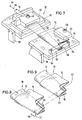
- the starting form of the test sample shown in FIG. 1 of the drawing, cut out of the wall of a hollow body can also result from the need to test the sample in order to carry out the test in a suitable manner in attach the tester and certain movements on it perform.
- Test sample 10 has a first strip-shaped section 12 on one end of which there is a second, essentially rectangular section 14 connects.
- the width of the first section 12 increases continuously so that its the second Section facing end has the smallest width. Because it only the area 16 adjoining this end is the the stresses required to carry out the test the shape and dimensions of the other areas the test sample without great importance. For area 16 applies only that it must be possible to fold it twice, to the remaining areas of the test sample, apart from the Possibility of fixing the sample in the device, in the only essential requirement is that they the folds and the movements required for the test enable or not hinder.
- Fig. 2 shows the arrangement of the sample 10 after completion this first folding process.
- the first, folded back Section 12 covers part of the second section 14.
- Die Line 18 corresponds to the end of this folding process Folding axis, the end region 16 of the first section 12 now part of a double-layered area 17 and the position the fold line 18 is selected so that the double-layer area 17 with the apex area of the first fold opposite the associated boundary edge 24 of section 14 protrudes.
- test sample is folded a second time approximately the axis of symmetry of the first section 12
- the longitudinal axis 26 of the same, as indicated by the arrow 28 in FIG. 2 is indicated. It then results in the opposite of the Boundary edge 24 protruding area 17 the four-layer arrangement 3, in which the folding axis 18 through the first fold in turn created a fold has experienced almost 180 ° and the fold axis 29 of the second fold corresponds approximately to the longitudinal axis 26.
- Test device 30 clamped.
- This tester has a pneumatic cylinder 32.
- the piston rod 34 of the piston guided therein is connected to a slide 36, which is slidably guided on the frame 38 of the device.
- the stroke performed by the piston and thus by the slide 36 the embodiment shown in the drawing Length of 30 mm.
- FIG. 7 shows in particular that on the slide 36 a releasable clamping plate 40 is arranged, which makes it possible the folded back, double-layered by the second fold Area at the free end of the first section 12 on the carriage 36 to be clamped by a screw 42.
- the device 30 is also provided with a stationary table 44 provided that on the side facing away from the cylinder 32 Carriage 30 is arranged approximately at the level of the latter.
- This Table 44 has a clamping plate 46 which is attached laterally and serves the test sample 10 in the area of the second Section 14, however outside the range of twice folded first section 12 to clamp on the table 44.
- a clamping screw 48 is also provided for this.
- Farther is at the table 44 a bar provided with a recess 50 52 releasably attached by means of screws 54. The arrangement is there made so that the recess 50 of the bar 52 in the area in which is stuck in the operating position Test sample of that four-layer area 22 of the same lie, which is opposite the boundary edge 24 of the second Section 12 of the test sample protrudes.
- the bridge-like bar 52 has the function of a hold-down for this four-layer Area 22. Accordingly, the height of the recess is 50, that is to say its Extent dimensioned perpendicular to the plane of the table 44 so that it enables the test sample to bend evenly and to a uniform buckling and thus to uniform Kink angles leads, which during the walking process essentially be maintained. In the specific case, i.e. one Wall thickness of the test sample in the critical areas of 1.2 mm, the recess 50 has a height of about 10 mm. Doing so on the other hand avoided that the test sample additional mechanical Stresses e.g. B. experiences by clamping or friction, that can falsify the test result. The width too the recess 50 is to be chosen so that to achieve more uniform Test conditions additional mechanical loads of the test sample should be avoided as far as possible.
- Fig. 9 of the drawing shows the position of the test sample, in particular their directly to the second section 14 subsequent four-layer region 22 of the first section 12 occupies by the vertex area, which is the folding axis 18 corresponds to the first fold, is limited.
- the bar 52 stops due to the aforementioned height of the recess 50 this area in the collapsed form such that the four layers in any case in the area of the strip 52 or the recess 50 of them are pressed against each other, so that the individual At least lay over parts of their areal extension abut each other.
- a lifting movement starting from the position according to FIG. 9 in the direction of arrow 56 has the consequence that since the first section 12 of test sample 10 through slide 36 on the other hand, the second section 14 of the test sample 10 this movement can not follow the first section 12 compared to the second section 14 within that of the latter formed fold moved towards the bar 52 becomes.
- Fig. 7 shows that the clamping plate 46 only the second section 14 is detected and the movement described above of the first section 12 is not hindered. The latter will out of position during the movement in the direction of arrow 56 9 brought into that of FIG. 8, in the course of this Movement of the fold axis 18 of the folds created by the first fold Fold the length of the stroke 58 in the direction of the arrow 56 is moved.
- the apex area leads this Fold out a kind of rolling motion that is similar to a walking process is. Since the first fold with fold line 18 in turn with formation of the fold belonging to the folding axis 29 is folded by approximately 180 ° the material forming the test sample 10 experiences at The aforementioned rolling movement over the length of the stroke 58 in Crossing area of both folds a very heavy load. This highly stressed area runs along the folding axis 29 of the second fold over the length of the parallel stroke movement in the direction of arrow 56, the apex area the folding axis 18 is rolled along the folding axis 29.
- the This type of stress corresponds approximately to the type of stress, which the material experiences in the areas of the inner container, in which two fold or crease lines intersect.
- the bar 52 acting as a hold-down prevents that the folded areas due to the elasticity of the material and / or the forces acting on it open up, ie unfold. It can be so precisely defined and reproducible Conditions for performing such tests be determined.
- the test sample shown in Fig. 1 of the drawing has one Total length of about 220 mm, of which about 150 mm on the first section 12 is omitted, on which the test is carried out becomes.
- the first section 12 has a width of 20 mm on.
- the first section widens to its free end continuous and symmetrical to a width of 70 mm. This Widening serves in particular for better handling, in particular when performing the second fold around the Longitudinal and symmetry plane of the first section.
- the area of the first section 12 on which the test is carried out that is, the area along which the apex area the first fold is moved back and forth has a width of approximately between 25 mm and 35 mm.
- test sample may also be possible not to separate the test sample by removing it a corresponding section from the wall of a Manufacture inner container, but by other means, for example by pressing the plastic to be tested, albeit the use of a section from the wall of a inner container manufactured in the extrusion blow molding process preference will be given to better comparability.
Landscapes
- Engineering & Computer Science (AREA)
- Mechanical Engineering (AREA)
- Investigating Strength Of Materials By Application Of Mechanical Stress (AREA)
- Tubes (AREA)
- Containers Having Bodies Formed In One Piece (AREA)
- Folding Of Thin Sheet-Like Materials, Special Discharging Devices, And Others (AREA)
- Packages (AREA)
- Closures For Containers (AREA)
Description
- Fig. 1
- die perspektivische Ansicht einer Prüfprobe in ungefaltetem Zustand,
- Fig. 2
- die perspektivische Ansicht der Prüfprobe nach Durchführung der ersten Faltung,
- Fig. 3
- die perspektivische Ansicht der Prüfprobe nach Durchführung der zweiten Faltung,
- Fig. 4
- im Schema die Seitenansicht einer Vorrichtung zum Prüfen der Proben,
- Fig. 5
- eine Ansicht der Vorrichtung etwa in Richtung des Pfeiles V der Fig. 4,
- Fig. 6
- eine Ansicht der Vorrichtung etwa in Richtung des Pfeiles VI der Fig. 4,
- Fig. 7
- eine perspektivische Ansicht etwa in Richtung des Pfeiles VII der Fig. 4 in größerem Maßstab,
- Fig. 8
- einen Ausschnitt aus der perspektivischen Ansicht einer doppelt gefalteten Prüfprobe in einer Extremposition während des Prüfvorganges,
- Fig. 9
- eine der Fig. 8 entsprechende Darstellung der Prüfprobe in der anderen Extremposition.
Claims (5)
- Flexibler Behälter aus thermoplastischem Kunststoff für fließfähige Füllgüter, der bei Gebrauch in einen ihn stützenden Außenbehälter eingestellt ist, wobei der Außenbehälter an die Größe und die Form des gefüllten Innenbehälters angepaßt werden kann, um seine Stützfunktion zu erfüllen und wenigstens der flexible im Extrusions-Blasverfahren hergestellte Innenbehälter in leerem Zustand in eine Gestalt zusammenfaltbar ist, in welcher er ein wesentlich geringeres Volumen aufweist als in gefülltem Zustand, dadurch gekennzeichnet, daß der Innenbehälter, der ein Füllvolumen von wenigstens 450 l aufweist, aus einem im Reaktor mit einem elastomeren Kunststoff modifizierten Propylen mit einem E-Modul von < 100 MPa besteht und bei der Erprobung auf Knickbeanspruchbarkeit folgenden Voraussetzungen genügt:
An einem in seinem Ausgangszustand im wesentlichen ebenen Prüfmuster aus dem thermoplastischen Kunststoff mit einer Wandstärke von etwa 1,2 mm in Form eines Materialstreifens mit einer Breite zwischen 20 und 70 mm, welches zunächst einmal quer zu seiner Längsrichtung gefaltet wurde, so daß die Achse dieser ersten Falte quer zur Längsachse des Streifens verläuft, und danach ein zweites Mal gefaltet wurde derart, daß die Achse dieser zweiten Faltung im wesentlichen parallel zur Längsachse des Streifens verläuft, werden die beiden inneren der durch die zweite Faltung erzeugten Lagen im wesentlichen parallel zur Faltachse dieser zweiten Faltung relativ zur ersten, außen befindlichen Lage linear hin- und herverschoben, wobei der Verschiebeweg etwa 30 mm beträgt und dabei alle vier Lagen des Prüfmusters in einer Position gehalten werden, in welcher sie zumindest in dem Bereich, in welchem die Faltachse der ersten Faltung hin- und herbewegt wird, wenigstens in Teilbereichen ihrer flächigen Erstreckung aneinander anliegen, wobei die Prüfung bei folgenden Randbedingungen durchgeführt wird:und das Prüfmuster mindestens 1000 Hubbewegungen unterzogen wird, ohne daß im Hubbereich irgendwelche Beschädigungen des Prüfmusters eintreten, die am Innenbehälter zu einer Beeinträchtigung seiner Funktionstüchtigkeit führen würden.Raumtemperatur: 22° Crelative Luftfeuchtigkeit: 55%Hubgeschwindigkeit: 30 Hübe/min.Hub: 30 mm - Flexibler Behälter nach Anspruch 1, dadurch gekennzeichnet, daß das Prüfmuster mindestens 2000 Hubbewegungen unterzogen wird, ohne daß im Hubbereich irgendwelche Beschädigungen des Prüfmusters eintreten, die am Innenbehälter zu einer Beeinträchtigung seiner Funktionstüchtigkeit führen würden.
- Flexibler Behälter nach Anspruch 1, dadurch gekennzeichnet, daß das Prüfmuster mindestens 5000 Hubbewegungen unterzogen wird, ohne daß im Hubbereich irgendwelche Beschädigungen des Prüfmusters eintreten, die am Innenbehälter zu einer Beeinträchtigung seiner Funktionstüchtigkeit führen würden.
- Flexibler Behälter nach Anspruch 1, dadurch gekennzeichnet, daß das Prüfmuster mindestens 10000 Hubbewegungen unterzogen wird, ohne daß im Hubbereich irgendwelche Beschädigungen des Prüfmusters eintreten, die am Innenbehälter zu einer Beeinträchtigung seiner Funktionstüchtigkeit führen würden.
- Flexibler Behälter nach Anspruch 1, dadurch gekennzeichnet, daß seine Wandstärke in den zu faltenden Bereichen zwischen 0,8 und 1,5 mm liegt.
Applications Claiming Priority (2)
| Application Number | Priority Date | Filing Date | Title |
|---|---|---|---|
| DE4405301 | 1994-02-19 | ||
| DE4405301A DE4405301A1 (de) | 1994-02-19 | 1994-02-19 | Flexibler Behälter aus thermoplastischem Kunststoff für fließfähige Füllgüter |
Publications (3)
| Publication Number | Publication Date |
|---|---|
| EP0668222A2 EP0668222A2 (de) | 1995-08-23 |
| EP0668222A3 EP0668222A3 (de) | 1996-05-15 |
| EP0668222B1 true EP0668222B1 (de) | 1998-06-10 |
Family
ID=6510630
Family Applications (1)
| Application Number | Title | Priority Date | Filing Date |
|---|---|---|---|
| EP95101665A Expired - Lifetime EP0668222B1 (de) | 1994-02-19 | 1995-02-08 | Flexibler Behälter aus thermoplastischem Kunststoff für fliessfähige Füllgüter |
Country Status (3)
| Country | Link |
|---|---|
| EP (1) | EP0668222B1 (de) |
| AT (1) | ATE167156T1 (de) |
| DE (2) | DE4405301A1 (de) |
Family Cites Families (3)
| Publication number | Priority date | Publication date | Assignee | Title |
|---|---|---|---|---|
| GB1510490A (en) * | 1974-09-09 | 1978-05-10 | Rheem Au Ltd | Foldable liner for containers |
| FR2306142A1 (fr) * | 1975-04-03 | 1976-10-29 | Boracier Sa | Poche pliable; procede et moule pour sa fabrication |
| FR2377942A1 (fr) * | 1977-01-20 | 1978-08-18 | Erb Rene | Recipient souple pliable |
-
1994
- 1994-02-19 DE DE4405301A patent/DE4405301A1/de not_active Withdrawn
-
1995
- 1995-02-08 AT AT95101665T patent/ATE167156T1/de not_active IP Right Cessation
- 1995-02-08 EP EP95101665A patent/EP0668222B1/de not_active Expired - Lifetime
- 1995-02-08 DE DE59502448T patent/DE59502448D1/de not_active Expired - Fee Related
Also Published As
| Publication number | Publication date |
|---|---|
| EP0668222A2 (de) | 1995-08-23 |
| ATE167156T1 (de) | 1998-06-15 |
| EP0668222A3 (de) | 1996-05-15 |
| DE4405301A1 (de) | 1995-08-24 |
| DE59502448D1 (de) | 1998-07-16 |
Similar Documents
| Publication | Publication Date | Title |
|---|---|---|
| DE69526599T2 (de) | Geschlossenes, einteiliges blasgeformtes Fass aus Kunststoff mit Handhabungsring sowie dessen Formverfahren | |
| DE2633379C3 (de) | Vorrichtung zum Vermessen der Geometrie des Formhohlraumes von Stranggießkokillen | |
| DE69706544T2 (de) | Rohrförmiger mehrkammer-behälter mit gleichmässiger abgabe | |
| DE2846700B2 (de) | Rohrartige Kultursammel- und Transportvorrichtung | |
| DE3702977A1 (de) | Dichtungs- und abstreifer-anordnung | |
| AT392525B (de) | Blattfeder aus faser-kunststoff-verbundwerkstoff | |
| EP1007327A1 (de) | Verfahren zur herstellung eines behälters sowie behälter mit druckausgleichsöffnungen | |
| EP2046564A1 (de) | Verfahren zur herstellung von mehreren faserverbundbauteilen | |
| DE1943027U (de) | Aus einem schlauch aus thermoplastischer kunststoffolie hergestellte tasche. | |
| DE2148401A1 (de) | Fuellbare hohlartikel aus mit gummi oder gummiersatzstoffen beschichteten geweben | |
| DE69107816T2 (de) | Verstärkte Ösenstruktur für Klammern. | |
| DE69805026T2 (de) | Radiale Luftreifen | |
| CH621742A5 (de) | ||
| DE69807295T2 (de) | Vorrichtung zum portionsweisen Entleeren einer Tube | |
| DE2517201A1 (de) | Dosierpumpe mit elastischem saug- und foerderorgan | |
| DE19935627C2 (de) | Verfahren zum Zusammensetzen der Enden von Materialbahnen | |
| DE69202253T2 (de) | Tube mit rechteckigem Querschnitt. | |
| EP0668222A2 (de) | Flexibler Behälter aus thermoplastischem Kunststoff für fliessfähige Füllgüter | |
| DE19632960A1 (de) | Elastische Kunststoffleiste, insbesondere für Lattenroste von Liegemöbeln | |
| DE69102678T2 (de) | Verfahren und Vorrichtung zur Prüfung des Endes eines geschlossenen Rohres. | |
| DE102006048413B4 (de) | Spritzform zum Herstellen von Scheibeneinheiten aus einer Scheibe und einem Rahmen | |
| DE10252461B4 (de) | Seitenplanenführung für Lastfahrzeuge | |
| DE9016893U1 (de) | Staubsaugereinsatzbeutel | |
| DE2210551C3 (de) | Arbeitselement mit einem Kolben | |
| DE4107375A1 (de) | Zylinderrohr fuer einen arbeitszylinder |
Legal Events
| Date | Code | Title | Description |
|---|---|---|---|
| PUAI | Public reference made under article 153(3) epc to a published international application that has entered the european phase |
Free format text: ORIGINAL CODE: 0009012 |
|
| AK | Designated contracting states |
Kind code of ref document: A2 Designated state(s): AT BE CH DE DK ES FR GB GR IT LI NL PT SE |
|
| PUAL | Search report despatched |
Free format text: ORIGINAL CODE: 0009013 |
|
| AK | Designated contracting states |
Kind code of ref document: A3 Designated state(s): AT BE CH DE DK ES FR GB GR IT LI NL PT SE |
|
| 17P | Request for examination filed |
Effective date: 19961023 |
|
| 17Q | First examination report despatched |
Effective date: 19961128 |
|
| GRAG | Despatch of communication of intention to grant |
Free format text: ORIGINAL CODE: EPIDOS AGRA |
|
| GRAG | Despatch of communication of intention to grant |
Free format text: ORIGINAL CODE: EPIDOS AGRA |
|
| GRAH | Despatch of communication of intention to grant a patent |
Free format text: ORIGINAL CODE: EPIDOS IGRA |
|
| GRAH | Despatch of communication of intention to grant a patent |
Free format text: ORIGINAL CODE: EPIDOS IGRA |
|
| RAP1 | Party data changed (applicant data changed or rights of an application transferred) |
Owner name: KAUTEX TEXTRON GMBH & CO. KG. |
|
| GRAA | (expected) grant |
Free format text: ORIGINAL CODE: 0009210 |
|
| AK | Designated contracting states |
Kind code of ref document: B1 Designated state(s): AT BE CH DE DK ES FR GB GR IT LI NL PT SE |
|
| PG25 | Lapsed in a contracting state [announced via postgrant information from national office to epo] |
Ref country code: NL Free format text: LAPSE BECAUSE OF FAILURE TO SUBMIT A TRANSLATION OF THE DESCRIPTION OR TO PAY THE FEE WITHIN THE PRESCRIBED TIME-LIMIT Effective date: 19980610 Ref country code: IT Free format text: LAPSE BECAUSE OF FAILURE TO SUBMIT A TRANSLATION OF THE DESCRIPTION OR TO PAY THE FEE WITHIN THE PRE;WARNING: LAPSES OF ITALIAN PATENTS WITH EFFECTIVE DATE BEFORE 2007 MAY HAVE OCCURRED AT ANY TIME BEFORE 2007. THE CORRECT EFFECTIVE DATE MAY BE DIFFERENT FROM THE ONE RECORDED.SCRIBED TIME-LIMIT Effective date: 19980610 Ref country code: GR Free format text: LAPSE BECAUSE OF NON-PAYMENT OF DUE FEES Effective date: 19980610 Ref country code: GB Free format text: LAPSE BECAUSE OF FAILURE TO SUBMIT A TRANSLATION OF THE DESCRIPTION OR TO PAY THE FEE WITHIN THE PRESCRIBED TIME-LIMIT Effective date: 19980610 Ref country code: FR Free format text: LAPSE BECAUSE OF FAILURE TO SUBMIT A TRANSLATION OF THE DESCRIPTION OR TO PAY THE FEE WITHIN THE PRESCRIBED TIME-LIMIT Effective date: 19980610 Ref country code: ES Free format text: THE PATENT HAS BEEN ANNULLED BY A DECISION OF A NATIONAL AUTHORITY Effective date: 19980610 |
|
| REF | Corresponds to: |
Ref document number: 167156 Country of ref document: AT Date of ref document: 19980615 Kind code of ref document: T |
|
| REG | Reference to a national code |
Ref country code: CH Ref legal event code: NV Representative=s name: R. A. EGLI & CO. PATENTANWAELTE Ref country code: CH Ref legal event code: EP |
|
| REF | Corresponds to: |
Ref document number: 59502448 Country of ref document: DE Date of ref document: 19980716 |
|
| PG25 | Lapsed in a contracting state [announced via postgrant information from national office to epo] |
Ref country code: SE Free format text: LAPSE BECAUSE OF FAILURE TO SUBMIT A TRANSLATION OF THE DESCRIPTION OR TO PAY THE FEE WITHIN THE PRESCRIBED TIME-LIMIT Effective date: 19980910 Ref country code: DK Free format text: LAPSE BECAUSE OF FAILURE TO SUBMIT A TRANSLATION OF THE DESCRIPTION OR TO PAY THE FEE WITHIN THE PRESCRIBED TIME-LIMIT Effective date: 19980910 |
|
| PG25 | Lapsed in a contracting state [announced via postgrant information from national office to epo] |
Ref country code: PT Free format text: LAPSE BECAUSE OF FAILURE TO SUBMIT A TRANSLATION OF THE DESCRIPTION OR TO PAY THE FEE WITHIN THE PRESCRIBED TIME-LIMIT Effective date: 19980915 |
|
| NLV1 | Nl: lapsed or annulled due to failure to fulfill the requirements of art. 29p and 29m of the patents act | ||
| EN | Fr: translation not filed | ||
| GBV | Gb: ep patent (uk) treated as always having been void in accordance with gb section 77(7)/1977 [no translation filed] |
Effective date: 19980610 |
|
| PGFP | Annual fee paid to national office [announced via postgrant information from national office to epo] |
Ref country code: DE Payment date: 19981229 Year of fee payment: 5 |
|
| PGFP | Annual fee paid to national office [announced via postgrant information from national office to epo] |
Ref country code: AT Payment date: 19990201 Year of fee payment: 5 |
|
| PG25 | Lapsed in a contracting state [announced via postgrant information from national office to epo] |
Ref country code: BE Free format text: LAPSE BECAUSE OF NON-PAYMENT OF DUE FEES Effective date: 19990228 |
|
| PLBE | No opposition filed within time limit |
Free format text: ORIGINAL CODE: 0009261 |
|
| STAA | Information on the status of an ep patent application or granted ep patent |
Free format text: STATUS: NO OPPOSITION FILED WITHIN TIME LIMIT |
|
| PGFP | Annual fee paid to national office [announced via postgrant information from national office to epo] |
Ref country code: CH Payment date: 19990531 Year of fee payment: 5 |
|
| 26N | No opposition filed | ||
| BERE | Be: lapsed |
Owner name: KAUTEX TEXTRON G.M.B.H. & CO. K.G. Effective date: 19990228 |
|
| PG25 | Lapsed in a contracting state [announced via postgrant information from national office to epo] |
Ref country code: AT Free format text: LAPSE BECAUSE OF NON-PAYMENT OF DUE FEES Effective date: 20000208 |
|
| PG25 | Lapsed in a contracting state [announced via postgrant information from national office to epo] |
Ref country code: LI Free format text: LAPSE BECAUSE OF NON-PAYMENT OF DUE FEES Effective date: 20000229 Ref country code: CH Free format text: LAPSE BECAUSE OF NON-PAYMENT OF DUE FEES Effective date: 20000229 |
|
| REG | Reference to a national code |
Ref country code: CH Ref legal event code: PL |
|
| PG25 | Lapsed in a contracting state [announced via postgrant information from national office to epo] |
Ref country code: DE Free format text: LAPSE BECAUSE OF NON-PAYMENT OF DUE FEES Effective date: 20001201 |