EP0666333B1 - TÔles fortes en alliages d'aluminium résistant à la fatigue et procédé d'obtention - Google Patents
TÔles fortes en alliages d'aluminium résistant à la fatigue et procédé d'obtention Download PDFInfo
- Publication number
- EP0666333B1 EP0666333B1 EP19950420013 EP95420013A EP0666333B1 EP 0666333 B1 EP0666333 B1 EP 0666333B1 EP 19950420013 EP19950420013 EP 19950420013 EP 95420013 A EP95420013 A EP 95420013A EP 0666333 B1 EP0666333 B1 EP 0666333B1
- Authority
- EP
- European Patent Office
- Prior art keywords
- fatigue
- porosities
- plates
- format
- maximum
- Prior art date
- Legal status (The legal status is an assumption and is not a legal conclusion. Google has not performed a legal analysis and makes no representation as to the accuracy of the status listed.)
- Revoked
Links
- 238000000034 method Methods 0.000 title claims description 11
- 229910000838 Al alloy Inorganic materials 0.000 title claims description 7
- 238000005266 casting Methods 0.000 claims description 14
- 238000005096 rolling process Methods 0.000 claims description 10
- UFHFLCQGNIYNRP-UHFFFAOYSA-N Hydrogen Chemical compound [H][H] UFHFLCQGNIYNRP-UHFFFAOYSA-N 0.000 claims description 7
- 239000001257 hydrogen Substances 0.000 claims description 7
- 229910052739 hydrogen Inorganic materials 0.000 claims description 7
- 238000005098 hot rolling Methods 0.000 claims description 4
- 229910001338 liquidmetal Inorganic materials 0.000 claims description 4
- 238000010791 quenching Methods 0.000 claims description 3
- 230000000171 quenching effect Effects 0.000 claims description 3
- 238000004519 manufacturing process Methods 0.000 claims description 2
- 230000032683 aging Effects 0.000 claims 2
- 230000007547 defect Effects 0.000 claims 2
- 230000035882 stress Effects 0.000 claims 2
- 125000004122 cyclic group Chemical group 0.000 claims 1
- 230000001747 exhibiting effect Effects 0.000 claims 1
- 229910045601 alloy Inorganic materials 0.000 description 5
- 239000000956 alloy Substances 0.000 description 5
- 238000012360 testing method Methods 0.000 description 5
- 238000012512 characterization method Methods 0.000 description 4
- 238000012937 correction Methods 0.000 description 4
- 229910052751 metal Inorganic materials 0.000 description 4
- 239000002184 metal Substances 0.000 description 4
- 230000000694 effects Effects 0.000 description 3
- 238000009661 fatigue test Methods 0.000 description 3
- 238000005242 forging Methods 0.000 description 3
- 230000004927 fusion Effects 0.000 description 3
- XKRFYHLGVUSROY-UHFFFAOYSA-N Argon Chemical compound [Ar] XKRFYHLGVUSROY-UHFFFAOYSA-N 0.000 description 2
- ZAMOUSCENKQFHK-UHFFFAOYSA-N Chlorine atom Chemical compound [Cl] ZAMOUSCENKQFHK-UHFFFAOYSA-N 0.000 description 2
- 229910052782 aluminium Inorganic materials 0.000 description 2
- XAGFODPZIPBFFR-UHFFFAOYSA-N aluminium Chemical compound [Al] XAGFODPZIPBFFR-UHFFFAOYSA-N 0.000 description 2
- 239000000460 chlorine Substances 0.000 description 2
- 229910052801 chlorine Inorganic materials 0.000 description 2
- 230000002596 correlated effect Effects 0.000 description 2
- 238000007872 degassing Methods 0.000 description 2
- 238000001514 detection method Methods 0.000 description 2
- 238000009826 distribution Methods 0.000 description 2
- 238000010438 heat treatment Methods 0.000 description 2
- 238000010191 image analysis Methods 0.000 description 2
- 238000005259 measurement Methods 0.000 description 2
- 238000012545 processing Methods 0.000 description 2
- 239000000523 sample Substances 0.000 description 2
- 238000005496 tempering Methods 0.000 description 2
- XLYOFNOQVPJJNP-UHFFFAOYSA-N water Substances O XLYOFNOQVPJJNP-UHFFFAOYSA-N 0.000 description 2
- 229910052786 argon Inorganic materials 0.000 description 1
- 230000002238 attenuated effect Effects 0.000 description 1
- 238000001739 density measurement Methods 0.000 description 1
- 238000010586 diagram Methods 0.000 description 1
- 230000008034 disappearance Effects 0.000 description 1
- 238000011156 evaluation Methods 0.000 description 1
- 239000012634 fragment Substances 0.000 description 1
- 238000000265 homogenisation Methods 0.000 description 1
- 230000000977 initiatory effect Effects 0.000 description 1
- 238000002844 melting Methods 0.000 description 1
- 230000008018 melting Effects 0.000 description 1
- 238000001000 micrograph Methods 0.000 description 1
- 239000000203 mixture Substances 0.000 description 1
- 238000005482 strain hardening Methods 0.000 description 1
- 230000002195 synergetic effect Effects 0.000 description 1
Images


Classifications
-
- C—CHEMISTRY; METALLURGY
- C22—METALLURGY; FERROUS OR NON-FERROUS ALLOYS; TREATMENT OF ALLOYS OR NON-FERROUS METALS
- C22F—CHANGING THE PHYSICAL STRUCTURE OF NON-FERROUS METALS AND NON-FERROUS ALLOYS
- C22F1/00—Changing the physical structure of non-ferrous metals or alloys by heat treatment or by hot or cold working
- C22F1/04—Changing the physical structure of non-ferrous metals or alloys by heat treatment or by hot or cold working of aluminium or alloys based thereon
- C22F1/053—Changing the physical structure of non-ferrous metals or alloys by heat treatment or by hot or cold working of aluminium or alloys based thereon of alloys with zinc as the next major constituent
-
- C—CHEMISTRY; METALLURGY
- C22—METALLURGY; FERROUS OR NON-FERROUS ALLOYS; TREATMENT OF ALLOYS OR NON-FERROUS METALS
- C22F—CHANGING THE PHYSICAL STRUCTURE OF NON-FERROUS METALS AND NON-FERROUS ALLOYS
- C22F1/00—Changing the physical structure of non-ferrous metals or alloys by heat treatment or by hot or cold working
- C22F1/04—Changing the physical structure of non-ferrous metals or alloys by heat treatment or by hot or cold working of aluminium or alloys based thereon
Definitions
- the invention relates to heavy plates of Al alloys resistant to fatigue and a process for obtaining them.
- the present invention also relates to a method for obtaining sheets of thickness between 110 and 250 mm in aluminum alloy with structural hardening as defined by claim 6.
- the fatigue resistance properties are further improved if the liquid metal at the time of casting has been suitably degassed by methods known to those skilled in the art (degassing with chlorine or with products containing chlorine, argon degassing pockets) so that the hydrogen content in the liquid metal are less than 0.15 cm 3 / 100g. It has also been found that the fatigue properties are further improved if during the hot rolling the last two rolling passes (inlet thickness-outlet thickness) are greater than 25 mm each.
- the products according to the invention resistant to fatigue are characterized by good internal health, determined by a US control in the vicinity of the median plane of the thick sheets.
- the device is calibrated using a standard block of the same type and in the same state of heat treatment as the test product, comprising flat bottom holes 0 50 and 100 ⁇ m, to which the maximum amplitude is conventionally assigned. 80% on the control screen, which fixes the overall gain Gb.
- the volume examined, on a slice of maximum thickness of 20 mm, is 20 x 20 x 0.6 mm 3 .
- the measurements are located on several locations to obtain reliable statistical values.
- the porosities are defined by the peaks exceeding an adjustable threshold, and fixed slightly above the background noise.
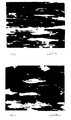
- Figure 1 shows a macrographic section along the L / TC plane (long / short cross) of a 118 mm thick sheet from size A from example 1.
- FIG. 2 represents a macrographic section along the L / TC plane a 125 mm sheet from format B of Example 1.
- Figures 3 and 4 show the density and distribution of the phases intermetallic sheets from A and B format respectively Example 1, L / TC plan.
- FIGS. 5 and 6 represent in an amplitude - number of porosities / cm 3 diagram, the results of the acoustic micrographs carried out on the product of Example 4, the standard being a hole with a flat bottom 100 ⁇ m.
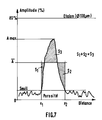
- FIG. 7 represents the principle for determining the quantities Amax and AT .
- the alloys will be designated according to the nomenclature of Aluminum Association.
- 7010 alloy plates were developed on the one hand in 420 mm thick formats after scalping (outside the invention: format A) and on the other hand in 260 mm thick formats after scalping (according to the invention: format B ).
- the thickness of metal removed with scalping is identical in both cases.
- the hydrogen content in the liquid metal is in both cases ⁇ 0.15 cm 3 / 100g.
- the final thickness of the sheets is 118 mm for format A, which leads to a correction factor C of 3.56 for format A and 125 mm for format B, which leads to a correction factor C of 2.08 for format B.
- the form factor of the pouring grain is of the order of 4 to 6 for format A and of the order of 2 to 3 for format B.
- the two sheets were then subjected to a solution treatment of 8 hours at 480 ° C followed by water quenching, controlled traction of 2.1% and a 10 hour tempering treatment at 120 ° C followed by 8 hours at 170 ° C, so as to give them the characteristics of state T 7651.
- the staircase case fatigue test tubes were used to measure the size and number of microposits by image analysis on a micrographic section.
- the measurements by image analysis were carried out on a polished section in a mid-thickness L - TC plane, under magnification ⁇ 100, with examination of 150 fields of 1 mm ⁇ 1 mm, ie a total surface examined of 150 mm 2 by test tube.
- the measured parameter is Dmax, the largest dimension in the observation plane, for all Dmax> 20 microns.
- Figures 3 and 4 show the size and distribution of intermetallic in the case of the two formats. There is a size and reduced intermetallic density in the case of format B.
- 7050 alloy plates were developed on the one hand in 420 mm thick formats after scalping (outside the invention: format A) and on the other hand in 260 mm thick formats after scalping (according to the invention: format B ).
- the thickness of metal removed with scalping is identical in both cases.
- the hydrogen content in the metal is in each case ⁇ 0.15 cm 3 / 100g.
- the two sheets were then subjected to a solution dissolving treatment of 20 hours at 478 ° C followed by water quenching, controlled traction of 1.6% and a 6 hour tempering treatment at 120 ° C followed by 21 hours at 165 ° C so as to give them the characteristics of state T 7451.
- the logarithmic means of life on 8 test pieces taken in the TL direction at half-width and half-thickness of the sheets are grouped in Table III, as well as the maximum number of porosities per cm2.
- the elastic limit is 411 MPa in the TL direction for the sheet from format B (according to the invention) and 420 MPa in the TL direction for the sheet from format A (outside the invention).
- Landmark Melt bed chip content (%) Final thickness (mm)
- Log average life (cycles) Rp0.2 TL (MPa) 201 0% 200 118000 411 202 0% 150 145000 436 203 10% 200 93000 413 204 10% 150 112000 447
Landscapes
- Chemical & Material Sciences (AREA)
- Mechanical Engineering (AREA)
- Thermal Sciences (AREA)
- Crystallography & Structural Chemistry (AREA)
- Engineering & Computer Science (AREA)
- Materials Engineering (AREA)
- Physics & Mathematics (AREA)
- Metallurgy (AREA)
- Organic Chemistry (AREA)
- Metal Rolling (AREA)
- Continuous Casting (AREA)
- Forging (AREA)
- Manufacture Of Alloys Or Alloy Compounds (AREA)
Description
Le second de ces brevets décrit un exemple dans lequel le taux de corroyage (forgeage et laminage) est de 2,6. Mais l'introduction d'une étape de préforgeage impose un double réchauffage des plaques et leur transport sur deux sites de production différents, ce qui entraíne une augmentation significative du coût de transformation.
La présente invention concerne également une méthode d'obtention de tôles d'épaisseur comprise entre 110 et 250 mm en alliage d'aluminium à durcissement structural telle que définie par la revendication 6.
Contrairement à l'enseignement de l'art antérieur, la demanderesse a constaté, avec surprise, que des propriétés de fatigue nettement améliorées pouvaient être obtenues en limitant le corroyage à des valeurs C < 2,4 pour des tôles ayant des épaisseurs finales comprises entre 110 mm et 150 mm (et donc avec des épaisseurs de plaques scalpées < 360 mm), et même à des valeurs C < 2 pour des tôles ayant des épaisseurs finales comprises entre 150 mm et 250 mm (et donc avec des épaisseurs de plaques scalpées < 500 mm). Ce corroyage à chaud est obtenu de préférence uniquement par laminage, sans forgeage préalable.
L'appareil de contrôle utilisé est un émetteur-récepteur PR 02 de Synergetics ou 5052 de Panametrics avec les réglages suivants : US focalisés : tache focale (à -6 dB ou mi-amplitude) en forme d'ellipsoïde allongé 100 µm x 600 µm
fréquence : 50 MHz
Palpeur à large bande ( Δf / fo = 70%)
L'appareil est étalonné à l'aide d'un bloc étalon de même nature et dans le même état de traitement thermique que le produit testé, comportant des trous à fond plat 0 50 et 100 µm, auquel on attribue conventionnellement l'amplitude maximale de 80% sur l'écran de contrôle, ce qui fixe le gain global Go.
Le volume examiné, sur une tranche d'épaisseur maximale de 20 mm, est de 20 x 20 x 0,6 mm3.
Les porosités sont définies par les pics dépassant un seuil, réglable, et fixé légèrement au-dessus du bruit de fond.
- le nombre de porosités (de taille équivalente > 20 µm, seuil de détection) par unité de volume
- la moyenne arithmétique des amplitudes maximales Amax, Amax étant la valeur maximum de l'écho sur une porosité,
- la moyenne arithmétique des amplitudes moyennes
A ,A étant égale àx et y étant les distances sur l'image de la porosité considérée (voir fig. 7).
Nombre de porosités ≤ 800/cm3
Moyenne des Amplitudes moyennes
Moyenne des Amplitudes maximales Amax ≤ 50 %
- L =
- sens long
- TL =
- sens travers long
- TC =
- sens travers court
- R =
- contrainte maximale/contrainte minimale d'un cycle lors des essais de fatigue
- Kt =
- coefficient d'entaille
- ΔK =
- variation du facteur d'intensité de contrainte lors des essais de fatigue
- da/dn =
- vitesse de propagation des fissures de fatigue
| Format A | 20-30-40-40-34-34 mm |
| Format B | 22-23-26-28-32 mm |
| Format | Epais.finale de la Tôle (mm) | Contrainte à 105 cycles (MPa) | Nombre de porosités /cm2 ayant 20 < Dmax < 100 µm | Nombre de porosités /cm2 ayant Dmax > 100 µm | Rp0,2 TL (MPa) |
| A-coulée 92990 | 118 | 212 ± 15 | 107 | 3 | 455 |
| A-coulée 92292 | 118 | 210 ± 5 | 110 | 10 | 455 |
| B-coulée 93193 | 125 | 246 ± 5 | 67 | 0 | 453 |
| Format | Epaisseur finale de la tôle (mm) | da/dN à 10MPa √m (mm/cycle) | da/dN à 20MPa √m (mm/cycle) |
| A-coulée 92990 | 118 | 1,8 10-4 | 10-3 |
| B-coulée 93139 | 125 | 10-4 | 10-3 |
| Format A | 28 mm/32 mm | épaisseur finale 204 mm |
| Format B | 34 mm/34 mm | épaisseur finale 204 mm |
| Format | Epaisseur finale de la tôle (mm) | Moyenne logarithmique de durée de vie (en cycles) | Nombre maximum de porosités/(cm2) | Rp0,2 TL (MPa) |
| A-coulée 96343 | 204 | 71000 | 7 | 420 |
| B-coulée 96381 | 204 | 118000 | 4 | 411 |
| Format | H2 cm3/100 g | 2 dernières Passes (mm) | Porosités/cm2 (> 20 µm) | Contrainte de rupture à 106 cycles (MPa) | Rp0,2 TL (MPa) |
| B/1 | 0,3 | 7/5 | 109 | 115 ± 5,9 | 446 |
| B/2 | 0,3 | 17/16 | 90 | 112 ± 3,8 | 443 |
| B/3 | < 0,15 | 6/5 | 16 | 200 ± 26,1 | 451 |
| B/4 | < 0,15 | 19/18 | 7 | 215 ± 11,3 | 455 |
Deux de ces plaques ont été élaborées avec un lit de fusion ne comportant pas de copeaux recyclés, les deux autres plaques ont été élaborées avec un lit de fusion comportant 10% de copeaux recyclés.
Ces plaques ont été transformées selon la gamme décrite dans l'exemple 2, et conduites jusqu'à des épaisseurs finales de 200 mm et 150 mm. Les moyennes logarithmiques de durée de vie en fatigue sous 242 MPa, R = 0,1, Kt = 1 à l'état T 7451 ont été mesurées dans chaque cas. Les résultats sont regroupés dans le Tableau V.
| Repère | Teneur en copeaux de lit de fusion (%) | Epaisseur finale (mm) | Moyenne logarithmique de durée de vie (cycles) | Rp0,2 TL (MPa) |
| 201 | 0% | 200 | 118000 | 411 |
| 202 | 0% | 150 | 145000 | 436 |
| 203 | 10% | 200 | 93000 | 413 |
| 204 | 10% | 150 | 112000 | 447 |
Claims (9)
- Tôles d'épaisseur > 110 mm en alliage d'aluminium à durcissement structural résistant à la fatigue, caractérisées en ce que la densité des porosités de taille équivalente comprise entre 20 et 100 µm, et situées au voisinage du plan médian de laminage, est inférieure à 800 par cm3.
- Tôles selon la revendication 1, caractérisées en ce que la moyenne des amplitudes maximum des défauts, mesurées par les valeurs maximum de l'écho aux ultrasons sur les porosités, est inférieure à 50% lorsque l'amplitude maximale de 80% est attribuée conventionnellement à un trou à fond plat de 100 µm.
- Tôles selon la revendication 1, caractérisées en ce que la moyenne des amplitudes moyennes des défauts, mesurées par les valeursx et y étant les distances sur l'image des porosités, est inférieure à 22% lorsque l'amplitude maximale de 80% est attribuée conventionnellement à un trou à fond plat de 100 µm.

- Tôles selon l'une des revendications 1 à 3, caractérisées en ce qu'à l'état traité (trempé mûri, ou trempé revenu, ou trempé mûri revenu) elles possèdent une durée de vie en fatigue > 100000 cycles en traction ondulée (R = 0,1) sous une contrainte maximale égale à 50% de la limite élastique Rp0,2.
- Tôles selon la revendication 4, caractérisées en ce que la durée de vie en fatigue dépasse 100000 cycles sous une contrainte maximale égale à 60% de Rp0,2.
- Méthode d'obtention de tôles d'épaisseur comprise entre 110 et 250 mm en alliage d'aluminium à durcissement structural, résistant à la fatigue et présentant une densité de porosités de taille équivalente comprise entre 20 et 100 µm, situées au voisinage du plan médian de laminage, inférieure à 800 par cm3, comportant la coulée d'une plaque, le scalpage de cette plaque, une homogénéisation, un corroyage à chaud, une mise en solution, une trempe, éventuellement une traction contrôlée, une maturation pour obtenir les états T351 ou T4 ou un revenu pour obtenir les états T651 ou T7x51, caractérisée en ce que le corroyage à chaud C est inférieur à 2,4 pour les épaisseurs comprises entre 110 et 150 mm, et inférieur à 2 pour les épaisseurs comprises entre 150 et 250 mm.
- Méthode selon la revendication 6, caractérisée en ce que le corroyage à chaud est uniquement un laminage.
- Méthode selon l'une des revendications 6 ou 7, caractérisée en ce que la teneur en hydrogène du métal liquide de départ est inférieure à 0,15 cm3/100 g.
- Méthode selon l'une des revendications 6 à 8, caractérisée en ce que les deux dernières passes de laminage à chaud sont supérieures à 25 mm chacune.
Applications Claiming Priority (4)
| Application Number | Priority Date | Filing Date | Title |
|---|---|---|---|
| FR9401044A FR2715408A1 (fr) | 1994-01-25 | 1994-01-25 | Tôles fortes en alliages d'aluminium résistant à la fatigue et procédé d'obtention. |
| FR9403712 | 1994-03-23 | ||
| FR9401044 | 1994-03-23 | ||
| FR9403712A FR2715409B1 (fr) | 1994-01-25 | 1994-03-23 | Tôles fortes en alliages d'aluminium résistant à la fatigue et procédé d'obtention. |
Publications (2)
| Publication Number | Publication Date |
|---|---|
| EP0666333A1 EP0666333A1 (fr) | 1995-08-09 |
| EP0666333B1 true EP0666333B1 (fr) | 1999-06-30 |
Family
ID=26230921
Family Applications (1)
| Application Number | Title | Priority Date | Filing Date |
|---|---|---|---|
| EP19950420013 Revoked EP0666333B1 (fr) | 1994-01-25 | 1995-01-23 | TÔles fortes en alliages d'aluminium résistant à la fatigue et procédé d'obtention |
Country Status (5)
| Country | Link |
|---|---|
| EP (1) | EP0666333B1 (fr) |
| JP (1) | JPH0839102A (fr) |
| CA (1) | CA2140385A1 (fr) |
| DE (2) | DE666333T1 (fr) |
| FR (1) | FR2715409B1 (fr) |
Families Citing this family (2)
| Publication number | Priority date | Publication date | Assignee | Title |
|---|---|---|---|---|
| US5772800A (en) * | 1994-06-09 | 1998-06-30 | Hoogovens Aluminium Walzprodukte Gmbh | Aluminium alloy plate and method for its manufacture |
| FR2879217B1 (fr) * | 2004-12-13 | 2007-01-19 | Pechiney Rhenalu Sa | Toles fortes en alliage ai-zn-cu-mg a faibles contraintes internes |
Family Cites Families (2)
| Publication number | Priority date | Publication date | Assignee | Title |
|---|---|---|---|---|
| FR2529578B1 (fr) * | 1982-07-02 | 1986-04-11 | Cegedur | Procede pour ameliorer a la fois la resistance a la fatigue et la tenacite des alliages d'al a haute resistance |
| US5277719A (en) * | 1991-04-18 | 1994-01-11 | Aluminum Company Of America | Aluminum alloy thick plate product and method |
-
1994
- 1994-03-23 FR FR9403712A patent/FR2715409B1/fr not_active Expired - Fee Related
-
1995
- 1995-01-17 CA CA 2140385 patent/CA2140385A1/fr not_active Abandoned
- 1995-01-23 DE DE1995420013 patent/DE666333T1/de active Pending
- 1995-01-23 EP EP19950420013 patent/EP0666333B1/fr not_active Revoked
- 1995-01-23 DE DE1995610476 patent/DE69510476T2/de not_active Revoked
- 1995-01-25 JP JP980895A patent/JPH0839102A/ja active Pending
Also Published As
| Publication number | Publication date |
|---|---|
| EP0666333A1 (fr) | 1995-08-09 |
| FR2715409A1 (fr) | 1995-07-28 |
| CA2140385A1 (fr) | 1995-07-26 |
| DE69510476D1 (de) | 1999-08-05 |
| DE69510476T2 (de) | 1999-11-04 |
| DE666333T1 (de) | 1996-10-24 |
| JPH0839102A (ja) | 1996-02-13 |
| FR2715409B1 (fr) | 1996-05-24 |
Similar Documents
| Publication | Publication Date | Title |
|---|---|---|
| Avalle et al. | Casting defects and fatigue strength of a die cast aluminium alloy: a comparison between standard specimens and production components | |
| KR102610549B1 (ko) | 개선된 두꺼운 가공 7xxx 알루미늄 합금, 및 이의 제조 방법 | |
| JP2002241882A (ja) | 高強度、高耐食性構造用アルミニウム合金板の製造方法 | |
| WO1985002416A1 (fr) | Alliages a base d'aluminium contenant du lithium, du magnésium et du cuivre | |
| CA2907854A1 (fr) | Toles minces en alliage d'aluminium-cuivre-lithium pour la fabrication de fuselages d'avion | |
| WO2016051061A1 (fr) | Procédé de fabrication de produits en alliage aluminium, magnésium, lithium | |
| EP3728667A1 (fr) | Procede de fabrication ameliore de toles en alliage d'aluminium-cuivre-lithium pour la fabrication de fuselage d'avion | |
| WO2019106254A1 (fr) | Produit plat en alliage d'aluminium presentant des proprietes ameliorees dans l'epaisseur | |
| FR2879217A1 (fr) | Toles fortes en alliage ai-zn-cu-mg a faibles contraintes internes | |
| GB2065516A (en) | A cast bar of an aluminum alloy for wrought products, having improved mechanical properties and workability | |
| JP4712159B2 (ja) | 強度と耐食性に優れたアルミニウム合金板およびその製造方法 | |
| Sahin et al. | Estimating toughness limit of cast aluminum alloys with reduced pressure test | |
| EP0666333A1 (fr) | Tôles fortes en alliages d'aluminium résistant à la fatigue et procédé d'obtention | |
| EP0282421B1 (fr) | Produit en alliage d'Al comprenant du Li, résistant à la corrosion sous tension et procédé d'obtention | |
| EP0731185A1 (fr) | TÔles en alliage Al-Cu-Mg à faible niveau de contraintes résiduelles | |
| Khomamizadeh et al. | Evaluation of quality index of A-356 aluminum alloy by microstructural analysis | |
| GB2130941A (en) | A cast bar of an aluminum alloy for wrought products, having improved mechanical properties and workability | |
| FR2715408A1 (fr) | Tôles fortes en alliages d'aluminium résistant à la fatigue et procédé d'obtention. | |
| EP3802897B1 (fr) | Toles minces en alliage d'aluminium-cuivre-lithium pour la fabrication de fuselages d'avion | |
| JP7669663B2 (ja) | 自動車のホイール用アルミニウム合金及び自動車のホイール | |
| RU2489217C1 (ru) | Способ производства листов из термически упрочняемых алюминиевых сплавов, легированных скандием и цирконием | |
| Girelli et al. | Impact behavior of gravity cast AlSi10Mg alloy: Effect of hot isostatic pressing and innovative high pressure T6 heat treatment | |
| Bosi et al. | Fatigue properties of a cast aluminium alloy for rims of car wheels | |
| CA2014776A1 (fr) | Alliage al-li-cu-mg a bonne deformabilite a froid et bonne resistance aux dommages | |
| JP3563313B2 (ja) | 超音波探傷による金属材料の清浄度評価方法 |
Legal Events
| Date | Code | Title | Description |
|---|---|---|---|
| PUAI | Public reference made under article 153(3) epc to a published international application that has entered the european phase |
Free format text: ORIGINAL CODE: 0009012 |
|
| AK | Designated contracting states |
Kind code of ref document: A1 Designated state(s): DE FR GB |
|
| 17P | Request for examination filed |
Effective date: 19950825 |
|
| GBC | Gb: translation of claims filed (gb section 78(7)/1977) | ||
| DET | De: translation of patent claims | ||
| 17Q | First examination report despatched |
Effective date: 19971105 |
|
| GRAG | Despatch of communication of intention to grant |
Free format text: ORIGINAL CODE: EPIDOS AGRA |
|
| GRAG | Despatch of communication of intention to grant |
Free format text: ORIGINAL CODE: EPIDOS AGRA |
|
| GRAH | Despatch of communication of intention to grant a patent |
Free format text: ORIGINAL CODE: EPIDOS IGRA |
|
| GRAH | Despatch of communication of intention to grant a patent |
Free format text: ORIGINAL CODE: EPIDOS IGRA |
|
| GRAA | (expected) grant |
Free format text: ORIGINAL CODE: 0009210 |
|
| AK | Designated contracting states |
Kind code of ref document: B1 Designated state(s): DE FR GB |
|
| REF | Corresponds to: |
Ref document number: 69510476 Country of ref document: DE Date of ref document: 19990805 |
|
| GBT | Gb: translation of ep patent filed (gb section 77(6)(a)/1977) |
Effective date: 19990804 |
|
| PLBQ | Unpublished change to opponent data |
Free format text: ORIGINAL CODE: EPIDOS OPPO |
|
| PLBI | Opposition filed |
Free format text: ORIGINAL CODE: 0009260 |
|
| PLBQ | Unpublished change to opponent data |
Free format text: ORIGINAL CODE: EPIDOS OPPO |
|
| PLAB | Opposition data, opponent's data or that of the opponent's representative modified |
Free format text: ORIGINAL CODE: 0009299OPPO |
|
| PLBI | Opposition filed |
Free format text: ORIGINAL CODE: 0009260 |
|
| PLBF | Reply of patent proprietor to notice(s) of opposition |
Free format text: ORIGINAL CODE: EPIDOS OBSO |
|
| 26 | Opposition filed |
Opponent name: ALUMINUM COMPANY OF AMERICA Effective date: 20000329 |
|
| 26 | Opposition filed |
Opponent name: CORUS ALUMINIUM WALZPRODUKTE GMBH Effective date: 20000329 Opponent name: ALUMINUM COMPANY OF AMERICA Effective date: 20000328 |
|
| REG | Reference to a national code |
Ref country code: GB Ref legal event code: IF02 |
|
| PLAW | Interlocutory decision in opposition |
Free format text: ORIGINAL CODE: EPIDOS IDOP |
|
| APAC | Appeal dossier modified |
Free format text: ORIGINAL CODE: EPIDOS NOAPO |
|
| APAE | Appeal reference modified |
Free format text: ORIGINAL CODE: EPIDOS REFNO |
|
| APAC | Appeal dossier modified |
Free format text: ORIGINAL CODE: EPIDOS NOAPO |
|
| APAC | Appeal dossier modified |
Free format text: ORIGINAL CODE: EPIDOS NOAPO |
|
| APAC | Appeal dossier modified |
Free format text: ORIGINAL CODE: EPIDOS NOAPO |
|
| PGFP | Annual fee paid to national office [announced via postgrant information from national office to epo] |
Ref country code: DE Payment date: 20031216 Year of fee payment: 10 |
|
| PGFP | Annual fee paid to national office [announced via postgrant information from national office to epo] |
Ref country code: GB Payment date: 20031222 Year of fee payment: 10 |
|
| PGFP | Annual fee paid to national office [announced via postgrant information from national office to epo] |
Ref country code: FR Payment date: 20040119 Year of fee payment: 10 |
|
| APBU | Appeal procedure closed |
Free format text: ORIGINAL CODE: EPIDOSNNOA9O |
|
| RDAF | Communication despatched that patent is revoked |
Free format text: ORIGINAL CODE: EPIDOSNREV1 |
|
| RDAG | Patent revoked |
Free format text: ORIGINAL CODE: 0009271 |
|
| STAA | Information on the status of an ep patent application or granted ep patent |
Free format text: STATUS: PATENT REVOKED |
|
| 27W | Patent revoked |
Effective date: 20040915 |
|
| GBPR | Gb: patent revoked under art. 102 of the ep convention designating the uk as contracting state |
Free format text: 20040915 |
|
| APAH | Appeal reference modified |
Free format text: ORIGINAL CODE: EPIDOSCREFNO |