EP0665329B1 - Press felt and method of manufacturing it - Google Patents
Press felt and method of manufacturing it Download PDFInfo
- Publication number
- EP0665329B1 EP0665329B1 EP95102372A EP95102372A EP0665329B1 EP 0665329 B1 EP0665329 B1 EP 0665329B1 EP 95102372 A EP95102372 A EP 95102372A EP 95102372 A EP95102372 A EP 95102372A EP 0665329 B1 EP0665329 B1 EP 0665329B1
- Authority
- EP
- European Patent Office
- Prior art keywords
- fabric
- yarn material
- layer
- strip
- press felt
- Prior art date
- Legal status (The legal status is an assumption and is not a legal conclusion. Google has not performed a legal analysis and makes no representation as to the accuracy of the status listed.)
- Expired - Lifetime
Links
Images

Classifications
-
- D—TEXTILES; PAPER
- D06—TREATMENT OF TEXTILES OR THE LIKE; LAUNDERING; FLEXIBLE MATERIALS NOT OTHERWISE PROVIDED FOR
- D06H—MARKING, INSPECTING, SEAMING OR SEVERING TEXTILE MATERIALS
- D06H5/00—Seaming textile materials
- D06H5/003—Devices or apparatus for joining the longitudinal edges of fabrics
- D06H5/005—Devices or apparatus for joining the longitudinal edges of fabrics for making a tubular fabric
-
- D—TEXTILES; PAPER
- D21—PAPER-MAKING; PRODUCTION OF CELLULOSE
- D21F—PAPER-MAKING MACHINES; METHODS OF PRODUCING PAPER THEREON
- D21F7/00—Other details of machines for making continuous webs of paper
- D21F7/08—Felts
- D21F7/083—Multi-layer felts
-
- Y—GENERAL TAGGING OF NEW TECHNOLOGICAL DEVELOPMENTS; GENERAL TAGGING OF CROSS-SECTIONAL TECHNOLOGIES SPANNING OVER SEVERAL SECTIONS OF THE IPC; TECHNICAL SUBJECTS COVERED BY FORMER USPC CROSS-REFERENCE ART COLLECTIONS [XRACs] AND DIGESTS
- Y10—TECHNICAL SUBJECTS COVERED BY FORMER USPC
- Y10T—TECHNICAL SUBJECTS COVERED BY FORMER US CLASSIFICATION
- Y10T428/00—Stock material or miscellaneous articles
- Y10T428/24—Structurally defined web or sheet [e.g., overall dimension, etc.]
- Y10T428/24777—Edge feature
-
- Y—GENERAL TAGGING OF NEW TECHNOLOGICAL DEVELOPMENTS; GENERAL TAGGING OF CROSS-SECTIONAL TECHNOLOGIES SPANNING OVER SEVERAL SECTIONS OF THE IPC; TECHNICAL SUBJECTS COVERED BY FORMER USPC CROSS-REFERENCE ART COLLECTIONS [XRACs] AND DIGESTS
- Y10—TECHNICAL SUBJECTS COVERED BY FORMER USPC
- Y10T—TECHNICAL SUBJECTS COVERED BY FORMER US CLASSIFICATION
- Y10T428/00—Stock material or miscellaneous articles
- Y10T428/24—Structurally defined web or sheet [e.g., overall dimension, etc.]
- Y10T428/24777—Edge feature
- Y10T428/24785—Edge feature including layer embodying mechanically interengaged strands, strand portions or strand-like strips [e.g., weave, knit, etc.]
-
- Y—GENERAL TAGGING OF NEW TECHNOLOGICAL DEVELOPMENTS; GENERAL TAGGING OF CROSS-SECTIONAL TECHNOLOGIES SPANNING OVER SEVERAL SECTIONS OF THE IPC; TECHNICAL SUBJECTS COVERED BY FORMER USPC CROSS-REFERENCE ART COLLECTIONS [XRACs] AND DIGESTS
- Y10—TECHNICAL SUBJECTS COVERED BY FORMER USPC
- Y10T—TECHNICAL SUBJECTS COVERED BY FORMER US CLASSIFICATION
- Y10T442/00—Fabric [woven, knitted, or nonwoven textile or cloth, etc.]
- Y10T442/30—Woven fabric [i.e., woven strand or strip material]
- Y10T442/3033—Including a strip or ribbon
Definitions
- the present invention relates to a press felt for use in a papermaking machine, and to a method of manufacturing the press felt, which is of the type comprising a woven base fabric which is made of yarn material and is endless in the machine direction (i.e. in the running direction of the press felt in the papermaking machine), and one or more layers of fibre material arranged on the base fabric.
- endless base fabric as used herein and in the following relates to a base fabric which is closed during operation.
- the term “endless” should, in particular, be considered also to include the case where the base fabric can be opened across the machine direction for mounting in a papermaking machine, and subsequently joined together by means of a locking seam.
- the "fabric of yarn material” as mentioned above may in particular be some type of woven or knitted fabric, and the term “fibre material” includes all types of batt layers and the like that can be used in a press felt.
- base fabrics for press felts are manufactured mainly by tubular weaving technique which is known to those skilled in the art and according to which the fabric is made in the form of a tube or a hose-pipe and the weft threads are alternately passing into an upper warp thread layer (upper cloth) and a lower warp thread layer (lower cloth).
- the extent of this "tube” in the transverse direction of the weaving loom thus corresponds to half the length of the final base fabric.
- the width of the base fabric is determined by the weaving length.
- the strip has a width which is smaller than the width of the final base fabric, and the strip is wound in one or more layers, edge-to-edge or overlapping. No edge joints are provided between adjacent edge portions of the spirally-wound fabric strip.
- a press felt according to the invention thus comprises a press felt for a papermaking machine, comprising a base fabric which is made of yarn material and is endless in the machine direction of the press felt, and one or more layers of fibre material arranged on the base fabric.
- Said base fabric comprises at least one layer composed of a spirally-wound fabric strip made of yarn material and having a width which is smaller than the width of the final base fabric, longitudinal threads of the spirally-wound fabric strip of yarn material making an angle with the machine direction of the press felt.
- the base fabric comprises one or more further layers of fabric of yarn material.
- Said further fabric layers of yarn material comprise a second layer composed of a spirally-wound strip made of fabric of yarn material and having a width which is smaller than the width of the final base fabric.
- the fabric strip of yarn material in said first layer and the fabric strip of yarn material in said second layer are wound mutually crosswise, such that the longitudinal threads of the spirally-wound fabric strip of yarn material of said second layer make an angle both with the machine direction of the press felt and with the longitudinal threads of the spirally-wound fabric strip of yarn material of the first-mentioned layer.
- the fabric strip of yarn material is wound or placed spirally, preferably over at least two rolls having parallel axes, to form said layer of the base fabric.
- the length of base fabric will be determined by the length of each spiral turn of the fabric strip of yarn material and its width determined by the number of spiral turns.
- the number of spiral turns over the total width of the base fabric may vary.
- the term "strip" as used herein and in the following relates to a piece of material having an essentially larger length than width, the only upper limit of the strip width is that it should be narrower than the width of the final base fabric.
- the strip width may for example be 0.5-1.5 m, which should be compared with a press felt which may be wider than 10 m.
- adjoining portions of the longitudinal edges of the spirally-wound strip are preferably so arranged that the joints or transitions between the spiral turns become completely smooth, i.e. such that the spirally-wound layer has a substantially constant thickness across the entire width of the base fabric.
- the spiral turns of the strip need not necessarily be fixed to each other, but preferably there is an edge joint between the adjoining longitudinal edge portions of the spirally-wound strip.
- the edge joint can be achieved, e.g. by sewing (for instance with water-soluble thread), melting, and welding (for instance ultrasonic welding), of non-woven material, or of non-woven material with melting fibres.
- the edge joint can also be obtained by providing the fabric strip of yarn material along its two longitudinal edges with seam loops of known type, which can be joined by means of one or more seam threads. Such seam loops may for instance be formed directly of the weft threads, if the strip is flat-woven.
- these may be arranged edge to edge of overlappingly.
- the strip edges must however be so shaped that when being placed so as to overlap each other, they fit into each other without giving rise to any thickness increase at the joint.
- One way of achieving this is to reduce the thickness of the edges by half as compared with the thickness of the rest of the strip.
- Another way is to increase the warp thread spacing at the edges and "interlace" the overlapping edges, as will be described in more detail hereinbelow.
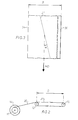
- Fig. 1 is a schematic top plan view illustrating a method of manufacturing a base fabric for a press felt according to the invention.
- Fig. 2 is a side view corresponding to Fig. 1.
- Fig. 3 shows on an enlarged scale a broken-away part of a base fabric made according to Figs 1 and 2 and schematically illustrates an angular relation between longitudinal threads in the base fabric.
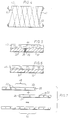
- Fig. 4 is a highly simplified top plan view illustrating a method of manufacturing a multilayer base fabric according to the invention.
- Fig. 5 is an enlarged schematic view of an edge joint between spiral turns of a press felt according to the invention.
- Fig. 6 shows a variant of the embodiment in Fig. 5, and
- Fig. 7 shows another variant of the embodiment in Fig. 5.
- Figs 1 and 2 illustrate two rotatably mounted rolls 10, 12 having parallel axes spaced from each other by a distance D.
- a supply reel 14 rotatably mounted about an axis 16 and displaceable parallel to the rolls 10 and 12, as indicated by the double arrow 18.
- the supply reel 14 accommodates a reeled supply of a flat-woven fabric strip of yarn material 20 having a width w.
- the flat-woven strip 20 has in known manner two mutually orthoganal thread systems consisting of longitudinal threads (warp threads) and cross threads (weft threads) schematically represented in Fig. 1 at 22 and 24, respectively. Further, the strip 20 has two longitudinal edges 26 and 28, the edges of which are e.g. cut before the strip 20 is wound on to the supply reel 14.
- the supply reel 14 is initially applied at the lefthand end of the roll 12 before being continuously displaced to the right at a synchronised speed.
- the strip 200 is dispensed, as indicated by an arrow 30, to be wound spirally about the rolls 10, 12 into a "tube" having a closed circumferential surface.
- the strip 20 is placed around the rolls 10, 12 with a certain pitch angle, which in the illustrated embodiment is assumed to be so adapted to the strip width w, the distance D between the roll axes and the diameters of the rolls 10, 12, that the longitudinal edges 26, 28 of adjacent "spiral turns" 32 are placed edge to edge (see Fig. 5), so as to provide a smooth transition between the spiral turns 32.
- the number of spiral turns 32 placed on the rolls 10, 12 is dependent on the desired width B on the final base fabric.
- the edges of the resulting base fabric are cut along the dash-dot lines 34, 36 in Fig. 1 to obtain the width B.
- the length of the final base fabric essentially is twice the distance D between the roll axes and can therefore easily be varied by changing the distance D.
- Fig. 3 shows on an enlarged scale a broken-away part of a base fabric produced as shown in Figs 1 and 2 and forming part of a final multilayer base fabric of a press felt according to the invention.
- Each longitudinal thread (warp thread) 22 of the strip 20 makes an angle ⁇ with the machine direction MD of the fabric/press felt.
- These oblique longitudinal threads 22 run uninterrupted through the entire base fabric layer, whilst the cross threads (weft threads) 24 are interrupted and each have a length w.
- Fig. 4 illustrates most schematically, with an exaggerated small distance between the rolls 10, 12 and with an exaggerated large strip width w, an embodiment of the invention.
- Two spirally-wound layers 40 and 42 are placed crosswise on each other, optionally setting out from one and the same strip 20.
- this embodiment especially yields the advantage of an increased flow resistance occurring, since the longitudinal threads in both layers 40, 42 make an angle with each other.
- Fig. 5 schematically shows how the end edges 26, 28 of two juxtaposed spiral turns 32 are in edge-to-edge relationship and joined by sewing, as schematically indicated at 44.
- Fig. 5 also schematically illustrates a top layer 46 of fibre material, such as a batt layer, arranged on the base fabric, e.g. by needling.
- the top layer 46 can be used for holding together the different layers in a base fabric of multilayer type according to Fig. 4.
- Fig. 6 shows an alternative embodiment according to which adjacent longitudinal edge portions of adjoining spiral turns are arranged overlappingly, the edges having a reduced thickness so as not to give rise to an increased thickness in the area of transition.
- Fig. 7 shows another variant with overlapping of adjoining edge portions.
- the spacing between longitudinal threads is increased at the edges 26, 28 of the strip 20, as indicated at 48, and the longitudinal threads 22 of the edge portions are interlaced. The result is an unchanged spacing between longitudinal threads in the area of transition, as indicated at 50.
Landscapes
- Engineering & Computer Science (AREA)
- Textile Engineering (AREA)
- Paper (AREA)
- Diaphragms For Electromechanical Transducers (AREA)
- Printing Plates And Materials Therefor (AREA)
- Artificial Filaments (AREA)
- Ceramic Capacitors (AREA)
- Casting Or Compression Moulding Of Plastics Or The Like (AREA)
- Dry Formation Of Fiberboard And The Like (AREA)
- External Artificial Organs (AREA)
Abstract
Description
- The use of two or more layers spirally arranged crosswise results in particularly interesting advantages, since the longitudinal threads in the upper base layer and in the lower base layer run in mutually different directions. Generally, in a press nip through which the press felt passes for dewatering a paper web, the flow of water in the base fabric occurs substantially parallel to the longitudinal threads. The above-mentioned crossed longitudinal threads means an increased flow resistance, which gives an advantage in and after the press nip. When the press felt passes the press nip, it is compressed, thereafter to expand when leaving the press nip. During the phase of expansion, the water which during the phase of compression has penetrated down into the lower base layer will not as easily return up through the upper base layer to rewet the paper web. In this respect, it may also be noted that two or more such spirally-applied layers can also be made with different thread spacings in the different layers, as is known per se in traditional, tubular-woven base fabrics of the multilayer type, to counteract rewetting.
- The weaving loom width can be considerably limited, e.g. to 0.5-1.5 m, giving low investment costs.
- The fabric strip of yarn material, especially a flat-woven one, can be manufactured and kept in stock in considerable lengths (e.g. thousands of meters) before being dispensed from a supply reel and placed spirally into the desired length and width of the base fabric, which spiral arrangement can be achieved in a very short time, e.g. in one day or less. Thus, the delivery time is considerably cut.
- It is easier to maintain a uniform quality over a small strip width, e.g. 0.5-1.5 m, than over the relatively larger width (e.g. 6-20 m) normally used in tubular weaving, this also giving a higher quality to the base fabric layer built up of the strip of yarn material.
- The use of flat-weaving technique gives higher production capacity.
- Variations in the thread tension across the base fabric can be reduced considerably, since the longitudinal threads of the final layer (= warp threads of a flat-woven strip) are not parallel to the machine direction of the press felt. Instead, the tension at each point becomes a mean of the tension in many different longitudinal threads.
- No irregularities are formed at the loom edges during weaving.
Claims (2)
- A press felt for a papermaking machine, comprising a base fabric which is made of yarn material and is endless in the machine direction (MD) of the press felt, and one or more layers (46) of fibre material arranged on the base fabric, said base fabric comprising at least one layer composed of a spirally-wound fabric strip (20) made of yarn material and having a width (w) which is smaller than the width (B) of the final base fabric, longitudinal threads (22) of the spirally-wound fabric strip of yarn material (20) making an angle (α) with the machine direction (MD) of the press felt, wherein the base fabric comprises one or more further layers (46) of fabric of yarn material and wherein said further fabric layers of yarn material comprise a second layer (42) composed of a spirally-wound strip (20) made of fabric of yarn material and having a width (w) which is smaller than the width (B) of the final base fabric, and wherein the fabric strip of yarn material (20) in said first layer (40) and the fabric strip of yarn material (20) in said second layer (42) are wound mutually crosswise, such that the longitudinal threads (22) of the spirally-wound fabric strip of yarn material (20) in said second layer (42) make an angle both with the machine direction (MD) of the press felt and with the longitudinal threads (22) of the fabric strip of yarn material (20) in said first layer (40).
- A method of manufacturing a press felt for use in a papermaking machine, said press felt having a base fabric which is made of yarn material and is endless in the machine direction (MD) of the press felt, and at least one layer (46) of fibre material arranged on the base fabric, comprising the steps of manufacturing a fabric strip of yarn material (20) with longitudinal threads (22) in its longitudinal direction and of a width (w) which is smaller than the width (B) of the final base fabric, spirally winding said fabric strip of yarn material (20), preferrably about at least two parallel rolls (10, 12) to form in the base fabric a first layer (40) of fabric of yarn material, the longitudinal threads (22) of the spirally-wound fabric strip of yarn material (20) making an angle (α) with the machine direction (MD) of the press felt, and prior to a step of fixing said layer (46) of fibre material, spirally winding the same or a corresponding fabric strip of yarn material (20) to form a second layer (42) of fabric of yarn material on the first layer (40), wherein the fabric strip of yarn material (20) in said first layer (40) and the fabric strip of yarn material (20) in said second layer (42) are wound mutually crosswise, such that the longitudinal threads (22) of the fabric strip of yarn material (20) in said second layer (42) make an angle both with the machine direction (MD) of the press felt and with the longitudinal threads (22) of the fabric strip of yarn material (20) in said first layer (40), and fixing said layer (46) of fibre material to the base fabric.
Applications Claiming Priority (3)
| Application Number | Priority Date | Filing Date | Title |
|---|---|---|---|
| SE9004009A SE468602B (en) | 1990-12-17 | 1990-12-17 | PRESS FILT AND WAY TO MANUFACTURE THEM |
| SE9004009 | 1990-12-17 | ||
| EP92901432A EP0563150B1 (en) | 1990-12-17 | 1991-12-17 | Press felt and method of manufacturing it |
Related Parent Applications (2)
| Application Number | Title | Priority Date | Filing Date |
|---|---|---|---|
| EP92901432A Division EP0563150B1 (en) | 1990-12-17 | 1991-12-17 | Press felt and method of manufacturing it |
| EP92901432.2 Division | 1991-12-17 |
Publications (2)
| Publication Number | Publication Date |
|---|---|
| EP0665329A1 EP0665329A1 (en) | 1995-08-02 |
| EP0665329B1 true EP0665329B1 (en) | 1998-06-17 |
Family
ID=20381205
Family Applications (2)
| Application Number | Title | Priority Date | Filing Date |
|---|---|---|---|
| EP95102372A Expired - Lifetime EP0665329B1 (en) | 1990-12-17 | 1991-12-17 | Press felt and method of manufacturing it |
| EP92901432A Expired - Lifetime EP0563150B1 (en) | 1990-12-17 | 1991-12-17 | Press felt and method of manufacturing it |
Family Applications After (1)
| Application Number | Title | Priority Date | Filing Date |
|---|---|---|---|
| EP92901432A Expired - Lifetime EP0563150B1 (en) | 1990-12-17 | 1991-12-17 | Press felt and method of manufacturing it |
Country Status (13)
| Country | Link |
|---|---|
| US (1) | US5360656A (en) |
| EP (2) | EP0665329B1 (en) |
| JP (1) | JP3027414B2 (en) |
| AT (2) | ATE167536T1 (en) |
| AU (1) | AU654165B2 (en) |
| BR (1) | BR9107186A (en) |
| CA (1) | CA2119784C (en) |
| DE (2) | DE69129639T2 (en) |
| ES (2) | ES2078730T3 (en) |
| FI (1) | FI96333C (en) |
| NO (2) | NO304750B1 (en) |
| SE (2) | SE468602B (en) |
| WO (1) | WO1992011411A1 (en) |
Families Citing this family (148)
| Publication number | Priority date | Publication date | Assignee | Title |
|---|---|---|---|---|
| US5208087A (en) * | 1991-10-08 | 1993-05-04 | Albany International Corp. | Spiral construction for a long nip press belt |
| US5571590A (en) * | 1995-06-06 | 1996-11-05 | Appleton Mills | Methods of making papermaking felt and substrate |
| US5731063A (en) * | 1995-06-06 | 1998-03-24 | Appleton Mills | Papermaking felt and substrate |
| US5792323A (en) * | 1995-09-07 | 1998-08-11 | Albany International Corp. | Spiral base structres for long nip paper machine press belts |
| SE505390C2 (en) * | 1995-11-30 | 1997-08-18 | Albany Int Corp | Laminated cladding as well as the method and substance for their preparation |
| US5617903A (en) * | 1996-03-04 | 1997-04-08 | Bowen, Jr.; David | Papermaker's fabric containing multipolymeric filaments |
| US6124015A (en) * | 1996-04-18 | 2000-09-26 | Jwi Ltd. | Multi-ply industrial fabric having integral jointing structures |
| US5713399A (en) * | 1997-02-07 | 1998-02-03 | Albany International Corp. | Ultrasonic seaming of abutting strips for paper machine clothing |
| DE69805681T2 (en) * | 1997-02-27 | 2002-11-21 | Astenjohnson, Inc. | Multiaxial papermaker press felt with seam |
| US5785818A (en) * | 1997-02-27 | 1998-07-28 | Jwi Ltd. | Multiaxial pin seamed papermaker's press felt |
| US6027615A (en) * | 1997-05-06 | 2000-02-22 | Albany International Corp. | Belts for compliant calendering |
| US5879777A (en) * | 1997-06-19 | 1999-03-09 | Asten, Inc. | Modular papermaking fabric |
| JP3272282B2 (en) * | 1997-10-20 | 2002-04-08 | 市川毛織株式会社 | Needle felt and manufacturing method thereof |
| US6030908A (en) * | 1998-03-16 | 2000-02-29 | Jwi Ltd. | Multilayer porous fabric |
| ES2170976T3 (en) * | 1998-04-02 | 2002-08-16 | Heimbach Gmbh Thomas Josef | TEXTILE BAND SPECIALLY USABLE AS A BASE FOR COATINGS OF PAPER MACHINES. |
| JP3472483B2 (en) * | 1998-06-15 | 2003-12-02 | 市川毛織株式会社 | Felt for papermaking and method for producing the same |
| US5939176A (en) * | 1998-09-01 | 1999-08-17 | Albany International Corp. | Warp loop seam |
| US5916421A (en) * | 1998-09-02 | 1999-06-29 | Albany International Corp. | Preformed seam fabric |
| US6117274A (en) * | 1998-09-03 | 2000-09-12 | Albany International Corp. | Multilayer laminate seam fabric |
| US6240608B1 (en) * | 1999-04-12 | 2001-06-05 | Albany International Corp. | Method for joining nonwoven mesh products |
| US6350336B1 (en) * | 1999-06-22 | 2002-02-26 | Albany International Corp. | Method of manufacturing a press fabric by spirally attaching a top laminate layer with a heat-activated adhesive |
| US6331341B1 (en) * | 1999-07-09 | 2001-12-18 | Albany International Corp. | Multiaxial press fabric having shaped yarns |
| NZ501159A (en) * | 1999-07-09 | 2001-01-26 | Albany Int Corp | Multi-axial press fabric comprising a base fabric formed from spirally wound strips of fabric and a crisscross web of fiber material attached to the base fabric |
| US6465074B1 (en) | 1999-08-25 | 2002-10-15 | Albany International Corp. | Base substrates for coated belts |
| US6723208B1 (en) * | 2000-10-05 | 2004-04-20 | Albany International Corp. | Method for producing spiral wound paper machine clothing |
| GB0025514D0 (en) | 2000-10-18 | 2000-11-29 | Voith Fabrics Heidenheim Gmbh | Papermachine clothing |
| US6428874B1 (en) | 2000-11-03 | 2002-08-06 | Albany International Corp. | Grooved long nip shoe press belt |
| EP1209283B1 (en) | 2000-11-23 | 2003-12-17 | Thomas Josef Heimbach Gesellschaft mit beschränkter Haftung | Fabric, in particular a papermaking fabric |
| US6630223B2 (en) | 2001-01-26 | 2003-10-07 | Albany International Corp. | Spirally wound shaped yarns for paper machine clothing and industrial belts |
| US6565713B2 (en) | 2001-02-03 | 2003-05-20 | Albany International Corp. | Laminated structure for paper machine press fabric and method making |
| US6491794B2 (en) * | 2001-03-29 | 2002-12-10 | Albany International Corp. | Base structure for seamed papermaker's fabrics |
| JP2004528218A (en) | 2001-04-11 | 2004-09-16 | アルバニー インターナショナル コーポレイション | Flexible fluid enclosure coating and method of making same |
| US6860218B2 (en) | 2001-04-11 | 2005-03-01 | Albany International Corp. | Flexible fluid containment vessel |
| US6739274B2 (en) | 2001-04-11 | 2004-05-25 | Albany International Corp. | End portions for a flexible fluid containment vessel and a method of making the same |
| DE60217092T2 (en) | 2001-04-11 | 2007-06-06 | Albany International Corp. | FINAL CIRCUITS FOR A FLEXIBLE LIQUID CONTAINER AND METHOD FOR THE PRODUCTION THEREOF |
| US6718896B2 (en) | 2001-10-30 | 2004-04-13 | Albany International Corp. | Fabric structure for a flexible fluid containment vessel |
| US6832571B2 (en) | 2001-10-30 | 2004-12-21 | Albany International Corp. | Segment formed flexible fluid containment vessel |
| US7107921B2 (en) * | 2001-10-30 | 2006-09-19 | Albany International Corp. | End portion for a flexible fluid containment vessel and a method of making the same |
| US6702927B2 (en) * | 2002-03-27 | 2004-03-09 | Albany International Corp. | Seaming of spirally wound paper machine clothing |
| US6776878B2 (en) * | 2002-04-02 | 2004-08-17 | Albany International Corp. | Laminated multiaxial press fabric |
| US6634068B1 (en) | 2002-04-24 | 2003-10-21 | Astenjohnson, Inc. | Apparatus for preparing a fabric for seaming |
| US7101599B2 (en) * | 2002-05-06 | 2006-09-05 | Albany International Corp. | Method to increase bond strength and minimize non-uniformities of woven two-layer multiaxial fabrics and fabric produced according to same |
| US6880583B2 (en) * | 2002-05-29 | 2005-04-19 | Albany International Corp. | Papermaker's and industrial fabric seam |
| WO2003102298A1 (en) * | 2002-05-30 | 2003-12-11 | National Wire Fabric Inc. | Broadloom fabric and method of forming the same |
| JP2004036046A (en) * | 2002-07-04 | 2004-02-05 | Ichikawa Woolen Textile Co Ltd | Papermaking press felt |
| US7128810B2 (en) | 2002-10-10 | 2006-10-31 | Albany International Corp. | Anti-rewet press fabric |
| US7407564B2 (en) * | 2002-11-15 | 2008-08-05 | Albany International Corp. | Stratified press fabric |
| US7141144B2 (en) * | 2002-12-04 | 2006-11-28 | Albany International Corp. | Multi-layer woven seam baseweave having different sized seam attachments |
| WO2004061183A1 (en) * | 2002-12-16 | 2004-07-22 | Albany International Corp. | Hydroentangling using a fabric having flat filaments |
| FI113674B (en) * | 2002-12-18 | 2004-05-31 | Tamfelt Oyj Abp | Press felt |
| US6878238B2 (en) | 2002-12-19 | 2005-04-12 | Kimberly-Clark Worldwide, Inc. | Non-woven through air dryer and transfer fabrics for tissue making |
| US6875315B2 (en) * | 2002-12-19 | 2005-04-05 | Kimberly-Clark Worldwide, Inc. | Non-woven through air dryer and transfer fabrics for tissue making |
| US7169265B1 (en) | 2002-12-31 | 2007-01-30 | Albany International Corp. | Method for manufacturing resin-impregnated endless belt and a belt for papermaking machines and similar industrial applications |
| US7514030B2 (en) * | 2002-12-30 | 2009-04-07 | Albany International Corp. | Fabric characteristics by flat calendering |
| US7172982B2 (en) * | 2002-12-30 | 2007-02-06 | Albany International Corp. | Dryer and/or industrial fabric with silicone-coated surface |
| US7005043B2 (en) | 2002-12-31 | 2006-02-28 | Albany International Corp. | Method of fabrication of a dryer fabric and a dryer fabric with backside venting for improved sheet stability |
| US7005044B2 (en) * | 2002-12-31 | 2006-02-28 | Albany International Corp. | Method of fabricating a belt and a belt used to make bulk tissue and towel, and nonwoven articles and fabrics |
| US7022208B2 (en) * | 2002-12-31 | 2006-04-04 | Albany International Corp. | Methods for bonding structural elements of paper machine and industrial fabrics to one another and fabrics produced thereby |
| US7166196B1 (en) | 2002-12-31 | 2007-01-23 | Albany International Corp. | Method for manufacturing resin-impregnated endless belt structures for papermaking machines and similar industrial applications and belt |
| US7014735B2 (en) | 2002-12-31 | 2006-03-21 | Albany International Corp. | Method of fabricating a belt and a belt used to make bulk tissue and towel, and nonwoven articles and fabrics |
| US7008513B2 (en) * | 2002-12-31 | 2006-03-07 | Albany International Corp. | Method of making a papermaking roll cover and roll cover produced thereby |
| US7919173B2 (en) * | 2002-12-31 | 2011-04-05 | Albany International Corp. | Method for controlling a functional property of an industrial fabric and industrial fabric |
| US7775171B2 (en) | 2003-01-21 | 2010-08-17 | Albany International Corp. | Flexible fluid containment vessel featuring a keel-like seam |
| JP2004232098A (en) * | 2003-01-28 | 2004-08-19 | Ichikawa Woolen Textile Co Ltd | Press felt for papermaking and method for producing the same |
| US7147756B2 (en) * | 2003-02-11 | 2006-12-12 | Albany International Corp. | Unique fabric structure for industrial fabrics |
| US7306703B2 (en) * | 2003-05-23 | 2007-12-11 | Albany International Corp. | Contamination resistant press fabric structure and method of manufacture |
| US6989080B2 (en) * | 2003-06-19 | 2006-01-24 | Albany International Corp. | Nonwoven neutral line dryer fabric |
| US7011731B2 (en) * | 2003-07-02 | 2006-03-14 | Albany International Corp. | Long nip press belt made from thermoplastic resin-impregnated fibers |
| US7303656B2 (en) * | 2003-07-02 | 2007-12-04 | Albany International Corp. | Low permeability textile substrate for a two-sided coated product |
| US20050003724A1 (en) * | 2003-07-02 | 2005-01-06 | Fitzpatrick Keith | Substrate for endless belt for use in papermaking applications |
| US7141142B2 (en) | 2003-09-26 | 2006-11-28 | Kimberly-Clark Worldwide, Inc. | Method of making paper using reformable fabrics |
| AU2004286319A1 (en) * | 2003-11-03 | 2005-05-12 | Albany International Corp. | Belt with variable grooves |
| US7387711B2 (en) * | 2003-11-18 | 2008-06-17 | Albany International Corp. | Shoe press belt having a grooved surface |
| US8080137B2 (en) * | 2003-11-18 | 2011-12-20 | Albany International Corp. | Shoe press belt having a grooved surface |
| US8840683B2 (en) * | 2003-11-19 | 2014-09-23 | Albany International Corp. | Industrial textile fabric |
| US7654296B2 (en) * | 2003-11-24 | 2010-02-02 | Albany International Corp. | Grooved single facer belt |
| US7238259B2 (en) * | 2003-12-10 | 2007-07-03 | Albany International Corp. | Methods of seaming |
| RU2343242C2 (en) * | 2003-12-11 | 2009-01-10 | Олбани Интернешнл Корп. | System of passive detection of clothes wear in papermaking machine |
| AU2003293512A1 (en) | 2003-12-11 | 2005-07-14 | Albany International Corp. | Passive sensor system for detection or wear problems in paper machine clothing |
| US20050136763A1 (en) * | 2003-12-17 | 2005-06-23 | Dana Eagles | Industrial fabric having a layer of a fluoropolymer and method of manufacture |
| US7135096B2 (en) * | 2003-12-23 | 2006-11-14 | Astenjohnson, Inc. | Press felt with improved dewatering capability |
| US7132036B2 (en) * | 2003-12-23 | 2006-11-07 | Astenjohnson, Inc. | Dewatering of a paper web in a press section of a papermaking machine |
| US20060010568A1 (en) * | 2004-01-27 | 2006-01-19 | Wiles William A | Helmet sweat band |
| DE102004006103A1 (en) * | 2004-02-06 | 2005-10-20 | Voith Fabrics Patent Gmbh | Modular paper machine clothing |
| US20050227561A1 (en) * | 2004-04-13 | 2005-10-13 | Kenney Maryann C | Anti-rewet press fabric or filter media comprising a fine porous layer of splittable microfibers |
| US7229531B2 (en) * | 2004-05-12 | 2007-06-12 | Albany International Corp. | Method of seaming a multiaxial papermaking fabric to prevent yarn migration |
| US7381308B2 (en) * | 2004-05-12 | 2008-06-03 | Albany International Corp. | Seam for multiaxial papermaking fabrics |
| US7455752B2 (en) * | 2004-07-22 | 2008-11-25 | Albany International Corp. | Semi-permeable fabrics for transfer belt and press fabric applications |
| US20060046593A1 (en) * | 2004-08-27 | 2006-03-02 | Jean Senellart | Antistatic transfer belt for nonwovens process |
| US20060068665A1 (en) * | 2004-09-29 | 2006-03-30 | Heinz Pernegger | Seamed felt for forming fiber cement articles and related methods |
| US7410554B2 (en) * | 2004-11-11 | 2008-08-12 | Albany International Corp. | Unique modular construction for use as a forming fabric in papermaking or tissue or nonwovens |
| US7384515B2 (en) * | 2005-04-22 | 2008-06-10 | Albany International Corp. | Four layer seam multi-axial fabric |
| US7473336B2 (en) | 2005-04-28 | 2009-01-06 | Albany International Corp. | Multiaxial fabrics |
| US7207355B2 (en) * | 2005-05-06 | 2007-04-24 | Astenjohnson, Inc. | Multi-axial seamed papermaking fabric and method |
| GB2432337A (en) * | 2005-11-22 | 2007-05-23 | Marc Pierre Despault | Offset intermeshing industrial fabric seam |
| ATE526453T1 (en) * | 2006-03-21 | 2011-10-15 | Heimbach Gmbh & Co Kg | METHOD FOR PRODUCING A FELT TAPE AND FELT TAPE |
| EP1837440B1 (en) * | 2006-03-21 | 2011-09-28 | Heimbach GmbH & Co.KG | Method for manufacturing a felt sheet and felt sheet |
| CN101041922B (en) * | 2006-03-21 | 2010-06-09 | 亨巴赫有限公司&两合公司 | Method for manufacturing felt tape and felt tape |
| US8640862B2 (en) * | 2006-04-10 | 2014-02-04 | Albany International Corp. | Seam-on laminated belt |
| US8535777B2 (en) | 2006-04-26 | 2013-09-17 | Dsm Ip Assets B.V. | Multilayered material sheet and process for its preparation |
| GB0608280D0 (en) * | 2006-04-26 | 2006-06-07 | Despault Marc | Nonwoven Textile Assembly, Method Of Manufacture, And Spirally Wound Press Felt Comprised Of Same |
| US8709575B2 (en) | 2006-04-26 | 2014-04-29 | Dsm Ip Assets B.V. | Multilayered material sheet and process for its preparation |
| US7712336B2 (en) * | 2007-01-31 | 2010-05-11 | Albany International Corp. | Subassembly for industrial fabrics |
| US20090047496A1 (en) * | 2007-08-16 | 2009-02-19 | Hansen Robert A | Multilayer fabric and manufacturing method thereof |
| US7892402B2 (en) * | 2007-10-05 | 2011-02-22 | Albany International Corp. | Flat woven full width on-machine-seamable fabric |
| DE102007000579A1 (en) | 2007-10-26 | 2009-04-30 | Voith Patent Gmbh | Press felt useful in a wet part of a paper machine, comprises two spirally winded layers, each of which comprises layer strips, where the spirally winded layers lie one upon the other or lie on each other |
| DE502007007083D1 (en) | 2007-12-04 | 2011-06-09 | Heimbach Gmbh & Co Kg | Process for producing a machine felt and machine felt |
| DK2231909T3 (en) * | 2007-12-28 | 2011-11-21 | Albany Int Corp | Ultra-elastic cushion |
| US10590571B2 (en) * | 2007-12-28 | 2020-03-17 | Albany International Corp. | Ultra-resilient pad |
| US10590569B2 (en) | 2007-12-28 | 2020-03-17 | Albany International Corp. | Ultra-resilient fabric |
| JP5667879B2 (en) * | 2007-12-28 | 2015-02-12 | オルバニー インターナショナル コーポレイション | Super elastic fabric |
| US20090214822A1 (en) * | 2008-02-25 | 2009-08-27 | Voith Patent Gmbh | Multilayered laminated fabric with single seam |
| JP5368071B2 (en) * | 2008-12-01 | 2013-12-18 | イチカワ株式会社 | Felt for papermaking |
| US8728280B2 (en) | 2008-12-12 | 2014-05-20 | Albany International Corp. | Industrial fabric including spirally wound material strips with reinforcement |
| US8764943B2 (en) | 2008-12-12 | 2014-07-01 | Albany International Corp. | Industrial fabric including spirally wound material strips with reinforcement |
| CN102317524A (en) | 2008-12-12 | 2012-01-11 | 阿尔巴尼国际公司 | Industrial fabrics including strips of spirally wound material |
| WO2010088280A1 (en) * | 2009-01-28 | 2010-08-05 | Albany International Corp. | Industrial fabric for production of nonwovens, and method of making thereof |
| WO2010146814A1 (en) * | 2009-06-19 | 2010-12-23 | キヤノン株式会社 | Method for producing magnetic carrier and magnetic carrier produced using the same production method |
| US8535484B2 (en) * | 2011-01-21 | 2013-09-17 | Albany International Corp. | Ultra-resilient fabric and method of making thereof |
| DE102011012202B4 (en) * | 2011-02-23 | 2014-09-25 | Dbw Holding Gmbh | Silencer insert for motor vehicles and method for the manufacture thereof |
| DE102011012156A1 (en) * | 2011-02-23 | 2012-08-23 | Dbw Holding Gmbh | Process for the preparation of a molding material made of fiber materials and apparatus therefor |
| DE102011005673A1 (en) * | 2011-03-17 | 2012-09-20 | Voith Patent Gmbh | Laminated endless belt |
| US20130008552A1 (en) | 2011-07-06 | 2013-01-10 | Hans Peter Breuer | Felt for forming fiber cement articles and related methods |
| US8961742B2 (en) * | 2011-07-22 | 2015-02-24 | Astenjohnson, Inc. | Multiaxial press felt base fabric including cabled monofilaments |
| BR112014027988B1 (en) | 2012-05-11 | 2021-10-05 | Albany International Corp | BELT OR SLEEVE AND ITS TRAINING METHOD |
| IN2014MN02268A (en) | 2012-05-11 | 2015-07-24 | Albany Int Corp | |
| US8980062B2 (en) | 2012-12-26 | 2015-03-17 | Albany International Corp. | Industrial fabric comprising spirally wound material strips and method of making thereof |
| US9199412B2 (en) | 2012-12-28 | 2015-12-01 | Albany International Corp. | Industrial fabric and method of welding seam area using ultrasonic welding |
| FI2954105T3 (en) | 2013-02-06 | 2024-05-30 | Astenjohnson Inc | Press felt base fabric exhibiting reduced interference |
| US9352530B2 (en) | 2013-03-15 | 2016-05-31 | Albany International Corp. | Industrial fabric comprising an extruded mesh and method of making thereof |
| US9545773B2 (en) | 2013-03-15 | 2017-01-17 | Albany International Corp. | Pad comprising an extruded mesh and method of making thereof |
| US9315940B2 (en) | 2013-04-19 | 2016-04-19 | Astenjohnson, Inc. | Seamed press felt including an elastic carrier layer and method of making |
| EP3011103B1 (en) * | 2013-06-21 | 2023-08-16 | Voith Patent GmbH | Fabric and method for the production thereof |
| DE102014213444A1 (en) * | 2014-07-10 | 2016-01-14 | Voith Patent Gmbh | Extruded paper machine clothing |
| CN107002361B (en) * | 2014-09-25 | 2022-09-23 | 奥伯尼国际有限责任公司 | Creping and structuring multilayer tape for use in toilet paper making processes |
| JP2017528619A (en) * | 2014-09-25 | 2017-09-28 | アルバニー インターナショナル コーポレイションAlbany International Corporation | Multi-layer belt for creping and structuring in tissue paper manufacturing process |
| JP6497678B2 (en) * | 2015-07-21 | 2019-04-10 | イチカワ株式会社 | Papermaking felt and method for producing the same |
| JP6521447B2 (en) | 2015-07-28 | 2019-05-29 | イチカワ株式会社 | Papermaking felt |
| JP6718731B2 (en) * | 2016-04-20 | 2020-07-08 | 日本フエルト株式会社 | Felt base fabric for papermaking and method for producing felt base fabric for papermaking |
| EP3235949B1 (en) | 2016-04-21 | 2018-05-23 | Ichikawa Co., Ltd. | Papermaking felt |
| US10385510B2 (en) | 2016-11-16 | 2019-08-20 | Astenjohnson, Inc. | Seamless press felt with intermediate elastic carrier layer |
| JP6890433B2 (en) * | 2017-02-15 | 2021-06-18 | 日本フエルト株式会社 | Felt base cloth for papermaking and its manufacturing method |
| EP3746291A4 (en) | 2018-02-02 | 2021-10-27 | Astenjohnson International, Inc. | NON-WOVEN BACKING FOR PRESS FELT, PROCESS FOR THE PRODUCTION OF NON-WOVEN BACKING AND PRESS FELT |
| DE102018105433A1 (en) * | 2018-03-09 | 2019-09-12 | Voith Patent Gmbh | Process for the production of a basic structure for a paper machine clothing |
| EP3830333B1 (en) | 2018-07-30 | 2025-12-03 | Astenjohnson International, Inc. | Seamed press felt with monofilament seam support yarns |
| JP7398043B2 (en) * | 2019-09-27 | 2023-12-14 | イチカワ株式会社 | Papermaking felt and its manufacturing method |
| CN114207213B (en) | 2020-07-06 | 2023-03-24 | 艾斯登强生国际股份有限公司 | Seam press felt with partially anchored stuffer yarn encapsulation |
| EP4547907A1 (en) * | 2022-07-01 | 2025-05-07 | Albany International Corp. | Extruded reinforced industrial belt |
Family Cites Families (4)
| Publication number | Priority date | Publication date | Assignee | Title |
|---|---|---|---|---|
| US4271222A (en) * | 1980-02-04 | 1981-06-02 | Albany International Corp. | Papermakers felt and method of manufacture |
| US4695498A (en) * | 1982-07-20 | 1987-09-22 | Asten Group, Inc. | Papermakers flat woven fabric |
| DE3632386A1 (en) * | 1986-09-24 | 1988-04-07 | Heimbach Gmbh Thomas Josef | MACHINE FELT AND METHOD FOR PRODUCING THE SAME |
| DE9007400U1 (en) * | 1990-06-13 | 1991-08-14 | Thomas Josef Heimbach GmbH & Co, 5160 Düren | Felt, especially paper machine felt |
-
1990
- 1990-12-17 SE SE9004009A patent/SE468602B/en not_active IP Right Cessation
-
1991
- 1991-12-17 DE DE69129639T patent/DE69129639T2/en not_active Expired - Lifetime
- 1991-12-17 DE DE69114144T patent/DE69114144T2/en not_active Expired - Lifetime
- 1991-12-17 EP EP95102372A patent/EP0665329B1/en not_active Expired - Lifetime
- 1991-12-17 CA CA002119784A patent/CA2119784C/en not_active Expired - Lifetime
- 1991-12-17 JP JP4501489A patent/JP3027414B2/en not_active Expired - Fee Related
- 1991-12-17 AT AT95102372T patent/ATE167536T1/en not_active IP Right Cessation
- 1991-12-17 AT AT92901432T patent/ATE129536T1/en not_active IP Right Cessation
- 1991-12-17 ES ES92901432T patent/ES2078730T3/en not_active Expired - Lifetime
- 1991-12-17 US US08/078,216 patent/US5360656A/en not_active Expired - Lifetime
- 1991-12-17 BR BR919107186A patent/BR9107186A/en not_active IP Right Cessation
- 1991-12-17 AU AU90986/91A patent/AU654165B2/en not_active Ceased
- 1991-12-17 EP EP92901432A patent/EP0563150B1/en not_active Expired - Lifetime
- 1991-12-17 WO PCT/SE1991/000868 patent/WO1992011411A1/en not_active Ceased
- 1991-12-17 ES ES95102372T patent/ES2117311T3/en not_active Expired - Lifetime
-
1992
- 1992-11-17 SE SE9203442A patent/SE469335B/en not_active IP Right Cessation
-
1993
- 1993-06-08 FI FI932608A patent/FI96333C/en active
- 1993-06-11 NO NO931727A patent/NO304750B1/en not_active IP Right Cessation
-
1997
- 1997-05-30 NO NO972476A patent/NO309334B1/en not_active IP Right Cessation
Also Published As
Similar Documents
| Publication | Publication Date | Title |
|---|---|---|
| EP0563150B1 (en) | Press felt and method of manufacturing it | |
| KR100405084B1 (en) | A press fabric for the press section of a paper machine and manufacturing method therefor | |
| AU712007B1 (en) | Warp loop seam | |
| AU714757B1 (en) | Preformed seam fabric | |
| US6117274A (en) | Multilayer laminate seam fabric | |
| US6194331B1 (en) | Flow-resistant material additions to double-seam on machine-seamable fabrics | |
| AU773084B2 (en) | Multiaxial press fabric having shaped yarns | |
| US7407564B2 (en) | Stratified press fabric | |
| US7410554B2 (en) | Unique modular construction for use as a forming fabric in papermaking or tissue or nonwovens | |
| US7147756B2 (en) | Unique fabric structure for industrial fabrics | |
| FI107066B (en) | Press felt and ways of making the same | |
| GB2325881A (en) | Seam construction for papermaking fabric |
Legal Events
| Date | Code | Title | Description |
|---|---|---|---|
| PUAI | Public reference made under article 153(3) epc to a published international application that has entered the european phase |
Free format text: ORIGINAL CODE: 0009012 |
|
| 17P | Request for examination filed |
Effective date: 19950221 |
|
| AC | Divisional application: reference to earlier application |
Ref document number: 563150 Country of ref document: EP |
|
| AK | Designated contracting states |
Kind code of ref document: A1 Designated state(s): AT BE CH DE DK ES FR GB GR IT LI LU MC NL SE |
|
| 17Q | First examination report despatched |
Effective date: 19961111 |
|
| GRAG | Despatch of communication of intention to grant |
Free format text: ORIGINAL CODE: EPIDOS AGRA |
|
| GRAG | Despatch of communication of intention to grant |
Free format text: ORIGINAL CODE: EPIDOS AGRA |
|
| GRAH | Despatch of communication of intention to grant a patent |
Free format text: ORIGINAL CODE: EPIDOS IGRA |
|
| GRAH | Despatch of communication of intention to grant a patent |
Free format text: ORIGINAL CODE: EPIDOS IGRA |
|
| GRAA | (expected) grant |
Free format text: ORIGINAL CODE: 0009210 |
|
| AC | Divisional application: reference to earlier application |
Ref document number: 563150 Country of ref document: EP |
|
| AK | Designated contracting states |
Kind code of ref document: B1 Designated state(s): AT BE CH DE DK ES FR GB GR IT LI LU MC NL SE |
|
| PG25 | Lapsed in a contracting state [announced via postgrant information from national office to epo] |
Ref country code: GR Free format text: LAPSE BECAUSE OF NON-PAYMENT OF DUE FEES Effective date: 19980617 |
|
| REF | Corresponds to: |
Ref document number: 167536 Country of ref document: AT Date of ref document: 19980715 Kind code of ref document: T |
|
| REG | Reference to a national code |
Ref country code: CH Ref legal event code: NV Representative=s name: BUGNION S.A. Ref country code: CH Ref legal event code: EP |
|
| REF | Corresponds to: |
Ref document number: 69129639 Country of ref document: DE Date of ref document: 19980723 |
|
| REG | Reference to a national code |
Ref country code: ES Ref legal event code: FG2A Ref document number: 2117311 Country of ref document: ES Kind code of ref document: T3 |
|
| PG25 | Lapsed in a contracting state [announced via postgrant information from national office to epo] |
Ref country code: SE Free format text: LAPSE BECAUSE OF FAILURE TO SUBMIT A TRANSLATION OF THE DESCRIPTION OR TO PAY THE FEE WITHIN THE PRESCRIBED TIME-LIMIT Effective date: 19980917 Ref country code: DK Free format text: LAPSE BECAUSE OF FAILURE TO SUBMIT A TRANSLATION OF THE DESCRIPTION OR TO PAY THE FEE WITHIN THE PRESCRIBED TIME-LIMIT Effective date: 19980917 |
|
| ET | Fr: translation filed | ||
| PG25 | Lapsed in a contracting state [announced via postgrant information from national office to epo] |
Ref country code: LU Free format text: LAPSE BECAUSE OF NON-PAYMENT OF DUE FEES Effective date: 19981217 |
|
| PLBE | No opposition filed within time limit |
Free format text: ORIGINAL CODE: 0009261 |
|
| STAA | Information on the status of an ep patent application or granted ep patent |
Free format text: STATUS: NO OPPOSITION FILED WITHIN TIME LIMIT |
|
| 26N | No opposition filed | ||
| PG25 | Lapsed in a contracting state [announced via postgrant information from national office to epo] |
Ref country code: MC Free format text: LAPSE BECAUSE OF NON-PAYMENT OF DUE FEES Effective date: 19990630 |
|
| REG | Reference to a national code |
Ref country code: GB Ref legal event code: IF02 |
|
| PG25 | Lapsed in a contracting state [announced via postgrant information from national office to epo] |
Ref country code: IT Free format text: LAPSE BECAUSE OF NON-PAYMENT OF DUE FEES;WARNING: LAPSES OF ITALIAN PATENTS WITH EFFECTIVE DATE BEFORE 2007 MAY HAVE OCCURRED AT ANY TIME BEFORE 2007. THE CORRECT EFFECTIVE DATE MAY BE DIFFERENT FROM THE ONE RECORDED. Effective date: 20051217 |
|
| PGFP | Annual fee paid to national office [announced via postgrant information from national office to epo] |
Ref country code: IT Payment date: 20061231 Year of fee payment: 16 |
|
| PGRI | Patent reinstated in contracting state [announced from national office to epo] |
Ref country code: IT Effective date: 20080301 |
|
| PGRI | Patent reinstated in contracting state [announced from national office to epo] |
Ref country code: IT Effective date: 20080301 |
|
| PGFP | Annual fee paid to national office [announced via postgrant information from national office to epo] |
Ref country code: GB Payment date: 20091229 Year of fee payment: 19 |
|
| PGFP | Annual fee paid to national office [announced via postgrant information from national office to epo] |
Ref country code: FR Payment date: 20110107 Year of fee payment: 20 Ref country code: AT Payment date: 20101202 Year of fee payment: 20 |
|
| PGFP | Annual fee paid to national office [announced via postgrant information from national office to epo] |
Ref country code: CH Payment date: 20101227 Year of fee payment: 20 |
|
| PGFP | Annual fee paid to national office [announced via postgrant information from national office to epo] |
Ref country code: NL Payment date: 20101224 Year of fee payment: 20 |
|
| PGFP | Annual fee paid to national office [announced via postgrant information from national office to epo] |
Ref country code: DE Payment date: 20101229 Year of fee payment: 20 |
|
| PGFP | Annual fee paid to national office [announced via postgrant information from national office to epo] |
Ref country code: ES Payment date: 20101227 Year of fee payment: 20 Ref country code: BE Payment date: 20101224 Year of fee payment: 20 |
|
| GBPC | Gb: european patent ceased through non-payment of renewal fee |
Effective date: 20101217 |
|
| PG25 | Lapsed in a contracting state [announced via postgrant information from national office to epo] |
Ref country code: GB Free format text: LAPSE BECAUSE OF NON-PAYMENT OF DUE FEES Effective date: 20101217 |
|
| REG | Reference to a national code |
Ref country code: DE Ref legal event code: R071 Ref document number: 69129639 Country of ref document: DE |
|
| REG | Reference to a national code |
Ref country code: DE Ref legal event code: R071 Ref document number: 69129639 Country of ref document: DE |
|
| REG | Reference to a national code |
Ref country code: NL Ref legal event code: V4 Effective date: 20111217 |
|
| REG | Reference to a national code |
Ref country code: CH Ref legal event code: PL |
|
| BE20 | Be: patent expired |
Owner name: *ALBANY INTERNATIONAL CORP. Effective date: 20111217 |
|
| PG25 | Lapsed in a contracting state [announced via postgrant information from national office to epo] |
Ref country code: NL Free format text: LAPSE BECAUSE OF EXPIRATION OF PROTECTION Effective date: 20111217 |
|
| REG | Reference to a national code |
Ref country code: ES Ref legal event code: FD2A Effective date: 20120305 |
|
| REG | Reference to a national code |
Ref country code: AT Ref legal event code: MK07 Ref document number: 167536 Country of ref document: AT Kind code of ref document: T Effective date: 20111217 |
|
| PG25 | Lapsed in a contracting state [announced via postgrant information from national office to epo] |
Ref country code: ES Free format text: LAPSE BECAUSE OF EXPIRATION OF PROTECTION Effective date: 20111218 |
|
| PG25 | Lapsed in a contracting state [announced via postgrant information from national office to epo] |
Ref country code: DE Free format text: LAPSE BECAUSE OF EXPIRATION OF PROTECTION Effective date: 20111218 |