EP0665233B1 - 1-Hydrocarbyloxy-piperidine compounds containing silane groups for use as stabilizers for organic materials - Google Patents

1-Hydrocarbyloxy-piperidine compounds containing silane groups for use as stabilizers for organic materials Download PDF

Info

Publication number
EP0665233B1
EP0665233B1 EP95810029A EP95810029A EP0665233B1 EP 0665233 B1 EP0665233 B1 EP 0665233B1 EP 95810029 A EP95810029 A EP 95810029A EP 95810029 A EP95810029 A EP 95810029A EP 0665233 B1 EP0665233 B1 EP 0665233B1
Authority
EP
European Patent Office
Prior art keywords
alkyl
formula
phenyl
group
tert
Prior art date
Legal status (The legal status is an assumption and is not a legal conclusion. Google has not performed a legal analysis and makes no representation as to the accuracy of the status listed.)
Expired - Lifetime
Application number
EP95810029A
Other languages
German (de)
French (fr)
Other versions
EP0665233A3 (en
EP0665233A2 (en
Inventor
Valerio Dr. Borzatta
Primo Carrozza
Ramanathan Ravichandran
Current Assignee (The listed assignees may be inaccurate. Google has not performed a legal analysis and makes no representation or warranty as to the accuracy of the list.)
BASF Schweiz AG
Ciba Specialty Chemicals SpA
Original Assignee
Ciba Spezialitaetenchemie Holding AG
Ciba SC Holding AG
Ciba Specialty Chemicals SpA
Priority date (The priority date is an assumption and is not a legal conclusion. Google has not performed a legal analysis and makes no representation as to the accuracy of the date listed.)
Filing date
Publication date
Application filed by Ciba Spezialitaetenchemie Holding AG, Ciba SC Holding AG, Ciba Specialty Chemicals SpA filed Critical Ciba Spezialitaetenchemie Holding AG
Publication of EP0665233A2 publication Critical patent/EP0665233A2/en
Publication of EP0665233A3 publication Critical patent/EP0665233A3/en
Application granted granted Critical
Publication of EP0665233B1 publication Critical patent/EP0665233B1/en
Anticipated expiration legal-status Critical
Expired - Lifetime legal-status Critical Current

Links

Classifications

    • CCHEMISTRY; METALLURGY
    • C07ORGANIC CHEMISTRY
    • C07FACYCLIC, CARBOCYCLIC OR HETEROCYCLIC COMPOUNDS CONTAINING ELEMENTS OTHER THAN CARBON, HYDROGEN, HALOGEN, OXYGEN, NITROGEN, SULFUR, SELENIUM OR TELLURIUM
    • C07F7/00Compounds containing elements of Groups 4 or 14 of the Periodic Table
    • C07F7/02Silicon compounds
    • C07F7/08Compounds having one or more C—Si linkages
    • C07F7/18Compounds having one or more C—Si linkages as well as one or more C—O—Si linkages
    • CCHEMISTRY; METALLURGY
    • C07ORGANIC CHEMISTRY
    • C07FACYCLIC, CARBOCYCLIC OR HETEROCYCLIC COMPOUNDS CONTAINING ELEMENTS OTHER THAN CARBON, HYDROGEN, HALOGEN, OXYGEN, NITROGEN, SULFUR, SELENIUM OR TELLURIUM
    • C07F7/00Compounds containing elements of Groups 4 or 14 of the Periodic Table
    • C07F7/02Silicon compounds
    • C07F7/08Compounds having one or more C—Si linkages
    • C07F7/0834Compounds having one or more O-Si linkage
    • C07F7/0838Compounds with one or more Si-O-Si sequences
    • CCHEMISTRY; METALLURGY
    • C07ORGANIC CHEMISTRY
    • C07FACYCLIC, CARBOCYCLIC OR HETEROCYCLIC COMPOUNDS CONTAINING ELEMENTS OTHER THAN CARBON, HYDROGEN, HALOGEN, OXYGEN, NITROGEN, SULFUR, SELENIUM OR TELLURIUM
    • C07F7/00Compounds containing elements of Groups 4 or 14 of the Periodic Table
    • C07F7/02Silicon compounds
    • C07F7/21Cyclic compounds having at least one ring containing silicon, but no carbon in the ring
    • CCHEMISTRY; METALLURGY
    • C08ORGANIC MACROMOLECULAR COMPOUNDS; THEIR PREPARATION OR CHEMICAL WORKING-UP; COMPOSITIONS BASED THEREON
    • C08GMACROMOLECULAR COMPOUNDS OBTAINED OTHERWISE THAN BY REACTIONS ONLY INVOLVING UNSATURATED CARBON-TO-CARBON BONDS
    • C08G77/00Macromolecular compounds obtained by reactions forming a linkage containing silicon with or without sulfur, nitrogen, oxygen or carbon in the main chain of the macromolecule
    • C08G77/04Polysiloxanes
    • C08G77/22Polysiloxanes containing silicon bound to organic groups containing atoms other than carbon, hydrogen and oxygen
    • C08G77/26Polysiloxanes containing silicon bound to organic groups containing atoms other than carbon, hydrogen and oxygen nitrogen-containing groups
    • CCHEMISTRY; METALLURGY
    • C08ORGANIC MACROMOLECULAR COMPOUNDS; THEIR PREPARATION OR CHEMICAL WORKING-UP; COMPOSITIONS BASED THEREON
    • C08GMACROMOLECULAR COMPOUNDS OBTAINED OTHERWISE THAN BY REACTIONS ONLY INVOLVING UNSATURATED CARBON-TO-CARBON BONDS
    • C08G77/00Macromolecular compounds obtained by reactions forming a linkage containing silicon with or without sulfur, nitrogen, oxygen or carbon in the main chain of the macromolecule
    • C08G77/04Polysiloxanes
    • C08G77/38Polysiloxanes modified by chemical after-treatment
    • C08G77/382Polysiloxanes modified by chemical after-treatment containing atoms other than carbon, hydrogen, oxygen or silicon
    • C08G77/388Polysiloxanes modified by chemical after-treatment containing atoms other than carbon, hydrogen, oxygen or silicon containing nitrogen
    • CCHEMISTRY; METALLURGY
    • C08ORGANIC MACROMOLECULAR COMPOUNDS; THEIR PREPARATION OR CHEMICAL WORKING-UP; COMPOSITIONS BASED THEREON
    • C08KUse of inorganic or non-macromolecular organic substances as compounding ingredients
    • C08K5/00Use of organic ingredients
    • C08K5/54Silicon-containing compounds
    • C08K5/544Silicon-containing compounds containing nitrogen
    • C08K5/5477Silicon-containing compounds containing nitrogen containing nitrogen in a heterocyclic ring
    • CCHEMISTRY; METALLURGY
    • C08ORGANIC MACROMOLECULAR COMPOUNDS; THEIR PREPARATION OR CHEMICAL WORKING-UP; COMPOSITIONS BASED THEREON
    • C08LCOMPOSITIONS OF MACROMOLECULAR COMPOUNDS
    • C08L101/00Compositions of unspecified macromolecular compounds

Definitions

  • the present invention relates to novel 1-hydrocarbyloxy-2,2,6,6-tetramethylpiperidine compounds containing siloxane groups, to their use as light stabilizers, heat stabilizers and oxidation stabilizers for organic materials, in particular synthetic polymers, and to organic materials thus stabilized.
  • the present invention relates to novel compounds of the formula (I) in which m + n is a number from 1 to 100 and n varies from zero to 90 % of the sum of m + n,
  • Each of the groups A, R 1 , R 2 , R 3 , R 4 and R 5 can, in the single recurring units of the formula (I), have the same definition or different definitions and, if the compounds of the present invention are copolymeric, they can have a random distribution or a block distribution of the various recurring units.
  • alkyl having not more than 18 carbon atoms examples include methyl, ethyl, propyl, isopropyl, butyl, 2-butyl, isobutyl, t-butyl, pentyl, 2-pentyl, isopentyl, hexyl, heptyl, octyl, 2-ethylhexyl, t-octyl, nonyl, decyl, undecyl, dodecyl, tridecyl, tetradecyl, hexadecyl and octadecyl.
  • C 1 -C 8 alkoxy examples are methoxy, ethoxy, propoxy, isopropoxy, butoxy, isobutoxy, t-butoxy, pentoxy, isopentoxy, hexoxy, heptoxy and octoxy.
  • C 5 -C 12 cycloalkyl examples are cyclopentyl, cyclohexyl, methylcyclohexyl, cycloheptyl, cyclooctyl, cyclodecyl and cyclododecyl.
  • C 5 -C 12 cycloalkyl also covers a saturated cyclic hydrocarbon radical of 5 to 8 carbon atoms, which is substituted by C 1 -C 4 alkyl.
  • C 2 -C 18 alkenyl examples include vinyl, allyl, 2-methylallyl, butenyl, pentenyl, hexenyl, heptenyl, octenyl, decenyl, dodecenyl, tetradecenyl, hexadecenyl and octadecenyl.
  • C 5 -C 12 cycloalkenyl examples are cyclopentenyl, cyclohexenyl, methylcyclohexenyl, cycloheptenyl, cyclooctenyl, cyclodecenyl and cyclododecenyl.
  • C 5 -C 12 cycloalkenyl also covers an unsaturated cyclic hydrocarbon radical of 5 to 8 carbon atoms, which is substituted by C 1 -C 4 alkyl.
  • C 7 -C 12 aralkyl examples include benzyl, ⁇ -methylbenzyl, ⁇ , ⁇ -dimethylbenzyl and phenylethyl.
  • C 7 -C 9 phenylalkyl is preferred.
  • saturated or unsaturated radicals of a bicyclic or tricyclic C 7 -C 12 hydrocarbon are bicycloheptyl, bicycloheptenyl, decahydronaphthyl, tetrahydronaphthyl and tricyclodecyl.
  • C 2 -C 12 alkylene examples include ethylene, propylene, trimethylene, 2-methyltrimethylene, tetramethylene, pentamethylene, hexamethylene, octamethylene, decamethylene, undecamethylene and dodecamethylene. Trimethylene is preferred.
  • n + n is a number from 1 to 80, n varies from zero to 90 % of the sum m + n, A is -O- or where R 6 is hydrogen, C 1 -C 12 alkyl or a group of the formula (II),
  • n is a number from 1 to 60, n varies from zero to 90 % of the sum of m + n,
  • n is a number from 1 to 50, n varies from zero to 75 % of the sum m + n, A is -O- or where R 6 is hydrogen or C 1 -C 4 alkyl,
  • n is a number from 1 to 40, n varies from zero to 50 % of the sum m + n,
  • the compounds of the present invention can be prepared by various processes known per se.
  • the compounds of the formula (I) can be prepared, for example, by hydrolytic polycondensation of compounds of the formulae (IVa) and (IVb) where G1 is Cl or C 1 -C 8 alkoxy and G 2 is Cl, C 1 -C 8 alkoxy or phenyl, as reported, for example, in US Patent 4 946 880, or, if R 1 and R 4 are C 1 -C 8 alkyl or phenyl, by reaction of a compound of the formula (V) with a compound of the formula (VI) with R 2 ' being C 2 -C 12 alkenyl, in the presence of catalytic quantities of the Pt or Rh complex as described, for example, in US Patent 5 051 458 and EP Patent 388 321.
  • the compounds of the formula (I) can be prepared, for example, by reacting a compound of the formula (V) with a piperidinol of the formula (VII) in the presence of catalytic quantities of a complex of Pt, Rh or Pd, as described, for example, in US Patent 4 895 885.
  • the compounds of the formula (V) are commercially available or can be prepared by known processes.
  • the compounds of the formula (VI) are prepared, for example, as indicated in US Patent 4 946 880, the group R 3 O- in the 1-position of the piperidyl group being introduced according to the processes disclosed in US Patent 4 921 962.
  • the compounds of the present invention are highly effective in improving the light stability, heat stability and oxidation stability of organic materials, in particular synthetic polymers and copolymers, and, owing to their high resistance to volatilization, are particularly suitable for stabilizing polypropylene fibres, especially in the presence of flame retardants, or polyethylene films, particularly in the presence of pesticides.
  • the compounds of the formula (I) are particularly suitable for improving the light stability, heat stability and oxidation stability of polyolefins, especially polyethylene and polypropylene.
  • the compounds of the formula (I) can be used in mixtures with organic materials in various proportions depending on the nature of the material to be stabilized, on the end use and on the presence of other additives.
  • the compounds of the formula (I) can be added to the polymeric materials before, during or after the polymerization or crosslinking of the said materials.
  • the compounds of the formula (I) can be incorporated in the polymeric materials in the pure form or encapsulated in waxes, oils or polymers.
  • the compounds of the formula (I) can be incorporated in the polymeric materials by various processes, such as dry mixing in the form of powder, or wet mixing in the form of solutions or suspensions or also in the form of a masterbatch; in such operations, the polymer can be used in the form of powder, granules, solutions, suspensions or in the form of latices.
  • the materials stabilized with the products of the formula (I) can be used for the production of mouldings, films, tapes, monofilaments, fibres, surface coatings and the like.
  • additives for synthetic polymers such as antioxidants, UV absorbers, nickel stabilizers, pigments, fillers, plasticizers, antistatic agents, flameproofing agents, lubricants, corrosion inhibitors and metal deactivators, can be added to the mixtures of the compounds of the formula (I) with the organic materials.
  • additives which can be used in admixture with the compounds of the formula (I) are:
  • the compounds of the present invention can also be used as stabilizers, especially as light stabilizers, for the major part of the materials known in the art of photographic reproduction and other reproduction techniques, for example as described in Research Disclosure 1990, 31429 (pages 474-480).
  • the reaction mixture is heated at 100°C for 3 hours and then stirred in vacuo at ambient temperature for 3 hours.
  • the reaction mixture is cooled and extracted with toluene, and the organic phase is washed with water, dried over anhydrous sodium sulfate, filtered and evaporated at 50°C/1 mbar.
  • Example 5 Preparation of 1-methoxy-4-[3-[bis(trimethylsiloxy)methylsilyl]propoxy]-2,2,6,6-tetramethylpiperidine.
  • the solvent is evaporated at 50°C/1 mbar, and the residue is dissolved in n-heptane and purified on a silica gel column using n-heptane as solvent.
  • Example 10 (light-stabilizing action in polypropylene fibres)
  • the mixtures are extruded at 200-230°C to give polymer granules which are then converted into fibres, using a pilot-type apparatus (®Leonard-Sumirago (VA) Italy) operating under the following conditions: Extruder temperature 230-245°C Head temperature 255-260°C Stretch ratio 1: 3.5 Count 11 dtex per filament
  • the fibres thus prepared are exposed, mounted on a white card, in a model 65 WR Weather-O-Meter (ASTM D2565-85) with a black panel temperature of 63°C.
  • the residual tenacity is measured on samples taken after various times of exposure to light by means of a constant-speed dynamometer, and the exposure time in hours (T 50 ) needed to halve the initial tenacity is then calculated.
  • Fibres prepared under the same conditions as indicated above, but without addition of stabilizers according to the invention, are exposed for comparison.

Landscapes

  • Chemical & Material Sciences (AREA)
  • Organic Chemistry (AREA)
  • Health & Medical Sciences (AREA)
  • Chemical Kinetics & Catalysis (AREA)
  • Medicinal Chemistry (AREA)
  • Polymers & Plastics (AREA)
  • General Chemical & Material Sciences (AREA)
  • Compositions Of Macromolecular Compounds (AREA)
  • Silicon Polymers (AREA)
  • Anti-Oxidant Or Stabilizer Compositions (AREA)
  • Organic Low-Molecular-Weight Compounds And Preparation Thereof (AREA)

Description

The present invention relates to novel 1-hydrocarbyloxy-2,2,6,6-tetramethylpiperidine compounds containing siloxane groups, to their use as light stabilizers, heat stabilizers and oxidation stabilizers for organic materials, in particular synthetic polymers, and to organic materials thus stabilized.
The stabilization of synthetic polymers with 2,2,6,6-tetramethylpiperidine derivatives containing siloxane groups has been described in various patents, in particular in US Patents 4 177 186, 4 859 759, 4 895 885, 4 946 880 and 4 948 888, in EP Patents 162 524, 244 026, 343 717, 388 321, 389 419, 461 071, 480 466 and 491 659 and in East German Patents 234 682 and 234 683.
The present invention relates to novel compounds of the formula (I)
Figure 00010001
in which m + n is a number from 1 to 100 and n varies from zero to 90 % of the sum of m + n,
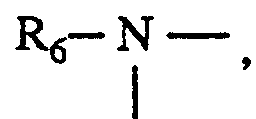
  • A is -O- or
    Figure 00010002
    where R6 is hydrogen, C1-C18 alkyl or a group of the formula (II)
    Figure 00020001
  • R1 and R4 which can be identical or different are C1-C8alkyl, phenyl, C1-C8alkoxy, OH, ONa or OK,
  • R2 is C2-C12alkylene or also a direct bond if A is -O- and R1 and R4 are C1-C8alkyl or phenyl,
  • R3 is C1-C18alkyl, C5-C12cycloalkyl, C2-C18alkenyl, C5-C12cycloalkenyl, C7-C12aralkyl, a saturated or unsaturated radical of a bicyclic or tricyclic C7-C12hydrocarbon or phenyl, methylphenyl, dimethylphenyl, trimethylphenyl, isopropylphenyt, naphthyl or methylnaphthyl,
  • R5 is hydrogen, C1-C18alkyl, C5-C12cycloalkyl or phenyl,
  • X1 is as defined for R1 or is a group (R7)3SiO- with R7 being C1-C8alkyl,
  • X2 is hydrogen, Na, K, C1-C8alkyl, a group (R7)3-Si- or, if n is zero and R1 and X1 are
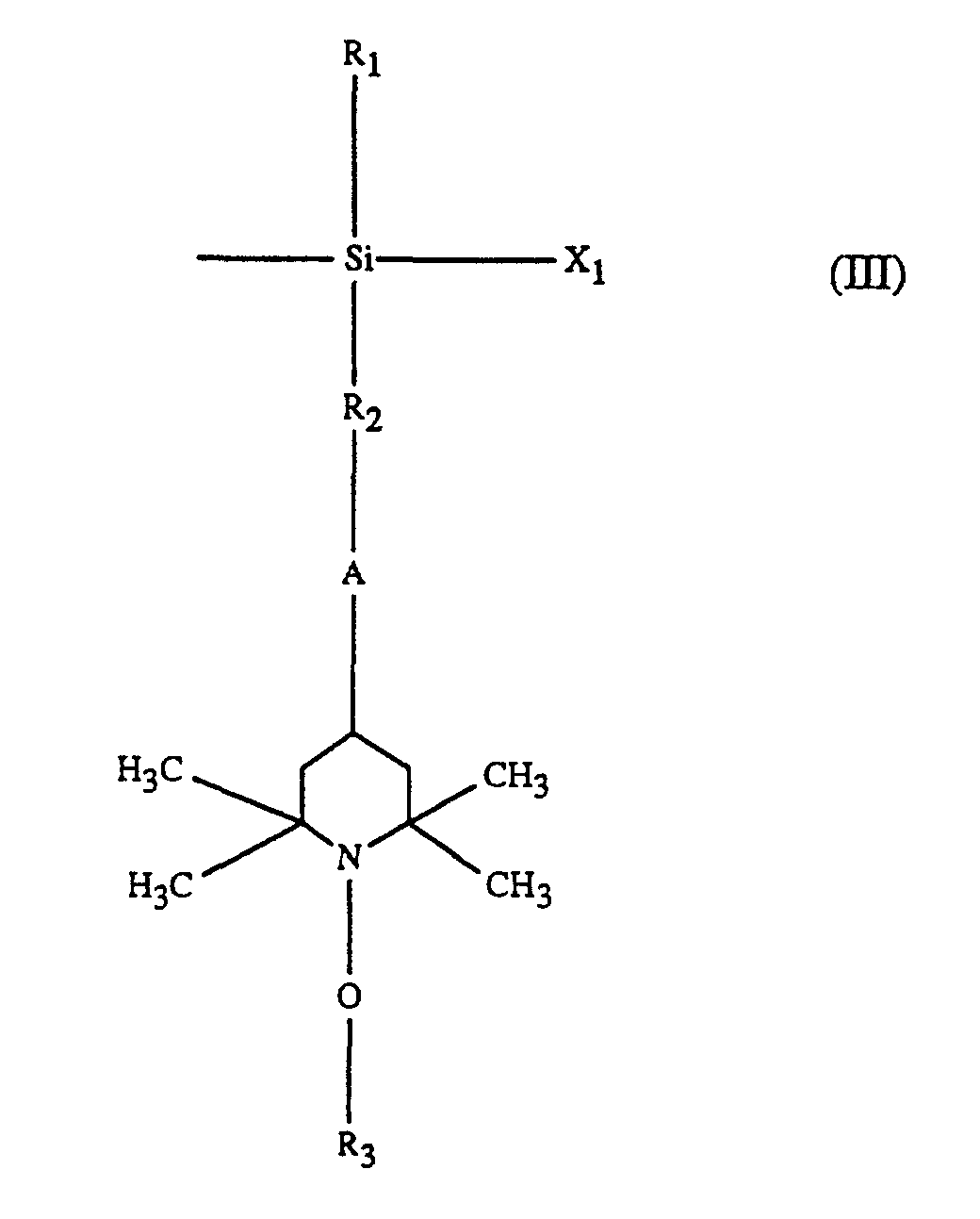
  • C1-C8alkyl or phenyl, X2 is also a group of the formula (III)
    Figure 00020002
  • and, if m + n is a number from 3 to 10, X1 and X2 together can also be a direct bond.
  • Each of the groups A, R1, R2, R3, R4 and R5 can, in the single recurring units of the formula (I), have the same definition or different definitions and, if the compounds of the present invention are copolymeric, they can have a random distribution or a block distribution of the various recurring units.
    Examples of alkyl having not more than 18 carbon atoms are methyl, ethyl, propyl, isopropyl, butyl, 2-butyl, isobutyl, t-butyl, pentyl, 2-pentyl, isopentyl, hexyl, heptyl, octyl, 2-ethylhexyl, t-octyl, nonyl, decyl, undecyl, dodecyl, tridecyl, tetradecyl, hexadecyl and octadecyl.
    Examples of C1-C8alkoxy are methoxy, ethoxy, propoxy, isopropoxy, butoxy, isobutoxy, t-butoxy, pentoxy, isopentoxy, hexoxy, heptoxy and octoxy.
    Examples of C5-C12cycloalkyl are cyclopentyl, cyclohexyl, methylcyclohexyl, cycloheptyl, cyclooctyl, cyclodecyl and cyclododecyl. C5-C12cycloalkyl also covers a saturated cyclic hydrocarbon radical of 5 to 8 carbon atoms, which is substituted by C1-C4alkyl.
    Examples of C2-C18alkenyl are vinyl, allyl, 2-methylallyl, butenyl, pentenyl, hexenyl, heptenyl, octenyl, decenyl, dodecenyl, tetradecenyl, hexadecenyl and octadecenyl.
    Examples of C5-C12cycloalkenyl are cyclopentenyl, cyclohexenyl, methylcyclohexenyl, cycloheptenyl, cyclooctenyl, cyclodecenyl and cyclododecenyl. C5-C12cycloalkenyl also covers an unsaturated cyclic hydrocarbon radical of 5 to 8 carbon atoms, which is substituted by C1-C4alkyl.
    Examples of C7-C12aralkyl are benzyl, α-methylbenzyl, α,α-dimethylbenzyl and phenylethyl. C7-C9phenylalkyl is preferred.
    Examples of saturated or unsaturated radicals of a bicyclic or tricyclic C7-C12 hydrocarbon are bicycloheptyl, bicycloheptenyl, decahydronaphthyl, tetrahydronaphthyl and tricyclodecyl.
    Examples of C2-C12alkylene are ethylene, propylene, trimethylene, 2-methyltrimethylene, tetramethylene, pentamethylene, hexamethylene, octamethylene, decamethylene, undecamethylene and dodecamethylene. Trimethylene is preferred.
    Those compounds of the formula (I) are preferred in which m + n is a number from 1 to 80, n varies from zero to 90 % of the sum m + n, A is -O- or
    Figure 00040001
    where R6 is hydrogen, C1-C12alkyl or a group of the formula (II),
  • R1 and R4 which can be identical or different are C1-C6alkyl, phenyl, C1-C6 alkoxy, OH, ONa or OK,
  • R2 is C2-C8alkylene or also a direct bond if A is -O- and R1 and R4 are C1-C6alkyl or phenyl,
  • R3 is C1-C18alkyl, C5-C8cycloalkyl, C3-C12alkenyl, C5-C8cycloalkenyl, C7-C9aralkyl, a saturated or unsaturated radical of a bicyclic or tricyclic C7-C10 hydrocarbon or phenyl, methylphenyl, dimethylphenyl, trimethylphenyl, isopropylphenyl, naphthyl or methylnaphthyl,
  • R5 is hydrogen, C1-C18alkyl, C5-C8cycloalkyl or phenyl,
  • X1 is as defined for R1 or is a group (R7)3SiO- with R7 being C1-C6alkyl,
  • X2 is hydrogen, Na, K, C1-C6alkyl, a group (R7)3Si- or, if n is zero and R1 and X1 are
  • C1-C6alkyl or phenyl, X2 is also a group of the formula (III) and, if m + n is a number from 3 to 10, X1 and X2 together can also be a direct bond.
  • Those compounds of the formula (I) are particularly preferred in which m + n is a number from 1 to 60, n varies from zero to 90 % of the sum of m + n,
  • A is -O- or
    Figure 00040002
    where R6 is hydrogen or C1-C8alkyl,
  • R1 and R4 which can be identical or different are C1-C4alkyl, phenyl, C1-C4alkoxy, OH, ONa or OK,
  • R2 is C2-C6alkylene or also a direct bond if A is -O- and R1 and R4 are C1-C4alkyl or phenyl,
  • R3 is C1-C16alkyl, C5-C7cycloalkyl, C3-C6alkenyl, C5-C7cycloalkenyl, benzyl,
  • α-methylbenzyl, α,α-dimethylbenzyl, bicycloheptyl, bicycloheptenyl, decahydronaphthyl or tetrahydronaphthyl,
  • R5 is hydrogen, C1-C16alkyl, cyclohexyl or phenyl,
  • X1 is as defined for R1 or a group (R7)3SiO- with R7 being C1-C4alkyl,
  • X2 is hydrogen, Na, K, C1-C4alkyl, a group (R7)3Si- or, if n is zero and R1 and X1 are C1-C4alkyl or phenyl, X2 is also a group of the formula (III) and, if m + n is a number from 3 to 10, X1 and X2 together can also be a direct bond.
  • Those compounds of the formula (I) are of special interest in which m + n is a number from 1 to 50, n varies from zero to 75 % of the sum m + n,
    A is -O- or
    Figure 00050001
    where R6 is hydrogen or C1-C4alkyl,
  • R1 and R4 which can be identical or different are C1-C3alkyl, C1-C3alkoxy or OH,
  • R2 is C2-C4alkylene or is also a direct bond if A is -O- and R1 and R4 are C1-C3alkyl,
  • R3 is methyl, C6-C12alkyl, cyclopentyl, cyclohexyl, methylcyclohexyl or α-methylbenzyl, R5 is hydrogen, C1-C14alkyl or cyclohexyl,
  • X1 is as defined for R1 or is a group (R7)3SiO- with R7 being C1-C3alkyl,
  • X2 is hydrogen, C1-C3alkyl, a group (R7)3Si- or, if n is zero and R1 and X1 are C1-C3alkyl,
  • X2 is also a group of the formula (III) and, if m + n is a number from 3 to 10, X1 and X2 together can also be a direct bond.
  • Those compounds of the formula (I) are of particular interest in which m + n is a number from 1 to 40, n varies from zero to 50 % of the sum m + n,
  • A is -O-,
  • R1 and R4 which can be identical or different are methyl, methoxy, ethoxy or OH,
  • R2 is trimethylene or is also a direct bond if A is -O- and R1 and R4 are methyl,
  • R3 is methyl, C7-C9alkyl or cyclohexyl,
  • R5 is C1-C12alkyl,
  • X1 is as defined for R1 or is a group (CH3)3SiO- and
  • X2 is hydrogen, methyl, ethyl, a group (CH3)3Si- or, if n is zero and R1 and X1 are methyl,
  • X2 is also a group of the formula (III) and, if m + n is a number from 3 to 10, X1 and X2 together can also be a direct bond.
  • The compounds of the present invention can be prepared by various processes known per se.
    If R2 is C2-C12alkylene, the compounds of the formula (I) can be prepared, for example, by hydrolytic polycondensation of compounds of the formulae (IVa) and (IVb)
    Figure 00060001
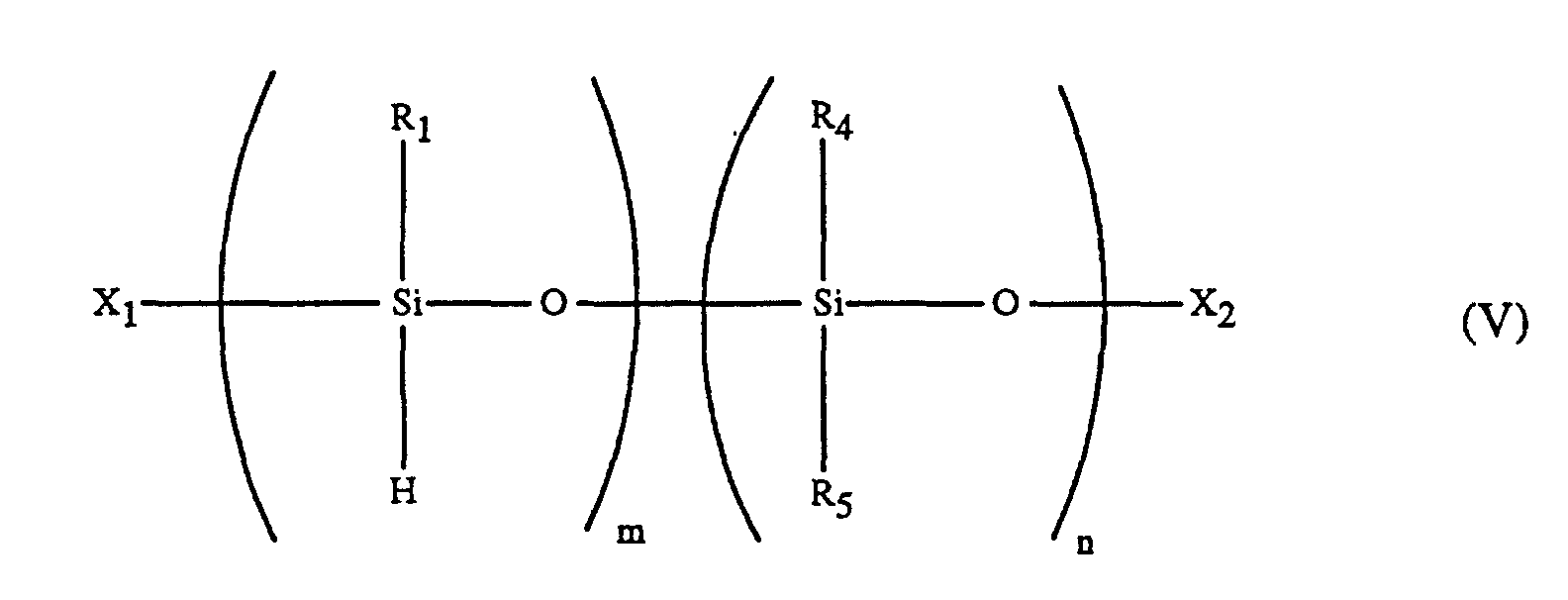
    where G1 is Cl or C1-C8alkoxy and G2 is Cl, C1-C8alkoxy or phenyl, as reported, for example, in US Patent 4 946 880, or, if R1 and R4 are C1-C8alkyl or phenyl, by reaction of a compound of the formula (V)
    Figure 00060002
    with a compound of the formula (VI)
    Figure 00070001
    with R2' being C2-C12alkenyl, in the presence of catalytic quantities of the Pt or Rh complex as described, for example, in US Patent 5 051 458 and EP Patent 388 321.
    If R2 is a direct bond, the compounds of the formula (I) can be prepared, for example, by reacting a compound of the formula (V) with a piperidinol of the formula (VII)
    Figure 00070002
    in the presence of catalytic quantities of a complex of Pt, Rh or Pd, as described, for example, in US Patent 4 895 885.
    The compounds of the formula (V) are commercially available or can be prepared by known processes. The compounds of the formula (VI) are prepared, for example, as indicated in US Patent 4 946 880, the group R3O- in the 1-position of the piperidyl group being introduced according to the processes disclosed in US Patent 4 921 962.
    The compounds of the formula (VII) are prepared, for example, as reported in US Patent 5 021 481.
    The compounds of the present invention are highly effective in improving the light stability, heat stability and oxidation stability of organic materials, in particular synthetic polymers and copolymers, and, owing to their high resistance to volatilization, are particularly suitable for stabilizing polypropylene fibres, especially in the presence of flame retardants, or polyethylene films, particularly in the presence of pesticides.
    Examples of such organic materials which can be stabilized are:
  • 1. Polymers of monoolefins and diolefins, for example polypropylene, polyisobutylene, polybut-1-ene, poly-4-methylpent-l-ene, polyisoprene or polybutadiene, as well as polymers of cycloolefins, for instance of cyclopentene or norbornene, polyethylene (which optionally can be crosslinked), for example high density polyethylene (HDPE), low density polyethylene (LDPE), linear low density polyethylene (LLDPE), branched low density polyethylene (BLDPE). Polyolefins, i.e. the polymers of monoolefins exemplified in the preceding paragraph, preferably polyethylene and polypropylene, can be prepared by different, and especially by the following, methods:
  • a) radical polymerisation (normally under high pressure and at elevated temperature).
  • b) catalytic polymerisation using a catalyst that normally contains one or more than one metal of groups IVb, Vb, VIb or VIII of the Periodic Table. These metals usually have one or more than one ligand, typically oxides, halides, alcoholates, esters, ethers, amines, alkyls, alkenyls and/or aryls that may be either n- or σ-coordinated. These metal complexes may be in the free form or fixed on substrates, typically on activated magnesium chloride, titanium(III) chloride, alumina or silicon oxide. These catalysts may be soluble or insoluble in the polymerisation medium. The catalysts can be used by themselves in the polymerisation or further activators may be used, typically metal alkyls, metal hydrides, metal alkyl halides, metal alkyl oxides or metal alkyloxanes, said metals being elements of groups Ia, IIa and/or IIIa of the Periodic Table. The activators may be modified conveniently with further ester, ether, amine or silyl ether groups. These catalyst systems are usually termed Phillips, Standard Oil Indiana, Ziegler (-Natta), TNZ (DuPont), metallocene or single site catalysts (SSC).
  • 2. Mixtures of the polymers mentioned under 1), for example mixtures of polypropylene with polyisobutylene, polypropylene with polyethylene (for example PP/HDPE, PP/LDPE) and mixtures of different types of polyethylene (for example LDPE/HDPE).
  • 3. Copolymers of monoolefins and diolefins with each other or with other vinyl monomers, for example ethylene/propylene copolymers, linear low density polyethylene (LLDPE) and mixtures thereof with low density polyethylene (LDPE), propylene/but-1-ene copolymers, propylene/isobutylene copolymers, ethylene/but-1-ene copolymers, ethylene/hexene copolymers, ethylene/methylpentene copolymers, ethylene/heptene copolymers, ethylene/octene copolymers, propylene/butadiene copolymers, isobutylene/isoprene copolymers, ethylene/alkyl acrylate copolymers, ethylene/alkyl methacrylate copolymers, ethylene/vinyl acetate copolymers and their copolymers with carbon monoxide or ethylene/acrylic acid copolymers and their salts (ionomers) as well as terpolymers of ethylene with propylene and a diene such as hexadiene, dicyclopentadiene or ethylidene-norbomene; and mixtures of such copolymers with one another and with polymers mentioned in 1) above, for example polypropylene/ethylene-propylene copolymers, LDPE/ethylene-vinyl acetate copolymers (EVA), LDPE/ethylene-acrylic acid copolymers (EAA), LLDPE/EVA, LLDPE/EAA and alternating or random polyalkylene/carbon monoxide copolymers and mixtures thereof with other polymers, for example polyamides.
  • 4. Hydrocarbon resins (for example C5-C9) including hydrogenated modifications thereof (e.g. tackifiers) and mixtures of polyalkylenes and starch.
  • 5. Polystyrene, poly(p-methylstyrene), poly(α-methylstyrene).
  • 6. Copolymers of styrene or α-methylstyrene with dienes or acrylic derivatives, for example styrene/butadiene, styrene/acrylonitrile, styrene/alkyl methacrylate, styrene/butadiene/alkyl acrylate, styrene/butadiene/alkyl methacrylate, styrene/maleic anhydride, styrene/acrylonitrile/methyl acrylate; mixtures of high impact strength of styrene copolymers and another polymer, for example a polyacrylate, a diene polymer or an ethylene/propylene/diene terpolymer; and block copolymers of styrene such as styrene/butadiene/styrene, styrene/isoprene/styrene, styrene/ethylene/butylene/styrene or styrene/ethylene/propylene/ styrene.
  • 7. Graft copolymers of styrene or α-methylstyrene, for example styrene on polybutadiene, styrene on polybutadiene-styrene or polybutadiene-acrylonitrile copolymers; styrene and acrylonitrile (or methacrylonitrile) on polybutadiene; styrene, acrylonitrile and methyl methacrylate on polybutadiene; styrene and maleic anhydride on polybutadiene; styrene, acrylonitrile and maleic anhydride or maleimide on polybutadiene; styrene and maleimide on polybutadiene; styrene and alkyl acrylates or methacrylates on polybutadiene; styrene and acrylonitrile on ethylene/propylene/diene terpolymers; styrene and acrylonitrile on polyalkyl acrylates or polyalkyl methacrylates, styrene and acrylonitrile on acrylate/butadiene copolymers, as well as mixtures thereof with the copolymers listed under 6), for example the copolymer mixtures known as ABS, MBS, ASA or AES polymers.
  • 8. Halogen-containing polymers such as polychloroprene, chlorinated rubbers, chlorinated or sulfochlorinated polyethylene, copolymers of ethylene and chlorinated ethylene, epichlorohydrin homo- and copolymers, especially polymers of halogen-containing vinyl compounds, for example polyvinyl chloride, polyvinylidene chloride, polyvinyl fluoride, polyvinylidene fluoride, as well as copolymers thereof such as vinyl chloride/vinylidene chloride, vinyl chloride/vinyl acetate or vinylidene chloride/vinyl acetate copolymers.
  • 9. Polymers derived from α,β-unsaturated acids and derivatives thereof such as polyacrylates and polymethacrylates; polymethyl methacrylates, polyacrylamides and polyacrylonitriles, impact-modified with butyl acrylate.
  • 10. Copolymers of the monomers mentioned under 9) with each other or with other unsaturated monomers, for example acrylonitrile/ butadiene copolymers, acrylonitrile/alkyl acrylate copolymers, acrylonitrile/alkoxyalkyl acrylate or acrylonitrile/vinyl halide copolymers or acrylonitrile/ alkyl methacrylate/butadiene terpolymers.
  • 11. Polymers derived from unsaturated alcohols and amines or the acyl derivatives or acetals thereof, for example polyvinyl alcohol, polyvinyl acetate, polyvinyl stearate, polyvinyl benzoate, polyvinyl maleate, polyvinyl butyral, polyallyl phthalate or polyallyl melamine; as well as their copolymers with olefins mentioned in 1) above.
  • 12. Homopolymers and copolymers of cyclic ethers such as polyalkylene glycols, polyethylene oxide, polypropylene oxide or copolymers thereof with bisglycidyl ethers.
  • 13. Polyacetals such as polyoxymethylene and those polyoxymethylenes which contain ethylene oxide as a comonomer; polyacetals modified with thermoplastic polyurethanes, acrylates or MBS.
  • 14. Polyphenylene oxides and sulfides, and mixtures of polyphenylene oxides with styrene polymers or polyamides.
  • 15. Polyurethanes derived from hydroxyl-terminated polyethers, polyesters or polybutadienes on the one hand and aliphatic or aromatic polyisocyanates on the other, as well as precursors thereof.
  • 16. Polyamides and copolyamides derived from diamines and dicarboxylic acids and/or from aminocarboxylic acids or the corresponding lactams, for example polyamide 4, polyamide 6, polyamide 6/6, 6/10, 6/9, 6/12, 4/6, 12/12, polyamide 11, polyamide 12, aromatic polyamides starting from m-xylene diamine and adipic acid; polyamides prepared from hexamethylenediamine and isophthalic or/and terephthalic acid and with or without an elastomer as modifier, for example poly-2,4,4,-trimethylhexamethylene terephthalamide or poly-m-phenylene isophthalamide; and also block copolymers of the aforementioned polyamides with polyolefins, olefin copolymers, ionomers or chemically bonded or grafted elastomers; or with polyethers, e.g. with polyethylene glycol, polypropylene glycol or polytetramethylene glycol; as well as polyamides or copolyamides modified with EPDM or ABS; and polyamides condensed during processing (RIM polyamide systems).
  • 17. Polyureas, polyimides, polyamide-imides and polybenzimidazoles.
  • 18. Polyesters derived from dicarboxylic acids and diols and/or from hydroxycarboxylic acids or the corresponding lactones, for example polyethylene terephthalate, polybutylene terephthalate, poly-1,4-dimethylolcyclohexane terephthalate and polyhydroxybenzoates, as well as block copolyether esters derived from hydroxyl-terminated polyethers; and also polyesters modified with polycarbonates or MBS.
  • 19. Polycarbonates and polyester carbonates.
  • 20. Polysulfones, polyether sulfones and polyether ketones.
  • 21. Crosslinked polymers derived from aldehydes on the one hand and phenols, ureas and melamines on the other hand, such as phenol/formaldehyde resins, urea/formaldehyde resins and melamine/formaldehyde resins.
  • 22. Drying and non-drying alkyd resins.
  • 23. Unsaturated polyester resins derived from copolyesters of saturated and unsaturated dicarboxylic acids with polyhydric alcohols and vinyl compounds as crosslinking agents, and also halogen-containing modifications thereof of low flammability.
  • 24. Crosslinkable acrylic resins derived from substituted acrylates, for example epoxy acrylates, urethane acrylates or polyester acrylates.
  • 25. Alkyd resins, polyester resins and acrylate resins crosslinked with melamine resins, urea resins, polyisocyanates or epoxy resins.
  • 26. Crosslinked epoxy resins derived from polyepoxides, for example from bisglycidyl ethers or from cycloaliphatic diepoxides.
  • 27. Natural polymers such as cellulose, rubber, gelatin and chemically modified homologous derivatives thereof, for example cellulose acetates, cellulose propionates and cellulose butyrates, or the cellulose ethers such as methyl cellulose; as well as rosins and their derivatives.
  • 28. Blends of the aforementioned polymers (polyblends), for example PP/EPDM, Polyamide/EPDM or ABS, PVC/EVA, PVC/ABS, PVC/MBS, PC/ABS, PBTP/ABS, PC/ASA, PC/PBT, PVC/CPE, PVC/acrylates, POM/thermoplastic PUR, PC/thermoplastic PUR, POM/acrylate, POM/MBS, PPO/HIPS, PPO/PA 6.6 and copolymers, PA/HDPE, PA/PP, PA/PPO.
  • 29. Naturally occurring and synthetic organic materials which are pure monomeric compounds or mixtures of such compounds, for example mineral oils, animal and vegetable fats, oil and waxes, or oils, fats and waxes based on synthetic esters (e.g. phthalates, adipates, phosphates or trimellitates) and also mixtures of synthetic esters with mineral oils in any weight ratios, typically those used as spinning compositions, as well as aqueous emulsions of such materials.
  • 30. Aqueous emulsions of natural or synthetic rubber, e.g. natural latex or latices of carboxylated styrene/butadiene copolymers.
  • The compounds of the formula (I) are particularly suitable for improving the light stability, heat stability and oxidation stability of polyolefins, especially polyethylene and polypropylene.
    The compounds of the formula (I) can be used in mixtures with organic materials in various proportions depending on the nature of the material to be stabilized, on the end use and on the presence of other additives.
    In general, it is appropriate to use, for example, 0.01 to 5 % by weight of the compounds of the formula (I), relative to the weight of the material to be stabilized, preferably between 0.05 and 1 %.
    In general, the compounds of the formula (I) can be added to the polymeric materials before, during or after the polymerization or crosslinking of the said materials.
    The compounds of the formula (I) can be incorporated in the polymeric materials in the pure form or encapsulated in waxes, oils or polymers.
    The compounds of the formula (I) can be incorporated in the polymeric materials by various processes, such as dry mixing in the form of powder, or wet mixing in the form of solutions or suspensions or also in the form of a masterbatch; in such operations, the polymer can be used in the form of powder, granules, solutions, suspensions or in the form of latices.
    The materials stabilized with the products of the formula (I) can be used for the production of mouldings, films, tapes, monofilaments, fibres, surface coatings and the like.
    If desired, other conventional additives for synthetic polymers, such as antioxidants, UV absorbers, nickel stabilizers, pigments, fillers, plasticizers, antistatic agents, flameproofing agents, lubricants, corrosion inhibitors and metal deactivators, can be added to the mixtures of the compounds of the formula (I) with the organic materials.
    Particular examples of additives which can be used in admixture with the compounds of the formula (I) are:
  • 1. Antioxidants
  • 1. 1. Alkylated monophenols, for example 2,6-di-tert-butyl-4-methylphenol, 2-tert-butyl-4,6-dimethylphenol, 2,6-di-tert-butyl-4-ethylphenol, 2,6-di-tert-butyl-4-n-butylphenol, 2,6-di-tert-butyl-4-isobutylphenol, 2,6-dicyclopentyl-4-methylphenol, 2-(α-methylcyclohexyl)-4,6-dimethylphenol, 2,6-dioctadecyl-4-methylphenol, 2,4,6-tricyclohexylphenol, 2,6-di-tert-butyl-4-methoxymethylphenol, 2,6-di-nonyl-4-methylphenol, 2,4-dimethyl-6-(1'-methylundec-1'-yl)phenol, 2,4-dimethyl-6-(1'-methylheptadec- 1'-yl)phenol, 2,4-dimethyl-6-(1'-methyltridec-1'-yl)phenol and mixtures thereof.
  • 1. 2. Alkylthiomethylphenols, for example 2,4-dioctylthiomethyl-6-tert-butylphenol, 2,4-dioctylthiomethyl-6-methylphenol, 2,4-dioctylthiomethyl-6-ethylphenol, 2,6-di-dodecylthiomethyl-4-nonylphenol.
  • 1. 3. Hydroquinones and alkylated hydroquinones, for example 2,6-di-tert-butyl-4-methoxyphenol, 2,5-di-tert-butylhydroquinone, 2,5-di-tert-amylhydroquinone, 2,6-diphenyl-4-octadecyloxyphenol, 2,6-di-tert-butylhydroquinone, 2,5-di-tert-butyl-4-hydroxyanisole, 3,5-di-tert-butyl-4-hydroxyanisole, 3,5-di-tert-butyl-4-hydroxyphenyl stearate, bis-(3,5-di-tert-butyl-4-hydroxyphenyl) adipate.
  • 1. 4. Tocopherols, for example α-tocopherol, β-tocopherol, γ-tocopherol, δ-tocopherol and mixtures thereof (Vitamin E).
  • 1. 5. Hydroxylated thiodiphenyl ethers, for example 2,2'-thiobis(6-tert-butyl-4-methylphenol), 2,2'-thiobis(4-octylphenol), 4,4'-thiobis(6-tert-butyl-3-methylphenol), 4,4'-thiobis(6-tert-butyl-2-methylphenol), 4,4'-thiobis-(3,6-di-sec-amylphenol), 4,4'-bis-(2,6-dimethyl-4-hydroxyphenyl) disulfide.
  • 1. 6. Alkylidenebisphenols, for example 2,2'-methylenebis(6-tert-butyl-4-methylphenol), 2,2'-methylenebis(6-tert-butyl-4-ethylphenol), 2,2'-methylenebis[4-methyl-6-(α-methylcyclohexyl)phenol], 2,2'-methylenebis(4-methyl-6-cyclohexylphenol), 2,2'-methylenebis(6-nonyl-4-methylphenol), 2,2'-methylenebis(4,6-di-tert-butylphenol), 2,2'-ethylidenebis(4,6-di-tert-butylphenol), 2,2'-ethylidenebis(6-tert-butyl-4-isobutylphenol), 2,2'-methylenebis[6-(α-methylbenzyl)-4-nonylphenol],2,2'-methylenebis[6-(α,α-dimethylbenzyl)-4-nonylphenol], 4,4'-methylenebis(2,6-di-tert-butylphenol), 4,4'-methylenebis(6-tert-butyl-2-methylphenol), 1,1-bis(5-tert-butyl-4-hydroxy-2-methylphenyl)butane, 2,6-bis(3-tert-butyl-5-methyl-2-hydroxybenzyl)-4-methylphenol, 1,1,3-tris(5-tert-butyl-4-hydroxy-2-methylphenyl)butane, 1,1-bis(5-tert-butyl-4-hydroxy-2-methyl-phenyl)-3-n-dodecylmercaptobutane, ethylene glycol bis[3,3-bis(3'-tert-butyl-4'-hydroxyphenyl)butyrate], bis(3-tert-butyl-4-hydroxy-5-methyl-phenyl)dicyclopentadiene, bis[2-(3'-tert-butyl-2'-hydroxy-5'-methylbenzyl)-6-tert-butyl-4-methylphenyl]terephthalate, 1,1-bis-(3,5-dimethyl-2-hydroxyphenyl)butane, 2,2-bis-(3,5-di-tert-butyl-4-hydroxyphenyl)propane, 2,2-bis-(5-tert-butyl-4-hydroxy2-methylphenyl)-4-n-dodecylmercaptobutane, 1,1,5,5-tetra-(5-tert-butyl-4-hydroxy2-methylphenyl)pentane.
  • 1. 7. O-, N- and S-benzyl compounds, for example 3,5,3',5'-tetra-tert-butyl-4,4'-dihydroxydibenzyl ether, octadecyl-4-hydroxy-3,5-dimethylbenzylmercaptoacetate, tris-(3,5-di-tert-butyl-4-hydroxybenzyl)amine, bis(4-tert-butyl-3-hydroxy-2,6-dimethylbenzyl)dithioterephthalate, bis(3,5-di-tert-butyl-4-hydroxybenzyl)sulfide, isooctyl-3,5di-tert-butyl-4-hydroxybenzylmercaptoacetate.
  • 1. 8. Hydroxybenzylated malonates, for example dioctadecyl-2,2-bis-(3,5-di-tert-butyl-2-hydroxybenzyl)-malonate, di-octadecyl-2-(3-tert-butyl-4-hydroxy-5-methylbenzyl)-malonate, di-dodecylmercaptoethyl-2,2-bis-(3,5-di-tert-butyl-4-hydroxybenzyl)malonate, bis-[4-(1,1,3,3-tetramethylbutyl)phenyl]-2,2-bis(3,5-di-tert-butyl-4-hydroxybenzyl)malonate.
  • 1. 9. Aromatic hydroxybenzyl compounds, for example 1,3,5-tris-(3,5-di-tert-butyl-4-hydroxybenzyl)-2,4,6-trimethylbenzene, 1,4-bis(3,5-di-tert-butyl-4-hydroxybenzyl)-2,3,5,6-tetramethylbenzene, 2,4,6-tris(3,5-di-tert-butyl-4-hydroxybenzyl)phenol.
  • 1. 10. Triazine Compounds, for example 2,4-bis(octylmercapto)-6-(3,5-di-tert-butyl-4-hydroxyanilino)-1,3,5-triazine, 2-octylmercapto-4,6-bis(3,5-di-tert-butyl-4-hydroxyanilino)-1,3,5-triazine, 2-octylmercapto-4,6-bis(3,5-di-tert-butyl-4-hydroxyphenoxy)-1,3,5-triazine, 2,4,6-tris(3,5-di-tert-butyl-4-hydroxyphenoxy)-1,2,3-triazine, 1,3,5-tris(3,5-di-tert-butyl-4-hydroxybenzyl)isocyanurate, 1,3,5-tris(4-tert-butyl-3-hydroxy-2,6-dimethylbenzyl)isocyanurate, 2,4,6-tris(3,5-di-tert-butyl-4-hydroxyphenylethyl)-1,3,5-triazine, 1,3,5-tris(3,5-di-tert-butyl-4-hydroxyphenylpropionyl)-hexahydro-1,3,5-triazine, 1,3,5-tris(3,5-dicyclohexyl-4-hydroxybenzyl)isocyanurate.
  • 1. 11. Benzylphosphonates, for example dimethyl-2,5-di-tert-butyl-4-hydroxybenzylphosphonate, diethyl-3,5-di-tert-butyl-4-hydroxybenzylphosphonate, dioctadecyl3,5-di-tert-butyl-4-hydroxybenzylphosphonate, dioctadecyl-5-tert-butyl-4-hydroxy3-methylbenzylphosphonate, the calcium salt of the monoethyl ester of 3,5-di-tert-butyl-4-hydroxybenzylphosphonic acid.
  • 1. 12. Acylaminophenols, for example 4-hydroxylauranilide, 4-hydroxystearanilide, octyl N-(3,5-di-tert-butyl-4-hydroxyphenyl)carbamate.
  • 1. 13. Esters of β-(3,5-di-tert-butyl-4-hydroxyphenyl)propionic acid with mono- or polyhydric alcohols, e.g. with methanol, ethanol, octanol, octadecanol, 1,6-hexanediol, 1,9-nonanediol, ethylene glycol, 1,2-propanediol, neopentyl glycol, thiodiethylene glycol, diethylene glycol, triethylene glycol, pentaerythritol, tris(hydroxyethyl) isocyanurate, N,N'-bis(hydroxyethyl)oxamide, 3-thiaundecanol, 3-thiapentadecanol, trimethylhexanediol, trimethylolpropane, 4-hydroxymethyl-1-phospha-2,6,7-trioxabicyclo[2.2.2]octane.
  • 1. 14. Esters of β-(5-tert-butyl-4-hydroxy-3-methylphenyl)propionic acid with mono- or polyhydric alcohols, e.g. with methanol, ethanol, octanol, octadecanol, 1,6-hexanediol, 1,9-nonanediol, ethylene glycol, 1,2-propanediol, neopentyl glycol, thiodiethylene glycol, diethylene glycol, triethylene glycol, pentaerythritol, tris(hydroxyethyl) isocyanurate, N,N'-bis(hydroxyethyl)oxamide, 3-thiaundecanol, 3-thiapentadecanol, trimethylhexanediol, trimethylolpropane, 4-hydroxymethyl-1-phospha-2,6,7-trioxabicyclo[2.2.2]octane.
  • 1. 15. Esters of β- (3,5-dicyclohexyl-4-hydroxyphenyl)propionic acid with mono- or polyhydric alcohols, e.g. with methanol, ethanol, octanol, octadecanol, 1,6-hexanediol, 1,9-nonanediol, ethylene glycol, 1,2-propanediol, neopentyl glycol, thiodiethylene glycol, diethylene glycol, triethylene glycol, pentaerythritol, tris(hydroxyethyl) isocyanurate, N,N'-bis(hydroxyethyl)oxamide, 3-thiaundecanol, 3-thiapentadecanol, trimethylhexanediol, trimethylolpropane, 4-hydroxymethyl-1-phospha-2,6,7-trioxabicyclo[2.2.2]octane.
  • 1. 16. Esters of 3,5-di-tert-butyl-4-hydroxyphenyl acetic acid with mono- or polyhydric alcohols, e.g. with methanol, ethanol, octanol, octadecanol, 1,6-hexanediol, 1,9-nonanediol, ethylene glycol, 1,2-propanediol, neopentyl glycol, thiodiethylene glycol, diethylene glycol, triethylene glycol, pentaerythritol, tris(hydroxyethyl) isocyanurate, N,N'-bis(hydroxyethyl)oxamide, 3-thiaundecanol, 3-thiapentadecanol, trimethylhexanediol, trimethylolpropane, 4-hydroxymethyl-1-phospha-2,6,7-trioxabicyclo[2.2.2]octane.
  • 1. 17. Amides of β-(3,5-di-tert-butyl-4-hydroxyphenyl)propionic acid e.g. N,N'-bis(3,5-di-tert-butyl-4-hydroxyphenylpropionyl)hexamethylenediamine, N,N'-bis(3,5-di-tert-butyl-4-hydroxyphenylpropionyl)trimethylenediamine, N,N'-bis(3,5-di-tert-butyl-4-hydroxyphenylpropionyl)hydrazine.
  • 2. UV absorbers and light stabilisers
  • 2. 1. 2-(2'-Hydroxyphenyl)benzotriazoles, for example 2-(2'-hydroxy-5'-methylphenyl)benzotriazole, 2-(3',5'-di-tert-butyl-2'-hydroxyphenyl)benzotriazole, 2-(5'-tert-butyl-2'-hydroxyphenyl)benzotriazole, 2-(2'-hydroxy-5'-(1,1,3,3-tetramethylbutyl)phenyl)benzotriazole, 2-(3',5'-di-tert-butyl-2'-hydroxyphenyl)-5-chloro-benzotriazole, 2-(3'-tert-butyl-2'-hydroxy-5'-methylphenyl)-5-chloro-benzotriazole, 2-(3'-sec-butyl-5'-tert-butyl-2'-hydroxyphenyl)benzotriazole, 2-(2'-hydroxy-4'-octyloxyphenyl)benzotriazole, 2-(3',5'-di-tert-amyl-2'-hydroxyphenyl)benzotriazole, 2-(3',5'-bis-(α,α-dimethylbenzyl)-2'-hydroxyphenyl)benzotriazole, mixture of 2-(3'-tert-butyl-2'-hydroxy-5'-(2-octyloxycarbonylethyl)phenyl)-5-chloro-benzotriazole, 2-(3'-tert-butyl-5'-[2-(2-ethylhexyloxy)-carbonylethyl]-2'-hydroxyphenyl)-5-chloro-benzotriazole, 2-(3'-tert-butyl-2'-hydroxy-5'-(2-methoxycarbonylethyl)phenyl)-5-chloro-benzotriazole, 2-(3'-tert-butyl-2'-hydroxy-5'-(2-methoxycarbonylethyl)phenyl)benzotriazole, 2-(3'-tert-butyl-2'-hydroxy-5'-(2-octyloxycarbonylethyl)phenyl)benzotriazole, 2-(3'-tert-butyl-5'-[2-(2-ethylhexyloxy)carbonylethyl]-2'-hydroxyphenyl)benzotriazole, 2-(3'-dodecyl-2'-hydroxy-5'-methylphenyl)benzotriazole, and 2-(3'-tert-butyl-2'-hydroxy-5'-(2-isooctyloxycarbonylethyl)phenylbenzotriazole, 2,2'-methylene-bis[4-(1,1,3,3-tetramethylbutyl)-6-benzotriazole-2-ylphenol]; the transesterification product of 2-[3'-tert-butyl-5'-(2-methoxycarbonylethyl)-2'-hydroxyphenyl]-2H-benzotriazole with polyethylene glycol 300;
    Figure 00170001
    where R = 3'-tert-butyl-4'-hydroxy-5'-2H-benzotriazol-2-ylphenyl.
  • 2. 2. 2-Hydroxybenzophenones, for example the 4-hydroxy, 4-methoxy, 4-octyloxy, 4-decyloxy, 4-dodecyloxy, 4-benzyloxy, 4,2',4'-trihydroxy and 2'-hydroxy-4,4'-dimethoxy derivatives.
  • 2. 3. Esters of substituted and unsubstituted benzoic acids, as for example 4-tertbutylphenyl salicylate, phenyl salicylate, octylphenyl salicylate, dibenzoyl resorcinol, bis(4-tert-butylbenzoyl) resorcinol, benzoyl resorcinol, 2,4-di-tertbutylphenyl 3,5-di-tert-butyl-4-hydroxybenzoate, hexadecyl 3,5-di-tert-butyl-4-hydroxybenzoate, octadecyl 3,5-di-tert-butyl-4-hydroxybenzoate, 2-methyl-4,6-di-tert-butylphenyl 3,5-di-tert-butyl-4-hydroxybenzoate.
  • 2. 4. Acrylates, for example ethyl α-cyano-β,β-diphenylacrylate, isooctyl α-cyano-β,β-diphenylacrylate, methyl α-carbomethoxycinnamate, methyl α-cyano-β-methyl-p-methoxycinnamate, butyl α-cyano-β-methyl-p-methoxy-cinnamate, methyl α-carbomethoxy-p-methoxycinnamate and N-(β-carbomethoxy-β-cyanovinyl)-2-methylindoline.
  • 2. 5. Nickel compounds, for example nickel complexes of 2,2'-thio-bis-[4-(1,1,3,3-tetramethylbutyl)phenol], such as the 1:1 or 1:2 complex, with or without additional ligands such as n-butylamine, triethanolamine or N-cyclohexyldiethanolamine, nickel dibutyldithiocarbamate, nickel salts of the monoalkyl esters, e.g. the methyl or ethyl ester, of 4-hydroxy-3,5-di-tert-butylbenzylphosphonic acid, nickel complexes of ketoximes, e.g. of 2-hydroxy-4-methylphenyl undecylketoxime, nickel complexes of 1-phenyl-4-lauroyl-5-hydroxypyrazole, with or without additional ligands.
  • 2. 6. Sterically hindered amines, for example bis(2,2,6,6-tetramethyl-piperidyl)sebacate, bis(2,2,6,6-tetramethyl-piperidyl)succinate, bis(1,2,2,6,6-pentamethylpiperidyl)sebacate, bis(1,2,2,6,6-pentamethylpiperidyl) n-butyl-3,5-di-tert-butyl-4-hydroxybenzylmalonate, the condensate of 1-(2-hydroxyethyl)-2,2,6,6-tetramethyl-4-hydroxypiperidine and succinic acid, the condensate of N,N'-bis(2,2,6,6-tetramethyl-4-piperidyl)hexamethylenediamine and 4-tert-octylamino-2,6-dichloro-1,3,5-triazine, tris(2,2,6,6-tetramethyl-4-piperidyl) nitrilotriacetate, tetrakis(2,2,6,6-tetramethyl-4- piperidyl)-1,2,3,4-butane-tetracarboxylate, 1,1'-(1,2-ethanediyl)bis(3,3,5,5-tetramethylpiperazinone), 4-benzoyl-2,2,6,6-tetramethylpiperidine, 4-stearyloxy-2,2,6,6-tetramethylpiperidine, bis(1,2,2,6,6-pentamethylpiperidyl)-2-n-butyl-2-(2-hydroxy-3,5-di-tert-butylbenzyl)malonate, 3-n-octyl-7,7,9,9-tetramethyl-1,3,8-triazasprio[4.5]decan-2,4-dion, bis(1-octyloxy-2,2,6,6-tetramethylpiperidyl)sebacate, bis(1-octyloxy-2,2,6,6-tetramethylpiperidyl)succinate, the condensate of N,N'-bis-(2,2,6,6-tetramethyl-4-piperidyl)hexamethylenediamine and 4-morpholino-2,6-dichloro-1,3,5-triazine, the condensate of 2-chloro-4,6-bis(4-n-butylamino-2,2,6,6-tetramethylpiperidyl )-1,3,5-triazine and 1,2-bis(3-aminopropylamino)ethane, the condensate of 2-chloro-4,6-di-(4-n-butylamino-1,2,2,6,6-pentamethylpiperidyl)-1,3,5-triazine and 1,2-bis-(3-aminopropylamino)ethane, 8-acetyl-3-dodecyl-7,7,9,9-tetramethyl-1,3,8-triazaspiro[4.5]decane-2,4-dione, 3-dodecyl-1-(2,2,6,6-tetramethyl-4-piperidyl)pyrrolidin-2,5-dione, 3-dodecyl-1-(1,2,2,6,6-pentamethyl-4-piperidyl)pyrrolidine-2,5-dione.
  • 2. 7. Oxamides, for example 4,4'-dioctyloxyoxanilide, 2,2'-diethoxyoxanilide, 2,2'-dioctyloxy-5,5'-di-tert-butoxanilide, 2,2'-didodecyloxy-5,5'-di-tert-butoxanilide, 2-ethoxy-2'-ethyloxanilide, N,N'-bis(3-dimethylaminopropyl)oxamide, 2-ethoxy-5-tert-butyl-2'-ethoxanilide and its mixture with 2-ethoxy-2'-ethyl-5,4'-di-tert-butoxanilide and mixtures of ortho- and para-methoxy-disubstituted oxanilides and mixtures of o- and p-ethoxy-disubstituted oxanilides.
  • 2. 8. 2-(2-Hydroxyphenyl)-1,3,5-triazines, for example 2,4,6-tris(2-hydroxy-4-octyloxyphenyl)-1,3,5-triazine, 2-(2-hydroxy-4-octyloxyphenyl)-4,6-bis(2,4-dimethylphenyl)-1,3,5-triazine, 2-(2,4-dihydroxyphenyl)-4,6-bis(2,4-dimethylphenyl)-1,3,5-triazine, 2,4-bis(2-hydroxy-4-propyloxyphenyl)-6-(2,4-dimethylphenyl)-1,3,5-triazine, 2-(2-hydroxy-4-octyloxyphenyl)-4,6-bis(4-methylphenyl)-1,3,5-triazine, 2-(2-hydroxy-4-dodecyloxyphenyl)-4,6-bis(2,4-dimethylphenyl)-1,3,5-triazine, 2-[2-hydroxy-4-(2hydroxy-3-butyloxy-propoxy)phenyl]-4,6-bis(2,4-dimethyl)-1,3,5-triazine, 2-[2-hydroxy-4-(2-hydroxy-3-octyloxy-propyloxy)phenyl]-4,6-bis(2,4-dimethyl)-1,3,5-triazine.
  • 3. Metal deactivators, for example N,N'-diphenyloxamide, N-salicylal-N'-salicyloyl hydrazine, N,N'-bis(salicyloyl) hydrazine, N,N'-bis(3,5-di-tert-butyl-4-hydroxyphenylpropionyl) hydrazine , 3-salicyloylamino-1,2,4-triazole, bis(benzylidene)oxalyl dihydrazide, oxanilide, isophthaloyl dihydrazide, sebacoyl bisphenylhydrazide, N,N'-diacetyladipoyl dihydrazide, N,N'-bis(salicyloyl)oxalyl dihydrazide, N,N'-bis(salicyloyl)thiopropionyl dihydrazide.
  • 4. Phosphites and phosphonites, for example triphenyl phosphite, diphenyl alkyl phosphites, phenyl dialkyl phosphites, tris(nonylphenyl) phosphite, trilauryl phosphite, trioctadecyl phosphite, distearyl pentaerythritol diphosphite, tris(2,4-di-tert-butylphenyl) phosphite, diisodecyl pentaerythritol diphosphite, bis(2,4-di-tert-butylphenyl) pentaerythritol diphosphite, bis(2,6-di-tert-butyl-4-methylphenyl)-pentaeryt hritol diphosphite, diisodecyloxypentaerythritol diphosphite, bis(2,4-di-tert-butyl-6-methylphenyl)pentaerythritol diphosphite, bis(2,4,6-tris(tert-butylphenyl)pentaerythritol diphsophite, tristearyl sorbitol triphosphite, tetrakis(2,4-di-tert-butylphenyl) 4,4'-biphenylene diphosphonite, 6-isooctyloxy-2,4,8,10-tetra-tert-butyl-12H-dibenz[d,g]-1,3,2-dioxaphosphocin, 6-fluoro-2,4,8,10-tetra-tert-butyl-12-methyl-dibenz[d,g]-1,3,2-dioxaphosphocin, bis(2,4-di-tert-butyl-6-methylphenyl)methylphosphite, bis(2,4-di-tert-butyl-6-methylphenyl)ethylphosphite.
  • 5. Peroxide scavengers, for example esters of β-thiodipropionic acid, for example the lauryl, stearyl, myristyl or tridecyl esters, mercaptobenzimidazole or the zinc salt of 2-mercaptobenzimidazole, zinc dibutyldithiocarbamate, dioctadecyl disulfide, pentaerythritol tetrakis(β-dodecylmercapto)propionate.
  • 6. Polyamide stabilisers, for example, copper salts in combination with iodides and/or phosphorus compounds and salts of divalent manganese.
  • 7. Basic co-stabilisers, for example, melamine, polyvinylpyrrolidone, dicyandiamide, triallyl cyanurate, urea derivatives, hydrazine derivatives, amines, polyamides, polyurethanes, alkali metal salts and alkaline earth metal salts of higher fatty acids for example calcium stearate, zinc stearate, magnesium behenate, magnesium stearate, sodium ricinoleate and potassium palmitate, antimony pyrocatecholate or tin pyrocatecholate.
  • 8. Nucleating agents, for example, 4-tert-butylbenzoic acid, adipic acid, diphenylacetic acid.
  • 9. Fillers and reinforcing agents, for example, calcium carbonate, silicates, glass fibres, asbestos, talc, kaolin, mica, barium sulfate, metal oxides and hydroxides, carbon black, graphite.
  • 10. Other additives, for example, plasticisers, lubricants, emulsifiers, pigments, optical brighteners, flameproofing agents, antistatic agents and blowing agents.
  • 11. Benzofuranones and indolinones, for example those disclosed in US-A-4 325 863, US-A-4 338 244, US-A-5 175 312, US-A-5 216 052, US-A-5 252 643, DE-A-4 316 611, DE-A-4 316 622, DE-A-4 316 876, EP-A-0 589 839 or EP-A-0 591 102 or 3-[4-(2-acetoxyethoxy)phenyl]-5,7-di-tert-butyl-benzofuran-2-one, 5,7-di-tert-butyl-3-[4-(2-stearoyloxyethoxy)phenyl]benzofuran-2-one, 3,3'-bis[5,7-di-tert-butyl-3-(4-[2-hydroxyethoxy]phenyl)benzofuran-2-one], 5,7-di-tert-butyl-3-(4-ethoxyphenyl)benzofuran-2-one, 3-(4-acetoxy-3,5-dimethylphenyl)-5,7-di-tert-butyl-benzofuran-2-one, 3-(3,5-dimethyl-4-pivaloyloxyphenyl)-5,7-di-tert-butyl-benzofuran-2-one.
  • The compounds of the present invention can also be used as stabilizers, especially as light stabilizers, for the major part of the materials known in the art of photographic reproduction and other reproduction techniques, for example as described in Research Disclosure 1990, 31429 (pages 474-480).
    Several examples of the preparation and use of the compounds of the formula (I) are reported for a more detailed illustration of the present invention; these examples are given solely for illustrative purposes and do not imply any restriction. The compounds disclosed in Examples 2, 4, 8 and 9 are particularly preferred.
    Example 1: Preparation of 1-cyclohexyloxy-4-[3-diethoxymethylsilyl)propoxy]-2,2,6,6-tetramethylpiperidine
    29.5 g (0.1 mol) of 4-allyloxy-1-cyclohexyloxy-2,2,6,6-tetramethylpiperidine, 16.1 g (0.12 mol) of diethoxymethylsilane and 0.01 g of PtCl2 (C6H5CH=CH2)2 are heated for 1 hour at 90°C and 1 hour at 125°C.
    After cooling to ambient temperature, 50 ml of toluene are added and the resulting solution is filtered and evaporated at 50°C/1 mbar.
    The residue is purified by distillation in vacuo, giving the product as a pale oil of boiling point=180-181°C/0.1 mbar.
    Analysis for C23H47NO4Si
    Calculated C = 64.29 %; H = 11.02 % ; N = 3.26 %
    Found C = 64.25 %; H = 11.04 %; N = 3.25 %
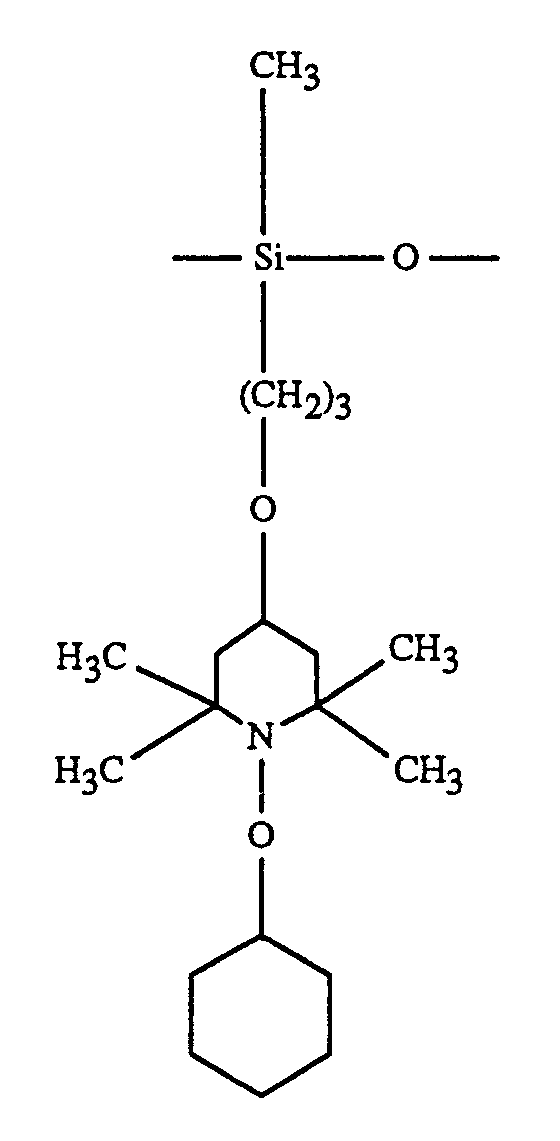
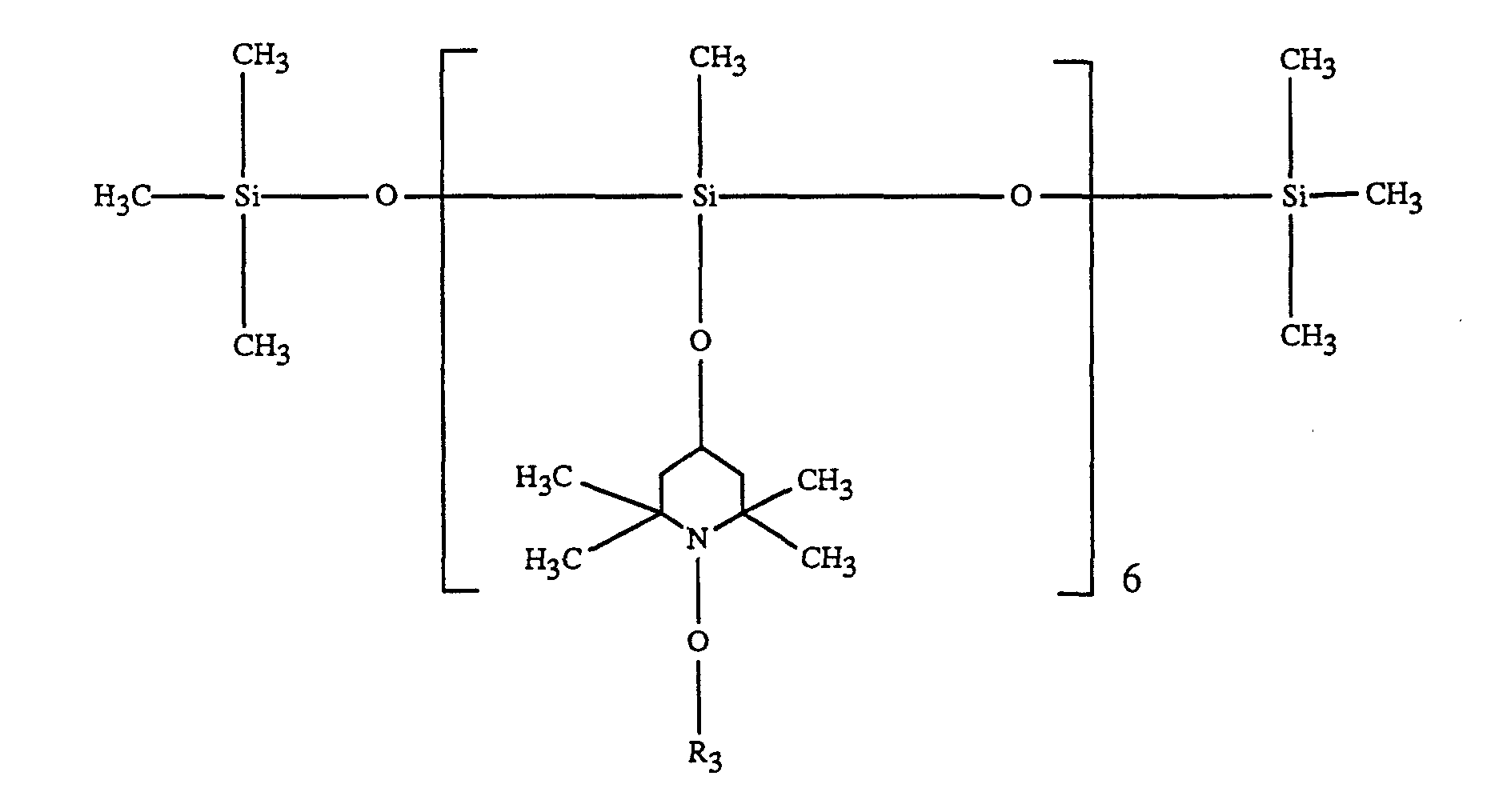
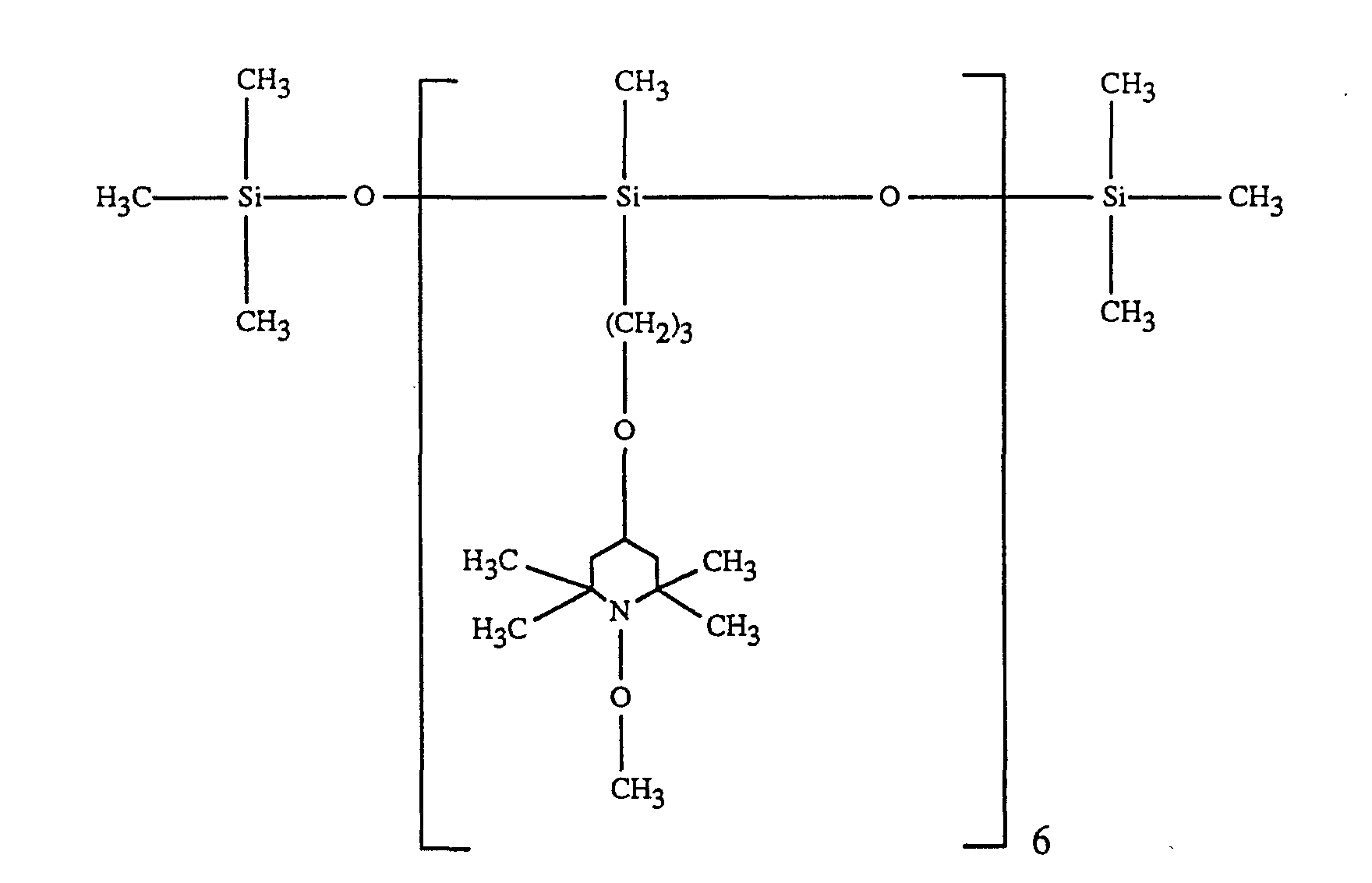
    Example 2: Preparation of a polysiloxane containing recurring units of the formula
    Figure 00210001
    16.3 g (0.038 mol) of 1-cyclohexyloxy-4-[3-(diethoxymethylsilyl)propoxy]-2,2,6,6-tetramethylpiperidine are dissolved at ambient temperature in 115 ml of 1 N HCl and the resulting solution is stirred for 10 hours at 20°C. 80 ml of toluene are added and, while maintaining the temperature at 20°C, a solution of 5.2 g (0.13 mol) of NaOH in 30 ml of water is added. The mixture is stirred for 30 minutes and the organic phase is separated off, dried over anhydrous Na2SO4 and evaporated at 50°C/1 mbar.
    The product is obtained as a yellow oil of Mn = 2650.
    Example 3: Preparation of 1-methoxy-4-[3-diethoxymethylsilyl)propoxy]-2,2,6,6-tetramethylpiperidine
    1 ml of a 2 % solution of hexachloroplatinic acid in isopropanol is added to a mixture of 22.7 g (0.1 mol) of 4-allyloxy-1-methoxy-2,2,6,6-tetramethylpiperidine and 17.9 g (0.13 mol) of diethoxymethylsilane.
    The reaction mixture is heated at 100°C for 3 hours and then stirred in vacuo at ambient temperature for 3 hours.
    After evaporation in vacuo at 50°C/1 mbar, the residue is purified by distillation in vacuo, giving the product as a pale oil of boiling point 104-110°C/0.04 mbar, whose NMR and MS analyses conform with the indicated structure.
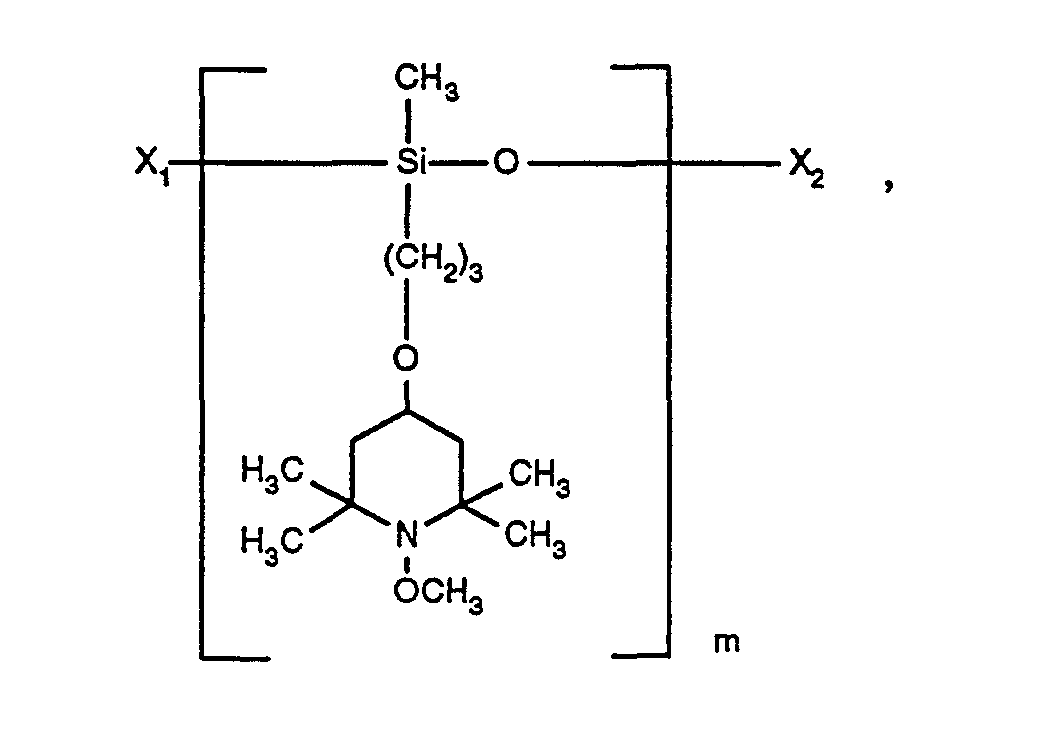
    Example 4: Preparation of a polysiloxane containing recurring units of the formula
    Figure 00220001
    A mixture of 21.0 g (0.058 mol) of 1-methoxy-4-[3-(diethoxymethylsilyl)propoxy]-2,2,6,6-tetramethylpiperidine, 1.02 g (0.003 mol) of butyl-tin diacetate and 3.0 g of water in 100 ml of xylene are heated at 120°C for 2 hours.
    The reaction mixture is cooled and extracted with toluene, and the organic phase is washed with water, dried over anhydrous sodium sulfate, filtered and evaporated at 50°C/1 mbar. The product is obtained as a viscous pale oil of Mn = 2300.
    Example 5: Preparation of 1-methoxy-4-[3-[bis(trimethylsiloxy)methylsilyl]propoxy]-2,2,6,6-tetramethylpiperidine.
    Following the procedure of Example 3, 34.1 g (0.15 mol) of 4-allyloxy-1-methoxy-2,2,6,6-tetramethylpiperidine are reacted with 33.4 g (0.15 mol) of bis(trimethylsiloxy)methylsilane in the presence of 1 ml of a 2 % solution of hexachloroplatinic acid in isopropanol.
    The product is obtained as a clear oil of boiling point 125-130°C/0.11 mbar.
    Analysis for C20H47NO4Si3
    Calculated C = 53.40 %; H = 10.53 %; N = 3.11 %
    Found C = 53.10 %; H = 11.00 %; N = 3.90 %
    Example 6: Preparation of 2,4,6,8-tetramethyl-2,4,6,8-tetrakis[1-methoxy-4-(3-propoxy)-2,2,6,6-tetramethyl-4-piperidyl]-[1,3,5,7,2,4,6,8]-tetraoxatetrasilane
    Following the procedure of Example 3, 31.8 g (0.14 mol) of 4-allyloxy-1-methoxy-2,2,6,6-tetramethylpiperidine are reacted with 7.2 g (0.03 mol) of 2,4,6,8-tetramethyl-[1,3,5,7,2,4,6,8]-tetraoxatetrasilane in the presence of 1.0 ml of a 2 % solution of hexachloroplatinic acid in isopropanol.
    After the excess reagent has been distilled off, the product is obtained as a pale viscous oil.
    Analysis for C56H116N4O12Si4
    Calculated C = 58.49 %; H = 10.17 %; N = 4.87 %
    Found C = 58.60 %; H = 10.80 %; N = 5.50 %
    Example 7: Preparation of 1-methoxy-4-[bis(trimethylsiloxy)methylsilyl]-2,2,6,6-tetramethyl-4-oxypiperidine
    A solution of 22.2 g (0.12 mol) of 1-methoxy-2,2,6,6-tetramethyl-4-hydroxypiperidine, 26.4 g (0.12 mol) of bis(trimethylsiloxy)methylsilane and 0.02 g (0.12 mol) of cyclooctadiene-platinum diiodide in 45 ml of xylene is heated under reflux for 4 hours.
    The solvent is evaporated at 50°C/1 mbar, and the residue is dissolved in n-heptane and purified on a silica gel column using n-heptane as solvent.
    After evaporation of the solvent, the product is obtained as a pale oil.
    Analysis for C17H41NO4Si3
    Calculated C = 50.07 %; H = 10.13 %; N = 3.43 %
    Found C = 50.30 %; H = 10.90 %; N = 4.10 %
    Example 8: Preparation of a polysiloxane of the formula
    Figure 00240001
    Following the procedure of Example 7, 25.7 g (0.14 mol) of 1-methoxy-2,2,6,6-tetramethyl-4-hydroxypiperidine are reacted with 9.7 g (0.025 mol) of the respective polymethylhydroxysiloxane in the presence of 11.5 mg of cyclooctadiene-platinum diiodide in 50 ml of xylene.
    After evaporation of the solvent and purification by column chromatography, the product is obtained as a viscous pale oil whose NMR and MS analyses conform with the indicated structure.
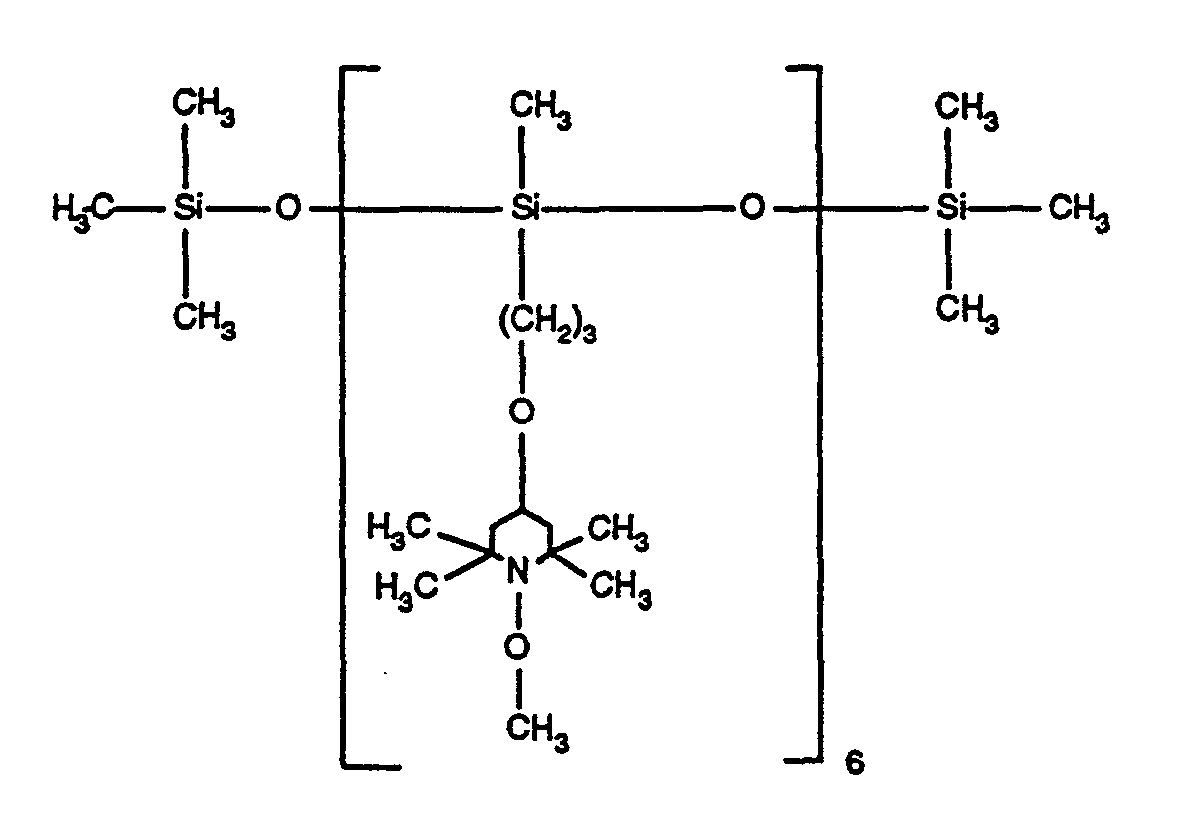
    Example 9: Preparation of a polysiloxane of the formula
    Figure 00250001
    Following the procedure of Example 3, 27.3 g (0.12 mol) of 4-allyloxy-1-methoxy-2,2,6,6-tetramethylpiperidine are reacted with 7.8 g (0.02 mol) of the respective polymethylhydrosiloxane in the presence of 0.5 ml of a 2% solution of hexachloroplatinic acid in isopropanol. After heating at 120°C for 4 hours, the solvent is dried off and after purification by column chromatography, the product is obtained as a viscous pale oil whose NMR and MS analyses conform with the indicated structure.
    Example 10: (light-stabilizing action in polypropylene fibres)
    2.5 g of the product indicated in Table 1, 1 g of tris(2,4-di-t-butylphenyl) phosphite, 0.5 g of calcium monoethyl 3,5-di-t-butyl-4-hydroxybenzylphosphonate, 1 g of calcium stearate and 2.5 g of titanium dioxide are mixed in a slow mixer with 1000 g of polypropylene powder of melt index = 12 g/10 minutes (measured at 230°C and 2.16 kg).
    The mixtures are extruded at 200-230°C to give polymer granules which are then converted into fibres, using a pilot-type apparatus (®Leonard-Sumirago (VA) Italy) operating under the following conditions:
    Extruder temperature 230-245°C
    Head temperature 255-260°C
    Stretch ratio 1: 3.5
    Count 11 dtex per filament
    The fibres thus prepared are exposed, mounted on a white card, in a model 65 WR Weather-O-Meter (ASTM D2565-85) with a black panel temperature of 63°C. The residual tenacity is measured on samples taken after various times of exposure to light by means of a constant-speed dynamometer, and the exposure time in hours (T50) needed to halve the initial tenacity is then calculated. Fibres prepared under the same conditions as indicated above, but without addition of stabilizers according to the invention, are exposed for comparison.
    The results obtained are shown in Table 1:
    Stabilizer T50 (hours)
    None 220
    Compound from Example 1 1910

    Claims (12)

    1. A compound of the formula (I)
      Figure 00270001
      in which m + n is a number from 1 to 100 and n varies from zero to 90 % of the sum of m+n,
      A is -O- or
      Figure 00270002
      where R6 is hydrogen, C1-C18alkyl or a group of the formula (II)
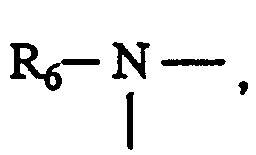
      Figure 00270003
      R1 and R4 which can be identical or different are C1-C8alkyl, phenyl, C1-C8alkoxy, OH, ONa or OK,
      R2 is C2-C12alkylene or also a direct bond if A is -O- and R1 and R4 are C1-C8alkyl or phenyl,
      R3 is C1-C18alkyl, C5-C12cycloalkyl, C2-C18alkenyl, C5-C12cycloalkenyl, C7-C12aralkyl, a saturated or unsaturated radical of a bicyclic or tricyclic C7-C12hydrocarbon or phenyl, methylphenyl, dimethylphenyl, trimethylphenyl, isopropylphenyl, naphthyl or methylnaphthyl,
      R5 is hydrogen, C1-C18alkyl, C5-C12cycloalkyl or phenyl,
      X1 is as defined for R1 or is a group (R7)3SiO- with R7 being C1-C8alkyl,
      X2 is hydrogen, Na, K, C1-C8alkyl, a group (R7)3Si- or, if n is zero and R1 and X1 are
      C1-C8alkyl or phenyl, X2 is also a group of the formula (III)
      Figure 00280001
      and, if m + n is a number from 3 to 10, X1 and X2 together can also be a direct bond.
    2. A compound of the formula (I) according to claim 1, in which m + n is a number from 1 to 80, n varies from zero to 90 % of the sum m + n, A is -O- or
      Figure 00280002
      where R6 is hydrogen, C1-C12alkyl or a group of the formula (II),
      R1 and R4 which can be identical or different are C1-C6alkyl, phenyl, C1-C6 alkoxy, OH, ONa or OK,
      R2 is C2-C8alkylene or also a direct bond if A is -O- and R1 and R4 are C1-C6alkyl or phenyl,
      R3 is C1-C18alkyl, C5-C8cycloalkyl, C3-C12alkenyl, C5-C8cycloalkenyl, C7-C9aralkyl, a saturated or unsaturated radical of a bicyclic or tricyclic C7-C10 hydrocarbon or phenyl, methylphenyl, dimethylphenyl, trimethylphenyl, isopropylphenyl, naphthyl or methylnaphthyl,
      R5 is hydrogen, C1-C18alkyl, C5-C8cycloalkyl or phenyl,
      X1 is as defined for R1 or is a group (R7)3SiO- with R7 being C1-C6alkyl,
      X2 is hydrogen, Na, K, C1-C6alkyl, a group (R7)3Si- or, if n is zero and R1 and X1 are
      C1-C6alkyl or phenyl, X2 is also a group of the formula (III) and, if m + n is a number from 3 to 10, X1 and X2 together can also be a direct bond.
    3. A compound of the formula (I) according to claim 1, in which m + n is a number from 1 to 60, n varies from zero to 90 % of the sum of m + n,
      A is -O- or
      Figure 00290001
      where R6 is hydrogen or C1-C8alkyl,
      R1 and R4 which can be identical or different are C1-C4alkyl, phenyl, C1-C4alkoxy, OH, ONa or OK,
      R2 is C2-C6alkylene or also a direct bond if A is -O- and R1 and R4 are C1-C4alkyl or phenyl,
      R3 is C1-C16alkyl, C5-C7cycloalkyl, C3-C6alkenyl, C5-C7cycloalkenyl, benzyl,
      α-methylbenzyl, α,α-dimethylbenzyl, bicycloheptyl, bicycloheptenyl, decahydronaphthyl or tetrahydronaphthyl,
      R5 is hydrogen, C1-C16alkyl, cyclohexyl or phenyl,
      X1 is as defined for R1 or a group (R7)3SiO- with R7 being C1-C4alkyl,
      X2 is hydrogen, Na, K, C1-C4alkyl, a group (R7)3Si- or, if n is zero and R1 and X1 are
      C1-C4alkyl or phenyl, X2 is also a group of the formula (III) and, if m + n is a number from 3 to 10, X1 and X2 together can also be a direct bond.
    4. A compound of the formula (I) according to claim 1, in which m + n is a number from 1 to 50, n varies from zero to 75 % of the sum m + n,
      A is -O- or
      Figure 00290002
      where R6 is hydrogen or C1-C4alkyl,
      R1 and R4 which can be identical or different are C1-C3alkyl, C1-C3alkoxy or OH,
      R2 is C2-C4alkylene or is also a direct bond if A is -O- and R1 and R4 are C1-C3alkyl,
      R3 is methyl, C6-C12alkyl, cyclopentyl, cyclohexyl, methylcyclohexyl or α-methylbenzyl,
      R5 is hydrogen, C1-C14alkyl or cyclohexyl,
      X1 is as defined for R1 or is a group (R7)3SiO- with R7 being C1-C3alkyl,
      X2 is hydrogen, C1-C3alkyl, a group (R7)3Si- or, if n is zero and R1 and X1 are C1-C3alkyl,
      X2 is also a group of the formula (III) and, if m + n is a number from 3 to 10, X1 and X2 together can also be a direct bond.
    5. A compound of the formula (I) according to claim 1, in which m + n is a number from 1 to 40, n varies from zero to 50 % of the sum m + n,
      A is -O-,
      R1 and R4 which can be identical or different are methyl, methoxy, ethoxy or OH,
      R2 is trimethylene or is also a direct bond if A is -O- and R1 and R4 are methyl,
      R3 is methyl, C7-C9alkyl or cyclohexyl,
      R5 is C1-C12alkyl,
      X1 is as defined for R1 or is a group (CH3)3SiO- and
      X2 is hydrogen, methyl, ethyl, a group (CH3)3Si- or, if n is zero and R1 and X1 are methyl,
      X2 is also a group of the formula (III) and, if m + n is a number from 3 to 10, X1 and X2 together can also be a direct bond.
    6. A compound of the formula (I) according to claim 1, which corresponds to
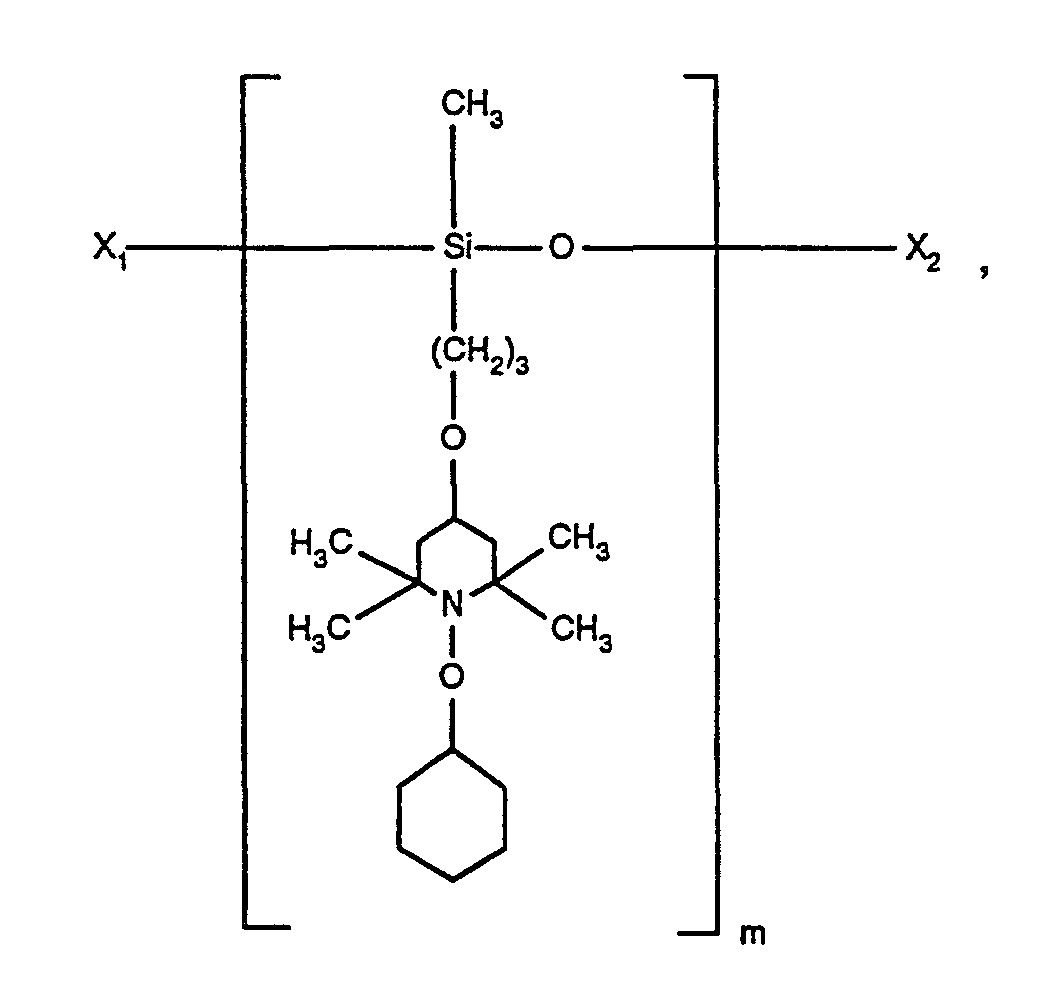
      Figure 00300001
      Figure 00300002
      Figure 00310001
      Figure 00310002
      wherein X1, X2 and m are as defined in claim 1.
    7. A composition which contains an organic material susceptible to degradation induced by light, heat and oxidation and at least one compound of the formula (I) according to claim 1.
    8. A composition according to claim 7, wherein the organic material is a synthetic polymer.
    9. A composition according to claim 8, which contains other conventional additives for synthetic polymers, in addition to the compounds of the formula (I).
    10. A composition according to claim 7, wherein the organic material is a polyolefin.
    11. A composition according to claim 7, wherein the organic material is polyethylene or polypropylene.
    12. The use of a compound of the formula (I) according to claim 1 for stabilizing an organic material against degradation induced by light, heat and oxidation.
    EP95810029A 1994-01-24 1995-01-16 1-Hydrocarbyloxy-piperidine compounds containing silane groups for use as stabilizers for organic materials Expired - Lifetime EP0665233B1 (en)

    Applications Claiming Priority (2)

    Application Number Priority Date Filing Date Title
    ITMI940102A IT1269197B (en) 1994-01-24 1994-01-24 1-HYDROCARBYLOXIDE PIPERIDIN COMPOUNDS CONTAINING SILANIC GROUPS SUITABLE FOR USE AS STABILIZERS FOR ORGANIC MATERIALS
    ITMI940102 1994-01-24

    Publications (3)

    Publication Number Publication Date
    EP0665233A2 EP0665233A2 (en) 1995-08-02
    EP0665233A3 EP0665233A3 (en) 1996-03-27
    EP0665233B1 true EP0665233B1 (en) 2001-08-16

    Family

    ID=11367606

    Family Applications (1)

    Application Number Title Priority Date Filing Date
    EP95810029A Expired - Lifetime EP0665233B1 (en) 1994-01-24 1995-01-16 1-Hydrocarbyloxy-piperidine compounds containing silane groups for use as stabilizers for organic materials

    Country Status (9)

    Country Link
    US (1) US5514738A (en)
    EP (1) EP0665233B1 (en)
    JP (1) JP3811864B2 (en)
    KR (1) KR100346061B1 (en)
    CA (1) CA2140707A1 (en)
    CZ (1) CZ16295A3 (en)
    DE (1) DE69522124T2 (en)
    IT (1) IT1269197B (en)
    SK (1) SK8195A3 (en)

    Families Citing this family (17)

    * Cited by examiner, † Cited by third party
    Publication number Priority date Publication date Assignee Title
    IT1271131B (en) * 1994-11-30 1997-05-26 Ciba Geigy Spa PIPERIDINE COMPOUNDS CONTAINING SILANIC GROUPS AS STABILIZERS FOR ORGANIC MATERIALS
    DE19535939A1 (en) * 1995-09-27 1997-04-03 Agfa Gevaert Ag Photographic material
    TW357175B (en) 1996-07-12 1999-05-01 Ciba Sc Holding Ag Stabilizer mixtures
    DE19638868A1 (en) * 1996-09-23 1998-03-26 Basf Ag Stabilized monomer composition
    EP1185577B1 (en) 1999-04-27 2003-05-21 Ciba SC Holding AG Polysilane stabilizers containing sterically hindered amine groups
    TWI273115B (en) 2000-12-12 2007-02-11 Ciba Sc Holding Ag Improved weatherability of flame retardant polyolefin
    ATE469959T1 (en) * 2005-06-24 2010-06-15 Basf Se COMPOSITIONS CONTAINING A POLYORGANOSILOXANE HAVING ONE OR MORE PIPERIDINYL FUNCTIONS AS SURFACE PROTECTION AGENTS
    JP2008031077A (en) * 2006-07-28 2008-02-14 Shin Etsu Chem Co Ltd Light-stabilizing group-containing siloxane oligomer and method for producing the same
    EP2094765B1 (en) * 2006-10-31 2011-02-16 Bluestar Silicones France Reactive silanol-hals amino silicone polymer with improved fabric coating performance
    JP4863002B2 (en) * 2006-12-12 2012-01-25 信越化学工業株式会社 Silanol compound, silanol condensate-containing aqueous solution, and method for producing the same
    JP5413710B2 (en) * 2008-06-11 2014-02-12 日本電気株式会社 Electrode active material, method for producing the same, and battery using the same
    EP2671905A4 (en) * 2011-02-04 2014-11-12 Adeka Corp COMPOUND HAVING A MASKED AMINE SKELETON, AND RESIN COMPOSITION
    WO2016105990A1 (en) * 2014-12-22 2016-06-30 3M Innovative Properties Company Sterically hindered amine and oxyalkyl amine light stabilizers
    US20170283444A1 (en) * 2014-12-22 2017-10-05 3M Innovative Properties Company Sterically hindered amine and oxyalkyl amine light stabilizers
    JP6867203B2 (en) * 2017-03-17 2021-04-28 旭化成株式会社 Curable composition
    WO2021011696A1 (en) 2019-07-15 2021-01-21 Novinium, Inc. Silane functional stabilizers for extending long-term electrical power cable performance
    CN113880874A (en) * 2021-10-20 2022-01-04 宿迁联盛科技股份有限公司 A kind of preparation method of poly[propoxy piperidinyl (methyl) siloxane] compound

    Citations (1)

    * Cited by examiner, † Cited by third party
    Publication number Priority date Publication date Assignee Title
    EP0388321A1 (en) * 1989-02-03 1990-09-19 Rhone-Poulenc Chimie Piperidinyle compounds and their use as a photostabilizer for polymers

    Family Cites Families (26)

    * Cited by examiner, † Cited by third party
    Publication number Priority date Publication date Assignee Title
    US4177186A (en) 1975-05-28 1979-12-04 Ciba-Geigy Corporation Stabilization of light-sensitive polymers
    GB2042562B (en) 1979-02-05 1983-05-11 Sandoz Ltd Stabilising polymers
    IT1209543B (en) * 1984-05-21 1989-08-30 Anic Spa STABILIZATION OF ORGANIC POLYMERS.
    IT1215227B (en) 1984-11-13 1990-01-31 Anic Spa PROCEDURE FOR THE PREPARATION OF STABILIZERS FOR ORGANIC POLYMERS AND STABILIZERS SO OBTAINED.
    DD234682A1 (en) 1985-02-13 1986-04-09 Univ Dresden Tech METHOD FOR PRODUCING LONG-TERM STABILIZED POLYMERS WITH HALS GROUPS
    DD234683A1 (en) 1985-02-13 1986-04-09 Univ Dresden Tech METHOD FOR PRODUCING POLYMER LONG-TERM STABILIZERS WITH HALS GROUPS
    IT1189096B (en) * 1986-05-02 1988-01-28 Enichem Sintesi STABILIZING COMPOUNDS AND PROCEDURE FOR THEIR PREPARATION
    IT1197491B (en) * 1986-10-08 1988-11-30 Enichem Sintesi UV STABILIZERS SILITATES CONTAINING TERTIARY IMPEDED AMINES
    US4859759A (en) 1988-04-14 1989-08-22 Kimberly-Clark Corporation Siloxane containing benzotriazolyl/tetraalkylpiperidyl substituent
    IT1218004B (en) 1988-05-27 1990-03-30 Enichem Sintesi UV STABILIZERS FOR ORGANIC POLES
    US4895885A (en) 1988-09-06 1990-01-23 Union Carbide Chemicals And Plastics Company Inc. Polymer compositions stabilized with polysiloxanes containing sterically hindered heterocyclic moiety
    US4927898A (en) * 1988-09-06 1990-05-22 Union Carbide Chemicals And Plastics Company Inc. Polysiloxanes with sterically hindered heterocyclic moiety
    US4921962A (en) 1988-10-19 1990-05-01 Ciba-Geigy Corporation Process for preparing N-hydrocarbyloxy derivatives of sterically hindered amines
    US5021481A (en) 1989-03-21 1991-06-04 Ciba-Geigy Corporation N-hydrocarbyloxy hindered amine light stabilizers with phosphorus moieties
    ES2086394T3 (en) 1989-03-21 1996-07-01 Ciba Geigy Ag NON-MIGRANT 1-HYDROCARBYLOXYL PREVENTED AMINIC COMPOUNDS AS POLYMER STABILIZERS.
    US5175312A (en) 1989-08-31 1992-12-29 Ciba-Geigy Corporation 3-phenylbenzofuran-2-ones
    IT1248698B (en) 1990-06-06 1995-01-26 Ciba Geigy Spa PIEPRIDIN TRIAZIN COMPOUNDS CONTAINING SILOXANE GROUPS, SUITABLE FOR USE AS STABILIZERS FOR ORGANIC MATERIALS
    IT1243985B (en) 1990-10-12 1994-06-28 Enichem Sintesi UV STABILIZERS SILICONES CONTAINING REACTIVE GROUPS.
    IT1243409B (en) 1990-12-17 1994-06-10 Ciba Geigy Spa PIPERIDINE COMPOUNDS CONTAINING SILENIC GROUPS SUITABLE FOR USE AS STABILIZERS FOR ORGANIC MATERIALS
    TW206220B (en) 1991-07-01 1993-05-21 Ciba Geigy Ag
    US5252643A (en) 1991-07-01 1993-10-12 Ciba-Geigy Corporation Thiomethylated benzofuran-2-ones
    TW260686B (en) 1992-05-22 1995-10-21 Ciba Geigy
    GB2267490B (en) 1992-05-22 1995-08-09 Ciba Geigy Ag 3-(Carboxymethoxyphenyl)benzofuran-2-one stabilisers
    NL9300801A (en) 1992-05-22 1993-12-16 Ciba Geigy 3- (ACYLOXYPHENYL) BENZOFURAN-2-ON AS STABILIZERS.
    TW255902B (en) 1992-09-23 1995-09-01 Ciba Geigy
    MX9305489A (en) 1992-09-23 1994-03-31 Ciba Geigy Ag 3- (DIHIDROBENZOFURAN-5-IL) BENZOFURAN-2-ONAS, STABILIZERS.

    Patent Citations (1)

    * Cited by examiner, † Cited by third party
    Publication number Priority date Publication date Assignee Title
    EP0388321A1 (en) * 1989-02-03 1990-09-19 Rhone-Poulenc Chimie Piperidinyle compounds and their use as a photostabilizer for polymers

    Also Published As

    Publication number Publication date
    ITMI940102A1 (en) 1995-07-24
    CA2140707A1 (en) 1995-07-25
    KR950032238A (en) 1995-12-20
    JP3811864B2 (en) 2006-08-23
    KR100346061B1 (en) 2002-12-06
    DE69522124T2 (en) 2002-04-25
    DE69522124D1 (en) 2001-09-20
    IT1269197B (en) 1997-03-21
    JPH07224279A (en) 1995-08-22
    US5514738A (en) 1996-05-07
    EP0665233A3 (en) 1996-03-27
    ITMI940102A0 (en) 1994-01-24
    EP0665233A2 (en) 1995-08-02
    SK8195A3 (en) 1995-08-09
    CZ16295A3 (en) 1996-06-12

    Similar Documents

    Publication Publication Date Title
    US5719217A (en) Synergistic stabiliser mixture
    US6020406A (en) Synergistic stabilizer mixture
    US5514738A (en) 1-hydrocarbyloxy-piperidine compounds containing silane groups for use as stabilizers for organic materials
    EP0491659B1 (en) Novel piperidine compounds containing silane groups for use as stabilizers for organic materials
    US5561179A (en) Piperidine compounds containing silane groups as stabilizers for organic materials
    US5496875A (en) Derivatives of 2,2,6,6-tetramethyl-4-piperidinol for use as light stabilizers, heat stabilizers and oxidation stabilizers for organic materials
    US5463058A (en) Siloxane derivatives of 2,2,6,6-tetramethylpiperidine compounds as stabilizers
    US5449776A (en) Piperidine-triazine compounds for use as light stabilizers, heat stabilizers and oxidation stabilizers for organic materials
    EP0670841B1 (en) Amorphous solid modification of 2,2',2''-nitrilo triethyl-tris-(3,3',5,5'-tetra-tert-butyl-1,1'-biphenyl-2,2'-diyl)phosphite]
    US5488112A (en) Dimeric benzotriazoles as UV absorbers
    US5439958A (en) Polyalkyl-4-piperidinol derivatives for use as stabilizers for organic materials
    US5616637A (en) Polyethers containing hindered amine side chains as stabilizers
    US5618871A (en) Phenyl phosphites for use as stabilizers for organic materials
    US5654430A (en) Oligomeric aliphatic HALS phosphites and HALS phosphonites as stabilizers
    US6005036A (en) Polysilanes
    US5610211A (en) 2,2,6,6-tetramethylpiperidine derivatives for use as stabilizing agents for organic materials
    EP0634412B1 (en) Piperidine compounds for use as stabilizers for organic materials
    US5847132A (en) Polytriazine derivatives containing polyalkylpiperidinyloxy or polyalkylpiperidinylamino groups
    EP0794972B1 (en) Piperidine compounds containing silane groups as stabilizers for organic materials
    US5925758A (en) HALS phosphites and HALS phosphoramides as stabilizers
    US5466803A (en) Piperidine-triazine compounds suitable for use as stabilizers for organic materials
    US5280057A (en) Cycloalkylidene bisphenol phosphites
    CA2163956A1 (en) Piperidine triazine compounds containing silane groups as stabilizers for organic materials
    US5442067A (en) Tetra-[N-alkyl-2,2,6,6,-tetramethylpiperidin-4-yl]-4,4'-diphenylbisphosphonite
    US5710240A (en) Condensates of butyne-linked hindered amines

    Legal Events

    Date Code Title Description
    PUAI Public reference made under article 153(3) epc to a published international application that has entered the european phase

    Free format text: ORIGINAL CODE: 0009012

    AK Designated contracting states

    Kind code of ref document: A2

    Designated state(s): BE DE FR GB IT NL

    PUAL Search report despatched

    Free format text: ORIGINAL CODE: 0009013

    AK Designated contracting states

    Kind code of ref document: A3

    Designated state(s): BE DE FR GB IT NL

    17P Request for examination filed

    Effective date: 19960814

    RAP1 Party data changed (applicant data changed or rights of an application transferred)

    Owner name: CIBA-GEIGY S.P.A.

    Owner name: CIBA SC HOLDING AG

    RAP3 Party data changed (applicant data changed or rights of an application transferred)

    Owner name: CIBA-GEIGY S.P.A.

    Owner name: CIBA SPECIALTY CHEMICALS HOLDING INC.

    RAP1 Party data changed (applicant data changed or rights of an application transferred)

    Owner name: CIBA SPECIALITY CHEMICALS S.P.A.

    Owner name: CIBA SPECIALTY CHEMICALS HOLDING INC.

    17Q First examination report despatched

    Effective date: 19990319

    GRAG Despatch of communication of intention to grant

    Free format text: ORIGINAL CODE: EPIDOS AGRA

    GRAG Despatch of communication of intention to grant

    Free format text: ORIGINAL CODE: EPIDOS AGRA

    GRAH Despatch of communication of intention to grant a patent

    Free format text: ORIGINAL CODE: EPIDOS IGRA

    GRAH Despatch of communication of intention to grant a patent

    Free format text: ORIGINAL CODE: EPIDOS IGRA

    GRAA (expected) grant

    Free format text: ORIGINAL CODE: 0009210

    AK Designated contracting states

    Kind code of ref document: B1

    Designated state(s): BE DE FR GB IT NL

    REF Corresponds to:

    Ref document number: 69522124

    Country of ref document: DE

    Date of ref document: 20010920

    REG Reference to a national code

    Ref country code: GB

    Ref legal event code: IF02

    ET Fr: translation filed
    PLBE No opposition filed within time limit

    Free format text: ORIGINAL CODE: 0009261

    STAA Information on the status of an ep patent application or granted ep patent

    Free format text: STATUS: NO OPPOSITION FILED WITHIN TIME LIMIT

    26N No opposition filed
    PG25 Lapsed in a contracting state [announced via postgrant information from national office to epo]

    Ref country code: IT

    Free format text: LAPSE BECAUSE OF NON-PAYMENT OF DUE FEES;WARNING: LAPSES OF ITALIAN PATENTS WITH EFFECTIVE DATE BEFORE 2007 MAY HAVE OCCURRED AT ANY TIME BEFORE 2007. THE CORRECT EFFECTIVE DATE MAY BE DIFFERENT FROM THE ONE RECORDED.

    Effective date: 20050116

    PGFP Annual fee paid to national office [announced via postgrant information from national office to epo]

    Ref country code: NL

    Payment date: 20051215

    Year of fee payment: 12

    PGFP Annual fee paid to national office [announced via postgrant information from national office to epo]

    Ref country code: BE

    Payment date: 20060208

    Year of fee payment: 12

    NLV4 Nl: lapsed or anulled due to non-payment of the annual fee

    Effective date: 20070801

    BERE Be: lapsed

    Owner name: *CIBA SPECIALTY CHEMICALS HOLDING INC.

    Effective date: 20070131

    PG25 Lapsed in a contracting state [announced via postgrant information from national office to epo]

    Ref country code: BE

    Free format text: LAPSE BECAUSE OF NON-PAYMENT OF DUE FEES

    Effective date: 20070131

    PG25 Lapsed in a contracting state [announced via postgrant information from national office to epo]

    Ref country code: NL

    Free format text: LAPSE BECAUSE OF NON-PAYMENT OF DUE FEES

    Effective date: 20070801

    PGRI Patent reinstated in contracting state [announced from national office to epo]

    Ref country code: IT

    Effective date: 20091201

    PGFP Annual fee paid to national office [announced via postgrant information from national office to epo]

    Ref country code: FR

    Payment date: 20140130

    Year of fee payment: 20

    Ref country code: IT

    Payment date: 20140129

    Year of fee payment: 20

    PGFP Annual fee paid to national office [announced via postgrant information from national office to epo]

    Ref country code: GB

    Payment date: 20140131

    Year of fee payment: 20

    PGFP Annual fee paid to national office [announced via postgrant information from national office to epo]

    Ref country code: DE

    Payment date: 20140331

    Year of fee payment: 20

    REG Reference to a national code

    Ref country code: DE

    Ref legal event code: R071

    Ref document number: 69522124

    Country of ref document: DE

    REG Reference to a national code

    Ref country code: DE

    Ref legal event code: R071

    Ref document number: 69522124

    Country of ref document: DE

    REG Reference to a national code

    Ref country code: GB

    Ref legal event code: PE20

    Expiry date: 20150115

    PG25 Lapsed in a contracting state [announced via postgrant information from national office to epo]

    Ref country code: GB

    Free format text: LAPSE BECAUSE OF EXPIRATION OF PROTECTION

    Effective date: 20150115