EP0664576A2 - Pinned module - Google Patents
Pinned module Download PDFInfo
- Publication number
- EP0664576A2 EP0664576A2 EP94118583A EP94118583A EP0664576A2 EP 0664576 A2 EP0664576 A2 EP 0664576A2 EP 94118583 A EP94118583 A EP 94118583A EP 94118583 A EP94118583 A EP 94118583A EP 0664576 A2 EP0664576 A2 EP 0664576A2
- Authority
- EP
- European Patent Office
- Prior art keywords
- pin
- substrate
- compliant
- pins
- circuit board
- Prior art date
- Legal status (The legal status is an assumption and is not a legal conclusion. Google has not performed a legal analysis and makes no representation as to the accuracy of the status listed.)
- Withdrawn
Links
Images



Classifications
-
- H—ELECTRICITY
- H05—ELECTRIC TECHNIQUES NOT OTHERWISE PROVIDED FOR
- H05K—PRINTED CIRCUITS; CASINGS OR CONSTRUCTIONAL DETAILS OF ELECTRIC APPARATUS; MANUFACTURE OF ASSEMBLAGES OF ELECTRICAL COMPONENTS
- H05K1/00—Printed circuits
- H05K1/02—Details
- H05K1/14—Structural association of two or more printed circuits
-
- H—ELECTRICITY
- H01—ELECTRIC ELEMENTS
- H01R—ELECTRICALLY-CONDUCTIVE CONNECTIONS; STRUCTURAL ASSOCIATIONS OF A PLURALITY OF MUTUALLY-INSULATED ELECTRICAL CONNECTING ELEMENTS; COUPLING DEVICES; CURRENT COLLECTORS
- H01R12/00—Structural associations of a plurality of mutually-insulated electrical connecting elements, specially adapted for printed circuits, e.g. printed circuit boards [PCB], flat or ribbon cables, or like generally planar structures, e.g. terminal strips, terminal blocks; Coupling devices specially adapted for printed circuits, flat or ribbon cables, or like generally planar structures; Terminals specially adapted for contact with, or insertion into, printed circuits, flat or ribbon cables, or like generally planar structures
- H01R12/50—Fixed connections
- H01R12/51—Fixed connections for rigid printed circuits or like structures
- H01R12/55—Fixed connections for rigid printed circuits or like structures characterised by the terminals
- H01R12/58—Fixed connections for rigid printed circuits or like structures characterised by the terminals terminals for insertion into holes
-
- H—ELECTRICITY
- H01—ELECTRIC ELEMENTS
- H01R—ELECTRICALLY-CONDUCTIVE CONNECTIONS; STRUCTURAL ASSOCIATIONS OF A PLURALITY OF MUTUALLY-INSULATED ELECTRICAL CONNECTING ELEMENTS; COUPLING DEVICES; CURRENT COLLECTORS
- H01R12/00—Structural associations of a plurality of mutually-insulated electrical connecting elements, specially adapted for printed circuits, e.g. printed circuit boards [PCB], flat or ribbon cables, or like generally planar structures, e.g. terminal strips, terminal blocks; Coupling devices specially adapted for printed circuits, flat or ribbon cables, or like generally planar structures; Terminals specially adapted for contact with, or insertion into, printed circuits, flat or ribbon cables, or like generally planar structures
- H01R12/50—Fixed connections
- H01R12/51—Fixed connections for rigid printed circuits or like structures
- H01R12/52—Fixed connections for rigid printed circuits or like structures connecting to other rigid printed circuits or like structures
- H01R12/523—Fixed connections for rigid printed circuits or like structures connecting to other rigid printed circuits or like structures by an interconnection through aligned holes in the boards or multilayer board
-
- H—ELECTRICITY
- H05—ELECTRIC TECHNIQUES NOT OTHERWISE PROVIDED FOR
- H05K—PRINTED CIRCUITS; CASINGS OR CONSTRUCTIONAL DETAILS OF ELECTRIC APPARATUS; MANUFACTURE OF ASSEMBLAGES OF ELECTRICAL COMPONENTS
- H05K2201/00—Indexing scheme relating to printed circuits covered by H05K1/00
- H05K2201/04—Assemblies of printed circuits
- H05K2201/042—Stacked spaced PCBs; Planar parts of folded flexible circuits having mounted components in between or spaced from each other
-
- H—ELECTRICITY
- H05—ELECTRIC TECHNIQUES NOT OTHERWISE PROVIDED FOR
- H05K—PRINTED CIRCUITS; CASINGS OR CONSTRUCTIONAL DETAILS OF ELECTRIC APPARATUS; MANUFACTURE OF ASSEMBLAGES OF ELECTRICAL COMPONENTS
- H05K2201/00—Indexing scheme relating to printed circuits covered by H05K1/00
- H05K2201/20—Details of printed circuits not provided for in H05K2201/01 - H05K2201/10
- H05K2201/2036—Permanent spacer or stand-off in a printed circuit or printed circuit assembly
-
- H—ELECTRICITY
- H05—ELECTRIC TECHNIQUES NOT OTHERWISE PROVIDED FOR
- H05K—PRINTED CIRCUITS; CASINGS OR CONSTRUCTIONAL DETAILS OF ELECTRIC APPARATUS; MANUFACTURE OF ASSEMBLAGES OF ELECTRICAL COMPONENTS
- H05K3/00—Apparatus or processes for manufacturing printed circuits
- H05K3/30—Assembling printed circuits with electric components, e.g. with resistor
- H05K3/306—Lead-in-hole components, e.g. affixing or retention before soldering, spacing means
- H05K3/308—Adaptations of leads
-
- H—ELECTRICITY
- H05—ELECTRIC TECHNIQUES NOT OTHERWISE PROVIDED FOR
- H05K—PRINTED CIRCUITS; CASINGS OR CONSTRUCTIONAL DETAILS OF ELECTRIC APPARATUS; MANUFACTURE OF ASSEMBLAGES OF ELECTRICAL COMPONENTS
- H05K3/00—Apparatus or processes for manufacturing printed circuits
- H05K3/36—Assembling printed circuits with other printed circuits
- H05K3/368—Assembling printed circuits with other printed circuits parallel to each other
-
- Y—GENERAL TAGGING OF NEW TECHNOLOGICAL DEVELOPMENTS; GENERAL TAGGING OF CROSS-SECTIONAL TECHNOLOGIES SPANNING OVER SEVERAL SECTIONS OF THE IPC; TECHNICAL SUBJECTS COVERED BY FORMER USPC CROSS-REFERENCE ART COLLECTIONS [XRACs] AND DIGESTS
- Y10—TECHNICAL SUBJECTS COVERED BY FORMER USPC
- Y10T—TECHNICAL SUBJECTS COVERED BY FORMER US CLASSIFICATION
- Y10T29/00—Metal working
- Y10T29/49—Method of mechanical manufacture
- Y10T29/49002—Electrical device making
- Y10T29/49117—Conductor or circuit manufacturing
- Y10T29/49124—On flat or curved insulated base, e.g., printed circuit, etc.
- Y10T29/49126—Assembling bases
-
- Y—GENERAL TAGGING OF NEW TECHNOLOGICAL DEVELOPMENTS; GENERAL TAGGING OF CROSS-SECTIONAL TECHNOLOGIES SPANNING OVER SEVERAL SECTIONS OF THE IPC; TECHNICAL SUBJECTS COVERED BY FORMER USPC CROSS-REFERENCE ART COLLECTIONS [XRACs] AND DIGESTS
- Y10—TECHNICAL SUBJECTS COVERED BY FORMER USPC
- Y10T—TECHNICAL SUBJECTS COVERED BY FORMER US CLASSIFICATION
- Y10T29/00—Metal working
- Y10T29/49—Method of mechanical manufacture
- Y10T29/49002—Electrical device making
- Y10T29/49117—Conductor or circuit manufacturing
- Y10T29/49124—On flat or curved insulated base, e.g., printed circuit, etc.
- Y10T29/49147—Assembling terminal to base
- Y10T29/49151—Assembling terminal to base by deforming or shaping
- Y10T29/49153—Assembling terminal to base by deforming or shaping with shaping or forcing terminal into base aperture
-
- Y—GENERAL TAGGING OF NEW TECHNOLOGICAL DEVELOPMENTS; GENERAL TAGGING OF CROSS-SECTIONAL TECHNOLOGIES SPANNING OVER SEVERAL SECTIONS OF THE IPC; TECHNICAL SUBJECTS COVERED BY FORMER USPC CROSS-REFERENCE ART COLLECTIONS [XRACs] AND DIGESTS
- Y10—TECHNICAL SUBJECTS COVERED BY FORMER USPC
- Y10T—TECHNICAL SUBJECTS COVERED BY FORMER US CLASSIFICATION
- Y10T29/00—Metal working
- Y10T29/49—Method of mechanical manufacture
- Y10T29/49002—Electrical device making
- Y10T29/49117—Conductor or circuit manufacturing
- Y10T29/49124—On flat or curved insulated base, e.g., printed circuit, etc.
- Y10T29/49155—Manufacturing circuit on or in base
- Y10T29/49165—Manufacturing circuit on or in base by forming conductive walled aperture in base
-
- Y—GENERAL TAGGING OF NEW TECHNOLOGICAL DEVELOPMENTS; GENERAL TAGGING OF CROSS-SECTIONAL TECHNOLOGIES SPANNING OVER SEVERAL SECTIONS OF THE IPC; TECHNICAL SUBJECTS COVERED BY FORMER USPC CROSS-REFERENCE ART COLLECTIONS [XRACs] AND DIGESTS
- Y10—TECHNICAL SUBJECTS COVERED BY FORMER USPC
- Y10T—TECHNICAL SUBJECTS COVERED BY FORMER US CLASSIFICATION
- Y10T29/00—Metal working
- Y10T29/53—Means to assemble or disassemble
- Y10T29/5313—Means to assemble electrical device
- Y10T29/53174—Means to fasten electrical component to wiring board, base, or substrate
Definitions
- the present invention relates to a novel pinned module and a method for making the same.
- circuit boards and other like devices In the design of complicated electronic components, it is not uncommon to arrange circuit boards and other like devices in stacked relation with numerous electrical connections being made between the different boards. Typically this is done by providing a first circuit board with pins of either the compliant or non-compliant types, moving a second circuit board into position so that the pins projecting from the first circuit board engage corresponding positions in the second circuit board and then soldering the pins to the second circuit board to lock them in place.
- a still further object of this invention is to provide a completed assembly of two or more stacked printed circuit boards or devices which is made using this module.
- an electrical connection pin blank having at least one compliant section is affixed to a first circuit board by compressive deformation in such a way that the compliant section of the pin blank projects outwardly from the surface of the first circuit board.
- the end of the pin projecting from the first circuit board is then inserted into a corresponding opening in a second circuit board and the two boards brought together until the second circuit board is firmly affixed to the complaint section of the pin by compliant pin connection.
- both the first and the second circuit boards are securely connected together, both mechanically and electrically, even when many pins are involved. Moreover, because soldering is avoided the attendant disadvantages of soldering are also avoided. Furthermore, because the pin blanks employed are of conventional structure, and also because only simply mechanical movements are needed for each formation step, the manufacturing method is simple, easy and inexpensive to carry out.
- a novel hammer for affixing pin blanks to a substrate by compressive deformation is provided, the hammer defining holes for receiving the projecting ends of a plurality of pin blanks, these projecting ends including compliant pin sections, the holes in the hammer being so shaped that they can receive the projecting ends of the pin blanks including their compliant sections.
- an electrical module generally indicated at 10 ( Figure 3) is formed from a substrate 12 and a pin blank 14.
- substrate 12 is a printed circuit board and is composed of a dielectric material such as ceramic, fiberglass-reinforced epoxy such as FR4, etc., which contains one or more electrically conductive paths (not shown) therein.
- Substrate 12 defines one or more holes 16 therein which pass all the way through the substrate from a first surface 18 thereof to a second surface 20 thereof.
- hole 16 is a plated-through-hole, meaning that the surfaces of hole 16 carry a coating of an electrically conductive material 22 which extends all the way through the hole from first surface 18 of the substrate to second surface 20 and extends outwardly from the center of the hole by a small distance on these surfaces to form pads 23 as shown in Figure 1.
- the electrically conductive material 22 of the plated-through-hole is electrically connected to an electrically conductive path (not shown) in the substrate.
- pin blank 14 comprises a generally elongated member which defines a first end 24 and a second end 26.
- the body of pin blank 14 near first end 24 defines a substrate-engaging section 28 and, in a location spaced from substrate-engaging section 28, a first compliant section generally indicated at 30.
- first compliant section 30 includes protrusions 32, which are formed by swaging and which extend outwardly from the center line of pin blank 14 by a distance greater than the radius of the pin blank in the remainder of the pin blank body. As discussed more fully below, the shape and size of protrusions 32 are selected so that these protrusions will cooperate with the walls of openings in a second circuit board to which the module 10 is to be attached.
- pin blank 14 is arranged to register with hole 16 in printed circuit board 12.
- printed circuit board 12 and pin blank 14 are also arranged to register with a pin blank receiving hole 34 in a lower hammer 36 as well as a bulge cavity 38 in an upper hammer 40, these hammers being part of a machine (not shown) for attaching pin blanks to boards by compressive deformation.
- Part of pin blank receiving hole 34 in lower hammer 36 defines its own bulge cavity 42 having a shape similar to bulge cavity 38 in upper hammer 40.
- “upper” and “lower” refer to the position as shown in the Figure 1, but physically they can be reversed or even spaced laterally or other direction rather than vertically.
- lower hammer 36 and upper hammer 40 are moved together in the axial direction, i.e., in the direction of the longitudinal axis of pin blank 14.
- This causes the first end 24 of the pin blank to be inserted into hole 16 of board 12 and then for the pin blank to be moved all the way into hole 16 until substrate-engaging section 28 of the pin blank aligns with the body of the board and the end 24 of the pin protrudes out of hole 16 just past pads 23 of electrically conductive material 22.
- movement of the hammers together also causes end 26 and compliant section 30 of pin 14 to be received in pin blank receiving hole 34 of lower hammer 36.
- Figures 1 and 2 illustrate only a single pin blank being affixed to printed circuit board 12, in actual practice there will normally be multiple pin blanks affixed to multiple holes in the substrate.
- a module is provided which, as illustrated in Figure 3, defines a plurality, or array, of pins 14, each having a compliant section projecting from the first surface 18 of the board for subsequent connection of module 10 to another printed circuit board or other device by compliant pin connection, as more fully described below.
- FIGs 4, 5 and 6 illustrate how the inventive module 10 prepared as described above can be connected to another circuit board or other device (known in the art by various terms such as “carrier,” “mother board,” “planar,” etc.) for forming a completed assembly of stacked boards or devices.
- module 10 is arranged so that second end 26 of pin 14 registers with opening 48 in a second electrical substrate 50, which in the embodiment shown is also a printed circuit board.
- Opening 48 in printed circuit board 50 has a size compatible with compliant section 30 of pin 14 so that when this section is inserted into opening 48, protrusions 32 in the compliant section 30 firmly affix pin 14 to circuit board 50 by compliant pin connection.
- the walls of opening 48 in board 50 are plated through holes provided with a coating 52 of an electrically conductive material for providing electrical connection to pin 14 as well as mechanical connection.
- Printed circuit board 50 also includes an electrically conductive path (not shown) connected to the electrically conductive material 52 in hole 48 for electrical connection of pin 14 to other elements on printed circuit board 50.
- module 10 and circuit board 50 With pin 14 arranged in registration with hole 48 of printed circuit 50, module 10 and circuit board 50 are brought together to insert pin 14 into hole 48 of the circuit board.
- This operation is accomplished in the embodiment shown by means of a press 54 and a mounting plate 56.
- Press 54 includes projections 58 for engaging the bulge 46 of pin 14, while mounting plate 56 defines holes 60 for receiving the portion of the body of pin 14 extending out of the bottom of the second printed circuit when module 10 and board 50 are brought together for their final positioning.
- mounting plate 56 and press 54 are brought together until stopped by a suitable stop 62 which is so arranged that converging movement of the press and mounting plate is stopped when protrusions 32 of pin 14 align with the axial center of hole 48.
- suitable spacer elements may also be provided to insure that module 10 and board 50 remain spaced apart by a predetermined distance as press 54 and mounting plate 56 are moved together.
- insertion of compliant section 30 of pin 14 into hole 48 and convergence of press 54 and mounting plate 56 in the manner described above causes compliant section 30 of pin 14 and the walls of hole 48 to be firmly affixed together, thereby creating a secure mechanical and electrical bond in accordance with known compliant pin connection techniques.
- Press 54 and mounting plate 56 are then withdrawn from one another to form a completed assembly 64 as illustrated in Figure 6.
- completed assembly 64 comprises a first circuit board 12 and second circuit board 50 which are securely affixed to one another, both mechanically and electrically by means of pin 14.
- pin 14 In actual practice, many pins will normally be employed rather than the single pin illustrated in the figure so that numerous electrical and mechanical connections can be made, thereby making the connection between boards 12 and 50 even more secure.
- the present invention provides a simple and straightforward method for mechanically and electrically forming together multiple circuit boards in stacked relation without soldering.
- the procedure of the invention requires only simple movement of suitable anvils, hammers and other work pieces in the longitudinal direction, that is the direction aligning with the longitudinal axis of the pin blanks.
- the pin blanks used in the present invention are of simple design, not requiring involved mechanical steps to develop complex shapes or structures as in prior art systems.
- pin blank receiving hole 34 is sized and shaped to receive the lower end of pin 14 therein, even though this portion of pin 14 includes a compliant pin section 30.
- pin blank receiving hole 34 in lower hammer 36 in addition to including bulge cavity 42 as previously described, includes two grooves 66 axially arranged in the walls of pin blank receiving hole 34 to receive protrusions 32 of pin blank 14.
- these grooves 66 extend downwardly by a distance sufficient to accommodate protrusions 32 when pin 14 is inserted in lower hammer 36 by sufficient distance so that the bottom 68 of pin engaging hole 34 engages the end 26 of the pin.
- lower hammer 36 can be used together with upper hammer 40 to cause compressive deformation of pin blank 14 thereby forming bulges 44 and 46 in the manner described above.
- a third electrical substrate or printed circuit board can be stacked with the assembly of two printed circuit boards shown in Figure 6.
- a pin is used which has two compliant sections, one near each of the two ends of the pin blank with the substrate-engaging section being located therebetween.
- the diameter of the substrate-engaging section be larger than the diameter of the pin in the other sections, and preferably at least as large as the largest cross-sectional dimension of the pin at the protrusions 32.
- upper hammer 40 is provided with a pin blank receiving hole having essentially the same structure as pin blank receiving hole 34 in lower hammer 36.
- upper hammer 40 can receive the ends of the pins projecting from the upper surface 20 of board 12 in the same way lower hammer 36 receives the ends of the pins projecting downwardly from lower surface 18 of the board.
- the present invention can be employed to form printed circuit boards, modules, module assemblies and other devices of any size.
- Typical circuit boards used today measure 25 x 25 to 75 x 75 millimeters and contain an array of 5 to 500 pin/holes, for example.
- Conventional pin sizes include pins of 16, 18, 20, etc., mils in diameter with the individual pins being spaced apart by any suitable distance, for example 1.27 to 2.54 millimeters.
- the invention described herein is applicable to printed circuit boards and other electrical devices of any such sizes.
- the present invention is also applicable to the production of printed circuit boards and other electrical devices of even larger construction, with the assemblies once formed being subdivided into smaller subassemblies after formation.
- lower hammer 36 has been described as being a single, unitary member, it should be appreciated that lower hammer 36 can be composed of a number of different pieces or devices so long as the overall function of the hammer remains the same.
- hammer 36 could be divided into two or more pieces, one or more pieces arranged to accept and hold the compliant portion 30 of pin blank 14 and another device employed for the application of axial force to end 26 of the pin blank.
- the electrically conductive material 22 in openings 16 form pads 23 on the first and second surfaces of the substrate, it should be appreciated that such pads are not required.
- using pins and pin blanks of circular cross-section is not required, as any cross-sectional shape can be employed.
- the diameter of the pin blanks used in accordance with the present invention can vary from section to section as desired, it being sufficient in accordance with the present invention merely that hole 34 in hammer 36 (whether formed from single or multiple pieces) receive and accommodate so much of compliant section 30 of the pin as is necessary to accomplish compressive deformation of the pin blank as described above.
- pin blanks with pre-formed compliant sections
- the pin blanks can be affixed to substrate 12 before the pin blank is swaged or otherwise worked to form compliant sections. This, of course, defeats one of the major advantages of the present invention in using preformed pin blanks for the sake of ease of operation and low cost.
Landscapes
- Engineering & Computer Science (AREA)
- Microelectronics & Electronic Packaging (AREA)
- Multi-Conductor Connections (AREA)
- Coupling Device And Connection With Printed Circuit (AREA)
- Manufacturing Of Electrical Connectors (AREA)
Abstract
An electrical connection pin blank having at least one compliant section is affixed to a first circuit board (10) by compressive deformation in such a way that the compliant section of the pin blank (14) projects outwardly from the surface of the first circuit board. The end of the pin projecting from the first circuit board is then inserted into a corresponding opening (16) in a second circuit board (12) and the two boards brought together until the second circuit board is firmly affixed to the complaint section of the pin by compliant pin connection.
Description
- The present invention relates to a novel pinned module and a method for making the same.
- In the manufacture of printed circuit boards and similar electrical devices, it is desirable to make connections to the device as quickly and easily as possible. One technique for making this connection is to employ pins which are mechanically and sometimes electrically connected to the device.
- Many techniques are known for affixing electrical connection pins to circuit boards and the like devices. One well known way is to provide the circuit board or device with an opening and to provide the pin with a compliant section having a size compatible with the opening such that when the compliant section of the pin is inserted into the opening, it coacts with the walls of the opening to maintain the pin affixed to the device or board. See US 4,969,259, the disclosure of which is incorporated herein by reference. For convenience, this technique of affixing a pin to a substrate using a compliant section of the pin to interact with the walls of an opening in the substrate shall be referred to hereinafter as "compliant pin connection."
- Another well known method for connecting pins to circuit boards and the like devices uses non-compliant pins. In this technique, a pin blank is inserted into a hole in the board or other device and the blank is subjected to compression along its longitudinal axis. As a result, the portions of the pin blank adjacent the two sides or surfaces of the board deform through compressive stress to form bulges which securely lock the pin in place. For convenience, techniques for affixing pins in this manner will be referred to hereinafter as "compressive deformation connection."
- In the design of complicated electronic components, it is not uncommon to arrange circuit boards and other like devices in stacked relation with numerous electrical connections being made between the different boards. Typically this is done by providing a first circuit board with pins of either the compliant or non-compliant types, moving a second circuit board into position so that the pins projecting from the first circuit board engage corresponding positions in the second circuit board and then soldering the pins to the second circuit board to lock them in place.
- Although this procedure works well, it is disadvantageous because it employs soldering operations, which are inherently time consuming, messy and expensive.
- In order to overcome this disadvantage, it has been proposed to affix stacked circuit boards together by using electrical connection pins in which both boards are secured to the same pin by compliant pin connection. See, for example, US 4,446,505 and US 4,889,496, the disclosures of which are incorporated herein by reference. However, in these cases, either the mechanical/electrical connection made with at least some of the pins in one or both boards is not as good as desired or the procedures are complicated and expensive due to the use of pin blanks of esoteric structure, special mechanical manipulations, or both.
- Accordingly, it is an object of the present invention to provide a novel technique for forming electrical connections between two or more stacked printed circuit boards by a simple and straightforward manner which provides excellent electrical/mechanical connection for all connections.
- In addition, it is a further object of the present invention to provide a novel circuit board or module for use in this technique.
- A still further object of this invention is to provide a completed assembly of two or more stacked printed circuit boards or devices which is made using this module.
- In addition, it is a still further object of the present invention to provide a method of affixing pin blanks to electrical substrates in order to make the modules of the present invention.
- Moreover, it is a still another object of this invention to provide a novel hammer or anvil for use in affixing pin blanks to substrates in accordance with this method.
- These and other objects are accomplished by the present invention in accordance with which an electrical connection pin blank having at least one compliant section is affixed to a first circuit board by compressive deformation in such a way that the compliant section of the pin blank projects outwardly from the surface of the first circuit board. The end of the pin projecting from the first circuit board is then inserted into a corresponding opening in a second circuit board and the two boards brought together until the second circuit board is firmly affixed to the complaint section of the pin by compliant pin connection.
- By this means, both the first and the second circuit boards are securely connected together, both mechanically and electrically, even when many pins are involved. Moreover, because soldering is avoided the attendant disadvantages of soldering are also avoided. Furthermore, because the pin blanks employed are of conventional structure, and also because only simply mechanical movements are needed for each formation step, the manufacturing method is simple, easy and inexpensive to carry out.
- In accordance with a further aspect of the invention, a novel hammer for affixing pin blanks to a substrate by compressive deformation is provided, the hammer defining holes for receiving the projecting ends of a plurality of pin blanks, these projecting ends including compliant pin sections, the holes in the hammer being so shaped that they can receive the projecting ends of the pin blanks including their compliant sections. By this means attachment of pins to a first circuit board by compressive deformation can be easily accomplished, even though the pins include compliant sections that would prevent them from being used in ordinary hammers.
- The present invention is more thoroughly illustrated in the following drawings wherein:
- Figure 1 is an exploded schematic view, in cross section, illustrating how a pin blank is affixed to a first circuit board by compressive deformation in accordance with the present invention, with the parts and the hammers used for this forming process being in a retracted position; and
- Figure 2 is a view similar to Figure 1 showing the hammers in a closed position with the pin being received in and affixed to the first circuit board; and
- Figure 3 is an isometric view illustrating the module produced by the technique illustrated in Figures 1 and 2; and
- Figure 4 is another exploded schematic view illustrating how the module of Figure 3 is affixed to a second circuit board by compliant pin connection; and
- Figure 5 is a schematic view similar to Figure 4 showing the parts of the forming machine in a closed position to form an assembly in accordance with the present invention; and
- Figure 6 is a partial isometric view illustrating the completed assembly produced by the process illustrated in Figure 4 and 5; and
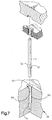
- Figure 7 is a view similar to Figure 1 but shown in exploded isometric form for illustrating the details of the hammer of the present invention used to affix the pin blank to the first circuit board; and
- Figure 8 is an isometric view similar to Figure 3 but showing another embodiment of the present invention.
- Referring to Figures 1 to 3, an electrical module generally indicated at 10 (Figure 3) is formed from a
substrate 12 and a pin blank 14. In the embodiment shown,substrate 12 is a printed circuit board and is composed of a dielectric material such as ceramic, fiberglass-reinforced epoxy such as FR4, etc., which contains one or more electrically conductive paths (not shown) therein.Substrate 12 defines one ormore holes 16 therein which pass all the way through the substrate from afirst surface 18 thereof to asecond surface 20 thereof. In the embodiment shown,hole 16 is a plated-through-hole, meaning that the surfaces ofhole 16 carry a coating of an electrically conductive material 22 which extends all the way through the hole fromfirst surface 18 of the substrate tosecond surface 20 and extends outwardly from the center of the hole by a small distance on these surfaces to formpads 23 as shown in Figure 1. In the particular embodiment shown, the electrically conductive material 22 of the plated-through-hole is electrically connected to an electrically conductive path (not shown) in the substrate. - As further shown in Figure 1, pin blank 14 comprises a generally elongated member which defines a
first end 24 and asecond end 26. The body of pin blank 14 nearfirst end 24 defines a substrate-engaging section 28 and, in a location spaced from substrate-engaging section 28, a first compliant section generally indicated at 30. - In the particular embodiment shown, first
compliant section 30 includesprotrusions 32, which are formed by swaging and which extend outwardly from the center line of pin blank 14 by a distance greater than the radius of the pin blank in the remainder of the pin blank body. As discussed more fully below, the shape and size ofprotrusions 32 are selected so that these protrusions will cooperate with the walls of openings in a second circuit board to which themodule 10 is to be attached. - In order to form the module of Figure 3, pin blank 14 is arranged to register with
hole 16 in printedcircuit board 12. In addition, printedcircuit board 12 and pin blank 14 are also arranged to register with a pinblank receiving hole 34 in alower hammer 36 as well as abulge cavity 38 in anupper hammer 40, these hammers being part of a machine (not shown) for attaching pin blanks to boards by compressive deformation. Part of pin blank receivinghole 34 inlower hammer 36 defines itsown bulge cavity 42 having a shape similar tobulge cavity 38 inupper hammer 40. As used herein, "upper" and "lower" refer to the position as shown in the Figure 1, but physically they can be reversed or even spaced laterally or other direction rather than vertically. - With the elements arranged in this manner,
lower hammer 36 andupper hammer 40 are moved together in the axial direction, i.e., in the direction of the longitudinal axis of pin blank 14. This causes thefirst end 24 of the pin blank to be inserted intohole 16 ofboard 12 and then for the pin blank to be moved all the way intohole 16 until substrate-engaging section 28 of the pin blank aligns with the body of the board and theend 24 of the pin protrudes out ofhole 16 justpast pads 23 of electrically conductive material 22. At the same time, movement of the hammers together also causesend 26 andcompliant section 30 ofpin 14 to be received in pin blank receivinghole 34 oflower hammer 36. - Movement of
lower hammer 36 andupper hammer 40 together is continued until they reach a predetermined distance apart, this distance being, in the particular embodiment shown, the thickness ofelectrical substrate 12 includingpads 23 of electrically conductive material 22. As will be appreciated by those skilled in the art, movement of the upper and lower hammers together in this manner causes a compressive force to be exerted upon the body of pin blank 14 along its longitudinal axis. This compressive force in turn causes a compressive deformation, i.e., plastic deformation, of those portions of the substrate-engagingsection 28 of the pin blank immediately below and above the first and second surfaces, respectively, of printedcircuit board 12. This plastic deformation, in turn, causes bulges 44 and 46 to form in the body of the pin blank, these bulges being formed by the material of pin blank 14filling bulge cavities lower hammers board 12 therebetween, thereby firmly and securely affixing the pin blank to the board, pin blank 14 now being referred to simply as a pin.Lower hammer 36 andupper hammer 40 are then moved to a retracted position, thereby producing a completedmodule 10 in accordance with the present invention. - Although Figures 1 and 2 illustrate only a single pin blank being affixed to printed
circuit board 12, in actual practice there will normally be multiple pin blanks affixed to multiple holes in the substrate. By this technique, a module is provided which, as illustrated in Figure 3, defines a plurality, or array, ofpins 14, each having a compliant section projecting from thefirst surface 18 of the board for subsequent connection ofmodule 10 to another printed circuit board or other device by compliant pin connection, as more fully described below. - Figures 4, 5 and 6 illustrate how the
inventive module 10 prepared as described above can be connected to another circuit board or other device (known in the art by various terms such as "carrier," "mother board," "planar," etc.) for forming a completed assembly of stacked boards or devices. Referring to Figure 4,module 10 is arranged so thatsecond end 26 ofpin 14 registers with opening 48 in a secondelectrical substrate 50, which in the embodiment shown is also a printed circuit board.Opening 48 in printedcircuit board 50 has a size compatible withcompliant section 30 ofpin 14 so that when this section is inserted intoopening 48,protrusions 32 in thecompliant section 30 firmly affixpin 14 tocircuit board 50 by compliant pin connection. In the particular embodiment shown, the walls of opening 48 inboard 50 are plated through holes provided with acoating 52 of an electrically conductive material for providing electrical connection to pin 14 as well as mechanical connection. Printedcircuit board 50 also includes an electrically conductive path (not shown) connected to the electricallyconductive material 52 inhole 48 for electrical connection ofpin 14 to other elements on printedcircuit board 50. - With
pin 14 arranged in registration withhole 48 of printedcircuit 50,module 10 andcircuit board 50 are brought together to insertpin 14 intohole 48 of the circuit board. This operation is accomplished in the embodiment shown by means of apress 54 and a mountingplate 56.Press 54 includesprojections 58 for engaging thebulge 46 ofpin 14, while mountingplate 56 definesholes 60 for receiving the portion of the body ofpin 14 extending out of the bottom of the second printed circuit whenmodule 10 andboard 50 are brought together for their final positioning. - As illustrated in Figure 5, mounting
plate 56 andpress 54 are brought together until stopped by asuitable stop 62 which is so arranged that converging movement of the press and mounting plate is stopped whenprotrusions 32 ofpin 14 align with the axial center ofhole 48. As will be appreciated by those skilled in the art, suitable spacer elements (not shown) may also be provided to insure thatmodule 10 andboard 50 remain spaced apart by a predetermined distance aspress 54 and mountingplate 56 are moved together. In any event, insertion ofcompliant section 30 ofpin 14 intohole 48 and convergence ofpress 54 and mountingplate 56 in the manner described above causescompliant section 30 ofpin 14 and the walls ofhole 48 to be firmly affixed together, thereby creating a secure mechanical and electrical bond in accordance with known compliant pin connection techniques.Press 54 and mountingplate 56 are then withdrawn from one another to form a completedassembly 64 as illustrated in Figure 6. - As shown in Figure 6, completed
assembly 64 comprises afirst circuit board 12 andsecond circuit board 50 which are securely affixed to one another, both mechanically and electrically by means ofpin 14. In actual practice, many pins will normally be employed rather than the single pin illustrated in the figure so that numerous electrical and mechanical connections can be made, thereby making the connection betweenboards - From the foregoing, it can be seen that the present invention provides a simple and straightforward method for mechanically and electrically forming together multiple circuit boards in stacked relation without soldering. In particular, it can be seen that the procedure of the invention requires only simple movement of suitable anvils, hammers and other work pieces in the longitudinal direction, that is the direction aligning with the longitudinal axis of the pin blanks. Moreover, it can also be seen that the pin blanks used in the present invention are of simple design, not requiring involved mechanical steps to develop complex shapes or structures as in prior art systems. These features make the inventive technique for joining multiple circuit boards together inexpensive to carry out while at the same time providing secure electrical connections throughout the completed device.
- In accordance with another feature of the invention, a novel hammer or anvil is provided for inserting pin blank 14 into the substrate or
circuit board 12 illustrated above. In this connection, an important feature oflower hammer 36 is that pinblank receiving hole 34 is sized and shaped to receive the lower end ofpin 14 therein, even though this portion ofpin 14 includes acompliant pin section 30. The structure to make this possible is more fully illustrated in Figure 7. As shown in this figure, pinblank receiving hole 34 inlower hammer 36, in addition to includingbulge cavity 42 as previously described, includes twogrooves 66 axially arranged in the walls of pinblank receiving hole 34 to receiveprotrusions 32 of pin blank 14. As shown in Figure 2, thesegrooves 66 extend downwardly by a distance sufficient to accommodateprotrusions 32 whenpin 14 is inserted inlower hammer 36 by sufficient distance so that the bottom 68 ofpin engaging hole 34 engages theend 26 of the pin. By this means,lower hammer 36 can be used together withupper hammer 40 to cause compressive deformation of pin blank 14 thereby formingbulges - In accordance with another feature of the invention, a third electrical substrate or printed circuit board can be stacked with the assembly of two printed circuit boards shown in Figure 6. In accordance with this embodiment of the invention, a pin is used which has two compliant sections, one near each of the two ends of the pin blank with the substrate-engaging section being located therebetween. In this embodiment, it is preferable that the diameter of the substrate-engaging section be larger than the diameter of the pin in the other sections, and preferably at least as large as the largest cross-sectional dimension of the pin at the
protrusions 32. With this configuration, a preformed pin can still be inserted into thehole 16 ofboard 12 and then moved therethrough until the substrate-engagingsection 28 of the pin aligns withboard 12. In this configuration, the pin blank is again subjected to compression along its longitudinal axis, but in this embodimentupper hammer 40 is provided with a pin blank receiving hole having essentially the same structure as pinblank receiving hole 34 inlower hammer 36. As a result,upper hammer 40 can receive the ends of the pins projecting from theupper surface 20 ofboard 12 in the same waylower hammer 36 receives the ends of the pins projecting downwardly fromlower surface 18 of the board. - When this embodiment of the invention is employed, there is produced a module as illustrated in Figure 8, the pins of such module projecting a first array of
compliant sections 30 downward from thefirst surface 18 of the substrate and a second array of compliant sections upward from thesecond surface 20 of the substrate. Each of these arrays of compliant sections can be firmly affixed to its own printed circuit or other device by compliant pin connection, thereby creating a 3-layered stacked assembly as desired. This is illustrated in Figure 9. - The present invention can be employed to form printed circuit boards, modules, module assemblies and other devices of any size. Typical circuit boards used today measure 25 x 25 to 75 x 75 millimeters and contain an array of 5 to 500 pin/holes, for example. Conventional pin sizes include pins of 16, 18, 20, etc., mils in diameter with the individual pins being spaced apart by any suitable distance, for example 1.27 to 2.54 millimeters. The invention described herein is applicable to printed circuit boards and other electrical devices of any such sizes. In addition, the present invention is also applicable to the production of printed circuit boards and other electrical devices of even larger construction, with the assemblies once formed being subdivided into smaller subassemblies after formation.
- Although only a few embodiments of the present invention have been described above, it should be appreciated that many modifications can be made without departing from the spirit and scope of the invention. For example, although
lower hammer 36 has been described as being a single, unitary member, it should be appreciated thatlower hammer 36 can be composed of a number of different pieces or devices so long as the overall function of the hammer remains the same. For example, hammer 36 could be divided into two or more pieces, one or more pieces arranged to accept and hold thecompliant portion 30 of pin blank 14 and another device employed for the application of axial force to end 26 of the pin blank. - Furthermore, although the foregoing has described the holes and openings in the first and second circuit boards as including contacts allowing electrical connection of the pins thereto, it should be appreciated that electrical connections are not always necessary, mechanical connections only being sufficient for some applications.
- Furthermore, although the foregoing description indicates that the electrically conductive material 22 in
openings 16form pads 23 on the first and second surfaces of the substrate, it should be appreciated that such pads are not required. In the same way, using pins and pin blanks of circular cross-section is not required, as any cross-sectional shape can be employed. Also, the diameter of the pin blanks used in accordance with the present invention can vary from section to section as desired, it being sufficient in accordance with the present invention merely thathole 34 in hammer 36 (whether formed from single or multiple pieces) receive and accommodate so much ofcompliant section 30 of the pin as is necessary to accomplish compressive deformation of the pin blank as described above. - In addition, although the foregoing shows using pin blanks with pre-formed compliant sections, it should be appreciated that the pin blanks can be affixed to
substrate 12 before the pin blank is swaged or otherwise worked to form compliant sections. This, of course, defeats one of the major advantages of the present invention in using preformed pin blanks for the sake of ease of operation and low cost. - All such modifications are intended to be included within the scope of the present invention, which is to be limited only by the following claims.
Claims (18)
- A module comprising(1) a substrate defining a first surface, a second surface spaced from said first surface and at least one hole communicating between said first and second surfaces for receiving an electrical connection pin, and(2) an electrical connection pin having a substrate-engaging section received in said hole, said substrate-engaging section defining a first bulge engaging said first surface and a second bulge engaging said second surface, said first and second bulges being formed by compressive deformation so that said bulges securely fasten said pin to said substrate, said pin further defining a first compliant section spaced from said substrate-engaging section and projecting from the first surface of said substrate for affixing said pin to a carrier by compliant pin connection.
- The module of claim 1 wherein said substrate is composed of a dielectric material, wherein said substrate defines a plurality of holes for receiving respective electrical connection pins and wherein said substrate further defines at least one electrically conductive path therein electrically connected to at least one of said holes, said module further comprising a plurality of electrical connection pins in said holes, with at least one of said pins being electrically connected to said electrically conductive path.
- The module of claim 2 wherein said substrate defines a plurality of plated-through-holes electrically connected to said electrically conductive path, the surfaces of said plated-through-holes carrying an electrically conductive material for electrical connection to the pins therein.
- The module of claim 2 wherein said module is a printed circuit board defining a first array of pins each having its own compliant section, said first array of pins projecting from the first surface of said substrate for affixing said module to a first carrier by compliant pin connection.
- The module of claim 4 wherein at least some of the pins in said module define second compliant sections spaced from their respective substrate-engaging sections, said second compliant sections defining a second array of compliant pin sections projecting from the second surface of said substrate for affixing said second array of compliant pin sections to a second carrier by compliant pin connection.
- The module of claim 4 wherein compliant pin sections for attachment to a carrier project from one side of said substrate only.
- An assembly comprising the module of claim 1 affixed to a first carrier, said carrier defining at least one opening having a size compatible with the compliant section of at least one pin of said module, said compliant pin section of said at least one pin being inserted into said opening and coacting with the walls of said opening so that said at least one pin is securely affixed to said carrier.
- The assembly of claim 7 wherein said module comprises a first printed circuit board defining a first array of pins each having its own compliant section, said first array of pins projecting from the first surface of said substrate for affixing said module to said first carrier, said carrier comprising a second printed circuit board defining a plurality of openings therein corresponding to the pins in said first array of pins, the compliant sections of said first array of pins being inserted into and securely fixed to the respective openings in said second printed circuit board.
- The module of claim 8 wherein the holes in said first printed circuit board and the openings in said second printed circuit board are plated-through holes.
- A hammer for forming bulges in an array of compliant pin blanks by compressive deformation to thereby attach said array of pin blanks to a printed circuit board, each of said compliant pin blanks having a substrate-engaging portion and a compliant section spaced from said substrate-engaging portion and projecting from said printed circuit board when said pin blank is inserted therein, the compliant section of each of said pin blanks defining at least one protrusion extending outwardly from the central axis of the pin blank farther than the remaining portions of the compliant section of the pin blank, said printed circuit board having a plurality of holes receiving the substrate-engaging portions of said array of compliant pin blanks,
said hammer comprising a body defining a substrate-facing surface for facing said printed circuit board when said compliant pin blanks are attached thereto, said body defining a plurality of holes in said substrate-facing surface for receiving the compliant sections of said pin blanks, each of said holes being elongated and arranged generally perpendicular to said substrate-facing surface, each of said holes defining in said substrate-facing surface a bulge cavity larger in cross-section than the cross-section of the portion of pin blank received therein so that compressive stress of said pin blanks will cause said blanks to deform and thereby form bulges in said cavities, each of said holes further defining at least one groove therein, one groove corresponding to each of the protrusions in the respective compliant sections of said pins, each groove being shaped to receive its respective protrusion when said array of pins is placed in said holes. - The hammer of claim 10 wherein said protrusions are formed by swaging and further wherein said grooves extend axially along the walls of said holes.
- The hammer of claim 11 wherein (herein describe the close packing of the holes to set the environment).
- A process for forming a module comprising(1) providing a substrate defining a first surface, a second surface spaced from said first surface and at least one hole communicating between said first and second surfaces for receiving an electrical connection pin blank,(2) inserting one end of an electrical connection pin blank into said hole, said electrical connection pin blank having a substrate-engaging section and a compliant section spaced from said substrate-engaging section, said pin being inserted into said substrate from said first surface so that the compliant section of said pin projects from the first surface of said substrate and further so that said substrate-engaging section is in said hole with a portion of said substrate-engaging section protruding beyond the second surface of substrate and another portion of said substrate-engaging section protruding beyond said first surface, and(3) applying a compressive force along the longitudinal axis of said pin thereby causing the portions of the substrate-engaging section of said pin protruding out from the first and second surfaces of said substrate to deform into first and second bulges, respectively, thereby securely fastening said pin to said substrate.
- A process of claim 13 wherein said module is a first printed circuit board, wherein said substrate defines a plurality of holes for receiving a plurality of electrical connector pins and further wherein said process comprises securely fastening a plurality of electrical connection pins to said plurality of holes in said substrate by applying a compressive force along the longitudinal axis of said pin, said force causing each of said pins to deform to form first and second bulges locking each pin in place whereby said first printed circuit board is formed.
- The process of claim 13 further comprising forming an assembly by(4) inserting the other end of said electrical connection pin into the opening of a second substrate, said opening having a size compatible with the compliant section of said pin so that when said compliant section is inserted into said opening the compliant section of said pin is firmly affixed to the walls of the opening of said second substrate, and(5) moving said first and second substrates together until the compliant section of said pin is inserted into and becomes firmly affixed to the walls of said opening.
- The process of claim 13 wherein said first substrate includes at least one electrically conductive path electrically connected to said pin, wherein the opening in said second substrate is a plated through hole and further wherein said second substrate includes at least one electrically conductive path electrically connected to said plated-through-hole.
- The process of claim 16 wherein said first substrate is a first printed circuit board defining a first array of pins each having its own compliant section, said first array of pins projecting from the first surface of said board for affixing said board to said carrier, said carrier comprising a second printed circuit board defining a plurality of openings therein corresponding to the pins in said first array of pins, the compliant sections of said first array of pins being inserted into and securely fixed to the respective openings in said second printed circuit board.
- The process of claim 17 wherein said pins are affixed to said second substrate without soldering.
Applications Claiming Priority (2)
| Application Number | Priority Date | Filing Date | Title |
|---|---|---|---|
| US08/185,182 US5548486A (en) | 1994-01-21 | 1994-01-21 | Pinned module |
| US185182 | 1994-01-21 |
Publications (2)
| Publication Number | Publication Date |
|---|---|
| EP0664576A2 true EP0664576A2 (en) | 1995-07-26 |
| EP0664576A3 EP0664576A3 (en) | 1996-07-31 |
Family
ID=22679944
Family Applications (1)
| Application Number | Title | Priority Date | Filing Date |
|---|---|---|---|
| EP94118583A Withdrawn EP0664576A3 (en) | 1994-01-21 | 1994-11-25 | Pinned module. |
Country Status (7)
| Country | Link |
|---|---|
| US (2) | US5548486A (en) |
| EP (1) | EP0664576A3 (en) |
| JP (1) | JP2673102B2 (en) |
| KR (1) | KR100189799B1 (en) |
| CN (1) | CN1051409C (en) |
| PH (1) | PH30836A (en) |
| TW (1) | TW411638B (en) |
Cited By (6)
| Publication number | Priority date | Publication date | Assignee | Title |
|---|---|---|---|---|
| DE19546888C1 (en) * | 1995-12-15 | 1997-08-21 | Weidmueller Interface | Circuit board connector terminal machining method |
| EP0825680A3 (en) * | 1996-08-23 | 1999-01-27 | CTS Corporation | Deformable pin electrical connector |
| GB2331409A (en) * | 1997-08-06 | 1999-05-19 | Siemens Ag | Housing for electronic control unit |
| WO1999031393A1 (en) * | 1997-12-15 | 1999-06-24 | Mannesmann Rexroth Ag | Vertical interlinking system |
| CN112787119A (en) * | 2019-11-05 | 2021-05-11 | 马瑞利汽车照明罗伊特林根(德国)有限公司 | Conductive connecting device of circuit board |
| EP3819989A1 (en) * | 2019-11-05 | 2021-05-12 | Marelli Automotive Lighting Reutlingen (Germany) GmbH | Electrically conductive connection of printed circuit boards |
Families Citing this family (61)
| Publication number | Priority date | Publication date | Assignee | Title |
|---|---|---|---|---|
| US5878483A (en) * | 1995-06-01 | 1999-03-09 | International Business Machines Corporation | Hammer for forming bulges in an array of compliant pin blanks |
| AU6337998A (en) * | 1997-02-28 | 1998-09-18 | Cornell Research Foundation Inc. | Self-assembled low-insertion force connector assembly |
| GB9705277D0 (en) * | 1997-03-14 | 1997-04-30 | Kam Circuits Limited | Improvements relating to printed circuit board pin location |
| US6070531A (en) * | 1997-07-22 | 2000-06-06 | Autoliv Asp, Inc. | Application specific integrated circuit package and initiator employing same |
| US6005198A (en) * | 1997-10-07 | 1999-12-21 | Dimensional Circuits Corporation | Wiring board constructions and methods of making same |
| DE19756345C2 (en) * | 1997-12-18 | 1999-12-30 | Telefunken Microelectron | Arrangement for contacting printed circuit boards |
| US6108902A (en) * | 1998-01-20 | 2000-08-29 | Lucent Technologies, Inc. | Contact pin header connector repair method and repair fixture |
| US6222739B1 (en) | 1998-01-20 | 2001-04-24 | Viking Components | High-density computer module with stacked parallel-plane packaging |
| AU5305799A (en) * | 1998-09-02 | 2000-03-27 | Ibiden Co. Ltd. | Electronic part module mounted on socket |
| JP4295384B2 (en) * | 1999-03-08 | 2009-07-15 | 富士通コンポーネント株式会社 | connector |
| US6448106B1 (en) * | 1999-11-09 | 2002-09-10 | Fujitsu Limited | Modules with pins and methods for making modules with pins |
| US6453549B1 (en) | 1999-12-13 | 2002-09-24 | International Business Machines Corporation | Method of filling plated through holes |
| US6552277B1 (en) * | 2000-09-08 | 2003-04-22 | Emc Corporation | Techniques for forming a connection between a pin and a circuit board |
| US6698091B1 (en) * | 2000-12-29 | 2004-03-02 | Cisco Technology, Inc. | Method and apparatus for coupling circuit boards |
| US6565367B2 (en) | 2001-01-17 | 2003-05-20 | International Business Machines Corporation | Zero insertion force compliant pin contact and assembly |
| US6739881B2 (en) | 2001-05-31 | 2004-05-25 | Trw Inc. | High integration electronic assembly and method |
| KR20020092703A (en) * | 2001-06-05 | 2002-12-12 | 홍성결 | A Lead Pin for CPU PCB and Method of Assembly thereof |
| US6472970B1 (en) | 2001-06-08 | 2002-10-29 | Trw Inc. | Apparatus for attaching an electric coil to a printed circuit board |
| US6485112B1 (en) | 2001-06-13 | 2002-11-26 | Trw Inc. | Assembly, with lead frame, for antilock brake system and associated method |
| US6518511B1 (en) * | 2001-09-20 | 2003-02-11 | Wen Hsiung Lin | Circuit board having a shortage preventing structure |
| US6549410B1 (en) * | 2001-11-20 | 2003-04-15 | Hewlett-Packard Company | Heatsink mounting system |
| JP4197234B2 (en) * | 2001-12-28 | 2008-12-17 | 三菱電機株式会社 | Optical communication device |
| US6901646B2 (en) * | 2002-01-16 | 2005-06-07 | Avaya Technology Corp. | Universal snap-fit spacer |
| US6749105B2 (en) | 2002-03-21 | 2004-06-15 | Motorola, Inc. | Method and apparatus for securing a metallic substrate to a metallic housing |
| US6763580B2 (en) | 2002-03-21 | 2004-07-20 | Motorola, Inc. | Method and apparatus for securing an electrically conductive interconnect through a metallic substrate |
| KR100457380B1 (en) | 2002-05-06 | 2004-11-16 | 삼성전기주식회사 | Chip on board package for optical mouse and a lense cover used therefor |
| US6716072B1 (en) | 2002-06-27 | 2004-04-06 | Emc Corporation | Systems and methods for disposing a circuit board component on a circuit board using a soldering pin |
| US6716038B2 (en) * | 2002-07-31 | 2004-04-06 | Medallion Technology, Llc | Z-axis connection of multiple substrates by partial insertion of bulges of a pin |
| US6773269B1 (en) * | 2002-09-27 | 2004-08-10 | Emc Corporation | Circuit board assembly which utilizes a pin assembly and techniques for making the same |
| US7135764B2 (en) * | 2003-08-07 | 2006-11-14 | Aries Electronics, Inc. | Shielded semiconductor chip carrier having a high-density external interface |
| DE102004036407A1 (en) * | 2003-08-27 | 2005-06-09 | Japan Electronic Materials Corp., Amagasaki | Probe card and connector for this |
| JP2005106482A (en) * | 2003-09-26 | 2005-04-21 | Japan Electronic Materials Corp | Connection pin |
| JP4131724B2 (en) * | 2004-10-18 | 2008-08-13 | Tdk株式会社 | Terminal mounting structure on circuit board |
| US7209365B2 (en) * | 2005-04-06 | 2007-04-24 | Inventec Corporation | Card retention device |
| US7242084B2 (en) * | 2005-05-27 | 2007-07-10 | Intel Corporation | Apparatuses and associated methods for improved solder joint reliability |
| US7083431B1 (en) | 2005-09-02 | 2006-08-01 | Lear Corporation | Method and system of electrically connecting multiple printed circuit boards |
| JP2007103079A (en) * | 2005-09-30 | 2007-04-19 | Funai Electric Co Ltd | Digital video disc-integrated crt television and connector fixing structure |
| US7300289B2 (en) * | 2005-09-30 | 2007-11-27 | Control Products Inc. | Electrical cordset having connector with integral signal conditioning circuitry |
| US7473101B2 (en) * | 2006-05-05 | 2009-01-06 | International Business Machines Corporation | Connector for mezzanine mounting of a printed wiring board |
| US7503767B2 (en) * | 2006-08-01 | 2009-03-17 | General Dynamics Advanced Information Systems, Inc. | Method and apparatus for compliantly connecting stack of high-density electronic modules in harsh environments |
| US7816781B2 (en) * | 2007-10-02 | 2010-10-19 | Infineon Technologies Ag | Power semiconductor module |
| WO2009046428A2 (en) * | 2007-10-05 | 2009-04-09 | Battery-Biz® Inc. | Termination apparatus and method for planar components on printed circuit boards |
| AT506929B1 (en) * | 2008-04-29 | 2012-10-15 | Siemens Ag | ARRANGEMENT OF TWO CIRCUITS |
| DE102008002558A1 (en) * | 2008-06-20 | 2009-12-24 | Robert Bosch Gmbh | Contact pin for an electronic circuit |
| JP5423621B2 (en) * | 2010-06-04 | 2014-02-19 | 株式会社デンソー | Circuit board terminal connection structure |
| KR200456772Y1 (en) | 2010-10-12 | 2011-11-24 | 주식회사 유라코퍼레이션 | Board connector |
| DE102011054818A1 (en) * | 2011-10-26 | 2013-05-02 | Hella Kgaa Hueck & Co. | Electronic switch |
| US8900008B2 (en) * | 2012-05-25 | 2014-12-02 | International Business Machines Corporation | Universal press-fit connection for printed circuit boards |
| EP2962365A1 (en) * | 2013-02-27 | 2016-01-06 | ABB Technology AG | Programming connector |
| JP5420809B1 (en) * | 2013-06-04 | 2014-02-19 | 株式会社岡崎製作所 | MI cable end structure and manufacturing method thereof |
| US9070987B2 (en) * | 2013-10-30 | 2015-06-30 | Samtec, Inc. | Connector with secure wafer retention |
| JP5681261B1 (en) * | 2013-10-31 | 2015-03-04 | 株式会社フジクラ | PCB mounting terminals |
| CN104797027B (en) * | 2014-01-20 | 2018-01-02 | 美的集团股份有限公司 | Coil panel component |
| US9554476B2 (en) * | 2014-08-14 | 2017-01-24 | Continental Automotive Systems, Inc. | Compliant staple pin for connecting multiple printed circuit boards |
| CN106298713A (en) * | 2015-06-09 | 2017-01-04 | 台达电子工业股份有限公司 | Power module of perpendicular connection and pin of piling up connection thereof |
| JP6727937B2 (en) * | 2016-06-10 | 2020-07-22 | 日本電波工業株式会社 | Electronic device |
| CN106535532A (en) * | 2016-12-27 | 2017-03-22 | 成都芯通科技股份有限公司 | Positioning and installing device and positioning method for circuit system |
| CN108513440B (en) * | 2018-04-20 | 2023-11-21 | 深圳市动力飞扬智能装备有限公司 | A PIN encapsulation equipment for PCB boards |
| TWM584842U (en) * | 2019-05-10 | 2019-10-11 | 伍鐌科技股份有限公司 | Buckling member of multi-buckling part |
| JP7179434B2 (en) * | 2020-07-06 | 2022-11-29 | 矢崎総業株式会社 | vehicle instrumentation |
| US11647591B2 (en) | 2021-06-10 | 2023-05-09 | International Business Machines Corporation | Compliant pin surface mount technology pad for rework |
Family Cites Families (64)
| Publication number | Priority date | Publication date | Assignee | Title |
|---|---|---|---|---|
| US1900099A (en) * | 1929-05-25 | 1933-03-07 | Westinghouse Lamp Co | Method of securing contact pins in radiotube bases |
| US2611010A (en) * | 1949-07-30 | 1952-09-16 | Rca Corp | Printed circuit structure for highfrequency apparatus |
| US2979600A (en) * | 1956-08-31 | 1961-04-11 | Plessey Co Ltd | Electrode systems for electronic valves |
| US3281923A (en) * | 1964-08-27 | 1966-11-01 | Corning Glass Works | Method of attaching leads to thin films |
| US3257708A (en) * | 1965-04-05 | 1966-06-28 | Ibm | Substrate with contact pins and method of making same |
| US3545080A (en) * | 1967-05-16 | 1970-12-08 | Amp Inc | Method of making resilient pins |
| US3541496A (en) * | 1967-12-21 | 1970-11-17 | Thomas & Betts Corp | Terminal |
| US3880486A (en) * | 1973-03-05 | 1975-04-29 | Epis Corp | Apparatus and system for interconnecting circuits and electronic components |
| US3888486A (en) * | 1974-04-10 | 1975-06-10 | Robert E Sutter | Article receiving and collecting receptacle assembly |
| JPS5163460A (en) * | 1974-10-10 | 1976-06-01 | Du Pont | Kairobanpin oyobi hoho |
| DE2541222C2 (en) * | 1974-12-19 | 1982-08-26 | Elfab Corp., Dallas, Tex. | Plug-in device that can be mounted on a carrier body, in particular a printed circuit board |
| JPS52117853A (en) * | 1976-03-29 | 1977-10-03 | Ibm | Detachable solder mask |
| US4034468A (en) * | 1976-09-03 | 1977-07-12 | Ibm Corporation | Method for making conduction-cooled circuit package |
| US4072816A (en) * | 1976-12-13 | 1978-02-07 | International Business Machines Corporation | Integrated circuit package |
| US4082394A (en) * | 1977-01-03 | 1978-04-04 | International Business Machines Corporation | Metallized ceramic and printed circuit module |
| JPS5428586A (en) * | 1977-08-08 | 1979-03-03 | Koden Electronics Co Ltd | Phase tracking malfunction detector for omega receiver |
| US4202007A (en) * | 1978-06-23 | 1980-05-06 | International Business Machines Corporation | Multi-layer dielectric planar structure having an internal conductor pattern characterized with opposite terminations disposed at a common edge surface of the layers |
| US4191938A (en) * | 1978-07-03 | 1980-03-04 | International Business Machines Corporation | Cermet resistor trimming method |
| US4233620A (en) * | 1979-02-27 | 1980-11-11 | International Business Machines Corporation | Sealing of integrated circuit modules |
| US4265775A (en) * | 1979-08-16 | 1981-05-05 | International Business Machines Corporation | Non-bleeding thixotropic thermally conductive material |
| US4291364A (en) * | 1979-12-26 | 1981-09-22 | International Business Machines Corporation | Air-cooled hybrid electronic package |
| US4274124A (en) * | 1979-12-26 | 1981-06-16 | International Business Machines Corporation | Thick film capacitor having very low internal inductance |
| US4415025A (en) * | 1981-08-10 | 1983-11-15 | International Business Machines Corporation | Thermal conduction element for semiconductor devices |
| US4446505A (en) * | 1982-03-22 | 1984-05-01 | Amp Incorporated | Electrical connector for interconnecting printed circuit boards |
| JPS59151443A (en) * | 1983-02-17 | 1984-08-29 | Fujitsu Ltd | Semiconductor device |
| US4825331A (en) * | 1983-08-29 | 1989-04-25 | Electro-Matic Products Co. | Tape degausser |
| JPS60151030A (en) * | 1984-01-20 | 1985-08-08 | Japan Styrene Paper Co Ltd | Manufacturing method of polyolefin resin foamed molding unit |
| US4550493A (en) * | 1984-02-08 | 1985-11-05 | International Business Machines Corporation | Apparatus for connecting contact pins to a substrate |
| GB8412674D0 (en) * | 1984-05-18 | 1984-06-27 | British Telecomm | Integrated circuit chip carrier |
| JPS6110263A (en) * | 1984-06-26 | 1986-01-17 | Nec Kansai Ltd | Hybrid ic |
| US4601424A (en) * | 1985-05-17 | 1986-07-22 | International Business Machines Corporation | Stripped gold plating process |
| JPS62136865A (en) * | 1985-12-11 | 1987-06-19 | Hitachi Ltd | Module mounting structure |
| JPS62271376A (en) * | 1986-01-31 | 1987-11-25 | デイジタル イクイプメント コ−ポレ−シヨン | Press-fit pin for linking circuit board |
| US4780371A (en) * | 1986-02-24 | 1988-10-25 | International Business Machines Corporation | Electrically conductive composition and use thereof |
| US4676426A (en) * | 1986-03-10 | 1987-06-30 | Ibm Corp. | Solder leveling technique |
| JPS62216259A (en) * | 1986-03-17 | 1987-09-22 | Fujitsu Ltd | Manufacture and structure of hybrid integrated circuit |
| US4690833A (en) * | 1986-03-28 | 1987-09-01 | International Business Machines Corporation | Providing circuit lines on a substrate |
| JPS62287658A (en) * | 1986-06-06 | 1987-12-14 | Hitachi Ltd | Ceramic multilayered circuit board and semiconductor module |
| US4741100A (en) * | 1986-09-24 | 1988-05-03 | International Business Machines Corporation | Pin retention method and apparatus |
| US4803595A (en) * | 1986-11-17 | 1989-02-07 | International Business Machines Corporation | Interposer chip technique for making engineering changes between interconnected semiconductor chips |
| US4764848A (en) * | 1986-11-24 | 1988-08-16 | International Business Machines Corporation | Surface mounted array strain relief device |
| US5159535A (en) * | 1987-03-11 | 1992-10-27 | International Business Machines Corporation | Method and apparatus for mounting a flexible film semiconductor chip carrier on a circuitized substrate |
| JPS63241892A (en) * | 1987-03-30 | 1988-10-07 | 藤好 克聡 | Manufacture of terminal and so forth |
| US4813130A (en) * | 1987-04-23 | 1989-03-21 | International Business Machines | Automatic extrusion pinning method and apparatus |
| US4791075A (en) * | 1987-10-05 | 1988-12-13 | Motorola, Inc. | Process for making a hermetic low cost pin grid array package |
| US4889496A (en) * | 1988-04-12 | 1989-12-26 | Intercon Systems, Inc. | Compressible core electrical connector |
| JP2548602B2 (en) * | 1988-04-12 | 1996-10-30 | 株式会社日立製作所 | Semiconductor mounting module |
| US4988646A (en) * | 1988-05-12 | 1991-01-29 | International Business Machines | Method for producing a ceramic |
| US4883744A (en) * | 1988-05-17 | 1989-11-28 | International Business Machines Corporation | Forming a polymide pattern on a substrate |
| US4916259A (en) * | 1988-08-01 | 1990-04-10 | International Business Machines Corporation | Composite dielectric structure for optimizing electrical performance in high performance chip support packages |
| US4878861A (en) * | 1988-11-01 | 1989-11-07 | Elfab Corporation | Compliant electrical connector pin |
| JPH02125696A (en) * | 1988-11-04 | 1990-05-14 | Nec Corp | Multilayer printed wiring board |
| JPH02155176A (en) * | 1988-12-06 | 1990-06-14 | Ngk Spark Plug Co Ltd | Fixing of metal terminal |
| US4969259A (en) * | 1988-12-14 | 1990-11-13 | International Business Machines Corporation | Pin with tubular elliptical compliant portion and method for affixing to mating receptacle |
| JP3090453B2 (en) * | 1989-07-10 | 2000-09-18 | 株式会社日立製作所 | Thick film thin film laminated substrate and electronic circuit device using the same |
| US5082460A (en) * | 1989-10-02 | 1992-01-21 | Zierick Manufacturing Corporation | Electrical terminal with frangible mounting leg and method of forming the same |
| JPH0574532A (en) * | 1990-01-18 | 1993-03-26 | Kel Corp | Electric connector |
| US5002507A (en) * | 1990-01-31 | 1991-03-26 | E. I. Du Pont De Nemours And Company | Circuit board contact element and compliant section thereof |
| JPH03263771A (en) * | 1990-03-13 | 1991-11-25 | Fujitsu Ltd | Press fit pin |
| US5065227A (en) * | 1990-06-04 | 1991-11-12 | International Business Machines Corporation | Integrated circuit packaging using flexible substrate |
| US5050296A (en) * | 1990-06-07 | 1991-09-24 | International Business Machines Corporation | Affixing pluggable pins to a ceramic substrate |
| US5048178A (en) * | 1990-10-23 | 1991-09-17 | International Business Machines Corp. | Alignment--registration tool for fabricating multi-layer electronic packages |
| US5257165A (en) * | 1992-02-13 | 1993-10-26 | Jaton Technology Co., Ltd. | Pin grid array adaptor mounting hardware |
| DE9203996U1 (en) * | 1992-03-25 | 1992-05-07 | Schroff Gmbh, 75334 Straubenhardt | Electronic module |
-
1994
- 1994-01-21 US US08/185,182 patent/US5548486A/en not_active Expired - Fee Related
- 1994-09-21 JP JP6226511A patent/JP2673102B2/en not_active Expired - Lifetime
- 1994-11-25 EP EP94118583A patent/EP0664576A3/en not_active Withdrawn
- 1994-12-29 KR KR1019940038855A patent/KR100189799B1/en not_active Expired - Fee Related
- 1994-12-29 PH PH49724A patent/PH30836A/en unknown
- 1994-12-31 CN CN94113423A patent/CN1051409C/en not_active Expired - Fee Related
-
1995
- 1995-01-13 TW TW084100279A patent/TW411638B/en not_active IP Right Cessation
- 1995-06-01 US US08/457,413 patent/US5715595A/en not_active Expired - Fee Related
Cited By (9)
| Publication number | Priority date | Publication date | Assignee | Title |
|---|---|---|---|---|
| DE19546888C1 (en) * | 1995-12-15 | 1997-08-21 | Weidmueller Interface | Circuit board connector terminal machining method |
| EP0825680A3 (en) * | 1996-08-23 | 1999-01-27 | CTS Corporation | Deformable pin electrical connector |
| GB2331409A (en) * | 1997-08-06 | 1999-05-19 | Siemens Ag | Housing for electronic control unit |
| US6180880B1 (en) | 1997-08-06 | 2001-01-30 | Siemens Aktiengesellschaft | Electronic control unit with a contact pin, and method of producing the control unit |
| GB2331409B (en) * | 1997-08-06 | 2001-08-08 | Siemens Ag | Electronic control unit |
| WO1999031393A1 (en) * | 1997-12-15 | 1999-06-24 | Mannesmann Rexroth Ag | Vertical interlinking system |
| CN112787119A (en) * | 2019-11-05 | 2021-05-11 | 马瑞利汽车照明罗伊特林根(德国)有限公司 | Conductive connecting device of circuit board |
| EP3819988A1 (en) * | 2019-11-05 | 2021-05-12 | Marelli Automotive Lighting Reutlingen (Germany) GmbH | Electrically conductive connection of printed circuit boards |
| EP3819989A1 (en) * | 2019-11-05 | 2021-05-12 | Marelli Automotive Lighting Reutlingen (Germany) GmbH | Electrically conductive connection of printed circuit boards |
Also Published As
| Publication number | Publication date |
|---|---|
| JP2673102B2 (en) | 1997-11-05 |
| KR950024623A (en) | 1995-08-21 |
| EP0664576A3 (en) | 1996-07-31 |
| KR100189799B1 (en) | 1999-06-01 |
| US5715595A (en) | 1998-02-10 |
| CN1051409C (en) | 2000-04-12 |
| PH30836A (en) | 1997-11-03 |
| TW411638B (en) | 2000-11-11 |
| CN1111833A (en) | 1995-11-15 |
| US5548486A (en) | 1996-08-20 |
| JPH07220779A (en) | 1995-08-18 |
Similar Documents
| Publication | Publication Date | Title |
|---|---|---|
| US5548486A (en) | Pinned module | |
| US5601453A (en) | Electrical connector hold-down | |
| EP0373342B1 (en) | Circuit board assembly and contact pin for use therein | |
| US7097506B2 (en) | Contact module in which mounting of contacts is simplified | |
| US4923414A (en) | Compliant section for circuit board contact elements | |
| EP0825680B1 (en) | Deformable pin electrical connector | |
| EP0088582B1 (en) | Press-fit electrical terminals | |
| JPH09511865A (en) | Low profile electrical connector | |
| US5878483A (en) | Hammer for forming bulges in an array of compliant pin blanks | |
| US6483041B1 (en) | Micro soldered connection | |
| DE19649549C1 (en) | Arrangement esp. for use in electronic controller of motor vehicle for connection to external pluggable connector | |
| US9093775B2 (en) | Connection pin for mounting in a component carrier, a method for producing an electronic assembly comprising a motherboard with stackable modules comprising a component carrier, and such an electronic assembly | |
| US20040253863A1 (en) | Floating connector and method for manufacturing therefor | |
| EP2679082B1 (en) | A connection pin and a method for mounting a connection pin in a component carrier for an electronic assembly, and such a component carrier comprising connection pins | |
| EP0418045A1 (en) | Coaxial pin connector having an array of conductive hollow cylindrical structures | |
| JP2000501225A (en) | How to form a smooth contact terminal | |
| US5017159A (en) | Solid single leg terminal | |
| US7185430B2 (en) | Method of manufacturing contact sheets | |
| US12030103B2 (en) | Assembly with a stack of sheet metal joined from at least three superimposed layers of sheet metal | |
| JPH0245305B2 (en) | ||
| US6669499B2 (en) | Contact for pin grid array connector and method of forming same | |
| EP2679081B1 (en) | A method for mounting connection pins in a component carrier, a die tool for mounting connection pins, a component carrier forming a module for an electronic assembly, and such an assembly | |
| JPH033344B2 (en) | ||
| JP2003142191A (en) | Receptacle contact and manufacturing method therefor | |
| JPS63181283A (en) | Manufacture of connector |
Legal Events
| Date | Code | Title | Description |
|---|---|---|---|
| PUAI | Public reference made under article 153(3) epc to a published international application that has entered the european phase |
Free format text: ORIGINAL CODE: 0009012 |
|
| AK | Designated contracting states |
Kind code of ref document: A2 Designated state(s): DE FR GB |
|
| 17P | Request for examination filed |
Effective date: 19951115 |
|
| PUAL | Search report despatched |
Free format text: ORIGINAL CODE: 0009013 |
|
| AK | Designated contracting states |
Kind code of ref document: A3 Designated state(s): DE FR GB |
|
| STAA | Information on the status of an ep patent application or granted ep patent |
Free format text: STATUS: THE APPLICATION HAS BEEN WITHDRAWN |
|
| 18W | Application withdrawn |
Withdrawal date: 19961125 |