EP0664366A1 - Roofing tile - Google Patents
Roofing tile Download PDFInfo
- Publication number
- EP0664366A1 EP0664366A1 EP94203570A EP94203570A EP0664366A1 EP 0664366 A1 EP0664366 A1 EP 0664366A1 EP 94203570 A EP94203570 A EP 94203570A EP 94203570 A EP94203570 A EP 94203570A EP 0664366 A1 EP0664366 A1 EP 0664366A1
- Authority
- EP
- European Patent Office
- Prior art keywords
- tile
- ridges
- tile according
- extrados
- tiles
- Prior art date
- Legal status (The legal status is an assumption and is not a legal conclusion. Google has not performed a legal analysis and makes no representation as to the accuracy of the status listed.)
- Granted
Links
- 230000015572 biosynthetic process Effects 0.000 description 1
- 238000010276 construction Methods 0.000 description 1
- 238000001125 extrusion Methods 0.000 description 1
- 238000005755 formation reaction Methods 0.000 description 1
- 238000009434 installation Methods 0.000 description 1
- 230000014759 maintenance of location Effects 0.000 description 1
- 238000000034 method Methods 0.000 description 1
- 238000000465 moulding Methods 0.000 description 1
- 238000009423 ventilation Methods 0.000 description 1
Images







Classifications
-
- E—FIXED CONSTRUCTIONS
- E04—BUILDING
- E04D—ROOF COVERINGS; SKY-LIGHTS; GUTTERS; ROOF-WORKING TOOLS
- E04D1/00—Roof covering by making use of tiles, slates, shingles, or other small roofing elements
- E04D1/02—Grooved or vaulted roofing elements
- E04D1/04—Grooved or vaulted roofing elements of ceramics, glass or concrete, with or without reinforcement
- E04D1/045—Vaulted roofing elements laid alternately side-up and side-down, e.g. monks and nuns tiles
Definitions
- This invention relates to an improved roofing tile having an intrados surface and an extrados surface with a major longitudinal dimension.
- a roofing tile of this kind is identified, according to its specific shape, as a bent tile when rounded in the form of a frusto-conical segment, imbrex when tapered but almost flat in shape, and plain tile when rectangular in plan view with corrugations and rib formations.
- the invention applies to all these types of roofing tiles, although it is primarily and preferably directed to bent tiles.
- tiles are laid into alternating courses wherein one tile has its extrados facing up and is flanked by another tile with its extrados down and partly overlapped by it.
- tiles have two major drawbacks.
- a first drawback is that the tiles with their extrados down, through being arranged to rest directly on the beam and rafter framework of a roof to be covered, introduce a restriction to the free circulation of air between the roof framework and the tile covering, resulting in moisture becoming trapped and encouraging the onset of rot in the roof framework.
- Another drawback is that the tiles are held in their working positions almost exclusively by friction opposing their tendency to slide down. The holding action is, therefore, modest, and the tiles can easily become dislodged over time and cause the roof to leak.
- a tile of the kind initially mentioned being characterized in that it comprises at least one ridge running lengthwise along said extrados surface and being raised on said surface.
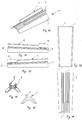
- the tile 1 is a bent tile with opposed intrados 2 and extrados 3 surfaces, and has a major longitudinal dimension with longitudinally opposed ends respectively indicated at 4 and 5.
- the surfaces 2 and 3 are tapered from the end 4 to the opposite end 5, and said ends will also be referred to herein as the large end and small end.
- ridges 6 Formed on the extrados surface 2, integrally with the tile 1 during the tile molding or extrusion process, are symmetrically arranged two ridges, being mirror-images of each other and both indicated at 6, which ridges are radially oriented, i.e. perpendicularly to the surface 3 and run lengthwise of the tile 1.
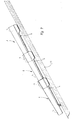
- Such ridges 6 extend in parallel at a spacing from each other, are symmetrical about a longitudinal mid-plane of the tile 1, and extend from the large end 4 to a location at a predetermined distance from the small end 5, in a region 7 which is also referred to as the covering region, i.e. the area where a tile is, within the layout of a roof generally denoted by T, in a relationship of partial overlap with a longitudinally adjacent tile 1.
- the ridges 6 have first and second contiguous sections 6a, 6b, the first section having a smaller longitudinal dimension and a taller ridge on the extrados surface than the second section.
- the section 6a has opposed end bevels, both indicated at 8.
- the section 6a of the ridges 6 provides support for the corresponding tile end raised over the roof framework 10, while the free end of the section 6b, by abutting against the large end of the longitudinally adjacent tile, forms a stop for the latter, thereby preventing it from sliding relatively.
- functional advantages can be secured by using tiles configured according to the invention at least for those tiles whose extrados surface is to be laid facing the roof framework 10. While it is preferred that the whole covering be formed of tiles 1 according to this invention, it is also contemplated that the other tiles having their extrados facing up may have a traditional bent tile shape.
- a typical tile 20 is shown which is also a bent type, and only differs from the tile 1 by the ridges 6 having a uniform height on the surface 3.
- Shown in Figures 17 to 23 is a tile 30, similar to the tile 20, except that the ridges 6, instead of being oriented radially, lie parallel to each other, that is perpendicular to the plane of the roof T.
- Figures 24 to 30 show a tile 40, similar to the tile 20, except that the ridges 6 are tapered from the small end 5 toward the large end 4.
- a tile 50 is shown in Figures 31 to 37 which is similar to the tile 40, except that the ridges 6, instead of having a radial orientation, lie parallel to each other, that is perpendicular to the plane of the roof T.
- a tile 60 is shown which is similar to the tile 1, except that the ridges 6 include each a taller section 6a on the surface 3, a lower section 6c of shorter longitudinal dimension, and an intermediate section 6b of still lower height interconnecting the two sections 6a and 6c.
- a tile 70 is shown in Figures 45 to 51 which is similar to the tile 1, except that the ridges 6 are not provided with bevel 8 at the large end 4.
- Figures 52 to 58 show a tile 80 which is similar to the tile 70, except that its ridges 6, instead of being radially oriented, extend parallel to each other, that is perpendicular to the plane of the roof T.
- FIG. 59 to 65 Shown in Figures 59 to 65 is a tile 90, similar to the tile 30, except that its ridges 6, rather than extending continuously in the longitudinal direction, are each comprised of two sections 6d in longitudinally spaced apart and aligned relationship.
- a tile 100 is shown which is similar to the tile 90, with the exception that the sections 6d of the ridges 6, instead of lying parallel to each other, are oriented radially like the embodiment of Figures 10 to 16.
- Figures 73 to 79 and Figures 80 to 86 respectively show tiles 110, 120 which are similar to the tiles 90 and 100, respectively, except that the sections 6d of the ridges 6, rather than having a constant height on the extrados surface 3, follow a tapering pattern consistent with that of the respective tiles 50 and 40 previously described.
- FIG. 87 to 93 Shown in Figures 87 to 93 is a tile 130, similar to the tile 30 of Figure 17, but having the space between the ridges 6 partly filled and the ridges interconnected by a concave surface 131.
- Figures 94 to 100 show a tile 140 similar to the tile 1, except that its extrados 3 and intrados 2 surfaces are rectangular in plan view, and instead of having a curvilinear profile, result from dihedral intersections of planar surfaces. It will be understood, however, that the tile 140 could also have any of the previous configurations in the respects of the ridge 6 construction and layout.
- two further embodiments of the invention respectively indicated at 150 and 160, have the intrados surface provided with rest surfaces, respectively a raised one 151 and a recessed one 161, effective to engage in bearing relationship the back side 9 of the corresponding ridges 6 of an overlying tile to facilitate stacking of the aforesaid tiles.
- the improved ventilation of the roof is the improved ventilation of the roof, an optimal retention of one tile by another, and an easier and more efficient stacking of the tile for shipping.
Landscapes
- Engineering & Computer Science (AREA)
- Chemical & Material Sciences (AREA)
- Ceramic Engineering (AREA)
- Architecture (AREA)
- Civil Engineering (AREA)
- Structural Engineering (AREA)
- Roof Covering Using Slabs Or Stiff Sheets (AREA)
- Finishing Walls (AREA)
Abstract
Description
- This invention relates to an improved roofing tile having an intrados surface and an extrados surface with a major longitudinal dimension. A roofing tile of this kind is identified, according to its specific shape, as a bent tile when rounded in the form of a frusto-conical segment, imbrex when tapered but almost flat in shape, and plain tile when rectangular in plan view with corrugations and rib formations. The invention applies to all these types of roofing tiles, although it is primarily and preferably directed to bent tiles.
- These roofing tiles, referred to as tiles hereinafter for brevity, are laid into alternating courses wherein one tile has its extrados facing up and is flanked by another tile with its extrados down and partly overlapped by it. In their current form, tiles have two major drawbacks. A first drawback is that the tiles with their extrados down, through being arranged to rest directly on the beam and rafter framework of a roof to be covered, introduce a restriction to the free circulation of air between the roof framework and the tile covering, resulting in moisture becoming trapped and encouraging the onset of rot in the roof framework. Another drawback is that the tiles are held in their working positions almost exclusively by friction opposing their tendency to slide down. The holding action is, therefore, modest, and the tiles can easily become dislodged over time and cause the roof to leak.
- The problem at the basis of this invention is that of providing improved tiles structurally and functionally designed to overcome the inconvenience considered in connection to the cited prior art.
- This problem is solved by the invention, with a tile of the kind initially mentioned, being characterized in that it comprises at least one ridge running lengthwise along said extrados surface and being raised on said surface.
- The features and advantages of the invention will be more clearly apparent from the following detailed description of some preferred embodiments thereof, shown, by way of example and not of limitation, in the accompanying drawings, in which:
- Figure 1 is a perspective view of a first embodiment of a bent tile according to the present invention;
- Figures 2 and 3 are side elevation views, taken from either sides of the tile in Figure 1;
- Figures 4 and 5 are top and bottom plan views, respectively, of the tile in Figure 1;
- Figures 6 and 7 are elevation views from the two longitudinal ends of the tile in Figure 1;
- Figure 8 is a partial perspective view from above of a roof assembled with the tiles of the preceding Figures;
- Figure 9 is a side elevation view of the roof in Figure 8;
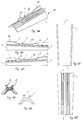
- Figures 10 to 16 are similar views to Figures 1 to 7, showing a second embodiment of the tile according to this invention;
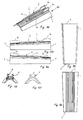
- Figures 17 to 23, 24 to 30, 31 to 37, 38 to 44, 45 to 51, 52 to 58, 59 to 65, 66 to 72, 73 to 79, 80 to 86, 87 to 93 and 94 to 100 are similar views to Figures 1 to 7, showing further embodiments of the tile according to this invention;
- Figures 102 and 103 are elevation views, taken from a longitudinal end, showing respectively two further embodiments of the tile according to this invention.
- With reference to Figures 1 to 9, generally indicated at 1 is a tile according to a first embodiment of this invention. The
tile 1 is a bent tile withopposed intrados 2 andextrados 3 surfaces, and has a major longitudinal dimension with longitudinally opposed ends respectively indicated at 4 and 5. In view of the typical frusto-conically bent shape of the tile, thesurfaces end 4 to theopposite end 5, and said ends will also be referred to herein as the large end and small end. - Formed on the
extrados surface 2, integrally with thetile 1 during the tile molding or extrusion process, are symmetrically arranged two ridges, being mirror-images of each other and both indicated at 6, which ridges are radially oriented, i.e. perpendicularly to thesurface 3 and run lengthwise of thetile 1.Such ridges 6 extend in parallel at a spacing from each other, are symmetrical about a longitudinal mid-plane of thetile 1, and extend from thelarge end 4 to a location at a predetermined distance from thesmall end 5, in aregion 7 which is also referred to as the covering region, i.e. the area where a tile is, within the layout of a roof generally denoted by T, in a relationship of partial overlap with a longitudinallyadjacent tile 1. - The
ridges 6 have first and secondcontiguous sections 6a, 6b, the first section having a smaller longitudinal dimension and a taller ridge on the extrados surface than the second section. The section 6a has opposed end bevels, both indicated at 8. During the installation of the roof T, the section 6a of theridges 6 provides support for the corresponding tile end raised over theroof framework 10, while the free end of thesection 6b, by abutting against the large end of the longitudinally adjacent tile, forms a stop for the latter, thereby preventing it from sliding relatively. Notice that, in assembling the roof T (or the like covering), functional advantages can be secured by using tiles configured according to the invention at least for those tiles whose extrados surface is to be laid facing theroof framework 10. While it is preferred that the whole covering be formed oftiles 1 according to this invention, it is also contemplated that the other tiles having their extrados facing up may have a traditional bent tile shape. - The other embodiments of this invention will now be described limited to those features by which they differ from the
tile 1, it being understood that similar parts to those of the previous embodiment will be denoted by the same reference numerals. - In Figures 10 to 16, a
typical tile 20 is shown which is also a bent type, and only differs from thetile 1 by theridges 6 having a uniform height on thesurface 3. - Shown in Figures 17 to 23 is a
tile 30, similar to thetile 20, except that theridges 6, instead of being oriented radially, lie parallel to each other, that is perpendicular to the plane of the roof T. - Figures 24 to 30 show a
tile 40, similar to thetile 20, except that theridges 6 are tapered from thesmall end 5 toward thelarge end 4. - A
tile 50 is shown in Figures 31 to 37 which is similar to thetile 40, except that theridges 6, instead of having a radial orientation, lie parallel to each other, that is perpendicular to the plane of the roof T. - In Figures 38 to 44, a
tile 60 is shown which is similar to thetile 1, except that theridges 6 include each a taller section 6a on thesurface 3, alower section 6c of shorter longitudinal dimension, and anintermediate section 6b of still lower height interconnecting the twosections 6a and 6c. - A tile 70 is shown in Figures 45 to 51 which is similar to the
tile 1, except that theridges 6 are not provided withbevel 8 at thelarge end 4. - Figures 52 to 58 show a
tile 80 which is similar to the tile 70, except that itsridges 6, instead of being radially oriented, extend parallel to each other, that is perpendicular to the plane of the roof T. - Shown in Figures 59 to 65 is a
tile 90, similar to thetile 30, except that itsridges 6, rather than extending continuously in the longitudinal direction, are each comprised of twosections 6d in longitudinally spaced apart and aligned relationship. - In Figures 66 to 72, a
tile 100 is shown which is similar to thetile 90, with the exception that thesections 6d of theridges 6, instead of lying parallel to each other, are oriented radially like the embodiment of Figures 10 to 16. - Figures 73 to 79 and Figures 80 to 86 respectively show
tiles tiles sections 6d of theridges 6, rather than having a constant height on theextrados surface 3, follow a tapering pattern consistent with that of therespective tiles - Shown in Figures 87 to 93 is a
tile 130, similar to thetile 30 of Figure 17, but having the space between theridges 6 partly filled and the ridges interconnected by aconcave surface 131. - Figures 94 to 100 show a
tile 140 similar to thetile 1, except that itsextrados 3 andintrados 2 surfaces are rectangular in plan view, and instead of having a curvilinear profile, result from dihedral intersections of planar surfaces. It will be understood, however, that thetile 140 could also have any of the previous configurations in the respects of theridge 6 construction and layout. - Finally, with reference to Figures 102 and 103, two further embodiments of the invention, respectively indicated at 150 and 160, have the intrados surface provided with rest surfaces, respectively a raised one 151 and a recessed one 161, effective to engage in bearing relationship the
back side 9 of thecorresponding ridges 6 of an overlying tile to facilitate stacking of the aforesaid tiles. - Among the major advantages afforded by the invention, is the improved ventilation of the roof, an optimal retention of one tile by another, and an easier and more efficient stacking of the tile for shipping.
Claims (13)
- An improved roofing tile having an intrados surface (2) and an extrados surface (3) with a major longitudinal dimension, characterized in that it comprises at least one ridge (6) running lengthwise along said extrados surface (3) and being raised on said surface.
- A tile according to Claim 1, having a bent tile structure.
- A tile according to either Claim 1 or 2, wherein at least two spaced-apart ridges (6) extend along substantially parallel directions.
- A tile according to one or more of the preceding claims, wherein said at least one ridge (6) extends over a shorter length than the longitudinal dimension of said tile.
- A tile according to Claim 4, wherein said at least one ridge (6) extends from one longitudinal end (4) of said tile to a location at a predetermined distance from the other tile end (5) where said tile has a covering region (7).
- A tile according to one or more of the preceding claims, wherein said surfaces (2,3) have a near-conical pattern, and the height of said ridges over the extrados surface increases with said surface taper.
- A tile according to one or more of the preceding claims, wherein said ridges (6) form ribs of said tile.
- A tile according to one or more of the preceding claims, wherein said ridges (6) have a folded line profile.
- A tile according to one or more of the preceding claims, wherein said ridges (6) have first and second contiguous sections (6a,6b), the first section having a shorter longitudinal dimension and greater height on the extrados surface (3) than the second.
- A tile according to one or more of the preceding claims, wherein the ridges (6) have an approximately radial orientation relative to the extrados surface (3).
- A tile according to one or more of the preceding claims, wherein the ridges (6) are parallel to each other.
- A tile according to one or more of the preceding claims, wherein, formed on said intrados surface (2), are rest surfaces (151,161) for the back side (9) of the corresponding ridges (6) of an overlying tile to facilitate the stacking of said tiles.
- A covering (T) including a framework (10) and a plurality of tiles laid in side-by-side rows and alternately with the extrados (3), or respectively the intrados (2), surface facing toward said framework (10), wherein at least the tiles with the extrados surface (3) facing toward said framework (10) are as claimed in one or more of the preceding claims.
Priority Applications (1)
| Application Number | Priority Date | Filing Date | Title |
|---|---|---|---|
| SI9430234T SI0664366T1 (en) | 1994-01-21 | 1994-12-07 | Roofing tile |
Applications Claiming Priority (4)
| Application Number | Priority Date | Filing Date | Title |
|---|---|---|---|
| ITPD940005U | 1994-01-21 | ||
| ITPD940005 IT234496Y1 (en) | 1994-01-21 | 1994-01-21 | CUP EQUIPPED WITH FLAPS OR RIBS |
| IT94PD000103 IT234557Y1 (en) | 1994-09-30 | 1994-09-30 | COPPO AND TILE EQUIPPED WITH CONICAL FINS-TEETH-RIBS |
| ITPD940103U | 1994-09-30 |
Publications (2)
| Publication Number | Publication Date |
|---|---|
| EP0664366A1 true EP0664366A1 (en) | 1995-07-26 |
| EP0664366B1 EP0664366B1 (en) | 1999-01-27 |
Family
ID=26331808
Family Applications (1)
| Application Number | Title | Priority Date | Filing Date |
|---|---|---|---|
| EP94203570A Expired - Lifetime EP0664366B1 (en) | 1994-01-21 | 1994-12-07 | Roofing tile |
Country Status (2)
| Country | Link |
|---|---|
| EP (1) | EP0664366B1 (en) |
| ES (1) | ES2129576T3 (en) |
Cited By (1)
| Publication number | Priority date | Publication date | Assignee | Title |
|---|---|---|---|---|
| AU713431B2 (en) * | 1995-04-13 | 1999-12-02 | Peter Hamilton Boyle | Roofing tile |
Citations (5)
| Publication number | Priority date | Publication date | Assignee | Title |
|---|---|---|---|---|
| FR989570A (en) * | 1949-06-27 | 1951-09-11 | Channel tiles with stops | |
| DE840591C (en) * | 1949-06-27 | 1952-06-03 | Jose Eresue | In the style of Moench and Nun, hollow tile for roofing that can be laid |
| FR1084080A (en) * | 1953-09-29 | 1955-01-17 | Self-supporting roof tile | |
| FR2223529A1 (en) * | 1973-03-29 | 1974-10-25 | Ybl Miklos Epitoipari Muszaki | Roofing tile with high wind resistance - has stiffening ribs on both faces providing rainwater and snow channels |
| FR2457354A1 (en) * | 1979-03-29 | 1980-12-19 | Poudenx Sa Tuilerie Briqueteri | Half round channel section roof tiles - has lugs to aid laying in alternately inverted columns, in |
-
1994
- 1994-12-07 ES ES94203570T patent/ES2129576T3/en not_active Expired - Lifetime
- 1994-12-07 EP EP94203570A patent/EP0664366B1/en not_active Expired - Lifetime
Patent Citations (5)
| Publication number | Priority date | Publication date | Assignee | Title |
|---|---|---|---|---|
| FR989570A (en) * | 1949-06-27 | 1951-09-11 | Channel tiles with stops | |
| DE840591C (en) * | 1949-06-27 | 1952-06-03 | Jose Eresue | In the style of Moench and Nun, hollow tile for roofing that can be laid |
| FR1084080A (en) * | 1953-09-29 | 1955-01-17 | Self-supporting roof tile | |
| FR2223529A1 (en) * | 1973-03-29 | 1974-10-25 | Ybl Miklos Epitoipari Muszaki | Roofing tile with high wind resistance - has stiffening ribs on both faces providing rainwater and snow channels |
| FR2457354A1 (en) * | 1979-03-29 | 1980-12-19 | Poudenx Sa Tuilerie Briqueteri | Half round channel section roof tiles - has lugs to aid laying in alternately inverted columns, in |
Cited By (1)
| Publication number | Priority date | Publication date | Assignee | Title |
|---|---|---|---|---|
| AU713431B2 (en) * | 1995-04-13 | 1999-12-02 | Peter Hamilton Boyle | Roofing tile |
Also Published As
| Publication number | Publication date |
|---|---|
| ES2129576T3 (en) | 1999-06-16 |
| EP0664366B1 (en) | 1999-01-27 |
Similar Documents
| Publication | Publication Date | Title |
|---|---|---|
| US4573291A (en) | Ridge or hip covering for tiled roofs | |
| US4890432A (en) | Roof tile | |
| US5772502A (en) | Adjustable pitch roof vent with accordion-shaped end plug | |
| US4914885A (en) | Roofing tile | |
| US5115603A (en) | Roof valley flashing including expansion joint | |
| EP2304122B1 (en) | Interlockable tiles | |
| US20040144040A1 (en) | Weather block for low or high profile tile | |
| PL195643B1 (en) | Covering materials | |
| US1738006A (en) | Roofing | |
| EP0664366A1 (en) | Roofing tile | |
| EP0383604B1 (en) | Valley sections for roofs | |
| EP0340856B1 (en) | Roof ventilation | |
| US4617773A (en) | Cladding element | |
| CA1212217A (en) | Cladding element | |
| WO1998029619A1 (en) | Roof tile | |
| GB2263712A (en) | Roof valleys | |
| EP4215685A1 (en) | Aerodynamically stable roof paver system and ballast block therefor | |
| GB2181470A (en) | Ventilated roofing | |
| GB2337277A (en) | Support device for use with roof valley units | |
| EP0032321A1 (en) | Tiled roofs | |
| JP2004278284A (en) | Resin mat | |
| GB2334980A (en) | Roof valley strip | |
| RU2011773C1 (en) | Roof | |
| AU4949890A (en) | Roof valleys | |
| JP3003643U (en) | tile |
Legal Events
| Date | Code | Title | Description |
|---|---|---|---|
| PUAI | Public reference made under article 153(3) epc to a published international application that has entered the european phase |
Free format text: ORIGINAL CODE: 0009012 |
|
| AK | Designated contracting states |
Kind code of ref document: A1 Designated state(s): ES FR GR IT PT |
|
| RAX | Requested extension states of the european patent have changed |
Free format text: SI PAYMENT 941207 |
|
| 17P | Request for examination filed |
Effective date: 19950715 |
|
| 17Q | First examination report despatched |
Effective date: 19950908 |
|
| GRAG | Despatch of communication of intention to grant |
Free format text: ORIGINAL CODE: EPIDOS AGRA |
|
| GRAG | Despatch of communication of intention to grant |
Free format text: ORIGINAL CODE: EPIDOS AGRA |
|
| GRAH | Despatch of communication of intention to grant a patent |
Free format text: ORIGINAL CODE: EPIDOS IGRA |
|
| GRAH | Despatch of communication of intention to grant a patent |
Free format text: ORIGINAL CODE: EPIDOS IGRA |
|
| GRAH | Despatch of communication of intention to grant a patent |
Free format text: ORIGINAL CODE: EPIDOS IGRA |
|
| GRAA | (expected) grant |
Free format text: ORIGINAL CODE: 0009210 |
|
| AK | Designated contracting states |
Kind code of ref document: B1 Designated state(s): ES FR GR IT PT |
|
| AX | Request for extension of the european patent |
Free format text: SI PAYMENT 941207 |
|
| PG25 | Lapsed in a contracting state [announced via postgrant information from national office to epo] |
Ref country code: GR Free format text: LAPSE BECAUSE OF NON-PAYMENT OF DUE FEES Effective date: 19990127 |
|
| ITF | It: translation for a ep patent filed | ||
| ET | Fr: translation filed | ||
| REG | Reference to a national code |
Ref country code: ES Ref legal event code: FG2A Ref document number: 2129576 Country of ref document: ES Kind code of ref document: T3 |
|
| PGFP | Annual fee paid to national office [announced via postgrant information from national office to epo] |
Ref country code: PT Payment date: 19991124 Year of fee payment: 6 |
|
| PLBE | No opposition filed within time limit |
Free format text: ORIGINAL CODE: 0009261 |
|
| STAA | Information on the status of an ep patent application or granted ep patent |
Free format text: STATUS: NO OPPOSITION FILED WITHIN TIME LIMIT |
|
| PGFP | Annual fee paid to national office [announced via postgrant information from national office to epo] |
Ref country code: ES Payment date: 19991210 Year of fee payment: 6 |
|
| 26N | No opposition filed | ||
| PGFP | Annual fee paid to national office [announced via postgrant information from national office to epo] |
Ref country code: FR Payment date: 20001229 Year of fee payment: 7 |
|
| PG25 | Lapsed in a contracting state [announced via postgrant information from national office to epo] |
Ref country code: PT Free format text: LAPSE BECAUSE OF NON-PAYMENT OF DUE FEES Effective date: 20010630 |
|
| PG25 | Lapsed in a contracting state [announced via postgrant information from national office to epo] |
Ref country code: ES Free format text: LAPSE BECAUSE OF NON-PAYMENT OF DUE FEES Effective date: 20011208 |
|
| PG25 | Lapsed in a contracting state [announced via postgrant information from national office to epo] |
Ref country code: FR Free format text: LAPSE BECAUSE OF NON-PAYMENT OF DUE FEES Effective date: 20020830 |
|
| REG | Reference to a national code |
Ref country code: FR Ref legal event code: ST |
|
| REG | Reference to a national code |
Ref country code: ES Ref legal event code: FD2A Effective date: 20020112 |
|
| PG25 | Lapsed in a contracting state [announced via postgrant information from national office to epo] |
Ref country code: IT Free format text: LAPSE BECAUSE OF NON-PAYMENT OF DUE FEES Effective date: 20051207 |