EP0660897B1 - Method for the combustion of waste liquids - Google Patents
Method for the combustion of waste liquids Download PDFInfo
- Publication number
- EP0660897B1 EP0660897B1 EP92915760A EP92915760A EP0660897B1 EP 0660897 B1 EP0660897 B1 EP 0660897B1 EP 92915760 A EP92915760 A EP 92915760A EP 92915760 A EP92915760 A EP 92915760A EP 0660897 B1 EP0660897 B1 EP 0660897B1
- Authority
- EP
- European Patent Office
- Prior art keywords
- furnace
- supplied
- liquid
- air
- level
- Prior art date
- Legal status (The legal status is an assumption and is not a legal conclusion. Google has not performed a legal analysis and makes no representation as to the accuracy of the status listed.)
- Expired - Lifetime
Links
- 239000002699 waste material Substances 0.000 title claims abstract description 32
- 238000002485 combustion reaction Methods 0.000 title claims abstract description 29
- 239000007788 liquid Substances 0.000 title claims abstract description 25
- 238000000034 method Methods 0.000 title claims abstract description 24
- 239000007789 gas Substances 0.000 claims abstract description 35
- 238000002347 injection Methods 0.000 claims abstract description 13
- 239000007924 injection Substances 0.000 claims abstract description 13
- 239000000126 substance Substances 0.000 claims abstract description 13
- 238000001035 drying Methods 0.000 claims abstract description 12
- 238000004519 manufacturing process Methods 0.000 claims abstract description 9
- 230000000694 effects Effects 0.000 claims abstract description 5
- 239000007787 solid Substances 0.000 claims abstract description 3
- CDBYLPFSWZWCQE-UHFFFAOYSA-L Sodium Carbonate Chemical compound [Na+].[Na+].[O-]C([O-])=O CDBYLPFSWZWCQE-UHFFFAOYSA-L 0.000 description 29
- 239000000155 melt Substances 0.000 description 8
- 238000006243 chemical reaction Methods 0.000 description 6
- 230000008569 process Effects 0.000 description 6
- OKTJSMMVPCPJKN-UHFFFAOYSA-N Carbon Chemical compound [C] OKTJSMMVPCPJKN-UHFFFAOYSA-N 0.000 description 5
- 229910052799 carbon Inorganic materials 0.000 description 5
- NINIDFKCEFEMDL-UHFFFAOYSA-N Sulfur Chemical compound [S] NINIDFKCEFEMDL-UHFFFAOYSA-N 0.000 description 4
- 239000005864 Sulphur Substances 0.000 description 4
- 239000000725 suspension Substances 0.000 description 4
- 230000008901 benefit Effects 0.000 description 3
- 230000008859 change Effects 0.000 description 3
- 230000008018 melting Effects 0.000 description 3
- 238000002844 melting Methods 0.000 description 3
- 239000002245 particle Substances 0.000 description 3
- 230000005855 radiation Effects 0.000 description 3
- XLYOFNOQVPJJNP-UHFFFAOYSA-N water Substances O XLYOFNOQVPJJNP-UHFFFAOYSA-N 0.000 description 3
- UGFAIRIUMAVXCW-UHFFFAOYSA-N Carbon monoxide Chemical compound [O+]#[C-] UGFAIRIUMAVXCW-UHFFFAOYSA-N 0.000 description 2
- RWSOTUBLDIXVET-UHFFFAOYSA-N Dihydrogen sulfide Chemical compound S RWSOTUBLDIXVET-UHFFFAOYSA-N 0.000 description 2
- DGAQECJNVWCQMB-PUAWFVPOSA-M Ilexoside XXIX Chemical compound C[C@@H]1CC[C@@]2(CC[C@@]3(C(=CC[C@H]4[C@]3(CC[C@@H]5[C@@]4(CC[C@@H](C5(C)C)OS(=O)(=O)[O-])C)C)[C@@H]2[C@]1(C)O)C)C(=O)O[C@H]6[C@@H]([C@H]([C@@H]([C@H](O6)CO)O)O)O.[Na+] DGAQECJNVWCQMB-PUAWFVPOSA-M 0.000 description 2
- 229910002091 carbon monoxide Inorganic materials 0.000 description 2
- 239000001913 cellulose Substances 0.000 description 2
- 229920002678 cellulose Polymers 0.000 description 2
- 230000003247 decreasing effect Effects 0.000 description 2
- 230000008020 evaporation Effects 0.000 description 2
- 238000001704 evaporation Methods 0.000 description 2
- 229910010272 inorganic material Inorganic materials 0.000 description 2
- 239000011147 inorganic material Substances 0.000 description 2
- 239000011734 sodium Substances 0.000 description 2
- 229910052708 sodium Inorganic materials 0.000 description 2
- 229910000029 sodium carbonate Inorganic materials 0.000 description 2
- UCKMPCXJQFINFW-UHFFFAOYSA-N Sulphide Chemical compound [S-2] UCKMPCXJQFINFW-UHFFFAOYSA-N 0.000 description 1
- 230000009471 action Effects 0.000 description 1
- 150000001768 cations Chemical class 0.000 description 1
- VDQVEACBQKUUSU-UHFFFAOYSA-M disodium;sulfanide Chemical compound [Na+].[Na+].[SH-] VDQVEACBQKUUSU-UHFFFAOYSA-M 0.000 description 1
- 239000010808 liquid waste Substances 0.000 description 1
- 239000000463 material Substances 0.000 description 1
- 150000002894 organic compounds Chemical class 0.000 description 1
- 239000011368 organic material Substances 0.000 description 1
- 230000002093 peripheral effect Effects 0.000 description 1
- 239000002994 raw material Substances 0.000 description 1
- 238000011084 recovery Methods 0.000 description 1
- 238000006722 reduction reaction Methods 0.000 description 1
- 230000000630 rising effect Effects 0.000 description 1
- 159000000000 sodium salts Chemical class 0.000 description 1
- 229910052979 sodium sulfide Inorganic materials 0.000 description 1
- 239000011343 solid material Substances 0.000 description 1
- 239000000243 solution Substances 0.000 description 1
- 238000005507 spraying Methods 0.000 description 1
- 230000008961 swelling Effects 0.000 description 1
- 239000002023 wood Substances 0.000 description 1
Images
Classifications
-
- D—TEXTILES; PAPER
- D21—PAPER-MAKING; PRODUCTION OF CELLULOSE
- D21C—PRODUCTION OF CELLULOSE BY REMOVING NON-CELLULOSE SUBSTANCES FROM CELLULOSE-CONTAINING MATERIALS; REGENERATION OF PULPING LIQUORS; APPARATUS THEREFOR
- D21C11/00—Regeneration of pulp liquors or effluent waste waters
- D21C11/12—Combustion of pulp liquors
-
- F—MECHANICAL ENGINEERING; LIGHTING; HEATING; WEAPONS; BLASTING
- F23—COMBUSTION APPARATUS; COMBUSTION PROCESSES
- F23G—CREMATION FURNACES; CONSUMING WASTE PRODUCTS BY COMBUSTION
- F23G7/00—Incinerators or other apparatus for consuming industrial waste, e.g. chemicals
- F23G7/04—Incinerators or other apparatus for consuming industrial waste, e.g. chemicals of waste liquors, e.g. sulfite liquors
-
- F—MECHANICAL ENGINEERING; LIGHTING; HEATING; WEAPONS; BLASTING
- F23—COMBUSTION APPARATUS; COMBUSTION PROCESSES
- F23L—SUPPLYING AIR OR NON-COMBUSTIBLE LIQUIDS OR GASES TO COMBUSTION APPARATUS IN GENERAL ; VALVES OR DAMPERS SPECIALLY ADAPTED FOR CONTROLLING AIR SUPPLY OR DRAUGHT IN COMBUSTION APPARATUS; INDUCING DRAUGHT IN COMBUSTION APPARATUS; TOPS FOR CHIMNEYS OR VENTILATING SHAFTS; TERMINALS FOR FLUES
- F23L9/00—Passages or apertures for delivering secondary air for completing combustion of fuel
- F23L9/02—Passages or apertures for delivering secondary air for completing combustion of fuel by discharging the air above the fire
Definitions
- the invention relates to a method for the combustion of waste liquids in connection with recovering of chemicals from waste liquid preferably black liquor from pulp production for recovering of chemicals and energy. Most often the combustion is in the latter case carried out in a specially designed boiler which is called a soda furnace.
- the invention is related to the way of supplying combustion air into such a boiler.
- the chemicals used at the pulp production consist of sodium salts and in these cases the main cation content of the waste liquor consists of sodium.
- the main part of the inorganic substances are liberated in the form of ash in melt form which primarily consists of sodium carbonate, so called soda (Na 2 CO 3 ).
- the evaporated waste liquor which still contains some water is added to the soda furnace at some level above the bottom of the furnace usually by means of one or more injection nozzles.
- the accordingly finely distributed waste liquor is in the soda furnace subjected to three stages which can be called the drying stage, the pyrolysing stage and the carbon combustion stage.
- the last stage occurs primarily in the melt bed (char bed), which is made up of the residue from the pyrolysing on the bottom of the soda furnace.
- This bed with a high content of carbon is a condition that the main part of the content of sulphur in the ash shall be tapped in reduced form together with the melt, that is as sulphide (Na 2 S).
- the temperature of the melt bed shall be kept above a certain level. This is possible due to the fact that the combustion of carbon is an exotherm reaction, i.e. energy in the form of heat is developed by the reaction. This is kept alive by the addition of combustion air through the walls of the soda furnace at a low level. Combustion air which is supplied at the lowermost level in a soda furnace is usually called primary air.
- Both drying and pyrolysing are endotherm processes, i.e. energy has to be supplied from the environment. If a too large part of these processes should occur at the melting bed the temperature of the bed would sink under the required level and all reactions should cease (so called black bed). Due to this reason one has to make sure that the main part of the drying and pyrolysing stages have been fulfilled when the solid material reaches the melting bed on the bottom of the soda furnace.
- the second method is that by finely distributing of the injected waste liquor and/or violent gas turbulence in the fire make sure that a sufficiently great part of the drying and pyrolysing reactions occur when the waste liquor still is suspended in the furnace gases and before the waste liquor particles reach the melt bed.
- None of the above described methods could possibly be adapted to a soda furnace where the waste liquor is supplied through injection nozzles directed into the fire. Even if one tries to direct the liquor distributors so that the liquor can hit the walls a part of the drops will never reach the walls and will be dried and pyrolysed in a suspended form. On the other side it should be inevitable that also finely distributed droplets of the liquor which is supplied with the aim to bring about said reactions in suspension to some extent will reach the walls of the furnace and adhere there.
- the present invention relates to the first mentioned method, i.e. the addition occurs so that a larger part of the liquor adheres on the furnace walls before the drying and pyrolysing reactions are finished in principle according to the so called Tomlinson process (SE-B-84138).
- SE-B-84138 the so called Tomlinson process
- the waste liquor is injected by an oscillating distributor in such a way that the walls of the furnace are "painted" up to a level a few meters above the level of the primary air.
- so called secondary air is supplied the main object of which is to bring about burning of the pyrolysing gases above the melting bed. Heat which is developed by this combustion of gas is partly transferred by radiation to the liquor which has been supplied to the furnace.
- the object of the present invention is to bring about a method by which the above said disadvantages are reduced or eliminated.
- Said objects can be attained by a method for combustion of waste liquids in connection with recovering of chemicals from the waste liquor, preferably waste liquor from pulp production whereby the liquid is injected at a given level in a furnace in which the liquid is initially dried and the rest thereafter is pyrolysed and finally burnt and the chemicals are assembled on the bottom of the furnace whereas the exhaust gases are going up through and out of the furnace and whereby a part of the combustion air, the so called primary air, is supplied at one or more levels below said level for the injection of the liquid and another part of the combustion air, the secondary air is supplied at one or more levels between said levels for the injection of the liquor and the supply of the primary air respectively, characterized in that the secondary air is supplied to the furnace in such a way that the gas is forced to rotate in a plane substantially perpendicular to the vertical axis of the furnace so that the in the furnace injected liquid is by the gas rotation thrown out against the walls of the furnace during simultaneous drying and pyrolysing.
- the part of the liquid which adheres on the walls of the furnace is increased also in very large soda furnaces and the above said disadvantages relating to coverings on the heat surfaces is decreased or even completely avoided. Further one gains the advantage that a very high part of the sulphur is recovered in reduced form. This results in that the efficiency of the plant will rise and the influence on the environment in form of sulphur emissions will decrease.
- the rotation obtained thus also has the advantage that the so called “chimney effect” which is specially noticeable at large soda furnaces is counter acted.
- the “chimney effect” depends on that the gases in the center of the furnace due to longer distance from the normally water cooled walls of the furnace have a higher temperature than the peripheral gases and consequently lower density. The gas tends therefore to move upwardly at a greater velocity in the center than at the walls. In some cases it can go so far that the stream is downwardly directed at the walls of the furnace.
- the effect can be increased if combustion air is added in a conventional way, that is evenly at the same level through the four walls of the furnace, due to the fact that the air beams meet in the center and therethrough get an upwardly directed action.
- the above method is complemented in that all combustion air which is supplied above the waste liquor distribution level (so called tertiary air) shall be so directed that the on a lower level started rotation is broken or reduced so that one in the longitudinal plane of the soda furnace substantially symmetrical streaming pattern is obtained.
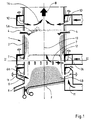
- Fig. 1 is schematically shown the lower part of a soda furnace 1 comprising walls 2 and a bottom 3. Through nozzles 4 liquid waste 5A is injected. Within the soda furnace a temperature of about 1000°C prevails.
- Primary air 11 is supplied to the furnace through a battery of nozzles 6, which can be found at a lower level.
- the airflow through these can be controlled by valves 6A.
- Secondary air 12 is supplied by means of nozzles 7 provided with valves 7A at a level between the nozzles 4 for the injection of waste liquor and the nozzles 6 for the primary air.
- the organic material in the waste liquor will be burned and move upwardly out of the furnace as exhaust gases 8.
- the inorganic material 5 will contrary thereto in melt form be found in a melt bed 5B on the bottom 3 of the furnace 1. This melt, which contains chemicals worthy of recovery, can be tapped through an outlet 9.
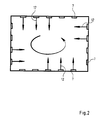
- the secondary air 12 is supplied to the furnace 1 via a number of nozzles 7 which have been arranged symmetrically in the walls of the in section square furnace (see Fig. 2).
- the in the embodiment example shown secondary air supply can occur through five nozzles from each longside and four nozzles respectively from each shortside.
- valves 7A are closed in two neighbouring nozzles 7 located closest to a corner, which nozzles 7 are arranged in pairs substantially diametrically in relation to the vertical longitudinal axis 13.
- the rotation can be optimized/accurately adjusted by individually controlling the flow from each open nozzle 7 by means of the valves 7A.
- a number of tertiary air nozzles 10 are arranged above the liquor injection nozzles 4 .
- these nozzles 10 are arranged in such a way that the supply of tertiary air effectively counteracts/breaks the rotation of the gas brought about by the secondary air stream 12 so that in the ideal case a symmetrical rising gas stream is obtained in the longitudinal plane of the soda furnace.
- primary air 11 is supplied about 1 meter above the bottom 3 and the furnace at low pressure through the four walls 2 of the soda furnace approximately evenly.
- Secondary air 12 is supplied at a level about 2 meter above the primary air 11 at a higher pressure and through openings 7 arranged and used in principal as shown in the figures.
- Evaporated waste liquor 5 from pulp production is injected through some liquor spraying nozzles 4 which are arranged at a level of about 4 meter above the secondary air supply 12 and at an inlet pressure of about 1 bar.
- Tertiary air 14 is finally supplied at a still higher pressure than the secondary air 12 through openings 10 which also are evenly distributed over the front and rear walls of the soda furnace at a level further about 4 meters upwards.
- the secondary air can be supplied at several different levels as one can imagine future presence of further air supply above the tertiary level. It is further evident that other changes such as for example the shape of the soda furnace (for example round instead of square) lies within the frame of what is comprised of the patent protection. It is also obvious that one instead of evenly great and evenly located air ports 7 and 10 and 6 respectively as shown in the figures, one can use ports at every level of varying size and varying location. It is also obvious that the number of air nozzles can be varied within wide frames whereby one extreme means that every wall in principal only is arranged with one single air nozzle at one and the same level.
Landscapes
- Engineering & Computer Science (AREA)
- Mechanical Engineering (AREA)
- General Engineering & Computer Science (AREA)
- Environmental & Geological Engineering (AREA)
- Chemical & Material Sciences (AREA)
- Combustion & Propulsion (AREA)
- Paper (AREA)
- Heat Treatment Of Water, Waste Water Or Sewage (AREA)
- Gasification And Melting Of Waste (AREA)
- Incineration Of Waste (AREA)
- Macromonomer-Based Addition Polymer (AREA)
- Electrical Discharge Machining, Electrochemical Machining, And Combined Machining (AREA)
- Control And Other Processes For Unpacking Of Materials (AREA)
- Fertilizers (AREA)
Abstract
Description
- The invention relates to a method for the combustion of waste liquids in connection with recovering of chemicals from waste liquid preferably black liquor from pulp production for recovering of chemicals and energy. Most often the combustion is in the latter case carried out in a specially designed boiler which is called a soda furnace. The invention is related to the way of supplying combustion air into such a boiler.
- With the aim to better clarify the invention below it is only referred to combustion of waste liquids from pulp production which, however, shall not be regarded as limiting the invention. By the production of chemical cellulose pulp from wood or other cellulose containing raw materials a rest product in the shape of spent liquor is obtained which after evaporation for reducing the water content suitably is burnt for recovering of the chemicals used at the pulp production and to transfer the organic compounds in the spent liquor to useful energy.
- Most often the chemicals used at the pulp production consist of sodium salts and in these cases the main cation content of the waste liquor consists of sodium. When after evaporation sodium containing waste liquor is burnt, the main part of the inorganic substances are liberated in the form of ash in melt form which primarily consists of sodium carbonate, so called soda (Na2CO3).
- The evaporated waste liquor which still contains some water is added to the soda furnace at some level above the bottom of the furnace usually by means of one or more injection nozzles. The accordingly finely distributed waste liquor is in the soda furnace subjected to three stages which can be called the drying stage, the pyrolysing stage and the carbon combustion stage. The last stage occurs primarily in the melt bed (char bed), which is made up of the residue from the pyrolysing on the bottom of the soda furnace. This bed with a high content of carbon is a condition that the main part of the content of sulphur in the ash shall be tapped in reduced form together with the melt, that is as sulphide (Na2S). To have the reduction reaction carried out and to tap the ash in melt form it is required that the temperature of the melt bed shall be kept above a certain level. This is possible due to the fact that the combustion of carbon is an exotherm reaction, i.e. energy in the form of heat is developed by the reaction. This is kept alive by the addition of combustion air through the walls of the soda furnace at a low level. Combustion air which is supplied at the lowermost level in a soda furnace is usually called primary air.
- Both drying and pyrolysing are endotherm processes, i.e. energy has to be supplied from the environment. If a too large part of these processes should occur at the melting bed the temperature of the bed would sink under the required level and all reactions should cease (so called black bed). Due to this reason one has to make sure that the main part of the drying and pyrolysing stages have been fulfilled when the solid material reaches the melting bed on the bottom of the soda furnace.
- Two principally different methods to bring about the necessary drying and pyrolysing is today practised industrially. The one is to let the injected waste liquor droplets after some initial drying hit some of the walls of the soda furnace. The waste liquor will then due to convective heat supply from the walls of the furnace, radiation from the melt bed and radiation from the above the bed burning pyrolysing gas initially be dried to a finishing stage and then the pyrolysing stage starts. In connection with the pyrolysing a swelling of the material occurs which then is liberated and falls down on the melt bed.
- The second method is that by finely distributing of the injected waste liquor and/or violent gas turbulence in the fire make sure that a sufficiently great part of the drying and pyrolysing reactions occur when the waste liquor still is suspended in the furnace gases and before the waste liquor particles reach the melt bed.
- None of the above described methods could possibly be adapted to a soda furnace where the waste liquor is supplied through injection nozzles directed into the fire. Even if one tries to direct the liquor distributors so that the liquor can hit the walls a part of the drops will never reach the walls and will be dried and pyrolysed in a suspended form. On the other side it should be inevitable that also finely distributed droplets of the liquor which is supplied with the aim to bring about said reactions in suspension to some extent will reach the walls of the furnace and adhere there. One can, however, in different ways design and operate a soda furnace so that one or the other method dominates.
- The present invention relates to the first mentioned method, i.e. the addition occurs so that a larger part of the liquor adheres on the furnace walls before the drying and pyrolysing reactions are finished in principle according to the so called Tomlinson process (SE-B-84138). At this process the waste liquor is injected by an oscillating distributor in such a way that the walls of the furnace are "painted" up to a level a few meters above the level of the primary air. Between this and the level of the waste liquor supply so called secondary air is supplied the main object of which is to bring about burning of the pyrolysing gases above the melting bed. Heat which is developed by this combustion of gas is partly transferred by radiation to the liquor which has been supplied to the furnace.
- Usually a further part of the combustion air is supplied to the furnace at a level above the injection level of the waste liquor, so called tertiary air. By means of this a final combustion of the gases are made so that the content of unburned gas in the shape of carbon monoxide (CO), hydrogen sulphide (H2S), etc in the effluent gas is maintained on a safe low level.
- As soda furnaces of capacity reasons have grown in size it has been more difficult to maintain a genuine Tomlinson process. The distance between the waste liquor injection points and the walls of the furnace which shall be painted have been so large that a great part of the liquor never reaches them. One has therefore when it is a question of larger soda furnaces been forced to let an appreciable part of the injected liquor dry and be pyrolysed suspended in the gases.
- If a greater part of the drying and pyrolysing occurs in suspension the risk that also carbon combustion will occur in the suspension is increased and therethrough the amount of inorganic material which follows the exhaust gases from the furnace will increase. This can in its turn give rise to increased coverings on the heat surfaces in the upper part of the soda furnace resulting in decreased efficiency and availability.
- Another disadvantage due to carbon combustion in the suspension is that the rest melt from a preburnt waste particle also if it does not follow the effluent gases, but falls down to the bottom of the furnace more easily can be oxidized and accordingly will not contain sulphur in reduced form.
- The object of the present invention is to bring about a method by which the above said disadvantages are reduced or eliminated.
- Said objects can be attained by a method for combustion of waste liquids in connection with recovering of chemicals from the waste liquor, preferably waste liquor from pulp production whereby the liquid is injected at a given level in a furnace in which the liquid is initially dried and the rest thereafter is pyrolysed and finally burnt and the chemicals are assembled on the bottom of the furnace whereas the exhaust gases are going up through and out of the furnace and whereby a part of the combustion air, the so called primary air, is supplied at one or more levels below said level for the injection of the liquid and another part of the combustion air, the secondary air is supplied at one or more levels between said levels for the injection of the liquor and the supply of the primary air respectively, characterized in that the secondary air is supplied to the furnace in such a way that the gas is forced to rotate in a plane substantially perpendicular to the vertical axis of the furnace so that the in the furnace injected liquid is by the gas rotation thrown out against the walls of the furnace during simultaneous drying and pyrolysing.
- By means of the invention the part of the liquid which adheres on the walls of the furnace is increased also in very large soda furnaces and the above said disadvantages relating to coverings on the heat surfaces is decreased or even completely avoided. Further one gains the advantage that a very high part of the sulphur is recovered in reduced form. This results in that the efficiency of the plant will rise and the influence on the environment in form of sulphur emissions will decrease.
- The rotation obtained thus also has the advantage that the so called "chimney effect" which is specially noticeable at large soda furnaces is counter acted. The "chimney effect" depends on that the gases in the center of the furnace due to longer distance from the normally water cooled walls of the furnace have a higher temperature than the peripheral gases and consequently lower density. The gas tends therefore to move upwardly at a greater velocity in the center than at the walls. In some cases it can go so far that the stream is downwardly directed at the walls of the furnace. The effect can be increased if combustion air is added in a conventional way, that is evenly at the same level through the four walls of the furnace, due to the fact that the air beams meet in the center and therethrough get an upwardly directed action.
- According to a preferred embodiment of the invention the above method is complemented in that all combustion air which is supplied above the waste liquor distribution level (so called tertiary air) shall be so directed that the on a lower level started rotation is broken or reduced so that one in the longitudinal plane of the soda furnace substantially symmetrical streaming pattern is obtained.
- To create rotation in the gas in a furnace by the supply of air is known per se, but relates in relation to the invention to different purposes. By for instance SE-B-197065 a method for the combustion of waste liquors is known whereby the secondary air is supplied so that the gas is forced to rotate in the horizontal plane. The known method does however relate to the supply of secondary air above the level in which the waste liquor is added. The object for this known process is also different, namely that in this way to try to increase possible total air supply to optimise the combustion itself and to separate by means of the centrifugal force solid particles which follow the exhaust gases. Also in connection with combustion of chips it is known to create rotation in the burning gases, see for instance USA 2,483,728 in which such a method is described where two counteracting gas whirls are used to obtain a more effective drying of the chips.
- In the following the invention will be explained more in detail in connection with the attached drawings in which:
- Fig. 1
- is a schematic view of the lower part of a soda furnace in section in the verticle plane, and
- Fig. 2
- shows a section through the furnace in Fig. 1 along a horizontal plane which is marked with II.
- In Fig. 1 is schematically shown the lower part of a
soda furnace 1 comprisingwalls 2 and abottom 3. Throughnozzles 4liquid waste 5A is injected. Within the soda furnace a temperature of about 1000°C prevails. -
Primary air 11 is supplied to the furnace through a battery ofnozzles 6, which can be found at a lower level. The airflow through these can be controlled byvalves 6A. -
Secondary air 12 is supplied by means ofnozzles 7 provided withvalves 7A at a level between thenozzles 4 for the injection of waste liquor and thenozzles 6 for the primary air. - The organic material in the waste liquor will be burned and move upwardly out of the furnace as
exhaust gases 8. The inorganic material 5 will contrary thereto in melt form be found in a melt bed 5B on thebottom 3 of thefurnace 1. This melt, which contains chemicals worthy of recovery, can be tapped through an outlet 9. - The
secondary air 12 is supplied to thefurnace 1 via a number ofnozzles 7 which have been arranged symmetrically in the walls of the in section square furnace (see Fig. 2). The in the embodiment example shown secondary air supply can occur through five nozzles from each longside and four nozzles respectively from each shortside. By varying the openings of these nozzles (by means of thevalves 7A the air supply can practically be controlled down to zero) according to a certain pattern one can create a rotation of the gas in a plane which is perpendicular to thelongitudinal axis 13 of the furnace. In the example shown this is created therethrough that at each side thevalves 7A are closed in twoneighbouring nozzles 7 located closest to a corner, which nozzles 7 are arranged in pairs substantially diametrically in relation to the verticallongitudinal axis 13. The rotation can be optimized/accurately adjusted by individually controlling the flow from eachopen nozzle 7 by means of thevalves 7A. - To change the direction of the rotation of the gas stream one can mirror change the pattern for the opening degree of the nozzles. Such a change can be advantageous to obtain an even possible wearing of parts present.
- Above the liquor injection nozzles 4 a number of
tertiary air nozzles 10 are arranged. According to a preferred embodiment thesenozzles 10 are arranged in such a way that the supply of tertiary air effectively counteracts/breaks the rotation of the gas brought about by thesecondary air stream 12 so that in the ideal case a symmetrical rising gas stream is obtained in the longitudinal plane of the soda furnace. - In an application example of the present invention of a
big soda furnace 1primary air 11 is supplied about 1 meter above thebottom 3 and the furnace at low pressure through the fourwalls 2 of the soda furnace approximately evenly.Secondary air 12 is supplied at a level about 2 meter above theprimary air 11 at a higher pressure and throughopenings 7 arranged and used in principal as shown in the figures. Evaporated waste liquor 5 from pulp production is injected through someliquor spraying nozzles 4 which are arranged at a level of about 4 meter above thesecondary air supply 12 and at an inlet pressure of about 1 bar.Tertiary air 14 is finally supplied at a still higher pressure than thesecondary air 12 throughopenings 10 which also are evenly distributed over the front and rear walls of the soda furnace at a level further about 4 meters upwards. - The invention is not limited to the above shown, but can be varied within the scope of the following claims. Thus the secondary air can be supplied at several different levels as one can imagine future presence of further air supply above the tertiary level. It is further evident that other changes such as for example the shape of the soda furnace (for example round instead of square) lies within the frame of what is comprised of the patent protection. It is also obvious that one instead of evenly great and evenly located
air ports
Claims (4)
- Method for the combustion of waste liquids in connection with recovering of chemicals from the waste liquid preferably black liquor from pulp production whereby the liquid (5 A) is injected at a given level (4) in a furnace (1, 2, 3) in which the liquid (5 A) initially is dried and the solid remainder thereafter is pyrolysed and finally burned and the chemicals are assembled on the bottom of the furnace while the exhaust gases (8) go up through and out of the furnace (1, 2, 3) and whereby a part of the combustion air, so called primary air (11), is supplied at one or more levels (6) below said level (4) for the injection of liquid (5 A) and another part of the combustion air, so called secondary air (12), is supplied at one or more levels (7) between said level (4) for the injection of liquid (5A) and said level (6) of primary air supply respectively, characterized in that the secondary air (12) is supplied to the furnace (1, 2, 3) in such a way that the gas is forced to rotate in a plane substantially perpendicular to the longitudinal axis (13) of the furnace so that the liquid (5A) injected into the furnace is thrown outwardly towards the walls (2) of the furnace by the gas rotation during simultaneous drying and pyrolysing whereby also the so called "chimney effect" in the furnace is counteracted.
- Method according to claim 1, characterized in that further combustion air, so called tertiary air, is supplied at a given location (10) at a level above the level (4) for the injection of the liquid and in such a way that the below the last mentioned level created gas rotation is reduced or eliminated.
- Method according to claim 1, characterized in that the secondary air periodically is supplied in a way that gives a first rotation direction, periodically in a way that gives a in relation to the first mentioned rotation direction opposite rotation direction so that possible wearing of the nozzles and other details becomes more even.
- Method according to claim 1, characterized in that at least 70%, preferably 90-100%, of the total air which is supplied through the secondary air nozzles (7) is supplied in such a way that it gives a positive contribution to create said rotation of the gas.
Applications Claiming Priority (3)
| Application Number | Priority Date | Filing Date | Title |
|---|---|---|---|
| SE9102546 | 1991-09-05 | ||
| SE9102546A SE467741C (en) | 1991-09-05 | 1991-09-05 | Incineration of waste liquids |
| PCT/SE1992/000384 WO1993005228A1 (en) | 1991-09-05 | 1992-06-04 | Method for the combustion of waste liquids |
Publications (2)
| Publication Number | Publication Date |
|---|---|
| EP0660897A1 EP0660897A1 (en) | 1995-07-05 |
| EP0660897B1 true EP0660897B1 (en) | 1997-01-15 |
Family
ID=20383623
Family Applications (1)
| Application Number | Title | Priority Date | Filing Date |
|---|---|---|---|
| EP92915760A Expired - Lifetime EP0660897B1 (en) | 1991-09-05 | 1992-06-04 | Method for the combustion of waste liquids |
Country Status (13)
| Country | Link |
|---|---|
| US (1) | US5450803A (en) |
| EP (1) | EP0660897B1 (en) |
| JP (1) | JP3047003B2 (en) |
| AT (1) | ATE147809T1 (en) |
| AU (1) | AU657354B2 (en) |
| BR (1) | BR9206464A (en) |
| CA (1) | CA2117064C (en) |
| DE (1) | DE69216865T2 (en) |
| ES (1) | ES2097919T3 (en) |
| FI (1) | FI113190B (en) |
| RU (1) | RU2078866C1 (en) |
| SE (2) | SE9102546L (en) |
| WO (1) | WO1993005228A1 (en) |
Families Citing this family (20)
| Publication number | Priority date | Publication date | Assignee | Title |
|---|---|---|---|---|
| FI98936B (en) * | 1992-10-19 | 1997-05-30 | Ahlstrom Machinery Oy | Method and apparatus for recovering heat in a waste liquor recovery boiler |
| FI925305A0 (en) * | 1992-11-23 | 1992-11-23 | Polyrec Ab Oy | PROCEDURE FOR MEASUREMENT OF INSPECTION OF FUERBRAENNINGSLUFT I EN ELDSTAD |
| SE502092C2 (en) * | 1993-08-23 | 1995-08-14 | Kvaerner Pulping Tech | Device for operating an air regulator in an oven |
| SE503453C2 (en) * | 1994-06-20 | 1996-06-17 | Kvaerner Pulping Tech | Soda boiler having a secondary air supply which causes a rotation of the combustion gases and a constriction of the boiler above the liquor injection and a method of such boiler |
| US5715763A (en) * | 1995-09-11 | 1998-02-10 | The Mead Corporation | Combustion system for a black liquor recovery boiler |
| US6148743A (en) * | 1996-04-29 | 2000-11-21 | Foster Wheeler Corporation | Air nozzle for a furnace |
| CA2220325C (en) * | 1996-11-22 | 2003-01-14 | Mitsubishi Heavy Industries, Ltd. | Recovery boiler |
| FI102410B1 (en) * | 1997-02-07 | 1998-11-30 | Kvaerner Pulping Oy | Method and apparatus for feeding air into a boiler |
| FI102411B (en) * | 1997-02-07 | 1998-11-30 | Kvaerner Power Oy | Method and apparatus for feeding air into a floating bed reactor |
| US6302039B1 (en) * | 1999-08-25 | 2001-10-16 | Boiler Island Air Systems Inc. | Method and apparatus for further improving fluid flow and gas mixing in boilers |
| WO2001031119A1 (en) * | 1999-10-22 | 2001-05-03 | Pulp And Paper Research Institute Of Canada | Method and apparatus for optimizing the addition of combustion air in a recovery boiler |
| US6279495B1 (en) | 1999-10-22 | 2001-08-28 | Pulp And Paper Research Institute Of Canada | Method and apparatus for optimizing the combustion air system in a recovery boiler |
| ES2263773T3 (en) * | 2001-04-06 | 2006-12-16 | Andritz Oy | COMBUSTION AIR SYSTEM FOR RECOVERY BOILERS, THAT BURN RESIDUAL LIQUORS FROM PROCEDURES OF OBTAINING PAPER PASTA. |
| FI110846B (en) | 2001-05-21 | 2003-04-15 | Innokarelia Oy | Filter elements and process for making its disks |
| FI118807B (en) * | 2001-11-14 | 2008-03-31 | Polyrec Ab Oy | A system for controlling the flow field of a recovery boiler |
| WO2003083370A1 (en) * | 2002-04-03 | 2003-10-09 | Seghers Keppel Technology Group Nv | Method and device for controlling injection of primary and secondary air in an incineration system |
| FI120550B (en) | 2002-10-10 | 2009-11-30 | Metso Power Oy | Inlet system of combustion air in a soda boiler |
| US8640634B2 (en) * | 2004-10-14 | 2014-02-04 | Andritz Oy | Combustion air system for recovery boilers, burning spent liquors from pulping processes |
| US20140080072A1 (en) * | 2012-09-14 | 2014-03-20 | Eclipse, Inc. | Method and apparatus for a dual mode burner yielding low nox emission |
| CN112696697B (en) * | 2020-12-28 | 2022-03-08 | 清华大学 | Laboratory organic waste liquid is real-time processing system on spot |
Family Cites Families (4)
| Publication number | Priority date | Publication date | Assignee | Title |
|---|---|---|---|---|
| US2911284A (en) * | 1955-06-01 | 1959-11-03 | Combustion Eng | Method of burning waste liquors |
| US3703919A (en) * | 1970-10-22 | 1972-11-28 | Combustion Eng | Supplementary air cascade evaporation |
| FI85187C (en) * | 1989-02-20 | 1992-03-10 | Tampella Oy Ab | Inlet system for combustion air in a recovery boiler |
| FI87246C (en) * | 1989-04-10 | 1992-12-10 | Ahlstroem Oy | PROCEDURE FOR MEASUREMENT OF INSPECTION OF FUERBRAENNINGSLUFT I EN ELDSTAD |
-
1991
- 1991-09-05 SE SE9102546D patent/SE9102546L/en not_active Application Discontinuation
- 1991-09-05 SE SE9102546A patent/SE467741C/en not_active IP Right Cessation
-
1992
- 1992-06-04 AT AT92915760T patent/ATE147809T1/en not_active IP Right Cessation
- 1992-06-04 AU AU23325/92A patent/AU657354B2/en not_active Ceased
- 1992-06-04 CA CA002117064A patent/CA2117064C/en not_active Expired - Fee Related
- 1992-06-04 RU RU94020405/12A patent/RU2078866C1/en not_active IP Right Cessation
- 1992-06-04 EP EP92915760A patent/EP0660897B1/en not_active Expired - Lifetime
- 1992-06-04 JP JP5504717A patent/JP3047003B2/en not_active Expired - Fee Related
- 1992-06-04 ES ES92915760T patent/ES2097919T3/en not_active Expired - Lifetime
- 1992-06-04 WO PCT/SE1992/000384 patent/WO1993005228A1/en not_active Ceased
- 1992-06-04 BR BR9206464A patent/BR9206464A/en not_active IP Right Cessation
- 1992-06-04 DE DE69216865T patent/DE69216865T2/en not_active Expired - Fee Related
-
1994
- 1994-03-04 FI FI941049A patent/FI113190B/en active
- 1994-05-24 US US08/204,192 patent/US5450803A/en not_active Expired - Lifetime
Also Published As
| Publication number | Publication date |
|---|---|
| SE9102546D0 (en) | 1991-09-05 |
| DE69216865T2 (en) | 1997-06-26 |
| CA2117064C (en) | 2002-01-08 |
| JPH06510338A (en) | 1994-11-17 |
| JP3047003B2 (en) | 2000-05-29 |
| DE69216865D1 (en) | 1997-02-27 |
| CA2117064A1 (en) | 1993-03-18 |
| AU657354B2 (en) | 1995-03-09 |
| AU2332592A (en) | 1993-04-05 |
| RU2078866C1 (en) | 1997-05-10 |
| BR9206464A (en) | 1995-10-17 |
| FI941049A0 (en) | 1994-03-04 |
| SE9102546L (en) | 1992-09-07 |
| ES2097919T3 (en) | 1997-04-16 |
| FI113190B (en) | 2004-03-15 |
| ATE147809T1 (en) | 1997-02-15 |
| EP0660897A1 (en) | 1995-07-05 |
| WO1993005228A1 (en) | 1993-03-18 |
| SE467741C (en) | 1998-06-21 |
| US5450803A (en) | 1995-09-19 |
| FI941049A7 (en) | 1994-05-03 |
| SE467741B (en) | 1992-09-07 |
Similar Documents
| Publication | Publication Date | Title |
|---|---|---|
| US5450803A (en) | Method for the combustion of waste liquids | |
| US5715763A (en) | Combustion system for a black liquor recovery boiler | |
| US4011129A (en) | Pulp mill recovery system | |
| US2416462A (en) | Method of and apparatus for recovering heat and chemicals | |
| US5771817A (en) | Recovery boiler | |
| US2808011A (en) | Furnace for burning semi-liquid fuels | |
| US2285876A (en) | Waste sulphite liquor recovery | |
| CA2443640C (en) | Combustion air system for recovery boilers, burning spent liquors from pulping processes | |
| US3122421A (en) | Apparatus and method of operating a chemical recovery furnace | |
| US5683550A (en) | Method and apparatus for increasing recovery boiler capacity by withdrawing combustible gas from the furnace | |
| US5901527A (en) | Wedge splash plate for kraft recovery furnace black liquor burners | |
| US2179456A (en) | Method of and apparatus for treating pulp residual liquor | |
| US1779535A (en) | Process of treating black liquors | |
| NO134310B (en) | ||
| US3008800A (en) | Method of operating furnace | |
| FI61329B (en) | FOERFARANDE FOER HOEJNING AV AOTERVINNINGSKAPACITETEN HOS SULFATCELLULOSAFABRIKEN | |
| US3852039A (en) | Furnace for the combustion of waste liquors or other solutions or suspensions containing combustible organic substance and various combinations with alkali | |
| WO1996005366A1 (en) | A recovery boiler where the flue gas is divided into two streams and a method therefore | |
| EP0678130B1 (en) | Method for reburning of lime sludge in fluidised bed | |
| NO762236L (en) | ||
| SU767454A1 (en) | Combustion chamber of soda regeneration plant | |
| JP2667467B2 (en) | Black liquor combustion boiler and its combustion method | |
| SE505270C2 (en) | Black liquor combustion with mesate additive | |
| Sharma et al. | An Experience in Running A Fluid Bed Recovery System For Agricultural Residues Black Liquor At MIs. Shreyans Industries Limited, Sangrur | |
| CA2209583A1 (en) | Method and arrangement for treatment of black liquor |
Legal Events
| Date | Code | Title | Description |
|---|---|---|---|
| PUAI | Public reference made under article 153(3) epc to a published international application that has entered the european phase |
Free format text: ORIGINAL CODE: 0009012 |
|
| 17P | Request for examination filed |
Effective date: 19940301 |
|
| AK | Designated contracting states |
Kind code of ref document: A1 Designated state(s): AT DE ES FR IT PT SE |
|
| 17Q | First examination report despatched |
Effective date: 19950802 |
|
| GRAG | Despatch of communication of intention to grant |
Free format text: ORIGINAL CODE: EPIDOS AGRA |
|
| GRAH | Despatch of communication of intention to grant a patent |
Free format text: ORIGINAL CODE: EPIDOS IGRA |
|
| GRAH | Despatch of communication of intention to grant a patent |
Free format text: ORIGINAL CODE: EPIDOS IGRA |
|
| GRAH | Despatch of communication of intention to grant a patent |
Free format text: ORIGINAL CODE: EPIDOS IGRA |
|
| GRAA | (expected) grant |
Free format text: ORIGINAL CODE: 0009210 |
|
| AK | Designated contracting states |
Kind code of ref document: B1 Designated state(s): AT DE ES FR IT PT SE |
|
| REF | Corresponds to: |
Ref document number: 147809 Country of ref document: AT Date of ref document: 19970215 Kind code of ref document: T |
|
| REF | Corresponds to: |
Ref document number: 69216865 Country of ref document: DE Date of ref document: 19970227 |
|
| ITF | It: translation for a ep patent filed | ||
| ET | Fr: translation filed | ||
| REG | Reference to a national code |
Ref country code: ES Ref legal event code: FG2A Ref document number: 2097919 Country of ref document: ES Kind code of ref document: T3 |
|
| REG | Reference to a national code |
Ref country code: PT Ref legal event code: SC4A Free format text: AVAILABILITY OF NATIONAL TRANSLATION Effective date: 19970304 |
|
| PLBE | No opposition filed within time limit |
Free format text: ORIGINAL CODE: 0009261 |
|
| STAA | Information on the status of an ep patent application or granted ep patent |
Free format text: STATUS: NO OPPOSITION FILED WITHIN TIME LIMIT |
|
| 26N | No opposition filed | ||
| PGFP | Annual fee paid to national office [announced via postgrant information from national office to epo] |
Ref country code: AT Payment date: 20030603 Year of fee payment: 12 |
|
| PG25 | Lapsed in a contracting state [announced via postgrant information from national office to epo] |
Ref country code: AT Free format text: LAPSE BECAUSE OF NON-PAYMENT OF DUE FEES Effective date: 20040604 |
|
| PGFP | Annual fee paid to national office [announced via postgrant information from national office to epo] |
Ref country code: DE Payment date: 20040604 Year of fee payment: 13 |
|
| REG | Reference to a national code |
Ref country code: PT Ref legal event code: PC4A Free format text: KVAERNER POWER AB SE Effective date: 20040923 |
|
| REG | Reference to a national code |
Ref country code: FR Ref legal event code: TP |
|
| REG | Reference to a national code |
Ref country code: ES Ref legal event code: PC2A |
|
| PG25 | Lapsed in a contracting state [announced via postgrant information from national office to epo] |
Ref country code: IT Free format text: LAPSE BECAUSE OF NON-PAYMENT OF DUE FEES Effective date: 20050604 |
|
| PG25 | Lapsed in a contracting state [announced via postgrant information from national office to epo] |
Ref country code: DE Free format text: LAPSE BECAUSE OF NON-PAYMENT OF DUE FEES Effective date: 20060103 |
|
| REG | Reference to a national code |
Ref country code: PT Ref legal event code: PD4A Owner name: METSO POWER AB, SE Effective date: 20080104 |
|
| REG | Reference to a national code |
Ref country code: FR Ref legal event code: CD |
|
| PGFP | Annual fee paid to national office [announced via postgrant information from national office to epo] |
Ref country code: ES Payment date: 20080627 Year of fee payment: 17 |
|
| PGFP | Annual fee paid to national office [announced via postgrant information from national office to epo] |
Ref country code: PT Payment date: 20080602 Year of fee payment: 17 |
|
| PGFP | Annual fee paid to national office [announced via postgrant information from national office to epo] |
Ref country code: SE Payment date: 20080612 Year of fee payment: 17 |
|
| PGFP | Annual fee paid to national office [announced via postgrant information from national office to epo] |
Ref country code: FR Payment date: 20080613 Year of fee payment: 17 |
|
| REG | Reference to a national code |
Ref country code: PT Ref legal event code: MM4A Free format text: LAPSE DUE TO NON-PAYMENT OF FEES Effective date: 20091204 |
|
| REG | Reference to a national code |
Ref country code: FR Ref legal event code: ST Effective date: 20100226 |
|
| PG25 | Lapsed in a contracting state [announced via postgrant information from national office to epo] |
Ref country code: PT Free format text: LAPSE BECAUSE OF NON-PAYMENT OF DUE FEES Effective date: 20091204 |
|
| PG25 | Lapsed in a contracting state [announced via postgrant information from national office to epo] |
Ref country code: FR Free format text: LAPSE BECAUSE OF NON-PAYMENT OF DUE FEES Effective date: 20090630 |
|
| REG | Reference to a national code |
Ref country code: ES Ref legal event code: FD2A Effective date: 20090605 |
|
| PG25 | Lapsed in a contracting state [announced via postgrant information from national office to epo] |
Ref country code: ES Free format text: LAPSE BECAUSE OF NON-PAYMENT OF DUE FEES Effective date: 20090605 |
|
| PG25 | Lapsed in a contracting state [announced via postgrant information from national office to epo] |
Ref country code: SE Free format text: LAPSE BECAUSE OF NON-PAYMENT OF DUE FEES Effective date: 20090605 |