EP0658576A1 - Olefin polymerization catalyst and olefin polymerization process - Google Patents
Olefin polymerization catalyst and olefin polymerization process Download PDFInfo
- Publication number
- EP0658576A1 EP0658576A1 EP94309413A EP94309413A EP0658576A1 EP 0658576 A1 EP0658576 A1 EP 0658576A1 EP 94309413 A EP94309413 A EP 94309413A EP 94309413 A EP94309413 A EP 94309413A EP 0658576 A1 EP0658576 A1 EP 0658576A1
- Authority
- EP
- European Patent Office
- Prior art keywords
- catalyst
- polymerization
- clay mineral
- compound
- bis
- Prior art date
- Legal status (The legal status is an assumption and is not a legal conclusion. Google has not performed a legal analysis and makes no representation as to the accuracy of the status listed.)
- Granted
Links
Classifications
-
- C—CHEMISTRY; METALLURGY
- C08—ORGANIC MACROMOLECULAR COMPOUNDS; THEIR PREPARATION OR CHEMICAL WORKING-UP; COMPOSITIONS BASED THEREON
- C08F—MACROMOLECULAR COMPOUNDS OBTAINED BY REACTIONS ONLY INVOLVING CARBON-TO-CARBON UNSATURATED BONDS
- C08F10/00—Homopolymers and copolymers of unsaturated aliphatic hydrocarbons having only one carbon-to-carbon double bond
-
- C—CHEMISTRY; METALLURGY
- C08—ORGANIC MACROMOLECULAR COMPOUNDS; THEIR PREPARATION OR CHEMICAL WORKING-UP; COMPOSITIONS BASED THEREON
- C08F—MACROMOLECULAR COMPOUNDS OBTAINED BY REACTIONS ONLY INVOLVING CARBON-TO-CARBON UNSATURATED BONDS
- C08F4/00—Polymerisation catalysts
- C08F4/42—Metals; Metal hydrides; Metallo-organic compounds; Use thereof as catalyst precursors
- C08F4/44—Metals; Metal hydrides; Metallo-organic compounds; Use thereof as catalyst precursors selected from light metals, zinc, cadmium, mercury, copper, silver, gold, boron, gallium, indium, thallium, rare earths or actinides
- C08F4/60—Metals; Metal hydrides; Metallo-organic compounds; Use thereof as catalyst precursors selected from light metals, zinc, cadmium, mercury, copper, silver, gold, boron, gallium, indium, thallium, rare earths or actinides together with refractory metals, iron group metals, platinum group metals, manganese, rhenium technetium or compounds thereof
- C08F4/62—Refractory metals or compounds thereof
- C08F4/64—Titanium, zirconium, hafnium or compounds thereof
- C08F4/659—Component covered by group C08F4/64 containing a transition metal-carbon bond
- C08F4/65912—Component covered by group C08F4/64 containing a transition metal-carbon bond in combination with an organoaluminium compound
-
- C—CHEMISTRY; METALLURGY
- C08—ORGANIC MACROMOLECULAR COMPOUNDS; THEIR PREPARATION OR CHEMICAL WORKING-UP; COMPOSITIONS BASED THEREON
- C08F—MACROMOLECULAR COMPOUNDS OBTAINED BY REACTIONS ONLY INVOLVING CARBON-TO-CARBON UNSATURATED BONDS
- C08F4/00—Polymerisation catalysts
- C08F4/42—Metals; Metal hydrides; Metallo-organic compounds; Use thereof as catalyst precursors
- C08F4/44—Metals; Metal hydrides; Metallo-organic compounds; Use thereof as catalyst precursors selected from light metals, zinc, cadmium, mercury, copper, silver, gold, boron, gallium, indium, thallium, rare earths or actinides
- C08F4/60—Metals; Metal hydrides; Metallo-organic compounds; Use thereof as catalyst precursors selected from light metals, zinc, cadmium, mercury, copper, silver, gold, boron, gallium, indium, thallium, rare earths or actinides together with refractory metals, iron group metals, platinum group metals, manganese, rhenium technetium or compounds thereof
- C08F4/62—Refractory metals or compounds thereof
- C08F4/64—Titanium, zirconium, hafnium or compounds thereof
- C08F4/659—Component covered by group C08F4/64 containing a transition metal-carbon bond
- C08F4/65916—Component covered by group C08F4/64 containing a transition metal-carbon bond supported on a carrier, e.g. silica, MgCl2, polymer
-
- C—CHEMISTRY; METALLURGY
- C08—ORGANIC MACROMOLECULAR COMPOUNDS; THEIR PREPARATION OR CHEMICAL WORKING-UP; COMPOSITIONS BASED THEREON
- C08F—MACROMOLECULAR COMPOUNDS OBTAINED BY REACTIONS ONLY INVOLVING CARBON-TO-CARBON UNSATURATED BONDS
- C08F4/00—Polymerisation catalysts
- C08F4/42—Metals; Metal hydrides; Metallo-organic compounds; Use thereof as catalyst precursors
- C08F4/44—Metals; Metal hydrides; Metallo-organic compounds; Use thereof as catalyst precursors selected from light metals, zinc, cadmium, mercury, copper, silver, gold, boron, gallium, indium, thallium, rare earths or actinides
- C08F4/60—Metals; Metal hydrides; Metallo-organic compounds; Use thereof as catalyst precursors selected from light metals, zinc, cadmium, mercury, copper, silver, gold, boron, gallium, indium, thallium, rare earths or actinides together with refractory metals, iron group metals, platinum group metals, manganese, rhenium technetium or compounds thereof
- C08F4/62—Refractory metals or compounds thereof
- C08F4/64—Titanium, zirconium, hafnium or compounds thereof
- C08F4/659—Component covered by group C08F4/64 containing a transition metal-carbon bond
- C08F4/6592—Component covered by group C08F4/64 containing a transition metal-carbon bond containing at least one cyclopentadienyl ring, condensed or not, e.g. an indenyl or a fluorenyl ring
- C08F4/65922—Component covered by group C08F4/64 containing a transition metal-carbon bond containing at least one cyclopentadienyl ring, condensed or not, e.g. an indenyl or a fluorenyl ring containing at least two cyclopentadienyl rings, fused or not
Definitions
- the present invention also intends to provide a process for polymerization of an olefin employing the above catalyst.
- the specific examples of the above compound includes specifically hydrochlorides, hydrofluorides, hydrobromides, and hydroiodides of trimethylamine, triethylamine, tripropylamine, tributylamine, N,N-dimethylaniline, N,N,-diethylaniline, and N,N-2,4,5-pentamethylaniline; hydrobromides, hydrochlorides, hydroiodides, and hydrofluorides of triphenylphosphine, tri(o-tolyl)phosphine, tri(p-tolyl)phosphine, and tri(mesityl)phosphine; bromotriphenylmethane, chlorotriphenylmethane, tropyryium bromide, ferrocenium sulfate, ferrocenium hexafluorophosphate, ferrocenium tetraphenylborate, and the like, but are not limited thereto.
- the halogen includes fluorine, chlorine, bromine, and iodine.
- the hydrocarbon group of 1 to 12 carbons includes alkyl groups, cycloalkyl groups, aryl groups, and aralkyl groups. Specifically the alkyl groups include methyl, ethyl, propyl, isopropyl, and butyl.
- the cylcoalkyl groups include cyclohexyl.
- the aryl groups include phenyl, and tolyl.
- the aralkyl groups include benzyl, and neophyl (C6H5C(CH3)2CH2-).
- the alkoxy groups include methoxy, and ethoxy.
- the aryloxy groups include phenoxy group.
- the autoclave was cooled, the unreacted gas was removed, and the mixture of the formed polymer and the sodium chloride was taken out. The mixture was washed with pure water to dissolve off the sodium chloride. The undissolved matter was dried to obtain 37 g of polymer.
Landscapes
- Chemical & Material Sciences (AREA)
- Health & Medical Sciences (AREA)
- Chemical Kinetics & Catalysis (AREA)
- Medicinal Chemistry (AREA)
- Polymers & Plastics (AREA)
- Organic Chemistry (AREA)
- Transition And Organic Metals Composition Catalysts For Addition Polymerization (AREA)
Abstract
Description
- The present invention relates to an olefin polymerization catalyst which comprises a modified clay, a metallocene compound, and an organoaluminum compound. The present invention also relates to an olefin polymerization process employing the above catalyst.
- In production of polyolefins by polymerization of olefin, catalysts are known which are constituted of a combination of a transition metal compound and an organometallic compound. Kaminsky, et al. disclosed that a catalyst formed from a metallocene and methylaluminoxane has high activity in polymerization of olefin including propylene in JP-A (Japanese Patent Application Laid-Open No.) 58-19309.
- The catalyst systems employed in the above patent publications, although they have excellent activity for polymerization, are used usually for solution polymerization owing to the solubleness of the catalyst in the reaction systems. Further, in the catalyst system, the relatively expensive methylaluminoxane need to be used in a large quantity to produce an industrially useful polymer, which involves the disadvantages of high production cost and much aluminum residue in the resulting polymer.
- On the other hand, JP-A-60-35006, etc. disclose catalyst systems which comprise the aforementioned soluble catalyst supported on an inorganic oxide carrier like silica. Such catalysts, however, do not have sufficient polymerization activity per unit weight of methylaluminoxane.
- To improve the activity per unit weight of methylaluminoxane, JP-A-4-8704, JP-A-4-11604, and JP-A-4-213305, for example, disclose a catalyst system containing a metallocene and less methylalminoxane modified by prepolymerization, for gas phase polymerization, which gives a polymer having satisfactory particle properties with high polymerization catalytic activity. However, the catalyst activity was not sufficient, although the amount of methylaluminoxane is reduced.
- In recent years, novel cocatalysts without an organoaluminumoxy compound like organoaluminumoxy compounds are being investigated. For example, Japanese Kohyo-1-501950 and Japanese Kohyo 1-502036 disclose special boron compounds as an effective cocatalyst. These boron compounds, which have a complicated structure, do not solve the problem of the cost.
- After comprehensive studies by the inventors of the present invention to solve the above problems, it was found that a highly active polyolefin polymerization catalyst is obtained from a modified clay mineral having been treated with a compound capable of introducing a cation into the interspaces between the layers in the clay mineral structure, a metallocene compound, and an organoaluminum compound, and the present invention has been accomplished.
- The present invention intends to provide an olefin polymerization catalyst which does not employ an expensive organoaluminumoxy compound or boron compound and has high polymerization catalytic activity with low cost.
- The present invention also intends to provide a process for polymerization of an olefin employing the above catalyst.
- The catalyst of a first embodiment of the present invention comprises a clay mineral (a) having been modified with a compound (b) capable of introducing a cation into layer interspaces in the clay mineral; a metallocene compound (c); and an organoaluminum compound (d).
- The catalyst of a second embodiment of the present invention comprises a first catalyst component prepared by prepolymerizing an olefin with a catalyst composed of a clay mineral (a) having been modified with a compound (b) capable of introducing a cation into layer interspaces in the clay mineral, a metallocene compound (c), and a first organoaluminum compound (d); and, as a second catalyst component, a second organoaluminum compound (e).
- The process for olefin polymerization of the present invention is conducted by using the above catalyst.
- The clay mineral (a) employed in the present invention is in a form of fine particles mainly composed of a fine crystalline silicate salt. Clay minerals generally have a characteristic layer structure, containing between the layers, various levels of negative charges. In this respect, the clay mineral is substantially different from metal oxides having a three-dimensional structure such as silica, alumina, and zeolite. The clay minerals are classified according to the levels of the aforementioned negative charge for the chemical formula: (1) biophilite, kaolinite, dickalite, and talc having the negative charge of 0 (zero), (2) smectite having the negative charge of from 0.25 to 0.6, (3) vermiculite having the negative charge of from 0.6 to 0.9, (4) mica having the negative charge of about 1, and (5) brittle mica having the negative charge of about 2. The each of the above groups includes various minerals. For example, the smectite group include montmorillonite, bidelite, saponite, hectorite, etc. These clay minerals exist in nature, and also can be synthesized artificially with a higher purity. Any of the natural and artificial clay minerals is useful in the present invention. Any substance which belongs to the clay minerals by definition is useful in the present invention even if it is not mentioned above.
- The compound (b) capable of introducing a cation into the interspaces between the layers in the clay mineral structure is represented by the general formula below:
(C⁺)(A⁻)
where (C⁺) is a cation which may be an inorganic or an organic cation and (A⁻) is an anion. - The cation (C⁺) preferably includes organic cations such as ones having an active proton, such as Brønsted acids, to example trimethylammonium, triethylammonium, tripropylammonium, tributylammonium, N,N-dimethylanilinium, N,N-diethylanilinium, N,N-2,4,5-pentamethylanilinium, triphenylphosphonium, tri(o-tolyl)phosphonium, tri(p-tolyl)phosphonium, tri(mesityl)phosphonium, dimethyloxonium, diethyloxonium, and the like; as well as organic cations which do not have an active proton such as carbonium ions, oxonium ions, and sulfonium ions, more specifically triphenylcarbenium ion (⁺C(C₆H₅)₃), tropylium ion (⁺C₇H₇), etc.;
and silver ion and ferrocenium ion, but are not limited thereto. - The anion (A⁻) is exemplified by halide ions including fluoride ion, chlorine ion, bromide ion, and iodide ion; sulfate ion, hexafluorophosphate ion, tetrafluoroborate ion, tetraphenylborate ion, and the like, but is not limited thereto.
- The specific examples of the above compound includes specifically hydrochlorides, hydrofluorides, hydrobromides, and hydroiodides of trimethylamine, triethylamine, tripropylamine, tributylamine, N,N-dimethylaniline, N,N,-diethylaniline, and N,N-2,4,5-pentamethylaniline; hydrobromides, hydrochlorides, hydroiodides, and hydrofluorides of triphenylphosphine, tri(o-tolyl)phosphine, tri(p-tolyl)phosphine, and tri(mesityl)phosphine; bromotriphenylmethane, chlorotriphenylmethane, tropyryium bromide, ferrocenium sulfate, ferrocenium hexafluorophosphate, ferrocenium tetraphenylborate, and the like, but are not limited thereto.
- The metallocene compound (c) employed in the present invention is represented by the general formula (1) or (2):
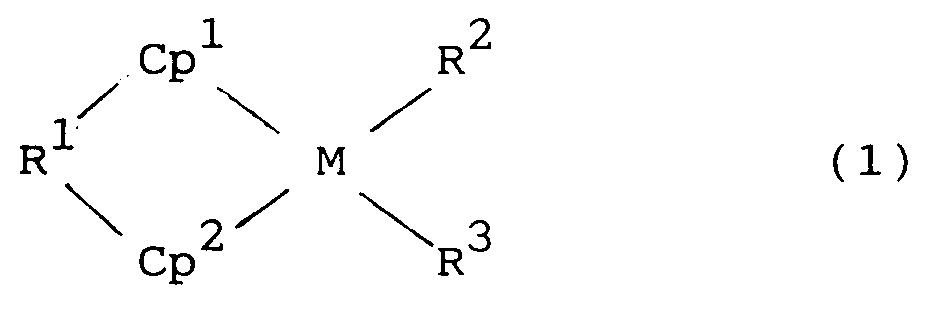

wherein Cp¹, Cp², Cp³, and Cp⁴ are independently a substituted or unsubstituted cyclopentadienyl group; R¹ is a alkylene group preferably a C₁-C₆ group, a substituted alkylene group, a dialkylsilanediyl group, dialkylgermanediyl group, an alkylphosphinediyl group, or an alkylimino group, R¹ linking the Cp¹ and Cp² groups together the alkyl groups preferably being C₁-C₆ groups; M is a transition metal of Group IVB of Periodic Table; and R², R³, R⁴, and R⁵ are independently a hydrogen atom, a halogen atom, or a hydrocarbon, alkoxy, or aryloxy group having 1 to 12 carbons. - In the above general formulas, the halogen includes fluorine, chlorine, bromine, and iodine. The hydrocarbon group of 1 to 12 carbons includes alkyl groups, cycloalkyl groups, aryl groups, and aralkyl groups. Specifically the alkyl groups include methyl, ethyl, propyl, isopropyl, and butyl. The cylcoalkyl groups include cyclohexyl. The aryl groups include phenyl, and tolyl. The aralkyl groups include benzyl, and neophyl (C₆H₅C(CH₃)₂CH₂-). The alkoxy groups include methoxy, and ethoxy. The aryloxy groups include phenoxy group.
- The specific Examples of the metallocene compound include:
bis(cyclopentadienyl)zirconiumdimethyl,
bis(methylcyclopentadienyl)zirconiumdimethyl,
bis(butylcyclopentadienyl)zirconiumdimethyl,
bis(1,3-dimethylcyclopentadienyl)zirconiumdimethyl,
bis(indenyl)zirconiumdimethyl,
bis(pentamethylcyclopentadienyl)zirconiumdimethyl,
ethylenebis(indenyl)zirconiumdimethyl,
dimethylsilanediylbis(indenyl)zirconiumdimethyl,
ethylenebis(tetrehydroindenyl)zirconiumdimethyl,
isopropylidene(cyclopentadienyl-1-fluorenyl)zirconiumdimethyl, diphenylmethylene(cyclopentadienyl-1-fluorenyl)zirconiumdimethyl, dimethylsilanediylbis(2,4,5-trimethylcyclopentadienyl)-zirconiumdimethyl,
dimethylsilanediylbis(2,4-dimethylcyclopentadienyl)-zirconiumdimethyl,
dimethylsilanediylbis(3-methylcyclopentadienyl)-zirconiumdimethyl,
bis(cyclopentadienyl)zirconium dichloride,
bis(methylcyclopentadienyl)zirconium dichloride,
bis(butylcyclopentadienyl)zirconium dichloride,
bis(1,3-dimethylcyclopentadienyl)zirconium dichloride,
bis(indenyl)zirconium dichloride,
bis(pentamethylcyclopentadienyl)zirconium dichloride,
ethylenebis(indenyl)zirconium dichloride,
dimethylsilanediylbis(indenyl)zirconium dichloride,
ethylenebis(tetrahydroindenyl)zirconium dichloride,
isopropylidene(cyclopentadienyl-1-fluorenyl)zirconium dichloride,
diphenylmethylene(cyclopentadienyl-1-fluorenyl)zirconium dichloride,
dimethylsilanediylbis(2,4,5-trimethylcyclopentadienyl)-zirconium dichloride,
dimethylsilanediylbis(2,4-dimethylcyclopentadienyl)zirconium dichloride,
dimethylsilanediylbis(3-methylcyclopentadienyl)zirconium dichloride,
bis(cyclopentadienyl)zirconiumdiphenyl,
bis(methylcyclopentadienyl)zirconiumdiphenyl,
bis(butylcyclopentadienyl)zirconiumdiphenyl,
bis(1,3-dimethylcyclopentadienyl)zirconiumdiphenyl,
bis(indenyl)zirconiumdiphenyl,
bis(pentamethylcyclopentadienyl)zirconiumdiphenyl,
ethylenebis(indenyl)zirconiumdiphenyl,
dimethylsilanediylbis(indenyl)zirconiumdiphenyl,
ethylenebis(tetrahydroindenyl)zirconiumdiphenyl,
isopropylidene(cyclopentadienyl-1-fluorenyl)zirconiumdiphenyl,
diphenylmethylene(cyclopentadienyl-1-fluorenyl)zirconium-diphenyl,
dimethylsilanediylbis(2,4,5-trimethylcyclopentadienyl)-zirconium-diphenyl,
dimethylsilanediylbis(2,4-dimethylcyclopentadienyl)-zirconiumdiphenyl,
dimethylsilanediylbis(3-methylcyclopentadienyl)-zirconiumdiphenyl,
bis(cyclopentadienyl)zirconiumdibenzyl,
bis(methylcyclopentadienyl)zirconiumdibenzyl,
bis(butylcyclopentadienyl)zirconiumdibenzyl,
bis(1,3-dimethylcyclopentadienyl)zirconiumdibenzyl,
bis(indenyl)zirconiumdibezyl,
bis(pentamethylcyclopentadienyl)zirconiumdibenzyl,
ethylenebis(indenyl)zirconiumdibenzyl,
dimethylsilanediylbis(indenyl)zirconiumdibenzyl,
ethylenebis(tetrahydroindenyl)zirconiumdibenzyl,
isopropylidene(cyclopentadienyl-1-fluorenyl)zirconiumdibenzyl,
diphenylmethylene(cyclopentadienyl-1-fluorenyl)zirconiumdibenzyl,
dimethylsilanediylbis(2,4,5-trimethylcyclopentadienyl)-zirconiumdibenzyl,
dimethylsilanediylbis(2,4-dimethylcyclopentadienyl)-zirconiumdibenzyl,
dimethylsilanediylbis(3-methylcyclopentadienyl)-zirconiumdibenzyl,
bis(cyclopentadienyl)methoxyzirconium monochloride,
bis(methylcyclopentadienyl)methoxyzirconium monochloride,
bis(butylcyclopentadienyl)methoxyzirconium monochloride,
bis(1,3-dimethylcyclopentadienyl)methoxyzirconium monochloride,
bis(indenyl)methoxyzirconium monochloride,
bis(pentamethylcyclopentadienyl)methoxyzirconium monochloride,
ethylenebis(indenyl)methoxyzirconium monochloride,
dimethylsilanediylbis(indenyl)methoxyzirconium monochloride,
ethylenebis(tetrahydroindenyl)methoxyzirconium monochloride,
isopropylidene(cyclopentadienyl-1-fluorenyl)methoxyzirconium monochloride,
diphenylmethylene(cyclopentadienyl-1-fluorenyl)methoxyzirconium monochloride,
dimethylsilanediylbis(2,4,5-trimethylcyclopentadienyl)-methoxyzirconium monochloride,
dimethylsilanediylbis(2,4-dimethylcyclopentadienyl)methoxyzirconium monochloride,
dimethylsilanediylbis(3-methylcyclopentadienyl)methoxyzirconium monochloride,
bis(cyclopentadienyl)methylzirconium monochloride,
bis(methylcyclopentadienyl)methylzirconium monochloride,
bis(butylcyclopentadienyl)methylzirconium monochloride,
bis(1,3-dimethylcyclopentadienyl)methylzirconium monochloride,
bis(indenyl)methylzirconium monochloride,
bis(pentamethylcyclopentadienyl)methylzirconium monochloride,
ethylenebis(indenyl)methylzirconium monochloride,
dimethylsilanediylbis(indenyl)methylzirconium monochloride,
ethylenebis(tetrahydroindenyl)methylzirconium monochloride,
isopropylidene(cyclopentadienyl-1-fluorenyl)methylzirconium monochloride,
diphenylmethylene(cyclopentadienyl-1-fluorenyl)methylzirconium monochloride,
dimethylsilanediylbis(2,4,5-trimethylcyclopentadienyl)-methylzirconium monochloride,
dimethylsilanediylbis(2,4-dimethylcyclopentadienyl)methylzirconium monochloride, and
dimethylsilanediylbis(3-methylcyclopentadienyl)methylzirconium monochloride;
and metallocene compounds which are derived by replacing zirconium in the above compounds with titanium or hafnium. - The organoaluminum compounds (d) and (e) employed in the present invention are represented by the general formula below:
Al(R⁶)₃
wherein each R⁶ is independently hydrogen, halogen, an amido group, an alkyl group, an alkoxy group, or an aryl group, and at least one R⁶ is an alkyl group. The specific examples of the organoaluminum compound include trimethylaluminum, triethylaluminum, tri(n-propyl)aluminum, triisopropylaluminum, tri(n-butyl)aluminum, triisobutylaluminum, tri(t-butyl)aluminum, triamylaluminum, dimethylaluminum chloride, diethylaluminum chloride, diisobutylaluminum chloride, di(t-butyl)aluminum chloride, diamylaluminum chloride, methylaluminum dichloride, ethylaluminum dichloride, isobutylaluminum dichloride, t-butylaluminum dichloride, and amylaluminum dichloride, but the organoaluminum compound is not limited thereto. - The olefin polymerization catalyst of the present invention comprises, as a component, a clay mineral (a) modified by a compound (b). The conditions of the reaction of the clay mineral (a) with the compound (b) are not specially limited, and the ratio of the amount of (a) to (b) is not specially limited also. If any cation exists in the clay mineral (a), the cation is preferably allowed to react with equimolar or more of the compound (b). The reaction solvent may be a usual organic solvent such as benzene, toluene, xylene, pentane, hexane, methylene chloride, and the like, and water may also be used. Of these solvents, particularly preferred are those which are capable of swelling the clay.
- The order of or the method of addition of the above modified clay mineral, the metallocene compound (c), and the organoaluminum compound (d) is not specially limited. In order to lower an adverse effect of impurity in the clay mineral, preferably the modified clay mineral is firstly brought into contact with the aluminum compound (d).
- In the prepolymerization also, the order of or the method of addition of the above modified clay mineral, the metallocene compound (c), and the organoaluminum compound (d) is not specially limited. In order to lower an adverse effect of impurity in the clay mineral, preferably the modified clay mineral is firstly brought into contact with the aluminum compound (d). The olefin employed in the prepolymerization is not specially limited, and α-olefins such as ethylene, propylene, 1-butene, 4-methyl-1-pentene, and 1-hexene are preferably used. The solvent for the prepolymerization, when it is conducted in a liquid phase, may be any usual organic solvent. The solvent includes specifically benzene, toluene, xylene, pentane, hexane, methylene chloride, etc. The olefin itself may be used as the solvent. The concentration of a-olefin, reaction temperature, and other reaction conditions are not specially limited.
- The amounts and the ratios of the three components of the catalyst of the present invention are also not specially limited. Preferably, the clay mineral is used in an amount sufficient for the reaction with the metallocene compound (c).
- The olefin polymerizable by the catalyst of the present invention includes α-olefins such as ethylene, propylene, 1-butene, 4-methyl-1-pentene, and 1-hexene; conjugated and unconjugated dienes such as butadiene, and 1,4-hexadiene; and cyclic dienes such as styrene and cyclobutene. The olefin may be a mixture of two or more of the above olefins.
- The olefin polymerization in the present invention may be conducted either in a liquid phase or a gas phase. In the liquid phase polymerization, the solvent may be any organic solvent used generally in liquid-phase polymerization, including specifically benzene, toluene, xylene, pentane, hexane, and methylene chloride, and also the olefin itself.
- The polymerization temperature is in the range of from -100 to 300°C, but is not limited thereto.
- The present invention is described below in more detail by reference to Examples without limiting the invention thereto in any way.
- The procedures of polymerization, reaction, and solvent purification were conducted in an inert atmosphere. The solvent used in the reaction was purified, dried, and/or deoxidized preliminarily in a conventional method. The compounds used in the reactions were synthesized and identified in conventional methods.
- The bulk density was measured according to JIS K-6721. The MFR (melt flow rate) was measured according to ASTM D-1238 (Condition E).
- At a room temperature, 0.56 g of ferrocene was reacted with 6 ml of concentrated sulfuric acid for one hour. The resulting solution was added to 150 ml of water. This mixture was added at room temperature to 150 ml of water containing 3.3 g of synthetic high-purity montmorillonite (trade name: Kunipia, produced by Kunimine Kogyo K.K.). The solid matter was collected by filtration, washed with water, and dried under a reduced pressure of 10⁻⁵ Torr at room temperature for 24 hours to obtain modified clay.
- In a 1-liter glass autoclave, after nitrogen purge, was placed 300 ml of toluene. Thereto, was added successively 250 mg of the modified clay obtained above, 3.8 mmol of triisobutylaluminum, and 17 µmol of ethylenebis(indenyl)zirconium dichloride. Ethylene was introduced thereto to keep the pressure at 2.5 kg/cm² to allow the polymerization to proceed with stirring at 60°C for one hour. After the polymerization, unreacted ethylene was removed, and the reaction mixture was poured into ethanol to obtain 15 g of polymer.
- Into a solution of 0.55 g of dimethylanilium chloride (Me₂PhNHCl) in 100 ml of water, was added 1.9 g of synthetic high-purity montmorillonite (trade name: Kunipia, produced by Kunimine Kogyo K.K.). The mixture was filtered, and the collected solid matter was washed with water, and dried under a reduced pressure of 10⁻⁵ Torr at room temperature for 24 hours to obtain modified clay.
- The polymerization was conducted in the same manner as in Example 1 except that 250 mg of the above modified clay was used. Consequently, 20 g of a polymer was obtained.
-
- The polymerization was conducted in the same manner as in Example 1 except that the modified clay was replaced with silica (#948, produced by Fuji Silicia Co.) which had been dried at a reduced pressure of 10⁻⁵ Torr at room temperature for 24 hours. Consequently, only 2 g of polymer was obtained.
- The polymerization was conducted in the same manner as in Example 1 except that the modified clay was replaced with synthetic high-purity montmorillonite (trade name: Kunipia, produced by Kunimine Kogyo K.K.) which had been dried at a reduced pressure of 10⁻⁵ Torr at room temperature for 24 hours. Consequently, only 1.5 g of polymer was obtained.
- In a 2-liter stainless-steel autoclave, after nitrogen purge, was placed 500 ml of toluene. Thereto, was added successively 14 mg of the modified clay prepared in Example 1, 0.6 mmol of triisobutylaluminum, and 1.0 µmol of ethylenebis(indenyl)zirconium dichloride. Ethylene was introduced thereto to keep the pressure at 4 kg/cm² to allow the polymerization to proceed with stirring at 80°C for one hour. After the polymerization, unreacted ethylene was removed, and the reaction mixture was poured into ethanol to obtain 55 g of polymer.
-
- At room temperature, 0.26 g of ferrocene was reacted with 3 ml of concentrated sulfuric acid for one hour. The resulting solution was added to 150 ml of water. This mixture was added to 350 ml of water containing 1.5 g of synthetic hectorite (trade name: Laponite, produced by Nippon Silica Kogyo K.K.). The solid matter was collected by filtration, washed with water, and dried under a reduced pressure of 10⁻⁵ Torr at room temperature for 24 hours to obtain modified clay.
- The polymerization was conducted in the same manner as in Example 3 except that the modified clay prepared above was used. Consequently, 89 g of polymer was obtained.
- The polymerization was conducted in the same manner as in Example 4 except that 1.0 µmol of dimethylsilanediylbis(indenyl)zirconium dichloride was used in place of ethylenebis(indenyl)zirconium dichloride. Consequently, 50 g of a polymer was obtained.
- 0.44 Gram of dimethylanilinium chloride(Me₂PhNHCI) was added to 100 ml of water. Thereto 2.0 g of synthetic hectorite (trade name: Laponite, produced by Nippon Silica Kogyo K.K.). The solid matter was collected by filtration, washed with water, and dried under a reduced pressure of 10⁻⁵ Torr at room temperature for 24 hours to obtain washed with water, and dried under a reduced pressure of 10⁻⁵ Torr at room temperature for 24 hours to obtain modified clay.
- The polymerization was conducted in the same manner as in Example 3 except that the modified clay prepared above was used. Consequently, 60 g of polymer was obtained.
- A 2-liter stainless-steel autoclave equipped with a magnetic stirrer was purged sufficiently with nitrogen. Therein, 200 g of sodium chloride which had been dried at 200°C for 20 hours as the dispersion medium, and the internal temperature was adjusted to 75°C. Then a mixture of 40 mg of the modified clay prepared in Example 6, 3.0 µmol of dimethylsilanediylbis(indenyl)zirconium chloride, and 5.5 mmol of triisobutylaluminum was charged into the autoclave. Immediately, gaseous ethylene was introduced thereto continuously to keep the internal pressure of the autoclave at 8 kg/cm²G to allow the polymerization to proceed at 80°C for 30 minutes. After the end of the polymerization, the autoclave was cooled, the unreacted gas was removed, and the mixture of the formed polymer and the sodium chloride was taken out. The mixture was washed with pure water to dissolve off the sodium chloride. The undissolved matter was dried to obtain 37 g of polymer.
-
- Ethylene was polymerized in the same manner as in Example 7 except that bis(1,3-dimethylcyclopentadienyl)-zirconium dichloride was used in place of dimethylsilanediylbis(indenyl)zirconium dichloride. Consequently, 25 g of a polymer was obtained.
- In a 1-liter glass autoclave, after nitrogen purge, was placed 300 ml of toluene. Thereto, was added successively 1.0 g of the modified clay prepared in Example 1, 15.0 mmol of triisobutylaluminum, and 68 µmol of ethylenebis(indenyl)zirconium dichloride. Ethylene was introduced thereto to keep the pressure at 2.5 kg/cm² to allow the prepolymerization to proceed with stirring at 60°C for 2 hour. After the prepolymerization, the solvent was eliminated by a filter e.g. a bridge or stick filter, and the solid matter was washed five times with 200 ml portions of hexane. Consequently, a prepolymeric catalyst containing 47 g of polyethylene per gram of the modified clay was obtained.
- A 2-liter stainless-steel autoclave equipped with a magnetic stirrer was purged sufficiently with nitrogen. Therein, 200 g of sodium chloride which had been dried at 200°C for 20 hours as the dispersion medium, and the internal temperature was adjusted to 75°C. Then a mixture of the prepolymeric catalyst (2.3 µmol in terms of zirconium) prepared above and 3.0 mmol of triisobutylaluminum was charged into the autoclave. Immediately, gaseous ethylene was introduced thereto continuously to keep the internal pressure of the autoclave at 8 kg/cm²G to allow the polymerization to proceed at 80°C for 30 minutes. After the end of the polymerization, the autoclave was cooled, the unreacted gas was removed, and the mixture of the formed polymer and the sodium chloride was taken out. The mixture was washed with pure water to dissolve off the sodium chloride. The undissolved matter was dried to obtain 28 g of polymer.
- In a 1-liter glass autoclave, after nitrogen purge, was placed 300 ml of toluene. Thereto, was added successively 0.25 g of the modified clay obtained in Example 2, 3.8 mmol of triisobutylaluminum, and 17 µmol of ethylenebis(indenyl)zirconium dichloride. Ethylene was introduced thereto to keep the pressure at 2 kg/cm² to allow the prepolymerization to proceed with stirring at 60°C for one hour. After the prepolymerization, the solvent was eliminated by a filter e.g. a bridge or stick filter, and the solid matter was washed five times with 200 ml portions of hexane. Consequently, a prepolymeric catalyst containing 20 g of polyethylene per gram of the modified clay was obtained.
- A 2-liter stainless-steel autoclave equipped with a magnetic stirrer was purged sufficiently with nitrogen. Therein, 200 g of sodium chloride which had been dried at 200°C for 20 hours as the dispersion medium, and the internal temperature was adjusted to 75°C. Then a mixture of the prepolymeric catalyst (2.4 µmol in terms of zirconium) prepared above and 3.0 mmol of triisobutylaluminum was charged into the autoclave. Immediately, gaseous ethylene was introduced therein continuously to keep the internal pressure of the autoclave at 8 kg/cm²G to allow the polymerization to proceed at 80°C for 30 minutes. After the end of the polymerization, the autoclave was cooled, the unreacted gas was removed, and the mixture of the formed polymer and the sodium chloride was taken out. The mixture was washed with pure water to dissolve off the sodium chloride. The undissolved matter was dried to obtain 22 g of polymer.
- A 2-liter stainless-steel autoclave equipped with a magnetic stirrer was purged sufficiently with nitrogen. Therein, 200 g of sodium chloride which had been dried at 200°C for 20 hours as the dispersion medium, and the internal temperature was adjusted to 75°C. Then a mixture of the prepolymeric catalyst (2.4 µmol in terms of zirconium) prepared in Example 9 and 1.5 mmol of triisobutylaluminum was charged into the autoclave. Immediately, gaseous ethylene was introduced therein continuously to keep the internal pressure of the autoclave at 8 kg/cm²G to allow the polymerization to proceed at 80°C for 30 minutes. After the end of the polymerization, the autoclave was cooled, the unreacted gas was removed, and the mixture of the formed polymer and the sodium chloride was taken out. The mixture was washed with pure water to dissolve off the sodium chloride. The undissolved matter was dried to obtain 22 g of polymer.
- In a 1-liter glass autoclave, after nitrogen purge, was placed 300 ml of toluene. Thereto, was added successively 0.25 g of the modified clay prepared in Example 2, 3.8 mmol of triisobutylaluminum, and 17 µmol of bis(indenyl)zirconium dichloride. Ethylene was introduced thereto to keep the pressure at 1.5 kg/cm² to allow the prepolymerization to proceed with stirring at 60°C for 30 minutes. After the prepolymerization, the solvent was eliminated by a filter e.g. a bridge or stick filter, and the solid matter was washed five times with 200 ml portions of hexane. Consequently, a prepolymeric catalyst containing 40 g of polyethylene per gram of the modified clay was obtained.
- A 2-liter stainless-steel autoclave equipped with a magnetic stirrer was purged sufficiently with nitrogen. Therein, 200 g of sodium chloride which had been dried at 200°C for 20 hours as the dispersion medium, and the internal temperature was adjusted to 75°C. Then a mixture of the prepolymeric catalyst (2.4 µmol in terms of zirconium) prepared above and 3.0 mmol of triisobutylaluminum was charged into the autoclave. Immediately, gaseous ethylene was introduced therein continuously to keep the internal pressure of the autoclave at 8 kg/cm²G to allow the polymerization to proceed at 80°C for one hour. After the end of the polymerization, the autoclave was cooled, the unreacted gas was removed, and the mixture of the formed polymer and the sodium chloride was taken out. The mixture was washed with pure water to dissolve off the sodium chloride. The undissolved matter was dried to obtain 45 g of polymer.
- In a 1-liter glass autoclave, after nitrogen purge, was placed 300 ml of toluene. Thereto, was added successively 0.25 g of the modified clay obtained in Example 2, 3.3 mmol of triisobutylaluminum, and 20 µmol of bis(1,3-dimethylcyclopentadienyl)zirconium dichloride. Ethylene was introduced thereto to keep the pressure at 2 kg/cm² to allow the prepolymerization to proceed with stirring at 60°C for one hour. After the prepolymerization, the solvent was eliminated by a filter e.g. a bridge or stick filter, and the solid matter was washed five times with 200 ml portions of hexane. Consequently, a prepolymeric catalyst containing 30 g of polyethylene per gram of the modified clay was obtained.
-
- A 2-liter stainless-steel autoclave equipped with a magnetic stirrer was purged sufficiently with nitrogen. Therein, 200 g of sodium chloride which had been dried at 200°C for 20 hours as the dispersion medium, and the internal temperature was adjusted to 75°C. Then a mixture of the prepolymeric catalyst (2.8 µmol in terms of zirconium) prepared above and 2.6 mmol of triisobutylaluminum was charged into the autoclave. Thereto, butene-1 was introduced to give a pressure of 1 kg/cm². Immediately, gaseous ethylene was introduced therein continuously to keep the internal pressure of the autoclave at 8 kg/cm²G to allow the polymerization to proceed at 80°C for one hour. After the end of the polymerization, the autoclave was cooled, the unreacted gas was removed, and the mixture of the formed polymer and the sodium chloride was taken out. The mixture was washed with pure water to dissolve off the sodium chloride. The undissolved matter was dried to obtain 33 g of copolymer, which had a melting point of 116°C, an MFR of 0.19 g/10min, and a bulk density of 0.28 g/cc.
- In a 1-liter glass autoclave, after nitrogen purge, was placed 300 ml of toluene. Thereto, was added successively 0.25 g of the modified clay obtained in Example 2, 3.3 mmol of triisobutylaluminum, and 20 µmol of bis(1,3-dimethylcyclopentadienyl)zirconium dichloride. Ethylene was introduced thereto to keep the pressure at 2 kg/cm² to allow the prepolymerization to proceed with stirring at 30°C for one hour. After the prepolymerization, the solvent was eliminated by a filter e.g. a bridge filter or stick filter, and the solid matter was washed five times with 200 ml portions of hexane. Consequently, a prepolymeric catalyst containing 34 g of polyethylene per gram of the modified clay was obtained.
- A 2-liter stainless-steel autoclave equipped with a magnetic stirrer was purged sufficiently with nitrogen. Therein, 200 g of sodium chloride which had been dried at 200°C for 20 hours as the dispersion medium, and the internal temperature was adjusted to 75°C. Then a mixture of the prepolymeric catalyst (2.8 µmol in terms of zirconium) prepared above and 2.6 mmol of triisobutylaluminum was charged into the autoclave. Thereto, butene-1 was introduced to give a pressure of 1 kg/cm². Immediately, gaseous ethylene was introduced therein continuously to keep the internal pressure of the autoclave at 8 kg/cm²G to allow the polymerization to proceed at 80°C for 30 minutes. After the end of the polymerization, the autoclave was cooled, the unreacted gas was removed, and the mixture of the formed polymer and the sodium chloride was taken out. The mixture was washed with pure water to dissolve off the sodium chloride. The undissolved matter was dried to obtain 28 g of copolymer, which had a melting point of 117°C, an MFR of 0.53 g/10min, and a bulk density of 0.35 g/cc.
- As described above, the novel catalyst of the present invention has high activity for olefin polymerization without an expensive organoaluminumoxy compound or a special boron compound.
Claims (9)
- A catalyst for polymerization of olefins, comprising a clay mineral (a); a metallocene compound (c); and at least one organoaluminum compound (d), characterised in that the clay mineral has been modified with a compound (b) capable of introducing a cation into layer interspaces in the clay mineral.
- A catalyst for polymerization of olefins comprising a clay mineral (a); a metallocene compound (c); and at least one organoaluminum compound (d) characterised in that the clay mineral (a) has cations in the layer interspaces different to the cations present in the naturally occurring clay mineral.
- A catalyst as claimed in claim 1 or claim 2 characterised in that the cations introduced into the clay mineral are cations having active proton.
- A catalyst as claimed in claim 3 characterised in that the cations introduced into the clay mineral are Bronsted acids.
- A catalyst as claimed in claim 1 or claim 2 characterised in that the cations introduced into the clay mineral are vations which do not have an active proton.
- A catalyst as claimed in anyone of claims 1 to 5 characterised in that it comprises a primary catalyst component prepared by prepolymerizing an olefin with a catalyst composed of a clay mineral (a) which has been modified with a compound (b) capable of introducing a cation into layer interspaces in the clay mineral, a metallocene compound (c) and a first organoaluminium compound (d).
- A catalyst as claimed in anyone of claims 1 to 6 characterised in that it contains as a second catalyst component, a second organoaluminum compound (e).
- A process for polymerization or copolymerization of olefins, characterised in that it employs a catalyst as claimed in anyone of claims 1 to 7.
- An olefin polymer or copolymer whenever made by a process as claimed in claim 8 further characterised in that it is free of or substantially free of aluminium or has a low content of aluminium.
Applications Claiming Priority (2)
| Application Number | Priority Date | Filing Date | Title |
|---|---|---|---|
| JP317965/93 | 1993-12-17 | ||
| JP31796593 | 1993-12-17 |
Publications (2)
| Publication Number | Publication Date |
|---|---|
| EP0658576A1 true EP0658576A1 (en) | 1995-06-21 |
| EP0658576B1 EP0658576B1 (en) | 1998-07-29 |
Family
ID=18093977
Family Applications (1)
| Application Number | Title | Priority Date | Filing Date |
|---|---|---|---|
| EP94309413A Expired - Lifetime EP0658576B1 (en) | 1993-12-17 | 1994-12-16 | Olefin polymerization catalyst and olefin polymerization process |
Country Status (3)
| Country | Link |
|---|---|
| US (1) | US5830820A (en) |
| EP (1) | EP0658576B1 (en) |
| DE (1) | DE69412047T2 (en) |
Cited By (14)
| Publication number | Priority date | Publication date | Assignee | Title |
|---|---|---|---|---|
| EP0849292A1 (en) * | 1996-12-18 | 1998-06-24 | Tosoh Corporation | Olefin polymerisation catalysts and processes for producing olefin polymers |
| EP0849288A1 (en) * | 1996-12-20 | 1998-06-24 | Tosoh Corporation | Catalyst for polymerization of an olefin, and method for producing an olefin polymer |
| EP0839842A3 (en) * | 1996-10-31 | 1998-09-02 | Mitsubishi Chemical Corporation | Ethylene-alpha-olefin copolymer |
| EP0881232A1 (en) * | 1997-05-27 | 1998-12-02 | Tosoh Corporation | Catalyst for olefin polymerization and process for production of olefin polymer |
| EP0942006A3 (en) * | 1998-03-09 | 2000-05-17 | Tosoh Corporation | Catalyst for olefin polymer production and process for olefin polymer production employing the catalyst |
| US6284699B1 (en) | 1998-03-25 | 2001-09-04 | Sumitomo Chemical Company, Limited | Modified particles, catalyst for olefin polymerization containing the same, and method for producing olefin polymer |
| GB2360290A (en) * | 2000-03-14 | 2001-09-19 | Ind Tech Res Inst | Modified clay minerals and polymer composites comprising the same |
| US6353064B1 (en) | 1999-04-01 | 2002-03-05 | Bayer Aktiengesellschaft | Supported catalysts with a donor-acceptor interaction |
| WO2001030864A3 (en) * | 1999-10-07 | 2002-03-28 | Dow Chemical Co | Nanocomposite polymers |
| US6376421B2 (en) | 1998-03-26 | 2002-04-23 | The Dow Chemical Company | Ion exchanged aluminum-magnesium silicate or fluorinated magnesium silicate aerogels and catalyst supports therefrom |
| US6482765B1 (en) | 1997-08-21 | 2002-11-19 | Sumitomo Chemical Company, Limited | Modified particles, carrier prepared therefrom, olefin polymerization catalyst component prepared therefrom, olefin polymerization catalyst prepared therefrom, and process for preparing olefin polymer |
| US6562891B1 (en) * | 1999-12-17 | 2003-05-13 | Industrial Technology Research Institute | Modified clay minerals and polymer composites comprising the same |
| EP1063244A3 (en) * | 1995-12-19 | 2003-11-26 | ExxonMobil Chemical Patents Inc. | High temperature olefin polymerization process |
| EP1995258A2 (en) | 1998-05-18 | 2008-11-26 | Chevron Phillips Chemical Company LP | Catalyst composition for polymerizing monomers |
Families Citing this family (31)
| Publication number | Priority date | Publication date | Assignee | Title |
|---|---|---|---|---|
| DE69525679T2 (en) * | 1994-05-18 | 2002-11-07 | Mitsubishi Chemical Corp., Tokio/Tokyo | Catalyst for polymerizing an olefin and process for polymerizing the olefin |
| DE69738304T2 (en) | 1996-12-09 | 2008-09-18 | Mitsubishi Chemical Corp. | Catalyst for alpha olefin polymerization |
| US6048817A (en) * | 1997-04-25 | 2000-04-11 | Mitsubishi Chemical Corporation | Polymerization of olefins |
| DE69911128T2 (en) * | 1998-07-21 | 2004-07-08 | Japan Polychem Corp. | Olefin polymerization catalyst and process for making olefin polymers |
| US6399535B1 (en) * | 1999-11-01 | 2002-06-04 | W. R. Grace & Co.-Conn. | Coordination catalyst systems employing agglomerated metal oxide/clay support-activator and method of their preparation |
| US6559090B1 (en) | 1999-11-01 | 2003-05-06 | W. R. Grace & Co.-Conn. | Metallocene and constrained geometry catalyst systems employing agglomerated metal oxide/clay support-activator and method of their preparation |
| JP5258077B2 (en) * | 1999-11-01 | 2013-08-07 | ダブリュー・アール・グレイス・アンド・カンパニー−コネチカット | Tridentate heterogeneous supported catalysts with activity for olefin polymerization. |
| EP1401887A1 (en) | 2001-04-30 | 2004-03-31 | W.R. Grace & Co.-Conn. | Heterogeneous chromium catalysts and processes of polymerization of olefins using same |
| US6946420B2 (en) | 2001-04-30 | 2005-09-20 | W. R. Grace & Co.-Conn | Coordination catalyst systems employing chromium support-agglomerate and method of their preparation |
| EP1401889B1 (en) | 2001-04-30 | 2010-06-09 | W.R. Grace & Co.-Conn. | Method of making supported transition metal polymerization catalysts and compositions formed therefrom |
| US6943224B2 (en) | 2001-04-30 | 2005-09-13 | W. R. Grace & Co.-Conn. | Process for preparing supported transition metal catalyst systems and catalyst systems prepared thereby |
| KR100893971B1 (en) | 2001-04-30 | 2009-04-20 | 더블유.알. 그레이스 앤드 캄파니-콘. | Supported Double Transition Metal Catalyst Systems |
| CN1182190C (en) * | 2001-09-27 | 2004-12-29 | 中国科学院长春应用化学研究所 | Method for preparing polyolefin/inorganic component nanocomposite material by in-situ polymerization |
| US6646072B2 (en) * | 2002-01-23 | 2003-11-11 | Equistar Chemicals, Lp | Process for making polyolefin compositions containing exfoliated clay |
| US6602966B1 (en) | 2002-07-11 | 2003-08-05 | Equistar Chemicals, Lp | In-reactor process for making ethylene polymer nanocomposite materials |
| US7282546B2 (en) * | 2005-06-22 | 2007-10-16 | Fina Technology, Inc. | Cocatalysts for reduction of production problems in metallocene-catalyzed polymerizations |
| CA2985613C (en) | 2015-05-11 | 2021-05-25 | W.R. Grace & Co.-Conn. | Process to produce modified clay, modified clay produced and use thereof |
| JP6963350B2 (en) | 2015-05-11 | 2021-11-05 | ダブリュー・アール・グレイス・アンド・カンパニー−コネチカット | Process for producing modified clay, supported metallocene polymerization catalyst, produced catalyst and its use |
| WO2017039994A1 (en) | 2015-08-31 | 2017-03-09 | Exxonmobil Chemical Patents Inc. | Aluminum alkyls with pendant olefins on clays |
| US11041029B2 (en) | 2015-08-31 | 2021-06-22 | Exxonmobil Chemical Patents Inc. | Aluminum alkyls with pendant olefins for polyolefin reactions |
| US10618988B2 (en) | 2015-08-31 | 2020-04-14 | Exxonmobil Chemical Patents Inc. | Branched propylene polymers produced via use of vinyl transfer agents and processes for production thereof |
| US9982067B2 (en) | 2015-09-24 | 2018-05-29 | Exxonmobil Chemical Patents Inc. | Polymerization process using pyridyldiamido compounds supported on organoaluminum treated layered silicate supports |
| US9982076B2 (en) | 2015-10-02 | 2018-05-29 | Exxonmobil Chemical Patents Inc. | Supported bis phenolate transition metals complexes, production and use thereof |
| US9975973B2 (en) | 2015-10-02 | 2018-05-22 | Exxonmobil Chemical Patents Inc. | Asymmetric fluorenyl-substituted salan catalysts |
| US10000593B2 (en) | 2015-10-02 | 2018-06-19 | Exxonmobil Chemical Patents Inc. | Supported Salan catalysts |
| US9994658B2 (en) | 2015-10-02 | 2018-06-12 | Exxonmobil Chemical Patents Inc. | Polymerization process using bis phenolate compounds supported on organoaluminum treated layered silicate supports |
| US10414887B2 (en) | 2015-10-02 | 2019-09-17 | Exxonmobil Chemical Patents Inc. | Supported catalyst systems and methods of using same |
| US9994657B2 (en) | 2015-10-02 | 2018-06-12 | Exxonmobil Chemical Patents Inc. | Polymerization process using bis phenolate compounds supported on organoaluminum treated layered silicate supports |
| US10562987B2 (en) | 2016-06-30 | 2020-02-18 | Exxonmobil Chemical Patents Inc. | Polymers produced via use of quinolinyldiamido transition metal complexes and vinyl transfer agents |
| US10626200B2 (en) | 2017-02-28 | 2020-04-21 | Exxonmobil Chemical Patents Inc. | Branched EPDM polymers produced via use of vinyl transfer agents and processes for production thereof |
| US10676551B2 (en) | 2017-03-01 | 2020-06-09 | Exxonmobil Chemical Patents Inc. | Branched ethylene copolymers produced via use of vinyl transfer agents and processes for production thereof |
Citations (2)
| Publication number | Priority date | Publication date | Assignee | Title |
|---|---|---|---|---|
| US4666877A (en) * | 1985-07-19 | 1987-05-19 | Exxon Research And Engineering Company | Multimetallic pillared interlayered clay products and processes of making them |
| EP0511665A2 (en) * | 1991-05-01 | 1992-11-04 | Mitsubishi Chemical Corporation | Catalyst for polymerizing an olefin and method for producing an olefin polymer |
Family Cites Families (2)
| Publication number | Priority date | Publication date | Assignee | Title |
|---|---|---|---|---|
| US5369196A (en) * | 1990-11-30 | 1994-11-29 | Idemitsu Kosan Co., Ltd. | Production process of olefin based polymers |
| EP0522581B1 (en) * | 1991-07-11 | 1997-10-15 | Idemitsu Kosan Company Limited | Process for producing olefin based polymers and olefin polymerization catalyst |
-
1994
- 1994-12-16 DE DE69412047T patent/DE69412047T2/en not_active Expired - Lifetime
- 1994-12-16 EP EP94309413A patent/EP0658576B1/en not_active Expired - Lifetime
-
1997
- 1997-03-13 US US08/816,325 patent/US5830820A/en not_active Expired - Lifetime
Patent Citations (2)
| Publication number | Priority date | Publication date | Assignee | Title |
|---|---|---|---|---|
| US4666877A (en) * | 1985-07-19 | 1987-05-19 | Exxon Research And Engineering Company | Multimetallic pillared interlayered clay products and processes of making them |
| EP0511665A2 (en) * | 1991-05-01 | 1992-11-04 | Mitsubishi Chemical Corporation | Catalyst for polymerizing an olefin and method for producing an olefin polymer |
Cited By (20)
| Publication number | Priority date | Publication date | Assignee | Title |
|---|---|---|---|---|
| EP1063244A3 (en) * | 1995-12-19 | 2003-11-26 | ExxonMobil Chemical Patents Inc. | High temperature olefin polymerization process |
| US6448356B1 (en) | 1996-10-31 | 2002-09-10 | Mitsubishi Chemical Corporation | Ethylene-α-olefin copolymer |
| EP0839842A3 (en) * | 1996-10-31 | 1998-09-02 | Mitsubishi Chemical Corporation | Ethylene-alpha-olefin copolymer |
| US6110858A (en) * | 1996-12-18 | 2000-08-29 | Tosoh Corporation | Olefin polymerization catalysts and process for producing olefin polymers |
| EP0849292A1 (en) * | 1996-12-18 | 1998-06-24 | Tosoh Corporation | Olefin polymerisation catalysts and processes for producing olefin polymers |
| EP0849288A1 (en) * | 1996-12-20 | 1998-06-24 | Tosoh Corporation | Catalyst for polymerization of an olefin, and method for producing an olefin polymer |
| US5906955A (en) * | 1996-12-20 | 1999-05-25 | Tosoh Corporation | Catalyst for polymerization of an olefin, and method for producing an olefin polymer |
| EP0881232A1 (en) * | 1997-05-27 | 1998-12-02 | Tosoh Corporation | Catalyst for olefin polymerization and process for production of olefin polymer |
| US6034187A (en) * | 1997-05-27 | 2000-03-07 | Tosoh Corporation | Catalyst for olefin polymerization and process for production of olefin polymer |
| US6482765B1 (en) | 1997-08-21 | 2002-11-19 | Sumitomo Chemical Company, Limited | Modified particles, carrier prepared therefrom, olefin polymerization catalyst component prepared therefrom, olefin polymerization catalyst prepared therefrom, and process for preparing olefin polymer |
| US6372681B1 (en) | 1998-03-09 | 2002-04-16 | Tosoh Corporation | Catalyst for olefin polymer production and process for olefin polymer production employing the catalyst |
| EP0942006A3 (en) * | 1998-03-09 | 2000-05-17 | Tosoh Corporation | Catalyst for olefin polymer production and process for olefin polymer production employing the catalyst |
| US6284699B1 (en) | 1998-03-25 | 2001-09-04 | Sumitomo Chemical Company, Limited | Modified particles, catalyst for olefin polymerization containing the same, and method for producing olefin polymer |
| US6376421B2 (en) | 1998-03-26 | 2002-04-23 | The Dow Chemical Company | Ion exchanged aluminum-magnesium silicate or fluorinated magnesium silicate aerogels and catalyst supports therefrom |
| EP1995258A2 (en) | 1998-05-18 | 2008-11-26 | Chevron Phillips Chemical Company LP | Catalyst composition for polymerizing monomers |
| EP1995258A3 (en) * | 1998-05-18 | 2008-12-10 | Chevron Phillips Chemical Company LP | Catalyst composition for polymerizing monomers |
| US6353064B1 (en) | 1999-04-01 | 2002-03-05 | Bayer Aktiengesellschaft | Supported catalysts with a donor-acceptor interaction |
| WO2001030864A3 (en) * | 1999-10-07 | 2002-03-28 | Dow Chemical Co | Nanocomposite polymers |
| US6562891B1 (en) * | 1999-12-17 | 2003-05-13 | Industrial Technology Research Institute | Modified clay minerals and polymer composites comprising the same |
| GB2360290A (en) * | 2000-03-14 | 2001-09-19 | Ind Tech Res Inst | Modified clay minerals and polymer composites comprising the same |
Also Published As
| Publication number | Publication date |
|---|---|
| US5830820A (en) | 1998-11-03 |
| EP0658576B1 (en) | 1998-07-29 |
| DE69412047D1 (en) | 1998-09-03 |
| DE69412047T2 (en) | 1999-04-15 |
Similar Documents
| Publication | Publication Date | Title |
|---|---|---|
| EP0658576B1 (en) | Olefin polymerization catalyst and olefin polymerization process | |
| US6034187A (en) | Catalyst for olefin polymerization and process for production of olefin polymer | |
| EP0791608B1 (en) | Olefin polymerization catalyst based on organometallic complexes and processes for production of polyolefins using the catalyst | |
| EP0495849B1 (en) | Olefin polymerization catalyst from trialkylaluminum mixture, silica gel and a metallocene | |
| EP0628574B1 (en) | Olefin polymerization catalyst and olefin polymerization process | |
| EP0799250B1 (en) | Process for the production of polyolefines in the presence of catalyst systems containing azametalloces and catalyst systems containing azametallocenes | |
| CA2177407C (en) | Metallocene preparation and use | |
| CA2143586C (en) | Method for making and using a supported metallocene catalyst system | |
| EP0786466B1 (en) | Olefin polymerisation process which comprises a transition metal catalyst. | |
| JP3033452B2 (en) | Olefin polymerization catalyst and olefin polymerization method | |
| KR20010099705A (en) | Bridged metallocenes for olefin copolymerization | |
| EP0260130A1 (en) | New supported polymerization catalyst | |
| EP0887355B1 (en) | Process for preparing olefin polymers | |
| EP0619326B1 (en) | Olefin polymerization catalyst and olefin polymerisation process | |
| WO1998052686A1 (en) | Method for making and using a prepolymerized olefin polymerization catalyst | |
| US6956002B2 (en) | Process for polymerization of olefins | |
| JP2002510700A (en) | Cyclopentadienyl transition metal compounds as polymerization catalysts | |
| JP3572328B2 (en) | Method for producing ethylene polymer | |
| JP7202462B2 (en) | Method for preparing catalyst for olefin polymerization | |
| KR100583822B1 (en) | Asymmetric uncrosslinked metallocene compound and catalyst composition comprising the same | |
| JPH072935A (en) | Catalyst component for producing polyolefin and production of polyolefin | |
| JP2988244B2 (en) | Olefin polymerization catalyst and olefin polymerization method | |
| JP3588665B2 (en) | Olefin polymerization catalyst using transition metal complex and method for producing polyolefin using the same | |
| JP4186285B2 (en) | Olefin polymerization catalyst and process for producing olefin polymer | |
| JPH1112312A (en) | Catalyst for producing olefin polymer and method for producing olefin polymer |
Legal Events
| Date | Code | Title | Description |
|---|---|---|---|
| PUAI | Public reference made under article 153(3) epc to a published international application that has entered the european phase |
Free format text: ORIGINAL CODE: 0009012 |
|
| AK | Designated contracting states |
Kind code of ref document: A1 Designated state(s): DE FR GB NL |
|
| 17P | Request for examination filed |
Effective date: 19950626 |
|
| 17Q | First examination report despatched |
Effective date: 19960423 |
|
| GRAG | Despatch of communication of intention to grant |
Free format text: ORIGINAL CODE: EPIDOS AGRA |
|
| GRAG | Despatch of communication of intention to grant |
Free format text: ORIGINAL CODE: EPIDOS AGRA |
|
| GRAG | Despatch of communication of intention to grant |
Free format text: ORIGINAL CODE: EPIDOS AGRA |
|
| GRAH | Despatch of communication of intention to grant a patent |
Free format text: ORIGINAL CODE: EPIDOS IGRA |
|
| GRAH | Despatch of communication of intention to grant a patent |
Free format text: ORIGINAL CODE: EPIDOS IGRA |
|
| GRAA | (expected) grant |
Free format text: ORIGINAL CODE: 0009210 |
|
| AK | Designated contracting states |
Kind code of ref document: B1 Designated state(s): DE FR GB NL |
|
| REF | Corresponds to: |
Ref document number: 69412047 Country of ref document: DE Date of ref document: 19980903 |
|
| ET | Fr: translation filed | ||
| PLBE | No opposition filed within time limit |
Free format text: ORIGINAL CODE: 0009261 |
|
| STAA | Information on the status of an ep patent application or granted ep patent |
Free format text: STATUS: NO OPPOSITION FILED WITHIN TIME LIMIT |
|
| 26N | No opposition filed | ||
| REG | Reference to a national code |
Ref country code: GB Ref legal event code: IF02 |
|
| PGFP | Annual fee paid to national office [announced via postgrant information from national office to epo] |
Ref country code: GB Payment date: 20101215 Year of fee payment: 17 |
|
| PGFP | Annual fee paid to national office [announced via postgrant information from national office to epo] |
Ref country code: DE Payment date: 20101208 Year of fee payment: 17 |
|
| PGFP | Annual fee paid to national office [announced via postgrant information from national office to epo] |
Ref country code: FR Payment date: 20111219 Year of fee payment: 18 Ref country code: NL Payment date: 20111221 Year of fee payment: 18 |
|
| REG | Reference to a national code |
Ref country code: NL Ref legal event code: V1 Effective date: 20130701 |
|
| GBPC | Gb: european patent ceased through non-payment of renewal fee |
Effective date: 20121216 |
|
| REG | Reference to a national code |
Ref country code: FR Ref legal event code: ST Effective date: 20130830 |
|
| PG25 | Lapsed in a contracting state [announced via postgrant information from national office to epo] |
Ref country code: DE Free format text: LAPSE BECAUSE OF NON-PAYMENT OF DUE FEES Effective date: 20130702 Ref country code: NL Free format text: LAPSE BECAUSE OF NON-PAYMENT OF DUE FEES Effective date: 20130701 |
|
| REG | Reference to a national code |
Ref country code: DE Ref legal event code: R119 Ref document number: 69412047 Country of ref document: DE Effective date: 20130702 |
|
| PG25 | Lapsed in a contracting state [announced via postgrant information from national office to epo] |
Ref country code: GB Free format text: LAPSE BECAUSE OF NON-PAYMENT OF DUE FEES Effective date: 20121216 Ref country code: FR Free format text: LAPSE BECAUSE OF NON-PAYMENT OF DUE FEES Effective date: 20130102 |