EP0658150B1 - A process for preparing a crystalline, stable sodium percarbonate - Google Patents
A process for preparing a crystalline, stable sodium percarbonate Download PDFInfo
- Publication number
- EP0658150B1 EP0658150B1 EP93919359A EP93919359A EP0658150B1 EP 0658150 B1 EP0658150 B1 EP 0658150B1 EP 93919359 A EP93919359 A EP 93919359A EP 93919359 A EP93919359 A EP 93919359A EP 0658150 B1 EP0658150 B1 EP 0658150B1
- Authority
- EP
- European Patent Office
- Prior art keywords
- sodium percarbonate
- polymers
- polymer
- crystals
- sodium
- Prior art date
- Legal status (The legal status is an assumption and is not a legal conclusion. Google has not performed a legal analysis and makes no representation as to the accuracy of the status listed.)
- Expired - Lifetime
Links
- VTIIJXUACCWYHX-UHFFFAOYSA-L disodium;carboxylatooxy carbonate Chemical compound [Na+].[Na+].[O-]C(=O)OOC([O-])=O VTIIJXUACCWYHX-UHFFFAOYSA-L 0.000 title claims description 50
- 229940045872 sodium percarbonate Drugs 0.000 title claims description 50
- 238000004519 manufacturing process Methods 0.000 title claims description 5
- 239000013078 crystal Substances 0.000 claims description 52
- 229920000642 polymer Polymers 0.000 claims description 50
- MHAJPDPJQMAIIY-UHFFFAOYSA-N Hydrogen peroxide Chemical compound OO MHAJPDPJQMAIIY-UHFFFAOYSA-N 0.000 claims description 36
- CDBYLPFSWZWCQE-UHFFFAOYSA-L Sodium Carbonate Chemical compound [Na+].[Na+].[O-]C([O-])=O CDBYLPFSWZWCQE-UHFFFAOYSA-L 0.000 claims description 33
- 239000000243 solution Substances 0.000 claims description 21
- 238000000034 method Methods 0.000 claims description 13
- 229910000029 sodium carbonate Inorganic materials 0.000 claims description 13
- 239000007864 aqueous solution Substances 0.000 claims description 12
- 150000003839 salts Chemical class 0.000 claims description 11
- 239000011248 coating agent Substances 0.000 claims description 8
- 238000000576 coating method Methods 0.000 claims description 8
- 229920001577 copolymer Polymers 0.000 claims description 7
- 238000002425 crystallisation Methods 0.000 claims description 6
- 239000000203 mixture Substances 0.000 claims description 6
- 230000008025 crystallization Effects 0.000 claims description 5
- VZCYOOQTPOCHFL-UHFFFAOYSA-N trans-butenedioic acid Natural products OC(=O)C=CC(O)=O VZCYOOQTPOCHFL-UHFFFAOYSA-N 0.000 claims description 4
- IAYPIBMASNFSPL-UHFFFAOYSA-N Ethylene oxide Chemical compound C1CO1 IAYPIBMASNFSPL-UHFFFAOYSA-N 0.000 claims description 3
- DGAQECJNVWCQMB-PUAWFVPOSA-M Ilexoside XXIX Chemical compound C[C@@H]1CC[C@@]2(CC[C@@]3(C(=CC[C@H]4[C@]3(CC[C@@H]5[C@@]4(CC[C@@H](C5(C)C)OS(=O)(=O)[O-])C)C)[C@@H]2[C@]1(C)O)C)C(=O)O[C@H]6[C@@H]([C@H]([C@@H]([C@H](O6)CO)O)O)O.[Na+] DGAQECJNVWCQMB-PUAWFVPOSA-M 0.000 claims description 3
- OFOBLEOULBTSOW-UHFFFAOYSA-N Propanedioic acid Natural products OC(=O)CC(O)=O OFOBLEOULBTSOW-UHFFFAOYSA-N 0.000 claims description 3
- VZCYOOQTPOCHFL-UPHRSURJSA-N maleic acid Chemical compound OC(=O)\C=C/C(O)=O VZCYOOQTPOCHFL-UPHRSURJSA-N 0.000 claims description 3
- 239000011976 maleic acid Substances 0.000 claims description 3
- 239000011734 sodium Substances 0.000 claims description 3
- 229910052708 sodium Inorganic materials 0.000 claims description 3
- 150000001768 cations Chemical class 0.000 claims description 2
- 229910052727 yttrium Inorganic materials 0.000 claims description 2
- 229920002126 Acrylic acid copolymer Polymers 0.000 claims 1
- ZLMJMSJWJFRBEC-UHFFFAOYSA-N Potassium Chemical compound [K] ZLMJMSJWJFRBEC-UHFFFAOYSA-N 0.000 claims 1
- 150000003863 ammonium salts Chemical class 0.000 claims 1
- 229910052739 hydrogen Inorganic materials 0.000 claims 1
- 229920003145 methacrylic acid copolymer Polymers 0.000 claims 1
- 229910052700 potassium Inorganic materials 0.000 claims 1
- 239000011591 potassium Substances 0.000 claims 1
- 238000000354 decomposition reaction Methods 0.000 description 16
- 229960002163 hydrogen peroxide Drugs 0.000 description 14
- FAPWRFPIFSIZLT-UHFFFAOYSA-M Sodium chloride Chemical compound [Na+].[Cl-] FAPWRFPIFSIZLT-UHFFFAOYSA-M 0.000 description 10
- XLYOFNOQVPJJNP-UHFFFAOYSA-N water Substances O XLYOFNOQVPJJNP-UHFFFAOYSA-N 0.000 description 10
- QVGXLLKOCUKJST-UHFFFAOYSA-N atomic oxygen Chemical compound [O] QVGXLLKOCUKJST-UHFFFAOYSA-N 0.000 description 9
- 239000012452 mother liquor Substances 0.000 description 9
- 229910052760 oxygen Inorganic materials 0.000 description 9
- 239000001301 oxygen Substances 0.000 description 9
- 238000012360 testing method Methods 0.000 description 8
- 239000003607 modifier Substances 0.000 description 7
- 239000002245 particle Substances 0.000 description 6
- 238000002360 preparation method Methods 0.000 description 6
- 239000012535 impurity Substances 0.000 description 5
- 239000011780 sodium chloride Substances 0.000 description 5
- NIXOWILDQLNWCW-UHFFFAOYSA-N 2-Propenoic acid Natural products OC(=O)C=C NIXOWILDQLNWCW-UHFFFAOYSA-N 0.000 description 4
- TWRXJAOTZQYOKJ-UHFFFAOYSA-L Magnesium chloride Chemical compound [Mg+2].[Cl-].[Cl-] TWRXJAOTZQYOKJ-UHFFFAOYSA-L 0.000 description 4
- CSNNHWWHGAXBCP-UHFFFAOYSA-L Magnesium sulfate Chemical compound [Mg+2].[O-][S+2]([O-])([O-])[O-] CSNNHWWHGAXBCP-UHFFFAOYSA-L 0.000 description 4
- 229920002125 Sokalan® Polymers 0.000 description 4
- 239000007844 bleaching agent Substances 0.000 description 4
- 239000003599 detergent Substances 0.000 description 4
- 229910052911 sodium silicate Inorganic materials 0.000 description 4
- SMZOUWXMTYCWNB-UHFFFAOYSA-N 2-(2-methoxy-5-methylphenyl)ethanamine Chemical compound COC1=CC=C(C)C=C1CCN SMZOUWXMTYCWNB-UHFFFAOYSA-N 0.000 description 3
- 239000004115 Sodium Silicate Substances 0.000 description 3
- 230000007423 decrease Effects 0.000 description 3
- 229910052751 metal Inorganic materials 0.000 description 3
- 239000002184 metal Substances 0.000 description 3
- 229920000620 organic polymer Polymers 0.000 description 3
- 229920000058 polyacrylate Polymers 0.000 description 3
- 238000005185 salting out Methods 0.000 description 3
- NTHWMYGWWRZVTN-UHFFFAOYSA-N sodium silicate Chemical compound [Na+].[Na+].[O-][Si]([O-])=O NTHWMYGWWRZVTN-UHFFFAOYSA-N 0.000 description 3
- HGINCPLSRVDWNT-UHFFFAOYSA-N Acrolein Chemical compound C=CC=O HGINCPLSRVDWNT-UHFFFAOYSA-N 0.000 description 2
- 238000010521 absorption reaction Methods 0.000 description 2
- 238000004061 bleaching Methods 0.000 description 2
- 239000011777 magnesium Substances 0.000 description 2
- 229910001629 magnesium chloride Inorganic materials 0.000 description 2
- 229910052943 magnesium sulfate Inorganic materials 0.000 description 2
- 235000019341 magnesium sulphate Nutrition 0.000 description 2
- 230000000704 physical effect Effects 0.000 description 2
- 229920005646 polycarboxylate Polymers 0.000 description 2
- 229920000867 polyelectrolyte Polymers 0.000 description 2
- 230000001376 precipitating effect Effects 0.000 description 2
- 239000007787 solid Substances 0.000 description 2
- 238000005507 spraying Methods 0.000 description 2
- 238000003860 storage Methods 0.000 description 2
- 239000004753 textile Substances 0.000 description 2
- JSYPRLVDJYQMAI-ODZAUARKSA-N (z)-but-2-enedioic acid;prop-2-enoic acid Chemical compound OC(=O)C=C.OC(=O)\C=C/C(O)=O JSYPRLVDJYQMAI-ODZAUARKSA-N 0.000 description 1
- FEWFXBUNENSNBQ-UHFFFAOYSA-N 2-hydroxyacrylic acid Chemical compound OC(=C)C(O)=O FEWFXBUNENSNBQ-UHFFFAOYSA-N 0.000 description 1
- OKTJSMMVPCPJKN-UHFFFAOYSA-N Carbon Chemical compound [C] OKTJSMMVPCPJKN-UHFFFAOYSA-N 0.000 description 1
- BVKZGUZCCUSVTD-UHFFFAOYSA-L Carbonate Chemical compound [O-]C([O-])=O BVKZGUZCCUSVTD-UHFFFAOYSA-L 0.000 description 1
- IMROMDMJAWUWLK-UHFFFAOYSA-N Ethenol Chemical class OC=C IMROMDMJAWUWLK-UHFFFAOYSA-N 0.000 description 1
- VZCYOOQTPOCHFL-OWOJBTEDSA-N Fumaric acid Natural products OC(=O)\C=C\C(O)=O VZCYOOQTPOCHFL-OWOJBTEDSA-N 0.000 description 1
- CERQOIWHTDAKMF-UHFFFAOYSA-N Methacrylic acid Chemical compound CC(=C)C(O)=O CERQOIWHTDAKMF-UHFFFAOYSA-N 0.000 description 1
- 239000002202 Polyethylene glycol Substances 0.000 description 1
- GOOHAUXETOMSMM-UHFFFAOYSA-N Propylene oxide Chemical compound CC1CO1 GOOHAUXETOMSMM-UHFFFAOYSA-N 0.000 description 1
- 239000002253 acid Substances 0.000 description 1
- 239000012190 activator Substances 0.000 description 1
- 239000000654 additive Substances 0.000 description 1
- 239000003513 alkali Substances 0.000 description 1
- JYYOBHFYCIDXHH-UHFFFAOYSA-N carbonic acid;hydrate Chemical compound O.OC(O)=O JYYOBHFYCIDXHH-UHFFFAOYSA-N 0.000 description 1
- 238000003421 catalytic decomposition reaction Methods 0.000 description 1
- 230000003197 catalytic effect Effects 0.000 description 1
- 238000006555 catalytic reaction Methods 0.000 description 1
- 238000006243 chemical reaction Methods 0.000 description 1
- 239000003795 chemical substances by application Substances 0.000 description 1
- 230000000536 complexating effect Effects 0.000 description 1
- 150000001875 compounds Chemical class 0.000 description 1
- 238000010924 continuous production Methods 0.000 description 1
- 230000003247 decreasing effect Effects 0.000 description 1
- 238000009826 distribution Methods 0.000 description 1
- 238000001035 drying Methods 0.000 description 1
- 239000000428 dust Substances 0.000 description 1
- 230000000694 effects Effects 0.000 description 1
- 239000001530 fumaric acid Substances 0.000 description 1
- 229940005740 hexametaphosphate Drugs 0.000 description 1
- 239000007788 liquid Substances 0.000 description 1
- ZLNQQNXFFQJAID-UHFFFAOYSA-L magnesium carbonate Chemical compound [Mg+2].[O-]C([O-])=O ZLNQQNXFFQJAID-UHFFFAOYSA-L 0.000 description 1
- 239000001095 magnesium carbonate Substances 0.000 description 1
- 229910000021 magnesium carbonate Inorganic materials 0.000 description 1
- HCWCAKKEBCNQJP-UHFFFAOYSA-N magnesium orthosilicate Chemical compound [Mg+2].[Mg+2].[O-][Si]([O-])([O-])[O-] HCWCAKKEBCNQJP-UHFFFAOYSA-N 0.000 description 1
- 239000000391 magnesium silicate Substances 0.000 description 1
- 229910052919 magnesium silicate Inorganic materials 0.000 description 1
- 235000019792 magnesium silicate Nutrition 0.000 description 1
- 239000000463 material Substances 0.000 description 1
- 125000005395 methacrylic acid group Chemical group 0.000 description 1
- 238000002156 mixing Methods 0.000 description 1
- 238000012856 packing Methods 0.000 description 1
- 150000002978 peroxides Chemical class 0.000 description 1
- 238000011020 pilot scale process Methods 0.000 description 1
- 239000004584 polyacrylic acid Substances 0.000 description 1
- 229920001223 polyethylene glycol Polymers 0.000 description 1
- 229920002959 polymer blend Polymers 0.000 description 1
- 239000000843 powder Substances 0.000 description 1
- 238000000746 purification Methods 0.000 description 1
- 239000002994 raw material Substances 0.000 description 1
- 239000011541 reaction mixture Substances 0.000 description 1
- 229920006395 saturated elastomer Polymers 0.000 description 1
- 239000012047 saturated solution Substances 0.000 description 1
- 239000002002 slurry Substances 0.000 description 1
- 229960001922 sodium perborate Drugs 0.000 description 1
- 159000000000 sodium salts Chemical class 0.000 description 1
- YKLJGMBLPUQQOI-UHFFFAOYSA-M sodium;oxidooxy(oxo)borane Chemical compound [Na+].[O-]OB=O YKLJGMBLPUQQOI-UHFFFAOYSA-M 0.000 description 1
- 238000013112 stability test Methods 0.000 description 1
- 238000003756 stirring Methods 0.000 description 1
- 239000000126 substance Substances 0.000 description 1
- 229910001428 transition metal ion Inorganic materials 0.000 description 1
- 229920003169 water-soluble polymer Polymers 0.000 description 1
Images


Classifications
-
- C—CHEMISTRY; METALLURGY
- C01—INORGANIC CHEMISTRY
- C01B—NON-METALLIC ELEMENTS; COMPOUNDS THEREOF; METALLOIDS OR COMPOUNDS THEREOF NOT COVERED BY SUBCLASS C01C
- C01B15/00—Peroxides; Peroxyhydrates; Peroxyacids or salts thereof; Superoxides; Ozonides
- C01B15/055—Peroxyhydrates; Peroxyacids or salts thereof
- C01B15/10—Peroxyhydrates; Peroxyacids or salts thereof containing carbon
- C01B15/106—Stabilisation of the solid compounds, subsequent to the preparation or to the crystallisation, by additives or by coating
-
- C—CHEMISTRY; METALLURGY
- C11—ANIMAL OR VEGETABLE OILS, FATS, FATTY SUBSTANCES OR WAXES; FATTY ACIDS THEREFROM; DETERGENTS; CANDLES
- C11D—DETERGENT COMPOSITIONS; USE OF SINGLE SUBSTANCES AS DETERGENTS; SOAP OR SOAP-MAKING; RESIN SOAPS; RECOVERY OF GLYCEROL
- C11D3/00—Other compounding ingredients of detergent compositions covered in group C11D1/00
- C11D3/39—Organic or inorganic per-compounds
- C11D3/3902—Organic or inorganic per-compounds combined with specific additives
- C11D3/3937—Stabilising agents
- C11D3/394—Organic compounds
Definitions
- the invention relates to a process for preparing a crystalline, sodium percarbonate comprising the stages wherein hydrogen peroxide and sodium carbonate are contacted in an aqueous solution to form dissolved sodium percarbonate, which is precipitated from the solution by crystallization and recovered.
- Sodium percarbonate is a water-soluble, crystalline peroxygen compound with the molecular formula 2Na 2 CO 3 . 3H 2 O 2 . It has a theoretical active oxygen concentration (AO) of 15.28% by weight.
- AO active oxygen concentration
- Sodium percarbonate is relatively well water-soluble, sodium carbonate and hydrogen peroxide being released in the solution. Owing to this characteristic sodium percarbonate has, in fact, a widespread application as a bleaching agent. It is particularly suitable for bleaching textiles and for removing coloured stains from textiles in industry and households.
- sodium perborate sodium percarbonate is considerably faster dissolved in cold water and does not require any special bleaching activator, and is thus also energy-saving. Moreover, compared to perborates and chlorous bleaching agents, sodium percarbonate does not generate any polluting residues.
- the stocking of sodium percarborate involves certain problems. In a cooled, dry storage it is conserved as such for long periods cf time. If, however during storage, the relative humidity of air is greater than the critical relative humidity of the product sodium percarbonate will absorb water from the surrounding air. This process is enhanced by a temperature raise and causes a reduction of the AO concentration as a function of time. Sodium percarbonate will be dissolved in the absorbed water into a saturated solution consisting of sodium carbonate and hydrogen peroxide. Sodium carbonate increases the basicity of the solution, which, again, accelerates the natural decomposition of hydrogen peroxide in the solution. Moreover, due to the preparation process and the raw materials, impurities may occur in the product, which accelerate the decomposition of hydrogen peroxide. Such impurities with a catalytic activity are transition metal ions, among others.
- the product when preparing sodium percarbonate with crystallization methods, it is commonly known to carry out a preliminary purification of sodium carbonate by adding water-soluble Mg salt to its solution, the Mg salt precipitating magnesium carbonate from the solution and metal salt impurities being coprecipitated.
- the product may be stabilized by adding agents complexing the metal salts concerned and by precipitating finely-divided magnesium silicate in the product, which will protect the hydrogen peroxide in the product against heterogenic decomposition by catalysis of the surfaces of solid impurities.
- the water absorption tendency of the product can be reduced in the preparation step, since thus the amount of solution phase formed by absorbed water and sodium percarbonate in the finished product, in which dissolved hydrogen peroxide is apt to be decomposed, will be small.
- crystal modifiers additives controlling crystal growth in the preparation step
- DE 2 364 634 discloses a process for preparing sodium percarbonate, in which polycarboxylates are added to the reaction mixture of alkali carbonate and hydrogen-peroxide.
- polycarboxylates Besides acrylic acid or its derivative, polycarboxylates contain vinyl alcohol derivatives and acrolein.
- DE-B-2303627 discloses a process for the preparation of crystalline sodium percarbonate by crystallizing from a solution containing an acrylic polymer, which is preferably a copolymer of methacrylic and/or acrylic acid. In the examples of DE 2303627 polyacrylic acid and its sodium salts are disclosed.
- GB patent specification 1469 352 (Peroxid-Chemie) describes a Process for preparing sodium percarbonate by adding hexametaphosphate or polyacrylate as a modifier to the sodium carbonate solution.
- WO-A-92/17400 discloses the coating of finished sodium percarbonate particles with water-soluble polymers by drying an aqueous polymer solution in the presence of the particles e.g. by spraying the solution into a fluidized bed of solid sodium percarbonate.
- US-A-4120812 describes how finished sodium percarbonate particles are coated with a polyethylene glycol polymer by spraying the polymer onto a bed of the sodium percarbonate particles.
- EP-A-0021498 discloses the coating of finished particles.
- the purpose of this invention is to provide a process that enables to yield sodium percarbonates having a good mechanical strength, an adequate particle size and a good ability to conserve active oxygen.
- Sodium percarbonate crystals that were surprisingly stable and only slightly hygroscopic were obtained by using the polymers of claim 1 as crystal modifiers.
- the crystals were confirmed to have a regular rounded shape and the crystal size (0.1 to 1 mm) was particularly suitable to be used along with other detergent components. Only a reduced amount of material having too fine a crystal size or an inadequate shape was produced.
- the average bulk density of the product was in the range from 0.5 to 0.6 g/cm 3 and the active oxygen concentration was approx. 14%.
- the sodium percarbonate crystals preserved their active oxygen concentration for quite a long time. Only 0.9 to 1.5% of the active oxygen had disappeared during a stocking of six weeks, at a temperature of 30°C and in a relative humidity of 70%. Tests in similar conditions for hygroscopicity yieided equally good results.
- Appropriate polymers are methacrylic, acrylic and maleic or fumaric acid copolymers and/or their salts or ethylene oxide and propylene oxide copolymers or mixtures of these polymers. Copolymers of acrylic acid and maleic acid, their salts, copolymers of ethylene oxide and propylene oxide, and mixtures of all the above polymers are cited as particularly appropriate polymers.
- sodium percarbonate was prepared by adding simultaneously a soda solution and an aqueous solution of hydrogen peroxide into a simulated mother liquor. Metal impurities were removed from the soda solution by means of magnesium sulfate before the use. Sodium silicate had been added to the aqueous solution of hydrogen peroxide in order to stabilize the solution.
- the mother liquor contained a soda solution, a polymer for modifying and coating the crystals, as well as sodium chloride for salting out.
- Sodium percarbonate crystals were added to the mother liquor as seen crystals at the stage when the mother liquor became slightly turbid.
- the reaction temperature was 20°C and the mixing rate 142 rpm. The sodium percarbonate crystals formed were washed with an aqueous solution of soda and hydrogen peroxide and were dried over night.
- the appropriate polymer concentration varies in the range from 10 to 1000 ppm, being preferably about 100 ppm.
- the polymer concentration denotes the concentration of formula I or II or mixtures of them or the concentration of the salts of such polymers or polymer mixtures.
- the polymers appropriate for modifying and coating the crystals allow wide variations of the preparation process. As the polymer concentration increases the crystallization rate decreases, whereas the bulk density and the crystal size grow. Also, as the polymer concentration increases, the "coarseness" of the crystals disappears. ( Figures 1 and 2).
- the polymer concentration did not apparently affect the decomposition rate of sodium percarbonate.
- sodium chloride used for salting out does affect the decomposition rate. When sodium chloride was not used at all, the decomposition rate of the sodium percarbonate crystals was approx. 2.5 times as rapid. When the hydrogen peroxide solution was first added to the mother liquor, needle-shaped crystals inadequate for the purpose were obtained.
- Appropriate polymers have a molecular weight in the range from 1000 to 200 000 g/mol, in particular from 2000 to 130 000 g/mol.
- Sodium percarbonate was prepared as follows: 127 g of 50% aqueous solution of hydrogen peroxide and 375 g of 30% aqueous solution of Na 2 CO 3 were simultaneously added to a mother liquor containing 7.5 g of Na 2 CO 3 , 55 g of NaCl, 200 g of water and 10 to 1000 ppm of organic polymer (tables 1 and 2), for one hour at room temperature and by stirring at a rate of 142 rpm. The aqueous solution of hydrogen peroxide had been stabilized with an aqueous solution of sodium silicate (1.84 g of sodium silicate had been dissolved in 5 g of water).
- the aqueous solution of sodium carbonate had been purified with magnesium sulfate.
- the crystals were filtered, washed with an aqueous solution of sodium percarbonate, which had been obtained by dissolving 22.5 g of Na 2 CO 3 x 1.5 H 2 O 2 in 150 g of water.
- the crystals were dried at a temperature of 30°C over night.
- Organic polymers used for controlling the crystal shape of sodium percarbonate Polymer Maleic acid Acrylic acid Molecular weight % % g/mol Fennodispo B41 80 20 3000-4000 MA 50/70 50 50 70000 MA 50/20 50 50 20000 MA 30/130 30 70 130000 MA 30/40 30 70 40000 Sokalan CP12S 30 70 3000 Fennodispo A47 4000
- the AO concentration decreased by 0.3 to 0.6% during the first week when using the polymers of the MA range (30°C, relative humidity 70%). At the end of six weeks the AO concentration was 0.9 to 1.5% lower. When using Fennodispo MA 50/70 polymer there was no decrease at all in the first week.
- the average decomposition per week was 1 to 2% in a test series of six weeks.
- the decomposition rate was clearly higher in the first week than in the subsequent weeks.
- the decomposition and moisture content of sodium percarbonate crystals prepared according to the invention were compared to a commercially available sodium percarbonate product prepared by Interox. The tests were performed at a temperature of 40°C and a 75% relative humidity. Decomposition and hygroscopicity tests Temperature 40°C, relative humidity 75% Polymer Decomposition (%) per week Pick up of moisture (%) per week Interox 46 39 Fennodispo A47 Fenno- 8 8 dispo B41 7 2 MA50/70 4 2
- the crystal slurry containing 17.5% of SPC(sodium percarbonate) crystals was removed from the crystallizer continuously about 100 l/h, the crystals were separated from the mother liquor with a vacuum band filter and washed with a water solution saturated with regard to SPC.
- the water content of the washed humid crystal cake was 19% in test a) and respectively 18% in test b).
- test indicates that a good product quality is maintained or even improved, particularly with regard to hygroscopicity, when the process of the invention is implemented in continuous production.
Landscapes
- Chemical & Material Sciences (AREA)
- Organic Chemistry (AREA)
- Inorganic Chemistry (AREA)
- Life Sciences & Earth Sciences (AREA)
- Engineering & Computer Science (AREA)
- Chemical Kinetics & Catalysis (AREA)
- Oil, Petroleum & Natural Gas (AREA)
- Wood Science & Technology (AREA)
- Detergent Compositions (AREA)
- Addition Polymer Or Copolymer, Post-Treatments, Or Chemical Modifications (AREA)
Description
Sodium percarbonate is a water-soluble, crystalline peroxygen compound with the molecular formula 2Na2CO3 . 3H2O2. It has a theoretical active oxygen concentration (AO) of 15.28% by weight. Sodium percarbonate is relatively well water-soluble, sodium carbonate and hydrogen peroxide being released in the solution. Owing to this characteristic sodium percarbonate has, in fact, a widespread application as a bleaching agent. It is particularly suitable for bleaching textiles and for removing coloured stains from textiles in industry and households.

127 g of 50% aqueous solution of hydrogen peroxide and 375 g of 30% aqueous solution of Na2CO3 were simultaneously added to a mother liquor containing 7.5 g of Na2CO3, 55 g of NaCl, 200 g of water and 10 to 1000 ppm of organic polymer (tables 1 and 2), for one hour at room temperature and by stirring at a rate of 142 rpm. The aqueous solution of hydrogen peroxide had been stabilized with an aqueous solution of sodium silicate (1.84 g of sodium silicate had been dissolved in 5 g of water).
| Organic polymers used for controlling the crystal shape of sodium percarbonate | |||
| Polymer | Maleic acid | Acrylic acid | Molecular weight |
| % | % | g/mol | |
| Fennodispo B41 | 80 | 20 | 3000-4000 |
| MA 50/70 | 50 | 50 | 70000 |
| MA 50/20 | 50 | 50 | 20000 |
| MA 30/130 | 30 | 70 | 130000 |
| MA 30/40 | 30 | 70 | 40000 |
| Sokalan CP12S | 30 | 70 | 3000 |
| Fennodispo A47 | 4000 |
| The effect of the polymer concentration used for controlling the crystal form | ||||||
| Polymer | ppm | Active oxygen concen. % | Bulk density g/cm3 | Yield % | <0.35 mm % | <0.25 mm % |
| MA 50/20 | 10 | 13.6 | 0.48 | 71.8 | 62.1 | 54.1 |
| MA 50/20 | 100 | 13.5 | 0.51 | 70.0 | 60.2 | 47.5 |
| MA 50/20 | 1000 | 14.4 | 0.90 | 32.0 | 62.7 | 19.3 |
| 100 ppm of polymer was used for controlling the crystal form. | ||||||
| Polymer | AO % | Bulk densit y g/cm3 | Yield % | Crystal size <0.35% | Decomposition % (rel.) t=611h | Pick up of moisture % t=611 h |
| Fennodispo B41 | 14.1 | 0.59 | 58.0 | 92.8 | 4.3 | 2.4 |
| MA 50/70 | 13.6 | 0.56 | 63.3 | 61.3 | 3.8 | 1.0 |
| MA 50/20 | 13.5 | 0.51 | 70.0 | 60.2 | 8.0 | 0.2 |
| MA 30/130 | 13.9 | 0.53 | 66.0 | 65.2 | 5.2 | 2.8 |
| MA 30/40 | 14.4 | 0.58 | 66.6 | 49.4 | 5.6 | 2.6 |
| Sok.CP12S | 14.4 | 0.76 | 69.3 | 31.6 | 3.6 | 2.1 |
| Active oxygen concentration and decomposition Temperature 30°C, relative humidity 70%, 100 ppm of polymer | |||||||||
| Polymer Active oxygen (%) | Decomposition (%) per week | ||||||||
| Time h | 0 h | 164 | 448 | 611 | 990 | 164h | 448 | 611 | 990 |
| Fennodispo B41 | 13.8 | 13.6 | 13.5 | 13.2 | 12.8 | 1.48 | 0.82 | 1.20 | 1.23 |
| MA 50/70 | 13.0 | 13.0 | 12.7 | 12.5 | 12.0 | 0.00 | 0.87 | 1.06 | 1.31 |
| MA 50/20 | 13.8 | 13.3 | 12.8 | 12.7 | 12.3 | 3.71 | 2.72 | 2.19 | 1.87 |
| MA 30/130 | 13.5 | 13.0 | 12.8 | 12.8 | 12.5 | 3.79 | 1.94 | 1.43 | 1.26 |
| MA 30/40 | 14.2 | 13.8 | 13.6 | 13.4 | 13.1 | 2.89 | 1.58 | 1.55 | 1.31 |
| Sokl.CP12S | 14.0 | 13.7 | 13.7 | 13.5 | 2.20 | 1.10 | 0.94 |
| Hygroscopicity tests | |||||
| Temperature 30°C, relative humidity 70%, 100 ppm of polymer | |||||
| Polymer | Pick up of moisture, H2O % | ||||
| Time h | 0 h | 164 | 448 | 611 | 990 |
| Fennodispo B41 | 0 | 1.8 | 2.0 | 2.4 | 3.6 |
| MA 50/70 | 0 | 0.6 | 0.9 | 1.0 | 2.3 |
| MA 50/20 | 0 | 0.6 | 0.2 | 0.2 | 1.2 |
| MA 30/130 | 0 | 2.7 | 2.7 | 2.8 | 3.9 |
| MA 30/40 | 0 | 1.4 | 2.0 | 2.6 | 3.8 |
| Sokl.CP12S | 0 | 1.2 | 2.0 | 2.1 |
| Decomposition and hygroscopicity tests Temperature 40°C, relative humidity 75% | ||
| Polymer | Decomposition (%) per week | Pick up of moisture (%) per week |
| Interox | 46 | 39 |
| Fennodispo A47 Fenno- | 8 | 8 |
| dispo B41 | 7 | 2 |
| MA50/70 | 4 | 2 |
| Fluidized-bed dried SPC samples of a continuous Pilot scale crystallizer with Fennodispo B41 as a crystal modifier a) 10 pp, b) 100 ppm | ||
| Process step | a | b |
| AO, % | 15.2 | 15.2 |
| SPC (calculated on AO) % | 99.4 | 99.2 |
| Cl, % | 0.1 | 0.1 |
| H2O, % | 0.1 | 0.2 |
| Bulk density, g/cm3 | 0.85 | 0.85 |
| Decomposition per week, % | 2.1 | 0.52 |
| Moisture absorption per week, % | 0.01 | 0.00 |
Claims (5)
- A process for preparing a crystalline sodium percarbonate, comprising the stages wherein:characterised in that during stage (a) for the purpose of controlling the crystal form of the sodium percarbonate and for providing a protecting coating for the crystals, one or more polymers are added having formula I or II:(a) hydrogen peroxide and sodium carbonate are contacted in an aqueous solution to form dissolved sodium percarbonate,(b) the sodium percarbonate is precipitated from said solution by crystallization and recovered,
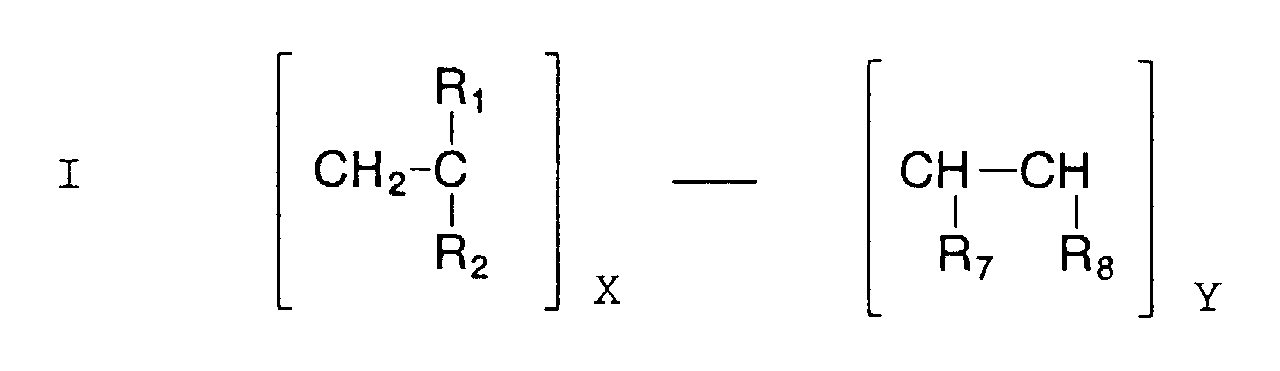 their sum being 100%, the molecular weight of said polymers being from 500 to 1,000,000 g/mol, or mixtures and/or salts of said polymers.R1 is -H or -CH3R2 is -COOM, in which M may be H+ or a cation, in particular Na+, K+, NH+ 4R7, R8 may be both -COOM or one -COOM and the other -COOL, wherein M is defined as above independently for each M, L is - (-CH2-CH2-O)r- (CHCH3-CH2-O)s-- (-CH2CH2-O)tH, in which r, t and s may vary respectively in the range from 0 to 100%,
 - A process according to claim 1, characterised in that a polymer is used for controlling the crystal form of the sodium percarbonate and for coating the crystals, the polymer being a methacrylic or acrylic acid copolymer with maleic acid or a sodium, potassium or ammonium salt of such a copolymer.
- A process according to claim 1, characterised in that a polymer is used for controlling the crystal form of the sodium percarbonate and for coating the crystals, the polymer being an ethylene oxide and propylene oxide copolymer.
- A process according to any one of claims 1 to 3, characterised in that the polymers of general formulas I or II or salts of these polymers or mixtures of the polymers of formulas I and II or of their salts are used in amounts such that their concentration will be in the range from 10 to 1000 ppm, preferably 100 ppm.
- A process according to any of claims 1 to 4, characterised in that the molecular weight of the polymers of general formula I and II is in the range from 1000 to 200,000 g/mol, preferably from 2000 to 130,000 g/mol.
Applications Claiming Priority (3)
| Application Number | Priority Date | Filing Date | Title |
|---|---|---|---|
| FI923995A FI91632C (en) | 1992-09-07 | 1992-09-07 | Process for the preparation of crystalline stable sodium percarbonate |
| FI923995 | 1992-09-07 | ||
| PCT/FI1993/000356 WO1994005594A1 (en) | 1992-09-07 | 1993-09-07 | A process for preparing a crystalline, stable sodium percarbonate |
Publications (2)
| Publication Number | Publication Date |
|---|---|
| EP0658150A1 EP0658150A1 (en) | 1995-06-21 |
| EP0658150B1 true EP0658150B1 (en) | 1998-12-02 |
Family
ID=8535827
Family Applications (1)
| Application Number | Title | Priority Date | Filing Date |
|---|---|---|---|
| EP93919359A Expired - Lifetime EP0658150B1 (en) | 1992-09-07 | 1993-09-07 | A process for preparing a crystalline, stable sodium percarbonate |
Country Status (7)
| Country | Link |
|---|---|
| US (1) | US5603911A (en) |
| EP (1) | EP0658150B1 (en) |
| DE (1) | DE69322397T2 (en) |
| DK (1) | DK0658150T3 (en) |
| ES (1) | ES2125348T3 (en) |
| FI (1) | FI91632C (en) |
| WO (1) | WO1994005594A1 (en) |
Families Citing this family (11)
| Publication number | Priority date | Publication date | Assignee | Title |
|---|---|---|---|---|
| US5902682A (en) * | 1993-07-17 | 1999-05-11 | Degussa Aktiengesellschaft | Coated sodium percarbonate particles, a process for their preparation and their use |
| US5701438A (en) * | 1995-09-29 | 1997-12-23 | Intel Corporation | Logical relocation of memory based on memory device type |
| DE19600018A1 (en) | 1996-01-03 | 1997-07-10 | Henkel Kgaa | Detergent with certain oxidized oligosaccharides |
| CA2250057C (en) * | 1996-03-27 | 2008-10-21 | Solvay Interox (Societe Anonyme) | Process for producing a percarbonate |
| FI104634B (en) | 1997-01-24 | 2000-03-15 | Kemira Chemicals Oy | Stabilized sodium carbonate peroxyhydrate |
| JP2995470B1 (en) * | 1998-09-03 | 1999-12-27 | オリエンタル ケミカル インダストリーズ | Composition of sodium percarbonate with improved solubility |
| KR100366556B1 (en) | 2000-04-26 | 2003-01-09 | 동양화학공업주식회사 | Granular coated sodium percarbonate and process for preparing them |
| AU2002327280A1 (en) * | 2002-08-12 | 2004-02-25 | Shengwen Qian | Coated sodium percarbonate and the preparation process and use thereof |
| US8100298B2 (en) * | 2003-03-03 | 2012-01-24 | Aptargroup, Inc. | Aerosol actuator |
| CA2558266C (en) | 2004-03-05 | 2017-10-17 | Gen-Probe Incorporated | Reagents, methods and kits for use in deactivating nucleic acids |
| CN106632903A (en) * | 2016-12-24 | 2017-05-10 | 杭州美高华颐化工有限公司 | Leveling agent for cotton and preparation method thereof |
Citations (2)
| Publication number | Priority date | Publication date | Assignee | Title |
|---|---|---|---|---|
| US4120812A (en) * | 1977-06-17 | 1978-10-17 | Fmc Corporation | Polyethylene glycol-stabilized peroxygens |
| WO1992017400A1 (en) * | 1991-03-26 | 1992-10-15 | Henkel Kommanditgesellschaft Auf Aktien | Long-shelf-life encapsulated particulate sodium percarbonate and process for producing it |
Family Cites Families (2)
| Publication number | Priority date | Publication date | Assignee | Title |
|---|---|---|---|---|
| BE794539A (en) * | 1972-01-26 | 1973-07-25 | Ici Ltd | STAFF |
| FR2459203A1 (en) * | 1979-06-21 | 1981-01-09 | Interox | PARTICLES OF STABILIZED PEROXYGEN COMPOUNDS, PROCESS FOR THEIR MANUFACTURE AND COMPOSITION CONTAINING SAME |
-
1992
- 1992-09-07 FI FI923995A patent/FI91632C/en active
-
1993
- 1993-09-07 EP EP93919359A patent/EP0658150B1/en not_active Expired - Lifetime
- 1993-09-07 US US08/397,171 patent/US5603911A/en not_active Expired - Lifetime
- 1993-09-07 DE DE69322397T patent/DE69322397T2/en not_active Expired - Lifetime
- 1993-09-07 ES ES93919359T patent/ES2125348T3/en not_active Expired - Lifetime
- 1993-09-07 WO PCT/FI1993/000356 patent/WO1994005594A1/en not_active Ceased
- 1993-09-07 DK DK93919359T patent/DK0658150T3/en active
Patent Citations (2)
| Publication number | Priority date | Publication date | Assignee | Title |
|---|---|---|---|---|
| US4120812A (en) * | 1977-06-17 | 1978-10-17 | Fmc Corporation | Polyethylene glycol-stabilized peroxygens |
| WO1992017400A1 (en) * | 1991-03-26 | 1992-10-15 | Henkel Kommanditgesellschaft Auf Aktien | Long-shelf-life encapsulated particulate sodium percarbonate and process for producing it |
Also Published As
| Publication number | Publication date |
|---|---|
| FI91632C (en) | 1994-07-25 |
| WO1994005594A1 (en) | 1994-03-17 |
| DE69322397D1 (en) | 1999-01-14 |
| FI91632B (en) | 1994-04-15 |
| DK0658150T3 (en) | 1999-08-16 |
| FI923995A0 (en) | 1992-09-07 |
| US5603911A (en) | 1997-02-18 |
| DE69322397T2 (en) | 1999-07-15 |
| EP0658150A1 (en) | 1995-06-21 |
| ES2125348T3 (en) | 1999-03-01 |
Similar Documents
| Publication | Publication Date | Title |
|---|---|---|
| EP1149800B1 (en) | Granular coated sodium percarbonate for detergent and its manufacturing process | |
| CA2108513C (en) | Sodium percarbonate stabilized by coating | |
| KR100289001B1 (en) | Stabilized Sodium Percarbonate Particles | |
| EP1572852B1 (en) | Coated peroxygen compounds with controlled release, a process for their preparation and their use | |
| EP0364840B2 (en) | Process for manufacturing a soda ash peroxygen | |
| KR20000005036A (en) | Compositions containing sodium percarbonate | |
| KR960012705B1 (en) | Soda ash peroxygen carrier | |
| US5603911A (en) | Preparing a crystalline, stable sodium percarbonate | |
| CN1729283A (en) | Coated peroxygen compounds with controlled release, a process for their preparation and their use | |
| JPH09509132A (en) | Method for stabilizing granular alkali metal percarbonate | |
| EP0267042A2 (en) | Detergent granules and a process for their preparation | |
| JPH07502770A (en) | Granular percarbonate laundry bleach containing layered silicate stabilizers | |
| US7041267B2 (en) | Granular sodium carbonate obtained by fluid-bed spray granulation and a process for its production | |
| JPH09512300A (en) | Detergent powder composition comprising metal ion-chelating agent complex and anionic functional polymer | |
| KR960015976B1 (en) | Particulate composition containing bleach and an optical brightener and process for its manufacture | |
| US4316879A (en) | Stabilized sodium carbonate peroxide preparation method | |
| KR100321534B1 (en) | Method for preparing abrasion resistant sodium percarbonate with fast dissolution rate and sodium percarbonate prepared therefrom | |
| US5632965A (en) | Method for the preparation of stabilized sodium percarbonate | |
| JP3305111B2 (en) | Stabilized sodium percarbonate particles and method for producing the same | |
| JP3314526B2 (en) | Method for producing stabilized sodium percarbonate particles | |
| JP3305112B2 (en) | Stabilized sodium percarbonate particles and method for producing the same | |
| KR20030008705A (en) | Sodium percarbonate superior stability and method for preparing thereof | |
| JPH0415163B2 (en) | ||
| JPH09235109A (en) | Method for producing granular sodium percarbonate | |
| PL204153B1 (en) | Method for manufacture of sodium percarbonate |
Legal Events
| Date | Code | Title | Description |
|---|---|---|---|
| PUAI | Public reference made under article 153(3) epc to a published international application that has entered the european phase |
Free format text: ORIGINAL CODE: 0009012 |
|
| 17P | Request for examination filed |
Effective date: 19950306 |
|
| AK | Designated contracting states |
Kind code of ref document: A1 Designated state(s): DE DK ES FR GB IT NL SE |
|
| 17Q | First examination report despatched |
Effective date: 19951121 |
|
| GRAG | Despatch of communication of intention to grant |
Free format text: ORIGINAL CODE: EPIDOS AGRA |
|
| GRAG | Despatch of communication of intention to grant |
Free format text: ORIGINAL CODE: EPIDOS AGRA |
|
| GRAH | Despatch of communication of intention to grant a patent |
Free format text: ORIGINAL CODE: EPIDOS IGRA |
|
| GRAH | Despatch of communication of intention to grant a patent |
Free format text: ORIGINAL CODE: EPIDOS IGRA |
|
| GRAA | (expected) grant |
Free format text: ORIGINAL CODE: 0009210 |
|
| AK | Designated contracting states |
Kind code of ref document: B1 Designated state(s): DE DK ES FR GB IT NL SE |
|
| REF | Corresponds to: |
Ref document number: 69322397 Country of ref document: DE Date of ref document: 19990114 |
|
| ET | Fr: translation filed | ||
| REG | Reference to a national code |
Ref country code: ES Ref legal event code: FG2A Ref document number: 2125348 Country of ref document: ES Kind code of ref document: T3 |
|
| REG | Reference to a national code |
Ref country code: DK Ref legal event code: T3 |
|
| PLBE | No opposition filed within time limit |
Free format text: ORIGINAL CODE: 0009261 |
|
| STAA | Information on the status of an ep patent application or granted ep patent |
Free format text: STATUS: NO OPPOSITION FILED WITHIN TIME LIMIT |
|
| 26N | No opposition filed | ||
| PGFP | Annual fee paid to national office [announced via postgrant information from national office to epo] |
Ref country code: DK Payment date: 20010814 Year of fee payment: 9 |
|
| PGFP | Annual fee paid to national office [announced via postgrant information from national office to epo] |
Ref country code: SE Payment date: 20010817 Year of fee payment: 9 |
|
| PGFP | Annual fee paid to national office [announced via postgrant information from national office to epo] |
Ref country code: NL Payment date: 20010820 Year of fee payment: 9 |
|
| REG | Reference to a national code |
Ref country code: GB Ref legal event code: IF02 |
|
| PG25 | Lapsed in a contracting state [announced via postgrant information from national office to epo] |
Ref country code: SE Free format text: LAPSE BECAUSE OF NON-PAYMENT OF DUE FEES Effective date: 20020908 |
|
| PG25 | Lapsed in a contracting state [announced via postgrant information from national office to epo] |
Ref country code: DK Free format text: LAPSE BECAUSE OF NON-PAYMENT OF DUE FEES Effective date: 20020930 |
|
| PG25 | Lapsed in a contracting state [announced via postgrant information from national office to epo] |
Ref country code: NL Free format text: LAPSE BECAUSE OF NON-PAYMENT OF DUE FEES Effective date: 20030401 |
|
| REG | Reference to a national code |
Ref country code: DK Ref legal event code: EBP |
|
| EUG | Se: european patent has lapsed | ||
| PG25 | Lapsed in a contracting state [announced via postgrant information from national office to epo] |
Ref country code: IT Free format text: LAPSE BECAUSE OF NON-PAYMENT OF DUE FEES;WARNING: LAPSES OF ITALIAN PATENTS WITH EFFECTIVE DATE BEFORE 2007 MAY HAVE OCCURRED AT ANY TIME BEFORE 2007. THE CORRECT EFFECTIVE DATE MAY BE DIFFERENT FROM THE ONE RECORDED. Effective date: 20050907 |
|
| PGFP | Annual fee paid to national office [announced via postgrant information from national office to epo] |
Ref country code: ES Payment date: 20110916 Year of fee payment: 19 Ref country code: GB Payment date: 20110920 Year of fee payment: 19 |
|
| PGFP | Annual fee paid to national office [announced via postgrant information from national office to epo] |
Ref country code: DE Payment date: 20120921 Year of fee payment: 20 |
|
| PGFP | Annual fee paid to national office [announced via postgrant information from national office to epo] |
Ref country code: FR Payment date: 20121010 Year of fee payment: 20 |
|
| GBPC | Gb: european patent ceased through non-payment of renewal fee |
Effective date: 20120907 |
|
| PG25 | Lapsed in a contracting state [announced via postgrant information from national office to epo] |
Ref country code: GB Free format text: LAPSE BECAUSE OF NON-PAYMENT OF DUE FEES Effective date: 20120907 |
|
| REG | Reference to a national code |
Ref country code: DE Ref legal event code: R071 Ref document number: 69322397 Country of ref document: DE |
|
| REG | Reference to a national code |
Ref country code: DE Ref legal event code: R071 Ref document number: 69322397 Country of ref document: DE |
|
| REG | Reference to a national code |
Ref country code: ES Ref legal event code: FD2A Effective date: 20131021 |
|
| PG25 | Lapsed in a contracting state [announced via postgrant information from national office to epo] |
Ref country code: DE Free format text: LAPSE BECAUSE OF EXPIRATION OF PROTECTION Effective date: 20130910 Ref country code: ES Free format text: LAPSE BECAUSE OF NON-PAYMENT OF DUE FEES Effective date: 20120908 |