EP0657048B1 - Intelligentes kommunikations-system - Google Patents
Intelligentes kommunikations-system Download PDFInfo
- Publication number
- EP0657048B1 EP0657048B1 EP94918265A EP94918265A EP0657048B1 EP 0657048 B1 EP0657048 B1 EP 0657048B1 EP 94918265 A EP94918265 A EP 94918265A EP 94918265 A EP94918265 A EP 94918265A EP 0657048 B1 EP0657048 B1 EP 0657048B1
- Authority
- EP
- European Patent Office
- Prior art keywords
- data
- processors
- individual
- communications
- communication
- Prior art date
- Legal status (The legal status is an assumption and is not a legal conclusion. Google has not performed a legal analysis and makes no representation as to the accuracy of the status listed.)
- Expired - Lifetime
Links
Images



Classifications
-
- G—PHYSICS
- G06—COMPUTING OR CALCULATING; COUNTING
- G06F—ELECTRIC DIGITAL DATA PROCESSING
- G06F15/00—Digital computers in general; Data processing equipment in general
- G06F15/16—Combinations of two or more digital computers each having at least an arithmetic unit, a program unit and a register, e.g. for a simultaneous processing of several programs
- G06F15/163—Interprocessor communication
- G06F15/17—Interprocessor communication using an input/output type connection, e.g. channel, I/O port
-
- G—PHYSICS
- G06—COMPUTING OR CALCULATING; COUNTING
- G06F—ELECTRIC DIGITAL DATA PROCESSING
- G06F15/00—Digital computers in general; Data processing equipment in general
- G06F15/16—Combinations of two or more digital computers each having at least an arithmetic unit, a program unit and a register, e.g. for a simultaneous processing of several programs
- G06F15/163—Interprocessor communication
- G06F15/173—Interprocessor communication using an interconnection network, e.g. matrix, shuffle, pyramid, star, snowflake
- G06F15/17337—Direct connection machines, e.g. completely connected computers, point to point communication networks
-
- H—ELECTRICITY
- H04—ELECTRIC COMMUNICATION TECHNIQUE
- H04L—TRANSMISSION OF DIGITAL INFORMATION, e.g. TELEGRAPHIC COMMUNICATION
- H04L9/00—Cryptographic mechanisms or cryptographic arrangements for secret or secure communications; Network security protocols
- H04L9/40—Network security protocols
Definitions
- the invention relates to an intelligent communication system and its application in a multiprocessor system For example, for use in electronic data processing.
- Multiprocessor systems are nowadays becoming more and more large as well small computing systems and used for ever more diverse applications.
- a personal computer is actually several specialized ones Processors for operating the screen, keyboard, mass storage etc., i.e. every personal computer is already a multiprocessor system.
- Multiprocessor systems are not only used in personal computers but also in computing-intensive applications, for example for scientific ones Calculations such as meterology and fluid dynamics or for digital Image processing used. Such applications work very well executed by processors operating in parallel, i.e. over several or more better over a variety of processors over a communication system are interconnected. It can therefore be assumed that Multiprocessor systems will play an important role in the future.
- the transmission protocol therefore has a central one Meaning too. How quickly communication becomes a bottleneck shows, for example, the symmetric multiprocessor system of the Pentiums from Intel, in which up to four processors communicate with each other can.
- the multiprocessor interconnect (MPI) communication system used has nine different cycles by means of which the individual Processors according to a transmission protocol over a common one notify used and local storage.
- the maximum transmission bandwidth is 2.1 GBits / s at 33.3 MHz clock frequency and 64 bit data.
- the individual pentiums are clocked at 60 MHz for 64 bit data and have a maximum transmission bandwidth that is higher by a factor of 1.8 from 3.8 GBits / s.
- the communication system becomes a bottleneck because under assumption a linear speed increase, the maximum transmission bandwidth of the MPI system is only 14% of that of the individual Pentium.
- the object of the present invention is an optimal communication method for multiprocessor systems regarding transmission speed, Utilization of the transmission bandwidth, control of the communication and to show appropriate devices.
- the idea underlying the invention is to minimize the Communication on the efficient transmission of information.
- the for Communication is not absolutely necessary, but it is necessary to convey it quickly redundant information, such as determining the Sequence of sending and receiving participants or the determination which participant sends to whom and which participant receives from whom, or also the determination of the time and the package size of a Communication etc. are "separated" and are therefore not part of the content of the transmission protocol.
- This separated information is the Participants (the participating processors) as protocol instructions in Form of a timetable communicated before the "meeting", they save it and know in advance when, how and to whom you send, when, how and from who they receive, etc., that is, there is a division of functions instead of: the transmission protocol is no longer a postman, who walks around with addressed envelopes and looks for mailboxes, he comes rather, with the bag open only to the participants, who in turn get the information that interests them.
- the modern electronic data processing also enables information in this way to communicate once or several times.
- the communication system according to the invention (postman, timetable and subscriber) is therefore called intelligent and autonomously actuating, because the individual Participants (processors) their tasks and functions in advance know.
- the common communication system as a whole is one higher-level corpus of process specifications programmable.
- the efficient Transmission can thus be carried out using a pure hardware solution (e.g. an ASIC) be realized using simple, inexpensive to manufacture and less vulnerable components.
- This organizational effort increases first approximation linear with the number of processors involved. I.e. the administrative effort can be transferred even if the data is transferred quickly quickly larger than the actual computing effort to create the tables become. In this case, the computing power of the entire system is carried out Adding more processors no longer increases, on the contrary, it can even lose weight. This is where the invention begins. Management of communication is given to the network, hence the name intelligent Communication system. Another advantage is that the administration ensures that each processor takes its data packets and that the data packets are sensibly arranged for all processors, copied and the correct cutouts sent. Cutouts are parts of data packets. The administrative burden of information exchange is therefore minimized for the processors.
- the intelligent communication system can not only be organized and sending information to be exchanged between individual processors use, but it is also suitable for actual editing this information.
- the communication network instructs or several arithmetic units, for example by a group or used by all processors so that data from the communication network be fed into an arithmetic unit without this Call, an external instruction is necessary.
- calculations can be made like determining the minimum, the maximum, the sum, Carry out Z-buffers, etc. with freely adjustable counter models.
- the calculator can have one, several or all processors with the same or be subordinate to different priorities, the communication and the This calculation is controlled autonomously.
- the intelligent communication system can also be used as a fast one Use the operating system.
- the communication network points in analogy to the arithmetic unit for this one or more depots on the used for example by a group or by all processors so that data from one or more processors into a depot can be fed in without an call, an external instruction is necessary and that this data to one or more processors in the same way, i.e. be distributed autonomously.
- a first embodiment of the architecture of the communication system according to the invention can be seen in a block diagram in FIG .
- the communication system is intelligent and autonomously actuating, ie at the beginning of a session the necessary documents for communication are transmitted to the communication system. This means that it understands the information provided by the individual participants, can compile it and pass it on to other participants.
- This parallel communicating communication system for multiprocessor systems is therefore programmable.
- a plurality of processors 1, 1 ', 1 "to 1 n are permanently and parallel connected to a communication system 2
- n is a whole positive number.
- the communication system 2 can have a linear, branched or ring-shaped structure.
- Each of these processors receives its individual algorithm for executing a common program before it is executed, written into individual memories by the communication system 2.
- each of the processors receives an original individual data record and individual protocol instructions in individual memories a certain point in time begins and ends, according to the protocol instructions beforehand and in a specified order, only data is read in and out via the communication system.
- the common communication system is programmable as a whole to a higher-level corpus of process instructions and is in accordance with the process instructions Aben operable autonomously.
- the individual processors receive individual algorithms, data records and protocol instructions in their memory, they process data records with algorithms independently and calculate individual results and communicate these individual results as data according to the protocol instructions to all processors autonomously.
- the transmission of instructions, commands, algorithm sequences, etc. to the individual processors and the communication of individual results as data among the individual processors can therefore be transmitted at different times.
- the communication system is autonomous. Communication can be controlled freely, it can be performed centrally, ie by one or more processors, and it can be implemented hierarchically.
- the algorithms, data and protocol instructions transmitted before the session are transmitted, for example, from one or more leading processors to the other processors, but this hierarchy is then removed during the session.
- Each of the processors 1, 1 ', 1 "to 1 n is, according to its individual set of instructions, commands, algorithm sequences, etc., so autonomous or independent that arbitration, an arbitration board, a decision as to when, who communicates with whom and how, The processors' dependency on instructions already exists, but it is no longer present externally during the communication, but was internalized by the processors before the communication in accordance with the protocol instructions.
- Each of the processors 1, 1 ', 1 "to 1 n receives data 3, 3', 3" to 3 n via the intelligent communication system 2 and generates new data 4, 4 ', 4 "to 4 n .
- the newly generated Data 4, 4 ', 4 "to 4 n are in turn sent to the processors 1, 1', 1" by the intelligent communication system 2 in a further communication process following in time as data 5, 5 ', 5 "to 5 n distributed to 1 n .
- the intelligent communication system according to FIG. 1 distributes data 3, 3 ', 3 "to 3 n , for example empty data circles, to the processors 1, 1', 1" to 1 n at a specific point in time.
- 12 processors calculate individual results or data packets 4, 4 ', 4 "to 4 n in one process, for example each a different data circle filled with 1/12.
- the intelligent communication system delivers these different 1/12 filled data circles a completely filled data circle and passes it on to the processors 1, 1 ', 1 "to 1 n as data 5, 5', 5" to 5 n , for example as a completely filled data circle, at a later specific point in time.
- the communication system can also calculate at the same time, ie it can feed data into one or more commonly used arithmetic units without the need for an external instruction.
- This processor can be used by all processors, for example. In this way, calculations such as the determination of the minimum, the maximum, the sum, Z-buffer, etc. can be carried out with freely adjustable counter models.
- 12 processors 1, 1 ', 1 "to 1 n calculate different, individual results or data packets 4, 4', 4" to 4 n in one process. For example, they calculate the same data circle together.
- the intelligent communication system overlays these data circles, calculates, for example, minima, the maxima, sums, etc., and forwards this received data 5, 5 ', 5 "to 5 n to the processors 1, for example as a completely filled data circle , 1 ', 1 "to 1 n further.
- the communication system can also be used as an operating system, ie one or more operating units are used by one or more processors for feeding in data.
- One or more plants then distribute data to one or more processors. This distribution is done to processors that are able to receive data. Distribution takes place without external instructions.
- FIG. 1 for example, 12 processors 1, 1 ', 1 "to 1 n send data packets 4, 4', 4" to 4 n in one operation to an operating plant. This distributes the data packets to those processors that can carry out data processing. This control is also carried out autonomously by the communication system.
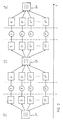
- FIG. 2 shows a time diagram of the communication process for a communication system in an embodiment according to FIG. 1.
- the intelligent communication system has written the individual processor sequences and their individual algorithm sequences and protocol instructions into the memory.
- the data exchange begins at the beginning of the time arrow t on the left-hand side of FIG. 2.
- the individual processors 1, 1 ', 1 "to 1 n from the communication system 2 receive the data 3, 3', 3" to be processed. up to 3 n sent from a data block 3 *.
- the communication system 2 is in the state 2 3 .
- These processors process their individual algorithms and send their individual results or results 4, 4 ', 4 "to 4 n to the communication system 2 at a later point in time.
- the communication system 2 is in the state 2 4 , it receives Data 4, 4 ', 4 "to 4 n from the individual processors 1, 1', 1" to 1 n . These data or data packets 4, 4 ', 4 "to 4 n are transformed into a virtual one by the intelligent communication system 2 Data block 5 * compiled and this (or parts thereof) can then be redistributed to the processors. These data transmission processes can be repeated.
- the intelligent communication system 2 can distribute the data 5, 5 ', 5 "to 5 n compiled into a virtual data block 5 * again at a specific point in time to the processors 1, 1', 1" to 1 n .
- the communication system is in the state 2 5 , it sends data 5, 5 ', 5 "to 5 n to the individual processors 1, 1', 1" to 1 n .
- the individual results or results 6, 6 ', 6 "to 6 n of the individual processors are then collected again by the communication system 2 and again compiled to form a virtual data block 7 *.
- the intelligent communication system 2 is then in the state 2 7 .
- the data packets that are generated can be constant or different Have size.
- a record that represents an image divided line by line or block by block (also with different block sizes) become.
- the packet sizes of the transmission of the communication system are also variable. I.e. individual processors can therefore use, before communication communicate individually defined package sizes.
- the technically maximum transmission bandwidth can, if necessary, completely exploited or divided into several transmission channels so that for example, simultaneous sending and receiving takes place (see Description according to Figure 5).
- the specified protocol instructions can be changed, so also the packet size of the transfer of each processor during the Communication can be changed.
- FIG. 3 shows a schematic model of processors working in parallel in the communication system according to the invention.
- the individual processors 1, 1 ', 1 "to 1 n are fast processors.
- Each of these processors has a communication controller 6.1, 6.1', 6.1" to 6.1 n and two memories 7.1, 7.1 ', 7.1 "to 7, 1 n and 8.1, 8.1 ', 8.1 "to 8.1 n .
- the communication controllers 6.1, 6.1 ', 6.1 "to 6.1 n organize access to the memories 7.1, 7.1', 7.1" to 7.1 n and 8.1, 8.1 ', 8.1 "to 8.1 n between the processors 1, 1' , 1 "to 1 n and the communication system 2.
- the communication controllers can be constructed individually, or several communication controllers can be combined on a module, for example a chip.
- the memories 7.1, 7.1 ', 7.1 "to 7.1 n are data memories, for example video DRAMs, the memories 8.1, 8.1', 8.1" to 8.1 n are command memories, for example SRAMs.
- the data memories 7.1, 7.1 ', 7.1 "to 7.1 n and command memories 8.1, 8.1', 8.1" to 8.1 n advantageously have two inputs, one for the processor and one as an interface to the communication system. Equipped in this way, for example, a processor 1 can process data and access its data memory 7.1 without being disturbed by the communication system 2 through the transmission of new data to be processed via the interface. The opening and closing of the two inputs of the data memory 7.1 is then controlled via the communication controller 6.1.
- these arithmetic elements are located in communication controllers 6.1, 6.1 ', 6.1 "to 6.1 n .
- the arithmetic unit in the communication controllers can then also be used to control a task acceptance, for example, a communication controller can only accept a task if a data value lies within a certain expected value and specified by the processor.
- the processors 1, 1 ', 1 "to 1 n signal to the communication controllers 6.1, 6.1', 6.1" to 6.1 n the point in time from which they are ready for data acquisition.
- the communication controllers 6.1, 6.1 ', 6.1 "to 6.1 n then get a task from the communication system 2.
- FIG. 4 shows a schematic model of a multi-layer perceptron (neural network) implemented with the communication system according to the invention.
- the multilayer perceptron is an exemplary application that can be parallelized. It is a universal learning model that represents the development of values in a variety of layers L n-1 , L n , L n + 1 (n is a positive integer) according to an algorithm. Starting from an initial value, which is specified in a layer L n , the layers are used to calculate an end value in the forward direction (n + 1) and the original value is calculated in the reverse direction (n-1) by the layers.
- the individual processors 1, 1 ', 1 "to 1 n calculate result sets in parallel in each layer and communicate them with one another before values of a next layer are calculated.
- This communication of result sets is carried out by the lines that the individual processors 1, 1 ', 1 "to 1 n of adjacent layers, shown.
- the result sets can be large, ie their communication can quickly become the speed-determining step in the execution of the algorithm.
- the advantage of the communication system 2 according to the invention is that it is programmable that the individual processors 1, 1 ', 1 "to 1 n determine their individual algorithms or computing software, the data records necessary for executing the same, and the protocol instructions (for example their individual communication times and transmission bandwidths), before the start of the execution of the perceptron algorithm in their data memories 7.1, 7.1 ', 7.1 "to 7.1 n and command memories 8.1, 8.1', 8.1" to 8.1 n
- the algorithm works independently according to your individual computing software. Based on the protocol instructions, you know when to send and receive results, and you can also update your own data records with these results.
- the intelligence of this communication system lies in the fact that only a minimum of data is communicated during the execution of the algorithm and that it functions largely autonomously.
- the protocol instructions transmitted in advance lead to hierarchical communication.
- the autonomy is that a schedule with communication packet sizes between the individual processors is defined according to the protocol instructions before communication.
- Minimized means that individual data values that have to be sent to several other processors only load the communication system once. All processors interested in this specific data value make a copy of it.
- the communication controllers therefore know, for example by counting the communicated data values, when they should participate in the communication, they do not have to be requested by a higher authority, as is usually the case, and they do not have to keep the communication line open unnecessarily long and wait.
- the communication system is programmable and is sent through of software, data and protocol instructions to the participants Processors not only quickly before the actual communication, but also also flexible.
- the hardware used namely processors with data memories and communication controllers require fast communication, because directly on the communication system only the access to the Data storage devices are connected, which open and clocked quickly Let close. What varies depending on the application, namely the software and data are transmitted to the processors before communication, which guarantees a general range of applications.
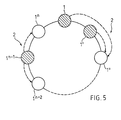
- FIG. 5 shows a second embodiment of the architecture of the communication system according to the invention with data sources and data sinks in the block diagram.
- the communication takes place here according to a ring structure, the communication system 2 connects the individual processors 1, 1 ', 1 "to 1 n in a closed ring.
- ring structures enable simultaneous access to data can also work with higher data rates than, for example, classic bus-based or linear communication systems, since here a single transmitter passes on information to a single known receiver, which is easier to implement in terms of circuitry. They are therefore faster and can be operated over longer distances.
- linear, matrix or tree structures are also possible. A linear structure can be easier to implement for small systems in a limited space.
- the individual communication controllers are then connected in a bus with a linear matrix molds free.
- the individual processors 1, 1 ', 1 "to 1 n are equipped with data memories 7.1, 7.1', 7.1" to 7.1 n and command memories 8.1, 8.1 ', 8.1 "to 8.1 n and take communication controllers 6.1 "6.1 ', 6.1” to 6.1 n participate in the communication (see description according to FIGS. 1 to 3).
- the exchange of calculated results as data between all processors 1, 1 ', 1 "to 1 n , the individual computing software, the data records required for the calculation and the protocol instructions such as the communication pact sizes are transmitted to them.
- the intelligence of the communication The system consists of minimizing the communication between the individual processors, doing it optimally and as quickly as possible.
- the "full" memories of the dark, hatched processors 1, 1 ', 1 "to 1 n are referred to as data sources, and the " empty "memories of the bright, non-hatched processors 1, 1', 1" to 1 n are referred to as data sinks .
- communication takes place via the communication system 2 between the processors 1, 1 'and 1 ", but the processors 1 and 1' simultaneously transmit data to the processor 1" via packet sizes of different sizes.
- processor 1 n-1 simultaneously sends data to processors 1 n-2 and 1 n .
- processors 1 n-2 and 1 n Unlike, for example, in the demultiplexed token ring, where the transmission authorization of the processors participating in the communication is assigned in turn, multiplexing, simultaneous access to data from several processors, is possible in the communication system according to the invention. This is due to the high flexibility of the individual protocol instructions. Because these protocol instructions are limited to the communication of data, but do not have to call the communicating processors, for example, hierarchically, externally, the transmission bandwidth can be divided into several and narrower and independent transmission channels according to the size of the data to be communicated. The direction of communication is not predetermined, so processor 1 n-1 communicates in opposite directions with processors 1 n-2 and 1 n . Of course, changes in order and direction are also possible during communication.
- one according to the invention Communication system in an arrangement according to the description Figures 1 to 5 think of as a hyper processor.
- This can in turn with intelligent communication controllers for communicating with others Communication systems are provided.
- Several such hyper processors can thus be coupled to one another analogously to the description above become.
- This game can be Repeat as often as you want. It can be very large and corresponding powerful supercomputers can be built.
- Such hyper processors have the same variety of possible architectures as described above are.
- several can Annular communication systems are coupled in such a way that they over intelligent communication controllers can communicate with each other, a hyper processor takes the lead, in the spirit of the server / client architecture.
- different and also differently structured architectures for example linear, matrix or tree structures of hyper processors with each other be coupled.
- those skilled in the art are familiar with the invention diverse design options free.
Landscapes
- Engineering & Computer Science (AREA)
- Computer Hardware Design (AREA)
- Theoretical Computer Science (AREA)
- Physics & Mathematics (AREA)
- Software Systems (AREA)
- General Engineering & Computer Science (AREA)
- General Physics & Mathematics (AREA)
- Computer Security & Cryptography (AREA)
- Signal Processing (AREA)
- Computer Networks & Wireless Communication (AREA)
- Mathematical Physics (AREA)
- Multi Processors (AREA)
- Maintenance And Management Of Digital Transmission (AREA)
- Computer And Data Communications (AREA)
- Bus Control (AREA)
Description
- Fig. 1
- zeigt in einem Blockdiagramm die Ausgangslage für ein Kommunikations-Systems gemäss Erfindung.
- Fig. 2
- zeigt im Zeitdiagramm den Kommunikations-Vorgang für ein Kommunikations-System in einer Ausführung gemäss Figur 1.
- Fig. 3
- zeigt ein schematisches Modell parallel arbeitender Prozessoren im erfindungsgemässen Kommunikations-System.
- Fig. 4
- zeigt ein schematisches Modell eines mit dem erfindungsgemässen Kommunikations-System implementierten mehrlagigen Perzeptrons.
- Fig. 5
- zeigt in einem Blockdiagramm eine zweite Ausführungsform der Architektur des erfindungsgemässen Kommunikations-Systems mit Datenquellen und Datensenken.
Claims (22)
- Parallel arbeitendes Mehrprozessor-System der elektronischen Datenverarbeitung, dessen Prozessoren über individuelle Datenspeicher, Befehlsspeicher und Schnittstellen zu einem gemeinsamen Kommunikations-System verfügen,
dadurch gekennzeichnet, daßdas gemeinsame Kommunikations-System als ganzes zu einem übergeordneten Corpus mit Ablaufsvorgaben programmiert ist und den Ablaufsvorgaben entsprechend autonom aktuierend betrieben wird,wobei den aufgrund der programmierten Ablaufsvorgaben des Kommunikations-systems adressierten Prozessoren vor einer Kommunikationssitzung individuelle Algorithmen, Datensätze und Protokollweisungen in ihre Speicher übersandt werden,wobei die Protokollweisungen Aufgaben und Funktionen, sowie Kommunikationskriterien betreffend den zeitlichen Bedingungen des Datenaustausches der einzelnen Prozessoren mit dem Kommunikations-System, bestimmen, und während einer Kommunikationssitzung die einzelnen Prozessoren Datensätze aufgrund ihrer individuellen Algorithmen selbständig bearbeiten und individuelle Ergebnisse als Daten entsprechend den Protokollweisungen autonom an alle Prozessoren liefern. - System gemäss Anspruch 1, dadurch gekennzeichnet, dass die Autonomie darin besteht, dass die einzelnen Prozessoren entsprechend den Protokollweisungen selbstständig Daten senden und empfangen.
- System gemäss einem der Ansprüche 1 oder 2, dadurch gekennzeichnet, dass die Autonomie darin besteht, dass die einzelnen Prozessoren entsprechend den Protokollweisungen ihre individuellen Datensätze mit den kommunizierten Daten selbstständig aktualisieren und daraufhin ihre individuellen Algorithmen mit diesen selbständig aktualisierten individuellen Datensätzen weiterbearbeiten.
- System gemäss Anspruch 3, dadurch gekennzeichnet, dass die einzelnen Prozessoren ihre individuellen Datensätze durch Zählen der kommunizierten Daten autonom aktuieren.
- System gemäss einem der Ansprüche 1 bis 4, dadurch gekennzeichnet, dass die Autonomie darin besteht, dass ein Fahrplan mit Kommunikationspaketgrössen zwischen den einzelnen Prozessoren entsprechend den Protokollweisungen vor der Kommunikation festgelegt wird.
- System gemäss Anspruch 5, dadurch gekennzeichnet, dass gleich grosse Kommunikationspaketgrössen zwischen den einzelnen Prozessoren verwendet werden.
- System gemäss Anspruch 5, dadurch gekennzeichnet, dass verschieden grosse Kommunikationspaketgrössen zwischen den einzelnen Prozessoren verwendet werden.
- System gemäss einem der Ansprüche 1 bis 5, dadurch gekennzeichnet, dass die Autonomie darin besteht, dass Bandbreiten der Übertragung zwischen den einzelnen Prozessoren entsprechend den Protokollweisungen vor der Kommunikation festgelegt werden.
- System gemäss Anspruch 8, dadurch gekennzeichnet, dass gemultiplext wird, dass auf Daten aus mehreren Prozessoren über mehrere Übertragungsbandbreiten zugegriffen wird.
- System gemäss Anspruch 9, dadurch gekennzeichnet, dass die Übertragungsbandbreiten entsprechend der Grösse der zu kommunizierenden Daten in mehrere und schmälere und unabhängige Übertragungskanäle unterteilt werden.
- System gemäss einem der Ansprüche 1 bis 10, dadurch gekennzeichnet, dass die einzelnen Prozessoren nur durch Senden und Empfangen von Daten über Schnittstellen zum Kommunikations-System miteinander kommunizieren.
- System gemäss Anspruch 11, dadurch gekennzeichnet, dass geänderte Daten aus individuellen Datensätzen als Daten kommuniziert werden.
- Kommunikations-System zum Einsatz im Mehrprozessor-System gemäss den Ansprüchen 1 bis 12, dadurch gekennzeichnet, dass die einzelnen Prozessoren über Kommunikationskontroller verfügen, die das Öffnen und Schliessen der Datenspeicher über Schnittstellen zum Kommunikations-System steuern.
- Kommunikations-System gemäss Anspruch 13, dadurch gekennzeichnet, dass die Kommunikationskontroller unbhängig von den einzelnen Prozessoren arbeiten und dass die einzelnen Prozessoren unabhängig vom Öffnen und Schliessen der Datenspeicher, von der Kommunikation über die Schnittstellen arbeiten.
- Kommunikations-System gemäss Anspruch 13, dadurch gekennzeichnet, dass mehrere Kommunikationskontroller auf einem Modul zusammenfassbar sind.
- Kommunikations-System gemäss Anspruch 13, dadurch gekennzeichnet, dass die Prozessoren mit ihren Kommunikationskontrollern in einem geschlossenem Ring angeordnet sind.
- Kommunikations-System gemäss Anspruch 16, dadurch gekennzeichnet, dass die Kommunikationskontroller über einen Bus miteinander verbunden sind.
- Kommunikations-System gemäss Anspruch 13, dadurch gekennzeichnet, dass ein oder mehrere Kommunikationskontroller als ein oder mehrere gemeinsam nutzbare Rechenwerke arbeiten, wobei ein oder mehrere Prozessoren Daten autonom in diese Kommunikationskontroller einspeisen und in diesen Kommunikationskontrollern Berechnungen erfolgen.
- Kommunikations-System gemäss Anspruch 13, dadurch gekennzeichnet, dass ein oder mehrere Kommunikationskontroller als Betriebswerk arbeiten, wobei ein oder mehrere Prozessoren Daten autonom in diese Kommunikationskontroller eingespeisen und diese Kommunikationskontroller Daten an einen oder mehrere Prozessoren übersenden.
- Hyper-Prozessor aufgebaut aus einem Kommunikations-System gemäss einem der Ansprüche 13 bis 19, dadurch gekennzeichnet, dass der Hyper-Prozessor mit weiteren Kommunikationskontrollern versehen ist, welche die Kommunikation mit anderen Hyper-Prozessoren erlauben.
- Hyper-Prozessor gemäss Anspruch 20, dadurch gekennzeichnet, dass mehrere Hyper-Prozessoren miteinander gekoppelt sind.
- Hyper-Prozessor gemäss Anspruch 21, dadurch gekennzeichnet, dass mehrere Hyper-Prozessoren hierarchisch miteinander gekoppelt sind.
Applications Claiming Priority (4)
| Application Number | Priority Date | Filing Date | Title |
|---|---|---|---|
| CH197293 | 1993-06-30 | ||
| CH197293 | 1993-06-30 | ||
| CH1972/93 | 1993-06-30 | ||
| PCT/CH1994/000133 WO1995001604A1 (de) | 1993-06-30 | 1994-06-24 | Intelligentes kommunikations-system |
Publications (2)
| Publication Number | Publication Date |
|---|---|
| EP0657048A1 EP0657048A1 (de) | 1995-06-14 |
| EP0657048B1 true EP0657048B1 (de) | 1999-08-25 |
Family
ID=4222929
Family Applications (1)
| Application Number | Title | Priority Date | Filing Date |
|---|---|---|---|
| EP94918265A Expired - Lifetime EP0657048B1 (de) | 1993-06-30 | 1994-06-24 | Intelligentes kommunikations-system |
Country Status (6)
| Country | Link |
|---|---|
| US (1) | US5671430A (de) |
| EP (1) | EP0657048B1 (de) |
| JP (1) | JPH08501403A (de) |
| AT (1) | ATE183836T1 (de) |
| DE (1) | DE59408657D1 (de) |
| WO (1) | WO1995001604A1 (de) |
Families Citing this family (15)
| Publication number | Priority date | Publication date | Assignee | Title |
|---|---|---|---|---|
| JP3125842B2 (ja) * | 1995-03-03 | 2001-01-22 | 株式会社日立製作所 | 並列計算機での通信処理方法及びそのシステム |
| JPH10232788A (ja) * | 1996-12-17 | 1998-09-02 | Fujitsu Ltd | 信号処理装置及びソフトウェア |
| US5784383A (en) * | 1997-10-02 | 1998-07-21 | International Business Machines Corporation | Apparatus for identifying SMP bus transfer errors |
| US6477143B1 (en) | 1998-01-25 | 2002-11-05 | Dror Ginossar | Method and apparatus for packet network congestion avoidance and control |
| JP2001027951A (ja) * | 1999-07-14 | 2001-01-30 | Fujitsu Ltd | マルチプロセッサ構成の情報処理システムにおけるファイルロード装置と記録媒体 |
| CA2503791A1 (en) * | 2002-10-22 | 2004-05-06 | Jason A. Sullivan | Non-peripherals processing control module having improved heat dissipating properties |
| EP1557074A4 (de) | 2002-10-22 | 2010-01-13 | Sullivan Jason | Robustes anpassbares computerverarbeitungsystem |
| KR20150040371A (ko) * | 2002-10-22 | 2015-04-14 | 제이슨 에이. 설리반 | 프로세서를 수용하도록 구성된 장치의 비힌지식 용기 및 이를 포함하는 가전 기기 |
| US7308558B2 (en) * | 2004-01-07 | 2007-12-11 | International Business Machines Corporation | Multiprocessor data processing system having scalable data interconnect and data routing mechanism |
| US7007128B2 (en) * | 2004-01-07 | 2006-02-28 | International Business Machines Corporation | Multiprocessor data processing system having a data routing mechanism regulated through control communication |
| US20070233805A1 (en) * | 2006-04-02 | 2007-10-04 | Mentor Graphics Corp. | Distribution of parallel operations |
| US7990724B2 (en) | 2006-12-19 | 2011-08-02 | Juhasz Paul R | Mobile motherboard |
| US9779057B2 (en) | 2009-09-11 | 2017-10-03 | Micron Technology, Inc. | Autonomous memory architecture |
| US9779138B2 (en) | 2013-08-13 | 2017-10-03 | Micron Technology, Inc. | Methods and systems for autonomous memory searching |
| US10003675B2 (en) | 2013-12-02 | 2018-06-19 | Micron Technology, Inc. | Packet processor receiving packets containing instructions, data, and starting location and generating packets containing instructions and data |
Family Cites Families (6)
| Publication number | Priority date | Publication date | Assignee | Title |
|---|---|---|---|---|
| IT1151683B (it) * | 1982-07-06 | 1986-12-24 | Honeywell Inf Systems | Sistema multiprocessore a bus asincrono con caricamento di microistruzioni da memoria di lavoro |
| CA1293819C (en) * | 1986-08-29 | 1991-12-31 | Thinking Machines Corporation | Very large scale computer |
| US4873626A (en) * | 1986-12-17 | 1989-10-10 | Massachusetts Institute Of Technology | Parallel processing system with processor array having memory system included in system memory |
| US5321825A (en) * | 1991-06-18 | 1994-06-14 | Advanced Micro Devices, Inc. | Processing system with lock spaces for providing critical section access |
| US5423008A (en) * | 1992-08-03 | 1995-06-06 | Silicon Graphics, Inc. | Apparatus and method for detecting the activities of a plurality of processors on a shared bus |
| US5517656A (en) * | 1993-06-11 | 1996-05-14 | Temple University Of The Commonwealth System Of Higher Education | Multicomputer system and method |
-
1994
- 1994-06-24 EP EP94918265A patent/EP0657048B1/de not_active Expired - Lifetime
- 1994-06-24 JP JP7503195A patent/JPH08501403A/ja not_active Ceased
- 1994-06-24 WO PCT/CH1994/000133 patent/WO1995001604A1/de not_active Ceased
- 1994-06-24 US US08/392,786 patent/US5671430A/en not_active Expired - Lifetime
- 1994-06-24 DE DE59408657T patent/DE59408657D1/de not_active Expired - Lifetime
- 1994-06-24 AT AT94918265T patent/ATE183836T1/de not_active IP Right Cessation
Also Published As
| Publication number | Publication date |
|---|---|
| EP0657048A1 (de) | 1995-06-14 |
| DE59408657D1 (de) | 1999-09-30 |
| JPH08501403A (ja) | 1996-02-13 |
| US5671430A (en) | 1997-09-23 |
| ATE183836T1 (de) | 1999-09-15 |
| WO1995001604A1 (de) | 1995-01-12 |
Similar Documents
| Publication | Publication Date | Title |
|---|---|---|
| EP0960374B1 (de) | Internes bussystem für dfps, sowie bausteine mit zwei- oder mehrdimensionalen programmierbaren zellstrukturen, zur bewältigung grosser datenmengen mit hohem vernetzungsaufwand | |
| DE69628631T2 (de) | Dateneingangs/-ausgangsvorrichtung durch Referenzierung zwischen zentralen Verarbeitungseinheiten und Ein-/Ausgabevorrichtungen | |
| DE68924934T2 (de) | Parallelsynchronisationstechnik. | |
| DE602006000516T2 (de) | Architektur eines Kommunikationsknoten in einem global asynchronen Netzwerk on-chip-System | |
| EP0657048A1 (de) | Intelligentes kommunikations-system | |
| DE69106384T2 (de) | Skalierbares parallel-vektorrechnersystem. | |
| DE69433293T2 (de) | Netzwerkübertragungsverfahren für Systeme mit virtuellem Speicher | |
| DE69419524T2 (de) | Sperrsynchronisierung für verteilte speicher-massivparallelrechner | |
| DE3789625T2 (de) | Methode zur dynamischen Partitionierung von Parallelprozessoren. | |
| DE69701802T2 (de) | Paralleler prozessor mit redundanz von prozessorpaaren und verfahren | |
| DE68909426T2 (de) | Datenverarbeitung und -übertragung. | |
| DE3035718C2 (de) | Signalprozessoranordnung mit Bedingungsunterbrechungseinheit | |
| EP2786258B1 (de) | System, computer-implementiertes verfahren und computerprogrammprodukt zur direkten kommunikation zwischen hardwarebeschleunigern in einem computercluster | |
| DE3820544C2 (de) | Ortsbereichsnetzsystem mit einem hiermit gekoppelten Mehrcomputersystem und Verfahren zur Steuerung hiervon | |
| EP1329816A2 (de) | Verfahren zum selbständigen dynamischen Umladen von Datenflussprozessoren (DFPs) sowie Bausteinen mit zwei- oder mehrdimensionalen programmierbaren Zellstrukturen (FPGAs, DPGAs, o.dgl.) | |
| DE102021127153A1 (de) | System und verfahren zur implementierung einer netzwerkschnittstellenbasierten allreduce-operation | |
| DE19822543A1 (de) | Verfahren zum Zuteilen von Aufträgen, Datenverarbeitssystem, Client-Datenbearbeitungsknoten und computerlesbares Speichermedium | |
| DE69121893T2 (de) | Koppelelement und verfahren zu seiner steuerung | |
| DE69432816T2 (de) | Ultrahohes geschwindigkeits-paralleldaten-fusionssystem | |
| DE68917679T2 (de) | Datenübertragungsnetzwerk für Multiprozessorsysteme. | |
| DE69431781T2 (de) | Verfahren und System von Zwischenverbindungen zur Verwaltung von Meldungen in einem Prozessorennetzwerk mit paralleler Struktur | |
| DE4406258A1 (de) | Informationsverarbeitungsvorrichtung | |
| DE112022003383T5 (de) | Hierarchisches verbindungsnetzwerk auf ringgrundlage für symmetrische mehrprozessoren | |
| DE68906224T2 (de) | Zentrale datenverarbeitungseinheit fuer ein datenverarbeitungssystem. | |
| EP1038235B1 (de) | Vorrichtung zum hierarchischen verbinden einer mehrzahl von funktionseinheiten in einem prozessor |
Legal Events
| Date | Code | Title | Description |
|---|---|---|---|
| PUAI | Public reference made under article 153(3) epc to a published international application that has entered the european phase |
Free format text: ORIGINAL CODE: 0009012 |
|
| 17P | Request for examination filed |
Effective date: 19950209 |
|
| AK | Designated contracting states |
Kind code of ref document: A1 Designated state(s): AT BE CH DE DK ES FR GB GR IE IT LI LU MC NL PT SE |
|
| GRAG | Despatch of communication of intention to grant |
Free format text: ORIGINAL CODE: EPIDOS AGRA |
|
| 17Q | First examination report despatched |
Effective date: 19981005 |
|
| GRAG | Despatch of communication of intention to grant |
Free format text: ORIGINAL CODE: EPIDOS AGRA |
|
| GRAH | Despatch of communication of intention to grant a patent |
Free format text: ORIGINAL CODE: EPIDOS IGRA |
|
| GRAH | Despatch of communication of intention to grant a patent |
Free format text: ORIGINAL CODE: EPIDOS IGRA |
|
| GRAA | (expected) grant |
Free format text: ORIGINAL CODE: 0009210 |
|
| AK | Designated contracting states |
Kind code of ref document: B1 Designated state(s): AT BE CH DE DK ES FR GB GR IE IT LI LU MC NL PT SE |
|
| PG25 | Lapsed in a contracting state [announced via postgrant information from national office to epo] |
Ref country code: SE Free format text: THE PATENT HAS BEEN ANNULLED BY A DECISION OF A NATIONAL AUTHORITY Effective date: 19990825 Ref country code: NL Free format text: LAPSE BECAUSE OF FAILURE TO SUBMIT A TRANSLATION OF THE DESCRIPTION OR TO PAY THE FEE WITHIN THE PRESCRIBED TIME-LIMIT Effective date: 19990825 Ref country code: GR Free format text: LAPSE BECAUSE OF NON-PAYMENT OF DUE FEES Effective date: 19990825 Ref country code: ES Free format text: THE PATENT HAS BEEN ANNULLED BY A DECISION OF A NATIONAL AUTHORITY Effective date: 19990825 |
|
| REF | Corresponds to: |
Ref document number: 183836 Country of ref document: AT Date of ref document: 19990915 Kind code of ref document: T |
|
| REG | Reference to a national code |
Ref country code: CH Ref legal event code: EP |
|
| REF | Corresponds to: |
Ref document number: 59408657 Country of ref document: DE Date of ref document: 19990930 |
|
| REG | Reference to a national code |
Ref country code: IE Ref legal event code: FG4D Free format text: GERMAN |
|
| ITF | It: translation for a ep patent filed | ||
| ET | Fr: translation filed | ||
| PG25 | Lapsed in a contracting state [announced via postgrant information from national office to epo] |
Ref country code: PT Free format text: LAPSE BECAUSE OF FAILURE TO SUBMIT A TRANSLATION OF THE DESCRIPTION OR TO PAY THE FEE WITHIN THE PRESCRIBED TIME-LIMIT Effective date: 19991125 Ref country code: DK Free format text: LAPSE BECAUSE OF FAILURE TO SUBMIT A TRANSLATION OF THE DESCRIPTION OR TO PAY THE FEE WITHIN THE PRESCRIBED TIME-LIMIT Effective date: 19991125 |
|
| REG | Reference to a national code |
Ref country code: CH Ref legal event code: NV Representative=s name: FREI PATENTANWALTSBUERO |
|
| NLV1 | Nl: lapsed or annulled due to failure to fulfill the requirements of art. 29p and 29m of the patents act | ||
| GBT | Gb: translation of ep patent filed (gb section 77(6)(a)/1977) |
Effective date: 20000128 |
|
| PLBE | No opposition filed within time limit |
Free format text: ORIGINAL CODE: 0009261 |
|
| STAA | Information on the status of an ep patent application or granted ep patent |
Free format text: STATUS: NO OPPOSITION FILED WITHIN TIME LIMIT |
|
| PG25 | Lapsed in a contracting state [announced via postgrant information from national office to epo] |
Ref country code: LU Free format text: LAPSE BECAUSE OF NON-PAYMENT OF DUE FEES Effective date: 20000624 |
|
| PG25 | Lapsed in a contracting state [announced via postgrant information from national office to epo] |
Ref country code: MC Free format text: THE PATENT HAS BEEN ANNULLED BY A DECISION OF A NATIONAL AUTHORITY Effective date: 20000630 |
|
| 26N | No opposition filed | ||
| REG | Reference to a national code |
Ref country code: GB Ref legal event code: IF02 |
|
| PGFP | Annual fee paid to national office [announced via postgrant information from national office to epo] |
Ref country code: IE Payment date: 20100618 Year of fee payment: 17 Ref country code: FR Payment date: 20100706 Year of fee payment: 17 |
|
| PGFP | Annual fee paid to national office [announced via postgrant information from national office to epo] |
Ref country code: IT Payment date: 20100621 Year of fee payment: 17 Ref country code: AT Payment date: 20100614 Year of fee payment: 17 |
|
| PGFP | Annual fee paid to national office [announced via postgrant information from national office to epo] |
Ref country code: CH Payment date: 20100510 Year of fee payment: 17 Ref country code: BE Payment date: 20100611 Year of fee payment: 17 |
|
| PGFP | Annual fee paid to national office [announced via postgrant information from national office to epo] |
Ref country code: GB Payment date: 20100618 Year of fee payment: 17 Ref country code: DE Payment date: 20100625 Year of fee payment: 17 |
|
| BERE | Be: lapsed |
Owner name: *GUNZINGER ANTON Effective date: 20110630 |
|
| REG | Reference to a national code |
Ref country code: CH Ref legal event code: PL |
|
| GBPC | Gb: european patent ceased through non-payment of renewal fee |
Effective date: 20110624 |
|
| PG25 | Lapsed in a contracting state [announced via postgrant information from national office to epo] |
Ref country code: IT Free format text: LAPSE BECAUSE OF NON-PAYMENT OF DUE FEES Effective date: 20110624 Ref country code: AT Free format text: LAPSE BECAUSE OF NON-PAYMENT OF DUE FEES Effective date: 20110624 |
|
| REG | Reference to a national code |
Ref country code: AT Ref legal event code: MM01 Ref document number: 183836 Country of ref document: AT Kind code of ref document: T Effective date: 20110624 |
|
| REG | Reference to a national code |
Ref country code: FR Ref legal event code: ST Effective date: 20120229 |
|
| REG | Reference to a national code |
Ref country code: IE Ref legal event code: MM4A |
|
| PG25 | Lapsed in a contracting state [announced via postgrant information from national office to epo] |
Ref country code: BE Free format text: LAPSE BECAUSE OF NON-PAYMENT OF DUE FEES Effective date: 20110630 |
|
| REG | Reference to a national code |
Ref country code: DE Ref legal event code: R119 Ref document number: 59408657 Country of ref document: DE Effective date: 20120103 |
|
| PG25 | Lapsed in a contracting state [announced via postgrant information from national office to epo] |
Ref country code: FR Free format text: LAPSE BECAUSE OF NON-PAYMENT OF DUE FEES Effective date: 20110630 Ref country code: DE Free format text: LAPSE BECAUSE OF NON-PAYMENT OF DUE FEES Effective date: 20120103 Ref country code: LI Free format text: LAPSE BECAUSE OF NON-PAYMENT OF DUE FEES Effective date: 20110630 Ref country code: IE Free format text: LAPSE BECAUSE OF NON-PAYMENT OF DUE FEES Effective date: 20110624 Ref country code: CH Free format text: LAPSE BECAUSE OF NON-PAYMENT OF DUE FEES Effective date: 20110630 |
|
| PG25 | Lapsed in a contracting state [announced via postgrant information from national office to epo] |
Ref country code: GB Free format text: LAPSE BECAUSE OF NON-PAYMENT OF DUE FEES Effective date: 20110624 |