EP0654085B1 - Monomeric and dimeric antibody-fragment fusion proteins - Google Patents
Monomeric and dimeric antibody-fragment fusion proteins Download PDFInfo
- Publication number
- EP0654085B1 EP0654085B1 EP93902206A EP93902206A EP0654085B1 EP 0654085 B1 EP0654085 B1 EP 0654085B1 EP 93902206 A EP93902206 A EP 93902206A EP 93902206 A EP93902206 A EP 93902206A EP 0654085 B1 EP0654085 B1 EP 0654085B1
- Authority
- EP
- European Patent Office
- Prior art keywords
- fragment
- peptide
- antibody
- monomeric
- protein
- Prior art date
- Legal status (The legal status is an assumption and is not a legal conclusion. Google has not performed a legal analysis and makes no representation as to the accuracy of the status listed.)
- Expired - Lifetime
Links
Images


Classifications
-
- C—CHEMISTRY; METALLURGY
- C12—BIOCHEMISTRY; BEER; SPIRITS; WINE; VINEGAR; MICROBIOLOGY; ENZYMOLOGY; MUTATION OR GENETIC ENGINEERING
- C12N—MICROORGANISMS OR ENZYMES; COMPOSITIONS THEREOF; PROPAGATING, PRESERVING, OR MAINTAINING MICROORGANISMS; MUTATION OR GENETIC ENGINEERING; CULTURE MEDIA
- C12N15/00—Mutation or genetic engineering; DNA or RNA concerning genetic engineering, vectors, e.g. plasmids, or their isolation, preparation or purification; Use of hosts therefor
- C12N15/09—Recombinant DNA-technology
- C12N15/11—DNA or RNA fragments; Modified forms thereof; Non-coding nucleic acids having a biological activity
- C12N15/62—DNA sequences coding for fusion proteins
-
- C—CHEMISTRY; METALLURGY
- C07—ORGANIC CHEMISTRY
- C07K—PEPTIDES
- C07K16/00—Immunoglobulins [IG], e.g. monoclonal or polyclonal antibodies
-
- C—CHEMISTRY; METALLURGY
- C07—ORGANIC CHEMISTRY
- C07K—PEPTIDES
- C07K16/00—Immunoglobulins [IG], e.g. monoclonal or polyclonal antibodies
- C07K16/46—Hybrid immunoglobulins
- C07K16/468—Immunoglobulins having two or more different antigen binding sites, e.g. multifunctional antibodies
-
- A—HUMAN NECESSITIES
- A61—MEDICAL OR VETERINARY SCIENCE; HYGIENE
- A61K—PREPARATIONS FOR MEDICAL, DENTAL OR TOILETRY PURPOSES
- A61K38/00—Medicinal preparations containing peptides
-
- C—CHEMISTRY; METALLURGY
- C07—ORGANIC CHEMISTRY
- C07K—PEPTIDES
- C07K2319/00—Fusion polypeptide
- C07K2319/01—Fusion polypeptide containing a localisation/targetting motif
- C07K2319/02—Fusion polypeptide containing a localisation/targetting motif containing a signal sequence
-
- C—CHEMISTRY; METALLURGY
- C07—ORGANIC CHEMISTRY
- C07K—PEPTIDES
- C07K2319/00—Fusion polypeptide
- C07K2319/70—Fusion polypeptide containing domain for protein-protein interaction
- C07K2319/73—Fusion polypeptide containing domain for protein-protein interaction containing coiled-coiled motif (leucine zippers)
Definitions
- the present invention describes a new class of antigen binding molecules which contain Fv-fragments of an antibody but do not use the constant antibody domains. They can also dimerize with other antibody fragment molecules or with non-antibody fragment molecules to form bi- or multifunctional antibody-fragment fusion proteins and so-called mininantibodies, respectively.
- the new fusion proteins can be used in the broad field of diagnostic and therapeutical medicine.
- the Fv fragment however, has a tendency to dissociate into V H and V L and therefore, it is advantageous to link the two domains covalently.
- One particular way of linking them is by designing a peptide linker between them, either in the orientation V H -linker-V L or V L -linker-V H (Bird et al.,1988, Science 242, 423; Huston et al., 1988, Proc. Natl. Acad. Sci. USA 85, 5879)
- the resulting fragments are called single-chain Fv fragments.
- Antibody fragments of small size are of particular advantage in many applications.
- diagnostic applications e. g. ELISA, RIA, etc.
- the smaller molecules surface decreases the problems of nonspecific interactions, which are known to frequently involve the constant domains.
- the same is true in using antibody fragments as ligands in affinity chromatography.
- Expression yields and secretion efficiency of recombinant proteins are also a function of chain size (Skerra & Plückthun, 1991, Protein Eng. 4, 971) and smaller proteins are preferred for this reason. Therefore, molecules of a small size are advantageous for several reasons.
- Bifunctional antibodies may be defined as having two different specificities for either two different antigens or for two epitopes of the same antigen.
- the second previous method involved the fusion of two hybridomas to give a so-called heterohybridoma or "quadroma".
- any light chain can pair with any heavy chain, and the two heavy chains can give homodimers or heterodimers resulting in very complicated product mixtures (Milstein & Cuello, 1983, Nature 305, 537).
- the third method is related to the second and consists of transfecting two expression plasmids into a hybridoma cell, encoding the heavy and light chain of the second antibody (Lenz & Weidle, 1990, Gene 87, 213) or a retroviral vector ( De Monte et al., 1990, Acad. Sci. 87, 2941-2945). However, once introduced, the product mixture is identical as in the second procedure.
- this problem is solved by (i) covalently linking corresponding VH and VL domain in a scFv fragment and (ii) using dimerization domains only allowing the formation of heterodimers, such as certain leucine zippers and derivatives.
- Another important consideration in the present invention was the desire to make the MW of the bispecific antibody as small as possible for reasons explained above in detail. This was achieved by using scFv fragments.
- bispecific antibodies are of great interest in tumor therapy.
- One arm of the antibody may bind to a tumor marker, the other arm to a T-cell epitope, a toxin, or a radionuclide binding peptide or protein to bring a killing function close to the tumor cell.
- one arm may bind to the analyte of interest and the other to a principle which can easily be quantified, e. g. an enzyme.
- it may be advantageous to obtain higher selectivity in binding if two different epitopes or the same protein complex can be recognized or if two different proteins can be recognized on the same cell surface.
- Object of the invention is, therefore, a monomeric antibody-fragment fusion protein essentially consisting of a Fv-fragment of an antibody and a peptide which is capable to dimerize with another peptide by noncovalent interaction.
- noncovalent interaction means every existing under normal condititions stable linkage which is not related to a covalent binding, for example linkage by Van der Waal's forces, (steric) interdigitation of amphiphilic peptides, especially peptide helices, or peptides bearing opposite charges of amino acid residues.
- the correspondingly effective peptides are called above and below interactive or intercalating peptides.
- the amphiphilic peptides consist of up to 50 amino acids. Preferrably they consist of 10 to 30 amino acids.
- the interactive peptide is a peptide helix bundle (comprising of a helix, a turn and another helix, see above).
- the interactive peptide is a leucine zipper consisting of a peptide having several repeating amino acids, in which every seventh amino acid is a leucine residue.
- the peptide bear positively or negatively charged residues, e.g. lysine (positively charged) or glutamic acid (negatively charged) in a way that this peptide can bind to another peptide (of a second monomeric unit) bearing opposite charges.
- the Fv-fragment and the intercalating peptide are linked together either directly or by a linker peptide, preferrably by a linker peptide.
- the linker peptide is a hinge region sequence of an antibody.
- the Fv-fragment consists of the V L and V H region of an antibody.
- the Fv-fragment according to the invention is preferrably a single chain fragment. Single chain fragments can be obtained by standard techniques using standard linker molecules.
- object of the invention is a dimeric fusion protein essentially consisting of two monomeric fusion proteins, wherein the linkage of the monomeric units bases on noncovalent interaction of identical or different peptides, characterized in that at least one monomeric unit is an antibody-Fv-fragment fusion protein as defined above.
- the Fv-fragments may be the same (identical antigen binding sites) or may be different (different antigen binding sites).
- mono- and bispecific (Fv)- miniantibodies can be obtained. According to the invention bispecific mini-antibodies are preferred.
- the interactive peptides may be the same or may be different; preferrably, they are identical.
- the intercalating peptides may be associated in parallel or in antiparallel fashion.
- Object of the invention is, therefore, above all, a dimeric fusion protein consisting of two Fv-fragments with different specificity (antigen binding sites) and identical intercalating helix peptides, the antibody fragments and the peptides are linked together by a hinge region sequence.
- object of the invention is a dimer consisting of a monomeric unit containing a Fv-fragment and another monomeric unit wherein the Fv-Fragment was replaced by a non-antibody peptide.
- the non-antibody peptide may be a toxin, like ricin, a chelator- or metal binding peptide, or an enzyme (e.g. marker enzyme), or a peptide bearing a detectable lable (e.g. a radioisotope).
- the non-antibody peptide can also bear a corresponding binding site for said groups, binding sites directed to T-cells or T-cell fragments included.
- the invention relates to monomers and dimers, as defined above, wherein the interactive peptide(s) is (are) additionally fused at the C-terminus to target proteins/peptides as mentioned above, the corresponding binding sites included.
- the resulting fusion proteins and miniantibodies, respectively are multifunctional.
- the invention relates, furthermore, to a process for preparation of a monomeric antibody fusion protein as defined above, characterized in that the genes coding for the Fv-fragment, the interactive peptide and, if desired, the linking peptide are cloned into one expression plasmid, a host cell is transformed with said expression plasmid and cultivated in a nutrient solution, and the monomeric fusion protein is expressed in the cell or secreted into the medium.
- Object of the invention is, finally, a process for preparation of a dimeric fusion protein as defined above, characterized in that the genes coding for the complete monomeric fusion proteins or parts of it are cloned at least into one expression plasmid, a host cell is transformed with said expression plasmid(s) and cultivated in a nutrient solution, and either the complete dimeric fusion protein is expressed in the cell or into the medium, or the monomeric fusion proteins are separately expressed and the noncovalent linkage between the two monomeric units is performed in the medium or in vitro, and in the case that only parts of the fusion proteins were cloned, protein engineering steps are additionally performed according to standard techniques.
- the dimeric Fv-fragments containing fusion proteins according to the invention show a high avidity against corresponding antigens and a satisfying stability.
- These novel bivalent or bifunctional molecules can be prepared as folded and assembled molecules in E. coli. These miniantibodies are compatible with functional expression by secretion.
- the oligomerization domains were selected for having a fairly small molecular weight and for being compatible with transport of the fusion protein through the membrane. They are based on two different types of amphiphilic helices.
- Amphiphilic helices are known to predominantly, but not exclusively, associate in two different molecular structures: Four helix bundles and coiled coils.
- the design and formation of helix bundles has been studied previously (Eisenberg et al., 1986, Proteins 1, 16-22; Ho and deGrado, 1987, J. Am. Chem. Soc. 109, 6751-6758; Regan and deGrado, 1988, Science 241, 976-978 ; Hill et al., 1990, Science 294, 543-546 ).
- This molecule association is also known from natural proteins (Richardson, 1981, Adv. Prot. Chem. 34, 167).
- the four helix bundle may be formed from either four separate molecules (each contributing one helix), two molecules containing two helices each (connected as helix-turn-helix) or one molecule containing a helix-turn-helix-turn-helix-turn-helix motif. For dimerization or multimerization, only the first two are suitable.
- peptides are used which can form so-called coiled-coil structures.
- Such peptides occur in transcription factors such as e. g. GCN4 from yeast and have been called leucine zippers (Landschulz et al., 1988, Science 240, 1759-1764 ).
- the crystal structure of this has been solved recently (O'Shea et al., 1991, Science 254, 539-544) and showed a parallel arrangement of the helices.
- a covalent attachment of the helices is possible by a small peptide extension, again containing a cystein. Since the helices are now parallel, the peptide extension can be much shorter, since the distance is much smaller.
- the various dimerization devices were however not fused to the antibody domain directly. It is advantageous to introduce a flexible peptide between the end of the scFv fragment and the beginning of the helix.
- the upper hinge region of mouse IgG3 has been used.
- a variety of hinges can be used. It is not required for dimerization per se, but provides a spacing of the two scFv domains similar to the antigen binding sites of a whole antibody. This way, the two binding sites span a greater distance in space and therefore can reach neighboring antigens on a solid surface.
- hinges of antibodies are preferred embodiments of hinges in bivalent miniantibodies.
- the hinges may be shorter, since frequently molecules from different surfaces are to be crosslinked as close as possible, and flexibilty of the dimer is not necessary.
- the choice of the hinge is governed by the desired residue sequence, l ength (Argos, 1990, J. Mol. Biol. 211, 943-958), compatibility with folding and stability of the amphiphilic helices (Richardson & Richardson, 1988, Science 240, 1648-1652), secretion and resistance against proteases .
- the present invention deals with peptides as dimerization devices, which should be as small as possible.
- One preferred embodiment is the use of peptides which can form amphipathic helices. Such helices shield the hydrophobic surface by dimerization or even multimerization.
- Helices of this type are characterized by their having hydrophobic patches on one face of the helix, and containing a sufficient number of helix-forming residues. Rules for such peptides are discussed in Eisenberg et al. 1986, O'Shea et al.,.1991 (Science 254, 539-544),1992 (Cell 68, 699-708).
- Natural peptides of this type are found as the so-called leucine zippers, characterized by a periodic occurence of leucine (every seventh residue) and other hydrophilic residues (e. g. valine) also every seventh residue.
- leucine zippers characterized by a periodic occurence of leucine (every seventh residue) and other hydrophilic residues (e. g. valine) also every seventh residue.
- sequence alteration can e. g. involve the incorporation of charge bridges, such that in the homodimers, like charges repel each other and in the heterodimer, opposite charges attract each other (see below).
- the present invention can also be extended to bifunctional miniantibodies.
- dimerization devices intercalation peptides
- a preferred embodiment of this part of the invention are two different coiled-coil helices, such as in naturally occuring leucine zippers, e. g. from the transcription factor proteins jun and fos (O'Shea et al., 1989, Science 245, 646-648 ).
- the constant scFv-hinge-helix can be extended at the C-terminus to result in a fusion protein.
- a fusion to an enzyme may be made to use such bivalent constructs in diagnostics.
- Such enzymes are e. g. alkaline phosphatase, luciferase or horse radish peroxidase.
- the advantage of such a antibody-enzyme fusion protein would be that the bivalence of the antibody would lead to an enhanced binding to the surface-bound antigen.
- the advantage over a fusion protein prepared by conventional technology i. e. chemical coupling of the antibody to the enzyme of choice
- miniantibodies may be extended at the C-terminus to incorporate a toxin.
- immunotoxins would be bivalent or even bispecific and thus combine the advantages of such antibody fragments linked above with the advantages in tumor therapy known for immunotoxins.
- a metal binding peptide or protein could be linked genetically to be used in radioimmunotherapy or in tumor imaging. The same advantages for any genetically encoded hybrid protein hold true as given above for the antibody-enzyme fusions.
- a construct of the type scFv-hinge-helix may be made to dimerize with another protein fused to a dimerization domain, in complete analogy as described above for the formation of bispecific miniantibodies.
- the scFv fragment would e. g. be fitted with the helix of the fos protein.
- Such foreign protein which could be made to form heterodimers with the scFv fragment, include enzymes useful in diagnosis, toxins, metal-binding peptides or proteins useful in radioimmunotherapy or radio-imaging.
- the dimerization domains presented here can also serve for purification purposes.
- a recombinant protein of any kind can be fused to a dimerization domain, e.g. to hinge-fos-zipper.
- the heterodimer can be purified in one step with an affinity column for the scFv-specificity.
- the 'opposite' zipper linked to a column support, 'catches' the protein-hinge-zipper when passing through the column as a crude cell extract.
- the elution of the pure fusion protein from the column is possible using the unfolding temperature of the zipper.
- a subsequent separation from the dimerization domain is achievable by introduction of a proteolytic site, e.g. for blood clotting factor Xa, into the hinge (Nagai & Thogerson, 1987, Meth. Enyzmol. 152,,461-481).
- a particular advantage of the miniantibodies described in this invention is the ability to assemble functionally in Escherichia coli.
- a dimerization principle is used which allows the formation of homodimers.
- Examples described above include the coiled-coil helix (leucine zipper) of the yeast protein GCN4 or the helices from an antiparallel 4-helix bundle.
- the scFv fragment is expressed in the presence of a bacterial signal sequence and carries at the end of the gene of the scFv fragment the codons for a hinge and the dimerization helix or helix-turn-helix.
- the helices are compatible with secretion to the periplasmic space in E. coli, where protein folding, disulfide formation and assembly occurs. Under these conditions, the homodimeric proteins form by themselves and can directly be isolated in the dimeric form.
- both proteins to be assembled are expressed in the same cell, preferably on the same plasmid, preferably as a dicistronic operon.
- the design of artificial dicistronic operons is explained e.g. in Skerra et al. (1991, Protein Eng. 4, 971). Since the assembly must take place in the periplasm, because the scFv fragment can only fold in the oxidizing milieu, both proteins must be transported and both must be fitted with a signal sequence.
- the dimerization peptides must be chosen such that they promote the association of two different proteins, but prevent the association of the respective homodimers. Examples of such proteins are the leucine zipper peptides of the proteins fos and jun (see above).
- the different scFv-hinge-zipper constructs When not expressed in the same cell, the different scFv-hinge-zipper constructs have to be mixed together as a crude cell extract or purified protein and treated with raised temperature.
- a scFv-hinge-jun-zipper construct In absence of the 'opposite' zipper, e.g. a scFv-hinge-jun-zipper construct is able to form homodimers. After short heating to the melting temperature of around 40 ⁇ C, the zippers of the unwanted homodimer unfold and form a much more stable heterodimer (O'Shea et al., 1992, Cell 68, 699-708). Without raising the temperature, formation of heterodimers in vitro is not possible, as tested in experiments.
- Example 1 Construction of vectors for secreted single-chain fragments, containing a restriction site for introducing genes for intercalating peptides.
- the gene for the single-chain Fv fragment is designed as follows: The nucleotide sequence of a V H domain is directly followed by a linker sequence encoding preferably about 15 residues, preferably of the sequence (Gly 4 Ser) 3 , followed directly by the sequence of the V L domain. Alternatively, the sequence of the V L domain may be directly followed by the sequence of the linker, followed by the sequence of the V H domain.
- the complete gene of the scFv fragment may be assembled from synthetic oligonucleotides.
- a detailed experimental procedure for such a gene synthesis of an antibody gene is e.g. given in Plückthun et al. (1987, Cold Spring Harbor Symp. Quant. Biol. 52, 105-112).
- the gene for the scFv fragment may be assembled from restriction fragments.
- a restriction fragment encoding most of the V H domain may be excised from another plasmid, and a fragment encoding most of the V L domain may be excised from a plasmid.
- the remaining pieces of V L and V H and the linker for the scFv fragment can be provided by cassettes of synthetic oligonucleotides, which need to be ligated by standard methodology (Sambrook et al., 1989, literature cited). The mixture of fragments is ligated into the vector pASK40 or a similar plasmid containing a pair of suitable restriction sites.
- the genes of the antibody may be directly obtained from the hybridoma cell producing the antibody by the polymerase chain reaction (PCR; PCR methodology is described in McPherson et al., 1991, PCR-A Practical Approach Oxford University Press, New York). Primers suitable for amplification of V H and V L domains have been given by Orlandi et al., 1989, Proc. Natl. Acad. Sci. USA 86, 3833-3837; Huse et al., 1989, Science 246, 1275-1281; Larrick et al., 1989, Bio-technology 7, 934-938. The methodology of obtaining mRNA from hybridoma is described in these references as well. The separate V H and V L genes may be cloned into separate vectors, and the scFv gene assembled according to the principles explained above.
- a precise fusion with the signal sequence codons resident on the plasmid may be generated by site directed mutagenesis.
- the design of the oligonucleotides and the execution is possible for anyone skilled in the art.
- the scFv expression plasmid so obtained contains the codons for a bacterial signal sequence, directly followed by the first variable domain (V H or V L ), a linker and the second variable domain (V L or V H ) under the control of a regulatable promotor.
- a unique restriction site is introduced into the expression plasmid to allow insertion of cassettes coding for the intercalating peptides.
- the restriction site is introduced by site directed mutagenesis using the method of Kunkel (1987, Meth. Enzymol. 154, 367-382).
- Example 2 Design and construction of a gene cassette encoding intercalating peptides of a leucine zipper.
- the gene cassette fitted with restriction sites to be compatible with the restriction site at the 3' end of the scFv fragment gene, must encode the sequence of a hinge (connection the scFv fragment to the intercalating peptide) and the intercalation peptide itself.
- the hinge region may however also be obmitted.
- sequence of the upper hinge region of mouse IgG3 (Dangl et al., 1988, EMBO J. 7, 1989-1994)
- the sequence of the leucine zipper sequence of the yeast protein GCN4 (Oas et al., 1990, Biochemistry T29, 2891-2894)
- Oligonucleotides are synthesized, and ligated into the vector pLISC-SE, previously digested with EcoRI and Hind III.
- Example 3 Design and construction of a gene cassette encoding intercalating peptides of a four-helix bundle.
- Example 4 Design and construction two gene cassettes encoding intercalating peptides of a leucine zipper and their co-expression.
- Example 2 Analogous to Example 2, the sequence of the upper hinge region of mouse IgG3 followed by the sequence of the zipper sequence of the jun protein (O'Shea et al., 1992, literature cited), is backtranslated into frequently used E. coli codons (S.I.N.: 4). Oligonucleotides are synthesized, and ligated into the vector pLISC-SE, previously digested with EcoRI and Hind III.
- the whole scFv-hinge-zipper gene of the fos-containing product is excised from the vector as a Xba I-Hind III fragment and ligated into the vector, pLISC-SE-scFv-jun, containing already the scFv gene of the other antibody.
- the newly obtained vector expresses the scFv 1 -linker 1 -fos-zipper and the scFv 2 -linker 2 -jun-zipper from a single promoter as a dicistronic operon.
- Example 5 Purification of bivalent miniantibody from E. coli.
- E. coli JM83 harboring a plasmid constructed as in examples II and III, are grown to an O.D. 550 of 0.5 and induced with IPTG at a final concentration of 1 mM.
- the cells are centrifuged, resuspended in BBS buffer ( 200 mM Na-borate, 160 mM NaCl, pH 8.0) and the suspension is passed through a French press.
- BBS buffer 200 mM Na-borate, 160 mM NaCl, pH 8.0
- a phosphorylcholine binding miniantibody is used.
- the miniantibody is purified by passage over a phosphorylcholine affinity chromatography as described (Chesebro and Metzger, 1972, Biochemistry 11, 766-771).
- Example 6 Purification of a bispecific miniantibody from E. coli
- E. coli JM83 harboring a plasmid constructed as in examples II and III and containing a dicistronic structural gene for two different scFv (Fig. 2), are grown to an O.D. 550 of 0.5 and induced with IPTG at a final concentration of 1mM.
- the cells are centrifuged, resuspended in BBS buffer (200 mM Na-borate, 160 mM NaCl, pH 8.0) and the suspension is passed through a French press.
- BBS buffer 200 mM Na-borate, 160 mM NaCl, pH 8.0
- a bispecific miniantibody is used containing both a specificity for phosphorylcholine as well as benzoylampicillin.
- the miniantibody is purified by passage over a phosphorylcholine affinity chromatography as described (Chesebro and Metzger, 1972, literature cited).
- the ELISA-plates (Nunc, Macrosorp) were coated with 400 ⁇ g/ml phosphocholine-BSA in PBS buffer (20 mM phosphate, pH 7.2, 115 mM NaCl).
- the hapten reagent was prepared from nitrophenyl phosphocholine (Sigma), which was reduced and diazotized essentially as described (Chesebro & Metzger, 1972, literature cited), and reacted by azo-coupling to BSA (Sigma) in borate-saline buffer (52.5 mM sodium borate, pH 9, 120 mM NaCl) at 4 ⁇ C for 48 hours with subsequent dialysis against PBS.
- thermodynamic affinity of the natural antibody to soluble phosphocholine is about 1.6 $ 10 5 M -1 and thus relatively weak (Metzger et al., 1971, Proceedings of the I st Congress of Imunology. Academic Press, New York, pp. 253-267), and this is apparently not sufficient for a monomeric fragment-hapten complex to survive the repeated washing steps of a functional ELISA (Kemeny & Challacombe, 1988, "ELISA and other solid phase immunoassays", Wiley & Sons, New York).
- Coexpressed bifunctional miniantibodies recognizing phosphorylcholine with one arm and lysozyme with the other arm were purified by phosphocholine (PC) affinity chromatography and tested for lysozyme specificity.
- An ELISA-plate was coated with lysozyme, the ELISA was carried out as described in Example VII.Three different preparations show binding to the antigen-surface, which is completely inhibitible with soluble lysozyme (Fig. 4).
Landscapes
- Health & Medical Sciences (AREA)
- Chemical & Material Sciences (AREA)
- Organic Chemistry (AREA)
- Genetics & Genomics (AREA)
- Immunology (AREA)
- Life Sciences & Earth Sciences (AREA)
- Molecular Biology (AREA)
- Biochemistry (AREA)
- Biophysics (AREA)
- General Health & Medical Sciences (AREA)
- Engineering & Computer Science (AREA)
- Medicinal Chemistry (AREA)
- Proteomics, Peptides & Aminoacids (AREA)
- Biomedical Technology (AREA)
- Wood Science & Technology (AREA)
- Biotechnology (AREA)
- General Engineering & Computer Science (AREA)
- Zoology (AREA)
- Bioinformatics & Cheminformatics (AREA)
- Physics & Mathematics (AREA)
- Microbiology (AREA)
- Plant Pathology (AREA)
- Peptides Or Proteins (AREA)
- Preparation Of Compounds By Using Micro-Organisms (AREA)
- Medicines Containing Antibodies Or Antigens For Use As Internal Diagnostic Agents (AREA)
Abstract
Description
- The present invention describes a new class of antigen binding molecules which contain Fv-fragments of an antibody but do not use the constant antibody domains. They can also dimerize with other antibody fragment molecules or with non-antibody fragment molecules to form bi- or multifunctional antibody-fragment fusion proteins and so-called mininantibodies, respectively. The new fusion proteins can be used in the broad field of diagnostic and therapeutical medicine.
- Since a few years there is a great interest in the biotechnological field to modify naturally occuring antibodies in order to obtain more specified and more individual antibody species. Therefore, attempts have been made to produce (modified) antibody fragments.
- All naturally occuring antibodies of all classes have at least two binding sites. This enables them to bind to a surface with a greater functional affinity (also called avidity) than monovalent fragments, such as Fab fragments. Over the last few years, methods have been described (Skerra and Plückthun, 1988, Science 240, 1038-1040 ; Better et al., 1988, Science 240, 1041-1043) with which functional antibody fragments can be produced in Escherichia coli. These include the Fv fragment (the heterodimer consisting of VH and VL) and the Fab fragment (consisting of the complete light chain with the domains VL and CL as well as the first two domains of the heavy chains VH and CH1).
- The Fv fragment, however, has a tendency to dissociate into VH and VL and therefore, it is advantageous to link the two domains covalently. One particular way of linking them is by designing a peptide linker between them, either in the orientation VH-linker-VL or VL-linker-VH (Bird et al.,1988, Science 242, 423; Huston et al., 1988, Proc. Natl. Acad. Sci. USA 85, 5879) The resulting fragments are called single-chain Fv fragments.
- All these fragments are, however, monovalent. We describe in this invention a method to engineer small dimerization domains based on peptides forming amphipathic helices. These peptides will be referred to as "intercalating", but this term is only meant to express the ability of targeted association and not a restriction referring to a particular structure of the dimerization interface.
- While the methodology described here, is in principle applicable to either Fab, Fv or scFv fragments, it is the latter for which their use is most advantageous. In this case bivalent fragments can be constructed cf very small size, and still the dissociation into VL and VH as well as the wrong matching of fragment chains, e.g. VL-VL, can be prevented.
- Antibody fragments of small size are of particular advantage in many applications. In diagnostic applications (e. g. ELISA, RIA, etc.), the smaller molecules surface decreases the problems of nonspecific interactions, which are known to frequently involve the constant domains. The same is true in using antibody fragments as ligands in affinity chromatography. In tumor diagnostics or therapy, it is important that a significant proportion of the injected antibody penetrates tissues and localizes to the tumor, and is dependend on the molecular dimensions (Colcher et al., 1990, J. Natl. Cancer Inst. 82, 1191-1197). Expression yields and secretion efficiency of recombinant proteins are also a function of chain size (Skerra & Plückthun, 1991, Protein Eng. 4, 971) and smaller proteins are preferred for this reason. Therefore, molecules of a small size are advantageous for several reasons.
- Previously, decreasing the molecular dimensions of the antibody meant the preparation of proteolytic fragments. The smallest bivalent fragments, (Fab)'2 fragments, are still about twice the size of the present fragments of this invention. Therefore, these new fragments combine three features: (a) small size, (b) bivalence or bifunctionality and (c) ability of functional expression in E. coli.
- There is great interest in bifunctional antibodies in a large number of areas. Bifunctional antibodies may be defined as having two different specificities for either two different antigens or for two epitopes of the same antigen.
- There are currently a number of methods how to produce bifunctional antibodies. However, none of the existing methods allows to produce exclusively bifunctional antibodies in vivo, but rather a mixture of molecular species always occur, requiring complicated and expensive separation procedures.
- Four principal methods can be distinguished. In the first, chemical crosslinking is used, which may advantageously use heterobifunctional crosslinkers. By this method, whole antibodies (Staerz et al., 1985, Nature 314, 628; Perez et al, 1985, Nature 316, 354-356), Fab fragments (Carter et al., 1992, Biotechnology 10, 163) and scFv fragments (Cumber et al., 1992, J. Immunol. 149, 120) have been chemically crosslinked after purification.
- The second previous method involved the fusion of two hybridomas to give a so-called heterohybridoma or "quadroma". In this method, any light chain can pair with any heavy chain, and the two heavy chains can give homodimers or heterodimers resulting in very complicated product mixtures (Milstein & Cuello, 1983, Nature 305, 537).
- The third method is related to the second and consists of transfecting two expression plasmids into a hybridoma cell, encoding the heavy and light chain of the second antibody (Lenz & Weidle, 1990, Gene 87, 213) or a retroviral vector ( De Monte et al., 1990, Acad. Sci. 87, 2941-2945). However, once introduced, the product mixture is identical as in the second procedure.
- Finally, antibodies have been reduced, mixed and reoxidized (Staerz & Bevan, 1986, Immunology Today 7). Again, very complicated product mixtures are obtained requiring sophistical separation and quality control procedures.
- Thus a method is still needed allowing the isolation of exclusively heterodimeric antibodies directly without the complicated preparation required from chemical crosslinking. In the present invention, this problem is solved by (i) covalently linking corresponding VH and VL domain in a scFv fragment and (ii) using dimerization domains only allowing the formation of heterodimers, such as certain leucine zippers and derivatives.
- Another important consideration in the present invention was the desire to make the MW of the bispecific antibody as small as possible for reasons explained above in detail. This was achieved by using scFv fragments.
- A number of uses of bispecific antibodies bave been described, and most of them would benefit from this new technology. For example, bispecific antibodies are of great interest in tumor therapy. One arm of the antibody may bind to a tumor marker, the other arm to a T-cell epitope, a toxin, or a radionuclide binding peptide or protein to bring a killing function close to the tumor cell. In diagnostics, one arm may bind to the analyte of interest and the other to a principle which can easily be quantified, e. g. an enzyme. Finally, in cellular applications, it may be advantageous to obtain higher selectivity in binding, if two different epitopes or the same protein complex can be recognized or if two different proteins can be recognized on the same cell surface.
- Thus, it was object of the invention to create new individual and stable antibody fragment fusion proteins with bi- or even mulitfunctional binding sites.
- It has been found that antibody fragment fusion proteins containing Fv-fragments could be produced by genetic engineering methods which show specified and improved properties.
- Object of the invention is, therefore, a monomeric antibody-fragment fusion protein essentially consisting of a Fv-fragment of an antibody and a peptide which is capable to dimerize with another peptide by noncovalent interaction.
- The term "noncovalent interaction" means every existing under normal condititions stable linkage which is not related to a covalent binding, for example linkage by Van der Waal's forces, (steric) interdigitation of amphiphilic peptides, especially peptide helices, or peptides bearing opposite charges of amino acid residues. The correspondingly effective peptides are called above and below interactive or intercalating peptides.
- The amphiphilic peptides consist of up to 50 amino acids. Preferrably they consist of 10 to 30 amino acids. In a preferred embodiment of the invention the interactive peptide is a peptide helix bundle (comprising of a helix, a turn and another helix, see above). In another embodiment the interactive peptide is a leucine zipper consisting of a peptide having several repeating amino acids, in which every seventh amino acid is a leucine residue. In other cases according to the invention the peptide bear positively or negatively charged residues, e.g. lysine (positively charged) or glutamic acid (negatively charged) in a way that this peptide can bind to another peptide (of a second monomeric unit) bearing opposite charges.
- The Fv-fragment and the intercalating peptide are linked together either directly or by a linker peptide, preferrably by a linker peptide. In a preferred embodiment the linker peptide is a hinge region sequence of an antibody.
- As defined, the Fv-fragment consists of the VL and VH region of an antibody. The Fv-fragment according to the invention is preferrably a single chain fragment. Single chain fragments can be obtained by standard techniques using standard linker molecules.
- Furthermore, object of the invention is a dimeric fusion protein essentially consisting of two monomeric fusion proteins, wherein the linkage of the monomeric units bases on noncovalent interaction of identical or different peptides, characterized in that at least one monomeric unit is an antibody-Fv-fragment fusion protein as defined above.
- If the dimer contains two Fv-fragments, the Fv-fragments may be the same (identical antigen binding sites) or may be different (different antigen binding sites). In these cases mono- and bispecific (Fv)- miniantibodies can be obtained. According to the invention bispecific mini-antibodies are preferred.
- The interactive peptides may be the same or may be different; preferrably, they are identical. The intercalating peptides may be associated in parallel or in antiparallel fashion.
- Object of the invention is, therefore, above all, a dimeric fusion protein consisting of two Fv-fragments with different specificity (antigen binding sites) and identical intercalating helix peptides, the antibody fragments and the peptides are linked together by a hinge region sequence.
- Furthermore, object of the invention is a dimer consisting of a monomeric unit containing a Fv-fragment and another monomeric unit wherein the Fv-Fragment was replaced by a non-antibody peptide. The non-antibody peptide may be a toxin, like ricin, a chelator- or metal binding peptide, or an enzyme (e.g. marker enzyme), or a peptide bearing a detectable lable (e.g. a radioisotope).
- The non-antibody peptide can also bear a corresponding binding site for said groups, binding sites directed to T-cells or T-cell fragments included.
- Furthermore, the invention relates to monomers and dimers, as defined above, wherein the interactive peptide(s) is (are) additionally fused at the C-terminus to target proteins/peptides as mentioned above, the corresponding binding sites included. Thus, the resulting fusion proteins and miniantibodies, respectively, are multifunctional.
- The invention relates, furthermore, to a process for preparation of a monomeric antibody fusion protein as defined above, characterized in that the genes coding for the Fv-fragment, the interactive peptide and, if desired, the linking peptide are cloned into one expression plasmid, a host cell is transformed with said expression plasmid and cultivated in a nutrient solution, and the monomeric fusion protein is expressed in the cell or secreted into the medium.
- Object of the invention is, finally, a process for preparation of a dimeric fusion protein as defined above, characterized in that the genes coding for the complete monomeric fusion proteins or parts of it are cloned at least into one expression plasmid, a host cell is transformed with said expression plasmid(s) and cultivated in a nutrient solution, and either the complete dimeric fusion protein is expressed in the cell or into the medium, or the monomeric fusion proteins are separately expressed and the noncovalent linkage between the two monomeric units is performed in the medium or in vitro, and in the case that only parts of the fusion proteins were cloned, protein engineering steps are additionally performed according to standard techniques.
- The dimeric Fv-fragments containing fusion proteins according to the invention show a high avidity against corresponding antigens and a satisfying stability. These novel bivalent or bifunctional molecules can be prepared as folded and assembled molecules in E. coli. These miniantibodies are compatible with functional expression by secretion.
- The oligomerization domains were selected for having a fairly small molecular weight and for being compatible with transport of the fusion protein through the membrane. They are based on two different types of amphiphilic helices.
- Amphiphilic helices are known to predominantly, but not exclusively, associate in two different molecular structures: Four helix bundles and coiled coils. The design and formation of helix bundles has been studied previously (Eisenberg et al., 1986,
Proteins 1, 16-22; Ho and deGrado, 1987, J. Am. Chem. Soc. 109, 6751-6758; Regan and deGrado, 1988, Science 241, 976-978 ; Hill et al., 1990, Science 294, 543-546 ). This molecule association is also known from natural proteins (Richardson, 1981, Adv. Prot. Chem. 34, 167). - The four helix bundle may be formed from either four separate molecules (each contributing one helix), two molecules containing two helices each (connected as helix-turn-helix) or one molecule containing a helix-turn-helix-turn-helix-turn-helix motif. For dimerization or multimerization, only the first two are suitable.
- Three variations of this latter theme were tested. In the first, one helix of the sequence given in Eisenberg et al. (1986) (
Proteins 1, 16-22 ) was used. In the second, this sequence was extended by a small hydrophilic peptide ending in a cysteine. Once the helices are associated, the hydrophilic peptides are held in sufficiently close contact that they can collide and a disulfide bond can form under oxidizing conditions, as in the periplasm of E. coli. In the third variation, two helices are used in tandem, separated by a short turn encoding peptide. - In the second design, peptides are used which can form so-called coiled-coil structures. Such peptides occur in transcription factors such as e. g. GCN4 from yeast and have been called leucine zippers (Landschulz et al., 1988, Science 240, 1759-1764 ). The crystal structure of this has been solved recently (O'Shea et al., 1991, Science 254, 539-544) and showed a parallel arrangement of the helices.
- A covalent attachment of the helices is possible by a small peptide extension, again containing a cystein. Since the helices are now parallel, the peptide extension can be much shorter, since the distance is much smaller.
- The various dimerization devices (intercalating helices) were however not fused to the antibody domain directly. It is advantageous to introduce a flexible peptide between the end of the scFv fragment and the beginning of the helix. As an example, the upper hinge region of mouse IgG3 has been used. However, a variety of hinges can be used. It is not required for dimerization per se, but provides a spacing of the two scFv domains similar to the antigen binding sites of a whole antibody. This way, the two binding sites span a greater distance in space and therefore can reach neighboring antigens on a solid surface.
- The naturally occuring hinges of antibodies are preferred embodiments of hinges in bivalent miniantibodies. In the case of bifunctional miniantibodies, the hinges may be shorter, since frequently molecules from different surfaces are to be crosslinked as close as possible, and flexibilty of the dimer is not necessary. The choice of the hinge is governed by the desired residue sequence, l ength (Argos, 1990, J. Mol. Biol. 211, 943-958), compatibility with folding and stability of the amphiphilic helices (Richardson & Richardson, 1988, Science 240, 1648-1652), secretion and resistance against proteases .
- The present invention deals with peptides as dimerization devices, which should be as small as possible. One preferred embodiment is the use of peptides which can form amphipathic helices. Such helices shield the hydrophobic surface by dimerization or even multimerization. Helices of this type are characterized by their having hydrophobic patches on one face of the helix, and containing a sufficient number of helix-forming residues. Rules for such peptides are discussed in Eisenberg et al. 1986, O'Shea et al.,.1991 (Science 254, 539-544),1992 (Cell 68, 699-708).
- Natural peptides of this type are found as the so-called leucine zippers, characterized by a periodic occurence of leucine (every seventh residue) and other hydrophilic residues (e. g. valine) also every seventh residue. As these priniples are now understood (O'Shea et al. 1991, 1992, literature cited), the sequence can be varied to incorporate residues which make the association of homodimers unfavorable, but favors the association of heterodimers. Such sequence alteration can e. g. involve the incorporation of charge bridges, such that in the homodimers, like charges repel each other and in the heterodimer, opposite charges attract each other (see below).
- The present invention can also be extended to bifunctional miniantibodies. In this case, dimerization devices (intercalation peptides) have to be used which will only allow the formation of heterodimers, but not homodimers. A preferred embodiment of this part of the invention are two different coiled-coil helices, such as in naturally occuring leucine zippers, e. g. from the transcription factor proteins jun and fos (O'Shea et al., 1989, Science 245, 646-648 ).
- In a further embodiment of the invention, the constant scFv-hinge-helix can be extended at the C-terminus to result in a fusion protein. For example, a fusion to an enzyme may be made to use such bivalent constructs in diagnostics. Such enzymes are e. g. alkaline phosphatase, luciferase or horse radish peroxidase. The advantage of such a antibody-enzyme fusion protein would be that the bivalence of the antibody would lead to an enhanced binding to the surface-bound antigen. The advantage over a fusion protein prepared by conventional technology (i. e. chemical coupling of the antibody to the enzyme of choice) would be a greater batch-to-batch consistency; homogeneity of the product and the much simpler method of preparation, namely from E. coli in a single step.
- In the same fashion, the miniantibodies may be extended at the C-terminus to incorporate a toxin. Such immunotoxins would be bivalent or even bispecific and thus combine the advantages of such antibody fragments linked above with the advantages in tumor therapy known for immunotoxins. Similarly, a metal binding peptide or protein could be linked genetically to be used in radioimmunotherapy or in tumor imaging. The same advantages for any genetically encoded hybrid protein hold true as given above for the antibody-enzyme fusions.
- In another embodiment of the invention, a construct of the type scFv-hinge-helix may be made to dimerize with another protein fused to a dimerization domain, in complete analogy as described above for the formation of bispecific miniantibodies. In this fashion, the scFv fragment would e. g. be fitted with the helix of the fos protein. Such foreign protein, which could be made to form heterodimers with the scFv fragment, include enzymes useful in diagnosis, toxins, metal-binding peptides or proteins useful in radioimmunotherapy or radio-imaging.
- Using the principles of this invention, the dimerization domains presented here can also serve for purification purposes. A recombinant protein of any kind can be fused to a dimerization domain, e.g. to hinge-fos-zipper. After coexpression with a scFv-hinge-jun, the heterodimer can be purified in one step with an affinity column for the scFv-specificity. In an alternative approach, the 'opposite' zipper, linked to a column support, 'catches' the protein-hinge-zipper when passing through the column as a crude cell extract.
- The elution of the pure fusion protein from the column is possible using the unfolding temperature of the zipper. A subsequent separation from the dimerization domain is achievable by introduction of a proteolytic site, e.g. for blood clotting factor Xa, into the hinge (Nagai & Thogerson, 1987, Meth. Enyzmol. 152,,461-481).
- A particular advantage of the miniantibodies described in this invention is the ability to assemble functionally in Escherichia coli. In the case of homobivalent constructs, a dimerization principle is used which allows the formation of homodimers. Examples described above include the coiled-coil helix (leucine zipper) of the yeast protein GCN4 or the helices from an antiparallel 4-helix bundle. In this case, the scFv fragment is expressed in the presence of a bacterial signal sequence and carries at the end of the gene of the scFv fragment the codons for a hinge and the dimerization helix or helix-turn-helix. The helices are compatible with secretion to the periplasmic space in E. coli, where protein folding, disulfide formation and assembly occurs. Under these conditions, the homodimeric proteins form by themselves and can directly be isolated in the dimeric form.
- If heterobivalent constructs are desired, two different scFv fragments or one scFv fragment associating with a different protein need to associate. In the preferred embodiment of this invention, both proteins to be assembled are expressed in the same cell, preferably on the same plasmid, preferably as a dicistronic operon. The design of artificial dicistronic operons is explained e.g. in Skerra et al. (1991, Protein Eng. 4, 971). Since the assembly must take place in the periplasm, because the scFv fragment can only fold in the oxidizing milieu, both proteins must be transported and both must be fitted with a signal sequence. The dimerization peptides must be chosen such that they promote the association of two different proteins, but prevent the association of the respective homodimers. Examples of such proteins are the leucine zipper peptides of the proteins fos and jun (see above).
- When not expressed in the same cell, the different scFv-hinge-zipper constructs have to be mixed together as a crude cell extract or purified protein and treated with raised temperature. In absence of the 'opposite' zipper, e.g. a scFv-hinge-jun-zipper construct is able to form homodimers. After short heating to the melting temperature of around 40∼C, the zippers of the unwanted homodimer unfold and form a much more stable heterodimer (O'Shea et al., 1992, Cell 68, 699-708). Without raising the temperature, formation of heterodimers in vitro is not possible, as tested in experiments.
-
- Fig. 1
- scFv-Expression vector pLISC-SE containg the scFv-fragment.
- Fig. 2
- Dicistronic scFv-hinge-zipper expression vector pACKxFyJ.
- Fig. 3
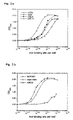
- Functional ELISA;
The concentrations of the affinity purified proteins, measured by OD280 (vertical axis), refer to the molar number of binding sites per well (horizontal axis). The ELISA plates were coated with phosphocholine-BSA, and the purified phosphocholine-specific miniantibody-proteins were bound and detected by an anti-McPC603 antiserum.- (a) Comparison of various miniantibodies.
- (b) Comparison of miniantibody scHLXc with ScFV and whole IgA.
- Fig. 4
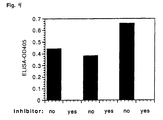
- Functional Anti-lysozyme ELISA;
PC-affinity purified samples of coexpressed anti-PC-anti-lysozyme bispecific miniantibody. + and - on the horizontal axis means: plus inhibitor (+) and without inhibitor (-). - The attached sequence listing refers to sequence identity numbers (S.I.N.):
- S.I.N. 1:
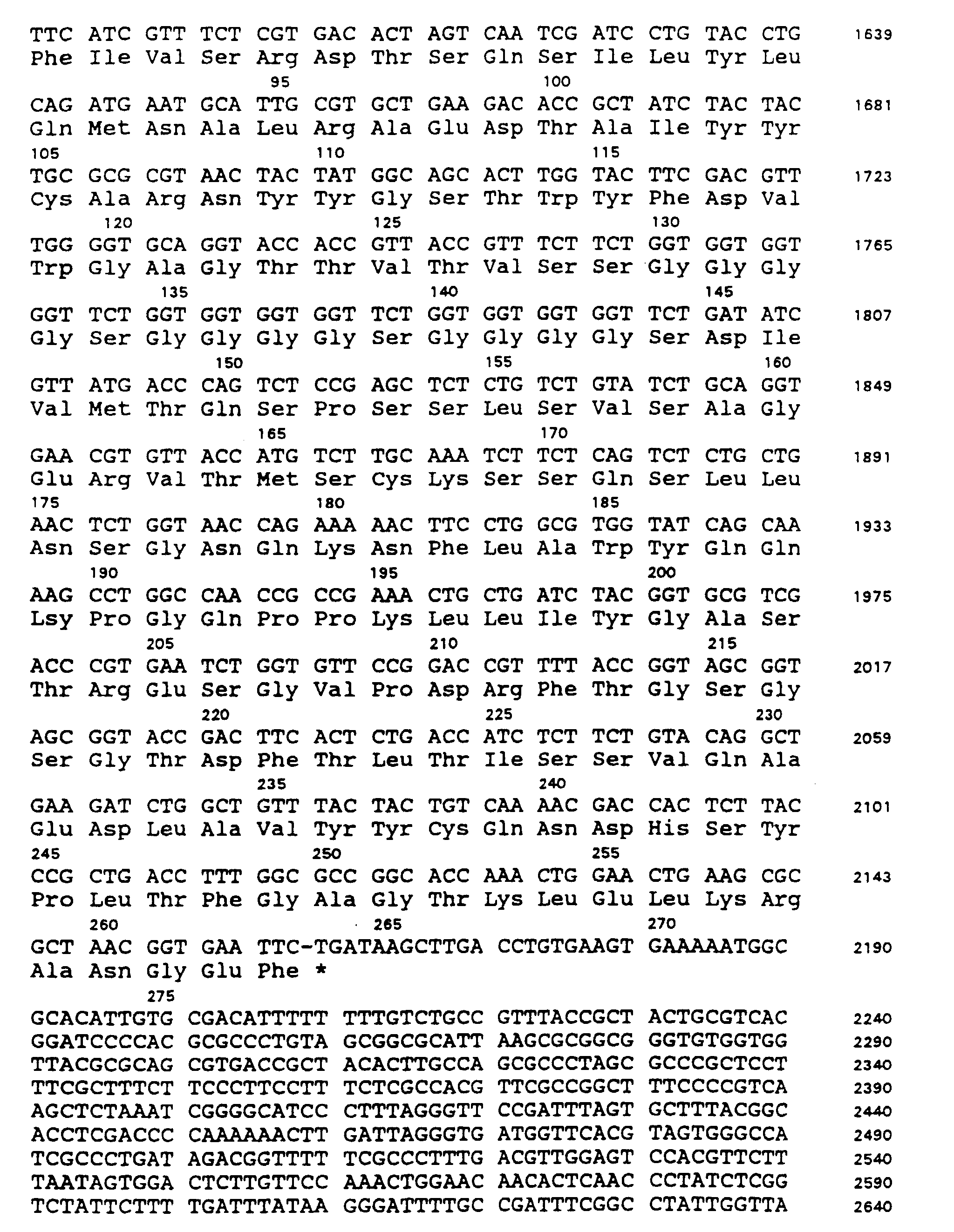
- Whole nucleotid- and amino acid sequence of the pLISC-SE vector.
- S.I.N. 2:
- Gene cassette of intercalating GCN4-leucine zipper (nucleotid- and amino acid sequence).
- S.I.N. 3:
- Gene cassette encoding intercalating antiparallel helix-turn-helix (nucleotid- and amino acid sequence).
- S.I.N. 4:
- Gene cassette encoding intercalating jun-zipper and IgG3-hinge region.
- S.I.N. 5:
- Gene cassette encoding intercalating fos-zipper and IgG3-hinge region.
- S.I.N. 6:
- Gene cassette encoding intercalating jun-zipper and designed linker.
- S.I.N. 7:
- Gene cassette encoding intercalating fos-zipper and designed linker.
- Recombinant DNA-techniques were based on Sambrook et al. (1989, Molecular Cloning: A laboratory manual. Second edition. Cold Spring Harbor Laboratory, New York). Functional expression of the single-chain Fv fragments and the miniantibodies in E. coli JM83 was carried out with vectors similar to pASK-lisc (Skerra et al., 1991, Protein Eng. 4, 971). Site directed mutagenesis was directly performed in these vectors according to Kunkel et al. (1987, Meth. Enzymol. 154, 367-382) and Geisselsoder et al. (1987, Biotechniques 5, 786-791) using the helper phage M13K07 (Vieira & Messing, 1987, Meth. Enzymol. 153, 3-11). SDS-PAGE was carried out as described by Fling and Gregerson (1986, Anal. Biochem. 155, 83-88). Concentrations of affinity-purified proteins were measured by OD280 using calculated extinction coefficients (Gill & von Hippel, 1989, Anal. Biochem. 182, 319-326).A vector such as pASK40 (Skerra et al., 1991, Protein Eng. 4, 971) is used, which contains an origin of replication, a regulatable promotor, a bacterial signal sequence followed by a multiple cloning site, a transcription terminator and an origin for single stranded phages.The gene for the single-chain Fv fragment is designed as follows: The nucleotide sequence of a VH domain is directly followed by a linker sequence encoding preferably about 15 residues, preferably of the sequence (Gly4Ser)3, followed directly by the sequence of the VL domain. Alternatively, the sequence of the VL domain may be directly followed by the sequence of the linker, followed by the sequence of the VH domain.
- If the antibody is of known sequence, the complete gene of the scFv fragment may be assembled from synthetic oligonucleotides. A detailed experimental procedure for such a gene synthesis of an antibody gene is e.g. given in Plückthun et al. (1987, Cold Spring Harbor Symp. Quant. Biol. 52, 105-112).
- If the genes of the VH and VL domains are present in other vectors, the gene for the scFv fragment may be assembled from restriction fragments. For example, a restriction fragment encoding most of the VH domain may be excised from another plasmid, and a fragment encoding most of the VL domain may be excised from a plasmid. The remaining pieces of VL and VH and the linker for the scFv fragment can be provided by cassettes of synthetic oligonucleotides, which need to be ligated by standard methodology (Sambrook et al., 1989, literature cited). The mixture of fragments is ligated into the vector pASK40 or a similar plasmid containing a pair of suitable restriction sites.
- If the genes of the antibody have not been cloned before, they may be directly obtained from the hybridoma cell producing the antibody by the polymerase chain reaction (PCR; PCR methodology is described in McPherson et al., 1991, PCR-A Practical Approach Oxford University Press, New York). Primers suitable for amplification of VH and VL domains have been given by Orlandi et al., 1989, Proc. Natl. Acad. Sci. USA 86, 3833-3837; Huse et al., 1989, Science 246, 1275-1281; Larrick et al., 1989, Bio-technology 7, 934-938. The methodology of obtaining mRNA from hybridoma is described in these references as well. The separate VH and VL genes may be cloned into separate vectors, and the scFv gene assembled according to the principles explained above.
- If the ligated fragments do not result in a correct reading frame of the scFv fragment, a precise fusion with the signal sequence codons resident on the plasmid may be generated by site directed mutagenesis. The design of the oligonucleotides and the execution is possible for anyone skilled in the art.
- The scFv expression plasmid so obtained contains the codons for a bacterial signal sequence, directly followed by the first variable domain (VH or VL), a linker and the second variable domain (VL or VH) under the control of a regulatable promotor.
- At the 3' end of this genes, corresponding to the C-terminus of the scFv protein, a unique restriction site is introduced into the expression plasmid to allow insertion of cassettes coding for the intercalating peptides. The restriction site is introduced by site directed mutagenesis using the method of Kunkel (1987, Meth. Enzymol. 154, 367-382).
- An example of the complete sequence of a suitable single-chain Fv expression plasmid pLISC-SE for receiving an intercalation peptide is shown in Fig. 1 and Sequence Identity No. (S.I.N.) 1 (see Squence Listing).
- The gene cassette, fitted with restriction sites to be compatible with the restriction site at the 3' end of the scFv fragment gene, must encode the sequence of a hinge (connection the scFv fragment to the intercalating peptide) and the intercalation peptide itself. The hinge region, may however also be obmitted.
As an example the sequence of the upper hinge region of mouse IgG3 (Dangl et al., 1988, EMBO J. 7, 1989-1994), followed by the sequence of the leucine zipper sequence of the yeast protein GCN4 (Oas et al., 1990, Biochemistry T29, 2891-2894), is back-translated into frequently used E. coli codons (S.I.N.: 2). Oligonucleotides are synthesized, and ligated into the vector pLISC-SE, previously digested with EcoRI and Hind III. - Analogous to Example 2, the sequence of the upper hinge region of mouse IgG3, followed by the sequence of the helix-turn-helix of a four helix bundle (Eisenberg et al., 1986, literature cited) is backtranslated into frequently used E. coli codons (S.I.N.: 3) . Oligonucleotides are synthesized, and ligated into the vector pLISC-SE, previously digested with Eco RI and Hind III.
- Analogous to Example 2, the sequence of the upper hinge region of mouse IgG3 followed by the sequence of the zipper sequence of the jun protein (O'Shea et al., 1992, literature cited), is backtranslated into frequently used E. coli codons (S.I.N.: 4). Oligonucleotides are synthesized, and ligated into the vector pLISC-SE, previously digested with EcoRI and Hind III.
- In a parallel reaction, the sequence of the upper hinge region of mouse IgG3, followed by the sequence of the zipper sequence of the fos protein (O'Shea et al., 1992, Cell 68, 699-708), is backtranslated into frequently used E. coli codons (S.I.N.: 5). Oligonucleotides are synthesized, and ligated into the vector pLISC-SE, previously digested with Eco RI and Hind III.The two vectors thus each code for a different antibody scFv fragment, followed by a hinge peptide and a different leucine zipper peptide. To co-express the two scFv fragments, the whole scFv-hinge-zipper gene of the fos-containing product is excised from the vector as a Xba I-Hind III fragment and ligated into the vector, pLISC-SE-scFv-jun, containing already the scFv gene of the other antibody.
The newly obtained vector then expresses the scFv1-linker1-fos-zipper and the scFv2-linker2-jun-zipper from a single promoter as a dicistronic operon. - An improved sequence for the hinge region in the context of fos and jun zippers is given in S.I.N.: 6 and 7. This hinge is shorter and therefore not as susceptible to proteolysis. In cases, where the distance between the two binding sites is of less importance, such shortened hinges may be advantageous. In this case, the "tail" of the scFv fragment has been shortened and the EcoRI site, which receive the genes for the intercalating peptides has been moved four residues upstream.
- E. coli JM83, harboring a plasmid constructed as in examples II and III, are grown to an O.D. 550 of 0.5 and induced with IPTG at a final concentration of 1 mM. The cells are centrifuged, resuspended in BBS buffer ( 200 mM Na-borate, 160 mM NaCl, pH 8.0) and the suspension is passed through a French press. In these examples, a phosphorylcholine binding miniantibody is used. The miniantibody is purified by passage over a phosphorylcholine affinity chromatography as described (Chesebro and Metzger, 1972,
Biochemistry 11, 766-771). - E. coli JM83, harboring a plasmid constructed as in examples II and III and containing a dicistronic structural gene for two different scFv (Fig. 2), are grown to an O.D. 550 of 0.5 and induced with IPTG at a final concentration of 1mM. The cells are centrifuged, resuspended in BBS buffer (200 mM Na-borate, 160 mM NaCl, pH 8.0) and the suspension is passed through a French press.
In this example, a bispecific miniantibody is used containing both a specificity for phosphorylcholine as well as benzoylampicillin. The miniantibody is purified by passage over a phosphorylcholine affinity chromatography as described (Chesebro and Metzger, 1972, literature cited). - The ELISA-plates (Nunc, Macrosorp) were coated with 400 ∼g/ml phosphocholine-BSA in PBS buffer (20 mM phosphate, pH 7.2, 115 mM NaCl). The hapten reagent was prepared from nitrophenyl phosphocholine (Sigma), which was reduced and diazotized essentially as described (Chesebro & Metzger, 1972, literature cited), and reacted by azo-coupling to BSA (Sigma) in borate-saline buffer (52.5 mM sodium borate, pH 9, 120 mM NaCl) at 4∼C for 48 hours with subsequent dialysis against PBS. After blocking the non-coated plate surface with 5% skim milk (Nestle) in PBS buffer for at least 2 hours, the periplasmic extract or the purified protein was incubated in BBS buffer on the plate for 90 min at room temperature. After thorough washing (3 times), remaining functional antibody fragments were detected according standard procedures (Harlow & Lane, 1988, "Antibodies, A Laboratory Manual", Cold Spring Harbor Laboratory, 555-592) with rabbit anti-McPC603 serum and anti-rabbit immunoglobulin linked to peroxidase (Sigma) according to Gallati (1979, Clin. Chem. Clin. Biochem. 17, 1-4).
- An enormous gain in binding, and thus sensitivity, is observed for all miniantibody constructs, compared to the monomeric scFv fragment. This is consistent with the simultaneous binding of two or even more binding sites to the same surface. These avidity of the fusion protein scHLXc was comparable to the natural antibody McPC603, which could be detected with antigen-coated ELISA, while the monomeric scFv fragment could only be detected with hundred-fold higher concentrations (Fig. 3 a, b) . All binding is nearly totally inhibitible with soluble hapten, except of the monomeric scFv fragment. The thermodynamic affinity of the natural antibody to soluble phosphocholine is about 1.6 $ 105 M-1 and thus relatively weak (Metzger et al., 1971, Proceedings of the I st Congress of Imunology. Academic Press, New York, pp. 253-267), and this is apparently not sufficient for a monomeric fragment-hapten complex to survive the repeated washing steps of a functional ELISA (Kemeny & Challacombe, 1988, "ELISA and other solid phase immunoassays", Wiley & Sons, New York).
- Coexpressed bifunctional miniantibodies recognizing phosphorylcholine with one arm and lysozyme with the other arm were purified by phosphocholine (PC) affinity chromatography and tested for lysozyme specificity. An ELISA-plate was coated with lysozyme, the ELISA was carried out as described in Example VII.Three different preparations show binding to the antigen-surface, which is completely inhibitible with soluble lysozyme (Fig. 4).
-



Claims (24)
- Monomeric antibody-fragment fusion protein consisting of a Fv-fragment of an antibody and a peptide which is capable to dimerize with another peptide by noncovalent interaction.
- Monomer according to claim 1 characterized in that the Fv-fragment is a single chain fragment.
- Monomer according to claim 1 or 2 characterized in that the interactive peptide consists of 10 to 50, preferrably 10 to 30 amino acids.
- Monomer according to one of the claims 1 or 3 characterized in that the peptide consists of at least one helix.
- Monomer according to claim 4 characterized in that the helix peptide consists of a helix, a turn and another helix.
- Monomer according to claims 4 characterized in that the peptide contains a leucine zipper molecule, having several repeating amino acids, in which every seventh amino acid is a leucine.
- Monomer according to claims 4 characterized in that the peptide bears charged residues.
- Monomer according one of the claims 1 to 7 characterized in that a linking peptide is between the Fv-fragment and the peptide.
- Monomer according to claim 8 characterized in that the linking peptide is a hinge region sequence of an antibody or a fragment thereof.
- Process for preparation of a monomeric antibody fusion protein as defined in claims 1 to 9, characterized in that the genes coding for the Fv-fragment, the interactive peptide and, if desired, the linking peptide are cloned into one expression plasmid, a host cell is transformed with said expression plasmid and cultivated in a nutrient solution, and the monomeric fusion protein is expressed in the cell or secreted into the medium.
- Process according to claim 10 characterized in that the host cell is E. coli.
- Dimeric fusion protein consisting of two monomeric fusion proteins, wherein the linkage of the monomeric units bases on noncovalent interaction of identical or different peptides, characterized in that at least one monomeric unit is an antibody-fragment fusion protein as defined in claims 1 to 9.
- Dimeric fusion protein according to claim 12 wherein the interactive peptides are the same.
- Dimer according to claim 12 or 13 characterized in that the second monomeric unit is an antibody-fragment fusion protein as defined in claims 1 to 9 having different specificity.
- Dimer according to claim 12 or 13 characterized in that the second monomeric unit is a fusion protein as defined in claims 1 to 9, wherein the antibody-fragment (Fv) is replaced by a non-antibody protein or peptide.
- Dimer according to claim 15 characterized in that the protein or peptide is a toxin, a chelator peptide, a metal binding protein or an enzyme, or has the corresponding specific binding site.
- Dimer according to claim 15 characterized in that the protein or peptide has a T-cell-, or a T-cell fragment specific binding site.
- Dimer according to one of the claims 12 to 17, wherein another protein is fused at the C-terminus of one or both of the intercalating peptides.
- Dimer according to claim 18, wherein the fused protein is a toxin, a chelator peptide, a metal binding protein or an enzyme, or has the corresponding specific binding site, or has a T-cell (fragment) specific binding site.
- Process for preparation of a dimeric fusion proteinas defined in claims 12 to 19 characterized in that the genes coding for the complete monomeric fusion proteins or parts of it are cloned at least into one expression plasmid, a host cell is transformed with said expression plasmid(s) and cultivated in a nutrient solution, and either the complete dimeric fusion protein is expressed in the cell or into the medium, or the monomeric fusion proteins are separately expressed and the noncovalent linkage between the two monomeric units is performed in the medium or in vitro, and in the case that only parts of the fusion proteins were cloned protein engineering steps are additionally performed.
- Process according to claim 20 characterized in that the gene coding for the first monomeric fusion protein is cloned into a first expression plasmid, and the gene coding for the second monomeric fusion protein is cloned into a second expression plasmid.
- Process according to claim 20 characterized in that the noncovalent linkage between the monomeric units forming the dimeric fusion protein is performed in vitro.
- Process according to one of the claims 20 to 22 characterized in that the host cell is E. coli.
- Construction kit for preparation of seletive dimers of antibody-fragment fusion proteins as defined in claims 12 to 19 containing(a) a monomeric antibody-fragment fusion protein as defined in claims 1 to 8, and (b) a second monomeric fusion protein as defined in (a), wherein the antibody fragment has the same or another antigen specificity, or wherein the antibody fragment unit is replaced by a non-antibody protein/peptide.
Priority Applications (1)
| Application Number | Priority Date | Filing Date | Title |
|---|---|---|---|
| EP93902206A EP0654085B1 (en) | 1992-01-23 | 1993-01-15 | Monomeric and dimeric antibody-fragment fusion proteins |
Applications Claiming Priority (4)
| Application Number | Priority Date | Filing Date | Title |
|---|---|---|---|
| EP92101069 | 1992-01-23 | ||
| EP92101069 | 1992-01-23 | ||
| EP93902206A EP0654085B1 (en) | 1992-01-23 | 1993-01-15 | Monomeric and dimeric antibody-fragment fusion proteins |
| PCT/EP1993/000082 WO1993015210A1 (en) | 1992-01-23 | 1993-01-15 | Monomeric and dimeric antibody-fragment fusion proteins |
Publications (2)
| Publication Number | Publication Date |
|---|---|
| EP0654085A1 EP0654085A1 (en) | 1995-05-24 |
| EP0654085B1 true EP0654085B1 (en) | 1997-04-02 |
Family
ID=8209260
Family Applications (1)
| Application Number | Title | Priority Date | Filing Date |
|---|---|---|---|
| EP93902206A Expired - Lifetime EP0654085B1 (en) | 1992-01-23 | 1993-01-15 | Monomeric and dimeric antibody-fragment fusion proteins |
Country Status (16)
| Country | Link |
|---|---|
| US (1) | US5910573A (en) |
| EP (1) | EP0654085B1 (en) |
| JP (2) | JP3490437B2 (en) |
| KR (1) | KR100254759B1 (en) |
| AT (1) | ATE151113T1 (en) |
| AU (1) | AU676150B2 (en) |
| CA (1) | CA2128511C (en) |
| CZ (1) | CZ287296B6 (en) |
| DE (1) | DE69309472T2 (en) |
| DK (1) | DK0654085T3 (en) |
| ES (1) | ES2102007T3 (en) |
| GR (1) | GR3023860T3 (en) |
| HU (1) | HU215180B (en) |
| NO (1) | NO942750L (en) |
| RU (1) | RU2128709C1 (en) |
| WO (1) | WO1993015210A1 (en) |
Cited By (2)
| Publication number | Priority date | Publication date | Assignee | Title |
|---|---|---|---|---|
| US7696324B2 (en) | 1998-11-30 | 2010-04-13 | Perlan Therapeutics, Inc. | Humanized antibodies |
| US8394771B1 (en) | 2001-07-19 | 2013-03-12 | Perlan Therapeutics, Inc. | Multimeric proteins and methods of making and using same |
Families Citing this family (249)
| Publication number | Priority date | Publication date | Assignee | Title |
|---|---|---|---|---|
| US6416738B1 (en) | 1973-12-07 | 2002-07-09 | Neorx Corporation | Pretargeting methods and compounds |
| US6075010A (en) * | 1992-06-09 | 2000-06-13 | Neorx Corporation | Small molecular weight ligand-hexose containing clearing agents |
| US5576195A (en) * | 1985-11-01 | 1996-11-19 | Xoma Corporation | Vectors with pectate lyase signal sequence |
| US5618920A (en) * | 1985-11-01 | 1997-04-08 | Xoma Corporation | Modular assembly of antibody genes, antibodies prepared thereby and use |
| US5869620A (en) * | 1986-09-02 | 1999-02-09 | Enzon, Inc. | Multivalent antigen-binding proteins |
| US6027725A (en) * | 1991-11-25 | 2000-02-22 | Enzon, Inc. | Multivalent antigen-binding proteins |
| WO1993016185A2 (en) * | 1992-02-06 | 1993-08-19 | Creative Biomolecules, Inc. | Biosynthetic binding protein for cancer marker |
| US6217869B1 (en) | 1992-06-09 | 2001-04-17 | Neorx Corporation | Pretargeting methods and compounds |
| US6358490B2 (en) | 1992-06-09 | 2002-03-19 | Neorx Corporation | Three-step pretargeting methods and compounds |
| US5911969A (en) | 1992-06-09 | 1999-06-15 | Neorx Corporation | Pretargeting protocols for enhanced localization of active agents to target sites |
| US6329507B1 (en) * | 1992-08-21 | 2001-12-11 | The Dow Chemical Company | Dimer and multimer forms of single chain polypeptides |
| AU5670194A (en) * | 1992-11-20 | 1994-06-22 | Enzon, Inc. | Linker for linked fusion polypeptides |
| GB9225453D0 (en) | 1992-12-04 | 1993-01-27 | Medical Res Council | Binding proteins |
| WO1995015978A1 (en) * | 1993-12-07 | 1995-06-15 | Neorx Corporation | Pretargeting methods and compounds |
| US6015897A (en) * | 1993-12-07 | 2000-01-18 | Neorx Corporation | Biotinamido-n-methylglycyl-seryl-o-succinamido-benzyl dota |
| US20050214309A1 (en) * | 1994-03-18 | 2005-09-29 | Hinrichs Steven H | Methods and compositions for modulating transcription factor activity |
| SE9401460D0 (en) * | 1994-04-28 | 1994-04-28 | Ferring Ab | Antigen / antibody specificity exhanger |
| US6660842B1 (en) | 1994-04-28 | 2003-12-09 | Tripep Ab | Ligand/receptor specificity exchangers that redirect antibodies to receptors on a pathogen |
| US6040137A (en) | 1995-04-27 | 2000-03-21 | Tripep Ab | Antigen/antibody specification exchanger |
| US6933366B2 (en) | 1996-12-27 | 2005-08-23 | Tripep Ab | Specificity exchangers that redirect antibodies to bacterial adhesion receptors |
| JP3659261B2 (en) * | 1994-10-20 | 2005-06-15 | モルフォシス・アクチェンゲゼルシャフト | Targeted heterojunction of a recombinant protein to a multifunctional complex |
| US6908903B1 (en) | 1994-12-07 | 2005-06-21 | Aletheon Pharmaceuticals, Inc. | Cluster clearing agents |
| US6172045B1 (en) | 1994-12-07 | 2001-01-09 | Neorx Corporation | Cluster clearing agents |
| US7399837B2 (en) | 1995-12-22 | 2008-07-15 | Smithkline Beecham Corporation | Recombinant IL-5 antagonists useful in treatment of IL-5 mediated disorders |
| US5683892A (en) * | 1994-12-23 | 1997-11-04 | Smithkline Beecham Corporation | DNA encoding recombinant IL-5 antagonists useful in treatment of IL-5 mediated disorders |
| ATE274064T1 (en) * | 1995-05-23 | 2004-09-15 | Morphosys Ag | MULTIMER PROTEINS |
| GB9718358D0 (en) * | 1997-08-30 | 1997-11-05 | Univ Leeds | Chemical modification |
| US7105307B2 (en) | 1997-08-30 | 2006-09-12 | Cyclacel, Ltd. | Compositions and methods for screening for modulators of enzymatic activity |
| EP1039931B1 (en) * | 1997-12-01 | 2005-04-27 | Fang Fang | Multivalent recombinant antibodies for treating hrv infections |
| US6204537B1 (en) | 1998-10-01 | 2001-03-20 | Micron Technology, Inc. | ESD protection scheme |
| US20040009535A1 (en) | 1998-11-27 | 2004-01-15 | Celltech R&D, Inc. | Compositions and methods for increasing bone mineralization |
| US6432673B1 (en) * | 1998-12-07 | 2002-08-13 | Zymogenetics, Inc. | Growth factor homolog ZVEGF3 |
| US7550143B2 (en) * | 2005-04-06 | 2009-06-23 | Ibc Pharmaceuticals, Inc. | Methods for generating stably linked complexes composed of homodimers, homotetramers or dimers of dimers and uses |
| SK782002A3 (en) | 1999-07-21 | 2003-08-05 | Lexigen Pharm Corp | FC fusion proteins for enhancing the immunogenicity of protein and peptide antigens |
| BR0013231A (en) * | 1999-08-09 | 2002-07-23 | Lexigen Pharm Corp | Multiple cytokine-antibody complexes |
| US20030143234A1 (en) * | 1999-08-20 | 2003-07-31 | Wenyuan Shi | Anti-microbial targeting chimeric pharmaceutical |
| US7569542B2 (en) | 1999-08-20 | 2009-08-04 | The Regents Of The University Of California | Anti-microbial targeting chimeric pharmaceutical |
| PL362324A1 (en) * | 2001-02-19 | 2004-10-18 | Merck Patent Gmbh | Artificial fusion proteins with reduced immunogenicity |
| CA2450793A1 (en) * | 2001-06-20 | 2002-12-27 | Prochon Biotech Ltd. | Antibodies that block receptor protein tyrosine kinase activation, methods of screening for and uses thereof |
| US7022323B2 (en) | 2001-06-26 | 2006-04-04 | Progenics Pharmaceuticals, Inc. | Uses of DC-SIGN and DC-SIGNR for inhibiting hepatitis C virus infection |
| DE10133071A1 (en) * | 2001-07-07 | 2003-03-06 | Alexander Cherkasky | New compound containing protease and a recognition component, useful for treating diseases associated with specific proteins, e.g. multiple sclerosis |
| US6833441B2 (en) * | 2001-08-01 | 2004-12-21 | Abmaxis, Inc. | Compositions and methods for generating chimeric heteromultimers |
| AU2002332598A1 (en) | 2001-08-22 | 2003-03-10 | Shengfeng Li | Compositions and methods for generating antigen-binding units |
| US7175983B2 (en) * | 2001-11-02 | 2007-02-13 | Abmaxis, Inc. | Adapter-directed display systems |
| US20050069549A1 (en) | 2002-01-14 | 2005-03-31 | William Herman | Targeted ligands |
| US7335359B2 (en) | 2003-02-06 | 2008-02-26 | Tripep Ab | Glycosylated specificity exchangers |
| KR20050099536A (en) | 2003-02-06 | 2005-10-13 | 트리펩 아베 | Glycosylated specificity exchangers |
| ES2333598T5 (en) * | 2003-05-06 | 2013-09-04 | Biogen Idec Hemophilia Inc | CHEMICAL PROTEINS OF FC COAGULATION FACTOR TO TREAT HEMOPHILIA. |
| US7348004B2 (en) * | 2003-05-06 | 2008-03-25 | Syntonix Pharmaceuticals, Inc. | Immunoglobulin chimeric monomer-dimer hybrids |
| TWI353991B (en) | 2003-05-06 | 2011-12-11 | Syntonix Pharmaceuticals Inc | Immunoglobulin chimeric monomer-dimer hybrids |
| AU2004238263A1 (en) * | 2003-05-06 | 2004-11-25 | Syntonix Pharmaceuticals, Inc. | Inhibition of drug binding to serum albumin |
| US9481878B2 (en) | 2004-02-13 | 2016-11-01 | Immunomedics, Inc. | Compositions and methods of use of immunotoxins comprising ranpirnase (Rap) show potent cytotoxic activity |
| US8551480B2 (en) * | 2004-02-13 | 2013-10-08 | Immunomedics, Inc. | Compositions and methods of use of immunotoxins comprising ranpirnase (Rap) show potent cytotoxic activity |
| US7875598B2 (en) * | 2004-03-04 | 2011-01-25 | The Regents Of The University Of California | Compositions useful for the treatment of microbial infections |
| US8067008B2 (en) | 2004-08-23 | 2011-11-29 | Yeda Research And Development Co. | Peptide inhibitors for mediating stress responses |
| US20090175866A1 (en) * | 2004-11-04 | 2009-07-09 | Avner Yayon | Treatment of b-cell malignancies |
| US20120276100A1 (en) * | 2005-04-06 | 2012-11-01 | Ibc Pharmaceuticals, Inc. | Compositions and Methods of Use of Immunotoxins Comprising Ranpirnase (Rap) Show Potent Cytotoxic Activity |
| WO2006117782A2 (en) * | 2005-05-04 | 2006-11-09 | Quark Pharmaceuticals, Inc. | Recombinant antibodies against cd55 and cd59 and uses thereof |
| WO2006129843A2 (en) * | 2005-05-31 | 2006-12-07 | Canon Kabushiki Kaisha | Bispecific capturing molecule |
| KR100832773B1 (en) | 2005-11-18 | 2008-05-27 | 주식회사 아이지세라피 | How to prepare functional FV antibody fragments |
| EP2005185B1 (en) | 2006-03-22 | 2010-10-20 | Viral Logic Systems Technology Corp. | Methods for identifying polypeptide targets |
| HRP20160990T1 (en) | 2006-03-24 | 2016-10-07 | Biogen Hemophilia Inc. | Pc5 as a factor ix propeptide processing enzyme |
| US20080131431A1 (en) * | 2006-05-15 | 2008-06-05 | Viral Logic Systems Technology Corp. | CD47 related compositions and methods for treating immunological diseases and disorders |
| US8377448B2 (en) * | 2006-05-15 | 2013-02-19 | The Board Of Trustees Of The Leland Standford Junior University | CD47 related compositions and methods for treating immunological diseases and disorders |
| WO2007144893A2 (en) * | 2006-06-15 | 2007-12-21 | Fibron Ltd. | Antibodies blocking fibroblast growth factor receptor activation and methods of use thereof |
| DK2059533T3 (en) | 2006-08-30 | 2013-02-25 | Genentech Inc | MULTI-SPECIFIC ANTIBODIES |
| AU2007292221B2 (en) | 2006-09-06 | 2013-08-29 | The Regents Of The University Of California | Selectively targeted antimicrobial peptides and the use thereof |
| EP2072527A1 (en) | 2007-12-21 | 2009-06-24 | Altonabiotec AG | Fusion polypeptides comprising a SHBG dimerization component and uses thereof |
| JP5917143B2 (en) | 2008-03-28 | 2016-05-11 | グラクソスミスクライン・リミテッド・ライアビリティ・カンパニーGlaxoSmithKline LLC | Treatment method |
| RU2547596C2 (en) | 2008-09-03 | 2015-04-10 | Дженентек, Инк. | Polyspecific antibodies |
| TWI513466B (en) * | 2010-01-20 | 2015-12-21 | Boehringer Ingelheim Int | Anticoagulant antidotes |
| US20130245233A1 (en) | 2010-11-24 | 2013-09-19 | Ming Lei | Multispecific Molecules |
| PE20140964A1 (en) | 2011-03-30 | 2014-08-17 | Boehringer Ingelheim Int | ANTICOAGULANT ANTIDOTES |
| US20140088017A1 (en) | 2011-05-23 | 2014-03-27 | Yeda Research And Development Co., Ltd. | Use of akt phosphorylation as a biomarker for prognosing neurodegenerative diseases and treating same |
| WO2013054320A1 (en) | 2011-10-11 | 2013-04-18 | Tel Hashomer Medical Research Infrastructure And Services Ltd. | Antibodies to carcinoembryonic antigen-related cell adhesion molecule (ceacam) |
| WO2013078425A1 (en) * | 2011-11-22 | 2013-05-30 | University Of Maryland, Baltimore | Lambodies with high affinity and selectivity for glycans and uses therefor |
| CN108034006A (en) | 2012-01-13 | 2018-05-15 | 乌利班-马克西姆利安大学 | The difunctional complementation of double antigen inductions |
| EP3492095A1 (en) | 2012-04-01 | 2019-06-05 | Technion Research & Development Foundation Limited | Extracellular matrix metalloproteinase inducer (emmprin) peptides and binding antibodies |
| TWI828269B (en) | 2013-03-15 | 2024-01-01 | 美商百歐維拉提夫治療公司 | Factor ix polypeptide formulations |
| EP3027204B1 (en) | 2013-07-29 | 2022-01-05 | 2seventy bio, Inc. | Multipartite signaling proteins and uses thereof |
| US9243294B2 (en) | 2013-09-30 | 2016-01-26 | Hadasit Medical Research Services And Development Ltd. | Modulation of NLGn4 expression, NK cell activity in non-alcoholic fatty liver disease (NAFLD) |
| RU2697522C1 (en) | 2013-11-25 | 2019-08-15 | СиСиЭйЭм БАЙОТЕРАПЬЮТИКС ЛТД. | Compositions containing anti-seams 1 and anti-pd antibodies for cancer therapy |
| CA2935423C (en) | 2014-01-24 | 2023-11-07 | Dana-Farber Cancer Institute, Inc. | Antibody molecules to pd-1 and uses thereof |
| SG11201606239UA (en) | 2014-01-28 | 2016-08-30 | Buck Inst For Res On Aging | Methods and compositions for killing senescent cells and for treating senescence-associated diseases and disorders |
| AU2015210750B2 (en) | 2014-01-31 | 2020-08-20 | Children's Medical Center Corporation | Antibody molecules to TIM-3 and uses thereof |
| WO2015138920A1 (en) | 2014-03-14 | 2015-09-17 | Novartis Ag | Antibody molecules to lag-3 and uses thereof |
| EP3593812A3 (en) | 2014-03-15 | 2020-05-27 | Novartis AG | Treatment of cancer using chimeric antigen receptor |
| US20170174764A1 (en) | 2014-03-27 | 2017-06-22 | Yeda Research And Development Co. Ltd. | T-cell receptor cdr3 peptides and antibodies |
| MX366359B (en) | 2014-04-27 | 2019-07-05 | Ccam Biotherapeutics Ltd | Humanized antibodies against ceacam1. |
| US11427647B2 (en) | 2014-04-27 | 2022-08-30 | Famewave Ltd. | Polynucleotides encoding humanized antibodies against CEACAM1 |
| JP2016002009A (en) * | 2014-06-13 | 2016-01-12 | 国立大学法人名古屋大学 | Tagged antibody |
| US9777061B2 (en) | 2014-07-21 | 2017-10-03 | Novartis Ag | Treatment of cancer using a CD33 chimeric antigen receptor |
| US11542488B2 (en) | 2014-07-21 | 2023-01-03 | Novartis Ag | Sortase synthesized chimeric antigen receptors |
| MY181834A (en) | 2014-07-21 | 2021-01-08 | Novartis Ag | Treatment of cancer using humanized anti-bcma chimeric antigen receptor |
| WO2016014530A1 (en) | 2014-07-21 | 2016-01-28 | Novartis Ag | Combinations of low, immune enhancing. doses of mtor inhibitors and cars |
| US20170209492A1 (en) | 2014-07-31 | 2017-07-27 | Novartis Ag | Subset-optimized chimeric antigen receptor-containing t-cells |
| WO2016025880A1 (en) | 2014-08-14 | 2016-02-18 | Novartis Ag | Treatment of cancer using gfr alpha-4 chimeric antigen receptor |
| SG11201700770PA (en) | 2014-08-19 | 2017-03-30 | Novartis Ag | Anti-cd123 chimeric antigen receptor (car) for use in cancer treatment |
| ES2891332T3 (en) | 2014-09-17 | 2022-01-27 | Novartis Ag | Targeting cytotoxic cells with chimeric receptors for adoptive immunotherapy |
| WO2016061142A1 (en) | 2014-10-14 | 2016-04-21 | Novartis Ag | Antibody molecules to pd-l1 and uses thereof |
| US20180334490A1 (en) | 2014-12-03 | 2018-11-22 | Qilong H. Wu | Methods for b cell preconditioning in car therapy |
| WO2016157195A1 (en) | 2015-04-01 | 2016-10-06 | Hadasit Medical Research Services And Development Ltd. | Inhibitors of neuroligin 4 - neurexin 1-beta protein-protein interaction for treatment of liver disorders |
| MX2017012939A (en) | 2015-04-08 | 2018-05-22 | Novartis Ag | CD20 THERAPIES, CD22 THERAPIES AND COMBINATION THERAPIES WITH A CELL THAT EXPRESSES AN ANTIGEN (CAR) CHEMICAL RECEIVER OF CD19. |
| EP3286211A1 (en) | 2015-04-23 | 2018-02-28 | Novartis AG | Treatment of cancer using chimeric antigen receptor and protein kinase a blocker |
| ES2878188T3 (en) | 2015-07-29 | 2021-11-18 | Novartis Ag | Combination therapies comprising antibody molecules against LAG-3 |
| WO2017019897A1 (en) | 2015-07-29 | 2017-02-02 | Novartis Ag | Combination therapies comprising antibody molecules to tim-3 |
| EP4378957A3 (en) | 2015-07-29 | 2024-08-07 | Novartis AG | Combination therapies comprising antibody molecules to pd-1 |
| EP3344658B1 (en) | 2015-09-02 | 2022-05-11 | Yissum Research Development Company of The Hebrew University of Jerusalem Ltd. | Antibodies specific to human t-cell immunoglobulin and itim domain (tigit) |
| EP3362093A4 (en) | 2015-10-13 | 2019-05-08 | Technion Research & Development Foundation Limited | MONOCLONAL ANTIBODIES NEUTRALIZING HEPARANASE |
| RU2018125603A (en) | 2015-12-17 | 2020-01-21 | Новартис Аг | COMBINATION OF C-MET INHIBITOR WITH ANTIBODY MOLECULE TO PD-1 AND ITS APPLICATIONS |
| EP3389712B1 (en) | 2015-12-17 | 2024-04-10 | Novartis AG | Antibody molecules to pd-1 and uses thereof |
| PT3393504T (en) | 2015-12-22 | 2025-12-30 | Novartis Ag | Mesothelin chimeric antigen receptor (CAR) and anti-PD-L1 inhibitor antibody for combined use in anticancer therapy. |
| EP3405492B1 (en) | 2016-01-21 | 2020-10-21 | Novartis AG | Multispecific molecules targeting cll-1 |
| KR20250065434A (en) | 2016-03-01 | 2025-05-12 | 이섬 리서치 디벨러프먼트 컴파니 오브 더 히브루 유니버시티 오브 예루살렘 엘티디. | Antibodies specific to human poliovirus receptor (pvr) |
| CA3016287A1 (en) | 2016-03-04 | 2017-09-08 | Novartis Ag | Cells expressing multiple chimeric antigen receptor (car) molecules and uses therefore |
| US11549099B2 (en) | 2016-03-23 | 2023-01-10 | Novartis Ag | Cell secreted minibodies and uses thereof |
| EP3443096B1 (en) | 2016-04-15 | 2023-03-01 | Novartis AG | Compositions and methods for selective expression of chimeric antigen receptors |
| GB201609235D0 (en) | 2016-05-25 | 2016-07-06 | Univ Cape Town | Production of a horseradish peroxidase-IGG fusion protein |
| US20210177896A1 (en) | 2016-06-02 | 2021-06-17 | Novartis Ag | Therapeutic regimens for chimeric antigen receptor (car)- expressing cells |
| SG11201900344YA (en) | 2016-07-15 | 2019-02-27 | Novartis Ag | Treatment and prevention of cytokine release syndrome using a chimeric antigen receptor in combination with a kinase inhibitor |
| CN110214150A (en) | 2016-07-28 | 2019-09-06 | 诺华股份有限公司 | Combination therapy of chimeric antigen receptor and PD-1 inhibitor |
| EP3490590A2 (en) | 2016-08-01 | 2019-06-05 | Novartis AG | Treatment of cancer using a chimeric antigen receptor in combination with an inhibitor of a pro-m2 macrophage molecule |
| WO2018067992A1 (en) | 2016-10-07 | 2018-04-12 | Novartis Ag | Chimeric antigen receptors for the treatment of cancer |
| EP3574005B1 (en) | 2017-01-26 | 2021-12-15 | Novartis AG | Cd28 compositions and methods for chimeric antigen receptor therapy |
| US20200048359A1 (en) | 2017-02-28 | 2020-02-13 | Novartis Ag | Shp inhibitor compositions and uses for chimeric antigen receptor therapy |
| US20200179511A1 (en) | 2017-04-28 | 2020-06-11 | Novartis Ag | Bcma-targeting agent, and combination therapy with a gamma secretase inhibitor |
| US20200055948A1 (en) | 2017-04-28 | 2020-02-20 | Novartis Ag | Cells expressing a bcma-targeting chimeric antigen receptor, and combination therapy with a gamma secretase inhibitor |
| WO2018226339A1 (en) | 2017-06-06 | 2018-12-13 | Glaxosmithkline Llc | Biopharmaceutical compositions and methods for pediatric patients |
| UY37758A (en) | 2017-06-12 | 2019-01-31 | Novartis Ag | METHOD OF MANUFACTURING OF BIESPECTIFIC ANTIBODIES, BISPECTIFIC ANTIBODIES AND THERAPEUTIC USE OF SUCH ANTIBODIES |
| US11312783B2 (en) | 2017-06-22 | 2022-04-26 | Novartis Ag | Antibody molecules to CD73 and uses thereof |
| US20200223924A1 (en) | 2017-06-27 | 2020-07-16 | Novartis Ag | Dosage regimens for anti-tim-3 antibodies and uses thereof |
| KR20200031659A (en) | 2017-07-20 | 2020-03-24 | 노파르티스 아게 | Dosage regimen of anti-LAG-3 antibody and use thereof |
| CN111655288A (en) | 2017-11-16 | 2020-09-11 | 诺华股份有限公司 | combination therapy |
| CN111565737A (en) | 2017-12-14 | 2020-08-21 | 蓝鸟生物公司 | DARIC Interleukin Receptor |
| BR112020012346A2 (en) * | 2017-12-22 | 2020-11-24 | Hanmi Pharm. Co., Ltd. | therapeutic enzymatic fusion protein having a new structure and use |
| WO2019139987A1 (en) | 2018-01-09 | 2019-07-18 | Elstar Therapeutics, Inc. | Calreticulin binding constructs and engineered t cells for the treatment of diseases |
| AU2019215031C1 (en) | 2018-01-31 | 2026-02-26 | Novartis Ag | Combination therapy using a chimeric antigen receptor |
| US12152073B2 (en) | 2018-03-14 | 2024-11-26 | Marengo Therapeutics, Inc. | Multifunctional molecules that bind to calreticulin and uses thereof |
| US20210147547A1 (en) | 2018-04-13 | 2021-05-20 | Novartis Ag | Dosage Regimens For Anti-Pd-L1 Antibodies And Uses Thereof |
| EP3784351A1 (en) | 2018-04-27 | 2021-03-03 | Novartis AG | Car t cell therapies with enhanced efficacy |
| WO2019215728A1 (en) | 2018-05-09 | 2019-11-14 | Yissum Research Development Company Of The Hebrew University Of Jerusalem Ltd. | Antibodies specific to human nectin4 |
| WO2019226658A1 (en) | 2018-05-21 | 2019-11-28 | Compass Therapeutics Llc | Multispecific antigen-binding compositions and methods of use |
| WO2019226617A1 (en) | 2018-05-21 | 2019-11-28 | Compass Therapeutics Llc | Compositions and methods for enhancing the killing of target cells by nk cells |
| WO2019227003A1 (en) | 2018-05-25 | 2019-11-28 | Novartis Ag | Combination therapy with chimeric antigen receptor (car) therapies |
| US20210214459A1 (en) | 2018-05-31 | 2021-07-15 | Novartis Ag | Antibody molecules to cd73 and uses thereof |
| AU2019277029C1 (en) | 2018-06-01 | 2024-01-04 | Novartis Ag | Binding molecules against BCMA and uses thereof |
| AU2019284911B2 (en) | 2018-06-13 | 2026-04-09 | Novartis Ag | BCMA chimeric antigen receptors and uses thereof |
| KR20210035173A (en) | 2018-06-19 | 2021-03-31 | 아타르가, 엘엘씨 | Antibody molecule against complement component 5 and use thereof |
| WO2020010250A2 (en) | 2018-07-03 | 2020-01-09 | Elstar Therapeutics, Inc. | Anti-tcr antibody molecules and uses thereof |
| AR116109A1 (en) | 2018-07-10 | 2021-03-31 | Novartis Ag | DERIVATIVES OF 3- (5-AMINO-1-OXOISOINDOLIN-2-IL) PIPERIDINE-2,6-DIONA AND USES OF THE SAME |
| JP2021531306A (en) | 2018-07-25 | 2021-11-18 | アドバンスド アクセラレーター アプリケーションズ エスエー | How to treat neuroendocrine tumors |
| WO2020123947A1 (en) | 2018-12-14 | 2020-06-18 | Bluebird Bio, Inc. | Dimerizing agent regulated immunoreceptor complexes |
| EP3895052A4 (en) | 2018-12-14 | 2022-10-26 | 2seventy bio, Inc. | DIMERIZING AGENT REGULATED IMMUNORECEPTOR COMPLEXES |
| WO2020128972A1 (en) | 2018-12-20 | 2020-06-25 | Novartis Ag | Dosing regimen and pharmaceutical combination comprising 3-(1-oxoisoindolin-2-yl)piperidine-2,6-dione derivatives |
| JP2022514280A (en) | 2018-12-20 | 2022-02-10 | ノバルティス アーゲー | Extended low-dose regimen for MDM2 inhibitors |
| JP7606706B2 (en) | 2019-01-13 | 2024-12-26 | イッサム リサーチ デベロップメント カンパニー オブ ザ ヘブリュー ユニバーシティー オブ エルサレム エルティーディー. | Antibody specific to human nectin-2 |
| ES3032659T3 (en) | 2019-02-15 | 2025-07-23 | Novartis Ag | 3-(1-oxo-5-(piperidin-4-yl)isoindolin-2-yl)piperidine-2,6-dione derivatives and uses thereof |
| US10871640B2 (en) | 2019-02-15 | 2020-12-22 | Perkinelmer Cellular Technologies Germany Gmbh | Methods and systems for automated imaging of three-dimensional objects |
| BR112021015672A2 (en) | 2019-02-15 | 2021-10-05 | Novartis Ag | 3-(1-OXOISOINDOLIN-2-YL)PIPERIDINE-2,6-DIONE DERIVATIVES AND USES THEREOF |
| AU2020226893B2 (en) | 2019-02-21 | 2025-02-27 | Marengo Therapeutics, Inc. | Multifunctional molecules that bind to T cell related cancer cells and uses thereof |
| GB2597851B (en) | 2019-02-21 | 2024-05-29 | Marengo Therapeutics Inc | Antibody molecules that bind to NKP30 and uses thereof |
| US20220088075A1 (en) | 2019-02-22 | 2022-03-24 | The Trustees Of The University Of Pennsylvania | Combination therapies of egfrviii chimeric antigen receptors and pd-1 inhibitors |
| JP2022527790A (en) | 2019-03-29 | 2022-06-06 | アターガ,エルエルシー | Anti-FGF23 antibody molecule |
| CA3138972A1 (en) | 2019-05-04 | 2020-11-12 | Inhibrx, Inc. | Clec12a-binding polypeptides and uses thereof |
| SG11202111927QA (en) | 2019-05-08 | 2021-11-29 | 2Seventy Bio Inc | Cll-1 targeted immunotherapies |
| CN118994397A (en) | 2019-05-21 | 2024-11-22 | 诺华股份有限公司 | Trispecific binding molecules directed against BCMA and uses thereof |
| UY38701A (en) | 2019-05-21 | 2020-12-31 | Novartis Ag | MOLECULES OF BINDING TO CD19, CONJUGATES, COMPOSITIONS THAT INCLUDE THEM AND USES OF THE SAME |
| WO2020236797A1 (en) | 2019-05-21 | 2020-11-26 | Novartis Ag | Variant cd58 domains and uses thereof |
| JP7682853B2 (en) | 2019-08-08 | 2025-05-26 | リジェネロン・ファーマシューティカルズ・インコーポレイテッド | Novel antigen-binding molecule format |
| EP4041392A1 (en) | 2019-10-08 | 2022-08-17 | Nectin Therapeutics Ltd. | Antibodies against the poliovirus receptor (pvr) and uses thereof |
| TW202128191A (en) | 2019-10-21 | 2021-08-01 | 瑞士商諾華公司 | Tim-3 inhibitors and uses thereof |
| CA3158298A1 (en) | 2019-10-21 | 2021-04-29 | Novartis Ag | Combination therapies with venetoclax and tim-3 inhibitors |
| CA3157075A1 (en) | 2019-11-05 | 2021-05-14 | Regeneron Pharmaceuticals, Inc. | N-terminal scfv multispecific binding molecules |
| EP4065158A2 (en) | 2019-11-26 | 2022-10-05 | Novartis AG | Chimeric antigen receptors binding bcma and cd19 and uses thereof |
| IL293978A (en) | 2019-12-20 | 2022-08-01 | Regeneron Pharma | Novel il2 agonists and methods of use thereof |
| KR20220116257A (en) | 2019-12-20 | 2022-08-22 | 노파르티스 아게 | Combination of anti-TIM-3 antibody MBG453 and anti-TGF-beta antibody NIS793 with or without decitabine or anti-PD-1 antibody spartalizumab for treating myelofibrosis and myelodysplastic syndrome |
| AU2020416273A1 (en) | 2020-01-03 | 2022-07-28 | Marengo Therapeutics, Inc. | Anti-TCR antibody molecules and uses thereof |
| EP4090762A1 (en) | 2020-01-17 | 2022-11-23 | Becton, Dickinson and Company | Methods and compositions for single cell secretomics |
| US20230058489A1 (en) | 2020-01-17 | 2023-02-23 | Novartis Ag | Combination comprising a tim-3 inhibitor and a hypomethylating agent for use in treating myelodysplastic syndrome or chronic myelomonocytic leukemia |
| MX2022010685A (en) | 2020-02-27 | 2022-09-23 | Novartis Ag | Methods of making chimeric antigen receptor-expressing cells. |
| EP4126241A1 (en) | 2020-03-27 | 2023-02-08 | Novartis AG | Bispecific combination therapy for treating proliferative diseases and autoimmune disorders |
| IL297104A (en) | 2020-04-06 | 2025-01-01 | Yissum Res Dev Co Of Hebrew Univ Jerusalem Ltd | Antibodies to nkp46 and constructs thereof for treatment of cancers and infections |
| US20230242647A1 (en) | 2020-05-01 | 2023-08-03 | Novartis Ag | Engineered immunoglobulins |
| US11673930B2 (en) | 2020-05-12 | 2023-06-13 | Regeneran Pharmaceuticals, Inc. | IL10 agonists and methods of use thereof |
| CN115916199A (en) | 2020-06-23 | 2023-04-04 | 诺华股份有限公司 | Dosage regimens comprising 3-(1-oxoisoindolin-2-yl)piperidine-2,6-dione derivatives |
| EP4175670A4 (en) | 2020-07-06 | 2024-07-24 | Technion Research & Development Foundation Limited | MONOCLONAL ANTIBODY A54 NEUTRALIZING HEPARANASE |
| US11524998B2 (en) | 2020-07-16 | 2022-12-13 | Novartis Ag | Anti-betacellulin antibodies, fragments thereof, and multi-specific binding molecules |
| WO2022026592A2 (en) | 2020-07-28 | 2022-02-03 | Celltas Bio, Inc. | Antibody molecules to coronavirus and uses thereof |
| US20230271940A1 (en) | 2020-08-03 | 2023-08-31 | Novartis Ag | Heteroaryl substituted 3-(1-oxoisoindolin-2-yl)piperidine-2,6-dione derivatives and uses thereof |
| WO2022044010A1 (en) | 2020-08-26 | 2022-03-03 | Yissum Research Development Company Of The Hebrew University Of Jerusalem Ltd. | Anti-t-cell immunoglobulin and itim domain (tigit) antibodies for the treatment of fungal infections |
| WO2022043557A1 (en) | 2020-08-31 | 2022-03-03 | Advanced Accelerator Applications International Sa | Method of treating psma-expressing cancers |
| EP4204020A1 (en) | 2020-08-31 | 2023-07-05 | Advanced Accelerator Applications International S.A. | Method of treating psma-expressing cancers |
| AU2021374083A1 (en) | 2020-11-06 | 2023-06-01 | Novartis Ag | Anti-cd19 agent and b cell targeting agent combination therapy for treating b cell malignancies |
| JP2023547499A (en) | 2020-11-06 | 2023-11-10 | ノバルティス アーゲー | Antibody Fc variant |
| EP4240491A1 (en) | 2020-11-06 | 2023-09-13 | Novartis AG | Cd19 binding molecules and uses thereof |
| MX2023005609A (en) | 2020-11-13 | 2023-05-29 | Novartis Ag | Combination therapies with chimeric antigen receptor (car)-expressing cells. |
| EP4284510A1 (en) | 2021-01-29 | 2023-12-06 | Novartis AG | Dosage regimes for anti-cd73 and anti-entpd2 antibodies and uses thereof |
| JP2024507124A (en) | 2021-02-11 | 2024-02-16 | ネクチン セラピューティクス リミテッド | Antibodies against CD112R and uses thereof |
| TW202304979A (en) | 2021-04-07 | 2023-02-01 | 瑞士商諾華公司 | USES OF ANTI-TGFβ ANTIBODIES AND OTHER THERAPEUTIC AGENTS FOR THE TREATMENT OF PROLIFERATIVE DISEASES |
| CN117597365A (en) | 2021-05-04 | 2024-02-23 | 再生元制药公司 | Multispecific FGF21 receptor agonists and their applications |
| EP4334353A1 (en) | 2021-05-04 | 2024-03-13 | Regeneron Pharmaceuticals, Inc. | Multispecific fgf21 receptor agonists and their uses |
| AR125874A1 (en) | 2021-05-18 | 2023-08-23 | Novartis Ag | COMBINATION THERAPIES |
| US20240294626A1 (en) | 2021-06-22 | 2024-09-05 | Novartis Ag | Bispecific antibodies for use in treatment of hidradenitis suppurativa |
| CA3226924A1 (en) | 2021-07-19 | 2023-01-26 | Regeneron Pharmaceuticals, Inc. | Il12 receptor agonists and methods of use thereof |
| KR20240046251A (en) | 2021-08-16 | 2024-04-08 | 리제너론 파아마슈티컬스, 인크. | Novel IL27 receptor agonists and methods of use thereof |
| EP4405396A2 (en) | 2021-09-20 | 2024-07-31 | Voyager Therapeutics, Inc. | Compositions and methods for the treatment of her2 positive cancer |
| CN118119642A (en) | 2021-10-28 | 2024-05-31 | 诺华股份有限公司 | Engineered Fc variants |
| JP2024544534A (en) | 2021-11-11 | 2024-12-03 | リジェネロン・ファーマシューティカルズ・インコーポレイテッド | CD20-PD1 binding molecules and methods of use thereof |
| US20250034559A1 (en) | 2021-11-17 | 2025-01-30 | Voyager Therapeutics, Inc. | Compositions and methods for the treatment of tau-related disorders |
| WO2023105528A1 (en) | 2021-12-12 | 2023-06-15 | Yissum Research Development Company Of The Hebrew University Of Jerusalem Ltd. | Antibodies specific to ceacam1 |
| TW202342548A (en) | 2022-02-07 | 2023-11-01 | 美商威特拉公司 | Anti-idiotype antibody molecules and uses thereof |
| WO2023148707A1 (en) | 2022-02-07 | 2023-08-10 | Yeda Research And Development Co. Ltd. | Humanized anti quiescin suefhydrye oxidase 1 (qsox1) antibodies and uses thereof |
| CN119451983A (en) | 2022-02-28 | 2025-02-14 | 耐科廷疗法有限公司 | Humanized antibodies and drug conjugates targeting connexin 2 |
| WO2023209568A1 (en) | 2022-04-26 | 2023-11-02 | Novartis Ag | Multispecific antibodies targeting il-13 and il-18 |
| CN119546628A (en) | 2022-05-11 | 2025-02-28 | 再生元制药公司 | Multispecific binding molecule preprotein and its use |
| EP4522757A2 (en) | 2022-05-13 | 2025-03-19 | Voyager Therapeutics, Inc. | Compositions and methods for the treatment of her2 positive cancer |
| AU2023276766A1 (en) | 2022-05-27 | 2024-12-05 | Regeneron Pharmaceuticals, Inc. | Interleukin-2 proproteins and uses thereof |
| US20230391844A1 (en) | 2022-06-04 | 2023-12-07 | Regeneron Pharmaceuticals, Inc. | Interleukin-2 proproteins and uses thereof |
| JP2025528068A (en) | 2022-08-03 | 2025-08-26 | ボイジャー セラピューティクス インコーポレイテッド | Compositions and methods for crossing the blood-brain barrier |
| WO2024040247A1 (en) | 2022-08-18 | 2024-02-22 | Regeneron Pharmaceuticals, Inc. | Interferon proproteins and uses thereof |
| US20240067691A1 (en) | 2022-08-18 | 2024-02-29 | Regeneron Pharmaceuticals, Inc. | Interferon receptor agonists and uses thereof |
| IL320758A (en) | 2022-11-10 | 2025-07-01 | Famewave Ltd | Anti carcinoembryonic antigen-related cell adhesion molecule 1 (ceacam1) antibodies for inhibition of neutrophil extracellular traps (net)-mediated activities |
| WO2024130175A2 (en) | 2022-12-16 | 2024-06-20 | Regeneron Pharmaceuticals, Inc. | Antigen-binding molecules that bind to aav particles and uses |
| EP4638729A1 (en) | 2022-12-23 | 2025-10-29 | Regeneron Pharmaceuticals, Inc. | Ace2 fusion proteins and uses thereof |
| WO2024152014A1 (en) | 2023-01-13 | 2024-07-18 | Regeneron Pharmaceuticals, Inc. | Fgfr3 binding molecules and methods of use thereof |
| IL322055A (en) | 2023-01-13 | 2025-09-01 | Regeneron Pharma | Il12 receptor agonists and methods of use thereof |
| WO2024168061A2 (en) | 2023-02-07 | 2024-08-15 | Ayan Therapeutics Inc. | Antibody molecules binding to sars-cov-2 |
| CN121175341A (en) | 2023-02-28 | 2025-12-19 | 再生元制药公司 | Multispecific molecules comprising peptide-MHC complexes comprising MHC domains and antigenic peptides and immune cell antigen targeting moieties |
| JP2026507138A (en) | 2023-02-28 | 2026-02-27 | リジェネロン・ファーマシューティカルズ・インコーポレイテッド | Multivalent anti-spike protein binding molecules and uses thereof |
| EP4709756A1 (en) | 2023-05-10 | 2026-03-18 | Regeneron Pharmaceuticals, Inc. | Cd20-pd1 binding molecules and methods of use thereof |
| US20240376229A1 (en) | 2023-05-12 | 2024-11-14 | Regeneron Pharmaceuticals, Inc. | Interferon receptor antagonists and uses thereof |
| KR20260040523A (en) | 2023-06-11 | 2026-03-24 | 리제너론 파아마슈티컬스, 인크. | Circular antibody molecules |
| WO2025042428A1 (en) | 2023-08-18 | 2025-02-27 | Regeneron Pharmaceuticals, Inc. | Bispecific antigen-binding molecules and uses thereof |
| WO2025068957A1 (en) | 2023-09-29 | 2025-04-03 | Novartis Ag | Bispecific antibodies for use in lowering the risk of cardiovascular disease events in subjects known to be a carrier of clonal expansion of hematopoietic cell lines with somatic mutations |
| WO2025106469A1 (en) | 2023-11-14 | 2025-05-22 | Regeneron Pharmaceuticals, Inc. | Engineered heavy chain variable domains and uses thereof |
| WO2025122634A1 (en) | 2023-12-05 | 2025-06-12 | Voyager Therapeutics, Inc. | Compositions and methods for the treatment of tau-related disorders |
| US20250179137A1 (en) | 2023-12-05 | 2025-06-05 | Regeneron Pharmaceuticals, Inc. | Il18 receptor agonists and methods of use thereof |
| WO2025199243A1 (en) | 2024-03-20 | 2025-09-25 | Regeneron Pharmaceuticals, Inc. | Trivalent multispecific binding molecules and methods of use thereof |
| WO2025240335A1 (en) | 2024-05-13 | 2025-11-20 | Regeneron Pharmaceuticals, Inc. | Fgfr3 binding molecules and methods of use thereof |
| WO2025245494A1 (en) | 2024-05-24 | 2025-11-27 | Regeneron Pharmaceuticals, Inc. | Tumor-targeted split il12 receptor agonists |
| US20250376524A1 (en) | 2024-06-07 | 2025-12-11 | Regeneron Pharmaceuticals, Inc. | Tetravalent multispecific binding molecules and methods of use thereof |
| WO2025255452A2 (en) | 2024-06-07 | 2025-12-11 | Regeneron Pharmaceuticals, Inc. | Antigen-binding molecules that bind to aav particles and uses thereof |
| WO2025259718A2 (en) | 2024-06-11 | 2025-12-18 | Regeneron Pharmaceuticals, Inc. | Vegf antagonists and methods of use thereof |
| WO2026025058A1 (en) | 2024-07-25 | 2026-01-29 | Regeneron Pharmaceuticals, Inc. | Aav viral particles retargeted to egfr-expressing cancer cells |
| WO2026036047A1 (en) | 2024-08-08 | 2026-02-12 | Altus Enterprises, Inc. | Antibody molecules to fixa and fx and uses thereof |
| WO2026039791A1 (en) | 2024-08-16 | 2026-02-19 | Regeneron Pharmaceuticals, Inc. | Tumor-targeted split il2 receptor agonists |
| WO2026058155A1 (en) | 2024-09-11 | 2026-03-19 | Novartis Ag | Antibodies targeting il-31 |
| WO2026076013A1 (en) | 2024-10-01 | 2026-04-09 | Regeneron Pharmaceuticals, Inc. | Tumor-targeted il2 receptor agonists and multispecific t-cell engagers |
| WO2026075989A1 (en) | 2024-10-01 | 2026-04-09 | Regeneron Pharmaceuticals, Inc. | Engineered igg molecules and methods of use thereof |
Family Cites Families (7)
| Publication number | Priority date | Publication date | Assignee | Title |
|---|---|---|---|---|
| US5132405A (en) * | 1987-05-21 | 1992-07-21 | Creative Biomolecules, Inc. | Biosynthetic antibody binding sites |
| DE3920358A1 (en) * | 1989-06-22 | 1991-01-17 | Behringwerke Ag | BISPECIFIC AND OLIGO-SPECIFIC, MONO- AND OLIGOVALENT ANTI-BODY CONSTRUCTS, THEIR PRODUCTION AND USE |
| DE69030579T2 (en) * | 1989-09-20 | 1997-11-13 | Abbott Lab | METHOD FOR PRODUCING FUSION PROTEINS |
| GB8925590D0 (en) * | 1989-11-13 | 1990-01-04 | Central Blood Lab Authority | Monoclonal antibodies |
| WO1991007493A1 (en) * | 1989-11-13 | 1991-05-30 | Xoma Corporation | Chimeric mouse human antibodies with specificity to hiv antigens |
| JP3512795B2 (en) * | 1991-09-30 | 2004-03-31 | アメリカ合衆国 | Recombinant immunotoxin |
| US5932448A (en) * | 1991-11-29 | 1999-08-03 | Protein Design Labs., Inc. | Bispecific antibody heterodimers |
-
1993
- 1993-01-15 ES ES93902206T patent/ES2102007T3/en not_active Expired - Lifetime
- 1993-01-15 DK DK93902206.7T patent/DK0654085T3/en active
- 1993-01-15 WO PCT/EP1993/000082 patent/WO1993015210A1/en not_active Ceased
- 1993-01-15 KR KR1019940702517A patent/KR100254759B1/en not_active Expired - Lifetime
- 1993-01-15 US US08/256,790 patent/US5910573A/en not_active Expired - Lifetime
- 1993-01-15 RU RU94045249A patent/RU2128709C1/en active
- 1993-01-15 DE DE69309472T patent/DE69309472T2/en not_active Expired - Lifetime
- 1993-01-15 CA CA002128511A patent/CA2128511C/en not_active Expired - Lifetime
- 1993-01-15 AT AT93902206T patent/ATE151113T1/en active
- 1993-01-15 CZ CZ19941757A patent/CZ287296B6/en unknown
- 1993-01-15 AU AU34100/93A patent/AU676150B2/en not_active Expired
- 1993-01-15 EP EP93902206A patent/EP0654085B1/en not_active Expired - Lifetime
- 1993-01-15 HU HU9402167A patent/HU215180B/en not_active IP Right Cessation
- 1993-01-15 JP JP51288993A patent/JP3490437B2/en not_active Expired - Lifetime
-
1994
- 1994-07-22 NO NO942750A patent/NO942750L/en not_active Application Discontinuation
-
1997
- 1997-06-20 GR GR970401501T patent/GR3023860T3/en unknown
-
2003
- 2003-08-29 JP JP2003306222A patent/JP2004041221A/en active Pending
Cited By (3)
| Publication number | Priority date | Publication date | Assignee | Title |
|---|---|---|---|---|
| US7696324B2 (en) | 1998-11-30 | 2010-04-13 | Perlan Therapeutics, Inc. | Humanized antibodies |
| US8586712B2 (en) | 1998-11-30 | 2013-11-19 | Perlan Therapeutics, Inc. | Humanized antibodies |
| US8394771B1 (en) | 2001-07-19 | 2013-03-12 | Perlan Therapeutics, Inc. | Multimeric proteins and methods of making and using same |
Also Published As
| Publication number | Publication date |
|---|---|
| KR100254759B1 (en) | 2000-05-01 |
| CA2128511C (en) | 2006-11-07 |
| CZ175794A3 (en) | 1994-12-15 |
| JP2004041221A (en) | 2004-02-12 |
| HUT68798A (en) | 1995-07-28 |
| AU3410093A (en) | 1993-09-01 |
| US5910573A (en) | 1999-06-08 |
| CZ287296B6 (en) | 2000-10-11 |
| AU676150B2 (en) | 1997-03-06 |
| HU9402167D0 (en) | 1994-10-28 |
| RU94045249A (en) | 1996-05-27 |
| JP3490437B2 (en) | 2004-01-26 |
| NO942750L (en) | 1994-09-13 |
| NO942750D0 (en) | 1994-07-22 |
| DE69309472D1 (en) | 1997-05-07 |
| GR3023860T3 (en) | 1997-09-30 |
| ATE151113T1 (en) | 1997-04-15 |
| RU2128709C1 (en) | 1999-04-10 |
| DK0654085T3 (en) | 1997-09-22 |
| JPH07503366A (en) | 1995-04-13 |
| KR950700419A (en) | 1995-01-16 |
| HU215180B (en) | 1998-10-28 |
| DE69309472T2 (en) | 1997-10-23 |
| CA2128511A1 (en) | 1993-08-05 |
| WO1993015210A1 (en) | 1993-08-05 |
| EP0654085A1 (en) | 1995-05-24 |
| ES2102007T3 (en) | 1997-07-16 |
Similar Documents
| Publication | Publication Date | Title |
|---|---|---|
| KR100254759B1 (en) | Monomeric and cimeric antibody-fragment fusion proteins | |
| US5837821A (en) | Antibody construct | |
| JP3659261B2 (en) | Targeted heterojunction of a recombinant protein to a multifunctional complex | |
| JP3312357B2 (en) | Multivalent single chain antibody | |
| US5856456A (en) | Linker for linked fusion polypeptides | |
| JP3720353B2 (en) | Multivalent and multispecific binding proteins, their production and use | |
| JP3210342B2 (en) | Total synthetic affinity reagent | |
| EP1456651B1 (en) | Self-assembly molecules | |
| Schlehuber et al. | Duocalins: engineered ligand-binding proteins with dual specificity derived from the lipocalin fold | |
| AU2004218675B2 (en) | Protein scaffolds for antibody mimics and other binding proteins | |
| EP0894135B1 (en) | Multivalent and multispecific antigen-binding protein | |
| CA1341411C (en) | Method for producing fv fragments in eukaryotic cells | |
| Fernández | Prokaryotic expression of antibodies and affibodies | |
| US20040220388A1 (en) | Novel heterodimeric fusion proteins | |
| Tomlinson et al. | [28] Methods for generating multivalent and bispecific antibody fragments | |
| AU4238993A (en) | Chimeric multivalent protein analogues and methods of use thereof | |
| Anand et al. | Synthesis and expression in Escherichia coli of cistronic DNA encoding an antibody fragment specific for a Salmonella serotype B O-antigen | |
| JP2006333825A (en) | Method for producing protein for capturing target substance and method for selecting constituent material thereof | |
| US20080280346A1 (en) | System For the Production of Dimeric Proteins Based on the Transport System of Hemolysin of Escherichia Coli | |
| White et al. | Targeting mucosal sites by polymeric immunoglobulin receptor-directed peptides | |
| Markiv et al. | Expression of recombinant multi-coloured fluorescent antibodies in gor-/trxB-E. coli cytoplasm | |
| Sawyer | Expression of engineered antibody derivatives in the periplasm of Escherichia coli | |
| HK1019014B (en) | Multivalent single chain antibodies |
Legal Events
| Date | Code | Title | Description |
|---|---|---|---|
| PUAI | Public reference made under article 153(3) epc to a published international application that has entered the european phase |
Free format text: ORIGINAL CODE: 0009012 |
|
| 17P | Request for examination filed |
Effective date: 19940712 |
|
| AK | Designated contracting states |
Kind code of ref document: A1 Designated state(s): AT BE CH DE DK ES FR GB GR IE IT LI LU NL PT SE |
|
| GRAG | Despatch of communication of intention to grant |
Free format text: ORIGINAL CODE: EPIDOS AGRA |
|
| 17Q | First examination report despatched |
Effective date: 19960514 |
|
| GRAH | Despatch of communication of intention to grant a patent |
Free format text: ORIGINAL CODE: EPIDOS IGRA |
|
| GRAH | Despatch of communication of intention to grant a patent |
Free format text: ORIGINAL CODE: EPIDOS IGRA |
|
| GRAH | Despatch of communication of intention to grant a patent |
Free format text: ORIGINAL CODE: EPIDOS IGRA |
|
| GRAA | (expected) grant |
Free format text: ORIGINAL CODE: 0009210 |
|
| AK | Designated contracting states |
Kind code of ref document: B1 Designated state(s): AT BE CH DE DK ES FR GB GR IE IT LI LU NL PT SE |
|
| REF | Corresponds to: |
Ref document number: 151113 Country of ref document: AT Date of ref document: 19970415 Kind code of ref document: T |
|
| REG | Reference to a national code |
Ref country code: CH Ref legal event code: EP |
|
| REF | Corresponds to: |
Ref document number: 69309472 Country of ref document: DE Date of ref document: 19970507 |
|
| ITF | It: translation for a ep patent filed | ||
| ET | Fr: translation filed | ||
| REG | Reference to a national code |
Ref country code: CH Ref legal event code: NV Representative=s name: BOVARD AG PATENTANWAELTE |
|
| REG | Reference to a national code |
Ref country code: ES Ref legal event code: FG2A Ref document number: 2102007 Country of ref document: ES Kind code of ref document: T3 |
|
| REG | Reference to a national code |
Ref country code: IE Ref legal event code: FG4D Free format text: 73034 |
|
| ET1 | Fr: translation filed ** revision of the translation of the patent or the claims | ||
| REG | Reference to a national code |
Ref country code: GR Ref legal event code: FG4A Free format text: 3023860 |
|
| REG | Reference to a national code |
Ref country code: DK Ref legal event code: T3 |
|
| REG | Reference to a national code |
Ref country code: PT Ref legal event code: SC4A Free format text: AVAILABILITY OF NATIONAL TRANSLATION Effective date: 19970625 |
|
| PLBE | No opposition filed within time limit |
Free format text: ORIGINAL CODE: 0009261 |
|
| STAA | Information on the status of an ep patent application or granted ep patent |
Free format text: STATUS: NO OPPOSITION FILED WITHIN TIME LIMIT |
|
| 26N | No opposition filed | ||
| REG | Reference to a national code |
Ref country code: GB Ref legal event code: IF02 |
|
| PGFP | Annual fee paid to national office [announced via postgrant information from national office to epo] |
Ref country code: PT Payment date: 20030106 Year of fee payment: 11 |
|
| PGFP | Annual fee paid to national office [announced via postgrant information from national office to epo] |
Ref country code: GR Payment date: 20030130 Year of fee payment: 11 |
|
| PG25 | Lapsed in a contracting state [announced via postgrant information from national office to epo] |
Ref country code: PT Free format text: LAPSE BECAUSE OF NON-PAYMENT OF DUE FEES Effective date: 20040731 |
|
| PG25 | Lapsed in a contracting state [announced via postgrant information from national office to epo] |
Ref country code: GR Free format text: LAPSE BECAUSE OF NON-PAYMENT OF DUE FEES Effective date: 20040804 |
|
| PG25 | Lapsed in a contracting state [announced via postgrant information from national office to epo] |
Ref country code: IT Free format text: LAPSE BECAUSE OF NON-PAYMENT OF DUE FEES;WARNING: LAPSES OF ITALIAN PATENTS WITH EFFECTIVE DATE BEFORE 2007 MAY HAVE OCCURRED AT ANY TIME BEFORE 2007. THE CORRECT EFFECTIVE DATE MAY BE DIFFERENT FROM THE ONE RECORDED. Effective date: 20050115 |
|
| PGRI | Patent reinstated in contracting state [announced from national office to epo] |
Ref country code: IT Effective date: 20080301 |
|
| REG | Reference to a national code |
Ref country code: CH Ref legal event code: PFA Owner name: MERCK PATENT GMBH Free format text: MERCK PATENT GMBH#FRANKFURTER STRASSE 250#D-64271 DARMSTADT (DE) -TRANSFER TO- MERCK PATENT GMBH#FRANKFURTER STRASSE 250#D-64271 DARMSTADT (DE) |
|
| PGFP | Annual fee paid to national office [announced via postgrant information from national office to epo] |
Ref country code: LU Payment date: 20110215 Year of fee payment: 19 |
|
| PGFP | Annual fee paid to national office [announced via postgrant information from national office to epo] |
Ref country code: IE Payment date: 20120110 Year of fee payment: 20 Ref country code: CH Payment date: 20120112 Year of fee payment: 20 Ref country code: FR Payment date: 20120202 Year of fee payment: 20 |
|
| PGFP | Annual fee paid to national office [announced via postgrant information from national office to epo] |
Ref country code: DE Payment date: 20120111 Year of fee payment: 20 |
|
| PGFP | Annual fee paid to national office [announced via postgrant information from national office to epo] |
Ref country code: BE Payment date: 20120117 Year of fee payment: 20 Ref country code: DK Payment date: 20120111 Year of fee payment: 20 Ref country code: GB Payment date: 20120111 Year of fee payment: 20 Ref country code: SE Payment date: 20120112 Year of fee payment: 20 Ref country code: IT Payment date: 20120118 Year of fee payment: 20 |
|
| PGFP | Annual fee paid to national office [announced via postgrant information from national office to epo] |
Ref country code: NL Payment date: 20120117 Year of fee payment: 20 |
|
| REG | Reference to a national code |
Ref country code: DE Ref legal event code: R071 Ref document number: 69309472 Country of ref document: DE |
|
| REG | Reference to a national code |
Ref country code: DE Ref legal event code: R071 Ref document number: 69309472 Country of ref document: DE |
|
| REG | Reference to a national code |
Ref country code: DK Ref legal event code: EUP |
|
| REG | Reference to a national code |
Ref country code: NL Ref legal event code: V4 Effective date: 20130115 |
|
| BE20 | Be: patent expired |
Owner name: *MERCK PATENT G.M.B.H. Effective date: 20130115 |
|
| REG | Reference to a national code |
Ref country code: CH Ref legal event code: PL |
|
| REG | Reference to a national code |
Ref country code: GB Ref legal event code: PE20 Expiry date: 20130114 |
|
| REG | Reference to a national code |
Ref country code: CH Ref legal event code: PL |
|
| REG | Reference to a national code |
Ref country code: SE Ref legal event code: EUG |
|
| REG | Reference to a national code |
Ref country code: AT Ref legal event code: MK07 Ref document number: 151113 Country of ref document: AT Kind code of ref document: T Effective date: 20130115 |
|
| PGFP | Annual fee paid to national office [announced via postgrant information from national office to epo] |
Ref country code: AT Payment date: 20111229 Year of fee payment: 20 |
|
| PG25 | Lapsed in a contracting state [announced via postgrant information from national office to epo] |
Ref country code: GB Free format text: LAPSE BECAUSE OF EXPIRATION OF PROTECTION Effective date: 20130114 Ref country code: DE Free format text: LAPSE BECAUSE OF EXPIRATION OF PROTECTION Effective date: 20130116 |
|
| PGFP | Annual fee paid to national office [announced via postgrant information from national office to epo] |
Ref country code: ES Payment date: 20120213 Year of fee payment: 20 |
|
| REG | Reference to a national code |
Ref country code: IE Ref legal event code: MK9A |
|
| PG25 | Lapsed in a contracting state [announced via postgrant information from national office to epo] |
Ref country code: IE Free format text: LAPSE BECAUSE OF EXPIRATION OF PROTECTION Effective date: 20130115 |
|
| REG | Reference to a national code |
Ref country code: ES Ref legal event code: FD2A Effective date: 20140827 |
|
| PG25 | Lapsed in a contracting state [announced via postgrant information from national office to epo] |
Ref country code: ES Free format text: LAPSE BECAUSE OF EXPIRATION OF PROTECTION Effective date: 20130116 |