EP0653981B1 - Method of forming multi-layer preform and container with low crystallizing interior layer - Google Patents
Method of forming multi-layer preform and container with low crystallizing interior layer Download PDFInfo
- Publication number
- EP0653981B1 EP0653981B1 EP93916962A EP93916962A EP0653981B1 EP 0653981 B1 EP0653981 B1 EP 0653981B1 EP 93916962 A EP93916962 A EP 93916962A EP 93916962 A EP93916962 A EP 93916962A EP 0653981 B1 EP0653981 B1 EP 0653981B1
- Authority
- EP
- European Patent Office
- Prior art keywords
- container
- pet
- polymer
- preform
- sidewall
- Prior art date
- Legal status (The legal status is an assumption and is not a legal conclusion. Google has not performed a legal analysis and makes no representation as to the accuracy of the status listed.)
- Expired - Lifetime
Links
- 238000000034 method Methods 0.000 title claims abstract description 39
- 229920001577 copolymer Polymers 0.000 claims abstract description 71
- 239000000463 material Substances 0.000 claims abstract description 28
- 238000002425 crystallisation Methods 0.000 claims abstract description 24
- 239000010410 layer Substances 0.000 claims description 88
- 229920000139 polyethylene terephthalate Polymers 0.000 claims description 81
- 239000005020 polyethylene terephthalate Substances 0.000 claims description 81
- 229920000642 polymer Polymers 0.000 claims description 56
- QQVIHTHCMHWDBS-UHFFFAOYSA-N isophthalic acid Chemical compound OC(=O)C1=CC=CC(C(O)=O)=C1 QQVIHTHCMHWDBS-UHFFFAOYSA-N 0.000 claims description 24
- 239000012792 core layer Substances 0.000 claims description 23
- -1 polyethylene terephthalate Polymers 0.000 claims description 21
- 235000013361 beverage Nutrition 0.000 claims description 8
- 238000009998 heat setting Methods 0.000 claims description 7
- YIMQCDZDWXUDCA-UHFFFAOYSA-N [4-(hydroxymethyl)cyclohexyl]methanol Chemical compound OCC1CCC(CO)CC1 YIMQCDZDWXUDCA-UHFFFAOYSA-N 0.000 claims description 6
- 230000004888 barrier function Effects 0.000 claims description 5
- 230000009477 glass transition Effects 0.000 claims description 5
- 238000000465 moulding Methods 0.000 claims description 4
- 238000001746 injection moulding Methods 0.000 claims description 2
- 230000008025 crystallization Effects 0.000 abstract description 20
- 239000007924 injection Substances 0.000 abstract description 17
- 238000002347 injection Methods 0.000 abstract description 17
- 229920000728 polyester Polymers 0.000 abstract description 13
- 239000003518 caustics Substances 0.000 abstract description 12
- 239000000796 flavoring agent Substances 0.000 abstract description 10
- 235000019634 flavors Nutrition 0.000 abstract description 10
- 235000014171 carbonated beverage Nutrition 0.000 abstract description 6
- 238000000071 blow moulding Methods 0.000 abstract 1
- 239000011162 core material Substances 0.000 description 18
- 230000008569 process Effects 0.000 description 15
- 239000000047 product Substances 0.000 description 11
- 235000012174 carbonated soft drink Nutrition 0.000 description 7
- 239000000243 solution Substances 0.000 description 6
- 239000002253 acid Substances 0.000 description 5
- LYCAIKOWRPUZTN-UHFFFAOYSA-N Ethylene glycol Chemical compound OCCO LYCAIKOWRPUZTN-UHFFFAOYSA-N 0.000 description 4
- 230000008859 change Effects 0.000 description 4
- 238000005336 cracking Methods 0.000 description 4
- 238000007689 inspection Methods 0.000 description 4
- 239000000178 monomer Substances 0.000 description 4
- 229920003023 plastic Polymers 0.000 description 4
- 239000004033 plastic Substances 0.000 description 4
- YPFDHNVEDLHUCE-UHFFFAOYSA-N propane-1,3-diol Chemical compound OCCCO YPFDHNVEDLHUCE-UHFFFAOYSA-N 0.000 description 4
- 230000009467 reduction Effects 0.000 description 4
- 230000000007 visual effect Effects 0.000 description 4
- UHOVQNZJYSORNB-UHFFFAOYSA-N Benzene Chemical compound C1=CC=CC=C1 UHOVQNZJYSORNB-UHFFFAOYSA-N 0.000 description 3
- HEMHJVSKTPXQMS-UHFFFAOYSA-M Sodium hydroxide Chemical compound [OH-].[Na+] HEMHJVSKTPXQMS-UHFFFAOYSA-M 0.000 description 3
- 230000002411 adverse Effects 0.000 description 3
- 238000004891 communication Methods 0.000 description 3
- 230000007423 decrease Effects 0.000 description 3
- MTHSVFCYNBDYFN-UHFFFAOYSA-N diethylene glycol Chemical compound OCCOCCO MTHSVFCYNBDYFN-UHFFFAOYSA-N 0.000 description 3
- 229920001519 homopolymer Polymers 0.000 description 3
- 239000004615 ingredient Substances 0.000 description 3
- 238000012545 processing Methods 0.000 description 3
- 229920005989 resin Polymers 0.000 description 3
- 239000011347 resin Substances 0.000 description 3
- CXMXRPHRNRROMY-UHFFFAOYSA-N sebacic acid Chemical compound OC(=O)CCCCCCCCC(O)=O CXMXRPHRNRROMY-UHFFFAOYSA-N 0.000 description 3
- 238000003860 storage Methods 0.000 description 3
- QIGBRXMKCJKVMJ-UHFFFAOYSA-N Hydroquinone Chemical compound OC1=CC=C(O)C=C1 QIGBRXMKCJKVMJ-UHFFFAOYSA-N 0.000 description 2
- ATUOYWHBWRKTHZ-UHFFFAOYSA-N Propane Chemical compound CCC ATUOYWHBWRKTHZ-UHFFFAOYSA-N 0.000 description 2
- KKEYFWRCBNTPAC-UHFFFAOYSA-N Terephthalic acid Chemical compound OC(=O)C1=CC=C(C(O)=O)C=C1 KKEYFWRCBNTPAC-UHFFFAOYSA-N 0.000 description 2
- WNLRTRBMVRJNCN-UHFFFAOYSA-N adipic acid Chemical compound OC(=O)CCCCC(O)=O WNLRTRBMVRJNCN-UHFFFAOYSA-N 0.000 description 2
- 235000013405 beer Nutrition 0.000 description 2
- QMKYBPDZANOJGF-UHFFFAOYSA-N benzene-1,3,5-tricarboxylic acid Chemical compound OC(=O)C1=CC(C(O)=O)=CC(C(O)=O)=C1 QMKYBPDZANOJGF-UHFFFAOYSA-N 0.000 description 2
- 238000007664 blowing Methods 0.000 description 2
- WERYXYBDKMZEQL-UHFFFAOYSA-N butane-1,4-diol Chemical compound OCCCCO WERYXYBDKMZEQL-UHFFFAOYSA-N 0.000 description 2
- 235000019993 champagne Nutrition 0.000 description 2
- 238000010276 construction Methods 0.000 description 2
- 239000000356 contaminant Substances 0.000 description 2
- 238000001816 cooling Methods 0.000 description 2
- 238000005516 engineering process Methods 0.000 description 2
- 235000011389 fruit/vegetable juice Nutrition 0.000 description 2
- WGCNASOHLSPBMP-UHFFFAOYSA-N hydroxyacetaldehyde Natural products OCC=O WGCNASOHLSPBMP-UHFFFAOYSA-N 0.000 description 2
- 230000006872 improvement Effects 0.000 description 2
- 238000005259 measurement Methods 0.000 description 2
- 235000013336 milk Nutrition 0.000 description 2
- 239000008267 milk Substances 0.000 description 2
- 210000004080 milk Anatomy 0.000 description 2
- BDJRBEYXGGNYIS-UHFFFAOYSA-N nonanedioic acid Chemical compound OC(=O)CCCCCCCC(O)=O BDJRBEYXGGNYIS-UHFFFAOYSA-N 0.000 description 2
- XNGIFLGASWRNHJ-UHFFFAOYSA-N phthalic acid Chemical compound OC(=O)C1=CC=CC=C1C(O)=O XNGIFLGASWRNHJ-UHFFFAOYSA-N 0.000 description 2
- 239000004014 plasticizer Substances 0.000 description 2
- 229920001225 polyester resin Polymers 0.000 description 2
- 239000004645 polyester resin Substances 0.000 description 2
- 239000002356 single layer Substances 0.000 description 2
- 239000002904 solvent Substances 0.000 description 2
- 239000000126 substance Substances 0.000 description 2
- 239000008399 tap water Substances 0.000 description 2
- 235000020679 tap water Nutrition 0.000 description 2
- 238000010998 test method Methods 0.000 description 2
- ARCGXLSVLAOJQL-UHFFFAOYSA-N trimellitic acid Chemical compound OC(=O)C1=CC=C(C(O)=O)C(C(O)=O)=C1 ARCGXLSVLAOJQL-UHFFFAOYSA-N 0.000 description 2
- 230000035899 viability Effects 0.000 description 2
- ISPYQTSUDJAMAB-UHFFFAOYSA-N 2-chlorophenol Chemical compound OC1=CC=CC=C1Cl ISPYQTSUDJAMAB-UHFFFAOYSA-N 0.000 description 1
- MMINFSMURORWKH-UHFFFAOYSA-N 3,6-dioxabicyclo[6.2.2]dodeca-1(10),8,11-triene-2,7-dione Chemical group O=C1OCCOC(=O)C2=CC=C1C=C2 MMINFSMURORWKH-UHFFFAOYSA-N 0.000 description 1
- VPWNQTHUCYMVMZ-UHFFFAOYSA-N 4,4'-sulfonyldiphenol Chemical class C1=CC(O)=CC=C1S(=O)(=O)C1=CC=C(O)C=C1 VPWNQTHUCYMVMZ-UHFFFAOYSA-N 0.000 description 1
- LLLVZDVNHNWSDS-UHFFFAOYSA-N 4-methylidene-3,5-dioxabicyclo[5.2.2]undeca-1(9),7,10-triene-2,6-dione Chemical group C1(C2=CC=C(C(=O)OC(=C)O1)C=C2)=O LLLVZDVNHNWSDS-UHFFFAOYSA-N 0.000 description 1
- 229930185605 Bisphenol Natural products 0.000 description 1
- 229920001634 Copolyester Polymers 0.000 description 1
- VGGSQFUCUMXWEO-UHFFFAOYSA-N Ethene Chemical compound C=C VGGSQFUCUMXWEO-UHFFFAOYSA-N 0.000 description 1
- 239000005977 Ethylene Substances 0.000 description 1
- 239000002202 Polyethylene glycol Substances 0.000 description 1
- CDBYLPFSWZWCQE-UHFFFAOYSA-L Sodium Carbonate Chemical compound [Na+].[Na+].[O-]C([O-])=O CDBYLPFSWZWCQE-UHFFFAOYSA-L 0.000 description 1
- ZJCCRDAZUWHFQH-UHFFFAOYSA-N Trimethylolpropane Chemical compound CCC(CO)(CO)CO ZJCCRDAZUWHFQH-UHFFFAOYSA-N 0.000 description 1
- ORLQHILJRHBSAY-UHFFFAOYSA-N [1-(hydroxymethyl)cyclohexyl]methanol Chemical compound OCC1(CO)CCCCC1 ORLQHILJRHBSAY-UHFFFAOYSA-N 0.000 description 1
- 150000007513 acids Chemical class 0.000 description 1
- 239000000654 additive Substances 0.000 description 1
- 239000001361 adipic acid Substances 0.000 description 1
- 235000011037 adipic acid Nutrition 0.000 description 1
- 125000001931 aliphatic group Chemical group 0.000 description 1
- QVGXLLKOCUKJST-UHFFFAOYSA-N atomic oxygen Chemical compound [O] QVGXLLKOCUKJST-UHFFFAOYSA-N 0.000 description 1
- 230000005540 biological transmission Effects 0.000 description 1
- 230000015572 biosynthetic process Effects 0.000 description 1
- 229920005605 branched copolymer Polymers 0.000 description 1
- UBAZGMLMVVQSCD-UHFFFAOYSA-N carbon dioxide;molecular oxygen Chemical compound O=O.O=C=O UBAZGMLMVVQSCD-UHFFFAOYSA-N 0.000 description 1
- 239000007795 chemical reaction product Substances 0.000 description 1
- 229920006026 co-polymeric resin Polymers 0.000 description 1
- 235000021443 coca cola Nutrition 0.000 description 1
- 150000001875 compounds Chemical class 0.000 description 1
- 238000007796 conventional method Methods 0.000 description 1
- 239000013078 crystal Substances 0.000 description 1
- QYQADNCHXSEGJT-UHFFFAOYSA-N cyclohexane-1,1-dicarboxylate;hydron Chemical compound OC(=O)C1(C(O)=O)CCCCC1 QYQADNCHXSEGJT-UHFFFAOYSA-N 0.000 description 1
- 125000001142 dicarboxylic acid group Chemical group 0.000 description 1
- 238000000113 differential scanning calorimetry Methods 0.000 description 1
- 238000009826 distribution Methods 0.000 description 1
- GHLKSLMMWAKNBM-UHFFFAOYSA-N dodecane-1,12-diol Chemical compound OCCCCCCCCCCCCO GHLKSLMMWAKNBM-UHFFFAOYSA-N 0.000 description 1
- 239000000975 dye Substances 0.000 description 1
- 230000000694 effects Effects 0.000 description 1
- 229920001971 elastomer Polymers 0.000 description 1
- 230000001747 exhibiting effect Effects 0.000 description 1
- 238000001125 extrusion Methods 0.000 description 1
- 239000000945 filler Substances 0.000 description 1
- 235000013305 food Nutrition 0.000 description 1
- 239000007789 gas Substances 0.000 description 1
- 238000004817 gas chromatography Methods 0.000 description 1
- 239000011521 glass Substances 0.000 description 1
- 125000003827 glycol group Chemical group 0.000 description 1
- XXMIOPMDWAUFGU-UHFFFAOYSA-N hexane-1,6-diol Chemical compound OCCCCCCO XXMIOPMDWAUFGU-UHFFFAOYSA-N 0.000 description 1
- 239000004611 light stabiliser Substances 0.000 description 1
- 239000007788 liquid Substances 0.000 description 1
- 239000000314 lubricant Substances 0.000 description 1
- 238000004519 manufacturing process Methods 0.000 description 1
- 239000000155 melt Substances 0.000 description 1
- 238000002844 melting Methods 0.000 description 1
- 230000008018 melting Effects 0.000 description 1
- KYTZHLUVELPASH-UHFFFAOYSA-N naphthalene-1,2-dicarboxylic acid Chemical compound C1=CC=CC2=C(C(O)=O)C(C(=O)O)=CC=C21 KYTZHLUVELPASH-UHFFFAOYSA-N 0.000 description 1
- SLCVBVWXLSEKPL-UHFFFAOYSA-N neopentyl glycol Chemical compound OCC(C)(C)CO SLCVBVWXLSEKPL-UHFFFAOYSA-N 0.000 description 1
- 239000001301 oxygen Substances 0.000 description 1
- 229910052760 oxygen Inorganic materials 0.000 description 1
- 238000004806 packaging method and process Methods 0.000 description 1
- WXZMFSXDPGVJKK-UHFFFAOYSA-N pentaerythritol Chemical compound OCC(CO)(CO)CO WXZMFSXDPGVJKK-UHFFFAOYSA-N 0.000 description 1
- 239000012466 permeate Substances 0.000 description 1
- 239000000049 pigment Substances 0.000 description 1
- 229920001281 polyalkylene Polymers 0.000 description 1
- 229920001223 polyethylene glycol Polymers 0.000 description 1
- 230000000379 polymerizing effect Effects 0.000 description 1
- 229920001451 polypropylene glycol Polymers 0.000 description 1
- 230000001902 propagating effect Effects 0.000 description 1
- 239000001294 propane Substances 0.000 description 1
- 235000021572 root beer Nutrition 0.000 description 1
- 235000014214 soft drink Nutrition 0.000 description 1
- 238000007711 solidification Methods 0.000 description 1
- 230000008023 solidification Effects 0.000 description 1
- 239000003017 thermal stabilizer Substances 0.000 description 1
- 229920001169 thermoplastic Polymers 0.000 description 1
- 239000012815 thermoplastic material Substances 0.000 description 1
- 229920006230 thermoplastic polyester resin Polymers 0.000 description 1
- 239000004416 thermosoftening plastic Substances 0.000 description 1
- 230000007704 transition Effects 0.000 description 1
- 238000005406 washing Methods 0.000 description 1
- XLYOFNOQVPJJNP-UHFFFAOYSA-N water Substances O XLYOFNOQVPJJNP-UHFFFAOYSA-N 0.000 description 1
Images
Classifications
-
- B—PERFORMING OPERATIONS; TRANSPORTING
- B32—LAYERED PRODUCTS
- B32B—LAYERED PRODUCTS, i.e. PRODUCTS BUILT-UP OF STRATA OF FLAT OR NON-FLAT, e.g. CELLULAR OR HONEYCOMB, FORM
- B32B7/00—Layered products characterised by the relation between layers; Layered products characterised by the relative orientation of features between layers, or by the relative values of a measurable parameter between layers, i.e. products comprising layers having different physical, chemical or physicochemical properties; Layered products characterised by the interconnection of layers
- B32B7/02—Physical, chemical or physicochemical properties
- B32B7/027—Thermal properties
-
- B—PERFORMING OPERATIONS; TRANSPORTING
- B32—LAYERED PRODUCTS
- B32B—LAYERED PRODUCTS, i.e. PRODUCTS BUILT-UP OF STRATA OF FLAT OR NON-FLAT, e.g. CELLULAR OR HONEYCOMB, FORM
- B32B27/00—Layered products comprising a layer of synthetic resin
- B32B27/06—Layered products comprising a layer of synthetic resin as the main or only constituent of a layer, which is next to another layer of the same or of a different material
- B32B27/08—Layered products comprising a layer of synthetic resin as the main or only constituent of a layer, which is next to another layer of the same or of a different material of synthetic resin
-
- B—PERFORMING OPERATIONS; TRANSPORTING
- B29—WORKING OF PLASTICS; WORKING OF SUBSTANCES IN A PLASTIC STATE IN GENERAL
- B29C—SHAPING OR JOINING OF PLASTICS; SHAPING OF MATERIAL IN A PLASTIC STATE, NOT OTHERWISE PROVIDED FOR; AFTER-TREATMENT OF THE SHAPED PRODUCTS, e.g. REPAIRING
- B29C49/00—Blow-moulding, i.e. blowing a preform or parison to a desired shape within a mould; Apparatus therefor
- B29C49/0005—Blow-moulding, i.e. blowing a preform or parison to a desired shape within a mould; Apparatus therefor characterised by the material
- B29C49/0006—Blow-moulding, i.e. blowing a preform or parison to a desired shape within a mould; Apparatus therefor characterised by the material for heating or cooling
-
- B—PERFORMING OPERATIONS; TRANSPORTING
- B29—WORKING OF PLASTICS; WORKING OF SUBSTANCES IN A PLASTIC STATE IN GENERAL
- B29C—SHAPING OR JOINING OF PLASTICS; SHAPING OF MATERIAL IN A PLASTIC STATE, NOT OTHERWISE PROVIDED FOR; AFTER-TREATMENT OF THE SHAPED PRODUCTS, e.g. REPAIRING
- B29C49/00—Blow-moulding, i.e. blowing a preform or parison to a desired shape within a mould; Apparatus therefor
- B29C49/22—Blow-moulding, i.e. blowing a preform or parison to a desired shape within a mould; Apparatus therefor using multilayered preforms or parisons
-
- B—PERFORMING OPERATIONS; TRANSPORTING
- B29—WORKING OF PLASTICS; WORKING OF SUBSTANCES IN A PLASTIC STATE IN GENERAL
- B29C—SHAPING OR JOINING OF PLASTICS; SHAPING OF MATERIAL IN A PLASTIC STATE, NOT OTHERWISE PROVIDED FOR; AFTER-TREATMENT OF THE SHAPED PRODUCTS, e.g. REPAIRING
- B29C49/00—Blow-moulding, i.e. blowing a preform or parison to a desired shape within a mould; Apparatus therefor
- B29C49/42—Component parts, details or accessories; Auxiliary operations
- B29C49/64—Heating or cooling preforms, parisons or blown articles
- B29C49/6409—Thermal conditioning of preforms
-
- B—PERFORMING OPERATIONS; TRANSPORTING
- B32—LAYERED PRODUCTS
- B32B—LAYERED PRODUCTS, i.e. PRODUCTS BUILT-UP OF STRATA OF FLAT OR NON-FLAT, e.g. CELLULAR OR HONEYCOMB, FORM
- B32B1/00—Layered products having a non-planar shape
-
- B—PERFORMING OPERATIONS; TRANSPORTING
- B32—LAYERED PRODUCTS
- B32B—LAYERED PRODUCTS, i.e. PRODUCTS BUILT-UP OF STRATA OF FLAT OR NON-FLAT, e.g. CELLULAR OR HONEYCOMB, FORM
- B32B27/00—Layered products comprising a layer of synthetic resin
- B32B27/36—Layered products comprising a layer of synthetic resin comprising polyesters
-
- B—PERFORMING OPERATIONS; TRANSPORTING
- B65—CONVEYING; PACKING; STORING; HANDLING THIN OR FILAMENTARY MATERIAL
- B65D—CONTAINERS FOR STORAGE OR TRANSPORT OF ARTICLES OR MATERIALS, e.g. BAGS, BARRELS, BOTTLES, BOXES, CANS, CARTONS, CRATES, DRUMS, JARS, TANKS, HOPPERS, FORWARDING CONTAINERS; ACCESSORIES, CLOSURES, OR FITTINGS THEREFOR; PACKAGING ELEMENTS; PACKAGES
- B65D1/00—Rigid or semi-rigid containers having bodies formed in one piece, e.g. by casting metallic material, by moulding plastics, by blowing vitreous material, by throwing ceramic material, by moulding pulped fibrous material or by deep-drawing operations performed on sheet material
- B65D1/02—Bottles or similar containers with necks or like restricted apertures, designed for pouring contents
- B65D1/0207—Bottles or similar containers with necks or like restricted apertures, designed for pouring contents characterised by material, e.g. composition, physical features
- B65D1/0215—Bottles or similar containers with necks or like restricted apertures, designed for pouring contents characterised by material, e.g. composition, physical features multilayered
-
- B—PERFORMING OPERATIONS; TRANSPORTING
- B29—WORKING OF PLASTICS; WORKING OF SUBSTANCES IN A PLASTIC STATE IN GENERAL
- B29C—SHAPING OR JOINING OF PLASTICS; SHAPING OF MATERIAL IN A PLASTIC STATE, NOT OTHERWISE PROVIDED FOR; AFTER-TREATMENT OF THE SHAPED PRODUCTS, e.g. REPAIRING
- B29C49/00—Blow-moulding, i.e. blowing a preform or parison to a desired shape within a mould; Apparatus therefor
- B29C49/42—Component parts, details or accessories; Auxiliary operations
- B29C49/78—Measuring, controlling or regulating
- B29C2049/7879—Stretching, e.g. stretch rod
-
- B—PERFORMING OPERATIONS; TRANSPORTING
- B29—WORKING OF PLASTICS; WORKING OF SUBSTANCES IN A PLASTIC STATE IN GENERAL
- B29C—SHAPING OR JOINING OF PLASTICS; SHAPING OF MATERIAL IN A PLASTIC STATE, NOT OTHERWISE PROVIDED FOR; AFTER-TREATMENT OF THE SHAPED PRODUCTS, e.g. REPAIRING
- B29C2949/00—Indexing scheme relating to blow-moulding
- B29C2949/07—Preforms or parisons characterised by their configuration
- B29C2949/0715—Preforms or parisons characterised by their configuration the preform having one end closed
-
- B—PERFORMING OPERATIONS; TRANSPORTING
- B29—WORKING OF PLASTICS; WORKING OF SUBSTANCES IN A PLASTIC STATE IN GENERAL
- B29C—SHAPING OR JOINING OF PLASTICS; SHAPING OF MATERIAL IN A PLASTIC STATE, NOT OTHERWISE PROVIDED FOR; AFTER-TREATMENT OF THE SHAPED PRODUCTS, e.g. REPAIRING
- B29C2949/00—Indexing scheme relating to blow-moulding
- B29C2949/07—Preforms or parisons characterised by their configuration
- B29C2949/079—Auxiliary parts or inserts
- B29C2949/08—Preforms made of several individual parts, e.g. by welding or gluing parts together
-
- B—PERFORMING OPERATIONS; TRANSPORTING
- B29—WORKING OF PLASTICS; WORKING OF SUBSTANCES IN A PLASTIC STATE IN GENERAL
- B29C—SHAPING OR JOINING OF PLASTICS; SHAPING OF MATERIAL IN A PLASTIC STATE, NOT OTHERWISE PROVIDED FOR; AFTER-TREATMENT OF THE SHAPED PRODUCTS, e.g. REPAIRING
- B29C2949/00—Indexing scheme relating to blow-moulding
- B29C2949/07—Preforms or parisons characterised by their configuration
- B29C2949/081—Specified dimensions, e.g. values or ranges
- B29C2949/0811—Wall thickness
-
- B—PERFORMING OPERATIONS; TRANSPORTING
- B29—WORKING OF PLASTICS; WORKING OF SUBSTANCES IN A PLASTIC STATE IN GENERAL
- B29C—SHAPING OR JOINING OF PLASTICS; SHAPING OF MATERIAL IN A PLASTIC STATE, NOT OTHERWISE PROVIDED FOR; AFTER-TREATMENT OF THE SHAPED PRODUCTS, e.g. REPAIRING
- B29C2949/00—Indexing scheme relating to blow-moulding
- B29C2949/07—Preforms or parisons characterised by their configuration
- B29C2949/081—Specified dimensions, e.g. values or ranges
- B29C2949/0811—Wall thickness
- B29C2949/0817—Wall thickness of the body
-
- B—PERFORMING OPERATIONS; TRANSPORTING
- B29—WORKING OF PLASTICS; WORKING OF SUBSTANCES IN A PLASTIC STATE IN GENERAL
- B29C—SHAPING OR JOINING OF PLASTICS; SHAPING OF MATERIAL IN A PLASTIC STATE, NOT OTHERWISE PROVIDED FOR; AFTER-TREATMENT OF THE SHAPED PRODUCTS, e.g. REPAIRING
- B29C2949/00—Indexing scheme relating to blow-moulding
- B29C2949/07—Preforms or parisons characterised by their configuration
- B29C2949/081—Specified dimensions, e.g. values or ranges
- B29C2949/082—Diameter
-
- B—PERFORMING OPERATIONS; TRANSPORTING
- B29—WORKING OF PLASTICS; WORKING OF SUBSTANCES IN A PLASTIC STATE IN GENERAL
- B29C—SHAPING OR JOINING OF PLASTICS; SHAPING OF MATERIAL IN A PLASTIC STATE, NOT OTHERWISE PROVIDED FOR; AFTER-TREATMENT OF THE SHAPED PRODUCTS, e.g. REPAIRING
- B29C2949/00—Indexing scheme relating to blow-moulding
- B29C2949/07—Preforms or parisons characterised by their configuration
- B29C2949/081—Specified dimensions, e.g. values or ranges
- B29C2949/0829—Height, length
-
- B—PERFORMING OPERATIONS; TRANSPORTING
- B29—WORKING OF PLASTICS; WORKING OF SUBSTANCES IN A PLASTIC STATE IN GENERAL
- B29C—SHAPING OR JOINING OF PLASTICS; SHAPING OF MATERIAL IN A PLASTIC STATE, NOT OTHERWISE PROVIDED FOR; AFTER-TREATMENT OF THE SHAPED PRODUCTS, e.g. REPAIRING
- B29C2949/00—Indexing scheme relating to blow-moulding
- B29C2949/07—Preforms or parisons characterised by their configuration
- B29C2949/0861—Other specified values, e.g. values or ranges
- B29C2949/0862—Crystallinity
-
- B—PERFORMING OPERATIONS; TRANSPORTING
- B29—WORKING OF PLASTICS; WORKING OF SUBSTANCES IN A PLASTIC STATE IN GENERAL
- B29C—SHAPING OR JOINING OF PLASTICS; SHAPING OF MATERIAL IN A PLASTIC STATE, NOT OTHERWISE PROVIDED FOR; AFTER-TREATMENT OF THE SHAPED PRODUCTS, e.g. REPAIRING
- B29C2949/00—Indexing scheme relating to blow-moulding
- B29C2949/30—Preforms or parisons made of several components
- B29C2949/3008—Preforms or parisons made of several components at neck portion
-
- B—PERFORMING OPERATIONS; TRANSPORTING
- B29—WORKING OF PLASTICS; WORKING OF SUBSTANCES IN A PLASTIC STATE IN GENERAL
- B29C—SHAPING OR JOINING OF PLASTICS; SHAPING OF MATERIAL IN A PLASTIC STATE, NOT OTHERWISE PROVIDED FOR; AFTER-TREATMENT OF THE SHAPED PRODUCTS, e.g. REPAIRING
- B29C2949/00—Indexing scheme relating to blow-moulding
- B29C2949/30—Preforms or parisons made of several components
- B29C2949/3008—Preforms or parisons made of several components at neck portion
- B29C2949/3009—Preforms or parisons made of several components at neck portion partially
-
- B—PERFORMING OPERATIONS; TRANSPORTING
- B29—WORKING OF PLASTICS; WORKING OF SUBSTANCES IN A PLASTIC STATE IN GENERAL
- B29C—SHAPING OR JOINING OF PLASTICS; SHAPING OF MATERIAL IN A PLASTIC STATE, NOT OTHERWISE PROVIDED FOR; AFTER-TREATMENT OF THE SHAPED PRODUCTS, e.g. REPAIRING
- B29C2949/00—Indexing scheme relating to blow-moulding
- B29C2949/30—Preforms or parisons made of several components
- B29C2949/3012—Preforms or parisons made of several components at flange portion
-
- B—PERFORMING OPERATIONS; TRANSPORTING
- B29—WORKING OF PLASTICS; WORKING OF SUBSTANCES IN A PLASTIC STATE IN GENERAL
- B29C—SHAPING OR JOINING OF PLASTICS; SHAPING OF MATERIAL IN A PLASTIC STATE, NOT OTHERWISE PROVIDED FOR; AFTER-TREATMENT OF THE SHAPED PRODUCTS, e.g. REPAIRING
- B29C2949/00—Indexing scheme relating to blow-moulding
- B29C2949/30—Preforms or parisons made of several components
- B29C2949/3016—Preforms or parisons made of several components at body portion
-
- B—PERFORMING OPERATIONS; TRANSPORTING
- B29—WORKING OF PLASTICS; WORKING OF SUBSTANCES IN A PLASTIC STATE IN GENERAL
- B29C—SHAPING OR JOINING OF PLASTICS; SHAPING OF MATERIAL IN A PLASTIC STATE, NOT OTHERWISE PROVIDED FOR; AFTER-TREATMENT OF THE SHAPED PRODUCTS, e.g. REPAIRING
- B29C2949/00—Indexing scheme relating to blow-moulding
- B29C2949/30—Preforms or parisons made of several components
- B29C2949/302—Preforms or parisons made of several components at bottom portion
-
- B—PERFORMING OPERATIONS; TRANSPORTING
- B29—WORKING OF PLASTICS; WORKING OF SUBSTANCES IN A PLASTIC STATE IN GENERAL
- B29C—SHAPING OR JOINING OF PLASTICS; SHAPING OF MATERIAL IN A PLASTIC STATE, NOT OTHERWISE PROVIDED FOR; AFTER-TREATMENT OF THE SHAPED PRODUCTS, e.g. REPAIRING
- B29C2949/00—Indexing scheme relating to blow-moulding
- B29C2949/30—Preforms or parisons made of several components
- B29C2949/3024—Preforms or parisons made of several components characterised by the number of components or by the manufacturing technique
- B29C2949/3026—Preforms or parisons made of several components characterised by the number of components or by the manufacturing technique having two or more components
- B29C2949/3028—Preforms or parisons made of several components characterised by the number of components or by the manufacturing technique having two or more components having three or more components
-
- B—PERFORMING OPERATIONS; TRANSPORTING
- B29—WORKING OF PLASTICS; WORKING OF SUBSTANCES IN A PLASTIC STATE IN GENERAL
- B29C—SHAPING OR JOINING OF PLASTICS; SHAPING OF MATERIAL IN A PLASTIC STATE, NOT OTHERWISE PROVIDED FOR; AFTER-TREATMENT OF THE SHAPED PRODUCTS, e.g. REPAIRING
- B29C2949/00—Indexing scheme relating to blow-moulding
- B29C2949/30—Preforms or parisons made of several components
- B29C2949/3024—Preforms or parisons made of several components characterised by the number of components or by the manufacturing technique
- B29C2949/3026—Preforms or parisons made of several components characterised by the number of components or by the manufacturing technique having two or more components
- B29C2949/3028—Preforms or parisons made of several components characterised by the number of components or by the manufacturing technique having two or more components having three or more components
- B29C2949/303—Preforms or parisons made of several components characterised by the number of components or by the manufacturing technique having two or more components having three or more components having more than three components
-
- B—PERFORMING OPERATIONS; TRANSPORTING
- B29—WORKING OF PLASTICS; WORKING OF SUBSTANCES IN A PLASTIC STATE IN GENERAL
- B29C—SHAPING OR JOINING OF PLASTICS; SHAPING OF MATERIAL IN A PLASTIC STATE, NOT OTHERWISE PROVIDED FOR; AFTER-TREATMENT OF THE SHAPED PRODUCTS, e.g. REPAIRING
- B29C2949/00—Indexing scheme relating to blow-moulding
- B29C2949/30—Preforms or parisons made of several components
- B29C2949/3032—Preforms or parisons made of several components having components being injected
-
- B—PERFORMING OPERATIONS; TRANSPORTING
- B29—WORKING OF PLASTICS; WORKING OF SUBSTANCES IN A PLASTIC STATE IN GENERAL
- B29C—SHAPING OR JOINING OF PLASTICS; SHAPING OF MATERIAL IN A PLASTIC STATE, NOT OTHERWISE PROVIDED FOR; AFTER-TREATMENT OF THE SHAPED PRODUCTS, e.g. REPAIRING
- B29C2949/00—Indexing scheme relating to blow-moulding
- B29C2949/30—Preforms or parisons made of several components
- B29C2949/3032—Preforms or parisons made of several components having components being injected
- B29C2949/3034—Preforms or parisons made of several components having components being injected having two or more components being injected
- B29C2949/3036—Preforms or parisons made of several components having components being injected having two or more components being injected having three or more components being injected
-
- B—PERFORMING OPERATIONS; TRANSPORTING
- B29—WORKING OF PLASTICS; WORKING OF SUBSTANCES IN A PLASTIC STATE IN GENERAL
- B29C—SHAPING OR JOINING OF PLASTICS; SHAPING OF MATERIAL IN A PLASTIC STATE, NOT OTHERWISE PROVIDED FOR; AFTER-TREATMENT OF THE SHAPED PRODUCTS, e.g. REPAIRING
- B29C49/00—Blow-moulding, i.e. blowing a preform or parison to a desired shape within a mould; Apparatus therefor
- B29C49/02—Combined blow-moulding and manufacture of the preform or the parison
- B29C49/06—Injection blow-moulding
-
- B—PERFORMING OPERATIONS; TRANSPORTING
- B29—WORKING OF PLASTICS; WORKING OF SUBSTANCES IN A PLASTIC STATE IN GENERAL
- B29C—SHAPING OR JOINING OF PLASTICS; SHAPING OF MATERIAL IN A PLASTIC STATE, NOT OTHERWISE PROVIDED FOR; AFTER-TREATMENT OF THE SHAPED PRODUCTS, e.g. REPAIRING
- B29C49/00—Blow-moulding, i.e. blowing a preform or parison to a desired shape within a mould; Apparatus therefor
- B29C49/08—Biaxial stretching during blow-moulding
- B29C49/087—Means for providing controlled or limited stretch ratio
-
- B—PERFORMING OPERATIONS; TRANSPORTING
- B29—WORKING OF PLASTICS; WORKING OF SUBSTANCES IN A PLASTIC STATE IN GENERAL
- B29C—SHAPING OR JOINING OF PLASTICS; SHAPING OF MATERIAL IN A PLASTIC STATE, NOT OTHERWISE PROVIDED FOR; AFTER-TREATMENT OF THE SHAPED PRODUCTS, e.g. REPAIRING
- B29C49/00—Blow-moulding, i.e. blowing a preform or parison to a desired shape within a mould; Apparatus therefor
- B29C49/42—Component parts, details or accessories; Auxiliary operations
- B29C49/42394—Providing specific wall thickness
-
- B—PERFORMING OPERATIONS; TRANSPORTING
- B29—WORKING OF PLASTICS; WORKING OF SUBSTANCES IN A PLASTIC STATE IN GENERAL
- B29C—SHAPING OR JOINING OF PLASTICS; SHAPING OF MATERIAL IN A PLASTIC STATE, NOT OTHERWISE PROVIDED FOR; AFTER-TREATMENT OF THE SHAPED PRODUCTS, e.g. REPAIRING
- B29C49/00—Blow-moulding, i.e. blowing a preform or parison to a desired shape within a mould; Apparatus therefor
- B29C49/42—Component parts, details or accessories; Auxiliary operations
- B29C49/64—Heating or cooling preforms, parisons or blown articles
- B29C49/6604—Thermal conditioning of the blown article
- B29C49/6605—Heating the article, e.g. for hot fill
-
- B—PERFORMING OPERATIONS; TRANSPORTING
- B29—WORKING OF PLASTICS; WORKING OF SUBSTANCES IN A PLASTIC STATE IN GENERAL
- B29K—INDEXING SCHEME ASSOCIATED WITH SUBCLASSES B29B, B29C OR B29D, RELATING TO MOULDING MATERIALS OR TO MATERIALS FOR MOULDS, REINFORCEMENTS, FILLERS OR PREFORMED PARTS, e.g. INSERTS
- B29K2067/00—Use of polyesters or derivatives thereof, as moulding material
-
- B—PERFORMING OPERATIONS; TRANSPORTING
- B29—WORKING OF PLASTICS; WORKING OF SUBSTANCES IN A PLASTIC STATE IN GENERAL
- B29K—INDEXING SCHEME ASSOCIATED WITH SUBCLASSES B29B, B29C OR B29D, RELATING TO MOULDING MATERIALS OR TO MATERIALS FOR MOULDS, REINFORCEMENTS, FILLERS OR PREFORMED PARTS, e.g. INSERTS
- B29K2105/00—Condition, form or state of moulded material or of the material to be shaped
- B29K2105/25—Solid
- B29K2105/253—Preform
-
- B—PERFORMING OPERATIONS; TRANSPORTING
- B29—WORKING OF PLASTICS; WORKING OF SUBSTANCES IN A PLASTIC STATE IN GENERAL
- B29K—INDEXING SCHEME ASSOCIATED WITH SUBCLASSES B29B, B29C OR B29D, RELATING TO MOULDING MATERIALS OR TO MATERIALS FOR MOULDS, REINFORCEMENTS, FILLERS OR PREFORMED PARTS, e.g. INSERTS
- B29K2105/00—Condition, form or state of moulded material or of the material to be shaped
- B29K2105/25—Solid
- B29K2105/253—Preform
- B29K2105/258—Tubular
-
- B—PERFORMING OPERATIONS; TRANSPORTING
- B29—WORKING OF PLASTICS; WORKING OF SUBSTANCES IN A PLASTIC STATE IN GENERAL
- B29K—INDEXING SCHEME ASSOCIATED WITH SUBCLASSES B29B, B29C OR B29D, RELATING TO MOULDING MATERIALS OR TO MATERIALS FOR MOULDS, REINFORCEMENTS, FILLERS OR PREFORMED PARTS, e.g. INSERTS
- B29K2105/00—Condition, form or state of moulded material or of the material to be shaped
- B29K2105/26—Scrap or recycled material
-
- B—PERFORMING OPERATIONS; TRANSPORTING
- B29—WORKING OF PLASTICS; WORKING OF SUBSTANCES IN A PLASTIC STATE IN GENERAL
- B29K—INDEXING SCHEME ASSOCIATED WITH SUBCLASSES B29B, B29C OR B29D, RELATING TO MOULDING MATERIALS OR TO MATERIALS FOR MOULDS, REINFORCEMENTS, FILLERS OR PREFORMED PARTS, e.g. INSERTS
- B29K2667/00—Use of polyesters or derivatives thereof for preformed parts, e.g. for inserts
-
- B—PERFORMING OPERATIONS; TRANSPORTING
- B29—WORKING OF PLASTICS; WORKING OF SUBSTANCES IN A PLASTIC STATE IN GENERAL
- B29K—INDEXING SCHEME ASSOCIATED WITH SUBCLASSES B29B, B29C OR B29D, RELATING TO MOULDING MATERIALS OR TO MATERIALS FOR MOULDS, REINFORCEMENTS, FILLERS OR PREFORMED PARTS, e.g. INSERTS
- B29K2995/00—Properties of moulding materials, reinforcements, fillers, preformed parts or moulds
- B29K2995/0018—Properties of moulding materials, reinforcements, fillers, preformed parts or moulds having particular optical properties, e.g. fluorescent or phosphorescent
- B29K2995/0026—Transparent
-
- B—PERFORMING OPERATIONS; TRANSPORTING
- B29—WORKING OF PLASTICS; WORKING OF SUBSTANCES IN A PLASTIC STATE IN GENERAL
- B29K—INDEXING SCHEME ASSOCIATED WITH SUBCLASSES B29B, B29C OR B29D, RELATING TO MOULDING MATERIALS OR TO MATERIALS FOR MOULDS, REINFORCEMENTS, FILLERS OR PREFORMED PARTS, e.g. INSERTS
- B29K2995/00—Properties of moulding materials, reinforcements, fillers, preformed parts or moulds
- B29K2995/0037—Other properties
- B29K2995/004—Semi-crystalline
-
- B—PERFORMING OPERATIONS; TRANSPORTING
- B29—WORKING OF PLASTICS; WORKING OF SUBSTANCES IN A PLASTIC STATE IN GENERAL
- B29K—INDEXING SCHEME ASSOCIATED WITH SUBCLASSES B29B, B29C OR B29D, RELATING TO MOULDING MATERIALS OR TO MATERIALS FOR MOULDS, REINFORCEMENTS, FILLERS OR PREFORMED PARTS, e.g. INSERTS
- B29K2995/00—Properties of moulding materials, reinforcements, fillers, preformed parts or moulds
- B29K2995/0037—Other properties
- B29K2995/0041—Crystalline
-
- B—PERFORMING OPERATIONS; TRANSPORTING
- B29—WORKING OF PLASTICS; WORKING OF SUBSTANCES IN A PLASTIC STATE IN GENERAL
- B29K—INDEXING SCHEME ASSOCIATED WITH SUBCLASSES B29B, B29C OR B29D, RELATING TO MOULDING MATERIALS OR TO MATERIALS FOR MOULDS, REINFORCEMENTS, FILLERS OR PREFORMED PARTS, e.g. INSERTS
- B29K2995/00—Properties of moulding materials, reinforcements, fillers, preformed parts or moulds
- B29K2995/0037—Other properties
- B29K2995/0041—Crystalline
- B29K2995/0043—Crystalline non-uniform
-
- B—PERFORMING OPERATIONS; TRANSPORTING
- B29—WORKING OF PLASTICS; WORKING OF SUBSTANCES IN A PLASTIC STATE IN GENERAL
- B29K—INDEXING SCHEME ASSOCIATED WITH SUBCLASSES B29B, B29C OR B29D, RELATING TO MOULDING MATERIALS OR TO MATERIALS FOR MOULDS, REINFORCEMENTS, FILLERS OR PREFORMED PARTS, e.g. INSERTS
- B29K2995/00—Properties of moulding materials, reinforcements, fillers, preformed parts or moulds
- B29K2995/0037—Other properties
- B29K2995/0065—Permeability to gases
- B29K2995/0067—Permeability to gases non-permeable
-
- B—PERFORMING OPERATIONS; TRANSPORTING
- B29—WORKING OF PLASTICS; WORKING OF SUBSTANCES IN A PLASTIC STATE IN GENERAL
- B29K—INDEXING SCHEME ASSOCIATED WITH SUBCLASSES B29B, B29C OR B29D, RELATING TO MOULDING MATERIALS OR TO MATERIALS FOR MOULDS, REINFORCEMENTS, FILLERS OR PREFORMED PARTS, e.g. INSERTS
- B29K2995/00—Properties of moulding materials, reinforcements, fillers, preformed parts or moulds
- B29K2995/0037—Other properties
- B29K2995/0068—Permeability to liquids; Adsorption
- B29K2995/0069—Permeability to liquids; Adsorption non-permeable
-
- B—PERFORMING OPERATIONS; TRANSPORTING
- B29—WORKING OF PLASTICS; WORKING OF SUBSTANCES IN A PLASTIC STATE IN GENERAL
- B29L—INDEXING SCHEME ASSOCIATED WITH SUBCLASS B29C, RELATING TO PARTICULAR ARTICLES
- B29L2031/00—Other particular articles
- B29L2031/712—Containers; Packaging elements or accessories, Packages
- B29L2031/7158—Bottles
-
- B—PERFORMING OPERATIONS; TRANSPORTING
- B32—LAYERED PRODUCTS
- B32B—LAYERED PRODUCTS, i.e. PRODUCTS BUILT-UP OF STRATA OF FLAT OR NON-FLAT, e.g. CELLULAR OR HONEYCOMB, FORM
- B32B2307/00—Properties of the layers or laminate
- B32B2307/40—Properties of the layers or laminate having particular optical properties
- B32B2307/412—Transparent
-
- B—PERFORMING OPERATIONS; TRANSPORTING
- B32—LAYERED PRODUCTS
- B32B—LAYERED PRODUCTS, i.e. PRODUCTS BUILT-UP OF STRATA OF FLAT OR NON-FLAT, e.g. CELLULAR OR HONEYCOMB, FORM
- B32B2367/00—Polyesters, e.g. PET, i.e. polyethylene terephthalate
-
- B—PERFORMING OPERATIONS; TRANSPORTING
- B32—LAYERED PRODUCTS
- B32B—LAYERED PRODUCTS, i.e. PRODUCTS BUILT-UP OF STRATA OF FLAT OR NON-FLAT, e.g. CELLULAR OR HONEYCOMB, FORM
- B32B2439/00—Containers; Receptacles
- B32B2439/40—Closed containers
- B32B2439/60—Bottles
-
- Y—GENERAL TAGGING OF NEW TECHNOLOGICAL DEVELOPMENTS; GENERAL TAGGING OF CROSS-SECTIONAL TECHNOLOGIES SPANNING OVER SEVERAL SECTIONS OF THE IPC; TECHNICAL SUBJECTS COVERED BY FORMER USPC CROSS-REFERENCE ART COLLECTIONS [XRACs] AND DIGESTS
- Y10—TECHNICAL SUBJECTS COVERED BY FORMER USPC
- Y10S—TECHNICAL SUBJECTS COVERED BY FORMER USPC CROSS-REFERENCE ART COLLECTIONS [XRACs] AND DIGESTS
- Y10S264/00—Plastic and nonmetallic article shaping or treating: processes
- Y10S264/90—Direct application of fluid pressure differential to shape, reshape, i.e. distort, or sustain an article or preform and heat-setting, i.e. crystallizing of stretched or molecularly oriented portion thereof
- Y10S264/904—Maintaining article in fixed shape during heat-setting
-
- Y—GENERAL TAGGING OF NEW TECHNOLOGICAL DEVELOPMENTS; GENERAL TAGGING OF CROSS-SECTIONAL TECHNOLOGIES SPANNING OVER SEVERAL SECTIONS OF THE IPC; TECHNICAL SUBJECTS COVERED BY FORMER USPC CROSS-REFERENCE ART COLLECTIONS [XRACs] AND DIGESTS
- Y10—TECHNICAL SUBJECTS COVERED BY FORMER USPC
- Y10T—TECHNICAL SUBJECTS COVERED BY FORMER US CLASSIFICATION
- Y10T428/00—Stock material or miscellaneous articles
- Y10T428/13—Hollow or container type article [e.g., tube, vase, etc.]
- Y10T428/1352—Polymer or resin containing [i.e., natural or synthetic]
-
- Y—GENERAL TAGGING OF NEW TECHNOLOGICAL DEVELOPMENTS; GENERAL TAGGING OF CROSS-SECTIONAL TECHNOLOGIES SPANNING OVER SEVERAL SECTIONS OF THE IPC; TECHNICAL SUBJECTS COVERED BY FORMER USPC CROSS-REFERENCE ART COLLECTIONS [XRACs] AND DIGESTS
- Y10—TECHNICAL SUBJECTS COVERED BY FORMER USPC
- Y10T—TECHNICAL SUBJECTS COVERED BY FORMER US CLASSIFICATION
- Y10T428/00—Stock material or miscellaneous articles
- Y10T428/13—Hollow or container type article [e.g., tube, vase, etc.]
- Y10T428/1352—Polymer or resin containing [i.e., natural or synthetic]
- Y10T428/1379—Contains vapor or gas barrier, polymer derived from vinyl chloride or vinylidene chloride, or polymer containing a vinyl alcohol unit
-
- Y—GENERAL TAGGING OF NEW TECHNOLOGICAL DEVELOPMENTS; GENERAL TAGGING OF CROSS-SECTIONAL TECHNOLOGIES SPANNING OVER SEVERAL SECTIONS OF THE IPC; TECHNICAL SUBJECTS COVERED BY FORMER USPC CROSS-REFERENCE ART COLLECTIONS [XRACs] AND DIGESTS
- Y10—TECHNICAL SUBJECTS COVERED BY FORMER USPC
- Y10T—TECHNICAL SUBJECTS COVERED BY FORMER US CLASSIFICATION
- Y10T428/00—Stock material or miscellaneous articles
- Y10T428/13—Hollow or container type article [e.g., tube, vase, etc.]
- Y10T428/1352—Polymer or resin containing [i.e., natural or synthetic]
- Y10T428/1379—Contains vapor or gas barrier, polymer derived from vinyl chloride or vinylidene chloride, or polymer containing a vinyl alcohol unit
- Y10T428/1383—Vapor or gas barrier, polymer derived from vinyl chloride or vinylidene chloride, or polymer containing a vinyl alcohol unit is sandwiched between layers [continuous layer]
-
- Y—GENERAL TAGGING OF NEW TECHNOLOGICAL DEVELOPMENTS; GENERAL TAGGING OF CROSS-SECTIONAL TECHNOLOGIES SPANNING OVER SEVERAL SECTIONS OF THE IPC; TECHNICAL SUBJECTS COVERED BY FORMER USPC CROSS-REFERENCE ART COLLECTIONS [XRACs] AND DIGESTS
- Y10—TECHNICAL SUBJECTS COVERED BY FORMER USPC
- Y10T—TECHNICAL SUBJECTS COVERED BY FORMER US CLASSIFICATION
- Y10T428/00—Stock material or miscellaneous articles
- Y10T428/13—Hollow or container type article [e.g., tube, vase, etc.]
- Y10T428/1352—Polymer or resin containing [i.e., natural or synthetic]
- Y10T428/139—Open-ended, self-supporting conduit, cylinder, or tube-type article
-
- Y—GENERAL TAGGING OF NEW TECHNOLOGICAL DEVELOPMENTS; GENERAL TAGGING OF CROSS-SECTIONAL TECHNOLOGIES SPANNING OVER SEVERAL SECTIONS OF THE IPC; TECHNICAL SUBJECTS COVERED BY FORMER USPC CROSS-REFERENCE ART COLLECTIONS [XRACs] AND DIGESTS
- Y10—TECHNICAL SUBJECTS COVERED BY FORMER USPC
- Y10T—TECHNICAL SUBJECTS COVERED BY FORMER US CLASSIFICATION
- Y10T428/00—Stock material or miscellaneous articles
- Y10T428/13—Hollow or container type article [e.g., tube, vase, etc.]
- Y10T428/1352—Polymer or resin containing [i.e., natural or synthetic]
- Y10T428/139—Open-ended, self-supporting conduit, cylinder, or tube-type article
- Y10T428/1393—Multilayer [continuous layer]
-
- Y—GENERAL TAGGING OF NEW TECHNOLOGICAL DEVELOPMENTS; GENERAL TAGGING OF CROSS-SECTIONAL TECHNOLOGIES SPANNING OVER SEVERAL SECTIONS OF THE IPC; TECHNICAL SUBJECTS COVERED BY FORMER USPC CROSS-REFERENCE ART COLLECTIONS [XRACs] AND DIGESTS
- Y10—TECHNICAL SUBJECTS COVERED BY FORMER USPC
- Y10T—TECHNICAL SUBJECTS COVERED BY FORMER US CLASSIFICATION
- Y10T428/00—Stock material or miscellaneous articles
- Y10T428/13—Hollow or container type article [e.g., tube, vase, etc.]
- Y10T428/1352—Polymer or resin containing [i.e., natural or synthetic]
- Y10T428/1397—Single layer [continuous layer]
Definitions
- This invention relates to new and useful improvements in containers, and more particularly to a method of forming a container having an enhanced level of surface sidewall crystallinity, while maintaining a high level of transparency (clarity).
- the container is particularly useful as a refillable carbonated beverage container, able to withstand high caustic wash temperatures and exhibit reduced product flavor carryover and as a hot-fill container.
- Refillable bottles reduce the existing landfill and recycle problems associated with disposable plastic beverage bottles.
- a refillable bottle provides a safer, lighter-weight plastic container in those markets, currently dominated by glass, where legislation prohibits use of non-returnable packages.
- the goal is to produce a refillable bottle having the necessary physical characteristics to withstand numerous refill cycles, and which is still economical to produce.
- a refillable plastic bottle must maintain its functional and aesthetic features over a minimum of 10 and preferably over 20 cycles or loops to be considered economically feasible.
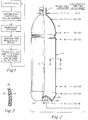
- a loop is comprised of (1) an empty hot caustic wash followed by (2) contaminant inspection and product filling/capping, (3) warehouse storage, (4) distribution to wholesale and retail locations and (5) purchase, use and empty storage by the consumer followed by eventual return to the bottler. This cycle is illustrated in Fig. 1. In an alternative cycle, the contaminant inspection occurs before the caustic wash.
- Refillable containers must meet several key performance criteria to achieve commercial viability, including:
- PET refillable CSD container A commercially successful PET refillable CSD container is presently being distributed by The Coca-Cola Company in Europe (hereinafter "the prior art container”).
- This container is formed of a single layer of a polyethylene terephthalate (PET) copolymer having 3-5% comonomer, such as 1,4-cyclohexanedimethanol (CHDM) or isophthalic acid (IPA).
- PET polyethylene terephthalate
- CHDM 1,4-cyclohexanedimethanol
- IPA isophthalic acid
- the preform, from which this bottle is stretch blow molded has a sidewall thickness on the order of 5-7 mm, or about 2-2.5 times that of a preform for a disposable one-way bottle.
- This provides a greater average bottle sidewall thickness (i.e., 0.5-0.7 mm) required for abuse resistance and dimensional stability, based on a planar stretch ratio of about 10:1.
- the average crystallinity in the panel is about 15-20%.
- the high copolymer content prevents visual crystallization, i.e., haze, from forming in the preform during injection molding. Preform haze is undesirable because it produces bottle haze which hinders the visual on-line inspection required of commercial refill containers.
- Various aspects of this prior art container are described in Continental PET Technology's US-A- 4,725,464, 4,755,404, 5,066,528 and 5,198,248.
- the prior arc container has a demonstrated field viability in excess of 20 refill trips at caustic wash temperatures of up to 60°C.
- caustic wash temperatures of up to 60°C.
- An increase in wash temperature may also be desirable in order to increase the effectiveness and/or reduce the time of the caustic wash, and may be required with certain food products such as juice or milk.
- the present invention provides a method of forming a substantially transparent multi-layer article, including an interior layer of a first polymer and two exterior inner and outer layers of a second polymer, the method comprising: providing a first polyethylene terephthalate (PET) polymer having a copolymer therein, and a second PET polymer having a copolymer therein; and moulding at an elevated temperature a substantially amorphous and transparent multi-layer preform having an interior core layer of the first PET polymer between two exterior inner and outer layers of the second PET polymer, characterised in that the first PET polymer has on the order of 4-6% copolymer and the second PET polymer has on the order of 2% or less copolymer and in the moulding step the preform is cooled from the exterior and the first PET polymer of the interior layer resists thermal-induced crystallisation.
- PET polyethylene terephthalate
- the present invention further provides a container formed by expansion from a multi-layer preform, the container having a substantially transparent biaxially-oriented multi-layer integral sidewall including an interior layer of a first polymer and two exterior inner and outer layers of a second polymer, the first polymer being polyethylene terephthalate (PET) having a copolymer, and the second polymer being PET having a copolymer, characterised in that the first polymer has on the order of 4-6% copolymer and the second polymer has on the order of 2% or less copolymer and the sidewall has an average strain-induced crystallinity of at least about 20% in the exterior layers and at least about 14% in the interior layer.
- PET polyethylene terephthalate
- the present invention yet further provides a preform for forming a substantially transparent biaxially-oriented container, the preform having a substantially amorphous and transparent multi-layer sidewall including an interior core layer of a first polyethylene terephthalate (PET) polymer having inner and outer exterior layers of a second PET polymer, characterised in that the first PET polymer has on the order of 4 to 6% copolymer, and the second PET polymer has on the order of 2% or less copolymer.
- PET polyethylene terephthalate
- a method of forming a substantially transparent multi-layer container having an enhanced level of strain-induced exterior sidewall crystallinity, and which may be further enhanced by low-temperature heat-setting.
- the container can have improved resistance to caustic stress cracking, while maintaining a high level of transparency and dimensional stability, and thus is particularly suitable for refillable carbonated beverage bottles.
- the container can have a lifetime of at least 10 refill cycles and more preferably at least 20 refill cycles, at caustic washing temperatures of 60°C and above.
- the container can exhibit a reduction in flavor carryover of at least 20% over the previously described refillable CSD prior art container.
- a multi-layer preform including a panel-forming portion having an interior layer of a first copolymer polyester, and an exterior layer of a second polyester having relatively less copolymer and a rate of crystallization at least about 20% higher than the first polyester.
- the interior layer forms a high copolymer core between two exterior (inner and outer) layers of the low copolymer.
- the high copolymer prevents crystallization (haze) of the interior core layer, which cools more slowly during the injection process, in order to preserve overall container clarity and inspectability.
- the exterior (inner and outer) layers cool more rapidly during the injection process and are less likely to crystallize.
- the core layer may typically comprise about 50-80% of the wall thickness of the panel-forming portion of the preform, and of the corresponding panel portion of the container, and more preferably about 60-70%.
- the above preform is reheat stretch blow molded to form a one-piece PET free-standing refillable pressurized beverage container having biaxially oriented, relatively thin and highly crystalline inner and outer layers in the panel.
- the panel has a total average wall thickness of about 0.5 to about 0.8mm, with the core comprising about 60-70% of the total.
- the container base includes a thickened base portion of lower orientation and crystallinity.
- the inner and outer layers of the panel have a strain-induced average crystallinity of at least about 20%, and the panel core layer at least about 14%, given a planar stretch ratio of about 7-13:1, and more preferably 9-11:1.
- average crystallinity is meant an average taken over the entire area of the respective container part, e.g., panel.
- the multilayer PET container preferably is provided with at least 20% strain-induced average crystallinity in the panel, which may be further enhanced by low-temperature heat-setting (e.g., in contact with a mold at a mold temperature of 110-140°C in order to retain transparency) to levels of 30-35%, or even greater.
- low-temperature heat-setting e.g., in contact with a mold at a mold temperature of 110-140°C in order to retain transparency
- the higher the crystallinity level in the exterior layer of the panel the higher the allowable wash temperature, e.g., 62°C 65°C or 70°C.
- the core layer in the panel has a much lower crystallinity, but is sufficient to provide the necessary strength (creep resistance, abuse resistance and thermal stability) for a viable refill container.
- the container of this invention can be washed at 60°C or higher temperatures and exhibits reduced flavor carryover (20% improvement or more) with no significant loss of container properties, versus the prior art single-layer refillable C
- the above two-material three-layer PET preform may be made by a metered sequential co-injection process comprising a first injection of a homopolymer or low copolymer, e.g., 0-2% copolymer content by total weight, to form the inner and outer layers, followed by a second injection of a high copolymer, e.g., 4-6% copolymer content by total weight, to form the core layer.
- a homopolymer or low copolymer e.g., 0-2% copolymer content by total weight
- a high copolymer e.g., 4-6% copolymer content by total weight
- the copolymer may be less than 3% and the high copolymer more than 3% copolymer as long as there is at least a 20% difference in crystallization rate.
- the improved resistance to hazing and stress crack resistance at elevated temperatures makes the container of this invention also particularly suitable as a hot-fill container.
- a commercial refillable container must withstand numerous refill cycles while maintaining its aesthetic and functional features.
- a test procedure for simulating such a cycle would be as follows. As used in the specification and claims, the ability to withstand a designated number of refill cycles without crack failure and/or with a maximum volume change is determined according to the following test procedure.
- Each container is subjected to a typical commercial caustic wash solution prepared with 3.5% sodium hydroxide by weight and tap water.
- the wash solution is maintained at the designated wash temperature, i.e., 60°C or more, in accordance with this invention.
- the bottles are submerged uncapped in the wash for 15 minutes to simulate the time/temperature conditions of a commercial bottle wash system.
- the bottles are rinsed in tap water and then filled with a carbonated water solution at 4.0 ⁇ 0.2 atmospheres (to simulate the pressure in a carbonated soft drink container), capped and placed in a 38°C convection oven at 50% relative humidity for 24 hours.
- This elevated oven temperature is selected to simulate longer commercial storage periods at lower ambient temperatures.
- the containers emptied and again subjected to the same refill cycle, until failure.
- a failure is defined as any crack propagating through the bottle wall which results in leakage and pressure loss.
- Volume change is determined by comparing the volume of liquid the container will hold at room temperature, both before and after each refill cycle.
- the container of Fig. 2 can withstand at least 20 refill cycles at a wash temperature of greater than 60°C without failure, and with no more than about 1.5% volume change after 20 cycles.
- the container also exhibits at least a 20% reduction in product flavor carryover (compared to the prior art CSD bottle) as determined by gas chromatography mass spectrometer measurements.
- Fig. 2 shows a PET refillable 1.5 liter carbonated beverage bottle having a relatively thick champagne base, made in accordance with this invention.
- the bottle 10 is a unitary blow-molded, biaxially-oriented hollow body having an open upper end with external screw threads on neck finish 12 for receiving a screw-on cap (not shown), and a lower closed base 18. Between the neck finish and base is a substantially vertically-disposed sidewall including an upper tapered shoulder portion 14, and a substantially cylindrical panel portion 16 (defined by vertical axis or centerline CL of the bottle).
- the champagne base 18 has a central outwardly-concave dome 22 with a center gate portion 20, an inwardly concave chime area 24 including a standing ring on which the bottle rests, and a radially increasing and arcuate outer base portion 26 for a smooth transition to the sidewall 16.
- the chime is a substantially toroidal-shaped area around the standing ring which is thickened to resist stress cracking.
- the dome and chime form a thickened base portion, which is about 3-4X the thickness of the panel 16.
- Above the chime there is a thinner outer base portion of about 50-70% of the thickness of the thickened base portion and increasing in crystallinity up to its junction with the sidewall.
- the thinner outer base wall provides improved impact resistance.
- Fig. 3 shows in cross section the sidewall of the panel portion 16 having a high copolymer core layer 30 and inner and outer low copolymer layers 32 and 34, respectively.
- the core layer 30 is about 0.015 - 0.024 inch (.38-.61mm) thick and the inner and outer layers 32 and 34 are each about 0.003 - 0.006 inch (.077-.15mm) thick, based on a preform having a sidewall thickness of about 0.24 inch (6.1 mm) and a planar stretch ratio of about 10:1.
- the container is about 13.2 inch (335 mm) in height and about 3.6 inch (92 mm) in (widest) diameter.
- a preform for making the container of Fig. 2 has a panel-forming wall thickness of about 0.24 in (6.1 mm), wherein the panel 16 is stretched at an average planar stretch ratio of about 10:1.
- the planar stretch ratio is the ratio of the average thickness of the panel-forming portion of the preform to the average thickness of the panel in the bottle.
- a preferred planar stretch ratio for polyester refill carbonated beverage bottles of about 0.5 to 2.0 liters/volume and about 0.5 to 0.8mm panel wall thickness is about 7-15:1, and more preferably about 9-11:1.
- the hoop stretch is preferably 3-3.6:1 and the axial stretch 2-3:1. This produces a container panel with the desired abuse resistance, and a preform sidewall with the desired visual transparency.
- the panel thickness and stretch ratio selected depend on the dimensions of the specific bottle, the internal pressure (e.g., 2 atm for beer, 4 atm for soft drinks), and the processing characteristics of the particular material (as determined for example, by the intrinsic viscosity).
- the crystallinity in the neck finish 12, across both the core and inner and outer layers, is very low (0-2%) because this portion of the bottle undergoes substantially no expansion.
- the tapered shoulder portion 14, which undergoes less expansion than the panel section 16, achieves 15-17% strain-induced crystallinity in the core, and 22-24% in the inner and outer layers.
- the relatively thick sections at the gate 20 and recess 22 portions of the base where there is relatively less expansion again there is from 0-2% strain-induced crystallinity in both the core and inner and outer layers.
- a strain-induced crystallinity of 4-8% is provided in the core, and 16-18% in the inner and outer layers.
- further enhanced levels of crystallinity can be achieved by heat setting (thermal-induced crystallinity at low temperatures to preserve transparency, e.g., in contact with a mold at a mold temperature of 110°-140°C for PET), for a combination of strain-induced and thermal-induced crystallization.
- a combined average panel crystallinity of 30-35% allows a wash temperature of at least 62°C and 20 cycles, along with at least 20% reduction in flavor carryover.
- the strain-induced crystallinity tends to be substantially uniform across the thickness of the particular layer, while thermal-induced crystallinity may exhibit a gradient across the wall.
- a high level of crystallinity at the surface of the sidewall alone is sufficient, although typically a substantially constant average level of crystallinity is achieved across the respective layer.
- the diffuse and specular light transmission values are measured in accordance with ASTM Method D 1003, using any standard color difference meter such as model D25D3P manufactured by Hunterlab, Inc.
- the refill container should have a percent haze (through the wall) of less than about 15%, more preferably less than about 10%, and still more preferably less than about 5%.
- the high copolymer PET forming the core layer 30 preferably contains about 4-6% by total weight of a comonomer such as 1,4-cyclohexanedimethanol (CHDM) and/or isophthalic acid (IPA).
- a comonomer such as 1,4-cyclohexanedimethanol (CHDM) and/or isophthalic acid (IPA).
- the low copolymer PET for the inner and outer layers 32, 34 preferably contains about 0-2% by total weight of comonomer, such as CHDM and/or IPA. These materials are commercially available from Eastman Chemical in Kingsport, Tennessee, and Goodyear Tire & Rubber Co. in Akron, Ohio.
- the comonomer e.g., CHDM as a replacement for the glycol moitey, or IPA as a replacement for the acid moitey
- the comonomer disrupts the PET polymer backbone (i.e., alternating units of acid and gylcol) to decrease the molecular crystallization rate.
- the comonomer is most effective if it forms part of the backbone, but may also form a branched copolymer.
- the bottle is preferably made via a two-stage preform injection and subsequent reheat blow process.
- the portions of the bottle which are stretched (at the appropriate temperature) the greatest exhibit the greatest amount of crystallinity across the sidewall.
- the varying levels of copolymer in the multi-layer sidewall produce a variation in crystallinity, with the high copolymer core layer 30 exhibiting a lower crystallinity than the low copolymer inner and outer layers 32, 34. This is because increasing the copolymer content decreases the molecular crystallization rate at a given temperature.
- DSC Differential Scanning Calorimetry
- ⁇ T is a function of the overall rate of crystallization and the smaller the ⁇ T, the greater the rate of crystallization.
- a high copolymer is generally considered to have a ⁇ T (as determined at a cooling rate of 5°C/min. from 300°C to below T g (80°C)) of 21.5°C and above, and a low copolymer below 21.5°C.
- ⁇ T there is a difference in ⁇ T between the high and low copolymer layers of this invention of at least about 20%, e.g., a high copolymer ⁇ T of about 24 and a low copolymer ⁇ T of about 20.
- the preform from which the bottle is blown should be substantially amorphous, which for PET means up to about 10% crystallinity, preferably no more than about 5% crystallinity, and more preferably no more than about 2% crystallinity.
- the substantially amorphous or transparent nature of the preform can be determined by the percent haze.
- the percent haze across the wall of the preform should be no more than about 20%, preferably no more than about 10%, and more preferably no more than about 5%.
- the substantially amorphous preform is then expanded which produces orientation and crystallization in the sidewall of the container.
- the preform may be expanded into a container by any conventional technique involving distension of the preform, such as by vacuum or pressure forming.
- Two well-known processes are the integrated injection blow process, and the two-stage preform injection and subsequent reheat blow process.
- the distension step should be carried out at a temperature in the molecular orientation temperature range for the polyester material being employed.
- molecular orientation of an orientable thermoplastic material occurs over a temperature range varying from just above the glass transition temperature (that temperature or narrow temperature range below which the polymer is in a glassy state) up to just below the melt temperature of the polymer
- the formation of oriented containers is carried out in a much narrower temperature range, known as the molecular orientation temperature range. The reason is that when the temperature is too close to the glass transition temperature, the material is too stiff to stretch in conventional processing equipment.
- the molecular orientation range is typically from about 20 to 65°F (11 to 36°C), and more preferably from about 30 to 40°F (17 - 22°C), above the glass transition temperature of the polyester material.
- Typical amorphous PET polymer which has a glass transition temperature of about 168°F (76°C), generally has an orientation temperature range of about 195°F (91°C) to about 205°F (96°C).
- the hot injected preform is quenched to room temperature before use and then the preform is reheated to within the orientation temperature range before the distension step.
- the reheated preform is positioned in a stretch blow assembly wherein a stretch rod is moved into the open end of the preform and extended to draw the preform end against a base of an internal cavity blow mold, thereby axially stretching the preform sidewall, and simultaneously or sequentially a blowing medium is admitted into the interior of the preform through openings in or around the rod to radially stretch the preform outwardly to conform to the inner surface of the mold.
- the extent of stretching can be varied depending on the desired shape and wall thickness of the blown container and is controlled by affixing the relative dimensions of the initial preform and the finished container.
- the hot injected preform is partially quenched and allowed to equilibriate within the orientation temperature range prior to distending by a suitable blow or combined stretch/blow apparatus similar to that previously described.
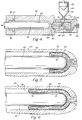
- Figs. 4-6 illustrate a metered, sequential co-injection apparatus for making a multi-layer preform of this invention. This apparatus is substantially described in US-A- 4,710,118 to Krishnakumar et al. granted December 1, 1987, which is hereby incorporated by reference in its entirety.
- an injection mold unit 40 includes an outer mold cavity 42, a neck ring 44 which defines the neck finish, and a core 46.
- the neck ring 44 in conjunction with the core 46 closes the upper end of the mold cavity 42 while the lower end is provided with an opening 48 which receives in sealed relation a nozzle-like end 50 of a rotary valve member 52 of the extruder.
- the valve member 52 is mounted in sealed relation within a valve block 54 which has formed therein a first passage 56 which receives a conventional nozzle 60 of a plasticizer or injection head.
- the passage 56 opens radially toward the rotary valve member 52, and the latter has a through passage 62 which at one end terminates in a generally radial passage 64 which can be aligned with the passage 56.
- valve block 54 There is also associated with the valve block 54 a second material dispenser 66 which includes a dispensing piston 68 and a flow passage 70 exiting therefrom toward the valve block 54.
- the valve block 54 has a radial passage 72 which is axially aligned with and in communication with the passage 70.
- the valve member 52 has a further passage 74 extending generally radially from the passage 62 and so circumferentially spaced from the passage 64 such that when the passage 64 is aligned with the passage 56, the passage 74 is spaced from the passage 72. By rotating the valve member 52, the passage 64 may be moved out of communication with the passage 56 and the passage 74 moved into communication with the passage 72.
- material may be selectively supplied from either the first supply device (injection head) 60 or from the second supply device 66.
- the material delivered by the first supply device 60 will be the low copolymer PET for the inner and outer layers.
- the material supplied by the second supply device 66 will be the high copolymer PET for the core layer.
- a preselected amount of a first low copolymer resin 76 will be injected into the bottom of the mold cavity 42 and as it flows through the mold cavity, due to the relatively cool temperature of the mold unit 40 including the core 46, there will be solidification of the resin 76 to define exterior inner and outer layers 78, 80 of the first material.
- the high copolymer core material 86 is next injected into the mold cavity. It will be seen that the core material 86 will have a tunnel flow through the cavity defined between the layers 78, 80 and at the same time will advance the previously injected material 76. The interior core material cools more slowly because it does not contact the cooler mold walls, but because the core layer has a higher copolymer content, it resists hazing.
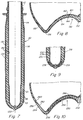
- a preform 110 is made as previously described, which includes a high copolymer core layer 130, a continuous low copolymer inner layer 132, and a low copolymer outer layer 134 which is continuous except for a portion of the core material which may extend through the outer layer at the gate area 120.
- the preform 110 includes an upper neck finish 112, a tapered shoulder-forming section 114 which increases in thickness from top to bottom, a panel-forming section 116 having a uniform wall thickness, and a base-forming section 118.
- Base section 118 includes an upper cylindrical thickened portion 121 of greater thickness than the panel section 116 and which forms a thickened chime in the container base, and a tapering lower portion 119 of reduced thickness for forming the recessed dome of the container.
- a preform having a preferred cross-section for refill applications is described in US-A- 5,066,528 granted November 19, 1991 to Krishnakumar et al., which is hereby incorporated by reference in its entirety.
- the core layer 130 in the panel section 116 is roughly twice the thickness of each of the inner and outer layers 132 and 134, to form the preferred 1.5 liter bottle having the wall thickness previously described.
- the blown container as shown in Fig. 8, has a champagne-type base section 150 including a center gate portion 152, central recessed dome 154, chime 156, and outer base portion 158.
- the core layer 160 and inner and outer layers 162 and 164, respectively, vary in thickness along the base depending upon the relative amount of stretch the specific base portion has undergone, but generally the wall thickness decreases progressively while moving radially away from the gate 152.
- Fig. 9 shows an alternative embodiment of a preform base-forming section 218, wherein a third injection of a low copolymer material is injected into at least a portion 236 of the base-forming section, and preferably into the reduced wall thickness lower base portion 219 which because it is less thick and cools more rapidly, is not as susceptible to hazing.
- Low copolymer section 236 displaces the core material 230 and preferably is of the same material as the inner and outer layers 232, 234 so that in the coinjection process previously described the nozzle is cleared of the high copolymer before the next preform is started to avoid injecting any high copolymer in the inner and outer layers of the next preform.
- Fig. 9 shows an alternative embodiment of a preform base-forming section 218, wherein a third injection of a low copolymer material is injected into at least a portion 236 of the base-forming section, and preferably into the reduced wall thickness lower base portion 219 which because it is less thick and cools more rapidly, is not
- a champagne-type container base 250 blown from the preform of Fig. 9 includes a gate portion 252, dome 254, chime 256, and outer base 258.
- the base includes inner and outer layers 262 and 264, respectively, and core layer 260.
- the core layer 260 is displaced at least in part by the low copolymer in section 266 across the gate and recess areas.
- thermoplastic polyester materials used in this invention are preferably those based on polyalkylene, and in particular, polyethylene terephthalate (PET).
- PET polymers are prepared by polymerizing terephthalic acid or its ester-forming derivative with ethylene.
- the polymer comprises repeating units of ethylene terephthalate of the formula:
- PET means PET homopolymer and PET copolymers of the grades suitable for making containers, which are well known in the art.
- the glycol moiety of the monomer may be replaced by aliphatic or alicyclic glycols such as cyclohexanedimethanol (CHDM), trimethylene glycol, polytetramethylene glycol, hexamethylene glycol, dodecamethylene glycol, diethylene glycol, polyethylene glycol, polypropylene glycol, propane-1,3-diol, butane-1,4-diol, and neopentyl glycol, bisphenols, and other aromatic diols such as hydroquinone and 2,2-bis(4'-B-hydroxethoxyphenyl) propane.
- CHDM cyclohexanedimethanol
- trimethylene glycol polytetramethylene glycol
- hexamethylene glycol hexamethylene glycol
- dodecamethylene glycol diethylene glycol
- polyethylene glycol polypropylene glycol
- propane-1,3-diol propane-1,3-diol
- dicarboxylic acid moieties which may be substituted into the monomer unit include aromatic dicarboxylic acids such as isophthalic acid (IPA), phthalic acid, naphthalenedicarboxylic acid, diphenyldicarboxylic acid, diphenoxyethanedicarboxylic acids, bibenzoic acid, and aliphataic or alicyclic dicarboxylic acids such as adipic acid, sebacic acid, azelaic acid, decanedicarboxylic acid and cyclohexanedicarboxylic acid.
- aromatic dicarboxylic acids such as isophthalic acid (IPA), phthalic acid, naphthalenedicarboxylic acid, diphenyldicarboxylic acid, diphenoxyethanedicarboxylic acids, bibenzoic acid, and aliphataic or alicyclic dicarboxylic acids such as adipic acid, sebacic acid, azelaic acid, decanedica
- the polyethylene terephthalate polymers may contain other compatible additives and ingredients which do not adversely affect the performance characteristics of the container, such as adversely affecting the taste or other properties of products packaged therein.
- ingredients include thermal stabilizers, light stabilizers, dyes, pigments, plasticizers, fillers, antitoxidants, lubricants, extrusion aids, residual monomer scavengers and the like.
- the intrinsic viscosity effects the processability of the polyester resins.
- Polyethylene terephthalate having an intrinsic viscosity of about 0.8 is widely used in the CSD industry. Resins for various applications may range from about 0.55 to about 1.04, and more particularly from about 0.65 to 0.85.
- Intrinsic viscosity measurements are made according to the procedure of ASTM D-2857, by employing 0.0050 ⁇ 0.0002 g/ml of the polymer in a solvent comprising o-chlorophenol (melting point 0°C), respectively, at 30°C.
- the plastic container of this invention is preferably made of polyethylene terephthalate (PET).
- PET polyethylene terephthalate
- other thermoplastic polyester resins may be used to achieve the multi-layer container of this invention, wherein an interior layer is provided having greater resistance to thermal-induced crystallization during an injection or similar heat-treating process, and wherein an exterior second layer achieves a higher strain and/or thermal-induced crystallization during a later blowing or expansion step in order to provide a higher level of surface crystallization.
- Additional layers may be provided, in addition to the core, inner and outer layers of the preferred embodiment, e.g., barrier (oxygen, carbon dioxide, light), high thermal stability, recycle PET or post-consumer PET or other layers.
- a footed base having a substantially hemispherical bottom wall with a plurality of downwardly-extending legs terminating in lowermost supporting feet, and with radiating ribs (which are part of the bottom wall) between the legs.
- the materials, wall thicknesses, preform and bottle contours, and processing techniques may all be varied for a specific end product, while still incorporating the substance of this invention.
- the container may be for other pressurized or unpressurized beverages, such as beer, juice or milk, or for other non-beverage products.
- the benefits of the invention for example the resistance to hazing and improved stress crack resistance at elevated temperatures, may be particularly suited for a hot-fill container, such as described in
- Hot-fill containers typically must withstand elevated temperatures on the order of 82-85°C (180-185°F) (the product filling temperature) and positive internal pressures on the order of 13.8 x 10 3 -34.5 x 10 3 N/m 2 (2-5psi) (the filling line pressure) without substantial deformation ( i . e ., volume change of no greater than about 1%).
Landscapes
- Engineering & Computer Science (AREA)
- Mechanical Engineering (AREA)
- Manufacturing & Machinery (AREA)
- Physics & Mathematics (AREA)
- Thermal Sciences (AREA)
- Ceramic Engineering (AREA)
- Blow-Moulding Or Thermoforming Of Plastics Or The Like (AREA)
- Containers Having Bodies Formed In One Piece (AREA)
- Processing And Handling Of Plastics And Other Materials For Molding In General (AREA)
Abstract
Description
- This invention relates to new and useful improvements in containers, and more particularly to a method of forming a container having an enhanced level of surface sidewall crystallinity, while maintaining a high level of transparency (clarity). The container is particularly useful as a refillable carbonated beverage container, able to withstand high caustic wash temperatures and exhibit reduced product flavor carryover and as a hot-fill container.
- The market for PET refillable carbonated soft drink (CSD) bottles has enjoyed significant growth worldwide since its introduction in 1987 by Continental PET Technologies. These bottles have been commercialized throughout much of Europe, Central and South America, and are now moving into the Far East market.
- Refillable bottles reduce the existing landfill and recycle problems associated with disposable plastic beverage bottles. In addition, a refillable bottle provides a safer, lighter-weight plastic container in those markets, currently dominated by glass, where legislation prohibits use of non-returnable packages. The goal is to produce a refillable bottle having the necessary physical characteristics to withstand numerous refill cycles, and which is still economical to produce.
- Generally, a refillable plastic bottle must maintain its functional and aesthetic features over a minimum of 10 and preferably over 20 cycles or loops to be considered economically feasible. A loop is comprised of (1) an empty hot caustic wash followed by (2) contaminant inspection and product filling/capping, (3) warehouse storage, (4) distribution to wholesale and retail locations and (5) purchase, use and empty storage by the consumer followed by eventual return to the bottler. This cycle is illustrated in Fig. 1. In an alternative cycle, the contaminant inspection occurs before the caustic wash.
- Refillable containers must meet several key performance criteria to achieve commercial viability, including:
- 1. high clarity (transparency) to permit visual on-line inspection;
- 2. dimensional stability over the life of the container; and
- 3. resistance to caustic wash induced stress cracking and leakage.
-
- A commercially successful PET refillable CSD container is presently being distributed by The Coca-Cola Company in Europe (hereinafter "the prior art container"). This container is formed of a single layer of a polyethylene terephthalate (PET) copolymer having 3-5% comonomer, such as 1,4-cyclohexanedimethanol (CHDM) or isophthalic acid (IPA). The preform, from which this bottle is stretch blow molded, has a sidewall thickness on the order of 5-7 mm, or about 2-2.5 times that of a preform for a disposable one-way bottle. This provides a greater average bottle sidewall thickness (i.e., 0.5-0.7 mm) required for abuse resistance and dimensional stability, based on a planar stretch ratio of about 10:1. The average crystallinity in the panel (cylindrical sidewall section beneath the label) is about 15-20%. The high copolymer content prevents visual crystallization, i.e., haze, from forming in the preform during injection molding. Preform haze is undesirable because it produces bottle haze which hinders the visual on-line inspection required of commercial refill containers. Various aspects of this prior art container are described in Continental PET Technology's US-A- 4,725,464, 4,755,404, 5,066,528 and 5,198,248.
- The prior arc container has a demonstrated field viability in excess of 20 refill trips at caustic wash temperatures of up to 60°C. Although successful, there exists a commercial need for an improved container that permits an increase in wash temperature of greater than 60°C, along with a reduction in product flavor carryover. The latter occurs when flavor ingredients from a first product (e.g., root beer) migrate into the bottle sidewall and subsequently permeate into a second product (e.g., club soda) on a later fill cycle, thus influencing the taste of the second product. An increase in wash temperature may also be desirable in order to increase the effectiveness and/or reduce the time of the caustic wash, and may be required with certain food products such as juice or milk.
- Thus, it would be desirable to increase the caustic wash temperature above 60°C for a returnable bottle having a lifetime of at least 10 refill trips, and preferably 20 refill trips, and to reduce the product flavor carryover. These and other objects are achieved by the present invention as set forth below. In the hot-fill prior art, it has been suggested to provide heatset multilayer articles, such as in GB-A-2188001 (Jabarin). Jabarin describes a multilayer article in which there is at least one barrier layer containing a copolyester which includes 1,3 bis(hydroxytheoxy) benzene for improved oxygen barrier resistance. The multilayer articles are blow moulded using a heatsetting process. The heatset multilayer articles are said to retain high gas barrier properties, uniform thickness in layers, and desirable mechanical strength even after the heatsetting process. GB-A-2188001 discloses the features of the characterising portions of claims 1, 13 and 23.
- The present invention provides a method of forming a substantially transparent multi-layer article, including an interior layer of a first polymer and two exterior inner and outer layers of a second polymer, the method comprising: providing a first polyethylene terephthalate (PET) polymer having a copolymer therein, and a second PET polymer having a copolymer therein; and moulding at an elevated temperature a substantially amorphous and transparent multi-layer preform having an interior core layer of the first PET polymer between two exterior inner and outer layers of the second PET polymer, characterised in that the first PET polymer has on the order of 4-6% copolymer and the second PET polymer has on the order of 2% or less copolymer and in the moulding step the preform is cooled from the exterior and the first PET polymer of the interior layer resists thermal-induced crystallisation.
- The present invention further provides a container formed by expansion from a multi-layer preform, the container having a substantially transparent biaxially-oriented multi-layer integral sidewall including an interior layer of a first polymer and two exterior inner and outer layers of a second polymer, the first polymer being polyethylene terephthalate (PET) having a copolymer, and the second polymer being PET having a copolymer, characterised in that the first polymer has on the order of 4-6% copolymer and the second polymer has on the order of 2% or less copolymer and the sidewall has an average strain-induced crystallinity of at least about 20% in the exterior layers and at least about 14% in the interior layer.
- The present invention yet further provides a preform for forming a substantially transparent biaxially-oriented container, the preform having a substantially amorphous and transparent multi-layer sidewall including an interior core layer of a first polyethylene terephthalate (PET) polymer having inner and outer exterior layers of a second PET polymer, characterised in that the first PET polymer has on the order of 4 to 6% copolymer, and the second PET polymer has on the order of 2% or less copolymer.
- In accordance with this invention, a method of forming a substantially transparent multi-layer container is provided having an enhanced level of strain-induced exterior sidewall crystallinity, and which may be further enhanced by low-temperature heat-setting. The container can have improved resistance to caustic stress cracking, while maintaining a high level of transparency and dimensional stability, and thus is particularly suitable for refillable carbonated beverage bottles. The container can have a lifetime of at least 10 refill cycles and more preferably at least 20 refill cycles, at caustic washing temperatures of 60°C and above. The container can exhibit a reduction in flavor carryover of at least 20% over the previously described refillable CSD prior art container.
- In one embodiment, a multi-layer preform is provided including a panel-forming portion having an interior layer of a first copolymer polyester, and an exterior layer of a second polyester having relatively less copolymer and a rate of crystallization at least about 20% higher than the first polyester. Preferably, the interior layer forms a high copolymer core between two exterior (inner and outer) layers of the low copolymer. The high copolymer prevents crystallization (haze) of the interior core layer, which cools more slowly during the injection process, in order to preserve overall container clarity and inspectability. The exterior (inner and outer) layers cool more rapidly during the injection process and are less likely to crystallize. They are made of a homopolymer or low copolymer polyester which has a higher rate of stretching or strain-induced crystallization and thus provides enhanced surface resistance to caustic induced stress cracking and reduced flavor carryover in the blown container. The core layer may typically comprise about 50-80% of the wall thickness of the panel-forming portion of the preform, and of the corresponding panel portion of the container, and more preferably about 60-70%.
- In one embodiment, the above preform is reheat stretch blow molded to form a one-piece PET free-standing refillable pressurized beverage container having biaxially oriented, relatively thin and highly crystalline inner and outer layers in the panel. The panel has a total average wall thickness of about 0.5 to about 0.8mm, with the core comprising about 60-70% of the total. The container base includes a thickened base portion of lower orientation and crystallinity. The inner and outer layers of the panel have a strain-induced average crystallinity of at least about 20%, and the panel core layer at least about 14%, given a planar stretch ratio of about 7-13:1, and more preferably 9-11:1. By "average" crystallinity is meant an average taken over the entire area of the respective container part, e.g., panel.
- The multilayer PET container preferably is provided with at least 20% strain-induced average crystallinity in the panel, which may be further enhanced by low-temperature heat-setting (e.g., in contact with a mold at a mold temperature of 110-140°C in order to retain transparency) to levels of 30-35%, or even greater. The higher the crystallinity level in the exterior layer of the panel, the higher the allowable wash temperature, e.g., 62°C 65°C or 70°C. The core layer in the panel has a much lower crystallinity, but is sufficient to provide the necessary strength (creep resistance, abuse resistance and thermal stability) for a viable refill container. Overall, the container of this invention can be washed at 60°C or higher temperatures and exhibits reduced flavor carryover (20% improvement or more) with no significant loss of container properties, versus the prior art single-layer refillable CSD beverage bottle previously described.
- The above two-material three-layer PET preform may be made by a metered sequential co-injection process comprising a first injection of a homopolymer or low copolymer, e.g., 0-2% copolymer content by total weight, to form the inner and outer layers, followed by a second injection of a high copolymer, e.g., 4-6% copolymer content by total weight, to form the core layer. In other examples, the copolymer may be less than 3% and the high copolymer more than 3% copolymer as long as there is at least a 20% difference in crystallization rate.
- The improved resistance to hazing and stress crack resistance at elevated temperatures makes the container of this invention also particularly suitable as a hot-fill container.
- These and other features of the invention will be more particularly described by the following detailed description and drawings of certain embodiments.
- Fig. 1 is a schematic illustration showing a typical cycle or loop through which a refillable container must pass;
- Fig. 2 is a schematic elevational view of a PET refillable 1.5 liter carbonated beverage bottle of this invention, partially broken away, and showing the varying levels of crystallinity in the high-copolymer core versus low-copolymer inner and outer layers, at various positions along the bottle;
- Fig. 3 is an enlarged fragmentary view taken along the section lines 3-3 of Fig. 2 showing more specifically the central core layer of high-copolymer PET, and the inner and outer layers of low-copolymer PET;
- Fig. 4 is a schematic sectional view taken through an injection mold cavity and showing the manner in which the polyester resin material is directed into the cavity to form a preform in accordance with this invention;
- Fig. 5 is an enlarged fragmentary schematic view showing the manner in which a quantity of a first low copolymer material is injected into the bottom of the mold cavity and the resultant cooling upon contact with the cooler mold wall surfaces in order to form the inner and outer layers of the preform;
- Fig. 6 is an enlarged fragmentary schematic view showing the manner in which a quantity of a second high copolymer material is injected into the bottom of the mold cavity to form the core layer and the resultant tunnel flow of both the first and second materials to form the preform;
- Fig. 7 is an enlarged sectional view of the multi-layer preform used to make the container of this invention;
- Fig. 8 is an enlarged fragmentary view showing in cross section the base of a container made from the preform of Fig. 7;
- Fig. 9 is a fragmentary sectional view of an alternative embodiment of the preform having a third injection of material in the base-forming section of the preform which displaces the core material, and which may be a low copolymer material similar to the inner and outer layers; and
- Fig. 10 is an enlarged fragmentary view showing in cross section the base portion of a container made from the preform of Fig. 9.
-
- Referring now to the drawings, and in particular Fig. 1, a commercial refillable container must withstand numerous refill cycles while maintaining its aesthetic and functional features. A test procedure for simulating such a cycle would be as follows. As used in the specification and claims, the ability to withstand a designated number of refill cycles without crack failure and/or with a maximum volume change is determined according to the following test procedure.
- Each container is subjected to a typical commercial caustic wash solution prepared with 3.5% sodium hydroxide by weight and tap water. The wash solution is maintained at the designated wash temperature, i.e., 60°C or more, in accordance with this invention. The bottles are submerged uncapped in the wash for 15 minutes to simulate the time/temperature conditions of a commercial bottle wash system. After removal from the wash solution, the bottles are rinsed in tap water and then filled with a carbonated water solution at 4.0 ± 0.2 atmospheres (to simulate the pressure in a carbonated soft drink container), capped and placed in a 38°C convection oven at 50% relative humidity for 24 hours. This elevated oven temperature is selected to simulate longer commercial storage periods at lower ambient temperatures. Upon removal from the oven, the containers are emptied and again subjected to the same refill cycle, until failure.
- A failure is defined as any crack propagating through the bottle wall which results in leakage and pressure loss. Volume change is determined by comparing the volume of liquid the container will hold at room temperature, both before and after each refill cycle.
- The container of Fig. 2, described below, can withstand at least 20 refill cycles at a wash temperature of greater than 60°C without failure, and with no more than about 1.5% volume change after 20 cycles. The container also exhibits at least a 20% reduction in product flavor carryover (compared to the prior art CSD bottle) as determined by gas chromatography mass spectrometer measurements.
- Fig. 2 shows a PET refillable 1.5 liter carbonated beverage bottle having a relatively thick champagne base, made in accordance with this invention. The
bottle 10 is a unitary blow-molded, biaxially-oriented hollow body having an open upper end with external screw threads onneck finish 12 for receiving a screw-on cap (not shown), and a lowerclosed base 18. Between the neck finish and base is a substantially vertically-disposed sidewall including an uppertapered shoulder portion 14, and a substantially cylindrical panel portion 16 (defined by vertical axis or centerline CL of the bottle). Thechampagne base 18 has a central outwardly-concave dome 22 with acenter gate portion 20, an inwardlyconcave chime area 24 including a standing ring on which the bottle rests, and a radially increasing and arcuateouter base portion 26 for a smooth transition to thesidewall 16. The chime is a substantially toroidal-shaped area around the standing ring which is thickened to resist stress cracking. The dome and chime form a thickened base portion, which is about 3-4X the thickness of thepanel 16. Above the chime, there is a thinner outer base portion of about 50-70% of the thickness of the thickened base portion and increasing in crystallinity up to its junction with the sidewall. The thinner outer base wall provides improved impact resistance. - The multi-layer sidewall of
bottle 10 is not specifically illustrated in Fig. 2 due to the small scale of the drawing. Fig. 3 shows in cross section the sidewall of thepanel portion 16 having a highcopolymer core layer 30 and inner and outer low copolymer layers 32 and 34, respectively. Thecore layer 30 is about 0.015 - 0.024 inch (.38-.61mm) thick and the inner andouter layers - A preform for making the container of Fig. 2 has a panel-forming wall thickness of about 0.24 in (6.1 mm), wherein the
panel 16 is stretched at an average planar stretch ratio of about 10:1. The planar stretch ratio is the ratio of the average thickness of the panel-forming portion of the preform to the average thickness of the panel in the bottle. A preferred planar stretch ratio for polyester refill carbonated beverage bottles of about 0.5 to 2.0 liters/volume and about 0.5 to 0.8mm panel wall thickness is about 7-15:1, and more preferably about 9-11:1. The hoop stretch is preferably 3-3.6:1 and the axial stretch 2-3:1. This produces a container panel with the desired abuse resistance, and a preform sidewall with the desired visual transparency. The panel thickness and stretch ratio selected depend on the dimensions of the specific bottle, the internal pressure (e.g., 2 atm for beer, 4 atm for soft drinks), and the processing characteristics of the particular material (as determined for example, by the intrinsic viscosity). - The varying percent crystallinity at various positions along the bottle from the neck finish to the base is listed in Fig. 2. The percent crystallinity is determined according to ASTM 1505 as follows:
- As shown in Fig. 2, the crystallinity in the
neck finish 12, across both the core and inner and outer layers, is very low (0-2%) because this portion of the bottle undergoes substantially no expansion. The taperedshoulder portion 14, which undergoes less expansion than thepanel section 16, achieves 15-17% strain-induced crystallinity in the core, and 22-24% in the inner and outer layers. In the highly-stretchedpanel section 16, there is 16-18% strain-induced crystallinity in the core, and 22-25% in the inner and outer layers. In the relatively thick sections at thegate 20 and recess 22 portions of the base where there is relatively less expansion, again there is from 0-2% strain-induced crystallinity in both the core and inner and outer layers. In thechime area 24, a strain-induced crystallinity of 4-8% is provided in the core, and 16-18% in the inner and outer layers. - Alternatively, further enhanced levels of crystallinity can be achieved by heat setting (thermal-induced crystallinity at low temperatures to preserve transparency, e.g., in contact with a mold at a mold temperature of 110°-140°C for PET), for a combination of strain-induced and thermal-induced crystallization. For example, a combined average panel crystallinity of 30-35% allows a wash temperature of at least 62°C and 20 cycles, along with at least 20% reduction in flavor carryover. Generally, the strain-induced crystallinity tends to be substantially uniform across the thickness of the particular layer, while thermal-induced crystallinity may exhibit a gradient across the wall. In this invention, a high level of crystallinity at the surface of the sidewall alone is sufficient, although typically a substantially constant average level of crystallinity is achieved across the respective layer.
- The blown container should be substantially transparent based on the percent crystallinity as previously defined. Another measure of transparency is the percent haze for transmitted light through the wall (HT) which is given by the following formula:
- The high copolymer PET forming the
core layer 30 preferably contains about 4-6% by total weight of a comonomer such as 1,4-cyclohexanedimethanol (CHDM) and/or isophthalic acid (IPA). The low copolymer PET for the inner andouter layers - The bottle is preferably made via a two-stage preform injection and subsequent reheat blow process. Generally, the portions of the bottle which are stretched (at the appropriate temperature) the greatest exhibit the greatest amount of crystallinity across the sidewall. Furthermore, the varying levels of copolymer in the multi-layer sidewall (see Fig. 3), produce a variation in crystallinity, with the high
copolymer core layer 30 exhibiting a lower crystallinity than the low copolymer inner andouter layers - One measure of the crystallization rate is to determine ΔT from the crystallization curve obtained by Differential Scanning Calorimetry (DSC), i.e.,
- The preform from which the bottle is blown should be substantially amorphous, which for PET means up to about 10% crystallinity, preferably no more than about 5% crystallinity, and more preferably no more than about 2% crystallinity.
- Alternatively, the substantially amorphous or transparent nature of the preform can be determined by the percent haze. The percent haze across the wall of the preform should be no more than about 20%, preferably no more than about 10%, and more preferably no more than about 5%.
- The substantially amorphous preform is then expanded which produces orientation and crystallization in the sidewall of the container. The preform may be expanded into a container by any conventional technique involving distension of the preform, such as by vacuum or pressure forming. Two well-known processes are the integrated injection blow process, and the two-stage preform injection and subsequent reheat blow process.
- The distension step should be carried out at a temperature in the molecular orientation temperature range for the polyester material being employed. Generally speaking, molecular orientation of an orientable thermoplastic material occurs over a temperature range varying from just above the glass transition temperature (that temperature or narrow temperature range below which the polymer is in a glassy state) up to just below the melt temperature of the polymer As a practical matter, the formation of oriented containers is carried out in a much narrower temperature range, known as the molecular orientation temperature range. The reason is that when the temperature is too close to the glass transition temperature, the material is too stiff to stretch in conventional processing equipment. When the temperature is increased, the processability improves greatly but a practical upper limit is reached at or near the temperature at which large aggregates of crystallites called spherulites begin to form, because the orientation process is adversely affected by spherulite growth. For substantially amorphous polyester material, the molecular orientation range is typically from about 20 to 65°F (11 to 36°C), and more preferably from about 30 to 40°F (17 - 22°C), above the glass transition temperature of the polyester material. Typical amorphous PET polymer, which has a glass transition temperature of about 168°F (76°C), generally has an orientation temperature range of about 195°F (91°C) to about 205°F (96°C).
- In the preferred reheat stretch blow process, the hot injected preform is quenched to room temperature before use and then the preform is reheated to within the orientation temperature range before the distension step. The reheated preform is positioned in a stretch blow assembly wherein a stretch rod is moved into the open end of the preform and extended to draw the preform end against a base of an internal cavity blow mold, thereby axially stretching the preform sidewall, and simultaneously or sequentially a blowing medium is admitted into the interior of the preform through openings in or around the rod to radially stretch the preform outwardly to conform to the inner surface of the mold. The extent of stretching can be varied depending on the desired shape and wall thickness of the blown container and is controlled by affixing the relative dimensions of the initial preform and the finished container.
- In the alternative integrated process, the hot injected preform is partially quenched and allowed to equilibriate within the orientation temperature range prior to distending by a suitable blow or combined stretch/blow apparatus similar to that previously described.
- Figs. 4-6 illustrate a metered, sequential co-injection apparatus for making a multi-layer preform of this invention. This apparatus is substantially described in US-A- 4,710,118 to Krishnakumar et al. granted December 1, 1987, which is hereby incorporated by reference in its entirety.
- As shown in Fig. 4, an
injection mold unit 40 includes anouter mold cavity 42, aneck ring 44 which defines the neck finish, and acore 46. Theneck ring 44 in conjunction with thecore 46 closes the upper end of themold cavity 42 while the lower end is provided with anopening 48 which receives in sealed relation a nozzle-like end 50 of a rotary valve member 52 of the extruder. The valve member 52 is mounted in sealed relation within a valve block 54 which has formed therein afirst passage 56 which receives aconventional nozzle 60 of a plasticizer or injection head. Thepassage 56 opens radially toward the rotary valve member 52, and the latter has a throughpassage 62 which at one end terminates in a generallyradial passage 64 which can be aligned with thepassage 56. There is also associated with the valve block 54 asecond material dispenser 66 which includes adispensing piston 68 and aflow passage 70 exiting therefrom toward the valve block 54. The valve block 54 has aradial passage 72 which is axially aligned with and in communication with thepassage 70. The valve member 52 has afurther passage 74 extending generally radially from thepassage 62 and so circumferentially spaced from thepassage 64 such that when thepassage 64 is aligned with thepassage 56, thepassage 74 is spaced from thepassage 72. By rotating the valve member 52, thepassage 64 may be moved out of communication with thepassage 56 and thepassage 74 moved into communication with thepassage 72. Thus, material may be selectively supplied from either the first supply device (injection head) 60 or from thesecond supply device 66. - In accordance with the preferred embodiment, the material delivered by the
first supply device 60 will be the low copolymer PET for the inner and outer layers. The material supplied by thesecond supply device 66 will be the high copolymer PET for the core layer. - Referring to Fig. 5, it will be seen that a preselected amount of a first
low copolymer resin 76 will be injected into the bottom of themold cavity 42 and as it flows through the mold cavity, due to the relatively cool temperature of themold unit 40 including thecore 46, there will be solidification of theresin 76 to define exterior inner andouter layers - As is schematically shown in Fig. 6, the high
copolymer core material 86 is next injected into the mold cavity. It will be seen that thecore material 86 will have a tunnel flow through the cavity defined between thelayers material 76. The interior core material cools more slowly because it does not contact the cooler mold walls, but because the core layer has a higher copolymer content, it resists hazing. - With respect to Fig. 7, a
preform 110 is made as previously described, which includes a highcopolymer core layer 130, a continuous low copolymerinner layer 132, and a low copolymerouter layer 134 which is continuous except for a portion of the core material which may extend through the outer layer at thegate area 120. Thepreform 110 includes anupper neck finish 112, a tapered shoulder-formingsection 114 which increases in thickness from top to bottom, a panel-formingsection 116 having a uniform wall thickness, and a base-formingsection 118.Base section 118 includes an upper cylindrical thickenedportion 121 of greater thickness than thepanel section 116 and which forms a thickened chime in the container base, and a taperinglower portion 119 of reduced thickness for forming the recessed dome of the container. A preform having a preferred cross-section for refill applications is described in US-A- 5,066,528 granted November 19, 1991 to Krishnakumar et al., which is hereby incorporated by reference in its entirety. Thecore layer 130 in thepanel section 116 is roughly twice the thickness of each of the inner andouter layers - The blown container, as shown in Fig. 8, has a champagne-
type base section 150 including acenter gate portion 152, central recesseddome 154,chime 156, andouter base portion 158. Thecore layer 160 and inner andouter layers gate 152. - Fig. 9 shows an alternative embodiment of a preform base-forming
section 218, wherein a third injection of a low copolymer material is injected into at least aportion 236 of the base-forming section, and preferably into the reduced wall thicknesslower base portion 219 which because it is less thick and cools more rapidly, is not as susceptible to hazing.Low copolymer section 236 displaces the core material 230 and preferably is of the same material as the inner andouter layers 232, 234 so that in the coinjection process previously described the nozzle is cleared of the high copolymer before the next preform is started to avoid injecting any high copolymer in the inner and outer layers of the next preform. As shown in Fig. 10, a champagne-type container base 250 blown from the preform of Fig. 9, includes agate portion 252,dome 254, chime 256, andouter base 258. Across the wall, the base includes inner andouter layers core layer 260. Thecore layer 260 is displaced at least in part by the low copolymer insection 266 across the gate and recess areas. - The thermoplastic polyester materials used in this invention are preferably those based on polyalkylene, and in particular, polyethylene terephthalate (PET). PET polymers are prepared by polymerizing terephthalic acid or its ester-forming derivative with ethylene. The polymer comprises repeating units of ethylene terephthalate of the formula:
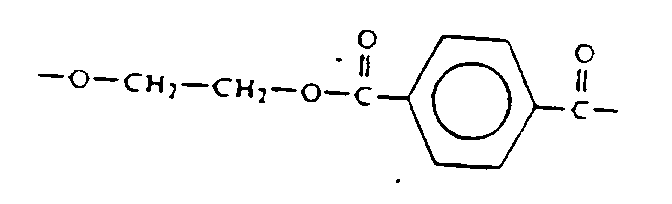
- The present invention contemplates the use of copolymers of polyethylene terephthalate in which a minor proportion, for example, up to about 10% by weight, of the ethylene terephthalate units are replaced by compatible monomer units. Thus, as used herein "PET" means PET homopolymer and PET copolymers of the grades suitable for making containers, which are well known in the art. The glycol moiety of the monomer may be replaced by aliphatic or alicyclic glycols such as cyclohexanedimethanol (CHDM), trimethylene glycol, polytetramethylene glycol, hexamethylene glycol, dodecamethylene glycol, diethylene glycol, polyethylene glycol, polypropylene glycol, propane-1,3-diol, butane-1,4-diol, and neopentyl glycol, bisphenols, and other aromatic diols such as hydroquinone and 2,2-bis(4'-B-hydroxethoxyphenyl) propane. Examples of dicarboxylic acid moieties which may be substituted into the monomer unit include aromatic dicarboxylic acids such as isophthalic acid (IPA), phthalic acid, naphthalenedicarboxylic acid, diphenyldicarboxylic acid, diphenoxyethanedicarboxylic acids, bibenzoic acid, and aliphataic or alicyclic dicarboxylic acids such as adipic acid, sebacic acid, azelaic acid, decanedicarboxylic acid and cyclohexanedicarboxylic acid. In addition, various multifunctional compounds such as trimethylolpropane, pentaerythritol, trimellitic acid and trimesic acid can be copolymerized with the polyethylene terephthalate polymer.
- The polyethylene terephthalate polymers may contain other compatible additives and ingredients which do not adversely affect the performance characteristics of the container, such as adversely affecting the taste or other properties of products packaged therein. Examples of such ingredients include thermal stabilizers, light stabilizers, dyes, pigments, plasticizers, fillers, antitoxidants, lubricants, extrusion aids, residual monomer scavengers and the like.
- The intrinsic viscosity (I.V.) effects the processability of the polyester resins. Polyethylene terephthalate having an intrinsic viscosity of about 0.8 is widely used in the CSD industry. Resins for various applications may range from about 0.55 to about 1.04, and more particularly from about 0.65 to 0.85. Intrinsic viscosity measurements are made according to the procedure of ASTM D-2857, by employing 0.0050±0.0002 g/ml of the polymer in a solvent comprising o-chlorophenol (melting point 0°C), respectively, at 30°C. Intrinsic viscosity (I.V.) is given by the following formula:
- VSoln. is the viscosity of the solution in any units;
- VSol. is the viscosity of the solvent in the same units; and
- C is the concentration in grams of polymer per 100 mls of solution.
-
- Other factors important in the manufacture of refillable polyester beverage bottles are described in US-A- 4,334,627 to Krishnakimer et al. granted June 15, 1982, US-A- 4,725,464 to Collette granted February 16, 1988, and US-A- 5,066,528 to Krishnakumar et al. granted November 19, 1991, which are hereby incorporated by reference in their entirety.
- As previously described, the plastic container of this invention is preferably made of polyethylene terephthalate (PET). However, other thermoplastic polyester resins may be used to achieve the multi-layer container of this invention, wherein an interior layer is provided having greater resistance to thermal-induced crystallization during an injection or similar heat-treating process, and wherein an exterior second layer achieves a higher strain and/or thermal-induced crystallization during a later blowing or expansion step in order to provide a higher level of surface crystallization. Additional layers may be provided, in addition to the core, inner and outer layers of the preferred embodiment, e.g., barrier (oxygen, carbon dioxide, light), high thermal stability, recycle PET or post-consumer PET or other layers. Different base structures may be used, such as a footed base having a substantially hemispherical bottom wall with a plurality of downwardly-extending legs terminating in lowermost supporting feet, and with radiating ribs (which are part of the bottom wall) between the legs. The materials, wall thicknesses, preform and bottle contours, and processing techniques may all be varied for a specific end product, while still incorporating the substance of this invention. The container may be for other pressurized or unpressurized beverages, such as beer, juice or milk, or for other non-beverage products. The benefits of the invention, for example the resistance to hazing and improved stress crack resistance at elevated temperatures, may be particularly suited for a hot-fill container, such as described in
- US-A-4,863,046 to Collette et al. granted September 5, 1989, which is hereby incorporated by reference in its entirety. Hot-fill containers typically must withstand elevated temperatures on the order of 82-85°C (180-185°F) (the product filling temperature) and positive internal pressures on the order of 13.8 x 10³-34.5 x 10³ N/m2 (2-5psi) (the filling line pressure) without substantial deformation (i.e., volume change of no greater than about 1%).
- Thus, although several embodiments of this invention have been specifically illustrated and described herein, it is to be understood that variations may be made in the preform construction, materials, the container construction and the method of forming the container without departing from the scope of the invention as defined by the appended claims.
Claims (25)
- A method of forming a substantially transparent multi-layer article, including an interior layer (130) of a first polymer and two exterior inner and outer layers (132,134) of a second polymer, the method comprising:providing a first polyethylene terephthalate (PET) polymer having a copolymer therein, and a second PET polymer having a copolymer therein; andmoulding at an elevated temperature a substantially amorphous and transparent multi-layer preform (110) having an interior core layer (130) of the first PET polymer between two exterior inner and outer layers (132,134) of the second PET polymer, characterised in that the first PET polymer has on the order of 4-6% copolymer and the second PET polymer has on the order of 2% or less copolymer and in the moulding step the preform is cooled from the exterior and the first PET polymer of the interior layer (130) resists thermal-induced crystallisation.
- The method of claim 1, wherein the first PET polymer has a lower rate of crystallisation than the second PET polymer.
- The method of claim 2, wherein the first PET polymer has a rate of crystallisation at least 20% lower than the second PET polymer.
- The method of any one of claims 1 to 3, wherein the comonomer for the first and second polymers is selected from 1,4-cyclohexane dimethanol (CHDM) and isophthalic acid (IPA).
- The method of any one of claims 1 to 4, wherein the preform (110) is moulded by injection moulding.
- The method of any one of claims 1 to 5, further comprising:expanding the preform (110) at a temperature above the glass transition temperatures of the first and second PET polymers to form a biaxially-oriented substantially transparent multi-layer container (10) having a sidewall (16) with an enhanced level of strain-induced crystallinity in the inner and outer layers (32,34).
- The method of claim 6, wherein the first PET polymer has on the order of 6% copolymer.
- The method of claim 6 or claim 7, wherein the preform (110) has a sidewall-forming portion (116) which is expanded at an area stretch ratio of about 7-11:1.
- The method of any one of claims 6 to 8, wherein the sidewall-forming portion (116) is expanded to provide a strain-induced crystallinity of at least 20% in the inner and outer layers (132,134).
- The method of any one of claims 6 to 9, further comprising the step of increasing the average crystallinity of the container sidewall (16) while maintaining substantial transparency by low-temperature heat setting.
- The method of claim 6 or claim 7, wherein the preform has a sidewall-forming portion (116) having a wall thickness of from about 5 to about 7mm and an average haze of no greater than about 10%, the sidewall-forming portion (116) being expanded at an area stretch ratio of about 7-11:1 to form the container sidewall (16) with an average haze of no greater than about 10% and an average crystallinity of at least about 20% in the exterior layers (32,34) and at least about 14% in the interior layer (30).
- The method of any one of claims 6 to 11, further comprising the step of increasing the average crystallinity of the exterior layers (32,34) of the sidewall (16) to at least 30% by low temperature heat setting.
- A container (10) formed by expansion from a multi-layer preform (110), the container (10) having a substantially transparent biaxially-oriented multi-layer integral sidewall (16) including an interior layer (30) of a first polymer and two exterior inner and outer layers (32,34) of a second polymer, the first polymer being polyethylene terephthalate (PET) having a copolymer, and the second polymer being PET having a copolymer, characterised in that the first polymer has on the order of 4-6% copolymer and the second polymer has on the order of 2% or less copolymer and the sidewall (16) has an average strain-induced crystallinity of at least about 20% in the exterior layers (32,34) and at least about 14% in the interior layer (30).
- The container of claim 13, wherein the average crystallinity of the exterior layers (32,34) of the sidewall (16) is enhanced by thermal-induced crystallinity to 30% or above while maintaining substantial transparency.
- The container of claim 13 or claim 14, wherein the sidewall (16) has a wall thickness of about 0.5 to about 0.7mm.
- The container of any one of claims 13 to 15, wherein the interior layer (30) is about 50 to about 80% of the sidewall thickness.
- The container of any one of claims 13 to 16, wherein the copolymer is selected from 1,4-cyclohexane dimethanol (CHDM) and isophthalic acid (IPA).
- The container of any one of claims 13 to 17, wherein the container (10) is a free-standing pressurized PET beverage container.
- The container of any one of claims 13 to 17, wherein the container (10) is a hot-fill container.
- The container of any one of claims 13 to 19, wherein the sidewall (16) has a percent haze of no more than about 15%.
- The container of any one of claims 13 to 20, wherein the first and second polymers are each bottle grade PET.
- The container of any one of claims 13 to 21, wherein the container (10) includes a layer of a material selected from barrier material, high thermal stability material, recycle PET and post-consumer PET.
- A preform (110) for forming a substantially transparent biaxially-oriented container (10), the preform (110) having a substantially amorphous and transparent multi-layer sidewall (116) including an interior core layer (130) of a first polyethylene terephthalate (PET) polymer having inner and outer exterior layers (132,134) of a second PET polymer, characterised in that the first PET polymer has on the order of 4 to 6% copolymer, and the second PET polymer has on the order of 2% or less copolymer.
- The preform of claim 23, wherein the core layer (130) is about 50 to about 80% of the sidewall thickness.
- The preform of claim 23 or 24, wherein the sidewall (116) has a percentage haze of no greater than about 20%.
Applications Claiming Priority (5)
| Application Number | Priority Date | Filing Date | Title |
|---|---|---|---|
| US909961 | 1986-09-22 | ||
| US90996192A | 1992-07-07 | 1992-07-07 | |
| US8217193A | 1993-06-30 | 1993-06-30 | |
| US82171 | 1993-06-30 | ||
| PCT/US1993/006335 WO1994001268A1 (en) | 1992-07-07 | 1993-07-02 | Method of forming multi-layer preform and container with low crystallizing interior layer |
Publications (2)
| Publication Number | Publication Date |
|---|---|
| EP0653981A1 EP0653981A1 (en) | 1995-05-24 |
| EP0653981B1 true EP0653981B1 (en) | 1999-03-03 |
Family
ID=26767148
Family Applications (1)
| Application Number | Title | Priority Date | Filing Date |
|---|---|---|---|
| EP93916962A Expired - Lifetime EP0653981B1 (en) | 1992-07-07 | 1993-07-02 | Method of forming multi-layer preform and container with low crystallizing interior layer |
Country Status (11)
| Country | Link |
|---|---|
| US (3) | US5728347A (en) |
| EP (1) | EP0653981B1 (en) |
| CN (1) | CN1092352A (en) |
| AT (1) | ATE177049T1 (en) |
| AU (1) | AU674528B2 (en) |
| CA (1) | CA2139764C (en) |
| DE (1) | DE69323751T2 (en) |
| HU (1) | HU213531B (en) |
| SG (1) | SG45429A1 (en) |
| SK (1) | SK1495A3 (en) |
| WO (1) | WO1994001268A1 (en) |
Families Citing this family (65)
| Publication number | Priority date | Publication date | Assignee | Title |
|---|---|---|---|---|
| ZA946726B (en) * | 1993-09-10 | 1995-04-21 | Plastipak Packaging Inc | Polyethylene terephthalate multi-layer preform used for plastic blow molding and method for making the preform. |
| FR2712828B1 (en) * | 1993-11-22 | 1996-02-16 | Pernod Ricard | Process for washing refillable plastic bottles. |
| CO4520125A1 (en) * | 1995-03-29 | 1997-10-15 | Continental Pet Technologies | PRESSURIZED CONTAINER TO FILL RESISTANT TO THE CRAWLING OF THE DRINKER, PREFORM AND METHOD TO MANUFACTURE THEM |
| US7048906B2 (en) * | 1995-05-17 | 2006-05-23 | Cedars-Sinai Medical Center | Methods of diagnosing and treating small intestinal bacterial overgrowth (SIBO) and SIBO-related conditions |
| US7594866B2 (en) * | 1996-02-16 | 2009-09-29 | Acushnet Company | Method of making a golf ball with a multi-layer core |
| DE19630597A1 (en) * | 1996-07-31 | 1998-02-05 | Hoechst Ag | Multi-layer sheet made of a crystallizable thermoplastic, process for its production and use |
| DE19642287A1 (en) * | 1996-10-14 | 1998-04-30 | Hoechst Ag | Multi-layer plate made of a crystallizable thermoplastic, a crystallized molded body that can be produced therefrom and its use |
| US6309718B1 (en) * | 1997-07-25 | 2001-10-30 | Eastman Chemical Company | Large polyester containers and method for making same |
| EP1518877B1 (en) * | 1997-07-25 | 2006-12-27 | Eastman Chemical Company | Large polyester containers and method for making same |
| TWI250934B (en) * | 1997-10-17 | 2006-03-11 | Advancsd Plastics Technologies | Barrier-coated polyester articles and the fabrication method thereof |
| AU2006203442B2 (en) * | 1997-10-17 | 2008-03-06 | Advanced Plastics Technologies Luxembourg S.A. | Barrier-Coated Polyester |
| US6352426B1 (en) * | 1998-03-19 | 2002-03-05 | Advanced Plastics Technologies, Ltd. | Mold for injection molding multilayer preforms |
| US6808820B2 (en) * | 2000-09-05 | 2004-10-26 | Advanced Plastics Technology Ltd. | Multilayer containers and preforms having barrier properties utilizing recycled material |
| EP1155807B1 (en) * | 1999-11-30 | 2005-02-09 | Yoshino Kogyosho Co., Ltd. | Method for molding a multilayered polyester container |
| US6284866B1 (en) | 1999-12-07 | 2001-09-04 | Wellman, Inc. | Method of preparing modified polyester bottle resins |
| US6626324B1 (en) * | 2000-06-30 | 2003-09-30 | Schmalbach-Lubeca Ag | Plastic container having a crystallinity gradient |
| US6763968B1 (en) * | 2000-06-30 | 2004-07-20 | Schmalbach-Lubeca Ag | Base portion of a plastic container |
| JP4547843B2 (en) * | 2001-08-30 | 2010-09-22 | 株式会社吉野工業所 | Primary molded product and casing of biaxially stretched blow molded casing |
| EG23499A (en) * | 2002-07-03 | 2006-01-17 | Advanced Plastics Technologies | Dip, spray, and flow coating process for forming coated articles |
| CA2505697C (en) | 2002-11-08 | 2013-10-22 | Advanced Plastics Technologies Ltd. | Injection mold having a wear resistant portion and a high heat transfer portion and a method of forming a preform |
| US7166575B2 (en) * | 2002-12-17 | 2007-01-23 | Nastech Pharmaceutical Company Inc. | Compositions and methods for enhanced mucosal delivery of peptide YY and methods for treating and preventing obesity |
| US7229966B2 (en) * | 2002-12-17 | 2007-06-12 | Nastech Pharmaceutical Company Inc. | Compositions and methods for enhanced mucosal delivery of Y2 receptor-binding peptides and methods for treating and preventing obesity |
| US7186692B2 (en) | 2002-12-17 | 2007-03-06 | Nastech Pharmaceutical Company Inc. | Compositions and methods for enhanced mucosal delivery and non-infused administration of Y2 receptor-binding peptides and methods for treating and preventing obesity |
| CA2510199A1 (en) * | 2002-12-17 | 2004-07-08 | Nastech Pharmaceutical Company Inc. | Compositions and methods for enhanced mucosal delivery of y2 receptor-binding peptides and methods for treating and preventing obesity |
| CN100418997C (en) * | 2003-06-18 | 2008-09-17 | 可口可乐公司 | Polyester compositions for hot fill applications, containers made therefrom, and methods |
| US7097061B2 (en) | 2003-08-14 | 2006-08-29 | Graham Packaging Pet Technologies Inc. | Plastic container which is hot-fillable and/or having neck finish adapted for receipt of handle |
| ES2289226T3 (en) * | 2003-10-31 | 2008-02-01 | NESTLE WATERS MANAGEMENT & TECHNOLOGY | PRODUCT CONTAINER MANUFACTURED WITH LESS MATERIAL. |
| US20050136201A1 (en) * | 2003-12-22 | 2005-06-23 | Pepsico, Inc. | Method of improving the environmental stretch crack resistance of RPET without solid stating |
| ATE424288T1 (en) | 2004-04-16 | 2009-03-15 | Advanced Plastics Technologies | PREFORM AND METHOD FOR PRODUCING THE PREFORM AND A BOTTLE |
| US7303387B2 (en) | 2004-06-10 | 2007-12-04 | Advanced Plastics Technologies Luxembourg S.A. | System for controlling mold temperatures |
| USD518722S1 (en) | 2004-08-04 | 2006-04-11 | Cadbury Schweppes Plc | Bottle |
| USD536255S1 (en) | 2004-08-04 | 2007-02-06 | Cadbury Schweppes Plc | Bottle with grip |
| USD533785S1 (en) | 2004-08-04 | 2006-12-19 | Cadbury Schweppes Plc | Grip for bottle |
| ITMO20040354A1 (en) * | 2004-12-31 | 2005-03-31 | Granarolo S P A | PREFORM, METHOD TO PRODUCE A PREFORM AND CONTAINER. |
| US20060292323A1 (en) * | 2005-04-18 | 2006-12-28 | Hutchinson Gerald A | Water-resistant coated articles and methods of making same |
| US7820257B2 (en) * | 2005-05-11 | 2010-10-26 | The Coca-Cola Company | Preforms for preparing lightweight stretch blow molded PET copolymer containers and methods for making and using same |
| US7572493B2 (en) * | 2005-05-11 | 2009-08-11 | The Coca-Cola Company | Low IV pet based copolymer preform with enhanced mechanical properties and cycle time, container made therewith and methods |
| MX2008002479A (en) | 2005-08-30 | 2008-04-07 | Advanced Plastics Technologies | METHODS AND SYSTEMS FOR CONTROLLING MOLD TEMPERATURES. |
| KR20080063400A (en) * | 2005-10-14 | 2008-07-03 | 어드밴스드 플라스틱스 테크놀로지즈 룩셈부르크 에스.에이. | Methods of forming multilayer articles by surface treatment applications |
| US9777111B2 (en) * | 2005-10-20 | 2017-10-03 | Grupo Petrotemex, S.A. De C.V. | PET polymer with improved properties |
| US20080071012A1 (en) * | 2006-09-11 | 2008-03-20 | Graham Packaging Company, Lp | Phosphorous containing reprocessed polymer materials |
| US20080076841A1 (en) * | 2006-09-11 | 2008-03-27 | Graham Packaging Company, Lp | Phosphorous containing reprocessed polymer materials, articles formed thereof, and methods of forming such articles |
| US20080061474A1 (en) * | 2006-09-11 | 2008-03-13 | Graham Packaging Company, Lp | Thermally stabilized adhesion promoting material for use in multilayer articles |
| US20080064796A1 (en) * | 2006-09-11 | 2008-03-13 | Graham Packaging Company, Lp | Articles formed of phosphorous containing reprocessed polymer materials |
| US20080093772A1 (en) * | 2006-10-06 | 2008-04-24 | Graham Packing Company, Lp | Method and apparatus for delivering sequential shots to multiple cavities to form multilayer articles |
| DE102006050797A1 (en) | 2006-10-28 | 2008-04-30 | Mitsubishi Polyester Film Gmbh | Hot embossable polyester film |
| US8020717B2 (en) * | 2007-04-19 | 2011-09-20 | Graham Packaging Company, Lp | Preform base and method of making a delamination and crack resistant multilayer container base |
| FR2917068B1 (en) * | 2007-06-07 | 2012-10-12 | Sidel Participations | POLYMER CONTAINER HAVING A CRYSTALLINITE GRADIENT |
| DE102007049750A1 (en) * | 2007-10-16 | 2009-04-23 | Krones Ag | Pouch bottle |
| US20090223920A1 (en) * | 2008-03-07 | 2009-09-10 | Graham Packaging Company, Lp | Abuse resistant preform and container neck finish |
| US20090236302A1 (en) * | 2008-03-18 | 2009-09-24 | Graham Packaging Company, L.P. | Finish Portion For Plastic Preform and Container and Method of Making |
| US20100280152A1 (en) * | 2009-04-29 | 2010-11-04 | Spartech Corporation | Thermoformable and RF Sealable Plastic Packaging Material |
| USD633392S1 (en) * | 2010-04-19 | 2011-03-01 | Doskocil Manufacturing Company, Inc. | Locking bottle preform |
| US20120100266A1 (en) | 2010-10-20 | 2012-04-26 | Pepsico., Inc. | Control of bubble size in a carbonated liquid |
| US9758294B2 (en) | 2013-01-25 | 2017-09-12 | The Procter & Gamble Company | Components for aerosol dispenser and aerosol dispenser made therewith |
| JP6585591B2 (en) * | 2013-08-16 | 2019-10-02 | ザ プロクター アンド ギャンブル カンパニーThe Procter & Gamble Company | Blow molding process |
| US9821505B2 (en) | 2015-02-27 | 2017-11-21 | Dr Pepper/Seven Up, Inc. | High stretch ratio preforms and related containers and methods |
| US11850779B2 (en) | 2017-06-23 | 2023-12-26 | Husky Injection Molding Systems Ltd. | Molded article with selectively varied core layer geometry and hot runner nozzles for producing same |
| CN111032519B (en) * | 2017-08-31 | 2022-05-31 | 宝洁公司 | Rigid article with well defined corners |
| CH715582A1 (en) * | 2018-11-22 | 2020-05-29 | Alpla Werke Alwin Lehner Gmbh & Co Kg | Plastic container with at least partially sharp-edged container geometry and method for producing the plastic container. |
| US20200354529A1 (en) * | 2019-05-08 | 2020-11-12 | The Procter & Gamble Company | One piece multilayer thermoplastic container having a colorant |
| CA3180200A1 (en) * | 2020-04-17 | 2021-10-21 | Abc Technologies Inc. | Variable cooling during blow molding process |
| US12583169B2 (en) | 2020-11-18 | 2026-03-24 | Nissei Asb Machine Co., Ltd. | Method and apparatus for manufacturing resin container |
| CN117841338B (en) * | 2024-01-11 | 2025-03-14 | 鸿利达精密组件(中山)有限公司 | Injection-blow mold, injection-blow equipment and molding method for hollow double-layer bottles |
| CN118617713B (en) * | 2024-08-14 | 2025-01-10 | 河北世昌汽车部件股份有限公司 | Fuel tank blow molding process and blow molding equipment |
Family Cites Families (32)
| Publication number | Priority date | Publication date | Assignee | Title |
|---|---|---|---|---|
| GB1179117A (en) * | 1966-11-29 | 1970-01-28 | Ici Ltd | Plastics Containers. |
| GB1227083A (en) * | 1968-07-11 | 1971-03-31 | ||
| GB1555313A (en) * | 1975-07-03 | 1979-11-07 | Metal Box Co Ltd | Extrusion of plastics structures |
| CH598064A5 (en) * | 1976-01-09 | 1978-04-28 | Lonza Ag | |
| SE430147B (en) * | 1977-05-13 | 1983-10-24 | Plm Ab | SUBJECT FOR MANUFACTURING PLASTIC MATERIAL CONTAINERS AS WELL AS ASTADCOMMUNICATING A SUBJECT |
| US4334627A (en) * | 1979-11-27 | 1982-06-15 | The Continental Group, Inc. | Blow molded plastic bottle |
| JPS57210830A (en) * | 1981-06-22 | 1982-12-24 | Yoshino Kogyosho Co Ltd | Bottle and molding method thereof |
| US4398017A (en) * | 1982-03-09 | 1983-08-09 | Owens-Illinois, Inc. | Copolyesters |
| JPS58183243A (en) * | 1982-04-22 | 1983-10-26 | 株式会社吉野工業所 | Synthetic resin biaxially stretched blow-molded bottle |
| EP0212339B1 (en) * | 1982-04-22 | 1995-08-16 | Yoshino Kogyosho CO., LTD. | Bottle-shaped container |
| US4482586A (en) * | 1982-09-07 | 1984-11-13 | The Goodyear Tire & Rubber Company | Multi-layer polyisophthalate and polyterephthalate articles and process therefor |
| JPS5989149A (en) * | 1982-11-15 | 1984-05-23 | 三井化学株式会社 | Multilayer vessel |
| DE3248670A1 (en) * | 1982-12-30 | 1984-07-05 | Hoechst Ag, 6230 Frankfurt | POLYESTER MULTILAYER FILM WITH THERMOPLASTIC PRESERVABLE INTERIOR |
| DE3465456D1 (en) * | 1983-02-08 | 1987-09-24 | Toyo Seikan Kaisha Ltd | Plastic laminate structure and vessel |
| JPS6089326A (en) * | 1983-10-21 | 1985-05-20 | Mitsui Petrochem Ind Ltd | Manufacture of multi-layered container |
| JPS60171124A (en) * | 1984-02-15 | 1985-09-04 | Yoshino Kogyosho Co Ltd | Process of biaxially oriented drawing blow molding |
| US4609516A (en) * | 1984-02-17 | 1986-09-02 | Continental Pet Technologies, Inc. | Method of forming laminated preforms |
| DE3407060C2 (en) * | 1984-02-27 | 1986-04-10 | Krupp Corpoplast Maschinenbau GmbH, 2000 Hamburg | Process for making a parison for blow molding |
| JPH0617136B2 (en) * | 1985-02-15 | 1994-03-09 | 日精エ−・エス・ビ−機械株式会社 | Biaxially oriented container with excellent gas barrier properties |
| US4622199A (en) * | 1985-06-11 | 1986-11-11 | Owens-Illinois, Inc. | Process for extruding high molecular weight, high density linear ethylene polymers to form heavy tubular members |
| SE504354C2 (en) * | 1986-02-28 | 1997-01-20 | Toyo Seikan Kaisha Ltd | Process for making a biaxially drawn vessel and biaxially drawn polyester vessel |
| US4713269A (en) * | 1986-03-20 | 1987-12-15 | Owens-Illinois Plastic Products Inc. | Heatset multilayer container |
| US4755404A (en) * | 1986-05-30 | 1988-07-05 | Continental Pet Technologies, Inc. | Refillable polyester beverage bottle and preform for forming same |
| US4725464A (en) * | 1986-05-30 | 1988-02-16 | Continental Pet Technologies, Inc. | Refillable polyester beverage bottle and preform for forming same |
| JPH01153453A (en) * | 1987-12-10 | 1989-06-15 | Toyo Seikan Kaisha Ltd | Pressure-and heat-resisting container and production thereof |
| JPH01167041A (en) * | 1987-12-22 | 1989-06-30 | Mitsubishi Gas Chem Co Inc | Multiple layer container |
| US4863046A (en) * | 1987-12-24 | 1989-09-05 | Continental Pet Technologies, Inc. | Hot fill container |
| JPH0751343B2 (en) * | 1988-10-17 | 1995-06-05 | 日本石油化学株式会社 | Hollow container |
| CA2002369C (en) * | 1988-11-08 | 2000-10-31 | Mikio Hashimoto | Copolyester, polyester composition containing the copolyester, and polyester laminated structure having layer composed of the copolyester or the polyester composition |
| US5066528A (en) * | 1990-03-05 | 1991-11-19 | Continental Pet Technologies, Inc. | Refillable polyester container and preform for forming the same |
| JP3128764B2 (en) * | 1990-10-19 | 2001-01-29 | 三井化学株式会社 | Bottle made of saturated polyester for carbonated drinks |
| JPH0573568A (en) * | 1991-09-18 | 1993-03-26 | Hokuriku Nippon Denki Software Kk | Device for sorting japanese name |
-
1993
- 1993-07-02 DE DE69323751T patent/DE69323751T2/en not_active Expired - Fee Related
- 1993-07-02 SK SK14-95A patent/SK1495A3/en unknown
- 1993-07-02 CA CA002139764A patent/CA2139764C/en not_active Expired - Fee Related
- 1993-07-02 HU HU9500018A patent/HU213531B/en not_active IP Right Cessation
- 1993-07-02 AU AU46642/93A patent/AU674528B2/en not_active Ceased
- 1993-07-02 EP EP93916962A patent/EP0653981B1/en not_active Expired - Lifetime
- 1993-07-02 AT AT93916962T patent/ATE177049T1/en not_active IP Right Cessation
- 1993-07-02 WO PCT/US1993/006335 patent/WO1994001268A1/en not_active Ceased
- 1993-07-02 SG SG1996007595A patent/SG45429A1/en unknown
- 1993-07-07 CN CN93109891A patent/CN1092352A/en active Pending
-
1995
- 1995-03-31 US US08/415,149 patent/US5728347A/en not_active Expired - Fee Related
-
1997
- 1997-05-19 US US08/858,132 patent/US5759656A/en not_active Expired - Fee Related
-
1998
- 1998-06-01 US US09/088,238 patent/US6090460A/en not_active Expired - Fee Related
Also Published As
| Publication number | Publication date |
|---|---|
| AU674528B2 (en) | 1997-01-02 |
| HU213531B (en) | 1997-07-28 |
| US5728347A (en) | 1998-03-17 |
| US5759656A (en) | 1998-06-02 |
| CA2139764C (en) | 1999-02-23 |
| CA2139764A1 (en) | 1994-01-20 |
| HUT71921A (en) | 1996-02-28 |
| ATE177049T1 (en) | 1999-03-15 |
| CN1092352A (en) | 1994-09-21 |
| SG45429A1 (en) | 1998-01-16 |
| DE69323751T2 (en) | 1999-07-01 |
| WO1994001268A1 (en) | 1994-01-20 |
| US6090460A (en) | 2000-07-18 |
| DE69323751D1 (en) | 1999-04-08 |
| AU4664293A (en) | 1994-01-31 |
| HU9500018D0 (en) | 1995-03-28 |
| EP0653981A1 (en) | 1995-05-24 |
| SK1495A3 (en) | 1995-08-09 |
Similar Documents
| Publication | Publication Date | Title |
|---|---|---|
| US6090460A (en) | Method of forming multi-layer preform and container with low crystallizing interior layer | |
| US5628957A (en) | Method of forming multilayer container with polyethylene naphthalalte (pen) | |
| CA2139741C (en) | Method of forming container with high-crystallinity sidewall and low-crystallinity base | |
| US5520877A (en) | Method of forming container with high-crystallinity sidewall and low-crystallinity base | |
| US6787094B2 (en) | Sleeve molding | |
| US5622735A (en) | Fluid supply apparatus for blow mold | |
| EP1147872B1 (en) | Method for molding multi-layer plastic articles | |
| CA2436981A1 (en) | Sleeve molding |
Legal Events
| Date | Code | Title | Description |
|---|---|---|---|
| PUAI | Public reference made under article 153(3) epc to a published international application that has entered the european phase |
Free format text: ORIGINAL CODE: 0009012 |
|
| 17P | Request for examination filed |
Effective date: 19950109 |
|
| AK | Designated contracting states |
Kind code of ref document: A1 Designated state(s): AT BE CH DE DK ES FR GB GR IE IT LI LU MC NL PT SE |
|
| 17Q | First examination report despatched |
Effective date: 19960604 |
|
| GRAG | Despatch of communication of intention to grant |
Free format text: ORIGINAL CODE: EPIDOS AGRA |
|
| GRAG | Despatch of communication of intention to grant |
Free format text: ORIGINAL CODE: EPIDOS AGRA |
|
| GRAG | Despatch of communication of intention to grant |
Free format text: ORIGINAL CODE: EPIDOS AGRA |
|
| GRAH | Despatch of communication of intention to grant a patent |
Free format text: ORIGINAL CODE: EPIDOS IGRA |
|
| GRAH | Despatch of communication of intention to grant a patent |
Free format text: ORIGINAL CODE: EPIDOS IGRA |
|
| GRAA | (expected) grant |
Free format text: ORIGINAL CODE: 0009210 |
|
| AK | Designated contracting states |
Kind code of ref document: B1 Designated state(s): AT BE CH DE DK ES FR GB GR IE IT LI LU MC NL PT SE |
|
| PG25 | Lapsed in a contracting state [announced via postgrant information from national office to epo] |
Ref country code: NL Free format text: LAPSE BECAUSE OF FAILURE TO SUBMIT A TRANSLATION OF THE DESCRIPTION OR TO PAY THE FEE WITHIN THE PRESCRIBED TIME-LIMIT Effective date: 19990303 Ref country code: LI Free format text: LAPSE BECAUSE OF FAILURE TO SUBMIT A TRANSLATION OF THE DESCRIPTION OR TO PAY THE FEE WITHIN THE PRESCRIBED TIME-LIMIT Effective date: 19990303 Ref country code: IT Free format text: LAPSE BECAUSE OF FAILURE TO SUBMIT A TRANSLATION OF THE DESCRIPTION OR TO PAY THE FEE WITHIN THE PRESCRIBED TIME-LIMIT;WARNING: LAPSES OF ITALIAN PATENTS WITH EFFECTIVE DATE BEFORE 2007 MAY HAVE OCCURRED AT ANY TIME BEFORE 2007. THE CORRECT EFFECTIVE DATE MAY BE DIFFERENT FROM THE ONE RECORDED. Effective date: 19990303 Ref country code: GR Free format text: LAPSE BECAUSE OF NON-PAYMENT OF DUE FEES Effective date: 19990303 Ref country code: FR Free format text: LAPSE BECAUSE OF FAILURE TO SUBMIT A TRANSLATION OF THE DESCRIPTION OR TO PAY THE FEE WITHIN THE PRESCRIBED TIME-LIMIT Effective date: 19990303 Ref country code: ES Free format text: THE PATENT HAS BEEN ANNULLED BY A DECISION OF A NATIONAL AUTHORITY Effective date: 19990303 Ref country code: CH Free format text: LAPSE BECAUSE OF FAILURE TO SUBMIT A TRANSLATION OF THE DESCRIPTION OR TO PAY THE FEE WITHIN THE PRESCRIBED TIME-LIMIT Effective date: 19990303 |
|
| REF | Corresponds to: |
Ref document number: 177049 Country of ref document: AT Date of ref document: 19990315 Kind code of ref document: T |
|
| REG | Reference to a national code |
Ref country code: CH Ref legal event code: EP |
|
| REG | Reference to a national code |
Ref country code: IE Ref legal event code: FG4D |
|
| REF | Corresponds to: |
Ref document number: 69323751 Country of ref document: DE Date of ref document: 19990408 |
|
| PG25 | Lapsed in a contracting state [announced via postgrant information from national office to epo] |
Ref country code: DK Free format text: LAPSE BECAUSE OF FAILURE TO SUBMIT A TRANSLATION OF THE DESCRIPTION OR TO PAY THE FEE WITHIN THE PRESCRIBED TIME-LIMIT Effective date: 19990603 |
|
| PG25 | Lapsed in a contracting state [announced via postgrant information from national office to epo] |
Ref country code: PT Free format text: LAPSE BECAUSE OF FAILURE TO SUBMIT A TRANSLATION OF THE DESCRIPTION OR TO PAY THE FEE WITHIN THE PRESCRIBED TIME-LIMIT Effective date: 19990604 |
|
| PG25 | Lapsed in a contracting state [announced via postgrant information from national office to epo] |
Ref country code: LU Free format text: LAPSE BECAUSE OF NON-PAYMENT OF DUE FEES Effective date: 19990702 Ref country code: IE Free format text: LAPSE BECAUSE OF NON-PAYMENT OF DUE FEES Effective date: 19990702 Ref country code: GB Free format text: LAPSE BECAUSE OF NON-PAYMENT OF DUE FEES Effective date: 19990702 |
|
| EN | Fr: translation not filed | ||
| NLV1 | Nl: lapsed or annulled due to failure to fulfill the requirements of art. 29p and 29m of the patents act | ||
| REG | Reference to a national code |
Ref country code: CH Ref legal event code: PL |
|
| PLBQ | Unpublished change to opponent data |
Free format text: ORIGINAL CODE: EPIDOS OPPO |
|
| PLBI | Opposition filed |
Free format text: ORIGINAL CODE: 0009260 |
|
| PLBF | Reply of patent proprietor to notice(s) of opposition |
Free format text: ORIGINAL CODE: EPIDOS OBSO |
|
| 26 | Opposition filed |
Opponent name: PLM AB Effective date: 19991203 |
|
| PG25 | Lapsed in a contracting state [announced via postgrant information from national office to epo] |
Ref country code: MC Free format text: LAPSE BECAUSE OF NON-PAYMENT OF DUE FEES Effective date: 20000131 |
|
| GBPC | Gb: european patent ceased through non-payment of renewal fee |
Effective date: 19990702 |
|
| REG | Reference to a national code |
Ref country code: IE Ref legal event code: MM4A |
|
| PLBF | Reply of patent proprietor to notice(s) of opposition |
Free format text: ORIGINAL CODE: EPIDOS OBSO |
|
| PLBF | Reply of patent proprietor to notice(s) of opposition |
Free format text: ORIGINAL CODE: EPIDOS OBSO |
|
| PLBO | Opposition rejected |
Free format text: ORIGINAL CODE: EPIDOS REJO |
|
| PLBN | Opposition rejected |
Free format text: ORIGINAL CODE: 0009273 |
|
| STAA | Information on the status of an ep patent application or granted ep patent |
Free format text: STATUS: OPPOSITION REJECTED |
|
| 27O | Opposition rejected |
Effective date: 20020506 |
|
| PGFP | Annual fee paid to national office [announced via postgrant information from national office to epo] |
Ref country code: AT Payment date: 20040707 Year of fee payment: 12 |
|
| PG25 | Lapsed in a contracting state [announced via postgrant information from national office to epo] |
Ref country code: AT Free format text: LAPSE BECAUSE OF NON-PAYMENT OF DUE FEES Effective date: 20050702 |
|
| PGFP | Annual fee paid to national office [announced via postgrant information from national office to epo] |
Ref country code: DE Payment date: 20070730 Year of fee payment: 15 |
|
| PGFP | Annual fee paid to national office [announced via postgrant information from national office to epo] |
Ref country code: SE Payment date: 20070723 Year of fee payment: 15 Ref country code: BE Payment date: 20070816 Year of fee payment: 15 |
|
| EUG | Se: european patent has lapsed | ||
| PG25 | Lapsed in a contracting state [announced via postgrant information from national office to epo] |
Ref country code: DE Free format text: LAPSE BECAUSE OF NON-PAYMENT OF DUE FEES Effective date: 20090203 |
|
| PG25 | Lapsed in a contracting state [announced via postgrant information from national office to epo] |
Ref country code: SE Free format text: LAPSE BECAUSE OF NON-PAYMENT OF DUE FEES Effective date: 20080703 Ref country code: BE Free format text: LAPSE BECAUSE OF NON-PAYMENT OF DUE FEES Effective date: 20080731 |