EP0651031B1 - Verfahren zur Einfärbung von organischen Medien - Google Patents
Verfahren zur Einfärbung von organischen Medien Download PDFInfo
- Publication number
- EP0651031B1 EP0651031B1 EP94116231A EP94116231A EP0651031B1 EP 0651031 B1 EP0651031 B1 EP 0651031B1 EP 94116231 A EP94116231 A EP 94116231A EP 94116231 A EP94116231 A EP 94116231A EP 0651031 B1 EP0651031 B1 EP 0651031B1
- Authority
- EP
- European Patent Office
- Prior art keywords
- pigments
- process according
- granulated
- oils
- granules
- Prior art date
- Legal status (The legal status is an assumption and is not a legal conclusion. Google has not performed a legal analysis and makes no representation as to the accuracy of the status listed.)
- Expired - Lifetime
Links
- 238000000034 method Methods 0.000 title claims description 34
- 238000004040 coloring Methods 0.000 title description 5
- 239000008187 granular material Substances 0.000 claims description 50
- 239000000049 pigment Substances 0.000 claims description 41
- 239000000843 powder Substances 0.000 claims description 20
- GWEVSGVZZGPLCZ-UHFFFAOYSA-N Titan oxide Chemical compound O=[Ti]=O GWEVSGVZZGPLCZ-UHFFFAOYSA-N 0.000 claims description 16
- 239000001023 inorganic pigment Substances 0.000 claims description 15
- 239000003921 oil Substances 0.000 claims description 13
- 235000019198 oils Nutrition 0.000 claims description 12
- 239000004033 plastic Substances 0.000 claims description 12
- 229920003023 plastic Polymers 0.000 claims description 12
- 239000011230 binding agent Substances 0.000 claims description 9
- 238000004519 manufacturing process Methods 0.000 claims description 7
- 239000002245 particle Substances 0.000 claims description 7
- 229920002545 silicone oil Polymers 0.000 claims description 6
- 239000004408 titanium dioxide Substances 0.000 claims description 6
- WGLPBDUCMAPZCE-UHFFFAOYSA-N Trioxochromium Chemical compound O=[Cr](=O)=O WGLPBDUCMAPZCE-UHFFFAOYSA-N 0.000 claims description 3
- -1 for example Chemical class 0.000 claims description 3
- 238000000227 grinding Methods 0.000 claims description 3
- 239000007788 liquid Substances 0.000 claims description 3
- 238000002156 mixing Methods 0.000 claims description 3
- 229920001971 elastomer Polymers 0.000 claims description 2
- 239000000806 elastomer Substances 0.000 claims description 2
- 239000001034 iron oxide pigment Substances 0.000 claims description 2
- 229920000642 polymer Polymers 0.000 claims description 2
- 229920001296 polysiloxane Polymers 0.000 claims description 2
- 238000000576 coating method Methods 0.000 claims 1
- 238000012505 colouration Methods 0.000 claims 1
- 150000001875 compounds Chemical class 0.000 claims 1
- 238000005453 pelletization Methods 0.000 claims 1
- 238000004064 recycling Methods 0.000 claims 1
- 229920002994 synthetic fiber Polymers 0.000 claims 1
- 229920001169 thermoplastic Polymers 0.000 claims 1
- 229920001187 thermosetting polymer Polymers 0.000 claims 1
- 239000004416 thermosoftening plastic Substances 0.000 claims 1
- 235000015112 vegetable and seed oil Nutrition 0.000 claims 1
- 239000008158 vegetable oil Substances 0.000 claims 1
- 238000005469 granulation Methods 0.000 description 21
- 230000003179 granulation Effects 0.000 description 21
- 239000003795 chemical substances by application Substances 0.000 description 13
- 239000013065 commercial product Substances 0.000 description 11
- 239000000428 dust Substances 0.000 description 10
- 239000007921 spray Substances 0.000 description 9
- 238000005259 measurement Methods 0.000 description 6
- XLYOFNOQVPJJNP-UHFFFAOYSA-N water Substances O XLYOFNOQVPJJNP-UHFFFAOYSA-N 0.000 description 6
- 239000000463 material Substances 0.000 description 5
- 238000005096 rolling process Methods 0.000 description 5
- UQSXHKLRYXJYBZ-UHFFFAOYSA-N Iron oxide Chemical compound [Fe]=O UQSXHKLRYXJYBZ-UHFFFAOYSA-N 0.000 description 4
- 239000000654 additive Substances 0.000 description 4
- 239000000853 adhesive Substances 0.000 description 4
- 230000001070 adhesive effect Effects 0.000 description 4
- 238000001035 drying Methods 0.000 description 4
- 239000010721 machine oil Substances 0.000 description 4
- 239000000203 mixture Substances 0.000 description 4
- 229920000915 polyvinyl chloride Polymers 0.000 description 4
- 239000004800 polyvinyl chloride Substances 0.000 description 4
- 238000003825 pressing Methods 0.000 description 4
- 239000002243 precursor Substances 0.000 description 3
- 239000000126 substance Substances 0.000 description 3
- 239000010426 asphalt Substances 0.000 description 2
- 229910000423 chromium oxide Inorganic materials 0.000 description 2
- 230000000052 comparative effect Effects 0.000 description 2
- 239000002270 dispersing agent Substances 0.000 description 2
- 239000006185 dispersion Substances 0.000 description 2
- 238000010348 incorporation Methods 0.000 description 2
- 239000010687 lubricating oil Substances 0.000 description 2
- 238000012545 processing Methods 0.000 description 2
- 239000000047 product Substances 0.000 description 2
- 239000001993 wax Substances 0.000 description 2
- 235000019484 Rapeseed oil Nutrition 0.000 description 1
- 235000019486 Sunflower oil Nutrition 0.000 description 1
- 229910010413 TiO 2 Inorganic materials 0.000 description 1
- 239000013543 active substance Substances 0.000 description 1
- 230000000996 additive effect Effects 0.000 description 1
- 239000002318 adhesion promoter Substances 0.000 description 1
- 230000002411 adverse Effects 0.000 description 1
- 239000007864 aqueous solution Substances 0.000 description 1
- 238000000889 atomisation Methods 0.000 description 1
- 230000015572 biosynthetic process Effects 0.000 description 1
- 238000001354 calcination Methods 0.000 description 1
- OIQPTROHQCGFEF-UHFFFAOYSA-L chembl1371409 Chemical compound [Na+].[Na+].OC1=CC=C2C=C(S([O-])(=O)=O)C=CC2=C1N=NC1=CC=C(S([O-])(=O)=O)C=C1 OIQPTROHQCGFEF-UHFFFAOYSA-L 0.000 description 1
- 239000007795 chemical reaction product Substances 0.000 description 1
- 239000003240 coconut oil Substances 0.000 description 1
- 235000019864 coconut oil Nutrition 0.000 description 1
- 239000003086 colorant Substances 0.000 description 1
- 230000008094 contradictory effect Effects 0.000 description 1
- 235000005687 corn oil Nutrition 0.000 description 1
- 239000002285 corn oil Substances 0.000 description 1
- 238000009826 distribution Methods 0.000 description 1
- 238000009837 dry grinding Methods 0.000 description 1
- 239000003995 emulsifying agent Substances 0.000 description 1
- 238000005516 engineering process Methods 0.000 description 1
- 230000002349 favourable effect Effects 0.000 description 1
- 239000010419 fine particle Substances 0.000 description 1
- 230000009969 flowable effect Effects 0.000 description 1
- 230000002209 hydrophobic effect Effects 0.000 description 1
- 238000005461 lubrication Methods 0.000 description 1
- 239000002480 mineral oil Substances 0.000 description 1
- 235000010446 mineral oil Nutrition 0.000 description 1
- 239000012184 mineral wax Substances 0.000 description 1
- 238000012544 monitoring process Methods 0.000 description 1
- 238000000465 moulding Methods 0.000 description 1
- 239000004006 olive oil Substances 0.000 description 1
- 235000008390 olive oil Nutrition 0.000 description 1
- 229920000570 polyether Polymers 0.000 description 1
- 229920005862 polyol Polymers 0.000 description 1
- 150000003077 polyols Chemical class 0.000 description 1
- 230000008092 positive effect Effects 0.000 description 1
- 239000011164 primary particle Substances 0.000 description 1
- 230000000717 retained effect Effects 0.000 description 1
- 238000010079 rubber tapping Methods 0.000 description 1
- 238000007493 shaping process Methods 0.000 description 1
- 238000007873 sieving Methods 0.000 description 1
- 239000010802 sludge Substances 0.000 description 1
- 239000003549 soybean oil Substances 0.000 description 1
- 235000012424 soybean oil Nutrition 0.000 description 1
- 238000001694 spray drying Methods 0.000 description 1
- 239000002600 sunflower oil Substances 0.000 description 1
- 239000000725 suspension Substances 0.000 description 1
- 238000012360 testing method Methods 0.000 description 1
- 238000012546 transfer Methods 0.000 description 1
- 235000013311 vegetables Nutrition 0.000 description 1
- 238000001238 wet grinding Methods 0.000 description 1
- 239000000080 wetting agent Substances 0.000 description 1
Images
Classifications
-
- C—CHEMISTRY; METALLURGY
- C09—DYES; PAINTS; POLISHES; NATURAL RESINS; ADHESIVES; COMPOSITIONS NOT OTHERWISE PROVIDED FOR; APPLICATIONS OF MATERIALS NOT OTHERWISE PROVIDED FOR
- C09C—TREATMENT OF INORGANIC MATERIALS, OTHER THAN FIBROUS FILLERS, TO ENHANCE THEIR PIGMENTING OR FILLING PROPERTIES ; PREPARATION OF CARBON BLACK ; PREPARATION OF INORGANIC MATERIALS WHICH ARE NO SINGLE CHEMICAL COMPOUNDS AND WHICH ARE MAINLY USED AS PIGMENTS OR FILLERS
- C09C3/00—Treatment in general of inorganic materials, other than fibrous fillers, to enhance their pigmenting or filling properties
- C09C3/04—Physical treatment, e.g. grinding, treatment with ultrasonic vibrations
- C09C3/045—Agglomeration, granulation, pelleting
-
- C—CHEMISTRY; METALLURGY
- C09—DYES; PAINTS; POLISHES; NATURAL RESINS; ADHESIVES; COMPOSITIONS NOT OTHERWISE PROVIDED FOR; APPLICATIONS OF MATERIALS NOT OTHERWISE PROVIDED FOR
- C09C—TREATMENT OF INORGANIC MATERIALS, OTHER THAN FIBROUS FILLERS, TO ENHANCE THEIR PIGMENTING OR FILLING PROPERTIES ; PREPARATION OF CARBON BLACK ; PREPARATION OF INORGANIC MATERIALS WHICH ARE NO SINGLE CHEMICAL COMPOUNDS AND WHICH ARE MAINLY USED AS PIGMENTS OR FILLERS
- C09C1/00—Treatment of specific inorganic materials other than fibrous fillers; Preparation of carbon black
- C09C1/36—Compounds of titanium
- C09C1/3607—Titanium dioxide
- C09C1/3615—Physical treatment, e.g. grinding, treatment with ultrasonic vibrations
- C09C1/3638—Agglomeration, granulation, pelleting
-
- C—CHEMISTRY; METALLURGY
- C01—INORGANIC CHEMISTRY
- C01P—INDEXING SCHEME RELATING TO STRUCTURAL AND PHYSICAL ASPECTS OF SOLID INORGANIC COMPOUNDS
- C01P2004/00—Particle morphology
- C01P2004/50—Agglomerated particles
Definitions
- the present invention relates to a method for coloring organic media using inorganic pigment granules.
- This goal is more or less achieved by applying granulation processes to pigments.
- Build-up or spray granulation are generally used.
- Compacting processes have hitherto been less suitable because of the limited dispersibility of the granules obtained thereby.
- the mechanical stability is responsible for both good transport properties for transport between manufacturer and user as well as for good dosage and flow properties when using the pigments. It is caused by high adhesive forces and depends, for example, on the amount of binder or also on the pressing pressure during shaping.
- the dispersibility is influenced by good grinding before granulation (wet and dry grinding), the mechanical energy during incorporation (shear forces) and dispersing agents which immediately reduce the adhesive forces in the dry granulate when incorporated into a medium.
- the use of large amounts of dispersing aids is restricted because of the cost ratio of additive / pigment.
- a high additional proportion causes a corresponding reduction in the color strength or the scattering power. Since the color strength fluctuations are generally less than ⁇ 5%, the use of additives is also limited, even if these act simultaneously as adhesion promoters and dispersing agents.
- the additives must also not adversely change the performance properties of the media to be colored, for example the strength or notched impact strength in the case of plastics, the elastic properties in the case of elastomers (polymers).
- spray granulation spray drying via disk or nozzle
- build-up granulation mixture, fluidized bed granulator, plate or drum
- EP-A 0 257 423 and DE-A 3 841 848 describe spray granulation using polyorganosiloxanes as hydrophobic, lipophilic additives.
- the atomization dryer mentioned generally leads to small particle sizes, i.e. high fines content. This means that a substantial proportion of the material is not obtained from the dryer as granules that can be used directly, but is retained as a fine fraction in the filter and then has to be returned to the process.
- the hydrophobizing aftertreatment leads to very good flowing, but extraordinarily dusty granules in spray-granulated products.
- EP-A 0 424 896 discloses the production of low-dust fine granules in one production step in known intensive mixers. It becomes a low wax content in combination with emulsifier and wetting agents applied by applying an aqueous dispersion. In general, water contents of 20 to over 50% are obtained. These granules must first be dried and separated from oversize and undersize.
- DE-A 31 32 303 describes low-dust, flowable inorganic pigment granules which are mixed with binders which become liquid under the action of heat and are granulated by a sieving process using a sieve aid (pressure). About 10 to 20% of the throughput is obtained as a fine fraction ⁇ 0.1 mm.
- EP-A 0 144 940 shows low-dust pigment granules which, starting from filter sludge, are mixed with approx. 50% water by adding 0.5-10% surface-active substances and additional mineral oil or waxes becoming liquid at 50 to 200 ° C until Lubrication point. The process takes place in intensive mixers, possibly granulating and drying. Water is still present in the end product in an amount of 10 to 15%, which is disadvantageous for incorporation into plastics.
- EP-A 567 822 describes a process for coloring asphalt and / or bitumen with inorganic pigment granules, the granules consisting of inorganic pigments with the addition of oils which have a kinematic viscosity at 40 ° C. of 1.6 to 1,500 mm 2 / s , and / or waxes, polyols, polyethers and paraffins with dropping points between 50 and 180 ° C as a binder and subsequent granulation of the mixture.
- the spray granulation requires the use of free-flowing, i.e. low-viscosity, suspensions.
- free-flowing i.e. low-viscosity
- suspensions For the drying process, a larger amount of water has to be evaporated than in the frequently used fluidized bed drying process using highly compressed pigment filter pastes. This leads to higher energy costs.
- spray granulation means an additional process step with high energy costs.
- more or falls in the spray granulation less large proportion of fine material in the dust filter, which must be returned to production.
- the build-up granulation often also has disadvantages. Starting from pigment powder, it can be carried out in mixers under high turbulence, in a fluidized bed process or by plate and drum granulation. All these processes have in common that the binder requirement, usually water, is large, so that drying must follow as an additional process step.
- Granules of different sizes are also obtained here, in particular if there is insufficient binder available for the amount of powder or the distribution is not optimal. Then a certain proportion as granules can become too large, while on the other hand there are too small and therefore still dusty parts. It is therefore necessary to classify the resulting granules with a return of oversize and undersize.
- the plate granulation leads to a wide range of particle sizes of granules. Where this is not desired because of the poor dispersibility of particles which are too large, the granulation process must be followed by intensive personal monitoring and the granulate production must be optimized by manual control of the amount of seeds. Classification with return of oversize and undersize is usually also carried out here.
- the object of the present application was, however, to provide a process for coloring organic media which avoids the disadvantages of spray granulation or build-up granulation described above in their application to inorganic pigments and sufficiently stable, meterable, low-dust granules of the same good dispersibility as provides the powder used so far.
- a classification with feedback of oversize and undersize should be avoided.
- the present invention thus relates to a process for coloring organic media with inorganic pigment granules, inorganic pigments being used as binders in a multistage process with the addition of oils which have a kinematic viscosity at 40 ° C.
- a pigment granulate is obtainable by the process according to the invention, which can be easily incorporated into organic media at ad 50 of 0.2 to 2 mm.
- Preferred inorganic pigments for the purposes of this invention are iron oxide, titanium dioxide, chromium oxide and / or rutile mixed phase pigments.
- Substances which improve the adhesive forces are used as binders.
- water and aqueous solutions are available.
- Oils of different origins can also be used.
- oils such as Machine oil V 100 or silicone oils (polysiloxanes) can also be used for biodegradable oils of vegetable and animal origin such as rapeseed oil, soybean oil, corn oil, olive oil, coconut oil, sunflower oil or trans-oil.
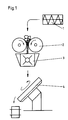
- the second step is preferably compacting.
- the compacting should preferably take place at very low line forces.
- the line forces used are generally in the lowest range of the commercially available devices between about 0.1 and 15 kN / cm. With the conditions of the subsequent sieve granulator (e.g. flake crusher from Bepex GmbH, D-74211 Leingart or Frewitt, Friborg / Switzerland), the adhesive forces within the flaps determine the size of the pre-granulate (germ) and the ratio between germ and powder.
- the line forces are preferably 0.5 to 10 kN / cm.
- This ratio and the residence time in the subsequent build-up granulation determine the optimal particle size of the granules.
- the correct ratio between the pre-granulate and powder means that practically the entire amount of pigment is converted into free-flowing, low-dust granules. A return of oversize and undersize is not necessary.
- this build-up granulation by re-rolling can easily be carried out by a person skilled in the art on commercially available turntables, drag drums or rotary drums.
- the plastic dispersibility was tested in accordance with one of DIN 53 775: Testing of colorants in plasticized poly-polyvinyl chloride (PVC-P) molding composition determination of the dispersion hardness by rolling approximation.
- the pigment to be tested is dispersed in PVC at 160 ⁇ 5 ° C on a mixing mill.
- the rolled skin obtained is divided and one half is then subjected to increased shear forces by rolling at room temperature.
- the measure of dispersibility for colored pigments is the color difference ⁇ E according to CIELAB (DIN 5033, 6174) between hot and cold-rolled PVC fur, or for white pigments the difference between the standard color values Y (DIN 5033) between hot and cold-rolled PVC fur.
- a readily dispersible pigment is dispersed even at low shear forces, while the increased shear forces when rolling at low temperature are necessary to disperse a pigment that is difficult to disperse. Therefore, the following applies: the smaller the color difference ⁇ E or the difference between the standard color values Y, the better the pigment is dispersible.
- dispersibility is of great importance since the granulate particles which must then be dispersed in the plastic must first be broken up. The aim is for granules to have the same good dispersibility as the corresponding pigment powders, so that the parameters ⁇ E and Y should not differ significantly for powder and granules.
- a ⁇ Y of 2.1 to 3.0 units is considered to be readily dispersible in the case of granulated white pigments, as is achieved with commercial products of TiO 2 granules, for example Baytitan R-FK-21 or in the case of colored pigments a ⁇ E of 0 to 1 units as achieved with Bayferrox 130 (commercial product from Bayer AG).
- the flow behavior is tested by assessing the flow behavior from a funnel with a volume of 300 to 1000 ml with an 8 mm opening.
- the flow behavior is said to be good if the material runs freely. If there is no material flow or flow only after tapping, the flow behavior is considered insufficient.
- the pre-granulate was granulated with the powder resulting from the crushing on a granulating plate with a diameter of 70 cm and a residence time of 7-10 minutes.
- the resulting granulate had a grain size of 0.2 to 2 mm with ad 50 of 0.56 mm. It was practically dust-free, very easy to pour and sufficiently stable in transport.
- the measurement of the dispersibility in plastics resulted in a color difference ⁇ E of 0.3 for the granules compared to a distance of 0.2 for the corresponding pigment powder.
- the resulting granules had a grain size of 0.2 to 2 mm with ad 50 of 0.5 mm. It was practically dust-free, very easy to pour and sufficiently stable in transport.
- the measurement of the dispersibility in plastics showed a difference in the standard color values Y of 1.7 for the granules compared to a distance of 3.0 for the ungranulated pigment powder used.
- the resulting granules had grain sizes of 0.2 to 2 mm. They were practically dust-free, very easy to pour and sufficiently stable in transport.
- the measurement of the dispersibility in plastics showed differences in the standard color values Y of a) 1.1 for the granules; b) 1.6; c) 1.3 compared to a distance of 2.4 when the ungranulated pigment powder used.
- the resulting granulate had a grain size of 0.2 to 2 mm. It was practically dust-free, very easy to pour and sufficiently stable in transport. The measurement of the dispersibility in plastics gave one for the granulate Color distance ⁇ E of 0.5 compared to a distance of 0.3 for the corresponding pigment powder.
- the resulting granules had grain sizes of 0.2 to 2 mm. They were practically dust-free, very easy to pour and sufficiently stable in transport.
- the resulting granules had grain sizes of 0.2 to 2 mm. It was dust free and free flowing. However, the measurement of the dispersibility in plastics showed a difference in the standard color values Y of 4.8 for the granules compared to a distance of 2.4 for the ungranulated pigment powder used.
- Titanium dioxide R-FK-21 (commercial product from Bayer AG), which was granulated using a spray dryer, has a grain size of 40-300 ⁇ with ad 50 of 120 ⁇ and a fine fraction ⁇ 100 ⁇ between 20 and 40%.
- the measurement of the dispersibility in plastics resulted in a difference of the standard color values Y of 3.0 for the spray granules.
Landscapes
- Chemical & Material Sciences (AREA)
- Organic Chemistry (AREA)
- Pigments, Carbon Blacks, Or Wood Stains (AREA)
- Processes Of Treating Macromolecular Substances (AREA)
- Compositions Of Macromolecular Compounds (AREA)
- Cosmetics (AREA)
- Silicates, Zeolites, And Molecular Sieves (AREA)
Applications Claiming Priority (2)
| Application Number | Priority Date | Filing Date | Title |
|---|---|---|---|
| DE4336612 | 1993-10-27 | ||
| DE4336612A DE4336612C2 (de) | 1993-10-27 | 1993-10-27 | Mehrstufiges Verfahren zur Herstellung von anorganischen Pigmentgranulaten und deren Verwendung zur Färbung von Kunststoffen und zur Herstellung von Pulverlacken |
Publications (2)
| Publication Number | Publication Date |
|---|---|
| EP0651031A1 EP0651031A1 (de) | 1995-05-03 |
| EP0651031B1 true EP0651031B1 (de) | 1997-03-12 |
Family
ID=6501109
Family Applications (1)
| Application Number | Title | Priority Date | Filing Date |
|---|---|---|---|
| EP94116231A Expired - Lifetime EP0651031B1 (de) | 1993-10-27 | 1994-10-14 | Verfahren zur Einfärbung von organischen Medien |
Country Status (10)
| Country | Link |
|---|---|
| US (1) | US5634970A (enExample) |
| EP (1) | EP0651031B1 (enExample) |
| JP (1) | JP3544720B2 (enExample) |
| CN (1) | CN1052025C (enExample) |
| AU (1) | AU675875B2 (enExample) |
| BR (1) | BR9404254A (enExample) |
| DE (2) | DE4336612C2 (enExample) |
| ES (1) | ES2099522T3 (enExample) |
| FI (1) | FI110948B (enExample) |
| TW (1) | TW275050B (enExample) |
Families Citing this family (18)
| Publication number | Priority date | Publication date | Assignee | Title |
|---|---|---|---|---|
| DE19649756B4 (de) * | 1996-04-18 | 2005-05-25 | Bayer Chemicals Ag | Verfahren zur Herstellung von Brikettier- und Preßgranulaten aus Rußpigmenten und deren Verwendung |
| DE19638042B4 (de) * | 1996-04-18 | 2005-09-08 | Bayer Chemicals Ag | Verfahren zur Herstellung von Brikettier- und Preßgranulaten aus anorganischen Pigmenten |
| DE19652953C2 (de) * | 1996-12-19 | 2000-05-18 | Bayer Ag | Verfahren zur Herstellung von Eisenoxidkeimen und deren Verwendung |
| DE19704943A1 (de) * | 1997-02-10 | 1998-08-13 | Bayer Ag | Anorganische Pigmentgranulate zum Einfärben von Kunststoffen, Lacken und Baustoffen und ein Verfahren zu deren Herstellung |
| DE19706899C1 (de) * | 1997-02-21 | 1998-11-05 | Bayer Ag | Anorganische, kompaktierte Pigmentgranulate, Verfahren zu ihrer Herstellung und ihre Verwendung |
| US5891237A (en) * | 1997-10-08 | 1999-04-06 | Millennium Inorganic Chemicals, Ltd. | Production of free flowing spheres using partially neutralized fatty acid |
| US6562120B2 (en) * | 1998-09-08 | 2003-05-13 | Elementis Uk Limited | Granular pigments |
| DE19933710A1 (de) | 1999-07-19 | 2001-01-25 | Daniele Casalini | Oberflächenbeschichteter Hartstoff |
| DE10002559B4 (de) | 2000-01-21 | 2004-07-15 | Brockhues Gmbh & Co. Kg | Pigmentgranulat zur Einfärbung von Baustoffen und Verfahren zu dessen Herstellung |
| DE10003248B4 (de) * | 2000-01-26 | 2008-05-29 | Brockhues Gmbh & Co. Kg | Pigmentgranulat zur Einfärbung von unpolaren Medien sowie Verfahren zu dessen Herstellung |
| DE102006017109A1 (de) * | 2006-04-10 | 2007-10-11 | Lanxess Deutschland Gmbh | Verfahren zur Herstellung von Pigmentgranulaten und deren Verwendung |
| DE102007023912A1 (de) | 2007-05-23 | 2008-11-27 | Lanxess Deutschland Gmbh | Pigmentzubereitungen von pastöser oder gelförmiger Konsistenz |
| DE102007023913A1 (de) | 2007-05-23 | 2008-11-27 | Lanxess Deutschland Gmbh | Pigmentzubereitungen von pastöser oder gelförmiger Konsistenz |
| DE102008045121A1 (de) | 2008-09-01 | 2010-03-04 | Lanxess Deutschland Gmbh | Pigmentgranulate, die anorganische Filterhilfsmittel enthalten |
| TWI397465B (zh) * | 2009-06-24 | 2013-06-01 | Pure Technology Corp I | 結合負離子及遠紅外線之塑料製品的製作方法 |
| US8663518B2 (en) * | 2011-12-27 | 2014-03-04 | Tronox Llc | Methods of producing a titanium dioxide pigment and improving the processability of titanium dioxide pigment particles |
| US11390755B2 (en) | 2017-01-26 | 2022-07-19 | Solomon Colors, Inc. | Pigment granulation process and method of use for coloring building materials |
| DE102018127691A1 (de) * | 2018-11-06 | 2020-05-07 | Osram Opto Semiconductors Gmbh | Deck- und/oder Füllmaterial, optoelektronische Vorrichtung, Verfahren zur Herstellung einer optoelektronischen Vorrichtung und Verfahren zur Herstellung eines Deck- und/oder Füllmaterials |
Family Cites Families (13)
| Publication number | Priority date | Publication date | Assignee | Title |
|---|---|---|---|---|
| DE1134467B (de) * | 1959-06-11 | 1962-08-09 | Hoechst Ag | Verfahren zur Herstellung staubfreier Farbstoff-Pulver |
| US4102967A (en) * | 1976-08-09 | 1978-07-25 | Phillips Petroleum Company | Pelleting of carbon black |
| WO1981000165A1 (en) * | 1979-07-02 | 1981-01-22 | Tokyo Shibaura Electric Co | Magnetic transfer recording method |
| DE3132303A1 (de) * | 1981-08-17 | 1983-02-24 | Bayer Ag, 5090 Leverkusen | Verfahren zur herstellung staubarmer anorganischer pigmentgranulate mit enger kornverteilung |
| DE3344464A1 (de) * | 1983-12-02 | 1985-07-25 | Heubach Hans Dr Gmbh Co Kg | Dauerhaft staubungsfreie pigment- und farbstoffpraeparate und verfahren zu ihrer herstellung |
| DE3619363A1 (de) * | 1986-06-09 | 1987-12-10 | Brockhues Chem Werke Ag | Verfahren zum einfaerben von beton |
| DE3628320A1 (de) * | 1986-08-21 | 1988-02-25 | Bayer Ag | Hydrophobe pigmente und fuellstoffe fuer die einarbeitung in kunststoffe |
| DE3841848A1 (de) * | 1988-12-13 | 1990-06-21 | Bayer Ag | Anorganische pigmente mit verbesserten eigenschaften |
| DE3931417A1 (de) * | 1989-09-21 | 1991-04-04 | Bayer Ag | Rutilmischphasenpigment-mikrogranulate, verfahren zu ihrer herstellung sowie deren verwendung |
| DE3935815A1 (de) * | 1989-10-27 | 1991-05-02 | Degussa | Staubarmes pigment- bzw. farbstoff-feingranulat |
| DE4041137A1 (de) * | 1990-12-21 | 1992-06-25 | Bayer Ag | Verfahren zur mahlung von pigmenten |
| DE4214195C2 (de) * | 1992-04-30 | 1995-06-08 | Bayer Ag | Verfahren zur Einfärbung von Asphalt |
| IT1254974B (it) * | 1992-06-18 | 1995-10-11 | Bayer Italia Spa | Granulati compositi, scorrevoli,idrofobi,un procedimento per la loro preparazione nonche' loro impiego |
-
1993
- 1993-10-27 DE DE4336612A patent/DE4336612C2/de not_active Expired - Fee Related
-
1994
- 1994-10-13 TW TW083108142A patent/TW275050B/zh not_active IP Right Cessation
- 1994-10-14 EP EP94116231A patent/EP0651031B1/de not_active Expired - Lifetime
- 1994-10-14 DE DE59402040T patent/DE59402040D1/de not_active Expired - Lifetime
- 1994-10-14 ES ES94116231T patent/ES2099522T3/es not_active Expired - Lifetime
- 1994-10-17 US US08/323,734 patent/US5634970A/en not_active Expired - Lifetime
- 1994-10-21 AU AU75991/94A patent/AU675875B2/en not_active Ceased
- 1994-10-21 JP JP28146794A patent/JP3544720B2/ja not_active Expired - Fee Related
- 1994-10-25 FI FI945012A patent/FI110948B/fi not_active IP Right Cessation
- 1994-10-26 BR BR9404254A patent/BR9404254A/pt not_active IP Right Cessation
- 1994-10-27 CN CN94113668A patent/CN1052025C/zh not_active Expired - Fee Related
Also Published As
| Publication number | Publication date |
|---|---|
| US5634970A (en) | 1997-06-03 |
| JPH07179785A (ja) | 1995-07-18 |
| CN1052025C (zh) | 2000-05-03 |
| FI110948B (fi) | 2003-04-30 |
| FI945012L (fi) | 1995-04-28 |
| DE4336612A1 (de) | 1995-05-04 |
| AU7599194A (en) | 1995-05-18 |
| CN1106039A (zh) | 1995-08-02 |
| BR9404254A (pt) | 1995-07-04 |
| ES2099522T3 (es) | 1997-05-16 |
| AU675875B2 (en) | 1997-02-20 |
| EP0651031A1 (de) | 1995-05-03 |
| FI945012A0 (fi) | 1994-10-25 |
| DE59402040D1 (de) | 1997-04-17 |
| TW275050B (enExample) | 1996-05-01 |
| JP3544720B2 (ja) | 2004-07-21 |
| DE4336612C2 (de) | 1995-09-07 |
Similar Documents
| Publication | Publication Date | Title |
|---|---|---|
| EP0650939B1 (de) | Verfahren zur Einfärbung von Baustoffen | |
| EP0802242B1 (de) | Verfahren zur Herstellung von Brikettier- und Pressgranulaten | |
| EP0651031B1 (de) | Verfahren zur Einfärbung von organischen Medien | |
| EP1845137B1 (de) | Verfahren zur Herstellung von Pigmentgranulaten und deren Verwendung | |
| EP2159266B1 (de) | Pigmentgranulate, die anorganische Filterhilfsmittel enthalten | |
| EP0857764B2 (de) | Anorganische Pigmentgranulate zum Einfärben von Kunststoffen, Lacken und Baustoffen und ein Verfahren zu deren Herstellung | |
| EP2427520B1 (de) | Granulatzusammensetzung und verfahren zu deren herstellung | |
| DE19706899C1 (de) | Anorganische, kompaktierte Pigmentgranulate, Verfahren zu ihrer Herstellung und ihre Verwendung | |
| EP0424896A1 (de) | Staubarmes Pigment- bzw. Farbstoff-Feingranulat | |
| EP0924268B1 (de) | Perlruss und Verfahren zu seiner Herstellung | |
| EP2658930B1 (de) | Öl- und wachshaltige mittel in stückiger form mit bestimmten wachsmischungen für die asphalt- und bitumeneinfärbung | |
| EP0807669A2 (de) | Russ-Granulate | |
| EP1215249B1 (de) | Perlruss | |
| EP1064331B1 (de) | Russgranulate | |
| DE19638042B4 (de) | Verfahren zur Herstellung von Brikettier- und Preßgranulaten aus anorganischen Pigmenten | |
| EP2658929B1 (de) | Öl- und wachshaltige mittel in stückiger form für die asphalt- und bitumeneinfärbung |
Legal Events
| Date | Code | Title | Description |
|---|---|---|---|
| PUAI | Public reference made under article 153(3) epc to a published international application that has entered the european phase |
Free format text: ORIGINAL CODE: 0009012 |
|
| AK | Designated contracting states |
Kind code of ref document: A1 Designated state(s): BE DE ES FR GB IT NL |
|
| 17P | Request for examination filed |
Effective date: 19950518 |
|
| 17Q | First examination report despatched |
Effective date: 19960510 |
|
| GRAG | Despatch of communication of intention to grant |
Free format text: ORIGINAL CODE: EPIDOS AGRA |
|
| GRAH | Despatch of communication of intention to grant a patent |
Free format text: ORIGINAL CODE: EPIDOS IGRA |
|
| GRAH | Despatch of communication of intention to grant a patent |
Free format text: ORIGINAL CODE: EPIDOS IGRA |
|
| GRAA | (expected) grant |
Free format text: ORIGINAL CODE: 0009210 |
|
| AK | Designated contracting states |
Kind code of ref document: B1 Designated state(s): BE DE ES FR GB IT NL |
|
| GBT | Gb: translation of ep patent filed (gb section 77(6)(a)/1977) |
Effective date: 19970313 |
|
| REF | Corresponds to: |
Ref document number: 59402040 Country of ref document: DE Date of ref document: 19970417 |
|
| ITF | It: translation for a ep patent filed | ||
| REG | Reference to a national code |
Ref country code: ES Ref legal event code: FG2A Ref document number: 2099522 Country of ref document: ES Kind code of ref document: T3 |
|
| ET | Fr: translation filed | ||
| PLBE | No opposition filed within time limit |
Free format text: ORIGINAL CODE: 0009261 |
|
| STAA | Information on the status of an ep patent application or granted ep patent |
Free format text: STATUS: NO OPPOSITION FILED WITHIN TIME LIMIT |
|
| 26N | No opposition filed | ||
| REG | Reference to a national code |
Ref country code: GB Ref legal event code: IF02 |
|
| REG | Reference to a national code |
Ref country code: GB Ref legal event code: 732E |
|
| NLS | Nl: assignments of ep-patents |
Owner name: LANXESS DEUTSCHLAND GMBH Effective date: 20070305 |
|
| REG | Reference to a national code |
Ref country code: FR Ref legal event code: TP |
|
| PGFP | Annual fee paid to national office [announced via postgrant information from national office to epo] |
Ref country code: NL Payment date: 20101009 Year of fee payment: 17 Ref country code: FR Payment date: 20101020 Year of fee payment: 17 |
|
| PGFP | Annual fee paid to national office [announced via postgrant information from national office to epo] |
Ref country code: DE Payment date: 20101006 Year of fee payment: 17 |
|
| PGFP | Annual fee paid to national office [announced via postgrant information from national office to epo] |
Ref country code: IT Payment date: 20101020 Year of fee payment: 17 Ref country code: GB Payment date: 20101013 Year of fee payment: 17 Ref country code: BE Payment date: 20101020 Year of fee payment: 17 |
|
| PGFP | Annual fee paid to national office [announced via postgrant information from national office to epo] |
Ref country code: ES Payment date: 20101122 Year of fee payment: 17 |
|
| BERE | Be: lapsed |
Owner name: *LANXESS DEUTSCHLAND G.M.B.H. Effective date: 20111031 |
|
| REG | Reference to a national code |
Ref country code: NL Ref legal event code: V1 Effective date: 20120501 |
|
| GBPC | Gb: european patent ceased through non-payment of renewal fee |
Effective date: 20111014 |
|
| REG | Reference to a national code |
Ref country code: FR Ref legal event code: ST Effective date: 20120629 |
|
| PG25 | Lapsed in a contracting state [announced via postgrant information from national office to epo] |
Ref country code: NL Free format text: LAPSE BECAUSE OF NON-PAYMENT OF DUE FEES Effective date: 20120501 Ref country code: BE Free format text: LAPSE BECAUSE OF NON-PAYMENT OF DUE FEES Effective date: 20111031 |
|
| PG25 | Lapsed in a contracting state [announced via postgrant information from national office to epo] |
Ref country code: FR Free format text: LAPSE BECAUSE OF NON-PAYMENT OF DUE FEES Effective date: 20111102 Ref country code: GB Free format text: LAPSE BECAUSE OF NON-PAYMENT OF DUE FEES Effective date: 20111014 |
|
| REG | Reference to a national code |
Ref country code: ES Ref legal event code: FD2A Effective date: 20130604 |
|
| PG25 | Lapsed in a contracting state [announced via postgrant information from national office to epo] |
Ref country code: ES Free format text: LAPSE BECAUSE OF NON-PAYMENT OF DUE FEES Effective date: 20111015 Ref country code: DE Free format text: LAPSE BECAUSE OF NON-PAYMENT OF DUE FEES Effective date: 20130501 |
|
| REG | Reference to a national code |
Ref country code: DE Ref legal event code: R119 Ref document number: 59402040 Country of ref document: DE Effective date: 20130501 |
|
| PG25 | Lapsed in a contracting state [announced via postgrant information from national office to epo] |
Ref country code: IT Free format text: LAPSE BECAUSE OF NON-PAYMENT OF DUE FEES Effective date: 20121014 |