EP0649846B1 - Galanthamine derivates, a process for their preparation and their use as medicaments - Google Patents
Galanthamine derivates, a process for their preparation and their use as medicaments Download PDFInfo
- Publication number
- EP0649846B1 EP0649846B1 EP94115961A EP94115961A EP0649846B1 EP 0649846 B1 EP0649846 B1 EP 0649846B1 EP 94115961 A EP94115961 A EP 94115961A EP 94115961 A EP94115961 A EP 94115961A EP 0649846 B1 EP0649846 B1 EP 0649846B1
- Authority
- EP
- European Patent Office
- Prior art keywords
- chloroform
- galanthamine
- demethyl
- compound
- formula
- Prior art date
- Legal status (The legal status is an assumption and is not a legal conclusion. Google has not performed a legal analysis and makes no representation as to the accuracy of the status listed.)
- Expired - Lifetime
Links
- ASUTZQLVASHGKV-UHFFFAOYSA-N galanthamine hydrochloride Natural products O1C(=C23)C(OC)=CC=C2CN(C)CCC23C1CC(O)C=C2 ASUTZQLVASHGKV-UHFFFAOYSA-N 0.000 title claims description 59
- ASUTZQLVASHGKV-JDFRZJQESA-N galanthamine Chemical compound O1C(=C23)C(OC)=CC=C2CN(C)CC[C@]23[C@@H]1C[C@@H](O)C=C2 ASUTZQLVASHGKV-JDFRZJQESA-N 0.000 title claims description 38
- 229960003980 galantamine Drugs 0.000 title claims description 20
- HPOIPOPJGBKXIR-UHFFFAOYSA-N 3,6-dimethoxy-10-methyl-galantham-1-ene Natural products O1C(C(=CC=2)OC)=C3C=2CN(C)CCC23C1CC(OC)C=C2 HPOIPOPJGBKXIR-UHFFFAOYSA-N 0.000 title claims description 17
- LPCKPBWOSNVCEL-UHFFFAOYSA-N Chlidanthine Natural products O1C(C(=CC=2)O)=C3C=2CN(C)CCC23C1CC(OC)C=C2 LPCKPBWOSNVCEL-UHFFFAOYSA-N 0.000 title claims description 17
- BGLNUNCBNALFOZ-WMLDXEAASA-N galanthamine Natural products COc1ccc2CCCC[C@@]34C=CCC[C@@H]3Oc1c24 BGLNUNCBNALFOZ-WMLDXEAASA-N 0.000 title claims description 17
- IYVSXSLYJLAZAT-NOLJZWGESA-N lycoramine Natural products CN1CC[C@@]23CC[C@H](O)C[C@@H]2Oc4cccc(C1)c34 IYVSXSLYJLAZAT-NOLJZWGESA-N 0.000 title claims description 17
- 238000002360 preparation method Methods 0.000 title claims description 8
- 239000003814 drug Substances 0.000 title claims description 3
- 238000000034 method Methods 0.000 title abstract description 6
- 150000001875 compounds Chemical class 0.000 claims abstract description 58
- 230000006949 cholinergic function Effects 0.000 claims abstract description 6
- 230000007074 memory dysfunction Effects 0.000 claims abstract description 6
- 230000003247 decreasing effect Effects 0.000 claims abstract description 5
- 239000008194 pharmaceutical composition Substances 0.000 claims abstract description 3
- 229910052739 hydrogen Inorganic materials 0.000 claims description 96
- 239000001257 hydrogen Substances 0.000 claims description 24
- -1 phenylcarbonyloxy Chemical group 0.000 claims description 24
- 125000003118 aryl group Chemical group 0.000 claims description 16
- 125000004435 hydrogen atom Chemical group [H]* 0.000 claims description 15
- 125000005196 alkyl carbonyloxy group Chemical group 0.000 claims description 10
- 125000004457 alkyl amino carbonyl group Chemical group 0.000 claims description 9
- 125000004448 alkyl carbonyl group Chemical group 0.000 claims description 9
- 150000003839 salts Chemical class 0.000 claims description 9
- UFHFLCQGNIYNRP-UHFFFAOYSA-N Hydrogen Chemical compound [H][H] UFHFLCQGNIYNRP-UHFFFAOYSA-N 0.000 claims description 8
- 125000005843 halogen group Chemical group 0.000 claims description 8
- 125000004453 alkoxycarbonyl group Chemical group 0.000 claims description 7
- 125000005194 alkoxycarbonyloxy group Chemical group 0.000 claims description 7
- 125000001246 bromo group Chemical group Br* 0.000 claims description 7
- 239000002253 acid Substances 0.000 claims description 6
- 125000004169 (C1-C6) alkyl group Chemical group 0.000 claims description 3
- 125000004916 (C1-C6) alkylcarbonyl group Chemical group 0.000 claims description 3
- 125000005199 aryl carbonyloxy group Chemical group 0.000 claims description 3
- 125000004674 methylcarbonyl group Chemical group CC(=O)* 0.000 claims description 3
- 125000001997 phenyl group Chemical group [H]C1=C([H])C([H])=C(*)C([H])=C1[H] 0.000 claims description 3
- 125000001424 substituent group Chemical group 0.000 claims description 3
- 125000004178 (C1-C4) alkyl group Chemical group 0.000 claims description 2
- 125000004191 (C1-C6) alkoxy group Chemical group 0.000 claims description 2
- 239000003937 drug carrier Substances 0.000 claims description 2
- 125000004672 ethylcarbonyl group Chemical group [H]C([H])([H])C([H])([H])C(*)=O 0.000 claims description 2
- 125000006253 t-butylcarbonyl group Chemical group [H]C([H])([H])C(C(*)=O)(C([H])([H])[H])C([H])([H])[H] 0.000 claims description 2
- 125000002023 trifluoromethyl group Chemical group FC(F)(F)* 0.000 claims description 2
- 150000002431 hydrogen Chemical class 0.000 claims 2
- OKKJLVBELUTLKV-UHFFFAOYSA-N Methanol Chemical compound OC OKKJLVBELUTLKV-UHFFFAOYSA-N 0.000 description 192
- YMWUJEATGCHHMB-UHFFFAOYSA-N Dichloromethane Chemical compound ClCCl YMWUJEATGCHHMB-UHFFFAOYSA-N 0.000 description 171
- HEDRZPFGACZZDS-UHFFFAOYSA-N Chloroform Chemical compound ClC(Cl)Cl HEDRZPFGACZZDS-UHFFFAOYSA-N 0.000 description 156
- 239000000243 solution Substances 0.000 description 79
- RTZKZFJDLAIYFH-UHFFFAOYSA-N Diethyl ether Chemical compound CCOCC RTZKZFJDLAIYFH-UHFFFAOYSA-N 0.000 description 74
- 229910052799 carbon Inorganic materials 0.000 description 72
- VHYFNPMBLIVWCW-UHFFFAOYSA-N 4-Dimethylaminopyridine Chemical compound CN(C)C1=CC=NC=C1 VHYFNPMBLIVWCW-UHFFFAOYSA-N 0.000 description 58
- 239000003921 oil Substances 0.000 description 55
- VEXZGXHMUGYJMC-UHFFFAOYSA-N Hydrochloric acid Chemical compound Cl VEXZGXHMUGYJMC-UHFFFAOYSA-N 0.000 description 46
- IXCSERBJSXMMFS-UHFFFAOYSA-N hydrogen chloride Substances Cl.Cl IXCSERBJSXMMFS-UHFFFAOYSA-N 0.000 description 46
- 229910000041 hydrogen chloride Inorganic materials 0.000 description 46
- USUHXXKCHSBMOS-XPSHAMGMSA-N galanthamine hydrochloride Chemical compound Cl.O1C(=C23)C(OC)=CC=C2CN(C)CC[C@]23[C@@H]1C[C@@H](O)C=C2 USUHXXKCHSBMOS-XPSHAMGMSA-N 0.000 description 42
- 229910052757 nitrogen Inorganic materials 0.000 description 37
- 238000004458 analytical method Methods 0.000 description 36
- VYPSYNLAJGMNEJ-UHFFFAOYSA-N Silicium dioxide Chemical compound O=[Si]=O VYPSYNLAJGMNEJ-UHFFFAOYSA-N 0.000 description 35
- 239000000741 silica gel Substances 0.000 description 34
- 229910002027 silica gel Inorganic materials 0.000 description 34
- 239000000203 mixture Substances 0.000 description 31
- 239000007787 solid Substances 0.000 description 28
- 238000003756 stirring Methods 0.000 description 23
- 239000000047 product Substances 0.000 description 22
- 239000002904 solvent Substances 0.000 description 22
- 239000000725 suspension Substances 0.000 description 21
- ZMANZCXQSJIPKH-UHFFFAOYSA-N Triethylamine Chemical compound CCN(CC)CC ZMANZCXQSJIPKH-UHFFFAOYSA-N 0.000 description 18
- 238000003818 flash chromatography Methods 0.000 description 17
- 238000004128 high performance liquid chromatography Methods 0.000 description 17
- GQHTUMJGOHRCHB-UHFFFAOYSA-N 2,3,4,6,7,8,9,10-octahydropyrimido[1,2-a]azepine Chemical compound C1CCCCN2CCCN=C21 GQHTUMJGOHRCHB-UHFFFAOYSA-N 0.000 description 16
- QCQCHGYLTSGIGX-GHXANHINSA-N 4-[[(3ar,5ar,5br,7ar,9s,11ar,11br,13as)-5a,5b,8,8,11a-pentamethyl-3a-[(5-methylpyridine-3-carbonyl)amino]-2-oxo-1-propan-2-yl-4,5,6,7,7a,9,10,11,11b,12,13,13a-dodecahydro-3h-cyclopenta[a]chrysen-9-yl]oxy]-2,2-dimethyl-4-oxobutanoic acid Chemical compound N([C@@]12CC[C@@]3(C)[C@]4(C)CC[C@H]5C(C)(C)[C@@H](OC(=O)CC(C)(C)C(O)=O)CC[C@]5(C)[C@H]4CC[C@@H]3C1=C(C(C2)=O)C(C)C)C(=O)C1=CN=CC(C)=C1 QCQCHGYLTSGIGX-GHXANHINSA-N 0.000 description 15
- XEKOWRVHYACXOJ-UHFFFAOYSA-N Ethyl acetate Chemical compound CCOC(C)=O XEKOWRVHYACXOJ-UHFFFAOYSA-N 0.000 description 15
- ZMXDDKWLCZADIW-UHFFFAOYSA-N N,N-Dimethylformamide Chemical compound CN(C)C=O ZMXDDKWLCZADIW-UHFFFAOYSA-N 0.000 description 15
- 239000002244 precipitate Substances 0.000 description 15
- XLYOFNOQVPJJNP-UHFFFAOYSA-N water Chemical compound O XLYOFNOQVPJJNP-UHFFFAOYSA-N 0.000 description 14
- FAPWRFPIFSIZLT-UHFFFAOYSA-M Sodium chloride Chemical compound [Na+].[Cl-] FAPWRFPIFSIZLT-UHFFFAOYSA-M 0.000 description 12
- 239000000463 material Substances 0.000 description 12
- WFDIJRYMOXRFFG-UHFFFAOYSA-N Acetic anhydride Chemical compound CC(=O)OC(C)=O WFDIJRYMOXRFFG-UHFFFAOYSA-N 0.000 description 9
- YXFVVABEGXRONW-UHFFFAOYSA-N Toluene Chemical compound CC1=CC=CC=C1 YXFVVABEGXRONW-UHFFFAOYSA-N 0.000 description 9
- 229910001868 water Inorganic materials 0.000 description 8
- UIIMBOGNXHQVGW-UHFFFAOYSA-M Sodium bicarbonate Chemical compound [Na+].OC([O-])=O UIIMBOGNXHQVGW-UHFFFAOYSA-M 0.000 description 7
- CSCPPACGZOOCGX-UHFFFAOYSA-N Acetone Chemical compound CC(C)=O CSCPPACGZOOCGX-UHFFFAOYSA-N 0.000 description 6
- WEVYAHXRMPXWCK-UHFFFAOYSA-N Acetonitrile Chemical compound CC#N WEVYAHXRMPXWCK-UHFFFAOYSA-N 0.000 description 6
- CDBYLPFSWZWCQE-UHFFFAOYSA-L Sodium Carbonate Chemical compound [Na+].[Na+].[O-]C([O-])=O CDBYLPFSWZWCQE-UHFFFAOYSA-L 0.000 description 6
- PMZURENOXWZQFD-UHFFFAOYSA-L Sodium Sulfate Chemical compound [Na+].[Na+].[O-]S([O-])(=O)=O PMZURENOXWZQFD-UHFFFAOYSA-L 0.000 description 6
- 238000006243 chemical reaction Methods 0.000 description 6
- 238000001914 filtration Methods 0.000 description 6
- 238000012360 testing method Methods 0.000 description 6
- 229960000549 4-dimethylaminophenol Drugs 0.000 description 5
- 102100033639 Acetylcholinesterase Human genes 0.000 description 5
- 108010022752 Acetylcholinesterase Proteins 0.000 description 5
- 241001465754 Metazoa Species 0.000 description 5
- 239000011541 reaction mixture Substances 0.000 description 5
- 229910052938 sodium sulfate Inorganic materials 0.000 description 5
- 229930000680 A04AD01 - Scopolamine Natural products 0.000 description 4
- 208000024827 Alzheimer disease Diseases 0.000 description 4
- WKBOTKDWSSQWDR-UHFFFAOYSA-N Bromine atom Chemical compound [Br] WKBOTKDWSSQWDR-UHFFFAOYSA-N 0.000 description 4
- STECJAGHUSJQJN-GAUPFVANSA-N Hyoscine Natural products C1([C@H](CO)C(=O)OC2C[C@@H]3N([C@H](C2)[C@@H]2[C@H]3O2)C)=CC=CC=C1 STECJAGHUSJQJN-GAUPFVANSA-N 0.000 description 4
- CSNNHWWHGAXBCP-UHFFFAOYSA-L Magnesium sulfate Chemical compound [Mg+2].[O-][S+2]([O-])([O-])[O-] CSNNHWWHGAXBCP-UHFFFAOYSA-L 0.000 description 4
- STECJAGHUSJQJN-UHFFFAOYSA-N N-Methyl-scopolamin Natural products C1C(C2C3O2)N(C)C3CC1OC(=O)C(CO)C1=CC=CC=C1 STECJAGHUSJQJN-UHFFFAOYSA-N 0.000 description 4
- WYURNTSHIVDZCO-UHFFFAOYSA-N Tetrahydrofuran Chemical compound C1CCOC1 WYURNTSHIVDZCO-UHFFFAOYSA-N 0.000 description 4
- 229940022698 acetylcholinesterase Drugs 0.000 description 4
- 125000000217 alkyl group Chemical group 0.000 description 4
- 238000003556 assay Methods 0.000 description 4
- GDTBXPJZTBHREO-UHFFFAOYSA-N bromine Substances BrBr GDTBXPJZTBHREO-UHFFFAOYSA-N 0.000 description 4
- 229910052794 bromium Inorganic materials 0.000 description 4
- 239000002775 capsule Substances 0.000 description 4
- 239000003795 chemical substances by application Substances 0.000 description 4
- 239000000544 cholinesterase inhibitor Substances 0.000 description 4
- 239000010410 layer Substances 0.000 description 4
- 239000003960 organic solvent Substances 0.000 description 4
- STECJAGHUSJQJN-FWXGHANASA-N scopolamine Chemical compound C1([C@@H](CO)C(=O)O[C@H]2C[C@@H]3N([C@H](C2)[C@@H]2[C@H]3O2)C)=CC=CC=C1 STECJAGHUSJQJN-FWXGHANASA-N 0.000 description 4
- 229960002646 scopolamine Drugs 0.000 description 4
- 239000011780 sodium chloride Substances 0.000 description 4
- PGZVFRAEAAXREB-UHFFFAOYSA-N 2,2-dimethylpropanoyl 2,2-dimethylpropanoate Chemical compound CC(C)(C)C(=O)OC(=O)C(C)(C)C PGZVFRAEAAXREB-UHFFFAOYSA-N 0.000 description 3
- WVDDGKGOMKODPV-UHFFFAOYSA-N Benzyl alcohol Chemical compound OCC1=CC=CC=C1 WVDDGKGOMKODPV-UHFFFAOYSA-N 0.000 description 3
- 239000007832 Na2SO4 Substances 0.000 description 3
- OYSGWKOGUVOGFQ-UHFFFAOYSA-N O-demethylgalanthamine Natural products O1C(C(=CC=2)O)=C3C=2CN(C)CCC23C1CC(O)C=C2 OYSGWKOGUVOGFQ-UHFFFAOYSA-N 0.000 description 3
- DNIAPMSPPWPWGF-UHFFFAOYSA-N Propylene glycol Chemical compound CC(O)CO DNIAPMSPPWPWGF-UHFFFAOYSA-N 0.000 description 3
- 150000001412 amines Chemical class 0.000 description 3
- 239000002585 base Substances 0.000 description 3
- 238000010790 dilution Methods 0.000 description 3
- 239000012895 dilution Substances 0.000 description 3
- DNJIEGIFACGWOD-UHFFFAOYSA-N ethanethiol Chemical compound CCS DNJIEGIFACGWOD-UHFFFAOYSA-N 0.000 description 3
- RAFYDKXYXRZODZ-UHFFFAOYSA-N octanoyl octanoate Chemical compound CCCCCCCC(=O)OC(=O)CCCCCCC RAFYDKXYXRZODZ-UHFFFAOYSA-N 0.000 description 3
- 229910000030 sodium bicarbonate Inorganic materials 0.000 description 3
- 229910000029 sodium carbonate Inorganic materials 0.000 description 3
- YBRBMKDOPFTVDT-UHFFFAOYSA-N tert-butylamine Chemical compound CC(C)(C)N YBRBMKDOPFTVDT-UHFFFAOYSA-N 0.000 description 3
- 125000004454 (C1-C6) alkoxycarbonyl group Chemical group 0.000 description 2
- CIWBSHSKHKDKBQ-JLAZNSOCSA-N Ascorbic acid Chemical compound OC[C@H](O)[C@H]1OC(=O)C(O)=C1O CIWBSHSKHKDKBQ-JLAZNSOCSA-N 0.000 description 2
- IJGRMHOSHXDMSA-UHFFFAOYSA-N Atomic nitrogen Chemical compound N#N IJGRMHOSHXDMSA-UHFFFAOYSA-N 0.000 description 2
- BVKZGUZCCUSVTD-UHFFFAOYSA-L Carbonate Chemical compound [O-]C([O-])=O BVKZGUZCCUSVTD-UHFFFAOYSA-L 0.000 description 2
- XDTMQSROBMDMFD-UHFFFAOYSA-N Cyclohexane Chemical compound C1CCCCC1 XDTMQSROBMDMFD-UHFFFAOYSA-N 0.000 description 2
- QOSSAOTZNIDXMA-UHFFFAOYSA-N Dicylcohexylcarbodiimide Chemical compound C1CCCCC1N=C=NC1CCCCC1 QOSSAOTZNIDXMA-UHFFFAOYSA-N 0.000 description 2
- PEDCQBHIVMGVHV-UHFFFAOYSA-N Glycerine Chemical compound OCC(O)CO PEDCQBHIVMGVHV-UHFFFAOYSA-N 0.000 description 2
- LRHPLDYGYMQRHN-UHFFFAOYSA-N N-Butanol Chemical compound CCCCO LRHPLDYGYMQRHN-UHFFFAOYSA-N 0.000 description 2
- AMQJEAYHLZJPGS-UHFFFAOYSA-N N-Pentanol Chemical compound CCCCCO AMQJEAYHLZJPGS-UHFFFAOYSA-N 0.000 description 2
- 229930006000 Sucrose Natural products 0.000 description 2
- CZMRCDWAGMRECN-UGDNZRGBSA-N Sucrose Chemical compound O[C@H]1[C@H](O)[C@@H](CO)O[C@@]1(CO)O[C@@H]1[C@H](O)[C@@H](O)[C@H](O)[C@@H](CO)O1 CZMRCDWAGMRECN-UGDNZRGBSA-N 0.000 description 2
- 125000003545 alkoxy group Chemical group 0.000 description 2
- 210000004556 brain Anatomy 0.000 description 2
- FZFAMSAMCHXGEF-UHFFFAOYSA-N chloro formate Chemical compound ClOC=O FZFAMSAMCHXGEF-UHFFFAOYSA-N 0.000 description 2
- 238000002425 crystallisation Methods 0.000 description 2
- 230000008025 crystallization Effects 0.000 description 2
- 230000000694 effects Effects 0.000 description 2
- 239000000284 extract Substances 0.000 description 2
- 239000000796 flavoring agent Substances 0.000 description 2
- 239000012458 free base Substances 0.000 description 2
- 230000005764 inhibitory process Effects 0.000 description 2
- LSACYLWPPQLVSM-UHFFFAOYSA-N isobutyric acid anhydride Chemical compound CC(C)C(=O)OC(=O)C(C)C LSACYLWPPQLVSM-UHFFFAOYSA-N 0.000 description 2
- HQKMJHAJHXVSDF-UHFFFAOYSA-L magnesium stearate Chemical compound [Mg+2].CCCCCCCCCCCCCCCCCC([O-])=O.CCCCCCCCCCCCCCCCCC([O-])=O HQKMJHAJHXVSDF-UHFFFAOYSA-L 0.000 description 2
- 229910052943 magnesium sulfate Inorganic materials 0.000 description 2
- 206010027175 memory impairment Diseases 0.000 description 2
- OSWPMRLSEDHDFF-UHFFFAOYSA-N methyl salicylate Chemical compound COC(=O)C1=CC=CC=C1O OSWPMRLSEDHDFF-UHFFFAOYSA-N 0.000 description 2
- VLKZOEOYAKHREP-UHFFFAOYSA-N n-Hexane Chemical class CCCCCC VLKZOEOYAKHREP-UHFFFAOYSA-N 0.000 description 2
- 239000000546 pharmaceutical excipient Substances 0.000 description 2
- 239000006187 pill Substances 0.000 description 2
- BWHMMNNQKKPAPP-UHFFFAOYSA-L potassium carbonate Chemical compound [K+].[K+].[O-]C([O-])=O BWHMMNNQKKPAPP-UHFFFAOYSA-L 0.000 description 2
- 238000001556 precipitation Methods 0.000 description 2
- WYVAMUWZEOHJOQ-UHFFFAOYSA-N propionic anhydride Chemical compound CCC(=O)OC(=O)CC WYVAMUWZEOHJOQ-UHFFFAOYSA-N 0.000 description 2
- 125000004673 propylcarbonyl group Chemical group 0.000 description 2
- 239000003586 protic polar solvent Substances 0.000 description 2
- 125000003548 sec-pentyl group Chemical group [H]C([H])([H])C([H])([H])C([H])([H])C([H])(*)C([H])([H])[H] 0.000 description 2
- 235000011152 sodium sulphate Nutrition 0.000 description 2
- 239000008174 sterile solution Substances 0.000 description 2
- 239000005720 sucrose Substances 0.000 description 2
- 239000006188 syrup Substances 0.000 description 2
- 235000020357 syrup Nutrition 0.000 description 2
- 229960001685 tacrine Drugs 0.000 description 2
- YLJREFDVOIBQDA-UHFFFAOYSA-N tacrine Chemical compound C1=CC=C2C(N)=C(CCCC3)C3=NC2=C1 YLJREFDVOIBQDA-UHFFFAOYSA-N 0.000 description 2
- DYHSDKLCOJIUFX-UHFFFAOYSA-N tert-butoxycarbonyl anhydride Chemical compound CC(C)(C)OC(=O)OC(=O)OC(C)(C)C DYHSDKLCOJIUFX-UHFFFAOYSA-N 0.000 description 2
- 230000001225 therapeutic effect Effects 0.000 description 2
- 238000005303 weighing Methods 0.000 description 2
- NFKAWBGFIMBUMB-UHFFFAOYSA-N 1-phenylpentan-2-one Chemical compound CCCC(=O)CC1=CC=CC=C1 NFKAWBGFIMBUMB-UHFFFAOYSA-N 0.000 description 1
- NOGFHTGYPKWWRX-UHFFFAOYSA-N 2,2,6,6-tetramethyloxan-4-one Chemical compound CC1(C)CC(=O)CC(C)(C)O1 NOGFHTGYPKWWRX-UHFFFAOYSA-N 0.000 description 1
- VUAXHMVRKOTJKP-UHFFFAOYSA-N 2,2-dimethylbutyric acid Chemical compound CCC(C)(C)C(O)=O VUAXHMVRKOTJKP-UHFFFAOYSA-N 0.000 description 1
- CFLAYISSADVCJH-UHFFFAOYSA-N 2,6-dimethylbenzoyl chloride Chemical compound CC1=CC=CC(C)=C1C(Cl)=O CFLAYISSADVCJH-UHFFFAOYSA-N 0.000 description 1
- PGWKKYVDHYLHNF-UHFFFAOYSA-N 2-methylbutan-2-yl 2-methylbutan-2-yloxycarbonyl carbonate Chemical compound CCC(C)(C)OC(=O)OC(=O)OC(C)(C)CC PGWKKYVDHYLHNF-UHFFFAOYSA-N 0.000 description 1
- MLMQPDHYNJCQAO-UHFFFAOYSA-N 3,3-dimethylbutyric acid Chemical compound CC(C)(C)CC(O)=O MLMQPDHYNJCQAO-UHFFFAOYSA-N 0.000 description 1
- ISULZYQDGYXDFW-UHFFFAOYSA-N 3-methylbutanoyl chloride Chemical compound CC(C)CC(Cl)=O ISULZYQDGYXDFW-UHFFFAOYSA-N 0.000 description 1
- OXZYBOLWRXENKT-UHFFFAOYSA-N 4-(trifluoromethyl)benzoyl chloride Chemical compound FC(F)(F)C1=CC=C(C(Cl)=O)C=C1 OXZYBOLWRXENKT-UHFFFAOYSA-N 0.000 description 1
- QCMLOHSHCOOPQB-UHFFFAOYSA-N 4-[4-(trifluoromethyl)phenoxy]piperidin-1-ium;chloride Chemical compound Cl.C1=CC(C(F)(F)F)=CC=C1OC1CCNCC1 QCMLOHSHCOOPQB-UHFFFAOYSA-N 0.000 description 1
- JLDLLLFQYFAMHX-UHFFFAOYSA-N 6,11-dihydroxy-3,3,12-trimethyl-5-(3-methylbut-2-enyl)pyrano[2,3-c]acridin-7-one Chemical compound CN1C2=C(O)C=CC=C2C(=O)C(C(O)=C2CC=C(C)C)=C1C1=C2OC(C)(C)C=C1 JLDLLLFQYFAMHX-UHFFFAOYSA-N 0.000 description 1
- KBMGLVFFJUCSBR-UHFFFAOYSA-N 8-hydroxy-4-methoxy-1-methyl-3-(3-methylbut-2-enyl)quinolin-2-one Chemical compound C1=CC=C2C(OC)=C(CC=C(C)C)C(=O)N(C)C2=C1O KBMGLVFFJUCSBR-UHFFFAOYSA-N 0.000 description 1
- 229940100578 Acetylcholinesterase inhibitor Drugs 0.000 description 1
- NLXLAEXVIDQMFP-UHFFFAOYSA-N Ammonia chloride Chemical compound [NH4+].[Cl-] NLXLAEXVIDQMFP-UHFFFAOYSA-N 0.000 description 1
- VHUUQVKOLVNVRT-UHFFFAOYSA-N Ammonium hydroxide Chemical compound [NH4+].[OH-] VHUUQVKOLVNVRT-UHFFFAOYSA-N 0.000 description 1
- 241000416162 Astragalus gummifer Species 0.000 description 1
- 229920002261 Corn starch Polymers 0.000 description 1
- GZDFHIJNHHMENY-UHFFFAOYSA-N Dimethyl dicarbonate Chemical compound COC(=O)OC(=O)OC GZDFHIJNHHMENY-UHFFFAOYSA-N 0.000 description 1
- SNRUBQQJIBEYMU-UHFFFAOYSA-N Dodecane Natural products CCCCCCCCCCCC SNRUBQQJIBEYMU-UHFFFAOYSA-N 0.000 description 1
- KCXVZYZYPLLWCC-UHFFFAOYSA-N EDTA Chemical compound OC(=O)CN(CC(O)=O)CCN(CC(O)=O)CC(O)=O KCXVZYZYPLLWCC-UHFFFAOYSA-N 0.000 description 1
- 108010010803 Gelatin Proteins 0.000 description 1
- WQZGKKKJIJFFOK-GASJEMHNSA-N Glucose Natural products OC[C@H]1OC(O)[C@H](O)[C@@H](O)[C@@H]1O WQZGKKKJIJFFOK-GASJEMHNSA-N 0.000 description 1
- GUBGYTABKSRVRQ-QKKXKWKRSA-N Lactose Natural products OC[C@H]1O[C@@H](O[C@H]2[C@H](O)[C@@H](O)C(O)O[C@@H]2CO)[C@H](O)[C@@H](O)[C@H]1O GUBGYTABKSRVRQ-QKKXKWKRSA-N 0.000 description 1
- 208000026139 Memory disease Diseases 0.000 description 1
- 244000246386 Mentha pulegium Species 0.000 description 1
- 235000016257 Mentha pulegium Nutrition 0.000 description 1
- 235000004357 Mentha x piperita Nutrition 0.000 description 1
- 241000699666 Mus <mouse, genus> Species 0.000 description 1
- 241000699670 Mus sp. Species 0.000 description 1
- MZRVEZGGRBJDDB-UHFFFAOYSA-N N-Butyllithium Chemical compound [Li]CCCC MZRVEZGGRBJDDB-UHFFFAOYSA-N 0.000 description 1
- SECXISVLQFMRJM-UHFFFAOYSA-N N-Methylpyrrolidone Chemical compound CN1CCCC1=O SECXISVLQFMRJM-UHFFFAOYSA-N 0.000 description 1
- 229910019142 PO4 Inorganic materials 0.000 description 1
- 229920001800 Shellac Polymers 0.000 description 1
- UIIMBOGNXHQVGW-DEQYMQKBSA-M Sodium bicarbonate-14C Chemical class [Na+].O[14C]([O-])=O UIIMBOGNXHQVGW-DEQYMQKBSA-M 0.000 description 1
- DWAQJAXMDSEUJJ-UHFFFAOYSA-M Sodium bisulfite Chemical compound [Na+].OS([O-])=O DWAQJAXMDSEUJJ-UHFFFAOYSA-M 0.000 description 1
- 229920002472 Starch Polymers 0.000 description 1
- 229920001615 Tragacanth Polymers 0.000 description 1
- 150000001242 acetic acid derivatives Chemical class 0.000 description 1
- 150000001243 acetic acids Chemical class 0.000 description 1
- OIPILFWXSMYKGL-UHFFFAOYSA-N acetylcholine Chemical compound CC(=O)OCC[N+](C)(C)C OIPILFWXSMYKGL-UHFFFAOYSA-N 0.000 description 1
- 229960004373 acetylcholine Drugs 0.000 description 1
- 150000007513 acids Chemical class 0.000 description 1
- 239000000783 alginic acid Substances 0.000 description 1
- 235000010443 alginic acid Nutrition 0.000 description 1
- 229920000615 alginic acid Polymers 0.000 description 1
- 229960001126 alginic acid Drugs 0.000 description 1
- 150000004781 alginic acids Chemical class 0.000 description 1
- 125000003282 alkyl amino group Chemical group 0.000 description 1
- 150000008064 anhydrides Chemical class 0.000 description 1
- 239000003242 anti bacterial agent Substances 0.000 description 1
- 230000001078 anti-cholinergic effect Effects 0.000 description 1
- 239000003963 antioxidant agent Substances 0.000 description 1
- 235000006708 antioxidants Nutrition 0.000 description 1
- 239000012223 aqueous fraction Substances 0.000 description 1
- 125000003710 aryl alkyl group Chemical group 0.000 description 1
- 125000001769 aryl amino group Chemical group 0.000 description 1
- 235000010323 ascorbic acid Nutrition 0.000 description 1
- 229960005070 ascorbic acid Drugs 0.000 description 1
- 239000011668 ascorbic acid Substances 0.000 description 1
- 235000019445 benzyl alcohol Nutrition 0.000 description 1
- WQZGKKKJIJFFOK-VFUOTHLCSA-N beta-D-glucose Chemical compound OC[C@H]1O[C@@H](O)[C@H](O)[C@@H](O)[C@@H]1O WQZGKKKJIJFFOK-VFUOTHLCSA-N 0.000 description 1
- 239000011230 binding agent Substances 0.000 description 1
- 239000000872 buffer Substances 0.000 description 1
- 125000004432 carbon atom Chemical group C* 0.000 description 1
- 150000004649 carbonic acid derivatives Chemical class 0.000 description 1
- 125000002915 carbonyl group Chemical group [*:2]C([*:1])=O 0.000 description 1
- 150000001244 carboxylic acid anhydrides Chemical class 0.000 description 1
- 150000001732 carboxylic acid derivatives Chemical class 0.000 description 1
- 239000002738 chelating agent Substances 0.000 description 1
- 229940112822 chewing gum Drugs 0.000 description 1
- 235000015218 chewing gum Nutrition 0.000 description 1
- 125000001309 chloro group Chemical group Cl* 0.000 description 1
- 239000002026 chloroform extract Substances 0.000 description 1
- WORJEOGGNQDSOE-UHFFFAOYSA-N chloroform;methanol Chemical compound OC.ClC(Cl)Cl WORJEOGGNQDSOE-UHFFFAOYSA-N 0.000 description 1
- 150000001860 citric acid derivatives Chemical class 0.000 description 1
- KRKNYBCHXYNGOX-UHFFFAOYSA-N citric acid group Chemical group C(CC(O)(C(=O)O)CC(=O)O)(=O)O KRKNYBCHXYNGOX-UHFFFAOYSA-N 0.000 description 1
- 238000000576 coating method Methods 0.000 description 1
- 229940075614 colloidal silicon dioxide Drugs 0.000 description 1
- 238000004040 coloring Methods 0.000 description 1
- 238000001816 cooling Methods 0.000 description 1
- 239000008120 corn starch Substances 0.000 description 1
- 229940099112 cornstarch Drugs 0.000 description 1
- 239000013078 crystal Substances 0.000 description 1
- HTWWKYKIBSHDPC-UHFFFAOYSA-N decanoyl decanoate Chemical compound CCCCCCCCCC(=O)OC(=O)CCCCCCCCC HTWWKYKIBSHDPC-UHFFFAOYSA-N 0.000 description 1
- 125000002704 decyl group Chemical group [H]C([H])([H])C([H])([H])C([H])([H])C([H])([H])C([H])([H])C([H])([H])C([H])([H])C([H])([H])C([H])([H])C([H])([H])* 0.000 description 1
- 230000002950 deficient Effects 0.000 description 1
- 239000008121 dextrose Substances 0.000 description 1
- FFYPMLJYZAEMQB-UHFFFAOYSA-N diethyl pyrocarbonate Chemical compound CCOC(=O)OC(=O)OCC FFYPMLJYZAEMQB-UHFFFAOYSA-N 0.000 description 1
- 239000003085 diluting agent Substances 0.000 description 1
- 235000010300 dimethyl dicarbonate Nutrition 0.000 description 1
- ODCCJTMPMUFERV-UHFFFAOYSA-N ditert-butyl carbonate Chemical compound CC(C)(C)OC(=O)OC(C)(C)C ODCCJTMPMUFERV-UHFFFAOYSA-N 0.000 description 1
- 125000003438 dodecyl group Chemical group [H]C([H])([H])C([H])([H])C([H])([H])C([H])([H])C([H])([H])C([H])([H])C([H])([H])C([H])([H])C([H])([H])C([H])([H])C([H])([H])C([H])([H])* 0.000 description 1
- 238000001035 drying Methods 0.000 description 1
- 239000000975 dye Substances 0.000 description 1
- 239000002702 enteric coating Substances 0.000 description 1
- 238000009505 enteric coating Methods 0.000 description 1
- 239000012259 ether extract Substances 0.000 description 1
- 125000001495 ethyl group Chemical group [H]C([H])([H])C([H])([H])* 0.000 description 1
- 206010016256 fatigue Diseases 0.000 description 1
- 239000010685 fatty oil Substances 0.000 description 1
- 235000019634 flavors Nutrition 0.000 description 1
- 125000001153 fluoro group Chemical group F* 0.000 description 1
- 235000013355 food flavoring agent Nutrition 0.000 description 1
- 235000003599 food sweetener Nutrition 0.000 description 1
- 235000011087 fumaric acid Nutrition 0.000 description 1
- 150000002238 fumaric acids Chemical class 0.000 description 1
- 239000000499 gel Substances 0.000 description 1
- 239000008273 gelatin Substances 0.000 description 1
- 229920000159 gelatin Polymers 0.000 description 1
- 239000007903 gelatin capsule Substances 0.000 description 1
- 235000019322 gelatine Nutrition 0.000 description 1
- 235000011852 gelatine desserts Nutrition 0.000 description 1
- 239000011521 glass Substances 0.000 description 1
- 235000011187 glycerol Nutrition 0.000 description 1
- 159000000011 group IA salts Chemical class 0.000 description 1
- 229940093915 gynecological organic acid Drugs 0.000 description 1
- 229910052736 halogen Chemical group 0.000 description 1
- 150000002367 halogens Chemical group 0.000 description 1
- DAPZDAPTZFJZTO-UHFFFAOYSA-N heptanoyl heptanoate Chemical compound CCCCCCC(=O)OC(=O)CCCCCC DAPZDAPTZFJZTO-UHFFFAOYSA-N 0.000 description 1
- 125000003187 heptyl group Chemical group [H]C([*])([H])C([H])([H])C([H])([H])C([H])([H])C([H])([H])C([H])([H])C([H])([H])[H] 0.000 description 1
- PKHMTIRCAFTBDS-UHFFFAOYSA-N hexanoyl hexanoate Chemical compound CCCCCC(=O)OC(=O)CCCCC PKHMTIRCAFTBDS-UHFFFAOYSA-N 0.000 description 1
- 125000004051 hexyl group Chemical group [H]C([H])([H])C([H])([H])C([H])([H])C([H])([H])C([H])([H])C([H])([H])* 0.000 description 1
- 235000001050 hortel pimenta Nutrition 0.000 description 1
- QMEZUZOCLYUADC-UHFFFAOYSA-N hydrate;dihydrochloride Chemical compound O.Cl.Cl QMEZUZOCLYUADC-UHFFFAOYSA-N 0.000 description 1
- DKAGJZJALZXOOV-UHFFFAOYSA-N hydrate;hydrochloride Chemical compound O.Cl DKAGJZJALZXOOV-UHFFFAOYSA-N 0.000 description 1
- 150000003840 hydrochlorides Chemical class 0.000 description 1
- 239000012535 impurity Substances 0.000 description 1
- 239000003701 inert diluent Substances 0.000 description 1
- 239000004615 ingredient Substances 0.000 description 1
- 125000002346 iodo group Chemical group I* 0.000 description 1
- 125000000959 isobutyl group Chemical group [H]C([H])([H])C([H])(C([H])([H])[H])C([H])([H])* 0.000 description 1
- 239000012948 isocyanate Substances 0.000 description 1
- 150000002513 isocyanates Chemical class 0.000 description 1
- 125000001449 isopropyl group Chemical group [H]C([H])([H])C([H])(*)C([H])([H])[H] 0.000 description 1
- 239000008101 lactose Substances 0.000 description 1
- 231100001231 less toxic Toxicity 0.000 description 1
- 239000012035 limiting reagent Substances 0.000 description 1
- 239000007788 liquid Substances 0.000 description 1
- 239000000314 lubricant Substances 0.000 description 1
- 235000019359 magnesium stearate Nutrition 0.000 description 1
- 150000002689 maleic acids Chemical class 0.000 description 1
- 238000002844 melting Methods 0.000 description 1
- 230000008018 melting Effects 0.000 description 1
- 229910052751 metal Inorganic materials 0.000 description 1
- 239000002184 metal Substances 0.000 description 1
- 125000002496 methyl group Chemical group [H]C([H])([H])* 0.000 description 1
- STZCRXQWRGQSJD-GEEYTBSJSA-M methyl orange Chemical compound [Na+].C1=CC(N(C)C)=CC=C1\N=N\C1=CC=C(S([O-])(=O)=O)C=C1 STZCRXQWRGQSJD-GEEYTBSJSA-M 0.000 description 1
- 229940012189 methyl orange Drugs 0.000 description 1
- 235000010270 methyl p-hydroxybenzoate Nutrition 0.000 description 1
- 229960001047 methyl salicylate Drugs 0.000 description 1
- 229940016286 microcrystalline cellulose Drugs 0.000 description 1
- 235000019813 microcrystalline cellulose Nutrition 0.000 description 1
- 239000008108 microcrystalline cellulose Substances 0.000 description 1
- 150000007522 mineralic acids Chemical class 0.000 description 1
- PSHKMPUSSFXUIA-UHFFFAOYSA-N n,n-dimethylpyridin-2-amine Chemical compound CN(C)C1=CC=CC=N1 PSHKMPUSSFXUIA-UHFFFAOYSA-N 0.000 description 1
- 125000004108 n-butyl group Chemical group [H]C([H])([H])C([H])([H])C([H])([H])C([H])([H])* 0.000 description 1
- 125000004123 n-propyl group Chemical group [H]C([H])([H])C([H])([H])C([H])([H])* 0.000 description 1
- 231100000252 nontoxic Toxicity 0.000 description 1
- 230000003000 nontoxic effect Effects 0.000 description 1
- 239000000346 nonvolatile oil Substances 0.000 description 1
- 125000001400 nonyl group Chemical group [H]C([*])([H])C([H])([H])C([H])([H])C([H])([H])C([H])([H])C([H])([H])C([H])([H])C([H])([H])C([H])([H])[H] 0.000 description 1
- VFXVAXFIFHSGNR-UHFFFAOYSA-N octyl carbonochloridate Chemical compound CCCCCCCCOC(Cl)=O VFXVAXFIFHSGNR-UHFFFAOYSA-N 0.000 description 1
- 125000002347 octyl group Chemical group [H]C([*])([H])C([H])([H])C([H])([H])C([H])([H])C([H])([H])C([H])([H])C([H])([H])C([H])([H])[H] 0.000 description 1
- 230000003287 optical effect Effects 0.000 description 1
- 150000007524 organic acids Chemical class 0.000 description 1
- 235000005985 organic acids Nutrition 0.000 description 1
- 239000012044 organic layer Substances 0.000 description 1
- 235000006408 oxalic acid Nutrition 0.000 description 1
- 150000002913 oxalic acids Chemical class 0.000 description 1
- 125000002958 pentadecyl group Chemical group [H]C([*])([H])C([H])([H])C([H])([H])C([H])([H])C([H])([H])C([H])([H])C([H])([H])C([H])([H])C([H])([H])C([H])([H])C([H])([H])C([H])([H])C([H])([H])C([H])([H])C([H])([H])[H] 0.000 description 1
- DUCKXCGALKOSJF-UHFFFAOYSA-N pentanoyl pentanoate Chemical compound CCCCC(=O)OC(=O)CCCC DUCKXCGALKOSJF-UHFFFAOYSA-N 0.000 description 1
- 125000001147 pentyl group Chemical group C(CCCC)* 0.000 description 1
- VLTRZXGMWDSKGL-UHFFFAOYSA-N perchloric acid Chemical class OCl(=O)(=O)=O VLTRZXGMWDSKGL-UHFFFAOYSA-N 0.000 description 1
- 235000021317 phosphate Nutrition 0.000 description 1
- 150000003013 phosphoric acid derivatives Chemical class 0.000 description 1
- 239000004033 plastic Substances 0.000 description 1
- 229920003023 plastic Polymers 0.000 description 1
- 229920001223 polyethylene glycol Polymers 0.000 description 1
- 229910000027 potassium carbonate Inorganic materials 0.000 description 1
- 239000003755 preservative agent Substances 0.000 description 1
- IVRIRQXJSNCSPQ-UHFFFAOYSA-N propan-2-yl carbonochloridate Chemical compound CC(C)OC(Cl)=O IVRIRQXJSNCSPQ-UHFFFAOYSA-N 0.000 description 1
- 238000001953 recrystallisation Methods 0.000 description 1
- 239000011369 resultant mixture Substances 0.000 description 1
- CVHZOJJKTDOEJC-UHFFFAOYSA-N saccharin Chemical compound C1=CC=C2C(=O)NS(=O)(=O)C2=C1 CVHZOJJKTDOEJC-UHFFFAOYSA-N 0.000 description 1
- 229940081974 saccharin Drugs 0.000 description 1
- 235000019204 saccharin Nutrition 0.000 description 1
- 239000000901 saccharin and its Na,K and Ca salt Substances 0.000 description 1
- 229920006395 saturated elastomer Polymers 0.000 description 1
- 239000012047 saturated solution Substances 0.000 description 1
- 125000002914 sec-butyl group Chemical group [H]C([H])([H])C([H])([H])C([H])(*)C([H])([H])[H] 0.000 description 1
- 239000004208 shellac Substances 0.000 description 1
- ZLGIYFNHBLSMPS-ATJNOEHPSA-N shellac Chemical compound OCCCCCC(O)C(O)CCCCCCCC(O)=O.C1C23[C@H](C(O)=O)CCC2[C@](C)(CO)[C@@H]1C(C(O)=O)=C[C@@H]3O ZLGIYFNHBLSMPS-ATJNOEHPSA-N 0.000 description 1
- 229940113147 shellac Drugs 0.000 description 1
- 235000013874 shellac Nutrition 0.000 description 1
- 235000017557 sodium bicarbonate Nutrition 0.000 description 1
- 235000010267 sodium hydrogen sulphite Nutrition 0.000 description 1
- RHHHGLCTQKINES-UHFFFAOYSA-M sodium;5-amino-2-methoxy-4-sulfobenzenesulfonate Chemical compound [Na+].COC1=CC(S(O)(=O)=O)=C(N)C=C1S([O-])(=O)=O RHHHGLCTQKINES-UHFFFAOYSA-M 0.000 description 1
- 239000008107 starch Substances 0.000 description 1
- 235000019698 starch Nutrition 0.000 description 1
- 239000012258 stirred mixture Substances 0.000 description 1
- 150000003444 succinic acids Chemical class 0.000 description 1
- 239000003765 sweetening agent Substances 0.000 description 1
- 208000011580 syndromic disease Diseases 0.000 description 1
- 239000003826 tablet Substances 0.000 description 1
- 125000000999 tert-butyl group Chemical group [H]C([H])([H])C(*)(C([H])([H])[H])C([H])([H])[H] 0.000 description 1
- YLQBMQCUIZJEEH-UHFFFAOYSA-N tetrahydrofuran Natural products C=1C=COC=1 YLQBMQCUIZJEEH-UHFFFAOYSA-N 0.000 description 1
- 125000002948 undecyl group Chemical group [H]C([*])([H])C([H])([H])C([H])([H])C([H])([H])C([H])([H])C([H])([H])C([H])([H])C([H])([H])C([H])([H])C([H])([H])C([H])([H])[H] 0.000 description 1
- 235000012431 wafers Nutrition 0.000 description 1
- 239000003643 water by type Substances 0.000 description 1
- 239000008215 water for injection Substances 0.000 description 1
Classifications
-
- C—CHEMISTRY; METALLURGY
- C07—ORGANIC CHEMISTRY
- C07D—HETEROCYCLIC COMPOUNDS
- C07D491/00—Heterocyclic compounds containing in the condensed ring system both one or more rings having oxygen atoms as the only ring hetero atoms and one or more rings having nitrogen atoms as the only ring hetero atoms, not provided for by groups C07D451/00 - C07D459/00, C07D463/00, C07D477/00 or C07D489/00
- C07D491/02—Heterocyclic compounds containing in the condensed ring system both one or more rings having oxygen atoms as the only ring hetero atoms and one or more rings having nitrogen atoms as the only ring hetero atoms, not provided for by groups C07D451/00 - C07D459/00, C07D463/00, C07D477/00 or C07D489/00 in which the condensed system contains two hetero rings
- C07D491/04—Ortho-condensed systems
-
- C—CHEMISTRY; METALLURGY
- C07—ORGANIC CHEMISTRY
- C07D—HETEROCYCLIC COMPOUNDS
- C07D491/00—Heterocyclic compounds containing in the condensed ring system both one or more rings having oxygen atoms as the only ring hetero atoms and one or more rings having nitrogen atoms as the only ring hetero atoms, not provided for by groups C07D451/00 - C07D459/00, C07D463/00, C07D477/00 or C07D489/00
- C07D491/02—Heterocyclic compounds containing in the condensed ring system both one or more rings having oxygen atoms as the only ring hetero atoms and one or more rings having nitrogen atoms as the only ring hetero atoms, not provided for by groups C07D451/00 - C07D459/00, C07D463/00, C07D477/00 or C07D489/00 in which the condensed system contains two hetero rings
- C07D491/10—Spiro-condensed systems
-
- A—HUMAN NECESSITIES
- A61—MEDICAL OR VETERINARY SCIENCE; HYGIENE
- A61P—SPECIFIC THERAPEUTIC ACTIVITY OF CHEMICAL COMPOUNDS OR MEDICINAL PREPARATIONS
- A61P25/00—Drugs for disorders of the nervous system
- A61P25/28—Drugs for disorders of the nervous system for treating neurodegenerative disorders of the central nervous system, e.g. nootropic agents, cognition enhancers, drugs for treating Alzheimer's disease or other forms of dementia
Definitions
- the present invention relates to galanthamine derivatives, a process for their preparation and their use as medicaments
- WO-A-88 08708 discloses galanthamine derivatives, including 6-0-demethylgalanthamine, as acetylcholinesterase inhibitors for use in the treatment of memory dysfunction such as Alzheimer's disease.
- WO-A-92 20327 discloses galanthamine derivatives as cholinesterase inhibitors for the treatment of fatigue syndrome
- EP-A-0 236 684 dicloses galanthamine derivatives for the treatment of Alzheimer's disease
- NL-A-8 800 350 discloses galanthamine derivatives as cholinesterase inhibitors.
- This invention also provides a pharmaceutical composition useful for alleviating various memory dysfunctions characterized by decreased cholinergic function which comprises a compound of the invention, in an amount sufficient to affect cholinergic function and a pharmaceutically acceptable carrier.
- alkyl shall mean a straight or branched alkyl group of the stated number of carbon atoms. Examples include methyl, ethyl, n-propyl, iso-propyl, n-butyl, isobutyl, sec-butyl, t-butyl, and straight and branched chain pentyl, hexyl, heptyl, octyl, nonyl, decyl, undecyl, dodecyl and pentadecyl.
- halo shall mean chloro, fluoro, bromo and iodo.
- aryl shall mean phenyl having 0, 1, 2 or 3 substituents independently selected from the group of (C 1 -C 6 )alkyl, (C 1 -C 6 )alkoxy, (C 1 -C 6 )alkylcarbonyl, halo or trifluoromethyl.
- R 1 is hydrogen, (C 1 -C 12 )alkylcarbonyl or (C 1 -C 12 )alkoxycarbonyl
- R 2 is (C 1 -C 12 )alkylcarbonyloxy, phenylcarbonyloxy or (C 1 -C 12 )alkoxycarbonyloxy
- R 3 is hydrogen or halogen.
- R 1 is hydrogen, (C 1 -C 8 )alkylcarbonyl or (C 1 -C 6 )alkoxycarbonyl;
- R 2 is (C 1 -C 10 )alkylcarbonyloxy or phenylcarbonyloxy; and
- R 3 is hydrogen or bromo.
- R 1 is hydrogen, methylcarbonyl, ethylcarbonyl, isopropylcarbonyl, t-butylcarbonyl or n-heptylcarbonyl
- R 2 is methylcarbonyloxy, ethylcarbonyloxy, isopropylcarbonyloxy, t-butylcarbonyloxy, n-heptylcarbonyloxy or phenylcarbonyloxy
- R 3 is hydrogen or bromo.
- R 1 is hydrogen, (C 1 -C 12 )alkylcarbonyl or (C 1 -C 12 )alkoxycarbonyl;
- R 2 is (C 1 -C 12 )alkoxycarbonyloxy; and
- R 3 is hydrogen or bromo.
- R 1 is hydrogen, (C 1 -C 10 )alkylcarbonyl or (C 1 -C 6 )alkoxycarbonyl;
- R 2 is (C 1 -C 6 )alkoxycarbonyloxy; and
- R 3 is hydrogen or bromo.
- R 1 is hydrogen, methylcarbonyl or t-butoxycarbonyl
- R 2 is methoxycarbonyloxy, ethoxycarbonyloxy or t-butoxycarbonyloxy
- R 3 is hydrogen
- the compounds of the invention are prepared from the appropriate optical isomer of galanthamine as described more fully below and shown in Scheme I.
- the intermediate 6-demethylgalanthamine of Formula IV a known compound was prepared in a novel process by treating the galanthamine of Formula III with an alkaline salt of ethanthiol such as, for example, with EtSLi, EtSNa or EtSK.
- the reaction is typically carried out in a polar nonprotic solvent such as dimethylformamide (DMF) or N-methylpyrrolidone or a protic solvent such as butanol or pentanol at from about 80°C to about 135°C, preferably from about 90°C to about 125°C.
- a polar nonprotic solvent such as dimethylformamide (DMF) or N-methylpyrrolidone
- a protic solvent such as butanol or pentanol
- the compound of Formula V where R 4 is alkyl or arylalkyl is prepared by reacting the compound of Formula IV or IVa with one equivalent of the appropriate anhydride in the presence of a base such as 4-dimethylaminopyridine, triethylamine or 1,8-diazabicyclo[5.4.0]undec-7-ene.
- a base such as 4-dimethylaminopyridine, triethylamine or 1,8-diazabicyclo[5.4.0]undec-7-ene.
- the reaction is typically carried out in a non-protic organic solvent such as, for example, chloroform or dichloromethane at from about 0°C to about 50°C, preferably at from about 15°C to about 30°C.
- the compound of Formula V where R 4 is alkoxy is prepared by reacting the compound of Formula IV or IVa with the appropriate chloroformate or carbonate.
- the reaction is typically carried out in an inert organic solvent such as dichloromethane at from about 0°C to about 50°C, preferably from about 15°C to about 30°C.
- R 5 is alkyl or aryl
- the compound of Formula V is typically reacted with an appropriate carboxylic anhydride in the presence of a base such as 4-dimethylamine (DMAP) or carboxylic acid chloride in the presence of a base such as 1,8-diazabicyclo[5.4.0]undec-7-ene (DBU).
- DMAP 4-dimethylamine
- DBU 1,8-diazabicyclo[5.4.0]undec-7-ene
- the reactions are typically carried out in a non-protic solvent such as, for example, chloroform at from about 0°C to about 50°C, preferably at from about 15°C to about 30°C.
- R 5 is alkoxy
- the compound is reacted with the appropriate chloroformate in the presence of an amine such as triethylamine; or with the appropriate carbonate in the presence of an amine such as DMAP.
- the reactions are typically carried out in an inert organic solvent such as methylene chloride at from about -10°C to about 50°C, preferably from about 0°C to about 30°C.
- the compound of Formula VI can be prepared from the compound of Formula V.
- R 5 is alkylamino or arylamino
- a solution of the appropriate isocyanate and the compound V in a nonprotic solvent such as tetrahydrofuran in a sealed tube at from about 55°C to about 85°C for from about 24 hours to about 120 hours, preferably from about 60°C to about 70°C for from about 60 hours to about 80 hours.
- the compound of Formula IV is treated with bromine in the presence of an amine such as t-butylamine to obtain the brominated compound.
- the bromine is first added to the t-butylamine at from about -20°C to about -30°C, the mixture is then cooled to about -70°C to about -78°C and the galanthamine compound is then added and the mixture allowed to warm to room temperature over 6 to 10 hours, preferably about 8 hours.
- the reaction is typically carried out in a nonpolar organic solvent such as for example toluene at from about -80°C to about room temperature for from about 6 hours to about 10 hours, preferably about 8 hours.
- the compounds of Formula I of the present invention can be used for the treatment of various memory dysfunctions characterized by decreased cholinergic function, such as Alzheimer's disease.
- the compounds of the present invention are advantageous because they are less toxic and more specific to brain acetylcholinesterase than the related compounds known in the art.
- the 6-O-demethyl ester and carbonate derivatives of this invention can cleave to yield 6-O-demethylgalanthamine, a known acetylcholinesterase inhibitor.
- This utility is manifested by the ability of these compounds to inhibit the enzyme acetylcholinesterase and thereby increase acetylcholine levels in the brain.
- Acetylcholinesterase Inhibition Assay Compound IC 50 ⁇ M CHE I 6-O-Demethyl-6-O-(trimethylacetyl)galanthamine hydrochloride 2.688 6-O-Demethyl-6-O-(2-propoxycarbonyl)galanthamine 1.612 Tacrine 0.32
- mice are tested for their ability to remember an unpleasant stimulus for a period of 24 hours.
- a mouse is placed in a chamber that contains a dark compartment; a strong incandescent light drives it to the dark compartment, where an electric shock is administered through metal plates on the floor. The animal is removed from the testing apparatus and tested again, 24 hours later, for the ability to remember the electric shock.
- scopolamine an anticholinergic that is known to cause memory impairment
- the animal reenters the dark compartment shortly after being placed in the test chamber 24 hours later. This effect of scopolamine is blocked by an active test compound, resulting in a greater interval before re-entry into the dark compartment.
- test results are expressed as the percent of a group of animals in which the effect of scopolamine is blocked, as manifested by an increased interval between being placed in the test chamber and re-entering the dark compartment.
- Results of Dark Avoidance Assay for some of the compounds of this invention are presented in Table II along with a result for a reference compounds.
- Effective quantities of the compounds of the invention may be administered to a patient by any of the various methods, for example, orally as in capsule or tablets, parenterally in the form of sterile solutions or suspensions, and in some cases intravenously in the form of sterile solutions.
- the free base final products while effective themselves, may be formulated and administered in the form of their pharmaceutically acceptable acid addition salts for purposes of stability, convenience of crystallization, increased solubility and the like.
- Acids useful for preparing the pharmaceutically acceptable acid addition salts of the invention include inorganic acids such as hydrochloric, hydrobromic, sulfuric, nitric, phosphoric and perchloric acids, as well as organic acids such as tartaric, citric, acetic, succinic, maleic, fumaric and oxalic acids.
- inorganic acids such as hydrochloric, hydrobromic, sulfuric, nitric, phosphoric and perchloric acids
- organic acids such as tartaric, citric, acetic, succinic, maleic, fumaric and oxalic acids.
- the active compounds of the present invention may be orally administered, for example, with an inert diluent or with an edible carrier, or they may be enclosed in gelatin capsules, or they may be compressed into tablets.
- the active compounds of the invention may be incorporated with excipients and used in the form of tablets, troches, capsules, elixirs, suspensions, syrups, wafers, chewing gum and the like. These preparations should contain at least 0.5% of active compounds, but may be varied depending upon the particular form and may conveniently be between 5% to about 70% of the weight of the unit. The amount of active compound in such compositions is such that a suitable dosage will be obtained.
- Preferred compositions and preparations according to the present invention are prepared so that an oral dosage unit form contains between 1.0 - 200 milligrams of active compound.
- the tablets, pills, capsules, troches and the like may also contain the following ingredients: a binder such as micro-crystalline cellulose, gum tragacanth or gelatin: an excipient such as starch or lactose, a disintegrating agent such as alginic acid, Primogel, cornstarch and the like; a lubricant such as magnesium stearate or Sterotex; a glidant such as colloidal silicon dioxide; and a sweeting agent such as sucrose or saccharin may be added or a flavoring agent such as peppermint, methyl salicylate, or orange flavoring.
- a binder such as micro-crystalline cellulose, gum tragacanth or gelatin
- an excipient such as starch or lactose, a disintegrating agent such as alginic acid, Primogel, cornstarch and the like
- a lubricant such as magnesium stearate or Sterotex
- a glidant such as colloidal silicon dioxide
- a sweeting agent such
- dosage unit forms may contain other various materials which modify the physical form of the dosage unit, for example, as coatings.
- tablets or pills may be coated with sugar, shellac, or other enteric coating agents.
- a syrup may contain, in addition to the active compounds, sucrose as a sweetening agent and certain preservatives, dyes, colorings and flavors. Materials used in preparing these various compositions should be pharmaceutically pure and non-toxic in the amounts used.
- the active compounds of the invention may be incorporated into a solution or suspension. These preparations should contain at least 0.1% of active compound, but may be varied between 0.5 and about 30% of the weight thereof. The amount of active compound in such compositions is such that a suitable dosage will be obtained. Preferred compositions and preparations according to the present inventions are prepared so that a parenteral dosage unit contains between 0.5 to 100 milligrams of active compound.
- the solutions or suspensions may also include the following components: a sterile diluent such as water for injection, saline solution, fixed oils, polyethylene glycols, glycerine, propylene glycol or other synthetic solvents; antibacterial agents, such as benzyl alcohol or methyl parabens; antioxidants such as ascorbic acid or sodium bisulfite; chelating agents such as ethylenediaminetetraacetic acid; buffers such as acetates; citrates or phosphates and agents for the adjustment of tonicity such as sodium chloride or dextrose.
- a sterile diluent such as water for injection, saline solution, fixed oils, polyethylene glycols, glycerine, propylene glycol or other synthetic solvents
- antibacterial agents such as benzyl alcohol or methyl parabens
- antioxidants such as ascorbic acid or sodium bisulfite
- chelating agents such as ethylenediaminetetraacetic acid
- Table III The following Table III and examples will further illustrate this invention.
- Table III typical compounds of the instant invention are listed. The melting points are for hydrochloride salts unless otherwise indicated. Following Table III, representative illustrative preparations of compounds of the invention are described.
- the solution was stirred at 95-100° for 2 hours and subsequently at 100-105° for 3 hours, allowed to cool to room temperature and concentrated to an oil.
- the oil was dissolved in chloroform, shaken with NH 4 Cl, made basic with aq NaHCO 3 and extracted four times with CHCl 3 .
- the pH of the aqueous layer was then adjusted to 9-10 with NH 4 OH and again extracted four times with chloroform.
- the combined organic extracts were dried (Na 2 SO 4 ), filtered and concentrated to an oil.
- the oil was dissolved in degassed 5% methanol/chloroform and flash chromatographed on silica gel eluting with the same solvent system followed by 10% methanol/chloroform to provide a beige solid.
- the solution was again cooled to 0°C, poured into ice/NaHCO 3 /water, and extracted with chloroform.
- the aqueous fraction was saturated with NaCI and extracted 3 times with chloroform.
- the chloroform extracts were dried (Na 2 SO 4 ), filtered and concentrated to an oil which was purified by HPLC, employing a Water Prep 500 Instrument and eluting with 3% methanol/chloroform, followed by 5% methanol/chloroform.
- the pure product-containing fractions were combined and concentrated to provide 1.83 g (47.3% based on 6-demethylgalanthamine, 78.9% based on bromine, the limiting reagent).
- the resultant mixture was stirred at room temperature for 1.5 hours after which it was cooled in an ice bath for 1.5 hours, warmed to room temperature and filtered onto a flash chromatography column, packed with silica gel and 3% methanol:chloroform and eluted with the same solvent system, followed by 5% methanol:chloroform.
- the appropriate fractions were combined and concentrated to provide a mixture of product and a slightly a higher eluting impurity as an oil.
- the oil was chromatographed on silica gel, eluting with 3% methanol chloroform.
Landscapes
- Chemical & Material Sciences (AREA)
- Organic Chemistry (AREA)
- Health & Medical Sciences (AREA)
- Engineering & Computer Science (AREA)
- Bioinformatics & Cheminformatics (AREA)
- Biomedical Technology (AREA)
- Neurology (AREA)
- Neurosurgery (AREA)
- Nuclear Medicine, Radiotherapy & Molecular Imaging (AREA)
- Life Sciences & Earth Sciences (AREA)
- General Chemical & Material Sciences (AREA)
- Medicinal Chemistry (AREA)
- Psychiatry (AREA)
- Hospice & Palliative Care (AREA)
- Pharmacology & Pharmacy (AREA)
- Chemical Kinetics & Catalysis (AREA)
- Animal Behavior & Ethology (AREA)
- General Health & Medical Sciences (AREA)
- Public Health (AREA)
- Veterinary Medicine (AREA)
- Pharmaceuticals Containing Other Organic And Inorganic Compounds (AREA)
- Saccharide Compounds (AREA)
- Nitrogen Condensed Heterocyclic Rings (AREA)
- Preparation Of Compounds By Using Micro-Organisms (AREA)
Abstract
Description
- The present invention relates to galanthamine derivatives, a process for their preparation and their use as medicaments
- WO-A-88 08708 discloses galanthamine derivatives, including 6-0-demethylgalanthamine, as acetylcholinesterase inhibitors for use in the treatment of memory dysfunction such as Alzheimer's disease.
- WO-A-92 20327 discloses galanthamine derivatives as cholinesterase inhibitors for the treatment of fatigue syndrome
- EP-A-0 236 684 dicloses galanthamine derivatives for the treatment of Alzheimer's disease
- NL-A-8 800 350 discloses galanthamine derivatives as cholinesterase inhibitors.
- This invention accordingly provides compounds of the formulawherein

- R1
- is hydrogen ((3 x)) ; (C1-C12)alkylcarbonyl ((3 x)) ; (C1-C12)alkoxycarbonyl ((3x)) ; aryl(C1-C12)alkylaminocarbonyl, where 'aryl' is phenyl having 0, 1, 2 or 3 substituents independently selected from: C1-C6alkyl, C1-C6alkoxy, C1-C6alkylcarbonyl, halo and trifluromethyl; mono (C1-C18)alkylaminocarbonyl or di(C1-C8)alkylaminocarbonyl;
- R2
- is (C1-C12)alkylcarbonyloxy, aryl(C1-C4)alkylcarbonyloxy, where 'aryl' is defined as above, (C1-C12)alkoxycarbonyloxy or arylcarbonyloxy, where 'aryl' is defined as above;
- R3
- is hydrogen, halo or (C1-C4)alkyl; and pharmaceutically acceptable addition salts;
- This invention also provides a pharmaceutical composition useful for alleviating various memory dysfunctions characterized by decreased cholinergic function which comprises a compound of the invention, in an amount sufficient to affect cholinergic function and a pharmaceutically acceptable carrier.
- Unless otherwise stated or indicated, the following definitions shall apply throughout the specification and appended claims.
- The term "alkyl" shall mean a straight or branched alkyl group of the stated number of carbon atoms. Examples include methyl, ethyl, n-propyl, iso-propyl, n-butyl, isobutyl, sec-butyl, t-butyl, and straight and branched chain pentyl, hexyl, heptyl, octyl, nonyl, decyl, undecyl, dodecyl and pentadecyl.
- The term "halo" shall mean chloro, fluoro, bromo and iodo.
- The term "aryl" shall mean phenyl having 0, 1, 2 or 3 substituents independently selected from the group of (C1-C6)alkyl, (C1-C6)alkoxy, (C1-C6)alkylcarbonyl, halo or trifluoromethyl.
- In one embodiment of the invention are compounds of the formula (II)wherein

- R1
- is hydrogen, (C1-C12)alkylcarbonyl, (C1-C12)alkoxycarbonyl, aryl(C1-C12)alkylaminocarbonyl, where 'aryl' is defined as above, mono(C1-C18)alkylaminocarbonyl or di(C1-C8)alkylaminocarbonyl;
- R2
- is (C1-C12)alkylcarbonyloxy, aryl(C1-C4)alkylcarbonyloxy, (C1-C12)alkoxycarbonyloxy or arylcarbonyloxy, where 'aryl' is defined as above;
- R3
- is hydrogen or halo; and pharmaceutically acceptable addition salts.
- In a preferred embodiment are compounds of Formula II wherein R1 is hydrogen, (C1-C12)alkylcarbonyl or (C1-C12)alkoxycarbonyl; R2 is (C1-C12)alkylcarbonyloxy, phenylcarbonyloxy or (C1-C12)alkoxycarbonyloxy; and R3 is hydrogen or halogen.
- More preferably, R1 is hydrogen, (C1-C8)alkylcarbonyl or (C1-C6)alkoxycarbonyl; R2 is (C1-C10)alkylcarbonyloxy or phenylcarbonyloxy; and R3 is hydrogen or bromo. Most preferably, R1 is hydrogen, methylcarbonyl, ethylcarbonyl, isopropylcarbonyl, t-butylcarbonyl or n-heptylcarbonyl; R2 is methylcarbonyloxy, ethylcarbonyloxy, isopropylcarbonyloxy, t-butylcarbonyloxy, n-heptylcarbonyloxy or phenylcarbonyloxy; and R3 is hydrogen or bromo.
- In another type of compound of this embodiment are compounds of Formula II wherein R1 is hydrogen, (C1-C12)alkylcarbonyl or (C1-C12)alkoxycarbonyl; R2 is (C1-C12)alkoxycarbonyloxy; and R3 is hydrogen or bromo.
- More preferably R1 is hydrogen, (C1-C10)alkylcarbonyl or (C1-C6)alkoxycarbonyl; R2 is (C1-C6)alkoxycarbonyloxy; and R3 is hydrogen or bromo.
- Most preferably, R1 is hydrogen, methylcarbonyl or t-butoxycarbonyl, R2 is methoxycarbonyloxy, ethoxycarbonyloxy or t-butoxycarbonyloxy; and R3 is hydrogen.
- The compounds of the invention are prepared from the appropriate optical isomer of galanthamine as described more fully below and shown in Scheme I.
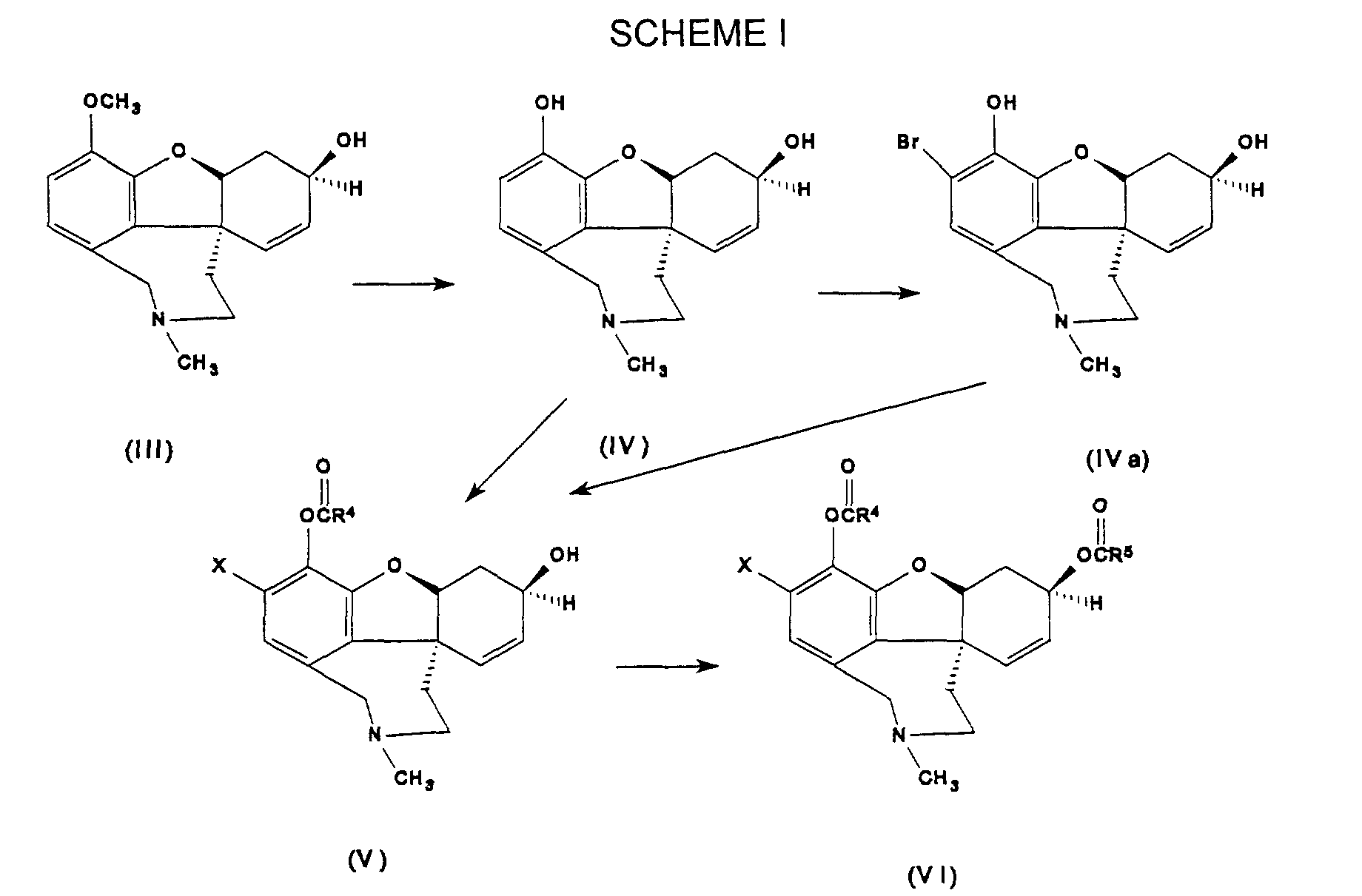
- The intermediate 6-demethylgalanthamine of Formula IV, a known compound was prepared in a novel process by treating the galanthamine of Formula III with an alkaline salt of ethanthiol such as, for example, with EtSLi, EtSNa or EtSK. The reaction is typically carried out in a polar nonprotic solvent such as dimethylformamide (DMF) or N-methylpyrrolidone or a protic solvent such as butanol or pentanol at from about 80°C to about 135°C, preferably from about 90°C to about 125°C.
- The compound of Formula V where R4 is alkyl or arylalkyl is prepared by reacting the compound of Formula IV or IVa with one equivalent of the appropriate anhydride in the presence of a base such as 4-dimethylaminopyridine, triethylamine or 1,8-diazabicyclo[5.4.0]undec-7-ene. The reaction is typically carried out in a non-protic organic solvent such as, for example, chloroform or dichloromethane at from about 0°C to about 50°C, preferably at from about 15°C to about 30°C.
- The compound of Formula V where R4 is alkoxy is prepared by reacting the compound of Formula IV or IVa with the appropriate chloroformate or carbonate. The reaction is typically carried out in an inert organic solvent such as dichloromethane at from about 0°C to about 50°C, preferably from about 15°C to about 30°C.
- In the case where R5 is alkyl or aryl, the compound of Formula V is typically reacted with an appropriate carboxylic anhydride in the presence of a base such as 4-dimethylamine (DMAP) or carboxylic acid chloride in the presence of a base such as 1,8-diazabicyclo[5.4.0]undec-7-ene (DBU). The reactions are typically carried out in a non-protic solvent such as, for example, chloroform at from about 0°C to about 50°C, preferably at from about 15°C to about 30°C.
- In the case where R5 is alkoxy, the compound is reacted with the appropriate chloroformate in the presence of an amine such as triethylamine; or with the appropriate carbonate in the presence of an amine such as DMAP. The reactions are typically carried out in an inert organic solvent such as methylene chloride at from about -10°C to about 50°C, preferably from about 0°C to about 30°C.
- The compound of Formula VI can be prepared from the compound of Formula V. In the case where R5 is alkylamino or arylamino, a solution of the appropriate isocyanate and the compound V in a nonprotic solvent such as tetrahydrofuran in a sealed tube at from about 55°C to about 85°C for from about 24 hours to about 120 hours, preferably from about 60°C to about 70°C for from about 60 hours to about 80 hours.
- In the case where X is Br, the compound of Formula IV is treated with bromine in the presence of an amine such as t-butylamine to obtain the brominated compound.
- The bromine is first added to the t-butylamine at from about -20°C to about -30°C, the mixture is then cooled to about -70°C to about -78°C and the galanthamine compound is then added and the mixture allowed to warm to room temperature over 6 to 10 hours, preferably about 8 hours. The reaction is typically carried out in a nonpolar organic solvent such as for example toluene at from about -80°C to about room temperature for from about 6 hours to about 10 hours, preferably about 8 hours.
- The compounds of Formula I of the present invention can be used for the treatment of various memory dysfunctions characterized by decreased cholinergic function, such as Alzheimer's disease. The compounds of the present invention are advantageous because they are less toxic and more specific to brain acetylcholinesterase than the related compounds known in the art. In addition, the 6-O-demethyl ester and carbonate derivatives of this invention can cleave to yield 6-O-demethylgalanthamine, a known acetylcholinesterase inhibitor.
- This utility is manifested by the ability of these compounds to inhibit the enzyme acetylcholinesterase and thereby increase acetylcholine levels in the brain.
- The ability to inhibit acetylcholinesterase was determined by the photometric method of Ellman et al., Biochem. Pharmacol. 7,88 (1961). Results of acetylcholinesterase inhibition for some of the compounds of this invention are presented in Table I along with those for reference compounds.
Acetylcholinesterase Inhibition Assay Compound IC50 µM CHE I 6-O-Demethyl-6-O-(trimethylacetyl)galanthamine hydrochloride 2.688 6-O-Demethyl-6-O-(2-propoxycarbonyl)galanthamine 1.612 Tacrine 0.32 - This utility can also be ascertained by determining the ability of these compounds to restore cholinergically deficient memory in the Dark Avoidance Assay. In this assay mice are tested for their ability to remember an unpleasant stimulus for a period of 24 hours. A mouse is placed in a chamber that contains a dark compartment; a strong incandescent light drives it to the dark compartment, where an electric shock is administered through metal plates on the floor. The animal is removed from the testing apparatus and tested again, 24 hours later, for the ability to remember the electric shock.
- If scopolamine, an anticholinergic that is known to cause memory impairment, is administered before an animal's initial exposure to the test chamber, the animal reenters the dark compartment shortly after being placed in the test chamber 24 hours later. This effect of scopolamine is blocked by an active test compound, resulting in a greater interval before re-entry into the dark compartment.
- The test results are expressed as the percent of a group of animals in which the effect of scopolamine is blocked, as manifested by an increased interval between being placed in the test chamber and re-entering the dark compartment. Results of Dark Avoidance Assay for some of the compounds of this invention are presented in Table II along with a result for a reference compounds.
Compound SDDA Dose (mg/kg, s.c.) Percent of Animals with Scopolamine Induced Memory Deficit Reversal 6-O-Demethyl-6-O-(trimethylacetyl)-galanthamine 0.10 53 6-O-Demethyl-6-O-(2-propoxycarbonyl)galanthamine hydrochloride 0.10 33 6-O-Demethyl-3-O-(2-propoxycarbonyl)-6-O-(t-butylcarbonyl)-galanthamine hydrochloride hydrate 0.10 53 Tacrine 0.31 33 - Effective quantities of the compounds of the invention may be administered to a patient by any of the various methods, for example, orally as in capsule or tablets, parenterally in the form of sterile solutions or suspensions, and in some cases intravenously in the form of sterile solutions. The free base final products, while effective themselves, may be formulated and administered in the form of their pharmaceutically acceptable acid addition salts for purposes of stability, convenience of crystallization, increased solubility and the like.
- Acids useful for preparing the pharmaceutically acceptable acid addition salts of the invention include inorganic acids such as hydrochloric, hydrobromic, sulfuric, nitric, phosphoric and perchloric acids, as well as organic acids such as tartaric, citric, acetic, succinic, maleic, fumaric and oxalic acids.
- The active compounds of the present invention may be orally administered, for example, with an inert diluent or with an edible carrier, or they may be enclosed in gelatin capsules, or they may be compressed into tablets. For the purpose of oral therapeutic administration, the active compounds of the invention may be incorporated with excipients and used in the form of tablets, troches, capsules, elixirs, suspensions, syrups, wafers, chewing gum and the like. These preparations should contain at least 0.5% of active compounds, but may be varied depending upon the particular form and may conveniently be between 5% to about 70% of the weight of the unit. The amount of active compound in such compositions is such that a suitable dosage will be obtained. Preferred compositions and preparations according to the present invention are prepared so that an oral dosage unit form contains between 1.0 - 200 milligrams of active compound.
- The tablets, pills, capsules, troches and the like may also contain the following ingredients: a binder such as micro-crystalline cellulose, gum tragacanth or gelatin: an excipient such as starch or lactose, a disintegrating agent such as alginic acid, Primogel, cornstarch and the like; a lubricant such as magnesium stearate or Sterotex; a glidant such as colloidal silicon dioxide; and a sweeting agent such as sucrose or saccharin may be added or a flavoring agent such as peppermint, methyl salicylate, or orange flavoring. When the dosage unit form is a capsule, it may contain, in addition to materials of the above-type, a liquid carrier such as a fatty oil. Other dosage unit forms may contain other various materials which modify the physical form of the dosage unit, for example, as coatings. Thus, tablets or pills may be coated with sugar, shellac, or other enteric coating agents. A syrup may contain, in addition to the active compounds, sucrose as a sweetening agent and certain preservatives, dyes, colorings and flavors. Materials used in preparing these various compositions should be pharmaceutically pure and non-toxic in the amounts used.
- For the purpose of parenteral therapeutic administration, the active compounds of the invention may be incorporated into a solution or suspension. These preparations should contain at least 0.1% of active compound, but may be varied between 0.5 and about 30% of the weight thereof. The amount of active compound in such compositions is such that a suitable dosage will be obtained. Preferred compositions and preparations according to the present inventions are prepared so that a parenteral dosage unit contains between 0.5 to 100 milligrams of active compound. The solutions or suspensions may also include the following components: a sterile diluent such as water for injection, saline solution, fixed oils, polyethylene glycols, glycerine, propylene glycol or other synthetic solvents; antibacterial agents, such as benzyl alcohol or methyl parabens; antioxidants such as ascorbic acid or sodium bisulfite; chelating agents such as ethylenediaminetetraacetic acid; buffers such as acetates; citrates or phosphates and agents for the adjustment of tonicity such as sodium chloride or dextrose. The parenteral multiple dose vials may be of glass or plastic.
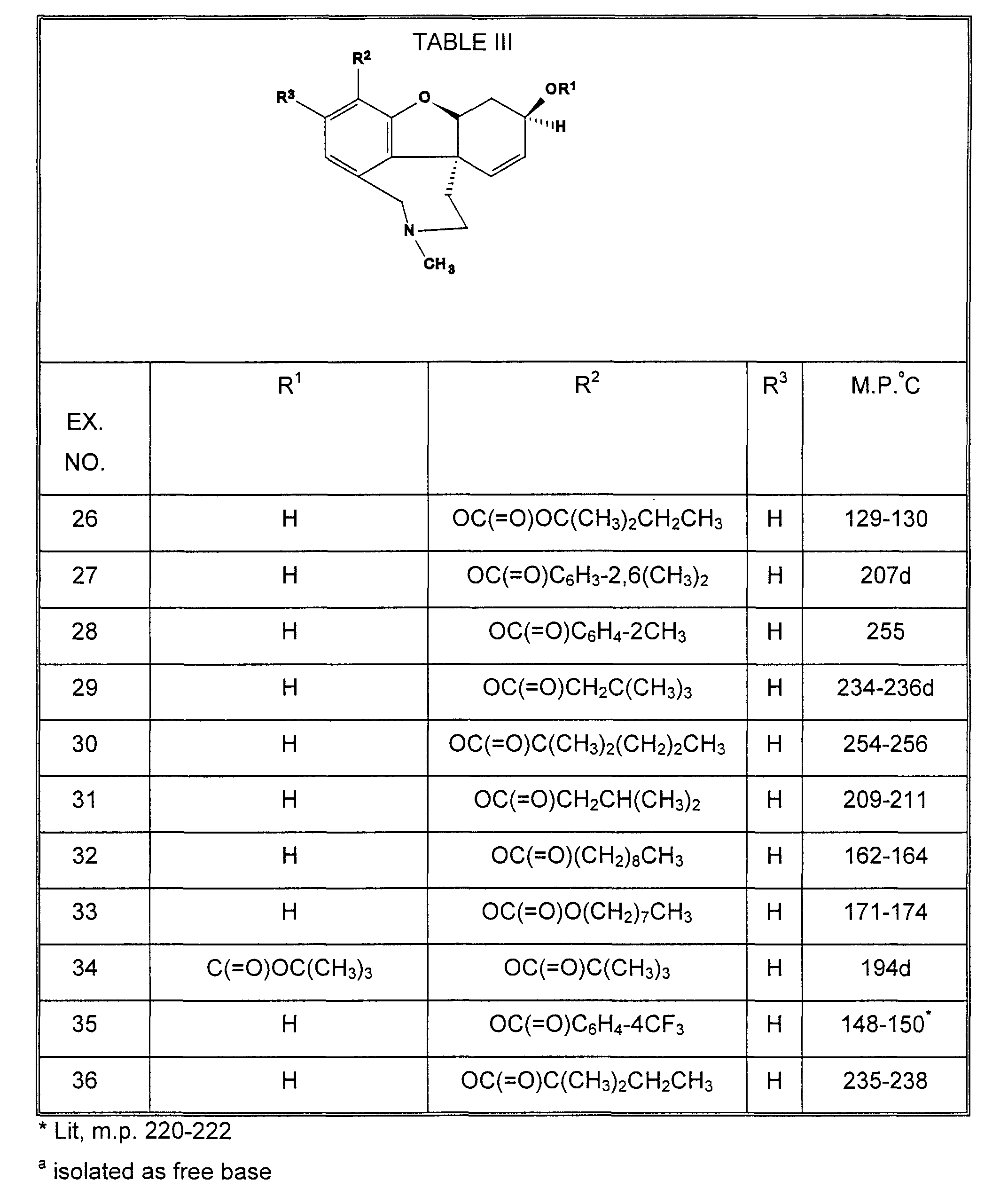
- The following Table III and examples will further illustrate this invention. In Table III typical compounds of the instant invention are listed. The melting points are for hydrochloride salts unless otherwise indicated. Following Table III, representative illustrative preparations of compounds of the invention are described.


- To a stirred solution of 20 ml of dry DMF at -40° under nitrogen was added 0.57 ml (0.48 g) of ethanethiol. The mixture was stirred for several minutes at -40° to -30° after which 2.84 ml of 2.5 M BuLi in hexanes was added slowly by syringe at -40° to -50°. The solution was then allowed to warm to room temperature over 15 minutes, heated to 50° under aspirator vacuum and again cooled to 30°. To the solution was added a solution of 0.57 g of galanthamine in 5.7 ml of dry DMF. The solution was stirred at 95-100° for 2 hours and subsequently at 100-105° for 3 hours, allowed to cool to room temperature and concentrated to an oil. The oil was dissolved in chloroform, shaken with NH4Cl, made basic with aq NaHCO3 and extracted four times with CHCl3. The pH of the aqueous layer was then adjusted to 9-10 with NH4OH and again extracted four times with chloroform. The combined organic extracts were dried (Na2SO4), filtered and concentrated to an oil. The oil was dissolved in degassed 5% methanol/chloroform and flash chromatographed on silica gel eluting with the same solvent system followed by 10% methanol/chloroform to provide a beige solid. The material was dissolved in acetone and allowed to crystallize overnight to provide 0.298 g of (6-O-demethyl)galanthamine,
m.p. 225-229° .ANALYSIS: Calculated for C16H19NO3 70.31%C 7.01%H 5.12%N Found 70.14%C 7.29%H 4.96%N - To a cold solution of 6-O-demethylgalanthamine (0.5 g) in 125 ml of dichloromethane was added 4-dimethylaminopyridine (1.2 g) followed by a solution of isobutyric anhydride (1.0 ml) in 5 ml of dichloromethane. After stirring at 0°C for one hour, then at ambient temperature for one hour, the solution was evaporated to an oil, which was dissolved in ethyl acetate, washed with water, sodium carbonate, saturated sodium chloride solution, then dried over anhydrous sodium sulfate. After filtering, the solvents were evaporated to an oil (0.7 g) which was eluted on a silica gel column with 10% methanol/dichloromethane via HPLC to yield a thick yellow oil (0.5 g) which was dissolved in ether, and the pH adjusted to 1 with ethereal HCI. The resultant precipitate was collected and dried to give an off-white solid which was recrystallized from methanol/ether (1:10) to yield 0.35 g, m.p. 225°C (dec.)
ANALYSIS: Calculated for C24H3NO5•HCl•H2O 61.59%C 7.32%H 2.99%N Found 61.53%C 7.34%H 2.97%N - To a stirred suspension of 1.0 g of 6-O-demethylgalanthamine in 6.5 ml of chloroform was added 0.74 ml (0.68 g) of trimethylacetic anhydride followed by 45 mg of 4-dimethylaminopyridine. The mixture was stirred at room temperature for 4 hours. The solution as poured onto a flash chromatography column packed with 3% methanol/chloroform and eluted with the same solvent system followed by 5% methanol/chloroform. The product-containing fractions were combined and concentrated to provide a white solid (quantitative yield). The material was recrystallized from cyclohexane, filtered, dried, dissolved in ether and the hydrochloride salt precipitated by addition of ethereal HCI. The salt was isolated by filtration and dried to provide 0.421 g of 6-O-demethyl-6-O-(t-butylcarbonyl)galanthamine hydrochloride, m.p. 250-251°C.
ANALYSIS: Calculated for C21H27NO4•HCl 64.03%C 7.16%H 3.56%N Found 63.99%C 7.21%H 3.44%N - To a cold solution of 6-O-demethylgalanthamine (1.5 g) in 100 ml of dichloromethane, was added 4-dimethylaminopyridine (3.5 g) followed by slow addition of a solution of propionic anhydride (2.4 ml) in 10 ml of dichloromethane. After stirring at ambient temperature for one hour, the mixture was evaporated to a yellow oil which was dissolved in ethyl acetate. The solution was washed with water, sodium carbonate solution, saturated sodium chloride solution and then dried over anhydrous MgSO4. After filtering, the solvent was evaporated to a yellow oil, 2.0 g, which was eluted on a silica gel column with 5% methanol/dichloromethane via flash chromatography. The desired fractions were combined and evaporated to a thick yellow oil, 1.8 g. This oil was dissolved in ether and adjusted to pH 1 with ethereal-HCI. The resultant white precipitate was collected and dried to give 1.8 g of the product, m.p. 170-172°C.
ANALYSIS: Calculated for C22H27NO5•HCl 62.62%C 6.69%H 3.32%N Found 62.19%C 6.65%H 3.16%N - To a stirred suspension of 1.02 g of 6-O-demethylgalanthamine in 6.0 ml of chloroform was added by syringe 0.35 ml of acetic anhydride followed by 45.5 mg of DMAP dissolved in 0.5 ml of chloroform. The suspension was allowed to stir for 3.5 hours at room temperature after which it was filtered onto a flash chromatography column, packed with silica gel in 5% methanol:chloroform, and eluted with the same solvent system. The product-containing fractions were combined and concentrated to a yellow oil which was crystallized from ethyl ether to provide 0.44 g of a white solid. The solid was dissolved in chloroform, diluted with ethyl ether and the hydrochloride salt was precipitated by addition of ethereal hydrogen chloride to provide 0.47 g of 6-O-demethyl-6-O-(acetyl)galanthamine hydrochloride which was recrystallized from acetonitrile, m.p. 244-246°C (dec).
ANALYSIS: Calculated for C18H21NO4•HCl 61.45%C 6.30%H 3.98%N Found 60.97%C 6.34%H 3.86%N - To a cold solution of 6-O-demethyl-galanthamine (2.0 g) in 75 ml of dichloromethane, was added 4-dimethylaminopyridine (4.6 g) followed by a solution of acetic anhydride (2.3 ml). After stirring at ambient temperature for 5 hours, the solution was eluted on a silica gel column with 3% methanol/dichloromethane via HPLC. The desired fractions were combined and then evaporated to a thick yellow oil (2.1 g). A sample (0.5 g) of this oil was dissolved in methanol then acidified to pH 1 with ethereal-HCI; followed by dilution with ether. The resultant white precipitate was collected and dried to give 0.4 g, 142°C dec.
ANALYSIS: Calculated for C20H23NO5•HCl 60.99%C 6.14%H 3.56%N Found 60.78%C 6.08%H 3.48%N - To a cold solution of 6-O-demethylgalanthamine 1.5 g in 100 ml of dichloromethane, was added 4-dimethylaminopyridine (3.5 g) followed by a solution of trimethylacetic anhydride (3.8 ml) in 10 ml of dichloromethane. After stirring at ambient temperature for one hour, the solution was evaporated to a yellow oil. A solution of the oil and ethyl acetate was washed with water, sodium carbonate solution, saturated sodium chloride solution, and then dried over anhydrous MgSO4. After filtering, the solvent was evaporated to afford a yellow solid, which was eluted on a silica gel column with 2% methanol/dichloromethane via flash chromatography. The desired fractions were combined and evaporated to give a white solid; 1.6 g, m.p. 117-119°C. A solution of the solid and ether was adjusted to pH 1 with ethereal-HCl, and the resultant white precipitate was collected and dried to give 1.4 g of product, m.p. 265°C (dec.).
ANALYSIS: Calculated for C26H35NO5•HCl 65.33%C 7.59%H 2.93%N Found 64.85%C 7.67%H 2.68%N - To a cold solution of 6-O-demethylgalanthamine 1.5 g in 60 ml of dichloromethane, was added triethylamine (0.8 ml) followed by a solution of isopropyl chloroformate (1.0 M solution in toluene, 5.5 ml). After stirring at 0°C for one hour, the mixture was stirred at ambient temperature for twenty hours. The mixture was added to a flash silica gel column and eluted with 10% methanol/dichloromethane. The desired fractions were combined and evaporated to a thick yellow oil, 0.5 g. This oil was dissolved in methanol/ether (1:10) and then acidified to pH 1 with ethereal-HCI. The resultant white precipitate was collected and dried, to give 0.4 g of product, m.p. 218°C(dec.).
ANALYSIS: Calculated for C20H25NO5•HCl 60.67%C 6.62%H 3.54%N Found 61.15%C 6.56%H 3.44%N - To a solution of 6-O-demethyl-6-O-(t-butylcarbonyl)galanthamine (EXAMPLE 8) (2.6 g) in 100 ml of dichloromethane was added 4-dimethylaminopyridine (0.9 g) followed by a solution of isobutyric anhydride (1.2 ml in 10 ml of dichloromethane). After stirring at ambient temperature for twenty hours, the mixture was added to a silica gel column and eluted with 3% methanol/dichloromethane via HPLC. The desired fractions were combined and then evaporated to a clear thick oil (2.0 g). A solution of the oil was adjusted to pH 1 in ether with ethereal-HCI. The resultant white precipitate was collected and dried to give 1.8 g of product, m.p. 248°C (dec.).
ANALYSIS: Calculated for C25H33NO5•HCl 62.29%C 7.53%H 2.91%N Found 62.42%C 7.32%H 2.76%N - To a stirred suspension of 0.8 g of 6-O-demethylgalanthamine, 8 ml of chloroform and 0.72 g of benzoic anhydride was added 0.44 ml of 1,8-diazabicyclo-[5.4.0]undec-7-ene. The mixture was stirred at room temperature for 4 hours and subsequently poured onto a flash chromatography column packed with silica gel in 3% methanol/chloroform. The column was eluted with the same solvent system followed by 5% methanol/chloroform. The product-containing fractions were combined and concentrated to provlde an oil which was crystallized from ether to give 0.45 g of 6-O-demethyl-6-O-benzoylgalanthamine, m.p. 144-145°C.
ANALYSIS: Calculated for C23H23NO4 73.19%C 6.14%H 3.71%N Found 73.29%C 6.11%H 3.79%N - To a cold solution of 6-O-demethyl-6-O-(t-butylcarbonyl)galanthamine (EXAMPLE 10) 2.6 g in 100 ml dichloromethane, was added 4-dimethylaminopyridine (1.0 g) followed by a solution of n-octanoic anhydride (2.4 ml) in 10 ml dichloromethane. After stirring at ambient temperature for twenty hours, the mixture was eluted on a silica gel column with 3% methanol/dichloromethane via HPLC. The desired fractions were combined, then evaporated to a clear thick oil, which solidified to a white solid upon cooling to give 3.0, m.p. 27°C. This solid was dissolved in methanol, and the solution was adjusted to pH 1 with ethereal-HCI, then diluted with ether. The resultant white precipitate was collected and dried to give 2.0 g, m.p. 185-187°C.
ANALYSIS: Calculated for C29H41NO5•HCl•0.5H2O 65.83%C 8.19%H 2.65%N Found 65.98%C 8.13%H 2.65%N - To a cold solution of 6-O-demethylgalanthamine 1.5 g in 75 ml of dichloromethane, was added 4-diemthylaminopyridine (3.5 g) followed by a solution of octanoic anhydride (5.6 ml) in 25 ml dichloromethane. After stirring at ambient temperature for twenty hours, the mixture was eluted on a silica gel column with 3% methanol:dichloromethane via HPLC. The desired fractions were combined, then evaporated to a thick yellow oil, 2.3 g. This oil was dissolved in methanol, and the pH adjusted to 1 with ethereal:HCl; then diluted with ether. The resultant white precipitate was collected and dried to give 2.0 g, 215°C dec.
ANALYSIS: Calculated for C32H47NO5•HCl•0.5H2O 67.28%C 8.65%H 2.45%N Found 67.01%C 8.91%H 2.25%N - To a cold solution of 6-O-demethylgalanthamine (1.0 g in 50 ml dichloromethane), was added 4-dimethylaminopyridine (2.3 g) followed by a solution of di-t-butyl dicarbonate (2.9 ml) in 20 ml of dichloromethane. After stirring at ambient temperature for forty hours, the mixture was eluted on a silica gel column with 3% methanol/dichloromethane via HPLC. The desired fractions were combined, then evaporated to a thick yellow oil, 1.3 g. The oil was dissolved in methanol, and the pH was adjusted to 1 with ethereal-HCl, then diluted with ether. The resultant white precipitate was collected and dried to give 1.2 g, 154°C dec.
ANALYSIS: Calculated for C26H35NO7•HCl 61.23%C 7.12%H 2.75%N Found 60.83%C 7.10%H 2.72%N - To a stirred solution of 1.38 ml (0.966 g) of t-butylamine in 36 ml of azeotripically dried toluene at -20 to -30 C was added dropwise 0.34 ml (1.05 g) of bromine such that the temperature remained between -20 to -30°C. The solution was then cooled to -70 to -75°C and a solution of 3.0 g of 6-demethylgalanthamine in 15 ml of DMF was added slowly such that the temperature did not rise above -70°C. The solution was stirred for 2 hours at -70 to -78°C and subsequently allowed to warm slowly to room temperature over 6 hours. The solution was again cooled to 0°C, poured into ice/NaHCO3/water, and extracted with chloroform. The aqueous fraction was saturated with NaCI and extracted 3 times with chloroform. The chloroform extracts were dried (Na2SO4), filtered and concentrated to an oil which was purified by HPLC, employing a Water Prep 500 Instrument and eluting with 3% methanol/chloroform, followed by 5% methanol/chloroform. The pure product-containing fractions were combined and concentrated to provide 1.83 g (47.3% based on 6-demethylgalanthamine, 78.9% based on bromine, the limiting reagent). Crystallization from acetone provided analytically pure 7-bromo-6-O-demethyl galanthamine, m.p. 138-141°C.
ANALYSIS: Calculated for C16H18BrNO3 54.56%C 5.15%H 3.98%N Found 54.62%C 5.50%H 3.61%N - To a stirred suspension of a mixture of approximately 0.528 g of 7-bromo-6-O-demethylgalanthamine and 93.2 mg of 6-O-demethylgalanthamine in 4 ml of chloroform was added 0.37 ml (0.34 g) of pivalic anhydride followed by 23 mg of DMAP. The mixture was stirred at room temperature for 5 hours. The solution was poured onto a flash chromatography column packed with 3% methanol/chloroform and eluted with the same solvent system followed by 5% methanol/chloroform. The product-containing fractions were combined and concentrated to a white solid. The material was dissolved in ether, decanted and the hydrochloride salt precipitated by addition of ethereal HCI. The material was isolated by filtration dried at 80°C under vacuum to provide 0.315 g of 7-bromo-6-O-demethyl-6-O-(t-butylcarbonyl)-galanthamine, m.p. 275-278°C.
ANALYSIS: Calculated for C21H26BrNO4 53.35%C 5.76%H 2.96%N Found 53.37%C 5.41%H 2.79%N - To a stirred suspension of 1.00 g of 6-O-demethylgalanthamine in 6.5 ml of chloroform was added 0.47 ml of propionic anhydride followed by 45.2 mg of DMAP dissolved in 0.5 ml of chloroform. The suspension was allowed to stir at room temperature overnight and filtered onto a flash chromatography column, packed with silica gel and 3% methyl alcohol:chloroform and eluted with the same solvent system followed by 5% methyl alcohol:chloroform. The product-containing fractions were combined and concentrated to provide a yellow solid. Recrystallization from cyclohexane gave 0.70 g. Precipitation of the hydrochloride salt using ethereal hydrogen chloride gave 0.74 g of 6-O-demethyl-6-O-(ethylcarbonyl)galanthamine hydrochloride which was recrystallized from acetonitrile, m.p. 221-223°C.
ANALYSIS: Calculated for C19H23NO4•HCl 62.38%C 6.61%H 3.83%N Found 62.32%C 6.67%H 3.89%N - To a stirred solution of 0.851 g of 7-bromo-6-demethylgalanthamine in 2 ml of chloroform was added 0.227 ml (0.245 g) of acetic anhydride followed by 29.6 mg of 4-dimethylaminopyridine. The solution was stirred at room temperature for 3 hours. The mixture was then poured onto a flash silica gel column packed with silica gel in 3% methanol/chloroform. The column was eluted with the same solvent system followed by 5% methanol/chloroform. The pure product-containing fractions were combined, concentrated to an oil and crystallized from ether to provide 0.455 g of colorless crystals. The material was dissolved in chloroform/ether and the hydrochloride salt precipitated by addition of ethereal hydrogen chloride, Isolated by filtration and dried to provide 335 mg of 6-O-acetyl-7-bromo-6-O-demethylgalanthamine hydrochloride, m.p. 236-238°C.
ANALYSIS: Calculated for C18H20BrNO4 50.19%C 4.91%H 3.25%N Found 49.83%C 4.65%H 3.09%N - To a cold solution of 6-O-demethylgalanthamine (1.5 g) in 60 ml dichloromethane, was added 4-dimethylaminopyridine (0.7 g); followed by a solution of dimethyl pyrocarbonate (0.6 ml) in 10 ml of dichloromethane. After stirring at ambient temperature for 4 hours, the solution was eluted on a silica gel column with 3% methanol/dichloromethane via HPLC. The desired fractions were combined, then evaporated to a thick clear oil, 1.0 g. This oil was dissolved in methanol, then acidified to pH 1 with ethereal-HCI, followed by dilution with ether. The resultant white precipitate was collected and dried to give 1.0 g, 195°C. dec.
ANALYSIS: Calculated for C18H21NO5•HCl 58.77%C 6.03%H 3:81%N Found 58.54%C 6.20%H 3.74%N - To a cold solution of 6-O-demethylgalanthamine (1.5 g) in 60 ml dichloromethane, was added 4-dimethylaminopyridine (0.7 g) followed by a solution of diethyl pyrocarbonate (0.8 ml) in 10 ml of dichloromethane. After stirring at ambient temperature for 4 hours, the solution was eluted on a silica gel column with 3% methanol/dichloromethane via HPLC. The desired fractions were combined, then evaporated to a white solid, 1.8 g, m.p. 139-141°C. This material was dissolved in methanol then acidified to pH 1 with ethereal-HCI, followed by dilution with ether. The resultant white precipitate was collected and dried to give 1.3 g, 208°C dec.
ANALYSIS: Calculated for C19H23NO5•HCl 59.76%C 6.33%H 3.67%N Found 59.74%C 6.32%H 3.44%N - To a cold solution of 6-O-demethyl-galanthamine (1.5 g) in 60 ml of dichloromethane was added 4-dimethylaminopyridine (0.7 g) followed by a solution of di-t-butyl dicarbonate (1.3 ml) in 10 ml dichloromethane. After stirring at ambient temperature for 4 hours, the solution was eluted on a silca gel column with 3% methanol/dichloromethane via HPLC. The desired fractions were combined and evaporated to a white solid, 1.9 g, m.p. 147-149°C. This solid was dissolved in methanol, acidified to pH 1 with ethereal-HCI then diluted with ether. The resultant white precipitate was collected and dried to give 1.3 g, 237°C dec.
ANALYSIS: Calculated for C21H27NO5•HCl 61.53%C 6.88%H 3.42%N Found 61.62%C 6.49%H 3.36%N - To a mixture of 0.80 g (2.93 mmol) of 6-O-demethylgalanthamine and 0.82 g (5.92 mmol) of milled potassium carbonate was added 13.5 ml of dry THF. The suspension was cooled to 0 C after which was added 1.10 ml (3.70 mmol) of octanoic anhydride. The reaction mixture was stirred at 0°C for 1/2 hour followed by 3 hours at room temperature after which the suspension was filtered onto a flash chromatography column packed with silica gel and 3% methanol:chloroform and eluted with the same solvent system followed by 5% dry methyl alcohol:chloroform. The pure, product-containing fractions were combined and concentrated to provide 0.88 g (2.20 mmol; 75.3%) of the free base as an oil. The oil was dissolved in ethyl ether and the hydrochloride salt precipitated by addition of ethereal hydrogen chloride to give 0.51 g of 6-O-demethyl-6-O-(n-heptylcarbonyl)galanthamine hydrochloride, m.p. 158-161°C.
ANALYSIS: Calculated for C24H33NO4•HCl 66.12%C 7.86%H 3.21%N Found 66.01%C 7.75%H 3.07%N - To a stirred suspension of 1.00 g (3.6 mmol) of 6-O-démethylgalanthamine dissolved in 10.0 ml of chloroform was added a solution of 0.45 g (3.66 mmol) of 4-dimethylaminopyridine dissolved in 6.0 ml of chloroform by syringe, followed by 0.69 ml (3.49 mmol) of valeric anhydride dissolved in 4.0 ml of chloroform via syringe.
- The reaction mixture was stirred at room temperature for 0.5 hour after which it was poured onto a flash chromatography column packed with silica gel and 3% methanol:chloroform and eluted with the same solvent system, followed by 5% methanol:chloroform. The appropriate fractions were combined and concentrated to a clear, yellow oil. The oil was dissolved in diethyl ether and the hydrochloride salt precipitated by addition of ethereal hydrogen chloride to provide 0.73 g (1.85 mmol; 51%) of 6-O-demethyl-6-O-(n-butylcarbonyl)galanthamine hydrochloride, m.p. 208-210°C.
ANALYSIS: Calculated for C21H28NO4•HCl 64.03%C 7.16%H 3.56%N Found 63.91%C 7.25%H 3.48%N - To a stirred solution of 1.00 g (3.66 mmol) of 6-O-demethylgalanthamine in 10.0 ml of chloroform was added 0.45 g (3.67 mmol) of 4-dimethylaminopyridine dissolved in 4.0 ml of chloroform by syringe, followed by 0.80 ml (0.74 mmol) of hexanoic anhydride in 6.0 ml of chloroform via a syringe. The mixture was stirred at room temperature for 3.5 hours, poured onto a flash chromatography column packed with silica gel and 3% methanol:chloroform, and eluted with the same solvent system, followed by 5% methanol:chloroform. The appropriate fractions were combined and concentrated to a yellow oil weighing 1.26 g (3.39 mmol; 92%). The oil was dissolved in diethyl ether and the hydrochloride salt precipitated by addition of ethereal hydrogen chloride to give 0.77 g (1.87 mmol; 51%) of 6-O-demethyl-6-O-(n-pentylcarbonyl)galanthamine hydrochloride, m.p. 212-215°C.
ANALYSIS: Calculated for C22H29NO4•HCl 64.78%C 7.41%H 3.43%N Found 64.66%C 7.25%H 3.37%N - To a stirred solution of 1.00 g (3.66 mmol) of 6-O-demethylgalanthamine in 10.0 ml of chloroform was added a solution of 0.45 g (3.69 mmol) of 4-dimethylaminopyridine in 4.0 ml of chloroform via syringe and stirred at room temperature for 20 minutes after which was added 0.91 ml (3.47 mmol) of n-heptanoic anhydride dissolved in 6.0 ml of chloroform by syringe. The reaction mixture was allowed to stir at room temperature for 0.5 hour, poured onto a flash chromatography column, packed with silica gel and 3% methanol:chloroform, and eluted with the same solvent system, followed by 5% methanol:chloroform. The pure, product-containing fractions were combined and concentrated to a yellow oil weighing 1.14 g (2.95 mmol, 81%). The oil was dissolved in diethyl ether and the hydrochloride salt precipitated by addition of ethereal hydrogen chloride to provide 0.74 g (1.75 mmol; 48%) of 6-O-demethyl-6-O-(n-hexylcarbonyl)galanthamine hydrochloride, m.p, 178-180°C.
ANALYSIS: Calculated for C23H31NO4•HCl 65.47%C 7.64%H 3.32%N Found 65.18%C 7.88%H 3.18%N - To a cold solution of 6-O-demethyl-6-O-(methylcarbonyl)galanthamine (Example 5, 2.8 g, 0.009 mole) and 4-dimethylaminopyridine (1.1 g, 0.009 mole) in 80 ml of dichloromethane, was added dropwise, a solution of di-t-amyl dicarbonate (2.2 ml, 0.009 mole) in 10 ml of dichloromethane.
- After stirring at ambient temperature for 20 hours, the mixture was eluted on a silica gel column with 3% methanol/dichloromethane via HPLC. The desired fractions were combined and evaporated to a thick clear oil, 2.7 g (69%). A 0.4 g sample of this oil was dissolved in methanol, adjusted to pH 1 with etheral-HCI, and then diluted with ether. The resultant white precipitate was collected and dried to give 0.3 g (70%) of the product as a colorless solid, m.p. 178-180°C (dec.).
ANALYSIS: Calculated for C24H31NO6•HCl•H2O 59.56%C 7.08%H 2.89%N Found 59.84%C 7.01%H 3.02%N - To a cold solution of 6-O-demethylgalanthamine (2.0 g, 0.007 mole) and 4-dimethylaminopyridine (0.85 g, 0.007 mole) in 70 ml of dichloromethane was added dropwise a solution of di-tert-amyl dicarbonate (.7 ml, 0.007 mole) in 10 ml of dichloromethane.
- After stirring at ambient temperature for eight hours, the mixture was added to a silica gel column and eluted with 3% methanol/chloroform via HPLC. The desired fractions were evaporated in vacuo to a white solid, 2.2 g (85%), m.p. 129-130°C. This material was dissolved in ether and adjusted to pH 1 with ethereal-HCI, to give a white solid, 1.8 g (63%), m.p. 205°C (dec.).
ANALYSIS: Calculated for C22H29NO5•HCl 62.33%C 7.13%H 3.34%N Found 62.49%C 7.16%H 3.35%N - To a cold solution of 6-O-demethylgalanthamine (2.0 g, 0.007 mole), triethylamine (1.0 ml, 0.007 mole), and 4-dimethylaminopyridine (0.01 g) in 70 ml of dichloromethane, was added dropwise a solution of 2,6-dimethylbenzoyl chloride (1.2 g, 0.007 mole) in 10 ml of dichloromethane.
- After stirring at ambient temperature for twenty hours, the mixture was added to a silica gel column and eluted with 3% methanol/dichloromethane via HPLC. The desired fractions were combined and evaporated in vacuo to a white solid, 2.7 g (95%), m.p. 159-161°C.
- A 1.5 g sample of this material was dissolved in ethyl acetate and adjusted to pH 1 with etheral-HCI, to give a white solid, 1.1 g (81%), m.p. 207°C (dec.).
ANALYSIS: Calculated for C25H27NO4•HCl 67.94%C 6.39%H 3.17%N Found 67.58%C 6.63%H 3.11%N - To a cold solution of 6-O-demethylgalanthamine (2.0 g, 0.007 mole), triethylamine (1.0 ml, 0.007 mole) and 4-dimethylaminopyridine (0.01 g, 0.0001 mole) in 70 ml of dichloromethane, was added dropwise a solution of o-toluoyl chloride (0.9 ml, 0.007 mole) in 10 ml of dichloromethane.
- After stirring at ambient temperature for three hours, the mixture was added to a silica gel column and eluted with 3% methanol/dichloromethane via HPLC. The desired fractions were combined and then evaporated to a white solid, 1.7 g (63%), m.p. 148-150°C.
- A solution of the solid in ethyl acetate was adjusted to pH 1 with etheral-HCI, and the resultant white precipitate was collected and dried to give 1.2 g (40%) of product, m.p. 255°C (dec.).
ANALYSIS: Calculated for C24H25NO4•HCl 67.36%C 6.12%H 3.27%N Found 67.62%C 6.49%H 3.09%N - To a stirred suspension of 1.00 g (3.66 mmol) of 6-O-demethylgalanthamine in 10.0 ml of chloroform was added 0.55 ml (3.67 mmol) of 1,8-diazabicyclo[5.4.0]undec-7-ene by syringe. The mixture was stirred in an ice bath for 10-15 minutes after which was added 0.55 ml (3.99 mmol) of t-butyl acetic acid via syringe. After the addition was complete, the suspension was allowed to warm to room temperature and stir at this temperature for 0.5 hour, poured into 50 ml of cold, saturated sodium bicarbonate solution and extracted with chloroform. To the aqueous layer was added sodium chloride and extracted twice with chloroform. The combined organic layers were dried over sodium sulfate, filtered, and concentrated to a yellow oil. The oil was dissolved in chloroform, filtered onto a flash chromatography column, packed with silica gel and 3% methanol:chloroform and eluted with the same solvent system, followed by 5% methanol:chloroform. The appropriate fractions were combined and concentrated to provide 0.61 g (1.64 mmol; 45%) of a white solid. The solid was dissolved in diethyl ether and the hydrochloride salt precipitated by addition of ethereal hydrogen chloride to provide 6-O-demethyl-6-O-(2,2-dimethylpropylcarbonyl)galanthamine hydrochloride, m.p. 234-236°C (dec).
ANALYSIS: Calculated for C22H29NO4•HCl 64.78%C 7.41%H 3.43%N Found 64.60%C 7.65%H 3.39%N - To a stirred suspension of 0.48 g (3.67 mmol) of 2,2-dimethylvaleric acid in 2.5 ml of chloroform was added 0.75 g (3.66 mmol) of 1,3-dicyclohexylcarbodiimide dissolved in 0.7 ml of chloroform, followed by 1.00 g (3.66 mmol) of 6-O-demethylgalanthamine in 2.0 ml of chloroform, and 0.45 g (3.67 mmol) of 4-dimethylaminopyridine in 0.2 ml of chloroform. The suspension was stirred at room temperature for 6 hours after which it was filtered onto a flash chromatography column, packed with silica gel and 3% methanol:chloroform and eluted with the same solvent system, followed by 5% methanol:chloroform. The appropriate fractions were combined and concentrated to provide 0.68 g (1.78 mmol; 49%) of a yellow oil. The oil was dissolved in diethyl ether and the hydrochloride salt precipitated by addition of ethereal hydrogen chloride to provide 6-O-demethyl-6-O-[[(2-methyl)pentan-2-yl]-carbonyl]galanthamine hydrochloride, m.p. 254-256°C (dec.).
ANALYSIS: Calculated for C23H31NO4•HCl 65.47%C 7.64%H 3.32%N Found 65.60%C 7.61%H 3.32%N - To a stirred suspension of 0.80 g (2.91 mmol) of 6-O-demethylgalanthamine in 8 ml of chloroform was added 0.44 ml (2.94 mmol) of 1,8-diazabicyclo[5.4.0]undec-7-ene by syringe. The suspension was cooled in an ice bath for 10 minutes after which was added 0.38 ml (3.12 mmol) of isovaleryl chloride via syringe. The reaction mixture was warmed to room temperature, stirred at this temperature for 2 hours poured into a cold saturated solution of sodium bicarbonate and extracted with chloroform. The aqueous layer was treated with sodium chloride and extracted twice with chloroform. The combined organic extracts were dried over sodium sulfate, filtered, and concentrated to a yellow oil. The oil was dissolved in chloroform, pipetted onto a flash chromatography column, packed with silica gel in 3% methanol:chloroform, and eluted with the same solvent system, followed by 5% methanol:chloroform. The appropriate fractions were combined and concentrated to give 0.76 g (2.13 mmol; 73%) as an oil. The oil was dissolved in diethyl ether and chloroform and the hydrochloride salt precipitated by addition of ethereal hydrogen chloride to provide 6-O-demethyl-6-O-[2-(methyl)propylcarbonyl]galanthamine hydrochloride, m.p. 209-211°C (dec.).
ANALYSIS: Calculated for C21H27NO4•HCl 64.03%C 7.16%H 3.56%N Found 63.79%C 7.04%H 3.45%N - To a stirred mixture of 1.99 g (7.29 mmol) of 6-O-demethylgalanthamine in 5.0 ml of dichloromethane was added 1.62 g (13.23 mmol) of 4-dimethylaminopyridine, dissolved in 1.0 ml of dichloromethane. The mixture was cooled to 0°C after which was added 3.13 g (9.50 mmol) of decanoic anhydride, dissolved in 0.5 ml of dichloromethane. The resultant mixture was stirred at room temperature for 1.5 hours after which it was cooled in an ice bath for 1.5 hours, warmed to room temperature and filtered onto a flash chromatography column, packed with silica gel and 3% methanol:chloroform and eluted with the same solvent system, followed by 5% methanol:chloroform. The appropriate fractions were combined and concentrated to provide a mixture of product and a slightly a higher eluting impurity as an oil. The oil was chromatographed on silica gel, eluting with 3% methanol chloroform. The fractions containing the desired product were combined and concentrated to provide a slightly impure oil which was purified using Waters Prep 500 HPLC instrument, eluting with 2% methanol:chloroform. The pure, product-containing fractions were combined and concentrated to provide 1.78 g (4.16 mmol; 57%) of an oil. Precipitation of the hydrochloride salt using ethereal hydrogen chloride provided 6-O-demethyl-6-O-(n-nonylcarbonyl)galanthamine hydrochloride, m.p. 162-164°C.
ANALYSIS: Calculated for C26H37NO4•HCl 67.30%C 8.25%H 3.02%N Found 67.28%C 8.18%H 2.84%N - To a stirred suspension of 1.0 g (3.66 mmol) of 6-O-demethylgalanthamine in 10 ml of chloroform in an ice bath was added 0.49 ml (0.55 g, 3.65 mmol) of 1,8-diazabicyclo[5.4.0]undec-7-ene (DBU). To the solution was added by syringe 0.72 ml of n-octylchloroformate. The solution was stirred in an ice bath for 4.5 hours, poured into cold saturated sodium bicarbonate, extracted with ether and the aqueous layer treated with sodium chloride and extracted twice with ether. The combined ether extracts were dried (Na2SO4), filtered and concentrated to an oil which was purified by flash chromatography on silica gel, eluting with chloroform, followed by 3% methanol/chloroform. The pure, product-containing fractions were combined and concentrated to an oil (0.44 g, 0.102 mmol, 27.9%) which was dissolved in ether and the hydrochloride salt precipitated by addition of ethereal hydrogen chloride. The white solid was dried under vacuum at 80°C to provide 0.27 g of 6-O-demethyl-O- (n-octyloxycarbonyl)galanthamine hydrochloride, m.p. 171-174°C.
ANALYSIS: Calculated for C25H35NO5•HCl 64.43%C 7.79%H 3.01%N Found 64.12%C 7.86%H 3.03%N - To a cold solution of 6-O-demethyl-6-O-(t-butylcarbonyl)galanthamine (2.2 g, 0.0062 mole) in 75 ml of dichloromethane was added 4-dimethylaminopyridine (0.85 g, 0.007 mole), followed by a solution of di-t-butyl carbonate (1.5 ml, 0.0062 mole) in 10 ml of dichloromethane.
- After stirring at ambient temperature for 40 hours, the mixture was added to a silica gel column and eluted with 3% methanol:dichloromethane via HPLC. The desired fractions were evaporated to a thick yellow oil, 1.7 g (60%); which was dissolved in methanol, acidified to pH 1 with ethereal-HCI and then diluted with ether. The resultant white precipitate was collected and dried to give 1.1 g of the product, m.p. 194°C(dec.).
ANALYSIS: Calculated for C26H35NO6•HCl 63.21%C 7.35%H 2.84%N Found 63.47%C 7.42%H 2.83%N - To a cold solution of 6-O-demethylgalanthamine (1.7 g, 0.0062 mole) in 60 ml of dichloromethane was added triethylamine (0.9 ml, 0.0062 mole) and 4-dimethylaminopyridine (0.1 g, 0.001 mole), followed by a solution of 4-trifluoromethylbenzoyl chloride (0.9 ml, 0.0062 mole) in 10 ml of dichloromethane.
- After stirring at ambient temperature for 20 hours, the mixture was added to a silica gel column and eluted with 3% methanol/dichloromethane via HPLC. The desired fractions were combined and evaporated to afford the product as a white solid, 2.6 g (90%),m.p. 148-150°C.
ANALYSIS: Calculated for C24H22F3NO4 64.71%C 4.98%H 3.15%N Found 64.45%C 4.99%H 3.02%N - To a stirred solution of 0.46 ml (3.68mmol) of 2,2-dimethylbutyric acid in 3.7 ml of dry chloroform was added 1.01 g (3.70 mmol)of 6-O-demethylgalanthamine, followed by 0.76 g (3.67 mmol) of 1,3-dicyclohexylcarbodiimide and 0.45 g (3.68 mmol) of dimethylaminopyridine. The reaction mixture was allowed to stir at room temperature for 23 hours , then filtered onto a flash chromatography column packed with silica gel in 3% methanol:chloroform and eluted with the same solvent system followed by 5% methanol:chloroform. The desired fractions were combined and concentrated to provide 1.07 g of an off-yellow solid. The solid was dissolved in ether and the hydrochloride salt was precipitated by the addition of ethereal hydrogen chloride to provide after drying material of m.p. 235-238°C (dec).
ANALYSIS: Calculated for C22H29NO4•HCl 64.78%C 7.41%H 3.43%N Found 64.63%C 7.70%H 3.54%N
Claims (10)
- A compound of the formula (II)wherein
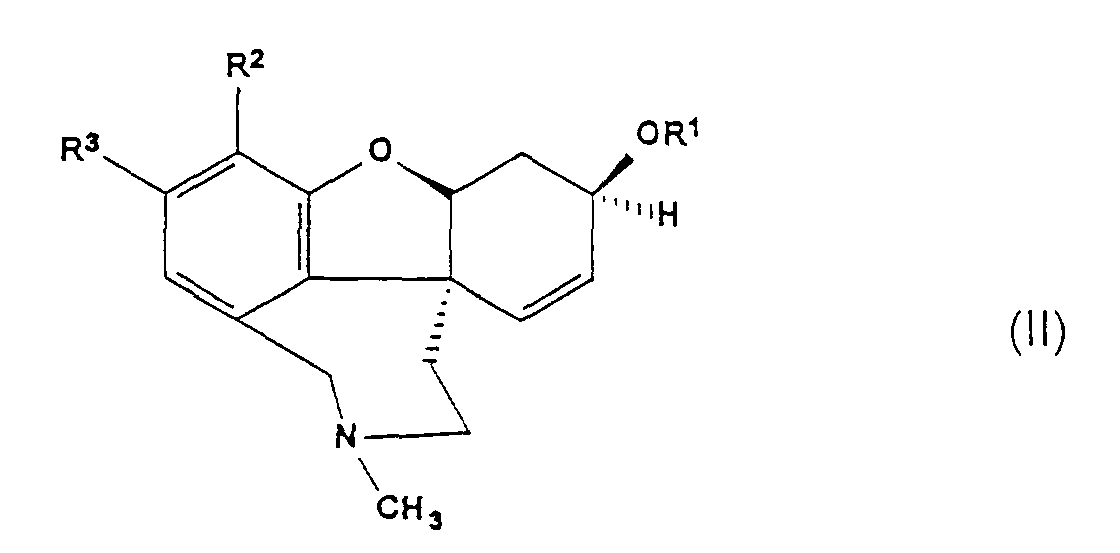
- R1
- is hydrogen ((4 x)) ; (C1-C12)alkylcarbonyl ((4 x)) ; (C1-C12)alkoxycarbonyl ((4x)); aryl(C1-C12)alkylaminocarbonyl, where 'aryl' is phenyl having 0, 1, 2 or 3 substituents independently selected from:(C1-C6)alkyl,(C1-C6)alkoxy,(C1-C6)alkylcarbonyl, halo and trifluoromethyl ((4 x)) ; mono (C1-C18)alkylaminocarbonyl or di(C1-C8)alkylaminocarbonyl;
- R2
- is (C1-C12)alkylcarbonyloxy, aryl(C1-C4)alkylcarbonyloxy, where 'aryl' is defined as above, (C1-C12)alkoxycarbonyloxy or arylcarbonyloxy, where 'aryl' is defined as above;
- R3
- is hydrogen, halo or (C1-C4)alkyl; and pharmaceutically acceptable addition salts.
- A compound of the formula II as defined in claim 1 wherein R3 is hydrogen or halo.
- A compound of the formula II as defined in claim 2, wherein
- R1
- is hydrogen, (C1-C12)alkylcarbonyl or (C1-C12)alkoxycarbonyl;
- R2
- is (C1-C12)alkylcarbonyloxy, phenylcarbonyloxy or (C1-C12)alkoxycarbonyloxy.
- A compound of the formula II as defined in claim 1, wherein
- R1
- is hydrogen, (C1-C8)alkylcarbonyl or (C1-C8)alkoxycarbonyl;
- R2
- is (C1-C10)alkylcarbonyloxy or phenylcarbonyloxy; and
- R3
- is hydrogen or bromo;
- A compound of the formula II as defined in claim 1, wherein
- R1
- hydrogen, methylcarbonyl, ethylcarbonyl, isopropylcarbonyl, t-butylcarbonyl or n-heptylcarbonyl;
- R2
- is methylcarbonyloxy, ethylcarbonyloxy, isopropylcarbonyloxy, t-butylcarbonyloxy, n-heptylcarbonyloxy, phenylcarbonyloxy, trifluoromethylphenylcarbonyloxy, methylphenylcarbonyloxy or dimethylphenylcarbonyloxy, and
- R3
- is hydrogen or bromo;
- The compound of the formula II as defined in claim 1, which is 6-O-demethyl-6-O-(trimethylacetyl)galanthamine or a pharmaceutically acceptable acid addition salt thereof.
- The compound of the formula II as defined in claim 1, which is 6-O-demethyl-[6-O-(2-propoxycarbonyl)]galanthamine or a pharmaceutically acceptable acid addition salt thereof.
- The compound of the formula II as defined in claim 1, which is 6-O-demethyl-3-O-(2-propoxycarbonyl)-6-O-(t-butylcarbonyl)-galanthamine or a pharmaceutically acceptable acid addition salt thereof.
- A pharmaceutical composition which comprises a compound of the formula II as defined in claim 1 and a pharmaceutically acceptable carrier therefor.
- Use of a compound of the formula II as defined in claim 1 for the preparation of a medicament being useful for the treatment of memory dysfunction characterized by decreased cholinergic function.
Applications Claiming Priority (2)
| Application Number | Priority Date | Filing Date | Title |
|---|---|---|---|
| US137444 | 1993-10-15 | ||
| US08/137,444 US6316439B1 (en) | 1993-10-15 | 1993-10-15 | Galanthamine derivatives as acetylcholinesterase inhibitors |
Publications (2)
| Publication Number | Publication Date |
|---|---|
| EP0649846A1 EP0649846A1 (en) | 1995-04-26 |
| EP0649846B1 true EP0649846B1 (en) | 2002-01-02 |
Family
ID=22477461
Family Applications (1)
| Application Number | Title | Priority Date | Filing Date |
|---|---|---|---|
| EP94115961A Expired - Lifetime EP0649846B1 (en) | 1993-10-15 | 1994-10-10 | Galanthamine derivates, a process for their preparation and their use as medicaments |
Country Status (23)
| Country | Link |
|---|---|
| US (1) | US6316439B1 (en) |
| EP (1) | EP0649846B1 (en) |
| JP (1) | JP2664343B2 (en) |
| KR (1) | KR100227957B1 (en) |
| CN (1) | CN1039910C (en) |
| AT (1) | ATE211474T1 (en) |
| AU (1) | AU696170B2 (en) |
| CA (1) | CA2118172C (en) |
| CZ (1) | CZ283731B6 (en) |
| DE (1) | DE69429570T2 (en) |
| DK (1) | DK0649846T3 (en) |
| EG (1) | EG20726A (en) |
| ES (1) | ES2170759T3 (en) |
| FI (1) | FI108722B (en) |
| IL (1) | IL111275A (en) |
| NO (1) | NO307464B1 (en) |
| NZ (1) | NZ264682A (en) |
| PL (1) | PL177549B1 (en) |
| PT (1) | PT649846E (en) |
| RO (1) | RO114134B1 (en) |
| RU (1) | RU2109743C1 (en) |
| TW (1) | TW289754B (en) |
| ZA (1) | ZA948061B (en) |
Families Citing this family (19)
| Publication number | Priority date | Publication date | Assignee | Title |
|---|---|---|---|---|
| AT403803B (en) | 1996-04-19 | 1998-05-25 | Sanochemia Ltd | NEW BENZAZEPINE DERIVATIVES, THESE MEDICINAL PRODUCTS AND THE USE THEREOF FOR THE PRODUCTION OF MEDICINAL PRODUCTS |
| AU780012B2 (en) * | 1999-12-10 | 2005-02-24 | Bonnie Davis | Analogs of galanthamine and lycoramine as modulators of nicotinic receptors |
| CN101100472A (en) * | 2001-04-30 | 2008-01-09 | 美国拜尔公司 | 4-amino-5,6-substituted thiopheno [2,3-D] pyrimidines compound and its uses |
| US20030162770A1 (en) * | 2002-02-22 | 2003-08-28 | Davis Bonnie M. | Use of modulators of nicotinic receptors for treatment of cognitive dysfunction |
| US20040254146A1 (en) * | 2002-05-21 | 2004-12-16 | Nastech Pharmaceutical Company Inc. | Carboxylate salts of galantamine and their pharmaceutical use |
| US20050143350A1 (en) * | 2003-11-19 | 2005-06-30 | Seed John C. | Combination drug therapy to treat obesity |
| CA2552114A1 (en) * | 2003-12-31 | 2005-07-21 | Actavis Group Hf | Solid dosage formulations of galantamine |
| US20050191349A1 (en) * | 2003-12-31 | 2005-09-01 | Garth Boehm | Galantamine formulations |
| EP1779867A4 (en) * | 2004-07-01 | 2009-12-02 | Eisai R&D Man Co Ltd | Nerve reveneration promoter |
| EP2425846A1 (en) * | 2004-12-23 | 2012-03-07 | Voyager Pharmaceutical Corporation | Acetylcholinesterase Inhibitors and leuprolide acetate for the treatment of Alzheimer's disease |
| DK1895994T3 (en) * | 2005-05-13 | 2010-12-20 | Alza Corp | Multilayer drug delivery system with barrier against reservoir material flow |
| US20080188510A1 (en) * | 2005-05-23 | 2008-08-07 | Eisai R & D Management Co., Ltd. | Novel methods using zonisamide |
| US20090253654A1 (en) | 2005-09-22 | 2009-10-08 | Galantos Pharma Gmbh | Cholinergic enhancers with improved blood-brain barrier permeability for the treatment of diseases accompanied by cognitive impairment |
| WO2007035941A2 (en) * | 2005-09-23 | 2007-03-29 | Alza Corporation | Transdermal galantamine delivery system |
| EP2137192B8 (en) | 2008-04-14 | 2014-06-11 | Neurodyn Life Sciences Inc. | Derivatives of galantamine as pro-drugs for the treatment of human brain diseases |
| US20120184532A1 (en) * | 2009-07-23 | 2012-07-19 | Shire Llc | Galantamine amino acid and peptide prodrugs and uses thereof |
| AU2015258814B2 (en) * | 2014-05-16 | 2018-04-05 | Synaptec Development Llc | Clearance of amyloid ss |
| EP4029867A1 (en) | 2021-01-13 | 2022-07-20 | Alpha Cognition Inc. | Solid forms of galantamine benzoate gluconate |
| US12551491B1 (en) * | 2025-07-23 | 2026-02-17 | Alpha Cognition Inc. | Dosage regimens for benzgalantamine |
Citations (1)
| Publication number | Priority date | Publication date | Assignee | Title |
|---|---|---|---|---|
| NL8800350A (en) * | 1988-02-12 | 1989-09-01 | Stichting Biomedical Research | New 6-O-demethyl-galanthamine derivs. - useful as anti-cholinesterase agents |
Family Cites Families (7)
| Publication number | Priority date | Publication date | Assignee | Title |
|---|---|---|---|---|
| PL122665B1 (en) | 1978-11-21 | 1982-08-31 | Edinen Zentar Chim | Process for preparing novel dienones of narvedine type and their derivatives |
| US4663318A (en) | 1986-01-15 | 1987-05-05 | Bonnie Davis | Method of treating Alzheimer's disease |
| US6150354A (en) * | 1987-01-15 | 2000-11-21 | Bonnie Davis | Compounds for the treatment of Alzheimer's disease |
| DE3856594D1 (en) * | 1987-05-04 | 2008-11-27 | Bonnie Davis | MEANS FOR THE TREATMENT OF ALZHEIMER DISEASE |
| DE69229781T2 (en) | 1991-05-14 | 2000-01-05 | Ernir Snorrason | TREATMENT OF FATIGUE SYNDROME WITH CHOLINESTERAS INHIBITORS |
| US5153193A (en) | 1991-10-01 | 1992-10-06 | Hoechst-Roussel Pharmaceuticals Incorporated | Carbamate derivatives of 4-amino-3-isoxazolidinones, 3-amino-1-hydroxypyrrolidin-2-ones and 1-amino-1-cyclopropanecarboxylic acid analogs |
| US5231093A (en) * | 1991-10-01 | 1993-07-27 | Hoechst-Roussel Pharmaceuticals Incorporated | Carbamate derivatives of 4-amino-3-isoxazolidinones, 3-amino-1-hydroxypyrrolidin-2-ones and 1-amino-1-cyclopropanecarboxylic acid analogs |
-
1993
- 1993-10-15 US US08/137,444 patent/US6316439B1/en not_active Expired - Lifetime
-
1994
- 1994-10-10 ES ES94115961T patent/ES2170759T3/en not_active Expired - Lifetime
- 1994-10-10 AT AT94115961T patent/ATE211474T1/en active
- 1994-10-10 EP EP94115961A patent/EP0649846B1/en not_active Expired - Lifetime
- 1994-10-10 PT PT94115961T patent/PT649846E/en unknown
- 1994-10-10 DE DE69429570T patent/DE69429570T2/en not_active Expired - Lifetime
- 1994-10-10 DK DK94115961T patent/DK0649846T3/en active
- 1994-10-13 FI FI944823A patent/FI108722B/en not_active IP Right Cessation
- 1994-10-13 RU RU94036745A patent/RU2109743C1/en active
- 1994-10-13 IL IL11127594A patent/IL111275A/en not_active IP Right Cessation
- 1994-10-13 NZ NZ264682A patent/NZ264682A/en not_active IP Right Cessation
- 1994-10-14 TW TW083109527A patent/TW289754B/zh not_active IP Right Cessation
- 1994-10-14 KR KR1019940026305A patent/KR100227957B1/en not_active Expired - Lifetime
- 1994-10-14 CZ CZ942545A patent/CZ283731B6/en not_active IP Right Cessation
- 1994-10-14 PL PL94305457A patent/PL177549B1/en unknown
- 1994-10-14 CN CN94117062A patent/CN1039910C/en not_active Expired - Lifetime
- 1994-10-14 RO RO94-01670A patent/RO114134B1/en unknown
- 1994-10-14 CA CA002118172A patent/CA2118172C/en not_active Expired - Lifetime
- 1994-10-14 ZA ZA948061A patent/ZA948061B/en unknown
- 1994-10-14 AU AU75813/94A patent/AU696170B2/en not_active Expired
- 1994-10-14 NO NO943895A patent/NO307464B1/en not_active IP Right Cessation
- 1994-10-15 EG EG64694A patent/EG20726A/en active
- 1994-10-17 JP JP6250777A patent/JP2664343B2/en not_active Expired - Fee Related
Patent Citations (1)
| Publication number | Priority date | Publication date | Assignee | Title |
|---|---|---|---|---|
| NL8800350A (en) * | 1988-02-12 | 1989-09-01 | Stichting Biomedical Research | New 6-O-demethyl-galanthamine derivs. - useful as anti-cholinesterase agents |
Non-Patent Citations (1)
| Title |
|---|
| CHEMICAL ABSTRACTS, vol. 112, no. 13, 1990, Columbus, Ohio, US; abstract no. 112096Y, page 76; * |
Also Published As
Similar Documents
| Publication | Publication Date | Title |
|---|---|---|
| US6316439B1 (en) | Galanthamine derivatives as acetylcholinesterase inhibitors | |
| EP0653427B1 (en) | Galanthamine derivatives, a process for their preparation and their use as medicaments | |
| AU679560B2 (en) | Galanthamine derivatives, a process for their preparation and their use as medicaments | |
| EP0452151B1 (en) | Substituted aromatic sulfonamides as antiglaucoma agents | |
| HU202548B (en) | Process for producing epipodophyllotoxin-glycoside-4'-acyl derivatives and pharmaceutical compositions comprising such compounds | |
| ISAKA et al. | Lactol esters of ampicillin | |
| KR830001902B1 (en) | Manufacturing method of waste nisilane derivative | |
| US4677114A (en) | Pyrrolidone-2 derivatives and pharmaceutical compositions thereof | |
| JP2000290280A (en) | Phenylazole compound, its production, and antihyperlipemic agent | |
| RU2135502C1 (en) | Clavulanic acid diamine salts, method of their synthesis (variants), method of synthesis of clavulanic acid or its pharmaceutically acceptable salt, method of purification of clavulanic acid of its salt | |
| 伊坂一郎 et al. | Lactol esters of ampicillin. | |
| TW200410966A (en) | Methods for producing hydroxyalkyl tropane esters |
Legal Events
| Date | Code | Title | Description |
|---|---|---|---|
| PUAI | Public reference made under article 153(3) epc to a published international application that has entered the european phase |
Free format text: ORIGINAL CODE: 0009012 |
|
| AK | Designated contracting states |
Kind code of ref document: A1 Designated state(s): AT BE CH DE DK ES FR GB GR IE IT LI LU NL PT SE |
|
| 17P | Request for examination filed |
Effective date: 19951026 |
|
| RAP1 | Party data changed (applicant data changed or rights of an application transferred) |
Owner name: HOECHST MARION ROUSSEL, INC. |
|
| 17Q | First examination report despatched |
Effective date: 19980529 |
|
| RAP1 | Party data changed (applicant data changed or rights of an application transferred) |
Owner name: AVENTIS PHARMACEUTICALS INC. |
|
| GRAG | Despatch of communication of intention to grant |
Free format text: ORIGINAL CODE: EPIDOS AGRA |
|
| GRAG | Despatch of communication of intention to grant |
Free format text: ORIGINAL CODE: EPIDOS AGRA |
|
| GRAG | Despatch of communication of intention to grant |
Free format text: ORIGINAL CODE: EPIDOS AGRA |
|
| GRAH | Despatch of communication of intention to grant a patent |
Free format text: ORIGINAL CODE: EPIDOS IGRA |
|
| GRAH | Despatch of communication of intention to grant a patent |
Free format text: ORIGINAL CODE: EPIDOS IGRA |
|
| GRAA | (expected) grant |
Free format text: ORIGINAL CODE: 0009210 |
|
| REG | Reference to a national code |
Ref country code: GB Ref legal event code: IF02 |
|
| AK | Designated contracting states |
Kind code of ref document: B1 Designated state(s): AT BE CH DE DK ES FR GB GR IE IT LI LU NL PT SE |
|
| REF | Corresponds to: |
Ref document number: 211474 Country of ref document: AT Date of ref document: 20020115 Kind code of ref document: T |
|
| REG | Reference to a national code |
Ref country code: CH Ref legal event code: EP |
|
| REG | Reference to a national code |
Ref country code: IE Ref legal event code: FG4D |
|
| REF | Corresponds to: |
Ref document number: 69429570 Country of ref document: DE Date of ref document: 20020207 |
|
| REG | Reference to a national code |
Ref country code: DK Ref legal event code: T3 |
|
| RAP2 | Party data changed (patent owner data changed or rights of a patent transferred) |
Owner name: AVENTIS PHARMACEUTICALS INC. |
|
| ET | Fr: translation filed | ||
| REG | Reference to a national code |
Ref country code: PT Ref legal event code: SC4A Free format text: AVAILABILITY OF NATIONAL TRANSLATION Effective date: 20020322 |
|
| NLT2 | Nl: modifications (of names), taken from the european patent patent bulletin |
Owner name: AVENTIS PHARMACEUTICALS INC. |
|
| REG | Reference to a national code |
Ref country code: ES Ref legal event code: FG2A Ref document number: 2170759 Country of ref document: ES Kind code of ref document: T3 |
|
| REG | Reference to a national code |
Ref country code: GR Ref legal event code: EP Ref document number: 20020401202 Country of ref document: GR |
|
| PLBE | No opposition filed within time limit |
Free format text: ORIGINAL CODE: 0009261 |
|
| STAA | Information on the status of an ep patent application or granted ep patent |
Free format text: STATUS: NO OPPOSITION FILED WITHIN TIME LIMIT |
|
| 26N | No opposition filed | ||
| REG | Reference to a national code |
Ref country code: FR Ref legal event code: CA Effective date: 20130125 |
|
| REG | Reference to a national code |
Ref country code: CH Ref legal event code: PCOW Free format text: NEW ADDRESS: 55 CORPORATE DRIVE, BRIDGEWATER NEW JERSEY 08807 (US) |
|
| PGFP | Annual fee paid to national office [announced via postgrant information from national office to epo] |
Ref country code: GR Payment date: 20130916 Year of fee payment: 20 Ref country code: ES Payment date: 20130911 Year of fee payment: 20 |
|
| PGFP | Annual fee paid to national office [announced via postgrant information from national office to epo] |
Ref country code: DK Payment date: 20131010 Year of fee payment: 20 |
|
| PGFP | Annual fee paid to national office [announced via postgrant information from national office to epo] |
Ref country code: LU Payment date: 20131014 Year of fee payment: 20 Ref country code: GB Payment date: 20131009 Year of fee payment: 20 Ref country code: PT Payment date: 20130411 Year of fee payment: 20 Ref country code: AT Payment date: 20130926 Year of fee payment: 20 Ref country code: CH Payment date: 20131014 Year of fee payment: 20 Ref country code: DE Payment date: 20131002 Year of fee payment: 20 Ref country code: BE Payment date: 20131014 Year of fee payment: 20 Ref country code: SE Payment date: 20131011 Year of fee payment: 20 Ref country code: IE Payment date: 20131010 Year of fee payment: 20 Ref country code: FR Payment date: 20131009 Year of fee payment: 20 |
|
| PGFP | Annual fee paid to national office [announced via postgrant information from national office to epo] |
Ref country code: IT Payment date: 20131016 Year of fee payment: 20 Ref country code: NL Payment date: 20131010 Year of fee payment: 20 |
|
| REG | Reference to a national code |
Ref country code: DE Ref legal event code: R071 Ref document number: 69429570 Country of ref document: DE |
|
| REG | Reference to a national code |
Ref country code: DK Ref legal event code: EUP Effective date: 20141010 |
|
| REG | Reference to a national code |
Ref country code: CH Ref legal event code: PL |
|
| REG | Reference to a national code |
Ref country code: PT Ref legal event code: MM4A Free format text: MAXIMUM VALIDITY LIMIT REACHED Effective date: 20141010 |
|
| REG | Reference to a national code |
Ref country code: NL Ref legal event code: V4 Effective date: 20141010 |
|
| REG | Reference to a national code |
Ref country code: GB Ref legal event code: PE20 Expiry date: 20141009 |
|
| REG | Reference to a national code |
Ref country code: AT Ref legal event code: MK07 Ref document number: 211474 Country of ref document: AT Kind code of ref document: T Effective date: 20141010 |
|
| REG | Reference to a national code |
Ref country code: SE Ref legal event code: EUG |
|
| REG | Reference to a national code |
Ref country code: IE Ref legal event code: MK9A |
|
| REG | Reference to a national code |
Ref country code: ES Ref legal event code: FD2A Effective date: 20150107 |
|
| REG | Reference to a national code |
Ref country code: GR Ref legal event code: MA Ref document number: 20020401202 Country of ref document: GR Effective date: 20141011 |
|
| PG25 | Lapsed in a contracting state [announced via postgrant information from national office to epo] |
Ref country code: ES Free format text: LAPSE BECAUSE OF EXPIRATION OF PROTECTION Effective date: 20141011 Ref country code: GB Free format text: LAPSE BECAUSE OF EXPIRATION OF PROTECTION Effective date: 20141009 Ref country code: PT Free format text: LAPSE BECAUSE OF EXPIRATION OF PROTECTION Effective date: 20141020 Ref country code: IE Free format text: LAPSE BECAUSE OF EXPIRATION OF PROTECTION Effective date: 20141010 |