EP0649600B1 - Process for preparing a grain product - Google Patents

Process for preparing a grain product Download PDF

Info

Publication number
EP0649600B1
EP0649600B1 EP94914605A EP94914605A EP0649600B1 EP 0649600 B1 EP0649600 B1 EP 0649600B1 EP 94914605 A EP94914605 A EP 94914605A EP 94914605 A EP94914605 A EP 94914605A EP 0649600 B1 EP0649600 B1 EP 0649600B1
Authority
EP
European Patent Office
Prior art keywords
phytic acid
inositol
grain
defatted soybean
koji
Prior art date
Legal status (The legal status is an assumption and is not a legal conclusion. Google has not performed a legal analysis and makes no representation as to the accuracy of the status listed.)
Expired - Lifetime
Application number
EP94914605A
Other languages
German (de)
French (fr)
Other versions
EP0649600A1 (en
EP0649600A4 (en
Inventor
Minoru Takebe
Yoshio Ando
Sunao Hishiroku Co Ltd 79 Rokuro-Cho Kikushima
Current Assignee (The listed assignees may be inaccurate. Google has not performed a legal analysis and makes no representation or warranty as to the accuracy of the list.)
Nichimo Co Ltd
Original Assignee
Nichimo Co Ltd
Priority date (The priority date is an assumption and is not a legal conclusion. Google has not performed a legal analysis and makes no representation as to the accuracy of the date listed.)
Filing date
Publication date
Application filed by Nichimo Co Ltd filed Critical Nichimo Co Ltd
Publication of EP0649600A1 publication Critical patent/EP0649600A1/en
Publication of EP0649600A4 publication Critical patent/EP0649600A4/en
Application granted granted Critical
Publication of EP0649600B1 publication Critical patent/EP0649600B1/en
Anticipated expiration legal-status Critical
Expired - Lifetime legal-status Critical Current

Links

Images

Classifications

    • AHUMAN NECESSITIES
    • A23FOODS OR FOODSTUFFS; TREATMENT THEREOF, NOT COVERED BY OTHER CLASSES
    • A23KFODDER
    • A23K10/00Animal feeding-stuffs
    • A23K10/10Animal feeding-stuffs obtained by microbiological or biochemical processes
    • A23K10/12Animal feeding-stuffs obtained by microbiological or biochemical processes by fermentation of natural products, e.g. of vegetable material, animal waste material or biomass
    • AHUMAN NECESSITIES
    • A23FOODS OR FOODSTUFFS; TREATMENT THEREOF, NOT COVERED BY OTHER CLASSES
    • A23KFODDER
    • A23K10/00Animal feeding-stuffs
    • A23K10/30Animal feeding-stuffs from material of plant origin, e.g. roots, seeds or hay; from material of fungal origin, e.g. mushrooms
    • AHUMAN NECESSITIES
    • A23FOODS OR FOODSTUFFS; TREATMENT THEREOF, NOT COVERED BY OTHER CLASSES
    • A23LFOODS, FOODSTUFFS OR NON-ALCOHOLIC BEVERAGES, NOT OTHERWISE PROVIDED FOR; PREPARATION OR TREATMENT THEREOF
    • A23L11/00Pulses, i.e. fruits of leguminous plants, for production of food; Products from legumes; Preparation or treatment thereof
    • A23L11/30Removing undesirable substances, e.g. bitter substances
    • A23L11/37Removing undesirable substances, e.g. bitter substances using microorganisms
    • AHUMAN NECESSITIES
    • A23FOODS OR FOODSTUFFS; TREATMENT THEREOF, NOT COVERED BY OTHER CLASSES
    • A23LFOODS, FOODSTUFFS OR NON-ALCOHOLIC BEVERAGES, NOT OTHERWISE PROVIDED FOR; PREPARATION OR TREATMENT THEREOF
    • A23L5/00Preparation or treatment of foods or foodstuffs, in general; Food or foodstuffs obtained thereby; Materials therefor
    • A23L5/20Removal of unwanted matter, e.g. deodorisation or detoxification
    • A23L5/28Removal of unwanted matter, e.g. deodorisation or detoxification using microorganisms
    • AHUMAN NECESSITIES
    • A23FOODS OR FOODSTUFFS; TREATMENT THEREOF, NOT COVERED BY OTHER CLASSES
    • A23LFOODS, FOODSTUFFS OR NON-ALCOHOLIC BEVERAGES, NOT OTHERWISE PROVIDED FOR; PREPARATION OR TREATMENT THEREOF
    • A23L7/00Cereal-derived products; Malt products; Preparation or treatment thereof
    • A23L7/10Cereal-derived products
    • A23L7/104Fermentation of farinaceous cereal or cereal material; Addition of enzymes or microorganisms
    • YGENERAL TAGGING OF NEW TECHNOLOGICAL DEVELOPMENTS; GENERAL TAGGING OF CROSS-SECTIONAL TECHNOLOGIES SPANNING OVER SEVERAL SECTIONS OF THE IPC; TECHNICAL SUBJECTS COVERED BY FORMER USPC CROSS-REFERENCE ART COLLECTIONS [XRACs] AND DIGESTS
    • Y10TECHNICAL SUBJECTS COVERED BY FORMER USPC
    • Y10STECHNICAL SUBJECTS COVERED BY FORMER USPC CROSS-REFERENCE ART COLLECTIONS [XRACs] AND DIGESTS
    • Y10S426/00Food or edible material: processes, compositions, and products
    • Y10S426/807Poultry or ruminant feed

Definitions

  • the fermentation time depends upon the type of koji used. However, it is at least 24 hours and is appropriately selected to be sufficient one for removing phytic acid to a satisfactory extent.
  • the number of the phosphoric acid groups liberated from phytic acid by adjusting the fermentation time, and hydrolysis time and hydrolysis temperature depending upon the type, state, properties and amount of the grain, the type, state, properties and amount of koji, and type and properties of the intended product.
  • Table 1 shows phytic acid content in 100g of a defatted soybean, with respect to an untreated defatted soybean; defatted soybeans A and B which are prepared, in accordance with the process of the present invention as claimed in claim 7, by using two different shochu kojis, for example, Aspergillus niger and Aspergillus awamori , respectively, and each prepared by subjecting a defatted soybean to koji preparation at 30 °C for 48 hours; defatted soybeans Aa and Ba prepared, in accordance with the process of the present invention as claimed in claim 10, by adding water to the above-mentioned products A and B in the same weight as that of the products, respectively, and further subjecting the resultants to hydrolysis of protein at 50°C for 48 hours; and a defatted soybean subjected to conventional washing treatment with an alcohol.
  • defatted soybeans A and B which are prepared, in accordance with the process of the present invention as claimed in claim 7, by using two different shochu kojis, for example
  • inositol tetraphosphate, inositol triphosphate, inositol diphosphate, inositol monophosphate and an inorganic phosphorus are eluted which have activities to greatly facilitate absorption of a mineral such as calcium contained in a product made from a grain as a starting material, but no substantial inositol pentaphosphate and phytic acid are eluted which inhibit absorption of a mineral; and the defatted soybean is thus understood to be such that a vitamin B complex having growth promoting activities and antiadipohepatic activities and such useful like which are contained in the defatted soybean are maintained highly active to enable a mineral and the like contained in the defatted soybean to be readily absorbed.
  • the present invention it is ensured that the following problem involved in preparation of a solid product by a conventional method can be solved, i.e., is surely solved a problem that a step for converting a starting material into a liquid form is required and a post-step for reducing the liquid to a solid form is also required subsequently to phytic acid hydrolyzing treatment, thereby leading to complicated preparation procedure and increased cost.
  • the defatted soybean fed to the defatted soybean division is untreated one containing phytic acid
  • the treated defatted soybeans fed to the other divisions are the above-mentioned defatted soybeans which are prepared in accordance with the present invention and from which phytic acid is removed.
  • the treated defatted soybean for A division is one subjected to koji preparation for 48 hours and hydrolysis for 12 hours
  • the treated defatted soybean for B division is one subjected to koji preparation for 48 hours and hydrolysis for 3 hours
  • the treated defatted soybean for C division is one subjected to koji preparation for 48 hours and hydrolysis for 1 hour
  • the treated defatted soybean for D division is the same one as the treated defatted soybean for A division.
  • Digestional degree and increase in a body weight in each of the divisions are as shown in Table 5.
  • digestion degree and body weight increase d.s. div. A div. B div. C div. D div. ingested amount of dry matter (g/day) 22.9 ⁇ 0.7 22.1 ⁇ 0.5 23.5 ⁇ 0.3 21.8 ⁇ 0.7 24.1 ⁇ 0.4 amount of dry matter through excrement (g/day) 2.09 ⁇ 0.07 2.94 ⁇ 0.16 3.19 ⁇ 0.13 3.21 ⁇ 0.13 2.52 ⁇ 0.16 digestion degree (%) 90.9 ⁇ 0.1 86.7 ⁇ 0.6 86.4 ⁇ 0.4 84.8 ⁇ 0.2 89.5 ⁇ 0.7 ingested amount of phosphorus (mg/day) 103.6 ⁇ 3.0 81.8 ⁇ 1.7 93.8 ⁇ 1.3 87.2 ⁇ 3.0 110.7 ⁇ 1.7 amount of phosphorus through excrement (mg/day) 38.5 ⁇ 1.1 16.3 ⁇ 1.4 18.5 ⁇ 1.8 19.3 ⁇ 0.3 14.3 ⁇ 0.6 absorption degree of phosphorus
  • the digestional degree is determined from the ingested amount of a dry matter of the formula feed and the amount of excrement
  • the ingested amount of phosphorus is determined from the above-mentioned ingested amount of a dry matter
  • the excreted amount of phosphorus through excrement is determined from the above-mentioned amount of excrement
  • the absorption degree of phosphorus is determined from the ingested amount of phosphorus and the excreted amount of phosphorus through excrement.
  • phytic acid contained in a grain is converted into (a) form(s) readily absorbable in an animal body, specifically, into such (a) form(s) that phytic acid has its at least two phosphoric acid groups liberated, i.e., inositol tetraphosphate, inositol triphosphate, inositol diphosphate, inositol monophosphate or inositol alone or a mixture and consequently removed, and as a result, phytic acid which has heretofore been impossible to be digested and absorbed by a monogastric animal is converted into (a) digestible and absorbable form(s) and sufficiently digested and absorbed.
  • a livestock efficiently digests and absorbs phosphorus at least in an amount required for satisfactorily rearing a livestock. Accordingly, total amount of phosphorus excreted through excreta of a livestock can be reduced greatly, and it is not required to incorporate an inorganic phosphorus such as calcium phosphate which has heretofore been incorporated into a feed. Consequently, prevention of environmental pollution caused by excreta of a livestock is ensured, and cost for a livestock feed can be reduced.
  • the present invention can likewise be applied to any products made from a grain as a starting material which contains phytic acid, i.e., those ranging from foods for a human being to cultural and aquacultural feeds.
  • the present invention can be carried out using a conventional device for preparing koji without any alteration, and hence a basic device for production is not required to be specially manufactured, thereby providing wide utility.

Landscapes

  • Life Sciences & Earth Sciences (AREA)
  • Engineering & Computer Science (AREA)
  • Chemical & Material Sciences (AREA)
  • Polymers & Plastics (AREA)
  • Health & Medical Sciences (AREA)
  • Food Science & Technology (AREA)
  • Microbiology (AREA)
  • Biotechnology (AREA)
  • Nutrition Science (AREA)
  • Physiology (AREA)
  • Zoology (AREA)
  • Molecular Biology (AREA)
  • Botany (AREA)
  • Animal Husbandry (AREA)
  • Agronomy & Crop Science (AREA)
  • Sustainable Development (AREA)
  • Biochemistry (AREA)
  • Biomedical Technology (AREA)
  • Mycology (AREA)
  • Cereal-Derived Products (AREA)
  • Fodder In General (AREA)
  • Noodles (AREA)
  • General Preparation And Processing Of Foods (AREA)
  • Beans For Foods Or Fodder (AREA)
  • Bakery Products And Manufacturing Methods Therefor (AREA)
  • Seeds, Soups, And Other Foods (AREA)

Abstract

Products obtained from cereal such as soybean, rice, wheat, corn and meals thereof and usable as food, animal feed and aquacultural feed. The production process comprises decomposing phytic acid contained in cereal. The products are superior in digestion efficiency to the conventional ones, and the process is superior in productivity to the conventional ones. <IMAGE>

Description

Technical Field
The present invention relates to a process for preparing a grain product.
In the present invention, the term "grain" means soybean, rice, barley, wheat, oats, rye and corn, and defatted products or brans thereof, and the like, and the term "product made from a grain" means foods, livestock feeds, aquacultural feeds and the like which are made from the above-mentioned grain.
Background Art
Products made from a grain as a starting material are generally in great demand, and a large variety of such products are provided.
Explanation will be made with respect to products made from soybean which is one of grains or a defatted soybean. In soybean and a defatted soybean, phytic acid is contained in an amount of about 1 to 2 % by weight.
Phytic acid is residually present also in a product made from soybean and inhibits activities of a vitamin B complex contained in the product to prevent absorption of minerals and the like contained in the product.
Further descriptively, phytic acid is such a compound that myo-inositol has its all hydroxyl groups each bonded with a phosphoric acid group, and chelates with a nutritionally important trace metal element to form a hardly soluble compound. Accordingly, when a food with high phytic acid content is ingested by a human being or simple-stomached animal, normal intestinal absorption of such metals, for example, calcium, magnesium. iron, zinc and the like is prevented to cause various deficiencies.
It has further been found that phytic acid present in products including an isolated soybean protein prevents a monogasteric animal from metabolically utilizing zinc in a food. Further, phytic acid is known to have inhibitory activities on various digestive enzymes in a gastrointestinal digestive tract on which ions of minerals such as calcium act as activators and which include amylase, pepsin and tripsin. It is, therefore, desired to remove phytic acid from the product.
Accordingly, there have heretofore been proposed various methods for removing phytic acid from soybean or a defatted soybean.
The conventional methods are roughly categorized as (1) ultrafiltration methods, (2) ion exchange resin methods, (3) chemical methods, and (4) enzyme treatment methods.
Disclosure of Invention
In the above-mentioned ultrafiltration method, however, there is a problem that peptides deposit on the surface of a filtration membrane during operation to retard filtration rate, thereby leading to decreased efficiency.
In the ion exchange resin method which comprises treating a protein-containing liquid with an ion exchange resin, there are problems of complicated operation and poor yield of protein.
In the chemical method which comprises washing soybean or a defatted soybean with an acid or alcohol, there are problems that production operation is complicated and that disposal of a large amount of waste liquor is cost-consuming and troublesome.
In the enzyme treatment method as described in Japanese Patent Unexamined Publication No.27706/1989, an enzyme is used to lower a phytic acid content, and hence a starting material such as soybean is required to be reduced to a slurry or aqueous liquid, otherwise the enzyme cannot exhibit phytic acid hydrolyzing activities. In other words, there is a problem that an enzyme cannot catalytically act on soybean or the like in the form of a solid.
Therefore, when a soybean milk which is a liquid is prepared as in the above-mentioned publication, an enzyme may be added subsequently to reduction of a starting material to a soybean milk which is a liquid, thereby causing no problem. However, when a solid product is prepared, a step of reducing a starting material to a liquid is required, and after hydrolytic treatment of phytic acid, a post-step of reduction of the liquid to a solid is further required. This results in problems of complicated preparatiton procedure and increased cost and the like. Further descriptively, there is a problem with respect to a solid product in that protein content is lowered due to reduction of a starting material to a liquid, and accordingly, the liquid is required to be subjected to a technically high level of concentration procedure so as to obtain a solid product with high protein content, thereby leading to extremely increased cost.
FR-A-2 654 585 relates to a process for removing non-nutritional substances which are present in a substrate of vegetable origin, characterised that the said substrate is subjected to a fermentation by the action of at least one microorganism capable of degrading the said non-nutritional substances, ie phytic acid or glucosinolates.
Further, there have been proposed methods utilizing phytase to hydrolytically remove phytin or to obtain a protein from soybean or a vegetable protein raw material in Japanese Patent National Publication No.503,002/1992 (Japanese Patent Application claiming priority based on U.S. Patent Application No.301,563 filed on January 25, 1989), Japanese Patent Publication No.29,654/1980 (Japanese Patent Application claiming priority based on U.S. Patent Application No.162,654 filed on July 14, 1971) and Japanese Patent Unexamined Publication No.125,300/1976 (Japanese Patent Application claiming priority based on U.S. Patent Application No.538,127 filed on January 2, 1975, i.e., U.S. Patent No.3,966,971). However, each of them has a problem such as poor production efficiency or high cost.
Further, when a product made from a grain is utilized as a livestock feed, it is nowadays regarded as indispensable to take measures for preventing environmental pollution from being caused.
In other words, excreta of livestock which contain nitrogen, phosphorus and the like in plenty have been restored as barnyard manure to farmlands. However, as chemical fertilizers have become used more and more, a large amount of phosphoric acid has accumulated in soil such as farmlands in Japan. Accordingly, pollution nuisance with excreta of livestock is not confined to particular regions of the country nowadays but has been spreading all over the country as eutrophication.
In a product made from a grain as a starting material which is used as a livestock feed, inorganic phosphoric acid is contained in a small amount, and a large part of phosphorus is present in the form of phytic acid or phytin as a salt mixture.
A ruminant animal digests phytic acid or phytin by breaking the same down to inorganic phosphorus with the aid of microorganisms present in its stomach and absorbs the inorganic phosphorus. On the other hand, however, a monogastric animal such as a pig can digest and absorb only non-phytic phosphorus. Accordingly, with respect to a monogasteric animal, an organic phosphorus in the form of phytic acid or phytin contained in a feed made from a grain as a starting material is discharged through excrement with the organic phosphorus still undigested. Further, in compensation for an indigestible and thus unabsorbable organic posphorus contained in a feed, an inorganic phosphorus such as calcium phosphate is mixed in the feed. Such an inorganic phosphorus becomes consumed in a considerably increased amount and a portion thereof is discharged through excrement, thereby causing a problem that pollution with excreta of livestock increasingly becomes severe.
Further, a rearing method has been attempted in Europe which comprises preparing phytase, which is known as an enzyme hydrolyzing phytic acid, as an isolated product, mixing the isolated product with a livestock feed made from a grain as a starting material, and feeding them together to hydrolyze phytic acid in the livestock feed by the action of the phytase in a gastrointestinal tract of livestock. In this method, however, there are problems in that expensive phytase is required as well as a livestock feed to result in increased rearing cost, and that satisfactory hydrolytic efficiency on phytic acid cannot be expected, because a livestock feed is fed with no phytic acid in a grain removed at all and then phytic acid is hydrolyzed in a livestock body by the action of phytase.
It is an object of the present invention to solve the above-mentioned problems inherent in the conventional techniques, and to provide a product made from a grain in which phytic acid contained in a grain is removed by conversion thereof into (a) form(s) readily absorbable in an animal body, which is imparted with high activities of (a) phytic acid hydrolyzing enzyme(s) to reduce an amount of phosphorus excreted through excrement of an animal, and accordingly, which is capable of effectively preventing environmental pollution with livestock excreta, which is capable of greatly reducing an amount of an inorganic phosphorus preliminarily incorporated into a feed, which is capable of eliminating addition of phytase which has heretofore been-added to a grain feed, and which is capable of realizing lowered cost; and to provide a method for using such a product.
It is another object of the present invention to provide a product made from a grain in which phytic acid in a grain is readily removed to maintain a vitamin B complex contained in the product highly active, thereby facilitating absorption of minerals contained in the product, and which is capable of further promoting the absorption, and whose preparation cost is low; and to provide a process for preparing such a product.
The above-mentioned object, is solved by the process of claim 1.
The present invention is constructed as above, and hence it exhibits the following extremely excellent functions and effects.
In other words, according to the products made from a grain as a starting material of the present invention as claimed in claim 1, phytic acid is removed by conversion thereof into (a) form(s) readily absorbable in an animal body, specifically into such (a) form(s) that phytic acid has its at least two phosphoric acid groups liberated, such as inositol tetraphosphate, inositol triphosphate, inositol diphosphate, inositol monophosphate or inositol alone or a mixture thereof. Accordingly, phytic acid which has heretofore been impossible to be absorbed by a monogasteric animal is converted into (a) digestible and absorbable form(s) and is readily digested and absorbed.
According to the process for preparing a product made from a grain as a starting material as claimed in claim 1, a koji mold(starter) is inoculated on the starting material to effect koji preparation, and the koji mold(starter) is propagated to remove phytic acid and also to provide activities of (a) phytic acid hydrolyzing enzyme(s), and further, water is added to the resultant from the koji preparation to hydrolyze a protein in the resultant in parallel with further thorough removal of phytic acid and with providing superior activities of (a) phytic acid hydrolyzing enzyme(s).
The product made from a grain as a starting material and the process for preparing the same according to the present invention have such constructions and functions as described above. Therefore, effects are provided that phytic acid contained in a grain is removed by conversion thereof into (a) form(s) readily absorbable in an animal body, and the product is imparted with high activities of (a) phytic acid hydrolyzing enzyme(s) to reduce an amount of phosphorus excreted through excrement of an animal, and accordingly, the product is capable of effectively preventing environmental pollution with livestock excreta and is also capable of greatly reducing an amount of an inorganic phosphorus preliminarily incorporated into a feed, and is further capable of eliminating addition of phytase which has heretofore been added to a grain feed, and is yet capable of realizing lowered cost.
Further, the process for preparing a product made from a grain according to the present invention is capable of providing effects that phytic acid in a grain is readily removed, if the grain may be in the form of a solid, to maintain a vitamin B complex contained in the product highly active, thereby facilitating absorption of minerals contained in the product, and that the process further enables a product capable of promoting the absorption of a mineral to be obtained, and enables simplified preparation procedure and low preparation cost to be realized.
Brief Description of the Drawings
  • Fig.1 is a flow chart showing one embodiment of the process for preparing a product in which phytic acid is removed in a defatted soybean in accordance with the present invention;
  • Fig.2 is a flow chart showing another embodiment of the process for preparing a product in which phytic acid is removed in a defatted soybean in accordance with the present invention;
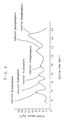
  • Fig.3 is a characteristic representation showing a chromatographic elution pattern of phytic acid hydrolysates with respect to a product in which phytic acid is removed in a defatted soybean in accordance with the present invention; and Fig.4 is a characteristic representation showing a chromatographic elution pattern of phytic acid hydrolysates with respect to a product in which phytic acid is removed in an untreated defatted soybean.
  • Best Mode for Carrying Out the Invention
    Hereinbelow, embodiments of the present invention will be described with reference to Figs.1 to 4.
    Fig.1 is a flow chart showing one embodiment of the process for preparing a product subjected to removal of phytic acid in a defatted product of soybean which is one of grain in accordance with the present invention.
    Explanation will be given along the lines of the procedure in Fig.1. First, a defatted soybean is cooked. By effecting the cooking, propagation of koji is facilitated. The cooking of the defatted soybean may be conducted batchwise or continuously according to the intended product or the like.
    After completion of the cooking, the defatted soybean is once cooled to adjust water content of the defatted soybean to a level allowing koji to propagate (for example 40% by weight).
    The defatted soybean thus adjusted in the water content is subjected to the process of the present invention as follows.
    That is, the defatted soybean already cooked is inoculated with a koji starter of a koji mold at a predetermined weight ratio, and mixing is conducted to uniformness.
    Then, the mixture is charged into a device for preparing koji and kept in a heated condition at 28 to 30°C for a predetermined period of time to ferment the defatted soybean having a water content as low as 40% by weight with koji. The koji preparation is continued until phytic acid level in the defatted soybean is sufficiently reduced.
    In this case, koji is propagated on the defatted soybean to produce phytase and phosphatase which are enzymes hydrolyzing phytic acid, and by the enzymes, phytic acid is removed by hydrolysis.
    In other words, from phytic acid which is such a compound that myo-inositol has all its hydroxyl groups each bonded with a phosphoric acid group, the phytic acid hydrolyzing enzymes liberate the above-mentioned phosphoric acid group(s) to form inositol pentaphosphate, inositol tetraphosphate, inositol triphosphate, inositol diphosphate, inositol monophosphate or inositol alone or a mixture thereof, thereby removing the above-mentioned phytic acid.
    Further, in this embodiment, phytic acid hydrolyzing enzymes of phytase and phosphatase are produced in the defatted soybean, thereby enabling a product having very high phytic acid hydrolyzing enzyme activities to be attained. This enables phytic acid contained in a grain to be further hydrolyzed in a gastrointestinal tract of an animal by the above-mentioned phytic acid hydrolyzing activities, and also enables phytic acid contained not only in the above-mentioned product but also in a grain ingested together therewith to be hydrolyzed. Accordingly, remarkably enhanced digestion and absorption efficiency on grain is attained, and it is not required to conventionally prepare phytase as an isolated product and mix the same in a grain.
    As the koji for the koji preparation, there may be used koji mold(starter)s which are used in preparation of fermented foods peculiar to Japan and tempeh and which are safely used for foods, for example, those having high phytase and phosphatase potencies and classified as Aspergillus genus such as Aspergillus usamii, Aspergillus kawachii, Aspergillus awamori, Aspergillus saitoi, Aspergillus oryzae and Aspergillus niger; and those having high phytase and phosphatase potencies and classified as Rhizopus genus.
    The fermentation time depends upon the type of koji used. However, it is at least 24 hours and is appropriately selected to be sufficient one for removing phytic acid to a satisfactory extent.
    Fig.2 is a flow chart showing another embodiment of the process for preparing a product subjected to removal of phytic acid in a defatted product of soybean which is one of grain in accordance with the present invention.
    In this embodiment, a protein is hydrolyzed in parallel with further thorough removal of phytic acid.
    In other words, in this embodiment, the steps up to the koji preparation are conducted in the same manner as in the previous embodiment, and after completion of the koji preparation, water is added to the resulting product, and then the mixture is kept in a heated condition at 30 to 65°C for a predetermined period of time to sufficiently reduce the level of phytic acid contained in the defatted soybean by the hydrolytic activities of phytase and phosphatase while generating phytic acid hydrolyzing enzymes of phytase and phosphatase in the defatted soybean in parallel with hydrolysis of protein.
    With respect to the hydrolysis of protein, hydrolysis time and hydrolysis temperature is appropriately selected depending upon the type of koji used so that phytic acid in the defatted soybean is sufficiently removed.
    According to the process of the latter embodiment, organic acids are formed in the initial stage of the fermentation to inhibit contaminants from propagating in the defatted soybean, thereby eliminating undesired possibility of secondary contamination. Consequently, a product made from a defatted soybean as a starting material can be mass-produced. Further, even if the water content is not low, satisfactory phytic acid removing treatment can be effected.
    The removal of phytic acid is effected by liberating at least one phosphoric acid group from phytic acid which is inositol hexaphosphate. In this connection, however, at least two phosphoric acid group-liberated resultants, i.e., inositol tetraphosphate, inositol triphosphate, inositol diphosphate, inositol monophosphate and inositol are watersoluble and have activities to greatly facilitate absorption of a mineral such as calcium contained in a product made from a cereal.
    Further descriptively, the above-mentioned inositol hexaphosphate and inositol pentaphosphate have strong ion capturing activities and prevent captured ion from being liberated, thereby strongly inhibiting absorption of calcium. On the other hand, inositol tetraphosphate to inositol have such preferable affinities that they preferably capture calcium but readily liberate captured calcium on occasion, thereby exhibiting characteristic activities to facilitate absorption of calcium as mentioned above. With interest in this point, the aspect of the present invention according to claim 8 or 11 resides in that a product which enables minerals to be absorbed efficiently is obtained by liberating at least two phosphoric acid groups from phytic acid to form inositol tetraphosphate, inositol triphosphate, inositol diphosphate, inositol monophosphate or inositol alone or a mixture thereof for removal of phytic acid. In this case, according to the aspect of the invention as claimed in claim 7 or 10, it is preferred to control the number of the phosphoric acid groups liberated from phytic acid by adjusting the fermentation time, and hydrolysis time and hydrolysis temperature depending upon the type, state, properties and amount of the grain, the type, state, properties and amount of koji, and type and properties of the intended product.
    Table 1 shows phytic acid content in 100g of a defatted soybean, with respect to an untreated defatted soybean; defatted soybeans A and B which are prepared, in accordance with the process of the present invention as claimed in claim 7, by using two different shochu kojis, for example, Aspergillus niger and Aspergillus awamori, respectively, and each prepared by subjecting a defatted soybean to koji preparation at 30 °C for 48 hours; defatted soybeans Aa and Ba prepared, in accordance with the process of the present invention as claimed in claim 10, by adding water to the above-mentioned products A and B in the same weight as that of the products, respectively, and further subjecting the resultants to hydrolysis of protein at 50°C for 48 hours; and a defatted soybean subjected to conventional washing treatment with an alcohol.
    Figure 00180001
    According to Table 1, as compared with the phytic acid content of 999mg, i.e., about 1% in the untreated defatted soybean, phytic acid contents in the defatted soybeans A and B subjected to the shochu koji treatment in accordance with the process of the present invention are 366mg and 358mg, respectively, each of which is a bit greater than 1/3 of the phytic acid content in the untreated defatted soybean, it is thereby understood that greatly reduced phytic acid contents are realized. Further, in each of the defatted soybeans Aa and Ba which are prepared in accordance with the process of the present invention by adding water to the above-mentioned defatted soybeans A and B in the same weight as those of the products, respectively, and further subjecting the mixtures to hydrolysis of protein at 50 °C for 48 hours, no substantial phytic acid content is detected. In other words, phytic acid content is reduced to such a level that almost all phytic acid has been hydrolyzed.
    On the other hand, the phytic acid content in the defatted soybean subjected to the conventional washing treatment with an alcohol is 1,150mg and no reduction of the phytic acid content is observed at all.
    Upon separation by means of ion exchange chromatography with respect to the defatted soybean A according to the present invention and the conventional untreated defatted soybean, a chromatographic elution pattern of hydrolysates from phytic acid shown in Fig.3 was obtained for the defatted soybean A according to the present invention, and a chromatographic elution pattern of hydrolysates from phytic acid shown in Fig.4 was obtained.
    Upon comparison between Fig.3 and Fig.4, with respect to the defatted soybean A according the present invention, it is seen that inositol tetraphosphate, inositol triphosphate, inositol diphosphate, inositol monophosphate and an inorganic phosphorus are eluted which have activities to greatly facilitate absorption of a mineral such as calcium contained in a product made from a grain as a starting material, but no substantial inositol pentaphosphate and phytic acid are eluted which inhibit absorption of a mineral; and the defatted soybean is thus understood to be such that a vitamin B complex having growth promoting activities and antiadipohepatic activities and such useful like which are contained in the defatted soybean are maintained highly active to enable a mineral and the like contained in the defatted soybean to be readily absorbed. Of these eluates, the inorganic phosphorus, which is a resultant from conversion of an organic phosphorus into an inorganic phosphorus and is eluted, is advantageously readily absorbed in a body to enable phosphorus which is a nutrient contained in a defatted soybean to be absorbed in a body, thereby realizing a nutrititively enhanced product as a food, livestock feed and the like.
    On the other hand, with respect to the conventional untreated defatted soybean, it is seen that inositol pentaphosphate and phytic acid which inhibit absorption of a mineral are eluted as well as inositol tetraphosphate, inositol triphosphate, inositol diphosphate and inositol monophosphate; and the untreated defatted soybean is thus understood to be very poor in absorption efficiency of a mineral as compared with the defatted soybean A ccording to the present invention.
    The defatted soybean thus having its phytic acid level reatly or almost completely reduced in accordance with the present invention is such a defatted soybean that a vitamin B complex having growth promoting activities and antiadipohepatic activities and such useful like which are contained in the defatted soybean are maintained highly active to enable a mineral and the like contained in the defatted soybean to be readily absorbed.
    When the thus prepared defatted soybean is utilized as a feed or the like, as shown in Figs.1 and 2, the defatted soybean prepared as in each of the above-mentioned embodiments is dried and then pulverized to obtain a product such as a material for a livestock feed or an aquacultural feed as a pulverized defatted soybean from which phytic acid is substantially removed.
    As described above, according to the present invention, removal of phytic acid in a grain and hydrolysis of protein are effected by propagation of living koji. Accordingly, phytic acid is readily removed if the grain may be in a solid state or liquid state, thereby enabling simplified preparation procedure and reduced preparation cost to be realized.
    Therefore, according to the present invention, it is ensured that the following problem involved in preparation of a solid product by a conventional method can be solved, i.e., is surely solved a problem that a step for converting a starting material into a liquid form is required and a post-step for reducing the liquid to a solid form is also required subsequently to phytic acid hydrolyzing treatment, thereby leading to complicated preparation procedure and increased cost.
    Further, by virtue of the removal of phytic acid by liberating at least two phosphoric acid groups from phytic acid, a product exhibiting improved mineral absorption efficiency can be obtained.
    Further, in the process of the present invention according to claim 9 or 12 for preparing a product from a grain as a starting material, attention is given to the fact that koji preparation and subsequent hydrolysis is conducted by inoculating koji mold(starter) on the starting material, and the koji mold(starter) is thereby propagated to remove phytic acid in the grain and to enhance activities of phytic acid hydrolyzing enzymes. In other words, according to this embodiment, phytic acid hydrolyzing enzymes of phytase and phosphatase are generated, thereby enabling phytic acid in the grain to be readily and reliably removed in a short time, and also enabling phytic acid contained in the grain to be further hydrolyzed in a gastrointestinal tract of an animal by the above-mentioned phytic acid hydrolyzing activities, and further enabling phytic acid contained not only in the above-mentioned product but also in a grain ingested together therewith to be hydrolyzed. Accordingly, remarkably enhanced digestion and absorption efficiency on grain is attained.
    In the next place, by the following experiments, explanation will be given with respect to influence of excreta of livestock on the environment when the product made from a grain of the present invention prepared as described above is fed to livestock as a livestock feed.
    Contents of Experiment
    30 male rats of 7 weeks old as test animals were divided into 5 experimental divisions (defatted soybean division, A division, B division, C division, D division) and fed with formula feeds shown in Table 2, respectively. During 5 days after a lapse of a week from initiation of of the formula feeds, excreta are collected to examine digestional degree and increase of a body weight with respect to each of rats.
    feed formulaltion (% by weight)
    d.s. div. A div. B div. C div. D div.
    defatted soybean 40 0 0 0 0
    treated defatted soybean 0 40 40 40 40
    methionine 0.3 0.3 0.3 0.3 0.3
    sucrose 50.6 50.6 50.6 50.6 50.6
    corn oil 5 5 5 5 5
    cellulose 0.5 0.5 0.5 0.5 0.5
    mixed vitamin 2 2 2 2 2
    mixed mineral 3.5 3.5 3.5 3.5 3.5
    calcium carbonate 1.5 1.5 1.5 1.5 1.5
    sodium dihydrogenphosphate 1.6 1.6 1.6 1.6 1.6
    sodium phytate 0 0 0 0 0 0.55
    choline chloride 0.1 0.1 0.1 0.1 0.1
    PEG 1 1 1 1 1
    calcium 0.69 0.69 0.69 0.69 0.69
    phosphorus 0.57 0.57 0.57 0.57 0.57
    phytic acid 0.40 0 0 0 0.39
    content of phytic acid hydrolysates in treated defatted soybean (µ mol/g)
    Division 1P 2P 3P 4P 5P 6P
    defatted soybean 0.39 0.48 0.47 1.42 1.58 8.81
    A 13.9 1.33 0.33 slight slight slight
    B 5.95 3.20 1.81 0.31 0.67 0.85
    C 8.45 2.21 1.12 0.15 0.39 0.44
    phytase activities (unit/g)
    defatted soybean A B C
    slight 167.7 196.8 151.6
    In Table 2, the defatted soybean fed to the defatted soybean division is untreated one containing phytic acid, and the treated defatted soybeans fed to the other divisions are the above-mentioned defatted soybeans which are prepared in accordance with the present invention and from which phytic acid is removed. The treated defatted soybean for A division is one subjected to koji preparation for 48 hours and hydrolysis for 12 hours, the treated defatted soybean for B division is one subjected to koji preparation for 48 hours and hydrolysis for 3 hours, the treated defatted soybean for C division is one subjected to koji preparation for 48 hours and hydrolysis for 1 hour, and the treated defatted soybean for D division is the same one as the treated defatted soybean for A division. With respect to each of the defatted soybean and the treated defatted soybeans for these divisions, contents of phytic acid hydrolysates are as shown in Table 3 and phytase activities are as shown in Table 4. The formula feed fed to D division is prepared by incorporating sodium phytase into the formula feed fed to A division with its sodium dihydrogenphosphate content decreased. In Table 2, contents of calcium (Ca), phosphorus (P) and phytic acid in the formula feeds are also shown in the bottom section.
    Digestional degree and increase in a body weight in each of the divisions are as shown in Table 5.
    digestion degree and body weight increase
    d.s. div. A div. B div. C div. D div.
    ingested amount of dry matter (g/day) 22.9 ±0.7 22.1 ±0.5 23.5 ±0.3 21.8 ±0.7 24.1 ±0.4
    amount of dry matter through excrement (g/day) 2.09 ±0.07 2.94 ±0.16 3.19 ±0.13 3.21 ±0.13 2.52 ±0.16
    digestion degree (%) 90.9 ±0.1 86.7 ±0.6 86.4 ±0.4 84.8 ±0.2 89.5 ±0.7
    ingested amount of phosphorus (mg/day) 103.6 ±3.0 81.8 ±1.7 93.8 ±1.3 87.2 ±3.0 110.7 ±1.7
    amount of phosphorus through excrement (mg/day) 38.5 ±1.1 16.3 ±1.4 18.5 ±1.8 19.3 ±0.3 14.3 ±0.6
    absorption degree of phosphorus (%) 62.8 ±1.2 80.1 ±1.5 80.4 ±1.6 77.8 ±0.5 86.5 ±0.2
    body weight increase (g/14 days) 185.6 ±5.7 173.3 ±5.7 196.6 ±6.8 173.7 ±9.0 184.1 ±9.1
    In Table 5, with respect to each of the rats, the digestional degree is determined from the ingested amount of a dry matter of the formula feed and the amount of excrement, the ingested amount of phosphorus is determined from the above-mentioned ingested amount of a dry matter, the excreted amount of phosphorus through excrement is determined from the above-mentioned amount of excrement, and the absorption degree of phosphorus is determined from the ingested amount of phosphorus and the excreted amount of phosphorus through excrement.
    It is seen from Table 5 that, in contrast to the average excreted amount of phosphorus through excrement of 38.5mg/day with respect to the defatted soybean division fed with the untreated defatted soybean, the averages of the excreted amounts of phosphorus through excrement are 16.3mg/day, 18.5mg/day, 19.3mg/day and 14.3mg/day with respect to A division, B division, C division and D division which are fed with the treated defatted soybeans prepared in accordance with the present invention, respectively, i.e., a half or less of the value in the defatted soybean division is realized. Consequently, also in the absorption degree of phosphorus, A division, B division, C division and D division which are fed with treated defatted soybeans prepared in accordance with the present invention are improved by 15 to 24 % as compared with the defatted soybean division fed with the untreated soybean.
    It is understood from this that when the product made from a grain as a starting material according to the present invention is used as a livestock feed, phytic acid contained in a grain is converted into (a) form(s) readily absorbable in an animal body, specifically, into such (a) form(s) that phytic acid has its at least two phosphoric acid groups liberated, i.e., inositol tetraphosphate, inositol triphosphate, inositol diphosphate, inositol monophosphate or inositol alone or a mixture and consequently removed, and as a result, phytic acid which has heretofore been impossible to be digested and absorbed by a monogastric animal is converted into (a) digestible and absorbable form(s) and sufficiently digested and absorbed. Further, from phosphorus contained in a grain as phytic acid, a livestock efficiently digests and absorbs phosphorus at least in an amount required for satisfactorily rearing a livestock. Accordingly, total amount of phosphorus excreted through excreta of a livestock can be reduced greatly, and it is not required to incorporate an inorganic phosphorus such as calcium phosphate which has heretofore been incorporated into a feed. Consequently, prevention of environmental pollution caused by excreta of a livestock is ensured, and cost for a livestock feed can be reduced.
    Further, in this Experimental Example, as shown in Table 4, phytase activities, i.e., activities of a phytic acid hydrolyzing enzyme are remarkably enhanced in A division, B division and C division fed with the treated defatted soybeans prepared in accordance with the present invention, as compared with those in the defatted soybean division fed with the untreated defatted soybean. Accordingly, in the Experimental phytic acid contained in a grain is further hydrolyzed in a gastrointestinal tract of each rat by virtue of the phytase activities, and it is understood that, as shown in Table 5, absorption degrees of phosphorus in A division, B division and C division are, extremely superior to that in the defatted soybean division. In this connection, as shown in Table 5, by the incorporation of sodium phytate into the formula feed in D division, the sodium phytate is decomposed in the course of digestion to exhibit activities comparable to those of the enzyme such as phytase, thereby realizing the excreted amount of phosphorus through excreta and the absorption degree of phosphorus superior to those in the other A division, B division and C division. It is, therefore, understood that phytic acid contained in a grain is further hydrolyzed in a gastrointestinal tract of each rat by virtue of the phytase activities, i.e., activities of a phytic acid hydrolyzing enzyme. Therefore, according to this Experimental Example, it is possible to hydrolyze phytic acid contained not only in the product made from a grain by koji preparation treatment and hydrolysis treatment but also in a grain ingested together with the product in a gastrointestinal tract of an animal, thereby enabling considerably enhanced digestion and absorption efficiency of a grain. Accordingly, it is not required to conventionally prepare phytase as an isolated product and to mix the same in a grain. In particular, in the case of animals fed with various grains as a feed such as a pig, by incorporating the treated defatted soybean of the Experimental Example into the feed, it is possible to considerably enhance digestion and absorption efficiency of the grains in the feed, and in tern possible to reduce an amount of phosphorus excreted through excrement of the animal to effectively prevent environmental pollution with livestock excreta. It is further possible to greatly reduce an amount of inorganic phosphorus preliminarily incorporated into the feed, and also possible addition of phytase which has heretofore been added to a grain feed to realize reduced cost. It is to be noted that although in each of the above-described embodiments is given the case where the present invention is applied to a defatted soybean, the present invention can likewise be applied to any products made from a grain as a starting material which contains phytic acid, i.e., those ranging from foods for a human being to cultural and aquacultural feeds.
    Further, the present invention can be carried out using a conventional device for preparing koji without any alteration, and hence a basic device for production is not required to be specially manufactured, thereby providing wide utility.

    Claims (3)

    1. A process for preparing a grain food product comprising the steps of:
      (a) cooking grains,
      (b) cooling said cooked grains
      (c) inoculating a koji mold on said grains as a starting material to effect a koji preparation,
      (d) adding water into said koji preparation,
      (e) keeping said koji preparation for further thorough removal of phytic acid for a period of time hydrolysing protein in parallel and
      (f) drying and pulverizing said koji preparation to produce said grain food product.
    2. The process for preparing a grain food product according to Claim 1, wherein at least two phosphoric acid groups are liberated from phytic acid to form inositol tetraphosphate, inositol triphosphate, inositol diphosphate, inositol monophosphate or inositol alone or a mixture thereof during hydrolysis of said phytic acid by said preparation, thereby removing phytic acid from said grains.
    3. A process as in Claim 1, characterised in that the grains are defatted soybeans and that said step of keeping said koji preparation is carried out 30°-65°C.
    EP94914605A 1993-05-11 1994-05-11 Process for preparing a grain product Expired - Lifetime EP0649600B1 (en)

    Applications Claiming Priority (7)

    Application Number Priority Date Filing Date Title
    JP10956593 1993-05-11
    JP10956593 1993-05-11
    JP109565/93 1993-05-11
    JP25432693 1993-10-12
    JP254326/93 1993-10-12
    JP5254326A JP2696057B2 (en) 1993-05-11 1993-10-12 Method for producing product from cereals
    PCT/JP1994/000763 WO1994026127A1 (en) 1993-05-11 1994-05-11 Cereal product, use thereof, and process for producing the same

    Publications (3)

    Publication Number Publication Date
    EP0649600A1 EP0649600A1 (en) 1995-04-26
    EP0649600A4 EP0649600A4 (en) 1996-06-12
    EP0649600B1 true EP0649600B1 (en) 2002-10-23

    Family

    ID=26449303

    Family Applications (1)

    Application Number Title Priority Date Filing Date
    EP94914605A Expired - Lifetime EP0649600B1 (en) 1993-05-11 1994-05-11 Process for preparing a grain product

    Country Status (10)

    Country Link
    US (1) US5853779A (en)
    EP (1) EP0649600B1 (en)
    JP (1) JP2696057B2 (en)
    AT (1) ATE226399T1 (en)
    DE (1) DE69431585T2 (en)
    DK (1) DK0649600T3 (en)
    ES (1) ES2185650T3 (en)
    FI (1) FI950135A7 (en)
    PT (1) PT649600E (en)
    WO (1) WO1994026127A1 (en)

    Cited By (2)

    * Cited by examiner, † Cited by third party
    Publication number Priority date Publication date Assignee Title
    WO2003080826A1 (en) 2002-03-22 2003-10-02 Chalmers Technology Licensing Ab Saccharomyces cerevisiae yeast strain with improved phytase activity
    US7972805B2 (en) 2001-10-31 2011-07-05 Phytex, Llc Phytase-containing animal food and method

    Families Citing this family (23)

    * Cited by examiner, † Cited by third party
    Publication number Priority date Publication date Assignee Title
    US5885632A (en) * 1993-12-14 1999-03-23 Nichimo Co., Ltd. Process for preparing a product from a pulse crop as a starting material and a food containing the product prepared from a pulse crop as a starting material
    EP1142485B1 (en) 1994-04-22 2008-02-27 Novozymes A/S A method for improving the solubility of vegetable proteins
    US6303161B1 (en) * 1996-04-01 2001-10-16 Nichimo Co., Ltd. Product containing healthful component and process for preparing the same
    WO1999010473A1 (en) * 1997-08-21 1999-03-04 Nichimo Co., Ltd. Growth promoting material for useful microorganisms and process for producing the same
    US6451572B1 (en) 1998-06-25 2002-09-17 Cornell Research Foundation, Inc. Overexpression of phytase genes in yeast systems
    EP1165806B1 (en) 1999-03-31 2005-08-03 Cornell Research Foundation, Inc. Phosphatases with improved phytase activity
    JP3050549B1 (en) * 1999-05-06 2000-06-12 正博 山元 Feed production method
    ES2265346T3 (en) * 1999-05-31 2007-02-16 Societe Des Produits Nestle S.A. CEREAL PRODUCTS, WHICH HAVE A REDUCED CONTENT OF FITIC ACID.
    US6841370B1 (en) 1999-11-18 2005-01-11 Cornell Research Foundation, Inc. Site-directed mutagenesis of Escherichia coli phytase
    AU780037B2 (en) * 2000-07-18 2005-02-24 Masahiro Yamamoto Livestock feed composition and its production method
    EP1389915B1 (en) * 2001-01-10 2007-09-12 DSM IP Assets B.V. The use of food and drink as a delevery system for phytase in humans
    US20050108780A1 (en) * 2002-01-24 2005-05-19 Erasmus University Intracellular antibodies for a retrovirus protein
    JP2003235465A (en) * 2002-02-21 2003-08-26 Masahiro Yamamoto Method for producing koji feed using fats and oils
    DE60335497D1 (en) 2002-09-13 2011-02-03 Cornell Res Foundation Inc ERGILLUS phytases
    US20050123644A1 (en) * 2003-01-24 2005-06-09 Cargill, Incorporated Phosphate-containing fertilizer derived from steepwater
    US20080095888A1 (en) * 2004-08-02 2008-04-24 Grant Vandenberg Nutritional Ingredient Containing Bioavailable Mineral Nutrients
    US20070098869A1 (en) * 2005-10-31 2007-05-03 The Quaker Oats Company Gel carrier for retortable food products and method of preparing same
    US7919297B2 (en) * 2006-02-21 2011-04-05 Cornell Research Foundation, Inc. Mutants of Aspergillus niger PhyA phytase and Aspergillus fumigatus phytase
    WO2008017066A2 (en) 2006-08-03 2008-02-07 Cornell Research Foundation, Inc. Phytases with improved thermal stability
    US8192734B2 (en) 2007-07-09 2012-06-05 Cornell University Compositions and methods for bone strengthening
    BRPI0922737B1 (en) * 2009-01-30 2022-09-27 The Coca-Cola Company METHOD OF PREPARING A FERMENTED SOY-BASED PRODUCT
    JP2013005750A (en) * 2011-06-24 2013-01-10 Univ Of Tokyo Animal feed including cereal bran or cereal ground product subjected to modification treatment
    EP3393269A4 (en) * 2015-12-22 2019-07-17 Cargill, Incorporated FERMENTED PLANT PROTEIN COMPOSITIONS PROCESSES FOR PRODUCING THE SAME

    Family Cites Families (17)

    * Cited by examiner, † Cited by third party
    Publication number Priority date Publication date Assignee Title
    US3655396A (en) * 1968-05-14 1972-04-11 Japan Maize Prod Process for preparing pulverized feed for animals
    US3966971A (en) * 1975-01-02 1976-06-29 Grain Processing Corporation Separation of protein from vegetable sources
    GB1548877A (en) * 1975-06-26 1979-07-18 Mullard Ltd Semiconductor devices
    US4055666A (en) * 1976-05-24 1977-10-25 George A. Jeffreys & Co., Inc. Animal feed yeast supplement from dried whey yeast bran process
    US4072670A (en) * 1976-10-26 1978-02-07 Mead Johnson & Company Low phytate isoelectric precipitated soy protein isolate
    JPS59166049A (en) * 1983-03-09 1984-09-19 Nippon Shinyaku Co Ltd Method of making soybean milk
    SE465951B (en) * 1984-10-23 1991-11-25 Perstorp Ab ISOMER OF INOSITOL TRIPHOSPHATE PHARMACEUTICAL STATEMENTS FOR SALT FOR USE AS THERAPEUTIC OR PROPHYLACTIC AGENTS AND COMPOSITIONS THEREOF
    US4800093A (en) * 1986-02-18 1989-01-24 Ralston Purina Company High moisture animal food product containing a filamentous fungal biomass
    JP2636247B2 (en) * 1987-07-14 1997-07-30 正博 山元 Method for producing fermentation product from shochu distillation waste liquid
    US5316770A (en) * 1989-02-16 1994-05-31 University Of Georgia Research Foundation, Inc. Vitamin D derivative feed compositions and methods of use
    CH679544A5 (en) * 1989-09-12 1992-03-13 Nestle Sa
    FR2654585B1 (en) * 1989-11-17 1992-08-28 Inst Nat Sante Rech Med PROCESS FOR DETOXIFYING SUBSTANCES OF PLANT ORIGIN AND FOODS OBTAINED BY THIS PROCESS.
    JP2921920B2 (en) * 1990-05-17 1999-07-19 日本製粉株式会社 Processed bran and its manufacturing method
    JPH04117262A (en) * 1990-09-07 1992-04-17 Moribun Jozo Kk Preparation of new 'moromi' containing soybean peptide and soybean oligosaccharide and product thereof
    JPH04281756A (en) * 1991-03-07 1992-10-07 Hidetoshi Soejima Preparation of processed malt food
    JPH05161473A (en) * 1991-12-12 1993-06-29 Tanisake:Kk Nutritive auxiliary food
    ES2202305T3 (en) * 1993-04-05 2004-04-01 Aveve N.V. HYDROLYSIS OF FITINA AND COMPOSITION OF ENZYMES THAT HAVE HYDROLYZING ACTIVITY OF FITATE.

    Cited By (2)

    * Cited by examiner, † Cited by third party
    Publication number Priority date Publication date Assignee Title
    US7972805B2 (en) 2001-10-31 2011-07-05 Phytex, Llc Phytase-containing animal food and method
    WO2003080826A1 (en) 2002-03-22 2003-10-02 Chalmers Technology Licensing Ab Saccharomyces cerevisiae yeast strain with improved phytase activity

    Also Published As

    Publication number Publication date
    FI950135A0 (en) 1995-01-11
    US5853779A (en) 1998-12-29
    EP0649600A1 (en) 1995-04-26
    WO1994026127A1 (en) 1994-11-24
    DE69431585D1 (en) 2002-11-28
    JP2696057B2 (en) 1998-01-14
    ATE226399T1 (en) 2002-11-15
    JPH0723725A (en) 1995-01-27
    EP0649600A4 (en) 1996-06-12
    PT649600E (en) 2003-03-31
    DK0649600T3 (en) 2003-02-24
    DE69431585T2 (en) 2003-06-12
    FI950135L (en) 1995-01-11
    FI950135A7 (en) 1995-01-11
    ES2185650T3 (en) 2003-05-01

    Similar Documents

    Publication Publication Date Title
    US5853779A (en) Process for preparing grain product
    EP0756457B2 (en) A method for improving the solubility of vegetable proteins
    US5885632A (en) Process for preparing a product from a pulse crop as a starting material and a food containing the product prepared from a pulse crop as a starting material
    DE69333071T2 (en) Phytate hydrolysis and enzymatic composition for the hydrolysis of phytate
    US6284502B1 (en) Process for converting phytate into inorganic phosphate
    EP1105004B1 (en) Process for converting phytate into inorganic phosphate
    JP4556868B2 (en) Production of larvae feed and low phytin protein hydrolyzate
    JP3403795B2 (en) Grain-based product and method for producing the same
    JPH08214822A (en) Product made from cereals, method of using the same and method of producing the same
    LV12340B (en) A method for producing food additive, food additive and the use of it
    PARK et al. Comparative enzymatic hydrolysis of phytate in various animal feedstuff with two different phytases
    JP3007135B2 (en) Dietary fiber and method for producing the same
    Obraztsova et al. DEVELOPMENT OF A METHOD FOR PRODUCING A FEED ADDITIVE FROM THE GREEN MASS OF AMARANTH
    JP2013005750A (en) Animal feed including cereal bran or cereal ground product subjected to modification treatment
    Nair Reduction of phytic acid content in canola meal by solid state fermentation.
    MXPA01001823A (en) Process for converting phytate into inorganic phosphate
    JPH043932B2 (en)

    Legal Events

    Date Code Title Description
    PUAI Public reference made under article 153(3) epc to a published international application that has entered the european phase

    Free format text: ORIGINAL CODE: 0009012

    AK Designated contracting states

    Kind code of ref document: A1

    Designated state(s): AT BE CH DE DK ES FR GB GR IE IT LI LU MC NL PT SE

    17P Request for examination filed

    Effective date: 19950519

    A4 Supplementary search report drawn up and despatched

    Effective date: 19960419

    AK Designated contracting states

    Kind code of ref document: A4

    Designated state(s): AT BE CH DE DK ES FR GB GR IE IT LI LU MC NL PT SE

    17Q First examination report despatched

    Effective date: 19990906

    GRAG Despatch of communication of intention to grant

    Free format text: ORIGINAL CODE: EPIDOS AGRA

    RTI1 Title (correction)

    Free format text: PROCESS FOR PREPARING A GRAIN PRODUCT

    RTI1 Title (correction)

    Free format text: PROCESS FOR PREPARING A GRAIN PRODUCT

    GRAG Despatch of communication of intention to grant

    Free format text: ORIGINAL CODE: EPIDOS AGRA

    GRAH Despatch of communication of intention to grant a patent

    Free format text: ORIGINAL CODE: EPIDOS IGRA

    GRAH Despatch of communication of intention to grant a patent

    Free format text: ORIGINAL CODE: EPIDOS IGRA

    GRAA (expected) grant

    Free format text: ORIGINAL CODE: 0009210

    AK Designated contracting states

    Kind code of ref document: B1

    Designated state(s): AT BE CH DE DK ES FR GB GR IE IT LI LU MC NL PT SE

    REF Corresponds to:

    Ref document number: 226399

    Country of ref document: AT

    Date of ref document: 20021115

    Kind code of ref document: T

    REG Reference to a national code

    Ref country code: GB

    Ref legal event code: FG4D

    REG Reference to a national code

    Ref country code: CH

    Ref legal event code: EP

    REG Reference to a national code

    Ref country code: IE

    Ref legal event code: FG4D

    REF Corresponds to:

    Ref document number: 69431585

    Country of ref document: DE

    Date of ref document: 20021128

    REG Reference to a national code

    Ref country code: CH

    Ref legal event code: NV

    Representative=s name: KIRKER & CIE SA

    REG Reference to a national code

    Ref country code: DK

    Ref legal event code: T3

    REG Reference to a national code

    Ref country code: GR

    Ref legal event code: EP

    Ref document number: 20030400238

    Country of ref document: GR

    REG Reference to a national code

    Ref country code: PT

    Ref legal event code: SC4A

    Free format text: AVAILABILITY OF NATIONAL TRANSLATION

    Effective date: 20030123

    REG Reference to a national code

    Ref country code: ES

    Ref legal event code: FG2A

    Ref document number: 2185650

    Country of ref document: ES

    Kind code of ref document: T3

    PGFP Annual fee paid to national office [announced via postgrant information from national office to epo]

    Ref country code: SE

    Payment date: 20030507

    Year of fee payment: 10

    Ref country code: GB

    Payment date: 20030507

    Year of fee payment: 10

    PGFP Annual fee paid to national office [announced via postgrant information from national office to epo]

    Ref country code: FR

    Payment date: 20030508

    Year of fee payment: 10

    PGFP Annual fee paid to national office [announced via postgrant information from national office to epo]

    Ref country code: LU

    Payment date: 20030512

    Year of fee payment: 10

    PGFP Annual fee paid to national office [announced via postgrant information from national office to epo]

    Ref country code: AT

    Payment date: 20030514

    Year of fee payment: 10

    PGFP Annual fee paid to national office [announced via postgrant information from national office to epo]

    Ref country code: CH

    Payment date: 20030516

    Year of fee payment: 10

    PGFP Annual fee paid to national office [announced via postgrant information from national office to epo]

    Ref country code: DK

    Payment date: 20030520

    Year of fee payment: 10

    PGFP Annual fee paid to national office [announced via postgrant information from national office to epo]

    Ref country code: DE

    Payment date: 20030522

    Year of fee payment: 10

    ET Fr: translation filed
    PGFP Annual fee paid to national office [announced via postgrant information from national office to epo]

    Ref country code: IE

    Payment date: 20030528

    Year of fee payment: 10

    PGFP Annual fee paid to national office [announced via postgrant information from national office to epo]

    Ref country code: GR

    Payment date: 20030529

    Year of fee payment: 10

    Ref country code: ES

    Payment date: 20030529

    Year of fee payment: 10

    PGFP Annual fee paid to national office [announced via postgrant information from national office to epo]

    Ref country code: PT

    Payment date: 20030530

    Year of fee payment: 10

    Ref country code: NL

    Payment date: 20030530

    Year of fee payment: 10

    PGFP Annual fee paid to national office [announced via postgrant information from national office to epo]

    Ref country code: MC

    Payment date: 20030602

    Year of fee payment: 10

    PGFP Annual fee paid to national office [announced via postgrant information from national office to epo]

    Ref country code: BE

    Payment date: 20030729

    Year of fee payment: 10

    PLBE No opposition filed within time limit

    Free format text: ORIGINAL CODE: 0009261

    STAA Information on the status of an ep patent application or granted ep patent

    Free format text: STATUS: NO OPPOSITION FILED WITHIN TIME LIMIT

    26N No opposition filed

    Effective date: 20030724

    PG25 Lapsed in a contracting state [announced via postgrant information from national office to epo]

    Ref country code: LU

    Free format text: LAPSE BECAUSE OF NON-PAYMENT OF DUE FEES

    Effective date: 20040511

    Ref country code: IE

    Free format text: LAPSE BECAUSE OF NON-PAYMENT OF DUE FEES

    Effective date: 20040511

    Ref country code: GB

    Free format text: LAPSE BECAUSE OF NON-PAYMENT OF DUE FEES

    Effective date: 20040511

    Ref country code: AT

    Free format text: LAPSE BECAUSE OF NON-PAYMENT OF DUE FEES

    Effective date: 20040511

    PG25 Lapsed in a contracting state [announced via postgrant information from national office to epo]

    Ref country code: SE

    Free format text: LAPSE BECAUSE OF NON-PAYMENT OF DUE FEES

    Effective date: 20040512

    Ref country code: ES

    Free format text: LAPSE BECAUSE OF NON-PAYMENT OF DUE FEES

    Effective date: 20040512

    PG25 Lapsed in a contracting state [announced via postgrant information from national office to epo]

    Ref country code: MC

    Free format text: LAPSE BECAUSE OF NON-PAYMENT OF DUE FEES

    Effective date: 20040531

    Ref country code: LI

    Free format text: LAPSE BECAUSE OF NON-PAYMENT OF DUE FEES

    Effective date: 20040531

    Ref country code: CH

    Free format text: LAPSE BECAUSE OF NON-PAYMENT OF DUE FEES

    Effective date: 20040531

    Ref country code: BE

    Free format text: LAPSE BECAUSE OF NON-PAYMENT OF DUE FEES

    Effective date: 20040531

    PG25 Lapsed in a contracting state [announced via postgrant information from national office to epo]

    Ref country code: DK

    Free format text: LAPSE BECAUSE OF NON-PAYMENT OF DUE FEES

    Effective date: 20040601

    PG25 Lapsed in a contracting state [announced via postgrant information from national office to epo]

    Ref country code: PT

    Free format text: LAPSE BECAUSE OF NON-PAYMENT OF DUE FEES

    Effective date: 20041111

    BERE Be: lapsed

    Owner name: *NICHIMO CY LTD

    Effective date: 20040531

    PG25 Lapsed in a contracting state [announced via postgrant information from national office to epo]

    Ref country code: NL

    Free format text: LAPSE BECAUSE OF NON-PAYMENT OF DUE FEES

    Effective date: 20041201

    Ref country code: DE

    Free format text: LAPSE BECAUSE OF NON-PAYMENT OF DUE FEES

    Effective date: 20041201

    PG25 Lapsed in a contracting state [announced via postgrant information from national office to epo]

    Ref country code: GR

    Free format text: LAPSE BECAUSE OF NON-PAYMENT OF DUE FEES

    Effective date: 20041203

    EUG Se: european patent has lapsed
    GBPC Gb: european patent ceased through non-payment of renewal fee

    Effective date: 20040511

    REG Reference to a national code

    Ref country code: DK

    Ref legal event code: EBP

    REG Reference to a national code

    Ref country code: CH

    Ref legal event code: PL

    PG25 Lapsed in a contracting state [announced via postgrant information from national office to epo]

    Ref country code: FR

    Free format text: LAPSE BECAUSE OF NON-PAYMENT OF DUE FEES

    Effective date: 20050131

    REG Reference to a national code

    Ref country code: PT

    Ref legal event code: MM4A

    Effective date: 20041111

    NLV4 Nl: lapsed or anulled due to non-payment of the annual fee

    Effective date: 20041201

    REG Reference to a national code

    Ref country code: IE

    Ref legal event code: MM4A

    REG Reference to a national code

    Ref country code: FR

    Ref legal event code: ST

    PG25 Lapsed in a contracting state [announced via postgrant information from national office to epo]

    Ref country code: IT

    Free format text: LAPSE BECAUSE OF NON-PAYMENT OF DUE FEES

    Effective date: 20050511

    REG Reference to a national code

    Ref country code: ES

    Ref legal event code: FD2A

    Effective date: 20040512