EP0648062B1 - Method for adaptive control of windows and rates in networks - Google Patents
Method for adaptive control of windows and rates in networks Download PDFInfo
- Publication number
- EP0648062B1 EP0648062B1 EP94306426A EP94306426A EP0648062B1 EP 0648062 B1 EP0648062 B1 EP 0648062B1 EP 94306426 A EP94306426 A EP 94306426A EP 94306426 A EP94306426 A EP 94306426A EP 0648062 B1 EP0648062 B1 EP 0648062B1
- Authority
- EP
- European Patent Office
- Prior art keywords
- feedback signal
- window
- network
- size
- data
- Prior art date
- Legal status (The legal status is an assumption and is not a legal conclusion. Google has not performed a legal analysis and makes no representation as to the accuracy of the status listed.)
- Expired - Lifetime
Links
Images


Classifications
-
- H—ELECTRICITY
- H04—ELECTRIC COMMUNICATION TECHNIQUE
- H04L—TRANSMISSION OF DIGITAL INFORMATION, e.g. TELEGRAPHIC COMMUNICATION
- H04L47/00—Traffic control in data switching networks
- H04L47/10—Flow control; Congestion control
- H04L47/35—Flow control; Congestion control by embedding flow control information in regular packets, e.g. piggybacking
-
- H—ELECTRICITY
- H04—ELECTRIC COMMUNICATION TECHNIQUE
- H04L—TRANSMISSION OF DIGITAL INFORMATION, e.g. TELEGRAPHIC COMMUNICATION
- H04L47/00—Traffic control in data switching networks
- H04L47/10—Flow control; Congestion control
-
- H—ELECTRICITY
- H04—ELECTRIC COMMUNICATION TECHNIQUE
- H04L—TRANSMISSION OF DIGITAL INFORMATION, e.g. TELEGRAPHIC COMMUNICATION
- H04L47/00—Traffic control in data switching networks
- H04L47/10—Flow control; Congestion control
- H04L47/16—Flow control; Congestion control in connection oriented networks, e.g. frame relay
-
- H—ELECTRICITY
- H04—ELECTRIC COMMUNICATION TECHNIQUE
- H04L—TRANSMISSION OF DIGITAL INFORMATION, e.g. TELEGRAPHIC COMMUNICATION
- H04L47/00—Traffic control in data switching networks
- H04L47/10—Flow control; Congestion control
- H04L47/26—Flow control; Congestion control using explicit feedback to the source, e.g. choke packets
- H04L47/263—Rate modification at the source after receiving feedback
-
- H—ELECTRICITY
- H04—ELECTRIC COMMUNICATION TECHNIQUE
- H04L—TRANSMISSION OF DIGITAL INFORMATION, e.g. TELEGRAPHIC COMMUNICATION
- H04L47/00—Traffic control in data switching networks
- H04L47/10—Flow control; Congestion control
- H04L47/27—Evaluation or update of window size, e.g. using information derived from acknowledged [ACK] packets
-
- H—ELECTRICITY
- H04—ELECTRIC COMMUNICATION TECHNIQUE
- H04L—TRANSMISSION OF DIGITAL INFORMATION, e.g. TELEGRAPHIC COMMUNICATION
- H04L47/00—Traffic control in data switching networks
- H04L47/10—Flow control; Congestion control
- H04L47/30—Flow control; Congestion control in combination with information about buffer occupancy at either end or at transit nodes
-
- H—ELECTRICITY
- H04—ELECTRIC COMMUNICATION TECHNIQUE
- H04Q—SELECTING
- H04Q11/00—Selecting arrangements for multiplex systems
- H04Q11/04—Selecting arrangements for multiplex systems for time-division multiplexing
- H04Q11/0428—Integrated services digital network, i.e. systems for transmission of different types of digitised signals, e.g. speech, data, telecentral, television signals
- H04Q11/0478—Provisions for broadband connections
Definitions
- This invention relates to methods for controlling congestion in a network, and to methods for controlling a rate of input of packets of data from a data source to a network.
- BISDN Broadband ISDN
- ATM Asynchronous Transfer Mode
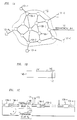
- FIG. 1A illustrates a typical high speed network 100 comprising switching nodes 106-i connected by high-bandwidth data links 108-j.
- switching nodes 106-i are arranged to appropriately format the input data. Communication between user location 101-k (or between a user location and an off-network location, e.g., via link 112) is advantageously via virtual circuits, as is well known in the art.
- window represents the total number of cells in transit through the virtual circuit at any time.
- many cells may be in transit between an originating node, e.g., 106-1 and a terminating node, e.g., 106-2 in FIG. 1A.
- the in-transit cells may be propagating through a link 106-i, or they may be temporarily queued at one of the nodes along the path of the virtual circuit.
- the window size conveniently identified by the value K (in units of packets or cells), may be fairly large.
- Some networks use explicit acknowledgement signals from the terminating node of a virtual circuit back to the originating node of a virtual circuit to indicate the error-free reception of packet or cell. Such acknowledgement signals can then be used to advance the window, thereby admitting a new cell into the virtual circuit. Conversely, when congestion is indicated, e.g., by a feedback signal from a downstream node, or when an error is detected requiring a retransmission between links in the network, the window can shrink or remain stationary. Variants of such "flow control" in the face of errors or congestion are known in the art.
- the afore-mentioned queues when needed, are typically implemented using buffer memory at each node along a virtual circuit.
- These buffers may be shared, as is typical for the so-called first-come-first-served (FCFS) service discipline, or they may be provided on a per-virtual-circuit basis when using a service discipline such as a round-robin (including weighted round-robin, WRR) discipline.
- FCFS first-come-first-served
- WRR weighted round-robin
- the service discipline in any event, allocates available node output capacity (e.g., trunk bandwidth) to meet the competing service requirements for each virtual circuit.
- Some data services are based on an agreed-upon grade of service. For example, a service provider and a user may agree that each virtual circuit (VC) is to have a "Committed Information Rate (CIR)." Thus a quiescent user seeking to start up or commence sending data over a VC expects to receive at least its CIR almost immediately.
- CIR Committed Information Rate
- a number of techniques have been developed to help ensure that competing demands for service are handled in such manner as to minimize congestion and avoid loss of data transmitted within the agreed-upon CIR. See, e.g., U.S. Patents 4,769,810 and 4,769,811 issued to Eckberg, et al on September 6, 1988. Congestion control techniques are discussed generally in U.S. Patent 5,014,265 issued May 7, 1991 to Hahne, et al, and in Tanenbaum, Computer Networks, 2nd Ed., Prentice Hall (1988), pp. 223-239, 287-288 and 309-322.
- an Admission Controller is used to restrict the total number of VCs at each node, and to monitor the sum of CIRs, for the VCs that have been admitted, to the total bandwidth.
- Fairness is a major goal of feedback-based congestion control. Such fairness typically encompasses several aspects.
- a first is that a VC should receive at least its CIR at any time it is required. This implies that when a VC turns on from a quiescent state, the network must respond speedily.
- bandwidth in excess of the sum of the CIRs of the active VCs is desirably made available to requesting VCs in a rational way, e.g., in proportion to their CIRs.
- a final desiderata is that fairness hold not only over long time periods, but also over relatively short time periods. "Best Effort" service, wherein the network makes no guarantees but attempts to make bandwidth available fairly, is the particular case of the above in which the CIRs are set to zero.
- Rates and windows are related in several major respects.
- a natural rate is the throughput, measured in packets per unit time.
- the throughput is close to the window size (in packets) per round-trip propagation delay over a broad range of practical operating conditions.
- This simple relation is the bridge between the two quantities, and thus methods for adapting rates based on feedback are in one-to-one correspondence with methods for adapting windows.
- Some key issues or criteria in evaluating the effectiveness of network traffic management and congestion control methods include: 1) fairness in short and long term behavior among VCs in competing for bandwidth, 2) the effect of large amplitude oscillations in network behavior caused by delayed feedback, 3) transient behavior, i.e. the quality of the responsiveness in a dynamic environment, 4) the ability to arbitrarily allocate bandwidth to different VCs as is typically required, 5) dealing with various propagation delays in the network which sometimes tend to discriminate against VCs on longer paths, 6) fulfilling contractual guarantees from the network to the user and 7) robustness of the design process in terms of network performance sensitivity to parameter values.
- Traffic on the network may be controlled by a variety of methods, e.g. by regulating the admission of new data onto the network, by regulating the window size, etc. See generally, I. W. Habib and T. N. Saadawi, "Controlling Flow and Avoiding Congestion in Broadband Networks," IEEE Comm. Mag ., pp. 46-53, Oct. 1991; H. Gilbert, O. Aboul-Magd and V. Phung, "Developing a Cohesive Traffic Management Strategy for ATM Networks," IEEE Comm. Mag ., pp. 36-45, Oct. 1991; A. E. Eckberg, B. T. Doshi and R.
- propagation delays (a consequence of the physical area served by the network and the finite speed of signals transmitted over the network) combined with high transmission rates (a consequence of a desire to transmit as much information in the shortest time possible) conspire to create large delay-bandwidth product.
- Large delay-bandwidth products make traffic regulation on or control of the network difficult because: 1) at any given time a large amount of data is on the network (a consequence of the large bandwidth aspect of the network); 2) feedback signals describing the state of congestion on the network do not instantaneously reach the mechanisms that control network traffic (i.e. the propagation delay aspects); and 3) by the time the feedback signals arrive, additional data is already in transit.
- regulation information describing the state of the network is dated, and the controls triggered by the information can result in improper regulation of the network. Improper regulation can lead to the loss of large amounts of data on the network requiring costly and time-consuming retransmission. Additionally, traffic controls can be triggered which can lead to undesirable oscillations in the traffic flow.
- the fairness aspect is improved when the service discipline is changed from FCFS to WRR.
- This combination is fair to all VCs and gives exemplary performance in all other respects, particularly in responsiveness to changing traffic conditions. A large part of this is derived from the packet-by-packet adaptation, which allows rapid adaptation when the throughput is high. Unfortunately, this same feature is a liability when used in conjunction with the FCFS service discipline.
- A. Demers, S. Keshav and S. Shenker, "Analysis and Simulation of a Fair Queueing Algorithm," J. Internetworking Res. Experience , 3-26 (1990), and L. Zhang, "Virtual Clock: A New Traffic Control Algorithm for Packet Switching Network," Proc. ACM SIGCOMM , 19-29 (1990) are illuminating on the role of service disciplines, albeit in the feedback-free framework.
- FCFS service discipline has important advantages: first, memory is more efficiently shared and thus smaller buffer memory usually suffices; second, it is cheaper and simpler to implement. Therefore, there is a need for methods for congestion control which use the FCFS discipline in which, furthermore, processing capability requirements are reduced by adapting rates and windows periodically and relatively infrequently.
- WRR weighted round-robin
- New methods are presented for the adaptive control of windows and rates, especially in networks in which the end-to-end propagation delay is relatively large. These methods may be used, e.g., in the virtual circuit (VC) environment in which the network ideally provides at least the CIR whenever a VC is active and, to the extent possible, makes available additional bandwidth on demand on an equitable basis.
- VC virtual circuit
- One illustrative method advantageously uses (i) periodicity, i.e., time is slotted and a distant switch provides feedback at most once in every time slot, an interval which advantageously may vary from a fraction to a multiple of the round-trip propagation delay; (ii) feedback in the form of a single bit (as used in existing and emerging ATM and Frame Relay standards, for example), which indicates if the instantaneous queue length is above or below a threshold; (iii) a First-Come-First Served service discipline; and (iv) systematic damping and control of a gain signal.
- An analytic fluid model of the methods is disclosed which can advantageously be used to select parameters of the method and permit evaluation of the effectiveness of the congestion control methods.
- FIG. 1B shows a typical cell (packet) format useful in systems of the type shown in FIG. 1A.
- the format shown in FIG. 1B shows a data portion 141 and a header portion 142.
- the header or control portion typically contains various address and control information, including a congestion control field 143.
- the congestion control field may contain only a single bit that is set to a predetermined condition, e.g., to a 1, by a node experiencing congestion through which the cell is passing. If a cell arrives at the end of a VC without having its congestion control field altered to indicate congestion, the receiving user will, upon examining that field, usually conclude that no congestion has been encountered by the cell in its passage through the VC.
- An appropriate feedback signal can then be sent to the originating user location.
- intermediate nodes in a VC can likewise conclude that a cell received without its congestion field set to the predetermined condition has not encountered congestion thus far in its travel along the VC. Consequently, the first node in the path of the VC which is experiencing congestion can send an appropriate signal to the originating user location.
- FIG. 1C shows in greater detail a particular virtual circuit in the network of FIG. 1A.
- the i th server is shown having a rate (e.g., transmission capacity) of ⁇ i .
- Feedback, and corresponding feedback delay may be used between nodes other than the last and first in a VC.
- the window is shown as having a value of K.
- the dashed lines 171 and 172, respectively, in FIG. 1C represent virtual circuit traffic leaving and seeking to be added to nodes, such as node 2, through which the subject VC passes.
- nodes such as node 2
- Such other traffic entering at a node competes for the resources available at the node with traffic in other VCs at the node.
- Traffic leaving prior to being presented at a node, e.g., node 2 in FIG. 1C of course ceases to compete for resources at that node, but may compete at another node along its VC before being finally delivered to its destination.
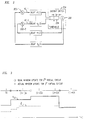
- FIG. 2 is a block diagram of a portion of high speed data network using FCFS service discipline.
- the switching node 204 is shown having a shared buffer 206 for queueing cells arriving from VCs; the serving (bandwidth allocation) function is represented by server 208.
- the various propagation delays for the VCs reflect the general case where sources 202 S 1 , S 2 ,... S c may be located at various geographical sites.
- ⁇ and Q T represent, respectively, the service rate and a queue threshold at node 204.
- the packet size is assumed constant.
- the methods described advantageously use the FCFS discipline and explicit, periodic feedback.
- the feedback signals are advantageously not provided on a cell by cell basis, but rather are periodically sent from the node, such as 204 in FIG. 2, back to the sources S i .
- the use of periodic feedback considerably reduces the computational complexity and reduces the data flow.
- These feedback-based adaptation algorithms can also be used in networks which employ the WRR service discipline, as described below in connection with FIG. 9, and in networks which integrate both the FCFS and WRR service disciplines, as shown in FIG. 10.
- the feedback is "explicit" in that the switch, e.g., 204 in FIG. 2 accurately generates information to be contained in the congestion field and the network protocol arranges for the sources S j to receive the information after the unavoidable propagation delay.
- the periodicity and FCFS features allow for low cost implementations, with the former leading to lower processor costs. Nonetheless, exemplary performance, including fairness in both the short and long terms, is obtained by the novel use of damping associated with a damping value, ⁇ .
- ⁇ damping value
- Section II describes basic periodic, illustratively 1-bit feedback, adaptive methods as well as various refinements used in conjunction with the FCFS service discipline.
- Section III gives periodic, 1-bit adaptive methods for use in conjunction with the WRR discipline and combinations of the FCFS and WRR disciplines.
- Section IV gives analytic results relating to these methods. More particularly, an analytic fluid model is disclosed using two first-order coupled delay-differential equations which reflects the propagation delay across the network. The results of analysis using this model guide the selection of parameters for methods useful in each of two operating regimes, Unsaturated and Saturated. The operating regimes are, in turn, determined by a ratio a / ⁇ . In steady state the unsaturated regime gives unutilized capacity and oscillation-free flow and empty buffers.
- This section describes the methods which are used in conjunction with a FCFS service discipline to control window size and data rates for sources S j in FIG. 2.
- the following section describes methods using a WRR discipline and for combinations of WRR disciplines with FCFS disciplines.
- time is slotted, i.e., time is divided into intervals of length ⁇ .
- Values for ⁇ generally range from 0.1 to 10 times the typical round trip cell propagation VC delay, depending on the system processing capabilities.
- the choice of ⁇ is flexible, and network performance is typically robust over a wide range of values of ⁇ .
- the time slot ⁇ may be different for different VCs.
- the general method of operation is that the distant switch 204 broadcasts a 1-bit message indicating the state of congestion once every slot to all sources of VCs passing through the switch.
- the operations can be made somewhat different and more economical: the switch broadcasts at the time of the first departure of a packet in every time slot.
- the switch may not broadcast for several (or many) slots.
- the source compensates for lack of explicit notification during the idle periods by inferring that the switch's buffer content was below the threshold.
- ideal need not imply optimum or best window size in any absolute sense, but rather may refer to calculated or target window size.
- the following adaptation is advantageously implemented by the source at most once in every time slot, on first receipt of a 1-bit feedback message in that time slot.
- B I ⁇ ⁇ -1,1 ⁇ is the 1-bit message from the switch received by the source in the I th slot.
- the feedback bit B I is received, possibly at different times, by all sources.
- a j is the gain and ⁇ j is the damping constant for VC j .
- the value of the ideal window in (2.1) when a VC turns on is influential in determining how much bandwidth the VC receives in the short-term.
- Various embodiments described later aim to make an appropriate selection for this initial value, using information on the VC's CIR and other network parameters.
- the actual implementation of (2.1) in a preferred embodiment is usually somewhat different, since it must take into account the integrality of the window length and the limited opportunities for reducing the window.
- Updating of the actual window is done at the source typically with every acknowledgement. Typically there are several acknowledgements in any time slot. Let n index the acknowledgements received by the source and let K ⁇ j,n denote the "actual window" of the j th VC.
- the actual window attempts to track the ideal window and the difference between the two windows is small, except for occasional, typically quite short, periods.
- the change in the actual window in any update is restricted to one of the following: -1,0,1. That is, where I is the interval in which then n th acknowledgement is received.
- FIG. 3 illustrates illustrative sequences of ideal and actual window updates. Note that when the actual window decreases, the size of the decrement is necessarily unity. In a preferred embodiment increments are also unity. However, in the more general case, increments may be larger.
- FIG. 4 is a flow chart illustrating an implementation of the updating of the window size in accordance with the above-described techniques.
- values for the variables in Eqs. 2.1 and 2.2 are conveniently initialized in block 400. Receipt of a feedback signal is determined by the decision block 405, and n is incremented in block 407. If a new time slot has begun, I is incremented in block 415. Then a new ideal window is determined in block 425 in accordance with Eq. 2.1. If the current time slot has not expired, the same K j,I value is used unchanged. The ideal window value is then used in accordance with Eqs. 2.2 to update the value for the actual window in block 450. In particular, if the condition for Eq.
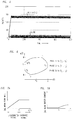
- FIG. 5 is a graph showing windows for two VCs using the method described above.
- the upper plots depict the performance of two virtual circuits, VC1 and VC2, in terms of the window size as a function of time. Both virtual circuits are initially off, but when they are activated, the upper plots demonstrate that the virtual circuits each quickly receive approximately half the bandwidth allocation while the queue depth remains consistently relatively low as indicated in the lower plots.
- (2.1) is modified to incorporate a mechanism called "Floor", which is motivated by the network's guarantee of the CIR.
- CIR j is the Committed Information Rate for the j th VC
- a mechanism called "Ramp-up" ensures that VCs realize their CIR soon after start-up.
- the procedure is as follows: first, the window corresponding to the CIR is calculated; next, all the packets in one window are transmitted during the interval ⁇ , corresponding to the round-trip delay of the VC, immediately after start-up without waiting for feedback. The recommended procedure is to transmit these packets uniformly spaced in time. This mechanism ceases to be operative after the initial period ⁇ following start-up.
- Ramp-up is an enhancement of Floor in that it gets the VC its CIR even faster after start-up.
- Ramp-up directly influences the actual window, while Floor affects the ideal window directly and the actual window indirectly.
- Floor In Floor the actual window, while growing exponentially fast, will still take longer to attain its CIR from quiescence; in Ramp-up it is guaranteed to do so in one round-trip delay.
- the higher speed of response comes at the cost of higher packet queues at the distant switches.
- Ceiling prevents any one VC from obtaining more bandwidth than is implied by K j,ceil , even when it is the sole active VC. Ceiling lessens the impact on the packet queue at the distant switch when a small number of VCs are active and several more turn on at about the same time. Without Ceiling the surge in the queue is much larger, which in turn calls for larger buffers if packet losses are to be avoided.
- a "Broadcasting" feature may advantageously be implemented by requiring the source of VCs to receive the periodic, 1-bit feedback signal from the distant node, and to update its ideal window even while quiescent.
- This feature allows quiescent VCs to know about currently available bandwidth, so that, at the time of transition to activity, the actual window (which is possibly zero) can grow rapidly to the ideal size.
- the incremental benefit accrues when the ideal window is above the Floor. This situation arises when only a small number of VCs are active, and consequently excess bandwidth is available.
- a possible drawback of Broadcasting is that there is a surge in the queue at the distant node immediately after a VC turns on, which lasts for a very short interval before rapidly dissipating.
- the Floor, Ramp-up, Ceiling and Broadcasting features are typically well-suited to bursty traffic in VCs in which the source alternates between periods of activity and quiescence.
- R j,I the counterpart of K j,I
- R j,I (1- d(I) ⁇ j )
- R j,I-d(I) - a j d(I)B I ( I 1,2,7)
- B I is the 1-bit message from the switch received by the source in the I th slot.
- d ( I ) is as defined earlier in (2.1), while ⁇ j and a j are again the damping and gain parameters.
- (2.6) may be modified to incorporate information from many prior slots.
- the window-based algorithms there are no restrictions on the realization of the "actual rate” and hence the actual rate coincides with the ideal rate, i.e.,
- the source associated with the VC j uses the rate R j,I to determine the times for packet transmission during slot I in one of two ways: (i) the time between consecutive packet transmission is set to 1/ R j,I ; (ii) the time between consecutive packet transmission is random with a distribution, such as the exponential or the uniform, with mean set to 1/ R j,I .
- FIG. 9 shows an alternative buffering arrangement to that shown above in FIG. 3.
- FIG. 9 illustrates the so-called Round Robin buffering and resource allocation discipline.
- time is again slotted, with ⁇ denoting the time slot length, as before.
- Typical values for ⁇ will fall within the ranges cited above for the FCFS discipline.
- Service is again provided by a server 920 with capacity (e.g., bandwidth) ⁇ operating on each of the VC queues in turn.
- capacity e.g., bandwidth
- the sequential nature of the servicing is represented by the scanner or commutator 915 in FIG. 9.
- service is provided only to buffers that contain packets to be transmitted.
- the Round-Robin discipline generally permits service to be provided in an unequal manner to the queues in buffers 910-1, i.e., the "weighting" may be unequal between the respective queues. Such weighting is characterized as the so-called Weighted Round-Robin discipline for allocating bandwidth (or other resource). In some cases, however, it may prove advantageous to employ equal weighting for all VC subject to Round-Robin queueing and allocation.
- the individual buffers 910-i for the VCs may be separated only logically, i.e. in software through the use of pointers, while being physically co-located in a common memory.
- the aforementioned weights determine templates, which stipulate the order and frequency with which the switch processor services the individual buffers of the VCs. See M. Katevenis, S. Sidiropoulos and C. Courcoubetis, "Weighted Round-Robin Cell Multiplexing in a General-Purpose ATM Switch Chip", IEEE J. on Selected Areas in Commun. , Vol. 9, No. 8, Oct. 1991, pp. 1265-1279.
- the general idea is that a distant switch in a VC sends a feedback message exclusively to the source of the VC, at most once in every time slot, based on the status of its buffer content with respect to the threshold.
- FCFS it proves advantageous to use a simple 1-bit feedback message.
- each VC maintains an "ideal window", which is adapted according to Eq. (2.1), as before. Also it proves advantageous to change the "actual window” in accordance with Eq. (2.2) with the objective of tracking the ideal window.
- the WRR service discipline ensures isolation of individual VCs from the rest of the network and generally makes fairness easier to achieve as compared to method based on the FCFS discipline. Hence, damping is of less consequence and the damping parameter ⁇ j for VC j may be set very small or zero.
- the algorithm allocates spare bandwidth among active VCs, typically in proportion to their CIRs.
- the primary role of the gains a j is in determining the trade-off between speed of response just after a change in the number of active VCs, and the amplitude of fluctuations in the windows/rates after the network has settled. This trade-off is similar to the role of gains studied by D. Mitra and J. B. Seery in "Dynamic Adaptive Windows for High Speed Data Networks with Multiple Paths and Propagation Delays", Computer Networks and ISDN Systems , Vol. 25, pp. 663-679 (1993). It is also noteworthy that with the WRR the gain for any VC does not usually have to be carefully tuned to the round-trip propagation delay.
- FIG. 10 shows the use of feedback-based adaptation in a network having one or more nodes which integrate the FCFS with the WRR service discipline.
- the overall network is of the type shown in FIGs. 1A, B, C and 2, with feedback based on congestion at a node.
- several VCs of Class 1 e.g., VC 1 , VC 2 ..., VC c , receive WRR service, i.e., each has its own buffer and a guaranteed proportion of the bandwidth.
- These proportions are illustratively indicated as .05, .07 and .05 for VC 1 , VC 2 and VC c , respectively.
- There are also several VCs of Class 2 which share a common buffer with other VCs.
- FCFS VCs may advantageously be grouped as shown in FIG. 10.
- VC F 1 , VC F 2 , and VC F 3 are conveniently grouped for service in a single buffer 960-1
- VC F 4 ,..., VC FC are grouped for service in the single buffer 960-P.
- Other similar groupings of FCFS VCs may, of course, be similarly grouped.
- Each of the FCFS buffers 960-i is conveniently assigned a proportion of the bandwidth ⁇ made available by server 970. In the illustrative case shown in FIG.10, buffer 960-1 is assigned 20 percent of the bandwidth and buffer 960-P is assigned 15 percent of the bandwidth.
- all traffic from FCFS VCs can be combined in a single buffer having a single overall share of the bandwidth.
- packets within each FCFS buffer are assigned on an FCFS discipline.
- the packets in this shared buffer are serviced according to the FCFS discipline.
- the VCs of Class 1 adapt their windows/rates on the basis of periodically received feedback on the status of their private buffers.
- the adaptation methods are those used in conjunction with WRR service which have been described earlier in this section.
- the VCs of the other classes adapt their windows/rates on the basis of periodically received, feedback on the status of the respective shared buffer.
- the adaptation methods are those used in conjunction with FCFS service, and these have been described in Section II.
- This section discloses simple models of the adaptive method for the FCFS service discipline described in Section II above in which the packet streams are approximated by fluid flow. These fluid models do not have any stochastic elements and are described by systems of nonlinear delay-differential equations. The models are approximate; an important approximation is that the adaptation, as described in Section II, is periodic while in the model it is continuous. This approximation is acceptable as long as the periodic interval ⁇ is not large.
- This section demonstrates how to bridge results and parameters of the fluid models and those of the periodic, adaptive algorithms of the preceding sections. The results of the analytic models of this section give clear guidelines for the design of parameters in the adaptive algorithm.
- ⁇ ( x ) is the flow rate at time t and represents the fluid approximation to the local (in time) throughput of packets.
- ⁇ is the round-trip propagation delay for the VC and ⁇ is the effective service rate at the distant switch, as shown in Figure 2.
- the constants A and ⁇ are the counterparts of the gain a and damping constant ⁇ in the adaptation algorithm for windows and rates given in (2.1) and (2.6), respectively.
- the classical queuing-theoretic steady state throughput, T is approximated by the long-term average: In (4.2) x ( t ) approximates the queue in packets at the distant switch and x T denotes the threshold.
- the amount of fluid in the network at time t is approximated by K ( t ), where K ( t ) ⁇ ( t ) .
- K ( t ) K ( t ) ⁇ ( t ) .
- K ( t ) here is analogous to K I (see (2.1).
- K ( t ) is analogous to K I (see (2.1).
- the following important correspondence between parameters of the fluid model and the adaptive algorithm is obtained: ⁇ ⁇ A ⁇ a In particular, the important ratio, A / ⁇ a /( ⁇ ) .
- FIG. 6 is a graph of the periodic solution in the Saturated Regime.
- Phase 1 t ⁇ ( t 0 , t 1 ); in Phase 2, t ⁇ ( t 1 , t 2 ); in Phase 3, t ⁇ ( t 2 , t 3 ), where t 1 , t 2 and t 3 are explicitly identified in the construction given below.
- Phase 1 0 ⁇ x ( t - ⁇ /2) ⁇ x T and ⁇ ( t - ⁇ /2) .
- the governing equations are, Hence, it is easily verified that in Phase 1,
- the governing equations for Phase 2 are Note that d ⁇ / dt ⁇ 0.
- x ( t ) is concave and reaches a maximum value x ⁇ at time denoted by t * / 2 .
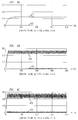
- FIGs. 7A and B illustrate some of the characteristics of the fluid model behavior.
- Unsaturated Regime the main features are oscillation-free approach to equilibrium, linear growth of throughput with increasing ( a / ⁇ ), empty buffers in equilibrium, unutilized switch capacity of ⁇ - a / ⁇ .
- the unutilized capacity is zero, there is no equilibrium point, instead limit cycles exist and the throughput and queue fluctuate around ⁇ and the threshold, respectively. These fluctuations are bounded and, moreover, the algorithm is surprisingly robust, i.e., the penalty for saturation is surprisingly small.
- a / ⁇ 125 and the network is unsaturated:
- the network is saturated in FIG. 8B and FIG. 8C.
- a / ⁇ is almost twice as large as ⁇ , the oscillation and queue are not excessive.
- the above detailed description has illustrated several methods for adaptive control of windows and rates in data networks. buffer.
- the methods have not been limited to specific hardware or software. Instead, the methods have been described in such a manner that those skilled in the art can readily adapt such hardware or software as may be available or preferable.
- the methods described have other network applications.
- the feedback-based methods for fairly allocating bandwidth in a timely manner can be advantageously integrated with an access regulator, which interfaces with the user at the network edge.
- a simple, effective access regulator is the "Leaky Bucket" device, which polices and smooths traffic.
- An illustrative techniques for such integration makes the token rate in the Leaky Bucket regulator grow and subside like the rate for the VC, which is determined by feedback methods, possibly in conjunction with similar adjustments for the token buffer.
Landscapes
- Engineering & Computer Science (AREA)
- Computer Networks & Wireless Communication (AREA)
- Signal Processing (AREA)
- Data Exchanges In Wide-Area Networks (AREA)
- Dram (AREA)
- Feedback Control In General (AREA)
- Control Of Temperature (AREA)
Applications Claiming Priority (2)
| Application Number | Priority Date | Filing Date | Title |
|---|---|---|---|
| US118531 | 1993-09-08 | ||
| US08/118,531 US5426635A (en) | 1993-09-08 | 1993-09-08 | Method for adaptive control of windows and rates in networks |
Publications (3)
| Publication Number | Publication Date |
|---|---|
| EP0648062A2 EP0648062A2 (en) | 1995-04-12 |
| EP0648062A3 EP0648062A3 (en) | 1996-10-16 |
| EP0648062B1 true EP0648062B1 (en) | 2000-11-29 |
Family
ID=22379179
Family Applications (1)
| Application Number | Title | Priority Date | Filing Date |
|---|---|---|---|
| EP94306426A Expired - Lifetime EP0648062B1 (en) | 1993-09-08 | 1994-08-31 | Method for adaptive control of windows and rates in networks |
Country Status (6)
| Country | Link |
|---|---|
| US (1) | US5426635A (enExample) |
| EP (1) | EP0648062B1 (enExample) |
| JP (1) | JP3497577B2 (enExample) |
| CA (1) | CA2129941C (enExample) |
| DE (1) | DE69426350T2 (enExample) |
| ES (1) | ES2152294T3 (enExample) |
Families Citing this family (70)
| Publication number | Priority date | Publication date | Assignee | Title |
|---|---|---|---|---|
| US6847611B1 (en) | 1990-12-10 | 2005-01-25 | At&T Corp. | Traffic management for frame relay switched data service |
| US5434850A (en) | 1993-06-17 | 1995-07-18 | Skydata Corporation | Frame relay protocol-based multiplex switching scheme for satellite |
| US6771617B1 (en) | 1993-06-17 | 2004-08-03 | Gilat Satellite Networks, Ltd. | Frame relay protocol-based multiplex switching scheme for satellite mesh network |
| JP2793769B2 (ja) * | 1994-04-01 | 1998-09-03 | 沖電気工業株式会社 | ウィンドウ型セル流量監視装置 |
| US6473793B1 (en) * | 1994-06-08 | 2002-10-29 | Hughes Electronics Corporation | Method and apparatus for selectively allocating and enforcing bandwidth usage requirements on network users |
| JPH0823332A (ja) * | 1994-07-05 | 1996-01-23 | Mitsubishi Electric Corp | リング型atmノードのアクセス制御装置 |
| US5594729A (en) * | 1994-09-23 | 1997-01-14 | Lucent Technologies Inc. | System and method for employing single-bit feedback control within a variable bit rate data transmission network |
| JP3563127B2 (ja) * | 1994-11-09 | 2004-09-08 | 富士通株式会社 | トラヒック制御方式 |
| CA2138061A1 (en) * | 1994-12-14 | 1996-06-15 | Mark Wolff | Fair allocation of excess resources |
| ZA959722B (en) * | 1994-12-19 | 1996-05-31 | Alcatel Nv | Traffic management and congestion control for packet-based networks |
| CA2160393C (en) * | 1994-12-30 | 1999-05-04 | Anwar Elwalid | Method for integrated congestion control in networks |
| GB9511314D0 (en) * | 1995-06-05 | 1995-08-02 | Gen Datacomm Adv Res | ATM network switch with congestion control |
| US6088736A (en) | 1995-07-19 | 2000-07-11 | Fujitsu Network Communications, Inc. | Joint flow control mechanism in a telecommunications network |
| CA2181206C (en) * | 1995-07-24 | 2001-03-13 | Anwar Elwalid | A method for admission control and routing by allocating network resources in network nodes |
| WO1997010656A1 (en) | 1995-09-14 | 1997-03-20 | Fujitsu Network Communications, Inc. | Transmitter controlled flow control for buffer allocation in wide area atm networks |
| JP2000517488A (ja) | 1996-01-16 | 2000-12-26 | フジツウ ネットワーク コミュニケーションズ,インコーポレイテッド | Atm網用の信頼性と柔軟性のあるマルチキャスト機構 |
| GB9606708D0 (en) * | 1996-03-29 | 1996-06-05 | Plessey Telecomm | Bandwidth bidding |
| US5864538A (en) * | 1996-08-26 | 1999-01-26 | Lucent Technologies Inc. | First-order rate-based flow control with adaptive queue threshold for ATM networks |
| US5999980A (en) * | 1996-09-12 | 1999-12-07 | Cabletron Systems, Inc. | Apparatus and method for setting a congestion indicate bit in an backwards RM cell on an ATM network |
| US5941952A (en) * | 1996-09-12 | 1999-08-24 | Cabletron Systems, Inc. | Apparatus and method for transferring data from a transmit buffer memory at a particular rate |
| US5970229A (en) * | 1996-09-12 | 1999-10-19 | Cabletron Systems, Inc. | Apparatus and method for performing look-ahead scheduling of DMA transfers of data from a host memory to a transmit buffer memory |
| US5966546A (en) | 1996-09-12 | 1999-10-12 | Cabletron Systems, Inc. | Method and apparatus for performing TX raw cell status report frequency and interrupt frequency mitigation in a network node |
| US5995995A (en) * | 1996-09-12 | 1999-11-30 | Cabletron Systems, Inc. | Apparatus and method for scheduling virtual circuit data for DMA from a host memory to a transmit buffer memory |
| US5922046A (en) * | 1996-09-12 | 1999-07-13 | Cabletron Systems, Inc. | Method and apparatus for avoiding control reads in a network node |
| US6038216A (en) * | 1996-11-01 | 2000-03-14 | Packeteer, Inc. | Method for explicit data rate control in a packet communication environment without data rate supervision |
| US5918020A (en) * | 1997-02-28 | 1999-06-29 | International Business Machines Corporation | Data processing system and method for pacing information transfers in a communications network |
| EP0884874A1 (en) * | 1997-06-13 | 1998-12-16 | International Business Machines Corporation | Method for adapting committed information rate over frame relay switched network |
| US6081524A (en) | 1997-07-03 | 2000-06-27 | At&T Corp. | Frame relay switched data service |
| JPH11177619A (ja) * | 1997-12-15 | 1999-07-02 | Nec Corp | フレームリレー網における端末側輻輳制御方法 |
| CA2237264A1 (en) * | 1998-05-08 | 1999-11-08 | Northern Telecom Limited | Receiver based congestion control |
| US6067301A (en) * | 1998-05-29 | 2000-05-23 | Cabletron Systems, Inc. | Method and apparatus for forwarding packets from a plurality of contending queues to an output |
| WO2000001123A1 (en) * | 1998-06-30 | 2000-01-06 | Sun Microsystems, Inc. | Congestion control in reliable multicast protocol |
| JP3786328B2 (ja) | 1998-07-27 | 2006-06-14 | 株式会社日立製作所 | サーバおよび通信制御方法 |
| KR20000040467A (ko) * | 1998-12-18 | 2000-07-05 | 서평원 | 네트워크의 데이터통신 제어방법 |
| US6442140B1 (en) | 1999-01-04 | 2002-08-27 | 3Com Corporation | Method for automatic setup of missing RM cell count parameter CRM in an ATM traffic management descriptor |
| US6460085B1 (en) | 1999-02-02 | 2002-10-01 | Mentat Inc. | Method and system for managing memory in an internet over satellite connection |
| US6654344B1 (en) | 1999-02-02 | 2003-11-25 | Mentat Inc. | Method and system for controlling data flow in an internet over satellite connection |
| US6584083B1 (en) | 1999-02-02 | 2003-06-24 | Mentat Inc. | Internet over satellite method |
| US6529477B1 (en) | 1999-02-02 | 2003-03-04 | Mentat Inc. | Internet over satellite system |
| WO2000046669A1 (en) * | 1999-02-02 | 2000-08-10 | Mentat, Inc. | Internet over satellite |
| US6934255B1 (en) * | 1999-02-02 | 2005-08-23 | Packeteer, Inc. | Internet over satellite apparatus |
| US6290713B1 (en) | 1999-08-24 | 2001-09-18 | Thomas A. Russell | Flexible illuminators for phototherapy |
| US6657960B1 (en) | 1999-11-23 | 2003-12-02 | International Business Machines Corporation | Method and system for providing differentiated services in computer networks |
| US6721786B1 (en) * | 2000-01-06 | 2004-04-13 | International Business Machines Corporation | Method and apparatus for balancing bandwidth usage in a browser |
| US6831912B1 (en) * | 2000-03-09 | 2004-12-14 | Raytheon Company | Effective protocol for high-rate, long-latency, asymmetric, and bit-error prone data links |
| US6466541B1 (en) | 2000-05-31 | 2002-10-15 | Fujitsu Network Communications, Inc. | Cell pacing on a network link employing a rate-based flow control protocol with underlying credit-based flow control mechanisms |
| US6452903B1 (en) | 2000-05-31 | 2002-09-17 | Fujitsu Network Communications, Inc. | Network switch supporting rate-based and credit-based flow control mechanisms on a link-by-link basis |
| US7042892B2 (en) * | 2000-06-02 | 2006-05-09 | Radisys Corporation | Voice-over IP communication without echo cancellation |
| ATE498261T1 (de) * | 2000-10-03 | 2011-02-15 | Gos Networks Ltd | Paketsequenzsteuerung |
| EP1329058B1 (en) * | 2000-10-03 | 2007-08-15 | U4EA Technologies Limited | Allocating priority levels in a data flow |
| ATE373911T1 (de) * | 2000-10-03 | 2007-10-15 | U4Ea Technologies Ltd | Datenflusssteuerung |
| KR20020093543A (ko) * | 2001-06-09 | 2002-12-16 | 주식회사 하이닉스반도체 | 다중 패킷 손실 제어 방법 |
| US7054902B2 (en) * | 2001-10-23 | 2006-05-30 | Packeteer, Inc. | Multicast delivery systems and methods |
| US20030189901A1 (en) * | 2002-04-03 | 2003-10-09 | Timucin Ozugur | Upstream resource management propagation system and method for use in bufferless networks |
| US7236459B1 (en) | 2002-05-06 | 2007-06-26 | Packeteer, Inc. | Method and apparatus for controlling data transmission volume using explicit rate control and queuing without data rate supervision |
| US7343398B1 (en) | 2002-09-04 | 2008-03-11 | Packeteer, Inc. | Methods, apparatuses and systems for transparently intermediating network traffic over connection-based authentication protocols |
| US7388842B1 (en) * | 2003-03-13 | 2008-06-17 | At&T Corp. | Method and apparatus for efficient routing of variable traffic |
| US7132953B2 (en) * | 2003-06-26 | 2006-11-07 | Lear Corporation | Spring sensor assembly for a vehicle seat cushion |
| US20050078602A1 (en) * | 2003-10-10 | 2005-04-14 | Nortel Networks Limited | Method and apparatus for allocating bandwidth at a network element |
| JP4349114B2 (ja) * | 2003-12-10 | 2009-10-21 | ソニー株式会社 | 送信装置および方法、受信装置および方法、記録媒体、並びにプログラム |
| KR100533686B1 (ko) * | 2004-05-21 | 2005-12-05 | 삼성전자주식회사 | 모바일 애드 혹 네트워크에서의 데이터 전송 방법 및 이를이용한 네트워크 장치 |
| US7869366B1 (en) | 2006-03-28 | 2011-01-11 | Packeteer, Inc. | Application-aware rate control |
| CN101502066B (zh) * | 2006-10-17 | 2011-09-14 | 松下电器产业株式会社 | 通信装置以及通信方法 |
| US8379515B1 (en) | 2007-02-01 | 2013-02-19 | F5 Networks, Inc. | TCP throughput control by imposing temporal delay |
| US9578055B1 (en) | 2008-01-25 | 2017-02-21 | F5 Networks, Inc. | Thwarting drone-waged denial of service attacks on a network |
| DE102009003851A1 (de) | 2009-04-30 | 2010-11-11 | Lear Corporation Gmbh | Verfahren und Vorrichtung zur Wiedergabe von digitalen Audiosignalen |
| US8339957B2 (en) * | 2009-06-26 | 2012-12-25 | Google Inc. | Aggregate transport control |
| DE102010061076B8 (de) | 2010-09-30 | 2012-07-19 | Lear Corporation Gmbh | Verfahren und Vorrichtung zur Versendung von digitalen Audiosignalen |
| JP6514100B2 (ja) * | 2015-12-28 | 2019-05-15 | 株式会社東芝 | 通信装置、通信システム及びネットワーク管理方法 |
| CN114124841A (zh) * | 2021-11-19 | 2022-03-01 | 青岛信大云谷信息科技有限公司 | 一种高速转发数据轻量级流量控制的方法 |
Family Cites Families (4)
| Publication number | Priority date | Publication date | Assignee | Title |
|---|---|---|---|---|
| US4769810A (en) * | 1986-12-31 | 1988-09-06 | American Telephone And Telegraph Company, At&T Bell Laboratories | Packet switching system arranged for congestion control through bandwidth management |
| US4769811A (en) * | 1986-12-31 | 1988-09-06 | American Telephone And Telegraph Company, At&T Bell Laboratories | Packet switching system arranged for congestion control |
| US5014265A (en) * | 1989-11-30 | 1991-05-07 | At&T Bell Laboratories | Method and apparatus for congestion control in a data network |
| DE69116673T2 (de) * | 1991-02-13 | 1996-08-08 | Bell Telephone Mfg | Bandbreitezuteilung für permanente virtuelle Verbindungen |
-
1993
- 1993-09-08 US US08/118,531 patent/US5426635A/en not_active Expired - Lifetime
-
1994
- 1994-08-11 CA CA002129941A patent/CA2129941C/en not_active Expired - Lifetime
- 1994-08-31 ES ES94306426T patent/ES2152294T3/es not_active Expired - Lifetime
- 1994-08-31 DE DE69426350T patent/DE69426350T2/de not_active Expired - Lifetime
- 1994-08-31 EP EP94306426A patent/EP0648062B1/en not_active Expired - Lifetime
- 1994-09-07 JP JP23860494A patent/JP3497577B2/ja not_active Expired - Lifetime
Also Published As
| Publication number | Publication date |
|---|---|
| CA2129941A1 (en) | 1995-03-09 |
| US5426635A (en) | 1995-06-20 |
| EP0648062A2 (en) | 1995-04-12 |
| EP0648062A3 (en) | 1996-10-16 |
| JPH07154399A (ja) | 1995-06-16 |
| ES2152294T3 (es) | 2001-02-01 |
| JP3497577B2 (ja) | 2004-02-16 |
| DE69426350D1 (de) | 2001-01-04 |
| DE69426350T2 (de) | 2001-04-05 |
| CA2129941C (en) | 1999-05-04 |
Similar Documents
| Publication | Publication Date | Title |
|---|---|---|
| US5426635A (en) | Method for adaptive control of windows and rates in networks | |
| KR100234212B1 (ko) | 패킷 네트워크에서의 적응 속도기반 혼잡제어 | |
| EP0784895B1 (en) | Flow control method and apparatus for cell-based communication networks | |
| US5737313A (en) | Design of a closed loop feed back control for ABR service | |
| US6424624B1 (en) | Method and system for implementing congestion detection and flow control in high speed digital network | |
| US6021116A (en) | Method and apparatus for controlling data transfer rate using virtual queues in asynchronous transfer mode networks | |
| US6075769A (en) | Method and apparatus for network flow control | |
| US5633859A (en) | Method and apparatus for congestion management in computer networks using explicit rate indication | |
| Benmohamed et al. | Feedback control of congestion in packet switching networks: The case of multiple congested nodes | |
| US6192406B1 (en) | Startup management system and method for networks | |
| US6549517B1 (en) | Explicit rate computation for flow control in compute networks | |
| US6175554B1 (en) | Asynchronous transfer mode (ATM) traffic control apparatus and control method for handling a wide variety of ATM services | |
| Benmohamed et al. | A control-theoretic ABR explicit rate algorithm for ATM switches with per-VC queueing | |
| EP0720414A2 (en) | Method for integrated congestion control in networks | |
| US20040246897A1 (en) | Startup management system and method for networks | |
| Fendick | Evolution of controls for the available bit rate service | |
| Hernandez‐Valencia et al. | Rate control algorithms for the ATM ABR service | |
| EP0796027B1 (en) | Design of a closed loop feed back control for ABR service | |
| Kim et al. | Minimum rate guarantee without per-flow information | |
| Wakeman et al. | A combined admission and congestion control scheme for variable bit rate video | |
| Puliafito et al. | Buffer sizing for ABR traffic in an ATM switch | |
| Jong et al. | Algorithms on dynamic priority scheduling for heterogeneous traffic in ATM | |
| Lu | ATM congestion control | |
| Petrovic | Comparative evaluation of adaptive stochastic and ERICA switch algorithms for ABR traffic management in ATM networks | |
| Sirisena et al. | Generalised minimum variance control of queues in packet switching networks |
Legal Events
| Date | Code | Title | Description |
|---|---|---|---|
| PUAI | Public reference made under article 153(3) epc to a published international application that has entered the european phase |
Free format text: ORIGINAL CODE: 0009012 |
|
| AK | Designated contracting states |
Kind code of ref document: A2 Designated state(s): DE ES FR GB IT SE |
|
| PUAL | Search report despatched |
Free format text: ORIGINAL CODE: 0009013 |
|
| AK | Designated contracting states |
Kind code of ref document: A3 Designated state(s): DE ES FR GB IT SE |
|
| 17P | Request for examination filed |
Effective date: 19970403 |
|
| 17Q | First examination report despatched |
Effective date: 19980211 |
|
| GRAG | Despatch of communication of intention to grant |
Free format text: ORIGINAL CODE: EPIDOS AGRA |
|
| GRAG | Despatch of communication of intention to grant |
Free format text: ORIGINAL CODE: EPIDOS AGRA |
|
| GRAH | Despatch of communication of intention to grant a patent |
Free format text: ORIGINAL CODE: EPIDOS IGRA |
|
| GRAH | Despatch of communication of intention to grant a patent |
Free format text: ORIGINAL CODE: EPIDOS IGRA |
|
| GRAA | (expected) grant |
Free format text: ORIGINAL CODE: 0009210 |
|
| AK | Designated contracting states |
Kind code of ref document: B1 Designated state(s): DE ES FR GB IT SE |
|
| ITF | It: translation for a ep patent filed | ||
| ET | Fr: translation filed | ||
| REF | Corresponds to: |
Ref document number: 69426350 Country of ref document: DE Date of ref document: 20010104 |
|
| REG | Reference to a national code |
Ref country code: ES Ref legal event code: FG2A Ref document number: 2152294 Country of ref document: ES Kind code of ref document: T3 |
|
| PLBE | No opposition filed within time limit |
Free format text: ORIGINAL CODE: 0009261 |
|
| STAA | Information on the status of an ep patent application or granted ep patent |
Free format text: STATUS: NO OPPOSITION FILED WITHIN TIME LIMIT |
|
| 26N | No opposition filed | ||
| REG | Reference to a national code |
Ref country code: GB Ref legal event code: IF02 |
|
| PGFP | Annual fee paid to national office [announced via postgrant information from national office to epo] |
Ref country code: SE Payment date: 20130821 Year of fee payment: 20 Ref country code: ES Payment date: 20130829 Year of fee payment: 20 Ref country code: DE Payment date: 20130821 Year of fee payment: 20 |
|
| PGFP | Annual fee paid to national office [announced via postgrant information from national office to epo] |
Ref country code: FR Payment date: 20130823 Year of fee payment: 20 Ref country code: GB Payment date: 20130821 Year of fee payment: 20 |
|
| PGFP | Annual fee paid to national office [announced via postgrant information from national office to epo] |
Ref country code: IT Payment date: 20130826 Year of fee payment: 20 |
|
| REG | Reference to a national code |
Ref country code: GB Ref legal event code: 732E Free format text: REGISTERED BETWEEN 20140102 AND 20140108 |
|
| REG | Reference to a national code |
Ref country code: GB Ref legal event code: 732E Free format text: REGISTERED BETWEEN 20140109 AND 20140115 |
|
| REG | Reference to a national code |
Ref country code: DE Ref legal event code: R071 Ref document number: 69426350 Country of ref document: DE |
|
| REG | Reference to a national code |
Ref country code: GB Ref legal event code: PE20 Expiry date: 20140830 |
|
| PG25 | Lapsed in a contracting state [announced via postgrant information from national office to epo] |
Ref country code: DE Free format text: LAPSE BECAUSE OF EXPIRATION OF PROTECTION Effective date: 20140902 |
|
| REG | Reference to a national code |
Ref country code: SE Ref legal event code: EUG |
|
| PG25 | Lapsed in a contracting state [announced via postgrant information from national office to epo] |
Ref country code: GB Free format text: LAPSE BECAUSE OF EXPIRATION OF PROTECTION Effective date: 20140830 |
|
| REG | Reference to a national code |
Ref country code: ES Ref legal event code: FD2A Effective date: 20150108 |
|
| PG25 | Lapsed in a contracting state [announced via postgrant information from national office to epo] |
Ref country code: ES Free format text: LAPSE BECAUSE OF EXPIRATION OF PROTECTION Effective date: 20140901 |