EP0647176B1 - Procede de production de pieces industrielles par action de la lumiere sur une matiere polymerisable ou reticulable liquide sans necessiter de supports - Google Patents
Procede de production de pieces industrielles par action de la lumiere sur une matiere polymerisable ou reticulable liquide sans necessiter de supports Download PDFInfo
- Publication number
- EP0647176B1 EP0647176B1 EP93913093A EP93913093A EP0647176B1 EP 0647176 B1 EP0647176 B1 EP 0647176B1 EP 93913093 A EP93913093 A EP 93913093A EP 93913093 A EP93913093 A EP 93913093A EP 0647176 B1 EP0647176 B1 EP 0647176B1
- Authority
- EP
- European Patent Office
- Prior art keywords
- process according
- parts
- enclosure
- supports
- elements
- Prior art date
- Legal status (The legal status is an assumption and is not a legal conclusion. Google has not performed a legal analysis and makes no representation as to the accuracy of the status listed.)
- Expired - Lifetime
Links
Images




Classifications
-
- B—PERFORMING OPERATIONS; TRANSPORTING
- B29—WORKING OF PLASTICS; WORKING OF SUBSTANCES IN A PLASTIC STATE IN GENERAL
- B29C—SHAPING OR JOINING OF PLASTICS; SHAPING OF MATERIAL IN A PLASTIC STATE, NOT OTHERWISE PROVIDED FOR; AFTER-TREATMENT OF THE SHAPED PRODUCTS, e.g. REPAIRING
- B29C64/00—Additive manufacturing, i.e. manufacturing of three-dimensional [3D] objects by additive deposition, additive agglomeration or additive layering, e.g. by 3D printing, stereolithography or selective laser sintering
- B29C64/40—Structures for supporting 3D objects during manufacture and intended to be sacrificed after completion thereof
-
- B—PERFORMING OPERATIONS; TRANSPORTING
- B29—WORKING OF PLASTICS; WORKING OF SUBSTANCES IN A PLASTIC STATE IN GENERAL
- B29C—SHAPING OR JOINING OF PLASTICS; SHAPING OF MATERIAL IN A PLASTIC STATE, NOT OTHERWISE PROVIDED FOR; AFTER-TREATMENT OF THE SHAPED PRODUCTS, e.g. REPAIRING
- B29C64/00—Additive manufacturing, i.e. manufacturing of three-dimensional [3D] objects by additive deposition, additive agglomeration or additive layering, e.g. by 3D printing, stereolithography or selective laser sintering
- B29C64/10—Processes of additive manufacturing
- B29C64/165—Processes of additive manufacturing using a combination of solid and fluid materials, e.g. a powder selectively bound by a liquid binder, catalyst, inhibitor or energy absorber
-
- B—PERFORMING OPERATIONS; TRANSPORTING
- B29—WORKING OF PLASTICS; WORKING OF SUBSTANCES IN A PLASTIC STATE IN GENERAL
- B29C—SHAPING OR JOINING OF PLASTICS; SHAPING OF MATERIAL IN A PLASTIC STATE, NOT OTHERWISE PROVIDED FOR; AFTER-TREATMENT OF THE SHAPED PRODUCTS, e.g. REPAIRING
- B29C64/00—Additive manufacturing, i.e. manufacturing of three-dimensional [3D] objects by additive deposition, additive agglomeration or additive layering, e.g. by 3D printing, stereolithography or selective laser sintering
- B29C64/10—Processes of additive manufacturing
- B29C64/171—Processes of additive manufacturing specially adapted for manufacturing multiple 3D objects
- B29C64/182—Processes of additive manufacturing specially adapted for manufacturing multiple 3D objects in parallel batches
Definitions
- the present invention relates to a process for the production of objects or models of industrial parts, by the action of light and in particular by photo-transformation of a plastic or composite material.
- Methods and devices proposed for the realization of models using CAD are based on a chemical polymerization induced by LASER.
- the controlled movement of one or more laser beams possibly concentrated at the same point allows the local polymerization of an advantageously polyfunctional monomer and, step by step, the production of the part.
- document [1] describes a process, the general principle of producing a part based on the use of an apparatus comprising a tank which contains the liquid photopolymerizable monomer (or oligomer or mixture of the two). at the level of which a mobile platform is exposed which descends step by step during the operation.
- the laser beam traces on the surface of the liquid successive sections of the object to be produced, thanks to a set of mirrors with electronic deflection, controlled by the database of the CAD system.
- the software has previously subdivided the virtual model of the object into a multitude of thin slices.
- the "sculpted" model dives slowly into the tank: with a 10 mW laser, this system makes it possible to create a part 30 mm high in 50 minutes, with a precision of around 1 / 10th of a millimeter.
- the model can be created in all kinds of materials (plastics), in a wide variety of colors, with different hardnesses and a whole range of abrasion resistance [3,4].
- the volume just solidified is not attached to any other solid, and is isolated in the liquid.
- the densities of the liquid and the solid are different, and the volume may "sink" if the surface tension is not enough to keep it on the surface.
- the part under construction is moved relative to the level of the liquid. This movement being made by means of the mechanical arm which supports it, it is impossible to communicate the movement to the isolated volume, which will therefore no longer be integral with the rest of the part during the rest of the manufacture.
- the object of the present invention is to modify the liquid-based method so that it has the same advantages as the methods based on solid material, without having the disadvantages.
- the basic idea is that during manufacture, the part is no longer in a liquid medium, but on the contrary in a medium which prevents the isolated elements from flowing, makes them integral with the rest of the part, while not laying no more problem during the final extraction of the part than if the part was still in liquid.
- a first solution would be to make a gel strong enough around the part so that the isolated portions do not move, but that we can still extract the part at the end of its manufacture.
- the present invention rather recommends a medium which could be described as a "wet powder", that is to say a large number of small solid elements bound by a liquid, which can be largely a minority in volume relative to the material. in solid form.
- the wet powder can after all be considered a part like any other.
- the manufacture of the part can therefore be done simultaneously with the manufacture of the wet powder which surrounds it, which totally avoids the need for any support, without hindering the extraction of the part at the end of the manufacture (clean this kind of powder is much simpler than breaking the supports).
- One possible solution to solve these problems consists in simultaneously manufacturing the part, a sealed enclosure around the part, and wet powder situated between the enclosure and the part (cf. FIG. 4).
- the purpose of the enclosure is to confine the powder, and to keep it in place when the layers are put in place.
- the shells and in particular those that make up the enclosure, can be attached to each other by "bridges" of material (see Figure 10), or even hinges (see Figure 11). The separation of the shells is then done by breaking or opening these attachment systems.
- Figure 2 shows how we usually go about solving the problems described in Figure 1.
- Figure 3 shows an example of a room for which it is difficult to set up the technique shown in Figure 2.
- FIG 4 shows the solution adopted for the process which is the subject of this patent.
- Figure 5 illustrates a problem that can occur when implementing the method described in Figure 4.
- Figure 6 shows some examples of grain shapes to solve the problems described in Figure 5.
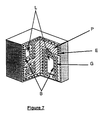
- Figure 7 shows how the use of bubbles helps preserve fully liquid portions.
- Figure 8 highlights the fact that using grains can solve the problem described in Figure 3.
- Figure 9 shows two examples of decomposition of an enclosure.
- Figure 10 shows an example of possible fasteners to maintain the cohesion of the multiple shells of an enclosure.
- Figure 11 shows an example of possible "hinge” type fasteners to maintain the cohesion of the multiple shells of an enclosure.
- FIG. 1 explains 3 intermediate phases in the production of the part "P".
- P has suspended regions "S", that is to say connected neither to the support plate of P, nor to another part of P.
- step A the portion “i” (for “ isolated ") the lowest in region S is solidified, but is not connected to solid.
- the portion "i” of step A can be considered as definitively detached from the part (it now appears as the portion "d” , for “detached”).
- step C the isolated portions "i” of steps A and B are detached, and have become portions "d”.
- FIG. 2 shows how one usually proceeds to solve the problems described in FIG. 1. This essentially consists in adding to "P" supports “1", so as not to result in the creation of portions of type "i” or “d”, as illustrated in steps A to C corresponding exactly to steps A to C in Figure 1.
- FIG. 5 illustrates a problem which can occur when the method described in FIG. 4 is implemented.
- Step A presents the top view of the surface of the liquid during construction of a part (only the solidified parts "P", “E” and “G"), just after a polymerization phase.
- the device “R” responsible for establishing the next layer of liquid is about to pass over the solidified parts. If the grains “G” are not compacted enough, they will be dispersed by the passage of "R”, as shown in step B. During the next polymerization phase, the grains moved to a position too close to " P "may end up being associated with” P ".
- Figure 6 shows some examples of grain shapes "G" to solve the problems described in Figure 5.
- Type A grains form a 3-dimensional block comparable to a brick wall without mortar. Depending on the relative size of the grains relative to the part, the cohesion of the assembly may be sufficient not to result in a situation like that described in Figure 5. The "demolition" of this structure during cleaning poses no problem .
- grains of type B to D can be used: they offer good resistance to the passage of a mechanical system for placing the layers if it moves in the direction V. They allow however easy cleaning.
- FIG. 7 shows how the use of bubbles "B” makes it possible to preserve entirely liquid portions "L", by limiting the number of grains "G” to be made compared to the number necessary in the absence of bubbles "B” ( see Figure 4).
- the amount of solidified (and therefore non-reusable) material can decrease considerably in this way.
- Figure 8 highlights the fact that using grains "G” can solve the problem described in Figure 3. All of the solid parts inside of "P” at the end of manufacturing (the grains , which can be very small) can be evacuated through the orifice "3", which would not have been the case if a support had been necessary.
- Figure 9 shows two examples of decomposition of an enclosure, to facilitate its "demolition” when cleaning the room.
- Example A cuts the enclosure into two shells, and the example cuts it into 4.
- Figures 10 and 11 show examples of possible attachment to maintain the cohesion of the multiple shells forming the enclosures until the final cleaning phase (i.e. during the manufacturing phase, when the part is removed from the when moving it to the cleaning area).
- the "solid material bridges" PT in FIG. 10 are sufficiently thin (depending on the resin) to be able to be easily broken by hand.
- FIG. 11 shows an example of a "hinge" CH, making it possible to hold the shells together.
Landscapes
- Chemical & Material Sciences (AREA)
- Engineering & Computer Science (AREA)
- Materials Engineering (AREA)
- Physics & Mathematics (AREA)
- Manufacturing & Machinery (AREA)
- Mechanical Engineering (AREA)
- Optics & Photonics (AREA)
- Polymerisation Methods In General (AREA)
- Heating, Cooling, Or Curing Plastics Or The Like In General (AREA)
- Graft Or Block Polymers (AREA)
- Manufacture Of Macromolecular Shaped Articles (AREA)
- Treatments Of Macromolecular Shaped Articles (AREA)
Applications Claiming Priority (3)
| Application Number | Priority Date | Filing Date | Title |
|---|---|---|---|
| FR9207021A FR2692065A1 (fr) | 1992-06-05 | 1992-06-05 | Procédé de production de pièces industrielles par action de la lumière sur une matière polymérisable ou réticulable liquide sans nécessiter de supports. |
| FR9207021 | 1992-06-05 | ||
| PCT/FR1993/000537 WO1993025376A1 (fr) | 1992-06-05 | 1993-06-04 | Procede de production de pieces industrielles par action de la lumiere sur une matiere polymerisable ou reticulable liquide sans necessiter de supports |
Publications (2)
| Publication Number | Publication Date |
|---|---|
| EP0647176A1 EP0647176A1 (fr) | 1995-04-12 |
| EP0647176B1 true EP0647176B1 (fr) | 1997-03-05 |
Family
ID=9430610
Family Applications (1)
| Application Number | Title | Priority Date | Filing Date |
|---|---|---|---|
| EP93913093A Expired - Lifetime EP0647176B1 (fr) | 1992-06-05 | 1993-06-04 | Procede de production de pieces industrielles par action de la lumiere sur une matiere polymerisable ou reticulable liquide sans necessiter de supports |
Country Status (10)
| Country | Link |
|---|---|
| US (1) | US5598340A (da) |
| EP (1) | EP0647176B1 (da) |
| JP (1) | JPH07507506A (da) |
| AT (1) | ATE149422T1 (da) |
| CA (1) | CA2137359A1 (da) |
| DE (1) | DE69308558T2 (da) |
| DK (1) | DK0647176T3 (da) |
| ES (1) | ES2101322T3 (da) |
| FR (1) | FR2692065A1 (da) |
| WO (1) | WO1993025376A1 (da) |
Families Citing this family (29)
| Publication number | Priority date | Publication date | Assignee | Title |
|---|---|---|---|---|
| DE4326986C1 (de) * | 1993-08-11 | 1994-12-22 | Eos Electro Optical Syst | Verfahren und Vorrichtung zum Herstellen von dreidimensionalen Objekten |
| DE4439124C2 (de) | 1994-11-02 | 1997-04-24 | Eos Electro Optical Syst | Verfahren und Vorrichtung zum Herstellen eines dreidimensionalen Objektes |
| US7332537B2 (en) * | 1996-09-04 | 2008-02-19 | Z Corporation | Three dimensional printing material system and method |
| DE19906564C2 (de) * | 1999-02-17 | 2001-01-25 | Peschges Klaus Juergen | Verfahren zur Herstellung von dreidimensionalen Gegenständen mittels Stereolithographie |
| WO2001034371A2 (en) * | 1999-11-05 | 2001-05-17 | Z Corporation | Material systems and methods of three-dimensional printing |
| US20010050031A1 (en) | 2000-04-14 | 2001-12-13 | Z Corporation | Compositions for three-dimensional printing of solid objects |
| FR2813609A1 (fr) * | 2000-09-01 | 2002-03-08 | Optoform Sarl Procedes De Prot | Composition de mousse photopolymerisable, procede d'obtention de pieces tridimensionnelles par prototypage rapide, dispositif de mise en oeuvre, piece obtenue et utilisation |
| US20020171177A1 (en) * | 2001-03-21 | 2002-11-21 | Kritchman Elisha M. | System and method for printing and supporting three dimensional objects |
| US6665574B2 (en) | 2001-05-02 | 2003-12-16 | Northrop Grumman Corporation | Method of forming finished parts utilizing stereolithography technology |
| WO2004024447A2 (en) * | 2002-09-12 | 2004-03-25 | Objet Geometries Ltd. | Device, system and method for calibration in three-dimensional model printing |
| US7087109B2 (en) * | 2002-09-25 | 2006-08-08 | Z Corporation | Three dimensional printing material system and method |
| US20040084811A1 (en) * | 2002-11-01 | 2004-05-06 | Beebe David J. | Method of fabricating a three-dimensional microfluidic device |
| US7725209B2 (en) * | 2002-11-12 | 2010-05-25 | Objet Geometries Ltd | Three-dimensional object printing |
| WO2004050323A1 (en) | 2002-12-03 | 2004-06-17 | Objet Geometries Ltd. | Process of and apparatus for three-dimensional printing |
| CA2526100A1 (en) * | 2003-05-21 | 2004-12-29 | Z Corporation | Thermoplastic powder material system for appearance models from 3d printing systems |
| US7435072B2 (en) * | 2003-06-02 | 2008-10-14 | Hewlett-Packard Development Company, L.P. | Methods and systems for producing an object through solid freeform fabrication |
| US7261542B2 (en) | 2004-03-18 | 2007-08-28 | Desktop Factory, Inc. | Apparatus for three dimensional printing using image layers |
| DE102007015389B4 (de) * | 2006-03-28 | 2013-06-27 | Sitec Industrietechnologie Gmbh | Bauteil und Verfahren zu dessen Herstellung |
| US20070241482A1 (en) * | 2006-04-06 | 2007-10-18 | Z Corporation | Production of three-dimensional objects by use of electromagnetic radiation |
| CN101568422B (zh) * | 2006-12-08 | 2013-02-13 | 3D系统公司 | 使用过氧化物固化的三维印刷材料体系和方法 |
| WO2008086033A1 (en) * | 2007-01-10 | 2008-07-17 | Z Corporation | Three-dimensional printing material system with improved color, article performance, and ease of use |
| US7968626B2 (en) | 2007-02-22 | 2011-06-28 | Z Corporation | Three dimensional printing material system and method using plasticizer-assisted sintering |
| US8777602B2 (en) | 2008-12-22 | 2014-07-15 | Nederlandse Organisatie Voor Tobgepast-Natuurwetenschappelijk Onderzoek TNO | Method and apparatus for layerwise production of a 3D object |
| WO2010074566A1 (en) | 2008-12-22 | 2010-07-01 | Nederlandse Organisatie Voor Toegepast-Natuurwetenschappelijk Onderzoek Tno | Method and apparatus for layerwise production of a 3d object |
| US8678805B2 (en) | 2008-12-22 | 2014-03-25 | Dsm Ip Assets Bv | System and method for layerwise production of a tangible object |
| US20150202825A1 (en) * | 2014-01-17 | 2015-07-23 | Christopher Cordingley | Three Dimensional Printing Method |
| CN103969075B (zh) * | 2014-05-23 | 2017-03-29 | 英华达(上海)科技有限公司 | 3d打印装置的自检方法及系统 |
| US11440097B2 (en) | 2019-02-12 | 2022-09-13 | General Electric Company | Methods for additively manufacturing components using lattice support structures |
| JP2020196216A (ja) * | 2019-06-04 | 2020-12-10 | セイコーエプソン株式会社 | 三次元造形物の製造方法 |
Family Cites Families (5)
| Publication number | Priority date | Publication date | Assignee | Title |
|---|---|---|---|---|
| US4575330A (en) * | 1984-08-08 | 1986-03-11 | Uvp, Inc. | Apparatus for production of three-dimensional objects by stereolithography |
| IL84936A (en) * | 1987-12-23 | 1997-02-18 | Cubital Ltd | Three-dimensional modelling apparatus |
| EP0250121B1 (en) * | 1986-06-03 | 1994-11-02 | Cubital Ltd. | Three-dimensional modelling apparatus |
| JPH02251419A (ja) * | 1989-03-27 | 1990-10-09 | Sony Corp | 立体形状形成方法 |
| JPH0745196B2 (ja) * | 1990-11-02 | 1995-05-17 | 三菱商事株式会社 | 光固化造形装置 |
-
1992
- 1992-06-05 FR FR9207021A patent/FR2692065A1/fr not_active Withdrawn
-
1993
- 1993-06-04 DK DK93913093.6T patent/DK0647176T3/da active
- 1993-06-04 EP EP93913093A patent/EP0647176B1/fr not_active Expired - Lifetime
- 1993-06-04 AT AT93913093T patent/ATE149422T1/de not_active IP Right Cessation
- 1993-06-04 WO PCT/FR1993/000537 patent/WO1993025376A1/fr not_active Ceased
- 1993-06-04 CA CA002137359A patent/CA2137359A1/fr not_active Abandoned
- 1993-06-04 JP JP6501171A patent/JPH07507506A/ja active Pending
- 1993-06-04 ES ES93913093T patent/ES2101322T3/es not_active Expired - Lifetime
- 1993-06-04 DE DE69308558T patent/DE69308558T2/de not_active Expired - Fee Related
- 1993-06-07 US US08/347,460 patent/US5598340A/en not_active Expired - Lifetime
Also Published As
| Publication number | Publication date |
|---|---|
| JPH07507506A (ja) | 1995-08-24 |
| ES2101322T3 (es) | 1997-07-01 |
| CA2137359A1 (fr) | 1993-12-23 |
| FR2692065A1 (fr) | 1993-12-10 |
| EP0647176A1 (fr) | 1995-04-12 |
| DK0647176T3 (da) | 1997-09-15 |
| DE69308558D1 (de) | 1997-04-10 |
| DE69308558T2 (de) | 1997-10-02 |
| ATE149422T1 (de) | 1997-03-15 |
| US5598340A (en) | 1997-01-28 |
| WO1993025376A1 (fr) | 1993-12-23 |
Similar Documents
| Publication | Publication Date | Title |
|---|---|---|
| EP0647176B1 (fr) | Procede de production de pieces industrielles par action de la lumiere sur une matiere polymerisable ou reticulable liquide sans necessiter de supports | |
| EP0448459B1 (fr) | Procédé de production d'objets à trois dimensions par photo-transformation et appareillage de mise en oeuvre d'un tel procédé | |
| EP3154761B1 (en) | Improved resin container for stereolithography | |
| EP0573346B1 (fr) | Procédé de fabrication d'un objet fractal par stéréolithographie et objet fractal obtenu par un tel procédé | |
| FR2750064A1 (fr) | Procede et dispositif de production de pieces par depot et fraisage de couches successives | |
| FR2583334A1 (fr) | Procede et dispositif pour realiser un modele de piece industrielle | |
| US20170225393A1 (en) | Apparatus and method for forming three-dimensional objects using two-photon absorption linear solidification | |
| US20020185782A1 (en) | Method and system for production of fibrous composite prototypes using acoustic manipulation in stereolithography | |
| WO2018060617A1 (fr) | Procédé pour la réalisation d'un objet tridimensionel par un processus de photo-polymérisation multi-photonique et dispositif associé | |
| FR3013634A1 (fr) | Procede de reparation de panneaux sandwich en materiaux composites comportant la realisation d'une ame ou d'un moule par stereolithographie | |
| EP3600727B1 (fr) | Éprouvette pour la validation de paramètres opératoires d'un procédé de fabrication additive d'une pièce par fusion laser sur lits de poudre | |
| FR2583333A1 (fr) | Procede pour realiser un modele de piece industrielle et dispositif de mise en oeuvre de ce procede | |
| FR3079517A1 (fr) | Procede pour la realisation d’un objet tridimensionnel par un processus de photo-polymerisation multi-photonique et dispositif associe | |
| WO1995015841A1 (fr) | Machine de fabrication d'objets par photopolymerisation selective de liquides ou poudres par couches | |
| FR2692053A1 (fr) | Machine de fabrication d'objets par photopolymérisation sélective de liquides ou poudres par couches, à base de masque ou source active en mouvement. | |
| FR2743017A1 (fr) | Procede de prototypage rapide par transformation successive de volumes de matiere et dispositif de mise en oeuvre de ce procede | |
| FR2789187A1 (fr) | Procede de realisation de pieces mecaniques, en particulier de prototypes, par decomposition en strates, strates elementaires obtenues selon le procede et pieces mecaniques ainsi obtenues | |
| FR2776225A1 (fr) | Cavite de moule a injection et procede de fabrication de celle-ci | |
| FR3110243A1 (fr) | Procédé de fabrication d’un garnissage multicapillaire pour la chromatographie | |
| FR2692066A1 (fr) | Procédé pour réaliser un modèle de pièce industrielle par transformation partielle d'un liquide sous l'action de la lumière et dispositif de mise en Óoeuvre de ce procédé. | |
| FR2576548A1 (fr) | Procedes pour fabriquer des substrats de miroirs en beton de resine et miroirs correspondants | |
| Gandhi et al. | 3D microfabrication using bulk lithography | |
| FR2631727A1 (fr) | Procede et dispositif de production de modeles de pieces industrielles par action de la lumiere | |
| US20130307169A1 (en) | Method for manufacturing micro-optical element | |
| Qiu et al. | Virtual simulation for multi-material LM process |
Legal Events
| Date | Code | Title | Description |
|---|---|---|---|
| PUAI | Public reference made under article 153(3) epc to a published international application that has entered the european phase |
Free format text: ORIGINAL CODE: 0009012 |
|
| 17P | Request for examination filed |
Effective date: 19941130 |
|
| AK | Designated contracting states |
Kind code of ref document: A1 Designated state(s): AT BE CH DE DK ES FR GB GR IE IT LI LU MC NL PT SE |
|
| GRAG | Despatch of communication of intention to grant |
Free format text: ORIGINAL CODE: EPIDOS AGRA |
|
| GRAH | Despatch of communication of intention to grant a patent |
Free format text: ORIGINAL CODE: EPIDOS IGRA |
|
| 17Q | First examination report despatched |
Effective date: 19960229 |
|
| GRAH | Despatch of communication of intention to grant a patent |
Free format text: ORIGINAL CODE: EPIDOS IGRA |
|
| GRAA | (expected) grant |
Free format text: ORIGINAL CODE: 0009210 |
|
| AK | Designated contracting states |
Kind code of ref document: B1 Designated state(s): AT BE CH DE DK ES FR GB GR IE IT LI LU MC NL PT SE |
|
| PG25 | Lapsed in a contracting state [announced via postgrant information from national office to epo] |
Ref country code: GR Free format text: LAPSE BECAUSE OF FAILURE TO SUBMIT A TRANSLATION OF THE DESCRIPTION OR TO PAY THE FEE WITHIN THE PRESCRIBED TIME-LIMIT Effective date: 19970305 Ref country code: AT Effective date: 19970305 |
|
| REF | Corresponds to: |
Ref document number: 149422 Country of ref document: AT Date of ref document: 19970315 Kind code of ref document: T |
|
| REG | Reference to a national code |
Ref country code: CH Ref legal event code: EP |
|
| REF | Corresponds to: |
Ref document number: 69308558 Country of ref document: DE Date of ref document: 19970410 |
|
| REG | Reference to a national code |
Ref country code: IE Ref legal event code: FG4D Free format text: 72393 |
|
| ITF | It: translation for a ep patent filed | ||
| PG25 | Lapsed in a contracting state [announced via postgrant information from national office to epo] |
Ref country code: SE Effective date: 19970605 Ref country code: PT Effective date: 19970605 |
|
| REG | Reference to a national code |
Ref country code: ES Ref legal event code: FG2A Ref document number: 2101322 Country of ref document: ES Kind code of ref document: T3 |
|
| GBT | Gb: translation of ep patent filed (gb section 77(6)(a)/1977) |
Effective date: 19970612 |
|
| REG | Reference to a national code |
Ref country code: DK Ref legal event code: T3 |
|
| PLBE | No opposition filed within time limit |
Free format text: ORIGINAL CODE: 0009261 |
|
| STAA | Information on the status of an ep patent application or granted ep patent |
Free format text: STATUS: NO OPPOSITION FILED WITHIN TIME LIMIT |
|
| 26N | No opposition filed | ||
| PGFP | Annual fee paid to national office [announced via postgrant information from national office to epo] |
Ref country code: DK Payment date: 19980630 Year of fee payment: 6 |
|
| PGFP | Annual fee paid to national office [announced via postgrant information from national office to epo] |
Ref country code: GB Payment date: 19981201 Year of fee payment: 6 |
|
| PGFP | Annual fee paid to national office [announced via postgrant information from national office to epo] |
Ref country code: IE Payment date: 19981204 Year of fee payment: 6 |
|
| PGFP | Annual fee paid to national office [announced via postgrant information from national office to epo] |
Ref country code: CH Payment date: 19981223 Year of fee payment: 6 |
|
| PGFP | Annual fee paid to national office [announced via postgrant information from national office to epo] |
Ref country code: MC Payment date: 19981228 Year of fee payment: 6 |
|
| PGFP | Annual fee paid to national office [announced via postgrant information from national office to epo] |
Ref country code: ES Payment date: 19981229 Year of fee payment: 6 Ref country code: NL Payment date: 19981229 Year of fee payment: 6 |
|
| PG25 | Lapsed in a contracting state [announced via postgrant information from national office to epo] |
Ref country code: IE Free format text: LAPSE BECAUSE OF NON-PAYMENT OF DUE FEES Effective date: 19990604 Ref country code: GB Free format text: LAPSE BECAUSE OF NON-PAYMENT OF DUE FEES Effective date: 19990604 |
|
| PG25 | Lapsed in a contracting state [announced via postgrant information from national office to epo] |
Ref country code: ES Free format text: LAPSE BECAUSE OF EXPIRATION OF PROTECTION Effective date: 19990605 |
|
| PG25 | Lapsed in a contracting state [announced via postgrant information from national office to epo] |
Ref country code: LI Free format text: LAPSE BECAUSE OF NON-PAYMENT OF DUE FEES Effective date: 19990630 Ref country code: DK Free format text: LAPSE BECAUSE OF NON-PAYMENT OF DUE FEES Effective date: 19990630 Ref country code: CH Free format text: LAPSE BECAUSE OF NON-PAYMENT OF DUE FEES Effective date: 19990630 |
|
| PG25 | Lapsed in a contracting state [announced via postgrant information from national office to epo] |
Ref country code: MC Free format text: LAPSE BECAUSE OF NON-PAYMENT OF DUE FEES Effective date: 19991231 |
|
| PG25 | Lapsed in a contracting state [announced via postgrant information from national office to epo] |
Ref country code: NL Free format text: LAPSE BECAUSE OF NON-PAYMENT OF DUE FEES Effective date: 20000101 |
|
| GBPC | Gb: european patent ceased through non-payment of renewal fee |
Effective date: 19990604 |
|
| REG | Reference to a national code |
Ref country code: CH Ref legal event code: PL |
|
| NLV4 | Nl: lapsed or anulled due to non-payment of the annual fee |
Effective date: 20000101 |
|
| REG | Reference to a national code |
Ref country code: FR Ref legal event code: TP |
|
| REG | Reference to a national code |
Ref country code: DK Ref legal event code: EBP |
|
| REG | Reference to a national code |
Ref country code: IE Ref legal event code: MM4A |
|
| REG | Reference to a national code |
Ref country code: ES Ref legal event code: FD2A Effective date: 20010601 |
|
| REG | Reference to a national code |
Ref country code: FR Ref legal event code: TP |
|
| PGFP | Annual fee paid to national office [announced via postgrant information from national office to epo] |
Ref country code: FR Payment date: 20020620 Year of fee payment: 10 |
|
| PGFP | Annual fee paid to national office [announced via postgrant information from national office to epo] |
Ref country code: DE Payment date: 20020708 Year of fee payment: 10 |
|
| PGFP | Annual fee paid to national office [announced via postgrant information from national office to epo] |
Ref country code: LU Payment date: 20020719 Year of fee payment: 10 |
|
| PGFP | Annual fee paid to national office [announced via postgrant information from national office to epo] |
Ref country code: BE Payment date: 20020805 Year of fee payment: 10 |
|
| PG25 | Lapsed in a contracting state [announced via postgrant information from national office to epo] |
Ref country code: LU Free format text: LAPSE BECAUSE OF NON-PAYMENT OF DUE FEES Effective date: 20030604 |
|
| PG25 | Lapsed in a contracting state [announced via postgrant information from national office to epo] |
Ref country code: BE Free format text: LAPSE BECAUSE OF NON-PAYMENT OF DUE FEES Effective date: 20030630 |
|
| BERE | Be: lapsed |
Owner name: *LASER 3 D Effective date: 20030630 |
|
| PG25 | Lapsed in a contracting state [announced via postgrant information from national office to epo] |
Ref country code: DE Free format text: LAPSE BECAUSE OF NON-PAYMENT OF DUE FEES Effective date: 20040101 |
|
| PG25 | Lapsed in a contracting state [announced via postgrant information from national office to epo] |
Ref country code: FR Free format text: LAPSE BECAUSE OF NON-PAYMENT OF DUE FEES Effective date: 20040227 |
|
| REG | Reference to a national code |
Ref country code: FR Ref legal event code: ST |
|
| PG25 | Lapsed in a contracting state [announced via postgrant information from national office to epo] |
Ref country code: IT Free format text: LAPSE BECAUSE OF NON-PAYMENT OF DUE FEES Effective date: 20050604 |