EP0645037B1 - Verfahren zur detektion von änderungen in bewegtbildern - Google Patents
Verfahren zur detektion von änderungen in bewegtbildern Download PDFInfo
- Publication number
- EP0645037B1 EP0645037B1 EP94911832A EP94911832A EP0645037B1 EP 0645037 B1 EP0645037 B1 EP 0645037B1 EP 94911832 A EP94911832 A EP 94911832A EP 94911832 A EP94911832 A EP 94911832A EP 0645037 B1 EP0645037 B1 EP 0645037B1
- Authority
- EP
- European Patent Office
- Prior art keywords
- image
- threshold
- computing unit
- compared
- detail
- Prior art date
- Legal status (The legal status is an assumption and is not a legal conclusion. Google has not performed a legal analysis and makes no representation as to the accuracy of the status listed.)
- Expired - Lifetime
Links
Images

Classifications
-
- G—PHYSICS
- G06—COMPUTING OR CALCULATING; COUNTING
- G06T—IMAGE DATA PROCESSING OR GENERATION, IN GENERAL
- G06T7/00—Image analysis
- G06T7/20—Analysis of motion
-
- G—PHYSICS
- G06—COMPUTING OR CALCULATING; COUNTING
- G06T—IMAGE DATA PROCESSING OR GENERATION, IN GENERAL
- G06T7/00—Image analysis
- G06T7/20—Analysis of motion
- G06T7/223—Analysis of motion using block-matching
-
- G—PHYSICS
- G06—COMPUTING OR CALCULATING; COUNTING
- G06T—IMAGE DATA PROCESSING OR GENERATION, IN GENERAL
- G06T7/00—Image analysis
- G06T7/20—Analysis of motion
- G06T7/254—Analysis of motion involving subtraction of images
-
- G—PHYSICS
- G06—COMPUTING OR CALCULATING; COUNTING
- G06V—IMAGE OR VIDEO RECOGNITION OR UNDERSTANDING
- G06V20/00—Scenes; Scene-specific elements
- G06V20/50—Context or environment of the image
- G06V20/52—Surveillance or monitoring of activities, e.g. for recognising suspicious objects
- G06V20/54—Surveillance or monitoring of activities, e.g. for recognising suspicious objects of traffic, e.g. cars on the road, trains or boats
-
- G—PHYSICS
- G06—COMPUTING OR CALCULATING; COUNTING
- G06T—IMAGE DATA PROCESSING OR GENERATION, IN GENERAL
- G06T2207/00—Indexing scheme for image analysis or image enhancement
- G06T2207/10—Image acquisition modality
- G06T2207/10016—Video; Image sequence
Definitions
- the invention is based on a method for detection of changes in moving images according to the genus of Main claim.
- An area of application for the detection of changes in Moving images lies in traffic monitoring and Security technology.
- the detection of changed Image areas enable automatic detection of moving objects e.g. Vehicles at an automatic Traffic monitoring or the detection of prohibited ones Intrusion in property protection.
- a method for detecting changes in Moving pictures is an image in moving objects and set a constant background. With this Process the moving objects as connected Treated image sections, their movement over a Motion vector or a set of motion vectors can be described.
- Procedures are known in which the change the image signals pixel by pixel with a threshold are compared and then the image signals are changed as or not changed.
- the threshold will after A.Gerhard, "Motion analysis in the coding of Image Sequences, "Dissertation at the Chair for Telecommunications at the Technical University of Kunststoff, September 20, 1988, p. 69, determined by taking a local value from a basic threshold a low pass filtered and standardized version of a Difference amount picture, which consists of the current and the temporally previous picture is determined, subtracted becomes.
- the information as to whether a pixel is changed or not decided to change is in a binary Mask removed.
- a moving edge ie a moving object
- a flip-flop is set to 1. This flip-flop is only set to 0 again, ie the viewed image pixel is identified as a stationary object if an accumulator in a block of 8x3 image pixels counts less than a fixed number of image pixels whose image difference signal exceeds a threshold T 2 or T 3 lies.
- features of the main claim have the advantage that the threshold with which the change in image signals is compared, depending on the environment of the crucial image signals is formed. Doing so both the temporal and the local environment of a to decisive image section taken into account.
- the Threshold becomes smaller the more adjacent Image sections in the comparison with their threshold have already been decided as changed.
- the Fact takes into account that the probability is high is that an image section changes when it changes Environment changes and the probability is small that an image section changes when its surroundings change does not change.
- Another advantage is that for determining the Also threshold image sections of the previous images be used. This takes security, one correct decision about the change or non-change to take a picture section, because one Change of an image section not only from the adjacent image sections, but also from the Image sections of previous images depends.
- Another advantage is that the detection of a Not changing or not changing an image section individually for all image pixels in an image section larger detection cells must be determined can be assigned. This makes the procedure without great loss in quality of the binary decision mask accelerates.
- a direct determination of the change in a Image section consists of the image signals of the decisive image detail from the image signals of the identically arranged image section of a temporally subtract the previous picture from each other and this Evaluate the image difference.
- the sum of the absolute amounts of the Pixel differences can be used.
- the threshold consists of a fixed percentage and a variable portion that depends on the Results of comparisons of those in the observation window contained image sections with their thresholds is being formed.
- the procedure is simplified if the determination of the change in an image section only a subset of those contained in the image section Image signals is used. This will result in a reduction of computing time is achieved without losing the quality of the binary Mask deteriorates significantly.
- FIG. 1 shows a device for recording and for evaluating image signals
- Figure 2 two temporally successive images, the observation window distributed over both pictures
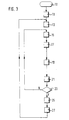
- Figure 3 is a structogram to illustrate the process flow.
- Figure 1 shows a computing unit 1, which Data lines 8 an image acquisition unit 3, e.g. a Video camera controls and that of the video camera stores recorded image data in a memory 2.
- the Computing unit 1 places the captured images pixel by pixel in the memory 2.
- Figure 1 also shows one Input unit 9, which is used to input data Data lines 8 is connected to the computing unit 1.
- FIG. 2 shows two images in succession, the pictures each in 16 square Image sections are divided.
- the image section 5 to be decided is dark hatched.
- Image n is the image section 5 to be decided temporally preceding ones arranged in the same way in picture n Image section 6 drawn with dark hatching.
- the selected observation window is 4 of the picture n + 1 is hatched and consists of the image sections 11, 12, 13, 14, which to the adjoin decisive image section 5 and already with have been compared to a threshold.
- the results of the Comparisons of the image sections are with Y for "changed” and entered with N for "not changed” in FIG. 2.
- the image sections in order from left to right and from top to top compared to a threshold below.
- Figure 3 shows a schematic program flow for the procedures used. This starts at program point 10 Program. At program point 11 are for the course of the Program necessary sizes via the input unit 9 entered and by the computing unit 1 in the memory 2 filed: The grid for dividing the images into Image sections, the size i.e. the number of image pixels per image section, the size of the observation window 4 and the procedure of how the image sections of the entire image can be compared with a threshold are imported. The calculation method for the change an image detail, the calculation of the threshold the results of comparisons in the observation window included image sections are also read in and stored in memory. At program point 13 the Image acquisition unit 3 an image and the computing unit 1 stores the captured image pixel by pixel in memory 2.
- computing unit 1 selects the first Image section and the corresponding observation window.
- the computing unit 1 determines from the Results of the comparisons of those in the observation window 4 lying image sections and that over the input unit 9 entered calculation method, the threshold for the image section 5 to be decided is used and stores them in memory 2.
- the computing unit 1 Determined at program point 19 the computing unit 1 the change between the Image signals of the image section to be compared and the image signals of the identically arranged image section 6 of the previous picture. Thereupon compares the Computing unit 1, the determined change with the in Memory 2 filed threshold.
- At program point 21 assigns the computing unit 1 to the memory addresses of the Image pixels of the compared image section 5 a 1 to, if the change is greater than the stored threshold and a 0 if the change is less than the filed Threshold is.
- the program points 15, 17, 19, 21 and 23 are so often processed until all image pixels with a threshold have been compared.
- Program item 23 that all image pixels with a threshold were compared, then according to program item 25 branches.
- computing unit 1 selects the Image sections of image n + 1, to which a 1 is assigned has been. In this way, the computing unit 1 determines moving objects or Bils excerpts, which for further Evaluation of the image can be used. After Program point 25 is branched back to program point 13 and the program sequence as described again run through.
- the preferred embodiment is shown in the figures 1 to 3 explained in more detail.
- the program will run after Structogram processed in Figure 3. At program point 10 the program is started and at program point 11 are 9 starting conditions for set the program.
- the picture is chosen in this Example divided into image sections, each consisting of there are five times five image pixels.
- the observation window 4 becomes the image section to be decided on 5 adjacent image sections formed.
- the method consists in observing the observation window 4 from image sections of several in time to form the following pictures. It is determined that the Image sections from left to right and from top to bottom are processed below. The order of Processing of the image sections can vary depending on the application done in a different way.
- the following statistics are defined for changing the image signals of an image section: where the sum of all image pixels i of the decisive image section 5 runs and d i is the difference of the image signal of an image pixel of image n + 1 with the image signal of the identically arranged image pixel of the temporally preceding image n and s 2 is an estimated variance or an empirical value for is the variance of the differential camera noise process.
- a threshold So is entered, which for the Comparison with the change used when due no threshold has yet been formed can, as is the case for the first image section.
- the image section 5 to be decided is shown in dark hatching in image n + 1.
- the observation window 4 results from the adjacent image sections which are hatched and outlined in FIG. 2. Since comparison results with a threshold are not available for all adjacent image sections of the picture n + 1, the corresponding picture section of the picture n, which is also hatched and outlined, is used to determine the threshold. If one looks at the selected observation window 4, which contains the image sections 11, 12, 13, 14 of the picture n + 1 and the picture sections 15, 16, 17, 18 of the picture n, the picture sections 11, 12, 13, 14, 17, 18 as changed and the image sections 15, 16 were decided as not changed, the following threshold T results:
- computing unit 1 forms according to the difference in statistics stored in program item 11 to compare between the image signals of the Image section 5 and the image signals of the same arranged image section 6 of the previous image n.
- the change was made with fixed. Instead of the squares of the difference signals d i , the amounts
- the change is compared with the threshold T, which was determined in program point 17.
- the computing unit 1 assigns a 1 to the memory addresses of the image pixels of the image section 5 to be compared if the change is greater than the threshold T and a 0 in the other cases. 2 memory addresses are stored in the memory for the image pixels of the stored images.
- the computing unit 1 queries whether all image pixels or image sections of the image n + 1 have been compared with a threshold T.
- the program branches back to program point 15 and a further image section corresponding to program points 15 to 21 is compared with a threshold. If the query at program point 23 shows that all image sections of the image have been compared with a threshold, the program branches to program point 25. At program point 25, computing unit 1 selects the image sections that were recognized as moving objects.
- the computing unit 1 determines from the values that are in the Memory addresses of the image sections are stored, connected moving objects. That way e.g. moving vehicles with an automatic Image surveillance determined.
- the threshold T is greater than T s in the event that the observation window has not changed and the threshold T is less than T s in the event that the observation window has changed.
- the value T s is determined by specifying a significance a, which represents a measure for the estimation of a probability: Prob (d 2 i > Ts
- Ho) a, in the event that the sum of squares is used as statistics for the change in the Image section is used.
- T v 2 * ln [p (l k
- Ho) denotes an experience value for the probability that a correct decision for not changed in picture n + 1 the correct decision l k in the previous picture n precedes p (l k changed
- H1) >> p (l k not changed
- H1) and p (l k not changed
- Ho) >> p (l k changed
- the thresholds T (l k ) are transformed by two significance a (l k ) according to Prob (d 2 k > T (l k )
- Ho) a (l k ) respectively.
- Ho) a (l k ) be formed.
Landscapes
- Engineering & Computer Science (AREA)
- Physics & Mathematics (AREA)
- General Physics & Mathematics (AREA)
- Multimedia (AREA)
- Theoretical Computer Science (AREA)
- Computer Vision & Pattern Recognition (AREA)
- Image Analysis (AREA)
- Image Processing (AREA)
- Compression Or Coding Systems Of Tv Signals (AREA)
Description





p(lk = geändert|H1)>>p(lk=nicht geändert|H1) und p(lk=nicht geändert|Ho)>>p(lk=geändert|Ho) gilt. T hängt also von lk ab, d.h. T(lk)=Ts+Tv(lk).
Claims (9)
- Verfahren zur Detektion von Änderungen in elektronisch aufgenommenen Bewegtbildern mittels einer Recheneinheit, wobei die Bildsignale pixelweise vorliegen und in einem Speicher abgelegt werden und mittels der Recheneinheit die Änderung eines Bildausschnittes mit mindestens einem Bildpixel im Vergleich zu dem in der Bildebene gleich angeordneten Bildausschnittes mindestens eines vorausgehenden Bildes ermittelt werden, die Änderung von der Recheneinheit mit einer vorgegebenen Schwelle verglichen wird und den für jedes Bildpixel des Bildausschnittes im Speicher abgelegten Speicheradressen je nachdem, ob die Änderung größer oder kleiner als die Schwelle ist, unterschiedliche Werte zugeordnet werden,
dadurch gekennzeichnet,daß von der Recheneinheit (1) aus den abgespeicherten Bildsignalen ein Beobachtungsfenster (4) im Bild-/Zeitraum ausgewählt wird, das den zu vergleichenden Bildausschnitt (5) und mindestens einen weiteren schon mit einer Schwelle verglichenen Bildausschnitt enthält,daß von der Recheneinhelt (1) die Schwelle in Abhängigkeit davon, ob die Änderung des schon verglichenen Bildausschnittes kleiner oder größer als seine Schwelle war, verändert wird, unddaß von der Recheneinheit (1) das Ergebnis des Vergleichs zwischen der Änderung des zu vergleichenden Bildausschnittes (5) und der ermittelten Schwelle mindestens einer der im Speicher (2) abgelegten Adresse eines Bildpixels des Bildausschnittes (5) zugewiesen wird. - Verfahren nach Anspruch 1, dadurch gekennzeichnet, daß von der Recheneinheit (1) die Ergebnisse der Vergleiche der Änderungen der im Beobachtungsfenster (4) enthaltenen Bildausschnitte mit ihren Schwellen bei der Ermittlung der Schwelle nach Abstand und Orientierung in Bezug auf den zu vergleichenden Bildausschnitt (5) unterschiedlich gewichtet berücksichtigt werden.
- Verfahren nach einem der Ansprüche 1 und 2, dadurch gekennzeichnet,
daß von der Recheneinheit (1) die Änderung des zu vergleichenden Bildausschnittes (5) im Vergleich zu einem in der Bildebene gleich angeordneten Bildausschnitt (6) mindestens eines vorausgehenden Bildes durch die Differenzen der Bildsignale ermittelt wird, wobei von der Recheneinheit (1) vorzugsweise die Summe der quadrierten Differenzen der Bildsignale auf die Leistung (Varianz) des Kamerarauschens im Differenzbild normiert wird, oder die Schwelle mit der Leistung des Kamerarauschens im Differenzbild multipliziert wird. - Verfahren nach einem der Ansprüche 1 und 2, dadurch gekennzeichnet,
daß von der Recheneinheit (1) die Änderung des zu vergleichenden Bildausschnittes (5) im Vergleich zu einem in der Bildebene gleich angeordneten Bildausschnitt (6) mindestens eines vorausgehenden Bildes durch die Differenzen der Bildsignale ermittelt wird, wobei von der Recheneinheit (1) vorzugsweise die Summe der Absolutbeträge der Differenzen der Bildsignale auf die Standardabweichung des Kamerarauschens im Differenzbild normiert wird, oder die Schwelle mit der Leistung des Kamerarauschens im Differenzbild multipliziert wird. - Verfahren nach einem der Ansprüche 1 bis 4, dadurch gekennzeichnet,
daß von der Recheneinheit (1) das Beobachtungsfenster (4) aus dem zu vergleichenden Bildausschnitt (5) und den angrenzenden Bildausschnitten gebildet wird. - Verfahren nach Anspruch 5, dadurch gekennzeichnet,
daß von der Recheneinheit (1) anstelle der noch nicht mit einer Schwelle entschiedenen zum selben Bild gehörenden Bildausschnitte die in der Bildebene gleich angeordneten Bildausschnitte des vorausgehenden Bildes, die schon mit einer Schwelle verglichen worden sind, verwendet werden. - Verfahren nach einem der Ansprüche 1 bis 6, dadurch gekennzeichnet,
daß von der Recheneinheit (1) zur Ermittlung der Schwelle das Ergebnis des Vergleichs des in Bezug auf den zu vergleichenden Bildausschnitt (5) in der Bildebene gleich angeordneten Bildausschnittes (6) mit seiner Schwelle mindestens eines vorausgehenden Bildes berücksichtigt wird. - Verfahren nach einem der Ansprüche 1 bis 7, dadurch gekennzeichnet,
daß von der Recheneinheit (1) die Schwelle aus einem festgelegten Anteil und einem Anteil, der in Abhängigkeit von den Ergebnissen der Vergleiche der in dem Beobachtungsfenster (4) enthaltenen Bildausschnitte ermittelt wird, gebildet wird. - Verfahren nach einem der Ansprüche 1 bis 8, dadurch gekennzeichnet,
daß von der Recheneinheit (1) zur Ermittlung der Änderung eines Bildausschnittes nur eine Teilmenge der im Bildausschnitt enthaltenen Bildsignale verwendet wird.
Applications Claiming Priority (3)
| Application Number | Priority Date | Filing Date | Title |
|---|---|---|---|
| DE4311972A DE4311972A1 (de) | 1993-04-10 | 1993-04-10 | Verfahren zur Detektion von Änderungen in Bewegtbildern |
| DE4311972 | 1993-04-10 | ||
| PCT/DE1994/000385 WO1994024634A1 (de) | 1993-04-10 | 1994-04-07 | Verfahren zur detektion von änderungen in bewegtbildern |
Publications (2)
| Publication Number | Publication Date |
|---|---|
| EP0645037A1 EP0645037A1 (de) | 1995-03-29 |
| EP0645037B1 true EP0645037B1 (de) | 1999-07-07 |
Family
ID=6485326
Family Applications (1)
| Application Number | Title | Priority Date | Filing Date |
|---|---|---|---|
| EP94911832A Expired - Lifetime EP0645037B1 (de) | 1993-04-10 | 1994-04-07 | Verfahren zur detektion von änderungen in bewegtbildern |
Country Status (5)
| Country | Link |
|---|---|
| US (1) | US5654772A (de) |
| EP (1) | EP0645037B1 (de) |
| JP (1) | JP3357058B2 (de) |
| DE (2) | DE4311972A1 (de) |
| WO (1) | WO1994024634A1 (de) |
Families Citing this family (30)
| Publication number | Priority date | Publication date | Assignee | Title |
|---|---|---|---|---|
| DE4332753C2 (de) * | 1993-09-25 | 1997-01-30 | Bosch Gmbh Robert | Verfahren zur Erkennung bewegter Objekte |
| DE4440671A1 (de) | 1994-11-04 | 1996-05-09 | Bosch Gmbh Robert | Verfahren zur objektorientierten Erkennung bewegter Objekte |
| GB9502748D0 (en) * | 1995-02-13 | 1995-03-29 | Snell & Wilcox Ltd | Video signal processing |
| GB2299233A (en) * | 1995-03-21 | 1996-09-25 | Ibm | Video compression method involving conditional replenishment |
| US6661838B2 (en) * | 1995-05-26 | 2003-12-09 | Canon Kabushiki Kaisha | Image processing apparatus for detecting changes of an image signal and image processing method therefor |
| JPH09130732A (ja) * | 1995-11-01 | 1997-05-16 | Matsushita Electric Ind Co Ltd | シーンチェンジ検出方法および動画像編集装置 |
| DE19601005A1 (de) * | 1996-01-15 | 1997-07-17 | Bosch Gmbh Robert | Verfahren zur Erkennung bewegter Objekte in zeitlich aufeinanderfolgenden Bildern |
| US6061471A (en) * | 1996-06-07 | 2000-05-09 | Electronic Data Systems Corporation | Method and system for detecting uniform images in video signal |
| US5778108A (en) * | 1996-06-07 | 1998-07-07 | Electronic Data Systems Corporation | Method and system for detecting transitional markers such as uniform fields in a video signal |
| US5767923A (en) * | 1996-06-07 | 1998-06-16 | Electronic Data Systems Corporation | Method and system for detecting cuts in a video signal |
| US5920360A (en) * | 1996-06-07 | 1999-07-06 | Electronic Data Systems Corporation | Method and system for detecting fade transitions in a video signal |
| US5959697A (en) * | 1996-06-07 | 1999-09-28 | Electronic Data Systems Corporation | Method and system for detecting dissolve transitions in a video signal |
| DE19630194B4 (de) * | 1996-07-26 | 2006-06-01 | Robert Bosch Gmbh | Verfahren zur Detektion von Objekten |
| DE19827835B4 (de) * | 1998-06-23 | 2012-01-19 | Robert Bosch Gmbh | Bildübertragungsverfahren und -vorrichtung |
| DE19848490B4 (de) * | 1998-10-21 | 2012-02-02 | Robert Bosch Gmbh | Bildinformationsübertragungsverfahren und -vorrichtung |
| US6801246B2 (en) | 2001-02-27 | 2004-10-05 | Thomson Licensing, S.A. | Method and apparatus for detecting change in video source material |
| US20040263621A1 (en) * | 2001-09-14 | 2004-12-30 | Guo Chun Biao | Customer service counter/checkpoint registration system with video/image capturing, indexing, retrieving and black list matching function |
| US7672397B2 (en) * | 2002-05-14 | 2010-03-02 | Otmar Irscheid | Method for producing a transmission signal |
| US20050163345A1 (en) * | 2003-12-03 | 2005-07-28 | Safehouse International Limited | Analysing image data |
| GB2410391B (en) * | 2003-12-03 | 2009-05-13 | Safehouse Internat Inc | Processing an output signal to generate an exemplar image from a period of activity |
| US7664292B2 (en) * | 2003-12-03 | 2010-02-16 | Safehouse International, Inc. | Monitoring an output from a camera |
| NZ536913A (en) * | 2003-12-03 | 2006-09-29 | Safehouse Internat Inc | Displaying graphical output representing the topographical relationship of detectors and their alert status |
| AU2004233453B2 (en) * | 2003-12-03 | 2011-02-17 | Envysion, Inc. | Recording a sequence of images |
| WO2005107240A1 (ja) * | 2004-04-28 | 2005-11-10 | Chuo Electronics Co., Ltd. | 自動撮影方法および装置 |
| US20060164658A1 (en) * | 2005-01-26 | 2006-07-27 | Eastman Kodak Company | Light tone reproduction of binary rip output at high screen frequencies using post rip image processing |
| JP5061444B2 (ja) * | 2005-09-20 | 2012-10-31 | ソニー株式会社 | 撮像装置及び撮像方法 |
| US20070252895A1 (en) * | 2006-04-26 | 2007-11-01 | International Business Machines Corporation | Apparatus for monitor, storage and back editing, retrieving of digitally stored surveillance images |
| DE102009017772A1 (de) * | 2009-04-16 | 2010-11-04 | Fraunhofer-Gesellschaft zur Förderung der angewandten Forschung e.V. | Verfahren und System zum Erkennen eines Objektes, und Verfahren und System zum Erzeugen einer Markierung in einer Bildschirmdarstellung mittels eines berührungslos gestikgesteuerten Bildschirmzeigers |
| CN108038851B (zh) * | 2017-12-11 | 2020-02-07 | 中国科学技术大学 | 一种基于反馈和迭代的雷达图像差异检测方法 |
| JP7636917B2 (ja) * | 2021-03-16 | 2025-02-27 | 本田技研工業株式会社 | 移動体の移動量を推定する情報処理装置、情報処理方法、及びプログラム |
Family Cites Families (12)
| Publication number | Priority date | Publication date | Assignee | Title |
|---|---|---|---|---|
| EP0318039B1 (de) * | 1987-11-26 | 1995-02-01 | Fujitsu Limited | Notüberwachungssystem mit Infrarotverarbeitung |
| JPH0293320A (ja) * | 1988-09-30 | 1990-04-04 | Nippon Petrochem Co Ltd | 動的物体の追跡法 |
| US5134472A (en) * | 1989-02-08 | 1992-07-28 | Kabushiki Kaisha Toshiba | Moving object detection apparatus and method |
| GB2231750B (en) * | 1989-04-27 | 1993-09-29 | Sony Corp | Motion dependent video signal processing |
| GB2231745B (en) * | 1989-04-27 | 1993-07-07 | Sony Corp | Motion dependent video signal processing |
| JP2953712B2 (ja) * | 1989-09-27 | 1999-09-27 | 株式会社東芝 | 移動物体検知装置 |
| US5091925A (en) * | 1990-01-18 | 1992-02-25 | Siemens Aktiengesellschaft | X-ray diagnostics installation with spatial frequency filtering |
| EP0806866B1 (de) * | 1991-05-23 | 1999-10-06 | Nippon Hoso Kyokai | Auswertungsvorrichtung und Methode verwendbar für ein Gerät zur Detektion von Bewegungsvektoren |
| DE4117774A1 (de) * | 1991-05-31 | 1992-12-03 | Telefunken Systemtechnik | Verfahren zur ueberwachung von gelaende |
| KR100255528B1 (ko) * | 1991-10-31 | 2000-05-01 | 요트.게.아. 롤페즈 | 디지탈 텔레비젼 영상을 송신기에서 수신기로 송신하기 위한 텔레비젼 시스템 |
| US5420638A (en) * | 1992-04-14 | 1995-05-30 | U.S. Philips Corporation | Subassembly for coding images with refresh correction of the data to be coded, and subassembly for decording signals representing these images and previously coded by means of a subassembly of the former kind |
| JP2611607B2 (ja) * | 1992-06-29 | 1997-05-21 | 日本ビクター株式会社 | シーンチェンジ検出装置 |
-
1993
- 1993-04-10 DE DE4311972A patent/DE4311972A1/de not_active Ceased
-
1994
- 1994-04-07 DE DE59408465T patent/DE59408465D1/de not_active Expired - Lifetime
- 1994-04-07 US US08/360,715 patent/US5654772A/en not_active Expired - Lifetime
- 1994-04-07 EP EP94911832A patent/EP0645037B1/de not_active Expired - Lifetime
- 1994-04-07 WO PCT/DE1994/000385 patent/WO1994024634A1/de not_active Ceased
- 1994-04-07 JP JP52261094A patent/JP3357058B2/ja not_active Expired - Lifetime
Also Published As
| Publication number | Publication date |
|---|---|
| DE4311972A1 (de) | 1994-10-13 |
| DE59408465D1 (de) | 1999-08-12 |
| JPH07508367A (ja) | 1995-09-14 |
| US5654772A (en) | 1997-08-05 |
| WO1994024634A1 (de) | 1994-10-27 |
| JP3357058B2 (ja) | 2002-12-16 |
| EP0645037A1 (de) | 1995-03-29 |
Similar Documents
| Publication | Publication Date | Title |
|---|---|---|
| DE4311972A1 (de) | Verfahren zur Detektion von Änderungen in Bewegtbildern | |
| DE69413148T2 (de) | Verfahren zur Bestimmung von Bewegungsvektoren in kleinen Bildsegmenten in Fernsehbildern | |
| DE69628282T2 (de) | Verfahren zur kompression mehrerer videobilder | |
| DE102011056982B4 (de) | Digitales Bildstabilisierungsverfahren mit adaptiver Filterung | |
| DE4411179B4 (de) | Bildeinfangvorrichtung | |
| DE19634768A1 (de) | Vorrichtung und Verfahren zur Erfassung eines Gesichts in einem Videobild | |
| DE69509577T2 (de) | Anordnung zur Verminderung des Rauschens unter Verwendung von zeitvarianten Filterkoeffizienten | |
| DE19983806B4 (de) | Ein die diskrete Wavelet-Transformation verwendender Autofokus-Algorithmus | |
| DE69413384T2 (de) | Verfahren zum bestimmen der ungleichheit zwischen monoskopischen bildern, die ein stereoskopisches bild darstellen | |
| DE69737141T2 (de) | Bildsegmentierung | |
| DE3874705T2 (de) | Verfahren zur bewegungsabschaetzung mit mehreren prediktoren fuer punkte eines elektronischen bildes. | |
| DE19618984B4 (de) | Verfahren zur Bewegungsbewertung in Bilddaten sowie Vorrichtung zur Durchführung dieses Verfahrens | |
| DE69231187T2 (de) | Verfahren zur schaetzung und hierarchischen kodierung von bewegung in bildfolgen | |
| DE69908550T2 (de) | Wasserzeichenerkennung | |
| DE112007000738T5 (de) | Filter für Störbewegungen | |
| DE69515535T2 (de) | Verfahren und Vorrichtung zum Bildvergleich | |
| DE69904610T2 (de) | Bewegungsschätzungsverfahren zur Reduzierung der Übertragungskosten von Bewegungsvektoren | |
| DE60119931T2 (de) | Verfahren und Vorrichtung zur Kompensation von fehlerhaften Bewegungsvektoren in Bilddaten | |
| EP0414113A2 (de) | Verfahren zur Bewegungskompensation in einem Bewegtbildcoder oder -decoder | |
| DE4138517A1 (de) | Einrichtung zur objekt-orientierten codierung von bildsignalen | |
| DE69008637T2 (de) | Iteratives Bewegungsabschätzungsverfahren zwischen einem Referenzbild und einem aktuellen Bild, und Verfahren zu ihrer Herstellung. | |
| DE69525898T2 (de) | Bewegtbildkodierungs- und -dekodierungsvorrichtung | |
| EP0897247A2 (de) | Verfahren zur Berechnung von Bewegungsvektoren | |
| EP1101196B1 (de) | Verfahren und anordnung zur bewegungsschätzung in einem digitalisierten bild mit bildpunkten | |
| DE4030703A1 (de) | Verfahren zur schaetzung von bewegung in einem aufgenommenen bild |
Legal Events
| Date | Code | Title | Description |
|---|---|---|---|
| PUAI | Public reference made under article 153(3) epc to a published international application that has entered the european phase |
Free format text: ORIGINAL CODE: 0009012 |
|
| AK | Designated contracting states |
Kind code of ref document: A1 Designated state(s): CH DE FR IT LI |
|
| 17P | Request for examination filed |
Effective date: 19950427 |
|
| GRAG | Despatch of communication of intention to grant |
Free format text: ORIGINAL CODE: EPIDOS AGRA |
|
| 17Q | First examination report despatched |
Effective date: 19980721 |
|
| GRAG | Despatch of communication of intention to grant |
Free format text: ORIGINAL CODE: EPIDOS AGRA |
|
| GRAH | Despatch of communication of intention to grant a patent |
Free format text: ORIGINAL CODE: EPIDOS IGRA |
|
| GRAH | Despatch of communication of intention to grant a patent |
Free format text: ORIGINAL CODE: EPIDOS IGRA |
|
| GRAA | (expected) grant |
Free format text: ORIGINAL CODE: 0009210 |
|
| AK | Designated contracting states |
Kind code of ref document: B1 Designated state(s): CH DE FR IT LI |
|
| REG | Reference to a national code |
Ref country code: CH Ref legal event code: NV Representative=s name: SCINTILLA AG, DIREKTION Ref country code: CH Ref legal event code: EP |
|
| REF | Corresponds to: |
Ref document number: 59408465 Country of ref document: DE Date of ref document: 19990812 |
|
| ET | Fr: translation filed | ||
| ITF | It: translation for a ep patent filed | ||
| PLBE | No opposition filed within time limit |
Free format text: ORIGINAL CODE: 0009261 |
|
| STAA | Information on the status of an ep patent application or granted ep patent |
Free format text: STATUS: NO OPPOSITION FILED WITHIN TIME LIMIT |
|
| 26N | No opposition filed | ||
| PGFP | Annual fee paid to national office [announced via postgrant information from national office to epo] |
Ref country code: DE Payment date: 20130627 Year of fee payment: 20 Ref country code: CH Payment date: 20130423 Year of fee payment: 20 |
|
| PGFP | Annual fee paid to national office [announced via postgrant information from national office to epo] |
Ref country code: FR Payment date: 20130523 Year of fee payment: 20 Ref country code: IT Payment date: 20130424 Year of fee payment: 20 |
|
| REG | Reference to a national code |
Ref country code: DE Ref legal event code: R071 Ref document number: 59408465 Country of ref document: DE |
|
| REG | Reference to a national code |
Ref country code: CH Ref legal event code: PL |
|
| PG25 | Lapsed in a contracting state [announced via postgrant information from national office to epo] |
Ref country code: DE Free format text: LAPSE BECAUSE OF EXPIRATION OF PROTECTION Effective date: 20140408 |