EP0641883A2 - Verfahren zur Delignifizierung mittels Sauerstoff - Google Patents
Verfahren zur Delignifizierung mittels Sauerstoff Download PDFInfo
- Publication number
- EP0641883A2 EP0641883A2 EP94305910A EP94305910A EP0641883A2 EP 0641883 A2 EP0641883 A2 EP 0641883A2 EP 94305910 A EP94305910 A EP 94305910A EP 94305910 A EP94305910 A EP 94305910A EP 0641883 A2 EP0641883 A2 EP 0641883A2
- Authority
- EP
- European Patent Office
- Prior art keywords
- wood pulp
- oxygen
- charge
- containing gas
- caustic soda
- Prior art date
- Legal status (The legal status is an assumption and is not a legal conclusion. Google has not performed a legal analysis and makes no representation as to the accuracy of the status listed.)
- Withdrawn
Links
Images

Classifications
-
- D—TEXTILES; PAPER
- D21—PAPER-MAKING; PRODUCTION OF CELLULOSE
- D21C—PRODUCTION OF CELLULOSE BY REMOVING NON-CELLULOSE SUBSTANCES FROM CELLULOSE-CONTAINING MATERIALS; REGENERATION OF PULPING LIQUORS; APPARATUS THEREFOR
- D21C9/00—After-treatment of cellulose pulp, e.g. of wood pulp, or cotton linters ; Treatment of dilute or dewatered pulp or process improvement taking place after obtaining the raw cellulosic material and not provided for elsewhere
- D21C9/10—Bleaching ; Apparatus therefor
- D21C9/1005—Pretreatment of the pulp, e.g. degassing the pulp
-
- D—TEXTILES; PAPER
- D21—PAPER-MAKING; PRODUCTION OF CELLULOSE
- D21C—PRODUCTION OF CELLULOSE BY REMOVING NON-CELLULOSE SUBSTANCES FROM CELLULOSE-CONTAINING MATERIALS; REGENERATION OF PULPING LIQUORS; APPARATUS THEREFOR
- D21C9/00—After-treatment of cellulose pulp, e.g. of wood pulp, or cotton linters ; Treatment of dilute or dewatered pulp or process improvement taking place after obtaining the raw cellulosic material and not provided for elsewhere
- D21C9/10—Bleaching ; Apparatus therefor
-
- D—TEXTILES; PAPER
- D21—PAPER-MAKING; PRODUCTION OF CELLULOSE
- D21C—PRODUCTION OF CELLULOSE BY REMOVING NON-CELLULOSE SUBSTANCES FROM CELLULOSE-CONTAINING MATERIALS; REGENERATION OF PULPING LIQUORS; APPARATUS THEREFOR
- D21C9/00—After-treatment of cellulose pulp, e.g. of wood pulp, or cotton linters ; Treatment of dilute or dewatered pulp or process improvement taking place after obtaining the raw cellulosic material and not provided for elsewhere
- D21C9/10—Bleaching ; Apparatus therefor
- D21C9/147—Bleaching ; Apparatus therefor with oxygen or its allotropic modifications
Definitions
- the present invention relates to an oxygen delignification method and apparatus in which wood pulp and oxygen are reacted in the presence of caustic soda such that the caustic soda is mixed with the wood pulp in a plurality of mixing stages, the wood pulp is reacted with the oxygen in a plurality of reaction stages located between the mixing stages and filtrate, produced from a washing stage, is mixed with the wood pulp in the mixing stages along with the caustic soda.
- the present invention relates to a wood pulp mixer having coaxial external, intermediate and internal passageways. The intermediate and internal passageways are provided with perforations sized to retain the wood pulp such that a gas circulated through the external, intermediate and internal passageways mixes with the wood pulp while the wood pulp is driven between the intermediate and internal passageways.
- lignins from the pulp are removed in a process known as oxygen delignification.
- Subsequent bleaching stages are used to further remove pigments from the wood pulp.
- Oxygen delignification is carried out by mixing steam with the wood pulp.
- caustic soda derived from oxidized white liquor is mixed with the wood pulp.
- the heated wood pulp is then reacted with the oxygen and in the presence of the caustic soda.
- the wood pulp After treatment with oxygen, the wood pulp is introduced into the bottom of a treatment tower in which the wood pulp is vertically driven and removed from the top. Passage of the wood pulp through this tower takes approximately one hour. After removal from the tower, the wood pulp, as mentioned above, is washed to produce a filtrate. The filtrate, is often mixed with weak black liquor being discharged from the initial treatment of the wood chips.
- the rate of delignification is dependent upon the pH during reaction of the wood pulp and the oxygen. The higher the pH, the greater the degree of delignification. This is not without limit in that a point is reached at which the cellulose is attacked by the caustic soda to cause degradation of the wood pulp.
- a charge of wood pulp is mixed with a charge of caustic soda.
- the wood pulp is then reacted with the oxygen and during such reaction, the caustic soda is being neutralized with acidic reaction by-products to lower the pH during the reaction. Therefore, the rate of delignification decreases during the reaction due to the neutralization of the caustic soda during the reaction.
- the degree of delignification cannot, however, be increased by supplying a greater initial charge of the caustic soda because of possible pulp degradation and therefore, the delignification of any charge of wood pulp is limited by initial peak pH exposure of the wood pulp to the caustic soda.
- the present invention provides an oxygen delignification method in which a greater amount of delignification for a given charge of wood pulp is possible as compared with prior art oxygen delignification methods. Additionally, the present invention provides an apparatus for conducting oxygen delignification that effects a simplification over prior art methodology and apparatus.
- an oxygen delignification method comprising the steps of:
- a charge of wood pulp is heated and then reacted with oxygen of an oxygen-containing gas.
- a charge of caustic soda is mixed with the charge of wood pulp such that the charge of wood pulp reacts with the oxygen in the presence of caustic soda, or other alkali, thereby neutralizing the caustic soda during the reaction.
- the charges of caustic soda and wood pulp are mixed in a plurality of mixing stages and the charge of wood pulp and oxygen are reacted in a plurality of reaction stages situated between the mixing stages.
- an oxygen delignification apparatus is provided.
- Such apparatus is provided with a heating means for heating a charge of wood pulp.
- a plurality of reactor means is provided for reacting a charge of wood pulp with oxygen of an oxygen-containing gas and a plurality of mixing means is connected to the reactor means for mixing a charge of caustic soda and the charge of wood pulp with one another such that the charge of wood pulp reacts with the oxygen in the presence of caustic soda, thereby consuming the caustic soda during the reaction.
- the plurality of reactor means is situated between the mixing means such that the charge of caustic soda is distributed among the reaction stages to reduce peak pH exposure of the charge of wood pulp to the caustic soda below that which would otherwise occur if the charges of wood pulp and caustic soda were mixed all at once.
- a washing means is provided for receiving the wood pulp from the reactor means for washing the wood pulp with a solvent, thereby to produce a filtrate.
- the washing means is connected to the plurality of mixing means such that the filtrate is mixed with the charge of wood pulp along with the charge of caustic soda to reduce potential wood pulp degradation produced by the increase in the average pH exposure of the charge of wood pulp to the caustic soda.
- an increase in the amount of delignification can be effected by a method and apparatus in accordance with the present invention for a given charge of caustic soda. Additionally, for a given amount of delignification, the residence time of the pulp in the oxygen delignification of a pulp produced process can be reduced below prior art time periods.
- a wood pulp mixer for mixing a gas and wood pulp.
- the wood pulp mixer comprises coaxial elongated, outer and inner tubular members defining coaxial intermediate and internal passageways between the outer and inner tubular members and within the inner tubular member, respectively.
- the outer and inner tubular members are provided with perforations sized to retain the wood pulp between the intermediate and internal passageways while admitting the gas.
- a body portion houses the outer and inner tubular members and has an external passageway surrounding the outer and inner tubular members and therefore the intermediate and internal passageways.
- a wood pulp inlet is provided in communication with one end of the intermediate passageway for introducing the wood pulp between the intermediate and internal passageways and a wood pulp outlet is provided in communication with the opposite end of the intermediate passageway for discharging the wood pulp from the intermediate passageway.
- a gas inlet is provided in the body portion in communication with the external passageway for introducing the gas into the external passageway such that it passes through the perforations of the intermediate and internal passageways in an inward radial direction thereof and thereby mixes with the wood pulp and collects in the internal passageway.
- a gas outlet is provided in communication with the internal passageway for discharging the gas.
- the wood pulp mixer as outlined above could serve as a reaction stage in practicing a method and apparatus in accordance with the present invention. Additionally, there are other potential uses for such a wood pulp mixer, for instance, heating the wood pulp by introducing steam into the wood pulp.
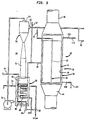
- Wood pulp designated by reference numeral 12 enters apparatus 10 from a prior stage in which wood chips are treated with cooking liquor to produce wood pulp 12. Delignified wood pulp 14 leaves apparatus 10 for further treatment in peroxide and/or chlorine dioxide bleaching stages.
- a charge of wood pulp 12 is heated in a mixer 16 by steam 18 to a reaction temperature at which the wood pulp will react with oxygen such that lignins contained within the wood pulp will be susceptible to be washed from the wood pulp with a solvent.
- the thus heated wood pulp is pumped by a pump 20 through mixers 22, 24 and 26 and reactors 28, 30 and 32.
- caustic soda and filtrate (which will be described in more detail hereinafter) are mixed with the wood pulp.
- oxygen is mixed with the charge of wood pulp 12 to produce the chemical reaction with the wood pulp.
- charge of wood pulp 12 is washed within a stage 34 to wash the lignins from the wood pulp.
- the effluent liquor (filtrate) from the washer 34 is mixed with the caustic soda for mixing with the wood pulp.
- the caustic soda is preferably oxidized white liquor recovered from weak black liquor.
- the white liquor is oxidized in a manner known in the art so that sulfides are oxidized to at least thiosulphates and sulphates.
- charge of wood pulp 12 is treated with a charge of caustic soda within apparatus 10.
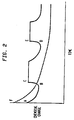
- caustic soda and filtrate is added to the heated wood pulp. This produces a peak in pH as shown by peak A.
- Oxygen is then mixed with the wood pulp in reactor 28 and the reaction is allowed to proceed for approximately 15 minutes.
- the caustic soda is neutralized by acids produced by the reaction so that the pH decreases to a point referenced as B.
- the caustic soda thus far consumed is replenished in mixer 24 as shown by peak C.
- the caustic soda 22 is depleted in reactor 30 as evidenced by the decrease in pH to point D.
- the expended caustic is then restored by mixer 26 as is evidenced by peak E.
- a peak pH would exist at point F. Over the span of an hour, the caustic soda would be depleted as shown by a decrease in pH in the dashed line curve. Thus, a major difference in the present invention over the prior art is that the peak pH is reduced over the prior art method and the average pH is increased over a prior art method. As stated previously, the rate of delignification is proportional to the pH. However, the rate of wood pulp degradation is also proportional to the pH because as the pH increases, the cellulose in the wood pulp begins to be attacked by the caustic soda.
- the present invention avoids the peak pH of point F by distributing the caustic soda over three mixers 22, 24 and 26.
- caustic soda expended in the chemical reaction, is being replenished between reaction stages, the average pH is maintained above the average pH of the prior art.
- the increase in average pH of the present invention favours increased delignification without subjecting the wood pulp to a high peak pH.
- This higher average pH in the present invention also favours potential wood pulp degradation. It has been found by the inventors that the recycling of the filtrate and introducing it into mixers 22-26, retards this possible wood pulp degradation produced by the higher average pH of the present invention.
- the present invention when compared with the prior art, is capable of delignifying the wood pulp to a greater extent than prior art techniques.
- the present invention is capable of delignifying the wood pulp to the same extent of the prior art, except, in much less time.
- the initial temperature can be anywhere from 100-115° and the steam consumption is approximately 40 kg per ton of low pressure steam and approximately 40-180 kg per ton of high pressure steam.
- the caustic soda neutralization is about 24 kg per ton of pulp and the oxygen consumption is approximately 27 kg per ton of pulp.
- magnesium carbonate is added at about 0.5 kg per ton of pulp.
- Each of the reaction stages operates at a pressure of approximately 6670 kpa. Conventional single stage treatments of pulp under similar consumptions of steam, caustic soda, oxygen, magnesium carbonate and etc. at best fall in a range of between about 40 and about 45%.
- Reactor 28 is illustrated that is used to form reactor 28.
- Reactors 30 and 32 are of identical construction.
- Reactor 28 has a body portion 36.
- Body portion 36 is provided with an elongated external passageway 38.
- Coaxial elongated, intermediate and internal passageways 40 and 42 are provided by coaxial outer and inner tubular members 41 and 43.
- tubular members 41 and 43 are housed within body portion 28 such that external passageway 38 surrounds intermediate passageway 40 and intermediate passageway 40 surrounds internal passageway 42.
- the charge of wood pulp enters reactor 28 through a wood pulp inlet 44 of body portion 28 and passes between internal and external passageways 40 and 42. Wood pulp is discharged from a wood pulp outlet 46 to mixer 24.
- tubular members 41 and 43 are of cylindrical configuration for ease of fabrication, they could also be of other shapes, for instance tubes having a square, transverse cross-section and etc.
- Outer and inner tubular members 41 and 43 and therefore intermediate and internal passageways 40 and 42 are provided with perforations.
- the perforations are sized to retain the wood pulp between intermediate and internal passageways 40 and 42 while admitting oxygen into the wood pulp.
- the oxygen is introduced as an oxygen-containing gas into gas inlet 48 of body portion 36.
- the oxygen-containing gas passes into external passageway 38 through the perforations of intermediate passageway 40 and then, into the wood pulp.
- the oxygen-containing gas travels in an inward radial direction of the passageways to internal passageway 42. Excess oxygen-containing gas not reacted with the wood pulp is then discharged from a gas outlet 50 of body portion 36, in communication with internal passageway 42.
- reactor 28 as described above, if appropriately sized could serve other purposes.
- a wood pulp mixer in accordance with the present invention could be used to mix steam with the wood pulp or in place of a static mixer to mix a gas with wood pulp.
- oxygen-containing gas is pumped from gas outlet 50 back into gas outlet 48 for recycling back into the wood pulp.
- This is effectuated by means of an eductor 60.
- Eductor 60 has a low pressure inlet 62 and a high pressure inlet 64.
- High pressure motive fluid pumped through high pressure inlet 64 creates a low pressure region in eductor 60 to draw the oxygen-containing gas and entrain it with the motive fluid being pumped through inlet 64.
- the motive fluid and oxygen-containing gas mixture is then discharged from a high pressure outlet 66 of eductor 60 into an phase separation tank 68 which is connected to high pressure outlet 66 of eductor 60 by a conduit 70.
- the motive fluid that is being pumped consists of filtrate which is introduced into phase separation tank 68 through an inlet 72 thereof.
- a valve 74 when open, permits replenishment of filtrate within phase separation tank 68.
- the filtrate is pumped by a centrifugal pump 76 back to high pressure inlet 64 of eductor 60.
- the filtrate separates from the oxygen-containing gas to form a head space 78 from which the oxygen-containing gas flows into gas inlet 48 of reactor 28.
- high pressure oxygen or steam could be used as the motive fluid to provide the requisite circulation.
- Reactors 30 and 32 are of the same design as reactor 28 and have gas outlet 90 and 92 from which gas is drawn to eductor 60 and gas inlets 94 and 96 attached to a header pipe 97 through which oxygen-containing gas is recycled back to reactors 30 and 32. Wood pulp outlets 98 and 100 of reactors 30 and 32 are proved for discharging wood pulp to mixer 26 and washer 34.
- Reactors 28-32 are also provided with filtrate drains 102, 104, and 106 which allow accumulated filtrate to drain from reactors 28-32 when associated valves 108, 110, and 112 are opened. Additionally, reactors 28-32 are also provided with vent lines 114, 116, and 18 which allows accumulated reaction products to be vented upon the opening of vent valves 120, 122, and 124.
Landscapes
- Life Sciences & Earth Sciences (AREA)
- Engineering & Computer Science (AREA)
- Wood Science & Technology (AREA)
- Paper (AREA)
Applications Claiming Priority (2)
| Application Number | Priority Date | Filing Date | Title |
|---|---|---|---|
| US105248 | 1979-12-19 | ||
| US08/105,248 US5460696A (en) | 1993-08-12 | 1993-08-12 | Oxygen delignification method incorporating wood pulp mixing apparatus |
Publications (2)
| Publication Number | Publication Date |
|---|---|
| EP0641883A2 true EP0641883A2 (de) | 1995-03-08 |
| EP0641883A3 EP0641883A3 (de) | 1998-05-13 |
Family
ID=22304796
Family Applications (1)
| Application Number | Title | Priority Date | Filing Date |
|---|---|---|---|
| EP94305910A Withdrawn EP0641883A3 (de) | 1993-08-12 | 1994-08-10 | Verfahren zur Delignifizierung mittels Sauerstoff |
Country Status (7)
| Country | Link |
|---|---|
| US (2) | US5460696A (de) |
| EP (1) | EP0641883A3 (de) |
| AU (1) | AU670201B2 (de) |
| CA (1) | CA2127654C (de) |
| FI (1) | FI117478B (de) |
| NO (1) | NO303291B1 (de) |
| ZA (1) | ZA945265B (de) |
Cited By (2)
| Publication number | Priority date | Publication date | Assignee | Title |
|---|---|---|---|---|
| EP1528149A1 (de) * | 2003-10-28 | 2005-05-04 | The Boc Group, Inc. | Verfahren zur Niederkonsistenz-Sauerstoffdelignifizierung |
| EP0826086B2 (de) † | 1995-03-28 | 2008-01-09 | GL&V Management Hungary Kft, Luxembourg Branch | Verfahren zur heizung und druckerhöhung eines faserzellstoffes beim transport zu einem bleichreaktor |
Families Citing this family (7)
| Publication number | Priority date | Publication date | Assignee | Title |
|---|---|---|---|---|
| BR9708265A (pt) * | 1996-03-26 | 1999-04-13 | Sunds Defibrator Ind Ab | Processo de deslignificação por oxigénio de pasta química em dois estágios |
| SE522593C2 (sv) * | 1999-07-06 | 2004-02-24 | Kvaerner Pulping Tech | System och förfarande för syragasdelignifiering av massa av lignocellulosahaltigt material |
| RU2164571C1 (ru) * | 2000-06-27 | 2001-03-27 | Камский целлюлозно-бумажный комбинат | Способ получения беленой сульфитной целлюлозы на магниевом основании |
| DE10163303B4 (de) * | 2001-12-21 | 2004-04-01 | Rhodia Acetow Gmbh | Verfahren zur Verbesserung der Farbzahl von Celluloseestern |
| SE525773C2 (sv) * | 2003-09-24 | 2005-04-26 | Kvaerner Pulping Tech | Metod och arrangemang för syrgasdelignifiering av cellulosamassa med pH-reglering i slutfasen |
| SE0403202L (sv) * | 2004-12-30 | 2005-10-25 | Kvaerner Pulping Tech | Metod för syrgasdelignifiering av cellulosamassa med inmixning av kemikalier vid högt tryck |
| SE0403222L (sv) * | 2004-12-30 | 2005-11-08 | Kvaerner Pulping Tech | Metod för syrgasdelignifiering av cellulosamassa vid högt tryck i flera steg |
Family Cites Families (18)
| Publication number | Priority date | Publication date | Assignee | Title |
|---|---|---|---|---|
| US3843473A (en) * | 1971-08-23 | 1974-10-22 | Mo Och Domsjoe Ab | Impregnation of cellulosic pulp under superatmospheric pressure with waste alkaline oxygan gas bleaching liquor followed by oxygen-alkali bleaching |
| SE387671B (sv) * | 1973-04-27 | 1976-09-13 | Mo Och Domsjoe Ab | Anordning for blekning av kompakt, icke fluffat vetskehaltigt lignocellulosamaterial med gasformiga blekmedel, foretredesvis syrgas |
| SE379069B (de) * | 1973-08-27 | 1975-09-22 | Kamyr Ab | |
| SE390549C (sv) * | 1973-12-20 | 1986-04-14 | Ahlstroem Oy | Sett att bleka cellulosahaltigt material med syre eller fritt syre innehallande gas i alkalisk miljo |
| US4089737A (en) * | 1974-02-18 | 1978-05-16 | Toyo Pulp Company, Ltd. | Delignification of cellulosic material with an alkaline aqueous medium containing oxygen dissolved therein |
| US3951733A (en) * | 1974-11-06 | 1976-04-20 | International Paper Company | Delignification and bleaching of wood pulp with oxygen |
| CA1095663A (en) * | 1975-02-12 | 1981-02-17 | John Gordy | Pulping process |
| FI770790A7 (de) * | 1976-03-12 | 1977-09-13 | Union Carbide Corp | |
| US4161421A (en) * | 1977-09-13 | 1979-07-17 | Kamyr, Inc. | Method and apparatus for continuous oxygen bleaching of cellulosic pulp |
| US4198266A (en) * | 1977-10-12 | 1980-04-15 | Airco, Inc. | Oxygen delignification of wood pulp |
| CA1127357A (en) * | 1978-05-23 | 1982-07-13 | Makoto Kikuiri | Process for producing alkali pulp |
| US4259150A (en) * | 1978-12-18 | 1981-03-31 | Kamyr Inc. | Plural stage mixing and thickening oxygen bleaching process |
| US4363697A (en) * | 1979-12-03 | 1982-12-14 | The Black Clawson Company | Method for medium consistency oxygen delignification of pulp |
| SE441192B (sv) * | 1980-05-27 | 1985-09-16 | Mo Och Domsjoe Ab | Forfarande for delignifiering av kemisk cellulosamassa med syrgas i nervaro av ett eller flera neutralisationsmedel |
| US4384920A (en) * | 1981-04-06 | 1983-05-24 | The Black Clawson Company | Method and apparatus for oxygen delignification |
| US4431480A (en) * | 1981-10-27 | 1984-02-14 | The Black Clawson Company | Method and apparatus for controlled addition of alkaline chemicals to an oxygen delignification reaction |
| US4581104A (en) * | 1983-08-11 | 1986-04-08 | Ingersoll-Rand Company | Method of reducing the lignin in wood pulp with oxygen gas recirculation |
| US5034095A (en) * | 1989-06-01 | 1991-07-23 | Oji Paper Co., Ltd. | Apparatus and process for the delignification of cellulose pulp |
-
1993
- 1993-08-12 US US08/105,248 patent/US5460696A/en not_active Expired - Lifetime
-
1994
- 1994-07-08 CA CA002127654A patent/CA2127654C/en not_active Expired - Fee Related
- 1994-07-19 ZA ZA945265A patent/ZA945265B/xx unknown
- 1994-07-26 NO NO942779A patent/NO303291B1/no not_active IP Right Cessation
- 1994-07-29 AU AU68800/94A patent/AU670201B2/en not_active Ceased
- 1994-08-10 EP EP94305910A patent/EP0641883A3/de not_active Withdrawn
- 1994-08-11 FI FI943719A patent/FI117478B/fi active IP Right Grant
-
1995
- 1995-06-28 US US08/496,264 patent/US5591308A/en not_active Expired - Lifetime
Cited By (2)
| Publication number | Priority date | Publication date | Assignee | Title |
|---|---|---|---|---|
| EP0826086B2 (de) † | 1995-03-28 | 2008-01-09 | GL&V Management Hungary Kft, Luxembourg Branch | Verfahren zur heizung und druckerhöhung eines faserzellstoffes beim transport zu einem bleichreaktor |
| EP1528149A1 (de) * | 2003-10-28 | 2005-05-04 | The Boc Group, Inc. | Verfahren zur Niederkonsistenz-Sauerstoffdelignifizierung |
Also Published As
| Publication number | Publication date |
|---|---|
| CA2127654A1 (en) | 1995-02-13 |
| FI943719L (fi) | 1995-02-13 |
| ZA945265B (en) | 1995-04-21 |
| NO942779L (no) | 1995-02-13 |
| EP0641883A3 (de) | 1998-05-13 |
| FI943719A0 (fi) | 1994-08-11 |
| CA2127654C (en) | 1995-11-28 |
| US5460696A (en) | 1995-10-24 |
| FI117478B (fi) | 2006-10-31 |
| NO303291B1 (no) | 1998-06-22 |
| AU670201B2 (en) | 1996-07-04 |
| NO942779D0 (no) | 1994-07-26 |
| AU6880094A (en) | 1995-02-23 |
| US5591308A (en) | 1997-01-07 |
Similar Documents
| Publication | Publication Date | Title |
|---|---|---|
| FI59434B (fi) | Delignifiering och blekning av cellulosa med syre | |
| US4451332A (en) | Method for delignification of ligno-cellulose containing fiber material with an alkali-oxygen extraction stage | |
| US20010004005A1 (en) | Acid treatment of pulp at high temperature prior ro chrlorine dioxide bleaching | |
| CA2111519C (en) | Oxygen/ozone/peracetic acid delignification and bleaching of cellulosic pulps | |
| BG51052A3 (bg) | Метод за безхлорно избелване на целулоза | |
| US5591308A (en) | Wood pulp reactor | |
| EP0884415B1 (de) | Verfahren zum Waschen von Zellstoff beim Bleichen | |
| RU2148118C1 (ru) | Двустадийная делигнификация лигноцеллюлозной массы кислородом | |
| US3362868A (en) | Method and apparatus for oxidizing spent digestion liquors | |
| EP0106609A1 (de) | Vorrichtung und Verfahren zur Sauerstoffextraktion von Pulpe niedriger Konsistenz | |
| EP0420860B1 (de) | Vorrichtung und verfahren zur herstellung von papierpulpe, pappe, faserbrettern und ähnlichen erzeugnissen | |
| US5328564A (en) | Modified digestion of paper pulp followed by ozone bleaching | |
| US20210040688A1 (en) | Method of producing dissolving pulp | |
| US5785810A (en) | Wood pulp processing apparatus and method | |
| US20010035272A1 (en) | Method for oxygen delignification of a digested pulp | |
| EP0554391B1 (de) | Aufschlussverfahren | |
| US3193444A (en) | Continuous sulphate pulping method with countercurrent heating and concurrent cooking zones and apparatus therefor | |
| RU2793493C2 (ru) | Способ изготовления растворимой древесноволокнистой массы | |
| EP0557112A1 (de) | Verfahren zum chlorfreien Aufschluss und Bleichen | |
| CA1249904A (en) | Oxygen alkali extraction of cellulosic pulp | |
| FI102193B (fi) | Menetelmä ja laitteisto massan käsittelemiseksi | |
| US5783037A (en) | System and method for operating a pulp mill | |
| JP2008527183A (ja) | 薬剤の混合によりセルロースパルプの酸素での脱リグニン方法 | |
| JPH06264384A (ja) | 中濃度パルプの漂白装置 | |
| SE452896B (sv) | Forfarande for behandling av cellulosamassor |
Legal Events
| Date | Code | Title | Description |
|---|---|---|---|
| PUAI | Public reference made under article 153(3) epc to a published international application that has entered the european phase |
Free format text: ORIGINAL CODE: 0009012 |
|
| AK | Designated contracting states |
Kind code of ref document: A2 Designated state(s): DE FR SE |
|
| PUAL | Search report despatched |
Free format text: ORIGINAL CODE: 0009013 |
|
| AK | Designated contracting states |
Kind code of ref document: A3 Designated state(s): DE FR SE |
|
| 17P | Request for examination filed |
Effective date: 19981029 |
|
| 17Q | First examination report despatched |
Effective date: 19981223 |
|
| STAA | Information on the status of an ep patent application or granted ep patent |
Free format text: STATUS: THE APPLICATION IS DEEMED TO BE WITHDRAWN |
|
| 18D | Application deemed to be withdrawn |
Effective date: 19990503 |