EP0640666B1 - Verfahren zum Färben von Polyester und polyesterhaltigen Textilmaterialien - Google Patents
Verfahren zum Färben von Polyester und polyesterhaltigen Textilmaterialien Download PDFInfo
- Publication number
- EP0640666B1 EP0640666B1 EP94112182A EP94112182A EP0640666B1 EP 0640666 B1 EP0640666 B1 EP 0640666B1 EP 94112182 A EP94112182 A EP 94112182A EP 94112182 A EP94112182 A EP 94112182A EP 0640666 B1 EP0640666 B1 EP 0640666B1
- Authority
- EP
- European Patent Office
- Prior art keywords
- dyeing
- polyester
- general formula
- dye
- phenylene
- Prior art date
- Legal status (The legal status is an assumption and is not a legal conclusion. Google has not performed a legal analysis and makes no representation as to the accuracy of the status listed.)
- Expired - Lifetime
Links
- 0 CC(CC1)C(*)C(*)C1*(P*C(C(*)=C(*)C(*1C)=O)=C1OC=C)=O Chemical compound CC(CC1)C(*)C(*)C1*(P*C(C(*)=C(*)C(*1C)=O)=C1OC=C)=O 0.000 description 3
Classifications
-
- D—TEXTILES; PAPER
- D06—TREATMENT OF TEXTILES OR THE LIKE; LAUNDERING; FLEXIBLE MATERIALS NOT OTHERWISE PROVIDED FOR
- D06P—DYEING OR PRINTING TEXTILES; DYEING LEATHER, FURS OR SOLID MACROMOLECULAR SUBSTANCES IN ANY FORM
- D06P3/00—Special processes of dyeing or printing textiles, or dyeing leather, furs, or solid macromolecular substances in any form, classified according to the material treated
- D06P3/34—Material containing ester groups
- D06P3/52—Polyesters
- D06P3/54—Polyesters using dispersed dyestuffs
-
- C—CHEMISTRY; METALLURGY
- C09—DYES; PAINTS; POLISHES; NATURAL RESINS; ADHESIVES; COMPOSITIONS NOT OTHERWISE PROVIDED FOR; APPLICATIONS OF MATERIALS NOT OTHERWISE PROVIDED FOR
- C09B—ORGANIC DYES OR CLOSELY-RELATED COMPOUNDS FOR PRODUCING DYES, e.g. PIGMENTS; MORDANTS; LAKES
- C09B29/00—Monoazo dyes prepared by diazotising and coupling
- C09B29/34—Monoazo dyes prepared by diazotising and coupling from other coupling components
- C09B29/36—Monoazo dyes prepared by diazotising and coupling from other coupling components from heterocyclic compounds
- C09B29/3604—Monoazo dyes prepared by diazotising and coupling from other coupling components from heterocyclic compounds containing only a nitrogen as heteroatom
- C09B29/3617—Monoazo dyes prepared by diazotising and coupling from other coupling components from heterocyclic compounds containing only a nitrogen as heteroatom containing a six-membered heterocyclic with only one nitrogen as heteroatom
- C09B29/3621—Monoazo dyes prepared by diazotising and coupling from other coupling components from heterocyclic compounds containing only a nitrogen as heteroatom containing a six-membered heterocyclic with only one nitrogen as heteroatom from a pyridine ring
- C09B29/3626—Monoazo dyes prepared by diazotising and coupling from other coupling components from heterocyclic compounds containing only a nitrogen as heteroatom containing a six-membered heterocyclic with only one nitrogen as heteroatom from a pyridine ring from a pyridine ring containing one or more hydroxyl groups (or = O)
- C09B29/363—Monoazo dyes prepared by diazotising and coupling from other coupling components from heterocyclic compounds containing only a nitrogen as heteroatom containing a six-membered heterocyclic with only one nitrogen as heteroatom from a pyridine ring from a pyridine ring containing one or more hydroxyl groups (or = O) from diazotized amino carbocyclic rings
-
- Y—GENERAL TAGGING OF NEW TECHNOLOGICAL DEVELOPMENTS; GENERAL TAGGING OF CROSS-SECTIONAL TECHNOLOGIES SPANNING OVER SEVERAL SECTIONS OF THE IPC; TECHNICAL SUBJECTS COVERED BY FORMER USPC CROSS-REFERENCE ART COLLECTIONS [XRACs] AND DIGESTS
- Y10—TECHNICAL SUBJECTS COVERED BY FORMER USPC
- Y10S—TECHNICAL SUBJECTS COVERED BY FORMER USPC CROSS-REFERENCE ART COLLECTIONS [XRACs] AND DIGESTS
- Y10S8/00—Bleaching and dyeing; fluid treatment and chemical modification of textiles and fibers
- Y10S8/92—Synthetic fiber dyeing
- Y10S8/922—Polyester fiber
-
- Y—GENERAL TAGGING OF NEW TECHNOLOGICAL DEVELOPMENTS; GENERAL TAGGING OF CROSS-SECTIONAL TECHNOLOGIES SPANNING OVER SEVERAL SECTIONS OF THE IPC; TECHNICAL SUBJECTS COVERED BY FORMER USPC CROSS-REFERENCE ART COLLECTIONS [XRACs] AND DIGESTS
- Y10—TECHNICAL SUBJECTS COVERED BY FORMER USPC
- Y10S—TECHNICAL SUBJECTS COVERED BY FORMER USPC CROSS-REFERENCE ART COLLECTIONS [XRACs] AND DIGESTS
- Y10S8/00—Bleaching and dyeing; fluid treatment and chemical modification of textiles and fibers
- Y10S8/933—Thermosol dyeing, thermofixation or dry heat fixation or development
-
- Y—GENERAL TAGGING OF NEW TECHNOLOGICAL DEVELOPMENTS; GENERAL TAGGING OF CROSS-SECTIONAL TECHNOLOGIES SPANNING OVER SEVERAL SECTIONS OF THE IPC; TECHNICAL SUBJECTS COVERED BY FORMER USPC CROSS-REFERENCE ART COLLECTIONS [XRACs] AND DIGESTS
- Y10—TECHNICAL SUBJECTS COVERED BY FORMER USPC
- Y10S—TECHNICAL SUBJECTS COVERED BY FORMER USPC CROSS-REFERENCE ART COLLECTIONS [XRACs] AND DIGESTS
- Y10S8/00—Bleaching and dyeing; fluid treatment and chemical modification of textiles and fibers
- Y10S8/934—High temperature and pressure dyeing
Definitions
- the present invention relates to a method for dyeing of textile polyester or textile materials containing polyester with hydroxypyridone azo dyes.
- polyester is polyester or polyester-containing Textile materials with disperse dyes aqueous dye bath under HT conditions in a temperature range colored from 120 to 140 ° C at pH values from 4 to 6, because at higher pH values the disperse dyes partially or completely destroyed. At higher pH values This leads to loss of color strength and color deviations when dyeing and the dyeings are not reproducible.
- the polyester fiber in a separate step before staining an alkaline Subject to rinsing treatment to aids that have been used in weaving or spinning the fiber, to remove.
- These tools are e.g. Oiling or Sizing agents that, when available, are level Dyeing the polyester fiber difficult or impossible would do.
- the alkaline treatment is also carried out to oligomers of polyester fiber that are used in the dyeing process have emerged from the inside of the fiber and the Color uneven, destroy and appear in the to keep aqueous dye liquor.
- the oligomers mentioned are particularly undesirable in yarn dyeing because they itself when spinning the dyed yarn in the spinning apparatus where the yarn is deflected by abrasion settle powdery. This will contaminate the equipment and cause the yarn to tear.
- This alkaline rinsing treatment is convenient performed at elevated temperature. For time and energy to save and the number of alkaline for both processes Pretreatment and dyeing, equipment needed reduce, it has always been the goal of both processes to form a one-bath rinsing and dyeing process. However, procedures must be implemented to achieve this goal be developed in an aqueous dyebath at pH 8 reproducible colorations up to pH 11.
- Polyester-cellulose or polyester-polyamide blend are with disperse or reactive dyes from aqueous Dye bath usually dyed in two dyeing steps.
- the goal here in the past was a one-bath Develop application methods for both dye classes. They searched for reactive dyes with which already stained at pH values between 8 and 11 and procedures were also required who ensure that under these conditions the Polyester content reproducible with disperse dyes can be colored.
- DOS 39 38 631 describes a method in which Disperse dyes in the pH range between pH 8 and 10 in the presence of at least one, optionally on nitrogen substituted amino acid and / or an alkali metal salt one optionally substituted on nitrogen Amino acid is colored.
- the mentioned hydroxypyridone azo dyes especially the described in DE-A 20 01 821 and DE-A 31 20 747 namely due to their acidified hydroxy groups sensitive to alkali.
- alkali-stable Dyes provide the yellowing reproducible in good quality and without uneconomical More use of dye or higher ecological pollution of dyeing wastewater through hydrolyzed dyes deliver.
- alkyl radicals can be linear or branched. Examples are methyl, Ethyl, n-propyl, i-propyl, n-butyl, i-butyl, n-pentyl and n-hexyl.
- alkoxyalkyl group representing R. are 2-methoxy, 2-ethoxy, 2-n-propoxy, 2-i-propoxy, 2-n-butoxy and 2-i-butoxyethyl, 3-methoxy, 3-ethoxy, 3-n-propoxy, 3-i-propoxy, 3-n-butoxy and 3-i-butoxypropyl, 2-methoxypropyl and 4-methoxy and 4-ethoxybutyl.
- the method according to the invention is preferably carried out with dyes of the general formula I, in which A for 1,4-phenylene.
- radicals X 1 to X 3 preference is given to those dyes in which X 1 and one of the radicals X 2 and X 3 are methyl and those in which X 2 and X 3 are hydrogen and X 1 are ethyl or in particular for i- Stand propyl.
- dyes in which the sum of the carbon atoms in the radicals R and X is 1 to X 3 4 to 7.
- Dyes of the general type are particularly preferred Formula I used which preferred several of the above Features.
- the dyes of the general formula Ia were previously not yet known and are structurally the closest Prior Art Compounds Regarding superior to their coloring properties.
- the dyes of the general formula Ia can be prepared analogously to the processes described in the abovementioned prior art.
- they can be prepared by an amine of the general formula IV wherein A is as defined above, diazotized in a conventional manner and onto a hydroxypyridone of the general formula V where R is defined as indicated above, is coupled.
- the process according to the invention can be carried out using a dye of the general formula I or Ia. It but can also with two or more dyes general formula I or Ia are carried out, wherein but two dyes are preferred.
- the share of one Dye in these cases is preferably 5 to 80% by weight, particularly preferably 20 to 50% by weight, in each case based on the total amount of dye.
- the process according to the invention is preferred under HT conditions executed, i.e. in aqueous dye liquor Temperatures between 120 ° C and 140 ° C in a dyeing autoclave.
- the pH value is preferably pH 9 to pH 10.
- the dyes of the general formula according to the invention Ia can not only in the inventive method, but also in other common processes for dyeing and Printing of hydrophobic synthetic textile materials, e.g. under HT conditions in the pH range between 4 and 11, are used in the so-called thermosol process or applied to the fiber after a printing process become.
- Polyesters are in particular those based on polyethylene glycol terephthalates. Textile materials containing polyester are e.g. Mixtures of polyester and polyamides.
- the dyes or dye mixtures used in fine distribution takes place in a manner known per se Wise in that the one arising in the manufacturing Dye together with dispersants in in a liquid medium, preferably in water and the mix of shear forces exposes the original dye particles mechanically crushed to the extent that a optimal specific surface is achieved and the Sedimentation of the dye is as low as possible.
- the Particle sizes of the dyes are generally between 0.5 and 5 ⁇ m, preferably around 1 ⁇ m.
- the dispersants used in the grinding process can be nonionic or anionic.
- Non-ionogenic Dispersants are e.g. Reaction products of alkylene oxides, such as. Ethylene or propylene oxide with alkylatable Connections such as Fatty alcohols, fatty amines, Fatty acids, phenols, alkylphenols and carboxamides.
- Anionic dispersants are, for example Lignin sulfonates, alkyl or alkyl aryl sulfonates or alkyl aryl polyglycol ether sulfonates.
- the dye preparations thus obtained are intended for most applications are pourable.
- the dye and The dispersant content is therefore limited in these cases.
- the dispersions are in one Dye content up to 25% by weight and a dispersant content set up to about 25%. From economic Dye contents of 15% by weight are usually not the reason undershot.
- the dispersions can also contain other auxiliaries, e.g. those that act as oxidizing agents, such as e.g. Sodium m-nitrobenzenesulfonate or fungicidal agents, such as. Sodium o-phenyl phenolate.
- auxiliaries e.g. those that act as oxidizing agents, such as e.g. Sodium m-nitrobenzenesulfonate or fungicidal agents, such as. Sodium o-phenyl phenolate.
- These powders contain the dye or that Dye mixture, dispersant and other auxiliaries, such as. Wetting, oxidation, preservation and Dedusting agent.
- a preferred manufacturing method for powdery Dye preparations are that described above liquid dye dispersions the liquid is withdrawn, e.g. by vacuum drying, freeze drying, by drying on drum dryers, preferably but by spray drying.
- the necessary Amounts of dye settings made according to the were made with the coloring medium, preferably diluted with water to such an extent that for the dyeing a liquor ratio of 1: 5 to 1:50 results.
- the fleets are generally more Dyeing aids, such as dispersing, wetting and Fixing aid added.
- the required pH value of the dye liquor is checked before or also during dyeing by adding bases such as alkali hydroxides, e.g. aqueous sodium hydroxide solution, alkali hydrogen carbonates, e.g. Sodium bicarbonate or alkali carbonates e.g. Soda, discontinued.
- bases such as alkali hydroxides, e.g. aqueous sodium hydroxide solution, alkali hydrogen carbonates, e.g. Sodium bicarbonate or alkali carbonates e.g. Soda, discontinued.
- buffer substances are preferably added, as are described, for example, in JSDC 77 (1979), p. 47 or JSDC 79 (1981), p. 115.
- Particularly suitable buffer substances are those which have the greatest buffering action in the pH range between 9 and 11.
- Suitable buffer systems are, for example, acetic acid / sodium pyrophosphate, boric acid / borax, sodium dihydrogen phosphate / disodium hydrogen phosphate, phosphoric acid / succinic acid / boric acid or combinations of organic phosphorus compounds with polycarboxylic acids.
- the amounts of buffer system used are preferably between 0.5 and 10 g / l.
- 1.5 g of a 20% powder preparation of the dye of the formula Ib are made in a dyeing autoclave from a dyeing liquor consisting of 2 l of water, 2 g of a dyeing aid based on formaldehyde condensation product and 5 g of a buffer substance, which is a mixture of an organic phosphorus compound and a polycarboxylic acid, at 130 ° C. on 100 g of a fabric Polyethylene terephthalate dyed after the pH of the dye liquor had previously been adjusted to 9.5 with aqueous sodium hydroxide solution. The dyeing is then rinsed, reductively cleaned, and rinsed and dried. This gives a yellow color with a clear hue.
- the coloring is repeated, using as a buffer substance now added 4 g of sodium acetate and the pH of the Dyeing liquor is adjusted to 4.5 with acetic acid.
- the resulting coloring is practically the same color strength and shade, the dye has come in handy at pH 4.5 not decomposed.
- 15 g of the dye of formula Ib are in fine distribution a printing paste containing 45 g of locust bean gum, 6 g of 3-nitrobenzenesulfonic acid sodium and 3 g of citric acid contains to 100 g, incorporated. Will polyester with this printing paste printed, the printed fabric after the Dried steamed for 15 min at 1.5 atm steam pressure, soaped, rinsed and dried, you get a strong color yellow print with excellent fastness properties.
Landscapes
- Chemical & Material Sciences (AREA)
- Organic Chemistry (AREA)
- Dispersion Chemistry (AREA)
- Engineering & Computer Science (AREA)
- Textile Engineering (AREA)
- Coloring (AREA)
Description


Claims (10)
- Verfahren zum Färben von Polyester oder polyesterhaltigen Textilmaterialien bei pH 8 bis pH 11, dadurch gekennzeichnet, daß man einen oder mehrere Monoazofarbstoffe der allgemeinen Formel Ieinsetzt, worin
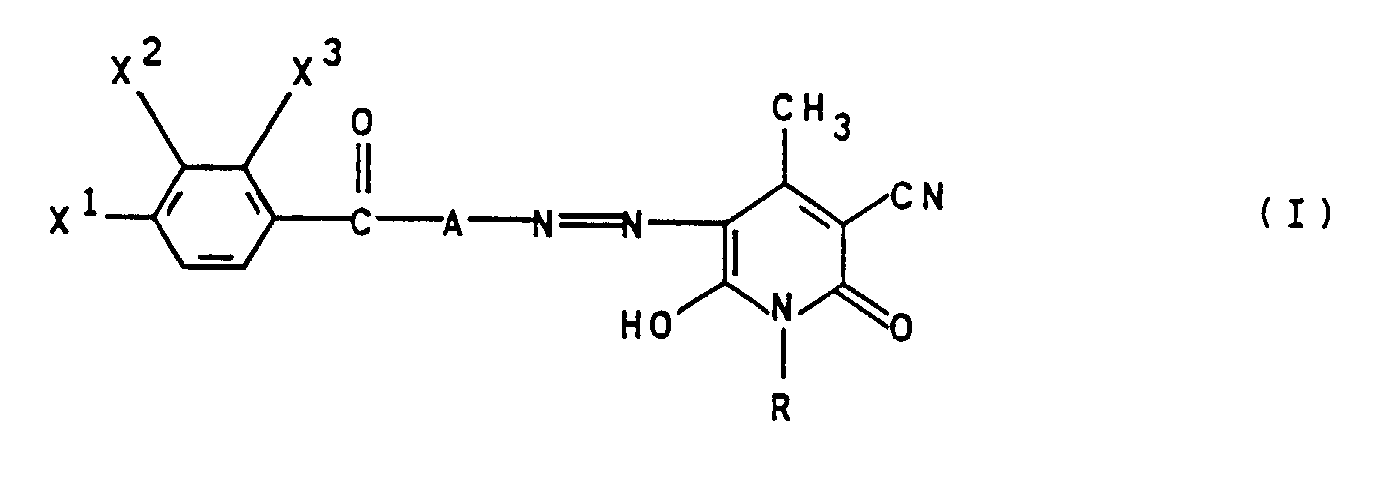 A 1,4-Phenylen oder 1,3-Phenylen;R lineares (C1-C6)-Alkyl oder (C1-C4)-Alkoxy-(C2-C4)-alkyl;X1 Wasserstoff oder (C1-C4)-Alkyl; undX2 und X3 unabhängig voneinander Wasserstoff oder Methyl bedeuten.
 - Verfahren gemäß Anspruch 1, dadurch geknnzeichnet, daß A für 1,4-Phenylen steht.
- Verfahren gemäß Anspruch 1 und/oder 2, dadurch gekennzeichnet, daß R Ethyl, n-Propyl oder n-Butyl bedeuten.
- Verfahren gemäß einem oder mehreren der Ansprüche 1 bis 3, dadurch gekennzeichnet, daß X1 und einer der Reste X2 und X3 Methyl bedeuten.
- Verfahren bemäß einem oder mehreren der Ansprüche 1 bis 4, dadurch gekennzeichnet, daß X2 und X3 für Wasserstoff und X1 für Ethyl und insbesondere für i-Propyl steht.
- Verfahren gemäß einem oder mehreren der Ansprüche 1 bis 5, dadurch gekennzeichnet, daß es unter HT-Bedinungen in wäßriger Färbeflotte bei Temperaturen zwischen 120°C und 140°C in einem Färbeautoklaven ausgeführt wird.
- Verfahren gemäß einem oder mehreren der Ansprüche 1 bis 6, dadurch gekennzeichnet, daß es bei pH 9 bis pH 10 ausgeführt wird.
- Monoazofarbstoffe der allgemeinen Formel Iaworin
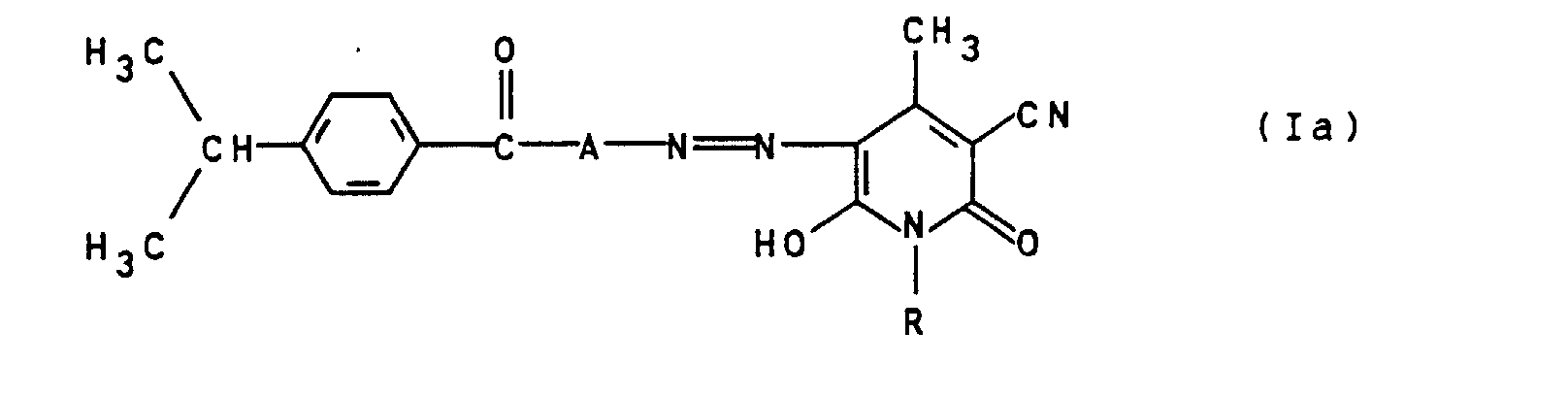 A 1,4-Phenylen oder 1,3-Phenylen undR Ethyl, n-Propyl oder n-Butyl bedeuten.
 - Verfahren zur Herstellung von Monoazofarbstoffen der allgemeinen Formel Ia gemäß Anspruch 8, dadurch gekennzeichnet, daß ein Amin der allgemeinen Formel IVworin A wie in Anspruch 8 angegeben definiert ist, in an sich bekannter Weise diazotiert und auf ein Hydroxypyridon der allgemeinen Formel V
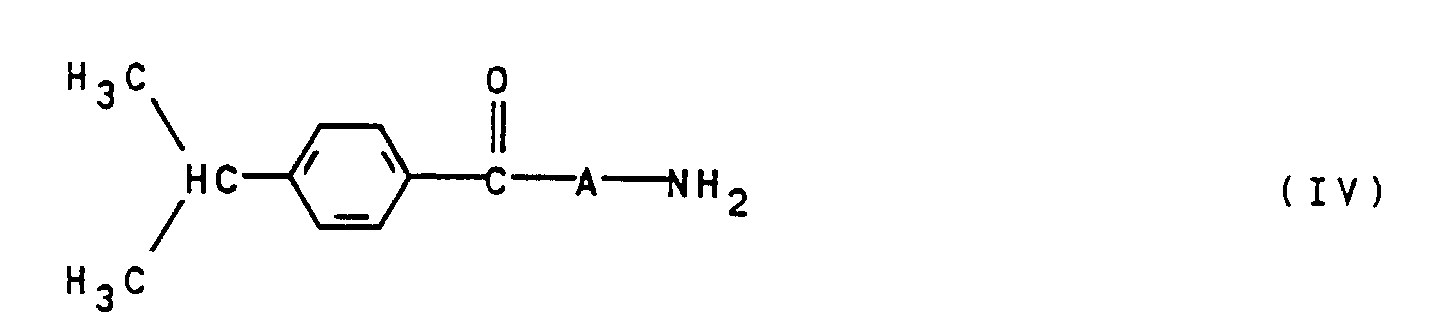 worin R wie in Anspruch 8 angegeben definiert ist, gekuppelt wird.
- Verwendung von Monoazofarbstoffen der allgemeinen Formel Ia gemäß Anspruch 8 zum Färben und Bedrucken von hydrophoben Textilmaterialen.
Applications Claiming Priority (2)
| Application Number | Priority Date | Filing Date | Title |
|---|---|---|---|
| DE4329026A DE4329026A1 (de) | 1993-08-28 | 1993-08-28 | Verfahren zum Färben von Polyester und polyesterhaltigen Textilmaterialien |
| DE4329026 | 1993-08-28 |
Publications (2)
| Publication Number | Publication Date |
|---|---|
| EP0640666A1 EP0640666A1 (de) | 1995-03-01 |
| EP0640666B1 true EP0640666B1 (de) | 1999-03-17 |
Family
ID=6496280
Family Applications (1)
| Application Number | Title | Priority Date | Filing Date |
|---|---|---|---|
| EP94112182A Expired - Lifetime EP0640666B1 (de) | 1993-08-28 | 1994-08-04 | Verfahren zum Färben von Polyester und polyesterhaltigen Textilmaterialien |
Country Status (5)
| Country | Link |
|---|---|
| US (1) | US5425785A (de) |
| EP (1) | EP0640666B1 (de) |
| JP (1) | JPH07145573A (de) |
| DE (2) | DE4329026A1 (de) |
| ES (1) | ES2130315T3 (de) |
Families Citing this family (1)
| Publication number | Priority date | Publication date | Assignee | Title |
|---|---|---|---|---|
| KR19980072440A (ko) * | 1997-03-05 | 1998-11-05 | 성재갑 | 폴리에스터 섬유용 모노아조 분산염료 |
Family Cites Families (5)
| Publication number | Priority date | Publication date | Assignee | Title |
|---|---|---|---|---|
| BE791584A (fr) * | 1971-11-18 | 1973-05-17 | Cassella Farbwerke Mainkur Ag | Teinture de manieres fibreuses synthetiques |
| DE3726301A1 (de) * | 1987-08-07 | 1989-02-16 | Cassella Ag | Pyridonfarbstoffe, verfahren zu ihrer herstellung und verwendung |
| US5019133A (en) * | 1988-11-25 | 1991-05-28 | Mitsubishi Kasei Corporation | Method for dyeing polyester-containing fibers in an alkaline dyeing bath and dyeing assistant, an amino-acid compound |
| DE3927069A1 (de) * | 1989-08-16 | 1991-02-21 | Basf Ag | Phenonazofarbstoffe und verfahren zum thermischen transfer dieser farbstoffe |
| DE4131845A1 (de) * | 1991-09-25 | 1993-06-17 | Basf Ag | Farbstoffzubereitungen, enthaltend benzophenon-azo-pyridon-farbstoffe |
-
1993
- 1993-08-28 DE DE4329026A patent/DE4329026A1/de not_active Withdrawn
-
1994
- 1994-08-04 EP EP94112182A patent/EP0640666B1/de not_active Expired - Lifetime
- 1994-08-04 ES ES94112182T patent/ES2130315T3/es not_active Expired - Lifetime
- 1994-08-04 DE DE59407944T patent/DE59407944D1/de not_active Expired - Fee Related
- 1994-08-17 US US08/291,864 patent/US5425785A/en not_active Expired - Fee Related
- 1994-08-25 JP JP6200730A patent/JPH07145573A/ja not_active Withdrawn
Also Published As
| Publication number | Publication date |
|---|---|
| JPH07145573A (ja) | 1995-06-06 |
| DE59407944D1 (de) | 1999-04-22 |
| DE4329026A1 (de) | 1995-03-02 |
| ES2130315T3 (es) | 1999-07-01 |
| EP0640666A1 (de) | 1995-03-01 |
| US5425785A (en) | 1995-06-20 |
Similar Documents
| Publication | Publication Date | Title |
|---|---|---|
| EP0945493A1 (de) | Dispersionsazofarbstoffmischungen | |
| EP0036512B1 (de) | Wasserunlösliche Azofarbstoffe, ihre Herstellung und Verwendung | |
| EP0499090B1 (de) | Verfahren zum Färben von Polyester und polyesterhaltigen Textilmaterialien | |
| EP0685531B1 (de) | Monoazofarbstoffe, ihre Herstellung und Verwendung | |
| EP0501238B1 (de) | Verfahren zum Färben von Polyester und polyesterhaltigen Textilmaterialien | |
| EP0640666B1 (de) | Verfahren zum Färben von Polyester und polyesterhaltigen Textilmaterialien | |
| EP0336163B1 (de) | Mischungen von Monoazofarbstoffen | |
| EP0152005B1 (de) | Mischungen von Monoazofarbstoffen | |
| EP0811041B1 (de) | Verfahren zum färben von polyester und polyesterhaltigen textilmaterialien | |
| EP0643107B1 (de) | Verfahren zum Färben von Polyester und polyesterhaltigen Textilmaterialien | |
| EP0391121A1 (de) | Monoazofarbstoffe, ihre Herstellung und Verwendung | |
| EP0641837A1 (de) | Verfahren zum Färben von Polyester und polyesterhaltigen Textilmaterialien | |
| EP0185207B1 (de) | Farbstoffmischungen, Verfahren zu ihrer Herstellung und Verfahren zum Färben und Bedrucken von hydrophoben Fasermaterialien | |
| EP0546366B1 (de) | Monoazofarbstoffe und diese enthaltende Mischungen | |
| EP0540936B1 (de) | Verfahren zum Färben von Polyester und polyesterhaltigen Textilmaterialien | |
| EP0719888A2 (de) | Verfahren zum Färben von Polyester und polyesterhaltigen Textilmaterialien | |
| EP0439057B1 (de) | Monoazofarbstoffe, ihre Herstellung und Verwendung | |
| DE3800708A1 (de) | Wasserunloesliche monoazofarbstoffe, ihre herstellung und verwendung | |
| EP0372334B1 (de) | Wasserunlösliche Monoazofarbstoffe, Mischungen dieser Monoazofarbstoffe, ihre Herstellung und Verwendung | |
| DE3133099A1 (de) | Farbstoffzubereitung und verfahren zum faerben und bedrucken von hochmolekularen polyestern und polyamiden | |
| DE4329761A1 (de) | Verfahren zum Färben von Polyester und polyesterhaltigen Textilmaterialien | |
| DE4001670A1 (de) | Monoazofarbstoffe, ihre herstellung und verwendung | |
| DE4020117A1 (de) | Monoazofarbstoff, seine herstellung und verwendung | |
| DE3901839A1 (de) | Monoazofarbstoffe, ihre herstellung und verwendung | |
| EP0439038A1 (de) | Monoazofarbstoffe, ihre Herstellung und Verwendung |
Legal Events
| Date | Code | Title | Description |
|---|---|---|---|
| PUAI | Public reference made under article 153(3) epc to a published international application that has entered the european phase |
Free format text: ORIGINAL CODE: 0009012 |
|
| AK | Designated contracting states |
Kind code of ref document: A1 Designated state(s): DE ES FR GB IT |
|
| 17P | Request for examination filed |
Effective date: 19950901 |
|
| RAP1 | Party data changed (applicant data changed or rights of an application transferred) |
Owner name: DYSTAR JAPAN LTD. |
|
| RAP1 | Party data changed (applicant data changed or rights of an application transferred) |
Owner name: DYSTAR TEXTILFARBEN GMBH & CO. DEUTSCHLAND KG |
|
| GRAG | Despatch of communication of intention to grant |
Free format text: ORIGINAL CODE: EPIDOS AGRA |
|
| GRAG | Despatch of communication of intention to grant |
Free format text: ORIGINAL CODE: EPIDOS AGRA |
|
| GRAH | Despatch of communication of intention to grant a patent |
Free format text: ORIGINAL CODE: EPIDOS IGRA |
|
| 17Q | First examination report despatched |
Effective date: 19980827 |
|
| GRAH | Despatch of communication of intention to grant a patent |
Free format text: ORIGINAL CODE: EPIDOS IGRA |
|
| GRAA | (expected) grant |
Free format text: ORIGINAL CODE: 0009210 |
|
| AK | Designated contracting states |
Kind code of ref document: B1 Designated state(s): DE ES FR GB IT |
|
| ET | Fr: translation filed | ||
| REF | Corresponds to: |
Ref document number: 59407944 Country of ref document: DE Date of ref document: 19990422 |
|
| ITF | It: translation for a ep patent filed | ||
| GBT | Gb: translation of ep patent filed (gb section 77(6)(a)/1977) |
Effective date: 19990415 |
|
| REG | Reference to a national code |
Ref country code: ES Ref legal event code: FG2A Ref document number: 2130315 Country of ref document: ES Kind code of ref document: T3 |
|
| PLBE | No opposition filed within time limit |
Free format text: ORIGINAL CODE: 0009261 |
|
| STAA | Information on the status of an ep patent application or granted ep patent |
Free format text: STATUS: NO OPPOSITION FILED WITHIN TIME LIMIT |
|
| 26N | No opposition filed | ||
| PGFP | Annual fee paid to national office [announced via postgrant information from national office to epo] |
Ref country code: DE Payment date: 20010706 Year of fee payment: 8 |
|
| PGFP | Annual fee paid to national office [announced via postgrant information from national office to epo] |
Ref country code: GB Payment date: 20010719 Year of fee payment: 8 Ref country code: FR Payment date: 20010719 Year of fee payment: 8 |
|
| PGFP | Annual fee paid to national office [announced via postgrant information from national office to epo] |
Ref country code: ES Payment date: 20010816 Year of fee payment: 8 |
|
| REG | Reference to a national code |
Ref country code: GB Ref legal event code: IF02 |
|
| PG25 | Lapsed in a contracting state [announced via postgrant information from national office to epo] |
Ref country code: GB Free format text: LAPSE BECAUSE OF NON-PAYMENT OF DUE FEES Effective date: 20020804 |
|
| PG25 | Lapsed in a contracting state [announced via postgrant information from national office to epo] |
Ref country code: ES Free format text: LAPSE BECAUSE OF NON-PAYMENT OF DUE FEES Effective date: 20020805 |
|
| PG25 | Lapsed in a contracting state [announced via postgrant information from national office to epo] |
Ref country code: DE Free format text: LAPSE BECAUSE OF NON-PAYMENT OF DUE FEES Effective date: 20030301 |
|
| GBPC | Gb: european patent ceased through non-payment of renewal fee |
Effective date: 20020804 |
|
| PG25 | Lapsed in a contracting state [announced via postgrant information from national office to epo] |
Ref country code: FR Free format text: LAPSE BECAUSE OF NON-PAYMENT OF DUE FEES Effective date: 20030430 |
|
| REG | Reference to a national code |
Ref country code: FR Ref legal event code: ST |
|
| REG | Reference to a national code |
Ref country code: ES Ref legal event code: FD2A Effective date: 20030912 |
|
| PG25 | Lapsed in a contracting state [announced via postgrant information from national office to epo] |
Ref country code: IT Free format text: LAPSE BECAUSE OF NON-PAYMENT OF DUE FEES Effective date: 20050804 |