EP0635578B1 - Procédé de raffinage d'un sucre brut, notamment de sucre roux provenant de l'industrie sucrière de la canne à sucre - Google Patents
Procédé de raffinage d'un sucre brut, notamment de sucre roux provenant de l'industrie sucrière de la canne à sucre Download PDFInfo
- Publication number
- EP0635578B1 EP0635578B1 EP94401635A EP94401635A EP0635578B1 EP 0635578 B1 EP0635578 B1 EP 0635578B1 EP 94401635 A EP94401635 A EP 94401635A EP 94401635 A EP94401635 A EP 94401635A EP 0635578 B1 EP0635578 B1 EP 0635578B1
- Authority
- EP
- European Patent Office
- Prior art keywords
- sugar
- syrup
- raw sugar
- phosphatation
- process according
- Prior art date
- Legal status (The legal status is an assumption and is not a legal conclusion. Google has not performed a legal analysis and makes no representation as to the accuracy of the status listed.)
- Expired - Lifetime
Links
- 238000000034 method Methods 0.000 title claims abstract description 25
- 235000000346 sugar Nutrition 0.000 title claims abstract description 25
- 238000007670 refining Methods 0.000 title claims abstract description 14
- CZMRCDWAGMRECN-UGDNZRGBSA-N Sucrose Chemical compound O[C@H]1[C@H](O)[C@@H](CO)O[C@@]1(CO)O[C@@H]1[C@H](O)[C@@H](O)[C@H](O)[C@@H](CO)O1 CZMRCDWAGMRECN-UGDNZRGBSA-N 0.000 title claims abstract description 7
- 229930006000 Sucrose Natural products 0.000 title claims abstract description 4
- 229960004793 sucrose Drugs 0.000 title claims abstract 3
- 235000020374 simple syrup Nutrition 0.000 claims abstract description 19
- 238000002425 crystallisation Methods 0.000 claims abstract description 15
- 238000001471 micro-filtration Methods 0.000 claims abstract description 10
- 238000000108 ultra-filtration Methods 0.000 claims abstract description 10
- 238000005115 demineralization Methods 0.000 claims abstract description 7
- 238000004042 decolorization Methods 0.000 claims abstract 2
- NBIIXXVUZAFLBC-UHFFFAOYSA-N Phosphoric acid Chemical compound OP(O)(O)=O NBIIXXVUZAFLBC-UHFFFAOYSA-N 0.000 claims description 17
- 230000008025 crystallization Effects 0.000 claims description 14
- 239000008394 flocculating agent Substances 0.000 claims description 13
- 238000005189 flocculation Methods 0.000 claims description 12
- 230000016615 flocculation Effects 0.000 claims description 12
- 239000000292 calcium oxide Substances 0.000 claims description 9
- ODINCKMPIJJUCX-UHFFFAOYSA-N calcium oxide Inorganic materials [Ca]=O ODINCKMPIJJUCX-UHFFFAOYSA-N 0.000 claims description 9
- 229910000147 aluminium phosphate Inorganic materials 0.000 claims description 8
- 235000008733 Citrus aurantifolia Nutrition 0.000 claims description 6
- 235000011941 Tilia x europaea Nutrition 0.000 claims description 6
- 230000002328 demineralizing effect Effects 0.000 claims description 6
- 239000004571 lime Substances 0.000 claims description 6
- 235000013336 milk Nutrition 0.000 claims description 6
- 239000008267 milk Substances 0.000 claims description 6
- 210000004080 milk Anatomy 0.000 claims description 6
- BRPQOXSCLDDYGP-UHFFFAOYSA-N calcium oxide Chemical compound [O-2].[Ca+2] BRPQOXSCLDDYGP-UHFFFAOYSA-N 0.000 claims description 5
- 235000007201 Saccharum officinarum Nutrition 0.000 claims description 4
- 240000000111 Saccharum officinarum Species 0.000 claims description 4
- 229920002101 Chitin Polymers 0.000 claims description 2
- 229920001661 Chitosan Polymers 0.000 claims description 2
- OVRNDRQMDRJTHS-FMDGEEDCSA-N N-acetyl-beta-D-glucosamine Chemical compound CC(=O)N[C@H]1[C@H](O)O[C@H](CO)[C@@H](O)[C@@H]1O OVRNDRQMDRJTHS-FMDGEEDCSA-N 0.000 claims description 2
- 235000014113 dietary fatty acids Nutrition 0.000 claims description 2
- 239000000194 fatty acid Substances 0.000 claims description 2
- 229930195729 fatty acid Natural products 0.000 claims description 2
- 150000004665 fatty acids Chemical class 0.000 claims description 2
- 229950006780 n-acetylglucosamine Drugs 0.000 claims description 2
- 239000003760 tallow Substances 0.000 claims description 2
- 150000003856 quaternary ammonium compounds Chemical class 0.000 claims 1
- 235000020357 syrup Nutrition 0.000 description 25
- 239000006188 syrup Substances 0.000 description 25
- 239000000047 product Substances 0.000 description 7
- 239000011347 resin Substances 0.000 description 7
- 229920005989 resin Polymers 0.000 description 7
- 239000000975 dye Substances 0.000 description 6
- 239000012528 membrane Substances 0.000 description 6
- 238000004061 bleaching Methods 0.000 description 4
- 239000000920 calcium hydroxide Substances 0.000 description 4
- 235000011116 calcium hydroxide Nutrition 0.000 description 4
- 235000021551 crystal sugar Nutrition 0.000 description 4
- 238000002845 discoloration Methods 0.000 description 4
- CURLTUGMZLYLDI-UHFFFAOYSA-N Carbon dioxide Chemical compound O=C=O CURLTUGMZLYLDI-UHFFFAOYSA-N 0.000 description 3
- 125000000129 anionic group Chemical group 0.000 description 3
- 238000004040 coloring Methods 0.000 description 3
- 238000010438 heat treatment Methods 0.000 description 3
- 239000007787 solid Substances 0.000 description 3
- XLYOFNOQVPJJNP-UHFFFAOYSA-N water Substances O XLYOFNOQVPJJNP-UHFFFAOYSA-N 0.000 description 3
- OKTJSMMVPCPJKN-UHFFFAOYSA-N Carbon Chemical compound [C] OKTJSMMVPCPJKN-UHFFFAOYSA-N 0.000 description 2
- 239000002253 acid Substances 0.000 description 2
- 239000012736 aqueous medium Substances 0.000 description 2
- 125000002091 cationic group Chemical group 0.000 description 2
- 239000000919 ceramic Substances 0.000 description 2
- 239000003795 chemical substances by application Substances 0.000 description 2
- 238000000605 extraction Methods 0.000 description 2
- 239000007788 liquid Substances 0.000 description 2
- 235000013379 molasses Nutrition 0.000 description 2
- 239000012466 permeate Substances 0.000 description 2
- 238000000746 purification Methods 0.000 description 2
- 238000003756 stirring Methods 0.000 description 2
- WECIKJKLCDCIMY-UHFFFAOYSA-N 2-chloro-n-(2-cyanoethyl)acetamide Chemical compound ClCC(=O)NCCC#N WECIKJKLCDCIMY-UHFFFAOYSA-N 0.000 description 1
- OYPRJOBELJOOCE-UHFFFAOYSA-N Calcium Chemical compound [Ca] OYPRJOBELJOOCE-UHFFFAOYSA-N 0.000 description 1
- VEXZGXHMUGYJMC-UHFFFAOYSA-N Hydrochloric acid Chemical group Cl VEXZGXHMUGYJMC-UHFFFAOYSA-N 0.000 description 1
- 229910019142 PO4 Inorganic materials 0.000 description 1
- 229920001222 biopolymer Polymers 0.000 description 1
- 229910052791 calcium Inorganic materials 0.000 description 1
- 239000011575 calcium Substances 0.000 description 1
- 229910052799 carbon Inorganic materials 0.000 description 1
- 239000001569 carbon dioxide Substances 0.000 description 1
- 229910002092 carbon dioxide Inorganic materials 0.000 description 1
- 239000003093 cationic surfactant Substances 0.000 description 1
- 210000004534 cecum Anatomy 0.000 description 1
- 238000006243 chemical reaction Methods 0.000 description 1
- 239000003153 chemical reaction reagent Substances 0.000 description 1
- 235000009508 confectionery Nutrition 0.000 description 1
- 238000010908 decantation Methods 0.000 description 1
- OGQYPPBGSLZBEG-UHFFFAOYSA-N dimethyl(dioctadecyl)azanium Chemical compound CCCCCCCCCCCCCCCCCC[N+](C)(C)CCCCCCCCCCCCCCCCCC OGQYPPBGSLZBEG-UHFFFAOYSA-N 0.000 description 1
- 238000007599 discharging Methods 0.000 description 1
- 238000004090 dissolution Methods 0.000 description 1
- 230000000694 effects Effects 0.000 description 1
- 238000001914 filtration Methods 0.000 description 1
- 239000012530 fluid Substances 0.000 description 1
- 239000007789 gas Substances 0.000 description 1
- 238000009434 installation Methods 0.000 description 1
- 239000000463 material Substances 0.000 description 1
- 239000002609 medium Substances 0.000 description 1
- 238000002844 melting Methods 0.000 description 1
- 230000008018 melting Effects 0.000 description 1
- 238000002156 mixing Methods 0.000 description 1
- 239000000203 mixture Substances 0.000 description 1
- 238000006386 neutralization reaction Methods 0.000 description 1
- 229920000620 organic polymer Polymers 0.000 description 1
- RVTZCBVAJQQJTK-UHFFFAOYSA-N oxygen(2-);zirconium(4+) Chemical compound [O-2].[O-2].[Zr+4] RVTZCBVAJQQJTK-UHFFFAOYSA-N 0.000 description 1
- 235000011837 pasties Nutrition 0.000 description 1
- NBIIXXVUZAFLBC-UHFFFAOYSA-K phosphate Chemical compound [O-]P([O-])([O-])=O NBIIXXVUZAFLBC-UHFFFAOYSA-K 0.000 description 1
- 239000010452 phosphate Substances 0.000 description 1
- 230000001376 precipitating effect Effects 0.000 description 1
- 238000001556 precipitation Methods 0.000 description 1
- 238000005086 pumping Methods 0.000 description 1
- 238000007873 sieving Methods 0.000 description 1
- 238000010186 staining Methods 0.000 description 1
- 239000005720 sucrose Substances 0.000 description 1
- 239000000725 suspension Substances 0.000 description 1
- 238000005406 washing Methods 0.000 description 1
- 229910001928 zirconium oxide Inorganic materials 0.000 description 1
Images
Classifications
-
- C—CHEMISTRY; METALLURGY
- C13—SUGAR INDUSTRY
- C13B—PRODUCTION OF SUCROSE; APPARATUS SPECIALLY ADAPTED THEREFOR
- C13B30/00—Crystallisation; Crystallising apparatus; Separating crystals from mother liquors ; Evaporating or boiling sugar juice
- C13B30/04—Separating crystals from mother liquor
- C13B30/14—Dissolving or refining raw sugar
-
- C—CHEMISTRY; METALLURGY
- C13—SUGAR INDUSTRY
- C13B—PRODUCTION OF SUCROSE; APPARATUS SPECIALLY ADAPTED THEREFOR
- C13B20/00—Purification of sugar juices
- C13B20/12—Purification of sugar juices using adsorption agents, e.g. active carbon
- C13B20/126—Organic agents, e.g. polyelectrolytes
-
- C—CHEMISTRY; METALLURGY
- C13—SUGAR INDUSTRY
- C13B—PRODUCTION OF SUCROSE; APPARATUS SPECIALLY ADAPTED THEREFOR
- C13B20/00—Purification of sugar juices
- C13B20/16—Purification of sugar juices by physical means, e.g. osmosis or filtration
- C13B20/165—Purification of sugar juices by physical means, e.g. osmosis or filtration using membranes, e.g. osmosis, ultrafiltration
Definitions
- the present invention relates to a process for refining a raw sugar, in particular brown sugar from the sugar cane industry.
- Known processes of this type include firstly a refining of the sugar raw which usually consists of washing the latter with the sewer of the last crystallization of high products, which dissolves the surface film of the most loaded with dyes. This gives a refined sugar and a refining sewer containing generally around 80-85% by weight of dry matter essentially consisting of sugar. This sewer is then subjected to several crystallizations in the bottom chain products to obtain brown sugar (which will be melted with refined sugar) and molasses. Taking into account that the concentrated refining sewer has a high content in dyes, the crystallization operations require very crystallization times and therefore make the crystallization systems unavailable for a long time. significant duration for other operations.
- refined sugar As for refined sugar (high products), it is subjected to an additional purification including operations of recasting, carbonation (treatment with calcium oxide or milk of lime and gas carbonic acid) or phosphating (treatment with calcium oxide or milk from lime and phosphoric acid), front filtration or decantation, discoloration and crystallization.
- this process is free from any preliminary operation tedious and expensive refining of raw sugar, which is made possible in any way completely unexpected, according to the invention, by the implementation of the technique of tangential microfiltration and / or tangential ultrafiltration, a well known technique, simple, flexible, high yield, fast, well controlled and with an operating cost much lower than that of the above-mentioned refining operation.
- the present invention overcomes a tedious and expensive operation by setting in a simple operation that consumes little time and energy.
- the method according to the invention can also comprise an operation flocculation using a flocculating agent, which can be carried out simultaneously with operation (b) or before or after this operation (b), the implementation of such a flocculation operation making it possible to very significantly reduce the quantities of reagents (calcium oxide or lime milk, carbon dioxide and acid phosphoric) to be used in the carbonation or phosphating operation.
- a flocculating agent which can be carried out simultaneously with operation (b) or before or after this operation (b)
- the implementation of such a flocculation operation making it possible to very significantly reduce the quantities of reagents (calcium oxide or lime milk, carbon dioxide and acid phosphoric) to be used in the carbonation or phosphating operation.
- the method comprises a flocculation operation and a phosphating operation, in which case calcium oxide (or milk of lime), phosphoric acid and the flocculating agent are put used in the phosphating and flocculation operations respectively at a rate of 200 to 900 ppm (expressed as CaO), 200-900 ppm (expressed as pure H 3 PO 4 ) and 200-900 ppm (expressed as active product) relative to the dry matter of raw sugar syrup.
- calcium oxide or milk of lime
- phosphoric acid and the flocculating agent are put used in the phosphating and flocculation operations respectively at a rate of 200 to 900 ppm (expressed as CaO), 200-900 ppm (expressed as pure H 3 PO 4 ) and 200-900 ppm (expressed as active product) relative to the dry matter of raw sugar syrup.
- the flocculating agent used in the flocculation operation can in particular be constituted by a cationic surfactant, in particular a compound quaternary ammonium tallow fatty acids, such as dioctadecyldimethylammonium, such as NORAMIUM® M2SH marketed by the French company CECA. They may also be derivatives of chitosan deacetylated poly-N-acetylglucosamine derived from chitin such as PROFLOC® SD 340 from the Norwegian company PROTAN BIOPOLYMER.
- the refining process according to the invention will be completed by an operation (d) for bleaching the sugar syrup resulting from microfiltration and / or ultrafiltration, and by an operation (e) of crystallization and / or demineralization of the sugar syrup resulting from the bleaching operation to obtain crystal sugar white in the case of crystallization and liquid sugar (syrup) in the case of demineralization.
- the raw sugar to be refined is brown sugar from a sugar cane candy, this brown sugar with a dry matter content (essentially sucrose) of the order of 97 to 99% by weight.
- aqueous medium such as a solution sweetened aqueous or preferably water.
- the aqueous medium is at a temperature sufficient for the recasting operation to be carried out at a temperature of the order of 50 to 90 ° C, preferably around 80 ° C.
- the redesign leads to a brown sugar syrup, the amount of medium aqueous use is preferably chosen so that said syrup has a content in dry matter of the order of 40 to 70% by weight.
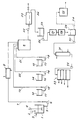
- This redesign operation is carried out in a tank 1 provided at its upper part with an inlet 2 of brown sugar and a hot water supply 3. To obtain a homogeneous syrup, this tank is in additionally provided with stirring means 4.
- the brown sugar syrup resulting from this redesign operation which has usually a coloration of 2500-4500 ICUMSA units (international units) and a disorder of 3000-4000 ICUMSA units, is then subjected to an operation of phosphating in conjunction with a flocculation operation.
- the syrup is extracted at the base of the tank 1 by a conduit 5 connected to the suction of a pump circulation 6 whose delivery is extended by a conduit 7 leading to the part upper of a phosphating / flocculation tank 8.
- the syrup is reheated, for example by indirect heat exchange in a heat exchanger 9 disposed on the path of the syrup between the reservoir 1 and the reservoir 8. This exchanger is chosen to bring, if necessary, the syrup to a sufficient temperature so that within the tank 8 reigns a temperature of the order of 70 ° C.
- a flocculating agent is then introduced. Specifically, this the latter is brought to the upper part of the reservoir 8, from an agent reservoir 10 flocculant, comprising at its base an extraction duct 11 connected to the suction of a circulation pump 12 whose delivery is connected to a conduit 13 terminating to the reservoir 8.
- the reservoir 10 can be provided with heating means (not shown) such as an internal jacket in which a hot fluid circulates, for example water hot or steam, these heating means allowing, in the case where the flocculating agent is solid or pasty at room temperature, to bring it in the form liquid for pumping by pump 12.
- this agent flocculant consists of NORAMIUM® M2SH whose melting point is around of 60 ° C
- the heating means are designed to bring the latter to a temperature of the order of 60-65 ° C.
- the quantity of flocculating agent used is from 200 to 900 ppm of active product relative to the dry matter of the syrup Brown sugar ; for example in the case of NORAMIUM® M2SH this quantity will be preferably of the order of 500 ppm of active product relative to the dry matter of the syrup.
- lime milk is introduced into the reservoir 8 (at a concentration 200 g / l expressed as CaO) in an amount of the order of 300 ppm expressed as CaO relative to the dry matter of the syrup, then phosphoric acid (for example a 90% solution) until neutralization, approximately 250 ppm expressed as acid pure phosphoric and compared to the dry matter of the syrup.
- phosphoric acid for example a 90% solution
- the introduction of milk lime and phosphoric acid in tank 8 is carried out in the same way as for the flocculating agent, that is to say respectively from a reservoir 14 of milk lime and a reservoir 15 of phosphoric acid, via extraction pipes 16, 17, of circulation pumps 18, 19 and conduits 20, 21 connected to said pumps and leading to the reservoir 8.
- the reservoir 8 and provided with stirring means to achieve a violent mixing of its contents.
- the flocculating agent could, alternatively, be introduced into the tank 8 at the same time or after the milk of lime and phosphoric acid, however preference is given to the procedure described above. Under the effect of the flocculating agent, there is precipitation of part of the dyes and suspended solids. Much of the dyes and solids remaining suspension is removed by the phosphating operation, the phosphate of calcium formed by the reaction between milk of lime and precipitating phosphoric acid with occlusion of said dyes and suspended matter.
- the syrup having undergone the flocculation / phosphating is withdrawn from this reservoir 8 by a pump 22 discharging into a unit 23 of tangential microfiltration or tangential ultrafiltration. If necessary, the syrup thus withdrawn can be reheated so that the operation in this unit 23 takes place at approximately 80 ° C.
- the membrane used in unit 23 may have a cut-off threshold of 10 nm to 1 ⁇ m (preferably of the order of 0.1 ⁇ m), the syrup circulating with a tangential speed of the order of 1 to 8 m / s (preferably 4 to 6 m / s) and the permeate flow rate being of the order of 20 to 80 liters / hour.m 2 of membrane (preferably 35-50 liters / hour.m 2 of membrane).
- a membrane use can be made of organic polymer or ceramic membranes. Good results have been obtained with a zirconium oxide membrane on a ceramic support, manufactured by the French company TECH-SEP.
- the permeate from unit 23 (coloring of the order of 1000-2000 ICUMSA units and cloudiness less than 20 ICUMSA units) is routed through a conduit 24 in a storage tank 25, from which it is drawn off by a pump 26 to be brought at the head of a two-stage discoloration column 27, 28.
- These columns are packed dyestuff adsorbing material such as animal black, activated carbon or preferably a bleaching resin; it can be a strong anionic resin under chloride form (for example, IRA® 900 resin from Rohm and Haas).
- the operation of discoloration in this column is preferably carried out at 70-90 ° C, in particular at 80 ° C.
- the discolored syrup (coloring ⁇ 400 ICUMSA units) is brought into a tank 29.
- This discolored syrup can then be transformed into either crystal sugar or demineralized syrup.
- the syrup is brought by a pump 30 into an evaporator 31, for example a falling-stream evaporator, then the concentrated syrup is brought by a pump 32 into a crystallization unit 33 where it undergoes several successive crystallizations (three in the example illustrated in the figure) to deliver crystal sugar and a crystallization drain.
- the discolored syrup is brought, by a pump 34, from the reservoir 29 into a demineralization unit 35 which can for example consist of a column packed with a mixture of cationic resins in H + form and anionic in form OH - .
- This column in a mixed bed of resins can be replaced by two columns filled one with cationic resin in H + form and the other with anionic resin in OH - form. After the demineralization treatment, a syrup with a coloration ⁇ 20 ICUMSA units is obtained.
Landscapes
- Chemical & Material Sciences (AREA)
- Life Sciences & Earth Sciences (AREA)
- Biochemistry (AREA)
- Organic Chemistry (AREA)
- Crystallography & Structural Chemistry (AREA)
- Electrochemistry (AREA)
- Engineering & Computer Science (AREA)
- Water Supply & Treatment (AREA)
- Jellies, Jams, And Syrups (AREA)
- Confectionery (AREA)
- Crystals, And After-Treatments Of Crystals (AREA)
- Seasonings (AREA)
- Polysaccharides And Polysaccharide Derivatives (AREA)
- Saccharide Compounds (AREA)
- Separation Using Semi-Permeable Membranes (AREA)
- Disintegrating Or Milling (AREA)
- Preparation Of Compounds By Using Micro-Organisms (AREA)
Description
Claims (7)
- Procédé de raffinage d'un sucre brut, notamment de sucre roux provenant de l'industrie sucrière de la canne à sucre, qui se caractérise en ce qu'il comprend les opérations :(a) de refonte du sucre brut pour obtenir un sirop de sucre brut,(b) de carbonatation ou de phosphatation dudit sirop de sucre brut, et(c) de microfiltration tangentielle et/ou d'ultrafiltration tangentielle du sirop de sucre brut ayant subi la carbonatation ou la phosphatation.
- Procédé selon la revendication 1, caractérisé en ce qu'il comprend en outre une opération de floculation faisant appel à un agent floculant, celle-ci étant effectuée simultanément à l'opération (b) ou avant ou après cette opération (b).
- Procédé selon la revendication 2, caractérisé en ce que l'agent floculant est un composé d'ammonium quaternaire d'acides gras de suif.
- Procédé selon la revendication 2, caractérisé en ce que l'agent floculant est un poly-N-acétylglucosamine désacétylé dérivé de la chitine.
- Procédé selon l'une quelconque des revendications 2 à 4 dans lequel l'opération (b) est une phosphatation, caractérisé en ce que l'oxyde de calcium ou le lait de chaux, l'acide phosphorique et l'agent floculant sont mis en oeuvre dans les opérations de phosphatation et de floculation respectivement à raison de 200 à 900 ppm (exprimés en CaO), 200 à 900 ppm (exprimés en H3PO4 pur) et 200 à 900 ppm (exprimés en produit actif) par rapport à la matière sèche du sirop de sucre brut.
- Procédé selon l'une quelconque des revendications précédentes, caractérisé en ce que les opérations de carbonatation ou de phosphatation, de floculation et de microfiltration tangentielle et/ou d'ultrafiltration tangentielle sont mises en oeuvre à une température de 70 à 95° C.
- Procédé selon l'une quelconque des revendications précédentes, caractérisé en ce qu'il comprend en outre des opérations :(d) de décoloration du sirop de sucre résultant de l'opération (c), et(e) de cristallisation et/ou de déminéralisation du sirop de sucre résultant de l'opération (d).
Applications Claiming Priority (2)
| Application Number | Priority Date | Filing Date | Title |
|---|---|---|---|
| FR9308826A FR2707997B1 (fr) | 1993-07-19 | 1993-07-19 | Procédé de raffinage d'un sucre brut, notamment de sucre roux provenant de l'industrie sucrière de la canne à sucre. |
| FR9308826 | 1993-07-19 |
Publications (2)
| Publication Number | Publication Date |
|---|---|
| EP0635578A1 EP0635578A1 (fr) | 1995-01-25 |
| EP0635578B1 true EP0635578B1 (fr) | 1999-11-03 |
Family
ID=9449354
Family Applications (1)
| Application Number | Title | Priority Date | Filing Date |
|---|---|---|---|
| EP94401635A Expired - Lifetime EP0635578B1 (fr) | 1993-07-19 | 1994-07-13 | Procédé de raffinage d'un sucre brut, notamment de sucre roux provenant de l'industrie sucrière de la canne à sucre |
Country Status (10)
| Country | Link |
|---|---|
| US (1) | US5865899A (fr) |
| EP (1) | EP0635578B1 (fr) |
| AT (1) | ATE186331T1 (fr) |
| AU (1) | AU674755B2 (fr) |
| BR (1) | BR9402810A (fr) |
| CA (1) | CA2128366C (fr) |
| CO (1) | CO4370780A1 (fr) |
| DE (1) | DE69421458D1 (fr) |
| FR (1) | FR2707997B1 (fr) |
| ZA (1) | ZA945133B (fr) |
Families Citing this family (30)
| Publication number | Priority date | Publication date | Assignee | Title |
|---|---|---|---|---|
| US5554227A (en) * | 1993-11-12 | 1996-09-10 | Societe Nouvelle De Recherches Et D'applications Industrielles D'echangeurs D'ions Applexion | Process of manufacturing crystal sugar from an aqueous sugar juice such as cane juice or sugar beet juice |
| US5468300A (en) * | 1994-04-07 | 1995-11-21 | International Food Processing Incorporated | Process for producing refined sugar directly from sugarcane |
| AU688197B2 (en) * | 1995-02-16 | 1998-03-05 | Csr Limited | Process for refining raw sugar |
| AUPN118095A0 (en) * | 1995-02-16 | 1995-03-09 | Csr Limited | Improved process for the refining of sugar |
| US6096136A (en) | 1996-10-18 | 2000-08-01 | Board Of Supervisors Of Louisiana State University And Agricultural And Mechanical College | Method for producing white sugar |
| US5759283A (en) * | 1996-05-14 | 1998-06-02 | The Western Sugar Company | Method for processing sugar beets to produce a purified beet juice product |
| US6037456A (en) * | 1998-03-10 | 2000-03-14 | Biosource Technologies, Inc. | Process for isolating and purifying viruses, soluble proteins and peptides from plant sources |
| AU781362B2 (en) * | 1999-04-07 | 2005-05-19 | Ufion (Proprietary) Limited | Treatment of sugar juice |
| US6375751B2 (en) * | 1999-08-19 | 2002-04-23 | Tate & Lyle, Inc. | Process for production of purified cane juice for sugar manufacture |
| US6174378B1 (en) * | 1999-08-19 | 2001-01-16 | Tate Life Industries, Limited | Process for production of extra low color cane sugar |
| US6387186B1 (en) * | 1999-08-19 | 2002-05-14 | Tate & Lyle, Inc. | Process for production of purified beet juice for sugar manufacture |
| US6485574B1 (en) * | 2000-06-23 | 2002-11-26 | Chung-Chi Chou | Process for pretreating colored aqueous sugar solutions to produce a low colored crystallized sugar |
| US6656287B2 (en) | 2002-04-15 | 2003-12-02 | Co2 Solutions, Llc | System to produce sugar from plant materials |
| FR2838751B1 (fr) * | 2002-04-17 | 2007-03-09 | Applexion Ste Nouvelle De Rech | Procede et installation de fabrication de sucre raffine a partir de jus sucre |
| FR2907687B1 (fr) * | 2006-10-30 | 2008-12-26 | Applexion | Procede de purification de sialyllactose par chromatographie |
| FR2925349A1 (fr) * | 2007-12-20 | 2009-06-26 | Applexion | Procede de separation sequence multicolonnes d'un derive metallique ionique |
| US9055752B2 (en) * | 2008-11-06 | 2015-06-16 | Intercontinental Great Brands Llc | Shelf-stable concentrated dairy liquids and methods of forming thereof |
| US8486473B2 (en) | 2009-11-11 | 2013-07-16 | Carbo-UA Limited | Compositions and processes for improving phosphatation clarification of sugar liquors and syrups |
| US9175358B2 (en) | 2009-11-11 | 2015-11-03 | Carbo-UA Limited | Compositions and processes for sugar treatment |
| US8486474B2 (en) * | 2009-11-11 | 2013-07-16 | Carbo-UA Limited | Compositions and processes for improving carbonatation clarification of sugar liquors and syrups |
| US9605324B2 (en) | 2009-12-23 | 2017-03-28 | Carbo-UA Limited | Compositions and processes for clarification of sugar juices and syrups in sugar mills |
| UA112972C2 (uk) | 2010-09-08 | 2016-11-25 | Інтерконтінентал Грейт Брендс ЛЛС | Рідкий молочний концентрат з високим вмістом сухих речовин |
| US9080221B2 (en) * | 2011-12-02 | 2015-07-14 | Amalgamated Research Llc | System and process for refining sugar |
| CN103757143A (zh) * | 2014-01-10 | 2014-04-30 | 河南工业大学 | 一种糖汁澄清方法 |
| EP2944701B1 (fr) | 2014-05-16 | 2017-03-29 | Sociedade Portuguesa do Ar Líquido | Procédé pour la carbonatation |
| WO2018029500A1 (fr) | 2016-08-08 | 2018-02-15 | Rhodia Poliamida E Especialidades S.A. | Nouveaux constituants pour clarifier le jus de canne à sucre dans un procédé de production de sucre cristallisé ou brut |
| CN108929391A (zh) * | 2018-07-24 | 2018-12-04 | 北京美亚斯磷脂技术有限公司 | 一种菊糖提取液的纯化方法 |
| CN109628649A (zh) * | 2018-12-21 | 2019-04-16 | 广东省生物工程研究所(广州甘蔗糖业研究所) | 一种糖汁高质量清净方法 |
| ES2779058B2 (es) * | 2019-02-13 | 2021-04-12 | Seppelec S L | Procedimiento para obtener jarabe de azúcar refinado a partir de azúcar crudo para su aplicación en plantas embotelladoras de bebidas azucaradas no alcohólicas y jarabe así obtenido |
| GB202310865D0 (en) | 2023-07-14 | 2023-08-30 | Sudeco International Ltd | Chemical-free processes and methods of neutralisation, clarification, purification and decolourisation for sugar manufacturing and correlated effluents |
Family Cites Families (9)
| Publication number | Priority date | Publication date | Assignee | Title |
|---|---|---|---|---|
| US2047218A (en) * | 1934-06-21 | 1936-07-14 | Du Pont | Compositions comprising deacetylated chitin |
| US3166442A (en) * | 1963-05-23 | 1965-01-19 | Minerals & Chem Philipp Corp | Method for treating sugar liquor |
| US3563799A (en) * | 1967-10-02 | 1971-02-16 | Industrial Filter Pump Mfg Co | Purified liquid sugar concentrate and method of manufacturing same |
| GB1350261A (en) * | 1970-10-16 | 1974-04-18 | Hitachi Shipbuilding Eng Co | Sugar refining process |
| GB1361674A (en) * | 1971-04-23 | 1974-07-30 | Danske Sukkerfab | Process for the purification and clarification of sugar juices |
| US3799806A (en) * | 1972-04-20 | 1974-03-26 | Danske Sukkerfab | Process for the purification and clarification of sugar juices,involving ultrafiltration |
| SE441932B (sv) * | 1981-01-14 | 1985-11-18 | Danske Sukkerfab | Forfarande for rening av sockersaft framstelld genom extraktion av sockerbetssnitsel |
| AU624560B1 (en) * | 1990-11-13 | 1992-06-11 | Csr Limited | Sugar refining process |
| JPH04249000A (ja) * | 1991-01-30 | 1992-09-04 | Nansei Togyo Kk | 廃糖蜜の清浄法 |
-
1993
- 1993-07-19 FR FR9308826A patent/FR2707997B1/fr not_active Expired - Lifetime
-
1994
- 1994-07-13 AT AT94401635T patent/ATE186331T1/de not_active IP Right Cessation
- 1994-07-13 DE DE69421458T patent/DE69421458D1/de not_active Expired - Lifetime
- 1994-07-13 EP EP94401635A patent/EP0635578B1/fr not_active Expired - Lifetime
- 1994-07-14 BR BR9402810A patent/BR9402810A/pt not_active Application Discontinuation
- 1994-07-14 ZA ZA945133A patent/ZA945133B/xx unknown
- 1994-07-18 AU AU67551/94A patent/AU674755B2/en not_active Ceased
- 1994-07-19 CA CA002128366A patent/CA2128366C/fr not_active Expired - Fee Related
- 1994-07-19 CO CO94031678A patent/CO4370780A1/es unknown
-
1996
- 1996-05-29 US US08/654,811 patent/US5865899A/en not_active Expired - Lifetime
Non-Patent Citations (1)
| Title |
|---|
| HUI: "Encyclopedia of food science and technology", 1 January 1992, JOHN WILEY & SONS, INC., NEW YORK, CHICHESTER, BRISBANE, TORONTO, SINGAPORE, 1. ED. * |
Also Published As
| Publication number | Publication date |
|---|---|
| AU674755B2 (en) | 1997-01-09 |
| EP0635578A1 (fr) | 1995-01-25 |
| DE69421458D1 (de) | 1999-12-09 |
| ATE186331T1 (de) | 1999-11-15 |
| CA2128366C (fr) | 2005-12-06 |
| US5865899A (en) | 1999-02-02 |
| AU6755194A (en) | 1995-01-27 |
| CO4370780A1 (es) | 1996-10-07 |
| ZA945133B (en) | 1995-03-16 |
| FR2707997B1 (fr) | 1995-09-29 |
| FR2707997A1 (fr) | 1995-01-27 |
| CA2128366A1 (fr) | 1995-01-20 |
| BR9402810A (pt) | 1995-04-04 |
Similar Documents
| Publication | Publication Date | Title |
|---|---|---|
| EP0635578A1 (fr) | Procédé de raffinage d'un sucre brut, notamment de sucre roux provenant de l'industrie sucrière de la canne à sucre | |
| EP0655507B1 (fr) | Procédé de fabrication de sucre cristallisé, à partir de jus sucré aqueux tel qu'un jus de canne à sucre ou de betterave sucrière | |
| FR2512832A1 (fr) | Procede et installation pour l'obtention de carburant liquide a base d'ethanol par hydrolyse acide continue de matieres cellulosiques | |
| US4614662A (en) | Fast cook-continuous process for production of ammonia caramel color | |
| KR20050026418A (ko) | 당의 결정화 | |
| EA039199B1 (ru) | Способ превращения твердого продукта, содержащего гемицеллюлозу, целлюлозу и лигнин | |
| EP3155095B1 (fr) | Procede de fabrication d'une solution aqueuse stable de bêta-amylase, solution aqueuse obtenue et ses utilisations | |
| CN217323995U (zh) | 一种鳐鱼鱼肝油提取制备装置 | |
| FR2838751A1 (fr) | Procede et installation de fabrication de sucre raffine a partir de jus sucre | |
| FR2668775A1 (fr) | Procede continu permettant la preparation et la separation de glucose et de fructose a partir de saccharose. | |
| JPH11500005A (ja) | 粗糖の精製プロセス | |
| RU2255980C2 (ru) | Способ производства сахара | |
| EP0092466B1 (fr) | Procédé d'extraction du jus de betteraves | |
| EP0582510B1 (fr) | Procédé de préparation d'une solution purifiée d'inuline à partir du jus de chicorée | |
| US281188A (en) | Henby a | |
| FR2604728A1 (fr) | Procede de saccharification de materiaux ligneux-cellulosiques et installation pour la mise en oeuvre du procede | |
| EP0832986A1 (fr) | Procédé de régénération de résines échangeuses d'ions dans le processus de décalcification des jus de sucrerie | |
| BE1021481B1 (fr) | Procede de purification d'une solution aqueuse d'acide lactique au depart de sous-produits a haute teneur en hydrates de carbone | |
| WO2025017289A1 (fr) | Processus et procédés de neutralisation, clarification, purification et décoloration sans produit chimique pour la fabrication de sucre et effluents associés | |
| Bento | Decolorization in Cane Sugar Refineries and in Beet Sugar Factories Adapted to Process Raw Cane Sugar | |
| US309776A (en) | Process of making sugar | |
| CN101068938A (zh) | 精制糖的生产方法 | |
| US1609133A (en) | Process of clarifying sugar solutions | |
| BE432477A (fr) | ||
| BE351391A (fr) |
Legal Events
| Date | Code | Title | Description |
|---|---|---|---|
| PUAI | Public reference made under article 153(3) epc to a published international application that has entered the european phase |
Free format text: ORIGINAL CODE: 0009012 |
|
| AK | Designated contracting states |
Kind code of ref document: A1 Designated state(s): AT BE CH DE DK ES GB GR IE IT LI LU MC NL PT SE |
|
| 17P | Request for examination filed |
Effective date: 19950710 |
|
| 17Q | First examination report despatched |
Effective date: 19980320 |
|
| GRAG | Despatch of communication of intention to grant |
Free format text: ORIGINAL CODE: EPIDOS AGRA |
|
| GRAG | Despatch of communication of intention to grant |
Free format text: ORIGINAL CODE: EPIDOS AGRA |
|
| GRAH | Despatch of communication of intention to grant a patent |
Free format text: ORIGINAL CODE: EPIDOS IGRA |
|
| GRAH | Despatch of communication of intention to grant a patent |
Free format text: ORIGINAL CODE: EPIDOS IGRA |
|
| GRAA | (expected) grant |
Free format text: ORIGINAL CODE: 0009210 |
|
| AK | Designated contracting states |
Kind code of ref document: B1 Designated state(s): AT BE CH DE DK ES GB GR IE IT LI LU MC NL PT SE |
|
| PG25 | Lapsed in a contracting state [announced via postgrant information from national office to epo] |
Ref country code: SE Free format text: THE PATENT HAS BEEN ANNULLED BY A DECISION OF A NATIONAL AUTHORITY Effective date: 19991103 Ref country code: NL Free format text: LAPSE BECAUSE OF FAILURE TO SUBMIT A TRANSLATION OF THE DESCRIPTION OR TO PAY THE FEE WITHIN THE PRESCRIBED TIME-LIMIT Effective date: 19991103 Ref country code: IT Free format text: LAPSE BECAUSE OF FAILURE TO SUBMIT A TRANSLATION OF THE DESCRIPTION OR TO PAY THE FEE WITHIN THE PRE;WARNING: LAPSES OF ITALIAN PATENTS WITH EFFECTIVE DATE BEFORE 2007 MAY HAVE OCCURRED AT ANY TIME BEFORE 2007. THE CORRECT EFFECTIVE DATE MAY BE DIFFERENT FROM THE ONE RECORDED.SCRIBED TIME-LIMIT Effective date: 19991103 Ref country code: GR Free format text: LAPSE BECAUSE OF NON-PAYMENT OF DUE FEES Effective date: 19991103 Ref country code: ES Free format text: THE PATENT HAS BEEN ANNULLED BY A DECISION OF A NATIONAL AUTHORITY Effective date: 19991103 Ref country code: AT Free format text: LAPSE BECAUSE OF FAILURE TO SUBMIT A TRANSLATION OF THE DESCRIPTION OR TO PAY THE FEE WITHIN THE PRESCRIBED TIME-LIMIT Effective date: 19991103 |
|
| REF | Corresponds to: |
Ref document number: 186331 Country of ref document: AT Date of ref document: 19991115 Kind code of ref document: T |
|
| REG | Reference to a national code |
Ref country code: CH Ref legal event code: EP |
|
| REF | Corresponds to: |
Ref document number: 69421458 Country of ref document: DE Date of ref document: 19991209 |
|
| GBT | Gb: translation of ep patent filed (gb section 77(6)(a)/1977) |
Effective date: 19991119 |
|
| REG | Reference to a national code |
Ref country code: IE Ref legal event code: FG4D Free format text: FRENCH |
|
| PG25 | Lapsed in a contracting state [announced via postgrant information from national office to epo] |
Ref country code: DK Free format text: LAPSE BECAUSE OF FAILURE TO SUBMIT A TRANSLATION OF THE DESCRIPTION OR TO PAY THE FEE WITHIN THE PRESCRIBED TIME-LIMIT Effective date: 20000203 |
|
| PG25 | Lapsed in a contracting state [announced via postgrant information from national office to epo] |
Ref country code: DE Free format text: LAPSE BECAUSE OF FAILURE TO SUBMIT A TRANSLATION OF THE DESCRIPTION OR TO PAY THE FEE WITHIN THE PRESCRIBED TIME-LIMIT Effective date: 20000204 |
|
| REG | Reference to a national code |
Ref country code: PT Ref legal event code: SC4A Free format text: AVAILABILITY OF NATIONAL TRANSLATION Effective date: 19991130 |
|
| NLV1 | Nl: lapsed or annulled due to failure to fulfill the requirements of art. 29p and 29m of the patents act | ||
| PG25 | Lapsed in a contracting state [announced via postgrant information from national office to epo] |
Ref country code: LU Free format text: LAPSE BECAUSE OF NON-PAYMENT OF DUE FEES Effective date: 20000713 |
|
| PG25 | Lapsed in a contracting state [announced via postgrant information from national office to epo] |
Ref country code: IE Free format text: LAPSE BECAUSE OF NON-PAYMENT OF DUE FEES Effective date: 20000719 |
|
| PG25 | Lapsed in a contracting state [announced via postgrant information from national office to epo] |
Ref country code: MC Free format text: THE PATENT HAS BEEN ANNULLED BY A DECISION OF A NATIONAL AUTHORITY Effective date: 20000731 Ref country code: LI Free format text: LAPSE BECAUSE OF NON-PAYMENT OF DUE FEES Effective date: 20000731 Ref country code: CH Free format text: LAPSE BECAUSE OF NON-PAYMENT OF DUE FEES Effective date: 20000731 Ref country code: BE Free format text: LAPSE BECAUSE OF NON-PAYMENT OF DUE FEES Effective date: 20000731 |
|
| REG | Reference to a national code |
Ref country code: IE Ref legal event code: FD4D |
|
| PLBE | No opposition filed within time limit |
Free format text: ORIGINAL CODE: 0009261 |
|
| STAA | Information on the status of an ep patent application or granted ep patent |
Free format text: STATUS: NO OPPOSITION FILED WITHIN TIME LIMIT |
|
| 26N | No opposition filed | ||
| BERE | Be: lapsed |
Owner name: APPLEXION Effective date: 20000731 |
|
| REG | Reference to a national code |
Ref country code: CH Ref legal event code: PL |
|
| REG | Reference to a national code |
Ref country code: GB Ref legal event code: IF02 |
|
| PGFP | Annual fee paid to national office [announced via postgrant information from national office to epo] |
Ref country code: PT Payment date: 20060621 Year of fee payment: 13 |
|
| REG | Reference to a national code |
Ref country code: PT Ref legal event code: MM4A Free format text: LAPSE DUE TO NON-PAYMENT OF FEES Effective date: 20080114 |
|
| PG25 | Lapsed in a contracting state [announced via postgrant information from national office to epo] |
Ref country code: PT Free format text: LAPSE BECAUSE OF NON-PAYMENT OF DUE FEES Effective date: 20080114 |
|
| PGFP | Annual fee paid to national office [announced via postgrant information from national office to epo] |
Ref country code: GB Payment date: 20130710 Year of fee payment: 20 |
|
| REG | Reference to a national code |
Ref country code: GB Ref legal event code: PE20 Expiry date: 20140712 |
|
| PG25 | Lapsed in a contracting state [announced via postgrant information from national office to epo] |
Ref country code: GB Free format text: LAPSE BECAUSE OF EXPIRATION OF PROTECTION Effective date: 20140712 |