EP0633939B1 - Nisines - Google Patents
Nisines Download PDFInfo
- Publication number
- EP0633939B1 EP0633939B1 EP93907964A EP93907964A EP0633939B1 EP 0633939 B1 EP0633939 B1 EP 0633939B1 EP 93907964 A EP93907964 A EP 93907964A EP 93907964 A EP93907964 A EP 93907964A EP 0633939 B1 EP0633939 B1 EP 0633939B1
- Authority
- EP
- European Patent Office
- Prior art keywords
- nisin
- nisa
- gene
- variant
- fragment
- Prior art date
- Legal status (The legal status is an assumption and is not a legal conclusion. Google has not performed a legal analysis and makes no representation as to the accuracy of the status listed.)
- Expired - Lifetime
Links
- 235000010297 nisin Nutrition 0.000 title claims abstract description 135
- 108010053775 Nisin Proteins 0.000 claims abstract description 132
- NVNLLIYOARQCIX-MSHCCFNRSA-N Nisin Chemical compound N1C(=O)[C@@H](CC(C)C)NC(=O)C(=C)NC(=O)[C@@H]([C@H](C)CC)NC(=O)[C@@H](NC(=O)C(=C/C)/NC(=O)[C@H](N)[C@H](C)CC)CSC[C@@H]1C(=O)N[C@@H]1C(=O)N2CCC[C@@H]2C(=O)NCC(=O)N[C@@H](C(=O)N[C@H](CCCCN)C(=O)N[C@@H]2C(NCC(=O)N[C@H](C)C(=O)N[C@H](CC(C)C)C(=O)N[C@H](CCSC)C(=O)NCC(=O)N[C@H](CS[C@@H]2C)C(=O)N[C@H](CC(N)=O)C(=O)N[C@H](CCSC)C(=O)N[C@H](CCCCN)C(=O)N[C@@H]2C(N[C@H](C)C(=O)N[C@@H]3C(=O)N[C@@H](C(N[C@H](CC=4NC=NC=4)C(=O)N[C@H](CS[C@@H]3C)C(=O)N[C@H](CO)C(=O)N[C@H]([C@H](C)CC)C(=O)N[C@H](CC=3NC=NC=3)C(=O)N[C@H](C(C)C)C(=O)NC(=C)C(=O)N[C@H](CCCCN)C(O)=O)=O)CS[C@@H]2C)=O)=O)CS[C@@H]1C NVNLLIYOARQCIX-MSHCCFNRSA-N 0.000 claims abstract description 126
- 239000004309 nisin Substances 0.000 claims abstract description 126
- IATSBFLNMNJNHI-XFCJPLPPSA-N prenisin Chemical compound N1C(=O)[C@@H](CC(C)C)NC(=O)C(=C)NC(=O)[C@@H]([C@H](C)CC)NC(=O)[C@@H](NC(=O)C(=C/C)/NC(=O)[C@H](N)[C@H](C)CC)CSC[C@@H]1C(=O)N[C@@H]1C(=O)N2CCC[C@@H]2C(=O)NCC(=O)N[C@@H](C(=O)N[C@H](CCCCN)C(=O)N[C@@H]2C(NCC(=O)N[C@H](C)C(=O)N[C@H](CC(C)C)C(=O)N[C@H](CCSC)C(=O)NCC(=O)N[C@H](CS[C@@H]2C)[C@H](CC(N)=O)C(=O)N[C@H](CCSC)C(=O)N[C@H](CCCCN)C(=O)N[C@@H]2C(N[C@H](C)C(=O)N[C@@H]3C(=O)N[C@@H](C(N[C@H](CC=4NC=NC=4)C(=O)N[C@H](CS[C@@H]3C)C(=O)N[C@H](CO)C(=O)N[C@H]([C@H](C)CC)C(=O)N[C@H](CC=3NC=NC=3)C(=O)N[C@H](C(C)C)C(=O)NC(=C)C(=O)N[C@H](CCCCN)C(O)=O)=O)CS[C@@H]2C)=O)=O)CS[C@@H]1C IATSBFLNMNJNHI-XFCJPLPPSA-N 0.000 claims abstract description 16
- UQBOJOOOTLPNST-UHFFFAOYSA-N Dehydroalanine Chemical compound NC(=C)C(O)=O UQBOJOOOTLPNST-UHFFFAOYSA-N 0.000 claims description 12
- ZDXPYRJPNDTMRX-VKHMYHEASA-N L-glutamine Chemical compound OC(=O)[C@@H](N)CCC(N)=O ZDXPYRJPNDTMRX-VKHMYHEASA-N 0.000 claims description 8
- HNDVDQJCIGZPNO-YFKPBYRVSA-N L-histidine Chemical compound OC(=O)[C@@H](N)CC1=CN=CN1 HNDVDQJCIGZPNO-YFKPBYRVSA-N 0.000 claims description 8
- 235000004279 alanine Nutrition 0.000 claims description 8
- ZDXPYRJPNDTMRX-UHFFFAOYSA-N glutamine Natural products OC(=O)C(N)CCC(N)=O ZDXPYRJPNDTMRX-UHFFFAOYSA-N 0.000 claims description 8
- HNDVDQJCIGZPNO-UHFFFAOYSA-N histidine Natural products OC(=O)C(N)CC1=CN=CN1 HNDVDQJCIGZPNO-UHFFFAOYSA-N 0.000 claims description 8
- DCXYFEDJOCDNAF-UHFFFAOYSA-N Asparagine Natural products OC(=O)C(N)CC(N)=O DCXYFEDJOCDNAF-UHFFFAOYSA-N 0.000 claims description 7
- QNAYBMKLOCPYGJ-REOHCLBHSA-N L-alanine Chemical compound C[C@H](N)C(O)=O QNAYBMKLOCPYGJ-REOHCLBHSA-N 0.000 claims description 7
- DCXYFEDJOCDNAF-REOHCLBHSA-N L-asparagine Chemical compound OC(=O)[C@@H](N)CC(N)=O DCXYFEDJOCDNAF-REOHCLBHSA-N 0.000 claims description 7
- 229960001230 asparagine Drugs 0.000 claims description 7
- 235000009582 asparagine Nutrition 0.000 claims description 7
- DHMQDGOQFOQNFH-UHFFFAOYSA-N Glycine Chemical compound NCC(O)=O DHMQDGOQFOQNFH-UHFFFAOYSA-N 0.000 claims description 6
- 125000003607 serino group Chemical group [H]N([H])[C@]([H])(C(=O)[*])C(O[H])([H])[H] 0.000 claims description 5
- 239000004475 Arginine Substances 0.000 claims description 4
- XUJNEKJLAYXESH-REOHCLBHSA-N L-Cysteine Chemical compound SC[C@H](N)C(O)=O XUJNEKJLAYXESH-REOHCLBHSA-N 0.000 claims description 4
- ODKSFYDXXFIFQN-BYPYZUCNSA-P L-argininium(2+) Chemical compound NC(=[NH2+])NCCC[C@H]([NH3+])C(O)=O ODKSFYDXXFIFQN-BYPYZUCNSA-P 0.000 claims description 4
- ODKSFYDXXFIFQN-UHFFFAOYSA-N arginine Natural products OC(=O)C(N)CCCNC(N)=N ODKSFYDXXFIFQN-UHFFFAOYSA-N 0.000 claims description 4
- XUJNEKJLAYXESH-UHFFFAOYSA-N cysteine Natural products SCC(N)C(O)=O XUJNEKJLAYXESH-UHFFFAOYSA-N 0.000 claims description 4
- 235000018417 cysteine Nutrition 0.000 claims description 4
- -1 methonine Chemical compound 0.000 claims description 4
- 239000004471 Glycine Substances 0.000 claims description 3
- CKLJMWTZIZZHCS-REOHCLBHSA-N L-aspartic acid Chemical compound OC(=O)[C@@H](N)CC(O)=O CKLJMWTZIZZHCS-REOHCLBHSA-N 0.000 claims description 3
- WHUUTDBJXJRKMK-VKHMYHEASA-N L-glutamic acid Chemical compound OC(=O)[C@@H](N)CCC(O)=O WHUUTDBJXJRKMK-VKHMYHEASA-N 0.000 claims description 3
- AGPKZVBTJJNPAG-WHFBIAKZSA-N L-isoleucine Chemical compound CC[C@H](C)[C@H](N)C(O)=O AGPKZVBTJJNPAG-WHFBIAKZSA-N 0.000 claims description 3
- KDXKERNSBIXSRK-YFKPBYRVSA-N L-lysine Chemical compound NCCCC[C@H](N)C(O)=O KDXKERNSBIXSRK-YFKPBYRVSA-N 0.000 claims description 3
- AYFVYJQAPQTCCC-GBXIJSLDSA-N L-threonine Chemical compound C[C@@H](O)[C@H](N)C(O)=O AYFVYJQAPQTCCC-GBXIJSLDSA-N 0.000 claims description 3
- OUYCCCASQSFEME-QMMMGPOBSA-N L-tyrosine Chemical compound OC(=O)[C@@H](N)CC1=CC=C(O)C=C1 OUYCCCASQSFEME-QMMMGPOBSA-N 0.000 claims description 3
- KDXKERNSBIXSRK-UHFFFAOYSA-N Lysine Natural products NCCCCC(N)C(O)=O KDXKERNSBIXSRK-UHFFFAOYSA-N 0.000 claims description 3
- 239000004472 Lysine Substances 0.000 claims description 3
- AYFVYJQAPQTCCC-UHFFFAOYSA-N Threonine Natural products CC(O)C(N)C(O)=O AYFVYJQAPQTCCC-UHFFFAOYSA-N 0.000 claims description 3
- 239000004473 Threonine Substances 0.000 claims description 3
- 239000004599 antimicrobial Substances 0.000 claims description 3
- 229960000310 isoleucine Drugs 0.000 claims description 3
- AGPKZVBTJJNPAG-UHFFFAOYSA-N isoleucine Natural products CCC(C)C(N)C(O)=O AGPKZVBTJJNPAG-UHFFFAOYSA-N 0.000 claims description 3
- OUYCCCASQSFEME-UHFFFAOYSA-N tyrosine Natural products OC(=O)C(N)CC1=CC=C(O)C=C1 OUYCCCASQSFEME-UHFFFAOYSA-N 0.000 claims description 3
- ONIBWKKTOPOVIA-BYPYZUCNSA-N L-Proline Chemical compound OC(=O)[C@@H]1CCCN1 ONIBWKKTOPOVIA-BYPYZUCNSA-N 0.000 claims description 2
- ROHFNLRQFUQHCH-YFKPBYRVSA-N L-leucine Chemical compound CC(C)C[C@H](N)C(O)=O ROHFNLRQFUQHCH-YFKPBYRVSA-N 0.000 claims description 2
- COLNVLDHVKWLRT-QMMMGPOBSA-N L-phenylalanine Chemical compound OC(=O)[C@@H](N)CC1=CC=CC=C1 COLNVLDHVKWLRT-QMMMGPOBSA-N 0.000 claims description 2
- QIVBCDIJIAJPQS-VIFPVBQESA-N L-tryptophane Chemical compound C1=CC=C2C(C[C@H](N)C(O)=O)=CNC2=C1 QIVBCDIJIAJPQS-VIFPVBQESA-N 0.000 claims description 2
- KZSNJWFQEVHDMF-BYPYZUCNSA-N L-valine Chemical compound CC(C)[C@H](N)C(O)=O KZSNJWFQEVHDMF-BYPYZUCNSA-N 0.000 claims description 2
- ROHFNLRQFUQHCH-UHFFFAOYSA-N Leucine Natural products CC(C)CC(N)C(O)=O ROHFNLRQFUQHCH-UHFFFAOYSA-N 0.000 claims description 2
- ONIBWKKTOPOVIA-UHFFFAOYSA-N Proline Natural products OC(=O)C1CCCN1 ONIBWKKTOPOVIA-UHFFFAOYSA-N 0.000 claims description 2
- QIVBCDIJIAJPQS-UHFFFAOYSA-N Tryptophan Natural products C1=CC=C2C(CC(N)C(O)=O)=CNC2=C1 QIVBCDIJIAJPQS-UHFFFAOYSA-N 0.000 claims description 2
- KZSNJWFQEVHDMF-UHFFFAOYSA-N Valine Natural products CC(C)C(N)C(O)=O KZSNJWFQEVHDMF-UHFFFAOYSA-N 0.000 claims description 2
- 125000003295 alanine group Chemical group N[C@@H](C)C(=O)* 0.000 claims description 2
- 229940009098 aspartate Drugs 0.000 claims description 2
- 229930195712 glutamate Natural products 0.000 claims description 2
- COLNVLDHVKWLRT-UHFFFAOYSA-N phenylalanine Natural products OC(=O)C(N)CC1=CC=CC=C1 COLNVLDHVKWLRT-UHFFFAOYSA-N 0.000 claims description 2
- 239000004474 valine Substances 0.000 claims description 2
- 101100510641 Lactococcus lactis subsp. lactis spaN gene Proteins 0.000 abstract description 136
- 108090000623 proteins and genes Proteins 0.000 abstract description 55
- 238000000034 method Methods 0.000 abstract description 32
- 230000036039 immunity Effects 0.000 abstract description 20
- 230000004048 modification Effects 0.000 abstract description 15
- 238000012986 modification Methods 0.000 abstract description 15
- 230000005945 translocation Effects 0.000 abstract description 10
- 108091026890 Coding region Proteins 0.000 abstract description 8
- 230000008569 process Effects 0.000 abstract description 4
- 230000001105 regulatory effect Effects 0.000 abstract description 3
- 230000003248 secreting effect Effects 0.000 abstract description 2
- 239000012634 fragment Substances 0.000 description 60
- 239000013615 primer Substances 0.000 description 45
- 239000013612 plasmid Substances 0.000 description 43
- 108020004414 DNA Proteins 0.000 description 36
- ULGZDMOVFRHVEP-RWJQBGPGSA-N Erythromycin Chemical compound O([C@@H]1[C@@H](C)C(=O)O[C@@H]([C@@]([C@H](O)[C@@H](C)C(=O)[C@H](C)C[C@@](C)(O)[C@H](O[C@H]2[C@@H]([C@H](C[C@@H](C)O2)N(C)C)O)[C@H]1C)(C)O)CC)[C@H]1C[C@@](C)(OC)[C@@H](O)[C@H](C)O1 ULGZDMOVFRHVEP-RWJQBGPGSA-N 0.000 description 36
- 238000003752 polymerase chain reaction Methods 0.000 description 27
- 235000001014 amino acid Nutrition 0.000 description 23
- 229940024606 amino acid Drugs 0.000 description 22
- 150000001413 amino acids Chemical class 0.000 description 21
- 230000035772 mutation Effects 0.000 description 20
- 229960003276 erythromycin Drugs 0.000 description 18
- 108020004705 Codon Proteins 0.000 description 16
- 230000000692 anti-sense effect Effects 0.000 description 16
- 108020004707 nucleic acids Proteins 0.000 description 16
- 102000039446 nucleic acids Human genes 0.000 description 16
- 150000007523 nucleic acids Chemical class 0.000 description 16
- 241000194035 Lactococcus lactis Species 0.000 description 12
- MTCFGRXMJLQNBG-UHFFFAOYSA-N Serine Natural products OCC(N)C(O)=O MTCFGRXMJLQNBG-UHFFFAOYSA-N 0.000 description 12
- 238000004519 manufacturing process Methods 0.000 description 12
- 229960001153 serine Drugs 0.000 description 12
- 239000013598 vector Substances 0.000 description 12
- 238000003780 insertion Methods 0.000 description 11
- 230000037431 insertion Effects 0.000 description 11
- 108090000765 processed proteins & peptides Proteins 0.000 description 11
- 101100325906 Bacillus subtilis (strain 168) ganA gene Proteins 0.000 description 10
- 101100111413 Thermoanaerobacter pseudethanolicus (strain ATCC 33223 / 39E) lacZ gene Proteins 0.000 description 10
- 101150086432 lacA gene Proteins 0.000 description 10
- 238000002741 site-directed mutagenesis Methods 0.000 description 10
- 238000010276 construction Methods 0.000 description 9
- 230000000694 effects Effects 0.000 description 9
- 210000004027 cell Anatomy 0.000 description 8
- 239000002773 nucleotide Substances 0.000 description 8
- 125000003729 nucleotide group Chemical group 0.000 description 8
- 210000004899 c-terminal region Anatomy 0.000 description 7
- 210000000349 chromosome Anatomy 0.000 description 7
- 229960002743 glutamine Drugs 0.000 description 7
- 229960002885 histidine Drugs 0.000 description 7
- 108010074461 nisin A Proteins 0.000 description 7
- 229960003767 alanine Drugs 0.000 description 6
- 239000013604 expression vector Substances 0.000 description 6
- 230000035800 maturation Effects 0.000 description 6
- 102200091900 rs76285851 Human genes 0.000 description 6
- 238000006467 substitution reaction Methods 0.000 description 6
- 241000894006 Bacteria Species 0.000 description 5
- 108091028043 Nucleic acid sequence Proteins 0.000 description 5
- 238000010222 PCR analysis Methods 0.000 description 5
- 235000014897 Streptococcus lactis Nutrition 0.000 description 5
- 125000003275 alpha amino acid group Chemical group 0.000 description 5
- 230000004071 biological effect Effects 0.000 description 5
- 230000002759 chromosomal effect Effects 0.000 description 5
- 238000012217 deletion Methods 0.000 description 5
- 230000037430 deletion Effects 0.000 description 5
- 230000001404 mediated effect Effects 0.000 description 5
- 102000004196 processed proteins & peptides Human genes 0.000 description 5
- 239000000047 product Substances 0.000 description 5
- 230000006798 recombination Effects 0.000 description 5
- 238000005215 recombination Methods 0.000 description 5
- 108091008146 restriction endonucleases Proteins 0.000 description 5
- 239000000523 sample Substances 0.000 description 5
- 230000009466 transformation Effects 0.000 description 5
- 229920001817 Agar Polymers 0.000 description 4
- 235000014469 Bacillus subtilis Nutrition 0.000 description 4
- 241000588724 Escherichia coli Species 0.000 description 4
- DTQVDTLACAAQTR-UHFFFAOYSA-N Trifluoroacetic acid Chemical compound OC(=O)C(F)(F)F DTQVDTLACAAQTR-UHFFFAOYSA-N 0.000 description 4
- 239000008272 agar Substances 0.000 description 4
- 230000003321 amplification Effects 0.000 description 4
- 238000004458 analytical method Methods 0.000 description 4
- 238000004166 bioassay Methods 0.000 description 4
- 230000015572 biosynthetic process Effects 0.000 description 4
- 229960005091 chloramphenicol Drugs 0.000 description 4
- 238000009792 diffusion process Methods 0.000 description 4
- 230000002779 inactivation Effects 0.000 description 4
- 230000010354 integration Effects 0.000 description 4
- JVTAAEKCZFNVCJ-UHFFFAOYSA-N lactic acid Chemical compound CC(O)C(O)=O JVTAAEKCZFNVCJ-UHFFFAOYSA-N 0.000 description 4
- 108700042622 nisin Z Proteins 0.000 description 4
- 238000003199 nucleic acid amplification method Methods 0.000 description 4
- 235000018102 proteins Nutrition 0.000 description 4
- 102000004169 proteins and genes Human genes 0.000 description 4
- 238000012546 transfer Methods 0.000 description 4
- RTZKZFJDLAIYFH-UHFFFAOYSA-N Diethyl ether Chemical compound CCOCC RTZKZFJDLAIYFH-UHFFFAOYSA-N 0.000 description 3
- 102000004190 Enzymes Human genes 0.000 description 3
- 108090000790 Enzymes Proteins 0.000 description 3
- 230000004075 alteration Effects 0.000 description 3
- 229960003121 arginine Drugs 0.000 description 3
- 230000003115 biocidal effect Effects 0.000 description 3
- 239000003795 chemical substances by application Substances 0.000 description 3
- WIIZWVCIJKGZOK-RKDXNWHRSA-N chloramphenicol Chemical compound ClC(Cl)C(=O)N[C@H](CO)[C@H](O)C1=CC=C([N+]([O-])=O)C=C1 WIIZWVCIJKGZOK-RKDXNWHRSA-N 0.000 description 3
- 238000003776 cleavage reaction Methods 0.000 description 3
- 230000021615 conjugation Effects 0.000 description 3
- 229960002433 cysteine Drugs 0.000 description 3
- 235000013305 food Nutrition 0.000 description 3
- 238000010348 incorporation Methods 0.000 description 3
- 101150063389 nisB gene Proteins 0.000 description 3
- 239000013600 plasmid vector Substances 0.000 description 3
- 239000002243 precursor Substances 0.000 description 3
- 230000007017 scission Effects 0.000 description 3
- 230000028327 secretion Effects 0.000 description 3
- 239000000126 substance Substances 0.000 description 3
- 239000006228 supernatant Substances 0.000 description 3
- 238000013519 translation Methods 0.000 description 3
- NSGOABPZARPCFM-VAYJURFESA-N (2s,3s)-2-amino-3-[(2r)-2-amino-2-carboxyethyl]sulfanylbutanoic acid Chemical group OC(=O)[C@H](N)[C@H](C)SC[C@H](N)C(O)=O NSGOABPZARPCFM-VAYJURFESA-N 0.000 description 2
- 108010062877 Bacteriocins Proteins 0.000 description 2
- 108010014303 DNA-directed DNA polymerase Proteins 0.000 description 2
- 102000016928 DNA-directed DNA polymerase Human genes 0.000 description 2
- DWPCPZJAHOETAG-IMJSIDKUSA-N L-lanthionine Chemical compound OC(=O)[C@@H](N)CSC[C@H](N)C(O)=O DWPCPZJAHOETAG-IMJSIDKUSA-N 0.000 description 2
- 240000002605 Lactobacillus helveticus Species 0.000 description 2
- 235000013967 Lactobacillus helveticus Nutrition 0.000 description 2
- 241000194041 Lactococcus lactis subsp. lactis Species 0.000 description 2
- 101100516689 Lactococcus lactis subsp. lactis nisB gene Proteins 0.000 description 2
- GUBGYTABKSRVRQ-QKKXKWKRSA-N Lactose Natural products OC[C@H]1O[C@@H](O[C@H]2[C@H](O)[C@@H](O)C(O)O[C@@H]2CO)[C@H](O)[C@@H](O)[C@H]1O GUBGYTABKSRVRQ-QKKXKWKRSA-N 0.000 description 2
- 108091034117 Oligonucleotide Proteins 0.000 description 2
- 238000012408 PCR amplification Methods 0.000 description 2
- ISWSIDIOOBJBQZ-UHFFFAOYSA-N Phenol Chemical compound OC1=CC=CC=C1 ISWSIDIOOBJBQZ-UHFFFAOYSA-N 0.000 description 2
- 238000002105 Southern blotting Methods 0.000 description 2
- 235000014969 Streptococcus diacetilactis Nutrition 0.000 description 2
- JLCPHMBAVCMARE-UHFFFAOYSA-N [3-[[3-[[3-[[3-[[3-[[3-[[3-[[3-[[3-[[3-[[3-[[5-(2-amino-6-oxo-1H-purin-9-yl)-3-[[3-[[3-[[3-[[3-[[3-[[5-(2-amino-6-oxo-1H-purin-9-yl)-3-[[5-(2-amino-6-oxo-1H-purin-9-yl)-3-hydroxyoxolan-2-yl]methoxy-hydroxyphosphoryl]oxyoxolan-2-yl]methoxy-hydroxyphosphoryl]oxy-5-(5-methyl-2,4-dioxopyrimidin-1-yl)oxolan-2-yl]methoxy-hydroxyphosphoryl]oxy-5-(6-aminopurin-9-yl)oxolan-2-yl]methoxy-hydroxyphosphoryl]oxy-5-(6-aminopurin-9-yl)oxolan-2-yl]methoxy-hydroxyphosphoryl]oxy-5-(6-aminopurin-9-yl)oxolan-2-yl]methoxy-hydroxyphosphoryl]oxy-5-(6-aminopurin-9-yl)oxolan-2-yl]methoxy-hydroxyphosphoryl]oxyoxolan-2-yl]methoxy-hydroxyphosphoryl]oxy-5-(5-methyl-2,4-dioxopyrimidin-1-yl)oxolan-2-yl]methoxy-hydroxyphosphoryl]oxy-5-(4-amino-2-oxopyrimidin-1-yl)oxolan-2-yl]methoxy-hydroxyphosphoryl]oxy-5-(5-methyl-2,4-dioxopyrimidin-1-yl)oxolan-2-yl]methoxy-hydroxyphosphoryl]oxy-5-(5-methyl-2,4-dioxopyrimidin-1-yl)oxolan-2-yl]methoxy-hydroxyphosphoryl]oxy-5-(6-aminopurin-9-yl)oxolan-2-yl]methoxy-hydroxyphosphoryl]oxy-5-(6-aminopurin-9-yl)oxolan-2-yl]methoxy-hydroxyphosphoryl]oxy-5-(4-amino-2-oxopyrimidin-1-yl)oxolan-2-yl]methoxy-hydroxyphosphoryl]oxy-5-(4-amino-2-oxopyrimidin-1-yl)oxolan-2-yl]methoxy-hydroxyphosphoryl]oxy-5-(4-amino-2-oxopyrimidin-1-yl)oxolan-2-yl]methoxy-hydroxyphosphoryl]oxy-5-(6-aminopurin-9-yl)oxolan-2-yl]methoxy-hydroxyphosphoryl]oxy-5-(4-amino-2-oxopyrimidin-1-yl)oxolan-2-yl]methyl [5-(6-aminopurin-9-yl)-2-(hydroxymethyl)oxolan-3-yl] hydrogen phosphate Polymers Cc1cn(C2CC(OP(O)(=O)OCC3OC(CC3OP(O)(=O)OCC3OC(CC3O)n3cnc4c3nc(N)[nH]c4=O)n3cnc4c3nc(N)[nH]c4=O)C(COP(O)(=O)OC3CC(OC3COP(O)(=O)OC3CC(OC3COP(O)(=O)OC3CC(OC3COP(O)(=O)OC3CC(OC3COP(O)(=O)OC3CC(OC3COP(O)(=O)OC3CC(OC3COP(O)(=O)OC3CC(OC3COP(O)(=O)OC3CC(OC3COP(O)(=O)OC3CC(OC3COP(O)(=O)OC3CC(OC3COP(O)(=O)OC3CC(OC3COP(O)(=O)OC3CC(OC3COP(O)(=O)OC3CC(OC3COP(O)(=O)OC3CC(OC3COP(O)(=O)OC3CC(OC3COP(O)(=O)OC3CC(OC3COP(O)(=O)OC3CC(OC3CO)n3cnc4c(N)ncnc34)n3ccc(N)nc3=O)n3cnc4c(N)ncnc34)n3ccc(N)nc3=O)n3ccc(N)nc3=O)n3ccc(N)nc3=O)n3cnc4c(N)ncnc34)n3cnc4c(N)ncnc34)n3cc(C)c(=O)[nH]c3=O)n3cc(C)c(=O)[nH]c3=O)n3ccc(N)nc3=O)n3cc(C)c(=O)[nH]c3=O)n3cnc4c3nc(N)[nH]c4=O)n3cnc4c(N)ncnc34)n3cnc4c(N)ncnc34)n3cnc4c(N)ncnc34)n3cnc4c(N)ncnc34)O2)c(=O)[nH]c1=O JLCPHMBAVCMARE-UHFFFAOYSA-N 0.000 description 2
- 239000011543 agarose gel Substances 0.000 description 2
- RDOXTESZEPMUJZ-UHFFFAOYSA-N anisole Chemical compound COC1=CC=CC=C1 RDOXTESZEPMUJZ-UHFFFAOYSA-N 0.000 description 2
- 230000000845 anti-microbial effect Effects 0.000 description 2
- 238000003556 assay Methods 0.000 description 2
- 230000008859 change Effects 0.000 description 2
- 239000013611 chromosomal DNA Substances 0.000 description 2
- 230000008711 chromosomal rearrangement Effects 0.000 description 2
- 238000010367 cloning Methods 0.000 description 2
- 230000000295 complement effect Effects 0.000 description 2
- 230000008878 coupling Effects 0.000 description 2
- 238000005859 coupling reaction Methods 0.000 description 2
- 230000002950 deficient Effects 0.000 description 2
- 238000004520 electroporation Methods 0.000 description 2
- 238000005516 engineering process Methods 0.000 description 2
- 238000012215 gene cloning Methods 0.000 description 2
- 229960002449 glycine Drugs 0.000 description 2
- 238000009396 hybridization Methods 0.000 description 2
- 230000002401 inhibitory effect Effects 0.000 description 2
- 238000011835 investigation Methods 0.000 description 2
- 238000002955 isolation Methods 0.000 description 2
- 101150043267 lacR gene Proteins 0.000 description 2
- 239000004310 lactic acid Substances 0.000 description 2
- 235000014655 lactic acid Nutrition 0.000 description 2
- 229940054346 lactobacillus helveticus Drugs 0.000 description 2
- 239000008101 lactose Substances 0.000 description 2
- 229960003646 lysine Drugs 0.000 description 2
- 239000003550 marker Substances 0.000 description 2
- DWPCPZJAHOETAG-UHFFFAOYSA-N meso-lanthionine Natural products OC(=O)C(N)CSCC(N)C(O)=O DWPCPZJAHOETAG-UHFFFAOYSA-N 0.000 description 2
- 239000000203 mixture Substances 0.000 description 2
- 239000000178 monomer Substances 0.000 description 2
- 210000004898 n-terminal fragment Anatomy 0.000 description 2
- 238000010647 peptide synthesis reaction Methods 0.000 description 2
- 239000003910 polypeptide antibiotic agent Substances 0.000 description 2
- 230000004481 post-translational protein modification Effects 0.000 description 2
- 125000006239 protecting group Chemical group 0.000 description 2
- 238000000746 purification Methods 0.000 description 2
- 238000002708 random mutagenesis Methods 0.000 description 2
- 238000011084 recovery Methods 0.000 description 2
- 239000011347 resin Substances 0.000 description 2
- 229920005989 resin Polymers 0.000 description 2
- 238000004007 reversed phase HPLC Methods 0.000 description 2
- 239000007790 solid phase Substances 0.000 description 2
- 238000003786 synthesis reaction Methods 0.000 description 2
- 229960002898 threonine Drugs 0.000 description 2
- 238000010361 transduction Methods 0.000 description 2
- 230000026683 transduction Effects 0.000 description 2
- 229960004441 tyrosine Drugs 0.000 description 2
- 238000011144 upstream manufacturing Methods 0.000 description 2
- MTCFGRXMJLQNBG-REOHCLBHSA-N (2S)-2-Amino-3-hydroxypropansäure Chemical compound OC[C@H](N)C(O)=O MTCFGRXMJLQNBG-REOHCLBHSA-N 0.000 description 1
- NSGOABPZARPCFM-UHFFFAOYSA-N (2S,3S,2'R)-beta-Methyllanthionine Natural products OC(=O)C(N)C(C)SCC(N)C(O)=O NSGOABPZARPCFM-UHFFFAOYSA-N 0.000 description 1
- YUXKOWPNKJSTPQ-AXWWPMSFSA-N (2s,3r)-2-amino-3-hydroxybutanoic acid;(2s)-2-amino-3-hydroxypropanoic acid Chemical compound OC[C@H](N)C(O)=O.C[C@@H](O)[C@H](N)C(O)=O YUXKOWPNKJSTPQ-AXWWPMSFSA-N 0.000 description 1
- PAWSVPVNIXFKOS-IHWYPQMZSA-N (Z)-2-aminobutenoic acid Chemical compound C\C=C(/N)C(O)=O PAWSVPVNIXFKOS-IHWYPQMZSA-N 0.000 description 1
- DHBXNPKRAUYBTH-UHFFFAOYSA-N 1,1-ethanedithiol Chemical compound CC(S)S DHBXNPKRAUYBTH-UHFFFAOYSA-N 0.000 description 1
- ASOKPJOREAFHNY-UHFFFAOYSA-N 1-Hydroxybenzotriazole Chemical compound C1=CC=C2N(O)N=NC2=C1 ASOKPJOREAFHNY-UHFFFAOYSA-N 0.000 description 1
- DURPTKYDGMDSBL-UHFFFAOYSA-N 1-butoxybutane Chemical class CCCCOCCCC DURPTKYDGMDSBL-UHFFFAOYSA-N 0.000 description 1
- VUCNQOPCYRJCGQ-UHFFFAOYSA-N 2-[4-(hydroxymethyl)phenoxy]acetic acid Chemical class OCC1=CC=C(OCC(O)=O)C=C1 VUCNQOPCYRJCGQ-UHFFFAOYSA-N 0.000 description 1
- KKAJSJJFBSOMGS-UHFFFAOYSA-N 3,6-diamino-10-methylacridinium chloride Chemical compound [Cl-].C1=C(N)C=C2[N+](C)=C(C=C(N)C=C3)C3=CC2=C1 KKAJSJJFBSOMGS-UHFFFAOYSA-N 0.000 description 1
- WHNPOQXWAMXPTA-UHFFFAOYSA-N 3-methylbut-2-enamide Chemical compound CC(C)=CC(N)=O WHNPOQXWAMXPTA-UHFFFAOYSA-N 0.000 description 1
- 241000193830 Bacillus <bacterium> Species 0.000 description 1
- 244000063299 Bacillus subtilis Species 0.000 description 1
- 101100174784 Bacillus subtilis (strain 168) ganR gene Proteins 0.000 description 1
- 125000001433 C-terminal amino-acid group Chemical group 0.000 description 1
- 108091036055 CccDNA Proteins 0.000 description 1
- 206010061765 Chromosomal mutation Diseases 0.000 description 1
- 241001112696 Clostridia Species 0.000 description 1
- 239000004971 Cross linker Substances 0.000 description 1
- 102000053602 DNA Human genes 0.000 description 1
- 239000003155 DNA primer Substances 0.000 description 1
- QOSSAOTZNIDXMA-UHFFFAOYSA-N Dicylcohexylcarbodiimide Chemical compound C1CCCCC1N=C=NC1CCCCC1 QOSSAOTZNIDXMA-UHFFFAOYSA-N 0.000 description 1
- GDSYPXWUHMRTHT-UHFFFAOYSA-N Epidermin Natural products N#CCC(C)(C)OC1OC(CO)C(O)C(O)C1O GDSYPXWUHMRTHT-UHFFFAOYSA-N 0.000 description 1
- 230000005526 G1 to G0 transition Effects 0.000 description 1
- WQZGKKKJIJFFOK-GASJEMHNSA-N Glucose Natural products OC[C@H]1OC(O)[C@H](O)[C@@H](O)[C@@H]1O WQZGKKKJIJFFOK-GASJEMHNSA-N 0.000 description 1
- WHUUTDBJXJRKMK-UHFFFAOYSA-N Glutamic acid Natural products OC(=O)C(N)CCC(O)=O WHUUTDBJXJRKMK-UHFFFAOYSA-N 0.000 description 1
- AVXURJPOCDRRFD-UHFFFAOYSA-N Hydroxylamine Chemical compound ON AVXURJPOCDRRFD-UHFFFAOYSA-N 0.000 description 1
- 102100034343 Integrase Human genes 0.000 description 1
- FFEARJCKVFRZRR-BYPYZUCNSA-N L-methionine Chemical compound CSCC[C@H](N)C(O)=O FFEARJCKVFRZRR-BYPYZUCNSA-N 0.000 description 1
- 241000194036 Lactococcus Species 0.000 description 1
- 241000186781 Listeria Species 0.000 description 1
- 241000186779 Listeria monocytogenes Species 0.000 description 1
- 239000004952 Polyamide Substances 0.000 description 1
- 108010021757 Polynucleotide 5'-Hydroxyl-Kinase Proteins 0.000 description 1
- 102000008422 Polynucleotide 5'-hydroxyl-kinase Human genes 0.000 description 1
- 229920001213 Polysorbate 20 Polymers 0.000 description 1
- 108010076504 Protein Sorting Signals Proteins 0.000 description 1
- 108010092799 RNA-directed DNA polymerase Proteins 0.000 description 1
- 108091081062 Repeated sequence (DNA) Proteins 0.000 description 1
- 108020005091 Replication Origin Proteins 0.000 description 1
- 108091027568 Single-stranded nucleotide Proteins 0.000 description 1
- DWAQJAXMDSEUJJ-UHFFFAOYSA-M Sodium bisulfite Chemical compound [Na+].OS([O-])=O DWAQJAXMDSEUJJ-UHFFFAOYSA-M 0.000 description 1
- 229930006000 Sucrose Natural products 0.000 description 1
- CZMRCDWAGMRECN-UGDNZRGBSA-N Sucrose Chemical compound O[C@H]1[C@H](O)[C@@H](CO)O[C@@]1(CO)O[C@@H]1[C@H](O)[C@@H](O)[C@H](O)[C@@H](CO)O1 CZMRCDWAGMRECN-UGDNZRGBSA-N 0.000 description 1
- 108010006785 Taq Polymerase Proteins 0.000 description 1
- UATJOMSPNYCXIX-UHFFFAOYSA-N Trinitrobenzene Chemical compound [O-][N+](=O)C1=CC([N+]([O-])=O)=CC([N+]([O-])=O)=C1 UATJOMSPNYCXIX-UHFFFAOYSA-N 0.000 description 1
- 238000005903 acid hydrolysis reaction Methods 0.000 description 1
- 229940023020 acriflavine Drugs 0.000 description 1
- 230000004913 activation Effects 0.000 description 1
- 230000006978 adaptation Effects 0.000 description 1
- 238000000246 agarose gel electrophoresis Methods 0.000 description 1
- QWCKQJZIFLGMSD-UHFFFAOYSA-N alpha-aminobutyric acid Chemical compound CCC(N)C(O)=O QWCKQJZIFLGMSD-UHFFFAOYSA-N 0.000 description 1
- 125000003368 amide group Chemical group 0.000 description 1
- 150000003862 amino acid derivatives Chemical class 0.000 description 1
- 125000000539 amino acid group Chemical group 0.000 description 1
- 229940067621 aminobutyrate Drugs 0.000 description 1
- 229960000723 ampicillin Drugs 0.000 description 1
- AVKUERGKIZMTKX-NJBDSQKTSA-N ampicillin Chemical compound C1([C@@H](N)C(=O)N[C@H]2[C@H]3SC([C@@H](N3C2=O)C(O)=O)(C)C)=CC=CC=C1 AVKUERGKIZMTKX-NJBDSQKTSA-N 0.000 description 1
- 150000008064 anhydrides Chemical class 0.000 description 1
- 239000003242 anti bacterial agent Substances 0.000 description 1
- 229940088710 antibiotic agent Drugs 0.000 description 1
- 238000013459 approach Methods 0.000 description 1
- 239000008346 aqueous phase Substances 0.000 description 1
- 125000000613 asparagine group Chemical group N[C@@H](CC(N)=O)C(=O)* 0.000 description 1
- 235000003704 aspartic acid Nutrition 0.000 description 1
- 108010058966 bacteriophage T7 induced DNA polymerase Proteins 0.000 description 1
- OQFSQFPPLPISGP-UHFFFAOYSA-N beta-carboxyaspartic acid Natural products OC(=O)C(N)C(C(O)=O)C(O)=O OQFSQFPPLPISGP-UHFFFAOYSA-N 0.000 description 1
- 125000000484 butyl group Chemical group [H]C([*])([H])C([H])([H])C([H])([H])C([H])([H])[H] 0.000 description 1
- 125000004744 butyloxycarbonyl group Chemical group 0.000 description 1
- 230000015556 catabolic process Effects 0.000 description 1
- 238000005119 centrifugation Methods 0.000 description 1
- 238000012512 characterization method Methods 0.000 description 1
- 238000006243 chemical reaction Methods 0.000 description 1
- 239000003153 chemical reaction reagent Substances 0.000 description 1
- 239000000470 constituent Substances 0.000 description 1
- 238000010168 coupling process Methods 0.000 description 1
- 230000009089 cytolysis Effects 0.000 description 1
- 230000007812 deficiency Effects 0.000 description 1
- 230000018044 dehydration Effects 0.000 description 1
- 238000006297 dehydration reaction Methods 0.000 description 1
- 238000010511 deprotection reaction Methods 0.000 description 1
- 238000009795 derivation Methods 0.000 description 1
- 150000004985 diamines Chemical class 0.000 description 1
- 230000002255 enzymatic effect Effects 0.000 description 1
- 230000009144 enzymatic modification Effects 0.000 description 1
- 238000009585 enzyme analysis Methods 0.000 description 1
- 108010064962 epidermin Proteins 0.000 description 1
- CXTXHTVXPMOOSW-JUEJINBGSA-N epidermin Chemical compound C([C@H]1C(=O)N[C@H](C(=O)N[C@@H](CSC[C@H](C(N[C@@H](CCCCN)C(=O)N1)=O)NC(=O)[C@H](C)NC(=O)[C@@H](N)[C@@H](C)CC)C(=O)N[C@H]1C(N2CCC[C@H]2C(=O)NCC(=O)N[C@@H](CS[C@H]1C)C(=O)N[C@@H](C)C(=O)N[C@@H](CCCCN)C(=O)N\C(=C/C)C(=O)NCC(=O)N[C@H]1C(N[C@@H](CC=2C=CC=CC=2)C(=O)N[C@@H](CC(N)=O)C(=O)N[C@H]2C(=O)N[C@@H](CC=3C=CC(O)=CC=3)C(=O)N[C@H](C(N\C=C/SC2)=O)CSC1)=O)=O)[C@@H](C)CC)C1=CC=CC=C1 CXTXHTVXPMOOSW-JUEJINBGSA-N 0.000 description 1
- ZMMJGEGLRURXTF-UHFFFAOYSA-N ethidium bromide Chemical compound [Br-].C12=CC(N)=CC=C2C2=CC=C(N)C=C2[N+](CC)=C1C1=CC=CC=C1 ZMMJGEGLRURXTF-UHFFFAOYSA-N 0.000 description 1
- 238000001704 evaporation Methods 0.000 description 1
- 230000008020 evaporation Effects 0.000 description 1
- 238000000605 extraction Methods 0.000 description 1
- 238000010265 fast atom bombardment Methods 0.000 description 1
- 238000004108 freeze drying Methods 0.000 description 1
- 230000006870 function Effects 0.000 description 1
- BTCSSZJGUNDROE-UHFFFAOYSA-N gamma-aminobutyric acid Chemical compound NCCCC(O)=O BTCSSZJGUNDROE-UHFFFAOYSA-N 0.000 description 1
- 239000008103 glucose Substances 0.000 description 1
- 229940049906 glutamate Drugs 0.000 description 1
- 235000013922 glutamic acid Nutrition 0.000 description 1
- 239000004220 glutamic acid Substances 0.000 description 1
- 239000001963 growth medium Substances 0.000 description 1
- 238000000338 in vitro Methods 0.000 description 1
- 230000000415 inactivating effect Effects 0.000 description 1
- 238000011534 incubation Methods 0.000 description 1
- 230000001939 inductive effect Effects 0.000 description 1
- 238000004255 ion exchange chromatography Methods 0.000 description 1
- JXDYKVIHCLTXOP-UHFFFAOYSA-N isatin Chemical compound C1=CC=C2C(=O)C(=O)NC2=C1 JXDYKVIHCLTXOP-UHFFFAOYSA-N 0.000 description 1
- 238000002372 labelling Methods 0.000 description 1
- 229960003136 leucine Drugs 0.000 description 1
- 230000014759 maintenance of location Effects 0.000 description 1
- 238000004949 mass spectrometry Methods 0.000 description 1
- 230000007246 mechanism Effects 0.000 description 1
- 239000002609 medium Substances 0.000 description 1
- 239000012528 membrane Substances 0.000 description 1
- MYWUZJCMWCOHBA-VIFPVBQESA-N methamphetamine Chemical compound CN[C@@H](C)CC1=CC=CC=C1 MYWUZJCMWCOHBA-VIFPVBQESA-N 0.000 description 1
- 229930182817 methionine Natural products 0.000 description 1
- 229960004452 methionine Drugs 0.000 description 1
- UZKWTJUDCOPSNM-UHFFFAOYSA-N methoxybenzene Substances CCCCOC=C UZKWTJUDCOPSNM-UHFFFAOYSA-N 0.000 description 1
- ZCQGVFNHUATAJY-UHFFFAOYSA-N methyl 2-[methyl(prop-2-enoyl)amino]acetate Chemical compound COC(=O)CN(C)C(=O)C=C ZCQGVFNHUATAJY-UHFFFAOYSA-N 0.000 description 1
- 230000002906 microbiologic effect Effects 0.000 description 1
- 108091005601 modified peptides Proteins 0.000 description 1
- 239000003471 mutagenic agent Substances 0.000 description 1
- 231100000707 mutagenic chemical Toxicity 0.000 description 1
- 230000003505 mutagenic effect Effects 0.000 description 1
- CMWYAOXYQATXSI-UHFFFAOYSA-N n,n-dimethylformamide;piperidine Chemical compound CN(C)C=O.C1CCNCC1 CMWYAOXYQATXSI-UHFFFAOYSA-N 0.000 description 1
- FEMOMIGRRWSMCU-UHFFFAOYSA-N ninhydrin Chemical compound C1=CC=C2C(=O)C(O)(O)C(=O)C2=C1 FEMOMIGRRWSMCU-UHFFFAOYSA-N 0.000 description 1
- 244000052769 pathogen Species 0.000 description 1
- 229960005190 phenylalanine Drugs 0.000 description 1
- 229920002647 polyamide Polymers 0.000 description 1
- 125000003367 polycyclic group Chemical group 0.000 description 1
- 229920000642 polymer Polymers 0.000 description 1
- 239000000256 polyoxyethylene sorbitan monolaurate Substances 0.000 description 1
- 235000010486 polyoxyethylene sorbitan monolaurate Nutrition 0.000 description 1
- 229920001184 polypeptide Polymers 0.000 description 1
- 238000012545 processing Methods 0.000 description 1
- 229960002429 proline Drugs 0.000 description 1
- 230000000644 propagated effect Effects 0.000 description 1
- 239000002516 radical scavenger Substances 0.000 description 1
- 230000009467 reduction Effects 0.000 description 1
- 230000003252 repetitive effect Effects 0.000 description 1
- 230000003362 replicative effect Effects 0.000 description 1
- 238000012552 review Methods 0.000 description 1
- 238000012216 screening Methods 0.000 description 1
- 238000000926 separation method Methods 0.000 description 1
- 239000013605 shuttle vector Substances 0.000 description 1
- 238000005549 size reduction Methods 0.000 description 1
- 238000001542 size-exclusion chromatography Methods 0.000 description 1
- 239000004289 sodium hydrogen sulphite Substances 0.000 description 1
- 235000010267 sodium hydrogen sulphite Nutrition 0.000 description 1
- 230000002269 spontaneous effect Effects 0.000 description 1
- 238000003860 storage Methods 0.000 description 1
- 108010082567 subtilin Proteins 0.000 description 1
- 239000005720 sucrose Substances 0.000 description 1
- BDHFUVZGWQCTTF-UHFFFAOYSA-N sulfonic acid Chemical compound OS(=O)=O BDHFUVZGWQCTTF-UHFFFAOYSA-N 0.000 description 1
- 238000010189 synthetic method Methods 0.000 description 1
- 238000010998 test method Methods 0.000 description 1
- 238000012360 testing method Methods 0.000 description 1
- 238000004809 thin layer chromatography Methods 0.000 description 1
- 125000000341 threoninyl group Chemical group [H]OC([H])(C([H])([H])[H])C([H])(N([H])[H])C(*)=O 0.000 description 1
- 238000013518 transcription Methods 0.000 description 1
- 230000035897 transcription Effects 0.000 description 1
- 230000013715 transcription antitermination Effects 0.000 description 1
- 230000001131 transforming effect Effects 0.000 description 1
- 238000001665 trituration Methods 0.000 description 1
- 125000002221 trityl group Chemical group [H]C1=C([H])C([H])=C([H])C([H])=C1C([*])(C1=C(C(=C(C(=C1[H])[H])[H])[H])[H])C1=C([H])C([H])=C([H])C([H])=C1[H] 0.000 description 1
- 229960004799 tryptophan Drugs 0.000 description 1
- 229960004295 valine Drugs 0.000 description 1
- XLYOFNOQVPJJNP-UHFFFAOYSA-N water Substances O XLYOFNOQVPJJNP-UHFFFAOYSA-N 0.000 description 1
Images




Classifications
-
- C—CHEMISTRY; METALLURGY
- C12—BIOCHEMISTRY; BEER; SPIRITS; WINE; VINEGAR; MICROBIOLOGY; ENZYMOLOGY; MUTATION OR GENETIC ENGINEERING
- C12N—MICROORGANISMS OR ENZYMES; COMPOSITIONS THEREOF; PROPAGATING, PRESERVING, OR MAINTAINING MICROORGANISMS; MUTATION OR GENETIC ENGINEERING; CULTURE MEDIA
- C12N15/00—Mutation or genetic engineering; DNA or RNA concerning genetic engineering, vectors, e.g. plasmids, or their isolation, preparation or purification; Use of hosts therefor
- C12N15/09—Recombinant DNA-technology
- C12N15/63—Introduction of foreign genetic material using vectors; Vectors; Use of hosts therefor; Regulation of expression
- C12N15/74—Vectors or expression systems specially adapted for prokaryotic hosts other than E. coli, e.g. Lactobacillus, Micromonospora
- C12N15/746—Vectors or expression systems specially adapted for prokaryotic hosts other than E. coli, e.g. Lactobacillus, Micromonospora for lactic acid bacteria (Streptococcus; Lactococcus; Lactobacillus; Pediococcus; Enterococcus; Leuconostoc; Propionibacterium; Bifidobacterium; Sporolactobacillus)
-
- C—CHEMISTRY; METALLURGY
- C07—ORGANIC CHEMISTRY
- C07K—PEPTIDES
- C07K14/00—Peptides having more than 20 amino acids; Gastrins; Somatostatins; Melanotropins; Derivatives thereof
- C07K14/195—Peptides having more than 20 amino acids; Gastrins; Somatostatins; Melanotropins; Derivatives thereof from bacteria
- C07K14/315—Peptides having more than 20 amino acids; Gastrins; Somatostatins; Melanotropins; Derivatives thereof from bacteria from Streptococcus (G), e.g. Enterococci
Definitions
- This invention relates to the production of protein-engineered nisins.
- Nisin is a highly modified peptide antibiotic produced, for example, by certain strains of Lactococcus lactis. It is of great interest to the food industry because of its efficient antimicrobial activity against a wide range of gram-positive organisms including many spoilage bacteria and food pathogens, for example, Listeria, Clostridia and Bacillus species (12,25).
- nisin The chemical structure of nisin is well established (6,17,34,45, Fig 9). It is a member of the family of antibiotics termed lantibiotics. These unusual polycyclic peptides share the structural features of dehydro-residues and intrachain sulphide bridges forming lanthionine and ⁇ -methyllanthionine rings. The atypical residues are introduced by post-translational modification of amino acids serine, threonine and cysteine in the primary sequence of a precursor peptide (lantibiotics are the subject of a recent extensive review, 26).
- Biosynthesis of nisin thus involves genes for both the inactive precursor of nisin, known as prenisin, ( nis A) and also the modifying enzymes responsible for nisin maturation.
- the mature nisin molecule is based on a sequence of 34 amino acids.
- the protein encoded by nis A includes a 23 amino acid N terminal signal sequence which is cleaved off during secretion of nisin.
- the conversion of prenisin, encoded by nis A, into mature nisin involves cleavage of the leader and the modification of individual amino acids.
- the nis A gene has been cloned and characterised (1,27,11) and shown to have a chromosomal location (11,42).
- nisin producing strains 42).
- nisin producing strains 42).
- These determinants, along with nis A, are thought to be clustered together as has been described recently for the lantibiotics subtilin (28) and epidermin (41). It has been known for some time that nisin determinants can be transferred by conjugation (14) and it has now been established that this ability is due to their carriage on a large conjugative transposon, Tn 5301 (22,38).
- Established protein engineering techniques can be used to introduce changes to the amino acid sequence of nisin. This involves modifying the coding region of the nisin structural gene, nisA , for example by site-directed or random mutagenesis. Expression of these changes is complicated by the fact that nisin is post-translationally modified.
- Variant nisins may be constructed by the expression of variant nis A genes in a host strain which encodes the necessary maturation machinery, and thus can process the modified precursor peptide.
- the simplest approach is to transform a nisin producing strain with a recombinant plasmid encoding a variant nis A gene.
- the host's maturation enzymes are available to process both the resident prenisin and its plasmid-encoded variant.
- a strategy of this type has been reported for a strain that carries the wild-type nisin transposon (29).
- Described herein is an organism which does not secrete its natural nisin, but which has expressible genes for nisin modification, immunity and translocation out of the cell.
- an organism that does not secrete its natural nisin we include an organism which does not naturally encode a nisin.
- Examples of organisms that do not naturally encode a nisin are Bacillus subtilis and Escherichia coli.
- the organism is not a lactic acid bacterium in which lactic acid bacterium expressible genes for nisin modification and translocation out of the cell are present on a plasmid and which, in the absence of said plasmid, does not secrete nisin.
- the organism is a lactococcal strain, most preferably Lacrococcus lactis.
- Also described herein is the organism described above transformed with a coding sequence for a variant prenisin and, if necessary, appropriate regulatory sequences for expression thereof, such that the organism is capable of secreting the corresponding variant nisin.
- nisin it is meant a peptide antibiotic produced by some naturally occurring nisin producing strains of bacteria.
- the mature molecule is based on a sequence of amino acids encoded by a gene nis A.
- variant nisin it is meant a protein engineered variant of a natural nisin in which changes to the amino acid sequence of the nisin have been introduced as a result of site-directed or random mutagenesis of the nisA gene.
- Site-directed mutations of the nisA gene may be made, for example, by the oligonucleotide-directed mutagenesis technique of Zoller & Smith (1983) Meth. Enzymol. 100 , 468-500 and Zoller & Smith (1984) DNA 3, 479-480 which uses mismatched oligonucleotide primers to introduce the mutation.
- PCR polymerase chain reaction
- Random mutants of the nisA gene can be made chemically using, for example, sodium bisulphite or hydroxylamine as the mutagen.
- random mutations can be introduced into the nisA gene using enzymatic misincorporation using a DNA polymerase with relatively low fidelity, for example AMV reverse transcriptase or Taq DNA polymerase or by using mixtures of oligonucleotides, spiked during synthesis, to incorporate a small amount of each different bases at each position. These methods are well known in the art.
- nis A As the gene for nis A is only one of a coordinately expressed group of genes that also provide the nisin modification, immunity and translocation functions, simple inactivation of the nis A gene does not yield a strain that is able to convert the product of a plasmid-encoded nis A gene into mature nisin.
- Also described herein is a method of constructing an organism that does not secrete its natural nisin but is capable of expressing the other nisin genes.
- the method comprises selecting a nisin producing organism and selectively deleting the coding sequence for its natural nisA gene product or otherwise preventing the secretion of the nisin polypeptide, for example, by modifying an amino acid in the prenisin leader sequence, preferably amino acid 4.
- a preferred method comprises insertionally inactivating the nis A gene and restoring the activity of the genes for nisin modification, immunity and translocation out of the cell.
- the restoration of activity may be achieved by selection in media containing nisin at inhibitory levels.
- nis A gene is deleted or a mutation is introduced which prevents its translation and the expression of the associated nisin genes is maintained.
- an organism which does not naturally secrete nisin, and that does not naturally contain genes for nisin modification, immunity and translocation out of the cell may be converted into an organism useful in the methods described herein by transferring into it the said genes for nisin modification immunity and translocation out of the cell.
- nisin modification, immunity and translocation genes from the Lactococcus lactis strain FI.7332 (as disclosed in the Example) to an organism that does not contain these genes, nor contains a nisA gene, for example E. coli or B. subtilis or a suitable lactococcal strain, by conjugation or transduction or by gene cloning technology. It is preferred if the organism is B. subtilis or a suitable lactococcal strain.
- nisin modification, immunity and translocation genes from a strain not able to produce a nisin (for example Lactococcus lactis strains FI 7300 and FI 7304. as disclosed in the Example) to an organism that does not contain these genes, introduce a nisA gene and then select for nisin production (that is, using similar methods to those disclosed in the Examples for the production of Lactococcus lactis FI 7300).
- Such a transfer of genes may also be by conjugation or transduction or gene cloning technology (including transformation in the case of the nisA gene). It is preferred if the organism is B. subtilis or a suitable lactococcal strain.
- the above-outlined method further comprises transforming the organism with a coding sequence for a variant prenisin and, if necessary, appropriate regulatory sequences for expression thereof.
- the organism is capable of post-translational modification of said prenisin and secretion of the corresponding variant nisin.
- a first aspect of the present invention provides a nisin having a residue other than dehydroalanine corresponding to the residue in the first ring of natural nisin derived from the serine residue of unmodified prenisin. Said first ring of mature nisin is shown as ring a in Figure 9.
- a further aspect provides a nisin which does not have a dehydroalanine residue in the first ring.
- This variant nisin is preferably produced using the expression system described herein .
- a study of nisin breakdown during storage has revealed that activity is lost when the first ring of mature nisin becomes opened at amino acid 5 (5,34). This residue is dehydroalanine in mature nisin and it is derived by dehydration of a serine residue in prenisin. It is believed that the opening of the ring is due to the fact that the dehydroalanine is labile.
- a site-directed mutant of the nis A gene may be constructed in which the codon for serine at residue 5 of the natural prenisin is changed to one that encodes an amino acid other than serine.
- codon for serine 5 may be changed to encode alanine, valine, threonine, leucine, isoleucine, glycine, histidine, arginine, lysine, aspartate, glutamate, asparagine, glutamine, proline, methionine, cysteine, phenylalanine, tyrosine or tryptophan. Alanine is preferred.
- nisinA S5A the variant mature nisin.
- Investigations indicate that this variant nisin has greater stability than natural nisin A and is therefore an example of the exclusive production of an improved nisin.
- the variant nisin not having dehydroalanine at position 5 may have other variations as well, although it is preferable to retain the dehydroalanine residue at position 33.
- amino acids replacing serine at position 5 may be modified post-translationally to form an amino acid not coded for directly, for example as disclosed herein for threonine residues.
- this variant nisin by expressing the engineered variant nis A gene on a plasmid vector that is transformed into a normal nisin producing organism. Mature variant nisin is produced as well as normal nisin.
- Peptides such as the variant nisins, may be synthesised by the Fmoc-polyamide mode of solid-phase peptide synthesis as disclosed by Lu et al (1981) J. Org. Chem. 46 , 3433 and references therein.
- Temporary N-amino group protection is afforded by the 9-fluorenylmethyloxycarbonyl (Fmoc) group. Repetitive cleavage of this highly base-labile protecting group is effected using 20% piperidine in N,N-dimethylformamide.
- Side-chain functionalities may be protected as their butyl ethers (in the case of serine threonine and tyrosine), butyl esters (in the case of glutamic acid and aspartic acid), butyloxycarbonyl derivative (in the case of lysine and histidine), trityl derivative (in the case of cysteine) and 4-methoxy-2,3,6-trimethylbenzenesulphonyl derivative (in the case of arginine).
- glutamine or asparagine are C-terminal residues, use is made of the 4,4'-dimethoxybenzhydryl group for protection of the side chain amido functionalities.
- the solid-phase support is based on a polydimethylacrylamide polymer constituted from the three monomers dimethylacrylamide (backbone-monomer), bisacryloylethylene diamine (cross linker) and acryloylsarcosine methyl ester (functionalising agent).
- the peptide-to-resin cleavable linked agent used is the acid-labile 4-hydroxymethyl-phenoxyacetic acid derivative. All amino acid derivatives are added as their preformed symmetrical anhydride derivatives with the exception of asparagine and glutamine, which are added using a reversed N,N-dicyclohexyl-carbodiimide/ 1-hydroxybenzotriazole mediated coupling procedure.
- Any scavengers present are removed by a simple extraction procedure which on lyophilisation of the aqueous phase affords the crude peptide free of scavengers.
- Reagents for peptide synthesis are generally available from Calbiochem-Novabiochem (UK) Ltd, Nottingham NG7 2QJ, UK. Using this chemical synthetic method it is possible to introduce non-natural amino acids into the synthetic nisin variant. Purification may be effected by any one, or a combination of, techniques such as size exclusion chromatography, ion-exchange chromatography and (principally) reverse-phase high performance liquid chromatography. Analysis of peptides may be carried out using thin layer chromatography, reverse-phase high performance liquid chromatography, amino-acid analysis after acid hydrolysis and by fast atom bombardment (FAB) mass spectrometric analysis.
- FAB fast atom bombardment
- nisin variants including those with an "unnatural" amino acid replacing serine at position 5, may be produced by in vitro cell-free translation.
- nisins may also be exclusively produced using the expression system described herein. Retaining a dehydroalanine residue at positions 5 or 33 is preferred.
- nisin Z An active natural variant of nisin, known as nisin Z, has asparagine instead of histidine at amino acid 27 (15,37).
- a variant of nisin Z for example, in which the amino acid corresponding to asparagine is changed to glutamine may be produced using a site-directed mutant of the nis A gene in the expression system.
- This variant nisin, named nisinA H27Q has full biological activity.
- the variant nisins of the present invention are particularly useful as antimicrobial agents in those conditions where the natural nisin is ring-opened and loses its antimicrobial properties. Such conditions include those of high pH present in many food situations and where the activity of normal nisin is limited. Preferred organisms to be killed include Listeria monocytogenes and Gram negative bacteria.
- Figure 1 illustrates the strategy for nisA gene replacement.
- FI283 shows a) a map of the gene replacement vector pFI283 and maps showing equivalent regions of chromosome encoding nisA and flanking sequences in strains b) FI5876, c) FI7181 and d) FI7300.
- the thin line represents plasmid DNA and the thick line represents lactococcal chromosomal DNA.
- the nisA and nisB genes are indicated by black boxed regions and DNA sequences containing the erythromycin resistance (Em r ) determinant are shown as shaded boxes.
- the direction of transcription of the genes is indicated by arrows above the maps. The small numbered arrows below the maps represent primers used in PCR analysis.
- a single recombination event between lactococcal sequences to the left of the Em r determinant on pFI283 and homologous sequences on FI5876 (X) results in Campbell integration of the plasmid with the organisation of sequences as shown in FI7181. Recombination between pFI283 sequences on both sides of the Em r determinant and homologous FI5876 sequences (X and Y) leads to gene replacement, as found with FI7300.
- Figure 2 shows the double stranded nucleotide sequence of the nisA gene and flanking regions (SEQ 1)
- Coding regions preceded by ribosome binding sites are indicated and the primary translation products are given below the sequence.
- the arrow between the arginine (R) at codon 154-156 and isoleucine (I) at codon 157-159 shows the point of cleavage of the N-terminal leader sequence of prenisin. Shaded regions represent the nucleotide sequences of synthetic oligomers employed as primers for PCR-mediated site-directed mutagenesis.
- the 3' end of the primers and the direction in which PCR proceeds is indicated by numbered arrows. The numbers refer to those primers as listed in methods. Specific mismatches included in the primers are represented by shaded nucleotides above or below the sequence.
- Primers 7 and 8 are designed to substitute a glutamine (Q) codon for a histidine (H) codon (coordinates 235-237)
- Primer 11 contains an alanine (A) codon in place of a serine (S) codon (coordinates 169-171).
- the primers containing restriction sites at their 5' ends define the termini of either PCR generated Sac I/ Eco RI restriction fragments (primers 5 and 6) or Bam HI/ Sac I restriction fragments (primers 9 and 10 or 9 and 11). The base changes mentioned above are incorporated in these fragments, which are then cloned into the expression vectors (see figures 3 and 4) to reconstitute nisA genes containing the specific mutation.
- Figure 3 shows the construction of nisA expression vectors which use the natural nisin gene promoter.
- the linear plasmid maps are of a) pFI172, b) pFI354, c) pFI378 and e) pFI411.
- Cloned Lactococcal DNA is represented by a thick line and vector sequences are indicated by a thin line. Genes within the cloned sequences are boxed and relevant restriction sites are given above the maps.
- d) illustrates the strategy employed for site-directed mutagenesis of the nisA gene to introduce the amino acid substitution His 27 .
- Double stranded DNA sequence between the Sac I and Eco RI sites shown in pFI378 (c) is represented by a double line.
- primers 7 and 8 The sites at which primers anneal are indicated by arrows above and below the lines and the fragments which are amplified by PCR using combinations of these primers are represented by single thin lines.
- Figure 4 shows the construction of nisA expression vectors for site-directed mutagenesis throughout the nisA gene using the lac promoter.
- the 0.45kb restriction fragment (see Figure 5) was subcloned into pTG262 to generate pFI451 (a).
- the nisA cassette contains the uninterrupted nisA gene preceded by 60bp, including the RBS, and followed by an intergenic gap and the start of the nisB gene (sequence shown in Figure 2).
- Vector pFI449 (c) contains the nisA cassette cloned into pFI451 as a Bam HI/ Eco RI restriction fragment.
- Vector pFI480 (d) contains the N-fragment of the nisA cassette cloned into pFI451 as a Bam HI/ Sac I fragment.
- Vector pFI487 (e) contains the C-fragment of the nisA cassette cloned into pFI451 as a SacI / EcoRI fragment.
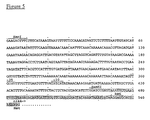
- Figure 5 shows the nucleotide sequence of the lactose operon promoter (SEQ 2).
- the Xmn I/ Bam HI fragment contains the lacA promoter and start of the nisA gene in the nisA cassette.
- Figure 6 shows plate diffusion bioassays.
- nisin A is produced by the FI7332 expression system as a result of complementation of the hosts nisA deficiency by plasmid encoded nisA genes. Furthermore, biological activity of the variant nisin A/H27Q is demonstrated.
- Wells contain supernatants from FI7330 (FI7332/pFI172 plasmid encoded nisA ); FI5876 (nisin producing parent strain); MG1614 (non-nisin producing strain); FI7332/pFI411 (plasmid encoded nisA /H27Q); FI7332/pFI378 (plasmid encoded nisA ); FI7332 plasmid free; and FI7332/pFI354 (plasmid vector for construction of variant nisA genes).
- Plate 2 demonstrates nisin activity by strains encoding nisA and the variant nisA /S5A gene under the control of the lacA promoter.
- Wells contain supernatants from FI5876 (nisin producing parent strain); FI7332 (plasmid free); FI7332/pFI378 (plasmid encoded nisA, natural promoter); FI7332/pFI449 (plasmid encoded nisA, lacA promoter); and FI7332/pFI493 (plasmid encoded nisA /S5A, lacA promoter).
- 100 ⁇ l of the following nisin standards were loaded into some wells: 500 U/ml; 300 U/ml; 200 U/ml; 100 U/ml; and 0 U/ml.
- Figure 7 shows the construction of a host strain for the exclusive expression of mutant nisA genes.
- Maps are of equivalent chromosomal regions of a) the nisin producing strain FI5876 and derivatives b) FI7300, c) FI7304 and d) FI7332.
- the nisA gene and the start of nisB gene are indicated by black boxes.
- the insertions in nis A are signified by a shaded box (Em r , erythromycin resistance) and an open box (IS 905 ).
- Primers employed for analysis of nisA insertional inactivation are shown as numbered arrows below the maps. Lines connecting primers represent the amplified fragment with sizes given in kilobases.
- Figure 8 shows PCR analysis of the constructed host strains.
- PCR fragments generated with primers 1 and 2 are separated by agarose gel electrophoresis.
- Template DNA from the non-nisin producing strain MG1614 is not amplified (track 2) whereas a band of 0.9kb is generated from the nisin producing parent strain FI5876 (track 3). This band is also present when DNA from FI7181 is employed as template.
- Campbell integration of the gene replacement vector pFI283 in this strain results in the generation of a second band of 1.9kb (track 4).
- FI7330 (track 5) the nisA gene has been insertionally inactivated as a result of gene replacement (see Figure 1d) and the 0.9kb band is replaced with the 1.9kb band containing the integrated Em r marker.
- This band is increased in size by a further 1.3kb to 3.2kb in FI7304 (track 6) as a result of insertion of IS905 in the Em r gene (see Figure 7c).
- Strain FI7332 has undergone a 200bp deletion at one end of IS905 ( Figure 7d) and a corresponding decrease in the equivalent PCR generated fragment results in a 3.0kb band (track 7).
- Tracks 1 shows ⁇ DNA digested with Bgl I included as a size standard. The 1.2% agarose gel was run for 2.5 hours at 100 volts.
- Figure 9 shows the structure of nisin A.
- the modified residues are dehydroalanine (Dha), dehydrobutyrine (Dhb), aminobutyrate (Abu), lanthionine (Ala-S-Ala) and ⁇ -methyllanthionine (Abu-S-Ala).
- the predicted molecular alterations in Nisin A/H27Q and Nisin A/S5A are shown as amino-acid substitutions in ring e and ring a respectively.
- Figure 10 illustrates the presence of multiple copies of DNA in the lactococcal genome.
- Figure 11 shows the single stranded nucleotide sequence of insertion sequence IS 905 (SEQ 3) and its encoded polypeptide sequence (SEQ 4).
- Figure 12 shows the potential promoter active sequences at junctions generated by IS905 insertion in strains a) FI 7304 (SEQ 5) and b) FI 7332 (SEQ 6).
- Lactococcus lactis subsp. lactis strains generated in the course of this work, were derived from the nisin producing strain L. lactis F15876 (11,22). The construction of the derivative strains and their relevant properties are described in the results and in Table 1. The plasmid-free, non-nisin producing strain MG1614 (13) was included as a control. L. lactis strains were routinely grown at 30°C in M17 media (43) supplemented with 0.5% (w/v) glucose (GM17).
- antibiotic resistance markers were as follows:- chloramphenicol resistance (Cm r ), 5 ⁇ g/ml; erythromycin resistance (Em r ) was induced at the subinhibitory level of 50 ng/ml followed by selection at 5 ⁇ g/ml. Characterisation of nisin producing strain FI5876 and derivatives. Strain Em r Nisin Production Nisin Immunity (IU/ml) MG1614 - - ⁇ 10 FI5876 - + 1 - 3 x 10 3 FI7300 + - 2 - 5 x 10 2 FI7304 - - 1 - 3 x 10 3 FI7332 - - 1 - 3 x 10 3
- the Escherichia coli strain MC1022 (3) was the host strain used for construction of recombinant plasmids. Cultures were propagated at 37°C in L broth (30). Selection for ampicillin resistance (Ap r ) was at 100 ⁇ g/ml and Cm r was at 15 ⁇ g/ml.
- nisin production by L. lactis strains was based on the plate diffusion assay of Tramer and Fowler (44). Lactobacillus helveticus CH-1 (Chr. Hansens Labs, Danmark A/S) was used as the nisin sensitive indicator strain. 0.5 ml of an overnight culture, grown in MRS media (9), was used to seed 50 ml MRS agar (pH 6.0) containing 1 ml Tween-20/Ringers solution (50:50). Wells were loaded with 100 ⁇ l of test sample and the plates incubated at 4°C for a minimum of 3 hours (to allow diffusion) prior to overnight incubation at 42°C.
- Nisin immunity was determined by streaking a loopful of stationary-phase cells on plates containing varying amounts of nisin. Nisin (Koch-Light), dissolved in 0.2 M HCl, was added to GM17 agar up to a maximum concentration of 5 x 10 3 U/ml at which growth of all strains was inhibited. L. lactis strains were considered to be immune to the highest level of nisin at which growth was evident throughout the streak.
- Plasmid curing was achieved by growth in the presence of acriflavine (36).
- Recombinant plasmids were recovered by transformation of E. coli by the method of Cohen et al, 1972 (8) with the modification of Humphreys et al, 1979 (24).
- L. lactis strains were transformed by electroporation as described by Holo and Nes, 1989 (19) with the following modifications.
- Cells were grown in GM17 broth supplemented with 2% glycine and selection was made on GM17 plates containing antibiotic. Sucrose was omitted from the initial growth media and the selection plates. Electroporation was performed using the Gene Pulser apparatus (Bio-Rad).
- Nucleotide sequence determination of plasmid DNA was performed by the dideoxy chain termination method (40). Sequenase Version 2.0 was used according to the suppliers recommendations (United States Biochemical Corp.).
- Site-directed mutagenesis was carried out using either PCR-mediated overlap extension or by incorporation of a specific mismatch into the particular primer used in the nisA fragment amplification.
- Insertional inactivation of the chromosomally located nisA gene The gene replacement vector pF 1283 was constructed to insertionally inactivate the chromosomally encoded nisA gene. It carries a cloned nisA gene which is disrupted by the insertion of an erythromycin resistance gene (Fig 1a). Plasmid construction involved the following steps:
- nisA gene of F15876 was cloned into the shuttle vector pTG262 to generate pFI172 which has been described previously (11,22).
- the erythromycin resistance gene in this construct was transcribed in the same direction as the nisA gene and was flanked on either side by approximately 1kb of lactococcal DNA sequences.
- a unique EcoRV site in the adjacent polylinker of the vector sequences was used to insert a 2kb fragment carrying the chloramphenicol resistance gene originating from the staphylococcal plasmid pC194 (21).
- a map of the resulting recombinant plasmid, pFI283, is shown in Figure la.
- the nisin producing strain L. lactis FI5876 was transformed with pFI283 and erythromycin resistant transformants were obtained.
- the plasmid does not encode a replication origin functional in Lactococcus and hence the recovery of erythromycin resistance in these transformants required integration of this marker into the recipient chromosome.
- Reciprocal recombination between homologous sequences on pFI283 (Fig. 1a) and the chromosome of FI5876 (Fig. 1b) could generate two types of transformants.
- a single cross-over event would result in the entire plasmid integrating in the chromosome (Campbell integration).
- a double cross-over event, one on either side of the erythromycin resistance gene in pFI283, would exchange the wild-type chromosomal nisA gene for the insertionally inactivated copy, with subsequent loss of chloramphenicol resistance encoded by the non-replicating plasmid (gene replacement). Both recombination mechanisms have been shown to operate in Lactococcus lactis (7,31,32).
- chromosomal rearrangement was confirmed by PCR analysis using primers 1 and 2 which specifically amplify a 0.9kb fragment from FI5876 chromosomal sequences containing the nisA gene and flanking regions (Fig. 1b; Fig. 8, track 3).
- primers 1 and 2 specifically amplify a 0.9kb fragment from FI5876 chromosomal sequences containing the nisA gene and flanking regions
- Activation of genes for nisin immunity and modification Reduction in nisin immunity due to the insertional inactivation of nisA in FI7300 may be caused by a polar effect on downstream genes. This may also result in reduced expression of genes required for modification thus preventing complementation of the nisA mutation in this host.
- the immunity and maturation genes were fully active mutation to wild-type levels of nisin immunity was selected by growth in media containing nisin at inhibitory levels. Colonies which grew on agar plates containing 10 3 ⁇ g/ml nisin were picked and the cells grown on in media containing the same level of nisin.
- One such mutant, designated FI7304 expressed wild-type levels of nisin immunity, did not produce nisin and furthermore was no longer resistant to erythromycin (Table 1).
- the IS element IS 905 was found to have significant homology with IS 256 , which is known to express an adjacent antibiotic resistance gene from an internal promoter (2,39). Such promoter activity could account for the observed increase in nisin immunity exhibited by FI7304 which is equivalent to that of the parent strain, FI5876 (Table 1) and it may also have restored the expression of genes required for processing of prenisin to a level sufficient to facilitate nisA complementation.
- the DNA sequences of the junction of IS905 and the Em gene in FI 7304 and of IS905 and the nisA gene in FI 7332 are shown in Figure 12.
- FI7304 was transformed with the nisA encoding plasmid, pFI172. Transformants were obtained at low frequency and the majority did not produce nisin in bioassays.
- One transformant, designated FI7330 was found to yield nisin at a level approximately 50% that of the parent strain FI5876 (Fig. 6). It was presumed that FI7330 had undergone a spontaneous mutation, either within the plasmid or the chromosome sequences, which resulted in nisin production. Isolation of plasmid DNA from FI7330 yielded a molecule indistinguishable from pFI172 on the basis of restriction enzyme analysis.
- FI7332 The deletion does not extend beyond the nisA gene as primer 2 (specific for sequences at the end of nisA), together with either primers 1 or 3, resulted in fragment amplification (Fig. 7d).
- the small chromosomal rearrangement in FI7332 has not affected nisin immunity which is conferred at a level indistinguishable from that of the parent strain (Table 1).
- nisA genes To produce engineered nisin molecules PCR-mediated site-directed mutagenesis was carried out on the nucleotide sequence of the nisA gene.
- Plasmid pFI354 was constructed by deletion of a 1.25kb Sac I fragment from pFI172. It thus encodes only the N-terminal part of nisA (Fig. 3b). Using PCR the C-terminal part of the nisA gene was amplified as a 254bp Sac I/ Eco RI fragment. By cloning this fragment into pFI354 an intact nisA gene could be reconstituted as in pFI378 (Fig. 3c). Adaptation of this procedure enabled predetermined substitutions to be introduced into the C-terminal region of the nisA gene (using site-directed mutagenesis, see below).
- pFI354 derivatives utilize the natural promoter of the nisin operon which lies between the Sal I site defining one end of the cloned chromosomal fragment and the start of the nisA gene (Fig. 3). In this system the incorporation of site-directed mutations is limited to sequences in the nisA coding region downstream of the Sac I site (Fig. 2).
- nisA codon selected for alteration was Histidine 27 which lies within ring 5 of the mature nisin A molecule (Fig. 9).
- nisin Z A naturally occurring variant of nisin A, termed nisin Z, has been identified which contains an Asparagine residue in place of Histidine 27 (15,23,37).
- the engineered incorporation of a similarly charged Glutamine in place of Asparagine at residue 27 would thus represent a conservative substitution in the nisin Z amino acid sequence.
- the mutation involved a single base pair change in the PCR generated Sac I/ Eco RI fragment carrying the C-terminal end of nisA (Fig. 2).
- nisA /H27Q The reconstituted gene, containing a Glutamine codon (CAG) in place of a Histidine codon (CAT. Fig. 2) was designated nisA /H27Q in accordance with agreed nomenclature (10).
- Site-directed mutagenesis was carried out using PCR-mediated overlap extension (Fig. 3d) as follows:
- Terminal primers 5 and 6 contain a Sac I site and an Eco RI site respectively and define the ends of a 254bp fragment encoding the C-terminal 20 amino acids of prenisin (Fig. 2).
- a pair of overlapping complementary primers (7 and 8) were designed from sequences within the C-terminal region of nisA which included a single base change from the original nisA sequence (Fig. 2). These were used in PCR amplifications in conjunction with one of the terminal primers (Fig. 3d) to create two partially complementary fragments with the specific mutation located in the overlapping region. The fragments were annealed to provide a template for subsequent PCR involving the same terminal primers that determined the two ends of the Sac I/ Eco RI fragment (primers 5 and 6, Fig.
- the final PCR generated fragment containing the specific mutation was purified by isolation from an agarose gel using DEAE-NA 45 membrane (Schleicher and Schuell). Modification of ragged ends was carried out using T4 DNA polymerase and polynucleotide kinase. The blunt ended fragment was cloned into the SmaI site of pUC 18 and the nucleotide sequence of the manipulated region determined to confirm that the selected mutation was present. A Sac I/ Eco RI fragment from the pUC18 derivatives was then subcloned into pFI354 to recover an uninterrupted nisA reading frame containing the predetermined mutation. This plasmid was designated pFI411 (Fig. 3e).
- Vectors pFI480 and pFI487 were constructed in which expression of the nisA gene was under the control of the lacA promoter (Fig. 4).
- a nisA gene cassette was constructed.
- the N-terminal part of the nisA gene was amplified as a 200bp Bam HI/ Sac I fragment.
- This fragment was cloned into plasmid pFI354 upstream of the 254bp Sac I/ Eco RI fragment encoding the C-terminal part of nisA.
- the latter was generated by PCR using primers 5 and 6 as described above.
- the nisA cassette includes the upstream nisA ribosome binding site and the start of the nisB gene (Fig. 2).
- the inducible lac A promoter of the lactococcal lactose operon (18, Fig. 5) was employed for expression of nisA and subsequent variant nisA genes.
- Vector construction involved cloning a Xmn I/ Bam HI fragment containing the lacA promoter, but excluding the lacA ribosome binding site, into pTG262 to generate pFI451 (Fig. 4).
- Into the adjacent polylinker was cloned the entire nisA cassette on a Bam HI/ Eco RI fragment to generate pFI449.
- nisA gene described above ie the 200bp Bam HI/ Sac I N-fragment and the 254bp Sac I/ Eco RI C-fragment, were also separately cloned into pFI451 to generate pFI480 and pFI487 respectively (Fig. 4).
- insertion of the missing N or C fragment is required.
- These fragments can be generated by PCR and using appropriate primers, site-specific substitutions can be incorporated into the reconstituted gene (see below).
- the amino acid initially selected for alteration was Serine 5 .
- Serine 5 is modified to a dehydroalanine residue in ring A (Fig. 9).
- the aim was to replace this with an Alanine residue by incorporating the required mutation in the N-terminal fragment of the nisA cassette using PCR methodology.
- Primer 11 comprises primer 10 sequences with an additional 20 nucleotides including an alanine codon in place of the wild type serine codon (Fig. 2).
- PCR amplification of nisA using primers 9 and 11 generated an N-terminal fragment carrying the specific substitution and subsequent insertion of this Bam HI/ Sac I fragment into pFI487 resulted in a variant nisA gene containing the desired site-specific mutation.
- the plasmid encoding this variant nisA gene was designated pFI493.
- the Nis - strain FI7332 was transformed with plasmids which encode the nisA gene under the control of either its own promoter (pFI378, Fig. 3c) or the lacA promoter (pFI449, Fig. 4c).
- pFI378, Fig. 3c the own promoter
- pFI449, Fig. 4c the lacA promoter
- Transformants of FI7332 containing derivatives of the expression vectors encoding variant nisA genes were also tested for biological activity.
- Strains encoding nisA /H27Q and nisA /S5A exhibited nisin activity at levels lower than that of FI5876, but comparable to those levels achieved in the expression systems involving nisA complementation (ie FI7332/pFI378 and FI7332/pFI451; Table 2, Fig. 6).
Landscapes
- Health & Medical Sciences (AREA)
- Genetics & Genomics (AREA)
- Chemical & Material Sciences (AREA)
- Organic Chemistry (AREA)
- Life Sciences & Earth Sciences (AREA)
- Engineering & Computer Science (AREA)
- Biophysics (AREA)
- Biomedical Technology (AREA)
- General Engineering & Computer Science (AREA)
- Molecular Biology (AREA)
- General Health & Medical Sciences (AREA)
- Bioinformatics & Cheminformatics (AREA)
- Biochemistry (AREA)
- Wood Science & Technology (AREA)
- Zoology (AREA)
- Biotechnology (AREA)
- Microbiology (AREA)
- Plant Pathology (AREA)
- Physics & Mathematics (AREA)
- Gastroenterology & Hepatology (AREA)
- Medicinal Chemistry (AREA)
- Proteomics, Peptides & Aminoacids (AREA)
- Micro-Organisms Or Cultivation Processes Thereof (AREA)
- Preparation Of Compounds By Using Micro-Organisms (AREA)
- Insulated Gate Type Field-Effect Transistor (AREA)
- Saccharide Compounds (AREA)
Claims (4)
- Nisine ayant un résidu autre que la déhydroalanine au niveau du résidu correspondant au résidu dans le premier cycle de nisine naturelle dérivée du résidu sérine de la prénisine non modifiée.
- Nisine selon la revendication 1, dans laquelle le résidu autre que la déhydroalanine est choisi dans le groupe constitué par l'alanine, la valine, la thréonine, la leucine, l'isoleucine, la glycine, l'histidine, l'arginine, la lysine, l'aspartate, le glutamate, l'asparagine, la glutamine, la proline, la méthionine, la cystéine, la phénylalanine, la tyrosine et le tryptophane.
- Nisine selon la revendication 2, dans laquelle le résidu autre que la déhydroalanine est l'alanine.
- Utilisation d'une nisine selon l'une quelconque des revendications 1 à 3, en tant qu'agent antimicrobien.
Applications Claiming Priority (3)
| Application Number | Priority Date | Filing Date | Title |
|---|---|---|---|
| GB9207267 | 1992-04-02 | ||
| GB929207267A GB9207267D0 (en) | 1992-04-02 | 1992-04-02 | Nisins |
| PCT/GB1993/000676 WO1993020213A1 (fr) | 1992-04-02 | 1993-04-01 | Nisines |
Publications (2)
| Publication Number | Publication Date |
|---|---|
| EP0633939A1 EP0633939A1 (fr) | 1995-01-18 |
| EP0633939B1 true EP0633939B1 (fr) | 2004-06-30 |
Family
ID=10713353
Family Applications (1)
| Application Number | Title | Priority Date | Filing Date |
|---|---|---|---|
| EP93907964A Expired - Lifetime EP0633939B1 (fr) | 1992-04-02 | 1993-04-01 | Nisines |
Country Status (7)
| Country | Link |
|---|---|
| US (1) | US6100056A (fr) |
| EP (1) | EP0633939B1 (fr) |
| AT (1) | ATE270336T1 (fr) |
| CA (1) | CA2133578A1 (fr) |
| DE (1) | DE69333564T2 (fr) |
| GB (2) | GB9207267D0 (fr) |
| WO (1) | WO1993020213A1 (fr) |
Families Citing this family (5)
| Publication number | Priority date | Publication date | Assignee | Title |
|---|---|---|---|---|
| NL9401935A (nl) * | 1994-11-18 | 1996-07-01 | Nl Zuivelonderzoek Inst | Werkwijze voor het regelen van de gen-expressie in melkzuurbacteriën. |
| DK0712935T3 (da) * | 1994-11-18 | 2002-07-15 | Stichting Nl I Voor Zuivelonde | Fremgangsmåde til styring af genekspressionen i mælkesyrebakterier |
| GB9423404D0 (en) * | 1994-11-19 | 1995-01-11 | Biotech & Biolog Scien Res | Production of nisin |
| US6861236B2 (en) | 2002-05-24 | 2005-03-01 | Applied Nanosystems B.V. | Export and modification of (poly)peptides in the lantibiotic way |
| CN106755220A (zh) * | 2015-11-23 | 2017-05-31 | 武汉臻智生物科技有限公司 | 制备乳酸链球菌素的方法 |
Citations (1)
| Publication number | Priority date | Publication date | Assignee | Title |
|---|---|---|---|---|
| EP0137869A2 (fr) * | 1983-09-06 | 1985-04-24 | Microlife Technics, Inc. | Micro-organismes dérivés produisant la nisine, méthode de production et utilisation et produits ainsi obtenus |
Family Cites Families (3)
| Publication number | Priority date | Publication date | Assignee | Title |
|---|---|---|---|---|
| US4990452A (en) * | 1986-02-12 | 1991-02-05 | Genex Corporation | Combining mutations for stabilization of subtilisin |
| US5218101A (en) * | 1988-07-05 | 1993-06-08 | The University Of Maryland | Leader sequence inducing a post-translational modification of polypeptides in bacteria, and gene therefor |
| EP0579730B1 (fr) * | 1991-04-11 | 2003-02-26 | Stichting Nederlands Instituut Voor Zuivelonderzoek (Nizo) | Lantibiotiques semblables a la nisine a, bacteries d'acide lactique les produisant, procede de construction de ces bacteries et procede de conservation de denrees alimentaires a l'aide desdits lantibiotiques et desdites bacteries |
-
1992
- 1992-04-02 GB GB929207267A patent/GB9207267D0/en active Pending
-
1993
- 1993-04-01 WO PCT/GB1993/000676 patent/WO1993020213A1/fr not_active Ceased
- 1993-04-01 CA CA002133578A patent/CA2133578A1/fr not_active Abandoned
- 1993-04-01 AT AT93907964T patent/ATE270336T1/de not_active IP Right Cessation
- 1993-04-01 EP EP93907964A patent/EP0633939B1/fr not_active Expired - Lifetime
- 1993-04-01 GB GB9419872A patent/GB2280442B/en not_active Expired - Fee Related
- 1993-04-01 US US08/773,731 patent/US6100056A/en not_active Expired - Fee Related
- 1993-04-01 DE DE69333564T patent/DE69333564T2/de not_active Expired - Fee Related
Patent Citations (1)
| Publication number | Priority date | Publication date | Assignee | Title |
|---|---|---|---|---|
| EP0137869A2 (fr) * | 1983-09-06 | 1985-04-24 | Microlife Technics, Inc. | Micro-organismes dérivés produisant la nisine, méthode de production et utilisation et produits ainsi obtenus |
Non-Patent Citations (1)
| Title |
|---|
| OLD, R.W. AND PRIMROSE, S.B.: "Principles of gene manipulation.", 1989, BLACKWELL SCIENTIFIC PUBLICATIONS, OXFORD GB * |
Also Published As
| Publication number | Publication date |
|---|---|
| DE69333564D1 (de) | 2004-08-05 |
| EP0633939A1 (fr) | 1995-01-18 |
| GB9419872D0 (en) | 1994-11-23 |
| GB2280442A (en) | 1995-02-01 |
| WO1993020213A1 (fr) | 1993-10-14 |
| ATE270336T1 (de) | 2004-07-15 |
| GB2280442B (en) | 1995-10-18 |
| US6100056A (en) | 2000-08-08 |
| DE69333564T2 (de) | 2005-07-28 |
| CA2133578A1 (fr) | 1994-10-14 |
| GB9207267D0 (en) | 1992-05-13 |
Similar Documents
| Publication | Publication Date | Title |
|---|---|---|
| Dodd et al. | A lactococcal expression system for engineered nisins | |
| EP0994191B1 (fr) | Systeme pour exprimer une proteine hyperthermostable | |
| Robichon et al. | The rpoN (sigma54) gene from Listeria monocytogenes is involved in resistance to mesentericin Y105, an antibacterial peptide from Leuconostoc mesenteroides | |
| US5928946A (en) | Lactic acid bacteria producing lantibiotics similar to nisin A | |
| JPS63502396A (ja) | ズブチリシン類似体 | |
| US5426047A (en) | Plasmid pBUL1 derived from a lactobacillus and derivatives thereof | |
| EP0506789B1 (fr) | Vecteur de clonage utilise dans des bacteries d'acide lactique et son procede d'elaboration | |
| Kiel et al. | Molecular cloning and nucleotide sequence of the glycogen branching enzyme gene (glgB) from Bacillus stearothermophilus and expression in Escherichia coli and Bacillus subtilis | |
| De Vos et al. | Gene organization and expression in mesophilic lactic acid bacteria | |
| EP0793727B1 (fr) | Production de variantes de nisine | |
| US6100056A (en) | Nisins | |
| WO2007129072A2 (fr) | Procédé et produit | |
| US6319692B1 (en) | Methods for transferring gene into chromosome | |
| Bourgoin et al. | Characterization of a Novel Insertion Sequence, IS1194, inStreptococcus thermophilus | |
| US5747310A (en) | Gene integration into chromosomes of lactobacillus delbrueckii species and integrants thereof | |
| WO1988009821A1 (fr) | Systeme d'expression et de secretion coryneforme | |
| Moreau et al. | Analysis of the integration functions of φ304L: an integrase module among corynephages | |
| Klaenhammer et al. | Lactacin F, a small hydrophobic heat-stable bacteriocin from Lactobacillus johnsonii | |
| AU722223B2 (en) | Nucleic acid sequence and plasmids comprising at least one phage resistance mechanism, bacteria containing them and their use | |
| US20240368231A1 (en) | Improving conjugation competence in firmicutes | |
| AU743215B2 (en) | Food-grade cloning vector and their use in lactic acid bacteria | |
| AU1158799A (en) | Non rcr leuconostoc plasmid capable of being transferred into lactic acid bacteria; use as cloning and expressing tool | |
| JP2024525749A (ja) | 組換えタンパク質を生産する新規システム | |
| Young et al. | Truncation of Peptide Deformylase Reduces | |
| JPH104974A (ja) | ラクトバチラス・カゼイ菌用ベクター |
Legal Events
| Date | Code | Title | Description |
|---|---|---|---|
| PUAI | Public reference made under article 153(3) epc to a published international application that has entered the european phase |
Free format text: ORIGINAL CODE: 0009012 |
|
| AK | Designated contracting states |
Kind code of ref document: A1 Designated state(s): AT BE CH DE DK ES FR GB GR IE IT LI LU MC NL PT SE |
|
| 17P | Request for examination filed |
Effective date: 19941007 |
|
| 17Q | First examination report despatched |
Effective date: 20001004 |
|
| RAP1 | Party data changed (applicant data changed or rights of an application transferred) |
Owner name: THE INSTITUTE OF FOOD RESEARCH |
|
| GRAH | Despatch of communication of intention to grant a patent |
Free format text: ORIGINAL CODE: EPIDOS IGRA |
|
| GRAS | Grant fee paid |
Free format text: ORIGINAL CODE: EPIDOSNIGR3 |
|
| RBV | Designated contracting states (corrected) |
Designated state(s): AT BE CH DE DK ES FR GR IE IT LI LU MC NL PT SE |
|
| RIN1 | Information on inventor provided before grant (corrected) |
Inventor name: DODD, HELEN, MAIR Inventor name: GASSON, MICHAEL JOHN |
|
| GRAA | (expected) grant |
Free format text: ORIGINAL CODE: 0009210 |
|
| RIC1 | Information provided on ipc code assigned before grant |
Ipc: 7C 12N 1/21 B Ipc: 7C 12P 21/02 B Ipc: 7C 12N 15/74 A |
|
| AK | Designated contracting states |
Kind code of ref document: B1 Designated state(s): AT BE CH DE DK ES FR GR IE IT LI LU MC NL PT SE |
|
| PG25 | Lapsed in a contracting state [announced via postgrant information from national office to epo] |
Ref country code: NL Free format text: LAPSE BECAUSE OF FAILURE TO SUBMIT A TRANSLATION OF THE DESCRIPTION OR TO PAY THE FEE WITHIN THE PRESCRIBED TIME-LIMIT Effective date: 20040630 Ref country code: IT Free format text: LAPSE BECAUSE OF FAILURE TO SUBMIT A TRANSLATION OF THE DESCRIPTION OR TO PAY THE FEE WITHIN THE PRESCRIBED TIME-LIMIT;WARNING: LAPSES OF ITALIAN PATENTS WITH EFFECTIVE DATE BEFORE 2007 MAY HAVE OCCURRED AT ANY TIME BEFORE 2007. THE CORRECT EFFECTIVE DATE MAY BE DIFFERENT FROM THE ONE RECORDED. Effective date: 20040630 Ref country code: AT Free format text: LAPSE BECAUSE OF FAILURE TO SUBMIT A TRANSLATION OF THE DESCRIPTION OR TO PAY THE FEE WITHIN THE PRESCRIBED TIME-LIMIT Effective date: 20040630 |
|
| REG | Reference to a national code |
Ref country code: CH Ref legal event code: EP |
|
| REG | Reference to a national code |
Ref country code: IE Ref legal event code: FG4D |
|
| REF | Corresponds to: |
Ref document number: 69333564 Country of ref document: DE Date of ref document: 20040805 Kind code of ref document: P |
|
| PG25 | Lapsed in a contracting state [announced via postgrant information from national office to epo] |
Ref country code: SE Free format text: LAPSE BECAUSE OF FAILURE TO SUBMIT A TRANSLATION OF THE DESCRIPTION OR TO PAY THE FEE WITHIN THE PRESCRIBED TIME-LIMIT Effective date: 20040930 Ref country code: GR Free format text: LAPSE BECAUSE OF FAILURE TO SUBMIT A TRANSLATION OF THE DESCRIPTION OR TO PAY THE FEE WITHIN THE PRESCRIBED TIME-LIMIT Effective date: 20040930 Ref country code: DK Free format text: LAPSE BECAUSE OF FAILURE TO SUBMIT A TRANSLATION OF THE DESCRIPTION OR TO PAY THE FEE WITHIN THE PRESCRIBED TIME-LIMIT Effective date: 20040930 |
|
| PG25 | Lapsed in a contracting state [announced via postgrant information from national office to epo] |
Ref country code: ES Free format text: LAPSE BECAUSE OF FAILURE TO SUBMIT A TRANSLATION OF THE DESCRIPTION OR TO PAY THE FEE WITHIN THE PRESCRIBED TIME-LIMIT Effective date: 20041011 |
|
| REG | Reference to a national code |
Ref country code: CH Ref legal event code: NV Representative=s name: R. A. EGLI & CO. PATENTANWAELTE |
|
| NLV1 | Nl: lapsed or annulled due to failure to fulfill the requirements of art. 29p and 29m of the patents act | ||
| PG25 | Lapsed in a contracting state [announced via postgrant information from national office to epo] |
Ref country code: MC Free format text: LAPSE BECAUSE OF NON-PAYMENT OF DUE FEES Effective date: 20050430 |
|
| ET | Fr: translation filed | ||
| PLBE | No opposition filed within time limit |
Free format text: ORIGINAL CODE: 0009261 |
|
| STAA | Information on the status of an ep patent application or granted ep patent |
Free format text: STATUS: NO OPPOSITION FILED WITHIN TIME LIMIT |
|
| 26N | No opposition filed |
Effective date: 20050331 |
|
| PG25 | Lapsed in a contracting state [announced via postgrant information from national office to epo] |
Ref country code: PT Free format text: LAPSE BECAUSE OF NON-PAYMENT OF DUE FEES Effective date: 20041130 |
|
| PGFP | Annual fee paid to national office [announced via postgrant information from national office to epo] |
Ref country code: LU Payment date: 20080429 Year of fee payment: 16 Ref country code: DE Payment date: 20080530 Year of fee payment: 16 Ref country code: CH Payment date: 20080430 Year of fee payment: 16 |
|
| PGFP | Annual fee paid to national office [announced via postgrant information from national office to epo] |
Ref country code: BE Payment date: 20080423 Year of fee payment: 16 |
|
| PGFP | Annual fee paid to national office [announced via postgrant information from national office to epo] |
Ref country code: IE Payment date: 20080422 Year of fee payment: 16 |
|
| PGFP | Annual fee paid to national office [announced via postgrant information from national office to epo] |
Ref country code: FR Payment date: 20080418 Year of fee payment: 16 |
|
| BERE | Be: lapsed |
Owner name: THE *INSTITUTE OF FOOD RESEARCH Effective date: 20090430 |
|
| REG | Reference to a national code |
Ref country code: CH Ref legal event code: PL |
|
| REG | Reference to a national code |
Ref country code: FR Ref legal event code: ST Effective date: 20091231 |
|
| PG25 | Lapsed in a contracting state [announced via postgrant information from national office to epo] |
Ref country code: LI Free format text: LAPSE BECAUSE OF NON-PAYMENT OF DUE FEES Effective date: 20090430 Ref country code: DE Free format text: LAPSE BECAUSE OF NON-PAYMENT OF DUE FEES Effective date: 20091103 Ref country code: CH Free format text: LAPSE BECAUSE OF NON-PAYMENT OF DUE FEES Effective date: 20090430 |
|
| REG | Reference to a national code |
Ref country code: IE Ref legal event code: MM4A |
|
| PG25 | Lapsed in a contracting state [announced via postgrant information from national office to epo] |
Ref country code: IE Free format text: LAPSE BECAUSE OF NON-PAYMENT OF DUE FEES Effective date: 20090401 Ref country code: FR Free format text: LAPSE BECAUSE OF NON-PAYMENT OF DUE FEES Effective date: 20091222 |
|
| PG25 | Lapsed in a contracting state [announced via postgrant information from national office to epo] |
Ref country code: BE Free format text: LAPSE BECAUSE OF NON-PAYMENT OF DUE FEES Effective date: 20090430 |
|
| PG25 | Lapsed in a contracting state [announced via postgrant information from national office to epo] |
Ref country code: LU Free format text: LAPSE BECAUSE OF NON-PAYMENT OF DUE FEES Effective date: 20090401 |