EP0630673B2 - Method for recovering terephthalic acid crystals from slurry - Google Patents
Method for recovering terephthalic acid crystals from slurry Download PDFInfo
- Publication number
- EP0630673B2 EP0630673B2 EP94303720A EP94303720A EP0630673B2 EP 0630673 B2 EP0630673 B2 EP 0630673B2 EP 94303720 A EP94303720 A EP 94303720A EP 94303720 A EP94303720 A EP 94303720A EP 0630673 B2 EP0630673 B2 EP 0630673B2
- Authority
- EP
- European Patent Office
- Prior art keywords
- washing
- region
- filter
- filter medium
- slurry
- Prior art date
- Legal status (The legal status is an assumption and is not a legal conclusion. Google has not performed a legal analysis and makes no representation as to the accuracy of the status listed.)
- Expired - Lifetime
Links
- 239000002002 slurry Substances 0.000 title claims abstract description 57
- 239000013078 crystal Substances 0.000 title claims abstract description 55
- 238000000034 method Methods 0.000 title claims abstract description 21
- KKEYFWRCBNTPAC-UHFFFAOYSA-N Terephthalic acid Chemical compound OC(=O)C1=CC=C(C(O)=O)C=C1 KKEYFWRCBNTPAC-UHFFFAOYSA-N 0.000 title claims description 38
- 238000005406 washing Methods 0.000 claims abstract description 162
- 239000007788 liquid Substances 0.000 claims abstract description 68
- 239000012065 filter cake Substances 0.000 claims abstract description 41
- 238000001914 filtration Methods 0.000 claims abstract description 20
- 239000000706 filtrate Substances 0.000 claims description 10
- 238000002360 preparation method Methods 0.000 claims description 5
- 239000011261 inert gas Substances 0.000 claims description 4
- 238000005507 spraying Methods 0.000 abstract description 3
- QTBSBXVTEAMEQO-UHFFFAOYSA-N Acetic acid Chemical compound CC(O)=O QTBSBXVTEAMEQO-UHFFFAOYSA-N 0.000 description 36
- XLYOFNOQVPJJNP-UHFFFAOYSA-N water Substances O XLYOFNOQVPJJNP-UHFFFAOYSA-N 0.000 description 18
- 230000001590 oxidative effect Effects 0.000 description 17
- URLKBWYHVLBVBO-UHFFFAOYSA-N Para-Xylene Chemical group CC1=CC=C(C)C=C1 URLKBWYHVLBVBO-UHFFFAOYSA-N 0.000 description 14
- 239000007921 spray Substances 0.000 description 13
- 239000007789 gas Substances 0.000 description 11
- 239000007787 solid Substances 0.000 description 11
- 239000000356 contaminant Substances 0.000 description 7
- 238000007796 conventional method Methods 0.000 description 6
- 238000010586 diagram Methods 0.000 description 6
- 238000000926 separation method Methods 0.000 description 6
- 238000003860 storage Methods 0.000 description 6
- MYMOFIZGZYHOMD-UHFFFAOYSA-N Dioxygen Chemical compound O=O MYMOFIZGZYHOMD-UHFFFAOYSA-N 0.000 description 5
- 229910001882 dioxygen Inorganic materials 0.000 description 5
- 239000002904 solvent Substances 0.000 description 5
- 239000007791 liquid phase Substances 0.000 description 4
- 239000000203 mixture Substances 0.000 description 4
- 239000002994 raw material Substances 0.000 description 4
- 239000007858 starting material Substances 0.000 description 4
- 238000007664 blowing Methods 0.000 description 3
- 239000003054 catalyst Substances 0.000 description 3
- 238000006243 chemical reaction Methods 0.000 description 3
- 238000007254 oxidation reaction Methods 0.000 description 3
- 239000012429 reaction media Substances 0.000 description 3
- 239000000498 cooling water Substances 0.000 description 2
- 238000007599 discharging Methods 0.000 description 2
- 230000003647 oxidation Effects 0.000 description 2
- 239000002245 particle Substances 0.000 description 2
- 238000011084 recovery Methods 0.000 description 2
- 238000009834 vaporization Methods 0.000 description 2
- 230000008016 vaporization Effects 0.000 description 2
- 239000002699 waste material Substances 0.000 description 2
- 238000009825 accumulation Methods 0.000 description 1
- 239000006227 byproduct Substances 0.000 description 1
- 239000007795 chemical reaction product Substances 0.000 description 1
- 238000010276 construction Methods 0.000 description 1
- 238000001816 cooling Methods 0.000 description 1
- 230000003247 decreasing effect Effects 0.000 description 1
- 230000008021 deposition Effects 0.000 description 1
- 230000000694 effects Effects 0.000 description 1
- 239000012467 final product Substances 0.000 description 1
- 239000010419 fine particle Substances 0.000 description 1
- 238000004519 manufacturing process Methods 0.000 description 1
- 230000002093 peripheral effect Effects 0.000 description 1
- 238000003825 pressing Methods 0.000 description 1
- 238000000746 purification Methods 0.000 description 1
- 238000004064 recycling Methods 0.000 description 1
- 230000000717 retained effect Effects 0.000 description 1
- KKEYFWRCBNTPAC-UHFFFAOYSA-L terephthalate(2-) Chemical compound [O-]C(=O)C1=CC=C(C([O-])=O)C=C1 KKEYFWRCBNTPAC-UHFFFAOYSA-L 0.000 description 1
- 238000011144 upstream manufacturing Methods 0.000 description 1
- 239000012808 vapor phase Substances 0.000 description 1
Images

Classifications
-
- B—PERFORMING OPERATIONS; TRANSPORTING
- B01—PHYSICAL OR CHEMICAL PROCESSES OR APPARATUS IN GENERAL
- B01D—SEPARATION
- B01D33/00—Filters with filtering elements which move during the filtering operation
- B01D33/06—Filters with filtering elements which move during the filtering operation with rotary cylindrical filtering surfaces, e.g. hollow drums
- B01D33/073—Filters with filtering elements which move during the filtering operation with rotary cylindrical filtering surfaces, e.g. hollow drums arranged for inward flow filtration
-
- B—PERFORMING OPERATIONS; TRANSPORTING
- B01—PHYSICAL OR CHEMICAL PROCESSES OR APPARATUS IN GENERAL
- B01D—SEPARATION
- B01D33/00—Filters with filtering elements which move during the filtering operation
- B01D33/58—Handling the filter cake in the filter for purposes other than for regenerating the filter cake remaining on the filtering element
- B01D33/60—Handling the filter cake in the filter for purposes other than for regenerating the filter cake remaining on the filtering element for washing
-
- C—CHEMISTRY; METALLURGY
- C07—ORGANIC CHEMISTRY
- C07C—ACYCLIC OR CARBOCYCLIC COMPOUNDS
- C07C51/00—Preparation of carboxylic acids or their salts, halides or anhydrides
- C07C51/42—Separation; Purification; Stabilisation; Use of additives
- C07C51/43—Separation; Purification; Stabilisation; Use of additives by change of the physical state, e.g. crystallisation
Definitions
- the present invention relates to a method for recovering terephthalic acid crystals from a slurry containing such crystals.
- Terephthalic acid used as a starting material of polyethelene terephthalate and the like is produced by oxidizing paraxylene with a molecular oxygen-containing gas in a reaction medium based on acetic acid, wherein the resulting terephthalic acid will deposit in the reaction liqour in a crystalline form. Since the so-formed slurry of the crystalline terephthalic acid contains also the acetic acid solvent, the unreacted paraxylene, by-products and the catalyst components, it is necessary to separate the terephthalic acid crystals, from the slurry in order then to recover the terephthalic acid.
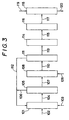
- Fig. 3 shows a schematic sequence diagram for a conventional method for recovering terephthalic acid crystals from such a slurry.
- the numeral 101 denotes an oxidizing reactor, to which a raw material mixture 102 composed of paraxylene as the starting material, acetic acid as the reaction medium and the catalyst is supplied, while supplying thereto at the same time a molecular oxygen-containing gas 103 to cause oxidation of the paraxylene into terephthalic acid.
- the crystal-containing slurry 104 formed in the oxidizing reactor 101 is transferred to a first stage solid/liquid separator 105 to effect a primary solid/liquid separation to separate the crystals from the liquid phase.
- the liquid phase 106 composed mainly of acetic acid separated here is returned to the oxidizing reactor 101, while the crude crystals 107 are forwarded to a re-disperser 108, where the crystals are suspended again in a medium of acetic acid 109 fed thereto in order to dissolve out the contaminants included in the crude crystal mass.
- the resulting reformed slurry 110 is then subjected to a secondary liquid/solid separation to separate the crystals from the liquid phase in a second stage solid/liquid separator 111.
- the separated liquid phase 112 composed mainly of acetic acid is transferred to the oxidizing reactor 101, while the purified crystals 113 are forwarded to a drier 114.
- the dried crystals 115 are stored in a silo 116.
- the recovered crystals 117 are then conveyed to a disperser 118, whereto water 119 is also supplied and is mixed with the crystals 117 to form an aqueous slurry 120 which is guided then to a refinery system to refine the crystals.
- DE-A-1 278 402 discloses a rotary drum filter for separating and washing solid particles with a minimum of water.
- the rotary drum is hollow and has peripheral compartments connectable to the interior of the drum. Water filtered through a filter cake on the perforated periphery of the drum enters into these compartments and is collected and drained therefrom separately. The water is recycled.
- the water is supplied to the exterior of the drum from a succession of spray heads arranged around the exterior of the drum. The waste liquid originating from one spray head is collected and supplied to the spray head located immediately upstream of the first spray head with regard to the direction of rotation of the drum.
- EP-A-0 406 424 discloses a method and apparatus for recovering crystals from a crystal-containing slurry using a rotary filter having a rotating cylindrical filter medium. Crystal-containing slurry is filtered in a filtering region of the rotating filter medium so as to separate the crystals as a filter cake on the filter medium. This filter cake is then washed in a washing region by supplying washing liquid to the exterior of the filter medium. Upon passing once through the filter cake the spent washing liquid is collected and stored in a waste tank prior to being disposed of. Where the crystals are crystals of terephthalic acid the spent washing liquid will contain acetic acid of low concentration.
- a method of recovering terephthalic acid crystals from a crystal-containing slurry using a rotary filter having a rotating cylindrical filter medium comprising:
- the rotating cylindrical filter medium may, for example, have three washing regions, said first washing region, said last washing region and an intermediate washing region provided therebetween, the washing liquid supplied to the intermediate washing region being the spent washing liquid collected from said last washing region and the washing liquid supplied to said first washing region being the spent washing liquid collected from the intermediate washing region.
- a rotary pressure filter operated by pressurizing the outside of its rotating filter medium for establishing the filtering pressure drop is used.
- a rotary pressure/sucking filter may also be used.
- a rotary vacuum filter operated by maintaining a reduced pressure inside the rotating filter medium a part of the solvent of the slurry becomes vaporized due to the lowering of the pressure, whereby the slurry temperature is lowered by being deprived of the latent heat of vaporization, so that the solubility of the solutes existing at their saturation points in the solvent of the slurry is decreased to force deposition thereof in a form of fine particles which fill up the liquid flow paths between the solid particles in the filter cake and cause stuffing of the filter medium.
- a rotary pressure filter and a rotary pressure/sucking filter undergo less tendency to stuffing of the filter medium than that of rotary vaccum filter, since occurrence of a slurry temperature lowering due to the solvent vaporization is avoided in them.
- the filter cake formed on the filter medium is washed in a series of steps on the rotating filter medium in a plurality of washing regions subsequent to the filtering region of the rotary filter to a considerable degree, so that the number of solid/liquid separators and their accessories required for recovering the crystals are reduced as compared with those of the conventional techniques.
- the primary slurry containing the crude terephthalic acid crystals from an oxidizing reactor is filtered by a rotary filter on a rotating filter medium and the resulting filter cake is washed several times on the rotating filter medium with a washing liquid, whereupon the washed filter cake is re-suspended to form a secondary slurry which is sent directly to a disperser for forming the starting slurry to be supplied to the crystal refinery system.
- a series of a primary solid/liquid separator, a re-disperser, a drier and a silo with their accessories in the first process step of the conventional technique are dispensed with.
- the contaminant components included in the filter cake can be recovered and reclaimed effectively by washing the filter cake on the rotating filter medium in a plurality of washing regions by supplying a washing liquid to and separating the spent washing liquid from each of the washing regions in such a manner that a fresh washing liquid is supplied to the washing region of the forefront in the moving direction of the rotating filter medium, while supplying any one of washing regions on the aft side of said forefront, seen in the moving direction of the rotating filter medium, with the spent washing liquid separated in the washing region neighboring said one washing region on the fore side, seen in the moving direction of the filter medium, and recycling the spent washing liquid from the washing region rearmost in the moving direction of the filter medium to the slurry preparation step together with the filtrate of the filtering region.
- the spent washing liquid from the final washing region namely, the washing region rearmost in the rotating direction of the filter medium
- This spent washing liquid from the washing region rearmost in the rotating direction of the filter medium is recycled to the oxidizing reactor to reuse it as the reaction medium for the oxidation of paraxylene.
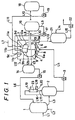
- Fig. 1 shows a schematic flow diagram for recovering terephthalic acid crystals from a crystal-containing slurry according to a preferred embodiment of the present invention.
- the numeral 1 denotes an oxidizing reactor which is constructed so as to realize an oxidizing reaction of the raw material by supplying thereto the starting raw material mixture via a supply line L1 and a molecular oxygen-containing gas via a gas supply line L2.
- An exhaustion line L3 for discharging out the resulting slurry of the oxidizing reaction communicates from the bottom of the oxidizing reactor 1 to a flash drum 2.
- a slurry supply line L4 including a slurry pump 3 communicates from the bottom of the flash drum 2 to a rotary pressure filter 4 at a slurry inlet 5.
- the rotary pressure filter 4 having the slurry inlet 5 at its bottom has a casing 7 provided with a filter cake discharge gate 6 arranged downwards.
- a horizontal cylindrical filter medium 9 is disposed within the casing 7 of the rotary pressure filter 4 with its lower portion being immersed in a sump 8 of the slurry supplied thereto so as to constitute a filtering region 9a and is rotatingly driven clockwise in Fig. 1 at a constant speed by a not-shown motor under intermediation by a reduction gear.
- a plurality of spray nozzles 11a, 11b, 11c constituting a spraying unit for spraying a washing liquid onto the filter cake on the filter medium are disposed outside the rotating filter medium 9 each correspondingly, but in the reverse sense, in each of a plurality of washing regions 9b, 9c, 9d provided subsequently to the filtering region 9a above the slurry sump 8 and allotted successively in a row in the rotating direction of the filter medium.
- spent washing liquid receivers 12a, 12b are disposed inside the cylindrical filter medium in a paired relation with the spray nozzles 11a, 11b except the spray nozzle 11c of the washing region rearmost in the rotating direction.
- a gas blow nozzle 13 is located inside the filter medium 9 in a filter cake removal region 9e at a portion adjacent the cake discharge gate 6 and serves for blowing N 2 gas from inside to the filter cake layer to remove it off the filter medium 9.
- An exhaustion line L5 for exhausting the spent washing liquid for the rearmost spray nozzle in the rotating direction together with the filtrate collected in the bottom portion of the rotating filter medium communicates therefrom to a filtrate reservoir 14 which is connected with the oxidizing reactor 1 by a line L6 having a pump 15.
- a line L7 is connected with the nozzle 11a in order to supply pure water as the fresh washing liquid.
- the receiver 12a is connected with a first spent washing liquid storage tank 16 via a line L8 and the bottom of the storage tank 16 is connected with the spray nozzle 11b via a line L9 having a pump 17.
- the receiver 12b is connected with a second spent washing liquid storage tank 18 via a line L10 and the bottom of the storage tank 18 is connected with the spray nozzle 11c via a line L11 having a pump 19.
- the casing 7 is connected at its upper portion with a line L12 for pressurizing the outside of the rotating filter medium and its cake discharge gate 6 is connected with a disperser 21 via a line L13.
- the disperser 21 is connected with a line L14 for supplying pure water thereto and at its bottom with a line L15 having an interposed pump 22 and communicating to a refinery system.
- the flash drum 2 is connected with a condenser 23 by lines L16 and L17 for cooling the vapor from the flash drum 2 to condense it and to return the condensate thereto.
- the condenser 23 is connected with lines L18, L19 and L20 for supplying the cooling water thereto, for discharging the spent cooling water therefrom and for exhausting the trapped non-condensing gas out of it, respectively.
- the oxidizing rector 1 is supplied with a raw material mixture composed of paraxylene as the starting material, acetic acid as the solvent and a catalyst via the line L1 and also with a molecular oxygen-containing gas, such as the air, via the line 2 and in which paraxylene is oxidized by the molecular oxygen into terephthalic acid.
- the resulting reaction product mixture in the form of a slurry is sent from the oxidizing rector 1 via the line L3 to the flash drum 2 where it is exposed to a reduced pressure and is flashed to cause a temperature decrease.
- the vapor phase is cooled by the condenser 23 to condense the condensible components into a condensate which is returned to the flash drum 2 via the line L17 and the non-condensible gas is exhausted out via the line L20.
- the slurry left in the flash drum 2 is guided via the line L4 to the slurry inlet 5 of the rotary pressure filter 4 by the pump 3.
- pure water is supplied as the washing liquid via the line L7 to the spray nozzle 11a in the washing region 9d of the forefront in the rotating direction of the filter medium 9 and is sprayed to wash the filter cake.
- the spent washing water passed through the filter cake and the filter medium and collected in the receiver 12a is guided through the line L8 to the first spent washing liquid storage tank 16, from which it is supplied to the spray nozzle 11b of the washing region 9c neighboring the above-mentioned forefront washing region 9d in the aft side in the rotating direction of the filter medium by the pump 17 and is sprayed to wash the filter cake in the washing region 9c.
- the spent washing water collected in the receiver 12b of the washing region 9c is guided through the line L10 to the second spent washing liquid storage tank 18, from which it is supplied to the spray nozzle llc of the washing region 9b rearmost in the rotating direction of the filter medium by the pump 19 and is sprayed to wash the filter cake.
- the concentration of the contaminant components, such as acetic acid and unreacted starting material, in the spent washing water becomes increased successively in the washing regions towards aft the rotating direction of the filter medium.
- the spent washing water of the washing region 9b rearmost in the rotating direction which has the highest concentration of such contaminant components, is gathered with the filtrate from the filtering region 9a in the bottom portion of the horizontal cylindrical filter medium, from which it is recycled, namely, together with the filtrate, to the oxidizing reactor 1 via the line L6 by the pump 15 to reuse them in the oxidation reaction.
- the filter cake of crystals retained on the rotating filter medium in a layer is cleaned to a considerable degree by a repeated washing (three times in this embodiment) in the washing regions 9b - 9d under separation of each spent washing water from the crystals with final washing by pure water, so that the contaminant components, such as acetic acid etc., occluded in between the crystals can efficiently be removed.
- the washed filter cake left on the rotating filter medium in a layer is blown off from the filter medium 9 in the filter cake removing region 9e by blowing an inert gas, such as N 2 gas, from inside onto the filter cake layer using a gas blowing nozzle 13 and the so-removed filter cake is discharged from the cake discharge gate 6 into the disperser 21, where the filter cake is re-suspended in pure water supplied thereto via the line L14 to form a secondary slurry which is supplied to the refinery system via the line L15 by the slurry pump 22.
- an inert gas such as N 2 gas
- Fig. 2 the procedures of the method according to the present invention described above are explained schematically in a flow sequence diagram. As shown, the slurry containing crystals of terephthalic acid formed in the oxidizing reactor 1 is guided to the rotary pressure filter 4 via the line L3,L4.
- a plurality of solid/liquid separation steps of filtration and washing purification are performed in the filtering region 9a and the washing regions 9b, 9c and 9d, wherein the washing liquid supplied via the line L7 is used for washing the filter cake in the washing region 9d in the forefront in the rotating direction of the filter medium and the spent washing liquid thereof is used for washing the filter cake in the washing region 9c neighboring the said forefront washing region 9d in the aft side in the rotating direction of the filter medium by supplying it thereto as the washing liquid therefor via the line L8,L9 and, further, the spent washing liquid of this washing region 9c is used for washing the filter cake in the washing region 9b rearmost in the rotating direction of the filter medium by supplying it thereto as the- washing liquid therefor via the line L10,L11.
- the went washing liquid separated in the washing region 9b rearmost in the rotating direction of the filter medium is returned together with the filtrate from the filtering region 9a to the oxidizing reactor 1 via the line L5,L6.
- the filter cake of the crystals washed finally by pure water in the washing region 9d in the forefront in the rotating direction is collected and sent to the disperser 21 via the line L13.
- the method according to the present invention can afford to recover terephthalic acid crystals from a crystal-containing slurry using a simplified apparatus by a simple operation efficiently with the simultaneous attainment of an effective reclamation of the contaminant component included in between the crystals in the filter cake, i.e. acetic acid., by recovering it at higher concentrations, since the procedures of washing of the filter cake and separation of the spent washing liquid are repeated in a plurality of washing regions settled within the rotary filter by using the spent washing water separated in any one of the washing region as the washing liquid for the washing region neighboring the said one washing region on the aft side in the moving direction of the filter medium.
Landscapes
- Chemical & Material Sciences (AREA)
- Organic Chemistry (AREA)
- Chemical Kinetics & Catalysis (AREA)
- Crystallography & Structural Chemistry (AREA)
- Engineering & Computer Science (AREA)
- Oil, Petroleum & Natural Gas (AREA)
- Organic Low-Molecular-Weight Compounds And Preparation Thereof (AREA)
- Filtration Of Liquid (AREA)
- Separation Using Semi-Permeable Membranes (AREA)
- Application Of Or Painting With Fluid Materials (AREA)
- Treatment Of Sludge (AREA)
- Centrifugal Separators (AREA)
Abstract
Description
- The present invention relates to a method for recovering terephthalic acid crystals from a slurry containing such crystals.
- Terephthalic acid used as a starting material of polyethelene terephthalate and the like is produced by oxidizing paraxylene with a molecular oxygen-containing gas in a reaction medium based on acetic acid, wherein the resulting terephthalic acid will deposit in the reaction liqour in a crystalline form. Since the so-formed slurry of the crystalline terephthalic acid contains also the acetic acid solvent, the unreacted paraxylene, by-products and the catalyst components, it is necessary to separate the terephthalic acid crystals, from the slurry in order then to recover the terephthalic acid.
- Fig. 3 shows a schematic sequence diagram for a conventional method for recovering terephthalic acid crystals from such a slurry. In Fig. 3, the
numeral 101 denotes an oxidizing reactor, to which araw material mixture 102 composed of paraxylene as the starting material, acetic acid as the reaction medium and the catalyst is supplied, while supplying thereto at the same time a molecular oxygen-containinggas 103 to cause oxidation of the paraxylene into terephthalic acid. - In this conventional technique for recovering terephthalic acid crystals, the crystal-containing
slurry 104 formed in the oxidizingreactor 101 is transferred to a first stage solid/liquid separator 105 to effect a primary solid/liquid separation to separate the crystals from the liquid phase. Theliquid phase 106 composed mainly of acetic acid separated here is returned to the oxidizingreactor 101, while thecrude crystals 107 are forwarded to are-disperser 108, where the crystals are suspended again in a medium ofacetic acid 109 fed thereto in order to dissolve out the contaminants included in the crude crystal mass. The resulting reformedslurry 110 is then subjected to a secondary liquid/solid separation to separate the crystals from the liquid phase in a second stage solid/liquid separator 111. The separatedliquid phase 112 composed mainly of acetic acid is transferred to the oxidizingreactor 101, while the purifiedcrystals 113 are forwarded to adrier 114. Thedried crystals 115 are stored in asilo 116. The recoveredcrystals 117 are then conveyed to adisperser 118, wheretowater 119 is also supplied and is mixed with thecrystals 117 to form anaqueous slurry 120 which is guided then to a refinery system to refine the crystals. - The conventional technique for recovering crystals from a slurry thus requires a large number of process steps with a correspondingly large number of devices and instruments, resulting in higher production costs for the final product.
- DE-A-1 278 402 discloses a rotary drum filter for separating and washing solid particles with a minimum of water. The rotary drum is hollow and has peripheral compartments connectable to the interior of the drum. Water filtered through a filter cake on the perforated periphery of the drum enters into these compartments and is collected and drained therefrom separately. The water is recycled. The water is supplied to the exterior of the drum from a succession of spray heads arranged around the exterior of the drum. The waste liquid originating from one spray head is collected and supplied to the spray head located immediately upstream of the first spray head with regard to the direction of rotation of the drum.
- BHS-Fest Druck-Vakuum Filter, 9 June 1961, Huttenwerk Sonthofen, discloses a rotary drum filter generally similar to that disclosed in DE-A-1 278 402.
- EP-A-0 406 424 discloses a method and apparatus for recovering crystals from a crystal-containing slurry using a rotary filter having a rotating cylindrical filter medium. Crystal-containing slurry is filtered in a filtering region of the rotating filter medium so as to separate the crystals as a filter cake on the filter medium. This filter cake is then washed in a washing region by supplying washing liquid to the exterior of the filter medium. Upon passing once through the filter cake the spent washing liquid is collected and stored in a waste tank prior to being disposed of. Where the crystals are crystals of terephthalic acid the spent washing liquid will contain acetic acid of low concentration.
- According to the present invention there is provided a method of recovering terephthalic acid crystals from a crystal-containing slurry using a rotary filter having a rotating cylindrical filter medium, the method comprising:
- supplying the crystal-containing slurry from a slurry preparation step to the outside of the rotating cylindrical filter medium whilst pressurizing with inert gas the slurry side of the rotary filter, the rotary filter having a plurality of washing regions including at least a first washing region and a last washing region, the last washing region being downstream of the first washing region in the direction of rotation of the filter medium;
- filtering the supplied slurry in a filtering region of the rotary filter so as to form a filtrate and to separate the crystals as a filter cake on the filter medium;
- washing the filter cake on the rotating filter medium in the plurality of washing regions by supplying washing liquid to the washing regions and collecting the spent washing liquid from each of the washing regions, the washing liquid supplied to said last washing region being fresh washing liquid and the washing liquid supplied to the first washing region being spent washing liquid collected from the washing region immediately downstream of the first washing region in the direction of rotation of the filter medium;
- supplying to the slurry preparation step the spent washing liquid collected from the first washing region, together with the filtrate from the filtering region; and
- collecting the washed filter cake from the filter medium.
-
- The rotating cylindrical filter medium may, for example, have three washing regions, said first washing region, said last washing region and an intermediate washing region provided therebetween, the washing liquid supplied to the intermediate washing region being the spent washing liquid collected from said last washing region and the washing liquid supplied to said first washing region being the spent washing liquid collected from the intermediate washing region.
- The present invention will be further described hereinafter with reference to the following description of an exemplary embodiment and the accompanying drawings, in which:-
- Fig. 1 is a schematic flow diagram of the method for recovering crystals from a slurry according to the present invention;
- Fig. 2 is a schematic sequence diagram for the method for recovering crystals from a slurry according to the present invention;
- Fig. 3 is a schematic sequence diagram for a typical conventional method for recovering crystals from a slurry.
-
- For the rotary filter to be employed in the method according to the present invention a rotary pressure filter operated by pressurizing the outside of its rotating filter medium for establishing the filtering pressure drop is used. A rotary pressure/sucking filter may also be used. In a rotary vacuum filter operated by maintaining a reduced pressure inside the rotating filter medium, a part of the solvent of the slurry becomes vaporized due to the lowering of the pressure, whereby the slurry temperature is lowered by being deprived of the latent heat of vaporization, so that the solubility of the solutes existing at their saturation points in the solvent of the slurry is decreased to force deposition thereof in a form of fine particles which fill up the liquid flow paths between the solid particles in the filter cake and cause stuffing of the filter medium. In contrast thereto, a rotary pressure filter and a rotary pressure/sucking filter undergo less tendency to stuffing of the filter medium than that of rotary vaccum filter, since occurrence of a slurry temperature lowering due to the solvent vaporization is avoided in them.
- According to the present invention, the filter cake formed on the filter medium is washed in a series of steps on the rotating filter medium in a plurality of washing regions subsequent to the filtering region of the rotary filter to a considerable degree, so that the number of solid/liquid separators and their accessories required for recovering the crystals are reduced as compared with those of the conventional techniques. The primary slurry containing the crude terephthalic acid crystals from an oxidizing reactor is filtered by a rotary filter on a rotating filter medium and the resulting filter cake is washed several times on the rotating filter medium with a washing liquid, whereupon the washed filter cake is re-suspended to form a secondary slurry which is sent directly to a disperser for forming the starting slurry to be supplied to the crystal refinery system. In this manner, a series of a primary solid/liquid separator, a re-disperser, a drier and a silo with their accessories in the first process step of the conventional technique are dispensed with.
- The contaminant components included in the filter cake can be recovered and reclaimed effectively by washing the filter cake on the rotating filter medium in a plurality of washing regions by supplying a washing liquid to and separating the spent washing liquid from each of the washing regions in such a manner that a fresh washing liquid is supplied to the washing region of the forefront in the moving direction of the rotating filter medium, while supplying any one of washing regions on the aft side of said forefront, seen in the moving direction of the rotating filter medium, with the spent washing liquid separated in the washing region neighboring said one washing region on the fore side, seen in the moving direction of the filter medium, and recycling the spent washing liquid from the washing region rearmost in the moving direction of the filter medium to the slurry preparation step together with the filtrate of the filtering region. In recovering terephthalic acid crystals by the method according to the present invention, the spent washing liquid from the final washing region, namely, the washing region rearmost in the rotating direction of the filter medium, has a considerably high acetic acid concentration due to the incremental accumulation thereof by the repeated use of the spent washing liquid from the preceding regions as the washing liquid successively. This spent washing liquid from the washing region rearmost in the rotating direction of the filter medium is recycled to the oxidizing reactor to reuse it as the reaction medium for the oxidation of paraxylene.
- In this manner, by the method for recovering crystals from a slurry according to the present invention, the procedures of repeated washing of the filter cake and solid/liquid separation of the slurry are realized in one and the same rotary filter, so that the number of solid/liquid separators to be incorporated and the accessories for them can be reduced, whereby the construction of the entire recovery system can be simplified and an econimization of energy and an improvement of the operation of the system are attainable.
- Fig. 1 shows a schematic flow diagram for recovering terephthalic acid crystals from a crystal-containing slurry according to a preferred embodiment of the present invention. In Fig. 1, the numeral 1 denotes an oxidizing reactor which is constructed so as to realize an oxidizing reaction of the raw material by supplying thereto the starting raw material mixture via a supply line L1 and a molecular oxygen-containing gas via a gas supply line L2. An exhaustion line L3 for discharging out the resulting slurry of the oxidizing reaction communicates from the bottom of the oxidizing reactor 1 to a flash drum 2. A slurry supply line L4 including a slurry pump 3 communicates from the bottom of the flash drum 2 to a rotary pressure filter 4 at a
slurry inlet 5. - The rotary pressure filter 4 having the
slurry inlet 5 at its bottom has a casing 7 provided with a filter cake discharge gate 6 arranged downwards. A horizontalcylindrical filter medium 9 is disposed within the casing 7 of the rotary pressure filter 4 with its lower portion being immersed in asump 8 of the slurry supplied thereto so as to constitute afiltering region 9a and is rotatingly driven clockwise in Fig. 1 at a constant speed by a not-shown motor under intermediation by a reduction gear. A plurality ofspray nozzles filter medium 9 each correspondingly, but in the reverse sense, in each of a plurality ofwashing regions region 9a above theslurry sump 8 and allotted successively in a row in the rotating direction of the filter medium. As a spent washing liquid receiving means for receiving the spent washing liquid sprayed onto the filter cake outside the filter medium and passed therethrough to the inside thereof, spent washingliquid receivers spray nozzles spray nozzle 11c of the washing region rearmost in the rotating direction. A gas blow nozzle 13 is located inside thefilter medium 9 in a filter cake removal region 9e at a portion adjacent the cake discharge gate 6 and serves for blowing N2 gas from inside to the filter cake layer to remove it off thefilter medium 9. - An exhaustion line L5 for exhausting the spent washing liquid for the rearmost spray nozzle in the rotating direction together with the filtrate collected in the bottom portion of the rotating filter medium communicates therefrom to a
filtrate reservoir 14 which is connected with the oxidizing reactor 1 by a line L6 having apump 15. A line L7 is connected with thenozzle 11a in order to supply pure water as the fresh washing liquid. Thereceiver 12a is connected with a first spent washingliquid storage tank 16 via a line L8 and the bottom of thestorage tank 16 is connected with thespray nozzle 11b via a line L9 having apump 17. Thereceiver 12b is connected with a second spent washingliquid storage tank 18 via a line L10 and the bottom of thestorage tank 18 is connected with thespray nozzle 11c via a line L11 having apump 19. The casing 7 is connected at its upper portion with a line L12 for pressurizing the outside of the rotating filter medium and its cake discharge gate 6 is connected with adisperser 21 via a line L13. Thedisperser 21 is connected with a line L14 for supplying pure water thereto and at its bottom with a line L15 having an interposedpump 22 and communicating to a refinery system. - The flash drum 2 is connected with a
condenser 23 by lines L16 and L17 for cooling the vapor from the flash drum 2 to condense it and to return the condensate thereto. Thecondenser 23 is connected with lines L18, L19 and L20 for supplying the cooling water thereto, for discharging the spent cooling water therefrom and for exhausting the trapped non-condensing gas out of it, respectively. - The recovery of the crystals from the slurry using the apparatus explained above is carried out as follows:
- The oxidizing rector 1 is supplied with a raw material mixture composed of paraxylene as the starting material, acetic acid as the solvent and a catalyst via the line L1 and also with a molecular oxygen-containing gas, such as the air, via the line 2 and in which paraxylene is oxidized by the molecular oxygen into terephthalic acid.
- The resulting reaction product mixture in the form of a slurry is sent from the oxidizing rector 1 via the line L3 to the flash drum 2 where it is exposed to a reduced pressure and is flashed to cause a temperature decrease. The vapor phase is cooled by the
condenser 23 to condense the condensible components into a condensate which is returned to the flash drum 2 via the line L17 and the non-condensible gas is exhausted out via the line L20. The slurry left in the flash drum 2 is guided via the line L4 to theslurry inlet 5 of the rotary pressure filter 4 by the pump 3. - By rotating the horizontal
cylindrical filter medium 9 clockwise (seen in Fig. 1) within the casing 7 of the rotary pressure filter 4 while pressurizing the outside of the cylindrical filter medium 4 by pressing an inert gas, such as N2, into the casing 7, the slurry contacting with the cylindricalrotating filter medium 9 in its bottom portion constituting thefiltering region 9a immersed in the slurry is subjected to filtration by the pressure gradient across the filter medium to retain the crystals on thefilter medium 9 as the filter cake while successively moving upwards in accordance with the rotation of thefilter medium 9. The filter cake on thefilter medium 9 passes then through thewashing regions spray nozzle 11a in thewashing region 9d of the forefront in the rotating direction of thefilter medium 9 and is sprayed to wash the filter cake. The spent washing water passed through the filter cake and the filter medium and collected in thereceiver 12a is guided through the line L8 to the first spent washingliquid storage tank 16, from which it is supplied to thespray nozzle 11b of thewashing region 9c neighboring the above-mentionedforefront washing region 9d in the aft side in the rotating direction of the filter medium by thepump 17 and is sprayed to wash the filter cake in thewashing region 9c. The spent washing water collected in thereceiver 12b of thewashing region 9c is guided through the line L10 to the second spent washingliquid storage tank 18, from which it is supplied to the spray nozzle llc of thewashing region 9b rearmost in the rotating direction of the filter medium by thepump 19 and is sprayed to wash the filter cake. - By supplying, in this manner, any one of the washing regions on the aft side of the washing region of the forefront, seen in the moving direction of the rotating filter medium, with the spent washing water separated in the washing region neighboring the said one washing region on the fore side, seen in the moving direction of the filter medium, the concentration of the contaminant components, such as acetic acid and unreacted starting material, in the spent washing water becomes increased successively in the washing regions towards aft the rotating direction of the filter medium. The spent washing water of the
washing region 9b rearmost in the rotating direction, which has the highest concentration of such contaminant components, is gathered with the filtrate from thefiltering region 9a in the bottom portion of the horizontal cylindrical filter medium, from which it is recycled, namely, together with the filtrate, to the oxidizing reactor 1 via the line L6 by thepump 15 to reuse them in the oxidation reaction. - In this manner, the filter cake of crystals retained on the rotating filter medium in a layer is cleaned to a considerable degree by a repeated washing (three times in this embodiment) in the
washing regions 9b - 9d under separation of each spent washing water from the crystals with final washing by pure water, so that the contaminant components, such as acetic acid etc., occluded in between the crystals can efficiently be removed. The washed filter cake left on the rotating filter medium in a layer is blown off from thefilter medium 9 in the filter cake removing region 9e by blowing an inert gas, such as N2 gas, from inside onto the filter cake layer using a gas blowing nozzle 13 and the so-removed filter cake is discharged from the cake discharge gate 6 into thedisperser 21, where the filter cake is re-suspended in pure water supplied thereto via the line L14 to form a secondary slurry which is supplied to the refinery system via the line L15 by theslurry pump 22. - In Fig. 2, the procedures of the method according to the present invention described above are explained schematically in a flow sequence diagram. As shown, the slurry containing crystals of terephthalic acid formed in the oxidizing reactor 1 is guided to the rotary pressure filter 4 via the line L3,L4. In the rotary pressure filter 4, a plurality of solid/liquid separation steps of filtration and washing purification are performed in the
filtering region 9a and thewashing regions washing region 9d in the forefront in the rotating direction of the filter medium and the spent washing liquid thereof is used for washing the filter cake in thewashing region 9c neighboring the saidforefront washing region 9d in the aft side in the rotating direction of the filter medium by supplying it thereto as the washing liquid therefor via the line L8,L9 and, further, the spent washing liquid of thiswashing region 9c is used for washing the filter cake in thewashing region 9b rearmost in the rotating direction of the filter medium by supplying it thereto as the- washing liquid therefor via the line L10,L11. The went washing liquid separated in thewashing region 9b rearmost in the rotating direction of the filter medium is returned together with the filtrate from thefiltering region 9a to the oxidizing reactor 1 via the line L5,L6. The filter cake of the crystals washed finally by pure water in thewashing region 9d in the forefront in the rotating direction is collected and sent to thedisperser 21 via the line L13. - As described above, the method according to the present invention can afford to recover terephthalic acid crystals from a crystal-containing slurry using a simplified apparatus by a simple operation efficiently with the simultaneous attainment of an effective reclamation of the contaminant component included in between the crystals in the filter cake, i.e. acetic acid., by recovering it at higher concentrations, since the procedures of washing of the filter cake and separation of the spent washing liquid are repeated in a plurality of washing regions settled within the rotary filter by using the spent washing water separated in any one of the washing region as the washing liquid for the washing region neighboring the said one washing region on the aft side in the moving direction of the filter medium.
Claims (2)
- A method of recovering terephthalic acid crystals from a crystal-containing slurry using a rotary filter (4) having a rotating cylindrical filter medium (9), the method comprising:supplying the crystal-containing slurry from a slurry preparation step to the outside of the rotating cylindrical filter medium (9) whilst pressurizing with inert gas the slurry side of the rotary filter (4), the rotary filter (4) having a plurality of washing regions (9b, 9c, 9d) including at least a first washing region (9b) and a last washing region (9d), the last washing region (9d) being downstream of the first washing region (9b) in the direction of rotation of the filter medium (9);filtering the supplied slurry in a filtering region (9a) of the rotary filter (4) so as to form a filtrate and to separate the crystals as a filter cake on the filter medium (9);washing the filter cake on the rotating filter medium (9) in the plurality of washing regions (9b, 9c, 9d) by supplying washing liquid to the washing regions and collecting the spent washing liquid from each of the washing regions,the washing liquid supplied to said last washing region (9d) being fresh washing liquid and the washing liquid supplied to the first washing region (9b) being spent washing liquid collected from the washing region (9c) immediately downstream of the first washing region (9b) in the direction of rotation of the filter medium (9);supplying to the slurry preparation step the spent washing liquid collected from the first washing region (9b), together with the filtrate from the filtering region (9a); andcollecting the washed filter cake from the filter medium (9).
- A method as claimed in claim 1, wherein the rotary filter (4) has three washing regions (9b, 9c, 9d) comprising said first (9b) and last (9d) washing regions and an intermediate washing region (9c) provided therebetween, the washing liquid supplied to the intermediate washing region (9c) being spent washing liquid collected from said last washing region (9d) and the washing liquid supplied to said first washing region (9b) being spent washing liquid collected from the intermediate washing region (9c).
Applications Claiming Priority (3)
| Application Number | Priority Date | Filing Date | Title |
|---|---|---|---|
| JP120301/93 | 1993-05-24 | ||
| JP5120301A JPH06327915A (en) | 1993-05-24 | 1993-05-24 | Method for recovering crystal from slurry and device therefor |
| JP12030193 | 1993-05-24 |
Publications (3)
| Publication Number | Publication Date |
|---|---|
| EP0630673A1 EP0630673A1 (en) | 1994-12-28 |
| EP0630673B1 EP0630673B1 (en) | 1997-01-29 |
| EP0630673B2 true EP0630673B2 (en) | 2000-01-05 |
Family
ID=14782855
Family Applications (1)
| Application Number | Title | Priority Date | Filing Date |
|---|---|---|---|
| EP94303720A Expired - Lifetime EP0630673B2 (en) | 1993-05-24 | 1994-05-24 | Method for recovering terephthalic acid crystals from slurry |
Country Status (10)
| Country | Link |
|---|---|
| US (1) | US5676847A (en) |
| EP (1) | EP0630673B2 (en) |
| JP (1) | JPH06327915A (en) |
| KR (1) | KR100278544B1 (en) |
| CN (1) | CN1060967C (en) |
| AT (1) | ATE148364T1 (en) |
| CA (1) | CA2124041A1 (en) |
| DE (1) | DE69401620T3 (en) |
| ES (1) | ES2100021T3 (en) |
| TW (1) | TW259721B (en) |
Families Citing this family (56)
| Publication number | Priority date | Publication date | Assignee | Title |
|---|---|---|---|---|
| US6409929B2 (en) * | 1992-11-11 | 2002-06-25 | Bokela Ingenieurgesellschaft Fur Mechanische Verfahrenstechnik Mbh | Steam drying of rotary filter cakes without crack formation |
| JPH11179115A (en) * | 1997-12-24 | 1999-07-06 | Mitsui Chem Inc | Method and apparatus for recovering crystal from slurry |
| WO2000039844A1 (en) * | 1998-12-28 | 2000-07-06 | Hitachi Chemical Company, Ltd. | Materials for polishing liquid for metal, polishing liquid for metal, method for preparation thereof and polishing method using the same |
| RU2002122766A (en) * | 2000-01-25 | 2004-01-10 | Инка Интернэшнл С.П.А. (It) | METHOD FOR ISOLATING RAW TERPHTHALIC ACID (STK) |
| JP4243912B2 (en) * | 2000-07-05 | 2009-03-25 | 三菱瓦斯化学株式会社 | Method for recovering crystals from slurry |
| BR0114454A (en) * | 2000-10-06 | 2003-10-21 | Cooperative Verkoop En Product | A process for washing and removing water from a starch suspension, a washing and deliquor apparatus, and a process for chemically converting or modifying starch into a suspension reaction. |
| US7404904B2 (en) * | 2001-10-02 | 2008-07-29 | Melvin Stanley | Method and apparatus to clean particulate matter from a toxic fluid |
| US7276625B2 (en) * | 2002-10-15 | 2007-10-02 | Eastman Chemical Company | Process for production of a carboxylic acid/diol mixture suitable for use in polyester production |
| US7074954B2 (en) * | 2002-12-09 | 2006-07-11 | Eastman Chemical Company | Process for the oxidative purification of terephthalic acid |
| WO2004052821A1 (en) * | 2002-12-09 | 2004-06-24 | Eastman Chemical Company | Process for the oxidative purification of terephthalic acid |
| US7132566B2 (en) * | 2003-09-22 | 2006-11-07 | Eastman Chemical Company | Process for the purification of a crude carboxylic acid slurry |
| US7161027B2 (en) | 2002-12-09 | 2007-01-09 | Eastman Chemical Company | Process for the oxidative purification of terephthalic acid |
| US7193109B2 (en) * | 2003-03-06 | 2007-03-20 | Eastman Chemical Company | Process for production of a carboxylic acid/diol mixture suitable for use in polyester production |
| US7282151B2 (en) * | 2003-06-05 | 2007-10-16 | Eastman Chemical Company | Process for removal of impurities from mother liquor in the synthesis of carboxylic acid using pressure filtration |
| US7351396B2 (en) * | 2003-06-05 | 2008-04-01 | Eastman Chemical Company | Extraction process for removal of impurities from an aqueous mixture |
| US7494641B2 (en) * | 2003-06-05 | 2009-02-24 | Eastman Chemical Company | Extraction process for removal of impurities from an oxidizer purge stream in the synthesis of carboxylic acid |
| US7452522B2 (en) * | 2003-06-05 | 2008-11-18 | Eastman Chemical Company | Extraction process for removal of impurities from an oxidizer purge stream in the synthesis of carboxylic acid |
| US7381386B2 (en) * | 2003-06-05 | 2008-06-03 | Eastman Chemical Company | Extraction process for removal of impurities from mother liquor in the synthesis of carboxylic acid |
| US7410632B2 (en) * | 2003-06-05 | 2008-08-12 | Eastman Chemical Company | Extraction process for removal of impurities from mother liquor in the synthesis of carboxylic acid |
| US20050059709A1 (en) * | 2003-09-15 | 2005-03-17 | Meythaler Jay M. | Treatment of a neuropathy with rapid release aminopyridine |
| US7214760B2 (en) * | 2004-01-15 | 2007-05-08 | Eastman Chemical Company | Process for production of a carboxylic acid/diol mixture suitable for use in polyester production |
| US7888530B2 (en) * | 2004-09-02 | 2011-02-15 | Eastman Chemical Company | Optimized production of aromatic dicarboxylic acids |
| US20070238899A9 (en) * | 2004-09-02 | 2007-10-11 | Robert Lin | Optimized production of aromatic dicarboxylic acids |
| US7897810B2 (en) | 2004-09-02 | 2011-03-01 | Eastman Chemical Company | Optimized production of aromatic dicarboxylic acids |
| US7273559B2 (en) * | 2004-10-28 | 2007-09-25 | Eastman Chemical Company | Process for removal of impurities from an oxidizer purge stream |
| US7291270B2 (en) * | 2004-10-28 | 2007-11-06 | Eastman Chemical Company | Process for removal of impurities from an oxidizer purge stream |
| JP4804776B2 (en) * | 2005-03-22 | 2011-11-02 | 三井化学株式会社 | Method for recovering crystals from slurry |
| KR100643342B1 (en) * | 2005-05-30 | 2006-11-10 | 삼성석유화학(주) | Filtering device, solid component recovery system and recovery method |
| US7569722B2 (en) * | 2005-08-11 | 2009-08-04 | Eastman Chemical Company | Process for removal of benzoic acid from an oxidizer purge stream |
| US7402694B2 (en) * | 2005-08-11 | 2008-07-22 | Eastman Chemical Company | Process for removal of benzoic acid from an oxidizer purge stream |
| US20070179312A1 (en) * | 2006-02-02 | 2007-08-02 | O'meadhra Ruairi Seosamh | Process for the purification of a crude carboxylic axid slurry |
| US7863483B2 (en) * | 2006-03-01 | 2011-01-04 | Eastman Chemical Company | Carboxylic acid production process |
| US8173836B2 (en) * | 2006-03-01 | 2012-05-08 | Grupo Petrotemex, S.A. De C.V. | Method and apparatus for drying carboxylic acid |
| US20070208199A1 (en) * | 2006-03-01 | 2007-09-06 | Kenny Randolph Parker | Methods and apparatus for isolating carboxylic acid |
| US7847121B2 (en) * | 2006-03-01 | 2010-12-07 | Eastman Chemical Company | Carboxylic acid production process |
| US7897808B2 (en) * | 2006-03-01 | 2011-03-01 | Eastman Chemical Company | Versatile oxidation byproduct purge process |
| US20070203359A1 (en) * | 2006-03-01 | 2007-08-30 | Philip Edward Gibson | Versatile oxidation byproduct purge process |
| US7462736B2 (en) | 2006-03-01 | 2008-12-09 | Eastman Chemical Company | Methods and apparatus for isolating carboxylic acid |
| US7863481B2 (en) * | 2006-03-01 | 2011-01-04 | Eastman Chemical Company | Versatile oxidation byproduct purge process |
| US7880032B2 (en) * | 2006-03-01 | 2011-02-01 | Eastman Chemical Company | Versatile oxidation byproduct purge process |
| US8697906B2 (en) * | 2006-03-01 | 2014-04-15 | Grupo Petrotemex, S.A. De C.V. | Methods and apparatus for producing a low-moisture carboxylic acid wet cake |
| CN101437593B (en) * | 2006-05-24 | 2011-08-31 | 三菱化工机株式会社 | Recovery method and recovery system for crystallization component |
| US8614350B2 (en) | 2008-01-15 | 2013-12-24 | Eastman Chemical Company | Carboxylic acid production process employing solvent from esterification of lignocellulosic material |
| US8455680B2 (en) | 2008-01-15 | 2013-06-04 | Eastman Chemical Company | Carboxylic acid production process employing solvent from esterification of lignocellulosic material |
| WO2009123350A1 (en) * | 2008-04-04 | 2009-10-08 | 株式会社 城 | Method and device for crystal filtration |
| KR101015606B1 (en) * | 2008-06-30 | 2011-02-17 | (주)태린 | Metal Film Filtering Method in Terephthalic Acid Manufacturing Process |
| US8357302B2 (en) * | 2010-08-02 | 2013-01-22 | Ampac Fine Chemicals Llc | Reaction systems with incorporated chromatography units for enhanced product recovery |
| CN104225989A (en) * | 2013-06-14 | 2014-12-24 | 承发科技有限公司 | Method and device for recycling and treating waste scraps and cooling lubricating fluid of processing machines |
| RU2687433C2 (en) * | 2013-12-31 | 2019-05-13 | Бипи Корпорейшен Норт Америка Инк. | Separation of solid proof from liquid by means of rotary pressed fluid filter without drying |
| CN104826384B (en) * | 2014-04-24 | 2017-07-28 | 因温斯特技术公司 | Filter for aromatic carboxylic acid |
| KR102506343B1 (en) | 2014-07-25 | 2023-03-03 | 이네오스 유에스 케미컬즈 컴퍼니 | Rotary pressure filter apparatus with reduced pressure fluctuations |
| US10857490B2 (en) * | 2014-08-11 | 2020-12-08 | Bp Corporation North America Inc. | Separation process having improved capacity |
| GB201501436D0 (en) * | 2015-01-28 | 2015-03-11 | Invista Technologies S.�.R.L. | Gas-driven rotary filter |
| GB201508411D0 (en) * | 2015-05-15 | 2015-07-01 | Invista Tech Sarl | Filter |
| EP3658526A4 (en) * | 2017-07-25 | 2021-03-10 | BP Corporation North America Inc. | Routing of purified aromatic carboxylic acid filter rinse for energy optimization |
| CN110404331B (en) * | 2018-04-27 | 2024-02-20 | 芜湖美的厨卫电器制造有限公司 | Composite filter element and water purification equipment |
Family Cites Families (6)
| Publication number | Priority date | Publication date | Assignee | Title |
|---|---|---|---|---|
| FR1361505A (en) * | 1963-04-08 | 1964-05-22 | Improvements to rotating drum filters and the like | |
| US3409139A (en) * | 1965-09-03 | 1968-11-05 | Dorr Oliver Inc | Rotary-vacuum filter drum and suction box arrangement |
| FR1482148A (en) * | 1966-04-13 | 1967-05-26 | Olier Sa Ets A | Process and installation for the filtration of liquids |
| DK152176B (en) * | 1978-06-23 | 1988-02-08 | Danske Sukkerfab | ROOTABLE DRUM OR PLATE FILTER |
| JP2595657B2 (en) * | 1988-05-27 | 1997-04-02 | 三井石油化学工業株式会社 | How to recover crystals from a slurry |
| US5175355A (en) * | 1991-04-12 | 1992-12-29 | Amoco Corporation | Improved process for recovery of purified terephthalic acid |
-
1993
- 1993-05-24 JP JP5120301A patent/JPH06327915A/en active Pending
-
1994
- 1994-05-20 US US08/246,714 patent/US5676847A/en not_active Expired - Fee Related
- 1994-05-20 CA CA002124041A patent/CA2124041A1/en not_active Abandoned
- 1994-05-21 TW TW083104613A patent/TW259721B/zh not_active IP Right Cessation
- 1994-05-23 KR KR1019940011156A patent/KR100278544B1/en not_active Expired - Fee Related
- 1994-05-24 AT AT94303720T patent/ATE148364T1/en not_active IP Right Cessation
- 1994-05-24 DE DE69401620T patent/DE69401620T3/en not_active Expired - Fee Related
- 1994-05-24 CN CN94106191A patent/CN1060967C/en not_active Expired - Fee Related
- 1994-05-24 ES ES94303720T patent/ES2100021T3/en not_active Expired - Lifetime
- 1994-05-24 EP EP94303720A patent/EP0630673B2/en not_active Expired - Lifetime
Non-Patent Citations (1)
| Title |
|---|
| BHS-FEST-Druckfilter, Durchvermerk Fi 267 † |
Also Published As
| Publication number | Publication date |
|---|---|
| DE69401620T3 (en) | 2000-06-29 |
| TW259721B (en) | 1995-10-11 |
| CN1099312A (en) | 1995-03-01 |
| EP0630673A1 (en) | 1994-12-28 |
| ES2100021T3 (en) | 1997-06-01 |
| JPH06327915A (en) | 1994-11-29 |
| CN1060967C (en) | 2001-01-24 |
| CA2124041A1 (en) | 1994-11-25 |
| KR100278544B1 (en) | 2001-02-01 |
| ATE148364T1 (en) | 1997-02-15 |
| DE69401620T2 (en) | 1997-06-26 |
| DE69401620D1 (en) | 1997-03-13 |
| EP0630673B1 (en) | 1997-01-29 |
| US5676847A (en) | 1997-10-14 |
Similar Documents
| Publication | Publication Date | Title |
|---|---|---|
| EP0630673B2 (en) | Method for recovering terephthalic acid crystals from slurry | |
| RU2106337C1 (en) | Method for production of terephthalic acid (versions) | |
| CN1044785C (en) | filter method | |
| US5840965A (en) | Process for the production of purified telephthalic acid | |
| EP1170280B1 (en) | Process for recovering crystals from a slurry | |
| US5698734A (en) | Process for the production of purified terephthalic acid | |
| US20030004372A1 (en) | Process for the recovery of crude terephthalic acid (cta) | |
| JP2000191583A (en) | Production of aromatic carboxylic acid | |
| US5925786A (en) | Process for producing aromatic dicarboxylic acid | |
| JPH11343264A (en) | Method for producing aromatic carboxylic acid | |
| JP3859178B2 (en) | Method and apparatus for producing high-purity aromatic dicarboxylic acid |
Legal Events
| Date | Code | Title | Description |
|---|---|---|---|
| PUAI | Public reference made under article 153(3) epc to a published international application that has entered the european phase |
Free format text: ORIGINAL CODE: 0009012 |
|
| AK | Designated contracting states |
Kind code of ref document: A1 Designated state(s): AT BE DE ES FR GB IT NL SE |
|
| 17P | Request for examination filed |
Effective date: 19950127 |
|
| 17Q | First examination report despatched |
Effective date: 19951024 |
|
| GRAG | Despatch of communication of intention to grant |
Free format text: ORIGINAL CODE: EPIDOS AGRA |
|
| GRAH | Despatch of communication of intention to grant a patent |
Free format text: ORIGINAL CODE: EPIDOS IGRA |
|
| GRAH | Despatch of communication of intention to grant a patent |
Free format text: ORIGINAL CODE: EPIDOS IGRA |
|
| GRAA | (expected) grant |
Free format text: ORIGINAL CODE: 0009210 |
|
| AK | Designated contracting states |
Kind code of ref document: B1 Designated state(s): AT BE DE ES FR GB IT NL SE |
|
| PG25 | Lapsed in a contracting state [announced via postgrant information from national office to epo] |
Ref country code: NL Free format text: LAPSE BECAUSE OF FAILURE TO SUBMIT A TRANSLATION OF THE DESCRIPTION OR TO PAY THE FEE WITHIN THE PRESCRIBED TIME-LIMIT Effective date: 19970129 Ref country code: FR Free format text: LAPSE BECAUSE OF FAILURE TO SUBMIT A TRANSLATION OF THE DESCRIPTION OR TO PAY THE FEE WITHIN THE PRESCRIBED TIME-LIMIT Effective date: 19970129 |
|
| REF | Corresponds to: |
Ref document number: 148364 Country of ref document: AT Date of ref document: 19970215 Kind code of ref document: T |
|
| ET | Fr: translation filed | ||
| ITF | It: translation for a ep patent filed | ||
| REF | Corresponds to: |
Ref document number: 69401620 Country of ref document: DE Date of ref document: 19970313 |
|
| REG | Reference to a national code |
Ref country code: ES Ref legal event code: FG2A Ref document number: 2100021 Country of ref document: ES Kind code of ref document: T3 |
|
| PLBQ | Unpublished change to opponent data |
Free format text: ORIGINAL CODE: EPIDOS OPPO |
|
| PLBI | Opposition filed |
Free format text: ORIGINAL CODE: 0009260 |
|
| 26 | Opposition filed |
Opponent name: BHS-SONTHOFEN MASCHINEN- UND ANLAGEBAU GMBH Effective date: 19971028 |
|
| PLBF | Reply of patent proprietor to notice(s) of opposition |
Free format text: ORIGINAL CODE: EPIDOS OBSO |
|
| NLR1 | Nl: opposition has been filed with the epo |
Opponent name: BHS-SONTHOFEN MASCHINEN- UND ANLAGEBAU GMBH |
|
| PLBF | Reply of patent proprietor to notice(s) of opposition |
Free format text: ORIGINAL CODE: EPIDOS OBSO |
|
| PLBF | Reply of patent proprietor to notice(s) of opposition |
Free format text: ORIGINAL CODE: EPIDOS OBSO |
|
| RAP2 | Party data changed (patent owner data changed or rights of a patent transferred) |
Owner name: MITSUI CHEMICALS, INC. |
|
| REG | Reference to a national code |
Ref country code: FR Ref legal event code: CD |
|
| REG | Reference to a national code |
Ref country code: ES Ref legal event code: PC2A |
|
| NLT1 | Nl: modifications of names registered in virtue of documents presented to the patent office pursuant to art. 16 a, paragraph 1 |
Owner name: MITSUI CHEMICALS, INC. |
|
| NLT2 | Nl: modifications (of names), taken from the european patent patent bulletin |
Owner name: MITSUI CHEMICALS, INC. |
|
| PLAW | Interlocutory decision in opposition |
Free format text: ORIGINAL CODE: EPIDOS IDOP |
|
| PGFP | Annual fee paid to national office [announced via postgrant information from national office to epo] |
Ref country code: SE Payment date: 19990414 Year of fee payment: 6 |
|
| PGFP | Annual fee paid to national office [announced via postgrant information from national office to epo] |
Ref country code: FR Payment date: 19990511 Year of fee payment: 6 |
|
| PGFP | Annual fee paid to national office [announced via postgrant information from national office to epo] |
Ref country code: AT Payment date: 19990512 Year of fee payment: 6 |
|
| PGFP | Annual fee paid to national office [announced via postgrant information from national office to epo] |
Ref country code: GB Payment date: 19990519 Year of fee payment: 6 |
|
| PGFP | Annual fee paid to national office [announced via postgrant information from national office to epo] |
Ref country code: ES Payment date: 19990524 Year of fee payment: 6 |
|
| PGFP | Annual fee paid to national office [announced via postgrant information from national office to epo] |
Ref country code: DE Payment date: 19990525 Year of fee payment: 6 |
|
| PGFP | Annual fee paid to national office [announced via postgrant information from national office to epo] |
Ref country code: NL Payment date: 19990531 Year of fee payment: 6 |
|
| PLAW | Interlocutory decision in opposition |
Free format text: ORIGINAL CODE: EPIDOS IDOP |
|
| PGFP | Annual fee paid to national office [announced via postgrant information from national office to epo] |
Ref country code: BE Payment date: 19990728 Year of fee payment: 6 |
|
| RTI2 | Title (correction) |
Free format text: METHOD FOR RECOVERING TEREPHTHALIC ACID CRYSTALS FROM SLURRY |
|
| PUAH | Patent maintained in amended form |
Free format text: ORIGINAL CODE: 0009272 |
|
| STAA | Information on the status of an ep patent application or granted ep patent |
Free format text: STATUS: PATENT MAINTAINED AS AMENDED |
|
| 27A | Patent maintained in amended form |
Effective date: 20000105 |
|
| AK | Designated contracting states |
Kind code of ref document: B2 Designated state(s): AT BE DE ES FR GB IT NL SE |
|
| NLR2 | Nl: decision of opposition | ||
| PG25 | Lapsed in a contracting state [announced via postgrant information from national office to epo] |
Ref country code: GB Free format text: LAPSE BECAUSE OF NON-PAYMENT OF DUE FEES Effective date: 20000524 Ref country code: AT Free format text: LAPSE BECAUSE OF NON-PAYMENT OF DUE FEES Effective date: 20000524 |
|
| PG25 | Lapsed in a contracting state [announced via postgrant information from national office to epo] |
Ref country code: ES Free format text: THE PATENT HAS BEEN ANNULLED BY A DECISION OF A NATIONAL AUTHORITY Effective date: 20000525 |
|
| PG25 | Lapsed in a contracting state [announced via postgrant information from national office to epo] |
Ref country code: SE Free format text: THE PATENT HAS BEEN ANNULLED BY A DECISION OF A NATIONAL AUTHORITY Effective date: 20000530 |
|
| PG25 | Lapsed in a contracting state [announced via postgrant information from national office to epo] |
Ref country code: BE Free format text: LAPSE BECAUSE OF NON-PAYMENT OF DUE FEES Effective date: 20000531 |
|
| EN | Fr: translation not filed | ||
| NLV1 | Nl: lapsed or annulled due to failure to fulfill the requirements of art. 29p and 29m of the patents act | ||
| BERE | Be: lapsed |
Owner name: MITSUI CHEMICALS INC. Effective date: 20000531 |
|
| GBPC | Gb: european patent ceased through non-payment of renewal fee |
Effective date: 20000524 |
|
| PG25 | Lapsed in a contracting state [announced via postgrant information from national office to epo] |
Ref country code: DE Free format text: LAPSE BECAUSE OF NON-PAYMENT OF DUE FEES Effective date: 20010301 |
|
| REG | Reference to a national code |
Ref country code: ES Ref legal event code: FD2A Effective date: 20020304 |
|
| PG25 | Lapsed in a contracting state [announced via postgrant information from national office to epo] |
Ref country code: IT Free format text: LAPSE BECAUSE OF NON-PAYMENT OF DUE FEES Effective date: 20050524 |