EP0628087B1 - Method for continuous recrystallization annealing of a steel strip - Google Patents
Method for continuous recrystallization annealing of a steel strip Download PDFInfo
- Publication number
- EP0628087B1 EP0628087B1 EP92909240A EP92909240A EP0628087B1 EP 0628087 B1 EP0628087 B1 EP 0628087B1 EP 92909240 A EP92909240 A EP 92909240A EP 92909240 A EP92909240 A EP 92909240A EP 0628087 B1 EP0628087 B1 EP 0628087B1
- Authority
- EP
- European Patent Office
- Prior art keywords
- strip
- steel
- thickness
- annealing furnace
- breadth
- Prior art date
- Legal status (The legal status is an assumption and is not a legal conclusion. Google has not performed a legal analysis and makes no representation as to the accuracy of the status listed.)
- Expired - Lifetime
Links
Images

Classifications
-
- C—CHEMISTRY; METALLURGY
- C21—METALLURGY OF IRON
- C21D—MODIFYING THE PHYSICAL STRUCTURE OF FERROUS METALS; GENERAL DEVICES FOR HEAT TREATMENT OF FERROUS OR NON-FERROUS METALS OR ALLOYS; MAKING METAL MALLEABLE, e.g. BY DECARBURISATION OR TEMPERING
- C21D8/00—Modifying the physical properties of ferrous metals or ferrous alloys by deformation combined with, or followed by, heat treatment
- C21D8/02—Modifying the physical properties of ferrous metals or ferrous alloys by deformation combined with, or followed by, heat treatment during manufacturing of plates or strips
- C21D8/0247—Modifying the physical properties of ferrous metals or ferrous alloys by deformation combined with, or followed by, heat treatment during manufacturing of plates or strips characterised by the heat treatment
- C21D8/0252—Modifying the physical properties of ferrous metals or ferrous alloys by deformation combined with, or followed by, heat treatment during manufacturing of plates or strips characterised by the heat treatment with application of tension
-
- C—CHEMISTRY; METALLURGY
- C21—METALLURGY OF IRON
- C21D—MODIFYING THE PHYSICAL STRUCTURE OF FERROUS METALS; GENERAL DEVICES FOR HEAT TREATMENT OF FERROUS OR NON-FERROUS METALS OR ALLOYS; MAKING METAL MALLEABLE, e.g. BY DECARBURISATION OR TEMPERING
- C21D9/00—Heat treatment, e.g. annealing, hardening, quenching or tempering, adapted for particular articles; Furnaces therefor
- C21D9/52—Heat treatment, e.g. annealing, hardening, quenching or tempering, adapted for particular articles; Furnaces therefor for wires; for strips ; for rods of unlimited length
- C21D9/54—Furnaces for treating strips or wire
- C21D9/56—Continuous furnaces for strip or wire
-
- C—CHEMISTRY; METALLURGY
- C21—METALLURGY OF IRON
- C21D—MODIFYING THE PHYSICAL STRUCTURE OF FERROUS METALS; GENERAL DEVICES FOR HEAT TREATMENT OF FERROUS OR NON-FERROUS METALS OR ALLOYS; MAKING METAL MALLEABLE, e.g. BY DECARBURISATION OR TEMPERING
- C21D9/00—Heat treatment, e.g. annealing, hardening, quenching or tempering, adapted for particular articles; Furnaces therefor
- C21D9/52—Heat treatment, e.g. annealing, hardening, quenching or tempering, adapted for particular articles; Furnaces therefor for wires; for strips ; for rods of unlimited length
- C21D9/54—Furnaces for treating strips or wire
- C21D9/56—Continuous furnaces for strip or wire
- C21D9/562—Details
- C21D9/564—Tension control
-
- C—CHEMISTRY; METALLURGY
- C21—METALLURGY OF IRON
- C21D—MODIFYING THE PHYSICAL STRUCTURE OF FERROUS METALS; GENERAL DEVICES FOR HEAT TREATMENT OF FERROUS OR NON-FERROUS METALS OR ALLOYS; MAKING METAL MALLEABLE, e.g. BY DECARBURISATION OR TEMPERING
- C21D6/00—Heat treatment of ferrous alloys
- C21D6/004—Heat treatment of ferrous alloys containing Cr and Ni
Definitions
- the invention concerns a method relating to the manufacturing of steel strips, comprising continuous treatment of the steel strip in an annealing furnace at a temperature between 1000°C and 1250°C.
- the rolling of steel strips usually is carried out from several reasons.
- a primary objective is to afford the steel strip a desired thickness.
- the rolling usually is performed as hot rolling down to a thickness in the dimension range 1-12 mm, preferably 1-6 mm, whereupon continued reduction of the thickness to desired final thickness is performed through cold rolling.
- one or more annealing operations are included for the recrystallization of the steel structure.
- the end product shall have a certain desired strip breadth, which must at least be reached.
- hot rolled strips having a breadth which substantially exceeds the desired final breadth. This implies that larger amounts of edge scrap is formed at the manufucturing than what is required for the more or less unavoidable conditioning of the edges of the strip.
- the formation of this scrap material from the edge portions which is due to poor adaptation of the breadth of the raw strips to the breadth required by the customer and also due to the fact that there are no possibilities to adjust the breadth of the strips in the cold roll mills, represents very large losses.
- SU-A-384903 discloses correction of strip geometry by heating a steel strip to recrystallization point under tension to obtain a longitudinal extension of 0.2-1.5 %.
- DE-A-1 260 798 discloses continuous heat treatment of a metal strip in a furnace comprising plastic elongation of the strip obtained by a feeding-out velocity that is higher than the feeding-in velocity.
- the purpose of the invention is to solve the above mentioned problems. This can be achieved therein that the invention is characterised in by what is stated in the appending claims.
- the method of the invention has been developed particularly for austenitic stainless steels but can be used also for other steel grades, stainless as well as other alloyed steels, and also for carbon steels.
- the principles of the invention per se also can be utilized for the manufacturing of metal strips, which do not consist of steel, particularly metals which are subjected to cold hardening during cold working, as for example copper and copper alloys. Further features and aspects of the invention will be apparent from the following description of a preferred embodiment.
- a roll of hot rolled steel strip is general designated 1.
- the starting material - the steel strip 1 - may consist of a cold rolled, annealed strip.
- a cutter is designated 2
- a welding apparatus for welding together strip sections is designated 3.
- the plant shown in the drawing also includes the following members, namely a strip store or accumulator 5, a first braking mill 6, a cold rolling mill 16, a second braking mill 13, an annealing furnace 7, an air-cooling chamber for forced air cooling 8, and aggregate 9 for water cooling of the strip, a drawing mill 10, a wheel abrator 11, a pickling bath 12, a store or accumulator of finished strips 14, and a winding-up drum containing the final product 15.
- Measuring devices for measuring the breadth and thickness of the strip have been designated 17 and 18, respectively.
- strips are unwound from the reel 1, are cut in their ends by the cutter 2, are spliced in the welding apparatus 3, and are directed into the strip accumulator 5, which forms a buffer of steel strip 4, so that the continued process can be performed completely continuously.
- the hot rolled strip 4 has, when it enters the accumulator 5 a thickness of between 1 and 12 mm, preferably a thickness between 1 and 6 mm.
- the steel strip 4 is fed through the first braking mill 6 and thereafter into the cold rolling mill 16.
- the strip 4 is subjected to a reduction of the thickness in the cold rolling mill 16 essentially without any change of the breadth of the strip. How large this thickness reduction shall be according to a preferred embodiment will be explained in the following. According to one aspect of the invention the cold rolling, however, in certain cases can be eliminated.
- the preferably cold rolled strip 4A thereafter is drawn through an annealing furnace 7, further through the cooling chamber 8 in which the annealed strip 4B is subjected to forced air-cooling, and thereafter through the water cooling aggregate 9 by means of the drawing mill 10.
- the cold rolled strip 4A is heated from about 20°C to a temperature exceeding the recrystallization temperature of the steel.
- a suitable temperature for most steel grades is between 1000°C and 1250°C.
- the steel strip should be heated to a temperature between 1080°C and 1200°C.
- the holding time in the annealing furnace 7 can be made so short that the requirement upon sufficient holding time will not be a limiting factor for the production in the plant.
- the strip 4A By subjecting the strip 4A to a tensile stress exceeding the creep limit of the material, that is to say within the creeping region of the material, in the annealing furnace 7 at a temperature exceeding the recrystallization temperature of the material, there is achieved a permanent elongation of the strip in the longitudinal direction of the strip, corresponding to the difference between on one hand the rate with which the annealed and thereafter cold strip 4B is fed into the drawing mill 10 and on the other hand the rate with which the strip 4 is fed into the braking mill 13.
- This permanent stretch or elongation completely takes place within that region of the strip which is heated to a high temperature, that is to say in the annealing furnace 7.
- the elongation of the strip in other words can be described as the elongation of an immovable strip a certain, limited distance, e.g. to a stop, at a high temperature.
- the stretched and cold strip is passed through the wheel abrator 11 and the pickling bath 12 and is fed into the strip accumulator 14. Finally, the strip is cut in the cutter 20 and is wound up on the winding-up roller 15.
- the cross section of the strip is reduced to an extent corresponding to the elongation.
- the reduction of the cross section takes place in the form of the reduction of the thickness of the strip and in the reduction of the breadth of the strip.
- the breadth and the thickness of the elongated and cold strip 4B are measured by means of the measuring devices 19, 18.
- the rates of the drawing mill 10 and of the second braking mill 13 are controlled and adjusted such that the rate difference will cause such a large elongation that the breadth of the strip is reduced to a certain strip breadth.
- the thickness of this strip having the desired thickness is measured by means of the measuring device 18.
- the cold rolling mill 16 is adjusted such that it will reduce the thickness of the strip 4 so much that the combined thickness reduction in the cold rolling mill 16 because of the rolling in the cold rolling mill 16 and the thickness reduction in the annealing furnace 7 due to the permanent elongation of the material in this furnace will give the strip 4B a thickness which corresponds to the desired final thickness for the desired strip breadth.
- this preferred embodiment it is in other words possible to achieve as well a desired strip thickness as a desired strip breadth which involves a number of significant advantages.
- the adjustment of the cold rolling mill 16 may have an impact on the relative ratios between thickness reduction and breadth reduction in the annealing furnace 7, and that the adjustment of the difference of rate of the drawing mill 10 and the braking mill 13 as well as the roll pressure in the cold rolling mill 16 may require repeated measurements and adjustments, that is to say that a certain running-in period may be necessary before stabile conditions have been achieved.
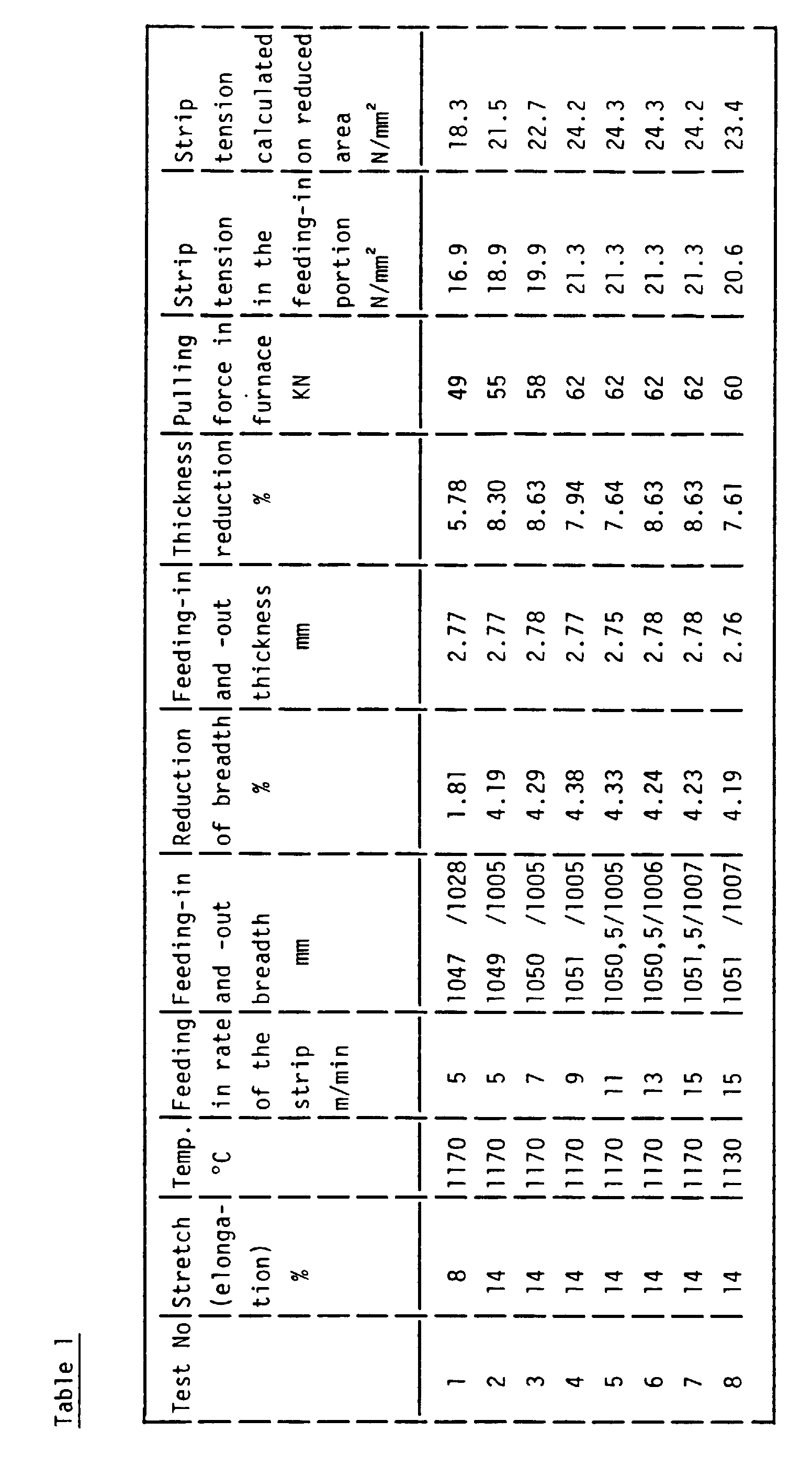
- Table 1 there is shown results from ten tests, which concerned continuous elongation of steel strips in an annealing furnace. All the strips which were tested were of an austenitic stainless steel, grade Avesta 18-9 (SIS 2333) having the nominal composition 18 chromium, 9 nickel, 0.04 carbon, 0.5 manganese, 0.7 silicon, balance iron and unavoidable impurities.
- the steel strip first had been hot rolled to a thickness of about 2.75 mm and a breadth of about 1050 mm.
- the strips were heated in the annealing furnace to a temperature of 1170°C, except in one case, when the temperature was 1130°C. Two different elongations were applied at the experiments, namely 8 % and 14 %.
- the feeding-in rate to the furnace 7 was 5 m/min, while the feeding-in rate at the elongation 14 % was varied between 5 and 15 m/min.
- the annealing temperature was also lowered from 1170°C to 1130°C. The breadth and thickness values were measured before and after the elongation and also necessary strip pulling forces were registered.
Landscapes
- Chemical & Material Sciences (AREA)
- Engineering & Computer Science (AREA)
- Organic Chemistry (AREA)
- Thermal Sciences (AREA)
- Crystallography & Structural Chemistry (AREA)
- Mechanical Engineering (AREA)
- Materials Engineering (AREA)
- Metallurgy (AREA)
- Physics & Mathematics (AREA)
- Heat Treatment Of Strip Materials And Filament Materials (AREA)
- Metal Rolling (AREA)
- Heat Treatment Of Sheet Steel (AREA)
- Coating With Molten Metal (AREA)
- Manufacturing Of Steel Electrode Plates (AREA)
- Enzymes And Modification Thereof (AREA)
- Peptides Or Proteins (AREA)
Abstract
Description
- that the breadth reduction is almost constant at constant elongation, even if the feeding rate is varied;
- that the thickness reduction is almost constant at constant elongation, even if the feeding rate is varied; and
- that the tension in the strip calculated on a reduced area is increased with increased elongation values.
Claims (5)
- Method of manufacturing steel strips, to obtain a desired breath of the strip by controlling the pulling force in continuous treatment of the steel strip in an annealing furnace (7) at a temperature exceeding the recrystallization temperature of the steel, wherein the steel strip (4A) is fed into the annealing furnace at a certain feeding-in rate and is drawn out of the furnace at another, higher feeding-out rate, and wherein the steel strip is subjected to a pulling force in the annealing furnace at said temperature exceeding the creep limit of the steel at said temperature, resulting in a permanent stretch (elongation) of the steel strip connesponding to the difference between the feeding-out and feeding-in rates, and in a reduction of the cross section of the strip corresponding to the elongation, including a reduction of the strip thickness as well as of the strip breadth.
- Method according to claim 1, characterised in that the steel strip is subjected to the said pulling tension at a temperature between 1000° and 1250°C.
- Method according to claim 2, characterised in that the steel strip is subjected to the said pulling tension at a temperature between 1080° and 1200°C.
- Method according to any of claims 1-3, characterised in that the strip after hot rolling is subjected to at least one cold rolling operation causing a first strip thickness reduction before the strip is subjected to said continuous annealing and stretching in the annealing furnace resulting in a second thickness reduction.
- Method according to claim 4 for the production of strips having a certain desired breadth and thickness, characterised in that the strip is continuously stretched so much in the annealing furnace that the breadth of the strip is reduced to a certain final breadth at the same time as said second thickness reduction is achieved, and that the strip is worked in the preceding cold rolling operation to an extent depending on the finishing second thickness reduction, so that the total thickness reduction achieved through the cold rolling and through the elongation in the annealing furnace affords the strip a thickness after annealing which corresponds to the desired strip thickness of the end product.
Applications Claiming Priority (2)
| Application Number | Priority Date | Filing Date | Title |
|---|---|---|---|
| SE9003018A SE467055B (en) | 1990-09-21 | 1990-09-21 | PROCEDURE PROVIDES CONTINUOUS RECRISTALIZATION ANGLE OF A STEEL BAND, WHERE THE STEEL BAND IS EXPOSED BEFORE A TENSION TENSION |
| PCT/SE1992/000162 WO1993019211A1 (en) | 1990-09-21 | 1992-03-17 | Method for continuous recrystallization annealing of a steel strip |
Publications (2)
| Publication Number | Publication Date |
|---|---|
| EP0628087A1 EP0628087A1 (en) | 1994-12-14 |
| EP0628087B1 true EP0628087B1 (en) | 1998-01-14 |
Family
ID=40379726
Family Applications (1)
| Application Number | Title | Priority Date | Filing Date |
|---|---|---|---|
| EP92909240A Expired - Lifetime EP0628087B1 (en) | 1990-09-21 | 1992-03-17 | Method for continuous recrystallization annealing of a steel strip |
Country Status (11)
| Country | Link |
|---|---|
| US (1) | US5690757A (en) |
| EP (1) | EP0628087B1 (en) |
| JP (1) | JP3547431B2 (en) |
| AT (1) | ATE162228T1 (en) |
| AU (1) | AU1655792A (en) |
| CA (1) | CA2131282A1 (en) |
| DE (1) | DE69224078T2 (en) |
| ES (1) | ES2112902T3 (en) |
| FI (1) | FI100603B (en) |
| SE (1) | SE467055B (en) |
| WO (1) | WO1993019211A1 (en) |
Families Citing this family (2)
| Publication number | Priority date | Publication date | Assignee | Title |
|---|---|---|---|---|
| SE508892C2 (en) * | 1996-10-15 | 1998-11-16 | Avesta Sheffield Ab | Process for making a stainless steel strip |
| FR3027920B1 (en) * | 2014-10-29 | 2019-03-29 | Fives Stein | METHOD FOR ORIENTING STEEL SHEET GRAINS, DEVICE THEREFOR, AND INSTALLATION USING SAID METHOD OR DEVICE |
Family Cites Families (3)
| Publication number | Priority date | Publication date | Assignee | Title |
|---|---|---|---|---|
| SE302470B (en) * | 1964-07-13 | 1968-07-22 | Svenska Metallverken Ab | |
| US3388011A (en) * | 1965-10-08 | 1968-06-11 | Atomic Energy Commission Usa | Process for the production of high strength steels |
| SU602573A1 (en) * | 1976-07-09 | 1978-04-15 | Научно-исследовательский институт автотракторных материалов | Method of heat and mechanical treatment of steel articles |
-
1990
- 1990-09-21 SE SE9003018A patent/SE467055B/en not_active IP Right Cessation
-
1992
- 1992-03-17 CA CA002131282A patent/CA2131282A1/en not_active Abandoned
- 1992-03-17 DE DE69224078T patent/DE69224078T2/en not_active Expired - Lifetime
- 1992-03-17 US US08/302,870 patent/US5690757A/en not_active Expired - Lifetime
- 1992-03-17 AU AU16557/92A patent/AU1655792A/en not_active Abandoned
- 1992-03-17 AT AT92909240T patent/ATE162228T1/en not_active IP Right Cessation
- 1992-03-17 ES ES92909240T patent/ES2112902T3/en not_active Expired - Lifetime
- 1992-03-17 EP EP92909240A patent/EP0628087B1/en not_active Expired - Lifetime
- 1992-03-17 WO PCT/SE1992/000162 patent/WO1993019211A1/en not_active Ceased
- 1992-03-17 JP JP50871792A patent/JP3547431B2/en not_active Expired - Lifetime
-
1994
- 1994-08-31 FI FI943986A patent/FI100603B/en not_active IP Right Cessation
Also Published As
| Publication number | Publication date |
|---|---|
| SE9003018L (en) | 1992-03-22 |
| ATE162228T1 (en) | 1998-01-15 |
| EP0628087A1 (en) | 1994-12-14 |
| ES2112902T3 (en) | 1998-04-16 |
| JPH07500871A (en) | 1995-01-26 |
| DE69224078D1 (en) | 1998-02-19 |
| AU1655792A (en) | 1993-10-21 |
| SE9003018D0 (en) | 1990-09-21 |
| DE69224078T2 (en) | 1998-05-07 |
| FI943986L (en) | 1994-08-31 |
| FI100603B (en) | 1998-01-15 |
| WO1993019211A1 (en) | 1993-09-30 |
| JP3547431B2 (en) | 2004-07-28 |
| SE467055B (en) | 1992-05-18 |
| CA2131282A1 (en) | 1993-09-30 |
| FI943986A0 (en) | 1994-08-31 |
| US5690757A (en) | 1997-11-25 |
Similar Documents
| Publication | Publication Date | Title |
|---|---|---|
| KR101232259B1 (en) | Method for producing hot strips consisting of lightweight steel | |
| EP4317506A1 (en) | Non-oriented electrical steel sheet | |
| JP4231932B2 (en) | Hot rolled strip processing method | |
| JP3763041B2 (en) | A method to increase the yield strength of cold formed steel shapes. | |
| EP0099520A2 (en) | Method and apparatus for thermomechanically rolling hot strip product to a controlled microstructure | |
| EP0314667B1 (en) | Process and apparatus for manufacturing thin wires, rods, pipes or sections made of steels or alloys with a low deformability, particularly of hardenable steels | |
| US5690757A (en) | Method for continuous recrystallization annealing of a steel strip | |
| US4291558A (en) | Process of rolling iron-silicon strip material | |
| JP3806173B2 (en) | Manufacturing method of hot-rolled steel sheet with small material variations by continuous hot-rolling process | |
| JPS63145718A (en) | Production of ultra-high-strength cold rolled steel sheet having excellent workability | |
| KR100239281B1 (en) | Method for continuous recrystallization annealing of a steel strip | |
| CN112458360A (en) | Production method of hot continuous rolling plate with low residual stress for bridge U rib | |
| JP2820805B2 (en) | Method for producing thin hot rolled steel sheet with excellent surface properties | |
| JP2825986B2 (en) | Method for producing thin hot rolled steel sheet with excellent surface properties | |
| RU2031749C1 (en) | Method to produce hot rolled bars of commercially pure aluminum | |
| JP2756531B2 (en) | Manufacturing method of soft steel bar | |
| RU2006505C1 (en) | Method of manufacture of hot-rolled high-strength sheet steel | |
| DE68925578T2 (en) | METHOD FOR PRODUCING THIN SHEETS FROM CR-NI AND STAINLESS STEEL WITH EXCELLENT PROPERTIES, AND SURFACE QUALITY AND MATERIAL QUALITY | |
| JP2677326B2 (en) | Method for continuously treating cold rolled carbon manganese steel | |
| JP3671516B2 (en) | Method for producing hot-rolled steel sheet with excellent pickling and surface properties | |
| EP0211681A2 (en) | Continuous annealing method for deep drawable extra-low carbon steel | |
| JPH09279245A (en) | Method for producing Cr-Mo type seamless steel pipe excellent in high temperature strength | |
| JP2644580B2 (en) | Manufacturing method of cold rolled mild steel sheet with excellent deep pattern | |
| CN117396616A (en) | Apparatus and method for manufacturing wire and/or strip steel | |
| JP2003320403A (en) | Hot rolled steel strip manufacturing method |
Legal Events
| Date | Code | Title | Description |
|---|---|---|---|
| PUAI | Public reference made under article 153(3) epc to a published international application that has entered the european phase |
Free format text: ORIGINAL CODE: 0009012 |
|
| 17P | Request for examination filed |
Effective date: 19940713 |
|
| AK | Designated contracting states |
Kind code of ref document: A1 Designated state(s): AT DE ES FR GB IT |
|
| GRAG | Despatch of communication of intention to grant |
Free format text: ORIGINAL CODE: EPIDOS AGRA |
|
| 17Q | First examination report despatched |
Effective date: 19970325 |
|
| GRAG | Despatch of communication of intention to grant |
Free format text: ORIGINAL CODE: EPIDOS AGRA |
|
| GRAH | Despatch of communication of intention to grant a patent |
Free format text: ORIGINAL CODE: EPIDOS IGRA |
|
| GRAH | Despatch of communication of intention to grant a patent |
Free format text: ORIGINAL CODE: EPIDOS IGRA |
|
| GRAA | (expected) grant |
Free format text: ORIGINAL CODE: 0009210 |
|
| AK | Designated contracting states |
Kind code of ref document: B1 Designated state(s): AT DE ES FR GB IT |
|
| PG25 | Lapsed in a contracting state [announced via postgrant information from national office to epo] |
Ref country code: AT Free format text: LAPSE BECAUSE OF FAILURE TO SUBMIT A TRANSLATION OF THE DESCRIPTION OR TO PAY THE FEE WITHIN THE PRESCRIBED TIME-LIMIT Effective date: 19980114 |
|
| REF | Corresponds to: |
Ref document number: 162228 Country of ref document: AT Date of ref document: 19980115 Kind code of ref document: T |
|
| ITF | It: translation for a ep patent filed | ||
| ET | Fr: translation filed | ||
| REF | Corresponds to: |
Ref document number: 69224078 Country of ref document: DE Date of ref document: 19980219 |
|
| PG25 | Lapsed in a contracting state [announced via postgrant information from national office to epo] |
Ref country code: GB Free format text: LAPSE BECAUSE OF NON-PAYMENT OF DUE FEES Effective date: 19980414 |
|
| REG | Reference to a national code |
Ref country code: ES Ref legal event code: FG2A Ref document number: 2112902 Country of ref document: ES Kind code of ref document: T3 |
|
| PLBE | No opposition filed within time limit |
Free format text: ORIGINAL CODE: 0009261 |
|
| GBPC | Gb: european patent ceased through non-payment of renewal fee |
Effective date: 19980414 |
|
| 26N | No opposition filed | ||
| REG | Reference to a national code |
Ref country code: FR Ref legal event code: CD |
|
| REG | Reference to a national code |
Ref country code: FR Ref legal event code: CD |
|
| PGFP | Annual fee paid to national office [announced via postgrant information from national office to epo] |
Ref country code: FR Payment date: 20110404 Year of fee payment: 20 |
|
| PGFP | Annual fee paid to national office [announced via postgrant information from national office to epo] |
Ref country code: ES Payment date: 20110322 Year of fee payment: 20 Ref country code: DE Payment date: 20110325 Year of fee payment: 20 |
|
| PGFP | Annual fee paid to national office [announced via postgrant information from national office to epo] |
Ref country code: IT Payment date: 20110329 Year of fee payment: 20 |
|
| REG | Reference to a national code |
Ref country code: DE Ref legal event code: R071 Ref document number: 69224078 Country of ref document: DE |
|
| REG | Reference to a national code |
Ref country code: DE Ref legal event code: R071 Ref document number: 69224078 Country of ref document: DE |
|
| PG25 | Lapsed in a contracting state [announced via postgrant information from national office to epo] |
Ref country code: DE Free format text: LAPSE BECAUSE OF EXPIRATION OF PROTECTION Effective date: 20120318 |
|
| REG | Reference to a national code |
Ref country code: ES Ref legal event code: FD2A Effective date: 20120604 |
|
| PG25 | Lapsed in a contracting state [announced via postgrant information from national office to epo] |
Ref country code: ES Free format text: LAPSE BECAUSE OF EXPIRATION OF PROTECTION Effective date: 20120318 |