EP0627406A1 - 2-amino-1,3-propanediol compound and immunosuppressant - Google Patents
2-amino-1,3-propanediol compound and immunosuppressant Download PDFInfo
- Publication number
- EP0627406A1 EP0627406A1 EP93923035A EP93923035A EP0627406A1 EP 0627406 A1 EP0627406 A1 EP 0627406A1 EP 93923035 A EP93923035 A EP 93923035A EP 93923035 A EP93923035 A EP 93923035A EP 0627406 A1 EP0627406 A1 EP 0627406A1
- Authority
- EP
- European Patent Office
- Prior art keywords
- amino
- propanediol
- optionally substituted
- alkyl
- ethyl
- Prior art date
- Legal status (The legal status is an assumption and is not a legal conclusion. Google has not performed a legal analysis and makes no representation as to the accuracy of the status listed.)
- Granted
Links
Classifications
-
- C—CHEMISTRY; METALLURGY
- C07—ORGANIC CHEMISTRY
- C07D—HETEROCYCLIC COMPOUNDS
- C07D207/00—Heterocyclic compounds containing five-membered rings not condensed with other rings, with one nitrogen atom as the only ring hetero atom
- C07D207/02—Heterocyclic compounds containing five-membered rings not condensed with other rings, with one nitrogen atom as the only ring hetero atom with only hydrogen or carbon atoms directly attached to the ring nitrogen atom
- C07D207/30—Heterocyclic compounds containing five-membered rings not condensed with other rings, with one nitrogen atom as the only ring hetero atom with only hydrogen or carbon atoms directly attached to the ring nitrogen atom having two double bonds between ring members or between ring members and non-ring members
- C07D207/32—Heterocyclic compounds containing five-membered rings not condensed with other rings, with one nitrogen atom as the only ring hetero atom with only hydrogen or carbon atoms directly attached to the ring nitrogen atom having two double bonds between ring members or between ring members and non-ring members with only hydrogen atoms, hydrocarbon or substituted hydrocarbon radicals, directly attached to ring carbon atoms
- C07D207/325—Heterocyclic compounds containing five-membered rings not condensed with other rings, with one nitrogen atom as the only ring hetero atom with only hydrogen or carbon atoms directly attached to the ring nitrogen atom having two double bonds between ring members or between ring members and non-ring members with only hydrogen atoms, hydrocarbon or substituted hydrocarbon radicals, directly attached to ring carbon atoms with substituted hydrocarbon radicals directly attached to the ring nitrogen atom
-
- C—CHEMISTRY; METALLURGY
- C07—ORGANIC CHEMISTRY
- C07C—ACYCLIC OR CARBOCYCLIC COMPOUNDS
- C07C215/00—Compounds containing amino and hydroxy groups bound to the same carbon skeleton
- C07C215/02—Compounds containing amino and hydroxy groups bound to the same carbon skeleton having hydroxy groups and amino groups bound to acyclic carbon atoms of the same carbon skeleton
-
- A—HUMAN NECESSITIES
- A61—MEDICAL OR VETERINARY SCIENCE; HYGIENE
- A61K—PREPARATIONS FOR MEDICAL, DENTAL OR TOILETRY PURPOSES
- A61K31/00—Medicinal preparations containing organic active ingredients
- A61K31/21—Esters, e.g. nitroglycerine, selenocyanates
- A61K31/215—Esters, e.g. nitroglycerine, selenocyanates of carboxylic acids
-
- A—HUMAN NECESSITIES
- A61—MEDICAL OR VETERINARY SCIENCE; HYGIENE
- A61K—PREPARATIONS FOR MEDICAL, DENTAL OR TOILETRY PURPOSES
- A61K31/00—Medicinal preparations containing organic active ingredients
- A61K31/21—Esters, e.g. nitroglycerine, selenocyanates
- A61K31/215—Esters, e.g. nitroglycerine, selenocyanates of carboxylic acids
- A61K31/235—Esters, e.g. nitroglycerine, selenocyanates of carboxylic acids having an aromatic ring attached to a carboxyl group
- A61K31/24—Esters, e.g. nitroglycerine, selenocyanates of carboxylic acids having an aromatic ring attached to a carboxyl group having an amino or nitro group
-
- C—CHEMISTRY; METALLURGY
- C07—ORGANIC CHEMISTRY
- C07C—ACYCLIC OR CARBOCYCLIC COMPOUNDS
- C07C215/00—Compounds containing amino and hydroxy groups bound to the same carbon skeleton
- C07C215/02—Compounds containing amino and hydroxy groups bound to the same carbon skeleton having hydroxy groups and amino groups bound to acyclic carbon atoms of the same carbon skeleton
- C07C215/04—Compounds containing amino and hydroxy groups bound to the same carbon skeleton having hydroxy groups and amino groups bound to acyclic carbon atoms of the same carbon skeleton the carbon skeleton being saturated
- C07C215/06—Compounds containing amino and hydroxy groups bound to the same carbon skeleton having hydroxy groups and amino groups bound to acyclic carbon atoms of the same carbon skeleton the carbon skeleton being saturated and acyclic
- C07C215/10—Compounds containing amino and hydroxy groups bound to the same carbon skeleton having hydroxy groups and amino groups bound to acyclic carbon atoms of the same carbon skeleton the carbon skeleton being saturated and acyclic with one amino group and at least two hydroxy groups bound to the carbon skeleton
-
- C—CHEMISTRY; METALLURGY
- C07—ORGANIC CHEMISTRY
- C07C—ACYCLIC OR CARBOCYCLIC COMPOUNDS
- C07C215/00—Compounds containing amino and hydroxy groups bound to the same carbon skeleton
- C07C215/02—Compounds containing amino and hydroxy groups bound to the same carbon skeleton having hydroxy groups and amino groups bound to acyclic carbon atoms of the same carbon skeleton
- C07C215/04—Compounds containing amino and hydroxy groups bound to the same carbon skeleton having hydroxy groups and amino groups bound to acyclic carbon atoms of the same carbon skeleton the carbon skeleton being saturated
- C07C215/06—Compounds containing amino and hydroxy groups bound to the same carbon skeleton having hydroxy groups and amino groups bound to acyclic carbon atoms of the same carbon skeleton the carbon skeleton being saturated and acyclic
- C07C215/18—Compounds containing amino and hydroxy groups bound to the same carbon skeleton having hydroxy groups and amino groups bound to acyclic carbon atoms of the same carbon skeleton the carbon skeleton being saturated and acyclic with hydroxy groups and at least two amino groups bound to the carbon skeleton
-
- C—CHEMISTRY; METALLURGY
- C07—ORGANIC CHEMISTRY
- C07C—ACYCLIC OR CARBOCYCLIC COMPOUNDS
- C07C215/00—Compounds containing amino and hydroxy groups bound to the same carbon skeleton
- C07C215/02—Compounds containing amino and hydroxy groups bound to the same carbon skeleton having hydroxy groups and amino groups bound to acyclic carbon atoms of the same carbon skeleton
- C07C215/04—Compounds containing amino and hydroxy groups bound to the same carbon skeleton having hydroxy groups and amino groups bound to acyclic carbon atoms of the same carbon skeleton the carbon skeleton being saturated
- C07C215/20—Compounds containing amino and hydroxy groups bound to the same carbon skeleton having hydroxy groups and amino groups bound to acyclic carbon atoms of the same carbon skeleton the carbon skeleton being saturated the carbon skeleton being saturated and containing rings
-
- C—CHEMISTRY; METALLURGY
- C07—ORGANIC CHEMISTRY
- C07C—ACYCLIC OR CARBOCYCLIC COMPOUNDS
- C07C215/00—Compounds containing amino and hydroxy groups bound to the same carbon skeleton
- C07C215/02—Compounds containing amino and hydroxy groups bound to the same carbon skeleton having hydroxy groups and amino groups bound to acyclic carbon atoms of the same carbon skeleton
- C07C215/22—Compounds containing amino and hydroxy groups bound to the same carbon skeleton having hydroxy groups and amino groups bound to acyclic carbon atoms of the same carbon skeleton the carbon skeleton being unsaturated
- C07C215/24—Compounds containing amino and hydroxy groups bound to the same carbon skeleton having hydroxy groups and amino groups bound to acyclic carbon atoms of the same carbon skeleton the carbon skeleton being unsaturated and acyclic
-
- C—CHEMISTRY; METALLURGY
- C07—ORGANIC CHEMISTRY
- C07C—ACYCLIC OR CARBOCYCLIC COMPOUNDS
- C07C215/00—Compounds containing amino and hydroxy groups bound to the same carbon skeleton
- C07C215/02—Compounds containing amino and hydroxy groups bound to the same carbon skeleton having hydroxy groups and amino groups bound to acyclic carbon atoms of the same carbon skeleton
- C07C215/22—Compounds containing amino and hydroxy groups bound to the same carbon skeleton having hydroxy groups and amino groups bound to acyclic carbon atoms of the same carbon skeleton the carbon skeleton being unsaturated
- C07C215/26—Compounds containing amino and hydroxy groups bound to the same carbon skeleton having hydroxy groups and amino groups bound to acyclic carbon atoms of the same carbon skeleton the carbon skeleton being unsaturated and containing rings other than six-membered aromatic rings
-
- C—CHEMISTRY; METALLURGY
- C07—ORGANIC CHEMISTRY
- C07C—ACYCLIC OR CARBOCYCLIC COMPOUNDS
- C07C215/00—Compounds containing amino and hydroxy groups bound to the same carbon skeleton
- C07C215/02—Compounds containing amino and hydroxy groups bound to the same carbon skeleton having hydroxy groups and amino groups bound to acyclic carbon atoms of the same carbon skeleton
- C07C215/22—Compounds containing amino and hydroxy groups bound to the same carbon skeleton having hydroxy groups and amino groups bound to acyclic carbon atoms of the same carbon skeleton the carbon skeleton being unsaturated
- C07C215/28—Compounds containing amino and hydroxy groups bound to the same carbon skeleton having hydroxy groups and amino groups bound to acyclic carbon atoms of the same carbon skeleton the carbon skeleton being unsaturated and containing six-membered aromatic rings
-
- C—CHEMISTRY; METALLURGY
- C07—ORGANIC CHEMISTRY
- C07C—ACYCLIC OR CARBOCYCLIC COMPOUNDS
- C07C215/00—Compounds containing amino and hydroxy groups bound to the same carbon skeleton
- C07C215/02—Compounds containing amino and hydroxy groups bound to the same carbon skeleton having hydroxy groups and amino groups bound to acyclic carbon atoms of the same carbon skeleton
- C07C215/22—Compounds containing amino and hydroxy groups bound to the same carbon skeleton having hydroxy groups and amino groups bound to acyclic carbon atoms of the same carbon skeleton the carbon skeleton being unsaturated
- C07C215/28—Compounds containing amino and hydroxy groups bound to the same carbon skeleton having hydroxy groups and amino groups bound to acyclic carbon atoms of the same carbon skeleton the carbon skeleton being unsaturated and containing six-membered aromatic rings
- C07C215/34—Compounds containing amino and hydroxy groups bound to the same carbon skeleton having hydroxy groups and amino groups bound to acyclic carbon atoms of the same carbon skeleton the carbon skeleton being unsaturated and containing six-membered aromatic rings containing hydroxy groups and carbon atoms of six-membered aromatic rings bound to the same carbon atom of the carbon skeleton and at least one hydroxy group bound to another carbon atom of the carbon skeleton
-
- C—CHEMISTRY; METALLURGY
- C07—ORGANIC CHEMISTRY
- C07C—ACYCLIC OR CARBOCYCLIC COMPOUNDS
- C07C215/00—Compounds containing amino and hydroxy groups bound to the same carbon skeleton
- C07C215/42—Compounds containing amino and hydroxy groups bound to the same carbon skeleton having amino groups or hydroxy groups bound to carbon atoms of rings other than six-membered aromatic rings of the same carbon skeleton
-
- C—CHEMISTRY; METALLURGY
- C07—ORGANIC CHEMISTRY
- C07C—ACYCLIC OR CARBOCYCLIC COMPOUNDS
- C07C215/00—Compounds containing amino and hydroxy groups bound to the same carbon skeleton
- C07C215/46—Compounds containing amino and hydroxy groups bound to the same carbon skeleton having hydroxy groups bound to carbon atoms of at least one six-membered aromatic ring and amino groups bound to acyclic carbon atoms or to carbon atoms of rings other than six-membered aromatic rings of the same carbon skeleton
- C07C215/48—Compounds containing amino and hydroxy groups bound to the same carbon skeleton having hydroxy groups bound to carbon atoms of at least one six-membered aromatic ring and amino groups bound to acyclic carbon atoms or to carbon atoms of rings other than six-membered aromatic rings of the same carbon skeleton with amino groups linked to the six-membered aromatic ring, or to the condensed ring system containing that ring, by carbon chains not further substituted by hydroxy groups
- C07C215/54—Compounds containing amino and hydroxy groups bound to the same carbon skeleton having hydroxy groups bound to carbon atoms of at least one six-membered aromatic ring and amino groups bound to acyclic carbon atoms or to carbon atoms of rings other than six-membered aromatic rings of the same carbon skeleton with amino groups linked to the six-membered aromatic ring, or to the condensed ring system containing that ring, by carbon chains not further substituted by hydroxy groups linked by carbon chains having at least three carbon atoms between the amino groups and the six-membered aromatic ring or the condensed ring system containing that ring
-
- C—CHEMISTRY; METALLURGY
- C07—ORGANIC CHEMISTRY
- C07C—ACYCLIC OR CARBOCYCLIC COMPOUNDS
- C07C215/00—Compounds containing amino and hydroxy groups bound to the same carbon skeleton
- C07C215/46—Compounds containing amino and hydroxy groups bound to the same carbon skeleton having hydroxy groups bound to carbon atoms of at least one six-membered aromatic ring and amino groups bound to acyclic carbon atoms or to carbon atoms of rings other than six-membered aromatic rings of the same carbon skeleton
- C07C215/56—Compounds containing amino and hydroxy groups bound to the same carbon skeleton having hydroxy groups bound to carbon atoms of at least one six-membered aromatic ring and amino groups bound to acyclic carbon atoms or to carbon atoms of rings other than six-membered aromatic rings of the same carbon skeleton with amino groups linked to the six-membered aromatic ring, or to the condensed ring system containing that ring, by carbon chains further substituted by hydroxy groups
-
- C—CHEMISTRY; METALLURGY
- C07—ORGANIC CHEMISTRY
- C07C—ACYCLIC OR CARBOCYCLIC COMPOUNDS
- C07C215/00—Compounds containing amino and hydroxy groups bound to the same carbon skeleton
- C07C215/68—Compounds containing amino and hydroxy groups bound to the same carbon skeleton having amino groups bound to carbon atoms of six-membered aromatic rings and hydroxy groups bound to acyclic carbon atoms or to carbon atoms of rings other than six-membered aromatic rings of the same carbon skeleton
-
- C—CHEMISTRY; METALLURGY
- C07—ORGANIC CHEMISTRY
- C07C—ACYCLIC OR CARBOCYCLIC COMPOUNDS
- C07C217/00—Compounds containing amino and etherified hydroxy groups bound to the same carbon skeleton
- C07C217/02—Compounds containing amino and etherified hydroxy groups bound to the same carbon skeleton having etherified hydroxy groups and amino groups bound to acyclic carbon atoms of the same carbon skeleton
- C07C217/04—Compounds containing amino and etherified hydroxy groups bound to the same carbon skeleton having etherified hydroxy groups and amino groups bound to acyclic carbon atoms of the same carbon skeleton the carbon skeleton being acyclic and saturated
- C07C217/28—Compounds containing amino and etherified hydroxy groups bound to the same carbon skeleton having etherified hydroxy groups and amino groups bound to acyclic carbon atoms of the same carbon skeleton the carbon skeleton being acyclic and saturated having one amino group and at least two singly-bound oxygen atoms, with at least one being part of an etherified hydroxy group, bound to the carbon skeleton, e.g. ethers of polyhydroxy amines
-
- C—CHEMISTRY; METALLURGY
- C07—ORGANIC CHEMISTRY
- C07C—ACYCLIC OR CARBOCYCLIC COMPOUNDS
- C07C217/00—Compounds containing amino and etherified hydroxy groups bound to the same carbon skeleton
- C07C217/02—Compounds containing amino and etherified hydroxy groups bound to the same carbon skeleton having etherified hydroxy groups and amino groups bound to acyclic carbon atoms of the same carbon skeleton
- C07C217/04—Compounds containing amino and etherified hydroxy groups bound to the same carbon skeleton having etherified hydroxy groups and amino groups bound to acyclic carbon atoms of the same carbon skeleton the carbon skeleton being acyclic and saturated
- C07C217/28—Compounds containing amino and etherified hydroxy groups bound to the same carbon skeleton having etherified hydroxy groups and amino groups bound to acyclic carbon atoms of the same carbon skeleton the carbon skeleton being acyclic and saturated having one amino group and at least two singly-bound oxygen atoms, with at least one being part of an etherified hydroxy group, bound to the carbon skeleton, e.g. ethers of polyhydroxy amines
- C07C217/30—Compounds containing amino and etherified hydroxy groups bound to the same carbon skeleton having etherified hydroxy groups and amino groups bound to acyclic carbon atoms of the same carbon skeleton the carbon skeleton being acyclic and saturated having one amino group and at least two singly-bound oxygen atoms, with at least one being part of an etherified hydroxy group, bound to the carbon skeleton, e.g. ethers of polyhydroxy amines having the oxygen atom of at least one of the etherified hydroxy groups further bound to a carbon atom of a six-membered aromatic ring
-
- C—CHEMISTRY; METALLURGY
- C07—ORGANIC CHEMISTRY
- C07C—ACYCLIC OR CARBOCYCLIC COMPOUNDS
- C07C217/00—Compounds containing amino and etherified hydroxy groups bound to the same carbon skeleton
- C07C217/02—Compounds containing amino and etherified hydroxy groups bound to the same carbon skeleton having etherified hydroxy groups and amino groups bound to acyclic carbon atoms of the same carbon skeleton
- C07C217/04—Compounds containing amino and etherified hydroxy groups bound to the same carbon skeleton having etherified hydroxy groups and amino groups bound to acyclic carbon atoms of the same carbon skeleton the carbon skeleton being acyclic and saturated
- C07C217/28—Compounds containing amino and etherified hydroxy groups bound to the same carbon skeleton having etherified hydroxy groups and amino groups bound to acyclic carbon atoms of the same carbon skeleton the carbon skeleton being acyclic and saturated having one amino group and at least two singly-bound oxygen atoms, with at least one being part of an etherified hydroxy group, bound to the carbon skeleton, e.g. ethers of polyhydroxy amines
- C07C217/30—Compounds containing amino and etherified hydroxy groups bound to the same carbon skeleton having etherified hydroxy groups and amino groups bound to acyclic carbon atoms of the same carbon skeleton the carbon skeleton being acyclic and saturated having one amino group and at least two singly-bound oxygen atoms, with at least one being part of an etherified hydroxy group, bound to the carbon skeleton, e.g. ethers of polyhydroxy amines having the oxygen atom of at least one of the etherified hydroxy groups further bound to a carbon atom of a six-membered aromatic ring
- C07C217/32—Compounds containing amino and etherified hydroxy groups bound to the same carbon skeleton having etherified hydroxy groups and amino groups bound to acyclic carbon atoms of the same carbon skeleton the carbon skeleton being acyclic and saturated having one amino group and at least two singly-bound oxygen atoms, with at least one being part of an etherified hydroxy group, bound to the carbon skeleton, e.g. ethers of polyhydroxy amines having the oxygen atom of at least one of the etherified hydroxy groups further bound to a carbon atom of a six-membered aromatic ring the six-membered aromatic ring or condensed ring system containing that ring being further substituted
- C07C217/34—Compounds containing amino and etherified hydroxy groups bound to the same carbon skeleton having etherified hydroxy groups and amino groups bound to acyclic carbon atoms of the same carbon skeleton the carbon skeleton being acyclic and saturated having one amino group and at least two singly-bound oxygen atoms, with at least one being part of an etherified hydroxy group, bound to the carbon skeleton, e.g. ethers of polyhydroxy amines having the oxygen atom of at least one of the etherified hydroxy groups further bound to a carbon atom of a six-membered aromatic ring the six-membered aromatic ring or condensed ring system containing that ring being further substituted by halogen atoms, by trihalomethyl, nitro or nitroso groups, or by singly-bound oxygen atoms
-
- C—CHEMISTRY; METALLURGY
- C07—ORGANIC CHEMISTRY
- C07C—ACYCLIC OR CARBOCYCLIC COMPOUNDS
- C07C217/00—Compounds containing amino and etherified hydroxy groups bound to the same carbon skeleton
- C07C217/02—Compounds containing amino and etherified hydroxy groups bound to the same carbon skeleton having etherified hydroxy groups and amino groups bound to acyclic carbon atoms of the same carbon skeleton
- C07C217/48—Compounds containing amino and etherified hydroxy groups bound to the same carbon skeleton having etherified hydroxy groups and amino groups bound to acyclic carbon atoms of the same carbon skeleton the carbon skeleton being unsaturated and containing rings
-
- C—CHEMISTRY; METALLURGY
- C07—ORGANIC CHEMISTRY
- C07C—ACYCLIC OR CARBOCYCLIC COMPOUNDS
- C07C217/00—Compounds containing amino and etherified hydroxy groups bound to the same carbon skeleton
- C07C217/52—Compounds containing amino and etherified hydroxy groups bound to the same carbon skeleton having etherified hydroxy groups or amino groups bound to carbon atoms of rings other than six-membered aromatic rings of the same carbon skeleton
-
- C—CHEMISTRY; METALLURGY
- C07—ORGANIC CHEMISTRY
- C07C—ACYCLIC OR CARBOCYCLIC COMPOUNDS
- C07C217/00—Compounds containing amino and etherified hydroxy groups bound to the same carbon skeleton
- C07C217/54—Compounds containing amino and etherified hydroxy groups bound to the same carbon skeleton having etherified hydroxy groups bound to carbon atoms of at least one six-membered aromatic ring and amino groups bound to acyclic carbon atoms or to carbon atoms of rings other than six-membered aromatic rings of the same carbon skeleton
- C07C217/64—Compounds containing amino and etherified hydroxy groups bound to the same carbon skeleton having etherified hydroxy groups bound to carbon atoms of at least one six-membered aromatic ring and amino groups bound to acyclic carbon atoms or to carbon atoms of rings other than six-membered aromatic rings of the same carbon skeleton with amino groups linked to the six-membered aromatic ring, or to the condensed ring system containing that ring, by carbon chains further substituted by singly-bound oxygen atoms
-
- C—CHEMISTRY; METALLURGY
- C07—ORGANIC CHEMISTRY
- C07C—ACYCLIC OR CARBOCYCLIC COMPOUNDS
- C07C217/00—Compounds containing amino and etherified hydroxy groups bound to the same carbon skeleton
- C07C217/54—Compounds containing amino and etherified hydroxy groups bound to the same carbon skeleton having etherified hydroxy groups bound to carbon atoms of at least one six-membered aromatic ring and amino groups bound to acyclic carbon atoms or to carbon atoms of rings other than six-membered aromatic rings of the same carbon skeleton
- C07C217/64—Compounds containing amino and etherified hydroxy groups bound to the same carbon skeleton having etherified hydroxy groups bound to carbon atoms of at least one six-membered aromatic ring and amino groups bound to acyclic carbon atoms or to carbon atoms of rings other than six-membered aromatic rings of the same carbon skeleton with amino groups linked to the six-membered aromatic ring, or to the condensed ring system containing that ring, by carbon chains further substituted by singly-bound oxygen atoms
- C07C217/66—Compounds containing amino and etherified hydroxy groups bound to the same carbon skeleton having etherified hydroxy groups bound to carbon atoms of at least one six-membered aromatic ring and amino groups bound to acyclic carbon atoms or to carbon atoms of rings other than six-membered aromatic rings of the same carbon skeleton with amino groups linked to the six-membered aromatic ring, or to the condensed ring system containing that ring, by carbon chains further substituted by singly-bound oxygen atoms with singly-bound oxygen atoms and six-membered aromatic rings bound to the same carbon atom of the carbon chain
- C07C217/72—Compounds containing amino and etherified hydroxy groups bound to the same carbon skeleton having etherified hydroxy groups bound to carbon atoms of at least one six-membered aromatic ring and amino groups bound to acyclic carbon atoms or to carbon atoms of rings other than six-membered aromatic rings of the same carbon skeleton with amino groups linked to the six-membered aromatic ring, or to the condensed ring system containing that ring, by carbon chains further substituted by singly-bound oxygen atoms with singly-bound oxygen atoms and six-membered aromatic rings bound to the same carbon atom of the carbon chain linked by carbon chains having at least three carbon atoms between the amino groups and the six-membered aromatic ring or the condensed ring system containing that ring
-
- C—CHEMISTRY; METALLURGY
- C07—ORGANIC CHEMISTRY
- C07C—ACYCLIC OR CARBOCYCLIC COMPOUNDS
- C07C217/00—Compounds containing amino and etherified hydroxy groups bound to the same carbon skeleton
- C07C217/76—Compounds containing amino and etherified hydroxy groups bound to the same carbon skeleton having amino groups bound to carbon atoms of six-membered aromatic rings and etherified hydroxy groups bound to acyclic carbon atoms or to carbon atoms of rings other than six-membered aromatic rings of the same carbon skeleton
-
- C—CHEMISTRY; METALLURGY
- C07—ORGANIC CHEMISTRY
- C07C—ACYCLIC OR CARBOCYCLIC COMPOUNDS
- C07C219/00—Compounds containing amino and esterified hydroxy groups bound to the same carbon skeleton
- C07C219/02—Compounds containing amino and esterified hydroxy groups bound to the same carbon skeleton having esterified hydroxy groups and amino groups bound to acyclic carbon atoms of the same carbon skeleton
- C07C219/04—Compounds containing amino and esterified hydroxy groups bound to the same carbon skeleton having esterified hydroxy groups and amino groups bound to acyclic carbon atoms of the same carbon skeleton the carbon skeleton being acyclic and saturated
- C07C219/06—Compounds containing amino and esterified hydroxy groups bound to the same carbon skeleton having esterified hydroxy groups and amino groups bound to acyclic carbon atoms of the same carbon skeleton the carbon skeleton being acyclic and saturated having the hydroxy groups esterified by carboxylic acids having the esterifying carboxyl groups bound to hydrogen atoms or to acyclic carbon atoms of an acyclic saturated carbon skeleton
-
- C—CHEMISTRY; METALLURGY
- C07—ORGANIC CHEMISTRY
- C07C—ACYCLIC OR CARBOCYCLIC COMPOUNDS
- C07C219/00—Compounds containing amino and esterified hydroxy groups bound to the same carbon skeleton
- C07C219/02—Compounds containing amino and esterified hydroxy groups bound to the same carbon skeleton having esterified hydroxy groups and amino groups bound to acyclic carbon atoms of the same carbon skeleton
- C07C219/04—Compounds containing amino and esterified hydroxy groups bound to the same carbon skeleton having esterified hydroxy groups and amino groups bound to acyclic carbon atoms of the same carbon skeleton the carbon skeleton being acyclic and saturated
- C07C219/08—Compounds containing amino and esterified hydroxy groups bound to the same carbon skeleton having esterified hydroxy groups and amino groups bound to acyclic carbon atoms of the same carbon skeleton the carbon skeleton being acyclic and saturated having at least one of the hydroxy groups esterified by a carboxylic acid having the esterifying carboxyl group bound to an acyclic carbon atom of an acyclic unsaturated carbon skeleton
-
- C—CHEMISTRY; METALLURGY
- C07—ORGANIC CHEMISTRY
- C07C—ACYCLIC OR CARBOCYCLIC COMPOUNDS
- C07C219/00—Compounds containing amino and esterified hydroxy groups bound to the same carbon skeleton
- C07C219/24—Compounds containing amino and esterified hydroxy groups bound to the same carbon skeleton having esterified hydroxy groups or amino groups bound to carbon atoms of rings other than six-membered aromatic rings of the same carbon skeleton
-
- C—CHEMISTRY; METALLURGY
- C07—ORGANIC CHEMISTRY
- C07C—ACYCLIC OR CARBOCYCLIC COMPOUNDS
- C07C219/00—Compounds containing amino and esterified hydroxy groups bound to the same carbon skeleton
- C07C219/26—Compounds containing amino and esterified hydroxy groups bound to the same carbon skeleton having esterified hydroxy groups bound to carbon atoms of at least one six-membered aromatic ring and amino groups bound to acyclic carbon atoms or to carbon atoms of rings other than six-membered aromatic rings of the same carbon skeleton
- C07C219/28—Compounds containing amino and esterified hydroxy groups bound to the same carbon skeleton having esterified hydroxy groups bound to carbon atoms of at least one six-membered aromatic ring and amino groups bound to acyclic carbon atoms or to carbon atoms of rings other than six-membered aromatic rings of the same carbon skeleton having amino groups bound to acyclic carbon atoms of the carbon skeleton
- C07C219/30—Compounds containing amino and esterified hydroxy groups bound to the same carbon skeleton having esterified hydroxy groups bound to carbon atoms of at least one six-membered aromatic ring and amino groups bound to acyclic carbon atoms or to carbon atoms of rings other than six-membered aromatic rings of the same carbon skeleton having amino groups bound to acyclic carbon atoms of the carbon skeleton with amino groups linked to the six-membered aromatic ring, or to the condensed ring system containing that ring, by carbon chains further substituted by singly-bound oxygen atoms
-
- C—CHEMISTRY; METALLURGY
- C07—ORGANIC CHEMISTRY
- C07C—ACYCLIC OR CARBOCYCLIC COMPOUNDS
- C07C225/00—Compounds containing amino groups and doubly—bound oxygen atoms bound to the same carbon skeleton, at least one of the doubly—bound oxygen atoms not being part of a —CHO group, e.g. amino ketones
- C07C225/02—Compounds containing amino groups and doubly—bound oxygen atoms bound to the same carbon skeleton, at least one of the doubly—bound oxygen atoms not being part of a —CHO group, e.g. amino ketones having amino groups bound to acyclic carbon atoms of the carbon skeleton
- C07C225/04—Compounds containing amino groups and doubly—bound oxygen atoms bound to the same carbon skeleton, at least one of the doubly—bound oxygen atoms not being part of a —CHO group, e.g. amino ketones having amino groups bound to acyclic carbon atoms of the carbon skeleton the carbon skeleton being saturated
-
- C—CHEMISTRY; METALLURGY
- C07—ORGANIC CHEMISTRY
- C07C—ACYCLIC OR CARBOCYCLIC COMPOUNDS
- C07C225/00—Compounds containing amino groups and doubly—bound oxygen atoms bound to the same carbon skeleton, at least one of the doubly—bound oxygen atoms not being part of a —CHO group, e.g. amino ketones
- C07C225/02—Compounds containing amino groups and doubly—bound oxygen atoms bound to the same carbon skeleton, at least one of the doubly—bound oxygen atoms not being part of a —CHO group, e.g. amino ketones having amino groups bound to acyclic carbon atoms of the carbon skeleton
- C07C225/04—Compounds containing amino groups and doubly—bound oxygen atoms bound to the same carbon skeleton, at least one of the doubly—bound oxygen atoms not being part of a —CHO group, e.g. amino ketones having amino groups bound to acyclic carbon atoms of the carbon skeleton the carbon skeleton being saturated
- C07C225/06—Compounds containing amino groups and doubly—bound oxygen atoms bound to the same carbon skeleton, at least one of the doubly—bound oxygen atoms not being part of a —CHO group, e.g. amino ketones having amino groups bound to acyclic carbon atoms of the carbon skeleton the carbon skeleton being saturated and acyclic
-
- C—CHEMISTRY; METALLURGY
- C07—ORGANIC CHEMISTRY
- C07C—ACYCLIC OR CARBOCYCLIC COMPOUNDS
- C07C225/00—Compounds containing amino groups and doubly—bound oxygen atoms bound to the same carbon skeleton, at least one of the doubly—bound oxygen atoms not being part of a —CHO group, e.g. amino ketones
- C07C225/02—Compounds containing amino groups and doubly—bound oxygen atoms bound to the same carbon skeleton, at least one of the doubly—bound oxygen atoms not being part of a —CHO group, e.g. amino ketones having amino groups bound to acyclic carbon atoms of the carbon skeleton
- C07C225/04—Compounds containing amino groups and doubly—bound oxygen atoms bound to the same carbon skeleton, at least one of the doubly—bound oxygen atoms not being part of a —CHO group, e.g. amino ketones having amino groups bound to acyclic carbon atoms of the carbon skeleton the carbon skeleton being saturated
- C07C225/08—Compounds containing amino groups and doubly—bound oxygen atoms bound to the same carbon skeleton, at least one of the doubly—bound oxygen atoms not being part of a —CHO group, e.g. amino ketones having amino groups bound to acyclic carbon atoms of the carbon skeleton the carbon skeleton being saturated and containing rings
- C07C225/10—Compounds containing amino groups and doubly—bound oxygen atoms bound to the same carbon skeleton, at least one of the doubly—bound oxygen atoms not being part of a —CHO group, e.g. amino ketones having amino groups bound to acyclic carbon atoms of the carbon skeleton the carbon skeleton being saturated and containing rings with doubly-bound oxygen atoms bound to carbon atoms not being part of rings
-
- C—CHEMISTRY; METALLURGY
- C07—ORGANIC CHEMISTRY
- C07C—ACYCLIC OR CARBOCYCLIC COMPOUNDS
- C07C225/00—Compounds containing amino groups and doubly—bound oxygen atoms bound to the same carbon skeleton, at least one of the doubly—bound oxygen atoms not being part of a —CHO group, e.g. amino ketones
- C07C225/02—Compounds containing amino groups and doubly—bound oxygen atoms bound to the same carbon skeleton, at least one of the doubly—bound oxygen atoms not being part of a —CHO group, e.g. amino ketones having amino groups bound to acyclic carbon atoms of the carbon skeleton
- C07C225/14—Compounds containing amino groups and doubly—bound oxygen atoms bound to the same carbon skeleton, at least one of the doubly—bound oxygen atoms not being part of a —CHO group, e.g. amino ketones having amino groups bound to acyclic carbon atoms of the carbon skeleton the carbon skeleton being unsaturated
-
- C—CHEMISTRY; METALLURGY
- C07—ORGANIC CHEMISTRY
- C07C—ACYCLIC OR CARBOCYCLIC COMPOUNDS
- C07C225/00—Compounds containing amino groups and doubly—bound oxygen atoms bound to the same carbon skeleton, at least one of the doubly—bound oxygen atoms not being part of a —CHO group, e.g. amino ketones
- C07C225/02—Compounds containing amino groups and doubly—bound oxygen atoms bound to the same carbon skeleton, at least one of the doubly—bound oxygen atoms not being part of a —CHO group, e.g. amino ketones having amino groups bound to acyclic carbon atoms of the carbon skeleton
- C07C225/14—Compounds containing amino groups and doubly—bound oxygen atoms bound to the same carbon skeleton, at least one of the doubly—bound oxygen atoms not being part of a —CHO group, e.g. amino ketones having amino groups bound to acyclic carbon atoms of the carbon skeleton the carbon skeleton being unsaturated
- C07C225/16—Compounds containing amino groups and doubly—bound oxygen atoms bound to the same carbon skeleton, at least one of the doubly—bound oxygen atoms not being part of a —CHO group, e.g. amino ketones having amino groups bound to acyclic carbon atoms of the carbon skeleton the carbon skeleton being unsaturated and containing six-membered aromatic rings
-
- C—CHEMISTRY; METALLURGY
- C07—ORGANIC CHEMISTRY
- C07C—ACYCLIC OR CARBOCYCLIC COMPOUNDS
- C07C229/00—Compounds containing amino and carboxyl groups bound to the same carbon skeleton
- C07C229/02—Compounds containing amino and carboxyl groups bound to the same carbon skeleton having amino and carboxyl groups bound to acyclic carbon atoms of the same carbon skeleton
- C07C229/04—Compounds containing amino and carboxyl groups bound to the same carbon skeleton having amino and carboxyl groups bound to acyclic carbon atoms of the same carbon skeleton the carbon skeleton being acyclic and saturated
- C07C229/22—Compounds containing amino and carboxyl groups bound to the same carbon skeleton having amino and carboxyl groups bound to acyclic carbon atoms of the same carbon skeleton the carbon skeleton being acyclic and saturated the carbon skeleton being further substituted by oxygen atoms
-
- C—CHEMISTRY; METALLURGY
- C07—ORGANIC CHEMISTRY
- C07C—ACYCLIC OR CARBOCYCLIC COMPOUNDS
- C07C229/00—Compounds containing amino and carboxyl groups bound to the same carbon skeleton
- C07C229/38—Compounds containing amino and carboxyl groups bound to the same carbon skeleton having amino groups bound to acyclic carbon atoms and carboxyl groups bound to carbon atoms of six-membered aromatic rings of the same carbon skeleton
-
- C—CHEMISTRY; METALLURGY
- C07—ORGANIC CHEMISTRY
- C07C—ACYCLIC OR CARBOCYCLIC COMPOUNDS
- C07C229/00—Compounds containing amino and carboxyl groups bound to the same carbon skeleton
- C07C229/46—Compounds containing amino and carboxyl groups bound to the same carbon skeleton having amino or carboxyl groups bound to carbon atoms of rings other than six-membered aromatic rings of the same carbon skeleton
-
- C—CHEMISTRY; METALLURGY
- C07—ORGANIC CHEMISTRY
- C07C—ACYCLIC OR CARBOCYCLIC COMPOUNDS
- C07C233/00—Carboxylic acid amides
- C07C233/01—Carboxylic acid amides having carbon atoms of carboxamide groups bound to hydrogen atoms or to acyclic carbon atoms
- C07C233/16—Carboxylic acid amides having carbon atoms of carboxamide groups bound to hydrogen atoms or to acyclic carbon atoms having the nitrogen atom of at least one of the carboxamide groups bound to a carbon atom of a hydrocarbon radical substituted by singly-bound oxygen atoms
- C07C233/17—Carboxylic acid amides having carbon atoms of carboxamide groups bound to hydrogen atoms or to acyclic carbon atoms having the nitrogen atom of at least one of the carboxamide groups bound to a carbon atom of a hydrocarbon radical substituted by singly-bound oxygen atoms with the substituted hydrocarbon radical bound to the nitrogen atom of the carboxamide group by an acyclic carbon atom
- C07C233/18—Carboxylic acid amides having carbon atoms of carboxamide groups bound to hydrogen atoms or to acyclic carbon atoms having the nitrogen atom of at least one of the carboxamide groups bound to a carbon atom of a hydrocarbon radical substituted by singly-bound oxygen atoms with the substituted hydrocarbon radical bound to the nitrogen atom of the carboxamide group by an acyclic carbon atom having the carbon atom of the carboxamide group bound to a hydrogen atom or to a carbon atom of an acyclic saturated carbon skeleton
-
- C—CHEMISTRY; METALLURGY
- C07—ORGANIC CHEMISTRY
- C07C—ACYCLIC OR CARBOCYCLIC COMPOUNDS
- C07C233/00—Carboxylic acid amides
- C07C233/01—Carboxylic acid amides having carbon atoms of carboxamide groups bound to hydrogen atoms or to acyclic carbon atoms
- C07C233/30—Carboxylic acid amides having carbon atoms of carboxamide groups bound to hydrogen atoms or to acyclic carbon atoms having the nitrogen atom of at least one of the carboxamide groups bound to a carbon atom of a hydrocarbon radical substituted by doubly-bound oxygen atoms
- C07C233/31—Carboxylic acid amides having carbon atoms of carboxamide groups bound to hydrogen atoms or to acyclic carbon atoms having the nitrogen atom of at least one of the carboxamide groups bound to a carbon atom of a hydrocarbon radical substituted by doubly-bound oxygen atoms with the substituted hydrocarbon radical bound to the nitrogen atom of the carboxamide group by an acyclic carbon atom
-
- C—CHEMISTRY; METALLURGY
- C07—ORGANIC CHEMISTRY
- C07C—ACYCLIC OR CARBOCYCLIC COMPOUNDS
- C07C233/00—Carboxylic acid amides
- C07C233/01—Carboxylic acid amides having carbon atoms of carboxamide groups bound to hydrogen atoms or to acyclic carbon atoms
- C07C233/34—Carboxylic acid amides having carbon atoms of carboxamide groups bound to hydrogen atoms or to acyclic carbon atoms having the nitrogen atom of at least one of the carboxamide groups bound to a carbon atom of a hydrocarbon radical substituted by amino groups
- C07C233/35—Carboxylic acid amides having carbon atoms of carboxamide groups bound to hydrogen atoms or to acyclic carbon atoms having the nitrogen atom of at least one of the carboxamide groups bound to a carbon atom of a hydrocarbon radical substituted by amino groups with the substituted hydrocarbon radical bound to the nitrogen atom of the carboxamide group by an acyclic carbon atom
-
- C—CHEMISTRY; METALLURGY
- C07—ORGANIC CHEMISTRY
- C07C—ACYCLIC OR CARBOCYCLIC COMPOUNDS
- C07C233/00—Carboxylic acid amides
- C07C233/01—Carboxylic acid amides having carbon atoms of carboxamide groups bound to hydrogen atoms or to acyclic carbon atoms
- C07C233/34—Carboxylic acid amides having carbon atoms of carboxamide groups bound to hydrogen atoms or to acyclic carbon atoms having the nitrogen atom of at least one of the carboxamide groups bound to a carbon atom of a hydrocarbon radical substituted by amino groups
- C07C233/35—Carboxylic acid amides having carbon atoms of carboxamide groups bound to hydrogen atoms or to acyclic carbon atoms having the nitrogen atom of at least one of the carboxamide groups bound to a carbon atom of a hydrocarbon radical substituted by amino groups with the substituted hydrocarbon radical bound to the nitrogen atom of the carboxamide group by an acyclic carbon atom
- C07C233/36—Carboxylic acid amides having carbon atoms of carboxamide groups bound to hydrogen atoms or to acyclic carbon atoms having the nitrogen atom of at least one of the carboxamide groups bound to a carbon atom of a hydrocarbon radical substituted by amino groups with the substituted hydrocarbon radical bound to the nitrogen atom of the carboxamide group by an acyclic carbon atom having the carbon atom of the carboxamide group bound to a hydrogen atom or to a carbon atom of an acyclic saturated carbon skeleton
-
- C—CHEMISTRY; METALLURGY
- C07—ORGANIC CHEMISTRY
- C07C—ACYCLIC OR CARBOCYCLIC COMPOUNDS
- C07C233/00—Carboxylic acid amides
- C07C233/01—Carboxylic acid amides having carbon atoms of carboxamide groups bound to hydrogen atoms or to acyclic carbon atoms
- C07C233/34—Carboxylic acid amides having carbon atoms of carboxamide groups bound to hydrogen atoms or to acyclic carbon atoms having the nitrogen atom of at least one of the carboxamide groups bound to a carbon atom of a hydrocarbon radical substituted by amino groups
- C07C233/41—Carboxylic acid amides having carbon atoms of carboxamide groups bound to hydrogen atoms or to acyclic carbon atoms having the nitrogen atom of at least one of the carboxamide groups bound to a carbon atom of a hydrocarbon radical substituted by amino groups with the substituted hydrocarbon radical bound to the nitrogen atom of the carboxamide group by a carbon atom of a ring other than a six-membered aromatic ring
-
- C—CHEMISTRY; METALLURGY
- C07—ORGANIC CHEMISTRY
- C07C—ACYCLIC OR CARBOCYCLIC COMPOUNDS
- C07C233/00—Carboxylic acid amides
- C07C233/01—Carboxylic acid amides having carbon atoms of carboxamide groups bound to hydrogen atoms or to acyclic carbon atoms
- C07C233/34—Carboxylic acid amides having carbon atoms of carboxamide groups bound to hydrogen atoms or to acyclic carbon atoms having the nitrogen atom of at least one of the carboxamide groups bound to a carbon atom of a hydrocarbon radical substituted by amino groups
- C07C233/42—Carboxylic acid amides having carbon atoms of carboxamide groups bound to hydrogen atoms or to acyclic carbon atoms having the nitrogen atom of at least one of the carboxamide groups bound to a carbon atom of a hydrocarbon radical substituted by amino groups with the substituted hydrocarbon radical bound to the nitrogen atom of the carboxamide group by a carbon atom of a six-membered aromatic ring
- C07C233/43—Carboxylic acid amides having carbon atoms of carboxamide groups bound to hydrogen atoms or to acyclic carbon atoms having the nitrogen atom of at least one of the carboxamide groups bound to a carbon atom of a hydrocarbon radical substituted by amino groups with the substituted hydrocarbon radical bound to the nitrogen atom of the carboxamide group by a carbon atom of a six-membered aromatic ring having the carbon atom of the carboxamide group bound to a hydrogen atom or to a carbon atom of a saturated carbon skeleton
-
- C—CHEMISTRY; METALLURGY
- C07—ORGANIC CHEMISTRY
- C07C—ACYCLIC OR CARBOCYCLIC COMPOUNDS
- C07C233/00—Carboxylic acid amides
- C07C233/01—Carboxylic acid amides having carbon atoms of carboxamide groups bound to hydrogen atoms or to acyclic carbon atoms
- C07C233/45—Carboxylic acid amides having carbon atoms of carboxamide groups bound to hydrogen atoms or to acyclic carbon atoms having the nitrogen atom of at least one of the carboxamide groups bound to a carbon atom of a hydrocarbon radical substituted by carboxyl groups
- C07C233/46—Carboxylic acid amides having carbon atoms of carboxamide groups bound to hydrogen atoms or to acyclic carbon atoms having the nitrogen atom of at least one of the carboxamide groups bound to a carbon atom of a hydrocarbon radical substituted by carboxyl groups with the substituted hydrocarbon radical bound to the nitrogen atom of the carboxamide group by an acyclic carbon atom
- C07C233/47—Carboxylic acid amides having carbon atoms of carboxamide groups bound to hydrogen atoms or to acyclic carbon atoms having the nitrogen atom of at least one of the carboxamide groups bound to a carbon atom of a hydrocarbon radical substituted by carboxyl groups with the substituted hydrocarbon radical bound to the nitrogen atom of the carboxamide group by an acyclic carbon atom having the carbon atom of the carboxamide group bound to a hydrogen atom or to a carbon atom of an acyclic saturated carbon skeleton
-
- C—CHEMISTRY; METALLURGY
- C07—ORGANIC CHEMISTRY
- C07C—ACYCLIC OR CARBOCYCLIC COMPOUNDS
- C07C237/00—Carboxylic acid amides, the carbon skeleton of the acid part being further substituted by amino groups
- C07C237/02—Carboxylic acid amides, the carbon skeleton of the acid part being further substituted by amino groups having the carbon atoms of the carboxamide groups bound to acyclic carbon atoms of the carbon skeleton
- C07C237/04—Carboxylic acid amides, the carbon skeleton of the acid part being further substituted by amino groups having the carbon atoms of the carboxamide groups bound to acyclic carbon atoms of the carbon skeleton the carbon skeleton being acyclic and saturated
- C07C237/06—Carboxylic acid amides, the carbon skeleton of the acid part being further substituted by amino groups having the carbon atoms of the carboxamide groups bound to acyclic carbon atoms of the carbon skeleton the carbon skeleton being acyclic and saturated having the nitrogen atoms of the carboxamide groups bound to hydrogen atoms or to acyclic carbon atoms
-
- C—CHEMISTRY; METALLURGY
- C07—ORGANIC CHEMISTRY
- C07C—ACYCLIC OR CARBOCYCLIC COMPOUNDS
- C07C237/00—Carboxylic acid amides, the carbon skeleton of the acid part being further substituted by amino groups
- C07C237/24—Carboxylic acid amides, the carbon skeleton of the acid part being further substituted by amino groups having the carbon atom of at least one of the carboxamide groups bound to a carbon atom of a ring other than a six-membered aromatic ring of the carbon skeleton
-
- C—CHEMISTRY; METALLURGY
- C07—ORGANIC CHEMISTRY
- C07C—ACYCLIC OR CARBOCYCLIC COMPOUNDS
- C07C237/00—Carboxylic acid amides, the carbon skeleton of the acid part being further substituted by amino groups
- C07C237/28—Carboxylic acid amides, the carbon skeleton of the acid part being further substituted by amino groups having the carbon atom of at least one of the carboxamide groups bound to a carbon atom of a non-condensed six-membered aromatic ring of the carbon skeleton
- C07C237/30—Carboxylic acid amides, the carbon skeleton of the acid part being further substituted by amino groups having the carbon atom of at least one of the carboxamide groups bound to a carbon atom of a non-condensed six-membered aromatic ring of the carbon skeleton having the nitrogen atom of the carboxamide group bound to hydrogen atoms or to acyclic carbon atoms
-
- C—CHEMISTRY; METALLURGY
- C07—ORGANIC CHEMISTRY
- C07C—ACYCLIC OR CARBOCYCLIC COMPOUNDS
- C07C251/00—Compounds containing nitrogen atoms doubly-bound to a carbon skeleton
- C07C251/32—Oximes
- C07C251/34—Oximes with oxygen atoms of oxyimino groups bound to hydrogen atoms or to carbon atoms of unsubstituted hydrocarbon radicals
- C07C251/36—Oximes with oxygen atoms of oxyimino groups bound to hydrogen atoms or to carbon atoms of unsubstituted hydrocarbon radicals with the carbon atoms of the oxyimino groups bound to hydrogen atoms or to acyclic carbon atoms
- C07C251/38—Oximes with oxygen atoms of oxyimino groups bound to hydrogen atoms or to carbon atoms of unsubstituted hydrocarbon radicals with the carbon atoms of the oxyimino groups bound to hydrogen atoms or to acyclic carbon atoms to carbon atoms of a saturated carbon skeleton
-
- C—CHEMISTRY; METALLURGY
- C07—ORGANIC CHEMISTRY
- C07C—ACYCLIC OR CARBOCYCLIC COMPOUNDS
- C07C271/00—Derivatives of carbamic acids, i.e. compounds containing any of the groups, the nitrogen atom not being part of nitro or nitroso groups
- C07C271/06—Esters of carbamic acids
- C07C271/08—Esters of carbamic acids having oxygen atoms of carbamate groups bound to acyclic carbon atoms
- C07C271/10—Esters of carbamic acids having oxygen atoms of carbamate groups bound to acyclic carbon atoms with the nitrogen atoms of the carbamate groups bound to hydrogen atoms or to acyclic carbon atoms
- C07C271/20—Esters of carbamic acids having oxygen atoms of carbamate groups bound to acyclic carbon atoms with the nitrogen atoms of the carbamate groups bound to hydrogen atoms or to acyclic carbon atoms to carbon atoms of hydrocarbon radicals substituted by nitrogen atoms not being part of nitro or nitroso groups
-
- C—CHEMISTRY; METALLURGY
- C07—ORGANIC CHEMISTRY
- C07C—ACYCLIC OR CARBOCYCLIC COMPOUNDS
- C07C271/00—Derivatives of carbamic acids, i.e. compounds containing any of the groups, the nitrogen atom not being part of nitro or nitroso groups
- C07C271/06—Esters of carbamic acids
- C07C271/08—Esters of carbamic acids having oxygen atoms of carbamate groups bound to acyclic carbon atoms
- C07C271/24—Esters of carbamic acids having oxygen atoms of carbamate groups bound to acyclic carbon atoms with the nitrogen atom of at least one of the carbamate groups bound to a carbon atom of a ring other than a six-membered aromatic ring
-
- C—CHEMISTRY; METALLURGY
- C07—ORGANIC CHEMISTRY
- C07C—ACYCLIC OR CARBOCYCLIC COMPOUNDS
- C07C271/00—Derivatives of carbamic acids, i.e. compounds containing any of the groups, the nitrogen atom not being part of nitro or nitroso groups
- C07C271/06—Esters of carbamic acids
- C07C271/08—Esters of carbamic acids having oxygen atoms of carbamate groups bound to acyclic carbon atoms
- C07C271/26—Esters of carbamic acids having oxygen atoms of carbamate groups bound to acyclic carbon atoms with the nitrogen atom of at least one of the carbamate groups bound to a carbon atom of a six-membered aromatic ring
- C07C271/28—Esters of carbamic acids having oxygen atoms of carbamate groups bound to acyclic carbon atoms with the nitrogen atom of at least one of the carbamate groups bound to a carbon atom of a six-membered aromatic ring to a carbon atom of a non-condensed six-membered aromatic ring
-
- C—CHEMISTRY; METALLURGY
- C07—ORGANIC CHEMISTRY
- C07C—ACYCLIC OR CARBOCYCLIC COMPOUNDS
- C07C317/00—Sulfones; Sulfoxides
- C07C317/26—Sulfones; Sulfoxides having sulfone or sulfoxide groups and nitrogen atoms, not being part of nitro or nitroso groups, bound to the same carbon skeleton
- C07C317/32—Sulfones; Sulfoxides having sulfone or sulfoxide groups and nitrogen atoms, not being part of nitro or nitroso groups, bound to the same carbon skeleton with sulfone or sulfoxide groups bound to carbon atoms of six-membered aromatic rings of the carbon skeleton
-
- C—CHEMISTRY; METALLURGY
- C07—ORGANIC CHEMISTRY
- C07C—ACYCLIC OR CARBOCYCLIC COMPOUNDS
- C07C323/00—Thiols, sulfides, hydropolysulfides or polysulfides substituted by halogen, oxygen or nitrogen atoms, or by sulfur atoms not being part of thio groups
- C07C323/23—Thiols, sulfides, hydropolysulfides or polysulfides substituted by halogen, oxygen or nitrogen atoms, or by sulfur atoms not being part of thio groups containing thio groups and nitrogen atoms, not being part of nitro or nitroso groups, bound to the same carbon skeleton
- C07C323/24—Thiols, sulfides, hydropolysulfides or polysulfides substituted by halogen, oxygen or nitrogen atoms, or by sulfur atoms not being part of thio groups containing thio groups and nitrogen atoms, not being part of nitro or nitroso groups, bound to the same carbon skeleton having the sulfur atoms of the thio groups bound to acyclic carbon atoms of the carbon skeleton
- C07C323/25—Thiols, sulfides, hydropolysulfides or polysulfides substituted by halogen, oxygen or nitrogen atoms, or by sulfur atoms not being part of thio groups containing thio groups and nitrogen atoms, not being part of nitro or nitroso groups, bound to the same carbon skeleton having the sulfur atoms of the thio groups bound to acyclic carbon atoms of the carbon skeleton the carbon skeleton being acyclic and saturated
-
- C—CHEMISTRY; METALLURGY
- C07—ORGANIC CHEMISTRY
- C07C—ACYCLIC OR CARBOCYCLIC COMPOUNDS
- C07C323/00—Thiols, sulfides, hydropolysulfides or polysulfides substituted by halogen, oxygen or nitrogen atoms, or by sulfur atoms not being part of thio groups
- C07C323/23—Thiols, sulfides, hydropolysulfides or polysulfides substituted by halogen, oxygen or nitrogen atoms, or by sulfur atoms not being part of thio groups containing thio groups and nitrogen atoms, not being part of nitro or nitroso groups, bound to the same carbon skeleton
- C07C323/30—Thiols, sulfides, hydropolysulfides or polysulfides substituted by halogen, oxygen or nitrogen atoms, or by sulfur atoms not being part of thio groups containing thio groups and nitrogen atoms, not being part of nitro or nitroso groups, bound to the same carbon skeleton having the sulfur atom of at least one of the thio groups bound to a carbon atom of a ring other than a six-membered aromatic ring of the carbon skeleton
-
- C—CHEMISTRY; METALLURGY
- C07—ORGANIC CHEMISTRY
- C07C—ACYCLIC OR CARBOCYCLIC COMPOUNDS
- C07C323/00—Thiols, sulfides, hydropolysulfides or polysulfides substituted by halogen, oxygen or nitrogen atoms, or by sulfur atoms not being part of thio groups
- C07C323/23—Thiols, sulfides, hydropolysulfides or polysulfides substituted by halogen, oxygen or nitrogen atoms, or by sulfur atoms not being part of thio groups containing thio groups and nitrogen atoms, not being part of nitro or nitroso groups, bound to the same carbon skeleton
- C07C323/31—Thiols, sulfides, hydropolysulfides or polysulfides substituted by halogen, oxygen or nitrogen atoms, or by sulfur atoms not being part of thio groups containing thio groups and nitrogen atoms, not being part of nitro or nitroso groups, bound to the same carbon skeleton having the sulfur atom of at least one of the thio groups bound to a carbon atom of a six-membered aromatic ring of the carbon skeleton
- C07C323/32—Thiols, sulfides, hydropolysulfides or polysulfides substituted by halogen, oxygen or nitrogen atoms, or by sulfur atoms not being part of thio groups containing thio groups and nitrogen atoms, not being part of nitro or nitroso groups, bound to the same carbon skeleton having the sulfur atom of at least one of the thio groups bound to a carbon atom of a six-membered aromatic ring of the carbon skeleton having at least one of the nitrogen atoms bound to an acyclic carbon atom of the carbon skeleton
-
- C—CHEMISTRY; METALLURGY
- C07—ORGANIC CHEMISTRY
- C07C—ACYCLIC OR CARBOCYCLIC COMPOUNDS
- C07C323/00—Thiols, sulfides, hydropolysulfides or polysulfides substituted by halogen, oxygen or nitrogen atoms, or by sulfur atoms not being part of thio groups
- C07C323/23—Thiols, sulfides, hydropolysulfides or polysulfides substituted by halogen, oxygen or nitrogen atoms, or by sulfur atoms not being part of thio groups containing thio groups and nitrogen atoms, not being part of nitro or nitroso groups, bound to the same carbon skeleton
- C07C323/31—Thiols, sulfides, hydropolysulfides or polysulfides substituted by halogen, oxygen or nitrogen atoms, or by sulfur atoms not being part of thio groups containing thio groups and nitrogen atoms, not being part of nitro or nitroso groups, bound to the same carbon skeleton having the sulfur atom of at least one of the thio groups bound to a carbon atom of a six-membered aromatic ring of the carbon skeleton
- C07C323/33—Thiols, sulfides, hydropolysulfides or polysulfides substituted by halogen, oxygen or nitrogen atoms, or by sulfur atoms not being part of thio groups containing thio groups and nitrogen atoms, not being part of nitro or nitroso groups, bound to the same carbon skeleton having the sulfur atom of at least one of the thio groups bound to a carbon atom of a six-membered aromatic ring of the carbon skeleton having at least one of the nitrogen atoms bound to a carbon atom of the same non-condensed six-membered aromatic ring
- C07C323/34—Thiols, sulfides, hydropolysulfides or polysulfides substituted by halogen, oxygen or nitrogen atoms, or by sulfur atoms not being part of thio groups containing thio groups and nitrogen atoms, not being part of nitro or nitroso groups, bound to the same carbon skeleton having the sulfur atom of at least one of the thio groups bound to a carbon atom of a six-membered aromatic ring of the carbon skeleton having at least one of the nitrogen atoms bound to a carbon atom of the same non-condensed six-membered aromatic ring the thio group being a mercapto group
-
- C—CHEMISTRY; METALLURGY
- C07—ORGANIC CHEMISTRY
- C07C—ACYCLIC OR CARBOCYCLIC COMPOUNDS
- C07C323/00—Thiols, sulfides, hydropolysulfides or polysulfides substituted by halogen, oxygen or nitrogen atoms, or by sulfur atoms not being part of thio groups
- C07C323/23—Thiols, sulfides, hydropolysulfides or polysulfides substituted by halogen, oxygen or nitrogen atoms, or by sulfur atoms not being part of thio groups containing thio groups and nitrogen atoms, not being part of nitro or nitroso groups, bound to the same carbon skeleton
- C07C323/39—Thiols, sulfides, hydropolysulfides or polysulfides substituted by halogen, oxygen or nitrogen atoms, or by sulfur atoms not being part of thio groups containing thio groups and nitrogen atoms, not being part of nitro or nitroso groups, bound to the same carbon skeleton at least one of the nitrogen atoms being part of any of the groups, X being a hetero atom, Y being any atom
- C07C323/40—Y being a hydrogen or a carbon atom
- C07C323/41—Y being a hydrogen or an acyclic carbon atom
-
- C—CHEMISTRY; METALLURGY
- C07—ORGANIC CHEMISTRY
- C07D—HETEROCYCLIC COMPOUNDS
- C07D207/00—Heterocyclic compounds containing five-membered rings not condensed with other rings, with one nitrogen atom as the only ring hetero atom
- C07D207/02—Heterocyclic compounds containing five-membered rings not condensed with other rings, with one nitrogen atom as the only ring hetero atom with only hydrogen or carbon atoms directly attached to the ring nitrogen atom
- C07D207/04—Heterocyclic compounds containing five-membered rings not condensed with other rings, with one nitrogen atom as the only ring hetero atom with only hydrogen or carbon atoms directly attached to the ring nitrogen atom having no double bonds between ring members or between ring members and non-ring members
- C07D207/06—Heterocyclic compounds containing five-membered rings not condensed with other rings, with one nitrogen atom as the only ring hetero atom with only hydrogen or carbon atoms directly attached to the ring nitrogen atom having no double bonds between ring members or between ring members and non-ring members with radicals, containing only hydrogen and carbon atoms, attached to ring carbon atoms
-
- C—CHEMISTRY; METALLURGY
- C07—ORGANIC CHEMISTRY
- C07D—HETEROCYCLIC COMPOUNDS
- C07D207/00—Heterocyclic compounds containing five-membered rings not condensed with other rings, with one nitrogen atom as the only ring hetero atom
- C07D207/02—Heterocyclic compounds containing five-membered rings not condensed with other rings, with one nitrogen atom as the only ring hetero atom with only hydrogen or carbon atoms directly attached to the ring nitrogen atom
- C07D207/04—Heterocyclic compounds containing five-membered rings not condensed with other rings, with one nitrogen atom as the only ring hetero atom with only hydrogen or carbon atoms directly attached to the ring nitrogen atom having no double bonds between ring members or between ring members and non-ring members
- C07D207/08—Heterocyclic compounds containing five-membered rings not condensed with other rings, with one nitrogen atom as the only ring hetero atom with only hydrogen or carbon atoms directly attached to the ring nitrogen atom having no double bonds between ring members or between ring members and non-ring members with hydrocarbon radicals, substituted by hetero atoms, attached to ring carbon atoms
- C07D207/09—Radicals substituted by nitrogen atoms, not forming part of a nitro radical
-
- C—CHEMISTRY; METALLURGY
- C07—ORGANIC CHEMISTRY
- C07D—HETEROCYCLIC COMPOUNDS
- C07D207/00—Heterocyclic compounds containing five-membered rings not condensed with other rings, with one nitrogen atom as the only ring hetero atom
- C07D207/02—Heterocyclic compounds containing five-membered rings not condensed with other rings, with one nitrogen atom as the only ring hetero atom with only hydrogen or carbon atoms directly attached to the ring nitrogen atom
- C07D207/30—Heterocyclic compounds containing five-membered rings not condensed with other rings, with one nitrogen atom as the only ring hetero atom with only hydrogen or carbon atoms directly attached to the ring nitrogen atom having two double bonds between ring members or between ring members and non-ring members
- C07D207/32—Heterocyclic compounds containing five-membered rings not condensed with other rings, with one nitrogen atom as the only ring hetero atom with only hydrogen or carbon atoms directly attached to the ring nitrogen atom having two double bonds between ring members or between ring members and non-ring members with only hydrogen atoms, hydrocarbon or substituted hydrocarbon radicals, directly attached to ring carbon atoms
- C07D207/33—Heterocyclic compounds containing five-membered rings not condensed with other rings, with one nitrogen atom as the only ring hetero atom with only hydrogen or carbon atoms directly attached to the ring nitrogen atom having two double bonds between ring members or between ring members and non-ring members with only hydrogen atoms, hydrocarbon or substituted hydrocarbon radicals, directly attached to ring carbon atoms with substituted hydrocarbon radicals, directly attached to ring carbon atoms
- C07D207/335—Radicals substituted by nitrogen atoms not forming part of a nitro radical
-
- C—CHEMISTRY; METALLURGY
- C07—ORGANIC CHEMISTRY
- C07D—HETEROCYCLIC COMPOUNDS
- C07D211/00—Heterocyclic compounds containing hydrogenated pyridine rings, not condensed with other rings
- C07D211/04—Heterocyclic compounds containing hydrogenated pyridine rings, not condensed with other rings with only hydrogen or carbon atoms directly attached to the ring nitrogen atom
- C07D211/06—Heterocyclic compounds containing hydrogenated pyridine rings, not condensed with other rings with only hydrogen or carbon atoms directly attached to the ring nitrogen atom having no double bonds between ring members or between ring members and non-ring members
- C07D211/08—Heterocyclic compounds containing hydrogenated pyridine rings, not condensed with other rings with only hydrogen or carbon atoms directly attached to the ring nitrogen atom having no double bonds between ring members or between ring members and non-ring members with hydrocarbon or substituted hydrocarbon radicals directly attached to ring carbon atoms
- C07D211/10—Heterocyclic compounds containing hydrogenated pyridine rings, not condensed with other rings with only hydrogen or carbon atoms directly attached to the ring nitrogen atom having no double bonds between ring members or between ring members and non-ring members with hydrocarbon or substituted hydrocarbon radicals directly attached to ring carbon atoms with radicals containing only carbon and hydrogen atoms attached to ring carbon atoms
- C07D211/14—Heterocyclic compounds containing hydrogenated pyridine rings, not condensed with other rings with only hydrogen or carbon atoms directly attached to the ring nitrogen atom having no double bonds between ring members or between ring members and non-ring members with hydrocarbon or substituted hydrocarbon radicals directly attached to ring carbon atoms with radicals containing only carbon and hydrogen atoms attached to ring carbon atoms with hydrocarbon or substituted hydrocarbon radicals attached to the ring nitrogen atom
-
- C—CHEMISTRY; METALLURGY
- C07—ORGANIC CHEMISTRY
- C07D—HETEROCYCLIC COMPOUNDS
- C07D211/00—Heterocyclic compounds containing hydrogenated pyridine rings, not condensed with other rings
- C07D211/04—Heterocyclic compounds containing hydrogenated pyridine rings, not condensed with other rings with only hydrogen or carbon atoms directly attached to the ring nitrogen atom
- C07D211/06—Heterocyclic compounds containing hydrogenated pyridine rings, not condensed with other rings with only hydrogen or carbon atoms directly attached to the ring nitrogen atom having no double bonds between ring members or between ring members and non-ring members
- C07D211/08—Heterocyclic compounds containing hydrogenated pyridine rings, not condensed with other rings with only hydrogen or carbon atoms directly attached to the ring nitrogen atom having no double bonds between ring members or between ring members and non-ring members with hydrocarbon or substituted hydrocarbon radicals directly attached to ring carbon atoms
- C07D211/18—Heterocyclic compounds containing hydrogenated pyridine rings, not condensed with other rings with only hydrogen or carbon atoms directly attached to the ring nitrogen atom having no double bonds between ring members or between ring members and non-ring members with hydrocarbon or substituted hydrocarbon radicals directly attached to ring carbon atoms with substituted hydrocarbon radicals attached to ring carbon atoms
- C07D211/26—Heterocyclic compounds containing hydrogenated pyridine rings, not condensed with other rings with only hydrogen or carbon atoms directly attached to the ring nitrogen atom having no double bonds between ring members or between ring members and non-ring members with hydrocarbon or substituted hydrocarbon radicals directly attached to ring carbon atoms with substituted hydrocarbon radicals attached to ring carbon atoms with hydrocarbon radicals, substituted by nitrogen atoms
-
- C—CHEMISTRY; METALLURGY
- C07—ORGANIC CHEMISTRY
- C07D—HETEROCYCLIC COMPOUNDS
- C07D213/00—Heterocyclic compounds containing six-membered rings, not condensed with other rings, with one nitrogen atom as the only ring hetero atom and three or more double bonds between ring members or between ring members and non-ring members
- C07D213/02—Heterocyclic compounds containing six-membered rings, not condensed with other rings, with one nitrogen atom as the only ring hetero atom and three or more double bonds between ring members or between ring members and non-ring members having three double bonds between ring members or between ring members and non-ring members
- C07D213/04—Heterocyclic compounds containing six-membered rings, not condensed with other rings, with one nitrogen atom as the only ring hetero atom and three or more double bonds between ring members or between ring members and non-ring members having three double bonds between ring members or between ring members and non-ring members having no bond between the ring nitrogen atom and a non-ring member or having only hydrogen or carbon atoms directly attached to the ring nitrogen atom
- C07D213/24—Heterocyclic compounds containing six-membered rings, not condensed with other rings, with one nitrogen atom as the only ring hetero atom and three or more double bonds between ring members or between ring members and non-ring members having three double bonds between ring members or between ring members and non-ring members having no bond between the ring nitrogen atom and a non-ring member or having only hydrogen or carbon atoms directly attached to the ring nitrogen atom with substituted hydrocarbon radicals attached to ring carbon atoms
- C07D213/36—Radicals substituted by singly-bound nitrogen atoms
- C07D213/38—Radicals substituted by singly-bound nitrogen atoms having only hydrogen or hydrocarbon radicals attached to the substituent nitrogen atom
-
- C—CHEMISTRY; METALLURGY
- C07—ORGANIC CHEMISTRY
- C07D—HETEROCYCLIC COMPOUNDS
- C07D213/00—Heterocyclic compounds containing six-membered rings, not condensed with other rings, with one nitrogen atom as the only ring hetero atom and three or more double bonds between ring members or between ring members and non-ring members
- C07D213/02—Heterocyclic compounds containing six-membered rings, not condensed with other rings, with one nitrogen atom as the only ring hetero atom and three or more double bonds between ring members or between ring members and non-ring members having three double bonds between ring members or between ring members and non-ring members
- C07D213/04—Heterocyclic compounds containing six-membered rings, not condensed with other rings, with one nitrogen atom as the only ring hetero atom and three or more double bonds between ring members or between ring members and non-ring members having three double bonds between ring members or between ring members and non-ring members having no bond between the ring nitrogen atom and a non-ring member or having only hydrogen or carbon atoms directly attached to the ring nitrogen atom
- C07D213/24—Heterocyclic compounds containing six-membered rings, not condensed with other rings, with one nitrogen atom as the only ring hetero atom and three or more double bonds between ring members or between ring members and non-ring members having three double bonds between ring members or between ring members and non-ring members having no bond between the ring nitrogen atom and a non-ring member or having only hydrogen or carbon atoms directly attached to the ring nitrogen atom with substituted hydrocarbon radicals attached to ring carbon atoms
- C07D213/36—Radicals substituted by singly-bound nitrogen atoms
- C07D213/40—Acylated substituent nitrogen atom
-
- C—CHEMISTRY; METALLURGY
- C07—ORGANIC CHEMISTRY
- C07D—HETEROCYCLIC COMPOUNDS
- C07D231/00—Heterocyclic compounds containing 1,2-diazole or hydrogenated 1,2-diazole rings
- C07D231/02—Heterocyclic compounds containing 1,2-diazole or hydrogenated 1,2-diazole rings not condensed with other rings
- C07D231/10—Heterocyclic compounds containing 1,2-diazole or hydrogenated 1,2-diazole rings not condensed with other rings having two or three double bonds between ring members or between ring members and non-ring members
- C07D231/12—Heterocyclic compounds containing 1,2-diazole or hydrogenated 1,2-diazole rings not condensed with other rings having two or three double bonds between ring members or between ring members and non-ring members with only hydrogen atoms, hydrocarbon or substituted hydrocarbon radicals, directly attached to ring carbon atoms
-
- C—CHEMISTRY; METALLURGY
- C07—ORGANIC CHEMISTRY
- C07D—HETEROCYCLIC COMPOUNDS
- C07D233/00—Heterocyclic compounds containing 1,3-diazole or hydrogenated 1,3-diazole rings, not condensed with other rings
- C07D233/54—Heterocyclic compounds containing 1,3-diazole or hydrogenated 1,3-diazole rings, not condensed with other rings having two double bonds between ring members or between ring members and non-ring members
- C07D233/56—Heterocyclic compounds containing 1,3-diazole or hydrogenated 1,3-diazole rings, not condensed with other rings having two double bonds between ring members or between ring members and non-ring members with only hydrogen atoms or radicals containing only hydrogen and carbon atoms, attached to ring carbon atoms
-
- C—CHEMISTRY; METALLURGY
- C07—ORGANIC CHEMISTRY
- C07D—HETEROCYCLIC COMPOUNDS
- C07D233/00—Heterocyclic compounds containing 1,3-diazole or hydrogenated 1,3-diazole rings, not condensed with other rings
- C07D233/54—Heterocyclic compounds containing 1,3-diazole or hydrogenated 1,3-diazole rings, not condensed with other rings having two double bonds between ring members or between ring members and non-ring members
- C07D233/64—Heterocyclic compounds containing 1,3-diazole or hydrogenated 1,3-diazole rings, not condensed with other rings having two double bonds between ring members or between ring members and non-ring members with substituted hydrocarbon radicals attached to ring carbon atoms, e.g. histidine
-
- C—CHEMISTRY; METALLURGY
- C07—ORGANIC CHEMISTRY
- C07D—HETEROCYCLIC COMPOUNDS
- C07D237/00—Heterocyclic compounds containing 1,2-diazine or hydrogenated 1,2-diazine rings
- C07D237/02—Heterocyclic compounds containing 1,2-diazine or hydrogenated 1,2-diazine rings not condensed with other rings
- C07D237/06—Heterocyclic compounds containing 1,2-diazine or hydrogenated 1,2-diazine rings not condensed with other rings having three double bonds between ring members or between ring members and non-ring members
- C07D237/08—Heterocyclic compounds containing 1,2-diazine or hydrogenated 1,2-diazine rings not condensed with other rings having three double bonds between ring members or between ring members and non-ring members with only hydrogen atoms, hydrocarbon or substituted hydrocarbon radicals, directly attached to ring carbon atoms
-
- C—CHEMISTRY; METALLURGY
- C07—ORGANIC CHEMISTRY
- C07D—HETEROCYCLIC COMPOUNDS
- C07D239/00—Heterocyclic compounds containing 1,3-diazine or hydrogenated 1,3-diazine rings
- C07D239/02—Heterocyclic compounds containing 1,3-diazine or hydrogenated 1,3-diazine rings not condensed with other rings
- C07D239/24—Heterocyclic compounds containing 1,3-diazine or hydrogenated 1,3-diazine rings not condensed with other rings having three or more double bonds between ring members or between ring members and non-ring members
- C07D239/26—Heterocyclic compounds containing 1,3-diazine or hydrogenated 1,3-diazine rings not condensed with other rings having three or more double bonds between ring members or between ring members and non-ring members with only hydrogen atoms, hydrocarbon or substituted hydrocarbon radicals, directly attached to ring carbon atoms
-
- C—CHEMISTRY; METALLURGY
- C07—ORGANIC CHEMISTRY
- C07D—HETEROCYCLIC COMPOUNDS
- C07D241/00—Heterocyclic compounds containing 1,4-diazine or hydrogenated 1,4-diazine rings
- C07D241/02—Heterocyclic compounds containing 1,4-diazine or hydrogenated 1,4-diazine rings not condensed with other rings
- C07D241/10—Heterocyclic compounds containing 1,4-diazine or hydrogenated 1,4-diazine rings not condensed with other rings having three double bonds between ring members or between ring members and non-ring members
- C07D241/12—Heterocyclic compounds containing 1,4-diazine or hydrogenated 1,4-diazine rings not condensed with other rings having three double bonds between ring members or between ring members and non-ring members with only hydrogen atoms, hydrocarbon or substituted hydrocarbon radicals, directly attached to ring carbon atoms
-
- C—CHEMISTRY; METALLURGY
- C07—ORGANIC CHEMISTRY
- C07D—HETEROCYCLIC COMPOUNDS
- C07D249/00—Heterocyclic compounds containing five-membered rings having three nitrogen atoms as the only ring hetero atoms
- C07D249/02—Heterocyclic compounds containing five-membered rings having three nitrogen atoms as the only ring hetero atoms not condensed with other rings
- C07D249/08—1,2,4-Triazoles; Hydrogenated 1,2,4-triazoles
-
- C—CHEMISTRY; METALLURGY
- C07—ORGANIC CHEMISTRY
- C07D—HETEROCYCLIC COMPOUNDS
- C07D261/00—Heterocyclic compounds containing 1,2-oxazole or hydrogenated 1,2-oxazole rings
- C07D261/02—Heterocyclic compounds containing 1,2-oxazole or hydrogenated 1,2-oxazole rings not condensed with other rings
- C07D261/06—Heterocyclic compounds containing 1,2-oxazole or hydrogenated 1,2-oxazole rings not condensed with other rings having two or more double bonds between ring members or between ring members and non-ring members
- C07D261/08—Heterocyclic compounds containing 1,2-oxazole or hydrogenated 1,2-oxazole rings not condensed with other rings having two or more double bonds between ring members or between ring members and non-ring members with only hydrogen atoms, hydrocarbon or substituted hydrocarbon radicals, directly attached to ring carbon atoms
-
- C—CHEMISTRY; METALLURGY
- C07—ORGANIC CHEMISTRY
- C07D—HETEROCYCLIC COMPOUNDS
- C07D263/00—Heterocyclic compounds containing 1,3-oxazole or hydrogenated 1,3-oxazole rings
- C07D263/02—Heterocyclic compounds containing 1,3-oxazole or hydrogenated 1,3-oxazole rings not condensed with other rings
- C07D263/30—Heterocyclic compounds containing 1,3-oxazole or hydrogenated 1,3-oxazole rings not condensed with other rings having two or three double bonds between ring members or between ring members and non-ring members
- C07D263/32—Heterocyclic compounds containing 1,3-oxazole or hydrogenated 1,3-oxazole rings not condensed with other rings having two or three double bonds between ring members or between ring members and non-ring members with only hydrogen atoms, hydrocarbon or substituted hydrocarbon radicals, directly attached to ring carbon atoms
-
- C—CHEMISTRY; METALLURGY
- C07—ORGANIC CHEMISTRY
- C07D—HETEROCYCLIC COMPOUNDS
- C07D265/00—Heterocyclic compounds containing six-membered rings having one nitrogen atom and one oxygen atom as the only ring hetero atoms
- C07D265/28—1,4-Oxazines; Hydrogenated 1,4-oxazines
- C07D265/30—1,4-Oxazines; Hydrogenated 1,4-oxazines not condensed with other rings
-
- C—CHEMISTRY; METALLURGY
- C07—ORGANIC CHEMISTRY
- C07D—HETEROCYCLIC COMPOUNDS
- C07D275/00—Heterocyclic compounds containing 1,2-thiazole or hydrogenated 1,2-thiazole rings
- C07D275/02—Heterocyclic compounds containing 1,2-thiazole or hydrogenated 1,2-thiazole rings not condensed with other rings
-
- C—CHEMISTRY; METALLURGY
- C07—ORGANIC CHEMISTRY
- C07D—HETEROCYCLIC COMPOUNDS
- C07D277/00—Heterocyclic compounds containing 1,3-thiazole or hydrogenated 1,3-thiazole rings
- C07D277/02—Heterocyclic compounds containing 1,3-thiazole or hydrogenated 1,3-thiazole rings not condensed with other rings
- C07D277/20—Heterocyclic compounds containing 1,3-thiazole or hydrogenated 1,3-thiazole rings not condensed with other rings having two or three double bonds between ring members or between ring members and non-ring members
- C07D277/22—Heterocyclic compounds containing 1,3-thiazole or hydrogenated 1,3-thiazole rings not condensed with other rings having two or three double bonds between ring members or between ring members and non-ring members with only hydrogen atoms, hydrocarbon or substituted hydrocarbon radicals, directly attached to ring carbon atoms
- C07D277/28—Radicals substituted by nitrogen atoms
-
- C—CHEMISTRY; METALLURGY
- C07—ORGANIC CHEMISTRY
- C07D—HETEROCYCLIC COMPOUNDS
- C07D279/00—Heterocyclic compounds containing six-membered rings having one nitrogen atom and one sulfur atom as the only ring hetero atoms
- C07D279/10—1,4-Thiazines; Hydrogenated 1,4-thiazines
- C07D279/12—1,4-Thiazines; Hydrogenated 1,4-thiazines not condensed with other rings
-
- C—CHEMISTRY; METALLURGY
- C07—ORGANIC CHEMISTRY
- C07D—HETEROCYCLIC COMPOUNDS
- C07D295/00—Heterocyclic compounds containing polymethylene-imine rings with at least five ring members, 3-azabicyclo [3.2.2] nonane, piperazine, morpholine or thiomorpholine rings, having only hydrogen atoms directly attached to the ring carbon atoms
- C07D295/04—Heterocyclic compounds containing polymethylene-imine rings with at least five ring members, 3-azabicyclo [3.2.2] nonane, piperazine, morpholine or thiomorpholine rings, having only hydrogen atoms directly attached to the ring carbon atoms with substituted hydrocarbon radicals attached to ring nitrogen atoms
- C07D295/12—Heterocyclic compounds containing polymethylene-imine rings with at least five ring members, 3-azabicyclo [3.2.2] nonane, piperazine, morpholine or thiomorpholine rings, having only hydrogen atoms directly attached to the ring carbon atoms with substituted hydrocarbon radicals attached to ring nitrogen atoms substituted by singly or doubly bound nitrogen atoms
- C07D295/125—Heterocyclic compounds containing polymethylene-imine rings with at least five ring members, 3-azabicyclo [3.2.2] nonane, piperazine, morpholine or thiomorpholine rings, having only hydrogen atoms directly attached to the ring carbon atoms with substituted hydrocarbon radicals attached to ring nitrogen atoms substituted by singly or doubly bound nitrogen atoms with the ring nitrogen atoms and the substituent nitrogen atoms attached to the same carbon chain, which is not interrupted by carbocyclic rings
- C07D295/13—Heterocyclic compounds containing polymethylene-imine rings with at least five ring members, 3-azabicyclo [3.2.2] nonane, piperazine, morpholine or thiomorpholine rings, having only hydrogen atoms directly attached to the ring carbon atoms with substituted hydrocarbon radicals attached to ring nitrogen atoms substituted by singly or doubly bound nitrogen atoms with the ring nitrogen atoms and the substituent nitrogen atoms attached to the same carbon chain, which is not interrupted by carbocyclic rings to an acyclic saturated chain
-
- C—CHEMISTRY; METALLURGY
- C07—ORGANIC CHEMISTRY
- C07D—HETEROCYCLIC COMPOUNDS
- C07D295/00—Heterocyclic compounds containing polymethylene-imine rings with at least five ring members, 3-azabicyclo [3.2.2] nonane, piperazine, morpholine or thiomorpholine rings, having only hydrogen atoms directly attached to the ring carbon atoms
- C07D295/04—Heterocyclic compounds containing polymethylene-imine rings with at least five ring members, 3-azabicyclo [3.2.2] nonane, piperazine, morpholine or thiomorpholine rings, having only hydrogen atoms directly attached to the ring carbon atoms with substituted hydrocarbon radicals attached to ring nitrogen atoms
- C07D295/12—Heterocyclic compounds containing polymethylene-imine rings with at least five ring members, 3-azabicyclo [3.2.2] nonane, piperazine, morpholine or thiomorpholine rings, having only hydrogen atoms directly attached to the ring carbon atoms with substituted hydrocarbon radicals attached to ring nitrogen atoms substituted by singly or doubly bound nitrogen atoms
- C07D295/135—Heterocyclic compounds containing polymethylene-imine rings with at least five ring members, 3-azabicyclo [3.2.2] nonane, piperazine, morpholine or thiomorpholine rings, having only hydrogen atoms directly attached to the ring carbon atoms with substituted hydrocarbon radicals attached to ring nitrogen atoms substituted by singly or doubly bound nitrogen atoms with the ring nitrogen atoms and the substituent nitrogen atoms separated by carbocyclic rings or by carbon chains interrupted by carbocyclic rings
-
- C—CHEMISTRY; METALLURGY
- C07—ORGANIC CHEMISTRY
- C07D—HETEROCYCLIC COMPOUNDS
- C07D307/00—Heterocyclic compounds containing five-membered rings having one oxygen atom as the only ring hetero atom
- C07D307/02—Heterocyclic compounds containing five-membered rings having one oxygen atom as the only ring hetero atom not condensed with other rings
- C07D307/34—Heterocyclic compounds containing five-membered rings having one oxygen atom as the only ring hetero atom not condensed with other rings having two or three double bonds between ring members or between ring members and non-ring members
- C07D307/38—Heterocyclic compounds containing five-membered rings having one oxygen atom as the only ring hetero atom not condensed with other rings having two or three double bonds between ring members or between ring members and non-ring members with substituted hydrocarbon radicals attached to ring carbon atoms
- C07D307/52—Radicals substituted by nitrogen atoms not forming part of a nitro radical
-
- C—CHEMISTRY; METALLURGY
- C07—ORGANIC CHEMISTRY
- C07D—HETEROCYCLIC COMPOUNDS
- C07D309/00—Heterocyclic compounds containing six-membered rings having one oxygen atom as the only ring hetero atom, not condensed with other rings
- C07D309/32—Heterocyclic compounds containing six-membered rings having one oxygen atom as the only ring hetero atom, not condensed with other rings having two double bonds between ring members or between ring members and non-ring members
-
- C—CHEMISTRY; METALLURGY
- C07—ORGANIC CHEMISTRY
- C07D—HETEROCYCLIC COMPOUNDS
- C07D317/00—Heterocyclic compounds containing five-membered rings having two oxygen atoms as the only ring hetero atoms
- C07D317/08—Heterocyclic compounds containing five-membered rings having two oxygen atoms as the only ring hetero atoms having the hetero atoms in positions 1 and 3
- C07D317/10—Heterocyclic compounds containing five-membered rings having two oxygen atoms as the only ring hetero atoms having the hetero atoms in positions 1 and 3 not condensed with other rings
- C07D317/14—Heterocyclic compounds containing five-membered rings having two oxygen atoms as the only ring hetero atoms having the hetero atoms in positions 1 and 3 not condensed with other rings with substituted hydrocarbon radicals attached to ring carbon atoms
- C07D317/28—Radicals substituted by nitrogen atoms
-
- C—CHEMISTRY; METALLURGY
- C07—ORGANIC CHEMISTRY
- C07D—HETEROCYCLIC COMPOUNDS
- C07D333/00—Heterocyclic compounds containing five-membered rings having one sulfur atom as the only ring hetero atom
- C07D333/02—Heterocyclic compounds containing five-membered rings having one sulfur atom as the only ring hetero atom not condensed with other rings
- C07D333/04—Heterocyclic compounds containing five-membered rings having one sulfur atom as the only ring hetero atom not condensed with other rings not substituted on the ring sulphur atom
- C07D333/06—Heterocyclic compounds containing five-membered rings having one sulfur atom as the only ring hetero atom not condensed with other rings not substituted on the ring sulphur atom with only hydrogen atoms, hydrocarbon or substituted hydrocarbon radicals, directly attached to the ring carbon atoms
- C07D333/14—Radicals substituted by singly bound hetero atoms other than halogen
- C07D333/20—Radicals substituted by singly bound hetero atoms other than halogen by nitrogen atoms
-
- C—CHEMISTRY; METALLURGY
- C07—ORGANIC CHEMISTRY
- C07C—ACYCLIC OR CARBOCYCLIC COMPOUNDS
- C07C2601/00—Systems containing only non-condensed rings
- C07C2601/06—Systems containing only non-condensed rings with a five-membered ring
- C07C2601/08—Systems containing only non-condensed rings with a five-membered ring the ring being saturated
-
- C—CHEMISTRY; METALLURGY
- C07—ORGANIC CHEMISTRY
- C07C—ACYCLIC OR CARBOCYCLIC COMPOUNDS
- C07C2601/00—Systems containing only non-condensed rings
- C07C2601/12—Systems containing only non-condensed rings with a six-membered ring
- C07C2601/14—The ring being saturated
Definitions
- the present invention relates to 2-amino-1,3-propanediol compounds useful as pharmaceuticals, particularly as an immunosuppressant.
- cyclosporin is in use for suppressing rejection developed in transplanting organs. Inclusive of the compounds currently under development, the so-called immunosuppressants are expected to be useful as therapeutic agents for articular rheumatism and so on. Said cyclosporin, however, also poses problems of side effects such as renal disorders.
- Japanese Patent Unexamined Publication No. 104087/1989 discloses that an immunosuppressive substance is obtained from a liquid culture of Isaria sinclairii and said substance has been confirmed to be (2S,3R,4R)-(E)-2-amino-3,4-dihydroxy-2-hydroxymethyl-14-oxoicosa-6-enoic acid of the formula disclosed in US Patent No. 3928572.
- Japanese Patent Unexamined Publication No. 128347/1991 states that a series of said compound has an immunosuppressive action.
- 2-amino-2-methyl-1 ,3-propanediol (Index No. 460), 2-amino-2-ethyl-1,3-propanediol (Index No. 451) and 2-amino-2-hydroxymethyl-1,3-propanediol (also called tromethamine, Index No. 9684) can be used as surfactants, intermediates for pharmaceuticals, emulsifiers or gas adsorbents and that tromethamine is medically usable as an alkalization agent.
- tromethamine is medically usable as an alkalization agent.
- An object of the present invention is to provide novel 2-amino-1,3-propanediol compounds having superior immunosuppressive action with less side effects.
- the present invention relates to
- the carbon chain at R, R 1 , R l a or Rt is a straight- or branched carbon chain having 1 to 30 carbon atoms and is exemplified by methyl, ethyl, propyl, isopropyl, butyl, isobutyl, tert-butyl, pentyl, isopentyl, tert-pentyl, hexyl, heptyl, octyl, nonyl, decyl, undecyl, dodecyl, tridecyl, tetradecyl, pentadecyl, hexadecyl, heptadecyl, octadecyl, nonadecyl, icosyl, henicosyl, docosyl, tricosyl, tetracosyl, pentacosyl, hexacosyl, heptacosyl, octacosyl, nona
- the arylene at R, R 1 or Rt is exemplified by phenylene and naphthylene, with preference given to phenylene.
- the cycloalkylene at R, R 1 , R l a or Rt is that having 3 to 10 carbon atoms and is exemplified by cyclopropylene, cyclobutylene, cyclopentylene, cyclohexylene, cycloheptylene, cyclooctylene, cyclononylene and cyclodecylene, with preference given to cyclohexylene.
- the heteroarylene at R, R 1 or Rt is a 5- or 6-membered heteroarylene optionally having, in the ring, 1 or 2 hetero atoms selected from nitrogen atom, oxygen atom and sulfur atom and is exemplified by thiophen-(2,4-, 2,5- or 3,4-)ylene, furan-(2,4-, 2,5- or 3,4-)ylene, pyrrol-(1,3-, 2,4-, 2,5- or 3,4-)ylene, imidazol-(1,4-, 2,4- or 2,5-)ylene, thiazol-(2,4- or 2,5-)ylene, isothiazol-(3,4- or 3,5-)ylene, oxazol-(2,4- or 2,5-)ylene, isoxazol-(3,4- or 3,5-)ylene, pyridin-(2,4-, 2,5-, 2,6- or 3,5-)ylene, pyrimidin-(2,4- or 2,5-)y
- the alicycle of the aforementioned heteroarylene at R, R 1 or Rt is the aforementioned heteroarylene when saturated and is exemplified by pyrrolidine-(1,3-, 2,4-, 2,5- or 3,4-)ylene, piperidine-(1,4-, 2,4-, 2,5-, 2,6- or 3,5-)ylene, piperazine-1,4-ylene,morpholine-2,4 or 3,4-ylene and thiomorpholine-2,4 or 3,4-ylene.
- the aryl at R, R 1 , Rt or Rv is exemplified by phenyl and naphthyl, with preference given to phenyl.
- the cycloalkyl at R, R 1 , R'a, R l b, Rp, Rt or Rv is cycloalkyl having 3 to 10 carbon atoms and includes, for example, cyclopropyl, cyclobutyl, cyclopentyl, cyclohexyl, cycloheptyl, cyclooctyl, cyclononyl and cyclodecyl, with preference given to cyclohexyl.
- the heteroaryl at R, R 1 , Rp, Rt or Rv is a 5- or 6-membered heteroaryl optionally having, in the ring, 1 to 4 hetero atoms selected from nitrogen atom, oxygen atom and sulfur atom and includes, for example, monocyclic heteroaryl such as thienyl(2-thienyl, 3-thienyl), furyl(2-furyl, 3-furyl), pyrrolyl (1-pyrrolyl, 2-pyrrolyl, 3-pyrrolyl), imidazolyl(2-imidazolyl, 4-imidazolyl), pyrazolyl(3-pyrazolyl, 4-pyrazolyl), triazolyl, tetrazolyl, thiazolyl(2-thiazolyl, 4-thiazolyl), isothiazolyl(3-isothiazolyl, 4-isothiazolyl), oxazolyl(2-oxazolyl, 4-oxazolyl), isooxazolyl(3-
- the alicycle of the aforementioned heteroaryl at R, R 1 , Rt or Rv is the above-mentioned monocyclic heteroaryl when saturated and includes, for example, pyrrolidinyl(1-pyrrolidinyl, 2-pyrrolidinyl, 3-pyrrolidinyl), piperidyl(2-piperidyl, 3-piperidyl, 4-piperidyl), piperidino, piperazinyl, morpholinyl and thiomorpholinyl.
- the heterocycle at Rp means an alicycle of heteroaryl.
- the alkyl at R l b or Rr is a straight- or branched chain alkyl having 1 to 30 carbon atoms and is exemplified by methyl, ethyl, propyl, isopropyl, butyl, isobutyl, tert-butyl, pentyl, isopentyl, tert-pentyl, hexyl, heptyl, octyl, nonyl, decyl, undecyl, dodecyl, tridecyl, tetradecyl, pentadecyl, hexadecyl, heptadecyl, octadecyl, nonadecyl, icosyl, henicosyl, docosyl, tricosyl, tetracosyl, pentacosyl, hexacosyl, heptacosyl, octacosyl, nonacosyl and
- the straight- or branched chain alkyl having 12 to 22 carbon atoms at Ra and the straight- or branched chain alkyl having 13 to 20 carbon atoms at Rb or Rc are the above-mentioned alkyl having the specified numbers of carbon atoms.
- the alkenyl at R l b is a straight- or branched chain alkenyl having 2 to 30 carbon atoms and includes, for example, ethenyl, propenyl, isopropenyl, butenyl, isobutenyl, pentenyl, isopentenyl, hexenyl, heptenyl, octenyl, nonenyl, decenyl, undecenyl, dodecenyl, tridecenyl, tetradecenyl, pentadecenyl, hexadecenyl, heptadecenyl, octadecenyl, nonadecenyl, icosenyl, henicosenyl, docosenyl, tricosenyl, tetracosenyl, pen- tacosenyl, hexacosenyl, heptaco
- the alkynyl at R l b is a straight- or branched chain alkynyl having 2 to 30 carbon atoms and includes, for example, ethynyl, propynyl, isopropynyl, butynyl, pentynyl, hexynyl, heptynyl, octynyl, nonynyl, decynyl, undecynyl, dodecynyl, tridecynyl, tetradecynyl, pentadecynyl, hexadecynyl, heptadecynyl, octadecynyl, nonadecynyl, icosynyl, henicosynyl, docosynyl, tricosynyl, tetracosynyl, pentacosynyl, hexacosynyl,
- the phenylalkyl at Rd, Re, Rf, Rg, Ri, Rk or Rs is that where the alkyl moiety is a straight- or branched chain alkyl having 1 to 30 carbon atoms and includes, for example, benzyl, 1-phenylethyl, 2-phenylethyl, 1-phenylpropyl, 2-phenylpropyl, 3-phenylpropyl, 4-phenylbutyl, 5-phenylpentyl, 6-phenylhexyl, 7-phenylheptyl, 8-phenyloctyl, 9-phenylnonyl, 10-phenyldecyl, 11-phenylundecyl, 12-phenyldodecyl, 13-phenyltridecyl, 14-phenyltetradecyl, 15-phenylpentadecyl, 16-phenylhexadecyl, 17-phenylheptadecyl
- the phenylalkyl at Re, Rf, Rg or Rh where the alkyl moiety has 6 to 20 carbon atoms and that at Rj or RI where the alkyl moiety has 2 to 6 carbon atoms are the above-mentioned phenylalkyl having the specified numbers of carbon atoms.
- the phenylalkoxyalkyl at Rh where the alkyl moiety and alkoxy moiety have 6 to 20 carbon atoms in total is exemplified by 5-phenylmethyloxypentyl, 6-phenylmethyloxyhexyl, 7-phenylmethyloxyheptyl, 8-phenylmethyloxyoctyl, 9-phenylmethyloxynonyl, 10-phenylmethyloxydecyl, 12-phenylmethyloxydodecyl, 14-phenylmethyloxytetradecyl, 16-phenylmethyloxyhexadecyl, 18-phenylmethyloxyoctadecyl, 2-(8-phenyloctyloxy)ethyl, 3-(8-phenyloctyloxy)propyl, 4-(8-phenyloctyloxy)butyl, 5-(8-phenyloctyloxy)pentyl, 6-(8-phenyloctyloxy)hexyl and
- the phenoxyalkyl at Rh where the alkyl moiety has 6 to 20 carbon atoms is exemplified by 6-phenoxyhexyl, 7-phenoxyheptyl, 8-phenoxyoctyl, 9-phenoxynonyl, 10-phenoxydecyl, 11-phenoxyundecyl, 12-phenoxydodecyl, 13-phenoxytridecyl, 14-phenoxytetradecyl, 15-phenoxypentadecyl, 16-phenoxyhex- adecyl, 17-phenoxyheptadecyl, 18-phenoxyoctadecyl, 19-phenoxynonadecyl and 20-phenoxyicosyl.
- the phenoxyalkoxyalkyl at Rh where the alkyl moiety and alkoxy moiety have 6 to 20 carbon atoms in total is exemplified by 5-(2-phenoxyethyloxy)pentyl, 6-(2-phenoxyethyloxy)hexyl, 7-(2-phenoxyethyloxy)-heptyl, 8-(2-phenoxyethyloxy)octyl, 5-(3-phenoxypropyloxy)pentyl, 6-(3-phenoxypropyloxy)hexyl, 7-(3-phenoxypropyloxy)heptyl, 8-(3-phenoxypropyloxy)octyl, 5-(4-phenoxybutyloxy)pentyl, 6-(4-phenox- ybutyloxy)hexyl, 7-(4-phenoxybutyloxy)heptyl, 8-(4-phenoxybutyloxy)octyl, 5-(6-phenoxy
- the cycloalkylalkyl at Rd, Re, Rf or Rg is that where the alkyl moiety is a straight- or branched chain alkyl having 1 to 30 carbon atoms and the cycloalkyl moiety is a cycloalkyl having 3 to 10 carbon atoms, and is exemplified by cyclohexylmethyl, 1-cyclohexylethyl, 2-cyclohexylethyl, 1-cyclohexylpropyl, 2-cyclohexylpropyl, 3-cyclohexylpropyl, 4-cyclohexylbutyl, 5-cyclohexylpentyl, 6-cyclohexylhexyl, 7-cyclohex- ylheptyl, 8-cyclohexyloctyl, 9-cyclohexylnonyl, 10-cyclohexyldecyl, 11-cyclohexylundecyl, 12-cycl
- the cycloalkylalkyl at Re, Rf or Rg where the alkyl moiety has 6 to 20 carbon atoms is the above-mentioned cycloalkylalkyl having the specified numbers of carbon atoms.
- the alkyl-substituted cycloalkylalkyl at Rm where the alkyl moiety has 6 to 20 carbon atoms is exemplified by 3-(4-heptylcyclohexyl)propyl,4-(4-butylcyclohexyl)butyl, 2-(4-octylcyclohexyl)ethyl, 2-(4-non- ylcyclohexyl)ethyl and 2-(4-dodecylcyclohexyl)ethyl.
- the heteroarylalkyl at Rd, Re, Rf or Rg is that where the alkyl moiety is a straight- or branched chain alkyl having 1 to 30 carbon atoms and is exemplified by thienylalkyl and pyridylalkyl such as (thienyl or pyridyl)methyl, 1-(thienyl or pyridyl)ethyl, 2-(thienyl or pyridyl)ethyl, 1-(thienyl or pyridyl)propyl, 2-(thienyl or pyridyl)propyl, 3-(thienyl or pyridyl)propyl, 4-(thienyl or pyridyl)butyl, 5-(thienyl or pyridyl)pentyl, 6-(thienyl or pyridyl)hexyl, 7-(thienyl or pyridyl)
- heteroarylalkyl at Re, Rf or Rg where the alkyl moiety has 6 to 20 carbon atoms is the above-mentioned heteroarylalkyl having the specified numbers of carbon atoms.
- the alkyl-substituted thienylalkyl at Ro where the alkyl moiety has 6 to 20 carbon atoms in total is exemplified by 2-(5-octyl-2-thienyl)ethyl, 2-(5-nonyl-2-thienyl)ethyl, 2-(5-decyl-2-thienyl)ethyl and 2-(5-dodecyl-2-thienyl)ethyl.
- the thienylalkyl at Ro where the alkyl moiety has 6 to 20 carbon atoms is thienylalkyl from among the above-mentioned heteroarylalkyls. Preferred is 13-(2-thienyl)tridecyl.
- the alkyl-substituted pyridylalkyl at Ro where the alkyl moiety has 6 to 20 carbon atoms in total is exemplified by 2-(5-octyl-2-pyridyl)ethyl, 2-(5-decyl-2-pyridyl)ethyl, 2-(2-octyl-5-pyridyl)ethyl and 2-(2-decyl-5-pyridyl)ethyl.
- the pyridylalkyl at Ro where the alkyl moiety has 6 to 20 carbon atoms is pyridylalkyl from among the above-mentioned heteroarylalkyls. Preferred are 13-(2-pyridyl)tridecyl and 13-(3-pyridyl)tridecyl.
- heterocyclic alkyl at Rd, Re, Rf or Rg where the alkyl moiety is a straight- or branched chain alkyl having 1 to 30 carbon atoms and heterocyclic means an alicycle of heteroaryl is exemplified by 4-piperidylmethyl, 1-(4-piperidyl)ethyl, 2-(4-piperidyl)ethyl, 1-(4-piperidyl)propyl, 2-(4-piperidyl)propyl, 3-(4-piperidyl)propyl, 4-(4-piperidyl)butyl, 5-(4-piperidyl)-pentyl, 6-(4-piperidyl)hexyl, 7-(4-piperidyl)heptyl, 8-(4-piperidyl)octyl, 9-(4-piperidyl)nonyl, 10-(4-piperidyl)decyl, 11-(4-piperidyl)unde
- heterocyclic alkyl at Re, Rf or Rg where the alkyl moiety has 6 to 20 carbon atoms is the above-mentioned heterocyclic alkyl having the specified numbers of carbon atoms.
- the 1-alkyl-substituted piperidin-4-ylalkyl at Rn where the alkyl moiety has 6 to 20 carbon atoms in total is, for example, 2-(1-octylpiperidin-4-yl)ethyl and 2-(1-dodecylpiperidin-4-yl)-ethyl.
- the alkyl as a substitutent at R, R 1 b, Rd, Rm, Rn, Ro or Rv is a straight- or branched chain alkyl having 1 to 20 carbon atoms and is exemplified by methyl, ethyl, propyl, butyl, pentyl, hexyl, heptyl, octyl, nonyl, decyl, undecyl, dodecyl, tridecyl, tetradecyl, pentadecyl, hexadecyl, heptadecyl, octadecyl, nonadecyl and icosyl.
- the straight- or branched chain alkyl having 6 to 20 carbon atoms as a substituent at Re or Rf, the straight- or branched chain alkyl having 6 to 14 carbon atoms as a substituent at Rg, Ri, Rj or Rs, the alkyl having 6 to 18 carbon atoms as a substituent at Rp or Rq and the alkyl having 4 to 16 carbon atoms as a substituent at Ru or Rw are the above-mentioned alkyls having the specified numbers of carbon atoms.
- the alkoxy as a substituent at R, R 1 , R 1 a, R 1 b, Ra, Rd, Re, Rf, Rt or Rv is a straight- or branched chain alkoxy having 1 to 20 carbon atoms and is exemplified by methoxy, ethoxy, propoxy, isopropoxy, butoxy, isobutoxy, sec-butoxy, tert-butoxy, pentyloxy, isopentyloxy, tert-pentyloxy, hexyloxy, heptyloxy, octyloxy, nonyloxy, decyloxy, undecyloxy, dodecyloxy, tridecyloxy, tetradecyloxy, pentadecyloxy, hexadecyloxy, heptadecyloxy, octadecyloxy, nonadecyloxy and icosyloxy.
- the straight- or branched chain alkoxy having 6 to 20 carbon atoms as a substituent at Re or Rf and the straight- or branched chain alkoxy having 6 to 14 carbon atoms as a substituent at Rg, Ri, Rj or Rs are the above-mentioned alkoxys having the specified numbers of carbon atoms.
- the alkenyloxy as a substituent at R, R 1 , R 1 a, R 1 b, Ra, Rd, Re, Rf, Rt or Rv is that where the alkenyl moiety is a straight- or branched chain alkenyl having 2 to 20 carbon atoms and is exemplified by vinyloxy, propenyloxy, isopropenyloxy, butenyloxy, isobutenyloxy, pentenyloxy, isopentenyloxy, hexenyloxy, hep- tenyloxy, octenyloxy, nonenyloxy, decenyloxy, undecenyloxy, dodecenyloxy, tridecenyloxy, tetradecenyloxy, pentadecenyloxy, hexadecenyloxy, heptadecenyloxy, octadecenyloxy, nonadecenyloxy and ico
- the straight- or branched chain alkenyloxy having 6 to 20 carbon atoms as a substituent at Re or Rf and the straight- or branched chain alkenyloxy having 6 to 14 carbon atoms as a substituent at Rg, Ri, Rj or Rs are the above-mentioned alkenyloxys having the specified numbers of carbon atoms.
- the alkynyloxy as a substituent at R, R 1 , R 1 a, R 1 b, Ra, Rd, Re, Rf, Rt or Rv is that where the alkynyl moiety is a straight- or branched chain alkynyl having 2 to 20 carbon atoms and is exemplified by ethynyloxy, propynyloxy, butynyloxy, pentynyloxy, hexynyloxy, heptynyloxy, octynyloxy, nonynyloxy, de- cynyloxy, undecynyloxy, dodecynyloxy, tridecynyloxy, tetradecynyloxy, pentadecynyloxy, hexadecynyloxy, heptadecynyloxy, octadecynyloxy, nonadecyny
- the aralkyloxy as a substituent at R, R 1 , R 1 a, R 1 b, Ra, Rd, Re, Rf, Rt or Rv is that wherein the aralkyl is that where the alkyl moiety is a straight- or branched chain alkyl having 1 to 20 carbon atoms and the aralkyloxy is exemplified by phenylalkoxy such as benzyloxy, 2-phenethyloxy, 1-phenylethyloxy, 1-phenylpropyloxy, 2-phenylpropyloxy, 3-phenylpropyloxy, 4-phenylbutyloxy, 5-phenylpentyloxy, 6-phenylhexyloxy, 7-phenylheptyloxy, 8-phenyloctyloxy, 9-phenylnonyloxy, 10-phenyldecyloxy, 11-phenylundecyloxy, 12-phenyldodecyloxy 13-
- the phenylalkoxy as a substituent at Re, Rf, Rg or Rk is phenylalkoxy of the aforementioned aralkyloxy.
- the phenylalkoxy as a substituent at RI where the alkoxy moiety has 2 to 8 carbon atoms is phenylalkoxy of the aforementioned aralkyloxy, having the specified numbers of carbon atoms.
- alkylenedioxy as a substituent at R, R 1 , R 1 a, Rd, Rt or Rv is alkylenedioxy where the alkylene moiety is a straight- or branched chain alkylene having 1 to 20 carbon atoms and is exemplified by methylenedioxy, ethylenedioxy, propylenedioxy, trimethylenedioxy, butylenedioxy, 1,2-dimethylethylenedioxy, pentamethylenedioxy, hexamethylenedioxy, heptamethylenedioxy, oc- tamethylenedioxy, nonamethylenedioxy, decamethylenedioxy, undecamethylenedioxy, dodecamethylenedioxy, tridecamethylenedioxy, tetradecamethylenedioxy, pentadecamethylenedioxy, hex- adecamethylenedioxy, heptadecamethylenedioxy, octadecamethylenedioxy, nonadecamethylenedi
- alkanoyl is optionally substituted alkanoyl or aroyl, in which alkanoyl is a straight- or branched chain alkanoyl having 1 to 20 carbon atoms, and is exemplified by formyl, acetyl, propionyl, butyryl, isobutyryl, pentanoyl, hexanoyl, heptanoyl, octanoyl, nonanoyl, decanoyl, undecanoyl, dodecanoyl, tridecanoyl, tetradecanoyl, pentadecanoyl, hexadecanoyl, heptadecanoyl, octadecanoyl, nonadecanoyl and icosanoyl, where alkanoyl is optionally substituted alkanoyl or aroyl, in which alkanoyl is a straight- or branched chain al
- the alkylamino as a substituent at R, R 1 , R 1 a, R 1 b, Ra, Rd, Re, Rf, Rt or Rv is that where the alkyl moiety is a straight- or branched chain alkyl having 1 to 20 carbon atoms, and is exemplified by methylamino, ethylamino, propylamino, isopropylamino, butylamino, isobutylamino, sec-butylamino, tert- butylamino, pentylamino, isopentylamino, tert-pentylamino, hexylamino, heptylamino, octylamino, non- ylamino, decylamino, undecylamino, dodecylamino, tridecylamino, tetradecylamino, pentadecylamino, hex
- alkylthio as a substituent at R, R 1 , R 1 a, R 1 b, Ra, Rd, Re, Rf, Rt or Rv is that where the alkyl moiety is a straight- or branched chain alkyl having 1 to 20 carbon atoms, and is exemplified by methylthio, ethylthio, propylthio, isopropylthio, butylthio, isobutylthio, sec-butylthio, tert-butylthio, pentylthio, isopentyl- thio, tert-pentylthio, hexylthio, heptylthio, octylthio, nonylthio, decylthio, undecylthio, dodecylthio, tridecyl- thio, tetradecylthio, pentadecylthio, hex
- the acylamino as a substituent at R, R 1 , R 1 a, R 1 b, Ra, Rd, Re, Rf, Rt or Rv is that where the acyl moiety is a straight- or branched chain alkanoyl having 1 to 20 carbon atoms, and is exemplified by formylamino, acetylamino, propionylamino, butyrylamino, isobutyrylamino, pentanoylamino, pivaloylamino, hexanoylamino, heptanoylamino, octanoylamino, nonanoylamino, decanoylamino, undecanoylamino, dodecanoylamino, tridecanoylamino, tetradecanoylamino, pentadecanoylamino, hexadecanoylamino, hep- tadecan
- the alkoxycarbonyl as a substituent at R, R 1 , R 1 a, R 1 b, Ra, Rd, Re, Rf, Rt or Rv is that where the alkoxy moiety is an optionally substituted straight- or branched chain alkoxy having 1 to 20 carbon atoms, and is exemplified by methoxycarbonyl, ethoxycarbonyl, propoxycarbonyl, isopropoxycarbonyl, butoxycarbonyl, isobutoxycarbonyl, tert-butoxycarbonyl, pentyloxycarbonyl, isopentyloxycarbonyl, tert-pentyloxycarbonyl, hexyloxycarbonyl, heptyloxycarbonyl, octyloxycarbonyl, nonyloxycarbonyl, decyloxycarbonyl, undecyloxycarbonyl, dodecyloxycarbonyl, tridecyloxycarbonyl, tetradecy
- the alkoxycarbonylamino as a substituent at R, R 1 , R 1 a, R 1 b, Ra, Rd, Re, Rf, Rt or Rv is that where the alkoxy moiety is an optionally substituted straight- or branched chain alkoxy having 1 to 20 carbon atoms, and is exemplified by methoxycarbonylamino, ethoxycarbonylamino, propoxycarbonylamino, isoproporycar- bonylamino, butoxycarbonylamino, isobutoxycarbonylamino, tert-butoxycarbonylamino, pentyloxycarbonylamino, isopentyloxycarbonylamino, tert-pentyloxycarbonylamino, hexyloxycarbonylamino, heptylox- ycarbonylamino, octyloxycarbonylamino, nonyloxycarbonylamino, decyloxycarbonylamin
- the acyloxy as a substituent at R, R 1 , R 1 a, R 1 b, Ra, Rd, Re, Rf, Rt or Rv is that where the acyl moiety is a straight- or branched chain alkanoyl having 2 to 20 carbon atoms, and is exemplified by acetoxy, propionyloxy, butyryloxy, isobutyryloxy, pivaloyloxy, pentanoyloxy, hexanoyloxy, heptanoyloxy, octanoyloxy, nonanoyloxy, decanoyloxy, undecanoyloxy, dodecanoyloxy, tridecanoyloxy, tetradecanoyloxy, pen- tadecanoyloxy, hexadecanoyloxy, heptadecanoyloxy, octadecanoyloxy, nonadecanoyloxy and icos
- the alkylcarbamoyl as a substituent at R, R 1 , R 1 a, R 1 b, Ra, Rd, Re, Rf, Rt or Rv is that where the alkyl moiety is a straight- or branched chain alkyl having 1 to 20 carbon atoms, and is exemplified by methylcarbamoyl, ethylcarbamoyl, propylcarbamoyl, butylcarbamoyl, pentylcarbamoyl, hexylcarbamoyl, heptylcarbamoyl, octylcarbamoyl, nonylcarbamoyl, decylcarbamoyl, undecylcarbamoyl, dodecylcarbamoyl, tridecylcarbamoyl, tetradecylcarbamoyl, pentadecylcarb
- the haloalkyl as a substituent at R, R 1 , R 1 a, R 1 b, Rd, Rt or Rv is that where the alkyl moiety is a straight- or branched chain alkyl having 1 to 20 carbon atoms, and is exemplified by fluoromethyl, trifluoromethyl, chloromethyl, 2,2,2-trifluoroethyl, perfluoroethyl, 3-chloropropyl, 3-fluoropropyl, 4-chlorobutyl, 4-fluorobutyl, 5-chloropentyl, 6-chlorohexyl, 6-fluorohexyl, 7-chloroheptyl, 7-fluoroheptyl, 8-fluorooctyl, 9-fluorononyl, 10-fluorodecyl, 11-fluoroundecyl, 12-fluorododecyl, 13-fluorotridecyl, 14-fluo
- the haloalkoxy as a substituent at R, R 1 , Rd, Rt or Rv has 1 to 20 carbon atoms, and is exemplified by chloromethoxy, bromomethoxy, fluoromethoxy, dichloromethoxy, dibromomethoxy, difluoromethoxy, 2-chloroethoxy, 2-fluoroethoxy, 2,2,2-trifluoroethoxy, 3-chloropropoxy, 3-fluoropropoxy, 2,2,3,3-tetrafluoropropoxy, 4-chlorobutoxy, 4-fluorobutoxy, 5-chloropentyloxy, 5-fluoropentyloxy, 6-chlorohexyloxy, 6-fluorohexyloxy, 7-chloroheptyloxy, 7-fluoroheptyloxy, 8-fluorooctyloxy, 9-fluorononyloxy, 10-fluorodecyloxy, 11-fluoroundecyloxy, 12-
- halogen as a substituent at R, R 1 , R 1 a, R 1 b, Ra, Rb, Rc, Rd, Re, Rf, Rg, Ri, Rj, Rs, Rt or Rv is exemplified by fluorine, chlorine, bromine and iodine.
- the aryl as a substituent at R, R 1 or Rt is exemplified by phenyl and naphthyl, with preference given to phenyl.
- the aryloxy as a substituent at R, R 1 or Rt is exemplified by phenoxy and naphthyloxy, with preference given to phenoxy.
- the cycloalkyl as a substituent at R, R 1 , R 1 a, R 1 b or Rt is that having 3 to 10 carbon atoms and is exemplified by cyclopropyl, cyclobutyl, cyclopentyl, cyclohexyl, cycloheptyl, cyclooctyl, cyclononyl and cyclodecyl, with preference given to cyclohexyl.
- the heteroaryl as a substituent at R, R 1 or Rt is a 5- or 6-membered heteroaryl optionally having, in the ring, 1 to 4 hetero atoms selected from nitrogen atom, oxygen atom and sulfur atom and includes, for example, monocyclic heteroaryl such as thienyl(2-thienyl, 3-thienyl), furyl(2-furyl, 3-furyl), pyrrolyl(1-pyrrolyl, 2-pyrrolyl, 3-pyrrolyl), imidazolyl(2-imidazolyl, 4-imidazolyl etc.), pyrazolyl(3-pyrazolyl, 4-pyrazolyl etc.), triazolyl, tetrazolyl, thiazolyl(2-thiazolyl, 4-thiazolyl), isothiazolyl(3-isothiazolyl, 4-isothiazolyl), oxazolyl(2-oxazolyl, 4-oxazolyl), isoxazolyl(
- the alicycle of the aforementioned heteroaryl as a substituent at R, R 1 or Rt is the above-mentioned monocyclic heteroaryl when saturated such as pyrrolidinyl(1-pyrrolidinyl, 2-pyrrolidinyl, 3-pyrrolidinyl), piperidyl(2-piperidy], 3-piperidyl, 4-piperidyl), piperidino, piperazinyl, morpholinyl or thiomorpholinyl.
- the carbon chain as a substituent at R 1 a is a straight- or branched carbon chain having 1 to 30 carbon atoms such as methyl, ethyl, propyl, isopropyl, butyl, isobutyl, tert-butyl, pentyl, isopentyl, tert-pentyl, hexyl, heptyl, octyl, nonyl, decyl, undecyl, dodecyl, tridecyl, tetradecyl, pentadecyl, hexadecyl, heptadecyl, octadecyl, nonadecyl, icosyl, henicosyl, docosyl, tricosyl, tetracosyl, pentacosyl, hexacosyl, heptacosyl, octacosyl, nonacosyl or triacontyl.
- the alkenyl as a substituent at R l b is a straight- or branched chain alkenyl having 2 to 20 carbon atoms such as ethenyl, propenyl, isopropenyl, butenyl, isobutenyl, pentenyl, isopentenyl, hexenyl, heptenyl, octenyl, nonenyl, decenyl, undecenyl, dodecenyl, tridecenyl, tetradecenyl, pentadecenyl, hexadecenyl, heptadecenyl, octadeceny], nonadecenyl or icosenyl.
- the alkynyl as a substituent at R l b is a straight- or branched chain alkynyl having 2 to 20 carbon atoms such as ethynyl, propynyl, isopropynyl, butynyl, pentynyl, hexynyl, heptynyl, octynyl, nonynyl, decynyl, undecynyl, dodecynyl, tridecynyl, tetradecynyl, pentadecynyl, hexadecynyl, heptadecynyl, octadecynyl, nonadecynyl or icosynyl.
- haloaralkyloxy as a substituent at Rd is that including aralkyl where the alkyl moiety is a straight- or branched chain alkyl having 1 to 20 carbon atoms, and is exemplified by halophenylalkoxy such as 4-fluorobenzyloxy, 2-(4-fluorophenyl)-ethyloxy, 1-(4-fluorophenyl)ethyloxy, 1-(4-fluorophenyl)-propyloxy, 2-(4-fluorophenyl)propyloxy, 3-(4-fluorophenyl)-propyloxy, 4-(4-fluorophenyl)butyloxy, 5-(4-fluorophenyl)-pentyloxy, 6-(4-fluorophenyl)hexyloxy, 7-(4-fluorophenyl)-heptyloxy, 8-(4-fluorophenyl)octyloxy,
- halophenylalkoxy as a substituent at Re, Rf, Rg or Rk is that of the aforementioned haloaralkyloxy.
- halophenylalkoxy as a substituent at RI, where the alkoxy moiety has 2 to 8 carbon atoms, is halophenylalkoxy of the aforementioned haloaralkyloxy, having the specified numbers of carbon atoms.
- the aralkyloxyalkyl as a substituent at Rd is that where the alkyl moiety and the alkyl moiety of the aralkyl are straight- or branched chain alkyls having 1 to 20 carbon atoms and have 2 to 20 carbon atoms in total, and is exemplified by phenylalkoxyalkyl such as phenylmethyloxymethyl, 2-phenylethyloxymethyl, 3-phenylpropyloxymethyl, 4-phenylbutyloxymethyl, 5-phenylpentyloxymethyl, 6-phenylhexyloxymethyl, 7-phenylheptyloxymethyl, 8-phenyloctyloxymethyl, 9-phenylnonyloxymethyl, 10-phenyldecyloxymethyl, 12-phenyldodecyloxymethyl, 14-phenyltetradecyloxymethyl, 16-phenylhexadecyloxymethyl or 18-phenyloc- tadecyl
- the phenylalkoxyalkyl as a substituent at Re, Rf, Rg or Rk is that of the aforementioned aralkyloxyalkyl.
- the phenylalkoxyalkyl as a substituent at RI, where the alkoxy moiety and the alkyl moiety have 2 to 8 carbon atoms in total, is phenylalkoxyalkyl of the aforementioned aralkyloxyalkyl, having the specified numbers of carbon atoms, in which the carbon number of the alkoxy moiety and the alkyl moiety is respectively 1 to 7, with total being 2 to 8.
- the phenoxylalkyl as a substituent at Rd, Re, Rf, Rg or Rk is that where the alkyl moiety is a straight-or branched chain alkyl having 1 to 20 carbon atoms and is exemplified by phenoxymethyl, 1-phenoxyethyl, 2-phenoxyethyl, 1-phenoxypropyl, 2-phenoxypropyl, 3-phenoxypropyl, 4-phenoxybutyl, 5-phenoxypentyl, 6-phenoxyhexyl, 7-phenoxyheptyl, 8-phenoxyoctyl, 9-phenoxynonyl, 10-phenoxydecyl, 11-phenoxyundecyl, 12-phenoxydodecyl, 13-phenoxytridecyl, 14-phenoxytetradecyl, 15-phenoxypentadecyl, 16-phenoxyhex- adecyl, 17-phenoxyheptadecyl, 18-phenoxyoctade
- the phenoxyalkyl as a substituent at RI, where the alkyl moiety has 2 to 8 carbon atoms, is the aforementioned phenoxyalkyl having the specified numbers of carbon atoms.
- the phenoxyalkoxy as a substituent at Rd, Re, Rf, Rg or Rk is that where the alkoxy moiety is a straight- or branched chain alkoxy having 1 to 20 carbon atoms and is exemplified by phenoxymethoxy, 1-phenoxyethyloxy, 2-phenoxyethyloxy, 1-phenoxypropyloxy, 2-phenoxypropyloxy, 3-phenoxypropyloxy, 4-phenoxybutyloxy, 5-phenoxypentyloxy, 6-phenoxyhexyloxy, 7-phenoxyheptyloxy, 8-phenoxyoctyloxy, 9-phenoxynonyloxy, 1 0-phenoxydecyloxy, 11-phenoxyundecyloxy, 12-phenoxydodecyloxy, 13-phenox- ytridecyloxy, 14-phenoxytetradecyloxy, 15-phenoxypentadecyloxy, 16-phenoxyhexadecyl
- the phenoxyalkoxy as a substituent at RI, where the alkoxy moiety has 2 to 8 carbon atoms, is the aforementioned phenoxyalkoxy having the specified numbers of carbon atoms.
- the alkyl at R2 , R 2 a , R 2 b , R 2 c , R 3, R 3 a , R 3 b , R 3 c , R 4 , R4 a, R4 b, R 5 , R5 a, R 5 b or R 6 is that having 1 to 20 carbon atoms and is exemplified by methyl, ethyl, propyl, isopropyl, butyl, isobutyl, tert-butyl, pentyl, isopentyl, tert-pentyl, hexyl, heptyl, octyl, nonyl, decyl, undecyl, dodecyl, tridecyl, tetradecyl, pentadecyl, hexadecyl, heptadecyl, octadecyl, nonadecyl and icosyl.
- the aralkyl at R 2 , R 3 , R 4 , R 5 or R 6 is that where the alkyl moiety is a straight- or branched chain alkyl having 1 to 20 carbon atoms and is exemplified by benzyl, 1-phenylethyl, 2-phenylethyl, 1-phenylpropyl, 2-phenylpropyl, 3-phenylpropyl, 4-phenylbutyl, 5-phenylpentyl, 6-phenylhexyl, 7-phenylheptyl, 8-phenyloctyl, 9-phenylnonyl, 10-phenyldecyl, 11-phenylundecyl, 12-phenyldodecyl, 13-phenyltridecyl, 14-phenyl- tetradecyl, 15-phenylpentadecyl, 16-phenylhexadecyl, 17-phenylheptadec
- the acyl at R2 , R2a , R2b , R 3, R 3 a , R 3 b , R 4 , R 4 a, R 4 b, R 5 , R 5 a, R 5 b or R 6 is optionally substituted alkanoyl or aroyl where the alkanoyl is a straight- or branched chain alkanoyl having 1 to 20 carbon atoms, and alkoanoyl is exemplified by formyl, acetyl, propionyl, butyryl, isobutyryl, pentanoyl, hexanoyl, heptanoyl, octanoyl, nonanoyl, decanoyl, undecanoyl, dodecanoyl, tridecanoyl, tetradecanoyl, pentadecanoyl, hexadecanoyl, heptadecanoyl, oc
- the alkoxycarbonyl at R 2 , R 2 a, R 3 , R 3 a, R 4 , R4 a, R 5 , R 5 a or R 6 is that where the alkoxy moiety is an optionally substituted straight- or branched chain alkoxy having 1 to 20 carbon atoms and is exemplified by methoxycarbonyl, ethoxycarbonyl, propoxycarbonyl, isopropoxycarbonyl, butoxycarbonyl, isobutoxycarbonyl, tert-butoxycarbonyl, pentyloxycarbonyl, isopentyloxycarbonyl, tert-pentyloxycarbonyl, hexyloxycarbonyl, heptyloxycarbonyl, octyloxycarbonyl, nonyloxycarbonyl, decyloxycarbonyl, undecyloxycarbonyl, dodecyloxycarbonyl, tridecyloxycarbonyl, tetradec
- the alkylene chain formed by R 4 and R 5 is a straight- or branched chain alkylene having 1 to 5 carbon atoms and is exemplified by methylene, ethylene, trimethylene, propylene, butylene, 1,2-dimethylethylene and pentamethylene.
- the alkyl as a substituent at R 4 or R 5 is a straight- or branched chain alkyl having 1 to 5 carbon atoms and is exemplified by methyl, ethyl, propyl, isopropyl, butyl, isobutyl, sec-butyl, tert-butyl and pentyl.
- the aryl as a substituent at R 4 or R 5 is, for example, phenyl or naphthyl.
- the aralkyl as a substituent at R 4 or R 5 is that where the alkyl moiety is a straight- or branched chain alkyl having 1 to 5 carbon atoms and is exemplified by benzyl, 2-phenethyl, 1-phenylethyl, 1-phenylpropyl, 2-phenylpropyl, 3-phenylpropyl, 4-phenylbutyl and 5-phenylpentyl.
- the alkylene chain formed by R 4 and R 5 which is substituted by alkyl, aryl or aralkyl, is preferably ethylidene, isopropylidene, benzylidene or 2-phenylethylidene.
- Examples of the pharmaceutically acceptable salts of the compounds of the formula (I) include salts with inorganic acids, such as hydrochloride, hydrobromide and sulfate, salts with organic acids, such as acetate, fumarate, maleate, benzoate, citrate, malate, methanesulfonate and benzenesulfonate, and when carboxyl group is included, salts with metals such as sodium salt, potassium salt, calcium salt and aluminum salt, salts with amines, such as triethylamine and salts with dibasic amino acids, such as lysine.
- the compounds of the present invention encompass hydrates and solvates.
- the present invention encompasses cis- compounds, trans- compounds and mixtures thereof.
- the compounds of the present invention have one or more asymmetric centers in the molecule, various optical isomers are obtained.
- the present invention also encompasses optical isomers, racemates, diastereomers and mixtures thereof.
- the compounds of the present invention can be produced by the following methods. (method A)
- R'CH 2 is the same as the aforementioned R I CH 2 , R'aCH 2 , R 1 bCH 2 , Ra, Rb, Rc, Rd, Re, Rf, Rg, Rh, Ri, Rj, Rk, RI, Rm, Rn or Ro which are encompassed in R, and G is a leaving group in wide use in the field of organic synthetic chemistry, such as halogen (fluorine, chlorine, bromine, iodine), methanesul- fonyloxy, p-toluenesulfonyloxy or trifluoromethanesulfonyloxy [hereinafter referred to as Compound (II)], or when R' has a functional group (e.g.
- Compound B-(II) is condensed, in the presence of a base, with a compound of the formula (III) wherein Y is lower alkyl (e.g. methyl, ethyl, propyl, isopropyl, butyl, tert-butyl) or aralkyl (e.g.
- benzyl, nitrobenzyl, methoxybenzyl, methylbenzyl), and Q is an amino-protecting group widely used in the field of organic synthetic chemistry, such as acetyl, benzoyl, tert-butoxycarbonyl or benzyloxycarbonyl, where the two Ys in the molecule in the formula may together form a ring such as dioxane and Q and Y in the molecule may together form a ring such as oxazolidine or oxazine [hereinafter referred to as Compound (III)] to give a compound of the formula (IV) wherein R', Q and Y are as defined above [hereinafter referred to as Compound (IV)], which is subjected to reduction of carboxyl with a suitable reducing agent and deprotection as necessary to give a compound of the formula (I-29) wherein R' is as defined above [hereinafter referred to as Compound (1-29)] or an N- and/or O
- Examples of the base to be used in the condensation include sodium hydroxide, sodium methoxide, sodium ethoxide, sodium hydride, potassium hydride, lithium diisopropylamide, butyl lithium, lithium hexamethyldisilazane, triethylamine, diisopropylethylamine and 1,8-diazabicyclo[5.4.0]undeca-7-ene.
- organic solvent to be used in the condensation examples include methanol, ethanol, tert-butyl alcohol, tetrahydrofuran, diethyl ether, ethylene glycol dimethyl ether, dimethylformamide, dimethyl sulfoxide, benzene, toluene, xylene, dioxane, methylene chloride, chloroform, dichloroethane and acetonitrile.
- the condensation generally proceeds at a temperature of from -20 °C to 150°C and a temperature lower or higher than this temperature range may be selected on demand.
- the condensation is generally carried out for 30 minutes to 2 days and the reaction period longer or shorter than the indicated period may be used as necessary.
- the Compound (IV) can be purified by a method known in the field of organic synthetic chemistry, such as solvent extraction, recrystallization, chromatography and a method using an ion exchange resin.
- Examples of the reducing agent to be used in the reduction of carboxyl include metallic reducing reagent such as sodium borohydride, lithium borohydride or lithium aluminum hydride, and diborane.
- organic solvent to be used in the reduction of carboxyl examples include methanol, ethanol, tert-butyl alcohol, tetrahydrofuran, diethyl ether and ethylene glycol dimethyl ether.
- the temperature for the reduction of carboxyl is generally from -20 ° C to 80 ° C and a temperature lower or higher than this temperature range may be selected on demand.
- the reduction of carboxyl is generally carried out for 30 minutes to 10 hours and the reaction period longer or shorter than the indicated period may be used as necessary.
- the objective compound can be purified by a method known in the field of organic synthetic chemistry, such as solvent extraction, recrystallization, chromatography and a method using an ion exchange resin.
- a Compound (II) or a Compound B-(II) is condensed, in the presence of a base, with a compound of the formula (V) wherein Y and Q are as defined above, and Z is a hydroxy-protecting group widely used in the field of organic synthetic chemistry, such as acetyl, benzoyl, benzyl, trimethylsilyl, tert-butyldimethylsilyl, methoxymethyl, methoxyethoxymethyl or tetrahydropyranyl [hereinafter referred to as Compound (V)] to give a Compound of the formula (VI) wherein R', Q, Y and Z are as defined above [hereinafter referred to as Compound (VI)].
- the obtained compound is then subjected to reduction of carboxyl with a suitable reducing agent and deprotection as necessary to give a compound (I-29) or an N- and/or O-protected compound thereof.
- Examples of the base to be used in the condensation include sodium hydroxide, sodium methoxide, sodium ethoxide, sodium hydride, potassium hydride, lithium diisopropylamide, butyl lithium, lithium hexamethyldisilazane, triethylamine, diisopropylethylamine and 1,8-diazabicyclo[5.4.0]undeca-7-ene.
- organic solvent to be used in the condensation examples include methanol, ethanol, tert-butyl alcohol, tetrahydrofuran, diethyl ether, ethylene glycol dimethyl ether, dimethylformamide, dimethyl sulfoxide, benzene, toluene, xylene, dioxane, methylene chloride, chloroform, dichloroethane and acetonitrile.
- the condensation generally proceeds at a temperature of from -20 °C to 150°C and a temperature lower or higher than this temperature range may be selected on demand.
- the condensation is generally carried out for 30 minutes to 2 days and the reaction period longer or shorter than the indicated period may be used as necessary.
- the Compound (VI) can be purified by a method known in the field of organic synthetic chemistry, such as solvent extraction, recrystallization, chromatography and a method using an ion exchange resin.
- Examples of the reducing agent to be used for the reduction of carboxyl include metallic reducing reagent such as sodium borohydride, lithium borohydride or lithium aluminum hydride, and diborane.
- organic solvent to be used for the reduction of carboxyl examples include methanol, ethanol, tert-butyl alcohol, tetrahydrofuran, diethyl ether and ethylene glycol dimethyl ether.
- the temperature of the reduction of carboxyl is generally from -20 ° C to 80 ° C and a temperature lower or higher than this temperature range may be selected on demand.
- the reduction of carboxyl is generally carried out for 30 minutes to 10 hours and the reaction period longer or shorter than the indicated period may be used as necessary.
- the objective compound can be purified by a method known in the field of organic synthetic chemistry, such as solvent extraction, recrystallization, chromatography and a method using an ion exchange resin.
- a Compound (II) or a Compound B-(II) is condensed, in the presence of a base, with a compound of the formula (VII) wherein Y is as defined above [hereinafter referred to as Compound (VII)] to give a compound of the formula (VIII) wherein R' and Y are as defined above [hereinafter referred to as Compound (VIII)].
- the obtained compound is then subjected to reduction of carboxyl and aside with a suitable reducing agent and deprotection as necessary to give a Compound (1-29) or an O-protected compound thereof.
- Examples of the base to be used for the condensation include sodium hydroxide, sodium methoxide, sodium ethoxide, sodium hydride, potassium hydride, lithium diisopropylamide, butyl lithium, lithium hexamethyldisilazane, triethylamine, diisopropylethylamine and 1,8-diazabicyclo[5.4.0]undeca-7-ene.
- organic solvent to be used for the condensation examples include methanol, ethanol, tert-butyl alcohol, tetrahydrofuran, diethyl ether, ethylene glycol dimethyl ether, dimethylformamide, dimethyl sulfoxide, benzene, toluene, xylene, dioxane, methylene chloride, chloroform, dichloroethane and acetonitrile.
- the condensation generally proceeds at a temperature of from -20 °C to 150°C and a temperature lower or higher than this temperature range may be selected on demand.
- the condensation is generally carried out for 30 minutes to 2 days and the reaction period longer or shorter than the indicated period may be used as necessary.
- the Compound (VIII) can be purified by a method known in the field of organic synthetic chemistry, such as solvent extraction, recrystallization, chromatography and a method using an ion exchange resin.
- Examples of the reducing agent to be used for the reduction of carboxyl include metallic reducing reagent such as sodium borohydride, lithium borohydride or lithium aluminum hydride, and diborane.
- organic solvent to be used for the reduction of carboxyl examples include methanol, ethanol, tert-butyl alcohol, tetrahydrofuran, diethyl ether and ethylene glycol dimethyl ether.
- the temperature of the reduction of carboxyl is generally from -20 ° C to 80 ° C and a temperature lower or higher than this temperature range may be selected on demand.
- the reduction is generally carried out for 30 minutes to 10 hours and the reaction period longer or shorter than the indicated period may be used as necessary.
- Examples of the reducing agent to be used for the reduction of azide include metallic reducing reagent such as sodium borohydride, lithium borohydride or lithium aluminum hydride, and transition metal such as palladium-carbon, platinum oxide, Raney nickel, rhodium or ruthenium for catalytic reduction.
- metallic reducing reagent such as sodium borohydride, lithium borohydride or lithium aluminum hydride
- transition metal such as palladium-carbon, platinum oxide, Raney nickel, rhodium or ruthenium for catalytic reduction.
- organic solvent to be used for the reduction of azide examples include methanol, ethanol, tert-butyl alcohol, tetrahydrofuran, diethyl ether, dioxane, acetone, ethyl acetate, acetic acid, benzene, toluene, xylene, dimethylformamide and dimethyl sulfoxide.
- the temperature of the reduction of azide is generally from -20 ° C to 80 °C and a temperature lower or higher than this temperature range may be selected on demand.
- the objective compound can be purified by a method known in the field of organic synthetic chemistry, such as solvent extraction, recrystallization, chromatography and a method using an ion exchange resin.
- a Compound (II) or a Compound B-(II) is condensed, in the presence of a base, with a compound of the formula (IX) wherein Z 1 and Z 2 are the same or different and each is hydroxyl-protecting group widely used in the field of organic synthetic chemistry, such as acetyl, benzoyl, benzyl, trimethylsilyl, tert-butyldimethylsilyl, methoxymethyl, methoxyethoxymethyl or tetrahydropyranyl and Z 1 and Z 2 may together form a ring such as dioxane [hereinafter referred to as Compound (IX)] to give a compound of the formula (X) wherein R', Z 1 and Z 2 are as defined above [hereinafter referred to as Compound (X)].
- the obtained compound is then subjected to reduction of nitro with a suitable reducing agent and deprotection as necessary to give a Compound (I-29) or an O-protect
- Examples of the base to be used for the condensation include sodium hydroxide, sodium methoxide, sodium ethoxide, sodium hydride, potassium hydride, lithium diisopropylamide, butyl lithium, lithium hexamethyldisilazane, triethylamine, diisopropylethylamine and 1,8-diazabicyclo[5.4.0]undeca-7-ene.
- organic solvent to be used for the condensation examples include methanol, ethanol, tert-butyl alcohol, tetrahydrofuran, diethyl ether, ethylene glycol dimethyl ether, dimethylformamide, dimethyl sulfoxide, benzene, toluene, xylene, dioxane, methylene chloride, chloroform, dichloroethane and acetonitrile.
- the condensation generally proceeds at a temperature of from -20 °C to 150°C and a temperature lower or higher than this temperature range may be selected on demand.
- the condensation is generally carried out for 30 minutes to 2 days and the reaction period longer or shorter than the indicated period may be used as necessary.
- the Compound (X) can be purified by a method known in the field of organic synthetic chemistry, such as solvent extraction, recrystallization, chromatography and a method using an ion exchange resin.
- Examples of the reducing agent to be used for the reduction of nitro include metallic reducing reagent such as sodium borohydride, lithium borohydride or lithium aluminum hydride, transition metal such as palladium-carbon, platinum oxide, Raney nickel, rhodium or ruthenium for catalytic reduction, and metal such as iron, zinc or tin.
- metallic reducing reagent such as sodium borohydride, lithium borohydride or lithium aluminum hydride, transition metal such as palladium-carbon, platinum oxide, Raney nickel, rhodium or ruthenium for catalytic reduction, and metal such as iron, zinc or tin.
- Examples of the solvent to be used for the reduction of nitro include water, methanol, ethanol, tert-butyl alcohol, tetrahydrofuran, diethyl ether, dioxane, acetone, ethyl acetate, acetic acid, benzene, toluene, xylene, dimethylformamide and dimethyl sulfoxide.
- the reduction of nitro generally proceeds at a temperature of from -20 °C to 80 °C and a temperature lower or higher than this temperature range may be selected on demand.
- the objective compound can be purified by a method known in the field of organic synthetic chemistry, such as solvent extraction, recrystallization, chromatography and a method using an ion exchange resin.
- Compound B-(Xi) a compound with protection of the functional group as necessary
- Compound B-(Xi) is subjected to nucleophilic addition to a compound of the formula (XII) wherein Y is as defined above and Q' is an imino-protecting group in wide use in the field of organic synthetic chemistry, such as acetyl, benzoyl, tert-butoxycarbonyl or benzyloxycarbonyl [hereinafter referred to as Compound (XII)] to give a compound of the formula (IV-a) wherein R", Q' and Y are as defined above [hereinafter referred to as Compound (IV-a)].
- organic solvent to be used for the addition examples include tetrahydrofuran, diethyl ether, ethylene glycol dimethyl ether, dimethylformamide, dimethyl sulfoxide, benzene, toluene, xylene, dioxane, methylene chloride, chloroform, dichloroethane and acetonitrile.
- the addition generally proceeds at a temperature of from -100°C to 80°C and a temperature lower or higher than this temperature range may be selected on demand.
- the addition is generally carried out for 30 minutes to 2 days and the reaction period longer or shorter than the indicated period may be used as necessary.
- the Compound (IV-a) can be purified by a method known in the field of organic synthetic chemistry, such as solvent extraction, recrystallization, chromatography and a method using an ion exchange resin.
- Examples of the reducing agent to be used for the reduction of carboxyl include metallic reducing reagent such as sodium borohydride, lithium borohydride or lithium aluminum hydride, and diborane.
- organic solvent to be used for the reduction of carboxyl examples include methanol, ethanol, tert-butyl alcohol, tetrahydrofuran, diethyl ether and ethylene glycol dimethyl ether.
- the reduction of carboxyl generally proceeds at a temperature of from -20°C to 80 ° C and a temperature lower or higher than this temperature range may be selected on demand.
- the reduction of carboxyl is generally carried out for 30 minutes to 10 hours and the reaction period longer or shorter than the indicated period may be used as necessary.
- the objective compound can be purified by a method known in the field of organic synthetic chemistry, such as solvent extraction, recrystallization, chromatography and a method using an ion exchange resin.
- the instant method can be used for the synthesis of the compounds of the formulas (1-1) to (1-20), (I-24), (1-25), (I-26) when a ⁇ 1 and (1-27).
- Rt and Ru are as defined above [hereinafter referred to as Compound (XIII-1) or Compound (XIII-2)], or when Rt and Ru have a functional group (e.g.
- Compound B-(XIII-1) or Compound B-(XIII-2)] is condensed, in the presence of a base, with a compound of the formula (XIV) wherein Q 1 and Q 2 are amino-protecting groups widely used in the field of organic synthetic chemistry, such as acetyl, benzoyl, tert-butoxycarbonyl, benzyloxycarbonyl or benzyl and one of them may be hydrogen, and Z 1 and Z 2 are as defined above [hereinafter referred to as Compound (XIV)] to give a compound of the formula (XV) wherein Rt, Ru, Q 1 , Q 2 , Z 1 and Z 2 are as defined above [hereinafter referred to as Compound (XV-1) or Compound (XV-2)].
- the obtained compound is then subjected to deprotection as necessary to give a compound
- Examples of the base to be used in the condensation include sodium hydroxide, sodium methoxide, sodium ethoxide, potassium tert-butoxide, sodium hydride, potassium hydride, lithium diisopropylamide, butyl lithium, lithium hexamethyldisilazane, triethylamine, diisopropylethylamine, pyridine and 1,8-diazabicyclo[5.4.0]undeca-7-ene.
- solvent to be used for the condensation examples include water, methanol, ethanol, tert-butyl alcohol, tetrahydrofuran, diethyl ether, ethylene glycol dimethyl ether, dimethylformamide, dimethyl sulfoxide, benzene, toluene, xylene, dioxane, methylene chloride, chloroform, dichloroethane and acetonitrile.
- the condensation generally proceeds at a temperature of from -20°C to 150°C and a temperature lower or higher than this temperature range may be selected on demand.
- the condensation is generally carried out for 30 minutes to 2 days and the reaction period longer or shorter than the indicated period may be used as necessary.
- the Compound (XV-1) or (XV-2.) can be purified by a method known in the field of organic synthetic chemistry, such as solvent extraction, recrystallization, chromatography or a method using an ion exchange resin.
- the instant method can be used for the synthesis of the compounds of the formulas (I-24) and (1-25).
- the compounds of the formulas (I-24) and (1-25) By reducing the double bond of the compounds of the formulas (I-24) and (1-25), or an N- and/or O-protected compound thereof, the compounds of the formulas (1-1) through (1-18) and (I-26) when ⁇ ⁇ 2 can be obtained.
- Examples of the reducing agent to be used for the reduction of the double bond include metal reducing reagent such as sodium borohydride, lithium borohydride or lithium aluminum hydride, and transition metal such as palladium-carbon, platinum oxide, Raney nickel, rhodium or ruthenium for catalytic reduction.
- metal reducing reagent such as sodium borohydride, lithium borohydride or lithium aluminum hydride
- transition metal such as palladium-carbon, platinum oxide, Raney nickel, rhodium or ruthenium for catalytic reduction.
- organic solvent to be used for the reduction of the double bond examples include methanol, ethanol, tert-butyl alcohol, tetrahydrofuran, diethyl ether, dioxane, acetone, ethyl acetate, acetic acid, benzene, toluene, xylene, dimethylformamide and dimethyl sulfoxide.
- the reduction of the double bond generally proceeds at a temperature of from -20 °C to 80 °C and a temperature lower or higher than this temperature range may be selected on demand.
- the objective compounds of the formulas (1-1) through (1-18) and (I-26) when ⁇ 2 can be purified by a method known in the field of organic synthetic chemistry, such as solvent extraction, recrystallization, chromatography or a method using an ion exchange resin.
- compound B-(XVI-1), Compound B-(XVI-2) or Compound B-(XVI-3)] is reacted with a compound of the formula (XVII) wherein M is a metal such as sodium, potassium, magenesium, silver, calcium or lithium and n is an integer of 1 or 2 [hereinafter referred to as Compound (XVII)] to give a compound of the formula (XVIII) wherein R III , Rp and Rq are as defined above [hereinafter referred to as Compound (XVIII-1 Compound (XVIII-2) or Compound (XVIII-3)].
- the obtained compound is condensed with formal in in the presence of a base, and then subjected to protection of hydroxyl as necessary to give a compound of the formula (XIX) wherein R III , Rp, Rq, Z 1 and Z 2 are as defined above [hereinafter referred to as Compound (XIX-1), Compound (XIX-2) or Compound (XIX-3)].
- the obtained compound is then subjected to reduction of nitro with a suitable reducing agent and deprotection as necessary to give a desired compound inclusive of the compounds (1-19) and (1-20).
- Examples of the solvent to be used for the condensation of nitrite (XVII) and the Compound (XVI-1), (XVI-2) or (XVI-3) include water, methanol, ethanol, tert-butyl alcohol, tetrahydrofuran, diethyl ether, ethylene glycol dimethyl ether, dimethylformamide, dimethyl sulfoxide, benzene, toluene, xylene, dioxane, methylene chloride, chloroform, dichloroethane and acetonitrile.
- the condensation generally proceeds at a temperature of from -20 °C to 150°C and a temperature lower or higher than this temperature range may be selected on demand.
- the condensation is generally carried out for 30 minutes to 2 days and the reaction period longer or shorter than the indicated period may be used as necessary.
- the Compound (XVIII-1), (XVIII-2) or (XVIII-3) can be purified by a method known in the field of organic synthetic chemistry, such as solvent extraction, recrystallization, chromatography or a method using an ion exchange resin.
- Examples of the solvent to be used for the condensation of the Compound (XVIII-1 ), (XVIII-2) or (XVIII-3) and, formalin include water, methanol, ethanol, tert-butyl alcohol, tetrahydrofuran, diethyl ether, ethylene glycol dimethyl ether, dimethylformamide, dimethyl sulfoxide, benzene, toluene, xylene, dioxane, methylene chloride, chloroform, dichloroethane and acetonitrile.
- Examples of the base to be used for the condensation include sodium hydroxide, sodium methoxide, sodium ethoxide, sodium hydride, potassium hydride, triethylamine, diisopropylethylamine and 1,8-diazabicyclo[5.4.0]undeca-7-ene.
- the condensation generally proceeds at a temperature of from -20 °C to 150°C and a temperature lower or higher than this temperature range may be selected on demand.
- the condensation is generally carried out for 30 minutes to 2 days and the reaction period longer or shorter than the indicated period may be used as necessary.
- the Compound (XIX-1), (XIX-2) or (XIX-3) can be purified by a method known in the field of organic synthetic chemistry, such as solvent extraction, recrystallization, chromatography or a method using an ion exchange resin.
- Examples of the reducing agent to be used for the reduction of nitro include metallic reducing reagent such as sodium borohydride, lithium borohydride or lithium aluminum hydride, transition metal such as palladium-carbon, platinum oxide, Raney nickel, rhodium or ruthenium for catalytic reduction, and metal such as iron, zinc or tin.
- metallic reducing reagent such as sodium borohydride, lithium borohydride or lithium aluminum hydride, transition metal such as palladium-carbon, platinum oxide, Raney nickel, rhodium or ruthenium for catalytic reduction, and metal such as iron, zinc or tin.
- Examples of the solvent to be used for the reduction of nitro include water, methanol, ethanol, tert-butyl alcohol, tetrahydrofuran, diethyl ether, dioxane, acetone, ethyl acetate, acetic acid, benzene, toluene, xylene, dimethylformamide and dimethyl sulfoxide.
- the reduction of nitro generally proceeds at a temperature of from -20 ° C to 80 ° C and a temperature lower or higher than this temperature range may be selected on demand.
- the objective compound can be purified by a method known in the field of organic synthetic chemistry, such as solvent extraction, recrystallization, chromatography or a method using an ion exchange resin.
- the instant method is suitable for the synthesis of the compounds (1-19) and (1-20), as well as for the synthesis of the compounds of the formulas (1-1) through (1-18).
- a compound of the formula (XX) wherein R 1 , Rr and Rs are as defined above [hereinafter referred to as Compound (XX-1), Compound (XX-2) or Compound (XX-3)] is condensed, in the presence of a base, with a Compound (IX) and subjected to protection of hydroxyl as necessary to give a compound of the formula (XXI) wherein R 1 , Rr, Rs, Z 1 and Z 2 are as defined above and Za is hydrogen or a hydroxyl-protecting group in wide use in the field of organic synthetic chemistry, such as acetyl, benzoyl, benzyl, trimethylsilyl, tert-butyldimethylsilyl, methoxymethyl, methoxyethoxymethyl or tetrahydropyranyl [hereinafter referred to as Compound (XXI-1), Compound (XXI-2) or Compound (XXI-3)].
- Examples of the base to be used for the condensation with aldehyde include sodium hydroxide, sodium methoxide, sodium ethoxide, sodium hydride, potassium hydride, lithium diisopropylamide, butyl lithium, lithium hexamethyldisilazane, triethylamine, diisopropylethylamine and 1,8-diazabicyclo-[5.4.0]undeca-7-ene.
- solvent to be used for the condensation examples include water, methanol, ethanol, tert-butyl alcohol, tetrahydrofuran, diethyl ether, ethylene glycol dimethyl ether, dimethylformamide, dimethyl sulfoxide, benzene, toluene, xylene, dioxane, methylene chloride, chloroform, dichloroethane and acetonitrile.
- the condensation generally proceeds at a temperature of from -20 °C to 150°C and a temperature lower or higher than this temperature range may be selected on demand.
- the condensation is generally carried out for 30 minutes to 2 days and the reaction period longer or shorter than the indicated period may be used as necessary.
- the Compound (XXI-1), (XXI-2) or (XXI-3) can be purified by a method known in the field of organic synthetic chemistry, such as solvent extraction, recrystallization, chromatography or a method using an ion exchange resin.
- Examples of the reducing agent to be used for the reduction of nitro include metal reducing reagent such as sodium borohydride, lithium borohydride or lithium aluminum hydride, transition metal such as palladium-carbon, platinum oxide, Raney nickel, rhodium or ruthenium for catalytic reduction, and metal such as iron, zinc or tin.
- metal reducing reagent such as sodium borohydride, lithium borohydride or lithium aluminum hydride, transition metal such as palladium-carbon, platinum oxide, Raney nickel, rhodium or ruthenium for catalytic reduction, and metal such as iron, zinc or tin.
- Examples of the solvent to be used for the reduction of nitro include water, methanol, ethanol, tert-butyl alcohol, tetrahydrofuran, diethyl ether, dioxane, acetone, ethyl acetate, acetic acid, benzene, toluene, xylene, dimethylformamide and dimethyl sulfoxide.
- the reduction of nitro generally proceeds at a temperature of from -20 °C to 80 °C and a temperature lower or higher than this temperature range may be selected on demand.
- the Compound (XXII-1), (1-22) or (I-23) can be purified by a method known in the field of organic synthetic chemistry, such as solvent extraction, recrystallization, chromatography or a method using an ion exchange resin.
- the instant method can be used for the synthesis of the compounds of the formulas (1-21) through (1-23).
- Compound (XVIII-1) can be also produced by the following method.
- a compound of the formula (XX') wherein R A is a straight- or branched carbon chain optionally having a substituent having a carbon number less 1 from that of the substituent at Rill [hereinafter referred to as Compound (XX')] is condensed with nitromethane in the presence of a base to give a compound of the formula (XXIII) wherein R A is as defined above [hereinafter referred to as Compound (XXIII)].
- the obtained compound is then subjected to reduction of the double bond with a suitable reducing agent to give a compound (XVIII-1
- solvent to be used for the condensation examples include water, methanol, ethanol, tert-butyl alcohol, tetrahydrofuran, diethyl ether, ethylene glycol dimethyl ether, dimethylformamide, dimethyl sulfoxide, benzene, toluene, xylene, dioxane, methylene chloride, chloroform, dichloroethane and acetonitrile.
- Examples of the base to be used for the condensation include sodium hydroxide, sodium methoxide, sodium ethoxide, sodium hydride, potassium hydride, triethylamine, diisopropylethylamine and 1,8-diazabicyclo[5.4.0]undeca-7-ene.
- the condensation generally proceeds at a temperature of from -20 °C to 150 ° C and a temperature lower or higher than this temperature range may be selected on demand.
- the condensation is generally carried out for 30 minutes to 2 days and the reaction period longer or shorter than the indicated period may be used as necessary.
- the Compound (XXIII) can be purified by a method known in the field of organic synthetic chemistry, such as solvent extraction, recrystallization, chromatography or a method using an ion exchange resin.
- Examples of the reducing agent to be used for the reduction of the double bond include metallic reducing reagent such as lithium borohydride or lithium aluminum hydride, and transition metal such as palladium-carbon, platinum oxide, Raney nickel, rhodium or ruthenium for catalytic reduction.
- metallic reducing reagent such as lithium borohydride or lithium aluminum hydride
- transition metal such as palladium-carbon, platinum oxide, Raney nickel, rhodium or ruthenium for catalytic reduction.
- organic solvent to be used for the reduction of the double bond examples include methanol, ethanol, tert-butyl alcohol, tetrahydrofuran, diethyl ether, dioxane, acetone, ethyl acetate, acetic acid, benzene, toluene, xylene, dimethylformamide and dimethyl sulfoxide.
- the reduction of the double bond generally proceeds at a temperature of from -20 ° C to 80 ° C and a temperature lower or higher than this temperature range may be selected on demand.
- the Compound (XVIII-1 ) can be purified by a method known in the field of organic synthetic chemistry, such as solvent extraction, recrystallization, chromatography or a method using an ion exchange resin.
- Compound (XXI-1), Compound (XXI-2) and Compound (XXI-3) can be also produced by the following method.
- a Compound (XX-1), (XX-2) or (XX-3) is condensed with nitromethane in the presence of a base and subjected to protection of hydroxyl as necessary to give a compound of the formula (XXIV) wherein R 1 , Rr, Rs and Za are as defined above [hereinafter referred to as Compound (XXIV-1), Compound (XXIV-2) or Compound (XXIV-3)].
- the obtained compound is condensed with formalin in the presence of a base and then subjected to protection of hydroxyl as necessary to give a Compound (XXI-1), (XXI-2) or (XXI-3).
- solvent to be used for the condensation examples include water, methanol, ethanol, tert-butyl alcohol, tetrahydrofuran, diethyl ether, ethylene glycol dimethyl ether, dimethylformamide, dimethyl sulfoxide, benzene, toluene, xylene, dioxane, methylene chloride, chloroform, dichloroethane and acetonitrile.
- Examples of the base to be used for the condensation include sodium hydroxide, sodium methoxide, sodium ethoxide, sodium hydride, potassium hydride, triethylamine, diisopropylethylamine and 1,8-diazabicyclo[5.4.0]undeca-7-ene.
- the condensation generally proceeds at a temperature of from -20 °C to 150°C and a temperature lower or higher than this temperature range may be selected on demand.
- the condensation is generally carried out for 30 minutes to 2 days and the reaction period longer or shorter than the indicated period may be used as necessary.
- the Compound (XXIV-1), (XXIV-2) or (XXIV-3) can be purified by a method known in the field of organic synthetic chemistry, such as solvent extraction, recrystallization, chromatography or a method using an ion exchange resin.
- Examples of the solvent to be used for the condensation with formal in include water, methanol, ethanol, tert-butyl alcohol, tetrahydrofuran, diethyl ether, ethylene glycol dimethyl ether, dimethylformamide, dimethyl sulfoxide, benzene, toluene, xylene, dioxane, methylene chloride, chloroform, dichloroethane and acetonitrile.
- Examples of the base to be used for the condensation include sodium hydroxide, sodium methoxide, sodium ethoxide, sodium hydride, potassium hydride, triethylamine, diisopropylethylamine and 1,8-diazabicyclo[5.4.0]undeca-7-ene.
- the condensation generally proceeds at a temperature of from -20 ° C to 150 ° C and a temperature lower or higher than this temperature range may be selected on demand.
- the condensation is generally carried out for 30 minutes to 2 days and the reaction period longer or shorter than the indicated period may be used as necessary.
- the Compound (XXI-1), (XXI-2) or (XXI-3) can be purified by a method known in the field of organic synthetic chemistry, such as solvent extraction, recrystallization, chromatography or a method using an ion exchange resin.
- Compound (XXI-1), Compound (XXI-2) and Compound (XXI-3) can be also produced by the following method.
- a compound (XXV) wherein Z is as defined above [hereinafter referred to as Compound (XXV)] is condensed with a Compound (XX-1), (XX-2) or (XX-3) in the presence of a base and subjected to protection of hydroxyl as necessary, to give a compound of the formula (XXVI) wherein R 1 , Rr, Rs, Z and Za are as defined above [hereinafter referred to as Compound (XXVI-1), Compound (XXVI-2) or Compound (XXVI-3)].
- the obtained compound is condensed with formalin in the presence of a base and then subjected to protection of hydroxyl as necessary to give a Compound (XXI-1), (XXI-2) or (XXI-3).
- solvent to be used for the condensation examples include water, methanol, ethanol, tert-butyl alcohol, tetrahydrofuran, diethyl ether, ethylene glycol dimethyl ether, dimethylformamide, dimethyl sulfoxide, benzene, toluene, xylene, dioxane, methylene chloride, chloroform, dichloroethane and acetonitrile.
- Examples of the base to be used for the condensation include sodium hydroxide, sodium methoxide, sodium ethoxide, sodium hydride, potassium hydride, triethylamine, diisopropylethylamine and 1,8-diazabicyclo[5.4.0]undeca-7-ene.
- the condensation generally proceeds at a temperature of from -20 °C to 150°C and a temperature lower or higher than this temperature range may be selected on demand.
- the condensation is generally carried out for 30 minutes to 2 days and the reaction period longer or shorter than the indicated period may be used as necessary.
- the Compound (XXVI-1), (XXVI-2) or (XXVI-3) can be purified by a method known in the field of organic synthetic chemistry, such as solvent extraction, recrystallization, chromatography or a method using an ion exchange resin.
- Examples of the solvent to be used for the condensation with formal in include water, methanol, ethanol, tert-butyl alcohol, tetrahydrofuran, diethyl ether, ethylene glycol dimethyl ether, dimethylformamide, dimethyl sulfoxide, benzene, toluene, xylene, dioxane, methylene chloride, chloroform, dichloroethane and acetonitrile.
- Examples of the base to be used for the condensation include sodium hydroxide, sodium methoxide, sodium ethoxide, sodium hydride, potassium hydride, triethylamine, diisopropylethylamine and 1,8-diazabicyclo[5.4.0]undeca-7-ene.
- the condensation generally proceeds at a temperature of from -20 °C to 150°C and a temperature lower or higher than this temperature range may be selected on demand.
- the condensation is generally carried out for 30 minutes to 2 days and the reaction period longer or shorter than the indicated period may be used as necessary.
- the Compound (XXI-1), (XXI-2) or (XXI-3) can be purified by a method known in the field of organic synthetic chemistry, such as solvent extraction, recrystallization, chromatography or a method using an ion exchange resin.
- a compound of the formula (XXVII) wherein W is azide, nitro or amino protected by a suitable protecting group and Y is as defined above [hereinafter referred to as Compound (XXVII)] is condensed, in the presence of a base, with a compound of the formula (XXVIII) wherein R 1 , Rr, Rs and Hal are as defined above [hereinafter referred to as Compound (XXVIII-1), Compound (XXVIII-2) or Compound (XXVIII-3)] to give a compound of the formula (XXIX) wherein R 1 , Rr, Rs, W and Y are as defined above [hereinafter referred to as Compound (XXIX-1), Compound (XXIX-2) or Compound (XXIX-3)].
- the obtained compound is subjected to reduction of carboxyl with a suitable reducing agent and protection of hydroxyl as necessary to give a compound of the formula (XXXI) wherein R 1 , Rr, Rs, W, Z 1 and Z 2 are as defined above [hereinafter referred to as Compound (XXXI-1), Compound (XXXI-2) or Compound (XXXI-3)] and the obtained compound is subjected to reduction of carbonyl with a suitable reducing agent, and reduction and deprotection as necessary, to give a Compound (XXII-1), (1-22) or (1-23).
- solvent to be used for the condensation examples include water, methanol, ethanol, tert-butyl alcohol, tetrahydrofuran, diethyl ether, ethylene glycol dimethyl ether, dimethylformamide, dimethyl sulfoxide, benzene, toluene, xylene, dioxane, methylene chloride, chloroform, dichloroethane and acetonitrile.
- Examples of the base to be used for the condensation include sodium hydroxide, sodium methoxide, sodium ethoxide, sodium hydride, potassium hydride, triethylamine, diisopropylethylamine and 1,8-diazabicyclo[5.4.0]undeca-7-ene.
- the condensation generally proceeds at a temperature of from -20 °C to 150°C and a temperature lower or higher than this temperature range may be selected on demand.
- the condensation is generally carried out for 30 minutes to 2 days and the reaction period longer or shorter than the indicated period may be used as necessary.
- the Compound (XXIX-1), (XXIX-2) or (XXIX-3) can be purified by a method known in the field of organic synthetic chemistry, such as solvent extraction, recrystallization, chromatography or a method using an ion exchange resin.
- Examples of the solvent to be used for the condensation with formal in include water, methanol, ethanol, tert-butyl alcohol, tetrahydrofuran, diethyl ether, ethylene glycol dimethyl ether, dimethylformamide, dimethyl sulfoxide, benzene, toluene, xylene, dioxane, methylene chloride, chloroform, dichloroethane and acetonitrile.
- Examples of the base to be used for the condensation include sodium hydroxide, sodium methoxide, sodium ethoxide, sodium hydride, potassium hydride, triethylamine, diisopropylethylamine and 1,8-diazabicyclo[5.4.0]undeca-7-ene.
- the condensation generally proceeds at a temperature of from -20 °C to 150°C and a temperature lower or higher than this temperature range may be selected on demand.
- the condensation is generally carried out for 30 minutes to 2 days and the reaction period longer or shorter than the indicated period may be used as necessary.
- the Compound (XXX-1), (XXX-2) or (XXX-3) can be purified by a method known in the field of organic synthetic chemistry, such as solvent extraction, recrystallization, chromatography or a method using an ion exchange resin.
- Examples of the reducing agent to be used for the reduction of carboxyl include metallic reducing reagent such as sodium borohydride, lithium borohydride or lithium aluminum hydride, and diborane.
- organic solvent to be used for the reduction of carboxyl examples include methanol, ethanol, tert-butyl alcohol, tetrahydrofuran, diethyl ether and ethylene glycol dimethyl ether.
- the reduction of carboxyl generally proceeds at a temperature of from -20 °C to 80°C and a temperature lower or higher than this temperature range may be selected on demand.
- the reduction of carboxyl is generally carried out for 30 minutes to 10 hours and the reaction period longer or shorter than the indicated period may be used as necessary.
- the Compound (XXXI-1), (XXXI-2) or (XXXI-3) can be purified by a method known in the field of organic synthetic chemistry, such as solvent extraction, recrystallization, chromatography or a method using an ion exchange resin.
- Examples of the reducing agent to be used for the reduction of carbonyl include metallic reducing reagent such as sodium borohydride, lithium borohydride or lithium aluminum hydride, and diborane.
- organic solvent to be used for the reduction of carbonyl examples include methanol, ethanol, tert-butyl alcohol, tetrahydrofuran, diethyl ether and ethylene glycol dimethyl ether.
- the reduction of carbonyl generally proceeds at a temperature of from -20°C to 80°C and a temperature lower or higher than this temperature range may be selected on demand.
- the reduction of carbonyl is generally carried out for 30 minutes to 10 hours and the reaction period longer or shorter than the indicated period may be used as necessary.
- examples of the reducing agent to be used for the reduction of azide include metallic reducing agent such as sodium borohydride, lithium borohydride or lithium aluminum hydride, and transition metal such as palladium-carbon, platinum oxide, Raney nickel, rhodium or ruthenium for catalytic reduction.
- organic solvent to be used for the reduction of azide examples include methanol, ethanol, tert-butyl alcohol, tetrahydrofuran, diethyl ether, dioxane, acetone, ethyl acetate, acetic acid, benzene, toluene, xylene, dimethylformamide and dimethyl sulfoxide.
- the reduction of azide generally proceeds at a temperature of from -20 ° C to 80 ° C and a temperature lower or higher than this temperature range may be selected on demand.
- examples of the reducing agent to be used for the reduction of nitro include metallic reducing reagent such as sodium borohydride, lithium borohydride or lithium aluminum hydride, transition metal such as palladium-carbon, platinum oxide, Raney nickel, rhodium or ruthenium for catalytic reduction, and metal such as iron, zinc or tin.
- metallic reducing reagent such as sodium borohydride, lithium borohydride or lithium aluminum hydride, transition metal such as palladium-carbon, platinum oxide, Raney nickel, rhodium or ruthenium for catalytic reduction, and metal such as iron, zinc or tin.
- Examples of the solvent to be used for the reduction of nitro include water, methanol, ethanol, tert-butyl alcohol, tetrahydrofuran, diethyl ether, dioxane, acetone, ethyl acetate, acetic acid, benzene, toluene, xylene, dimethylformamide and dimethyl sulfoxide.
- the reduction of nitro generally proceeds at a temperature of from -20 ° C to 80 °C and a temperature lower or higher than this temperature range may be selected on demand.
- the Compound (XXII-1), (1-22) or (I-23) can be purified by a method known in the field of organic synthetic chemistry, such as solvent extraction, recrystallization, chromatography or a method using an ion exchange resin.
- the instant method is applicable to the synthesis of the compounds of the formulas (1-21) through (1-23).
- Compound (XXX-1), Compound (XXX-2) and Compound (XXX-3) can be also produced by the following method.
- a compound (XXVIII) and a compound of the formula (XXXII) wherein W, Y and Z are as defined above [hereinafter referred to as Compound (XXXII)] are condensed in the presence of a base to give a Compound (XXX-1), (XXX-2) or (XXX-3).
- solvent to be used for the condensation examples include water, methanol, ethanol, tert-butyl alcohol, tetrahydrofuran, diethyl ether, ethylene glycol dimethyl ether, dimethylformamide, dimethyl sulfoxide, benzene, toluene, xylene, dioxane, methylene chloride, chloroform, dichloroethane and acetonitrile.
- Examples of the base to be used for the condensation include sodium hydroxide, sodium methoxide, sodium ethoxide, sodium hydride, potassium hydride, triethylamine, diisopropylethylamine and 1,8-diazabicyclo[5.4.0]undeca-7-ene.
- the condensation generally proceeds at a temperature of from -20 °C to 150°C and a temperature lower or higher than this temperature range may be selected on demand.
- the condensation is generally carried out for 30 minutes to 2 days and the reaction period longer or shorter than the indicated period may be used as necessary.
- the Compound (XXX-1), (XXX-2) or (XXX-3) can be purified by a method known in the field of organic synthetic chemistry, such as solvent extraction, recrystallization, chromatography or a method using an ion exchange resin.
- a compound (XXVIII-1 ), (XXVIII-2) or (XXVIII-3) and a compound (XXXIII) [hereinafter referred to as Compound (XXXIII)] are condensed in the presence of a base to give a compound of the formula (XXXIV) wherein R 1 , Rr and Rs are as defined above [hereinafter referred to as Compound (XXXIV-1), Compound (XXXIV-2) or Compound (XXXIV-3)] and the obtained compound is condensed with formal in in the presence of a base and subjected to protection of hydroxyl as necessary to give a Compound (XXXI-1), (XXXI-2) or (XXXI-3).
- solvent to be used for the condensation examples include water, methanol, ethanol, tert-butyl alcohol, tetrahydrofuran, diethyl ether, ethylene glycol dimethyl ether, dimethylformamide, dimethyl sulfoxide, benzene, toluene, xylene, dioxane, methylene chloride, chloroform, dichloroethane and acetonitrile.
- Examples of the base to be used for the condensation include sodium hydroxide, sodium methoxide, sodium ethoxide, sodium hydride, potassium hydride, triethylamine, diisopropylethylamine and 1,8-diazabicyclo[5.4.0]undeca-7-ene.
- the condensation generally proceeds at a temperature of from -20 °C to 150°C and a temperature lower or higher than this temperature range may be selected on demand.
- the condensation is generally carried out for 30 minutes to 2 days and the reaction period longer or shorter than the indicated period may be used as necessary.
- the Compound (XXXIV-1), (XXXIV-2) or (XXXIV-3) can be purified by a method known in the field of organic synthetic chemistry, such as solvent extraction, recrystallization, chromatography or a method using an ion exchange resin.
- Examples of the solvent to be used for the condensation with formalin include water, methanol, ethanol, tert-butyl alcohol, tetrahydrofuran, diethyl ether, ethylene glycol dimethyl ether, dimethylformamide, dimethyl sulfoxide, benzene, toluene, xylene, dioxane, methylene chloride, chloroform, dichloroethane and acetonitrile.
- Examples of the base to be used for the condensation include sodium hydroxide, sodium methoxide, sodium ethoxide, sodium hydride, potassium hydride, triethylamine, diisopropylethylamine and 1,8-diazabicyclo[5.4.0]undeca-7-ene.
- the condensation generally proceeds at a temperature of from -20 °C to 150°C and a temperature lower or higher than this temperature range may be selected on demand.
- the condensation is generally carried out for 30 minutes to 2 days and the reaction period longer or shorter than the indicated period may be used as necessary.
- the Compound (XXXI-1), (XXXI-2) or (XXXI-3) can be purified by a method known in the field of organic synthetic chemistry, such as solvent extraction, recrystallization, chromatography or a method using an ion exchange resin.
- Compound (XXXIV-1), Compound (XXXIV-2) and Compound (XXXIV-3) can be also produced by the following method.
- a Compound (XVII) and a compound of the formula (XXXV) wherein R 1 , Rr, Rs and G are as defined above [hereinafter referred to as Compound (XXXV-1), Compound (XXXV-2) or Compound (XXXV-3)] are condensed in the presence of a base to give a Compound (XXXIV-1), (XXXIV-2) or (XXXIV-3).
- solvent to be used for the condensation examples include water, methanol, ethanol, tert-butyl alcohol, tetrahydrofuran, diethyl ether, ethylene glycol dimethyl ether, dimethylformamide, dimethyl sulfoxide, benzene, toluene, xylene, dioxane, methylene chloride, chloroform, dichloroethane and acetonitrile.
- Examples of the base to be used for the condensation include sodium hydroxide, sodium methoxide, sodium ethoxide, sodium hydride, potassium hydride, triethylamine, diisopropylethylamine and 1,8-diazabicyclo[5.4.0]undeca-7-ene.
- the condensation generally proceeds at a temperature of from -20°C to 150°C and a temperature lower or higher than this temperature range may be selected on demand.
- the condensation is generally carried out for 30 minutes to 2 days and the reaction period longer or shorter than the indicated period may be used as necessary.
- the Compound (XXXIV-1), (XXXIV-2) or (XXXIV-3) can be purified by a method known in the field of organic synthetic chemistry, such as solvent extraction, recrystallization, chromatography or a method using an ion exchange resin.
- Compound (XXXI-1), Compound (XXXI-2) and Compound (XXXI-3) can be also produced by the following method.
- a Compound (XXV) and a Compound (XXVIII-1 ), (XXVIII-2) or (XXVIII-3) are condensed in the presence of a base to give a compound of the formula (XXXVI) wherein R 1 , Rr, Rs and Z are as defined above [hereinafter referred to as Compound (XXXVI-1), Compound (XXXVI-2) or Compound (XXXVI-3)].
- the obtained compound is condensed with formal in in the presence of a base and subjected to protection of hydroxyl as necessary to give a Compound (XXXI-1), (XXXI-2) or (XXXI-3).
- solvent to be used for the condensation examples include water, methanol, ethanol, tert-butyl alcohol, tetrahydrofuran, diethyl ether, ethylene glycol dimethyl ether, dimethylformamide, dimethyl sulfoxide, benzene, toluene, xylene, dioxane, methylene chloride, chloroform, dichloroethane and acetonitrile.
- Examples of the base to be used for the condensation include sodium hydroxide, sodium methoxide, sodium ethoxide, sodium hydride, potassium hydride, triethylamine, diisopropylethylamine and 1,8-diazabicyclo[5.4.0]undeca-7-ene.
- the condensation generally proceeds at a temperature of from -20 °C to 150°C and a temperature lower or higher than this temperature range may be selected on demand.
- the condensation is generally carried out for 30 minutes to 2 days and the reaction period longer or shorter than the indicated period may be used as necessary.
- the Compound (XXXVI-1), (XXXVI-2) or (XXXVI-3) can be purified by a method known in the field of organic synthetic chemistry, such as solvent extraction, recrystallization, chromatography or a method using an ion exchange resin.
- Examples of the solvent to be used for the condensation with formal in include water, methanol, ethanol, tert-butyl alcohol, tetrahydrofuran, diethyl ether, ethylene glycol dimethyl ether, dimethylformamide, dimethyl sulfoxide, benzene, toluene, xylene, dioxane, methylene chloride, chloroform, dichloroethane and acetonitrile.
- Examples of the base to be used for the condensation include sodium hydroxide, sodium methoxide, sodium ethoxide, sodium hydride, potassium hydride, triethylamine, diisopropylethylamine and 1,8-diazabicyclo[5.4.0]undeca-7-ene.
- the condensation generally proceeds at a temperature of from -20 °C to 150°C and a temperature lower or higher than this temperature range may be selected on demand.
- the condensation is generally carried out for 30 minutes to 2 days and the reaction period longer or shorter than the indicated period may be used as necessary.
- the Compound (XXXI-1), (XXXI-2) or (XXXI-3) can be purified by a method known in the field of organic synthetic chemistry, such as solvent extraction, recrystallization, chromatography or a method using an ion exchange resin.
- Compound (X) can be also produced by the following method.
- the obtained compound is condensed with formal in in the presence of a base and subjected to protection of hydroxyl as necessary to give a compound of the formula (XXXVIII) wherein R', Y and Z are as defined above [hereinafter referred to as Compound (XXXVIII)] and the obtained compound is subjected to reduction of carboxyl with a suitable reducing agent and protection of hydroxyl as necessary to give a Compound (X).
- solvent to be used for the condensation examples include water, methanol, ethanol, tert-butyl alcohol, tetrahydrofuran, diethyl ether, ethylene glycol dimethyl ether, dimethylformamide, dimethyl sulfoxide, benzene, toluene, xylene, dioxane, methylene chloride, chloroform, dichloroethane and acetonitrile.
- Examples of the base to be used for the condensation include sodium hydroxide, sodium methoxide, sodium ethoxide, sodium hydride, potassium hydride, triethylamine, diisopropylethylamine and 1,8-diazabicyclo[5.4.0]undeca-7-ene.
- the condensation generally proceeds at a temperature of from -20 °C to 150 ° C and a temperature lower or higher than this temperature range may be selected on demand.
- the condensation is generally carried out for 30 minutes to 2 days and the reaction period longer or shorter than the indicated period may be used as necessary.
- the Compound (XXXVII) can be purified by a method known in the field of organic synthetic chemistry, such as solvent extraction, recrystallization, chromatography or a method using an ion exchange resin.
- Examples of the solvent to be used for the condensation with formal in include water, methanol, ethanol, tert-butyl alcohol, tetrahydrofuran, diethyl ether, ethylene glycol dimethyl ether, dimethylformamide, dimethyl sulfoxide, benzene, toluene, xylene, dioxane, methylene chloride, chloroform, dichloroethane and acetonitrile.
- Examples of the base to be used for the condensation include sodium hydroxide, sodium methoxide, sodium ethoxide, sodium hydride, potassium hydride, triethylamine, diisopropylethylamine and 1,8-diazabicyclo[5.4.0]undeca-7-ene.
- the condensation generally proceeds at a temperature of from -20 °C to 150 ° C and a temperature lower or higher than this temperature range may be selected on demand.
- the condensation is generally carried out for 30 minutes to 2 days and the reaction period longer or shorter than the indicated period may be used as necessary.
- the Compound (XXXVIII) can be purified by a method known in the field of organic synthetic chemistry, such as solvent extraction, recrystallization, chromatography or a method using an ion exchange resin.
- Examples of the reducing agent to be used for the reduction of carboxyl include metallic reducing reagent such as sodium borohydride, lithium borohydride or lithium aluminum hydride, and diborane.
- organic solvent to be used for the reduction of carboxyl examples include methanol, ethanol, tert-butyl alcohol, tetrahydrofuran, diethyl ether and ethylene glycol dimethyl ether.
- the reduction of carboxyl generally proceeds at a temperature of from -20 °C to 80 °C and a temperature lower or higher than this temperature range may be selected on demand.
- the reduction of carboxyl is generally carried out for 30 minutes to 10 hours and the reaction period longer or shorter than the indicated period may be used as necessary.
- the Compound (X) can be purified by a method known in the field of organic synthetic chemistry, such as solvent extraction, recrystallization, chromatography or a method using an ion exchange resin.
- Examples of the base to be used for the condensation include sodium hydroxide, sodium methoxide, sodium ethoxide, sodium hydride, potassium hydride, lithium diisopropylamide, butyl lithium, lithium hexamethyldisilazane, triethylamine, diisopropylethylamine and 1,8-diazabicyclo[5.4.0]undeca-7-ene.
- solvent to be used for the condensation examples include water, methanol, ethanol, tert-butyl alcohol, tetrahydrofuran, diethyl ether, ethylene glycol dimethyl ether, dimethylformamide, dimethyl sulfoxide, benzene, toluene, xylene, dioxane, methylene chloride, chloroform, dichloroethane and acetonitrile.
- the condensation generally proceeds at a temperature of from -20°C to 150°C and a temperature lower or higher than this temperature range may be selected on demand.
- the condensation is generally carried out for 30 minutes to 2 days and the reaction period longer or shorter than the indicated period may be used as necessary.
- the Compound (XXXXI-1) or (XXXXI-2) can be purified by a method known in the field of organic synthetic chemistry, such as solvent extraction, recrystallization, chromatography or a method using an ion exchange resin.
- a compound wherein X is sulfinyl or sulfonyl can be obtained by oxidation of a compound wherein X is sulfur.
- the instant method can be used for the synthesis of the compounds of the formulas (I-26) and (1-27). It is also applicable to the synthesis of the compounds (1-1), (1-2), (1-4), (I-5) and (I-7) through (I-11 ).
- Compound (XXXXI-1) and Compound (XXXXI-2) can be also produced by the following method.
- a compound of the formula (XXXXII) wherein Q 1 , Q 2 , Z 1 , Z 2 , X and a are as defined above [hereinafter referred to as Compound (XXXXII-1) or Compound (XXXXII-2)] and a compound of the formula (XXXXIII) wherein Rv, Rw, G and are as defined above [hereinafter referred to as Compound (XXXXIII-1) or Compound (XXXIII-2)] are condensed in the presence of a base and the obtained compound is subjected to deprotection on demand to give a Compound (XXXXI-1) or (XXXXI-2).
- Examples of the base to be used for the condensation include sodium hydroxide, sodium methoxide, sodium ethoxide, sodium hydride, potassium hydride, lithium diisopropylamide, butyl lithium, lithium hexamethyldisilazane, triethylamine, diisopropylethylamine and 1,8-diazabicyclo[5.4.0]undeca-7-ene.
- solvent to be used for the condensation examples include water, methanol, ethanol, tert-butyl alcohol, tetrahydrofuran, diethyl ether, ethylene glycol dimethyl ether, dimethylformamide, dimethyl sulfoxide, benzene, toluene, xylene, dioxane, methylene chloride, chloroform, dichloroethane and acetonitrile.
- the condensation generally proceeds at a temperature of from -20 °C to 150°C and a temperature lower or higher than this temperature range may be selected on demand.
- the condensation is generally carried out for 30 minutes to 2 days and the reaction period longer or shorter than the indicated period may be used as necessary.
- the Compound (XXXXI-1) or (XXXXI-2) can be purified by a method known in the field of organic synthetic chemistry, such as solvent extraction, recrystallization, chromatography or a method using an ion exchange resin.
- Compound (XXXXI-1) and Compound (XXXXI-2) can be also produced by the following method.
- a compound of the formula (XXXXIV) wherein Rv, Rw, G, X, a and are as defined above [hereinafter referred to as Compound (XXXXIV-1) or Compound (XXXXIV-2)] and a Compound (III) are condensed in the presence of a base to give a compound of the formula (XXXXV) wherein Rv, Rw, X, Q, Y, a and are as defined above [hereinafter referred to as Compound (XXXXV-1) or Compound (XXXXV-2)].
- the obtained compound is subjected to reduction with a suitable reducing agent and protection of hydroxyl and amino as necessary to give a compound (XXXXI-1) or (XXXXI-2).
- Examples of the base to be used for the condensation include sodium hydroxide, sodium methoxide, sodium ethoxide, sodium hydride, potassium hydride, lithium diisopropylamide, butyl lithium, lithium hexamethyldisilazane, triethylamine, diisopropylethylamine and 1,8-diazabicyclo[5.4.0]undeca-7-ene.
- solvent to be used for the condensation examples include water, methanol, ethanol, tert-butyl alcohol, tetrahydrofuran, diethyl ether, ethylene glycol dimethyl ether, dimethylformamide, dimethyl sulfoxide, benzene, toluene, xylene, dioxane, methylene chloride, chloroform, dichloroethane and acetonitrile.
- the condensation generally proceeds at a temperature of from -20 °C to 150°C and a temperature lower or higher than this temperature range may be selected on demand.
- the condensation is generally carried out for 30 minutes to 2 days and the reaction period longer or shorter than the indicated period may be used as necessary.
- the Compound (XXXXV-1) or (XXXXV-2) can be purified by a method known in the field of organic synthetic chemistry, such as solvent extraction, recrystallization, chromatography or a method using an ion exchange resin.
- Examples of the reducing agent to be used for the reduction of carboxyl include metallic reducing reagent such as sodium borohydride, lithium borohydride or lithium aluminum hydride, and diborane.
- organic solvent to be used for the reduction of carboxyl examples include methanol, ethanol, tert-butyl alcohol, tetrahydrofuran, diethyl ether and ethylene glycol dimethyl ether.
- the reduction of carboxyl generally proceeds at a temperature of from -20°C to 80°C and a temperature lower or higher than this temperature range may be selected on demand.
- the reduction of carboxyl is generally carried out for 30 minutes to 10 hours and the reaction period longer or shorter than the indicated period may be used as necessary.
- the Compound (XXXXI-1) or (XXXXI-2) can be purified by a method known in the field of organic synthetic chemistry, such as solvent extraction, recrystallization,chromatography or a method using an ion exchange resin.
- a Compound (XIV) is added with a compound of the formula (XXXXVI) wherein R 1 , Rr, Rs, M and n are as defined above [hereinafter referred to as Compound (XXXXVI-1), Compound (XXXXVI-2) or Compound (XXXXVI-3)] and the mixture is subjected to protection of hydroxyl as necessary to give a compound of the formula (XXXXVII) wherein R 1 , Rr, Rs, Q 1 , Q 2 , Z 1 , Z 2 and Za are as defined above [hereinafter referred to as Compound (XXXXVII-1), Compound (XXXVIl-2) or Compound (XXXXVIl-3)].
- the obtained compound is subjected to deprotection on demand to give a Compound (XXII-1), (1-22) or (1-23).
- solvent to be used for the addition examples include tetrahydrofuran, diethyl ether, ethylene glycol dimethyl ether, dimethylformamide, dimethyl sulfoxide, benzene, toluene, xylene, dioxane, methylene chloride, chloroform, dichloroethane and acetonitrile.
- the addition generally proceeds at a temperature of from -100°C to 80°C and a temperature lower or higher than this temperature range may be selected on demand.
- the addition is generally carried out for 30 minutes to 2 days and the reaction period longer or shorter than the indicated period may be used as necessary.
- the Compound (XXXXVII-1), (XXXXVIl-2) or (XXXXVIl-3) can be purified by a method known in the field of organic synthetic chemistry, such as solvent extraction, recrystallization, chromatography or a method using an ion exchange resin.
- the instant method can be used for the synthesis of the compounds of the formulas (1-21) through (1-23).
- a compound of the formula (XXXXVIII) wherein Y is as defined above [hereinafter referred to as Compound (XXXXVIII)] and a Compound (II) are condensed in the presence of a base to give a compound of the formula (XXXXIX) wherein R' and Y are as defined above [hereinafter referred to as Compound (XXXXIX)] and the obtained compound is reacted with an amination agent of the formula (XXXX) wherein Le means a leaving group such as 2,4-dinitrophenoxy, in the presence of a base to give a compound of the formula (XXXXXI) wherein R' and Y are as defined above [hereinafter referred to as Compound (XXXXI)].
- the obtained compound is subjected to reduction of carboxyl with a suitable reducing agent and deprotection as necessary to give a Compound (1-29).
- Examples of the base to be used for the condensation include sodium hydroxide, sodium methoxide, sodium ethoxide, sodium hydride, potassium hydride, lithium diisopropylamide, butyl lithium, lithium hexamethyldisilazane, triethylamine, diisopropylethylamine and 1,8-diazabicyclo[5.4.0]undeca-7-ene.
- solvent to be used for the condensation examples include water, methanol, ethanol, tert-butyl alcohol, tetrahydrofuran, diethyl ether, ethylene glycol dimethyl ether, dimethylformamide, dimethyl sulfoxide, benzene, toluene, xylene, dioxane, methylene chloride, chloroform, dichloroethane and acetonitrile.
- the condensation generally proceeds at a temperature of from -20°C to 150°C and a temperature lower or higher than this temperature range may be selected on demand.
- the condensation is generally carried out for 30 minutes to 2 days and the reaction period longer or shorter than the indicated period may be used as necessary.
- the Compound (XXXXIX) can be purified by a method known in the field of organic synthetic chemistry, such as solvent extraction, recrystallization, chromatography or a method using an ion exchange resin.
- Examples of the base to be used for the amination include sodium hydroxide, sodium methoxide, sodium ethoxide, sodium hydride, potassium hydride, lithium diisopropylamide, butyl lithium, lithium hexamethyldisilazane, triethylamine, diisopropylethylamine and 1,8-diazabicyclo[5.4.0]undeca-7-ene.
- Examples of the solvent to be used for the amination include water, methanol, ethanol, tert-butyl alcohol, tetrahydrofuran, diethyl ether, ethylene glycol dimethyl ether, dimethylformamide, dimethyl sulfoxide, benzene, toluene, xylene, dioxane, methylene chloride, chloroform, dichloroethane and acetonitrile.
- the amination generally proceeds at a temperature of from -20°C to 150°C and a temperature lower or higher than this temperature range may be selected on demand.
- the amination is generally carried out for 30 minutes to 2 days and the reaction period longer or shorter than the indicated period may be used as necessary.
- the Compound (XXXXXI) can be purified by a method known in the field of organic synthetic chemistry, such as solvent extraction, recrystallization, chromatography or a method using an ion exchange resin.
- Examples of the reducing agent to be used for the reduction of carboxyl include metallic reducing reagent such as sodium borohydride, lithium borohydride or lithium aluminum hydride, and diborane.
- organic solvent to be used for the reduction of carboxyl examples include methanol, ethanol, tert-butyl alcohol, tetrahydrofuran, diethyl ether and ethylene glycol dimethyl ether.
- the reduction of carboxyl generally proceeds at a temperature of from -20 ° C to 80 °C and a temperature lower or higher than this temperature range may be selected on demand.
- the reduction of carboxyl is generally carried out for 30 minutes to 10 hours and the reaction period longer or shorter than the indicated period may be used as necessary.
- the Compound (I-29) can be purified by a method known in the field of organic synthetic chemistry, such as solvent extraction, recrystallization, chromatography or a method using an ion exchange resin.
- the instant method can be used for the synthesis of the compounds of the formulas (1-1) through (1-18), preferably for the synthesis of the compounds of the formulas (1-12) and (1-13).
- a compound wherein R is -CH(OH)Rr when it is a compound of the formula wherein Rr is as defined above [hereinafter referred to as Compound (XXXXXII)] or a derivative at carboxyl group thereof or a compound (XXXXXII) wherein the a-position of alkyl at Rr, which may have a double bond or carbonyl in the chain, is substituted by hydroxyl
- Compound (XXXXXII) a compound wherein the a-position of alkyl at Rr, which may have a double bond or carbonyl in the chain, is substituted by hydroxyl
- Examples of the derivative at the carboxyl group of the Compound (XXXXII) include ester (e.g. methyl ester, ethyl ester, benzyl ester, p-nitrobenzyl ester, trimethylsilyl ester, tert-butyldimethylsilyl ester), acid halide (e.g. acid chloride), acid anhydride and mixed acid anhydride.
- ester e.g. methyl ester, ethyl ester, benzyl ester, p-nitrobenzyl ester, trimethylsilyl ester, tert-butyldimethylsilyl ester
- acid halide e.g. acid chloride
- a Compound (I) wherein Rr is an a-position hydroxyl-substituted alkyl is preferably produced by using the aforementioned lactone compound as a starting material.
- Reduction proceeds in a solvent inert to the reaction and in the presence of a metal hydride complex at a temperature from under cooling to under refluxing.
- the metal hydride complex include aluminum hydride, lithium aluminum hydride, lithium aluminum hydride-aluminum chloride, lithium trimethoxy aluminum hydride, sodium bis(2-methoxyethoxy)-aluminum hydride, diisobutyl aluminum hydride, sodium borohydride, sodium hydride, lithium borohydride and borohydride
- the solvent include alcohol solvents such as methanol, ethanol, isopropanol and diethylene glycol, hydrocarbon solvents such as benzene, toluene and xylene, halohydrocarbon solvents such as methylene chloride, dichloroethane and chloroform, ether solvents such as diethyl ether, dipropyl ether, tetrahydrofuran and dioxane, dimethylformamide, and dimethyl
- the reduction may be catalytic reduction using zinc-hydrochloric acid saturated acetic anhydride, copper-chromite catalyst, palladium-carbon, Raney nickel or rhenium oxide, or electroreduction. These reactions proceed in a manner similar to the reaction known per se.
- the hydrogenation generally proceeds according to a method known per se using a conventional catalyst such as a palladium, nickel or platinum catalyst.
- a solvent inert to the reaction may be used and examples thereof are as mentioned above.
- the compound obtained by the above-mentioned reactions can be used as a starting material.
- a compound wherein Rr is an a-position hydroxyl-substituted alkyl which may have a double bond or carbonyl in the chain and lactone compound thereof are known compounds reported in Japanese Patent Unexamined Publication Nos. 104087/1989 and 128347/1991 mentioned above and are produced according to the method described therein.
- a compound wherein Rr is an alkyl which may have a double bond or carbonyl in the chain, such as heptadecyl is produced, for example, by fermentation or by using a compound (XXXXIII) produced by the fermentation and having the formula as a starting meterial.
- Examples of the microorganism capable of producing the compound (XXXXIII) include those belonging to Ascomycetes or Fungi Imperfecti, particularly the genera Isaria and Mycelia belonging to the Fungi Imperfecti and the genus Myriococcum (the genus Thielavia) belonging to Ascomycetes, which are respectively deposited at American Type Culture Collection as Isaria sinclairii ATCC No. 24400, Myriococcum albomyces ATCC No. 16425 and Mycelia sterilia ATCC No. 20349. Also, Myriococcum albomyces ATCC No. 16425 has been deposited at the Institute of Fermentation, Osaka as IF032292.
- Compound (XXXXXIII) can be produced, for example, by a mutant strain obtained by mutating the above-mentioned strain by a conventional artificial mutating method using ultraviolet rays, high frequency radiation, drug or the like.
- the Compound (XXXXXIII)-producing cell may be cultured in various culture media containing conventional nutrition sources for mold.
- a medium may contain glucose, starch, glycerin, sugar syrup, dextrin, molasses, maltose, xylose or the like as a carbon source and an inorganic or organic nitrogen compound such as corn steep liquor, peptone, yeast extract, potato brew, meat broth, soybean powder, wheat germ, potassium nitrate, sodium nitrate, ammonium sulfate, casein, gluten meal, cottonseed powder or feather powder as a nitrogen source.
- additives conventionally used for culture such as conventional inorganic salt, organic or inorganic substance which promotes the growth of cell and enhances production of the Compound (XXXXXIII), and antifoaming agent.
- the culture method is subject to no particular limitation, aerobic submerged culture is desirable.
- the temperature appropriate for the culture is 20-35°C, preferably 25-30°C for the microorganisms belonging to the genus Isaria and 30-50 ° C, preferably 35-45 ° C for the microorganisms belonging to the genus Myriococcum or Mycelia.
- the Compound (XXXXXIII) produced in the culture medium is isolated therefrom by conventional steps such as extraction and adsorption which may be used in combination as necessary.
- the Compound (XXXXXIII) is taken out from the culture by filtering off the insoluble matters such as cells from the culture, isolation by centrifugation, passing the culture filtrate through Amberlite XAD-2 (trade mark) and adsorbing Compound (XXXXXIII).
- the Compound (XXXXXIII) thus obtained is eluted with, for example, methanol and the eluate is fractionated by reversed phase chromatography, whereby a highly purified product of Compound (XXXXXIII) can be obtained.
- a microorganism belonging to the genus Myriococcum or the genus Mycelia such as Myriococcum albomyces, Mycelia sterilia or the like
- cells are separated from the culture by filtration, centrifugation and the like and the culture filtrate is treated in the same manner as in the case of the microorganisms belonging to the genus Isaria.
- the Compound (XXXXXIII) is extracted from the separated cells by the use of methanol and the extract is treated with Amberlite XAD-2 in the same manner as with the filtrate above and purified by chromatography and recrystallization.
- the 2-amino-1,3-propanediol compounds, isomers thereof and salts thereof of the present invention show superior immunosuppressive effect and are useful as a suppressant of rejection in organ or bone marrow transplantation in mammals inclusive of human, cow, horse, dog, mouse, rat etc., an agent for the prevention and treatment of autoimmune diseases such as rheumatoid arthritis, atopic eczema (atopic dermatitis), Behget's disease, uvea diseases, systemic lupus erythematosus, Sjögren's syndrome, poly- sclerosis, myasthenia gravis, diabetes type I, endocrine eye disorders, primary biliary cirrhosis, Crohn's disease, glomerulonephritis, sarcoidosis, psoriasis, pemphigus, aplastic anemia, idiopathic throm- bocytopenic purpura, allergy, polyarteritis nod
- an effective amount thereof is generally admixed with carrier, excipient, diluent and so on and formulated into powder, capsule, tablet, injection or the like for the administration to patients.
- a lyophilized preparation may be produced by a method known per se.
- the compounds of the present invention can be used in combination with other immunosuppressant such as cyclosporin, azathioprine, steroids or FK-506 (EP-A184162).
- the mixture was stirred at room temperature overnight.
- the reaction mixture was poured into ice water to make the total amount 1600 ml and extracted three times with 500 ml of ethyl acetate.
- the ethyl acetate layers were combined and washed with a 1N aqueous hydrochloric acid solution, a saturated aqueous sodium hydrogencarbonate solution and a saturated aqueous sodium chloride solution in order.
- the mixture was dehydrated over anhydrous magnesium sulfate and concentrated.
- the reaction mixture was poured into ice water to make the total amount 1600 ml and extracted three times with 500 ml of ethyl acetate.
- the ethyl acetate layers were combined and washed with a 1N aqueous hydrochloric acid solution, a saturated aqueous sodium hydrogencarbonate solution and a saturated aqueous sodium chloride solution in order.
- the resultant mixture was dehydrated over anhydrous magnesium sulfate and concentrated.
- the concentrate was purified by silica gel column chromatography to give 1.83 g of 2-acetamido-1,3-diacetoxy-2-hexadecylpropane.
- the resultant mixture was poured into ice water to make the total amount 2200 ml and extracted three times with 700 ml of ethyl acetate.
- the ethyl acetate layers were combined and washed with a 1 N aqueous hydrochloric acid solution, an aqueous sodium hydrogencarbonate solution and an aqueous sodium chloride solution in order.
- the mixture was dehydrated over anhydrous magnesium sulfate and concentrated.
- the concentrate was purified by silica gel column chromatography to give 1.7 g of 2-acetamido-1,3-diacetoxy-2-octadecylpropane.
- 2-Amino-2-octadecyl-1,3-propanediol hydrochloride 100 mg was dissolved in 200 ml of methanol and the mixture was dropwise added to 50 ml of Diaion WA-10 (trade mark, anion exchange resin). The solvent of the eluate was distilled away to give 64 mg of 2-amino-2-octadecyl-1,3-propanediol.
- the reaction mixture was poured into ice water to make the total amount 2200 ml and extracted three times with 700 ml of ethyl acetate.
- the ethyl acetate layers were combined and washed with a 1 N aqueous hydrochloric acid solution, a saturated aqueous sodium hydrogencarbonate solution and a saturated aqueous sodium chloride solution in order.
- the mixture was dehydrated over anhydrous magnesium sulfate and concentrated.
- the concentrate was purified by silica gel column chromatography to give 1.8 g of 2-acetamido-1,3-diacetoxy-2-docosyl- propane.
- the reaction mixture was poured into ice water to make the total amount 2200 ml and extracted three times with 700 ml of ethyl acetate.
- the ethyl acetate layers were combined and washed with a 1 N aqueous hydrochloric acid solution, a saturated aqueous sodium hydrogencarbonate solution and a saturated aqueous sodium chloride solution in order.
- the mixture was dehydrated over anhydrous magnesium sulfate and concentrated.
- the concentrate was purified by silica gel column chromatography to give 1.7 g of 2-acetamido-1,3-diacetoxy-2-icosylpropane.
- 2-Acetamido-1 ,3-diacetoxy-2-(9-octadecenyl)propane (332 mg) was dissolved in 30 ml of methanol and 7.8 ml of a 1 N aqueous sodium hydroxide solution was added thereto. The mixture was refluxed under heating overnight. The mixture was neutralized with methanol-concentrated hydrochloric acid (11:1) and concentrated under reduced pressure. The concentrate was dissolved in methanol-water (1:1) and subjected to reversed phase column chromatography [packing: Sep-Pak(C 18 )]. After washing, the mixture was eluted with methanol. The eluate was concentrated to give 209 mg of 2-amino-2-(9-octadecenyl)-1,3-propanediol hydrochloride as a colorless, oily and viscous substance.
- 2-Acetamido-2-(3-phenylpropyl)-1,3-propanediol 600 mg was dissolved in 25 ml of methanol and 11.9 ml of a 1 N, aqueous sodium hydroxide solution was added thereto. The mixture was refluxed under heating for 6 hours. The mixture was poured into 30 ml of ice water and neutralized with dilute hydrochloric acid. The solvent was distilled away. Chloroform was added to the residue for extraction and the chloroform layer was washed and dried.
- Triethylsilane 28.8 ml was added to a solution (86ml) of the above-mentioned compound (24.9 g) in trifluoroacetic acid under ice-cooling and the mixture was stirred at room temperature for 2 hours. The solvent was distilled away and thereto was added ice water and then a cool, saturated sodium hydrogencarbonate solution gradually. The mixture was extracted with ethyl acetate and the ethyl acetate layer was washed and dried over magnesium sulfate.
- Triethylamine (16.4 ml) was added to a solution (500 ml) of the above-mentioned compound (25 g) in dichloromethane and the mixture was ice-cooled.
- Methanesulfonyl chloride (13.4 g) was dropwise added thereto and the mixture was stirred at room temperature for 1 hour.
- the reaction mixture was poured into ice water and extracted with dichloromethane.
- the dichloromethane layer was washed with a saturated potassium hydrogencarbonate solution, a 1% saturated aqueous hydrochloric acid solution and saturated brine and dried over anhydrous magnesium sulfate.
- reaction mixture was concentrated and extracted with ethyl acetate.
- the extract was washed with saturated brine and dried over anhydrous magnesium sulfate.
- the solvent was distilled away and the residue was recrystallized from ethyl acetate to give 4 g of the subject compound, melting point 103-105°C.
- the obtained compound was dissolved in pyridine (40 ml) and acetic anhydride (30 ml) was added thereto under ice-cooling. The mixture was left standing at room temperature overnight.
- the reaction mixture was poured into a 10% aqueous hydrochloric acid solution (500 ml) and extracted with ethyl acetate.
- the ethyl acetate layer was washed with an aqueous potassium hydrogencarbonate solution and saturated brine, and dried over anhydrous magnesium sulfate.
- the instant compound is produced according to the following steps (1) through (6).
- reaction mixture was poured into ice water and extracted three times with ethyl acetate.
- the ethyl acetate layer was washed with 1N hydrochloric acid, a saturated aqueous sodium hydrogencarbonate solution and saturated brine in order and dried over anhydrous magnesium sulfate.
- the instant compound is produced according to the following steps (1) through (5).
- the reaction mixture was poured into ice water and extracted with ethyl acetate.
- the ethyl acetate layer was washed with 1N hydrochloric acid, a saturated aqueous sodium hydrogencarbonate solution and a saturated aqueous sodium chloride solution in order.
- the mixture was dried over anhydrous magnesium sulfate and concentrated under reduced pressure.
- the concentrate was dissolved in 100 ml of methanol and 30 mg of p-toluenesulfonic acid was added thereto.
- the mixture was stirred at room temperature for 1 hour.
- Triethylamine (0.5 ml) was added thereto and the mixture was stirred for 10 minutes, followed by concentration under reduced pressure.
- the concentrate was purified by silica gel column chromatography to give 1.180 g of 2-acetamido-1,3-diacetoxy-2-(12-hydroxydodecyl)propane.
- the instant compound is produced by the following steps (1) through (6).
- Diethyl acetamidomalonate (6.0 g) was dissolved in 50 ml of dehydrated ethanol and 2.26 g of sodium ethoxide and 5.22 g of 5-bromo-1-pentene were added thereto. The mixture was refluxed under a nitrogen atmosphere overnight. The reaction mixture was neutralized and concentrated. The concentrate was purified by silica gel column chromatography using hexane-ethyl acetate (5:1 - 2:1) as an eluent to give 4.871 g of colorless, oily diethyl 2-acetamido-2-pentenylmalonate.
- reaction mixture was filtrated, concentrated, extracted with ethyl acetate and washed with water.
- the hexane layer was dehydrated and concentrated to give 4.17 g of colorless, oily diethyl 2-acetamido-2-(4-formylbutyl)-malonate.
- Decyltriphenylphosphonium bromide (10.85 g) was dissolved in 100 ml of dry tetrahydrofuran. Under an argon atmosphere, 13 ml of a 1.6 M n-butyl lithium/hexane solution was dropwise added thereto and the mixture was stirred for 15 minutes. The mixture was cooled to -78°C and a solution of diethyl 2-acetamido-2-(4-formylbutyl)malonate (4.17 g)/dry tetrahydrofuran (50 ml) was dropwise added thereto and the mixture was stirred at 78°C for 40 minutes under an argon atmosphere.
- reaction mixture was added to ice, extracted with ethyl acetate and washed with 1N hydrochloric acid, a saturated aqueous sodium hydrogencarbonate solution and a saturated aqueous sodium chloride solution.
- the ethyl acetate layer was dehydrated, concentrated and purified by silica gel column chromatography using hexane-ethyl acetate (3:1 - 2:1) as an eluent to give 537 mg of colorless, powdery 2-acetamido-1,3-diacetoxy-2-(4-tetradecenyl)propane.
- the instant compound is produced as follows.
- the concentrate was purified by silica gel column chromatography using hexane-ethyl acetate (5:1 ⁇ 2:1) as an eluent to give 1.036 g of colorless, oily 1,3-diacetoxy-2-octadecyl-2-(N-pentanoylamino)propane.
- the instant compound is produced as follows.
- 1,3-Diacetoxy-2-octadecyl-2-(N-pentanoylamino)propane 400 mg was dissolved in 30 ml of dry ether and 150 mg of lithium aluminum hydride was added thereto under ice-cooling. The mixture was stirred at room temperature for 3 hours. The reaction mixture was concentrated and 20 ml of dry tetrahydrofuran was added thereto. Under ice-cooling, 0.15 ml of water, 0.15 ml of a 15% aqueous sodium hydroxide solution and 0.45 ml of water were added in order and the reaction mixture was filtered.
- the filtrate was concentrated and purified by silica gel column chromatography using chloroform-methanol-acetic acid (19:1:0.1 - 10:1:0.05) as an eluent to give 153 mg of colorless, powdery 2-octadecyl-2-(N-pentylamino)-1,3-propanediol.
- the instant compound is produced as follows.
- reaction mixture was concentrated and purified by silica gel column chromatography using hexane-ethyl acetate (4:1 - 3:1) as an eluent to give 436 mg of colorless, oily 1,3-diacetoxy-2-(N,N-dimethylamino)-2-octadecylpropane.
- the subject compound was prepared as follows: (1) Dodecylthiol (5 g) was dissolved in 50 ml of dry N,N-dimethylformamide and 1 g of 60% sodium hydride was added thereto under ice-cooling. The mixture was stirred at room temperature for 1 hour. Further, a solution of 3.45 g of 3-bromopropanol in 10 ml of dry N,N-dimethylformamide was dropwise added thereto under ice-cooling and the mixture was stirred at room temperature for 3 hours. The reaction mixture was poured into ice, extracted with ether and washed with 1 N hydrochloric acid, a saturated aqueous sodium hydrogencarbonate solution and a saturated aqueous sodium chloride solution.
- the ether layer was dehydrated and concentrated.
- the resultant mixture was purified by silica gel column chromatography using hexane-ethyl acetate (10:1 - 3:1) as an eluent to give 6.071 g of 3-dodecylthiopropanol as a colorless powder.
- the reaction mixture was poured to ice, extracted with ethyl acetate and washed with 1N hydrochloric acid, a saturated aqueous sodium hydrogencarbonate solution and a saturated aqueous sodium chloride solution.
- the ethyl acetate layer was dehydrated and concentrated.
- the concentrate was subjected to silica gel column chromatography using hexane-ethyl acetate (3: 1 - 1:1) as an eluent and recrystallized from hexane to give 852 mg of 2-acetamido-1,3- diacetoxy-2-(3-dodecylthiopropyl)-propane.
- Example 151 2-Acetamido-2-[3-(3-heptyloxyphenyl)propyl]-1,3-propanediol,
- Example 165 2-Amino-2- ⁇ 7-[2-(4-hexylphenyl)-1,3-dioxolan-2-yl]heptyl ⁇ -1,3-propanediol 1/2 hydrate hydrochloride,
- Example 166 2-Acetamido-1 ,3-diacetoxy-2- ⁇ 7-[2-(4-hexylphenyl)-1,3-dioxolan-2-yl]heptyl ⁇ propane,
- Example 170 2-Amino-2- ⁇ 3-[4-(2-decyl-1,3-dioxolan-2-yl)phenyl]propyl ⁇ -1,3-propanediol 2/3 hydrate,
- Example 176 2-Acetamido-1,3-diacetoxy-2- ⁇ 2-[4-(5-phenylpentyloxymethyl)phenyl]ethyl ⁇ propane,
- Example 180 2-Acetamido-1 ,3-diacetoxy-2-[6-(2-phenyloxyethyloxy)hexyl]propane,
- Example 200 2-Acetamido-1,3-diacetoxy-2-[2-(3-fluoro-4-octylphenyl)ethyl]propane
- Example 202 2-Acetamido-1,3-diacetoxy-2-[2-(2-ethyl-4-octylphenyl)ethyl]propane
Landscapes
- Chemical & Material Sciences (AREA)
- Organic Chemistry (AREA)
- Health & Medical Sciences (AREA)
- Emergency Medicine (AREA)
- Medicinal Chemistry (AREA)
- Pharmacology & Pharmacy (AREA)
- Epidemiology (AREA)
- Life Sciences & Earth Sciences (AREA)
- Animal Behavior & Ethology (AREA)
- General Health & Medical Sciences (AREA)
- Public Health (AREA)
- Veterinary Medicine (AREA)
- Acyclic And Carbocyclic Compounds In Medicinal Compositions (AREA)
- Organic Low-Molecular-Weight Compounds And Preparation Thereof (AREA)
- Pharmaceuticals Containing Other Organic And Inorganic Compounds (AREA)
- Medicines That Contain Protein Lipid Enzymes And Other Medicines (AREA)
- Heterocyclic Compounds Containing Sulfur Atoms (AREA)
- Hydrogenated Pyridines (AREA)
- Pyridine Compounds (AREA)
Abstract
Description
- The present invention relates to 2-amino-1,3-propanediol compounds useful as pharmaceuticals, particularly as an immunosuppressant.
- In recent years, cyclosporin is in use for suppressing rejection developed in transplanting organs. Inclusive of the compounds currently under development, the so-called immunosuppressants are expected to be useful as therapeutic agents for articular rheumatism and so on. Said cyclosporin, however, also poses problems of side effects such as renal disorders.
- Meanwhile, Japanese Patent Unexamined Publication No. 104087/1989 discloses that an immunosuppressive substance is obtained from a liquid culture of Isaria sinclairii and said substance has been confirmed to be (2S,3R,4R)-(E)-2-amino-3,4-dihydroxy-2-hydroxymethyl-14-oxoicosa-6-enoic acid of the formula

disclosed in US Patent No. 3928572. In addition, Japanese Patent Unexamined Publication No. 128347/1991 states that a series of said compound has an immunosuppressive action. - Referring to Merck Index, 11th edition, it is described that 2-amino-2-methyl-1 ,3-propanediol (Index No. 460), 2-amino-2-ethyl-1,3-propanediol (Index No. 451) and 2-amino-2-hydroxymethyl-1,3-propanediol (also called tromethamine, Index No. 9684) can be used as surfactants, intermediates for pharmaceuticals, emulsifiers or gas adsorbents and that tromethamine is medically usable as an alkalization agent. In Japanese Patent Unexamined Publication No. 416/1987, a hair dye containing 2-amino-2-(C1-C5 alkyl)-1,3-propanediol is disclosed. US Patent No. 4910218 and J. Med. Chem., vol. 33, 2385-2393 (1990) teach 2-amino-2-(methyl or ethyl)-1,3-propanediol as an intermediate for an antitumor agent. Also, Japanese Patent Unexamined Publication No. 192962/1984 teaches that the aforementioned 2-amino-2-(C1-C5 alkyl)-1,3-propanediol or 2-amino-1,3-propanediol can be used as a stabilizer for an antigen or antibody-sensitized latex reagent. Moreover, US Patent No. 3062839 teaches 2-methyl- or ethyl-amino-2-(furylmethyl, phenylmethyl or phenylmethyl substituted by lower alkyl, lower alkoxy, chloro, hydroxy or unsubstituted amine)-1,3-propanediol having a tranquilizer action and J. Org. Chem., vol. 25, 2057-2059 (1960) teaches 2-methylamino-2-(phenylmethyl or phenylmethyl substituted by 2-methyl, 3-methyl, 4-methyl, 4-methoxy or 4-hydroxy)-1,3-propanediol. It is not known, however, that these compounds have immunosuppressive actions such as suppression of rejection developed in organ transplantation, prevention and treatment of autoimmune diseases and the like.
- An object of the present invention is to provide novel 2-amino-1,3-propanediol compounds having superior immunosuppressive action with less side effects.
- The present invention relates to
- (1) a 2-amino-1,3-propanediol compound of the formula

- R is an optionally substituted straight- or branched carbon chain which may have, in the chain, a bond, a hetero atom or a group selected from the group consisting of a double bond, a triple bond, oxygen, sulfur, sulfinyl, sulfonyl, -N-(R6)- where R6 is hydrogen, alkyl, aralkyl, acyl or alkoxycarbonyl, carbonyl, optionally substituted arylene, optionally substituted cycloalkylene, optionally substituted heteroarylene and an alicycle thereof, and which may be substituted, at the chain end thereof, by a double bond, a triple bond, optionally substituted aryl, optionally substituted cycloalkyl, optionally substituted heteroaryl or an alicycle thereof; an optionally substituted aryl, an optionally substituted cycloalkyl, an optionally substituted heteroaryl or an alicycle thereof; and
- R2, R3, R4 and R5
are the same or different and each is a hydrogen, an alkyl, an aralkyl, an acyl or an alkoxycarbonyl, or R4 and R5 may be bonded to form an alkylene chain which may be substituted by alkyl, aryl or aralkyl;
wherein the optionally substituted straight- or branched carbon chain may have a substituent selected from the group consisting of alkoxy, alkenyloxy, alkynyloxy, aralkyloxy, alkylenedioxy, acyl, alkylamino, alkylthio, acylamino, alkoxycarbonyl, alkoxycarbonylamino, acyloxy, alkylcarbamoyl, haloalkyl, haloalkoxy, nitro, halogen, amino, hydroxyimino, hydroxy, carboxy, optionally substituted aryl, optionally substituted aryloxy, optionally substituted cycloalkyl, optionally substituted heteroaryl and an alicycle thereof; the aforementioned optionally substituted arylene, optionally substituted cycloalkylene, optionally substituted heteroarylene and an alicycle thereof may have a substituent selected from the group consisting of alkoxy, alkenyloxy, alkynyloxy, aralkyloxy, alkylenedioxy, acyl, alkylamino, alkylthio, acylamino, alkoxycarbonyl, alkoxycarbonylamino, acyloxy, alkylcarbamoyl, haloalkyl, haloalkoxy, nitro, halogen, amino, hydroxy and carboxy; and the optionally substituted aryl, optionally substituted aryloxy, optionally substituted cycloalkyl, optionally substituted heteroaryl and an alicycle thereof may have a substituent selected from the group consisting of alkyl, alkoxy, alkenyloxy, alkynyloxy, aralkyloxy, alkylenedioxy, acyl, alkylamino, alkylthio, acylamino, alkoxycarbonyl, alkoxycarbonylamino, acyloxy, alkylcarbamoyl, haloalkyl, haloalkoxy, nitro, halogen, amino, hydroxy and carboxy; provided that when R is C1-C5 alkyl, the alkyl should be substituted and when R is furylmethyl, phenylmethyl or phenylmethyl substituted by lower alkyl, lower alkoxy, chloro, hydroxy or amino, one of R2 and R3 is not methyl or ethyl, and a pharmaceutically acceptable salt thereof; - (2) a 2-amino-1,3-propanediol compound according to the above-mentioned (1), having the formula

wherein- R1 is an optionally substituted straight- or branched carbon chain which may have, in the chain, a bond, a hetero atom or a group selected from the group consisting of a double bond, a triple bond, oxygen, sulfur, sulfinyl, sulfonyl, -N-(R6)- where R6 is hydrogen, alkyl, aralkyl, acyl or alkoxycarbonyl, carbonyl, optionally substituted arylene, optionally substituted cycloalkylene, optionally substituted heteroarylene and an alicycle thereof; and which may be substituted, at the chain end (m-position) thereof, by a double bond, a triple bond, optionally substituted aryl, optionally substituted cycloalkyl, optionally substituted heteroaryl or an alicycle thereof; an optionally substituted aryl, an optionally substituted cycloalkyl, an optionally substituted heteroaryl or an alicycle thereof; and
- R2, R3, R4 and R5
are the same or different and each is a hydrogen, an alkyl, an aralkyl, an acyl or an alkoxycarbonyl, or R4 and R5 may be bonded to form an alkylene chain which may be substituted by alkyl, aryl or aralkyl;
wherein the optionally substituted straight- or branched carbon chain may have a substituent selected from the group consisting of alkoxy, alkenyloxy, alkynyloxy, aralkyloxy, alkylenedioxy, acyl, alkylamino, alkylthio, acylamino, alkoxycarbonyl, alkoxycarbonylamino, acyloxy, alkylcarbamoyl, haloalkyl, haloalkoxy, nitro, halogen, amino, hydroxyimino, hydroxy, carboxy, optionally substituted aryl, optionally substituted aryloxy, optionally substituted cycloalkyl, optionally substituted heteroaryl and an alicycle thereof; and the aforementioned optionally substituted arylene, optionally substituted cycloalkylene, optionally substituted heteroarylene, an alicycle thereof, optionally substituted aryl, optionally substituted aryloxy, optionally substituted cycloalkyl, optionally substituted heteroaryl and an alicycle thereof may have a substituent selected from the group consisting of alkoxy, alkenyloxy, alkynyloxy, aralkyloxy, alkylenedioxy, acyl, alkylamino, alkylthio, acylamino, alkoxycarbonyl, alkoxycarbonylamino, acyloxy, alkylcarbamoyl, haloalkyl, haloalkoxy, nitro, halogen, amino, hydroxy and carboxy; provided that when R1 is C1-C4 alkyl, the alkyl should be substituted and when R1 is furyl, phenyl or phenyl substituted by lower alkyl, lower alkoxy, chloro, hydroxy or amino, one of R2 and R3 is not methyl or ethyl, and a pharmaceutically acceptable salt thereof;
(3) a 2-amino-1,3-propanediol compound according to the above-mentioned (1) or (2), having the formula
wherein- R1a is an optionally substituted straight- or branched carbon chain which may have, in the chain, a bond, a hetero atom or a group selected from the group consisting of a double bond, a triple bond, oxygen, sulfur, sulfinyl, sulfonyl, -N(R6)- where R6 is hydrogen, alkyl, aralkyl, acyl or alkoxycarbonyl, carbonyl, optionally substituted phenylene and optionally substituted cycloalkylene; an optionally substituted phenyl or an optionally substituted cycloalkyl; and
- R2a, R3a, R4 a and R5 a are the same or different and each is a hydrogen, an alkyl, an acyl or an alkoxycarbonyl;
wherein the optionally substituted phenyl and optionally substituted cycloalkyl may have a substituent selected from the group consisting of optionally substituted straight- or branched carbon chain which may have, in the chain, a bond, a hetero atom or a group selected from the group consisting of a double bond, a triple bond, oxygen, sulfur, sulfinyl, sulfonyl, -N(R6)- where R6 is hydrogen, alkyl, aralkyl, acyl or alkoxycarbonyl, carbonyl, optionally substituted phenylene and optionally substituted cycloalkylene; alkoxy, alkenyloxy, alkynyloxy, aralkyloxy, alkylenedioxy, acyl, alkylamino, alkylthio, acylamino, alkoxycarbonyl, alkoxycarbonylamino, acyloxy, alkylcarbamoyl, haloalkyl, nitro, halogen, amino, hydroxy, carboxy, optionally substituted phenyl, optionally substituted phenoxy and optionally substituted cycloalkyl; the optionally substituted carbon chain may have a substituent selected from the group consisting of alkoxy, alkenyloxy, alkynyloxy, aralkyloxy, alkylenedioxy, acyl, alkylamino, alkylthio, acylamino, alkoxycarbonyl, alkoxycarbonylamino, acyloxy, alkylcarbamoyl, haloalkyl, nitro, halogen, amino, hydroxy, carboxy, optionally substituted phenyl, optionally substituted phenoxy and optionally substituted cycloalkyl; and the aforementioned optionally substituted phenylene, optionally substituted cycloalkylene, optionally substituted phenyl, optionally substituted phenoxy and optionally substituted cycloalkyl may have a substituent selected from the group consisting of alkoxy, alkenyloxy, alkynyloxy, aralkyloxy, alkylenedioxy, acyl, alkylamino, alkylthio, acylamino, alkoxycarbonyl, alkoxycarbonylamino, acyloxy, alkylcarbamoyl, haloalkyl, nitro, halogen, amino, hydroxy and carboxy; provided that when R1a is C1-C4 alkyl, the alkyl should be substituted and when R1a is furyl, phenyl or phenyl substituted by lower alkyl, lower alkoxy, chloro, hydroxy or amino, one of R2a and R3a is not methyl or ethyl, and a pharmaceutically acceptable salt thereof;
(4) a 2-amino-1,3-propanediol compound according to the above-mentioned (3), having the formula
wherein- Rlb is an optionally substituted alkyl, an optionally substituted alkenyl, an optionally substituted alkynyl, an optionally substituted phenyl or an optionally substituted cycloalkyl, and
- R2b, R3b, R4b and R5 b
are the same or different and each is a hydrogen, an alkyl or an acyl; wherein the optionally substituted alkyl, optionally substituted alkenyl and optionally substituted alkynyl may have a substituent selected from the group consisting of alkoxy, alkenyloxy, alkynyloxy, aralkyloxy, acyl, alkylamino, alkylthio, acylamino, alkoxycarbonyl, alkoxycarbonylamino, acyloxy, alkylcarbamoyl, nitro, halogen, amino, hydroxy, carboxy, optionally substituted phenyl and optionally substituted cycloalkyl; and the aforementioned optionally substituted phenyl and optionally substituted cycloalkyl may have 1 to 3 substituents selected from the group consisting of alkyl, alkenyl, alkynyl, alkoxy, alkenyloxy, alkynyloxy, aralkyloxy, acyl, alkylamino, alkylthio, acylamino, alkoxycarbonyl, alkoxycarbonylamino, acyloxy, alkylcarbamoyl, haloalkyl, nitro, halogen, amino, hydroxy and carboxy; provided that when Rlb is C1-C4 alkyl, the alkyl should be substituted and when Rlb is furyl, phenyl or phenyl substituted by lower alkyl, lower alkoxy, chloro, hydroxy or amino, one of R2b and R3b is not methyl or ethyl, and a pharmaceutically acceptable salt thereof; - (5) a 2-amino-1,3-propanediol compound according to the above-mentioned (1), (2), (3) or (4), having the formula

wherein- Ra is a straight- or branched chain alkyl having 12 to 22 carbon atoms, which may have, in the chain, a bond or a hetero atom selected from the group consisting of a double bond, a triple bond, oxygen, sulfur, sulfinyl, sulfonyl, -N(R6)- where R6 is hydrogen, alkyl, aralkyl, acyl or alkoxycarbonyl, and carbonyl, and which may have, as a substituent, alkoxy, alkenyloxy, alkynyloxy, aralkyloxy, acyl, alkylamino, alkylthio, acylamino, alkoxycarbonyl, alkoxycarbonylamino, acyloxy, alkylcarbamoyl, nitro, halogen, amino, hydroxyimino, hydroxy or carboxy, and
- R2b, R3b, R4b and R5 b are the same or different and each is a hydrogen, an alkyl or an acyl, and a pharmaceutically acceptable salt thereof;
- (6) a 2-amino-1,3-propanediol compound according to the above-mentioned (5), having the formula

- wherein Rb is a straight- or branched chain alkyl having 13 to 20 carbon atoms, which may have, in the chain, an oxygen atom and which may have, as a substituent, nitro, halogen, amino, hydroxy or carboxy, and
- R2c and R3 C are the same or different and each is a hydrogen or an alkyl, and a pharmaceutically acceptable salt thereof;
- (7) a 2-amino-1,3-propanediol compound according to the above-mentioned (5) or (6), having the formula

wherein- Rc is a straight- or branched chain alkyl having 13 to 20 carbon atoms or a straight- or branched chain alkyl having 13 to 20 carbon atoms which is substituted by halogen, and a pharmaceutically acceptable salt thereof;
- (8) a 2-amino-1,3-propanediol compound according to the above-mentioned (5), (6) or (7), which is selected from 2-amino-2-tridecyl-1,3-propanediol, 2-amino-2-tetradecyl-1,3-propanediol, 2-amino-2-pentadecyl-1,3-propanediol, 2-amino-2-hexadecyl-1,3-propanediol, 2-amino-2-heptadecyl-1,3-propanediol, 2-amino-2-octadecyl-1,3-propanediol, 2-amino-2-nonadecyl-1,3-propanediol, 2-amino-2-icosyl-1,3-propanediol, 2-amino-2-(12-fluorododecyl)-1,3-propanediol and 2-amino-2-(14-fluorotetradecyl)-1,3-propanediol, and a pharmaceutically acceptable salt thereof;
- (9) a 2-amino-1,3-propanediol compound according to the above-mentioned (1), (2), (3) or (4), having the formula

wherein- Rd is a phenylalkyl, a substituted phenylalkyl, a cycloalkylalkyl, a substituted cycloalkylalkyl, a heteroarylalkyl, a substituted heteroarylalkyl, a heterocyclic alkyl or a substituted heterocyclic alkyl,
wherein the alkyl moiety may have, in the carbon chain, a bond or a hetero atom selected from the group consisting of a double bond, a triple bond, oxygen, sulfur, sulfinyl, sulfonyl, -N(R6)- where R6 is hydrogen, alkyl, aralkyl, acyl or alkoxycarbonyl, and carbonyl, and may have, as a substituent, alkoxy, alkenyloxy, alkynyloxy, aralkyloxy, acyl, alkylamino, alkylthio, acylamino, alkoxycarbonyl, alkoxycarbonylamino, acyloxy, alkylcarbamoyl, nitro, halogen, amino, hydroxy or carboxy; and the substituted phenylalkyl, substituted cycloalkylalkyl, substituted heteroarylalkyl and substituted heterocyclic alkyl may have a substituent selected from the group consisting of alkyl, alkoxy, alkenyloxy, alkynyloxy, aralkyloxy, haloaralkyloxy, aralkyloxyalkyl, phenoxyalkyl, phenoxyalkoxy, alkylenedioxy, acyl, alkylamino, alkylthio, acylamino, alkoxycarbonyl, alkoxycarbonylamino, acyloxy, alkylcarbamoyl, haloalkyl, haloalkoxy, nitro, halogen, amino, hydroxy and carboxy, and a pharmaceutically acceptable salt thereof;
(10) a 2-amino-1,3-propanediol compound according to the above-mentioned (9), having the formula
wherein- Re is a phenylalkyl wherein the alkyl moiety is a straight- or branched chain having 6 to 20 carbon atoms; a phenylalkyl which may be substituted by a straight- or branched chain C6-C20 alkyl optionally substituted by halogen, a straight- or branched chain C6-C20 alkoxy optionally substituted by halogen, a straight- or branched chain C6-C20 alkenyloxy, phenylalkoxy, halophenylalkoxy, phenylalkoxyalkyl, phenoxyalkoxy or phenoxyalkyl; a cycloalkylalkyl wherein the alkyl moiety is a straight- or branched chain having 6 to 20 carbon atoms; a cycloalkylalkyl substituted by a straight- or branched chain alkyl having 6 to 20 carbon atoms; a heteroarylalkyl wherein the alkyl moiety is a straight- or branched chain having 6 to 20 carbon atoms; a heteroarylalkyl substituted by a straight- or branched chain alkyl having 6 to 20 carbon atoms; a heterocyclic alkyl wherein the alkyl moiety is a straight- or branched chain having 6 to 20 carbon atoms, or a heterocyclic alkyl substituted by a straight- or branched chain alkyl having 6 to 20 carbon atoms;
wherein the alkyl moiety may have, in the carbon chain, a bond or a hetero atom selected from the group consisting of a double bond, a triple bond, oxygen, sulfur, sulfinyl, sulfonyl, -N(R6)- where R6 is hydrogen, alkyl, aralkyl, acyl or alkoxycarbonyl, and carbonyl, and may have, as a substituent, alkoxy, alkenyloxy, alkynyloxy, aralkyloxy, acyl, alkylamino, alkylthio, acylamino, alkoxycarbonyl, alkoxycarbonylamino, acyloxy, alkylcarbamoyl, nitro, halogen, amino, hydroxy or carboxy, and a pharmaceutically acceptable salt thereof; - (11) a 2-amino-1,3-propanediol compound according to the above-mentioned (9) or (10), having the formula

wherein - Rf is a phenylalkyl wherein the alkyl moiety is a straight-or branched chain having 6 to 20 carbon atoms which may have, in the carbon chain, one or two oxygen atoms; a phenylalkyl which may be substituted by a straight- or branched chain C6-C20 alkyl optionally substituted by halogen, a straight- or branched chain C6-C20 alkoxy optionally substituted by halogen, a straight- or branched chain C6-C20 alkenyloxy, phenylalkoxy, halophenylalkoxy, phenylalkoxyalkyl, phenoxyalkoxy or phenoxyalkyl; a cycloalkylalkyl wherein the alkyl moiety is a straight-or branched chain having 6 to 20 carbon atoms which may have, in the carbon chain, one or two oxygen atoms; a cycloalkylalkyl substituted by a straight- or branched chain alkyl having 6 to 20 carbon atoms; a heteroarylalkyl wherein the alkyl moiety is a straight- or branched chain having 6 to 20 carbon atoms which may have, in the carbon chain, one or two oxygen atoms; a heteroarylalkyl substituted by a straight- or branched chain alkyl having 6 to 20 carbon atoms; a heterocyclic alkyl wherein the alkyl moiety is a straight- or branched chain having 6 to 20 carbon atoms which may have, in the carbon chain, one or two oxygen atoms, or a heterocyclic alkyl substituted by a straight-or branched chain alkyl having 6 to 20 carbon atoms;
wherein the alkyl moiety may have, in the carbon chain, a substituent selected from the group consisting of alkoxy, alkenyloxy, alkynyloxy, aralkyloxy, acyl, alkylamino, alkylthio, acylamino, alkoxycarbonyl, alkoxycarbonylamino, acyloxy, alkylcarbamoyl, nitro, halogen, amino, hydroxy and carboxy, and a pharmaceutically acceptable salt thereof;
- Rd is a phenylalkyl, a substituted phenylalkyl, a cycloalkylalkyl, a substituted cycloalkylalkyl, a heteroarylalkyl, a substituted heteroarylalkyl, a heterocyclic alkyl or a substituted heterocyclic alkyl,
- (12) a 2-amino-1,3-propanediol compound according to the above-mentioned (9), (10) or (11), having the formula
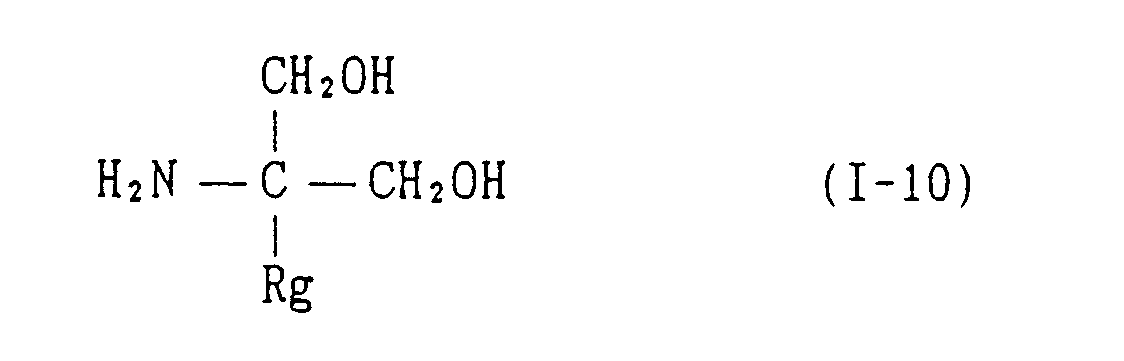
wherein- Rg is a phenylalkyl wherein the alkyl moiety is a straight-or branched chain having 6 to 20 carbon atoms which may have, in the carbon chain, one or two oxygen atoms, a phenylalkyl which may be substituted by a straight- or branched chain C6-C14 alkyl optionally substituted by halogen, a straight- or branched chain C6-C14 alkoxy optionally substituted by halogen, a straight- or branched chain C6-C14 alkenyloxy, phenylalkoxy, halophenylalkoxy, phenylalkoxyalkyl, phenoxyalkoxy or phenoxyalkyl; a cycloalkylalkyl wherein the alkyl moiety has 6 to 20 carbon atoms; a cycloalkylalkyl substituted by a straight- or branched chain alkyl having 6 to 14 carbon atoms; a heteroarylalkyl wherein the alkyl moiety has 6 to 20 carbon atoms; a heteroarylalkyl substituted by a straight- or branched chain alkyl having 6 to 14 carbon atoms; a heterocyclic alkyl wherein the alkyl moiety has 6 to 20 carbon atoms, or a heterocyclic alkyl substituted by a straight- or branched chain alkyl having 6 to 14 carbon atoms, and a pharmaceutically acceptable salt thereof;
- (13) a 2-amino-1,3-propanediol compound according to the above-mentioned (12), having the formula

wherein- Rh is a phenylalkyl wherein the alkyl moiety has 6 to 20 carbon atoms, a phenylalkoxyalkyl wherein the alkyl moiety and alkoxy moiety have 6 to 20 carbon atoms in total, a phenoxyalkyl wherein the alkyl moiety has 6 to 20 carbon atoms or a phenoxyalkoxyalkyl wherein the alkyl moiety and alkoxy moiety have 6 to 20 carbon atoms in total, and a pharmaceutically acceptable salt thereof;
- (14) a 2-amino-1,3-propanediol compound according to the above-mentioned (13), which is selected from the group consisting of 2-amino-2-(8-phenyloctyl)-1,3-propanediol, 2-amino-2-(9-phenyl-nonyl)-1,3-propanediol, 2-amino-2-(10-phenyldecyl)-1,3-propanediol, 2-amino-2-(11-phenylundecyl)-1,3-propanediol, 2-amino-2-(12-phenyldodecyl)-1,3-propanediol, 2-amino-2-(13-phenyltridecyl)-1,3-propanediol, 2-amino-2-(14-phenyltetradecyl)-1,3-propanediol, 2-amino-2-(15-phenylpentadecyl)-1,3-propanediol, 2-amino-2-(16-phenylhexadecyl-1,3-propanediol, 2-amino-2-[6-(8-phenyloctyloxy)hexyl]-1,3-propanediol, 2-amino-2-(8-phenylmethyloxyoctyl)-1,3-propanediol, 2-amino-2-(9-phenoxynonyl)-1,3-propanediol, 2-amino-2-(12-phenoxydodecyl)-1,3-propanediol and 2-amino-2-[6-(2-phenoxyethyloxy)hexyl]-1,3-propanediol, and a pharmaceutically acceptable salt thereof;
- (15) a 2-amino-1,3-propanediol compound according to the above-mentioned (13) which is selected from the group consisting of 2-amino-2-(10-phenyldecyl)-1,3-propanediol, 2-amino-2-(13-phenyltridecyl)-1,3-propanediol, 2-amino-2[6-(8-phenyloctyloxy)hexyl]-1,3-propanediol, 2-amino-2-(8-phenylmethyloxyoctyl)-1,3-propanediol, 2-amino-2-(9-phenoxynonyl)-1,3-propanediol, 2-amino-2-(12-phenoxydodecyl)-1,3-propanediol and 2-amino-2-[6-(2-phenoxyethyloxy)hexyl]-1 ,3-propanediol, and a pharmaceutically acceptable salt thereof;
- (16) a 2-amino-1,3-propanediol compound according to the above-mentioned (12), having the formula

wherein- Ri is a phenylalkyl substituted by a straight- or branched chain C6-C14 alkyl optionally substituted by halogen, a straight- or branched chain C6-C14 alkoxy optionally substituted by halogen or a straight- or branched chain C6-C14 alkenyloxy;
wherein the alkyl moiety of phenylalkyl may be substituted by hydroxy, and a pharmaceutically acceptable salt thereof; - (17) a 2-amino-1,3-propanediol compound according to the above-mentioned (16), having the formula
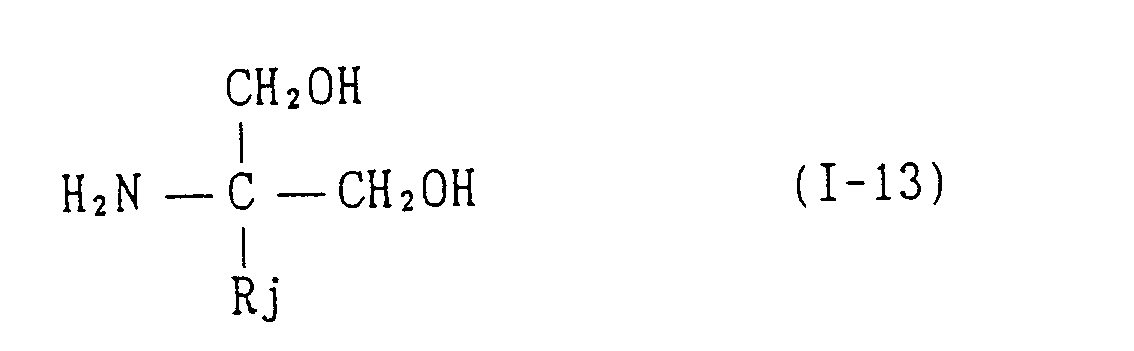
wherein- Rj is a phenylalkyl substituted by a straight- or branched chain C6-C14 alkyl optionally substituted by halogen, a straight- or branched chain C6-C14 alkoxy optionally substituted by halogen or a straight- or branched chain C6-C14 alkenyloxy, wherein the alkyl moiety is a C2-C6 alkyl optionally substituted by hydroxy, and a pharmaceutically acceptable salt thereof;
- (18) a 2-amino-1,3-propanediol compound according to the above-mentioned (16) or (17), which is selected from the group consisting of 2-amino-2-[2-(4-heptylphenyl)ethyl]-1,3-propanediol, 2-amino-2-[2-(4-octylphenyl)ethyl]-1,3-propanediol, 2-amino-2-[2-(4-nonylphenyl)ethyl]-1,3-propanediol 2-amino-2-[2-(4- decylphenyl)ethyl]-1,3-propanediol, 2-amino-2-[2-(4-undecylphenyl)ethyl]-1,3-propanediol, 2-amino-2-[2-(4-dodecylphenyl)ethyl]-1,3-propanediol, 2-amino-2-[2-(4-tridecylphenyl)-ethyl]-1,3-propanediol, 2-amino-2-[2-(4-tetradecylphenyl)ethyl]-1,3-propanediol, 2-amino-2-[2-(4-hexyloxyphenyI)ethyl]-1,3-propanediol, 2-amino-2-[2-(4-heptyloxyphenyl)ethyl]-1,3-propanediol, 2-amino-2-[2-(4-octyloxyphenyl)ethyl]-1,3-propanediol, 2-amino-2-[2-(4-nonyloxyphenyl)ethyl]-1,3-propanediol, 2-amino-2-[2-(4-decyloxyphenyl)ethyl]-1,3-propanediol, 2-amino-2-[2-(4-undecyloxyphenyl)ethyl]-1,3-propanediol, 2-amino-2-[2-(4-dodecylox- yphenyl)ethyl]-1,3-propanediol, 2-amino-2-[2-(4-tridecyloxyphenyl)ethyl]-1,3-propanediol, 2-amino-2-[2-(4-(8-fluorooctyl)phenyl)ethyl]-1,3-propanediol, 2-amino-2-[2-(4-(12-fluorododecyI)phenyl)ethyl]-1,3-propanediol, 2-amino-2-[2-(4-(7-fluoroheptyloxy)phenyl)ethyl]-1,3-propanediol,2-amino-2-[2-(4-(11-fluoroundecyloxy)phenyl)ethyl]-1,3-propanediol and 2-amino-2-[2-(4-(7-octenyloxy)phenyl)ethyl]-1,3-propanediol, and a pharmaceutically acceptable salt thereof;
- (19) a 2-amino-1,3-propanediol compound according to the above-mentioned (16) or (17), which is selected from the group consisting of 2-amino-2-[2-(4-heptylphenyl)ethyl]-1,3-propanediol, 2-amino-2-[2-(4-octylphenyl)ethyl]-1,3-propanediol, 2-amino-2-[2-(4-nonylphenyl)ethyl]-1,3-propanediol, 2-amino-2-[2-(4-decylphenyl)ethyl]-1,3-propanediol, 2-amino-2-[2-(4-undecylphenyl)ethyl]-1,3-propanediol, 2-amino-2-[2-(4-dodecylphenyl)ethyl]-1,3-propanediol, 2-amino-2-[2-(4-heptyloxyphenyl)ethyl]-1,3-propanediol, 2-amino-2-[2-(4-octyloxyphenyl)ethyl]-1,3-propanediol, 2-amino-2-[2-(4-nonyloxyphenyl)ethyl]-1,3-propanediol, 2-amino-2-[2-(4-undecyloxyphenyl)ethyl]-1,3-propanediol, and 2-amino-2-[2-(4-(7-octenyloxy)-phenyl)ethyl]-1 ,3-propanediol, and a pharmaceutically acceptable salt thereof;
- (20) a 2-amino-1,3-propanediol compound according to the above-mentioned (12), having the formula

wherein
Rk is a phenylalkyl substituted by phenylalkoxy, halophenylalkoxy, phenylalkoxyalkyl, phenoxyalkoxy or phenoxyalkyl, and a pharmaceutically acceptable salt thereof; - (21) a 2-amino-1,3-propanediol compound according to the above-mentioned (20), having the formula

wherein- RI is a phenylalkyl substituted by phenylalkoxy wherein the alkoxy moiety has 2 to 8 carbon atoms, halophenylalkoxy wherein the alkoxy moiety has 2 to 8 carbon atoms, phenylalkoxyalkyl wherein the alkoxy moiety and alkyl moiety have 2 to 8 carbon atoms in total, phenoxyalkoxy wherein the alkoxy moiety has 2 to 8 carbon atoms or phenoxyalkyl wherein the alkyl moiety has 2 to 8 carbon atoms, where the alkyl moiety has 2 to 6 carbon atoms, and a pharmaceutically acceptable salt thereof;
- (22) a 2-amino-1,3-propanediol compound according to the above-mentioned (20) or (21), which is selected from the group consisting of 2-amino-2-[2-(4-phenylmethyloxyphenyl)ethyl]-1,3-propanediol, 2-amino-2-[2-(4-(2-phenylethyloxy)phenyl)ethyl]-1,3-propanediol, 2-amino-2-[2-(4-(3-phenylpropyloxy)-phenyl)-ethyl]-1,3-propanediol, 2-amino-2-[2-(4-(4-phenylbutyloxy)-phenyl)ethyl]-1,3-propanediol,2-amino-2-[2-(4-(5-phenylpentyloxy)phenyl)ethyl]-1,3-propanediol,2-amino-2-[2-(4-(6-phenylhexyloxy)phenyl)ethyl]-1,3-propanediol, 2-amino-2-[2-(4-(7-phenylheptyloxy)phenyl)ethyl]-1,3-propanediol,2-amino-2-[2-(4-(8-phenyloctyloxy)phenyl)ethyl]-1,3-propanediol, 2-amino-2-[4-(6-(4-fluorophenyl)hexyloxy)phenyl)ethyl]-1,3-propanediol, 2-amino-2-[2-(4-(5-phenylpentyloxymethyl)phenyl)ethyl]-1,3-propanediol, 2-amino-2-[2-(4-(4-phenoxybutyloxy)phenyl)ethyl]-1,3-propanediol,2-amino-2-[2-(4-(5-phenoxypentyloxy)phenyl)-ethyl]-1,3-propanediol, 2-amino-2-[2-(4-(6-phenoxyhexyloxy)-phenyl)ethyl]-1,3-propanediol, 2-amino-2-[2-(4-(7-phenoxyheptyloxy)phenyl)ethyl]-1,3-propanediol, 2-amino-2-[2-(4-(4-phenoxybutyI)phenyl)ethyl]-1,3-propanediol, 2-amino-2-[2-(4-(5-phenoxypentyl)phenyl)ethyl]-1,3-propanediol, 2-amino-2-[2-(4-(6-phenox- yhexyl)phenyl)ethyl]-1,3-propanediol and 2-amino-2-[2-(4-(7-phenoxyheptyl)phenyl)ethyl]-1,3-propanediol, and a pharmaceutically acceptable salt thereof;
- (23) a 2-amino-1,3-propanediol compound according to the above-mentioned (20) or (21) which is selected from the group consisting of 2-amino-2-[2-(4-(6-phenylhexyloxy)phenyl)ethyl]-1,3-propanediol and 2-amino-2-[2-(4-(5-phenylpentyloxymethyl)-phenyl)ethyl]-1 ,3-propanediol, and a pharmaceutically acceptable salt thereof;
- (24) a 2-amino-1,3-propanediol compound according to the above-mentioned (12), having the formula

wherein- Rm is an alkyl-substituted cycloalkylalkyl wherein the alkyl moiety has 6 to 20 carbon atoms in total, and a pharmaceutically acceptable salt thereof;
- (25) a 2-amino-1,3-propanediol compound according to the above-mentioned (24), which is selected from the group consisting of 2-amino-2-[3-(4-heptylcyclohexyl)propyl]-1,3-propanediol, 2-amino-2-[4-(4-butylcyclohexyl)butyl]-1,3-propanediol, 2-amino-2-[2-(4-octylcyclohexyl)ethyl)-1,3-propanediol, 2-amino-2-[2-(4-nonylcyclohexyl)ethyl]-1,3-propanediol and 2-amino-2-[2-(4-dodecylcyclohexyl)ethyl]-1,3-propanediol, and a pharmaceutically acceptable salt thereof;
- (26) a 2-amino-1,3-propanediol compound according to the above-mentioned (12), having the formula

wherein- Rn is a 1-alkyl-substituted piperidin-4-ylalkyl wherein the alkyl moiety has 6 to 20 carbon atoms in total, and a pharmaceutically acceptable salt thereof;
- (27) a 2-amino-1,3-propanediol compound according to the above-mentioned (26), which is selected from the group consisting of 2-amino-2-[2-(1-octylpiperidin-4-yl)ethyl]-1,3-propanediol and 2-amino-2-[2-(1-dodecylpiperidin-4-yl)ethyl]-1 ,3-propanediol, and a pharmaceutically acceptable salt thereof;
- (28) a 2-amino-1,3-propanediol compound according to the above-mentioned (12), having the formula
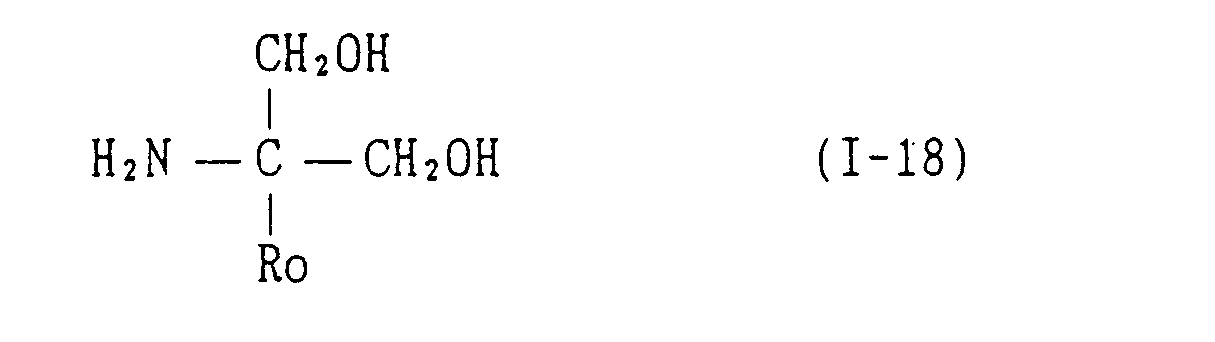
wherein- Ro is a thienylalkyl wherein the alkyl moiety has 6 to 20 carbon atoms, an alkyl-substituted thienylalkyl wherein the alkyl moiety has 6 to 20 carbon atoms in total, pyridylalkyl wherein the alkyl moiety has 6 to 20 carbon atoms or an alkyl-substituted pyridylalkyl wherein the alkyl moiety has 6 to 20 carbon atoms in total, and a pharmaceutically acceptable salt thereof;
- (29) a 2-amino-1,3-propanediol compound according to the above-mentioned (28), which is selected from the group consisting of 2-amino-2-[2-(5-octyl-2-thienyl)ethyl]-1,3-propanediol, 2-amino-2-[2-(5-nonyl-2-thienyl)ethyl]-1,3-propanediol, 2-amino-2-[2-(5-decyl-2-thienyl)ethyl]-1,3-propanediol, 2-amino-2-[2-(5-dodecyl-2-thienyl)ethyl]-1,3-propanediol, 2-amino-2-[13-(2-thienyl)-tridecyl]-1,3-propanediol, 2-amino-2-[2-(5-octyl-2-pyridyl)-ethyl]-1,3-propanediol, 2-amino-2-[2-(5-decyl-2-pyridyl)ethyl]-1,3-propanediol, 2-amino-2-[13-(2-pyridyl)tridecyl]-1,3-propanediol, 2-amino-2-[2-(2-octyl-5-pyridyl)ethyl]-1,3-propanediol, 2-amino-2-[2-(2-decyl-5-pyridyl)ethyl]-1,3-propanediol and 2-amino-2-[13-(3-pyridyl)tridecyl]-1,3-propanediol, and a pharmaceutically acceptable salt thereof;
- (30) a 2-amino-1,3-propanediol compound according to the above-mentioned (1) or (2), having the formula

wherein- Rp is a phenyl substituted by C6-C18 alkyl, a cycloalkyl, a heteroaryl or a heterocycle, and a pharmaceutically acceptable salt thereof;
- (31) a 2-amino-1,3-propanediol compound according to the above-mentioned (30), having the formula
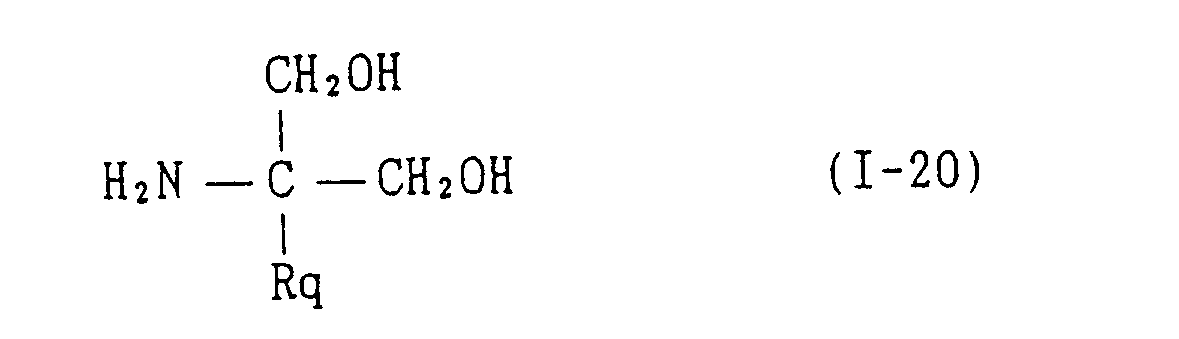
wherein- Rq is a phenyl substituted by C6-C18 alkyl, and a pharmaceutically acceptable salt thereof;
- (32) a 2-amino-1,3-propanediol compound according to the above-mentioned (30) or (31), which is selected from the group consisting of 2-amino-2-(4-decylphenyl)-1,3-propanediol, 2-amino-2-(4-dodecylphenyl)-1,3-propanediol, 2-amino-2-(4-tetradecylphenyl)-1,3-propanediol and 2-amino-2-(4-hexadecyl- phenyl)-1 ,3-propanediol, and a pharmaceutically acceptable salt thereof;
- (33) a 2-amino-1,3-propanediol compound according to the above-mentioned (1) or (2), having the formula

wherein- R1 is an optionally substituted straight- or branched carbon chain which may have, in the chain, a bond, a hetero atom or a group selected from the group consisting of a double bond, a triple bond, oxygen, sulfur, sulfinyl, sulfonyl, -N(R6)- where R6 is hydrogen, alkyl, aralkyl, acyl or alkoxycarbonyl, and carbonyl, optionally substituted arylene, optionally substituted cycloalkylene, optionally substituted heteroarylene and an alicycle thereof, and which may be substituted, at the chain end (m-position) thereof, by a double bond, a triple bond, optionally substituted aryl, optionally substituted cycloalkyl, optionally substituted heteroaryl or an alicycle thereof, an optionally substituted aryl, an optionally substituted cycloalkyl, an optionally substituted heteroaryl or an alicycle thereof, and
- R2a, R3a, R4 a and R5 a are the same or different and each is a hydrogen, an alkyl, an acyl or an alkoxycarbonyl;
wherein the optionally substituted straight- or branched carbon chain may have a substituent selected from the group consisting of alkoxy, alkenyloxy, alkynyloxy, aralkyloxy, alkylenedioxy, acyl, alkylamino, alkylthio, acylamino, alkoxycarbonyl, alkoxycarbonylamino, acyloxy, alkylcarbamoyl, haloalkyl, haloalkoxy, nitro, halogen, amino, hydroxyimino, hydroxy, carboxy, optionally substituted aryl, optionally substituted aryloxy, optionally substituted cycloalkyl, optionally substituted heteroaryl and an alicycle thereof; and the aforementioned optionally substituted arylene, optionally substituted cycloalkylene, optionally substituted heteroarylene, an alicycle thereof, optionally substituted aryl, optionally substituted aryloxy, optionally substituted cycloalkyl, optionally substituted heteroaryl and an alicycle thereof may have a substituent selected from the group consisting of alkoxy, alkenyloxy, alkynyloxy, aralkyloxy, alkylenedioxy, acyl, alkylamino, alkylthio, acylamino, alkoxycarbonyl, alkoxycarbonylamino, acyloxy, alkylcarbamoyl, haloalkyl, haloalkoxy, nitro, halogen, amino, hydroxy and carboxy, and a pharmaceutically acceptable salt thereof; - (34) a 2-amino-1,3-propanediol compound according to the above-mentioned (33), having the formula

wherein- Rr is an alkyl optionally substituted by hydroxy and/or hydroxyimino which may have, in the chain, a double bond or carbonyl, and a pharmaceutically acceptable salt thereof;
- (35) a 2-amino-1,3-propanediol compound according to the above-mentioned (33) or (34), which is selected from the group consisting of 2-amino-2-(1,2,12-trihydroxy-4-octadecenyl)-1,3-propanediol, 2-amino-2-(1,2-dihydroxy-4-octadecenyl)-1,3-propanediol, 2-amino-2-(1,2-dihydroxyoctadecyl)-1,3-propanediol, 2-amino-2-(1,12-dihydroxy-4-octadecenyl)-1,3-propanediol, 2-amino-2-(1,2,4-trihydroxybutyl)-1,3-propanediol, 2-amino-2-(1,2,12-trihydroxyoctadecyl)-1,3-propanediol and 2-amino-2-(1,12-dihydrox- yoctadecyl)-1,3-propanediol and a pharmaceutically acceptable salt thereof;
- (36) a 2-amino-1,3-propanediol compound according to the above-mentioned (33), having the formula

wherein- Rs is a phenylalkyl substituted by a straight- or branched chain C6-C14 alkyl optionally substituted by halogen, a straight- or branched chain C6-C14 alkoxy optionally substituted by halogen or a straight- or branched chain C6-C14 alkenyloxy, and a pharmaceutically acceptable salt thereof;
- (37) a 2-amino-1,3-propanediol compound according to the above-mentioned (36), which is selected from the group consisting of 2-amino-2-[1-hydroxy-2-(4-octylphenyl)ethyl]-1,3-propanediol, 2-amino-2-[2-(4-dodecylphenyl)-1-hydroxyethyl]-1,3-propanediol, 2-amino-2-[2-(4-heptyloxyphenyl)-1-hydroxyethyl]-1,3-propanediol, 2-amino-2-[1-hydroxy-2-(4-undecyloxyphenyl)ethyl]-1,3-propanediol, 2-amino-2-[2-(4-(8-fluorooctyl)phenyl)-1-hydroxyethyl]-1,3-propanediol, 2-amino-2-[2-(4-(12-fluorododecyl)phenyl)-1-hydroxyethyl]-1,3-propanediol, 2-amino-2-[2-(4-(7-fluoroheptyloxy)phenyl)-I-hydroxyethyl]-1,3-propanediol and 2-amino-2-[1-hydroxy-2-(4-(11-fluoroundecyloxy)phenyl)ethyl]-1,3-propanediol, and a pharmaceutically acceptable salt thereof;
- (38) a 2-amino-1,3-propanediol compound according to the above-mentioned (1) or (2), having the formula

wherein- Rt is an optionally substituted straight- or branched carbon chain which may have, in the chain, a bond, a hetero atom or a group selected from the group consisting of a double bond, a triple bond, oxygen, sulfur, sulfinyl, sulfonyl, -N(R6)- where R6 is hydrogen, alkyl, aralkyl, acyl or alkoxycarbonyl, carbonyl, optionally substituted arylene, optionally substituted cycloalkylene, optionally substituted heteroarylene and an alicycle thereof, an optionally substituted aryl, an optionally substituted cycloalkyl, an optionally substituted heteroaryl or an alicycle thereof, and
- R2a, R3a, R4 a and R5a a are the same or different and each is a hydrogen, an alkyl, an acyl or an alkoxycarbonyl;
wherein the optionally substituted straight- or branched carbon chain may have a substituent selected from the group consisting of alkoxy, alkenyloxy, alkynyloxy, aralkyloxy, alkylenedioxy, acyl, alkylamino, alkylthio, acylamino, alkoxycarbonyl, alkoxycarbonylamino, acyloxy, alkylcarbamoyl, haloalkyl, haloalkoxy, nitro, halogen, amino, hydroxy, carboxy, optionally substituted aryl, optionally substituted aryloxy, optionally substituted cycloalkyl, optionally substituted heteroaryl and an alicycle thereof; and the aforementioned optionally substituted arylene, optionally substituted cycloalkylene, optionally substituted heteroarylene, an alicycle thereof, optionally substituted aryl, optionally substituted aryloxy, optionally substituted cycloalkyl, optionally substituted heteroaryl and an alicycle thereof may have a substituent selected from the group consisting of alkoxy, alkenyloxy, alkynyloxy, aralkyloxy, alkylenedioxy, acyl, alkylamino, alkylthio, acylamino, alkoxycarbonyl, alkoxycarbonylamino, acyloxy, alkylcarbamoyl, haloalkyl, haloalkoxy, nitro, halogen, amino, hydroxy and carboxy, and a pharmaceutically acceptable salt thereof; - (39) a 2-amino-1,3-propanediol compound according to the above-mentioned (38), having the formula
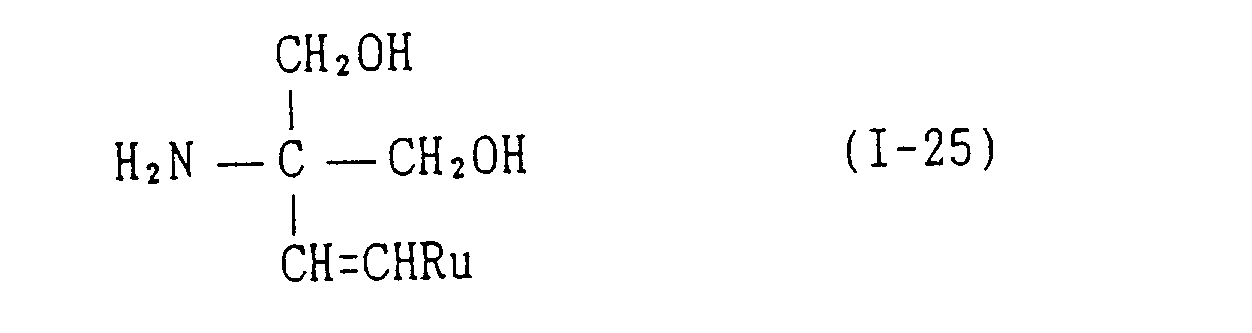
wherein- Ru is a phenyl substituted by alkyl having 4 to 16 carbon atoms, and a pharmaceutically acceptable salt thereof;
- (40) a 2-amino-1,3-propanediol compound according to the above-mentioned (38) or (39), which is selected from the group consisting of 2-amino-2-[2-(4-octylphenyl)ethenyl]-1,3-propanediol, 2-amino-2-[2-(4-decylphenyl)ethenyl]-1,3-propanediol, 2-amino-2-[2-(4-dodecylphenyl)ethenyl]-1,3-propanediol and 2-amino-2-[2-(4-tetradecylphenyl)ethenyl]-1 ,3-propanediol, and a pharmaceutically acceptable salt thereof;
- (41) a 2-amino-1,3-propanediol compound according to the above-mentioned (1) or (2), having the formula

wherein- Rv is an optionally substituted aryl, an optionally substituted cycloalkyl, an optionally substituted heteroaryl or an alicycle thereof;
- R2a, R3a, R4 a and R5 a are the same or different and each is a hydrogen, an alkyl, an acyl or an alkoxycarbonyl;
- X is an oxygen, a sulfur, a sulfinyl, a sulfonyl, -N(R6)-where R6 is hydrogen, alkyl, aralkyl, acyl or alkoxycarbonyl; and
- a and are 0 or an integer of 1-20 provided that a + β =5-20, wherein the optionally substituted aryl, optionally substituted cycloalkyl, optionally substituted heteroaryl and an alicycle thereof may have a substituent selected from the group consisting of alkyl, alkoxy, alkenyloxy, alkynyloxy, aralkyloxy, alkylenedioxy, acyl, alkylamino, alkylthio, acylamino, alkoxycarbonyl, alkoxycarbonylamino, acyloxy, alkylcarbamoyl, haloalkyl, haloalkoxy, nitro, halogen, amino, hydroxy and carboxy, and a pharmaceutically acceptable salt thereof;
- (42) a 2-amino-1,3-propanediol compound according to the above-mentioned (41), having the formula

wherein- Rw is a phenyl substituted by C4-C16 alkyl, and a pharmaceutically acceptable salt thereof;
- (43) a 2-amino-1,3-propanediol compound according to the above-mentioned (41) or (42), which is selected from the group consisting of 2-amino-2-(4-octylphenoxymethyl)-1,3-propanediol, 2-amino-2-(4- decylphenoxymethyl)-1,3-propanediol, 2-amino-2-(4-dodecylphenoxymethyl)-1,3-propanediol and 2-amino-2-(4-tetradecylphenoxymethyl)-1 ,3-propanediol, and a pharmaceutically acceptable salt thereof;
- (44) a pharmaceutical composition comprising either one of the above-mentioned compounds (1) through (4);
- (45) an immunosuppressant comprising a 2-amino-1,3-propanediol compound of the formula

wherein- R is an optionally substituted straight- or branched carbon chain which may have, in the chain, a bond, a hetero atom or a group selected from the group consisting of a double bond, a triple bond, oxygen, sulfur, sulfinyl, sulfonyl, -N-(R6)- where R6 is hydrogen, alkyl, aralkyl, acyl or alkoxycarbonyl, carbonyl, optionally substituted arylene, optionally substituted cycloalkylene, optionally substituted heteroarylene and an alicycle thereof, and which may be substituted, at the chain end thereof, by a double bond, a triple bond, optionally substituted aryl, optionally substituted cycloalkyl, optionally substituted heteroaryl or an alicycle thereof, an optionally substituted aryl, an optionally substituted cycloalkyl, an optionally substituted heteroaryl or an alicycle thereof, and
- R2, R3, R4 and R5 are the same or different and each is a hydrogen, an alkyl, an aralkyl, an acyl or an alkoxycarbonyl, or R4 and R5 may be bonded by an alkylene chain which may be substituted by alkyl, aryl or aralkyl;
wherein the optionally substituted straight- or branched carbon chain may have a substituent selected from the group consisting of alkoxy, alkenyloxy, alkynyloxy, aralkyloxy, alkylenedioxy, acyl, alkylamino, alkylthio, acylamino, alkoxycarbonyl, alkoxycarbonylamino, acyloxy, alkylcarbamoyl, haloalkyl, haloalkoxy, nitro, halogen, amino, hydroxyimino, hydroxy, carboxy, optionally substituted aryl, optionally substituted aryloxy, optionally substituted cycloalkyl, optionally substituted heteroaryl and an alicycle thereof; the aforementioned optionally substituted arylene, optionally substituted cycloalkylene, optionally substituted heteroarylene and an alicycle thereof may have a substituent selected from the group consisting of alkoxy, alkenyloxy, alkynyloxy, aralkyloxy, alkylenedioxy, acyl, alkylamino, alkylthio, acylamino, alkoxycarbonyl, alkoxycarbonylamino, acyloxy, alkylcarbamoyl, haloalkyl, haloalkoxy, nitro, halogen, amino, hydroxy and carboxy; and the optionally substituted aryl, optionally substituted aryloxy, optionally substituted cycloalkyl, optionally substituted heteroaryl and an alicycle thereof may have a substituent selected from the group consisting of alkyl, alkoxy, alkenyloxy, alkynyloxy, aralkyloxy, alkylenedioxy, acyl, alkylamino, alkylthio, acylamino, alkoxycarbonyl, alkoxycarbonylamino, acyloxy, alkylcarbamoyl, haloalkyl, haloalkoxy, nitro, halogen, amino, hydroxy and carboxy, and a pharmaceutically acceptable salt thereof; - (46) an immunosuppressant comprising a 2-amino-1,3-propanediol compound or a pharmaceutically acceptable salt thereof according to either one of the aforementioned (1) through (43);
- (47) a pharmaceutical agent according to the aforementioned (45) or (46), wherein the immunosuppressant is an agent for suppressing rejection;
- (48) a pharmaceutical agent according to the aforementioned (45) or (46), wherein the immunosuppressant is an agent for the prevention and treatment of autoimmune diseases; and
- (49) a pharmaceutical agent according to the aforementioned (48), wherein the agent for the prevention and treatment of autoimmune diseases is an agent for the prevention and treatment of rheumatism.
- The groups represented by respective symbols in the present specification are explained in the following.
- The carbon chain at R, R1, Rla or Rt is a straight- or branched carbon chain having 1 to 30 carbon atoms and is exemplified by methyl, ethyl, propyl, isopropyl, butyl, isobutyl, tert-butyl, pentyl, isopentyl, tert-pentyl, hexyl, heptyl, octyl, nonyl, decyl, undecyl, dodecyl, tridecyl, tetradecyl, pentadecyl, hexadecyl, heptadecyl, octadecyl, nonadecyl, icosyl, henicosyl, docosyl, tricosyl, tetracosyl, pentacosyl, hexacosyl, heptacosyl, octacosyl, nonacosyl and triacontyl.
- The arylene at R, R1 or Rt is exemplified by phenylene and naphthylene, with preference given to phenylene.
- The cycloalkylene at R, R1, Rla or Rt is that having 3 to 10 carbon atoms and is exemplified by cyclopropylene, cyclobutylene, cyclopentylene, cyclohexylene, cycloheptylene, cyclooctylene, cyclononylene and cyclodecylene, with preference given to cyclohexylene.
- The heteroarylene at R, R1 or Rt is a 5- or 6-membered heteroarylene optionally having, in the ring, 1 or 2 hetero atoms selected from nitrogen atom, oxygen atom and sulfur atom and is exemplified by thiophen-(2,4-, 2,5- or 3,4-)ylene, furan-(2,4-, 2,5- or 3,4-)ylene, pyrrol-(1,3-, 2,4-, 2,5- or 3,4-)ylene, imidazol-(1,4-, 2,4- or 2,5-)ylene, thiazol-(2,4- or 2,5-)ylene, isothiazol-(3,4- or 3,5-)ylene, oxazol-(2,4- or 2,5-)ylene, isoxazol-(3,4- or 3,5-)ylene, pyridin-(2,4-, 2,5-, 2,6- or 3,5-)ylene, pyrimidin-(2,4- or 2,5-)ylene, pyrazin-2,5- ylene, pyridazin-(3,5- or 3,6-)ylene and pyran-(2,4-, 2,5- or 2,6-)ylene, with preference given to thiophen-2,5- ylene and pyridin-2,5-ylene.
- The alicycle of the aforementioned heteroarylene at R, R1 or Rt is the aforementioned heteroarylene when saturated and is exemplified by pyrrolidine-(1,3-, 2,4-, 2,5- or 3,4-)ylene, piperidine-(1,4-, 2,4-, 2,5-, 2,6- or 3,5-)ylene, piperazine-1,4-ylene,morpholine-2,4 or 3,4-ylene and thiomorpholine-2,4 or 3,4-ylene.
- The aryl at R, R1, Rt or Rv is exemplified by phenyl and naphthyl, with preference given to phenyl.
- The cycloalkyl at R, R1, R'a, Rlb, Rp, Rt or Rv is cycloalkyl having 3 to 10 carbon atoms and includes, for example, cyclopropyl, cyclobutyl, cyclopentyl, cyclohexyl, cycloheptyl, cyclooctyl, cyclononyl and cyclodecyl, with preference given to cyclohexyl.
- The heteroaryl at R, R1, Rp, Rt or Rv is a 5- or 6-membered heteroaryl optionally having, in the ring, 1 to 4 hetero atoms selected from nitrogen atom, oxygen atom and sulfur atom and includes, for example, monocyclic heteroaryl such as thienyl(2-thienyl, 3-thienyl), furyl(2-furyl, 3-furyl), pyrrolyl (1-pyrrolyl, 2-pyrrolyl, 3-pyrrolyl), imidazolyl(2-imidazolyl, 4-imidazolyl), pyrazolyl(3-pyrazolyl, 4-pyrazolyl), triazolyl, tetrazolyl, thiazolyl(2-thiazolyl, 4-thiazolyl), isothiazolyl(3-isothiazolyl, 4-isothiazolyl), oxazolyl(2-oxazolyl, 4-oxazolyl), isooxazolyl(3-isooxazolyl, 4-isooxazolyl), pyridyl(2-pyridyl, 3-pyridyl, 4-pyridyl), pyrazinyl, pyrimidinyl(2-pyrimidinyl, 4-pyrimidinyl), pyridazinyl(3-pyridazinyl, 4-pyridazinyl) or pyranyl(2-pyranyl, 3- pyranyl, 4-pyranyl), and bicyclic heteroaryl such as indolyl(2-indolyl, 3-indolyl), quinolyl(2-quinolyl, 3-quinolyl), isoquinolyl(1-isoquinolyl, 3-isoquinolyl), benzofuranyl(2-benzofuranyl, 3-benzofuranyl), benzothienyl(2-benzothienyl, 3-benzothienyl), 1 H-benzimidazol-2-yl or chromenyl(2-chromenyl, 3-chromenyl, 4-chromenyl).
- The alicycle of the aforementioned heteroaryl at R, R1, Rt or Rv is the above-mentioned monocyclic heteroaryl when saturated and includes, for example, pyrrolidinyl(1-pyrrolidinyl, 2-pyrrolidinyl, 3-pyrrolidinyl), piperidyl(2-piperidyl, 3-piperidyl, 4-piperidyl), piperidino, piperazinyl, morpholinyl and thiomorpholinyl.
- The heterocycle at Rp means an alicycle of heteroaryl.
- The alkyl at Rlb or Rr is a straight- or branched chain alkyl having 1 to 30 carbon atoms and is exemplified by methyl, ethyl, propyl, isopropyl, butyl, isobutyl, tert-butyl, pentyl, isopentyl, tert-pentyl, hexyl, heptyl, octyl, nonyl, decyl, undecyl, dodecyl, tridecyl, tetradecyl, pentadecyl, hexadecyl, heptadecyl, octadecyl, nonadecyl, icosyl, henicosyl, docosyl, tricosyl, tetracosyl, pentacosyl, hexacosyl, heptacosyl, octacosyl, nonacosyl and triacontyl.
- The straight- or branched chain alkyl having 12 to 22 carbon atoms at Ra and the straight- or branched chain alkyl having 13 to 20 carbon atoms at Rb or Rc are the above-mentioned alkyl having the specified numbers of carbon atoms.
- The alkenyl at Rlb is a straight- or branched chain alkenyl having 2 to 30 carbon atoms and includes, for example, ethenyl, propenyl, isopropenyl, butenyl, isobutenyl, pentenyl, isopentenyl, hexenyl, heptenyl, octenyl, nonenyl, decenyl, undecenyl, dodecenyl, tridecenyl, tetradecenyl, pentadecenyl, hexadecenyl, heptadecenyl, octadecenyl, nonadecenyl, icosenyl, henicosenyl, docosenyl, tricosenyl, tetracosenyl, pen- tacosenyl, hexacosenyl, heptacosenyl, octacosenyl, nonacosenyl and triacontenyl.
- The alkynyl at Rlb is a straight- or branched chain alkynyl having 2 to 30 carbon atoms and includes, for example, ethynyl, propynyl, isopropynyl, butynyl, pentynyl, hexynyl, heptynyl, octynyl, nonynyl, decynyl, undecynyl, dodecynyl, tridecynyl, tetradecynyl, pentadecynyl, hexadecynyl, heptadecynyl, octadecynyl, nonadecynyl, icosynyl, henicosynyl, docosynyl, tricosynyl, tetracosynyl, pentacosynyl, hexacosynyl, hep- tacosynyl, octacosynyl, nonacosynyl and triacontynyl.
- The phenylalkyl at Rd, Re, Rf, Rg, Ri, Rk or Rs is that where the alkyl moiety is a straight- or branched chain alkyl having 1 to 30 carbon atoms and includes, for example, benzyl, 1-phenylethyl, 2-phenylethyl, 1-phenylpropyl, 2-phenylpropyl, 3-phenylpropyl, 4-phenylbutyl, 5-phenylpentyl, 6-phenylhexyl, 7-phenylheptyl, 8-phenyloctyl, 9-phenylnonyl, 10-phenyldecyl, 11-phenylundecyl, 12-phenyldodecyl, 13-phenyltridecyl, 14-phenyltetradecyl, 15-phenylpentadecyl, 16-phenylhexadecyl, 17-phenylheptadecyl, 18-phenyloctadecyl, 19-phenylnonadecyl, 20-phenylicosyl, 21-phenylhenicosyl, 22-phenyldocosyl, 23-phenyltricosyl, 24-phenyl- tetracosyl, 25-phenylpentacosyl, 26-phenylhexacosyl, 27-phenylheptacosyl, 28-phenyloctacosyl, 29-phenyl- nonacosyl and 30-phenyltriacontyl.
- The phenylalkyl at Re, Rf, Rg or Rh where the alkyl moiety has 6 to 20 carbon atoms and that at Rj or RI where the alkyl moiety has 2 to 6 carbon atoms are the above-mentioned phenylalkyl having the specified numbers of carbon atoms.
- The phenylalkoxyalkyl at Rh where the alkyl moiety and alkoxy moiety have 6 to 20 carbon atoms in total is exemplified by 5-phenylmethyloxypentyl, 6-phenylmethyloxyhexyl, 7-phenylmethyloxyheptyl, 8-phenylmethyloxyoctyl, 9-phenylmethyloxynonyl, 10-phenylmethyloxydecyl, 12-phenylmethyloxydodecyl, 14-phenylmethyloxytetradecyl, 16-phenylmethyloxyhexadecyl, 18-phenylmethyloxyoctadecyl, 2-(8-phenyloctyloxy)ethyl, 3-(8-phenyloctyloxy)propyl, 4-(8-phenyloctyloxy)butyl, 5-(8-phenyloctyloxy)pentyl, 6-(8-phenyloctyloxy)hexyl and 7-(8-phenyloctyloxy)heptyl.
- The phenoxyalkyl at Rh where the alkyl moiety has 6 to 20 carbon atoms is exemplified by 6-phenoxyhexyl, 7-phenoxyheptyl, 8-phenoxyoctyl, 9-phenoxynonyl, 10-phenoxydecyl, 11-phenoxyundecyl, 12-phenoxydodecyl, 13-phenoxytridecyl, 14-phenoxytetradecyl, 15-phenoxypentadecyl, 16-phenoxyhex- adecyl, 17-phenoxyheptadecyl, 18-phenoxyoctadecyl, 19-phenoxynonadecyl and 20-phenoxyicosyl.
- The phenoxyalkoxyalkyl at Rh where the alkyl moiety and alkoxy moiety have 6 to 20 carbon atoms in total is exemplified by 5-(2-phenoxyethyloxy)pentyl, 6-(2-phenoxyethyloxy)hexyl, 7-(2-phenoxyethyloxy)-heptyl, 8-(2-phenoxyethyloxy)octyl, 5-(3-phenoxypropyloxy)pentyl, 6-(3-phenoxypropyloxy)hexyl, 7-(3-phenoxypropyloxy)heptyl, 8-(3-phenoxypropyloxy)octyl, 5-(4-phenoxybutyloxy)pentyl, 6-(4-phenox- ybutyloxy)hexyl, 7-(4-phenoxybutyloxy)heptyl, 8-(4-phenoxybutyloxy)octyl, 5-(6-phenoxyhexyloxy)pentyl, 6-(6-phenoxyhexyloxy)hexyl, 7-(6-phenoxyhexyloxy)heptyl and 8-(6-phenoxyhexyloxy)octyl.
- The cycloalkylalkyl at Rd, Re, Rf or Rg is that where the alkyl moiety is a straight- or branched chain alkyl having 1 to 30 carbon atoms and the cycloalkyl moiety is a cycloalkyl having 3 to 10 carbon atoms, and is exemplified by cyclohexylmethyl, 1-cyclohexylethyl, 2-cyclohexylethyl, 1-cyclohexylpropyl, 2-cyclohexylpropyl, 3-cyclohexylpropyl, 4-cyclohexylbutyl, 5-cyclohexylpentyl, 6-cyclohexylhexyl, 7-cyclohex- ylheptyl, 8-cyclohexyloctyl, 9-cyclohexylnonyl, 10-cyclohexyldecyl, 11-cyclohexylundecyl, 12-cyclohexyl- dodecyl, 13-cyclohexyltridecyl, 14-cyclohexyltetradecyl, 15-cyclohexylpentadecyl, 16-cyclohexylhexadecyl, 17-cyclohexylheptadecyl, 18-cyclohexyloctadecyl, 19-cyclohexylnonadecyl, 20-cyclohexylicosyl, 21-cyclohexylhenicosyl, 22-cyclohexyldocosyl, 23-cyclohexyltricosyl, 24-cyclohexyltetracosyl, 25-cyclohexyl- pentacosyl, 26-cyclohexylhexacosyl, 27-cyclohexylheptacosyl, 28-cyclohexyloctacosyl, 29-cyclohexyl- nonacosyl and 30-cyclohexyltriacontyl.
- The cycloalkylalkyl at Re, Rf or Rg where the alkyl moiety has 6 to 20 carbon atoms is the above-mentioned cycloalkylalkyl having the specified numbers of carbon atoms.
- The alkyl-substituted cycloalkylalkyl at Rm where the alkyl moiety has 6 to 20 carbon atoms is exemplified by 3-(4-heptylcyclohexyl)propyl,4-(4-butylcyclohexyl)butyl, 2-(4-octylcyclohexyl)ethyl, 2-(4-non- ylcyclohexyl)ethyl and 2-(4-dodecylcyclohexyl)ethyl.
- The heteroarylalkyl at Rd, Re, Rf or Rg is that where the alkyl moiety is a straight- or branched chain alkyl having 1 to 30 carbon atoms and is exemplified by thienylalkyl and pyridylalkyl such as (thienyl or pyridyl)methyl, 1-(thienyl or pyridyl)ethyl, 2-(thienyl or pyridyl)ethyl, 1-(thienyl or pyridyl)propyl, 2-(thienyl or pyridyl)propyl, 3-(thienyl or pyridyl)propyl, 4-(thienyl or pyridyl)butyl, 5-(thienyl or pyridyl)pentyl, 6-(thienyl or pyridyl)hexyl, 7-(thienyl or pyridyl)heptyl, 8-(thienyl or pyridyl)octyl, 9-(thienyl or pyridyl)nonyl, 10-(thienyl or pyridyl)decyl, 11-(thienyl or pyridyl)undecyl, 12-(thienyl or pyridyl)dodecyl, 13-(thienyl or pyridyl)tridecyl, 14-(thienyl or pyridyl)tetradecyl, 15-(thienyl or pyridyl)pentadecyl, 16-(thienyl or pyridyl)hexadecyl, 17-(thienyl or pyridyl)heptadecyl, 18-(thienyl or pyridyl)-octadecyl, 19-(thienyl or pyridyl)nonadecyl, 20-(thienyl or pyridyl)icosyl, 21-(thienyl or pyridyl)henicosyl, 22-(thienyl or pyridyl)docosyl, 23-(thienyl or pyridyl)-tricosyl, 24-(thienyl or pyridyl)tetracosyl, 25-(thienyl or pyridyl)pentacosyl, 26-(thienyl or pyridyl)hexacosyl, 27-(thienyl or pyridyl)-heptacosyl, 28-(thienyl or pyridyl)octacosyl, 29-(thienyl or pyridyl)nonacosyl and 30-(thienyl or pyridyl)triacontyl.
- The heteroarylalkyl at Re, Rf or Rg where the alkyl moiety has 6 to 20 carbon atoms is the above-mentioned heteroarylalkyl having the specified numbers of carbon atoms.
- The alkyl-substituted thienylalkyl at Ro where the alkyl moiety has 6 to 20 carbon atoms in total is exemplified by 2-(5-octyl-2-thienyl)ethyl, 2-(5-nonyl-2-thienyl)ethyl, 2-(5-decyl-2-thienyl)ethyl and 2-(5-dodecyl-2-thienyl)ethyl.
- The thienylalkyl at Ro where the alkyl moiety has 6 to 20 carbon atoms is thienylalkyl from among the above-mentioned heteroarylalkyls. Preferred is 13-(2-thienyl)tridecyl.
- The alkyl-substituted pyridylalkyl at Ro where the alkyl moiety has 6 to 20 carbon atoms in total is exemplified by 2-(5-octyl-2-pyridyl)ethyl, 2-(5-decyl-2-pyridyl)ethyl, 2-(2-octyl-5-pyridyl)ethyl and 2-(2-decyl-5-pyridyl)ethyl.
- The pyridylalkyl at Ro where the alkyl moiety has 6 to 20 carbon atoms is pyridylalkyl from among the above-mentioned heteroarylalkyls. Preferred are 13-(2-pyridyl)tridecyl and 13-(3-pyridyl)tridecyl.
- The heterocyclic alkyl at Rd, Re, Rf or Rg where the alkyl moiety is a straight- or branched chain alkyl having 1 to 30 carbon atoms and heterocyclic means an alicycle of heteroaryl, is exemplified by 4-piperidylmethyl, 1-(4-piperidyl)ethyl, 2-(4-piperidyl)ethyl, 1-(4-piperidyl)propyl, 2-(4-piperidyl)propyl, 3-(4-piperidyl)propyl, 4-(4-piperidyl)butyl, 5-(4-piperidyl)-pentyl, 6-(4-piperidyl)hexyl, 7-(4-piperidyl)heptyl, 8-(4-piperidyl)octyl, 9-(4-piperidyl)nonyl, 10-(4-piperidyl)decyl, 11-(4-piperidyl)undecyl, 12-(4-piperidyl)dodecyl, 13-(4-piperidyl)tridecyl, 14-(4-piperidyl)tetradecyl, 15-(4-piperidyl)-pentadecyl, 16-(4-piperidyl)hexadecyl, 17-(4-piperidyl)-heptadecyl, 18-(4-piperidyl)octadecyl, 19-(4-piperidyl)-nonadecyl, 20-(4-piperidyl)icosyl, 21-(4-piperidyl)-henicosyl, 22-(4-piperidyl)docosyl, 23-(4-piperidyl)tricosyl, 24-(4-piperidyl)tetracosyl, 25-(4-piperidyl)pentacosyl, 26-(4-piperidyl)hexacosyl, 27-(4-piperidyl)heptacosyl, 28-(4-piperidyl)octacosyl, 29-(4-piperidyl)nonacosyl and 30-(4-piperidyl)triacontyl.
- The heterocyclic alkyl at Re, Rf or Rg where the alkyl moiety has 6 to 20 carbon atoms is the above-mentioned heterocyclic alkyl having the specified numbers of carbon atoms.
- The 1-alkyl-substituted piperidin-4-ylalkyl at Rn where the alkyl moiety has 6 to 20 carbon atoms in total is, for example, 2-(1-octylpiperidin-4-yl)ethyl and 2-(1-dodecylpiperidin-4-yl)-ethyl.
- The alkyl as a substitutent at R, R1b, Rd, Rm, Rn, Ro or Rv is a straight- or branched chain alkyl having 1 to 20 carbon atoms and is exemplified by methyl, ethyl, propyl, butyl, pentyl, hexyl, heptyl, octyl, nonyl, decyl, undecyl, dodecyl, tridecyl, tetradecyl, pentadecyl, hexadecyl, heptadecyl, octadecyl, nonadecyl and icosyl.
- The straight- or branched chain alkyl having 6 to 20 carbon atoms as a substituent at Re or Rf, the straight- or branched chain alkyl having 6 to 14 carbon atoms as a substituent at Rg, Ri, Rj or Rs, the alkyl having 6 to 18 carbon atoms as a substituent at Rp or Rq and the alkyl having 4 to 16 carbon atoms as a substituent at Ru or Rw are the above-mentioned alkyls having the specified numbers of carbon atoms.
- The alkoxy as a substituent at R, R1, R1a, R1b, Ra, Rd, Re, Rf, Rt or Rv is a straight- or branched chain alkoxy having 1 to 20 carbon atoms and is exemplified by methoxy, ethoxy, propoxy, isopropoxy, butoxy, isobutoxy, sec-butoxy, tert-butoxy, pentyloxy, isopentyloxy, tert-pentyloxy, hexyloxy, heptyloxy, octyloxy, nonyloxy, decyloxy, undecyloxy, dodecyloxy, tridecyloxy, tetradecyloxy, pentadecyloxy, hexadecyloxy, heptadecyloxy, octadecyloxy, nonadecyloxy and icosyloxy.
- The straight- or branched chain alkoxy having 6 to 20 carbon atoms as a substituent at Re or Rf and the straight- or branched chain alkoxy having 6 to 14 carbon atoms as a substituent at Rg, Ri, Rj or Rs are the above-mentioned alkoxys having the specified numbers of carbon atoms.
- The alkenyloxy as a substituent at R, R1, R1a, R1b, Ra, Rd, Re, Rf, Rt or Rv is that where the alkenyl moiety is a straight- or branched chain alkenyl having 2 to 20 carbon atoms and is exemplified by vinyloxy, propenyloxy, isopropenyloxy, butenyloxy, isobutenyloxy, pentenyloxy, isopentenyloxy, hexenyloxy, hep- tenyloxy, octenyloxy, nonenyloxy, decenyloxy, undecenyloxy, dodecenyloxy, tridecenyloxy, tetradecenyloxy, pentadecenyloxy, hexadecenyloxy, heptadecenyloxy, octadecenyloxy, nonadecenyloxy and icosenyloxy.
- The straight- or branched chain alkenyloxy having 6 to 20 carbon atoms as a substituent at Re or Rf and the straight- or branched chain alkenyloxy having 6 to 14 carbon atoms as a substituent at Rg, Ri, Rj or Rs are the above-mentioned alkenyloxys having the specified numbers of carbon atoms.
- The alkynyloxy as a substituent at R, R1, R1a, R1b, Ra, Rd, Re, Rf, Rt or Rv is that where the alkynyl moiety is a straight- or branched chain alkynyl having 2 to 20 carbon atoms and is exemplified by ethynyloxy, propynyloxy, butynyloxy, pentynyloxy, hexynyloxy, heptynyloxy, octynyloxy, nonynyloxy, de- cynyloxy, undecynyloxy, dodecynyloxy, tridecynyloxy, tetradecynyloxy, pentadecynyloxy, hexadecynyloxy, heptadecynyloxy, octadecynyloxy, nonadecynyloxy and icosynyloxy.
- The aralkyloxy as a substituent at R, R1, R1a, R1b, Ra, Rd, Re, Rf, Rt or Rv is that wherein the aralkyl is that where the alkyl moiety is a straight- or branched chain alkyl having 1 to 20 carbon atoms and the aralkyloxy is exemplified by phenylalkoxy such as benzyloxy, 2-phenethyloxy, 1-phenylethyloxy, 1-phenylpropyloxy, 2-phenylpropyloxy, 3-phenylpropyloxy, 4-phenylbutyloxy, 5-phenylpentyloxy, 6-phenylhexyloxy, 7-phenylheptyloxy, 8-phenyloctyloxy, 9-phenylnonyloxy, 10-phenyldecyloxy, 11-phenylundecyloxy, 12-phenyldodecyloxy 13-phenyltridecyloxy or 14-phenyltetradecyloxy, and naphthylalkoxy such as naphthylmethyl or 2-naphthylethyl, with preference given to phenylalkoxy.
- The phenylalkoxy as a substituent at Re, Rf, Rg or Rk is phenylalkoxy of the aforementioned aralkyloxy.
- The phenylalkoxy as a substituent at RI where the alkoxy moiety has 2 to 8 carbon atoms is phenylalkoxy of the aforementioned aralkyloxy, having the specified numbers of carbon atoms.
- The alkylenedioxy as a substituent at R, R1, R1a, Rd, Rt or Rv is alkylenedioxy where the alkylene moiety is a straight- or branched chain alkylene having 1 to 20 carbon atoms and is exemplified by methylenedioxy, ethylenedioxy, propylenedioxy, trimethylenedioxy, butylenedioxy, 1,2-dimethylethylenedioxy, pentamethylenedioxy, hexamethylenedioxy, heptamethylenedioxy, oc- tamethylenedioxy, nonamethylenedioxy, decamethylenedioxy, undecamethylenedioxy, dodecamethylenedioxy, tridecamethylenedioxy, tetradecamethylenedioxy, pentadecamethylenedioxy, hex- adecamethylenedioxy, heptadecamethylenedioxy, octadecamethylenedioxy, nonadecamethylenedioxy and icosamethylenedioxy, with preference given to methylenedioxy and ethylenedioxy.
- The acyl as a substituent at R, R1, R1a, R1b, Ra, Rd, Re, Rf, Rt or Rv is optionally substituted alkanoyl or aroyl, in which alkanoyl is a straight- or branched chain alkanoyl having 1 to 20 carbon atoms, and is exemplified by formyl, acetyl, propionyl, butyryl, isobutyryl, pentanoyl, hexanoyl, heptanoyl, octanoyl, nonanoyl, decanoyl, undecanoyl, dodecanoyl, tridecanoyl, tetradecanoyl, pentadecanoyl, hexadecanoyl, heptadecanoyl, octadecanoyl, nonadecanoyl and icosanoyl, where alkanoyl may be substituted by phenyl. Examples of the alkanoyl optionally substituted by phenyl include phenylacetyl and phenylpropionyl. Examples of aroyl include benzoyl.
- The alkylamino as a substituent at R, R1, R1a, R1b, Ra, Rd, Re, Rf, Rt or Rv is that where the alkyl moiety is a straight- or branched chain alkyl having 1 to 20 carbon atoms, and is exemplified by methylamino, ethylamino, propylamino, isopropylamino, butylamino, isobutylamino, sec-butylamino, tert- butylamino, pentylamino, isopentylamino, tert-pentylamino, hexylamino, heptylamino, octylamino, non- ylamino, decylamino, undecylamino, dodecylamino, tridecylamino, tetradecylamino, pentadecylamino, hex- adecylamino, heptadecylamino, octadecylamino, nonadecylamino and icosylamino.
- The alkylthio as a substituent at R, R1, R1a, R1b, Ra, Rd, Re, Rf, Rt or Rv is that where the alkyl moiety is a straight- or branched chain alkyl having 1 to 20 carbon atoms, and is exemplified by methylthio, ethylthio, propylthio, isopropylthio, butylthio, isobutylthio, sec-butylthio, tert-butylthio, pentylthio, isopentyl- thio, tert-pentylthio, hexylthio, heptylthio, octylthio, nonylthio, decylthio, undecylthio, dodecylthio, tridecyl- thio, tetradecylthio, pentadecylthio, hexadecylthio, heptadecylthio, octadecylthio, nonadecylthio and icosyl- thio.
- The acylamino as a substituent at R, R1, R1a, R1b, Ra, Rd, Re, Rf, Rt or Rv is that where the acyl moiety is a straight- or branched chain alkanoyl having 1 to 20 carbon atoms, and is exemplified by formylamino, acetylamino, propionylamino, butyrylamino, isobutyrylamino, pentanoylamino, pivaloylamino, hexanoylamino, heptanoylamino, octanoylamino, nonanoylamino, decanoylamino, undecanoylamino, dodecanoylamino, tridecanoylamino, tetradecanoylamino, pentadecanoylamino, hexadecanoylamino, hep- tadecanoylamino, octadecanoylamino, nonadecanoylamino and icosanoylamino.
- The alkoxycarbonyl as a substituent at R, R1, R1a, R1b, Ra, Rd, Re, Rf, Rt or Rv is that where the alkoxy moiety is an optionally substituted straight- or branched chain alkoxy having 1 to 20 carbon atoms, and is exemplified by methoxycarbonyl, ethoxycarbonyl, propoxycarbonyl, isopropoxycarbonyl, butoxycarbonyl, isobutoxycarbonyl, tert-butoxycarbonyl, pentyloxycarbonyl, isopentyloxycarbonyl, tert-pentyloxycarbonyl, hexyloxycarbonyl, heptyloxycarbonyl, octyloxycarbonyl, nonyloxycarbonyl, decyloxycarbonyl, undecyloxycarbonyl, dodecyloxycarbonyl, tridecyloxycarbonyl, tetradecyloxycarbonyl, pentadecyloxycarbonyl, hexadecyloxycarbonyl, heptadecyloxycarbonyl, octadecyloxycarbonyl, nonadecyloxycarbonyl and icosyloxycarbonyl, which may be substituted by phenyl. Examples thereof include benzyloxycarbonyl.
- The alkoxycarbonylamino as a substituent at R, R1, R1a, R1b, Ra, Rd, Re, Rf, Rt or Rv is that where the alkoxy moiety is an optionally substituted straight- or branched chain alkoxy having 1 to 20 carbon atoms, and is exemplified by methoxycarbonylamino, ethoxycarbonylamino, propoxycarbonylamino, isoproporycar- bonylamino, butoxycarbonylamino, isobutoxycarbonylamino, tert-butoxycarbonylamino, pentyloxycarbonylamino, isopentyloxycarbonylamino, tert-pentyloxycarbonylamino, hexyloxycarbonylamino, heptylox- ycarbonylamino, octyloxycarbonylamino, nonyloxycarbonylamino, decyloxycarbonylamino, undecyloxycar- bonylamino, dodecyloxycarbonylamino, tridecyloxycarbonylamino, tetradecyloxycarbonylamino, pen- tadecyloxycarbonylamino, hexadecyloxycarbonylamino, heptadecyloxycarbonylamino, octadecyloxycar- bonylamino, nonadecyloxycarbonylamino and icosyloxycarbonylamino, which may be substituted by phenyl. Examples thereof include benzyloxycarbonylamino.
- The acyloxy as a substituent at R, R1, R1a, R1b, Ra, Rd, Re, Rf, Rt or Rv is that where the acyl moiety is a straight- or branched chain alkanoyl having 2 to 20 carbon atoms, and is exemplified by acetoxy, propionyloxy, butyryloxy, isobutyryloxy, pivaloyloxy, pentanoyloxy, hexanoyloxy, heptanoyloxy, octanoyloxy, nonanoyloxy, decanoyloxy, undecanoyloxy, dodecanoyloxy, tridecanoyloxy, tetradecanoyloxy, pen- tadecanoyloxy, hexadecanoyloxy, heptadecanoyloxy, octadecanoyloxy, nonadecanoyloxy and icosanoyloxy.
- The alkylcarbamoyl as a substituent at R, R1, R1a, R1b, Ra, Rd, Re, Rf, Rt or Rv is that where the alkyl moiety is a straight- or branched chain alkyl having 1 to 20 carbon atoms, and is exemplified by methylcarbamoyl, ethylcarbamoyl, propylcarbamoyl, butylcarbamoyl, pentylcarbamoyl, hexylcarbamoyl, heptylcarbamoyl, octylcarbamoyl, nonylcarbamoyl, decylcarbamoyl, undecylcarbamoyl, dodecylcarbamoyl, tridecylcarbamoyl, tetradecylcarbamoyl, pentadecylcarbamoyl, hexadecylcarbamoyl, heptadecylcarbamoyl, octadecylcarbamoyl, nonadecylcarbamoyl and icosylcarbamoyl.
- The haloalkyl as a substituent at R, R1, R1a, R1b, Rd, Rt or Rv is that where the alkyl moiety is a straight- or branched chain alkyl having 1 to 20 carbon atoms, and is exemplified by fluoromethyl, trifluoromethyl, chloromethyl, 2,2,2-trifluoroethyl, perfluoroethyl, 3-chloropropyl, 3-fluoropropyl, 4-chlorobutyl, 4-fluorobutyl, 5-chloropentyl, 6-chlorohexyl, 6-fluorohexyl, 7-chloroheptyl, 7-fluoroheptyl, 8-fluorooctyl, 9-fluorononyl, 10-fluorodecyl, 11-fluoroundecyl, 12-fluorododecyl, 13-fluorotridecyl, 14-fluorotetradecyl, 15-fluoropentadecyl, 16-fluorohexadecyl, 17-fluoroheptadecyl, 18-fluorooctadecyl, 19-fluorononadecyl and 20-fluoroicosyl.
- The haloalkoxy as a substituent at R, R1, Rd, Rt or Rv has 1 to 20 carbon atoms, and is exemplified by chloromethoxy, bromomethoxy, fluoromethoxy, dichloromethoxy, dibromomethoxy, difluoromethoxy, 2-chloroethoxy, 2-fluoroethoxy, 2,2,2-trifluoroethoxy, 3-chloropropoxy, 3-fluoropropoxy, 2,2,3,3-tetrafluoropropoxy, 4-chlorobutoxy, 4-fluorobutoxy, 5-chloropentyloxy, 5-fluoropentyloxy, 6-chlorohexyloxy, 6-fluorohexyloxy, 7-chloroheptyloxy, 7-fluoroheptyloxy, 8-fluorooctyloxy, 9-fluorononyloxy, 10-fluorodecyloxy, 11-fluoroundecyloxy, 12-fluorododecyloxy, 13-fluorotridecyloxy, 14-fluorotetradecyloxy, 15-fluoropentadecyloxy, 16-fluorohexadecyloxy, 17-fluoroheptadecyloxy, 18-fluorooctadecyloxy, 19-fluorononadecyloxy and 20-fluoroicosyloxy.
- The halogen as a substituent at R, R1, R1a, R1b, Ra, Rb, Rc, Rd, Re, Rf, Rg, Ri, Rj, Rs, Rt or Rv is exemplified by fluorine, chlorine, bromine and iodine.
- The aryl as a substituent at R, R1 or Rt is exemplified by phenyl and naphthyl, with preference given to phenyl.
- The aryloxy as a substituent at R, R1 or Rt is exemplified by phenoxy and naphthyloxy, with preference given to phenoxy.
- The cycloalkyl as a substituent at R, R1, R1a, R1b or Rt is that having 3 to 10 carbon atoms and is exemplified by cyclopropyl, cyclobutyl, cyclopentyl, cyclohexyl, cycloheptyl, cyclooctyl, cyclononyl and cyclodecyl, with preference given to cyclohexyl.
- The heteroaryl as a substituent at R, R1 or Rt is a 5- or 6-membered heteroaryl optionally having, in the ring, 1 to 4 hetero atoms selected from nitrogen atom, oxygen atom and sulfur atom and includes, for example, monocyclic heteroaryl such as thienyl(2-thienyl, 3-thienyl), furyl(2-furyl, 3-furyl), pyrrolyl(1-pyrrolyl, 2-pyrrolyl, 3-pyrrolyl), imidazolyl(2-imidazolyl, 4-imidazolyl etc.), pyrazolyl(3-pyrazolyl, 4-pyrazolyl etc.), triazolyl, tetrazolyl, thiazolyl(2-thiazolyl, 4-thiazolyl), isothiazolyl(3-isothiazolyl, 4-isothiazolyl), oxazolyl(2-oxazolyl, 4-oxazolyl), isoxazolyl(3-isooxazolyl, 4-isooxazolyl), pyridyl(2-pyridyl, 3-pyridyl, 4-pyridyl), pyrazinyl, pyrimidinyl(2-pyrimidinyl, 4-pyrimidinyl), pyridazinyl(3-pyridazinyl, 4-pyridazinyl) and pyranyl(2- pyranyl, 3-pyranyl, 4-pyranyl), and bicyclic heteroaryl such as indolyl(2-indolyl, 3-indoly]), quinolyl(2-quinolyl, 3-quinolyl), isoquinolyl(1-isoquinolyl, 3-isoquinolyl), benzofuranyl(2-benzofuranyl, 3-benzofuranyl), benzothienyl(2-benzothienyl, 3-benzothienyl), 1 H-benzimidazol-2-yl or chromenyl(2-chromenyl, 3-chromenyl, 4-chromenyl).
- The alicycle of the aforementioned heteroaryl as a substituent at R, R1 or Rt is the above-mentioned monocyclic heteroaryl when saturated such as pyrrolidinyl(1-pyrrolidinyl, 2-pyrrolidinyl, 3-pyrrolidinyl), piperidyl(2-piperidy], 3-piperidyl, 4-piperidyl), piperidino, piperazinyl, morpholinyl or thiomorpholinyl.
- The carbon chain as a substituent at R1a is a straight- or branched carbon chain having 1 to 30 carbon atoms such as methyl, ethyl, propyl, isopropyl, butyl, isobutyl, tert-butyl, pentyl, isopentyl, tert-pentyl, hexyl, heptyl, octyl, nonyl, decyl, undecyl, dodecyl, tridecyl, tetradecyl, pentadecyl, hexadecyl, heptadecyl, octadecyl, nonadecyl, icosyl, henicosyl, docosyl, tricosyl, tetracosyl, pentacosyl, hexacosyl, heptacosyl, octacosyl, nonacosyl or triacontyl.
- The alkenyl as a substituent at Rlb is a straight- or branched chain alkenyl having 2 to 20 carbon atoms such as ethenyl, propenyl, isopropenyl, butenyl, isobutenyl, pentenyl, isopentenyl, hexenyl, heptenyl, octenyl, nonenyl, decenyl, undecenyl, dodecenyl, tridecenyl, tetradecenyl, pentadecenyl, hexadecenyl, heptadecenyl, octadeceny], nonadecenyl or icosenyl.
- The alkynyl as a substituent at Rlb is a straight- or branched chain alkynyl having 2 to 20 carbon atoms such as ethynyl, propynyl, isopropynyl, butynyl, pentynyl, hexynyl, heptynyl, octynyl, nonynyl, decynyl, undecynyl, dodecynyl, tridecynyl, tetradecynyl, pentadecynyl, hexadecynyl, heptadecynyl, octadecynyl, nonadecynyl or icosynyl.
- The haloaralkyloxy as a substituent at Rd is that including aralkyl where the alkyl moiety is a straight- or branched chain alkyl having 1 to 20 carbon atoms, and is exemplified by halophenylalkoxy such as 4-fluorobenzyloxy, 2-(4-fluorophenyl)-ethyloxy, 1-(4-fluorophenyl)ethyloxy, 1-(4-fluorophenyl)-propyloxy, 2-(4-fluorophenyl)propyloxy, 3-(4-fluorophenyl)-propyloxy, 4-(4-fluorophenyl)butyloxy, 5-(4-fluorophenyl)-pentyloxy, 6-(4-fluorophenyl)hexyloxy, 7-(4-fluorophenyl)-heptyloxy, 8-(4-fluorophenyl)octyloxy, 9-(4-fluorophenyl)-nonyloxy, 10-(4-fluorophenyl)decyloxy, 11-(4-fluorophenyl)-undecyloxy, 12-(4-fluorophenyl)-dodecyloxy, 13-(4-fluorophenyl)-tridecyloxy or 14-(4-fluorophenyl)tetradecyloxy, and halonaphthylalkoxy such as (7-fluoro-2-naphthyl)methyloxy or 2-(7-fluoro-2-naphthyl)ethyloxy, with preference given to halophenylalkoxy.
- The halophenylalkoxy as a substituent at Re, Rf, Rg or Rk is that of the aforementioned haloaralkyloxy.
- The halophenylalkoxy as a substituent at RI, where the alkoxy moiety has 2 to 8 carbon atoms, is halophenylalkoxy of the aforementioned haloaralkyloxy, having the specified numbers of carbon atoms.
- The aralkyloxyalkyl as a substituent at Rd is that where the alkyl moiety and the alkyl moiety of the aralkyl are straight- or branched chain alkyls having 1 to 20 carbon atoms and have 2 to 20 carbon atoms in total, and is exemplified by phenylalkoxyalkyl such as phenylmethyloxymethyl, 2-phenylethyloxymethyl, 3-phenylpropyloxymethyl, 4-phenylbutyloxymethyl, 5-phenylpentyloxymethyl, 6-phenylhexyloxymethyl, 7-phenylheptyloxymethyl, 8-phenyloctyloxymethyl, 9-phenylnonyloxymethyl, 10-phenyldecyloxymethyl, 12-phenyldodecyloxymethyl, 14-phenyltetradecyloxymethyl, 16-phenylhexadecyloxymethyl or 18-phenyloc- tadecyloxymethyl, and naphthylalkoxyalkyl such as 4-(2-naphthyl)butyloxymethyl, 5-(2-naphthyl)-pentyloxymethyl or 6-(2-naphthyl)hexyloxymethyl, with preference given to phenylalkoxyalkyl.
- The phenylalkoxyalkyl as a substituent at Re, Rf, Rg or Rk is that of the aforementioned aralkyloxyalkyl.
- The phenylalkoxyalkyl as a substituent at RI, where the alkoxy moiety and the alkyl moiety have 2 to 8 carbon atoms in total, is phenylalkoxyalkyl of the aforementioned aralkyloxyalkyl, having the specified numbers of carbon atoms, in which the carbon number of the alkoxy moiety and the alkyl moiety is respectively 1 to 7, with total being 2 to 8.
- The phenoxylalkyl as a substituent at Rd, Re, Rf, Rg or Rk is that where the alkyl moiety is a straight-or branched chain alkyl having 1 to 20 carbon atoms and is exemplified by phenoxymethyl, 1-phenoxyethyl, 2-phenoxyethyl, 1-phenoxypropyl, 2-phenoxypropyl, 3-phenoxypropyl, 4-phenoxybutyl, 5-phenoxypentyl, 6-phenoxyhexyl, 7-phenoxyheptyl, 8-phenoxyoctyl, 9-phenoxynonyl, 10-phenoxydecyl, 11-phenoxyundecyl, 12-phenoxydodecyl, 13-phenoxytridecyl, 14-phenoxytetradecyl, 15-phenoxypentadecyl, 16-phenoxyhex- adecyl, 17-phenoxyheptadecyl, 18-phenoxyoctadecyl, 19-phenoxynonadecyl and 20-phenoxyicosyl.
- The phenoxyalkyl as a substituent at RI, where the alkyl moiety has 2 to 8 carbon atoms, is the aforementioned phenoxyalkyl having the specified numbers of carbon atoms.
- The phenoxyalkoxy as a substituent at Rd, Re, Rf, Rg or Rk is that where the alkoxy moiety is a straight- or branched chain alkoxy having 1 to 20 carbon atoms and is exemplified by phenoxymethoxy, 1-phenoxyethyloxy, 2-phenoxyethyloxy, 1-phenoxypropyloxy, 2-phenoxypropyloxy, 3-phenoxypropyloxy, 4-phenoxybutyloxy, 5-phenoxypentyloxy, 6-phenoxyhexyloxy, 7-phenoxyheptyloxy, 8-phenoxyoctyloxy, 9-phenoxynonyloxy, 1 0-phenoxydecyloxy, 11-phenoxyundecyloxy, 12-phenoxydodecyloxy, 13-phenox- ytridecyloxy, 14-phenoxytetradecyloxy, 15-phenoxypentadecyloxy, 16-phenoxyhexadecyloxy, 17-phenox- yheptadecyloxy, 18-phenoxyoctadecyloxy, 19-phenoxynonadecyloxy and 20-phenoxyicosyloxy.
- The phenoxyalkoxy as a substituent at RI, where the alkoxy moiety has 2 to 8 carbon atoms, is the aforementioned phenoxyalkoxy having the specified numbers of carbon atoms.
- The alkyl at R2, R2a, R2b, R2c, R3, R3a, R3b, R3 c, R4, R4 a, R4 b, R5, R5 a, R5b or R6 is that having 1 to 20 carbon atoms and is exemplified by methyl, ethyl, propyl, isopropyl, butyl, isobutyl, tert-butyl, pentyl, isopentyl, tert-pentyl, hexyl, heptyl, octyl, nonyl, decyl, undecyl, dodecyl, tridecyl, tetradecyl, pentadecyl, hexadecyl, heptadecyl, octadecyl, nonadecyl and icosyl.
- The aralkyl at R2, R3, R4, R5 or R6 is that where the alkyl moiety is a straight- or branched chain alkyl having 1 to 20 carbon atoms and is exemplified by benzyl, 1-phenylethyl, 2-phenylethyl, 1-phenylpropyl, 2-phenylpropyl, 3-phenylpropyl, 4-phenylbutyl, 5-phenylpentyl, 6-phenylhexyl, 7-phenylheptyl, 8-phenyloctyl, 9-phenylnonyl, 10-phenyldecyl, 11-phenylundecyl, 12-phenyldodecyl, 13-phenyltridecyl, 14-phenyl- tetradecyl, 15-phenylpentadecyl, 16-phenylhexadecyl, 17-phenylheptadecyl, 18-phenyloctadecyl, 19-phenyl- nonadecyl and 20-phenylicosyl.
- The acyl at R2, R2a, R2b, R3, R3a, R3b, R 4, R 4 a, R4 b, R5, R5a, R5b or R6 is optionally substituted alkanoyl or aroyl where the alkanoyl is a straight- or branched chain alkanoyl having 1 to 20 carbon atoms, and alkoanoyl is exemplified by formyl, acetyl, propionyl, butyryl, isobutyryl, pentanoyl, hexanoyl, heptanoyl, octanoyl, nonanoyl, decanoyl, undecanoyl, dodecanoyl, tridecanoyl, tetradecanoyl, pentadecanoyl, hexadecanoyl, heptadecanoyl, octadecanoyl, nonadecanoyl and icosanoyl, which may be substituted by phenyl. Examples thereof include phenylacetyl and phenylpropionyl. Examples of aroyl include benzoyl.
- The alkoxycarbonyl at R2, R2a, R3, R3a, R4, R4 a, R5, R5a or R6 is that where the alkoxy moiety is an optionally substituted straight- or branched chain alkoxy having 1 to 20 carbon atoms and is exemplified by methoxycarbonyl, ethoxycarbonyl, propoxycarbonyl, isopropoxycarbonyl, butoxycarbonyl, isobutoxycarbonyl, tert-butoxycarbonyl, pentyloxycarbonyl, isopentyloxycarbonyl, tert-pentyloxycarbonyl, hexyloxycarbonyl, heptyloxycarbonyl, octyloxycarbonyl, nonyloxycarbonyl, decyloxycarbonyl, undecyloxycarbonyl, dodecyloxycarbonyl, tridecyloxycarbonyl, tetradecyloxycarbonyl, pentadecyloxycarbonyl, hexadecyloxycarbonyl, heptadecyloxycarbonyl, octadecyloxycarbonyl, nonadecyloxycarbonyl and icosyloxycarbonyl, which may be substituted by phenyl. Examples thereof include benzyloxycarbonyl.
- The alkylene chain formed by R4 and R5 is a straight- or branched chain alkylene having 1 to 5 carbon atoms and is exemplified by methylene, ethylene, trimethylene, propylene, butylene, 1,2-dimethylethylene and pentamethylene.
- The alkyl as a substituent at R4 or R5 is a straight- or branched chain alkyl having 1 to 5 carbon atoms and is exemplified by methyl, ethyl, propyl, isopropyl, butyl, isobutyl, sec-butyl, tert-butyl and pentyl.
- The aryl as a substituent at R4 or R5 is, for example, phenyl or naphthyl.
- The aralkyl as a substituent at R4 or R5 is that where the alkyl moiety is a straight- or branched chain alkyl having 1 to 5 carbon atoms and is exemplified by benzyl, 2-phenethyl, 1-phenylethyl, 1-phenylpropyl, 2-phenylpropyl, 3-phenylpropyl, 4-phenylbutyl and 5-phenylpentyl.
- The alkylene chain formed by R4 and R5, which is substituted by alkyl, aryl or aralkyl, is preferably ethylidene, isopropylidene, benzylidene or 2-phenylethylidene.
- The preferable compounds of the present invention are shown in the following tables.
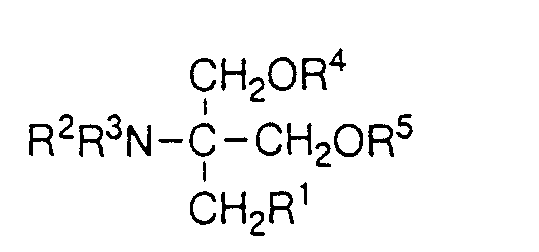
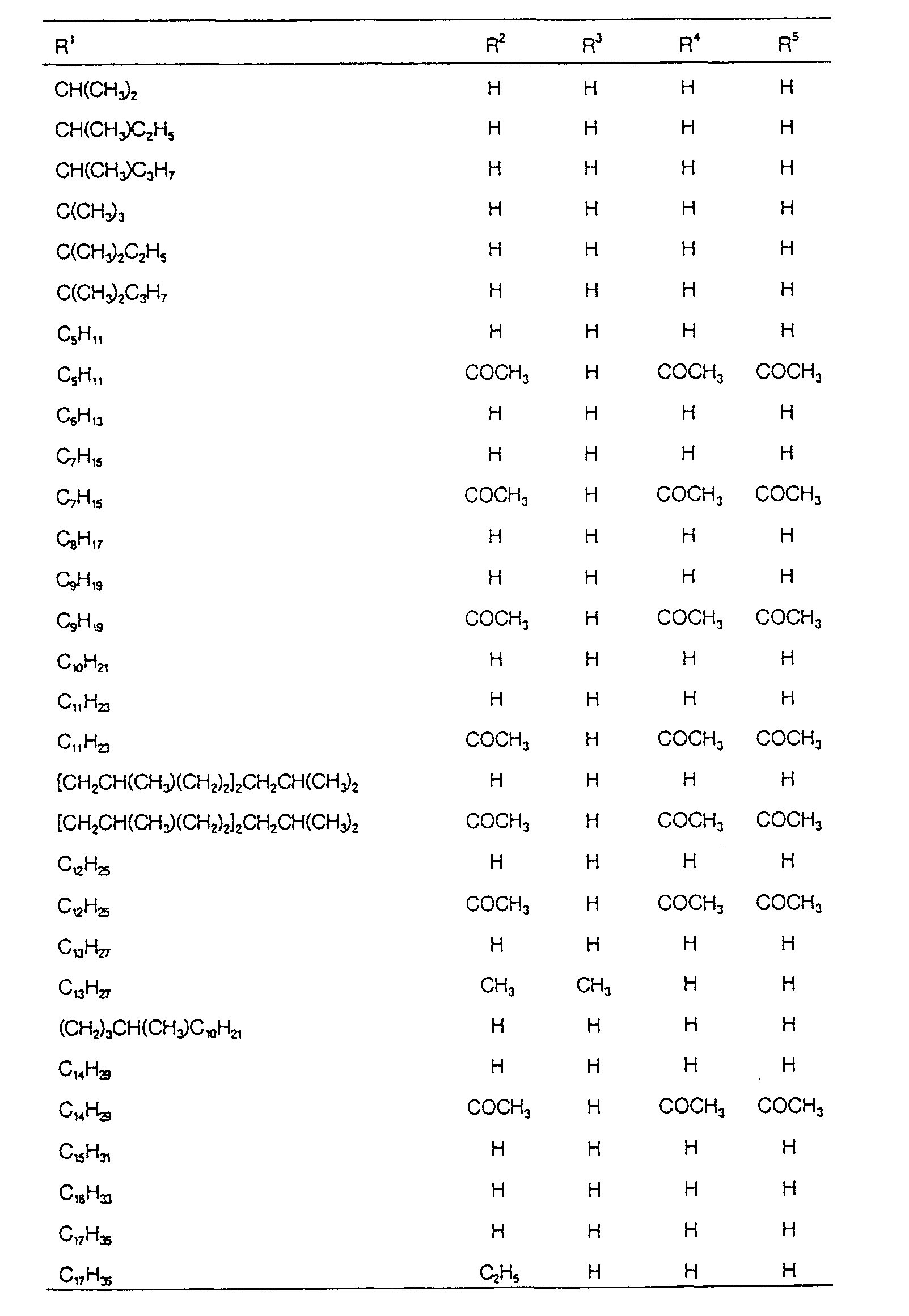


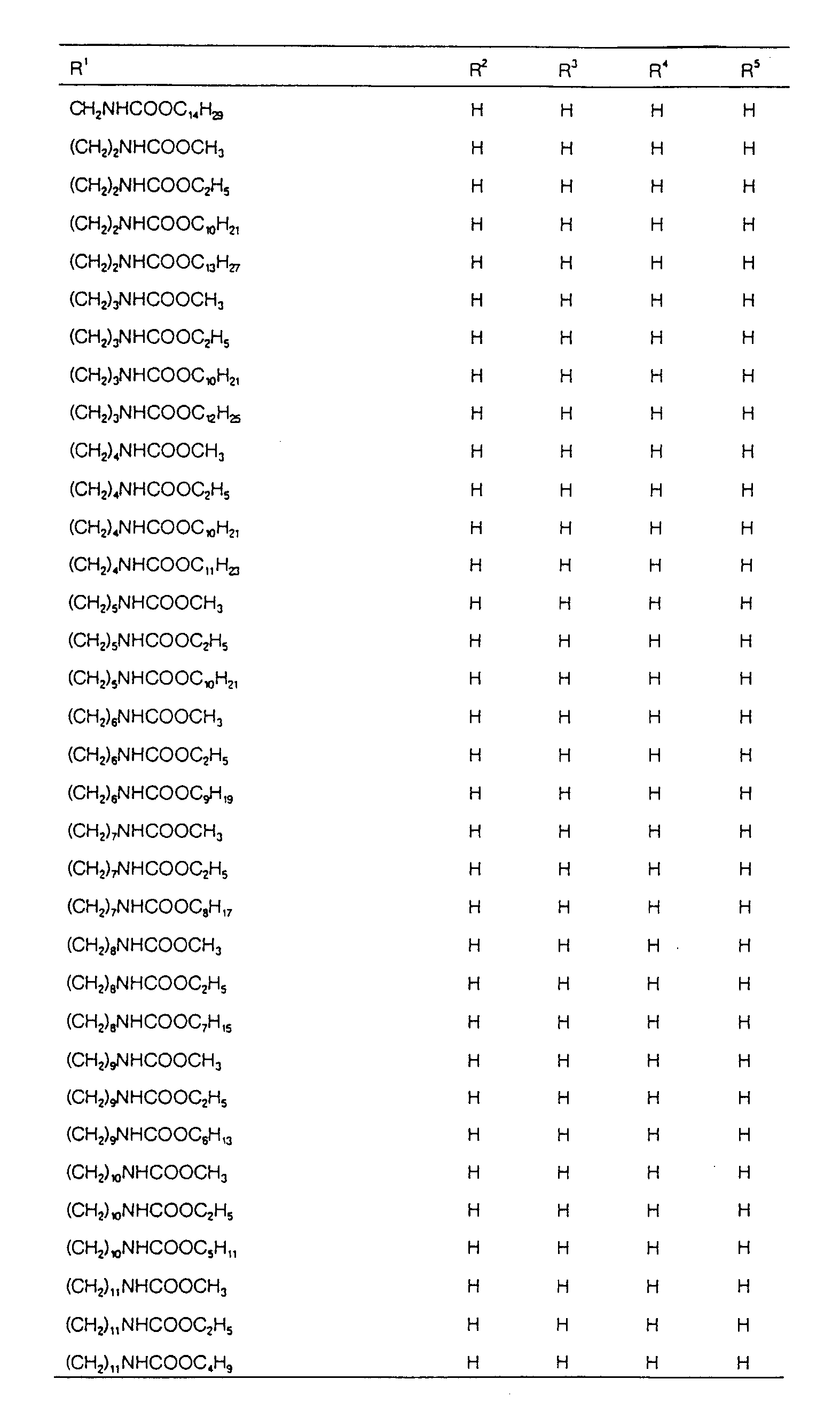


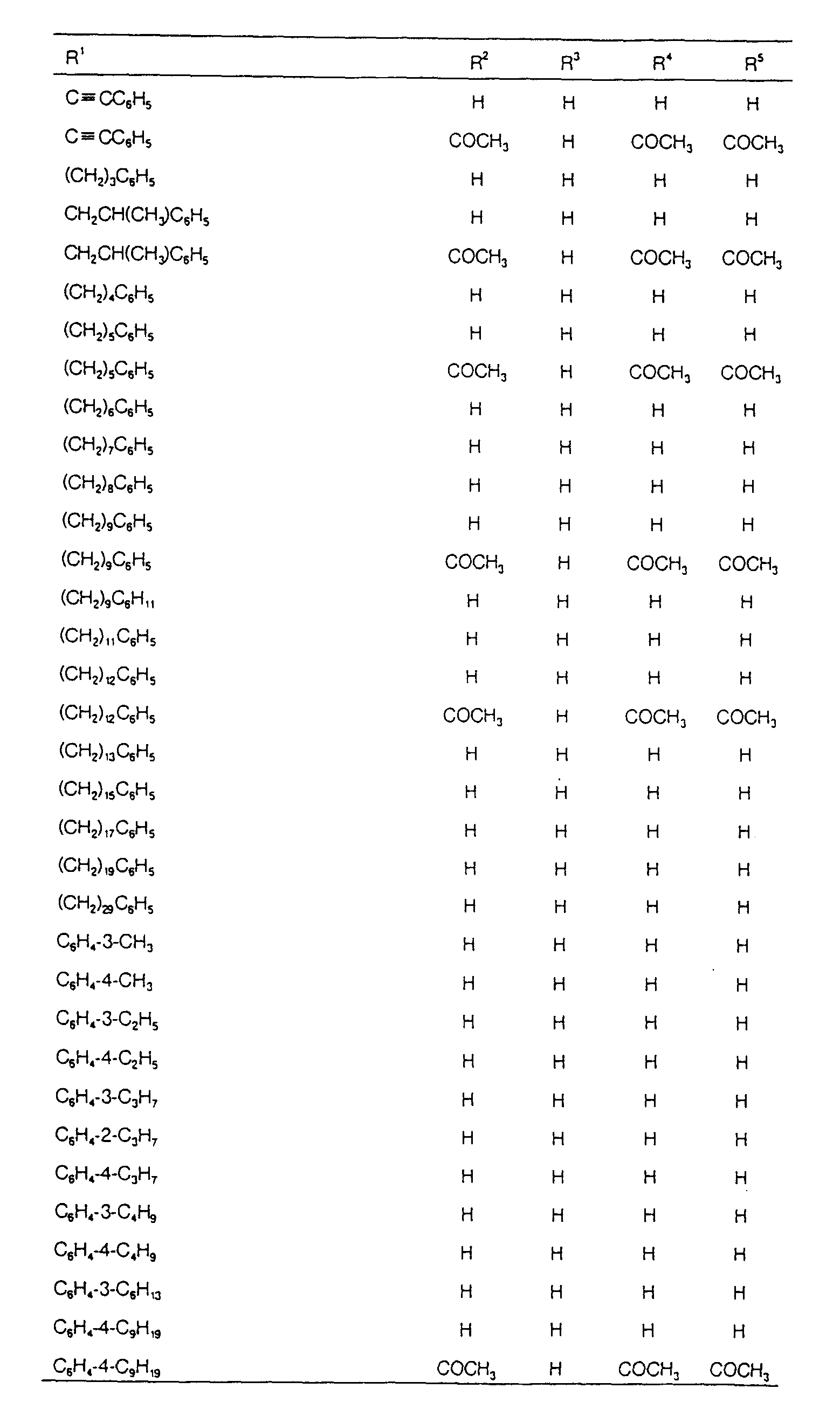

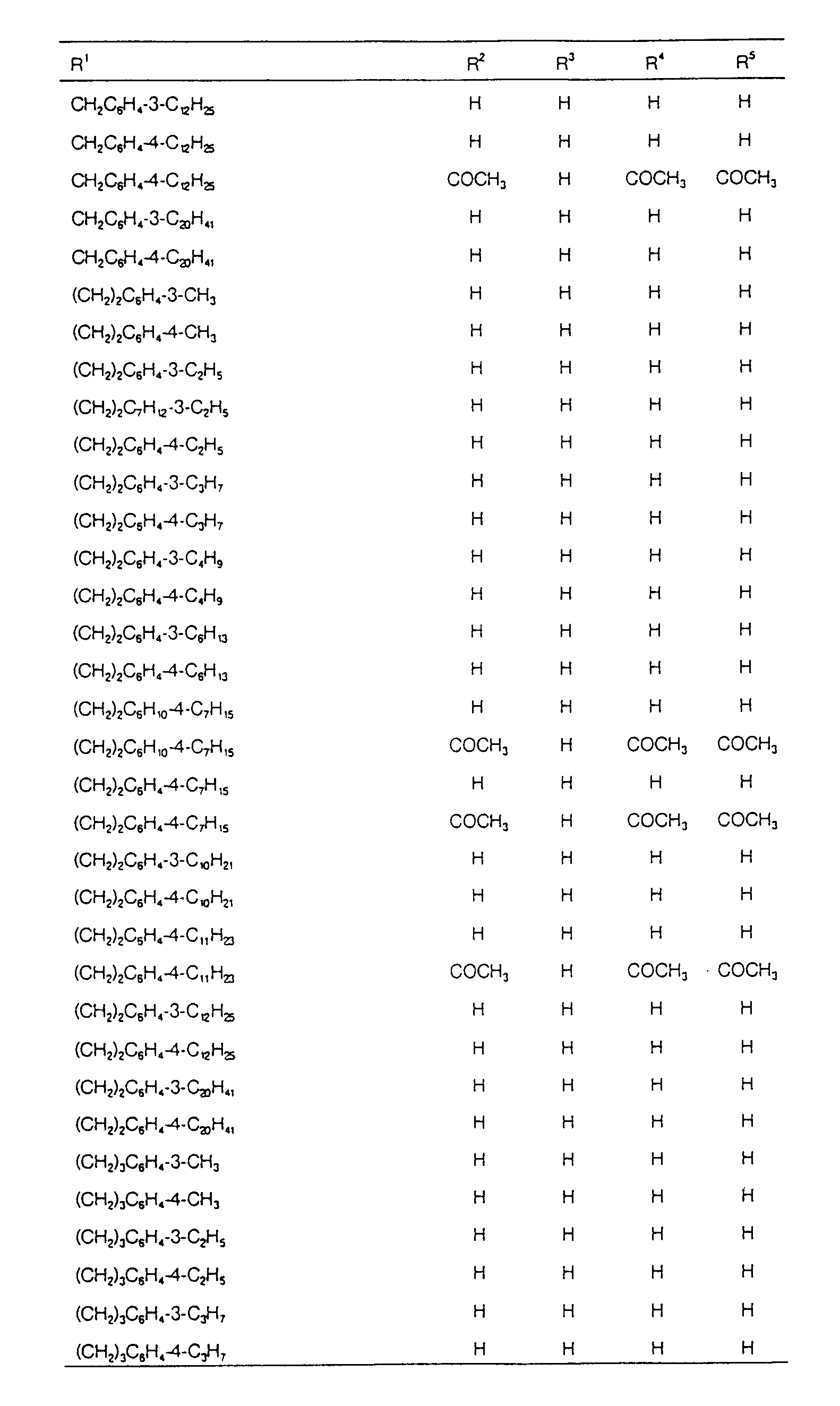
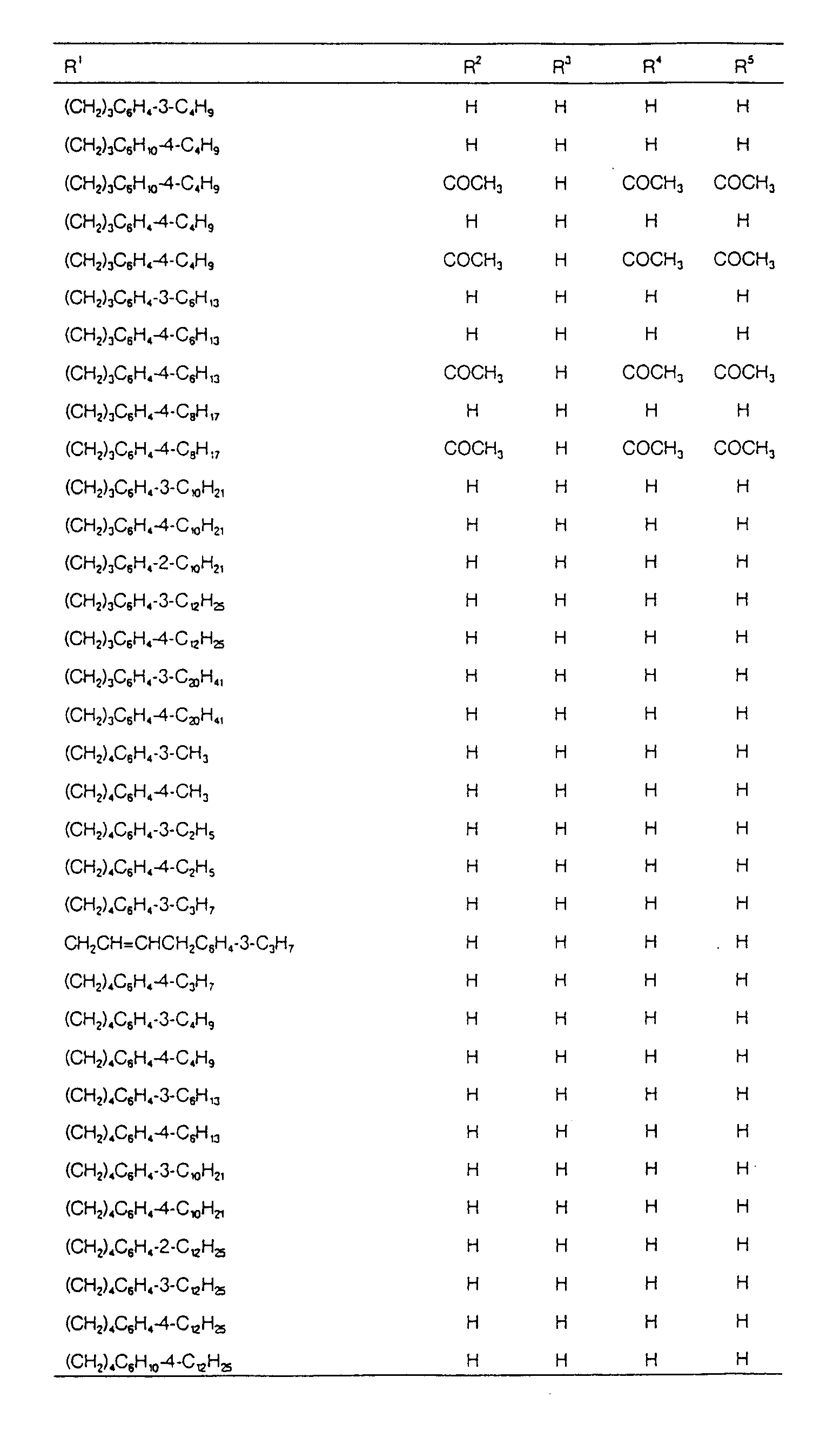


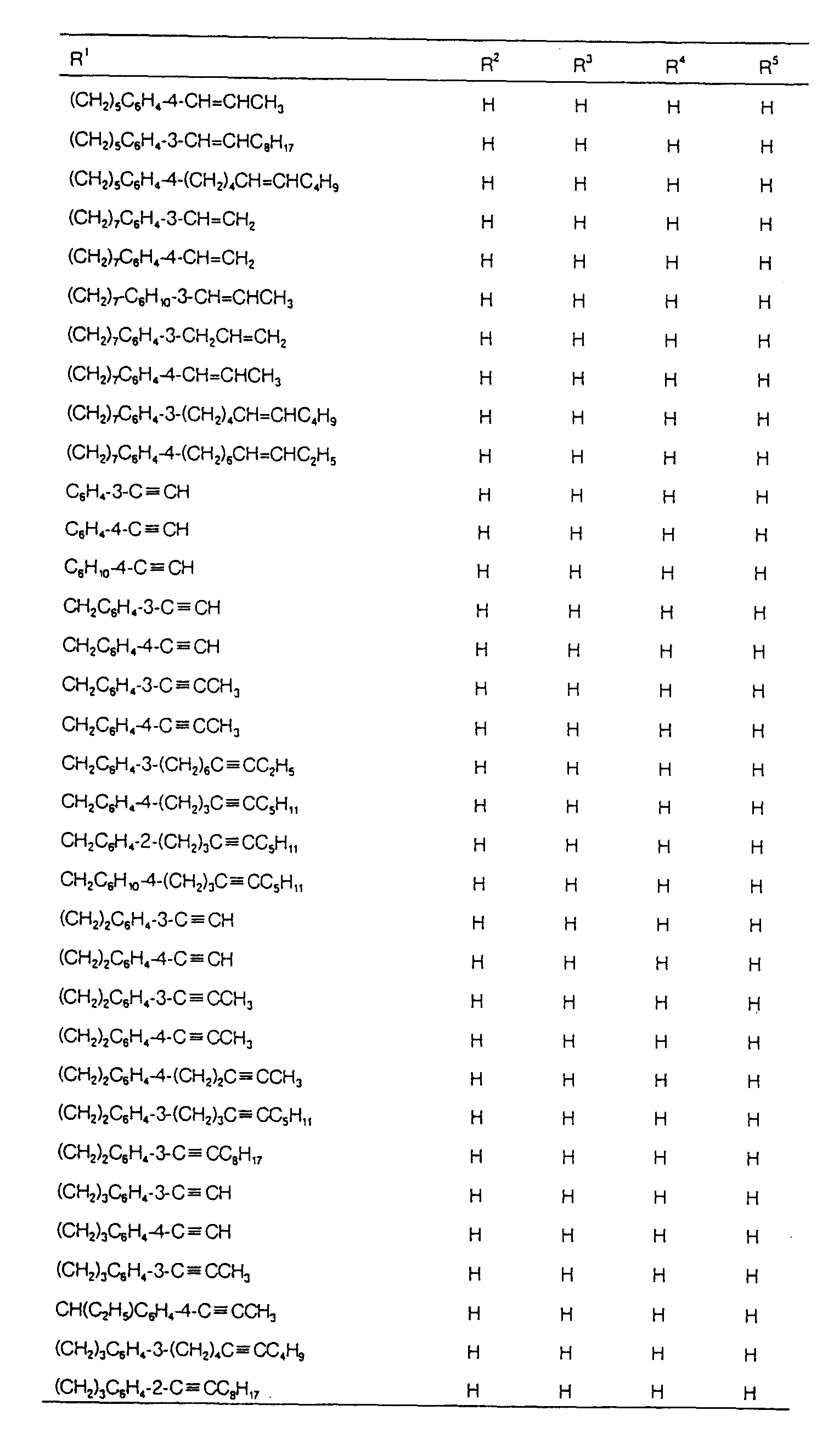
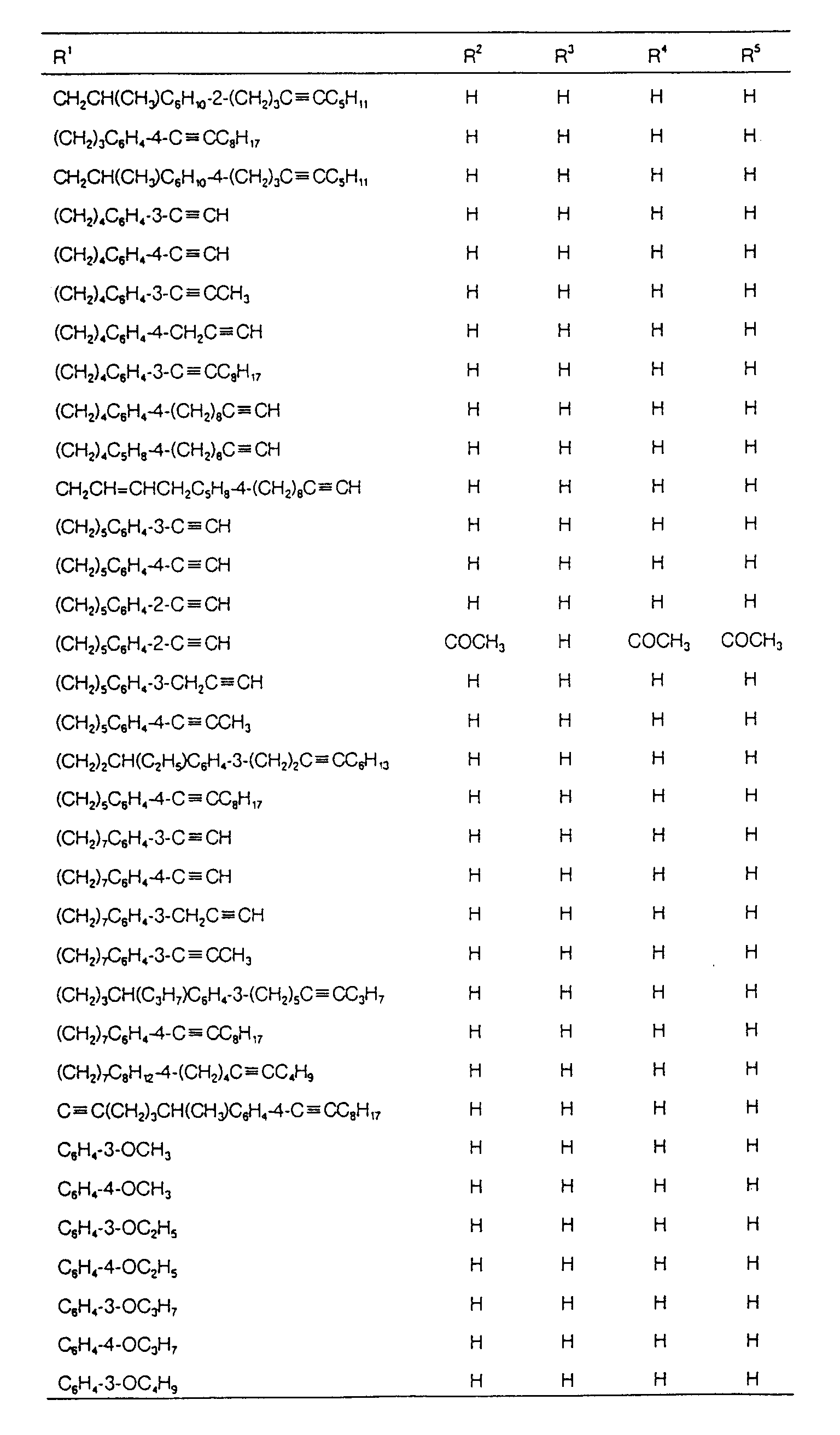


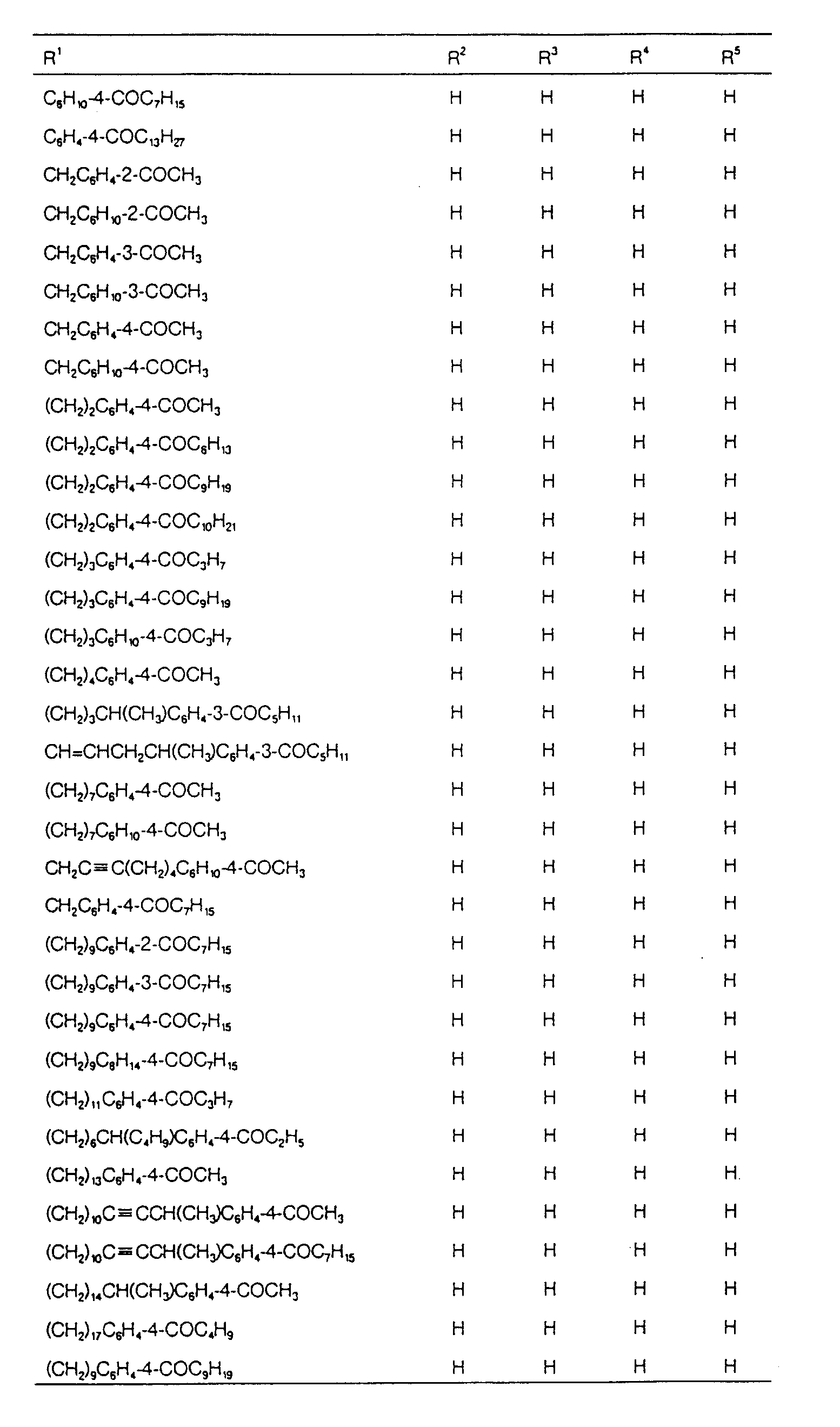


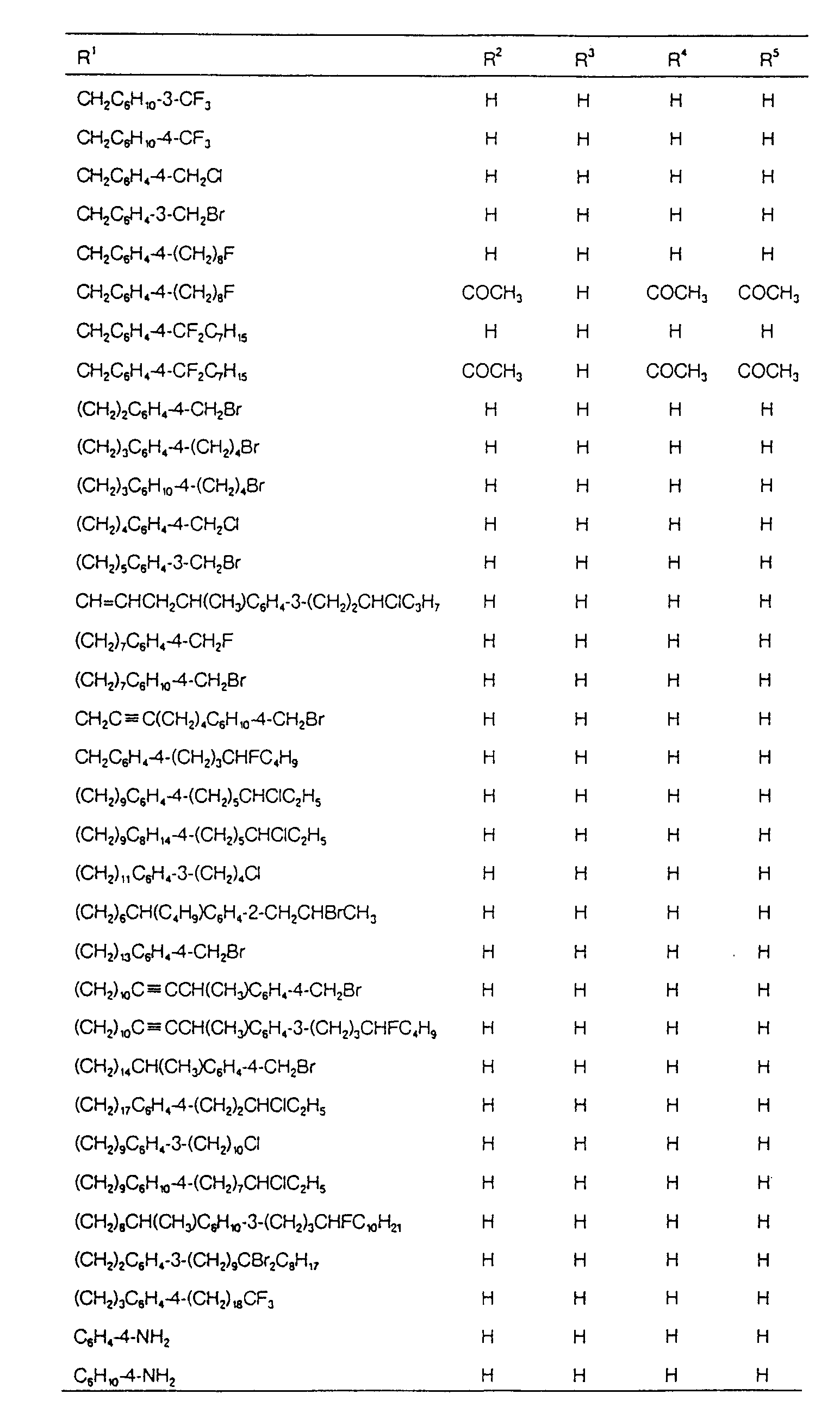

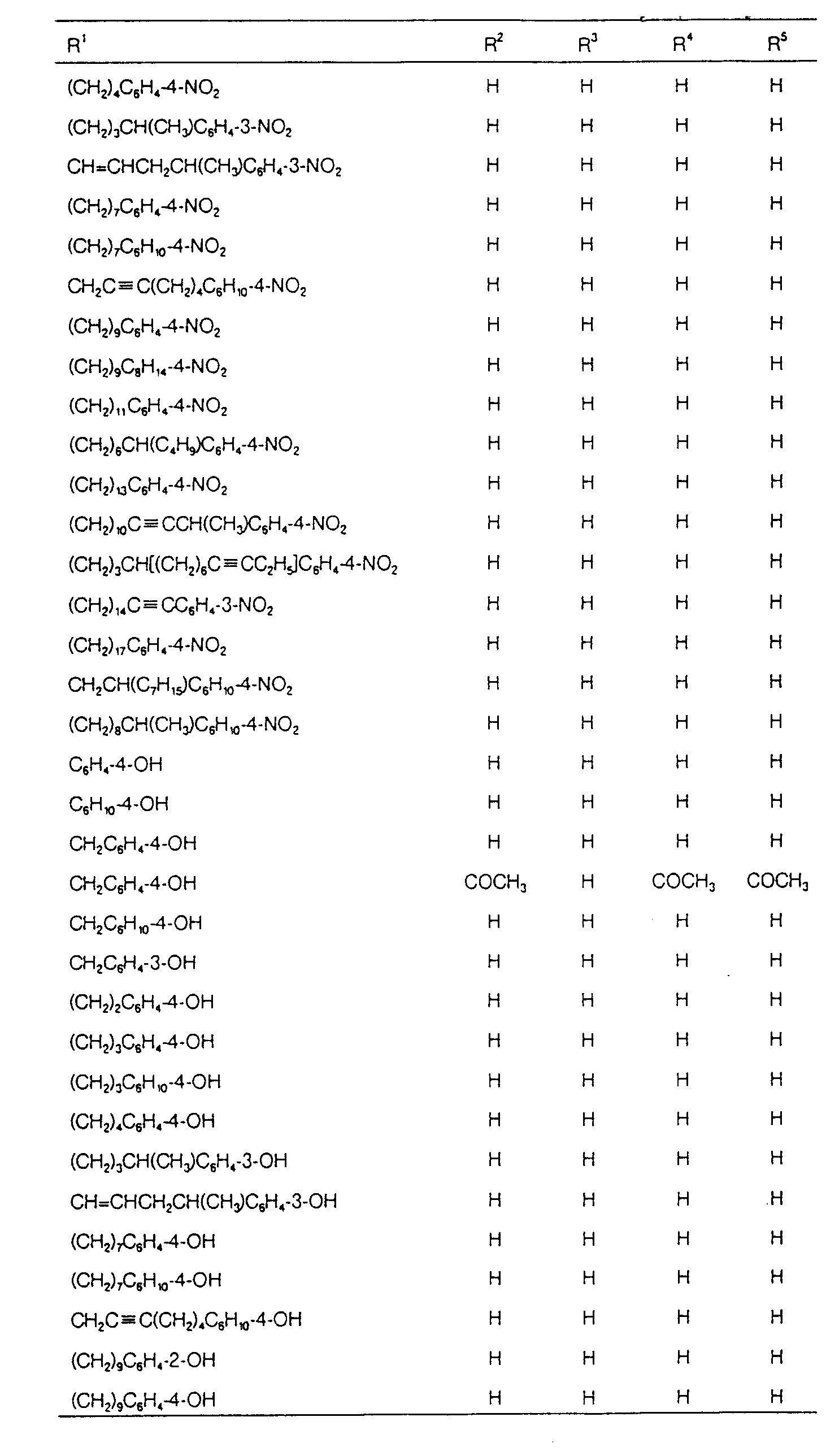
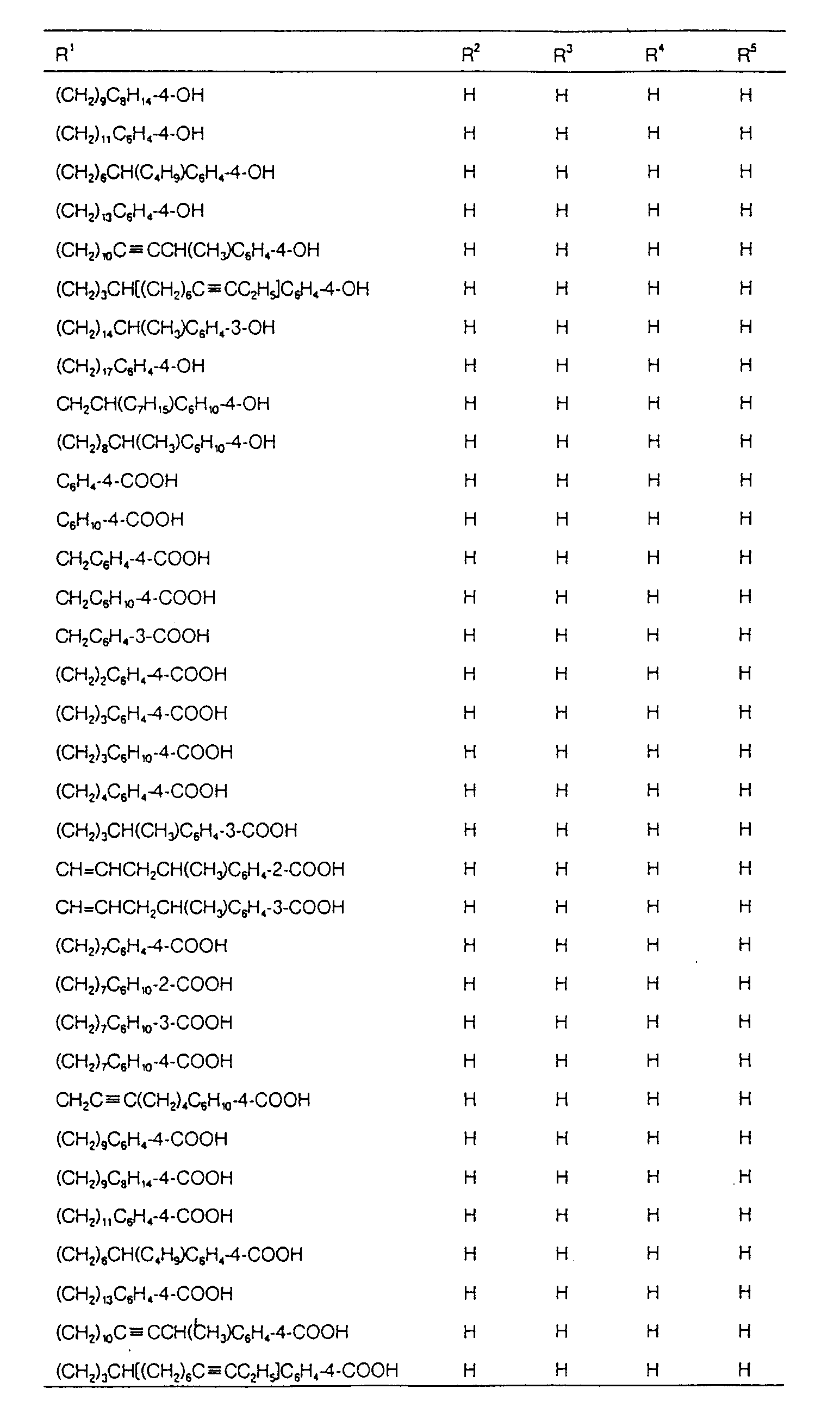


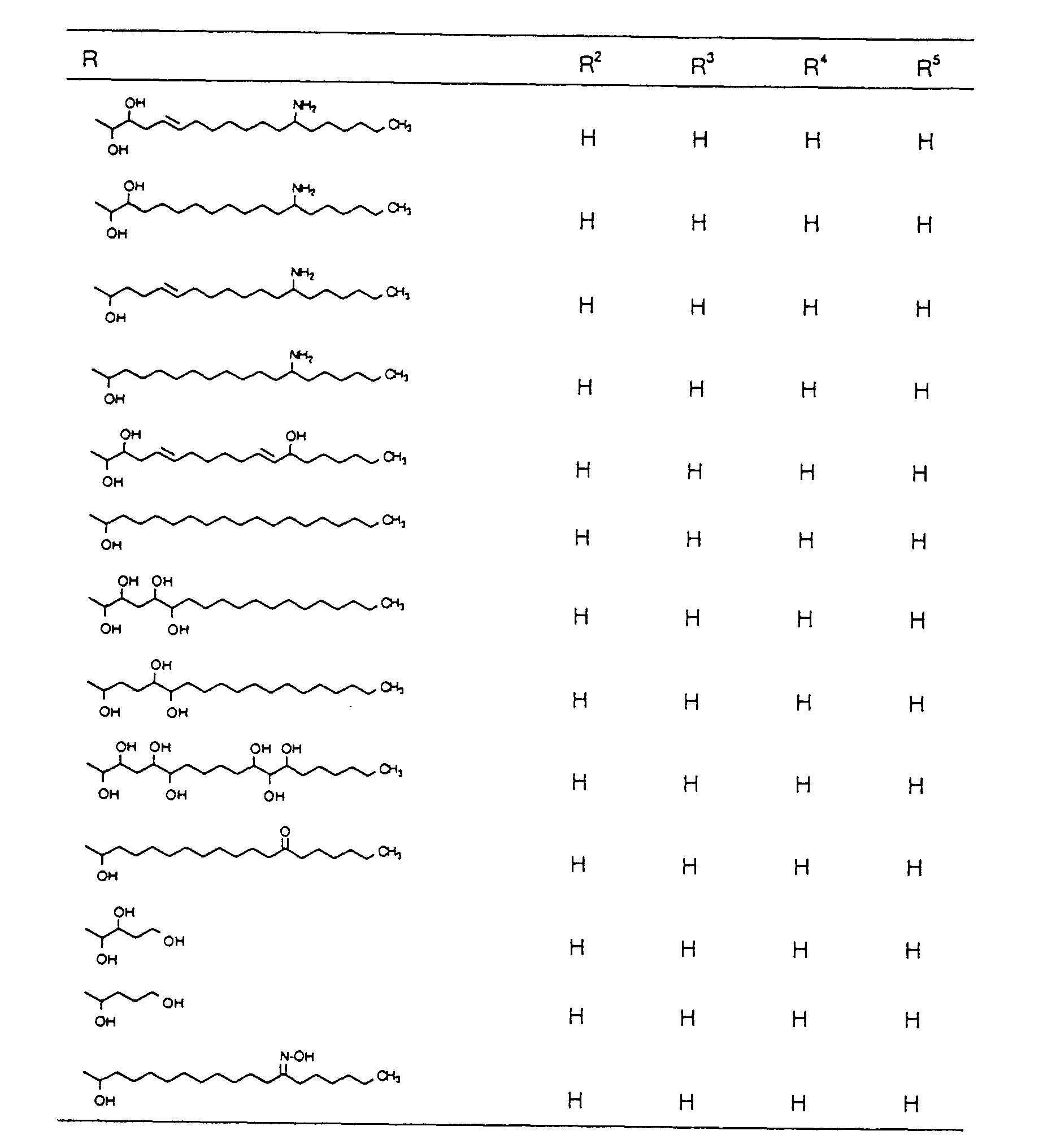


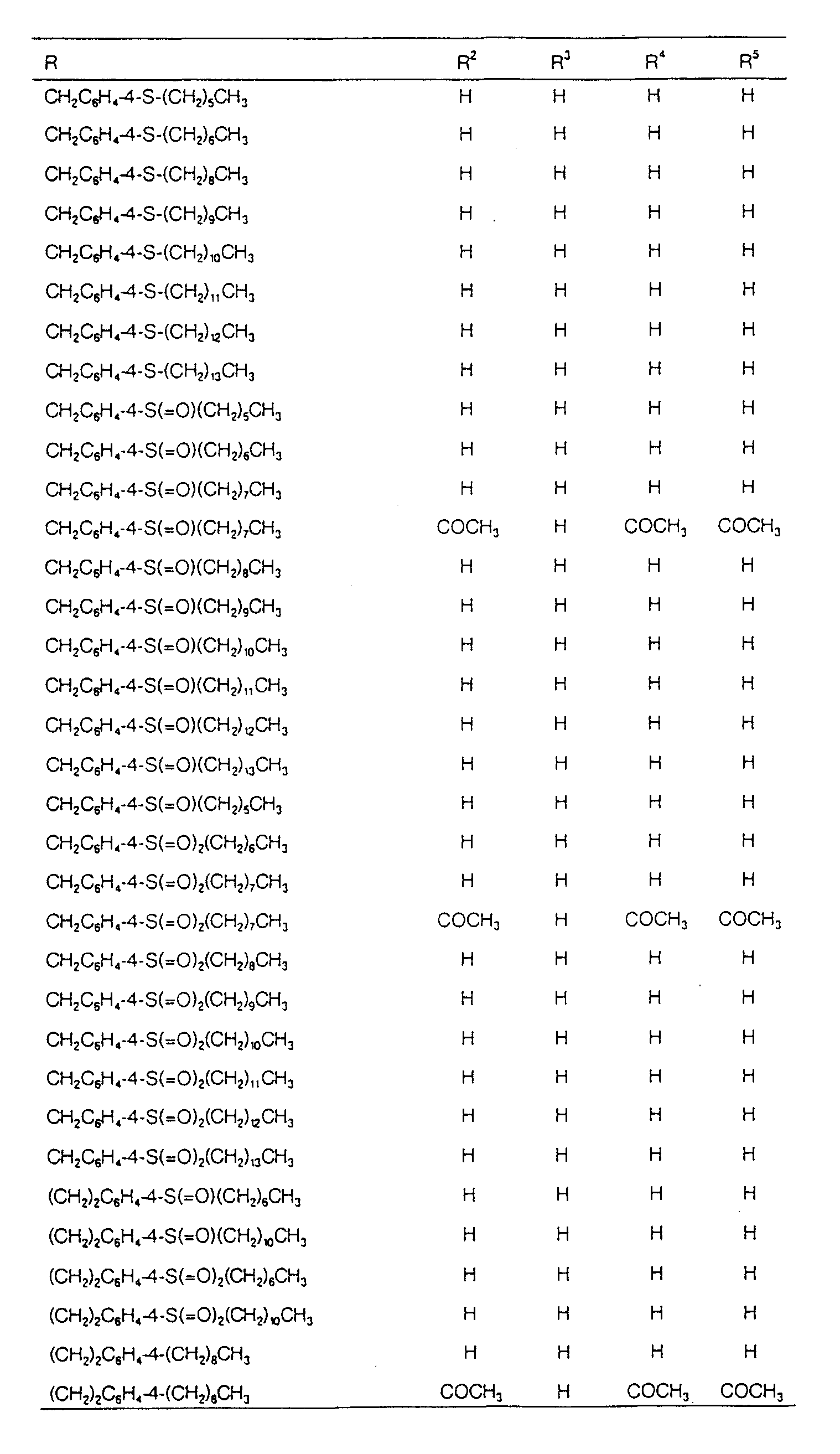


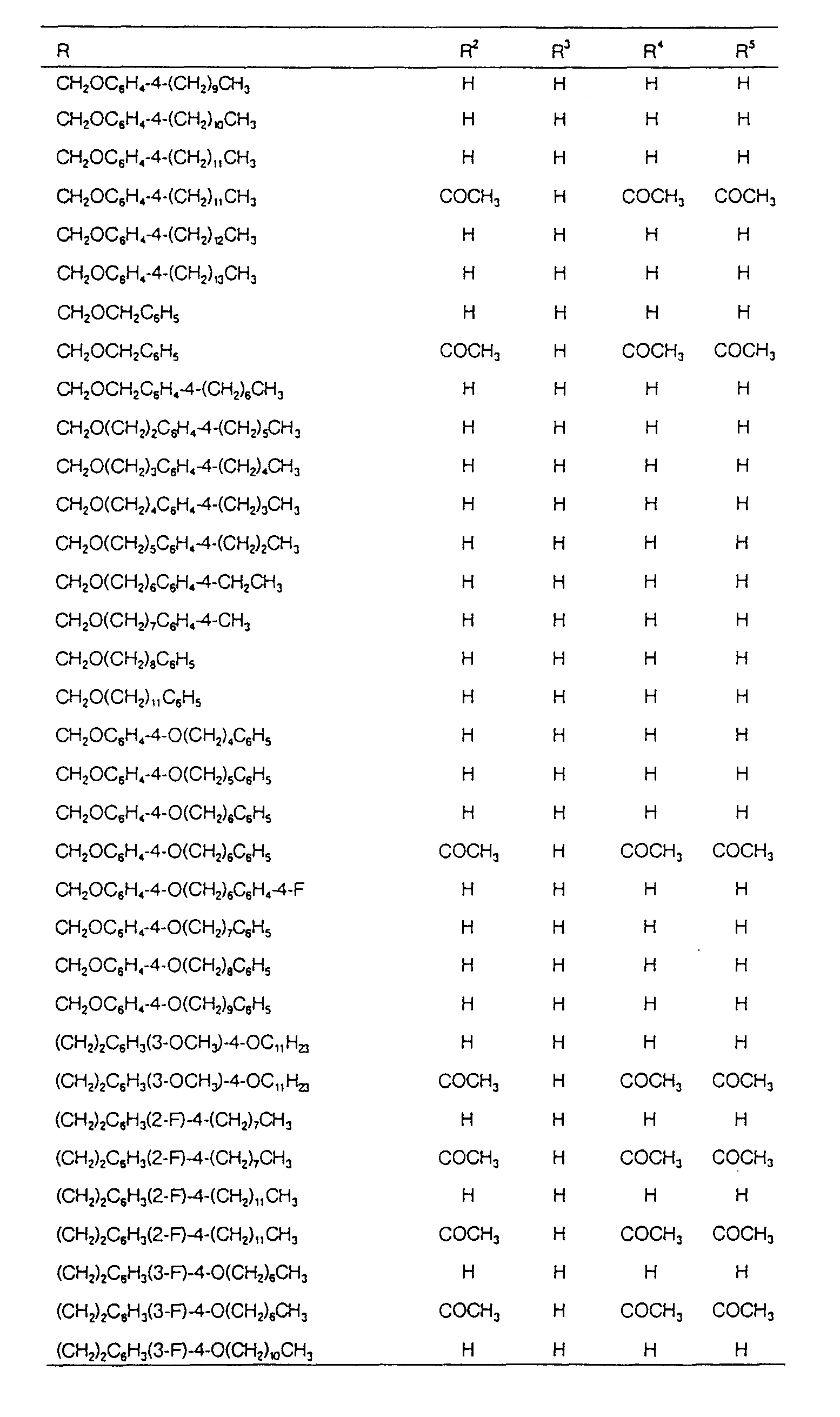
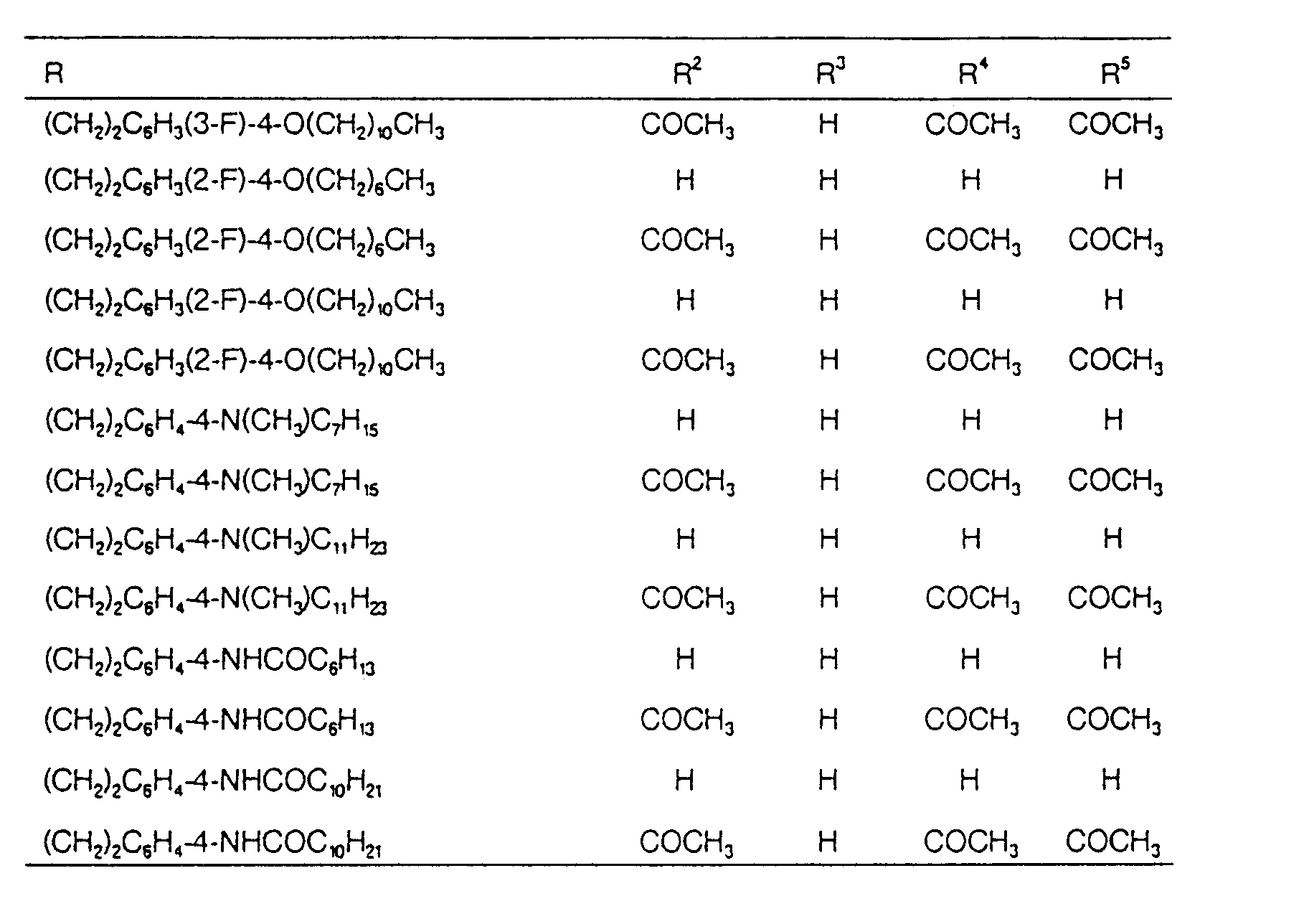
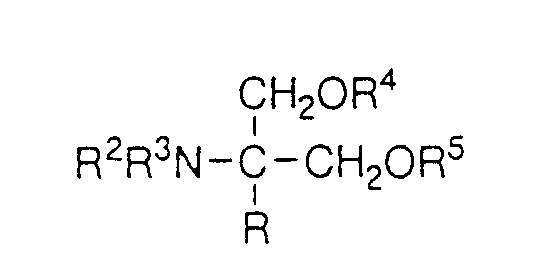
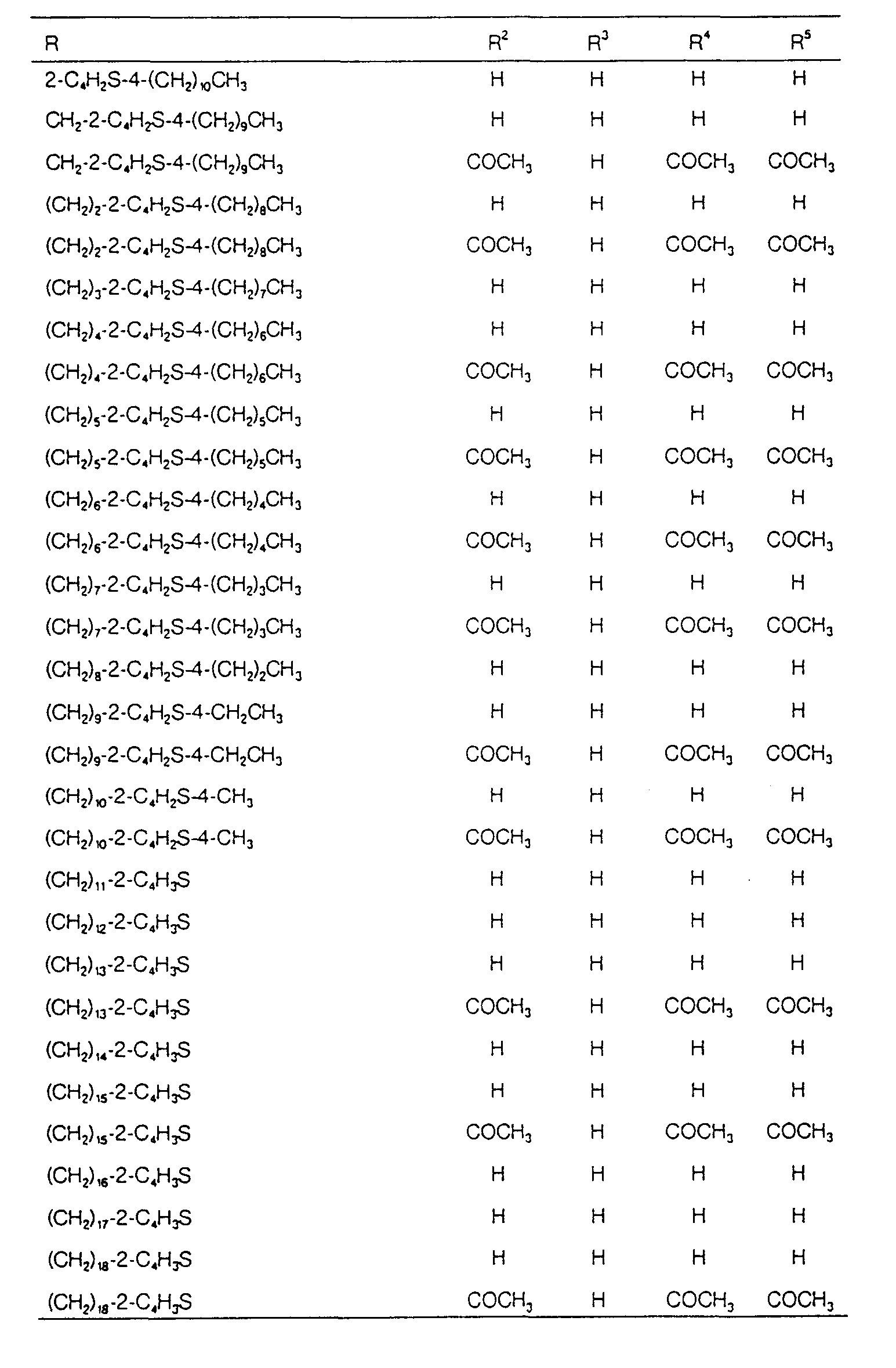


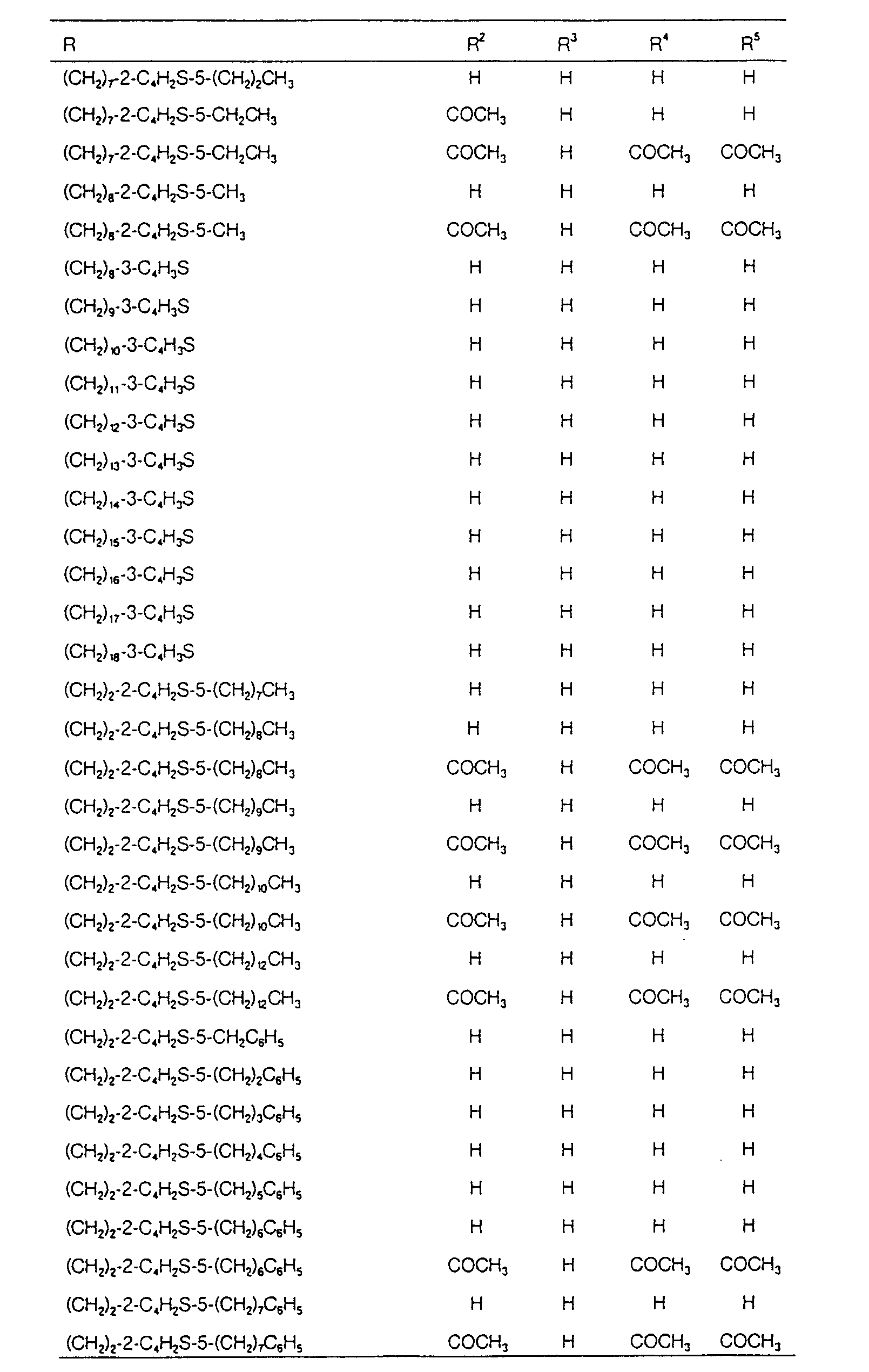


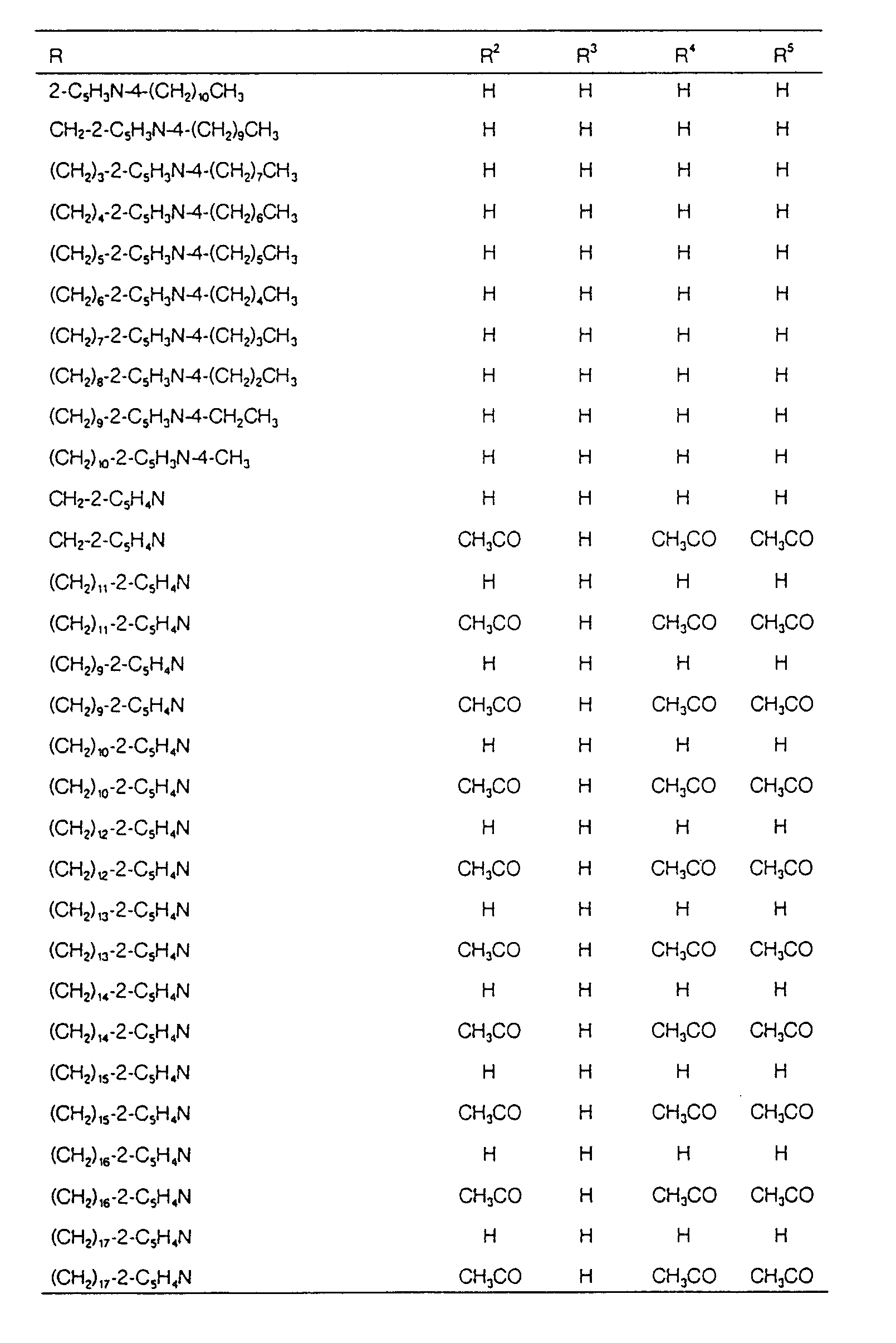

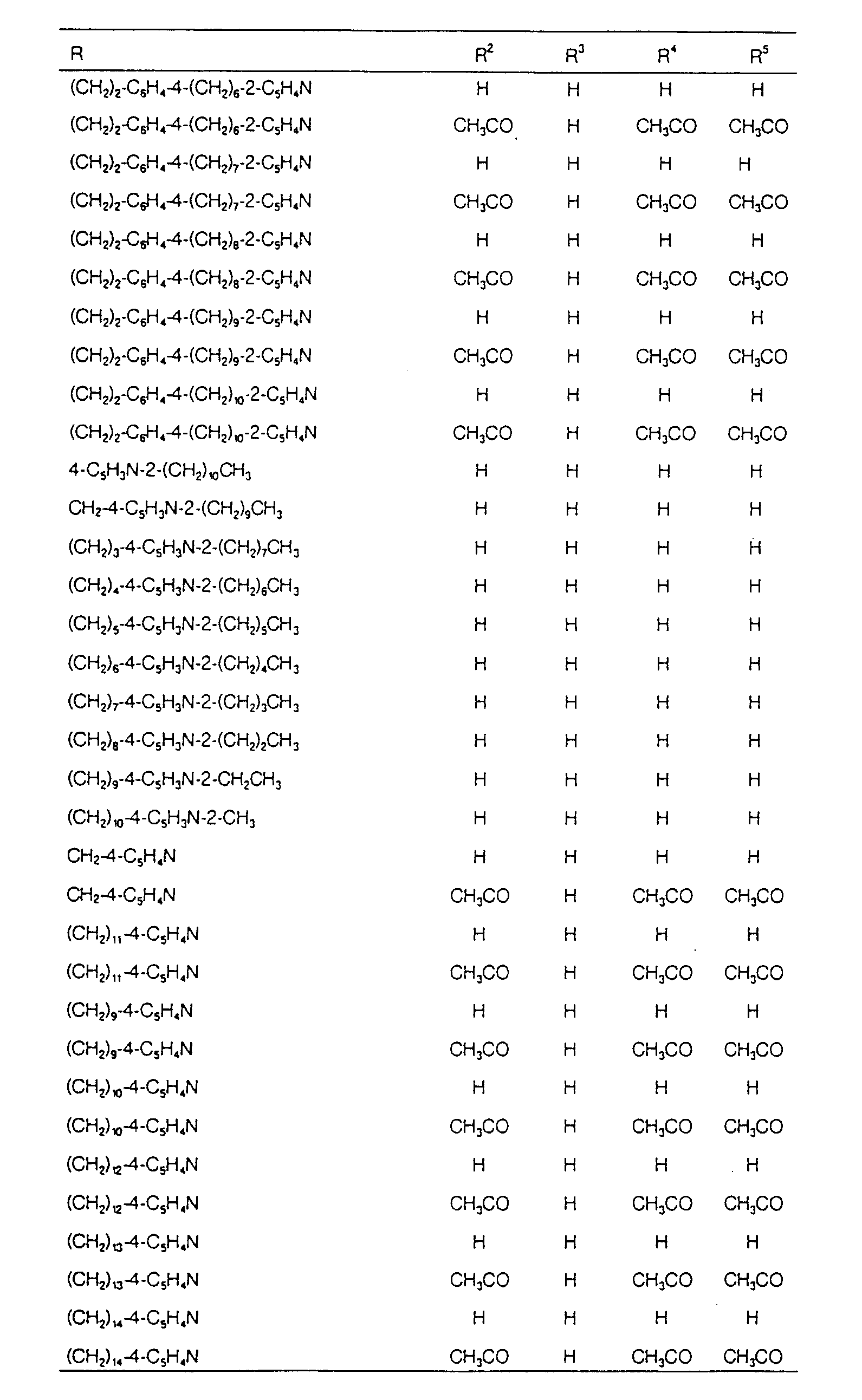

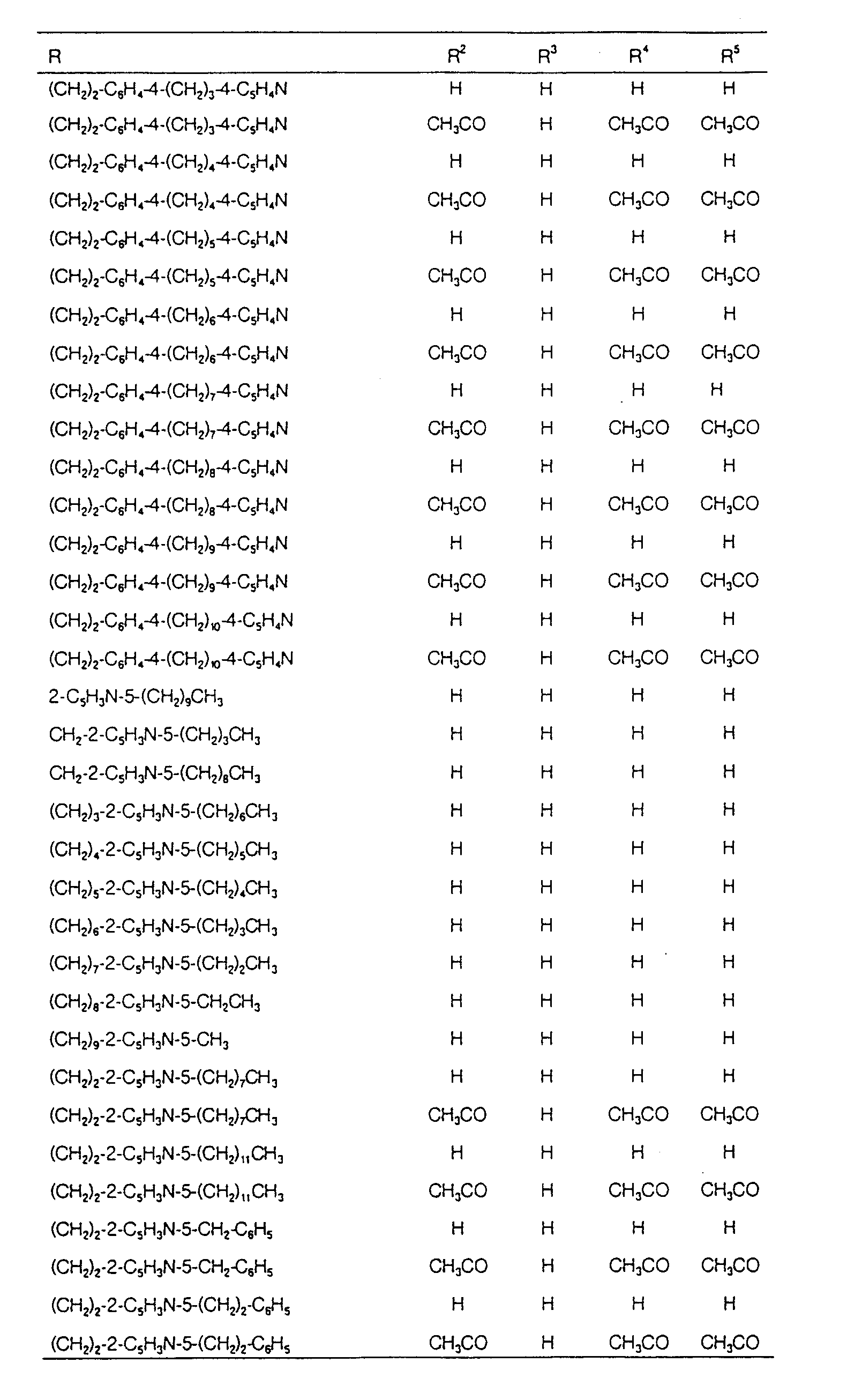

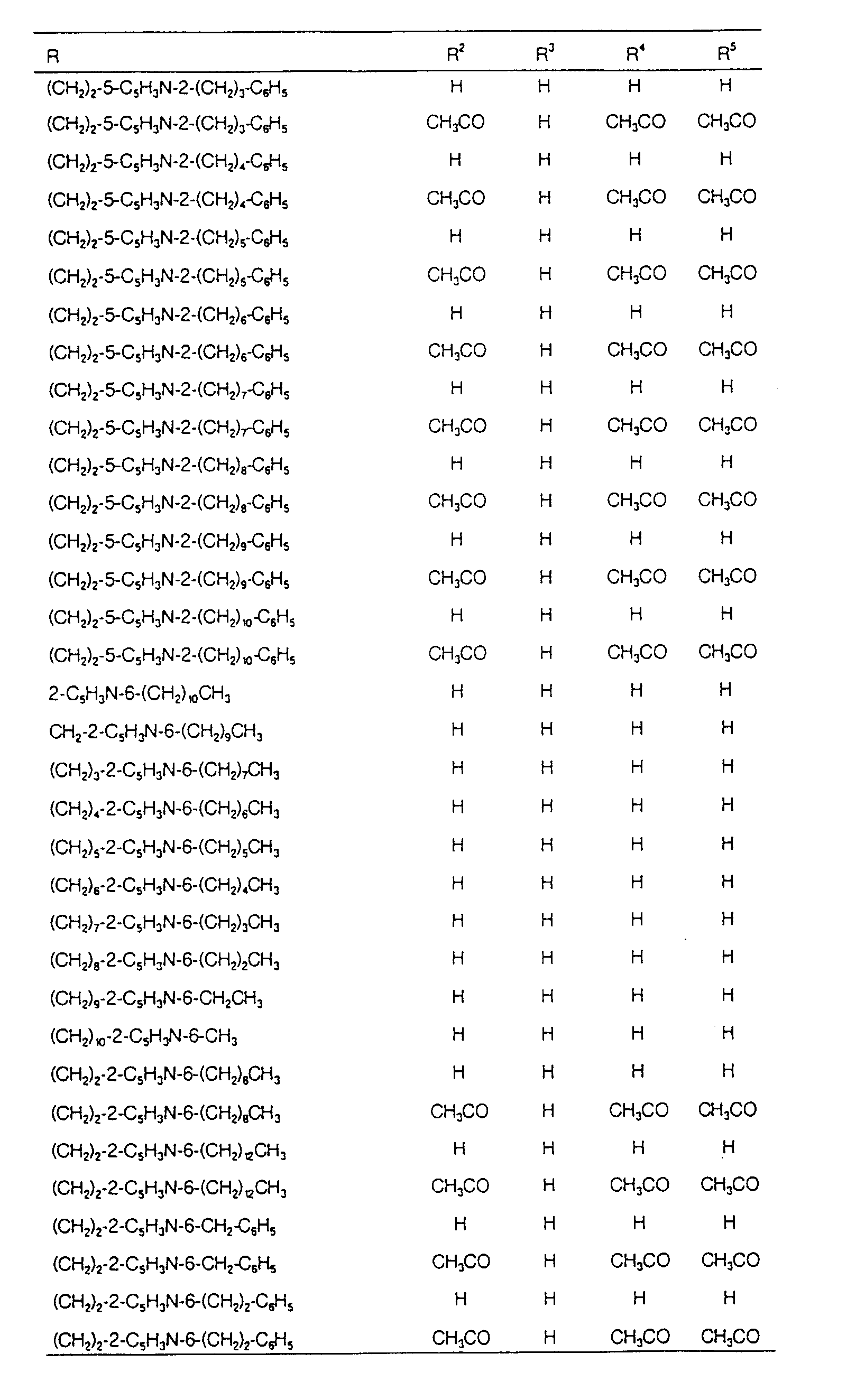

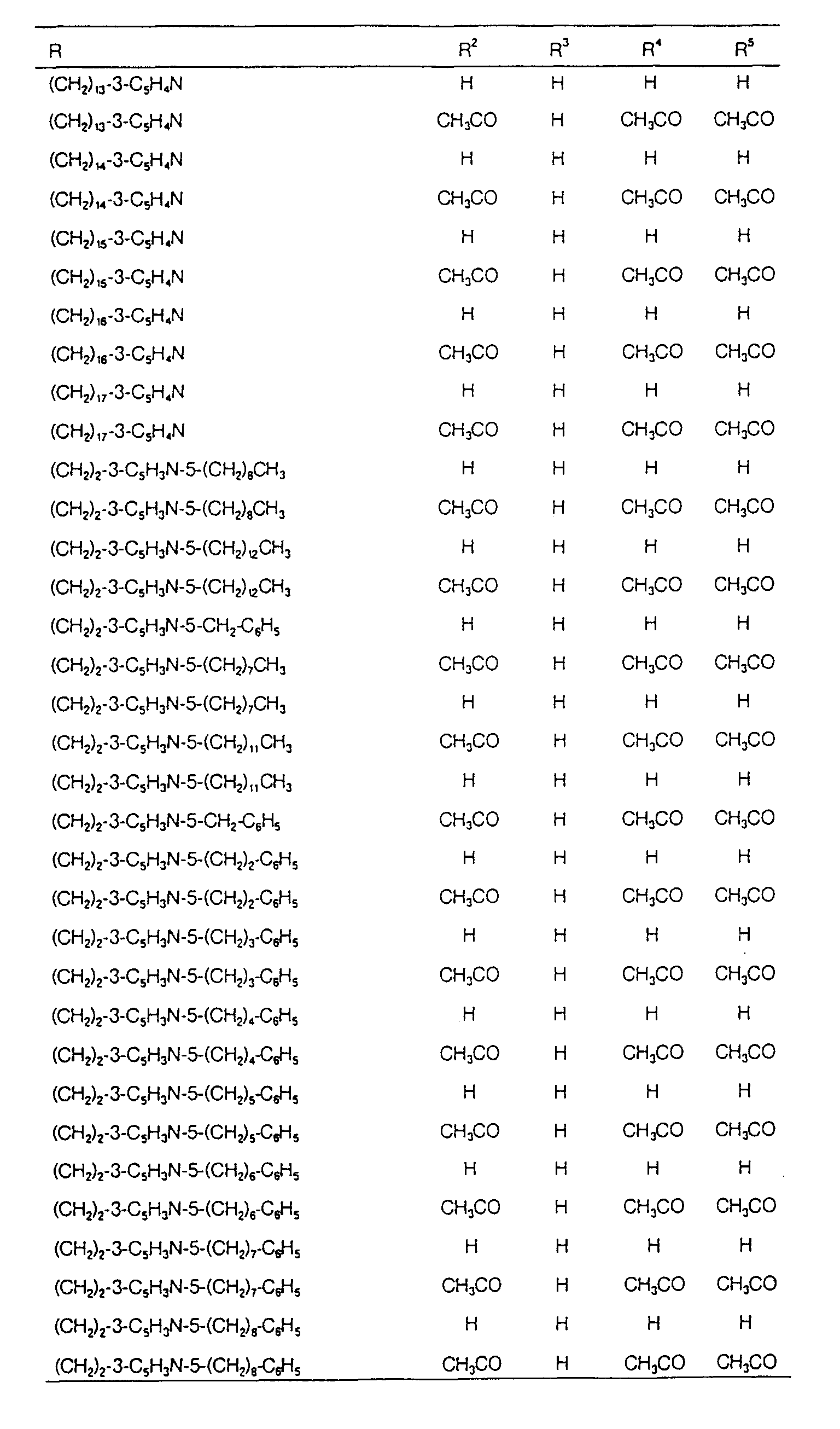


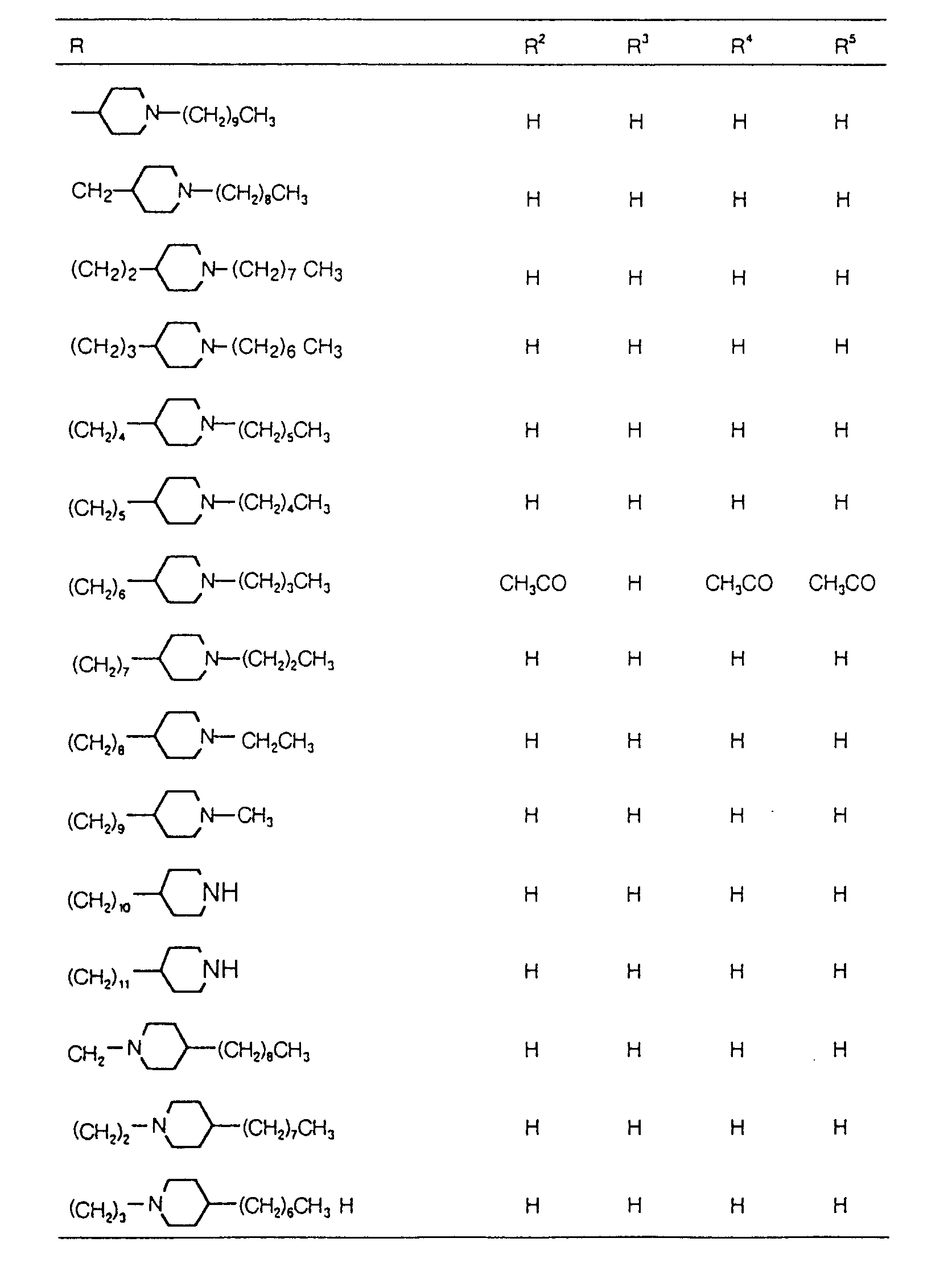


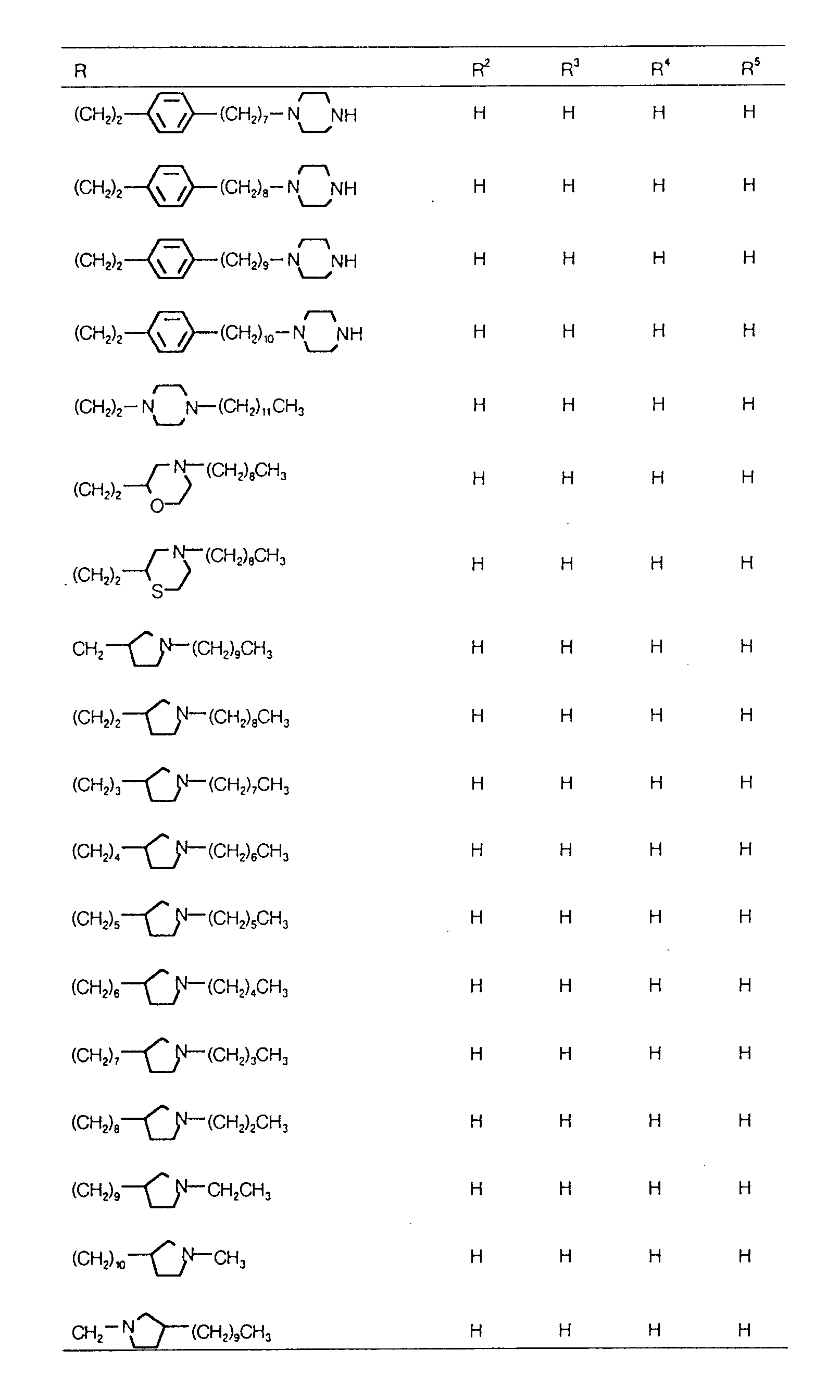


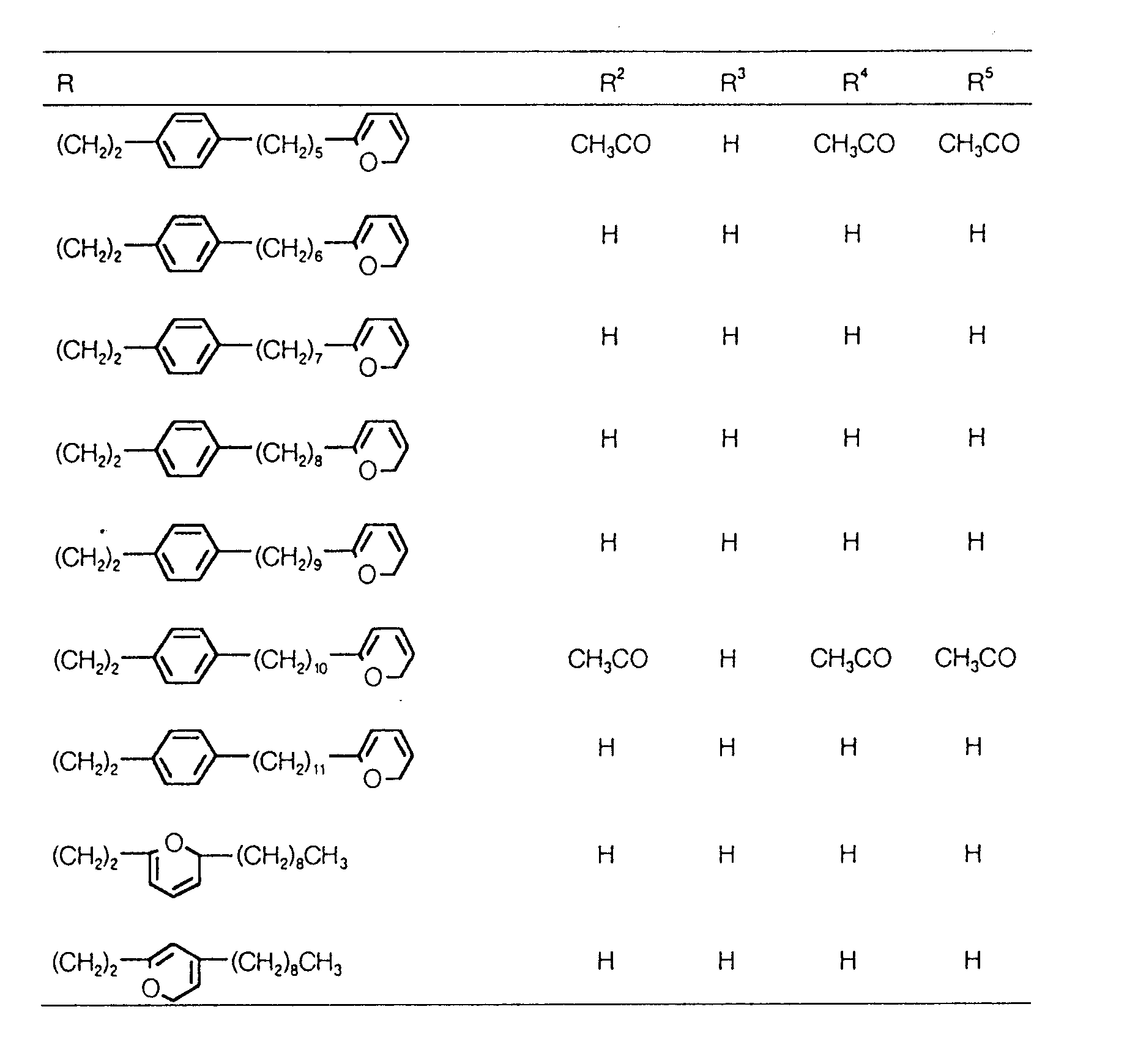
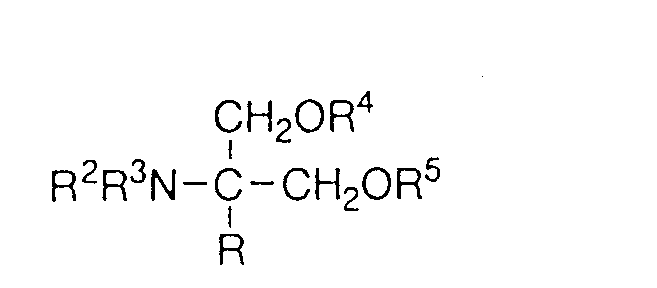


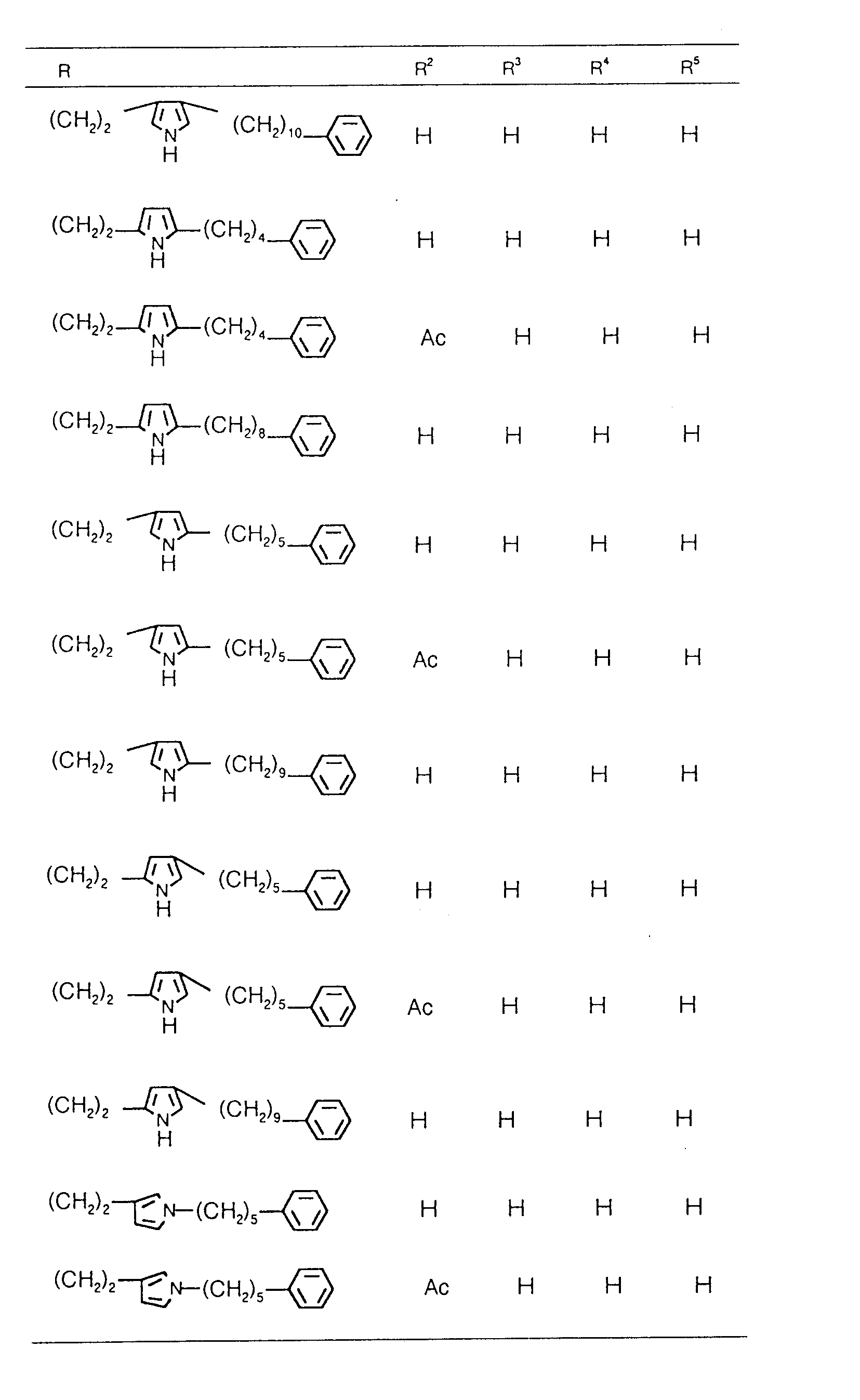


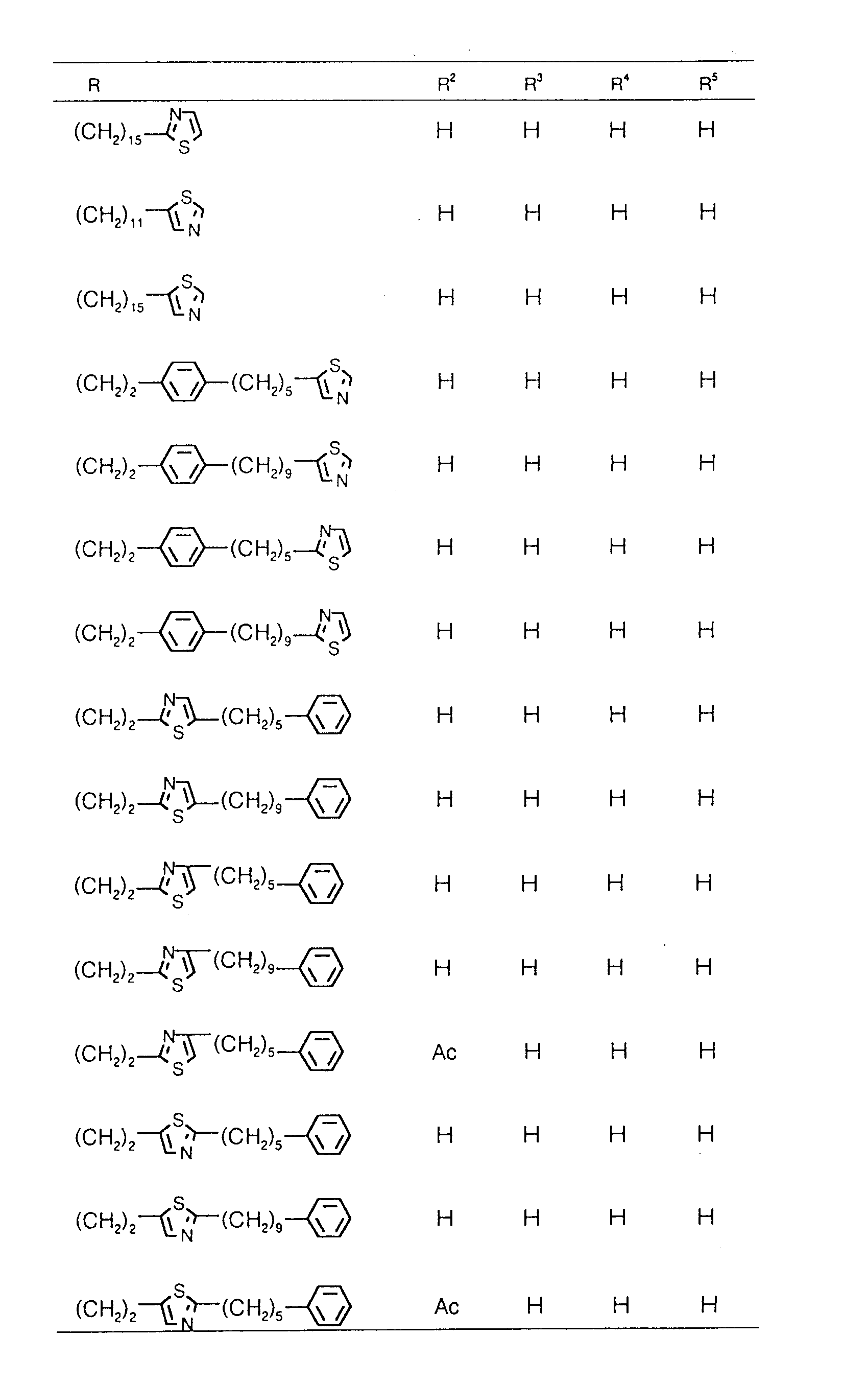


- Examples of the pharmaceutically acceptable salts of the compounds of the formula (I) [hereinafter referred to as Compound (I)] include salts with inorganic acids, such as hydrochloride, hydrobromide and sulfate, salts with organic acids, such as acetate, fumarate, maleate, benzoate, citrate, malate, methanesulfonate and benzenesulfonate, and when carboxyl group is included, salts with metals such as sodium salt, potassium salt, calcium salt and aluminum salt, salts with amines, such as triethylamine and salts with dibasic amino acids, such as lysine. The compounds of the present invention encompass hydrates and solvates.
- When the compounds of the present invention include geometric isomers, the present invention encompasses cis- compounds, trans- compounds and mixtures thereof. When the compounds of the present invention have one or more asymmetric centers in the molecule, various optical isomers are obtained. The present invention also encompasses optical isomers, racemates, diastereomers and mixtures thereof.
- The compounds of the present invention can be produced by the following methods. (method A)
- A compound of the formula (II)

wherein R'CH2 is the same as the aforementioned RICH2, R'aCH2, R1bCH2, Ra, Rb, Rc, Rd, Re, Rf, Rg, Rh, Ri, Rj, Rk, RI, Rm, Rn or Ro which are encompassed in R, and G is a leaving group in wide use in the field of organic synthetic chemistry, such as halogen (fluorine, chlorine, bromine, iodine), methanesul- fonyloxy, p-toluenesulfonyloxy or trifluoromethanesulfonyloxy [hereinafter referred to as Compound (II)], or when R' has a functional group (e.g. amino, hydroxyl group, mercapto, ketone, carboxyl), a compound with protection of the functional group as necessary [hereinafter referred to as. Compound B-(II)] is condensed, in the presence of a base, with a compound of the formula (III)
wherein Y is lower alkyl (e.g. methyl, ethyl, propyl, isopropyl, butyl, tert-butyl) or aralkyl (e.g. benzyl, nitrobenzyl, methoxybenzyl, methylbenzyl), and Q is an amino-protecting group widely used in the field of organic synthetic chemistry, such as acetyl, benzoyl, tert-butoxycarbonyl or benzyloxycarbonyl, where the two Ys in the molecule in the formula may together form a ring such as dioxane and Q and Y in the molecule may together form a ring such as oxazolidine or oxazine [hereinafter referred to as Compound (III)] to give a compound of the formula (IV)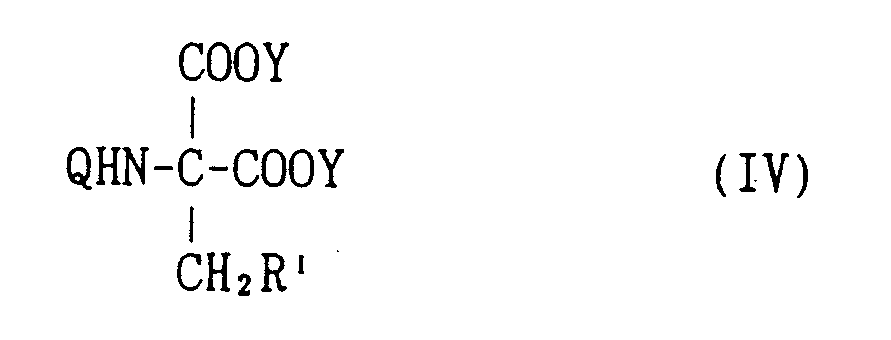
wherein R', Q and Y are as defined above [hereinafter referred to as Compound (IV)], which is subjected to reduction of carboxyl with a suitable reducing agent and deprotection as necessary to give a compound of the formula (I-29)
wherein R' is as defined above [hereinafter referred to as Compound (1-29)] or an N- and/or O-protected compound thereof. - Examples of the base to be used in the condensation include sodium hydroxide, sodium methoxide, sodium ethoxide, sodium hydride, potassium hydride, lithium diisopropylamide, butyl lithium, lithium hexamethyldisilazane, triethylamine, diisopropylethylamine and 1,8-diazabicyclo[5.4.0]undeca-7-ene.
- Examples of the organic solvent to be used in the condensation include methanol, ethanol, tert-butyl alcohol, tetrahydrofuran, diethyl ether, ethylene glycol dimethyl ether, dimethylformamide, dimethyl sulfoxide, benzene, toluene, xylene, dioxane, methylene chloride, chloroform, dichloroethane and acetonitrile.
- The condensation generally proceeds at a temperature of from -20 °C to 150°C and a temperature lower or higher than this temperature range may be selected on demand.
- The condensation is generally carried out for 30 minutes to 2 days and the reaction period longer or shorter than the indicated period may be used as necessary.
- After the condensation is carried out under the above-mentioned conditions or after removing the protecting group on demand, the Compound (IV) can be purified by a method known in the field of organic synthetic chemistry, such as solvent extraction, recrystallization, chromatography and a method using an ion exchange resin.
- Examples of the reducing agent to be used in the reduction of carboxyl include metallic reducing reagent such as sodium borohydride, lithium borohydride or lithium aluminum hydride, and diborane.
- Examples of the organic solvent to be used in the reduction of carboxyl include methanol, ethanol, tert-butyl alcohol, tetrahydrofuran, diethyl ether and ethylene glycol dimethyl ether.
- The temperature for the reduction of carboxyl is generally from -20 ° C to 80 ° C and a temperature lower or higher than this temperature range may be selected on demand.
- The reduction of carboxyl is generally carried out for 30 minutes to 10 hours and the reaction period longer or shorter than the indicated period may be used as necessary.
- After the reduction is carried out under the above-mentioned conditions or after removing the protecting group on demand, the objective compound can be purified by a method known in the field of organic synthetic chemistry, such as solvent extraction, recrystallization, chromatography and a method using an ion exchange resin.
- A Compound (II) or a Compound B-(II) is condensed, in the presence of a base, with a compound of the formula (V)

wherein Y and Q are as defined above, and Z is a hydroxy-protecting group widely used in the field of organic synthetic chemistry, such as acetyl, benzoyl, benzyl, trimethylsilyl, tert-butyldimethylsilyl, methoxymethyl, methoxyethoxymethyl or tetrahydropyranyl [hereinafter referred to as Compound (V)] to give a Compound of the formula (VI)
wherein R', Q, Y and Z are as defined above [hereinafter referred to as Compound (VI)]. The obtained compound is then subjected to reduction of carboxyl with a suitable reducing agent and deprotection as necessary to give a compound (I-29) or an N- and/or O-protected compound thereof. - Examples of the base to be used in the condensation include sodium hydroxide, sodium methoxide, sodium ethoxide, sodium hydride, potassium hydride, lithium diisopropylamide, butyl lithium, lithium hexamethyldisilazane, triethylamine, diisopropylethylamine and 1,8-diazabicyclo[5.4.0]undeca-7-ene.
- Examples of the organic solvent to be used in the condensation include methanol, ethanol, tert-butyl alcohol, tetrahydrofuran, diethyl ether, ethylene glycol dimethyl ether, dimethylformamide, dimethyl sulfoxide, benzene, toluene, xylene, dioxane, methylene chloride, chloroform, dichloroethane and acetonitrile.
- The condensation generally proceeds at a temperature of from -20 °C to 150°C and a temperature lower or higher than this temperature range may be selected on demand.
- The condensation is generally carried out for 30 minutes to 2 days and the reaction period longer or shorter than the indicated period may be used as necessary.
- After the condensation is carried out under the above-mentioned conditions or after removing the protecting group on demand, the Compound (VI) can be purified by a method known in the field of organic synthetic chemistry, such as solvent extraction, recrystallization, chromatography and a method using an ion exchange resin.
- Examples of the reducing agent to be used for the reduction of carboxyl include metallic reducing reagent such as sodium borohydride, lithium borohydride or lithium aluminum hydride, and diborane.
- Examples of the organic solvent to be used for the reduction of carboxyl include methanol, ethanol, tert-butyl alcohol, tetrahydrofuran, diethyl ether and ethylene glycol dimethyl ether.
- The temperature of the reduction of carboxyl is generally from -20 ° C to 80 ° C and a temperature lower or higher than this temperature range may be selected on demand.
- The reduction of carboxyl is generally carried out for 30 minutes to 10 hours and the reaction period longer or shorter than the indicated period may be used as necessary.
- After the reduction is carried out under the above-mentioned conditions or after removing the protecting group on demand, the objective compound can be purified by a method known in the field of organic synthetic chemistry, such as solvent extraction, recrystallization, chromatography and a method using an ion exchange resin.
- A Compound (II) or a Compound B-(II) is condensed, in the presence of a base, with a compound of the formula (VII)

wherein Y is as defined above [hereinafter referred to as Compound (VII)] to give a compound of the formula (VIII)
wherein R' and Y are as defined above [hereinafter referred to as Compound (VIII)]. The obtained compound is then subjected to reduction of carboxyl and aside with a suitable reducing agent and deprotection as necessary to give a Compound (1-29) or an O-protected compound thereof. - Examples of the base to be used for the condensation include sodium hydroxide, sodium methoxide, sodium ethoxide, sodium hydride, potassium hydride, lithium diisopropylamide, butyl lithium, lithium hexamethyldisilazane, triethylamine, diisopropylethylamine and 1,8-diazabicyclo[5.4.0]undeca-7-ene.
- Examples of the organic solvent to be used for the condensation include methanol, ethanol, tert-butyl alcohol, tetrahydrofuran, diethyl ether, ethylene glycol dimethyl ether, dimethylformamide, dimethyl sulfoxide, benzene, toluene, xylene, dioxane, methylene chloride, chloroform, dichloroethane and acetonitrile.
- The condensation generally proceeds at a temperature of from -20 °C to 150°C and a temperature lower or higher than this temperature range may be selected on demand.
- The condensation is generally carried out for 30 minutes to 2 days and the reaction period longer or shorter than the indicated period may be used as necessary.
- After the condensation is carried out under the above-mentioned conditions or after removing the protecting group on demand, the Compound (VIII) can be purified by a method known in the field of organic synthetic chemistry, such as solvent extraction, recrystallization, chromatography and a method using an ion exchange resin.
- Examples of the reducing agent to be used for the reduction of carboxyl include metallic reducing reagent such as sodium borohydride, lithium borohydride or lithium aluminum hydride, and diborane.
- Examples of the organic solvent to be used for the reduction of carboxyl include methanol, ethanol, tert-butyl alcohol, tetrahydrofuran, diethyl ether and ethylene glycol dimethyl ether.
- The temperature of the reduction of carboxyl is generally from -20 ° C to 80 ° C and a temperature lower or higher than this temperature range may be selected on demand.
- The reduction is generally carried out for 30 minutes to 10 hours and the reaction period longer or shorter than the indicated period may be used as necessary.
- Examples of the reducing agent to be used for the reduction of azide include metallic reducing reagent such as sodium borohydride, lithium borohydride or lithium aluminum hydride, and transition metal such as palladium-carbon, platinum oxide, Raney nickel, rhodium or ruthenium for catalytic reduction.
- Examples of the organic solvent to be used for the reduction of azide include methanol, ethanol, tert-butyl alcohol, tetrahydrofuran, diethyl ether, dioxane, acetone, ethyl acetate, acetic acid, benzene, toluene, xylene, dimethylformamide and dimethyl sulfoxide.
- The temperature of the reduction of azide is generally from -20 ° C to 80 °C and a temperature lower or higher than this temperature range may be selected on demand.
- After the reduction is carried out under the above-mentioned conditions or after removing the protecting group on demand, the objective compound can be purified by a method known in the field of organic synthetic chemistry, such as solvent extraction, recrystallization, chromatography and a method using an ion exchange resin.
- A Compound (II) or a Compound B-(II) is condensed, in the presence of a base, with a compound of the formula (IX)

wherein Z1 and Z2 are the same or different and each is hydroxyl-protecting group widely used in the field of organic synthetic chemistry, such as acetyl, benzoyl, benzyl, trimethylsilyl, tert-butyldimethylsilyl, methoxymethyl, methoxyethoxymethyl or tetrahydropyranyl and Z1 and Z2 may together form a ring such as dioxane [hereinafter referred to as Compound (IX)] to give a compound of the formula (X)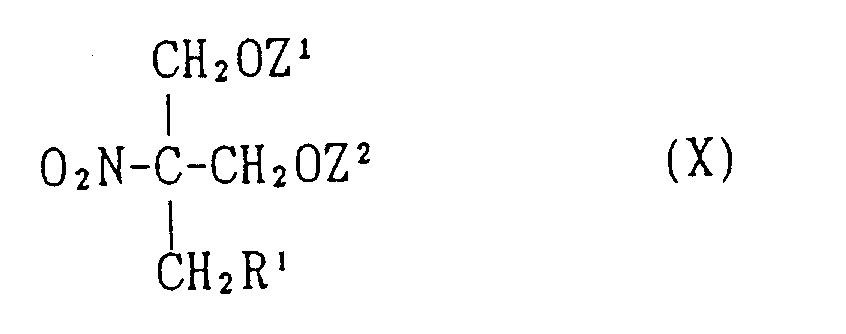
wherein R', Z1 and Z2 are as defined above [hereinafter referred to as Compound (X)]. The obtained compound is then subjected to reduction of nitro with a suitable reducing agent and deprotection as necessary to give a Compound (I-29) or an O-protected compound thereof. - Examples of the base to be used for the condensation include sodium hydroxide, sodium methoxide, sodium ethoxide, sodium hydride, potassium hydride, lithium diisopropylamide, butyl lithium, lithium hexamethyldisilazane, triethylamine, diisopropylethylamine and 1,8-diazabicyclo[5.4.0]undeca-7-ene.
- Examples of the organic solvent to be used for the condensation include methanol, ethanol, tert-butyl alcohol, tetrahydrofuran, diethyl ether, ethylene glycol dimethyl ether, dimethylformamide, dimethyl sulfoxide, benzene, toluene, xylene, dioxane, methylene chloride, chloroform, dichloroethane and acetonitrile.
- The condensation generally proceeds at a temperature of from -20 °C to 150°C and a temperature lower or higher than this temperature range may be selected on demand.
- The condensation is generally carried out for 30 minutes to 2 days and the reaction period longer or shorter than the indicated period may be used as necessary.
- After the condensation is carried out under the above-mentioned conditions or after removing the protecting group on demand, the Compound (X) can be purified by a method known in the field of organic synthetic chemistry, such as solvent extraction, recrystallization, chromatography and a method using an ion exchange resin.
- Examples of the reducing agent to be used for the reduction of nitro include metallic reducing reagent such as sodium borohydride, lithium borohydride or lithium aluminum hydride, transition metal such as palladium-carbon, platinum oxide, Raney nickel, rhodium or ruthenium for catalytic reduction, and metal such as iron, zinc or tin.
- Examples of the solvent to be used for the reduction of nitro include water, methanol, ethanol, tert-butyl alcohol, tetrahydrofuran, diethyl ether, dioxane, acetone, ethyl acetate, acetic acid, benzene, toluene, xylene, dimethylformamide and dimethyl sulfoxide.
- The reduction of nitro generally proceeds at a temperature of from -20 °C to 80 °C and a temperature lower or higher than this temperature range may be selected on demand.
- After the reduction is carried out under the above-mentioned conditions or after removing the protecting group on demand, the objective compound can be purified by a method known in the field of organic synthetic chemistry, such as solvent extraction, recrystallization, chromatography and a method using an ion exchange resin.
- The above-mentioned methods A through D can be used for the synthesis of the compounds of the formulas (1-1) to (1-18).
- A compound of the formula (XI)

wherein R" is the same as the aforementioned CH2R1, CH2R'a, CH2R'b, Ra, Rb, Rc, Rd, Re, Rf, Rg, Rh, Ri, Rj, Rk, RI, Rm, Rn, Ro, Rp, Rq, CH=CHRt, CH=CHRu, (CH2)α-X-(CH2)βRv (when α 1) or CH20Rw which are encompassed in R, M is a metal in wide use in the field of organic synthetic chemistry, such as lithium, magnesium chloride, magnesium bromide, magnesium iodide, copper, lithium copper or nickel, and n is an integer of 1 to 3 [hereinafter referred to as compound (XI)], or when R" has a functional group (e.g. amino, hydroxyl group, mercapto, ketone, carboxyl), a compound with protection of the functional group as necessary [hereinafter referred to as Compound B-(Xi)] is subjected to nucleophilic addition to a compound of the formula (XII)
wherein Y is as defined above and Q' is an imino-protecting group in wide use in the field of organic synthetic chemistry, such as acetyl, benzoyl, tert-butoxycarbonyl or benzyloxycarbonyl [hereinafter referred to as Compound (XII)] to give a compound of the formula (IV-a)
wherein R", Q' and Y are as defined above [hereinafter referred to as Compound (IV-a)]. The obtained compound is then subjected to reduction of carboxyl with a suitable reducing agent and deprotection as necessary to give a compound of the formula (I-30)
wherein R" is as defined above [hereinafter referred to as Compound (1-30)] or an N- and/or O-protected compound thereof. - Examples of the organic solvent to be used for the addition include tetrahydrofuran, diethyl ether, ethylene glycol dimethyl ether, dimethylformamide, dimethyl sulfoxide, benzene, toluene, xylene, dioxane, methylene chloride, chloroform, dichloroethane and acetonitrile.
- The addition generally proceeds at a temperature of from -100°C to 80°C and a temperature lower or higher than this temperature range may be selected on demand.
- The addition is generally carried out for 30 minutes to 2 days and the reaction period longer or shorter than the indicated period may be used as necessary.
- After the addition is carried out under the above-mentioned conditions or after removing the protecting group on demand, the Compound (IV-a) can be purified by a method known in the field of organic synthetic chemistry, such as solvent extraction, recrystallization, chromatography and a method using an ion exchange resin.
- Examples of the reducing agent to be used for the reduction of carboxyl include metallic reducing reagent such as sodium borohydride, lithium borohydride or lithium aluminum hydride, and diborane.
- Examples of the organic solvent to be used for the reduction of carboxyl include methanol, ethanol, tert-butyl alcohol, tetrahydrofuran, diethyl ether and ethylene glycol dimethyl ether.
- The reduction of carboxyl generally proceeds at a temperature of from -20°C to 80°C and a temperature lower or higher than this temperature range may be selected on demand.
- The reduction of carboxyl is generally carried out for 30 minutes to 10 hours and the reaction period longer or shorter than the indicated period may be used as necessary.
- After the reduction is carried out under the above-mentioned conditions or after removing the protecting group on demand, the objective compound can be purified by a method known in the field of organic synthetic chemistry, such as solvent extraction, recrystallization, chromatography and a method using an ion exchange resin.
- The instant method can be used for the synthesis of the compounds of the formulas (1-1) to (1-20), (I-24), (1-25), (I-26) when a ≧ 1 and (1-27).
- A compound of the formula (XIII)

wherein Hal is halogen such as chlorine, bromine or iodine and. Rt and Ru are as defined above [hereinafter referred to as Compound (XIII-1) or Compound (XIII-2)], or when Rt and Ru have a functional group (e.g. amino, hydroxyl, mercapto, ketone, carboxyl), a compound with protection of the functional group as necessary [hereinafter referred to as Compound B-(XIII-1) or Compound B-(XIII-2)] is condensed, in the presence of a base, with a compound of the formula (XIV)
wherein Q1 and Q2 are amino-protecting groups widely used in the field of organic synthetic chemistry, such as acetyl, benzoyl, tert-butoxycarbonyl, benzyloxycarbonyl or benzyl and one of them may be hydrogen, and Z1 and Z2 are as defined above [hereinafter referred to as Compound (XIV)] to give a compound of the formula (XV)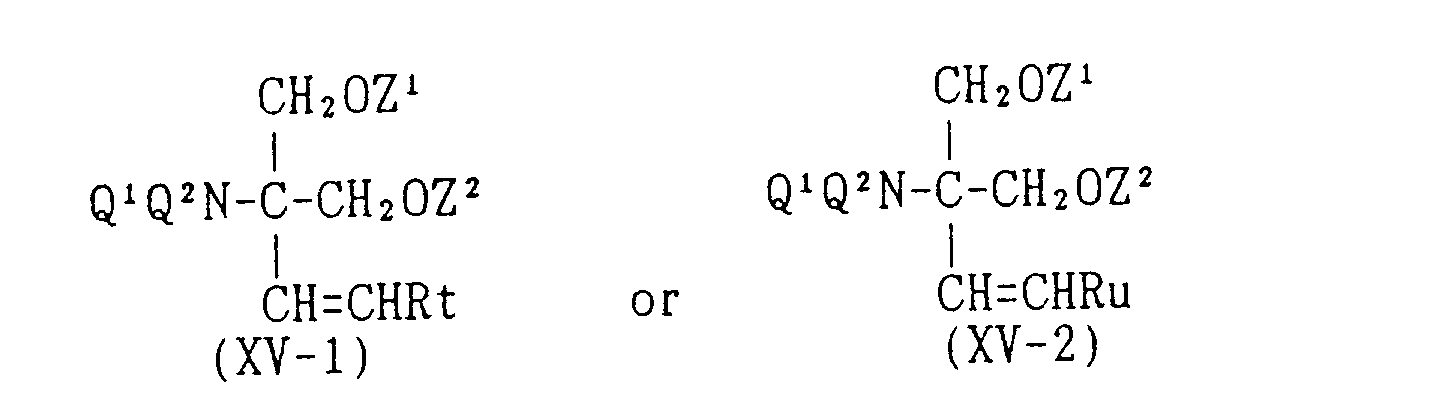
wherein Rt, Ru, Q1, Q2, Z1 and Z2 are as defined above [hereinafter referred to as Compound (XV-1) or Compound (XV-2)]. The obtained compound is then subjected to deprotection as necessary to give a compound (I-24) or (1-25). - Examples of the base to be used in the condensation include sodium hydroxide, sodium methoxide, sodium ethoxide, potassium tert-butoxide, sodium hydride, potassium hydride, lithium diisopropylamide, butyl lithium, lithium hexamethyldisilazane, triethylamine, diisopropylethylamine, pyridine and 1,8-diazabicyclo[5.4.0]undeca-7-ene.
- Examples of the solvent to be used for the condensation include water, methanol, ethanol, tert-butyl alcohol, tetrahydrofuran, diethyl ether, ethylene glycol dimethyl ether, dimethylformamide, dimethyl sulfoxide, benzene, toluene, xylene, dioxane, methylene chloride, chloroform, dichloroethane and acetonitrile.
- The condensation generally proceeds at a temperature of from -20°C to 150°C and a temperature lower or higher than this temperature range may be selected on demand.
- The condensation is generally carried out for 30 minutes to 2 days and the reaction period longer or shorter than the indicated period may be used as necessary.
- After the condensation is carried out under the above-mentioned conditions or after removing the protecting group on demand, the Compound (XV-1) or (XV-2.) can be purified by a method known in the field of organic synthetic chemistry, such as solvent extraction, recrystallization, chromatography or a method using an ion exchange resin.
- The instant method can be used for the synthesis of the compounds of the formulas (I-24) and (1-25). By reducing the double bond of the compounds of the formulas (I-24) and (1-25), or an N- and/or O-protected compound thereof, the compounds of the formulas (1-1) through (1-18) and (I-26) when α ≧2 can be obtained.
- Examples of the reducing agent to be used for the reduction of the double bond include metal reducing reagent such as sodium borohydride, lithium borohydride or lithium aluminum hydride, and transition metal such as palladium-carbon, platinum oxide, Raney nickel, rhodium or ruthenium for catalytic reduction.
- Examples of the organic solvent to be used for the reduction of the double bond include methanol, ethanol, tert-butyl alcohol, tetrahydrofuran, diethyl ether, dioxane, acetone, ethyl acetate, acetic acid, benzene, toluene, xylene, dimethylformamide and dimethyl sulfoxide.
- The reduction of the double bond generally proceeds at a temperature of from -20 °C to 80 °C and a temperature lower or higher than this temperature range may be selected on demand.
- After the reduction is carried out under the above-mentioned conditions or after removing the protecting group on demand, the objective compounds of the formulas (1-1) through (1-18) and (I-26) when α 2 can be purified by a method known in the field of organic synthetic chemistry, such as solvent extraction, recrystallization, chromatography or a method using an ion exchange resin.
- A compound of the formula (XVI)

wherein Rill is the aforementioned CH2R1, CH2R'a, CH2R1b, Ra, Rb, Rc, Rd, Re, Rf, Rg, Rh, Ri, Rj, Rk, RI, Rm, Rn or Ro which are encompassed in R, and Rp, Rq and G are as defined above [hereinafter referred to as Compound (XVI-1), Compound (XVI-2) or Compound (XVI-3)], or when RIII, Rp and Rq have a functional group (e.g. amino, hydroxyl, mercapto, ketone, carboxyl), a compound with protection thereof as necessary [hereinafter referred to as compound B-(XVI-1), Compound B-(XVI-2) or Compound B-(XVI-3)] is reacted with a compound of the formula (XVII)
wherein M is a metal such as sodium, potassium, magenesium, silver, calcium or lithium and n is an integer of 1 or 2 [hereinafter referred to as Compound (XVII)] to give a compound of the formula (XVIII)
wherein RIII, Rp and Rq are as defined above [hereinafter referred to as Compound (XVIII-1 Compound (XVIII-2) or Compound (XVIII-3)]. The obtained compound is condensed with formal in in the presence of a base, and then subjected to protection of hydroxyl as necessary to give a compound of the formula (XIX)
wherein RIII, Rp, Rq, Z1 and Z2 are as defined above [hereinafter referred to as Compound (XIX-1), Compound (XIX-2) or Compound (XIX-3)]. The obtained compound is then subjected to reduction of nitro with a suitable reducing agent and deprotection as necessary to give a desired compound inclusive of the compounds (1-19) and (1-20). - Examples of the solvent to be used for the condensation of nitrite (XVII) and the Compound (XVI-1), (XVI-2) or (XVI-3) include water, methanol, ethanol, tert-butyl alcohol, tetrahydrofuran, diethyl ether, ethylene glycol dimethyl ether, dimethylformamide, dimethyl sulfoxide, benzene, toluene, xylene, dioxane, methylene chloride, chloroform, dichloroethane and acetonitrile.
- The condensation generally proceeds at a temperature of from -20 °C to 150°C and a temperature lower or higher than this temperature range may be selected on demand.
- The condensation is generally carried out for 30 minutes to 2 days and the reaction period longer or shorter than the indicated period may be used as necessary.
- After the condensation is carried out under the above-mentioned conditions or after removing the protecting group on demand, the Compound (XVIII-1), (XVIII-2) or (XVIII-3) can be purified by a method known in the field of organic synthetic chemistry, such as solvent extraction, recrystallization, chromatography or a method using an ion exchange resin.
- Examples of the solvent to be used for the condensation of the Compound (XVIII-1 ), (XVIII-2) or (XVIII-3) and, formalin include water, methanol, ethanol, tert-butyl alcohol, tetrahydrofuran, diethyl ether, ethylene glycol dimethyl ether, dimethylformamide, dimethyl sulfoxide, benzene, toluene, xylene, dioxane, methylene chloride, chloroform, dichloroethane and acetonitrile.
- Examples of the base to be used for the condensation include sodium hydroxide, sodium methoxide, sodium ethoxide, sodium hydride, potassium hydride, triethylamine, diisopropylethylamine and 1,8-diazabicyclo[5.4.0]undeca-7-ene.
- The condensation generally proceeds at a temperature of from -20 °C to 150°C and a temperature lower or higher than this temperature range may be selected on demand.
- The condensation is generally carried out for 30 minutes to 2 days and the reaction period longer or shorter than the indicated period may be used as necessary.
- After the condensation is carried out under the above-mentioned conditions or after removing the protecting group on demand, the Compound (XIX-1), (XIX-2) or (XIX-3) can be purified by a method known in the field of organic synthetic chemistry, such as solvent extraction, recrystallization, chromatography or a method using an ion exchange resin.
- Examples of the reducing agent to be used for the reduction of nitro include metallic reducing reagent such as sodium borohydride, lithium borohydride or lithium aluminum hydride, transition metal such as palladium-carbon, platinum oxide, Raney nickel, rhodium or ruthenium for catalytic reduction, and metal such as iron, zinc or tin.
- Examples of the solvent to be used for the reduction of nitro include water, methanol, ethanol, tert-butyl alcohol, tetrahydrofuran, diethyl ether, dioxane, acetone, ethyl acetate, acetic acid, benzene, toluene, xylene, dimethylformamide and dimethyl sulfoxide.
- The reduction of nitro generally proceeds at a temperature of from -20 ° C to 80 ° C and a temperature lower or higher than this temperature range may be selected on demand.
- After the reduction is carried out under the above-mentioned conditions or after removing the protecting group on demand, the objective compound can be purified by a method known in the field of organic synthetic chemistry, such as solvent extraction, recrystallization, chromatography or a method using an ion exchange resin.
- The instant method is suitable for the synthesis of the compounds (1-19) and (1-20), as well as for the synthesis of the compounds of the formulas (1-1) through (1-18).

- A compound of the formula (XX)

wherein R1, Rr and Rs are as defined above [hereinafter referred to as Compound (XX-1), Compound (XX-2) or Compound (XX-3)] is condensed, in the presence of a base, with a Compound (IX) and subjected to protection of hydroxyl as necessary to give a compound of the formula (XXI)
wherein R1, Rr, Rs, Z1 and Z2 are as defined above and Za is hydrogen or a hydroxyl-protecting group in wide use in the field of organic synthetic chemistry, such as acetyl, benzoyl, benzyl, trimethylsilyl, tert-butyldimethylsilyl, methoxymethyl, methoxyethoxymethyl or tetrahydropyranyl [hereinafter referred to as Compound (XXI-1), Compound (XXI-2) or Compound (XXI-3)]. The obtained compound is then subjected to reduction of nitro with a suitable reducing agent and deprotection as necessary to give a compound of the formula (XXII)
wherein R1, Rr and Rs are as defined above [hereinafter referred to as Compound (XXII-1), Compound (I-22) or Compound (1-23)]. - Examples of the base to be used for the condensation with aldehyde include sodium hydroxide, sodium methoxide, sodium ethoxide, sodium hydride, potassium hydride, lithium diisopropylamide, butyl lithium, lithium hexamethyldisilazane, triethylamine, diisopropylethylamine and 1,8-diazabicyclo-[5.4.0]undeca-7-ene.
- Examples of the solvent to be used for the condensation include water, methanol, ethanol, tert-butyl alcohol, tetrahydrofuran, diethyl ether, ethylene glycol dimethyl ether, dimethylformamide, dimethyl sulfoxide, benzene, toluene, xylene, dioxane, methylene chloride, chloroform, dichloroethane and acetonitrile.
- The condensation generally proceeds at a temperature of from -20 °C to 150°C and a temperature lower or higher than this temperature range may be selected on demand.
- The condensation is generally carried out for 30 minutes to 2 days and the reaction period longer or shorter than the indicated period may be used as necessary.
- After the condensation is carried out under the above-mentioned conditions or after removing the protecting group on demand, the Compound (XXI-1), (XXI-2) or (XXI-3) can be purified by a method known in the field of organic synthetic chemistry, such as solvent extraction, recrystallization, chromatography or a method using an ion exchange resin.
- Examples of the reducing agent to be used for the reduction of nitro include metal reducing reagent such as sodium borohydride, lithium borohydride or lithium aluminum hydride, transition metal such as palladium-carbon, platinum oxide, Raney nickel, rhodium or ruthenium for catalytic reduction, and metal such as iron, zinc or tin.
- Examples of the solvent to be used for the reduction of nitro include water, methanol, ethanol, tert-butyl alcohol, tetrahydrofuran, diethyl ether, dioxane, acetone, ethyl acetate, acetic acid, benzene, toluene, xylene, dimethylformamide and dimethyl sulfoxide.
- The reduction of nitro generally proceeds at a temperature of from -20 °C to 80 °C and a temperature lower or higher than this temperature range may be selected on demand.
- After the reduction is carried out under the above-mentioned conditions or after removing the protecting group on demand, the Compound (XXII-1), (1-22) or (I-23) can be purified by a method known in the field of organic synthetic chemistry, such as solvent extraction, recrystallization, chromatography or a method using an ion exchange resin.
- Accordingly, the instant method can be used for the synthesis of the compounds of the formulas (1-21) through (1-23).
- Compound (XVIII-1) can be also produced by the following method.
- A compound of the formula (XX')
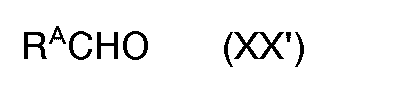
wherein RA is a straight- or branched carbon chain optionally having a substituent having a carbon number less 1 from that of the substituent at Rill [hereinafter referred to as Compound (XX')] is condensed with nitromethane in the presence of a base to give a compound of the formula (XXIII)
wherein RA is as defined above [hereinafter referred to as Compound (XXIII)]. The obtained compound is then subjected to reduction of the double bond with a suitable reducing agent to give a compound (XVIII-1 - Examples of the solvent to be used for the condensation include water, methanol, ethanol, tert-butyl alcohol, tetrahydrofuran, diethyl ether, ethylene glycol dimethyl ether, dimethylformamide, dimethyl sulfoxide, benzene, toluene, xylene, dioxane, methylene chloride, chloroform, dichloroethane and acetonitrile.
- Examples of the base to be used for the condensation include sodium hydroxide, sodium methoxide, sodium ethoxide, sodium hydride, potassium hydride, triethylamine, diisopropylethylamine and 1,8-diazabicyclo[5.4.0]undeca-7-ene.
- The condensation generally proceeds at a temperature of from -20 °C to 150 ° C and a temperature lower or higher than this temperature range may be selected on demand.
- The condensation is generally carried out for 30 minutes to 2 days and the reaction period longer or shorter than the indicated period may be used as necessary.
- After the condensation is carried out under the above-mentioned conditions or after removing the protecting group on demand, the Compound (XXIII) can be purified by a method known in the field of organic synthetic chemistry, such as solvent extraction, recrystallization, chromatography or a method using an ion exchange resin.
- Examples of the reducing agent to be used for the reduction of the double bond include metallic reducing reagent such as lithium borohydride or lithium aluminum hydride, and transition metal such as palladium-carbon, platinum oxide, Raney nickel, rhodium or ruthenium for catalytic reduction.
- Examples of the organic solvent to be used for the reduction of the double bond include methanol, ethanol, tert-butyl alcohol, tetrahydrofuran, diethyl ether, dioxane, acetone, ethyl acetate, acetic acid, benzene, toluene, xylene, dimethylformamide and dimethyl sulfoxide.
- The reduction of the double bond generally proceeds at a temperature of from -20 ° C to 80 ° C and a temperature lower or higher than this temperature range may be selected on demand.
- After the reduction is carried out under the above-mentioned conditions or after removing the protecting group on demand, the Compound (XVIII-1 ) can be purified by a method known in the field of organic synthetic chemistry, such as solvent extraction, recrystallization, chromatography or a method using an ion exchange resin.
- Compound (XXI-1), Compound (XXI-2) and Compound (XXI-3) can be also produced by the following method.
- A Compound (XX-1), (XX-2) or (XX-3) is condensed with nitromethane in the presence of a base and subjected to protection of hydroxyl as necessary to give a compound of the formula (XXIV)

wherein R1, Rr, Rs and Za are as defined above [hereinafter referred to as Compound (XXIV-1), Compound (XXIV-2) or Compound (XXIV-3)]. The obtained compound is condensed with formalin in the presence of a base and then subjected to protection of hydroxyl as necessary to give a Compound (XXI-1), (XXI-2) or (XXI-3). - Examples of the solvent to be used for the condensation include water, methanol, ethanol, tert-butyl alcohol, tetrahydrofuran, diethyl ether, ethylene glycol dimethyl ether, dimethylformamide, dimethyl sulfoxide, benzene, toluene, xylene, dioxane, methylene chloride, chloroform, dichloroethane and acetonitrile.
- Examples of the base to be used for the condensation include sodium hydroxide, sodium methoxide, sodium ethoxide, sodium hydride, potassium hydride, triethylamine, diisopropylethylamine and 1,8-diazabicyclo[5.4.0]undeca-7-ene.
- The condensation generally proceeds at a temperature of from -20 °C to 150°C and a temperature lower or higher than this temperature range may be selected on demand.
- The condensation is generally carried out for 30 minutes to 2 days and the reaction period longer or shorter than the indicated period may be used as necessary.
- After the condensation is carried out under the above-mentioned conditions or after removing the protecting group on demand, the Compound (XXIV-1), (XXIV-2) or (XXIV-3) can be purified by a method known in the field of organic synthetic chemistry, such as solvent extraction, recrystallization, chromatography or a method using an ion exchange resin.
- Examples of the solvent to be used for the condensation with formal in include water, methanol, ethanol, tert-butyl alcohol, tetrahydrofuran, diethyl ether, ethylene glycol dimethyl ether, dimethylformamide, dimethyl sulfoxide, benzene, toluene, xylene, dioxane, methylene chloride, chloroform, dichloroethane and acetonitrile.
- Examples of the base to be used for the condensation include sodium hydroxide, sodium methoxide, sodium ethoxide, sodium hydride, potassium hydride, triethylamine, diisopropylethylamine and 1,8-diazabicyclo[5.4.0]undeca-7-ene.
- The condensation generally proceeds at a temperature of from -20 ° C to 150 ° C and a temperature lower or higher than this temperature range may be selected on demand.
- The condensation is generally carried out for 30 minutes to 2 days and the reaction period longer or shorter than the indicated period may be used as necessary.
- After the condensation is carried out under the above-mentioned conditions or after removing the protecting group on demand, the Compound (XXI-1), (XXI-2) or (XXI-3) can be purified by a method known in the field of organic synthetic chemistry, such as solvent extraction, recrystallization, chromatography or a method using an ion exchange resin.
- Compound (XXI-1), Compound (XXI-2) and Compound (XXI-3) can be also produced by the following method.
- A compound (XXV)

wherein Z is as defined above [hereinafter referred to as Compound (XXV)] is condensed with a Compound (XX-1), (XX-2) or (XX-3) in the presence of a base and subjected to protection of hydroxyl as necessary, to give a compound of the formula (XXVI)
wherein R1, Rr, Rs, Z and Za are as defined above [hereinafter referred to as Compound (XXVI-1), Compound (XXVI-2) or Compound (XXVI-3)]. The obtained compound is condensed with formalin in the presence of a base and then subjected to protection of hydroxyl as necessary to give a Compound (XXI-1), (XXI-2) or (XXI-3). - Examples of the solvent to be used for the condensation include water, methanol, ethanol, tert-butyl alcohol, tetrahydrofuran, diethyl ether, ethylene glycol dimethyl ether, dimethylformamide, dimethyl sulfoxide, benzene, toluene, xylene, dioxane, methylene chloride, chloroform, dichloroethane and acetonitrile.
- Examples of the base to be used for the condensation include sodium hydroxide, sodium methoxide, sodium ethoxide, sodium hydride, potassium hydride, triethylamine, diisopropylethylamine and 1,8-diazabicyclo[5.4.0]undeca-7-ene.
- The condensation generally proceeds at a temperature of from -20 °C to 150°C and a temperature lower or higher than this temperature range may be selected on demand.
- The condensation is generally carried out for 30 minutes to 2 days and the reaction period longer or shorter than the indicated period may be used as necessary.
- After the condensation is carried out under the above-mentioned conditions or after removing the protecting group on demand, the Compound (XXVI-1), (XXVI-2) or (XXVI-3) can be purified by a method known in the field of organic synthetic chemistry, such as solvent extraction, recrystallization, chromatography or a method using an ion exchange resin.
- Examples of the solvent to be used for the condensation with formal in include water, methanol, ethanol, tert-butyl alcohol, tetrahydrofuran, diethyl ether, ethylene glycol dimethyl ether, dimethylformamide, dimethyl sulfoxide, benzene, toluene, xylene, dioxane, methylene chloride, chloroform, dichloroethane and acetonitrile.
- Examples of the base to be used for the condensation include sodium hydroxide, sodium methoxide, sodium ethoxide, sodium hydride, potassium hydride, triethylamine, diisopropylethylamine and 1,8-diazabicyclo[5.4.0]undeca-7-ene.
- The condensation generally proceeds at a temperature of from -20 °C to 150°C and a temperature lower or higher than this temperature range may be selected on demand.
- The condensation is generally carried out for 30 minutes to 2 days and the reaction period longer or shorter than the indicated period may be used as necessary.
- After the condensation is carried out under the above-mentioned conditions or after removing the protecting group on demand, the Compound (XXI-1), (XXI-2) or (XXI-3) can be purified by a method known in the field of organic synthetic chemistry, such as solvent extraction, recrystallization, chromatography or a method using an ion exchange resin.
- A compound of the formula (XXVII)

wherein W is azide, nitro or amino protected by a suitable protecting group and Y is as defined above [hereinafter referred to as Compound (XXVII)] is condensed, in the presence of a base, with a compound of the formula (XXVIII)
wherein R1, Rr, Rs and Hal are as defined above [hereinafter referred to as Compound (XXVIII-1), Compound (XXVIII-2) or Compound (XXVIII-3)] to give a compound of the formula (XXIX)
wherein R1, Rr, Rs, W and Y are as defined above [hereinafter referred to as Compound (XXIX-1), Compound (XXIX-2) or Compound (XXIX-3)]. The obtained compound is condensed with formalin in the presence of a base and subjected to protection of hydroxyl as necessary to give a compound of the formula (XXX)
wherein R1, Rr, Rs, W, Y and Z are as defined above [hereinafter referred to as Compound (XXX-1), Compound (XXX-2) or Compound (XXX-3)]. The obtained compound is subjected to reduction of carboxyl with a suitable reducing agent and protection of hydroxyl as necessary to give a compound of the formula (XXXI)
wherein R1, Rr, Rs, W, Z1 and Z2 are as defined above [hereinafter referred to as Compound (XXXI-1), Compound (XXXI-2) or Compound (XXXI-3)] and the obtained compound is subjected to reduction of carbonyl with a suitable reducing agent, and reduction and deprotection as necessary, to give a Compound (XXII-1), (1-22) or (1-23). - Examples of the solvent to be used for the condensation include water, methanol, ethanol, tert-butyl alcohol, tetrahydrofuran, diethyl ether, ethylene glycol dimethyl ether, dimethylformamide, dimethyl sulfoxide, benzene, toluene, xylene, dioxane, methylene chloride, chloroform, dichloroethane and acetonitrile.
- Examples of the base to be used for the condensation include sodium hydroxide, sodium methoxide, sodium ethoxide, sodium hydride, potassium hydride, triethylamine, diisopropylethylamine and 1,8-diazabicyclo[5.4.0]undeca-7-ene.
- The condensation generally proceeds at a temperature of from -20 °C to 150°C and a temperature lower or higher than this temperature range may be selected on demand.
- The condensation is generally carried out for 30 minutes to 2 days and the reaction period longer or shorter than the indicated period may be used as necessary.
- After the condensation is carried out under the above-mentioned conditions or after removing the protecting group on demand, the Compound (XXIX-1), (XXIX-2) or (XXIX-3) can be purified by a method known in the field of organic synthetic chemistry, such as solvent extraction, recrystallization, chromatography or a method using an ion exchange resin.
- Examples of the solvent to be used for the condensation with formal in include water, methanol, ethanol, tert-butyl alcohol, tetrahydrofuran, diethyl ether, ethylene glycol dimethyl ether, dimethylformamide, dimethyl sulfoxide, benzene, toluene, xylene, dioxane, methylene chloride, chloroform, dichloroethane and acetonitrile.
- Examples of the base to be used for the condensation include sodium hydroxide, sodium methoxide, sodium ethoxide, sodium hydride, potassium hydride, triethylamine, diisopropylethylamine and 1,8-diazabicyclo[5.4.0]undeca-7-ene.
- The condensation generally proceeds at a temperature of from -20 °C to 150°C and a temperature lower or higher than this temperature range may be selected on demand.
- The condensation is generally carried out for 30 minutes to 2 days and the reaction period longer or shorter than the indicated period may be used as necessary.
- After the condensation is carried out under the above-mentioned conditions or after removing the protecting group on demand, the Compound (XXX-1), (XXX-2) or (XXX-3) can be purified by a method known in the field of organic synthetic chemistry, such as solvent extraction, recrystallization, chromatography or a method using an ion exchange resin.
- Examples of the reducing agent to be used for the reduction of carboxyl include metallic reducing reagent such as sodium borohydride, lithium borohydride or lithium aluminum hydride, and diborane.
- Examples of the organic solvent to be used for the reduction of carboxyl include methanol, ethanol, tert-butyl alcohol, tetrahydrofuran, diethyl ether and ethylene glycol dimethyl ether.
- The reduction of carboxyl generally proceeds at a temperature of from -20 °C to 80°C and a temperature lower or higher than this temperature range may be selected on demand.
- The reduction of carboxyl is generally carried out for 30 minutes to 10 hours and the reaction period longer or shorter than the indicated period may be used as necessary.
- After the reduction is carried out under the above-mentioned conditions or after removing the protecting group on demand, the Compound (XXXI-1), (XXXI-2) or (XXXI-3) can be purified by a method known in the field of organic synthetic chemistry, such as solvent extraction, recrystallization, chromatography or a method using an ion exchange resin.
- Examples of the reducing agent to be used for the reduction of carbonyl include metallic reducing reagent such as sodium borohydride, lithium borohydride or lithium aluminum hydride, and diborane.
- Examples of the organic solvent to be used for the reduction of carbonyl include methanol, ethanol, tert-butyl alcohol, tetrahydrofuran, diethyl ether and ethylene glycol dimethyl ether.
- The reduction of carbonyl generally proceeds at a temperature of from -20°C to 80°C and a temperature lower or higher than this temperature range may be selected on demand.
- The reduction of carbonyl is generally carried out for 30 minutes to 10 hours and the reaction period longer or shorter than the indicated period may be used as necessary.
- When (i) W=azide, examples of the reducing agent to be used for the reduction of azide include metallic reducing agent such as sodium borohydride, lithium borohydride or lithium aluminum hydride, and transition metal such as palladium-carbon, platinum oxide, Raney nickel, rhodium or ruthenium for catalytic reduction.
- Examples of the organic solvent to be used for the reduction of azide include methanol, ethanol, tert-butyl alcohol, tetrahydrofuran, diethyl ether, dioxane, acetone, ethyl acetate, acetic acid, benzene, toluene, xylene, dimethylformamide and dimethyl sulfoxide.
- The reduction of azide generally proceeds at a temperature of from -20 ° C to 80 ° C and a temperature lower or higher than this temperature range may be selected on demand.
- When (ii) W = nitro, examples of the reducing agent to be used for the reduction of nitro include metallic reducing reagent such as sodium borohydride, lithium borohydride or lithium aluminum hydride, transition metal such as palladium-carbon, platinum oxide, Raney nickel, rhodium or ruthenium for catalytic reduction, and metal such as iron, zinc or tin.
- Examples of the solvent to be used for the reduction of nitro include water, methanol, ethanol, tert-butyl alcohol, tetrahydrofuran, diethyl ether, dioxane, acetone, ethyl acetate, acetic acid, benzene, toluene, xylene, dimethylformamide and dimethyl sulfoxide.
- The reduction of nitro generally proceeds at a temperature of from -20 ° C to 80 °C and a temperature lower or higher than this temperature range may be selected on demand.
- After the reduction is carried out under the above-mentioned conditions or after removing the protecting group on demand, the Compound (XXII-1), (1-22) or (I-23) can be purified by a method known in the field of organic synthetic chemistry, such as solvent extraction, recrystallization, chromatography or a method using an ion exchange resin.
- Accordingly, the instant method is applicable to the synthesis of the compounds of the formulas (1-21) through (1-23).
- Compound (XXX-1), Compound (XXX-2) and Compound (XXX-3) can be also produced by the following method.
- A compound (XXVIII) and a compound of the formula (XXXII)

wherein W, Y and Z are as defined above [hereinafter referred to as Compound (XXXII)] are condensed in the presence of a base to give a Compound (XXX-1), (XXX-2) or (XXX-3). - Examples of the solvent to be used for the condensation include water, methanol, ethanol, tert-butyl alcohol, tetrahydrofuran, diethyl ether, ethylene glycol dimethyl ether, dimethylformamide, dimethyl sulfoxide, benzene, toluene, xylene, dioxane, methylene chloride, chloroform, dichloroethane and acetonitrile.
- Examples of the base to be used for the condensation include sodium hydroxide, sodium methoxide, sodium ethoxide, sodium hydride, potassium hydride, triethylamine, diisopropylethylamine and 1,8-diazabicyclo[5.4.0]undeca-7-ene.
- The condensation generally proceeds at a temperature of from -20 °C to 150°C and a temperature lower or higher than this temperature range may be selected on demand.
- The condensation is generally carried out for 30 minutes to 2 days and the reaction period longer or shorter than the indicated period may be used as necessary.
- After the condensation is carried out under the above-mentioned conditions or after removing the protecting group on demand, the Compound (XXX-1), (XXX-2) or (XXX-3) can be purified by a method known in the field of organic synthetic chemistry, such as solvent extraction, recrystallization, chromatography or a method using an ion exchange resin.
- When W = nitro, Compound (XXXI-1), (XXXI-2) and (XXXI-3) can be also produced by the following method.
- A compound (XXVIII-1 ), (XXVIII-2) or (XXVIII-3) and a compound (XXXIII)
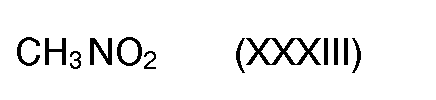
[hereinafter referred to as Compound (XXXIII)] are condensed in the presence of a base to give a compound of the formula (XXXIV)
wherein R1, Rr and Rs are as defined above [hereinafter referred to as Compound (XXXIV-1), Compound (XXXIV-2) or Compound (XXXIV-3)] and the obtained compound is condensed with formal in in the presence of a base and subjected to protection of hydroxyl as necessary to give a Compound (XXXI-1), (XXXI-2) or (XXXI-3). - Examples of the solvent to be used for the condensation include water, methanol, ethanol, tert-butyl alcohol, tetrahydrofuran, diethyl ether, ethylene glycol dimethyl ether, dimethylformamide, dimethyl sulfoxide, benzene, toluene, xylene, dioxane, methylene chloride, chloroform, dichloroethane and acetonitrile.
- Examples of the base to be used for the condensation include sodium hydroxide, sodium methoxide, sodium ethoxide, sodium hydride, potassium hydride, triethylamine, diisopropylethylamine and 1,8-diazabicyclo[5.4.0]undeca-7-ene.
- The condensation generally proceeds at a temperature of from -20 °C to 150°C and a temperature lower or higher than this temperature range may be selected on demand.
- The condensation is generally carried out for 30 minutes to 2 days and the reaction period longer or shorter than the indicated period may be used as necessary.
- After the condensation is carried out under the above-mentioned conditions or after removing the protecting group on demand, the Compound (XXXIV-1), (XXXIV-2) or (XXXIV-3) can be purified by a method known in the field of organic synthetic chemistry, such as solvent extraction, recrystallization, chromatography or a method using an ion exchange resin.
- Examples of the solvent to be used for the condensation with formalin include water, methanol, ethanol, tert-butyl alcohol, tetrahydrofuran, diethyl ether, ethylene glycol dimethyl ether, dimethylformamide, dimethyl sulfoxide, benzene, toluene, xylene, dioxane, methylene chloride, chloroform, dichloroethane and acetonitrile.
- Examples of the base to be used for the condensation include sodium hydroxide, sodium methoxide, sodium ethoxide, sodium hydride, potassium hydride, triethylamine, diisopropylethylamine and 1,8-diazabicyclo[5.4.0]undeca-7-ene.
- The condensation generally proceeds at a temperature of from -20 °C to 150°C and a temperature lower or higher than this temperature range may be selected on demand.
- The condensation is generally carried out for 30 minutes to 2 days and the reaction period longer or shorter than the indicated period may be used as necessary.
- After the condensation is carried out under the above-mentioned conditions or after removing the protecting group on demand, the Compound (XXXI-1), (XXXI-2) or (XXXI-3) can be purified by a method known in the field of organic synthetic chemistry, such as solvent extraction, recrystallization, chromatography or a method using an ion exchange resin.
- Compound (XXXIV-1), Compound (XXXIV-2) and Compound (XXXIV-3) can be also produced by the following method.
- A Compound (XVII) and a compound of the formula (XXXV)

wherein R1, Rr, Rs and G are as defined above [hereinafter referred to as Compound (XXXV-1), Compound (XXXV-2) or Compound (XXXV-3)] are condensed in the presence of a base to give a Compound (XXXIV-1), (XXXIV-2) or (XXXIV-3). - Examples of the solvent to be used for the condensation include water, methanol, ethanol, tert-butyl alcohol, tetrahydrofuran, diethyl ether, ethylene glycol dimethyl ether, dimethylformamide, dimethyl sulfoxide, benzene, toluene, xylene, dioxane, methylene chloride, chloroform, dichloroethane and acetonitrile.
- Examples of the base to be used for the condensation include sodium hydroxide, sodium methoxide, sodium ethoxide, sodium hydride, potassium hydride, triethylamine, diisopropylethylamine and 1,8-diazabicyclo[5.4.0]undeca-7-ene.
- The condensation generally proceeds at a temperature of from -20°C to 150°C and a temperature lower or higher than this temperature range may be selected on demand.
- The condensation is generally carried out for 30 minutes to 2 days and the reaction period longer or shorter than the indicated period may be used as necessary.
- After the condensation is carried out under the above-mentioned conditions or after removing the protecting group on demand, the Compound (XXXIV-1), (XXXIV-2) or (XXXIV-3) can be purified by a method known in the field of organic synthetic chemistry, such as solvent extraction, recrystallization, chromatography or a method using an ion exchange resin.
- When W = nitro, Compound (XXXI-1), Compound (XXXI-2) and Compound (XXXI-3) can be also produced by the following method.
- A Compound (XXV) and a Compound (XXVIII-1 ), (XXVIII-2) or (XXVIII-3) are condensed in the presence of a base to give a compound of the formula (XXXVI)
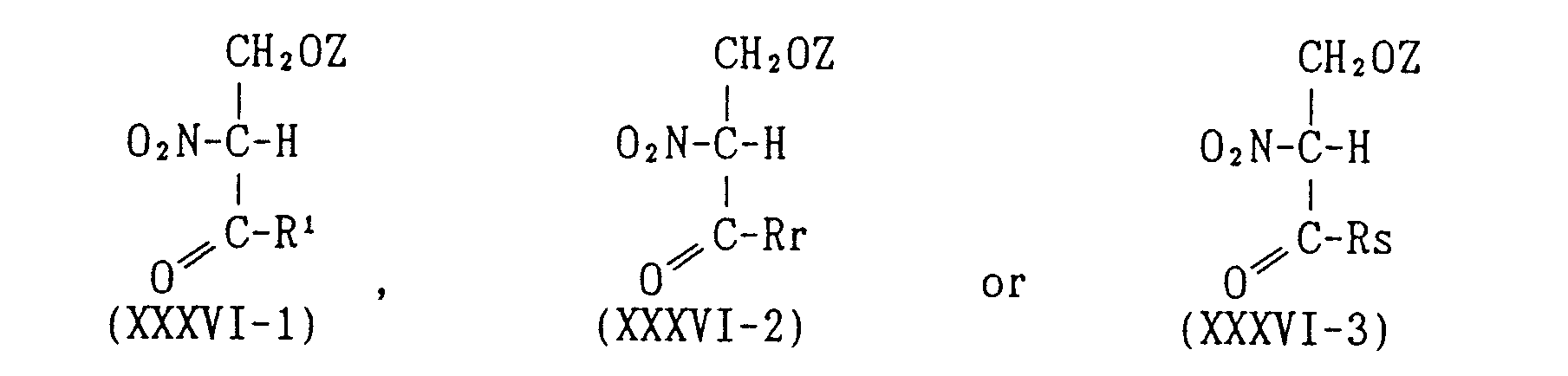
wherein R1, Rr, Rs and Z are as defined above [hereinafter referred to as Compound (XXXVI-1), Compound (XXXVI-2) or Compound (XXXVI-3)]. The obtained compound is condensed with formal in in the presence of a base and subjected to protection of hydroxyl as necessary to give a Compound (XXXI-1), (XXXI-2) or (XXXI-3). - Examples of the solvent to be used for the condensation include water, methanol, ethanol, tert-butyl alcohol, tetrahydrofuran, diethyl ether, ethylene glycol dimethyl ether, dimethylformamide, dimethyl sulfoxide, benzene, toluene, xylene, dioxane, methylene chloride, chloroform, dichloroethane and acetonitrile.
- Examples of the base to be used for the condensation include sodium hydroxide, sodium methoxide, sodium ethoxide, sodium hydride, potassium hydride, triethylamine, diisopropylethylamine and 1,8-diazabicyclo[5.4.0]undeca-7-ene.
- The condensation generally proceeds at a temperature of from -20 °C to 150°C and a temperature lower or higher than this temperature range may be selected on demand.
- The condensation is generally carried out for 30 minutes to 2 days and the reaction period longer or shorter than the indicated period may be used as necessary.
- After the condensation is carried out under the above-mentioned conditions or after removing the protecting group on demand, the Compound (XXXVI-1), (XXXVI-2) or (XXXVI-3) can be purified by a method known in the field of organic synthetic chemistry, such as solvent extraction, recrystallization, chromatography or a method using an ion exchange resin.
- Examples of the solvent to be used for the condensation with formal in include water, methanol, ethanol, tert-butyl alcohol, tetrahydrofuran, diethyl ether, ethylene glycol dimethyl ether, dimethylformamide, dimethyl sulfoxide, benzene, toluene, xylene, dioxane, methylene chloride, chloroform, dichloroethane and acetonitrile.
- Examples of the base to be used for the condensation include sodium hydroxide, sodium methoxide, sodium ethoxide, sodium hydride, potassium hydride, triethylamine, diisopropylethylamine and 1,8-diazabicyclo[5.4.0]undeca-7-ene.
- The condensation generally proceeds at a temperature of from -20 °C to 150°C and a temperature lower or higher than this temperature range may be selected on demand.
- The condensation is generally carried out for 30 minutes to 2 days and the reaction period longer or shorter than the indicated period may be used as necessary.
- After the condensation is carried out under the above-mentioned conditions or after removing the protecting group on demand, the Compound (XXXI-1), (XXXI-2) or (XXXI-3) can be purified by a method known in the field of organic synthetic chemistry, such as solvent extraction, recrystallization, chromatography or a method using an ion exchange resin.
- Compound (X) can be also produced by the following method.
- A Compound (II) and a Compound (XXVII) (W = nitro) are condensed in the presence of a base to give a compound of the formula (XXXVII)
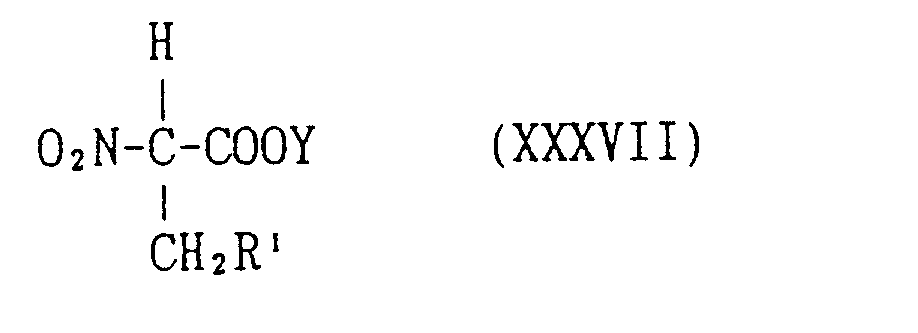
wherein R' and Y are as defined above [hereinafter referred to as Compound (XXXVII)]. The obtained compound is condensed with formal in in the presence of a base and subjected to protection of hydroxyl as necessary to give a compound of the formula (XXXVIII)
- Examples of the solvent to be used for the condensation include water, methanol, ethanol, tert-butyl alcohol, tetrahydrofuran, diethyl ether, ethylene glycol dimethyl ether, dimethylformamide, dimethyl sulfoxide, benzene, toluene, xylene, dioxane, methylene chloride, chloroform, dichloroethane and acetonitrile.
- Examples of the base to be used for the condensation include sodium hydroxide, sodium methoxide, sodium ethoxide, sodium hydride, potassium hydride, triethylamine, diisopropylethylamine and 1,8-diazabicyclo[5.4.0]undeca-7-ene.
- The condensation generally proceeds at a temperature of from -20 °C to 150 ° C and a temperature lower or higher than this temperature range may be selected on demand.
- The condensation is generally carried out for 30 minutes to 2 days and the reaction period longer or shorter than the indicated period may be used as necessary.
- After the condensation is carried out under the above-mentioned conditions or after removing the protecting group on demand, the Compound (XXXVII) can be purified by a method known in the field of organic synthetic chemistry, such as solvent extraction, recrystallization, chromatography or a method using an ion exchange resin.
- Examples of the solvent to be used for the condensation with formal in include water, methanol, ethanol, tert-butyl alcohol, tetrahydrofuran, diethyl ether, ethylene glycol dimethyl ether, dimethylformamide, dimethyl sulfoxide, benzene, toluene, xylene, dioxane, methylene chloride, chloroform, dichloroethane and acetonitrile.
- Examples of the base to be used for the condensation include sodium hydroxide, sodium methoxide, sodium ethoxide, sodium hydride, potassium hydride, triethylamine, diisopropylethylamine and 1,8-diazabicyclo[5.4.0]undeca-7-ene.
- The condensation generally proceeds at a temperature of from -20 °C to 150 ° C and a temperature lower or higher than this temperature range may be selected on demand.
- The condensation is generally carried out for 30 minutes to 2 days and the reaction period longer or shorter than the indicated period may be used as necessary.
- After the condensation is carried out under the above-mentioned conditions or after removing the protecting group on demand, the Compound (XXXVIII) can be purified by a method known in the field of organic synthetic chemistry, such as solvent extraction, recrystallization, chromatography or a method using an ion exchange resin.
- Examples of the reducing agent to be used for the reduction of carboxyl include metallic reducing reagent such as sodium borohydride, lithium borohydride or lithium aluminum hydride, and diborane.
- Examples of the organic solvent to be used for the reduction of carboxyl include methanol, ethanol, tert-butyl alcohol, tetrahydrofuran, diethyl ether and ethylene glycol dimethyl ether.
- The reduction of carboxyl generally proceeds at a temperature of from -20 °C to 80 °C and a temperature lower or higher than this temperature range may be selected on demand.
- The reduction of carboxyl is generally carried out for 30 minutes to 10 hours and the reaction period longer or shorter than the indicated period may be used as necessary.
- After the reduction is carried out under the above-mentioned conditions or after removing the protecting group on demand, the Compound (X) can be purified by a method known in the field of organic synthetic chemistry, such as solvent extraction, recrystallization, chromatography or a method using an ion exchange resin.
- A compound of the formula (XXXIX)

wherein Q1, Q2, Z1, Z2, G and a are as defined above [hereinafter referred to as Compound (XXXIX-1) or Compound (XXXIX-2)] and a compound of the formula (XXXX)
wherein Rv, Rw, X and are as defined above [hereinafter referred to as Compound (XXXX-1) or Compound (XXXX-2)] are condensed in the presence of a base to give a compound of the formula (XXXXI)
wherein Rv, Rw, X, Q1, Q2, Z1, Z2, a and are as defined above [hereinafter referred to as Compound (XXXXI-1) or Compound (XXXXI-2)] and the obtained compound is subjected to deprotection as necessary to give a compound (I-26) or (1-27). - Examples of the base to be used for the condensation include sodium hydroxide, sodium methoxide, sodium ethoxide, sodium hydride, potassium hydride, lithium diisopropylamide, butyl lithium, lithium hexamethyldisilazane, triethylamine, diisopropylethylamine and 1,8-diazabicyclo[5.4.0]undeca-7-ene.
- Examples of the solvent to be used for the condensation include water, methanol, ethanol, tert-butyl alcohol, tetrahydrofuran, diethyl ether, ethylene glycol dimethyl ether, dimethylformamide, dimethyl sulfoxide, benzene, toluene, xylene, dioxane, methylene chloride, chloroform, dichloroethane and acetonitrile.
- The condensation generally proceeds at a temperature of from -20°C to 150°C and a temperature lower or higher than this temperature range may be selected on demand.
- The condensation is generally carried out for 30 minutes to 2 days and the reaction period longer or shorter than the indicated period may be used as necessary.
- After the condensation is carried out under the above-mentioned conditions or after removing the protecting group on demand, the Compound (XXXXI-1) or (XXXXI-2) can be purified by a method known in the field of organic synthetic chemistry, such as solvent extraction, recrystallization, chromatography or a method using an ion exchange resin.
- In the instant method, a compound wherein X is sulfinyl or sulfonyl can be obtained by oxidation of a compound wherein X is sulfur.
- Accordingly, the instant method can be used for the synthesis of the compounds of the formulas (I-26) and (1-27). It is also applicable to the synthesis of the compounds (1-1), (1-2), (1-4), (I-5) and (I-7) through (I-11 ).
- Compound (XXXXI-1) and Compound (XXXXI-2) can be also produced by the following method. A compound of the formula (XXXXII)

wherein Q1, Q2, Z1, Z2, X and a are as defined above [hereinafter referred to as Compound (XXXXII-1) or Compound (XXXXII-2)] and a compound of the formula (XXXXIII)
wherein Rv, Rw, G and are as defined above [hereinafter referred to as Compound (XXXXIII-1) or Compound (XXXXIII-2)] are condensed in the presence of a base and the obtained compound is subjected to deprotection on demand to give a Compound (XXXXI-1) or (XXXXI-2). - Examples of the base to be used for the condensation include sodium hydroxide, sodium methoxide, sodium ethoxide, sodium hydride, potassium hydride, lithium diisopropylamide, butyl lithium, lithium hexamethyldisilazane, triethylamine, diisopropylethylamine and 1,8-diazabicyclo[5.4.0]undeca-7-ene.
- Examples of the solvent to be used for the condensation include water, methanol, ethanol, tert-butyl alcohol, tetrahydrofuran, diethyl ether, ethylene glycol dimethyl ether, dimethylformamide, dimethyl sulfoxide, benzene, toluene, xylene, dioxane, methylene chloride, chloroform, dichloroethane and acetonitrile.
- The condensation generally proceeds at a temperature of from -20 °C to 150°C and a temperature lower or higher than this temperature range may be selected on demand.
- The condensation is generally carried out for 30 minutes to 2 days and the reaction period longer or shorter than the indicated period may be used as necessary.
- After the condensation is carried out under the above-mentioned conditions or after removing the protecting group on demand, the Compound (XXXXI-1) or (XXXXI-2) can be purified by a method known in the field of organic synthetic chemistry, such as solvent extraction, recrystallization, chromatography or a method using an ion exchange resin.
- Compound (XXXXI-1) and Compound (XXXXI-2) can be also produced by the following method. A compound of the formula (XXXXIV)

wherein Rv, Rw, G, X, a and are as defined above [hereinafter referred to as Compound (XXXXIV-1) or Compound (XXXXIV-2)] and a Compound (III) are condensed in the presence of a base to give a compound of the formula (XXXXV)
wherein Rv, Rw, X, Q, Y, a and are as defined above [hereinafter referred to as Compound (XXXXV-1) or Compound (XXXXV-2)]. The obtained compound is subjected to reduction with a suitable reducing agent and protection of hydroxyl and amino as necessary to give a compound (XXXXI-1) or (XXXXI-2). - Examples of the base to be used for the condensation include sodium hydroxide, sodium methoxide, sodium ethoxide, sodium hydride, potassium hydride, lithium diisopropylamide, butyl lithium, lithium hexamethyldisilazane, triethylamine, diisopropylethylamine and 1,8-diazabicyclo[5.4.0]undeca-7-ene.
- Examples of the solvent to be used for the condensation include water, methanol, ethanol, tert-butyl alcohol, tetrahydrofuran, diethyl ether, ethylene glycol dimethyl ether, dimethylformamide, dimethyl sulfoxide, benzene, toluene, xylene, dioxane, methylene chloride, chloroform, dichloroethane and acetonitrile.
- The condensation generally proceeds at a temperature of from -20 °C to 150°C and a temperature lower or higher than this temperature range may be selected on demand.
- The condensation is generally carried out for 30 minutes to 2 days and the reaction period longer or shorter than the indicated period may be used as necessary.
- After the condensation is carried out under the above-mentioned conditions or after removing the protecting group on demand, the Compound (XXXXV-1) or (XXXXV-2) can be purified by a method known in the field of organic synthetic chemistry, such as solvent extraction, recrystallization, chromatography or a method using an ion exchange resin.
- Examples of the reducing agent to be used for the reduction of carboxyl include metallic reducing reagent such as sodium borohydride, lithium borohydride or lithium aluminum hydride, and diborane.
- Examples of the organic solvent to be used for the reduction of carboxyl include methanol, ethanol, tert-butyl alcohol, tetrahydrofuran, diethyl ether and ethylene glycol dimethyl ether.
- The reduction of carboxyl generally proceeds at a temperature of from -20°C to 80°C and a temperature lower or higher than this temperature range may be selected on demand.
- The reduction of carboxyl is generally carried out for 30 minutes to 10 hours and the reaction period longer or shorter than the indicated period may be used as necessary.
- After the reduction is carried out under the above-mentioned conditions or after removing the protecting group on demand, the Compound (XXXXI-1) or (XXXXI-2) can be purified by a method known in the field of organic synthetic chemistry, such as solvent extraction, recrystallization,chromatography or a method using an ion exchange resin.
- A Compound (XIV) is added with a compound of the formula (XXXXVI)

wherein R1, Rr, Rs, M and n are as defined above [hereinafter referred to as Compound (XXXXVI-1), Compound (XXXXVI-2) or Compound (XXXXVI-3)] and the mixture is subjected to protection of hydroxyl as necessary to give a compound of the formula (XXXXVII)
wherein R1, Rr, Rs, Q1, Q2, Z1, Z2 and Za are as defined above [hereinafter referred to as Compound (XXXXVII-1), Compound (XXXXVIl-2) or Compound (XXXXVIl-3)]. The obtained compound is subjected to deprotection on demand to give a Compound (XXII-1), (1-22) or (1-23). - Examples of the solvent to be used for the addition include tetrahydrofuran, diethyl ether, ethylene glycol dimethyl ether, dimethylformamide, dimethyl sulfoxide, benzene, toluene, xylene, dioxane, methylene chloride, chloroform, dichloroethane and acetonitrile.
- The addition generally proceeds at a temperature of from -100°C to 80°C and a temperature lower or higher than this temperature range may be selected on demand.
- The addition is generally carried out for 30 minutes to 2 days and the reaction period longer or shorter than the indicated period may be used as necessary.
- After the addition is carried out under the above-mentioned conditions or after removing the protecting group on demand, the Compound (XXXXVII-1), (XXXXVIl-2) or (XXXXVIl-3) can be purified by a method known in the field of organic synthetic chemistry, such as solvent extraction, recrystallization, chromatography or a method using an ion exchange resin.
- Accordingly, the instant method can be used for the synthesis of the compounds of the formulas (1-21) through (1-23).
- A compound of the formula (XXXXVIII)

wherein Y is as defined above [hereinafter referred to as Compound (XXXXVIII)] and a Compound (II) are condensed in the presence of a base to give a compound of the formula (XXXXIX)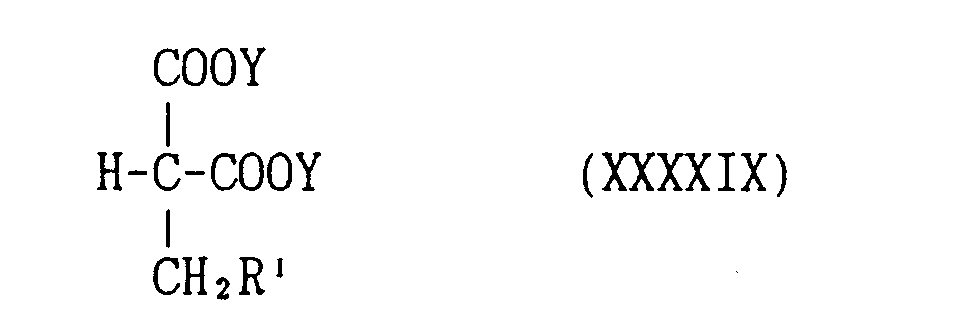
wherein R' and Y are as defined above [hereinafter referred to as Compound (XXXXIX)] and the obtained compound is reacted with an amination agent of the formula (XXXXX)
wherein Le means a leaving group such as 2,4-dinitrophenoxy, in the presence of a base to give a compound of the formula (XXXXXI)
wherein R' and Y are as defined above [hereinafter referred to as Compound (XXXXXI)]. The obtained compound is subjected to reduction of carboxyl with a suitable reducing agent and deprotection as necessary to give a Compound (1-29). - Examples of the base to be used for the condensation include sodium hydroxide, sodium methoxide, sodium ethoxide, sodium hydride, potassium hydride, lithium diisopropylamide, butyl lithium, lithium hexamethyldisilazane, triethylamine, diisopropylethylamine and 1,8-diazabicyclo[5.4.0]undeca-7-ene.
- Examples of the solvent to be used for the condensation include water, methanol, ethanol, tert-butyl alcohol, tetrahydrofuran, diethyl ether, ethylene glycol dimethyl ether, dimethylformamide, dimethyl sulfoxide, benzene, toluene, xylene, dioxane, methylene chloride, chloroform, dichloroethane and acetonitrile.
- The condensation generally proceeds at a temperature of from -20°C to 150°C and a temperature lower or higher than this temperature range may be selected on demand.
- The condensation is generally carried out for 30 minutes to 2 days and the reaction period longer or shorter than the indicated period may be used as necessary.
- After the condensation is carried out under the above-mentioned conditions or after removing the protecting group on demand, the Compound (XXXXIX) can be purified by a method known in the field of organic synthetic chemistry, such as solvent extraction, recrystallization, chromatography or a method using an ion exchange resin.
- Examples of the base to be used for the amination include sodium hydroxide, sodium methoxide, sodium ethoxide, sodium hydride, potassium hydride, lithium diisopropylamide, butyl lithium, lithium hexamethyldisilazane, triethylamine, diisopropylethylamine and 1,8-diazabicyclo[5.4.0]undeca-7-ene.
- Examples of the solvent to be used for the amination include water, methanol, ethanol, tert-butyl alcohol, tetrahydrofuran, diethyl ether, ethylene glycol dimethyl ether, dimethylformamide, dimethyl sulfoxide, benzene, toluene, xylene, dioxane, methylene chloride, chloroform, dichloroethane and acetonitrile.
- The amination generally proceeds at a temperature of from -20°C to 150°C and a temperature lower or higher than this temperature range may be selected on demand.
- The amination is generally carried out for 30 minutes to 2 days and the reaction period longer or shorter than the indicated period may be used as necessary.
- After the amination is carried out under the above-mentioned conditions or after removing the protecting group on demand, the Compound (XXXXXI) can be purified by a method known in the field of organic synthetic chemistry, such as solvent extraction, recrystallization, chromatography or a method using an ion exchange resin.
- Examples of the reducing agent to be used for the reduction of carboxyl include metallic reducing reagent such as sodium borohydride, lithium borohydride or lithium aluminum hydride, and diborane.
- Examples of the organic solvent to be used for the reduction of carboxyl include methanol, ethanol, tert-butyl alcohol, tetrahydrofuran, diethyl ether and ethylene glycol dimethyl ether.
- The reduction of carboxyl generally proceeds at a temperature of from -20°C to 80 °C and a temperature lower or higher than this temperature range may be selected on demand.
- The reduction of carboxyl is generally carried out for 30 minutes to 10 hours and the reaction period longer or shorter than the indicated period may be used as necessary.
- After the reduction is carried out under the above-mentioned conditions or after removing the protecting group on demand, the Compound (I-29) can be purified by a method known in the field of organic synthetic chemistry, such as solvent extraction, recrystallization, chromatography or a method using an ion exchange resin.
- The instant method can be used for the synthesis of the compounds of the formulas (1-1) through (1-18), preferably for the synthesis of the compounds of the formulas (1-12) and (1-13).
- Of the compounds of the formula (I) of the present invention, a compound wherein R is -CH(OH)Rr when it is a compound of the formula
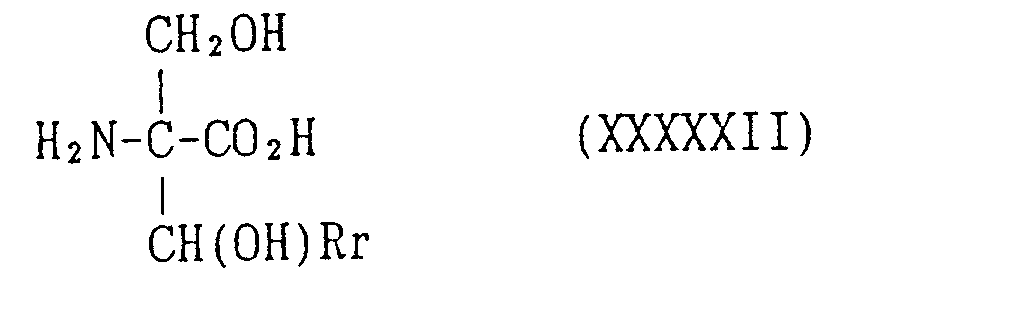
wherein Rr is as defined above [hereinafter referred to as Compound (XXXXXII)] or a derivative at carboxyl group thereof or a compound (XXXXXII) wherein the a-position of alkyl at Rr, which may have a double bond or carbonyl in the chain, is substituted by hydroxyl, can be produced by reduction, hydrogenation, ozonolysis or oxidation known per se, which may be used solely or in combination, of a corresponding lactone compound or a compound wherein amino or hydroxy of a Compound (XXXXXII) or lactone compound is protected by a protecting group. - Examples of the derivative at the carboxyl group of the Compound (XXXXXII) include ester (e.g. methyl ester, ethyl ester, benzyl ester, p-nitrobenzyl ester, trimethylsilyl ester, tert-butyldimethylsilyl ester), acid halide (e.g. acid chloride), acid anhydride and mixed acid anhydride.
- A Compound (I) wherein Rr is an a-position hydroxyl-substituted alkyl is preferably produced by using the aforementioned lactone compound as a starting material.
- Reduction proceeds in a solvent inert to the reaction and in the presence of a metal hydride complex at a temperature from under cooling to under refluxing. Examples of the metal hydride complex include aluminum hydride, lithium aluminum hydride, lithium aluminum hydride-aluminum chloride, lithium trimethoxy aluminum hydride, sodium bis(2-methoxyethoxy)-aluminum hydride, diisobutyl aluminum hydride, sodium borohydride, sodium hydride, lithium borohydride and borohydride, and examples of the solvent include alcohol solvents such as methanol, ethanol, isopropanol and diethylene glycol, hydrocarbon solvents such as benzene, toluene and xylene, halohydrocarbon solvents such as methylene chloride, dichloroethane and chloroform, ether solvents such as diethyl ether, dipropyl ether, tetrahydrofuran and dioxane, dimethylformamide, and dimethyl sulfoxide, which may be used solely or in combination.
- The reduction may be catalytic reduction using zinc-hydrochloric acid saturated acetic anhydride, copper-chromite catalyst, palladium-carbon, Raney nickel or rhenium oxide, or electroreduction. These reactions proceed in a manner similar to the reaction known per se.
- The hydrogenation generally proceeds according to a method known per se using a conventional catalyst such as a palladium, nickel or platinum catalyst. In the reaction, a solvent inert to the reaction may be used and examples thereof are as mentioned above.
- In the present invention, the compound obtained by the above-mentioned reactions can be used as a starting material.
- Of the Compounds (XXXXXII), a compound wherein Rr is an a-position hydroxyl-substituted alkyl which may have a double bond or carbonyl in the chain and lactone compound thereof are known compounds reported in Japanese Patent Unexamined Publication Nos. 104087/1989 and 128347/1991 mentioned above and are produced according to the method described therein. Of the Compounds (XXXXXII), a compound wherein Rr is an alkyl which may have a double bond or carbonyl in the chain, such as heptadecyl, is produced, for example, by fermentation or by using a compound (XXXXXIII) produced by the fermentation and having the formula
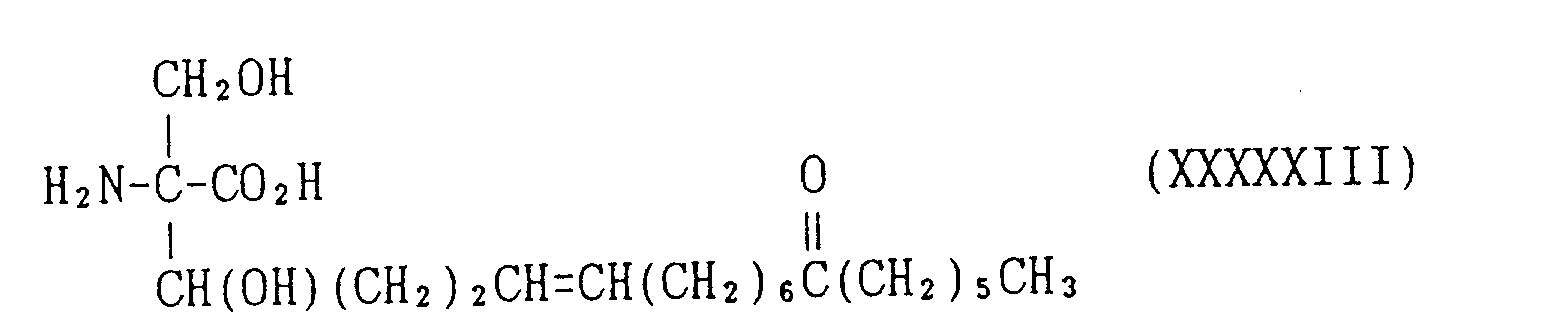
as a starting meterial. Examples of the microorganism capable of producing the compound (XXXXXIII) include those belonging to Ascomycetes or Fungi Imperfecti, particularly the genera Isaria and Mycelia belonging to the Fungi Imperfecti and the genus Myriococcum (the genus Thielavia) belonging to Ascomycetes, which are respectively deposited at American Type Culture Collection as Isaria sinclairii ATCC No. 24400, Myriococcum albomyces ATCC No. 16425 and Mycelia sterilia ATCC No. 20349. Also, Myriococcum albomyces ATCC No. 16425 has been deposited at the Institute of Fermentation, Osaka as IF032292. - Compound (XXXXXIII) can be produced, for example, by a mutant strain obtained by mutating the above-mentioned strain by a conventional artificial mutating method using ultraviolet rays, high frequency radiation, drug or the like.
- The Compound (XXXXXIII)-producing cell may be cultured in various culture media containing conventional nutrition sources for mold. For example, a medium may contain glucose, starch, glycerin, sugar syrup, dextrin, molasses, maltose, xylose or the like as a carbon source and an inorganic or organic nitrogen compound such as corn steep liquor, peptone, yeast extract, potato brew, meat broth, soybean powder, wheat germ, potassium nitrate, sodium nitrate, ammonium sulfate, casein, gluten meal, cottonseed powder or feather powder as a nitrogen source. Besides these, there may be contained additives conventionally used for culture such as conventional inorganic salt, organic or inorganic substance which promotes the growth of cell and enhances production of the Compound (XXXXXIII), and antifoaming agent.
- While the culture method is subject to no particular limitation, aerobic submerged culture is desirable. The temperature appropriate for the culture is 20-35°C, preferably 25-30°C for the microorganisms belonging to the genus Isaria and 30-50 ° C, preferably 35-45 ° C for the microorganisms belonging to the genus Myriococcum or Mycelia.
- The Compound (XXXXXIII) produced in the culture medium is isolated therefrom by conventional steps such as extraction and adsorption which may be used in combination as necessary. For example, in the case of a microorganism belonging to the genus Isaria such as Isaria sinclairii, the Compound (XXXXXIII) is taken out from the culture by filtering off the insoluble matters such as cells from the culture, isolation by centrifugation, passing the culture filtrate through Amberlite XAD-2 (trade mark) and adsorbing Compound (XXXXXIII). The Compound (XXXXXIII) thus obtained is eluted with, for example, methanol and the eluate is fractionated by reversed phase chromatography, whereby a highly purified product of Compound (XXXXXIII) can be obtained. In the case of a microorganism belonging to the genus Myriococcum or the genus Mycelia, such as Myriococcum albomyces, Mycelia sterilia or the like, cells are separated from the culture by filtration, centrifugation and the like and the culture filtrate is treated in the same manner as in the case of the microorganisms belonging to the genus Isaria. The Compound (XXXXXIII) is extracted from the separated cells by the use of methanol and the extract is treated with Amberlite XAD-2 in the same manner as with the filtrate above and purified by chromatography and recrystallization.
- The 2-amino-1,3-propanediol compounds, isomers thereof and salts thereof of the present invention show superior immunosuppressive effect and are useful as a suppressant of rejection in organ or bone marrow transplantation in mammals inclusive of human, cow, horse, dog, mouse, rat etc., an agent for the prevention and treatment of autoimmune diseases such as rheumatoid arthritis, atopic eczema (atopic dermatitis), Behget's disease, uvea diseases, systemic lupus erythematosus, Sjögren's syndrome, poly- sclerosis, myasthenia gravis, diabetes type I, endocrine eye disorders, primary biliary cirrhosis, Crohn's disease, glomerulonephritis, sarcoidosis, psoriasis, pemphigus, aplastic anemia, idiopathic throm- bocytopenic purpura, allergy, polyarteritis nodosa, progressive systemic sclerosis, mixed connective-tissue disease, aortitis syndrome, polymyositis, dermatomyositis, Wegener's granulomatosis, ulcerative colitis, active chronic hepatitis, autoimmune hemolytic anemia, Evans syndrome, bronchial asthma, pollinosis and so on, and a reagent for use in medicine and pharmacy. Also, the compounds protected with a protecting group are useful as intermediates for the synthesis of the compounds having superior pharmacological actions as recited above.
- When these compounds are used as pharmaceuticals, an effective amount thereof is generally admixed with carrier, excipient, diluent and so on and formulated into powder, capsule, tablet, injection or the like for the administration to patients. A lyophilized preparation may be produced by a method known per se.
- While the dose of these compounds varies depending on disease, symptom, body weight, sex, age and so on, they are administered, for example, to an adult daily by 0.01-10 mg (potency) in a single to several times divided doses when suppressing rejection in kidney transplantation.
- Moreover, the compounds of the present invention can be used in combination with other immunosuppressant such as cyclosporin, azathioprine, steroids or FK-506 (EP-A184162).
- The present invention is hereinafter explained in detail by illustrating examples, to which the present invention is not limited.
- (1) Diethyl 2-acetamidomalonate (3.0 g) was dissolved in 50 ml of dry ethanol and 1.13 g of sodium ethoxide was added thereto. A solution of 4.7 g of tetradecyl bromide in 20 ml of ethanol was added to the mixed solution while stirring at room temperature. The inside of the reaction vessel was displaced with nitrogen and the mixture was refluxed for about 15 hours. Then, the mixture was neutralized with a 1 N aqueous hydrochloric acid solution and concentrated. The concentrate was purified by silica gel column chromatography to give 3.5 g of diethyl 2-acetamido-2-tetradecylmalonate. melting point = 58.5-60.5 °C
- IR(KBr): 3280, 2970, 2930, 2860, 1750, 1655, 1525, 1480, 1220, 1030 cm-1 (2) Diethyl 2-acetamido-2-tetradecylmalonate (3.40 g) was dissolved in 200 ml of dry tetrahydrofuran. The reaction vessel was equipped with a calcium chloride tube and 1.58 g of lithium aluminum hydride was added thereto in an ice water bath, followed by stirring. After stirring the mixture at room temperature for 30 minutes, 3.0 ml of water was added thereto to stop the reaction. The reaction mixture was concentrated under reduced pressure and 100 ml of acetic anhydride and 80 ml of pyridine were added to the concentrate. The mixture was stirred at room temperature overnight. The reaction mixture was poured into ice water to make the total amount 1600 ml and extracted three times with 500 ml of ethyl acetate. The ethyl acetate layers were combined and washed with a 1N aqueous hydrochloric acid solution, a saturated aqueous sodium hydrogencarbonate solution and a saturated aqueous sodium chloride solution in order. The mixture was dehydrated over anhydrous magnesium sulfate and concentrated. The concentrate was purified by silica gel column chromatography to give 1.35 g of 2-acetamido-1,3-diacetoxy-2-tetradecylpropane. melting point = 84.0-85.5 ° C
- IR(KBr): 3310, 2950, 2920, 2840, 1750, 1655, 1550, 1470, 1375, 1255, 1230, 1035, 900 cm-1
- 2-Acetamido-1,3-diacetoxy-2-tetradecylpropane (1.25 g) was dissolved in 100 ml of methanol and 19.4 ml of a 1 N aqueous sodium hydroxide solution was added thereto. The mixture was refluxed under heating for 6 hours. The mixture was neutralized with a 1N aqueous hydrochloric acid solution and concentrated under reduced pressure. The concentrate was washed with water and ethyl acetate:hexane = 1:1 in order to give 791 mg of 2-amino-2-tetradecyl-1 ,3-propanediol hydrochloride. melting point = 96.5-98.5 °C
- Rf: 0.55 (chloroform:methanol:water = 65:35:5)
- IR(KBr): 3520, 3450, 3300, 3050, 2920, 2850, 1630, 1530, 1470, 1290, 1070, 1050 cm-1
- (1) Diethyl 2-acetamidomalonate (3.0 g) was dissolved in 50 ml of dry ethanol and 1.13 g of sodium ethoxide was added thereto. A solution of 5.5 g of hexadecyl bromide in 20 ml of ethanol was added thereto at room temprature with stirring. The inside of the reaction vessel was displaced with nitrogen and the mixture was refluxed for about 15 hours. The mixture was neutralized with a 1 N aqueous hydrochloric acid solution and concentrated. The concentrate was purified by silica gel column chromatography to give 4.37 g of diethyl 2-acetamido-2-hexadecylmalonate. melting point = 65.0-67.0 °C
- IR(KBr): 3300, 2920, 2850, 1745, 1650, 1515, 1210, 1020 cm-1
- (2) Diethyl 2-acetamido-2-hexadecylmalonate (4.30 g) was dissolved in 200 ml of dry tetrahydrofuran and the reaction vessel was equipped with a calcium chloride tube. Thereto was added 1.90 g of lithium aluminum hydride in an ice water bath and the mixture was stirred. After stirring the mixture at room temperature for 30 minutes, 3.6 ml of water was added thereto to stop the reaction. The reaction mixture was concentrated under reduced pressure and 100 ml of acetic anhydride and 80 ml of pyridine were added to the residue. The mixture was stirred at room temperature overnight. The reaction mixture was poured into ice water to make the total amount 1600 ml and extracted three times with 500 ml of ethyl acetate. The ethyl acetate layers were combined and washed with a 1N aqueous hydrochloric acid solution, a saturated aqueous sodium hydrogencarbonate solution and a saturated aqueous sodium chloride solution in order. The resultant mixture was dehydrated over anhydrous magnesium sulfate and concentrated. The concentrate was purified by silica gel column chromatography to give 1.83 g of 2-acetamido-1,3-diacetoxy-2-hexadecylpropane.
- melting point = 84-86 °C
- IR(KBr): 3300, 2920, 2850, 1740, 1655, 1560, 1390, 1270, 1240, 1055 cm-1
- 2-Acetamido-1,3-diacetoxy-2-hexadecylpropane (1.75 g) was dissolved in 100 ml of methanol and 23.8 ml of a 1 N aqueous sodium hydroxide solution was added thereto. The mixture was refluxed under heating for 6 hours. The mixture was neutralized with a 1N aqueous hydrochloric acid solution and concentrated under reduced pressure. The concentrate was washed with water and ethyl acetate:hexane = 1:1 in order to give 892 mg of 2-amino-2-hexadecyl-1 ,3-propanediol hydrochloride.
- melting point = 100.5-104.0 °C
- Rf: 0.55 (chloroform:methanol:water = 65:35:5)
- IR(KBr): 3350, 2920, 2850, 1590, 1470, 1050 cm-1
- (1) Diethyl 2-acetamidomalonate (5.0 g) was dissolved in 64 ml of dry ethanol and 1.71 g of sodium ethoxide was added thereto. A solution of 8.4 g of octadecyl bromide in 20 ml of dry ethanol was added thereto while stirring at room temperature. The inside of the reaction vessel was displaced with nitrogen and the mixture was refluxed for about 15 hours. The mixture was neutralized with a 1 N aqueous hydrochloric acid solution and concentrated. The concentrate was purified by silica gel column chromatography to give 6.4 g of diethyl 2-acetamido-2-octadecylmalonate.
- melting point = 70-71 ° C
- 1H-NMR (200MHz, CDCl3) δ: 6.77 (1H, br.s, -NH-), 4.24 (4H, q, J=7.16Hz, -OCH2- x 2), 2.35-2.26 (2H, m, C3-Ha, Hb), 2.03 (3H, s, CH3CONH-), 1.25 (38H, m, O-CH2 -CH3 x 2, CH2 x 16), 0.88 (3H, t, J = 6.47Hz, CH3) IR: 3260, 2910, 2850, 1745, 1640, 1515, 1210, 1020 cm-1
- (2) Diethyl 2-acetamido-2-octadecylmalonate (3.0 g) was dissolved in dry tetrahydrofuran and the reaction vessel was equipped with a calcium chloride tube. In an ice water bath, 1.2 g of lithium aluminum hydride was added thereto and the mixture was stirred. Then, the mixture was stirred at room temperature for 30 minutes and 2.31 g of water was added thereto to stop the reaction. The reaction mixture was concentrated under reduced pressure and 130 ml of acetic anhydride and 120 ml of pyridine were added to the concentrate. The mixture was stirred at room temperature overnight. The resultant mixture was poured into ice water to make the total amount 2200 ml and extracted three times with 700 ml of ethyl acetate. The ethyl acetate layers were combined and washed with a 1 N aqueous hydrochloric acid solution, an aqueous sodium hydrogencarbonate solution and an aqueous sodium chloride solution in order. The mixture was dehydrated over anhydrous magnesium sulfate and concentrated. The concentrate was purified by silica gel column chromatography to give 1.7 g of 2-acetamido-1,3-diacetoxy-2-octadecylpropane.
- melting point = 90-91 °C 1H-NMR (200MHz, CDCl3)δ: 5.64 (1 H, br.s, -NH-), 4.30 (4H, s, -CH20- x 2), 2.09 (6H, s, OCOCH3 x 2), 1.97 (3H, s, NHCOCH3), 1.25 (34H, br.s, CH2 x 17), 0.88 (3H, t, J = 6.47Hz, CH3)
- IR: 3280, 2920, 2850, 1750, 1735, 1645, 1565, 1385, 1270, 1240, 1045 cm-1
- 2-Acetamido-1,3-diacetoxy-2-octadecylpropane (1.00 g) was dissolved in 26 ml of methanol and 6.4 ml of a 1 N aqueous sodium hydroxide solution was added thereto. The mixture was refluxed under heating for 6 hours. The mixture was neutralized with a 1 N aqueous hydrochloric acid solution and concentrated under reduced pressure. The concentrate was washed with water and ethyl acetate:hexane = 1:1 in order to give 639 mg of 2-amino-2-octadecyl-1,3-propanediol hydrochloride.
- melting point = 108.5-109.5 °C
- 1H-NMR (200MHz, CD3 OD) 8: 3.64 (2H, d, J = 11.48Hz, -CHa-O-), 3.57 (2H, d, J = 11.47Hz, -CHb-O-), 1.28 (34H, br.s, CH2 x 17), 0.90 (3H, t, J = 6.35Hz, -CH3)
- IR: 3275, 2900, 2840, 1630, 1600, 1530, 1465, 1290, 1050 cm-1
- 2-Amino-2-octadecyl-1,3-propanediol hydrochloride (100 mg) as obtained in Example 5 was dissolved in 200 ml of methanol and the mixture was dropwise added to 50 ml of Diaion WA-10 (trade mark, anion exchange resin). The solvent of the eluate was distilled away to give 64 mg of 2-amino-2-octadecyl-1,3-propanediol.
- melting point = 76.0-80.0 °C
- IR: 3290, 3175, 2910, 2850, 1590, 1580, 1480, 1065, 1050, 1000 cm-1
- (1) Diethyl 2-acetamidomalonate (3.0 g) was dissolved in 50 ml of dry ethanol and 1.3 g of sodium ethoxide was added thereto. A solution of 6.5 g of docosyl bromide in 20 ml of dry ethanol was added thereto while stirring at room temperature. The inside of the reaction vessel was displaced with nitrogen and the mixture was refluxed for about 15 hours. The mixture was neutralized with a 1 N aqueous hydrochloric acid solution and concentrated. The concentrate was purified by silica gel column chromatography to give 4.2 g of diethyl 2-acetamido-2-docosylmalonate.
- melting point = 79-80 °C
- IR(KBr): 3300, 2925, 2860, 1750, 1655, 1520, 1220 cm-1
- (2) Diethyl 2-acetamido-2-docosylmalonate (4.15 g) was dissolved in dry tetrahydrofuran and the reaction vessel was eqipped with a calcium chloride tube. In an ice water bath, 1.4 g of lithium aluminum hydride was added thereto and the mixture was stirred. The mixture was stirred at room temperature for 30 minutes and 2.31 g of water was added thereto to stop the reaction. The reaction mixture was concentrated under reduced pressure and 130 ml of acetic anhydride and 120 ml of pyridine were added thereto. The mixture was stirred at room temperature overnight. The reaction mixture was poured into ice water to make the total amount 2200 ml and extracted three times with 700 ml of ethyl acetate. The ethyl acetate layers were combined and washed with a 1 N aqueous hydrochloric acid solution, a saturated aqueous sodium hydrogencarbonate solution and a saturated aqueous sodium chloride solution in order.
- The mixture was dehydrated over anhydrous magnesium sulfate and concentrated. The concentrate was purified by silica gel column chromatography to give 1.8 g of 2-acetamido-1,3-diacetoxy-2-docosyl- propane.
- melting point = 94-95 ° C
- IR(KBr): 3280, 2920, 2850, 1750, 1655, 1520, 1480, 1220 cm-1
- 2-Acetamido-1,3-diacetoxy-2-docosylpropane (1.5 g) was dissolved in 40 ml of methanol and 9.6 ml of a 1N aqueous sodium hydroxide solution was added thereto. The mixture was refluxed under heating for 6 hours. The mixture was neutralized with a 1N aqueous hydrochloric acid solution and concentrated under reduced pressure. The concentrate was washed with water and ethyl acetate:hexane = 1:1 in order to give 846 mg of 2-amino-2-docosyl-1,3-propanediol hydrochloride.
- melting point = 109.0-110.5 °C
- Rf: 0.55 (chloroform:methanol:water = 65:35:5)
- IR(KBr): 3500, 3450, 3290, 2920, 2850, 1640, 1530, 1470, 1060 cm-1
- (1) Diethyl 2-acetamidomalonate (3.0 g) was dissolved in 50 ml of dry ethanol and 1.3 g of sodium ethoxide was added thereto. A solution of 6.0 g of icosyl bromide in 20 ml of dry ethanol was added thereto while stirring at room temperature. The inside of the reaction vessel was displaced with nitrogen and the mixture was refluxed for about 15 hours. The mixture was neutralized with a 1 N aqueous hydrochloric acid solution and concentrated. The concentrate was purified by silica gel column chromatography to give 4 g of diethyl 2-acetamido-2-icosylmalonate.
- melting point = 76.5-77.5 ° C
- IR(KBr): 2920, 2850, 1750, 1655, 1520, 1480, 1220 cm-1
- (2) Diethyl 2-acetamido-2-icosylmalonate (3.7 g) was dissolved in dry tetrahydrofuran. The reaction vessel was eqipped with a calcium chloride tube and the mixture was cooled to 0°C. Lithium aluminum hydride (1.4 g) was added thereto and the mixture was stirred. The mixture was stirred at room temperature for 30 minutes and 2.31 g of water was added thereto to stop the reaction. The reaction mixture was concentrated under reduced pressure and 130 ml of acetic anhydride and 120 ml of pyridine were added thereto. The mixture was stirred at room temperature overnight. The reaction mixture was poured into ice water to make the total amount 2200 ml and extracted three times with 700 ml of ethyl acetate. The ethyl acetate layers were combined and washed with a 1 N aqueous hydrochloric acid solution, a saturated aqueous sodium hydrogencarbonate solution and a saturated aqueous sodium chloride solution in order. The mixture was dehydrated over anhydrous magnesium sulfate and concentrated. The concentrate was purified by silica gel column chromatography to give 1.7 g of 2-acetamido-1,3-diacetoxy-2-icosylpropane.
- melting point = 93-94°C
- IR(KBr): 3280, 2920, 2855, 1775, 1755, 1650, 1565, 1480, 1385, 1270, 1245, 1045 cm-1
- 2-Acetamido-1,3-diacetoxy-2-icosylpropane (1.5 g) was dissolved in 40 ml of methanol and 9.6 ml of a 1 N aqueous sodium hydroxide solution was added thereto. The mixture was refluxed under heating for 6 hours. The mixture was neutralized with a 1N aqueous hydrochloric acid solution and the reaction mixture was concentrated under reduced pressure. The concentrate was washed with water and ethyl acetate:hexane = 1:1 in order to give 817 mg of 2-amino-2-icosyl-1 ,3-propanediol hydrochloride.
- melting point = 109.5-111.0°C
- Rf: 0.55 (chloroform:methanol:water = 65:35:5)
- IR(KBr): 3300, 2910, 2850, 1640, 1600, 1480, 1065, 1050 cm-1
- (1) Diethyl 2-acetamidomalonate (15 g) was dissolved in 200 ml of dry ethanol and 5.6 g of sodium ethoxide was added thereto. To the reaction mixture, 22 g of 9-octadecenyl chloride was added while stirring at room temperature. The inside of the reaction vessel was displaced with nitrogen and the mixture was refluxed for about 15 hours. The mixture was neutralized with ethanol-concentrated hydrochloric acid (11:1) and concentrated. The concentrate was purified by silica gel column chromatography to give 1.3 g of diethyl 2-acetamido-2-(9-octadecenyl)malonate as a colorless, oily and viscous substance.
- 1H-NMR (200MHz, CDCl3) δ: 6.765 (1 H, br.s, -NH-), 5.340-5.310 (2H, m, CH = CH), 4.240 (4H, q, J=7.4Hz, -OCH2- x 2), 2.032 (3H, s, CH3 CON), 1.990 (4H, m, CH2CH= = x 2), 1.252 (26H, m, CH2 x 13), 1.252 (6H, t, J=7.2Hz, OCH2 -CH3 x 2), 0.880 (3H, t, J = 6.5Hz, CH3)
- (2) Diethyl 2-acetamido-2-(9-octadecenyl)malonate (1.3 g) was dissolved in 30 ml of dry tetrahydrofuran and 450 mg of lithium aluminum hydride was added thereto under ice-cooling. The inside of the reaction vessel was displaced with dry nitrogen and the mixture was stirred. Then, the mixture was stirred at room temperature for 2 hours and 1 ml of water was added thereto to stop the reaction. The reaction mixture was concentrated under reduced pressure and 10 ml of acetic anhydride and 5 ml of pyridine were added thereto. The mixture was stirred at room temperature overnight. Water was added to the reaction mixture under ice-cooling to make the total amount about 100 ml and the mixture was extracted twice with 50 ml of ethyl acetate. The ethyl acetate layers were combined and washed with a 1N aqueous hydrochloric acid solution, a saturated aqueous sodium hydrogencarbonate solution and a saturated aqueous sodium chloride solution in order. The mixture was dehydrated over anhydrous magnesium sulfate and concentrated to give 430 mg of 2-acetamido-1,3-diacetoxy-2-(9-octadecenyl)-propane as a coloreless, oily and viscous substance.
- IR(CHCl3): 3460, 3420, 3010, 2940, 2860, 1750, 1690, 1520, 1475, 1390, 1380, 1240(br), 1045, 990 cm-1
- 2-Acetamido-1 ,3-diacetoxy-2-(9-octadecenyl)propane (332 mg) was dissolved in 30 ml of methanol and 7.8 ml of a 1 N aqueous sodium hydroxide solution was added thereto. The mixture was refluxed under heating overnight. The mixture was neutralized with methanol-concentrated hydrochloric acid (11:1) and concentrated under reduced pressure. The concentrate was dissolved in methanol-water (1:1) and subjected to reversed phase column chromatography [packing: Sep-Pak(C18)]. After washing, the mixture was eluted with methanol. The eluate was concentrated to give 209 mg of 2-amino-2-(9-octadecenyl)-1,3-propanediol hydrochloride as a colorless, oily and viscous substance.
- 1H-NMR (200MHz, CD3 OD) 8:
- 5.385-5.315 (2H, m, CH = CH), 3.616 (2H, d, J = 11.4Hz, OCH2a x 2), 3.548 (2H, d, J=11.4Hz, OCH2b x 2), 2.071-1.957 (4H, m, CH2CH= = x
- 2), 1.665-1.580 (2H, m, CCH2), 1.39-1.28 (24H, m, CH2 x 12), 0.896 (3H, t, J=6Hz, CH3)
- IR: 3300(br), 2920, 2850, 1600, 1500, 1465, 1050, 965 cm-1
- (1) Sodium (0.23 g) was added to 15 ml of absolute ethanol and the mixture was stirred at room temperature for 30 minutes in a nitrogen flow to give a 10 mmol solution of sodium ethoxide in ethanol. To this solution, 1.98 g of diethyl 2-acetamidomalonate was added and the mixture was heated at 50°C for 30 minutes in a stream of nitrogen. 3-Phenylpropyl bromide was added thereto at room temperature and the mixture was refluxed under heating for 24 hours. The mixture was neutralized with dilute hydrochloric acid and ethanol was distilled away. The resultant residue was extracted with ethyl acetate. The ethyl acetate layer was washed with water and dried over anhydrous magnesium sulfate. The solvent was distilled away and the residue was purified by silica gel column chromatography (ethyl acetate:hexane = 1:4 - 1:1) and recrystallized from diisopropyl ether-hexane to give 800 mg of diethyl 2-acetamido-2-(3-phenylpropyl)malonate as white crystals.
- melting point = 76-77°C
- Rf: 0.58 (ethyl acetate:hexane = 1:1)
- 1H-NMR (90MHz, CDCl3) δ: 1.22 (3H, t, J=7Hz), 1.10-1.56 (4H, m), 2.02 (3H, s), 2.28-2.75 (2H, m), 4.21 (4H, q, J = 7Hz), 6.75 (1 H, br.s), 7.02-7.42 (5H, m)
- IRv : 3259, 2980, 2863, 1738, 1648 cm-1
- MS(EI): 335(M+)
- (2) A solution (50 ml) of 1.0 g of the above-mentioned compound and 136 mg of lithium borohydride in tetrahydrofuran was refluxed under heating for 1 hour in a nitrogen flow. The reaction mixture was poured into 100 ml of ice water and extracted with ethyl acetate. The extract was washed and dried, and the solvent was distilled away. The residue was purified by silica gel column chromatography (methanol:chloroform = 1:20) to give 720 mg of 2-acetamido-2-(3-phenylpropyl)-1,3-propanediol as a colorless, oily substance.
- Rf: 0.30 (ethyl acetate)
- 1H-NMR (90MHz, CDCl3) δ: 1.47-1.89 (4H, m), 2.00 (3H, s), 2.44-2.84 (2H, m), 3.73 (4H, dd, J=7Hz, 15Hz), 3.37-4.17 (2H, m), 5.51-5.97 (1H, m), 7.00-7.45 (5H, m)
- IRν: 3294, 2938, 1652 cm-1
- MS(EI): 251 (M+)
- 2-Acetamido-2-(3-phenylpropyl)-1,3-propanediol (600 mg) was dissolved in 25 ml of methanol and 11.9 ml of a 1 N, aqueous sodium hydroxide solution was added thereto. The mixture was refluxed under heating for 6 hours. The mixture was poured into 30 ml of ice water and neutralized with dilute hydrochloric acid. The solvent was distilled away. Chloroform was added to the residue for extraction and the chloroform layer was washed and dried. The solvent was distilled away and the residue was purified by column chromatography (chloroform:methanol = 9:1 - 4:1) to give 250 mg of 2-amino-2-(3-phenylpropyl)-1,3-propanediol as a pale yellow, oily substance.
- Rf: 0.22 (methanol:chloroform = 1:4)
- 1H-NMR (90MHz, CDCl3) δ: 1.11-1.98 (4H, m), 2.43-2.75 (2H, m), 3.15-4.03 (4H, m), 3.62 (4H, br.s), 7.19 (5H, s)
- IRv : 3347, 3023, 2937, 1583 cm-1
- MS(EI): 209(M + 1)
- (1) A solution of 5.42 g of cinnamyl bromide, 5.43 g of diethyl 2-acetamidomalonate and 1.87 g of sodium ethoxide in 70 ml of ethanol was refluxed under heating for 2 hours under a nitrogen atmosphere. The mixture was poured into 200 ml of ice water and extracted with ethyl acetate. The extract was dried over anhydrous sodium sulfate and the solvent was distilled away. The residue was purified by silica gel chromatography (ethyl acetate:hexane = 1:10 - 1:3) to give 2.68 g of diethyl 2-acetamido-2-(3-phenyl-2-propenyl)malonate as white crystals.
- melting point = 70-75 ° C
- Rf: 0.38 (ethyl acetate:hexane = 1:5)
- 1H-NMR (CDCl3/TMS) 8: 1.31 (6H, t, J = 7.5Hz), 1.56 (2H, s), 2.09 (3H, s), 4.28 (4H, q, J = 7.5Hz), 6.30-6.80 (2H, m), 7.27 (5H, s)
- IR(KBr): 3280, 2990, 1740, 1640 cm-1
- (2) A solution (80 ml) of 2.50 g of the above-mentioned compound and 1.63 g of lithium borohydride in tetrahydrofuran was refluxed under heating for 2 hours under a nitrogen atmosphere. After the reaction, the solvent was distilled away and the residue was evaporated to dryness. Acetic anhydride (14 ml) and 50 ml of pyridine were added to the residue and the mixture was stirred at room temperature overnight. The mixture was poured into ice water and extracted with ethyl acetate. The extract was washed with 2N hydrochloric acid, a saturated aqueous sodium bicarbonate solution and saturated brine in order and dried. The solvent was distilled away and the residue was purified by silica gel column chromatography (ethyl acetate:hexane = 3:1) to give 200 mg of 2-acetamido-1,3-diacetoxy-2-(3-phenyl-2-propenyl)-
- propane as white crystals.
- melting point = 88-90 °C
- Rf: 0.70 (ethyl acetate)
- 1H-NMR (CDCl3/TMS) 8: 1.96 (3H, s), 2.07 (6H, s), 2.82 (2H, d, J=7.5Hz), 4.36 (4H, s) IR(KBr): 3311, 3084, 1750, 1655, 1560 cm-1
- MS(EI): 333(M+)

- 2-Acetamido-1,3-diacetoxy-2-(3-phenyl-2-propenyl)propane (170 mg) was dissolved in 6 ml of methanol and 6 ml of a 1N aqueous sodium hydroxide solution was added thereto. The mixture was refluxed under heating for 3 hours. After the reaction, the solvent was distilled away and the residue was purified by silica gel column chromatography (methanol: chloroform = 1:30 - 1:6) to give 70 mg of 2-amino-2-(3-phenyl-2-propenyl)-1,3-propanediol as pale brown crystals.
- Rf: 0.14 (methanol:chloroform = 1:10)
- IR(KBr): 3367, 2935, 1556 cm-1
- (1) 1-Phenyl-1-propyn-3-ol (5 g), 5.1 g of tosyl chloride and 20 ml of pyridine were stirred at room temperature for 1 hour. The reaction mixture was poured into 100 ml of ice water and extracted with ethyl acetate. The oil layer was washed with 1 N hydrochloric acid and saturated brine and dried over anhydrous sodium sulfate. The solvent was distilled away. The residue was purified by silica gel column chromatography (ethyl acetate:hexane = 1:5) to give 2.54 g of 3-phenyl-2-propynyl chloride as a pale yellow, oily substance.
- Rf: 0.81 (ethyl acetate:hexane = 1:2)
- 1H-NMR (CDCl3/TMS) δ:
- 4.37 (2H, s), 7.23-7.60 (5H, m)
- IR(neat): 2222, 758, 690 cm-1
- MS(70eV): 150(M+)
- (2) A solution of 2.5 g of the above-mentioned compound, 3.79 g of dimethyl 2-acetamidomalonate and 1.43 g of sodium ethoxide in 50 ml of ethanol was refluxed under heating for 3 hours under a nitrogen atmosphere. Water (20 ml) was added thereto to stop the reaction and the mixture was extracted with ethyl acetate. The extract was dried over anhydrous sodium sulfate and the solvent was distilled away. The residue was purified by silica gel column chromatography (ethyl acetate: hexane = 1:7 - 1:2) to give 2.5 g of diethyl 2-acetamido-2-(3-phenyl-2-propynyl)malonate as white crystals.
- melting point = 94-96.5 ° C
- Rf: 0.38 (ethyl acetate:hexane = 1:2)
- 1H-NMR (CDCl3/TMS) δ: 1.28 (6H, t, J=7.5Hz), 2.08 (3H, s), 3.49 (2H, s), 4.30 (4H, q, J=7.5Hz), 6.98 (1 H, br.s), 7.16-7.49 (5H, m)
- IR(KBr): 3260, 1747, 1643, 1197 cm-1
- MS(70eV): 331 (M+)
- (3) A solution (50 ml) of 1.8 g of the above-mentioned compound and 0.47 g of lithium borohydride in tetrahydrofuran was refluxed under heating for 1.5 hours under a nitrogen atmosphere. After cooling, the mixture was neutralized with 8 ml of a 1 N aqueous hydrochloric acid solution and evaporated to dryness. Acetic anhydride (4 ml) and 30 ml of pyridine were added to the residue and the mixture was stirred at room temperature for 2.5 hours. The reaction mixture was poured into ice water and extracted with chloroform. The extract was washed with 1 N hydrochloric acid and saturated brine in order and dried. The solvent was distilled away and the residue was purified by silica gel column chromatography (ethyl acetate: hexane = 2:1) to give 430 mg of 2-acetamido-1,3-diacetoxy-2-(3-phenyl-2-propynyl)propane as a colorless, oily substance.
- Rf: 0.64 (ethyl acetate) 1H-NMR (CDCl3/TMS) 8: 1.98 (3H, s), 2.07 (6H, s), 3.09 (2H, s), 4.47 (4H, s), 5.95 (1 H, br.s), 7.18-7.48 (5H, m)
- IR(neat): 3293, 2135, 1745, 1662 cm-1
- MS(70eV): 331 (M+)
- 2-Acetamido-1,3-diacetoxy-2-(3-phenyl-2-propynyl)propane (430 mg) was dissolved in 8 ml of methanol and 8 ml of a 1N aqueous sodium hydroxide solution was added thereto. The mixture was refluxed under heating for 2 hours. The solvent was distilled away and the residue was purified by silica gel column chromatography (methanol:chloroform = 1:50 - 1:7) to give 230 mg of 2-amino-2-(3-phenyl-2-propynyl)-1,3-propanediol as a pale yellow, amorphous-like solid.
- Rf: 0.20 (methanol:chloroform = 1:5)
- IR(KBr): 3281, 2932, 1558, 1049 cm-1
- (1) A solution of 1.1 g of 4-(4-butylphenyl)butanol, 1.05 g of tosyl chloride, 0.48 ml of pyridine and a catalytic amount of dimethylaminopyridine in dichloromethane was allowed to stand at room temperature overnight. The reaction mixture was poured into 50 ml of ice water and extracted with chloroform. The extract was dried over anhydrous sodium sulfate and the solvent was distilled away. The residue was purified by silica gel column chromatography (ethyl acetate:hexane = 1:6) to give 1.2814 g of 4-(4-butylphenyl)butyl p-toluenesulfonate as a colorless, oily substance.
- 1H-NMR (CDCl3/TMS) 8: 0.96 (3H, t, J=7Hz), 1.50-2.00 (8H, m), 2.48 (3H, s), 2.40-2.75 (4H, m), 4.08 (2H, t, J=6Hz), 7.07 (4H, m), 7.36 (2H, d, J=8Hz), 7.83 (2H, d, J = 8Hz)
- IR: 2956, 2929, 2858, 1361 cm-1
- MS: 360(M+)
- (2) The above-mentioned compound (1.2138 g) and 0.606 g of sodium iodide were dissolved in 34 ml of 2-butanone and the mixture was refluxed under heating for 4 hours. The mixture was poured into 100 ml of ice water and extracted with ethyl acetate. The extract was dried over anhydrous sodium sulfate and the solvent was distilled away. The residue was purified by silica gel column chromatography (ethyl acetate:hexane = 1:9) to give 0.953 g of 4-(4-butylphenyl)-1-iodobutane as a red, oily substance.
- Rf: 0.75 (ethyl acetate:hexane = 1:5)
- 1H-NMR (CDCl3/TMS) 8: 0.92 (3H, t, J = 7Hz), 1.10-2.05 (8H, m), 2.59 (4H, t, J = 7.5Hz), 3.20 (2H, t, J = 7Hz), 7.07 (5H, s)
- (3) A solution of 953.4 mg of the above-mentioned compound, 687.7 mg of diethyl 2-acetamidomalonate and 260 mg of sodium ethoxide in 10 ml of ethanol was refluxed under heating for 3 hours under a nitrogen atmosphere. The mixture was poured into 100 ml of ice water and extracted with ethyl acetate. The extract was dried over anhydrous sodium sulfate and the solvent was distilled away. The residue was purified by silica gel column chromatography (ethyl acetate:hexane = 1:3 - 1:2) to give 480 mg of diethyl 2-acetamido-2-[4-(4-butylphenyl)-butyl]malonate as white crystals. melting point = 60-61 °C
- Rf: 0.38 (ethyl acetate:hexane = 1:2)
- 1H-NMR (CDCl3/TMS) 8: 0.93 (3H, t, J=6Hz), 1.24 (3H, t, J = 7Hz), 1.09-1.85 (8H, m), 2.02 (3H, s), 2.35 (2H, m), 2.58 (4H, t, J = 7.5Hz), 4.25 (2H, q, J = 6Hz), 6.75 (1 H, br.s), 7.07 (4H, s)
- IR: 3270, 2930, 2850, 1740, 1640 cm-1
- MS: 405(M+), 290

(4) A solution (15 ml) of 450 mg of the above-mentioned compound and 100 mg of lithium borohydride in tetrahydrofuran was refluxed under heating for 2 hours under a nitrogen atmosphere. The mixture was neutralized with 2.5 ml of a 2N aqueous hydrochloric acid solution and dried to solidness. Acetic anhydride (2 ml) and 4 ml of pyridine were added to the residue and the mixture was stirred at room temperature overnight. The reaction mixture was poured into ice water and extracted with ethyl acetate. The extract was washed with 2N hydrochloric acid, a saturated sodium bicarbonate solution and saturated brine in order and dried. The solvent was distilled away and the residue was purified by silica gel column chromatography (ethyl acetate:hexane = 3:1) to give 72.4 mg of 2-acetamido-1,3-diacetoxy-2-[4-(4-butylphenyl)butyl]propane as white crystals. - melting point = 68-71 ° C
- Rf: 0.63 (ethyl acetate)
- 1H-NMR (CDCl3/TMS) 8: 0.91 (3H, t, J=7Hz), 1.10-2.40 (10H, m), 1.93 (3H, s), 2.06 (6H, s), 2.58 (4H, t, J = 7.5Hz), 4.28 (4H, s), 5.62 (1 H, br.s), 7.07 (4H, s)
- IR: 3298, 3090, 2931, 2859, 1739, 1652, 1557 cm-1
- MS: 405(M+)

- 2-Acetamido-1,3-diacetoxy-2-[4-(4-butylphenyl)butyl]propane (66.2 mg) was dissolved in 2 ml of methanol and 2 ml of a 1N aqueous sodium hydroxide solution was added thereto. The mixture was refluxed under heating for 4 hours. The solvent was distilled away and the residue was purified by silica gel thin layer chromatography (methanol:chloroform = 1:4) to give 24.9 mg of 2-amino-2-[4-(4-butylphenyl)butyl]-1,3-propanediol as white crystals.
- melting point = 92-94 ° C
- Rf: 0.15 (methanol:chloroform = 1:4)
- IR: 3276, 2928, 2858, 1560 cm-1
- (1) 4-(4-Hexylphenyl)butanol (5.0 g) was dissolved in 20 ml of pyridine and 4.88 g of tosyl chloride was added thereto. The reaction mixture was left standing at room temperature overnight. The reaction mixture was poured into ice water and extracted with ethyl acetate. The extract was washed with 2N hydrochloric acid, a saturated aqueous sodium bicarbonate solution and saturated brine in order and concentrated. The residue was purified by silica gel column chromatography (ethyl acetate:hexane = 1:7) to give 2.21 g of 4-(4-hexylphenyl)butyl p-toluenesulfonate as a colorless, oily substance.
- Rf: 0.35 (ethyl acetate:hexane = 1:5)
- 1H-NMR (CDCl3/TMS) 8: 0.90 (3H, t, J=6Hz), 1.09-1.85 (12H, m), 2.46 (3H, s), 2.53 (4H, m), 4.06 (2H, t, J = 6Hz), 7.06 (4H, s), 7.34 (2H, d, J = 8Hz), 7.81 (2H, d, J = 8Hz)
- IR: 2927, 2856, 1599 cm-1
- MS: 388(M+), 216

- (2) The above-mentioned compound (2.21 g) and 1.02 g of sodium iodide were dissolved in 57 ml of 2-butanone and the mixture was refluxed under heating for 2 hours. The reaction mixture was poured into ice water and extracted with ethyl acetate. The extract was washed with saturated brine, and dried and concentrated. The residue was purified by silica gel column chromatography (ethyl acetate:hexane = 1:9) to give 1.765 g of 4-(4-hexylphenyl)-1-iodobutane as a colorless, oily substance.
- Rf: 0.43 (ethyl acetate:hexane = 1:5)
- 1H-NMR (CDCl3/TMS) 8: 0.90 (3H, t, J=6Hz), 1.05-2.05 (12H, m), 2.60 (4H, m), 3.21 (2H, t, J = 7Hz), 7.10 (4H, s)
- MS: 344(M+), 273, 175

- (3) A solution of 1.6806 g of the above-mentioned compound, 1.1133 g of diethyl 2-acetamidomalonate and 523 mg of sodium ethoxide in 20 ml of ethanol was refluxed under heating for 4.5 hours under a nitrogen atmosphere. The reaction mixture was poured into ice water and extracted with ethyl acetate. The extract was dried and concentrated. The residue was purified by silica gel column chromatography (ethyl acetate:hexane = 1:3) to give 870 mg of diethyl 2-acetamido-2-[4-(4-hexylphenyl)-butyl]malonate as white crystals.
- melting point = 57-58°C
- Rf: 0.42 (ethyl acetate:hexane = 1:2)
- 1H-NMR (CDCl3/TMS) 8: 0.91 (3H, t, J=6Hz), 1.24 (6H, t, J=7Hz), 1.08-1.90 (12H, m), 2.02 (3H, s), 2.35 (2H, m), 2.58 (4H, t, J = 7Hz), 4.23 (4H, q, J = 7Hz), 6.74 (1 H, br.s), 7.07 (4H, s)
- IR: 3270, 2927, 2858, 1746, 1644, 1514 cm-1
- MS: 433(M+), 360, 318

- (4) A solution (20 ml) of 840 mg of the above-mentioned compound and 211 mg of lithium borohydride in tetrahydrofuran was refluxed under heating for 4 hours under a nitrogen atmosphere. The mixture was neutralized with 2N hydrochloric acid and the solvent was evaporated to dryness. Acetic anhydride (5.5 ml) and 16 ml of pyridine were added to the residue and the mixture was stirred at room temperature overnight. The reaction mixture was treated conventionally and the residue obtained was purified by silica gel column chromatography (ethyl acetate:hexane = 3:1) to give 244.5 mg of 2-acetamido-1,3- diacetoxy-2-[4-(4-hexylphenyl)butyl]propane as white crystals.
- melting point = 61-64°C
- Rf: 0.71 (ethyl acetate)
- 1H-NMR (CDCl3/TMS) 8: 0.88 (3H, t, J=6Hz), 1.10-1.90 (14H, m), 1.92 (3H, s), 2.04 (6H, s), 2.58 (4H, t, J = 7Hz), 4.28 (4H, s), 5.58 (1 H, br.s), 7.06 (4H, s)
- IR: 3313, 2928, 2856, 1750, 1656 cm-1
- MS: 433(M+), 389, 373

- 2-Acetamido-1,3-diacetoxy-2-[4-(4-hexylphenyl)butyl]propane (200.2 mg) was dissolved in 7 ml of methanol and 1 N sodium hydroxide was added thereto. The mixture was refluxed under heating for 5 hours. The solvent was distilled away and the residue obtained was purified by silica gel thin layer chromatography (methanol:chloroform = 1:3) to give 79.7 mg of 2-amino-2-[4-(4-hexylphenyl)butyl]-1,3-propanediol as white crystals.
- melting point = 99-102 °C
- Rf: 0.14 (methanol:chloroform = 1:4)
- IR: 3286, 2927, 2858, 1562, 1514 cm-1
- (1) Concentrated sulfuric acid (18.3 g) was gradually added dropwise to 13.94 g of concentrated nitric acid and the mixture was vigorously shaken for 10 minutes. To the mixed solution, 10 g of propyl bromide was gradually added dropwise at -20 °C and the mixture was stirred at -20 °C for 1 hour. The reaction mixture was poured into 500 ml of ice water and extracted with ether. The extract was washed and dried, and the solvent was distilled away. The residue was purified by silica gel column chromatography (ethyl acetate:hexane = 1:9) to give 4.5 g of 3-(4-nitrophenyl)propyl bromide as a colorless, oily substance. Rf: 0.33 (ethyl acetate:hexane = 1:15)
- (2) Sodium (0.68 g) was added to 40 ml of absolute ethanol under ice-cooling. The mixture was stirred at room temperature for 30 minutes in a stream of nitrogen to give a sodium ethoxide solution. To this solution, 1.98 g of diethyl 2-acetamidomalonate was added and 4.8 g of the compound of (1) above was dropwise added thereto. The mixture was refluxed under heating for 6 hours. The reaction mixture was poured into 100 ml of ice water and extracted with ethyl acetate. The extract was washed and dried, and the solvent was distilled away. The residue was purified by silica gel column chromatography (ethyl acetate:hexane = 1:3 - 1:1) to give 3.0 g of diethyl 2-acetamido-2-[3-(4-nitrophenyl)propyl]malonate as a yellow, oily substance.
- Rf: 0.51 (ethyl acetate:hexane = 1:1)
- (3) A solution (50 ml) of 1.0 g of the compound of (2) above and 228 mg of lithium borohydride in tetrahydrofuran was refluxed under heating for 2 hours in a stream of nitrogen. The reaction mixture was poured into 100 ml of ice water and extracted with ethyl acetate. The extract was washed and dried, and the solvent was distilled away. The residue was purified by silica gel column chromatography (methanol: chloroform = 1:9) to give 400 mg of 2-acetamido-2-[3-(4-nitrophenyl)propyl]-1 ,3-propanediol as a yellow, oily substance.
- Rf: 0.22 (ethyl acetate)
- 1H-NMR (90MHz, CDCl3) δ: 1.38-1.80 (4H, m), 2.00 (3H, s), 2.57-3.04 (2H, m), 3.39-4.28 (4H, m), 3.93 (2H, br.s), 6.23-6.58 (1 H, m), 7.17-7.63 (2H, m), 7.75-8.20 (2H, m)
- IRv : 3301, 2944, 1652, 1519 cm-1
- MS(EI): 296(M+)
- 2-Acetamido-2-[3-(4-nitrophenyl)propyl]-1,3-propanediol (400 mg) was dissolved in 50 ml of methanol and 6.7 ml of a 1 N aqueous sodium hydroxide solution was added thereto. The mixture was refluxed under heating for 3 hours and neutralized with dilute hydrochloric acid. The solvent was distilled away and chloroform was added to the residue for extraction. The chloroform layer was washed and dried, and the solvent was distilled away. The residue was purified by silica gel column chromatography (methanol:chloroform = 1:4) to give 100 mg of 2-amino-2-[3-(4-nitrophenyl)propyl]-1,3-propanediol as a red, oily substance.
- Rf: 0.13 (chloroform:methanol = 4:1)
- 1H-NMR (90MHz, CDCl3) δ: 1.10-2.05 (4H, m), 2.52-3.11 (2H, m), 3.19-3.86 (4H, m), 4.65 (4H, br.s), 7.08-7.65 (3H, m), 7.70-8.18 (1 H, m)
- IRv : 3359, 2936, 2866, 1524 cm-1
- (1) A 15N aqueous sodium hydroxide solution (2 ml) and a solution (10 ml) of 8.0 g of undecyl bromide in ethanol was added to a solution (30 ml) of 4.56 g of 3-(3-hydroxyphenyl)-propanol in ethanol and the mixture was stirred at 70 °C for 12 hours. The solvent was distilled away and the residue was extracted with ethyl acetate. The extract was washed with saturated sodium hydrogencarbonate and brine, and dried over magnesium sulfate. The solvent was distilled away and the residue was purified by silica gel column chromatography (ethyl acetate:hexane = 1:20 - 1:3) to give 7.37 g of 3-(3-undecyloxyphenyl)-propanol as a colorless, oily substance.
- 1H-NMR (90MHz, CDCl3) δ: 0.87 (3H, t, J = 6Hz), 1.10-2.08 (20H, m), 1.60 (1 H, br.s), 2.69 (2H, t, J=6Hz), 3.55-3.81 (2H, m), 3.94 (3H, t, J=6Hz), 6.62-6.87 (3H, m), 7.06-7.23 (1 H, m)
- (2) Carbon tetrabromide (5.68 g) and 4.49 g of triphenylphosphine were added to a solution (100 ml) of 5 g of the above-mentioned compound in methylene chloride and the mixture was stirred at room temperature overnight. The reaction mixture was poured into ice water and extracted with methylene chloride. The organic layer was washed and dried, and the solvent was distilled away. Petroleum ether was added to the residue and insoluble matters were filtered off. The petroleum ether layer was distilled away and the residue was purified by silica gel column chromatography (ethyl acetate:hexane = 1:20) to give 4.6 g of 3-(3-undecyloxyphenyl)propyl bromide as a colorless, oily substance.
- 1H-NMR (90MHz, CDCl3) δ: 0.83 (3H, t, J=7Hz), 1.04-1.53 (16H, m), 1.55-1.86 (2H, m), 2.14 (2H, m, J = 7Hz), 2.70 (2H, t, J = 7Hz), 3.34 (2H, t, J = 7Hz), 3.90 (2H, t, J = 7Hz), 6.73-6.85 (3H, m), 7.14-7.42 (1 H, m)
- IR: 2925, 2553, 1583, 1451, 1261 cm-1
- (3) Sodium (0.43 g) was added to absolute ethanol (40 ml) under ice-cooling and the mixture was stirred at room temperature for 30 minutes in a stream of nitrogen to give a 19 mmol solution of sodium ethoxide in ethanol. To this solution, 4.0 g of diethyl 2-acetamidomalonate was added and the mixture was stirred at 50 °C for 30 minutes in a stream of nitrogen. The compound (4.6 g) of (2) above was added thereto at room temperature and the mixture was refluxed under heating for 6 hours. After cooling to room temperature, the mixture was neutralized with dilute hydrochloric acid and ethanol was distilled away. The residue was extracted with ethyl acetate. The ethyl acetate layer was washed and dried, and the solvent was distilled away. The residue was purified by silica gel column chromatography (ethyl acetate:hexane = 1:5 - 1:1) to give 4.2 g of diethyl 2-acetamido-2-[3-(3-undecyloxyphenyl)-propyl]-malonate as white crystals.
- melting point = 38-39 °C
- 1H-NMR (90MHz, CDCl3) δ: 0.88 (3H, t, J=7Hz), 1.12-1.90 (27H, m), 2.03 (3H, s), 2.27-2.73 (4H, m), 3.93 (3H, t, J = 7Hz), 4.22 (4H, q, J = 7Hz), 6.61-6.87 (3H, m), 7.04-7.22 (1 H, m)
- IR: 3251, 2917, 1741, 1680 cm-1
- MS(EI): 505(M+)
- (4) A solution (20 ml) of 3.5 g of the compound of (3) above in anhydrous tetrahydrofuran was dropwise added to a solution (50 ml) of 1.08 g of lithium aluminum hydride in anhydrous tetrahydrofuran under ice-cooling and the mixture was stirred under ice-cooling for 1 hour. The excess lithium aluminum hydride was decomposed and filtered off. The filtrate was extracted with ethyl acetate. The ethyl acetate layer was washed and dried. The solvent was distilled away and the residue was purified by silica gel column chromatography (ethyl acetate, chloroform:methanol = 9:1) to give 1.6 g of 2-acetamido-2-[3-(3- undecyloxyphenyl)propyl]-1,3-propanediol as a colorless, oily substance.
- 1H-NMR (90MHz, CDCl3) δ: 0.86 (3H, t, J=6Hz), 1.05-1.45 (16H, m), 1.45-1.87 (6H, m), 1.99 (3H, s), 2.47-2.70 (2H, m), 3.64 (4H, dd, J = 12Hz, 21 Hz), 3.82 (2H, t, J=6Hz), 3.79-4.10 (2H, m), 5.89 (1H, br.s), 6.60-6.82 (3H, m), 7.03-7.31 (1 H, m)
- IR: 3307, 2926, 2857, 1652 cm-1
- MS(EI): 421 [M+1]
- 2-Acetamido-2-[3-(3-undecyloxyphenyl)propyl]-1,3-propanediol (1.4 g) was dissolved in 50 ml of methanol and 16.6 ml of a 1N aqueous sodium hydroxide solution was added thereto. The mixture was refluxed under heating for 3 hours. The mixture was poured into ice water and neutralized with dilute hydrochloric acid. The solvent was distilled away and chloroform was added to the residue for extraction. The chloroform layer was washed and dried. The solvent was distilled away and the residue was recrystallized from diisopropyl ether-hexane to give 0.9 g of 2-amino-2-[3-(3-undecyloxyphenyl)propyl]-1,3-propanediol as white crystals.
- melting point = 71-72 °C 1H-NMR (90MHz, CDCl3) δ: 0.86 (3H, t, J=6Hz), 1.14-1.91 (22H, m), 2.20 (4H, br.s), 2.60 (2H, t, J=6Hz), 3.49 (4H, dd, J=10Hz, 13Hz), 3.94 (2H, t, J=6Hz), 6.62-6.86 (3H, m), 7.05-7.21 (1 H, m)
- IR: 3344, 3289, 3179, 2919, 1610 cm-1
- MS(EI): 379(M+)
- (1) 2-(4-Octanoylphenyl)ethyl acetate
- Aluminum chloride (111.8 g) was added to dichloroethane (500 ml) in a stream of nitrogen and the mixture was stirred at room temperature. Then, phenethyl acetate (91.8 g) and decanoyl chloride (100 g) were dropwise added thereto under ice-cooling and the mixture was stirred at room temperature overnight. The reaction mixture was poured into ice water and extracted with diethyl ether. The ether layer was washed with saturated brine and dried over anhydrous magnesium sulfate. The solvent was distilled away and the residue was purified by silica gel column chromatography (eluent; ethyl acetate:hexane = 1:20) to give 61.3 g of the subject compound (yield 38%) as an oily substance.
- IRY Neat max : 2929, 1740, 1685, 1236 cm-1
- (2) 2-(4-Octylphenyl)ethyl acetate
- Triethylsilane (28.8 ml) was added to a solution (86ml) of the above-mentioned compound (24.9 g) in trifluoroacetic acid under ice-cooling and the mixture was stirred at room temperature for 2 hours. The solvent was distilled away and thereto was added ice water and then a cool, saturated sodium hydrogencarbonate solution gradually. The mixture was extracted with ethyl acetate and the ethyl acetate layer was washed and dried over magnesium sulfate. The solvent was distilled away and the residue obtained was purified by silica gel column chromatography (eluent; ethyl acetate:hexane = 1:20) to give 20.5 g of the subject compound as an oily substance (yield 87%).
- IRY Neat max : 2927, 2855, 1742, 1237 cm-1
- (3) 2-(4-Octylphenyl)ethyl alcohol
- Sodium methoxide (11.9 g) was added to a solution of the above-mentioned compound (30.3 g) in methanol (300 ml) and the mixture was refluxed under heating for 3 hours. The reaction mixture was concentrated and ice water was added thereto. The mixture was extracted with ethyl acetate and the ethyl acetate layer was washed with a 5% aqueous HCI solution and saturated brine. The resultant mixture was dried over magnesium sulfate. The solvent was distilled away and the residue obtained was purified by silica gel column chromatography (eluent; ethyl acetate:hexane = 1:15, ethyl acetate) to give 25.0 g of the subject compound as an oily substance (yield 97%).
- IRv Neat max : 3357, 2927, 2855, 1467 cm-1
- (4) 2-(4-Octylphenyl)ethyl methanesulfonate
- Triethylamine (16.4 ml) was added to a solution (500 ml) of the above-mentioned compound (25 g) in dichloromethane and the mixture was ice-cooled. Methanesulfonyl chloride (13.4 g) was dropwise added thereto and the mixture was stirred at room temperature for 1 hour. The reaction mixture was poured into ice water and extracted with dichloromethane. The dichloromethane layer was washed with a saturated potassium hydrogencarbonate solution, a 1% saturated aqueous hydrochloric acid solution and saturated brine and dried over anhydrous magnesium sulfate. The solvent was distilled away and the residue was purified by silica gel column chromatography (eluent; ethyl acetate:hexane = 1:19) to give 31.6 g of the subject compound as an oily substance (yield 95%).
- 1H-NMR (CDCl3) 8: 0.86 (3H, t, J=6Hz), 1.13-1.79 (12H, m), 2.58 (2H, t, J=6Hz), 2.82 (3H, s), 3.01 (2H, t, J=6Hz), 4.39 (2H, t, J=6Hz), 7.12 (4H, s)
- IRY Neat max : 2926, 1356, 1174 cm-1
- (5) 2-(4-Octylphenyl)ethyl iodide
- Sodium iodide (18.13 g) was added to a solution (500 ml) of the above-mentioned compound (31.5 g) in 2-butanone and the mixture was refluxed under heating for 4 hours. The reaction mixture was concentrated and poured into ice water. The resultant mixture was extracted with ethyl acetate. The ethyl acetate layer was washed with saturated brine and dried over anhydrous magnesium sulfate. The solvent was distilled away and the residue obtained was purified by silica gel column chromatography (eluent; ethyl acetate: hexane = 1:20) to give 27.5 g of the subject compound as an oily substance (yield 80%).
- 1H-NMR (CDCl3) 8: 0.86 (3H, t, J=6Hz), 1.07-1.79 (12H, m), 2.58 (2H, t, J=6Hz), 3.01-3.57 (4H, m), 7.11 (4H, s)
- IRv Neat max : 2925, 2853, 1168 cm-1
- (6) Diethyl 2-acetamido-2-(4-octylphenyl)ethyl malonate
- A solution (80 ml) of sodium ethoxide (8.2 g) in absolute ethanol was dropwise added to diethyl acetamidomalonate (26 g) in a stream of nitrogen and the mixture was stirred at 65°C for 30 minutes. Then, a solution of the above-mentioned compound (13.8 g) in anhydrous tetrahydrofuran was dropwise added thereto and the mixture was stirred at 65°C for 30 minutes. The reaction mixture was concentrated and poured into ice water.
- The resultant mixture was extracted with ethyl acetate. The extract was washed with saturated brine and dried over anhydrous magnesium sulfate. The solvent was distilled away and the residue was purified by silica gel column chromatography (eluent; ethyl acetate:hexane = 1:3) to give 10.6 g of the subject compound (yield 61%).
- melting point = 49-51 °C
- 1H-NMR (CDCl3) 8: 0.86 (3H, t, J=6Hz), 1.14 (6H, t, J=6Hz), 1.20-1.73 (12H, m), 2.95 (3H, s), 2.30-2.83 (6H, m), 4.21 (4H, q, J = 6Hz), 6.74 (1 H, s), 7.05 (4H, s)
- IRv max : 3257, 2924, 1747, 1643 cm-1
- (7) 2-Amino-2-[2-(4-octylphenyl)ethyl]-1,3-propanediol
- (a) A solution (100 ml) of the above-mentioned compound (11.55 g) in anhydrous tetrahydrofuran was dropwise added to a solution (260 ml) of lithium aluminum hydride (3.03 g) in anhydrous tetrahydrofuran under ice-cooling in a stream of nitrogen and the mixture was stirred at room temperature for 2 hours. A saturated aqueous sodium sulfate solution was added to the reaction mixture under ice-cooling. The resultant aluminum hydroxide was filtered off and the resultant mixture was dried over anhydrous sodium sulfate. The solvent was distilled away and pyridine (40 ml) was added to the residue. Acetic anhydride (30 ml) was added thereto under ice-cooling and the mixture was left standing at room temperature overnight. The reaction mixture was poured into water-cooled 5% hydrochloric acid and extracted with ethyl acetate. The ethyl acetate layer was washed with saturated brine and dried over anhydrous magnesium sulfate. The solvent was distilled away and the residue was purified by silica gel column chromatography (eluent; ethyl acetate:hexane = 2:1) to give 8.25 g of 1,3-propanediyl-2-acetamido-2-[2-(4-octylphenyl)ethyl]ylidenediacetate as white crystals.
- (b) An aqueous solution (100 ml) of lithium hydroxide (7.2 g) was added to a solution (100 ml) of the above-mentioned diacetate (8.25 g) in methanol and the mixture was refluxed under heating for 2 hours.
- The reaction mixture was concentrated and extracted with ethyl acetate. The extract was washed with saturated brine and dried over anhydrous magnesium sulfate. The solvent was distilled away and the residue was recrystallized from ethyl acetate to give 4 g of the subject compound, melting point 103-105°C.
- 1H-NMR (DMSO) 8: 0.86 (3H, t, J=6Hz), 1.10-1.85 (14H, m), 2.38-2.79 (6H, m), 3.39 (4H, s), 7.06 (4H, s), 7.84 (2H, brs)
- IRv : 3354, 2925, 1019 cm-1 Example 29 : 2-Amino-2-[2-(4-octylphenyl)ethyl]-1,3-propanediol hydrochloride
- 2-Amino-2-[2-(4-octylphenyl)ethyl]-1,3-propanediol (7 g) was dissolved in ethanol (50 ml) and a 1N hydrochloric acid/ether solution (50 ml) was added thereto. The solvent was distilled away and the resultant crystals were recrystallized from ethanol to give 4.2 g of the subject compound.
- melting point = 118-120°C
- 1H-NMR (DMSO) 8: 0.89 (3H, t, J=6Hz), 1.07-1.77 (12H, m), 1.82-2.17 (2H, m), 2.42-2.95 (4H, m), 3.80 (4H, s), 5.03 (2H, brs), 7.11 (4H, s), 8.07 (3H, brs)
- IRv : 3371, 3265, 2924, 1069 cm-1
- A solution (100 ml) of diethyl 2-acetamido-2-[2-(4-octylphenyl)ethyl]malonate (11.55 g) in anhydrous tetrahydrofuran was dropwise added to a solution (260 ml) of lithium aluminum hydride (3.0 g) in anhydrous tetrahydrofuran under ice-cooling. The mixture was stirred for 1 hour under ice-cooling and then at room temperature for 2 hours. A saturated aqueous solution of sodium sulfate was dropwise added under ice-cooling to decompose lithium aluminum hydride, which was then filtered off. The resultant mixture was extracted with ethyl acetate and the ethyl acetate layer was washed and dried. The solvent was distilled away and the residue was purified by silica gel column chromatography (chloroform/methanol = 9/1) to give crystals of 2-acetamido-2-[2-(4-octylphenyl)ethyl]-1,3-propanediol, melting point 66-68 °C. The obtained compound was dissolved in pyridine (40 ml) and acetic anhydride (30 ml) was added thereto under ice-cooling. The mixture was left standing at room temperature overnight. The reaction mixture was poured into a 10% aqueous hydrochloric acid solution (500 ml) and extracted with ethyl acetate. The ethyl acetate layer was washed with an aqueous potassium hydrogencarbonate solution and saturated brine, and dried over anhydrous magnesium sulfate. The solvent was distilled away and the residue was purified by silica gel column chromatography (ethyl acetate/hexane = 2/1) to give 8.25 g of the subject compound.
- yield 71 %
- melting point = 105-107°C
- 1H-NMR (CDCl3) 8: 0.85 (3H, t), 1.22-1.29 (10H, m), 1.51-1.61 (2H, m), 1.93 (3H, s), 2.07 (6H, s), 2.17 (2H, t), 2.54 (2H, t), 2.55 (2H, t), 4.35 (4H, s), 5.61 (1 H, brs), 7.07 (4H, s)
- IR (Nujol)v : 3310, 2920, 1738, 1652, 1556 cm-1
- In the same manner as in the above-mentioned Examples, the following compounds can be produced.
- Rf value : 0.47 (CHCl3:MeOH:CH3COOH:H2O = 70:20:6:4)
- IR(KBr): 3950, 1560, 1420, 1050 cm-1
- Rf value : 0.48 (CHCl3:MeOH:CH3COOH:H2O = 70:20:6:4)
- IR(KBr): 3190, 2930, 2850, 1630, 1560, 1410, 1100, 1060, 1020 cm-1
- Rf value : 0.49 (CHCl3:MeOH:CH3COOH:H2O = 70:20:6:4)
- IR(KBr): 3350, 2920, 2850, 1560, 1470, 1420, 1060 cm-1
- IR(KBr): 3260, 3050, 2920, 2850, 1590, 1520, 1470, 1260, 1070, 1050 cm-1
- melting point = 94.0-95.5 °C
- Example 35 : 2-Amino-2-tridecyl-1,3-propanediol hydrochloride
- IR(KBr): 3420, 3320, 2400, 2350, 1620, 1590, 1510, 1465, 1085, 1045, 1030, 1000 cm-1 melting point = 103.0-104.0 °C
- IR(KBr): 3430, 3350, 3030, 2920, 2850, 1620, 1590, 1510, 1475, 1080, 1055, 1040 cm-1

- melting point = 106.5-108.0 °C
- IR(KBr): 3400, 2920, 2850, 1500, 1470, 1060 cm-1
-

- melting point = 100.0-101.0°C
- The instant compound is produced according to the following steps (1) through (6).
- (1) Propargyl alcohol (3.00 g) was portionwise added to a mixed solution of 2.256 g of sodium hydride and 30 ml of dry dimethylformamide under ice-cooling under a nitrogen atmosphere. The mixture was stirred at room temperature for 30 minutes. The mixture was ice-cooled again and 5.175 g of chloro methyl methyl ether was portionwise added thereto. The mixture was stirred at room temperature overnight. Then, 4.284 g of sodium hydride was added thereto under ice-cooling and the mixture was heated to room temperature, followed by stirring for 30 minutes. The reaction mixture was ice-cooled again and a solution of 26.68 g of lauryl bromide in 20 ml of dry dimethylformamide was portionwise added thereto. The mixture was stirred at room temperature overnight. The reaction mixture was poured into ice water and extracted three times with ethyl acetate. The ethyl acetate layer was washed with saturated brine and dried over magnesium sulfate anhydride. The solvent was distilled away under reduced pressure and the residue was purified by silica gel column chromatography to give 12.374 g of 15-methoxymethoxy-13-pentadecyne.
- IR(cm-1): 2940, 2850, 1470, 1150, 1005, 1400, 1000, 930
- 1H-NMR (CDCl3) 8: 0.879 (3H, t, J=6.74Hz, CH2CH3), 1.257 (20H, br.s, CH2 x 10), 2.213 (2H, tt, J = 6.96, 2.20Hz, C=C-CH2CH2), 3.380 (3H, s, OCH3), 4.204 (2H, t, J=2.20Hz, OCH2C=C), 4.711 (2H, s, OCH20)
- (2) The compound (12.374 g) of (1) above was dissolved in a 1N solution (230 ml) of hydrochloric acid in methanol and the mixture was heated at 65°C for 1.5 hours. The reaction mixture was concentrated under reduced pressure and the residue was purified by silica gel column chromatography to give 8.465 g of 2-pentadecynyl alcohol.
- melting point = 41.5-42.5°C
- IR(cm-1): 3300, 3200, 2960, 2930, 2850, 1480, 1030
- 1H-NMR (CDCl3) 8: 0.880 (3H, t, J=6.74Hz, CH3), 1.260 (20H, br.s, CH2 x 10), 2.209 (2H, tt, J=6.96, 2.12Hz, C=CCH2), 4.255 (2H, dd, J=2.69, 2.44Hz, OCH2)
- (3) In a reaction vessel equipped with a calcium chloride tube, 8.465 g of the compound of (2) above was dissolved in 85 ml of dichloromethane and 15.683 g of carbon tetrabromide and 14.867 g of triphenylphosphine were added thereto under ice-cooling. The mixture was stirred at 0°C for 5 minutes. The reaction mixture was concentrated under reduced pressure and the residue was extracted with hexane. The hexane extract obtained was concentrated under reduced pressure and the residue was purified by silica gel column chromatography to give 7.964 g of 2-pentadecynyl bromide.
- IR(cm-1): 2930, 2850, 1470, 1420
- 1H-NMR (CDCl3) 8: 0.880 (3H, t, J=6.43Hz, CH3), 1.261 (20H, br.s, CH2 x 10), 2.232 (2H, tt, J = 6.96Hz, 2.36Hz, C=C-CH2),3.932 (2H, t, J=2.32Hz, BrCH2C=C)
- (4) Diethyl acetamidomalonate (3.327 g) and 1.137 g of sodium ethylate were dissolved in 50 ml of dry ethanol and the mixture was stirred at room temperature for 30 minutes under a nitrogen atmosphere. A solution of 4.000 g of the compound of (3) above in 30 ml of dry ethanol was added thereto and the mixture was refluxed for 15 hours. Methanol (50 ml) was added to the reaction mixture and the insoluble matters were removed. The solvent was distilled away under reduced pressure and the residue was purified by silica gel column chromatography to give 3.236 g of diethyl 2-acetamido-2-(2-pentadecynyl)-malonate.
- melting point = 43.0-43.5 ° C
- IR(cm-1): 3250, 2920, 2850, 1750, 1650, 1540, 1470, 1380, 1300, 1240, 1200, 1100, 1080,1060,1020,865
- 1H-NMR (CDCl3) 8: 0.879 (3H, t, J=6.35Hz, CH3), 1.261 (20H, s, CH2 x 10), 1.261 (6H, t, J=7.21Hz, OCH2CH3), 2.057 (3H, s, Ac), 2.123-2.077 (2H, m, C=CCH2CH2), 3.211 (2H, t, J=2.32Hz, CCH2-C=C), 4.253 (2H, q, J=7.08Hz, OCH2CH3), 4.257 (2H, q, J=7.08Hz, OCH2CH3), 6.896 (1H, br.s, NH)
- (5) In a reaction vessel equipped with a calcium chloride tube, 2.437 g of diethyl 2-acetamido-2-(pentadecynyl)malonate was dissolved in 80 ml of dry tetrahydrofuran and 0.898 g of lithium aluminum hydride was added thereto under ice-cooling. After heating to a room temperature, the mixture was stirred for 30 minutes. Water (3 ml) was added thereto under ice-cooling to stop the reaction and the solvent was distilled away under reduced pressure. Pyridine (70 ml) and 130 ml of acetic anhydride were added to the residue and the mixture was stirred at room temperature overnight. The reaction mixture was poured into ice water and extracted three times with ethyl acetate. The ethyl acetate layer was washed with 1N hydrochloric acid, a saturated aqueous sodium hydrogencarbonate solution and saturated brine in order and dried over anhydrous magnesium sulfate. The solvent was distilled away under reduced pressure and the residue was purified by silica gel column chromatography and recrystallized from hexane to give 808 mg of 2-acetamido-1,3-diacetoxy-2-(2-pentadecynyl)propane. melting point = 95.5-96.5°C
- IR(cm-1): 3300,2930,2850,1740,1650,1580,1400,1380,1260,1040
- 1H-NMR (CDCl3) 8: 0.879 (3H, t, J=6.47Hz, CH3), 1.225 (24H, br.s, CH2 x 12), 1.980 (3H, s, NAc), 2.089 (6H, s, OAc x 2), 2.140 (2H, m, CH2C=C-CH2CH2), 2.790 (2H, t, J=2.32Hz, CH2C=C-CH2CH2), 4.422 (4H, s, CH20 x 2), 5.829 (1H, br.s, NH)
- (6) 2-Acetamido-1,3-diacetoxy-2-(2-pentadecynyl)propane (600 mg) was dissolved in 28 ml of methanol and 7.09 ml of a 1 N aqueous sodium hydroxide solution was added thereto. The mixture was refluxed for 6 hours. The reaction mixture was concentrated under reduced pressure and the residue was dissolved in 20 ml of a solvent (methanol:water = 3:7). After adsorption onto Sep-Pak, the residue was eluted with methanol: water = 8:2 and the eluate was concentrated. The residue was dissolved in methanol and the mixture was acidified with hydrochloric acid. The solvent was distilled away under reduced pressure to give 343 mg of 2-amino-2-(2-pentadecynyl)-1,3-propanediol hydrochloride.
- IR(KBr): 3350, 2920, 2850, 1500, 1470, 1080, 1050, 1040 cm-1 melting point = 138.0-142.0°C
- The instant compound is produced according to the following steps (1) through (5).
- (1) Dodecanediol (23.000 g) was dissolved in 230 ml of dry tetrahydrofuran and 40 ml of dichloromethane, and 10 mg of p-toluenesulfonic acid and 9.578 g of dihydropyran were added thereto. The mixture was stirred at room temperature for a day. Triethylamine (1.0 ml) was added thereto to stop the reaction and the reaction mixture was concentrated under reduced pressure. The residue was purified by silica gel column chromatography to give 8.132 g of dodecanediol monotetrahydropyranyl ether.
- IR(cm-1): 3620, 3450, 2930, 2850, 1460, 1360, 1140, 1125, 1080, 1030
- (2) The above-mentioned dodecanediol monotetrahydropyranyl ether (7.882 g) and 11.437 g of carbon tetrabromide were dissolved in 78 ml of dichloromethane. Triphenylphosphine (10.843 g) was added thereto under ice-cooling and the mixture was stirred at 0°C for 5 minutes. The solvent was distilled away under reduced pressure and the residue was purified by silica gel column chromatography to give 4.029 g of 1-bromo-12-tetrahydropyranyloxydodecane.
- IR(cm-1): 2930, 2850, 1460, 1445, 1360, 1140, 1120, 1080, 1020, 980
- 1H-NMR (CDCl3) 8: 1.274 (16H, br.s), 1.611-1.554 (6H, m), 1.750-1.689 (1 H, m), 1.888-1.802 (1 H, m), 1.852 (2H, qui, J=7.1Hz), 3.381 (1 H, dt, J = 9.5, 6.9Hz), 3.407 (2H, t, J = 6.9Hz), 3.526-3.472 (1 H, m), 3.728 (1 H, dt, J = 9.5, 7.0Hz), 3.900-3.845 (1 H, m), 4.574 (1 H, dd, J = 4.4, 2.7Hz)
- (3) Diethyl acetamidomalonate (6.996 g) and 3.189 g of sodium ethoxide were dissolved in 130 ml of dry ethanol and a solution of 10.698 g of 1-bromo-12-tetrahydropyranyloxydodecane in 200 ml of dry ethanol was added thereto. The mixture was refluxed under heating for 8 hours. The solvent was distilled away under reduced pressure and the residue was purified by silica gel column chromatography to give 5.837 g of diethyl 2-acetamido-2-(12-tetrahydropyranyloxydodecyl)malonate.
- IR(cm-1): 3450, 2930, 2850, 1740, 1680, 1500, 1380, 1285, 1020
- 1H-NMR (CDCl3) 8: 1.25 (6H, t, J=7.1Hz), 1.25 (20H, br.s), 1.61-1.52 (6H, m), 1.83-1.71 (2H, m), 2.03 (3H, s), 3.87-3.35 (4H, m), 4.24 (4H, q, J = 7.1 Hz), 4.58 (1 H, d.d, J = 4.4, 2.4Hz), 6.77 (1 H, br.s)
- (4) Diethyl 2-acetamido-2-(12-tetrahydropyranyloxydodecyl)-malonate (5.837 g) was dissolved in 13.0 ml of methanol and 2.202 g of sodium borohydride was gradually added thereto under ice-cooling. The entire amount of sodium hydride was added thereto and the mixture was left standing at room temperature for 2 hours. Methanol (30 ml) was added thereto and the mixture was made to assume weak acidity with 2N hydrochloric acid. The solvent was distilled away under reduced pressure. Pyridine (100 ml) and acetic anhydride (200 ml) were added to the residue and the mixture was stirred at room temperature for day and night. The reaction mixture was poured into ice water and extracted with ethyl acetate. The ethyl acetate layer was washed with 1N hydrochloric acid, a saturated aqueous sodium hydrogencarbonate solution and a saturated aqueous sodium chloride solution in order. The mixture was dried over anhydrous magnesium sulfate and concentrated under reduced pressure. The concentrate was dissolved in 100 ml of methanol and 30 mg of p-toluenesulfonic acid was added thereto. The mixture was stirred at room temperature for 1 hour. Triethylamine (0.5 ml) was added thereto and the mixture was stirred for 10 minutes, followed by concentration under reduced pressure. The concentrate was purified by silica gel column chromatography to give 1.180 g of 2-acetamido-1,3-diacetoxy-2-(12-hydroxydodecyl)propane.
- melting point = 75.0-76.5 ° C
- IR(cm-1): 3350,2930,2850,1740,1630,1550,1375,1270,1240,1040
- 1H-NMR (CDCl3) 8: 1.236 (22H, br.s, CH2 x 11), 1.843-1.821 (2H, m, CH2), 1.937 (3H, s, NAc), 2.056 (6H, s, OAc x 2), 3.608 (2H, br.s, CH20H), 4.269 (4H, d.d, J=14.0, 11.5Hz, CH20Ac x 2), 5.607 (1H, br.s, NH)
- (5) 2-Acetamido-1,3-diacetoxy-2-(12-hydroxydodecyl)propane (500 mg) was dissolved in 24 ml of methanol and 6.0 ml of a 1 N aqueous sodium hydroxide solution was added thereto. The mixture was refluxed under heating for 6 hours. The reaction mixture was concentrated under reduced pressure and methanol was distilled away. The residue was extracted with ethyl acetate, and the extract was washed with water and dried over anydrous magnesium sulfate. The solvent was distilled away under reduced pressure and the residue was dissolved in methanol. The mixture was acidified with hydrochloric acid and the solvent was distilled away by concentration under reduced pressure. The residue was dried in vacuo to give 103 mg of 2-amino-2-(12-hydroxydodecyl)-1,3-propanediol hydrochloride.
- 1H-NMR (DMSO) 8: 1.23 (22H, s, CH2 x 11), 3.49-3.40 (6H, m, CH20 x 3), 5.26 (3H, br.s, OH x 3)

- Example 40 : 2-Acetamido-1,3-diacetoxy-2-octylpropane
- melting point = 79.5-82 °C
- melting point = 70-72 °C
- melting point = 75.5-76.5 °C
- melting point = 77.0-78.0 °C
- melting point = 82.0-83.0 °C
- IR(KBr): 3300, 2930, 2850, 1740, 1650, 1580, 1400, 1380, 1260, 1040 cm-1
- melting point = 95.5-96.5 °C
- IR(KBr): 3300, 3260, 3200, 2930, 2860, 1580, 1480, 1070, 105 cm-1
- melting point = 68.5-69.5 °C
- IR(KBr): 3360(br), 2920, 2850, 1470, 1070 cm-1
- 1H-NMR (CDCl3/TMS) 8: 3.530 (2H, d, J = 11.4Hz), 3.472 (2H, d, J = 11.4Hz), 2.545 (2H, q, J=7.2Hz), 2.5 (2H, br.s), 1.252 (34H, m), 1.121 (3H, t, J=7.0Hz), 0.879 (3H, t, J = 6.6Hz)
- melting point = 65.0-67.0 °C
- IR(KBr): 3530, 3050(br), 2920, 2850, 1470, 1060, 1040, 1030 cm-1
- melting point = 51-52°C
- The instant compound is produced by the following steps (1) through (6). (1) Diethyl acetamidomalonate (6.0 g) was dissolved in 50 ml of dehydrated ethanol and 2.26 g of sodium ethoxide and 5.22 g of 5-bromo-1-pentene were added thereto. The mixture was refluxed under a nitrogen atmosphere overnight. The reaction mixture was neutralized and concentrated. The concentrate was purified by silica gel column chromatography using hexane-ethyl acetate (5:1 - 2:1) as an eluent to give 4.871 g of colorless, oily diethyl 2-acetamido-2-pentenylmalonate.
- IRv max (CHCl3): 3450, 3000, 2950, 1740, 1680, 1500, 1480, 1280, 1200, 1100, 1020, 920, 860 cm-1
- 1H-NMR (CDCl3/TMS) 8: 1.25 (2H, m), 1.255 (6H, t, J=7.2Hz), 2.044 (2H, m), 2.040 (3H, s), 2.336 (2H, m), 4.246 (4H, q, J = 7.2Hz), 4.990 (1 H, dd, J = 1.8, 17.2Hz), 5.013 (1 H, dd, J = 1.8, 10.6Hz), 5.758 (1 H, ddt, J = 6.2, 10.6, 17.2Hz), 6.789 (1 H, s) (2) Diethyl 2-acetamido-2-pentenylmalonate (4.0 g) was dissolved in 210 ml of acetone and 3.3 g of N-methylmorpholine-N-oxide and 36 ml of a 1% aqueous osmium tetraoxide solution were added thereto. The mixture was stirred at room temperature for 2 hours. A solution of 700 mg of sodium sulfite in 20 ml of water was added thereto and the mixture was stirred for 15 minutes. The reaction mixture was concentrated and subjected to silica gel column chromatography using chloroform/methanol (10:1) as an eluent and a fraction having an Rf value : 0.3 (chloroform:methanol = 10:1) was concentrated. The residue was dissolved in 630 ml of 1,4-dioxane and 70 ml of a 0.2 M aqueous meta-sodium periodate solution was added thereto. The mixture was stirred at room temperature for 2 hours. The reaction mixture was filtrated, concentrated, extracted with ethyl acetate and washed with water. The hexane layer was dehydrated and concentrated to give 4.17 g of colorless, oily diethyl 2-acetamido-2-(4-formylbutyl)-malonate.
- Rf value = 0.4 (chloroform:methanol = 10:1)
- (3) Decane bromide (7.0 g) and 10 g of triphenylphosphine were stirred at 120°C under a nitrogen atmosphere for 8 hours. The mixture was recrystallized from acetone-ether to give 14.4 g of colorless, crystalline decyltriphenylphosphonium bromide.
- IRY max (CHCl3): 2920, 2850, 1440, 1120, 1000, 680 cm-1
- (4) Decyltriphenylphosphonium bromide (10.85 g) was dissolved in 100 ml of dry tetrahydrofuran. Under an argon atmosphere, 13 ml of a 1.6 M n-butyl lithium/hexane solution was dropwise added thereto and the mixture was stirred for 15 minutes. The mixture was cooled to -78°C and a solution of diethyl 2-acetamido-2-(4-formylbutyl)malonate (4.17 g)/dry tetrahydrofuran (50 ml) was dropwise added thereto and the mixture was stirred at 78°C for 40 minutes under an argon atmosphere. Under the same conditions, a solution of t-butanol (3.3 ml)/tetrahydrofuran (15 ml) was dropwise added thereto and the mixture was stirred at room temperature under an argon atmosphere for 1.5 hours. The reaction mixture was diluted with ether and washed with water. The organic layer was dehydrated and concentrated. The concentrate was purified by silica gel column chromatography using hexane-acetic acid (5:1- 5:2) as an eluent to give 2.1 g of colorless, oily diethyl 2-acetamido-2-(4-tetradecenyl)malonate.
- IRv max (CHCl3): 3450, 2940, 2850, 1740, 1680, 1500, 1380, 1280, 1200, 1100, 1020, 860 cm-1
- 1H-NMR (CDCl3/TMS) 8: 0.88 (3H, t, J=6.6Hz), 1.257 (16H, m), 1.255 (6H, t, J=7.08Hz), 2.010 (4H, m), 2.066 (3H, s), 2.334 (2H, m), 4.243 (4H, q, J=7.08Hz), 5.273 (1 H, dt, J = 5.4, 10.8Hz), 5.376 (1 H, dt, J = 5.4, 10.8Hz), 6.775 (1 H, s)
- (5) Diethyl 2-acetamido-2-(4-tetradecenyl)malonate (807 mg) was dissolved in 25 ml of dry tetrahydrofuran and 297 mg of lithium aluminum hydride was added thereto under ice-cooling. The mixture was stirred at room temperature for 1.5 hours. Water (0.544 ml) was added thereto under ice-cooling and the mixture was stirred at room temperature for 30 minutes. The reaction mixture was concentrated and an appropriate amount of pyridine-acetic anhydride was added to the residue. The mixture was stirred at room temperature overnight. The reaction mixture was added to ice, extracted with ethyl acetate and washed with 1N hydrochloric acid, a saturated aqueous sodium hydrogencarbonate solution and a saturated aqueous sodium chloride solution. The ethyl acetate layer was dehydrated, concentrated and purified by silica gel column chromatography using hexane-ethyl acetate (3:1 - 2:1) as an eluent to give 537 mg of colorless, powdery 2-acetamido-1,3-diacetoxy-2-(4-tetradecenyl)propane.
- IRv max (CHCl3): 3430, 2920, 2850, 1740, 1680, 1500, 1370, 1280, 1180, 1090, 1010, 855 cm-1
- (6) 2-Acetamido-1,3-diacetoxy-2-(4-tetradecenyl)propane (450 mg) was dissolved in 27 ml of methanol and 9 ml of a 1 N aqueous sodium hydroxide solution was added thereto. The mixture was refluxed under a nitrogen atmosphere for 8 hours. The reaction mixture was neutralized with hydrochloric acid and concentrated. Water was added to the concentrate and the mixture was subjected to chromatography using Sep-Pak(C18) (trade mark) and elution with methanol. The methanol eluate was concentrated to give 332 mg of pale yellow, oily 2-amino-2-(4-tetradecenyl)1 ,3-propanediol hydrochloride.
- IRv max (KBr): 3400(br), 2920, 2850, 1590, 1500, 1470, 1050, 1040 cm-1
- Rf value : 0.6 (chloroform:methanol:acetic acid:water = 70:20:6:4)
- IR(CHCl3): 3400(br), 2930, 2850, 1740, 1470, 1380, 1240, 1040 cm-1
- 1H-NMR (CDCl3/TMS) 8: 4.014 (2H, d, J=11.0Hz), 3.938 (2H, d, J=11.0Hz), 2.089 (6H, s), 1.255 (34H, m), 0.879 (3H, t, J = 6.6Hz) The instant compound is produced as follows.
- (1) 2-Amino-1,3-propanediol hydrochloride (7 g) was suspended in 150 ml of N,N-dimethylformamide, and 3.8 g of triethylamine and 5.4 g of di-t-butyldicarbonate were added thereto. The mixture was stirred at 50 °C for 5 hours. Under ice-cooling, water was added to the reaction mixture and the mixture was stirred. The resultant precipitate was collected by filtration. The precipitate was recrystallized from hexaneethyl acetate (5:1) to give 6.79 g of colorless, crystalline 2-octadecyl-2-(N-t-butoxycarbonylamino)-1,3-propanediol.
- IRv max (KBr): 3400(br), 3300, 2920, 2850, 1680, 1560, 1300, 1180, 1020 cm-1
- (2) The compound (4 g) of (1) above was dissolved in 15 ml of pyridine and 50 ml of acetic anhydride and the mixture was refluxed at room temperature overnight. The reaction mixture was poured into ice water, extracted with ethyl acetate and washed with 1 N hydrochloric acid, a saturated aqueous sodium hydrogencarbonate solution and, a saturated aqueous sodium chloride solution. After dehydration, the reaction mixture was concentrated to give 4.8 g of colorless, oily 1,3-diacetoxy-2-(N-t-butoxycarbonylamino)propane.
- IRv max (CHCl3): 3460, 2930, 2850, 1740, 1690(sh), 1510, 1470, 1380, 1240, 1160, 1040 cm-1
- (3) The compound (4.8 g) of (2) above was dissolved in 10 ml of trifluoroacetic acid and the mixture was left standing at room temperature for 15 minutes. The reaction mixture was diluted with ethyl acetate and washed with a saturated aqueous sodium hydrogencarbonate solution and saturated sodium chloride.
- The ethyl acetate layer was dehydrated and concentrated to give 3.83 g of colorless, oily 2-amino-1,3- diacetoxy-2-octadecylpropane.
- IR(CHCl3): 3450, 3400, 2920, 2850, 1740, 1680, 1520, 1460, 1380, 1240, 1020 cm-1 1H-NMR (CDCl3/TMS) 8: 5.599 (1 H, s), 4.330 (2H, d, J =11.6Hz), 4.271 (2H, d, J =11.6Hz), 2.150 (2H, t, J=7.2Hz), 2.078 (6H, s), 1.6 (4H, m), 1.251 (34H, m), 0.918 (3H, t, J = 7.4Hz), 0.879 (3H, t, J = 6.8Hz)
- IR(KBr): 3420, 3350(br), 2920, 2850, 1650, 1520, 1460, 1030 cm-1
- 1H-NMR (CDCl3/TMS) 8: 5.840 (1H, s), 4.021 (2H, br.s), 3.803 (2H, d, J=11.4Hz), 3.559 (2H, t, J=11.4Hz), 2.231 (2H, t, J = 7.8Hz), 1.6 (4H, m), 1.251 (34H, m), 0.928 (3H, t, J = 7.4Hz), 0.878 (3H, t, J = 6.6Hz)
- melting point = 73.0-73.5 °C
- The instant compound is produced as follows.
- (1) 2-Amino-1,3-diacetoxy-2-octadecylpropane (1.0 g) was dissolved in 50 ml of dry ether and 425 mg of N,N-dimethylaniline and 500 mg of pentanoyl chloride were added thereto. The mixture was stirred at room temperature under a nitrogen atmosphere for 6 hours. The reaction mixture was diluted with ethyl acetate and washed with 1N hydrochloric acid, a saturated aqueous sodium hydrogencarbonate solution and a saturated aqueous sodium chloride solution. The organic layer was dehydrated and the resultant mixture was concentrated. The concentrate was purified by silica gel column chromatography using hexane-ethyl acetate (5:1→2:1) as an eluent to give 1.036 g of colorless, oily 1,3-diacetoxy-2-octadecyl-2-(N-pentanoylamino)propane.
- IRv max (CHCl3): 3450, 3400, 2920, 2850, 1740, 1680, 1520, 1460, 1380, 1240, 1020 cm-1 1H-NMR (CDCl3/TMS) 8: 0.879 (3H, t, J = 6.8Hz), 0.918 (3H, t, J = 7.4Hz), 1.251 (34H, m), 1.6 (4H, m), 2.078 (6H, s), 2.150 (2H, t, J=7.2Hz), 4.271 (2H, d, J=11.6Hz), 4.330 (2H, d, J = 11.6Hz), 5.599 (1 H, s)
- (2) 1,3-Diacetoxy-2-octadecyl-2-(N-pentanoylamino)propane (400 mg) was dissolved in 8 ml of methanol and 17 mg of a 28% sodium methoxide-methanol solution was added thereto. The mixture was stirred at room temperature for 1 hour. Concentrated hydrochloric acid-methanol (1:11, 0.088 ml) was added thereto and the mixture was concentrated. The concentrate was subjected to silica gel column chromatography using chloroform-methanol (30:1) as an eluent. The resultant crystals were recrystallized from chloroform-hexane to give 312 mg of colorless, crystalline 2-octadecyl-2-(N-pentanoylamino)-1,3-propanediol.
- IR(KBr): 3470(br), 2930, 2850, 1480, 1060 cm-1
- 1H-NMR (CDCl3/TMS) δ: 3.990 (3H, br.s), 3.707 (2H, d, J = 12.8Hz), 3.643 (2H, d, J = 12.8Hz), 2.686 (2H, t, J=7.8Hz), 1.252 (40H, m), 0.908 (3H, t, J=7.0Hz), 0.879 (3H, t, J = 6.6Hz)
- melting point = 53.0-54.0 °C
- The instant compound is produced as follows.
- 1,3-Diacetoxy-2-octadecyl-2-(N-pentanoylamino)propane (400 mg) was dissolved in 30 ml of dry ether and 150 mg of lithium aluminum hydride was added thereto under ice-cooling. The mixture was stirred at room temperature for 3 hours. The reaction mixture was concentrated and 20 ml of dry tetrahydrofuran was added thereto. Under ice-cooling, 0.15 ml of water, 0.15 ml of a 15% aqueous sodium hydroxide solution and 0.45 ml of water were added in order and the reaction mixture was filtered. The filtrate was concentrated and purified by silica gel column chromatography using chloroform-methanol-acetic acid (19:1:0.1 - 10:1:0.05) as an eluent to give 153 mg of colorless, powdery 2-octadecyl-2-(N-pentylamino)-1,3-propanediol.
- 1H-NMR (CDCl3/TMS) δ: 5.594 (1 H, s), 4.828 (2H, d, J=12.0Hz), 4.269 (2H, d, J=12.0Hz), 2.140 (2H, t, J=7.2Hz), 1.6 (2H, m), 1.252 (46H, m), 0.878 (6H, t, J=6.8Hz)
- Rf value : 0.5 (EtOAc:C6H1 4 =1:2)
- IR(KBr): 3350, 3100, 2920, 2850, 1640, 1560, 1480, 1080 cm-1 melting point = 71.5-72.5 °C
- IR(KBr): 3350(br), 2920, 2850, 1470, 1060 cm-1
- 1H-NMR (CDCl3/TMS) δ: 3.562 (2H, d, J = 12.8Hz), 3.498 (2H, d, J = 12.8Hz), 2.741 (3H, br.s), 2.536 (2H, t, J=7.2Hz), 1.525 (2H, m), 1.251 (48H, m), 0.879 (6H, t, J=6.8Hz) melting point = 48.0-49.5 °C
- 1H-NMR (CDCl3/TMS) δ: 4.208 (2H, d, J=11.4Hz), 4.071 (2H, d, J=11.4Hz), 2.359 (6H, s), 2.070 (6H, s), 1.252 (34H, m), 0.878 (3H, t, J = 6.8Hz)
- Rf value : 0.4 (EtOAc:C6H14 = 3:2)
- IR(KBr): 3540, 3100(br), 2920, 2850, 1470, 1060, 1040 cm-1
- 1H-NMR (CDCl3/TMS) δ: 3.715 (2H, d, J = 10.8Hz), 3.632 (2H, d, J = 10.8Hz), 3.040 (2H, br.s), 2.412 (6H, s), 1.253 (34H, m), 0.880 (3H, t, J=6.8Hz)
- melting point = 63.5-64.5 °C
- The instant compound is produced as follows.
- (1) 2-Amino-1,3-diacetoxy-2-octadecylpropane (700 mg) was dissolved in 35 ml of acetonitrile and 1.38 g of 37% formaldehyde and 330 mg of sodium cyanoborohydride were added thereto. The mixture was stirred at room temperature for 1 hour. Acetic acid (0.265 ml) was added thereto and the mixture was stirred at room temperature for 1 hour. The reaction mixture was concentrated and purified by silica gel column chromatography using hexane-ethyl acetate (4:1 - 3:1) as an eluent to give 436 mg of colorless, oily 1,3-diacetoxy-2-(N,N-dimethylamino)-2-octadecylpropane.
- 1H-NMR (CDCl3/TMS) 8: 0.878 (3H, t, J=6.8Hz), 1.252 (34H, m), 2.070 (6H, s) 2.359 (6H, s), 4.071 (2H, d, J = 11.4Hz), 4.208 (2H, d, J = 11.4Hz)
- Rf value : 0.4 (ethyl acetate:hexane = 3:2)
- (2) The compound (436 mg) of (1) above was dissolved in 15 ml of, methanol and 37 mg of a 28% sodium methoxide methanol solution was added thereto. The mixture was stirred at room temperature for 6 hours. The reaction mixture was concentrated and water was added thereto. The resultant precipitate was collected by filtration and recrystallized from chloroformhexane to give 295 mg of colorless, crystalline 2-(N,N-dimethylamino)-2-octadecyl-1,3-propanediol.
- IR(KBr): 3510, 3450, 3380, 3020, 2920, 2850, 1630, 1530, 1460, 1070, 1050 cm-1
- 1H-NMR (CDCl3-DMSOd6/TMS) 8: 3.78 (2H, d, J = 11.8Hz), 3.68 (2H, d, J = 11.8Hz), 2.5 (4H, m), 1.26 (24H, m), 0.88 (3H, t, J = 7.1 Hz)
- melting point = 76-78 °C
- The subject compound was prepared as follows: (1) Dodecylthiol (5 g) was dissolved in 50 ml of dry N,N-dimethylformamide and 1 g of 60% sodium hydride was added thereto under ice-cooling. The mixture was stirred at room temperature for 1 hour. Further, a solution of 3.45 g of 3-bromopropanol in 10 ml of dry N,N-dimethylformamide was dropwise added thereto under ice-cooling and the mixture was stirred at room temperature for 3 hours. The reaction mixture was poured into ice, extracted with ether and washed with 1 N hydrochloric acid, a saturated aqueous sodium hydrogencarbonate solution and a saturated aqueous sodium chloride solution. The ether layer was dehydrated and concentrated. The resultant mixture was purified by silica gel column chromatography using hexane-ethyl acetate (10:1 - 3:1) as an eluent to give 6.071 g of 3-dodecylthiopropanol as a colorless powder.
- IRv max (CHCl3): 3450(br), 2930, 2850, 1460, 1050 cm-1
- (2) 3-Dodecylthiopropanol (3.0 g) was dissolved in 60 ml of dichloromethane and 7.66 g of carbon tetrabromide and 5.44 g of triphenylphosphine were added thereto under ice-cooling. The mixture was stirred under ice-cooling for 15 minutes. The reaction mixture was concentrated, and the residue was extracted with hexane. The extract was concentrated and purified by silica gel column chromatography using hexane as an eluent to give 3.255 g of pale yellow, oily 3-bromopropyldodecyl sulfide.
- Rf value = 0.4 (hexane)
- (3) Diethyl acetamidomalonate (1.6 g) was dissolved in 30 ml of dehydrated ethanol and 505 mg of sodium ethoxide and 2 g of 3-bromopropyldodecyl sulfide were added thereto. The mixture was refluxed under a nitrogen atmosphere overnight. The reaction mixture was neutralized with concentrated hydrochloric acid-ethanol (1:11) and concentrated. The concentrate was purified by silica gel column chromatography using hexane-ethyl acetate (5:1 - 5:2) as an eluent to give 1.722 g of colorless, powdery diethyl 2-acetamido-2-(3-dodecylthiopropyl)malonate.
- IRv max (CHCl3): 3440, 2930, 2850, 1740, 1680, 1500, 1380, 1260, 1100, 1020, 860 cm-1 1H-NMR (CDCl3/TMS) 8: 0.88 (3H, t, J = 7.4Hz), 1.26 (18H, m), 1.26 (6H, t, J = 7.3Hz), 1.57 (4H, m), 2.04 (3H, s), 2.42 (2H, m), 2.47 (2H, t, J = 7.3Hz), 2.48 (2H, t, J = 7.3Hz), 4.25 (4H, q, J = 7.4Hz), 6.78 (1 H, s)
- (4) Diethyl 2-acetamido-2-(3-dodecylthiopropyl)malonate (1.5 g) was dissolved in 30 ml of dry tetrahydrofuran and 500 mg of lithium aluminum hydride was added thereto under ice-cooling. The mixture was stirred under ice-cooling for 30 minutes and at room temperature for 1 hour. To the reaction mixture was added 1.0 ml of water under ice-cooling and the mixture was stirred for 1 hour and concentrated. Pyridine (5 ml) and 10 ml of acetic anhydride were added to the residue, and the mixture was stirred at room temperature overnight. The reaction mixture was poured to ice, extracted with ethyl acetate and washed with 1N hydrochloric acid, a saturated aqueous sodium hydrogencarbonate solution and a saturated aqueous sodium chloride solution. The ethyl acetate layer was dehydrated and concentrated. The concentrate was subjected to silica gel column chromatography using hexane-ethyl acetate (3: 1 - 1:1) as an eluent and recrystallized from hexane to give 852 mg of 2-acetamido-1,3- diacetoxy-2-(3-dodecylthiopropyl)-propane.
- 1H-NMR (CDCl3/TMS) 8: 0.88 (3H, t, J=6.8Hz), 1.26 (24H, m), 1.96 (3H, s), 2.09 (6H, s), 2.5 (4H, m), 4.30 (4H, s), 5.67 (1 H, s)
- Rf value = 0.4 (ethyl acetate:hexane = 7:3)
- (5) 2-Acetamido-1,3-diacetoxy-2-(3-dodecylthiopropyl)-propane (750 mg) was dissolved in 30 ml of methanol and 10 ml of a 1N aqueous sodium hydroxide solution was added thereto. The mixture was refluxed under a nitrogen atmosphere for 6 hours. The reaction mixture was cooled with ice and the resultant precipitate was collected by filtration. The precipitate was dissolved in methanol and 3 ml of concentrated hydrochloric acid-methanol (1:11) was added thereto. The mixture was concentrated and recrystallized from ethyl acetate-hexane to give 449 mg of colorless, crystalline 2-amino-2-(3-dodecyl- thiopropyl)-1,3-propanediol hydrochloride.
- 1H-NMR (CDCl3/TMS) 8: 5.67 (1 H, s), 4.30 (4H, s), 2.5 (4H, m), 2.09 (6H, s), 1.96 (3H, s), 1.26 (24H, m), 0.88 (3H, t, J = 6.8Hz)
- Rf value : 0.4 (EtOAc:C6H14 = 7:3)
- Example 79 : 2-(N,N-Dimethylamino)-2-octadecyl-1,3-propanediol
- Example 80 : 2-(N-Octadecylamino)-2-octadecyl-1,3-propanediol
- Example 108 : 2-Amino-2-(2-phenylethyl)-1,3-propanediol hydrochloride, melting point = 156-157 °C
- Example 109 : 2-Acetamido-1,3-diacetoxy-2-(2-phenylethyl)propane, melting point = 116-117°C
- Example 110 : 2-Amino-2-(3-phenylbutyl)-1,3-propanediol hydrochloride 1/5 hydrate, melting point = 111-118°C
- IR ; 3301, 2928, 2855, 1747, 1661, 1552 cm-1
- Example 116 : 2-Amino-2-[6-(3-phenylpropyloxy)hexyl]-1,3-propanediol 1/4 hydrate, melting point = 66-67°C
- IR ; 3418, 1735, 1655, 1026 cm-1
- Example 118 : 2-Amino-2-[8-(phenylmethyloxy)octyl]-1,3-propanediol hydrochloride, melting point = 87-88°C
- IR ; 3308, 1740, 1660, 1240 cm-1
- Example 121 : 2-Acetamido-1,3-diacetoxy-2-[3-(4-heptylcyclohexyl)propyl]propane, melting point = 53-55°C
- Example 122 : 2-Amino-2-[4-(4-butylcyclohexyl)butyl]-1,3-propanediol hydrochloride 1/5 hydrate, melting point = 96-99°C
- Example 126 : 2-Amino-2-[3-(4-heptylphenyl)propyl]-1,3-propanediol 1/2 hydrate, melting point = 78-80°C
- Example 127 : 2-Acetamido-1,3-diacetoxy-2-[3-(4-heptylphenyl)propyl]propane, melting point = 62-64°C
- Example 128 : 2-Amino-2-[3-(4-undecylphenyl)propyl]-1,3-propanediol, melting point = 89-91 ° C
- Example 129 : 2-Acetamido-1,3-diacetoxy-2-[3-(4-undecylphenyl)propyl]propane, melting point = 64-67°C
- Example 130 : 2-Amino-2-[4-(4-octylphenyl)butyl]-1,3-propanediol hydrochloride, melting point = 108-110°C
- Example 131 : 2-Acetamido-1,3-diacetoxy-2-[4-(4-octylphenyl)butyl]propane, melting point = 64-67°C
- Example 132 : 2-Amino-2-[6-(4-butylphenyl)hexyl]-1,3-propanediol, melting point = 70-71 °C
- IR ; 3300, 2930, 2858, 1748, 1660 cm-1
- Example 134 : 2-Amino-2-[8-(4-ethylphenyl)octyl]-1,3-propanediol hydrochloride 1 hydrate, melting point = 47-48 °C
- Example 138 : 2-Amino-2-(4-decyloxyphenylmethyl)-1,3-propanediol hydrochloride, melting point = 100-102°C
- Example 140 : 2-Amino-2-[2-(4-pentyloxyphenyl)ethyl]-1,3-propanediol hydrochloride, melting point = 134-137°C
- Example 143 : 2-Acetamido-1,3-diacetoxy-2-[3-(4-hexyloxyphenyl)propyl]propane, melting point = 70-72.5 °C
- Example 144 : 2-Amino-2-[3-(4-heptyloxyphenyl)propyl]-1,3-propanediol hydrochloride 1/6 hydrate, melting point = 111-113°C
- Example 150 : 2-Amino-2-[3-(3-heptyloxyphenyl)propyl]-1,3-propanediol hydrochloride, melting point = 102-103°C
- IR ; 3305, 2932, 1652, 1376 cm-1
- Example 152 : 2-Amino-2-[4-(4-pentyloxyphenyl)butyl]-1,3-propanediol, melting point = 79-80 ° C
- Example 154 : 2-Amino-2-[4-(4-hexyloxyphenyl)butyl]-1,3-propanediol hydrochloride, melting point = 99-100°C
- Example 156 : 2-Amino-2-[5-(4-butoxyphenyl)pentyl]-1,3-propanediol hydrochloride, melting point = 79-80°C
- IR ; 3301, 1745, 1662, 1246 cm-1
- Example 162 : 2-Amino-2-[3-(4-decanoylaminophenyl)propyl]-1,3-propanediol 1/4 hydrate, melting point = 112-113°C
- Example 163 : 2-t-Butoxycarbonylamino-2-[3-(4-decanoylaminophenyl)propyl]propane, melting point = 93-94°C
- Example 164 : 2-Amino-2-[3-(4-decylaminophenyl)propyl]-1,3-propanediol 1/2 hydrate, melting point = 100-102°C
- Example 165 : 2-Amino-2-{7-[2-(4-hexylphenyl)-1,3-dioxolan-2-yl]heptyl}-1,3-propanediol 1/2 hydrate hydrochloride,
- IR ; 3346, 1610, 1510, 1047 cm-1
- IR ; 3308, 1745, 1660, 1238, 1043 cm-1
- Example 167 : 2-Amino-2-[7-(4-hexylbenzoyl)heptyl]-1,3-propanediol hydrochloride, melting point = 114-115°C
- IR ; 3306, 1745, 1660, 1240 cm-1
- IR ; 3346, 1037 cm-1
- Example 171 : 2-Acetamido-1,3-diacetoxy-2-{3-[4-(2-decyl-1,3-dioxolan-2-yl)phenyl]propyl}propane, melting point = 45-47°C
- Example 172 : 2-Acetamido-1,3-diacetoxy-2-{3-[4-(2-hexyl-1,3-dioxolan-2-yl)phenyl]propyl}propane 3/5 hydrate, melting point = 48-50 ° C
- Example 173 : 2-Amino-2-[3-(4-decanoylphenyl)propyl]-1,3-propanediol hydrochloride, melting point = 126-127°C
- Example 174 : 2-Amino-2-[3-(4-heptanoylphenyl)propyl]-1,3-propanediol hydrochloride, melting point = 129-130 °C
- Example 175 : 2-Amino-2-{2-[4-(5-phenylpentyloxymethyl)phenyl]ethyl}-1,3-propanediol hydrochloride 3/2 hydrate, melting point = 105-108 °C
- IR ; 3308, 1738, 1651, 1226 cm-1
- Example 177 : 2-Amino-2-[6-(4-hexyloxyphenyloxy)hexyl]-1,3-propanediol hydrochloride 5/4 hydrate, melting point = 90-95 °C
- IR ; 2935, 2864, 1744, 1660, 1245 cm-1
- white amorphous-like solid
- Rf value = 0.09 (chloroform:methanol = 9:1)
- 1H-NMR (DMSO-d6) δ; 1.26-1.64 (14H, m), 3.50 (4H, s), 3.90 (2H, t, J=6.3Hz), 4.42 (2H, td, J=47.4Hz, 6.3Hz), 5.48 (2H, br.s), 6.83 (2H, d, J=8.8Hz), 7.09 (2H, d, J = 8.8Hz), 7.86 (3H, br.s)
- IR(KBr) 3391, 1612, 1581, 1249, 831 cm-1

- Example 189 : 2-Acetamido-1,3-diacetoxy-2-{2-[4-(7-fluoroheptyloxy)phenyl]ethyl}propane, colorless liquid
- Rf value = 0.70 (ethyl acetate)
- IR(neat) 3310, 1738, 1651, 1614, 1514, 1244, 815 cm-1
- Example190 : 2-Amino-2-{2-[4-(1,1-difluorooctyl)phenyl]ethyl}-1,3-propanediol
- Example 196 : 2-Amino-2-[2-(4-fluorophenyl)ethyl]-1,3-propanediol hydrochloride, melting point = 169-170°C
- Example 205 : 2-Amino-2-[2-(4-heptyloxy-3-methoxyphenyl)ethyl]-1,3-propanediol 1/2 hydrate hydrochloride, melting point = 126-129°C
- 1H-NMR (CDCl3) 8: 0.80 (3H, t, J=6Hz), 1.22-1.36 (8H, m), 1.70-1.76 (2H, m), 1.83-1.91 (2H, m), 2.50-2.54 (2H, m), 3.30 (3H, s), 3.77 (4H, s), 3.89 (2H, t, J=8Hz), 6.63-6.72 (3H, m) IRv 3179, 2931, 1617, 1518, 1240, 1036 cm-1
- Example 206 : 2-Acetamido-1,3-diacetoxy-2-[2-(4-heptyloxy-3-methoxyphenyl)ethyl]propane, melting point = 138-139 °C
- 1H-NMR (CDCl3) 8: 0.88 (3H, t, J=6Hz), 1.30-1.56 (10H, m), 1.96 (3H, s), 2.09 (6H, s), 2.18-2.22 (2H, m), 2.53-2.57 (2H, m), 3.86 (3H, s), 3.97 (2H, t, J = 6Hz), 4.35 (4H, s), 5.65 (1 H, s), 6.70-6.80 (3H, m)
- IRv 3291, 2930, 1738, 1258 cm-1

- Example 207 : 2-Amino-2-[2-(4-heptyloxy-3-methylphenyl)ethyl]-1,3-propanediol
- Example 209 : 2-Amino-2-[2-(4-phenylmethyloxyphenyl)ethyl]-1,3-propanediol 1/5 hydrate hydrochloride melting point = 207-210°C
- 1H-NMR (CDCl3) 8: 1.90-1.95 (2H, m), 2.59-2.63 (2H, m), 3.71 (4H, q, J = 12Hz), 5.04 (2H, s), 6.91 (2H, d, J = 8Hz), 7.13 (2H, d, J = 8Hz), 7.37-7.44 (5H, m)
- IRv 3422, 1617, 1508, 1245 cm-1
- Example 210 : 2-Acetamido-1,3-diacetoxy-2-[2-(4-phenylmethyloxyphenyl)ethyl]propane, melting point = 150-153 °C
- 1H-NMR (CDCl3) 8: 1.95 (3H, s), 2.09 (6H, s), 2.15-2.20 (2H, m), 2.53-2.58 (2H, m), 4.34 (4H, s), 5.04 (2H, s), 5.64 (1H, s), 6.90 (2H, d, J = 8Hz), 7.10 (2H, d, J = 8Hz), 7.36-7.43 (5H, m)
- IRv 3318, 1763, 1736, 1654, 1250 cm-1

- 1H-NMR (CDCl3) 8: 1.61-1.66 (2H, m), 2.52-2.57 (2H, m), 3.57 (4H, s), 6.74 (2H, d, J=8Hz), 7.03 (2H, d, J = 8Hz)
- IRv 3355, 2923, 1602, 1474, 1232 cm-1

- 1H-NMR (CDCl3) δ: 1.98 (3H, s), 2.10 (6H, s), 2.17-2.22 (2H, m), 2.52-2.56 (2H, m), 4.34 (4H, s), 5.73 (1 H, s), 6.76 (2H, d, J = 9Hz), 7.03 (2H, d, J = 9Hz)
- IRv 3590, 1741, 1577, 1243 cm-1
- Example 213 : 2-Amino-2-(9-phenyloxynonyl)-1,3-propanediol hydrochloride, melting point = 103-104 °C

- Example 214 : 2-Acetamido-2-(9-phenyloxynonyl)-1,3-propanediol melting point = 71-73°C

- Example 216 : 2-Amino-2-(12-fluorododecyl)-1,3-propanediol 1/10 hydrate hydrochloride, melting p 87-89 °C
- Example217 : 2-Acetamido-1,3-diacetoxy-2-(12-fluorododecyl)propane, melting point = 57-59 °C
- (1) 2-Acetamido-3-acetoxy-2-acetoxymethyl-14-oxoicosa-6-enoic acid-δ-lactone
- Acetic anhydride (200 ml) and pyridine (20 ml) were added to 2-amino-3,4-dihydroxy-2-dihydroxymethyl-14-oxoicosa-6-enoic acid (20 g) and the mixture was stirred at room temperature overnight. The reaction mixture was poured into ice water and extracted with ethyl acetate. The ethyl acetate layer was washed with 1 N hydrochloric acid, a saturated aqueous sodium hydrogencarbonate solution and saturated brine in order. The resultant mixture was dried over magnesium sulfate and the solvent was distilled away to give the subject compound (22.9 g).
- (2) 14-Hydroxy-2-acetamido-3-acetoxy-2-acetoxymethyl-14-oxoicosa-6-enoic acid-8-lactone
- Deionized water (150 ml) was added to a solution of the above-mentioned compound (12.8 g) in dioxane. The mixture was stirred in an ice bath for about 30 minutes while bubbling carbon dioxide to saturation, thereby to make the solution weak acidic. Sodium borohydride (2.41 g) was added thereto and the mixture was stirred for 1 hour. The reaction mixture was acidified with 1N hydrochloric acid and made weak acidic with 1 N sodium hydroxide. The resultant mixture was concentrated and extracted with ethyl acetate. The ethyl acetate layer was washed with a saturated sodium hydrogencarbonate solution and saturated brine in order and dried over magnesium sulfate. The solvent was distilled away and the residue obtained was purified by silica gel column chromatography (eluent; chloroform: methanol = 50:1) to give the subject compound (7.49 g).
- IR : 3440, 2920, 2850, 1750, 1680 cm-1
- (3) 14-t-Butyldimethylsilyloxy-2-acetamido-3-acetoxy-2-acetoxymethyl-14-oxoicosa-6-enoic acid-s-lactone
- Imidazole (4.97 g) and t-butyldimethylsilyl chloride (5.50 g) were added to a solution of the compound (7.49 g) as mentioned above in N,N-dimethylformamide (75 ml) and the mixture was stirred at 60°C for 1 hour. Deionized water was added to the reaction mixture under ice-cooling and the mixture was stirred for 30 minutes and then at room temperature for 30 minutes. Deionized water was added thereto and the mixture was extracted with diethyl ether. The diethyl ether layer was concentrated and dried over magnesium sulfate. The solvent was distilled away and the residue obtained was purified by silica gel column chromatography (eluent; ethyl acetate:hexane = 1:2) to give the subject compound (8.50 g).
- IR : 3440, 2920, 2850, 1750, 1680, 830 cm-1
- (4) 5,6-Dihydroxy-14-t-butyldimethylsilyloxy-2-acetamido-3-acetoxy-2-acetoxymethyl-14-oxoicosa-6-enoic acid-s-lactone
- N-Methylmorpholine-N-oxide (3.19 g) and a 1% aqueous osmium solution (34.5 ml) were added to a solution of the compound (8.50 g) as mentioned above in acetone (207 ml) and the mixture was stirred at room temperature for 2 hours. The reaction mixture was concentrated and extracted with ethyl acetate. The ethyl acetate layer was washed with a saturated sodium sulfite solution, 1N hydrochloric acid, a saturated sodium hydrogencarbonate solution and saturated brine in order and dried over magnesium sulfate. The solvent was distilled away to give the subject compound (8.05 g).
- IR : 3440, 2920, 2850, 1750, 1680, 830 cm-1
- (5) 8-t-Butyldimethylsilyloxytetradecanal
- A 0.2N aqueous sodium periodate solution (183 ml) was added to a solution of the compound (8.05 g) as mentioned above in dioxane (610 ml) and the mixture was stirred at room temperature for 2 hours. The reaction mixture was concentrated and extracted with hexane. The hexane layer was dried over magnesium sulfate and the solvent was distilled away to give the subject compound (4.1 g, yield 98.4%).
- IR : 2920, 2850, 1720, 830 cm-1
- (6) 8-t-Butyldimethylsilyloxytetradecanol
- Deionized water (40 ml) was added to a solution of the compound (4.1 g) as mentioned above in dioxane (120 ml) and sodium borohydride (1.15 g) was added thereto under ice-cooling. The mixture was stirred at room temperature for 30 minutes. The reaction mixture was concentrated and extracted with ethyl acetate. The ethyl acetate layer was washed with 1N hydrochloric acid, a saturated sodium hydrogencarbonate solution and saturated brine in order, and dried over magnesium sulfate. The solvent was distilled away and the residue obtained was purified by silica gel column chromatography (eluent; ethyl ace-
- tate:hexane = 1:10) to give the subject compound (3.74 g).
- IR : 2920, 2850, 1710, 830 cm-1
- (7) 1-lodo-8-t-butyldimethylsilyloxytetradecane
- Imidazole (1.85 g), triphenylphosphine (7.14 g) and iodine (5.53 g) were added to a solution of the compound (3.74 g) as mentioned above in benzene (200 ml) and the mixture was stirred at room temperature for 30 minutes. The reaction mixture was extracted with ethyl acetate and washed with a saturated sodium sulfite solution and saturated brine in order. The ethyl acetate layer was dried over magnesium sulfate and the solvent was distilled away. The residue obtained was purified by silica gel column chromatography (eluent; hexane) to give the subject compound (4.42 g).
- IR : 2920, 2850, 830 cm-1
- (8) Diethyl 2-acetamido-2-(8-t-butyldimethylsilyloxytetradecyl)malonate
- Diethyl acetamidomalonate (2.54 g) and sodium ethoxide (0.80 g) were added to a solution of the compound (4.42 g) as mentioned above in dehydrated ethanol (200ml) and the mixture was refluxed under heating in a stream of nitrogen overnight. The reaction mixture was concentrated and the residue obtained was purified by silica gel column chromatography (eluent; ethyl acetate:hexane = 1:10) to give the subject compound (2.81 g).
- 1H-NMR (CDCl3) 8: 0.03 (6H, s), 0.84 (9H, m), 1.23 (18H, m), 1.23 (3H, t, J=7.0Hz), 1.35 (3H, m), 2.01 (3H, s), 2.28 (2H, m), 3.57 (1 H, q, J = 6.0Hz), 4.215 (2H, q, J = 7Hz), 6.74 (1 H, s)
- IR : 3440, 2920, 2850, 1740, 1680, 830 cm-1
- (9) 2-Acetamido-1,3-diacetoxy-2-(8-t-butyldimethylsilyloxytetradecyl)propane
- Sodium borohydride (1.77 g) was added to a solution of the compound (3.38 g) as mentioned above in methanol (13 ml) and the mixture was allowed to stand at room temperature for 1 hour. The reaction mixture was extracted with ethyl acetate and washed with 1N hydrochloric acid, a saturated sodium hydrogencarbonate solution and saturated brine in order. The ethyl acetate layer was dried over magnesium sulfate and the solvent was distilled away. Acetic anhydride (19.6 ml) and pyridine (1.96 ml) were added to the residue obtained and the mixture was stirred at room temperature overnight. The reaction mixture was poured into ice water and extracted with ethyl acetate. The ethyl acetate layer was washed with 1N hydrochloric acid, a saturated sodium hydrogencarbonate solution and saturated brine in order and dried over magnesium sulfate. The solvent was distilled away and the residue obtained was purified by silica gel column chromatography (eluent; ethyl acetate:hexane = 1:2) to give the subject compound (2.04 g).
- 1H-NMR (CDCl3) 8: 0.009 (6H, s), 0.86 (3H, t), 0.86 (9H, s), 1.24 (18H, m), 1.36 (4H, m), 1.82 (2H, m), 1.94 (3H, s), 2.06 (6H, s), 3.58 (1 H, q, J = 8Hz), 4.26 (2H, d, J =11.2Hz), 4.29 (2H, d, J =11.3Hz), 5.59 (1 H, s)
- IR : 3440, 2920, 2850, 1740, 1680, 830 cm-1
- (10) 2-Acetamido-1 ,3-diacetoxy-2-(8-hydroxytetradecyl)propane A solution of the compound (2.04 g) as mentioned above in 0.01 N hydrochloric acid-methanol (37.6 ml) was allowed to stand at room temperature for 3 hours. Deionized water was added thereto and the mixture was extracted with ethyl acetate. The ethyl acetate layer was washed with a saturated sodium hydrogencarbonate solution and a saturated sodium chloride solution in order and dried over magnesium sulfate. The solvent was distilled away and the residue obtained was purified by silica gel column chromatography (eluent; ethyl acetate: hexane = 1:1) to give the subject compound (1.15 g). melting point = 82-84°C
- 1H-NMR (CDCl3) 8: 0.85 (3H, t, J=6.9Hz), 1.26 (18H, m), 1.40 (4H, m), 1.82 (2H, m), 1.93 (3H, s), 2.05 (6H, s), 3.55 (1 H, m), 4.25 (2H, d, J =11.2Hz), 4.28 (2H, d, J =11.7Hz), 5.59 (1 H, s)
- IR : 3440, 2920, 2850, 1720, 1680 cm-1
- (11) 2-Amino-2-(8-hydroxytetradecyl)-1,3-propanediol hydrochloride
- 1N Sodium hydroxide was added to a solution of the compound (300 mg) as mentioned above in methanol (12.6 ml) and the mixture was refluxed under heating in a stream of nitrogen for 6 hours. The reaction mixture was concentrated and extracted with ethyl acetate. The ethyl acetate layer was washed with saturated brine and dried over magnesium sulfate. The solvent was distilled away. 1 N Hydrochloric acid-methanol (1.4 ml) was added to the residue obtained and the mixture was concentrated to give the subject compound (230 mg).
- melting point = 106-108°C
- 1H-NMR (CDCl3) 8: 0.84 (3H, t, J=6.8Hz), 1.22 (22H, m), 1.48 (2H, d, J=10.3Hz), 3.40 (2H, d, J = 10.3Hz), 3.44 (2H, d, J = 12.2Hz), 4.21 (1 H, m), 5.28 (2H, br.s), 7.74 (3H, br.s) IR : 3350, 2900, 2850 cm-1
- (1) 2-Acetamido-1,3-diacetoxy-2-(8-oxotetradecyl)propane
- Pyridinium chlorochromate (301.5 mg) was added to a solution of 2-acetamido-1,3-diacetoxy-2-(8-hydroxtetradecyl)propane (300 mg) in dichloromethane (19 ml) and the mixture was stirred at room temperature for 2 hours in a stream of nitrogen. Ether (38 ml) and magnesium sulfate (appropriate amount) were added thereto and the mixture was stirred for 10 minutes. The reaction mixture was suction-filtered and the filtrate was concentrated. The concentrate was extracted with ethyl acetate and the ethyl acetate layer was washed with 1N hydrochloric acid, a saturated sodium hydrogencarbonate solution and saturated brine in order. The resultant mixture was dried over magnesium sulfate. The solvent was distilled away to give the subject compound (290 mg).
- melting point = 88-89 ° C
- 1H-NMR (CDCl3) 8: 0.88 (3H, t, J = 7.1 Hz), 1.27 (14H, m), 1.55 (4H, m), 1.84 (2H, dd, J = 8.8, 15.6Hz), 2.08 (6H, s), 2.38 (4H, t, J=7.4Hz), 4.28 (2H, d, J=11.3Hz), 4.31 (2H, d, J =11.2Hz), 5.63 (1 H, s)
- IR : 2920, 2850, 1740-1680 cm-1
- (2) 2-Amino-2-(8-oxotetradecyl)-1,3-propanediol hydrochloride
- 1N Sodium hydroxide (4.1 ml) was added to a solution of the compound (290 mg) as mentioned above in methanol (12.2 ml) and the mixture was refluxed under heating in a nitrogen flow for 6 hours. The reaction mixture was concentrated and extracted with ethyl acetate. The ethyl acetate layer was washed with saturated brine and dried over magnesium sulfate. The solution was distilled away and 1 N hydrochloric acid-methanol (1.2 ml) was added to the residue obtained. The mixture was concentrated and the residue obtained was recrystallized from ethyl acetate to give the subject compound (176 mg).
- melting point = 121-122°C
- 1H-NMR (CDCl3) 8: 0.614 (3H, t, J=6.3Hz), 1.03 (18H, m), 1.28 (4H, m), 1.41 (2H, m), 2.12 (4H, t, J = 7.3Hz), 3.38 (2H, d, J = 12.2Hz), 3.48 (2H, d, J = 12.2Hz), 4.71 (2H, br.s), 7.65 (3H, br.s)
- IR : 3420-3340, 3030, 2920, 2850, 1700 cm-1
- (1) Diethyl aminomalonate hydrochloride (10 g) was dissolved in 100 ml of N,N-dimethylformamide, and 6.3 g of triethylamine and 12.1 g of di-t-butyldicarbonate were added thereto. The mixture was stirred at 60 ° C for 1 hour. Water was added to the reaction mixture under ice-cooling and the mixture was stirred at room temperature. The reaction mixture was extracted with ether, dehydrated and concentrated. The resultant mixture was purified by silica gel column chromatography using hexane-ethyl acetate (10:1 → 5:1) as an eluent to give 13 g of colorless, oily diethyl N-t-butoxycarbonylaminomalonate.
- IRvmax (CHCl3) : 3450, 2970, 1740(sh), 1710, 1490, 1375, 1340, 1160, 1060, 1020, 860 cm-1
- (2) Diethyl N-t-butoxycarbonylaminomalonate (5 g) was dissolved in 100 ml of dehydrated ethanol, and 1.53 g of sodium ethoxide and 2.7 g of aryl bromide were added thereto. The mixture was refluxed under a nitrogen atmosphere for 12 hours. The reaction mixture was concentrated and purified by silica gel column chromatography using hexane-ethyl acetate (20:1 - 10: 1 - 8:1) to give 4.8 g of colorless, oily diethyl 2-aryl-N-t-butoxycarbonylaminomalonate.
- IRvmax (CHCl3) : 3450, 2980, 2860, 1740(sh), 1710, 1480, 1400, 1370, 1310, 1160, 1080, 1060, 1020, 915, 860 cm-1
- (3) Diethyl 2-aryl-N-t-butoxycarbonylaminomalonate (4.8 g) was dissolved in 30 ml of methanol and 4.34 g of sodium borohydride was added thereto. The mixture was allowed to stand at room temperature for 2 hours. Ethyl acetate was added to the reaction mixture and the mixture was washed with a 1 N aqueous hydrochloric acid solution, a saturated aqueous sodium hydrogencarbonate solution and a saturated aqueous sodium chloride solution. The resultant mixture was dehydrated and concentrated. The residue was dissolved in 32 ml of N,N-dimethylformamide, and 5.72 g of imidazole and 6.33 g of t-butyldimethylsilyl chloride were added thereto. The mixture was stirred at 60 °C for 1 hour.
- Water was added to the reaction mixture under ice-cooling and the mixture was stirred at room temperature. The resultant mixture was extracted with ether, dehydrated and concentrated. The concentrate was purified by silica gel column chromatography using hexane-ethyl acetate (10:1) as an eluent to give 3.8 g of colorless, oily 2-aryl-2-(N-t-butoxycarbonylam ino)-1,3-propanediol bis-t-butyldimethylsilyl ether. Rf value = 0.7 (hexane-ethyl acetate = 10:1)
- (4) 2-Aryl-2-(N-t-butoxycarbonylamino)-1 ,3-propanediol bis-t-butyldimethylsilyl ether (3.8 g) was dissolved in 300 ml of acetone, and 2.45 g of N-methylmorpholine-N-oxide and 43 ml of a 1% aqueous osmium tetraoxide solution were added thereto. The mixture was stirred at room temperature for 4 hours. The reaction mixture was concentrated and ethyl acetate was added thereto. The mixture was washed with a saturated aqueous sodium sulfite solution, a 1N aqueous hydrochloric acid solution, a saturated aqueous sodium hydrogencarbonate solution and a saturated aqueous sodium chloride solution. After dehydration, the resultant mixture was concentrated to give 4.3 g of colorless, oily 2-(2,3-dihydroxypropyl)-2-(N-t-butoxycarbonylamino)-1 ,3-propanediol bis-t-butyldimethylsilyl ether.
- IRvmax(CHCl3) : 3450(br), 2940, 2850, 1710, 1500, 1470, 1400, 1370, 1260, 1160, 1080(br), 840 cm-1
- (5) 2-(2,3-Dihydroxypropyl)-2-(N-t-butoxycarbonylamino)-1,3-propanediol bis-t-butyldimethylsilyl ether (4.3 g) was dissolved in 600 ml of 1,4-dioxane and a solution of 3.8 g of meta-sodium periodate in 90 ml of water was added thereto. The mixture was stirred at room temperature for 3 hours. The reaction mixture was concentrated and hexane was added thereto. After washing with water, the resultant mixture was dehydrated and concentrated to give 3.76 g of colorless, oily 2-(N-t-butoxycarbonylamino)-2-(2- formylethyl)-1,3-propanediol bis-t-butyldimethylsilyl ether.
- Rf value = 0.7 (hexane-ethyl acetate = 5:1)
- (6) 2-(N-t-Butoxycarbonylamino)-2-(2-formylethyl)-1,3-propanediol bis-t-butyldimethylsilyl ether (1.2 g) was dissolved in 20 ml of methanol and a solution of 2.89 g of dodecylamine in 5.2 ml of concentrated hydrochloric acid-methanol (1:11) and 245 mg of sodium cyanoborohydride were added thereto. The mixture was stirred at room temperature overnight. The reaction mixture was concentrated and ethyl acetate was added thereto. A 1 N aqueous hydrochloric acid solution was added until the aqueous layer assumed acidity; a 1 N aqueous sodium hydroxide solution was added until the aqueous layer assumed weak acidity; and the solution was partitioned. The ethyl acetate layer was washed with a saturated aqueous sodium chloride solution, dehydrated and concentrated. The resultant mixture was purified by silica gel column chromatography using hexane-ethyl acetate (3:1 - 2:1 - 1:1) as an eluent to give 956 mg of colorless, oily 2-(2-N-dodecylaminoethyl)-2-(butoxycarbonylamino)-1,3-propanediol bis-t-butyldimethylsilyl ether.
- IRvmax (CHCl3) : 3450, 2920, 2850, 1710, 1500, 1460, 1400, 1370, 1260, 1160, 1100(br), 840 cm-1
- 1H-NMR (CDCl3) 8: 5.31 (1 H, s, NHBoc), 3.69 (2H, d, J = 8Hz, OCH2a x 2), 3.61 (2H, d, J = 8Hz, OCH2b x 2), 2.66 (2H, t, J=8Hz, H2C-N), 2.55 (2H, t, J=8Hz, N-CH2), 1.85 (2H, t, J = 8Hz, -C-CH2), 1.40 (9H, s, Boc.-t-Bu), 1.24 (20H, m, CH2 x 10), 0.85 (21 H, m, Si-tBu x 2 and CH2CH3), 0.03 (12H, s, Si-CH3 x 4)
- (7) 2-(2-N-Dodecylaminoethyl)-2-(N-t-butoxycarbonylamino)-1,3-propanediol bis-t-butyldimethylsilyl ether (100 mg) was dissolved in 2 ml of methanol and 1.6 ml of concentrated hydrochloric acid-methanol (1:11) was added thereto. The mixture was warmed at 40°C for 3 hours. The reaction mixture was concentrated to give 58 mg of pale yellow, oily 2-amino-2-(2-N-dodecylaminoethyl)-1,3-propanediol hydrochloride.
- IRvmax (KBr) : 3350(br), 2920, 2850, 1600, 1460, 1060 cm-1
- 1H-NMR (DMSO-d6) 8: 9.00 (2H, br.s, +NH2Cl-), 8.04 (3H, br.s, +NH3Cl-), 5.51 (2H, s, OH x 2), 3.47 (2H, s, OCH2), 3.45 (2H, s, OCH2), 2.99 (2H, m, H2CN), 2.81 (2H, m, NCH2), 1.96 (2H, m, -C-CH2), 1.23 (20H, m, CH2 x 10), 0.84 (3H, t, 6.8Hz, CH3)
- 2-Acetamido-1,3-diacetoxy-2-(12-hydroxydodecyl)propane (426 mg) was dissolved in 2.7 ml of dry dimethylformamide and 1.345 g of pyridinium dichromate was added thereto. The mixture was stirred at room temperature day and night under a nitrogen atmosphere. The reaction mixture was poured into water and extracted twice with ether. The ether layer was washed with saturated brine and dried over anhydrous magnesium sulfate. The solvent was distilled away under reduced pressure and 17 ml of methanol and 4.23 ml of a 1 N aqueous sodium hydroxide solution were added to the residue. The mixture was refluxed under heating under a nitrogen atmosphere for 6 hours. The reaction mixture was passed through a strongly acidic ion exchange resin, Amberlite IR-120B column, and the eluate was concentrated. The concentrate was dissolved in methanol and the mixture was acidified with hydrochloric acid. The solvent was distilled away under reduced pressure to give 122 mg of the subject compound.
- melting point = 100.0-104.0°C
- IR(cm-1) : 3370,2920,2850,1740,1500,1470,1170,1080
- NMR (DMSO) 8: 7.684 (3H, br.s), 5,275 (2H, br.s), 3.563 (3H, s), 3.441 (1 H, d, J =11.2Hz), 3.430 (1 H, d, J=11.2Hz), 3.402 (1H, d, J=11.7Hz), 3.390 (1H, d, J=11.2Hz), 2.272 (2H, t, J = 7.3Hz), 1.229 (20H, s)
- 2N Hydrochloric acid (0.5 ml) was added to 10 mg of 2-amino-2-(11-methoxycarbonylundecyl)-1,3-propanediol hydrochloride and the mixture was heated at 90 °C for 1 hour. The solvent was distilled away under reduced pressure to give 10 mg of the subject compound.
- NMR (DMSO) 8: 11.992 (1H, br.s, COOH), 7.771 (3H, br.s, +NH3), 5.292 (2H, t, J=4.9Hz, OH x 2), 3.417 (4H, ddd, J=16.5, 11.7, 5.0Hz, CH20 x 2), 2.168 (2H, t, J=7.4Hz, CH2COO), 1.224 (20H, s, CH2 x 10)
- 1H-NMR (CDCl3) δ: 0.85 (3H, t, J=6.8Hz), 1.24 (18H, m), 1.47 (4H, m), 1.82 (2H, m), 1.94 (3H, s), 2.05 - 2.01 (9H, s), 4.25 (2H, d, J =11.7Hz), 4.29 (2H, d, J =11.7Hz), 4.83 (1 H, q, J = 6.3Hz), 5.62 (1 H, s)
- IR : 3400, 2920, 2850, 1720, 1680 cm-1
- 1H-NMR (CDCl3) δ: 5.589 (1H, br.s), 4.293 (4H, dd, J=13.7, 12.3Hz), 2.073 (6H, s), 1.956 (3H, s), 1.857 (1H, qui, J=13.7Hz), 1.844 (1H, qui, J=13.3Hz), 1.513 (1H, septet, J=6.6Hz), 1.345 - 1.040 (16H, m), 0.857 (6H, d, J=6.4Hz), 0.848 (3H, d, J = 6.4Hz), 0.831 (3H, d, J = 6.8Hz)
- 1H-NMR (CDCl3) δ: 5.57 (1H, br.s), 5.07 (3H, m), 4.28 (4H, s), 2.60 (2H, d, J=7.8Hz), 2.01 (6H, s), 2.05 - 1.94 (8H, m), 1.94 (3H, s), 1.70 - 1.57 (12H, m)
- Example 269 : 2-Acetamido-1,3-diacetoxy-2-(11-methoxycarbonylundecyl)propane
- melting point = 49.5-51.5 °C IRv : 3300, 2930, 2850, 1740, 1655, 1580, 1475, 1390, 1240, 1060 cm-1
- 1H-NMR (CDCl3) 8: 5.61 (1H, br.s), 4.265 (4H, dd, J=13.6Hz, 11.2Hz), 3.635 (3H, s), 2.272 (2H, t, J=7.6Hz), 2.051 (6H, s), 1.934 (3H, s), 1.836 - 1.817 (2H, m), 1.225 (18H, br.s)
- melting point = 67.5-69.0°C
- 1H-NMR (CDCl3) 8: 5.607 (1H, br.s), 4.267 (4H, dd, J=13.7, 11.3Hz), 4.021 (2H, t, J=6.9Hz), 2.052 (6H, s), 2.017 (3H, s), 1.934 (3H, s), 1.840 - 1.819 (2H, m), 1.225 (20H, br.s)
- 1H-NMR (400MHz, in CD30D) 8: 3.85 - 3.73 (7H, m), 1.60 (2H, m), 1.45 - 1.25 (26H, m), 0.90 (3H, t) IRvmax (KBr): 3350(br), 2920, 2850, 1560, 1480, 1420, 1060 cm-1
- 1H-NMR (400MHz, in CD30D) 8: 5.48 (2H, m), 3.86 - 3.72 (6H, m), 2.44 (4H, t), 2.29 (2H, t), 2.02 (2H, t), 1.53 (4H, quintet), 1.29 (12H, br.s), 0.89 (3H, t)
- IRvmax (CHCl3): 3300, 2925, 2850, 1710, 1560, 1420, 1060, 980 cm-1
- 1H-NMR (400MHz, in CD30D) 8: 3.85 - 3.73 (4H, m), 2.42 (2H, t), 2.15 (2H, t), 1.62 - 1.32 (24H, m)-,0.89 (3H, t)
- IRvmax (CHCl3): 3300(br), 2920, 2850, 1560, 1420, 1050 cm-1
- A lactone compound (2.00 g) of 2-amino-3-hydroxy-2-(1,2-dihydro-12-oxo-4-octadecenyl)propionic acid was dissolved in 66 ml of dry tetrahydrofuran and 800 mg of lithium aluminum hydride was portionwise added thereto at room temperature with stirring. The mixture was stirred at room temperature for 40 minutes and 0.8 ml of water, 0.8 ml of a 15% aqueous sodium hydroxide solution and 2.4 ml of water were added thereto in order. The insoluble matters were filtered off. The filtrate obtained was concentrated under reduced pressure, and the residue was washed with water and dried under reduced pressure to give 408 mg of the subject compound.
- IRvmax (KBr): 3280, 2920, 2850, 1640, 1470, 1400, 1075, 970cm-1 1H-NMR (300MHz, in CD30D, Ref:TMS) 8: 5.57 (1 H, dt, J = 15.3 and 6.6Hz), 5.43 (1 H, dt, J = 15.3 and 6.9Hz), 3.85 (1H, dt, J=6.9 and 1.0Hz), 3.84 - 3.73 (5H, m), 3.67 (1 H, d, J = 1.0Hz), 2.31 (2H, br.t, J = 6.7Hz), 2.02 (2H, br.q, J=6.4Hz), 1.42 - 1.31 (20H, m), 0.90 (3H, t, J = 6.8Hz)
- A lactone compound (978 mg) of 2-amino-3-hydroxy-2-(1,2-dihydroxy-4-octadecenyl)propionic acid and 403 mg of lithium aluminum hydride were reacted in 33 ml of dry tetrahydrofuran according to the method of Example 274 to give 222 mg of the subject compound.
- IRvmax (KBr) cm-1: 3300, 2920, 2850, 1575, 1480, 1390, 1060, 1105, 975
- 1H-NMR (200MHz, in CD30D, Ref:TMS) 8: 5.57 (1 H, dt, J = 15.4 and 6.4Hz), 5.42 (1 H, dt, J = 15.4 and 6.5Hz), 3.88 - 3.66 (6H, m), 2.31 (2H, t, J=6.7Hz), 2.04 - 1.93 (2H, m), 1.28 (22H, br.s), 0.90 (t, J = 6.5Hz)
- 2-Amino-2-(1,2-dihydroxy-4-octadecenyl)-1,3-propanediol (68.0 mg) was dissolved in 14 ml of methanol and 6.8 mg of 5% palladium-carbon was added thereto. The catalytic reduction was conducted at ordinary temperature and at atmospheric pressure day and night. After the reaction, the catalyst was filtered off and the filtrate was concentrated under reduced pressure to give 34.3 mg of the subject compound. IRvmax (KBr) cm-1: 3300, 2920, 2850, 1575, 1460, 1370, 1060
- 1H-NMR (200MHz, in CD3OD, Ref :TMS) 8: 3.77 (6H, m), 1.65 (2H, m), 1.27 (28H, br.s), 0.89 (3H, t, J = 6.5Hz)
- According to the method of Example 274, 35.0 mg of 2-amino-3-hydroxy-2-(1-hydroxy-12-oxo-4-octadecenyl)propionic acid and 14.4 mg of lithium aluminum hydride were reacted in 2.0 ml of dry tetrahydrofuran to give 8.9 mg of the subject compound.
- IRvmax (KBr) cm-1: 3300, 2920, 2850, 1640, 1400, 970
- 1H-NMR (200MHz, in CD30D, Ref:TMS) 8: 5.40 (2H, m), 3.97 - 3.70 (5H, m), 3.58 (1 H, m), 1.94 (4H, m), 1.70 - 1.21 (22H, m), 0.88 (3H, t, J = 6.5Hz)
- In the same manner as above, the following compounds are obtained.
- 2-(4-Hydroxyphenyl)ethanol (10.0 g) and sodium methoxide (4.30 g) were added to methanol (120 ml) and the mixture was refluxed under heating for 30 minutes. A solution of heptyl bromide (14.2 g) in methanol (30 ml) was dropwise added thereto and the mixture was refluxed under heating for 6 hours with stirring. The reaction mixture was concentrated and the concentrate was poured into ice water. The mixture was extracted with ethyl acetate. The ethyl acetate layer was washed with saturated brine and dried over magnesium sulfate. The solvent was distilled away and the resultant residue was purified by silica gel column chromatography (eluent; ethyl acetate:hexane = 1:2) to give the subject compound (10.81 g). melting point = 37-39 °C
- Rf value : 0.44 (ethyl acetate:n-hexane = 1:2)
- 1H-NMR (CDCl3) 8: 0.89 (3H, t, J=6.0Hz), 1.10-1.99 (11 H, m), 2.81 (2H, t, J = 6.25Hz), 3.68-4.05 (4H, m), 6.85 (2H, d, J = 8.7Hz), 7.15 (2H, d, J = 8.7Hz)
- IR : 3312, 1610, 1514, 1249 cm-1
- MS(EI): 236(M+)
- (2) 2-(4-Heptyloxyphenyl)ethylmethanesulfonate
- Triethylamine (4.2 g) was added to a solution of the above-mentioned compound (10.81 g) in tetrahydrofuran (300 ml) and the mixture was cooled with ice. Methanesulfonyl chloride (5.23 g) was dropwise added thereto and the mixture was stirred at room temperature for 2 hours. The reaction mixture was poured into ice water and extracted with dichloromethane. The dichloromethane layer was washed with a saturated potassium hydrogencarbonate solution, a 1% aqueous hydrochloric acid solution and saturated brine and dried over magnesium sulfate. The solvent was distilled away and the resultant residue was purified by silica gel column chromatography (eluent; ethyl acetate:hexane = 1:5) to give the subject compound (11.32 g). melting point = 35-36 °C
- Rf value : 0.33 (ethyl acetate:n-hexane = 1:2)
- 1H-NMR (CDCl3) 8:
- 0.90 (3H, t, J=6.0Hz), 1.10-1.95 (10H, m), 2.86 (3H, s), 3.00 (2H, t, J=7.5Hz), 3.94 (2H, t, J=6.3Hz), 4.39 (2H, t, J=7.0Hz), 6.85 (2H, d, J=8.7Hz), 7.15 (2H, d, J = 8.7Hz)
- IR : 1354, 1516, 1249cm-1
- MS(EI): 314(M+)
- (3) 2-(4-Heptyloxyphenyl)ethyl iodide
- Sodium iodide (10 g) was added to a solution of the above-mentioned compound (11.32 g) in 2-butanone (400 ml) and the mixture was refluxed under heating for 4 hours. The reaction mixture was concentrated and extracted with ethyl acetate. The ethyl acetate layer was washed with saturated brine and dried over magnesium sulfate. The solvent was distilled away and the residue obtained was purified by silica gel column chromatography (eluent; ethyl acetate:hexane = 1:5) to give the subject compound (9.07 g).
- Rf value : 0.80 (ethyl acetate:n-hexane = 1:2)
- 1H-NMR (CDCl3) 8: 0.89 (3H, t, J=6.0Hz), 1.10-1.96 (10H, m), 2.98-3.48 (4H, m), 3.94 (2H, t, J = 6.3Hz), 6.84 (2H, d, J = 8.7Hz), 7.11 (2H, d, J = 8.7Hz)
- IR : 1610, 1512, 1246 cm-1
- MS(EI): 346(M+)
- (4) Diethyl 2-acetamido-2-(4-heptyloxyphenyl)ethylmalonate
- A solution of sodium ethoxide (4.99 g) in absolute ethanol (60 ml) was dropwise added to diethyl acetamidomalonate (15 g) in a stream of nitrogen and the mixture was stirred at 65°C for 30 minutes. A solution of the above-mentioned compound (8.0 g) in tetrahydrofuran (30 ml) was dropwise added thereto and the mixture was stirred at 65 °C for 6 hours. The reaction mixture was concentrated, poured into ice water and extracted with ethyl acetate. The ethyl acetate layer was washed with saturated brine and dried over anhydrous magnesium sulfate. The solvent was distilled away and the resultant residue was purified by silica gel column chromatography (eluent; ethyl acetate:hexane = 1:5) to give the subject compound (6.50 g).
- melting point = 77-80 °C
- Rf value : 0.44 (chloroform:methanol = 9:1)
- 1H-NMR (CDCl3) δ: 0.89 (3H, t, J=6.0Hz), 1.05-1.90 (16H, m), 1.98 (3H, s), 2.10-2.85 (4H, m), 3.92 (2H t, J = 7.0Hz), 4.21 (4H, q, J = 7.5Hz), 6.65 (1 H, br.s), 6.79 (2H, d, J = 8.7Hz), 7.05 (2H, d, J = 8.7Hz)
- IR : 3242, 1745, 1641, 1614, 1512, 1296 cm-1
- MS(EI): 435(M+)
- (5) 1,3-Propanediyl-2-acetamido-2-[2-(4-heptyloxyphenyl)ethyl]ylidenediacetate
- A solution (50 ml) of the above-mentioned compound (6.50 g) in anhydrous tetrahydrofuran was dropwise added to a solution (150 ml) of lithium aluminum hydride (1.70 g) in anhydrous tetrahydrofuran under ice-cooling in a stream of nitrogen and the mixture was stirred at room temperature for 2 hours. A saturated aqueous sodium sulfate solution was added to the reaction mixture under ice-cooling and aluminum hydroxide produced was filtered off. The solvent was distilled away and pyridine (66 ml) was added to the residue. Acetic anhydride (14 ml) was added thereto under ice-cooling and the mixture was allowed to stand at room temperature overnight. The reaction mixture was poured into ice-cooled 5% hydrochloric acid and the mixture was extracted with ethyl acetate. The ethyl acetate layer was washed with saturated brine and dried over anhydrous magnesium sulfate. The solvent was distilled away and the residue obtained was purified by silica gel column chromatography (eluent; ethyl acetate) to give the subject compound (4.54 g) as white crystals.
- melting point = 89-91 °C
- Rf value : 0.35 (chloroform:methanol = 9:1)
- 1H-NMR (CDCl3) δ: 0.89 (3H, t, J=6.0Hz), 1.05-2.72 (14H, m), 1.95 (3H, s), 2.08 (6H, s), 3.92 (2H, t, J=7.0Hz), 4.34 (4H, s), 5.65 (1 H, br.s), 6.80 (2H, d, J=8.7Hz), 7.10 (2H, d, J = 8.7Hz)
- IR : 3308, 1739, 1651, 1614, 1514, 1246 cm-1
- MS(EI): 435(M+)
- (6) 2-Amino-2-[2-(4-heptyloxyphenyl)ethyl]-1,3-propanediol hydrochloride
- An aqueous solution (100 ml) of lithium hydroxide (3.93 g) was added to a solution of the above-mentioned compound (4.54 g) in methanol (70 ml)-tetrahydrofuran (70 ml) and the mixture was refluxed under heating for 3 hours. The reaction mixture was concentrated and extracted with ethyl acetate. The ethyl acetate layer was washed with saturated brine and dried over anhydrous magnesium sulfate. The solvent was distilled away and the resultant mixture was recrystallized from ethyl acetate. A 1 M hydrochloric acid-ether solution (43 ml) was added to a solution of the resultant crystals in tetrahydrofuran (28 ml)-methanol (28 ml). The solvent was distilled away and the crystals precipitated were recrystallized from ethyl acetate to give the subject compound (1.30 g).
- melting point = 111-112°C
- Rf value : 0.20 (chloroform:methanol = 5:1)
- 1H-NMR (CDCl3) δ: 0.88 (3H, t, J=5.5Hz), 1.10-1.91 (14H, m), 3.56 (4H, t, J=5.0Hz), 5.36 (2H, t, J = 4.5Hz), 6.84 (2H, d, J = 8.7Hz), 7.13 (2H, d, J = 8.7Hz), 7.85 (2H, br.s)
- IR : 3279, 1610, 1514, 1246 cm-1
- MS(EI): 309(M+)

- 2-(4-Hydroxyphenyl)ethanol (10.0 g) and sodium methoxide (4.30 g) were added to methanol (120 ml) and the mixture was refluxed under heating for 30 minutes. A solution of nonyl bromide (33 g) in methanol (20 ml) was dropwise added thereto and the mixture was refluxed under heating for 6 hours. The reaction mixture was concentrated, poured into ice water and extracted with ethyl acetate. The ethyl acetate layer was washed with saturated brine and dried over magnesium sulfate. The solvent was distilled away and the residue obtained was purified by silica gel column chromatography (eluent; ethyl acetate:hexane = 1:3) to give the subject compound (20 g).
- Rf value : 0.46 (ethyl acetate:n-hexane = 1:2)
- (2) 2-(4-Nonyloxyphenyl)ethylmethanesulfonate
- Triethylamine (8.8 g) was added to a solution of the above-mentioned compound (20 g) in tetrahydrofuran (500 ml) and the mixture was cooled with ice. Methanesulfonyl chloride (9.17 g) was dropwise added thereto and the mixture was stirred at room temperature for 4 hours. The reaction mixture was poured into ice water and extracted with dichloromethane. The dichloromethane layer was washed with a saturated potassium hydrogencarbonate solution, a 1% aqueous hydrochloric acid solution and saturated brine and dried over magnesium sulfate. The solvent was distilled away and the residue obtained was purified by silica gel column chromatography (eluent; ethyl acetate:hexane = 1:3) to give the subject compound (19.6 g).
- melting point = 37-42 °C
- Rf value : 0.45 (ethyl acetate:n-hexane = 1:2)
- 1H-NMR (CDCl3) δ: 0.89 (3H, t, J = 6.9Hz), 1.05-1.90 (16H, m), 2.82 (3H, s), 2.99 (2H, t, J = 6.1 Hz), 3.90 (2H, t, J=6.9Hz), 4.35 (2H, t, J=6.9Hz), 6.78 (2H, d, J=8.3Hz), 7.06 (2H, d, J = 8.3Hz)
- IR : 1354, 1251 cm-1
- MS(EI): 342(M+) (3) 2-(4-Nonyloxyphenyl)ethyl iodide
- Sodium iodide (17 g) was added to a solution of the above-mentioned compound (19.6 g) in 2-butanone (650 ml) and the mixture was refluxed under heating for 4 hours. The reaction mixture was concentrated and extracted with ethyl acetate. The ethyl acetate layer was washed with saturated brine and dried over magnesium sulfate. The solvent was distilled away and the residue obtained was purified by silica gel column chromatography (eluent; ethyl acetate:hexane = 1:3) to give the subject compound (18.08 g) as an oily substance.
- Rf value : 0.69 (ethyl acetate:n-hexane = 1:2)
- 1H-NMR (CDCl3) 8: 0.90 (3H, t, J=5.5Hz), 1.05-1.90 (14H, m), 2.90-3.40 (4H, m), 3.90 (2H, t, J = 6.9Hz), 6.76 (2H, d, J = 8.3Hz), 7.02 (2H, d, J = 8.3Hz)
- IR : 1610, 1512, 1246 cm-1
- MS(EI): 374(M+)
- (4) Diethyl 2-acetamido-2-(4-nonyloxyphenyl)ethylmalonate
- A solution of sodium ethoxide (10.4 g) in absolute ethanol (135 ml) was dropwise added to diethyl acetamidomalonate (31 g) in a stream of nitrogen and the mixture was stirred at 65 °C for 30 minutes. A solution of the above-mentioned compound (18 g) in tetrahydrofuran (63 ml) was dropwise added thereto and the mixture was stirred at 65 °C for 6 hours. The reaction mixture was concentrated, poured into ice water and extracted with ethyl acetate. The ethyl acetate layer was washed with saturated brine and dried over anhydrous magnesium sulfate. The solvent was distilled away and the residue obtained was purified by silica gel column chromatography (eluent; ethyl acetate:hexane = 1:3) to give the subject compound (8.78 g).
- melting point = 76-77 °C
- Rf value : 0.38 (ethyl acetate:n-hexane = 1:2)
- 1H-NMR (CDCl3) δ: 0.89 (3H, t, J=6.8Hz), 1.05-1.80 (20H, m), 1.99 (3H, s), 2.20-2.75 (4H, m), 3.88 (2H, t, J = 6.2Hz), 4.15 (4H, q, J = 6.9Hz), 6.70 (1 H, br.s), 6.72 (2H, d, J = 8.3Hz), 6.99 (2H, d, J=8.3Hz)
- IR : 3281, 1743, 1645, 1512, 1246 cm-1
- MS(EI): 463(M+)
- (5) 1,3-Propanediyl-2-acetamido-2-[2-(4-nonyloxyphenyl)ethyl]ylidenediacetate
- A solution (50 ml) of the above-mentioned compound (8.78 g) in anhydrous tetrahydrofuran was dropwise added to a solution (150 ml) of lithium aluminum hydride (1.79 g) in anhydrous tetrahydrofuran under ice-cooling in a stream of nitrogen and the mixture was stirred at room temperature for 2 hours. A saturated aqueous sodium sulfate solution was added to the reaction mixture under ice-cooling and aluminum hydroxide produced was filtered off. The solvent was distilled away and pyridine (84 ml) was added to the residue. Acetic anhydride (18 ml) was added thereto under ice-cooling and the mixture was allowed to stand at room temperature overnight. The reaction mixture was poured into ice-cooled 5% hydrochloric acid and extracted with ethyl acetate. The ethyl acetate layer was washed with saturated brine and dried over anhydrous magnesium sulfate. The solvent was distilled away and the residue obtained was purified by silica gel column chromatography (eluent; ethyl acetate) to give the subject compound (5.62 g) as white crystals.
- melting point = 88-94°C
- Rf value : 0.50 (chloroform:methanol = 9:1)
- 1H-NMR (CDCl3) δ: 0.89 (3H, t, J=6.9Hz), 1.05-2.30 (18H, m), 1.93 (3H, s), 2.06 (6H, s), 3.89 (2H, t, J=7.0Hz), 4.30 (4H, s), 5.60 (1 H, br.s), 6.72 (2H, d, J=8.2Hz), 7.01 (2H, d, J = 8.2Hz)
- IR : 3308, 1738, 1651, 1614, 1514, 1246 cm-1 MS(EI): 463(M+)

- An aqueous solution (54 ml) of lithium hydroxide (4.57 g) was added to a solution of the above-mentioned compound (5.62 g) in methanol (86 ml)-tetrahydrofuran (86 ml) and the mixture was refluxed under heating for 3 hours. The reaction mixture was concentrated and extracted with ethyl acetate. The ethyl acetate layer was washed with saturated brine and dried over anhydrous magnesium sulfate. The solvent was distilled away and the residue was crystallized from ethyl acetate. A 1 M hydrochloric acid/ether solution (20 ml) was added to a solution of the resultant crystals in tetrahydrofuran (40 ml)-methanol (40 ml). The solvent was distilled away and crystals precipitated were recrystallized from ethyl acetate to give the subject compound (2.10 g).
- melting point = 106-108 °C
- Rf value : 0.14 (chloroform:methanol = 5:1)
- 1H-NMR (CDCl3) 8: 0.85 (3H, t, J=4.1Hz), 1.10-1.90 (18H, m), 3.50 (4H, d, J = 4.7Hz), 3.88 (2H, t, J = 5.4Hz), 5.32 (2H, t, J = 4.9Hz), 6.75 (2H, d, J = 8.2Hz), 7.02 (2H, d, J = 8.2Hz), 7.81 (2H, br.s)
- IR : 3277, 1610, 1514, 1248 cm-1
- MS(EI): 337(M+)

- (1) 2-(4-Heptanoylaminophenyl)ethanol
- 2-(p-Aminophenyl)ethyl alcohol (13.8 g) and triethylamine (10.8 g) were added to tetrahydrofuran (300 ml) and the mixture was stirred for 30 minutes under ice-cooling. Heptanoyl chloride (15 g) was dropwise added thereto, and the mixture was stirred for 30 minutes under ice-cooling and then at room temperature for 3 hours. The reaction mixture was poured into ice water and extracted with ethyl acetate. The ethyl acetate layer was washed with saturated brine and dried over magnesium sulfate. The solvent was distilled away and the residue obtained was recrystallized from ethyl acetate-isopropyl alcohol to give the subject compound (13.15 g).
- melting point = 105-110°C
- Rf value : 0.41 (ethyl acetate:n-hexane = 1:2 - 1:1)
- 1H-NMR (CDCl3) δ: 0.89 (3H, t, J = 6.8Hz), 1.31-1.42 (8H, m), 1.70 (2H, tt, J = 7.3Hz, J = 7.8Hz), 2.35 (2H, t, J = 7.3Hz), 2.83 (2H, t, J = 6.4Hz), 3.84 (2H, dd, J = 6.3Hz, J = 5.8Hz), 7.12 (1 H, br.s), 7.18 (2H, d, J = 8.3Hz), 7.45 (2H, d,J = 8.3Hz)
- IR : 3302, 1660, 1593, 1412 cm-1
- MS(EI): 249(M+1)

- The above-mentioned compound (7.0 g), 3,4-dihydro-2H-pyran (3.08 g) and p-toluenesulfonic acid (180 mg) were added to tetrahydrofuran (50 ml) and dichloromethane (50 ml), and the mixture was stirred at room temperature for 7 hours. Triethylamine (0.5 ml) was added thereto and the solvent was distilled away. The resultant residue was purified by silica gel column chromatography (eluent; ethyl acetate:hexane = 1:1) to give the subject compound (11 g). melting point = 66-68 °C
- Rf value : 0.72 (ethyl acetate:n-hexane = 1:1)
- 1H-NMR (CDCl3) 8: 0.89 (3H, t, J=6.4Hz), 1.31-2.05 (14H, m), 2.34 (2H, t, J=7.3Hz), 2.87 (2H, t, J = 6.4Hz), 3.47 (2H, t, J = 6.4Hz), 3.47 (2H, dt, J = 7.3Hz, J = 9.7Hz), 3.77 (1 H, m), 3.92 (1 H, dt, J = 7.3Hz, J = 9.8Hz), 4.58 (1 H, t, J = 3.9Hz), 7.19 (2H, d, J = 8.3Hz), 7.42 (2H, d, J=8.3Hz)
- IR : 3273, 1655, 1599, 1033 cm-1
- MS(EI): 333(M+)
- (3) 2-(4-(N-Heptanoyl-N-methylamino)phenyl)ethoxytetrahydropyran
- The above-mentioned compound (7.0 g) and potassium-t-butoxide (5.18 g) were added to ethylene glycol dimethyl ether (120 ml) and the mixture was stirred at 60°C for 30 minutes. A solution of methyl iodide (16.39 g) in ethylene glycol dimethyl ether (4 ml) was added thereto and the mixture was stirred at 60 °C for 1 hour. The solvent was distilled away and the residue obtained was purified by silica gel column chromatography (eluent; ethyl acetate:hexane = 1:7) to give the subject compound (5.95 g).
- Rf value : 0.23 (ethyl acetate:n-hexane = 1:5)
- 1H-NMR (CDCl3) 8: 0.83 (3H, t, J=6.8Hz), 1.17-1.26 (6H, m), 1.42-1.60 (4H, m), 1.63-1.90 (4H, m), 2.04 (2H, t, J = 6.4Hz), 3.47 (2H, t, J = 6.4Hz), 3.47 (2H, dt, J=7.3Hz, J = 9.7Hz), 3.77 (1 H, m), 3.92 (1 H, dt, J = 7.3Hz, J = 9.8Hz), 4.58 (1 H, t, J=3.9Hz), 7.19 (2H, d, J = 8.3Hz), 7.42 (2H, d, J = 8.3Hz)
- IR : 3273, 1655, 1599, 1033 cm-1
- MS(EI): 333(M+)
- (4) 2-(4-(N-Heptyl-N-methylamino)phenyl)ethoxytetrahydropyran
- A solution of the above-mentioned compound (5.95 g) in tetrahydrofuran (90 ml) was cooled to 5 °C and a diboranetetrahydrofuran complex (tetrahydrofuran 1 M solution : 32.2 ml) was added thereto. The mixture was stirred at 5 °C for 3 hours and methanol (60 ml) was added thereto. The solvent was distilled away and the residue obtained was purified by silica gel column chromatography (eluent; ethyl acetate:hexane = 1:7) to give the subject compound (3.6 g).
- Rf value : 0.49 (ethyl acetate:n-hexane = 1:2)
- 1H-NMR (CDCl3) δ: 0.88 (3H, t, J=7.3Hz), 1.22-1.40 (8H, m), 1.42-1.62 (8H, m), 1.68-1.84 (2H, m), 2.81 (2H, t, J = 7.3Hz), 2.89 (3H, s), 3.26 (2H, t, J = 7.8Hz), 3.46 (1 H, m), 3.57 (1 H, dt, J = 7.4Hz, J = 7.8Hz), 3.81 (1 H, m), 3.89 (1 H, dt, J = 7.3Hz, J = 7.8Hz), 4.60 (1 H, t, J=3.0Hz), 6.63 (2H, d, J = 8.8Hz), 7.08 (2H, d, J = 8.8Hz)
- IR : 1616, 1365, 1030 cm-1
- MS(EI): 333(M+)
- (5) 2-(4-(N-Heptyl-N-methylamino)phenyl)ethyl alcohol
- p-Toluenesulfonic acid (3.10 g) was added to a solution of the above-mentioned compound (3.36 g) in methanol (60 ml) and the mixture was stirred at room temperature for 3 hours. Triethylamine (3 ml) was added thereto and the solvent was distilled away. The residue obtained was purified by silica gel column chromatography (eluent; ethyl acetate:hexane = 1:12) to give the subject compound (3.22 g).
- Rf value : 0.31 (methanol:chloroform = 1:9)
- 1H-NMR (CDCl3) δ:
- 0.88 (3H, t, J=6.9Hz), 1.22-1.38 (10H, m), 2.77 (2H, t, J=6.4Hz), 2.90 (3H, s), 3.27 (2H, t, J = 7.4Hz), 3.80 (1 H, t, J = 6.4Hz), 6.66 (2H, d, J = 8.7Hz), 7.08 (2H, d, J = 8.7Hz)
- IR : 3368, 1369 cm-1
- MS(EI): 249(M+)
- (6) 2-(4-(N-Heptyl-N-methylamino)phenyl)ethylmethanesulfonate
- Triethylamine (2.22 g) was added to a solution of the above-mentioned compound (3.65 g) in tetrahydrofuran (60 ml) and the mixture was cooled with ice. Methanesulfonyl chloride (3.01 g) was dropwise added thereto and the mixture was stirred at room temperature for 2 hours. The reaction mixture was poured into ice water and extracted with dichloromethane. The dichloromethane layer was washed with a saturated potassium hydrogencarbonate solution, a 1% aqueous hydrochloric acid solution and saturated brine and dried over magnesium sulfate. The solvent was distilled away and the residue obtained was purified by silica gel column chromatography (eluent; ethyl acetate:hexane = 1:5) to give the subject compound (4.02 g).
- Rf value : 0.56 (ethyl acetate:n-hexane = 1:5)
- 1H-NMR (CDCl3) 8: 0.88 (3H, t, J=6.4Hz), 1.24-1.29 (10H, m), 2.84 (3H, s), 2.90 (3H, s), 2.96 (2H, t, J = 6.8Hz), 3.27 (2H, t, J = 7.3Hz), 4.36 (2H, t, J = 6.9Hz), 6.64 (2H, d, J = 8.3Hz), 7.07 (2H, d, J=8.3Hz)
- (7) 2-(4-(N-heptyl-N-methylamino)phenyl)ethyl iodide
- Sodium iodide (3.66 g) was added to a solution of the above-mentioned compound (4.00 g) in 2-butanone (200 ml) and the mixture was refluxed under heating for 2 hours. The reaction mixture was concentrated and extracted with ethyl acetate. The ethyl acetate layer was washed with saturated brine and dried over magnesium sulfate. The solvent was distilled away and the resultant residue was purified by silica gel column chromatography (eluent; ethyl acetate:hexane = 1:10) to give the subject compound (2.58
- g) as an oily substance.
- Rf value : 0.78 (ethyl acetate:n-hexane = 1:10)
- 1H-NMR (CDCl3) 8: 0.88 (3H, t, J=7.3Hz), 1.22-1.40 (10H, m), 2.90 (2H, s), 3.07 (2H, t, J=7.8Hz), 3.63 (2H, t, J=5.9Hz), 3.65 (2H, t, J=7.3Hz), 6.62 (2H, d, J=8.3Hz), 7.04 (2H, d, J = 8.3Hz)
- IR : 1614, 1521, 1371, 804 cm-1
- MS(EI): 359(M+)
- (8) Diethyl 2-acetamide-2-(4-(N-heptyl-N-methylamino)phenyl)ethylmalonate
- A solution of sodium ethoxide (1.54 g) in absolute ethanol (18 ml) was dropwise added to diethyl acetamidomalonate (4.63 g) in a stream of nitrogen and the mixture was stirred at 60 °C for 30 minutes. A solution of the above-mentioned compound (18 g) in tetrahydrofuran (7 ml) was dropwise added thereto and the mixture was stirred at 60 °C for 6 hours. The reaction mixture was concentrated, poured into ice water and extracted with ethyl acetate. The ethyl acetate layer was washed with saturated brine and dried over anhydrous magnesium sulfate. The solvent was distilled away and the residue obtained was purified by silica gel column chromatography (eluent, ethyl acetate:hexane = 1 : 2) to give the subject compound (1.92
- g) as an oily substance.
- Rf value : 0.49 (ethyl acetate:n-hexane = 1:2)
- 1H-NMR (CDCl3) δ: 0.88 (3H, t, J=6.8Hz), 1.23-1.29 (10H, m), 1.24 (6H, t, J=7.4Hz), 1.99 (3H, s), 2.38 (2H, m), 2.63 (2H, m), 2.88 (3H, s), 3.25 (2H, t, J=7,3Hz), 4.21 (4H, q, J = 7.4Hz), 6.60 (2H, d, J = 8.3Hz), 6.76 (1 H, br.s), 6.99 (2H,d, J = 8.3Hz)
- IR : 3285, 1739, 1682, 1616, 1371 cm-1
- MS(EI): 448(M+)
- A solution (20 ml) of the above-mentioned compound (1.92 g) in anhydrous tetrahydrofuran was added dropwise to a solution (35 ml) of lithium aluminum hydride (0.49 g) in anhydrous tetrahydrofuran under ice-cooling in a stream of nitrogen. The mixture was stirred at room temperature for 2 hours. A saturated aqueous sodium sulfate solution was added to the reaction mixture under ice-cooling and aluminum hydroxide produced was filtered off. The solvent was distilled away and pyridine (84 ml) was added to the residue. Acetic anhydride (19 ml) was added thereto under ice-cooling and the mixture was allowed to stand at room temperature overnight. The reaction mixture was poured into ice-cooled 5% hydrochloric acid and extracted with ethyl acetate. The ethyl acetate layer was washed with saturated brine and dried over anhydrous magnesium sulfate. The solvent was distilled away and the residue obtained was purified by silica gel column chromatography (eluent; ethyl acetate) to give the subject compound (1.2 g) as an oily substance.
- melting point = 88-94°C
- Rf value : 0.50 (chloroform:methanol = 9:1)
- 1H-NMR (CDCl3) 8: 0.88 (3H, t, J=6.9Hz), 1.24-1.29 (10H, m), 1.94 (3H, s), 2.08 (6H, s), 2.15 (2H, m), 2.51 (2H, m), 2.89 (3H, s), 3.26 (2H, t, J=7.8Hz), 4.36 (4H, s), 5.60 (1H, br.s), 6.63 (2H, d, J=8.3Hz), 7.03 (2H, d, J=8.3Hz)
- IR : 3314, 1739, 1651, 1616, 1386 cm-1
- MS(EI): 448(M+)
- (10) 2-Amino-2-[2-(4-(N-heptyl-N-methylamino)phenyl)ethyl]-1,3-propanediol hydrochloride
- An aqueous solution (12 ml) of lithium hydroxide (1.01g) was added to a solution of the above-mentioned compound (1.20 g) in methanol (18 ml)-tetrahydrofuran (18 ml) and the mixture was refluxed under heating for 3 hours. The reaction mixture was concentrated and extracted with ethyl acetate. The ethyl acetate layer was washed with saturated brine and dried over anhydrous magnesium sulfate. The solvent was distilled away and the residue was recrystallized from ethyl acetate. A 1M hydrochloric acid/ether solution (14 ml) was added to a solution of the resultant crystals in tetrahydrofuran (7 ml)-methanol (7 ml). The solvent was distilled away and the crystals precipitated were recrystallized from ethyl acetate to give the subject compound (0.11 g).
- melting point = 128-129°C
- Rf value : 0.20 (chloroform:methanol = 9:1)
- 1H-NMR (CDCl3) 8: 0.84 (3H, t, J=6.8Hz), 1.25-1.46 (10H, m), 1.70-1.74 (2H, m), 2.42-2.46 (2H, m), 2.81 (3H, s), 3.23 (2H, t, J = 7.4Hz), 3.49 (4H, d, J = 5.3Hz), 5.35 (2H, t, J = 4.9Hz), 6.59 (2H, d, J=8.3Hz), 6.97 (2H, d, J=8.3Hz)
- IR : 3277, 1610, 1514, 1248 cm-1
- MS(EI): 322(M+)

- 2-(p-Aminophenyl)ethyl alcohol (13.8 g) and triethylamine (10.8 g) were added to tetrahydrofuran (300 ml) and the mixture was stirred under ice-cooling for 30 minutes. Heptanoyl chloride (15 g) was dropwise added thereto and the mixture was stirred under ice-cooling for 30 minutes and then at room temperature for 3 hours. The reaction mixture was poured into ice water and extracted with ethyl acetate. The ethyl acetate layer was washed with saturated brine and dried over magnesium sulfate. The solvent was distilled away and the resultant residue was recrystallized from ethyl acetate-isopropyl alcohol to give the subject compound (13.15 g).
- melting point = 105-110°C
- Rf value : 0.41 (ethyl acetate:n-hexane = 1:2 - 1:1)
- 1H-NMR (CDCl3) δ: 0.89 (3H, t, J = 6.8Hz), 1.31-1.42 (8H, m), 1.70 (2H, tt, J = 7.3Hz, J = 7.8Hz), 2.35 (2H, t, J = 7.3Hz), 2.83 (2H, t, J = 6.4Hz), 3.84 (2H, dd, J = 6.3Hz, J = 5.8Hz), 7.12 (1 H, br.s), 7.18 (2H, d, J = 8.3Hz), 7.45 (2H, d,J = 8.3Hz) IR : 3302, 1660, 1593, 1412 cm-1
- MS(EI): 249(M+1)

- Triethylamine (3.67 g) was added to the above-mentioned compound (6.00 g) in tetrahydrofuran (100 ml) and the mixture was cooled with ice. Methanesulfonyl chloride (5.00 g) was dropwise added thereto and the mixture was stirred at room temperature for 2 hours. The reaction mixture was poured into ice water and extracted with dichloromethane. The dichloromethane layer was washed with a saturated potassium hydrogencarbonate solution, a 1% aqueous hydrochloric acid solution and saturated brine and dried over magnesium sulfate. The solvent was distilled away and the residue obtained was purified by silica gel column chromatography (eluent; ethyl acetate:hexane = 1:1) to give the subject compound (6.02 g). melting point = 103-105 °C
- Rf value : 0.56 (ethyl acetate:n-hexane = 1:5)
- 1H-NMR (CDCl3) δ: 0.89 (3H, t, J=6.4Hz), 1.22-1.40 (6H, m), 1.72 (2H, t, J=7.3Hz), 2.35 (2H, t, J = 7.3Hz), 2.87 (3H, s), 3.02 (2H, t, J = 7.3Hz), 4.39 (2H, t, J = 6.4Hz), 7.13 (1 H, br.s), 7.19 (2H, d, J=8.3Hz), 7.48 (2H, d, J=8.3Hz)
- IR : 3307. 1659, 1337 cm-1
- MS(EI): 327(M+)

- Sodium iodide (5.51 g) was added to a solution of the above-mentioned compound (6.02 g) in 2-butanone (300 ml) and the mixture was refluxed under heating for 2 hours. The reaction mixture was concentrated and extracted with ethyl acetate. The ethyl acetate layer was washed with saturated brine and dried over magnesium sulfate. The solvent was distilled away and the residue obtained was purified by silica gel column chromatography (eluent; ethyl acetate:hexane = 1:5) to give the subject compound (5.31
- g) as an oily substance.
- melting point = 82-86 °C
- Rf value : 0.33 (ethyl acetate:n-hexane = 1:5)
- 1H-NMR (CDCl3) δ: 0.87 (3H, t, J=6.9Hz), 1.21-1.40 (6H, m), 1.70 (2H, t, J=7.3Hz), 2.32 (2H, t, J = 7.3Hz), 3.12 (2H, t, J = 7.8Hz), 3.30 (2H, t, J = 7.4Hz), 7.05 (1 H, br.s), 7.12 (2H, d, J = 8.3Hz), 7.44 (2H, d, J = 8.3Hz)
- IR : 3450, 1660, 1595, 709 cm-1
- MS(EI): 359(M+)

- (4) Diethyl-2-tert-butoxycarbonylamino-2-(4-heptanoylaminophenyl)ethyl malonate
- A solution of sodium ethoxide (3.19 g) in absolute ethanol (40 ml) was dropwise added to diethyl 2-tert-butoxycarbonylaminomalonate (12.12 g) in a stream of nitrogen and the mixture was stirred at 50°C for 30 minutes. A solution of the above-mentioned compound (5.31 g) in tetrahydrofuran (20 ml) was dropwise added thereto and the mixture was stirred at 60°C for 5 hours. The reaction mixture was concentrated, poured into ice water and extracted with ethyl acetate. The ethyl acetate layer was washed with saturated brine and dried over anhydrous magnesium sulfate. The solvent was distilled away and the residue obtained was purified by silica gel column chromatography (eluent; ethyl acetate:hexane = 1:7) to give the subject compound (4.29 g).
- Rf value : 0.49 (ethyl acetate:n-hexane = 1:2)
- 1H-NMR (CDCl3) δ: 0.82 (3H, t, J=6.9Hz), 1.18 (6H, t, J=6.8Hz), 1.21-1.40 (6H, m), 1.37 (9H, s), 1.64 (2H, t, J=7.4Hz), 2.27 (2H, t, J=7.3Hz), 2.42 (2H, m), 2.51 (2H, m), 4.05-4.25 (4H, m), 5.92 (1 H, br.s), 7.00 (1 H, br.s), 7.03 (2H, d, J = 8.3Hz), 7.33 (2H, d, J = 8.3Hz) IR : 3319, 1772, 1739, 1666 cm-1
- MS(EI): 506(M+)
- (5) 1,3-Propanediyl-2-tert-butoxycarbonylamino-2-[2-(4-heptanoylaminophenyl)ethyl]ylidenediacetate
- Sodium borohydride (0.32 g) was added to a solution of the above-mentioned compound (4.29 g) in methanol in a stream of nitrogen. The residue was purified by silica gel column chromatography (eluent; ethyl acetate:hexane = 2:1) to give the subject compound (0.56 g) as an oily substance.
- Rf value : 0.31 (acetic acid:n-hexane = 2:1)
- 1H-NMR (CDCl3) δ: 0.89 (3H, t, J=6.8Hz), 1.21-1.46 (10H, m), 1.45 (9H, s), 1.70-1.90 (4H, m), 2.34 (2H, t, J=7.3Hz), 2.59 (2H, t, J=8.7Hz), 3.61-3.64 (2H, m), 3.85-3.89 (2H, m), 5.03 (1 H, br.s), 7.13 (2H, d, J = 8.3Hz), 7.42 (2H, d, J = 8.3Hz)
- IR : 3310, 1668, 1602 cm-1
- MS(EI): 422(M+)
- (6) 2-Amino-2-[2-(4-heptanoylaminophenyl)ethyl]-1,3-propanediol
- A solution of the above-mentioned compound (0.56 g) in trifluoroacetic acid (4 ml) was stirred under ice-cooling for 4 hours. The reaction mixture was concentrated and ethyl acetate (110 ml) was added thereto. The mixture was washed with a saturated aqueous sodium hydrogencarbonate solution and dried over anhydrous magnesium sulfate. The solvent was distilled away and the residue was recrystallized from methanol-ethyl acetate to give the subject compound (0.14 g) as white crystals. melting point = 133-135 °C
- Rf value : 0.47 (chloroform:methanol = 5:1)
- 1H-NMR (DMSO-d6) δ: 0.85 (3H, t, J=6.4Hz), 1.26-1.57 (12H, m), 2.25 (2H, t, J=3.9Hz), 3.17-3.25 (4H, m), 4.43 (2H, t, J = 4.9Hz), 7.07 (2H, d, J = 8.8Hz), 7.45 (2H, d,J = 8.7Hz), 9.73 (1 H, br.s),
- IR : 3317, 1653, 1601 cm-1
- MS(EI): 322(M+)

- (1) Ethyl 2-ethoxycarbonyl-4-(4-octylphenyl)butyrate
- Sodium (2.67 g) was dissolved in absolute ethanol (100 ml) and diethyl malonate (18.6 g) was dropwise added thereto at 27 - 30 °C for 3 minutes. The mixture was stirred at 40 °C for 40 minutes and 2-(4-octylphenyl)ethyl iodide (40 g) was dropwise added to the reaction mixture at 44 - 45°C over 10 minutes. The mixture was refluxed at 50 °C for 1 hour and stirred under heating for 1.5 hours. The reaction mixture was cooled and the solvent was distilled away under reduced pressure. Water was added thereto and extracted with ethyl acetate. The extract was washed with water and dried over magnesium sulfate. The solvent was distilled away under reduced pressure and the residue obtained was subjected to silica gel column chromatography to give the subject compound (28.8 g).
- IR : 2920, 2850, 1745, 1725, 1240, 1140, 1040 cm-1
- (2) Ethyl 2-amino-2-ethoxycarbonyl-4-(4-octylphenyl)butyrate
- 60% Sodium hydride (0.38 g) was suspended in dry dimethylformamide (30 ml) and ethyl 2- ethoxycarbonyl-4-(4-octylphenyl)butyrate (3.0 g) was added thereto. The mixture was stirred at room temperature for 2 hours. O-(2,4-Dinitrophenyl)hydroxylamine (1.14 g) was added thereto and the mixture was stirred at room temperature for 5 hours. The reaction mixture was poured into cool water and extracted with toluene. The extract was washed with aqueous sodium chloride and dried over magnesium sulfate. The solvent was distilled away under reduced pressure to give 3 g of the subject compound.
- IR : 3380, 3320, 2930, 2850, 1730, 1180 cm-1
- (3) 2-Amino-2-[2-(4-octylphenyl)ethyl]-1,3-propanediol
- A suspension of sodium borohydride (0.60 g) and lithium bromide (1.66 g) in ethanol (17 ml) was stirred at room temperature for 25 minutes. Ethyl 2-amino-2-ethoxycarbonyl-4-(4-octylphenyl)butyrate (1.24 g) was dropwise added thereto over 3 minutes and the mixture was stirred at room temperature for 5 hours. Water (40 ml) was added to the reaction mixture and the mixture was stirred for 40 minutes. The crystals precipitated was collected by filtration and dried to give 0.68 g of the subject compound, melting point = 125-126 °C. Treatment of the subject compound with hydrochloric acid-ethanol gives the corresponding hydrochloride.
- (1) 2-[4-(7-Octenyloxy)phenyl]ethyl alcohol
- Sodium ethoxide (4.98 g) was added to a solution (240 ml) of 2-(4-hydroxyphenyl)ethyl alcohol (8.68 g) in absolute ethanol and the mixture was stirred at 50°C for 30 minutes. A solution of 7-octenyl bromide (10 g) in anhydrous tetrahydrofuran was dropwise added thereto and the mixture was stirred at 50°C for 6 hours. The reaction mixture was concentrated, poured into ice water and extracted with ethyl acetate. The ethyl acetate layer was washed with saturated brine and dried over anhydrous magnesium sulfate. The solvent was distilled away and the residue was purified by silica gel chromatography (eluent; ethyl acetate:hexane = 1:5) to give the subject compound (10.76 g) as an oily substance.
- 1N-NMR (DMSO) 8: 1.35 (6H, s), 1.50 - 2.16 (4H, m), 2.62 (2H, t, J=6Hz), 3.41 - 3.65 (2H, m), 3.88 (2H, t, J = 6Hz), 4.63 (1 H, t, J = 5Hz), 4.95 (2H, t x t, J = 7Hz, 2Hz), 5.66 - 5.96 (1 H, m), 6.74 (2H, d, J = 9Hz), 7.04 (2H, d, J = 9Hz)
- IRY NEATmax: 3445, 2251, 1028, 823, 761cm-1
- MS 248 (M+)
- (2) 2-[4-(7-Octenyloxy)phenyl]ethyl iodide
- Triethylamine (7.25 ml) was added to a solution (100 ml) of the above-mentioned compound (10.76 g) in dichloromethane and the mixture was cooled with ice. Methanesulfonyl chloride (3.69 ml) was dropwise added thereto and the mixture was stirred at room temperature for 1 hour. The reaction mixture was poured into ice water and extracted with chloroform. The chloroform layer was washed with saturated brine and dried over anhydrous magnesium sulfate. The solvent was distilled away and sodium iodide (7.78 g) was added to a solution (200 ml) of the residue in 2-butanone. The mixture was refluxed under heating for 5 hours. The reaction mixture was concentrated, poured into ice water and extracted with ethyl acetate. The ethyl acetate layer was washed with saturated brine and dried over anhydrous magnesium sulfate. The solvent was distilled away and the residue was purified by silica gel column chromatography (eluent; ethyl acetate:hexane = 1:3) to give the subject compound (13.72 g) as an oily substance.
- 1H-NMR (CDCl3) 8: 1.53 (6H, s), 1.68 - 2.07 (4H, m), 2.96 - 3.18 (4H, m), 3.90 (2H, t, J=6Hz), 4.92 (2H, m), 5.56 - 5.96 (1 H, m), 6.76 (2H, d, JH = 9Hz), 7.03 (2H, d, JH = 9Hz)
- IRY NEATmax: 2930, 1511, 1246cm-1
- MS 358 (M+)
- (3) Diethyl 2-acetamido-2-[4-(7-octenyloxy)phenyl]ethylmalonate
- Sodium ethoxide (5.72 g) was added to a solution (100 ml) of diethyl acetamidomalonate (16.60 g) in absolute ethanol and the mixture was stirred at 65 ° C for 30 minutes. A solution (100 ml) of the above-mentioned compound (13.69 g) in absolute ethanol was dropwise added thereto and the mixture was stirred at 65 ° C for 3 hours. The reaction mixture was concentrated, poured into ice water and extracted with ethyl acetate. The ethyl acetate layer was washed with saturated brine and dried over anhydrous magnesium sulfate. The solvent was distilled away and the residue was purified by silica gel chromatography (eluent; ethyl acetate:hexane = 1:2) to give the subject compound (4.60 g).
- melting point = 50-53 ° C
- 1H-NMR (CDCl3) 8: 1.25 (8H, t), 1.30 - 1.49 (6H, m), 1.72 - 1.79 (2H, m), 2.00 (3H, s), 2.63 - 2.67 (2H, m), 3.91 (2H, t, J = 6Hz), 4.15 - 4.25 (4H, m), 4.92 - 5.03 (2H, m), 5.76 - 5.86 (1 H, m), 6.79 (2H, d, J = 8Hz), 7.04 (2H, d, J = 8Hz)
- IRvmax: 3251, 2931, 1743, 1515, 1247, 1186cm-1
- MS 447 (M+)
- (4) 2-Acetamido-2-[2-{4-(7-octenyloxy)phenyl}ethyl]-1,3-propanediol diacetate
- A solution (70 ml) of the above-mentioned compound (4.47 g) in anhydrous tetrahydrofuran was dropwise added to a solution (50 ml) of lithium aluminum hydride (1.52 g) in anhydrous tetrahydrofuran under ice-cooling. The mixture was heated to room temperature and stirred for 3 hours. A saturated aqueous sodium sulfate solution was dropwise added thereto under ice-cooling to decompose lithium aluminum hydride and the same was filtered off. The reaction mixture was dried over anhydrous sodium sulfate and the solvent was distilled away. Pyridine (19.8 ml) was added to the residue. Acetic anhydride (18.4 ml) was added thereto under ice-cooling and the mixture was allowed to stand at room temperature overnight. The reaction mixture was poured into ice water and extracted with ethyl acetate. The ethyl acetate layer was washed with 7% hydrochloric acid and saturated brine and dried over anhydrous magnesium sulfate. The solvent was distilled away and the residue was purified by silica gel chromatography (eluent; ethyl acetate:hexane = 1:2) to give the subject compound (2.23 g) as white crystals. melting point = 88-90 ° C
- MS 447 (M+)
- 1H-NMR (CDCl3) 8: 1.54 - 1.57 (8H, m), 1.76 (2H, m), 1.96 (3H, s), 2.03 - 2.09 (8H, m), 2.52 - 2.57 (2H, m), 3.92 (2H, t, J = 6Hz), 4.34 (4H, s), 4.93 - 5.02 (2H, m), 5.64 (1 H, s), 5.64 - 5.86 (1 H, m), 6.81 (2H, d, J = 4Hz), 7.08 (2H, d, J = 4Hz)
- IRv : 3308, 1738, 1652, 1247, 1227 cm-1
- (5) 2-Amino-2-{2-[4-(7-octenyloxy)phenyl]ethyl}-1,3-propanediol
- An aqueous solution (20 ml) of lithium hydroxide (0.84 g) was added to a solution (20 ml) of the above-mentioned compound (1.01 g) in methanol and the mixture was refluxed under heating for 2 hours. The reaction mixture was concentrated and extracted with ethyl acetate. The ethyl acetate layer was washed with saturated brine and dried over anhydrous magnesium sulfate. The solvent was distilled away and the residue was recrystallized from ethyl acetate to give the subject compound (0.32 g), melting point 95 - 98 °C.
- 1H-NMR (CDCl3) 8: 1.36 - 1.48 (8H, m), 1.73 - 1.78 (2H, m), 2.06 (2H, q, J=8Hz), 2.59 (2H, t, J = 8Hz), 3.56 (4H, q, J=12Hz), 3.91 (2H, q, J = 8Hz), 4.93 - 5.02 (2H, m), 5.76 - 5.86 (1 H, m), 6.82 (2H, d, J = 10Hz), 7.09 (2H, t,J = 10Hz)
- IRν : 3350, 2938, 1512, 1245, 1021cm-1
- Example 286 : 2-Amino-2-[2-(4-octyloxyphenyl)ethyl]-1,3-propanediol hydrochloride
- (1) 2-Acetamido-2-[2-(4-octyloxyphenyl)ethyl]-1,3-propanediol diacetate
- 10% Palladium carbon (0.1 g) was added to a solution (30 ml) of 2-acetamido-2-[2-{4-(7-octenyloxy)-phenyl}ethyl]-1,3-propanediol diacetate (1.27 g) in ethanol and the mixture was stirred at ordinary temperature and at atmospheric pressure for 6 hours under a hydrogen atmosphere. The catalyst was filtered off and the filtrate was concentrated. The residue was collected by filtration to give the subject compound (1.18 g).
- melting point = 99-102 °C
- 1H-NMR (CDCl3) 8: 0.86 (3H, t, J=8Hz), 1.26 - 1.56 (12H, m), 1.94 (3H, s), 2.07 (6H, s), 2.12 - 2.17 (2H, m), 2.50 - 2.55 (2H, m), 3.89 (2H, t, J = 6Hz), 4.32 (4H, s), 5.62 (1 H, s), 6.79 (2H, d, J = 8Hz), 7.06 (2H, d, J = 8Hz)
- IRv : 3311, 2917, 1738, 1651, 1247 cm-1
- (2) 2-Amino-2-{2-(4-octyloxyphenyl)ethyl}-1,3-propanediol hydrochloride
- An aqueous solution (20 ml) of lithium hydroxide (0.94 g) was added to a solution (20 ml) of the above-mentioned compound (1.13 g) in ethanol and the mixture was refluxed under heating for 3 hours. The reaction mixture was concentrated and extracted with ethyl acetate. The ethyl acetate layer was washed with saturated brine and dried over anhydrous magnesium sulfate. The solvent was distilled away and the residue was dissolved in methanol (10 ml). A solution (10 ml) of 1M hydrochloric acid in ether was added thereto and the crystals precipitated were collected by filtration to give the subject compound (0.60 g, 65.2%).
- melting point = 59-61 °C
- 1H-NMR (CDCl3) 8: 0.88 (3H, t, J = 4Hz), 1.28 - 1.41 (12H, m), 1.73 - 1.75 (2H, m), 1.95(2H, m), 2.60 (2H, s), 3.78 - 3.92 (6H, m), 6.80 (2H, m), 7.10 (2H, m)
- IRv : 3354, 1609, 1513, 1247 cm-1
- (1) 12-(Tetrahydropyran-2-yloxy)dodecanol
- 1,12-Dodecanediol (25 g) was dissolved in dichloromethane (200 ml) and tetrahydrofuran (200 ml), and a catalytic amount of p-toluenesulfonic acid and 3,4-dihydro-2H-pyran (14 ml) were added thereto. The mixture was allowed to stand at room temperature for 2 hours and the reaction was stopped by triethylamine. The solvent was distilled away and the residue obtained was purified by silica gel column chromatography (eluent; ethyl acetate:hexane = 1:2) to give the subject compound (15.46 g) as a colorless, oily substance.
- Rf value : 0.39 (ethyl acetate:hexane = 1:2)
- 1H-NMR (CDCl3/TMS) 8: 1.28 (16H, m), 1.62 (10H, m), 3.65 (6H, m), 4.59 (1 H, br.s)
- IR(neat): 3417, 2927, 2854, 1034cm-1
- MS(EI): 285 (M+-1)
- (2) 12-(Tetrahydropyran-2-yloxy)dodecanal
- Oxalyl chloride (6.9 ml) was slowly added dropwise to a solution (85 ml) of dimethyl sulfoxide (11.3 ml) in dichloromethane at -78 °C under a nitrogen atmosphere. The mixture was stirred at -78 °C for 20 minutes and a solution of the above-mentioned compound (15.25 g) in dichloromethane (130 ml) was gradually added thereto over 30 minutes. The mixture was stirred at -78 ° C for 20 minutes and triethylamine (37 ml) was added thereto. The reaction was stopped with 150 ml of water and the reaction mixture was extracted twice with 150 ml of chloroform. The chloroform layer was dried and the solvent was distilled away. The residue obtained was purified by silica gel column chromatography (eluent; ethyl acetate:hexane = 1:3) to give the subject compound (13.54 g) as a slightly yellow, oily substance.
- Rf value : 0.63 (ethyl acetate:hexane = 1:2)
- 1H-NMR (CDCl3/TMS) 8: 1.29 (14H, m), 1.58 (10H, m), 2.43 (2H, dt, J=2 & 6Hz), 3.26 - 4.20 (4H, m), 4.59 (1 H, br.s), 9.79 (1 H, t, J = 2Hz)
- IR(neat): 2929, 2855, 1727cm-1
- MS(EI): 284 (M+)
- (3) 1-Phenyl-13-(tetrahydropyran-2-yloxy)-1-tridecene
- A solution (31 ml) of 1.6M butyl lithium in hexane was added to a suspension of benzyltriphenyl- phosphonium chloride (19.44 g) in tetrahydrofuran (100 ml) under ice-cooling and a solution of the above-mentioned compound (13.54 g) in tetrahydrofuran (30 ml) was dropwise added thereto under ice-cooling. The mixture was stirred for 3 hours. The reaction mixture was concentrated and the concentrate was poured into 200 ml of ice water. The mixture was extracted twice with 150 ml of ethyl acetate and the extract was dried and concentrated. The residue obtained was purified by silica gel column chromatography (eluent; ethyl acetate:hexane = 1:9) to give the subject compound (2.60 g).
- Rf value : 0.66 (ethyl acetate:hexane = 1:5)
- 1H-NMR (CDCl3/TMS) 8: 1.30 (14H, m), 1.58 (10H, m), 2.22 (2H, m), 3.60 & 3.80 (4H, 2m), 4.59 (1 H, br.s), 6.19 - 6.53 (2H, m), 7.30 (5H, m)
- IR(neat): 2927, 2854, 1466, 1034 cm-1
- MS(EI): 358 (M+)
- (4) 13-Phenyl-1-(tetrahydropyran-2-yloxy)tridecane
- 10% Palladium carbon (260 mg) was added to a solution of the above-mentioned compound (2.63 g) in ethanol (80 ml) and the mixture was stirred at room temperature for 3 hours under a hydrogen atmosphere. The catalyst was filtered through Celite and the filtrate was concentrated. The residue obtained was purified by silica gel column chromatography (eluent; ethyl acetate:hexane = 1:9) to give the subject compound (2.67 g) as a colorless, oily substance.
- Rf value : 0.60 (ethyl acetate:hexane = 1:5)
- 1H-NMR (CDCl3/TMS) δ: 1.27 (18H, m), 1.60 (10H, m), 2.62 (2H, t, J=7Hz), 3.45 & 3.80 (4H, 2m), 4.59 (1 H, br.s), 7.21 (5H, m)
- IR(neat): 2927, 2854, 1453 cm-1
- MS(EI): 360 (M+)
- (5) 13-Phenyltridecanol
- A solution of the above-mentioned compound (2.63 g) and a catalytic amount of p-toluenesulfonic acid in methanol (30 ml) and tetrahydrofuran (8 ml) was allowed to stand at room temperature overnight. Triethylamine (0.5 ml) was added thereto and the mixture was concentrated. The residue obtained was purified by silica gel column chromatography (eluent; ethyl acetate:hexane = 1:5) to give the subject compound (1.78 g) as white crystals.
- melting point = 34-36 ° C
- Rf value : 0.24 (ethyl acetate:hexane = 1:5)
- 1H-NMR (CDCl3/TMS) δ: 1.28 & 1.57 (23H, 2br.s), 2.62 (2H, t, J=7.5Hz), 3.65 (2H, t, J=6Hz), 7.23 (5H, m)
- IR(KBr): 3344, 3259, 2918, 2848, 1468 cm-1
- MS(EI): 276 (M+)
- (6) 13-Phenyltridecylmethanesulfonate
- Triethylamine (1.2 ml) was added to a solution of the above-mentioned compound (1.73 g) in dichloromethane (30 ml) and the mixture was cooled with ice. Methanesulfonyl chloride (0.58 ml) was dropwise added thereto and the mixture was stirred at room temperature for 2 hours. The reaction mixture was poured into ice water and extracted with dichloromethane. The dichloromethane layer was washed with a saturated potassium hydrogencarbonate solution, a 1% aqueous hydrochloric acid solution and saturated brine and dried over magnesium sulfate. The solvent was distilled away and the residue obtained was purified by silica gel column chromatography (eluent; ethyl acetate:hexane = 1:5) to give the subject compound (2.12 g) as white crystals.
- melting point = 45-47°C
- Rf value : 0.39 (ethyl acetate:hexane = 1:1)
- 1H-NMR (CDCl3/TMS) 8: 1.28 & 1.70 (22H, 2m), 2.62 (2H, t, J=7.5Hz), 3.01 (3H, s), 4.23 (2H, t, J=6Hz), 7.22 (5H, m)
- IR(KBr): 2920, 2851, 1474, 1344 cm-1
- MS(EI): 354 (M+)

- Sodium iodide (1.165 g) was added to a solution of the above-mentioned compound (2.12 g) in 2-butanone (60 ml) and the mixture was refluxed under heating for 2 hours. The reaction mixture was concentrated and extracted with ethyl acetate. The ethyl acetate layer was washed with saturated brine and dried over magnesium sulfate. The solvent was distilled away and the residue obtained was purified by silica gel column chromatography (eluent; ethyl acetate:hexane = 1:9) to give the subject compound (2.19
- g) as white crystals.
- melting point = 19-22°C
- Rf value : 0.88 (ethyl acetate:hexane = 1:2)
- 1H-NMR (CDCl3/TMS) 8: 1.27 & 1.70 (22H, 2m), 2.61 (2H, t, J=7.5Hz), 3.19 (2H, t, J=6.5Hz), 7.21 (5H, m)
- IR(KBr): 2917, 2851, 1472 cm-1
- MS(EI): 386 (M+)

- A solution of sodium ethoxide (0.764 g) in absolute ethanol (22 ml) was dropwise added to diethyl acetamidomalonate (2.38 g) in a stream of nitrogen and the mixture was stirred at 65 °C for 30 minutes. A solution of the above-mentioned compound (2.11 g) in tetrahydrofuran (5 ml) was dropwise added thereto and the mixture was stirred at 65 °C for 6 hours. The reaction mixture was concentrated, poured into ice water and extracted with ethyl acetate. The ethyl acetate layer was washed with saturated brine and dried over anhydrous magnesium sulfate. The solvent was distilled away and the residue obtained was purified by silica gel column chromatography (eluent; ethyl acetate:hexane = 1:3) to give the subject compound (2.06
- g) as a colorless, oily substance.
- Rf value : 0.41 (ethyl acetate:hexane = 1:2)
- 1H-NMR (CDCl3/TMS) δ: 1.25 (20H, m), 1.58 (2H, m), 2.02 (3H, s), 2.30 (2H, m), 2.61 (2H, t, J = 7.5Hz), 4.23 (4H, q, J = 6Hz), 6.76 (1 H, br.s), 7.21 (5H, m)
- IR(Neat): 3416, 3312, 2925, 2854, 1741, 1671 cm-1
- MS(EI): 475 (M+)
- (9) 2-Acetamido-1,3-diacetoxy-2-(13-phenyltridecyl)propane
- A solution (20 ml) of the above-mentioned compound (1.90 g) in anhydrous tetrahydrofuran was added dropwise to a solution (40 ml) of lithium aluminum hydride (0.56 g) in anhydrous tetrahydrofuran under ice-cooling in a stream of nitrogen and the mixture was stirred at room temperature for 2 hours. A saturated aqueous sodium sulfate solution was added to the reaction mixture under ice-cooling and aluminum hydroxide produced was filtered off. The solvent was distilled away and pyridine (8 ml) was added to the residue. Acetic anhydride (5 ml) was added thereto under ice-cooling and the mixture was allowed to stand at room temperature overnight. The reaction mixture was poured into 5% hydrochloric acid under ice-cooling and extracted with ethyl acetate. The ethyl acetate layer was washed with saturated brine and dried over anhydrous magnesium sulfate. The solvent was distilled away and the residue obtained was purified by silica gel column chromatography (eluent; ethyl acetate) to give the subject compound (1.01 g) as white crystals.
- melting point = 42-45 ° C
- Rf value : 0.24 (ethyl acetate:hexane = 1:1)
- 1H-NMR (CDCl3/TMS) 8: 1.26 & 1.61 (22H, 2m), 1.96 (3H, s), 2.08 (6H, s), 2.62 (2H, t, J = 7.5Hz), 4.30 (4H, s), 5.61 (1 H, br.s), 7.21 (5H, m)
- IR(KBr): 3295, 2926, 2854, 1748, 1660, 1553 cm-1
- MS(EI): 475 (M+)

- (10) 2-Amino-2-(13-phenyltridecyl)-1,3-propanediol 1/4 hydrate
- An aqueous solution (11.5 ml) of lithium hydroxide (0.88 g) was added to a solution of the above-mentioned compound (0.90 g) in methanol (11.5 ml) and the mixture was refluxed under heating for 3 hours. The reaction mixture was concentrated and extracted with ethyl acetate. The ethyl acetate layer was washed with saturated brine and dried over anhydrous magnesium sulfate. The solvent was distilled away and the residue was recrystallized from ethyl acetate to give the subject compound (170 mg) as white crystals.
- melting point = 61-64°C
- 1H-NMR (CDCl3/TMS) 8: 1.27 & 1.60 (24H, 2m), 2.00 (4H, m), 2.62 (2H, t, J = 7.5Hz), 3.50 (4H, m), 7.22 (5H, m)
- IR(KBr): 3342, 3290, 3157, 2916, 2849, 1581, 1472 cm-1
- MS(EI): 349 (M+)

- (1) 6-Phenylhexylmethanesulfonate
- Triethylamine (5.09 ml) was added to a solution of 6-phenylhexanol (5.0 g) in dichloromethane (140 ml) and the mixture was cooled with ice. Methanesulfonyl chloride (2.50 ml) was dropwise added thereto and the mixture was stirred at room temperature for 2 hours. The reaction mixture was poured into ice water and extracted with chloroform. The chloroform layer was washed with a saturated potassium hydrogencarbonate solution, a 1% aqueous hydrochloric acid solution and saturated brine and dried over magnesium sulfate. The solvent was distilled away and the residue obtained was purified by silica gel column chromatography (eluent; ethyl acetate:hexane = 1:2) to give the subject compound (8.08 g) as a colorless, oily substance.
- Rf value : 0.45 (ethyl acetate:hexane = 1:2)
- 1H-NMR (CDCl3/TMS) 8: 1.15 - 1.95 (8H, m), 2.65 (2H, t, J=7.5Hz), 2.99 (3H, s), 4.22 (2H, t, J=6Hz), 7.22 (5H, m)
- IR(neat): 3027, 2937, 2858, 1497cm-1
- (2) 6-Phenylhexyl iodide
- Sodium iodide (5.33 g) was added to a solution of the above-mentioned compound (7.93 g) in 2-butanone (150 ml) and the mixture was refluxed under heating for 2 hours. The reaction mixture was concentrated and extracted with ethyl acetate. The ethyl acetate layer was washed with saturated brine and dried over magnesium sulfate. The solvent was distilled away and the residue obtained was purified by silica gel column chromatography (eluent; ethyl acetate:hexane = 1:19) to give the subject compound (7.62 g) as a colorless, oily substance.
- Rf value : 0.78 (ethyl acetate:hexane = 1:5)
- 1H-NMR (CDCl3/TMS) 8: 1.20 - 2.00 (8H, m), 2.60 (2H, t, J=7.5Hz), 3.17 (2H, t, J=6.5Hz), 7.15 (5H, m)
- IR(neat): 3026, 2930, 2855, 1496, 1453 cm-1
- MS(EI): 288 (M+)
- (3) 2-[4-(6-Phenylhexyloxy)phenyl]ethanol
- 2-(4-Hydroxyphenyl)ethanol (3.97 g) and sodium ethoxide (2.30 g) were added to ethanol (130 ml) and the mixture was refluxed under heating for 30 minutes. A solution of the above-mentioned compound (7.53 g) in tetrahydrofuran (30 ml) was dropwise added thereto and the mixture was stirred under reflux under heating for 6 hours. The reaction mixture was concentrated, poured into ice water and extracted with ethyl acetate. The ethyl acetate layer was washed with saturated brine and dried over magnesium sulfate. The solvent was distilled away and the residue obtained was purified by silica gel column chromatography (eluent; ethyl acetate:hexane = 1:3) to give the subject compound (5.49 g) as a colorless, oily substance.
- Rf value : 0.50 (ethyl acetate:hexane = 1:2)
- 1H-NMR (CDCl3/TMS) 8: 1.24 - 1.89 (8H, m), 2.59 (2H, t, J=7.5Hz), 2.76 (2H, t, J=5Hz), 3.76 (2H, t, J=6.5Hz), 3.89 (2H, t, J=5Hz), 6.76 (2H, d, J=8.5Hz), 7.06 (2H, d, J=8.5Hz), 7.13 (5H, m)
- IR(neat): 3355, 2933, 2858, 1613, 1512 cm-1
- MS(EI): 298 (M+)
- (4) 2-[4-(6-Phenylhexyloxy)phenyl]ethylmethanesulfonate
- Triethylamine (3.3 ml) was added to a solution of the above-mentioned compound (5.40 g) in dichloromethane (100 ml) and the mixture was cooled with ice. Methanesulfonyl chloride (1.7 ml) was dropwise added thereto and the mixture was stirred at room temperature for 2 hours. The reaction mixture was poured into ice water and extracted with dichloromethane. The dichloromethane layer was washed with a saturated potassium hydrogencarbonate solution, a 1% aqueous hydrochloric acid solution and saturated brine and dried over magnesium sulfate. The solvent was distilled away and the residue obtained was purified by silica gel column chromatography (eluent; ethyl acetate:hexane = 1:2) to give the subject compound (6.99 g) as a colorless, oily substance.
- Rf value : 0.39 (ethyl acetate:hexane = 1:2)
- 1H-NMR (CDCl3/TMS) 8:
- 1.30 - 1.92 (8H, m), 2.75 (2H, t, J=7.5Hz), 2.81 (3H, s), 2.96 (2H, t, J=7Hz), 3.89 (2H, t, J=6Hz), 4.33 (2H, t, J=7Hz), 6.80 (2H, d, J=8.5Hz), 7.06 (2H, d, J=8.5Hz), 7.15 (5H, m)
- IR(neat): 2936, 2858, 1513 cm-1
- MS(EI): 376 (M+)
- (5) 2-[4-(6-Phenylhexyloxy)phenyl]ethyl iodide
- Sodium iodide (3.29 g) was added to a solution of the above-mentioned compound (6.88 g) in 2-butanone (180 ml) and the mixture was refluxed under heating for 4 hours. The reaction mixture was concentrated and extracted with ethyl acetate. The ethyl acetate layer was washed with saturated brine and dried over magnesium sulfate. The solvent was distilled away and the residue obtained was purified by silica gel column chromatography (eluent; ethyl acetate:hexane = 1:9) to give the subject compound (6.25
- g) as a colorless, oily substance.
- Rf value : 0.81 (ethyl acetate:hexane = 1:2)
- 1H-NMR (CDCl3/TMS) 8: 1.18 - 1.92 (8H, m), 2.60 (2H, t, J=7.5Hz), 3.18 (4H, m), 3.90 (2H, t, J=6Hz), 6.75 (2H, d, J=8.5Hz), 7.06 (2H, d, J=8.5Hz), 7.10 (5H, m) IR(neat): 2932, 2856, 1611, 1511 cm-1
- MS(EI): 408 (M+)

- A solution of sodium ethoxide (3.20 g) in absolute ethanol (40 ml) was dropwise added to diethyl acetamidomalonate (9.89 g) in a stream of nitrogen and the mixture was stirred at 65 °C for 30 minutes. A solution of the above-mentioned compound (6.20 g) in tetrahydrofuran (15 ml) was dropwise added thereto and the mixture was stirred at 65 °C for 6 hours. The reaction mixture was concentrated, poured into ice water and extracted with ethyl acetate. The ethyl acetate layer was washed with saturated brine and dried over anhydrous magnesium sulfate. The solvent was distilled away and the residue obtained was purified by silica gel column chromatography (eluent; ethyl acetate:hexane = 1:3) to give the subject compound (4.04
- g) as white crystals.
- melting point = 53-55 °C
- Rf value : 0.18 (ethyl acetate:hexane = 1:2)
- 1H-NMR (CDCl3/TMS) δ: 1.84 (6H, t, J=7Hz), 1.11 - 1.88 (10H, m), 1.97 (3H, s), 2.24 - 2.76(6H, m), 3.87 (2H, t, J=6Hz), 4.16 (4H, q, J=7Hz), 6.70 (1H, s), 6.74 (2H, d, J=8.5Hz), 6.97 (2H, d, J=8.5Hz), 7.15 (5H, m)
- IR(neat): 3233, 2933, 1747, 1639, 1511 cm-1
- MS(EI): 497 (M+)

- (7) 2-Acetamido-1,3-diacetoxy-2-{2-[4-(6-phenylhexyloxy)phenyl]ethyl}propane
- A solution (10 ml) of the above-mentioned compound (3.79 g) in anhydrous tetrahydrofuran was dropwise added to a solution (60 ml) of lithium aluminum hydride (0.87 g) in anhydrous tetrahydrofuran under ice-cooling in a stream of nitrogen and the mixture was stirred at room temperature for 2 hours. A saturated aqueous sodium sulfate solution was added thereto under ice-cooling and aluminum hydroxide produced was filtered off. The solvent was distilled away and pyridine (15 ml) was added to the residue. Acetic anhydride (10 ml) was added thereto under ice-cooling and the mixture was allowed to stand at room temperature overnight. The reaction mixture was poured into ice-cooled 5% hydrochloric acid and extracted with ethyl acetate. The ethyl acetate layer was washed with saturated brine and dried over anhydrous magnesium sulfate. The solvent was distilled away and the residue obtained was purified by silica gel column chromatography (eluent; ethyl acetate) to give the subject compound (1.80 g) as white crystals. melting point = 68-70 °C
- Rf value : 0.66 (ethyl acetate)
- 1H-NMR (CDCl3/TMS) δ: 1.24 - 1.88 (8H, m), 1.94 (3H, s), 2.06 (6H, s), 2.10 (2H, m), 2.56 (4H, m), 3.88 (2H, t, J=7Hz), 4.30 (4H, s), 5.60 (1H, s), 6.72 (2H, d, J=8.5Hz), 7.02 (2H, d, J=8.5Hz), 7.13 (5H, m)
- IR(KBr): 3319, 2934, 1739, 1652 cm-1
- MS(EI): 497 (M+)

- An aqueous solution (17 ml) of lithium hydroxide (1.33 g) was added to a solution of the above-mentioned compound (1.75 g) in methanol (25 ml) and the mixture was refluxed under heating for 3 hours. The reaction mixture was concentrated and extracted with ethyl acetate. The ethyl acetate layer was washed with saturated brine and dried over anhydrous magnesium sulfate. The solvent was distilled away and the residue obtained was recrystallized from ethyl acetate. A solution (10 ml) of 1M hydrochloric acid in ether was added to a solution of the resultant crystals in methanol (10 ml). The solvent was distilled away and the crystals precipitated were recrystallized from ethyl acetate to give the subject compound (0.90 g) as white crystals.
- melting point = 89-91 °C
- Rf value : 0.41 (chloroform:methanol:acetic acid:water = 70:20:6:4)
- 1H-NMR (CDCl3) 8: 1.33 (4H, m), 1.59 (6H, m), 1.91 (1 H, br.s), 2.36 (1 H, br.s), 2.55 (2H, t, J = 7.8Hz), 3.72 (4H, m), 4.98 (1 H; br.s), 6.66 (2H, d, J = 8.8Hz), 7.03 (2H, d, J = 8.8Hz), 7.12 (3H, m), 7.22 (2H, m), 7.85 (1 H, br.s)
- IR(KBr): 3275, 3028, 2934, 2858, 1513 cm-1
- MS(EI): 371 (M+)

- A solution (300 ml) of 2-(4-hydroxyphenyl)ethanol (15.5 g), undecyl bromide (25 ml) and sodium ethoxide (8.40 g) in ethanol was refluxed under heating for 5 hours. The solvent was distilled away and water (200 ml) and ethyl acetate (200 ml) were added thereto. The aqueous layer was extracted with ethyl acetate (200 ml). The combined extract was dried and filtered. The solvent was distilled away and the residue obtained was purified by silica gel column chromatography (eluent; ethyl acetate:hexane = 1:3) to give 23.37 g of the subject compound as white crystals.
- melting point = 47-50 °C
- Rf value : 0.40 (ethyl acetate:hexane = 1:2)
- 1H-NMR (CDCl3) 8: 0.87 (3H, t, J=7.5Hz), 1.10-1.58 (16H, m), 1.87 (2H, m), 2.78 (2H,t, J=7.5Hz), 3.78 (2H, t, J = 7Hz), 3.89 (2H, t, J = 7Hz), 6.82 (2H, d, J=9Hz), 7.09 (2H, d, J = 9Hz)
- IR(KBr): 3250, 2919, 2850, 1513, 1251 cm-1
- MS(EI): 292(M+)
- To a solution (400 ml) of the compound obtained above (23.24 g) in dichloromethane was added triethylamine (14.4 ml). Methanesulfonyl chloride (7.1 ml) was added to the mixture under ice-cooling and the mixture was stirred at room temperature for 2 hours. Then, the reaction mixture was poured into 200 ml of ice water and extracted twice with dichloromethane (200 ml). The extract was dried and concentrated, and the residue obtained was purified by silica gel column chromatography (eluent; ethyl acetate:hexane = 1:3) to give the subject compound (28.07 g) as white crystals.
- melting point = 43-44 °C
- Rf value : 0.51 (ethyl acetate:hexane = 1:2)
- 1H-NMR (CDCl3/TMS) 8: 0.88 (3H, t, J=7.5Hz), 1.25 (16H, m), 1.75 (2H, m), 2.81 (3H, s), 2.96 (2H, t, J = 7Hz), 3.90 (2H, t, J = 6Hz), 4.35 (2H, t, J=7Hz), 6.75 (2H, d, J=9Hz), 7.05 (2H, d, J=9Hz)
- IR(KBr): 2919, 2851, 1515, 1352 cm-1
- MS(EI): 370(M+)

- A solution (350 ml) of the compound obtained above (27.95 g) and sodium iodide (13.00 g) in 2-butanone was refluxed under heating for 3 hours. The solvent was distilled away and water (200 ml) was added thereto. The mixture was extracted twice with ethyl acetate (200 ml) and dried. The solvent was distilled away and the residue obtained was purified by silica gel column chromatography (eluent; ethyl acetate:hexane = 1:19) to give the subject compound (26.45 g) as white crystals.
- melting point = 22-23 °C
- Rf value : 0.79 (ethyl acetate:hexane = 1:5)
- 1H-NMR (CDCl3/TMS) 8: 0.88 (3H, t, J=7Hz), 1.30 (16H, m), 1.75 (2H, m), 2.90-3.40 (4H, m), 3.90 (2H, t, J = 7Hz), 6.76 (2H, d, J = 9Hz), 7.02 (2H, d, J = 9Hz),
- IR(KBr): 2920, 2852, 1609, 1509, 1247 cm-1
- MS(EI): 402(M+)
- A solution of sodium ethoxide (13.37 g) in absolute ethanol (400 ml) was dropwise added to diethyl acetamidomalonate (42.68 g) in a stream of nitrogen and the mixture was stirred at 65 °C for 30 minutes. A solution of the compound obtained above (26.35 g) in tetrahydrofuran (50 ml) was dropwise added thereto and the mixture was stirred at 65 °C for 6 hours. The reaction mixture was concentrated, poured into ice water and extracted with ethyl acetate. The ethyl acetate layer was washed with saturated brine and dried over anhydrous magnesium sulfate. The solvent was distilled away and the residue obtained was purified by silica gel column chromatography (eluent; ethyl acetate:hexane = 1:5) to give the subject compound (13.94 g).
- melting point = 63-65 °C
- Rf value : 0.24 (ethyl acetate:hexane = 1:2)
- 1H-NMR (CDCl3/TMS) 8: 0.86 (3H, t, J = 7.1 Hz), 1.24 (20H, m), 1.41 (2H, m), 1.73 (2H, m), 1.97 (3H, s), 2.39 (2H, m), 2.62 (2H, m), 3.89 (2H, t, J=6.3Hz), 4.18 (4H, m), 6.74 (1 H, s), 6.77 (2H, d, J=8.3Hz), 7.02 (2H, d, J=8.3Hz)
- IR(KBr): 3286, 2917, 2851, 1746, 1647, 1513 cm-1
- MS(EI): 491 (M+)

- A solution (60 ml) of the compound obtained above (13.02 g) in anhydrous tetrahydrofuran was dropwise added to a solution (200 ml) of lithium aluminum hydride (3.0 g) in anhydrous tetrahydrofuran in a stream of nitrogen under ice-cooling and the mixture was stirred at room temperature for 2 hours. A saturated aqueous sodium sulfate solution was added to the reaction mixture under ice-cooling and the resultant aluminum hydroxide was filtered off. The solvent was distilled away and pridine (40 ml) was added to the residue. Thereto was added acetic anhydride (30 ml) under ice-cooling and the mixture was allowed to stand at room temperature overnight. The reaction mixture was poured into ice-cooled 5% hydrochloric acid and extracted with ethyl acetate. The ethyl acetate layer was washed with saturated brine and dried over anhydrous magnesium sulfate. The solvent was distilled away and the residue obtained was purified by silica gel column chromatography (eluent; ethyl acetate) to give the subject compound (7.18 g) as white crystals.
- melting point = 82-85 °C
- Rf value : 0.6 (ethyl acetate)
- 1H-NMR (CDCl3/TMS) 8: 0.86 (3H, t, J=6.4Hz), 1.24 (14H, m), 1.41 (2H, m), 1.75 (2H, m), 1.94 (3H, s), 2.07 (6H, s), 2.14 (2H, m), 2.53 (2H, m), 3.89 (2H, t, J=6.6Hz), 4.32 (4H, s), 5.62 (1 H, s), 6.79 (2H, d, J = 8.8Hz), 7.06 (2H, d, J = 8.8Hz)
- IR(KBr): 3314, 2918, 2851, 1737, 1653 cm-1
- MS(EI): 491 (M+)

- To a solution of the compound obtained above (7.16 g) in methanol (70 ml) was added an aqueous solution (70 ml) of lithium hydroxide (5.50 g) and the mixture was refluxed under heating for 3 hours. The reaction mixture was concentrated and extracted with ethyl acetate. The ethyl acetate layer was washed with saturated brine and dried over anhydrous magnesium sulfate. The solvent was distilled away and the residue was recrystallized from ethyl acetate. To a solution of the thus obtained crystals in tetrahydrofuran (20 ml)-methanol (20 ml), 1M hydrochloric acid in ether (30 ml) was added. The solvent was distilled away and the precipitated crystals were recrystallized from ethyl acetate to give the subject compound (1.90 g). melting point = 88-91 °C
- 1H-NMR (CDCl3-CD3OD/TMS) 8: 0.80 (3H, t, J=6.9Hz), 1.19 (14H, m), 1.36 (2H, m), 1.68 (2H, m), 1.85 (2H, m), 2.53 (2H, m), 3.65 (4H, m), 3.84 (2H, t, J=6.4Hz), 6.74 (2H, d, J=8.3Hz), 7.04 (2H, d, J=8.3Hz)
- IR(KBr): 3274, 2921, 2852, 1613, 1513, 1247 cm-1
- MS(EI): 365(M+)

- Aluminum chloride (48.2 g) was added to dichloroethane (400ml) in a stream of nitrogen and the mixture was stirred at room temperature. Then, phenethyl acetate (39.6 g) and undecanoyl chloride (52.7 g) were dropwise added thereto under ice-cooling and the mixture was stirred at room temperature overnight. The reaction mixture was poured into ice water and extracted with diethyl ether. The ether layer was washed with saturated brine and dried over anhydrous magnesium sulfate. The solvent was distilled away and the residue obtained was purified by silica gel column chromatography (eluent; ethyl acetate:hexane = 1:20) to give the subject compound (34.5 g) as pale yellow crystals.
- melting point = 32-33 °C
- IR(neat)max: 2921, 2852, 1738, 1686, 1240 cm-1
- To a solution (50 ml) of the compound obtained above (34.5 g) in trifluoroacetic acid was added triethylsilane (22.7 ml) under ice-cooling and the mixture was stirred at room temperature for 3 hours. The solvent was distilled away and ice water was poured to the residue. A cold, saturated aqueous sodium hydrogencarbonate solution was slowly added to the mixture. The mixture was extracted with ethyl acetate, and the ethyl acetate layer was washed and dried over magnesium sulfate. The solvent was distilled away and methanol (250 ml) was added to the residue to give a methanol solution. To the solution was added sodium methoxide (10.2 g) and the mixture was refluxed under heating for 4 hours. The reaction mixture was concentrated and ice water was poured to the residue. The mixture was extracted with ethyl acetate. The ethyl acetate layer was washed with a 5% aqueous hydrochloric acid solution and saturated brine and dried over anhydrous magnesium sulfate. The solvent was distilled away to give the subject compound (27.1 g) as an oily substance.
- Rf : 0.21 (ethyl acetate:hexane = 1:3)
- (3) 2-(4-Dodecylphenyl)ethyl iodide
- To a solution (500 ml) of the compound obtained above (27.1 g) in dichloromethane was added triethylamine (14.4 ml) and the mixture was stirred at room temperature for 3 hours. The reaction mixture was poured into ice water and the mixture was extracted with dichloromethane. The dichloromethane layer was washed with a saturated aqueous potassium hydrogencarbonate solution, a 1% aqueous hydrochloric acid solution and saturated brine and dried over anhydrous magnesium sulfate. The solvent was distilled away and 2-butanone (500 ml) was added to the residue. Thereto was added sodium iodide (12.2 g) and the mixture was refluxed under heating for 3 hours. The reaction mixture was poured into ice water and extracted with ethyl acetate. The ethyl acetate layer was washed with saturated brine and dried over anhydrous magnesium sulfate. The solvent was distilled away and the residue was purified by silica gel column chromatography (eluent; ethyl acetate:hexane = 1:20) to give the subject compound (18.6 g) as an oily substance.
- 1H-NMR (CDCl3) 8: 0.37 (3H, t, J=6Hz), 0.66-0.86 (18H, m), 1.05-1.10 (2H, m), 2.06(2H, t, J=6Hz), 2.63 (2H, t, J = 4Hz), 2.83 (2H, t, J = 4Hz), 6.60 (4H, dd, J = 4Hz, 8Hz)
- IR(neat)max : 2919, 1513, 1467, 1168 cm-1
- A solution (100 ml) of sodium ethoxide (6.3 g) in absolute ethanol was dropwise added to diethyl acetamidomalonate (20.2 g) in a stream of nitrogen and the mixture was stirred at 65 °C for 30 minutes. Then, a solution (50 ml) of the compound obtained above (18.6 g) in anhydrous tetrahydrofuran was dropwise added thereto and the mixture wad stirred at 65 °C for 3 hours. The reaction mixture was concentrated, poured into ice water and extracted with ethyl acetate. The extract was washed with saturated brine and dried over anhydrous magnesium sulfate. The solvent was distilled away and the residue was purified by silica gel column chromatography (eluent; ethyl acetate:hexane = 1:3) to give the subject compound (8.9 g).
- melting point = 60-62 ° C
- 1H-NMR (CDCl3) 8: 0.86 (3H, t, J=6Hz), 1.24 (6H, t, J=6Hz), 1.23-1.59 (18H, m), 1.54-1.59 (2H, m), 1.97 (3H, s), 2.45 (3H, t, J=6Hz), 2.54 (3H, t, J=6Hz), 2.67 (3H, t, J=6Hz), 4.15-4.24 (4H, m), 6.75 (1 H, br.s), 7.06 (4H, dd, J = 6Hz, 6Hz)
- IR(KBr)max: 3253, 2920, 2850, 1747, 1644, 1517 cm-1
- A solution (50 ml) of the compound obtained above (8.9 g) in anhydrous tetrahydrofuran was dropwise added to a solution (200 ml) of lithium aluminum hydride (1.38 g) in anhydrous tetrahydrofuran in a stream of nitrogen under ice-cooling, and the mixture was stirred at room temperature for 2 hours. A saturated aqueous sodium sulfate solution was added to the reaction mixture under ice-cooling and the resultant aluminum hydroxide was filtered off. The resultant mixture was dried over anhydrous sodium sulfate and the solvent was distilled away. Pyridine (28.7 ml) was added to the residue. Thereto was added acetic anhydride (18.5 ml) under ice-cooling and the mixture was allowed to stand at room temperature overnight. The reaction mixture was poured into ice-cooled 5% hydrochloric acid and extracted with ethyl acetate. The ethyl acetate layer was washed with saturated brine and dried over anhydrous magnesium sulfate. The solvent was distilled away and the residue was purified by silica gel column chromatography (eluent; ethyl acetate:hexane = 1:2) to give the subject compound (2.5 g) as white crystals.
- melting point = 111-113°C
- 1H-NMR (CDCl3) 8: 0.86 (3H, t, J=6Hz), 1.24-1.31 (18H, m), 1.53-1.58 (4H, m), 1.95 (3H, s), 2.09 (6H, s), 2.56 (2H, t, J = 6Hz), 2.58 (2H, t, J = 6Hz), 4.35 (4H, s), 5.62 (1 H, br.s), 7.09 (4H, s)
- IR(KBr): 3309, 2918, 2850, 1738, 1651 cm-1
- An aqueous solution (25 ml) of lithium hydroxide (1.7 g) was added to a solution (25 ml) of the compound obtained above (2.5 g) in methanol and the mixture was refluxed under heating for 3 hours. The reaction mixture was concentrated and extracted with ethyl acetate. The ethyl acetate layer was washed with saturated brine and dried over anhydrous magnesium sulfate. The solvent was distilled away and a 26% hydrochloric acid - ethanol solution was added thereto, followed by stirring. The solvent was distilled away and the residue was recrystallized from ethanol to give the subject compound (770 mg) as white crystals.
- 1H-NMR (DMSO) 8: 0.88 (3H, t, J=6Hz), 1.25-1.30 (18H, m), 1.52-1.58 (2H, m), 1.94-2.02 (2H, m), 2.56-2.60 (2H, m), 2.64-2.68 (2H, m), 3.81 (4H, dd, J=11, 26Hz), 4.79 (2H, br.s), 7.09 (4H, dd, J=6, 26Hz), 8.07 (3H, br.s)
- IR(KBr): 2921, 2852, 1738, 1686, 1240 cm-1
- Exmaple 291 : 2-Amino-2-[2-(2-octylphenyl)ethyl]-1,3-propanediol
- Magnesium pieces (6.56 g) were added to anhydrous tetrahydrofuran (10 ml) in a stream of nitrogen and the mixture was stirred at room temperature. A solution (200 ml) of 1-bromoheptane (48.4 g) in anhydrous tetrahydrofuran was dropwise added thereto while heating gradually and the mixture was stirred at 40°C for 1 hour. Thereto was dropwise added a solution (100 ml) of 2-bromobenzaldehyde (25 g) in anhydrous tetrahydrofuran at room temperature and the mixture was stirred for 1 hour. The reaction mixture was poured into a saturated, aqueous ammonium chloride solution and extracted with ethyl acetate. The ethyl acetate layer was washed with saturated brine and dried over anhydrous magnesium sulfate. The solvent was distilled away and the residue was purified by silica gel column chromatography (eluent; ethyl acetate:hexane = 1:8) to give the subject compound (18.9 g) as an oily substance.
- 1H-NMR (CDCl3) 8: 0.85 (3H, t, J=6Hz), 1.24-1.58 (10H, m), 1.61-1.79 (2H, m), 5.05(1 H, m, J=4Hz), 7.08-7.12 (1 H, m, J = 6Hz), 7.29-7.31 (1 H, m, J = 6Hz), 7.50-7.54 (2H, m, J = 4Hz) IRν (neat): 3350, 2927, 1466, 1023 cm-1
- Diphosphorus pentaoxide (7.1 g) was added to a solution (200 ml) of the compound obtained above (2.85 g) in benzene and the mixture was refluxed under heating for 2 hours. The diphosphorus pentaoxide was filtered off and the solvent was distilled away. Ice water was added to the residue. The mixture was extracted with ethyl acetate, and the ethyl acetate layer was washed with saturated brine and dried over anhydrous magnesium sulfate. The solvent was distilled away and the residue was purified by silica gel column chromatography (eluent; ethyl acetate:hexane = 1:15) to give the subject compound (2.4 g) as an oily substance.
- 1H-NMR (CDCl3) 8: 0.86 (3H, t, J=7Hz), 1.18-1.45 (6H, m), 1.46-1.55 (2H, m), 2.24 (2H, m, J=1Hz, 7Hz), 6.16 (1 H, m, J=7Hz), 6.72 (1 H, d, J=16Hz), 7.02-7.08 (1 H, m), 7.19-7.33 (1 H, m), 7.46-7.55 (2H, m)
- IRν (neat): 2957, 2855, 1466, 1023cm-1
- Magnesium pieces (3.74 g) were added to anhydrous tetrahydrofuran (10 ml) in a stream of nitrogen and the mixture was stirred at room temperature. A solution (100 ml) of the compound obtained above (37.4 g) in anhydrous tetrahydrofuran was dropwise added thereto while heating gradually and the reaction mixture was stirred at 60°C for 1.5 hours. Thereto was dropwise added a solution (100 ml) of dimethylformamide (11.5 ml) in anhydrous tetrahydrofuran at room temperature and the mixture was stirred overnight. The reaction mixture was poured into a saturated aqueous ammonium chloride solution and extracted with ethyl acetate. The ethyl acetate layer was washed with saturated brine and dried over anhydrous magnesium sulfate. The solvent was distilled away and the residue was purified by silica gel column chromatography (eluent; ethyl acetate:hexane = 1:15) to give the subject compound (26.7 g) as an oily substance.
- 1H-NMR (CDCl3) 8: 0.88 (3H, t, J=6Hz), 1.22-1.38 (6H, m), 1.45-1.52 (2H, m), 2.24-2.36 (2H, m), 6.11-6.18 (1 H, m), 7.15 (1 H, d, J=18Hz), 7.33-7.37 (1 H, m), 7.48-7.53 (2H, m), 7.58 (1 H, d, J = 4Hz), 10.31 (1 H, s)
- IRν (neat): 2927, 2855, 1699, 1597 cm-1
- To a solution (200 ml) of the compound obtained above (26.7 g) in methanol was added a solution (20 ml) of 10% palladium carbon (1 g) in methanol and the mixture was stirred at ordinary temperature and at atmospheric pressure in a stream of hydrogen for 14 hours for catalytic reduction. The 10% palladium carbon was filtered off and the solvent was distilled away. The residue was purified by silica gel column chromatography (eluent; ethyl acetate:hexane = 1:20) to give the subject compound (22 g) as an oil.
- 1H-NMR (CDCl3) 8: 0.86 (3H, t, J = 7Hz), 1.25-1.38 (10H, m), 1.54-1.63 (2H, m), 3.00 (2H, t, J = 7Hz), 7.24-7.26 (1 H, m), 7.31-7.35 (1 H, m), 7.46-7.50 (1 H, m), 7.80-7.83 (1 H, m), 10.28 (1 H, s)
- IRν (neat): 3335, 2926, 1701, 1601cm-1
- Methyl methylsulfinylmethyl sulfide (12.4 g) and Triton B (9.16 ml) were added to a solution (100 ml) of the compound obtained above (22 g) in dioxane at room temperature and the mixture was refluxed under heating for 2 hours. The solvent was distilled away and ethyl acetate was added to the residue. The ethyl acetate layer was washed with saturated brine and dried over anhydrous magnesium sulfate. The solvent was distilled away and ethanol (200 ml) was added to the residue. Thereto was added a 26% hydrochloric acid-ethanol solution and the mixture was stirred at room temperature for 30 minutes. The solvent was distilled away and ice water was poured to the residue. The mixture was extracted with ethyl acetate. The extract was washed with saturated brine and dried over anhydrous magnesium sulfate. The solvent was distilled away and the residue was purified by silica gel column chromatography (eluent; ethyl acetate:hexane = 1:30) to give the subject compound (20.2 g) as an oily substance.
- 1H-NMR (CDCl3) 8: 0.86 (3H, t, J=5Hz), 1.19-1.38 (10H, m), 1.24 (3H, t, J=5Hz), 1.49-1.62 (2H, m), 2.59 (2H, t, J=6Hz), 3.85 (2H, s), 4.13 (2H, q, J=5Hz), 7.10-7.35 (4H, m)
- A solution (50 ml) of the compound obtained above (20.2 g) in anhydrous tetrahydrofuran was dropwise added to a solution (200 ml) of lithium aluminum hydride (3.04 g) in anhydrous tetrahydrofuran in stream of nitrogen under ice-cooling and the mixture was stirred at room temperature for 2 hours. A saturated aqueous sodium sulfate solution was added to the reaction mixture under ice-cooling and the resultant aluminum hydroxide was filtered off. The filtrate was dried over anhydrous sodium sulfate and the solvent was distilled away. The residue was purified by silica gel column chromatography (eluent; ethyl acetate:hexane = 1:30) to give the subject compound (10.2 g) as an oily substance.
- 1H-NMR (CDCl3) 8: 0.87 (3H, t, J=6Hz), 1.21-1.46 (10H, m), 1.47-1.62 (2H, m), 2.61(2H, t, J=6Hz), 2.96 (3H, t, J=6Hz), 3.82 (2H, dd, J=6Hz, 12Hz), 7.14-7.24 (4H, m)
- IRν (neat): 3335, 2926, 2854, 1467cm-1
- Triethylamine (7.37 ml) was added to a solution (250 ml) of the compound obtained above (10.2 g) in dichloromethane and the mixture was cooled with ice. Thereto was dropwise added methanesulfonyl chloride (6.04 g) and the mixture was stirred at room temperature for 2 hours. The reaction mixture was poured into ice water and extracted with dichloromethane. The dichloromethane layer was washed with a saturated aqueous potassium hydrogencarbonate solution, a 1% aqueous hydrochloric acid solution and saturated brine and dried over anhydrous magnesium sulfate. The solvent was distilled away and the residue was purified by silica gel column chromatography (eluent; ethyl acetate:hexane = 1:8) to give the subject compound (13.4 g) as an oily substance.
- 1H-NMR (CDCl3) 8: 0.86 (3H, t, J=6Hz), 1.22-1.41 (10H, m), 1.51-1:59 (2H, m), 2.60 (2H, t, J=6Hz), 2.84 (3H, s), 3.09 (2H, t, J=6Hz), 4.38 (2H, t, J=6Hz), 7.10-7.20 (4H, m) IR(neat): 2929, 1467, 1357, 1174 cm-1
- To a solution of the compound obtained above (13.4 g) in 2-butanone (300 ml) was added sodium iodide (7.7 g) and the mixture was refluxed under heating for 2 hours. The reaction mixture was poured into ice water and extracted with ethyl acetate. The ethyl acetate layer was washed with saturated brine and dried over anhydrous magnesium sulfate. The solvent was distilled away and the residue was purified by silica gel column chromatography (eluent; ethyl acetate:hexane = 1:30) to give the subject compound (11.9 g).
- 1H-NMR (CDCl3) 8: 0.87 (3H, t, J=6Hz), 1.18-1.74 (10H, m), 1.50-1.59 (2H, m), 2.57 (2H, t, J=6Hz), 3.18 (2H, t, J=6Hz), 3.28 (2H, t, J=6Hz), 7.10-7.25 (4H, m)
- IR(neat): 2923, 2854, 1490, 1468 cm-1
- A solution (50 ml) of sodium ethoxide (6.39 g) in anhydrous ethanol was dropwise added to diethyl acetamidomalonate (20.4 g) in a stream of nitrogen and the mixture was stirred at 65 °C for 1.5 hours. A solution of the compound obtained above (10.8 g) in tetrahydrofuran was dropwise added thereto and the mixture was refluxed under heating for 7 hours. The reaction mixture was concentrated, poured into ice water and extracted with ethyl acetate. The extract was washed with saturated brine and dried over anhydrous magnesium sulfate. The solvent was distilled away and the residue was purified by silica gel column chromatography (eluent; ethyl acetate:hexane = 1:3) to give the subject compound (5.8 g) as white crystals. melting point = 37-38 °C
- 1H-NMR (CDCl3) δ: 0.86 (3H, t, J=6Hz), 1.21-1.36 (10H, m), 1.25 (6H, t, J=6Hz), 1.46-1.57 (2H, m), 2.03 (3H, s), 2.38-2.47 (2H, m), 2.51 (2H, t, J=6Hz), 2.55-2.63 (2H, m, J=6Hz), 4.16-4.41 (4H, m), 6.82 (2H, br.s), 7.05-7.15 (4H, m)
- IR(KBr): 3415, 2977, 2855, 1741, 1683, 1492 cm-1
- A solution (50 ml) of the compound obtained above (4.3 g) in anhydrous tetrahydrofuran was dropwise added to a solution (200 ml) of lithium aluminum hydride (0.76 g) in anhydrous tetrahydrofuran in a stream of nitrogen under ice-cooling, and the mixture was stirred at room temperature for 2 hours. A saturated aqueous sodium sulfate solution was added to the reaction mixture under ice-cooling and the resultant aluminum hydroxide was filtered off. The filtrate was dried over anhydrous sodium sulfate and the solvent was distilled away. Pyridine (10 ml) was added to the residue and then, acetic anhydride (13 ml) was added thereto, and the mixture was allowed to stand at room temperature overnight. The reaction mixture was poured into ice-cooled 5% hydrochloric acid and extracted with ethyl acetate. The ethyl acetate layer was washed with saturated brine and dried over anhydrous magnesium sulfate. The solvent was distilled away and the residue was purified by silica gel column chromatography (eluent; ethyl acetate:hexane = 1:3) to give the subject compound (2.2 g) as an oily substance.
- 1H-NMR (CDCl3) 8: 0.86 (3H, t, J=6Hz), 1.21-1.38 (12H, m), 1.47-1.58 (2H, m), 1.97 (3H, s), 2.08 (6H, s), 2.56 (2H, t, J = 6Hz), 2.58 (2H, t, J = 6Hz), 4.35 (4H, s), 5.66 (1 H, br.s), 7.09-7.13 (4H, m)
- IR(neat): 3295, 2927, 1747, 1660, 1256 cm-1
- An aqueous solution (20 ml) of lithium hydroxide (1.7 g) was added to a solution of the compound obtained above (2.2 g) in methanol (20 ml) and the mixture was refluxed under heating for 4 hours. The reaction mixture was concentrated and extracted with ethyl acetate. The extract was washed with saturated brine and dried over anhydrous magnesium sulfate. The solvent was distilled away and a 26% hydrochloric acid-ethanol solution was added to the residue. The solvent was distilled away and the residue was recrystallized from ethanol to give hydrochloride of the subject compound (800 mg). melting point = 168-170°C
- 1H-NMR (DMSO) 8: 0.85 (3H, t, J=7Hz), 1.22-1.37 (10H, m), 1.43-1.54 (2H, m), 1.68-1.78 (2H, m), 2.52-2.63 (4H, m), 3.49-3.59 (4H, m), 5.40 (2H, t, J=4Hz), 7.05-7.17 (4H, m), 7.89 (3H, br.s)
- IRν (KBr): 3385, 3272, 2925, 1519, 1069 cm-1
- Sodium borohydride (3.78 g) was added to isopropyl alcohol (50 ml) and the mixture was stirred under ice-cooling. Thereto was dropwise added 4-(methylthio)benzaldehyde (15 g) and the mixture was stirred at room temperature for 30 minutes. The solvent was distilled away and water was added to the residue. The mixture was extracted with ethyl acetate. The organic layer was washed with saturated brine and dried over anhydrous sodium sulfate. The solvent was distilled away and the residue obtained was recrystallized from hexane-ethyl acetate to give the subject compound (15 g) as white crystals.
- melting point = 41-43 °C
- 1H-NMR (CDCl3) 8: 2.40 (3H, s), 4.43 (2H, s), 7.10 (4H, s), 3.36 (1 H, br.s)

- m-Chloroperbenzoic acid (content 50%, 35 g) was added to a solution (100 ml) of the compound obtained above (15 g) in chloroform under ice-cooling and the mixture was stirred for 1 hour. Thereto was added calcium hydroxide (37 g) and the mixture was stirred at room temperature for 1 hour. The insoluble matters were filtered off, and the filtrate was washed with saturated brine and dried over anhydrous sodium sulfate. The solvent was distilled away and the residue obtained was purified by silica gel column chromatography (eluent; chloroform:methanol = 20:1) to give the subject compound (15.56 g) as an oily substance.
- 1H-NMR (CDCl3) 8: 2.73 (3H, s), 3.28 (1 H, br.s), 4.45 (2H, s), 7.52 (4H, s)
- IR(neat): 3364, 1409, 1303, 1148, 1031 cm-1

- Triethylamine (14 ml) was added to a solution (100 ml) of the compound obtained above (13.88 g) in dichloromethane under ice-cooling. Thereto was dropwise added methanesulfonyl chloride (6.2 ml) and the mixture was stirred for 30 minutes. The reaction mixture was poured into ice water and extracted with dichloromethane. The organic layer was washed with a saturated aqueous sodium hydrogencarbonate solution, 0.1 N hydrochloric acid and saturated brine and dried over anhydrous sodium sulfate. The solvent was distilled away and the residue obtained was purified by silica gel column chromatography (eluent; chloroform:methanol = 10:1) to give the subject compound (15.38 g) as white crystals.
- melting point = 63-65 °C
- 1H-NMR(CDCl3) 8: 2.74 (3H, s), 3.0 (3H, s), 5.22 (2H, s), 7.52 (2H, d, J=8Hz), 7.63 (2H, d, J = 8Hz) IR(KBr): 3015, 1349, 1172, 1040, 951 cm-1

- MS: 248 (M+)
- (4) 4-(Methylsulfinyl)benzyl iodide
- To a solution (100 ml) of the compound obtained above (8.25 g) in 2-butanone was added sodium iodide (7.5 g) and the mixture was stirred at room temperature for 1 hour. The reaction mixture was concentrated, poured into ice water and extracted with ethyl acetate. The organic layer was washed with saturated brine and dried over anhydrous sodium sulfate. The solvent was distilled away and the residue was purified by silica gel column chromatography (eluent; chloroform:methanol = 10:1) to give the subject compound (8.65 g) as yellow crystals.
- melting point = 80-81 °C
- 1H-NMR (CDCl3) 8: 2.70 (3H, s), 4.42 (3H, s), 7.50 (4H, s)
- IR(KBr): 1399, 1153, 1038, 837, 565 cm-1

- MS: 280 (M+)
- Sodium ethoxide (4 g) was added to a solution (200 ml) of diethyl acetamidomalonate (13 g) in absolute ethanol in a stream of nitrogen and the mixture was stirred at 65 °C for 1 hour. A solution of the compound obtained above (8.4 g) in absolute ethanol was dropwise added thereto and the mixture was stirred at 65 °C for 1 hour. The reaction mixture was concentrated, poured into ice water and extracted with ethyl acetate. The extract was washed with saturated brine and dried over anhydrous sodium sulfate. The solvent was distilled away and the residue was purified by silica gel column chromatography (eluent; chloroform:methanol = 20:1) to give the subject compound (8.2 g) as crystals.
- melting point = 135-136 °C
- 1H-NMR (CDCl3) 8: 1.28 (6H, t, J = 7Hz), 2.02 (3H, s), 2.70 (3H, s), 3.70 (2H, s), 4.25 (4H, m), 6.52 (1 H, s), 7.15 (2H, d, J = 8Hz), 7.53 (2H, d, J = 8Hz)
- IR(KBr): 3253, 2986, 1748, 1642, 1198, 1039 cm-1

- (6) Diethyl 2-acetamido-2-(4-mercaptobenzyl)malonate
- The compound obtained above (6.22 g) was added to trifluoroacetic anhydride (50 ml) under ice-cooling and the mixture was stirred for 1 hour. The trifluoroacetic anhydride was removed, and ethanol (100 ml) and triethylamine (100 ml) were added thereto. The mixture was stirred at room temperature for 1 hour. The reaction mixture was concentrated and chloroform (200 ml) was added thereto. Then, the mixture was washed with a saturated aqueous ammonium chloride solution and dried over anhydrous sodium sulfate. The solvent was distilled away and the residue was purified by silica gel column chromatography (eluent; chloroform:methanol = 10:1) to give the subject compound (4.26 g) as crystals.
- melting point = 125-128 °C
- 1H-NMR (CDCl3) 8: 1.27 (6H, t, J=7Hz), 2.00 (3H, s), 3.38 (1H, s), 3.57 (2H, s), 4.24 (4H, m), 6.50 (1 H, s), 6.85 (2H, d, J = 8Hz), 7.14 (2H, d, J = 8Hz)
- IR(KBr): 3398, 2986, 2547, 1736, 1665, 1212, 1018 cm-1

- MS: 339 (M+)
- 1-Bromooctane (0.58 g) and potassium carbonate (0.5 g) were added to a solution (10 ml) of the compound obtained above (1 g) in dimethylformamide and the mixture was stirred at room temperature for 5 hours. The reaction mixture was poured into ice water and extracted with ethyl acetate. The organic layer was washed with a saturated aqueous ammonium chloride solution and dried over anhydrous sodium sulfate. The solvent was distilled away and the residue was purified by silica gel column chromatography (eluent; chloroform:methanol = 25:1) to give the subjected compound (1.16 g) as crystals.
- melting point = 82-84 ° C
- 1H-NMR (CDCl3) 8: 0.85 (3H, t, J=7Hz), 1.27 (14H, m), 1.40 (2H, quint, J=7Hz), 1.61 (2H, quint, J = 7Hz), 2.01 (3H, s), 2.86 (2H, t, J=7Hz), 3.58 (2H, s),4.25 (4H, m), 6.51 (1 H, s), 6.89 (2H, d, J = 8Hz), 7.17 (2H, d, J=8Hz)
- IR(KBr) : 3255, 2952, 1747, 1644, 1298, 1274, 1220 cm-1
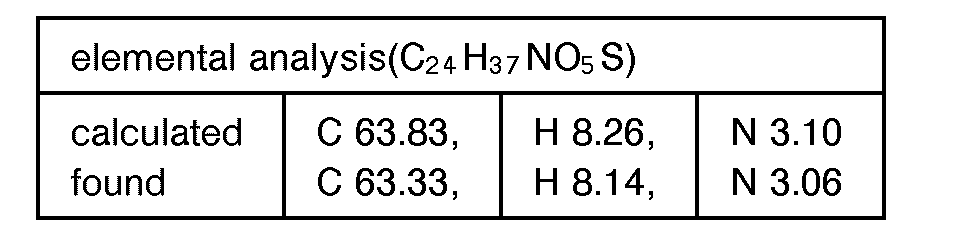
- A solution (10 ml) of the compound obtained above (1 g) in anhydrous tetrahydrofuran was dropwise added to a solution of lithium aluminum hydride (0.26 g) in anhydrous tetrahydrofuran (10 ml) under ice-cooling. The mixture was stirred under ice-cooling for 1 hour and at room temperature for 1 hour. Then, thereto was dropwise added a saturated aqueous sodium sulfate solution to decompose the lithium aluminum hydride. The insoluble matters were filtered off and the filtrate was extracted with ethyl acetate. The organic layer was washed with saturated brine and dried over anhydrous sodium sulfate. The solvent was distilled away and the residue obtained was purified by silica gel column chromatography (eluent; chloroform:methanol = 10:1) to give the subjected compound (0.6 g) as crystals.
- melting point = 76-78°C
- 1H-NMR (CDCl3) 8: 0.86 (3H, t, J=7Hz), 1.25 (8H, m), 1.40 (2H, quint, J=7Hz), 1.61 (2H, quint, J=7Hz), 1.99 (3H, s), 2.87 (2H, t, J=7Hz), 2.89 (2H, s), 3.50 (2H, m), 3.70 (2H, m), 3.73 (2H, m, -OH x 2), 5.79 (1H, s, -NH), 7.14 (2H, d, J=8Hz), 7.25 (2H, d, J = 8Hz)
- IR(KBr): 3422, 3347, 3192, 2942, 1654, 1550, 1055 cm-1

- An aqueous solution (5 ml) of lithium hydroxide (380 mg) was added to a solution (5ml) of the compound obtained above (400 mg) in methanol and the mixture was refluxed under heating for 4 hours. The reaction mixture was concentrated and extracted with ethyl acetate. The extract was washed with saturated brine and dried over anhydrous sodium sulfate. The solvent was distilled away to give white powder. The thus-obtained powder was dissolved in ethanol (2 ml) and thereto was added a 26% hydrochloric acid-ethanol solution(1 ml). The solvent was distilled away and the precipitated crystals were recrystallized from hexane-ethyl acetate to give the subjected compound (80 mg).
- melting point = 100-102°C
- 1H-NMR (CD30D) δ: 0.76 (3H, t, J=7Hz), 1.16 (8H, m), 1.30 (2H, m), 1.53 (2H, quint, J=7Hz), 2.79 (2H, t, J=7Hz), 2.86 (2H, s), 3.43 (2H, m), 3.62 (3H, m), 7.06 (2H, d, J=8Hz), 7.15 (2H, d, J=8Hz)
- IR(KBr): 3363, 3286, 2924, 1516, 1494, 1072 cm-1
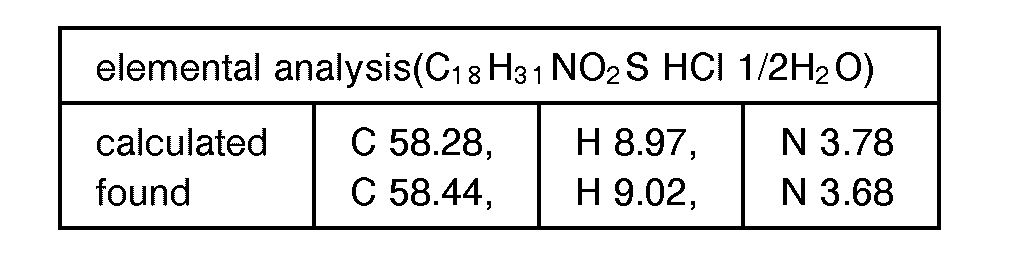
- To a solution (100 ml) of 2-(2-thienyl)ethanol (12.85 g) in dichloromethane, 3,4-dihydro-2H-pyran (9.25 g) and p-toluenesulfonic acid (2 g) were added. The mixture was stirred at room temperature for 4 hours. The solvent was distilled away and ethyl acetate was added thereto. The mixture was washed with saturated brine and dried over anhydrous sodium sulfate. The solvent was distilled away and the oily substance obtained was purified by distillation to give 13.52 g of the subject compound as an oily substance. boiling point = 107-108°C/1 mmHg
- 1H-NMR (CDCl3) δ: 1.50 (4H, m), 1.70 (1 H, m), 1.82 (1 H, m), 3.11 (2H, t, J = 7Hz), 3.47 (1 H, m), 3.60 (1 H, dt, J=10, 7Hz), 3.79 (1 H, m), 3.95 (1 H, dt, J=10,7Hz), 4.61 (1 H, t, J = 3.5Hz), 6.83 (1 H, dd, J = 1, 3.4Hz), 6.90 (1 H, dd, J = 3.4, 5.4Hz), 7.11 (1 H, dd, J = 1, 5.4Hz)
- IR(neat): 2930, 1250, 1120, 1030, 870 cm-1

- A solution (100 ml) of the above-mentioned compound (8.5 g) in anhydrous tetrahydrofuran was cooled to -78 °C and a solution (1.63 mol/I, 30 ml) of n-butyl lithium in hexane was dropwise added thereto. The mixture was stirred under ice-cooling for 30 minutes and then at room temperature for 30 minutes. A solution (15 ml) of 1-bromooctane (10 g) in anhydrous tetrahydrofuran was dropwise added thereto and the mixture was stirred at room temperature for 7 hours. The reaction mixture was poured into ice water and extracted with ethyl acetate. The organic layer was washed with a saturated aqueous ammonium chloride solution and dried over anhydrous sodium sulfate. The solvent was distilled away and the residue obtained was purified by silica gel column chromatography (eluent; hexane:ethyl acetate = 20:1) to give 6.6 g of the subject compound as an oily substance.
- 1H-NMR (CDCl3) 8: 0.85 (3H, t, 7Hz), 1.25 (10H, m), 1.53 (4H, m), 1.62 (2H, m), 1.72 (1 H, m), 1.83 (1 H, m), 2.71 (2H, t, J = 7Hz), 3.02 (2H, t, J = 7Hz), 3.46 (1 H, m), 3.60 (1 H, dt, J = 10, 7Hz), 3.80 (1 H, m), 3.92 (1 H, dt, J = 10, 7Hz), 4.61 (1 H, t, J = 3.5Hz), 6.54 (1 H, d, J = 3.4Hz), 6.61 (1 H, d, J = 3.4Hz)
- IR(neat): 2927, 2854, 1135, 1120, 1033 cm-1

- Tetrahydrofuran (20 ml) and p-toluenesulfonic acid (0.3 g) were added to a solution (80 ml) of the above-mentioned compound (6.5 g) in methanol and the mixture was stirred at room temperature for 1 hour. The solvent was distilled away and ethyl acetate was added to the resulting mixture. The mixture was washed with saturated brine and dried over anhydrous sodium sulfate. The solvent was distilled away and the residue obtained was purified by silica gel column chromatography (eluent; hexane:ethyl acetate = 5:1) to give 4 g of the subject compound as an oil.
- 1H-NMR (CDCl3) 8: 0.86 (3H, t, J=7Hz), 1.27 (10H, m), 1.62 (2H, quint, J=7Hz), 2.73 (2H, t, J=7Hz), 3.00 (2H, t, J = 6Hz), 3.80 (2H, t, J = 6Hz), 6.58 (1 H, d, J = 3.4Hz), 6.64 (1 H, d, J = 3.4Hz)
- IR(neat): 3348, 2927, 2854, 1466, 1047, 797 cm-1

- Triethylamine (3 ml) was added to a solution (50 ml) of the above-mentioned compound (4 g) in dichloromethane. Methanesulfonyl chloride (1.5 ml) was dropwise added thereto and the mixture was stirred for 30 minutes. The reaction mixture was poured into ice water and extracted with dichloromethane. The organic layer was washed with a saturated aqueous sodium hydrogencarbonate solution, 0.1 N hydrochloric acid and saturated brine, and dried over anhydrous sodium sulfate. The solvent was distilled away and the residue obtained was purified by silica gel column chromatography (eluent; chloroform:methanol = 20:1) to give 5 g of the subject compound as an oily substance.
- 1H-NMR (CDCl3) 8: 0.86 (3H, t, J=7Hz), 1.27 (10H, m), 1.61 (2H, quint, J=7Hz), 2.72 (2H, t, J = 7.5Hz), 2.91 (3H, s), 3.17 (2H, t, J = 3.4Hz), 4.37 (2H, t, J = 6.5Hz), 6.58 (1 H, d, J = 3.4Hz), 6.67 (1 H, d, J = 3.4Hz)
- IR(neat): 2927, 2854, 1357, 1176, 959, 802 cm-1

- Sodium iodide (4.5 g) was added to a solution (50 ml) of the above-mentioned compound (4.8 g) in 2-butanone and the mixture was stirred at room temperature for 17 hours. The reaction mixture was concentrated, poured into ice water and extracted with ethyl acetate. The organic layer was washed with saturated brine and dried over anhydrous sodium sulfate. The solvent was distilled away and the residue was purified by silica gel column chromatography (eluent; hexane:ethyl acetate = 20:1) to give 4.9 g of the subject compound as an oily substance.
- 1H-NMR (CDCl3) 8: 0.86 (3H, t, J=7Hz), 1.28 (10H, m), 1.62 (2H, quint, J=7Hz), 2.72 (2H, t, J = 7.5Hz), 3.30 (4H, m), 6.57 (1 H, d, J = 3.4Hz), 6.63 (1 H, d, J = 3.4Hz)
- IR(neat): 2926, 2853, 1466, 1168, 796 cm-1

- 60% Oily sodium hydride (0.33 g) was suspended in anhydrous dimethylformamide (20 ml) and diethyl acetamidomalonate (1.82 g) was added thereto. The mixture was stirred at room temperature for 1 hour. Then, a solution (10 ml) of the above-mentioned compound (2.7 g) in anhydrous dimethylformamide was dropwise added thereto and the mixture was stirred at room temperature for 10 hours. The reaction mixture was poured into ice water and extracted with ethyl acetate. The extract was washed with a saturated aqueous ammonium chloride solution and dried over anhydrous sodium sulfate. The solvent was distilled away and the residue was purified by silica gel column chromatography (eluent; hexane:ethyl acetate = 2:1) to give 1.4 g of the subject compound as crystals.
- melting point = 57-58 °C
- 1H-NMR (CDCl3) 8: 0.86 (3H, t, J = 7Hz), 1.25 (16H, m), 1.57 (2H, quint, J = 7Hz), 2.0 (3H, s), 2.61 (2H, m), 2.70 (4H, m), 4.20 (4H, m), 6.52 (1 H, d, J = 3.4Hz), 6.53 (1 H, d, J = 3.4Hz), 6.75 (1 H, s)
- IR(neat): 3278, 2923, 2852, 1746, 1647, 1211, 1195 cm-1

- A solution (15 ml) of the above-mentioned compound (1.3 g) in anhydrous tetrahydrofuran was dropwise added to a solution (15 ml) of lithium aluminum hydride (0.38 g) in anhydrous tetrahydrofuran under ice-cooling. After stirring under ice-cooling for 1 hour, the mixture was stirred at room temperature for 1 hour. A saturated aqueous sodium sulfate solution was dropwise added under ice-cooling to decompose lithium aluminum hydride. The insoluble matters were filtered off and the filtrate was extracted with ethyl acetate. The organic layer was washed with saturated brine and dried over anhydrous sodium sulfate. The solvent was distilled away and the residue obtained was purified by silica gel column chromatography (eluent; chloroform:methanol = 15:1) to give 0.5 g of the subject compound as crystals.
- melting point = 58-60 °C
- 1H-NMR (CDCl3) 8: 0.86 (3H, t, J = 7Hz), 1.27 (10H, m), 1.60 (2H, m), 1.94 (3H, s), 2.02 (2H, m), 2.71 (2H, t, J = 7Hz), 2.82 (2H, t, J = 7Hz), 3.57 (2H, dd, J=6, 12Hz), 3.71 (2H, br.s, OH x 2), 3.80 (2H, dd, J = 6, 12Hz), 5.88 (1 H, s), 6.54 (1 H, d, J = 3.4Hz), 6.58 (1 H, d, J = 3.4Hz)
- IR(KBr): 3277, 2924, 2852, 1626, 1560, 1236, 1064, 1036 cm-1

- A aqueous solution (5 ml) of lithium hydroxide (380 mg) was added to a solution (5 ml) of the above-mentioned compound (500 mg) in methanol and the mixture was refluxed under heating for 5 hours. The reaction mixture was concentrated and extracted with ethyl acetate. The extract was washed with saturated brine and dried over anhydrous sodium sulfate. The solvent was distilled away, whereby a powder was obtained. The powder was dissolved in ethanol (3 ml) and a 26% solution (2 ml) of hydrochloric acid in ethanol was added thereto. The solvent was distilled away and the precipitated crystals were recrystallized from hexane-ethyl acetate to give 150 mg of the subject compound.
- melting point = 63-65 °C
- 1H-NMR (CD30D) 8: 0.79 (3H, t, J=7Hz), 1.18 (10H, m), 1.53 (2H, m), 1.96 (2H, m), 2.63 (2H, t, J=7.5Hz), 2.74 (2H, m), 3.61 (2H, d, J=12.2Hz), 3.67 (2H, d, J=12.2Hz), 6.47 (1 H, d, J = 3.4Hz), 6.54 (1 H, d, J = 3.4Hz)
- IR(KBr): 3482, 3265, 1631, 1530, 1468, 1059, 811 cm-1

- Acetic anhydride (0.67 ml) was added to a solution (30 ml) of 2-acetamido-2-(4-octylthiobenzyl)-1,3-propanediol (1.04 g) in pyridine and the mixture was stirred at room temperature for 4 hours. The reaction mixture was concentrated and a 5% aqueous ammonium chloride solution was added thereto. The mixture was extracted with ethyl acetate. The ethyl acetate layer was washed with water and dried over anhydrus magnesium sulfate. The solvent was distilled away and the residue was purified by silica gel column chromatography (eluent; ethyl acetate:hexane = 4:1) to give 0.73 g of the subject compound.
- melting point = 71-74 C
- 1H-NMR (CDCl3) 8: 0.85 (3H, t, J=6.9Hz), 1.10-1.85 (12H, m), 1.94 (3H, s), 2.06 (6H, s), 2.28 (2H, t, J = 7.8Hz), 3.19 (2H, s), 4.26 (4H, dd, J=11.2, 17.6Hz), 5.48 (1 H, br.s), 7.03 (2H, d, J = 8.3Hz), 7.20 (2H, d, J = 8.3Hz)
- IR(KBr): 3295, 2924, 1739 cm-1
- MS: 451 (M+)

- To a solution (15 ml) of the above-mentioned compound (0.73 g) in chloroform was added m-chloroperbenzoic acid (0.56 g) and the mixture was stirred for 40 minutes. Calcium hydroxide (0.23 g) was added to the reaction mixture and the mixture was stirred at room temperature for 1 hour. The insoluble matters were filtered off and the solvent was distilled away. The residue was purified by silica gel column chromatography (eluent; dichloromethane:methanol = 30:1) to give 0.66 g of the subject compound. melting point = 70-72 °C
- 1H-NMR (CDCl3) 8: 0.85 (3H, t, J = 7.3Hz), 1.10-1.80 (12H, m), 1.95 (3H, s), 2.07 (6H,s), 2.76 (2H, m), 3.33 (2H, s), 4.09-4.16 (4H, m), 5.54 (1 H, s), 7.29 (2H, d, J = 8.3Hz), 7.54 (2H, d, J = 8.3Hz)
- IR(KBr): 3278, 3081, 2928, 1746, 1672, 1218 cm-1
- MS: 467 (M+)

- An aqueous solution (3 ml) of lithium hydroxide (242 mg) was added to a solution (3 ml) of the above-mentioned compound (300 mg) in methanol and the mixture was stirred at 50°C for 5 hours. After concentration, the reaction mixture was extracted with ethyl acetate and washed with water. The mixture was dried over anhydrous magnesium sulfate and the solvent was distilled away. The residue was recrystallized from ethyl acetate-hexane to give 81.5 mg of the subject compound.
- melting point = 80-82 °C
- 1H-NMR (CDCl3) 8: 0.85 (3H, t, J=6.8Hz), 1.20-1.80 (16H, m), 2.70-2.90 (4H, m), 3.44 (4H, dd, J = 10.3, 17.1 Hz), 7.38 (2H, d, J = 7.8Hz), 7.55 (2H, d, J = 7.8Hz)
- IR(KBr): 3339, 2915, 2758, 1033 cm-1
- MS: 342 (M+)

- To a solution (10 ml) of 2-acetamido-1,3-diacetoxy-2-(4-octylsulfinylbenzyl)propane (330 mg) in chloroform was added m-chloroperbenzoic acid (244 mg) under ice-cooling. The mixture was stirred for 2.5 hours and then at room temperature for 1.5 hours. Calcium hydroxide (0.1 g) was added to the reaction mixture and the mixture was stirred at room temperature for 45 minutes. The insoluble matters were filtered off and the filtrate was concentrated under reduced pressure. The residue was recrystallized from hexane- ethyl acetate to give 162 mg of the subject compound.
- melting point = 98-100°C
- 1H-NMR (CDCl3) 8: 0.84 (3H, t, J = 7.3Hz), 1.10-1.80 (12H, m), 1.96 (3H, s), 2.07 (6H, s), 3.06 (2H, m), 3.38 (2H, s), 4.25 (4H, dd, J=11.7, 25.8Hz), 5.54 (1 H, s), 7.34 (2H, d, J = 8.2Hz), 7.81 (2H, d, J = 8.2Hz)
- IR(KBr) : 3317, 2921, 2853, 1749, 1654, 1313, 1141 cm-1
- MS: 483 (M+)

- An aquous solution (2.5 ml) of lithium hydroxide (109 mg) was added to a solution (2.5 ml) of the above-mentioned compound (140 mg) in methanol and the mixture was stirred at 50°C for 4 hours. The reaction mixture was extracted with ethyl acetate and the extract was washed with water. The mixture was dried over anhydrous magnesium sulfate and the solvent was distilled away. The residue was recrystallized from hexaneethyl acetate to give 45 mg of the subject compound.
- melting point = 108-109 °C
- 1H-NMR (CDCl3) 8: 0.84 (3H, t, J=7.3Hz), 1.10-1.86 (16H, m), 2.83 (2H, s), 3.06 (2H, m), 3.43 (2H, s), 3.44 (2H, s), 7.43 (2H, d, J = 7.8Hz), 7.82 (2H, d, J = 7.8Hz)
- IR(KBr): 3343, 2915, 1299, 1147 cm-1
- MS: 357 (M+)

- A small amount of iodine was added to a solution (100 ml) of magnesium (9.8 g) in anhydrous tetrahydrofuran and the mixture was stirred at 50°C until the color of the iodine disappeared. A solution of heptyl bromide in anhydrous tetrahydrofuran (200 ml) was dropwise added thereto over 1 hour. The mixture was stirred at 65°C for 1 hour and a solution of m-bromobenzaldehyde in anhydrous tetrahydrofuran (200 ml) was dropwise added thereto under ice-cooling. The mixture was stirred at room temperature for 30 minutes. Under ice-cooling, a saturated aqueous ammonium chloride solution (7.3 ml) was added thereto and the mixture was stirred for 1 hour. The insoluble matters were filtered off and the filtrate was concentrated. The concentrate was dissolved in ethyl acetate and the mixture was washed with water. The mixture was dried over magnesium sulfate and the solvent was distilled away. The residue obtained was purified by silica gel column chromatography (eluent; hexane:ethyl acetate = 10:1) to give 50.9 g of the subject compound as an oily substance.
- 1H-NMR (CDCl3) 8: 0.85 (3H, t, J = 6.8Hz), 1.20-1.90 (13H, m), 4.61 (1 H, m), 7.1-7.3 (2H, m), 7.36 (1 H, dt, J = 1.5, 7.8Hz), 7.49 (1 H, m)
- IR(neat): 3346, 2922, 2853cm-1
- MS: 285 (M+)

- Phosphorus pentaoxide (24.9 g) was added to a solution of the above-mentioned compound (10 g) in benzene (500 ml) and the mixture was refluxed under heating for 1.5 hours. The insoluble matters were filtered off, and the filtrate was washed with water and dried over anhydrous magnesium sulfate. The solvent was distilled away and the residue was purified by silica gel column chromatography (eluent; hexane:ethyl acetate = 20:1) to give 9 g of the subject compound as an oily substance.
- 1H-NMR (CDCl3) 8: 0.88 (3H, t, J = 6.9Hz), 1.20-1.50 (8H, m), 2.19 (2H, dt, J = 6.3, 6.5Hz), 6.21 (1 H, td, J = 6.3, 16.1 Hz), 6.28 (1 H, d, J = 16.1 Hz), 7.13 (1 H, t, J = 7.9Hz), 7.21 (1 H, m), 7.28 (1 H, m), 7.47 (1 H, m)
- IR(neat): 3439, 3063 cm-1
- MS: 267 (M+)
- A small amount of iodine was added to a solution of magnesium (1.38 g) in anhydrous tetrahydrofuran (30 ml) and the mixture was stirred at 50 °C until the color of the iodine disappeared. A solution of the above-mentioned compound (13.8 g) in anhydrous tetrahydrofuran (40 ml) was dropwise added thereto over 30 minutes. The mixture was stirred at 55 °C for 1 hour and a solution of dimethylformamide (4 ml) in anhydrous tetrahydrofuran (30 ml) was dropwise added thereto over 1 hour. The mixture was stirred at room temperature for 2 hours. Under ice-cooling, a saturated aqueous ammonium chloride solution was added thereto and the mixture was extracted with ethyl acetate. The ethyl acetate layer was washed with water and dried over magnesium sulfate. The solvent was distilled away and the residue obtained was purified by silica gel column chromatography (eluent; hexane:ethyl acetate = 30:1) to give 7.12 g of the subject compound as an oily substance.
- 1H-NMR (CDCl3) 8: 0.86 (3H, t, J = 6.8Hz), 1.20-1.60 (8H, m), 2.22 (2H, dt, J = 6.8, 6.9Hz), 6.32 (1 H, td, J = 6.8, 15.7Hz), 6.41 (1 H, d, J = 15.7Hz), 7.43 (1 H, t, J = 7.8Hz), 7.57 (1 H, m), 7.68 (1 H, m), 7.83 (1 H, s), 9.99 (1 H, s)
- IR(neat): 2956, 2927, 2855, 1699 cm-1
- MS: 216 (M+)

- Methyl methyl sulfinyl methyl sulfide (3 ml) and a solution (2.6 ml) of trimethylbenzyl ammonium hydroxide in methanol were added to a solution of the above-mentioned compound (6.17 g) in dioxane (30 ml) and the mixture was stirred at 80°C for 2 hours. The reaction mixture was concentrated, dissolved in ethyl acetate and washed with water. The mixture was dried over anhydrous magnesium sulfate. The solvent was distilled away and the residue obtained was purified by silica gel column chromatography (eluent; hexane:ethyl acetate = 4:1) to give 6.48 g of the subject compound as an oily substance.
- 1H-NMR (CDCl3) 8: 0.87 (3H, t, J=6.8Hz), 1.20-1.55 (8H, m), 2.12 (2H, dt, J=6.8, 6.9Hz), 2.30 (3H, s), 2.75 (3H, s), 6.25 (1H, td, J=6.8, 16.1 Hz), 6.37 (3H, t, J=16.1Hz), 7.30-7.40 (2H, m), 7.60 (1 H, s), 7.72 (1 H, m), 7.81 (1 H, s)
- IR(neat): 2955, 2925, 1068 cm-1
- MS: 322 (M+)
- A solution of 26% hydrogen chloride in ethanol (48 ml) was added to a solution of the above-mentioned compound (6.48 g) in ethanol (40 ml) and the mixture was stirred at room temperature for 1 hour. The reaction mixture was concentrated and the residue was purified by silica gel column chromatography (eluent; hexane:ethyl acetate = 20:1) to give 5.11 g of the subject compound as an oily substance.
- 1H-NMR (CDCl3) 8: 0.87 (3H, t, J = 6.8Hz), 1.18-1.50 (11 H, m), 2.19 (2H, dt, J = 6.8, 6.9Hz), 3.57 (2H, s), 4.13 (2H, q, J = 7.3Hz), 6.22 (1 H, td, J = 6.8, 16.1 Hz), 6.33 (1 H, d, J = 16.1 Hz), 7.10-7.25 (4H, m)
- IR(neat): 2957, 2927, 2855, 1737 cm-1
- MS: 274 (M+)
- Lithium aluminum hydride (1.22 g) was suspended in anhydrous tetrahydrofuran (150 ml) and thereto was added the above-mentioned compound (5.89 g) under ice-cooling. The mixture was stirred for 1 hour. Under ice-cooling, ethanol and water were added thereto and the insoluble matters were filtered off. The filtrate was dried over anhydrous sodium sulfate and the solvent was distilled away. The residue was purified by silica gel column chromatography (eluent; hexane: ethyl acetate = 5:1) to give 4.22 g of the subject compound as an oily substance.
- 1H-NMR (CDCl3) δ: 0.87 (3H, t, J=6.8Hz), 1.10-1.50 (8H, m), 2.19 (2H, dt, J=6.8, 6.9Hz), 2.83 (2H, t, J = 6.3Hz), 3.85 (2H, dt, J = 6.2, 6.3Hz), 6.20 (1 H, td, J = 6.8, 16.1 Hz), 6.34 (1 H, d, J=16.1Hz), 7.03 (1 H, m), 7.18-7.27(3H, m)
- IR(neat): 3348, 2956, 2926, 2854 cm-1
- MS: 232 (M+)
- Triethylamine (2.8 ml) was added to a solution (60 ml) of the above-mentioned compound (4.19 g) in dichloromethane and the mixture was ice-cooled. Thereto was dropwise added methanesulfonyl chloride (14 ml) and the mixture was stirred at room temperature for 1.5 hours. The reaction mixture was poured into ice water and extracted with dichloromethane. The dichloromethane layer was washed with a saturated potassium hydrogencarbonate solution, a 1% aqueous hydrochloric acid solution and saturated brine and dried over anhydrous magnesium sulfate. The solvent was distilled away and the residue was purified by silica gel column chromatography (eluent; hexane: ethyl acetate = 5:1) to give 5.55 g of the subject compound as an oily substance.
- 1H-NMR (CDCl3) δ: 0.87 (3H, t, J=6.8Hz), 1.20-1.50 (8H, m), 2.19 (2H, dt, J=6.8, 6.9Hz), 2.83 (3H, s), 3.02 (2H, t, J=6.8Hz), 4.40 (2H, t, J=6.8Hz), 6.22 (1 H, td, J = 6.8, 15.6Hz), 6.33 (1 H, d, J= 15.6Hz), 7.03 (1 H, m), 7.18-7.24 (3H, m)
- IR(neat): 2956, 2927, 2855 cm-1
- MS: 310 (M+)
- Sodium iodide (3.99 g) was added to a solution of the above-mentioned compound (5.51 g) in 2-butanone (60 ml) and the mixture was stirred at 45°C for 3 hours. The reaction mixture was concentrated, poured into ice water and extracted with ethyl acetate. The extract was washed with saturated brine and dried over anhydrous magnesium sulfate. The solvent was distilled away and the residue was purified by silica gel column chromatography (eluent; hexane:ethyl acetate = 100:1) to give 4.75 g of the subject compound as an oily substance.
- 1H-NMR (CDCl3) δ: 0.87 (3H, t, J=6.8Hz), 1.20-1.50 (8H, m), 2.19 (2H, dt, J=6.8, 6.9Hz), 3.14 (2H, t, J=7.4Hz), 3.34 (2H, t, J=7.4Hz), 6.21 (1 H, td, J = 6.8, 18.1 Hz), 6.34 (1 H, d, J=18.1Hz), 7.00 (1 H, m), 7.14-7.24 (3H, m)
- IR(neat): 2956, 2925, 2853 cm-1 MS: 342 (M+)
- Sodium ethoxide (7.62 g) was added to a solution of diethyl acetamidomalonate (7.62 g) in ethanol (30 ml) and the mixture was stirred at 60 °C for 45 minutes. Thereto was dropwise added a solution of the above-mentioned compound (4 g) in ethanol (20 ml) and the mixture was refluxed under heating for 5 hours. The reaction mixture was concentrated, poured into ice water and extracted with ethyl acetate. The extract was washed with saturated brine and dried over anhydrous magnesium sulfate. The solvent was distilled away and the residue was purified by silica gel column chromatography (eluent; hexane:ethyl acetate = 3:1) to give 2.46 g of the subject compound as an oily substance.
- 1H-NMR (CDCl3) 8: 0.87 (3H, t, J=6.9Hz), 1.22 (6H, t, J=6.8Hz), 1.22-1.50 (8H, m), 1.97 (3H, s), 2.17 (2H, dt, J = 6.8, 6.9Hz), 2.43 (2H, m), 2.67 (2H, m), 4.11-4.23 (4H, m), 6.18 (1H, td, J = 6.8, 16.1 Hz), 6.31 (1 H, d, J = 16.1 Hz), 6.74 (1 H, s), 6.94 (1 H, d, J = 6.8Hz), 7.09-7.18 (3H, m)
- IR(neat): 3413, 2957, 2927, 1741, 1683 cm-1
- MS: 431 (M+)

- The above-mentioned compound (2.8 g) in anhydrous tetrahydrofuran (20 ml) was dropwise added to a solution of lithium aluminum hydride (0.74 g) in anhydrous tetrahydrofuran (40 ml) in a stream of nitrogen under ice-cooling and the mixture was stirred at room temperature for 2 hours. Under ice-cooling, ethanol and water were added to the reaction mixture and the insoluble matters were filtered off. The filtrate was dried over anhydrous magnesium sulfate and the solvent was distilled away to give a yellow, oily substance (2.34 g). This substance was dissolved in pyridine (60 ml) and thereto was added acetic anhydride (1.6 ml) under ice-cooling. The mixture was stirred at room temperature for 2.5 hours. The reaction mixture was concentrated and the residue was dissolved in ethyl acetate. The mixture was washed with a saturated aqueous ammonium chloride and saturated brine and dried over anhydrous magnesium sulfate. The solvent was distilled away and the residue was purified by silica gel column chromatography (eluent; hexane:ethyl acetate = 4:1) to give 1.8 g of the subject compound as white crystals.
- melting point = 84-86 °C
- 1H-NMR (CDCl3) 8: 0.87 (3H, t, J=6.8Hz), 1.10-1.50 (8H, m), 1.94 (3H, s), 2.07 (6H, s), 2.15-2.21 (4H, m), 2.57 (2H, m), 4.33 (4H, s), 5.62 (1 H, s), 6.19 (1 H, dt, J = 6.8, 16.1 Hz), 6.33 (1 H, d, J = 16.1 Hz), 6.99 (1 H, d, J = 6.8Hz), 7.13-7.21 (3H, m)
- IR(KBr): 3311, 2961, 2926, 1738, 1652 cm-1
- MS: 431 (M+)

- A suspension of 10% palladium carbon (150 mg) in methanol (10 ml) was added to a solution of the above-mentioned compound (1.41 g) in methanol (10 ml) and the mixture was stirred under hydrogen pressurization (10 atm) for 2 hours. The inside of the reaction vessel was displaced with nitrogen and the insoluble matters were filtered off. The solvent was distilled away and the residue was purified by silica gel column chromatography (eluent; hexane:ethyl acetate = 2:1) to give 1.05 g of the subject compound as white crystals.
- melting point = 86-87 °C
- 1H-NMR (CDCl3) 8: 0.86 (3H, t, J=6.9Hz), 1.10-1.60 (12H, m), 1.93 (3H, s), 2.07 (6H, s), 2.18 (2H, m), 2.52 (2H, t, J = 6.8Hz), 2.56 (2H, t, J = 6.8Hz), 4.33 (4H, s), 5.61 (1 H, s), 6.95-7.05 (3H, m), 7.17 (1 H, t, J = 7.8Hz)
- IR(KBr): 3313, 2960, 2925, 2854, 1738, 1651 cm-1
- An aqueous solution (10 ml) of lithium hydroxide (1 g) was added to a solution of the above-mentioned compound (1.04 g) in methanol (10 ml) and the mixture was refluxed under heating for 5 hours. The reaction mixture was concentrated, exctracted with ethyl acetate and washed with saturated brine. The mixture was dried over anhydrous magnesium sulfate and the solvent was distilled away. The residue was purified by silica gel column chromatography (eluent; chloroform:methanol = 5:1) to give 0.46 g of the subject compound as white crystals.
- melting point = 89-92 °C
- 1H-NMR (CDCl3) 8: 0.85 (3H, t, J=6.4Hz), 1.20-1.35 (12H, m), 1.55 (2H, m), 1.83 (2H, m), 2.51 (2H, t, J=7.2Hz), 2.60 (2H, m), 2.98 (2H, br.s), 3.68 (2H, t, J=11.2Hz), 3.71 (2H, t, J = 11.2Hz), 6.97 (3H, m), 7.12 (1 H, t, J = 7.3Hz)
- IR(KBr): 3396, 3257, 2925, 2854 cm-1
- (13) 2-Amino-2-[3-(3-octylphenyl)ethyl]-1,3-propanediol hydrochloride
- The above-mentioned compound (0.45 g) was dissolved in ethanol (20 ml) and thereto was added a 26% solution (1 ml) of hydrochloric acid in ethanol. The solvent was distilled away and the precipitated crystals were recrystallized from ethyl acetate:methanol = 30:1 to give 0.33 g of the subject compound. melting point = 99-101 ° C
- 1H-NMR (DMSO) 8: 0.84 (3H, t, J=6.8Hz), 1.20-1.35 (12H, m), 1.53 (2H, m), 1.74 (2H, m), 2.40-2.60 (2H, m), 3.45 (4H, s), 5.33 (2H, br.s), 6.98-7.00 (3H, m), 7.18 (1H, t, J = 7.3Hz), 7.70 (3H, br.s)
- IR(KBr): 3178, 2924, 2853 cm-1
- 4-Decylphenylmethanol (3.91 g) was dissolved in toluene (40 ml) and thereto was added 48% hydrobromic acid (40 ml). The mixture was refluxed under heating at 90°C for 6 hours. After cooling, the organic layer was separated and washed with saturated brine and a sodium hydrogencarbonate solution. The mixture was dried over anhydrous sodium sulfate and the solvent was distilled away to give 4.9 g of the oily subject compound.
- 1H-NMR (CDCl3) δ: 0.86 (3H, t, J=6.6Hz), 1.2-1.3 (14H, m), 1.5-1.6 (2H, m), 2.57 (2H, t, J=7.6Hz), 4.47 (2H, s), 7.13 (2H, d, J = 8.1 Hz), 7.28 (2H, d, J=8.0Hz)
- Silver nitrite (4.15 g) and dry ether (20 ml) were placed in a flask and cooled with ice. Thereto was dropwise added a solution of 4-bromomethyldecylbenzene (5.5 g) in ether (10 ml) with stirring. After the dropwise addition, the mixture was stirred under ice-cooling for 4 hours and the insoluble matters were filtered off. The solvent in the filtrate was distilled away and the residue was crystallized from pentane to give 1.44 g of the subject compound as pale yellow crystals.
- melting point = 50°C
- 1H-NMR (CDCl3) δ: 0.88 (3H, t, J=6Hz), 1.2-1.3 (14H, m), 1.5-1.6 (2H, m), 2.62 (2H, t, J=8Hz), 5.41 (2H, s), 7.24 (2H, d, J = 8Hz), 7.28 (2H, d, J = 8Hz)
- 4-Decylphenylnitromethane (555 mg) was dissolved in ethanol (5 ml) and thereto were added a 1N aqueous sodium hydroxide solution (0.02 ml) and 37% formalin (0.45 ml). The mixture was heated at 50 °C for 6 hours. The solvent was distilled away and the residue was extracted with ethyl acetate. The extract was washed with saturated brine and dried over anhydrous sodium sulfate. The solvent was distilled away and the residue was crystallized from hexane to give 1.75 g of the colorless, scale-like subject compound. melting point = 80-81 ° C
- 1H-NMR (CDCl3) 8: 0.88 (3H, t, J=6Hz), 1.2-1.3 (14H, m), 1.5-1.6 (2H, m), 2.59 (2H, t, J=8Hz), 2.77 (2H, m), 4.35 (2H, m), 4.60 (2H, m), 7.17 (2H, d, J=10Hz), 7.21 (2H, d, J = 10Hz)
- 2-(4-Decylphenyl)-2-nitro-1,3-propanediol (170 mg) was dissolved in ethanol (30 ml) and the mixture was subjected to catalytic reduction in the presence of 5% palladium carbon (40 mg) under hydrogen pressure of 20 atm. After stirring the mixture for 8 hours, the insoluble matters were filtered off and the filtrate was concentrated. The residue was purified by preparative thin layer chromatography (silica gel) to give 8.9 mg of the subject compound.
- melting point = 136-137 ° C
- 1H-NMR (CDCl3-CD3OD) 8: 0.88 (3H, t, J=8Hz), 1.1-1.4 (14H, m), 1.4-1.8 (2H, m), 2.3-2.7 (6H, m), 3.5-4.2 (4H, m), 7.2 (2H, d, J=10Hz), 7.33 (2H, d, J = 10Hz)
- melting point of hydrochloride = 113-114°C (recrystallized from isopropyl alcohol)
- 2-Amino-2-(4-decylphenyl)-1,3-propanediol (313 mg) was dissolved in a mixed solvent of ethanol (20 ml) and chloroform (5 ml). Thereto was added triethylamine (0.4 ml) and the mixture was cooled to -60 °C with dry ice-methanol. Thereto was dropwise added a solution of acetyl chloride (0.12 ml) in dichloromethane (5 ml) under ice-cooling and the mixture was heated to room temperature. The solvent was distilled away and the residue was dissolved in ethyl acetate. The mixture was washed with brine, an aqueous dilute hydrochloric acid solution and an aqueous sodium hydrogencarbonate solution. The resultant mixture was dried over anhydrous sodium sulfate and the solvent was distilled away. The residue was purified by preparative thin layer chromatography (silica gel) and recrystallized from hexane to give 130 mg of the colorless, crystalline subject compound.
- melting point = 112-113°C
- 1H-NMR (CDCl3) 8: 0.88 (3H, t, J=6.9Hz), 1.2-1.4 (14H, m), 1.5-1.7 (2H, m), 2.17 (3H, s), 2.58 (2H, t, J = 7.9Hz), 3.66 (2H, dd, J = 7.7Hz, 6Hz), 3.88 (2H, dd, J = 12Hz, 7.6Hz), 4.05 (2H, dd, J = 11.9Hz, 6Hz), 6.37 (1 H, bs), 7.20 (2H, d, J = 8.6Hz), 7.25 (2H, d, J = 8.6Hz)
- 2-Acetylamino-2-(4-decylphenyl)-1,3-propanediol (224 mg) and 2,2-dimethoxypropane (0.3 ml) were dissolved in benzene (5 ml) and the mixture was refluxed under heating in the presence of a catalytic amount of toluenesulfonic acid. After cooling, the reaction mixture was washed with an aqueous sodium hydrogencarbonate solution and dried over sodium sulfate. The solvent was distilled away and the residue was purified by preparative thin layer chromatography (silica gel) to give 99 mg of the amorphous subject compound.
- 1H-NMR (CDCl3) 8: 0.88 (3H, t, J=6.6Hz), 1.2-1.4 (14H, m), 1.48 (3H, s), 1.51 (3H, s), 1.5-1.7 (2H, m), 2.06 (3H, s), 2.56 (2H, t, J=7.8Hz), 4.14 (4H, s), 6.23 (1H, bs), 7.15 (2H, d, J = 8.3Hz), 7.22 (2H, d, J = 8.3Hz)
- Example 300 : 2-Amino-2-(8-phenyloctyl)-1,3-propanediol
- Example 301 : 2-Amino-2-(9-phenylnonyl)-1,3-propanediol
- Example 302 : 2-Amino-2-(11-phenylundecyl)-1,3-propanediol
- Example 303 : 2-Amino-2-(12-phenyldodecyl)-1,3-propanediol
- Example 304 : 2-Amino-2-(14-phenyltetradecyl)-1,3-propanediol
- Example 305 : 2-Amino-2-(15-phenylpentadecyl)-1,3-propanediol
- Example 306 : 2-Amino-2-(16-phenylhexadecyl)-1,3-propanediol
- Example 307 : 2-Amino-2-[2-(4-tridecylphenyl)ethyl]-1,3-propanediol
- Example 308 : 2-Amino-2-[2-(4-tetradecylphenyl)ethyl]-1,3-propanediol
- Example 309 : 2-Amino-2-[2-(4-hexyloxyphenyl)ethyl]-1,3-propanediol
- Example 310 : 2-Amino-2-[2-(4-decyloxyphenyl)ethyl]-1,3-propanediol
- Example 311 : 2-Amino-2-[2-(4-dodecyloxyphenyl)ethyl]-1,3-propanediol
- Example 312 : 2-Amino-2-[2-(4-tridecyloxyphenyl)ethyl]-1,3-propanediol
- Example 313 : 2-Amino-2-[2-(4-(8-fluorooctyl)phenyl)ethyl]-1 ,3-propanediol
- Example 314 : 2-Amino-2-[2-(4-(12-fluorododecyl)phenyl)ethyl]-1,3-propanediol
- Example 315 : 2-Amino-2-[2-(4-(7-fluoroheptyloxy)phenyl)ethyl]-1,3-propanediol
- Example 316 : 2-Amino-2-[2-(4-(11-fluoroundecyloxy)phenyl)ethyl]-1,3-propanediol
- Example 317 : 2-Amino-2-[2-(4-phenylmethyloxyphenyl)ethyl]-1,3-propanediol
- Example 318 : 2-Amino-2-[2-(4-(2-phenylethyloxy)phenyl)ethyl]-1,3-propanediol
- Example 319 : 2-Amino-2-[2-(4-(3-phenylpropyloxy)phenyl)ethyl]-1 ,3-propanediol
- Example 320 : 2-Amino-2-[2-(4-(4-phenylbutyloxy)phenyl)ethyl]-1,3-propanediol
- Example 321 : 2-Amino-2-[2-(4-(5-phenylpentyloxy)phenyl)ethyl]-1,3-propanediol
- Example 322 : 2-Amino-2-[2-(4-(7-phenylheptyloxy)phenyl)ethyl]-1,3-propanediol
- Example 323 : 2-Amino-2-[2-(4-(8-phenyloctyloxy)phenyl)ethyl]-1,3-propanediol
- Example 324 : 2-Amino-2-[4-(6-(4-fluorophenyl)hexyloxy)phenyl)ethyl]-1,3-propanediol
- Example 325 : 2-Amino-2-[2-(4-(4-phenoxybutyloxy)phenyl)ethyl]-1,3-propanediol
- Example 326 : 2-Amino-2-[2-(4-(5-phenoxypentyloxy)phenyl)ethyl]-1,3-propanediol
- Example 327 : 2-Amino-2-[2-(4-(6-phenoxyhexyloxy)phenyl)ethyl]-1,3-propanediol
- Example 328 : 2-Amino-2-[2-(4-(7-phenoxyheptyloxy)phenyl)ethyl]-1,3-propanediol
- Example 329 : 2-Amino-2-[2-(4-(4-phenoxybutyl)phenyl)ethyl]-1,3-propanediol
- Example 330 : 2-Amino-2-[2-(4-(5-phenoxypentyl)phenyl)ethyl]-1 ,3-propanediol
- Example 331 : 2-Amino-2-[2-(4-(6-phenoxyhexyl)phenyl)ethyl]-1 ,3-propanediol
- Example 332 : 2-Amino-2-[2-(4-(7-phenoxyheptyl)phenyl)ethyl]-1 ,3-propanediol
- Example 333 : 2-Amino-2-[2-(4-octylcyclohexyl)ethyl]-1,3-propanediol
- Example 334 : 2-Amino-2-[2-(4-nonylcyclohexyl)ethyl]-1,3-propanediol
- Example 335 : 2-Amino-2-[2-(4-dodecylcyclohexyl)ethyl]-1,3-propanediol
- Example 336 : 2-Amino-2-[2-(1-octylpiperidin-4-yl)ethyl]-1,3-propanediol
- Example 337 : 2-Amino-2-[2-(1-dodecylpiperidin-4-yl)ethyl]-1,3-propanediol
- Example 338 : 2-Amino-2-[2-(5-nonyl-2-thienyl)ethyl]-1,3-propanediol
- Example 339 : 2-Amino-2-[2-(5-decyl-2-thienyl)ethyl]-1,3-propanediol
- Example 340 : 2-Amino-2-[2-(5-dodecyl-2-thienyl)ethyl]-1,3-propanediol
- Example 341 : 2-Amino-2-[13-(2-thienyl)tridecyl]-1,3-propanediol
- Example 342 : 2-Amino-2-[2-(5-octyl-2-pyridyl)ethyl]-1,3-propanediol
- Example 343 : 2-Amino-2-[2-(5-decyl-2-pyridyl)ethyl]-1,3-propanediol
- Example 344 : 2-Amino-2-[13-(2-pyridyl)tridecyl]-1,3-propanediol
- Example 345 : 2-Amino-2-[2-(2-octyl-5-pyridyl)ethyl]-1,3-propanediol
- Example 346 : 2-Amino-2-[2-(2-decyl-5-pyridyl)ethyl]-1,3-propanediol
- Example 347 : 2-Amino-2-[13-(3-pyridyl)tridecyl]-1,3-propanediol
- Example 348 : 2-Amino-2-(4-decylphenyl)-1,3-propanediol
- Example 349 : 2-Amino-2-(4-dodecylphenyl)-1,3-propanediol
- Example 350 : 2-Amino-2-(4-tetradecylphenyl)-1,3-propanediol
- Example 351 : 2-Amino-2-(4-hexadecylphenyl)-1,3-propanediol
- Example 352 : 2-Amino-2-[1-hydroxy-2-(4-octylphenyl)ethyl]-1,3-propanediol
- Example 353 : 2-Amino-2-[2-(4-dodecylphenyl)-1-hydroxyethyl]-1,3-propanediol
- Example 354 : 2-Amino-2-[2-(4-heptyloxyphenyl)-1-hydroxyethyl]-1,3-propanediol
- Example 355 : 2-Amino-2-[1-hydroxy-2-(4-undecyloxyphenyl)ethyl]-1,3-propanediol
- Example 356 : 2-Amino-2-[2-(4-(8-fluorooctyl)phenyl)-1-hydroxyethyl]-1,3-propanediol
- Example 357 : 2-Amino-2-[2-(4-(12-fluorododecyl)phenyl)-1-hydroxyethyl]-1,3-propanediol Example 358 : 2-Amino-2-[2-(4-(7-fluoroheptyloxy)phenyl)-1-hydroxyethyl]-1,3-propanediol
- Example 365 : 2-Amino-2-(4-decylphenoxymethyl)-1,3-propanediol
- Example 366 : 2-Amino-2-(4-dodecylphenoxymethyl)-1,3-propanediol
- Example 367 : 2-Amino-2-(4-tetradecylphenoxymethyl)-1,3-propanediol
- Example 368 : 2-Amino-2-(1-hydroxy-2-phenylethyl)-1,3-propanediol hydrochloride
- melting point = 188-190 ° C 1H-NMR (DMSO-d6) δ(ppm): 2.57 (1 H, dd, J = 10.7, 14.2Hz), 2.88 (1 H, d, J=14.2Hz), 3.63 (4H, m)-,3.85 (1 H, d, J=10.7Hz), 5.16 (1 H, br.s), 5.28 (2H, br.s), 7.25 (5H, m), 7.77 (3H, br.s)
- IRν (KBr)max : 3156, 2814, 1626, 1550, 1080, 1056, 743, 702 cm-1
- Example 369 : 2-Acetamido-1,3-diacetoxy-2-(1-acetoxy-2-phenylethyl)propane, transparent oil
- 1H-NMR (CDCl3) δ(ppm): 1.89 (3H,s), 1.94 (3H, s), 2.08 (3H, s), 2.13 (3H, s), 2.83 (1 H, dd,J=10.3, 14.2Hz), 3.05 (1 H, dd, J = 3.4, 14.2Hz), 4.46 (1 H, d, J=11.7Hz), 4.48 (1 H, d, J = 11.7Hz), 4.55 (1 H, d, J = 11.7Hz), 4.71 (1 H, d, J = 11.7Hz), 5.66 (1 H, dd, J = 3, 4, 10.3Hz), 5.86 (1 H, s, -NH), 7.22 (5H, m)
- Example 370 : (Z)-2-Amino-2-styryl-1,3-propanediol
- Example 371 : (E)-2-Amino-2-styryl-1,3-propanediol
- 1H-NMR (CD30D) δ(ppm): 3.51 (2H, d, J=11Hz), 3.63 (2H, d, J=11Hz), 6.10 (1 H, d, J=16.4Hz), 6.55 (1 H, d, J = 16.4Hz), 7.23 (5H, m)
- Example 372 : 2-Acetamido-2-[2-(4-decylphenyl)ethyl]-1,3-propanediol diacetate
- melting point = 101-104°C
- 1H-NMR (CDCl3) δ(ppm): 0.88 (3H, t, J=6Hz), 1.26-1.29 (16H, m), 1.95 (3H, s), 2.09 (6H, s), 2.17-2.21 (2H, m), 2.54-2.60 (4H, m), 4.35 (4H, s), 5.63 (1 H, s), 7.09 (4H, s) IRv : 3310, 2919, 1735, 1654, 1231, 1058 cm-1
- Example 373 : 2-Amino-2-[2-(4-decylphenyl)ethyl]-1,3-propanediol hydrochloride
- melting point = 111-115°C 1H-NMR (CDCl3) 8 (ppm): 0.88 (3H, t, J=6Hz), 1.26-1.29 (16H, s), 1.92-1.96 (2H, m), 2.56 (2H, t, J = 8Hz), 2.61-2.65 (2H, m), 3.71 (4H, q, J=12Hz), 7.11 (4H, s) IRv : 3373, 2923, 1603, 1518, 1070 cm-1
- melting point = 83-87°C 1H-NMR (CDCl3) 8 (ppm): 0.91 (6H, d, J=6Hz), 1.57 (4H, s), 1.96 (3H, s), 2.09 (6H, s), 2.15-2.19 (2H, m), 2.51-2.58 (2H, m), 3.91 (2H, t, J=6Hz), 4.34 (4H, s),6.81 (2H, d, J = 4Hz), 7.08 (2H, d, J = 4Hz)
- IRv : 3310, 2954, 1735, 1649 cm-1

- melting point = 125-128 °C 1H-NMR (CDCl3) δ(ppm): 0.83 (6H, d, J=6Hz), 1.25 (2H, t, J=6Hz), 1.54-1.58 (3H, m), 1.66-1.72 (2H, m), 2.47-2.51 (2H, m), 3.39-3.50 (4H, m), 3.81-3.85 (2H, m), 6.73 (2H, d, J = 12Hz), 7.02 (2H, d, J = 12Hz)
- IRv : 3324, 2951, 1513, 1247, 1026 cm-1
- 1H-NMR (400MHz, CDCl3) 8 (ppm): 1.66 (2H, br.s, OH), 1.94 (3H, s, CH3), 3.26 (2H, s, CH2), 3.56 (4H,dd, J = 72, 12Hz, CH2 x 2), 6.97 (1 H, br.s, NH), 7.23 (1 H, dd, J=8.0, 4.0Hz, ArH), 7.33 (1 H, d, J=8.0Hz, ArH), 7.69 (1 H, dt, J = 8.0, 4.0Hz,ArH), 8.49 (1 H, d, J = 4.0Hz, ArH)
- 1H-NMR (400MHz, CDCl3) 8 (ppm): 1.96 (3H, s, CH3), 2.05 (6H, s, CH3 x 2), 3.13 (2H, s, CH2), 4.47 (4H, dd, J=40, 12Hz, CH2 x 2), 7.15 (1 H, d, J=8.0Hz, ArH), 7.21 (1 H, dd, J=8.0, 4.0Hz, ArH), 7.48 (1 H, s, NH), 7.65 (1 H, dt, J = 8.0, 4.0Hz, ArH), 8.55 (1 H, d, J = 4.0Hz, ArH)
- IRν (KBr)max : 3320(NH), 1748 (CO), 1654, 1533, 1248 cm-1 MS: 308 (M+ + 1)
- melting point = 109-110°C
- 1H-NMR (400MHz, CD30D) 8 (ppm): 3.53 (2H, s, ArCH2), 3.65 (4H, ddd, J=24, 12, 4.0Hz, CH2 x 2), 4.88 (6H, br.s, OH x 2, N+H3, N+), 8.02 (1H, t, J=8.0Hz, ArH), 8.09 (1 H, d, J=8.0Hz, ArH), 8.57-8.61 (1 H, m, ArH), 8.81 (1 H, d, J = 4.0Hz, ArH)
- IRν (KBr)max : 3385, 3070, 3059, 2945, 2897, 1621, 1066 cm-1 MS: 183 (M+)
- melting point = 165-170 ° C
- 1H-NMR (400MHz, CDCl3) 8 (ppm): 0.94 (3H, t, d=8.0Hz, CH3), 1.26 (2H, t, J=8.0Hz, CH2), 1.36 (2H, m,CH2), 1.59 (2H, br.s, OH x 2), 1.93 (3H, s, CH3), 2.58-2.62 (2H, m,CH2), 3.21 (2H, s, CH2), 3.55 (4H, dd, J=72, 12Hz, CH2 x 2), 6.97 (1 H, br.s, NH), 7.22 (1 H, d, J=8.0Hz, ArH), 8.45-8.50 (1 H, m, ArH), 8.31 (1 H, br.s, ArH)
- IRν (neat)max : 3378(OH), 2958, 2933, 2862, 1738(CO), 1658 cm-1 oil
- 1H-NMR (400MHz, CDCl3) 8 (ppm): 0.94 (3H, t, J=8.0Hz, CH3), 1.33-1.42 (2H, m, CH2), 1.56-1.64 (2H, m, CH2), 1.96 (3H, s, CH3), 2.05 (6H, s, CH3 x 2), 2.60 (2H, t, J=8.0Hz, CH2), 3.08 (2H, s, CH2), 4.46 (4H, dd, J=40, 12Hz, CH2 x 2), 7.05 (1 H, d, J=8.0Hz, ArH), 7.44-7.46 (1 H, m, ArH), 7.56 (1 H, s, NH), 8.35-8.37 (1 H, m, ArH)
- IRν (KBr)max : 3371, 3290, 2959, 2934, 1745(CO), 1681, 1240 cm-1 oil
- 1H-NMR (400MHz, CDCl3) 8 (ppm): 0.94 (3H, t, J=8.0Hz, CH3), 1.36 (2H, dt, J=16, 8.0Hz, CH2), 1.59 (2H, dt, J=16, 8.0Hz, CH2), 2.60 (2H, t, J=8.0Hz, CH2), 2.92 (2H, s, CH2), 1.20-3.00 (4H, m, OH x 2, NH2), 3.39 (4H, dd, J=36, 12Hz, CH2 x 2), 7.13 (1 H, d, J= 8.0Hz, ArH), 7.48 (1 H, dd, J = 8.0, 2.0Hz, ArH), 8.33 (1 H, d, J=2.0Hz, ArH)
- IRν (KBr)max : 3339, 3269, 2923, 2857, 1595, 1033 cm-1 melting point = 63-65 °C
- Example 382 : 2-Acetamido-1,3-diacetoxy-2-[2-(1-octylpiperidin-4-yl)ethyl]propane
- melting point = 93-95 °C 1H-NMR (CDCl3) 8 (ppm): 0.85 (3H, t, J=6.4Hz), 1.19-1.36 (15H, m), 1.50 (2H, br.s), 1.64 (2H, d, J=11.8Hz), 1.85-1.97 (3H, m), 1.93 (3H, s), 2.05 (6H, s), 2.33 (2H, br.s), 2.97 (2H, br.s), 4.25 (4H, s), 5.61 (1 H, s)
- IRν (KBr)max : 3302, 1739, 1654 , 1560 cm-1
- Rf value : 0.55 (chloroform:methanol = 5:1)
- 1H-NMR (CDCl3-CD3OD) 8 (ppm): 1.95 (3H, s), 2.33 (2H, d, J = 7.3Hz), 3.49 (2H, d, J=11.7Hz), 3.64 (2H, d, J =11.7Hz), 5.07-5.10 (2H, m), 5.66-5.90 (1 H, m) IRν (neat): 3310, 1641 cm-1
- MS(EI): 174 (M+1)
- brown liquid 1H-NMR (CDCl3) 8 (ppm): 2.33 (2H, d, J=10.7Hz), 3.56 (4H, dd, J=3.0Hz, J=19.0Hz), 3.39 (11 H, br.s), 5.14-5.22 (2H, m), 5.62-5.23 (1 H, m)
- IRν (neat): 3445, 1614, 1516 cm-1
- MS(EI): 132 (M + 1)

- melting point = 113-114°C
- IRν (neat): 3307, 2934, 1743, 1662, 1549 cm-1
- melting point = 95-97 °C

- melting point = 95-98 ° C
- melting point = 90-91 ° C
- melting point = 105-107 ° C
- 1H-NMR (CDCl3) δ(ppm): 0.88 (3H, t, J = 6.8Hz), 1.20-1.80 (24H, m), 2.56 (2H, t, J = 7.8Hz), 2.61 (2H, m), 3.51 (2H, d, J = 10.8Hz), 3.61 (2H, d, J = 10.8Hz), 7.10 (4H, s)
- melting point = 117-118°C
- melting point = 118-119°C
- melting point = 89-90 ° C
- melting point = 108-109 ° C
- Example 394 : 2-Amino-2-[2-(4-heptylphenyl)ethyl]-1,3-propanediol hydrochloride
- melting point = 134-135 °C
- 1H-NMR (DMSO only) 8 (ppm): 0.83 (3H, t, J=6Hz), 1.17-2.33 (8H, m), 1.45-1.58 (2H, m), 1.69-1.79 (2H, m), 2.48-2.62 (4H, m), 3.34 (2H, br.s), 3.48 (4H, s), 7.08 (4H, s), 7.47 (3H, br.s)
- IRν (KBr)max : 3369, 2926, 1515, 1467, 1059 cm-1
- melting point = 125-126 °C
- melting point = 123-124 °C
- 1H-NMR (DMSO-CDCl3) δ(ppm): 0.80 (3H, t, J=6Hz), 1.02-1.24 (22H, m), 1.45-1.53 (2H, m), 1.88 (2H, m, J=4Hz), 2.46 (2H, t, J=6Hz), 2.56-2.62 (2H, m), 3.56 (2H, dd, J = 12Hz, 31 Hz), 3.57 (2H, dd, J = 12Hz, 31 Hz), 4.90 (2H, br.s), 7.01 (4H, dd, J = 7Hz, 12Hz), 7.99 (3H, br.s)
- IRν (KBr)max : 3374, 3268, 2922, 1516, 1469, 1069 cm-1
- 1H-NMR (CDCl3) δ(ppm): 0.80 (3H, t, J=7Hz), 1.09-1.39 (10H, m), 1.45-1.56 (2H, m), 1.56-1.76 (2H, m), 2.41 (3H, s), 2.44-2.61 (4H, m), 3.32 (3H, br.s), 3.47-3.81 (4H, m), 7.01 (4H, s)
- IRν (neat): 3386, 2927, 1467, 1058, 909 cm-1
- melting point = 105-108°C
- 1H-NMR (DMSO) δ(ppm): 0.86 (3H, t, J=7Hz), 1.17-1.36 (8H, m), 1.46-1.63 (2H, m), 1.76 (2H, dd, J = 7Hz, 18Hz), 2.54 (2H, t, J = 7Hz), 3.34 (3H, br.s), 3.58 (4H, dd, J = 11 Hz, 35Hz), 4.83-4.92 (1 H, m), 6.99 (3H, br. s), 7.18 (4H, dd, J = 7Hz, 37Hz)
- IRν (KBr)max : 3388, 2928, 1610, 1511, 1063 cm-1
- 1H-NMR (CDCl3) 8 (ppm): 0.86 (3H, t, J = 7Hz), 1.22-1.38 (10H, m), 1.54-1.68 (3H, m), 1.68-1.79 (1 H, m), 2.59 (2H, t, J = 7Hz), 3.40 (3H, br.s), 3.50 (4H, dd, J = 8Hz, 38Hz), 3.63 (2H, br.s), 4.91 (1 H, m), 7.20 (4H, dd, J = 6Hz, 30Hz)
- IRν (neat): 3340, 3286, 2925, 1465, 1027 cm-1
- The action and effect of the present invention are explained in detail by illustrating experimental examples in the following.
- For determining the immunosuppressive activity, various immune reactions using lymphocytes of mouse, rat or human are usable. It may be determined with high sensitivity, for example, by an allogenic mixed lymphocyte reaction (allogenic MLR) of mouse, rat or human.
- The allogenic MLR is a blastogenesis of lymphocytes induced by a mixed culture of lymphocytes derived from two kinds of cells which are allogenic but have different major histocompatibility antigens, such as spleen cells, lymph node cells and peripheral blood lymphocytes. The allogenic MLR is a phenomenon induced by and reflects the difference in major histocompatibility antigens of the donors of the lymphocytes, and a blastogenesis phenomenon of the lymphocytes is not developed by a mixed culture of the lymphocytes from monozygotic twins. Accordingly, allogenic MLR is widely used for the donor-recipient selection in organ transplantations.
- When allogenic MLR is desired, one way-MLR, wherein the lymphocytes of one of them are used as stimulator cells upon X-ray irradiation or treatment with mitomycin C to inhibit proliferation and the blastogenesis of the other lymphocytes (responder cells) is determined, may be used.
- Further, the immunosuppressive activity may be determined as an activity to inhibit induction of cytotoxic T cells having the major histocompatibility antigen restrictive property during allogenic MLR.
- Also, the immunosuppressive activity may be determined, besides allogenic MLR, as an activity to inhibit the blastogenesis of the lymphocytes induced by the stimulation of of various mitogens such as concanavalin A, phytohemaggulutinin and pokeweed mitogen or as an activity to inhibit the proliferation of the lymphocytes induced by a cytokine (e.g. interleukin 1, 2, 3, 4, 5 or 6) having an activity to reinforce the proliferation or promote the differentiation of the lymphocytes such as T cells or B cells, or manifestation of such function. In addition, it is possible to evaluate the immunosuppressive activity according to the inhibition of the production of these cytokines from T cells or macrophages.
- Alternatively, the activity may be evaluated as an activity to inhibit induction of allogenic cells-specific cytotoxic T cells induced in spleen cells of mouse previously immunized with, for example, allogenic cells by intraperitoneally, orally, intravenously, intradermally, subcutaneously or intramuscularly administering a compound to mice; as an activity to inhibit the production of an allogenic cells-specific antibody produced in the blood serum of mouse immunized with allogenic cells or the like; or as an activity to inhibit rejection on organ transplantation between allogenic mice, rats, dogs and so on, graft-versus-host reaction, or delayed type allergy and adjuvant arthritis.
- Moreover, the immunosuppressive activity may be evaluated as an activity to inhibit, for example, production of an anti-DNA antiboty, production of a rheumatoid factor, nephritis, abnormal proliferation of lymphocytes or urinary protein; or a macrobiotic effect by the administration of the compound to MRL/Ipr mouse, NZB/WF, mouse, BXSB mouse, NOD mouse and the like which are model animals with autoimmune diseases.
- The mouse allogenic mixed lymphocyte reaction (hereinafter referred to as mouse allogenic MLR) is carried out by a mixed culture of spleen cells of BALB/c mouse as responder cells and spleen cells of C57BL/6 mouse treated with mitomycin C as stimulator cells at the same ratio.
- The reaction cells are prepared as follows. A spleen is removed from a 5-6 weeks old BALB/c mouse and a single cell suspension of spleen cells is obtained by the use of an RPM11640 medium (containing kanamycin sulfate 60 µg/ml, penicillin G potassium 100 units/ml, N-2-hydroxyethylpiperazine-N'-2-ethanesulfonate 10 mM, 0.1% sodium hydrogencarbonate and L-glutamine 2 mM) supplemented with 5% heat-inactivated fetal calf serum (hereinafter referred to as FCS). After hemolysis treatment, the suspension is adjusted to a concentration of 107 cells/ml by the use of an RPMI1640 medium containing 10-4 M 2-mercaptoethanol and 10% FCS and used as a reaction cell suspension.
- The stimulator cells are prepared as follows. A spleen is removed from a 5-6 weeks old C57BL/6 mouse and a single cell suspension of spleen cell is obtained by the use of an RPM11640 medium. After hemolysis treatment, the suspension is treated with 40 µg/ml mitomycin C at 37 ° C for 60 minutes. After washing three times, the suspension is adjusted to a concentration of 107 cells/ml by the use of an RPM11640 medium containing 10-4 M 2-mercaptoethanol and 10% FCS and used as a stimulator cell suspension.
- The responder cell suspension (50 µl) prepared by the method described above, the stimulator cell suspension (50 µl) prepared by the method described above and a test sample (100 µl) prepared by the use of an RPM11640 medium containing 10% FCS are placed in a 96 well flat-bottomed micro testplate and cultured at 37°C under 5% C02-95% air for 4 days.
- The blastogenesis reaction of lymphocytes in mouse allogenic MLR is determined by a method using 3H-thymidine uptake as an index. Namely, after the culture, 3H-thymidine 18.5 KBq/well is added and the cells are cultured for 4 hours. The cells are collected by a cell harvester and the radioactivity incorporated into the cells is determined by a liquid scintillation counter and used as an index for the lymphocyte blastogenesis in mouse allogenic MLR. The inhibition of mouse allogenic MLR is calculated by the formula below and evaluated accordingly.
- Of the compounds of the present invention, the preferred show an IC50 value (a concentration to inhibit by 50%) of from about 1 nM to about 50 nM in a mouse allogenic mixed lymphocyte reaction.
- Of the compounds of the present invention, the preferred show an IC50 value (a concentration to inhibit by 50%) of from about 1 nM to about 50 nM in a mouse allogenic mixed lymphocyte reaction.

- Experimental Example 2 [Inhibition of proliferation of interleukin 2 (IL-2)-dependent mouse T cell line CTLL-2 induced by IL-2]
- An IL-2-dependent mouse T cell line CTLL-2 is prepared to a concentration of 2 x 10⁵ cell/ml in an RPM11640 medium containing 10% FCS. A cell suspension thereof (50 µl), recombinant human IL-2 (rh-IL-2) 40 U/ml (50 µl) and a test sample (100 µl) prepared by the use of an RPM11640 medium containing 10% FCS are placed in a 96 well flat-bottomed micro testplate and cultured at 37°C under 5% C02-95% air for 68 hours. After the culture, 100 µl of the supernatant of each well is removed and a 5 mg/ml MTT [3-(4,5-dimethylthiazol-2-yl)-2,5-diphenyltetrazolium bromide] solution is added to each well by 20 µl and the cells are incubated at 37°C for 4 hours. Then, 0.01 N hydrochloric acid solution (100 µl) containing 10% sodium dodecyl sulfate is added thereto and the cells are incubated at 37°C overnight. The purple formazan crystals produced are dissolved and the absorbance at 570 nm is measured using a microplate absorbance photometer and used as an index of the proliferation of the IL-2-dependent CTLL-2 cells. The inhibition (%) of the IL-2 dependent proliferation is calculated by the following formula.
- Of the compounds of the present invention, the preferred show an IC50 value (a concentration to inhibit by 50%) of from about 1 nM to about 50 nM in the IL-2-dependent proliferation of mouse T cell line CTLL-2.

- A full-thickness graft (1.5 x 1.5 cm) of a 4 weeks-old male WKAH rat or LEW rat is grafted to a graft floor on the back of a 4 weeks-old male F344 rat by suture. The graft is covered with a sterile gauze and bound. The bandage is removed 5 days after the grafting and the skin graft is observed daily until it is rejected. The skin graft is considered to be rejected when 90% or more of the epithelium of the skin graft showed necrosis and turned brown. The number of days from the grafting to rejection is taken as a graft taking days. A test compound is intraperitoneally, intravenously or orally administered once a day and 10 times from the grafting day to day 9.
- When a test compound is not administered, an average taking days for grafting the skin of a WKAH rat to an F344 rat was 6.6±0.5 and that for grafting the skin of an LEW rat to an F344 rat was 8.2±0.4.
- Of the compounds of the present invention, a preferred compound showed, when administered at 0.1-10 mg/kg, an average taking days of not less than 10 for grafting the skin of a WKAH rat to an F344 rat and not less than 20 for grafting the skin of an LEW rat to an F344 rat, thus showing a take-prolonging effect statistically significant as compared with the group without administration of the test compound. Experimental Example 4 (Inhibition of adjuvant arthritis in rat)
- Dead tuberclosis bacterium (R35H5v-1 strain, 0.5 mg) was suspended as an adjuvant in 1.0 ml of liquid paraffin and innoculated to the tail head of a 10 weeks-old male LEW rat to cause adjuvant arthritis. After the innoculation of the adjuvant, the rats are observed daily to determine the onset of arthritis, ratio of the onset cases and body weight changes. At day 21, swelling of the hind limbs and the weight of the organs are measured. A test compound is intravenously or orally administered from the adjuvant innoculation day once a day and 22 times up to day 21.
- When the test compound was not administered, arthritis was found in all 7 rats innoculated with adjuvant at day 9.6±0.5, along with swelling and destruction of the bone of the hind limbs. Along with the onset of the adjuvant arthritis, decrease in body weight, increase in the weights of kidney and adrenal and decrease in the thymus weight were found.
- Of the compounds of the present invention, a preferred compound delayed the onset of and decreased the ratio of the onset cases of the adjuvant arthritis to a statistically significant degree and significantly suppressed swelling and bone destruction of the hind limbs by the administration of 0.1-10 mg/kg thereof. In addition, decrease in body weight, increase in the weights of kidney and adrenal and decrease in the thymus weight, which accompany onset of adjuvant arthritis, were significantly reduced.
- As is evident from the various experiments inclusive of phamacological experiments as noted above, the compounds of the present invention and salts thereof have superior immunosuppressive action and are useful as pharmaceuticals.
-

- Polyethylene glycol 300 and Polysorbate 80 are added to a compound of the present invention and the mixture is packed in a soft capsule.

- Ethanol and polyethylene glycol 300 are added to a compound of the present invention and injectable distilled water is added to reach the total amount.
- Injections containing 30 ml of the compound of the present invention in one ampoule (10 ml) are thus obtained.
- While the present invention has been described in detail by the specification including examples, the present invention is subject to various modifications and changes insofar as they are within the spirit and scope of the present invention.
Claims (49)

wherein
wherein the optionally substituted straight- or branched carbon chain may have a substituent selected from the group consisting of alkoxy, alkenyloxy, alkynyloxy, aralkyloxy, alkylenedioxy, acyl, alkylamino, alkylthio, acylamino, alkoxycarbonyl, alkoxycarbonylamino, acyloxy, alkylcarbamoyl, haloalkyl, haloalkoxy, nitro, halogen, amino, hydroxyimino, hydroxy, carboxy, optionally substituted aryl, optionally substituted aryloxy, optionally substituted cycloalkyl, optionally substituted heteroaryl and an alicycle thereof; the aforementioned optionally substituted arylene, optionally substituted cycloalkylene, optionally substituted heteroarylene and an alicycle thereof may have a substituent selected from the group consisting of alkoxy, alkenyloxy, alkynyloxy, aralkyloxy, alkylenedioxy, acyl, alkylamino, alkylthio, acylamino, alkoxycarbonyl, alkoxycarbonylamino, acyloxy, alkylcarbamoyl, haloalkyl, haloalkoxy, nitro, halogen, amino, hydroxy and carboxy; and the optionally substituted aryl, optionally substituted aryloxy, optionally substituted cycloalkyl, optionally substituted heteroaryl and an alicycle thereof may have a substituent selected from the group consisting of alkyl, alkoxy, alkenyloxy, alkynyloxy, aralkyloxy, alkylenedioxy, acyl, alkylamino, alkylthio, acylamino, alkoxycarbonyl, alkoxycarbonylamino, acyloxy, alkylcarbamoyl, haloalkyl, haloalkoxy, nitro, halogen, amino, hydroxy and carboxy;
provided that when R is C1-C5 alkyl, the alkyl should be substituted and when R is furylmethyl, phenylmethyl or phenylmethyl substituted by lower alkyl, lower alkoxy, chloro, hydroxy or amino, one of R2 and R3 is not methyl or ethyl; or a pharmaceutically acceptable salt thereof.

wherein
wherein the optionally substituted straight- or branched carbon chain may have a substituent selected from the group consisting of alkoxy, alkenyloxy, alkynyloxy, aralkyloxy, alkylenedioxy, acyl, alkylamino, alkylthio, acylamino, alkoxycarbonyl, alkoxycarbonylamino, acyloxy, alkylcarbamoyl, haloalkyl, haloalkoxy, nitro, halogen, amino, hydroxyimino, hydroxy, carboxy, optionally substituted aryl, optionally substituted aryloxy, optionally substituted cycloalkyl, optionally substituted heteroaryl and an alicycle thereof; and the aforementioned optionally substituted arylene, optionally substituted cycloalkylene, optionally substituted heteroarylene, an alicycle thereof, optionally substituted aryl, optionally substituted aryloxy, optionally substituted cycloalkyl, optionally substituted heteroaryl and an alicycle thereof may have a substituent selected from the group consisting of alkoxy, alkenyloxy, alkynyloxy, aralkyloxy, alkylenedioxy, acyl, alkylamino, alkylthio, acylamino, alkoxycarbonyl, alkoxycarbonylamino, acyloxy, alkylcarbamoyl, haloalkyl, haloalkoxy, nitro, halogen, amino, hydroxy and carboxy;
provided that when R1 is C1-C4 alkyl, the alkyl should be substituted and when R1 is furyl, phenyl or phenyl substituted by lower alkyl, lower alkoxy, chloro, hydroxy or amino, one of R2 and R3 is not methyl or ethyl; or a pharmaceutically acceptable salt thereof.
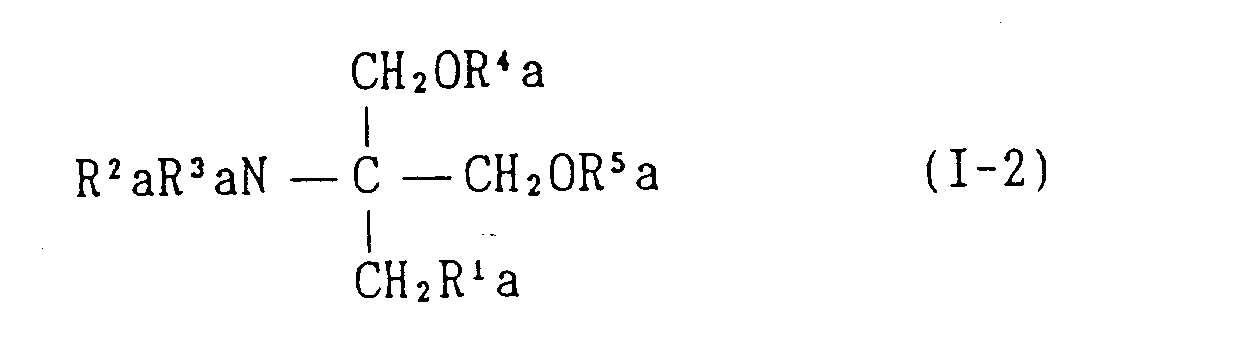
wherein
wherein the optionally substituted phenyl and optionally substituted cycloalkyl may have a substituent selected from the group consisting of optionally substituted straight- or branched carbon chain which may have, in the chain, a bond, a hetero atom or a group selected from the group consisting of a double bond, a triple bond, oxygen, sulfur, sulfinyl, sulfonyl, -N(R6)- where R6 is hydrogen, alkyl, aralkyl, acyl or alkoxycarbonyl, carbonyl, optionally substituted phenylene and optionally substituted cycloalkylene; alkoxy, alkenyloxy, alkynyloxy, aralkyloxy, alkylenedioxy, acyl, alkylamino, alkylthio, acylamino, alkoxycarbonyl, alkoxycarbonylamino, acyloxy, alkylcarbamoyl, haloalkyl, nitro, halogen, amino, hydroxy, carboxy, optionally substituted phenyl, optionally substituted phenoxy and optionally substituted cycloalkyl; the optionally substituted carbon chain may have a substituent selected from the group consisting of alkoxy, alkenyloxy, alkynyloxy, aralkyloxy, alkylenedioxy, acyl, alkylamino, alkylthio, acylamino, alkoxycarbonyl, alkoxycarbonylamino, acyloxy, alkylcarbamoyl, haloalkyl, nitro, halogen, amino, hydroxy, carboxy, optionally substituted phenyl, optionally substituted phenoxy and optionally substituted cycloalkyl; and the aforementioned optionally substituted phenylene, optionally substituted cycloalkylene, optionally substituted phenyl, optionally substituted phenoxy and optionally substituted cycloalkyl may have a substituent selected from the group consisting of alkoxy, alkenyloxy, alkynyloxy, aralkyloxy, alkylenedioxy, acyl, alkylamino, alkylthio, acylamino, alkoxycarbonyl, alkoxycarbonylamino, acyloxy, alkylcarbamoyl, haloalkyl, nitro, halogen, amino, hydroxy and carboxy;
provided that when R1a is C1-C4 alkyl, the alkyl should be substituted and when R1a is furyl, phenyl or phenyl substituted by lower alkyl, lower alkoxy, chloro, hydroxy or amino, one of R2a and R3a is not methyl or ethyl; or a pharmaceutically acceptable salt thereof.

wherein
wherein the optionally substituted alkyl, optionally substituted alkenyl and optionally substituted alkynyl may have a substituent selected from the group consisting of alkoxy, alkenyloxy, alkynyloxy, aralkyloxy, acyl, alkylamino, alkylthio, acylamino, alkoxycarbonyl, alkoxycarbonylamino, acyloxy, alkylcarbamoyl, nitro, halogen, amino, hydroxy, carboxy, optionally substituted phenyl and optionally substituted cycloalkyl; and the aforementioned optionally substituted phenyl and optionally substituted cycloalkyl may have 1 to 3 substituents selected from the group consisting of alkyl, alkenyl, alkynyl, alkoxy, alkenyloxy, alkynyloxy, aralkyloxy, acyl, alkylamino, alkylthio, acylamino, alkoxycarbonyl, alkoxycarbonylamino, acyloxy, alkylcarbamoyl, haloalkyl, nitro, halogen, amino, hydroxy and carboxy; provided that when Rlb is C1-C4 alkyl, the alkyl should be substituted and when Rlb is furyl, phenyl or phenyl substituted by lower alkyl, lower alkoxy, chloro, hydroxy or amino, one of R2b and R3b is not methyl or ethyl; or a pharmaceutically acceptable salt thereof.

wherein

wherein

wherein

wherein
wherein the alkyl moiety may have, in the carbon chain, a bond or a hetero atom selected from the group consisting of a double bond, a triple bond, oxygen, sulfur, sulfinyl, sulfonyl, -N(R6)- where R6 is hydrogen, alkyl, aralkyl, acyl or alkoxycarbonyl, and carbonyl, and may have, as a substituent, alkoxy, alkenyloxy, alkynyloxy, aralkyloxy, acyl, alkylamino, alkylthio, acylamino, alkoxycarbonyl, alkoxycarbonylamino, acyloxy, alkylcarbamoyl, nitro, halogen, amino, hydroxy or carboxy; and the substituted phenylalkyl, substituted cycloalkylalkyl, substituted heteroarylalkyl and substituted heterocyclic alkyl may have a substituent selected from the group consisting of alkyl, alkoxy, alkenyloxy, alkynyloxy, aralkyloxy, haloaralkyloxy, aralkyloxyalkyl, phenoxyalkyl, phenoxyalkoxy, alkylenedioxy, acyl, alkylamino, alkylthio, acylamino, alkoxycarbonyl, alkoxycarbonylamino, acyloxy, alkylcarbamoyl, haloalkyl, haloalkoxy, nitro, halogen, amino, hydroxy and carboxy; or a pharmaceutically acceptable salt thereof.

wherein
wherein the alkyl moiety may have, in the carbon chain, a bond or a hetero atom selected from the group consisting of a double bond, a triple bond, oxygen, sulfur, sulfinyl, sulfonyl, -N(R6)- where R6 is hydrogen, alkyl, aralkyl, acyl or alkoxycarbonyl, and carbonyl, and may have, as a substituent, alkoxy, alkenyloxy, alkynyloxy, aralkyloxy, acyl, alkylamino, alkylthio, acylamino, alkoxycarbonyl, alkoxycarbonylamino, acyloxy, alkylcarbamoyl, nitro, halogen, amino, hydroxy or carboxy; or a pharmaceutically acceptable salt thereof.
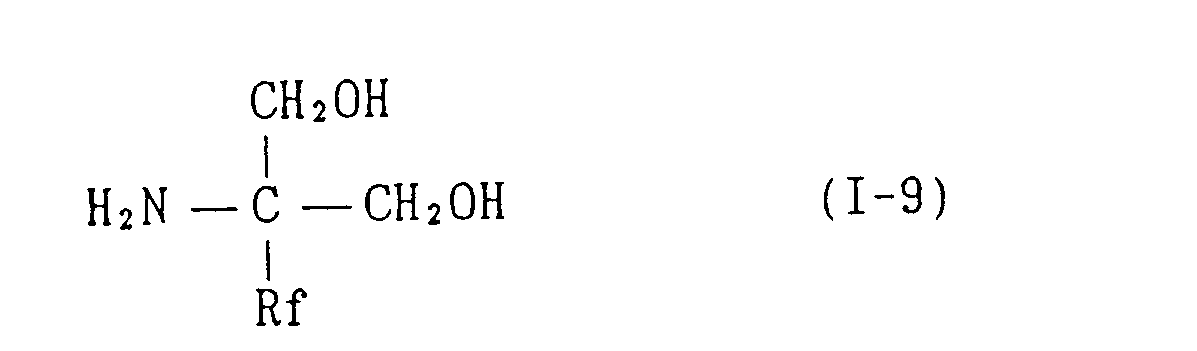
wherein
wherein the alkyl moiety may have, in the carbon chain, a substituent selected from the group consisting of alkoxy, alkenyloxy, alkynyloxy, aralkyloxy, acyl, alkylamino, alkylthio, acylamino, alkoxycarbonyl, alkoxycarbonylamino, acyloxy, alkylcarbamoyl, nitro, halogen, amino, hydroxy and carboxy; or a pharmaceutically acceptable salt thereof.

wherein

wherein

wherein
wherein the alkyl moiety of phenylalkyl may be substituted by hydroxy, or a pharmaceutically acceptable salt thereof.
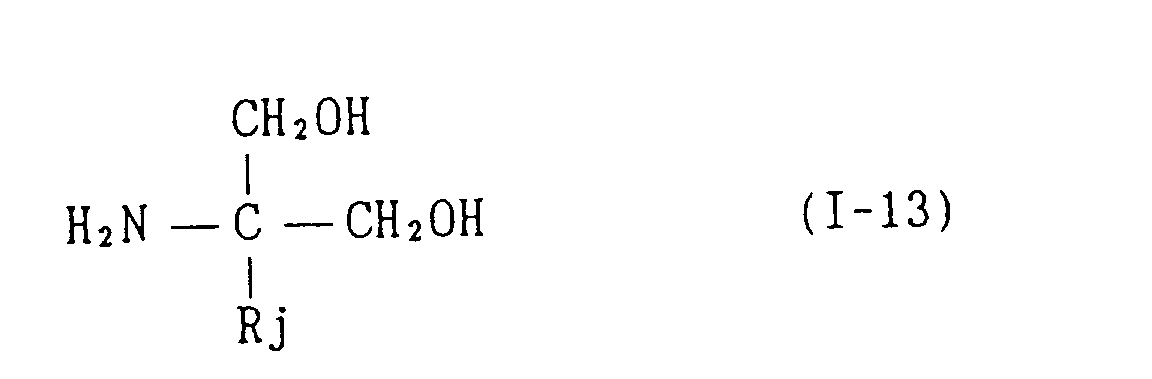
wherein

wherein
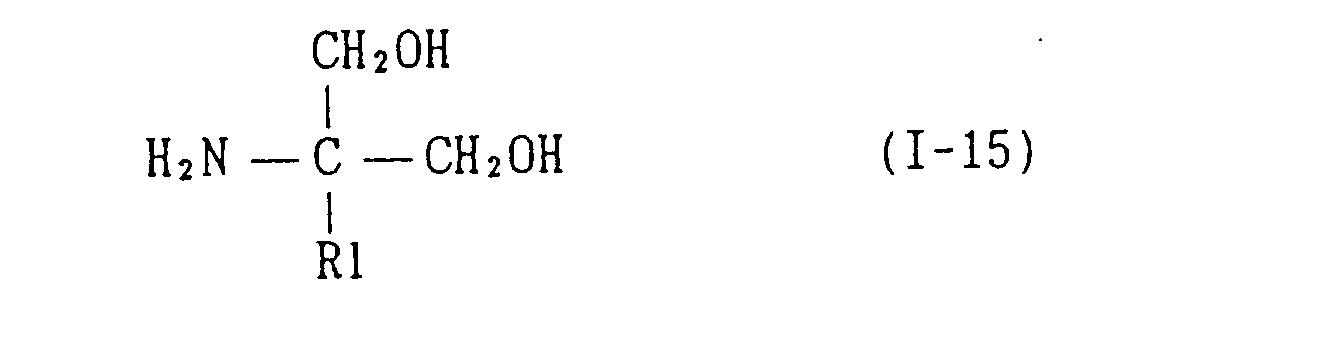
wherein
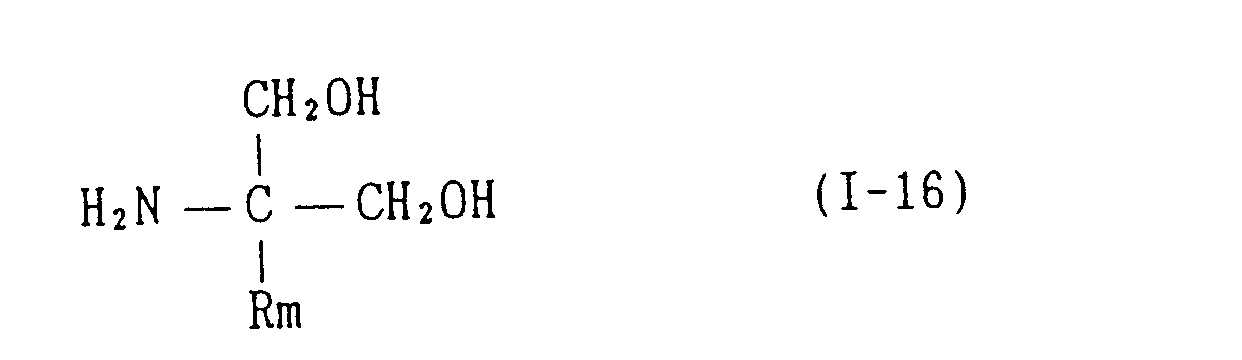
wherein

wherein

wherein

wherein

wherein

wherein
wherein the optionally substituted straight- or branched carbon chain may have a substituent selected from the group consisting of alkoxy, alkenyloxy, alkynyloxy, aralkyloxy, alkylenedioxy, acyl, alkylamino, alkylthio, acylamino, alkoxycarbonyl, alkoxycarbonylamino, acyloxy, alkylcarbamoyl, haloalkyl, haloalkoxy, nitro, halogen, amino, hydroxyimino, hydroxy, carboxy, optionally substituted aryl, optionally substituted aryloxy, optionally substituted cycloalkyl, optionally substituted heteroaryl and an alicycle thereof; and the aforementioned optionally substituted arylene, optionally substituted cycloalkylene, optionally substituted heteroarylene, an alicycle thereof, optionally substituted aryl, optionally substituted aryloxy, optionally substituted cycloalkyl, optionally substituted heteroaryl and an alicycle thereof may have a substituent selected from the group consisting of alkoxy, alkenyloxy, alkynyloxy, aralkyloxy, alkylenedioxy, acyl, alkylamino, alkylthio, acylamino, alkoxycarbonyl, alkoxycarbonylamino, acyloxy, alkylcarbamoyl, haloalkyl, haloalkoxy, nitro, halogen, amino, hydroxy and carboxy; or a pharmaceutically acceptable salt thereof.

wherein

wherein
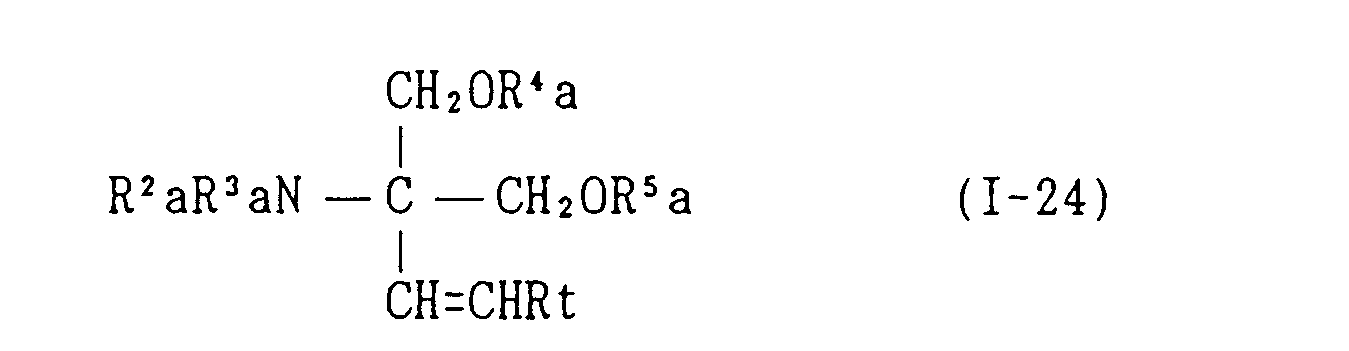
wherein
wherein the optionally substituted straight- or branched carbon chain may have a substituent selected from the group consisting of alkoxy, alkenyloxy, alkynyloxy, aralkyloxy, alkylenedioxy, acyl, alkylamino, alkylthio, acylamino, alkoxycarbonyl, alkoxycarbonylamino, acyloxy, alkylcarbamoyl, haloalkyl, haloalkoxy, nitro, halogen, amino, hydroxy, carboxy, optionally substituted aryl, optionally substituted aryloxy, optionally substituted cycloalkyl, optionally substituted heteroaryl and an alicycle thereof; and the aforementioned optionally substituted arylene, optionally substituted cycloalkylene, optionally substituted heteroarylene, an alicycle thereof, optionally substituted aryl, optionally substituted aryloxy, optionally substituted cycloalkyl, optionally substituted heteroaryl and an alicycle thereof may have a substituent selected from the group consisting of alkoxy, alkenyloxy, alkynyloxy, aralkyloxy, alkylenedioxy, acyl, alkylamino, alkylthio, acylamino, alkoxycarbonyl, alkoxycarbonylamino, acyloxy, alkylcarbamoyl, haloalkyl, haloalkoxy, nitro, halogen, amino, hydroxy and carboxy; or a pharmaceutically acceptable salt thereof.

wherein

wherein
wherein the optionally substituted aryl, optionally substituted cycloalkyl, optionally substituted heteroaryl and an alicycle thereof may have a substituent selected from the group consisting of alkyl, alkoxy, alkenyloxy, alkynyloxy, aralkyloxy, alkylenedioxy, acyl, alkylamino, alkylthio, acylamino, alkoxycarbonyl, alkoxycarbonylamino, acyloxy, alkylcarbamoyl, haloalkyl, haloalkoxy, nitro, halogen, amino, hydroxy and carboxy; or a pharmaceutically acceptable salt thereof.

wherein

wherein
wherein the optionally substituted straight- or branched carbon chain may have a substituent selected from the group consisting of alkoxy, alkenyloxy, alkynyloxy, aralkyloxy, alkylenedioxy, acyl, alkylamino, alkylthio, acylamino, alkoxycarbonyl, alkoxycarbonylamino, acyloxy, alkylcarbamoyl, haloalkyl, haloalkoxy, nitro, halogen, amino, hydroxyimino, hydroxy, carboxy, optionally substituted aryl, optionally substituted aryloxy, optionally substituted cycloalkyl, optionally substituted heteroaryl and an alicycle thereof; the aforementioned optionally substituted arylene, optionally substituted cycloalkylene, optionally substituted heteroarylene and an alicycle thereof may have a substituent selected from the group consisting of alkoxy, alkenyloxy, alkynyloxy, aralkyloxy, alkylenedioxy, acyl, alkylamino, alkylthio, acylamino, alkoxycarbonyl, alkoxycarbonylamino, acyloxy, alkylcarbamoyl, haloalkyl, haloalkoxy, nitro, halogen, amino, hydroxy and carboxy; and the optionally substituted aryl, optionally substituted aryloxy, optionally substituted cycloalkyl, optionally substituted heteroaryl and an alicycle thereof may have a substituent selected from the group consisting of alkyl, alkoxy, alkenyloxy, alkynyloxy, aralkyloxy, alkylenedioxy, acyl, alkylamino, alkylthio, acylamino, alkoxycarbonyl, alkoxycarbonylamino, acyloxy, alkylcarbamoyl, haloalkyl, haloalkoxy, nitro, halogen, amino, hydroxy and carboxy; or a pharmaceutically acceptable salt thereof.
Applications Claiming Priority (5)
| Application Number | Priority Date | Filing Date | Title |
|---|---|---|---|
| JP28328192 | 1992-10-21 | ||
| JP283281/92 | 1992-10-21 | ||
| JP17942793 | 1993-07-20 | ||
| JP179427/93 | 1993-07-20 | ||
| PCT/JP1993/001515 WO1994008943A1 (en) | 1992-10-21 | 1993-10-18 | 2-amino-1,3-propanediol compound and immunosuppressant |
Publications (3)
| Publication Number | Publication Date |
|---|---|
| EP0627406A1 true EP0627406A1 (en) | 1994-12-07 |
| EP0627406A4 EP0627406A4 (en) | 1995-04-12 |
| EP0627406B1 EP0627406B1 (en) | 1998-10-28 |
Family
ID=26499282
Family Applications (1)
| Application Number | Title | Priority Date | Filing Date |
|---|---|---|---|
| EP93923035A Expired - Lifetime EP0627406B1 (en) | 1992-10-21 | 1993-10-18 | 2-amino-1,3-propanediol compound and immunosuppressant |
Country Status (12)
| Country | Link |
|---|---|
| US (3) | US5604229A (en) |
| EP (1) | EP0627406B1 (en) |
| JP (1) | JP2579602B2 (en) |
| KR (1) | KR0155015B1 (en) |
| AT (1) | ATE172711T1 (en) |
| CA (1) | CA2126337C (en) |
| CY (2) | CY2215B1 (en) |
| DE (2) | DE122011100012I1 (en) |
| DK (1) | DK0627406T3 (en) |
| ES (1) | ES2126658T3 (en) |
| LU (1) | LU91832I2 (en) |
| WO (1) | WO1994008943A1 (en) |
Cited By (68)
| Publication number | Priority date | Publication date | Assignee | Title |
|---|---|---|---|---|
| WO1998022100A3 (en) * | 1996-11-19 | 1998-06-25 | Ciba Geigy Ag | New use for 1,3-propanediol derivatives |
| WO2000027798A1 (en) * | 1998-11-11 | 2000-05-18 | Novartis Ag | Production of 2-amino-2-[2-(4-c2-20-alkyl-phenyl)ethyl]propane-1,3-diols |
| WO2000053569A1 (en) * | 1999-03-11 | 2000-09-14 | Hangzhou Zhongmei Huadong Pharmaceutical Co. Ltd. | Method for preparing 2-2[(4-alkylphenyl)-ethyl]-2-amino-propanediol and intermediates useful in such preparation |
| US6214873B1 (en) | 1997-04-04 | 2001-04-10 | Welfide Corporation | 2-aminopropane-1,3-diol compounds, medicinal use thereof, and intermediates in synthesizing the same |
| US6277888B1 (en) | 1997-02-27 | 2001-08-21 | Welfide Corporation | Drug composition |
| WO2002067915A1 (en) * | 2001-02-22 | 2002-09-06 | Novartis Ag | Use of accelerated lymphocyte homing agents for the manufacture of a medicament for the treatment of delayed graft function |
| US6476004B1 (en) | 1996-07-18 | 2002-11-05 | Mitsubishi Pharma Corporation | Pharmaceutical composition |
| WO2002076995A3 (en) * | 2001-03-26 | 2003-02-13 | Novartis Ag | 2-amino-propanol derivatives |
| EP1207882A4 (en) * | 1999-07-30 | 2003-03-19 | Vertex Pharma | Acyclic and cyclic amine derivatives |
| WO2003035068A1 (en) * | 2001-10-23 | 2003-05-01 | Novartis Ag | Macrolides containing pharmaceutical compositions |
| WO2003099192A2 (en) | 2002-05-27 | 2003-12-04 | Novartis Ag | Bis-aromatic alkanols |
| WO2004024673A1 (en) * | 2002-09-13 | 2004-03-25 | Novartis Ag | Amino-propanol derivatives |
| WO2004010987A3 (en) * | 2002-07-24 | 2004-04-15 | Novartis Ag | Use of s1p receptor agonists in heart diseases |
| EP1484057A1 (en) * | 2003-06-06 | 2004-12-08 | Aventis Pharma Deutschland GmbH | Use of 2-amino-1-3-propanediol derivatives for the manufacture of a medicament for the treatment of various types of pain |
| WO2005040091A1 (en) * | 2003-10-15 | 2005-05-06 | Novartis Ag | Aminoalkanol derivatives |
| WO2005105146A1 (en) * | 2004-05-03 | 2005-11-10 | Novartis Ag | Combinations comprising a s1p receptor agonist and a jak3 kinase inhibitor |
| WO2006010630A1 (en) * | 2004-07-30 | 2006-02-02 | Novartis Ag | Compound formulations of 2-amino-1, 3-propanediol compounds |
| WO2006058316A1 (en) | 2004-11-29 | 2006-06-01 | Novartis Ag | Dosage regimen of an s1p receptor agonist |
| US7064217B2 (en) | 2001-01-30 | 2006-06-20 | University Of Virginia Patent Foundation | Agonists and antagonists of sphingosine-1-phosphate receptors |
| EP1797892A1 (en) | 2003-09-03 | 2007-06-20 | Novartis AG | Use of modified cyclosporins for the treatment of HCV disorders |
| EP1944026A2 (en) | 2002-05-16 | 2008-07-16 | Novartis AG | Use of EDG receptor binding agents in cancer |
| EP2008650A2 (en) | 2003-04-08 | 2008-12-31 | Novartis AG | Solid oral composition comprising a S 1 P receptor agonist and a sugar alcohol |
| EP1961734A4 (en) * | 2005-12-15 | 2009-03-25 | Mitsubishi Tanabe Pharma Corp | AMINO COMPOUND AND USE THEREOF FOR MEDICAL APPLICATIONS |
| US7524887B2 (en) | 2003-06-06 | 2009-04-28 | Sanofi-Aventis Deutschland Gmbh | 2-amino-1,3-propanediol compounds for the treatment of acute pain |
| WO2009155475A1 (en) * | 2008-06-20 | 2009-12-23 | Novartis Ag | Paediatric compositions for treating1 multiple sclerosis |
| WO2010045580A1 (en) | 2008-10-17 | 2010-04-22 | Exelixis, Inc. | Sphingosine-1-phosphate receptor antagonists |
| RU2391094C2 (en) * | 2002-09-24 | 2010-06-10 | Новартис Аг | Application of s1p receptor agonist and method of treatment, alleviation or retardation of optic neuritis or demyelinating diseases progression |
| WO2010075239A1 (en) | 2008-12-22 | 2010-07-01 | Novartis Ag | Dosage regimen for a s1p receptor agonist |
| EP2216019A2 (en) | 2005-03-04 | 2010-08-11 | Novartis AG | Ophthalmic uses of S1P receptor modulators |
| WO2010097371A1 (en) * | 2009-02-24 | 2010-09-02 | Novartis Ag | Ceramide-analogous metabolites |
| WO2010115981A1 (en) | 2009-04-10 | 2010-10-14 | Novartis Ag | 7-azadispiro [3.0.4.1] decane-8-carboxamides as hepatitis c virus inhibitors |
| WO2010116248A1 (en) | 2009-04-10 | 2010-10-14 | Novartis Ag | Organic compounds and their uses |
| US20100267675A1 (en) * | 2007-10-12 | 2010-10-21 | Colleen Ruegger | Compositions Comprising Sphingosine 1 Phosphate (S1P) Receptor Modulators |
| US7868009B2 (en) | 2005-01-31 | 2011-01-11 | Merck Serono, S.A. | N-hydroxyamide derivatives and use thereof |
| US7910617B2 (en) | 2004-02-24 | 2011-03-22 | Sankyo Company, Limited | Method for suppressing the number of peripheral blood lymphocytes using an amino alcohol compound |
| WO2011041145A2 (en) | 2009-09-29 | 2011-04-07 | Novartis Ag | Method and system for accessing patient data |
| US7973039B2 (en) | 2004-12-21 | 2011-07-05 | Merck Serono Sa | Sulfonyl amino cyclic derivatives and use thereof |
| EP2351560A1 (en) | 2005-01-04 | 2011-08-03 | Novartis AG | Treatment Of HCV infections with FTY720 |
| RU2428180C2 (en) * | 2005-08-09 | 2011-09-10 | Новартис Аг | Liquid compositions |
| WO2011131370A1 (en) | 2010-04-22 | 2011-10-27 | Ratiopharm Gmbh | Melt-granulated fingolimod |
| WO2011131368A2 (en) | 2010-04-22 | 2011-10-27 | Ratiopharm Gmbh | A method of preparing an oral dosage form comprising fingolimod |
| WO2011131369A1 (en) | 2010-04-22 | 2011-10-27 | Ratiopharm Gmbh | Fingolimod in the form of a solid solution |
| US8071300B2 (en) | 2006-08-04 | 2011-12-06 | Daiichi Sankyo Company, Limited | Drug-phosphorylating enzyme |
| US8129361B2 (en) | 2007-06-14 | 2012-03-06 | Mitsubishi Tanabe Pharma Corporation | Amine compound and pharmaceutical use thereof |
| WO2012041405A1 (en) | 2010-10-01 | 2012-04-05 | Synthon B.V. | Process for making fingolimod |
| WO2012041358A1 (en) | 2010-10-01 | 2012-04-05 | Synthon B.V. | Process for making fingolimod hydrochloride crystals |
| WO2012048235A1 (en) | 2010-10-08 | 2012-04-12 | Novartis Ag | Vitamin e formulations of sulfamide ns3 inhibitors |
| US8178083B2 (en) | 2005-09-01 | 2012-05-15 | Ares Trading, S.A. | Treatment of optic neuritis |
| WO2012080641A1 (en) | 2010-12-13 | 2012-06-21 | Centre National De La Recherche Scientifique - Cnrs - | S1p receptor agonists and use thereof in treating hiv infections |
| WO2012089238A1 (en) | 2010-12-28 | 2012-07-05 | Synthon Bv | Process for making fingolimod hydrochloride crystals |
| EP2505589A1 (en) | 2011-04-01 | 2012-10-03 | Johann Wolfgang Goethe-Universität Frankfurt am Main | Novel sphingolipid heterocyclic compounds as modulators of sphingolipid signaling and uses thereof |
| EP2518079A2 (en) | 2006-04-11 | 2012-10-31 | Novartis AG | HCV/HIV inhibitors and their uses |
| WO2013082299A1 (en) * | 2011-11-29 | 2013-06-06 | Als Therapy Development Institute | Targeting of t-lymphocytes to treat amyotrophic lateral sclerosis |
| WO2013091704A1 (en) | 2011-12-22 | 2013-06-27 | Synthon Bv | Pharmaceutical composition comprising fingolimod |
| US8519006B2 (en) | 2003-12-19 | 2013-08-27 | Novartis Ag | Use of sphingosine-1 phosphate (S1P) receptor agonists for the treatment of brain degenerative diseases |
| US8530522B2 (en) | 2008-11-11 | 2013-09-10 | Novartis Ag | Organic compounds |
| AU2013100531B4 (en) * | 2008-11-11 | 2013-11-28 | Novartis Ag | Crystalline forms of fingolimod HCL |
| WO2014011083A2 (en) | 2012-07-11 | 2014-01-16 | Алла Хем, Ллс | Pharmaceutical composition having improved flowability, medicinal agent, and method for producing and using same |
| US8680146B2 (en) | 2008-11-11 | 2014-03-25 | Novartis Ag | Organic compounds |
| US8766005B2 (en) | 2009-07-24 | 2014-07-01 | Ratiopharm Gmbh | Process for producing fingolimod salts |
| US8962891B2 (en) | 2007-11-08 | 2015-02-24 | Hadasit Medical Research Services & Development Limited | Synthetic analogs of sphingolipids |
| EP3103448A2 (en) | 2006-09-26 | 2016-12-14 | Novartis Ag | Pharmaceutical compositions comprising an s1p modulator |
| US9657043B2 (en) | 2012-04-23 | 2017-05-23 | Mitsubishi Tanabe Pharma Corporation | Amine compound and use thereof for medical purposes |
| US10251867B2 (en) | 2008-03-17 | 2019-04-09 | Actelion Pharmaceuticals Ltd. | Dosing regimen for a selective S1P1 receptor agonist |
| US10391066B2 (en) * | 2012-10-19 | 2019-08-27 | Texas Tech University System | Compositions and methods for the treatment of Parkinson's disease |
| EP3797765A1 (en) | 2006-06-27 | 2021-03-31 | Novartis AG | S1p receptor modulators for treating multiple sclerosis |
| CN113072471A (en) * | 2021-03-02 | 2021-07-06 | 四川美大康华康药业有限公司 | Lifeiste intermediate and preparation method thereof |
| WO2021209563A1 (en) | 2020-04-16 | 2021-10-21 | Som Innovation Biotech, S.A. | Compounds for use in the treatment of viral infections by respiratory syndrome-related coronavirus |
Families Citing this family (97)
| Publication number | Priority date | Publication date | Assignee | Title |
|---|---|---|---|---|
| US5948820A (en) * | 1994-08-22 | 1999-09-07 | Yoshitomi Pharmaceutical Industries, Ltd. | Benzene compound and pharmaceutical use thereof |
| DE69524962T4 (en) * | 1994-08-22 | 2003-08-28 | Mitsubishi Pharma Corp., Osaka | BENZENE DERIVATIVES AND THEIR MEDICAL USE |
| WO1997024112A1 (en) * | 1995-12-28 | 1997-07-10 | Yoshitomi Pharmaceutical Industries, Ltd. | External preparation |
| JP2002241272A (en) * | 1996-07-18 | 2002-08-28 | Mitsubishi Pharma Corp | Pharmaceutical formulation composition |
| JPH11209277A (en) * | 1998-01-19 | 1999-08-03 | Yoshitomi Pharmaceut Ind Ltd | Pharmaceutical composition |
| WO1999001420A1 (en) * | 1997-07-03 | 1999-01-14 | Taito Co., Ltd. | Process for the preparation of 2-aminomalonic acid derivatives and intermediates used in the process |
| JPH1180026A (en) * | 1997-09-02 | 1999-03-23 | Yoshitomi Pharmaceut Ind Ltd | Novel immunosuppressants, methods of use and methods of identification thereof |
| JP4627356B2 (en) * | 1999-06-30 | 2011-02-09 | 昭 松森 | Drugs for preventing or treating viral myocarditis |
| RU2233839C1 (en) * | 2000-07-13 | 2004-08-10 | Санкио Компани, Лимитед | Derivatives of aminoalcohols, pharmaceutical composition, method for prophylaxis or treatment, intermediate compounds and method for preparing intermediate compounds |
| CZ200350A3 (en) | 2000-07-13 | 2003-05-14 | Sankyo Company Limited | Aminoalcohol derivatives |
| CN100415735C (en) * | 2000-07-13 | 2008-09-03 | 三共株式会社 | Amino Alcohol Derivatives |
| WO2002018395A1 (en) | 2000-08-31 | 2002-03-07 | Merck & Co., Inc. | Phosphate derivatives as immunoregulatory agents |
| EP1361872A4 (en) * | 2000-10-03 | 2004-05-19 | Univ Virginia | NOVEL LYSOPHOSPHATIDIC ACID RECEPTOR AGONISTS AND ANTAGONISTS |
| ES2322442T3 (en) * | 2001-06-08 | 2009-06-22 | Novartis Ag | TREATMENT OR PROFILAXIS OF THE REJECTION OF INSULIN CELL PRODUCTION CELLS. |
| GB0117921D0 (en) * | 2001-07-23 | 2001-09-12 | Novartis Ag | Organic compounds |
| CA2450073C (en) | 2001-07-25 | 2017-08-29 | Biomarin Pharmaceutical Inc. | Compositions and methods for modulating blood-brain barrier transport |
| KR100913269B1 (en) * | 2001-09-27 | 2009-08-21 | 교린 세이야꾸 가부시키 가이샤 | Diaryl sulfide derivatives, salts thereof and immunosuppressive agents using the same |
| JP4152884B2 (en) * | 2001-09-27 | 2008-09-17 | 杏林製薬株式会社 | Diaryl ether derivatives and their addition salts and immunosuppressants |
| MXPA04006709A (en) * | 2002-01-11 | 2004-10-04 | Sankyo Co | Amino alcohol derivative or phosphonic acid derivative and medicinal composition containing these. |
| EP1469863A2 (en) * | 2002-01-18 | 2004-10-27 | Merck & Co., Inc. | Selective s1p1/edg1 receptor agonists |
| US20040058894A1 (en) * | 2002-01-18 | 2004-03-25 | Doherty George A. | Selective S1P1/Edg1 receptor agonists |
| AU2003233119A1 (en) | 2002-05-08 | 2003-11-11 | Neuronova Ab | Modulation of neural stem cells with s1p or lpa receptor agonists |
| JP4571497B2 (en) | 2002-09-19 | 2010-10-27 | 杏林製薬株式会社 | Amino alcohol derivatives and their addition salts and immunosuppressants |
| US20060270730A1 (en) * | 2003-08-07 | 2006-11-30 | Andreas Katopodis | Histone deacetylase inhibitors as immunosuppressants |
| WO2005014525A2 (en) * | 2003-08-12 | 2005-02-17 | Mitsubishi Pharma Corporation | Bi-aryl compound having immunosuppressive activity |
| AU2004268455B2 (en) | 2003-08-29 | 2009-12-17 | Ono Pharmaceutical Co., Ltd. | Compound capable of binding S1P receptor and pharmaceutical use thereof |
| EP1750722A4 (en) * | 2004-05-06 | 2010-03-10 | Univ Virginia | NOVEL SELECTIVE ANTAGONISTS OF LYSOPHOSPHATIDE ACID RECEPTOR |
| EP1768662A2 (en) | 2004-06-24 | 2007-04-04 | Novartis Vaccines and Diagnostics, Inc. | Small molecule immunopotentiators and assays for their detection |
| CN101905023B (en) * | 2004-07-16 | 2012-07-11 | 杏林制药株式会社 | Method of effectively using medicine and method concerning prevention of side effect |
| JP4919374B2 (en) * | 2004-07-29 | 2012-04-18 | 第一三共株式会社 | Pharmaceutical composition as an immunosuppressant |
| TW200611687A (en) * | 2004-07-29 | 2006-04-16 | Sankyo Co | Pharmaceutical compositions used for immunosuppressant |
| BRPI0514316A (en) * | 2004-08-13 | 2008-06-10 | Praecis Pharm Inc | methods and compositions for modulating sphingosine-1-phosphate (s1p) receptor activity |
| US20060223866A1 (en) * | 2004-08-13 | 2006-10-05 | Praecis Pharmaceuticals, Inc. | Methods and compositions for modulating sphingosine-1-phosphate (S1P) receptor activity |
| PL1806338T3 (en) * | 2004-10-12 | 2016-07-29 | Kyorin Seiyaku Kk | Process for producing 2-amino-2-[2-[4-(3-benzyloxyphenylthio)-2-chlorophenyl[ethyl]-1,3-propanediol hydrochloride and hydrates thereof. and intermediates the production thereof |
| AU2006212866A1 (en) * | 2005-02-08 | 2006-08-17 | Novartis Ag | Antilymphocyte antibody induction by combination of an S1P receptor agonist/modulator and of immunosuppressive drugs |
| EP2671508B1 (en) | 2005-04-28 | 2020-09-16 | Proteus Digital Health, Inc. | Pharma-informatics system |
| TWI418350B (en) * | 2005-06-24 | 2013-12-11 | Sankyo Co | Use of pharmaceutical compositions comprising ppar modulator |
| WO2007022718A1 (en) * | 2005-08-25 | 2007-03-01 | Chunde Liu | Alkyl aryl alkyl alcohols, their derivations and preparation process thereof |
| SI1932522T1 (en) * | 2005-10-07 | 2012-08-31 | Kyorin Seiyaku Kk | Therapeutic agent for liver disease containing 2-amino-1,3-propanediol derivative as active ingredient |
| CN1310869C (en) * | 2005-11-22 | 2007-04-18 | 江苏吴中苏药医药开发有限责任公司 | 2-amido-2-[2-(4-alkylphenyl)ethyl]-1,3-methyl glycol preparation method |
| TWI389683B (en) * | 2006-02-06 | 2013-03-21 | Kyorin Seiyaku Kk | A therapeutic agent for an inflammatory bowel disease or an inflammatory bowel disease treatment using a 2-amino-1,3-propanediol derivative as an active ingredient |
| EP2017257B1 (en) | 2006-04-28 | 2014-08-06 | Mitsubishi Tanabe Pharma Corporation | 2-aminobutanol compound and use thereof for medical purposes |
| WO2007129473A1 (en) * | 2006-05-09 | 2007-11-15 | Daiichi Sankyo Company, Limited | Bicyclic aryl derivative |
| EP2017263A4 (en) | 2006-05-09 | 2011-11-30 | Daiichi Sankyo Co Ltd | LOWER CARBOXYLIC ACID DERIVATIVE OF HETEROARYLAMIDE |
| RU2430925C2 (en) * | 2006-08-08 | 2011-10-10 | Киорин Фармасьютикал Ко., Лтд. | Aminophosphate derivative and s1p receptor modulator containing said derivative as active ingredient |
| CA2659599C (en) | 2006-08-08 | 2014-06-17 | Kyorin Pharmaceutical Co., Ltd. | Amino alcohol derivative and immunosuppressive agent having same as an active ingredient |
| JP2010503710A (en) | 2006-09-18 | 2010-02-04 | ラプトール ファーマシューティカル インコーポレイテッド | Treatment of liver damage by administration of receptor-related protein (RAP) conjugates |
| US20090082471A1 (en) * | 2007-09-26 | 2009-03-26 | Protia, Llc | Deuterium-enriched fingolimod |
| AR070950A1 (en) * | 2007-11-01 | 2010-05-19 | Acucela Inc | COMPOUNDS DERIVED FROM AMINA, PHARMACEUTICAL COMPOSITIONS OF THEM, INHIBITING PRODUCTION COMPOUNDS OF 11-CIS-RETINOL AND METHODS TO TREAT DISEASES AND OPHTHALMIC DISORDERS |
| JP5452237B2 (en) | 2008-02-07 | 2014-03-26 | 杏林製薬株式会社 | Therapeutic or prophylactic agent for inflammatory bowel disease comprising an amino alcohol derivative as an active ingredient |
| AU2009226975B2 (en) * | 2008-03-19 | 2012-09-06 | Novartis Ag | Process for the preparation of 2-amino-2- [2- (4-C3-C21-alkyl-phenyl)ethyl] propane-1, 3-diols |
| JP5451746B2 (en) * | 2008-04-16 | 2014-03-26 | アンガス ケミカル カンパニー | Nitrated hydrocarbons, derivatives and processes for their production |
| US8519199B2 (en) * | 2008-04-16 | 2013-08-27 | Angus Chemical Company | Process for the manufacture of nitropropanes |
| CA2739901A1 (en) * | 2008-10-17 | 2010-04-22 | Akaal Pharma Pty Ltd | S1p receptors modulators |
| AR074062A1 (en) * | 2008-10-31 | 2010-12-22 | Lexicon Pharmaceuticals Inc | S1P RECEIVER AGONISTS FOR THE TREATMENT OF BRAIN MALARIA AND PHARMACEUTICAL FORM |
| WO2010087244A1 (en) * | 2009-01-30 | 2010-08-05 | 第一三共株式会社 | Cyclic amino alcohol compound |
| KR20180114970A (en) | 2009-05-06 | 2018-10-19 | 라보라토리 스킨 케어, 인크. | Dermal delivery compositions comprising active agent-calcium phosphate particle complexes and methods of using the same |
| CA2780859A1 (en) * | 2009-12-10 | 2011-06-16 | Novartis Ag | Fty720 halogenated derivatives |
| US20120077778A1 (en) | 2010-09-29 | 2012-03-29 | Andrea Bourdelais | Ladder-Frame Polyether Conjugates |
| US8735627B2 (en) | 2010-10-28 | 2014-05-27 | Mapi Pharma Ltd. | Intermediate compounds and process for the preparation of fingolimod |
| WO2012071524A1 (en) | 2010-11-24 | 2012-05-31 | Ratiopharm Gmbh | Arylsulfonate salts of fingolimod and processes for preparation thereof |
| WO2012070059A1 (en) | 2010-11-25 | 2012-05-31 | Shilpa Medicare Limited | Fingolimod polymorphs and their processes |
| SG191286A1 (en) | 2011-01-07 | 2013-07-31 | Novartis Ag | Immunosuppressant formulations |
| US8673308B2 (en) | 2011-02-23 | 2014-03-18 | Als Therapy Development Institute | Targeting of CD8+ T-lymphocytes to treat neurodegenerative diseases |
| AR085749A1 (en) | 2011-04-01 | 2013-10-23 | Novartis Ag | FORMULATIONS |
| EP2702034A4 (en) | 2011-04-29 | 2015-03-25 | Reddys Lab Ltd Dr | Preparation of fingolimod and its salts |
| CA3141978A1 (en) | 2011-06-23 | 2012-12-27 | Ablynx Nv | Techniques for predicting, detecting and reducing aspecific protein interference in assays involving immunoglobulin single variable domains |
| HK1198467A1 (en) | 2011-08-03 | 2015-05-08 | Zhongmin MA | Treatment of type 2 diabetes with fty720 |
| US9345791B2 (en) * | 2011-08-19 | 2016-05-24 | Westfaelische Wilhelms-Universitaet Muenster | Ligands for targeting of S1P receptors for in vivo imaging and treatment of diseases |
| SG11201401330YA (en) * | 2011-10-12 | 2014-05-29 | Teva Pharma | Treatment of multiple sclerosis with combination of laquinimod and fingolimod |
| EP2609912A1 (en) | 2011-12-30 | 2013-07-03 | Deva Holding Anonim Sirketi | Pharmaceutical combination of fingolimod and nabiximols |
| EP2804605A4 (en) * | 2012-01-20 | 2015-07-08 | Acucela Inc | SUBSTITUTED HETEROCYCLIC COMPOUNDS FOR THE TREATMENT OF DISEASE |
| EP2807143B1 (en) * | 2012-01-25 | 2017-08-30 | Glenmark Generics Limited | Process for preparation of fingolimod |
| CZ2012406A3 (en) * | 2012-06-15 | 2013-12-27 | Zentiva, K.S. | A method for producing a fingolimod based on aziridine ring opening |
| CN103539683A (en) * | 2012-07-17 | 2014-01-29 | 广东东阳光药业有限公司 | New crystal form of drug for treating sclerosis and preparation method thereof |
| NZ630290A (en) | 2013-01-17 | 2016-09-30 | Shilpa Medicare Ltd | Process for preparation of fingolimod and its salts |
| WO2014111949A1 (en) | 2013-01-21 | 2014-07-24 | Natco Pharma Limited | Intermediates and process for the preparation of high purity fingolimod hydrochloride |
| AU2014224237B2 (en) * | 2013-03-05 | 2017-07-20 | Biocon Limited | A process for the preparation of 2-amino-1,3-propane diol compounds and salts thereof |
| JP6294872B2 (en) | 2013-04-26 | 2018-03-14 | 国立大学法人京都大学 | Pharmaceutical composition for inhibiting or reducing the formation and / or increase of cerebral aneurysms |
| EP3027174B1 (en) | 2013-07-29 | 2019-07-24 | Aizant Drug Research Solutions Private Limited | Pharmaceutical compositions of fingolimod |
| WO2015053879A1 (en) | 2013-10-11 | 2015-04-16 | Teikoku Pharma Usa, Inc. | Sphingosine-1-phosphate receptor agonist iontophoretic devices and methods of using the same |
| EP3054933A4 (en) | 2013-10-11 | 2017-03-15 | Teikoku Pharma USA, Inc. | Topical sphingosine-1-phosphate receptor agonist formulations and methods of using the same |
| WO2015066515A1 (en) | 2013-11-01 | 2015-05-07 | Receptos, Inc. | Selective sphingosine 1 phosphate receptor modulators and combination therapy therewith |
| IN2013MU03696A (en) | 2013-11-25 | 2015-07-31 | Emcure Pharmaceuticals Ltd | |
| WO2015107548A1 (en) | 2014-01-07 | 2015-07-23 | Emcure Pharmaceuticals Limited | Improved fingolimod process |
| WO2016042493A1 (en) | 2014-09-19 | 2016-03-24 | Aizant Drug Research Pvt. Ltd | Pharmaceutical compositions of fingolimod |
| WO2016118515A1 (en) | 2015-01-20 | 2016-07-28 | Handa Pharmaceuticals, Llc | Stable solid fingolimod dosage forms |
| WO2016135644A1 (en) | 2015-02-26 | 2016-09-01 | Novartis Ag | Treatment of autoimmune disease in a patient receiving additionally a beta-blocker |
| US20180250235A1 (en) | 2015-09-18 | 2018-09-06 | Sanovel Ilac Sanayi Ve Ticaret A.S. | Fingolimod capsule composition |
| US11434200B2 (en) | 2017-03-09 | 2022-09-06 | Novartis Ag | Solid forms comprising an oxime ether compound and a coformer, compositions and methods of use thereof |
| EP3419607B1 (en) | 2017-03-29 | 2019-11-20 | Deva Holding Anonim Sirketi | Stable formulations of fingolimod |
| US10865163B2 (en) | 2017-12-20 | 2020-12-15 | The University Of Toledo | Carbon dioxide as a directing group for C—H functionalization reactions involving Lewis basic amines, alcohols, thiols, and phosphines for the synthesis of compounds |
| WO2020165672A1 (en) | 2019-02-15 | 2020-08-20 | Shivalik Rasayan Limited | Process for preparation of highly pure fingolimod hydrochloride |
| CN113956276B (en) * | 2020-07-20 | 2025-09-05 | 中国科学院上海有机化学研究所 | A polysubstituted alkylarylazo compound, its synthesis method and application |
| WO2022031625A1 (en) * | 2020-08-01 | 2022-02-10 | Cornell University | Chelation crosslinked polymers, methods of making same, and uses thereof |
| CN113577059B (en) * | 2021-08-02 | 2022-05-20 | 山东大学齐鲁医院(青岛) | Active medicine for treating infantile asthma |
| WO2025083549A1 (en) | 2023-10-16 | 2025-04-24 | Sun Pharma Advanced Research Company Limited | Methods and combinations of inhibitors of il-23 pathway and modulators of s1p signaling pathway for the treatment of autoimmune disorders |
Family Cites Families (22)
| Publication number | Priority date | Publication date | Assignee | Title |
|---|---|---|---|---|
| US3062839A (en) * | 1959-06-11 | 1962-11-06 | American Home Prod | Dihydroxy-tertiary-butylamines |
| US3426042A (en) * | 1963-09-26 | 1969-02-04 | Union Carbide Corp | Organic cyclic carbonates |
| US3432603A (en) * | 1964-10-19 | 1969-03-11 | Sterling Drug Inc | Process for weight reduction |
| US3324043A (en) * | 1964-10-19 | 1967-06-06 | Sterling Drug Inc | Anti-oxidant compositions and process |
| US3660488A (en) * | 1965-07-16 | 1972-05-02 | Phillips Petroleum Co | 2-halo-alkylene- and -cyclopentylene-2-amino-propane 1 3-diols |
| US3928572A (en) * | 1971-02-11 | 1975-12-23 | Ayerst Mckenna & Harrison | Myriocin and process of preparation |
| JPS5154565A (en) * | 1974-11-02 | 1976-05-13 | Toa Eiyo Kagaku Kogyo Kk | |
| JPS6050186B2 (en) * | 1980-07-15 | 1985-11-07 | 三井東圧化学株式会社 | Method for producing 2-mercaptoethylamine hydrohalide salts |
| JPS6050783B2 (en) * | 1981-03-20 | 1985-11-11 | 三井東圧化学株式会社 | Method for producing S,S'-bis(2-aminoethyl)dithiocarbonate dihydrohalide derivative |
| JPS58101108A (en) * | 1981-12-11 | 1983-06-16 | Unitika Ltd | Chelate-forming group-containing phenolic resin, its manufacture and adsorption treatment using the same |
| DE3420308C2 (en) * | 1983-05-31 | 1998-06-18 | Toyo Boseki | Polyurethane composition with improved coloring properties |
| US4910218A (en) * | 1985-11-22 | 1990-03-20 | Burroughs Wellcome Co. | Phenanthro[2,3-6]thiophene derivatives, pharmaceutical compositions and use |
| JPS632904A (en) * | 1986-06-20 | 1988-01-07 | Ss Pharmaceut Co Ltd | Plant growth regulator |
| JPS6343140A (en) * | 1986-08-08 | 1988-02-24 | Fuji Photo Film Co Ltd | Processing method for silver halide color photographic sensitive material |
| EP0410176A1 (en) * | 1989-07-07 | 1991-01-30 | Yoshitomi Pharmaceutical Industries, Ltd. | 2-Aminopentanoic acid compounds and their use as immunosuppressants |
| JPH049309A (en) * | 1990-04-25 | 1992-01-14 | Kao Corp | Cosmetic |
| EP0450527A3 (en) * | 1990-03-30 | 1991-10-30 | Kao Corporation | N-tris(hydroxymethyl)methylfatty acid amides and cosmetic compositions containing same |
| JPH0469320A (en) * | 1990-07-06 | 1992-03-04 | Kao Corp | Hair cosmetic |
| JP2868887B2 (en) * | 1990-11-06 | 1999-03-10 | 花王株式会社 | Medicated cosmetics |
| JPH04224548A (en) * | 1990-12-26 | 1992-08-13 | Kao Corp | Production of fatty acid amide |
| AU664178B2 (en) * | 1991-03-19 | 1995-11-09 | Vithal J. Rajadhyaksha | Compositions and method comprising aminoalcohol derivatives as membrane penetration enhancers |
| JPH0578294A (en) * | 1991-09-19 | 1993-03-30 | Kao Corp | Branched fatty acid amide, its production and intermediate for producing the same |
-
1993
- 1993-10-18 KR KR1019940702174A patent/KR0155015B1/en not_active Expired - Lifetime
- 1993-10-18 DK DK93923035T patent/DK0627406T3/en active
- 1993-10-18 DE DE201112100012 patent/DE122011100012I1/en active Pending
- 1993-10-18 ES ES93923035T patent/ES2126658T3/en not_active Expired - Lifetime
- 1993-10-18 WO PCT/JP1993/001515 patent/WO1994008943A1/en not_active Ceased
- 1993-10-18 AT AT93923035T patent/ATE172711T1/en active
- 1993-10-18 EP EP93923035A patent/EP0627406B1/en not_active Expired - Lifetime
- 1993-10-18 CA CA002126337A patent/CA2126337C/en not_active Expired - Lifetime
- 1993-10-18 DE DE69321823T patent/DE69321823T2/en not_active Expired - Lifetime
- 1993-10-18 JP JP6509845A patent/JP2579602B2/en not_active Expired - Lifetime
- 1993-10-18 US US08/244,942 patent/US5604229A/en not_active Expired - Lifetime
-
1996
- 1996-10-02 US US08/725,890 patent/US5719176A/en not_active Expired - Lifetime
-
1997
- 1997-08-14 US US08/911,602 patent/US5952316A/en not_active Expired - Lifetime
-
2000
- 2000-04-27 CY CY0000010A patent/CY2215B1/en unknown
-
2011
- 2011-06-30 CY CY2011006C patent/CY2011006I2/en unknown
- 2011-06-30 LU LU91832C patent/LU91832I2/en unknown
Cited By (144)
| Publication number | Priority date | Publication date | Assignee | Title |
|---|---|---|---|---|
| US6476004B1 (en) | 1996-07-18 | 2002-11-05 | Mitsubishi Pharma Corporation | Pharmaceutical composition |
| US6486209B2 (en) | 1996-11-19 | 2002-11-26 | Novartis Ag | Use for 1,3-propanediol derivatives |
| CN1293876C (en) * | 1996-11-19 | 2007-01-10 | 诺瓦提斯公司 | New application of 1,3-propylene glycol derivative |
| AU728420B2 (en) * | 1996-11-19 | 2001-01-11 | Novartis Ag | New use for 1,3-propanediol derivatives |
| WO1998022100A3 (en) * | 1996-11-19 | 1998-06-25 | Ciba Geigy Ag | New use for 1,3-propanediol derivatives |
| US6274629B1 (en) | 1996-11-19 | 2001-08-14 | Novartis Ag | Use for 1,3-propanediol derivatives |
| EP1312359A3 (en) * | 1996-11-19 | 2004-01-02 | Novartis AG | Use for 1,3-propanediol compounds |
| EP2030614A1 (en) * | 1997-02-27 | 2009-03-04 | Novartis AG | Pharmaceutical Composition comprising 2-amino-2-[2-(4-octylphenyl)ethyl]propane-1,3-diol and a lecithin |
| US6277888B1 (en) | 1997-02-27 | 2001-08-21 | Welfide Corporation | Drug composition |
| EP1319651A3 (en) * | 1997-04-04 | 2004-01-02 | Mitsubishi Pharma Corporation | 2-Aminopropane-1,3-diol compound, pharmaceutical use thereof and synthetic intermediates therefor |
| US6214873B1 (en) | 1997-04-04 | 2001-04-10 | Welfide Corporation | 2-aminopropane-1,3-diol compounds, medicinal use thereof, and intermediates in synthesizing the same |
| USRE39072E1 (en) | 1997-04-04 | 2006-04-18 | Mitsubishi Pharma Corporation | 2-aminopropane-1,3-diol compounds, medicinal use thereof, and intermediates in synthesizing the same |
| US7026522B2 (en) | 1998-11-11 | 2006-04-11 | Novartis Ag | Production of 2-amino-2-[2- (4-alkylphenyl) ethyl] propane-1, 3-diols |
| WO2000027798A1 (en) * | 1998-11-11 | 2000-05-18 | Novartis Ag | Production of 2-amino-2-[2-(4-c2-20-alkyl-phenyl)ethyl]propane-1,3-diols |
| US6605744B2 (en) | 1998-11-11 | 2003-08-12 | Novartis Ag | Production of 2-amin-2-[2-(2-(40-C2-20-alkyl-phenyl)ethyl]propane-1,3-diols |
| EP1457478A3 (en) * | 1998-11-11 | 2004-12-22 | Novartis AG | Production of 2-amino-2-[2-(4-alkyl-phenyl)ethyl]propane-1,3-diols |
| WO2000053569A1 (en) * | 1999-03-11 | 2000-09-14 | Hangzhou Zhongmei Huadong Pharmaceutical Co. Ltd. | Method for preparing 2-2[(4-alkylphenyl)-ethyl]-2-amino-propanediol and intermediates useful in such preparation |
| EP1207882A4 (en) * | 1999-07-30 | 2003-03-19 | Vertex Pharma | Acyclic and cyclic amine derivatives |
| US7064217B2 (en) | 2001-01-30 | 2006-06-20 | University Of Virginia Patent Foundation | Agonists and antagonists of sphingosine-1-phosphate receptors |
| WO2002067915A1 (en) * | 2001-02-22 | 2002-09-06 | Novartis Ag | Use of accelerated lymphocyte homing agents for the manufacture of a medicament for the treatment of delayed graft function |
| US7326801B2 (en) | 2001-03-26 | 2008-02-05 | Novartis Ag | 2-amino-propanol derivatives |
| WO2002076995A3 (en) * | 2001-03-26 | 2003-02-13 | Novartis Ag | 2-amino-propanol derivatives |
| US7259170B2 (en) | 2001-10-23 | 2007-08-21 | Novartis Ag | Macrolides containing pharmaceutical compositions |
| JP2005509634A (en) * | 2001-10-23 | 2005-04-14 | ノバルティス アクチエンゲゼルシャフト | Pharmaceutical composition comprising macrolide |
| WO2003035068A1 (en) * | 2001-10-23 | 2003-05-01 | Novartis Ag | Macrolides containing pharmaceutical compositions |
| EP1944026A2 (en) | 2002-05-16 | 2008-07-16 | Novartis AG | Use of EDG receptor binding agents in cancer |
| EP1955696A2 (en) | 2002-05-16 | 2008-08-13 | Novartis AG | Use of EDG receptor binding agents in cancer |
| WO2003099192A2 (en) | 2002-05-27 | 2003-12-04 | Novartis Ag | Bis-aromatic alkanols |
| WO2003099192A3 (en) * | 2002-05-27 | 2004-03-18 | Novartis Ag | Bis-aromatic alkanols |
| US7169817B2 (en) | 2002-05-27 | 2007-01-30 | Irm Llc | Bis-aromatic alkanols |
| WO2004010987A3 (en) * | 2002-07-24 | 2004-04-15 | Novartis Ag | Use of s1p receptor agonists in heart diseases |
| US7910626B2 (en) | 2002-07-24 | 2011-03-22 | Novartis Ag | Use of S1P receptor agonists in heart diseases |
| WO2004024673A1 (en) * | 2002-09-13 | 2004-03-25 | Novartis Ag | Amino-propanol derivatives |
| US7612238B2 (en) | 2002-09-13 | 2009-11-03 | Novartis Ag | Amino-propanol derivatives |
| EP2251007A2 (en) | 2002-09-24 | 2010-11-17 | Novartis AG | Sphingosine-1-phosphate (S1P) receptor agonists for use in the treatment of demyelinating diseases |
| RU2391094C2 (en) * | 2002-09-24 | 2010-06-10 | Новартис Аг | Application of s1p receptor agonist and method of treatment, alleviation or retardation of optic neuritis or demyelinating diseases progression |
| EP2255798A2 (en) | 2002-09-24 | 2010-12-01 | Novartis AG | Sphingosine-1-phosphate receptor agonists for use in the treatment of optic neuritis |
| EP2008650A2 (en) | 2003-04-08 | 2008-12-31 | Novartis AG | Solid oral composition comprising a S 1 P receptor agonist and a sugar alcohol |
| EP2769713A1 (en) | 2003-04-08 | 2014-08-27 | Novartis AG | Solid oral composition comprising a S1P receptor agonist and a sugar alcohol |
| EP2316431A1 (en) | 2003-04-08 | 2011-05-04 | Novartis AG | Solid oral composition comprising a S1P receptor agonist and a sugar alcohol |
| US8324283B2 (en) | 2003-04-08 | 2012-12-04 | Novartis Ag | Solid pharmaceutical compositions comprising a SIP receptor agonist and a sugar alcohol |
| RU2475236C2 (en) * | 2003-04-08 | 2013-02-20 | Новартис Аг | Method for preparing pharmaceutical composition |
| AT501681B1 (en) * | 2003-04-08 | 2012-04-15 | Novartis Ag | SOLID ORAL PHARMACEUTICAL COMPOSITION CONTAINING 2-AMINO-1,3-PROPANDIOLE |
| RU2475237C2 (en) * | 2003-04-08 | 2013-02-20 | Новартис Аг | Oral pharmaceutical composition |
| DE202004021680U1 (en) | 2003-04-08 | 2010-04-22 | Novartis Ag | Solid pharmaceutical composition |
| EP1484057A1 (en) * | 2003-06-06 | 2004-12-08 | Aventis Pharma Deutschland GmbH | Use of 2-amino-1-3-propanediol derivatives for the manufacture of a medicament for the treatment of various types of pain |
| WO2004110421A1 (en) * | 2003-06-06 | 2004-12-23 | Sanofi-Aventis Deutschland Gmbh | Use of 2-amino-1-3-propanediol derivatives for the manufacture of a medicament for the treatment of various types of pain |
| US7524887B2 (en) | 2003-06-06 | 2009-04-28 | Sanofi-Aventis Deutschland Gmbh | 2-amino-1,3-propanediol compounds for the treatment of acute pain |
| EP1797892A1 (en) | 2003-09-03 | 2007-06-20 | Novartis AG | Use of modified cyclosporins for the treatment of HCV disorders |
| AU2004283844B2 (en) * | 2003-10-15 | 2009-03-26 | Novartis Ag | Aminoalkanol derivatives |
| EP3018121A1 (en) * | 2003-10-15 | 2016-05-11 | Novartis AG | Aminoalkanol derivatives |
| US9415024B2 (en) | 2003-10-15 | 2016-08-16 | Novartis Ag | Aminoalkanol derivatives |
| AU2009200915B2 (en) * | 2003-10-15 | 2012-03-01 | Novartis Ag | Aminoalkanol derivatives |
| WO2005040091A1 (en) * | 2003-10-15 | 2005-05-06 | Novartis Ag | Aminoalkanol derivatives |
| US8519006B2 (en) | 2003-12-19 | 2013-08-27 | Novartis Ag | Use of sphingosine-1 phosphate (S1P) receptor agonists for the treatment of brain degenerative diseases |
| US7910617B2 (en) | 2004-02-24 | 2011-03-22 | Sankyo Company, Limited | Method for suppressing the number of peripheral blood lymphocytes using an amino alcohol compound |
| AU2005237254B2 (en) * | 2004-05-03 | 2010-02-04 | Novartis Ag | Combinations comprising a S1P receptor agonist and a JAK3 kinase inhibitor |
| EP2363149A1 (en) | 2004-05-03 | 2011-09-07 | Novartis AG | Combinations comprising a S1P receptor agonist and a JAK3 kinase inhibitor |
| WO2005105146A1 (en) * | 2004-05-03 | 2005-11-10 | Novartis Ag | Combinations comprising a s1p receptor agonist and a jak3 kinase inhibitor |
| RU2415678C2 (en) * | 2004-05-03 | 2011-04-10 | Новартис Аг | Combinations which include receptor s1p agonist and jak3 kinase inhibitor |
| RU2402324C2 (en) * | 2004-07-30 | 2010-10-27 | Новартис Аг | 2-amino-1,3-propanediol compositions |
| EP2829268A1 (en) * | 2004-07-30 | 2015-01-28 | Novartis AG | Compound formulations of 2-amino-1,3-propanediol compounds |
| WO2006010630A1 (en) * | 2004-07-30 | 2006-02-02 | Novartis Ag | Compound formulations of 2-amino-1, 3-propanediol compounds |
| CN1993115B (en) * | 2004-07-30 | 2011-12-28 | 诺瓦提斯公司 | Compound formulations of 2-amino-1, 3-propanediol compounds |
| EP2384749A1 (en) | 2004-11-29 | 2011-11-09 | Novartis AG | Dosage regimen of an S1P receptor agonist |
| EP2359821A1 (en) | 2004-11-29 | 2011-08-24 | Novartis AG | Dosage regimen of an s1p receptor agonist |
| WO2006058316A1 (en) | 2004-11-29 | 2006-06-01 | Novartis Ag | Dosage regimen of an s1p receptor agonist |
| US7973039B2 (en) | 2004-12-21 | 2011-07-05 | Merck Serono Sa | Sulfonyl amino cyclic derivatives and use thereof |
| EP2351560A1 (en) | 2005-01-04 | 2011-08-03 | Novartis AG | Treatment Of HCV infections with FTY720 |
| US8198280B2 (en) | 2005-01-31 | 2012-06-12 | Merck Serono Sa | N-hydroxyamide derivatives and use thereof |
| US7868009B2 (en) | 2005-01-31 | 2011-01-11 | Merck Serono, S.A. | N-hydroxyamide derivatives and use thereof |
| EP2216019A3 (en) * | 2005-03-04 | 2010-11-17 | Novartis AG | Ophthalmic uses of S1P receptor modulators |
| EP2216019A2 (en) | 2005-03-04 | 2010-08-11 | Novartis AG | Ophthalmic uses of S1P receptor modulators |
| RU2428180C2 (en) * | 2005-08-09 | 2011-09-10 | Новартис Аг | Liquid compositions |
| US8178083B2 (en) | 2005-09-01 | 2012-05-15 | Ares Trading, S.A. | Treatment of optic neuritis |
| AU2006325931B2 (en) * | 2005-12-15 | 2012-09-06 | Mitsubishi Tanabe Pharma Corporation | Amine compound and use thereof for medical purposes |
| RU2433117C2 (en) * | 2005-12-15 | 2011-11-10 | Мицубиси Танабе Фарма Корпорейшн | Amine compound and its application in medicinal purposes |
| AU2006325931A8 (en) * | 2005-12-15 | 2012-09-20 | Mitsubishi Tanabe Pharma Corporation | Amine compound and use thereof for medical purposes |
| AU2006325931B8 (en) * | 2005-12-15 | 2012-09-20 | Mitsubishi Tanabe Pharma Corporation | Amine compound and use thereof for medical purposes |
| CN101346346B (en) * | 2005-12-15 | 2012-08-22 | 田边三菱制药株式会社 | Amine compound and use thereof for medical purposes |
| EP1961734A4 (en) * | 2005-12-15 | 2009-03-25 | Mitsubishi Tanabe Pharma Corp | AMINO COMPOUND AND USE THEREOF FOR MEDICAL APPLICATIONS |
| US8809304B2 (en) | 2005-12-15 | 2014-08-19 | Mitsubishi Tanabe Pharma Corporation | Amine compound and use thereof for medical purposes |
| EP2518079A2 (en) | 2006-04-11 | 2012-10-31 | Novartis AG | HCV/HIV inhibitors and their uses |
| EP3797765A1 (en) | 2006-06-27 | 2021-03-31 | Novartis AG | S1p receptor modulators for treating multiple sclerosis |
| US8071300B2 (en) | 2006-08-04 | 2011-12-06 | Daiichi Sankyo Company, Limited | Drug-phosphorylating enzyme |
| EP3103448A2 (en) | 2006-09-26 | 2016-12-14 | Novartis Ag | Pharmaceutical compositions comprising an s1p modulator |
| US8129361B2 (en) | 2007-06-14 | 2012-03-06 | Mitsubishi Tanabe Pharma Corporation | Amine compound and pharmaceutical use thereof |
| EP3733162A1 (en) | 2007-10-12 | 2020-11-04 | Novartis AG | Compositions comprising sphingosine 1 phosphate (s1p) receptor modulators |
| EP2465492A1 (en) | 2007-10-12 | 2012-06-20 | Novartis AG | Compositions comprising sphingosine I phosphate (sip) receptor modulators |
| EP3120833A1 (en) | 2007-10-12 | 2017-01-25 | Novartis Ag | Compositions comprising sphingosine 1 phosphate (s1p) receptor modulators |
| EP3733161A1 (en) | 2007-10-12 | 2020-11-04 | Novartis AG | Compositions comprising sphingosine 1 phosphate (s1p) receptor modulators |
| US9399066B2 (en) | 2007-10-12 | 2016-07-26 | Novartis Ag | Process for making compositions comprising sphingosine 1 phosphate (S1P) receptor modulators |
| US20100267675A1 (en) * | 2007-10-12 | 2010-10-21 | Colleen Ruegger | Compositions Comprising Sphingosine 1 Phosphate (S1P) Receptor Modulators |
| EP2653154A1 (en) | 2007-10-12 | 2013-10-23 | Novartis AG | Compositions comprising sphingosine 1 phosphate (S1P) receptor modulators |
| US8673918B2 (en) * | 2007-10-12 | 2014-03-18 | Novartis Ag | Compositions comprising sphingosine 1 phosphate (S1P) receptor modulators |
| US8962891B2 (en) | 2007-11-08 | 2015-02-24 | Hadasit Medical Research Services & Development Limited | Synthetic analogs of sphingolipids |
| US9340488B2 (en) | 2007-11-08 | 2016-05-17 | Hadasit Medical Research Services & Development Limited | Synthetic analogs of sphingolipids |
| US10251867B2 (en) | 2008-03-17 | 2019-04-09 | Actelion Pharmaceuticals Ltd. | Dosing regimen for a selective S1P1 receptor agonist |
| US10660880B2 (en) | 2008-03-17 | 2020-05-26 | Actelion Pharmaceuticals Ltd | Dosing regimen for a selective S1P1 agonist |
| WO2009155475A1 (en) * | 2008-06-20 | 2009-12-23 | Novartis Ag | Paediatric compositions for treating1 multiple sclerosis |
| CN104800196A (en) * | 2008-06-20 | 2015-07-29 | 诺华股份有限公司 | Paediatric compositions for treating1 multiple sclerosis |
| EP3011958A1 (en) | 2008-06-20 | 2016-04-27 | Novartis AG | Paediatric compositions for treating multiple sclerosis |
| EP3545953A1 (en) | 2008-06-20 | 2019-10-02 | Novartis AG | Paediatric compositions for treating1 multiple sclerosis |
| WO2010045580A1 (en) | 2008-10-17 | 2010-04-22 | Exelixis, Inc. | Sphingosine-1-phosphate receptor antagonists |
| US8530522B2 (en) | 2008-11-11 | 2013-09-10 | Novartis Ag | Organic compounds |
| AU2013100531B4 (en) * | 2008-11-11 | 2013-11-28 | Novartis Ag | Crystalline forms of fingolimod HCL |
| US8680146B2 (en) | 2008-11-11 | 2014-03-25 | Novartis Ag | Organic compounds |
| WO2010075239A1 (en) | 2008-12-22 | 2010-07-01 | Novartis Ag | Dosage regimen for a s1p receptor agonist |
| EP3120844A1 (en) | 2008-12-22 | 2017-01-25 | Novartis Ag | Dosage regimen for a s1p receptor agonist |
| EP3677260A1 (en) | 2008-12-22 | 2020-07-08 | Novartis AG | Dosage regimen for a s1p receptor agonist |
| EP2907511A1 (en) | 2008-12-22 | 2015-08-19 | Novartis AG | Dosage regimen for a s1p receptor agonist |
| EP3453387A1 (en) | 2008-12-22 | 2019-03-13 | Novartis AG | Dosage regimen for a s1p receptor agonist |
| EP3409274A1 (en) | 2008-12-22 | 2018-12-05 | Novartis AG | Dosage regimen for a s1p receptor agonist |
| EP4098256A1 (en) | 2008-12-22 | 2022-12-07 | Novartis AG | Dosage regimen for a s1p receptor agonist |
| US8673982B2 (en) | 2009-02-24 | 2014-03-18 | Novartis Ag | Ceramide-analogous metabolites |
| WO2010097371A1 (en) * | 2009-02-24 | 2010-09-02 | Novartis Ag | Ceramide-analogous metabolites |
| AU2010217605B2 (en) * | 2009-02-24 | 2012-07-26 | Novartis Ag | Ceramide-analogous metabolites |
| WO2010115981A1 (en) | 2009-04-10 | 2010-10-14 | Novartis Ag | 7-azadispiro [3.0.4.1] decane-8-carboxamides as hepatitis c virus inhibitors |
| WO2010116248A1 (en) | 2009-04-10 | 2010-10-14 | Novartis Ag | Organic compounds and their uses |
| US8766005B2 (en) | 2009-07-24 | 2014-07-01 | Ratiopharm Gmbh | Process for producing fingolimod salts |
| EP2896609A1 (en) | 2009-07-24 | 2015-07-22 | ratiopharm GmbH | Crystalline fingolimod citrate for the treatment of relapsing-remitting multiple sclerosis |
| WO2011041145A2 (en) | 2009-09-29 | 2011-04-07 | Novartis Ag | Method and system for accessing patient data |
| WO2011131369A1 (en) | 2010-04-22 | 2011-10-27 | Ratiopharm Gmbh | Fingolimod in the form of a solid solution |
| WO2011131370A1 (en) | 2010-04-22 | 2011-10-27 | Ratiopharm Gmbh | Melt-granulated fingolimod |
| WO2011131368A2 (en) | 2010-04-22 | 2011-10-27 | Ratiopharm Gmbh | A method of preparing an oral dosage form comprising fingolimod |
| WO2012041707A1 (en) | 2010-10-01 | 2012-04-05 | Synthon Bv | Process for making fingolimod |
| WO2012041358A1 (en) | 2010-10-01 | 2012-04-05 | Synthon B.V. | Process for making fingolimod hydrochloride crystals |
| WO2012041359A1 (en) | 2010-10-01 | 2012-04-05 | Synthon B.V. | Process for making fingolimod |
| WO2012041405A1 (en) | 2010-10-01 | 2012-04-05 | Synthon B.V. | Process for making fingolimod |
| EP2621889B1 (en) | 2010-10-01 | 2019-07-17 | Synthon BV | Process for making fingolimod hydrochloride crystals |
| WO2012048235A1 (en) | 2010-10-08 | 2012-04-12 | Novartis Ag | Vitamin e formulations of sulfamide ns3 inhibitors |
| WO2012080641A1 (en) | 2010-12-13 | 2012-06-21 | Centre National De La Recherche Scientifique - Cnrs - | S1p receptor agonists and use thereof in treating hiv infections |
| WO2012089238A1 (en) | 2010-12-28 | 2012-07-05 | Synthon Bv | Process for making fingolimod hydrochloride crystals |
| EP2658840B1 (en) | 2010-12-28 | 2019-07-03 | Synthon BV | Process for making fingolimod hydrochloride crystals |
| WO2012131096A1 (en) | 2011-04-01 | 2012-10-04 | Johann Wolfgang Goethe-Universität, Frankfurt Am Main | Novel heterocyclic compounds as modulators of sphingolipid signaling and uses thereof |
| EP2505589A1 (en) | 2011-04-01 | 2012-10-03 | Johann Wolfgang Goethe-Universität Frankfurt am Main | Novel sphingolipid heterocyclic compounds as modulators of sphingolipid signaling and uses thereof |
| US8946301B2 (en) | 2011-11-29 | 2015-02-03 | Als Therapy Development Institute | Targeting of T-lymphocytes to treat amyotrophic lateral sclerosis |
| WO2013082299A1 (en) * | 2011-11-29 | 2013-06-06 | Als Therapy Development Institute | Targeting of t-lymphocytes to treat amyotrophic lateral sclerosis |
| WO2013091704A1 (en) | 2011-12-22 | 2013-06-27 | Synthon Bv | Pharmaceutical composition comprising fingolimod |
| US9657043B2 (en) | 2012-04-23 | 2017-05-23 | Mitsubishi Tanabe Pharma Corporation | Amine compound and use thereof for medical purposes |
| WO2014011083A2 (en) | 2012-07-11 | 2014-01-16 | Алла Хем, Ллс | Pharmaceutical composition having improved flowability, medicinal agent, and method for producing and using same |
| US10391066B2 (en) * | 2012-10-19 | 2019-08-27 | Texas Tech University System | Compositions and methods for the treatment of Parkinson's disease |
| WO2021209563A1 (en) | 2020-04-16 | 2021-10-21 | Som Innovation Biotech, S.A. | Compounds for use in the treatment of viral infections by respiratory syndrome-related coronavirus |
| CN113072471A (en) * | 2021-03-02 | 2021-07-06 | 四川美大康华康药业有限公司 | Lifeiste intermediate and preparation method thereof |
Also Published As
| Publication number | Publication date |
|---|---|
| DE69321823T2 (en) | 1999-06-02 |
| CY2011006I1 (en) | 2016-12-14 |
| DK0627406T3 (en) | 1999-07-12 |
| ES2126658T3 (en) | 1999-04-01 |
| JP2579602B2 (en) | 1997-02-05 |
| CY2011006I2 (en) | 2016-12-14 |
| LU91832I2 (en) | 2011-08-30 |
| CA2126337C (en) | 2003-06-24 |
| DE69321823D1 (en) | 1998-12-03 |
| CA2126337A1 (en) | 1994-04-28 |
| WO1994008943A1 (en) | 1994-04-28 |
| EP0627406B1 (en) | 1998-10-28 |
| US5719176A (en) | 1998-02-17 |
| US5604229A (en) | 1997-02-18 |
| DE122011100012I1 (en) | 2011-10-20 |
| EP0627406A4 (en) | 1995-04-12 |
| US5952316A (en) | 1999-09-14 |
| CY2215B1 (en) | 2003-04-18 |
| ATE172711T1 (en) | 1998-11-15 |
| KR940703803A (en) | 1994-12-12 |
| KR0155015B1 (en) | 1998-12-01 |
| HK1013281A1 (en) | 1999-08-20 |
Similar Documents
| Publication | Publication Date | Title |
|---|---|---|
| EP0627406B1 (en) | 2-amino-1,3-propanediol compound and immunosuppressant | |
| JPWO1994008943A1 (en) | 2-amino-1,3-propanediol compounds and immunosuppressants | |
| JP3870419B2 (en) | Benzene compounds and their use as pharmaceuticals | |
| DE60216094T2 (en) | MODULATORS OF PEROXISOM PROLIFERATOR ACTIVATED RECEPTORS (PPAR) | |
| JPWO1996006068A1 (en) | Benzene compounds and their medicinal uses | |
| EP1537096B1 (en) | Derivatives of dioxane-2-alkyl carbamates, preparation method thereof and application of same in therapeutics | |
| EP0005848A1 (en) | N-Alkylated aminoalcohols and their salts, process for their preparation and pharmaceutical compositions containing them | |
| GB2305665A (en) | Selective ß3 agonists for the treatment of diabetes aand obesity | |
| WO1997047194A1 (en) | Substituted cyclopentane compounds useful as neuraminidase inhibitors | |
| JP2012515177A (en) | New eicosanoid derivatives | |
| US6495546B1 (en) | Propanolamine derivatives | |
| CA2552565C (en) | Aryloxyalkylcarbamate-type derivatives, preparation method thereof and use of same in therapeutics | |
| EP0025331A1 (en) | Cinnamic acid derivatives, their preparation, and pharmaceutical compositions containing them | |
| US9328083B2 (en) | 2-aminated methylene or 2-esterified methylene tanshinone derivatives, and preparation method and application thereof | |
| US20090264469A1 (en) | Novel dicarboxylic acid derivatives | |
| AU775861B2 (en) | 1-trifluoromethyl-4-hydroxy-7-piperidinyl-aminomethylchroman derivatives | |
| EP0693054B1 (en) | Cycloalkylhydroxyureas and their use as lipoxygenase inhibitors | |
| HK1013281B (en) | 2-amino-1, 3-propanediol compound and immunosuppressant | |
| US4450172A (en) | Antihypertensive polyhalohydroxyisopropyl phenylalka(e)noic acid esters of alkylaminohydroxypropyloxyphenylalkyl alcohols | |
| JPH07138214A (en) | Substituted amic acid derivative | |
| FR2662691A1 (en) | DICHLOROANILINE DERIVATIVE. | |
| JP2007008957A (en) | Benzene compounds and their use as pharmaceuticals | |
| JP2794341B2 (en) | Cycloalkylhydroxyureas and their use as lipoxygenase inhibitors | |
| FR2479194A1 (en) | NOVEL BENZYL ALCOHOL DERIVATIVE, PROCESS FOR THEIR PREPARATION AND APPLICATION TO PHARMACEUTICAL COMPOSITIONS | |
| EP1483236A1 (en) | Aminoalcohol derivatives as beta-3 adrenergic receptor agonists |
Legal Events
| Date | Code | Title | Description |
|---|---|---|---|
| PUAI | Public reference made under article 153(3) epc to a published international application that has entered the european phase |
Free format text: ORIGINAL CODE: 0009012 |
|
| 17P | Request for examination filed |
Effective date: 19940616 |
|
| AK | Designated contracting states |
Kind code of ref document: A1 Designated state(s): AT BE CH DE DK ES FR GB GR IE IT LI LU MC NL PT SE |
|
| A4 | Supplementary search report drawn up and despatched | ||
| AK | Designated contracting states |
Kind code of ref document: A4 Designated state(s): AT BE CH DE DK ES FR GB GR IE IT LI LU MC NL PT SE |
|
| 17Q | First examination report despatched |
Effective date: 19960730 |
|
| GRAG | Despatch of communication of intention to grant |
Free format text: ORIGINAL CODE: EPIDOS AGRA |
|
| GRAG | Despatch of communication of intention to grant |
Free format text: ORIGINAL CODE: EPIDOS AGRA |
|
| GRAH | Despatch of communication of intention to grant a patent |
Free format text: ORIGINAL CODE: EPIDOS IGRA |
|
| GRAH | Despatch of communication of intention to grant a patent |
Free format text: ORIGINAL CODE: EPIDOS IGRA |
|
| GRAH | Despatch of communication of intention to grant a patent |
Free format text: ORIGINAL CODE: EPIDOS IGRA |
|
| GRAA | (expected) grant |
Free format text: ORIGINAL CODE: 0009210 |
|
| AK | Designated contracting states |
Kind code of ref document: B1 Designated state(s): AT BE CH DE DK ES FR GB GR IE IT LI LU MC NL PT SE |
|
| REF | Corresponds to: |
Ref document number: 172711 Country of ref document: AT Date of ref document: 19981115 Kind code of ref document: T |
|
| REG | Reference to a national code |
Ref country code: CH Ref legal event code: EP |
|
| K1C1 | Correction of patent application (title page) published |
Effective date: 19941207 |
|
| RAP2 | Party data changed (patent owner data changed or rights of a patent transferred) |
Owner name: TAITO CO., LTD. Owner name: YOSHITOMI PHARMACEUTICAL INDUSTRIES, LTD. |
|
| REF | Corresponds to: |
Ref document number: 69321823 Country of ref document: DE Date of ref document: 19981203 |
|
| K2C1 | Correction of patent specification (title page) published |
Effective date: 19981028 |
|
| REG | Reference to a national code |
Ref country code: IE Ref legal event code: FG4D |
|
| ITF | It: translation for a ep patent filed | ||
| REG | Reference to a national code |
Ref country code: CH Ref legal event code: NV Representative=s name: A. BRAUN, BRAUN, HERITIER, ESCHMANN AG PATENTANWAE |
|
| NLT2 | Nl: modifications (of names), taken from the european patent patent bulletin |
Owner name: YOSHITOMI PHARMACEUTICAL INDUSTRIES, LTD. EN TAITO |
|
| ET | Fr: translation filed | ||
| REG | Reference to a national code |
Ref country code: ES Ref legal event code: FG2A Ref document number: 2126658 Country of ref document: ES Kind code of ref document: T3 |
|
| REG | Reference to a national code |
Ref country code: PT Ref legal event code: SC4A Free format text: AVAILABILITY OF NATIONAL TRANSLATION Effective date: 19990126 |
|
| REG | Reference to a national code |
Ref country code: DK Ref legal event code: T3 |
|
| PLBE | No opposition filed within time limit |
Free format text: ORIGINAL CODE: 0009261 |
|
| STAA | Information on the status of an ep patent application or granted ep patent |
Free format text: STATUS: NO OPPOSITION FILED WITHIN TIME LIMIT |
|
| 26N | No opposition filed | ||
| REG | Reference to a national code |
Ref country code: DE Ref legal event code: 8364 Ref document number: 69321823 Country of ref document: DE Kind code of ref document: A |
|
| REG | Reference to a national code |
Ref country code: AT Ref legal event code: UEP Ref document number: 172711 Country of ref document: AT Kind code of ref document: T |
|
| REG | Reference to a national code |
Ref country code: CH Ref legal event code: PFA Free format text: YOSHITOMI PHARMACEUTICAL INDUSTRIES, LTD.;TAITO CO., LTD. TRANSFER- TAITO CO., LTD.;WELFIDE CORPORATION |
|
| REG | Reference to a national code |
Ref country code: ES Ref legal event code: PC2A |
|
| REG | Reference to a national code |
Ref country code: DE Ref legal event code: 8327 Ref document number: 69321823 Country of ref document: DE Kind code of ref document: A Owner name: WELFIDE CORP., OSAKA, JP TAITO CO., LTD., TOKIO/TO |
|
| NLT1 | Nl: modifications of names registered in virtue of documents presented to the patent office pursuant to art. 16 a, paragraph 1 |
Owner name: WELFIDE CORPORATION |
|
| REG | Reference to a national code |
Ref country code: FR Ref legal event code: CD |
|
| REG | Reference to a national code |
Ref country code: PT Ref legal event code: TE4A Free format text: YOSHITOMI PHARMACEUTICAL INDUSTRIES, LTD. JP Effective date: 20010319 Ref country code: PT Ref legal event code: PD4A Free format text: WELFIDE CORPORATION JP Effective date: 20010319 |
|
| REG | Reference to a national code |
Ref country code: AT Ref legal event code: EEFA Ref document number: 172711 Country of ref document: AT Kind code of ref document: T |
|
| REG | Reference to a national code |
Ref country code: GB Ref legal event code: IF02 |
|
| REG | Reference to a national code |
Ref country code: CH Ref legal event code: PFA Free format text: TAITO CO., LTD.;WELFIDE CORPORATION TRANSFER- TAITO CO., LTD.;MITSUBISHI PHARMA CORPORATION |
|
| REG | Reference to a national code |
Ref country code: DE Ref legal event code: 8327 Ref document number: 69321823 Country of ref document: DE Owner name: SENJU PHARMACEUTICAL CO., LTD., OSAKA, JP Ref country code: DE Ref legal event code: 8327 Ref document number: 69321823 Country of ref document: DE Owner name: MITSUBISHI PHARMA CORP., OSAKA, JP |
|
| REG | Reference to a national code |
Ref country code: PT Ref legal event code: PD4A Free format text: MITSUBISHI PHARMA CORPORATION JP Effective date: 20030305 |
|
| REG | Reference to a national code |
Ref country code: FR Ref legal event code: CD |
|
| REG | Reference to a national code |
Ref country code: AT Ref legal event code: EEFA Ref document number: 172711 Country of ref document: AT Kind code of ref document: T |
|
| REG | Reference to a national code |
Ref country code: GB Ref legal event code: 732E |
|
| REG | Reference to a national code |
Ref country code: CH Ref legal event code: PUEA Owner name: MITSUBISHI PHARMA CORPORATION Free format text: TAITO CO., LTD.#7-5, NIHONBASHI-ODENMACHO, CHUO-KU#TOKYO 103 (JP) $ MITSUBISHI PHARMA CORPORATION#6-9, HIRANOMACHI 2-CHOME, CHUO-KU#OSAKA-SHI, OSAKA 541-0046 (JP) -TRANSFER TO- MITSUBISHI PHARMA CORPORATION#6-9, HIRANOMACHI 2-CHOME, CHUO-KU#OSAKA-SHI, OSAKA 541-0046 (JP) $ SHIN MITSUI SUGAR CO., LTD.#8-2, NIHONBASHI HONCHO 2-CHOME CHUO-KU#TOKYO (JP) Ref country code: CH Ref legal event code: PFA Owner name: MITSUBISHI PHARMA CORPORATION Free format text: MITSUBISHI PHARMA CORPORATION#6-9, HIRANOMACHI 2-CHOME, CHUO-KU#OSAKA-SHI, OSAKA 541-0046 (JP) $ SHIN MITSUI SUGAR CO., LTD.#8-2, NIHONBASHI HONCHO 2-CHOME CHUO-KU#TOKYO (JP) -TRANSFER TO- MITSUBISHI PHARMA CORPORATION#6-9, HIRANOMACHI 2-CHOME, CHUO-KU#OSAKA-SHI, OSAKA 541-0046 (JP) $ MITSUI SUGAR CO., LTD.#8-2, NIHONBASHI HONCHO 2-CHOME CHUO-KU#TOKYO (JP) |
|
| REG | Reference to a national code |
Ref country code: DE Ref legal event code: 8327 Ref document number: 69321823 Country of ref document: DE Owner name: MITSUI SUGAR CO., LTD., TOKIO/TOKYO, JP Ref country code: DE Ref legal event code: 8327 Ref document number: 69321823 Country of ref document: DE Owner name: MITSUBISHI PHARMA CORP., OSAKA, JP |
|
| REG | Reference to a national code |
Ref country code: FR Ref legal event code: TQ Ref country code: FR Ref legal event code: CD |
|
| REG | Reference to a national code |
Ref country code: AT Ref legal event code: EEIH Ref document number: 172711 Country of ref document: AT Kind code of ref document: T |
|
| REG | Reference to a national code |
Ref country code: ES Ref legal event code: PC2A |
|
| NLS | Nl: assignments of ep-patents |
Owner name: WELFIDE CORPORATION Effective date: 20051020 Owner name: MITSUI SUGAR CO., LTD Effective date: 20051020 |
|
| BECN | Be: change of holder's name |
Owner name: *MITSUI SUGAR CO. LTD Effective date: 20051205 Owner name: *WELFIDE CORP. Effective date: 20051205 |
|
| REG | Reference to a national code |
Ref country code: CH Ref legal event code: PFA Owner name: MITSUBISHI PHARMA CORPORATION Free format text: MITSUBISHI PHARMA CORPORATION#6-9, HIRANOMACHI 2-CHOME, CHUO-KU#OSAKA-SHI, OSAKA 541-0046 (JP) $ MITSUI SUGAR CO., LTD.#8-2, NIHONBASHI HONCHO 2-CHOME CHUO-KU#TOKYO (JP) -TRANSFER TO- MITSUBISHI PHARMA CORPORATION#6-9, HIRANOMACHI 2-CHOME, CHUO-KU#OSAKA-SHI, OSAKA 541-0046 (JP) $ MITSUI SUGAR CO., LTD.#8-2, NIHONBASHI HONCHO 2-CHOME CHUO-KU#TOKYO (JP) |
|
| REG | Reference to a national code |
Ref country code: PT Ref legal event code: PC4A Owner name: MITSUI SUGAR CO., LTD., JP Effective date: 20110223 Ref country code: PT Ref legal event code: PC4A Owner name: TANABE SEIYAKU CO. LTD., JP Effective date: 20110223 |
|
| REG | Reference to a national code |
Ref country code: NL Ref legal event code: SD Effective date: 20110225 Ref country code: GB Ref legal event code: 732E Free format text: REGISTERED BETWEEN 20110210 AND 20110216 |
|
| REG | Reference to a national code |
Ref country code: CH Ref legal event code: PFA Owner name: MITSUI SUGAR CO., LTD. Free format text: MITSUBISHI PHARMA CORPORATION#6-9, HIRANOMACHI 2-CHOME, CHUO-KU#OSAKA-SHI, OSAKA 541-0046 (JP) $ MITSUI SUGAR CO., LTD.#8-2, NIHONBASHI HONCHO 2-CHOME CHUO-KU#TOKYO (JP) -TRANSFER TO- MITSUI SUGAR CO., LTD.#8-2, NIHONBASHI HONCHO 2-CHOME CHUO-KU#TOKYO (JP) $ MITSUBISHI TANABE PHARMA CORPORATION#2-6-18, KITAHAMA CHUO-KU OSAKA-SHI#OSAKA 541-8505 (JP) |
|
| BECH | Be: change of holder |
Owner name: *MITSUI SUGAR CO. LTD Effective date: 20110331 Owner name: MITSUBISHI TANABE PHARMA CORP. Effective date: 20110331 |
|
| REG | Reference to a national code |
Ref country code: FR Ref legal event code: TQ Ref country code: FR Ref legal event code: CD Ref country code: FR Ref legal event code: CA |
|
| REG | Reference to a national code |
Ref country code: DE Ref legal event code: R081 Ref document number: 69321823 Country of ref document: DE Owner name: MITSUI SUGAR CO., LTD., 103-8423 TOKYO, JP Free format text: FORMER OWNERS: MITSUBISHI PHARMA CORP., OSAKA, JP; MITSUI SUGAR CO., LTD., 103-8423 TOKYO, CHUO-KU, JP Effective date: 20110302 Ref country code: DE Ref legal event code: R081 Ref document number: 69321823 Country of ref document: DE Owner name: MITSUBISHI TANABE PHARMA CORPORATION, 541-8505, JP Free format text: FORMER OWNERS: MITSUBISHI PHARMA CORP., OSAKA, JP; MITSUI SUGAR CO., LTD., 103-8423 TOKYO, CHUO-KU, JP Effective date: 20110302 Ref country code: DE Ref legal event code: R081 Ref document number: 69321823 Country of ref document: DE Owner name: MITSUBISHI TANABE PHARMA CORPORATION, JP Free format text: FORMER OWNER: MITSUBISHI PHARMA CORP., MITSUI SUGAR CO., LTD., , JP Effective date: 20110302 Ref country code: DE Ref legal event code: R081 Ref document number: 69321823 Country of ref document: DE Owner name: MITSUI SUGAR CO., LTD., JP Free format text: FORMER OWNER: MITSUBISHI PHARMA CORP., MITSUI SUGAR CO., LTD., , JP Effective date: 20110302 Ref country code: DE Ref legal event code: 8327 Ref document number: 69321823 Country of ref document: DE Owner name: MITSUI SUGAR CO., LTD., TOKIO/TOKYO, JP Ref country code: DE Ref legal event code: 8327 Ref document number: 69321823 Country of ref document: DE Owner name: MITSUBISHI TANABE PHARMA CORP., OSAKA, JP |
|
| REG | Reference to a national code |
Ref country code: AT Ref legal event code: EEIH Ref document number: 172711 Country of ref document: AT Kind code of ref document: T |
|
| REG | Reference to a national code |
Ref country code: ES Ref legal event code: PC2A Owner name: MITSUBISHI TANABE PHARMA CORPORATION Effective date: 20110527 |
|
| REG | Reference to a national code |
Ref country code: IT Ref legal event code: SPCF Ref document number: 501999900732904 Country of ref document: IT Free format text: PRODUCT NAME: FINGOLIMOD(GILENYA); AUTHORISATION NUMBER(S) AND DATE(S): EU/1/11/677/001-004, 20110317 Spc suppl protection certif: 132011901959713 Ref country code: FR Ref legal event code: CP Free format text: PRODUCT NAME: FINGOLIMOD ET SES SELS PHARMACEUTIQUEMENT ACCEPTABLES EN PARTICULIER SON CHLORHYDRATE; REGISTRATION NO/DATE: EU/1/11/677/001 20110317 Spc suppl protection certif: 11C0021 Filing date: 20110630 |
|
| REG | Reference to a national code |
Ref country code: NL Ref legal event code: KC1 Free format text: PRODUCT NAME: FINGOLIMOD EN FARMACEUTISCH AANVAARDBARE AFGELEIDEN DAARVAN, IN HET BIJZONDER FINGOLIMOD HYDROCHLORIDE; REGISTRATION NO/DATE: EU/1/11/677/001-004 20110317 Spc suppl protection certif: C300488 Filing date: 20110630 Extension date: 20181017 |
|
| REG | Reference to a national code |
Ref country code: CH Ref legal event code: SPCF Free format text: PRODUCT NAME: FINGOLIMOD; REGISTRATION NUMBER/DATE: SWISSMEDIC 60916 03.01.2011 Filing date: 20110630 |
|
| REG | Reference to a national code |
Ref country code: NL Ref legal event code: KC1 Free format text: PRODUCT NAME: FINGOLIMOD, DESGEWENST IN DE VORM VAN EEN FARMACEUTISCH AANVAARDBAAR ZOUT, IN HET BIJZONDER FINGOLIMOD HYDROCHLORIDE; REGISTRATION NO/DATE: EU/1/11/677/001-004 20110317 Spc suppl protection certif: C300488 Filing date: 20110630 Extension date: 20181017 |
|
| REG | Reference to a national code |
Ref country code: IT Ref legal event code: SPCG Ref document number: 501999900732904 Country of ref document: IT Free format text: PRODUCT NAME: FINGOLIMOD(GILENYA); AUTHORISATION NUMBER(S) AND DATE(S): EU/1/11/677/001-004, 20110317 Spc suppl protection certif: 132011901959713 Extension date: 20181018 |
|
| REG | Reference to a national code |
Ref country code: GB Ref legal event code: SPCX Free format text: THE FILING DETAILS SHOWN IN RESPECT OF SPC/GB11/026 LISTED IN JOURNAL NO. 6374 INCORRECTLY SHOWS THE PATENT NUMBER AS EP0062740, THE CORRECT NUMBER IS EP0627406. THE CORRECT PRODUCT DETAILS ARE 2-AMINO-2-(2-(4-OCTYLPHENYL)ETHYL)PROPANE-1,3-DIOL (SYNONOMOUS TO 2-AMINO-2-(2-(4-OCTYLPHENYL)ETHYL)-1,3-PROPANEDIOL) OR ITS SALTS OR OTHER DERIVATIVES CLAIMED IN EUROPEAN PATENT (UK) NO.0627406. THE INN IS FINGOLIMOD. Spc suppl protection certif: SPC/GB11/026 Extension date: 20181017 |
|
| REG | Reference to a national code |
Ref country code: IE Ref legal event code: SPCF Free format text: SPC020/2011: 20110630 Spc suppl protection certif: SPC020/2011 Filing date: 20110630 |
|
| REG | Reference to a national code |
Ref country code: FR Ref legal event code: CR Free format text: PRODUCT NAME: FINGOLIMOD ET SES SELS PHARMACEUTIQUEMENT ACCEPTABLES EN PARTICULIER SON CHLORHYDRATE; REGISTRATION NO/DATE IN FRANCE: EU/1/11/677/001 DU 20110317; REGISTRATION NO/DATE AT EEC: EU/1/11/677/001 DU 20110317 Spc suppl protection certif: 11C0021 Filing date: 20110630 |
|
| REG | Reference to a national code |
Ref country code: SE Ref legal event code: SPCF Free format text: PRODUCT NAME: FINGOLIMOD; REG. NO/DATE: EU/1/11/677/001-04 20110317 Spc suppl protection certif: 1190015-6.L |
|
| REG | Reference to a national code |
Ref country code: AT Ref legal event code: ESZA Free format text: PRODUCT NAME: FINGOLIMOD, GEGEBENENFALLS IN FORM EINES PHARMAZEUTISCH ANNEHMBAREN SALZES DAVON Spc suppl protection certif: SZ 17/2011 Filing date: 20110630 |
|
| REG | Reference to a national code |
Ref country code: FR Ref legal event code: CP |
|
| REG | Reference to a national code |
Ref country code: DK Ref legal event code: CTFG Free format text: PRODUCT NAME: FINGOLIMOD, HERUNDER FINGOLIMOD HYDROCHLORID Spc suppl protection certif: CA 2011 00015 Filing date: 20110630 Ref country code: DK Ref legal event code: CTFF Spc suppl protection certif: CA 2011 00015 Filing date: 20110630 Expiry date: 20181018 |
|
| REG | Reference to a national code |
Ref country code: DE Ref legal event code: R065 Ref document number: 69321823 Country of ref document: DE Free format text: PRODUCT NAME: FINGOLIMOD ODER EIN SALZ HIERVON, INSBESONDERE FINGOLIMOD-HYDROCHLORID; AUTHORISATION NO/DATE: EU/1/11/677 20110317 Spc suppl protection certif: 122011100012 |
|
| REG | Reference to a national code |
Ref country code: LU Ref legal event code: CCP Free format text: 91832, EXPIRES: 20181018 Spc suppl protection certif: 91832 Expiry date: 20181018 |
|
| REG | Reference to a national code |
Ref country code: DE Ref legal event code: R065 Ref document number: 69321823 Country of ref document: DE Free format text: PRODUCT NAME: FINGOLIMOD ODER EIN SALZ HIERVON, INSBESONDERE FINGOLIMOD-HYDROCHLORID; REGISTRATION NO/DATE: EU/1/11/677/001-004 20110317 Spc suppl protection certif: 122011100012 Filing date: 20110630 Expiry date: 20131019 Extension date: 20181018 Effective date: 20110829 |
|
| REG | Reference to a national code |
Ref country code: SE Ref legal event code: SPCG Free format text: PRODUCT NAME: FINGOLIMOD; REG. NO/DATE: EU/1/11/677/001-04 20110317 Spc suppl protection certif: 1190015-6 Expiry date: 20131019 Extension date: 20181018 |
|
| REG | Reference to a national code |
Ref country code: AT Ref legal event code: EEZF Spc suppl protection certif: SZ 17/2011 Filing date: 20110630 Extension date: 20181018 Effective date: 20120111 |
|
| REG | Reference to a national code |
Ref country code: DE Ref legal event code: SP82 Ref document number: 69321823 Country of ref document: DE Free format text: PREVIOUS REPRESENTATIVE: BREUER, MARKUS, DIPL.-CHEM. DR.RER.NAT., 80333 MUENCHEN, DE; PRODUCT NAME: FINGOLIMOD ODER EIN SALZ HIERVON, INSBESONDERE FINGOLIMOD-HYDROCHLORID; AUTHORISATION NO/DATE: EU/1/11/677 20110317 Spc suppl protection certif: 122011100012 Representative=s name: HENKEL & PARTNER MBB PATENTANWALTSKANZLEI, RECHTSANWALTSKANZLEI, 80333 MUENCHEN, DE Ref country code: DE Ref legal event code: SP82 Ref document number: 69321823 Country of ref document: DE Free format text: PREVIOUS REPRESENTATIVE: BREUER, MARKUS, DIPL.-CHEM. DR.RER.NAT., 80333 MUENCHEN, DE; PRODUCT NAME: FINGOLIMOD ODER EIN SALZ HIERVON, INSBESONDERE FINGOLIMOD-HYDROCHLORID; AUTHORISATION NO/DATE: EU/1/11/677 20110317 Spc suppl protection certif: 122011100012 Representative=s name: PATENTANWAELTE HENKEL, BREUER & PARTNER MBB, 80333 MUENCHEN, DE Ref country code: DE Ref legal event code: SP82 Ref document number: 69321823 Country of ref document: DE Free format text: PREVIOUS REPRESENTATIVE: BREUER, MARKUS, DR., 80331 MUENCHEN, DE; PRODUCT NAME: FINGOLIMOD ODER EIN SALZ HIERVON, INSBESONDERE FINGOLIMOD-HYDROCHLORID; AUTHORISATION NO/DATE: EU/1/11/677 20110317 Spc suppl protection certif: 122011100012 Representative=s name: HENKEL & PARTNER MBB PATENTANWALTSKANZLEI, RECHTSANWALTSKANZLEI, 80333 MUENCHEN, DE Ref country code: DE Ref legal event code: SP82 Ref document number: 69321823 Country of ref document: DE Free format text: PREVIOUS REPRESENTATIVE: BREUER, MARKUS, DIPL.-CHEM. DR.RER.NAT., 80636 MUENCHEN, DE; PRODUCT NAME: FINGOLIMOD ODER EIN SALZ HIERVON, INSBESONDERE FINGOLIMOD-HYDROCHLORID; AUTHORISATION NO/DATE: EU/1/11/677 20110317 Spc suppl protection certif: 122011100012 Representative=s name: PATENTANWAELTE HENKEL, BREUER & PARTNER MBB, 80333 MUENCHEN, DE |
|
| REG | Reference to a national code |
Ref country code: IE Ref legal event code: SPCG Free format text: PRODUCT: GILENYA FINGOLIMOD AND/OR PHARMACEUTICALLY ACCEPTABLE SALTS THEREOF REGISTRATION NO/DATE: IRELAND EU/1/11/677/001, EU/1/11/677/002, EU/1/11/677/003, EU/1/11/677/004 / 17/03/2011; FIRST REGISTRATION NO/DATE: EUROPEAN UNION EU/1/11/677/001, EU/1/11/677/002, EU/1/11/677/003, EU/1/11/677/004 / 17/03/2011 Spc suppl protection certif: 2011020 Extension date: 20181017 Effective date: 20120814 |
|
| REG | Reference to a national code |
Ref country code: DE Ref legal event code: R078 Ref document number: 69321823 Country of ref document: DE Free format text: PRODUCT NAME: FINGOLIMOD ODER EIN SALZ HIERVON, INSBESONDERE FINGOLIMOD-HYDROCHLORID; AUTHORISATION NO/DATE: EU/1/11/677 20110317 Spc suppl protection certif: 122011100012 |
|
| PGFP | Annual fee paid to national office [announced via postgrant information from national office to epo] |
Ref country code: LU Payment date: 20121025 Year of fee payment: 20 |
|
| PGFP | Annual fee paid to national office [announced via postgrant information from national office to epo] |
Ref country code: DK Payment date: 20121030 Year of fee payment: 20 |
|
| PGFP | Annual fee paid to national office [announced via postgrant information from national office to epo] |
Ref country code: DE Payment date: 20121120 Year of fee payment: 20 Ref country code: CH Payment date: 20121030 Year of fee payment: 20 Ref country code: FR Payment date: 20121127 Year of fee payment: 20 Ref country code: IE Payment date: 20121017 Year of fee payment: 20 Ref country code: MC Payment date: 20121029 Year of fee payment: 20 Ref country code: BE Payment date: 20121030 Year of fee payment: 20 |
|
| PGFP | Annual fee paid to national office [announced via postgrant information from national office to epo] |
Ref country code: PT Payment date: 20120418 Year of fee payment: 20 Ref country code: GB Payment date: 20121017 Year of fee payment: 20 Ref country code: GR Payment date: 20121018 Year of fee payment: 20 Ref country code: IT Payment date: 20121029 Year of fee payment: 20 Ref country code: SE Payment date: 20121024 Year of fee payment: 20 Ref country code: ES Payment date: 20121018 Year of fee payment: 20 |
|
| PGFP | Annual fee paid to national office [announced via postgrant information from national office to epo] |
Ref country code: NL Payment date: 20121030 Year of fee payment: 20 Ref country code: AT Payment date: 20121029 Year of fee payment: 20 |
|
| REG | Reference to a national code |
Ref country code: GB Ref legal event code: CTFG Free format text: PRODUCT NAME: FINGOLIMOD, I.E. 2-AMINO-2-(2-(4-OCTYLPHENYL)ETHYL)PROPANE-1,3-DIOL OR A PHARMACEUTICALLY ACCEPTABLE SALT THEREOF; REGISTERED: UK EU/1/11/677/001 20110317; UK EU/1/11/677/002 20110317; UK EU/1/11/677/003 20110317; UK EU/1/11/677/004 20110317 Spc suppl protection certif: SPC/GB11/026 Filing date: 20110630 Extension date: 20181017 Effective date: 20130409 |
|
| REG | Reference to a national code |
Ref country code: DE Ref legal event code: R067 Ref document number: 69321823 Country of ref document: DE Free format text: PRODUCT NAME: FINGOLIMOD ODER EIN SALZ HIERVON, INSBESONDERE FINGOLIMOD-HYDROCHLORID; REGISTRATION NO/DATE: EU/1/11/677/001-004 20110317 Spc suppl protection certif: 122011100012 Filing date: 20110630 Expiry date: 20131019 Extension date: 20181018 Ref country code: DE Ref legal event code: R067 Ref document number: 69321823 Country of ref document: DE Free format text: PRODUCT NAME: FINGOLIMOD ODER EIN SALZ HIERVON, INSBESONDERE FINGOLIMOD-HYDROCHLORID; AUTHORISATION NO/DATE: EU/1/11/677 20110317 Spc suppl protection certif: 122011100012 |
|
| REG | Reference to a national code |
Ref country code: DE Ref legal event code: R069 Ref document number: 69321823 Country of ref document: DE Free format text: PRODUCT NAME: FINGOLIMOD ODER EIN SALZ HIERVON, INSBESONDERE FINGOLIMOD-HYDROCHLORID; AUTHORISATION NO/DATE: EU/1/11/677 20110317 Spc suppl protection certif: 122011100012 |
|
| REG | Reference to a national code |
Ref country code: FR Ref legal event code: CT Free format text: PRODUCT NAME: FINGOLIMOD ET SES SELS PHARMACEUTIQUEMENT ACCEPTABLES EN PARTICULIER SON CHLORHYDRATE; REGISTRATION NO/DATE: EU/1/11/677/001 20110317 Spc suppl protection certif: 11C0021 Filing date: 20110630 Extension date: 20181017 |
|
| REG | Reference to a national code |
Ref country code: FR Ref legal event code: AV Effective date: 20130725 |
|
| REG | Reference to a national code |
Ref country code: DE Ref legal event code: R069 Ref document number: 69321823 Country of ref document: DE Free format text: PRODUCT NAME: FINGOLIMOD ODER EIN SALZ HIERVON, INSBESONDERE FINGOLIMOD-HYDROCHLORID; REGISTRATION NO/DATE: EU/1/11/677/001-004 20110317 Spc suppl protection certif: 122011100012 Filing date: 20110630 Expiry date: 20131019 Extension date: 20181018 Effective date: 20130704 |
|
| REG | Reference to a national code |
Ref country code: CH Ref legal event code: SPCG Free format text: PRODUCT NAME: 2-AMINO-1, 3- PROPANDIOLVERBINDUNG UND IMMUNOSUPPRESSIUM, FINGOLIMOD; REGISTRATION NO/DATE: SWISSMEDIC 60916 20110103 Spc suppl protection certif: C00627406/01 Extension date: 20181017 |
|
| REG | Reference to a national code |
Ref country code: DE Ref legal event code: R071 Ref document number: 69321823 Country of ref document: DE |
|
| REG | Reference to a national code |
Ref country code: DK Ref legal event code: EUP Effective date: 20131018 |
|
| REG | Reference to a national code |
Ref country code: PT Ref legal event code: MM4A Free format text: MAXIMUM VALIDITY LIMIT REACHED Effective date: 20131018 |
|
| REG | Reference to a national code |
Ref country code: NL Ref legal event code: V4 Effective date: 20131018 Ref country code: NL Ref legal event code: KC1 Free format text: PRODUCT NAME: FINGOLIMOD, DESGEWENST IN DE VORM VAN EEN FARMACEUTISCH AANVAARDBAAR ZOUT, IN HET BIJZONDER FINGOLIMOD HYDROCHLORIDE; REGISTRATION NO/DATE: EU/1/11/677/001-004 20110317 Spc suppl protection certif: C300488 Filing date: 20110630 Extension date: 20181017 |
|
| BE20 | Be: patent expired |
Owner name: MITSUBISHI TANABE PHARMA CORP. Effective date: 20131018 Owner name: *MITSUI SUGAR CO. LTD Effective date: 20131018 |
|
| REG | Reference to a national code |
Ref country code: CH Ref legal event code: PL |
|
| REG | Reference to a national code |
Ref country code: GB Ref legal event code: PE20 Expiry date: 20131017 |
|
| REG | Reference to a national code |
Ref country code: GB Ref legal event code: CTFE Free format text: PRODUCT NAME: FINGOLIMOD, I.E. 2-AMINO-2-(2-(4-OCTYLPHENYL)ETHYL)PROPANE-1,3-DIOL, OR A PHARMACEUTICALLY ACCEPTABLE SALT THEREOF; REGISTERED: UK EU/1/11/677/001 20110317; UK EU/1/11/677/002 20110317; UK EU/1/11/677/003 20110317; UK EU/1/11/677/004 20110317 Spc suppl protection certif: SPC/GB11/026 Filing date: 20110630 Expiry date: 20131018 Extension date: 20181017 |
|
| REG | Reference to a national code |
Ref country code: SE Ref legal event code: EUG |
|
| REG | Reference to a national code |
Ref country code: IE Ref legal event code: MK9A |
|
| REG | Reference to a national code |
Ref country code: AT Ref legal event code: MK07 Ref document number: 172711 Country of ref document: AT Kind code of ref document: T Effective date: 20131018 |
|
| REG | Reference to a national code |
Ref country code: GR Ref legal event code: MA Ref document number: 990400068 Country of ref document: GR Effective date: 20131019 |
|
| PG25 | Lapsed in a contracting state [announced via postgrant information from national office to epo] |
Ref country code: GB Free format text: LAPSE BECAUSE OF EXPIRATION OF PROTECTION Effective date: 20131017 Ref country code: IE Free format text: LAPSE BECAUSE OF EXPIRATION OF PROTECTION Effective date: 20131018 Ref country code: PT Free format text: LAPSE BECAUSE OF EXPIRATION OF PROTECTION Effective date: 20131025 Ref country code: DE Free format text: LAPSE BECAUSE OF EXPIRATION OF PROTECTION Effective date: 20131019 |
|
| REG | Reference to a national code |
Ref country code: CH Ref legal event code: SPCP Free format text: FORMER REPRESENTATIVE: BOHEST AG, CH Spc suppl protection certif: C00627406/01 Representative=s name: BOHEST AG, CH |
|
| REG | Reference to a national code |
Ref country code: ES Ref legal event code: FD2A Effective date: 20141120 |
|
| PG25 | Lapsed in a contracting state [announced via postgrant information from national office to epo] |
Ref country code: ES Free format text: LAPSE BECAUSE OF EXPIRATION OF PROTECTION Effective date: 20131019 |
|
| REG | Reference to a national code |
Ref country code: NL Ref legal event code: SPCX Free format text: PRODUCT NAME: FINGOLIMOD, DESGEWENST IN DE VORM VAN EEN FARMACEUTISCH AANVAARDBAAR ZOUT, IN HET BIJZONDER FINGOLIMOD HYDROCHLORIDE; REGISTRATION NO/DATE: EU/1/11/677/001-004 20110317 Spc suppl protection certif: 300488 Filing date: 20110630 Expiry date: 20131017 Extension date: 20181017 |
|
| REG | Reference to a national code |
Ref country code: DE Ref legal event code: SP71 Ref document number: 69321823 Country of ref document: DE Free format text: PRODUCT NAME: FINGOLIMOD ODER EIN SALZ HIERVON, INSBESONDERE FINGOLIMOD-HYDROCHLORID; AUTHORISATION NO/DATE: EU/1/11/677 20110317 Spc suppl protection certif: 122011100012 Ref country code: DE Ref legal event code: R071 Ref document number: 69321823 Country of ref document: DE Free format text: PRODUCT NAME: FINGOLIMOD ODER EIN SALZ HIERVON, INSBESONDERE FINGOLIMOD-HYDROCHLORID; REGISTRATION NO/DATE: EU/1/11/677/001-004 20110317 Spc suppl protection certif: 122011100012 Filing date: 20110630 Expiry date: 20131019 Extension date: 20181018 |
|
| REG | Reference to a national code |
Ref country code: CH Ref legal event code: SPCL Spc suppl protection certif: C00627406/01 |
|
| REG | Reference to a national code |
Ref country code: GB Ref legal event code: SPCE Free format text: PRODUCT NAME: FINGOLIMOD, I.E. 2-AMINO-2-(2-(4-OCTYLPHENYL)ETHYL)PROPANE-1,3-DIOL, OR A PHARMACEUTICALLY ACCEPTABLE SALT THEREOF; REGISTERED: UK EU/1/11/677/001 20110317; UK EU/1/11/677/002 20110317; UK EU/1/11/677/003 20110317; UK EU/1/11/677/004 20110317 Spc suppl protection certif: SPC/GB11/026 Filing date: 20110630 Expiry date: 20131018 Extension date: 20181017 |
|
| REG | Reference to a national code |
Ref country code: BE Ref legal event code: SPCX Free format text: PRODUCT NAME: FINGOLIMOD; AUTHORISATION NUMBER AND DATE: EU/1/11/677/001 20110321 Spc suppl protection certif: 2011C/018 Extension date: 20181018 |
|
| REG | Reference to a national code |
Ref country code: AT Ref legal event code: SPCX Ref document number: 172711 Country of ref document: AT Kind code of ref document: T Free format text: PRODUCT NAME: FINGOLIMOD, GEGEBENENFALLS IN FORM EINES PHARMAZEUTISCH ANNEHMBAREN SALZES DAVON,; REGISTRATION NO/DATE: EU/1/11/677-001 - 004 20110317 Spc suppl protection certif: 17/2011 Filing date: 20110630 Expiry date: 20131018 Extension date: 20181018 Effective date: 20181018 |