EP0626402B1 - Linear telechelic difunctional polymers and process for their preparation. - Google Patents
Linear telechelic difunctional polymers and process for their preparation. Download PDFInfo
- Publication number
- EP0626402B1 EP0626402B1 EP94303811A EP94303811A EP0626402B1 EP 0626402 B1 EP0626402 B1 EP 0626402B1 EP 94303811 A EP94303811 A EP 94303811A EP 94303811 A EP94303811 A EP 94303811A EP 0626402 B1 EP0626402 B1 EP 0626402B1
- Authority
- EP
- European Patent Office
- Prior art keywords
- reaction
- olefin
- group
- functional
- catalyst
- Prior art date
- Legal status (The legal status is an assumption and is not a legal conclusion. Google has not performed a legal analysis and makes no representation as to the accuracy of the status listed.)
- Expired - Lifetime
Links
- 229920000642 polymer Polymers 0.000 title claims description 80
- 238000000034 method Methods 0.000 title claims description 67
- 230000008569 process Effects 0.000 title claims description 52
- 238000002360 preparation method Methods 0.000 title claims description 18
- -1 cyclic olefin Chemical class 0.000 claims description 100
- 238000006243 chemical reaction Methods 0.000 claims description 93
- 239000003054 catalyst Substances 0.000 claims description 72
- JRZJOMJEPLMPRA-UHFFFAOYSA-N olefin Natural products CCCCCCCC=C JRZJOMJEPLMPRA-UHFFFAOYSA-N 0.000 claims description 65
- 150000001336 alkenes Chemical class 0.000 claims description 60
- 239000000376 reactant Substances 0.000 claims description 43
- 150000001875 compounds Chemical class 0.000 claims description 42
- 238000005649 metathesis reaction Methods 0.000 claims description 37
- 239000002879 Lewis base Substances 0.000 claims description 29
- 125000004432 carbon atom Chemical group C* 0.000 claims description 29
- 150000007527 lewis bases Chemical class 0.000 claims description 28
- 150000002148 esters Chemical class 0.000 claims description 26
- 239000000203 mixture Substances 0.000 claims description 25
- 239000012190 activator Substances 0.000 claims description 23
- 125000002015 acyclic group Chemical group 0.000 claims description 23
- 238000005865 alkene metathesis reaction Methods 0.000 claims description 23
- RTZKZFJDLAIYFH-UHFFFAOYSA-N Diethyl ether Chemical compound CCOCC RTZKZFJDLAIYFH-UHFFFAOYSA-N 0.000 claims description 22
- 229910052799 carbon Inorganic materials 0.000 claims description 20
- VYXHVRARDIDEHS-UHFFFAOYSA-N 1,5-cyclooctadiene Chemical compound C1CC=CCCC=C1 VYXHVRARDIDEHS-UHFFFAOYSA-N 0.000 claims description 15
- 239000004912 1,5-cyclooctadiene Substances 0.000 claims description 15
- WEVYAHXRMPXWCK-UHFFFAOYSA-N Acetonitrile Chemical compound CC#N WEVYAHXRMPXWCK-UHFFFAOYSA-N 0.000 claims description 15
- UORVGPXVDQYIDP-UHFFFAOYSA-N borane Chemical compound B UORVGPXVDQYIDP-UHFFFAOYSA-N 0.000 claims description 12
- WFKWXMTUELFFGS-UHFFFAOYSA-N tungsten Chemical compound [W] WFKWXMTUELFFGS-UHFFFAOYSA-N 0.000 claims description 12
- 229910052721 tungsten Inorganic materials 0.000 claims description 12
- 239000010937 tungsten Substances 0.000 claims description 12
- KPGXUAIFQMJJFB-UHFFFAOYSA-H tungsten hexachloride Chemical compound Cl[W](Cl)(Cl)(Cl)(Cl)Cl KPGXUAIFQMJJFB-UHFFFAOYSA-H 0.000 claims description 12
- 150000002825 nitriles Chemical class 0.000 claims description 11
- 238000007151 ring opening polymerisation reaction Methods 0.000 claims description 11
- FRPZMMHWLSIFAZ-UHFFFAOYSA-N 10-undecenoic acid Chemical group OC(=O)CCCCCCCCC=C FRPZMMHWLSIFAZ-UHFFFAOYSA-N 0.000 claims description 9
- NIXOWILDQLNWCW-UHFFFAOYSA-M acrylate group Chemical group C(C=C)(=O)[O-] NIXOWILDQLNWCW-UHFFFAOYSA-M 0.000 claims description 9
- 150000001298 alcohols Chemical class 0.000 claims description 9
- 150000004820 halides Chemical class 0.000 claims description 9
- CERQOIWHTDAKMF-UHFFFAOYSA-M methacrylate group Chemical group C(C(=C)C)(=O)[O-] CERQOIWHTDAKMF-UHFFFAOYSA-M 0.000 claims description 9
- 150000001408 amides Chemical class 0.000 claims description 8
- LPIQUOYDBNQMRZ-UHFFFAOYSA-N cyclopentene Chemical compound C1CC=CC1 LPIQUOYDBNQMRZ-UHFFFAOYSA-N 0.000 claims description 8
- 150000002576 ketones Chemical class 0.000 claims description 8
- 229910052750 molybdenum Inorganic materials 0.000 claims description 8
- 239000011733 molybdenum Substances 0.000 claims description 8
- 125000003107 substituted aryl group Chemical group 0.000 claims description 8
- VXKWYPOMXBVZSJ-UHFFFAOYSA-N tetramethyltin Chemical compound C[Sn](C)(C)C VXKWYPOMXBVZSJ-UHFFFAOYSA-N 0.000 claims description 8
- 150000003606 tin compounds Chemical class 0.000 claims description 8
- 238000005481 NMR spectroscopy Methods 0.000 claims description 7
- 239000002253 acid Substances 0.000 claims description 7
- 150000001345 alkine derivatives Chemical class 0.000 claims description 7
- 150000003863 ammonium salts Chemical class 0.000 claims description 7
- 125000001424 substituent group Chemical group 0.000 claims description 7
- UEXCJVNBTNXOEH-UHFFFAOYSA-N Ethynylbenzene Chemical group C#CC1=CC=CC=C1 UEXCJVNBTNXOEH-UHFFFAOYSA-N 0.000 claims description 6
- ZOKXTWBITQBERF-UHFFFAOYSA-N Molybdenum Chemical compound [Mo] ZOKXTWBITQBERF-UHFFFAOYSA-N 0.000 claims description 6
- JUJWROOIHBZHMG-UHFFFAOYSA-N Pyridine Chemical compound C1=CC=NC=C1 JUJWROOIHBZHMG-UHFFFAOYSA-N 0.000 claims description 6
- ZMANZCXQSJIPKH-UHFFFAOYSA-N Triethylamine Chemical compound CCN(CC)CC ZMANZCXQSJIPKH-UHFFFAOYSA-N 0.000 claims description 6
- YRKCREAYFQTBPV-UHFFFAOYSA-N acetylacetone Chemical compound CC(=O)CC(C)=O YRKCREAYFQTBPV-UHFFFAOYSA-N 0.000 claims description 6
- 150000008065 acid anhydrides Chemical class 0.000 claims description 6
- 150000001299 aldehydes Chemical class 0.000 claims description 6
- 125000000217 alkyl group Chemical group 0.000 claims description 6
- JFDZBHWFFUWGJE-UHFFFAOYSA-N benzonitrile Chemical compound N#CC1=CC=CC=C1 JFDZBHWFFUWGJE-UHFFFAOYSA-N 0.000 claims description 6
- 229910000085 borane Inorganic materials 0.000 claims description 6
- 125000005843 halogen group Chemical group 0.000 claims description 6
- 150000003949 imides Chemical class 0.000 claims description 6
- 229920002857 polybutadiene Polymers 0.000 claims description 6
- 239000005062 Polybutadiene Substances 0.000 claims description 5
- WYURNTSHIVDZCO-UHFFFAOYSA-N Tetrahydrofuran Chemical compound C1CCOC1 WYURNTSHIVDZCO-UHFFFAOYSA-N 0.000 claims description 5
- 150000001266 acyl halides Chemical class 0.000 claims description 5
- 229910052751 metal Inorganic materials 0.000 claims description 5
- 239000002184 metal Substances 0.000 claims description 5
- 150000003623 transition metal compounds Chemical class 0.000 claims description 5
- YTPLMLYBLZKORZ-UHFFFAOYSA-N Thiophene Chemical compound C=1C=CSC=1 YTPLMLYBLZKORZ-UHFFFAOYSA-N 0.000 claims description 4
- 125000005250 alkyl acrylate group Chemical group 0.000 claims description 4
- 125000003118 aryl group Chemical group 0.000 claims description 4
- 229920006037 cross link polymer Polymers 0.000 claims description 4
- USIUVYZYUHIAEV-UHFFFAOYSA-N diphenyl ether Chemical compound C=1C=CC=CC=1OC1=CC=CC=C1 USIUVYZYUHIAEV-UHFFFAOYSA-N 0.000 claims description 4
- 150000002170 ethers Chemical class 0.000 claims description 4
- 229920006158 high molecular weight polymer Polymers 0.000 claims description 4
- 239000011261 inert gas Substances 0.000 claims description 4
- JFNLZVQOOSMTJK-KNVOCYPGSA-N norbornene Chemical compound C1[C@@H]2CC[C@H]1C=C2 JFNLZVQOOSMTJK-KNVOCYPGSA-N 0.000 claims description 4
- RGSFGYAAUTVSQA-UHFFFAOYSA-N pentamethylene Natural products C1CCCC1 RGSFGYAAUTVSQA-UHFFFAOYSA-N 0.000 claims description 4
- 229940075466 undecylenate Drugs 0.000 claims description 4
- RRKODOZNUZCUBN-CCAGOZQPSA-N (1z,3z)-cycloocta-1,3-diene Chemical compound C1CC\C=C/C=C\C1 RRKODOZNUZCUBN-CCAGOZQPSA-N 0.000 claims description 3
- JSDZSLGMRRSAHD-UHFFFAOYSA-N 3-methylbutan-2-ylcyclopropane Chemical group CC(C)C(C)C1CC1 JSDZSLGMRRSAHD-UHFFFAOYSA-N 0.000 claims description 3
- XTXRWKRVRITETP-UHFFFAOYSA-N Vinyl acetate Chemical group CC(=O)OC=C XTXRWKRVRITETP-UHFFFAOYSA-N 0.000 claims description 3
- 238000004132 cross linking Methods 0.000 claims description 3
- CFBGXYDUODCMNS-UHFFFAOYSA-N cyclobutene Chemical compound C1CC=C1 CFBGXYDUODCMNS-UHFFFAOYSA-N 0.000 claims description 3
- ZOLLIQAKMYWTBR-RYMQXAEESA-N cyclododecatriene Chemical compound C/1C\C=C\CC\C=C/CC\C=C\1 ZOLLIQAKMYWTBR-RYMQXAEESA-N 0.000 claims description 3
- HYPABJGVBDSCIT-UPHRSURJSA-N cyclododecene Chemical compound C1CCCCC\C=C/CCCC1 HYPABJGVBDSCIT-UPHRSURJSA-N 0.000 claims description 3
- URYYVOIYTNXXBN-UPHRSURJSA-N cyclooctene Chemical compound C1CCC\C=C/CC1 URYYVOIYTNXXBN-UPHRSURJSA-N 0.000 claims description 3
- 239000004913 cyclooctene Substances 0.000 claims description 3
- HVAMZGADVCBITI-UHFFFAOYSA-M pent-4-enoate Chemical group [O-]C(=O)CCC=C HVAMZGADVCBITI-UHFFFAOYSA-M 0.000 claims description 3
- UMJSCPRVCHMLSP-UHFFFAOYSA-N pyridine Natural products COC1=CC=CN=C1 UMJSCPRVCHMLSP-UHFFFAOYSA-N 0.000 claims description 3
- 229910052702 rhenium Inorganic materials 0.000 claims description 3
- WUAPFZMCVAUBPE-UHFFFAOYSA-N rhenium atom Chemical compound [Re] WUAPFZMCVAUBPE-UHFFFAOYSA-N 0.000 claims description 3
- 229910052715 tantalum Inorganic materials 0.000 claims description 3
- GUVRBAGPIYLISA-UHFFFAOYSA-N tantalum atom Chemical compound [Ta] GUVRBAGPIYLISA-UHFFFAOYSA-N 0.000 claims description 3
- YEUZDWLVCVNEAO-UITAMQMPSA-N (1z)-3-phenylcyclooctene Chemical compound C1CCCC\C=C/C1C1=CC=CC=C1 YEUZDWLVCVNEAO-UITAMQMPSA-N 0.000 claims description 2
- RBCRLXISAJPFGG-UPHRSURJSA-N (1z)-5-chlorocyclooctene Chemical compound ClC1CCC\C=C/CC1 RBCRLXISAJPFGG-UPHRSURJSA-N 0.000 claims description 2
- CDCDYENGTKUCSR-UAOXYDSYSA-N (1z,4z,7z)-cyclonona-1,4,7-triene Chemical compound C\1\C=C/C\C=C/C\C=C/1 CDCDYENGTKUCSR-UAOXYDSYSA-N 0.000 claims description 2
- HOEFIGOFJSMARD-FUOWLQLWSA-N (1z,5z)-1-methylcycloocta-1,5-diene Chemical compound C\C1=C\CC\C=C/CC1 HOEFIGOFJSMARD-FUOWLQLWSA-N 0.000 claims description 2
- GWCMUONZBWHLRN-REXUQAFDSA-N (1z,6z)-cyclodeca-1,6-diene Chemical compound C1C\C=C/CCC\C=C/C1 GWCMUONZBWHLRN-REXUQAFDSA-N 0.000 claims description 2
- QXXJNSXVSLBQBK-UHFFFAOYSA-N 1-(3-methylphenyl)cyclooctene Chemical compound CC1=CC=CC(C=2CCCCCCC=2)=C1 QXXJNSXVSLBQBK-UHFFFAOYSA-N 0.000 claims description 2
- PHQVPLFRGMMSCP-UHFFFAOYSA-N 1-chlorocycloocta-1,5-diene Chemical compound ClC1=CCCC=CCC1 PHQVPLFRGMMSCP-UHFFFAOYSA-N 0.000 claims description 2
- IVGKSWHGVACBTF-UHFFFAOYSA-N 3-benzylcyclooctene Chemical compound C=1C=CC=CC=1CC1CCCCCC=C1 IVGKSWHGVACBTF-UHFFFAOYSA-N 0.000 claims description 2
- ZMXDDKWLCZADIW-UHFFFAOYSA-N N,N-Dimethylformamide Chemical compound CN(C)C=O ZMXDDKWLCZADIW-UHFFFAOYSA-N 0.000 claims description 2
- KJTLSVCANCCWHF-UHFFFAOYSA-N Ruthenium Chemical compound [Ru] KJTLSVCANCCWHF-UHFFFAOYSA-N 0.000 claims description 2
- VIQRCOQXIHFJND-UHFFFAOYSA-N bicyclo[2.2.2]oct-2-ene Chemical compound C1CC2CCC1C=C2 VIQRCOQXIHFJND-UHFFFAOYSA-N 0.000 claims description 2
- 229920005549 butyl rubber Polymers 0.000 claims description 2
- UCIYGNATMHQYCT-OWOJBTEDSA-N cyclodecene Chemical compound C1CCCC\C=C\CCC1 UCIYGNATMHQYCT-OWOJBTEDSA-N 0.000 claims description 2
- POLCUAVZOMRGSN-UHFFFAOYSA-N dipropyl ether Chemical class CCCOCCC POLCUAVZOMRGSN-UHFFFAOYSA-N 0.000 claims description 2
- SJYNFBVQFBRSIB-UHFFFAOYSA-N norbornadiene Chemical compound C1=CC2C=CC1C2 SJYNFBVQFBRSIB-UHFFFAOYSA-N 0.000 claims description 2
- 150000002903 organophosphorus compounds Chemical class 0.000 claims description 2
- 229920001195 polyisoprene Polymers 0.000 claims description 2
- 238000010926 purge Methods 0.000 claims description 2
- 229910052707 ruthenium Inorganic materials 0.000 claims description 2
- 229930192474 thiophene Natural products 0.000 claims description 2
- DNZZPKYSGRTNGK-PQZOIKATSA-N (1z,4z)-cycloocta-1,4-diene Chemical compound C1C\C=C/C\C=C/C1 DNZZPKYSGRTNGK-PQZOIKATSA-N 0.000 claims 1
- KEMUGHMYINTXKW-NQOXHWNZSA-N (1z,5z)-cyclododeca-1,5-diene Chemical compound C1CCC\C=C/CC\C=C/CC1 KEMUGHMYINTXKW-NQOXHWNZSA-N 0.000 claims 1
- FWASXIQNCSBDAF-SOAFDLDHSA-N (1z,5z,9z)-1,2,3-trimethylcyclododeca-1,5,9-triene Chemical compound CC1C\C=C/CC\C=C/CC\C(C)=C1\C FWASXIQNCSBDAF-SOAFDLDHSA-N 0.000 claims 1
- MUVALSXEYCDMFJ-UHFFFAOYSA-N 1,2-dimethylcycloocta-1,3-diene Chemical class CC1=C(C)C=CCCCC1 MUVALSXEYCDMFJ-UHFFFAOYSA-N 0.000 claims 1
- SFGYZTPBAOYZTF-UHFFFAOYSA-N 1,2-dimethylcyclooctene Chemical class CC1=C(C)CCCCCC1 SFGYZTPBAOYZTF-UHFFFAOYSA-N 0.000 claims 1
- LQDSIZNFFVRKJA-UHFFFAOYSA-N 1-methylcycloocta-1,3-diene Chemical class CC1=CC=CCCCC1 LQDSIZNFFVRKJA-UHFFFAOYSA-N 0.000 claims 1
- WFLPGXDWMZEHGP-UHFFFAOYSA-N 1-methylcyclooctene Chemical class CC1=CCCCCCC1 WFLPGXDWMZEHGP-UHFFFAOYSA-N 0.000 claims 1
- RCQICDBNOSONBE-UHFFFAOYSA-N 5,5-dichlorocyclooctene Chemical compound ClC1(Cl)CCCC=CCC1 RCQICDBNOSONBE-UHFFFAOYSA-N 0.000 claims 1
- SVTBJJRNHCIWSN-UHFFFAOYSA-N 5-chlorocyclododecene Chemical compound ClC1CCCCCCCC=CCC1 SVTBJJRNHCIWSN-UHFFFAOYSA-N 0.000 claims 1
- HFDDKSDTRAUYQQ-UHFFFAOYSA-N cyclodeca-1,4-diene Chemical compound C1CCC=CCC=CCC1 HFDDKSDTRAUYQQ-UHFFFAOYSA-N 0.000 claims 1
- RDAFFINKUCJOJK-UHFFFAOYSA-N cyclodeca-1,5-diene Chemical compound C1CCC=CCCC=CC1 RDAFFINKUCJOJK-UHFFFAOYSA-N 0.000 claims 1
- IUGWBXSXEQRBLP-UHFFFAOYSA-N cyclododeca-1,4,7-triene Chemical compound C1CCC=CCC=CCC=CC1 IUGWBXSXEQRBLP-UHFFFAOYSA-N 0.000 claims 1
- ZXIJMRYMVAMXQP-UHFFFAOYSA-N cycloheptene Chemical compound C1CCC=CCC1 ZXIJMRYMVAMXQP-UHFFFAOYSA-N 0.000 claims 1
- 239000000047 product Substances 0.000 description 41
- OKKJLVBELUTLKV-UHFFFAOYSA-N Methanol Chemical compound OC OKKJLVBELUTLKV-UHFFFAOYSA-N 0.000 description 21
- 125000000524 functional group Chemical group 0.000 description 20
- 235000019441 ethanol Nutrition 0.000 description 17
- 238000006116 polymerization reaction Methods 0.000 description 14
- IJGRMHOSHXDMSA-UHFFFAOYSA-N Atomic nitrogen Chemical compound N#N IJGRMHOSHXDMSA-UHFFFAOYSA-N 0.000 description 12
- LFQSCWFLJHTTHZ-UHFFFAOYSA-N Ethanol Chemical group CCO LFQSCWFLJHTTHZ-UHFFFAOYSA-N 0.000 description 12
- BAPJBEWLBFYGME-UHFFFAOYSA-N Methyl acrylate Chemical compound COC(=O)C=C BAPJBEWLBFYGME-UHFFFAOYSA-N 0.000 description 12
- 150000002430 hydrocarbons Chemical class 0.000 description 11
- 239000000178 monomer Substances 0.000 description 11
- 150000001334 alicyclic compounds Chemical class 0.000 description 10
- VVQNEPGJFQJSBK-UHFFFAOYSA-N Methyl methacrylate Chemical compound COC(=O)C(C)=C VVQNEPGJFQJSBK-UHFFFAOYSA-N 0.000 description 9
- 229930195733 hydrocarbon Natural products 0.000 description 9
- VLKZOEOYAKHREP-UHFFFAOYSA-N n-Hexane Chemical compound CCCCCC VLKZOEOYAKHREP-UHFFFAOYSA-N 0.000 description 9
- 238000007086 side reaction Methods 0.000 description 9
- 150000003658 tungsten compounds Chemical class 0.000 description 9
- 125000000391 vinyl group Chemical group [H]C([*])=C([H])[H] 0.000 description 9
- 239000002841 Lewis acid Substances 0.000 description 8
- MVPPADPHJFYWMZ-UHFFFAOYSA-N chlorobenzene Chemical compound ClC1=CC=CC=C1 MVPPADPHJFYWMZ-UHFFFAOYSA-N 0.000 description 8
- WWPILJGBYYPNPS-UHFFFAOYSA-N dimethyl icos-10-enedioate Chemical compound COC(=O)CCCCCCCCC=CCCCCCCCCC(=O)OC WWPILJGBYYPNPS-UHFFFAOYSA-N 0.000 description 8
- 229920002554 vinyl polymer Polymers 0.000 description 8
- LRHPLDYGYMQRHN-UHFFFAOYSA-N N-Butanol Chemical compound CCCCO LRHPLDYGYMQRHN-UHFFFAOYSA-N 0.000 description 7
- 229910052782 aluminium Inorganic materials 0.000 description 7
- 239000003153 chemical reaction reagent Substances 0.000 description 7
- 238000005686 cross metathesis reaction Methods 0.000 description 7
- 150000007517 lewis acids Chemical class 0.000 description 7
- 239000007788 liquid Substances 0.000 description 7
- 150000002989 phenols Chemical class 0.000 description 7
- QGZKDVFQNNGYKY-UHFFFAOYSA-N Ammonia Chemical compound N QGZKDVFQNNGYKY-UHFFFAOYSA-N 0.000 description 6
- KAKZBPTYRLMSJV-UHFFFAOYSA-N Butadiene Chemical compound C=CC=C KAKZBPTYRLMSJV-UHFFFAOYSA-N 0.000 description 6
- 239000004215 Carbon black (E152) Substances 0.000 description 6
- 150000001412 amines Chemical group 0.000 description 6
- 125000004122 cyclic group Chemical group 0.000 description 6
- 239000011968 lewis acid catalyst Substances 0.000 description 6
- 150000002752 molybdenum compounds Chemical class 0.000 description 6
- 229910052757 nitrogen Inorganic materials 0.000 description 6
- ANLABNUUYWRCRP-UHFFFAOYSA-N 1-(4-nitrophenyl)cyclopentane-1-carbonitrile Chemical compound C1=CC([N+](=O)[O-])=CC=C1C1(C#N)CCCC1 ANLABNUUYWRCRP-UHFFFAOYSA-N 0.000 description 5
- OKTJSMMVPCPJKN-UHFFFAOYSA-N Carbon Chemical group [C] OKTJSMMVPCPJKN-UHFFFAOYSA-N 0.000 description 5
- 229910003091 WCl6 Inorganic materials 0.000 description 5
- 238000007792 addition Methods 0.000 description 5
- 229920001400 block copolymer Polymers 0.000 description 5
- VILAVOFMIJHSJA-UHFFFAOYSA-N dicarbon monoxide Chemical compound [C]=C=O VILAVOFMIJHSJA-UHFFFAOYSA-N 0.000 description 5
- 150000001993 dienes Chemical class 0.000 description 5
- 238000004817 gas chromatography Methods 0.000 description 5
- 125000002496 methyl group Chemical group [H]C([H])([H])* 0.000 description 5
- 238000007142 ring opening reaction Methods 0.000 description 5
- 238000005872 self-metathesis reaction Methods 0.000 description 5
- 239000002904 solvent Substances 0.000 description 5
- XPQPWPZFBULGKT-UHFFFAOYSA-N undecanoic acid methyl ester Natural products CCCCCCCCCCC(=O)OC XPQPWPZFBULGKT-UHFFFAOYSA-N 0.000 description 5
- KWKAKUADMBZCLK-UHFFFAOYSA-N 1-octene Chemical compound CCCCCCC=C KWKAKUADMBZCLK-UHFFFAOYSA-N 0.000 description 4
- OKTJSMMVPCPJKN-OUBTZVSYSA-N Carbon-13 Chemical compound [13C] OKTJSMMVPCPJKN-OUBTZVSYSA-N 0.000 description 4
- RRHGJUQNOFWUDK-UHFFFAOYSA-N Isoprene Chemical compound CC(=C)C=C RRHGJUQNOFWUDK-UHFFFAOYSA-N 0.000 description 4
- 239000000853 adhesive Substances 0.000 description 4
- 230000001070 adhesive effect Effects 0.000 description 4
- 125000002723 alicyclic group Chemical group 0.000 description 4
- 125000004185 ester group Chemical group 0.000 description 4
- 239000006260 foam Substances 0.000 description 4
- 229920002521 macromolecule Polymers 0.000 description 4
- 125000000325 methylidene group Chemical group [H]C([H])=* 0.000 description 4
- 230000005012 migration Effects 0.000 description 4
- 238000013508 migration Methods 0.000 description 4
- 150000005324 oxide salts Chemical class 0.000 description 4
- BDERNNFJNOPAEC-UHFFFAOYSA-N propan-1-ol Chemical compound CCCO BDERNNFJNOPAEC-UHFFFAOYSA-N 0.000 description 4
- 238000000746 purification Methods 0.000 description 4
- 229910021381 transition metal chloride Inorganic materials 0.000 description 4
- HECLRDQVFMWTQS-RGOKHQFPSA-N 1755-01-7 Chemical compound C1[C@H]2[C@@H]3CC=C[C@@H]3[C@@H]1C=C2 HECLRDQVFMWTQS-RGOKHQFPSA-N 0.000 description 3
- QTBSBXVTEAMEQO-UHFFFAOYSA-N Acetic acid Chemical compound CC(O)=O QTBSBXVTEAMEQO-UHFFFAOYSA-N 0.000 description 3
- UHOVQNZJYSORNB-UHFFFAOYSA-N Benzene Chemical compound C1=CC=CC=C1 UHOVQNZJYSORNB-UHFFFAOYSA-N 0.000 description 3
- YMWUJEATGCHHMB-UHFFFAOYSA-N Dichloromethane Chemical compound ClCCl YMWUJEATGCHHMB-UHFFFAOYSA-N 0.000 description 3
- 239000005977 Ethylene Substances 0.000 description 3
- KFZMGEQAYNKOFK-UHFFFAOYSA-N Isopropanol Chemical compound CC(C)O KFZMGEQAYNKOFK-UHFFFAOYSA-N 0.000 description 3
- 239000004952 Polyamide Substances 0.000 description 3
- 229920002396 Polyurea Polymers 0.000 description 3
- VYPSYNLAJGMNEJ-UHFFFAOYSA-N Silicium dioxide Chemical compound O=[Si]=O VYPSYNLAJGMNEJ-UHFFFAOYSA-N 0.000 description 3
- HEMHJVSKTPXQMS-UHFFFAOYSA-M Sodium hydroxide Chemical compound [OH-].[Na+] HEMHJVSKTPXQMS-UHFFFAOYSA-M 0.000 description 3
- DKGAVHZHDRPRBM-UHFFFAOYSA-N Tert-Butanol Chemical compound CC(C)(C)O DKGAVHZHDRPRBM-UHFFFAOYSA-N 0.000 description 3
- YXFVVABEGXRONW-UHFFFAOYSA-N Toluene Chemical compound CC1=CC=CC=C1 YXFVVABEGXRONW-UHFFFAOYSA-N 0.000 description 3
- 150000001252 acrylic acid derivatives Chemical class 0.000 description 3
- PNEYBMLMFCGWSK-UHFFFAOYSA-N aluminium oxide Inorganic materials [O-2].[O-2].[O-2].[Al+3].[Al+3] PNEYBMLMFCGWSK-UHFFFAOYSA-N 0.000 description 3
- 229910021529 ammonia Inorganic materials 0.000 description 3
- 230000003197 catalytic effect Effects 0.000 description 3
- 238000000576 coating method Methods 0.000 description 3
- 230000000694 effects Effects 0.000 description 3
- 239000000835 fiber Substances 0.000 description 3
- 229920001002 functional polymer Polymers 0.000 description 3
- 229920000578 graft copolymer Polymers 0.000 description 3
- 229910052736 halogen Inorganic materials 0.000 description 3
- 150000002367 halogens Chemical class 0.000 description 3
- 239000012263 liquid product Substances 0.000 description 3
- 150000002734 metacrylic acid derivatives Chemical class 0.000 description 3
- SNVLJLYUUXKWOJ-UHFFFAOYSA-N methylidenecarbene Chemical group C=[C] SNVLJLYUUXKWOJ-UHFFFAOYSA-N 0.000 description 3
- 239000005078 molybdenum compound Substances 0.000 description 3
- 238000000655 nuclear magnetic resonance spectrum Methods 0.000 description 3
- DYIZHKNUQPHNJY-UHFFFAOYSA-N oxorhenium Chemical compound [Re]=O DYIZHKNUQPHNJY-UHFFFAOYSA-N 0.000 description 3
- 229920002647 polyamide Polymers 0.000 description 3
- 229920000728 polyester Polymers 0.000 description 3
- 230000000379 polymerizing effect Effects 0.000 description 3
- 239000002243 precursor Substances 0.000 description 3
- 229910003449 rhenium oxide Inorganic materials 0.000 description 3
- 238000001228 spectrum Methods 0.000 description 3
- 229920006250 telechelic polymer Polymers 0.000 description 3
- AFCAKJKUYFLYFK-UHFFFAOYSA-N tetrabutyltin Chemical compound CCCC[Sn](CCCC)(CCCC)CCCC AFCAKJKUYFLYFK-UHFFFAOYSA-N 0.000 description 3
- 229910052723 transition metal Inorganic materials 0.000 description 3
- PBYZMCDFOULPGH-UHFFFAOYSA-N tungstate Chemical compound [O-][W]([O-])(=O)=O PBYZMCDFOULPGH-UHFFFAOYSA-N 0.000 description 3
- 229930195735 unsaturated hydrocarbon Natural products 0.000 description 3
- OOCCDEMITAIZTP-QPJJXVBHSA-N (E)-cinnamyl alcohol Chemical compound OC\C=C\C1=CC=CC=C1 OOCCDEMITAIZTP-QPJJXVBHSA-N 0.000 description 2
- MYRTYDVEIRVNKP-UHFFFAOYSA-N 1,2-Divinylbenzene Chemical compound C=CC1=CC=CC=C1C=C MYRTYDVEIRVNKP-UHFFFAOYSA-N 0.000 description 2
- ZGEGCLOFRBLKSE-UHFFFAOYSA-N 1-Heptene Chemical compound CCCCCC=C ZGEGCLOFRBLKSE-UHFFFAOYSA-N 0.000 description 2
- KBPLFHHGFOOTCA-UHFFFAOYSA-N 1-Octanol Chemical compound CCCCCCCCO KBPLFHHGFOOTCA-UHFFFAOYSA-N 0.000 description 2
- AFFLGGQVNFXPEV-UHFFFAOYSA-N 1-decene Chemical compound CCCCCCCCC=C AFFLGGQVNFXPEV-UHFFFAOYSA-N 0.000 description 2
- BBMCTIGTTCKYKF-UHFFFAOYSA-N 1-heptanol Chemical compound CCCCCCCO BBMCTIGTTCKYKF-UHFFFAOYSA-N 0.000 description 2
- LIKMAJRDDDTEIG-UHFFFAOYSA-N 1-hexene Chemical compound CCCCC=C LIKMAJRDDDTEIG-UHFFFAOYSA-N 0.000 description 2
- WRMNZCZEMHIOCP-UHFFFAOYSA-N 2-phenylethanol Chemical compound OCCC1=CC=CC=C1 WRMNZCZEMHIOCP-UHFFFAOYSA-N 0.000 description 2
- BBDKZWKEPDTENS-UHFFFAOYSA-N 4-Vinylcyclohexene Chemical compound C=CC1CCC=CC1 BBDKZWKEPDTENS-UHFFFAOYSA-N 0.000 description 2
- LVGKNOAMLMIIKO-UHFFFAOYSA-N Elaidinsaeure-aethylester Natural products CCCCCCCCC=CCCCCCCCC(=O)OCC LVGKNOAMLMIIKO-UHFFFAOYSA-N 0.000 description 2
- VGGSQFUCUMXWEO-UHFFFAOYSA-N Ethene Chemical compound C=C VGGSQFUCUMXWEO-UHFFFAOYSA-N 0.000 description 2
- CSNNHWWHGAXBCP-UHFFFAOYSA-L Magnesium sulfate Chemical compound [Mg+2].[O-][S+2]([O-])([O-])[O-] CSNNHWWHGAXBCP-UHFFFAOYSA-L 0.000 description 2
- IMNFDUFMRHMDMM-UHFFFAOYSA-N N-Heptane Chemical compound CCCCCCC IMNFDUFMRHMDMM-UHFFFAOYSA-N 0.000 description 2
- AMQJEAYHLZJPGS-UHFFFAOYSA-N N-Pentanol Chemical compound CCCCCO AMQJEAYHLZJPGS-UHFFFAOYSA-N 0.000 description 2
- OFBQJSOFQDEBGM-UHFFFAOYSA-N Pentane Chemical compound CCCCC OFBQJSOFQDEBGM-UHFFFAOYSA-N 0.000 description 2
- PPBRXRYQALVLMV-UHFFFAOYSA-N Styrene Chemical compound C=CC1=CC=CC=C1 PPBRXRYQALVLMV-UHFFFAOYSA-N 0.000 description 2
- 230000001476 alcoholic effect Effects 0.000 description 2
- XXROGKLTLUQVRX-UHFFFAOYSA-N allyl alcohol Chemical compound OCC=C XXROGKLTLUQVRX-UHFFFAOYSA-N 0.000 description 2
- SJNALLRHIVGIBI-UHFFFAOYSA-N allyl cyanide Chemical compound C=CCC#N SJNALLRHIVGIBI-UHFFFAOYSA-N 0.000 description 2
- 125000000129 anionic group Chemical group 0.000 description 2
- 125000003710 aryl alkyl group Chemical group 0.000 description 2
- 125000004429 atom Chemical group 0.000 description 2
- 239000011203 carbon fibre reinforced carbon Substances 0.000 description 2
- 125000002915 carbonyl group Chemical group [*:2]C([*:1])=O 0.000 description 2
- 150000001733 carboxylic acid esters Chemical class 0.000 description 2
- 239000002738 chelating agent Substances 0.000 description 2
- 239000003795 chemical substances by application Substances 0.000 description 2
- QMVPMAAFGQKVCJ-UHFFFAOYSA-N citronellol Chemical compound OCCC(C)CCC=C(C)C QMVPMAAFGQKVCJ-UHFFFAOYSA-N 0.000 description 2
- 238000003776 cleavage reaction Methods 0.000 description 2
- MWKFXSUHUHTGQN-UHFFFAOYSA-N decan-1-ol Chemical compound CCCCCCCCCCO MWKFXSUHUHTGQN-UHFFFAOYSA-N 0.000 description 2
- XBDQKXXYIPTUBI-UHFFFAOYSA-N dimethylselenoniopropionate Natural products CCC(O)=O XBDQKXXYIPTUBI-UHFFFAOYSA-N 0.000 description 2
- 238000007323 disproportionation reaction Methods 0.000 description 2
- 238000004090 dissolution Methods 0.000 description 2
- 229920001971 elastomer Polymers 0.000 description 2
- 239000000806 elastomer Substances 0.000 description 2
- 239000010408 film Substances 0.000 description 2
- 238000007306 functionalization reaction Methods 0.000 description 2
- 239000007789 gas Substances 0.000 description 2
- UFLHIIWVXFIJGU-UHFFFAOYSA-N hex-3-en-1-ol Natural products CCC=CCCO UFLHIIWVXFIJGU-UHFFFAOYSA-N 0.000 description 2
- ZSIAUFGUXNUGDI-UHFFFAOYSA-N hexan-1-ol Chemical compound CCCCCCO ZSIAUFGUXNUGDI-UHFFFAOYSA-N 0.000 description 2
- 239000001257 hydrogen Substances 0.000 description 2
- 229910052739 hydrogen Inorganic materials 0.000 description 2
- 238000010348 incorporation Methods 0.000 description 2
- PHTQWCKDNZKARW-UHFFFAOYSA-N isoamylol Chemical compound CC(C)CCO PHTQWCKDNZKARW-UHFFFAOYSA-N 0.000 description 2
- ZXEKIIBDNHEJCQ-UHFFFAOYSA-N isobutanol Chemical compound CC(C)CO ZXEKIIBDNHEJCQ-UHFFFAOYSA-N 0.000 description 2
- 239000007791 liquid phase Substances 0.000 description 2
- 238000004519 manufacturing process Methods 0.000 description 2
- KISVAASFGZJBCY-UHFFFAOYSA-N methyl undecenate Chemical compound COC(=O)CCCCCCCCC=C KISVAASFGZJBCY-UHFFFAOYSA-N 0.000 description 2
- UAEPNZWRGJTJPN-UHFFFAOYSA-N methylcyclohexane Chemical compound CC1CCCCC1 UAEPNZWRGJTJPN-UHFFFAOYSA-N 0.000 description 2
- MEFBJEMVZONFCJ-UHFFFAOYSA-N molybdate Chemical compound [O-][Mo]([O-])(=O)=O MEFBJEMVZONFCJ-UHFFFAOYSA-N 0.000 description 2
- GDSGXRQXKTWBOS-UHFFFAOYSA-N n,n-di(tridecyl)tridecan-1-amine Chemical compound CCCCCCCCCCCCCN(CCCCCCCCCCCCC)CCCCCCCCCCCCC GDSGXRQXKTWBOS-UHFFFAOYSA-N 0.000 description 2
- TVMXDCGIABBOFY-UHFFFAOYSA-N n-Octanol Natural products CCCCCCCC TVMXDCGIABBOFY-UHFFFAOYSA-N 0.000 description 2
- IOVCWXUNBOPUCH-UHFFFAOYSA-M nitrite group Chemical group N(=O)[O-] IOVCWXUNBOPUCH-UHFFFAOYSA-M 0.000 description 2
- ZWRUINPWMLAQRD-UHFFFAOYSA-N nonan-1-ol Chemical compound CCCCCCCCCO ZWRUINPWMLAQRD-UHFFFAOYSA-N 0.000 description 2
- CFEYBLWMNFZOPB-UHFFFAOYSA-N pent-4-enenitrile Chemical compound C=CCCC#N CFEYBLWMNFZOPB-UHFFFAOYSA-N 0.000 description 2
- YWAKXRMUMFPDSH-UHFFFAOYSA-N pentene Chemical compound CCCC=C YWAKXRMUMFPDSH-UHFFFAOYSA-N 0.000 description 2
- 125000003367 polycyclic group Chemical group 0.000 description 2
- 150000004291 polyenes Chemical class 0.000 description 2
- 229920002635 polyurethane Polymers 0.000 description 2
- 239000004814 polyurethane Substances 0.000 description 2
- 238000001556 precipitation Methods 0.000 description 2
- 150000003254 radicals Chemical group 0.000 description 2
- 230000009257 reactivity Effects 0.000 description 2
- 238000010992 reflux Methods 0.000 description 2
- 229920005989 resin Polymers 0.000 description 2
- 239000011347 resin Substances 0.000 description 2
- 238000007363 ring formation reaction Methods 0.000 description 2
- 238000002390 rotary evaporation Methods 0.000 description 2
- 230000007017 scission Effects 0.000 description 2
- 241000894007 species Species 0.000 description 2
- 239000000126 substance Substances 0.000 description 2
- UHEPJGULSIKKTP-UHFFFAOYSA-N sulcatone Chemical compound CC(C)=CCCC(C)=O UHEPJGULSIKKTP-UHFFFAOYSA-N 0.000 description 2
- YLQBMQCUIZJEEH-UHFFFAOYSA-N tetrahydrofuran Natural products C=1C=COC=1 YLQBMQCUIZJEEH-UHFFFAOYSA-N 0.000 description 2
- 229920001169 thermoplastic Polymers 0.000 description 2
- 229920001187 thermosetting polymer Polymers 0.000 description 2
- 239000004416 thermosoftening plastic Substances 0.000 description 2
- 150000003624 transition metals Chemical class 0.000 description 2
- XTAZYLNFDRKIHJ-UHFFFAOYSA-O trioctylazanium Chemical compound CCCCCCCC[NH+](CCCCCCCC)CCCCCCCC XTAZYLNFDRKIHJ-UHFFFAOYSA-O 0.000 description 2
- 238000000214 vapour pressure osmometry Methods 0.000 description 2
- XLYOFNOQVPJJNP-UHFFFAOYSA-N water Substances O XLYOFNOQVPJJNP-UHFFFAOYSA-N 0.000 description 2
- 229910001868 water Inorganic materials 0.000 description 2
- MZJCFRKLOXHQIL-ZPUQHVIOSA-N (1E,3E)-cyclodeca-1,3-diene Chemical compound C/1=C\C=C\CCCCCC\1 MZJCFRKLOXHQIL-ZPUQHVIOSA-N 0.000 description 1
- GMGYODAMPOELNZ-MDZDMXLPSA-N (5e)-deca-1,5,9-triene Chemical compound C=CCC\C=C\CCC=C GMGYODAMPOELNZ-MDZDMXLPSA-N 0.000 description 1
- PMJHHCWVYXUKFD-SNAWJCMRSA-N (E)-1,3-pentadiene Chemical compound C\C=C\C=C PMJHHCWVYXUKFD-SNAWJCMRSA-N 0.000 description 1
- HRHOWZHRCRZVCU-AATRIKPKSA-N (E)-hex-2-enyl acetate Chemical compound CCC\C=C\COC(C)=O HRHOWZHRCRZVCU-AATRIKPKSA-N 0.000 description 1
- QMVPMAAFGQKVCJ-SNVBAGLBSA-N (R)-(+)-citronellol Natural products OCC[C@H](C)CCC=C(C)C QMVPMAAFGQKVCJ-SNVBAGLBSA-N 0.000 description 1
- BSVZXPLUMFUWHW-OWOJBTEDSA-N (e)-hex-3-enedinitrile Chemical compound N#CC\C=C\CC#N BSVZXPLUMFUWHW-OWOJBTEDSA-N 0.000 description 1
- UIAMCVSNZQYIQS-MDZDMXLPSA-N (e)-octadec-9-enenitrile Chemical compound CCCCCCCC\C=C\CCCCCCCC#N UIAMCVSNZQYIQS-MDZDMXLPSA-N 0.000 description 1
- OCJBOOLMMGQPQU-UHFFFAOYSA-N 1,4-dichlorobenzene Chemical compound ClC1=CC=C(Cl)C=C1 OCJBOOLMMGQPQU-UHFFFAOYSA-N 0.000 description 1
- PRBHEGAFLDMLAL-UHFFFAOYSA-N 1,5-Hexadiene Natural products CC=CCC=C PRBHEGAFLDMLAL-UHFFFAOYSA-N 0.000 description 1
- MXBXHKKEBPRKGG-UHFFFAOYSA-N 1-ethoxyoctadec-9-ene Chemical compound CCCCCCCCC=CCCCCCCCCOCC MXBXHKKEBPRKGG-UHFFFAOYSA-N 0.000 description 1
- XSXWOBXNYNULJG-UHFFFAOYSA-N 2-(2,4,4-trimethylpentan-2-yl)phenol Chemical compound CC(C)(C)CC(C)(C)C1=CC=CC=C1O XSXWOBXNYNULJG-UHFFFAOYSA-N 0.000 description 1
- SRKVJDYNPSMHJM-UHFFFAOYSA-N 2-(chloromethyl)-4-methoxy-3,5-dimethylpyridine Chemical compound COC1=C(C)C=NC(CCl)=C1C SRKVJDYNPSMHJM-UHFFFAOYSA-N 0.000 description 1
- WCASXYBKJHWFMY-NSCUHMNNSA-N 2-Buten-1-ol Chemical compound C\C=C\CO WCASXYBKJHWFMY-NSCUHMNNSA-N 0.000 description 1
- YIWUKEYIRIRTPP-UHFFFAOYSA-N 2-ethylhexan-1-ol Chemical compound CCCCC(CC)CO YIWUKEYIRIRTPP-UHFFFAOYSA-N 0.000 description 1
- CMAOLVNGLTWICC-UHFFFAOYSA-N 2-fluoro-5-methylbenzonitrile Chemical compound CC1=CC=C(F)C(C#N)=C1 CMAOLVNGLTWICC-UHFFFAOYSA-N 0.000 description 1
- 125000004398 2-methyl-2-butyl group Chemical group CC(C)(CC)* 0.000 description 1
- 125000004493 2-methylbut-1-yl group Chemical group CC(C*)CC 0.000 description 1
- RLCJPGSPFOFWPR-UHFFFAOYSA-N 2-methylpropyl but-3-enoate Chemical compound CC(C)COC(=O)CC=C RLCJPGSPFOFWPR-UHFFFAOYSA-N 0.000 description 1
- NMVXHZSPDTXJSJ-UHFFFAOYSA-L 2-methylpropylaluminum(2+);dichloride Chemical compound CC(C)C[Al](Cl)Cl NMVXHZSPDTXJSJ-UHFFFAOYSA-L 0.000 description 1
- WJQOZHYUIDYNHM-UHFFFAOYSA-N 2-tert-Butylphenol Chemical compound CC(C)(C)C1=CC=CC=C1O WJQOZHYUIDYNHM-UHFFFAOYSA-N 0.000 description 1
- NPFVOOAXDOBMCE-SNAWJCMRSA-N 3E-Hexenyl acetate Chemical compound CC\C=C\CCOC(C)=O NPFVOOAXDOBMCE-SNAWJCMRSA-N 0.000 description 1
- LVHDNIMNOMRZMF-UHFFFAOYSA-N 4-penten-1-yl acetate Chemical compound CC(=O)OCCCC=C LVHDNIMNOMRZMF-UHFFFAOYSA-N 0.000 description 1
- OJGMVHYLLBXQDB-UHFFFAOYSA-N 5,6-dichlorocyclooctene Chemical compound ClC1CCC=CCCC1Cl OJGMVHYLLBXQDB-UHFFFAOYSA-N 0.000 description 1
- RNDVGJZUHCKENF-UHFFFAOYSA-N 5-hexen-2-one Chemical compound CC(=O)CCC=C RNDVGJZUHCKENF-UHFFFAOYSA-N 0.000 description 1
- BWDBEAQIHAEVLV-UHFFFAOYSA-N 6-methylheptan-1-ol Chemical compound CC(C)CCCCCO BWDBEAQIHAEVLV-UHFFFAOYSA-N 0.000 description 1
- LVGKNOAMLMIIKO-VAWYXSNFSA-N 9-Octadecenoic acid, ethyl ester Chemical compound CCCCCCCC\C=C\CCCCCCCC(=O)OCC LVGKNOAMLMIIKO-VAWYXSNFSA-N 0.000 description 1
- XDRQJNUOIDGMMZ-UHFFFAOYSA-N C(C)N(C(CC=C)=O)CC.C(C)N(C(CCCCCCCC=C/CCCCCCCC)=O)CC Chemical compound C(C)N(C(CC=C)=O)CC.C(C)N(C(CCCCCCCC=C/CCCCCCCC)=O)CC XDRQJNUOIDGMMZ-UHFFFAOYSA-N 0.000 description 1
- VEXZGXHMUGYJMC-UHFFFAOYSA-M Chloride anion Chemical compound [Cl-] VEXZGXHMUGYJMC-UHFFFAOYSA-M 0.000 description 1
- XDTMQSROBMDMFD-UHFFFAOYSA-N Cyclohexane Chemical compound C1CCCCC1 XDTMQSROBMDMFD-UHFFFAOYSA-N 0.000 description 1
- ZAFNJMIOTHYJRJ-UHFFFAOYSA-N Diisopropyl ether Chemical compound CC(C)OC(C)C ZAFNJMIOTHYJRJ-UHFFFAOYSA-N 0.000 description 1
- MYMOFIZGZYHOMD-UHFFFAOYSA-N Dioxygen Chemical compound O=O MYMOFIZGZYHOMD-UHFFFAOYSA-N 0.000 description 1
- FXNFFCMITPHEIT-UHFFFAOYSA-N Ethyl 10-undecenoate Chemical compound CCOC(=O)CCCCCCCCC=C FXNFFCMITPHEIT-UHFFFAOYSA-N 0.000 description 1
- PTVSRINJXWDIKP-UHFFFAOYSA-N Ethyl 4-pentenoate Chemical compound CCOC(=O)CCC=C PTVSRINJXWDIKP-UHFFFAOYSA-N 0.000 description 1
- KBEBGUQPQBELIU-CMDGGOBGSA-N Ethyl cinnamate Chemical compound CCOC(=O)\C=C\C1=CC=CC=C1 KBEBGUQPQBELIU-CMDGGOBGSA-N 0.000 description 1
- VEXZGXHMUGYJMC-UHFFFAOYSA-N Hydrochloric acid Chemical compound Cl VEXZGXHMUGYJMC-UHFFFAOYSA-N 0.000 description 1
- UFHFLCQGNIYNRP-UHFFFAOYSA-N Hydrogen Chemical compound [H][H] UFHFLCQGNIYNRP-UHFFFAOYSA-N 0.000 description 1
- IGFHQQFPSIBGKE-UHFFFAOYSA-N Nonylphenol Natural products CCCCCCCCCC1=CC=C(O)C=C1 IGFHQQFPSIBGKE-UHFFFAOYSA-N 0.000 description 1
- CTQNGGLPUBDAKN-UHFFFAOYSA-N O-Xylene Chemical compound CC1=CC=CC=C1C CTQNGGLPUBDAKN-UHFFFAOYSA-N 0.000 description 1
- ALQSHHUCVQOPAS-UHFFFAOYSA-N Pentane-1,5-diol Chemical compound OCCCCCO ALQSHHUCVQOPAS-UHFFFAOYSA-N 0.000 description 1
- ISWSIDIOOBJBQZ-UHFFFAOYSA-N Phenol Chemical compound OC1=CC=CC=C1 ISWSIDIOOBJBQZ-UHFFFAOYSA-N 0.000 description 1
- HEDRZPFGACZZDS-MICDWDOJSA-N Trichloro(2H)methane Chemical compound [2H]C(Cl)(Cl)Cl HEDRZPFGACZZDS-MICDWDOJSA-N 0.000 description 1
- BZULCZJPGDCNDN-MDZDMXLPSA-N [(E)-octadec-9-enyl] benzoate Chemical compound CCCCCCCC\C=C\CCCCCCCCOC(=O)C1=CC=CC=C1 BZULCZJPGDCNDN-MDZDMXLPSA-N 0.000 description 1
- XPFTVTFOOTVHIA-FNORWQNLSA-N [(z)-hex-3-enyl] pentanoate Chemical compound CCCCC(=O)OCC\C=C\CC XPFTVTFOOTVHIA-FNORWQNLSA-N 0.000 description 1
- GYGAZRPDUOHMAF-UHFFFAOYSA-N acetic acid elaidylester Natural products CCCCCCCCC=CCCCCCCCCOC(C)=O GYGAZRPDUOHMAF-UHFFFAOYSA-N 0.000 description 1
- 150000007513 acids Chemical class 0.000 description 1
- NIXOWILDQLNWCW-UHFFFAOYSA-N acrylic acid group Chemical group C(C=C)(=O)O NIXOWILDQLNWCW-UHFFFAOYSA-N 0.000 description 1
- 150000008360 acrylonitriles Chemical class 0.000 description 1
- 125000002252 acyl group Chemical group 0.000 description 1
- 238000007259 addition reaction Methods 0.000 description 1
- 125000001931 aliphatic group Chemical group 0.000 description 1
- 125000003342 alkenyl group Chemical group 0.000 description 1
- 125000003545 alkoxy group Chemical group 0.000 description 1
- 125000005234 alkyl aluminium group Chemical group 0.000 description 1
- 125000002877 alkyl aryl group Chemical group 0.000 description 1
- 230000029936 alkylation Effects 0.000 description 1
- 238000005804 alkylation reaction Methods 0.000 description 1
- 125000001118 alkylidene group Chemical group 0.000 description 1
- OOCCDEMITAIZTP-UHFFFAOYSA-N allylic benzylic alcohol Natural products OCC=CC1=CC=CC=C1 OOCCDEMITAIZTP-UHFFFAOYSA-N 0.000 description 1
- 238000005576 amination reaction Methods 0.000 description 1
- 239000011609 ammonium molybdate Substances 0.000 description 1
- 235000018660 ammonium molybdate Nutrition 0.000 description 1
- 229940010552 ammonium molybdate Drugs 0.000 description 1
- 238000004458 analytical method Methods 0.000 description 1
- 238000010539 anionic addition polymerization reaction Methods 0.000 description 1
- 239000012298 atmosphere Substances 0.000 description 1
- QVGXLLKOCUKJST-UHFFFAOYSA-N atomic oxygen Chemical group [O] QVGXLLKOCUKJST-UHFFFAOYSA-N 0.000 description 1
- 150000008359 benzonitriles Chemical class 0.000 description 1
- XHZWDEGVEUATPY-UHFFFAOYSA-N benzyl pent-4-enoate Chemical compound C=CCCC(=O)OCC1=CC=CC=C1 XHZWDEGVEUATPY-UHFFFAOYSA-N 0.000 description 1
- JGQFVRIQXUFPAH-UHFFFAOYSA-N beta-citronellol Natural products OCCC(C)CCCC(C)=C JGQFVRIQXUFPAH-UHFFFAOYSA-N 0.000 description 1
- 230000015572 biosynthetic process Effects 0.000 description 1
- 238000007664 blowing Methods 0.000 description 1
- 229910052810 boron oxide Inorganic materials 0.000 description 1
- NZIXICKPQWIFAU-UHFFFAOYSA-K bromo(dimethyl)alumane;dibromo(methyl)alumane Chemical compound C[Al](C)Br.C[Al](Br)Br NZIXICKPQWIFAU-UHFFFAOYSA-K 0.000 description 1
- VASBMTKQLWDLDL-UHFFFAOYSA-N but-3-enoxybenzene Chemical compound C=CCCOC1=CC=CC=C1 VASBMTKQLWDLDL-UHFFFAOYSA-N 0.000 description 1
- IEKXSSZASGLISC-UHFFFAOYSA-N but-3-enyl acetate Chemical compound CC(=O)OCCC=C IEKXSSZASGLISC-UHFFFAOYSA-N 0.000 description 1
- WIBFFTLQMKKBLZ-OUKQBFOZSA-N butyl (e)-octadec-9-enoate Chemical compound CCCCCCCC\C=C\CCCCCCCC(=O)OCCCC WIBFFTLQMKKBLZ-OUKQBFOZSA-N 0.000 description 1
- 125000000484 butyl group Chemical group [H]C([*])([H])C([H])([H])C([H])([H])C([H])([H])[H] 0.000 description 1
- 229910002092 carbon dioxide Inorganic materials 0.000 description 1
- UBAZGMLMVVQSCD-UHFFFAOYSA-N carbon dioxide;molecular oxygen Chemical compound O=O.O=C=O UBAZGMLMVVQSCD-UHFFFAOYSA-N 0.000 description 1
- 238000001460 carbon-13 nuclear magnetic resonance spectrum Methods 0.000 description 1
- 150000007942 carboxylates Chemical class 0.000 description 1
- 230000015556 catabolic process Effects 0.000 description 1
- 125000002091 cationic group Chemical group 0.000 description 1
- 239000003610 charcoal Substances 0.000 description 1
- 239000007795 chemical reaction product Substances 0.000 description 1
- 150000001805 chlorine compounds Chemical class 0.000 description 1
- HYZXMVILOKSUKA-UHFFFAOYSA-K chloro(dimethyl)alumane;dichloro(methyl)alumane Chemical compound C[Al](C)Cl.C[Al](Cl)Cl HYZXMVILOKSUKA-UHFFFAOYSA-K 0.000 description 1
- 238000004587 chromatography analysis Methods 0.000 description 1
- XEHUIDSUOAGHBW-UHFFFAOYSA-N chromium;pentane-2,4-dione Chemical compound [Cr].CC(=O)CC(C)=O.CC(=O)CC(C)=O.CC(=O)CC(C)=O XEHUIDSUOAGHBW-UHFFFAOYSA-N 0.000 description 1
- KBEBGUQPQBELIU-UHFFFAOYSA-N cinnamic acid ethyl ester Natural products CCOC(=O)C=CC1=CC=CC=C1 KBEBGUQPQBELIU-UHFFFAOYSA-N 0.000 description 1
- 235000000484 citronellol Nutrition 0.000 description 1
- 239000011248 coating agent Substances 0.000 description 1
- 239000000470 constituent Substances 0.000 description 1
- 208000012839 conversion disease Diseases 0.000 description 1
- 238000001816 cooling Methods 0.000 description 1
- 238000007334 copolymerization reaction Methods 0.000 description 1
- 150000001923 cyclic compounds Chemical class 0.000 description 1
- 150000001925 cycloalkenes Chemical class 0.000 description 1
- ZLLMHFVWHQSIIV-UHFFFAOYSA-N cyclododeca-1,7-diene Chemical compound C1CCC=CCCCCC=CC1 ZLLMHFVWHQSIIV-UHFFFAOYSA-N 0.000 description 1
- HPXRVTGHNJAIIH-UHFFFAOYSA-N cyclohexanol Chemical compound OC1CCCCC1 HPXRVTGHNJAIIH-UHFFFAOYSA-N 0.000 description 1
- UCGBCBREJOVVSC-UHFFFAOYSA-N cyclohexyl but-3-enoate Chemical compound C=CCC(=O)OC1CCCCC1 UCGBCBREJOVVSC-UHFFFAOYSA-N 0.000 description 1
- XCIXKGXIYUWCLL-UHFFFAOYSA-N cyclopentanol Chemical compound OC1CCCC1 XCIXKGXIYUWCLL-UHFFFAOYSA-N 0.000 description 1
- VPBPFAIWNCCMAY-UHFFFAOYSA-N cyclotetracosa-1,9,17-triene Chemical compound C1CCCC=CCCCCCCC=CCCCCCCC=CCC1 VPBPFAIWNCCMAY-UHFFFAOYSA-N 0.000 description 1
- NDFSMWILPDXXGP-UHFFFAOYSA-N dec-9-enenitrile Chemical compound C=CCCCCCCCC#N NDFSMWILPDXXGP-UHFFFAOYSA-N 0.000 description 1
- NLDGJRWPPOSWLC-UHFFFAOYSA-N deca-1,9-diene Chemical compound C=CCCCCCCC=C NLDGJRWPPOSWLC-UHFFFAOYSA-N 0.000 description 1
- 238000006731 degradation reaction Methods 0.000 description 1
- 230000000881 depressing effect Effects 0.000 description 1
- JKWMSGQKBLHBQQ-UHFFFAOYSA-N diboron trioxide Chemical compound O=BOB=O JKWMSGQKBLHBQQ-UHFFFAOYSA-N 0.000 description 1
- 150000001990 dicarboxylic acid derivatives Chemical class 0.000 description 1
- RCJVRSBWZCNNQT-UHFFFAOYSA-N dichloridooxygen Chemical compound ClOCl RCJVRSBWZCNNQT-UHFFFAOYSA-N 0.000 description 1
- RFUDQCRVCDXBGK-UHFFFAOYSA-L dichloro(propyl)alumane Chemical compound [Cl-].[Cl-].CCC[Al+2] RFUDQCRVCDXBGK-UHFFFAOYSA-L 0.000 description 1
- 229940117389 dichlorobenzene Drugs 0.000 description 1
- GDWAYKGILJJNBB-UHFFFAOYSA-N diethyl 2-prop-2-enylpropanedioate Chemical compound CCOC(=O)C(CC=C)C(=O)OCC GDWAYKGILJJNBB-UHFFFAOYSA-N 0.000 description 1
- PPQUYYAZSOKTQD-UHFFFAOYSA-M diethylalumanylium;iodide Chemical compound CC[Al](I)CC PPQUYYAZSOKTQD-UHFFFAOYSA-M 0.000 description 1
- YNLAOSYQHBDIKW-UHFFFAOYSA-M diethylaluminium chloride Chemical compound CC[Al](Cl)CC YNLAOSYQHBDIKW-UHFFFAOYSA-M 0.000 description 1
- 239000003085 diluting agent Substances 0.000 description 1
- 239000000539 dimer Substances 0.000 description 1
- CPSQPCGPYWRIPB-UHFFFAOYSA-N dimethyl hex-3-enedioate Chemical compound COC(=O)CC=CCC(=O)OC CPSQPCGPYWRIPB-UHFFFAOYSA-N 0.000 description 1
- 229910001882 dioxygen Inorganic materials 0.000 description 1
- 238000004821 distillation Methods 0.000 description 1
- 238000009826 distribution Methods 0.000 description 1
- 238000001035 drying Methods 0.000 description 1
- QYDYPVFESGNLHU-UHFFFAOYSA-N elaidic acid methyl ester Natural products CCCCCCCCC=CCCCCCCCC(=O)OC QYDYPVFESGNLHU-UHFFFAOYSA-N 0.000 description 1
- OZZYKXXGCOLLLO-TWTPFVCWSA-N ethyl (2e,4e)-hexa-2,4-dienoate Chemical compound CCOC(=O)\C=C\C=C\C OZZYKXXGCOLLLO-TWTPFVCWSA-N 0.000 description 1
- BFMKFCLXZSUVPI-UHFFFAOYSA-N ethyl but-3-enoate Chemical compound CCOC(=O)CC=C BFMKFCLXZSUVPI-UHFFFAOYSA-N 0.000 description 1
- 125000001495 ethyl group Chemical group [H]C([H])([H])C([H])([H])* 0.000 description 1
- IKUZCNYUCLNCKN-UHFFFAOYSA-N ethyl octadec-6-enoate Chemical compound CCCCCCCCCCCC=CCCCCC(=O)OCC IKUZCNYUCLNCKN-UHFFFAOYSA-N 0.000 description 1
- LVGKNOAMLMIIKO-QXMHVHEDSA-N ethyl oleate Chemical compound CCCCCCCC\C=C/CCCCCCCC(=O)OCC LVGKNOAMLMIIKO-QXMHVHEDSA-N 0.000 description 1
- 229940093471 ethyl oleate Drugs 0.000 description 1
- NARCMUVKZHPJHP-UHFFFAOYSA-L ethyl(diiodo)alumane Chemical compound [I-].[I-].CC[Al+2] NARCMUVKZHPJHP-UHFFFAOYSA-L 0.000 description 1
- JFICPAADTOQAMU-UHFFFAOYSA-L ethylaluminum(2+);dibromide Chemical compound CC[Al](Br)Br JFICPAADTOQAMU-UHFFFAOYSA-L 0.000 description 1
- UAIZDWNSWGTKFZ-UHFFFAOYSA-L ethylaluminum(2+);dichloride Chemical compound CC[Al](Cl)Cl UAIZDWNSWGTKFZ-UHFFFAOYSA-L 0.000 description 1
- 238000002474 experimental method Methods 0.000 description 1
- 239000000706 filtrate Substances 0.000 description 1
- 238000001914 filtration Methods 0.000 description 1
- 239000008394 flocculating agent Substances 0.000 description 1
- VZCYOOQTPOCHFL-OWOJBTEDSA-L fumarate(2-) Chemical class [O-]C(=O)\C=C\C([O-])=O VZCYOOQTPOCHFL-OWOJBTEDSA-L 0.000 description 1
- WCASXYBKJHWFMY-UHFFFAOYSA-N gamma-methylallyl alcohol Natural products CC=CCO WCASXYBKJHWFMY-UHFFFAOYSA-N 0.000 description 1
- DSFNTAVCWZDPEB-UHFFFAOYSA-N hex-2-enyl 2-methylpropanoate Chemical compound CCCC=CCOC(=O)C(C)C DSFNTAVCWZDPEB-UHFFFAOYSA-N 0.000 description 1
- PYGSKMBEVAICCR-UHFFFAOYSA-N hexa-1,5-diene Chemical compound C=CCCC=C PYGSKMBEVAICCR-UHFFFAOYSA-N 0.000 description 1
- XXMIOPMDWAUFGU-UHFFFAOYSA-N hexane-1,6-diol Chemical compound OCCCCCCO XXMIOPMDWAUFGU-UHFFFAOYSA-N 0.000 description 1
- 238000004128 high performance liquid chromatography Methods 0.000 description 1
- 150000002431 hydrogen Chemical class 0.000 description 1
- IXCSERBJSXMMFS-UHFFFAOYSA-N hydrogen chloride Substances Cl.Cl IXCSERBJSXMMFS-UHFFFAOYSA-N 0.000 description 1
- 229910000041 hydrogen chloride Inorganic materials 0.000 description 1
- GELOGGFVYFNCCX-UHFFFAOYSA-N icos-11-en-3-one Chemical compound CCCCCCCCC=CCCCCCCCC(=O)CC GELOGGFVYFNCCX-UHFFFAOYSA-N 0.000 description 1
- DVHBMJFOYBQFAB-UHFFFAOYSA-N icos-8-en-3-one Chemical compound CCCCCCCCCCCC=CCCCCC(=O)CC DVHBMJFOYBQFAB-UHFFFAOYSA-N 0.000 description 1
- 239000012535 impurity Substances 0.000 description 1
- 238000011065 in-situ storage Methods 0.000 description 1
- 239000003456 ion exchange resin Substances 0.000 description 1
- 229920003303 ion-exchange polymer Polymers 0.000 description 1
- 229940035429 isobutyl alcohol Drugs 0.000 description 1
- 238000002955 isolation Methods 0.000 description 1
- 238000006317 isomerization reaction Methods 0.000 description 1
- 229910052747 lanthanoid Inorganic materials 0.000 description 1
- 150000002602 lanthanoids Chemical class 0.000 description 1
- 229910052943 magnesium sulfate Inorganic materials 0.000 description 1
- 235000019341 magnesium sulphate Nutrition 0.000 description 1
- 150000002688 maleic acid derivatives Chemical class 0.000 description 1
- 239000000463 material Substances 0.000 description 1
- 229910001510 metal chloride Inorganic materials 0.000 description 1
- VUZPPFZMUPKLLV-UHFFFAOYSA-N methane;hydrate Chemical compound C.O VUZPPFZMUPKLLV-UHFFFAOYSA-N 0.000 description 1
- 125000001160 methoxycarbonyl group Chemical group [H]C([H])([H])OC(*)=O 0.000 description 1
- WTTJVINHCBCLGX-NQLNTKRDSA-N methyl linoleate Chemical compound CCCCC\C=C/C\C=C/CCCCCCCC(=O)OC WTTJVINHCBCLGX-NQLNTKRDSA-N 0.000 description 1
- QYDYPVFESGNLHU-KHPPLWFESA-N methyl oleate Chemical compound CCCCCCCC\C=C/CCCCCCCC(=O)OC QYDYPVFESGNLHU-KHPPLWFESA-N 0.000 description 1
- 229940073769 methyl oleate Drugs 0.000 description 1
- GYNNXHKOJHMOHS-UHFFFAOYSA-N methyl-cycloheptane Natural products CC1CCCCCC1 GYNNXHKOJHMOHS-UHFFFAOYSA-N 0.000 description 1
- 238000002156 mixing Methods 0.000 description 1
- GICWIDZXWJGTCI-UHFFFAOYSA-I molybdenum pentachloride Chemical compound Cl[Mo](Cl)(Cl)(Cl)Cl GICWIDZXWJGTCI-UHFFFAOYSA-I 0.000 description 1
- 150000002762 monocarboxylic acid derivatives Chemical class 0.000 description 1
- 125000000896 monocarboxylic acid group Chemical group 0.000 description 1
- 125000002950 monocyclic group Chemical group 0.000 description 1
- VAMFXQBUQXONLZ-UHFFFAOYSA-N n-alpha-eicosene Natural products CCCCCCCCCCCCCCCCCCC=C VAMFXQBUQXONLZ-UHFFFAOYSA-N 0.000 description 1
- WIBFFTLQMKKBLZ-SEYXRHQNSA-N n-butyl oleate Chemical compound CCCCCCCC\C=C/CCCCCCCC(=O)OCCCC WIBFFTLQMKKBLZ-SEYXRHQNSA-N 0.000 description 1
- 229910052758 niobium Inorganic materials 0.000 description 1
- 239000010955 niobium Substances 0.000 description 1
- GUCVJGMIXFAOAE-UHFFFAOYSA-N niobium atom Chemical compound [Nb] GUCVJGMIXFAOAE-UHFFFAOYSA-N 0.000 description 1
- 239000012299 nitrogen atmosphere Substances 0.000 description 1
- QGLKJKCYBOYXKC-UHFFFAOYSA-N nonaoxidotritungsten Chemical compound O=[W]1(=O)O[W](=O)(=O)O[W](=O)(=O)O1 QGLKJKCYBOYXKC-UHFFFAOYSA-N 0.000 description 1
- SNQQPOLDUKLAAF-UHFFFAOYSA-N nonylphenol Chemical compound CCCCCCCCCC1=CC=CC=C1O SNQQPOLDUKLAAF-UHFFFAOYSA-N 0.000 description 1
- MZAQMHCKSVDJQZ-UHFFFAOYSA-N octadec-6-enenitrile Chemical compound CCCCCCCCCCCC=CCCCCC#N MZAQMHCKSVDJQZ-UHFFFAOYSA-N 0.000 description 1
- FIHZPUAKGUAAJK-UHFFFAOYSA-N octadeca-9,12-dienenitrile Chemical compound CCCCCC=CCC=CCCCCCCCC#N FIHZPUAKGUAAJK-UHFFFAOYSA-N 0.000 description 1
- BARWIPMJPCRCTP-UHFFFAOYSA-N oleic acid oleyl ester Natural products CCCCCCCCC=CCCCCCCCCOC(=O)CCCCCCCC=CCCCCCCCC BARWIPMJPCRCTP-UHFFFAOYSA-N 0.000 description 1
- GYGAZRPDUOHMAF-KHPPLWFESA-N oleyl acetate Chemical compound CCCCCCCC\C=C/CCCCCCCCOC(C)=O GYGAZRPDUOHMAF-KHPPLWFESA-N 0.000 description 1
- BARWIPMJPCRCTP-CLFAGFIQSA-N oleyl oleate Chemical compound CCCCCCCC\C=C/CCCCCCCCOC(=O)CCCCCCC\C=C/CCCCCCCC BARWIPMJPCRCTP-CLFAGFIQSA-N 0.000 description 1
- 150000007524 organic acids Chemical class 0.000 description 1
- 235000005985 organic acids Nutrition 0.000 description 1
- 150000002902 organometallic compounds Chemical class 0.000 description 1
- 125000001181 organosilyl group Chemical group [SiH3]* 0.000 description 1
- 239000001301 oxygen Substances 0.000 description 1
- 229910052760 oxygen Inorganic materials 0.000 description 1
- CIZMYXNXGYVKQG-UHFFFAOYSA-N pentyl pent-4-enoate Chemical compound CCCCCOC(=O)CCC=C CIZMYXNXGYVKQG-UHFFFAOYSA-N 0.000 description 1
- PNJWIWWMYCMZRO-UHFFFAOYSA-N pent‐4‐en‐2‐one Natural products CC(=O)CC=C PNJWIWWMYCMZRO-UHFFFAOYSA-N 0.000 description 1
- 230000000737 periodic effect Effects 0.000 description 1
- HHIIXBARRDFRHA-UHFFFAOYSA-N phenyl but-3-enoate Chemical compound C=CCC(=O)OC1=CC=CC=C1 HHIIXBARRDFRHA-UHFFFAOYSA-N 0.000 description 1
- WVDDGKGOMKODPV-ZQBYOMGUSA-N phenyl(114C)methanol Chemical compound O[14CH2]C1=CC=CC=C1 WVDDGKGOMKODPV-ZQBYOMGUSA-N 0.000 description 1
- 150000003018 phosphorus compounds Chemical class 0.000 description 1
- PMJHHCWVYXUKFD-UHFFFAOYSA-N piperylene Natural products CC=CC=C PMJHHCWVYXUKFD-UHFFFAOYSA-N 0.000 description 1
- 238000012643 polycondensation polymerization Methods 0.000 description 1
- 229920001228 polyisocyanate Polymers 0.000 description 1
- 239000005056 polyisocyanate Substances 0.000 description 1
- 229920000098 polyolefin Polymers 0.000 description 1
- 150000007519 polyprotic acids Polymers 0.000 description 1
- 230000002028 premature Effects 0.000 description 1
- POSICDHOUBKJKP-UHFFFAOYSA-N prop-2-enoxybenzene Chemical compound C=CCOC1=CC=CC=C1 POSICDHOUBKJKP-UHFFFAOYSA-N 0.000 description 1
- 235000019260 propionic acid Nutrition 0.000 description 1
- AADPYBAQZKEDNS-UHFFFAOYSA-N propyl dec-3-enoate Chemical compound CCCCCCC=CCC(=O)OCCC AADPYBAQZKEDNS-UHFFFAOYSA-N 0.000 description 1
- KAFBQJNQVJBCHW-UHFFFAOYSA-L propylaluminum(2+);diiodide Chemical compound [I-].[I-].CCC[Al+2] KAFBQJNQVJBCHW-UHFFFAOYSA-L 0.000 description 1
- 238000000425 proton nuclear magnetic resonance spectrum Methods 0.000 description 1
- 239000013014 purified material Substances 0.000 description 1
- 238000010791 quenching Methods 0.000 description 1
- IUVKMZGDUIUOCP-BTNSXGMBSA-N quinbolone Chemical compound O([C@H]1CC[C@H]2[C@H]3[C@@H]([C@]4(C=CC(=O)C=C4CC3)C)CC[C@@]21C)C1=CCCC1 IUVKMZGDUIUOCP-BTNSXGMBSA-N 0.000 description 1
- 238000010526 radical polymerization reaction Methods 0.000 description 1
- 238000002407 reforming Methods 0.000 description 1
- 150000003282 rhenium compounds Chemical class 0.000 description 1
- XZQYTGKSBZGQMO-UHFFFAOYSA-I rhenium pentachloride Chemical compound Cl[Re](Cl)(Cl)(Cl)Cl XZQYTGKSBZGQMO-UHFFFAOYSA-I 0.000 description 1
- 238000007152 ring opening metathesis polymerisation reaction Methods 0.000 description 1
- CQRYARSYNCAZFO-UHFFFAOYSA-N salicyl alcohol Chemical compound OCC1=CC=CC=C1O CQRYARSYNCAZFO-UHFFFAOYSA-N 0.000 description 1
- 239000000565 sealant Substances 0.000 description 1
- 239000000741 silica gel Substances 0.000 description 1
- 229910002027 silica gel Inorganic materials 0.000 description 1
- 239000000377 silicon dioxide Substances 0.000 description 1
- 239000007787 solid Substances 0.000 description 1
- 238000003756 stirring Methods 0.000 description 1
- OHEFFKYYKJVVOX-UHFFFAOYSA-N sulcatol Natural products CC(O)CCC=C(C)C OHEFFKYYKJVVOX-UHFFFAOYSA-N 0.000 description 1
- 150000003482 tantalum compounds Chemical class 0.000 description 1
- OEIMLTQPLAGXMX-UHFFFAOYSA-I tantalum(v) chloride Chemical compound Cl[Ta](Cl)(Cl)(Cl)Cl OEIMLTQPLAGXMX-UHFFFAOYSA-I 0.000 description 1
- RWWNQEOPUOCKGR-UHFFFAOYSA-N tetraethyltin Chemical compound CC[Sn](CC)(CC)CC RWWNQEOPUOCKGR-UHFFFAOYSA-N 0.000 description 1
- CRHIAMBJMSSNNM-UHFFFAOYSA-N tetraphenylstannane Chemical compound C1=CC=CC=C1[Sn](C=1C=CC=CC=1)(C=1C=CC=CC=1)C1=CC=CC=C1 CRHIAMBJMSSNNM-UHFFFAOYSA-N 0.000 description 1
- 229920005992 thermoplastic resin Polymers 0.000 description 1
- NPFVOOAXDOBMCE-UHFFFAOYSA-N trans-3-hexenyl acetate Natural products CCC=CCCOC(C)=O NPFVOOAXDOBMCE-UHFFFAOYSA-N 0.000 description 1
- 238000005809 transesterification reaction Methods 0.000 description 1
- ABVVEAHYODGCLZ-UHFFFAOYSA-O tridecylazanium Chemical compound CCCCCCCCCCCCC[NH3+] ABVVEAHYODGCLZ-UHFFFAOYSA-O 0.000 description 1
- SWZDQOUHBYYPJD-UHFFFAOYSA-N tridodecylamine Chemical compound CCCCCCCCCCCCN(CCCCCCCCCCCC)CCCCCCCCCCCC SWZDQOUHBYYPJD-UHFFFAOYSA-N 0.000 description 1
- VOITXYVAKOUIBA-UHFFFAOYSA-N triethylaluminium Chemical compound CC[Al](CC)CC VOITXYVAKOUIBA-UHFFFAOYSA-N 0.000 description 1
- MNMVKGDEKPPREK-UHFFFAOYSA-N trimethyl(prop-2-enoxy)silane Chemical compound C[Si](C)(C)OCC=C MNMVKGDEKPPREK-UHFFFAOYSA-N 0.000 description 1
- 229910001930 tungsten oxide Inorganic materials 0.000 description 1
- NRZJSHMHHFWKBV-UHFFFAOYSA-N undec-10-enenitrile Chemical compound C=CCCCCCCCCC#N NRZJSHMHHFWKBV-UHFFFAOYSA-N 0.000 description 1
- XSQUKJJJFZCRTK-UHFFFAOYSA-N urea group Chemical group NC(=O)N XSQUKJJJFZCRTK-UHFFFAOYSA-N 0.000 description 1
- 238000005292 vacuum distillation Methods 0.000 description 1
- 229940117958 vinyl acetate Drugs 0.000 description 1
- 238000005406 washing Methods 0.000 description 1
- 239000008096 xylene Substances 0.000 description 1
Classifications
-
- C—CHEMISTRY; METALLURGY
- C08—ORGANIC MACROMOLECULAR COMPOUNDS; THEIR PREPARATION OR CHEMICAL WORKING-UP; COMPOSITIONS BASED THEREON
- C08G—MACROMOLECULAR COMPOUNDS OBTAINED OTHERWISE THAN BY REACTIONS ONLY INVOLVING UNSATURATED CARBON-TO-CARBON BONDS
- C08G63/00—Macromolecular compounds obtained by reactions forming a carboxylic ester link in the main chain of the macromolecule
-
- C—CHEMISTRY; METALLURGY
- C08—ORGANIC MACROMOLECULAR COMPOUNDS; THEIR PREPARATION OR CHEMICAL WORKING-UP; COMPOSITIONS BASED THEREON
- C08C—TREATMENT OR CHEMICAL MODIFICATION OF RUBBERS
- C08C19/00—Chemical modification of rubber
- C08C19/28—Reaction with compounds containing carbon-to-carbon unsaturated bonds
-
- C—CHEMISTRY; METALLURGY
- C08—ORGANIC MACROMOLECULAR COMPOUNDS; THEIR PREPARATION OR CHEMICAL WORKING-UP; COMPOSITIONS BASED THEREON
- C08G—MACROMOLECULAR COMPOUNDS OBTAINED OTHERWISE THAN BY REACTIONS ONLY INVOLVING UNSATURATED CARBON-TO-CARBON BONDS
- C08G18/00—Polymeric products of isocyanates or isothiocyanates
- C08G18/06—Polymeric products of isocyanates or isothiocyanates with compounds having active hydrogen
- C08G18/08—Processes
- C08G18/10—Prepolymer processes involving reaction of isocyanates or isothiocyanates with compounds having active hydrogen in a first reaction step
-
- C—CHEMISTRY; METALLURGY
- C08—ORGANIC MACROMOLECULAR COMPOUNDS; THEIR PREPARATION OR CHEMICAL WORKING-UP; COMPOSITIONS BASED THEREON
- C08G—MACROMOLECULAR COMPOUNDS OBTAINED OTHERWISE THAN BY REACTIONS ONLY INVOLVING UNSATURATED CARBON-TO-CARBON BONDS
- C08G18/00—Polymeric products of isocyanates or isothiocyanates
- C08G18/06—Polymeric products of isocyanates or isothiocyanates with compounds having active hydrogen
- C08G18/28—Polymeric products of isocyanates or isothiocyanates with compounds having active hydrogen characterised by the compounds used containing active hydrogen
- C08G18/65—Low-molecular-weight compounds having active hydrogen with high-molecular-weight compounds having active hydrogen
- C08G18/6576—Compounds of group C08G18/69
- C08G18/6582—Compounds of group C08G18/69 with compounds of group C08G18/32 or polyamines of C08G18/38
- C08G18/6588—Compounds of group C08G18/69 with compounds of group C08G18/32 or polyamines of C08G18/38 with compounds of group C08G18/3203
-
- C—CHEMISTRY; METALLURGY
- C08—ORGANIC MACROMOLECULAR COMPOUNDS; THEIR PREPARATION OR CHEMICAL WORKING-UP; COMPOSITIONS BASED THEREON
- C08G—MACROMOLECULAR COMPOUNDS OBTAINED OTHERWISE THAN BY REACTIONS ONLY INVOLVING UNSATURATED CARBON-TO-CARBON BONDS
- C08G18/00—Polymeric products of isocyanates or isothiocyanates
- C08G18/06—Polymeric products of isocyanates or isothiocyanates with compounds having active hydrogen
- C08G18/28—Polymeric products of isocyanates or isothiocyanates with compounds having active hydrogen characterised by the compounds used containing active hydrogen
- C08G18/67—Unsaturated compounds having active hydrogen
- C08G18/69—Polymers of conjugated dienes
-
- C—CHEMISTRY; METALLURGY
- C08—ORGANIC MACROMOLECULAR COMPOUNDS; THEIR PREPARATION OR CHEMICAL WORKING-UP; COMPOSITIONS BASED THEREON
- C08G—MACROMOLECULAR COMPOUNDS OBTAINED OTHERWISE THAN BY REACTIONS ONLY INVOLVING UNSATURATED CARBON-TO-CARBON BONDS
- C08G61/00—Macromolecular compounds obtained by reactions forming a carbon-to-carbon link in the main chain of the macromolecule
- C08G61/02—Macromolecular compounds containing only carbon atoms in the main chain of the macromolecule, e.g. polyxylylenes
- C08G61/04—Macromolecular compounds containing only carbon atoms in the main chain of the macromolecule, e.g. polyxylylenes only aliphatic carbon atoms
- C08G61/06—Macromolecular compounds containing only carbon atoms in the main chain of the macromolecule, e.g. polyxylylenes only aliphatic carbon atoms prepared by ring-opening of carbocyclic compounds
- C08G61/08—Macromolecular compounds containing only carbon atoms in the main chain of the macromolecule, e.g. polyxylylenes only aliphatic carbon atoms prepared by ring-opening of carbocyclic compounds of carbocyclic compounds containing one or more carbon-to-carbon double bonds in the ring
-
- C—CHEMISTRY; METALLURGY
- C08—ORGANIC MACROMOLECULAR COMPOUNDS; THEIR PREPARATION OR CHEMICAL WORKING-UP; COMPOSITIONS BASED THEREON
- C08G—MACROMOLECULAR COMPOUNDS OBTAINED OTHERWISE THAN BY REACTIONS ONLY INVOLVING UNSATURATED CARBON-TO-CARBON BONDS
- C08G2261/00—Macromolecular compounds obtained by reactions forming a carbon-to-carbon link in the main chain of the macromolecule
- C08G2261/10—Definition of the polymer structure
- C08G2261/13—Morphological aspects
- C08G2261/135—Cross-linked structures
-
- C—CHEMISTRY; METALLURGY
- C08—ORGANIC MACROMOLECULAR COMPOUNDS; THEIR PREPARATION OR CHEMICAL WORKING-UP; COMPOSITIONS BASED THEREON
- C08G—MACROMOLECULAR COMPOUNDS OBTAINED OTHERWISE THAN BY REACTIONS ONLY INVOLVING UNSATURATED CARBON-TO-CARBON BONDS
- C08G2261/00—Macromolecular compounds obtained by reactions forming a carbon-to-carbon link in the main chain of the macromolecule
- C08G2261/10—Definition of the polymer structure
- C08G2261/16—End groups
- C08G2261/164—End groups comprising organic end groups
- C08G2261/1644—End groups comprising organic end groups comprising other functional groups, e.g. OH groups, NH groups, COOH groups or boronic acid
-
- C—CHEMISTRY; METALLURGY
- C08—ORGANIC MACROMOLECULAR COMPOUNDS; THEIR PREPARATION OR CHEMICAL WORKING-UP; COMPOSITIONS BASED THEREON
- C08G—MACROMOLECULAR COMPOUNDS OBTAINED OTHERWISE THAN BY REACTIONS ONLY INVOLVING UNSATURATED CARBON-TO-CARBON BONDS
- C08G2261/00—Macromolecular compounds obtained by reactions forming a carbon-to-carbon link in the main chain of the macromolecule
- C08G2261/30—Monomer units or repeat units incorporating structural elements in the main chain
- C08G2261/33—Monomer units or repeat units incorporating structural elements in the main chain incorporating non-aromatic structural elements in the main chain
- C08G2261/332—Monomer units or repeat units incorporating structural elements in the main chain incorporating non-aromatic structural elements in the main chain containing only carbon atoms
- C08G2261/3321—Monomer units or repeat units incorporating structural elements in the main chain incorporating non-aromatic structural elements in the main chain containing only carbon atoms derived from cyclopentene
-
- C—CHEMISTRY; METALLURGY
- C08—ORGANIC MACROMOLECULAR COMPOUNDS; THEIR PREPARATION OR CHEMICAL WORKING-UP; COMPOSITIONS BASED THEREON
- C08G—MACROMOLECULAR COMPOUNDS OBTAINED OTHERWISE THAN BY REACTIONS ONLY INVOLVING UNSATURATED CARBON-TO-CARBON BONDS
- C08G2261/00—Macromolecular compounds obtained by reactions forming a carbon-to-carbon link in the main chain of the macromolecule
- C08G2261/30—Monomer units or repeat units incorporating structural elements in the main chain
- C08G2261/33—Monomer units or repeat units incorporating structural elements in the main chain incorporating non-aromatic structural elements in the main chain
- C08G2261/332—Monomer units or repeat units incorporating structural elements in the main chain incorporating non-aromatic structural elements in the main chain containing only carbon atoms
- C08G2261/3322—Monomer units or repeat units incorporating structural elements in the main chain incorporating non-aromatic structural elements in the main chain containing only carbon atoms derived from cyclooctene
-
- C—CHEMISTRY; METALLURGY
- C08—ORGANIC MACROMOLECULAR COMPOUNDS; THEIR PREPARATION OR CHEMICAL WORKING-UP; COMPOSITIONS BASED THEREON
- C08G—MACROMOLECULAR COMPOUNDS OBTAINED OTHERWISE THAN BY REACTIONS ONLY INVOLVING UNSATURATED CARBON-TO-CARBON BONDS
- C08G2261/00—Macromolecular compounds obtained by reactions forming a carbon-to-carbon link in the main chain of the macromolecule
- C08G2261/30—Monomer units or repeat units incorporating structural elements in the main chain
- C08G2261/33—Monomer units or repeat units incorporating structural elements in the main chain incorporating non-aromatic structural elements in the main chain
- C08G2261/332—Monomer units or repeat units incorporating structural elements in the main chain incorporating non-aromatic structural elements in the main chain containing only carbon atoms
- C08G2261/3323—Monomer units or repeat units incorporating structural elements in the main chain incorporating non-aromatic structural elements in the main chain containing only carbon atoms derived from other monocyclic systems
-
- C—CHEMISTRY; METALLURGY
- C08—ORGANIC MACROMOLECULAR COMPOUNDS; THEIR PREPARATION OR CHEMICAL WORKING-UP; COMPOSITIONS BASED THEREON
- C08G—MACROMOLECULAR COMPOUNDS OBTAINED OTHERWISE THAN BY REACTIONS ONLY INVOLVING UNSATURATED CARBON-TO-CARBON BONDS
- C08G2261/00—Macromolecular compounds obtained by reactions forming a carbon-to-carbon link in the main chain of the macromolecule
- C08G2261/70—Post-treatment
- C08G2261/72—Derivatisation
-
- C—CHEMISTRY; METALLURGY
- C08—ORGANIC MACROMOLECULAR COMPOUNDS; THEIR PREPARATION OR CHEMICAL WORKING-UP; COMPOSITIONS BASED THEREON
- C08G—MACROMOLECULAR COMPOUNDS OBTAINED OTHERWISE THAN BY REACTIONS ONLY INVOLVING UNSATURATED CARBON-TO-CARBON BONDS
- C08G2261/00—Macromolecular compounds obtained by reactions forming a carbon-to-carbon link in the main chain of the macromolecule
- C08G2261/70—Post-treatment
- C08G2261/74—Further polymerisation of the obtained polymers, e.g. living polymerisation to obtain block-copolymers
-
- C—CHEMISTRY; METALLURGY
- C08—ORGANIC MACROMOLECULAR COMPOUNDS; THEIR PREPARATION OR CHEMICAL WORKING-UP; COMPOSITIONS BASED THEREON
- C08G—MACROMOLECULAR COMPOUNDS OBTAINED OTHERWISE THAN BY REACTIONS ONLY INVOLVING UNSATURATED CARBON-TO-CARBON BONDS
- C08G2261/00—Macromolecular compounds obtained by reactions forming a carbon-to-carbon link in the main chain of the macromolecule
- C08G2261/70—Post-treatment
- C08G2261/76—Post-treatment crosslinking
Definitions
- This invention relates to non-crosslinked linear telechelic polymers wherein the chain terminal groups are functional reactive groups, and to a process for preparation of these polymers.
- the functional reactive groups include ester groups such as acrylate, undecylenate, and methacrylate groups.
- the process uses olefin metathesis reactions wherein monofunctional acyclic olefins are reacted in a first step reaction in the presence of a catalyst comprising a transition metal compound, an organic tin compound or aluminum halide and an organic Lewis base to prepare a linear mono- or difunctional olefin which, optionally, in a second step reaction is reacted with a cyclic olefin or unsaturated polymer in the presence of the same catalyst to prepare linear telechelic low molecular weight polymers of high functional purity.
- Undesired side reactions such as double bond migration are minimized by the selected catalyst.
- Monofunctional linear acyclic olefins of up to 30 carbon atoms or unsaturated linear polymers with reactive endgroups are used to prepare non-crosslinked difunctional linear acyclic olefinic polymers with reactive terminal groups.
- the preparation of difunctional linear acyclic olefinic polymers with reactive terminal groups from readily available olefinic monofunctional compounds overcomes limitations of previous processes which relied upon the preparation of difunctional olefinic compounds by ring-opening reactions of cyclic olefins with ring-attached reactive groups.
- the resulting prior art compounds were typically crosslinked compounds.
- the linear telechelic low molecular weight polymers of high functional purity can be selectively reacted in a third reaction to prepare low and high molecular weight polymers with terminal ester, alcohol, amide, amine, or urea groups.
- this invention relates to non-crosslinked telechelic difunctional polymers and to their preparation by metathesis reactions of two olefins with each other, or wherein one olefin reactant is a long chain acyclic unsaturated polymer or cyclic olefin, and the other reactant is an acyclic olefin reactant having at least one terminal functional group, including an ester group such as an acrylate group or a methacrylate group or an undecylenate group.
- the disproportionation of olefins bearing functional groups is an especially economically useful reaction in that compounds bearing functional groups are valuable for use in polymer formation and chemical transformations to yield industrially valuable products.
- Examples of functional reactive groups previously available are esters, alcohols, amines, halides.
- Monofunctional and difunctional hydrocarbon polymers of olefinic compounds having at least one internal carbon-to-carbon double bond wherein the functional groups are acrylates, methacrylates, or undecylenates have not been previously available by disproportionation of olefins.
- Polymers having terminal functional endgroups can be further reacted to form telechelic difunctional polymers.
- a halogen-terminated polymer can be reacted with an unilaterally metal-terminated chain of another polymer to produce block copolymers.
- Hydroxy-terminated polymer chains can be reacted with di-and/or tri- polyisocyanates and/or analogous polyfunctional compounds such as acid chlorides of polybasic acids.
- Ester-terminated polymer chains can be reacted with alcohols or other reactive functional groups for adhesive, coating, fiber, foam and other applications.
- Monofunctional and telechelic difunctional polymers have been prepared in the past by termination of living polymers with anionic, cationic and metathesis polymerizations of cyclic olefins.
- Functional groups in monofunctional and difunctional polymers derived from cyclic olefins can be limited to those present in the precursor cyclic olefins.
- the olefin metathesis reaction can result in cleavage and reforming of carbon-to-carbon double bonds.
- the resulting redistribution of alkylidene moieties leads to a random product distribution at equilibrium (Kirk-Othmer, Ency. Chem. Tech. , 3rd ed. , 8 (597).
- Telechelic difunctional hydrocarbon polymers produced via anionic or free-radical polymerizations of acyclic olefins can be mixtures of polymer structures.
- the functionalities are less than difunctional, the functionality number (Fn) being less than 2; or greater than difunctional, the functionality number being greater than 2, and the products are mixtures of mono-functional, difunctional, trifunctional, and non-functional species.
- This invention relates to a process for preparation of non-crosslinked linear telechelic oligomers and polymers of high difunctional purity by olefin metathesis reactions in a two-reaction sequence.
- the first reaction (A) comprises a metathesis reaction wherein a linear acyclic olefin containing at least one terminal functional group can be reacted in a self-metathesis reaction to prepare a linear functional olefinic product.
- the second reaction (B) comprises a ring-opening polymerization of a cyclic olefin in the presence of the linear difunctional olefin product of reaction (A).
- the product of reaction (B) can be further reacted to prepare difunctional alcohols, acids and amines.
- the linear acyclic functional olefin of reaction (A) can be prepared by reacting a monofunctional linear olefin with a second olefin in a cross metathesis reaction wherein the second olefin is selected from the group consisting of a cyclic olefin of from 4 to 30 carbon atoms and an acyclic unsaturated polymer of number average molecular weight of up to about 1,000,000.
- the product of the reaction between the monofunctional olefin and a second olefin can be a mixture of species; i.e., monofunctional, difunctional and nonfunctional.
- the functional olefin which can be the reaction product of a polymer employed as a reactant in reaction (A) of the process of the instant invention can be reacted in reaction (B) in the process reactor in situ without separate purification.
- the instant invented process accordingly comprises methods for preparing the precursor functional olefins from acyclic and cyclic olefins and unsaturated polymers. Conversion of reactants is at least 10% of theoretical based on olefinic reactants.
- the invented process utilizes a catalyst composition comprising (a) a transition metal chloride, oxyhalide, oxide or ammonium salt, (b) an organic tin compound or aluminum halide reagent, and (c) an organic Lewis base, wherein undesired side reactions such as double bond migration are minimized.
- linear functional acyclic olefins comprising monofunctional unsaturated polymers containing groups such as acrylates, methacrylates and undecylenates can be prepared in the presence of the catalyst composition of the instant invented process in metathesis reactions of alkyl acrylates or alkyl methacrylates or alkyl undecylenates with acyclic or cyclic olefins.
- linear difunctional telechelic unsaturated polymers are prepared with at least one internal carbon-to-carbon double bond and ester groups such as acrylate, methacrylate or undecylenate terminal groups.
- linear non-crosslinked difunctional telechelic unsaturated polymers with reactive terminal groups are suitable for further functionalization or incorporation into other polymers for preparation of block copolymers, polyesters, polyamides, polyureas, graft copolymers thermoplastic resins, films, fibers, foams, ion exchange resins, adhesives and flocculants.
- linear non-crosslinked difunctional telechelic unsaturated polymers prepared by the process of this invention are true linear compounds of strictly regular structure with exactly defined terminal groups. Such polymers with acrylate, undecylenate, and methacrylate endgroups have not heretofore been produced.
- side reactions can occur during olefin metathesis reactions. These side reactions include alkylation, isomerization, cyclization and addition across double bonds present in the molecular structure. It has been found that in cross-metathesis reactions under the conditions of the present invention, these side reactions are minimal.
- Streck, et al., U.S. Patent 3,798,175 teaches a process for ring opening polymerization of cyclic olefins and forming terminal carbalkoxy groups by employing a catalyst system consisting essentially of (1) a tungsten or molybdenum compound, (2) an organoaluminum compound, (3) an unsaturated carboxylic acid ester.
- a catalyst system consisting essentially of (1) a tungsten or molybdenum compound, (2) an organoaluminum compound, (3) an unsaturated carboxylic acid ester.
- Streck '175 teaches that an unsaturated carboxylic acid ester containing at least one carbon-carbon double bond varies the molecular weight of the resulting polymer by reaction with the double bond of the ring-opened cyclic olefin to produce side chains. Streck, et al., U. S.
- Patent 3,857,825 discloses a similar reaction in the presence of a polymeric hydrocarbon having an unsubstituted non-conjugated ethylene double bond for production of polymeric hydrocarbons having reactive silyl end groups by a ring-opening polymerization of a cyclic olefin in the presence of a catalytic amount of a halogenated compound of a metal selected from the group consisting of niobium, tantalum, molybdenum, tungsten and rhenium and a halogen, alkoxy, carboxylate or Lewis acid.
- Lewis acid catalyst systems have been extensively reported in the prior art.
- Calderon, et al., U.S. Patent 3,597,406 teach the polymerization of hydrocarbon substituted cyclic compounds to prepare polymers with side chains by a ring-opening polymerization of hydrocarbon substituted cyclooctadienes in the presence of a Lewis acid catalyst system comprising (A) at least one organometallic compound wherein the metal is selected from the group consisting of la, IIa, IIb, and IIIa of the Periodic Table of Elements, (B) at least one transition metal salt selected from the group consisting of tungsten and molybdenum halides, and (C) at least one compound of the general formula R-Y-H wherein Y is oxygen, H is hydrogen and R is a radical selected from the group consisting of (1) hydrogen (2) alkyl, (3) aryl, (4) arylalkyl, (5) alkaryl, (6) alkenyl and radicals thereof.
- U.S. Patent 3,935,179 teaches a ring-opening polymerization of alicyclic hydrocarbons in the presence of a Lewis acid catalyst comprising (A) tungsten or molybdenum halides, (B) alkyl aluminum halides, and (C) an alcohol which may optionally contain a halogen constituent, and (D) an alcohol which has a nitrite substituent for ring opening polymerization of cycloolefins by cleavage of the carbon-to-carbon double bonds.
- the resulting polymers have repeating units derived from opening of the ring.
- Similar ring-opening polymerizations of cyclic olefins in presence of a Lewis acid catalyst are also taught in U.S. Patents 3,974,092; 3,974,094; 4,010,224; 4,020,254; and 4,172,932.
- Patent 4,429,089 teaches a catalytic system for polymerizing and copolymerizing diolefins comprising a Lewis acid, an aluminum compound and a particular compound belonging to the lanthanide series to give products having a high content of 1,4-cis units and high molecular weights from aliphatic conjugated diolefins such as 1,3-butadiene, 1,3-pentadiene, isoprene and their mixtures.
- aliphatic conjugated diolefins such as 1,3-butadiene, 1,3-pentadiene, isoprene and their mixtures.
- Patent 4,469,809 teaches a two-part-metathesis catalyst system wherein the first part of the catalyst system is comprised of a metathesis catalyst, preferably, WOCl 4 , WCl 6 , and a Lewis base to moderate the polymerization rate of a tungsten/monomer solution, the monomer preferably dicyclopentadiene.
- the second part of the catalyst system comprises an activator such as tetrabutyltin, triethylaluminum and similar compounds.
- the activator solution includes an ester, ether, ketone or nitrile which serves to moderate the rate of polymerization. Similar catalyst systems are taught in U.S.
- Patents 4,520,181; 4,699,963; and 4,918,039 wherein a Lewis base was used to moderate the polymerization reaction of a Lewis acid.
- U.S. 4,918,039 teaches that in the presence of a transition metal halide and a catalyst activator comprising an alkyl tin reagent, the presence of a Lewis base to stabilize the polymerization reaction can be omitted since an alkyl tin activator is a poorer Lewis acid.
- U.S. 4918,039 teaches that in the presence of a transition metal halide and a catalyst activator comprising an alkyl tin reagent, the presence of a Lewis base to stabilize the polymerization reaction can be omitted since an alkyl tin activator is a poorer Lewis acid.
- Patent 4,977,226 teaches a ring-opening process for polymerizing a norbornene monomer in the presence of a metathesis catalyst system comprising a tungsten compound such as tungsten hexachloride in the presence of a Lewis base to prevent premature polymerization.
- the telechelic difunctional polymers prepared by the process of the instant invention are prepared by metathesis reactions which are cross-metathesis reactions between acyclic olefins or cross-metathesis reactions between cyclic and acyclic olefins.
- Cross-metathesis reactions have been generally classified as being of three categories: (1) exchange of atoms between two olefin compounds to produce two different olefins, (2) ring-opening of a cyclic olefin to produce acyclic polymers, and (3) degradation of olefin polymers to produce oligomers of lower molecular weight.
- the reactions of the present invention are of the three categories.
- a metathesis catalyst system comprising a Lewis acid, an activator and a Lewis base can be used to prepare monofunctional or difunctional polymers by cross-metathesis reactions between acyclic olefins and between acyclic olefins and cyclic-olefins.
- the reactive terminal groups can be reacted to prepare block copolymers, polyurethanes, polyesters, polyamides, polyureas, and polyacrylics, for such applications as coatings, adhesives, reactants, elastomers, fibres, foams, thermoplastic and thermosetting resins.
- the invention provides a linear telechelic difunctional non-cross-linked polymer having at least one internal carbon-to-carbon double bend and containing terminal functional reactive groups, said polymer being free of any side chains or pendant groups which would cause cross-linking, said polymer having an average functionality number of 2.0, as determined by nuclear magnetic resonance spectroscopy, said reactive functionality selected from the group of moieties consisting of a nitrile, ester, acid, acyl halide, ketone, aldehyde, borane, amide, acid anhydride, ether, imide, halogen, atom, alkene, alkyne, and substituted aryl group of up to 30 carbon atoms, said aryl group containing at least one reactive substituent of said functional reactive group of moieties, and combinations thereof, wherein said linear telechelic weight of up to 1,000,000.
- the invention also provides a process for the preparation of a linear telechelic difunctional unsaturated polymer having at least one internal carbon-to-carbon double bond and containing terminal functional reactive groups from olefinic reactants in a process comprising a two reaction sequence of reactions (A) and (B) in which reaction (B) is carried out in the presence of a product of reaction (A), wherein:
- the process in the presence of a particular catalyst system also comprises the conversion of monofunctional olefins to difunctional olefins or to polymeric functional olefins which are then reacted with cyclic olefins or unsaturated polymers to prepare low molecular weight difunctional polymers.
- the process is substantially free of side reactions comprising double bond migration and cyclization.
- the catalyst comprises a composition of a transition metal chloride, oxychloride, oxide, or ammonium salt, an organic tin compound or an aluminum halide, and an organic Lewis base.
- This invention also relates to the non-crosslinked linear telechelic difunctional unsaturated polymers of high functional purity prepared by the process of this invention.
- difunctional telechelic unsaturated functional polymers prepared by the process of this invention wherein the functional groups are terminal reactive groups can be further reacted to prepare block copolymers, graft copolymers, polyurethanes, polyesters, polyamides, and polyureas, for such applications as coatings, adhesives, sealants, elastomers, films, fibers, foams, thermoplastic and thermosetting resins.
- the first reaction (A) of the process of this invention comprises an acyclic olefin metathesis reaction wherein linear acyclic olefins containing up to 30 carbon atoms and each containing at least one functional group selected from the group consisting of a nitrile, ester, acyl halide, ketone, aldehyde, borane, amide, acid anhydride, ether, imide, halogen atom, alkene, alkyne, and substituted aryl group of up to an additional 30 carbon atoms, are reacted to prepare linear mono- and difunctional olefinic products.
- the second reaction (B) comprises a ring-opening polymerization of a cyclic olefin in the presence of the linear mono- and difunctional olefin products of reaction (A).
- the compositions obtained thereby can be further reacted in condensation polymerization reactions to form macromolecules, transesterification reactions to prepare alcohols, or amination reactions to form amines, which, in turn, can be further reacted to prepare additional compounds suitable for further reactions.
- Non-crosslinked linear telechelic polymers obtained by the process of this invention are defined as polymers consisting essentially of strictly linear hydrocarbon chains comprising repeating units of 3 to 30 carbon atoms, said hydrocarbon chains without any side chains or pendant groups which would cause cross-linking.
- the number of repeating units can be from 3 to about 10,000.
- Methyl acrylate and methyl methacrylate do not react in self-metathesis reactions to prepare dimers of methyl acrylate and methyl methacrylate but alkyl undecylenates do react in a self-metathesis reaction.
- Methyl acrylate and methyl methacrylate therefore are unsuitable as self-metathesis reactants for reaction (A) but are suitable as reactants with an acyclic hydrocarbon polymer in reaction (A) and as reactants for reaction (B) whereas alkyl undecylenates can react in a self-metathesis reaction in reaction (A) and are suitable reactants for both reaction (A) and reaction (B).
- the instant invented process comprises reaction (B).
- a linear acyclic functional olefinic composition which can comprise a mixture of monofunctional, difunctional, and nonfunctional compounds is suitable for use in reaction (A) wherein the functional group is either an acrylate group or a methacrylate group or an undecylenate group e.g., methyl acrylate or methyL methacrylate or methyl undecylenate, and the other reactant is an acyclic unsaturated hydrocarbon polymer of number average molecular weight of up to about 1,000,000.
- the reaction is in the presence of a catalyst composition comprising a transition metal chloride, oxyhalide, oxide or ammonium salt, an organic tin compound or aluminum halide reagent, and an organic Lewis base.
- reaction (B) the resulting mixture can be reacted with a cyclic olefin to prepare a difunctional oligomer or polymer without purification of the mixture.
- acrylate, or methacrylate, or undecylenate-terminated functional polymers can be prepared in the presence of the above catalyst.
- the functional acyclic olefin can serve as the Lewis base.
- the ratios of the three catalyst components are in the range of from about 1.0:0.1:0.1 to about 1.0:20:1000.
- reaction (B) the acyclic olefin containing a functional group is also a chain terminating agent.
- Product molecular weight is controlled by the molar ratio of the cyclic olefin reactant and the functional olefin reactant in reaction (B).
- the molar ratios of the two reactants are in the range of from about 1:1 to 10,000:1, cyclic olefin to functional acyclic olefin.
- a low molar ratio yields lower molecular weight products, while a higher ratio yields higher molecular weight products.
- the process of the instant invention utilizes a metathesis reaction between acyclic olefins which may be the same or different olefins to prepare an acyclic functional olefin, and a metathesis reaction between an acyclic difunctional olefin produced thereby and a cyclic olefin, or unsaturated polymer, the process reactions being in one and two steps, i.e., olefins possessing functional groups are metathesized to yield a mono-or difunctional olefin which is metathesized in a second step with a cyclic olefin or an unsaturated polymer to yield a difunctional polymer product.
- the olefin possessing a functional group also can be prepared by metathesizing a cyclic olefin of up to 30 carbon atoms or an unsaturated high molecular weight polymer with a monofunctional olefin such as methyl methacrylate or methyl acrylate or methyl undecylenate by a cross-metathesis reaction.
- the process of the instant invention can use a ring-opening metathesis reaction of a cyclic olefin in the presence of a functional olefin or a metathesis reaction of an unsaturated high molecular weight polymer with a functional olefin at a temperature of from about 0°C to about 200°C and a pressure from about 1 x 10 -6 mm Hg to about 30 atmospheres.
- the two reactions of the invented process to prepare the non-crosslinked linear telechelic oligomers and polymers are by the following reactions: and wherein n is a number from 1 to about 10,000.
- the process reactions can be performed sequentially, including the preparation of the precursor compounds, with or without isolation and purification of the products of each step. If desired, the same reaction vessel can be employed for both reactions. All reactions should be liquid phase reactions, using neat liquid reactants, solvents, or diluents.
- the invented process utilizes a catalyst composition comprising (a) a transition metal chloride, oxyhalide, oxide or ammonium salt, (b) an organic tin compound or aluminum halide reagent, and (c) an organic Lewis base wherein undesired side reactions such as double bond migration are minimized.
- transition metal catalyst component there can be mentioned halides, oxyhalides, oxides and organic ammonium salts, preferably of tungsten, ruthenium, molybdenum, rhenium and tantalum.
- tungsten compounds such as tungsten hexachloride, tungsten oxytetrachloride, tungsten oxide, tridodecylammonium tungstate, methyltricaprylammonium tungstate, tri(tridecyl)ammonium tungstate and trioctylammonium tungstate
- molybdenum compounds such as molybdenum pentachloride, molybdenum oxytrichloride, tridecylammonium molybdate, methyltricaprylammonium molybdate, tri(tridecyl)ammonium molybdate and trioctylammonium molydate
- rhenium compounds such as rhenium pentachloride
- Organic tin compounds, alkylaluminum halides, alkoxyalkylaluminum halides and aryloxy-alkylaluminum halides can be used as the activator (b).
- the activator (b) there can be mentioned tetrabutyltin, tetramethyltin, tetraethyltin, tetraphenyltin, ethylaluminum dichloride, diethylaluminum monochloride, ethylaluminum sesquichloride, diethylaluminum iodide, ethylaluminum diiodide, propylaluminum dichloride, propylaluminum diiodide, isobutylaluminum dichloride, ethylaluminum dibromide, methylaluminum sesquichloride, methylaluminum sesquibromide, and precondensates of alkylaluminum
- the Lewis base (c) useful in this invention includes linear functional olefins having at least one functional terminal reactive group as a reactant in reaction (A), ethers, esters, nitriles, ketones, amides, amines, alkynes, phosphorus compounds, and alcohols, of up to 30 carbon atoms.
- alkyl and aryl acetates examples are alkyl and aryl acetates, alkyl acrylates, alkyl methacrylates, alkyl undecylenates, acetonitrile, benzonitriles, acrylonitriles, acetylacetone, tetrahydrofuran, pyridine, N,N'-dimethylformamide, thiophene, ethyl ether, propyl ethers, diphenyl ether, triethylamine, phenylacetylene, organic phosphorus compounds of from 1 to 30 carbon atoms and monohydric and dihydric alcohols of from 1 to 30 carbon atoms such as methyl alcohol, ethyl alcohol, n-propyl alcohol, isopropyl alcohol, n-butyl alcohol, isobutyl alcohol, tert-butyl alcohol, n-pentyl alcohol, isopentyl alcohol, 2-methyl-1-butyl alcohol
- the functionalized olefin having at least one functional reactive group contains at least one or more reactive moiety selected from the group consisting of a nitrile, ester, acyl, acid, halide, ketone, aldehyde, borane, acid anhydride, ether, amide, imide, halogen atom, alkene, alkyne, moiety, and substituted aryl moieties of up to 30 carbon atoms containing at least one reactive substituent.
- Olefinic unsaturates of the above-named Lewis base compounds can suitably serve as the functional olefin reactant.
- the preferred functional olefins contain no more than about 30 carbon atoms per molecule.
- Suitable functional olefins for use in the process of the instant invention include 1,5-hexadiene, 1,9-decadiene, 1,5,9-decatriene, 1,3-butadiene, divinylbenzene, and mixtures thereof, methyl acrylate, methyl methacrylate, methyl or ethyl 2,4-hexadienoate, ethyl cinnamate, 4-penten-1-yl acetate, methyl or ethyl vinylacetate, isobutyl vinylacetate, cyclohexyl vinylacetate, phenyl vinylacetate, methyl or ethyl 4-pentenoate, amyl 4-pentenoate, benzyl 4-pentenoate, propyl 3-decenoate, methyl 10-undecenoate, ethyl 10-undecenoate, methyl oleate, ethyl oleate, butyl oleate, methyl isoo
- any cyclic olefin of from 4 to about 30 carbon atoms can be polymerized in the presence of a functionalized olefin in the process of this invention.
- the cyclic olefins include both mono- and polycyclic unsaturated hydrocarbon compounds.
- Representative examples of polycyclic unsaturated hydrocarbon compounds include norbornene, norbornadiene, 2,2,2-bicyclooctene-2, dicyclopentadiene and the like.
- the preferred unsaturated alicyclic compounds of this invention are those comprising a single unsaturated alicyclic ring. These alicyclic rings may be mono- or multi-substituted by such groups as alkyl, aryl, arylalkyl, and halogen groups.
- unsaturated alicyclic compounds containing a single alicyclic ring having at least 4 and not more than 5 carbon atoms in the cyclic ring and containing one double bond in said ring are cyclobutene and cyclopentene.
- unsaturated alicyclic compounds containing at least seven carbon atoms in the cyclic ring and containing one or more non-conjugated carbon-to-carbon double bonds in the cyclic ring include cyclooctene; 1,4- and 1,5-cyclooctadiene; 1,4,7-cyclononatriene, cyclodecene, cyclododecene, 1,4-, 1,5- and 1,6-cyclodecadiene: 1,4-, 1,5-, 1,6- and 1,7-cyclododecadiene; 1,4,7- and 1,5,9-cyclododecatriene and the like.
- the most preferred unsaturated alicyclic compounds of this invention are those containing from one to three carbon-to-carbon double bonds in the ring and in which the double bonds are located in relation to each other in a manner that they are not adjacent and are non-conjugated.
- Representative examples of such preferred materials are cyclobutene, cyclopentene, cyclooctene, cyclododecene, and 1,5-cyclooctadiene, 1,5,9-cyclododecatriene and 1,9,17-cyclotetracosatriene.
- substituted alicyclic compounds are alkyl-substituted compounds such as 1-methyl-1,5-cyclooctadiene; aryl-substituted compounds such as 3-phenyl-1-cyclooctene: aralkyl-substituted compounds such as 3-benzyl-1-cyclooctene; alkaryl-substituted compounds such as 3-tolyl-1-cyclooctene and halogen-substituted compounds such as a 5-chloro-1-cyclooctene, 1-chloro-1,5-cyclooctadiene; 5-chloro-1-cyclododcene and 5,6-dichloro-1-cyclooctene.
- Mixtures of the unsaturated alicyclic compounds may be polymerized, including both substituted unsaturated alicyclic compounds and the unsubstituted unsaturated alicyclic compounds.
- the olefinic polymer useful as a reactant can be high molecular weight polybutadienes, polyisoprene, butyl rubber, and the like, and mixtures thereof.
- the metathesis catalyst comprising (a), the transition metal compound, is used in an amount of about 0.01 to about 50 millimoles, preferably 0.1 to 10 millimoles, of metal per mole of the olefin reactant.
- the activator (b) is used at a molar ratio of from 0.001 to 200:1 preferably from about 0.1 to about 10, per mole of the catalyst component (a).
- the organic Lewis base is used at a molar ratio of from about 0.1:1 to about 10,000:1 moles, preferably from about 1:1 to about 100:1 per mole of the catalyst component (a).
- both the metathesis catalyst and the activator are used when dissolved or suspended in the reactants, but the catalyst and activator can be used when suspended or dissolved in a small amount of a solvent, as long as the properties of the product are not substantially degraded.
- Preferred solvents are benzene, toluene, xylene, pentane, hexane, heptane, cyclohexane, methylcyclohexane, chlorobenzene, dichlorobenzene, and mixtures thereof.
- Any reagent for deactivating the activator or the metathesis catalyst system for example, an alkylaluminum chloride, or the catalyst component of the metathesis catalyst system, for example, a tungsten compound catalyst or a molybdenum compound catalyst, can be used as the stopper for the polymerization reaction.
- an alkylaluminum chloride or the catalyst component of the metathesis catalyst system, for example, a tungsten compound catalyst or a molybdenum compound catalyst
- the stopper for the polymerization reaction can be used as the stopper for the polymerization reaction.
- alcohols such as methanol, ethanol, n-propyl alcohol and n-butanol
- amines such as ammonia
- organic acids such as acetic acid and propionic acid
- oxygen, carbon dioxide and water.
- the stopper for the reaction only the activator such as an aluminum compound is deactivated but the catalyst component such as a molybdenum catalyst is left in the liquid product in a reusable state.
- a stopper capable of deactivating both of the activator and the catalyst component can be used.
- the metathesis catalyst component is used in an amount of 0.01 to 50 millimoles, preferably 0.1 to 10 millimoles, per mole of the monomers as a whole.
- the activator is used at a molar ratio of from 0.01 to 200, preferably from 1 to 10, to the catalyst component. It is sufficient if the stopper for the polymerization reaction is used in an amount enough to deactivate the catalyst system.
- the amount differs according to the kind of the activator or the catalyst component, but the amount can be easily determined by preliminary experiments. For example, where a dialkylaluminum halide is used as the activator and an alcohol is used as the stopper for the viscosity-increasing reaction, it is sufficient if the alcohol is used in an amount of at least 2 moles per mole of the activator.
- the metathesis polymerization is preferably performed in liquid phase, with catalyst components dissolved or suspended in a solvent or liquid olefin reactant.
- Reaction temperatures are preferably from about 0°C to 200°C.
- Pressure can be in the range of from about 1 x 10 -6 mm Hg to about 30 atmospheres, preferably from about 1 x 10 -6 mm Hg to about 1 atmosphere.
- Any light olefin coproduct ethylene in the case of polyene reactants with terminal carbon-to-carbon double bonds
- the catalyst composition preferably comprises a tungsten metal chloride, a tetraalkyltin reagent and an organic Lewis base selected from the group consisting of the functional olefin reactant, an alkyl acetate, a nitrite, and an ether.
- an activator such as a tetraalkyltin compound
- a sequence of mixing the components of the catalyst system is preferred.
- the tungsten compound is preferably suspended or dissolved in a small amount of a suitable solvent, preferably in an olefin monomer if the tungsten compound is soluble in the monomer.
- An alcoholic or phenolic compound is also suitable, phenolic compounds being preferred over an alcoholic compound.
- Suitable phenolic compounds include phenol, alkyl phenols, and halogenated phenols, with tert-butyl phenol, tert-octyl phenol and nonyl phenol most preferred.
- the preferred molar ratio of the tungsten compound/phenolic compound is from about 1:1 to about 1:3.
- the tungsten compound/phenolic compound solution can be prepared by adding the phenolic compound to the tungsten compound, stirring the solution and then blowing a stream of a dry inert gas through the solution to remove any hydrogen chloride.
- the addition of the Lewis base or a chelating agent can be in an amount of from about 0.1 to about 10,000 moles of Lewis base or chelating agent per mole of tungsten compound.
- Preferred chelants include acetylacetone and alkyl acetoacetates where the alkyl group contains from 1 to 10 carbon atoms.
- Preferred Lewis bases include nitriles, ethers and esters such as alkyl acetates, benzonitrile, acetonitrile, tetrahydrofuran.
- one of the products of the metathesis reaction is an olefin of a lower molecular weight than the starting monomer.
- removal of the olefin of the lower molecular weight is essential to obtain high reaction conversion.
- suitable means such as purging the reaction vessel with inert gas, by applying a low or high vacuum to the system, or by any combination of these methods during the reaction, including the omission of one or more of these procedures, the said steps being in any sequence and capable of being omitted individually.
- the inert gas can comprise nitrogen, the low vacuum from about 1 mm Hg to about 400 mm Hg, and the high vacuum to about 1 x 10 -6 mm Hg.
- Graft copolymers can be prepared by reacting linear non-crosslinked mono functional unsaturated polymers with a reactive terminal group wherein the terminal group is an ester moiety with excess vinyl or acrylic monomer to prepare a macromolecule copolymer with a graft-type architecture.
- a block copolymer can be prepared by reacting linear non-crosslinked difunctional unsaturated polymers with reactive terminal groups in a block-type architecture wherein the terminal groups are ester moieties with excess unsaturated monomer such as styrene, isoprene, and butadiene.
- Example 1 relates to preparation of telechelic difunctional polymers according to the present invention.
- Examples 2 and 3 relate to the influence of amount of catalyst and reagent purity on the functionality of the resulting polymers.
- the following illustrates the preparation of a telechelic difunctional oligomer with a two-step process from an acyclic olefin and a cyclic olefin.
- Chlorobenzene (Aldrich Chemical Co., Milwaukee, WI, HPLC grade) was purified by passage through a column of silica gel and 13X sieves, and stored over 4A sieves. Tetramethyltin (Aldrich, 99+%) was dried over 4A sieves. Tungsten hexachloride (Aldrich, 99.9+%) was used as obtained. Methyl undecylenate (methyl 10-undecenoate, 97%) was obtained from Elf Atochem, Philadelphia, PA, and purified by treatment with aqueous NaOH and water followed by drying (with magnesium sulfate) and vacuum distillation; the purified material was stored over 4A sieves.
- 1,5-Cyclooctadiene (Aldrich, 99.3%) was fractionally distilled using a 20-tray Oldershaw column at a reflux ratio of 15:1.
- the distilled product was determined to be 99.9% pure by gas chromatography, containing less than 0.01% 4-vinyl-1-cyclohexene.
- the distilled cyclooctadiene was further purified by passage through a column of basic activated alumina LaRoche Chemicals A-204-4, LaRoche Chemicals, Baton Rouge, La., then stored over 4A sieves under nitrogen.
- Tungsten hexachloride (3.2 g, 8.0 mmol) was dissolved in methyl undecylenate (90 mL, 400 mmol) under nitrogen.
- the solution was syringed into a 500 mL flask with attached reflux condenser which had been purged with nitrogen and preheated to 50 deg C using an oil bath.
- tetramethyltin (2.2mL, 16 mmol) was syringed into the solution and the temperature was raised to 75 deg C.
- the solution was stirred at 75 deg C for 19 hours under a slow flow of nitrogen, then cooled to room temperature. Dry gaseous ammonia was bubbled through the solution for 30-40 minutes to quench the reaction.
- Process Step (2) Reaction of dimethyl 10-eicosene-1,20-dioate with excess 1,5-cyclooctadiene to yield ester-terminated, difunctional 1,4-polybutadiene oligomer.
- the filtered solution was then subjected to rotary evaporation at 100-110 deg C using a mechanical vacuum pump to remove volatile liquids, leaving a viscous liquid product.
- the viscous liquid was dissolved in dichloromethane and then precipitated by addition of a large quantity of methanol.
- the precipitated viscous liquid was collected and washed with additional methanol.
- the dissolution/precipitation procedure was repeated.
- the final precipitated (methanol-insoluble) viscous liquid product was clear and pale yellow; yield was 44 g (77% yield based on weight of reactants). No dimethyl 10-eicosene-1,20-dioate was detected by gas chromatography in this product, but it was detected in the methanol washings from the dissolution/precipitation procedure.
- This example illustrates the effect of the amount of catalyst charge upon difunctional oligomer product purity.
- Example 1 A procedure was followed similar to that of Example 1, except that a greater amount of catalyst (relative to monomer amounts) was employed in the second process step (reaction of dimethyl 10-eicosene-1,20-dioate with 1,5-cyclooctadiene).
- the molar 1,5-cyclooctadiene/WCl 6 /SnMe 4 ratio employed in this example was 500/1/2 (vs. 2500/1/2 in Example 1).
- the reaction was terminated after 2.5 hours at 100 deg C, at which point 1,5-cyclooctadfiene conversion was 99.9% and dimethyl 10-eicosene-1,20-dioate conversion was 94% as determined by gas chromatography.
- the viscous liquid oligomer product was isolated by the procedure of Example 1, and analyzed by carbon-13 NMR.
- the integrated intensity of each vinyl endgroup carbon resonance was 1-2% of the intensity of the ester endgroup carbonyl carbon resonance. This indicates that 1-2% of the oligomer endgroups of this product were non-functional (meaning non-ester), and thus the product was not as difunctionally pure as that of Example 1.
- Number-average molecular weight of this product was determined to be 3,680 g/mole by vapor pressure osmometry (VPO), and was calculated by carbon-13 NMR to be 3,860 g/mole.
- This example illustrates the effect of reactant purity, in particular the purity of the cyclic olefin monomer, upon difunctional oligomer product purity.
- Example 2 A procedure was followed similar to that of Example 1, except that the 1,5-cyclooctadiene employed in the second process step was less pure.
- 1,5-cyclooctadiene Aldrich, 99.3% pure by gas chromatographic analysis
- GC analysis indicated the presence of several organic impurities, including 0.2% 4-vinyl-1-cyclohexene.
- the amount of catalyst employed in the second process step was the same as in Example 2: 500/1/2 1,5-cyclooctadiene/WCl 6 /SnMe 4 .
- the reaction was terminated after 4 hours at 100 deg C, at which point 1,5-cyclooctadiene conversion was 99.6% and dimethyl 10-eicosene-1,20-dioate conversion was 85% as determined by gas chromatography.
- the viscous liquid oligomer product was isolated by the procedure of Example 1, and analyzed by carbon-13 NMR.
- the NMR spectrum was similar to that of Example 2, except that the two vinyl endgroup carbon resonances (138.0 ppm and 114.3 ppm) were more intense, each with an integrated intensity of 7-8% of the intensity of the ester endgroup carbonyl carbon resonance. This indicates that 7-8% of the oligomer endgroups of this product were vinyl and non-functional (meaning non-ester), and thus the product was less difunctionally pure than that of Example 2.
Landscapes
- Chemical & Material Sciences (AREA)
- Health & Medical Sciences (AREA)
- Chemical Kinetics & Catalysis (AREA)
- Medicinal Chemistry (AREA)
- Polymers & Plastics (AREA)
- Organic Chemistry (AREA)
- General Chemical & Material Sciences (AREA)
- Polyoxymethylene Polymers And Polymers With Carbon-To-Carbon Bonds (AREA)
- Addition Polymer Or Copolymer, Post-Treatments, Or Chemical Modifications (AREA)
- Macromonomer-Based Addition Polymer (AREA)
Description
- This invention relates to non-crosslinked linear telechelic polymers wherein the chain terminal groups are functional reactive groups, and to a process for preparation of these polymers. The functional reactive groups include ester groups such as acrylate, undecylenate, and methacrylate groups. The process uses olefin metathesis reactions wherein monofunctional acyclic olefins are reacted in a first step reaction in the presence of a catalyst comprising a transition metal compound, an organic tin compound or aluminum halide and an organic Lewis base to prepare a linear mono- or difunctional olefin which, optionally, in a second step reaction is reacted with a cyclic olefin or unsaturated polymer in the presence of the same catalyst to prepare linear telechelic low molecular weight polymers of high functional purity. Undesired side reactions such as double bond migration are minimized by the selected catalyst. Monofunctional linear acyclic olefins of up to 30 carbon atoms or unsaturated linear polymers with reactive endgroups are used to prepare non-crosslinked difunctional linear acyclic olefinic polymers with reactive terminal groups. The preparation of difunctional linear acyclic olefinic polymers with reactive terminal groups from readily available olefinic monofunctional compounds overcomes limitations of previous processes which relied upon the preparation of difunctional olefinic compounds by ring-opening reactions of cyclic olefins with ring-attached reactive groups. The resulting prior art compounds were typically crosslinked compounds. The linear telechelic low molecular weight polymers of high functional purity can be selectively reacted in a third reaction to prepare low and high molecular weight polymers with terminal ester, alcohol, amide, amine, or urea groups.
- Accordingly, this invention relates to non-crosslinked telechelic difunctional polymers and to their preparation by metathesis reactions of two olefins with each other, or wherein one olefin reactant is a long chain acyclic unsaturated polymer or cyclic olefin, and the other reactant is an acyclic olefin reactant having at least one terminal functional group, including an ester group such as an acrylate group or a methacrylate group or an undecylenate group.
- Although the preparation of monomeric unsaturated mono- and difunctional compounds, such as mono- and dicarboxylic acid esters by an addition reaction of an olefin with a mono- or dicarboxylic acid ester is well known, as is taught in U. S. Patent 3,783,136, the preparation of linear alpha, omega difunctional polymers by an olefin metathesis reaction typically has been limited to a few special cases where the reaction is specific for a certain few reactants.
- The disproportionation of olefins bearing functional groups is an especially economically useful reaction in that compounds bearing functional groups are valuable for use in polymer formation and chemical transformations to yield industrially valuable products. Examples of functional reactive groups previously available are esters, alcohols, amines, halides. Monofunctional and difunctional hydrocarbon polymers of olefinic compounds having at least one internal carbon-to-carbon double bond wherein the functional groups are acrylates, methacrylates, or undecylenates have not been previously available by disproportionation of olefins.
- Polymers having terminal functional endgroups can be further reacted to form telechelic difunctional polymers. A halogen-terminated polymer can be reacted with an unilaterally metal-terminated chain of another polymer to produce block copolymers. Hydroxy-terminated polymer chains can be reacted with di-and/or tri- polyisocyanates and/or analogous polyfunctional compounds such as acid chlorides of polybasic acids. Ester-terminated polymer chains can be reacted with alcohols or other reactive functional groups for adhesive, coating, fiber, foam and other applications.
- Monofunctional and telechelic difunctional polymers have been prepared in the past by termination of living polymers with anionic, cationic and metathesis polymerizations of cyclic olefins. Functional groups in monofunctional and difunctional polymers derived from cyclic olefins can be limited to those present in the precursor cyclic olefins. With acyclic olefins, the olefin metathesis reaction can result in cleavage and reforming of carbon-to-carbon double bonds. The resulting redistribution of alkylidene moieties leads to a random product distribution at equilibrium (Kirk-Othmer, Ency. Chem. Tech., 3rd ed., 8 (597). Telechelic difunctional hydrocarbon polymers produced via anionic or free-radical polymerizations of acyclic olefins can be mixtures of polymer structures. Typically, the functionalities are less than difunctional, the functionality number (Fn) being less than 2; or greater than difunctional, the functionality number being greater than 2, and the products are mixtures of mono-functional, difunctional, trifunctional, and non-functional species.
- This invention relates to a process for preparation of non-crosslinked linear telechelic oligomers and polymers of high difunctional purity by olefin metathesis reactions in a two-reaction sequence. The first reaction (A) comprises a metathesis reaction wherein a linear acyclic olefin containing at least one terminal functional group can be reacted in a self-metathesis reaction to prepare a linear functional olefinic product. The second reaction (B) comprises a ring-opening polymerization of a cyclic olefin in the presence of the linear difunctional olefin product of reaction (A). The product of reaction (B) can be further reacted to prepare difunctional alcohols, acids and amines.
- The linear acyclic functional olefin of reaction (A) can be prepared by reacting a monofunctional linear olefin with a second olefin in a cross metathesis reaction wherein the second olefin is selected from the group consisting of a cyclic olefin of from 4 to 30 carbon atoms and an acyclic unsaturated polymer of number average molecular weight of up to about 1,000,000. The product of the reaction between the monofunctional olefin and a second olefin can be a mixture of species; i.e., monofunctional, difunctional and nonfunctional.
- The functional olefin which can be the reaction product of a polymer employed as a reactant in reaction (A) of the process of the instant invention can be reacted in reaction (B) in the process reactor in situ without separate purification.
- The instant invented process accordingly comprises methods for preparing the precursor functional olefins from acyclic and cyclic olefins and unsaturated polymers. Conversion of reactants is at least 10% of theoretical based on olefinic reactants.
- The invented process utilizes a catalyst composition comprising (a) a transition metal chloride, oxyhalide, oxide or ammonium salt, (b) an organic tin compound or aluminum halide reagent, and (c) an organic Lewis base, wherein undesired side reactions such as double bond migration are minimized.
- The non-reactivity of certain unsaturated compounds in the olefin metathesis reaction, such as methyl methacrylate, has been documented, K. J. Ivin, Olefin Metathesis, Academic Press, London, N.Y., (1983), 151. Dialkyl maleates or fumarates have been reported to be virtually unreactive in olefin metathesis reactions, Verkuijlen, et al. Recl. Trav, Chim., Pays-Bas (1977), 96, M86. However, dimethyl-3-hexene-1,6-dioate, which is costly and is not commercially available in bulk quantities, has been reported to cross-metathesize with 1,5-cyclooctadiene, Reyx, et al. Makromol. Chem. (1982), 183, 173-183, cyclopentene, Reyx, et al., J. Molecular Catal., (1986), 36, 101-105, or norbornene, and has been shown to yield oligomers/polymers which are not high in difunctional purity, Cramail, et al., J. Molecular Catal., (1991), 65, 193-203.
- It has been found that linear functional acyclic olefins comprising monofunctional unsaturated polymers containing groups such as acrylates, methacrylates and undecylenates can be prepared in the presence of the catalyst composition of the instant invented process in metathesis reactions of alkyl acrylates or alkyl methacrylates or alkyl undecylenates with acyclic or cyclic olefins.
- In the process of the instant invention, in the presence of reactants comprising cyclic olefins and functional olefins such as acrylates or methacrylates or alkyl undecylenates, linear difunctional telechelic unsaturated polymers are prepared with at least one internal carbon-to-carbon double bond and ester groups such as acrylate, methacrylate or undecylenate terminal groups. These linear non-crosslinked difunctional telechelic unsaturated polymers with reactive terminal groups are suitable for further functionalization or incorporation into other polymers for preparation of block copolymers, polyesters, polyamides, polyureas, graft copolymers thermoplastic resins, films, fibers, foams, ion exchange resins, adhesives and flocculants.
- The linear non-crosslinked difunctional telechelic unsaturated polymers prepared by the process of this invention are true linear compounds of strictly regular structure with exactly defined terminal groups. Such polymers with acrylate, undecylenate, and methacrylate endgroups have not heretofore been produced.
- Although acyclic unsaturated compounds containing functional groups have been prepared by the olefin metathesis reaction, it has been indicated that when the functional group is too close to the double bond, the metathesis reaction does not work. The non-reactivity of methyl methacrylate has been ascribed to this, K. J. Ivin, Olefin Metathesis, Academic Press, London, N.Y., (1983), 149-151. It has been found that in the process of the instant invention, olefinic compounds such as methyl methacrylate can be reacted to prepare telechelic difunctional oligomers or polymers by olefin metathesis reactions.
- As is well known, side reactions can occur during olefin metathesis reactions. These side reactions include alkylation, isomerization, cyclization and addition across double bonds present in the molecular structure. It has been found that in cross-metathesis reactions under the conditions of the present invention, these side reactions are minimal.
- Previous procedures to prepare polymeric hydrocarbons having reactive functional terminal groups frequently have utilized cyclic olefinic compounds in conjunction with a ring opening step. Ofstead, U.S. Patent 3,597,403, teaches a process for ring-opening polymerization of unsaturated alicyclic compounds, preferably unsaturated alicyclic compounds of a single unsaturated alicyclic ring containing at least four carbon atoms and not more than five carbon atoms wherein the carbon-to-carbon double bonds in the ring are not adjacent and are non-conjugated in the presence of a catalyst system comprising an alkylaluminum halide, molecular oxygen, and a compound of tungsten or molybdenum. Streck, et al., U.S. Patent 3,798,175 teaches a process for ring opening polymerization of cyclic olefins and forming terminal carbalkoxy groups by employing a catalyst system consisting essentially of (1) a tungsten or molybdenum compound, (2) an organoaluminum compound, (3) an unsaturated carboxylic acid ester. Streck '175 teaches that an unsaturated carboxylic acid ester containing at least one carbon-carbon double bond varies the molecular weight of the resulting polymer by reaction with the double bond of the ring-opened cyclic olefin to produce side chains. Streck, et al., U. S. Patent 3,857,825, discloses a similar reaction in the presence of a polymeric hydrocarbon having an unsubstituted non-conjugated ethylene double bond for production of polymeric hydrocarbons having reactive silyl end groups by a ring-opening polymerization of a cyclic olefin in the presence of a catalytic amount of a halogenated compound of a metal selected from the group consisting of niobium, tantalum, molybdenum, tungsten and rhenium and a halogen, alkoxy, carboxylate or Lewis acid.
- Wagener, et al. Makromol. Chem. 191, 365-374 (1990) reported a successful acylic diene metathesis polymerization wherein vinyl terminated oligo(octenylene)s were synthesized using a Lewis acid -free catalyst, W(CH-t-Bu) (N-2,6-C6H3-i-Pr2)(OCMe(CF3)2)2, the catalyst taught by Schrock, et al.. J. Am. Chem. Soc. 110, 1423 (1988). Ratio of reactant to catalyst was in a mole ration of 500:1. Yields were reported as essentially quantitative.
- Preparation of difunctional terminated unsaturated polymers by olefin metathesis from a polyene and a olefin containing a functional group has been reported by Wagener, et al., Macromolecules, 26, 2137-2138 (1993); Wagener, et al, Polymer Preprints, 34, 469-470 (1993), using the catalyst taught by Schrock, et al. J. Am, Chem, Soc., 110, 1423 (1988) as noted above.
- The catalyst composition reported as used by Wagener has not been disclosed as commercially available and is difficult and expensive to prepare.
- Olefin metathesis Lewis acid catalyst systems have been extensively reported in the prior art. Calderon, et al., U.S. Patent 3,597,406, teach the polymerization of hydrocarbon substituted cyclic compounds to prepare polymers with side chains by a ring-opening polymerization of hydrocarbon substituted cyclooctadienes in the presence of a Lewis acid catalyst system comprising (A) at least one organometallic compound wherein the metal is selected from the group consisting of la, IIa, IIb, and IIIa of the Periodic Table of Elements, (B) at least one transition metal salt selected from the group consisting of tungsten and molybdenum halides, and (C) at least one compound of the general formula R-Y-H wherein Y is oxygen, H is hydrogen and R is a radical selected from the group consisting of (1) hydrogen (2) alkyl, (3) aryl, (4) arylalkyl, (5) alkaryl, (6) alkenyl and radicals thereof. Ofstead, U.S. Patent 3,935,179, teaches a ring-opening polymerization of alicyclic hydrocarbons in the presence of a Lewis acid catalyst comprising (A) tungsten or molybdenum halides, (B) alkyl aluminum halides, and (C) an alcohol which may optionally contain a halogen constituent, and (D) an alcohol which has a nitrite substituent for ring opening polymerization of cycloolefins by cleavage of the carbon-to-carbon double bonds. The resulting polymers have repeating units derived from opening of the ring. Similar ring-opening polymerizations of cyclic olefins in presence of a Lewis acid catalyst are also taught in U.S. Patents 3,974,092; 3,974,094; 4,010,224; 4,020,254; and 4,172,932.
- Olefin metathesis Lewis acid catalyst systems for polymerizing and copolymerizing diolefins have been taught in the prior art wherein the catalyst system is comprised of a Lewis acid and a particular compound which permits carrying out the polymerization and copolymerization reactions starting with diolefins to give products of desired properties. U.S. Patent 4,429,089 teaches a catalytic system for polymerizing and copolymerizing diolefins comprising a Lewis acid, an aluminum compound and a particular compound belonging to the lanthanide series to give products having a high content of 1,4-cis units and high molecular weights from aliphatic conjugated diolefins such as 1,3-butadiene, 1,3-pentadiene, isoprene and their mixtures. U.S. Patent 4,469,809 teaches a two-part-metathesis catalyst system wherein the first part of the catalyst system is comprised of a metathesis catalyst, preferably, WOCl4, WCl6, and a Lewis base to moderate the polymerization rate of a tungsten/monomer solution, the monomer preferably dicyclopentadiene. The second part of the catalyst system comprises an activator such as tetrabutyltin, triethylaluminum and similar compounds. The activator solution includes an ester, ether, ketone or nitrile which serves to moderate the rate of polymerization. Similar catalyst systems are taught in U.S. Patents 4,520,181; 4,699,963; and 4,918,039 wherein a Lewis base was used to moderate the polymerization reaction of a Lewis acid. U.S. 4,918,039 teaches that in the presence of a transition metal halide and a catalyst activator comprising an alkyl tin reagent, the presence of a Lewis base to stabilize the polymerization reaction can be omitted since an alkyl tin activator is a poorer Lewis acid. U.S. Patent 4,977,226 teaches a ring-opening process for polymerizing a norbornene monomer in the presence of a metathesis catalyst system comprising a tungsten compound such as tungsten hexachloride in the presence of a Lewis base to prevent premature polymerization.
- K. Ichikawa, et al., J. Org. Chem., 41,2633-2635 (1976) taught use of a Lewis base catalyst as being effective for reactions of 1-alkenes using a WCl6/Bu4Sn catalyst with addition of esters, acetonitrile, phenylacetylene, dicyclopentadiene and ethers to improve the selectivity to the metathesis reaction by depressing side reactions. The reactants were 1-pentene, 1-hexene, 1-heptene, 1-octene and 1-decene. The optimum range of the Sn/W mole ratio was from 2:1 to 8:1. The ratio of 1-octene to WCl6 was 20-400. Products were ethylene and a symmetric internal alkene.
- The telechelic difunctional polymers prepared by the process of the instant invention are prepared by metathesis reactions which are cross-metathesis reactions between acyclic olefins or cross-metathesis reactions between cyclic and acyclic olefins. Cross-metathesis reactions have been generally classified as being of three categories: (1) exchange of atoms between two olefin compounds to produce two different olefins, (2) ring-opening of a cyclic olefin to produce acyclic polymers, and (3) degradation of olefin polymers to produce oligomers of lower molecular weight. The reactions of the present invention are of the three categories.
- With the exception of the teachings of Wagener, Makromol, Chem, 191, 365-374 (1990); Macromolecules, 26, 2137-2138 (1993); Polymer Preprints, 34,469-470 (1993), prior investigators have not dealt with the problem of preparing monofunctional or difunctional polymers by a metathesis reaction wherein the functional groups are terminal reactive groups from acyclic monofunctional olefin compounds and which previously had been found non-reactive in a metathesis reaction. As detailed above, Lewis acid catalysts are taught in the preparation of olefinic compounds via a ring opening reaction. The effect of the presence of Lewis base upon the rate of polymerization by a Lewis acid of an olefinic compound has been recognized but there has been no teaching or inference that a metathesis catalyst system comprising a Lewis acid, an activator and a Lewis base can be used to prepare monofunctional or difunctional polymers by cross-metathesis reactions between acyclic olefins and between acyclic olefins and cyclic-olefins.
- It is therefore an object of this invention to provide a metathesis catalytic process for preparing linear telechelic difunctional polymers having at least one internal carbon-to-carbon double bond from monofunctional olefins. It is further an object of this invention to provide difunctional unsaturated polymers wherein the functional groups are reactive terminal groups and thus are positioned for further functionalization and/or incorporation into other reactive compounds. It is further an object of this invention to prepare difunctional polymers wherein the functional component comprises a terminal functional group, particularly an ester group such as an acrylate group, methacrylate group, or undecylenate group. The reactive terminal groups can be reacted to prepare block copolymers, polyurethanes, polyesters, polyamides, polyureas, and polyacrylics, for such applications as coatings, adhesives, reactants, elastomers, fibres, foams, thermoplastic and thermosetting resins.
- It is therefore an object of this invention to prepare functional polymers from monofunctional olefins wherein the monofunctional olefin heretofore has been taught as unreactive in an olefin metathesis reaction.
- The invention provides a linear telechelic difunctional non-cross-linked polymer having at least one internal carbon-to-carbon double bend and containing terminal functional reactive groups, said polymer being free of any side chains or pendant groups which would cause cross-linking, said polymer having an average functionality number of 2.0, as determined by nuclear magnetic resonance spectroscopy, said reactive functionality selected from the group of moieties consisting of a nitrile, ester, acid, acyl halide, ketone, aldehyde, borane, amide, acid anhydride, ether, imide, halogen, atom, alkene, alkyne, and substituted aryl group of up to 30 carbon atoms, said aryl group containing at least one reactive substituent of said functional reactive group of moieties, and combinations thereof, wherein said linear telechelic weight of up to 1,000,000. The invention also provides a process for the preparation of a linear telechelic difunctional unsaturated polymer having at least one internal carbon-to-carbon double bond and containing terminal functional reactive groups from olefinic reactants in a process comprising a two reaction sequence of reactions (A) and (B) in which reaction (B) is carried out in the presence of a product of reaction (A), wherein:
- (I) reaction (A) is an olefin metathesis reaction of acyclic linear
olefinic compound reactants comprising at least one of said acyclic
olefinic compounds containing up to 30 carbon atoms and
containing at least one functional reactive group selected from
- (i) nitrile, ester, acid, acyl halide, ketone, aldehyde, borane, amide, acid anhydride, ether, imide, halogen atom, alkene and alkyne reactive moieties,
- (ii) substituted aryl group containing up to an additional 30 carbon atoms, the substituents of said substituted aryl group comprising at least one reactive substituent of said reactive moieties of (i), and
- (iii) combinations thereof, to prepare a linear functional olefinic product having at least one functional terminal reactive moiety,
- (II) reaction (B) is a ring-opening polymerization of a cyclic olefin in the presence of the linear functional olefinic product having at least one functional terminal reactive moiety of reaction (A) and wherein said reactions (A) and (B) are metathesis reactions in the presence of a catalyst composition comprising a metathesis catalyst (a) comprising a transition metal compound selected from the group consisting of halides, oxyhalides, oxides and organic ammonium salts; an activator (b) selected from the group consisting of organic tin compounds, alkylaluminum halides, alkoxyalkylaluminum halides and aryloxy-alkylaluminum halides, and an organic Lewis base (c), said metathesis catalyst (a) is present in an amount of from 0.01 to 50 millimoles per mole of said reactants, activator (b) is present in a molar ratio to metathesis catalyst (a) of from 0.001:1 to 200:1, and organic Lewis base (c) is present in a molar ratio to metathesis catalyst (a) of from 0.1:1 to 10,000:1, said reactions (A) and (B) are conducted at a temperature of from 0°C to 200°C and a pressure of from 1 x 10⁻⁶ mm Hg to 30 atmospheres, and wherein the reactants are sufficiently pure that a linear telechelic difunctional non-crosslinked polymer according to the invention is obtained.
-
- The process in the presence of a particular catalyst system also comprises the conversion of monofunctional olefins to difunctional olefins or to polymeric functional olefins which are then reacted with cyclic olefins or unsaturated polymers to prepare low molecular weight difunctional polymers. The process is substantially free of side reactions comprising double bond migration and cyclization. The catalyst comprises a composition of a transition metal chloride, oxychloride, oxide, or ammonium salt, an organic tin compound or an aluminum halide, and an organic Lewis base. This invention also relates to the non-crosslinked linear telechelic difunctional unsaturated polymers of high functional purity prepared by the process of this invention. The difunctional telechelic unsaturated functional polymers prepared by the process of this invention wherein the functional groups are terminal reactive groups can be further reacted to prepare block copolymers, graft copolymers, polyurethanes, polyesters, polyamides, and polyureas, for such applications as coatings, adhesives, sealants, elastomers, films, fibers, foams, thermoplastic and thermosetting resins.
- This invention relates to a process for preparation of non-crosslinked linear monofunctional polymers in a first reaction and telechelic polymers of high difunctional purity by olefin metathesis reactions in a second reaction, and to the compositions obtained thereby. The first reaction (A) of the process of this invention comprises an acyclic olefin metathesis reaction wherein linear acyclic olefins containing up to 30 carbon atoms and each containing at least one functional group selected from the group consisting of a nitrile, ester, acyl halide, ketone, aldehyde, borane, amide, acid anhydride, ether, imide, halogen atom, alkene, alkyne, and substituted aryl group of up to an additional 30 carbon atoms, are reacted to prepare linear mono- and difunctional olefinic products. The second reaction (B) comprises a ring-opening polymerization of a cyclic olefin in the presence of the linear mono- and difunctional olefin products of reaction (A). The compositions obtained thereby can be further reacted in condensation polymerization reactions to form macromolecules, transesterification reactions to prepare alcohols, or amination reactions to form amines, which, in turn, can be further reacted to prepare additional compounds suitable for further reactions.
- Non-crosslinked linear telechelic polymers obtained by the process of this invention are defined as polymers consisting essentially of strictly linear hydrocarbon chains comprising repeating units of 3 to 30 carbon atoms, said hydrocarbon chains without any side chains or pendant groups which would cause cross-linking. The number of repeating units can be from 3 to about 10,000.
- Methyl acrylate and methyl methacrylate do not react in self-metathesis reactions to prepare dimers of methyl acrylate and methyl methacrylate but alkyl undecylenates do react in a self-metathesis reaction. Methyl acrylate and methyl methacrylate therefore are unsuitable as self-metathesis reactants for reaction (A) but are suitable as reactants with an acyclic hydrocarbon polymer in reaction (A) and as reactants for reaction (B) whereas alkyl undecylenates can react in a self-metathesis reaction in reaction (A) and are suitable reactants for both reaction (A) and reaction (B). In the preparation of a polymer comprising a linear functional unsaturated polymer with terminal reactive moieties comprising acrylate and methacrylate moieties, the instant invented process comprises reaction (B).
- Accordingly, a linear acyclic functional olefinic composition which can comprise a mixture of monofunctional, difunctional, and nonfunctional compounds is suitable for use in reaction (A) wherein the functional group is either an acrylate group or a methacrylate group or an undecylenate group e.g., methyl acrylate or methyL methacrylate or methyl undecylenate, and the other reactant is an acyclic unsaturated hydrocarbon polymer of number average molecular weight of up to about 1,000,000. The reaction is in the presence of a catalyst composition comprising a transition metal chloride, oxyhalide, oxide or ammonium salt, an organic tin compound or aluminum halide reagent, and an organic Lewis base. In reaction (B), the resulting mixture can be reacted with a cyclic olefin to prepare a difunctional oligomer or polymer without purification of the mixture.
- Surprisingly and unexpectedly, it has been found that acrylate, or methacrylate, or undecylenate-terminated functional polymers can be prepared in the presence of the above catalyst. The functional acyclic olefin can serve as the Lewis base. The ratios of the three catalyst components are in the range of from about 1.0:0.1:0.1 to about 1.0:20:1000. In reaction (B) the acyclic olefin containing a functional group is also a chain terminating agent. Product molecular weight is controlled by the molar ratio of the cyclic olefin reactant and the functional olefin reactant in reaction (B). The molar ratios of the two reactants are in the range of from about 1:1 to 10,000:1, cyclic olefin to functional acyclic olefin. A low molar ratio yields lower molecular weight products, while a higher ratio yields higher molecular weight products.
- Accordingly, the process of the instant invention utilizes a metathesis reaction between acyclic olefins which may be the same or different olefins to prepare an acyclic functional olefin, and a metathesis reaction between an acyclic difunctional olefin produced thereby and a cyclic olefin, or unsaturated polymer, the process reactions being in one and two steps, i.e., olefins possessing functional groups are metathesized to yield a mono-or difunctional olefin which is metathesized in a second step with a cyclic olefin or an unsaturated polymer to yield a difunctional polymer product. The olefin possessing a functional group also can be prepared by metathesizing a cyclic olefin of up to 30 carbon atoms or an unsaturated high molecular weight polymer with a monofunctional olefin such as methyl methacrylate or methyl acrylate or methyl undecylenate by a cross-metathesis reaction.
- The following general reactions wherein X is a functional group other than a vinyl group and R is a portion of a cyclic molecule or a linear carbon chain of a molecule of up to 30 carbon atoms illustrate the process of the invention:wherein n is a number from 1 to about 10,000
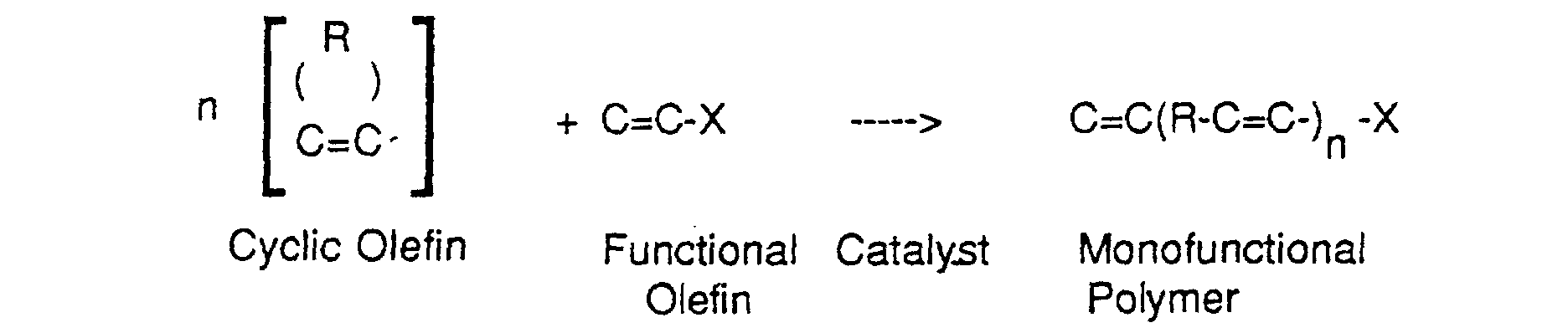
andwherein k is a number from 1 to about 200,000 and n is a number from 1 to about 10,000
- The process of the instant invention can use a ring-opening metathesis reaction of a cyclic olefin in the presence of a functional olefin or a metathesis reaction of an unsaturated high molecular weight polymer with a functional olefin at a temperature of from about 0°C to about 200°C and a pressure from about 1 x 10⁻⁶ mm Hg to about 30 atmospheres.
- The two reactions of the invented process to prepare the non-crosslinked linear telechelic oligomers and polymers are by the following reactions:and
 wherein n is a number from 1 to about 10,000.
- The process reactions can be performed sequentially, including the preparation of the precursor compounds, with or without isolation and purification of the products of each step. If desired, the same reaction vessel can be employed for both reactions. All reactions should be liquid phase reactions, using neat liquid reactants, solvents, or diluents.
- The invented process utilizes a catalyst composition comprising (a) a transition metal chloride, oxyhalide, oxide or ammonium salt, (b) an organic tin compound or aluminum halide reagent, and (c) an organic Lewis base wherein undesired side reactions such as double bond migration are minimized.
- As the transition metal catalyst component, (a), there can be mentioned halides, oxyhalides, oxides and organic ammonium salts, preferably of tungsten, ruthenium, molybdenum, rhenium and tantalum. As preferred examples, there can be mentioned tungsten compounds such as tungsten hexachloride, tungsten oxytetrachloride, tungsten oxide, tridodecylammonium tungstate, methyltricaprylammonium tungstate, tri(tridecyl)ammonium tungstate and trioctylammonium tungstate, molybdenum compounds such as molybdenum pentachloride, molybdenum oxytrichloride, tridecylammonium molybdate, methyltricaprylammonium molybdate, tri(tridecyl)ammonium molybdate and trioctylammonium molydate, rhenium compounds such as rhenium pentachloride, rhenium oxide, rhenium oxide supported on an oxide such as alumina, silica, or silica-alumina, rhenium oxide together with a promoter such as boron oxide on an oxide support, and tantalum compounds such as tantalum pentachloride.
- Organic tin compounds, alkylaluminum halides, alkoxyalkylaluminum halides and aryloxy-alkylaluminum halides can be used as the activator (b). As preferred examples, there can be mentioned tetrabutyltin, tetramethyltin, tetraethyltin, tetraphenyltin, ethylaluminum dichloride, diethylaluminum monochloride, ethylaluminum sesquichloride, diethylaluminum iodide, ethylaluminum diiodide, propylaluminum dichloride, propylaluminum diiodide, isobutylaluminum dichloride, ethylaluminum dibromide, methylaluminum sesquichloride, methylaluminum sesquibromide, and precondensates of alkylaluminum halides with alcohols.
- The Lewis base (c) useful in this invention includes linear functional olefins having at least one functional terminal reactive group as a reactant in reaction (A), ethers, esters, nitriles, ketones, amides, amines, alkynes, phosphorus compounds, and alcohols, of up to 30 carbon atoms. Examples are alkyl and aryl acetates, alkyl acrylates, alkyl methacrylates, alkyl undecylenates, acetonitrile, benzonitriles, acrylonitriles, acetylacetone, tetrahydrofuran, pyridine, N,N'-dimethylformamide, thiophene, ethyl ether, propyl ethers, diphenyl ether, triethylamine, phenylacetylene, organic phosphorus compounds of from 1 to 30 carbon atoms and monohydric and dihydric alcohols of from 1 to 30 carbon atoms such as methyl alcohol, ethyl alcohol, n-propyl alcohol, isopropyl alcohol, n-butyl alcohol, isobutyl alcohol, tert-butyl alcohol, n-pentyl alcohol, isopentyl alcohol, 2-methyl-1-butyl alcohol, 2-methyl-2-butyl alcohol, n-hexyl alcohol, n-heptyl alcohol, n-octyl alcohol, isooctyl alcohol, 2-ethylhexyl alcohol, n-nonyl alcohol, n-decyl alcohol, 1,5-pentanediol, 1,6-hexanediol, allyl alcohol, crotyl alcohol, 3-hexene-1-ol, citronellol, cyclopentanol, cyclohexanol, salicyl alcohol, benzyl alcohol, phenethyl alcohol, cinnamyl alcohol, and the like. The Lewis base (c) is preferably an ester, such as an alkyl acetate, instead of an alcohol. A nitrile such as acetonitrile is preferable to pyridine.
- The functionalized olefin having at least one functional reactive group contains at least one or more reactive moiety selected from the group consisting of a nitrile, ester, acyl, acid, halide, ketone, aldehyde, borane, acid anhydride, ether, amide, imide, halogen atom, alkene, alkyne, moiety, and substituted aryl moieties of up to 30 carbon atoms containing at least one reactive substituent. Olefinic unsaturates of the above-named Lewis base compounds can suitably serve as the functional olefin reactant. Typically, the preferred functional olefins contain no more than about 30 carbon atoms per molecule. Suitable functional olefins for use in the process of the instant invention include 1,5-hexadiene, 1,9-decadiene, 1,5,9-decatriene, 1,3-butadiene, divinylbenzene, and mixtures thereof, methyl acrylate, methyl methacrylate, methyl or ethyl 2,4-hexadienoate, ethyl cinnamate, 4-penten-1-yl acetate, methyl or ethyl vinylacetate, isobutyl vinylacetate, cyclohexyl vinylacetate, phenyl vinylacetate, methyl or ethyl 4-pentenoate, amyl 4-pentenoate, benzyl 4-pentenoate, propyl 3-decenoate, methyl 10-undecenoate, ethyl 10-undecenoate, methyl oleate, ethyl oleate, butyl oleate, methyl isooleate, ethyl 6-octadecenoate, butyl 6-ocatdecenoate, ethyl elaidate, butyl elaidate, methyl brassidate, methyl linolate, diethyl 2-allylmalonate, allyl acetate, oleyl acetate, 3-hexenyl acetate, oleyl oleate, 2-hexenyl 2-methylpropionate, 3-hexenyl valerate, 2-hexenyl acetate, allyl propionate, oleyl benzoate, 9-octadecenenitrile, 6-octadecenenitrile, 3-butenenitrile, 1,4-dicyano-2-butene, 4-pentenenitrile, octadecenedinitrile, 9,12-octadecadienenitrile, 9-decenenitrile, 10-undecenenitrile, 9-octadecenyl ethyl ether, 9-octadecenyl isopropropyl ether, crotyl isopropyl ether, trimethylallyloxysilane, allylanisole, allyl phenyl ether, 8-heptadecenyl ethyl ketone, 5-heptadecenyl ethyl ketone, 5-hexen-2-one, 6-methyl-5-hepten-2-one, N,N-diethyloleamide N,N-diethylvinylacetamide, alkyl acrylates, alkyl methacrylates, alkyl undecylenates, 3-buten-1-yl acetate, vinyl acetate, and alkyl sorbates.
- In general, any cyclic olefin of from 4 to about 30 carbon atoms can be polymerized in the presence of a functionalized olefin in the process of this invention. The cyclic olefins include both mono- and polycyclic unsaturated hydrocarbon compounds. Representative examples of polycyclic unsaturated hydrocarbon compounds include norbornene, norbornadiene, 2,2,2-bicyclooctene-2, dicyclopentadiene and the like.
- The preferred unsaturated alicyclic compounds of this invention are those comprising a single unsaturated alicyclic ring. These alicyclic rings may be mono- or multi-substituted by such groups as alkyl, aryl, arylalkyl, and halogen groups.
- Representative examples of unsaturated alicyclic compounds containing a single alicyclic ring having at least 4 and not more than 5 carbon atoms in the cyclic ring and containing one double bond in said ring are cyclobutene and cyclopentene. Representative examples of unsaturated alicyclic compounds containing at least seven carbon atoms in the cyclic ring and containing one or more non-conjugated carbon-to-carbon double bonds in the cyclic ring include cyclooctene; 1,4- and 1,5-cyclooctadiene; 1,4,7-cyclononatriene, cyclodecene, cyclododecene, 1,4-, 1,5- and 1,6-cyclodecadiene: 1,4-, 1,5-, 1,6- and 1,7-cyclododecadiene; 1,4,7- and 1,5,9-cyclododecatriene and the like.
- The most preferred unsaturated alicyclic compounds of this invention are those containing from one to three carbon-to-carbon double bonds in the ring and in which the double bonds are located in relation to each other in a manner that they are not adjacent and are non-conjugated. Representative examples of such preferred materials are cyclobutene, cyclopentene, cyclooctene, cyclododecene, and 1,5-cyclooctadiene, 1,5,9-cyclododecatriene and 1,9,17-cyclotetracosatriene.
- Representative examples of substituted alicyclic compounds are alkyl-substituted compounds such as 1-methyl-1,5-cyclooctadiene; aryl-substituted compounds such as 3-phenyl-1-cyclooctene: aralkyl-substituted compounds such as 3-benzyl-1-cyclooctene; alkaryl-substituted compounds such as 3-tolyl-1-cyclooctene and halogen-substituted compounds such as a 5-chloro-1-cyclooctene, 1-chloro-1,5-cyclooctadiene; 5-chloro-1-cyclododcene and 5,6-dichloro-1-cyclooctene. Mixtures of the unsaturated alicyclic compounds may be polymerized, including both substituted unsaturated alicyclic compounds and the unsubstituted unsaturated alicyclic compounds.
- The olefinic polymer useful as a reactant can be high molecular weight polybutadienes, polyisoprene, butyl rubber, and the like, and mixtures thereof.
- The metathesis catalyst comprising (a), the transition metal compound, is used in an amount of about 0.01 to about 50 millimoles, preferably 0.1 to 10 millimoles, of metal per mole of the olefin reactant. The activator (b) is used at a molar ratio of from 0.001 to 200:1 preferably from about 0.1 to about 10, per mole of the catalyst component (a). The organic Lewis base is used at a molar ratio of from about 0.1:1 to about 10,000:1 moles, preferably from about 1:1 to about 100:1 per mole of the catalyst component (a).
- Preferably both the metathesis catalyst and the activator are used when dissolved or suspended in the reactants, but the catalyst and activator can be used when suspended or dissolved in a small amount of a solvent, as long as the properties of the product are not substantially degraded. Preferred solvents are benzene, toluene, xylene, pentane, hexane, heptane, cyclohexane, methylcyclohexane, chlorobenzene, dichlorobenzene, and mixtures thereof.
- Any reagent for deactivating the activator or the metathesis catalyst system, for example, an alkylaluminum chloride, or the catalyst component of the metathesis catalyst system, for example, a tungsten compound catalyst or a molybdenum compound catalyst, can be used as the stopper for the polymerization reaction. As preferred examples, there can be mentioned alcohols such as methanol, ethanol, n-propyl alcohol and n-butanol, amines such as ammonia, organic acids such as acetic acid and propionic acid, oxygen, carbon dioxide, and water.
- If an appropriate amount of an alcohol is used as the stopper for the reaction, only the activator such as an aluminum compound is deactivated but the catalyst component such as a molybdenum catalyst is left in the liquid product in a reusable state. Of course, a stopper capable of deactivating both of the activator and the catalyst component can be used. In the polymerization reaction, the metathesis catalyst component is used in an amount of 0.01 to 50 millimoles, preferably 0.1 to 10 millimoles, per mole of the monomers as a whole. The activator (is used at a molar ratio of from 0.01 to 200, preferably from 1 to 10, to the catalyst component. It is sufficient if the stopper for the polymerization reaction is used in an amount enough to deactivate the catalyst system. The amount differs according to the kind of the activator or the catalyst component, but the amount can be easily determined by preliminary experiments. For example, where a dialkylaluminum halide is used as the activator and an alcohol is used as the stopper for the viscosity-increasing reaction, it is sufficient if the alcohol is used in an amount of at least 2 moles per mole of the activator.
- The metathesis polymerization is preferably performed in liquid phase, with catalyst components dissolved or suspended in a solvent or liquid olefin reactant. Reaction temperatures are preferably from about 0°C to 200°C. Pressure can be in the range of from about 1 x 10⁻⁶ mm Hg to about 30 atmospheres, preferably from about 1 x 10⁻⁶ mm Hg to about 1 atmosphere. Any light olefin coproduct (ethylene in the case of polyene reactants with terminal carbon-to-carbon double bonds) should be removed efficiently to drive the reaction to high conversion.
- In the practice of this invention, the catalyst composition preferably comprises a tungsten metal chloride, a tetraalkyltin reagent and an organic Lewis base selected from the group consisting of the functional olefin reactant, an alkyl acetate, a nitrite, and an ether. Inasmuch as the tungsten catalyst in the presence of an activator such as a tetraalkyltin compound, in the absence of a Lewis base, can catalyze side reactions in a metathesis reaction of an olefin compound, a sequence of mixing the components of the catalyst system is preferred.
- The tungsten compound is preferably suspended or dissolved in a small amount of a suitable solvent, preferably in an olefin monomer if the tungsten compound is soluble in the monomer. An alcoholic or phenolic compound is also suitable, phenolic compounds being preferred over an alcoholic compound. Suitable phenolic compounds include phenol, alkyl phenols, and halogenated phenols, with tert-butyl phenol, tert-octyl phenol and nonyl phenol most preferred. The preferred molar ratio of the tungsten compound/phenolic compound is from about 1:1 to about 1:3. The tungsten compound/phenolic compound solution can be prepared by adding the phenolic compound to the tungsten compound, stirring the solution and then blowing a stream of a dry inert gas through the solution to remove any hydrogen chloride.
- The addition of the Lewis base or a chelating agent can be in an amount of from about 0.1 to about 10,000 moles of Lewis base or chelating agent per mole of tungsten compound. Preferred chelants include acetylacetone and alkyl acetoacetates where the alkyl group contains from 1 to 10 carbon atoms. Preferred Lewis bases include nitriles, ethers and esters such as alkyl acetates, benzonitrile, acetonitrile, tetrahydrofuran.
- In some metathesis reactions, one of the products of the metathesis reaction is an olefin of a lower molecular weight than the starting monomer. In the instant process, it has been found that removal of the olefin of the lower molecular weight is essential to obtain high reaction conversion. This may be accomplished by suitable means such as purging the reaction vessel with inert gas, by applying a low or high vacuum to the system, or by any combination of these methods during the reaction, including the omission of one or more of these procedures, the said steps being in any sequence and capable of being omitted individually. The inert gas can comprise nitrogen, the low vacuum from about 1 mm Hg to about 400 mm Hg, and the high vacuum to about 1 x 10⁻⁶ mm Hg.
- Graft copolymers can be prepared by reacting linear non-crosslinked mono functional unsaturated polymers with a reactive terminal group wherein the terminal group is an ester moiety with excess vinyl or acrylic monomer to prepare a macromolecule copolymer with a graft-type architecture. Similarly, a block copolymer can be prepared by reacting linear non-crosslinked difunctional unsaturated polymers with reactive terminal groups in a block-type architecture wherein the terminal groups are ester moieties with excess unsaturated monomer such as styrene, isoprene, and butadiene.
- Example 1 relates to preparation of telechelic difunctional polymers according to the present invention. Examples 2 and 3 relate to the influence of amount of catalyst and reagent purity on the functionality of the resulting polymers.
- The following illustrates the preparation of a telechelic difunctional oligomer with a two-step process from an acyclic olefin and a cyclic olefin.
- Chlorobenzene (Aldrich Chemical Co., Milwaukee, WI, HPLC grade) was purified by passage through a column of silica gel and 13X sieves, and stored over 4A sieves. Tetramethyltin (Aldrich, 99+%) was dried over 4A sieves. Tungsten hexachloride (Aldrich, 99.9+%) was used as obtained. Methyl undecylenate (methyl 10-undecenoate, 97%) was obtained from Elf Atochem, Philadelphia, PA, and purified by treatment with aqueous NaOH and water followed by drying (with magnesium sulfate) and vacuum distillation; the purified material was stored over 4A sieves. 1,5-Cyclooctadiene (Aldrich, 99.3%) was fractionally distilled using a 20-tray Oldershaw column at a reflux ratio of 15:1. The distilled product was determined to be 99.9% pure by gas chromatography, containing less than 0.01% 4-vinyl-1-cyclohexene. The distilled cyclooctadiene was further purified by passage through a column of basic activated alumina LaRoche Chemicals A-204-4, LaRoche Chemicals, Baton Rouge, La., then stored over 4A sieves under nitrogen.
-

- Tungsten hexachloride (3.2 g, 8.0 mmol) was dissolved in methyl undecylenate (90 mL, 400 mmol) under nitrogen. The solution was syringed into a 500 mL flask with attached reflux condenser which had been purged with nitrogen and preheated to 50 deg C using an oil bath. After 30 minutes, tetramethyltin (2.2mL, 16 mmol) was syringed into the solution and the temperature was raised to 75 deg C. The solution was stirred at 75 deg C for 19 hours under a slow flow of nitrogen, then cooled to room temperature. Dry gaseous ammonia was bubbled through the solution for 30-40 minutes to quench the reaction. Hexane was added to the solution, and precipitated catalyst residue was removed by filtration. The filtrate was then subjected to rotary evaporation at 90-150 deg C using a mechanical vacuum pump to remove hexane and unreacted methyl undecylenate. Upon cooling, an orange crystalline solid was obtained. It was dissolved in methanol and decolorized by treatment with charcoal. The product was then recrystallized several times from aqueous methanol at 0 deg C, affording 22.3 g (60 mmol) of white, crystalline dimethyl 10-eicosene-1,20-dioate (m.p. 44 deg C).
- Under nitrogen, a 250-mL flask was charged with dimethyl 10-eicosene-1,20-dioate (7.0 g, 19 mmol), chlorobenzene (85 mL), 1,5-cyclooctadiene (56.5 mL, 460 mmol), tungsten hexachloride (37 mg, 0.093 mmol), and tetramethyltin (26 uL, 0.19 mmol). The solution was then heated to 100 deg C and stirred under a nitrogen atmosphere. After 4.5 hours at 100 deg C, additional catalyst solution (37 mg tungsten hexachloride and 26 uL tetramethyltin dissolved in 2 ml chlorobenzene) was syringed into the reaction flask. The solution was then stirred for an additional 17.5 hours (22 hours total) at 100 deg C, then cooled to room temperature. Gas chromatoographic analyses indicated 99.9% conversion of 1,5-cyclooctadiene and 87% conversion of dimethyl 10-eicosene-1,20-dioate. Gaseous ammonia was bubbled through the reaction solution for 10 minutes. The solution was degassed and then filtered to remove precipitated catalyst residue. The filtered solution was then subjected to rotary evaporation at 100-110 deg C using a mechanical vacuum pump to remove volatile liquids, leaving a viscous liquid product. To remove unreacted dimethyl eicosene dioate and very low molecular weight products, the viscous liquid was dissolved in dichloromethane and then precipitated by addition of a large quantity of methanol. The precipitated viscous liquid was collected and washed with additional methanol. The dissolution/precipitation procedure was repeated. The final precipitated (methanol-insoluble) viscous liquid product was clear and pale yellow; yield was 44 g (77% yield based on weight of reactants). No dimethyl 10-eicosene-1,20-dioate was detected by gas chromatography in this product, but it was detected in the methanol washings from the dissolution/precipitation procedure.
- A quantitative carbon-13 NMR was performed of the product dissolved in chloroform-d with chromium acetylacetonate added as a relaxation agent. The NMR spectrum was consistent with the following ester-terminated, difunctional 1,4-polybutadiene oligomer structure:
- Strong resonances were observed in the spectrum in the 128-132 ppm range, assigned as internal olefinic carbons of a 1,4-polybutadiene backbone: (-CH2-CH=CH-CH2-)n. Strong singlet resonances were observed at 32.5 ppm and 27.5 ppm in a 59/41 integrated intensity ratio, assigned as methylene carbons adjacent to trans (59%) and cis (41%) internal backbone carbon-carbon double bonds, respectively. The relative intensity of the combined backbone olefinic carbon resonances was equal (to within 1%) to that of the combined adjacent methylene carbon resonances, consistent with a 1,4-polybutadiene structure. The spectrum indicated that the product possessed ester endgroups of the structure -(CH2)7 CO2Me: weak singlet resonances of equal intensity were observed at 173.5 ppm (carbonyl carbon of the ester), 51.1 ppm (methoxy carbon of ester), 33.8 ppm (methylene carbon alpha to carbonyl), and 24.8 ppm (methylene carbon beta to carbonyl); a broad resonance was observed at 29.1 ppm with 5-fold greater intensity (five methylene carbons). Although the signal-to-noise ratio of the spectrum was very high (about 100:1 for the carbonyl carbon endgroup signal), no other resonances were detected other than sidebands of major peaks. No other endgroup types were detected, such as saturated methyl or ethyl endgroups (10-24 ppm) or vinyl endgroups (110-120 ppm, 132-142 ppm). Neither were vinyl endgroups detected in a proton NMR spectrum of the product. The NMR data thus indicate the acyclic oligomer product to be purely difunctional with respect to ester endgroups (Fn = 2.0).
- Number-average molecular weight (Mn) of the product was computed at 4,030 g/mole using relative integrated intensities from the carbon-13 NMR spectrum (carbonyl carbon = 6.87; methoxy carbon = 6.70; combined backbone olefinic carbon = 466) and the relation, Mn = n(54.1) +314.5, which is based upon the product structure shown above.
- This example illustrates the effect of the amount of catalyst charge upon difunctional oligomer product purity.
- A procedure was followed similar to that of Example 1, except that a greater amount of catalyst (relative to monomer amounts) was employed in the second process step (reaction of dimethyl 10-eicosene-1,20-dioate with 1,5-cyclooctadiene). The molar 1,5-cyclooctadiene/WCl6/SnMe4 ratio employed in this example was 500/1/2 (vs. 2500/1/2 in Example 1). The reaction was terminated after 2.5 hours at 100 deg C, at which point 1,5-cyclooctadfiene conversion was 99.9% and dimethyl 10-eicosene-1,20-dioate conversion was 94% as determined by gas chromatography. The viscous liquid oligomer product was isolated by the procedure of Example 1, and analyzed by carbon-13 NMR. The NMR spectrum was similar to that of Example 1 with the addition of two very weak singlet resonances of equal intensity at 138.0 ppm and 114.3 ppm, assigned as the =CHR and =CH2 carbons, respectively, of a vinyl endgroup: RHC=CH2. The integrated intensity of each vinyl endgroup carbon resonance was 1-2% of the intensity of the ester endgroup carbonyl carbon resonance. This indicates that 1-2% of the oligomer endgroups of this product were non-functional (meaning non-ester), and thus the product was not as difunctionally pure as that of Example 1.
- Number-average molecular weight of this product was determined to be 3,680 g/mole by vapor pressure osmometry (VPO), and was calculated by carbon-13 NMR to be 3,860 g/mole.
- This example illustrates the effect of reactant purity, in particular the purity of the cyclic olefin monomer, upon difunctional oligomer product purity.
- A procedure was followed similar to that of Example 1, except that the 1,5-cyclooctadiene employed in the second process step was less pure. In this example, 1,5-cyclooctadiene (Aldrich, 99.3% pure by gas chromatographic analysis) was used without further purification by distillation. GC analysis indicated the presence of several organic impurities, including 0.2% 4-vinyl-1-cyclohexene. In this example, the amount of catalyst employed in the second process step was the same as in Example 2: 500/1/2 1,5-cyclooctadiene/WCl6/SnMe4. The reaction was terminated after 4 hours at 100 deg C, at which point 1,5-cyclooctadiene conversion was 99.6% and dimethyl 10-eicosene-1,20-dioate conversion was 85% as determined by gas chromatography. The viscous liquid oligomer product was isolated by the procedure of Example 1, and analyzed by carbon-13 NMR. The NMR spectrum was similar to that of Example 2, except that the two vinyl endgroup carbon resonances (138.0 ppm and 114.3 ppm) were more intense, each with an integrated intensity of 7-8% of the intensity of the ester endgroup carbonyl carbon resonance. This indicates that 7-8% of the oligomer endgroups of this product were vinyl and non-functional (meaning non-ester), and thus the product was less difunctionally pure than that of Example 2.
Claims (13)
- A linear telechelic difunctional non-crosslinked polymer having at least one internal carbon-to-carbon double bond and containing terminal functional reactive groups, said polymer being free of any side chains or pendant groups which would cause cross-linking, said polymer having an average functionality number of 2.0, as determined by nuclear magnetic resonance spectroscopy, said reactive functionality selected from the group of moieties consisting of a nitrile, ester, acid, acyl halide, ketone, aldehyde, borane, amide, acid anhydride, ether, imide, halogen atom, alkene, alkyne, and substituted aryl group of up to 30 carbon atoms, said aryl group containing at least one reactive substituent of said functional reactive group of moieties, and combinations thereof, wherein said linear telechelic difunctional unsaturated polymer has a number average molecular weight of up to 1,000,000.
- The polymer of Claim 1 wherein said reactive functionality is an ester moiety, wherein said moiety is selected from the group consisting of an acrylate moiety, a methacrylate moiety an allyl acetate moiety, and allyl propionate moiety, a vinyl acetate moiety and an undecylenate moiety.
- A process for the preparation of the polymer of Claim 1 from olefinic reactants said process comprising a two reaction sequence of reactions (A) and (B) in which reaction (B) is carried out in the presence of a product of reaction (A), wherein:and wherein said reactions (A) and (B) are metathesis reactions in the presence of a catalyst composition comprising a metathesis catalyst (a) comprising a transition metal compound selected from the group consisting of halides, oxyhalides, oxides and organic ammonium salts; an activator (b) selected from the group consisting of organic tin compounds, alkylaluminum halides, alkoxyalkylaluminum halides and aryloxy-alkylaluminum halides, and an organic Lewis base (c), said metathesis catalyst (a) is present in an amount of from 0.01 to 50 millimoles per mole of said reactants, activator (b) is present in a molar ratio to metathesis catalyst (a) of from 0.001:1 to 200:1, and organic Lewis base (c) is present in a molar ratio to metathesis catalyst (a) of from 0.1:1 to 10,000:1, said reactions (A) and (B) are conducted at a temperature of from 0°C to 200°C and a pressure of from 1 x 10⁻⁶ mm Hg to 30 atmospheres, and wherein the reactants are sufficiently pure that a linear telechelic difunctional non-crosslinked polymer according to claim 1 is obtained.(I) reaction (A) is an olefin metathesis reaction of acyclic linear olefinic compound reactants comprising at least one of said acyclic olefinic compounds containing up to 30 carbon atoms and containing at least one functional reactive group selected from(i) nitrile, ester, acid, acyl halide, ketone, aldehyde, borane, amide, acid anhydride, ether, imide, halogen atom, alkene and alkyne reactive moieties,(ii) substituted aryl group containing up to an additional 30 carbon atoms, the substituents of said substituted aryl group comprising at least one reactive substituent of said reactive moieties of (i), and(iii) combinations thereof, to prepare a linear functional olefinic product having at least one functional terminal reactive moiety,(II) reaction (B) is a ring-opening polymerization of a cyclic olefin in the presence of the linear functional olefinic product having at least one functional terminal reactive moiety of reaction (A)
- The process of Claim 3 wherein the metal of the transition metal compound is selected from tungsten, molybdenum, rhenium, tantalum and ruthenium.
- The process of Claim 3 or 4 wherein the Lewis base (c) is selected from the group consisting of acyclic linear olefinic compound reactants of reactions (A), esters, ethers, nitriles of up to 30 carbon atoms comprising alkyl and aryl acetates, alkyl acrylates, alkyl methacrylates, alkyl undecylenates, ethyl ether, propyl ethers, diphenyl ether, acetonitrile, benzonitrile, and compounds comprising acetylacetone, tetrahyrofuran, pyridine, N,N'- dimethylformamide, thiophene, triethylamine, phenyl acetylene, organic phosphorus compounds of from 1 to 30 carbon atoms, or monohydric or dihydric alcohols of from 1 to 30 carbon atoms.
- The process of Claim 3 wherein said process comprises reaction (A) between two acyclic linear olefinic compound reactants, one linear olefinic compound reactant comprising an unsaturated polymer of number average molecular weight of up to 1,000,000 selected from the group consisting of low molecular weight oligomers and high molecular weight polymers of polybutadiene, polyisoprene, butyl rubber, and mixtures thereof, and a second linear olefinic compound reactant containing up to 30 carbon atoms and containing at least one functional reactive group selected from said reactive moieties.
- The process of Claim 3 wherein said linear functional olefin is selected from the group consisting of an alkyl undecylenate of up to 30 carbon atoms, allyl acetate, allyl propionate, and vinyl acetate and the cyclic olefin comprises 1,5-cyclooctadiene.
- The process of Claim 3 wherein said cyclic olefin is selected from the group consisting of cycloheptene; 1,3-cyclooctadiene; 1,4-cyclooctadiene: 1,5-cyclooctadiene, norbornene, norbornadiene, 2,2,2-bicyclooctene-2; cyclooctene; cyclodecene; methyl cyclooctadienes; dimethyl cyclooctadienes; methyl cyclooctenes: dimethyl cyclooctenes; 1,4,7-cyclononatriene; 1,4-cyclodecadiene; 1,5-cyclododecadiene; 1,6-cyclodecadiene; 1,7-cyclodecadiene; 1,4,7-cyclododecatriene; 1,5,9-cyclododecatriene; trimethyl 1,5,9-cyclododecatriene; cyclopentene; cyclododecene; cyclobutene; 1,9,17-cyclotetrasatriene; 1-methyl-1,5-cyclooctadiene; 3-phenyl-1-cyclooctene; 3-benzyl-1-cyclooctene; 3-tolyl-1-cyclooctene; 5-chloro-1-cyclooctene; 1-chloro-1,5-cyclooctadiene; 5-chloro-1-cyclododecene; 5,5-dichloro-1-cyclooctene; and mixtures thereof.
- The process of any of Claims 3-8 wherein said olefin metathesis reactions are driven to conversion by removal of low molecular weight co-product olefins produced by said olefin metathesis reactions of said acyclic olefins from said olefin metathesis reaction, wherein said low molecular weight co-product olefins from said polymers are removed from said process by a combination of steps comprising a purge of the olefin metathesis reaction with an inert gas, application of a low vacuum in the range of from 1 mm Hg to 400 mm Hg during said reaction, and an application of a high vacuum to about 1 x 10⁻⁶ mm Hg, said steps being in any sequence and capable of being omitted individually, said polymers containing less than 100 parts per million of tungsten, said polymers being free of a predominant color.
- The process of any of Claims 3-9 wherein catalyst (a) is tungsten hexachloride.
- The process of any of Claims 3-10 wherein activator (b) is tetramethyltin.
- The process of any of Claims 3-11 wherein Lewis base (c) is an ester.
- The process of any of Claims 3-12 wherein catalyst (a) is present in an amount of 0.1 to 10 millimoles of metal per mole of olefin reactant, activator (b) is present at a molar ratio of 0.1 to 10 per mole of catalyst (a), and Lewis base (c) is present at a molar ratio of 1 to 100 per mole of catalyst (a).
Applications Claiming Priority (6)
| Application Number | Priority Date | Filing Date | Title |
|---|---|---|---|
| US68240 | 1993-05-27 | ||
| US08/068,236 US5403904A (en) | 1993-05-27 | 1993-05-27 | Process for preparation of telechelic difunctional unsaturated oligomers or polymers by acyclic olefin metathesis |
| US68236 | 1993-05-27 | ||
| US08/068,240 US5519101A (en) | 1993-05-27 | 1993-05-27 | Process for preparation of unsaturated oligomers or polymers by acyclic olefin metathesis |
| US167668 | 1993-12-15 | ||
| US08/167,668 US5512635A (en) | 1993-05-27 | 1993-12-15 | Process for preparing linear monofunctional and telechelic difunctional polymers and compositions obtained thereby |
Publications (3)
| Publication Number | Publication Date |
|---|---|
| EP0626402A2 EP0626402A2 (en) | 1994-11-30 |
| EP0626402A3 EP0626402A3 (en) | 1995-09-27 |
| EP0626402B1 true EP0626402B1 (en) | 2002-07-31 |
Family
ID=27371294
Family Applications (1)
| Application Number | Title | Priority Date | Filing Date |
|---|---|---|---|
| EP94303811A Expired - Lifetime EP0626402B1 (en) | 1993-05-27 | 1994-05-26 | Linear telechelic difunctional polymers and process for their preparation. |
Country Status (5)
| Country | Link |
|---|---|
| US (5) | US5512635A (en) |
| EP (1) | EP0626402B1 (en) |
| CA (1) | CA2123843C (en) |
| DE (1) | DE69431086T2 (en) |
| ES (1) | ES2183829T3 (en) |
Families Citing this family (57)
| Publication number | Priority date | Publication date | Assignee | Title |
|---|---|---|---|---|
| US5512635A (en) * | 1993-05-27 | 1996-04-30 | Amoco Corporation | Process for preparing linear monofunctional and telechelic difunctional polymers and compositions obtained thereby |
| CA2179555C (en) * | 1995-06-26 | 2007-02-20 | Takeshi Moritani | Process for producing vinyl acetate polymer and saponified product of vinyl acetate polymer and resin composition |
| US6060570A (en) * | 1996-08-12 | 2000-05-09 | Bp Amoco Corporation | Process for preparation of addition products of difunctional telechelic polyolefins from cyclic olefins by olefin metathesis reaction |
| US5847064A (en) * | 1997-02-27 | 1998-12-08 | University Of Florida | Polycarbometallanes via acyclic diene metathesis polymerization |
| CA2256961C (en) * | 1997-12-29 | 2009-09-29 | Bayer Corporation | Polyurethane polyolefins and prepolymers based on hydroxy functional polybutadiene |
| US6153714A (en) * | 1998-03-31 | 2000-11-28 | Cryovac, Inc. | Regio-regular copolymer and methods of forming same |
| DE69939629D1 (en) | 1998-05-05 | 2008-11-06 | Massachusetts Inst Technology | Emitting polymers and devices containing these polymers |
| US20050147534A1 (en) | 1998-05-05 | 2005-07-07 | Massachusetts Institute Of Technology | Emissive sensors and devices incorporating these sensors |
| DE19820652A1 (en) | 1998-05-08 | 1999-11-11 | Basf Ag | Cationic ruthenium complexes used as catalyst for metathesis reactions |
| US6166166A (en) * | 1998-08-26 | 2000-12-26 | Bayer Corporation | Composition and process for preparation of thermoplastic polyurethanes (TPU based on a polybutadiene soft segment) |
| US6203923B1 (en) * | 1998-09-29 | 2001-03-20 | Cryovac, Inc. | Regio-regular functionalized polymeric packaging material |
| EP2000803A1 (en) | 1998-11-30 | 2008-12-10 | Nanosphere, Inc. | Nanoparticles with Polymer Shells |
| ATE437903T1 (en) | 1999-03-18 | 2009-08-15 | California Inst Of Techn | NEW ABA TRIBLOCK AND DIBLOCK COPOLYMERS AND METHOD FOR THE PRODUCTION THEREOF |
| US6211324B1 (en) | 1999-06-08 | 2001-04-03 | Bayer Corporation | Hydrophobic polyurethane elastomer |
| DE60016447T2 (en) | 1999-08-24 | 2005-12-08 | Toyo Boseki K.K. | Polymerization catalysts for polyesters, polyesters produced therewith and processes for the production of polyesters |
| US6780957B1 (en) | 1999-12-29 | 2004-08-24 | Bayer Polymers Llc | Hydrophobic light stable polyurethane elastomer with improved mechanical properties |
| AU2402401A (en) | 2000-01-05 | 2001-07-16 | Toyo Boseki Kabushiki Kaisha | Polymerization catalyst for polyesters, polyesters produced with the same and process for producing polyesters |
| AU2001286193A1 (en) | 2000-09-12 | 2002-03-26 | Toyo Boseki Kabushiki Kaisha | Polymerization catalyst for polyester, polyester produced with the same, and process for producing polyester |
| US6476167B2 (en) | 2000-12-14 | 2002-11-05 | Bayer Corporation | End-functionalized polyolefin prepared via ring opening metathesis polymerization in the presence of a novel chain transfer agent, and a process for the preparation of the end-functionalized polyolefin via ring opening metathesis polyermization |
| US6391978B1 (en) | 2000-12-14 | 2002-05-21 | Bayer Corporation | Process for the synthesis of hydroxyl-end group functionalized polybutadienes |
| MXPA03007471A (en) | 2001-02-23 | 2003-12-04 | Toyo Boseki | Polymerization catalyst for polyester, polyester produced with the same, and process for producing polyester. |
| US20030113740A1 (en) * | 2001-04-26 | 2003-06-19 | Mirkin Chad A. | Oligonucleotide-modified ROMP polymers and co-polymers |
| US6872792B2 (en) | 2001-06-25 | 2005-03-29 | Lord Corporation | Metathesis polymerization adhesives and coatings |
| JP2005517774A (en) | 2002-02-19 | 2005-06-16 | カリフォルニア インスティテュート オブ テクノロジー | Ring expansion of cyclic olefins by olefin metathesis reaction using acyclic dienes |
| FR2845687B1 (en) * | 2002-10-11 | 2004-12-03 | Commissariat Energie Atomique | POLYMER COMPRISING IN THE SKELETON AN INTERNAL ETHYLENE INSATURATION AND METHODS FOR THEIR PREPARATION |
| DE602004028742D1 (en) * | 2003-08-27 | 2010-09-30 | Mitsui Chemicals Inc | METHOD FOR PRODUCING A POLYOLEFIN FUNCTIONAL ON AN END |
| US7241620B2 (en) * | 2004-01-09 | 2007-07-10 | Chevron Phillips Chemical Company Lp | Ultra high molecular weight polyethylene fractions having narrow molecular weight distributions and methods of making and using the same |
| US8617819B2 (en) * | 2004-09-17 | 2013-12-31 | Massachusetts Institute Of Technology | Polymers for analyte detection |
| US8101697B2 (en) * | 2005-02-01 | 2012-01-24 | Bridgestone Corporation | Multi-functionalized high-trans elastomeric polymers |
| DE102006008520A1 (en) * | 2006-02-22 | 2007-08-23 | Lanxess Deutschland Gmbh | New catalyst systems and their use for metathesis reactions |
| US20090306268A1 (en) * | 2006-03-01 | 2009-12-10 | James Pawlow | Polyester Compositions Containing Metathesis Polymers with Reduced Recycle Color |
| WO2008027268A2 (en) * | 2006-08-25 | 2008-03-06 | Dow Global Technologies Inc. | Production of blockcopolymers by amorphous polymer segment interchange via metathesis |
| ES2391209T3 (en) * | 2006-08-25 | 2012-11-22 | Dow Global Technologies Llc | Production of randomized block copolymers by metathesis of high melting polymer segments |
| EP2057205B1 (en) | 2006-08-25 | 2017-02-08 | Dow Global Technologies LLC | Production of meta-block copolymers by polymer segment interchange |
| BRPI0714523A2 (en) * | 2006-08-25 | 2013-04-24 | Dow Global Technologies Inc | process for preparing a product mixture comprising ethylenically unsaturated telechelic polymers, process for preparing a product mixture comprising functionalized telechelic polymers, telechelic polymer comprised of ethylenic unsaturation or polyol functionality, and process for preparing a polyurethane composition by reacting a diisocyanate compound with a polyol |
| WO2008042289A2 (en) * | 2006-09-29 | 2008-04-10 | Massachusetts Institute Of Technology | Polymer synthetic technique |
| US8802447B2 (en) * | 2006-10-05 | 2014-08-12 | Massachusetts Institute Of Technology | Emissive compositions with internal standard and related techniques |
| US20090215189A1 (en) | 2006-10-27 | 2009-08-27 | Massachusetts Institute Of Technology | Sensor of species including toxins and chemical warfare agents |
| JP5422936B2 (en) * | 2008-07-31 | 2014-02-19 | 日本ゼオン株式会社 | Cyclopentene ring-opening polymer rubber and process for producing the same |
| EP2321363B1 (en) * | 2008-08-21 | 2020-04-22 | Materia, Inc. | Telechelic olefin metathesis polymers from renewable feedstocks |
| ES2626141T3 (en) * | 2010-01-22 | 2017-07-24 | Bridgestone Corporation | Polymers functionalized with nitrile compounds containing a protected amino group |
| US8604148B2 (en) | 2011-11-29 | 2013-12-10 | Exxonmobil Chemical Patents Inc. | Functionalization of vinyl terminated polymers by ring opening cross metathesis |
| CN103987755B (en) * | 2011-11-29 | 2016-08-17 | 埃克森美孚化学专利公司 | Functionalization by the metathetic vinyl terminated polymer of open loop crossover |
| RU2523799C1 (en) | 2011-12-20 | 2014-07-27 | Чайна Петролеум Энд Кемикал Корпорейшн | Additive and method of terminating polymerisation and/or reducing viscosity of polymer solution |
| WO2014031677A1 (en) * | 2012-08-20 | 2014-02-27 | University Of Florida Research Foundtion, Inc. | Metathesis depolymerization using acrylates |
| US9169334B2 (en) | 2013-01-30 | 2015-10-27 | Exxonmobil Chemical Patents Inc. | Preparation of bottlebrush polymers via ring-opening metathesis polymerization |
| WO2014120433A1 (en) * | 2013-01-30 | 2014-08-07 | Exxonmobil Chemical Patents Inc. | Preparation of bottlebrush polymers via ring-opening metathesis polymerization |
| TWI558727B (en) * | 2013-09-30 | 2016-11-21 | 陶氏全球科技有限責任公司 | A process to produce a polyolefin reactive telechelic pre-polymer, polyolefin reactive telechelic pre-polymers and crosslinked elastomers and high molecular weight elastomers |
| CN104505210B (en) * | 2014-12-29 | 2016-08-24 | 广西师范大学 | A kind of mixed valence manganese cluster molecule base magnetic material and preparation method thereof |
| JP7124702B2 (en) * | 2016-10-31 | 2022-08-24 | 日本ゼオン株式会社 | Crosslinkable composition and crosslinked product |
| EP3498361A1 (en) | 2017-12-18 | 2019-06-19 | Evonik Degussa GmbH | Method for producing temperature-stable polyalkenamers |
| JP7230328B2 (en) * | 2018-02-20 | 2023-03-01 | 日本ゼオン株式会社 | Reactive compositions and thermoplastic elastomers |
| EP3546495A1 (en) | 2018-03-29 | 2019-10-02 | Evonik Degussa GmbH | Method for producing temperature-stable polyalkenamers |
| EP3613787A1 (en) * | 2018-08-24 | 2020-02-26 | Covestro Deutschland AG | Polyurethanes with improved hardness |
| WO2021175617A1 (en) | 2020-03-04 | 2021-09-10 | Evonik Operations Gmbh | Oxygen scavenging polymer particles |
| CN116948067B (en) * | 2022-04-12 | 2025-11-28 | 中国石油天然气股份有限公司 | Catalyst for propylene polymerization and propylene polymerization or copolymerization reaction method |
| WO2025219051A1 (en) | 2024-04-16 | 2025-10-23 | Evonik Operations Gmbh | Polyoctenamer having silyl groups, production process and use in rubber mixtures |
Family Cites Families (26)
| Publication number | Priority date | Publication date | Assignee | Title |
|---|---|---|---|---|
| DE146053C (en) * | ||||
| DE146052C (en) * | ||||
| US4469809A (en) * | 1982-01-25 | 1984-09-04 | Hercules Incorporated | Method for making a dicyclopentadiene thermoset polymer |
| US3597406A (en) * | 1969-04-30 | 1971-08-03 | Goodyear Tire & Rubber | Polymers of hydrocarbon substituted 1,5-cyclooctadienes and methods for their polymerization |
| BE757752A (en) * | 1969-10-27 | 1971-04-01 | Goodyear Tire & Rubber | NEW CATALYSTS FOR OPEN-CYCLE POLYMERIZATION OF UNSATURE ALICYCLIC COMPOUNDS |
| US3783136A (en) * | 1969-12-24 | 1974-01-01 | Chisso Corp | Method for producing unsaturated carboxylic acid esters |
| US3974092A (en) * | 1970-06-06 | 1976-08-10 | Chemische Werke Huls Aktiengesellschaft | Catalyst for the preparation of polyalkenamers |
| US3974094A (en) * | 1970-06-11 | 1976-08-10 | Chemische Werke Huls Aktiengesellschaft | Catalyst system for the production of polyalkenamers |
| DE2028935C3 (en) * | 1970-06-12 | 1979-08-16 | Chemische Werke Huels Ag, 4370 Marl | Polyalkenamers and processes for their preparation |
| DE2157405C3 (en) * | 1971-11-19 | 1975-10-16 | Chemische Werke Huels Ag, 4370 Marl | Process for the production of polymeric hydrocarbons with reactive silicon groups |
| US4010224A (en) * | 1974-01-21 | 1977-03-01 | The Goodyear Tire & Rubber Company | Preparation of graft, block and crosslinked unsaturated polymers and copolymers by olefin metathesis |
| US3935179A (en) * | 1974-04-01 | 1976-01-27 | The Goodyear Tire & Rubber Company | Cycloolefin metathesis |
| US4020254A (en) * | 1974-09-30 | 1977-04-26 | The Goodyear Tire & Rubber Company | Metathesis polymerization of cycloolefins |
| US4080491A (en) * | 1975-08-27 | 1978-03-21 | Showa Denko K.K. | Process of producing ring-opening polymerization products |
| DE2613999C3 (en) * | 1976-04-01 | 1979-07-19 | Chemische Werke Huels Ag, 4370 Marl | Process for the polymerisation of cyclic olefins |
| IT1085663B (en) * | 1977-08-01 | 1985-05-28 | Snam Progetti | (co)polymerisation of conjugated aliphatic di:olefin(s) - to predominantly 1,4-cis polymers, with catalysts contg. lanthanide complexes, Lewis acids and aluminium cpds. |
| US4172932A (en) * | 1977-09-07 | 1979-10-30 | The Goodyear Tire & Rubber Company | Process for the preparation of polymers of cyclopentene or copolymers of cyclopentene with unsaturated alicyclic compounds |
| US4699963A (en) * | 1982-01-25 | 1987-10-13 | Hercules Incorporated | Method of cycloolefin polymerization |
| US4520181A (en) * | 1982-01-25 | 1985-05-28 | Hercules Incorporated | Method for making a dicyclopentadiene thermoset polymer containig elastomer |
| US4626580A (en) * | 1984-08-04 | 1986-12-02 | The British Petroleum Company Plc | Novel polymers and copolymers and production of poly(acetylene) |
| DE3529996A1 (en) * | 1985-08-22 | 1987-02-26 | Huels Chemische Werke Ag | METHOD FOR SETTING THE CIS-TRANS DOUBLE BINDING CONFIGURATION IN POLYALKEN AMERS |
| JPS6481817A (en) * | 1987-09-25 | 1989-03-28 | Nippon Zeon Co | Production of molded norbornene based polymer product |
| US4918039A (en) * | 1988-09-21 | 1990-04-17 | Hercules Incorporated | Binuclear metathesis polymerization catalyst system |
| US5519101A (en) * | 1993-05-27 | 1996-05-21 | Amoco Corporation | Process for preparation of unsaturated oligomers or polymers by acyclic olefin metathesis |
| US5403904A (en) * | 1993-05-27 | 1995-04-04 | Amoco Corporation | Process for preparation of telechelic difunctional unsaturated oligomers or polymers by acyclic olefin metathesis |
| US5512635A (en) * | 1993-05-27 | 1996-04-30 | Amoco Corporation | Process for preparing linear monofunctional and telechelic difunctional polymers and compositions obtained thereby |
-
1993
- 1993-12-15 US US08/167,668 patent/US5512635A/en not_active Expired - Lifetime
-
1994
- 1994-05-18 CA CA002123843A patent/CA2123843C/en not_active Expired - Lifetime
- 1994-05-26 EP EP94303811A patent/EP0626402B1/en not_active Expired - Lifetime
- 1994-05-26 ES ES94303811T patent/ES2183829T3/en not_active Expired - Lifetime
- 1994-05-26 DE DE69431086T patent/DE69431086T2/en not_active Expired - Lifetime
-
1995
- 1995-06-02 US US08/459,651 patent/US5589548A/en not_active Expired - Lifetime
- 1995-06-02 US US08459652 patent/US5559190B1/en not_active Expired - Lifetime
- 1995-10-13 US US08/543,080 patent/US5621047A/en not_active Expired - Fee Related
-
1996
- 1996-09-03 US US08/706,893 patent/US5731383A/en not_active Expired - Lifetime
Also Published As
| Publication number | Publication date |
|---|---|
| US5559190A (en) | 1996-09-24 |
| CA2123843C (en) | 2007-11-13 |
| ES2183829T3 (en) | 2003-04-01 |
| DE69431086D1 (en) | 2002-09-05 |
| CA2123843A1 (en) | 1994-11-28 |
| EP0626402A3 (en) | 1995-09-27 |
| DE69431086T2 (en) | 2003-05-08 |
| EP0626402A2 (en) | 1994-11-30 |
| US5559190B1 (en) | 1998-04-07 |
| US5621047A (en) | 1997-04-15 |
| US5731383A (en) | 1998-03-24 |
| US5589548A (en) | 1996-12-31 |
| US5512635A (en) | 1996-04-30 |
Similar Documents
| Publication | Publication Date | Title |
|---|---|---|
| US5512635A (en) | Process for preparing linear monofunctional and telechelic difunctional polymers and compositions obtained thereby | |
| US6677418B1 (en) | Process for polymerization of cycloolefins and polymerizable cycloolefins | |
| US5519101A (en) | Process for preparation of unsaturated oligomers or polymers by acyclic olefin metathesis | |
| US3974092A (en) | Catalyst for the preparation of polyalkenamers | |
| AU710233B2 (en) | Addition polymers of polycycloolefins containing functional substituents | |
| US3804803A (en) | Polyalkenamers and process for the preparation thereof | |
| US4020254A (en) | Metathesis polymerization of cycloolefins | |
| US4011386A (en) | Process for producing polymers or copolymers of norbornene-carboxylic acid amides | |
| US3798175A (en) | Catalysts for the ring opening polymerization of cyclic olefins | |
| CA1045295A (en) | Cycloolefin metathesis | |
| EP0841988B1 (en) | A ruthenium-based catalyst composition for olefin metathesis | |
| US5403904A (en) | Process for preparation of telechelic difunctional unsaturated oligomers or polymers by acyclic olefin metathesis | |
| US3974094A (en) | Catalyst system for the production of polyalkenamers | |
| EP0397866A1 (en) | Hydrogenated derivative of ring-opening polymer and process for its production | |
| US3836593A (en) | Polyalkenamers and process for the preparation thereof | |
| US6159890A (en) | Ruthenium-containing catalyst system for olefin metathesis | |
| KR19990063668A (en) | Process for the preparation of bifunctional telechelic polyolefin addition products from cyclic olefins by olefin metasissis reaction | |
| US3816382A (en) | Polyalkenamers and process for the preparation thereof | |
| US3816384A (en) | Polyalkenamers and process for the preparation thereof | |
| CA1103845A (en) | Process for the preparation of copolymers of cyclopentene with unsaturated alicyclic compounds | |
| CA1106542A (en) | Process for the polymerization of cycloolefins | |
| US3849509A (en) | Polyalkenamers and process for the preparation thereof | |
| CA1042594A (en) | Metathesis of cycloolefins | |
| US3997471A (en) | Cycloolefin metathesis catalyst | |
| US4010113A (en) | Catalyst for metathesis of cycloolefins |
Legal Events
| Date | Code | Title | Description |
|---|---|---|---|
| PUAI | Public reference made under article 153(3) epc to a published international application that has entered the european phase |
Free format text: ORIGINAL CODE: 0009012 |
|
| AK | Designated contracting states |
Kind code of ref document: A2 Designated state(s): BE DE ES FR GB IT NL |
|
| PUAL | Search report despatched |
Free format text: ORIGINAL CODE: 0009013 |
|
| AK | Designated contracting states |
Kind code of ref document: A3 Designated state(s): BE DE ES FR GB IT NL |
|
| 17P | Request for examination filed |
Effective date: 19951019 |
|
| 17Q | First examination report despatched |
Effective date: 19970624 |
|
| RAP1 | Party data changed (applicant data changed or rights of an application transferred) |
Owner name: BP AMOCO CORPORATION |
|
| RTI1 | Title (correction) |
Free format text: LINEAR TELECHELIC DIFUNCTIONAL POLYMERS AND PROCESS FOR THEIR PREPARATION. |
|
| GRAG | Despatch of communication of intention to grant |
Free format text: ORIGINAL CODE: EPIDOS AGRA |
|
| RAP1 | Party data changed (applicant data changed or rights of an application transferred) |
Owner name: CALIFORNIA INSTITUTE OF TECHNOLOGY |
|
| RTI1 | Title (correction) |
Free format text: LINEAR TELECHELIC DIFUNCTIONAL POLYMERS AND PROCESS FOR THEIR PREPARATION. |
|
| GRAG | Despatch of communication of intention to grant |
Free format text: ORIGINAL CODE: EPIDOS AGRA |
|
| GRAH | Despatch of communication of intention to grant a patent |
Free format text: ORIGINAL CODE: EPIDOS IGRA |
|
| GRAH | Despatch of communication of intention to grant a patent |
Free format text: ORIGINAL CODE: EPIDOS IGRA |
|
| GRAA | (expected) grant |
Free format text: ORIGINAL CODE: 0009210 |
|
| AK | Designated contracting states |
Kind code of ref document: B1 Designated state(s): BE DE ES FR GB IT NL |
|
| PG25 | Lapsed in a contracting state [announced via postgrant information from national office to epo] |
Ref country code: NL Free format text: LAPSE BECAUSE OF FAILURE TO SUBMIT A TRANSLATION OF THE DESCRIPTION OR TO PAY THE FEE WITHIN THE PRESCRIBED TIME-LIMIT Effective date: 20020731 Ref country code: BE Free format text: LAPSE BECAUSE OF FAILURE TO SUBMIT A TRANSLATION OF THE DESCRIPTION OR TO PAY THE FEE WITHIN THE PRESCRIBED TIME-LIMIT Effective date: 20020731 |
|
| REG | Reference to a national code |
Ref country code: GB Ref legal event code: FG4D |
|
| REF | Corresponds to: |
Ref document number: 69431086 Country of ref document: DE Date of ref document: 20020905 |
|
| NLV1 | Nl: lapsed or annulled due to failure to fulfill the requirements of art. 29p and 29m of the patents act | ||
| ET | Fr: translation filed | ||
| REG | Reference to a national code |
Ref country code: ES Ref legal event code: FG2A Ref document number: 2183829 Country of ref document: ES Kind code of ref document: T3 |
|
| PLBE | No opposition filed within time limit |
Free format text: ORIGINAL CODE: 0009261 |
|
| STAA | Information on the status of an ep patent application or granted ep patent |
Free format text: STATUS: NO OPPOSITION FILED WITHIN TIME LIMIT |
|
| 26N | No opposition filed |
Effective date: 20030506 |
|
| PGFP | Annual fee paid to national office [announced via postgrant information from national office to epo] |
Ref country code: ES Payment date: 20120607 Year of fee payment: 19 |
|
| PGFP | Annual fee paid to national office [announced via postgrant information from national office to epo] |
Ref country code: DE Payment date: 20130522 Year of fee payment: 20 Ref country code: GB Payment date: 20130522 Year of fee payment: 20 |
|
| PGFP | Annual fee paid to national office [announced via postgrant information from national office to epo] |
Ref country code: IT Payment date: 20130514 Year of fee payment: 20 Ref country code: FR Payment date: 20130531 Year of fee payment: 20 |
|
| REG | Reference to a national code |
Ref country code: DE Ref legal event code: R071 Ref document number: 69431086 Country of ref document: DE |
|
| REG | Reference to a national code |
Ref country code: GB Ref legal event code: PE20 Expiry date: 20140525 |
|
| PG25 | Lapsed in a contracting state [announced via postgrant information from national office to epo] |
Ref country code: GB Free format text: LAPSE BECAUSE OF EXPIRATION OF PROTECTION Effective date: 20140525 |
|
| REG | Reference to a national code |
Ref country code: ES Ref legal event code: FD2A Effective date: 20140807 |
|
| PG25 | Lapsed in a contracting state [announced via postgrant information from national office to epo] |
Ref country code: DE Free format text: LAPSE BECAUSE OF EXPIRATION OF PROTECTION Effective date: 20140527 |
|
| PG25 | Lapsed in a contracting state [announced via postgrant information from national office to epo] |
Ref country code: ES Free format text: LAPSE BECAUSE OF EXPIRATION OF PROTECTION Effective date: 20140527 |