EP0626060B1 - Shot for wild game hunting and a method for its manufacture - Google Patents
Shot for wild game hunting and a method for its manufacture Download PDFInfo
- Publication number
- EP0626060B1 EP0626060B1 EP93923085A EP93923085A EP0626060B1 EP 0626060 B1 EP0626060 B1 EP 0626060B1 EP 93923085 A EP93923085 A EP 93923085A EP 93923085 A EP93923085 A EP 93923085A EP 0626060 B1 EP0626060 B1 EP 0626060B1
- Authority
- EP
- European Patent Office
- Prior art keywords
- shot
- pellets
- lead
- silver
- layer
- Prior art date
- Legal status (The legal status is an assumption and is not a legal conclusion. Google has not performed a legal analysis and makes no representation as to the accuracy of the status listed.)
- Expired - Lifetime
Links
Images


Classifications
-
- F—MECHANICAL ENGINEERING; LIGHTING; HEATING; WEAPONS; BLASTING
- F42—AMMUNITION; BLASTING
- F42B—EXPLOSIVE CHARGES, e.g. FOR BLASTING, FIREWORKS, AMMUNITION
- F42B7/00—Shotgun ammunition
- F42B7/02—Cartridges, i.e. cases with propellant charge and missile
- F42B7/04—Cartridges, i.e. cases with propellant charge and missile of pellet type
- F42B7/046—Pellets or shot therefor
-
- B—PERFORMING OPERATIONS; TRANSPORTING
- B22—CASTING; POWDER METALLURGY
- B22F—WORKING METALLIC POWDER; MANUFACTURE OF ARTICLES FROM METALLIC POWDER; MAKING METALLIC POWDER; APPARATUS OR DEVICES SPECIALLY ADAPTED FOR METALLIC POWDER
- B22F1/00—Metallic powder; Treatment of metallic powder, e.g. to facilitate working or to improve properties
- B22F1/17—Metallic particles coated with metal
Definitions
- the present invention relates to shot such as BB-shot pellets, for wild game hunting and particularly for hunting birds on wet marshlands and for clay pigeon shooting from organized skeet ranges, wherein the shot pellets comprises an inner core of lead or lead alloy and an electrochemically deposited outer layer of a metal.
- shot pellets comprises an inner core of lead or lead alloy and an electrochemically deposited outer layer of a metal.
- lead shot pellets are used worldwide when hunting wild game, particularly when hunting birds. The majority of the pellets fail to hit the target, and fall relatively undamaged to the ground or settle on the bottom of waterways and lakes. With time, more and more lead pellets accumulate on the ground and on the bottoms of lakes and rivers.
- the lead pellets remain in the gizzard of the bird for from 7 to 15 calendar days.
- the gastric juices produced by birds are relatively acid and have a pH of about 1 and contains mainly hydrochloric acid, and consequently large quantities of lead are leached from the pellets.
- the leached lead then travels through the blood vessels to vital body organs and causes suffering and, in many cases, the death of the animal or bird concerned. According to scientific research, the ability of such creatures to reproduce is also affected by the ingestion of lead. The risk increases in areas that are densely populated by sea birds, where hunting is highly intensive.
- the alternative to lead shot is iron or steel shot.
- Bi-shot is available, although only in very limited quantities. Steel and iron shot, however, are encumbered with other serious drawbacks and hunters have reacted strongly against the use of such shot.
- the relative density of such shot is 30% lower than the relative density of lead, and therefore requires a larger explosive charge to propel the pellets, with the accompanying risk of fracturing the barrel of the gun concerned and also of lowering the penetrating force of the pellets and therewith causing more injuries than deaths to the animals or birds struck by the pellets.
- the use of steel and iron pellet also results in much heavier wear on the gun barrels. Sparks generated by ricochets and subsequent danger of fire also constitute a serious risk when hunting with iron or steel pellet.
- the present invention surprisingly makes possible the provision of shot pellets that are safer to use when hunting wild game, and particularly when hunting birds on wet marshlands etc., and for clay pigeon shooting and that can be characterized as being inert in the present context.
- the invention also relates to a method for manufacturing such shot pellets.
- the invention is characterized by the features set forth in the respective product and method Claims.
- the inventive shot pellet thus includes an inner core of lead or lead alloy, and an outer layer of silver or silver alloy applied electrochemically to the core.
- the pellet is not influenced by a strong hydrochloric acid environment, therewith essentially eliminating the danger of lead leaching from the pellet.
- strong hydrochloric acid environment is meant a strong acid environment which corresponds to the environment of the gizzard of a bird, where the acidity may be in the order of pH 1.
- the pellet is produced by coating a pellet core made of lead or lead alloy electrochemically with one or more material layers, of which the outermost layer will always consist of silver or a silver alloy.
- the silver or silver alloy may be deposited on the lead core or alternatively on an intermediate layer of copper, for instance, in thin dense layers.
- the silver or silver-alloy plating is thus effected electromechanically, for instance in an electrolysis bath.
- the shot pellet core either with or without intermediate layers, are pre-treated by cleaning and activating the core surfaces.
- adherence of the plating may be favoured by the presence of an intermediate layer which need not exhibit the resistance to hydrochloric acid exhibited by the outer layer but which exhibits good adhesion both to the outer layer and to the pellet core or at least to a further layer surrounding said core.
- the method can be carried out advantageously and simply by coating the pellet core with the aid of a continuous electrochemical plating process.
- Lead shot pellets were cleaned in a boiling caustic soda solution. The pellets were then tumbled with sand and water, and thereafter again treated in a caustic bath. The pellets were then silver-plated in a rotating drum at 20-30°C in an electrolyte which comprised: g/l Silver 40 Potassium cyanide 160 Potassium carbonate 40 Potassium hydroxide 1 Glossing agent or lustre 1-30
- the anodes used were silver metal anodes of sufficient purity.
- the plating process was carried out at a current density of 1-3 A/dm 2 .
- the pellets were washed repeatedly with water after the plating process.
- Shot pellets produced in accordance with Example 1 and having different layer thicknesses were tested in a shotgun to ascertain the mechanical strength of the pellets when fired from the gun. For evaluating reasons of a technical nature, the tests were carried out with the nozzle of the gun at a distance of only 3 metres from a water surface. This results in a much greater impact force than that generated by shot or pellets striking a water surface from a distance of 25-30 metres, which is a common distance when hunting so-called swimming birds on rivers and lakes, etc.
- the shooting test was carried out with six cartridges of 34 grams and containing silver-plated pellets having different layer thicknesses. Firing was effected against the water surface in a barrel filled with water and with a 1 dm foam layer. As before mentioned, the distance of the gun nozzle from the water surface was 3.0 metres.
- the pellets were examined ocularly and sorted into three groups on the basis of appearance. The results are shown in the following Table. Table Layer ⁇ m Large gash % Small gash % Whole % 23.3 13.7 41.5 44.8 34.9 7.7 20.6 71.7 46.5 3.1 8.1 88.8 58.2 3.5 2.3 94.3 69.8 0.8 1.2 98.0 81.4 1.2 2.0 96.8
- the results of this test show that the best results were obtained with pellets that had a layer thickness of 70 ⁇ m.
- the optimal layer thickness will vary with different manufacturing parameters, such as current density and after-treatment, for instance heat-treatment, and these tests merely provide a picture of the extent to which the silver layers remain essential intact when the pellets are fired, said silver layer having been applied to the underlying substrate core to an optimal thickness.
- Example 5 In laboratory tests carried out on a "simulated" duck stomach (explained in more detail in Example 5), there was obtained for conventional lead shot a leeching rate of 11.2 mg Pb/shot/day, which indicates that the result obtained from the simulated duck stomach was in very close agreement with the result obtained with the test described in Example 3.
- Tests were carried out on simulated duck stomachs in the following way.
- pH was measured first on each sampling occasion. 10 ml of sample was then removed for analysis, whereupon a further 10 ml of 0.1 M HCl was added. Each pellet was also weighed individually on each sampling occasion, so as to monitor wear on the pellets.
- the water used was tap water that had been acidified with H 2 SO 4 + HNO 3 to pH 4, simulating acid rainwater.
- the pellets were removed and weighed after 37, 70 and 86 calendar days respectively (accumulated over the three tests).
- the results can be seen from the diagram in Figure 4, which shows the change in weight expressed in mg/pellet as a function of time.
- the diagram also gives a prognosis of the change in weight.
- the change in weight of lead shot pellets mixed in the two different types of humus have been referenced Pb 1 and Pb 2 respectively (i.e. in humus type 1 and humus type 2).
- Corresponding references for the silver-plated pellets are Ag 1 and Ag 2. According to the prognosis, a lead shot pellet will have dissolved completely after 75-200 years, depending on the type of humus in which it is embedded. The silver-plated shot pellet showed essentially no change in weight during the test period.
- the silver-plated inventive shot pellets exhibited a leaching rate of only 0.003 mg Pb/pellet/day, i.e. a leaching rate which lies more than three powers of ten below the leaching rate of lead shot pellets and immediately beneath three powers of ten lower than the leaching rate of tin-plated shot pellets.
- the first 14 days have been chosen for this comparison because in practice a longer time period is of no interest, since the average residence time of pellet in the gizzards of birds is only from 7-15 calendar days, as indicated in the aforegoing.
Landscapes
- Engineering & Computer Science (AREA)
- General Engineering & Computer Science (AREA)
- Agricultural Chemicals And Associated Chemicals (AREA)
- Catching Or Destruction (AREA)
- Peptides Or Proteins (AREA)
- Detergent Compositions (AREA)
- Synchronisation In Digital Transmission Systems (AREA)
- Electrophonic Musical Instruments (AREA)
- Soy Sauces And Products Related Thereto (AREA)
- Steroid Compounds (AREA)
- Seasonings (AREA)
- Pinball Game Machines (AREA)
- Macromolecular Compounds Obtained By Forming Nitrogen-Containing Linkages In General (AREA)
- Fodder In General (AREA)
- Stringed Musical Instruments (AREA)
- Curing Cements, Concrete, And Artificial Stone (AREA)
- Orthopedics, Nursing, And Contraception (AREA)
Abstract
Description
- The present invention relates to shot such as BB-shot pellets, for wild game hunting and particularly for hunting birds on wet marshlands and for clay pigeon shooting from organized skeet ranges, wherein the shot pellets comprises an inner core of lead or lead alloy and an electrochemically deposited outer layer of a metal. Large numbers of lead shot pellets are used worldwide when hunting wild game, particularly when hunting birds. The majority of the pellets fail to hit the target, and fall relatively undamaged to the ground or settle on the bottom of waterways and lakes. With time, more and more lead pellets accumulate on the ground and on the bottoms of lakes and rivers.
- Investigations have shown that over the last decennium sea birds in particular have shown signs of lead poisoning. It has been established that the birds ingest lead pellets from the ground or from the bottom of rivers and lakes in their search for food and also for gravel to assist in digestion of the food ingested.
- The lead pellets remain in the gizzard of the bird for from 7 to 15 calendar days. The gastric juices produced by birds are relatively acid and have a pH of about 1 and contains mainly hydrochloric acid, and consequently large quantities of lead are leached from the pellets. The leached lead then travels through the blood vessels to vital body organs and causes suffering and, in many cases, the death of the animal or bird concerned. According to scientific research, the ability of such creatures to reproduce is also affected by the ingestion of lead. The risk increases in areas that are densely populated by sea birds, where hunting is highly intensive.
- Progressively more countries forbid the use of lead shot for hunting birds on wet marsh lands, lakes, rivers and other waterways, so as to avoid subjecting the birds to lead poisoning. The use of lead shot pellets over land is also prohibited, so as to avoid lead leaching from lead pellets in natural habitats. The use of lead shot pellets on clay pigeon skeet ranges is quantitatively much greater than the use to hunt birds on wet marshlands etc. This results in an undesirable local accumulation of lead, and the use of lead shot for clay pigeon shooting thus constitutes an environmental problem.
- At present time, the alternative to lead shot is iron or steel shot. Bi-shot is available, although only in very limited quantities. Steel and iron shot, however, are encumbered with other serious drawbacks and hunters have reacted strongly against the use of such shot. Among other things, the relative density of such shot is 30% lower than the relative density of lead, and therefore requires a larger explosive charge to propel the pellets, with the accompanying risk of fracturing the barrel of the gun concerned and also of lowering the penetrating force of the pellets and therewith causing more injuries than deaths to the animals or birds struck by the pellets. The use of steel and iron pellet also results in much heavier wear on the gun barrels. Sparks generated by ricochets and subsequent danger of fire also constitute a serious risk when hunting with iron or steel pellet.
- There is thus a need, at least when hunting so-called swimming birds on lakes and rivers, for shot pellets which while possessing all the positive properties of lead shot pellets will, at the same time, eliminate the negative aspects of lead pellet mentioned in the introduction, such as the lead poisoning of birds, for instance. Such lead shot pellets will also preferably have a negligible influence on skeet ranges and their surroundings.
- It has earlier been proposed to coat lead shot pellets with copper or nickel, so as to enhance resistance against the leaching of lead in acid environments, and shot pellets of this nature has also been sold commercially to a limited extent. GB-A 2,111,176 on which disclosure the preambles of
independent claims - The present invention surprisingly makes possible the provision of shot pellets that are safer to use when hunting wild game, and particularly when hunting birds on wet marshlands etc., and for clay pigeon shooting and that can be characterized as being inert in the present context. The invention also relates to a method for manufacturing such shot pellets. The invention is characterized by the features set forth in the respective product and method Claims.
- The inventive shot pellet thus includes an inner core of lead or lead alloy, and an outer layer of silver or silver alloy applied electrochemically to the core. The pellet is not influenced by a strong hydrochloric acid environment, therewith essentially eliminating the danger of lead leaching from the pellet. By "strong hydrochloric acid environment" is meant a strong acid environment which corresponds to the environment of the gizzard of a bird, where the acidity may be in the order of
pH 1. - The pellet is produced by coating a pellet core made of lead or lead alloy electrochemically with one or more material layers, of which the outermost layer will always consist of silver or a silver alloy.
- The silver or silver alloy may be deposited on the lead core or alternatively on an intermediate layer of copper, for instance, in thin dense layers. The silver or silver-alloy plating is thus effected electromechanically, for instance in an electrolysis bath.
- It is preferred that the shot pellet core, either with or without intermediate layers, are pre-treated by cleaning and activating the core surfaces.
- At times, adherence of the plating may be favoured by the presence of an intermediate layer which need not exhibit the resistance to hydrochloric acid exhibited by the outer layer but which exhibits good adhesion both to the outer layer and to the pellet core or at least to a further layer surrounding said core.
- The method can be carried out advantageously and simply by coating the pellet core with the aid of a continuous electrochemical plating process.
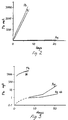
- The invention will now be described in more detail with reference to shot pellet manufacturing examples, firing tests, laboratory conducted leaching tests, and also with reference to practical tests and observations carried out on wild duck. The examples are illustrated in Figures 1-4, all of which are diagrams which show the results of the tests carried out.
- Lead shot pellets were cleaned in a boiling caustic soda solution. The pellets were then tumbled with sand and water, and thereafter again treated in a caustic bath. The pellets were then silver-plated in a rotating drum at 20-30°C in an electrolyte which comprised:
g/l Silver 40 Potassium cyanide 160 Potassium carbonate 40 Potassium hydroxide 1 Glossing agent or lustre 1-30 - The anodes used were silver metal anodes of sufficient purity. The plating process was carried out at a current density of 1-3 A/dm2. The pellets were washed repeatedly with water after the plating process.
- Shot pellets produced in accordance with Example 1 and having different layer thicknesses were tested in a shotgun to ascertain the mechanical strength of the pellets when fired from the gun. For evaluating reasons of a technical nature, the tests were carried out with the nozzle of the gun at a distance of only 3 metres from a water surface. This results in a much greater impact force than that generated by shot or pellets striking a water surface from a distance of 25-30 metres, which is a common distance when hunting so-called swimming birds on rivers and lakes, etc.
- The shooting test was carried out with six cartridges of 34 grams and containing silver-plated pellets having different layer thicknesses. Firing was effected against the water surface in a barrel filled with water and with a 1 dm foam layer. As before mentioned, the distance of the gun nozzle from the water surface was 3.0 metres. Upon completion of the firing test, the pellets were examined ocularly and sorted into three groups on the basis of appearance. The results are shown in the following Table.
Table Layer µm Large gash % Small gash % Whole % 23.3 13.7 41.5 44.8 34.9 7.7 20.6 71.7 46.5 3.1 8.1 88.8 58.2 3.5 2.3 94.3 69.8 0.8 1.2 98.0 81.4 1.2 2.0 96.8 - The results of this test show that the best results were obtained with pellets that had a layer thickness of 70 µm. The optimal layer thickness will vary with different manufacturing parameters, such as current density and after-treatment, for instance heat-treatment, and these tests merely provide a picture of the extent to which the silver layers remain essential intact when the pellets are fired, said silver layer having been applied to the underlying substrate core to an optimal thickness.
- Conventional lead shot was metered to wild ducks and the livers of the ducks were analyzed after 15 calendar days. It was established that the shot pellet had dissolved at a leaching rate of at least 9.2 mg Pb/pellet/day.
- In laboratory tests carried out on a "simulated" duck stomach (explained in more detail in Example 5), there was obtained for conventional lead shot a leeching rate of 11.2 mg Pb/shot/day, which indicates that the result obtained from the simulated duck stomach was in very close agreement with the result obtained with the test described in Example 3.
- Tests were carried out on simulated duck stomachs in the following way.
- 5 shot pellets (about 0.6 g) + 6.0 g gravel + 2 glass balls Ø 25 mm + 1 glass ball Ø 16 mm + 100 ml of 0.1 M HCl were shaken in a Turbula shaker for three weeks. The glass balls were used to increase the pressure on the shot and therewith subject the shot to treatment similar to that to which the shot would be subjected in the stomach muscles of the duck. In this way, the test material was subjected to both mechanical and chemical effect.
- pH was measured first on each sampling occasion. 10 ml of sample was then removed for analysis, whereupon a further 10 ml of 0.1 M HCl was added. Each pellet was also weighed individually on each sampling occasion, so as to monitor wear on the pellets.
- Reference tests were carried out with standard shot pellets, nickel-plated shot pellets and the inventive silver-plated shot pellets produced in accordance with Example 1. These pellets are referenced in the following respectively by Pb, Ni,Ag and Ag vb, wherein Ag identifies silver-plated pellets and Ag vb identifies heat-treated silver-plated pellets. Standard lead pellets (Pb) was tested in the absence of glass balls. Only insignificant differences were found when earlier testing pure lead pellets with and without glass balls. The reduction in weight (measured in mg) of the tested pellets is shown in the diagram in Figure 1 as a function of time expressed in calendar days. In the linear diagram in Figure 2, the lead content (mg/l) of the hydrochloric acid samples taken are shown as a function of time expressed in calendar days. This linear scale shows scarcely any dissolution of the silver-plated pellets. The test results from Figure 2 have been inserted in Figure 3 in a logarithmic diagram with an enlarged scale, and it will be seen that the silver-plated pellets are essentially fully intact after about 14 calendar days, whereafter leaching begins to occur. Up to 14 calendar days leaching corresponded to 0.003 mg Pb/pellet/day, which is three powers of ten lower than for conventional lead shot pellets (11.2 mg Pb/pellet/day).
- A series of comparison tests were carried out with fired conventional lead shot pellets and silver-plated shot pellets produced in accordance with Example 1 with the intention of evaluating the extent to which lead is leached from pellets fired into the ground. The tests are described in detail below.
- 10 shot pellets (individually weighed to 5 decimal places) were embedded in natural humus material in an open container. The mixture was moistened initially with acidified water (pH 4) and then intermittently at approximately one-week intervals. The mixture dried-out between the moisturizing occasions (= simulated rain). Two types of humus were used:
- 1. White moss, pine needles and gravel, etc., from dry heathy pine woodland.
- 2. Slime-rich material from the shores of a water-way that smelt of sulphuric acid.
- The water used was tap water that had been acidified with H2SO4 + HNO3 to pH 4, simulating acid rainwater. The pellets were removed and weighed after 37, 70 and 86 calendar days respectively (accumulated over the three tests). The results can be seen from the diagram in Figure 4, which shows the change in weight expressed in mg/pellet as a function of time. The diagram also gives a prognosis of the change in weight. The change in weight of lead shot pellets mixed in the two different types of humus have been referenced
Pb 1 andPb 2 respectively (i.e. inhumus type 1 and humus type 2). Corresponding references for the silver-plated pellets areAg 1 andAg 2. According to the prognosis, a lead shot pellet will have dissolved completely after 75-200 years, depending on the type of humus in which it is embedded. The silver-plated shot pellet showed essentially no change in weight during the test period. - The conclusions that can be drawn from the illustrated examples are as follows:
- Tests carried out with conventional lead shot pellets, nickel-plated shot pellets and inventive silver-plated shot have shown that conventional pellets in a simulated duck stomach exhibited a leaching rate of 11.2 mg/pellet/day and the nickel-plated pellets exhibited a leaching rate of 7.3 mg/shot/day in corresponding tests. No tests were carried out with tin-plated shot pellets, as proposed in GB-A 2,111,176, since no such shot pellet was available commercially and neither could any description be found in the literature as to how such pellet could be produced. In analogy with the test results recited in the GB reference and discussed in the introduction to the description, tin-plated shot pellets will exhibit a value within the range of 1-2 mg/pellet/day. During the first 14 days of the test, the silver-plated inventive shot pellets exhibited a leaching rate of only 0.003 mg Pb/pellet/day, i.e. a leaching rate which lies more than three powers of ten below the leaching rate of lead shot pellets and immediately beneath three powers of ten lower than the leaching rate of tin-plated shot pellets. The first 14 days have been chosen for this comparison because in practice a longer time period is of no interest, since the average residence time of pellet in the gizzards of birds is only from 7-15 calendar days, as indicated in the aforegoing.
- The tests also show that the silver-plated shot pellets are not measurably affected by humus, and consequently it is believed that no lead at all will leach into the ground on which the pellets fall, in sharp contrast to the conventional shot pellets.
- It can also be mentioned that in conjunction with the tests reported in the examples above, observations were also made on the gizzard of a wild duck, in which stones, gravel and grass seeds were found. These seeds resemble lead shot pellets in shape, colour and size. It is therefore obvious that birds will eat shot pellets in the belief that they are desirable grass seed. Literature indicates that the gizzard of sea birds can contain up to 62 shot pellets, even though the normal number is from one to three shots. It should be noted in this context that the inventive silver-plated shot pellets will distinguish from other materials primarily with regard to colour, since the pellet surface has a high lustre. The outer surface is also serrated to a large extent as it is shot from the gun. The risk of birds mistaking such pellets for grass seeds is therefore much smaller than in the case of conventional shot, and consequently this specific property of the inventive shot, which was not greatly affected by the humus tests carried out, is particularly favourable towards eliminating essentially those problems encountered with the use of lead shot pellets for hunting wild game, particularly so-called swimming birds such as ducks and recited in the introduction.
Claims (8)
- Shot pellets for hunting wild game, particularly for hunting birds on wet marshlands, rivers lakes, etc., and for clay pigeon shoots on organized skeet ranges, wherein the shot pellets comprises an inner core of lead or lead alloy and an electrochemically deposited outer layer of a metal, characterized in that said metal layer is silver or a silver alloy.
- Shot pellets according to Claim 1, characterized by an intermediate layer of copper or copper alloy.
- A method for producing shot pellets according to Claim 1 and 2 by applying at least one layer of metal electrochemically to shot pellet cores made of lead or lead alloy, characterized in that the outermost layer is always comprised of silver or silver alloy.
- A method according to Claim 3, characterized in that the shot pellet cores are comprised of conventional lead shot pellets.
- A method according to Claims 3-4, characterized by pre-treating the shot pellet cores with or without intermediate layers by cleaning and activating the cores.
- A method according to Claims 3-5, characterized by after-treatment in the form of controlled heating, resulting in a denser and more durable layer.
- A method according to Claims 3-6, characterized in that at least one layer has an adhesive effect on inwardly and outwardly lying layers and material respectively.
- A method according to Claims 3-7, characterized in that the shot pellet cores are coated with silver or silver alloy by means of a continuous electrochemical plating process.
Applications Claiming Priority (3)
| Application Number | Priority Date | Filing Date | Title |
|---|---|---|---|
| SE9202926 | 1992-10-07 | ||
| SE9202926A SE9202926L (en) | 1992-10-07 | 1992-10-07 | Hail for hunting prey and making such hail |
| PCT/SE1993/000808 WO1994008199A1 (en) | 1992-10-07 | 1993-10-06 | Shot for wild game hunting and a method for its manufacture |
Publications (2)
| Publication Number | Publication Date |
|---|---|
| EP0626060A1 EP0626060A1 (en) | 1994-11-30 |
| EP0626060B1 true EP0626060B1 (en) | 1997-04-16 |
Family
ID=20387401
Family Applications (1)
| Application Number | Title | Priority Date | Filing Date |
|---|---|---|---|
| EP93923085A Expired - Lifetime EP0626060B1 (en) | 1992-10-07 | 1993-10-06 | Shot for wild game hunting and a method for its manufacture |
Country Status (15)
| Country | Link |
|---|---|
| US (1) | US5528988A (en) |
| EP (1) | EP0626060B1 (en) |
| JP (1) | JPH07502108A (en) |
| AT (1) | ATE151866T1 (en) |
| AU (1) | AU662459B2 (en) |
| CA (1) | CA2123219C (en) |
| DE (1) | DE69309907T2 (en) |
| DK (1) | DK0626060T3 (en) |
| ES (1) | ES2100571T3 (en) |
| FI (1) | FI942659A0 (en) |
| GR (1) | GR3023343T3 (en) |
| HU (1) | HU212987B (en) |
| NO (1) | NO300789B1 (en) |
| SE (1) | SE9202926L (en) |
| WO (1) | WO1994008199A1 (en) |
Families Citing this family (7)
| Publication number | Priority date | Publication date | Assignee | Title |
|---|---|---|---|---|
| SE506479C2 (en) * | 1995-03-28 | 1997-12-22 | Boliden Mineral Ab | Hail for wet hunting and the production of such hail |
| GB9614468D0 (en) * | 1996-07-10 | 1996-09-04 | Taylor David B | Shot |
| ES2162232T3 (en) * | 1996-01-10 | 2001-12-16 | David Bradley Taylor | INOFENSIVE FORCES FOR THE ENVIRONMENT. |
| DE10151585C1 (en) * | 2001-10-23 | 2003-06-12 | Baumbach Metall Gmbh & Co Kg | Wire shaping system for manufacture of polygonal-shaped steel shot for use in sporting shotguns involves rolling to square-section, cutting to form cubes and then partial rounding to make polygonal shape |
| CA2726422C (en) * | 2007-07-09 | 2016-01-12 | Joseph Authement, Sr. | Shotgun shells having colored projectiles and method of using same |
| US8875632B2 (en) * | 2013-01-25 | 2014-11-04 | Tony Jaehnichen | Method of manufacturing colored shot for shot shells |
| JP7491578B2 (en) | 2021-02-10 | 2024-05-28 | 清川メッキ工業株式会社 | Shotgun Bullets |
Family Cites Families (14)
| Publication number | Priority date | Publication date | Assignee | Title |
|---|---|---|---|---|
| GB105415A (en) * | ||||
| US204298A (en) * | 1878-05-28 | Improvement in tin-plated shot | ||
| US1732211A (en) * | 1925-10-12 | 1929-10-15 | Western Cartridge Co | Small-caliber rifle bullet and process of making the same |
| BE341652A (en) * | 1926-10-28 | |||
| US1992244A (en) * | 1927-07-29 | 1935-02-26 | Western Cartridge Co | Process of making bullets |
| US1865727A (en) * | 1927-08-04 | 1932-07-05 | Western Cartridge Co | Process of making shot |
| US1916465A (en) * | 1929-04-08 | 1933-07-04 | Western Cartridge Co | Process and apparatus for electroplating projectiles |
| US2336143A (en) * | 1941-01-04 | 1943-12-07 | Remington Arms Co Inc | Method of making projectiles |
| US3349711A (en) * | 1964-12-07 | 1967-10-31 | Remington Arms Co Inc | Process of forming jacketed projectiles |
| US4387492A (en) * | 1980-10-02 | 1983-06-14 | Omark Industries, Inc. | Plated jacket soft point bullet |
| BE891406A (en) * | 1981-12-09 | 1982-06-09 | Herstal Sa | IMPROVEMENT IN LEAD GRAINS FOR HUNTING AMMUNITION. |
| US5085415A (en) * | 1990-04-17 | 1992-02-04 | Shaver Craig A | Windshield installation tool |
| US5088415A (en) * | 1990-10-31 | 1992-02-18 | Safety Shot Limited Partnership | Environmentally improved shot |
| US5079814A (en) * | 1990-11-13 | 1992-01-14 | Blount, Inc. | Method of manufacturing a hollow point bullet |
-
1992
- 1992-10-07 SE SE9202926A patent/SE9202926L/en not_active Application Discontinuation
-
1993
- 1993-10-06 DE DE69309907T patent/DE69309907T2/en not_active Expired - Fee Related
- 1993-10-06 ES ES93923085T patent/ES2100571T3/en not_active Expired - Lifetime
- 1993-10-06 AU AU52887/93A patent/AU662459B2/en not_active Ceased
- 1993-10-06 HU HU9401326A patent/HU212987B/en not_active IP Right Cessation
- 1993-10-06 AT AT93923085T patent/ATE151866T1/en not_active IP Right Cessation
- 1993-10-06 DK DK93923085.0T patent/DK0626060T3/en active
- 1993-10-06 WO PCT/SE1993/000808 patent/WO1994008199A1/en not_active Ceased
- 1993-10-06 CA CA002123219A patent/CA2123219C/en not_active Expired - Fee Related
- 1993-10-06 JP JP6508965A patent/JPH07502108A/en active Pending
- 1993-10-06 EP EP93923085A patent/EP0626060B1/en not_active Expired - Lifetime
- 1993-10-06 FI FI942659A patent/FI942659A0/en unknown
- 1993-10-06 US US08/232,111 patent/US5528988A/en not_active Expired - Fee Related
-
1994
- 1994-06-06 NO NO942093A patent/NO300789B1/en not_active IP Right Cessation
-
1997
- 1997-05-06 GR GR970401000T patent/GR3023343T3/en unknown
Also Published As
| Publication number | Publication date |
|---|---|
| AU5288793A (en) | 1994-04-26 |
| AU662459B2 (en) | 1995-08-31 |
| HUT67092A (en) | 1995-01-30 |
| DK0626060T3 (en) | 1997-10-27 |
| SE9202926D0 (en) | 1992-10-07 |
| SE9202926L (en) | 1994-04-08 |
| FI942659L (en) | 1994-06-06 |
| DE69309907D1 (en) | 1997-05-22 |
| CA2123219C (en) | 1998-03-31 |
| NO942093D0 (en) | 1994-06-06 |
| WO1994008199A1 (en) | 1994-04-14 |
| US5528988A (en) | 1996-06-25 |
| DE69309907T2 (en) | 1997-07-24 |
| NO942093L (en) | 1994-06-06 |
| ATE151866T1 (en) | 1997-05-15 |
| NO300789B1 (en) | 1997-07-21 |
| HU9401326D0 (en) | 1994-08-29 |
| EP0626060A1 (en) | 1994-11-30 |
| FI942659A7 (en) | 1994-06-06 |
| CA2123219A1 (en) | 1994-04-14 |
| HU212987B (en) | 1997-01-28 |
| FI942659A0 (en) | 1994-06-06 |
| GR3023343T3 (en) | 1997-08-29 |
| ES2100571T3 (en) | 1997-06-16 |
| JPH07502108A (en) | 1995-03-02 |
Similar Documents
| Publication | Publication Date | Title |
|---|---|---|
| EP0478608B1 (en) | Non-toxic shot and shot shell containing same | |
| US5528988A (en) | Shot pellets for wild game hunting and a method for its manufacture | |
| DE69824548T2 (en) | FRAGILE STOREY OF IRON POWDER | |
| US4881465A (en) | Non-toxic shot pellets for shotguns and method | |
| KR20180090736A (en) | Surface treated copper foil,and current collector,electrode,and battery using the surface treated copper foil | |
| CA2190277C (en) | Shot pellets for game hunting on wet marschlands and a method of manufacturing such shot | |
| Lopes-Lima et al. | Ionic regulation and shell mineralization in the bivalve Anodonta cygnea (swan mussel) following heavy-metal exposure | |
| US2167828A (en) | Bird shot | |
| GB2111176A (en) | Improvements to lead shots for hunting ammunition | |
| McClintock et al. | Intraspecific agonistic arm-fencing behavior in the Antarctic keystone sea star Odontaster validus influences prey acquisition | |
| Mallatt et al. | Ultrastructure of a complex epithelial system: the pharyngeal lining of the larval lamprey Petromyzon marinus | |
| Quy | Review of evidence concerning the contamination of wildlife and the environment arising from the use of lead ammunition | |
| Thomas et al. | Lead poisoning and waterfowl | |
| CN106288979A (en) | A kind of preparation method of cylindrical controlled fragment | |
| EP3966367A1 (en) | Plated bismuth shot | |
| DE1144076B (en) | Process for the production of metallic coatings | |
| Sanborn | Lead poisoning of North American wildlife from lead shot and lead fishing tackle | |
| Lewis | The function of the sphaeridia of sea urchins | |
| Norris | AM Scheuhammer1 | |
| DE73304C (en) | Mercury cathode for electrolytic cells | |
| RU25790U1 (en) | TARGET TARGET | |
| KALIsiNsKA et al. | Kalisińska E., Wysocki R., Dańczak A., Kalisiński MM, Engel J. 1995. Hunterg | |
| Macheikene et al. | Influence of Polymer Additives in the Chromating Solution on the Corrosion Resistance of Zinc Coatings | |
| Gowon et al. | The Need to Intensify Research Efforts in the Alternative to Lead Shot | |
| KR880002116B1 (en) | A gunpowder making method |
Legal Events
| Date | Code | Title | Description |
|---|---|---|---|
| PUAI | Public reference made under article 153(3) epc to a published international application that has entered the european phase |
Free format text: ORIGINAL CODE: 0009012 |
|
| AK | Designated contracting states |
Kind code of ref document: A1 Designated state(s): AT BE CH DE DK ES FR GB GR IE IT LI LU MC NL PT SE |
|
| 17P | Request for examination filed |
Effective date: 19941003 |
|
| 17Q | First examination report despatched |
Effective date: 19951213 |
|
| GRAG | Despatch of communication of intention to grant |
Free format text: ORIGINAL CODE: EPIDOS AGRA |
|
| GRAH | Despatch of communication of intention to grant a patent |
Free format text: ORIGINAL CODE: EPIDOS IGRA |
|
| GRAH | Despatch of communication of intention to grant a patent |
Free format text: ORIGINAL CODE: EPIDOS IGRA |
|
| GRAA | (expected) grant |
Free format text: ORIGINAL CODE: 0009210 |
|
| AK | Designated contracting states |
Kind code of ref document: B1 Designated state(s): AT BE CH DE DK ES FR GB GR IE IT LI LU MC NL PT SE |
|
| REF | Corresponds to: |
Ref document number: 151866 Country of ref document: AT Date of ref document: 19970515 Kind code of ref document: T |
|
| REG | Reference to a national code |
Ref country code: CH Ref legal event code: NV Representative=s name: KIRKER & CIE SA Ref country code: CH Ref legal event code: EP |
|
| REF | Corresponds to: |
Ref document number: 69309907 Country of ref document: DE Date of ref document: 19970522 |
|
| REG | Reference to a national code |
Ref country code: ES Ref legal event code: FG2A Ref document number: 2100571 Country of ref document: ES Kind code of ref document: T3 |
|
| ET | Fr: translation filed | ||
| REG | Reference to a national code |
Ref country code: IE Ref legal event code: FG4D Free format text: 73354 |
|
| REG | Reference to a national code |
Ref country code: PT Ref legal event code: SC4A Free format text: AVAILABILITY OF NATIONAL TRANSLATION Effective date: 19970506 Ref country code: GR Ref legal event code: FG4A Free format text: 3023343 |
|
| REG | Reference to a national code |
Ref country code: DK Ref legal event code: T3 |
|
| PLBE | No opposition filed within time limit |
Free format text: ORIGINAL CODE: 0009261 |
|
| STAA | Information on the status of an ep patent application or granted ep patent |
Free format text: STATUS: NO OPPOSITION FILED WITHIN TIME LIMIT |
|
| 26N | No opposition filed | ||
| PGFP | Annual fee paid to national office [announced via postgrant information from national office to epo] |
Ref country code: PT Payment date: 19990921 Year of fee payment: 7 |
|
| PGFP | Annual fee paid to national office [announced via postgrant information from national office to epo] |
Ref country code: GB Payment date: 19991006 Year of fee payment: 7 |
|
| PGFP | Annual fee paid to national office [announced via postgrant information from national office to epo] |
Ref country code: SE Payment date: 19991007 Year of fee payment: 7 |
|
| PGFP | Annual fee paid to national office [announced via postgrant information from national office to epo] |
Ref country code: DE Payment date: 19991008 Year of fee payment: 7 |
|
| PGFP | Annual fee paid to national office [announced via postgrant information from national office to epo] |
Ref country code: FR Payment date: 19991011 Year of fee payment: 7 |
|
| PGFP | Annual fee paid to national office [announced via postgrant information from national office to epo] |
Ref country code: DK Payment date: 19991013 Year of fee payment: 7 Ref country code: CH Payment date: 19991013 Year of fee payment: 7 Ref country code: AT Payment date: 19991013 Year of fee payment: 7 |
|
| PGFP | Annual fee paid to national office [announced via postgrant information from national office to epo] |
Ref country code: ES Payment date: 19991020 Year of fee payment: 7 Ref country code: LU Payment date: 19991020 Year of fee payment: 7 |
|
| PGFP | Annual fee paid to national office [announced via postgrant information from national office to epo] |
Ref country code: IE Payment date: 19991027 Year of fee payment: 7 Ref country code: GR Payment date: 19991027 Year of fee payment: 7 |
|
| PGFP | Annual fee paid to national office [announced via postgrant information from national office to epo] |
Ref country code: NL Payment date: 19991029 Year of fee payment: 7 |
|
| PGFP | Annual fee paid to national office [announced via postgrant information from national office to epo] |
Ref country code: MC Payment date: 19991102 Year of fee payment: 7 |
|
| PGFP | Annual fee paid to national office [announced via postgrant information from national office to epo] |
Ref country code: BE Payment date: 19991221 Year of fee payment: 7 |
|
| PG25 | Lapsed in a contracting state [announced via postgrant information from national office to epo] |
Ref country code: LU Free format text: LAPSE BECAUSE OF NON-PAYMENT OF DUE FEES Effective date: 20001006 Ref country code: IE Free format text: LAPSE BECAUSE OF NON-PAYMENT OF DUE FEES Effective date: 20001006 Ref country code: GB Free format text: LAPSE BECAUSE OF NON-PAYMENT OF DUE FEES Effective date: 20001006 Ref country code: DK Free format text: LAPSE BECAUSE OF NON-PAYMENT OF DUE FEES Effective date: 20001006 Ref country code: AT Free format text: LAPSE BECAUSE OF NON-PAYMENT OF DUE FEES Effective date: 20001006 |
|
| PG25 | Lapsed in a contracting state [announced via postgrant information from national office to epo] |
Ref country code: ES Free format text: LAPSE BECAUSE OF NON-PAYMENT OF DUE FEES Effective date: 20001007 |
|
| PG25 | Lapsed in a contracting state [announced via postgrant information from national office to epo] |
Ref country code: SE Free format text: THE PATENT HAS BEEN ANNULLED BY A DECISION OF A NATIONAL AUTHORITY Effective date: 20001030 |
|
| PG25 | Lapsed in a contracting state [announced via postgrant information from national office to epo] |
Ref country code: MC Free format text: THE PATENT HAS BEEN ANNULLED BY A DECISION OF A NATIONAL AUTHORITY Effective date: 20001031 Ref country code: LI Free format text: LAPSE BECAUSE OF NON-PAYMENT OF DUE FEES Effective date: 20001031 Ref country code: GR Free format text: LAPSE BECAUSE OF NON-PAYMENT OF DUE FEES Effective date: 20001031 Ref country code: CH Free format text: LAPSE BECAUSE OF NON-PAYMENT OF DUE FEES Effective date: 20001031 Ref country code: BE Free format text: LAPSE BECAUSE OF NON-PAYMENT OF DUE FEES Effective date: 20001031 |
|
| BERE | Be: lapsed |
Owner name: BOLIDEN MINERAL A.B. Effective date: 20001031 |
|
| PG25 | Lapsed in a contracting state [announced via postgrant information from national office to epo] |
Ref country code: PT Free format text: LAPSE BECAUSE OF NON-PAYMENT OF DUE FEES Effective date: 20010430 |
|
| PG25 | Lapsed in a contracting state [announced via postgrant information from national office to epo] |
Ref country code: NL Free format text: LAPSE BECAUSE OF NON-PAYMENT OF DUE FEES Effective date: 20010501 |
|
| GBPC | Gb: european patent ceased through non-payment of renewal fee |
Effective date: 20001006 |
|
| REG | Reference to a national code |
Ref country code: DK Ref legal event code: EBP |
|
| REG | Reference to a national code |
Ref country code: CH Ref legal event code: PL |
|
| EUG | Se: european patent has lapsed |
Ref document number: 93923085.0 |
|
| PG25 | Lapsed in a contracting state [announced via postgrant information from national office to epo] |
Ref country code: FR Free format text: LAPSE BECAUSE OF NON-PAYMENT OF DUE FEES Effective date: 20010629 |
|
| NLV4 | Nl: lapsed or anulled due to non-payment of the annual fee |
Effective date: 20010501 |
|
| PG25 | Lapsed in a contracting state [announced via postgrant information from national office to epo] |
Ref country code: DE Free format text: LAPSE BECAUSE OF NON-PAYMENT OF DUE FEES Effective date: 20010703 |
|
| REG | Reference to a national code |
Ref country code: FR Ref legal event code: ST |
|
| REG | Reference to a national code |
Ref country code: IE Ref legal event code: MM4A |
|
| REG | Reference to a national code |
Ref country code: ES Ref legal event code: FD2A Effective date: 20011113 |
|
| PG25 | Lapsed in a contracting state [announced via postgrant information from national office to epo] |
Ref country code: IT Free format text: LAPSE BECAUSE OF NON-PAYMENT OF DUE FEES;WARNING: LAPSES OF ITALIAN PATENTS WITH EFFECTIVE DATE BEFORE 2007 MAY HAVE OCCURRED AT ANY TIME BEFORE 2007. THE CORRECT EFFECTIVE DATE MAY BE DIFFERENT FROM THE ONE RECORDED. Effective date: 20051006 |