EP0620255A1 - Antifogging abrasion resistant coating composition and synthetic resin article coated therewith - Google Patents
Antifogging abrasion resistant coating composition and synthetic resin article coated therewith Download PDFInfo
- Publication number
- EP0620255A1 EP0620255A1 EP94105810A EP94105810A EP0620255A1 EP 0620255 A1 EP0620255 A1 EP 0620255A1 EP 94105810 A EP94105810 A EP 94105810A EP 94105810 A EP94105810 A EP 94105810A EP 0620255 A1 EP0620255 A1 EP 0620255A1
- Authority
- EP
- European Patent Office
- Prior art keywords
- meth
- acrylate
- composition
- group
- acid
- Prior art date
- Legal status (The legal status is an assumption and is not a legal conclusion. Google has not performed a legal analysis and makes no representation as to the accuracy of the status listed.)
- Granted
Links
- 239000008199 coating composition Substances 0.000 title claims abstract description 18
- 229920003002 synthetic resin Polymers 0.000 title claims description 8
- 239000000057 synthetic resin Substances 0.000 title claims description 8
- 238000005299 abrasion Methods 0.000 title abstract description 29
- NIXOWILDQLNWCW-UHFFFAOYSA-M Acrylate Chemical compound [O-]C(=O)C=C NIXOWILDQLNWCW-UHFFFAOYSA-M 0.000 claims abstract description 65
- 239000000178 monomer Substances 0.000 claims abstract description 33
- 150000001282 organosilanes Chemical class 0.000 claims abstract description 30
- 229920001577 copolymer Polymers 0.000 claims abstract description 28
- 239000000758 substrate Substances 0.000 claims abstract description 27
- 229920001897 terpolymer Polymers 0.000 claims abstract description 23
- 239000000413 hydrolysate Substances 0.000 claims abstract description 19
- 125000002924 primary amino group Chemical group [H]N([H])* 0.000 claims abstract description 17
- 239000003054 catalyst Substances 0.000 claims abstract description 15
- 239000004593 Epoxy Substances 0.000 claims abstract description 14
- XLYOFNOQVPJJNP-UHFFFAOYSA-N water Substances O XLYOFNOQVPJJNP-UHFFFAOYSA-N 0.000 claims abstract description 12
- 239000007870 radical polymerization initiator Substances 0.000 claims abstract description 9
- 239000000203 mixture Substances 0.000 claims description 74
- 238000000576 coating method Methods 0.000 claims description 46
- 239000011248 coating agent Substances 0.000 claims description 44
- -1 organosilane compound Chemical class 0.000 claims description 29
- 125000004435 hydrogen atom Chemical group [H]* 0.000 claims description 8
- 239000004417 polycarbonate Substances 0.000 claims description 8
- 229920000515 polycarbonate Polymers 0.000 claims description 8
- QTBSBXVTEAMEQO-UHFFFAOYSA-N Acetic acid Chemical compound CC(O)=O QTBSBXVTEAMEQO-UHFFFAOYSA-N 0.000 claims description 6
- LYCAIKOWRPUZTN-UHFFFAOYSA-N Ethylene glycol Chemical compound OCCO LYCAIKOWRPUZTN-UHFFFAOYSA-N 0.000 claims description 6
- KWYUFKZDYYNOTN-UHFFFAOYSA-M Potassium hydroxide Chemical compound [OH-].[K+] KWYUFKZDYYNOTN-UHFFFAOYSA-M 0.000 claims description 6
- HEMHJVSKTPXQMS-UHFFFAOYSA-M Sodium hydroxide Chemical compound [OH-].[Na+] HEMHJVSKTPXQMS-UHFFFAOYSA-M 0.000 claims description 6
- 125000000217 alkyl group Chemical group 0.000 claims description 6
- RAXXELZNTBOGNW-UHFFFAOYSA-N imidazole Natural products C1=CNC=N1 RAXXELZNTBOGNW-UHFFFAOYSA-N 0.000 claims description 6
- VEXZGXHMUGYJMC-UHFFFAOYSA-N Hydrochloric acid Chemical compound Cl VEXZGXHMUGYJMC-UHFFFAOYSA-N 0.000 claims description 5
- 125000003277 amino group Chemical group 0.000 claims description 5
- 150000002430 hydrocarbons Chemical class 0.000 claims description 5
- 150000002978 peroxides Chemical class 0.000 claims description 5
- 229910052710 silicon Inorganic materials 0.000 claims description 5
- 239000010703 silicon Substances 0.000 claims description 5
- QGZKDVFQNNGYKY-UHFFFAOYSA-N Ammonia Chemical compound N QGZKDVFQNNGYKY-UHFFFAOYSA-N 0.000 claims description 4
- 239000004215 Carbon black (E152) Substances 0.000 claims description 4
- ZRALSGWEFCBTJO-UHFFFAOYSA-N Guanidine Chemical compound NC(N)=N ZRALSGWEFCBTJO-UHFFFAOYSA-N 0.000 claims description 4
- NBIIXXVUZAFLBC-UHFFFAOYSA-N Phosphoric acid Chemical compound OP(O)(O)=O NBIIXXVUZAFLBC-UHFFFAOYSA-N 0.000 claims description 4
- QAOWNCQODCNURD-UHFFFAOYSA-N Sulfuric acid Chemical compound OS(O)(=O)=O QAOWNCQODCNURD-UHFFFAOYSA-N 0.000 claims description 4
- RTAQQCXQSZGOHL-UHFFFAOYSA-N Titanium Chemical compound [Ti] RTAQQCXQSZGOHL-UHFFFAOYSA-N 0.000 claims description 4
- XECAHXYUAAWDEL-UHFFFAOYSA-N acrylonitrile butadiene styrene Chemical compound C=CC=C.C=CC#N.C=CC1=CC=CC=C1 XECAHXYUAAWDEL-UHFFFAOYSA-N 0.000 claims description 4
- 229920000122 acrylonitrile butadiene styrene Polymers 0.000 claims description 4
- 239000004676 acrylonitrile butadiene styrene Substances 0.000 claims description 4
- WTEOIRVLGSZEPR-UHFFFAOYSA-N boron trifluoride Chemical compound FB(F)F WTEOIRVLGSZEPR-UHFFFAOYSA-N 0.000 claims description 4
- WERYXYBDKMZEQL-UHFFFAOYSA-N butane-1,4-diol Chemical compound OCCCCO WERYXYBDKMZEQL-UHFFFAOYSA-N 0.000 claims description 4
- JQVDAXLFBXTEQA-UHFFFAOYSA-N dibutylamine Chemical compound CCCCNCCCC JQVDAXLFBXTEQA-UHFFFAOYSA-N 0.000 claims description 4
- 125000003700 epoxy group Chemical group 0.000 claims description 4
- 125000000524 functional group Chemical group 0.000 claims description 4
- 238000007602 hot air drying Methods 0.000 claims description 4
- 229930195733 hydrocarbon Natural products 0.000 claims description 4
- 125000002887 hydroxy group Chemical group [H]O* 0.000 claims description 4
- VLTRZXGMWDSKGL-UHFFFAOYSA-N perchloric acid Chemical compound OCl(=O)(=O)=O VLTRZXGMWDSKGL-UHFFFAOYSA-N 0.000 claims description 4
- 229920003229 poly(methyl methacrylate) Polymers 0.000 claims description 4
- 239000004926 polymethyl methacrylate Substances 0.000 claims description 4
- YPFDHNVEDLHUCE-UHFFFAOYSA-N propane-1,3-diol Chemical compound OCCCO YPFDHNVEDLHUCE-UHFFFAOYSA-N 0.000 claims description 4
- WYTZZXDRDKSJID-UHFFFAOYSA-N (3-aminopropyl)triethoxysilane Chemical compound CCO[Si](OCC)(OCC)CCCN WYTZZXDRDKSJID-UHFFFAOYSA-N 0.000 claims description 3
- BVKZGUZCCUSVTD-UHFFFAOYSA-L Carbonate Chemical compound [O-]C([O-])=O BVKZGUZCCUSVTD-UHFFFAOYSA-L 0.000 claims description 3
- PVLBXNICXUCXTA-UHFFFAOYSA-N [2-hydroxy-3-(3-triethoxysilylpropylamino)propyl] prop-2-enoate Chemical compound CCO[Si](OCC)(OCC)CCCNCC(O)COC(=O)C=C PVLBXNICXUCXTA-UHFFFAOYSA-N 0.000 claims description 3
- 239000012933 diacyl peroxide Substances 0.000 claims description 3
- GNTHOKPJBLJTJY-UHFFFAOYSA-N dimethoxy(oxiran-2-ylmethoxymethyl)silane Chemical compound CO[SiH](OC)COCC1CO1 GNTHOKPJBLJTJY-UHFFFAOYSA-N 0.000 claims description 3
- 125000000864 peroxy group Chemical group O(O*)* 0.000 claims description 3
- 150000003839 salts Chemical class 0.000 claims description 3
- 125000004178 (C1-C4) alkyl group Chemical group 0.000 claims description 2
- 125000000229 (C1-C4)alkoxy group Chemical group 0.000 claims description 2
- ADVORQMAWLEPOI-XHTSQIMGSA-N (e)-4-hydroxypent-3-en-2-one;oxotitanium Chemical compound [Ti]=O.C\C(O)=C/C(C)=O.C\C(O)=C/C(C)=O ADVORQMAWLEPOI-XHTSQIMGSA-N 0.000 claims description 2
- KEQGZUUPPQEDPF-UHFFFAOYSA-N 1,3-dichloro-5,5-dimethylimidazolidine-2,4-dione Chemical compound CC1(C)N(Cl)C(=O)N(Cl)C1=O KEQGZUUPPQEDPF-UHFFFAOYSA-N 0.000 claims description 2
- LCZVSXRMYJUNFX-UHFFFAOYSA-N 2-[2-(2-hydroxypropoxy)propoxy]propan-1-ol Chemical compound CC(O)COC(C)COC(C)CO LCZVSXRMYJUNFX-UHFFFAOYSA-N 0.000 claims description 2
- GSVMCEUQHZAFKG-UHFFFAOYSA-N 2-triethoxysilylaniline Chemical compound CCO[Si](OCC)(OCC)C1=CC=CC=C1N GSVMCEUQHZAFKG-UHFFFAOYSA-N 0.000 claims description 2
- BHWUCEATHBXPOV-UHFFFAOYSA-N 2-triethoxysilylethanamine Chemical compound CCO[Si](CCN)(OCC)OCC BHWUCEATHBXPOV-UHFFFAOYSA-N 0.000 claims description 2
- QHQNYHZHLAAHRW-UHFFFAOYSA-N 2-trimethoxysilylethanamine Chemical compound CO[Si](OC)(OC)CCN QHQNYHZHLAAHRW-UHFFFAOYSA-N 0.000 claims description 2
- XBIUWALDKXACEA-UHFFFAOYSA-N 3-[bis(2,4-dioxopentan-3-yl)alumanyl]pentane-2,4-dione Chemical compound CC(=O)C(C(C)=O)[Al](C(C(C)=O)C(C)=O)C(C(C)=O)C(C)=O XBIUWALDKXACEA-UHFFFAOYSA-N 0.000 claims description 2
- HXLAEGYMDGUSBD-UHFFFAOYSA-N 3-[diethoxy(methyl)silyl]propan-1-amine Chemical compound CCO[Si](C)(OCC)CCCN HXLAEGYMDGUSBD-UHFFFAOYSA-N 0.000 claims description 2
- ZYAASQNKCWTPKI-UHFFFAOYSA-N 3-[dimethoxy(methyl)silyl]propan-1-amine Chemical compound CO[Si](C)(OC)CCCN ZYAASQNKCWTPKI-UHFFFAOYSA-N 0.000 claims description 2
- BMYNFMYTOJXKLE-UHFFFAOYSA-N 3-azaniumyl-2-hydroxypropanoate Chemical compound NCC(O)C(O)=O BMYNFMYTOJXKLE-UHFFFAOYSA-N 0.000 claims description 2
- GDDNTTHUKVNJRA-UHFFFAOYSA-N 3-bromo-3,3-difluoroprop-1-ene Chemical compound FC(F)(Br)C=C GDDNTTHUKVNJRA-UHFFFAOYSA-N 0.000 claims description 2
- LVNLBBGBASVLLI-UHFFFAOYSA-N 3-triethoxysilylpropylurea Chemical compound CCO[Si](OCC)(OCC)CCCNC(N)=O LVNLBBGBASVLLI-UHFFFAOYSA-N 0.000 claims description 2
- SJECZPVISLOESU-UHFFFAOYSA-N 3-trimethoxysilylpropan-1-amine Chemical compound CO[Si](OC)(OC)CCCN SJECZPVISLOESU-UHFFFAOYSA-N 0.000 claims description 2
- YHFFINXFNYQPQA-UHFFFAOYSA-N 4-[diethoxy(methyl)silyl]butan-1-amine Chemical compound CCO[Si](C)(OCC)CCCCN YHFFINXFNYQPQA-UHFFFAOYSA-N 0.000 claims description 2
- WFUCSFLLCZTCPT-UHFFFAOYSA-N 4-[diethoxy(phenyl)silyl]butan-1-amine Chemical compound NCCCC[Si](OCC)(OCC)C1=CC=CC=C1 WFUCSFLLCZTCPT-UHFFFAOYSA-N 0.000 claims description 2
- ZQJUGNSCGMEIHO-UHFFFAOYSA-N 4-[dimethoxy(methyl)silyl]butan-1-amine Chemical compound CO[Si](C)(OC)CCCCN ZQJUGNSCGMEIHO-UHFFFAOYSA-N 0.000 claims description 2
- URWGMCIGMFSAPW-UHFFFAOYSA-N 4-[dimethoxy(phenyl)silyl]butan-1-amine Chemical compound NCCCC[Si](OC)(OC)C1=CC=CC=C1 URWGMCIGMFSAPW-UHFFFAOYSA-N 0.000 claims description 2
- SWDDLRSGGCWDPH-UHFFFAOYSA-N 4-triethoxysilylbutan-1-amine Chemical compound CCO[Si](OCC)(OCC)CCCCN SWDDLRSGGCWDPH-UHFFFAOYSA-N 0.000 claims description 2
- CNODSORTHKVDEM-UHFFFAOYSA-N 4-trimethoxysilylaniline Chemical compound CO[Si](OC)(OC)C1=CC=C(N)C=C1 CNODSORTHKVDEM-UHFFFAOYSA-N 0.000 claims description 2
- RBVMDQYCJXEJCJ-UHFFFAOYSA-N 4-trimethoxysilylbutan-1-amine Chemical compound CO[Si](OC)(OC)CCCCN RBVMDQYCJXEJCJ-UHFFFAOYSA-N 0.000 claims description 2
- KIKDPIYHXZFGGH-UHFFFAOYSA-N B(F)(F)F.[Sn] Chemical compound B(F)(F)F.[Sn] KIKDPIYHXZFGGH-UHFFFAOYSA-N 0.000 claims description 2
- 229910015900 BF3 Inorganic materials 0.000 claims description 2
- XNCOSPRUTUOJCJ-UHFFFAOYSA-N Biguanide Chemical compound NC(N)=NC(N)=N XNCOSPRUTUOJCJ-UHFFFAOYSA-N 0.000 claims description 2
- 229940123208 Biguanide Drugs 0.000 claims description 2
- FEWJPZIEWOKRBE-JCYAYHJZSA-N Dextrotartaric acid Chemical compound OC(=O)[C@H](O)[C@@H](O)C(O)=O FEWJPZIEWOKRBE-JCYAYHJZSA-N 0.000 claims description 2
- CHJJGSNFBQVOTG-UHFFFAOYSA-N N-methyl-guanidine Natural products CNC(N)=N CHJJGSNFBQVOTG-UHFFFAOYSA-N 0.000 claims description 2
- GRYLNZFGIOXLOG-UHFFFAOYSA-N Nitric acid Chemical compound O[N+]([O-])=O GRYLNZFGIOXLOG-UHFFFAOYSA-N 0.000 claims description 2
- 239000004793 Polystyrene Substances 0.000 claims description 2
- VMHLLURERBWHNL-UHFFFAOYSA-M Sodium acetate Chemical compound [Na+].CC([O-])=O VMHLLURERBWHNL-UHFFFAOYSA-M 0.000 claims description 2
- FEWJPZIEWOKRBE-UHFFFAOYSA-N Tartaric acid Natural products [H+].[H+].[O-]C(=O)C(O)C(O)C([O-])=O FEWJPZIEWOKRBE-UHFFFAOYSA-N 0.000 claims description 2
- ATJFFYVFTNAWJD-UHFFFAOYSA-N Tin Chemical compound [Sn] ATJFFYVFTNAWJD-UHFFFAOYSA-N 0.000 claims description 2
- ZJCCRDAZUWHFQH-UHFFFAOYSA-N Trimethylolpropane Chemical compound CCC(CO)(CO)CO ZJCCRDAZUWHFQH-UHFFFAOYSA-N 0.000 claims description 2
- HCHKCACWOHOZIP-UHFFFAOYSA-N Zinc Chemical compound [Zn] HCHKCACWOHOZIP-UHFFFAOYSA-N 0.000 claims description 2
- OCKGXPDKMOCFDU-UHFFFAOYSA-N [diacetyloxy(2-aminoethyl)silyl] acetate Chemical compound CC(=O)O[Si](CCN)(OC(C)=O)OC(C)=O OCKGXPDKMOCFDU-UHFFFAOYSA-N 0.000 claims description 2
- UYNDTGSKTBWYDX-UHFFFAOYSA-N [diacetyloxy-[3-(oxiran-2-ylmethoxy)propyl]silyl] acetate Chemical compound CC(=O)O[Si](OC(C)=O)(OC(C)=O)CCCOCC1CO1 UYNDTGSKTBWYDX-UHFFFAOYSA-N 0.000 claims description 2
- CMEYFXQCAOKFSL-UHFFFAOYSA-N [diacetyloxy-[4-(oxiran-2-yl)butyl]silyl] acetate Chemical compound CC(=O)O[Si](OC(C)=O)(OC(C)=O)CCCCC1CO1 CMEYFXQCAOKFSL-UHFFFAOYSA-N 0.000 claims description 2
- OIPILFWXSMYKGL-UHFFFAOYSA-N acetylcholine Chemical compound CC(=O)OCC[N+](C)(C)C OIPILFWXSMYKGL-UHFFFAOYSA-N 0.000 claims description 2
- 239000002253 acid Substances 0.000 claims description 2
- 229920001893 acrylonitrile styrene Polymers 0.000 claims description 2
- 125000002252 acyl group Chemical group 0.000 claims description 2
- 125000004183 alkoxy alkyl group Chemical group 0.000 claims description 2
- 229910000147 aluminium phosphate Inorganic materials 0.000 claims description 2
- 150000001412 amines Chemical group 0.000 claims description 2
- 229910021529 ammonia Inorganic materials 0.000 claims description 2
- 150000008064 anhydrides Chemical class 0.000 claims description 2
- IISBACLAFKSPIT-UHFFFAOYSA-N bisphenol A Chemical class C=1C=C(O)C=CC=1C(C)(C)C1=CC=C(O)C=C1 IISBACLAFKSPIT-UHFFFAOYSA-N 0.000 claims description 2
- HQABUPZFAYXKJW-UHFFFAOYSA-N butan-1-amine Chemical compound CCCCN HQABUPZFAYXKJW-UHFFFAOYSA-N 0.000 claims description 2
- XTHPWXDJESJLNJ-UHFFFAOYSA-N chlorosulfonic acid Substances OS(Cl)(=O)=O XTHPWXDJESJLNJ-UHFFFAOYSA-N 0.000 claims description 2
- XEHUIDSUOAGHBW-UHFFFAOYSA-N chromium;pentane-2,4-dione Chemical compound [Cr].CC(=O)CC(C)=O.CC(=O)CC(C)=O.CC(=O)CC(C)=O XEHUIDSUOAGHBW-UHFFFAOYSA-N 0.000 claims description 2
- OCDFTWVGTADYMH-UHFFFAOYSA-N cobalt dodecanoic acid Chemical compound [Co].CCCCCCCCCCCC(O)=O.CCCCCCCCCCCC(O)=O OCDFTWVGTADYMH-UHFFFAOYSA-N 0.000 claims description 2
- FJDJVBXSSLDNJB-LNTINUHCSA-N cobalt;(z)-4-hydroxypent-3-en-2-one Chemical compound [Co].C\C(O)=C\C(C)=O.C\C(O)=C\C(C)=O.C\C(O)=C\C(C)=O FJDJVBXSSLDNJB-LNTINUHCSA-N 0.000 claims description 2
- CRSOKXHGCLHRFF-UHFFFAOYSA-N diethoxy-bis(oxiran-2-ylmethoxymethyl)silane Chemical compound C1OC1COC[Si](OCC)(OCC)COCC1CO1 CRSOKXHGCLHRFF-UHFFFAOYSA-N 0.000 claims description 2
- HNYVUZYLOVAQIF-UHFFFAOYSA-N diethoxy-bis[2-(oxiran-2-ylmethoxy)ethyl]silane Chemical compound C1OC1COCC[Si](OCC)(OCC)CCOCC1CO1 HNYVUZYLOVAQIF-UHFFFAOYSA-N 0.000 claims description 2
- RIIYEOHOQDANAR-UHFFFAOYSA-N diethoxy-bis[3-(oxiran-2-ylmethoxy)propyl]silane Chemical compound C1OC1COCCC[Si](OCC)(OCC)CCCOCC1CO1 RIIYEOHOQDANAR-UHFFFAOYSA-N 0.000 claims description 2
- OSDDERYBYVDGCN-UHFFFAOYSA-N dimethoxy-(oxiran-2-ylmethoxymethyl)-phenylsilane Chemical compound C=1C=CC=CC=1[Si](OC)(OC)COCC1CO1 OSDDERYBYVDGCN-UHFFFAOYSA-N 0.000 claims description 2
- OLGFJVSABRBVFE-UHFFFAOYSA-N dimethoxy-bis(oxiran-2-ylmethoxymethyl)silane Chemical compound C1OC1COC[Si](OC)(OC)COCC1CO1 OLGFJVSABRBVFE-UHFFFAOYSA-N 0.000 claims description 2
- XZXYTQWKUONLLI-UHFFFAOYSA-N dimethoxy-bis[3-(oxiran-2-ylmethoxy)propyl]silane Chemical compound C1OC1COCCC[Si](OC)(OC)CCCOCC1CO1 XZXYTQWKUONLLI-UHFFFAOYSA-N 0.000 claims description 2
- CAEPKDWOZATEMI-UHFFFAOYSA-N dimethoxy-methyl-(oxiran-2-ylmethoxymethyl)silane Chemical compound CO[Si](C)(OC)COCC1CO1 CAEPKDWOZATEMI-UHFFFAOYSA-N 0.000 claims description 2
- WHGNXNCOTZPEEK-UHFFFAOYSA-N dimethoxy-methyl-[3-(oxiran-2-ylmethoxy)propyl]silane Chemical compound CO[Si](C)(OC)CCCOCC1CO1 WHGNXNCOTZPEEK-UHFFFAOYSA-N 0.000 claims description 2
- SWSQBOPZIKWTGO-UHFFFAOYSA-N dimethylaminoamidine Natural products CN(C)C(N)=N SWSQBOPZIKWTGO-UHFFFAOYSA-N 0.000 claims description 2
- XPPKVPWEQAFLFU-UHFFFAOYSA-N diphosphoric acid Chemical compound OP(O)(=O)OP(O)(O)=O XPPKVPWEQAFLFU-UHFFFAOYSA-N 0.000 claims description 2
- 238000001035 drying Methods 0.000 claims description 2
- OGANKJGJBLMLGD-UHFFFAOYSA-N ethenyl-dimethoxy-(oxiran-2-ylmethoxymethyl)silane Chemical compound CO[Si](C=C)(OC)COCC1CO1 OGANKJGJBLMLGD-UHFFFAOYSA-N 0.000 claims description 2
- FPXODGDDDJHWJL-UHFFFAOYSA-N ethoxy-tris(oxiran-2-ylmethoxymethyl)silane Chemical compound C1OC1COC[Si](COCC1OC1)(OCC)COCC1CO1 FPXODGDDDJHWJL-UHFFFAOYSA-N 0.000 claims description 2
- CCXVULQMXGVDGY-UHFFFAOYSA-N ethoxy-tris[2-(oxiran-2-ylmethoxy)ethyl]silane Chemical compound C1OC1COCC[Si](CCOCC1OC1)(OCC)CCOCC1CO1 CCXVULQMXGVDGY-UHFFFAOYSA-N 0.000 claims description 2
- KXVVDFQYEAYAMG-UHFFFAOYSA-N ethoxy-tris[3-(oxiran-2-ylmethoxy)propyl]silane Chemical compound C1OC1COCCC[Si](CCCOCC1OC1)(OCC)CCCOCC1CO1 KXVVDFQYEAYAMG-UHFFFAOYSA-N 0.000 claims description 2
- BFMUNUUIHLWYSN-UHFFFAOYSA-N ethyl-dimethoxy-(oxiran-2-ylmethoxymethyl)silane Chemical compound CC[Si](OC)(OC)COCC1CO1 BFMUNUUIHLWYSN-UHFFFAOYSA-N 0.000 claims description 2
- YYDBOMXUCPLLSK-UHFFFAOYSA-N ethyl-dimethoxy-[3-(oxiran-2-ylmethoxy)propyl]silane Chemical compound CC[Si](OC)(OC)CCCOCC1CO1 YYDBOMXUCPLLSK-UHFFFAOYSA-N 0.000 claims description 2
- XXMIOPMDWAUFGU-UHFFFAOYSA-N hexane-1,6-diol Chemical compound OCCCCCCO XXMIOPMDWAUFGU-UHFFFAOYSA-N 0.000 claims description 2
- XMBWDFGMSWQBCA-UHFFFAOYSA-N hydrogen iodide Chemical compound I XMBWDFGMSWQBCA-UHFFFAOYSA-N 0.000 claims description 2
- 229940071870 hydroiodic acid Drugs 0.000 claims description 2
- FBNXYLDLGARYKQ-UHFFFAOYSA-N methoxy-dimethyl-[3-(oxiran-2-ylmethoxy)propyl]silane Chemical compound CO[Si](C)(C)CCCOCC1CO1 FBNXYLDLGARYKQ-UHFFFAOYSA-N 0.000 claims description 2
- ZNEANRFOVQWASK-UHFFFAOYSA-N methoxy-tris(oxiran-2-ylmethoxymethyl)silane Chemical compound C1OC1COC[Si](COCC1OC1)(OC)COCC1CO1 ZNEANRFOVQWASK-UHFFFAOYSA-N 0.000 claims description 2
- KNDSIIWXDUZDJI-UHFFFAOYSA-N methoxy-tris[2-(oxiran-2-ylmethoxy)ethyl]silane Chemical compound C1OC1COCC[Si](CCOCC1OC1)(OC)CCOCC1CO1 KNDSIIWXDUZDJI-UHFFFAOYSA-N 0.000 claims description 2
- KWALCKUJBZXIJB-UHFFFAOYSA-N methoxy-tris[3-(oxiran-2-ylmethoxy)propyl]silane Chemical compound C1OC1COCCC[Si](CCCOCC1OC1)(OC)CCCOCC1CO1 KWALCKUJBZXIJB-UHFFFAOYSA-N 0.000 claims description 2
- 125000002496 methyl group Chemical group [H]C([H])([H])* 0.000 claims description 2
- NHBRUUFBSBSTHM-UHFFFAOYSA-N n'-[2-(3-trimethoxysilylpropylamino)ethyl]ethane-1,2-diamine Chemical compound CO[Si](OC)(OC)CCCNCCNCCN NHBRUUFBSBSTHM-UHFFFAOYSA-N 0.000 claims description 2
- GEMHFKXPOCTAIP-UHFFFAOYSA-N n,n-dimethyl-n'-phenylcarbamimidoyl chloride Chemical compound CN(C)C(Cl)=NC1=CC=CC=C1 GEMHFKXPOCTAIP-UHFFFAOYSA-N 0.000 claims description 2
- BMGNSKKZFQMGDH-FDGPNNRMSA-L nickel(2+);(z)-4-oxopent-2-en-2-olate Chemical compound [Ni+2].C\C([O-])=C\C(C)=O.C\C([O-])=C\C(C)=O BMGNSKKZFQMGDH-FDGPNNRMSA-L 0.000 claims description 2
- 229910017604 nitric acid Inorganic materials 0.000 claims description 2
- OTLDLKLSNZMTTA-UHFFFAOYSA-N octahydro-1h-4,7-methanoindene-1,5-diyldimethanol Chemical compound C1C2C3C(CO)CCC3C1C(CO)C2 OTLDLKLSNZMTTA-UHFFFAOYSA-N 0.000 claims description 2
- WWZKQHOCKIZLMA-UHFFFAOYSA-N octanoic acid Chemical compound CCCCCCCC(O)=O WWZKQHOCKIZLMA-UHFFFAOYSA-N 0.000 claims description 2
- KHIWWQKSHDUIBK-UHFFFAOYSA-N periodic acid Chemical compound OI(=O)(=O)=O KHIWWQKSHDUIBK-UHFFFAOYSA-N 0.000 claims description 2
- 229920000728 polyester Polymers 0.000 claims description 2
- 229920000137 polyphosphoric acid Polymers 0.000 claims description 2
- 229920002223 polystyrene Polymers 0.000 claims description 2
- 229920000915 polyvinyl chloride Polymers 0.000 claims description 2
- 239000004800 polyvinyl chloride Substances 0.000 claims description 2
- SCUZVMOVTVSBLE-UHFFFAOYSA-N prop-2-enenitrile;styrene Chemical compound C=CC#N.C=CC1=CC=CC=C1 SCUZVMOVTVSBLE-UHFFFAOYSA-N 0.000 claims description 2
- 229940005657 pyrophosphoric acid Drugs 0.000 claims description 2
- 239000001632 sodium acetate Substances 0.000 claims description 2
- 235000017281 sodium acetate Nutrition 0.000 claims description 2
- 239000011975 tartaric acid Substances 0.000 claims description 2
- 235000002906 tartaric acid Nutrition 0.000 claims description 2
- JOXIMZWYDAKGHI-UHFFFAOYSA-N toluene-4-sulfonic acid Chemical compound CC1=CC=C(S(O)(=O)=O)C=C1 JOXIMZWYDAKGHI-UHFFFAOYSA-N 0.000 claims description 2
- IMFACGCPASFAPR-UHFFFAOYSA-N tributylamine Chemical compound CCCCN(CCCC)CCCC IMFACGCPASFAPR-UHFFFAOYSA-N 0.000 claims description 2
- YNJBWRMUSHSURL-UHFFFAOYSA-N trichloroacetic acid Chemical compound OC(=O)C(Cl)(Cl)Cl YNJBWRMUSHSURL-UHFFFAOYSA-N 0.000 claims description 2
- VQFQVYFUZUTIMU-UHFFFAOYSA-N triethoxy(7-oxabicyclo[4.1.0]heptan-4-ylmethyl)silane Chemical compound C1C(C[Si](OCC)(OCC)OCC)CCC2OC21 VQFQVYFUZUTIMU-UHFFFAOYSA-N 0.000 claims description 2
- UNKMHLWJZHLPPM-UHFFFAOYSA-N triethoxy(oxiran-2-ylmethoxymethyl)silane Chemical compound CCO[Si](OCC)(OCC)COCC1CO1 UNKMHLWJZHLPPM-UHFFFAOYSA-N 0.000 claims description 2
- QMBSEKLOGVDBLD-UHFFFAOYSA-N triethoxy-[2-(oxiran-2-yl)ethyl]silane Chemical compound CCO[Si](OCC)(OCC)CCC1CO1 QMBSEKLOGVDBLD-UHFFFAOYSA-N 0.000 claims description 2
- JXUKBNICSRJFAP-UHFFFAOYSA-N triethoxy-[3-(oxiran-2-ylmethoxy)propyl]silane Chemical compound CCO[Si](OCC)(OCC)CCCOCC1CO1 JXUKBNICSRJFAP-UHFFFAOYSA-N 0.000 claims description 2
- HHPPHUYKUOAWJV-UHFFFAOYSA-N triethoxy-[4-(oxiran-2-yl)butyl]silane Chemical compound CCO[Si](OCC)(OCC)CCCCC1CO1 HHPPHUYKUOAWJV-UHFFFAOYSA-N 0.000 claims description 2
- ROWWCTUMLAVVQB-UHFFFAOYSA-N triethoxysilylmethanamine Chemical compound CCO[Si](CN)(OCC)OCC ROWWCTUMLAVVQB-UHFFFAOYSA-N 0.000 claims description 2
- ZJMLTIYTXNQONU-UHFFFAOYSA-N trifluoroborane zinc Chemical compound B(F)(F)F.[Zn] ZJMLTIYTXNQONU-UHFFFAOYSA-N 0.000 claims description 2
- HGCVEHIYVPDFMS-UHFFFAOYSA-N trimethoxy(7-oxabicyclo[4.1.0]heptan-4-ylmethyl)silane Chemical compound C1C(C[Si](OC)(OC)OC)CCC2OC21 HGCVEHIYVPDFMS-UHFFFAOYSA-N 0.000 claims description 2
- LFBULLRGNLZJAF-UHFFFAOYSA-N trimethoxy(oxiran-2-ylmethoxymethyl)silane Chemical compound CO[Si](OC)(OC)COCC1CO1 LFBULLRGNLZJAF-UHFFFAOYSA-N 0.000 claims description 2
- DQZNLOXENNXVAD-UHFFFAOYSA-N trimethoxy-[2-(7-oxabicyclo[4.1.0]heptan-4-yl)ethyl]silane Chemical compound C1C(CC[Si](OC)(OC)OC)CCC2OC21 DQZNLOXENNXVAD-UHFFFAOYSA-N 0.000 claims description 2
- NVHGPBWXDPPIDQ-UHFFFAOYSA-N trimethoxy-[2-(oxiran-2-yl)ethyl]silane Chemical compound CO[Si](OC)(OC)CCC1CO1 NVHGPBWXDPPIDQ-UHFFFAOYSA-N 0.000 claims description 2
- DBUFXGVMAMMWSD-UHFFFAOYSA-N trimethoxy-[3-(7-oxabicyclo[4.1.0]heptan-4-yl)propyl]silane Chemical compound C1C(CCC[Si](OC)(OC)OC)CCC2OC21 DBUFXGVMAMMWSD-UHFFFAOYSA-N 0.000 claims description 2
- BPSIOYPQMFLKFR-UHFFFAOYSA-N trimethoxy-[3-(oxiran-2-ylmethoxy)propyl]silane Chemical compound CO[Si](OC)(OC)CCCOCC1CO1 BPSIOYPQMFLKFR-UHFFFAOYSA-N 0.000 claims description 2
- ARKBFSWVHXKMSD-UHFFFAOYSA-N trimethoxysilylmethanamine Chemical compound CO[Si](CN)(OC)OC ARKBFSWVHXKMSD-UHFFFAOYSA-N 0.000 claims description 2
- QXJQHYBHAIHNGG-UHFFFAOYSA-N trimethylolethane Chemical compound OCC(C)(CO)CO QXJQHYBHAIHNGG-UHFFFAOYSA-N 0.000 claims description 2
- MDCWDBMBZLORER-UHFFFAOYSA-N triphenyl borate Chemical compound C=1C=CC=CC=1OB(OC=1C=CC=CC=1)OC1=CC=CC=C1 MDCWDBMBZLORER-UHFFFAOYSA-N 0.000 claims description 2
- CESKYMDZTHKIPO-UHFFFAOYSA-N tris(2-methoxyethoxy)-[3-(oxiran-2-ylmethoxy)propyl]silane Chemical compound COCCO[Si](OCCOC)(OCCOC)CCCOCC1CO1 CESKYMDZTHKIPO-UHFFFAOYSA-N 0.000 claims description 2
- AXLLBZRZUBSGGF-UHFFFAOYSA-N tris(2-methoxyethoxy)-[4-(oxiran-2-yl)butyl]silane Chemical compound COCCO[Si](OCCOC)(OCCOC)CCCCC1CO1 AXLLBZRZUBSGGF-UHFFFAOYSA-N 0.000 claims description 2
- 125000000391 vinyl group Chemical group [H]C([*])=C([H])[H] 0.000 claims description 2
- 239000011701 zinc Substances 0.000 claims description 2
- 229910052725 zinc Inorganic materials 0.000 claims description 2
- CHJMFFKHPHCQIJ-UHFFFAOYSA-L zinc;octanoate Chemical compound [Zn+2].CCCCCCCC([O-])=O.CCCCCCCC([O-])=O CHJMFFKHPHCQIJ-UHFFFAOYSA-L 0.000 claims description 2
- KYZBSTMQNIESBN-UHFFFAOYSA-N dimethoxy-bis[2-(oxiran-2-ylmethoxy)ethyl]silane Chemical compound C1OC1COCC[Si](OC)(OC)CCOCC1CO1 KYZBSTMQNIESBN-UHFFFAOYSA-N 0.000 claims 1
- 125000001183 hydrocarbyl group Chemical group 0.000 claims 1
- 150000002432 hydroperoxides Chemical class 0.000 claims 1
- WOVCTWKZEAQMLV-UHFFFAOYSA-N methoxy-dimethyl-[2-(oxiran-2-ylmethoxy)ethoxy]silane Chemical compound C(C1CO1)OCCO[Si](OC)(C)C WOVCTWKZEAQMLV-UHFFFAOYSA-N 0.000 claims 1
- 238000002156 mixing Methods 0.000 claims 1
- 150000004978 peroxycarbonates Chemical class 0.000 claims 1
- 239000002861 polymer material Substances 0.000 claims 1
- OZAIFHULBGXAKX-UHFFFAOYSA-N 2-(2-cyanopropan-2-yldiazenyl)-2-methylpropanenitrile Chemical compound N#CC(C)(C)N=NC(C)(C)C#N OZAIFHULBGXAKX-UHFFFAOYSA-N 0.000 description 32
- 238000002360 preparation method Methods 0.000 description 27
- 238000000034 method Methods 0.000 description 24
- 239000000243 solution Substances 0.000 description 24
- HRPVXLWXLXDGHG-UHFFFAOYSA-N Acrylamide Chemical compound NC(=O)C=C HRPVXLWXLXDGHG-UHFFFAOYSA-N 0.000 description 21
- VOZRXNHHFUQHIL-UHFFFAOYSA-N glycidyl methacrylate Chemical compound CC(=C)C(=O)OCC1CO1 VOZRXNHHFUQHIL-UHFFFAOYSA-N 0.000 description 20
- WOBHKFSMXKNTIM-UHFFFAOYSA-N Hydroxyethyl methacrylate Chemical compound CC(=C)C(=O)OCCO WOBHKFSMXKNTIM-UHFFFAOYSA-N 0.000 description 19
- 229920002818 (Hydroxyethyl)methacrylate Polymers 0.000 description 18
- XDLMVUHYZWKMMD-UHFFFAOYSA-N 3-trimethoxysilylpropyl 2-methylprop-2-enoate Chemical compound CO[Si](OC)(OC)CCCOC(=O)C(C)=C XDLMVUHYZWKMMD-UHFFFAOYSA-N 0.000 description 18
- 239000011347 resin Substances 0.000 description 15
- 229920005989 resin Polymers 0.000 description 15
- LFQSCWFLJHTTHZ-UHFFFAOYSA-N Ethanol Chemical compound CCO LFQSCWFLJHTTHZ-UHFFFAOYSA-N 0.000 description 14
- 229910000077 silane Inorganic materials 0.000 description 13
- 230000000694 effects Effects 0.000 description 12
- BLRPTPMANUNPDV-UHFFFAOYSA-N Silane Chemical compound [SiH4] BLRPTPMANUNPDV-UHFFFAOYSA-N 0.000 description 11
- ZNQVEEAIQZEUHB-UHFFFAOYSA-N 2-ethoxyethanol Chemical compound CCOCCO ZNQVEEAIQZEUHB-UHFFFAOYSA-N 0.000 description 10
- 230000000052 comparative effect Effects 0.000 description 7
- OKKJLVBELUTLKV-UHFFFAOYSA-N Methanol Chemical compound OC OKKJLVBELUTLKV-UHFFFAOYSA-N 0.000 description 6
- 239000004342 Benzoyl peroxide Substances 0.000 description 5
- OMPJBNCRMGITSC-UHFFFAOYSA-N Benzoylperoxide Chemical group C=1C=CC=CC=1C(=O)OOC(=O)C1=CC=CC=C1 OMPJBNCRMGITSC-UHFFFAOYSA-N 0.000 description 5
- 235000019400 benzoyl peroxide Nutrition 0.000 description 5
- 150000001875 compounds Chemical class 0.000 description 5
- 229920003023 plastic Polymers 0.000 description 5
- 239000007787 solid Substances 0.000 description 5
- KFZMGEQAYNKOFK-UHFFFAOYSA-N Isopropanol Chemical compound CC(C)O KFZMGEQAYNKOFK-UHFFFAOYSA-N 0.000 description 4
- XUIMIQQOPSSXEZ-UHFFFAOYSA-N Silicon Chemical compound [Si] XUIMIQQOPSSXEZ-UHFFFAOYSA-N 0.000 description 4
- 238000007598 dipping method Methods 0.000 description 4
- 239000000463 material Substances 0.000 description 4
- 230000003287 optical effect Effects 0.000 description 4
- 238000003860 storage Methods 0.000 description 4
- VHSHLMUCYSAUQU-UHFFFAOYSA-N 2-hydroxypropyl methacrylate Chemical compound CC(O)COC(=O)C(C)=C VHSHLMUCYSAUQU-UHFFFAOYSA-N 0.000 description 3
- MHAJPDPJQMAIIY-UHFFFAOYSA-N Hydrogen peroxide Chemical compound OO MHAJPDPJQMAIIY-UHFFFAOYSA-N 0.000 description 3
- 238000006845 Michael addition reaction Methods 0.000 description 3
- 239000011521 glass Substances 0.000 description 3
- 239000004033 plastic Substances 0.000 description 3
- 239000004094 surface-active agent Substances 0.000 description 3
- 239000004925 Acrylic resin Substances 0.000 description 2
- 229920000178 Acrylic resin Polymers 0.000 description 2
- 229920006322 acrylamide copolymer Polymers 0.000 description 2
- 230000001680 brushing effect Effects 0.000 description 2
- 238000006243 chemical reaction Methods 0.000 description 2
- 239000003795 chemical substances by application Substances 0.000 description 2
- 238000004140 cleaning Methods 0.000 description 2
- 238000009833 condensation Methods 0.000 description 2
- 230000005494 condensation Effects 0.000 description 2
- 238000007796 conventional method Methods 0.000 description 2
- 238000004132 cross linking Methods 0.000 description 2
- ZQMIGQNCOMNODD-UHFFFAOYSA-N diacetyl peroxide Chemical compound CC(=O)OOC(C)=O ZQMIGQNCOMNODD-UHFFFAOYSA-N 0.000 description 2
- 230000007062 hydrolysis Effects 0.000 description 2
- 238000006460 hydrolysis reaction Methods 0.000 description 2
- MMCOUVMKNAHQOY-UHFFFAOYSA-L oxido carbonate Chemical compound [O-]OC([O-])=O MMCOUVMKNAHQOY-UHFFFAOYSA-L 0.000 description 2
- 229920005668 polycarbonate resin Polymers 0.000 description 2
- 239000004431 polycarbonate resin Substances 0.000 description 2
- 238000006116 polymerization reaction Methods 0.000 description 2
- 238000010526 radical polymerization reaction Methods 0.000 description 2
- 238000005507 spraying Methods 0.000 description 2
- WRXCBRHBHGNNQA-UHFFFAOYSA-N (2,4-dichlorobenzoyl) 2,4-dichlorobenzenecarboperoxoate Chemical compound ClC1=CC(Cl)=CC=C1C(=O)OOC(=O)C1=CC=C(Cl)C=C1Cl WRXCBRHBHGNNQA-UHFFFAOYSA-N 0.000 description 1
- HCXVPNKIBYLBIT-UHFFFAOYSA-N (2-methylpropan-2-yl)oxy 3,5,5-trimethylhexaneperoxoate Chemical compound CC(C)(C)CC(C)CC(=O)OOOC(C)(C)C HCXVPNKIBYLBIT-UHFFFAOYSA-N 0.000 description 1
- QEQBMZQFDDDTPN-UHFFFAOYSA-N (2-methylpropan-2-yl)oxy benzenecarboperoxoate Chemical compound CC(C)(C)OOOC(=O)C1=CC=CC=C1 QEQBMZQFDDDTPN-UHFFFAOYSA-N 0.000 description 1
- KDGNCLDCOVTOCS-UHFFFAOYSA-N (2-methylpropan-2-yl)oxy propan-2-yl carbonate Chemical compound CC(C)OC(=O)OOC(C)(C)C KDGNCLDCOVTOCS-UHFFFAOYSA-N 0.000 description 1
- NOBYOEQUFMGXBP-UHFFFAOYSA-N (4-tert-butylcyclohexyl) (4-tert-butylcyclohexyl)oxycarbonyloxy carbonate Chemical compound C1CC(C(C)(C)C)CCC1OC(=O)OOC(=O)OC1CCC(C(C)(C)C)CC1 NOBYOEQUFMGXBP-UHFFFAOYSA-N 0.000 description 1
- BEQKKZICTDFVMG-UHFFFAOYSA-N 1,2,3,4,6-pentaoxepane-5,7-dione Chemical compound O=C1OOOOC(=O)O1 BEQKKZICTDFVMG-UHFFFAOYSA-N 0.000 description 1
- UBRWPVTUQDJKCC-UHFFFAOYSA-N 1,3-bis(2-tert-butylperoxypropan-2-yl)benzene Chemical compound CC(C)(C)OOC(C)(C)C1=CC=CC(C(C)(C)OOC(C)(C)C)=C1 UBRWPVTUQDJKCC-UHFFFAOYSA-N 0.000 description 1
- GWQOYRSARAWVTC-UHFFFAOYSA-N 1,4-bis(2-tert-butylperoxypropan-2-yl)benzene Chemical compound CC(C)(C)OOC(C)(C)C1=CC=C(C(C)(C)OOC(C)(C)C)C=C1 GWQOYRSARAWVTC-UHFFFAOYSA-N 0.000 description 1
- UICXTANXZJJIBC-UHFFFAOYSA-N 1-(1-hydroperoxycyclohexyl)peroxycyclohexan-1-ol Chemical compound C1CCCCC1(O)OOC1(OO)CCCCC1 UICXTANXZJJIBC-UHFFFAOYSA-N 0.000 description 1
- AYMDJPGTQFHDSA-UHFFFAOYSA-N 1-(2-ethenoxyethoxy)-2-ethoxyethane Chemical compound CCOCCOCCOC=C AYMDJPGTQFHDSA-UHFFFAOYSA-N 0.000 description 1
- HQOVXPHOJANJBR-UHFFFAOYSA-N 2,2-bis(tert-butylperoxy)butane Chemical compound CC(C)(C)OOC(C)(CC)OOC(C)(C)C HQOVXPHOJANJBR-UHFFFAOYSA-N 0.000 description 1
- DMWVYCCGCQPJEA-UHFFFAOYSA-N 2,5-bis(tert-butylperoxy)-2,5-dimethylhexane Chemical compound CC(C)(C)OOC(C)(C)CCC(C)(C)OOC(C)(C)C DMWVYCCGCQPJEA-UHFFFAOYSA-N 0.000 description 1
- GZNBLVCRZUVKEM-UHFFFAOYSA-N 2,5-dihydroperoxyhexane;2,5-dimethylhexane Chemical compound CC(C)CCC(C)C.OOC(C)CCC(C)OO GZNBLVCRZUVKEM-UHFFFAOYSA-N 0.000 description 1
- SMZOUWXMTYCWNB-UHFFFAOYSA-N 2-(2-methoxy-5-methylphenyl)ethanamine Chemical compound COC1=CC=C(C)C=C1CCN SMZOUWXMTYCWNB-UHFFFAOYSA-N 0.000 description 1
- NIXOWILDQLNWCW-UHFFFAOYSA-N 2-Propenoic acid Natural products OC(=O)C=C NIXOWILDQLNWCW-UHFFFAOYSA-N 0.000 description 1
- XKBHBVFIWWDGQX-UHFFFAOYSA-N 2-bromo-3,3,4,4,5,5,5-heptafluoropent-1-ene Chemical compound FC(F)(F)C(F)(F)C(F)(F)C(Br)=C XKBHBVFIWWDGQX-UHFFFAOYSA-N 0.000 description 1
- VGZZAZYCLRYTNQ-UHFFFAOYSA-N 2-ethoxyethoxycarbonyloxy 2-ethoxyethyl carbonate Chemical compound CCOCCOC(=O)OOC(=O)OCCOCC VGZZAZYCLRYTNQ-UHFFFAOYSA-N 0.000 description 1
- MIRQGKQPLPBZQM-UHFFFAOYSA-N 2-hydroperoxy-2,4,4-trimethylpentane Chemical compound CC(C)(C)CC(C)(C)OO MIRQGKQPLPBZQM-UHFFFAOYSA-N 0.000 description 1
- WFUGQJXVXHBTEM-UHFFFAOYSA-N 2-hydroperoxy-2-(2-hydroperoxybutan-2-ylperoxy)butane Chemical compound CCC(C)(OO)OOC(C)(CC)OO WFUGQJXVXHBTEM-UHFFFAOYSA-N 0.000 description 1
- 125000000954 2-hydroxyethyl group Chemical group [H]C([*])([H])C([H])([H])O[H] 0.000 description 1
- OMIGHNLMNHATMP-UHFFFAOYSA-N 2-hydroxyethyl prop-2-enoate Chemical compound OCCOC(=O)C=C OMIGHNLMNHATMP-UHFFFAOYSA-N 0.000 description 1
- GWZMWHWAWHPNHN-UHFFFAOYSA-N 2-hydroxypropyl prop-2-enoate Chemical compound CC(O)COC(=O)C=C GWZMWHWAWHPNHN-UHFFFAOYSA-N 0.000 description 1
- RPBWMJBZQXCSFW-UHFFFAOYSA-N 2-methylpropanoyl 2-methylpropaneperoxoate Chemical compound CC(C)C(=O)OOC(=O)C(C)C RPBWMJBZQXCSFW-UHFFFAOYSA-N 0.000 description 1
- BIISIZOQPWZPPS-UHFFFAOYSA-N 2-tert-butylperoxypropan-2-ylbenzene Chemical compound CC(C)(C)OOC(C)(C)C1=CC=CC=C1 BIISIZOQPWZPPS-UHFFFAOYSA-N 0.000 description 1
- WPIYAXQPRQYXCN-UHFFFAOYSA-N 3,3,5-trimethylhexanoyl 3,3,5-trimethylhexaneperoxoate Chemical compound CC(C)CC(C)(C)CC(=O)OOC(=O)CC(C)(C)CC(C)C WPIYAXQPRQYXCN-UHFFFAOYSA-N 0.000 description 1
- FRIBMENBGGCKPD-UHFFFAOYSA-N 3-(2,3-dimethoxyphenyl)prop-2-enal Chemical compound COC1=CC=CC(C=CC=O)=C1OC FRIBMENBGGCKPD-UHFFFAOYSA-N 0.000 description 1
- GBAQKTTVWCCNHH-UHFFFAOYSA-N 3-[dichloro(methyl)silyl]propyl prop-2-enoate Chemical compound C[Si](Cl)(Cl)CCCOC(=O)C=C GBAQKTTVWCCNHH-UHFFFAOYSA-N 0.000 description 1
- ZCRUJAKCJLCJCP-UHFFFAOYSA-N 3-[methoxy(dimethyl)silyl]propyl prop-2-enoate Chemical compound CO[Si](C)(C)CCCOC(=O)C=C ZCRUJAKCJLCJCP-UHFFFAOYSA-N 0.000 description 1
- YQFQCQOGRMUSGZ-UHFFFAOYSA-N 3-[methyl-bis(trimethylsilyloxy)silyl]propyl prop-2-enoate Chemical compound C[Si](C)(C)O[Si](C)(O[Si](C)(C)C)CCCOC(=O)C=C YQFQCQOGRMUSGZ-UHFFFAOYSA-N 0.000 description 1
- GNSFRPWPOGYVLO-UHFFFAOYSA-N 3-hydroxypropyl 2-methylprop-2-enoate Chemical compound CC(=C)C(=O)OCCCO GNSFRPWPOGYVLO-UHFFFAOYSA-N 0.000 description 1
- QZPSOSOOLFHYRR-UHFFFAOYSA-N 3-hydroxypropyl prop-2-enoate Chemical compound OCCCOC(=O)C=C QZPSOSOOLFHYRR-UHFFFAOYSA-N 0.000 description 1
- CYUZOYPRAQASLN-UHFFFAOYSA-N 3-prop-2-enoyloxypropanoic acid Chemical compound OC(=O)CCOC(=O)C=C CYUZOYPRAQASLN-UHFFFAOYSA-N 0.000 description 1
- KBQVDAIIQCXKPI-UHFFFAOYSA-N 3-trimethoxysilylpropyl prop-2-enoate Chemical compound CO[Si](OC)(OC)CCCOC(=O)C=C KBQVDAIIQCXKPI-UHFFFAOYSA-N 0.000 description 1
- PPBAWVJOPQUAMY-UHFFFAOYSA-N 3-tris(trimethylsilyloxy)silylpropyl prop-2-enoate Chemical compound C[Si](C)(C)O[Si](O[Si](C)(C)C)(O[Si](C)(C)C)CCCOC(=O)C=C PPBAWVJOPQUAMY-UHFFFAOYSA-N 0.000 description 1
- CERQOIWHTDAKMF-UHFFFAOYSA-M Methacrylate Chemical compound CC(=C)C([O-])=O CERQOIWHTDAKMF-UHFFFAOYSA-M 0.000 description 1
- CERQOIWHTDAKMF-UHFFFAOYSA-N Methacrylic acid Chemical compound CC(=C)C(O)=O CERQOIWHTDAKMF-UHFFFAOYSA-N 0.000 description 1
- UIHCLUNTQKBZGK-UHFFFAOYSA-N Methyl isobutyl ketone Natural products CCC(C)C(C)=O UIHCLUNTQKBZGK-UHFFFAOYSA-N 0.000 description 1
- 229910000831 Steel Inorganic materials 0.000 description 1
- RMKZLFMHXZAGTM-UHFFFAOYSA-N [dimethoxy(propyl)silyl]oxymethyl prop-2-enoate Chemical compound CCC[Si](OC)(OC)OCOC(=O)C=C RMKZLFMHXZAGTM-UHFFFAOYSA-N 0.000 description 1
- 239000003377 acid catalyst Substances 0.000 description 1
- 150000001252 acrylic acid derivatives Chemical class 0.000 description 1
- 239000002318 adhesion promoter Substances 0.000 description 1
- 239000002390 adhesive tape Substances 0.000 description 1
- 238000007605 air drying Methods 0.000 description 1
- 125000003545 alkoxy group Chemical group 0.000 description 1
- 239000007864 aqueous solution Substances 0.000 description 1
- NSGQRLUGQNBHLD-UHFFFAOYSA-N butan-2-yl butan-2-yloxycarbonyloxy carbonate Chemical compound CCC(C)OC(=O)OOC(=O)OC(C)CC NSGQRLUGQNBHLD-UHFFFAOYSA-N 0.000 description 1
- BXIQXYOPGBXIEM-UHFFFAOYSA-N butyl 4,4-bis(tert-butylperoxy)pentanoate Chemical compound CCCCOC(=O)CCC(C)(OOC(C)(C)C)OOC(C)(C)C BXIQXYOPGBXIEM-UHFFFAOYSA-N 0.000 description 1
- 125000003178 carboxy group Chemical group [H]OC(*)=O 0.000 description 1
- 238000013329 compounding Methods 0.000 description 1
- 239000003431 cross linking reagent Substances 0.000 description 1
- YQHLDYVWEZKEOX-UHFFFAOYSA-N cumene hydroperoxide Chemical compound OOC(C)(C)C1=CC=CC=C1 YQHLDYVWEZKEOX-UHFFFAOYSA-N 0.000 description 1
- BSVQJWUUZCXSOL-UHFFFAOYSA-N cyclohexylsulfonyl ethaneperoxoate Chemical compound CC(=O)OOS(=O)(=O)C1CCCCC1 BSVQJWUUZCXSOL-UHFFFAOYSA-N 0.000 description 1
- XJOBOFWTZOKMOH-UHFFFAOYSA-N decanoyl decaneperoxoate Chemical compound CCCCCCCCCC(=O)OOC(=O)CCCCCCCCC XJOBOFWTZOKMOH-UHFFFAOYSA-N 0.000 description 1
- LSXWFXONGKSEMY-UHFFFAOYSA-N di-tert-butyl peroxide Chemical compound CC(C)(C)OOC(C)(C)C LSXWFXONGKSEMY-UHFFFAOYSA-N 0.000 description 1
- POSWICCRDBKBMH-UHFFFAOYSA-N dihydroisophorone Natural products CC1CC(=O)CC(C)(C)C1 POSWICCRDBKBMH-UHFFFAOYSA-N 0.000 description 1
- 238000007599 discharging Methods 0.000 description 1
- 238000004043 dyeing Methods 0.000 description 1
- 238000005530 etching Methods 0.000 description 1
- 238000001879 gelation Methods 0.000 description 1
- 125000003055 glycidyl group Chemical group C(C1CO1)* 0.000 description 1
- 238000010438 heat treatment Methods 0.000 description 1
- 239000003112 inhibitor Substances 0.000 description 1
- 239000003999 initiator Substances 0.000 description 1
- 230000001678 irradiating effect Effects 0.000 description 1
- 238000011068 loading method Methods 0.000 description 1
- FQPSGWSUVKBHSU-UHFFFAOYSA-N methacrylamide Chemical compound CC(=C)C(N)=O FQPSGWSUVKBHSU-UHFFFAOYSA-N 0.000 description 1
- LQKLWNAGFLCROC-UHFFFAOYSA-N methoxy-dimethyl-(oxiran-2-ylmethoxymethyl)silane Chemical compound CO[Si](C)(C)COCC1CO1 LQKLWNAGFLCROC-UHFFFAOYSA-N 0.000 description 1
- 229940043265 methyl isobutyl ketone Drugs 0.000 description 1
- 238000012986 modification Methods 0.000 description 1
- 230000004048 modification Effects 0.000 description 1
- SRSFOMHQIATOFV-UHFFFAOYSA-N octanoyl octaneperoxoate Chemical compound CCCCCCCC(=O)OOC(=O)CCCCCCC SRSFOMHQIATOFV-UHFFFAOYSA-N 0.000 description 1
- 239000003960 organic solvent Substances 0.000 description 1
- RPQRDASANLAFCM-UHFFFAOYSA-N oxiran-2-ylmethyl prop-2-enoate Chemical compound C=CC(=O)OCC1CO1 RPQRDASANLAFCM-UHFFFAOYSA-N 0.000 description 1
- 230000000704 physical effect Effects 0.000 description 1
- 238000009832 plasma treatment Methods 0.000 description 1
- 229920000642 polymer Polymers 0.000 description 1
- 230000000379 polymerizing effect Effects 0.000 description 1
- 229920001296 polysiloxane Polymers 0.000 description 1
- BWJUFXUULUEGMA-UHFFFAOYSA-N propan-2-yl propan-2-yloxycarbonyloxy carbonate Chemical compound CC(C)OC(=O)OOC(=O)OC(C)C BWJUFXUULUEGMA-UHFFFAOYSA-N 0.000 description 1
- KOPQZJAYZFAPBC-UHFFFAOYSA-N propanoyl propaneperoxoate Chemical compound CCC(=O)OOC(=O)CC KOPQZJAYZFAPBC-UHFFFAOYSA-N 0.000 description 1
- YPVDWEHVCUBACK-UHFFFAOYSA-N propoxycarbonyloxy propyl carbonate Chemical compound CCCOC(=O)OOC(=O)OCCC YPVDWEHVCUBACK-UHFFFAOYSA-N 0.000 description 1
- 239000000376 reactant Substances 0.000 description 1
- 239000013557 residual solvent Substances 0.000 description 1
- 239000002210 silicon-based material Substances 0.000 description 1
- 239000004447 silicone coating Substances 0.000 description 1
- 239000002904 solvent Substances 0.000 description 1
- 239000010959 steel Substances 0.000 description 1
- OPQYOFWUFGEMRZ-UHFFFAOYSA-N tert-butyl 2,2-dimethylpropaneperoxoate Chemical compound CC(C)(C)OOC(=O)C(C)(C)C OPQYOFWUFGEMRZ-UHFFFAOYSA-N 0.000 description 1
- ROEHNQZQCCPZCH-UHFFFAOYSA-N tert-butyl 2-tert-butylperoxycarbonylbenzoate Chemical compound CC(C)(C)OOC(=O)C1=CC=CC=C1C(=O)OC(C)(C)C ROEHNQZQCCPZCH-UHFFFAOYSA-N 0.000 description 1
- JIYXDFNAPHIAFH-UHFFFAOYSA-N tert-butyl 3-tert-butylperoxycarbonylbenzoate Chemical compound CC(C)(C)OOC(=O)C1=CC=CC(C(=O)OC(C)(C)C)=C1 JIYXDFNAPHIAFH-UHFFFAOYSA-N 0.000 description 1
- NMOALOSNPWTWRH-UHFFFAOYSA-N tert-butyl 7,7-dimethyloctaneperoxoate Chemical compound CC(C)(C)CCCCCC(=O)OOC(C)(C)C NMOALOSNPWTWRH-UHFFFAOYSA-N 0.000 description 1
- SWAXTRYEYUTSAP-UHFFFAOYSA-N tert-butyl ethaneperoxoate Chemical compound CC(=O)OOC(C)(C)C SWAXTRYEYUTSAP-UHFFFAOYSA-N 0.000 description 1
- 125000000999 tert-butyl group Chemical group [H]C([H])([H])C(*)(C([H])([H])[H])C([H])([H])[H] 0.000 description 1
- CIHOLLKRGTVIJN-UHFFFAOYSA-N tert‐butyl hydroperoxide Chemical compound CC(C)(C)OO CIHOLLKRGTVIJN-UHFFFAOYSA-N 0.000 description 1
- 229920001169 thermoplastic Polymers 0.000 description 1
- 229920001187 thermosetting polymer Polymers 0.000 description 1
- 239000004416 thermosoftening plastic Substances 0.000 description 1
- 210000002268 wool Anatomy 0.000 description 1
Classifications
-
- C—CHEMISTRY; METALLURGY
- C09—DYES; PAINTS; POLISHES; NATURAL RESINS; ADHESIVES; COMPOSITIONS NOT OTHERWISE PROVIDED FOR; APPLICATIONS OF MATERIALS NOT OTHERWISE PROVIDED FOR
- C09D—COATING COMPOSITIONS, e.g. PAINTS, VARNISHES OR LACQUERS; FILLING PASTES; CHEMICAL PAINT OR INK REMOVERS; INKS; CORRECTING FLUIDS; WOODSTAINS; PASTES OR SOLIDS FOR COLOURING OR PRINTING; USE OF MATERIALS THEREFOR
- C09D4/00—Coating compositions, e.g. paints, varnishes or lacquers, based on organic non-macromolecular compounds having at least one polymerisable carbon-to-carbon unsaturated bond ; Coating compositions, based on monomers of macromolecular compounds of groups C09D183/00 - C09D183/16
- C09D4/06—Organic non-macromolecular compounds having at least one polymerisable carbon-to-carbon unsaturated bond in combination with a macromolecular compound other than an unsaturated polymer of groups C09D159/00 - C09D187/00
-
- C—CHEMISTRY; METALLURGY
- C08—ORGANIC MACROMOLECULAR COMPOUNDS; THEIR PREPARATION OR CHEMICAL WORKING-UP; COMPOSITIONS BASED THEREON
- C08F—MACROMOLECULAR COMPOUNDS OBTAINED BY REACTIONS ONLY INVOLVING CARBON-TO-CARBON UNSATURATED BONDS
- C08F265/00—Macromolecular compounds obtained by polymerising monomers on to polymers of unsaturated monocarboxylic acids or derivatives thereof as defined in group C08F20/00
- C08F265/04—Macromolecular compounds obtained by polymerising monomers on to polymers of unsaturated monocarboxylic acids or derivatives thereof as defined in group C08F20/00 on to polymers of esters
-
- C—CHEMISTRY; METALLURGY
- C08—ORGANIC MACROMOLECULAR COMPOUNDS; THEIR PREPARATION OR CHEMICAL WORKING-UP; COMPOSITIONS BASED THEREON
- C08F—MACROMOLECULAR COMPOUNDS OBTAINED BY REACTIONS ONLY INVOLVING CARBON-TO-CARBON UNSATURATED BONDS
- C08F265/00—Macromolecular compounds obtained by polymerising monomers on to polymers of unsaturated monocarboxylic acids or derivatives thereof as defined in group C08F20/00
- C08F265/04—Macromolecular compounds obtained by polymerising monomers on to polymers of unsaturated monocarboxylic acids or derivatives thereof as defined in group C08F20/00 on to polymers of esters
- C08F265/06—Polymerisation of acrylate or methacrylate esters on to polymers thereof
-
- C—CHEMISTRY; METALLURGY
- C09—DYES; PAINTS; POLISHES; NATURAL RESINS; ADHESIVES; COMPOSITIONS NOT OTHERWISE PROVIDED FOR; APPLICATIONS OF MATERIALS NOT OTHERWISE PROVIDED FOR
- C09D—COATING COMPOSITIONS, e.g. PAINTS, VARNISHES OR LACQUERS; FILLING PASTES; CHEMICAL PAINT OR INK REMOVERS; INKS; CORRECTING FLUIDS; WOODSTAINS; PASTES OR SOLIDS FOR COLOURING OR PRINTING; USE OF MATERIALS THEREFOR
- C09D4/00—Coating compositions, e.g. paints, varnishes or lacquers, based on organic non-macromolecular compounds having at least one polymerisable carbon-to-carbon unsaturated bond ; Coating compositions, based on monomers of macromolecular compounds of groups C09D183/00 - C09D183/16
-
- Y—GENERAL TAGGING OF NEW TECHNOLOGICAL DEVELOPMENTS; GENERAL TAGGING OF CROSS-SECTIONAL TECHNOLOGIES SPANNING OVER SEVERAL SECTIONS OF THE IPC; TECHNICAL SUBJECTS COVERED BY FORMER USPC CROSS-REFERENCE ART COLLECTIONS [XRACs] AND DIGESTS
- Y10—TECHNICAL SUBJECTS COVERED BY FORMER USPC
- Y10T—TECHNICAL SUBJECTS COVERED BY FORMER US CLASSIFICATION
- Y10T428/00—Stock material or miscellaneous articles
- Y10T428/31504—Composite [nonstructural laminate]
- Y10T428/31507—Of polycarbonate
-
- Y—GENERAL TAGGING OF NEW TECHNOLOGICAL DEVELOPMENTS; GENERAL TAGGING OF CROSS-SECTIONAL TECHNOLOGIES SPANNING OVER SEVERAL SECTIONS OF THE IPC; TECHNICAL SUBJECTS COVERED BY FORMER USPC CROSS-REFERENCE ART COLLECTIONS [XRACs] AND DIGESTS
- Y10—TECHNICAL SUBJECTS COVERED BY FORMER USPC
- Y10T—TECHNICAL SUBJECTS COVERED BY FORMER US CLASSIFICATION
- Y10T428/00—Stock material or miscellaneous articles
- Y10T428/31504—Composite [nonstructural laminate]
- Y10T428/31511—Of epoxy ether
-
- Y—GENERAL TAGGING OF NEW TECHNOLOGICAL DEVELOPMENTS; GENERAL TAGGING OF CROSS-SECTIONAL TECHNOLOGIES SPANNING OVER SEVERAL SECTIONS OF THE IPC; TECHNICAL SUBJECTS COVERED BY FORMER USPC CROSS-REFERENCE ART COLLECTIONS [XRACs] AND DIGESTS
- Y10—TECHNICAL SUBJECTS COVERED BY FORMER USPC
- Y10T—TECHNICAL SUBJECTS COVERED BY FORMER US CLASSIFICATION
- Y10T428/00—Stock material or miscellaneous articles
- Y10T428/31504—Composite [nonstructural laminate]
- Y10T428/31652—Of asbestos
- Y10T428/31663—As siloxane, silicone or silane
-
- Y—GENERAL TAGGING OF NEW TECHNOLOGICAL DEVELOPMENTS; GENERAL TAGGING OF CROSS-SECTIONAL TECHNOLOGIES SPANNING OVER SEVERAL SECTIONS OF THE IPC; TECHNICAL SUBJECTS COVERED BY FORMER USPC CROSS-REFERENCE ART COLLECTIONS [XRACs] AND DIGESTS
- Y10—TECHNICAL SUBJECTS COVERED BY FORMER USPC
- Y10T—TECHNICAL SUBJECTS COVERED BY FORMER US CLASSIFICATION
- Y10T428/00—Stock material or miscellaneous articles
- Y10T428/31504—Composite [nonstructural laminate]
- Y10T428/31652—Of asbestos
- Y10T428/31667—Next to addition polymer from unsaturated monomers, or aldehyde or ketone condensation product
Definitions
- the present invention relates to an antifogging abrasion resistant coating composition and a synthetic resin article coated therewith; and, more particularly, to silicone coating composition for forming an abrasion resistant curable coating on the surface of a resin substrate to prevent fogging which may occur on the surface of the substrate, and to a synthetic resin article coated with the inventive composition.
- Optical devices when used in such diverse applications as lenses, sunglasses, goggles, reflectors, and mirrors in automobiles, frequently suffers from the fogging or misting due to differences in the ambient temperature/humidity.
- plastic materials having a superior fracture resistance have been developed and used in automobiles, other optical devices and the like. Since such plastic materials normally have a lighter weight than glass, it is particularly attractive in the field of transportation.
- plastic materials polycarbonate and polymethyl methacrylate are commonly employed. Particularly, polycarbonate is prefered due to its high impact strength, high heat distortion temperature, excellent dimensional stability and self-distinguishing property, in addition to the fact that it can be easily prepared.
- these plastic materials have a serious drawback in that they can be easily scratched by cleaning and weathering, which may cause deteriorate the transparancy and aesthetic appreance thereof.
- Japanese Patent Nos. 69247/1978, 55044/1979, 55048/1979, 88545/1979, 88637/1979, 102831/1980 and 22341/1981 disclose processes for reducing the surface fogging of a resin substrate, which comprises applying a surfactant to the surface or compounding a surfactant with the resin during the preparation of the latter.
- these methods have the limited ability of preventing the fogging and improving the abrasion resistance.
- Japanese Patent Nos. 69678/1980, 86848/1980, 53070/1981, 239/1986, 6064/1988 and 172778/1988, U.S. Patent No. 4,080,476 and European Patent No. 399,441 disclose compositions comprising a hydrophilic acrylic resin, a radiation-curable (meth)acrylate and a surfactant, which are intended to provide a cured coating having an improved abrasion resistance and anti-fogging property.
- these compositions has a balancing dilemma in that when an improved abrasion resistance is obtained, the anti-fogging property becomes inferior; and vice versa.
- the coating obtained by the above process provides an improved abrasion resistance, but still has an inferior anti-fogging effect to that of the above acrylic resin composition. Further, when polycarbonate is employed as a substrate, the adhesion between the substrate and the cured coating is poor, which may make the coating get easily peeled off from the substrate.
- a coating composition having an excellent anti-fogging property, good abrasion resistance, improved adhesion to a substrate and good water resistance, which comprises an epoxy functional organosilane of formula(I) or the hydrolysate or condensate thereof; an amino functional organosilane of formula(II) or the hydrolysate or condensate thereof; a hydrophilic (meth)acrylate monomer of formula(III), or a copolymer of two components selected from the hydrophilic monomer of formula(III), a hydrophilic monomer of formula(IV) and an organosilane of formula(V) and/or a terpolymer of the three components; a curing catalyst; and, optionally, a radical polymerization initiator and a multi-functional (meth)acrylate; and, a blend of two or more of the composition.
- Futher it is another object of the present invention to provide a synthetic resin article coated with the inventive composition.
- a coating composition comprising:
- the inventive coating composition may be a blend of two or more of the composition.
- a synthetic resin article having the inventive composition coated onto the surface of the resin substrate and hot-air drying the coated substrate at a temperature ranging from 90 to 150°C for a period ranging from 10 minutes to 2 hours to form a cured film on the surface in a thickness ranging from 1 to 30 ⁇ m.
- the epoxy functional organosilane which may be used as Component(A), may be preferably possessed with at least one epoxy group.
- Representative examples of the epoxy funtional organosilane compound may include: glycidoxymethyl trimethoxysilane, glycidoxymethyl triethoxysilane, ⁇ -glycidoxypropyl trimethoxysilane, ⁇ -glycidoxypropyl triethoxysilane, ⁇ -glycidoxypropyl tri(methoxyethoxy)silane, ⁇ -glycidoxypropyl triacetoxysilane, glycidoxymethyl dimethoxysilane, glycidoxymethyl (methyl)dimethoxysilane, glycidoxymethyl (ethyl)dimethoxysilane, glycidoxymethyl (phenyl)dimethoxysilane, glycidoxymethyl (vinyl) dimethoxysilane, glycidoxymethyl (dimethyl
- the hydrolysate or condensate of the epoxy functional organosilane compound may be used and easily produced by adding water in the presence of a hydrolysis or condensation catalyst to the organosilane compound in a lower alcohol such as methanol, ethanol and isopropanol.
- the hydrolysate or condensate preferably has a concentration ranging from 10 to 70 wt%, more preferably 20 to 60 wt% (based on solids) and a viscosity ranging from 5 to 50 cps(centipoise) at 25°C. If the solid content is less than 10wt%, the abrasion resistance and the anti-fogging effect becomes lowered; and, if the solid-content is greater than 70wt%, the storage stability becomes poor.
- the epoxy functional organosilane compound or the hydrolysate or condensate thereof, as Component (A), may be preferably employed in an amount of up to 50wt% of the composition. If the amount is greater than 50wt%, the storage stability of the composition as well as the anti-fogging effect becomes deteriorated.
- Component(A) provides a cured coating having a strong abrasion resistance preferably when applied on the surface of the substrate and then dried and cured at a temperature ranging from 90 to 150°C for a period ranging from 10 minutes to 2 hours.
- the epoxy group in Component(A) participates in forming a crosslinkage together with the amino functional group or hydroxyl group of the other components.
- the amino functional organosilane which may be used as Component(B), is preferably possessed with at least one amino group.
- exemplary amino funtional organosilane compounds are: aminomethyl trimethoxy silane, aminoethyl trimethoxysilane, aminomethyl triethoxy silane, aminoethyl triethoxysilane, ⁇ -aminopropyl trimethoxy silane, aminoethyl triacetoxysilane, ⁇ -aminopropyl triethoxy silane, ⁇ -aminopropyl methyldimethoxy silane, ⁇ -aminopropyl methyldiethoxysilane, N- ⁇ -(aminoethyl)- ⁇ -aminopropyl trimethoxysilane, N- ⁇ -(aminoethyl)- ⁇ -aminopropyl triethoxy silane, ⁇ -aminobutyl trimethoxysilane, ⁇ -aminobut
- the hydrolysate or condensate of the amino functional organosilane compound may be preferably used; and easily produced by adding water in the presence of a hydrolysis or condensation catalyst to the organosilane compound in a lower alcohol such as methanol, ethanol and isopropanol.
- the hydrolysate or condensate preferably has a concentration ranging from 10 to 60 wt%, more preferably 20 to 50 wt% (based on solids) and a viscosity ranging from 5 to 300 cps(centipoise) at 25°C. If the solid content is less than 10wt%, the abrasion resistance and the anti-fogging effect becomes lowered; and, if the solid content is greater than 60wt%, the storage stability and the coatability of the composition become lowered.
- the amino functional organosilane compound or the hydrolysate or condensate thereof, as Component(B), may be preferably employed in an amount of ranging from 10 to 70wt% of the composition. If the amount is less than 10wt%, the anti-fogging effect of the finally cured coating composition becomes lowered; and, if the amount is greater than 70wt%, the abrasion resistance of the cured coating and the coatability of the composition are poor.
- the amount of water employed may range from 0.1 to 5 moles per mole of the hydrolyzable group contained in the organosilane compound. If the amount of water employed is less than 0.1 mole, the overall conversion of the silane during the curing of the coated substrate becomes lowered; and, if the amount is greater than 5 moles, the abrasion resistance of the cured coating and the coatability of the composition are poor.
- a hydrophilic (meth)acrylate monomer of formula(III), or a copolymer of two components selected from the hydrophilic monomer of formula( III), a hydrophilic monomer of formula(IV) and an organosilane of formula(V) and/or a terpolymer of the three components may be employed.
- the hydrophilic (meth)acrylate monomer of formula(III) is preferably possessed with at least one hydrophilic group and may be selected from the group consisting of acrylic acid, methacrylic acid, 2-hydroxyethyl acrylate, 2-hydroxypropyl acrylate, 2-hydroxyethyl methacrylate, 2-hydroxypropyl methacrylate, 3-hydroxypropyl acrylate, 3-hydroxypropyl methacrylate, hydroxyallyl methacrylate, 2-carboxylethyl acrylate, glycidyl methacrylate and the like.
- representative of the hydrophilic monomer of formula(IV) may include: glycidyl acrylate, glycidyl methacrylate, acrylamide, methacrylamide, N-hydroxymethyl (meth)acrylamide, N-(2-hydroxyethyl) (meth)acrylamide, N,N-dihydroxymethyl (meth)acrylamide, N,N-di(2-hydroxyethyl) (meth)acrylamide and the like.
- Suitable silicon-containing compounds of formula(V) may include: N-(3-acryloxy-2-hydroxypropyl)-3-aminopropyl triethoxysilane, 3-acryloxy propyldimethylmethoxysilane, 3-acryloxy propylmethylbis(trimethylsiloxy)silane, 3-acryloxy propylmethyldichlorosilane, 3-acryloxypropyltrimethoxysilane, 3-acryloxy propyl tris(trimethylsiloxy)silane, 3-(meth) acryloxy propyltrimethoxysilane and the like.
- the hydrophilic (meth)acrylate of formula(III) may be connected to a silicon network by a Michael addition reaction with the amino group of the amino functional organosilane of formula(II) or the condensate or hydrolysate thereof, as Component(B), or may form separately a polymer chain by a radical polymerization of the double bond present therein.
- the double bond in the (meth)acrylate participates in forming the network to thereby contribute toward the improvement of the abrasion resistance; and the hydrophilic group of the (meth)acrylate, i.e., a hydroxyl, carboxyl or glycidyl group, provides anti-fogging effect.
- a copolymer of two components selected from the hydrophilic (meth)acrylate(III), a hydrophilic monomer of formula(IV) and an organosilane of formula(V), and/or a terpolymer of the three components, which may also be used as Component(C), preferably has an average molecular weight ranging from 2,000 to 100,000 and may be prepared by a conventional method.
- hydrophilic (meth) acrylate of formula(III), the copolymer and the terpolymer may be used individually or in a mixture thereof.
- Component(C) may be employed in an amount ranging from 10 to 70wt%, preferably 15 to 60 wt%, of the composition. If the amount is less than 10wt%, the effect of reducing the fogging and improving the abrasion resistance becomes rapidly lowered; and, if the amount is greater than 70wt%, the abrasion resistance and wettability of the cured coating become inferior.
- a curing catalyst as Component (D) is employed in the coating composition of the present invention, which functions to catalyze the curing process of the composition.
- Such curing catalyst may be an acid, base or metallic salt; and the representative compounds thereof include:
- the curing catalyst may be employed in an amount ranging from 0.05 to 10 wt%, preferably 0.1 to 5 wt% of the composition.
- the epoxy functional organosilane (as Component (A)) is employed in an amount of up to 20wt%; the amino functional organosilane (as Component(B)) is employed in an amount ranging from 15 to 70wt%; the hydrophilic (meth)acryalte monomer, or the copolymer and/or terpolymer(as Component(C)) is employed in an amount ranging from 15 to 70wt%; and the curing catalyst (as Component(D)) is employed in an amount ranging from 0.05 to 10% by weight of the composition.
- the coating composition of the present invention employs the hydrophilic (meth)acrylate monomer of formula(III) as Component(C)
- the composition may comprise a multi-functional (meth)acrylate(Component(E)) having at least two (meth)acryl group in one molecule, as a crosslinking agent component, and a radical polymerization initiator(Component (F)).
- Component(E) and Component(F) are not required.
- multi-functional (meth)acrylate are: those compounds having at least three functional groups, such as pentaerithritol tetra(meth)acrylate, pentaerithritol tri(meth)acrylate, trimethylolpropane tri(meth)acrylate, trimethylolethane tri(meth)acrylate, pentaglycerol tri(meth)acrylate, dipentaerithritol tetra(meth)acrylate, dipentaerithritol penta(meth)acrylate, dipentaerithritol hexa(meth)acrylate; and di-functional (meth)acrylate compounds such as ethylene glycol di(meth)acrylate, 1,3-propylene glycol di(meth)acrylate, 1,4-butanediol di(meth)acrylate, 1,6-hexanediol di(meth)acrylate, tripropylene glycol di(meth)acrylate,
- the multi-functional (meth)acrylate monomer may be coupled to a silicon network by a Michael addition reaction with the amino group of the amino functional organosilane of formula(II) or the condensate or hydrolysate thereof (Component(B)), or may form an inter-crosslinked chain structure by crosslinking it with the hydrophilic (meth)acrylate (Component(C)) by a radical polymerization, to thereby impart an improved abrasion resistance to the cured coating.
- the (meth)acryl group of the multi-functional (meth)acrylate monomer provides an excellent coatabilty of the composition to the polycarbonate substrate, together with the (meth)acryl group of the hydrophilic (meth)acrylate (Component(C)).
- the multi-functional (meth)acrylate monomer may be employed in an amount ranging from 0.5 to 20 wt%, preferably 1 to 10 wt% of the composition. If the amount is less than 0.5wt%, the effect of improving the abrasion resistance is very low due to the reduced level of cross linking; and, if the amount is greater than 20wt%, the storage stability of the composition becomes lowered due to gelation by a Michael addition reaction.
- the radical polymerization initiator (Component(F)), which easily generates radicals when heated, is employed to accelerate the polymerization between the hydrophilic (meth)acrylate (Component(C)) and the multi-functional (meth)acrylate monomer (Component(E)) upon curing of the composition.
- the radical polymerization initiator may be, for example, a ketone peroxide, diacyl peroxide, hydroperoxide, dialkyl peroxide, peroxy ketal, alkyl perester, peroxy carbonate and a water soluble peroxide.
- ketone peroxide may include: ethylmethylketone peroxide, methylisobutylketone peroxide, cyclohexanone peroxide, methylcyclohexanone peroxide, 3,3,5-trimethylcyclohexanone peroxide and the like;
- exemplary diacyl peroxide may include: acetyl peroxide, propionyl peroxide, isobutyryl peroxide, octanoyl peroxide, 3,3,5-trimethylhexanoyl peroxide, decanoyl peroxide, rauroyl peroxide, benzoyl peroxide, para-chlorobenzoyl peroxide, 2,4-dichlorobenzoyl peroxide, acetyl cyclohexanesulfonyl peroxide and the like; and exemplary hydroperoxide may include: t-butyl hydroperoxide, cumene hydroperoxide, isopropy
- dialkyl peroxide examples include: di-t-butyl peroxide, t-butyl- ⁇ -cumyl peroxide, dicumene peroxide, 1,4-bis(t-butylperoxyisopropyl)benzene, 1,3-bis(t-butyl peroxyisopropyl)benzene, 2,5-dimethyl-2,5-di(t-butylperoxy) hexane and the like;
- exemplary peroxy ketal may include: 1,1-bisbutyl peroxy-3,3,5-trimethyl cyclohexane, n-butyl-4,4-bis(t-butylperoxy)valerate, 2,2-bis(t-butylperoxy) butane and the like.
- alkyl perester may include: t-butyl peroxyacetate, t-butyl peroxyisobutyrate, t-butyl peroxyoctoate, t-butyl peroxypivalate, t-butyl peroxy neodecanoate, t-butyl peroxy-3,5,5-trimethylhexanoate, t-butyl peroxybenzoate, di-t-butyl peroxyphthalate, di-t-butyl peroxyisophthalate, t-butyl peroxylaurate, 2,5-dimethyl-2,5-dibenzoyl peroxyhexane and the like; and exemplary compounds of the peroxycarbonate may include: di-2-ethylhexyl peroxydicarbonate, diisopropylperoxydicarbonate, di-sec-butyl peroxydicarbonate, di-n-propyl peroxydicarbonate, dimethoxy iso
- the radical polymeriztion initiator if chosen, may be employed in an amount ranging from 0.05 to 10wt%, preferably 0.1 to 5wt% of the composition.
- composition of the present invention may comprise, optionally, a levelling agent, a slipping agent, an adhesion promoter and a polymerization inhibitor in an effective amount of, e.g., up to 10wt%; and, an organic solvent may be added to, or removed from the composition, for the purpose of controlling the viscosity and concentration of the composition.
- the abrasion resistant and anti-fogging composition of the present invention may be applied onto a suitable synthetic resin article as a substrate and then hot-air dried to remove the solvent therefrom and to cure the coating, and to thereby obtain the resin article having a cured coating.
- a resin article substrate any article molded from various thermoplastic and thermosetting resins including polymethyl-methacrylate, polycarbonate, polyallyldiglycol carbonate, polystyrene, acrylonitrile-styrene copolymer, polyvinyl chloride, polyacetate, ABS(acrylonitrile-butadiene-styrene), polyester in the form of a sheet, film, rod or other shape may be employed.
- the articles made from polymethyl-methacrylate, polycarbonate and polyallyldiglycol carbonate resin may be preferably applied with the present composition, especially when they require enhanced optical properties, heat resistance, impact strength and abrsion resistance.
- the articles to be used as a substrate may be preferably pretreated by cleaning, etching, discharging with a corona discharge, irradiating with an activated energy beam, dyeing, printing and the like.
- the composition may be applied by using a conventional method such as brushing, flowing, spraying, rotating or dipping depending on the characteristics and the final use of the resin article.
- a conventional method such as brushing, flowing, spraying, rotating or dipping depending on the characteristics and the final use of the resin article.
- the brushing and flowing method are preferred for providing an improved abrasion resistance to a part of an article;
- the spraying method is preferred for coating an article having a complicated structure;
- the rotating method is preferred for coating an article having a smooth and symmetric structure;
- the dipping method is preferred for coating an article in the form of a rod or sheet.
- the viscosity of the composition preferably ranges 100 cps (centipoise) or less at 25°C so as to provide a coating having satisfactory surface charcteristic.
- the coating composition of the present invention is preferably applied onto a resin article such that the thickness of the cured coating may be within the range of 1 to 30 ⁇ m, depending on the purpose of the final use of the article. If the thickness of the cured coating is less than 1 ⁇ m, the abrasion resistance and the anti-fogging property are inferior; and, if the thickness is greater than 30 ⁇ m, the coating becomes brittle and, therefore, the crack resistance and the strength of the article may become poor.
- the resin article substrate thus applied is then subjected to a hot-air drying process at a temperature from 90 to 150°C for a period from 10 minutes to 2 hours to obtain an article having a coating with good abrasion resistance and anti-fogging property effect.
- the air drying process may be preferably conducted at a temperature from 90 to 100°C for a period from 10 to 20 minutes to remove the residual solvent and then at a temperature from 120 to 130°C for a period from 20 to 40 minutes for curing.
- the resin article having a cured coating in accordance with the present invention has good surface smoothness, appearance, surface strength, abrasion resistance, scratch resistance and adhesion. Further, since the coating is transparent and peel or crack resistant, it is very useful in such applications as helmet shields, lenses for wearing glasses, head lamps, sunglasses, optical devices and watches, lighting equipment covers, mirrors and the like.
- the adhesion of the cured coating to the article was measured by using a cross cut cellotape peeling test, i.e., by pulling an adhesive tape from a 1 mm crosshatched grid of the coating over the surface area of 100 mm2. This procedure was repeated three times. The results are classified as follows:
- the crack resistance was measured by a cooling-heating test, i.e., by dipping the article with a cured coating on the surface into warm water maintained at 60°C for 1 hour and then into iced water maintained close to 0°C for 10 minutes, and drying the article at 80°C. This procedure was repeated five times. The results are classified as follows:
- the anti-fogging effect was measured by storing the article with a cured coating on the surface in a refrigerator at 4°C for 60 minutes and then subjecting the cold article to saturated water vapor at 55°C to measure the time at which the coating begins to be fogged with the vapor. This procedure was repeated five times to obtain an average time.
- Preparation 1 Preparation of a copolymer solution of methacryloxypropyl trimethoxysilane and hydroxyethyl methacrylate (Copolymer(A))
- Preparation 2 Preparation of a copolymer solution of hydroxyethyl methacrylate and glycidyl methacrylate (Copolymer(B))
- Preparation 5 Preparation of a copolymer solution of glycidyl methacrylate and methacryloxypropyl trimethoxysilane (Copolymer(E))
- Preparation 7 Preparation of a terpolymer solution of glycidyl methacrylate, hydroxyethyl methacrylate and methacryloxypropyl trimethoxysilane (Terpolymer(A))
- Preparation 8 Preparation of a terpolymer solution of acrylamide, hydroxyethyl methacrylate and methacryloxypropyl trimethoxysilane (Terpolymer(B))
- Preparation 9 Preparation of a terpolymer solution of hydroxyethyl methacrylate, glycidyl methacrylate and acrylamide (Terpolymer(C))
- ethyl cellosolve Into 250g of ethyl cellosolve were charged 80g of hydroxyethyl methacrylate, 12g of glycidyl methacrylate, 6g of acrylamide and 7g of azobis-isobutyronitrile, and the mixture was stirred at 450rpm to completely dissolve the azobis-isobutyronitrile, heated to 95°C and reacted at that temperature for 5 hours to obtain a solution of a terpolymer of hydroxyethyl methacrylate, glycidyl methacrylate and acrylamide having a molecular weight of 18,000.
- Preparation 10 Preparation of a terpolymer solution of methacryloxypropyl trimethoxysilane, glycidyl methacrylate and acrylamide (Terpolymer(D))
- Prep. 12 Prep. 13
- Prep. 14 Organosilane (g) Aminopropyl triethoxysilane 221 - - - N- ⁇ -(aminoethyl)- ⁇ -aminopropyl trimethoxysilane - 222 - - Diethylenetriaminopropyl trimethoxysilane - - 265 - ⁇ -glycidoxypropyl trimethoxysilane - - - 236 Ethanol (g) 181 324 424 356
- copolymers and terpolymers obtained in the Preparations 1 to 10 were employed in an amount shown in Table 2 to prepare various coating compositions of the present invention.
- a plate of polycarbonate resin having a thickness of 3mm was dipped into one of the compositions and then removed at a speed of 1 mm/sec to apply the coating composition onto the surface of the plate.
- the coated plate was placed in a hot-air drying oven at 90°C for 10 minutes and cured at 130°C for 20 minutes to cure the coating.
- the properties of the cured coatings were measured as described previously and the results are shown in Table 2.
- silane solutions obtained in the Preparations 11 to 14 and other components were employed in an amount shown in Table 3 to prepare various coating compositions of the present invention.
- a plate of polycarbonate resin having a thickness of 3mm was dipped into one of the compositions and then removed at a speed of 1 mm/sec to coat the coating composition onto the surface of the plate.
- the coated plate was placed in a hot-air dying oven at 90°C for 10 minutes and cured at 130°C for 20 minutes to cure the coating.
- the properties of the cured coatings were measured as described previously and the results are shown in Table 3.
- the synthetic resin articles coated with the compositions of the present invention have excellent abrasion resistance, scratch resistance, adhesion, crack resistance and anti-fogging property.
Landscapes
- Chemical & Material Sciences (AREA)
- Organic Chemistry (AREA)
- Wood Science & Technology (AREA)
- Life Sciences & Earth Sciences (AREA)
- Engineering & Computer Science (AREA)
- Materials Engineering (AREA)
- Medicinal Chemistry (AREA)
- Polymers & Plastics (AREA)
- Chemical Kinetics & Catalysis (AREA)
- Health & Medical Sciences (AREA)
- Paints Or Removers (AREA)
- Coating Of Shaped Articles Made Of Macromolecular Substances (AREA)
- Materials Applied To Surfaces To Minimize Adherence Of Mist Or Water (AREA)
Abstract
Description
- The present invention relates to an antifogging abrasion resistant coating composition and a synthetic resin article coated therewith; and, more particularly, to silicone coating composition for forming an abrasion resistant curable coating on the surface of a resin substrate to prevent fogging which may occur on the surface of the substrate, and to a synthetic resin article coated with the inventive composition.
- Optical devices, when used in such diverse applications as lenses, sunglasses, goggles, reflectors, and mirrors in automobiles, frequently suffers from the fogging or misting due to differences in the ambient temperature/humidity.
- Recently, as a substitute for glass, transparent plastic materials having a superior fracture resistance have been developed and used in automobiles, other optical devices and the like. Since such plastic materials normally have a lighter weight than glass, it is particularly attractive in the field of transportation. Among these plastic materials, polycarbonate and polymethyl methacrylate are commonly employed. Particularly, polycarbonate is prefered due to its high impact strength, high heat distortion temperature, excellent dimensional stability and self-distinguishing property, in addition to the fact that it can be easily prepared. However, these plastic materials have a serious drawback in that they can be easily scratched by cleaning and weathering, which may cause deteriorate the transparancy and aesthetic appreance thereof.
- Accordingly, many attempts have been made to prevent such surface fogging of these transparent plastics and simultaneously to impart the abrasion resistance property thereto. For example, Japanese Patent Nos. 69247/1978, 55044/1979, 55048/1979, 88545/1979, 88637/1979, 102831/1980 and 22341/1981 disclose processes for reducing the surface fogging of a resin substrate, which comprises applying a surfactant to the surface or compounding a surfactant with the resin during the preparation of the latter. However, these methods have the limited ability of preventing the fogging and improving the abrasion resistance.
- On the other hand, Japanese Patent Nos. 69678/1980, 86848/1980, 53070/1981, 239/1986, 6064/1988 and 172778/1988, U.S. Patent No. 4,080,476 and European Patent No. 399,441 disclose compositions comprising a hydrophilic acrylic resin, a radiation-curable (meth)acrylate and a surfactant, which are intended to provide a cured coating having an improved abrasion resistance and anti-fogging property. However, these compositions has a balancing dilemma in that when an improved abrasion resistance is obtained, the anti-fogging property becomes inferior; and vice versa.
- To solve the above problem, there is disclosed a process for forming a cured coating onto a resin substrate by coating the resin substrate with a mixture of a hydrophilic resin with a silicon-containing monomer and oligomer, and then curing the coated substrate by heat or an ultraviolet light in Japanese Patent Nos. 42092/1976, 39347/1978, 195127/1982, 156553/1983, 78302/1984, 80832/1986, 44971/1986, 148535/1987, 153147/1987, 153134/1988 and 42238/1991; U.S. Patent Nos. 4,098,840; 4,522,966 and 4,536,420; French Patent No. 2,483,448; and European Patent No. 52,427. While, the coating obtained by the above process provides an improved abrasion resistance, but still has an inferior anti-fogging effect to that of the above acrylic resin composition. Further, when polycarbonate is employed as a substrate, the adhesion between the substrate and the cured coating is poor, which may make the coating get easily peeled off from the substrate.
- Further, there have been proposed various other methods including a method of introducing water-repellency on the surface of a substrate by coating the surface with a silicone compound or a fluorocarbon compound having a lower surface tension than that of water; and a method of applying coating a silane compound onto a substrate surface in a thickness ranging from 150 to 2,000 Å and polymerizing the silane compound by a plasma treatment. However, the former renders a poor fogging resistance and the latter results in a high cost for the treatment.
- Accordingly, it is an object of the present invention to provide a coating composition having an excellent anti-fogging property, good abrasion resistance, improved adhesion to a substrate and good water resistance, which comprises an epoxy functional organosilane of formula(I) or the hydrolysate or condensate thereof; an amino functional organosilane of formula(II) or the hydrolysate or condensate thereof; a hydrophilic (meth)acrylate monomer of formula(III), or a copolymer of two components selected from the hydrophilic monomer of formula(III), a hydrophilic monomer of formula(IV) and an organosilane of formula(V) and/or a terpolymer of the three components; a curing catalyst; and, optionally, a radical polymerization initiator and a multi-functional (meth)acrylate; and, a blend of two or more of the composition.
- Futher, it is another object of the present invention to provide a synthetic resin article coated with the inventive composition.
- In accordance with one aspect of the present invention, there is provided a coating composition comprising:
- (A) up to 50% by weight of an epoxy functional organosilane of formula(I), or the hydrolysate or condensate thereof;
- (B) 10 to 70% by weight of an amino functional organosilane of formula(II), or the hydrolysate or condensate thereof;
- (C) 10 to 70% by weight of a hydrophilic (meth)acrylate monomer of formula(III), or a copolymer of two components selected from the hydrophilic monomer of formula(III), a hydrophilic monomer of formula(IV) and an organosilane of formula(V) and/or a terpolymer of the three components;
- (D) 0.05 to 10% by weight of a curing catalyst;
- (E) 0 to 20% by weight of a multi-functional (meth) acrylate; and
- (F) 0 to 10% by weight of a radical polymerization initiator,

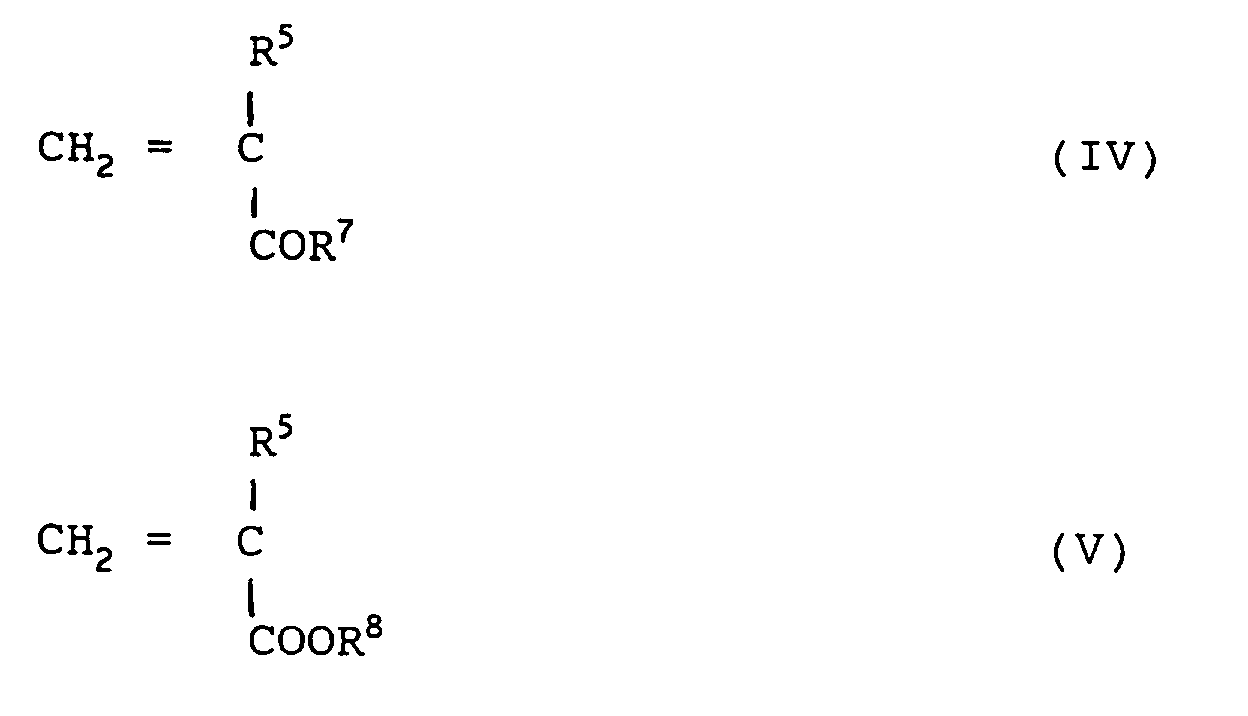
R¹ represents an alkyl group having an epoxy functional group;
R² represents a hydrogen atom, or a C₁₋₆ hydrocarbon or vinyl group;
R³ represents a hydrogen atom, or a C₁₋₅ hydrocarbon, C₁₋₄ alkoxyalkyl or acyl group;
R⁴ represents an alkyl group having an amino funtional group;
R⁵ represents a hydrogen atom or a methyl group;
R⁶ represents a hydrogen atom or a C₁₋₄ hydrocarbon group containing a hydroxyl group;
R⁷ represents an amine, C₁₋₄ alkoxy group containing an epoxy group, or C₁₋₄ alkyl group containing an amine group;
R⁸ represents a C₁₋₅ alkyl group containing silicon;
m represents an integer of 0 to 3; and
n represents an integer of 0 to 2, provided that
- The inventive coating composition may be a blend of two or more of the composition.
- In accordance with another aspect of the present invention, there is provided a synthetic resin article having the inventive composition coated onto the surface of the resin substrate and hot-air drying the coated substrate at a temperature ranging from 90 to 150°C for a period ranging from 10 minutes to 2 hours to form a cured film on the surface in a thickness ranging from 1 to 30 µm.
- The epoxy functional organosilane, which may be used as Component(A), may be preferably possessed with at least one epoxy group. Representative examples of the epoxy funtional organosilane compound may include: glycidoxymethyl trimethoxysilane, glycidoxymethyl triethoxysilane, γ-glycidoxypropyl trimethoxysilane, γ-glycidoxypropyl triethoxysilane, γ-glycidoxypropyl tri(methoxyethoxy)silane, γ-glycidoxypropyl triacetoxysilane, glycidoxymethyl dimethoxysilane, glycidoxymethyl (methyl)dimethoxysilane, glycidoxymethyl (ethyl)dimethoxysilane, glycidoxymethyl (phenyl)dimethoxysilane, glycidoxymethyl (vinyl) dimethoxysilane, glycidoxymethyl (dimethyl)methoxysilane, γ-glycidoxypropyl (methyl)dimethoxysilane, γ-glycidoxypropyl (ethyl)dimethoxysilane, γ-glycidoxypropyl (dimethyl) methoxysilane, bis-(glycidoxymethyl) dimethoxysilane, bis-(glycidoxymethyl) diethoxysilane, bis-(glycidoxyethyl) dimetloxysilane, bis-(glycidoxyethyl) diethoxysilane, bis-(glycidoxypropyl) dimethoxysilane, bis-(glycidoxypropyl) diethoxysilane, tris-(glycidoxymethyl) methoxysilane, tris-(glycidoxymethyl) ethoxysilane, tris-(glycidoxyethyl) methoxysilane, tris-(glycidoxyethyl) ethoxysilane, tris-(glycidoxypropyl) methoxysilane, tris-(glycidoxypropyl) ethoxysilane, glycidylmethyl trimethoxysilane, glycidylmethyl triethoxysilane, γ-glycidylpropyl triethoxysilane, γ-glycidylpropyl tri(methoxyethoxy)silane, γ-glycidylpropyl triacetoxysilane, 3,4-epoxycyclohexylmethyl trimethoxysilane, 3,4-epoxycyclohexylmethyl triethoxysilane, 3,4-epoxy cyclohexylethyl trimethoxysilane, 3,4-epoxycyclohexylpropyl trimethoxysilane and the like; and the organosilane compound may be employed either alone or in combination with other(s).
- Preferably, the hydrolysate or condensate of the epoxy functional organosilane compound may be used and easily produced by adding water in the presence of a hydrolysis or condensation catalyst to the organosilane compound in a lower alcohol such as methanol, ethanol and isopropanol. The hydrolysate or condensate preferably has a concentration ranging from 10 to 70 wt%, more preferably 20 to 60 wt% (based on solids) and a viscosity ranging from 5 to 50 cps(centipoise) at 25°C. If the solid content is less than 10wt%, the abrasion resistance and the anti-fogging effect becomes lowered; and, if the solid-content is greater than 70wt%, the storage stability becomes poor.
- The epoxy functional organosilane compound or the hydrolysate or condensate thereof, as Component (A), may be preferably employed in an amount of up to 50wt% of the composition. If the amount is greater than 50wt%, the storage stability of the composition as well as the anti-fogging effect becomes deteriorated.
- Component(A) provides a cured coating having a strong abrasion resistance preferably when applied on the surface of the substrate and then dried and cured at a temperature ranging from 90 to 150°C for a period ranging from 10 minutes to 2 hours. The epoxy group in Component(A) participates in forming a crosslinkage together with the amino functional group or hydroxyl group of the other components.
- The amino functional organosilane, which may be used as Component(B), is preferably possessed with at least one amino group. Exemplary amino funtional organosilane compounds are: aminomethyl trimethoxy silane, aminoethyl trimethoxysilane, aminomethyl triethoxy silane, aminoethyl triethoxysilane, γ-aminopropyl trimethoxy silane, aminoethyl triacetoxysilane, γ-aminopropyl triethoxy silane, γ-aminopropyl methyldimethoxy silane, γ-aminopropyl methyldiethoxysilane, N-β-(aminoethyl)-γ-aminopropyl trimethoxysilane, N-β-(aminoethyl)-γ-aminopropyl triethoxy silane, δ-aminobutyl trimethoxysilane, δ-aminobutyl triethoxysilane, δ-aminobutyl methyldimethoxysilane, δ-aminobutyl methyldiethoxysilane, δ-aminobutyl phenyl dimethoxysilane, δ-aminobutyl phenyldiethoxysilane, N-(γ-acryloxy-β-hydroxypropyl)-γ-aminopropyl triethoxysilane, diethylene triaminopropyl trimethoxysilane, aminophenyl trimethoxysilane, aminophenyl triethoxysilane, γ-ureidopropyl triethoxysilane and the like; and they may be employed either alone or in combination with other(s).
- The hydrolysate or condensate of the amino functional organosilane compound may be preferably used; and easily produced by adding water in the presence of a hydrolysis or condensation catalyst to the organosilane compound in a lower alcohol such as methanol, ethanol and isopropanol. The hydrolysate or condensate preferably has a concentration ranging from 10 to 60 wt%, more preferably 20 to 50 wt% (based on solids) and a viscosity ranging from 5 to 300 cps(centipoise) at 25°C. If the solid content is less than 10wt%, the abrasion resistance and the anti-fogging effect becomes lowered; and, if the solid content is greater than 60wt%, the storage stability and the coatability of the composition become lowered.
- The amino functional organosilane compound or the hydrolysate or condensate thereof, as Component(B), may be preferably employed in an amount of ranging from 10 to 70wt% of the composition. If the amount is less than 10wt%, the anti-fogging effect of the finally cured coating composition becomes lowered; and, if the amount is greater than 70wt%, the abrasion resistance of the cured coating and the coatability of the composition are poor.
- In the preparation of the hydrolysate or condensate of the epoxy or amino functional organosilane, the amount of water employed may range from 0.1 to 5 moles per mole of the hydrolyzable group contained in the organosilane compound. If the amount of water employed is less than 0.1 mole, the overall conversion of the silane during the curing of the coated substrate becomes lowered; and, if the amount is greater than 5 moles, the abrasion resistance of the cured coating and the coatability of the composition are poor.
- As Component(C), a hydrophilic (meth)acrylate monomer of formula(III), or a copolymer of two components selected from the hydrophilic monomer of formula( III), a hydrophilic monomer of formula(IV) and an organosilane of formula(V) and/or a terpolymer of the three components may be employed.
- The hydrophilic (meth)acrylate monomer of formula(III) is preferably possessed with at least one hydrophilic group and may be selected from the group consisting of acrylic acid, methacrylic acid, 2-hydroxyethyl acrylate, 2-hydroxypropyl acrylate, 2-hydroxyethyl methacrylate, 2-hydroxypropyl methacrylate, 3-hydroxypropyl acrylate, 3-hydroxypropyl methacrylate, hydroxyallyl methacrylate, 2-carboxylethyl acrylate, glycidyl methacrylate and the like.
- Further, representative of the hydrophilic monomer of formula(IV) may include: glycidyl acrylate, glycidyl methacrylate, acrylamide, methacrylamide, N-hydroxymethyl (meth)acrylamide, N-(2-hydroxyethyl) (meth)acrylamide, N,N-dihydroxymethyl (meth)acrylamide, N,N-di(2-hydroxyethyl) (meth)acrylamide and the like.
- Suitable silicon-containing compounds of formula(V) may include: N-(3-acryloxy-2-hydroxypropyl)-3-aminopropyl triethoxysilane, 3-acryloxy propyldimethylmethoxysilane, 3-acryloxy propylmethylbis(trimethylsiloxy)silane, 3-acryloxy propylmethyldichlorosilane, 3-acryloxypropyltrimethoxysilane, 3-acryloxy propyl tris(trimethylsiloxy)silane, 3-(meth) acryloxy propyltrimethoxysilane and the like.
- The hydrophilic (meth)acrylate of formula(III) may be connected to a silicon network by a Michael addition reaction with the amino group of the amino functional organosilane of formula(II) or the condensate or hydrolysate thereof, as Component(B), or may form separately a polymer chain by a radical polymerization of the double bond present therein. The double bond in the (meth)acrylate participates in forming the network to thereby contribute toward the improvement of the abrasion resistance; and the hydrophilic group of the (meth)acrylate, i.e., a hydroxyl, carboxyl or glycidyl group, provides anti-fogging effect.
- A copolymer of two components selected from the hydrophilic (meth)acrylate(III), a hydrophilic monomer of formula(IV) and an organosilane of formula(V), and/or a terpolymer of the three components, which may also be used as Component(C), preferably has an average molecular weight ranging from 2,000 to 100,000 and may be prepared by a conventional method.
- The hydrophilic (meth) acrylate of formula(III), the copolymer and the terpolymer may be used individually or in a mixture thereof.
- Component(C) may be employed in an amount ranging from 10 to 70wt%, preferably 15 to 60 wt%, of the composition. If the amount is less than 10wt%, the effect of reducing the fogging and improving the abrasion resistance becomes rapidly lowered; and, if the amount is greater than 70wt%, the abrasion resistance and wettability of the cured coating become inferior.
- Further, a curing catalyst as Component (D) is employed in the coating composition of the present invention, which functions to catalyze the curing process of the composition. Such curing catalyst may be an acid, base or metallic salt; and the representative compounds thereof include:
- (i) an acid catalyst such as acetic acid, phosphoric acid, sulfuric acid, hydrochloric acid, nitric acid, chlorosulfonic acid, para-toluenesulfonic acid, trichloroacetic acid, polyphosphoric acid, pyrophosphoric acid, hydroiodic acid, hydroiodic anhydride, hydrobromic acid, tartaric acid, boron trifluoride, perchloric acid, periodic acid and the like;
- (ii) a base catalyst such as sodium hydroxide, ammonia, potassium hydroxide, n-butylamine, di-n-butylamine, tri-n-butylamine, guanidine, biguanide, imidazole, ammonium perchlorate, triphenoxy boron, choline acetate and the like; and
- (iii) a metallic salt such as sodium acetate, cobalt laurate, cobalt naphthenate, zinc octylate, tin octylate, aluminum acetylacetonate, cobalt acetylacetonate, nickel acetylacetonate, zinc naphtonate, zinc boron fluoride, tin boron fluoride, tetrabutoxy titanate, tetraisopropoxy titanate, chromium acetylacetonate, titanyl acetylacetonate and the like.
- The curing catalyst may be employed in an amount ranging from 0.05 to 10 wt%, preferably 0.1 to 5 wt% of the composition.
- In accordance with the present invention, preferably, the epoxy functional organosilane (as Component (A)) is employed in an amount of up to 20wt%; the amino functional organosilane (as Component(B)) is employed in an amount ranging from 15 to 70wt%; the hydrophilic (meth)acryalte monomer, or the copolymer and/or terpolymer(as Component(C)) is employed in an amount ranging from 15 to 70wt%; and the curing catalyst (as Component(D)) is employed in an amount ranging from 0.05 to 10% by weight of the composition.
- Further, when the coating composition of the present invention employs the hydrophilic (meth)acrylate monomer of formula(III) as Component(C), the composition may comprise a multi-functional (meth)acrylate(Component(E)) having at least two (meth)acryl group in one molecule, as a crosslinking agent component, and a radical polymerization initiator(Component (F)). When only the copolymer and/or terpolymer are used as Component(C) without the acrylate monomer of formula(III), Component(E) and Component(F) are not required.
- Representative of the multi-functional (meth)acrylate are: those compounds having at least three functional groups, such as pentaerithritol tetra(meth)acrylate, pentaerithritol tri(meth)acrylate, trimethylolpropane tri(meth)acrylate, trimethylolethane tri(meth)acrylate, pentaglycerol tri(meth)acrylate, dipentaerithritol tetra(meth)acrylate, dipentaerithritol penta(meth)acrylate, dipentaerithritol hexa(meth)acrylate; and di-functional (meth)acrylate compounds such as ethylene glycol di(meth)acrylate, 1,3-propylene glycol di(meth)acrylate, 1,4-butanediol di(meth)acrylate, 1,6-hexanediol di(meth)acrylate, tripropylene glycol di(meth)acrylate, ethoxylated bisphenol A di(meth)acrylate, tricyclodecane dimethanol di(meth)acrylate and the like.
- The multi-functional (meth)acrylate monomer may be coupled to a silicon network by a Michael addition reaction with the amino group of the amino functional organosilane of formula(II) or the condensate or hydrolysate thereof (Component(B)), or may form an inter-crosslinked chain structure by crosslinking it with the hydrophilic (meth)acrylate (Component(C)) by a radical polymerization, to thereby impart an improved abrasion resistance to the cured coating. Particularly, the (meth)acryl group of the multi-functional (meth)acrylate monomer provides an excellent coatabilty of the composition to the polycarbonate substrate, together with the (meth)acryl group of the hydrophilic (meth)acrylate (Component(C)). Thus, when polycarbonate is employed as a substrate, it is preferred to employ the multi-functional (meth)acrylate monomer.
- The multi-functional (meth)acrylate monomer, if chosen, may be employed in an amount ranging from 0.5 to 20 wt%, preferably 1 to 10 wt% of the composition. If the amount is less than 0.5wt%, the effect of improving the abrasion resistance is very low due to the reduced level of cross linking; and, if the amount is greater than 20wt%, the storage stability of the composition becomes lowered due to gelation by a Michael addition reaction.
- Further, the radical polymerization initiator (Component(F)), which easily generates radicals when heated, is employed to accelerate the polymerization between the hydrophilic (meth)acrylate (Component(C)) and the multi-functional (meth)acrylate monomer (Component(E)) upon curing of the composition. The radical polymerization initiator may be, for example, a ketone peroxide, diacyl peroxide, hydroperoxide, dialkyl peroxide, peroxy ketal, alkyl perester, peroxy carbonate and a water soluble peroxide.
- Representative compounds of the ketone peroxide may include: ethylmethylketone peroxide, methylisobutylketone peroxide, cyclohexanone peroxide, methylcyclohexanone peroxide, 3,3,5-trimethylcyclohexanone peroxide and the like; exemplary diacyl peroxide may include: acetyl peroxide, propionyl peroxide, isobutyryl peroxide, octanoyl peroxide, 3,3,5-trimethylhexanoyl peroxide, decanoyl peroxide, rauroyl peroxide, benzoyl peroxide, para-chlorobenzoyl peroxide, 2,4-dichlorobenzoyl peroxide, acetyl cyclohexanesulfonyl peroxide and the like; and exemplary hydroperoxide may include: t-butyl hydroperoxide, cumene hydroperoxide, isopropyl benzene hydroperoxide, para-methane hydroperoxide, 2,5-dimethylhexane-2,5-dihydroperoxyhexane, 1,1,3,3-tetramethylbutyl hydroperoxide and the like.
- Further, representative of the dialkyl peroxide are: di-t-butyl peroxide, t-butyl-α-cumyl peroxide, dicumene peroxide, 1,4-bis(t-butylperoxyisopropyl)benzene, 1,3-bis(t-butyl peroxyisopropyl)benzene, 2,5-dimethyl-2,5-di(t-butylperoxy) hexane and the like; exemplary peroxy ketal may include: 1,1-bisbutyl peroxy-3,3,5-trimethyl cyclohexane, n-butyl-4,4-bis(t-butylperoxy)valerate, 2,2-bis(t-butylperoxy) butane and the like.
- Representative examples of the alkyl perester may include: t-butyl peroxyacetate, t-butyl peroxyisobutyrate, t-butyl peroxyoctoate, t-butyl peroxypivalate, t-butyl peroxy neodecanoate, t-butyl peroxy-3,5,5-trimethylhexanoate, t-butyl peroxybenzoate, di-t-butyl peroxyphthalate, di-t-butyl peroxyisophthalate, t-butyl peroxylaurate, 2,5-dimethyl-2,5-dibenzoyl peroxyhexane and the like; and exemplary compounds of the peroxycarbonate may include: di-2-ethylhexyl peroxydicarbonate, diisopropylperoxydicarbonate, di-sec-butyl peroxydicarbonate, di-n-propyl peroxydicarbonate, dimethoxy isopropyl peroxydicarbonate, di-3-methoxybutylperoxycarbonate, di-2-ethoxyethyl peroxydicarbonate, bis-(4-t-butyl cyclohexyl) peroxydicarbonate, t-butyl peroxyisopropylcarbonate and the like.
- The radical polymeriztion initiator, if chosen, may be employed in an amount ranging from 0.05 to 10wt%, preferably 0.1 to 5wt% of the composition.
- Further, the composition of the present invention may comprise, optionally, a levelling agent, a slipping agent, an adhesion promoter and a polymerization inhibitor in an effective amount of, e.g., up to 10wt%; and, an organic solvent may be added to, or removed from the composition, for the purpose of controlling the viscosity and concentration of the composition.
- The abrasion resistant and anti-fogging composition of the present invention may be applied onto a suitable synthetic resin article as a substrate and then hot-air dried to remove the solvent therefrom and to cure the coating, and to thereby obtain the resin article having a cured coating. As a resin article substrate, any article molded from various thermoplastic and thermosetting resins including polymethyl-methacrylate, polycarbonate, polyallyldiglycol carbonate, polystyrene, acrylonitrile-styrene copolymer, polyvinyl chloride, polyacetate, ABS(acrylonitrile-butadiene-styrene), polyester in the form of a sheet, film, rod or other shape may be employed. Particularly, the articles made from polymethyl-methacrylate, polycarbonate and polyallyldiglycol carbonate resin may be preferably applied with the present composition, especially when they require enhanced optical properties, heat resistance, impact strength and abrsion resistance. The articles to be used as a substrate may be preferably pretreated by cleaning, etching, discharging with a corona discharge, irradiating with an activated energy beam, dyeing, printing and the like.
- The composition may be applied by using a conventional method such as brushing, flowing, spraying, rotating or dipping depending on the characteristics and the final use of the resin article. For example, the brushing and flowing method are preferred for providing an improved abrasion resistance to a part of an article; the spraying method is preferred for coating an article having a complicated structure; the rotating method is preferred for coating an article having a smooth and symmetric structure; and the dipping method is preferred for coating an article in the form of a rod or sheet.
- In accordance with the present invention, when the dipping method, which requires a sufficiently low viscosity of the composition for providing a good coatability and reproductability, is employed, the viscosity of the composition preferably ranges 100 cps (centipoise) or less at 25°C so as to provide a coating having satisfactory surface charcteristic.
- The coating composition of the present invention is preferably applied onto a resin article such that the thickness of the cured coating may be within the range of 1 to 30µm, depending on the purpose of the final use of the article. If the thickness of the cured coating is less than 1µm, the abrasion resistance and the anti-fogging property are inferior; and, if the thickness is greater than 30µm, the coating becomes brittle and, therefore, the crack resistance and the strength of the article may become poor.
- In accordance with the present invention, the resin article substrate thus applied is then subjected to a hot-air drying process at a temperature from 90 to 150°C for a period from 10 minutes to 2 hours to obtain an article having a coating with good abrasion resistance and anti-fogging property effect. The air drying process may be preferably conducted at a temperature from 90 to 100°C for a period from 10 to 20 minutes to remove the residual solvent and then at a temperature from 120 to 130°C for a period from 20 to 40 minutes for curing.
- As described above, the resin article having a cured coating in accordance with the present invention has good surface smoothness, appearance, surface strength, abrasion resistance, scratch resistance and adhesion. Further, since the coating is transparent and peel or crack resistant, it is very useful in such applications as helmet shields, lenses for wearing glasses, head lamps, sunglasses, optical devices and watches, lighting equipment covers, mirrors and the like.
- The following Examples are intended to illustrate the present invention more specifically, without limiting the scope of the invention. All units, percentages, parts, etc. as used in the Examples are by weight, unless otherwise specified.
- The physical properties of the articles coated with the coating compositions prepared in Examples and Comparative Examples were evaluated in accordance with the following methods.
-
- (a) Surface hardness was determined in terms of pencil hardness measured in accordance with JIS K5651-1966.
- (b) Taber abrasion was determined in terms of % changes in haze of the coating, measured quantatively in accordance with ASTM D-1044 and 1003 at 100 cycles.
- Scratch resistance was measured by rubbing the surface of the article with #000 steel wool in a distance of 5cm at a loading of 10kg, and observing the surface visually. The results are classified as follows:
- O:
- Not scratched
- △:
- scratched lightly
- X:
- scratched severely
- The adhesion of the cured coating to the article was measured by using a cross cut cellotape peeling test, i.e., by pulling an adhesive tape from a 1 mm crosshatched grid of the coating over the surface area of 100 mm². This procedure was repeated three times. The results are classified as follows:
- O:
- Not peeled
- △:
- when 1-50 grids are peeled
- X:
- when 51-100 grids are peeled
- The crack resistance was measured by a cooling-heating test, i.e., by dipping the article with a cured coating on the surface into warm water maintained at 60°C for 1 hour and then into iced water maintained close to 0°C for 10 minutes, and drying the article at 80°C. This procedure was repeated five times. The results are classified as follows:
- O:
- Not peeled and cracked
- △:
- Cracked lightly
- X:
- Cracked and peeled severely
- The anti-fogging effect was measured by storing the article with a cured coating on the surface in a refrigerator at 4°C for 60 minutes and then subjecting the cold article to saturated water vapor at 55°C to measure the time at which the coating begins to be fogged with the vapor. This procedure was repeated five times to obtain an average time.
- Into 211g of ethyl cellosolve were charged 13g of methacryloxypropyl trimethoxysilane, 70g of hydroxyethyl methacrylate and 7g of benzoyl peroxide, and the mixture was stirred at 400rpm to completely dissolve the benzoyl peroxide heated to 95°C and reacted at that temperature for 5 hours to obtain a solution of a copolymer of methacryloxypropyl trimethoxysilane and hydroxyethyl methacrylate having a molecular weight of 18,000.
- Into 307g of ethyl cellosolve were charged 7g of glycidyl methacrylate, 90g of hydroxyethyl methacrylate and 4g of azobis-isobutyronitrile, and the mixture was stirred at 400rpm to completely dissolve the azobis-isobutyronitrile, heated to 95°C and reacted at that temperature for 5 hours to obtain a solution of a copolymer of hydroxyethyl methacrylate and glycidyl methacrylate having a molecular weight of 22,000.
- Into 200g of ethyl cellosolve were charged 80g of hydroxyethyl methacrylate, 5g of acrylamide and 5g of azobis-isobutyronitrile, and the mixture was stirred at 450rpm to completely dissolve the azobis-isobutyronitrile, heated to 90°C and reacted at that temperature for 5 hours to obtain a solution of a copolymer of hydroxyethyl methacrylate and acrylamide having a molecular weight of 20,000.
- Into 750g of ethyl cellosolve were charged 16g of glycidyl methacrylate, 60g of acrylamide and 8g of azobis-isobutyronitrile, and the mixture was stirred at 450rpm to completely dissolve the azobis-isobutyronitrile, heated to 95°C and reacted at that temperature for 5 hours to obtain a solution of a copolymer of glycidyl methacrylate and acrylamide having a molecular weight of 18,000.
-
- Into 120g of ethyl cellosolve were charged 40g of glycidyl methacrylate, 7g of methacryloxypropyl trimethoxysilane and 3g of azobis-isobutyronitrile, and the mixture was stirred at 400rpm to completely dissolve the azobis-isobutyronitrile, heated to 95°C and reacted at that temperature for 5 hours to obtain a solution of a copolymer of glycidyl methacrylate and methacryloxypropyl trimethoxysilane having a molecular weight of 18,000.
- Into 180g of ethyl cellosolve were charged 50g of acrylamide, 18g of methacryloxypropyl trimethoxysilane and 7g of azobis-isobutyronitrile, and the mixture was stirred at 400rpm to completely dissolve the azobis-isobutyronitrile, heated to 95°C and reacted at that temperature for 5 hours to obtain a solution of a copolymer of acrylamide and methacryloxypropyl trimethoxysilane having a molecular weight of 18,000.
-
- Into 200g of ethyl cellosolve were charged 10g of glycidyl methacrylate, 55g of hydroxyethyl methacrylate, 17g of methacryloxypropyl trimethoxysilane and 4g of azobis-isobutyronitrile, and the mixture was stirred at 400rpm to completely dissolve the azobis-isobutyronitrile, heated to 95°C and reacted at that temperature for 5 hours to obtain a solution of a terpolymer of glycidyl methacrylate, hydroxyethyl methacrylate and methacryloxypropyl trimethoxysilane having a molecular weight of 18,000.
- Into 230g of ethyl cellosolve were charged 4g of acrylamide, 75g of hydroxyethyl methacrylate, 14g of methacryloxypropyl trimethoxysilane and 5g of benzoyl peroxide, and the mixture was stirred at 400rpm to completely dissolve the benzoyl peroxide, heated to 95°C and reacted at that temperature for 5 hours to obtain a solution of a terpolymer of acrylamide, hydroxyethyl methacrylate and methacryloxypropyl trimethoxysilane having a molecular weight of 18,000.
- Into 250g of ethyl cellosolve were charged 80g of hydroxyethyl methacrylate, 12g of glycidyl methacrylate, 6g of acrylamide and 7g of azobis-isobutyronitrile, and the mixture was stirred at 450rpm to completely dissolve the azobis-isobutyronitrile, heated to 95°C and reacted at that temperature for 5 hours to obtain a solution of a terpolymer of hydroxyethyl methacrylate, glycidyl methacrylate and acrylamide having a molecular weight of 18,000.
- Into 260g of ethyl cellosolve were charged 20g of methacryloxypropyl trimethoxysilane, 80g of glycidyl methacrylate, 6g of acrylamide and 7g of azobis-isobutyronitrile, and the mixture was stirred at 450rpm to completely dissolve the azobis-isobutyronitrile, heated to 95°C and reacted at that temperature for 5 hours to obtain a solution of a terpolymer of methacryloxypropyl trimethoxysilane, glycidyl methacrylate and acrylamide having a molecular weight of 18,000.
- Into a three necked flask equipped with a stirrer and a thermometer was charged ethanol and the flask was cooled to 0°C. To the flask containing ethanol was added an organosilane monomer as specified in Table 1 below and, thereafter, 54g of 0.1N HCl aqueous solution was added dropwise to hydrolyze all alkoxy groups in the organosilane while the reaction temperature was maintained below 10°C. After completion of the addition, the reactants were reacted at 10°C for 5 hours and then placed in a refrigerator below 4°C to obtain a corresponding organosilane hydrolysate/condensate solution. The amount of the organosilane employed is also represented in Table 1.
Table 1 Prep. 11 Prep. 12 Prep. 13 Prep. 14 Organosilane (g) Aminopropyl triethoxysilane 221 - - - N-β-(aminoethyl)-γ-aminopropyl trimethoxysilane - 222 - - Diethylenetriaminopropyl trimethoxysilane - - 265 - γ-glycidoxypropyl trimethoxysilane - - - 236 Ethanol (g) 181 324 424 356 - The copolymers and terpolymers obtained in the Preparations 1 to 10, the silane solutions obtained in the Preparations 11 to 14 and other components were employed in an amount shown in Table 2 to prepare various coating compositions of the present invention.
- A plate of polycarbonate resin having a thickness of 3mm was dipped into one of the compositions and then removed at a speed of 1 mm/sec to apply the coating composition onto the surface of the plate. The coated plate was placed in a hot-air drying oven at 90°C for 10 minutes and cured at 130°C for 20 minutes to cure the coating. The properties of the cured coatings were measured as described previously and the results are shown in Table 2.
- The procedures described in Examples 1 to 20 were repeated except that among the components employed in formulating the composition of Example 12, Copolymer(B) was not employed.
- The properties of the cured coating were measured as described previously and the results are also shown in Table 2.
- The procedures described in Examples 1 to 20 were repeated except that among the components employed in formulating the composition of Example 12, Silane(C) was not employed.
- The properties of the cured coating were measured as described previously and the results are also shown in Table 2.
- The procedures described in Examples 1 to 20 were repeated except that among the components employed in formulating the composition of Example 2, Silane(A) and Silane(B) were not employed.
- The properties of the cured coating were measured as described previously and the results are also shown in Table 2.


- The silane solutions obtained in the Preparations 11 to 14 and other components were employed in an amount shown in Table 3 to prepare various coating compositions of the present invention.
- A plate of polycarbonate resin having a thickness of 3mm was dipped into one of the compositions and then removed at a speed of 1 mm/sec to coat the coating composition onto the surface of the plate. The coated plate was placed in a hot-air dying oven at 90°C for 10 minutes and cured at 130°C for 20 minutes to cure the coating. The properties of the cured coatings were measured as described previously and the results are shown in Table 3.
- The procedures described in Examples 21 to 23 were repeated except that among the components employed in formulating the composition of Example 21, Silane(D) was not employed and therefor Silane(A) was employed in an amount of 77 parts by weight.
- The properties of the cured coating were measured as described previously and the results are also shown in Table 3.
- The procedures described in Examples 21 to 23 were repeated except that among the components employed in formulating the composition of Example 21, Silane(A) was not employed and therefor Silane(D) was employed in an amount of 77 parts by weight.
- The properties of the cured coating were measured as described previously and the results are also shown in Table 3.
- The procedures described in Examples 21 to 23 were repeated except that among the components employed in formulating the composition of Example 21, 2- hydroxypropyl methacrylate as a hydrophilic acrylate monomer was not employed and in its instead Silane(A) was employed in an amount of 87 parts by weight.
- The properties of the cured coating were measured as described previously and the results are also shown in Table 3.
- The procedures described in Examples 21 to 23 were repeated except that among the components employed in formulating the composition of Example 21, 2- hydroxypropyl methacrylate as a hydrophilic acrylate monomer was employed in an amount of 23 parts by weight.
- The properties of the cured coating were measured as described previously and the results are also shown in Table 3.


- The procedures described in Examples 21 to 24 were repeated except that a blend of the composition obtained in Example 2 with the composition obtained in Example 23 in a ratio of 1:2 was employed.
- The properties of the cured coating were measured as described previously and the results are shown in Table 4.
Table 4 Abrasion Resistance Hardness 3H Taber 3.7 Scratch Resistance 0 Adhesion 0 Crack Resistance 0 Anti-fogging Effect(min) 3.0 - As can be seen from the above Tables 2, 3 and 4, the synthetic resin articles coated with the compositions of the present invention have excellent abrasion resistance, scratch resistance, adhesion, crack resistance and anti-fogging property.
- While the invention has been described in connection with the specific embodiments contained herein, it should be recognized that various modifications and changes may be made and also fall within the scope of the invention as defined by the claims that follow.
Claims (16)
- A coating composition comprising:(A) up to 50% by weight of an epoxy functional organosilane of formula(I), or the hydrolysate or condensate thereof;(B) 10 to 70% by weight of an amino functional organosilane of formula(II), or the hydrolysate or condensate thereof;(C) 10 to 70% by weight of a hydrophilic (meth)acrylate monomer of formula(III), or a copolymer of two components selected from the hydrophilic monomer of formula(III), a hydrophilic monomer of formula(IV) and an organosilane of formula(V) and/or a terpolymer of the three components ; and(D) 0.05 to 10% by weight of a curing catalyst:


R¹ represents an alkyl group having an epoxy functional group;
R² represents a hydrogen atom, or a C₁₋₆ hydrocarbon or vinyl group;
R³ represents a hydrogen atom, or a C₁₋₅ hydrocarbon, C₁₋₄ alkoxyalkyl or acyl group;
R⁴ represents an alkyl group having an amino funtional group;
R⁵ represents a hydrogen atom or a methyl group;
R⁶ represents a hydrogen atom or a C₁₋₄ hydrocarbon group containing a hydroxyl group;
R⁷ represents an amine, C₁₋₄ alkoxy group containing an epoxy group, or C₁₋₄ alkyl group containing an amine group;
R⁸ represents a C₁₋₅ alkyl group containing silicon;
m represents an integer of 0 to 3; and
n represents an integer of 0 to 2, provided that
- The composition of claim 1 wherein the epoxy funtional organosilane compound is selected from the group consisting of glycidoxymethyl trimethoxysilane, glycidoxymethyl triethoxysilane, γ-glycidoxypropyl trimethoxysilane, γ-glycidoxypropyl triethoxysilane, γ-glycidoxypropyl tri(methoxyethoxy)silane, γ-glycidoxypropyl triacetoxysilane, glycidoxymethyl dimethoxysilane, glycidoxymethyl (methyl)dimethoxysilane, glycidoxymethyl (ethyl)dimethoxysilane, glycidoxymethyl (phenyl) dimethoxysilane, glycidoxymethyl (vinyl) dimethoxysilane, glycidoxymethyl (dimethyl)dimethoxysilane, γ-glycidoxypropyl (methyl)dimethoxysilane, γ-glycidoxypropyl (ethyl) dimethoxysilane, γ-glycidoxypropyl (dimethyl) methoxysilane, bis-(glycidoxymethyl) dimethoxysilane, bis-(glycidoxymethyl) diethoxysilane, bis-(glycidoxyethyl) dimethoxysilane, bis-(glycidoxyethyl) diethoxysilane, glycidoxymethyl dimethoxysilane, bis-(glycidoxypropyl) dimethoxysilane, bis-(glycidoxypropyl) diethoxysilane, tris-(glycidoxymethyl) methoxysilane, tris-(glycidoxymethyl) ethoxysilane, tris-(glycidoxyethyl) methoxysilane, tris-(glycidoxyethyl) ethoxysilane, tris-(glycidoxypropyl) methoxysilane, tris-(glycidoxypropyl) ethoxysilane, glycidylmethyl trimethoxy silane, glycidylmethyl triethoxysilane, γ-glycidylpropyl triethoxysilane, γ-glycidylpropyl tri(methoxyethoxy)silane, γ-glycidylpropyl triacetoxysilane, 3,4-epoxycyclohexylmethyl trimethoxysilane, 3,4-epoxycyclohexylmethyl triethoxysilane, 3,4-epoxy cyclohexylethyl trimethoxysilane and 3,4-epoxycyclohexylpropyl trimethoxysilane.
- The composition of claim 1 wherein the amino funtional organosilane compound is selected from the group consisting of aminomethyl trimethoxy silane, aminoethyl trimethoxysilane, aminomethyl triethoxy silane, aminoethyl triethoxysilane, γ-aminopropyl trimethoxy silane, aminoethyl triacetoxysilane, γ-aminopropyl triethoxy silane, γ-aminopropyl methyldimethoxysilane, γ-aminopropyl methyldiethoxysilane, N-β-(aminoethyl)-γ-aminopropyl trimethoxysilane, N-β-(aminoethyl)-γ-aminopropyl triethoxy silane, δ-aminobutyl trimethoxysilane, δ-aminobutyl triethoxysilane, δ-aminobutyl methyldimethoxysilane, δ-aminobutyl methyldiethoxysilane, δ-aminobutyl phenyl dimethoxysilane, δ-aminobutyl phenyldiethoxysilane, N-(γ-acryloxy-β-hydroxypropyl)-γ-aminopropyl triethoxysilane, diethylene triaminopropyl trimethoxysilane, aminophenyl trimethoxysilane, aminophenyl triethoxysilane and γ-ureidopropyl triethoxysilane.
- The composition of claim 1 wherein the curing catalyst is an acid selected from the group consisting of acetic acid, phosphoric acid, sulfuric acid, hydrochloric acid, nitric acid, chlorosulfonic acid, para-toluenesulfonic acid, trichloroacetic acid, polyphosphoric acid, pyrophosphoric acid, hydroiodic acid, hydroiodic anhydride, hydrobromic acid, tartaric acid, boron trifluoride, perchloric acid and periodic acid.
- The composition of claim 1 wherein the curing catalyst is a base selected from the group consisting of sodium hydroxide, ammonia, potassium hydroxide, n-butylamine, di-n-butylamine, tri-n-butylamine, guanidine, biguanide, imidazole, ammonium perchlorate, triphenoxy boron and choline acetate.
- The composition of claim 1 wherein the curing catalyst is a metallic salt selected from the group consisting of sodium acetate, cobalt laurate, cobalt naphthenate, zinc octylate, tin octylate, aluminum acetylacetonate, cobalt acetylacetonate, nickel acetylacetonate, zinc naphtonate, zinc boron fluoride, tin boron fluoride, tetrabutoxy titanate, tetraisopropoxy titanate, chromium acetylacetonate and titanyl acetylacetonate.
- The composition of claim 1 wherein the epoxy functional organosilane as component (A) is employed in an amount of up to 20% by weight; the amino functional organosilane as component(B) is employed in an amount ranging from 15 to 70% by weight; the hydrophilic (meth)acrylate monomer, or the copolymer and/or the terpolymer as component(C) is employed in an amount ranging from 15 to 70% by weight; and the curing catalyst as Component(D) is employed in an amount ranging from 0.05 to 10% by weight of the composition.
- The composition of claim 1 wherein the hydrophilic (meth)acrylate monomer is employed as Component(C) and the composition further comprises a multi-functional (meth)acrylate having at least two (meth)acryl groups in the molecule and a radical polymerization initiator.
- The composition of claim 8 wherein the multi-functional (meth)acrylate is selected from the group consisting of pentaerithritol tetra(meth)acrylate, pentaerithritol tri(meth)acrylate, trimethylolpropane tri(meth)acrylate, trimethylolethane tri(meth)acrylate, pentaglycerol tri(meth)acrylate, dipentaerithritol tetra(meth)acrylate, dipentaerithritol penta(meth)acrylate, dipentaerithritol hexa(meth)acrylate, ethylene glycol di(meth)acrylate, 1,3-propylene glycol di(meth)acrylate, 1,4-butanediol di(meth)acrylate, 1,6-hexanediol di(meth)acrylate, tripropylene glycol di(meth)acrylate, ethoxylated bisphenol A di(meth)acrylate and tricyclodecane dimethanol di(meth)acrylate.
- The composition of claim 8 wherein the radical polymerization initiator is selected from the group consisting of ketone peroxides, diacyl peroxides, hydroperoxides, dialkyl peroxides, peroxy ketals, alkyl peresters, peroxy carbonates and water soluble peroxides.
- The composition of claim 8 wherein the multi-functional (meth)acrylate is employed in an amount ranging from 0.5 to 20 % by weight and the radical polymerization initiator is employed in an amount ranging from 0.05 to 10% by weight.
- A coating composition produced by blending the composition of claim 1 with the composition of claim 8.
- An article produced by coating a synthetic resin substrate with the coating composition of claim 1, 8 or 12 and then hot-air drying the coated substrate.
- The article of claim 13 wherein the substrate is made of a polymer material selected from the group consisting of polymethylmethacrylate, polycarbonate, polyallyldiglycol carbonate, polystyrene, acrylonitrile-styrene copolymer, polyvinyl chloride, polyacetate, ABS(acrylonitrile-butadiene-styrene) and polyester.
- The article of claim 13 wherein the drying is conducted at a temperature ranging from 90 to 130°C for a period ranging from 10 minutes to 2 hours.
- The article of claim 13 wherein the thickness of the cured coating on the substrate ranges from 1 to 30µm.
Applications Claiming Priority (2)
| Application Number | Priority Date | Filing Date | Title |
|---|---|---|---|
| KR1019930006425A KR100214288B1 (en) | 1993-04-16 | 1993-04-16 | Wear-resistant coating composition for preventing fog and synthetic resin molded article coated with the same |
| KR9306425 | 1993-04-16 |
Publications (2)
| Publication Number | Publication Date |
|---|---|
| EP0620255A1 true EP0620255A1 (en) | 1994-10-19 |
| EP0620255B1 EP0620255B1 (en) | 2002-02-27 |
Family
ID=19354059
Family Applications (1)
| Application Number | Title | Priority Date | Filing Date |
|---|---|---|---|
| EP94105810A Expired - Lifetime EP0620255B1 (en) | 1993-04-16 | 1994-04-14 | Antifogging abrasion resistant coating composition and synthetic resin article coated therewith |
Country Status (7)
| Country | Link |
|---|---|
| US (2) | US5674941A (en) |
| EP (1) | EP0620255B1 (en) |
| JP (1) | JP3227507B2 (en) |
| KR (1) | KR100214288B1 (en) |
| CN (1) | CN1040015C (en) |
| DE (1) | DE69429940T2 (en) |
| TW (1) | TW314543B (en) |
Cited By (11)
| Publication number | Priority date | Publication date | Assignee | Title |
|---|---|---|---|---|
| EP0720993A3 (en) * | 1995-01-05 | 1998-03-11 | THERA Patent GmbH & Co. KG Gesellschaft für industrielle Schutzrechte | Radically polymerisable compositions and their use |
| WO1998023691A1 (en) * | 1996-11-29 | 1998-06-04 | International Coatings Limited | Coating compositions |
| US6066384A (en) * | 1997-08-01 | 2000-05-23 | 3M Innovative Properties Company | Retroreflective article having a binder layer containing an epoxy resin and a silicone crosslinked polymer |
| US6150350A (en) * | 1997-09-15 | 2000-11-21 | Hoffman-La Roche Inc. | Antimicrobial compositions |
| US6281321B1 (en) | 1997-11-27 | 2001-08-28 | Akzo Nobel N.V. | Coating compositions |
| DE102005049141A1 (en) * | 2005-10-14 | 2007-04-19 | Klöckner Pentaplast GmbH & Co. KG | A coating mixture which is crosslinkable by radiation, plastic film and method for coating a plastic film with a coating mixture |
| US8067066B2 (en) | 2003-10-03 | 2011-11-29 | Hempel A/S | Tie-coat composition comprising at least two types of functional polysiloxane compounds and a method for using the same for establishing a coating on a substrate |
| US8415419B2 (en) | 2007-05-15 | 2013-04-09 | Fujifilm Corporation | Hydrophilic coating composition and hydrophilic member using the same |
| EP2664659A1 (en) * | 2012-05-15 | 2013-11-20 | Carl Zeiss Vision International GmbH | Antifog coating |
| WO2014152428A1 (en) * | 2013-03-15 | 2014-09-25 | Curatolo Benedict S | Dual curable composition |
| WO2017029040A1 (en) * | 2015-08-19 | 2017-02-23 | Luxembourg Patent Company S.A. | Sol-gel formulations enhancing corrosion resistance and lubrication properties of pressure equipment |
Families Citing this family (54)
| Publication number | Priority date | Publication date | Assignee | Title |
|---|---|---|---|---|
| JP3351666B2 (en) * | 1995-10-20 | 2002-12-03 | 株式会社中戸研究所 | Antifogging antireflection film, optical component, and method for producing antifogging antireflection film |
| JPH09323392A (en) * | 1996-06-05 | 1997-12-16 | Teijin Ltd | Silicone easily-adhesive film and method for producing the same |
| EP1044073A4 (en) * | 1997-10-15 | 2005-04-13 | Yazaki Corp | TRANSPARENT SUBSTRATE HAVING HYDROPHOUS ANTIC MUTED COATING AND METHOD FOR THE PRODUCTION THEREOF |
| US6395331B1 (en) * | 1997-10-28 | 2002-05-28 | Yazaki Corporation | Transparent substrate bearing an anti-stain, hydrophobic coating, and process for making it |
| US6352758B1 (en) | 1998-05-04 | 2002-03-05 | 3M Innovative Properties Company | Patterned article having alternating hydrophilic and hydrophobic surface regions |
| FR2787800B1 (en) * | 1998-12-23 | 2001-01-26 | Atochem Elf Sa | PROCESS FOR THE MANUFACTURE OF AN ORGANOSOLUBLE COMPOSITION OF (METH) ACRYLIC RESIN, AND USE OF THIS COMPOSITION AS A BINDER OF ANTIFOULING MARINE PAINTS |
| JP3648183B2 (en) * | 2001-08-29 | 2005-05-18 | 聡 澤村 | Transparent silicone film-forming composition and method for curing the same. |
| US7452611B2 (en) * | 2001-12-27 | 2008-11-18 | Transitions Optical, Inc. | Photochromic optical article |
| US7410691B2 (en) * | 2001-12-27 | 2008-08-12 | Ppg Industries Ohio, Inc. | Photochromic optical article |
| US6911263B2 (en) * | 2002-01-30 | 2005-06-28 | Awi Licensing Company | PET wear layer/sol gel top coat layer composites |
| US6762260B2 (en) * | 2002-03-05 | 2004-07-13 | Dow Global Technologies Inc. | Organoborane amine complex polymerization initiators and polymerizable compositions |
| JP4195236B2 (en) * | 2002-03-26 | 2008-12-10 | 日本ウェーブロック株式会社 | Metal-tone decorative sheet for forming metal-like molded product, method for producing the same, and metal-style decorative sheet intermediate material for forming metal-like molded product |
| AU2003255957A1 (en) * | 2002-09-06 | 2004-03-29 | Koninklijke Philips Electronics N.V. | Compound for screen-printing, screen-printed layer and substrate provided with such layer |
| KR100564565B1 (en) * | 2002-11-14 | 2006-03-28 | 삼성전자주식회사 | Polymer containing silicon, negative resist composition comprising the same, and pattern forming method of semiconductor device using them |
| US6777512B1 (en) * | 2003-02-28 | 2004-08-17 | Dow Global Technologies Inc. | Amine organoborane complex initiated polymerizable compositions containing siloxane polymerizable components |
| WO2006001787A1 (en) * | 2003-06-09 | 2006-01-05 | Dow Global Technologies Inc. | Stabilized organoborane polymerization initiators and polymerizable compositions |
| CN1321164C (en) * | 2003-06-20 | 2007-06-13 | 上海小糸车灯有限公司 | Lyophilic high-molecular antifogging coating and preparing method thereof |
| CN100519681C (en) * | 2003-11-28 | 2009-07-29 | 精工爱普生株式会社 | Antifogging treatment liquid and method for producing same, antifogging article and method for producing same |
| US7703456B2 (en) | 2003-12-18 | 2010-04-27 | Kimberly-Clark Worldwide, Inc. | Facemasks containing an anti-fog / anti-glare composition |
| US8501886B2 (en) * | 2003-12-22 | 2013-08-06 | Dow Global Technologies Llc | Accelerated organoborane amine complex initiated polymerizable compositions |
| WO2005063480A1 (en) * | 2003-12-22 | 2005-07-14 | Dow Global Technologies Inc. | Accelerated organoborane amine complex initiated polymerizable compositions |
| US20050196626A1 (en) * | 2004-03-04 | 2005-09-08 | Knox Carol L. | Photochromic optical article |
| US7811480B2 (en) * | 2004-03-04 | 2010-10-12 | Transitions Optical, Inc. | Photochromic optical article |
| US7261843B2 (en) * | 2004-03-04 | 2007-08-28 | Transitions Optical, Inc. | Photochromic optical article |
| US7189456B2 (en) * | 2004-03-04 | 2007-03-13 | Transitions Optical, Inc. | Photochromic optical article |
| US20050196616A1 (en) * | 2004-03-04 | 2005-09-08 | Stewart Kevin J. | Photochromic optical article |
| NO322724B1 (en) * | 2004-04-15 | 2006-12-04 | Sinvent As | Process for preparing polybranched organic / inorganic hybrid polymer |
| WO2005103172A2 (en) | 2004-04-15 | 2005-11-03 | Avery Dennison Corporation | Dew resistant coatings |
| EP1745924A4 (en) * | 2004-04-20 | 2011-10-05 | Kureha Corp | Antifogging laminated film |
| CN101010399B (en) * | 2004-08-26 | 2010-11-10 | 出光兴产株式会社 | Coating composition and resin laminate |
| WO2006069047A2 (en) * | 2004-12-21 | 2006-06-29 | Mitsubishi Polyester Film, Llc | In-line thermally curable coating with peroxide curing agent |
| BRPI0617591A2 (en) | 2005-10-07 | 2011-08-02 | Dow Global Technologies Inc | systems for initiating free radical polymerization, two part polymerizable composition, polymerization method, method for bonding two or more substrates together, method for modifying the surface of a low surface energy polymer, method for coating a substrate, coating composition and laminate |
| JP4978828B2 (en) * | 2006-06-12 | 2012-07-18 | Toto株式会社 | Antifogging coating composition and method for producing antifogging film using the same |
| DE102007020404A1 (en) * | 2006-09-18 | 2008-10-30 | Nano-X Gmbh | Process for the preparation of a coating material |
| DE102006044310A1 (en) * | 2006-09-18 | 2008-03-27 | Nano-X Gmbh | Silane coating material and method of making a silane coating material |
| US7524907B2 (en) * | 2006-10-12 | 2009-04-28 | Dow Global Technologies, Inc. | Accelerated organoborane initiated polymerizable compositions |
| US20080103274A1 (en) * | 2006-10-12 | 2008-05-01 | Jialanella Gary L | Accelerated organoborane initiated polymerizable compositions |
| JP2009256568A (en) * | 2007-08-17 | 2009-11-05 | Fujifilm Corp | Hydrophilic film-forming composition, spray composition, and hydrophilic member using the same |
| JP5469837B2 (en) * | 2007-09-12 | 2014-04-16 | 富士フイルム株式会社 | Hydrophilic composition |
| JP2009256564A (en) * | 2007-09-26 | 2009-11-05 | Fujifilm Corp | Composition for formation of hydrophilic film, and hydrophilic member |
| JP5427382B2 (en) * | 2008-03-25 | 2014-02-26 | 富士フイルム株式会社 | Hydrophilic member, fin material, aluminum fin material, heat exchanger and air conditioner |
| CN102108220B (en) * | 2010-10-29 | 2013-04-10 | 陈国坚 | Organosilicon waterproofing agent and preparation method thereof |
| CN102051101B (en) * | 2010-11-18 | 2012-07-04 | 浙江大学 | Method for preparing normal temperature-cured anti-fouling anti-drag hydrogel soft coating |
| CN102649830B (en) * | 2012-05-17 | 2013-11-27 | 陕西科技大学 | A kind of preparation method of cationic silicone modified polyacrylamide |
| CN102649832B (en) * | 2012-05-17 | 2013-10-23 | 陕西科技大学 | Preparation method of nonionic hydrophobic association polyacrylamide |
| CA2876125A1 (en) * | 2012-06-19 | 2013-12-27 | Watever Inc. | Coating composition |
| CN103627317A (en) * | 2013-12-07 | 2014-03-12 | 北京顺缘天和新材料技术有限公司 | Labor-saving type anticorrosive coating and preparation method thereof |
| CN104529185B (en) * | 2015-01-14 | 2017-05-03 | 湖南松井新材料有限公司 | Anti-fogging coating and preparation method thereof |
| CN112368347B (en) * | 2018-07-19 | 2022-04-08 | 陶氏环球技术有限责任公司 | Weather-resistant and durable coating composition |
| TWI731537B (en) * | 2019-12-31 | 2021-06-21 | 財團法人工業技術研究院 | Primer composition and laminated substrate |
| JP7694107B2 (en) * | 2020-03-31 | 2025-06-18 | マツダ株式会社 | Method for producing silane-based coating composition and method for producing laminate |
| US11459482B2 (en) * | 2020-06-19 | 2022-10-04 | Pall Corporation | Icephobic coating and coated articles |
| CN114015317B (en) * | 2021-11-05 | 2022-09-02 | 福耀玻璃工业集团股份有限公司 | Antifogging coating, preparation method thereof and antifogging glass |
| KR20230093895A (en) * | 2021-12-20 | 2023-06-27 | 주식회사 케이씨텍 | Surface treatment agent for organic-inorganic hybrid composition |
Citations (5)
| Publication number | Priority date | Publication date | Assignee | Title |
|---|---|---|---|---|
| US4098840A (en) * | 1974-08-21 | 1978-07-04 | Japan Atomic Energy Research Institute | Thermosetting resin composition |
| JPS54119599A (en) * | 1978-03-10 | 1979-09-17 | Japan Atom Energy Res Inst | Transparent thermosetting resin composition |
| US4522966A (en) * | 1980-05-29 | 1985-06-11 | Nippon Sheet Glass Co., Ltd. | Non-fogging coating composition and a shaped article coated therewith |
| EP0281365A2 (en) * | 1987-03-04 | 1988-09-07 | Nippon Oil Co. Ltd. | Curable compositions |
| EP0424007A2 (en) * | 1989-10-18 | 1991-04-24 | Dow Corning Corporation | Zero volatile organic content radiation curable silicone coatings |
Family Cites Families (4)
| Publication number | Priority date | Publication date | Assignee | Title |
|---|---|---|---|---|
| US4243767A (en) * | 1978-11-16 | 1981-01-06 | Union Carbide Corporation | Ambient temperature curable hydroxyl containing polymer/silicon compositions |
| US4348462A (en) * | 1980-07-11 | 1982-09-07 | General Electric Company | Abrasion resistant ultraviolet light curable hard coating compositions |
| JPH0627196B2 (en) * | 1984-03-12 | 1994-04-13 | 大日本印刷株式会社 | Method for producing radiation curable organosilicon compound |
| US4603068A (en) * | 1984-06-08 | 1986-07-29 | Harte Woodworking Limited | Display panel and a display panel system |
-
1993
- 1993-04-16 KR KR1019930006425A patent/KR100214288B1/en not_active Expired - Fee Related
-
1994
- 1994-04-14 DE DE69429940T patent/DE69429940T2/en not_active Expired - Fee Related
- 1994-04-14 EP EP94105810A patent/EP0620255B1/en not_active Expired - Lifetime
- 1994-04-15 CN CN94104440A patent/CN1040015C/en not_active Expired - Fee Related
- 1994-04-15 JP JP07766494A patent/JP3227507B2/en not_active Expired - Fee Related
- 1994-04-15 US US08/335,002 patent/US5674941A/en not_active Expired - Lifetime
- 1994-04-15 TW TW083103364A patent/TW314543B/zh active
-
1996
- 1996-04-26 US US08/638,270 patent/US5679458A/en not_active Expired - Lifetime
Patent Citations (5)
| Publication number | Priority date | Publication date | Assignee | Title |
|---|---|---|---|---|
| US4098840A (en) * | 1974-08-21 | 1978-07-04 | Japan Atomic Energy Research Institute | Thermosetting resin composition |
| JPS54119599A (en) * | 1978-03-10 | 1979-09-17 | Japan Atom Energy Res Inst | Transparent thermosetting resin composition |
| US4522966A (en) * | 1980-05-29 | 1985-06-11 | Nippon Sheet Glass Co., Ltd. | Non-fogging coating composition and a shaped article coated therewith |
| EP0281365A2 (en) * | 1987-03-04 | 1988-09-07 | Nippon Oil Co. Ltd. | Curable compositions |
| EP0424007A2 (en) * | 1989-10-18 | 1991-04-24 | Dow Corning Corporation | Zero volatile organic content radiation curable silicone coatings |
Non-Patent Citations (1)
| Title |
|---|
| DATABASE WPI Section 768 Week 7943, Derwent World Patents Index; AN 79-78355B * |
Cited By (16)
| Publication number | Priority date | Publication date | Assignee | Title |
|---|---|---|---|---|
| EP0720993A3 (en) * | 1995-01-05 | 1998-03-11 | THERA Patent GmbH & Co. KG Gesellschaft für industrielle Schutzrechte | Radically polymerisable compositions and their use |
| WO1998023691A1 (en) * | 1996-11-29 | 1998-06-04 | International Coatings Limited | Coating compositions |
| US6066384A (en) * | 1997-08-01 | 2000-05-23 | 3M Innovative Properties Company | Retroreflective article having a binder layer containing an epoxy resin and a silicone crosslinked polymer |
| US6150350A (en) * | 1997-09-15 | 2000-11-21 | Hoffman-La Roche Inc. | Antimicrobial compositions |
| US6281321B1 (en) | 1997-11-27 | 2001-08-28 | Akzo Nobel N.V. | Coating compositions |
| US8067066B2 (en) | 2003-10-03 | 2011-11-29 | Hempel A/S | Tie-coat composition comprising at least two types of functional polysiloxane compounds and a method for using the same for establishing a coating on a substrate |
| DE102005049141A1 (en) * | 2005-10-14 | 2007-04-19 | Klöckner Pentaplast GmbH & Co. KG | A coating mixture which is crosslinkable by radiation, plastic film and method for coating a plastic film with a coating mixture |
| US8415419B2 (en) | 2007-05-15 | 2013-04-09 | Fujifilm Corporation | Hydrophilic coating composition and hydrophilic member using the same |
| EP2664659A1 (en) * | 2012-05-15 | 2013-11-20 | Carl Zeiss Vision International GmbH | Antifog coating |
| US9500860B2 (en) | 2012-05-15 | 2016-11-22 | Carl Zeiss Vision International Gmbh | Anti-fog coating |
| US10338278B2 (en) | 2012-05-15 | 2019-07-02 | Carl Zeiss Vision International Gmbh | Anti-fog coating |
| WO2014152428A1 (en) * | 2013-03-15 | 2014-09-25 | Curatolo Benedict S | Dual curable composition |
| US10150835B2 (en) | 2013-03-15 | 2018-12-11 | Benedict S. Curatolo | Dual curable composition |
| US10563011B2 (en) | 2013-03-15 | 2020-02-18 | Benedict S. Curatolo | Dual curable composition |
| WO2017029040A1 (en) * | 2015-08-19 | 2017-02-23 | Luxembourg Patent Company S.A. | Sol-gel formulations enhancing corrosion resistance and lubrication properties of pressure equipment |
| LU92802B1 (en) * | 2015-08-19 | 2017-03-01 | Luxembourg Patent Co | Sol-gel formulations enhancing corrosion resistance and lubrication properties of pressure equipment |
Also Published As
| Publication number | Publication date |
|---|---|
| DE69429940T2 (en) | 2002-10-31 |
| US5679458A (en) | 1997-10-21 |
| TW314543B (en) | 1997-09-01 |
| CN1098429A (en) | 1995-02-08 |
| EP0620255B1 (en) | 2002-02-27 |
| US5674941A (en) | 1997-10-07 |
| JP3227507B2 (en) | 2001-11-12 |
| KR100214288B1 (en) | 1999-08-02 |
| DE69429940D1 (en) | 2002-04-04 |
| JPH06340841A (en) | 1994-12-13 |
| CN1040015C (en) | 1998-09-30 |
Similar Documents
| Publication | Publication Date | Title |
|---|---|---|
| EP0620255B1 (en) | Antifogging abrasion resistant coating composition and synthetic resin article coated therewith | |
| KR100293099B1 (en) | Coating compositions capable of producing hardened articles with high refractive index and coatings obtained from the compositions | |
| US4526920A (en) | Curable coating composition containing acryloyl or methacryloyl cyanurate or isocyanurate compound, cured composition therefrom, and process for producing articles by using the curable composition | |
| US4348462A (en) | Abrasion resistant ultraviolet light curable hard coating compositions | |
| CN109312038B (en) | Active energy ray-curable resin composition, resin molded product, and method for producing resin molded product | |
| JP6281061B2 (en) | Coating composition, cured film thereof and coated article provided with the cured film | |
| JP2001214122A (en) | Primer composition and coating method | |
| JPH036282A (en) | Primer composition | |
| JP6524261B2 (en) | Method of manufacturing laminate | |
| JPH0593170A (en) | Coating composition and surface modification of synthetic resin molding | |
| JP6911820B2 (en) | Coating agent and surface coating member | |
| EP0402466B1 (en) | Process for producing methacrylic resin molding | |
| EP0057906B1 (en) | Coating composition and process for preparing synthetic resin shaped articles by using same | |
| JP4372268B2 (en) | Resin molded product having coating agent and coating layer | |
| US4990376A (en) | Flexible silicone coatings for plastic substrates and methods for making thermoformable, abrasion-resistant thermoplastic articles | |
| JP4480408B2 (en) | Coating composition for silver plating and method for producing the same | |
| JP3436492B2 (en) | Thin article having a wear-resistant thin film and optical disc | |
| JP2005146155A (en) | Photocurable resin composition, photocurable sheet using the same, and method for producing molded article using the same | |
| CN1265408A (en) | Hydrophilic antifogging and antifrosting anti-friction coating and its application | |
| JP6354037B2 (en) | Coating composition, cured film thereof and coated article provided with the cured film | |
| JPH0911406A (en) | Surface protected plastic molding and method for producing the same | |
| JPH09194760A (en) | Coating material composition, article with excellent functionality obtained using the same, and plastic lens | |
| JP3782670B2 (en) | Curable composition for coating, coated article, outer plate for automobile, and active energy ray-curable composition | |
| JPS59109528A (en) | Coated polycarbonate resin molding | |
| KR0177181B1 (en) | Abrasion resistant coating composition to prevent fog fog, method of manufacturing synthetic resin molded article, and synthetic resin molded article manufactured by the method |
Legal Events
| Date | Code | Title | Description |
|---|---|---|---|
| PUAI | Public reference made under article 153(3) epc to a published international application that has entered the european phase |
Free format text: ORIGINAL CODE: 0009012 |
|
| 17P | Request for examination filed |
Effective date: 19940414 |
|
| AK | Designated contracting states |
Kind code of ref document: A1 Designated state(s): CH DE GB LI SE |
|
| 17Q | First examination report despatched |
Effective date: 19960115 |
|
| GRAG | Despatch of communication of intention to grant |
Free format text: ORIGINAL CODE: EPIDOS AGRA |
|
| GRAG | Despatch of communication of intention to grant |
Free format text: ORIGINAL CODE: EPIDOS AGRA |
|
| GRAH | Despatch of communication of intention to grant a patent |
Free format text: ORIGINAL CODE: EPIDOS IGRA |
|
| RAP1 | Party data changed (applicant data changed or rights of an application transferred) |
Owner name: LUCKY LTD. |
|
| GRAH | Despatch of communication of intention to grant a patent |
Free format text: ORIGINAL CODE: EPIDOS IGRA |
|
| REG | Reference to a national code |
Ref country code: GB Ref legal event code: IF02 |
|
| GRAA | (expected) grant |
Free format text: ORIGINAL CODE: 0009210 |
|
| AK | Designated contracting states |
Kind code of ref document: B1 Designated state(s): CH DE GB LI SE |
|
| REG | Reference to a national code |
Ref country code: CH Ref legal event code: EP |
|
| REF | Corresponds to: |
Ref document number: 69429940 Country of ref document: DE Date of ref document: 20020404 |
|
| REG | Reference to a national code |
Ref country code: CH Ref legal event code: NV Representative=s name: ISLER & PEDRAZZINI AG |
|
| PLBE | No opposition filed within time limit |
Free format text: ORIGINAL CODE: 0009261 |
|
| STAA | Information on the status of an ep patent application or granted ep patent |
Free format text: STATUS: NO OPPOSITION FILED WITHIN TIME LIMIT |
|
| 26N | No opposition filed |
Effective date: 20021128 |
|
| PGFP | Annual fee paid to national office [announced via postgrant information from national office to epo] |
Ref country code: SE Payment date: 20060406 Year of fee payment: 13 Ref country code: DE Payment date: 20060406 Year of fee payment: 13 |
|
| PGFP | Annual fee paid to national office [announced via postgrant information from national office to epo] |
Ref country code: GB Payment date: 20060412 Year of fee payment: 13 |
|
| PGFP | Annual fee paid to national office [announced via postgrant information from national office to epo] |
Ref country code: CH Payment date: 20060413 Year of fee payment: 13 |
|
| REG | Reference to a national code |
Ref country code: CH Ref legal event code: PCAR Free format text: ISLER & PEDRAZZINI AG;POSTFACH 1772;8027 ZUERICH (CH) |
|
| REG | Reference to a national code |
Ref country code: CH Ref legal event code: PL |
|
| GBPC | Gb: european patent ceased through non-payment of renewal fee |
Effective date: 20070414 |
|
| PG25 | Lapsed in a contracting state [announced via postgrant information from national office to epo] |
Ref country code: DE Free format text: LAPSE BECAUSE OF NON-PAYMENT OF DUE FEES Effective date: 20071101 |
|
| PG25 | Lapsed in a contracting state [announced via postgrant information from national office to epo] |
Ref country code: LI Free format text: LAPSE BECAUSE OF NON-PAYMENT OF DUE FEES Effective date: 20070430 Ref country code: CH Free format text: LAPSE BECAUSE OF NON-PAYMENT OF DUE FEES Effective date: 20070430 |
|
| PG25 | Lapsed in a contracting state [announced via postgrant information from national office to epo] |
Ref country code: GB Free format text: LAPSE BECAUSE OF NON-PAYMENT OF DUE FEES Effective date: 20070414 |
|
| PG25 | Lapsed in a contracting state [announced via postgrant information from national office to epo] |
Ref country code: SE Free format text: LAPSE BECAUSE OF NON-PAYMENT OF DUE FEES Effective date: 20070415 |