EP0620249A1 - Silicone emulsion - Google Patents
Silicone emulsion Download PDFInfo
- Publication number
- EP0620249A1 EP0620249A1 EP93106071A EP93106071A EP0620249A1 EP 0620249 A1 EP0620249 A1 EP 0620249A1 EP 93106071 A EP93106071 A EP 93106071A EP 93106071 A EP93106071 A EP 93106071A EP 0620249 A1 EP0620249 A1 EP 0620249A1
- Authority
- EP
- European Patent Office
- Prior art keywords
- diphenyl ether
- radicals
- silicone emulsion
- disulfonic acid
- monovalent hydrocarbon
- Prior art date
- Legal status (The legal status is an assumption and is not a legal conclusion. Google has not performed a legal analysis and makes no representation as to the accuracy of the status listed.)
- Granted
Links
Classifications
-
- C—CHEMISTRY; METALLURGY
- C08—ORGANIC MACROMOLECULAR COMPOUNDS; THEIR PREPARATION OR CHEMICAL WORKING-UP; COMPOSITIONS BASED THEREON
- C08J—WORKING-UP; GENERAL PROCESSES OF COMPOUNDING; AFTER-TREATMENT NOT COVERED BY SUBCLASSES C08B, C08C, C08F, C08G or C08H
- C08J3/00—Processes of treating or compounding macromolecular substances
- C08J3/02—Making solutions, dispersions, lattices or gels by other methods than by solution, emulsion or suspension polymerisation techniques
- C08J3/03—Making solutions, dispersions, lattices or gels by other methods than by solution, emulsion or suspension polymerisation techniques in aqueous media
-
- C—CHEMISTRY; METALLURGY
- C08—ORGANIC MACROMOLECULAR COMPOUNDS; THEIR PREPARATION OR CHEMICAL WORKING-UP; COMPOSITIONS BASED THEREON
- C08J—WORKING-UP; GENERAL PROCESSES OF COMPOUNDING; AFTER-TREATMENT NOT COVERED BY SUBCLASSES C08B, C08C, C08F, C08G or C08H
- C08J2383/00—Characterised by the use of macromolecular compounds obtained by reactions forming in the main chain of the macromolecule a linkage containing silicon with or without sulfur, nitrogen, oxygen, or carbon only; Derivatives of such polymers
- C08J2383/04—Polysiloxanes
Definitions
- the present invention relates generally to silicone emulsions and more specifically to a silicone emulsion composition that is useful as a mold release coating in aluminum die casting.
- Silicone emulsion compositions prepared by dispersing organopolysiloxane uniformly in water with the aid of an emulsifier are widely used as fiber processing agents, mold releasing agents, paint additives, and cosmetic feed materials.
- this type of silicone emulsion composition include a silicone emulsion composition made from an aqueous emulsion of dimethylpolysiloxane and polyoxyethylene alkyl phenyl ether sulfuric acid sodium (see Japanese Kokoku Patent No. Sho 53[1978]-13501) and emulsions made from cyclic methylpolysiloxane, emulsifier, and water (see, for instance, Japanese Kokai Patent Application No. Sho 56[1981]-95952.)
- silicone emulsion compositions such as those described above suffer from the drawback that they have a poor mechanical stability. That is to say that under mechanical shear, the emulsion form is easily damaged.
- the silicone emulsion composition is generally diluted several tens of times with water.
- the diluted solution is fed from a reservoir by a gear pump and sprayed onto the surface of a mold.
- the water in the emulsion is evaporated therefrom to form a uniform oil film of organopolysiloxane on the surface of the mold.
- Excess amounts of the diluted solution are recovered for recycling, being fed back by a gear pump. In this repeated liquid feed method, emulsion damage takes place, and it is thereafter impossible to uniformly coat the mold.
- the oil film produced by the aforementioned conventional silicone emulsion compositions has an additional drawback in that has a poor paintability. Consequently, when these silicone emulsion compositions are used as a mold releasing agent, the oil film adheres to the surface of the die-cast part and makes painting or marking the part very difficult.
- the oil film produced by the prior art silicone emulsion compositions has a low strength and hence, it has poor lubricity under extreme-pressure. Consequently, when these silicone emulsion compositions are used as a mold releasing agent in aluminum die-cast molding, cracks often form in the oil film produced therefrom. Such cracks cause the aluminum melt to misrun, which produces surface defects in the die cast part.
- a silicone emulsion composition useful as a mold coating in aluminum die casting operations.
- the silicone emulsion composition of the invention has high mechanical stability and, upon removal of water therefrom, forms an oil film with excellent paintability and extreme-pressure lubricating properties.
- the silicone emulsion composition of the invention comprises: (A) an aqueous emulsion of an organopolysiloxane; and (B) an alkyl diphenyl ether disulfonate salt.
- the alkyl diphenyl ether disulfonate salt (B) is present in the composition in the range of 0.2-10 parts by weight, with respect to 100 parts by weight of the organopolysiloxane of component (A).
- the oraganopolysiloxane (A) has the general formula: wherein: each R1 is selected from the group consisting of: monovalent hydrocarbon radicals having one to seven carbon atoms; each R2 is selected from the group consisting of: monovalent hydrocarbon radicals having eight or more carbon atoms; monovalent hydrocarbon radicals of the general formula -R3COOR4 wherein R3 is a divalent hydrocarbon radical and R4 is hydrogen or monovalent hydrocarbon radical; monovalent hydrocarbon radicals of the general formula -R3OOCR5 wherein R3 is a divalent hydrocarbon radical and R5 is a monovalent hydrocarbon radical; each A is a radical selected from the group consisting of: hydroxyl radicals; monovalent hydrocarbon radicals; radicals of the general formula -R3COOR4 wherein R3 and R4 are as described above; radicals of the general formula -R3OOCR5 wherein R3 and R5 are as described above; and x is an integer of 1 to 50, inclusive; y is an integer
- Still another object of the invention is to provide a novel silicone emulsion composition which, when applied to a preheated mold so that the water is driven from the emulsion, forms a uniform oil film thereon, which film has good paintability and extreme-pressure lubricity.
- the silicone emulsion composition of the invention comprises: (A) an aqueous emulsion of an organopolysiloxane; and (B) an alkyl diphenyl ether disufonate salt.
- the aqueous emulsion of component (A) is prepared by uniformly dispersing the organopolysiloxane of the following general formula in water, together with an emulsifier:
- R1 is selected from the group consisting of: monovalent hydrocarbon radicals having one to seven carbon atoms; and combinations thereof. Examples include alkyl radicals; aryl radicals; and cycloalkyl radicals, etc.
- the silicone emulsion composition of this invention it is preferred that at least 50% of R1 radicals in the organopolysiloxane be methyl radicals.
- R2 is a monovalent radical selected from the group consisting of: monovalent hydrocarbon radicals having eight or more carbon atoms; radicals represented by formula -R3COOR4 wherein R3 represents a divalent hydrocarbon radical and R4 represents a hydrogen atom or monovalent hydrocarbon radical; radicals represented by formula -R3OOCR5 wherein R3 represents a divalent hydrocarbon radical and R5 represents a monovalent hydrocarbon radical; and combinations thereof.
- monovalent hydrocarbon radicals having 8 or more carbon atoms include alkyl radicals; aryl radicals; and aralkyl radicals.
- R3 represents divalent hydrocarbon radical, such as alkylene, other divalent hydrocarbon radicals, etc.
- R4 represents a hydrogen atom or monovalent hydrocarbon radical, such as alkyl radicals; and aryl groups, etc.
- radicals represented by formula -R3COOR4 include a carboxyalkyl radicals; alkoxycarbonylalkyl radicals, etc.
- R5 represents monovalent a hydrocarbon radical, such as alkyl radicals; and aryl radicals, etc.
- radicals represented by -R3OOCR5 include acyloxyalkyl radicals, etc.
- A represents a radical selected from the group consisting of: hydroxyl radicals; monovalent hydrocarbon radicals; radicals represented by formula -R3COOR4 wherein R3 represents divalent a hydrocarbon radical, R4 represents a hydrogen atom or monovalent hydrocarbon radical; radicals represented by formula -R3OOCR5 wherein R3 represents a divalent hydrocarbon radical and R5 represents a monovalent hydrocarbon radical; and combinations thereof.
- Examples of the monovalent hydrocarbon radicals are the same as above.
- R2 represent the radical represented by the formula - R3COOR4 or the radical represented by formula -R3OOCR5
- R3 represent an alkylene radical
- R4 represent a hydrogen atom or alkyl radical
- R5 represent an alkyl radical
- the carbon atom numbers in R3, R3 + R4, R3 + R5 are larger than 10 for the organopolysiloxane used.
- the organopolysiloxane is oriented on the surface of the mold, and the mold releasing property is particularly good.
- the emulsifiers that may be used include nonionic surfactants, anionic surfactants, etc.
- nonionic surfactants include polyoxyalkylene alkyl ethers; polyoxyalkylene alkyl phenyl ethers; polyoxyalkylene alkylesters; polyoxyalkylene sorbitan alkyl esters; sorbitan alkyl esters; polyethylene glycol; polypropylene glycol, etc.
- anionic surfactants include octylbenzene sulfonic acid, dodecylbenzene sulfonic acid, and other alkylbenzene sulfonic acids; higher alcohol sulfuric ester; polyoxyethylene alkyl ether sulfuric ester; sodium salt, potassium salt, lithium salt, or ammonium salt, etc. of alkylnaphthyl sulfonic acid; etc. It is also possible to use the alkyl diphenyl ether disulfonate salt of component (B).
- the alkyl diphenyl ether disulfonate salt of component (B) is a component for making the silicone emulsion composition of the invention acquire mechanical stability and extreme-pressure lubricating properties.
- the compound represented by the following formula may be used:
- R6 represents a C3 ⁇ 20 alkyl radical, such as a propyl radical, butyl radical, octyl radical, nonyl radical, decyl radical, dodecyl radical, and other alkyl radicals, or preferably a C8 ⁇ 12 alkyl radical.
- M represents a cation, such as a sodium ion, potassium ion, lithium ion, ammonium ion, etc., or preferably a sodium or potassium ion.
- component (B) include butyl diphenyl ether disulfonic acid sodium, nonyl diphenyl ether disulfonic acid sodium, dodecyl diphenyl ether disulfonic acid sodium, dodecyl diphenyl ether disulfonic acid potassium, butyl diphenyl ether disulfonic acid lithium, nonyl diphenyl ether disulfonic acid ammonium, dodecyl diphenyl ether disulfonic acid ammonium and dodecyl diphenyl ether disulfonic acid lithium, etc.
- the amount of component (B) should be in the range of 0.2-10 parts by weight, or preferably in the range of 1-6 parts by weight. This is because, if the amount of component (B) is less than 0.2 part by weight with respect to 100 parts by weight of the organopolysiloxane in component (A), the silicone emulsion composition has insufficient mechanical stability and extreme-pressure lubricating properties.
- the silicone emulsion composition has poor storage stability, the relative concentration of organopolysiloxane is decreased, and the mold releasing properties of the oil film obtained from the emulsion of the invention is degraded.
- silicone emulsion composition of this invention has components (A) and (B) as the main components, it also may contain additives.
- additives may include preservatives, fungicides, rust inhibitors, coloring agents, mineral oils, higher fatty acids, thickeners, aluminum powder, graphite, etc.
- silicone emulsion composition of the present invention There is no special limitation on the method of manufacturing the silicone emulsion composition of the present invention.
- the conventional silicone emulsion composition manufacturing method may be used. More specifically, the aforementioned components may be emulsified by using homomixer, colloid mill, line mixer, homogenizer, and other emulsifiers.
- the silicone emulsion composition of this invention has excellent mechanical stability and the oil film produced therefrom has extreme-pressure lubricating properties.
- the silicon emulsion composition may be used in making a mold releasing agent in an aluminum die-casting operation where the emulsion is subjected to repeated mechanical shear force and an oil film having good extreme-pressure lubricating properties is required.
- silicone emulsion compositions were assessed using the following methods.
- organopolysiloxane (I) and 4 parts of polyoxyethylene (6 mol) lauryl ether were dispersed uniformly by means of a stirrer. Then, 4 parts of water were added, followed by stirring and emulsification using a colloid type emulsifier. Then, 39 parts of water were added to form the aqueous emulsion of organopolysiloxane (I). Then, 1.5 parts of alkyl diphenyl ether disulfonate salt (a)-(c) were added into the aforementioned aqueous emulsion, forming three types of silicone emulsion compositions, respectively.
- Silicone emulsion compositions were prepared in the same way as in Application Example 1 except that the alkyl diphenyl ether disulfonate salt added in Application Example 1 was not added, while water was added instead, and the following listed emulsifiers were added, respectively. The properties of these compositions were measured in the same way as in Application Example 1. The results are listed in Table II.
- silicone emulsion compositions were prepared in the same way as in Application Example 2 except that the following listed emulsifiers were used in place of the dodecyl diphenyl ether disulfonic acid sodium used in Application Example 2.
- the characteristics of these silicone emulsion compositions were measured in the same way as in Application Example 1. The results are listed in Table IV and Table V.
- silicone emulsion compositions were prepared in the same way as in Application Example 1 except that instead of the organopolysiloxane (I) used in Application Example 1, organopolysiloxane (IV) was used, and that with respect to 100 parts by weight of organopolysiloxane (IV), 0.1 part, 1 part, 3 parts, 6 parts, and 15 parts of dodecyl diphenyl ether sulfonic acid sodium were added, respectively.
- a type of silicone emulsion composition was prepared in the same way as above but without adding dodecyldiphenyl ether sulfonic acid sodium. The characteristics of these silicone emulsion compositions were measured in the same way as in Application Example 1, with results listed in Table VI.
- the silicone emulsion composition of this invention has excellent mechanical stability, extreme-pressure lubricating properties and paintability.
- the silicone emulsion composition prepared by adding 0.1 part of dodecyl diphenyl ether disulfonate sodium has insufficient mechanical stability and extreme-pressure lubricating properties.
- the silicone emulsion composition prepared by adding 15 parts of dodecyl diphenyl ether disulfonate sodium the storage stability and the mold releasing property were poor.
Landscapes
- Chemical & Material Sciences (AREA)
- Dispersion Chemistry (AREA)
- Health & Medical Sciences (AREA)
- Chemical Kinetics & Catalysis (AREA)
- Medicinal Chemistry (AREA)
- Polymers & Plastics (AREA)
- Organic Chemistry (AREA)
- Compositions Of Macromolecular Compounds (AREA)
- Paints Or Removers (AREA)
Abstract
Description
- The present invention relates generally to silicone emulsions and more specifically to a silicone emulsion composition that is useful as a mold release coating in aluminum die casting.
- Silicone emulsion compositions prepared by dispersing organopolysiloxane uniformly in water with the aid of an emulsifier are widely used as fiber processing agents, mold releasing agents, paint additives, and cosmetic feed materials. Examples of this type of silicone emulsion composition include a silicone emulsion composition made from an aqueous emulsion of dimethylpolysiloxane and polyoxyethylene alkyl phenyl ether sulfuric acid sodium (see Japanese Kokoku Patent No. Sho 53[1978]-13501) and emulsions made from cyclic methylpolysiloxane, emulsifier, and water (see, for instance, Japanese Kokai Patent Application No. Sho 56[1981]-95952.)
- Conventional silicone emulsion compositions such as those described above suffer from the drawback that they have a poor mechanical stability. That is to say that under mechanical shear, the emulsion form is easily damaged. For example, when these silicone emulsion compositions are used as a mold release in an aluminum die-casting operation, the silicone emulsion composition is generally diluted several tens of times with water. The diluted solution is fed from a reservoir by a gear pump and sprayed onto the surface of a mold. The water in the emulsion is evaporated therefrom to form a uniform oil film of organopolysiloxane on the surface of the mold. Excess amounts of the diluted solution are recovered for recycling, being fed back by a gear pump. In this repeated liquid feed method, emulsion damage takes place, and it is thereafter impossible to uniformly coat the mold.
- The oil film produced by the aforementioned conventional silicone emulsion compositions has an additional drawback in that has a poor paintability. Consequently, when these silicone emulsion compositions are used as a mold releasing agent, the oil film adheres to the surface of the die-cast part and makes painting or marking the part very difficult.
- Finally, the oil film produced by the prior art silicone emulsion compositions has a low strength and hence, it has poor lubricity under extreme-pressure. Consequently, when these silicone emulsion compositions are used as a mold releasing agent in aluminum die-cast molding, cracks often form in the oil film produced therefrom. Such cracks cause the aluminum melt to misrun, which produces surface defects in the die cast part.
- In accordance with the present invention there is provided a silicone emulsion composition useful as a mold coating in aluminum die casting operations. The silicone emulsion composition of the invention has high mechanical stability and, upon removal of water therefrom, forms an oil film with excellent paintability and extreme-pressure lubricating properties.
- The silicone emulsion composition of the invention comprises: (A) an aqueous emulsion of an organopolysiloxane; and (B) an alkyl diphenyl ether disulfonate salt. The alkyl diphenyl ether disulfonate salt (B) is present in the composition in the range of 0.2-10 parts by weight, with respect to 100 parts by weight of the organopolysiloxane of component (A). The oraganopolysiloxane (A) has the general formula:

wherein:
each R¹ is selected from the group consisting of:
monovalent hydrocarbon radicals having one to seven carbon atoms;
each R² is selected from the group consisting of:
monovalent hydrocarbon radicals having eight or more carbon atoms;
monovalent hydrocarbon radicals of the general formula
-R³COOR⁴ wherein R³ is a divalent hydrocarbon radical and R⁴ is hydrogen or monovalent hydrocarbon radical;
monovalent hydrocarbon radicals of the general formula -R³OOCR⁵ wherein R³ is a divalent hydrocarbon radical and R⁵ is a monovalent hydrocarbon radical;
each A is a radical selected from the group consisting of:
hydroxyl radicals;
monovalent hydrocarbon radicals;
radicals of the general formula -R³COOR⁴ wherein R³ and R⁴ are as described above;
radicals of the general formula -R³OOCR⁵ wherein R³ and R⁵ are as described above; and
x is an integer of 1 to 50, inclusive;
y is an integer of 10 to 450, and x < y;
It is therefore an object of the present invention to provide a novel silicone emulsion composition that is useful as a mold coating in aluminum die casting. - It is another object of the present invention to provide a novel silicone emulsion composition which has high stability when diluted with water and subjected to mechanical shear.
- Still another object of the invention is to provide a novel silicone emulsion composition which, when applied to a preheated mold so that the water is driven from the emulsion, forms a uniform oil film thereon, which film has good paintability and extreme-pressure lubricity.
- These and other objects and features of the present invention will become apparent to those skilled in the art from the following detailed description of the invention and examples thereof.
- In accordance with the invention there is provided a novel silicone emulsion composition which is useful as a mold coating in aluminum die casting. The silicone emulsion composition of the invention comprises: (A) an aqueous emulsion of an organopolysiloxane; and (B) an alkyl diphenyl ether disufonate salt.
- The aqueous emulsion of component (A) is prepared by uniformly dispersing the organopolysiloxane of the following general formula in water, together with an emulsifier:

In the aforementioned formula, R¹ is selected from the group consisting of: monovalent hydrocarbon radicals having one to seven carbon atoms; and combinations thereof. Examples include alkyl radicals; aryl radicals; and cycloalkyl radicals, etc. When the silicone emulsion composition of this invention is used as the mold releasing agent, it is preferred that at least 50% of R¹ radicals in the organopolysiloxane be methyl radicals. - R² is a monovalent radical selected from the group consisting of: monovalent hydrocarbon radicals having eight or more carbon atoms; radicals represented by formula -R³COOR⁴ wherein R³ represents a divalent hydrocarbon radical and R⁴ represents a hydrogen atom or monovalent hydrocarbon radical; radicals represented by formula -R³OOCR⁵ wherein R³ represents a divalent hydrocarbon radical and R⁵ represents a monovalent hydrocarbon radical; and combinations thereof. Examples of monovalent hydrocarbon radicals having 8 or more carbon atoms include alkyl radicals; aryl radicals; and aralkyl radicals.
- In the radicals represented by formula - R³COOR⁴, R³ represents divalent hydrocarbon radical, such as alkylene, other divalent hydrocarbon radicals, etc.; R⁴ represents a hydrogen atom or monovalent hydrocarbon radical, such as alkyl radicals; and aryl groups, etc.
- Consequently, examples of the radicals represented by formula -R³COOR⁴ include a carboxyalkyl radicals; alkoxycarbonylalkyl radicals, etc.
- In the radicals represented by -R³OOCR⁵, R⁵ represents monovalent a hydrocarbon radical, such as alkyl radicals; and aryl radicals, etc.
- Consequently, examples of the radicals represented by -R³OOCR⁵ include acyloxyalkyl radicals, etc.
- In the aforementioned formula, A represents a radical selected from the group consisting of: hydroxyl radicals; monovalent hydrocarbon radicals; radicals represented by formula -R³COOR⁴ wherein R³ represents divalent a hydrocarbon radical, R⁴ represents a hydrogen atom or monovalent hydrocarbon radical; radicals represented by formula -R³OOCR⁵ wherein R³ represents a divalent hydrocarbon radical and R⁵ represents a monovalent hydrocarbon radical; and combinations thereof.
- Examples of the monovalent hydrocarbon radicals are the same as above.
- Examples of the radicals represented by formula
-R³COOR⁴ are the same as listed above. - Examples of the radicals represented by formula
-R³OOCR⁵ are the same as listed above. - In the aforementioned formula, x represents an integer in the range of 1-50; y represents an integer in the range of 10-450, with x < y. This is because that if x becomes larger than 50, the paintability property of the oil film formed from the composition of the invention is degraded. If y is smaller than 10, the paintability is also degraded.
- On the other hand, if y is larger than 450, the mechanical stability of the composition of this invention is degraded.
- If (x + y) becomes larger than 500, the viscosity of the organopolysiloxane is increased, making it difficult to perform emulsification.
- In order to improve the paintability of the oil film produced from the emulsion of the inventions, it is necessary to have x < y. It is preferred that R² represent the radical represented by the formula - R³COOR⁴ or the radical represented by formula -R³OOCR⁵, R³ represent an alkylene radical, R⁴ represent a hydrogen atom or alkyl radical, R⁵ represent an alkyl radical, and the carbon atom numbers in R³, R³ + R⁴, R³ + R⁵ are larger than 10 for the organopolysiloxane used. In this case, the organopolysiloxane is oriented on the surface of the mold, and the mold releasing property is particularly good.
- There is no special limitation on the manufacturing method of the aforementioned organopolysiloxane. For example, the following method may be used: in the presence of chloroplatinic acid or other catalyst for the hydrosilylation reaction, methylhydrogenpolysiloxane or a dimethylsiloxanemethylhydrogensiloxane copolymer is added with the α-olefin or α-methylstyrene represented by the following formulas:
CH₂=CH(CH₂)₅CH₃,
CH₂=CH(CH₂)₁₀CH₃,
CH₂=CH(CH₂)₁₂CH₃,
or unsaturated fatty acid represented by the following formulas
CH₂=CHCOOH,
CH₂=CH(CH₂)₅COOH,
CH₂=CH(CH₂)₈COOH,
CH₂=CH(CH₂)₁₂COOH,
or the ester compound of unsaturated fatty acid represented by the following formulas:
CH₂=CHCOOCH₃,
CH₂=CHCOOC₃H₇,
CH₂=C(CH₃)₈COOC₃H₇,
CH₂=CH(CH₂)₈COOC₆H₅,
CH₂=CH(CH₂)₈COOC₂H₅,
CH₂=CH(CH₂)₈COOC₃H₇,
CH₂=CH(CH₂)₁₂COOC₃H₇,
or the ester compound of the unsaturated aliphatic alcohol represented by the formulas:
CH₂=CHCH₂OOCCH₃,
CH₂=CHCH₂OOCC₆H₅,
CH₂=CHCH₂OOCC₁₁H₂₃,

The aqueous emulsion of component (A) can be manufactured by dispersing the aforementioned organopolysiloxane uniformly in water with the aid of an emulsifier. According to this invention, there is no special limitation on the type of the emulsion used. Examples of the emulsifiers that may be used include nonionic surfactants, anionic surfactants, etc. Examples of the nonionic surfactants include polyoxyalkylene alkyl ethers; polyoxyalkylene alkyl phenyl ethers; polyoxyalkylene alkylesters; polyoxyalkylene sorbitan alkyl esters; sorbitan alkyl esters; polyethylene glycol; polypropylene glycol, etc. Examples of anionic surfactants include octylbenzene sulfonic acid, dodecylbenzene sulfonic acid, and other alkylbenzene sulfonic acids; higher alcohol sulfuric ester; polyoxyethylene alkyl ether sulfuric ester; sodium salt, potassium salt, lithium salt, or ammonium salt, etc. of alkylnaphthyl sulfonic acid; etc. It is also possible to use the alkyl diphenyl ether disulfonate salt of component (B). - The alkyl diphenyl ether disulfonate salt of component (B) is a component for making the silicone emulsion composition of the invention acquire mechanical stability and extreme-pressure lubricating properties. There is no special limitation on the type of the alkyl diphenyl ether disulfonate salt of component (B). For example, the compound represented by the following formula may be used:

In this formula, R⁶ represents a C₃₋₂₀ alkyl radical, such as a propyl radical, butyl radical, octyl radical, nonyl radical, decyl radical, dodecyl radical, and other alkyl radicals, or preferably a C₈₋₁₂ alkyl radical. M represents a cation, such as a sodium ion, potassium ion, lithium ion, ammonium ion, etc., or preferably a sodium or potassium ion. Examples of component (B) include butyl diphenyl ether disulfonic acid sodium, nonyl diphenyl ether disulfonic acid sodium, dodecyl diphenyl ether disulfonic acid sodium, dodecyl diphenyl ether disulfonic acid potassium, butyl diphenyl ether disulfonic acid lithium, nonyl diphenyl ether disulfonic acid ammonium, dodecyl diphenyl ether disulfonic acid ammonium and dodecyl diphenyl ether disulfonic acid lithium, etc. - According to this invention, with respect to 100 parts by weight of the organopolysiloxane in component (A), the amount of component (B) should be in the range of 0.2-10 parts by weight, or preferably in the range of 1-6 parts by weight. This is because, if the amount of component (B) is less than 0.2 part by weight with respect to 100 parts by weight of the organopolysiloxane in component (A), the silicone emulsion composition has insufficient mechanical stability and extreme-pressure lubricating properties. On the other hand, if the amount is over 10 parts by weight, the silicone emulsion composition has poor storage stability, the relative concentration of organopolysiloxane is decreased, and the mold releasing properties of the oil film obtained from the emulsion of the invention is degraded.
- While the silicone emulsion composition of this invention has components (A) and (B) as the main components, it also may contain additives. Such additives may include preservatives, fungicides, rust inhibitors, coloring agents, mineral oils, higher fatty acids, thickeners, aluminum powder, graphite, etc.
- There is no special limitation on the method of manufacturing the silicone emulsion composition of the present invention. The conventional silicone emulsion composition manufacturing method may be used. More specifically, the aforementioned components may be emulsified by using homomixer, colloid mill, line mixer, homogenizer, and other emulsifiers.
- The silicone emulsion composition of this invention has excellent mechanical stability and the oil film produced therefrom has extreme-pressure lubricating properties. For example, the silicon emulsion composition may be used in making a mold releasing agent in an aluminum die-casting operation where the emulsion is subjected to repeated mechanical shear force and an oil film having good extreme-pressure lubricating properties is required.
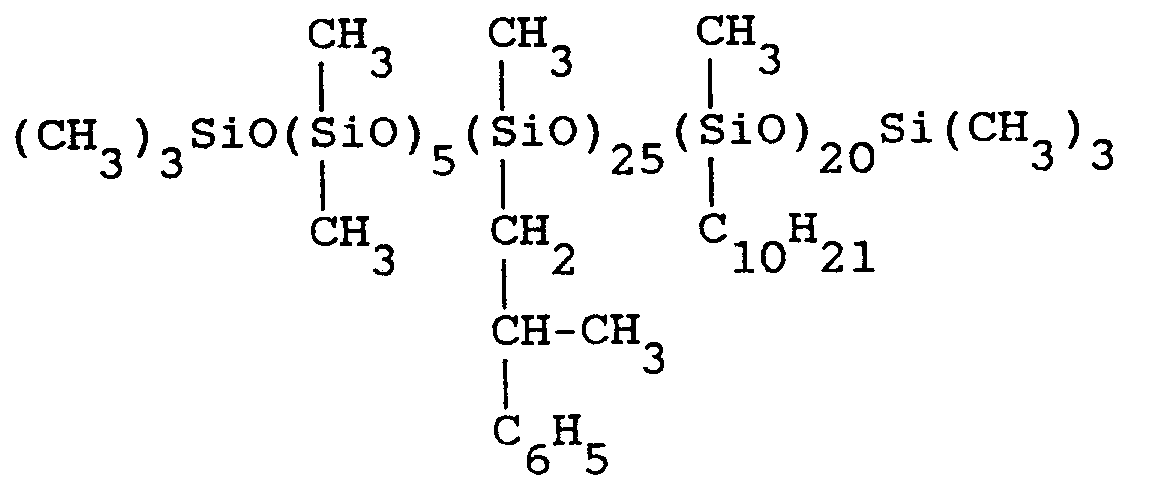
- The present invention will be explained with reference to the following application examples. In these application examples, "parts" refers to parts by weight, and % represents wt%. The viscosity refers to centistokes measured at 25°C. The structural formulas and viscosity values of the types of organopolysiloxane used in the application examples are listed below:
- (I) With viscosity of 1130 cs
- (II) With viscosity of 980 cs

- (III) With viscosity of 1630 cs

- (IV) With viscosity of 1040 cs

- (V) With viscosity of 1320 cs

- (a) Nonyl diphenyl ether disulfonic acid sodium;
- (b) Dodecyl diphenyl ether disulfonic acid sodium; and
- (c) Dodecyl diphenyl ether disulfonic acid potassium.
- In the application examples and comparative examples, the silicone emulsion compositions were assessed using the following methods.
- · Paintability: The silicone emulsion composition was diluted 50 times by water. The diluted solution was sprayed on paper by means of a simple spray gun, followed by drying at room temperature. Then, equidistant lines were drawn by means of a rule using a felt pen for drawing oily fat lines. The quality of the lines was then evaluated.
- o:
- The lines were not coarse at all, and the ink was attached uniformly.
- △:
- The lines were partially coarse, and the ink attachment was a little uneven.
- X:
- The lines were significantly coarse.
- · Mold releasing property: The silicone emulsion composition was diluted to a concentration of organopolysiloxane of 2% was sprayed on a mold, which mold had inner dimensions of 5 cm x 5 cm and a depth of 5 mm, and which mold had many grooves on its bottom, followed by preheating at about 350°C. Molten aluminum heated to about 750°C in an electric oven was poured into this mold, followed by cooling. Then, the aluminum piece was peeled off from the mold, and the peeling performance was assessed.
- Ⓞ:
- The mold releasing property was excellent.
- o:
- The mold releasing property was good.
- △:
- The mold releasing property was a little poor.
- X:
- The mold releasing agent was poor.
- · Storage stability: 180 mL of the silicone emulsion composition was loaded into a 200 mL glass bottle, followed by setting undisturbed at a room temperature of 25°C for 3 months to study the storage stability.
- · Mechanical stability: The silicone emulsion composition was diluted by water to a concentration of organopolysiloxane of 0.5%. Then, 600 g of the diluted solution was loaded into a 1000 mL beaker, followed by stirring at 10000 rpm for 1 h using a homomixer. Then, the sample was left undisturbed for 3 h, and inspected for the attachment of the oil-like substance on the wall of the beaker, the presence/absence of oil-like substance on the surface of the solution, and the presence/absence of cream-like substance.
- Ⓞ:
- No oil-like substance on the surface of the solution, and no cream-like substance were observed.
- o:
- A little oil-like substance on the surface of the solution, and a little cream-like substance were observed.
- △:
- Oil-like substance floating on a portion of the surface of the solution, and cream-like substance on the entire surface of the solution were observed.
- X:
- Oil-like substance floating on entire surface of the solution, and a large amount of cream-like substance were observed.
- · Extreme-pressure lubricating properties: According to the Lubricating Oil Load Test Method defined in JIS-K-2519, the seize load (kg) was evaluated. The measurement conditions and the measurement equipment specifications are as follows.
Form and name: 4-ball type friction tester (produced by Kobe Steel Equipment Mfg. Co., Ltd.)
Test steel balls: 3/4" steel ball bearings (basic diameter of 19.05 mm)
Higher rank: JIS-B-1501.
Load on the test steel balls: Max. 1000 kg
Rotating speed of spindle: 750 rpm - 50 parts of organopolysiloxane (I) and 4 parts of polyoxyethylene (6 mol) lauryl ether were dispersed uniformly by means of a stirrer. Then, 4 parts of water were added, followed by stirring and emulsification using a colloid type emulsifier. Then, 39 parts of water were added to form the aqueous emulsion of organopolysiloxane (I). Then, 1.5 parts of alkyl diphenyl ether disulfonate salt (a)-(c) were added into the aforementioned aqueous emulsion, forming three types of silicone emulsion compositions, respectively. For the obtained samples of silicone emulsion compositions, the paintability, mold releasing property, storage stability and extreme-pressure lubricating property were studied. The results are listed in Table I.
Table I Item Measured This Invention Alkyl Diphenyl Ether Disulfonate Salt A B C Paintability 0 0 0 Mold Releasing Property Ⓞ Ⓞ Ⓞ Storage Stability Good Good Good Mechanical Stability Ⓞ Ⓞ Ⓞ Extreme-Pressure Lubricating Property 100 110 110 General Assessment Appropriate Appropriate Appropriate - Silicone emulsion compositions were prepared in the same way as in Application Example 1 except that the alkyl diphenyl ether disulfonate salt added in Application Example 1 was not added, while water was added instead, and the following listed emulsifiers were added, respectively. The properties of these compositions were measured in the same way as in Application Example 1. The results are listed in Table II.
- (d) Sodium laurylsulfate
- (e) Polyoxyethylene (4 mol) lauryl ether sulfuric acid sodium
- (f) Polyoxyethylene (4 mol) nonyl phenyl ether sulfuric acid sodium
- (g) Dodecylbenzene sulfonic acid sodium
- 4 parts of polyoxyethylene (6 mol) lauryl ether and 0.5 part of dodecylbenzene sulfonic acid sodium were added into 50 parts of organopolysiloxane (II), (III), and (IV), followed by stirring to a uniform state using a stirrer. Then, 5 parts of water were added, followed by stirring and emulsification using a colloid mill type emulsifier. Then, 38.5 parts of water were added to form an aqueous emulsion. 2 parts of dodecyl diphenyl ether sulfonic acid sodium were added into the obtained aqueous emulsion to form the silicone emulsion composition. The properties of the composition were measured in the same way as in Application Example 1, with results listed in Table III.
Table III Item Measured This Invention Organopolysiloxane II III IV Emulsifier b b b Paintability 0 0 0 Mold Releasing Property Ⓞ Ⓞ Ⓞ Storage Stability Good Good Good Mechanical Stability Ⓞ Ⓞ Ⓞ Extreme-Pressure Lubricating Property 110 120 120 General Assessment Appropriate Appropriate Appropriate - Four types of silicone emulsion compositions were prepared in the same way as in Application Example 2 except that the following listed emulsifiers were used in place of the dodecyl diphenyl ether disulfonic acid sodium used in Application Example 2. The characteristics of these silicone emulsion compositions were measured in the same way as in Application Example 1. The results are listed in Table IV and Table V.
- (h) polyoxyethylene (6 mol) lauryl ether
- (i) polyoxyethylene (9.5 mol) nonyl phenyl ether
- (j) polyoxyethylene (10 mol) monostearate
- (k) decaglyceryl monoleate
- Five types of silicone emulsion compositions were prepared in the same way as in Application Example 1 except that instead of the organopolysiloxane (I) used in Application Example 1, organopolysiloxane (IV) was used, and that with respect to 100 parts by weight of organopolysiloxane (IV), 0.1 part, 1 part, 3 parts, 6 parts, and 15 parts of dodecyl diphenyl ether sulfonic acid sodium were added, respectively. In addition, a type of silicone emulsion composition was prepared in the same way as above but without adding dodecyldiphenyl ether sulfonic acid sodium. The characteristics of these silicone emulsion compositions were measured in the same way as in Application Example 1, with results listed in Table VI. It can be seen from these results that the silicone emulsion composition of this invention has excellent mechanical stability, extreme-pressure lubricating properties and paintability. On the other hand, the silicone emulsion composition prepared by adding 0.1 part of dodecyl diphenyl ether disulfonate sodium has insufficient mechanical stability and extreme-pressure lubricating properties. For the silicone emulsion composition prepared by adding 15 parts of dodecyl diphenyl ether disulfonate sodium, the storage stability and the mold releasing property were poor.

In addition, the types of the alkyl diphenyl ether disulfonate salts used in the application examples are as follows:
| Item Measured | Comparative Examples | ||||
| Emulsifier | Not Added | d | e | f | g |
| Paintability | 0 | 0 | 0 | 0 | 0 |
| Mold Releasing Property | △∼0 | △∼0 | △∼0 | △∼0 | △∼0 |
| Storage Stability | Good | Good | Good | Good | Good |
| Mechanical Stability | △∼0 | 0∼Ⓞ | 0∼Ⓞ | Ⓞ | Ⓞ |
| Extreme-Pressure Lubricating Property | 70 | 70 | 80 | 70 | 80 |
| General Assessment | Insufficient | Insufficent | Insufficent | Insufficent | Insufficent |


Claims (4)
- A silicone emulsion composition comprising:(A) an aqueous emulsion of an organopolysiloxane, said organaopolysiloxane having the general formula:

each R¹ is selected from monovalent hydrocarbon radicals having one to seven carbon atoms;
each R² is selected from the group consisting of:(i) monovalent hydrocarbon radicals having eight or more carbon atoms;(ii) monovalent hydrocarbon radicals of the general formula -R³COOR⁴ wherein R³ is a divalent hydrocarbon radical and R⁴ is hydrogen or a monovalent hydrocarbon radical;(iii) monovalent hydrocarbon radicals of the general formula -R³OOCR⁵ wherein R³ is a divalent hydrocarbon radical and R⁵ is a monovalent hydrocarbon radical;each A is a radical selected from the group consisting of:
hydroxyl radicals;
monovalent hydrocarbon radicals;
radicals of the general formula -R³COOR⁴ wherein R³ and R⁴ are as described above;
radicals of the general formula -R³OOCR⁵ wherein R³ and R⁵ are as described above;
x is an integer of 1 to 50,
y is an integer of 10 to 450, and
x < y; and(B) an alkyl diphenyl ether disulfonate salt;said component (B) being present in said composition in the range of 0.2-10 parts by weight, with respect to 100 parts by weight of said organopolysiloxane of component (A). - A composition in accordance with Claim 1 wherein said component (B), said alkyl diphenyl ether disulfonate salt, has the general formula:

R⁶ is a monovalent alkyl radical having from
3 to 20 carbon atoms; and M is a cation. - A composition in accordance with Claim 1 wherein said component (B), said alkyl diphenyl ether disulfonate salt, is selected from the group consisting of: butyl diphenyl ether disulfonic acid sodium; nonyl diphenyl ether disulfonic acid sodium; dodecyl diphenyl ether disulfonic acid sodium; dodecyl diphenyl ether disulfonic acid potassium; butyl diphenyl ether disulfonic acid lithium; nonyl diphenyl ether disulfonic acid ammonium; dodecyl diphenyl ether disulfonic acid ammonium; dodecyl diphenyl ether disulfonic acid lithium; and combinations thereof.
- A composition in accordance with Claim 1 further comprising an emulsifier.
Priority Applications (2)
| Application Number | Priority Date | Filing Date | Title |
|---|---|---|---|
| DE1993621576 DE69321576T2 (en) | 1993-04-14 | 1993-04-14 | Silicone emulsion |
| EP19930106071 EP0620249B1 (en) | 1993-04-14 | 1993-04-14 | Silicone emulsion |
Applications Claiming Priority (1)
| Application Number | Priority Date | Filing Date | Title |
|---|---|---|---|
| EP19930106071 EP0620249B1 (en) | 1993-04-14 | 1993-04-14 | Silicone emulsion |
Publications (2)
| Publication Number | Publication Date |
|---|---|
| EP0620249A1 true EP0620249A1 (en) | 1994-10-19 |
| EP0620249B1 EP0620249B1 (en) | 1998-10-14 |
Family
ID=8212813
Family Applications (1)
| Application Number | Title | Priority Date | Filing Date |
|---|---|---|---|
| EP19930106071 Expired - Lifetime EP0620249B1 (en) | 1993-04-14 | 1993-04-14 | Silicone emulsion |
Country Status (2)
| Country | Link |
|---|---|
| EP (1) | EP0620249B1 (en) |
| DE (1) | DE69321576T2 (en) |
Cited By (3)
| Publication number | Priority date | Publication date | Assignee | Title |
|---|---|---|---|---|
| EP0825004A1 (en) * | 1995-06-30 | 1998-02-25 | Dow Corning Toray Silicone Company Ltd. | Silicone water-based emulsion mold release agent and a manufacturing method therefor |
| WO2001088018A1 (en) * | 2000-05-16 | 2001-11-22 | Rhodia Chimie | Lubricating polyorganosiloxane oil, aqueous emulsion containing same, preparation and use thereof for stripping metals |
| WO2020010564A1 (en) * | 2018-07-12 | 2020-01-16 | Dow Global Technologies Llc | Aqueous polymer dispersion and process of making same |
Citations (3)
| Publication number | Priority date | Publication date | Assignee | Title |
|---|---|---|---|---|
| GB752660A (en) * | 1954-01-27 | 1956-07-11 | Bayer Ag | Mould release agent |
| EP0166397A2 (en) * | 1984-06-26 | 1986-01-02 | Dow Corning Corporation | Process for preparing emulsions of reinforced polydiorganosiloxane latex |
| EP0202679A2 (en) * | 1985-05-24 | 1986-11-26 | Dow Corning Corporation | Method of producing aqueous latex of crosslinked polydiorganosiloxane |
-
1993
- 1993-04-14 EP EP19930106071 patent/EP0620249B1/en not_active Expired - Lifetime
- 1993-04-14 DE DE1993621576 patent/DE69321576T2/en not_active Expired - Fee Related
Patent Citations (3)
| Publication number | Priority date | Publication date | Assignee | Title |
|---|---|---|---|---|
| GB752660A (en) * | 1954-01-27 | 1956-07-11 | Bayer Ag | Mould release agent |
| EP0166397A2 (en) * | 1984-06-26 | 1986-01-02 | Dow Corning Corporation | Process for preparing emulsions of reinforced polydiorganosiloxane latex |
| EP0202679A2 (en) * | 1985-05-24 | 1986-11-26 | Dow Corning Corporation | Method of producing aqueous latex of crosslinked polydiorganosiloxane |
Non-Patent Citations (2)
| Title |
|---|
| DATABASE WPI Section Ch, Week 9047, Derwent Publications Ltd., London, GB; Class A, AN 90-351880 & JP-A-2 253 836 (KANZAKI PAPER MFG KK ET AL.) 12 October 1990 * |
| PATENT ABSTRACTS OF JAPAN vol. 11, no. 80 (C-409)(2527) 11 March 1987 & JP-A-61 235 468 ( KASHIYUU K.K. ) 20 October 1986 * |
Cited By (7)
| Publication number | Priority date | Publication date | Assignee | Title |
|---|---|---|---|---|
| EP0825004A1 (en) * | 1995-06-30 | 1998-02-25 | Dow Corning Toray Silicone Company Ltd. | Silicone water-based emulsion mold release agent and a manufacturing method therefor |
| WO2001088018A1 (en) * | 2000-05-16 | 2001-11-22 | Rhodia Chimie | Lubricating polyorganosiloxane oil, aqueous emulsion containing same, preparation and use thereof for stripping metals |
| FR2809111A1 (en) * | 2000-05-16 | 2001-11-23 | Rhodia Chimie Sa | Polyorganosiloxane for use in the molding of aluminum articles comprises up to four different types of siloxy units |
| US6905540B2 (en) | 2000-05-16 | 2005-06-14 | Rhodia Chimie | Lubricating polyorganosiloxane oil, aqueous emulsion containing same, preparation and use thereof for stripping metals |
| WO2020010564A1 (en) * | 2018-07-12 | 2020-01-16 | Dow Global Technologies Llc | Aqueous polymer dispersion and process of making same |
| CN112262187A (en) * | 2018-07-12 | 2021-01-22 | 陶氏环球技术有限责任公司 | Aqueous polymer dispersion and process for preparing the same |
| CN112262187B (en) * | 2018-07-12 | 2022-04-26 | 陶氏环球技术有限责任公司 | Aqueous polymer dispersion and process for preparing the same |
Also Published As
| Publication number | Publication date |
|---|---|
| DE69321576D1 (en) | 1998-11-19 |
| EP0620249B1 (en) | 1998-10-14 |
| DE69321576T2 (en) | 1999-05-12 |
Similar Documents
| Publication | Publication Date | Title |
|---|---|---|
| US5401801A (en) | Aqueous silicone emulsion having utility as a mold release | |
| EP0328158B1 (en) | A method for improving the release of a cast concrete item from the mould by applying to the mould a mould release composition | |
| US4384976A (en) | Foam inhibitor useful in synthetic resin, lacquer, and paint dispersions | |
| JP3130103B2 (en) | Release agent composition for aluminum die casting | |
| JP3517495B2 (en) | Release agent for mold casting | |
| EP0094574A2 (en) | Mold release composition | |
| JP3524635B2 (en) | Silicone aqueous emulsion release agent and method for producing the same | |
| KR20170092635A (en) | Oil-in-water silicone emulsion composition for die casting release agent | |
| CN107614150B (en) | Release agent composition for casting | |
| JP5532600B2 (en) | Die-cast mold release agent composition and emulsion-type die-cast mold release agent using the same | |
| EP0620249B1 (en) | Silicone emulsion | |
| EP0365413B1 (en) | Rare earth halide dispersions in oil | |
| US3554910A (en) | Organosilane mold lubricants | |
| US4082689A (en) | Antifoam compositions and process with bis-α-hydroxyamine derivatives | |
| US3221040A (en) | Copolymeric organosilicon lubricants | |
| CA2010912C (en) | Liquid anti-settling agents for organic coating compositions | |
| JPH0237812B2 (en) | ||
| JP4717435B2 (en) | Silicone emulsion composition and mold release agent | |
| US4655961A (en) | Foam inhibitors for aqueous dispersions and solutions of synthetic resins | |
| US3739836A (en) | Process of die casting of brass | |
| US2833658A (en) | Organosilicon release agents | |
| JPH0940866A (en) | Silicone aqueous emulsion and method for producing the same | |
| US3654985A (en) | Process for die casting brass using a silicone lubricant | |
| US3231496A (en) | Emulsions of organopolysiloxane oils and water | |
| JP4717434B2 (en) | Silicone emulsion composition and mold release agent |
Legal Events
| Date | Code | Title | Description |
|---|---|---|---|
| PUAI | Public reference made under article 153(3) epc to a published international application that has entered the european phase |
Free format text: ORIGINAL CODE: 0009012 |
|
| AK | Designated contracting states |
Kind code of ref document: A1 Designated state(s): DE FR GB |
|
| 17P | Request for examination filed |
Effective date: 19941221 |
|
| GRAG | Despatch of communication of intention to grant |
Free format text: ORIGINAL CODE: EPIDOS AGRA |
|
| 17Q | First examination report despatched |
Effective date: 19971113 |
|
| GRAG | Despatch of communication of intention to grant |
Free format text: ORIGINAL CODE: EPIDOS AGRA |
|
| GRAG | Despatch of communication of intention to grant |
Free format text: ORIGINAL CODE: EPIDOS AGRA |
|
| GRAH | Despatch of communication of intention to grant a patent |
Free format text: ORIGINAL CODE: EPIDOS IGRA |
|
| GRAH | Despatch of communication of intention to grant a patent |
Free format text: ORIGINAL CODE: EPIDOS IGRA |
|
| GRAA | (expected) grant |
Free format text: ORIGINAL CODE: 0009210 |
|
| AK | Designated contracting states |
Kind code of ref document: B1 Designated state(s): DE FR GB |
|
| REF | Corresponds to: |
Ref document number: 69321576 Country of ref document: DE Date of ref document: 19981119 |
|
| ET | Fr: translation filed | ||
| PLBE | No opposition filed within time limit |
Free format text: ORIGINAL CODE: 0009261 |
|
| 26N | No opposition filed | ||
| PGFP | Annual fee paid to national office [announced via postgrant information from national office to epo] |
Ref country code: GB Payment date: 20010312 Year of fee payment: 9 Ref country code: FR Payment date: 20010312 Year of fee payment: 9 Ref country code: DE Payment date: 20010312 Year of fee payment: 9 |
|
| REG | Reference to a national code |
Ref country code: GB Ref legal event code: IF02 |
|
| PG25 | Lapsed in a contracting state [announced via postgrant information from national office to epo] |
Ref country code: GB Free format text: LAPSE BECAUSE OF NON-PAYMENT OF DUE FEES Effective date: 20020414 |
|
| PG25 | Lapsed in a contracting state [announced via postgrant information from national office to epo] |
Ref country code: DE Free format text: LAPSE BECAUSE OF NON-PAYMENT OF DUE FEES Effective date: 20021101 |
|
| GBPC | Gb: european patent ceased through non-payment of renewal fee |
Effective date: 20020414 |
|
| PG25 | Lapsed in a contracting state [announced via postgrant information from national office to epo] |
Ref country code: FR Free format text: LAPSE BECAUSE OF NON-PAYMENT OF DUE FEES Effective date: 20021231 |
|
| REG | Reference to a national code |
Ref country code: FR Ref legal event code: ST |