EP0614948A1 - Grinding of pigments consisting of alkaline earth metal compounds - Google Patents
Grinding of pigments consisting of alkaline earth metal compounds Download PDFInfo
- Publication number
- EP0614948A1 EP0614948A1 EP94301277A EP94301277A EP0614948A1 EP 0614948 A1 EP0614948 A1 EP 0614948A1 EP 94301277 A EP94301277 A EP 94301277A EP 94301277 A EP94301277 A EP 94301277A EP 0614948 A1 EP0614948 A1 EP 0614948A1
- Authority
- EP
- European Patent Office
- Prior art keywords
- suspension
- weight
- earth metal
- alkaline earth
- particles
- Prior art date
- Legal status (The legal status is an assumption and is not a legal conclusion. Google has not performed a legal analysis and makes no representation as to the accuracy of the status listed.)
- Granted
Links
Images
Classifications
-
- C—CHEMISTRY; METALLURGY
- C09—DYES; PAINTS; POLISHES; NATURAL RESINS; ADHESIVES; COMPOSITIONS NOT OTHERWISE PROVIDED FOR; APPLICATIONS OF MATERIALS NOT OTHERWISE PROVIDED FOR
- C09C—TREATMENT OF INORGANIC MATERIALS, OTHER THAN FIBROUS FILLERS, TO ENHANCE THEIR PIGMENTING OR FILLING PROPERTIES ; PREPARATION OF CARBON BLACK ; PREPARATION OF INORGANIC MATERIALS WHICH ARE NO SINGLE CHEMICAL COMPOUNDS AND WHICH ARE MAINLY USED AS PIGMENTS OR FILLERS
- C09C1/00—Treatment of specific inorganic materials other than fibrous fillers; Preparation of carbon black
- C09C1/62—Metallic pigments or fillers
-
- C—CHEMISTRY; METALLURGY
- C09—DYES; PAINTS; POLISHES; NATURAL RESINS; ADHESIVES; COMPOSITIONS NOT OTHERWISE PROVIDED FOR; APPLICATIONS OF MATERIALS NOT OTHERWISE PROVIDED FOR
- C09C—TREATMENT OF INORGANIC MATERIALS, OTHER THAN FIBROUS FILLERS, TO ENHANCE THEIR PIGMENTING OR FILLING PROPERTIES ; PREPARATION OF CARBON BLACK ; PREPARATION OF INORGANIC MATERIALS WHICH ARE NO SINGLE CHEMICAL COMPOUNDS AND WHICH ARE MAINLY USED AS PIGMENTS OR FILLERS
- C09C3/00—Treatment in general of inorganic materials, other than fibrous fillers, to enhance their pigmenting or filling properties
- C09C3/04—Physical treatment, e.g. grinding or treatment with ultrasonic vibrations
- C09C3/041—Grinding
-
- C—CHEMISTRY; METALLURGY
- C01—INORGANIC CHEMISTRY
- C01F—COMPOUNDS OF THE METALS BERYLLIUM, MAGNESIUM, ALUMINIUM, CALCIUM, STRONTIUM, BARIUM, RADIUM, THORIUM, OR OF THE RARE-EARTH METALS
- C01F11/00—Compounds of calcium, strontium, or barium
- C01F11/18—Carbonates
- C01F11/185—After-treatment, e.g. grinding, purification, conversion of crystal morphology
-
- C—CHEMISTRY; METALLURGY
- C09—DYES; PAINTS; POLISHES; NATURAL RESINS; ADHESIVES; COMPOSITIONS NOT OTHERWISE PROVIDED FOR; APPLICATIONS OF MATERIALS NOT OTHERWISE PROVIDED FOR
- C09C—TREATMENT OF INORGANIC MATERIALS, OTHER THAN FIBROUS FILLERS, TO ENHANCE THEIR PIGMENTING OR FILLING PROPERTIES ; PREPARATION OF CARBON BLACK ; PREPARATION OF INORGANIC MATERIALS WHICH ARE NO SINGLE CHEMICAL COMPOUNDS AND WHICH ARE MAINLY USED AS PIGMENTS OR FILLERS
- C09C1/00—Treatment of specific inorganic materials other than fibrous fillers; Preparation of carbon black
- C09C1/02—Compounds of alkaline earth metals or magnesium
-
- C—CHEMISTRY; METALLURGY
- C09—DYES; PAINTS; POLISHES; NATURAL RESINS; ADHESIVES; COMPOSITIONS NOT OTHERWISE PROVIDED FOR; APPLICATIONS OF MATERIALS NOT OTHERWISE PROVIDED FOR
- C09C—TREATMENT OF INORGANIC MATERIALS, OTHER THAN FIBROUS FILLERS, TO ENHANCE THEIR PIGMENTING OR FILLING PROPERTIES ; PREPARATION OF CARBON BLACK ; PREPARATION OF INORGANIC MATERIALS WHICH ARE NO SINGLE CHEMICAL COMPOUNDS AND WHICH ARE MAINLY USED AS PIGMENTS OR FILLERS
- C09C1/00—Treatment of specific inorganic materials other than fibrous fillers; Preparation of carbon black
- C09C1/02—Compounds of alkaline earth metals or magnesium
- C09C1/021—Calcium carbonates
-
- C—CHEMISTRY; METALLURGY
- C09—DYES; PAINTS; POLISHES; NATURAL RESINS; ADHESIVES; COMPOSITIONS NOT OTHERWISE PROVIDED FOR; APPLICATIONS OF MATERIALS NOT OTHERWISE PROVIDED FOR
- C09C—TREATMENT OF INORGANIC MATERIALS, OTHER THAN FIBROUS FILLERS, TO ENHANCE THEIR PIGMENTING OR FILLING PROPERTIES ; PREPARATION OF CARBON BLACK ; PREPARATION OF INORGANIC MATERIALS WHICH ARE NO SINGLE CHEMICAL COMPOUNDS AND WHICH ARE MAINLY USED AS PIGMENTS OR FILLERS
- C09C1/00—Treatment of specific inorganic materials other than fibrous fillers; Preparation of carbon black
- C09C1/02—Compounds of alkaline earth metals or magnesium
- C09C1/025—Calcium sulfates
-
- C—CHEMISTRY; METALLURGY
- C09—DYES; PAINTS; POLISHES; NATURAL RESINS; ADHESIVES; COMPOSITIONS NOT OTHERWISE PROVIDED FOR; APPLICATIONS OF MATERIALS NOT OTHERWISE PROVIDED FOR
- C09D—COATING COMPOSITIONS, e.g. PAINTS, VARNISHES OR LACQUERS; FILLING PASTES; CHEMICAL PAINT OR INK REMOVERS; INKS; CORRECTING FLUIDS; WOODSTAINS; PASTES OR SOLIDS FOR COLOURING OR PRINTING; USE OF MATERIALS THEREFOR
- C09D17/00—Pigment pastes, e.g. for mixing in paints
- C09D17/004—Pigment pastes, e.g. for mixing in paints containing an inorganic pigment
-
- D—TEXTILES; PAPER
- D21—PAPER-MAKING; PRODUCTION OF CELLULOSE
- D21H—PULP COMPOSITIONS; PREPARATION THEREOF NOT COVERED BY SUBCLASSES D21C OR D21D; IMPREGNATING OR COATING OF PAPER; TREATMENT OF FINISHED PAPER NOT COVERED BY CLASS B31 OR SUBCLASS D21G; PAPER NOT OTHERWISE PROVIDED FOR
- D21H19/00—Coated paper; Coating material
- D21H19/36—Coatings with pigments
- D21H19/38—Coatings with pigments characterised by the pigments
- D21H19/385—Oxides, hydroxides or carbonates
-
- C—CHEMISTRY; METALLURGY
- C01—INORGANIC CHEMISTRY
- C01P—INDEXING SCHEME RELATING TO STRUCTURAL AND PHYSICAL ASPECTS OF SOLID INORGANIC COMPOUNDS
- C01P2004/00—Particle morphology
- C01P2004/60—Particles characterised by their size
- C01P2004/61—Micrometer sized, i.e. from 1-100 micrometer
-
- C—CHEMISTRY; METALLURGY
- C01—INORGANIC CHEMISTRY
- C01P—INDEXING SCHEME RELATING TO STRUCTURAL AND PHYSICAL ASPECTS OF SOLID INORGANIC COMPOUNDS
- C01P2004/00—Particle morphology
- C01P2004/60—Particles characterised by their size
- C01P2004/62—Submicrometer sized, i.e. from 0.1-1 micrometer
-
- C—CHEMISTRY; METALLURGY
- C01—INORGANIC CHEMISTRY
- C01P—INDEXING SCHEME RELATING TO STRUCTURAL AND PHYSICAL ASPECTS OF SOLID INORGANIC COMPOUNDS
- C01P2006/00—Physical properties of inorganic compounds
- C01P2006/22—Rheological behaviour as dispersion, e.g. viscosity, sedimentation stability
-
- D—TEXTILES; PAPER
- D21—PAPER-MAKING; PRODUCTION OF CELLULOSE
- D21H—PULP COMPOSITIONS; PREPARATION THEREOF NOT COVERED BY SUBCLASSES D21C OR D21D; IMPREGNATING OR COATING OF PAPER; TREATMENT OF FINISHED PAPER NOT COVERED BY CLASS B31 OR SUBCLASS D21G; PAPER NOT OTHERWISE PROVIDED FOR
- D21H21/00—Non-fibrous material added to the pulp, characterised by its function, form or properties; Paper-impregnating or coating material, characterised by its function, form or properties
- D21H21/50—Non-fibrous material added to the pulp, characterised by its function, form or properties; Paper-impregnating or coating material, characterised by its function, form or properties characterised by form
- D21H21/52—Additives of definite length or shape
Definitions
- This invention concerns an improved process for comminuting in the wet state alkaline earth metal pigments, in particular, but not exclusively, calcium carbonate pigments.
- alkaline earth metal pigments have generally been comminuted in the wet state either in an aqueous suspension having a high solids content, for example from about 70 to 78% by weight of dry solids, or in an aqueous suspension having a relatively low solids content, for example less than 40% by weight of dry solids.
- the high solids content route has the advantage that less water is used to suspend the pigment, and therefore little or no water has to be removed from the ground pigment for transport and sale.
- the comminuted pigment is transported and sold in the form of a concentrated suspension, and this high solids route produces a suspension which is directly suitable for this purpose without further treatment.
- a dispersing agent for the alkaline earth metal pigment must be used in this route, and the route suffers from the disadvantage that a relatively high proportion of ultra-fine particles, i.e.
- the low solids route has the advantage that no dispersing agent for the pigment is required, but it is found that the grinding efficiency, as measured in terms of the increase in the percentage by weight of the pigment particles having an equivalent spherical diameter smaller than, say, 2 ⁇ m per unit of energy dissipated in the grinding process, is relatively low.
- the route has the further disadvantage that a large quantity of water has to be separated from the pigment before the pigment can economically be transported and sold.
- a process for producing a finely ground alkaline earth metal pigment comprising the steps of:
- the alkaline earth metal compound will generally be an alkaline earth metal carbonate or sulphate, such as, for example, calcium carbonate, calcium sulphate, barium sulphate, strontium carbonate and the like.
- the alkaline earth metal compound preferably has a particle size distribution such that substantially all (i.e. at least 95% by weight) of the particles are smaller than 100 ⁇ m. More preferably, the alkaline earth metal compound has a particle size distribution such that substantially all of the particles are smaller than 53 ⁇ m.
- the aqueous suspension may include a dispersing agent for the alkaline earth metal compound, in an amount effective to disperse the particles of the particulate material.
- the dispersing agent is preferably a water soluble salt of a homopolymer or copolymer of acrylic acid or methacrylic acid having a number average molecular weight of less than about 20,000.
- a sodium polyacrylate having a number average molecular weight in the range from 1,500 to 5,000 is especially preferred.
- the quantity of the dispersing agent used is preferably in the range from 0.1 to 2.0% by weight, based on the weight of dry alkaline earth metal compound.
- the suspension is preferably subjected to attrition grinding under conditions such as to yield a product having a particle size distribution such that at least 80% by weight of the particles have an equivalent spherical diameter smaller than 1 ⁇ m, more preferably such that at least 90% by weight of the particles have an equivalent spherical diameter smaller than 1 ⁇ m.
- the particulate grinding medium preferably consists of particles having an average particle diameter in the range from 0.1 to 5.0mm, more preferably in the range of from 0.25 to 4.0mm.
- the particulate grinding medium may be, for example, silica sand or granules of alumina, zirconia, zirconium silicate, aluminium silicate or the mullite-rich material which is produced by calcining kaolinitic clay at a temperature in the range from 1300 to 1800°C.
- the grinding may be carried out in one stage, but it is preferred that it is carried out in two or more stages.
- the feed suspension may be partially ground in a first attrition grinder, the suspension of partially ground alkaline earth metal compound then being fed to a second attrition grinder for further grinding, after which the suspension of ground product from the second grinder is fed to a third attrition grinder.
- the heat under whose action water is allowed to evaporate from the suspension may be that which has been generated in the suspension as a direct result of the attrition grinding carried out in step (b).
- the temperature of the suspension may rise to the boiling point of the aqueous phase of the suspension which will normally be around 100°C, and evaporation of water occurs naturally under the action of the heat contained in the suspension. It is not essential however, that the temperature of the suspension rises to its boiling point.
- the heat contained in the suspension as a result of the energy dissipated in the suspension during grinding may be sufficient to increase the percentage by weight of dry alkaline earth metal compound in the suspension to within the range from 70 to 80% by weight. It is preferred that the amount of energy dissipated in the suspension during grinding is in the range of from 100 to 500KWh/tonne of dry alkaline earth metal compound.
- the suspension may be heated by a heating means such as a heat exchanger to a temperature within the range of from 50°C to the boiling point of the suspension, preferably to within the range of from 70 to 80°C.
- a heating means such as a heat exchanger to a temperature within the range of from 50°C to the boiling point of the suspension, preferably to within the range of from 70 to 80°C.
- heat may be supplied to the suspension by passing the suspension through one side of a non-contact heat exchanger through the other side of which is passed a hot fluid, preferably at a temperature in the range from 50 to 100°C.
- the suspension which has been heated as a result of grinding and/or by the heating means e.g. a non-contact heat exchanger
- is exposed to reduced pressure preferably to a vacuum of at least 650mm of mercury below atmospheric pressure (-0.867bar) and more preferably at least 700mm of mercury below atmospheric pressure (-0.933bar).
- an aqueous suspension of a finely ground alkaline earth metal pigment whenever prepared by the process of the first aspect of the present invention.
- a high solids aqueous suspension of a finely ground alkaline earth metal pigment having a particle size distribution such that at least 80% by weight of the particles have an equivalent spherical diameter smaller than 1 ⁇ m and wherein the percentage by weight of dry alkaline earth metal compound in the suspension is at least 70% by weight.
- the high solids aqueous suspension of a finely ground alkaline earth metal pigment has a particle size distribution such that at least 80% by weight of the particles have an equivalent spherical diameter smaller than 1 ⁇ m.
- the processing equipment illustrated in the figure comprises a dry rotary roller grinder 1 which has a perforated base (not shown).
- a conduit 2 leads from an upper region of the grinder 1 to a cyclone 3 which communicates both with the grinder 3 and a conduit 4 which leads to a mixing tank 5. Further conduits 6 and 7 extend to the mixing tank 4 for the introduction therein of water and dispersing agent.
- a pump 8 is provided to transfer material from the mixing tank 4 via a conduit 9 to a first wet attrition grinder 10.
- a sieve 11 is provided at the bottom of the grinder 10.
- Adapted to collect material from the grinder 10 is a pump 12 which is connected, through a conduit 13, to a second wet attrition grinder 14.
- the second grinder 14 is provided with a sieve 15 and an associated pump 16 adapted to collect material from the grinder 14 and transfer it, through a conduit 17, to a third wet attrition grinder 18.
- the third wet attrition grinder 18 is provided with a sieve 19 at its outlet, an associated conduit 20 and a pump 21. Flow through the conduit 20 is controlled by means of a valve 22. Downstream of the pump 21 is provided a plate and frame heat exchanger 23, which is supplied with steam by a conduit 24 and an extractor 25. Heat exchanger 23 is provided with a waste conduit 26 and a conduit 28 which leads to a separating chamber 27. A conduit 29 controlled by means of a valve 30 leads from the bottom of the separating chamber to the pump 21 and on to a conduit 31, flow through this conduit being controlled by means of a valve 32.
- Raw marble in the form of chippings of maximum size about 10mm is introduced into dry rotary roller grinder 1 in which grinding takes place.
- a current of air is forced in through the perforated base of the grinder chamber (not shown) and finely ground particles elutriated from the grinding chamber pass through the conduit 2 to the cyclone 3 where insufficiently ground particles are separated and returned to the grinding chamber while sufficiently ground particles are conveyed through the conduit 4 to the mixing tank 5.
- particles having a diameter not greater than about 50 ⁇ m are considered to be sufficiently finely ground.
- To the mixing tank 5 are supplied water through the conduit 6 and a solution of a dispersing agent through the conduit 7.
- a homogeneous, dispersed suspension containing about 55-65% by weight of dry marble particles is transferred by means of the pump 8 through the conduit 9 to the top of the first wet attrition grinder 10 which is charged with granules of silica sand having sizes in the range from 0.25 to 0.5mm.
- a suspension of finely ground marble flows through the sieve 11 at the bottom of the grinder and is transferred by means of the pump 12 through the conduit 13 to the second wet attrition grinder 14 which is charged with similar silica sand to that used in the first grinder.
- the fine product suspension from the second grinder flows through the sieve 15 and is transferred by means of the pump 16 through the conduit 17 to the third wet attrition grinder 18.
- Water may be added to each wet attrition grinder through the conduit 6 to maintain the solids content of the suspension within the range from 55 to 65% by weight of dry marble.
- dispersing agent may be added to any of the wet attrition grinders through the conduit 7 in order to keep the viscosity of the suspension as low as possible.
- the suspension of finely ground marble produced by the third wet attrition grinder is withdrawn through the sieve 19 and the conduit 20 by means of the pump 21, flow through the conduit 20 being controlled by means of the valve 22.
- the pump 21 passes the suspension through a first side of the plate and frame heat exchanger 23, steam being supplied under pressure to a second side through the conduit 24 and an extractor 25. Condensate is discharged to waste from the second side of the heat exchanger through the conduit 26 and heated suspension is transferred under pressure to the separating chamber 27 from which water vapour is withdrawn through the conduit 28 by the extractor 25 which serves to maintain a vacuum of the order of -0.93bar in the separating chamber.
- a concentrated suspension of fine marble is withdrawn from the bottom of the separating chamber through the conduit 29 by the pump 21, flow through the conduit 29 being controlled by means of the valve 30.
- Part of the concentrated suspension of fine marble is mixed with the product suspension from the third wet attrition grinder and recirculated to the heat exchanger 23, and part may be finally discharged from the recirculating system through the conduit 31, flow through this conduit being controlled by means of the valve 32.
- a suspension was prepared containing 60% by weight of ground marble substantially all of the particles of which were smaller than 53 ⁇ m and 0.7% by weight, based on the weight of dry marble, of a sodium polyacrylate dispersing agent of number average molecular weight about 4,000.
- the suspension was introduced into an attrition grinding mill and the marble was ground with Ottawa sand having granules in the size range from 0.25 to 0.5mm, the weight ratio of sand to marble being 2:1.
- the suspension was pumped continuously from a stirred holding vessel, through the attrition grinding mill and back into the holding vessel.
- the amount of energy dissipated in the suspension in the attrition grinding mill was measured by means of a torque transducer and a voltage/time integrator.
- the suspension of finely ground marble was separated from the sand and 2.5 litres of this suspension was transferred to a 5 litre glass Buchner flask.
- An airtight stopper was placed into the neck of the flask and the side arm of the flask was connected to a source of vacuum at a pressure of 700mm of mercury below atmospheric pressure (-0.933bar).
- the flask was then immersed in a water bath at 75°C and shaken from time to time to maintain the uniformity of the suspension. After 3 hours the solids content of the suspension was measured and was found to have risen to 73.5% by weight.
- a sample of the suspension produced by the above method was flocculated and dewatered by filtration and the resultant cake was dried in an oven at 80°C.
- the dry cake was pulverised and the reflectance to light of wavelengths 457 and 570nm, respectively, was measured.
- the solids content of the suspension, the percentage by weight of particles of finely ground marble which had equivalent spherical diameters smaller than 2 ⁇ m and 1 ⁇ m, respectively, and the amount of energy dissipated in the suspension during the grinding were also recorded. The results obtained are set forth in Table 1 below.
- a suspension was prepared containing 75% by weight of the same ground marble as was used in Example 1 and 0.7% by weight, based on the weight of dry marble, of the same sodium polyacrylate dispersing agent as was used in Example 1.
- the suspension was introduced into an attrition grinding mill charged with Ottawa sand having granules in the size range from 0.5 to 1.0mm.
- the weight ratio of sand to dry marble was 2:1. Grinding was continued until 82% by weight of the particles had an equivalent spherical diameter smaller than 1 ⁇ m. It was found to be impracticable to grind the marble any more finely by this method because the viscosity of the suspension increased to the point at which no further grinding was possible.
- the suspension of finely ground marble was separated from the sand by sieving.
- Example 1 A sample of the suspension produced by the method of this example was treated as in Example 1 above and the results obtained are set forth in Table 1 below.
- Table 1 Product of method of invention (Ex.1)
- Product of comparative method (Ex.2) % by weight of particles smaller than 2 ⁇ m e.s.d. 98 95 % by weight of particles smaller than 1 ⁇ m e.s.d. 93 82 % reflectance to light of 457nm wavelength 92.9 92.1 % reflectance to light of 570nm wavelength 94.0 93.1 % by weight of dry marble 73.5 76.0 Energy dissipated (kWh/tonne) 300 345
- composition was coated on to a pre-coated, woodfree base paper of weight 86g.m ⁇ 2 using a laboratory paper coating machine of the type described in British Patent Specification No. 2225261 at a paper speed of 600m.min ⁇ 1 and at a series of different blade pressures to give different coat weights.
- Each batch of coated paper was conditioned for 16 hours at 23°C and 50% relative humidity and was then subjected to supercalendering by passing it ten times between the rolls of a laboratory supercalender at a speed of 36m.min ⁇ 1 a line pressure of 89kg.cm ⁇ 1 and a temperature of 65°C.
- the supercalendered paper before testing was again conditioned for 16 hours at 23°C and 50% relative humidity.
- the batches of coated paper were tested for gloss before and after calendering by the method laid down in TAPPI Standard No. T480ts-65 by means of the Hunterlab D16 gloss meter. They were also tested for percentage reflectance to light of wavelengths 457 and 570nm, respectively. Each measured property was plotted graphically against coat weight, and the value of the property for a coat weight of 12g.m ⁇ 2 was found by interpolation. The results obtained are set forth in Table 3 below.
- a suspension containing 59.4% by weight of ground marble substantially all of the particles of which were smaller than 53 ⁇ m and 0.68% by weight, based on the weight of dry marble, of the same sodium polyacrylate dispersing agent as was used in Example 1 was introduced into a series of three attrition grinding mills as shown in the Figure at a rate of 45.0 litres per minute.
- the grinding medium consisted of grains of silica sand of sizes in the range from 0.25 to 0.5mm. and the weight ratio of sand to dry marble was maintained at about 2:1. The total amount of energy dissipated in the three attrition grinding mills was recorded.
- the product suspension from the third attrition grinding mill was introduced into a forced circulation evaporation plant of the type shown in the Figure at a rate of 3,000 litres per hour. Steam was introduced into the second side of the heat exchanger at a pressure of 2.5bar and a vacuum of -0.93bar was maintained in the separating chamber. The evaporation was continued until the solids content of the suspension had increased to 74.7% by weight.
- Example 3 The experiment described in Example 3 above was repeated except that the feed suspension contained 0.76% by weight of the sodium polyacrylate dispersing agent, based on the weight of dry marble, and, in order to achieve a finer product, was passed through the three attrition grinding mills at the slower rate of 20.0 litres per minute. Steam was introduced into the second side of the heat exchanger at a pressure of 2.0bar in this case and the final solids content of the suspension was 74.6% by weight. A sample was taken from the product suspension and tested as in Example 3. The results obtained are set forth in Table 4 below.
- a suspension was prepared containing 75% by weight of the same ground marble as was used in Examples 3 and 4 and 0.68% by weight of the same sodium polyacrylate dispersing agent.
- the suspension was introduced into the series of three attrition grinding mills employed in Examples 3 and 4 at a rate of 24.3 litres per minute and water was added to each attrition grinding mill to replace water lost through evaporation and to maintain the solids content within the range from 74.5 to 76.5% by weight.
- the solids content of the product suspension of the third attrition grinding mill was found to be 76.5% which was a suitable value for a suspension of finely ground marble for incorporation in a paper coating composition.
- Example 3 A sample was taken from the product suspension and was tested as in Example 3. The results obtained are set forth in Table 4 below.
- Table 4 Product of Example 3 Product of Example 4 Product of Example 5 % by weight of particles smaller than 2 ⁇ m e.s.d. 96 99 96 % by weight of particles smaller than 1 ⁇ m e.s.d. 78 95 78 % by weight of particles smaller than 0.25 ⁇ m e.s.d. 23 43 30 Energy dissipated during grinding (kWh.tonne ⁇ 1) 173 395 222.5
- Example 3 Invention
- Example 5 Comparative
- Example 5 It will be seen that the product of Example 3 (Invention) has a very similar particle size distribution to that of the product of Example 5 (Comparative) but required less energy in the grinding stage to produce a calcium carbonate pigment of this particle size distribution. It was not possible to produce a calcium carbonate pigment having a particle size distribution corresponding to that of the product of Example 4 by the method described under Example 5.
- a suspension was prepared containing 68% by weight of the same ground marble as was used in Example 1 and 0.71% by weight, based on the weight of dry marble, of the same sodium polyacrylate dispersing agent.
- the suspension was introduced at a rate of 31 litres per minute into a series of three attrition grinding mills which were charged with silica sand of grain size in the range from 0.25 to 0.5mm, the weight ratio of sand to dry marble being maintained at about 2:1.
- water was not added to replace water lost through evaporation, and the solids content of the suspension was allowed to rise as the grinding proceeded.
- a sample of the product suspension from the third attrition grinding mill was tested for the percentages by weight of particles having an equivalent spherical diameter smaller than 2 ⁇ m, 1 ⁇ m and 0.25 ⁇ m, respectively and the amount of energy dissipated in the suspension to produce this particle size distribution was recorded. The final solids content of the suspension was also recorded.
- a calcium carbonate pigment having a particular fine particle size distribution can be with produced a saving of about 10% of the energy dissipated during the grinding step as compared with the method of Example 5.
Landscapes
- Chemical & Material Sciences (AREA)
- Organic Chemistry (AREA)
- Inorganic Chemistry (AREA)
- Life Sciences & Earth Sciences (AREA)
- Engineering & Computer Science (AREA)
- Materials Engineering (AREA)
- Wood Science & Technology (AREA)
- Geology (AREA)
- Pigments, Carbon Blacks, Or Wood Stains (AREA)
- Disintegrating Or Milling (AREA)
- Compounds Of Alkaline-Earth Elements, Aluminum Or Rare-Earth Metals (AREA)
- Crushing And Grinding (AREA)
Abstract
- (a) preparing an aqueous suspension comprising from 40 to 70 % by weight of a particulate alkaline earth metal compound, such as calcium carbonate;
- (b) subjecting the suspension formed in step (a) to attrition grinding with a particulate grinding medium under conditions such as to yield a product having a particle size distribution such that at least 90% by weight of the particles have an equivalent spherical diameter smaller than 2µm, and preferably at least 80% by weight of the particles have an equivalent spherical diameter smaller than 1µm; and
- (c) allowing water to evaporate from the suspension under the action of heat contained in the suspension until the percentage by weight of dry alkaline earth metal compound in the suspension has increased to at least 70% by weight.
Description
- This invention concerns an improved process for comminuting in the wet state alkaline earth metal pigments, in particular, but not exclusively, calcium carbonate pigments.
- Hitherto, alkaline earth metal pigments have generally been comminuted in the wet state either in an aqueous suspension having a high solids content, for example from about 70 to 78% by weight of dry solids, or in an aqueous suspension having a relatively low solids content, for example less than 40% by weight of dry solids.
- The high solids content route has the advantage that less water is used to suspend the pigment, and therefore little or no water has to be removed from the ground pigment for transport and sale. In fact, in many cases the comminuted pigment is transported and sold in the form of a concentrated suspension, and this high solids route produces a suspension which is directly suitable for this purpose without further treatment. A dispersing agent for the alkaline earth metal pigment must be used in this route, and the route suffers from the disadvantage that a relatively high proportion of ultra-fine particles, i.e. having an equivalent spherical diameter smaller than 0.25µm, is produced which renders the suspension more viscous and necessitates the use of a larger quantity of the dispersing agent, or of a dispersing agent which is specially prepared to yield suspensions of relatively low viscosity at high solids concentrations, and is therefore very expensive.
- The low solids route has the advantage that no dispersing agent for the pigment is required, but it is found that the grinding efficiency, as measured in terms of the increase in the percentage by weight of the pigment particles having an equivalent spherical diameter smaller than, say, 2µm per unit of energy dissipated in the grinding process, is relatively low. The route has the further disadvantage that a large quantity of water has to be separated from the pigment before the pigment can economically be transported and sold.
- According to a first aspect of the present invention, there is provided a process for producing a finely ground alkaline earth metal pigment comprising the steps of:
- (a) preparing an aqueous suspension comprising from 40 to 70 % by weight of a particulate alkaline earth metal compound;
- (b) subjecting the suspension formed in step (a) to attrition grinding with a particulate grinding medium under conditions such as to yield a product having a particle size distribution such that at least 90% by weight of the particles have an equivalent spherical diameter smaller than 2µm; and
- (c) allowing water to evaporate from the suspension under the action of heat contained in the suspension until the percentage by weight of dry alkaline earth metal compound in the suspension has increased to at least 70% by weight.
- The alkaline earth metal compound will generally be an alkaline earth metal carbonate or sulphate, such as, for example, calcium carbonate, calcium sulphate, barium sulphate, strontium carbonate and the like.
- In step (a) the alkaline earth metal compound preferably has a particle size distribution such that substantially all (i.e. at least 95% by weight) of the particles are smaller than 100µm. More preferably, the alkaline earth metal compound has a particle size distribution such that substantially all of the particles are smaller than 53µm.
- In step (a), the aqueous suspension may include a dispersing agent for the alkaline earth metal compound, in an amount effective to disperse the particles of the particulate material. The dispersing agent is preferably a water soluble salt of a homopolymer or copolymer of acrylic acid or methacrylic acid having a number average molecular weight of less than about 20,000. A sodium polyacrylate having a number average molecular weight in the range from 1,500 to 5,000 is especially preferred. The quantity of the dispersing agent used is preferably in the range from 0.1 to 2.0% by weight, based on the weight of dry alkaline earth metal compound.
- In step (b) the suspension is preferably subjected to attrition grinding under conditions such as to yield a product having a particle size distribution such that at least 80% by weight of the particles have an equivalent spherical diameter smaller than 1µm, more preferably such that at least 90% by weight of the particles have an equivalent spherical diameter smaller than 1µm. The particulate grinding medium preferably consists of particles having an average particle diameter in the range from 0.1 to 5.0mm, more preferably in the range of from 0.25 to 4.0mm. The particulate grinding medium may be, for example, silica sand or granules of alumina, zirconia, zirconium silicate, aluminium silicate or the mullite-rich material which is produced by calcining kaolinitic clay at a temperature in the range from 1300 to 1800°C.
- The grinding may be carried out in one stage, but it is preferred that it is carried out in two or more stages. For example the feed suspension may be partially ground in a first attrition grinder, the suspension of partially ground alkaline earth metal compound then being fed to a second attrition grinder for further grinding, after which the suspension of ground product from the second grinder is fed to a third attrition grinder.
- In step (c), the heat under whose action water is allowed to evaporate from the suspension may be that which has been generated in the suspension as a direct result of the attrition grinding carried out in step (b). For example, during the grinding step the temperature of the suspension may rise to the boiling point of the aqueous phase of the suspension which will normally be around 100°C, and evaporation of water occurs naturally under the action of the heat contained in the suspension. It is not essential however, that the temperature of the suspension rises to its boiling point. The heat contained in the suspension as a result of the energy dissipated in the suspension during grinding may be sufficient to increase the percentage by weight of dry alkaline earth metal compound in the suspension to within the range from 70 to 80% by weight. It is preferred that the amount of energy dissipated in the suspension during grinding is in the range of from 100 to 500KWh/tonne of dry alkaline earth metal compound.
- Alternatively, or in addition to the heat contained in the suspension as a result of the grinding step, the suspension may be heated by a heating means such as a heat exchanger to a temperature within the range of from 50°C to the boiling point of the suspension, preferably to within the range of from 70 to 80°C. For instance, heat may be supplied to the suspension by passing the suspension through one side of a non-contact heat exchanger through the other side of which is passed a hot fluid, preferably at a temperature in the range from 50 to 100°C. Advantageously the suspension which has been heated as a result of grinding and/or by the heating means (e.g. a non-contact heat exchanger) is exposed to reduced pressure, preferably to a vacuum of at least 650mm of mercury below atmospheric pressure (-0.867bar) and more preferably at least 700mm of mercury below atmospheric pressure (-0.933bar).
- According to a second aspect of the present invention, there is provided an aqueous suspension of a finely ground alkaline earth metal pigment whenever prepared by the process of the first aspect of the present invention.
- According to a third aspect of the present invention, there is provided a high solids aqueous suspension of a finely ground alkaline earth metal pigment having a particle size distribution such that at least 80% by weight of the particles have an equivalent spherical diameter smaller than 1µm and wherein the percentage by weight of dry alkaline earth metal compound in the suspension is at least 70% by weight. Preferably, the high solids aqueous suspension of a finely ground alkaline earth metal pigment has a particle size distribution such that at least 80% by weight of the particles have an equivalent spherical diameter smaller than 1µm.
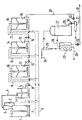
- The invention will now be illustrated, by way of example only, by reference to the accompanying drawing which shows a flow diagram for one arrangement of processing equipment which can be used to carry out the process of the invention.
- The processing equipment illustrated in the figure comprises a dry rotary roller grinder 1 which has a perforated base (not shown). A conduit 2 leads from an upper region of the grinder 1 to a
cyclone 3 which communicates both with thegrinder 3 and a conduit 4 which leads to a mixing tank 5. Further conduits 6 and 7 extend to the mixing tank 4 for the introduction therein of water and dispersing agent. Apump 8 is provided to transfer material from the mixing tank 4 via a conduit 9 to a firstwet attrition grinder 10. A sieve 11 is provided at the bottom of thegrinder 10. Adapted to collect material from thegrinder 10 is apump 12 which is connected, through aconduit 13, to a secondwet attrition grinder 14. Thesecond grinder 14 is provided with asieve 15 and an associatedpump 16 adapted to collect material from thegrinder 14 and transfer it, through aconduit 17, to a thirdwet attrition grinder 18. - The third
wet attrition grinder 18 is provided with asieve 19 at its outlet, an associatedconduit 20 and apump 21. Flow through theconduit 20 is controlled by means of avalve 22. Downstream of thepump 21 is provided a plate andframe heat exchanger 23, which is supplied with steam by aconduit 24 and anextractor 25.Heat exchanger 23 is provided with awaste conduit 26 and aconduit 28 which leads to a separatingchamber 27. Aconduit 29 controlled by means of avalve 30 leads from the bottom of the separating chamber to thepump 21 and on to aconduit 31, flow through this conduit being controlled by means of a valve 32. - Raw marble in the form of chippings of maximum size about 10mm is introduced into dry rotary roller grinder 1 in which grinding takes place. A current of air is forced in through the perforated base of the grinder chamber (not shown) and finely ground particles elutriated from the grinding chamber pass through the conduit 2 to the
cyclone 3 where insufficiently ground particles are separated and returned to the grinding chamber while sufficiently ground particles are conveyed through the conduit 4 to the mixing tank 5. Generally, particles having a diameter not greater than about 50µm are considered to be sufficiently finely ground. To the mixing tank 5 are supplied water through the conduit 6 and a solution of a dispersing agent through the conduit 7. - A homogeneous, dispersed suspension containing about 55-65% by weight of dry marble particles is transferred by means of the
pump 8 through the conduit 9 to the top of the firstwet attrition grinder 10 which is charged with granules of silica sand having sizes in the range from 0.25 to 0.5mm. A suspension of finely ground marble flows through the sieve 11 at the bottom of the grinder and is transferred by means of thepump 12 through theconduit 13 to the secondwet attrition grinder 14 which is charged with similar silica sand to that used in the first grinder. The fine product suspension from the second grinder flows through thesieve 15 and is transferred by means of thepump 16 through theconduit 17 to the thirdwet attrition grinder 18. Water may be added to each wet attrition grinder through the conduit 6 to maintain the solids content of the suspension within the range from 55 to 65% by weight of dry marble. Similarly dispersing agent may be added to any of the wet attrition grinders through the conduit 7 in order to keep the viscosity of the suspension as low as possible. - The suspension of finely ground marble produced by the third wet attrition grinder is withdrawn through the
sieve 19 and theconduit 20 by means of thepump 21, flow through theconduit 20 being controlled by means of thevalve 22. Thepump 21 passes the suspension through a first side of the plate andframe heat exchanger 23, steam being supplied under pressure to a second side through theconduit 24 and anextractor 25. Condensate is discharged to waste from the second side of the heat exchanger through theconduit 26 and heated suspension is transferred under pressure to the separatingchamber 27 from which water vapour is withdrawn through theconduit 28 by theextractor 25 which serves to maintain a vacuum of the order of -0.93bar in the separating chamber. A concentrated suspension of fine marble is withdrawn from the bottom of the separating chamber through theconduit 29 by thepump 21, flow through theconduit 29 being controlled by means of thevalve 30. Part of the concentrated suspension of fine marble is mixed with the product suspension from the third wet attrition grinder and recirculated to theheat exchanger 23, and part may be finally discharged from the recirculating system through theconduit 31, flow through this conduit being controlled by means of the valve 32. - The invention will now be illustrated by the following examples.
- A suspension was prepared containing 60% by weight of ground marble substantially all of the particles of which were smaller than 53µm and 0.7% by weight, based on the weight of dry marble, of a sodium polyacrylate dispersing agent of number average molecular weight about 4,000. The suspension was introduced into an attrition grinding mill and the marble was ground with Ottawa sand having granules in the size range from 0.25 to 0.5mm, the weight ratio of sand to marble being 2:1. The suspension was pumped continuously from a stirred holding vessel, through the attrition grinding mill and back into the holding vessel. The amount of energy dissipated in the suspension in the attrition grinding mill was measured by means of a torque transducer and a voltage/time integrator.
- At intervals during the grinding small samples of the suspension were withdrawn by means of a pipette and the particle size distribution of each suspension sample was measured by means of a Micromeritics "SEDIGRAPH". The grinding was continued until the product contained at least 93% by weight of particles which had an equivalent spherical diameter smaller than 1µm. The solids content of the suspension was measured on completion of the grinding and was found to be 62% by weight of dry marble.
- The suspension of finely ground marble was separated from the sand and 2.5 litres of this suspension was transferred to a 5 litre glass Buchner flask. An airtight stopper was placed into the neck of the flask and the side arm of the flask was connected to a source of vacuum at a pressure of 700mm of mercury below atmospheric pressure (-0.933bar). The flask was then immersed in a water bath at 75°C and shaken from time to time to maintain the uniformity of the suspension. After 3 hours the solids content of the suspension was measured and was found to have risen to 73.5% by weight.
- A sample of the suspension produced by the above method was flocculated and dewatered by filtration and the resultant cake was dried in an oven at 80°C. The dry cake was pulverised and the reflectance to light of wavelengths 457 and 570nm, respectively, was measured. The solids content of the suspension, the percentage by weight of particles of finely ground marble which had equivalent spherical diameters smaller than 2µm and 1µm, respectively, and the amount of energy dissipated in the suspension during the grinding were also recorded. The results obtained are set forth in Table 1 below.
- A suspension was prepared containing 75% by weight of the same ground marble as was used in Example 1 and 0.7% by weight, based on the weight of dry marble, of the same sodium polyacrylate dispersing agent as was used in Example 1. The suspension was introduced into an attrition grinding mill charged with Ottawa sand having granules in the size range from 0.5 to 1.0mm. The weight ratio of sand to dry marble was 2:1. Grinding was continued until 82% by weight of the particles had an equivalent spherical diameter smaller than 1µm. It was found to be impracticable to grind the marble any more finely by this method because the viscosity of the suspension increased to the point at which no further grinding was possible. The suspension of finely ground marble was separated from the sand by sieving.
- A sample of the suspension produced by the method of this example was treated as in Example 1 above and the results obtained are set forth in Table 1 below.
Table 1 Product of method of invention (Ex.1) Product of comparative method (Ex.2) % by weight of particles smaller than 2µm e.s.d. 98 95 % by weight of particles smaller than 1µm e.s.d. 93 82 % reflectance to light of 457nm wavelength 92.9 92.1 % reflectance to light of 570nm wavelength 94.0 93.1 % by weight of dry marble 73.5 76.0 Energy dissipated (kWh/tonne) 300 345 - Each of the two suspensions of finely ground marble prepared in Examples 1 and 2 was incorporated into a paper coating composition having the formulation shown in Table 2 below.
Table 2 Ingredient Parts by weight Pigment 100 Styrene butadiene latex adhesive 11 Sodium carboxymethyl cellulose 0.5 Cross linking agent "URECOL SMV" 0.7 Defoamer 0.7 Optical brightening agent 0.7 - The ingredients were added in turn, in the order given above, to each of the two suspensions. Finally there was added to each paper coating composition sufficient sodium hydroxide to raise the pH to within the range from 8.5 to 9.0.
- Each composition was coated on to a pre-coated, woodfree base paper of weight 86g.m⁻² using a laboratory paper coating machine of the type described in British Patent Specification No. 2225261 at a paper speed of 600m.min⁻¹ and at a series of different blade pressures to give different coat weights.
- Each batch of coated paper was conditioned for 16 hours at 23°C and 50% relative humidity and was then subjected to supercalendering by passing it ten times between the rolls of a laboratory supercalender at a speed of 36m.min⁻¹ a line pressure of 89kg.cm⁻¹ and a temperature of 65°C. The supercalendered paper before testing was again conditioned for 16 hours at 23°C and 50% relative humidity.
- The batches of coated paper were tested for gloss before and after calendering by the method laid down in TAPPI Standard No. T480ts-65 by means of the Hunterlab D16 gloss meter. They were also tested for percentage reflectance to light of wavelengths 457 and 570nm, respectively. Each measured property was plotted graphically against coat weight, and the value of the property for a coat weight of 12g.m⁻² was found by interpolation. The results obtained are set forth in Table 3 below.
Table 3 Product of method of invention (Ex.1) Product of comparative method (Ex.2) Gloss (uncalendered) 29 24 Gloss (calendered) 68 64 % reflectance to light of wavelength 457nm 87.4 87.0 % reflectance to light of wavelength 570nm 88.8 88.4 - A suspension containing 59.4% by weight of ground marble substantially all of the particles of which were smaller than 53µm and 0.68% by weight, based on the weight of dry marble, of the same sodium polyacrylate dispersing agent as was used in Example 1 was introduced into a series of three attrition grinding mills as shown in the Figure at a rate of 45.0 litres per minute.
- Water was added to each of the three attrition grinding mills to replace water which was lost through evaporation and to keep the percentage by weight of solids in the suspension in the range from 59.5 to 61.5% by weight. The grinding medium consisted of grains of silica sand of sizes in the range from 0.25 to 0.5mm. and the weight ratio of sand to dry marble was maintained at about 2:1. The total amount of energy dissipated in the three attrition grinding mills was recorded. The product suspension from the third attrition grinding mill was introduced into a forced circulation evaporation plant of the type shown in the Figure at a rate of 3,000 litres per hour. Steam was introduced into the second side of the heat exchanger at a pressure of 2.5bar and a vacuum of -0.93bar was maintained in the separating chamber. The evaporation was continued until the solids content of the suspension had increased to 74.7% by weight.
- A sample was taken from the product suspension and was tested for the percentage by weight of particles having an equivalent spherical diameter smaller than 2µm, 1µm and 0.25µm, respectively. The results obtained are set forth in Table 4 below.
- The experiment described in Example 3 above was repeated except that the feed suspension contained 0.76% by weight of the sodium polyacrylate dispersing agent, based on the weight of dry marble, and, in order to achieve a finer product, was passed through the three attrition grinding mills at the slower rate of 20.0 litres per minute. Steam was introduced into the second side of the heat exchanger at a pressure of 2.0bar in this case and the final solids content of the suspension was 74.6% by weight. A sample was taken from the product suspension and tested as in Example 3. The results obtained are set forth in Table 4 below.
- A suspension was prepared containing 75% by weight of the same ground marble as was used in Examples 3 and 4 and 0.68% by weight of the same sodium polyacrylate dispersing agent. The suspension was introduced into the series of three attrition grinding mills employed in Examples 3 and 4 at a rate of 24.3 litres per minute and water was added to each attrition grinding mill to replace water lost through evaporation and to maintain the solids content within the range from 74.5 to 76.5% by weight. The solids content of the product suspension of the third attrition grinding mill was found to be 76.5% which was a suitable value for a suspension of finely ground marble for incorporation in a paper coating composition.
- A sample was taken from the product suspension and was tested as in Example 3. The results obtained are set forth in Table 4 below.
Table 4 Product of Example 3 Product of Example 4 Product of Example 5 % by weight of particles smaller than 2µm e.s.d. 96 99 96 % by weight of particles smaller than 1µm e.s.d. 78 95 78 % by weight of particles smaller than 0.25µm e.s.d. 23 43 30 Energy dissipated during grinding (kWh.tonne⁻¹) 173 395 222.5 - It will be seen that the product of Example 3 (Invention) has a very similar particle size distribution to that of the product of Example 5 (Comparative) but required less energy in the grinding stage to produce a calcium carbonate pigment of this particle size distribution. It was not possible to produce a calcium carbonate pigment having a particle size distribution corresponding to that of the product of Example 4 by the method described under Example 5.
- A suspension was prepared containing 68% by weight of the same ground marble as was used in Example 1 and 0.71% by weight, based on the weight of dry marble, of the same sodium polyacrylate dispersing agent. The suspension was introduced at a rate of 31 litres per minute into a series of three attrition grinding mills which were charged with silica sand of grain size in the range from 0.25 to 0.5mm, the weight ratio of sand to dry marble being maintained at about 2:1. In this experiment water was not added to replace water lost through evaporation, and the solids content of the suspension was allowed to rise as the grinding proceeded. A sample of the product suspension from the third attrition grinding mill was tested for the percentages by weight of particles having an equivalent spherical diameter smaller than 2µm, 1µm and 0.25µm, respectively and the amount of energy dissipated in the suspension to produce this particle size distribution was recorded. The final solids content of the suspension was also recorded.
- The results obtained are set forth in Table 5 below, together with the results obtained for of Example 5 as a comparison.
Table 5 Product of Example 6 Product of Example 5 Initial solids content (%) 68 74.5 Final solids content (%) 75.4 76.5 % by weight of particles smaller than 2µm e.s.d. 96 96 % by weight of particles smaller than 1µm e.s.d. 78 78 % by weight of particles smaller than 0.25µm e.s.d. 28 30 Energy dissipated during grinding (kWh.tonne⁻¹) 201 222.5 - It can be seen that, by the method of the invention, a calcium carbonate pigment having a particular fine particle size distribution can be with produced a saving of about 10% of the energy dissipated during the grinding step as compared with the method of Example 5.
Claims (16)
- A process for producing a finely ground alkaline earth metal pigment comprising the steps of:(a) preparing an aqueous suspension comprising from 40 to 70 % by weight of a particulate alkaline earth metal compound;(b) subjecting the suspension formed in step (a) to attrition grinding with a particulate grinding medium under conditions such as to yield a product having a particle size distribution such that at least 90% by weight of the particles have an equivalent spherical diameter smaller than 2µm; and(c) allowing water to evaporate from the suspension under the action of heat contained in the suspension until the percentage by weight of dry alkaline earth metal compound in the suspension has increased to at least 70% by weight.
- A process according to claim 1, wherein the alkaline earth metal compound is an alkaline earth metal carbonate or sulphate.
- A process according to claim 1 or 2, wherein, in step (a), the alkaline earth metal compound has a particle size distribution such that substantially all of the particles are smaller than 100µm.
- A process according to claim 1 or 2, wherein, in step (a), the alkaline earth metal compound preferably has a particle size distribution such that substantially all of the particles are smaller than 53µm.
- A process according to any one or more of the preceding claims, wherein, in step (a), the aqueous suspension includes a dispersing agent for the alkaline earth metal compound, in an amount effective to disperse the particles of the particulate material.
- A process according to any one or more of the preceding claims, wherein, in step (b), the suspension is subjected to attrition grinding under conditions such as to yield a product having a particle size distribution such that at least 80% by weight of the particles have an equivalent spherical diameter smaller than 1µm.
- A process according to any one or more of the preceding claims, wherein the particulate grinding medium consists of particles having an average particle diameter in the range from 0.1 to 5.0mm.
- A process according to any one or more of the preceding claims, wherein the grinding is carried out in two or more stages.
- A process according to any one or more of the preceding claims, wherein, in step (c), the heat under whose action water is allowed to evaporate from the suspension is that which has been generated in the suspension as a direct result of the attrition grinding carried out in step (b).
- A process according to any one or more of the preceding claims, wherein the heat contained in the suspension as a result of the energy dissipated in the suspension during grinding is sufficient to increase the percentage by weight of dry alkaline earth metal compound in the suspension to at least 70% by weight.
- A process according to any one or more of claims 1 to 8, wherein the suspension is heated by a heating means such as a heat exchanger to a temperature within the range of from 50°C to the boiling point of the suspension.
- A process according to claim 9 or 10, wherein, in addition to the heat contained in the suspension as a result of the grinding step, the suspension is heated by a heating means such as a heat exchanger to a temperature within the range of from 50°C to the boiling point of the suspension.
- A process according to claim 11 or 12, wherein the heating means comprises a heat exchanger.
- An aqueous suspension of a finely ground alkaline earth metal pigment whenever prepared by the process as claimed in any one of the preceding claims.
- A high solids aqueous suspension of a finely ground alkaline earth metal pigment having a particle size distribution such that at least 80% by weight of the particles have an equivalent spherical diameter smaller than 1µm and wherein the percentage by weight of dry alkaline earth metal compound in the suspension is at least 70% by weight.
- A high solids aqueous suspension according to claim 15, wherein at least 90% by weight of the particles have an equivalent spherical diameter smaller than 1µm.
Priority Applications (1)
| Application Number | Priority Date | Filing Date | Title |
|---|---|---|---|
| EP98102572A EP0857763A1 (en) | 1993-03-12 | 1994-02-23 | Grinding of pigments consisting of alkaline earth metal pigments |
Applications Claiming Priority (2)
| Application Number | Priority Date | Filing Date | Title |
|---|---|---|---|
| GB9305087 | 1993-03-12 | ||
| GB9305087A GB2275876B (en) | 1993-03-12 | 1993-03-12 | Grinding alkaline earth metal pigments |
Related Child Applications (1)
| Application Number | Title | Priority Date | Filing Date |
|---|---|---|---|
| EP98102572A Division EP0857763A1 (en) | 1993-03-12 | 1994-02-23 | Grinding of pigments consisting of alkaline earth metal pigments |
Publications (2)
| Publication Number | Publication Date |
|---|---|
| EP0614948A1 true EP0614948A1 (en) | 1994-09-14 |
| EP0614948B1 EP0614948B1 (en) | 1999-08-18 |
Family
ID=10731936
Family Applications (2)
| Application Number | Title | Priority Date | Filing Date |
|---|---|---|---|
| EP98102572A Withdrawn EP0857763A1 (en) | 1993-03-12 | 1994-02-23 | Grinding of pigments consisting of alkaline earth metal pigments |
| EP94301277A Revoked EP0614948B1 (en) | 1993-03-12 | 1994-02-23 | Grinding of pigments consisting of alkaline earth metal compounds |
Family Applications Before (1)
| Application Number | Title | Priority Date | Filing Date |
|---|---|---|---|
| EP98102572A Withdrawn EP0857763A1 (en) | 1993-03-12 | 1994-02-23 | Grinding of pigments consisting of alkaline earth metal pigments |
Country Status (11)
| Country | Link |
|---|---|
| US (1) | US5533679A (en) |
| EP (2) | EP0857763A1 (en) |
| JP (1) | JPH06322289A (en) |
| KR (1) | KR100245762B1 (en) |
| AT (1) | ATE183536T1 (en) |
| BR (1) | BR9401138A (en) |
| DE (1) | DE69420064T2 (en) |
| DK (1) | DK0614948T3 (en) |
| FI (1) | FI941168A7 (en) |
| GB (1) | GB2275876B (en) |
| NO (1) | NO310422B1 (en) |
Cited By (54)
| Publication number | Priority date | Publication date | Assignee | Title |
|---|---|---|---|---|
| US6140376A (en) * | 1996-12-27 | 2000-10-31 | Imerys Minerals, Ltd. | Dispersed aqueous suspensions |
| EP1077199A3 (en) * | 1999-08-19 | 2002-01-09 | Kabushiki Kaisha Kaisui Kagaku Kenkyujo | Calcium hydroxide and process for the production thereof |
| WO2007110639A1 (en) * | 2006-03-27 | 2007-10-04 | Imerys Minerals Limited | Method for producing particulate inorganic material |
| DE202010005538U1 (en) | 2010-06-01 | 2010-08-05 | Imerys Minerals Ltd., Par | Coating composition for non-porous substrates |
| CN101840821A (en) * | 2010-03-23 | 2010-09-22 | 大连理工大学 | Method for producing alkaline earth metal oxide compound mixed slurry |
| WO2010131016A2 (en) | 2009-05-15 | 2010-11-18 | Imerys Minerals Limited | Paper filler composition |
| EP2390284A1 (en) | 2010-05-28 | 2011-11-30 | Omya Development AG | Process for manufacturing high solids suspensions of mineral materials |
| WO2012052778A1 (en) | 2010-10-22 | 2012-04-26 | Imerys Minerals Limited | Film compositions |
| WO2012066308A2 (en) | 2010-11-15 | 2012-05-24 | Imerys Minerals Limited | Compositions |
| EP2537883A1 (en) | 2011-06-20 | 2012-12-26 | Imerys Minerals Limited | Methods and compositions related to recycling polymer waste |
| WO2013061068A1 (en) | 2011-10-25 | 2013-05-02 | Imerys Minerals Limited | Particulate fillers |
| WO2013121213A1 (en) | 2012-02-15 | 2013-08-22 | Imerys Minerals Limited | Pigment compositions |
| EP2653508A1 (en) | 2012-04-19 | 2013-10-23 | Imerys S.A. | Compositions for paint |
| WO2014062476A1 (en) | 2012-10-18 | 2014-04-24 | Imerys Pigments, Inc. | Coating composition and coated paper and coated paperboard |
| WO2014140563A2 (en) | 2013-03-14 | 2014-09-18 | Imerys Minerals Limited | Composite structures |
| US20150000564A1 (en) * | 2012-02-17 | 2015-01-01 | Omya International Ag | Mineral material powder with high dispersion ability and use of said mineral material powder |
| WO2016038110A2 (en) | 2014-09-09 | 2016-03-17 | Imerys Minerals Limited | Polymer compositions |
| WO2017029480A1 (en) | 2015-08-14 | 2017-02-23 | Imerys Minerals Limited | Coated alkaline earth metal carbonates and their uses |
| WO2017046317A1 (en) | 2015-09-18 | 2017-03-23 | Imerys Minerals Limited | Mobile grinding facility |
| WO2017175063A1 (en) | 2016-04-04 | 2017-10-12 | Fiberlean Technologies Limited | Compositions and methods for providing increased strength in ceiling, flooring, and building products |
| US20170306057A1 (en) * | 2016-04-22 | 2017-10-26 | Fiberlean Technologies Limited | Re-dispersed microfibrillated cellulose |
| WO2017182877A1 (en) | 2016-04-22 | 2017-10-26 | Fiberlean Technologies Limited | Fibres comprising microfibrillated cellulose and methods of manufacturing fibres and nonwoven materials therefrom |
| US10053817B2 (en) | 2010-04-27 | 2018-08-21 | Fiberlean Technologies Limited | Process for the manufacture of structured materials using nano-fibrillar cellulose gels |
| US10106928B2 (en) | 2013-03-15 | 2018-10-23 | Fiberlean Technologies Limited | Paper composition |
| WO2018193314A1 (en) | 2017-04-21 | 2018-10-25 | Fiberlean Technologies Limited | Microfibrillated cellulose with enhanced properties and methods of making the same |
| WO2018197465A1 (en) | 2017-04-24 | 2018-11-01 | Imerys Minerals Limited | Coated calcium carbonate for pitch and/or stickies control |
| EP3418447A1 (en) | 2013-03-15 | 2018-12-26 | FiberLean Technologies Limited | Process for treating microfibrillated cellulose |
| US10214859B2 (en) | 2016-04-05 | 2019-02-26 | Fiberlean Technologies Limited | Paper and paperboard products |
| US10294371B2 (en) | 2009-03-30 | 2019-05-21 | Fiberlean Technologies Limited | Process for the production of nano-fibrillar cellulose gels |
| US10301774B2 (en) | 2009-03-30 | 2019-05-28 | Fiberlean Technologies Limited | Process for the production of nano-fibrillar cellulose suspensions |
| US10577469B2 (en) | 2015-10-14 | 2020-03-03 | Fiberlean Technologies Limited | 3D-formable sheet material |
| EP3633103A1 (en) | 2014-05-15 | 2020-04-08 | FiberLean Technologies Limited | Method for making a grinding medium |
| WO2021014206A1 (en) | 2019-07-23 | 2021-01-28 | Fiberlean Technologies Limited | Compositions and methods for producing microfibrillated cellulose with increased tensile properties |
| US10913854B2 (en) | 2014-09-17 | 2021-02-09 | Imertech Sas | Polymeric compositions |
| WO2021090059A1 (en) | 2019-11-05 | 2021-05-14 | Fiberlean Technologies Limited | Binder composition and method comprising microfibrillated cellulose and recycled cellulosic materials |
| US11155697B2 (en) | 2010-04-27 | 2021-10-26 | Fiberlean Technologies Limited | Process for the production of gel-based composite materials |
| WO2022015588A1 (en) | 2020-07-14 | 2022-01-20 | Ut-Battelle, Llc | Surface-modified and dried microfibrillated cellulose reinforced thermoplastic biocomposites |
| WO2022053869A1 (en) | 2020-09-11 | 2022-03-17 | Fiberlean Technologies Limited | Filler compositions comprising microfibrillated cellulose and microporous inorganic particulate material composites for paper and paperboard application with improved mechanical properties |
| WO2022208159A1 (en) | 2021-04-02 | 2022-10-06 | Fiberlean Technologies Limited | Paper and paperboard products |
| WO2022208160A1 (en) | 2021-04-02 | 2022-10-06 | Fiberlean Technologies Limited | Improved microfibrillated coating compositions, processes and applicators therefor |
| EP4116260A1 (en) | 2021-07-08 | 2023-01-11 | Imertech Sas | Method of preparation of calcium carbonate slurries |
| WO2023037161A1 (en) | 2021-09-08 | 2023-03-16 | Fiberlean Technologies Limited | Mobile dispersion system and methods for the resuspension of partially-dried microfibrillated cellulose |
| US11639441B2 (en) | 2016-02-01 | 2023-05-02 | Imertech Sas | Inorganic particulate material suitable for use in polymeric films |
| WO2023104872A1 (en) | 2021-12-09 | 2023-06-15 | Fiberlean Technologies Limited | Surface coating comprising microfibrillated cellulose |
| US11760886B2 (en) * | 2016-12-16 | 2023-09-19 | Coatex | Method for grinding mineral material |
| WO2023180806A1 (en) | 2022-03-23 | 2023-09-28 | Fiberlean Technologies Limited | Resin reinforced with nanocellulose for wood-based panel products |
| WO2023180808A2 (en) | 2022-03-21 | 2023-09-28 | Fiberlean Technologies Limited | Molded pulp article and processes for making them |
| WO2023180277A1 (en) | 2022-03-21 | 2023-09-28 | Fiberlean Technologies Limited | Porous surface coated with nanocellulose |
| US11840455B2 (en) * | 2015-06-30 | 2023-12-12 | Imertech Sas | Mineral compositions |
| US11846072B2 (en) | 2016-04-05 | 2023-12-19 | Fiberlean Technologies Limited | Process of making paper and paperboard products |
| WO2024110781A1 (en) | 2022-11-22 | 2024-05-30 | Fiberlean Technologies Limited | Sequential application of layers, comprising nanocellulose, onto the surface of paper or paperboard substrates |
| WO2024110786A1 (en) | 2022-11-22 | 2024-05-30 | Fiberlean Technologies Limited | Barrier coatings applied to nanocellulose-coated paper and paperboard |
| WO2024218566A1 (en) | 2023-04-21 | 2024-10-24 | Fiberlean Technologies Limited | Barrier layers comprising nanocellulose onto the surface of paper or paperboard substrates at the wet end of a papermaking process |
| WO2024228059A1 (en) | 2023-05-03 | 2024-11-07 | Fiberlean Technologies Limited | Grinding method and grinding medium |
Families Citing this family (14)
| Publication number | Priority date | Publication date | Assignee | Title |
|---|---|---|---|---|
| EP0551918B1 (en) * | 1992-01-17 | 1996-05-22 | Sumitomo Heavy Industries, Ltd. | Internally meshing planetary gear structure, reduction or step-up gear having said structure, and method for machining said reduction or step-up gear |
| GB9520703D0 (en) * | 1995-10-10 | 1995-12-13 | Ecc Int Ltd | Paper coating pigments and their production and use |
| US5722602A (en) * | 1995-12-15 | 1998-03-03 | Caterpillar Inc. | Process for making flowable powders for coating applications |
| DE19829649C2 (en) * | 1997-07-28 | 2003-05-08 | Omya Ag Oftringen | Slurry containing an agglomerated carbonate pigment |
| WO2000039029A2 (en) † | 1998-12-23 | 2000-07-06 | Imerys Minerals Ltd. | Production of concentrated carbonate suspensions |
| GB0221632D0 (en) * | 2002-09-17 | 2002-10-30 | Imerys Minerals Ltd | Grinding method |
| GB0319500D0 (en) | 2003-08-19 | 2003-09-17 | Resolution Chemicals Ltd | Particle-size reduction apparatus,and use thereof |
| GB0427568D0 (en) | 2004-12-16 | 2005-01-19 | Resolution Chemicals Ltd | Particle-size reduction apparatus, and the use thereof |
| CN100419032C (en) * | 2005-01-05 | 2008-09-17 | 上海东升新材料有限公司 | Heavy calcium carbonate filling preparation method |
| JP2007099614A (en) * | 2005-09-12 | 2007-04-19 | Ube Material Industries Ltd | Strontium carbonate fine powder |
| CN103627212B (en) * | 2013-08-16 | 2015-02-25 | 湖南磊鑫新材料科技有限公司 | Preparation method and preparation apparatus for ultrafine heavy calcium coating filler |
| GB201417830D0 (en) * | 2014-10-08 | 2014-11-19 | Cde Global Ltd | Process and apparatus for refining sand |
| SI3042878T1 (en) * | 2015-01-07 | 2019-07-31 | Omya International Ag | Process to obtain an ultrafine GCC with high light scattering properties and high solid content |
| CA3024879A1 (en) * | 2016-05-26 | 2017-11-30 | Allergan, Inc. | Production of rounded salt particles |
Citations (7)
| Publication number | Priority date | Publication date | Assignee | Title |
|---|---|---|---|---|
| GB1309074A (en) * | 1969-03-18 | 1973-03-07 | English Clays Lovering Pochin | Grinding of minerals |
| FR2243982A1 (en) * | 1973-09-14 | 1975-04-11 | Gewerk Victor Chem Werke | Prodn of conc dispersions of finely divided calcium carbonate - by homogenising with water and wet-milling the suspension |
| FR2306939A1 (en) * | 1975-04-11 | 1976-11-05 | Anglo American Clays Corp | PROCESS FOR PURIFYING AND INCREASING THE WHITNESS OF NATURAL CALCITE MINERALS |
| FR2347417A1 (en) * | 1976-04-07 | 1977-11-04 | Ass Portland Cement | CHALK WHITE FILLERS FOR COMPOSITIONS BASED ON POLYMERS, SUCH AS PLASTICS AND RUBBERS |
| EP0027996A1 (en) * | 1979-10-29 | 1981-05-06 | Plüss-Staufer AG | Process for manufacturing mineral fillers by wet grinding |
| EP0276077A2 (en) * | 1987-01-21 | 1988-07-27 | Ecc International Limited | A process for forming finely divided calcium sulphate |
| US4793985A (en) * | 1982-08-23 | 1988-12-27 | J. M. Huber Corporation | Method of producing ultrafine ground calcium carbonate |
Family Cites Families (13)
| Publication number | Priority date | Publication date | Assignee | Title |
|---|---|---|---|---|
| GB1204511A (en) * | 1967-03-14 | 1970-09-09 | English Clays Lovering Pochin | Improvements in or relating to pigments |
| GB1472701A (en) * | 1975-01-03 | 1977-05-04 | English Clays Lovering Pochin | Production of aqueous calcium carbonate suspensions |
| US4325514A (en) * | 1975-12-05 | 1982-04-20 | English Clays Lovering Pochin & Company Limited | Comminution of minerals |
| GB1569969A (en) * | 1975-12-05 | 1980-06-25 | English Clays Lovering Pochin | Comminution of solid materials |
| GB1599632A (en) * | 1977-01-19 | 1981-10-07 | English Clays Lovering Pochin | Comminution of solid materials |
| GB1597190A (en) * | 1977-09-19 | 1981-09-03 | Shiraishi Kogyo Kaisha Ltd | Calcium carbonate compositions |
| GB1601587A (en) * | 1978-05-31 | 1981-11-04 | English Clays Lovering Pochin | Processing of calcium carbonate minerals |
| DE3275717D1 (en) * | 1982-11-10 | 1987-04-23 | Allied Colloids Ltd | Calcium carbonate dispersions |
| DE3246232A1 (en) * | 1982-12-14 | 1984-06-14 | Bleeck, Jörg, Dipl.-Ing., 5309 Meckenheim | METHOD FOR WET MILLING NATURAL AND SYNTHETIC CALCIUM CARBONATES |
| US4687546B1 (en) * | 1985-07-19 | 1996-06-04 | Anglo American Clays Corp | Method of concentrating slurried kaolin |
| US5036599A (en) * | 1988-12-27 | 1991-08-06 | Georgia Kaolin Company, Inc. | Method of concentrating slurried kaolin |
| US5181662A (en) * | 1989-01-27 | 1993-01-26 | Coatex S.A. | Process for grinding calcium carbonate in aqueous media |
| GB2251254B (en) * | 1990-12-04 | 1994-06-29 | Ecc Int Ltd | Calcium carbonate slurry |
-
1993
- 1993-03-12 GB GB9305087A patent/GB2275876B/en not_active Expired - Fee Related
-
1994
- 1994-02-23 EP EP98102572A patent/EP0857763A1/en not_active Withdrawn
- 1994-02-23 EP EP94301277A patent/EP0614948B1/en not_active Revoked
- 1994-02-23 DE DE69420064T patent/DE69420064T2/en not_active Revoked
- 1994-02-23 AT AT94301277T patent/ATE183536T1/en not_active IP Right Cessation
- 1994-02-23 DK DK94301277T patent/DK0614948T3/en active
- 1994-03-09 NO NO19940820A patent/NO310422B1/en not_active IP Right Cessation
- 1994-03-10 US US08/209,006 patent/US5533679A/en not_active Expired - Fee Related
- 1994-03-10 JP JP6040181A patent/JPH06322289A/en active Pending
- 1994-03-11 KR KR1019940004744A patent/KR100245762B1/en not_active Expired - Fee Related
- 1994-03-11 BR BR9401138A patent/BR9401138A/en not_active IP Right Cessation
- 1994-03-11 FI FI941168A patent/FI941168A7/en unknown
Patent Citations (7)
| Publication number | Priority date | Publication date | Assignee | Title |
|---|---|---|---|---|
| GB1309074A (en) * | 1969-03-18 | 1973-03-07 | English Clays Lovering Pochin | Grinding of minerals |
| FR2243982A1 (en) * | 1973-09-14 | 1975-04-11 | Gewerk Victor Chem Werke | Prodn of conc dispersions of finely divided calcium carbonate - by homogenising with water and wet-milling the suspension |
| FR2306939A1 (en) * | 1975-04-11 | 1976-11-05 | Anglo American Clays Corp | PROCESS FOR PURIFYING AND INCREASING THE WHITNESS OF NATURAL CALCITE MINERALS |
| FR2347417A1 (en) * | 1976-04-07 | 1977-11-04 | Ass Portland Cement | CHALK WHITE FILLERS FOR COMPOSITIONS BASED ON POLYMERS, SUCH AS PLASTICS AND RUBBERS |
| EP0027996A1 (en) * | 1979-10-29 | 1981-05-06 | Plüss-Staufer AG | Process for manufacturing mineral fillers by wet grinding |
| US4793985A (en) * | 1982-08-23 | 1988-12-27 | J. M. Huber Corporation | Method of producing ultrafine ground calcium carbonate |
| EP0276077A2 (en) * | 1987-01-21 | 1988-07-27 | Ecc International Limited | A process for forming finely divided calcium sulphate |
Cited By (110)
| Publication number | Priority date | Publication date | Assignee | Title |
|---|---|---|---|---|
| US6140376A (en) * | 1996-12-27 | 2000-10-31 | Imerys Minerals, Ltd. | Dispersed aqueous suspensions |
| EP1077199A3 (en) * | 1999-08-19 | 2002-01-09 | Kabushiki Kaisha Kaisui Kagaku Kenkyujo | Calcium hydroxide and process for the production thereof |
| US6592834B1 (en) | 1999-08-19 | 2003-07-15 | Kabushiki Kaisha Kaisui Kagaku Kenkyujo | Calcium hydroxide, a process for the production thereof and use thereof |
| WO2007110639A1 (en) * | 2006-03-27 | 2007-10-04 | Imerys Minerals Limited | Method for producing particulate inorganic material |
| US20100035076A1 (en) * | 2006-03-27 | 2010-02-11 | Jacek Antoni Kostuch | Method for Producing Particulate Inorganic Material |
| EP3530624A1 (en) | 2006-03-27 | 2019-08-28 | FiberLean Technologies Limited | Method for producing particulate inorganic material |
| EP2540668A3 (en) * | 2006-03-27 | 2013-05-01 | Imerys Minerals Limited | Method for producing particulate inorganic material |
| EP2540668A2 (en) | 2006-03-27 | 2013-01-02 | Imerys Minerals Limited | Method for producing particulate inorganic material |
| US10982387B2 (en) | 2009-03-30 | 2021-04-20 | Fiberlean Technologies Limited | Process for the production of nano-fibrillar cellulose suspensions |
| US10294371B2 (en) | 2009-03-30 | 2019-05-21 | Fiberlean Technologies Limited | Process for the production of nano-fibrillar cellulose gels |
| US10301774B2 (en) | 2009-03-30 | 2019-05-28 | Fiberlean Technologies Limited | Process for the production of nano-fibrillar cellulose suspensions |
| US10975242B2 (en) | 2009-03-30 | 2021-04-13 | Fiberlean Technologies Limited | Process for the production of nano-fibrillar cellulose gels |
| WO2010131016A2 (en) | 2009-05-15 | 2010-11-18 | Imerys Minerals Limited | Paper filler composition |
| EP4141169A1 (en) | 2009-05-15 | 2023-03-01 | FiberLean Technologies Limited | Paper filler composition |
| EP4083315A1 (en) | 2009-05-15 | 2022-11-02 | FiberLean Technologies Limited | Paper filler composition |
| EP3985169A1 (en) | 2009-05-15 | 2022-04-20 | FiberLean Technologies Limited | Paper filler composition |
| EP3715528A1 (en) | 2009-05-15 | 2020-09-30 | FiberLean Technologies Limited | Paper filler composition |
| CN101840821A (en) * | 2010-03-23 | 2010-09-22 | 大连理工大学 | Method for producing alkaline earth metal oxide compound mixed slurry |
| US11155697B2 (en) | 2010-04-27 | 2021-10-26 | Fiberlean Technologies Limited | Process for the production of gel-based composite materials |
| US10633796B2 (en) | 2010-04-27 | 2020-04-28 | Fiberlean Technologies Limited | Process for the manufacture of structured materials using nano-fibrillar cellulose gels |
| US10100467B2 (en) | 2010-04-27 | 2018-10-16 | Fiberlean Technologies Limited | Process for the manufacture of structured materials using nano-fibrillar cellulose gels |
| US10053817B2 (en) | 2010-04-27 | 2018-08-21 | Fiberlean Technologies Limited | Process for the manufacture of structured materials using nano-fibrillar cellulose gels |
| EP2390284A1 (en) | 2010-05-28 | 2011-11-30 | Omya Development AG | Process for manufacturing high solids suspensions of mineral materials |
| WO2011147922A1 (en) | 2010-05-28 | 2011-12-01 | Omya Development Ag | Process for manufacturing high solids suspensions of mineral materials |
| US8721838B2 (en) | 2010-05-28 | 2014-05-13 | Omya International Ag | Process for manufacturing high solids suspensions of mineral materials |
| US9243121B2 (en) | 2010-05-28 | 2016-01-26 | Omya International Ag | Process for manufacturing high solids suspensions of mineral materials |
| DE202010005538U1 (en) | 2010-06-01 | 2010-08-05 | Imerys Minerals Ltd., Par | Coating composition for non-porous substrates |
| WO2012052778A1 (en) | 2010-10-22 | 2012-04-26 | Imerys Minerals Limited | Film compositions |
| US10253457B2 (en) | 2010-11-15 | 2019-04-09 | Fiberlean Technologies Limited | Compositions |
| WO2012066308A2 (en) | 2010-11-15 | 2012-05-24 | Imerys Minerals Limited | Compositions |
| US10336891B2 (en) | 2011-06-20 | 2019-07-02 | Imertech Sas | Methods and compositions related to recycling polymer waste |
| EP2537883A1 (en) | 2011-06-20 | 2012-12-26 | Imerys Minerals Limited | Methods and compositions related to recycling polymer waste |
| US9969868B2 (en) | 2011-06-20 | 2018-05-15 | Imerys Minerals Limited | Methods and compositions related to recycling polymer waste |
| WO2012175504A1 (en) | 2011-06-20 | 2012-12-27 | Imerys Minerals Limited | Methods and compositions related to recycling polymer waste |
| WO2013061068A1 (en) | 2011-10-25 | 2013-05-02 | Imerys Minerals Limited | Particulate fillers |
| EP3121234A1 (en) | 2012-02-15 | 2017-01-25 | Imerys Minerals Limited | Pigment compositions |
| WO2013121213A1 (en) | 2012-02-15 | 2013-08-22 | Imerys Minerals Limited | Pigment compositions |
| US20150000564A1 (en) * | 2012-02-17 | 2015-01-01 | Omya International Ag | Mineral material powder with high dispersion ability and use of said mineral material powder |
| US10767055B2 (en) * | 2012-02-17 | 2020-09-08 | Omya International Ag | Mineral material powder with high dispersion ability and use of said mineral material powder |
| US11555122B2 (en) | 2012-02-17 | 2023-01-17 | Omya International Ag | Mineral material powder with high dispersion ability and use of said mineral material powder |
| EP3825364A1 (en) | 2012-04-19 | 2021-05-26 | FiberLean Technologies Limited | Compositions for paint |
| EP2653508A1 (en) | 2012-04-19 | 2013-10-23 | Imerys S.A. | Compositions for paint |
| WO2013156223A1 (en) | 2012-04-19 | 2013-10-24 | Imerys S.A. | Compositions for paint |
| EP3804862A1 (en) | 2012-10-18 | 2021-04-14 | Imerys Pigments, Inc. | Coating composition and coated paper and coated paperboard |
| WO2014062476A1 (en) | 2012-10-18 | 2014-04-24 | Imerys Pigments, Inc. | Coating composition and coated paper and coated paperboard |
| WO2014140563A2 (en) | 2013-03-14 | 2014-09-18 | Imerys Minerals Limited | Composite structures |
| US11718065B2 (en) | 2013-03-14 | 2023-08-08 | Imertech Sas | Composite structures |
| US10745857B2 (en) | 2013-03-15 | 2020-08-18 | Fiberlean Technologies Limited | Process for treating microfibrillated cellulose |
| EP3418447A1 (en) | 2013-03-15 | 2018-12-26 | FiberLean Technologies Limited | Process for treating microfibrillated cellulose |
| US10106928B2 (en) | 2013-03-15 | 2018-10-23 | Fiberlean Technologies Limited | Paper composition |
| US10309060B2 (en) | 2013-03-15 | 2019-06-04 | Fiberlean Technologies Limited | Paper composition |
| US12018433B2 (en) | 2013-03-15 | 2024-06-25 | Fiberlean Technologies Limited | Process for treating microfibrillated cellulose |
| US10865524B2 (en) | 2013-03-15 | 2020-12-15 | Fiberlean Technologies Limited | Paper composition |
| EP3633103A1 (en) | 2014-05-15 | 2020-04-08 | FiberLean Technologies Limited | Method for making a grinding medium |
| EP3940142A1 (en) | 2014-05-15 | 2022-01-19 | FiberLean Technologies Limited | Grinding method and grinding medium |
| US11572658B2 (en) | 2014-05-15 | 2023-02-07 | Fiberlean Technologies Limited | Grinding method and grinding medium |
| US11067204B2 (en) | 2014-09-09 | 2021-07-20 | Imertech Sas | Polymer compositions |
| WO2016038110A2 (en) | 2014-09-09 | 2016-03-17 | Imerys Minerals Limited | Polymer compositions |
| US10913854B2 (en) | 2014-09-17 | 2021-02-09 | Imertech Sas | Polymeric compositions |
| US11840455B2 (en) * | 2015-06-30 | 2023-12-12 | Imertech Sas | Mineral compositions |
| WO2017029480A1 (en) | 2015-08-14 | 2017-02-23 | Imerys Minerals Limited | Coated alkaline earth metal carbonates and their uses |
| WO2017046317A1 (en) | 2015-09-18 | 2017-03-23 | Imerys Minerals Limited | Mobile grinding facility |
| US11384210B2 (en) | 2015-10-14 | 2022-07-12 | Fiberlean Technologies Limited | 3-D formable sheet material |
| US11932740B2 (en) | 2015-10-14 | 2024-03-19 | Fiberlean Technologies Limited | 3D-formable sheet material |
| US10577469B2 (en) | 2015-10-14 | 2020-03-03 | Fiberlean Technologies Limited | 3D-formable sheet material |
| US11639441B2 (en) | 2016-02-01 | 2023-05-02 | Imertech Sas | Inorganic particulate material suitable for use in polymeric films |
| WO2017175063A1 (en) | 2016-04-04 | 2017-10-12 | Fiberlean Technologies Limited | Compositions and methods for providing increased strength in ceiling, flooring, and building products |
| EP3828339A1 (en) | 2016-04-05 | 2021-06-02 | FiberLean Technologies Limited | Paper and paperboard products |
| EP4303361A2 (en) | 2016-04-05 | 2024-01-10 | FiberLean Technologies Limited | Paper and paperboard products |
| US11732421B2 (en) | 2016-04-05 | 2023-08-22 | Fiberlean Technologies Limited | Method of making paper or board products |
| US11846072B2 (en) | 2016-04-05 | 2023-12-19 | Fiberlean Technologies Limited | Process of making paper and paperboard products |
| US10801162B2 (en) | 2016-04-05 | 2020-10-13 | Fiberlean Technologies Limited | Paper and paperboard products |
| US10214859B2 (en) | 2016-04-05 | 2019-02-26 | Fiberlean Technologies Limited | Paper and paperboard products |
| US12203223B2 (en) | 2016-04-05 | 2025-01-21 | Fiberlean Technologies, Ltd. | Method of making paper or board products |
| US11274399B2 (en) | 2016-04-05 | 2022-03-15 | Fiberlean Technologies Limited | Paper and paperboard products |
| WO2017182877A1 (en) | 2016-04-22 | 2017-10-26 | Fiberlean Technologies Limited | Fibres comprising microfibrillated cellulose and methods of manufacturing fibres and nonwoven materials therefrom |
| US10435482B2 (en) * | 2016-04-22 | 2019-10-08 | Fiberlean Technologies Limited | Re-dispersed microfibrillated cellulose |
| US11001644B2 (en) | 2016-04-22 | 2021-05-11 | Fiberlean Technologies Limited | Re-dispersed microfibrillated cellulose |
| EP4043621A1 (en) | 2016-04-22 | 2022-08-17 | FiberLean Technologies Limited | Compositions comprising microfibrilated cellulose and polymers and methods of manufacturing fibres and nonwoven materials therefrom |
| EP4056741A1 (en) | 2016-04-22 | 2022-09-14 | FiberLean Technologies Limited | A method for preparing an aqueous suspension comprising microfibrillated cellulose |
| US20170306057A1 (en) * | 2016-04-22 | 2017-10-26 | Fiberlean Technologies Limited | Re-dispersed microfibrillated cellulose |
| EP3690137A1 (en) | 2016-04-22 | 2020-08-05 | FiberLean Technologies Limited | Re-dispersed microfibrillated cellulose |
| EP4092188A1 (en) | 2016-04-22 | 2022-11-23 | FiberLean Technologies Limited | Method of improving the physical and/or mechanical properties of re-dispersed microfibrillated cellulose |
| CN109312494B (en) * | 2016-04-22 | 2021-06-18 | 菲博林科技有限公司 | Fibers comprising microfibrillated cellulose and methods of making fibers and nonwovens therefrom |
| CN113430664A (en) * | 2016-04-22 | 2021-09-24 | 菲博林科技有限公司 | Fibers comprising microfibrillated cellulose and methods of making fibers and nonwovens therefrom |
| CN109312494A (en) * | 2016-04-22 | 2019-02-05 | 菲博林科技有限公司 | Fibers comprising microfibrillated cellulose and methods of making fibers and nonwovens therefrom |
| WO2017182883A1 (en) | 2016-04-22 | 2017-10-26 | Fiberlean Technologies Limited | Re-dispersed microfibrillated cellulose |
| US11760886B2 (en) * | 2016-12-16 | 2023-09-19 | Coatex | Method for grinding mineral material |
| WO2018193314A1 (en) | 2017-04-21 | 2018-10-25 | Fiberlean Technologies Limited | Microfibrillated cellulose with enhanced properties and methods of making the same |
| EP3896219A1 (en) | 2017-04-21 | 2021-10-20 | FiberLean Technologies Limited | Microfibrillated cellulose with enhanced properties and methods of making the same |
| WO2018197465A1 (en) | 2017-04-24 | 2018-11-01 | Imerys Minerals Limited | Coated calcium carbonate for pitch and/or stickies control |
| WO2021014206A1 (en) | 2019-07-23 | 2021-01-28 | Fiberlean Technologies Limited | Compositions and methods for producing microfibrillated cellulose with increased tensile properties |
| WO2021090059A1 (en) | 2019-11-05 | 2021-05-14 | Fiberlean Technologies Limited | Binder composition and method comprising microfibrillated cellulose and recycled cellulosic materials |
| WO2022015588A1 (en) | 2020-07-14 | 2022-01-20 | Ut-Battelle, Llc | Surface-modified and dried microfibrillated cellulose reinforced thermoplastic biocomposites |
| WO2022053869A1 (en) | 2020-09-11 | 2022-03-17 | Fiberlean Technologies Limited | Filler compositions comprising microfibrillated cellulose and microporous inorganic particulate material composites for paper and paperboard application with improved mechanical properties |
| WO2022208160A1 (en) | 2021-04-02 | 2022-10-06 | Fiberlean Technologies Limited | Improved microfibrillated coating compositions, processes and applicators therefor |
| WO2022208159A1 (en) | 2021-04-02 | 2022-10-06 | Fiberlean Technologies Limited | Paper and paperboard products |
| WO2023281011A1 (en) | 2021-07-08 | 2023-01-12 | Imertech Sas | Calcium carbonate slurries |
| EP4116260A1 (en) | 2021-07-08 | 2023-01-11 | Imertech Sas | Method of preparation of calcium carbonate slurries |
| WO2023037167A1 (en) | 2021-09-08 | 2023-03-16 | Fiberlean Technologies Limited | Mobile dispersion system and methods for the resuspension of dried microfibrillated cellulose |
| WO2023037161A1 (en) | 2021-09-08 | 2023-03-16 | Fiberlean Technologies Limited | Mobile dispersion system and methods for the resuspension of partially-dried microfibrillated cellulose |
| WO2023104872A1 (en) | 2021-12-09 | 2023-06-15 | Fiberlean Technologies Limited | Surface coating comprising microfibrillated cellulose |
| WO2023180277A1 (en) | 2022-03-21 | 2023-09-28 | Fiberlean Technologies Limited | Porous surface coated with nanocellulose |
| WO2023180808A2 (en) | 2022-03-21 | 2023-09-28 | Fiberlean Technologies Limited | Molded pulp article and processes for making them |
| WO2023180807A1 (en) | 2022-03-23 | 2023-09-28 | Fiberlean Technologies Limited | Nanocellulose and resin make down processes and systems |
| WO2023180806A1 (en) | 2022-03-23 | 2023-09-28 | Fiberlean Technologies Limited | Resin reinforced with nanocellulose for wood-based panel products |
| WO2024110781A1 (en) | 2022-11-22 | 2024-05-30 | Fiberlean Technologies Limited | Sequential application of layers, comprising nanocellulose, onto the surface of paper or paperboard substrates |
| WO2024110786A1 (en) | 2022-11-22 | 2024-05-30 | Fiberlean Technologies Limited | Barrier coatings applied to nanocellulose-coated paper and paperboard |
| WO2024218566A1 (en) | 2023-04-21 | 2024-10-24 | Fiberlean Technologies Limited | Barrier layers comprising nanocellulose onto the surface of paper or paperboard substrates at the wet end of a papermaking process |
| WO2024228059A1 (en) | 2023-05-03 | 2024-11-07 | Fiberlean Technologies Limited | Grinding method and grinding medium |
Also Published As
| Publication number | Publication date |
|---|---|
| DE69420064T2 (en) | 1999-12-09 |
| EP0857763A1 (en) | 1998-08-12 |
| GB2275876A (en) | 1994-09-14 |
| US5533679A (en) | 1996-07-09 |
| EP0614948B1 (en) | 1999-08-18 |
| NO940820D0 (en) | 1994-03-09 |
| NO940820L (en) | 1994-09-13 |
| NO310422B1 (en) | 2001-07-02 |
| GB2275876B (en) | 1996-07-17 |
| DE69420064D1 (en) | 1999-09-23 |
| ATE183536T1 (en) | 1999-09-15 |
| FI941168A7 (en) | 1994-09-13 |
| FI941168A0 (en) | 1994-03-11 |
| GB9305087D0 (en) | 1993-04-28 |
| BR9401138A (en) | 1994-10-25 |
| DK0614948T3 (en) | 2000-02-07 |
| KR940021677A (en) | 1994-10-19 |
| JPH06322289A (en) | 1994-11-22 |
| KR100245762B1 (en) | 2000-03-02 |
Similar Documents
| Publication | Publication Date | Title |
|---|---|---|
| EP0614948B1 (en) | Grinding of pigments consisting of alkaline earth metal compounds | |
| US4186027A (en) | Processing of kaolinitic clays at high solids | |
| CA1322709C (en) | High solids aqueous silica slurry | |
| EP2390284B2 (en) | Process for manufacturing high solids suspensions of mineral materials | |
| CA2347547C (en) | Processes for preparing precipitated calcium carbonate compositions and products thereof | |
| KR101964537B1 (en) | Method for obtaining ultrafine GCC with high light scattering properties and high solids content | |
| NO175983B (en) | Process for Preparing a Refined Pigmentation Suspension and Applying the Process to the Paper Coating Area | |
| KR20100098689A (en) | Composites of inorganic microparticles having a phosphated surface and alkaline earth carbonate nanoparticles | |
| EP0850283B1 (en) | Preparations of suspensions of ground particulate material | |
| CN103184710A (en) | White board paper used for coating | |
| WO1997010309A9 (en) | Preparations of suspensions of ground particulate material | |
| EP3931266A1 (en) | Process for preparing an aqueous suspension comprising a ground calcium carbonate-comprising material | |
| CA1161010A (en) | Process for the production of mineral fillers by wet comminution | |
| US5393716A (en) | Process for producing anti-blocking compositions | |
| EP0276077B1 (en) | A process for forming finely divided calcium sulphate | |
| CA1090833A (en) | Processing of clays | |
| JPH11335119A (en) | Preparation of aqueous slurry of light calcium carbonate | |
| US4971629A (en) | Method of preparing aggregated pigments from clays |
Legal Events
| Date | Code | Title | Description |
|---|---|---|---|
| PUAI | Public reference made under article 153(3) epc to a published international application that has entered the european phase |
Free format text: ORIGINAL CODE: 0009012 |
|
| 17P | Request for examination filed |
Effective date: 19940419 |
|
| AK | Designated contracting states |
Kind code of ref document: A1 Designated state(s): AT BE CH DE DK ES FR GR IE IT LI LU NL PT SE |
|
| 17Q | First examination report despatched |
Effective date: 19960418 |
|
| GRAG | Despatch of communication of intention to grant |
Free format text: ORIGINAL CODE: EPIDOS AGRA |
|
| GRAG | Despatch of communication of intention to grant |
Free format text: ORIGINAL CODE: EPIDOS AGRA |
|
| GRAG | Despatch of communication of intention to grant |
Free format text: ORIGINAL CODE: EPIDOS AGRA |
|
| GRAH | Despatch of communication of intention to grant a patent |
Free format text: ORIGINAL CODE: EPIDOS IGRA |
|
| GRAH | Despatch of communication of intention to grant a patent |
Free format text: ORIGINAL CODE: EPIDOS IGRA |
|
| GRAA | (expected) grant |
Free format text: ORIGINAL CODE: 0009210 |
|
| AK | Designated contracting states |
Kind code of ref document: B1 Designated state(s): AT BE CH DE DK ES FR GR IE IT LI LU NL PT SE |
|
| PG25 | Lapsed in a contracting state [announced via postgrant information from national office to epo] |
Ref country code: LI Free format text: LAPSE BECAUSE OF FAILURE TO SUBMIT A TRANSLATION OF THE DESCRIPTION OR TO PAY THE FEE WITHIN THE PRESCRIBED TIME-LIMIT Effective date: 19990818 Ref country code: CH Free format text: LAPSE BECAUSE OF FAILURE TO SUBMIT A TRANSLATION OF THE DESCRIPTION OR TO PAY THE FEE WITHIN THE PRESCRIBED TIME-LIMIT Effective date: 19990818 Ref country code: AT Free format text: LAPSE BECAUSE OF FAILURE TO SUBMIT A TRANSLATION OF THE DESCRIPTION OR TO PAY THE FEE WITHIN THE PRESCRIBED TIME-LIMIT Effective date: 19990818 |
|
| REF | Corresponds to: |
Ref document number: 183536 Country of ref document: AT Date of ref document: 19990915 Kind code of ref document: T |
|
| REG | Reference to a national code |
Ref country code: CH Ref legal event code: EP |
|
| REF | Corresponds to: |
Ref document number: 69420064 Country of ref document: DE Date of ref document: 19990923 |
|
| ITF | It: translation for a ep patent filed | ||
| REG | Reference to a national code |
Ref country code: IE Ref legal event code: FG4D |
|
| ET | Fr: translation filed | ||
| PG25 | Lapsed in a contracting state [announced via postgrant information from national office to epo] |
Ref country code: PT Free format text: LAPSE BECAUSE OF FAILURE TO SUBMIT A TRANSLATION OF THE DESCRIPTION OR TO PAY THE FEE WITHIN THE PRESCRIBED TIME-LIMIT Effective date: 19991118 |
|
| PG25 | Lapsed in a contracting state [announced via postgrant information from national office to epo] |
Ref country code: GR Free format text: LAPSE BECAUSE OF FAILURE TO SUBMIT A TRANSLATION OF THE DESCRIPTION OR TO PAY THE FEE WITHIN THE PRESCRIBED TIME-LIMIT Effective date: 19991119 Ref country code: ES Free format text: LAPSE BECAUSE OF FAILURE TO SUBMIT A TRANSLATION OF THE DESCRIPTION OR TO PAY THE FEE WITHIN THE PRESCRIBED TIME-LIMIT Effective date: 19991119 |
|
| REG | Reference to a national code |
Ref country code: DK Ref legal event code: T3 |
|
| PG25 | Lapsed in a contracting state [announced via postgrant information from national office to epo] |
Ref country code: LU Free format text: LAPSE BECAUSE OF NON-PAYMENT OF DUE FEES Effective date: 20000223 Ref country code: IE Free format text: LAPSE BECAUSE OF NON-PAYMENT OF DUE FEES Effective date: 20000223 |
|
| REG | Reference to a national code |
Ref country code: CH Ref legal event code: PL |
|
| PLBQ | Unpublished change to opponent data |
Free format text: ORIGINAL CODE: EPIDOS OPPO |
|
| PLBI | Opposition filed |
Free format text: ORIGINAL CODE: 0009260 |
|
| PLBF | Reply of patent proprietor to notice(s) of opposition |
Free format text: ORIGINAL CODE: EPIDOS OBSO |
|
| 26 | Opposition filed |
Opponent name: COATEX S.A. Effective date: 20000515 |
|
| NLR1 | Nl: opposition has been filed with the epo |
Opponent name: COATEX S.A. |
|
| PLBF | Reply of patent proprietor to notice(s) of opposition |
Free format text: ORIGINAL CODE: EPIDOS OBSO |
|
| REG | Reference to a national code |
Ref country code: IE Ref legal event code: MM4A |
|
| PLBF | Reply of patent proprietor to notice(s) of opposition |
Free format text: ORIGINAL CODE: EPIDOS OBSO |
|
| PGFP | Annual fee paid to national office [announced via postgrant information from national office to epo] |
Ref country code: DE Payment date: 20010119 Year of fee payment: 8 |
|
| PGFP | Annual fee paid to national office [announced via postgrant information from national office to epo] |
Ref country code: NL Payment date: 20010129 Year of fee payment: 8 |
|
| PLBF | Reply of patent proprietor to notice(s) of opposition |
Free format text: ORIGINAL CODE: EPIDOS OBSO |
|
| PGFP | Annual fee paid to national office [announced via postgrant information from national office to epo] |
Ref country code: FR Payment date: 20020114 Year of fee payment: 9 |
|
| PGFP | Annual fee paid to national office [announced via postgrant information from national office to epo] |
Ref country code: DK Payment date: 20020115 Year of fee payment: 9 |
|
| RDAH | Patent revoked |
Free format text: ORIGINAL CODE: EPIDOS REVO |
|
| PGFP | Annual fee paid to national office [announced via postgrant information from national office to epo] |
Ref country code: SE Payment date: 20020122 Year of fee payment: 9 |
|
| PGFP | Annual fee paid to national office [announced via postgrant information from national office to epo] |
Ref country code: BE Payment date: 20020213 Year of fee payment: 9 |
|
| RDAG | Patent revoked |
Free format text: ORIGINAL CODE: 0009271 |
|
| STAA | Information on the status of an ep patent application or granted ep patent |
Free format text: STATUS: PATENT REVOKED |
|
| 27W | Patent revoked |
Effective date: 20020128 |
|
| NLR2 | Nl: decision of opposition |