EP0614473B1 - Removable and guillotinable emulsion pressure-sensitive adhesives - Google Patents
Removable and guillotinable emulsion pressure-sensitive adhesives Download PDFInfo
- Publication number
- EP0614473B1 EP0614473B1 EP93900692A EP93900692A EP0614473B1 EP 0614473 B1 EP0614473 B1 EP 0614473B1 EP 93900692 A EP93900692 A EP 93900692A EP 93900692 A EP93900692 A EP 93900692A EP 0614473 B1 EP0614473 B1 EP 0614473B1
- Authority
- EP
- European Patent Office
- Prior art keywords
- wax
- weight
- emulsion polymer
- removability
- sensitive adhesive
- Prior art date
- Legal status (The legal status is an assumption and is not a legal conclusion. Google has not performed a legal analysis and makes no representation as to the accuracy of the status listed.)
- Expired - Lifetime
Links
- 239000000839 emulsion Substances 0.000 title claims abstract description 22
- 239000004820 Pressure-sensitive adhesive Substances 0.000 title claims description 32
- 230000001070 adhesive effect Effects 0.000 claims abstract description 42
- 239000000853 adhesive Substances 0.000 claims abstract description 41
- 239000000203 mixture Substances 0.000 claims abstract description 41
- 239000004094 surface-active agent Substances 0.000 claims abstract description 32
- NIXOWILDQLNWCW-UHFFFAOYSA-N acrylic acid group Chemical group C(C=C)(=O)O NIXOWILDQLNWCW-UHFFFAOYSA-N 0.000 claims abstract description 27
- 239000001993 wax Substances 0.000 claims description 63
- 239000004908 Emulsion polymer Substances 0.000 claims description 44
- 239000002736 nonionic surfactant Substances 0.000 claims description 20
- 238000000034 method Methods 0.000 claims description 13
- 239000003795 chemical substances by application Substances 0.000 claims description 11
- 238000000576 coating method Methods 0.000 claims description 11
- 239000011248 coating agent Substances 0.000 claims description 10
- 239000012188 paraffin wax Substances 0.000 claims description 8
- QTBSBXVTEAMEQO-UHFFFAOYSA-M Acetate Chemical compound CC([O-])=O QTBSBXVTEAMEQO-UHFFFAOYSA-M 0.000 claims description 6
- 239000000654 additive Substances 0.000 claims description 5
- 230000000996 additive effect Effects 0.000 claims description 4
- 230000001737 promoting effect Effects 0.000 claims description 4
- 239000003522 acrylic cement Substances 0.000 claims description 3
- 229920001400 block copolymer Polymers 0.000 claims description 3
- 239000004816 latex Substances 0.000 claims description 2
- 229920000126 latex Polymers 0.000 claims description 2
- 238000002156 mixing Methods 0.000 claims description 2
- 229920006395 saturated elastomer Polymers 0.000 claims description 2
- 229920002503 polyoxyethylene-polyoxypropylene Polymers 0.000 claims 1
- 239000004014 plasticizer Substances 0.000 abstract description 5
- 238000010276 construction Methods 0.000 abstract description 3
- 239000000123 paper Substances 0.000 description 18
- 239000000758 substrate Substances 0.000 description 13
- 239000007787 solid Substances 0.000 description 10
- GOXQRTZXKQZDDN-UHFFFAOYSA-N 2-Ethylhexyl acrylate Chemical compound CCCCC(CC)COC(=O)C=C GOXQRTZXKQZDDN-UHFFFAOYSA-N 0.000 description 9
- 239000011521 glass Substances 0.000 description 9
- 230000032683 aging Effects 0.000 description 8
- 229920000058 polyacrylate Polymers 0.000 description 8
- 229920000642 polymer Polymers 0.000 description 8
- IRIAEXORFWYRCZ-UHFFFAOYSA-N Butylbenzyl phthalate Chemical compound CCCCOC(=O)C1=CC=CC=C1C(=O)OCC1=CC=CC=C1 IRIAEXORFWYRCZ-UHFFFAOYSA-N 0.000 description 7
- 239000000178 monomer Substances 0.000 description 7
- 239000002202 Polyethylene glycol Substances 0.000 description 6
- 229920003023 plastic Polymers 0.000 description 6
- 239000004033 plastic Substances 0.000 description 6
- 229920001223 polyethylene glycol Polymers 0.000 description 6
- SMZOUWXMTYCWNB-UHFFFAOYSA-N 2-(2-methoxy-5-methylphenyl)ethanamine Chemical compound COC1=CC=C(C)C=C1CCN SMZOUWXMTYCWNB-UHFFFAOYSA-N 0.000 description 5
- CERQOIWHTDAKMF-UHFFFAOYSA-N Methacrylic acid Chemical compound CC(=C)C(O)=O CERQOIWHTDAKMF-UHFFFAOYSA-N 0.000 description 5
- CQEYYJKEWSMYFG-UHFFFAOYSA-N butyl acrylate Chemical compound CCCCOC(=O)C=C CQEYYJKEWSMYFG-UHFFFAOYSA-N 0.000 description 5
- 235000019809 paraffin wax Nutrition 0.000 description 5
- 235000019271 petrolatum Nutrition 0.000 description 5
- 229910001220 stainless steel Inorganic materials 0.000 description 5
- 239000010935 stainless steel Substances 0.000 description 5
- 239000004698 Polyethylene Substances 0.000 description 4
- 229910000831 Steel Inorganic materials 0.000 description 4
- 238000013459 approach Methods 0.000 description 4
- 150000001732 carboxylic acid derivatives Chemical class 0.000 description 4
- 239000010959 steel Substances 0.000 description 4
- 125000000391 vinyl group Chemical group [H]C([*])=C([H])[H] 0.000 description 4
- IAPLICAOQAMZMO-UHFFFAOYSA-N 4-amino-1-octadecoxy-1,4-dioxobutane-2-sulfonic acid;sodium Chemical compound [Na].[Na].CCCCCCCCCCCCCCCCCCOC(=O)C(S(O)(=O)=O)CC(N)=O IAPLICAOQAMZMO-UHFFFAOYSA-N 0.000 description 3
- 239000004676 acrylonitrile butadiene styrene Substances 0.000 description 3
- 125000005250 alkyl acrylate group Chemical group 0.000 description 3
- 238000013329 compounding Methods 0.000 description 3
- 229920001577 copolymer Polymers 0.000 description 3
- YXLIYGUJLJFLJH-UHFFFAOYSA-L disodium;4-(octadecylamino)-4-oxo-2-sulfonatobutanoate Chemical compound [Na+].[Na+].CCCCCCCCCCCCCCCCCCNC(=O)CC(C([O-])=O)S([O-])(=O)=O YXLIYGUJLJFLJH-UHFFFAOYSA-L 0.000 description 3
- 239000002184 metal Substances 0.000 description 3
- 229910052751 metal Inorganic materials 0.000 description 3
- 229920002554 vinyl polymer Polymers 0.000 description 3
- XLYOFNOQVPJJNP-UHFFFAOYSA-N water Substances O XLYOFNOQVPJJNP-UHFFFAOYSA-N 0.000 description 3
- RVGRUAULSDPKGF-UHFFFAOYSA-N Poloxamer Chemical compound C1CO1.CC1CO1 RVGRUAULSDPKGF-UHFFFAOYSA-N 0.000 description 2
- 125000004432 carbon atom Chemical group C* 0.000 description 2
- 238000002844 melting Methods 0.000 description 2
- 230000008018 melting Effects 0.000 description 2
- 238000007645 offset printing Methods 0.000 description 2
- 238000005191 phase separation Methods 0.000 description 2
- 229920001983 poloxamer Polymers 0.000 description 2
- -1 polyethylene Polymers 0.000 description 2
- 229920000573 polyethylene Polymers 0.000 description 2
- 229920001296 polysiloxane Polymers 0.000 description 2
- 238000000926 separation method Methods 0.000 description 2
- 239000000126 substance Substances 0.000 description 2
- JAHNSTQSQJOJLO-UHFFFAOYSA-N 2-(3-fluorophenyl)-1h-imidazole Chemical compound FC1=CC=CC(C=2NC=CN=2)=C1 JAHNSTQSQJOJLO-UHFFFAOYSA-N 0.000 description 1
- DXPPIEDUBFUSEZ-UHFFFAOYSA-N 6-methylheptyl prop-2-enoate Chemical compound CC(C)CCCCCOC(=O)C=C DXPPIEDUBFUSEZ-UHFFFAOYSA-N 0.000 description 1
- NIXOWILDQLNWCW-UHFFFAOYSA-M Acrylate Chemical compound [O-]C(=O)C=C NIXOWILDQLNWCW-UHFFFAOYSA-M 0.000 description 1
- AFCARXCZXQIEQB-UHFFFAOYSA-N N-[3-oxo-3-(2,4,6,7-tetrahydrotriazolo[4,5-c]pyridin-5-yl)propyl]-2-[[3-(trifluoromethoxy)phenyl]methylamino]pyrimidine-5-carboxamide Chemical compound O=C(CCNC(=O)C=1C=NC(=NC=1)NCC1=CC(=CC=C1)OC(F)(F)F)N1CC2=C(CC1)NN=N2 AFCARXCZXQIEQB-UHFFFAOYSA-N 0.000 description 1
- 229920003171 Poly (ethylene oxide) Polymers 0.000 description 1
- XTXRWKRVRITETP-UHFFFAOYSA-N Vinyl acetate Chemical compound CC(=O)OC=C XTXRWKRVRITETP-UHFFFAOYSA-N 0.000 description 1
- 125000000217 alkyl group Chemical group 0.000 description 1
- ROPXFXOUUANXRR-BUHFOSPRSA-N bis(2-ethylhexyl) (e)-but-2-enedioate Chemical compound CCCCC(CC)COC(=O)\C=C\C(=O)OCC(CC)CCCC ROPXFXOUUANXRR-BUHFOSPRSA-N 0.000 description 1
- ROPXFXOUUANXRR-YPKPFQOOSA-N bis(2-ethylhexyl) (z)-but-2-enedioate Chemical compound CCCCC(CC)COC(=O)\C=C/C(=O)OCC(CC)CCCC ROPXFXOUUANXRR-YPKPFQOOSA-N 0.000 description 1
- 150000001735 carboxylic acids Chemical class 0.000 description 1
- 239000004203 carnauba wax Substances 0.000 description 1
- 235000013869 carnauba wax Nutrition 0.000 description 1
- 230000008094 contradictory effect Effects 0.000 description 1
- 238000004132 cross linking Methods 0.000 description 1
- 238000010586 diagram Methods 0.000 description 1
- 150000001991 dicarboxylic acids Chemical class 0.000 description 1
- 150000005690 diesters Chemical class 0.000 description 1
- 230000000694 effects Effects 0.000 description 1
- 229920001971 elastomer Polymers 0.000 description 1
- 239000000806 elastomer Substances 0.000 description 1
- 238000007720 emulsion polymerization reaction Methods 0.000 description 1
- MEGHWIAOTJPCHQ-UHFFFAOYSA-N ethenyl butanoate Chemical compound CCCC(=O)OC=C MEGHWIAOTJPCHQ-UHFFFAOYSA-N 0.000 description 1
- UIWXSTHGICQLQT-UHFFFAOYSA-N ethenyl propanoate Chemical compound CCC(=O)OC=C UIWXSTHGICQLQT-UHFFFAOYSA-N 0.000 description 1
- 150000002334 glycols Chemical class 0.000 description 1
- 238000005461 lubrication Methods 0.000 description 1
- LVHBHZANLOWSRM-UHFFFAOYSA-N methylenebutanedioic acid Natural products OC(=O)CC(=C)C(O)=O LVHBHZANLOWSRM-UHFFFAOYSA-N 0.000 description 1
- 239000004200 microcrystalline wax Substances 0.000 description 1
- 235000019808 microcrystalline wax Nutrition 0.000 description 1
- 239000004005 microsphere Substances 0.000 description 1
- 125000004108 n-butyl group Chemical group [H]C([H])([H])C([H])([H])C([H])([H])C([H])([H])* 0.000 description 1
- 239000002245 particle Substances 0.000 description 1
- 239000003208 petroleum Substances 0.000 description 1
- 229920003229 poly(methyl methacrylate) Polymers 0.000 description 1
- 238000006116 polymerization reaction Methods 0.000 description 1
- 239000004926 polymethyl methacrylate Substances 0.000 description 1
- 230000037452 priming Effects 0.000 description 1
- 239000011347 resin Substances 0.000 description 1
- 229920005989 resin Polymers 0.000 description 1
- 238000000518 rheometry Methods 0.000 description 1
- 229910052709 silver Inorganic materials 0.000 description 1
- 239000004332 silver Substances 0.000 description 1
- 239000007779 soft material Substances 0.000 description 1
- 229920001567 vinyl ester resin Polymers 0.000 description 1
Images

Classifications
-
- C—CHEMISTRY; METALLURGY
- C09—DYES; PAINTS; POLISHES; NATURAL RESINS; ADHESIVES; COMPOSITIONS NOT OTHERWISE PROVIDED FOR; APPLICATIONS OF MATERIALS NOT OTHERWISE PROVIDED FOR
- C09J—ADHESIVES; NON-MECHANICAL ASPECTS OF ADHESIVE PROCESSES IN GENERAL; ADHESIVE PROCESSES NOT PROVIDED FOR ELSEWHERE; USE OF MATERIALS AS ADHESIVES
- C09J133/00—Adhesives based on homopolymers or copolymers of compounds having one or more unsaturated aliphatic radicals, each having only one carbon-to-carbon double bond, and at least one being terminated by only one carboxyl radical, or of salts, anhydrides, esters, amides, imides, or nitriles thereof; Adhesives based on derivatives of such polymers
- C09J133/04—Homopolymers or copolymers of esters
- C09J133/06—Homopolymers or copolymers of esters of esters containing only carbon, hydrogen and oxygen, the oxygen atom being present only as part of the carboxyl radical
- C09J133/08—Homopolymers or copolymers of acrylic acid esters
-
- C—CHEMISTRY; METALLURGY
- C09—DYES; PAINTS; POLISHES; NATURAL RESINS; ADHESIVES; COMPOSITIONS NOT OTHERWISE PROVIDED FOR; APPLICATIONS OF MATERIALS NOT OTHERWISE PROVIDED FOR
- C09J—ADHESIVES; NON-MECHANICAL ASPECTS OF ADHESIVE PROCESSES IN GENERAL; ADHESIVE PROCESSES NOT PROVIDED FOR ELSEWHERE; USE OF MATERIALS AS ADHESIVES
- C09J7/00—Adhesives in the form of films or foils
- C09J7/30—Adhesives in the form of films or foils characterised by the adhesive composition
- C09J7/38—Pressure-sensitive adhesives [PSA]
- C09J7/381—Pressure-sensitive adhesives [PSA] based on macromolecular compounds obtained by reactions involving only carbon-to-carbon unsaturated bonds
- C09J7/385—Acrylic polymers
-
- C—CHEMISTRY; METALLURGY
- C08—ORGANIC MACROMOLECULAR COMPOUNDS; THEIR PREPARATION OR CHEMICAL WORKING-UP; COMPOSITIONS BASED THEREON
- C08L—COMPOSITIONS OF MACROMOLECULAR COMPOUNDS
- C08L2666/00—Composition of polymers characterized by a further compound in the blend, being organic macromolecular compounds, natural resins, waxes or and bituminous materials, non-macromolecular organic substances, inorganic substances or characterized by their function in the composition
- C08L2666/02—Organic macromolecular compounds, natural resins, waxes or and bituminous materials
- C08L2666/14—Macromolecular compounds according to C08L59/00 - C08L87/00; Derivatives thereof
-
- C—CHEMISTRY; METALLURGY
- C08—ORGANIC MACROMOLECULAR COMPOUNDS; THEIR PREPARATION OR CHEMICAL WORKING-UP; COMPOSITIONS BASED THEREON
- C08L—COMPOSITIONS OF MACROMOLECULAR COMPOUNDS
- C08L2666/00—Composition of polymers characterized by a further compound in the blend, being organic macromolecular compounds, natural resins, waxes or and bituminous materials, non-macromolecular organic substances, inorganic substances or characterized by their function in the composition
- C08L2666/02—Organic macromolecular compounds, natural resins, waxes or and bituminous materials
- C08L2666/24—Graft or block copolymers according to groups C08L51/00, C08L53/00 or C08L55/02; Derivatives thereof
-
- C—CHEMISTRY; METALLURGY
- C08—ORGANIC MACROMOLECULAR COMPOUNDS; THEIR PREPARATION OR CHEMICAL WORKING-UP; COMPOSITIONS BASED THEREON
- C08L—COMPOSITIONS OF MACROMOLECULAR COMPOUNDS
- C08L2666/00—Composition of polymers characterized by a further compound in the blend, being organic macromolecular compounds, natural resins, waxes or and bituminous materials, non-macromolecular organic substances, inorganic substances or characterized by their function in the composition
- C08L2666/02—Organic macromolecular compounds, natural resins, waxes or and bituminous materials
- C08L2666/26—Natural polymers, natural resins or derivatives thereof according to C08L1/00 - C08L5/00, C08L89/00, C08L93/00, C08L97/00 or C08L99/00
-
- C—CHEMISTRY; METALLURGY
- C08—ORGANIC MACROMOLECULAR COMPOUNDS; THEIR PREPARATION OR CHEMICAL WORKING-UP; COMPOSITIONS BASED THEREON
- C08L—COMPOSITIONS OF MACROMOLECULAR COMPOUNDS
- C08L71/00—Compositions of polyethers obtained by reactions forming an ether link in the main chain; Compositions of derivatives of such polymers
- C08L71/02—Polyalkylene oxides
-
- C—CHEMISTRY; METALLURGY
- C08—ORGANIC MACROMOLECULAR COMPOUNDS; THEIR PREPARATION OR CHEMICAL WORKING-UP; COMPOSITIONS BASED THEREON
- C08L—COMPOSITIONS OF MACROMOLECULAR COMPOUNDS
- C08L91/00—Compositions of oils, fats or waxes; Compositions of derivatives thereof
- C08L91/06—Waxes
-
- C—CHEMISTRY; METALLURGY
- C09—DYES; PAINTS; POLISHES; NATURAL RESINS; ADHESIVES; COMPOSITIONS NOT OTHERWISE PROVIDED FOR; APPLICATIONS OF MATERIALS NOT OTHERWISE PROVIDED FOR
- C09J—ADHESIVES; NON-MECHANICAL ASPECTS OF ADHESIVE PROCESSES IN GENERAL; ADHESIVE PROCESSES NOT PROVIDED FOR ELSEWHERE; USE OF MATERIALS AS ADHESIVES
- C09J2301/00—Additional features of adhesives in the form of films or foils
- C09J2301/30—Additional features of adhesives in the form of films or foils characterized by the chemical, physicochemical or physical properties of the adhesive or the carrier
- C09J2301/302—Additional features of adhesives in the form of films or foils characterized by the chemical, physicochemical or physical properties of the adhesive or the carrier the adhesive being pressure-sensitive, i.e. tacky at temperatures inferior to 30°C
Definitions
- the invention is directed to pressure-sensitive adhesives that exhibit clean removability from various substrates without sacrificing guillotinability.
- the adhesive will exhibit a reduced peel force and will have a removable behavior for a short period of time.
- the adhesion will grow with age and become a non-removable.
- the rheological approach has been to design a high gel, low Tg adhesive which has a low tangent delta at the debonding frequency. These rheological properties enable the adhesive to behave like a soft material and have a low adhesion force during the peel test. This rheological approach, however, generates problems in the guillotine process.
- a guillotinable and substrate-removable pressure-sensitive adhesive composition comprising a tacky acrylic emulsion polymer in admixture with 0.5 to 1.5% by weight of an emulsifiable wax, based on the weight of the acrylic emulsion polymer and the emulsifiable wax.
- a guillotinable and removable pressure-sensitive adhesive stock comprising a backing providing on a surface thereof a coating of a guillotinable and removable pressure-sensitive adhesive composition comprising an acrylic emulsion polymer in admixture with from 0.5 to 1.5% of an emulsifiable wax, based on the weight of emulsifiable wax and the acrylic emulsion polymer.
- a method for preparing a guillotinable and substrate-removable pressure-sensitive adhesive composition comprising:
- a method for preparing a guillotinable and removable pressure-sensitive adhesive stock comprising the use of an adhesive composition prepared by the steps of:
- the invention further contemplates use of a nonionic surfactant, an emulsifiable wax or a mixture of a nonionic surfactant and an emulsifiable wax, as an additive to a pressure-sensitive acrylic adhesive emulsion polymer to reduce adhesivity of an adhesive coating made from the emulsion, to promote removability, and to provide sufficient lubricity of the coating to promote guillotinability, wherein
- the result of combining an emulsion acrylic, tacky pressure-sensitive adhesive with an emulsifiable wax surfactant or mixtures thereof in the specified concentrations is to reduce adhesivity of the adhesive to a level sufficiently low to allow removability and at the same time to provide it with sufficient lubricity to afford excellent quillotinability including excellent cuttability.
- the acrylic pressure-sensitive adhesive emulsion polymers used in the invention may be inherently tacky or tack may be provided by the inclusion of a tackifier or plasticizer during the compounding stage.
- a plasticizer may also be used to enhance removability.
- the adhesive may be used as such or its tack is reduced by crosslinking.
- the wax and/or surfactant used in the method claimed hereafter are provided during the compounding stage and are cast as part of a homogenous emulsion to provide a pressure-sensitive adhesive coating at any desired uniform level of removability, as compared to the unmodified acrylic pressure-sensitive adhesive composition. This is in consequence of a reduction in adhesion level.
- the additive at the same time imparts excellent guillotinability.
- the presently preferred emulsion acrylic adhesive is a crosslinked acrylic polymer based on 2-ethylhexyl acrylate, butyl acrylate and a carboxylic acid or a copolymer of 2-ethylhexyl acrylate, methacrylic acid and acrylic acid.
- Fig. 1 illustrates 90° peel and looptack properties of adhesive compositions which conform to the instant invention in comparison to controls.
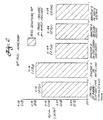
- Fig. 2 illustrates 90° peel adhesion for adhesives of the instant invention used with various backings for face stocks.
- pressure-sensitive adhesives which when cast from an emulsion onto a suitable backing or face stock display the properties of excellent guillotinability and repositionability.
- Adhesives made according to the method of this invention are based on an emulsion acrylic polymer, preferably crosslinked, compounded in emulsion with an emulsifiable wax, a surfactant or mixtures thereof, and when cast onto a suitable backing, they facilitate face stock guillotining for offset printing applications and possess removability and repositionability.
- the acrylic pressure-sensitive adhesive emulsion polymers desirably contain on a percent by weight basis from 30 to about 98% percent by weight of one or more alkyl acrylates containing 4 to 8 carbon atoms in the alkyl group.
- the total alkyl acrylate concentration is from 60 to 95% by weight based on the total weight of the monomers.
- Useful alkyl acrylates include n-butyl acrylate, 2-ethylhexyl acrylate, isooctyl acrylate and the like, with 2-ethylhexyl acrylate and mixtures of 2-ethylhexyl acrylate and butyl acrylate being preferred.
- the second component of the acrylate polymers is one of more modifying monomers which affect the performance of the acrylate monomers.
- modifying monomers which affect the performance of the acrylate monomers.
- unsaturated carboxylic acids containing from 3 to 5 carbon atoms normally present in an amount of about 2 to 10% by weight of the monomers forming the acrylic polymers.
- Unsaturated carboxylic acid included among others acrylic acid, methacrylic acid, itaconic acid and the like. Acrylic acid and methacrylic acid or mixtures thereof are presently preferred.
- Other monomers which may be present are one or more vinyl esters which may be present in an amount of from 15 to 35% by weight of the total monomers and can include monomers such as vinyl acetate, vinyl butyrate, vinyl propanate, vinyl isobutarate and the like.
- one or more diesters of dicarboxylic acids such as di-2-ethylhexyl maleate and di-2-ethylhexyl fumarate and the like.
- the acrylic polymers are normally are prepared by emulsion polymerization in the presence of one or more surfactants including a reactive surfactant which when reacted becomes part of the polymer.
- the acrylic polymer may be used as formed and, if desired, crosslinked either during or following polymerization by a conventional means and are provided as emulsion of the solids content of 50 or more percent by weight solids , normally 60 or more percent by weight solids.
- the presently preferred acrylic emulsion polymers are a crosslinked acrylic polymer containing butyl acrylate, 2-ethylhexyl acrylate and an unsaturated carboxylic acid sold by Avery Chemical Company division of Avery Dennison Corporation and a copolymer of about 98% 2-ethylhexyl acrylate, about 1.4% methacrylic acid and about 0.6% acrylic acid.
- the emulsion polymer pressure-sensitive adhesives are combined with an emulsifiable wax, a surfactant or mixtures thereof which are combined with the acrylic pressure-sensitive adhesive polymer at the compounding stage.
- the additive be an emulsified surfactant, in particular a nonionic surfactant known as Pluronic® F-108, a normally solid polyoxypropylene-polyoxethylene block copolymer having a molecular weight of about 14600 and an HLB value greater than 24.
- the surfactant is manufactured and sold by BASF.
- the most preferred surfactant is disodium n-octadecyl sulfosuccinamate manufactured and sold by American Cyanamid Co.
- Wax additives not only provide a special lubrication between the knife surface and the adhesive, but also dramatically reduces adhesion level.
- Wax emulsions include emulsified petroleum resins, paraffin waxes, oxidized paraffin waxes, microcrystalline waxes, carnauba waxes, montain waxes, polyethylene waxes and the like emulsified to form a nonionic wax emulsion.
- a preferred wax is ME47950, a nonionic paraffin wax emulsion manufactured and sold by Michelman, Inc. of Cincinnati, Ohio.
- the most preferred waxes are emulsified mixed modified polymeric waxes supplied by BVK-Cera B.V. Netherlands.
- the face stocks may vary widely and include paper face stocks, and polymeric face stocks such as vinyl and acetate face stock.
- the face stocks include cast coated high gloss paper, matte litho paper, uncoated offset paper, recycled matte litho paper, latex saturated face paper, clear acetate, matte acetate, vinyl and the like, coated with adhesive to a level of 15 to 21, preferably 18 g/m 2 with the adhesive protected by a silicone release liner.
- the products of the present invention as illustrated by the Examples, uniquely provide removability and guillotinability without developing curl even when paper is used as the face stock and in the release liner. It also displayed uniqueness as compared to other removable papers and tapes in that they displayed the ability to be removed from certain substrates without tear of the backing or face stock and yet provide a low enough adhesion to allow removability and repositionability.
- Examples 1 to 3 for purpose of illustrating the invention, there was used for Examples 1 to 3 as the base adhesive the preferred commercial crosslinked acrylic emulsion polymer an emulsion polymerized mix of butyl acrylate, 2-ethylhexyl acrylate and an unsaturated carboxylic acid manufactured by Avery Chemical with the name 220X.
- the preferred commercial crosslinked acrylic emulsion polymer an emulsion polymerized mix of butyl acrylate, 2-ethylhexyl acrylate and an unsaturated carboxylic acid manufactured by Avery Chemical with the name 220X.
- Control 1 the emulsion polymer was used as received.
- Examples 1 to 3 there was formulated an emulsion solution of 220X, Pluronic® F-108 a normally solid polyoxypropylene-polyoxyethylene block copolymer having an average molecular of 14600 and melting point of 57°C and HLB of greater than 24 manufactured by BASF. It was dissolved in dionized water added to the 220X emulsion and a coatable mixture having a solids content of about 52% solids and a viscosity of 7,000 mPa.s (desired range 4,000 - 10,000 mPa.s). The composition contained about 3% by weight surfactant based on the weight of surfactant and polymer (Adhesive A). Adhesive B was made the same way but contains about 2% surfactant.
- the formulated emulsion contained 3% surfactant based on the weight of surfactants and polymer when coated on the backing described below in Table I has the following approximate properties at a coat weight of about 18 g/m 2 .
- Example 1 2 3 Backing Property X Y Z Release, gr 30 30 50 (16 hrs. aged) 0.14 0.089 0.11 180° peel kg/cm (lb/in) (16 hrs. aged) (0.8 (0.5) (0.6)
- Table 2 and Fig. 1 compares adhesive coating performance of Control 1, Adhesive A and Adhesive B, Control 2 which contained 3% by weight polyethylene glycol and Control 3 containing 1% by weight polyethylene glycol. Polyethylene glycol was added by a aqueous 50% solution and exhibited phase separation.
- Table 3 compares removable performance of the composition of Example 1 from various substrates and aging for the dwell time shown. "Yes” means removability. The conclusion drawn was that performance on glass, stainless steel and corrugated cardboard was good, but not good on painted metal, polyethylene and ABS substrates.
- Table 4 compares the performance of the adhesive of Example 1 on a matte acetate backing. Based on the results it was concluded priming of the backing is required.
- Fig. 2 is a block diagram which compares peel adhesion in kg/cm and lb/in for Control 1 to the Adhesive A containing 3% surfactant on various backings.
- Example 1 When a 100 sheet stack of the construction of Example 1 was guillotined 15 times it was observed that both sides of the knife and stack were rated excellent with no build-up of adhesive on the stack or the blade.
- Table 5 shows the performance of the adhesive of Control 1 compounded with 1% by weight wax based on the weight of the polymer and wax of a paraffin wax provided as a nonionic emulsion.
- This is Adhesive C.
- the emulsion was known as ME47950 paraffin wax having a melting point of 64°C (147°F), a solids content of 50% with an average particle size of 0.35 micron.
- the backing was Matte Litho. Overall guillotinability performance was excellent.
- Table 6 shows the removability performance of the Adhesive C deposited at a coat weight of 25 g/m 2 on Mate Litho backing.
- Table 7 shows the performance at 0.75% by weight of the wax (Adhesive D) and
- Table 8 shows performance of 0.5% by weight of the wax (Adhesive E). Removability and guillotinability were in all instances excellent.
- Tables 6, 7 and 8 the values for 90° Peel and Looptack are given in lb/in.
- Tables 6A, 7A and 8A quote 90° Peel and Looptack in terms of kg/cm.
- Control 4 and Examples 5 to 8, and Reference Example 9 there was used as the polymer AVC 3666 at 67% solids acrylic polymer emulsion in which the polymer contains about 98% 2-ethylhexyl acrylate, about 1.4% by weight methacrylic acid and about 0.6% acrylic acid.
- the wax used was Aquacer 533, an emulsion of mixed polymeric waxes supplied by BYK-Cera B.V., Netherlands, and as the surfactant Aerosol 18, a paste of 35% disodium n-octadecyl sulfosuccinamate in water provided by American Cyanamid Co.
- the plasticizer was butyl benzyl phthalate. The following are the presently preferred compositions: A.
- AVC 3666 (67% TSC) 100 parts wet Aerosol 18 (35% TSC) 5.0 Butyl benzyl phthalate 5.0 B.
- the control and example compositions are shown in Table 9. Adhesive properties are shown in Table 10. The control displayed a build-up of adhesion with age. The compositions of Examples 5 and 8 showed no build-up of adhesion to a variety of substrates. The composition of Examples 6 and 7 showed a build-up of adhesion to polymethyl methacrylate at 70° C. It was observed that the mixture of polymer and wax gave adequate removability from most surfaces, but the addition of the plasticizer to the blend gave stable removability from a wider variety of surfaces. As with all other compositions of the invention, the examples gave excellent guillotinability and cutability. Substrate Aging Cond.
Landscapes
- Chemical & Material Sciences (AREA)
- Organic Chemistry (AREA)
- Chemical Kinetics & Catalysis (AREA)
- Adhesives Or Adhesive Processes (AREA)
- Adhesive Tapes (AREA)
- Paints Or Removers (AREA)
- Laminated Bodies (AREA)
Abstract
Description
- The invention is directed to pressure-sensitive adhesives that exhibit clean removability from various substrates without sacrificing guillotinability.
- It is well known in the pressure-sensitive adhesives industry that two approaches have been tried to achieve a good removability, namely, controlled coating processes and/or adhesive rheology.
- If the coat weight of the adhesive is controlled within a certain range, the adhesive will exhibit a reduced peel force and will have a removable behavior for a short period of time. However, due to the inherent permanent characteristic of most adhesives, the adhesion will grow with age and become a non-removable.
- An alternative is to use a discontinuous coat of adhesive segments or miscrospheres providing in effect a reduced coat weight. This approach is based on adhesion microspheres described in U.S. Patent 3,691,140 to Silver, U.S. Patent 4,166,152 to Baker et al, U.S. Patent 4,495,318 and 4,598,112 to Howard, U.S. Patent 4,810,763 to Mallya et al and adhesive segment described in European Patent 0180598.
- The rheological approach has been to design a high gel, low Tg adhesive which has a low tangent delta at the debonding frequency. These rheological properties enable the adhesive to behave like a soft material and have a low adhesion force during the peel test. This rheological approach, however, generates problems in the guillotine process.
- In other words, good removability and good guillotinabilty are often properties which are contradictory to each other. The latter is a must requirement for all adhesives used in the offset sheeting business.
- There have also been other attempts to formulate an adhesive to reduce the bonding between an adhesive and knife during the guillotine process. Polyalkalene glycols such as polyethylene glycol (PEG) have been used to achieve this property with tackified, water insoluble elastomers as described in U.S. Patent 4,548,845 to Parsons et al, but phase separation and incompatibility between the adhesive system and PEG have limited its amount and usage. Silicones, as described for instance in U.S. Patents 4,151,319 to Sackoff and 4,346,189 to Laurant have also been suggested. The products display good guillotinability, and initial repositionability. Repositionability, however, is lost with time.
- It would be desirable to provide a pressure-sensitive adhesive composition which exhibits removable and repositionable properties which do not deteriorate with age, as well as good guillotinability for use in offset printing applications.
- According to one aspect of the present invention, there is provided a guillotinable and substrate-removable pressure-sensitive adhesive composition comprising a tacky acrylic emulsion polymer in admixture with 0.5 to 1.5% by weight of an emulsifiable wax, based on the weight of the acrylic emulsion polymer and the emulsifiable wax.
- Also according to this aspect of the invention, there is provided a guillotinable and removable pressure-sensitive adhesive stock comprising a backing providing on a surface thereof a coating of a guillotinable and removable pressure-sensitive adhesive composition comprising an acrylic emulsion polymer in admixture with from 0.5 to 1.5% of an emulsifiable wax, based on the weight of emulsifiable wax and the acrylic emulsion polymer.
- According to a second aspect of the present invention, there is provided a method for preparing a guillotinable and substrate-removable pressure-sensitive adhesive composition comprising:
- providing a tacky pressure-sensitive adhesive acrylic emulsion polymer; and
- mixing the emulsion polymer with a modifying agent to
reduce its adhesivity promoting removability and provide
sufficient lubricity to promote guillotinability, the
emulsion-modifying agent being selected from:
- i. a nonionic surfactant present in an amount of from 0.5 to 3.5% by weight based on the weight of the nonionic surfactant and the emulsion polymer;
- ii. an emulsifiable wax present in an amount of from 0.5 to 1.5% by weight based on the weight of the emulsifiable wax and the emulsion polymer; and
- iii. a blend of an emulsifiable wax and a nonionic surfactant in which the emulsifiable wax and nonionic surfactant are present in a combined amount of less than 3% by weight based on the total weight of the emulsifiable wax, surfactant and the emulsion polymer.
-
- Also according to this aspect of the invention, there is provided a method for preparing a guillotinable and removable pressure-sensitive adhesive stock comprising the use of an adhesive composition prepared by the steps of:
- providing a tacky pressure-sensitive adhesive acrylic emulsion polymer;
- modifying the emulsion polymer by adding to it a
modifying agent that reduces its adhesivity promoting
removability and provides sufficient lubricity to promote
guillotinability, to form a coating on the stock of a
guillotinable and removable pressure-sensitive adhesive,
the emulsion-modifying agent being selected from:
- i. from 0.5 to 1.5% of an emulsifiable wax based on the weight of emulsifiable wax and emulsion polymer;
- ii. from 0.5 to 3.5% by weight of a nonionic surfactant based on the weight of surfactant and emulsion polymer; and
- iii. a mixture of a nonionic surfactant and an emulsifiable wax in which the mixture of the wax and nonionic surfactant are present in an amount of less than 3% by weight of the added emulsifiable wax, surfactant and emulsion polymer.
-
- The invention further contemplates use of a nonionic surfactant, an emulsifiable wax or a mixture of a nonionic surfactant and an emulsifiable wax, as an additive to a pressure-sensitive acrylic adhesive emulsion polymer to reduce adhesivity of an adhesive coating made from the emulsion, to promote removability, and to provide sufficient lubricity of the coating to promote guillotinability, wherein
- i. said surfactant is used in an amount of 0.5 to 3.5% by weight based on the weight of the surfactant and the emulsion polymer;
- ii. said wax is used in an amount of 0.5 to 1.5% by weight based on the weight of the wax and the emulsion polymer, and
- iii. the mixture of surfactant and wax is used in a combined amount of less than 3% by weight based on the total weight of surfactant, wax and emulsion polymer.
-
- The result of combining an emulsion acrylic, tacky pressure-sensitive adhesive with an emulsifiable wax surfactant or mixtures thereof in the specified concentrations is to reduce adhesivity of the adhesive to a level sufficiently low to allow removability and at the same time to provide it with sufficient lubricity to afford excellent quillotinability including excellent cuttability.
- The acrylic pressure-sensitive adhesive emulsion polymers used in the invention may be inherently tacky or tack may be provided by the inclusion of a tackifier or plasticizer during the compounding stage. A plasticizer may also be used to enhance removability. The adhesive may be used as such or its tack is reduced by crosslinking. The wax and/or surfactant used in the method claimed hereafter are provided during the compounding stage and are cast as part of a homogenous emulsion to provide a pressure-sensitive adhesive coating at any desired uniform level of removability, as compared to the unmodified acrylic pressure-sensitive adhesive composition. This is in consequence of a reduction in adhesion level. The additive at the same time imparts excellent guillotinability.
- It is presently preferred to employ a mixture of polymeric waxes alone or with a disodium n-octadecyl sulfosuccinamate in combination with butyl benzyl phthalate or a surfactant which is an ethyleneoxide-propyleneoxide copolymer with nonionic emulsified waxes.
- The presently preferred emulsion acrylic adhesive is a crosslinked acrylic polymer based on 2-ethylhexyl acrylate, butyl acrylate and a carboxylic acid or a copolymer of 2-ethylhexyl acrylate, methacrylic acid and acrylic acid.
- Fig. 1 illustrates 90° peel and looptack properties of adhesive compositions which conform to the instant invention in comparison to controls.
- Fig. 2 illustrates 90° peel adhesion for adhesives of the instant invention used with various backings for face stocks.
- According to the present invention, there are provided pressure-sensitive adhesives which when cast from an emulsion onto a suitable backing or face stock display the properties of excellent guillotinability and repositionability.
- Adhesives made according to the method of this invention are based on an emulsion acrylic polymer, preferably crosslinked, compounded in emulsion with an emulsifiable wax, a surfactant or mixtures thereof, and when cast onto a suitable backing, they facilitate face stock guillotining for offset printing applications and possess removability and repositionability.
- The acrylic pressure-sensitive adhesive emulsion polymers desirably contain on a percent by weight basis from 30 to about 98% percent by weight of one or more alkyl acrylates containing 4 to 8 carbon atoms in the alkyl group. Preferably the total alkyl acrylate concentration is from 60 to 95% by weight based on the total weight of the monomers. Useful alkyl acrylates include n-butyl acrylate, 2-ethylhexyl acrylate, isooctyl acrylate and the like, with 2-ethylhexyl acrylate and mixtures of 2-ethylhexyl acrylate and butyl acrylate being preferred.
- The second component of the acrylate polymers is one of more modifying monomers which affect the performance of the acrylate monomers. Among them there may be included one or more unsaturated carboxylic acids containing from 3 to 5 carbon atoms normally present in an amount of about 2 to 10% by weight of the monomers forming the acrylic polymers. Unsaturated carboxylic acid, included among others acrylic acid, methacrylic acid, itaconic acid and the like. Acrylic acid and methacrylic acid or mixtures thereof are presently preferred.
- Other monomers which may be present are one or more vinyl esters which may be present in an amount of from 15 to 35% by weight of the total monomers and can include monomers such as vinyl acetate, vinyl butyrate, vinyl propanate, vinyl isobutarate and the like. In addition there may be provided one or more diesters of dicarboxylic acids, such as di-2-ethylhexyl maleate and di-2-ethylhexyl fumarate and the like.
- The acrylic polymers are normally are prepared by emulsion polymerization in the presence of one or more surfactants including a reactive surfactant which when reacted becomes part of the polymer. The acrylic polymer may be used as formed and, if desired, crosslinked either during or following polymerization by a conventional means and are provided as emulsion of the solids content of 50 or more percent by weight solids , normally 60 or more percent by weight solids.
- The presently preferred acrylic emulsion polymers are a crosslinked acrylic polymer containing butyl acrylate, 2-ethylhexyl acrylate and an unsaturated carboxylic acid sold by Avery Chemical Company division of Avery Dennison Corporation and a copolymer of about 98% 2-ethylhexyl acrylate, about 1.4% methacrylic acid and about 0.6% acrylic acid.
- To induce the repositionability and guillotinability the emulsion polymer pressure-sensitive adhesives, in the methods of this invention, are combined with an emulsifiable wax, a surfactant or mixtures thereof which are combined with the acrylic pressure-sensitive adhesive polymer at the compounding stage. It is presently preferred that the additive be an emulsified surfactant, in particular a nonionic surfactant known as Pluronic® F-108, a normally solid polyoxypropylene-polyoxethylene block copolymer having a molecular weight of about 14600 and an HLB value greater than 24. The surfactant is manufactured and sold by BASF. The most preferred surfactant is disodium n-octadecyl sulfosuccinamate manufactured and sold by American Cyanamid Co.
- Wax additives not only provide a special lubrication between the knife surface and the adhesive, but also dramatically reduces adhesion level. Wax emulsions include emulsified petroleum resins, paraffin waxes, oxidized paraffin waxes, microcrystalline waxes, carnauba waxes, montain waxes, polyethylene waxes and the like emulsified to form a nonionic wax emulsion. A preferred wax is ME47950, a nonionic paraffin wax emulsion manufactured and sold by Michelman, Inc. of Cincinnati, Ohio. The most preferred waxes are emulsified mixed modified polymeric waxes supplied by BVK-Cera B.V. Netherlands.
- The face stocks may vary widely and include paper face stocks, and polymeric face stocks such as vinyl and acetate face stock. In the presently preferred construction the face stocks include cast coated high gloss paper, matte litho paper, uncoated offset paper, recycled matte litho paper, latex saturated face paper, clear acetate, matte acetate, vinyl and the like, coated with adhesive to a level of 15 to 21, preferably 18 g/m2 with the adhesive protected by a silicone release liner.
- The products of the present invention, as illustrated by the Examples, uniquely provide removability and guillotinability without developing curl even when paper is used as the face stock and in the release liner. It also displayed uniqueness as compared to other removable papers and tapes in that they displayed the ability to be removed from certain substrates without tear of the backing or face stock and yet provide a low enough adhesion to allow removability and repositionability.
- For purpose of illustrating the invention, there was used for Examples 1 to 3 as the base adhesive the preferred commercial crosslinked acrylic emulsion polymer an emulsion polymerized mix of butyl acrylate, 2-ethylhexyl acrylate and an unsaturated carboxylic acid manufactured by Avery Chemical with the name 220X.
- For Control 1 the emulsion polymer was used as received. For Examples 1 to 3 there was formulated an emulsion solution of 220X, Pluronic® F-108 a normally solid polyoxypropylene-polyoxyethylene block copolymer having an average molecular of 14600 and melting point of 57°C and HLB of greater than 24 manufactured by BASF. It was dissolved in dionized water added to the 220X emulsion and a coatable mixture having a solids content of about 52% solids and a viscosity of 7,000 mPa.s (desired range 4,000 - 10,000 mPa.s). The composition contained about 3% by weight surfactant based on the weight of surfactant and polymer (Adhesive A). Adhesive B was made the same way but contains about 2% surfactant.
- The formulated emulsion contained 3% surfactant based on the weight of surfactants and polymer when coated on the backing described below in Table I has the following approximate properties at a coat weight of about 18 g/m2.
Example 1 2 3 Backing Property X Y Z Release, gr 30 30 50 (16 hrs. aged) 0.14 0.089 0.11 180° peel kg/cm (lb/in)
(16 hrs. aged)(0.8 (0.5) (0.6) - Table 2 and Fig. 1 compares adhesive coating performance of Control 1, Adhesive A and Adhesive B, Control 2 which contained 3% by weight polyethylene glycol and
Control 3 containing 1% by weight polyethylene glycol. Polyethylene glycol was added by a aqueous 50% solution and exhibited phase separation. - Table 3 compares removable performance of the composition of Example 1 from various substrates and aging for the dwell time shown. "Yes" means removability. The conclusion drawn was that performance on glass, stainless steel and corrugated cardboard was good, but not good on painted metal, polyethylene and ABS substrates.
- Table 4 compares the performance of the adhesive of Example 1 on a matte acetate backing. Based on the results it was concluded priming of the backing is required.
- Fig. 2 is a block diagram which compares peel adhesion in kg/cm and lb/in for Control 1 to the Adhesive A containing 3% surfactant on various backings.
- When a 100 sheet stack of the construction of Example 1 was guillotined 15 times it was observed that both sides of the knife and stack were rated excellent with no build-up of adhesive on the stack or the blade.
- Table 5 shows the performance of the adhesive of Control 1 compounded with 1% by weight wax based on the weight of the polymer and wax of a paraffin wax provided as a nonionic emulsion. This is Adhesive C. The emulsion was known as ME47950 paraffin wax having a melting point of 64°C (147°F), a solids content of 50% with an average particle size of 0.35 micron. The backing was Matte Litho. Overall guillotinability performance was excellent.
Substrate Room Temperature Glass Painted Metal Stainless Steel Box ABS PE Corrugated Paper Dwell, Days 7 FS FS FS _ FS YES 14 FS FS FS _ FS YES with tissue 50°C Aged Dwell Days 7 FS FS FS FS FS TEAR 14 FS FS FS FS FS TEAR YES: GOOD REMOVABILITY PT: PAPER TEAR FS: FACE SEPARATION, ADHESIVE IS NOT ADHERED TO THE BACKING Substrate Room Temperature Glass Painted Metal Stainless Steel Box ABS PE Corrugated Paper Dwell, Days 7 YES YES _ YES _ YES YES 14 YES YES _ YES _ YES YES 18 YES YES _ YES _ YES YES 21 YES YES _ YES _ YES SLIGHTLY TISSUE TEAR 50°C Aged Dwell, Days 7 YES YES _ YES YES YES YES 10 YES YES _ YES YES YES _ 24 YES YES _ YES YES YES _ YES: GOOD REMOVABILITY PT: PAPER TEAR FS: FACE SEPARATION, ADHESIVE IS NOT ADHERED TO THE FACE STOCK - Attached Table 6 shows the removability performance of the Adhesive C deposited at a coat weight of 25 g/m2 on Mate Litho backing. Table 7 shows the performance at 0.75% by weight of the wax (Adhesive D) and Table 8 shows performance of 0.5% by weight of the wax (Adhesive E). Removability and guillotinability were in all instances excellent. In Tables 6, 7 and 8, the values for 90° Peel and Looptack are given in lb/in. Tables 6A, 7A and 8A quote 90° Peel and Looptack in terms of kg/cm.
- In the aging tests, exposure at 50°C for 1 week is equivalent to 6 months at room temperature and 2 weeks at 50°C is equivalent to 1 year at room temperature.
- For Control 4 and Examples 5 to 8, and Reference Example 9, there was used as the polymer AVC 3666 at 67% solids acrylic polymer emulsion in which the polymer contains about 98% 2-ethylhexyl acrylate, about 1.4% by weight methacrylic acid and about 0.6% acrylic acid. The wax used was Aquacer 533, an emulsion of mixed polymeric waxes supplied by BYK-Cera B.V., Netherlands, and as the surfactant Aerosol 18, a paste of 35% disodium n-octadecyl sulfosuccinamate in water provided by American Cyanamid Co. The plasticizer was butyl benzyl phthalate. The following are the presently preferred compositions:
A. AVC 3666 (67% TSC) 100 parts wet Aerosol 18 (35% TSC) 5.0 Butyl benzyl phthalate 5.0 B. AVC 3666 (67% TSC) 100 parts wet Aquacer 533 (40% TSC) 2.1 Butyl benzyl phthalate 5.0 TSC = Total Solids Content - The control and example compositions are shown in Table 9. Adhesive properties are shown in Table 10. The control displayed a build-up of adhesion with age. The compositions of Examples 5 and 8 showed no build-up of adhesion to a variety of substrates. The composition of Examples 6 and 7 showed a build-up of adhesion to polymethyl methacrylate at 70° C. It was observed that the mixture of polymer and wax gave adequate removability from most surfaces, but the addition of the plasticizer to the blend gave stable removability from a wider variety of surfaces. As with all other compositions of the invention, the examples gave excellent guillotinability and cutability.
Substrate Aging Cond. 90° Peel Looptack Edge Lift Failure Remarks stainless 1wk/25°C 0.8 0.01 none panel clean removability steel 1wk/50°C 1.15 0.01 a panel clean removability 2wk/25°C 0.75 0.30 a panel clean removability 2wk/50°C 1.4 0.30 a panel clean removability Glass 1wk/25°C 0.17 b panel clean removability 1wk/50°C 5 a panel clean removability 2wk/25°C 1.65 a panel clean removability 2wk/50°C 0.25 a panel clean removability 1.0 Painted M 1wk/25°C 0.75 a panel clean removability 1wk/50°C 1.2 a panel clean removability 2wk/25°C 0.85 a panel clean removability 2wk/50°C 1.1 a panel clean removability Plastic 1wk/25°C 1.45 a panel clean removability 1wk/50°C 2.05 a panel clean removability 2wk/25°C 1.5 a panel clean removability 2wk/50°C 1.9 a panel clean removability Corrugated 1wk/25°C 0.37 none panel stain clean removability 1wk/50°C 5 a panel stain clean removability 2wk/25°C 0.42 a panel stain clean removability 2wk/50°C 5 0.45 0.5 a panel stain clean removability Paper 1wk/25°C 0.85 a panel clean removability 1wk/50°C 0.90 a panel clean removability 2wk/25°C 1.15 a panel clean removability 2wk/50°C 1.5 a panel clean removability a = 0.40 mm (1/64 inch); b = 0.80 mm (1/32 inch). Substrate Aging Cond. 90° Peel Looptack Edge Lift Failture Remarks Stainless 1wk/25°C 0.975 0.01 none panel clean removability steel 1wk/50°C 1.35 0.01 a panel clean removability 2wk/25°C 0.9 0.01 a panel clean removability 2wk/50°C 1.55 0.01 a panel clean removability Glass 1wk/25°C 0.30 none panel clean removability 1wk/50°C 0.75 a panel clean removability 2wk/25°C 0.4 a panel clean removability 2wk/50°C 0.95 a panel clean removability Painted M 1wk/25°C 1.05 a panel clean removability 1wk/50°C 0.45 a panel clean removability 2wk/25°C 1.0 a panel clean removability 2wk/50°C 0.85 a panel clean removability Plastic 1wk/25°C 1.75 a panel stain clean removability 1wk/50°C 1.65 a panel stain clean removability 2wk/25°C 1.65 a panel stain clean removability 2wk/50°C 2.15 a panel stain clean removability Corrugated 1wk/25°C 0.80 none panel clean removability 1wk/50°C 0.775 a panel clean removability 2wk/25°C 0.63 a panel clean removability 2wk/50°C 0.75 a panel clean removability Paper 1wk/25°C 1.0 a panel clean removability 1wk/50°C 0.90 a panel clean removability 2wk/25°C 0.95 a panel clean removability 2wk/50°C 1.2 a panel clean removability Substrate Aging Cond. 90° Peel Looptack Edge Lift Failure Remarks Stainless 1wk/25°C 1.2 0.01 b panel clean removability steel 1wk/50°C 1.3 0.01 a panel clean removability 2wk/25°C 1.1 0.01 a panel clean removability 2wk/50°C 1.45 0.01 a panel clean removability Glass 1wk/25°C 0.325 none panel clean removability 1wk/50°C 1.2 a panel clean removability 2wk/25°C 0.5 a panel clean removability 2wk/50°C Tear a Tear clean removability Painted M 1wk/25°C 1.0 none panel clean removability 1wk/50°C 1.3 a panel clean removability 2wk/25°C 1.2 a panel clean removability 2wk/50°C Tear a Tear clean removability Plastic 1wk/25°C 1.8 none panel stain clean removability 1wk/50°C 1.7 a panel stain clean removsbitity 2wk/25°C 1.5 a panel stain clean removability 2wk/50°C 2.25 a panel stain clean removability Corrugated 1wk/25°C 0.425 none panel clean removability 1wk/50°C 0.425 a panel clean removability 2wk/25°C 0.7 a panel clean removability 2wk/50°C 0.55 a panel clean removability Paper 1wk/25°C 0.95 none panel clean removability 1wk/50°C 1.00 a panel clean removability 2wk/25°C 0.95 a panel clean removability 2wk/50°C 1.2 a panel clean removability a = 0.40 mm (1/64 inch); b = 0.80 mm (1/32 inch). Substrate Aging Cond. 90° Peel Looptack Edge Lift Failure Remarks Stainless 1wk/25°C 0·14 0·002 none panel clean removability steel 1wk/50°C 0·20 0·002 a panel clean removability 2wk/25°C 0·13 0·05 a panel clean removability 2wk/50°C 0·25 0·05 a panel clean removability Glass 1wk/25°C 0·03 b panel clean removability 1wk/50°C 0·90 a panel clean removability 2wk/25°C 0·29 a panel clean removability 2wk/50°C 0·04 a panel clean removability 0.18 Painted N 1wk/25°C 0·13 a panel clean removability 1wk/50°C 0·21 a panel clean removability 2wk/25°C 0·15 a panel clean removability 2wk/50°C 0.20 a panel clean removability Plastic 1wk/25°C 0.26 a panel clean removability 1wk/50°C 0.37 a panel clean removability 2wk/25°C 0.27 a panel clean removability 2wk/50°C 0·34 a panel clean removability Corrugated 1wk/25°C 0.07 none panel stain clean removability 1wk/50°C 0.90 a panel stain clean removability 2wk/25°C 0.07 a panel stain clean removability 2wk/50°C 0.89 a panel stain clean removability 0.09 Paper 1wk/25°C 0·15 a panel clean removability 1wk/50°C 0·16 a panel clean removability 2wk/25°C 0·20 a panel clean removability 2wk/50°C 0·27 a panel clean removability a = 0.40 mm (1/64 inch); b = 0.80 mm (1/32 inch). Substrate Aging Cond. 90° Peel Looptack edge Lift Failure Remarks Stainless steel 1wk/25°C 0.17 0.002 none panel clean removability 1wk/50°C 0.24 0.002 a panel clean removability 2wk/25°C 0.16 0.002 a panel clean removability 2wk/50°C 0.28 0·002 a panel clean removability Glass 1wk/25°C 0·05 a panel clean removability 1wk/50°C 0.13 a panel clean removability 2wk/25°C 0.07 a panel clean removability 2wk/50°C 0.17 a panel clean removability Painted M 1wk/25°C 0.19 a panel clean removability 1wk/50°C 0.08 a panel clean removability 2wk/25°C 0.18 a panel clean removability 2wk/50°C 0.15 a panel clean removability Plastic 1wk/25°C 0.31 a panel stain clean removability 1wk/50°C 0.29 a panel stain clean removability 2wk/25°C 0.29 a panel stain clean removability 2wk/50°C 0.38 a panel stain clean removability Corrugated 1wk/25°C 0.14 none panel clean removability 1wk/50°C 0.14 a panel clean removability 2wk/25°C 0.11 a panel clean removability 2wk/50°C 0.13 a panel clean removability Paper 1wk/25°C 0.18 a panel clean removability 1wk/50°C 0.16 a panel clean removability 2wk/25°C 0.17 a panel clean removability 2wk/50°C 0.21 a panel clean removability Substrate Aging Cond. 90° Peel Looptack Edge Lift Failure Remarks Stainless steel 1wk/25°C 0·21 0·002 b panel clean removability 1wk/50°C 0·23 0·002 a panel clean removability 2wk/25°C 0·19 0·002 a panel clean removability 2wk/50°C 0·26 0·002 a panel clean removability Glass 1wk/25°C 0·06 none panel clean removability 1wk/50°C 0·21 a panel clean removability 2wk/25°C 0.09 a panel clean removability 2wk/50°C Tear a Tear clean removability Painted M 1wk/25°C 0·18 none panel clean removability 1wk/50°C 0.23 a panel clean removability 2wk/25°C 0·21 a panel clean removability 2wk/50°C Tear a Tear clean removability Plastic 1wk/25°C 0·32 none panel stain clean removability 1wk/50°C 0·30 a panel stain clean removability 2wk/25°C 0.27 a panel stain clean removability 2wk/50°C 0·40 a panel stain clean removability Corrugated 1wk/25°C 0·08 none panel clean removability 1wk/50°C 0·08 a panel clean removability 2wk/25°C 0·12 a panel clean removability 2wk/50°C 0·10 a panel clean removability Paper 1wk/25°C 0·17 none panel clean removability 1wk/50°C 0·18 a panel clean removability 2wk/25°C 0·17 a panel clean removability 2wk/50°C 0·21 a panel clean removability a = 0.40 mm (1/64 inch); b = 0.80 mm (1/32 inch). % dry weight Cont 4 Ex 5 Ex 6 Ex 7 Ex 8 R.Ex.9 AVC 3666 90 89.43 99.16 98.75 92.02 90.97 Aquacer 533 0.67 0.84 1/25 1.11 Aerosol 18 2.24 Butylbenzylphthalatc 10 9.9 6.87 6.79 
Claims (15)
- A guillotinable and substrate-removable pressure-sensitive adhesive composition comprising a tacky acrylic emulsion polymer in admixture with 0.5 to 1.5% by weight of an emulsifiable wax, based on the weight of the acrylic emulsion polymer and the emulsifiable wax.
- A composition as claimed in claim 1 in which the tacky acrylic emulsion polymer is cross-linked.
- A composition as claimed in claim 1 or claim 2, in which emulsifiable wax is a paraffin wax.
- A guillotinable and removable pressure-sensitive adhesive stock comprising a backing providing on a surface thereof a coating of a guillotinable and removable pressure-sensitive adhesive composition comprising an acrylic emulsion polymer in admixture with from 0.5 to 1.5% of an emulsifiable wax, based on the weight of emulsifiable wax and the acrylic emulsion polymer.
- A pressure-sensitive adhesive stock as claimed in claim 4 in which the backing is paper or polymeric sheet.
- A pressure-sensitive adhesive stock as claimed in claim 4 in which the backing is matte litho paper, cast coated high gloss paper, uncoated offset paper, recycled matte litho paper, latex saturated face paper, clear acetate or matte acetate.
- A pressure-sensitive adhesive stock as claimed in claim 4 in which the emulsifiable wax is paraffin wax.
- A pressure-sensitive adhesive stock as claimed in claim 4 in which the tacky acrylic emulsion polymer is cross-linked.
- A method for preparing a guillotinable and substrate-removable pressure-sensitive adhesive composition comprising:providing a tacky pressure-sensitive adhesive acrylic emulsion polymer; andmixing the emulsion polymer with a modifying agent to reduce its adhesivity promoting removability and provide sufficient lubricity to promote guillotinability, the emulsion-modifying agent being selected from:i. a nonionic surfactant present in an amount of from 0.5 to 3.5% by weight based on the weight of the nonionic surfactant and the emulsion polymer;ii. an emulsifiable wax present in an amount of from 0.5 to 1.5% by weight based on the weight of the emulsifiable wax and the emulsion polymer; andiii. a blend of an emulsifiable wax and a nonionic surfactant in which the emulsifiable wax and nonionic surfactant are present in a combined amount of less than 3% by weight based on the total weight of the emulsifiable wax, surfactant and the emulsion polymer.
- A method for preparing a guillotinable and removable pressure-sensitive adhesive stock comprising the use of an adhesive composition prepared by the steps of:providing a tacky pressure-sensitive adhesive acrylic emulsion polymer;modifying the emulsion polymer by adding to it a modifying agent that reduces its adhesivity promoting removability and provides sufficient lubricity to promote guillotinability, to form a coating on the stock of a guillotinable and removable pressure-sensitive adhesive, the emulsion-modifying agent being selected from:i. from 0.5 to 1.5% of an emulsifiable wax based on the weight of emulsifiable wax and emulsion polymer;ii. from 0.5 to 3.5% by weight of a nonionic surfactant based on the weight of surfactant and emulsion polymer; andiii. a mixture of a nonionic surfactant and an emulsifiable wax in which the mixture of the wax and nonionic surfactant are present in an amount of less than 3% by weight of the added emulsifiable wax, surfactant and emulsion polymer.
- A method as claimed in claim 10 wherein the stock has a backing of paper or polymeric sheet.
- A method as claimed in claim 9, 10 or 11 wherein the emulsion-modifying agent is a polyoxyethylene-polyoxypropylene block copolymer.
- A method as claimed in claim 9, 10 or 11 wherein the emulsion-modifying agent is a nonionic surfactant having an HLB value greater than 24.
- A method as claimed in claim 9, 10 or 11 wherein the emulsion-modifying agent is paraffin wax.
- Use of a nonionic surfactant, an emulsifiable wax or a mixture of a nonionic surfactant and an emulsifiable wax, as an additive to a pressure-sensitive acrylic adhesive emulsion polymer to reduce adhesivity of an adhesive coating made from the emulsion, to promote removability, and to provide sufficient lubricity of the coating to promote guillotinability, whereini. said surfactant is used in an amount of 0.5 to 3.5% by weight based on the weight of the surfactant and the emulsion polymer;ii. said wax is used in an amount of 0.5 to 1.5% by weight based on the weight of the wax and the emulsion polymer, andiii. the mixture of surfactant and wax is used in a combined amount of less than 3% by weight based on the total weight of surfactant, wax and emulsion polymer.
Applications Claiming Priority (3)
| Application Number | Priority Date | Filing Date | Title |
|---|---|---|---|
| US795981 | 1985-11-07 | ||
| US07/795,981 US5939479A (en) | 1991-11-22 | 1991-11-22 | Removable and guillotinable emulsion pressure-sensitive adhesives |
| PCT/US1992/010233 WO1993010177A1 (en) | 1991-11-22 | 1992-11-20 | Removable and guillotinable emulsion pressure-sensitive adhesives |
Publications (3)
| Publication Number | Publication Date |
|---|---|
| EP0614473A1 EP0614473A1 (en) | 1994-09-14 |
| EP0614473A4 EP0614473A4 (en) | 1995-06-28 |
| EP0614473B1 true EP0614473B1 (en) | 2001-07-18 |
Family
ID=25166946
Family Applications (1)
| Application Number | Title | Priority Date | Filing Date |
|---|---|---|---|
| EP93900692A Expired - Lifetime EP0614473B1 (en) | 1991-11-22 | 1992-11-20 | Removable and guillotinable emulsion pressure-sensitive adhesives |
Country Status (9)
| Country | Link |
|---|---|
| US (1) | US5939479A (en) |
| EP (1) | EP0614473B1 (en) |
| JP (1) | JP3755889B2 (en) |
| KR (1) | KR100270455B1 (en) |
| AU (1) | AU669685B2 (en) |
| CA (1) | CA2124117C (en) |
| DE (1) | DE69231949D1 (en) |
| MX (1) | MX9206671A (en) |
| WO (1) | WO1993010177A1 (en) |
Cited By (1)
| Publication number | Priority date | Publication date | Assignee | Title |
|---|---|---|---|---|
| CN111354259A (en) * | 2018-12-21 | 2020-06-30 | Upm拉弗拉塔克公司 | Regeneration compatible PSA label |
Families Citing this family (20)
| Publication number | Priority date | Publication date | Assignee | Title |
|---|---|---|---|---|
| DE19628177B4 (en) * | 1996-07-12 | 2005-12-22 | Tesa Ag | Self-adhesive tape and its use |
| ATE346895T1 (en) * | 1998-12-15 | 2006-12-15 | Avery Dennison Corp | REMOVABLE PRESSURE SENSITIVE EMULSION ADHESIVES |
| US6518343B1 (en) * | 1999-06-18 | 2003-02-11 | 3M Innovative Properties Company | Wet-stick adhesives, articles, and methods |
| WO2000078884A1 (en) * | 1999-06-18 | 2000-12-28 | 3M Innovative Properties Company | Wet-stick adhesives, articles, and methods |
| US6441092B1 (en) | 1999-06-18 | 2002-08-27 | 3M Innovative Properties Company | Wet-stick adhesives |
| US6579941B1 (en) * | 2000-06-12 | 2003-06-17 | Avery Dennison Corporatoin | Adhesive compositions and constructions with outstanding cutting performance |
| KR100427407B1 (en) * | 2001-12-10 | 2004-04-14 | 태영화학공업 주식회사 | Removable pressure sensitive adhesive based on an acrylic emulsion |
| US7316832B2 (en) | 2001-12-20 | 2008-01-08 | The Procter & Gamble Company | Articles and methods for applying color on surfaces |
| US7709070B2 (en) | 2001-12-20 | 2010-05-04 | The Procter & Gamble Company | Articles and methods for applying color on surfaces |
| US20040161564A1 (en) | 2003-02-14 | 2004-08-19 | Truog Keith L. | Dry paint transfer laminate |
| BRPI0407483A (en) * | 2003-02-14 | 2006-02-14 | Avery Dennison Corp | multi-layer dry paint decorative laminate having discoloration prevention barrier |
| US20050196607A1 (en) * | 2003-06-09 | 2005-09-08 | Shih Frank Y. | Multi-layer dry paint decorative laminate having discoloration prevention barrier |
| US20050282961A1 (en) * | 2004-06-18 | 2005-12-22 | Hsienkun Tsai | Pressure-sensitive label laminates with improved convertability and broad temperature adhesion performance |
| KR100995510B1 (en) * | 2007-01-16 | 2010-11-19 | 주식회사 엘지화학 | Acrylic pressure-sensitive adhesive composition containing a plasticizer |
| JP5580069B2 (en) * | 2009-02-26 | 2014-08-27 | 日東電工株式会社 | Adhesive composition for surface protective film and use thereof |
| US8338515B1 (en) | 2009-05-14 | 2012-12-25 | DT-SP IP Holding LLC | Silicone-modified tackifier and use thereof in pressure sensitive adhesive compositions and laminates with improved guillotinability |
| US20110030300A1 (en) * | 2009-08-10 | 2011-02-10 | Liu David C | Floor And Tile With Padding |
| KR101316256B1 (en) | 2009-12-30 | 2013-10-10 | (주)엘지하우시스 | Pressure-sensitive adhesive composition and pressure-sensitive adhesive sheet |
| JP7575194B2 (en) * | 2020-02-19 | 2024-10-29 | 日本ゼオン株式会社 | Self-adhesive foam laminate sheet |
| US12454593B2 (en) * | 2020-02-19 | 2025-10-28 | Zeon Corporation | Composition for self-adhesive foamed sheet and self-adhesive foamed laminate sheet |
Family Cites Families (13)
| Publication number | Priority date | Publication date | Assignee | Title |
|---|---|---|---|---|
| US3919149A (en) * | 1974-04-26 | 1975-11-11 | Mobil Oil Corp | Wax emulsions |
| US4522998A (en) * | 1983-12-19 | 1985-06-11 | National Distillers And Chemical Corporation | Interpolymer, process for its preparation and adhesive of improved creep resistance containing the interpolymer |
| US4716194A (en) * | 1985-11-25 | 1987-12-29 | National Starch And Chemical Corporation | Removable pressure sensitive adhesive |
| US4845149A (en) * | 1986-08-22 | 1989-07-04 | S. C. Johnson & Son, Inc. | Pressure sensitive adhesive compositions |
| US4783354A (en) * | 1986-12-15 | 1988-11-08 | Coated Sales, Inc. | Adherable, yet removable sheet material |
| GB8715736D0 (en) * | 1987-07-03 | 1987-08-12 | Harlow Chem Co Ltd | Adhesive compositions |
| US4925908A (en) * | 1987-12-11 | 1990-05-15 | Avery International Corporation | Acrylic based emulsion polymers |
| US5073457A (en) * | 1988-12-01 | 1991-12-17 | Minnesota Mining And Manufacturing Company | Repositionable adhesive |
| US5049608A (en) * | 1989-05-03 | 1991-09-17 | Air Products And Chemicals, Inc. | Acrylic pressure sensitive adhesive compositions having improved low temperature adhesion |
| DE69008334T2 (en) * | 1989-08-14 | 1994-11-03 | Avery Dennison Corp., Pasadena, Calif. | EMULSION OF PRESSURE-SENSITIVE ADHESIVE POLYMERS WITH EXCELLENT BEHAVIOR AT ROOM AND LOW TEMPERATURES. |
| US5059479A (en) * | 1989-12-29 | 1991-10-22 | National Starch And Chemical Investment Holding Corporation | Pressure-sensitive adhesive emulsion composition and a kraft tape using it |
| ES2266683T3 (en) * | 1991-08-09 | 2007-03-01 | 3M Company | REPOSITIONABLE TAIL BAR. |
| US5196504A (en) * | 1991-10-15 | 1993-03-23 | Avery Dennison Corporation | Repulpable pressure-sensitive adhesive compositions |
-
1991
- 1991-11-22 US US07/795,981 patent/US5939479A/en not_active Expired - Fee Related
-
1992
- 1992-11-19 MX MX9206671A patent/MX9206671A/en not_active IP Right Cessation
- 1992-11-20 DE DE69231949T patent/DE69231949D1/en not_active Expired - Lifetime
- 1992-11-20 AU AU32274/93A patent/AU669685B2/en not_active Ceased
- 1992-11-20 KR KR1019940701726A patent/KR100270455B1/en not_active Expired - Fee Related
- 1992-11-20 WO PCT/US1992/010233 patent/WO1993010177A1/en not_active Ceased
- 1992-11-20 EP EP93900692A patent/EP0614473B1/en not_active Expired - Lifetime
- 1992-11-20 CA CA002124117A patent/CA2124117C/en not_active Expired - Fee Related
- 1992-11-20 JP JP50957393A patent/JP3755889B2/en not_active Expired - Fee Related
Cited By (2)
| Publication number | Priority date | Publication date | Assignee | Title |
|---|---|---|---|---|
| CN111354259A (en) * | 2018-12-21 | 2020-06-30 | Upm拉弗拉塔克公司 | Regeneration compatible PSA label |
| CN111354259B (en) * | 2018-12-21 | 2022-04-05 | Upm拉弗拉塔克公司 | Regeneration compatible PSA label |
Also Published As
| Publication number | Publication date |
|---|---|
| AU669685B2 (en) | 1996-06-20 |
| US5939479A (en) | 1999-08-17 |
| EP0614473A1 (en) | 1994-09-14 |
| DE69231949D1 (en) | 2001-08-23 |
| EP0614473A4 (en) | 1995-06-28 |
| CA2124117A1 (en) | 1993-05-27 |
| CA2124117C (en) | 2003-07-01 |
| MX9206671A (en) | 1993-10-01 |
| WO1993010177A1 (en) | 1993-05-27 |
| KR100270455B1 (en) | 2000-11-01 |
| AU3227493A (en) | 1993-06-15 |
| JP3755889B2 (en) | 2006-03-15 |
| JPH07504212A (en) | 1995-05-11 |
Similar Documents
| Publication | Publication Date | Title |
|---|---|---|
| AU669685B2 (en) | Removable and guillotinable emulsion pressure-sensitive adhesives | |
| US5073457A (en) | Repositionable adhesive | |
| US4983656A (en) | Aqueous pressure-sensitive adhesive | |
| US5663241A (en) | Removable pressure sensitive adhesive and article | |
| EP1159369B1 (en) | Removable emulsion pressure-sensitive adhesives | |
| EP1297092B1 (en) | Acrylic adhesive compositions comprising acrylate microspheres | |
| CN1119002A (en) | Modified repulpable pressure sensitive adhesive composition | |
| US5049608A (en) | Acrylic pressure sensitive adhesive compositions having improved low temperature adhesion | |
| JP2003027026A (en) | Re-releasable water-dispersed pressure-sensitive adhesive | |
| US6995207B2 (en) | Removable pressure sensitive adhesives with plasticizer resistance properties | |
| JPH05230428A (en) | Water dispersion type pressure sensitive adhesive composition | |
| JPH07157741A (en) | Removable water-based pressure-sensitive adhesive composition | |
| JP4214424B2 (en) | Tackifier resin emulsion and aqueous adhesive composition | |
| US6242552B1 (en) | Stamp adhesive | |
| EP1152047B1 (en) | Pressure-sensitive rubber adhesive and pressure-sensitive adhesive sheet made using the same | |
| EP4060006B1 (en) | Acrylic emulsion pressure sensitive adhesive composition | |
| KR102766558B1 (en) | Aqueous acrylic adhesive composition, manufacturing methode of the same, adhesive member manufactured using the same | |
| JPH07188631A (en) | Removable adhesive composition | |
| JP2002285137A (en) | Tackifying resin emulsion, method for producing the same and aqueous tackifier and adhesive composition | |
| JPH0925472A (en) | Tackifier emulsion and water-based adhesive composition containing the emulsion | |
| JP2001200235A (en) | Heat-sensitive adhesive composition, method for producing the same, and heat-sensitive adhesive sheet or label | |
| JP2012214668A (en) | Pressure-sensitive adhesive tape | |
| JPH07188621A (en) | Removable adhesive composition | |
| JPS6383180A (en) | Pressure-sensitive adhesive composition | |
| JPH01304170A (en) | Adhesive tape and preparation thereof |
Legal Events
| Date | Code | Title | Description |
|---|---|---|---|
| PUAI | Public reference made under article 153(3) epc to a published international application that has entered the european phase |
Free format text: ORIGINAL CODE: 0009012 |
|
| 17P | Request for examination filed |
Effective date: 19940620 |
|
| AK | Designated contracting states |
Kind code of ref document: A1 Designated state(s): DE ES FR GB IT |
|
| RIN1 | Information on inventor provided before grant (corrected) |
Inventor name: STIEGER, MANFRED, KARL Inventor name: MAYER, ANDRE Inventor name: VON KLEIST, PETER ROBIN Inventor name: SHIAONUNG, JOHN, SU Inventor name: REAVES, JESSIE, COSTON |
|
| A4 | Supplementary search report drawn up and despatched |
Effective date: 19950509 |
|
| AK | Designated contracting states |
Kind code of ref document: A4 Designated state(s): DE ES FR GB IT |
|
| 17Q | First examination report despatched |
Effective date: 19960816 |
|
| GRAG | Despatch of communication of intention to grant |
Free format text: ORIGINAL CODE: EPIDOS AGRA |
|
| GRAG | Despatch of communication of intention to grant |
Free format text: ORIGINAL CODE: EPIDOS AGRA |
|
| GRAG | Despatch of communication of intention to grant |
Free format text: ORIGINAL CODE: EPIDOS AGRA |
|
| GRAH | Despatch of communication of intention to grant a patent |
Free format text: ORIGINAL CODE: EPIDOS IGRA |
|
| GRAH | Despatch of communication of intention to grant a patent |
Free format text: ORIGINAL CODE: EPIDOS IGRA |
|
| GRAH | Despatch of communication of intention to grant a patent |
Free format text: ORIGINAL CODE: EPIDOS IGRA |
|
| GRAH | Despatch of communication of intention to grant a patent |
Free format text: ORIGINAL CODE: EPIDOS IGRA |
|
| GRAA | (expected) grant |
Free format text: ORIGINAL CODE: 0009210 |
|
| AK | Designated contracting states |
Kind code of ref document: B1 Designated state(s): DE ES FR GB IT |
|
| PG25 | Lapsed in a contracting state [announced via postgrant information from national office to epo] |
Ref country code: IT Free format text: LAPSE BECAUSE OF FAILURE TO SUBMIT A TRANSLATION OF THE DESCRIPTION OR TO PAY THE FEE WITHIN THE PRESCRIBED TIME-LIMIT;WARNING: LAPSES OF ITALIAN PATENTS WITH EFFECTIVE DATE BEFORE 2007 MAY HAVE OCCURRED AT ANY TIME BEFORE 2007. THE CORRECT EFFECTIVE DATE MAY BE DIFFERENT FROM THE ONE RECORDED. Effective date: 20010718 Ref country code: FR Free format text: LAPSE BECAUSE OF FAILURE TO SUBMIT A TRANSLATION OF THE DESCRIPTION OR TO PAY THE FEE WITHIN THE PRESCRIBED TIME-LIMIT Effective date: 20010718 |
|
| REF | Corresponds to: |
Ref document number: 69231949 Country of ref document: DE Date of ref document: 20010823 |
|
| PG25 | Lapsed in a contracting state [announced via postgrant information from national office to epo] |
Ref country code: DE Free format text: LAPSE BECAUSE OF FAILURE TO SUBMIT A TRANSLATION OF THE DESCRIPTION OR TO PAY THE FEE WITHIN THE PRESCRIBED TIME-LIMIT Effective date: 20011019 |
|
| PG25 | Lapsed in a contracting state [announced via postgrant information from national office to epo] |
Ref country code: GB Free format text: LAPSE BECAUSE OF NON-PAYMENT OF DUE FEES Effective date: 20011120 |
|
| EN | Fr: translation not filed | ||
| REG | Reference to a national code |
Ref country code: GB Ref legal event code: IF02 |
|
| PG25 | Lapsed in a contracting state [announced via postgrant information from national office to epo] |
Ref country code: ES Free format text: LAPSE BECAUSE OF FAILURE TO SUBMIT A TRANSLATION OF THE DESCRIPTION OR TO PAY THE FEE WITHIN THE PRESCRIBED TIME-LIMIT Effective date: 20020131 |
|
| PLBE | No opposition filed within time limit |
Free format text: ORIGINAL CODE: 0009261 |
|
| STAA | Information on the status of an ep patent application or granted ep patent |
Free format text: STATUS: NO OPPOSITION FILED WITHIN TIME LIMIT |
|
| 26N | No opposition filed | ||
| GBPC | Gb: european patent ceased through non-payment of renewal fee |
Effective date: 20011120 |