EP0614356B1 - Transdermal estradiol delivery system - Google Patents
Transdermal estradiol delivery system Download PDFInfo
- Publication number
- EP0614356B1 EP0614356B1 EP92923782A EP92923782A EP0614356B1 EP 0614356 B1 EP0614356 B1 EP 0614356B1 EP 92923782 A EP92923782 A EP 92923782A EP 92923782 A EP92923782 A EP 92923782A EP 0614356 B1 EP0614356 B1 EP 0614356B1
- Authority
- EP
- European Patent Office
- Prior art keywords
- estradiol
- matrix
- transdermal
- foil
- outer covering
- Prior art date
- Legal status (The legal status is an assumption and is not a legal conclusion. Google has not performed a legal analysis and makes no representation as to the accuracy of the status listed.)
- Expired - Lifetime
Links
- VOXZDWNPVJITMN-ZBRFXRBCSA-N 17β-estradiol Chemical compound OC1=CC=C2[C@H]3CC[C@](C)([C@H](CC4)O)[C@@H]4[C@@H]3CCC2=C1 VOXZDWNPVJITMN-ZBRFXRBCSA-N 0.000 title claims abstract description 96
- 229960005309 estradiol Drugs 0.000 title claims abstract description 64
- 229930182833 estradiol Natural products 0.000 title description 42
- 239000011159 matrix material Substances 0.000 claims abstract description 39
- 239000000203 mixture Substances 0.000 claims abstract description 37
- 239000004480 active ingredient Substances 0.000 claims abstract description 30
- 230000001681 protective effect Effects 0.000 claims abstract description 20
- 239000004820 Pressure-sensitive adhesive Substances 0.000 claims abstract description 19
- BAPJBEWLBFYGME-UHFFFAOYSA-N Methyl acrylate Chemical compound COC(=O)C=C BAPJBEWLBFYGME-UHFFFAOYSA-N 0.000 claims abstract description 12
- 229940066974 medicated patch Drugs 0.000 claims abstract description 11
- NIXOWILDQLNWCW-UHFFFAOYSA-N 2-Propenoic acid Natural products OC(=O)C=C NIXOWILDQLNWCW-UHFFFAOYSA-N 0.000 claims abstract description 9
- XTXRWKRVRITETP-UHFFFAOYSA-N Vinyl acetate Chemical compound CC(=O)OC=C XTXRWKRVRITETP-UHFFFAOYSA-N 0.000 claims abstract description 9
- GOXQRTZXKQZDDN-UHFFFAOYSA-N 2-Ethylhexyl acrylate Chemical compound CCCCC(CC)COC(=O)C=C GOXQRTZXKQZDDN-UHFFFAOYSA-N 0.000 claims abstract description 8
- SMZOUWXMTYCWNB-UHFFFAOYSA-N 2-(2-methoxy-5-methylphenyl)ethanamine Chemical compound COC1=CC=C(C)C=C1CCN SMZOUWXMTYCWNB-UHFFFAOYSA-N 0.000 claims abstract description 7
- OMIGHNLMNHATMP-UHFFFAOYSA-N 2-hydroxyethyl prop-2-enoate Chemical compound OCCOC(=O)C=C OMIGHNLMNHATMP-UHFFFAOYSA-N 0.000 claims abstract description 7
- 238000013265 extended release Methods 0.000 claims abstract description 6
- 239000000126 substance Substances 0.000 claims abstract description 6
- 238000007334 copolymerization reaction Methods 0.000 claims abstract 2
- 229920001577 copolymer Polymers 0.000 claims description 34
- 239000011888 foil Substances 0.000 claims description 24
- 230000001070 adhesive effect Effects 0.000 claims description 23
- 239000000853 adhesive Substances 0.000 claims description 20
- 238000000034 method Methods 0.000 claims description 10
- 239000002904 solvent Substances 0.000 claims description 10
- 238000004519 manufacturing process Methods 0.000 claims description 9
- 239000000463 material Substances 0.000 claims description 8
- 229920000728 polyester Polymers 0.000 claims description 8
- 229920001296 polysiloxane Polymers 0.000 claims description 7
- -1 polyethylene Polymers 0.000 claims description 6
- 239000002131 composite material Substances 0.000 claims description 5
- 239000003960 organic solvent Substances 0.000 claims description 4
- 230000008569 process Effects 0.000 claims description 4
- 230000001225 therapeutic effect Effects 0.000 claims description 4
- 239000004698 Polyethylene Substances 0.000 claims description 3
- 229920000573 polyethylene Polymers 0.000 claims description 3
- 229920002635 polyurethane Polymers 0.000 claims description 3
- 239000004814 polyurethane Substances 0.000 claims description 3
- 239000004800 polyvinyl chloride Substances 0.000 claims description 3
- 229920000915 polyvinyl chloride Polymers 0.000 claims description 3
- 238000003756 stirring Methods 0.000 claims description 3
- 238000001704 evaporation Methods 0.000 claims description 2
- 230000008020 evaporation Effects 0.000 claims description 2
- 239000013557 residual solvent Substances 0.000 claims 1
- 229920006243 acrylic copolymer Polymers 0.000 abstract description 5
- 239000003623 enhancer Substances 0.000 description 15
- 238000010521 absorption reaction Methods 0.000 description 14
- LFQSCWFLJHTTHZ-UHFFFAOYSA-N Ethanol Chemical compound CCO LFQSCWFLJHTTHZ-UHFFFAOYSA-N 0.000 description 10
- 238000009472 formulation Methods 0.000 description 10
- 230000000694 effects Effects 0.000 description 8
- 239000012528 membrane Substances 0.000 description 8
- 206010030113 Oedema Diseases 0.000 description 7
- XEKOWRVHYACXOJ-UHFFFAOYSA-N Ethyl acetate Chemical compound CCOC(C)=O XEKOWRVHYACXOJ-UHFFFAOYSA-N 0.000 description 6
- 238000010526 radical polymerization reaction Methods 0.000 description 6
- 206010015150 Erythema Diseases 0.000 description 5
- 241001465754 Metazoa Species 0.000 description 5
- 229940079593 drug Drugs 0.000 description 5
- 239000003814 drug Substances 0.000 description 5
- 231100000321 erythema Toxicity 0.000 description 5
- 238000002425 crystallisation Methods 0.000 description 4
- 238000009792 diffusion process Methods 0.000 description 4
- PEDCQBHIVMGVHV-UHFFFAOYSA-N Glycerine Chemical compound OCC(O)CO PEDCQBHIVMGVHV-UHFFFAOYSA-N 0.000 description 3
- DNIAPMSPPWPWGF-UHFFFAOYSA-N Propylene glycol Chemical compound CC(O)CO DNIAPMSPPWPWGF-UHFFFAOYSA-N 0.000 description 3
- 206010070834 Sensitisation Diseases 0.000 description 3
- 206010040880 Skin irritation Diseases 0.000 description 3
- 230000000052 comparative effect Effects 0.000 description 3
- 238000000338 in vitro Methods 0.000 description 3
- 230000002035 prolonged effect Effects 0.000 description 3
- 210000002966 serum Anatomy 0.000 description 3
- 231100000475 skin irritation Toxicity 0.000 description 3
- 230000036556 skin irritation Effects 0.000 description 3
- 238000003892 spreading Methods 0.000 description 3
- 230000007480 spreading Effects 0.000 description 3
- 229940100640 transdermal system Drugs 0.000 description 3
- 238000011282 treatment Methods 0.000 description 3
- 206010070835 Skin sensitisation Diseases 0.000 description 2
- 239000000654 additive Substances 0.000 description 2
- 229940093499 ethyl acetate Drugs 0.000 description 2
- 235000019439 ethyl acetate Nutrition 0.000 description 2
- 239000010410 layer Substances 0.000 description 2
- 239000007788 liquid Substances 0.000 description 2
- 210000004185 liver Anatomy 0.000 description 2
- 229920000058 polyacrylate Polymers 0.000 description 2
- 230000008313 sensitization Effects 0.000 description 2
- 231100000370 skin sensitisation Toxicity 0.000 description 2
- 230000001839 systemic circulation Effects 0.000 description 2
- 230000009885 systemic effect Effects 0.000 description 2
- 238000005303 weighing Methods 0.000 description 2
- NOOLISFMXDJSKH-UTLUCORTSA-N (+)-Neomenthol Chemical compound CC(C)[C@@H]1CC[C@@H](C)C[C@@H]1O NOOLISFMXDJSKH-UTLUCORTSA-N 0.000 description 1
- DNXHEGUUPJUMQT-UHFFFAOYSA-N (+)-estrone Natural products OC1=CC=C2C3CCC(C)(C(CC4)=O)C4C3CCC2=C1 DNXHEGUUPJUMQT-UHFFFAOYSA-N 0.000 description 1
- LDSYPJSYQOUQMN-WAJSLEGFSA-N (8R,9S,13S,14S)-13-methyl-6,7,8,9,11,12,14,15,16,17-decahydrocyclopenta[a]phenanthrene-3,17-diol sulfuric acid Chemical compound OS(O)(=O)=O.OC1=CC=C2[C@H]3CC[C@](C)(C(CC4)O)[C@@H]4[C@@H]3CCC2=C1 LDSYPJSYQOUQMN-WAJSLEGFSA-N 0.000 description 1
- WRIDQFICGBMAFQ-UHFFFAOYSA-N (E)-8-Octadecenoic acid Natural products CCCCCCCCCC=CCCCCCCC(O)=O WRIDQFICGBMAFQ-UHFFFAOYSA-N 0.000 description 1
- RYSXWUYLAWPLES-MTOQALJVSA-N (Z)-4-hydroxypent-3-en-2-one titanium Chemical compound [Ti].C\C(O)=C\C(C)=O.C\C(O)=C\C(C)=O.C\C(O)=C\C(C)=O.C\C(O)=C\C(C)=O RYSXWUYLAWPLES-MTOQALJVSA-N 0.000 description 1
- JKKFKPJIXZFSSB-UHFFFAOYSA-N 1,3,5(10)-estratrien-17-one 3-sulfate Natural products OS(=O)(=O)OC1=CC=C2C3CCC(C)(C(CC4)=O)C4C3CCC2=C1 JKKFKPJIXZFSSB-UHFFFAOYSA-N 0.000 description 1
- WEEGYLXZBRQIMU-UHFFFAOYSA-N 1,8-cineole Natural products C1CC2CCC1(C)OC2(C)C WEEGYLXZBRQIMU-UHFFFAOYSA-N 0.000 description 1
- IIZPXYDJLKNOIY-JXPKJXOSSA-N 1-palmitoyl-2-arachidonoyl-sn-glycero-3-phosphocholine Chemical compound CCCCCCCCCCCCCCCC(=O)OC[C@H](COP([O-])(=O)OCC[N+](C)(C)C)OC(=O)CCC\C=C/C\C=C/C\C=C/C\C=C/CCCCC IIZPXYDJLKNOIY-JXPKJXOSSA-N 0.000 description 1
- LQJBNNIYVWPHFW-UHFFFAOYSA-N 20:1omega9c fatty acid Natural products CCCCCCCCCCC=CCCCCCCCC(O)=O LQJBNNIYVWPHFW-UHFFFAOYSA-N 0.000 description 1
- QSBYPNXLFMSGKH-UHFFFAOYSA-N 9-Heptadecensaeure Natural products CCCCCCCC=CCCCCCCCC(O)=O QSBYPNXLFMSGKH-UHFFFAOYSA-N 0.000 description 1
- 239000004925 Acrylic resin Substances 0.000 description 1
- 229920000178 Acrylic resin Polymers 0.000 description 1
- 241000700198 Cavia Species 0.000 description 1
- 239000004971 Cross linker Substances 0.000 description 1
- NOOLISFMXDJSKH-UHFFFAOYSA-N DL-menthol Natural products CC(C)C1CCC(C)CC1O NOOLISFMXDJSKH-UHFFFAOYSA-N 0.000 description 1
- DNXHEGUUPJUMQT-CBZIJGRNSA-N Estrone Chemical compound OC1=CC=C2[C@H]3CC[C@](C)(C(CC4)=O)[C@@H]4[C@@H]3CCC2=C1 DNXHEGUUPJUMQT-CBZIJGRNSA-N 0.000 description 1
- VGGSQFUCUMXWEO-UHFFFAOYSA-N Ethene Chemical compound C=C VGGSQFUCUMXWEO-UHFFFAOYSA-N 0.000 description 1
- 239000005977 Ethylene Substances 0.000 description 1
- WEEGYLXZBRQIMU-WAAGHKOSSA-N Eucalyptol Chemical compound C1C[C@H]2CC[C@]1(C)OC2(C)C WEEGYLXZBRQIMU-WAAGHKOSSA-N 0.000 description 1
- 229920002153 Hydroxypropyl cellulose Polymers 0.000 description 1
- KFZMGEQAYNKOFK-UHFFFAOYSA-N Isopropanol Chemical compound CC(C)O KFZMGEQAYNKOFK-UHFFFAOYSA-N 0.000 description 1
- 206010027304 Menopausal symptoms Diseases 0.000 description 1
- SECXISVLQFMRJM-UHFFFAOYSA-N N-Methylpyrrolidone Chemical compound CN1CCCC1=O SECXISVLQFMRJM-UHFFFAOYSA-N 0.000 description 1
- WHNWPMSKXPGLAX-UHFFFAOYSA-N N-Vinyl-2-pyrrolidone Chemical compound C=CN1CCCC1=O WHNWPMSKXPGLAX-UHFFFAOYSA-N 0.000 description 1
- 239000005642 Oleic acid Substances 0.000 description 1
- ZQPPMHVWECSIRJ-UHFFFAOYSA-N Oleic acid Natural products CCCCCCCCC=CCCCCCCCC(O)=O ZQPPMHVWECSIRJ-UHFFFAOYSA-N 0.000 description 1
- 208000001132 Osteoporosis Diseases 0.000 description 1
- 239000002202 Polyethylene glycol Substances 0.000 description 1
- 102100028255 Renin Human genes 0.000 description 1
- 108090000783 Renin Proteins 0.000 description 1
- 230000037374 absorbed through the skin Effects 0.000 description 1
- 150000001252 acrylic acid derivatives Chemical class 0.000 description 1
- 239000002313 adhesive film Substances 0.000 description 1
- 239000012790 adhesive layer Substances 0.000 description 1
- XYLMUPLGERFSHI-UHFFFAOYSA-N alpha-Methylstyrene Chemical compound CC(=C)C1=CC=CC=C1 XYLMUPLGERFSHI-UHFFFAOYSA-N 0.000 description 1
- 230000004872 arterial blood pressure Effects 0.000 description 1
- 230000015572 biosynthetic process Effects 0.000 description 1
- 210000004369 blood Anatomy 0.000 description 1
- 239000008280 blood Substances 0.000 description 1
- 230000036765 blood level Effects 0.000 description 1
- 230000015556 catabolic process Effects 0.000 description 1
- 230000008859 change Effects 0.000 description 1
- 239000003795 chemical substances by application Substances 0.000 description 1
- 229960005233 cineole Drugs 0.000 description 1
- 238000005520 cutting process Methods 0.000 description 1
- 230000003247 decreasing effect Effects 0.000 description 1
- 230000006735 deficit Effects 0.000 description 1
- 239000006185 dispersion Substances 0.000 description 1
- 238000004090 dissolution Methods 0.000 description 1
- 238000007922 dissolution test Methods 0.000 description 1
- 238000001035 drying Methods 0.000 description 1
- 150000002148 esters Chemical class 0.000 description 1
- 229940011871 estrogen Drugs 0.000 description 1
- 239000000262 estrogen Substances 0.000 description 1
- 229960003399 estrone Drugs 0.000 description 1
- JKKFKPJIXZFSSB-CBZIJGRNSA-N estrone 3-sulfate Chemical compound OS(=O)(=O)OC1=CC=C2[C@H]3CC[C@](C)(C(CC4)=O)[C@@H]4[C@@H]3CCC2=C1 JKKFKPJIXZFSSB-CBZIJGRNSA-N 0.000 description 1
- 238000002474 experimental method Methods 0.000 description 1
- 238000010579 first pass effect Methods 0.000 description 1
- 239000011521 glass Substances 0.000 description 1
- 125000005908 glyceryl ester group Chemical group 0.000 description 1
- 150000002334 glycols Chemical class 0.000 description 1
- 238000004128 high performance liquid chromatography Methods 0.000 description 1
- 229940088597 hormone Drugs 0.000 description 1
- 239000005556 hormone Substances 0.000 description 1
- 238000002657 hormone replacement therapy Methods 0.000 description 1
- 239000001863 hydroxypropyl cellulose Substances 0.000 description 1
- 235000010977 hydroxypropyl cellulose Nutrition 0.000 description 1
- 230000006872 improvement Effects 0.000 description 1
- 210000000936 intestine Anatomy 0.000 description 1
- QXJSBBXBKPUZAA-UHFFFAOYSA-N isooleic acid Natural products CCCCCCCC=CCCCCCCCCC(O)=O QXJSBBXBKPUZAA-UHFFFAOYSA-N 0.000 description 1
- 239000000787 lecithin Substances 0.000 description 1
- 235000010445 lecithin Nutrition 0.000 description 1
- 229940067606 lecithin Drugs 0.000 description 1
- 229940041616 menthol Drugs 0.000 description 1
- 239000002207 metabolite Substances 0.000 description 1
- 150000004702 methyl esters Chemical class 0.000 description 1
- ZQPPMHVWECSIRJ-KTKRTIGZSA-N oleic acid Chemical compound CCCCCCCC\C=C/CCCCCCCC(O)=O ZQPPMHVWECSIRJ-KTKRTIGZSA-N 0.000 description 1
- 230000002611 ovarian Effects 0.000 description 1
- 210000001672 ovary Anatomy 0.000 description 1
- 230000035699 permeability Effects 0.000 description 1
- 229920001223 polyethylene glycol Polymers 0.000 description 1
- 229920000056 polyoxyethylene ether Polymers 0.000 description 1
- 239000000244 polyoxyethylene sorbitan monooleate Substances 0.000 description 1
- 235000010482 polyoxyethylene sorbitan monooleate Nutrition 0.000 description 1
- 229920000053 polysorbate 80 Polymers 0.000 description 1
- 229940068968 polysorbate 80 Drugs 0.000 description 1
- 230000000750 progressive effect Effects 0.000 description 1
- QQONPFPTGQHPMA-UHFFFAOYSA-N propylene Natural products CC=C QQONPFPTGQHPMA-UHFFFAOYSA-N 0.000 description 1
- 102000004169 proteins and genes Human genes 0.000 description 1
- 108090000623 proteins and genes Proteins 0.000 description 1
- 230000028327 secretion Effects 0.000 description 1
- 239000000758 substrate Substances 0.000 description 1
- 239000000725 suspension Substances 0.000 description 1
- 208000024891 symptom Diseases 0.000 description 1
- 238000003786 synthesis reaction Methods 0.000 description 1
- 210000002229 urogenital system Anatomy 0.000 description 1
- 230000001457 vasomotor Effects 0.000 description 1
- XLYOFNOQVPJJNP-UHFFFAOYSA-N water Substances O XLYOFNOQVPJJNP-UHFFFAOYSA-N 0.000 description 1
Images

Classifications
-
- A—HUMAN NECESSITIES
- A61—MEDICAL OR VETERINARY SCIENCE; HYGIENE
- A61K—PREPARATIONS FOR MEDICAL, DENTAL OR TOILETRY PURPOSES
- A61K9/00—Medicinal preparations characterised by special physical form
- A61K9/70—Web, sheet or filament bases ; Films; Fibres of the matrix type containing drug
- A61K9/7023—Transdermal patches and similar drug-containing composite devices, e.g. cataplasms
- A61K9/703—Transdermal patches and similar drug-containing composite devices, e.g. cataplasms characterised by shape or structure; Details concerning release liner or backing; Refillable patches; User-activated patches
- A61K9/7038—Transdermal patches of the drug-in-adhesive type, i.e. comprising drug in the skin-adhesive layer
- A61K9/7046—Transdermal patches of the drug-in-adhesive type, i.e. comprising drug in the skin-adhesive layer the adhesive comprising macromolecular compounds
- A61K9/7053—Transdermal patches of the drug-in-adhesive type, i.e. comprising drug in the skin-adhesive layer the adhesive comprising macromolecular compounds obtained by reactions only involving carbon to carbon unsaturated bonds, e.g. polyvinyl, polyisobutylene, polystyrene
- A61K9/7061—Polyacrylates
-
- A—HUMAN NECESSITIES
- A61—MEDICAL OR VETERINARY SCIENCE; HYGIENE
- A61K—PREPARATIONS FOR MEDICAL, DENTAL OR TOILETRY PURPOSES
- A61K31/00—Medicinal preparations containing organic active ingredients
- A61K31/56—Compounds containing cyclopenta[a]hydrophenanthrene ring systems; Derivatives thereof, e.g. steroids
- A61K31/565—Compounds containing cyclopenta[a]hydrophenanthrene ring systems; Derivatives thereof, e.g. steroids not substituted in position 17 beta by a carbon atom, e.g. estrane, estradiol
Definitions
- estradiol 17 ⁇ -estradiol
- estradiol sulfate estrone and estrone sulfate which may accumulate in the organism, if the administration is prolonged.
- estradiol sulfate estrone and estrone sulfate which may accumulate in the organism, if the administration is prolonged.
- estradiol sulfate estrone and estrone sulfate which may accumulate in the organism, if the administration is prolonged.
- One of the undesired effects of the oral administration of estradiol is the increased synthesis by the liver of proteins, including the substrate of renin, with a possible consequent increase in arterial pressure.
- estradiol which delivers the active ingredient directly into the systemic circulation.
- OTP Estradiol Transdermal Patch
- the OTP represents a considerable therapeutic progress, over the conventional oral administration, since it avoids the "first pass effect" and delivers estradiol directly into the systemic circulation in quantities comparable to those which are physiologically produced by the ovaries.
- a widely used OTP is represented by a reservoir in which estradiol is dissolved in ethanol gelatinised with, for example, hydroxypropyl cellulose.
- the reservoir is contained by a membrane, through which estradiol diffuses to the skin.
- the membrane becomes the diffusion-rate limiting component of the OTP, as it is the case of an OTP already on the market.
- transdermal systems based on a diffusion-rate limiting membranes involve various problems. For instance any small hole in the membrane causes inevitably the breakdown of the whole transdermal system.
- absorption enhancers which ultimately act by disrupting the intercellular connections of the superficial layers of the skin. This effect increases the permeability of the skin to the active ingredient but often causes skin irritation or sensitisation.
- the absorption enhancers may also be absorbed through the skin causing unwanted systemic side effects.
- transdermal systems Another possible structure of transdermal systems is that of the so-called “monolithic” systems.
- the active ingredient is dissolved or dispersed in a “matrix", which becomes the drug reservoir and contains also the pressure sensitive adhesives which assure the adhesion of the transdermal system to the skin.
- the release of the active ingredient from the matrix takes place by diffusion, which is driven by the chemical potential of the active ingredient resulting from the concentration gradient and the thermodynamic properties of the components of the matrix.
- EP patent 0 379 045 describes an OTP in which the system contains 2% estradiol dispersed in a matrix constituted by an acrylic polymer, an ethylene/vinyl acetate copolymer, gums and adhesives. Lecithin, butylene diglycol and propylene diglycol are used as absorption enhancers.
- EP patent 0 371 496 describes an OTP in which estradiol is dispersed in a matrix constituted by acrylic polymers, vinyl acetate, gums and silicone, containing also various enhancers such as oleic acid, ethanol and glycols.
- EP-A-0 484 543 and WO-A-8 907 951 deal with transdermal systems for delivering estradiol to skin. In both an adhesive layer is described which comprises acrylic resins.
- JP patent 02 196 714 describes the use of a matrix constituted by a copolymer based on 2-ethylhexyl acrylate and vinyl pyrrolidone, and absorption enhancers consisting of lactic esters formed by C1 - C20 alcohols.
- EP patent 0 341 202 describes the use of methyl pyrrolidone and eucalyptol as enhancers.
- EP 88 306 394.3 (EP-A-0 328 806), which describes a transdermal patch containing as enhancers polysorbate 80, polyoxyethylene ethers and aliphatic alcohols with high molecular weight.
- the absorption of the active ingredient can be improved by increasing its thermodynamic activity in the matrix, for example by increasing its concentration.
- This often leads to supersaturated matrices due to the limited solubility of the active ingredients.
- additives must be included in the matrix (cfr. for example, DE-C-3 933 460). Nevertheless the systems remain in metastable conditions and the incorporated active ingredients may crystallise during time, decreasing their thermodynamic activity, which is the driving force for diffusion through the skin. The physical stability of these systems is therefore not predictable.
- the crystallisation of the active ingredients may also change the adhesive properties of the transdermal patch, jeopardising the adhesion of the matrix to the skin and the reliable drug absorption.
- the matrix of "monolithic" transdermal patches must therefore comply with several prerequisites.
- the active ingredient must be provided by a notable thermodynamic potential and nevertheless it must be stable in time.
- the matrix contains also the pressure sensitive adhesives which stick the patch to the skin, it must have good "tack" properties.
- the patch must be easily removable from the skin after use, and during this procedure the matrix must remain attached to the outer covering and not to the skin.
- the adhesives must not "creep", because in this case the patch would stick to the container.
- the matrix should not contain absorption enhancers, in order to prevent skin irritation or sensitisation.
- all the components of the matrix must be well tolerated by the skin, even after repeated and prolonged applications of the patches.
- the new invention provides a system for the transdermal administration of estradiol which is well tolerated, is stable, is effective, prevents the crystallisation of the active ingredient in the matrix, ensures adequate and extended levels of the active ingredient in blood, and has very good tack and adhesive properties.
- transdermal patch for the extended release of 17 ⁇ -estradiol onto the skin consisting of:
- a specific embodiment concerns a transdermal medicated patch which is characterised in that the components of the adhesive copolymers are obtained by radical polymerization of 2-ethylhexyl acrylate, methyl acrylate, acrylic acid, vinyl acetate, hydroxyethyl acrylate or mixtures thereof, possibly with quantities of less than 0.5% (w/w) of other additives in the adhesive copolymers.
- a specific embodiment of the invention concerns a transdermal medicated patch in which the adhesive copolymers of the matrix are obtained by radical polymerization of (w/w of the matrix) about 50% to 70% (preferably 55% to 65% and especially 61% to 64%) 2-ethylhexyl acrylate, about 20% to 40% (preferably 24% to 32% and especially 25% to 28%) methyl acrylate, about 2% to 8% (preferably 3% to 5% and especially 4% to 5%) acrylic acid, about 2% to 10% (preferably 3% to 7% and especially 4% to 5%) vinyl acetate, and about 0.5% to 3% (preferably 0.7% to 1.5% and especially about 1%) hydroxyethyl acrylate.
- the adhesive copolymers of the matrix are obtained by radical polymerization of (w/w of the matrix) about 50% to 70% (preferably 55% to 65% and especially 61% to 64%) 2-ethylhexyl acrylate, about 20% to 40% (preferably 24% to 32% and especially 25% to 28%) methyl acrylate
- Small quantities of less than 0.5% of other substances may also be used to improve the adhesive properties and the strength of the matrix.
- the OTP according to the invention is characterized by a content of 17 ⁇ -estradiol from 1% to 5%, preferably 2.0% to 2.5%, (w/w) of the weight of the adhesive copolymers.
- a specific embodiment of the invention concerns a transdermal patch which contains about 4 mg 17 ⁇ -estradiol per 18 to 20 cm2 of patch area.
- a specific embodiment of the invention of the transdermal patch comprises an outer covering of suitable protective materials, which forms the external backing foil of the patch and is constituted by a foil of thin, flexible and water-impermeable material, preferably selected from the group of polyester, polyurethane, polyethylene and/or polyvinyl chloride.
- the transdermal patch according to the invention comprises a removable protective liner, preferably constituted by a foil of paper or polyester which is preferably silicone-coated on one or both sides and that is easily removed at the time of use without impairing the transdermal patch.
- a process for the production of a transdermal patch for the extended release of 17 ⁇ -estradiol to the skin, which is characterized in that pressure-sensitive adhesive copolymers containing 17 ⁇ -estradiol as active ingredient are spread onto a removable protective liner and then covered by another liner which becomes the outer covering.
- the pressure-sensitive adhesive copolymers containing 17 ⁇ -estradiol are spread on a water-impermeable foil which becomes the outer covering, and are then covered by the protective liner.
- the pressure-sensitive adhesive copolymers containing 17 ⁇ -estradiol are spread on an intermediate liner (usually a siliconized paper sheet) and then covered by the foil of the outer covering to which the copolymers adhere firmly. In the final manufacturing process the intermediate liner is removed and substituted by the protective liner.
- an intermediate liner usually a siliconized paper sheet
- the appropriate qualitative-quantitative selection of the acrylic components of the final copolymer obtained by radical polymerization, i.e. 2-ethylhexyl acrylate, acrylic acid and hydroxyethyl acrylate, and of vinyl acetate which acts as solvent for the active ingredient, is suitable for a transdermal system for the extended release of estradiol which is stable in time and does not give rise to crystallisation of the active ingredient in the matrix.
- the serum levels of estradiol in menopausal patients obtained after having applied the transdermal patch to their skin are more constant during the application time than during the application of a patch provided with a diffusion-rate limiting membrane and ethanol as enhancer.
- the extent of absorption after the application of the invented OTP was similar to that of the enhanced system.
- the production process of the transdermal patch according to the present invention containing 4 mg of 17 ⁇ -estradiol as the active ingredient per 18 cm2 of patch area (hereinafter referred to as "DERMESTRIL”), is illustrated further by the following, non-limiting example.
- An adhesive mixture was prepared dissolving in 3 litres of ethylacetate a mixture of copolymers obtained by radical polymerization of 1038 g 2-ethylhexyl acrylate, 520 g methyl acrylate, 68 g acrylic acid, 87 g vinyl acetate, and 17 g hydroxyethyl acrylate.
- a quantity of 40 g of 17 ⁇ -estradiol was dissolved or finely suspended in a mixture of solvents constituted by 1 litre of propan-2-ol and 1.5 litres of ethyl acetate. This solution was added, under stirring, to the mixture of copolymers, prepared as described above.
- the adhesive mixture containing the active ingredient was spread onto a foil of silicone-coated paper or polyester and dried at a temperature between 30° and 80°C to produce a film of matrix weighing about 98 g/m2 ( ⁇ 5%) as the dry weight, corresponding to about 2.2 g of 17 ⁇ -estradiol per m2 of the dry matrix.
- the steps for preparing the estradiol transdermal patch (OTP) according to the present invention consist substantially of:
- estradiol from the OTP produced according to the invention (“DERMESTRIL”) was tested in vitro with the following procedure.
- Table 1 shows also that about 30% of the estradiol contained in the patch had been released after 6 hours, about 60% after 24 hours and about 80% after 36 hours.
- Estradiol in blood serum was determined by a RIA method.
- the estradiol serum levels expressed in pg/ml are given in figure 1 and in table 2.
- Table 2 gives also the averages of the maximum concentrations found (C max ), of the times to the peak (t max ) and of the area under the concentration/time curve (AUC) in the period 0-96 hours after administration. From the results given in table 2 it can be concluded that the areas under the concentration/time curves (AUC) do not differ significantly after the two treatments. In fact the AUC(0-96) after DERMESTRIL was 4286 ⁇ 2409 (SD), and after the Reference OTP was 4268 ⁇ 1226 (SD).
- the skin tolerability to the OTP prepared according to the invention was evaluated on 10 female guinea pigs weighing between 300 and 400 g.
- the test was repeated using the same scores after 7 days, in order to record a possible sensitization induced by the patch.
- the overall sum of the scores relating to erythema for the 10 animals was 1 of 30, because only 1 animal out of 10 showed a slight erythema (30 is the maximum score obtainable).
- Table 3 summarizes the composition of the matrix of Examples 1 to 4 and of the Comparative Examples 1 to 7.
- the corresponding formulations of the matrix containing the copolymers obtained by radical polymerization of the acrylic compounds are quantitatively listed in table 3.
- the resulting OTPs were tested for stability and also, in six human subjects, for adhesion and skin compatibility.
- the results obtained with the eleven formulations are also reported in table 3.
- the results clearly show that formulations No. 1 to 4 and particularly No. 1 exhibit the properties required for the matrix of a "monolithic" transdermal patch.
- Comparative Examples 1 to 7 had disadvantages, for instance discolouration (formulations No. 6 to 10), unacceptable skin compatibility (formulation No. 5), or unacceptable tack properties (formulations No. 6, 7, 9 and 11).
Landscapes
- Health & Medical Sciences (AREA)
- Engineering & Computer Science (AREA)
- Bioinformatics & Cheminformatics (AREA)
- Dermatology (AREA)
- Chemical & Material Sciences (AREA)
- Medicinal Chemistry (AREA)
- Pharmacology & Pharmacy (AREA)
- Epidemiology (AREA)
- Life Sciences & Earth Sciences (AREA)
- Animal Behavior & Ethology (AREA)
- General Health & Medical Sciences (AREA)
- Public Health (AREA)
- Veterinary Medicine (AREA)
- Medicinal Preparation (AREA)
- Pharmaceuticals Containing Other Organic And Inorganic Compounds (AREA)
- Steroid Compounds (AREA)
Abstract
Description
- Ovarian secretion of 17β-estradiol is lacking in postmenopausal women. In many women this physiological phenomenon induces progressive hypotrophy of the urogenital system as well as characteristic vasomotor symptoms, often followed by osteoporosis affecting particularly the vertebral column.
- These climacteric symptoms can be prevented by an exogenous estrogen-based hormone replacement therapy. However, the oral administration of 17β-estradiol (hereinafter referred to as "estradiol") has problems, since the hormone is modified in the intestine and in the liver and produces high blood levels of its metabolites, such as estradiol sulfate, estrone and estrone sulfate which may accumulate in the organism, if the administration is prolonged. One of the undesired effects of the oral administration of estradiol is the increased synthesis by the liver of proteins, including the substrate of renin, with a possible consequent increase in arterial pressure.
- The oral route can be bypassed by the transdermal administration of estradiol, which delivers the active ingredient directly into the systemic circulation. However, the diffusion of estradiol through the skin is difficult. To improve it, a special transdermal systems must be developed that can enhance the absorption of estradiol, such as an especially designed, estradiol containing, pressure sensitive adhesive patch, i.e. an Estradiol Transdermal Patch (hereinafter referred to as "OTP").
- The OTP represents a considerable therapeutic progress, over the conventional oral administration, since it avoids the "first pass effect" and delivers estradiol directly into the systemic circulation in quantities comparable to those which are physiologically produced by the ovaries.
- A widely used OTP is represented by a reservoir in which estradiol is dissolved in ethanol gelatinised with, for example, hydroxypropyl cellulose. The reservoir is contained by a membrane, through which estradiol diffuses to the skin. In this system the membrane becomes the diffusion-rate limiting component of the OTP, as it is the case of an OTP already on the market.
- Various patents have been applied for in connection with OTPs provided with diffusion-rate limiting membranes and the use of solvents such as ethanol, alone or in mixture, for dissolving or dispersing estradiol in the drug reservoir, and for improving its absorption through the skin. Thus, for example, GB patent 2158 355 describes the use of a combination of propylene glycol and glycerol in variable ratios; US patent 4 568 343 describes the use of polyethylene glycol monolaurate as agent for improving the skin-penetration of estradiol ("enhancer"), and
EP patent 0 147 146 describes the use of menthol for the same purpose. - The transdermal systems based on a diffusion-rate limiting membranes involve various problems. For instance any small hole in the membrane causes inevitably the breakdown of the whole transdermal system.
- These systems often require the use of absorption enhancers, which ultimately act by disrupting the intercellular connections of the superficial layers of the skin. This effect increases the permeability of the skin to the active ingredient but often causes skin irritation or sensitisation. The absorption enhancers may also be absorbed through the skin causing unwanted systemic side effects.
- In general the systems with diffusion-rate limiting membranes do not allow to achieve constant release rates of the active ingredient, which is disadvantageous since usually the therapeutic treatments require that the active ingredient is released over a prolonged period of time.
- Another possible structure of transdermal systems is that of the so-called "monolithic" systems. In these systems the active ingredient is dissolved or dispersed in a "matrix", which becomes the drug reservoir and contains also the pressure sensitive adhesives which assure the adhesion of the transdermal system to the skin. In these systems the release of the active ingredient from the matrix takes place by diffusion, which is driven by the chemical potential of the active ingredient resulting from the concentration gradient and the thermodynamic properties of the components of the matrix.
- Many patents have recently been published on OTP based on matrix systems.
Thus, for example,EP patent 0 379 045 describes an OTP in which the system contains 2% estradiol dispersed in a matrix constituted by an acrylic polymer, an ethylene/vinyl acetate copolymer, gums and adhesives. Lecithin, butylene diglycol and propylene diglycol are used as absorption enhancers.EP patent 0 371 496 describes an OTP in which estradiol is dispersed in a matrix constituted by acrylic polymers, vinyl acetate, gums and silicone, containing also various enhancers such as oleic acid, ethanol and glycols. EP-A-0 484 543 and WO-A-8 907 951 deal with transdermal systems for delivering estradiol to skin. In both an adhesive layer is described which comprises acrylic resins. - JP patent 02 196 714 describes the use of a matrix constituted by a copolymer based on 2-ethylhexyl acrylate and vinyl pyrrolidone, and absorption enhancers consisting of lactic esters formed by C₁ - C₂₀ alcohols.
EP patent 0 341 202 describes the use of methyl pyrrolidone and eucalyptol as enhancers.
A last example is EP 88 306 394.3 (EP-A-0 328 806), which describes a transdermal patch containing as enhancers polysorbate 80, polyoxyethylene ethers and aliphatic alcohols with high molecular weight. - The use of enhancers to improve the absorption of estradiol through the skin is clear from the quoted patent literature.
- In order to avoid the drawbacks connected with the enhancers (skin irritation, systemic side effects) the absorption of the active ingredient can be improved by increasing its thermodynamic activity in the matrix, for example by increasing its concentration. This, however, often leads to supersaturated matrices due to the limited solubility of the active ingredients, In order to stabilise the supersaturation, additives must be included in the matrix (cfr. for example, DE-C-3 933 460). Nevertheless the systems remain in metastable conditions and the incorporated active ingredients may crystallise during time, decreasing their thermodynamic activity, which is the driving force for diffusion through the skin. The physical stability of these systems is therefore not predictable. The crystallisation of the active ingredients may also change the adhesive properties of the transdermal patch, jeopardising the adhesion of the matrix to the skin and the reliable drug absorption.
- The matrix of "monolithic" transdermal patches must therefore comply with several prerequisites. In fact the active ingredient must be provided by a notable thermodynamic potential and nevertheless it must be stable in time. Since the matrix contains also the pressure sensitive adhesives which stick the patch to the skin, it must have good "tack" properties.
- Nevertheless the patch must be easily removable from the skin after use, and during this procedure the matrix must remain attached to the outer covering and not to the skin. The adhesives must not "creep", because in this case the patch would stick to the container. As already pointed out, the matrix should not contain absorption enhancers, in order to prevent skin irritation or sensitisation. In addition, obviously, all the components of the matrix must be well tolerated by the skin, even after repeated and prolonged applications of the patches.
- Several formulations were investigated in order to optimize the matrix of the OTP described in this invention. Most formulations were based on acrylic copolymers, to which different substances were added in order to improve the adhesive quality of the matrix, for example hydroabiethylalcohol, glycerylester of hydrated collophonium, pentaester of hydrated collophonium, methylester of partially hydrated collophonium, or α-methylstyrol/styrol copolymers. All these formulations had to be discarded because of crystallisation of the active ingredient or impairment of its release rate.
- Based on this experience a monolithic matrix was developed which represents a definite improvement over the present state of art, since it eliminates or reduces to a minimum the main disadvantages of the transdermal patches known up to now and previously described. In fact the new invention provides a system for the transdermal administration of estradiol which is well tolerated, is stable, is effective, prevents the crystallisation of the active ingredient in the matrix, ensures adequate and extended levels of the active ingredient in blood, and has very good tack and adhesive properties.
- According to the invention the above mentioned features were provided by a transdermal patch for the extended release of 17β-estradiol onto the skin consisting of:
- a) an outer covering (backing foil);
- b) pressure-sensitive adhesive copolymers constituting the matrix in which the active ingredient is dissolved or dispersed (drug reservoir);
- c) a protective liner which is removed at the time of use;
- A specific embodiment concerns a transdermal medicated patch which is characterised in that the components of the adhesive copolymers are obtained by radical polymerization of 2-ethylhexyl acrylate, methyl acrylate, acrylic acid, vinyl acetate, hydroxyethyl acrylate or mixtures thereof, possibly with quantities of less than 0.5% (w/w) of other additives in the adhesive copolymers.
- A specific embodiment of the invention concerns a transdermal medicated patch in which the adhesive copolymers of the matrix are obtained by radical polymerization of (w/w of the matrix) about 50% to 70% (preferably 55% to 65% and especially 61% to 64%) 2-ethylhexyl acrylate, about 20% to 40% (preferably 24% to 32% and especially 25% to 28%) methyl acrylate, about 2% to 8% (preferably 3% to 5% and especially 4% to 5%) acrylic acid, about 2% to 10% (preferably 3% to 7% and especially 4% to 5%) vinyl acetate, and about 0.5% to 3% (preferably 0.7% to 1.5% and especially about 1%) hydroxyethyl acrylate.
- Small quantities of less than 0.5% of other substances may also be used to improve the adhesive properties and the strength of the matrix.
- According to the invention no cross-linker is used in the adhesive copolymer, such as titanium acetylacetonate, as it is suggested by the prior art, in order to avoid creeping of the adhesives onto the removable protective liner and therefore sticking of the patch to its container. The problem of creeping is surprisingly avoided in the invention by using the described copolymers obtained by radical polymerization.
- The OTP according to the invention is characterized by a content of 17β-estradiol from 1% to 5%, preferably 2.0% to 2.5%, (w/w) of the weight of the adhesive copolymers.
- A specific embodiment of the invention concerns a transdermal patch which contains about 4 mg 17β-estradiol per 18 to 20 cm² of patch area.
- A specific embodiment of the invention of the transdermal patch comprises an outer covering of suitable protective materials, which forms the external backing foil of the patch and is constituted by a foil of thin, flexible and water-impermeable material, preferably selected from the group of polyester, polyurethane, polyethylene and/or polyvinyl chloride. Finally, the transdermal patch according to the invention comprises a removable protective liner, preferably constituted by a foil of paper or polyester which is preferably silicone-coated on one or both sides and that is easily removed at the time of use without impairing the transdermal patch.
- According to the additional embodiment of the invention, a process is described for the production of a transdermal patch for the extended release of 17β-estradiol to the skin, which is characterized in that pressure-sensitive adhesive copolymers containing 17β-estradiol as active ingredient are spread onto a removable protective liner and then covered by another liner which becomes the outer covering.
Alternatively the pressure-sensitive adhesive copolymers containing 17β-estradiol are spread on a water-impermeable foil which becomes the outer covering, and are then covered by the protective liner.
Still alternatively the pressure-sensitive adhesive copolymers containing 17β-estradiol are spread on an intermediate liner (usually a siliconized paper sheet) and then covered by the foil of the outer covering to which the copolymers adhere firmly. In the final manufacturing process the intermediate liner is removed and substituted by the protective liner. - According to a preferred embodiment of the claimed process the transdermal patch can be produced as follows:
- the pressure-sensitive adhesive copolymers are dissolved in an organic solvent (adhesive mixture);
- 17β-estradiol, dissolved or dispersed in an organic solvent or in a mixture of solvents, is dissolved or dispersed in the adhesive mixture by stirring, at a concentration from 1% to 5% (w/w) of the dry weight of the pressure-sensitive adhesive copolymers;
- the obtained mixture is concentrated by evaporation of some of the solvents and then spread onto the removable protective liner, preferably constituted by a foil of paper or polyester which is silicone-coated on one or on both sides;
alternatively the mixture is spread onto the foil of the outer covering, constituted by water-impermeable materials preferably selected from the group of polyester, polyurethane, polyethylene and/or polyvinyl chloride; still alternatively the mixture is spread on an intermediate liner, preferably constituted by a sheet of paper, preferably siliconized on one or on both sides; - the solvent is evaporated at a temperature from 30° to 80°C with or without applying a vacuum;
- a foil of thin, flexible and water-impermeable material constituting the outer covering is applied, or, alternatively the final protective liner is applied or alternatively the intermediate liner is removed and replaced by the final protective liner, according one of the three procedures outlined above as examples;
- the produced composite medicated foil is cut into portions of appropriate shape and surface, such that they contain the required quantity of the active ingredient suitable for the therapeutic use, and in this way the final transdermal patches are obtained.
- The appropriate qualitative-quantitative selection of the acrylic components of the final copolymer obtained by radical polymerization, i.e. 2-ethylhexyl acrylate, acrylic acid and hydroxyethyl acrylate, and of vinyl acetate which acts as solvent for the active ingredient, is suitable for a transdermal system for the extended release of estradiol which is stable in time and does not give rise to crystallisation of the active ingredient in the matrix.
- Moreover, as will be described below, the serum levels of estradiol in menopausal patients obtained after having applied the transdermal patch to their skin, are more constant during the application time than during the application of a patch provided with a diffusion-rate limiting membrane and ethanol as enhancer. Surprisingly the extent of absorption after the application of the invented OTP was similar to that of the enhanced system.
- The production process of the transdermal patch according to the present invention, containing 4 mg of 17β-estradiol as the active ingredient per 18 cm² of patch area (hereinafter referred to as "DERMESTRIL"), is illustrated further by the following, non-limiting example.
- An adhesive mixture was prepared dissolving in 3 litres of ethylacetate a mixture of copolymers obtained by radical polymerization of 1038 g 2-ethylhexyl acrylate, 520 g methyl acrylate, 68 g acrylic acid, 87 g vinyl acetate, and 17 g hydroxyethyl acrylate.
- A quantity of 40 g of 17β-estradiol was dissolved or finely suspended in a mixture of solvents constituted by 1 litre of propan-2-ol and 1.5 litres of ethyl acetate. This solution was added, under stirring, to the mixture of copolymers, prepared as described above.
- The mixture was stirred until a homogeneous mass was obtained and this was evaporated to produce a mixture with a consistency appropriate for spreading on the appropriate liners. Then the adhesive mixture containing the active ingredient was spread onto a foil of silicone-coated paper or polyester and dried at a temperature between 30° and 80°C to produce a film of matrix weighing about 98 g/m² (± 5%) as the dry weight, corresponding to about 2.2 g of 17β-estradiol per m² of the dry matrix.
- Finally, a polyester foil, about 15 µm thick, was stuck on the matrix to form the outer covering of the patch.
- Individual circular patches having areas of 18 cm², each containing about 4 mg of the active ingredient were cut from the composite medicated foil to form the final transdermal patch.
- In summary, the steps for preparing the estradiol transdermal patch (OTP) according to the present invention consist substantially of:
- adding a solution or a fine suspension of estradiol to a suitable mixture of copolymers of acrylates and vinyl acetate;
- spreading a thin layer of the mixture formed by the dispersion of the active ingredient in the acrylic copolymers on a protective liner of silicone-coated paper or polyester to be removed at the time of use;
- drying the liquid adhesive film formed by the acrylic copolymers and containing estradiol, at a temperature between 30° and 80°C in order to evaporate the solvent, with or without applying vacuum;
- applying a foil of thin, flexible, water-impermeable material which constitutes the outer covering of the patch;
- cutting the composite medicated foil produced as above described into portions having the desired shape and surface, for example 18 cm² for patches containing 4 mg estradiol;
- alternative procedures are also possible, such as spreading the adhesive mixture onto the outer covering or onto an intermediate liner. The following manufacturing steps are then made in order to produce the appropriate final composite medicated foil.
- The release of estradiol from the OTP produced according to the invention ("DERMESTRIL") was tested in vitro with the following procedure.
- Discs cut from DERMESTRIL OTP, with surface areas of 6 cm² and containing about 1.33 mg of estradiol, were applied to a support deposited on the base of the dissolution test apparatus according to USP XXII, consisting of a 1 litre glass vessel and a rotating blade.
- The distance between the support and the blade, which rotated at a speed of 50 revolutions per minute, was 2.5 cm and the dissolution liquid was constituted by 900 ml of water at 32°C.
- Portions of 1 ml of the solution were withdrawn at 2, 4, 6, 8, 12, 24 and 36 hours after the start of the experiment, and the estradiol content was determined by HPLC. The test was repeated 6 times.
- The quantities of released estradiol, expressed as milligrams and as percent of the nominal content of estradiol in DERMESTRIL at the various times, are given in table 1.
Table 1 Milligrams and percent of estradiol released in the in vitro test Time (h) mg % of nominal 2 0.66 16.5 4 0.95 23.8 6 1.25 31.2 12 1.70 42.5 24 2.48 61.9 36 3.20 80.0 - Table 1 shows that from 6 to 36 hours, the release kinetics is linear and can be expressed by the equation:

- Table 1 shows also that about 30% of the estradiol contained in the patch had been released after 6 hours, about 60% after 24 hours and about 80% after 36 hours.
- The bioavailability study was carried out in postmenopausal women. DERMESTRIL was compared with an OTP commercially available and characterized by a diffusion rate limiting membrane and containing ethanol as solvent and absorption enhancer (hereinafter called "Reference OTP").
- Two DERMESTRIL patches prepared according to the invention, and containing each 4 mg of estradiol per 18 cm² or two Reference OTPs, also containing 4 mg of estradiol, were applied on the skin of the subjects for a single application of 96 hours.
- Studied were 20 subjects and the patches were applied according to a cross-over design, with a suitable wash-out period between the two treatments.
- Estradiol in blood serum was determined by a RIA method. The estradiol serum levels expressed in pg/ml are given in figure 1 and in table 2. Table 2 gives also the averages of the maximum concentrations found (Cmax), of the times to the peak (tmax) and of the area under the concentration/time curve (AUC) in the period 0-96 hours after administration.
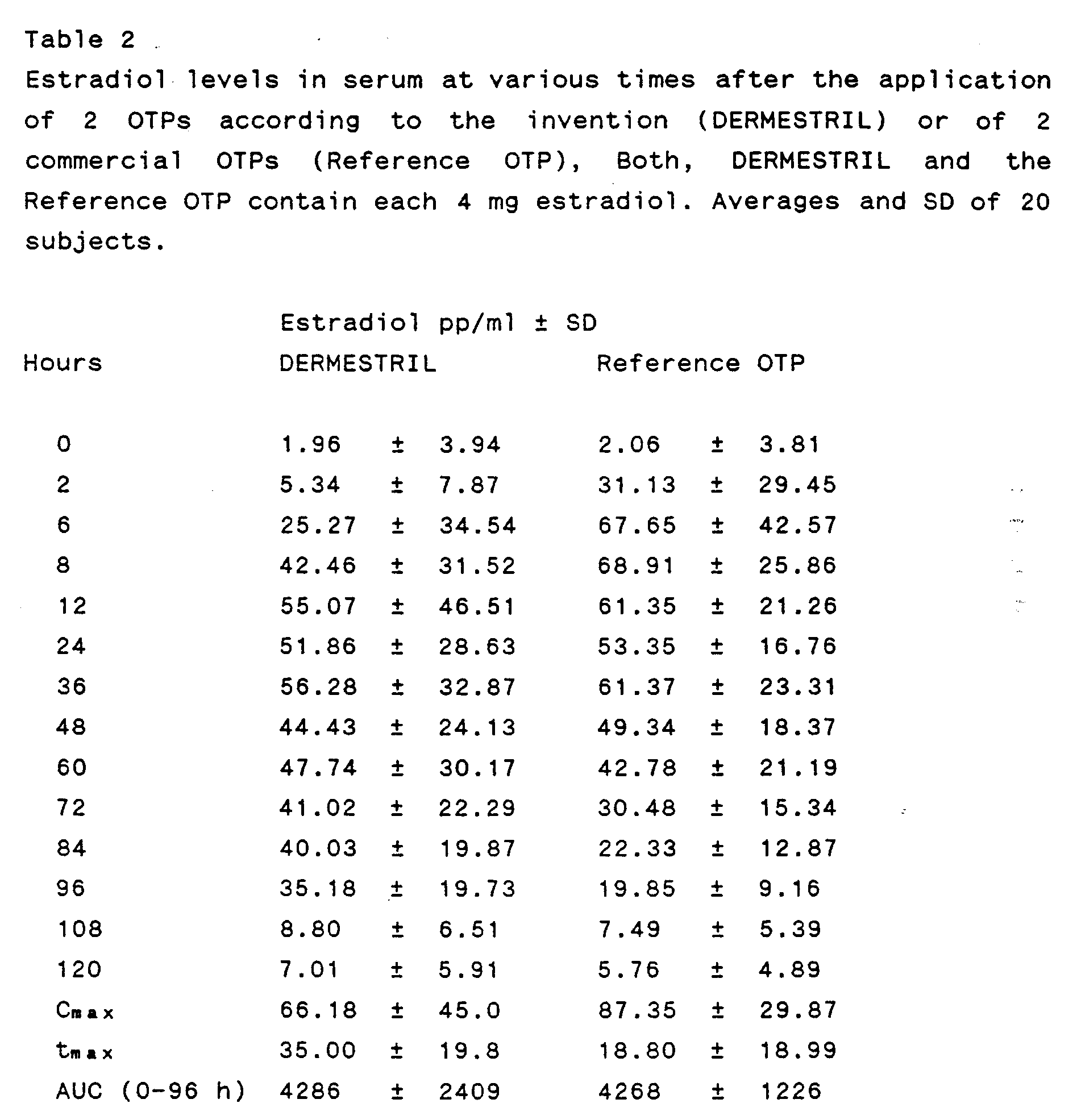
From the results given in table 2 it can be concluded that the areas under the concentration/time curves (AUC) do not differ significantly after the two treatments. In fact the AUC(0-96) after DERMESTRIL was 4286 ± 2409 (SD), and after the Reference OTP was 4268 ± 1226 (SD). - This demonstrates that the bioavailability of estradiol from DERMESTRIL is the same as that from Reference OTP, and this is a surprising result because DERMESTRIL does not contain absorption enhancers.
- The skin tolerability to the OTP prepared according to the invention was evaluated on 10 female guinea pigs weighing between 300 and 400 g.
- The patches were applied to the previously shaved left scapular region of the animals. An area of patch of 2 x 2 cm cut from DERMESTRIL and thus containing about 0.89 mg estradiol, was stuck on the shaved skin and left there for about 6 hours. The tolerability of the patch was evaluated by the appearance of erythema or oedema after 24 hours of application, according to the following scores.
Score ERYTHEMA OEDEMA 0 No effect No effect 1 Slight Slight oedema 2 Moderate Moderate oedema 3 Intense Severe oedema - The test was repeated using the same scores after 7 days, in order to record a possible sensitization induced by the patch.
- The overall sum of the scores relating to erythema for the 10 animals was 1 of 30, because only 1 animal out of 10 showed a slight erythema (30 is the maximum score obtainable).
- No animal presented oedema.
- In the sensitisation challenge carried out after 7 days, no animal had erythema or oedema, demonstrating that the patches were well tolerated and did not induce sensitization under the experimental conditions.
- Table 3 summarizes the composition of the matrix of Examples 1 to 4 and of the Comparative Examples 1 to 7. The corresponding formulations of the matrix containing the copolymers obtained by radical polymerization of the acrylic compounds are quantitatively listed in table 3. The resulting OTPs were tested for stability and also, in six human subjects, for adhesion and skin compatibility. The results obtained with the eleven formulations are also reported in table 3.
The results clearly show that formulations No. 1 to 4 and particularly No. 1 exhibit the properties required for the matrix of a "monolithic" transdermal patch. Conversely other formulations, which are here listed as Comparative Examples 1 to 7, had disadvantages, for instance discolouration (formulations No. 6 to 10), unacceptable skin compatibility (formulation No. 5), or unacceptable tack properties (formulations No. 6, 7, 9 and 11).
Claims (9)
- A transdermal medicated patch for the extended release of 17β-estradiol to the skin, consisting of pressure-sensitive adhesive copolymers in which the active ingredient is dissolved or dispersed (matrix), supported by a water-impermeable foil (outer covering) and covered by a protective liner that is removed at the time of use, characterized in that the pressure-sensitive adhesive copolymers are obtained by radical copolymerisation of (w/w of the matrix)- 50 to 70 % 2-ethylhexyl acrylate,- 20 to 40 % methyl acrylate,- 2 to 8 % acrylic acid,- 2 to 10 % vinyl acetate and- 0.5 to 3 % hydroxyethyl acrylate.
- A transdermal medicated patch according to claim 1, characterized in that the pressure-sensitive adhesive copolymers are obtained by radical copolymerization of (w/w of the matrix)- 55 to 65 % and especially 61 to 64 % 2-ethylhexyl acrylate,- 24 to 32 % and especially 25 to 28 % methyl acrylate,- 3 to 5 % and especially 4 to 5 % acrylic acid,- 3 to 7 % and especially 4 to 5 % vinyl acetate and- 0.7 to 1.5 % and especially about 1 % hydroxyethyl acrylate.
- A transdermal medicated patch according to claim 1 or 2, characterized in that other substances are added to the adhesive copolymers in quantities less than 0.5 % (w/w) of the matrix.
- A transdermal medicated patch according to any of claims 1 to 3, characterized by a content of 17β-estradiol from 1 % to 5 % and preferably 2.0 % to 2.5 % by weight of the adhesive copolymers.
- A transdermal medicated patch according to any of claims 1 to 4, characterized by a content of about 4 mg 17β-estradiol per 18 to 20 cm² of patch area.
- A transdermal medicated patch according to any of claims 1 to 5, characterized in that the patch comprises a removable protective liner constituted by a sheet of paper which is preferably silicone-coated on one or both sides.
- A transdermal patch according to any of claims 1 to 6, characterized by an outer covering constituted by a foil of a water-impermeable material selected from the group of polyester, polyurethane, polyethylene and/or polyvinyl chloride materials.
- A process for the production of a transdermal medicated patch according to any of claims 1 to 7, characterized in that(a) pressure-sensitive adhesive copolymers containing 17β-estradiol as active ingredient are spread onto a removable protective liner and then covered by an outer covering; or(b) the pressure sensitive adhesive copolymers containing 17β-estradiol are spread on the foil of the outer covering and eventually covered by the protective liner in the final steps of production; or(c) the pressure-sensitive adhesive copolymers containing 17β-estradiol are spread onto an intermediate liner and then covered by the foil of the outer covering to which the copolymers adhere firmly, and in the final step the intermediate liner is removed and replaced by the protective liner.
- A process for the production of a transdermal medicated patch according to claim 8, characterized by the following procedure:- the pressure-sensitive adhesive copolymers are dissolved in an organic solvent to form an adhesive mixture;- 17β-estradiol, dissolved or finely suspended in an organic solvent or in a mixture of solvents, is dissolved or dispersed in the adhesive mixture by stirring at a concentration from 1 % to 5 % (w/w) of the dry weight of the pressure-sensitive adhesive copolymers;- the mixture obtained is optionally concentrated by evaporation of some of the solvent; and(a) the mixture obtained as adhesive matrix is then spread onto a removable protective liner, preferably constituted by a sheet of paper, preferably silicone-coated on one or both sides and a foil of thin flexible and water-impermeable material constituting the outer covering of the patch is applied on the layer of adhesive matrix; or(b) the mixture obtained is spread on the foil of the outer covering and eventually covered by the protective liner in the final steps of production; or(c) the mixture obtained is spread on an intermediate liner which is then covered by the foil of the outer covering to which the copolymers adhere firmly, and in the final step the intermediate liner is removed and replaced by the protective liner;- the residual solvent is dried at a temperature from 30 ° to 80 °C, with or without applying a vacuum;- the composite medicated foil produced as above described is cut into portions of appropriate shape and dimensions such that they contain the quantity of the active ingredient required for the therapeutic use.
Applications Claiming Priority (3)
| Application Number | Priority Date | Filing Date | Title |
|---|---|---|---|
| ITTO910907A IT1253265B (en) | 1991-11-25 | 1991-11-25 | ACRYLIC-BASED ADHESIVE COPOLYMER MATRIX PREPARATION FOR THE TRANSDERMAL EXTRADIOL RELEASE. |
| ITTO910907 | 1991-11-25 | ||
| PCT/EP1992/002704 WO1993010772A1 (en) | 1991-11-25 | 1992-11-24 | Transdermal estradiol delivery system |
Publications (2)
| Publication Number | Publication Date |
|---|---|
| EP0614356A1 EP0614356A1 (en) | 1994-09-14 |
| EP0614356B1 true EP0614356B1 (en) | 1995-09-20 |
Family
ID=11409742
Family Applications (1)
| Application Number | Title | Priority Date | Filing Date |
|---|---|---|---|
| EP92923782A Expired - Lifetime EP0614356B1 (en) | 1991-11-25 | 1992-11-24 | Transdermal estradiol delivery system |
Country Status (12)
| Country | Link |
|---|---|
| US (1) | US6156335A (en) |
| EP (1) | EP0614356B1 (en) |
| JP (1) | JPH07501335A (en) |
| AT (1) | ATE128029T1 (en) |
| AU (1) | AU666151B2 (en) |
| CA (1) | CA2124209A1 (en) |
| DE (1) | DE69205010T2 (en) |
| DK (1) | DK0614356T3 (en) |
| ES (1) | ES2078066T3 (en) |
| GR (1) | GR3018303T3 (en) |
| IT (1) | IT1253265B (en) |
| WO (1) | WO1993010772A1 (en) |
Cited By (2)
| Publication number | Priority date | Publication date | Assignee | Title |
|---|---|---|---|---|
| US5925373A (en) * | 1994-07-26 | 1999-07-20 | Lavipharm S.A. | Transdermal delivery device containing an estrogen |
| DE10141652A1 (en) * | 2001-08-24 | 2003-03-13 | Lohmann Therapie Syst Lts | Transdermal therapeutic system based on polyacrylate pressure-sensitive adhesives without functional groups |
Families Citing this family (24)
| Publication number | Priority date | Publication date | Assignee | Title |
|---|---|---|---|---|
| US5554381A (en) * | 1993-08-09 | 1996-09-10 | Cygnus, Inc. | Low flux matrix system for delivering potent drugs transdermally |
| DE4333595A1 (en) * | 1993-10-01 | 1995-04-06 | Labtec Gmbh | Transdermal therapeutic system for applying drugs to the skin |
| DE19526864A1 (en) * | 1995-07-22 | 1997-01-23 | Labtec Gmbh | Hormone patches |
| US6623763B2 (en) | 1996-01-08 | 2003-09-23 | Lts Lohmann Therape-System Ag | Pharmaceutical preparation adhering to the skin, in particular a transdermal therapeutic system for the release of 17-β-estradiol to the human organism |
| DE19600347A1 (en) * | 1996-01-08 | 1997-07-10 | Lohmann Therapie Syst Lts | Skin-adhering pharmaceutical preparation, in particular TTS for the delivery of 17-beta-estradiol to the human organism |
| DE19830649C2 (en) * | 1998-07-09 | 2003-04-10 | Lohmann Therapie Syst Lts | Topical patch with nonsteroidal anti-inflammatory drugs with acid group |
| GB0019745D0 (en) * | 2000-08-10 | 2000-09-27 | Univ Surrey | Gene expression element |
| TWI287455B (en) * | 2000-12-05 | 2007-10-01 | Noven Pharma | Crystallization inhibition of drugs in transdermal drug delivery systems and methods of use |
| US6927267B1 (en) | 2002-03-07 | 2005-08-09 | Basf Ag | High solids dispersion for wide temperature, pressure sensitive adhesive applications |
| DE10229733A1 (en) * | 2002-07-02 | 2004-01-22 | Basf Ag | Pressure sensitive adhesives for carriers made of soft PVC |
| KR101144026B1 (en) | 2002-08-09 | 2012-05-09 | 후소 야쿠힝 고교 가부시끼가이샤 | Female hormone?containing patch |
| AU2005291098B2 (en) * | 2004-10-04 | 2011-11-24 | L'oreal | Cosmetic and/or dermatological composition for sensitive skins |
| FR2889057B1 (en) * | 2005-08-01 | 2008-07-18 | Oreal | COSMETIC AND / OR DERMATOLOGICAL COMPOSITION FOR THE PREVENTION AND / OR TREATMENT OF SENSITIVE OR DRY SKINS |
| US7754256B2 (en) * | 2007-03-07 | 2010-07-13 | Stan Dennison | Nutritional composition |
| US20080226698A1 (en) * | 2007-03-16 | 2008-09-18 | Mylan Technologies, Inc. | Amorphous drug transdermal systems, manufacturing methods, and stabilization |
| FR2919501B1 (en) * | 2007-08-02 | 2010-12-31 | Oreal | USE OF HESPERIDINE OR ONE OF ITS DERIVATIVES FOR THE PREVENTION AND / OR TREATMENT OF RELEASED SKINS |
| FR2920304B1 (en) | 2007-09-04 | 2010-06-25 | Oreal | COSMETIC USE OF LYSAT BIFIDOBACTERIUM SPECIES FOR THE TREATMENT OF DROUGHT. |
| WO2009031106A2 (en) * | 2007-09-04 | 2009-03-12 | L'oreal | Use of a combination of hesperidin and of a microorganism for influencing the barrier function of the skin |
| DE102008013701A1 (en) | 2008-03-11 | 2009-09-17 | Lts Lohmann Therapie-Systeme Ag | Transdermal therapeutic system with stabilized membrane |
| MX2010012989A (en) * | 2008-05-30 | 2011-04-27 | Mylan Inc | Stabilized transdermal drug delivery system. |
| US8231906B2 (en) | 2008-07-10 | 2012-07-31 | Noven Pharmaceuticals, Inc. | Transdermal estrogen device and delivery |
| JP2012504609A (en) * | 2008-10-06 | 2012-02-23 | マイラン・テクノロジーズ,インコーポレイテッド | Amorphous rotigotine transdermal system |
| DE102008059054A1 (en) | 2008-11-26 | 2010-05-27 | Otto Bock Pur Life Science Gmbh | Polyurethane patch for the transdermal application of active substances and process for its preparation |
| WO2011009800A1 (en) * | 2009-07-21 | 2011-01-27 | Basf Se | Film-to-film laminate, made by using an aqueous polymer dispersion as adhesive agent |
Family Cites Families (4)
| Publication number | Priority date | Publication date | Assignee | Title |
|---|---|---|---|---|
| US4906475A (en) * | 1988-02-16 | 1990-03-06 | Paco Pharmaceutical Services | Estradiol transdermal delivery system |
| DE68917292T2 (en) * | 1988-02-26 | 1995-02-02 | Riker Laboratories Inc | TRANSDERMAL ESTRADIOL AS A THERAPEUTIC SYSTEM. |
| US4994267A (en) * | 1988-03-04 | 1991-02-19 | Noven Pharmaceuticals, Inc. | Transdermal acrylic multipolymer drug delivery system |
| ES2081477T3 (en) * | 1990-04-24 | 1996-03-16 | Teijin Ltd | PATCH. |
-
1991
- 1991-11-25 IT ITTO910907A patent/IT1253265B/en active IP Right Grant
-
1992
- 1992-11-24 AT AT92923782T patent/ATE128029T1/en not_active IP Right Cessation
- 1992-11-24 DE DE69205010T patent/DE69205010T2/en not_active Expired - Lifetime
- 1992-11-24 AU AU29451/92A patent/AU666151B2/en not_active Ceased
- 1992-11-24 ES ES92923782T patent/ES2078066T3/en not_active Expired - Lifetime
- 1992-11-24 JP JP5509788A patent/JPH07501335A/en active Pending
- 1992-11-24 DK DK92923782.4T patent/DK0614356T3/en active
- 1992-11-24 US US08/244,132 patent/US6156335A/en not_active Expired - Fee Related
- 1992-11-24 WO PCT/EP1992/002704 patent/WO1993010772A1/en not_active Ceased
- 1992-11-24 EP EP92923782A patent/EP0614356B1/en not_active Expired - Lifetime
- 1992-11-24 CA CA002124209A patent/CA2124209A1/en not_active Abandoned
-
1995
- 1995-12-05 GR GR950403422T patent/GR3018303T3/en unknown
Cited By (3)
| Publication number | Priority date | Publication date | Assignee | Title |
|---|---|---|---|---|
| US5925373A (en) * | 1994-07-26 | 1999-07-20 | Lavipharm S.A. | Transdermal delivery device containing an estrogen |
| DE10141652A1 (en) * | 2001-08-24 | 2003-03-13 | Lohmann Therapie Syst Lts | Transdermal therapeutic system based on polyacrylate pressure-sensitive adhesives without functional groups |
| DE10141652B4 (en) * | 2001-08-24 | 2011-04-07 | Lts Lohmann Therapie-Systeme Ag | Transdermal therapeutic system based on polyacrylate pressure-sensitive adhesives without functional groups and its use |
Also Published As
| Publication number | Publication date |
|---|---|
| WO1993010772A1 (en) | 1993-06-10 |
| GR3018303T3 (en) | 1996-03-31 |
| ITTO910907A1 (en) | 1993-05-25 |
| ES2078066T3 (en) | 1995-12-01 |
| IT1253265B (en) | 1995-07-14 |
| AU666151B2 (en) | 1996-02-01 |
| EP0614356A1 (en) | 1994-09-14 |
| ITTO910907A0 (en) | 1991-11-25 |
| CA2124209A1 (en) | 1993-06-10 |
| DE69205010T2 (en) | 1996-02-22 |
| AU2945192A (en) | 1993-06-28 |
| DK0614356T3 (en) | 1995-11-13 |
| JPH07501335A (en) | 1995-02-09 |
| US6156335A (en) | 2000-12-05 |
| ATE128029T1 (en) | 1995-10-15 |
| DE69205010D1 (en) | 1995-10-26 |
Similar Documents
| Publication | Publication Date | Title |
|---|---|---|
| US6156335A (en) | Preparation with an acrylic-based, adhesive copolymeric matrix for the transdermal delivery of estradiol | |
| US5830505A (en) | Active ingredient patch | |
| US5154922A (en) | Compositions for transdermal delivery of estradiol | |
| EP0569338B1 (en) | Administration system for estradiol | |
| US5560922A (en) | Transdermal absorption dosage unit using a polyacrylate adhesive polymer and process | |
| US5904931A (en) | Transdermal therapeutic systems that contain sex steroids and dimethyl isosorbide | |
| JP2604097B2 (en) | Method and system for transdermal drug administration using sorbitan esters as skin penetration enhancers | |
| US5593686A (en) | Pharmaceutical compositions | |
| US20020012695A1 (en) | Transdermal preparation containing hydrophilic or salt-form drug | |
| US20060088580A1 (en) | Hormone-containing transdermal therapeutic system with an active substance reservoir based on vinylacetate-vinylpyrrolidone copolymer with improved cohesion | |
| EP0315219B1 (en) | Pharmaceutical compositions | |
| JPH10505825A (en) | Scopolamine patch | |
| CN112915071A (en) | Transdermal patch containing memantine | |
| US7018648B2 (en) | Transdermal device for administering testosterone or one of the derivatives thereof | |
| JP3834202B2 (en) | Transdermal therapeutic system containing the active substance scopolamine base | |
| JP3525391B2 (en) | Surface stabilized preparations for skin application | |
| JP2001508069A (en) | Acetylsalicylic acid-containing transdermal therapeutic system with enhanced absorbability | |
| KR100439659B1 (en) | Transdermal delivery system for tulobuterol | |
| AU2003254834B2 (en) | Female hormone-containing patch | |
| JP2552716B2 (en) | Transdermal patch | |
| US20030215487A1 (en) | Matrix-type device for the transdermal delivery of testosterone applied to the non-scrotal skin | |
| US20030175330A1 (en) | Transdermal therapeutical system with a reduced tendency of the active substance to crystallize | |
| EP0315217B1 (en) | Pharmaceutical compositions | |
| JP2839635B2 (en) | Estradiol-containing patch | |
| JPH07247217A (en) | Transdermal formulation |
Legal Events
| Date | Code | Title | Description |
|---|---|---|---|
| PUAI | Public reference made under article 153(3) epc to a published international application that has entered the european phase |
Free format text: ORIGINAL CODE: 0009012 |
|
| 17P | Request for examination filed |
Effective date: 19940525 |
|
| AK | Designated contracting states |
Kind code of ref document: A1 Designated state(s): AT BE CH DE DK ES FR GB GR IE IT LI NL PT SE |
|
| 17Q | First examination report despatched |
Effective date: 19940926 |
|
| GRAA | (expected) grant |
Free format text: ORIGINAL CODE: 0009210 |
|
| AK | Designated contracting states |
Kind code of ref document: B1 Designated state(s): AT BE CH DE DK ES FR GB GR IE IT LI NL PT SE |
|
| REF | Corresponds to: |
Ref document number: 128029 Country of ref document: AT Date of ref document: 19951015 Kind code of ref document: T |
|
| ITF | It: translation for a ep patent filed | ||
| REG | Reference to a national code |
Ref country code: IE Ref legal event code: FG4D Free format text: 65318 |
|
| REF | Corresponds to: |
Ref document number: 69205010 Country of ref document: DE Date of ref document: 19951026 |
|
| REG | Reference to a national code |
Ref country code: DK Ref legal event code: T3 |
|
| ET | Fr: translation filed | ||
| REG | Reference to a national code |
Ref country code: ES Ref legal event code: FG2A Ref document number: 2078066 Country of ref document: ES Kind code of ref document: T3 |
|
| SC4A | Pt: translation is available |
Free format text: 950920 AVAILABILITY OF NATIONAL TRANSLATION |
|
| REG | Reference to a national code |
Ref country code: GR Ref legal event code: FG4A Free format text: 3018303 |
|
| PLBE | No opposition filed within time limit |
Free format text: ORIGINAL CODE: 0009261 |
|
| STAA | Information on the status of an ep patent application or granted ep patent |
Free format text: STATUS: NO OPPOSITION FILED WITHIN TIME LIMIT |
|
| 26N | No opposition filed | ||
| PGFP | Annual fee paid to national office [announced via postgrant information from national office to epo] |
Ref country code: SE Payment date: 20011108 Year of fee payment: 10 |
|
| PGFP | Annual fee paid to national office [announced via postgrant information from national office to epo] |
Ref country code: DK Payment date: 20011109 Year of fee payment: 10 Ref country code: CH Payment date: 20011109 Year of fee payment: 10 |
|
| REG | Reference to a national code |
Ref country code: GB Ref legal event code: IF02 |
|
| PG25 | Lapsed in a contracting state [announced via postgrant information from national office to epo] |
Ref country code: SE Free format text: LAPSE BECAUSE OF NON-PAYMENT OF DUE FEES Effective date: 20021125 |
|
| PG25 | Lapsed in a contracting state [announced via postgrant information from national office to epo] |
Ref country code: LI Free format text: LAPSE BECAUSE OF NON-PAYMENT OF DUE FEES Effective date: 20021130 Ref country code: CH Free format text: LAPSE BECAUSE OF NON-PAYMENT OF DUE FEES Effective date: 20021130 |
|
| PG25 | Lapsed in a contracting state [announced via postgrant information from national office to epo] |
Ref country code: DK Free format text: LAPSE BECAUSE OF NON-PAYMENT OF DUE FEES Effective date: 20021231 |
|
| EUG | Se: european patent has lapsed | ||
| REG | Reference to a national code |
Ref country code: DK Ref legal event code: EBP |
|
| REG | Reference to a national code |
Ref country code: CH Ref legal event code: PL |
|
| PGFP | Annual fee paid to national office [announced via postgrant information from national office to epo] |
Ref country code: IE Payment date: 20031113 Year of fee payment: 12 |
|
| PGFP | Annual fee paid to national office [announced via postgrant information from national office to epo] |
Ref country code: GR Payment date: 20031114 Year of fee payment: 12 |
|
| PGFP | Annual fee paid to national office [announced via postgrant information from national office to epo] |
Ref country code: GB Payment date: 20031119 Year of fee payment: 12 |
|
| PGFP | Annual fee paid to national office [announced via postgrant information from national office to epo] |
Ref country code: AT Payment date: 20031120 Year of fee payment: 12 |
|
| PGFP | Annual fee paid to national office [announced via postgrant information from national office to epo] |
Ref country code: NL Payment date: 20031128 Year of fee payment: 12 |
|
| PGFP | Annual fee paid to national office [announced via postgrant information from national office to epo] |
Ref country code: BE Payment date: 20031219 Year of fee payment: 12 |
|
| PG25 | Lapsed in a contracting state [announced via postgrant information from national office to epo] |
Ref country code: IE Free format text: LAPSE BECAUSE OF NON-PAYMENT OF DUE FEES Effective date: 20041124 Ref country code: GB Free format text: LAPSE BECAUSE OF NON-PAYMENT OF DUE FEES Effective date: 20041124 Ref country code: AT Free format text: LAPSE BECAUSE OF NON-PAYMENT OF DUE FEES Effective date: 20041124 |
|
| PG25 | Lapsed in a contracting state [announced via postgrant information from national office to epo] |
Ref country code: BE Free format text: LAPSE BECAUSE OF NON-PAYMENT OF DUE FEES Effective date: 20041130 |
|
| BERE | Be: lapsed |
Owner name: *ROTTA RESEARCH LABORATORIUM S.P.A. Effective date: 20041130 |
|
| PG25 | Lapsed in a contracting state [announced via postgrant information from national office to epo] |
Ref country code: NL Free format text: LAPSE BECAUSE OF NON-PAYMENT OF DUE FEES Effective date: 20050601 |
|
| PG25 | Lapsed in a contracting state [announced via postgrant information from national office to epo] |
Ref country code: GR Free format text: LAPSE BECAUSE OF NON-PAYMENT OF DUE FEES Effective date: 20050602 |
|
| GBPC | Gb: european patent ceased through non-payment of renewal fee |
Effective date: 20041124 |
|
| NLV4 | Nl: lapsed or anulled due to non-payment of the annual fee |
Effective date: 20050601 |
|
| REG | Reference to a national code |
Ref country code: IE Ref legal event code: MM4A |
|
| BERE | Be: lapsed |
Owner name: *ROTTA RESEARCH LABORATORIUM S.P.A. Effective date: 20041130 |
|
| PGFP | Annual fee paid to national office [announced via postgrant information from national office to epo] |
Ref country code: IT Payment date: 20101126 Year of fee payment: 19 |
|
| PGFP | Annual fee paid to national office [announced via postgrant information from national office to epo] |
Ref country code: DE Payment date: 20101125 Year of fee payment: 19 |
|
| PGFP | Annual fee paid to national office [announced via postgrant information from national office to epo] |
Ref country code: FR Payment date: 20111115 Year of fee payment: 20 Ref country code: ES Payment date: 20111020 Year of fee payment: 20 Ref country code: PT Payment date: 20111014 Year of fee payment: 20 |
|
| REG | Reference to a national code |
Ref country code: DE Ref legal event code: R071 Ref document number: 69205010 Country of ref document: DE |
|
| REG | Reference to a national code |
Ref country code: DE Ref legal event code: R071 Ref document number: 69205010 Country of ref document: DE |
|
| REG | Reference to a national code |
Ref country code: PT Ref legal event code: MM4A Free format text: MAXIMUM VALIDITY LIMIT REACHED Effective date: 20121124 |
|
| PG25 | Lapsed in a contracting state [announced via postgrant information from national office to epo] |
Ref country code: PT Free format text: LAPSE BECAUSE OF EXPIRATION OF PROTECTION Effective date: 20121204 |
|
| REG | Reference to a national code |
Ref country code: ES Ref legal event code: FD2A Effective date: 20140827 |
|
| PG25 | Lapsed in a contracting state [announced via postgrant information from national office to epo] |
Ref country code: ES Free format text: LAPSE BECAUSE OF EXPIRATION OF PROTECTION Effective date: 20121125 |