EP0612702B1 - Zero slump-loss superplasticizer - Google Patents
Zero slump-loss superplasticizer Download PDFInfo
- Publication number
- EP0612702B1 EP0612702B1 EP94102312A EP94102312A EP0612702B1 EP 0612702 B1 EP0612702 B1 EP 0612702B1 EP 94102312 A EP94102312 A EP 94102312A EP 94102312 A EP94102312 A EP 94102312A EP 0612702 B1 EP0612702 B1 EP 0612702B1
- Authority
- EP
- European Patent Office
- Prior art keywords
- meth
- acrylate
- formula
- per cent
- loss
- Prior art date
- Legal status (The legal status is an assumption and is not a legal conclusion. Google has not performed a legal analysis and makes no representation as to the accuracy of the status listed.)
- Expired - Lifetime
Links
Classifications
-
- C—CHEMISTRY; METALLURGY
- C04—CEMENTS; CONCRETE; ARTIFICIAL STONE; CERAMICS; REFRACTORIES
- C04B—LIME, MAGNESIA; SLAG; CEMENTS; COMPOSITIONS THEREOF, e.g. MORTARS, CONCRETE OR LIKE BUILDING MATERIALS; ARTIFICIAL STONE; CERAMICS; REFRACTORIES; TREATMENT OF NATURAL STONE
- C04B24/00—Use of organic materials as active ingredients for mortars, concrete or artificial stone, e.g. plasticisers
- C04B24/24—Macromolecular compounds
- C04B24/26—Macromolecular compounds obtained by reactions only involving carbon-to-carbon unsaturated bonds
- C04B24/2641—Polyacrylates; Polymethacrylates
- C04B24/2647—Polyacrylates; Polymethacrylates containing polyether side chains
-
- C—CHEMISTRY; METALLURGY
- C04—CEMENTS; CONCRETE; ARTIFICIAL STONE; CERAMICS; REFRACTORIES
- C04B—LIME, MAGNESIA; SLAG; CEMENTS; COMPOSITIONS THEREOF, e.g. MORTARS, CONCRETE OR LIKE BUILDING MATERIALS; ARTIFICIAL STONE; CERAMICS; REFRACTORIES; TREATMENT OF NATURAL STONE
- C04B24/00—Use of organic materials as active ingredients for mortars, concrete or artificial stone, e.g. plasticisers
- C04B24/24—Macromolecular compounds
- C04B24/26—Macromolecular compounds obtained by reactions only involving carbon-to-carbon unsaturated bonds
- C04B24/2688—Copolymers containing at least three different monomers
- C04B24/2694—Copolymers containing at least three different monomers containing polyether side chains
-
- C—CHEMISTRY; METALLURGY
- C04—CEMENTS; CONCRETE; ARTIFICIAL STONE; CERAMICS; REFRACTORIES
- C04B—LIME, MAGNESIA; SLAG; CEMENTS; COMPOSITIONS THEREOF, e.g. MORTARS, CONCRETE OR LIKE BUILDING MATERIALS; ARTIFICIAL STONE; CERAMICS; REFRACTORIES; TREATMENT OF NATURAL STONE
- C04B24/00—Use of organic materials as active ingredients for mortars, concrete or artificial stone, e.g. plasticisers
- C04B24/24—Macromolecular compounds
- C04B24/28—Macromolecular compounds obtained otherwise than by reactions only involving carbon-to-carbon unsaturated bonds
- C04B24/32—Polyethers, e.g. alkylphenol polyglycolether
-
- C—CHEMISTRY; METALLURGY
- C04—CEMENTS; CONCRETE; ARTIFICIAL STONE; CERAMICS; REFRACTORIES
- C04B—LIME, MAGNESIA; SLAG; CEMENTS; COMPOSITIONS THEREOF, e.g. MORTARS, CONCRETE OR LIKE BUILDING MATERIALS; ARTIFICIAL STONE; CERAMICS; REFRACTORIES; TREATMENT OF NATURAL STONE
- C04B28/00—Compositions of mortars, concrete or artificial stone, containing inorganic binders or the reaction product of an inorganic and an organic binder, e.g. polycarboxylate cements
- C04B28/02—Compositions of mortars, concrete or artificial stone, containing inorganic binders or the reaction product of an inorganic and an organic binder, e.g. polycarboxylate cements containing hydraulic cements other than calcium sulfates
- C04B28/06—Aluminous cements
-
- C—CHEMISTRY; METALLURGY
- C04—CEMENTS; CONCRETE; ARTIFICIAL STONE; CERAMICS; REFRACTORIES
- C04B—LIME, MAGNESIA; SLAG; CEMENTS; COMPOSITIONS THEREOF, e.g. MORTARS, CONCRETE OR LIKE BUILDING MATERIALS; ARTIFICIAL STONE; CERAMICS; REFRACTORIES; TREATMENT OF NATURAL STONE
- C04B2103/00—Function or property of ingredients for mortars, concrete or artificial stone
- C04B2103/0045—Polymers chosen for their physico-chemical characteristics
- C04B2103/0061—Block (co-)polymers
-
- C—CHEMISTRY; METALLURGY
- C04—CEMENTS; CONCRETE; ARTIFICIAL STONE; CERAMICS; REFRACTORIES
- C04B—LIME, MAGNESIA; SLAG; CEMENTS; COMPOSITIONS THEREOF, e.g. MORTARS, CONCRETE OR LIKE BUILDING MATERIALS; ARTIFICIAL STONE; CERAMICS; REFRACTORIES; TREATMENT OF NATURAL STONE
- C04B2103/00—Function or property of ingredients for mortars, concrete or artificial stone
- C04B2103/30—Water reducers, plasticisers, air-entrainers, flow improvers
- C04B2103/308—Slump-loss preventing agents
-
- C—CHEMISTRY; METALLURGY
- C04—CEMENTS; CONCRETE; ARTIFICIAL STONE; CERAMICS; REFRACTORIES
- C04B—LIME, MAGNESIA; SLAG; CEMENTS; COMPOSITIONS THEREOF, e.g. MORTARS, CONCRETE OR LIKE BUILDING MATERIALS; ARTIFICIAL STONE; CERAMICS; REFRACTORIES; TREATMENT OF NATURAL STONE
- C04B2103/00—Function or property of ingredients for mortars, concrete or artificial stone
- C04B2103/30—Water reducers, plasticisers, air-entrainers, flow improvers
- C04B2103/32—Superplasticisers
Definitions
- the present invention relates to a new superplasticizing additive for concrete and other cementitious materials capable to considerably increase the initial workability of the mixes and to maintain this workability for longer periods than those corresponding to the traditional superplasticizers and to allow an easy placing of the concrete. More particularly, the present invention relates to a superplasticizer with the above mentioned properties and further characterized by a low air-entraining effect and no adverse effect on the mechanical properties of the concrete, even at the early age of curing.
- Superplasticizers are extensively used in the construction industry because their addition considerably increases the fluidity of fresh concrete without adding more water to the mix. Furthermore, they allow a considerable reduction of the mixing water and an easy placing of high quality concretes which, once hardened, are characterized by high strength.
- Zero slump-loss superplasticizers capable to maintain the same fluidity for longer periods and allow the transport of fresh concrete for long distances without further retempering the concrete at the placing-site.
- These new additives are based on crosslinked hydrophilic acrylic polymers which hydrolize in the strong alkaline medium of cementitious mixes to produce linear polymer chains which reduce the "slump loss" effect.
- Y may be a -O-(R 2a -0-R 2b -) n -O radical (with R 2a and R 2b C 2 -C 5 alkylene radicals and n integer from 2 to 30).
- the crosslinking agents of formula (I) can be obtained by reacting (meth)acrylic acid and polyglycolethers having alkylene radicals with at least 4 carbon atoms, according to the formula -(-0-R 2b -R 2a -0-R 2b -R 2a -0-)-.
- examples of such compounds are those obtained by reacting (meth)acrylic acid and poly-tetramethyleneglycols (PTMEG) having general formula H0-(CH 2 CH 2 CH 2 CH 2 0) n -H.
- PTMEG poly-tetramethyleneglycols
- EG-DA ethylene-glycol-di(meth)acrylate
- 2EG-DA diethylene glycol di(meth)acrylate
- 3EG-DA Triethylene glycol di (meth)acrylate
- 4-ethylene glycol di(meth)acrylate 5EG-DA
- 9-ethylene glycol di(meth)acrylate 9EG-DA
- 14-ethylene glycol di(meth)acrylate 14-ethylene glycol di(meth)acrylate
- European Patent Application n. 448717A1 describes other crosslinking agents for the production of superplasticizers having low "slump-loss" effect.
- Such crosslinking agents are represented by the following formulas containing epoxy groups: or by unsaturated monomers obtained by such epoxy compounds.
- a noteworthy drawback of this type of superplasticizers is the air-entraining effect they produce in the cement mixes, as already pointed out by V.S. Ramachandran (9th International Congress on the Chemistry of Cement, Vol.1, pp. 529-568, 1992, New Delhi). This effect, besides causing a strength decrease, also affects the appearance of the concrete.
- European Patent Application n. 448717A1 recommends the use of highly hydrophilic monomers such as: where: R 3 is H or -CH 3 ; R 5 and R 6 independently represent alkylene radicals containing from 2 to 4 carbon atoms.
- Examples of such type of monomers (II) are, for example, 2-sulfoethyl(meth)acrylate, 2-sulfopropyl (meth)-acrylate, sulfoethoxypolyethylenglycol (meth) acrylate, sulfoethoxypolypropylenglycolmono(meth)acrylate, etc. and their salts.
- the present invention relates to new crosslinked water soluble or water-dispersible acrylic polymers, which can find application as "zero slump-loss" superplasticizers, having different structures than those reported in the aforementioned patent applications.
- the new additives of the present invention are characterized by a very low air-entraining effect, even in the absence of monomers of formulas (II) and (III), till now considered essential to produce superplasticizers with a low air-entraining effect.
- the main difference among the polymer of the present invention and those described in the aforementioned patent applications is the crosslinking agent.
- monomers having formula (VI) are necessary, in which Y represents propyloxy group and m is an integer from 5 to 50.
- the monomers of the present invention are substantially different from those described in the previous patent applications, in which the special sulfonated monomer units reported in formulas II and III are essential to reduce the air entraining effect.
- the acrylic crosslinked polymers of the present invention may be obtained by terpolymerizing, in different ratios, the monomers of the formulas (IV), (V), (VI). Even though many combinations are possible, it has been observed that the best results, in terms of loss of workability ("slump-loss") and air- entraining effect, are obtained when the amount of acrylic monomers (IV) and (V) is from 90 to 99.9 per cent of the polymerizable mass and the amount of monomer (VI) is from 0.1 to 10 per cent of the polymerizable mass.
- slump-loss loss of workability
- air- entraining effect are obtained when the amount of acrylic monomers (IV) and (V) is from 90 to 99.9 per cent of the polymerizable mass and the amount of monomer (VI) is from 0.1 to 10 per cent of the polymerizable mass.
- the polymers of the present invention can be conveniently synthetized by many of the polymerisation methods known in the art. In the following examples, some preparations of polymers of the present invention are described.
- This example describes a polymer synthetized using a crosslinking agent (14-ethyleneglycoldimethacrylate) selected among those indicated in the Japanese Patent Application n. 281014.
- the polymer so obtained has been used in concrete tests in comparison with the polymers of the present invention.
- This example reports the results of concrete tests made using the polymers of the present invention (Examples 1, 2 and 3) as superplasticizer in comparison both to a traditional superplasticizer based on naphthalene sulfonated formaldehyde condensate (NSFC) and a polymer synthetized using 14- ethyleneglycoldimethacrylate as crosslinking agent (14 EG-DMA) selected among those described in the Japanese Patent Application n. 281014 (Example 4). All the concretes were prepared with the same water/cement and aggregate/cement ratios, using Type I Portland cement (400 kg/mc) and coarse aggregate with maximum diameter of 20 mm. The comparative results of the concrete tests are reported in the following table.
- Examples 1, 2, 3 are surprisingly low in comparison to the polymer of Example 4, which has been synthetized using polyethyleneglycoldimethacrylate (14EG-DMA) as crosslinking agent, as reported in Japanese Patent Application n. 281014.
- 14EG-DMA polyethyleneglycoldimethacrylate
- the crosslinking agent of the present invention based on polypropyleneglycoldi(meth)acrylate, allows preparing cementitious mixes with a low air content without requiring the monomers described in the European Patent Applications n. 448717A and n. 0331308, which up to now were belived necessary in order to produce polymer superplasticizers characterized by a low air- entraining effect.
- the polymer of the present invention has been evaluated as superplasticizer for High Alumina cement based mortars. It is common knowledge that traditional superplasticizers like NSFC (Naphthalene Sulfonated Formaldehyde Condensate and MSFC (Melamine Sulfite Formaldehyde Condensate) do not exert significant fluidifying effect on High Alumina cement.
- NSFC Naphthalene Sulfonated Formaldehyde Condensate
- MSFC Melamine Sulfite Formaldehyde Condensate
Landscapes
- Chemical & Material Sciences (AREA)
- Engineering & Computer Science (AREA)
- Ceramic Engineering (AREA)
- Chemical Kinetics & Catalysis (AREA)
- Materials Engineering (AREA)
- Structural Engineering (AREA)
- Organic Chemistry (AREA)
- Inorganic Chemistry (AREA)
- Macromonomer-Based Addition Polymer (AREA)
- Curing Cements, Concrete, And Artificial Stone (AREA)
- Addition Polymer Or Copolymer, Post-Treatments, Or Chemical Modifications (AREA)
- Compositions Of Macromolecular Compounds (AREA)
- Organic Low-Molecular-Weight Compounds And Preparation Thereof (AREA)
- Developing Agents For Electrophotography (AREA)
- Compositions Of Oxide Ceramics (AREA)
- Compounds Of Alkaline-Earth Elements, Aluminum Or Rare-Earth Metals (AREA)
Abstract
Description
- The present invention relates to a new superplasticizing additive for concrete and other cementitious materials capable to considerably increase the initial workability of the mixes and to maintain this workability for longer periods than those corresponding to the traditional superplasticizers and to allow an easy placing of the concrete. More particularly, the present invention relates to a superplasticizer with the above mentioned properties and further characterized by a low air-entraining effect and no adverse effect on the mechanical properties of the concrete, even at the early age of curing.
- Superplasticizers are extensively used in the construction industry because their addition considerably increases the fluidity of fresh concrete without adding more water to the mix. Furthermore, they allow a considerable reduction of the mixing water and an easy placing of high quality concretes which, once hardened, are characterized by high strength.
- Traditional superplasticizers based on the condensation between formaldehyde and naphthalene sulfonic acid salts (NSFC) or melamine sulphite modified resins (MSFC) cannot maintain the workability of fresh mixes for long periods. So, even after few minutes, a sharp decrease of the fluidity can occur, known as "slump-loss" effect of the fresh concrete. When "slump-loss" occurs, the initial workability is normally restored at the site of placing by adding more water to the mix, with a consequent adverse effect on the mechanical properties and the durability of the hardened concrete.
- Recently, "zero slump-loss" superplasticizers have been developed capable to maintain the same fluidity for longer periods and allow the transport of fresh concrete for long distances without further retempering the concrete at the placing-site. These new additives are based on crosslinked hydrophilic acrylic polymers which hydrolize in the strong alkaline medium of cementitious mixes to produce linear polymer chains which reduce the "slump loss" effect.
- Examples of such additives are described in Japanese Patent Application n. 281014, based on copolymers of (meth)acrylic acid, ethoxy esters of (meth)acrylic acid and a crosslinking monomer having the following general formula:

X represents hydrogen or methyl radical;
Y represents -O-(R1-)n-O- radical (R1 is an alkylene radical and n is integer from 2 to 30). In this case the crosslinking agents of formula (I) can be obtained by reacting (meth)acrylic acid and ethylene glycol (R1= CH2, n=2) or superior glycols (1,4-butanediol, 1,6-exanediol, 1,8 octanediol, etc. for n>2). Alternatively, Y may be a -O-(R2a-0-R2b-)n-O radical (with R2a and R2b C2-C5 alkylene radicals and n integer from 2 to 30). - In this case, the crosslinking agents of formula (I) can be obtained by reacting (meth)acrylic acid and polyglycolethers having alkylene radicals with at least 4 carbon atoms, according to the formula -(-0-R2b-R2a-0-R2b-R2a-0-)-. Examples of such compounds are those obtained by reacting (meth)acrylic acid and poly-tetramethyleneglycols (PTMEG) having general formula H0-(CH2CH2CH2CH20)n-H. Other crosslinking agents reported in Japanese Patent Application n. 281014 are ethylene-glycol-di(meth)acrylate (EG-DA), diethylene glycol di(meth)acrylate (2EG-DA) Triethylene glycol di (meth)acrylate (3EG-DA), 4-ethylene glycol di(meth)acrylate (5EG-DA), 9-ethylene glycol di(meth)acrylate (9EG-DA), 14-ethylene glycol di(meth)acrylate and their combination.
- European Patent Application n. 448717A1 describes other crosslinking agents for the production of superplasticizers having low "slump-loss" effect. Such crosslinking agents are represented by the following formulas containing epoxy groups:
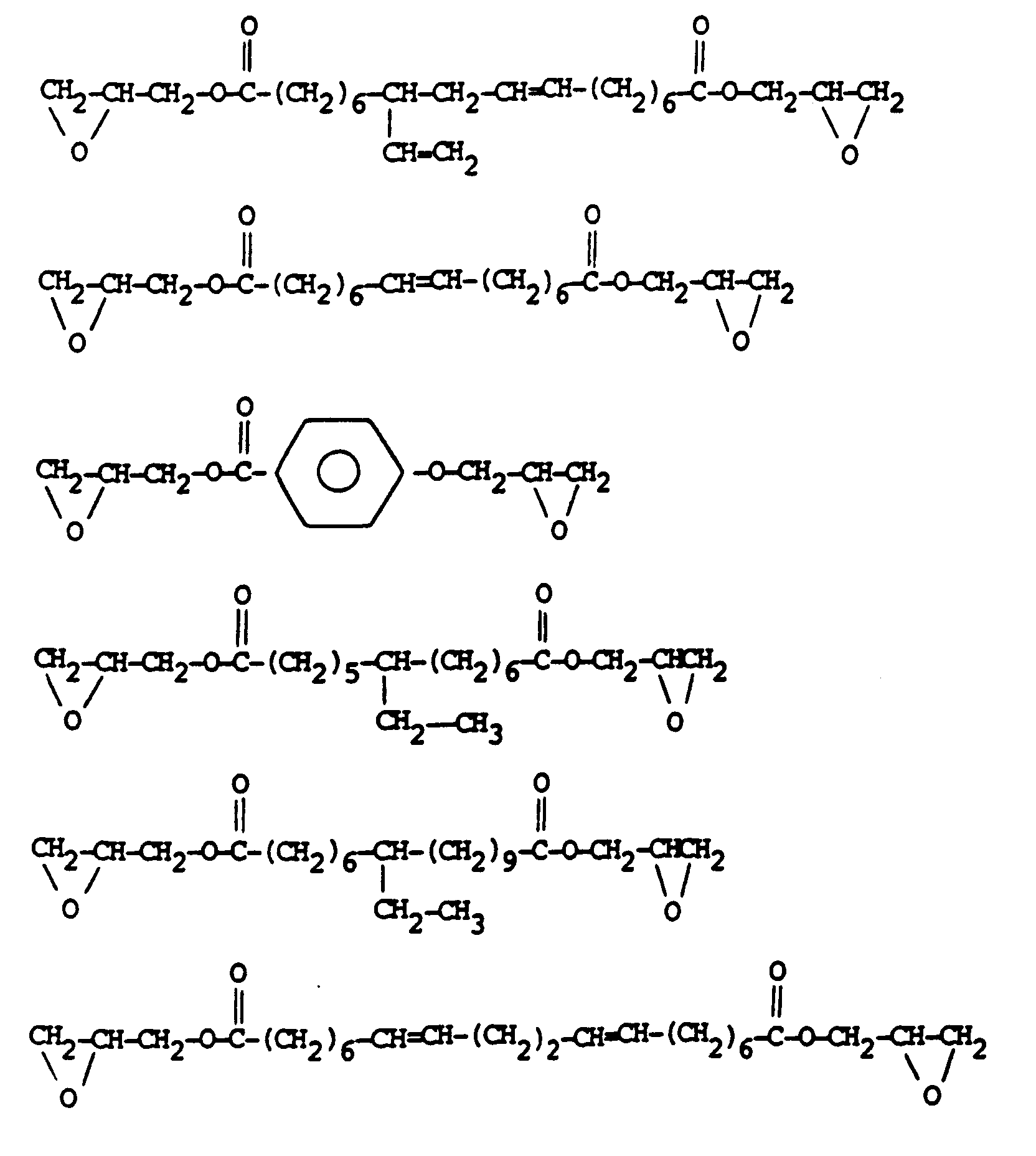
or by unsaturated monomers obtained by such epoxy compounds. A noteworthy drawback of this type of superplasticizers is the air-entraining effect they produce in the cement mixes, as already pointed out by V.S. Ramachandran (9th International Congress on the Chemistry of Cement, Vol.1, pp. 529-568, 1992, New Delhi). This effect, besides causing a strength decrease, also affects the appearance of the concrete. - Just to reduce the air-entraining effect caused by these superplasticizers, European Patent Application n. 448717A1 recommends the use of highly hydrophilic monomers such as:

where:
R3 is H or -CH3;
R5 and R6 independently represent alkylene radicals containing from 2 to 4 carbon atoms. - Examples of such type of monomers (II) are, for example, 2-sulfoethyl(meth)acrylate, 2-sulfopropyl (meth)-acrylate, sulfoethoxypolyethylenglycol (meth) acrylate, sulfoethoxypolypropylenglycolmono(meth)acrylate, etc. and their salts.
- In order to reduce the air-entraining effect of this type of polymers, in European Patent Application n. 0331308, is recommended the use of considerable amount (from 5 to 15 per cent by weight of the monomers) of the following monomer:

where:
R2 is H or CH3 - The present invention relates to new crosslinked water soluble or water-dispersible acrylic polymers, which can find application as "zero slump-loss" superplasticizers, having different structures than those reported in the aforementioned patent applications.
- Furthermore, the new additives of the present invention are characterized by a very low air-entraining effect, even in the absence of monomers of formulas (II) and (III), till now considered essential to produce superplasticizers with a low air-entraining effect.
- The new crosslinked superplasticizers object of the present invention are obtained by terpolymerization of the following monomers (IV), (V), (VI):

where Z= H, Na, K, Li, 1/2 Ca and X is H or CH3,
examples of such monomers are acrylic acid, methacrylic acid and their salts;
where W= -(-CH2-CH2-0-)n-CH3, n is integer from 2 to 30 and X is H or CH3; these monomers comprise polyethyleneglycolsmonomethylether-(meth)acrylate with molecular weight from 200 to 2000; and
where Y =
and m is an integer from 2 to 50. These monomers are preferably represented by polypropyleneglycol-di-(meth)acrylate with molecular weight of approximately between 280 and 3100, i.e. with m approximately between 2 and 50. - The main difference among the polymer of the present invention and those described in the aforementioned patent applications is the crosslinking agent. In fact, it has been surprisingly found that, in order to obtain "zero slump-loss" superplasticizers with low air-entraining effect, monomers having formula (VI) are necessary, in which Y represents propyloxy group

and m is an integer from 5 to 50. The monomers of the present invention are substantially different from those described in the previous patent applications, in which the special sulfonated monomer units reported in formulas II and III are essential to reduce the air entraining effect. - The acrylic crosslinked polymers of the present invention may be obtained by terpolymerizing, in different ratios, the monomers of the formulas (IV), (V), (VI). Even though many combinations are possible, it has been observed that the best results, in terms of loss of workability ("slump-loss") and air- entraining effect, are obtained when the amount of acrylic monomers (IV) and (V) is from 90 to 99.9 per cent of the polymerizable mass and the amount of monomer (VI) is from 0.1 to 10 per cent of the polymerizable mass.
- The polymers of the present invention can be conveniently synthetized by many of the polymerisation methods known in the art. In the following examples, some preparations of polymers of the present invention are described.
- 648 g of water are charged in a glass bottom-rounded reactor equipped with mechanical stirrer, thermometer and reflux condenser. The system is purged with nitrogen and heated at 90 °C. After the addition of 6.3 g of potassium persulfate K2S2O8, a mixture of 28 g of methacrylic acid, 247 g of polyethyleneglycolmonomethylether methacrylate of molecular weight 818 and 7 g of polypropyleneglycoldimethacrylate of molecular weight 861 is added in one hour. The system is further kept at 90 °C for one hour and then neutralized with 60 g of a 30 per cent solution of NaOH. About 990 g of an amber-coloured polymer solution are obtained, having a total solids content of 30 per cent and a viscosity of about 300 cps at 20 °C.
- 648 g of water are charged in a glass bottom-rounded reactor equipped with mechanical stirrer, thermometer and reflux condenser. The system is purged with nitrogen and heated at 90 °C. After the addition of 6.3 g of potassium persulfate K2S2O8, a mixture of 30 g of methacrylic acid, 251 g of polyethyleneglycolmonomethylether methacrylate of molecular weight 818 and 1 g of polypropyleneglycoldimethacrylate of molecular weight 861 is added in one hour. The system is further kept at 90 °C for one hour and then neutralized with 60 g of a 30 per cent solution of NaOH. About 990 g of an amber-coloured polymer solution are obtained, having a total solids content of 30 per cent and a viscosity of about 250 cps at 20 °C.
- 648 g of water are charged in a glass bottom-rounded reactor equipped with mechanical stirrer, thermometer and reflux condenser. The system is purged with nitrogen and heated at 90 °C. After the addition of 6.3 g of potassium persulfate K2S2O8, a mixture of 25 g of methacrylic acid, 229 g of polyethyleneglycolmonomethylether methacrylate of molecular weight 818 and 28 g of polypropyleneglycoldimethacrylate of molecular weight 861 is added in one hour. The system is further kept at 90 °C for one hour and then neutralized with 60 g of a 30 per cent solution of NaOH. About 990 g of an amber-coloured polymer solution are obtained, having a total solids content of 30 per cent and a viscosity of about 400 cps at 20 °C.
- This example describes a polymer synthetized using a crosslinking agent (14-ethyleneglycoldimethacrylate) selected among those indicated in the Japanese Patent Application n. 281014. The polymer so obtained has been used in concrete tests in comparison with the polymers of the present invention.
- 648 g of water are charged in a glass bottom-rounded reactor equipped with mechanical stirrer, thermometer and reflux condenser. The system is purged with nitrogen and heated at 90 °C. After the addition of 6.3 g of potassium persulfate K2S2O8, a mixture of 28 g of methacrylic acid, 247 g of polyethyleneglycolmonomethylether methacrylate of molecular weight 818 and 7 g of polyethyleneglycoldimethacrylate of average molecular weight 770 (14EG-DMA) is added in one hour. The system is further kept at 90 °C for one hour and then neutralized with 60 g of a 30 per cent solution of NaOH. About 990 g of an amber-coloured polymer solution are obtained, having a total solids content of 30 per cent and a viscosity of about 350 cps at 20°C.
- This example reports the results of concrete tests made using the polymers of the present invention (Examples 1, 2 and 3) as superplasticizer in comparison both to a traditional superplasticizer based on naphthalene sulfonated formaldehyde condensate (NSFC) and a polymer synthetized using 14- ethyleneglycoldimethacrylate as crosslinking agent (14 EG-DMA) selected among those described in the Japanese Patent Application n. 281014 (Example 4). All the concretes were prepared with the same water/cement and aggregate/cement ratios, using Type I Portland cement (400 kg/mc) and coarse aggregate with maximum diameter of 20 mm. The comparative results of the concrete tests are reported in the following table.


- The results of concrete tests of Table 1 clearly indicate that the fluidifying effect of the crosslinked polymer of the present invention (Examples 1, 2, 3) is much higher than that of the commercial additive based on naphthalene sulfonate (NSFC). In fact, the initial value of the fluidity of the concrete mixes (measured by "slump" test) containing the polymers of the present invention, even though at a dosage 50% less than NSFC, is higher or, at least comparable, with the mix containing NSFC.
- Furthermore, the crosslinked acrylic polymer of the present invention (Examples 1, 2, 3) shows an excellent retention of the workability (very low "slump-loss"). So, results of Table 1 indicate that, even 45 minutes after the mixing, the concrete mixes additivated with the polymers of the present invention retain 80 per cent of the initial "slump" value, while the "slump" of the concrete mix containing NSFC drops at 50 per cent of its initial value.
- Also the air-entraining effect of the polymers of the present invention (Examples 1, 2, 3) is surprisingly low in comparison to the polymer of Example 4, which has been synthetized using polyethyleneglycoldimethacrylate (14EG-DMA) as crosslinking agent, as reported in Japanese Patent Application n. 281014.
- Therefore, the crosslinking agent of the present invention, based on polypropyleneglycoldi(meth)acrylate, allows preparing cementitious mixes with a low air content without requiring the monomers described in the European Patent Applications n. 448717A and n. 0331308, which up to now were belived necessary in order to produce polymer superplasticizers characterized by a low air- entraining effect.
- In this example the polymer of the present invention has been evaluated as superplasticizer for High Alumina cement based mortars. It is common knowledge that traditional superplasticizers like NSFC (Naphthalene Sulfonated Formaldehyde Condensate and MSFC (Melamine Sulfite Formaldehyde Condensate) do not exert significant fluidifying effect on High Alumina cement. The results of this example (see Table 2) surprisingly show that the polymer of the present invention, even at an exceptionally low dosage, exerts an excellent superplasticizing effect and retain the workability of the mixes based on High Alumina cement and do not cause any decrease in the strength developments.

Claims (6)
- Superplasticizing additive for concrete and other cementitious mixes with high retention of workability (low "slump-loss") and low air-entraining effect, characterized by terpolymerizing the following mixture of monomers respectively having formula IV


- Superplasticizing additive according to claim 1, wherein the monomer of formula V is polyethyleneglycolmonomethylether-(meth)acrylate of molecular weight from about 200 to about 2000.
- Superplasticizing additive according to claims 1 or 2, wherein the monomer of formula VI is polypropyleneglycol-di-(meth)acrylate of molecular weight between about 280 and about 3100.
- Superplasticizing additive according to claims 1-3, wherein the amount of acrylic monomers (IV) and (V) ranges from 90 to 99.9 per cent of the whole polymerizable mass and the amount of monomer (VI) ranges from 0.1 to 10 per cent of the whole polymerizable mass.
- Cementitious mixes containing from 0.01 to 3.00 per cent (as dry matter) by weight of the cement, of the additive of the claims 1-4.
- Cementitious mixes according to claim 5, wherein the cement used is High Alumina cement.
Applications Claiming Priority (2)
| Application Number | Priority Date | Filing Date | Title |
|---|---|---|---|
| ITMI930366A IT1263969B (en) | 1993-02-25 | 1993-02-25 | SUPERFLUIDIFYING ADDITIVES WITH HIGH CONSERVATION OF WORKABILITY |
| ITMI930366 | 1993-02-25 |
Publications (2)
| Publication Number | Publication Date |
|---|---|
| EP0612702A1 EP0612702A1 (en) | 1994-08-31 |
| EP0612702B1 true EP0612702B1 (en) | 1996-11-27 |
Family
ID=11365161
Family Applications (1)
| Application Number | Title | Priority Date | Filing Date |
|---|---|---|---|
| EP94102312A Expired - Lifetime EP0612702B1 (en) | 1993-02-25 | 1994-02-16 | Zero slump-loss superplasticizer |
Country Status (12)
| Country | Link |
|---|---|
| US (1) | US5362324A (en) |
| EP (1) | EP0612702B1 (en) |
| KR (1) | KR100287301B1 (en) |
| AT (1) | ATE145638T1 (en) |
| CA (1) | CA2116381C (en) |
| DE (1) | DE69400968T2 (en) |
| DK (1) | DK0612702T3 (en) |
| ES (1) | ES2095690T3 (en) |
| GR (1) | GR3022575T3 (en) |
| IT (1) | IT1263969B (en) |
| PH (1) | PH30174A (en) |
| TW (1) | TW266200B (en) |
Families Citing this family (50)
| Publication number | Priority date | Publication date | Assignee | Title |
|---|---|---|---|---|
| CH689118A5 (en) * | 1993-06-11 | 1998-10-15 | Nippon Catalytic Chem Ind | Additional means of controlling the flow behavior of cementitious compositions. |
| MY114306A (en) * | 1995-07-13 | 2002-09-30 | Mbt Holding Ag | Cement dispersant method for production thereof and cement composition using dispersant |
| TW419447B (en) * | 1996-02-22 | 2001-01-21 | Nippon Catalytic Chem Ind | Cement composition |
| US5670578A (en) * | 1996-12-10 | 1997-09-23 | Arco Chemical Technology, L.P. | Cement additives |
| US5614017A (en) * | 1996-03-26 | 1997-03-25 | Arco Chemical Technology, L.P. | Cement additives |
| US6166112A (en) * | 1997-03-10 | 2000-12-26 | Nippon Shokubai Co., Ltd. | Cement admixture and cement composition |
| FR2763064B1 (en) * | 1997-05-12 | 1999-07-30 | Lafarge Sa | SELF-LEVELING CONCRETE AND METHOD FOR MAKING A CONSTRUCTION PART |
| US5854386A (en) * | 1997-08-25 | 1998-12-29 | Arco Chemical Technology, L.P. | Stabilizers for polymer polyols |
| US6294015B1 (en) * | 1998-01-22 | 2001-09-25 | Nippon Shokubai Co., Ltd. | Cement admixture and cement composition |
| FR2778913B1 (en) * | 1998-05-25 | 2000-06-23 | Gtm Construction | GROUND INJECTION, ITS USES AND ARTICLES INCLUDING SAME, KIT FOR THE PREPARATION OF THIS GROUT |
| IT1301974B1 (en) * | 1998-07-31 | 2000-07-20 | Atochem Elf Italia | WATER SOLUBLE ACRYLIC COPOLYMERS |
| US6265495B1 (en) * | 1998-09-22 | 2001-07-24 | Nippon Shokubai Co., Ltd. | Method for production of esterified product |
| FR2784048B1 (en) * | 1998-10-05 | 2000-12-15 | Lafarge Aluminates | TUBE INTERIORLY COATED WITH A CEMENTING COMPOSITION AND PROCESS FOR PRODUCING THE SAME |
| DE19854477C2 (en) * | 1998-11-25 | 2002-03-14 | Dyckerhoff Ag | Fastest-setting hydraulic binder composition and its use |
| US6133347A (en) | 1999-07-09 | 2000-10-17 | Mbt Holding Ag | Oligomeric dispersant |
| US6908955B2 (en) | 1999-07-09 | 2005-06-21 | Construction Research & Technology Gmbh | Oligomeric dispersant |
| US6861459B2 (en) | 1999-07-09 | 2005-03-01 | Construction Research & Technology Gmbh | Oligomeric dispersant |
| US6503318B2 (en) | 2000-03-29 | 2003-01-07 | National Research Council Of Canada | Conductive concrete composition |
| US6448311B1 (en) | 2000-07-19 | 2002-09-10 | Baker Hughes Incorporated | Cement fluid loss additive |
| FR2815342B1 (en) | 2000-10-13 | 2003-08-01 | Francais Ciments | CEMENTITIOUS COMPOSITION, ITS USE FOR THE PRODUCTION OF A SELF-LEVELING LIQUID SCREW AND A SCREEN THUS OBTAINED |
| US6641754B2 (en) | 2001-03-15 | 2003-11-04 | Betzdearborn Inc. | Method for controlling scale formation and deposition in aqueous systems |
| US6444747B1 (en) | 2001-03-15 | 2002-09-03 | Betzdearborn Inc. | Water soluble copolymers |
| FR2853646B1 (en) * | 2003-04-11 | 2007-07-06 | Chryso Sas | USE OF DISPERSANTS TO ENHANCE THE MAINTENANCE OF CONCRETE FLUIDITY |
| SE526347C2 (en) * | 2003-09-18 | 2005-08-30 | Perstorp Specialty Chem Ab | New copolymer and cement additive comprising the same |
| DE60321197D1 (en) * | 2003-12-22 | 2008-07-03 | Mapei Spa | Early high-strength super-condenser |
| EP1655272A1 (en) * | 2004-11-04 | 2006-05-10 | Mapei S.p.A. | Superplasticizers for extending the workability of mortars |
| BRPI0520003B1 (en) * | 2005-04-28 | 2016-02-16 | Pirelli | tire, crosslinkable elastomeric composition, and crosslinked manufactured article |
| CN100509683C (en) * | 2006-09-30 | 2009-07-08 | 江苏博特新材料有限公司 | Low molecular weight copolymer dispersant and preparing method thereof |
| EP2090596A1 (en) * | 2008-02-13 | 2009-08-19 | Construction Research and Technology GmbH | Copolymer with polyether side chains and hydroxyalkyl and acid building blocks |
| US7973110B2 (en) * | 2008-06-16 | 2011-07-05 | Construction Research & Technology Gmbh | Copolymer synthesis process |
| FR2949227B1 (en) * | 2009-08-21 | 2013-09-27 | Laboratoire Central Des Ponts Et Chaussees | GEOPOLYMERIC CEMENT AND USE THEREOF |
| EP2336094A1 (en) | 2009-12-21 | 2011-06-22 | Mapei S.p.A. | "Superplasticizers for concrete and cement materials and process for producing the same" |
| RU2469975C1 (en) * | 2011-05-26 | 2012-12-20 | Общество с ограниченной ответственностью Научно-производственное предприятие "Макромер" | Polycarboxylate plasticising additive for concrete, building mortars and dry construction mixes and method of its production (versions) |
| KR101355811B1 (en) * | 2012-08-20 | 2014-01-27 | 아주산업 주식회사 | Dry concrete mix composition |
| CN104583149B (en) | 2012-09-03 | 2017-03-22 | Lg化学株式会社 | Cement composition additive comprising cross-linked polycarboxylic acid-based copolymer, and cement composition comprising same |
| FR3013350B1 (en) | 2013-11-15 | 2016-09-02 | Coatex Sas | FLUIDITE RETENTION AGENT FOR HYDRAULIC COMPOSITION COMPATIBLE WITH POLYMER-TYPE WATER-REDUCING AGENT |
| ITMI20132059A1 (en) | 2013-12-10 | 2015-06-11 | Mapei Spa | ACCELERATING ADDITIVE FOR CEMENTITIOUS COMPOSITIONS |
| CN105085824B (en) * | 2015-08-24 | 2018-09-07 | 科之杰新材料集团有限公司 | A kind of cross-linking type polycarboxylic acid slump retaining agent and preparation method thereof |
| CN105037652B (en) * | 2015-08-24 | 2017-11-10 | 科之杰新材料集团有限公司 | A kind of preparation method of high solids esters polycarboxylate water-reducer |
| US10662121B1 (en) | 2015-12-28 | 2020-05-26 | Concrete Products Group LLC | Concrete mixing and concrete products |
| CN105712649B (en) | 2015-12-31 | 2018-06-26 | 江苏苏博特新材料股份有限公司 | A kind of phosphoric acid polycondensates high efficiency water reducing agent and preparation method thereof |
| CN106117460B (en) * | 2016-08-26 | 2018-09-28 | 科之杰新材料集团有限公司 | A kind of preparation method of ethers viscosity reduction type polycarboxylate water-reducer |
| CN106478895B (en) * | 2016-10-09 | 2019-02-01 | 武汉工程大学 | A kind of graphene oxide composite polycarboxylate water reducing agent and preparation method thereof |
| DE102017213600A1 (en) | 2017-08-04 | 2019-02-07 | Evonik Röhm Gmbh | Concrete flow improvers |
| DE102017213607A1 (en) | 2017-08-04 | 2019-02-07 | Evonik Röhm Gmbh | Flow improver and water reducer |
| EP3549961A1 (en) | 2018-04-03 | 2019-10-09 | Evonik Röhm GmbH | Concrete flow improver and water reducing agent |
| SG11202000829RA (en) | 2017-08-04 | 2020-02-27 | Roehm Gmbh | Concrete flow improvers and water reducers |
| CN109369860B (en) * | 2018-11-01 | 2021-03-19 | 中建材中岩科技有限公司 | Slow-release controllable polycarboxylate superplasticizer mother liquor and preparation method thereof |
| CN111100252A (en) * | 2019-12-22 | 2020-05-05 | 同济大学 | Synthetic method of polycarboxylic acid water reducer with high water reducing rate and super slump retaining property |
| CN113929342B (en) | 2020-06-29 | 2022-11-25 | 南京博特新材料有限公司 | Microcapsule type polycarboxylic acid superplasticizer and preparation method thereof |
Family Cites Families (8)
| Publication number | Priority date | Publication date | Assignee | Title |
|---|---|---|---|---|
| US4473406A (en) * | 1982-06-21 | 1984-09-25 | National Starch And Chemical Corporation | Cementiferous compositions |
| JPS6234977A (en) * | 1985-08-08 | 1987-02-14 | Mitsui Toatsu Chem Inc | Water stopping agent |
| US4792360A (en) * | 1987-06-30 | 1988-12-20 | The Dow Chemical Company | Workable cement composition of low water content containing a hydroxyalkyl (meth)acrylate polymer |
| JPH02271953A (en) * | 1989-04-13 | 1990-11-06 | Mitsui Cyanamid Co | Mortar-concrete composition |
| JPH0660042B2 (en) * | 1989-04-24 | 1994-08-10 | 株式会社エヌエムビー | Cement composition fluidity reduction inhibitor and cement additive |
| DE3917815A1 (en) * | 1989-06-01 | 1990-12-06 | Roehm Gmbh | POLYMER MODIFIED BITUMEN |
| US5028271A (en) * | 1989-07-05 | 1991-07-02 | Nalco Chemical Company | Vinyl grafted lignite fluid loss additives |
| JPH06104585B2 (en) * | 1992-09-30 | 1994-12-21 | 株式会社日本触媒 | How to prevent slump loss in cement compounds |
-
1993
- 1993-02-25 IT ITMI930366A patent/IT1263969B/en active IP Right Grant
-
1994
- 1994-02-16 DK DK94102312.9T patent/DK0612702T3/en active
- 1994-02-16 ES ES94102312T patent/ES2095690T3/en not_active Expired - Lifetime
- 1994-02-16 EP EP94102312A patent/EP0612702B1/en not_active Expired - Lifetime
- 1994-02-16 AT AT94102312T patent/ATE145638T1/en active
- 1994-02-16 DE DE69400968T patent/DE69400968T2/en not_active Expired - Lifetime
- 1994-02-24 TW TW083101592A patent/TW266200B/zh not_active IP Right Cessation
- 1994-02-24 CA CA002116381A patent/CA2116381C/en not_active Expired - Lifetime
- 1994-02-24 KR KR1019940003330A patent/KR100287301B1/en not_active Expired - Lifetime
- 1994-02-24 PH PH47832A patent/PH30174A/en unknown
- 1994-02-24 US US08/201,377 patent/US5362324A/en not_active Expired - Lifetime
-
1997
- 1997-02-17 GR GR970400261T patent/GR3022575T3/en unknown
Also Published As
| Publication number | Publication date |
|---|---|
| CA2116381A1 (en) | 1994-08-26 |
| EP0612702A1 (en) | 1994-08-31 |
| TW266200B (en) | 1995-12-21 |
| CA2116381C (en) | 2004-06-22 |
| ES2095690T3 (en) | 1997-02-16 |
| ITMI930366A0 (en) | 1993-02-25 |
| DE69400968D1 (en) | 1997-01-09 |
| IT1263969B (en) | 1996-09-05 |
| DE69400968T2 (en) | 1997-04-03 |
| HK1006449A1 (en) | 1999-02-26 |
| ATE145638T1 (en) | 1996-12-15 |
| PH30174A (en) | 1997-01-21 |
| ITMI930366A1 (en) | 1994-08-25 |
| KR100287301B1 (en) | 2001-04-16 |
| DK0612702T3 (en) | 1997-04-28 |
| US5362324A (en) | 1994-11-08 |
| KR940019644A (en) | 1994-09-14 |
| GR3022575T3 (en) | 1997-05-31 |
Similar Documents
| Publication | Publication Date | Title |
|---|---|---|
| US5362324A (en) | Zero slump - loss superplasticizer | |
| EP0734359B1 (en) | Admixture for concrete | |
| US5798425A (en) | Co-polymers based on oxyalkyleneglycol alkenyl ethers and unsaturated dicarboxylic acid derivatives | |
| CA2554763C (en) | Copolymers based on unsaturated mono- or dicarboxylic acid derivatives and oxyalkyleneglycol alkenyl ethers, method for the production thereof and use thereof | |
| US5362829A (en) | Cement dispersion agents | |
| US5703174A (en) | Air controlling superplasticizers | |
| US6239241B1 (en) | Concrete admixture | |
| US6043329A (en) | Acrylic copolymers | |
| US5290869A (en) | Cement dispersion agents | |
| CA2244384A1 (en) | Copolymers based on unsaturated dicarboxylic acid derivatives and oxyalkylene glycol alkenyl ethers | |
| EP0303747B1 (en) | Acrylic polymer and cement composition containing it | |
| JPS63162563A (en) | Cement dispersant | |
| JPS5918338B2 (en) | cement dispersant | |
| US20070039516A1 (en) | Cement dispersant and concrete composition containing the dispersant | |
| EP1547986B1 (en) | High early strength superplasticizer | |
| JP2008133176A (en) | Cement admixture | |
| JP3780456B2 (en) | Cement dispersant and concrete composition containing the dispersant | |
| JPS6339906A (en) | Cement additive | |
| HK1006449B (en) | Zero slump-loss superplasticizer | |
| US5137945A (en) | Cement with sulfoalkyacrylate polymers | |
| JP2008105867A (en) | Cement admixture | |
| AU2004318289A1 (en) | Cement dispersant and concrete composition containing the dispersant | |
| AU2004318290B2 (en) | Cement dispersant and concrete composition containing the dispersant | |
| KR100655562B1 (en) | Cement admixture | |
| KR20050102832A (en) | Superplasticizer for cement and concrete |
Legal Events
| Date | Code | Title | Description |
|---|---|---|---|
| PUAI | Public reference made under article 153(3) epc to a published international application that has entered the european phase |
Free format text: ORIGINAL CODE: 0009012 |
|
| AK | Designated contracting states |
Kind code of ref document: A1 Designated state(s): AT BE CH DE DK ES FR GB GR IE IT LI LU MC NL PT SE |
|
| 17P | Request for examination filed |
Effective date: 19950203 |
|
| GRAG | Despatch of communication of intention to grant |
Free format text: ORIGINAL CODE: EPIDOS AGRA |
|
| 17Q | First examination report despatched |
Effective date: 19960305 |
|
| GRAH | Despatch of communication of intention to grant a patent |
Free format text: ORIGINAL CODE: EPIDOS IGRA |
|
| GRAH | Despatch of communication of intention to grant a patent |
Free format text: ORIGINAL CODE: EPIDOS IGRA |
|
| GRAA | (expected) grant |
Free format text: ORIGINAL CODE: 0009210 |
|
| AK | Designated contracting states |
Kind code of ref document: B1 Designated state(s): AT BE CH DE DK ES FR GB GR IE IT LI LU MC NL PT SE |
|
| REF | Corresponds to: |
Ref document number: 145638 Country of ref document: AT Date of ref document: 19961215 Kind code of ref document: T |
|
| REG | Reference to a national code |
Ref country code: IE Ref legal event code: FG4D Free format text: 70788 |
|
| REF | Corresponds to: |
Ref document number: 69400968 Country of ref document: DE Date of ref document: 19970109 |
|
| ET | Fr: translation filed | ||
| REG | Reference to a national code |
Ref country code: ES Ref legal event code: FG2A Ref document number: 2095690 Country of ref document: ES Kind code of ref document: T3 |
|
| ITF | It: translation for a ep patent filed | ||
| REG | Reference to a national code |
Ref country code: CH Ref legal event code: NV Representative=s name: HUG INTERLIZENZ AG |
|
| REG | Reference to a national code |
Ref country code: PT Ref legal event code: SC4A Free format text: AVAILABILITY OF NATIONAL TRANSLATION Effective date: 19961129 |
|
| REG | Reference to a national code |
Ref country code: DK Ref legal event code: T3 |
|
| REG | Reference to a national code |
Ref country code: GR Ref legal event code: FG4A Free format text: 3022575 |
|
| PLBE | No opposition filed within time limit |
Free format text: ORIGINAL CODE: 0009261 |
|
| STAA | Information on the status of an ep patent application or granted ep patent |
Free format text: STATUS: NO OPPOSITION FILED WITHIN TIME LIMIT |
|
| 26N | No opposition filed | ||
| REG | Reference to a national code |
Ref country code: GB Ref legal event code: IF02 |
|
| PGFP | Annual fee paid to national office [announced via postgrant information from national office to epo] |
Ref country code: IT Payment date: 20120225 Year of fee payment: 19 |
|
| PGFP | Annual fee paid to national office [announced via postgrant information from national office to epo] |
Ref country code: LU Payment date: 20130131 Year of fee payment: 20 |
|
| PGFP | Annual fee paid to national office [announced via postgrant information from national office to epo] |
Ref country code: IE Payment date: 20130201 Year of fee payment: 20 Ref country code: CH Payment date: 20130214 Year of fee payment: 20 Ref country code: DK Payment date: 20130225 Year of fee payment: 20 Ref country code: DE Payment date: 20130328 Year of fee payment: 20 Ref country code: GB Payment date: 20130225 Year of fee payment: 20 Ref country code: FR Payment date: 20130321 Year of fee payment: 20 Ref country code: ES Payment date: 20130207 Year of fee payment: 20 Ref country code: MC Payment date: 20130131 Year of fee payment: 20 Ref country code: SE Payment date: 20130222 Year of fee payment: 20 |
|
| PGFP | Annual fee paid to national office [announced via postgrant information from national office to epo] |
Ref country code: NL Payment date: 20130215 Year of fee payment: 20 Ref country code: GR Payment date: 20130228 Year of fee payment: 20 |
|
| PGFP | Annual fee paid to national office [announced via postgrant information from national office to epo] |
Ref country code: PT Payment date: 20130129 Year of fee payment: 20 Ref country code: AT Payment date: 20130221 Year of fee payment: 20 |
|
| PGFP | Annual fee paid to national office [announced via postgrant information from national office to epo] |
Ref country code: BE Payment date: 20130304 Year of fee payment: 20 |
|
| REG | Reference to a national code |
Ref country code: DK Ref legal event code: EUP Effective date: 20140216 |
|
| REG | Reference to a national code |
Ref country code: DE Ref legal event code: R071 Ref document number: 69400968 Country of ref document: DE |
|
| REG | Reference to a national code |
Ref country code: PT Ref legal event code: MM4A Free format text: MAXIMUM VALIDITY LIMIT REACHED Effective date: 20140216 |
|
| REG | Reference to a national code |
Ref country code: NL Ref legal event code: V4 Effective date: 20140216 |
|
| BE20 | Be: patent expired |
Owner name: *MAPEI S.P.A. Effective date: 20140216 |
|
| REG | Reference to a national code |
Ref country code: CH Ref legal event code: PL |
|
| REG | Reference to a national code |
Ref country code: GB Ref legal event code: PE20 Expiry date: 20140215 |
|
| REG | Reference to a national code |
Ref country code: IE Ref legal event code: MK9A |
|
| REG | Reference to a national code |
Ref country code: SE Ref legal event code: EUG |
|
| REG | Reference to a national code |
Ref country code: AT Ref legal event code: MK07 Ref document number: 145638 Country of ref document: AT Kind code of ref document: T Effective date: 20140216 |
|
| REG | Reference to a national code |
Ref country code: GR Ref legal event code: MA Ref document number: 970400261 Country of ref document: GR Effective date: 20140217 |
|
| PG25 | Lapsed in a contracting state [announced via postgrant information from national office to epo] |
Ref country code: DE Free format text: LAPSE BECAUSE OF EXPIRATION OF PROTECTION Effective date: 20140218 Ref country code: GB Free format text: LAPSE BECAUSE OF EXPIRATION OF PROTECTION Effective date: 20140215 Ref country code: IE Free format text: LAPSE BECAUSE OF EXPIRATION OF PROTECTION Effective date: 20140216 |
|
| PG25 | Lapsed in a contracting state [announced via postgrant information from national office to epo] |
Ref country code: PT Free format text: LAPSE BECAUSE OF EXPIRATION OF PROTECTION Effective date: 20140225 |
|
| REG | Reference to a national code |
Ref country code: ES Ref legal event code: FD2A Effective date: 20140925 |
|
| PG25 | Lapsed in a contracting state [announced via postgrant information from national office to epo] |
Ref country code: ES Free format text: LAPSE BECAUSE OF EXPIRATION OF PROTECTION Effective date: 20140217 |