EP0609988A1 - Composite nuclear fuel container and method for producing same - Google Patents
Composite nuclear fuel container and method for producing same Download PDFInfo
- Publication number
- EP0609988A1 EP0609988A1 EP94300296A EP94300296A EP0609988A1 EP 0609988 A1 EP0609988 A1 EP 0609988A1 EP 94300296 A EP94300296 A EP 94300296A EP 94300296 A EP94300296 A EP 94300296A EP 0609988 A1 EP0609988 A1 EP 0609988A1
- Authority
- EP
- European Patent Office
- Prior art keywords
- zirconium
- container
- nuclear fuel
- service
- weight percent
- Prior art date
- Legal status (The legal status is an assumption and is not a legal conclusion. Google has not performed a legal analysis and makes no representation as to the accuracy of the status listed.)
- Withdrawn
Links
- 239000002131 composite material Substances 0.000 title claims abstract description 41
- 239000003758 nuclear fuel Substances 0.000 title claims abstract description 33
- 238000004519 manufacturing process Methods 0.000 title claims description 8
- 239000000446 fuel Substances 0.000 claims abstract description 26
- XLYOFNOQVPJJNP-UHFFFAOYSA-N water Substances O XLYOFNOQVPJJNP-UHFFFAOYSA-N 0.000 claims abstract description 17
- 230000004992 fission Effects 0.000 claims abstract description 15
- XEEYBQQBJWHFJM-UHFFFAOYSA-N Iron Chemical compound [Fe] XEEYBQQBJWHFJM-UHFFFAOYSA-N 0.000 claims description 26
- 230000004888 barrier function Effects 0.000 claims description 23
- 229910052751 metal Inorganic materials 0.000 claims description 21
- 239000002184 metal Substances 0.000 claims description 21
- PXHVJJICTQNCMI-UHFFFAOYSA-N Nickel Chemical compound [Ni] PXHVJJICTQNCMI-UHFFFAOYSA-N 0.000 claims description 20
- 230000001681 protective effect Effects 0.000 claims description 20
- QCWXUUIWCKQGHC-UHFFFAOYSA-N Zirconium Chemical compound [Zr] QCWXUUIWCKQGHC-UHFFFAOYSA-N 0.000 claims description 19
- 229910001093 Zr alloy Inorganic materials 0.000 claims description 18
- 229910052742 iron Inorganic materials 0.000 claims description 14
- 238000010438 heat treatment Methods 0.000 claims description 13
- 229910052804 chromium Inorganic materials 0.000 claims description 11
- 239000011651 chromium Substances 0.000 claims description 11
- 229910052759 nickel Inorganic materials 0.000 claims description 10
- VYZAMTAEIAYCRO-UHFFFAOYSA-N Chromium Chemical compound [Cr] VYZAMTAEIAYCRO-UHFFFAOYSA-N 0.000 claims description 9
- 230000001131 transforming effect Effects 0.000 claims description 7
- 238000001816 cooling Methods 0.000 claims description 6
- 229910052726 zirconium Inorganic materials 0.000 claims description 5
- 238000005260 corrosion Methods 0.000 abstract description 15
- 230000007797 corrosion Effects 0.000 abstract description 15
- 239000000203 mixture Substances 0.000 abstract description 8
- 238000000034 method Methods 0.000 abstract description 5
- 229910045601 alloy Inorganic materials 0.000 description 10
- 239000000956 alloy Substances 0.000 description 10
- 238000004901 spalling Methods 0.000 description 10
- 239000000463 material Substances 0.000 description 7
- 238000005275 alloying Methods 0.000 description 5
- 239000011162 core material Substances 0.000 description 5
- 238000005336 cracking Methods 0.000 description 5
- 239000008188 pellet Substances 0.000 description 5
- 230000009467 reduction Effects 0.000 description 5
- 230000001464 adherent effect Effects 0.000 description 4
- 238000000137 annealing Methods 0.000 description 3
- 230000006835 compression Effects 0.000 description 3
- 238000007906 compression Methods 0.000 description 3
- 239000004615 ingredient Substances 0.000 description 3
- 150000002739 metals Chemical class 0.000 description 3
- 239000000758 substrate Substances 0.000 description 3
- 229910052718 tin Inorganic materials 0.000 description 3
- 238000011282 treatment Methods 0.000 description 3
- ATJFFYVFTNAWJD-UHFFFAOYSA-N Tin Chemical compound [Sn] ATJFFYVFTNAWJD-UHFFFAOYSA-N 0.000 description 2
- 239000000654 additive Substances 0.000 description 2
- 230000001066 destructive effect Effects 0.000 description 2
- 238000009792 diffusion process Methods 0.000 description 2
- 238000005530 etching Methods 0.000 description 2
- 229910052758 niobium Inorganic materials 0.000 description 2
- 239000010955 niobium Substances 0.000 description 2
- 238000010791 quenching Methods 0.000 description 2
- 230000009466 transformation Effects 0.000 description 2
- 230000000007 visual effect Effects 0.000 description 2
- 239000011800 void material Substances 0.000 description 2
- 230000004584 weight gain Effects 0.000 description 2
- 235000019786 weight gain Nutrition 0.000 description 2
- RYGMFSIKBFXOCR-UHFFFAOYSA-N Copper Chemical compound [Cu] RYGMFSIKBFXOCR-UHFFFAOYSA-N 0.000 description 1
- ZOKXTWBITQBERF-UHFFFAOYSA-N Molybdenum Chemical compound [Mo] ZOKXTWBITQBERF-UHFFFAOYSA-N 0.000 description 1
- 238000009825 accumulation Methods 0.000 description 1
- 229910052782 aluminium Inorganic materials 0.000 description 1
- XAGFODPZIPBFFR-UHFFFAOYSA-N aluminium Chemical compound [Al] XAGFODPZIPBFFR-UHFFFAOYSA-N 0.000 description 1
- 230000000712 assembly Effects 0.000 description 1
- 238000000429 assembly Methods 0.000 description 1
- QVGXLLKOCUKJST-UHFFFAOYSA-N atomic oxygen Chemical compound [O] QVGXLLKOCUKJST-UHFFFAOYSA-N 0.000 description 1
- 229910052797 bismuth Inorganic materials 0.000 description 1
- 238000005253 cladding Methods 0.000 description 1
- 238000004140 cleaning Methods 0.000 description 1
- 239000000470 constituent Substances 0.000 description 1
- 238000010276 construction Methods 0.000 description 1
- 238000011109 contamination Methods 0.000 description 1
- 229910052802 copper Inorganic materials 0.000 description 1
- 239000010949 copper Substances 0.000 description 1
- 238000009826 distribution Methods 0.000 description 1
- 239000002360 explosive Substances 0.000 description 1
- 230000002349 favourable effect Effects 0.000 description 1
- 239000012535 impurity Substances 0.000 description 1
- 230000003993 interaction Effects 0.000 description 1
- 229910001092 metal group alloy Inorganic materials 0.000 description 1
- 238000012986 modification Methods 0.000 description 1
- 230000004048 modification Effects 0.000 description 1
- 229910052750 molybdenum Inorganic materials 0.000 description 1
- 239000011733 molybdenum Substances 0.000 description 1
- GUCVJGMIXFAOAE-UHFFFAOYSA-N niobium atom Chemical compound [Nb] GUCVJGMIXFAOAE-UHFFFAOYSA-N 0.000 description 1
- 229910052760 oxygen Inorganic materials 0.000 description 1
- 239000001301 oxygen Substances 0.000 description 1
- 230000000171 quenching effect Effects 0.000 description 1
- 238000001953 recrystallisation Methods 0.000 description 1
- 229910052702 rhenium Inorganic materials 0.000 description 1
- WUAPFZMCVAUBPE-UHFFFAOYSA-N rhenium atom Chemical compound [Re] WUAPFZMCVAUBPE-UHFFFAOYSA-N 0.000 description 1
- 238000005096 rolling process Methods 0.000 description 1
- 238000005488 sandblasting Methods 0.000 description 1
- 229910001220 stainless steel Inorganic materials 0.000 description 1
- 239000010935 stainless steel Substances 0.000 description 1
- WFKWXMTUELFFGS-UHFFFAOYSA-N tungsten Chemical compound [W] WFKWXMTUELFFGS-UHFFFAOYSA-N 0.000 description 1
- 229910052721 tungsten Inorganic materials 0.000 description 1
- 239000010937 tungsten Substances 0.000 description 1
- 150000003754 zirconium Chemical class 0.000 description 1
Images
Classifications
-
- G—PHYSICS
- G21—NUCLEAR PHYSICS; NUCLEAR ENGINEERING
- G21C—NUCLEAR REACTORS
- G21C3/00—Reactor fuel elements and their assemblies; Selection of substances for use as reactor fuel elements
- G21C3/02—Fuel elements
- G21C3/04—Constructional details
- G21C3/16—Details of the construction within the casing
- G21C3/20—Details of the construction within the casing with coating on fuel or on inside of casing; with non-active interlayer between casing and active material with multiple casings or multiple active layers
-
- Y—GENERAL TAGGING OF NEW TECHNOLOGICAL DEVELOPMENTS; GENERAL TAGGING OF CROSS-SECTIONAL TECHNOLOGIES SPANNING OVER SEVERAL SECTIONS OF THE IPC; TECHNICAL SUBJECTS COVERED BY FORMER USPC CROSS-REFERENCE ART COLLECTIONS [XRACs] AND DIGESTS
- Y02—TECHNOLOGIES OR APPLICATIONS FOR MITIGATION OR ADAPTATION AGAINST CLIMATE CHANGE
- Y02E—REDUCTION OF GREENHOUSE GAS [GHG] EMISSIONS, RELATED TO ENERGY GENERATION, TRANSMISSION OR DISTRIBUTION
- Y02E30/00—Energy generation of nuclear origin
- Y02E30/30—Nuclear fission reactors
Definitions
- This invention relates to composite nuclear fuel containers for service in water cooled nuclear fission reactor plants.
- the composite nuclear fuel containers of this invention comprise a tubular container consisting of an alloy of zirconium having therein a protective barrier liner consisting of zirconium metal combined with minor amounts of apt metal alloying additives.
- Similar composite nuclear fuel containers of the prior art are disclosed in U. S. Letters Patents No. 4,200,492, issued April 29, 1980, and No. 4,372,817, issued February 8, 1983.
- Nuclear fuel containers under certain conditions are subject to leakage failures attributable to corrosion.
- a destructive type of fuel container corrosion has been identified as fuel pellet-container or cladding interaction stress corrosion cracking, a phenomenon which is primarily induced or accelerated by abrupt or rapid reactor power increases.
- Composite nuclear fuel containers or elements have been introduced in the art and used in commercial power generating, water cooled nuclear fission reactors to cope with the problem of stress corrosion cracking.
- Composite nuclear fuel containers comprise a generally conventional tubular container, constructed of a zirconium alloy, stainless steel, aluminum, or other suitable alloys of the art, provided with an internal lining which functions as a protective barrier.
- Such linings are composed of a metal having increased resistance to stress corrosion cracking, or other forms of destructive attack.
- the barrier linings of the art include a variety of metals and alloys, including zirconium metal of substantial purity, for example less than about 5000 parts per million impurities, copper, molybdenum, tungsten, rhenium, niobium and alloys thereof.
- Examples of such protective metal barrier linings for nuclear fuel tubular containers comprise U. S. Letters Patents No. 4,200,492, issued April 29, 1980; No. 4,372,817, issued February 8, 1983; No. 4,445,942, issued May 1, 1984; No. 4,679,540; issued April 21, 1987; No. 4,942,016, issued July 17, 1990; and No. 4,986,957, issued January 22, 1991.
- Typical composite fuel containers for water cooled nuclear reactors comprising a tubular container provided with a metal liner internal barrier metallurgically bonded on to its inner surface, are generally produced by inserting a section of hollow liner stock in close fitting intersurface contact within and throughout the length of a section of tube stock.
- This composite assembly of a section of tube stock with the liner stock inserted within the length thereof is subjected to a series of circumference reductions with each reduction accompanied by a following heat annealing to reduce any stresses introduced by the compression distortions of the diameter reduction.
- Several methods can be used for metallurgically bonding the tube section to the liner component, including explosive bonding, heating under compression loading to cause diffusion bonding and extension of the assembly. Examples of such methods for producing composite constructed nuclear fuel containers are given in U. S. Letters Patents No. 4,200,492, issued April 29, 1980; No. 4,372,817, issued February 8, 1983; and No. 4,390,497, issued June 28, 1983.
- Heat treatment temperatures for producing the microcrystalline structure changes and accompanying property modifications disclosed in the literature typically depend upon the exact composition of the metal or alloy, and are essentially a unique condition for each different metal or combination of alloying ingredients. Accordingly if the temperature levels to achieve or optimize a particular characteristic in a specific metal composition is not provided in the literature, it can be determined empirically, note for example U. S. Letters Patents No. 2,894,866, issued July 14, 1959; and No. 4,238,251, issued December 9, 1980.
- This invention comprises a method for producing composite nuclear fuel containers having improved resistance to corrosive attack for service in water cooled nuclear fission reactors, and the corrosion resisting composite nuclear fuel container products of this method.
- the invention includes providing a protective barrier internal liner for the tubular fuel container which consists of a specific alloys of zirconium, and heat treating the assembled composite nuclear fuel container to transform the microcrystalline structures of the composite fuel container's components to minimize interdiffusion of the alloying ingredients of the zirconium alloy tubular container and the alloy liner.
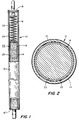
- Figure 1 of the drawing is an elevated or longitudinal view, partly in cross-section, of a nuclear fuel element comprising a composite constructed container or tube housing a column of pellets of nuclear fuel material.
- Figure 2 of the drawing is an enlarge cross-sectional view of the composite fuel container of Figure 1.
- This invention comprises a nuclear fuel container or element of a composite construction consisting of a zirconium alloy tubular fuel retainer having an internal protective barrier liner consisting of zirconium alloyed with minor amounts of iron, chromium and/or nickel.
- the invention additionally comprises a method for producing the composite constructed nuclear fuel container or element including a heat treatment for transforming the microcrystalline structure of the alloy of each component to a higher level of corrosion resistance.
- the fuel element 10 comprises an elongated composite fuel container 12 which typically consists of a tube-like body 14 closed at both ends with welded in place upper and lower end plugs 16 and 16' to provide a sealed enclosure.
- the fuel container 12 consists of a tube 14 of an alloy of zirconium which has been provided with a liner 18 of zirconium metal alloyed with iron and chromium and/or nickel which is metallurgically bonded over the inner surface of the zirconium alloy tube 14 substrate.
- the liner 18 can be provided in a thickness of from about 5 to about 30 percent of the thickness of the composite constructed tube 12, and preferably greater than 40 micrometers thick.
- a core or centrical cylindrical portion of nuclear fuel material 20 housed within the sealed composite fuel container 12, is a core or centrical cylindrical portion of nuclear fuel material 20, here shown as a plurality of fuel pellets of fissionable and/or fertile material stacked in a column.
- Fuel pellets may be of various shapes such as cylindrical pellets or short rods, and the like.
- the core of fuel material 20 and composite container 12 are typically designed so as to provide a gap illustrated as 22 or void between the inner surface of the composite container 12, including the liner 18, and the outer diameter of the fuel core material 20.
- the core of fuel material 20 does not occupy the full length of the composite container 12 as shown.
- the column of pellets forming the fuel core 20 is provided in a length shorter than the composite container 12 whereby there is an end void space or plenum 24 provided.
- the plenum 24 enables longitudinal expansion of the column of fuel material and serves as an area for the accumulation of gaseous products released from the fuel undergoing fission and irradiation.
- retainer means such as a spring 26 is employed positioned within plenum 24 to provide a restraint against the axial movement of the column of fuel, especially during handling and transportation of the fuel element.
- Zircaloy-2 has on a weight basis about 1.5 percent tin; about 0.14 percent iron; about 0.1 percent chromium; and about 0.05 percent nickel, and the balance zirconium.
- Zircaloy-4 has less nickel, but contains slightly more iron than zircaloy-2. Further details regarding these alloys are given in U. S. Letters Patents No. 2,772,969, and No. 3,148,055.
- the protective barrier liner 18 which is metallurgically bonded over the inner surface of the zirconium alloy tube 14 substrate comprises zirconium metal alloyed with about 0.1 weight percent of iron and about 0.05 weight percent chromium and/or about 0.04 weight percent nickel. These alloying additives can generally be varied in amounts of +/- 50 percent each.
- a composite constructed nuclear fuel container consisting of the foregoing described combination of zirconium alloy tube container provided with a protective barrier liner of zirconium metal alloyed with the specified metals and amounts, is subjected to a phase transformation heat treatment to enhance and optimize resistance to corrosion of the metal alloys of the container components, and in particular the metal composition of the liner component.
- the composite constructed fuel container of the specified metal compositions are subjected to a temperature throughout of at least about 865°C, followed by rapid cooling, such as taught in U.S. Letters Patent No. 2,894,866, and in related prior art, for example water quenching.
- the microcrystalline state of the zirconium alloy tubular container is transformed to an alpha plus beta phase while the modified zirconium barrier liner is transformed to the beta phase, and thus a favorable distribution of the alloying constituents formed by the heating is preserved by the rapid cooling from the said phase transforming temperatures of each component.
- a preferred temperature for the phase transforming treatment comprises about 900°C.
- the duration of this phase transforming treatment be carried out as briefly as practical to minimize any possible diffusion of oxygen and/or tin from the zirconium alloy of the tubular container to the metal of the barrier liner.
- the specific heat treated and transformed product should not be subsequently reheated to the transforming temperatures unless followed by the phase preserving rapid cooling.
- subsequent heat treatments such as heat annealing to relieve stresses imposed by working the metals can be safely carried out at temperatures of about 550 to about 650°C.
- Samples of the various specimens were then subjected to steam heat treatment corrosion test generally in accordance with the procedure disclosed in U.S. Letters Patent No. 4,440,862, issued April 3, 1984. Specifically these samples were subjected to test 1 comprising exposure to steam at about 410°C and 1750 psig for four hours, followed by exposure to steam at about 520°C and the same pressure for 16 hours. Other samples were subjected to a different test, test 2, comprising steam at about 400°C at 1500 psig for three days.
- Table 2 summarizes the corrosion results obtained from the two step steam heat treatment of test 1, while Table 3 summarizes the corrosion results produced by the second steam heat treatment of test 2.
- the gain in weight indicates the degree of corrosion.
- Table 2 - Steam Test Results Specimen # Condition Weight Gain mg/dm2 Visual Appearance of Linear 1 Linear 1720 Light Spalling, gray, cracking in 1/32'' pieces 2 Linear 954 Adherent, gray, mottled 3 Linear 919 Spalling, gray 4 Linear 40 Black 5 Linear 1519 Spalling, gray cracking in 1/16'' pieces 1 Container - Spalling, gray 2 Container - Adherent, gray mottled 3 Container - Spalling, gray 4 Container - Black 5 Container - Spalling, gray Table 3 - Test results from 400°C/1500 psig 3 day Steam Test Specimen # Condition Weight Gain mg/dm2 Visual Appearance of Linear 1 Linear 290 Adherent, goldish gray 2 Linear 330 Adherent, gray 3 Linear 65 Milky black 4 Linear 19
Landscapes
- Physics & Mathematics (AREA)
- Engineering & Computer Science (AREA)
- Plasma & Fusion (AREA)
- General Engineering & Computer Science (AREA)
- High Energy & Nuclear Physics (AREA)
- Preventing Corrosion Or Incrustation Of Metals (AREA)
- Laminated Bodies (AREA)
- Manufacture And Refinement Of Metals (AREA)
- Monitoring And Testing Of Nuclear Reactors (AREA)
Applications Claiming Priority (2)
| Application Number | Priority Date | Filing Date | Title |
|---|---|---|---|
| US11559 | 1993-02-01 | ||
| US08/011,559 US5285485A (en) | 1993-02-01 | 1993-02-01 | Composite nuclear fuel container and method for producing same |
Publications (1)
| Publication Number | Publication Date |
|---|---|
| EP0609988A1 true EP0609988A1 (en) | 1994-08-10 |
Family
ID=21750928
Family Applications (1)
| Application Number | Title | Priority Date | Filing Date |
|---|---|---|---|
| EP94300296A Withdrawn EP0609988A1 (en) | 1993-02-01 | 1994-01-17 | Composite nuclear fuel container and method for producing same |
Country Status (5)
| Country | Link |
|---|---|
| US (1) | US5285485A (enExample) |
| EP (1) | EP0609988A1 (enExample) |
| JP (1) | JPH06317688A (enExample) |
| MX (1) | MX9400841A (enExample) |
| TW (1) | TW229314B (enExample) |
Families Citing this family (16)
| Publication number | Priority date | Publication date | Assignee | Title |
|---|---|---|---|---|
| SE506174C2 (sv) * | 1992-12-18 | 1997-11-17 | Asea Atom Ab | Metod att framställa kärnbränsleelement |
| US5341407A (en) * | 1993-07-14 | 1994-08-23 | General Electric Company | Inner liners for fuel cladding having zirconium barriers layers |
| EP1760724A3 (de) * | 1999-03-29 | 2009-03-18 | AREVA NP GmbH | Brennelement für einen Druckwasser-Reaktor und Verfahren zur Herstellung seiner Hüllrohre |
| AU2003220930A1 (en) | 2002-03-29 | 2003-10-13 | Chugai Seiyaku Kabushiki Kaisha | Emthod of screening transporter inhibitor |
| SI1513934T1 (sl) | 2002-06-06 | 2011-06-30 | Oncotherapy Science Inc | Geni in polipeptidi, povezani s humanimi raki kolona |
| ATE492636T1 (de) | 2002-10-22 | 2011-01-15 | Eisai R&D Man Co Ltd | Spezifisch in postmitotischen dopamin- produzierenden neuronalen vorläuferzellen exprimiertes gen |
| US7922065B2 (en) | 2004-08-02 | 2011-04-12 | Ati Properties, Inc. | Corrosion resistant fluid conducting parts, methods of making corrosion resistant fluid conducting parts and equipment and parts replacement methods utilizing corrosion resistant fluid conducting parts |
| TWI406870B (zh) | 2005-02-21 | 2013-09-01 | Chugai Pharmaceutical Co Ltd | A method of making a protein using hamster IGF-1 |
| EP1907859B1 (en) | 2005-07-27 | 2011-03-02 | Oncotherapy Science, Inc. | Genes and polypeptides relating to prostate cancers |
| EP3246407B1 (en) | 2007-02-09 | 2019-04-03 | Eisai R&D Management Co., Ltd. | Gaba neuron progenitor cell marker 65b13 |
| KR101561175B1 (ko) | 2007-08-20 | 2015-10-16 | 온코세라피 사이언스 가부시키가이샤 | Cdh3 펩티드 및 이를 포함하는 의약제 |
| CA2696701C (en) | 2007-08-20 | 2017-01-24 | Oncotherapy Science, Inc. | Cdca1 peptide and pharmaceutical agent comprising the same |
| US8494106B2 (en) * | 2007-11-15 | 2013-07-23 | Global Nuclear Fuel—Americas, LLC | Shipping container for shipping channeled fuel bundles |
| WO2010073972A1 (ja) | 2008-12-22 | 2010-07-01 | エーザイ・アール・アンド・ディー・マネジメント株式会社 | Neph3を用いた膵臓前駆細胞の取得方法 |
| US10118259B1 (en) * | 2012-12-11 | 2018-11-06 | Ati Properties Llc | Corrosion resistant bimetallic tube manufactured by a two-step process |
| CN110853769A (zh) * | 2019-11-21 | 2020-02-28 | 中国核动力研究设计院 | 一种颗粒燃料芯体、燃料棒及金属冷却小型反应堆 |
Citations (4)
| Publication number | Priority date | Publication date | Assignee | Title |
|---|---|---|---|---|
| EP0155167A2 (en) * | 1984-03-14 | 1985-09-18 | Westinghouse Electric Corporation | Cladding tubes for containing nuclear fuel material |
| US4576654A (en) * | 1982-04-15 | 1986-03-18 | General Electric Company | Heat treated tube |
| GB2172737A (en) * | 1985-03-19 | 1986-09-24 | Cezus Co Europ Zirconium | Composite sheath tubes for nuclear fuel and their production |
| EP0353733A2 (en) * | 1988-08-02 | 1990-02-07 | Hitachi, Ltd. | Fuel assembly for nuclear reactor, method for producing the same and structural members for the same |
Family Cites Families (3)
| Publication number | Priority date | Publication date | Assignee | Title |
|---|---|---|---|---|
| US4390497A (en) * | 1979-06-04 | 1983-06-28 | General Electric Company | Thermal-mechanical treatment of composite nuclear fuel element cladding |
| JPS58224139A (ja) * | 1982-06-21 | 1983-12-26 | Hitachi Ltd | 高耐食性ジルコニウム合金 |
| US5223206A (en) * | 1992-06-08 | 1993-06-29 | General Electric Company | Method for producing heat treated composite nuclear fuel containers |
-
1993
- 1993-02-01 US US08/011,559 patent/US5285485A/en not_active Expired - Lifetime
-
1994
- 1994-01-04 TW TW083100026A patent/TW229314B/zh active
- 1994-01-17 EP EP94300296A patent/EP0609988A1/en not_active Withdrawn
- 1994-01-31 JP JP6008962A patent/JPH06317688A/ja not_active Withdrawn
- 1994-02-01 MX MX9400841A patent/MX9400841A/es not_active Application Discontinuation
Patent Citations (4)
| Publication number | Priority date | Publication date | Assignee | Title |
|---|---|---|---|---|
| US4576654A (en) * | 1982-04-15 | 1986-03-18 | General Electric Company | Heat treated tube |
| EP0155167A2 (en) * | 1984-03-14 | 1985-09-18 | Westinghouse Electric Corporation | Cladding tubes for containing nuclear fuel material |
| GB2172737A (en) * | 1985-03-19 | 1986-09-24 | Cezus Co Europ Zirconium | Composite sheath tubes for nuclear fuel and their production |
| EP0353733A2 (en) * | 1988-08-02 | 1990-02-07 | Hitachi, Ltd. | Fuel assembly for nuclear reactor, method for producing the same and structural members for the same |
Also Published As
| Publication number | Publication date |
|---|---|
| TW229314B (enExample) | 1994-09-01 |
| JPH06317688A (ja) | 1994-11-15 |
| MX9400841A (es) | 1994-08-31 |
| US5285485A (en) | 1994-02-08 |
Similar Documents
| Publication | Publication Date | Title |
|---|---|---|
| EP0609988A1 (en) | Composite nuclear fuel container and method for producing same | |
| EP0071193B1 (en) | Process for producing zirconium-based alloy | |
| US4675153A (en) | Zirconium alloy fuel cladding resistant to PCI crack propagation | |
| US5517541A (en) | Inner liners for fuel cladding having zirconium barriers layers | |
| US5383228A (en) | Method for making fuel cladding having zirconium barrier layers and inner liners | |
| US5620536A (en) | Manufacture of zirconium cladding tube with internal liner | |
| US5373541A (en) | Nuclear fuel rod and method of manufacturing the cladding of such a rod | |
| EP0155167B1 (en) | Cladding tubes for containing nuclear fuel material | |
| US4810461A (en) | Zirconium-based alloy with high corrosion resistance | |
| US5838753A (en) | Method of manufacturing zirconium niobium tin alloys for nuclear fuel rods and structural parts for high burnup | |
| US4775508A (en) | Zirconium alloy fuel cladding resistant to PCI crack propagation | |
| EP0399223A1 (en) | Corrosion resistant cladding for nuclear fuel rods | |
| US20090060115A1 (en) | Method, use and device concerning cladding tubes for nuclear fuel and a fuel assembly for a nuclear pressure water reactor | |
| US5844959A (en) | Zirconium niobium tin alloys for nuclear fuel rods and structural parts for high burnup | |
| US4360389A (en) | Zirconium alloy heat treatment process | |
| US5190721A (en) | Zirconium-bismuth-niobium alloy for nuclear fuel cladding barrier | |
| JPH07224373A (ja) | ジルコニウムまたはジルコニウム合金製のバリヤー被覆の耐蝕性を改良する方法 | |
| US4613479A (en) | Water reactor fuel cladding | |
| US5876524A (en) | Method for the manufacture of tubes of a zirconium based alloy for nuclear reactors and their usage | |
| US5223206A (en) | Method for producing heat treated composite nuclear fuel containers | |
| KR940002700B1 (ko) | 수형 원자로용 핵연료 피복관 | |
| US4933136A (en) | Water reactor fuel cladding | |
| KR940003704B1 (ko) | 수형 원자로 연료 피복관 | |
| US7715518B2 (en) | Method, use and device concerning cladding tubes for nuclear fuel and a fuel assembly for a nuclear boiling water reactor | |
| EP0195154B1 (en) | Water reactor fuel cladding tubes |
Legal Events
| Date | Code | Title | Description |
|---|---|---|---|
| PUAI | Public reference made under article 153(3) epc to a published international application that has entered the european phase |
Free format text: ORIGINAL CODE: 0009012 |
|
| AK | Designated contracting states |
Kind code of ref document: A1 Designated state(s): CH DE DK ES IT LI SE |
|
| 17P | Request for examination filed |
Effective date: 19950210 |
|
| GRAG | Despatch of communication of intention to grant |
Free format text: ORIGINAL CODE: EPIDOS AGRA |
|
| 17Q | First examination report despatched |
Effective date: 19960312 |
|
| GRAH | Despatch of communication of intention to grant a patent |
Free format text: ORIGINAL CODE: EPIDOS IGRA |
|
| STAA | Information on the status of an ep patent application or granted ep patent |
Free format text: STATUS: THE APPLICATION IS DEEMED TO BE WITHDRAWN |
|
| 18D | Application deemed to be withdrawn |
Effective date: 19960917 |