EP0609539B1 - Photographic printing paper support - Google Patents
Photographic printing paper support Download PDFInfo
- Publication number
- EP0609539B1 EP0609539B1 EP19930120424 EP93120424A EP0609539B1 EP 0609539 B1 EP0609539 B1 EP 0609539B1 EP 19930120424 EP19930120424 EP 19930120424 EP 93120424 A EP93120424 A EP 93120424A EP 0609539 B1 EP0609539 B1 EP 0609539B1
- Authority
- EP
- European Patent Office
- Prior art keywords
- printing paper
- photographic printing
- paper support
- copolymer
- styrene
- Prior art date
- Legal status (The legal status is an assumption and is not a legal conclusion. Google has not performed a legal analysis and makes no representation as to the accuracy of the status listed.)
- Expired - Lifetime
Links
- 229920001577 copolymer Polymers 0.000 claims description 40
- 150000001875 compounds Chemical class 0.000 claims description 29
- 239000011347 resin Substances 0.000 claims description 27
- 229920005989 resin Polymers 0.000 claims description 26
- 229920005672 polyolefin resin Polymers 0.000 claims description 25
- -1 ethyleneimino Chemical group 0.000 claims description 24
- 239000006185 dispersion Substances 0.000 claims description 22
- VYPSYNLAJGMNEJ-UHFFFAOYSA-N Silicium dioxide Chemical compound O=[Si]=O VYPSYNLAJGMNEJ-UHFFFAOYSA-N 0.000 claims description 19
- 239000000126 substance Substances 0.000 claims description 15
- PPBRXRYQALVLMV-UHFFFAOYSA-N Styrene Chemical compound C=CC1=CC=CC=C1 PPBRXRYQALVLMV-UHFFFAOYSA-N 0.000 claims description 14
- 239000008119 colloidal silica Substances 0.000 claims description 13
- 239000000178 monomer Substances 0.000 claims description 12
- 125000003178 carboxy group Chemical group [H]OC(*)=O 0.000 claims description 10
- 150000003839 salts Chemical class 0.000 claims description 10
- 238000002844 melting Methods 0.000 claims description 9
- 230000008018 melting Effects 0.000 claims description 9
- 239000000758 substrate Substances 0.000 claims description 9
- 239000007787 solid Substances 0.000 claims description 8
- 229910052751 metal Inorganic materials 0.000 claims description 7
- 239000002184 metal Substances 0.000 claims description 7
- 125000004432 carbon atom Chemical group C* 0.000 claims description 6
- 125000000020 sulfo group Chemical group O=S(=O)([*])O[H] 0.000 claims description 6
- NIXOWILDQLNWCW-UHFFFAOYSA-M Acrylate Chemical compound [O-]C(=O)C=C NIXOWILDQLNWCW-UHFFFAOYSA-M 0.000 claims description 5
- 239000004698 Polyethylene Substances 0.000 claims description 5
- 229920006026 co-polymeric resin Polymers 0.000 claims description 5
- FPYJFEHAWHCUMM-UHFFFAOYSA-N maleic anhydride Chemical compound O=C1OC(=O)C=C1 FPYJFEHAWHCUMM-UHFFFAOYSA-N 0.000 claims description 5
- 229920000573 polyethylene Polymers 0.000 claims description 5
- 239000007864 aqueous solution Substances 0.000 claims description 4
- 239000004848 polyfunctional curative Substances 0.000 claims description 4
- 238000006116 polymerization reaction Methods 0.000 claims description 4
- SMZOUWXMTYCWNB-UHFFFAOYSA-N 2-(2-methoxy-5-methylphenyl)ethanamine Chemical compound COC1=CC=C(C)C=C1CCN SMZOUWXMTYCWNB-UHFFFAOYSA-N 0.000 claims description 3
- NIXOWILDQLNWCW-UHFFFAOYSA-N 2-Propenoic acid Natural products OC(=O)C=C NIXOWILDQLNWCW-UHFFFAOYSA-N 0.000 claims description 3
- 239000002253 acid Substances 0.000 claims description 3
- 229910052783 alkali metal Inorganic materials 0.000 claims description 3
- 229920006228 ethylene acrylate copolymer Polymers 0.000 claims description 3
- 229920006242 ethylene acrylic acid copolymer Polymers 0.000 claims description 3
- 125000002887 hydroxy group Chemical group [H]O* 0.000 claims description 3
- 229920000172 poly(styrenesulfonic acid) Polymers 0.000 claims description 3
- 229940005642 polystyrene sulfonic acid Drugs 0.000 claims description 3
- MRAKLTZPBIBWFH-ARJAWSKDSA-N (z)-2-ethenylbut-2-enedioic acid Chemical compound OC(=O)\C=C(\C=C)C(O)=O MRAKLTZPBIBWFH-ARJAWSKDSA-N 0.000 claims description 2
- QGZKDVFQNNGYKY-UHFFFAOYSA-O Ammonium Chemical compound [NH4+] QGZKDVFQNNGYKY-UHFFFAOYSA-O 0.000 claims description 2
- 239000004593 Epoxy Substances 0.000 claims description 2
- JOYRKODLDBILNP-UHFFFAOYSA-N Ethyl urethane Chemical compound CCOC(N)=O JOYRKODLDBILNP-UHFFFAOYSA-N 0.000 claims description 2
- 150000001340 alkali metals Chemical class 0.000 claims description 2
- 125000003368 amide group Chemical group 0.000 claims description 2
- GYZLOYUZLJXAJU-UHFFFAOYSA-N diglycidyl ether Chemical group C1OC1COCC1CO1 GYZLOYUZLJXAJU-UHFFFAOYSA-N 0.000 claims description 2
- 150000002148 esters Chemical group 0.000 claims description 2
- 239000002245 particle Substances 0.000 claims description 2
- DNIAPMSPPWPWGF-GSVOUGTGSA-N (R)-(-)-Propylene glycol Chemical compound C[C@@H](O)CO DNIAPMSPPWPWGF-GSVOUGTGSA-N 0.000 claims 1
- DGAQECJNVWCQMB-PUAWFVPOSA-M Ilexoside XXIX Chemical compound C[C@@H]1CC[C@@]2(CC[C@@]3(C(=CC[C@H]4[C@]3(CC[C@@H]5[C@@]4(CC[C@@H](C5(C)C)OS(=O)(=O)[O-])C)C)[C@@H]2[C@]1(C)O)C)C(=O)O[C@H]6[C@@H]([C@H]([C@@H]([C@H](O6)CO)O)O)O.[Na+] DGAQECJNVWCQMB-PUAWFVPOSA-M 0.000 claims 1
- IQPQWNKOIGAROB-UHFFFAOYSA-N isocyanate group Chemical group [N-]=C=O IQPQWNKOIGAROB-UHFFFAOYSA-N 0.000 claims 1
- XAEFZNCEHLXOMS-UHFFFAOYSA-M potassium benzoate Chemical compound [K+].[O-]C(=O)C1=CC=CC=C1 XAEFZNCEHLXOMS-UHFFFAOYSA-M 0.000 claims 1
- 125000002924 primary amino group Chemical group [H]N([H])* 0.000 claims 1
- 229910052708 sodium Inorganic materials 0.000 claims 1
- 239000011734 sodium Substances 0.000 claims 1
- 239000000123 paper Substances 0.000 description 64
- HEMHJVSKTPXQMS-UHFFFAOYSA-M Sodium hydroxide Chemical compound [OH-].[Na+] HEMHJVSKTPXQMS-UHFFFAOYSA-M 0.000 description 30
- 238000000034 method Methods 0.000 description 21
- 230000000052 comparative effect Effects 0.000 description 15
- 239000000839 emulsion Substances 0.000 description 13
- 238000004061 bleaching Methods 0.000 description 12
- 230000004927 fusion Effects 0.000 description 12
- 239000000203 mixture Substances 0.000 description 12
- 239000002655 kraft paper Substances 0.000 description 10
- KWYUFKZDYYNOTN-UHFFFAOYSA-M Potassium hydroxide Chemical compound [OH-].[K+] KWYUFKZDYYNOTN-UHFFFAOYSA-M 0.000 description 9
- 238000010411 cooking Methods 0.000 description 9
- 230000008569 process Effects 0.000 description 9
- 239000000243 solution Substances 0.000 description 8
- 239000002023 wood Substances 0.000 description 8
- GWEVSGVZZGPLCZ-UHFFFAOYSA-N Titan oxide Chemical compound O=[Ti]=O GWEVSGVZZGPLCZ-UHFFFAOYSA-N 0.000 description 7
- 238000000576 coating method Methods 0.000 description 7
- 230000006872 improvement Effects 0.000 description 7
- 238000011282 treatment Methods 0.000 description 7
- XLYOFNOQVPJJNP-UHFFFAOYSA-N water Substances O XLYOFNOQVPJJNP-UHFFFAOYSA-N 0.000 description 7
- LFQSCWFLJHTTHZ-UHFFFAOYSA-N Ethanol Chemical compound CCO LFQSCWFLJHTTHZ-UHFFFAOYSA-N 0.000 description 6
- OKKJLVBELUTLKV-UHFFFAOYSA-N Methanol Chemical compound OC OKKJLVBELUTLKV-UHFFFAOYSA-N 0.000 description 6
- 239000002216 antistatic agent Substances 0.000 description 6
- 239000003795 chemical substances by application Substances 0.000 description 6
- OSVXSBDYLRYLIG-UHFFFAOYSA-N dioxidochlorine(.) Chemical compound O=Cl=O OSVXSBDYLRYLIG-UHFFFAOYSA-N 0.000 description 6
- 229920001684 low density polyethylene Polymers 0.000 description 6
- 239000004702 low-density polyethylene Substances 0.000 description 6
- 238000010186 staining Methods 0.000 description 6
- 108010010803 Gelatin Proteins 0.000 description 5
- CDBYLPFSWZWCQE-UHFFFAOYSA-L Sodium Carbonate Chemical compound [Na+].[Na+].[O-]C([O-])=O CDBYLPFSWZWCQE-UHFFFAOYSA-L 0.000 description 5
- 239000003513 alkali Substances 0.000 description 5
- 230000008901 benefit Effects 0.000 description 5
- 239000000920 calcium hydroxide Substances 0.000 description 5
- 235000011116 calcium hydroxide Nutrition 0.000 description 5
- 235000014113 dietary fatty acids Nutrition 0.000 description 5
- 238000011156 evaluation Methods 0.000 description 5
- 239000000194 fatty acid Substances 0.000 description 5
- 229930195729 fatty acid Natural products 0.000 description 5
- 150000004665 fatty acids Chemical class 0.000 description 5
- 239000006260 foam Substances 0.000 description 5
- 229920000159 gelatin Polymers 0.000 description 5
- 235000019322 gelatine Nutrition 0.000 description 5
- 235000011852 gelatine desserts Nutrition 0.000 description 5
- 239000003112 inhibitor Substances 0.000 description 5
- 239000000463 material Substances 0.000 description 5
- 229920000098 polyolefin Polymers 0.000 description 5
- VTYYLEPIZMXCLO-UHFFFAOYSA-L Calcium carbonate Chemical compound [Ca+2].[O-]C([O-])=O VTYYLEPIZMXCLO-UHFFFAOYSA-L 0.000 description 4
- VGGSQFUCUMXWEO-UHFFFAOYSA-N Ethene Chemical class C=C VGGSQFUCUMXWEO-UHFFFAOYSA-N 0.000 description 4
- VEXZGXHMUGYJMC-UHFFFAOYSA-N Hydrochloric acid Chemical compound Cl VEXZGXHMUGYJMC-UHFFFAOYSA-N 0.000 description 4
- MHAJPDPJQMAIIY-UHFFFAOYSA-N Hydrogen peroxide Chemical compound OO MHAJPDPJQMAIIY-UHFFFAOYSA-N 0.000 description 4
- BAPJBEWLBFYGME-UHFFFAOYSA-N Methyl acrylate Chemical compound COC(=O)C=C BAPJBEWLBFYGME-UHFFFAOYSA-N 0.000 description 4
- 239000002518 antifoaming agent Substances 0.000 description 4
- 230000015572 biosynthetic process Effects 0.000 description 4
- AXCZMVOFGPJBDE-UHFFFAOYSA-L calcium dihydroxide Chemical compound [OH-].[OH-].[Ca+2] AXCZMVOFGPJBDE-UHFFFAOYSA-L 0.000 description 4
- 229910001861 calcium hydroxide Inorganic materials 0.000 description 4
- 239000011248 coating agent Substances 0.000 description 4
- 238000004040 coloring Methods 0.000 description 4
- 239000000470 constituent Substances 0.000 description 4
- 238000001035 drying Methods 0.000 description 4
- 239000000835 fiber Substances 0.000 description 4
- 239000008273 gelatin Substances 0.000 description 4
- 239000011121 hardwood Substances 0.000 description 4
- WQYVRQLZKVEZGA-UHFFFAOYSA-N hypochlorite Chemical compound Cl[O-] WQYVRQLZKVEZGA-UHFFFAOYSA-N 0.000 description 4
- NLYAJNPCOHFWQQ-UHFFFAOYSA-N kaolin Chemical compound O.O.O=[Al]O[Si](=O)O[Si](=O)O[Al]=O NLYAJNPCOHFWQQ-UHFFFAOYSA-N 0.000 description 4
- 239000000049 pigment Substances 0.000 description 4
- 238000005406 washing Methods 0.000 description 4
- 229920003169 water-soluble polymer Polymers 0.000 description 4
- CSCPPACGZOOCGX-UHFFFAOYSA-N Acetone Chemical compound CC(C)=O CSCPPACGZOOCGX-UHFFFAOYSA-N 0.000 description 3
- QGZKDVFQNNGYKY-UHFFFAOYSA-N Ammonia Chemical compound N QGZKDVFQNNGYKY-UHFFFAOYSA-N 0.000 description 3
- KZBUYRJDOAKODT-UHFFFAOYSA-N Chlorine Chemical compound ClCl KZBUYRJDOAKODT-UHFFFAOYSA-N 0.000 description 3
- 239000004155 Chlorine dioxide Substances 0.000 description 3
- XEKOWRVHYACXOJ-UHFFFAOYSA-N Ethyl acetate Chemical compound CCOC(C)=O XEKOWRVHYACXOJ-UHFFFAOYSA-N 0.000 description 3
- ZMXDDKWLCZADIW-UHFFFAOYSA-N N,N-Dimethylformamide Chemical compound CN(C)C=O ZMXDDKWLCZADIW-UHFFFAOYSA-N 0.000 description 3
- UCKMPCXJQFINFW-UHFFFAOYSA-N Sulphide Chemical compound [S-2] UCKMPCXJQFINFW-UHFFFAOYSA-N 0.000 description 3
- 229910052784 alkaline earth metal Inorganic materials 0.000 description 3
- PNEYBMLMFCGWSK-UHFFFAOYSA-N aluminium oxide Inorganic materials [O-2].[O-2].[O-2].[Al+3].[Al+3] PNEYBMLMFCGWSK-UHFFFAOYSA-N 0.000 description 3
- 239000002585 base Substances 0.000 description 3
- 235000019398 chlorine dioxide Nutrition 0.000 description 3
- KRKNYBCHXYNGOX-UHFFFAOYSA-N citric acid Chemical compound OC(=O)CC(O)(C(O)=O)CC(O)=O KRKNYBCHXYNGOX-UHFFFAOYSA-N 0.000 description 3
- 238000003851 corona treatment Methods 0.000 description 3
- 238000011161 development Methods 0.000 description 3
- 230000018109 developmental process Effects 0.000 description 3
- 229920001903 high density polyethylene Polymers 0.000 description 3
- 239000004700 high-density polyethylene Substances 0.000 description 3
- 239000004615 ingredient Substances 0.000 description 3
- 239000002609 medium Substances 0.000 description 3
- 238000002156 mixing Methods 0.000 description 3
- 239000008188 pellet Substances 0.000 description 3
- 229920002451 polyvinyl alcohol Polymers 0.000 description 3
- 235000019422 polyvinyl alcohol Nutrition 0.000 description 3
- 229910052709 silver Inorganic materials 0.000 description 3
- 239000004332 silver Substances 0.000 description 3
- 239000002002 slurry Substances 0.000 description 3
- OGIDPMRJRNCKJF-UHFFFAOYSA-N titanium oxide Inorganic materials [Ti]=O OGIDPMRJRNCKJF-UHFFFAOYSA-N 0.000 description 3
- MYRTYDVEIRVNKP-UHFFFAOYSA-N 1,2-Divinylbenzene Chemical compound C=CC1=CC=CC=C1C=C MYRTYDVEIRVNKP-UHFFFAOYSA-N 0.000 description 2
- UZKWTJUDCOPSNM-UHFFFAOYSA-N 1-ethenoxybutane Chemical compound CCCCOC=C UZKWTJUDCOPSNM-UHFFFAOYSA-N 0.000 description 2
- JAHNSTQSQJOJLO-UHFFFAOYSA-N 2-(3-fluorophenyl)-1h-imidazole Chemical compound FC1=CC=CC(C=2NC=CN=2)=C1 JAHNSTQSQJOJLO-UHFFFAOYSA-N 0.000 description 2
- KUDUQBURMYMBIJ-UHFFFAOYSA-N 2-prop-2-enoyloxyethyl prop-2-enoate Chemical compound C=CC(=O)OCCOC(=O)C=C KUDUQBURMYMBIJ-UHFFFAOYSA-N 0.000 description 2
- QZPSOSOOLFHYRR-UHFFFAOYSA-N 3-hydroxypropyl prop-2-enoate Chemical compound OCCCOC(=O)C=C QZPSOSOOLFHYRR-UHFFFAOYSA-N 0.000 description 2
- 239000005995 Aluminium silicate Substances 0.000 description 2
- ZKQDCIXGCQPQNV-UHFFFAOYSA-N Calcium hypochlorite Chemical compound [Ca+2].Cl[O-].Cl[O-] ZKQDCIXGCQPQNV-UHFFFAOYSA-N 0.000 description 2
- 239000004215 Carbon black (E152) Substances 0.000 description 2
- ZAMOUSCENKQFHK-UHFFFAOYSA-N Chlorine atom Chemical compound [Cl] ZAMOUSCENKQFHK-UHFFFAOYSA-N 0.000 description 2
- VZCYOOQTPOCHFL-OWOJBTEDSA-N Fumaric acid Chemical compound OC(=O)\C=C\C(O)=O VZCYOOQTPOCHFL-OWOJBTEDSA-N 0.000 description 2
- CSNNHWWHGAXBCP-UHFFFAOYSA-L Magnesium sulfate Chemical compound [Mg+2].[O-][S+2]([O-])([O-])[O-] CSNNHWWHGAXBCP-UHFFFAOYSA-L 0.000 description 2
- 239000004594 Masterbatch (MB) Substances 0.000 description 2
- KFSLWBXXFJQRDL-UHFFFAOYSA-N Peracetic acid Chemical compound CC(=O)OO KFSLWBXXFJQRDL-UHFFFAOYSA-N 0.000 description 2
- NBIIXXVUZAFLBC-UHFFFAOYSA-N Phosphoric acid Chemical compound OP(O)(O)=O NBIIXXVUZAFLBC-UHFFFAOYSA-N 0.000 description 2
- 239000002202 Polyethylene glycol Substances 0.000 description 2
- 239000004743 Polypropylene Substances 0.000 description 2
- 239000004372 Polyvinyl alcohol Substances 0.000 description 2
- WCUXLLCKKVVCTQ-UHFFFAOYSA-M Potassium chloride Chemical compound [Cl-].[K+] WCUXLLCKKVVCTQ-UHFFFAOYSA-M 0.000 description 2
- 229920001131 Pulp (paper) Polymers 0.000 description 2
- FAPWRFPIFSIZLT-UHFFFAOYSA-M Sodium chloride Chemical compound [Na+].[Cl-] FAPWRFPIFSIZLT-UHFFFAOYSA-M 0.000 description 2
- QAOWNCQODCNURD-UHFFFAOYSA-N Sulfuric acid Chemical compound OS(O)(=O)=O QAOWNCQODCNURD-UHFFFAOYSA-N 0.000 description 2
- 239000000654 additive Substances 0.000 description 2
- 230000032683 aging Effects 0.000 description 2
- 150000001336 alkenes Chemical class 0.000 description 2
- 235000012211 aluminium silicate Nutrition 0.000 description 2
- VSCWAEJMTAWNJL-UHFFFAOYSA-K aluminium trichloride Chemical compound Cl[Al](Cl)Cl VSCWAEJMTAWNJL-UHFFFAOYSA-K 0.000 description 2
- IRERQBUNZFJFGC-UHFFFAOYSA-L azure blue Chemical compound [Na+].[Na+].[Na+].[Na+].[Na+].[Na+].[Na+].[Na+].[Al+3].[Al+3].[Al+3].[Al+3].[Al+3].[Al+3].[S-]S[S-].[O-][Si]([O-])([O-])[O-].[O-][Si]([O-])([O-])[O-].[O-][Si]([O-])([O-])[O-].[O-][Si]([O-])([O-])[O-].[O-][Si]([O-])([O-])[O-].[O-][Si]([O-])([O-])[O-] IRERQBUNZFJFGC-UHFFFAOYSA-L 0.000 description 2
- TZCXTZWJZNENPQ-UHFFFAOYSA-L barium sulfate Chemical compound [Ba+2].[O-]S([O-])(=O)=O TZCXTZWJZNENPQ-UHFFFAOYSA-L 0.000 description 2
- 239000011230 binding agent Substances 0.000 description 2
- 239000007844 bleaching agent Substances 0.000 description 2
- 238000005282 brightening Methods 0.000 description 2
- 229910000019 calcium carbonate Inorganic materials 0.000 description 2
- 235000010216 calcium carbonate Nutrition 0.000 description 2
- 239000000460 chlorine Substances 0.000 description 2
- 229910052801 chlorine Inorganic materials 0.000 description 2
- HNEGQIOMVPPMNR-IHWYPQMZSA-N citraconic acid Chemical compound OC(=O)C(/C)=C\C(O)=O HNEGQIOMVPPMNR-IHWYPQMZSA-N 0.000 description 2
- 229940018557 citraconic acid Drugs 0.000 description 2
- 239000004927 clay Substances 0.000 description 2
- 239000008199 coating composition Substances 0.000 description 2
- LDHQCZJRKDOVOX-NSCUHMNNSA-N crotonic acid Chemical compound C\C=C\C(O)=O LDHQCZJRKDOVOX-NSCUHMNNSA-N 0.000 description 2
- 239000000975 dye Substances 0.000 description 2
- STVZJERGLQHEKB-UHFFFAOYSA-N ethylene glycol dimethacrylate Substances CC(=C)C(=O)OCCOC(=O)C(C)=C STVZJERGLQHEKB-UHFFFAOYSA-N 0.000 description 2
- 238000001125 extrusion Methods 0.000 description 2
- 239000010419 fine particle Substances 0.000 description 2
- 230000009477 glass transition Effects 0.000 description 2
- 229930195733 hydrocarbon Natural products 0.000 description 2
- 150000002430 hydrocarbons Chemical class 0.000 description 2
- 230000007062 hydrolysis Effects 0.000 description 2
- 238000006460 hydrolysis reaction Methods 0.000 description 2
- 239000007788 liquid Substances 0.000 description 2
- LVHBHZANLOWSRM-UHFFFAOYSA-N methylenebutanedioic acid Natural products OC(=O)CC(=C)C(O)=O LVHBHZANLOWSRM-UHFFFAOYSA-N 0.000 description 2
- 239000002480 mineral oil Substances 0.000 description 2
- 235000010446 mineral oil Nutrition 0.000 description 2
- 239000003921 oil Substances 0.000 description 2
- 239000003002 pH adjusting agent Substances 0.000 description 2
- YWAKXRMUMFPDSH-UHFFFAOYSA-N pentene Chemical compound CCCC=C YWAKXRMUMFPDSH-UHFFFAOYSA-N 0.000 description 2
- 150000002978 peroxides Chemical class 0.000 description 2
- 229920001223 polyethylene glycol Polymers 0.000 description 2
- 230000000379 polymerizing effect Effects 0.000 description 2
- 229920001155 polypropylene Polymers 0.000 description 2
- 238000002360 preparation method Methods 0.000 description 2
- 238000012545 processing Methods 0.000 description 2
- 239000000047 product Substances 0.000 description 2
- 239000012744 reinforcing agent Substances 0.000 description 2
- 239000000377 silicon dioxide Substances 0.000 description 2
- 235000012239 silicon dioxide Nutrition 0.000 description 2
- 229920002545 silicone oil Polymers 0.000 description 2
- 229910000029 sodium carbonate Inorganic materials 0.000 description 2
- 235000017550 sodium carbonate Nutrition 0.000 description 2
- GEHJYWRUCIMESM-UHFFFAOYSA-L sodium sulfite Chemical compound [Na+].[Na+].[O-]S([O-])=O GEHJYWRUCIMESM-UHFFFAOYSA-L 0.000 description 2
- 239000011122 softwood Substances 0.000 description 2
- 239000000725 suspension Substances 0.000 description 2
- VZCYOOQTPOCHFL-UHFFFAOYSA-N trans-butenedioic acid Natural products OC(=O)C=CC(O)=O VZCYOOQTPOCHFL-UHFFFAOYSA-N 0.000 description 2
- LDHQCZJRKDOVOX-UHFFFAOYSA-N trans-crotonic acid Natural products CC=CC(O)=O LDHQCZJRKDOVOX-UHFFFAOYSA-N 0.000 description 2
- 239000004711 α-olefin Substances 0.000 description 2
- OMDQUFIYNPYJFM-XKDAHURESA-N (2r,3r,4s,5r,6s)-2-(hydroxymethyl)-6-[[(2r,3s,4r,5s,6r)-4,5,6-trihydroxy-3-[(2s,3s,4s,5s,6r)-3,4,5-trihydroxy-6-(hydroxymethyl)oxan-2-yl]oxyoxan-2-yl]methoxy]oxane-3,4,5-triol Chemical compound O[C@@H]1[C@@H](O)[C@@H](O)[C@@H](CO)O[C@@H]1OC[C@@H]1[C@@H](O[C@H]2[C@H]([C@@H](O)[C@H](O)[C@@H](CO)O2)O)[C@H](O)[C@H](O)[C@H](O)O1 OMDQUFIYNPYJFM-XKDAHURESA-N 0.000 description 1
- 229920002818 (Hydroxyethyl)methacrylate Polymers 0.000 description 1
- WBYWAXJHAXSJNI-VOTSOKGWSA-M .beta-Phenylacrylic acid Natural products [O-]C(=O)\C=C\C1=CC=CC=C1 WBYWAXJHAXSJNI-VOTSOKGWSA-M 0.000 description 1
- AKUNSTOMHUXJOZ-UHFFFAOYSA-N 1-hydroperoxybutane Chemical compound CCCCOO AKUNSTOMHUXJOZ-UHFFFAOYSA-N 0.000 description 1
- GOXQRTZXKQZDDN-UHFFFAOYSA-N 2-Ethylhexyl acrylate Chemical compound CCCCC(CC)COC(=O)C=C GOXQRTZXKQZDDN-UHFFFAOYSA-N 0.000 description 1
- WROUWQQRXUBECT-UHFFFAOYSA-N 2-ethylacrylic acid Chemical compound CCC(=C)C(O)=O WROUWQQRXUBECT-UHFFFAOYSA-N 0.000 description 1
- OMIGHNLMNHATMP-UHFFFAOYSA-N 2-hydroxyethyl prop-2-enoate Chemical compound OCCOC(=O)C=C OMIGHNLMNHATMP-UHFFFAOYSA-N 0.000 description 1
- OFNISBHGPNMTMS-UHFFFAOYSA-N 3-methylideneoxolane-2,5-dione Chemical compound C=C1CC(=O)OC1=O OFNISBHGPNMTMS-UHFFFAOYSA-N 0.000 description 1
- DBCAQXHNJOFNGC-UHFFFAOYSA-N 4-bromo-1,1,1-trifluorobutane Chemical compound FC(F)(F)CCCBr DBCAQXHNJOFNGC-UHFFFAOYSA-N 0.000 description 1
- RSWGJHLUYNHPMX-UHFFFAOYSA-N Abietic-Saeure Natural products C12CCC(C(C)C)=CC2=CCC2C1(C)CCCC2(C)C(O)=O RSWGJHLUYNHPMX-UHFFFAOYSA-N 0.000 description 1
- HRPVXLWXLXDGHG-UHFFFAOYSA-N Acrylamide Chemical compound NC(=O)C=C HRPVXLWXLXDGHG-UHFFFAOYSA-N 0.000 description 1
- VHUUQVKOLVNVRT-UHFFFAOYSA-N Ammonium hydroxide Chemical compound [NH4+].[OH-] VHUUQVKOLVNVRT-UHFFFAOYSA-N 0.000 description 1
- UXVMQQNJUSDDNG-UHFFFAOYSA-L Calcium chloride Chemical compound [Cl-].[Cl-].[Ca+2] UXVMQQNJUSDDNG-UHFFFAOYSA-L 0.000 description 1
- OKTJSMMVPCPJKN-UHFFFAOYSA-N Carbon Chemical compound [C] OKTJSMMVPCPJKN-UHFFFAOYSA-N 0.000 description 1
- 229920000049 Carbon (fiber) Polymers 0.000 description 1
- 229920002134 Carboxymethyl cellulose Polymers 0.000 description 1
- WBYWAXJHAXSJNI-SREVYHEPSA-N Cinnamic acid Chemical compound OC(=O)\C=C/C1=CC=CC=C1 WBYWAXJHAXSJNI-SREVYHEPSA-N 0.000 description 1
- 229920000089 Cyclic olefin copolymer Polymers 0.000 description 1
- BRLQWZUYTZBJKN-UHFFFAOYSA-N Epichlorohydrin Chemical compound ClCC1CO1 BRLQWZUYTZBJKN-UHFFFAOYSA-N 0.000 description 1
- JIGUQPWFLRLWPJ-UHFFFAOYSA-N Ethyl acrylate Chemical compound CCOC(=O)C=C JIGUQPWFLRLWPJ-UHFFFAOYSA-N 0.000 description 1
- 229920000926 Galactomannan Polymers 0.000 description 1
- WOBHKFSMXKNTIM-UHFFFAOYSA-N Hydroxyethyl methacrylate Chemical compound CC(=C)C(=O)OCCO WOBHKFSMXKNTIM-UHFFFAOYSA-N 0.000 description 1
- VQTUBCCKSQIDNK-UHFFFAOYSA-N Isobutene Chemical group CC(C)=C VQTUBCCKSQIDNK-UHFFFAOYSA-N 0.000 description 1
- 229920000914 Metallic fiber Polymers 0.000 description 1
- CERQOIWHTDAKMF-UHFFFAOYSA-N Methacrylic acid Chemical compound CC(=C)C(O)=O CERQOIWHTDAKMF-UHFFFAOYSA-N 0.000 description 1
- CNCOEDDPFOAUMB-UHFFFAOYSA-N N-Methylolacrylamide Chemical compound OCNC(=O)C=C CNCOEDDPFOAUMB-UHFFFAOYSA-N 0.000 description 1
- 229920003171 Poly (ethylene oxide) Polymers 0.000 description 1
- OFOBLEOULBTSOW-UHFFFAOYSA-N Propanedioic acid Natural products OC(=O)CC(O)=O OFOBLEOULBTSOW-UHFFFAOYSA-N 0.000 description 1
- KHPCPRHQVVSZAH-HUOMCSJISA-N Rosin Natural products O(C/C=C/c1ccccc1)[C@H]1[C@H](O)[C@@H](O)[C@@H](O)[C@@H](CO)O1 KHPCPRHQVVSZAH-HUOMCSJISA-N 0.000 description 1
- 239000004115 Sodium Silicate Substances 0.000 description 1
- PMZURENOXWZQFD-UHFFFAOYSA-L Sodium Sulfate Chemical compound [Na+].[Na+].[O-]S([O-])(=O)=O PMZURENOXWZQFD-UHFFFAOYSA-L 0.000 description 1
- 229920002472 Starch Polymers 0.000 description 1
- LSNNMFCWUKXFEE-UHFFFAOYSA-N Sulfurous acid Chemical compound OS(O)=O LSNNMFCWUKXFEE-UHFFFAOYSA-N 0.000 description 1
- 238000007754 air knife coating Methods 0.000 description 1
- 150000001298 alcohols Chemical class 0.000 description 1
- 150000001342 alkaline earth metals Chemical class 0.000 description 1
- 150000003973 alkyl amines Chemical class 0.000 description 1
- AZDRQVAHHNSJOQ-UHFFFAOYSA-N alumane Chemical class [AlH3] AZDRQVAHHNSJOQ-UHFFFAOYSA-N 0.000 description 1
- 229910052782 aluminium Inorganic materials 0.000 description 1
- XAGFODPZIPBFFR-UHFFFAOYSA-N aluminium Chemical compound [Al] XAGFODPZIPBFFR-UHFFFAOYSA-N 0.000 description 1
- 229910000147 aluminium phosphate Inorganic materials 0.000 description 1
- DIZPMCHEQGEION-UHFFFAOYSA-H aluminium sulfate (anhydrous) Chemical compound [Al+3].[Al+3].[O-]S([O-])(=O)=O.[O-]S([O-])(=O)=O.[O-]S([O-])(=O)=O DIZPMCHEQGEION-UHFFFAOYSA-H 0.000 description 1
- 125000003277 amino group Chemical group 0.000 description 1
- 229910021529 ammonia Inorganic materials 0.000 description 1
- 239000002280 amphoteric surfactant Chemical class 0.000 description 1
- 150000008064 anhydrides Chemical class 0.000 description 1
- 125000000129 anionic group Chemical group 0.000 description 1
- 239000003945 anionic surfactant Substances 0.000 description 1
- PYKYMHQGRFAEBM-UHFFFAOYSA-N anthraquinone Natural products CCC(=O)c1c(O)c2C(=O)C3C(C=CC=C3O)C(=O)c2cc1CC(=O)OC PYKYMHQGRFAEBM-UHFFFAOYSA-N 0.000 description 1
- 230000003254 anti-foaming effect Effects 0.000 description 1
- 229940053200 antiepileptics fatty acid derivative Drugs 0.000 description 1
- 239000003963 antioxidant agent Substances 0.000 description 1
- 230000003078 antioxidant effect Effects 0.000 description 1
- 239000012736 aqueous medium Substances 0.000 description 1
- 239000012298 atmosphere Substances 0.000 description 1
- WDIHJSXYQDMJHN-UHFFFAOYSA-L barium chloride Chemical compound [Cl-].[Cl-].[Ba+2] WDIHJSXYQDMJHN-UHFFFAOYSA-L 0.000 description 1
- 229910001626 barium chloride Inorganic materials 0.000 description 1
- 239000011324 bead Substances 0.000 description 1
- 238000010009 beating Methods 0.000 description 1
- 238000007664 blowing Methods 0.000 description 1
- CQEYYJKEWSMYFG-UHFFFAOYSA-N butyl acrylate Chemical compound CCCCOC(=O)C=C CQEYYJKEWSMYFG-UHFFFAOYSA-N 0.000 description 1
- 239000001110 calcium chloride Substances 0.000 description 1
- 229910001628 calcium chloride Inorganic materials 0.000 description 1
- 239000006229 carbon black Substances 0.000 description 1
- 239000004917 carbon fiber Substances 0.000 description 1
- 239000001768 carboxy methyl cellulose Substances 0.000 description 1
- 235000010948 carboxy methyl cellulose Nutrition 0.000 description 1
- 239000008112 carboxymethyl-cellulose Substances 0.000 description 1
- 125000002091 cationic group Chemical group 0.000 description 1
- 239000003093 cationic surfactant Substances 0.000 description 1
- 229920006319 cationized starch Polymers 0.000 description 1
- 229920002678 cellulose Polymers 0.000 description 1
- 235000010980 cellulose Nutrition 0.000 description 1
- 239000007795 chemical reaction product Substances 0.000 description 1
- 235000013985 cinnamic acid Nutrition 0.000 description 1
- 229930016911 cinnamic acid Natural products 0.000 description 1
- 239000000084 colloidal system Substances 0.000 description 1
- 238000007334 copolymerization reaction Methods 0.000 description 1
- 229910052593 corundum Inorganic materials 0.000 description 1
- 238000004132 cross linking Methods 0.000 description 1
- 229910002026 crystalline silica Inorganic materials 0.000 description 1
- 238000007766 curtain coating Methods 0.000 description 1
- 125000004386 diacrylate group Chemical group 0.000 description 1
- 239000000539 dimer Substances 0.000 description 1
- 238000003618 dip coating Methods 0.000 description 1
- NJLLQSBAHIKGKF-UHFFFAOYSA-N dipotassium dioxido(oxo)titanium Chemical compound [K+].[K+].[O-][Ti]([O-])=O NJLLQSBAHIKGKF-UHFFFAOYSA-N 0.000 description 1
- 208000028659 discharge Diseases 0.000 description 1
- 238000004090 dissolution Methods 0.000 description 1
- 239000003995 emulsifying agent Substances 0.000 description 1
- 230000002708 enhancing effect Effects 0.000 description 1
- 238000005530 etching Methods 0.000 description 1
- BEFDCLMNVWHSGT-UHFFFAOYSA-N ethenylcyclopentane Chemical compound C=CC1CCCC1 BEFDCLMNVWHSGT-UHFFFAOYSA-N 0.000 description 1
- 230000007717 exclusion Effects 0.000 description 1
- 238000000605 extraction Methods 0.000 description 1
- 239000000945 filler Substances 0.000 description 1
- 239000001530 fumaric acid Substances 0.000 description 1
- 125000000524 functional group Chemical group 0.000 description 1
- 239000007789 gas Substances 0.000 description 1
- 239000000499 gel Substances 0.000 description 1
- 125000003055 glycidyl group Chemical group C(C1CO1)* 0.000 description 1
- VOZRXNHHFUQHIL-UHFFFAOYSA-N glycidyl methacrylate Chemical compound CC(=C)C(=O)OCC1CO1 VOZRXNHHFUQHIL-UHFFFAOYSA-N 0.000 description 1
- 150000002334 glycols Chemical class 0.000 description 1
- 229910002804 graphite Inorganic materials 0.000 description 1
- 239000010439 graphite Substances 0.000 description 1
- HNMCSUXJLGGQFO-UHFFFAOYSA-N hexaaluminum;hexasodium;tetrathietane;hexasilicate Chemical compound [Na+].[Na+].[Na+].[Na+].[Na+].[Na+].[Al+3].[Al+3].[Al+3].[Al+3].[Al+3].[Al+3].S1SSS1.S1SSS1.[O-][Si]([O-])([O-])[O-].[O-][Si]([O-])([O-])[O-].[O-][Si]([O-])([O-])[O-].[O-][Si]([O-])([O-])[O-].[O-][Si]([O-])([O-])[O-].[O-][Si]([O-])([O-])[O-] HNMCSUXJLGGQFO-UHFFFAOYSA-N 0.000 description 1
- 229920001519 homopolymer Polymers 0.000 description 1
- 230000003301 hydrolyzing effect Effects 0.000 description 1
- 230000002209 hydrophobic effect Effects 0.000 description 1
- 150000004679 hydroxides Chemical class 0.000 description 1
- 230000002401 inhibitory effect Effects 0.000 description 1
- 239000001023 inorganic pigment Substances 0.000 description 1
- 239000012948 isocyanate Substances 0.000 description 1
- 150000002513 isocyanates Chemical class 0.000 description 1
- 229920005610 lignin Polymers 0.000 description 1
- 239000000314 lubricant Substances 0.000 description 1
- VTHJTEIRLNZDEV-UHFFFAOYSA-L magnesium dihydroxide Chemical compound [OH-].[OH-].[Mg+2] VTHJTEIRLNZDEV-UHFFFAOYSA-L 0.000 description 1
- 239000000347 magnesium hydroxide Substances 0.000 description 1
- 229910001862 magnesium hydroxide Inorganic materials 0.000 description 1
- 229910052943 magnesium sulfate Inorganic materials 0.000 description 1
- 235000019341 magnesium sulphate Nutrition 0.000 description 1
- VZCYOOQTPOCHFL-UPHRSURJSA-N maleic acid Chemical compound OC(=O)\C=C/C(O)=O VZCYOOQTPOCHFL-UPHRSURJSA-N 0.000 description 1
- 239000011976 maleic acid Substances 0.000 description 1
- 238000004519 manufacturing process Methods 0.000 description 1
- 229920001179 medium density polyethylene Polymers 0.000 description 1
- 239000004701 medium-density polyethylene Substances 0.000 description 1
- 239000000155 melt Substances 0.000 description 1
- HNEGQIOMVPPMNR-NSCUHMNNSA-N mesaconic acid Chemical compound OC(=O)C(/C)=C/C(O)=O HNEGQIOMVPPMNR-NSCUHMNNSA-N 0.000 description 1
- 229910044991 metal oxide Inorganic materials 0.000 description 1
- 150000004706 metal oxides Chemical class 0.000 description 1
- WBYWAXJHAXSJNI-UHFFFAOYSA-N methyl p-hydroxycinnamate Natural products OC(=O)C=CC1=CC=CC=C1 WBYWAXJHAXSJNI-UHFFFAOYSA-N 0.000 description 1
- HNEGQIOMVPPMNR-UHFFFAOYSA-N methylfumaric acid Natural products OC(=O)C(C)=CC(O)=O HNEGQIOMVPPMNR-UHFFFAOYSA-N 0.000 description 1
- OMNKZBIFPJNNIO-UHFFFAOYSA-N n-(2-methyl-4-oxopentan-2-yl)prop-2-enamide Chemical compound CC(=O)CC(C)(C)NC(=O)C=C OMNKZBIFPJNNIO-UHFFFAOYSA-N 0.000 description 1
- 150000004767 nitrides Chemical class 0.000 description 1
- QJGQUHMNIGDVPM-UHFFFAOYSA-N nitrogen group Chemical group [N] QJGQUHMNIGDVPM-UHFFFAOYSA-N 0.000 description 1
- 239000002736 nonionic surfactant Substances 0.000 description 1
- JRZJOMJEPLMPRA-UHFFFAOYSA-N olefin Natural products CCCCCCCC=C JRZJOMJEPLMPRA-UHFFFAOYSA-N 0.000 description 1
- 150000001451 organic peroxides Chemical class 0.000 description 1
- 229920000620 organic polymer Polymers 0.000 description 1
- 238000007500 overflow downdraw method Methods 0.000 description 1
- PNJWIWWMYCMZRO-UHFFFAOYSA-N pent‐4‐en‐2‐one Natural products CC(=O)CC=C PNJWIWWMYCMZRO-UHFFFAOYSA-N 0.000 description 1
- 239000003208 petroleum Substances 0.000 description 1
- 229920002401 polyacrylamide Polymers 0.000 description 1
- 229920001083 polybutene Polymers 0.000 description 1
- 229920000642 polymer Polymers 0.000 description 1
- 239000005077 polysulfide Substances 0.000 description 1
- 229920001021 polysulfide Polymers 0.000 description 1
- 150000008117 polysulfides Polymers 0.000 description 1
- 229920000036 polyvinylpyrrolidone Polymers 0.000 description 1
- 239000001267 polyvinylpyrrolidone Substances 0.000 description 1
- 235000013855 polyvinylpyrrolidone Nutrition 0.000 description 1
- 239000001103 potassium chloride Substances 0.000 description 1
- 235000011164 potassium chloride Nutrition 0.000 description 1
- 159000000001 potassium salts Chemical class 0.000 description 1
- 239000000843 powder Substances 0.000 description 1
- BDERNNFJNOPAEC-UHFFFAOYSA-N propan-1-ol Chemical compound CCCO BDERNNFJNOPAEC-UHFFFAOYSA-N 0.000 description 1
- LYBIZMNPXTXVMV-UHFFFAOYSA-N propan-2-yl prop-2-enoate Chemical compound CC(C)OC(=O)C=C LYBIZMNPXTXVMV-UHFFFAOYSA-N 0.000 description 1
- 238000004537 pulping Methods 0.000 description 1
- 150000003242 quaternary ammonium salts Chemical class 0.000 description 1
- 230000000717 retained effect Effects 0.000 description 1
- 238000007761 roller coating Methods 0.000 description 1
- 238000006748 scratching Methods 0.000 description 1
- 230000002393 scratching effect Effects 0.000 description 1
- 239000013049 sediment Substances 0.000 description 1
- RMAQACBXLXPBSY-UHFFFAOYSA-N silicic acid Chemical compound O[Si](O)(O)O RMAQACBXLXPBSY-UHFFFAOYSA-N 0.000 description 1
- 238000004513 sizing Methods 0.000 description 1
- 239000012279 sodium borohydride Substances 0.000 description 1
- 229910000033 sodium borohydride Inorganic materials 0.000 description 1
- 239000011780 sodium chloride Substances 0.000 description 1
- PFUVRDFDKPNGAV-UHFFFAOYSA-N sodium peroxide Chemical compound [Na+].[Na+].[O-][O-] PFUVRDFDKPNGAV-UHFFFAOYSA-N 0.000 description 1
- 159000000000 sodium salts Chemical class 0.000 description 1
- NTHWMYGWWRZVTN-UHFFFAOYSA-N sodium silicate Chemical compound [Na+].[Na+].[O-][Si]([O-])=O NTHWMYGWWRZVTN-UHFFFAOYSA-N 0.000 description 1
- 229910052911 sodium silicate Inorganic materials 0.000 description 1
- 229910052938 sodium sulfate Inorganic materials 0.000 description 1
- 229910052979 sodium sulfide Inorganic materials 0.000 description 1
- GRVFOGOEDUUMBP-UHFFFAOYSA-N sodium sulfide (anhydrous) Chemical compound [Na+].[Na+].[S-2] GRVFOGOEDUUMBP-UHFFFAOYSA-N 0.000 description 1
- 235000011152 sodium sulphate Nutrition 0.000 description 1
- 235000010265 sodium sulphite Nutrition 0.000 description 1
- 239000002904 solvent Substances 0.000 description 1
- 235000010199 sorbic acid Nutrition 0.000 description 1
- 239000004334 sorbic acid Substances 0.000 description 1
- 229940075582 sorbic acid Drugs 0.000 description 1
- 239000007921 spray Substances 0.000 description 1
- 239000003381 stabilizer Substances 0.000 description 1
- 239000008107 starch Substances 0.000 description 1
- 235000019698 starch Nutrition 0.000 description 1
- 150000003440 styrenes Chemical class 0.000 description 1
- 125000001174 sulfone group Chemical group 0.000 description 1
- 239000004094 surface-active agent Substances 0.000 description 1
- 229920002994 synthetic fiber Polymers 0.000 description 1
- 239000012209 synthetic fiber Substances 0.000 description 1
- 239000000454 talc Substances 0.000 description 1
- 229910052623 talc Inorganic materials 0.000 description 1
- 239000002562 thickening agent Substances 0.000 description 1
- 239000004408 titanium dioxide Substances 0.000 description 1
- KHPCPRHQVVSZAH-UHFFFAOYSA-N trans-cinnamyl beta-D-glucopyranoside Natural products OC1C(O)C(O)C(CO)OC1OCC=CC1=CC=CC=C1 KHPCPRHQVVSZAH-UHFFFAOYSA-N 0.000 description 1
- 238000012546 transfer Methods 0.000 description 1
- 235000013799 ultramarine blue Nutrition 0.000 description 1
- 235000013311 vegetables Nutrition 0.000 description 1
- KAKZBPTYRLMSJV-UHFFFAOYSA-N vinyl-ethylene Natural products C=CC=C KAKZBPTYRLMSJV-UHFFFAOYSA-N 0.000 description 1
- 230000000007 visual effect Effects 0.000 description 1
- 239000001993 wax Substances 0.000 description 1
- 229910001845 yogo sapphire Inorganic materials 0.000 description 1
- XOOUIPVCVHRTMJ-UHFFFAOYSA-L zinc stearate Chemical compound [Zn+2].CCCCCCCCCCCCCCCCCC([O-])=O.CCCCCCCCCCCCCCCCCC([O-])=O XOOUIPVCVHRTMJ-UHFFFAOYSA-L 0.000 description 1
Classifications
-
- G—PHYSICS
- G03—PHOTOGRAPHY; CINEMATOGRAPHY; ANALOGOUS TECHNIQUES USING WAVES OTHER THAN OPTICAL WAVES; ELECTROGRAPHY; HOLOGRAPHY
- G03C—PHOTOSENSITIVE MATERIALS FOR PHOTOGRAPHIC PURPOSES; PHOTOGRAPHIC PROCESSES, e.g. CINE, X-RAY, COLOUR, STEREO-PHOTOGRAPHIC PROCESSES; AUXILIARY PROCESSES IN PHOTOGRAPHY
- G03C1/00—Photosensitive materials
- G03C1/76—Photosensitive materials characterised by the base or auxiliary layers
- G03C1/7614—Cover layers; Backing layers; Base or auxiliary layers characterised by means for lubricating, for rendering anti-abrasive or for preventing adhesion
-
- D—TEXTILES; PAPER
- D21—PAPER-MAKING; PRODUCTION OF CELLULOSE
- D21H—PULP COMPOSITIONS; PREPARATION THEREOF NOT COVERED BY SUBCLASSES D21C OR D21D; IMPREGNATING OR COATING OF PAPER; TREATMENT OF FINISHED PAPER NOT COVERED BY CLASS B31 OR SUBCLASS D21G; PAPER NOT OTHERWISE PROVIDED FOR
- D21H19/00—Coated paper; Coating material
- D21H19/80—Paper comprising more than one coating
- D21H19/84—Paper comprising more than one coating on both sides of the substrate
-
- G—PHYSICS
- G03—PHOTOGRAPHY; CINEMATOGRAPHY; ANALOGOUS TECHNIQUES USING WAVES OTHER THAN OPTICAL WAVES; ELECTROGRAPHY; HOLOGRAPHY
- G03C—PHOTOSENSITIVE MATERIALS FOR PHOTOGRAPHIC PURPOSES; PHOTOGRAPHIC PROCESSES, e.g. CINE, X-RAY, COLOUR, STEREO-PHOTOGRAPHIC PROCESSES; AUXILIARY PROCESSES IN PHOTOGRAPHY
- G03C1/00—Photosensitive materials
- G03C1/76—Photosensitive materials characterised by the base or auxiliary layers
- G03C1/775—Photosensitive materials characterised by the base or auxiliary layers the base being of paper
- G03C1/79—Macromolecular coatings or impregnations therefor, e.g. varnishes
-
- G—PHYSICS
- G03—PHOTOGRAPHY; CINEMATOGRAPHY; ANALOGOUS TECHNIQUES USING WAVES OTHER THAN OPTICAL WAVES; ELECTROGRAPHY; HOLOGRAPHY
- G03C—PHOTOSENSITIVE MATERIALS FOR PHOTOGRAPHIC PURPOSES; PHOTOGRAPHIC PROCESSES, e.g. CINE, X-RAY, COLOUR, STEREO-PHOTOGRAPHIC PROCESSES; AUXILIARY PROCESSES IN PHOTOGRAPHY
- G03C1/00—Photosensitive materials
- G03C1/76—Photosensitive materials characterised by the base or auxiliary layers
- G03C1/95—Photosensitive materials characterised by the base or auxiliary layers rendered opaque or writable, e.g. with inert particulate additives
-
- Y—GENERAL TAGGING OF NEW TECHNOLOGICAL DEVELOPMENTS; GENERAL TAGGING OF CROSS-SECTIONAL TECHNOLOGIES SPANNING OVER SEVERAL SECTIONS OF THE IPC; TECHNICAL SUBJECTS COVERED BY FORMER USPC CROSS-REFERENCE ART COLLECTIONS [XRACs] AND DIGESTS
- Y10—TECHNICAL SUBJECTS COVERED BY FORMER USPC
- Y10T—TECHNICAL SUBJECTS COVERED BY FORMER US CLASSIFICATION
- Y10T428/00—Stock material or miscellaneous articles
- Y10T428/25—Web or sheet containing structurally defined element or component and including a second component containing structurally defined particles
- Y10T428/256—Heavy metal or aluminum or compound thereof
-
- Y—GENERAL TAGGING OF NEW TECHNOLOGICAL DEVELOPMENTS; GENERAL TAGGING OF CROSS-SECTIONAL TECHNOLOGIES SPANNING OVER SEVERAL SECTIONS OF THE IPC; TECHNICAL SUBJECTS COVERED BY FORMER USPC CROSS-REFERENCE ART COLLECTIONS [XRACs] AND DIGESTS
- Y10—TECHNICAL SUBJECTS COVERED BY FORMER USPC
- Y10T—TECHNICAL SUBJECTS COVERED BY FORMER US CLASSIFICATION
- Y10T428/00—Stock material or miscellaneous articles
- Y10T428/25—Web or sheet containing structurally defined element or component and including a second component containing structurally defined particles
- Y10T428/258—Alkali metal or alkaline earth metal or compound thereof
-
- Y—GENERAL TAGGING OF NEW TECHNOLOGICAL DEVELOPMENTS; GENERAL TAGGING OF CROSS-SECTIONAL TECHNOLOGIES SPANNING OVER SEVERAL SECTIONS OF THE IPC; TECHNICAL SUBJECTS COVERED BY FORMER USPC CROSS-REFERENCE ART COLLECTIONS [XRACs] AND DIGESTS
- Y10—TECHNICAL SUBJECTS COVERED BY FORMER USPC
- Y10T—TECHNICAL SUBJECTS COVERED BY FORMER US CLASSIFICATION
- Y10T428/00—Stock material or miscellaneous articles
- Y10T428/26—Web or sheet containing structurally defined element or component, the element or component having a specified physical dimension
-
- Y—GENERAL TAGGING OF NEW TECHNOLOGICAL DEVELOPMENTS; GENERAL TAGGING OF CROSS-SECTIONAL TECHNOLOGIES SPANNING OVER SEVERAL SECTIONS OF THE IPC; TECHNICAL SUBJECTS COVERED BY FORMER USPC CROSS-REFERENCE ART COLLECTIONS [XRACs] AND DIGESTS
- Y10—TECHNICAL SUBJECTS COVERED BY FORMER USPC
- Y10T—TECHNICAL SUBJECTS COVERED BY FORMER US CLASSIFICATION
- Y10T428/00—Stock material or miscellaneous articles
- Y10T428/31504—Composite [nonstructural laminate]
- Y10T428/31855—Of addition polymer from unsaturated monomers
- Y10T428/3188—Next to cellulosic
- Y10T428/31895—Paper or wood
Definitions
- the present invention relates to a photographic printing paper support which has an excellent water-resisting property and, in particular, to a support for photographic printing paper which ensures improved ink-printability on the back side thereof and satisfactory spliceability in the splicing operation utilizing ultrasonic waves or thermal fusion.
- raw paper has so far been used as a substrate for photographic printing paper.
- both sides thereof are generally covered with polyolefin resins, such as polyethylene.
- the photographic printing paper support using a polyolefin-covered raw paper as described above is coated with photographic emulsions on one side thereof. This side of the support is called “front side”.
- the other side of the support on which any photographic emulsions are not coated is called "back side”.
- the typewriting has caused a trouble such that the typed ink was eluted into a processing bath, the color thereof faded to such an extent as not to fully perform its function, or it partly transferred onto the emulsion layer side when the photographic material was wound up into a roll.
- the photographic printing paper support comprising a polyolefin-covered waterproof substrate having on the back side thereof a written letter-retaining layer constituted of a styrene-acrylate copolymer containing binder and an inorganic pigment (e.g., crystalline silica, colloidal silica) dispersed therein and
- the silver halide photographic material containing a carboxyl or sulfo group-containing compound in a backing layer thereof mainly for improvement in antistatic property have been proposed [in JP-A-62-6256 (the term “JP-A” as used herein means an "unexamined published Japanese patent application”) and JP-B-03-28696 (the term “JP-B” as used herein means an "examined Japanese patent publication), respectively].
- EP-A-0421764 discloses a support for photographic printing paper comprising a back layer comprising a) colloidal silica, b) an aqueous dispersion of a styrene-acrylate copolymer formed by polymerization in the presence of a water-soluble polymer and c) a water-soluble polymer containing a carboxylic group or a sulfone group, a salt thereof or a hydrophilic organic polymer colloid.
- the back layer provides improved water-resistance and improved writing and printing surface on the back of the support.
- photographic printing paper is manufactured by applying various photographic layers to a support generally measuring 1 to 2 meters in width, cut into sheets or rolls with a long length depending on the end-use purpose thereof, and then marketed.
- cut pieces of printing paper are overlapped with an appropriate width when they have a length less than the desired roll length, and the overlapped part thereof is thermally fused by a splicing method using ultrasonic waves or so on to splice the cut pieces.
- the thermal fusion method whether it uses ultrasonic wave irradiation or heat application, has a drawback such that it cannot ensure a satisfactorily spliced state to the overlapped part thereof because photographic layers including emulsion layers and coatings on the back side are present between two polyolefin resin-covered supports to adhere to each other.
- an object of the present invention is to provide a photographic printing paper support which has not only good typewriting qualities but also high spliceability.
- a photographic printing paper support comprising a waterproof substrate constituted of raw paper and polyolefin resin coats covering the both surfaces thereof, said substrate further having on the back side a backing layer containing at least (a) colloidal silica, (b) an aqueous dispersion of a styrene-acrylate copolymer prepared by the polymerization in the presence of a water-soluble high-molecular compound, (c) at least one substance selected from among carboxyl or sulfo group-containing water-soluble high-molecular compounds, the metal salts thereof and hydrophilic organic high-molecular colloidal substances, and (d) an aqueous dispersion of a polyolefin resin having a melting point below 100°C.
- Colloidal silica used as the component (a) in the present invention is a colloidal solution in which superfine grains of silicon dioxide is dispersed using water as a main dispersing medium. Therein, it is desirable that the average size of the grains be in the range of 5 to 50 ⁇ m. This is because the colloidal silica is too ready to gel when it has an excessively fine grain size, while it tends to sediment when the grain size thereof is too large.
- the coverage of the colloidal silica ranges from 0.04 to 1.0 g/m 2 , preferably from 0.06 to 0.5 g/m 2 , on a solids basis. When the colloidal silica has a too small coverage the antistatic property yielded thereby is insufficient, while it cannot provide the strength necessary for coating formation and the desired printability when the coverage thereof is too great.
- colloidal silica examples include various kinds of silica sol suspensions on the market, such as Rudox HS®, Rudox AS® (products of E.I. Du Pont de Nemours & Co. Inc.), Snowtex 20®, Snowtex 30® and Snowtex C® (products of Nissan Chemicals Industries, Ltd.).
- the present invention uses an aqueous dispersion of a styrene-acrylate copolymer as the component (b), which functions as a binder.
- the coverage of the component (b) ranges from 0.05 to 2.0 g/m 2 , preferably from 0.1 to 1.0 g/m 2 , on a solids basis.
- the styrene/acrylate ratio ranges from 90/10 to 10/90 by mole. Since the copolymer having a styrene fraction greater than 90 mole% is too high in glass transition temperature, it cannot form a satisfactory film under ordinary drying condition. The unsatisfactory film formation is apt to result in weak adhesion to the polyolefin layer. On the other hand, the copolymer having a styrene fraction less than 10 mole% has a too low glass transition temperature. Therefore, the resulting backing layer tends to cause adhesion troubles such that it adheres to the raw paper surface when wound up in the production process of polyolefin-covered paper and to the emulsion layer when wound up after the emulsion application.
- an acrylate which can be used examples include esters of acrylic acid and aliphatic alcohols containing 1 to 8 carbon atoms, such as methyl acrylate, ethyl acrylate, isopropyl acrylate, butyl acrylate, hydroxypropyl acrylate, 2-hydroxyethyl acrylate, and 2-ethylhexyl acrylate.
- the copolymer may contain as additional constituent monomer(s) a cross-linking divinyl compound, such as ethylene glycol diacrylate, polyethylene glycol diacrylate, ethylene glycol dimethacrylate, polyethylene glycol dimethacrylate, divinylbenzene, a nitrogen-containing monomer, such as N-methylol acrylamide, acrylamide, diacetone acrylamide, a carboxyl group-containing monomer, such as acrylic acid, methacrylic acid, itaconic acid, crotonic acid, sorbic acid, cinnamic acid, citraconic acid, mesaconic acid, maleic acid, fumaric acid, ethacrylic acid, maleic anhydride, it
- the copolymer used in the present invention is prepared by polymerizing constituent monomers as described above in the presence of a water-soluble high-molecular compound.
- the water-soluble high-molecular compound used herein can be properly chosen from known ones, provided that they don't have any polymerizable unsaturated bonds. Specific examples of such a water-soluble high-molecular compound include a styrene-maleic acid copolymer, polyvinyl alcohol, polyvinylpyrrolidone, carboxymethyl cellulose, and gelatin. Of these compounds, a styrene-maleic acid copolymer (including modified ones) is preferred over others.
- Styrene and an acrylate are copolymerized in a water medium in which a water-soluble high-molecular compound as cited above is dissolved.
- the copolymer can be obtained in the form of fine-particle dispersion.
- the concentration of a water-soluble high-molecular compound in the water medium be in the range of 5 to 50 %, particularly 10 to 30 %.
- the styrene-acrylate copolymer have a concentration ranging from 20 to 70 % in an emulsified state.
- the aqueous dispersion of the copolymer can optionally contain a lubricant, an emulsifier, an antioxidant, an aging inhibitor, a stabilizer, a hardener, and an antistatic agent.
- the component (c) of the backing layer is added in order to prevent the adhesion of foul substances to the back side of photographic printing paper, namely, as an antistatic agent.
- the coverage of the component (c) ranges from 0.01 to 1.0 g/m 2 , preferably from 0.02 to 0.2 g/m 2 , on a solids basis.
- the present invention uses as the component (c) at least one compound selected from among carboxyl or sulfo group-containing water-soluble high-molecular compounds and/or the metal salts thereof, and hydrophilic organic high-molecular colloidal substances and/or the salts thereof.
- those preferred in the present invention are copolymers of maleic anhydride and unsaturated copolymerizable monomers containing at least 4 carbon atoms, such as ethylene series unsaturated monomers including ⁇ -olefins containing at least 4 carbon atoms, alkyl vinyl ethers, and styrenes.
- These high-molecular compounds can be converted to salts by undergoing hydrolysis in the presence of an alkali such as sodium hydroxide, and potassium hydroxide, if desired.
- the copolymers of maleic anhydride and unsaturated copolymerizable monomers containing at least 4 carbon atoms desirably have a molecular weight of from 2,000 to 150,000.
- a copolymer can be a reaction product obtained by hydrolyzing the copolymer of maleic anhydride and a copolymerizable monomer such as isobutylene, 1-pentene, butyl vinyl ether or styrene in the presence of an alkali such as sodium hydroxide, and potassium hydroxide. In the hydrolysis, the copolymer solution is adjusted to pH 5.0-9.0.
- the carboxyl group-containing water-soluble high molecular compounds can include a copolymer of styrene and itaconic or crotonic acid, a copolymer of methylacrylate and citraconic acid, and the salts of these copolymers.
- sulfo group-containing water-soluble high-molecular compounds those having a molecular weight of from 5,000 to 1,000,000 are preferred.
- Specific examples of such compounds include polystyrenesulfonic acid, polyvinylbenzylsulfonic acid, sodium salts thereof, and potassium salts thereof.
- the aqueous solution or dispersion of a carboxyl-modified polyethylene or the alkali metal, ammonium, and amine salt thereof can be used to particular advantage.
- the polyolefin resin having a melting point below 100 °C which is used as the component (d) of the backing layer can be properly chosen from known polyolefin resins whose melting points are below 100 °C.
- resins include an ethylene-acrylic acid copolymer resin, an ethylene-maleic acid copolymer resin, an ethylene-acrylate copolymer resin, and resins obtained by modifying polyolefin resins, such as polyethylene, and polypropylene, with a hydroxyl group, a carboxyl group, an amino group, an amido group, an epoxy, an alkoxysilane group, or other functional groups including urethane, and isocyanate.
- an ethylene-acrylate copolymer resin is preferred in particular.
- An aqueous dispersion of the polyolefin resin can be easily obtained in accordance with a known method using a surfactant and a water-soluble high-molecular compound.
- the particle size of the dispersed polyolefin resin range from 0.01 to 0. 5 ⁇ m from the standpoints of mechanical strength of the backing layer and influence of the backing layer on the surface properties of the emulsion side in the form of rolled-up photographic printing paper.
- the coverage of the component (d) ranges from 0.01 to 1.0 g/m 2 , preferably from 0.02 to 0.2 g/m 2 , on a solids basis.
- the ratio (a)/(b)/(c)/(d) be in the range of (2-10)/(4-15)/(1-3)/(1-3) by weight.
- the backing layer further contain as a hardener a compound containing at least two ethyleneimino groups or glycidyl ether groups in a molecule.
- a hardener a compound containing at least two ethyleneimino groups or glycidyl ether groups in a molecule.
- Specific examples of such a compound include those disclosed in JP-B-03-28696.
- the agent be dissolved in advance into an appropriate solvent, such as water, methanol, ethanol, N,N-dimethylformamide, acetone, and ethyl acetate.
- an appropriate solvent such as water, methanol, ethanol, N,N-dimethylformamide, acetone, and ethyl acetate.
- Raw paper which can be used in the present invention has no particular limitation. More specifically, not only raw paper made mainly from natural pulp but also those made from mixtures of natural pulp with a synthetic fiber or pulp, in which the mixing ratio between them can be arbitrarily chosen, can be used depending on the end-use purpose.
- wood kraft pulp including softwood kraft pulp, hardwood kraft pulp and mixtures thereof are preferred.
- the wood kraft pulp may be prepared using any of cooking methods including polysulfide cooking, batch cooking and continuous cooking. In the preparation thereof, the cooking may be carried out till an appropriate hardening degree or a Kappa number is attained. Also, the wood kraft pulp may be prepared using the enzymatically pulping method disclosed in JP-B-59-38575.
- Wood chips are cooked with a suspension containing sodium hydroxide and sodium sulfide as chemical components in order to remove lignin therefrom, and in the presence of an anti-foaming agent or a foam inhibitor the resulting matter is separated into pulp fibers and the cooking residue (black liquor), followed by washing and bleaching treatments.
- the cooking liquor used may further contain a cooking assistant as a chemical component other than sodium hydroxide and sodium sulfite.
- a cooking assistant include salts such as sodium carbonate, sodium sulfate, slaked lime, calcium carbonate, sodium borohydride, and anthraquinone compounds.
- the natural kraft pulp may be used together with another natural pulp, if needed.
- the natural pulp used together to particular advantage is wood sulfide pulp including softwood sulfide pulp, hardwood sulfide pulp and mixtures thereof. Also, wood soda pulp and wood dissolution pulp can be used together with the natural kraft pulp.
- the anti-foaming agent or the foam inhibitor used in the step of bleaching pulp can be properly chosen from known ones. More specifically, there can be used those containing as an effective component an ester compound of a higher fatty acid and an alcohol, mineral oil, liquid hydrocarbon oil or silicone oil, as disclosed, e.g., in JP-A-54-59404, JP-A-58-220896, JP-A-61-245391, JP-A-61-245319, U.S. Patent 3,923,638 and U.S. Patent 4,107,073.
- water-base or oil-base compositions containing mineral oil or liquid hydrocarbon oil as a main component are particularly preferable in respect of the anti-foaming or foam-inhibiting power.
- Anti-foaming agents or foam inhibitors as cited above may further contain ingredients such as hydrophobic silica, ethylenebis(higher alkylamide), and silicone oil.
- ingredients such as hydrophobic silica, ethylenebis(higher alkylamide), and silicone oil.
- Chlorine bleaching in the preparation of natural pulp is carried out using chlorine gas or chlorine water. Therein, chlorine dioxide may be used together.
- sodium hydroxide is used to advantage, but calcium hydroxide, ammonia, and a mixture thereof can also be used.
- hypochlorite bleaching it is preferable to use a bleaching powder prepared by causing chlorine gas to react with slaked lime, especially a hypochlorite bleaching powder prepared by blowing chlorine gas into milk of lime or a dilute sodium hydroxide solution (the so-called calcium-hypo bleaching solution or sodium-hypo bleaching solution) from an industrial point of view.
- chlorine dioxide prepared by a sulfite process such as Mathieson process, New Mathieson process, Erust process, C.I.P. process, etc.
- a hydrochloric acid process such as a Kesting process, Nisso process, and Sorvay process
- inorganic or organic peroxides such as hydrogen peroxide, sodium peroxide, a peroxide bleaching solution (an aqueous solution containing a mixture of hydrogen peroxide, sodium hydroxide and sodium silicate, if necessary, to which magnesium sulfate is added), peracetic acid, 1-butylhydroperoxide, and mixtures of two or more thereof can be favorably used.
- a peroxide bleaching solution an aqueous solution containing a mixture of hydrogen peroxide, sodium hydroxide and sodium silicate, if necessary, to which magnesium sulfate is added
- peracetic acid 1-butylhydroperoxide
- alkali used therein include hydroxides of alkali and alkaline earth metals, such as sodium hydroxide, potassium hydroxide, aqueous ammonia, magnesium hydroxide, calcium hydroxide, and mixtures of two or more thereof.
- the bleaching treatment can be carried out under a condition properly chosen from those described, e.g., in a book entitled “Pulp Shori oyobi Hyohaku (which means “Pulp Processing and Bleaching"), compiled by Kami Pulp Gijutsu Kyokai, published in January 27, 1968; and JP-B-58-43732.
- Various additives can be incorporated in the substrate of the present invention in the step of preparing a paper stock slurry.
- a sizing agent chosen from among metal salts of fatty acids and/or fatty acids, the alkylketene dimer emulsions or epoxidized higher fatty acid amides disclosed in JP-B-62-7534, alkenyl- or alkylsuccinic anhydride emulsions, rosin derivatives, a dry paper strength reinforcing agent chosen from among anionic, cationic or amphoteric polyalcrylamides, polyvinyl alcohol, cationized starch (as disclosed, e.
- JP-A-03-171042 vegetable galactomannan, a wet paper strength reinforcing agent chosen from among polyaminepolyamide epichlorohydrin resins, a filler chosen from among clay, kaolin, calcium carbonate, titanium oxide, a fixing agent chosen from among water-soluble aluminum salts, including aluminum chloride and aluminum sulfate, a pH modifier chosen from among sodium hydroxide, sodium carbonate, sulfuric acid, and/or a coloring pigment, a coloring dye, and a brightening agent as disclosed, e.g., in JP-A-63-204251 and JP-A-01-266537.
- additives including various water-soluble polymers, and antistatic agents can be applied to raw paper with a spray or a tub size press.
- Water-soluble polymers suitable for the application include the starch type polymers disclosed in JP-A-01-266537, polyvinyl alcohols, gelatins, polyacrylamides and celluloses; and antistatic agents suitable therefor are conductive substances such as nonionic surfactants represented by polyoxyethylene glycols, anionic surfactants, cationic surfactants represented by quaternary ammonium salts, amphoteric surfactants, alkylamine derivatives, fatty acid derivatives, various kinds of waxes, carbon black, graphite, metal surface covering pigments, metal powders, metal flakes, carbon fibers, metallic fibers, and whiskers (including potassium titanate, alumina nitride and alumina).
- antistatic agent examples include alkali metal salts such as sodium chloride, potassium chloride, alkaline earth metal salts such as calcium chloride, barium chloride, colloidal metal oxides such as colloidal silica, organic antistatic agents such as polystyrenesulfonic acid salts.
- latexes or emulsions such as petroleum resin emulsions, styrene-acrylic acid-acrylate copolymer latexes, styrene-acrylic acid-butadiene copolymer latexes, styrene-vinyl acetate copolymer latexes, styrene-maleic acid-acrylate copolymer latexes, pigments such as clay, kaolin, talc, barium sulfate, titanium dioxide, pH modifiers such as hydrochloric acid, phosphoric acid, citric acid, sodium hydroxide, and/or coloring pigments, coloring dyes, and brightening agents as described above.
- latexes or emulsions such as petroleum resin emulsions, styrene-acrylic acid-acrylate copolymer latexes, styrene-acrylic acid-butadiene copolymer latexes, styrene
- raw paper preferred in particular is the raw paper disclosed in JP-A-04-97365, which is prepared by making paper from paper stock containing an epoxidized fatty acid amide and adjusted to pH 5.5-6.5, controlling the water content in the paper to 1-4% by weight, and then performing a surface size treatment with an alkaline aqueous solution to adjust the pH of paper surface to the range of 7 to 8.
- the raw paper used in the present invention have a smooth surface such that the Bekk smoothness thereof is at least 100 seconds, particularly at least 200 seconds, based on the definition of JIS P8119.
- wood pulp containing hardwood pulp in a large proportion is generally used. This is because hardwood pulp is made up of short fibers which are advantageous to the formation of a smooth surface. Further, the wood pulp is beaten with a beater so that the proportion of long fibers therein may become as small as possible.
- the fiber lengths of the beaten pulp may correspond to a 354 ⁇ m (42-mesh) residue of 20 to 40 % and a water leakiness of 20 to 350 CSF.
- the paper stock slurry, to which internal chemicals are added in advance, is made into paper.
- the paper-making is carried out so as to obtain uniform formation using a commonly used paper machine such as Fourdrinier paper machine, and a cylinder paper machine in accordance with an appropriate paper-making method as disclosed, e.g., in JP-A-58-37642, JP-A-61-260240 and JP-A-61-284762.
- the thus made paper is processed with a machine calender, a super calender, and a heat calender.
- raw paper having a Bekk smoothness of at least 100 seconds can be prepared.
- the raw paper used in the present invention does not have any particular limitation on thickness, but it is desirable for the raw paper to have a basis weight of from 40 to 250 g/m 2 .
- Suitable examples of polyolefin resins covering the both surfaces of raw paper include olefin homopolymers such as a low density polyethylene, a medium density polyethylene, a high density polyethylene, polypropylene, polybutene, polypentene, copolymers of olefins such as an ethylene-propylene copolymer, and mixtures of two or more thereof.
- olefin homopolymers such as a low density polyethylene, a medium density polyethylene, a high density polyethylene, polypropylene, polybutene, polypentene, copolymers of olefins such as an ethylene-propylene copolymer, and mixtures of two or more thereof.
- low density polyethylene resins especially ethylene- ⁇ -olefin copolymer resins having a density of from 0.870 to 0.915 g/cm 3 , are preferred over others.
- the layers may differ from one another in property and constituent resins. For instance, it is possible to use a resin having MFR of from 5 to 20 g/10 min for the top layer of the resin coat and a resin having MFR of from 2 to 10 g/10 min for the bottom layer of the resin coat.
- a water-base composition is applied to the polyolefin resin coat.
- various alcohols such as methanol, ethanol, may be added to the composition, if needed.
- the backing layer may be provided using any of well-known coating methods, including a dip coating method, an air-knife coating method, a curtain coating method, and a roller coating method.
- the backing layer is not particularly restricted as to its thickness. However, the thickness ranging from 0.1 to 3 ⁇ m suffices to perform functions of the backing layer.
- the aqueous dispersion of a polyolefin resin having a melting point of 100 °C at the highest is incorporated in the backing layer formed on the back side of a waterproof substrate having polyolefin resin coats on both sides.
- This aqueous dispersion incorporated in the backing layer of the present support for photographic printing paper not only enables an improvement in ink printability of the backing layer but also can enhance the spliceabilty of photographic printing paper in a splicing operation utilizing thermal fusion with ultrasonic waves. Therefore, even when ink is printed on the back side of the photographic printing paper according to the present invention, there occurs no transfer of the ink onto the silver halide photographic emulsion layer thereof. In addition, satisfactory splicing can be achieved between polyolefin resin coats when the photographic printing paper according to the present invention undergoes a splice operation.
- Raw paper was covered with a 15 ⁇ m-thick resin coat on the front side by applying thereto the composition prepared by throughly mixing:
- the former layer was disposed nearer to the raw paper than the latter layer.
- the back surface of the thus obtained substrate was subjected to a corona discharge treatment, and then provided with a backing layer having a thickness of 0.5 ⁇ m by coating thereon each of the aqueous coating compositions shown in Table 1 with a gravure coater, followed by drying.
- a gravure coater for photographic printing paper support
- the resin coat as the front surface of each support sample was subjected to a corona discharge treatment at 15 KV ⁇ A, and then was coated thereon 10 mg/m 2 of gelatin by means of a gravure coater, followed by drying.
- gelatin coat On the surface of the thus formed gelatin coat was coated an emulsion for color photographic printing paper in accordance with a slide bead coating method to prepare a sample of color photographic printing paper.
- Letters are typewritten on the backing layer of a sample with an impact printer installed in an automatic printer. Then, the resulting sample is processed with a roller transport processor, and observed the appearance of the typewritten letters, thereby judging whether or not the typewritten letters are retained in a good condition.
- a sample of photographic printing paper is processed with a roller transport processor wherein a color-developing step (30°C; 3 min. 30 sec.), a bleaching step (30 °C; 1 min. 30 sec.), a washing step (30 °C; 3 min.) and a drying step (80 °C; 20 sec.) are involved and blackish brown stain having generated in the color developer by ageing has adhered to the rollers set therein.
- the processed sample is examined as to whether or not the blackish brown stain is transferred onto the back side of the sample when the surfaces of the sample are pressed against the stained surfaces of the rollers. The extent of transferred stain is judged by visual observation.
- two sheets of 8.9 cm-wide sample of photographic printing paper are overlapped with each other at the top edge part thereof so as to have an overlap of 5 mm in width, and an 5 mm-wide ultrasonic oscillator generating the ultrasonic wave having a frequency of 28 KHz and an amplitude of 30 ⁇ m is pressed against the overlapped part for 30 seconds as a pressure of 20 Kg/cm 2 is applied thereto, thereby splicing the two sheets.
- the thus spliced sample is processed with a roller transport processor, and then observed to what extent the spliced part is delaminated, thereby judging the spliceability of the sample.
- two sheets of 8.9 cm-wide sample of photographic printing paper are overlapped with each other at the top edge part thereof so as to have an overlap of 5 mm in width, and the overlapped part is heated at 130 °C for 20 seconds with an 5 mm-wide aluminum heater as the heater is pressed against the overlapped part under a pressure of 20 Kg/cm 2 , thereby splicing the two sheets.
- the thus spliced sample is processed with a roller transport processor, and then observed to what extent the spliced part is delaminated, thereby judging the spliceability of the sample.
- the backing layer of a sample Prior to color development, the backing layer of a sample is examined for intrinsic surface resistance in the atmosphere of 20°C and 35% RH, thereby judging the anti-static property thereof.
- the backing layer of the present photographic printing paper support (Example 1) was good in all the properties, namely (1) ink receptivity, (2) anti-staining property, (3) ultrasonic spliceability, (4) thermal fusion spliceability and (5) antistatic property.
- the backing layer of Comparative Example 1 was found to be inferior in (3) ultrasonic spliceability and (4) thermal fusion spliceability. This result indicates that the addition of the aqueous dispersion of a polyolefin resin can produce improvements of (3) ultrasonic spliceability and (4) thermal fusion spliceability.
- Comparative Example 2 was found to be inferior to that of Example 1 in (1) ink receptivity and (4) thermal fusion spliceability. This result indicates that bad ink receptivity and unsatisfactory thermal fusion spliceability are due to the use of gelatin instead of the aqueous dispersion of a styrene-acrylate copolymer as well as the exclusion of a polyolefin resin.
Landscapes
- Physics & Mathematics (AREA)
- Chemical & Material Sciences (AREA)
- Engineering & Computer Science (AREA)
- Materials Engineering (AREA)
- General Physics & Mathematics (AREA)
- Spectroscopy & Molecular Physics (AREA)
- Paper (AREA)
Description
- The present invention relates to a photographic printing paper support which has an excellent water-resisting property and, in particular, to a support for photographic printing paper which ensures improved ink-printability on the back side thereof and satisfactory spliceability in the splicing operation utilizing ultrasonic waves or thermal fusion.
- In general, raw paper has so far been used as a substrate for photographic printing paper. For the purpose of imparting a water-resisting property to raw paper, both sides thereof are generally covered with polyolefin resins, such as polyethylene. The photographic printing paper support using a polyolefin-covered raw paper as described above is coated with photographic emulsions on one side thereof. This side of the support is called "front side". The other side of the support on which any photographic emulsions are not coated is called "back side".
- In case of a roll-form silver halide photographic material, letters and/or marks have often been typewritten on a backing layer provided on the back side thereof in order to clearly indicate the boundary between neighbouring image planes in anticipation of the photographic material's being automatically cut into image planes or in order to write image information on each image plane.
- Therein, the typewriting has caused a trouble such that the typed ink was eluted into a processing bath, the color thereof faded to such an extent as not to fully perform its function, or it partly transferred onto the emulsion layer side when the photographic material was wound up into a roll.
- Under these circumstances, some proposals have been made with the intention of imparting satisfactory penciling and typewriting qualities to photographic printing paper. For instance, (i) the photographic printing paper support comprising a polyolefin-covered waterproof substrate having on the back side thereof a written letter-retaining layer constituted of a styrene-acrylate copolymer containing binder and an inorganic pigment (e.g., crystalline silica, colloidal silica) dispersed therein and (ii) the silver halide photographic material containing a carboxyl or sulfo group-containing compound in a backing layer thereof mainly for improvement in antistatic property have been proposed [in JP-A-62-6256 (the term "JP-A" as used herein means an "unexamined published Japanese patent application") and JP-B-03-28696 (the term "JP-B" as used herein means an "examined Japanese patent publication), respectively]. However, those materials can be still improved upon typewriting quality. EP-A-0421764 discloses a support for photographic printing paper comprising a back layer comprising a) colloidal silica, b) an aqueous dispersion of a styrene-acrylate copolymer formed by polymerization in the presence of a water-soluble polymer and c) a water-soluble polymer containing a carboxylic group or a sulfone group, a salt thereof or a hydrophilic organic polymer colloid. The back layer provides improved water-resistance and improved writing and printing surface on the back of the support.
- Meanwhile, photographic printing paper is manufactured by applying various photographic layers to a support generally measuring 1 to 2 meters in width, cut into sheets or rolls with a long length depending on the end-use purpose thereof, and then marketed.
- In supplying roll-form printing papers with a long length, cut pieces of printing paper are overlapped with an appropriate width when they have a length less than the desired roll length, and the overlapped part thereof is thermally fused by a splicing method using ultrasonic waves or so on to splice the cut pieces.
- In case of broad photographic printing paper, however, the thermal fusion method, whether it uses ultrasonic wave irradiation or heat application, has a drawback such that it cannot ensure a satisfactorily spliced state to the overlapped part thereof because photographic layers including emulsion layers and coatings on the back side are present between two polyolefin resin-covered supports to adhere to each other.
- As a result of our intensive studies for solving the above-described problems, it has been found out that not only an improved typewriting quality but also enhanced spliceability upon thermal fusion utilizing ultrasonic waves or so on can be obtained by forming a backing layer on the back side of a waterproof support comprising raw paper covered with polyolefin resins on both sides thereof and further by using in said backing layer an aqueous dispersion of polyolefin resin having a melting point below 100°C, thus achieving the present invention.
- Therefore, an object of the present invention is to provide a photographic printing paper support which has not only good typewriting qualities but also high spliceability.
- The above-described object of the present invention is attained with a photographic printing paper support comprising a waterproof substrate constituted of raw paper and polyolefin resin coats covering the both surfaces thereof, said substrate further having on the back side a backing layer containing at least (a) colloidal silica, (b) an aqueous dispersion of a styrene-acrylate copolymer prepared by the polymerization in the presence of a water-soluble high-molecular compound, (c) at least one substance selected from among carboxyl or sulfo group-containing water-soluble high-molecular compounds, the metal salts thereof and hydrophilic organic high-molecular colloidal substances, and (d) an aqueous dispersion of a polyolefin resin having a melting point below 100°C.
- Colloidal silica used as the component (a) in the present invention is a colloidal solution in which superfine grains of silicon dioxide is dispersed using water as a main dispersing medium. Therein, it is desirable that the average size of the grains be in the range of 5 to 50 µm. This is because the colloidal silica is too ready to gel when it has an excessively fine grain size, while it tends to sediment when the grain size thereof is too large. The coverage of the colloidal silica ranges from 0.04 to 1.0 g/m2, preferably from 0.06 to 0.5 g/m2, on a solids basis. When the colloidal silica has a too small coverage the antistatic property yielded thereby is insufficient, while it cannot provide the strength necessary for coating formation and the desired printability when the coverage thereof is too great.
- Examples of colloidal silica as described above include various kinds of silica sol suspensions on the market, such as Rudox HS®, Rudox AS® (products of E.I. Du Pont de Nemours & Co. Inc.), Snowtex 20®, Snowtex 30® and Snowtex C® (products of Nissan Chemicals Industries, Ltd.).
- In addition to the above-described colloidal silica, the present invention uses an aqueous dispersion of a styrene-acrylate copolymer as the component (b), which functions as a binder.
- The coverage of the component (b) ranges from 0.05 to 2.0 g/m2, preferably from 0.1 to 1.0 g/m2, on a solids basis.
- In the foregoing copolymer, it is desirable that the styrene/acrylate ratio ranges from 90/10 to 10/90 by mole. Since the copolymer having a styrene fraction greater than 90 mole% is too high in glass transition temperature, it cannot form a satisfactory film under ordinary drying condition. The unsatisfactory film formation is apt to result in weak adhesion to the polyolefin layer. On the other hand, the copolymer having a styrene fraction less than 10 mole% has a too low glass transition temperature. Therefore, the resulting backing layer tends to cause adhesion troubles such that it adheres to the raw paper surface when wound up in the production process of polyolefin-covered paper and to the emulsion layer when wound up after the emulsion application.
- Examples of an acrylate which can be used include esters of acrylic acid and aliphatic alcohols containing 1 to 8 carbon atoms, such as methyl acrylate, ethyl acrylate, isopropyl acrylate, butyl acrylate, hydroxypropyl acrylate, 2-hydroxyethyl acrylate, and 2-ethylhexyl acrylate.
- For the purposes of heightening the adhesiveness of the foregoing copolymer to polyolefins, enhancing the stability of the coating composition for the backing layer as well as the stability of the copolymer dispersion and improving waterproof, chemical proof and heat-resisting properties of the backing layer, the copolymer may contain as additional constituent monomer(s) a cross-linking divinyl compound, such as ethylene glycol diacrylate, polyethylene glycol diacrylate, ethylene glycol dimethacrylate, polyethylene glycol dimethacrylate, divinylbenzene, a nitrogen-containing monomer, such as N-methylol acrylamide, acrylamide, diacetone acrylamide, a carboxyl group-containing monomer, such as acrylic acid, methacrylic acid, itaconic acid, crotonic acid, sorbic acid, cinnamic acid, citraconic acid, mesaconic acid, maleic acid, fumaric acid, ethacrylic acid, maleic anhydride, itaconic anhydride, or/and a glycidyl group-containing monomer such as glycidyl methacrylate, or a hydroxyl group-containing monomer such as hydroxyethyl methacrylate, and hydroxypropyl acrylate.
- The copolymer used in the present invention is prepared by polymerizing constituent monomers as described above in the presence of a water-soluble high-molecular compound. The water-soluble high-molecular compound used herein can be properly chosen from known ones, provided that they don't have any polymerizable unsaturated bonds. Specific examples of such a water-soluble high-molecular compound include a styrene-maleic acid copolymer, polyvinyl alcohol, polyvinylpyrrolidone, carboxymethyl cellulose, and gelatin. Of these compounds, a styrene-maleic acid copolymer (including modified ones) is preferred over others.
- Styrene and an acrylate are copolymerized in a water medium in which a water-soluble high-molecular compound as cited above is dissolved. As a result of it, the copolymer can be obtained in the form of fine-particle dispersion. In the copolymerization, it is desirable that the concentration of a water-soluble high-molecular compound in the water medium be in the range of 5 to 50 %, particularly 10 to 30 %.
- Further, it is desirable that the styrene-acrylate copolymer have a concentration ranging from 20 to 70 % in an emulsified state.
- The aqueous dispersion of the copolymer can optionally contain a lubricant, an emulsifier, an antioxidant, an aging inhibitor, a stabilizer, a hardener, and an antistatic agent.
- The component (c) of the backing layer is added in order to prevent the adhesion of foul substances to the back side of photographic printing paper, namely, as an antistatic agent. The coverage of the component (c) ranges from 0.01 to 1.0 g/m2, preferably from 0.02 to 0.2 g/m2, on a solids basis.
- The present invention uses as the component (c) at least one compound selected from among carboxyl or sulfo group-containing water-soluble high-molecular compounds and/or the metal salts thereof, and hydrophilic organic high-molecular colloidal substances and/or the salts thereof.
- As for the carboxyl group-containing water-soluble high molecular compounds, those preferred in the present invention are copolymers of maleic anhydride and unsaturated copolymerizable monomers containing at least 4 carbon atoms, such as ethylene series unsaturated monomers including α -olefins containing at least 4 carbon atoms, alkyl vinyl ethers, and styrenes. These high-molecular compounds can be converted to salts by undergoing hydrolysis in the presence of an alkali such as sodium hydroxide, and potassium hydroxide, if desired.
- The copolymers of maleic anhydride and unsaturated copolymerizable monomers containing at least 4 carbon atoms desirably have a molecular weight of from 2,000 to 150,000. Specifically, such a copolymer can be a reaction product obtained by hydrolyzing the copolymer of maleic anhydride and a copolymerizable monomer such as isobutylene, 1-pentene, butyl vinyl ether or styrene in the presence of an alkali such as sodium hydroxide, and potassium hydroxide. In the hydrolysis, the copolymer solution is adjusted to pH 5.0-9.0. In addition to the copolymers described above, the carboxyl group-containing water-soluble high molecular compounds can include a copolymer of styrene and itaconic or crotonic acid, a copolymer of methylacrylate and citraconic acid, and the salts of these copolymers.
- As for the sulfo group-containing water-soluble high-molecular compounds, those having a molecular weight of from 5,000 to 1,000,000 are preferred. Specific examples of such compounds include polystyrenesulfonic acid, polyvinylbenzylsulfonic acid, sodium salts thereof, and potassium salts thereof.
- As for the hydrophilic organic high-molecular colloidal substances, the aqueous solution or dispersion of a carboxyl-modified polyethylene or the alkali metal, ammonium, and amine salt thereof can be used to particular advantage.
- The polyolefin resin having a melting point below 100 °C which is used as the component (d) of the backing layer can be properly chosen from known polyolefin resins whose melting points are below 100 °C. Specific examples of such resins include an ethylene-acrylic acid copolymer resin, an ethylene-maleic acid copolymer resin, an ethylene-acrylate copolymer resin, and resins obtained by modifying polyolefin resins, such as polyethylene, and polypropylene, with a hydroxyl group, a carboxyl group, an amino group, an amido group, an epoxy, an alkoxysilane group, or other functional groups including urethane, and isocyanate. Of these resins, an ethylene-acrylate copolymer resin is preferred in particular.
- An aqueous dispersion of the polyolefin resin can be easily obtained in accordance with a known method using a surfactant and a water-soluble high-molecular compound. Therein, it is desirable that the particle size of the dispersed polyolefin resin range from 0.01 to 0. 5 µm from the standpoints of mechanical strength of the backing layer and influence of the backing layer on the surface properties of the emulsion side in the form of rolled-up photographic printing paper.
- When it is intended to prepare the fine-particle dispersion of the polyolefin resin, a method of polymerizing or copolymerizing constituent monomer(s) in an aqueous medium in which a water-soluble high-molecular compound is dissolved is used to advantage, similarly to the foregoing case of styrene-acrylate copolymers.
- The coverage of the component (d) ranges from 0.01 to 1.0 g/m2, preferably from 0.02 to 0.2 g/m2, on a solids basis.
- With respect to the blending ratio of the above-described components (a), (b), (c) and (d), it is desirable that the ratio (a)/(b)/(c)/(d) be in the range of (2-10)/(4-15)/(1-3)/(1-3) by weight.
- From the standpoints of improving the hardness and scratching resistance of the the backing layer used in the present invention, it is preferable that the backing layer further contain as a hardener a compound containing at least two ethyleneimino groups or glycidyl ether groups in a molecule. Specific examples of such a compound include those disclosed in JP-B-03-28696.
- In incorporating such a hardener into the backing layer, it is desirable that the agent be dissolved in advance into an appropriate solvent, such as water, methanol, ethanol, N,N-dimethylformamide, acetone, and ethyl acetate.
- Raw paper which can be used in the present invention has no particular limitation. More specifically, not only raw paper made mainly from natural pulp but also those made from mixtures of natural pulp with a synthetic fiber or pulp, in which the mixing ratio between them can be arbitrarily chosen, can be used depending on the end-use purpose.
- As for the natural pulp, wood kraft pulp including softwood kraft pulp, hardwood kraft pulp and mixtures thereof are preferred. The wood kraft pulp may be prepared using any of cooking methods including polysulfide cooking, batch cooking and continuous cooking. In the preparation thereof, the cooking may be carried out till an appropriate hardening degree or a Kappa number is attained. Also, the wood kraft pulp may be prepared using the enzymatically pulping method disclosed in JP-B-59-38575.
- Particularly preferred wood kraft pulp is obtained in the following manner: Wood chips are cooked with a suspension containing sodium hydroxide and sodium sulfide as chemical components in order to remove lignin therefrom, and in the presence of an anti-foaming agent or a foam inhibitor the resulting matter is separated into pulp fibers and the cooking residue (black liquor), followed by washing and bleaching treatments. The cooking liquor used may further contain a cooking assistant as a chemical component other than sodium hydroxide and sodium sulfite. Specific examples of a cooking assistant include salts such as sodium carbonate, sodium sulfate, slaked lime, calcium carbonate, sodium borohydride, and anthraquinone compounds.
- The natural kraft pulp may be used together with another natural pulp, if needed. The natural pulp used together to particular advantage is wood sulfide pulp including softwood sulfide pulp, hardwood sulfide pulp and mixtures thereof. Also, wood soda pulp and wood dissolution pulp can be used together with the natural kraft pulp.
- The anti-foaming agent or the foam inhibitor used in the step of bleaching pulp can be properly chosen from known ones. More specifically, there can be used those containing as an effective component an ester compound of a higher fatty acid and an alcohol, mineral oil, liquid hydrocarbon oil or silicone oil, as disclosed, e.g., in JP-A-54-59404, JP-A-58-220896, JP-A-61-245391, JP-A-61-245319, U.S. Patent 3,923,638 and U.S. Patent 4,107,073.
- Of those agents, water-base or oil-base compositions containing mineral oil or liquid hydrocarbon oil as a main component are particularly preferable in respect of the anti-foaming or foam-inhibiting power.
- Anti-foaming agents or foam inhibitors as cited above may further contain ingredients such as hydrophobic silica, ethylenebis(higher alkylamide), and silicone oil. In order to make these anti-foaming agents or foam inhibitors be present in the step of washing unbleached kraft pulp, it is advantageous to add them to the slurry or thickener of the unbleached kraft pulp at any stage of the washing step.
- Chlorine bleaching in the preparation of natural pulp is carried out using chlorine gas or chlorine water. Therein, chlorine dioxide may be used together. For the alkali treatment or extraction, sodium hydroxide is used to advantage, but calcium hydroxide, ammonia, and a mixture thereof can also be used. For hypochlorite bleaching, it is preferable to use a bleaching powder prepared by causing chlorine gas to react with slaked lime, especially a hypochlorite bleaching powder prepared by blowing chlorine gas into milk of lime or a dilute sodium hydroxide solution (the so-called calcium-hypo bleaching solution or sodium-hypo bleaching solution) from an industrial point of view.
- In the chlorine dioxide bleaching, chlorine dioxide prepared by a sulfite process, such as Mathieson process, New Mathieson process, Erust process, C.I.P. process, etc., or a hydrochloric acid process, such as a Kesting process, Nisso process, and Sorvay process, can be used to advantage. In the peroxide bleaching carried out under an alkaline condition, inorganic or organic peroxides, such as hydrogen peroxide, sodium peroxide, a peroxide bleaching solution (an aqueous solution containing a mixture of hydrogen peroxide, sodium hydroxide and sodium silicate, if necessary, to which magnesium sulfate is added), peracetic acid, 1-butylhydroperoxide, and mixtures of two or more thereof can be favorably used. Suitable examples of an alkali used therein include hydroxides of alkali and alkaline earth metals, such as sodium hydroxide, potassium hydroxide, aqueous ammonia, magnesium hydroxide, calcium hydroxide, and mixtures of two or more thereof.
- The bleaching treatment can be carried out under a condition properly chosen from those described, e.g., in a book entitled "Pulp Shori oyobi Hyohaku (which means "Pulp Processing and Bleaching"), compiled by Kami Pulp Gijutsu Kyokai, published in January 27, 1968; and JP-B-58-43732.
- Various additives can be incorporated in the substrate of the present invention in the step of preparing a paper stock slurry.
- In particular, it is desirable to incorporate a proper combination of a sizing agent chosen from among metal salts of fatty acids and/or fatty acids, the alkylketene dimer emulsions or epoxidized higher fatty acid amides disclosed in JP-B-62-7534, alkenyl- or alkylsuccinic anhydride emulsions, rosin derivatives, a dry paper strength reinforcing agent chosen from among anionic, cationic or amphoteric polyalcrylamides, polyvinyl alcohol, cationized starch (as disclosed, e. g., in JP-A-03-171042), vegetable galactomannan, a wet paper strength reinforcing agent chosen from among polyaminepolyamide epichlorohydrin resins, a filler chosen from among clay, kaolin, calcium carbonate, titanium oxide, a fixing agent chosen from among water-soluble aluminum salts, including aluminum chloride and aluminum sulfate, a pH modifier chosen from among sodium hydroxide, sodium carbonate, sulfuric acid, and/or a coloring pigment, a coloring dye, and a brightening agent as disclosed, e.g., in JP-A-63-204251 and JP-A-01-266537.
- Further, other additives including various water-soluble polymers, and antistatic agents can be applied to raw paper with a spray or a tub size press.
- Water-soluble polymers suitable for the application include the starch type polymers disclosed in JP-A-01-266537, polyvinyl alcohols, gelatins, polyacrylamides and celluloses; and antistatic agents suitable therefor are conductive substances such as nonionic surfactants represented by polyoxyethylene glycols, anionic surfactants, cationic surfactants represented by quaternary ammonium salts, amphoteric surfactants, alkylamine derivatives, fatty acid derivatives, various kinds of waxes, carbon black, graphite, metal surface covering pigments, metal powders, metal flakes, carbon fibers, metallic fibers, and whiskers (including potassium titanate, alumina nitride and alumina). Specific compounds as the antistatic agent include alkali metal salts such as sodium chloride, potassium chloride, alkaline earth metal salts such as calcium chloride, barium chloride, colloidal metal oxides such as colloidal silica, organic antistatic agents such as polystyrenesulfonic acid salts.
- Also, it is desirable to apply a proper combination of latexes or emulsions, such as petroleum resin emulsions, styrene-acrylic acid-acrylate copolymer latexes, styrene-acrylic acid-butadiene copolymer latexes, styrene-vinyl acetate copolymer latexes, styrene-maleic acid-acrylate copolymer latexes, pigments such as clay, kaolin, talc, barium sulfate, titanium dioxide, pH modifiers such as hydrochloric acid, phosphoric acid, citric acid, sodium hydroxide, and/or coloring pigments, coloring dyes, and brightening agents as described above.
- An example of raw paper preferred in particular is the raw paper disclosed in JP-A-04-97365, which is prepared by making paper from paper stock containing an epoxidized fatty acid amide and adjusted to pH 5.5-6.5, controlling the water content in the paper to 1-4% by weight, and then performing a surface size treatment with an alkaline aqueous solution to adjust the pH of paper surface to the range of 7 to 8.
- Moreover, it is desirable that the raw paper used in the present invention have a smooth surface such that the Bekk smoothness thereof is at least 100 seconds, particularly at least 200 seconds, based on the definition of JIS P8119.
- In order to prepare raw paper having a Bekk smoothness of at least 100 seconds, wood pulp containing hardwood pulp in a large proportion is generally used. This is because hardwood pulp is made up of short fibers which are advantageous to the formation of a smooth surface. Further, the wood pulp is beaten with a beater so that the proportion of long fibers therein may become as small as possible.
- More specifically, it is desirable to perform the beating operation so that the fiber lengths of the beaten pulp may correspond to a 354 µm (42-mesh) residue of 20 to 40 % and a water leakiness of 20 to 350 CSF.
- Then, the paper stock slurry, to which internal chemicals are added in advance, is made into paper. The paper-making is carried out so as to obtain uniform formation using a commonly used paper machine such as Fourdrinier paper machine, and a cylinder paper machine in accordance with an appropriate paper-making method as disclosed, e.g., in JP-A-58-37642, JP-A-61-260240 and JP-A-61-284762. The thus made paper is processed with a machine calender, a super calender, and a heat calender. As a result of it, raw paper having a Bekk smoothness of at least 100 seconds can be prepared. The raw paper used in the present invention does not have any particular limitation on thickness, but it is desirable for the raw paper to have a basis weight of from 40 to 250 g/m2.
- Suitable examples of polyolefin resins covering the both surfaces of raw paper include olefin homopolymers such as a low density polyethylene, a medium density polyethylene, a high density polyethylene, polypropylene, polybutene, polypentene, copolymers of olefins such as an ethylene-propylene copolymer, and mixtures of two or more thereof. Of these polyolefins, low density polyethylene resins, especially ethylene- α -olefin copolymer resins having a density of from 0.870 to 0.915 g/cm3, are preferred over others.
- When a resin coat covering the raw paper is constructed of two or more layers, the layers may differ from one another in property and constituent resins. For instance, it is possible to use a resin having MFR of from 5 to 20 g/10 min for the top layer of the resin coat and a resin having MFR of from 2 to 10 g/10 min for the bottom layer of the resin coat.
- In providing the backing layer of the present invention, a water-base composition is applied to the polyolefin resin coat. However, various alcohols, such as methanol, ethanol, may be added to the composition, if needed.
- The backing layer may be provided using any of well-known coating methods, including a dip coating method, an air-knife coating method, a curtain coating method, and a roller coating method.
- The backing layer is not particularly restricted as to its thickness. However, the thickness ranging from 0.1 to 3 µm suffices to perform functions of the backing layer. In providing the backing layer, it is desirable that the surface of the polyolefin layer to be covered therewith undergo in advance an etching treatment with an acid, a flame treatment with a gas burner, a corona discharge treatment, and a glow discharge treatment.
- In accordance with embodiments of the present invention, the aqueous dispersion of a polyolefin resin having a melting point of 100 °C at the highest is incorporated in the backing layer formed on the back side of a waterproof substrate having polyolefin resin coats on both sides. This aqueous dispersion incorporated in the backing layer of the present support for photographic printing paper not only enables an improvement in ink printability of the backing layer but also can enhance the spliceabilty of photographic printing paper in a splicing operation utilizing thermal fusion with ultrasonic waves. Therefore, even when ink is printed on the back side of the photographic printing paper according to the present invention, there occurs no transfer of the ink onto the silver halide photographic emulsion layer thereof. In addition, satisfactory splicing can be achieved between polyolefin resin coats when the photographic printing paper according to the present invention undergoes a splice operation.
- The present invention will now be illustrated in more detail by reference to the following examples. However, the invention should not be construed as being limited to these examples.
- Raw paper was covered with a 15 µm-thick resin coat on the front side by applying thereto the composition prepared by throughly mixing:
- (i) 30 parts by weight of titanium oxide master batch pellets constituted of 48% by weight of an ethylene-butene-1 copolymer resin having an MFR of 2.5 g/10 min and a density of 0.908 g/cm3, 2.0% by weight of zinc stearate and 50% by weight of TiO2 mixed with 0.7% by weight (on a coverage basis) of Al2O3 and 1% by weight (on a coverage basis) of methylol ethane and having an average grain size of 0.20 µm (determined by measuring major and minor axes of grains with an electron microscope and taking an average thereof),
- (ii) 4 parts by weight of ultramarine master batch pellets constituted of 2.3% by weight of ultramarine blue, 5.7% by weight of ultramarine violet, 5.7% by weight of low molecular-weight polyethylene and 86.3% by weight of a low density polyethylene resin (abbreviated as "LDPE resin") having an MFR of 3 g/10 min and a density of 0.927 g/cm3, and
- (iii) 66 parts by weight of ethylene-butene-1 copolymer resin pellets having an MFR of 2.5 g/10 min and a density of 0.908 g/cm3. Thus, the resin coat had a titanium oxide content of 15% by weight and an ultramaline (including blue and violet ones) content of 0.32% by weight.
-
- On the back side of the raw paper, a 20 µm-thick layer constituted of 70 parts by weight of a high density polyethylene (abbreviated as "HDPE resin") having an MFR of 8 g/10 min and a density of 0.96 g/cm3 and 30 parts by weight of a LDPE resin having an MFR of 8 g/10 min and a density of 0.918 g/cm3, and a 10 µm-thick layer constituted only of a LDPE resin having an MFR of 8 g/10 min and a density of 0.918 g/cm3 were formed by a melt extrusion method using a black box-type two-layer simultaneous co-extrusion die. Herein, the former layer was disposed nearer to the raw paper than the latter layer.
- The back surface of the thus obtained substrate was subjected to a corona discharge treatment, and then provided with a backing layer having a thickness of 0.5 µm by coating thereon each of the aqueous coating compositions shown in Table 1 with a gravure coater, followed by drying. Thus, three samples for photographic printing paper support were obtained.
- Further, the resin coat as the front surface of each support sample was subjected to a corona discharge treatment at 15 KV · A, and then was coated thereon 10 mg/m2 of gelatin by means of a gravure coater, followed by drying.
- On the surface of the thus formed gelatin coat was coated an emulsion for color photographic printing paper in accordance with a slide bead coating method to prepare a sample of color photographic printing paper.
- Each of the thus obtained samples of color photographic printing paper was examined for ink receptivity, anti-staining property, ultrasonic spliceability, thermal fusion spliceability and antistatic property in accordance with the following methods respectively. The results obtained are shown in Table 2. Therein, evaluation was made in three grades symbolized by the mark ○ for good properties, the mark ▵ for slightly good properties and the mark × for bad properties.
- Letters are typewritten on the backing layer of a sample with an impact printer installed in an automatic printer. Then, the resulting sample is processed with a roller transport processor, and observed the appearance of the typewritten letters, thereby judging whether or not the typewritten letters are retained in a good condition.
- A sample of photographic printing paper is processed with a roller transport processor wherein a color-developing step (30°C; 3 min. 30 sec.), a bleaching step (30 °C; 1 min. 30 sec.), a washing step (30 °C; 3 min.) and a drying step (80 °C; 20 sec.) are involved and blackish brown stain having generated in the color developer by ageing has adhered to the rollers set therein. The processed sample is examined as to whether or not the blackish brown stain is transferred onto the back side of the sample when the surfaces of the sample are pressed against the stained surfaces of the rollers. The extent of transferred stain is judged by visual observation.
- Prior to color development, two sheets of 8.9 cm-wide sample of photographic printing paper are overlapped with each other at the top edge part thereof so as to have an overlap of 5 mm in width, and an 5 mm-wide ultrasonic oscillator generating the ultrasonic wave having a frequency of 28 KHz and an amplitude of 30 µm is pressed against the overlapped part for 30 seconds as a pressure of 20 Kg/cm2 is applied thereto, thereby splicing the two sheets. The thus spliced sample is processed with a roller transport processor, and then observed to what extent the spliced part is delaminated, thereby judging the spliceability of the sample.
- Prior to color development, two sheets of 8.9 cm-wide sample of photographic printing paper are overlapped with each other at the top edge part thereof so as to have an overlap of 5 mm in width, and the overlapped part is heated at 130 °C for 20 seconds with an 5 mm-wide aluminum heater as the heater is pressed against the overlapped part under a pressure of 20 Kg/cm2, thereby splicing the two sheets. The thus spliced sample is processed with a roller transport processor, and then observed to what extent the spliced part is delaminated, thereby judging the spliceability of the sample.
- Prior to color development, the backing layer of a sample is examined for intrinsic surface resistance in the atmosphere of 20°C and 35% RH, thereby judging the anti-static property thereof.

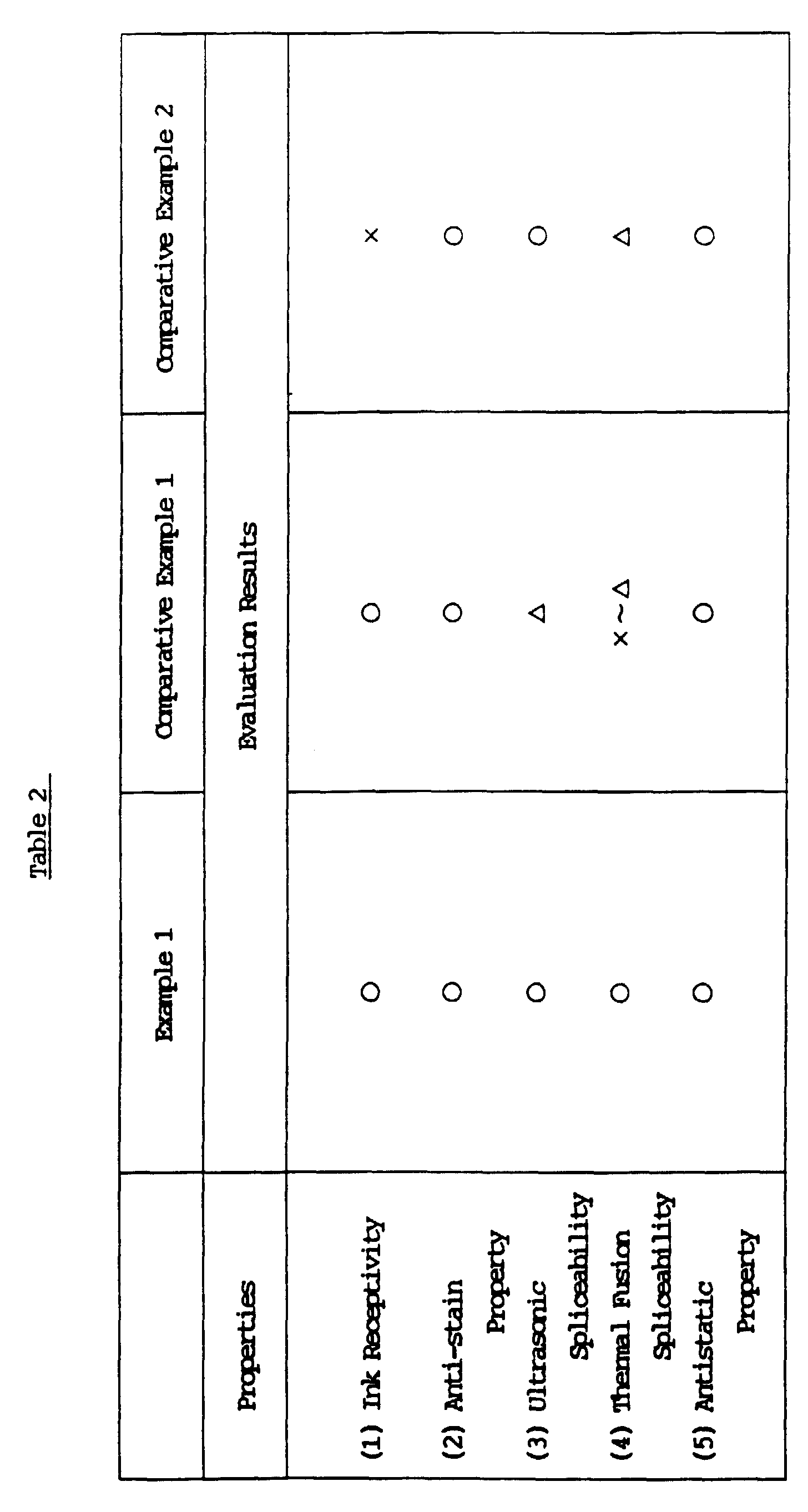
- As can be seen from Table 2, the backing layer of the present photographic printing paper support (Example 1) was good in all the properties, namely (1) ink receptivity, (2) anti-staining property, (3) ultrasonic spliceability, (4) thermal fusion spliceability and (5) antistatic property.
- On the other hand, the backing layer of Comparative Example 1 was found to be inferior in (3) ultrasonic spliceability and (4) thermal fusion spliceability. This result indicates that the addition of the aqueous dispersion of a polyolefin resin can produce improvements of (3) ultrasonic spliceability and (4) thermal fusion spliceability.
- Further, the backing layer of Comparative Example 2 was found to be inferior to that of Example 1 in (1) ink receptivity and (4) thermal fusion spliceability. This result indicates that bad ink receptivity and unsatisfactory thermal fusion spliceability are due to the use of gelatin instead of the aqueous dispersion of a styrene-acrylate copolymer as well as the exclusion of a polyolefin resin.
- Other samples of the present photographic printing paper support were prepared in the same manner as in Example 1, except that the ingredients used in the coating solution for the backing layer were changed to those shown in Table 3. Their properties were also evaluated in accordance with the same methods as employed in Example 1. The evaluation results are shown in Table 5. Therein, good properties are symbolized by the mark ○ , properties on the minimum level of practical use by the mark ▵, and properties unsuitable for practical use by the mark ×.

- Other comparative samples of photographic printing paper support were prepared in the same manner as in Example 1, except that the ingredients used in the coating solution for the backing layer were changed to those shown in Table 4. Their properties were also evaluated in accordance with the same methods as employed in Example 1. The evaluation results are shown in Table 5. Therein, good properties are symbolized by the mark ○, properties on the minimum level of practical use by the mark ▵, and properties unsuitable for practical use by the mark ×.

Ink Receptivity Anti-Staining Property Ultrasonic Spliceability Thermal Fusion Spliceability Example 2 ○ ○ ○ ○ Example 3 ○ ○ ○ ○ Example 4 ○ ○ ○ ○ Example 5 ○ ○ ○ ○ Example 6 ○ ○ ○ ○ Example 7 ○ ○ ○ ○ Example 8 ○ ○ ○ ○ Example 9 ○ ○ ○ ○ Example 10 ○ ○ ○ ○ Example 11 ○ ○ ○ ○ Example 12 ○ ○ ○ ○ Example 13 ○ ○ ○ ○ Example 14 ○ ○ ○ ○ Example 15 ○ ○ ○ ○ Comparative Example 3 ○ × ○ ○ Comparative Example 4 × ○ ○ ○ Comparative Example 5 ○ × ○ ○ Comparative Example 6 ○ ▵ ○ ○ Comparative Example 7 ○ ○ ▵ × Comparative Example 8 ○ ○ ▵ × Comparative Example 9 ▵ ○ ▵ × Comparative Example 10 ▵ ○ ▵ × Comparative Example 11 × ○ ▵ × Comparative Example 12 × ○ ▵ × - The evaluation results shown in Table 5 have proved that the improvement in anti-staining property can be produced by colloidal silica, the improvement in ink receptivity by styrene-acrylate copolymers, the improvement in anti-staining property by water-soluble high-molecular compounds, and the improvements in ultrasonic spliceability and thermal fusion spliceability by aqueous dispersions of polyolefin resins, provided that their melting points are below 100 °C.
Claims (19)
- A photographic printing paper support comprising a waterproof substrate constituted of raw paper and polyolefin resin coats covering the both surfaces thereof, characterized in that the support further has on the back side of the substrate a backing layer containing at least (a) colloidal silica, (b) an aqueous dispersion of a styrene-acrylate copolymer prepared by the polymerization in the presence of a water-soluble high-molecular compound, (c) at least one substance selected from a group consisting of carboxyl or sulfo group-containing water-soluble high-molecular compounds, the metal salts thereof and hydrophilic organic high-molecular colloidal substances and (d) an aqueous dispersion of a polyolefin resin having a melting point below 100°C.
- The photographic printing paper support of claim 1, said backing layer further containing as a hardener a compound having at least two ethyleneimino or glycidyl ether groups per molecule.
- The photographic printing paper support of claim 1 or 2, wherein the coverage of colloidal silica as the component (a) is in the range of 0.04 to 1.0 g/m2 on a solids basis.
- The photographic printing paper support of claim 1 or 2, wherein the coverage of the aqueous dispersion as the component (b) is in the range of 0.05 to 2.0 g/m2 on a solids basis.
- The photographic printing paper support of claim 1 or 2, wherein the coverage of the substance as the component (c) is in the range of 0.01 to 1.0 g/m2 on a solids basis.
- The photographic printing paper support of claim 1 or 2, wherein the coverage of the aqueous dispersion as the component (d) is in the range of 0.01 to 1.0 g/m2 on a solids basis.
- The photographic printing paper support of claim 1 or 2, wherein the components (a), (b), (c) and (d) are contained at the ratio of (a)/(b)/(c)/(d)=(2-10)/(4-15)/(1-3)/(1-3) by weight.
- The photographic printing paper support of claim 1 or 2, wherein the ratio of styrene to acrylate in the styrene-acrylate copolymer ranges from 90/10 to 10/90 by mole.
- The photographic printing paper support of claim 1 or 2, wherein the acrylate in the styrene-acrylate copolymer is an ester of acrylic acid and an aliphatic alcohol containing 1 to 8 carbon atoms.
- The photographic printing paper support of claim 1 or 2, wherein the water-soluble high-molecular compound present in the polymerization is a styrene-maleic acid copolymer.
- The photographic printing paper support of claim 1 or 2, wherein the copolymer has a molecular weight of from 2,000 to 150,000.
- The photographic printing paper support of claim 11, wherein the carboxyl group-containing water-soluble high-molecular compound is a copolymer of maleic anhydride and an unsaturated copolymerizable monomer containing at least 4 carbon atoms.
- The photographic printing paper support of claim 1 or 2, wherein the high-molecular compound has a molecular weight of 5,000 to 1,000,000.
- The photographic printing paper support of claim 13, wherein the sulfo group-containing water-soluble high-molecular compound is polystyrenesulfonic acid, polyvinylbenzylsulfonic acid or the sodium or potassium salt thereof.
- The photographic printing paper support of claim 1 or 2, wherein the hydrophilic organic high-molecular colloidal substance is an aqueous solution or dispersion of a carboxyl-modified polyethylene or the alkali metal, ammonium or amine salt thereof.
- The photographic printing paper support of claim 1 or 2, wherein the polyolefin resin having a melting point below 100°C is selected from among an ethylene-acrylic acid copolymer resin, an ethylene-maleic acid copolymer resin, an ethylene-acrylate copolymer resin and polyolefin resins modified by hydroxyl, carboxyl, amino, amido, epoxy, alkoxysilane, urethane or isocyanate groups.
- The photographic printing paper support of claim 16, wherein the polyolefin resin is an ethylene-acrylic acid copolymer resin.
- The photographic printing paper support of claim 1 or 2, wherein the polyolefin resin having a melting point of below 100 °C has a particle size of from 0.01 to 0.5 µm in the aqueous dispersion thereof.
- The photographic printing paper support of claim 1 or 2, the backing layer having a thickness of 0.1 to 3 µm.
Applications Claiming Priority (2)
| Application Number | Priority Date | Filing Date | Title |
|---|---|---|---|
| JP35613692A JP2835256B2 (en) | 1992-12-18 | 1992-12-18 | Photographic paper support |
| JP356136/92 | 1992-12-18 |
Publications (3)
| Publication Number | Publication Date |
|---|---|
| EP0609539A2 EP0609539A2 (en) | 1994-08-10 |
| EP0609539A3 EP0609539A3 (en) | 1995-08-02 |
| EP0609539B1 true EP0609539B1 (en) | 1999-03-24 |
Family
ID=18447519
Family Applications (1)
| Application Number | Title | Priority Date | Filing Date |
|---|---|---|---|
| EP19930120424 Expired - Lifetime EP0609539B1 (en) | 1992-12-18 | 1993-12-17 | Photographic printing paper support |
Country Status (4)
| Country | Link |
|---|---|
| US (1) | US5360707A (en) |
| EP (1) | EP0609539B1 (en) |
| JP (1) | JP2835256B2 (en) |
| DE (1) | DE69324126T2 (en) |
Families Citing this family (18)
| Publication number | Priority date | Publication date | Assignee | Title |
|---|---|---|---|---|
| JP3614941B2 (en) * | 1995-08-04 | 2005-01-26 | 富士写真フイルム株式会社 | Photographic paper support |
| GB9523138D0 (en) * | 1995-11-11 | 1996-01-10 | Kodak Ltd | Improvements in or relating to coating processes |
| US5726001A (en) * | 1996-06-12 | 1998-03-10 | Eastman Kodak Company | Composite support for imaging elements comprising an electrically-conductive layer and polyurethane adhesion promoting layer on an energetic surface-treated polymeric film |
| US5718995A (en) * | 1996-06-12 | 1998-02-17 | Eastman Kodak Company | Composite support for an imaging element, and imaging element comprising such composite support |
| US5723276A (en) * | 1996-09-11 | 1998-03-03 | Eastman Kodak Company | Coating compositions for photographic paper |
| US5709984A (en) * | 1996-10-31 | 1998-01-20 | Eastman Kodak Company | Coating composition for electrically-conductive layer comprising vanadium oxide gel |
| US5683862A (en) * | 1996-10-31 | 1997-11-04 | Eastman Kodak Company | Poly(ethylene oxide) and alkali metal salt antistatic backing layer for photographic paper coated with polyolefin layer |
| US5786133A (en) * | 1996-11-19 | 1998-07-28 | Eastman Kodak Company | Antistatic layer for photographic elements |
| JP4263780B2 (en) * | 1996-12-26 | 2009-05-13 | 株式会社日本触媒 | Inorganic dispersion stabilizer and process for producing resin particles using the same |
| US6171769B1 (en) | 1999-05-06 | 2001-01-09 | Eastman Kodak Company | Antistatic backing for photographic paper |
| US6120979A (en) * | 1999-05-06 | 2000-09-19 | Eastman Kodak Company | Primer layer for photographic element |
| US6077656A (en) * | 1999-05-06 | 2000-06-20 | Eastman Kodak Company | Photographic paper backing containing polymeric primary amine addition salt |
| US6197486B1 (en) | 1999-12-27 | 2001-03-06 | Eastman Kodak Company | Reflective print material with extruded antistatic layer |
| US7138223B2 (en) * | 2002-04-11 | 2006-11-21 | Fuji Photo Film Co., Ltd. | Photothermographic material |
| US6824964B1 (en) * | 2002-04-30 | 2004-11-30 | Fuji Photo Film Co., Ltd. | Image forming method |
| DE202004005474U1 (en) * | 2004-04-02 | 2004-07-08 | Felix Schoeller Jr. Foto- Und Spezialpapiere Gmbh & Co. Kg | Plastic concentrate for the production of coating compounds |
| JP2007009078A (en) * | 2005-06-30 | 2007-01-18 | Fujifilm Holdings Corp | Polyolefin resin composition and method for preventing gelatinization thereof, and substrate for image recording materials and method for producing the substrate |
| DE102009027817A1 (en) * | 2009-07-17 | 2011-01-20 | Wacker Chemie Ag | Crosslinkable compositions based on organosilicon compounds |
Family Cites Families (8)
| Publication number | Priority date | Publication date | Assignee | Title |
|---|---|---|---|---|
| US4220471A (en) * | 1977-10-13 | 1980-09-02 | Mitsubishi Paper Mills, Ltd. | Photographic polypropylene coated paper support with corona discharge treatment and polymeric subbing layer |
| US4675295A (en) * | 1981-10-28 | 1987-06-23 | Denki Kagaku Kogyo Kabushiki Kaisha | Process for producing subculturable lymphokine-producing human T cell hybridomas |
| JPS6076744A (en) * | 1983-10-04 | 1985-05-01 | Fuji Photo Film Co Ltd | Photographic printing paper |
| JPS626256A (en) * | 1985-07-02 | 1987-01-13 | Fuji Photo Film Co Ltd | Photographic support |
| US4858773A (en) * | 1988-07-26 | 1989-08-22 | Zimmerman Karen M | Cooling/baking rack |
| GB8821426D0 (en) * | 1988-09-13 | 1988-10-12 | Ciba Geigy Ag | Photographic film assembly |
| JPH0328696A (en) * | 1989-06-27 | 1991-02-06 | Ishikawajima Harima Heavy Ind Co Ltd | Electromagnetic accelerator |
| JP2704311B2 (en) * | 1989-10-03 | 1998-01-26 | 富士写真フイルム株式会社 | Photographic paper support |
-
1992
- 1992-12-18 JP JP35613692A patent/JP2835256B2/en not_active Expired - Fee Related
-
1993
- 1993-12-17 DE DE69324126T patent/DE69324126T2/en not_active Expired - Lifetime
- 1993-12-17 EP EP19930120424 patent/EP0609539B1/en not_active Expired - Lifetime
- 1993-12-20 US US08/169,633 patent/US5360707A/en not_active Expired - Lifetime
Also Published As
| Publication number | Publication date |
|---|---|
| US5360707A (en) | 1994-11-01 |
| JP2835256B2 (en) | 1998-12-14 |
| EP0609539A3 (en) | 1995-08-02 |
| JPH06186670A (en) | 1994-07-08 |
| DE69324126T2 (en) | 1999-07-22 |
| DE69324126D1 (en) | 1999-04-29 |
| EP0609539A2 (en) | 1994-08-10 |
Similar Documents
| Publication | Publication Date | Title |
|---|---|---|
| US5360707A (en) | Photographic printing paper support | |
| US5372884A (en) | Ink jet recording sheet | |
| US6190781B1 (en) | Support for imaging material | |
| JP2002105895A (en) | Low density coated paperboard | |
| EP0421764B1 (en) | Support for photographic printing paper | |
| JP3453717B2 (en) | Support for imaging materials | |
| JP2006028663A (en) | Bulky coated paper | |
| JP3485670B2 (en) | Ink jet recording sheet | |
| JPH09188999A (en) | Resin coated paper for gravure printing | |
| JP3343274B2 (en) | Support for imaging materials | |
| JP3529518B2 (en) | Support for imaging materials | |
| JP2000019684A (en) | Support for imaging materials | |
| JP2001121809A (en) | Ink jet recording sheet and manufacturing method thereof | |
| JP2004091997A (en) | Coated paper for printing | |
| JP3350565B2 (en) | Support for imaging materials | |
| JPH09158086A (en) | Resin coated paper for printing | |
| JPH07234476A (en) | Photographic support and photographic material | |
| JP3244958B2 (en) | Support for imaging materials | |
| JP3707819B2 (en) | Support for imaging materials | |
| JP3490119B2 (en) | Support for imaging materials | |
| JP2899147B2 (en) | Manufacturing method of photographic support | |
| JP2021116501A (en) | Printing paper | |
| JP2002062679A (en) | Transfer paper for electrophotography | |
| JPH1138554A (en) | Base for image material | |
| JPH07120872A (en) | Substrate for photographic printing paper |
Legal Events
| Date | Code | Title | Description |
|---|---|---|---|
| PUAI | Public reference made under article 153(3) epc to a published international application that has entered the european phase |
Free format text: ORIGINAL CODE: 0009012 |
|
| AK | Designated contracting states |
Kind code of ref document: A2 Designated state(s): DE FR NL |
|
| PUAL | Search report despatched |
Free format text: ORIGINAL CODE: 0009013 |
|
| AK | Designated contracting states |
Kind code of ref document: A3 Designated state(s): DE FR NL |
|
| 17P | Request for examination filed |
Effective date: 19960111 |
|
| GRAG | Despatch of communication of intention to grant |
Free format text: ORIGINAL CODE: EPIDOS AGRA |
|
| 17Q | First examination report despatched |
Effective date: 19980519 |
|
| GRAG | Despatch of communication of intention to grant |
Free format text: ORIGINAL CODE: EPIDOS AGRA |
|
| GRAH | Despatch of communication of intention to grant a patent |
Free format text: ORIGINAL CODE: EPIDOS IGRA |
|
| GRAH | Despatch of communication of intention to grant a patent |
Free format text: ORIGINAL CODE: EPIDOS IGRA |
|
| GRAA | (expected) grant |
Free format text: ORIGINAL CODE: 0009210 |
|
| AK | Designated contracting states |
Kind code of ref document: B1 Designated state(s): DE FR NL |
|
| REF | Corresponds to: |
Ref document number: 69324126 Country of ref document: DE Date of ref document: 19990429 |
|
| ET | Fr: translation filed | ||
| PLBE | No opposition filed within time limit |
Free format text: ORIGINAL CODE: 0009261 |
|
| STAA | Information on the status of an ep patent application or granted ep patent |
Free format text: STATUS: NO OPPOSITION FILED WITHIN TIME LIMIT |
|
| 26N | No opposition filed | ||
| REG | Reference to a national code |
Ref country code: FR Ref legal event code: TP Ref country code: FR Ref legal event code: CD |
|
| PGFP | Annual fee paid to national office [announced via postgrant information from national office to epo] |
Ref country code: FR Payment date: 20101224 Year of fee payment: 18 |
|
| PGFP | Annual fee paid to national office [announced via postgrant information from national office to epo] |
Ref country code: NL Payment date: 20101220 Year of fee payment: 18 |
|
| PGFP | Annual fee paid to national office [announced via postgrant information from national office to epo] |
Ref country code: DE Payment date: 20101124 Year of fee payment: 18 |
|
| REG | Reference to a national code |
Ref country code: NL Ref legal event code: V1 Effective date: 20120701 |
|
| REG | Reference to a national code |
Ref country code: FR Ref legal event code: ST Effective date: 20120831 |
|
| REG | Reference to a national code |
Ref country code: DE Ref legal event code: R119 Ref document number: 69324126 Country of ref document: DE Effective date: 20120703 |
|
| PG25 | Lapsed in a contracting state [announced via postgrant information from national office to epo] |
Ref country code: DE Free format text: LAPSE BECAUSE OF NON-PAYMENT OF DUE FEES Effective date: 20120703 |
|
| PG25 | Lapsed in a contracting state [announced via postgrant information from national office to epo] |
Ref country code: NL Free format text: LAPSE BECAUSE OF NON-PAYMENT OF DUE FEES Effective date: 20120701 |
|
| PG25 | Lapsed in a contracting state [announced via postgrant information from national office to epo] |
Ref country code: FR Free format text: LAPSE BECAUSE OF NON-PAYMENT OF DUE FEES Effective date: 20120102 |