EP0607744B1 - Method and apparatus for moving hog carcass sides from a suspended vertical position to a horizontal position and for making a controlled cutting of the hind foot - Google Patents
Method and apparatus for moving hog carcass sides from a suspended vertical position to a horizontal position and for making a controlled cutting of the hind foot Download PDFInfo
- Publication number
- EP0607744B1 EP0607744B1 EP19930610062 EP93610062A EP0607744B1 EP 0607744 B1 EP0607744 B1 EP 0607744B1 EP 19930610062 EP19930610062 EP 19930610062 EP 93610062 A EP93610062 A EP 93610062A EP 0607744 B1 EP0607744 B1 EP 0607744B1
- Authority
- EP
- European Patent Office
- Prior art keywords
- gambrel
- cutting
- carcass
- hind feet
- sides
- Prior art date
- Legal status (The legal status is an assumption and is not a legal conclusion. Google has not performed a legal analysis and makes no representation as to the accuracy of the status listed.)
- Expired - Lifetime
Links
Images



Classifications
-
- A—HUMAN NECESSITIES
- A22—BUTCHERING; MEAT TREATMENT; PROCESSING POULTRY OR FISH
- A22B—SLAUGHTERING
- A22B7/00—Slaughterhouse arrangements
- A22B7/001—Conveying arrangements
- A22B7/005—Means for transferring carcasses from a conveying unit to a different one, e.g. hooking, unhooking
-
- A—HUMAN NECESSITIES
- A22—BUTCHERING; MEAT TREATMENT; PROCESSING POULTRY OR FISH
- A22B—SLAUGHTERING
- A22B5/00—Accessories for use during or after slaughtering
- A22B5/0017—Apparatus for cutting, dividing or deboning carcasses
- A22B5/0058—Removing feet or hooves from carcasses
Definitions
- the present invention relates to a method for treatment of pig carcasses, in which a pair of carcass sides suspended at their hind feet in a gambrel is conveyed on an overhead conveyor, which moves above a conveyor belt, onto which the carcass sides are transferred when released from the gambrel, and by which method the hind feet are automatically cut off.
- This method suffers from the drawback that the transfer of the carcass side onto the conveyor belt takes place with such considerable variation that the succeeding carcass sides have to be moved and aligned and the cutting off of the hind feet has to take place while the carcasses lie on their side on the conveyor belt with the hind feet in a not right angle relative to the conveyor belt, the hind feet thus having to be turned into a right angle by the operator during the cutting off.
- the method exploits the condition that the hind feet so to speak are fixed on the gambrel during the transfer on account of the fact that the weight of the carcass during the intial step is only partially transferred to the conveyor belt and that the position of the hind feet is known, the gambrel serving as reference point in connection with the cutting. Due to the fixation a clean cut running perpendicular to the hind foot is attained, and the pull in the leg due to the reduced weight contributes to the attainment of the correctly running cut.
- the method is either carried out by the gambrels passing stationarily mounted circular saws, the circular saws being placed outside the travelling path of the gambrels, or thereby that the circular saws are pivotally mounted and advanced in a predetermined position of the gambrel in a direction substantially perpendicular to the vertical plane of the overhead conveyor.
- the latter possibility is used in an embodiment, which is characteristic in that the hind feet are cut at a predetermined distance from the gambrel.
- the method according to the invention may for instance be carried out in a way in which the carcass sides are automatically transferred transversely to the conveyor belt, until the ham ends are a few cm over the belt. While the hind feet are still hanging on the gambrel in a well-defined direction, and the rind side of the ham end has not yet been turned downwards automatically, the hind feet are sawed off perpendicularly to their longitudinal direction at a predetermined distance from the gambrel in such a way that the ham end falls down the last cm onto the belt and the rind side faces the belt. The gambrel is then advanced further along the overhead conveyor and is later freed from the back feet.
- the invention also relates to an apparatus for treatment of pig carcasses by use of the method according to the invention and comprising an overhead conveyor, along which pairs of carcass sides are conveyed suspended at their hind feet in a gambrel and a conveyor belt placed below the overhead conveyor and onto which the carcass sides are transferred by release of the carcass sides from the gambrel in a position above the conveyor belt whereby the overhead conveyor in the area, where the transfer is to take place, is placed at a distance therefrom which corresponds to a shifting of an essential part of the weight of the carcass sides to the conveyor belt.
- the apparatus according to the invention is characterised in that in this area two cutting devices for cutting off the hind feet from the carcass sides are provided.
- the transfer arrangement comprises guiding and/or supporting devices for controlling or holding the gambrel and/or the hind feet relative to the cutting devices during the transfer.
- the gambrel can convey the carcass sides in a predetermined height and position in such a way that two saws may saw through the hind feet to free the carcass sides from hind feet and gambrels and to bring them to rest on the underlying conveyor belt.
- a holding means may - if desired - be provided, said holding means holding the gambrel with the carcass sides in a predetermined position, as well as two movable saws which saw through the hind feet while the carcass sides are held by the holding means.
- carcass sides 3 are conveyed along an overhead conveyor, for instance a slide rail, by means of a guide 10 transversely over a conveyor belt 8, while hanging in a gambrel 4.
- Two guide bars 2 hold the gambrel fairly horizontally.
- two inclined arms 1 press the hind feet free from the gambrel and the two carcass sides fall down on the conveyor belt.
- the transfer apparatus has been amended to the embodiment shown in Figs. 3 and 4.
- Two guide bars 5 raise the gambrel to a predetermined height and hold, together with the guide bars 2, the gambrel in a horizontal posiiton, while the guide 10 conveys the gambrel with the carcass sides forwards.
- the arms 1 have been removed and instead two external guide bars 6 holding the hind feet on the gambrel and simultaneously laterally pressing them towards a vertical position are provided.
- Two circular saws with slightly inclined blades 7 are mounted below the bars 6 at a fixed distance from the bars 5 carrying the gambrel.
- the transfer apparatus shown in Figs. 5 and 6 comprises cutting devices which move relative to the suspended carcass sides.
- the same references are used as in Figs. 3 and 4 for analogous parts.
- pairs of pig carcass sides suspended at their hind feet on gambrels 4 are conveyed along an overhead conveyor 9 over a conveyor belt 8.
- the overhead conveyor 9 has in the transfer station shown in Figs. 5 and 6 such a height over the conveyor belt that an essential part of the weight of the pig carcass is transferred to the conveyor belt. The position of the carcass on the conveyor belt is thus determined. It is preferable that the ham or the loin of the carcass in the transfer station, before the release from the gambrel 4 takes place, is raised a few cm over the conveyor belt 8. A certain load in the hind foot in the transfer station is aimed at in order to attain a safe fixation of the foot during the cutting.
- two guide bars 5 By means of two guide bars 5 the gambrel 4 is raised somewhat relative to the overhead conveyor 9 and held in a horizontal position. Furthermore, two internal guide bars 6 are provided, said bars holding the hind feet in correct position on the gambrel and in particular preventing them from moving towards the centre of the gambrel.
- Two circular saws 7 are ounted at a fixed distance below the bars 5 carrying the gambrel and are suspended in such a way that when activated they can move along a path travelling substantially perpendicular to the vertical plane of the overhead conveyor 9 and their blades are approximately perpendicular to the hind feet.
- the saws 7 may be suspended to pivot about a shaft running parallelly with the overhead conveyor, or about an approximately vertical shaft.
- the carcass sides are stopped by the holding means 11 in a predetermined position, whereafter they are brought into an active position preventing further conveyance of the hind feet, and by the holding means 12, which stop the conveyance of the gambrel. While the hind feet are supported by means of the guide bars 6 and the holding means 11, the circular saws 7 are moved towards the hind feet which are sawed through. Then the holding means 11 and 12 are released, which makes the carcass sides fall down onto the conveyor belt. The carcass is conveyed further down the conveyor belt for further cutting in a lying position.
- the hind feet may be removed from the gambrel 4 now or at a subsequent, preferably automatic operation.
Landscapes
- Life Sciences & Earth Sciences (AREA)
- Engineering & Computer Science (AREA)
- Food Science & Technology (AREA)
- Chain Conveyers (AREA)
- Processing Of Meat And Fish (AREA)
- Apparatuses For Bulk Treatment Of Fruits And Vegetables And Apparatuses For Preparing Feeds (AREA)
- Automatic Assembly (AREA)
Description
- The present invention relates to a method for treatment of pig carcasses, in which a pair of carcass sides suspended at their hind feet in a gambrel is conveyed on an overhead conveyor, which moves above a conveyor belt, onto which the carcass sides are transferred when released from the gambrel, and by which method the hind feet are automatically cut off.
- In slaughter houses pig carcasses are suspended at their hind feet on a gambrel after removal of the bristles by a socalled dehairing machine.
- The further treatment of the carcass until the cutting up of the split carcass takes place while the carcasses thus suspended are conveyed along an overhead conveyor in form of a slide bar. In connection with the cutting up the carcass sides are put down in pairs on a cutting belt by lowering the carcasses and pulling them in a direction transversely to the belt, until the front part and the loin are in alignment with the conveyor belt, after which the hind feet are pressed or pushed free of the ends of the gambrel and the ham end of the carcass falls down on the conveyor belt. After the transfer the hind feet are manually cut off.
- This method suffers from the drawback that the transfer of the carcass side onto the conveyor belt takes place with such considerable variation that the succeeding carcass sides have to be moved and aligned and the cutting off of the hind feet has to take place while the carcasses lie on their side on the conveyor belt with the hind feet in a not right angle relative to the conveyor belt, the hind feet thus having to be turned into a right angle by the operator during the cutting off.
- Several types of semiautomatic equipment for the sawing off of the hind feet of the pig carcass have been tested in connection with the cutting of the carcass in a lying position, but the cutting accuracy has turned out to be worse than in case of manual cutting.
- From US Patent No. 4,662,029 an apparatus for automatic primal cutting of pig carcass sides, including the sawing off of the hind feet of the pig carcasses, is known. In the known apparatus the carcass sides are transferred to a horizontal conveyor belt from a conveyor, on which they are conveyed suspended in pairs in a gambrel at a hind foot. The cutting off of the hind foot takes place automatically after the transfer on basis of a measurement made by an optic scanner, from which a signal for adjustment of a rotating knife is emitted. The arrangement is complicated and consequently vulnerable. Furthermore, the hind foot is not secured during the cutting, and there is therefore a certain risk that the hind foot will move during the cutting, the incision thus partly not being clean and partly not placed as anticipated by the measurement.
- It is the object of the invention to provide a method, by which the hind feet can be sawed off automatically with good accuracy and with a clean cut running perpendicularly to the hind foot without the use of complicated equipment for optic scanning.
- This object is met according to the invention by a method according to claim 1.
- The method exploits the condition that the hind feet so to speak are fixed on the gambrel during the transfer on account of the fact that the weight of the carcass during the intial step is only partially transferred to the conveyor belt and that the position of the hind feet is known, the gambrel serving as reference point in connection with the cutting. Due to the fixation a clean cut running perpendicular to the hind foot is attained, and the pull in the leg due to the reduced weight contributes to the attainment of the correctly running cut.
- In practice the method is either carried out by the gambrels passing stationarily mounted circular saws, the circular saws being placed outside the travelling path of the gambrels, or thereby that the circular saws are pivotally mounted and advanced in a predetermined position of the gambrel in a direction substantially perpendicular to the vertical plane of the overhead conveyor.
- The latter possibility is used in an embodiment, which is characteristic in that the hind feet are cut at a predetermined distance from the gambrel.
- It has turned out that by such a sawing at a fixed distance from the bottom side of the gambrel a surprisingly accurate cutting of the hind feet is achieved, the position of the cut being at a distance with very little variation from the suspension point of the carcass.
- The method according to the invention may for instance be carried out in a way in which the carcass sides are automatically transferred transversely to the conveyor belt, until the ham ends are a few cm over the belt. While the hind feet are still hanging on the gambrel in a well-defined direction, and the rind side of the ham end has not yet been turned downwards automatically, the hind feet are sawed off perpendicularly to their longitudinal direction at a predetermined distance from the gambrel in such a way that the ham end falls down the last cm onto the belt and the rind side faces the belt. The gambrel is then advanced further along the overhead conveyor and is later freed from the back feet.
- The invention also relates to an apparatus for treatment of pig carcasses by use of the method according to the invention and comprising an overhead conveyor, along which pairs of carcass sides are conveyed suspended at their hind feet in a gambrel and a conveyor belt placed below the overhead conveyor and onto which the carcass sides are transferred by release of the carcass sides from the gambrel in a position above the conveyor belt whereby the overhead conveyor in the area, where the transfer is to take place, is placed at a distance therefrom which corresponds to a shifting of an essential part of the weight of the carcass sides to the conveyor belt. The apparatus according to the invention is characterised in that in this area two cutting devices for cutting off the hind feet from the carcass sides are provided.
- Advantageous embodiments of the apparatus can be seen from claims 7-9.
- In a preferred embodiment of the apparatus the transfer arrangement comprises guiding and/or supporting devices for controlling or holding the gambrel and/or the hind feet relative to the cutting devices during the transfer. In this way the gambrel can convey the carcass sides in a predetermined height and position in such a way that two saws may saw through the hind feet to free the carcass sides from hind feet and gambrels and to bring them to rest on the underlying conveyor belt.
- A holding means may - if desired - be provided, said holding means holding the gambrel with the carcass sides in a predetermined position, as well as two movable saws which saw through the hind feet while the carcass sides are held by the holding means.
- The invention will be described in detail in the following with reference to the drawing, in which
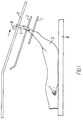
- Figs. 1 and 2 show a traditional transfer apparatus, seen from two different angles,
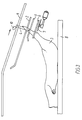
- Figs. 3 and 4 show schematically an embodiment of a transfer apparatus according to the invention, seen from the same angle as the transfer apparatus in Figs. 1 and 2, and
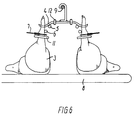
- Figs. 5 and 6 show schematically an embodiment of a transfer apparatus according to the invention, seen from the same angle as the transfer apparatus according to Figs. 1 and 2.
- In the traditional transfer apparatus in Figs. 1 and 2 carcass sides 3 are conveyed along an overhead conveyor, for instance a slide rail, by means of a
guide 10 transversely over aconveyor belt 8, while hanging in agambrel 4. Two guide bars 2 hold the gambrel fairly horizontally. When the gambrel has reached a predetermined position, two inclined arms 1 press the hind feet free from the gambrel and the two carcass sides fall down on the conveyor belt. - According to the invention the transfer apparatus has been amended to the embodiment shown in Figs. 3 and 4. Two
guide bars 5 raise the gambrel to a predetermined height and hold, together with the guide bars 2, the gambrel in a horizontal posiiton, while theguide 10 conveys the gambrel with the carcass sides forwards. The arms 1 have been removed and instead two external guide bars 6 holding the hind feet on the gambrel and simultaneously laterally pressing them towards a vertical position are provided. Two circular saws with slightlyinclined blades 7 are mounted below the bars 6 at a fixed distance from thebars 5 carrying the gambrel. When the ham ends of the carcass sides get in contact with thecircular saw blades 7, the hind feet are sawed through, whereby the carcass sides fall down onto theconveyor belt 8, after which the carcass sides are conveyed further in a lying position for cutting. Not until after the sawing are the hind feet released from the gambrel, for instance thereby that the gambrel with the hind feet is advanced further on theoverhead conveyor 9 and later freed from the hind feet. - In an alternative embodiment according to the invention the transfer apparatus shown in Figs. 5 and 6 comprises cutting devices which move relative to the suspended carcass sides. For the sake of clarity the same references are used as in Figs. 3 and 4 for analogous parts.
- In the same way as in the embodiment according to Figs. 3 and 4 pairs of pig carcass sides suspended at their hind feet on
gambrels 4 are conveyed along anoverhead conveyor 9 over aconveyor belt 8. Theoverhead conveyor 9 has in the transfer station shown in Figs. 5 and 6 such a height over the conveyor belt that an essential part of the weight of the pig carcass is transferred to the conveyor belt. The position of the carcass on the conveyor belt is thus determined. It is preferable that the ham or the loin of the carcass in the transfer station, before the release from thegambrel 4 takes place, is raised a few cm over theconveyor belt 8. A certain load in the hind foot in the transfer station is aimed at in order to attain a safe fixation of the foot during the cutting. - By means of two
guide bars 5 thegambrel 4 is raised somewhat relative to theoverhead conveyor 9 and held in a horizontal position. Furthermore, two internal guide bars 6 are provided, said bars holding the hind feet in correct position on the gambrel and in particular preventing them from moving towards the centre of the gambrel. Twocircular saws 7 are ounted at a fixed distance below thebars 5 carrying the gambrel and are suspended in such a way that when activated they can move along a path travelling substantially perpendicular to the vertical plane of theoverhead conveyor 9 and their blades are approximately perpendicular to the hind feet. Thesaws 7 may be suspended to pivot about a shaft running parallelly with the overhead conveyor, or about an approximately vertical shaft. The carcass sides are stopped by theholding means 11 in a predetermined position, whereafter they are brought into an active position preventing further conveyance of the hind feet, and by theholding means 12, which stop the conveyance of the gambrel. While the hind feet are supported by means of the guide bars 6 and the holding means 11, thecircular saws 7 are moved towards the hind feet which are sawed through. Then the holding means 11 and 12 are released, which makes the carcass sides fall down onto the conveyor belt. The carcass is conveyed further down the conveyor belt for further cutting in a lying position. The hind feet may be removed from thegambrel 4 now or at a subsequent, preferably automatic operation.
Claims (9)
- A method for treatment of pig carcasses (3), in which a pair of carcass sides suspended at their hind feet in a gambrel (4) is conveyed on an overhead conveyor (9), which moves above a conveyor belt, onto which the carcass sides are transferred when released from the gambrel, and by which method the hind feet are automatically cut off, characterized in that the hind feet are cut off from the carcass side by a cut running substantially perpendicular to the feet of the carcass side, while the carcass sides are in a position in which an essential part of the weight has been transferred to the conveyor belt and the position of the carcass on the belt has been established, the release of the carcass side being performed by the cut.
- A method according to claim 1, characterized in that the cutting off of the hind feet are carried out by means of circular saws (7) placed below in the traveling path of the gambrel (4), the cutting being effected by the gambrel passing the circular saws.
- A method according to claim 1, characterized in that the cutting of the hind feet is carried out by means of movably mounted circular saws (7), which in a predetermined position of the gambrel (4) are advanced in a direction essentially perpendicular to the vertical plane of the overhead conveyor (9).
- A method according to claims 1, 2 or 3, characterized in that the circular saws (7) during the cutting are positioned at a fixed, predetermined distance from the gambrel.
- A method according to claims 1, 2, 3 or 4, characterized in that the cutting is carried out immediately before the ham of the carcas sides (3) gets in contact with the conveyor belt (8).
- An apparatus for treatment of pig carcasses 83) and comprising an overhead conveyor (9), along which pairs of carcass sides are conveyed suspended at their hind feet in gambrels (4), and a conveyor belt placed below the overhead conveyor and to which the carcass sides are transferred by release of the carcass sides from the gambrels in a position above the conveyor belt, the overhead conveyor (9) is placed in the area, where the transfer is to take place, at a distance therefrom which corresponds to a shifting of an essential part of the weight of the carcass sides to the conveyor belt (8), characterized in that in this area two cutting devices for cutting off the hind feet from the carcass sides are provided.
- An apparatus according to claim 6, characterized in that in the transfer area guiding and/or supporting devices (5,6,11,12) are provided for controlling or holding the gambrel and/or the hind feet relative to the cutting devices (7) during the transfer.
- An apparatus according to claim 6, characterized in that the cutting devices are fixedly mounted below the travelling path of the gambrel (4) along the overhead conveyor (9), and in that guide bars (5) for lifting the gambrel (4) and conveying devices (10) for pulling the gambrel forwards past the cutting devices (7) are provided.
- An apparatus according to claim 6, characterized in that the cutting devices (7) are movable in a direction substantially perpendicular to the vertical plane of the overhead conveyor (9), and in that guide bars (5) fixing and possibly lifting the gambrel (4), supporting devices (6) for preventing movement of the hind feet in the direction towards the middle of the gambrel, as well as holding means (11) adapted to stop conveyance of the hind feet or the hind legs before the cutting, are provided.
Applications Claiming Priority (2)
| Application Number | Priority Date | Filing Date | Title |
|---|---|---|---|
| DK1451/92 | 1992-12-03 | ||
| DK145192A DK145192A (en) | 1992-12-03 | 1992-12-03 | Vacuum container |
Publications (3)
| Publication Number | Publication Date |
|---|---|
| EP0607744A2 EP0607744A2 (en) | 1994-07-27 |
| EP0607744A3 EP0607744A3 (en) | 1994-08-03 |
| EP0607744B1 true EP0607744B1 (en) | 1997-09-03 |
Family
ID=8104968
Family Applications (1)
| Application Number | Title | Priority Date | Filing Date |
|---|---|---|---|
| EP19930610062 Expired - Lifetime EP0607744B1 (en) | 1992-12-03 | 1993-11-24 | Method and apparatus for moving hog carcass sides from a suspended vertical position to a horizontal position and for making a controlled cutting of the hind foot |
Country Status (4)
| Country | Link |
|---|---|
| EP (1) | EP0607744B1 (en) |
| DE (1) | DE69313616T2 (en) |
| DK (2) | DK145192A (en) |
| ES (1) | ES2106307T3 (en) |
Cited By (1)
| Publication number | Priority date | Publication date | Assignee | Title |
|---|---|---|---|---|
| US6881138B2 (en) | 2001-01-22 | 2005-04-19 | Kj Maskinfabriken A/S | Method and facility for cutting off hind feet of half carcasses |
Families Citing this family (3)
| Publication number | Priority date | Publication date | Assignee | Title |
|---|---|---|---|---|
| EP1746895A1 (en) | 2004-05-13 | 2007-01-31 | K.J. Maskinfabriken A/S | A method and a device for processing a back end part of a carcase |
| WO2008019688A1 (en) * | 2006-08-16 | 2008-02-21 | Kj Industries A/S | Laying down half carcasses |
| NZ572040A (en) * | 2008-10-15 | 2011-06-30 | Robotic Technologies Ltd | A method and device for de-gambrelling including a lifter and a leg spreader |
Family Cites Families (3)
| Publication number | Priority date | Publication date | Assignee | Title |
|---|---|---|---|---|
| US3916484A (en) * | 1973-10-05 | 1975-11-04 | Raymond A Kennedy | Method and apparatus for automatic carcass cutting |
| CA1204192A (en) * | 1982-04-30 | 1986-05-06 | Norman H. Vogt | Method and apparatus for processing similar workpieces of varying shape, points of contour and dimension |
| US4662029A (en) * | 1985-11-06 | 1987-05-05 | Geo. A. Hormel & Co. | Process and apparatus for cutting hog carcasses |
-
1992
- 1992-12-03 DK DK145192A patent/DK145192A/en not_active Application Discontinuation
-
1993
- 1993-11-24 ES ES93610062T patent/ES2106307T3/en not_active Expired - Lifetime
- 1993-11-24 DK DK93610062T patent/DK0607744T3/en active
- 1993-11-24 EP EP19930610062 patent/EP0607744B1/en not_active Expired - Lifetime
- 1993-11-24 DE DE1993613616 patent/DE69313616T2/en not_active Expired - Lifetime
Cited By (1)
| Publication number | Priority date | Publication date | Assignee | Title |
|---|---|---|---|---|
| US6881138B2 (en) | 2001-01-22 | 2005-04-19 | Kj Maskinfabriken A/S | Method and facility for cutting off hind feet of half carcasses |
Also Published As
| Publication number | Publication date |
|---|---|
| DE69313616T2 (en) | 1998-04-02 |
| EP0607744A3 (en) | 1994-08-03 |
| DK145192D0 (en) | 1992-12-03 |
| DK145192A (en) | 1994-06-04 |
| DE69313616D1 (en) | 1997-10-09 |
| EP0607744A2 (en) | 1994-07-27 |
| ES2106307T3 (en) | 1997-11-01 |
| DK0607744T3 (en) | 1998-02-02 |
Similar Documents
| Publication | Publication Date | Title |
|---|---|---|
| EP0508551B1 (en) | Automatic animal carcass splitting | |
| US4559672A (en) | Poultry cut-up machine | |
| US20040058636A1 (en) | Automatic cutting of products such as carcasses | |
| US5139457A (en) | Automatic animal processing | |
| US6033296A (en) | Installation for making a cut in the neck of slaughtered poultry | |
| US5195923A (en) | Automatic animal processing | |
| EP0607744A2 (en) | Method and apparatus for moving hog carcass sides from a suspended vertical position to a horizontal position and for making a controlled cutting of the hind foot | |
| US3988803A (en) | Apparatus for centering slaughtered carcasses cut open for cleaving | |
| US4723340A (en) | Machine for drawing poultry | |
| EP0180454A2 (en) | Apparatus for automatically fixing a carcass | |
| AU2010229463B2 (en) | A method and device for automatic removal of animal carcass knuckle tips | |
| EP1228693B1 (en) | Apparatus and method for cutting through the ribs of a middle from a carcass | |
| EP1363499B1 (en) | Method and facility for cutting off hind feet of half carcasses | |
| WO2000074491A1 (en) | Method and apparatus for positioning carcasses and carcass parts of large animals such as pigs and cattle | |
| IES20020231A2 (en) | Meat carcass processing | |
| CA1334046C (en) | Automatic animal processing | |
| DK161794B (en) | INSTALLATION AND PROCEDURES FOR AUTOMATIC CUTTING OF THE VERTICAL PENDING BODY | |
| AU632230B2 (en) | Automatic animal carcass splitting | |
| EP0784932A2 (en) | Wing Remover | |
| WO1984001690A1 (en) | Process and apparatus for cutting slaughtered chickens into parts | |
| EP0509613A2 (en) | Automatic animal brisket cutting | |
| AU2001295259A1 (en) | Automatic cutting of products such as carcasses | |
| GB1443485A (en) | Method and an apparatus for cleaving slaughtered carcasses | |
| NZ235514A (en) | Apparatus for automatic head removal from carcass | |
| IE84452B1 (en) | Meat carcass processing |
Legal Events
| Date | Code | Title | Description |
|---|---|---|---|
| PUAI | Public reference made under article 153(3) epc to a published international application that has entered the european phase |
Free format text: ORIGINAL CODE: 0009012 |
|
| PUAL | Search report despatched |
Free format text: ORIGINAL CODE: 0009013 |
|
| AK | Designated contracting states |
Kind code of ref document: A2 Designated state(s): DE DK ES FR GB IE NL SE |
|
| AK | Designated contracting states |
Kind code of ref document: A3 Designated state(s): DE DK ES FR GB IE NL SE |
|
| 17P | Request for examination filed |
Effective date: 19950120 |
|
| GRAG | Despatch of communication of intention to grant |
Free format text: ORIGINAL CODE: EPIDOS AGRA |
|
| 17Q | First examination report despatched |
Effective date: 19960919 |
|
| GRAH | Despatch of communication of intention to grant a patent |
Free format text: ORIGINAL CODE: EPIDOS IGRA |
|
| GRAH | Despatch of communication of intention to grant a patent |
Free format text: ORIGINAL CODE: EPIDOS IGRA |
|
| GRAA | (expected) grant |
Free format text: ORIGINAL CODE: 0009210 |
|
| AK | Designated contracting states |
Kind code of ref document: B1 Designated state(s): DE DK ES FR GB IE NL SE |
|
| REF | Corresponds to: |
Ref document number: 69313616 Country of ref document: DE Date of ref document: 19971009 |
|
| ET | Fr: translation filed | ||
| REG | Reference to a national code |
Ref country code: ES Ref legal event code: FG2A Ref document number: 2106307 Country of ref document: ES Kind code of ref document: T3 |
|
| REG | Reference to a national code |
Ref country code: IE Ref legal event code: FG4D Free format text: 76184 |
|
| REG | Reference to a national code |
Ref country code: DK Ref legal event code: T3 |
|
| PLBE | No opposition filed within time limit |
Free format text: ORIGINAL CODE: 0009261 |
|
| STAA | Information on the status of an ep patent application or granted ep patent |
Free format text: STATUS: NO OPPOSITION FILED WITHIN TIME LIMIT |
|
| 26N | No opposition filed | ||
| REG | Reference to a national code |
Ref country code: GB Ref legal event code: IF02 |
|
| PGFP | Annual fee paid to national office [announced via postgrant information from national office to epo] |
Ref country code: SE Payment date: 20091120 Year of fee payment: 17 Ref country code: IE Payment date: 20091124 Year of fee payment: 17 Ref country code: ES Payment date: 20091123 Year of fee payment: 17 Ref country code: DE Payment date: 20091120 Year of fee payment: 17 |
|
| PGFP | Annual fee paid to national office [announced via postgrant information from national office to epo] |
Ref country code: NL Payment date: 20091124 Year of fee payment: 17 |
|
| PGFP | Annual fee paid to national office [announced via postgrant information from national office to epo] |
Ref country code: GB Payment date: 20091119 Year of fee payment: 17 Ref country code: FR Payment date: 20091201 Year of fee payment: 17 |
|
| REG | Reference to a national code |
Ref country code: NL Ref legal event code: V1 Effective date: 20110601 |
|
| REG | Reference to a national code |
Ref country code: SE Ref legal event code: EUG |
|
| GBPC | Gb: european patent ceased through non-payment of renewal fee |
Effective date: 20101124 |
|
| REG | Reference to a national code |
Ref country code: DE Ref legal event code: R119 Ref document number: 69313616 Country of ref document: DE Effective date: 20110601 Ref country code: DE Ref legal event code: R119 Ref document number: 69313616 Country of ref document: DE Effective date: 20110531 |
|
| REG | Reference to a national code |
Ref country code: FR Ref legal event code: ST Effective date: 20110801 |
|
| PG25 | Lapsed in a contracting state [announced via postgrant information from national office to epo] |
Ref country code: NL Free format text: LAPSE BECAUSE OF NON-PAYMENT OF DUE FEES Effective date: 20110601 |
|
| REG | Reference to a national code |
Ref country code: IE Ref legal event code: MM4A |
|
| PG25 | Lapsed in a contracting state [announced via postgrant information from national office to epo] |
Ref country code: SE Free format text: LAPSE BECAUSE OF NON-PAYMENT OF DUE FEES Effective date: 20101125 Ref country code: DE Free format text: LAPSE BECAUSE OF NON-PAYMENT OF DUE FEES Effective date: 20110531 |
|
| PG25 | Lapsed in a contracting state [announced via postgrant information from national office to epo] |
Ref country code: IE Free format text: LAPSE BECAUSE OF NON-PAYMENT OF DUE FEES Effective date: 20101124 Ref country code: FR Free format text: LAPSE BECAUSE OF NON-PAYMENT OF DUE FEES Effective date: 20101130 |
|
| PG25 | Lapsed in a contracting state [announced via postgrant information from national office to epo] |
Ref country code: GB Free format text: LAPSE BECAUSE OF NON-PAYMENT OF DUE FEES Effective date: 20101124 |
|
| REG | Reference to a national code |
Ref country code: ES Ref legal event code: FD2A Effective date: 20120110 |
|
| PG25 | Lapsed in a contracting state [announced via postgrant information from national office to epo] |
Ref country code: ES Free format text: LAPSE BECAUSE OF NON-PAYMENT OF DUE FEES Effective date: 20101125 |
|
| PGFP | Annual fee paid to national office [announced via postgrant information from national office to epo] |
Ref country code: DK Payment date: 20121120 Year of fee payment: 20 |
|
| REG | Reference to a national code |
Ref country code: DK Ref legal event code: EUP Effective date: 20131124 |