EP0606011B1 - Aminopyrimidine derivatives and their production and use - Google Patents
Aminopyrimidine derivatives and their production and use Download PDFInfo
- Publication number
- EP0606011B1 EP0606011B1 EP93310556A EP93310556A EP0606011B1 EP 0606011 B1 EP0606011 B1 EP 0606011B1 EP 93310556 A EP93310556 A EP 93310556A EP 93310556 A EP93310556 A EP 93310556A EP 0606011 B1 EP0606011 B1 EP 0606011B1
- Authority
- EP
- European Patent Office
- Prior art keywords
- compound
- alkyl
- alkoxy
- ethyl
- formula
- Prior art date
- Legal status (The legal status is an assumption and is not a legal conclusion. Google has not performed a legal analysis and makes no representation as to the accuracy of the status listed.)
- Expired - Lifetime
Links
Classifications
-
- C—CHEMISTRY; METALLURGY
- C07—ORGANIC CHEMISTRY
- C07D—HETEROCYCLIC COMPOUNDS
- C07D239/00—Heterocyclic compounds containing 1,3-diazine or hydrogenated 1,3-diazine rings
- C07D239/02—Heterocyclic compounds containing 1,3-diazine or hydrogenated 1,3-diazine rings not condensed with other rings
- C07D239/04—Heterocyclic compounds containing 1,3-diazine or hydrogenated 1,3-diazine rings not condensed with other rings having no double bonds between ring members or between ring members and non-ring members
-
- C—CHEMISTRY; METALLURGY
- C07—ORGANIC CHEMISTRY
- C07D—HETEROCYCLIC COMPOUNDS
- C07D239/00—Heterocyclic compounds containing 1,3-diazine or hydrogenated 1,3-diazine rings
- C07D239/02—Heterocyclic compounds containing 1,3-diazine or hydrogenated 1,3-diazine rings not condensed with other rings
- C07D239/24—Heterocyclic compounds containing 1,3-diazine or hydrogenated 1,3-diazine rings not condensed with other rings having three or more double bonds between ring members or between ring members and non-ring members
- C07D239/28—Heterocyclic compounds containing 1,3-diazine or hydrogenated 1,3-diazine rings not condensed with other rings having three or more double bonds between ring members or between ring members and non-ring members with hetero atoms or with carbon atoms having three bonds to hetero atoms with at the most one bond to halogen, directly attached to ring carbon atoms
- C07D239/32—One oxygen, sulfur or nitrogen atom
- C07D239/42—One nitrogen atom
-
- A—HUMAN NECESSITIES
- A01—AGRICULTURE; FORESTRY; ANIMAL HUSBANDRY; HUNTING; TRAPPING; FISHING
- A01N—PRESERVATION OF BODIES OF HUMANS OR ANIMALS OR PLANTS OR PARTS THEREOF; BIOCIDES, e.g. AS DISINFECTANTS, AS PESTICIDES OR AS HERBICIDES; PEST REPELLANTS OR ATTRACTANTS; PLANT GROWTH REGULATORS
- A01N43/00—Biocides, pest repellants or attractants, or plant growth regulators containing heterocyclic compounds
- A01N43/48—Biocides, pest repellants or attractants, or plant growth regulators containing heterocyclic compounds having rings with two nitrogen atoms as the only ring hetero atoms
- A01N43/54—1,3-Diazines; Hydrogenated 1,3-diazines
-
- C—CHEMISTRY; METALLURGY
- C07—ORGANIC CHEMISTRY
- C07D—HETEROCYCLIC COMPOUNDS
- C07D239/00—Heterocyclic compounds containing 1,3-diazine or hydrogenated 1,3-diazine rings
- C07D239/02—Heterocyclic compounds containing 1,3-diazine or hydrogenated 1,3-diazine rings not condensed with other rings
- C07D239/24—Heterocyclic compounds containing 1,3-diazine or hydrogenated 1,3-diazine rings not condensed with other rings having three or more double bonds between ring members or between ring members and non-ring members
- C07D239/28—Heterocyclic compounds containing 1,3-diazine or hydrogenated 1,3-diazine rings not condensed with other rings having three or more double bonds between ring members or between ring members and non-ring members with hetero atoms or with carbon atoms having three bonds to hetero atoms with at the most one bond to halogen, directly attached to ring carbon atoms
- C07D239/46—Two or more oxygen, sulphur or nitrogen atoms
- C07D239/47—One nitrogen atom and one oxygen or sulfur atom, e.g. cytosine
-
- C—CHEMISTRY; METALLURGY
- C07—ORGANIC CHEMISTRY
- C07D—HETEROCYCLIC COMPOUNDS
- C07D405/00—Heterocyclic compounds containing both one or more hetero rings having oxygen atoms as the only ring hetero atoms, and one or more rings having nitrogen as the only ring hetero atom
- C07D405/02—Heterocyclic compounds containing both one or more hetero rings having oxygen atoms as the only ring hetero atoms, and one or more rings having nitrogen as the only ring hetero atom containing two hetero rings
- C07D405/12—Heterocyclic compounds containing both one or more hetero rings having oxygen atoms as the only ring hetero atoms, and one or more rings having nitrogen as the only ring hetero atom containing two hetero rings linked by a chain containing hetero atoms as chain links
Definitions
- the present invention relates to novel aminopyrimidine derivatives useful as agricultural fungicides, insecticides and miticides, and also relates to their production and use.
- aminopyrimidine derivatives especially 4-aminopyrimidine derivatives, are known to have insecticidal activity, miticidal activity and fungicidal activity (JP-A 57-176967, JP-A 63-225364 and JP-A 64-68362).
- the main object of the present invention is to provide novel aminopyrimidine derivatives having potent fungicidal activity as well as insecticidal and miticidal activity.
- Another object of the present invention is to provide a process for producing aminopyrimidine derivatives.
- Yet another object of the present invention is to provide novel intermediate compounds for the production of the aminopyrimidine derivatives.
- Still another object of the present invention is to provide agricultural fungicides, insecticides and miticides containing the above aminopyrimidine derivative.
- the present inventors have intensively studied to obtain compounds having potent fungicidal activity. As a result, it has been found that novel 4-aminopyrimidine derivatives containing an optionally esterified carboxyl group at the 5-position have potent fungicidal activity as well as insecticidal and miticidal activity.
- alkyl represented by R 1 , R 2 , R 3 , R 4 , R 5 , R 6 and R 11 include alkyl having 1 to 6 carbon atoms, preferably 1 to 4 carbon atoms, for example, methyl, ethyl, propyl, butyl, tert-butyl and the like. Among them, in particular, methyl is preferred for R 1 , methyl and ethyl are preferred for R 2 , methyl and ethyl are preferred for R 3 .
- Examples of the alkyl of the alkylthio represented by R 1 include the same groups as described for the alkyl represented by R 1 .
- heterocyclic group of the optionally substituted heterocyclic group represented by R 1 are 5 to 6 membered heterocyclic groups containing in the ring at least one heteroatom selected from oxygen, sulfur and nitrogen, and it may be a condensed ring with a carbocyclic ring or other heterocyclic ring.
- heterocyclic group include pyridyl, pyrimidinyl, pyrazinyl, thiazolyl, benzothiazolyl, benzofuranyl, benzothienyl, oxazolyl, benzoxazolyl, isoxazolyl, pyrazolyl, imidazolyl, quinolyl and the like.
- Examples of the substituent of the optionally substituted phenyl represented by R 1 and the substituent of the optionally substituted heterocyclic group represented by R 1 include a halogen atom (e.g., fluorine, chlorine, bromine, iodine), C 1-4 alkyl (e.g., methyl, ethyl, propyl, etc.), halo-C 1-4 alkyl (e.g., trifluoromethyl, 2-chloroethyl, etc.), C 1-4 alkoxy (e.g., methoxy, ethoxy, propoxy, etc.) and the like.
- a halogen atom e.g., fluorine, chlorine, bromine, iodine
- C 1-4 alkyl e.g., methyl, ethyl, propyl, etc.
- halo-C 1-4 alkyl e.g., trifluoromethyl, 2-chloroethyl, etc.
- alkenyl represented by R 3 , R 5 , R 6 and R 11 examples include alkenyl having 2 to 6 carbon atoms, preferably 2 to 4 carbon atoms, more preferably 3 to 4 carbon atoms, for example, vinyl, allyl, crotyl and the like.
- alkynyl represented by R 3 , R 5 , R 6 and R 11 examples include alkynyl having 2 to 6 carbon atoms, preferably 2 to 4 carbon atoms, more preferably 3 to 4 carbon atoms, for example, ethynyl, propargyl, 3-butynyl and the like.
- Examples of the aralkyl represented by R 3 include C 6-10 aryl-C 1-4 alkyl, for example, benzyl, phenethyl and the like.
- Examples of the halogen atom represented by R 1 , R 5 , R 6 and R 11 include a fluorine atom, chlorine atom, bromine atom and iodine atom.
- alkoxy represented by R 5 , R 6 and R 11 examples include alkoxy having 1 to 6 carbon atoms, preferably 1 to 4 carbon atoms, for example, methoxy, ethoxy, propoxy, butoxy and the like.
- Examples of the alkyl of the optionally substituted alkyl represented by R 5 , R 6 and R 11 include the same groups as those described for the above alkyl represented by R 1 .
- Examples of the substituted alkyl include halo-C 1-4 alkyl (e.g., trifluoromethyl, 2-chloroethyl, etc.), C 1-4 alkoxy-C 1-4 alkyl (e.g., methoxymethyl, ethoxyethyl, etc.), hydroxy-C 1-4 alkyl (e.g., hydroxymethyl, hydroxyethyl, etc.), C 1-4 alkylsulfonyloxy-C 1-4 alkyl (e.g., ethylsulfonyloxymethyl, methylsulfonyloxyethyl, etc.), tetrahydropyranyloxy-C 1-4 alkyl (e.g., tetrahydropyran-2-yloxymethyl, tetra
- Examples of the substituted hydroxyl represented by R 5 , R 6 and R 11 include C 1-6 alkoxy (e.g., methoxy, ethoxy, propoxy, isopropoxy, butoxy, etc.), C 2-6 alkenyloxy (e.g., vinyloxy, allyloxy, etc.), C 2-6 alkynyloxy (e.g., ethynyloxy, propargyloxy, etc.), halo-C 1-6 alkoxy (e.g., difluoromethyloxy, 2-chloroethyloxy, etc.), C 1-4 alkoxy-C 1-4 alkoxy (e.g., ethoxymethoxy, ethoxyethoxy, etc.), hydroxy-C 1-4 alkoxy (e.g., hydroxymethoxy, hydroxyethoxy, etc.), C 1-4 alkylthio-C 1-4 alkoxy (e.g., ethylthiomethoxy, methylthioeth
- Examples of the mono- or dialkylamino represented by R 5 , R 6 and R 11 include mono- or dialkylamino having the same alkyl as that represented by R 1 , for example, butylamino, diethylamino and the like.
- alkylthio represented by R 5 , R 6 and R 11 examples include alkylthio having the same alkyl as that represented by R 1 , for example, methylthio, ethylthio, propylthio, butylthio and the like.
- alkylsulfinyl represented by R 5 , R 6 and R 11 examples include alkylsulfinyl having the same alkyl as that represented by R 1 , for example, methylsulfinyl, ethylsulfinyl, propylsulfinyl and the like.
- alkylsulfonyl represented by R 5 , R 6 and R 11 examples include alkylsulfonyl having the same alkyl as that represented by R 1 , for example, methylsulfonyl, ethylsulfonyl, propylsulfonyl and the like.
- R 5 , R 6 and R 11 may be at any possible position in the benzene ring.
- the benzene ring preferably has one substituent other than a hydrogen atom preferably at the 4-position.
- alkylene represented by X examples include straight-chain or branched-chain alkylene having 1 to 6 carbon atoms, for example, methylene, ethylene, -CH(CH 3 )-, -CH(C 2 H 5 )- and the like.
- alkyleneoxy represented by X examples include alkyleneoxy having straight-chain or branched-chain alkylene having 1 to 6 carbon atoms, for example, -CH 2 O-, -CH 2 CH 2 O- and the like.
- the oxygen atom of the alkyleneoxy is attached to the neighboring benzene ring.
- each optical isomer and racemic mixtures are also included in the scope of the present invention.
- the acid forming the acid addition salt examples include inorganic acids such as hydrochloric acid, hydrobromic acid, nitric acid, sulfuric acid, phosphoric acid; carboxylic acids such as formic acid, oxalic acid, trichloroacetic acid; sulfonic acids such as methanesulfonic acid, benzenesulfonic acid and the like.
- the aminopyrimidine compound of the formula (I) of the present invention is preferably that wherein R 5 is a hydrogen atom, halogen atom, alkyl or alkoxy; R 6 is a halogen atom, optionally substituted alkyl, alkenyl, alkynyl, optionally substituted hydroxyl, mono- or dialkylamino, alkylthio, alkylsulfinyl, alkylsulfonyl or nitro; and R 11 is a hydrogen atom.
- the aminopyrimidine compound of the formula (I) of the present invention is more preferably that wherein R 5 is a hydrogen atom, halogen atom, alkyl or alkoxy; R 6 is a halogen atom, alkyl, alkenyl, alkynyl, haloalkyl, alkoxyalkyl, hydroxyalkyl, alkylsulfonyloxyalkyl, tetrahydropyranyloxyalkyl, mono- or dialkylaminoalkyl, alkylthioalkyl, alkylsulfinylalkyl, alkylsulfonylalkyl, alkoxy, alkenyloxy, alkynyloxy, haloalkoxy, alkoxyalkoxy, hydroxyalkoxy, alkylsulfonyloxyalkoxy, alkylthioalkoxy, alkylsulfinylalkoxy, alkylsulfonylalkoxy, mono
- more preferred aminopyrimidine compound of the formula (I) is that wherein R 1 is a hydrogen atom or methyl; R 2 is methyl or ethyl; R 3 is C 1-4 alkyl, C 3-4 alkenyl or C 3-4 alkynyl; R 4 is a hydrogen atom; R 5 is a hydrogen atom, halogen atom or alkyl; R 6 is alkyl, alkoxy, haloalkoxy or alkoxyalkyl; R 11 is a hydrogen atom; and X is -CH 2 CH 2 -.
- aminopyrimidine compounds of the formula (I) are particularly preferred:
- the aminopyrimidine derivative (I) of the present invention can be prepared, for example, according to the following scheme by condensation of the compound (II) and the amine compound (III) in an appropriate solvent in the presence or absence of a base.
- Y is a halogen atom (e.g., fluorine, chlorine, bromine, iodine);
- R 3 ' is alkyl, alkenyl, alkynyl or aralkyl; and the other symbols are as defined for the formula (I).
- Examples of each group represented by R 3 ' include the same groups as those represented by R 3 .
- the amount of the amine compound (III) to be used is 1 to 2 mol per mol of the compound (II).
- the solvent examples include alcohols (e.g., methanol, ethanol, propanol, isopropanol, butanol, etc. ), ethers (e.g., diethyl ether, tetrahydrofuran, etc.), N,N-dimethylformamide, dimethyl sulfoxide, aromatic hydrocarbons (e.g., toluene, xylene, etc.), halogenated hydrocarbons (e.g., methylene chloride, etc. ), ketones (e.g., acetone, ethyl methyl ketone, etc.), water and the like. These solvents can be used alone or as mixed solvents thereof.
- alcohols e.g., methanol, ethanol, propanol, isopropanol, butanol, etc.
- ethers e.g., diethyl ether, tetrahydrofuran, etc.
- N,N-dimethylformamide
- the base examples include organic bases such as triethylamine, pyridine N,N-dimethylaniline, N,N-diethylaniline and the like; inorganic bases such as sodium hydroxide, potassium hydroxide, calcium hydroxide, sodium carbonate, potassium carbonate and the like.
- organic bases such as triethylamine, pyridine N,N-dimethylaniline, N,N-diethylaniline and the like
- inorganic bases such as sodium hydroxide, potassium hydroxide, calcium hydroxide, sodium carbonate, potassium carbonate and the like.
- the amount of the base to be used is 1 to 3 mol per mol of the compound (II).
- the reaction temperature is room temperature to reflux temperature.
- the reaction time is 1 to 24 hours.
- the compound (I) thus obtained can be separated and purified by known methods.
- the compound (I) thus obtained can optionally be converted into the carboxylic acid derivative (I-A) by hydrolyzing the -CO 2 R 3 group, or into the ester (I-B) by esterifying the carboxylic acid derivative (I-A).
- ester (I-B) can be converted into the carboxylic acid derivative (I-A) by hydrolysis in an appropriate solvent in the presence of a base.
- the solvent there can be used mixtures of an alcohol (e.g., methanol, ethanol, propanol, isopropanol, butanol, etc.) and an appropriate amount of water.
- an alcohol e.g., methanol, ethanol, propanol, isopropanol, butanol, etc.
- the base examples include inorganic bases such as lithium hydroxide, sodium hydroxide, potassium hydroxide, calcium hydroxide, sodium carbonate, potassium carbonate and the like.
- the amount of the base to be used is 1 to 5 mol per mol of the ester (I-B).
- the reaction temperature is room temperature to reflux temperature.
- the reaction time is 1 to 24 hours.
- the carboxylic acid derivative (I-A) can be separated and purified by conventional methods.
- the carboxylic acid derivative (I-A) can be converted into the ester (I-B) by esterification according to the following three methods.
- the acid examples include inorganic acids such as hydrochloric acid, sulfuric acid, phosphoric acid and the like; organic acids such as p-toluenesulfonic acid and the like.
- the amount of the acid to be used is 0.05 to 1 mol per mol of the carboxylic acid derivative (I-A).
- the reaction is performed at room temperature to reflux temperature for 1 to 24 hours while removing the resulting water.
- the ester (I-B) thus obtained can be separated and purified by conventional methods.
- the amine compound (III) used in the above reaction can be prepared from the corresponding alcohol or ketone by known methods (J. Am. Chem. Soc., 76 , 4180 (1954) or Angew. Chem., 80 , 986 (1968)).
- the compound (II) used in the above reaction can preferably be prepared according to the following scheme by halogenating the compound (IV) with an appropriate halogenating agent in the absence of solvents or in toluene.
- Y is a halogen atom and the other symbols are as defined for the formula (I).
- halogenating agent examples include phosphorus oxychloride, phosphorus pentachloride, phosphorus pentabromide, thionyl bromide or thionyl chloride.
- the amount of the halogenating agent to be used is 1 to 5 mol per mol of the compound (IV).
- the reaction temperature is room temperature to reflux temperature of the solvent. The reaction temperature is 1 to 24 hours.
- the compound (II) thus obtained can be used for the preparation of the compound (I), if necessary after separation and purification by conventional methods.
- the compound (II) is a novel compound.
- the present invention also provides this novel compound useful as an intermediate for the production of the compound (I).
- each optical isomer and racemic mixtures are also included in the scope of the present invention.
- the compound (II) is preferably that wherein Y is a chlorine atom, provided that R 1 is other than a halogen atom or optionally substituted phenyl.
- the compound (IV) used in the above preparation of the compound (II) can preferably be prepared according to the following scheme by condensing the compound (V) with the amidine compound (VI) or an acid (e.g., acetic acid, hydrogen chloride, 1/2 sulfuric acid, etc.) addition salt thereof in the presence or absence of a base.
- an acid e.g., acetic acid, hydrogen chloride, 1/2 sulfuric acid, etc.
- R 7 is C 1-4 alkyl (e.g., methyl, ethyl, propyl, etc.), C 1-4 alkyl-carbonyl (e.g., methylcarbonyl, ethylcarbonyl, etc.), C 1-4 alkylsulfonyl (e.g., methylsulfonyl, ethylsulfonyl, etc.), and the other symbols are as defined for the formula (I).
- C 1-4 alkyl e.g., methyl, ethyl, propyl, etc.
- C 1-4 alkyl-carbonyl e.g., methylcarbonyl, ethylcarbonyl, etc.
- C 1-4 alkylsulfonyl e.g., methylsulfonyl, ethylsulfonyl, etc.
- the amount of the amidine compound (VI) to be used is 1 to 2 mol per mol of the compound (V).
- the solvent examples include alcohols (e.g., methanol, ethanol, propanol, isopropanol, n-butanol, tert-butanol, etc.), ethers (e.g., diethyl ether, tetrahydrofuran, etc.), N,N-dimethylformamide, dimethyl sulfoxide, aromatic hydrocarbons (e.g, toluene, xylene, etc.), halogenated hydrocarbons (e.g., methylene chloride, etc.), ketones (e.g., acetone, ethyl methyl ketone, etc.), water and the like. These solvents can be used alone or as mixed solvents thereof.
- alcohols e.g., methanol, ethanol, propanol, isopropanol, n-butanol, tert-butanol, etc.
- ethers e.g., diethyl ether,
- the base examples include organic bases such as triethylamine, pyridine, N,N-dimethylaniline, N,N-diethylaniline, sodium methoxide, sodium ethoxide, potassium tert-butoxide and the like; inorganic bases such as sodium hydroxide, potassium hydroxide, calcium hydroxide, sodium carbonate, potassium carbonate and the like.
- organic bases such as triethylamine, pyridine, N,N-dimethylaniline, N,N-diethylaniline, sodium methoxide, sodium ethoxide, potassium tert-butoxide and the like
- inorganic bases such as sodium hydroxide, potassium hydroxide, calcium hydroxide, sodium carbonate, potassium carbonate and the like.
- the amount of the base to be used is 1 to 3 mol per mol of the compound (V).
- the reaction temperature is -20°C to reflux temperature.
- the reaction time is 1 to 24 hours.
- the compound (IV) thus obtained can be used for the preparation of the above compound (II), if necessary after separation and purification by conventional methods.
- the compound (IV) is a novel compound.
- the present invention also provides this novel compound useful as an intermediate for the production of the compound (I).
- the compound (IV) has an asymmetric carbon atom, each optical isomer and racemic mixtures thereof are also included in the scope of the present invention.
- R 8 is a halogen atom (e.g., fluorine, chlorine, bromine, iodine), alkylsulfonyloxy (e.g., methylsulfonyloxy, ethylsulfonyloxy, etc.) or arylsulfonyloxy (e.g., p-toluenesulfonyloxy, etc.);
- R 9 is mono- or dialkylamino (e.g., methylamino, diethylamino, etc.) or alkylthio (e.g., methylthio, ethylthio, etc.);
- R 10 is alkylsulfinyl (e.g., methylsulfinyl, ethylsulfinyl, etc.) or alkylsulfonyl (e.g., methylsulfonyl, ethylsulf
- the compound (I-1) (i.e., the compound (I) wherein R 6 is tetrahydropyran-2-yloxyalkyl, or tetrahydropyran-2-yloxyalkoxy) is reacted in an alcohol in the presence of an acid (e.g., p-toluenesulfonic acid, hydrochloric acid, etc.) to give the alcohol (I-2).
- the reaction temperature is room temperature to reflux temperature of the solvent.
- the reaction time is 30 minutes to 24 hours. If necessary, the compound (I-2) thus obtained can be separated and purified by conventional methods.
- the compound (I-2) is reacted with a halogenating agent or sulfonating agent in an appropriate solvent in the presence or absence of a base to give the compound (I-3).
- a halogenating agent or sulfonating agent in an appropriate solvent in the presence or absence of a base.
- the solvent include halogenated hydrocarbons, ethers or aromatic hydrocarbons.
- the base there can be used, for example, triethylamine, N,N-dimethylaniline, N,N-diethylaniline or pyridine in an amount of 1 to 3 mol per mol of the compound (I-2).
- halogenating agent there can be used, for example, thionyl chloride, thionyl bromide or phosphorus tribromide in an amount of 1 to 2 mol per mol of the compound (I-2).
- sulfonating agent there can be used, for example, methanesulfonyl chloride or p-toluenesulfonyl chloride in an amount of 1 to 2 mol per mol of the compound (I-2).
- the reaction temperature is 0° to reflux temperature of the solvent.
- the reaction time is 30 minutes to 24 hours. If necessary, the compound (I-3) thus obtained can be separated and purified by conventional methods.
- the compound (I-3) is reacted with mono- or dialkylamine or alkyl mercaptan in an appropriate solvent in the presence or absence of a base to give the compound (I-4).
- the amount of the mono- or dialkylamine or alkyl mercaptan to be used is 1 to 5 mol per mol of the compound (I-3).
- the solvent include halogenated hydrocarbons, ethers, aromatic hydrocarbons, acetonitrile, N,N-dimethylformamide, dimethyl sulfoxide and the like.
- the base there can be used, for example, sodium carbonate, potassium carbonate, sodium hydroxide, potassium hydroxide, sodium hydride, potassium hydride or the like in an amount of 1 to 3 mol per mol of the mono- or dialkylamine or alkyl mercaptan.
- the reaction temperature is room temperature to reflux temperature of the solvent.
- the reaction time is 1 to 24 hours. If necessary, the compound (I-4) thus obtained can be separated and purified by conventional methods.
- the compound (I-4) is reacted with m-chloroperbenzoic acid in a halogenated hydrocarbon to give the compound (I-5).
- the amount of the m-chloroperbenzoic acid to be used is 1 to 3 mol per mol of the compound (I-4).
- the reaction temperature is -20° to room temperature.
- the reaction time is 30 minutes to 24 hours. If necessary, the compound (I-5) thus obtained can be separated and purified by conventional methods.
- aminopyrimidine compounds of the present invention show high fungicidal activities against a wide variety of pathogens on crop plants (e.g., rice, wheat, barley, rye, corn, common millet, millet, buckwheat, soybean, redbean, peanut, cucumber, eggplant, tomato, pumpkin, kidney bean, citrus fruits, grape, apple, pear, peach, etc.) and the like.
- crop plants e.g., rice, wheat, barley, rye, corn, common millet, millet, buckwheat, soybean, redbean, peanut, cucumber, eggplant, tomato, pumpkin, kidney bean, citrus fruits, grape, apple, pear, peach, etc.
- the pathogen include Pyricularia oryzae , Rhizoctonia solani , Erysiphe graminis , Sphaerotheca fuliginea Erysiphe cichoracearum , Phytophthora infestans , Pseudoperonospora cubensis , Peronospora manshurica , Plasmopara viticola , Botrytis cinerea of vegetables, grape and the like, Pythium aphanidermatum , Sclerotinia sclerotiorum of buckwheat, soybean, colza and the like, Corticium rolfsii of soybean, redbean, potato, peanut and the like. Therefore, the aminopyrimidine compounds of the present invention are useful as agricultural fungicides.
- aminopyrimidine compounds of the present invention show excellent insecticidal activity against aphides (e.g., Myzus persicae , etc.), planthoppers, leafhoppers (e.g., Nephotettix cincticeps , etc.) and the like. Further, they show excellent miticidal activity against various spider mites (e.g., Tetranychus urticae , Tetranychus kanzawai , Panonychus citri , etc.). Therefore, aminopyrimidine compounds of the invention are also useful as insecticides and miticides.
- aphides e.g., Myzus persicae , etc.
- leafhoppers e.g., Nephotettix cincticeps , etc.
- miticidal activity against various spider mites e.g., Tetranychus urticae , Tetranychus kanzawai , Panonychus citri , etc.
- aminopyrimidine compounds of the present invention When used as agricultural fungicides, they can be applied to plants by any conventional manner such as atomizing, scattering, spreading or the like. Application may also be made to seeds of plants, soil around plants, soil to be seeded, paddies, water of hydroponic culture or the like. Application can be made before or after the infection of plants with pathogens.
- aminopyrimidine compounds of the present invention when used as insecticides or miticides, they can be applied to insects or spider mites by any conventional manner such as atomizing, scattering, spreading or the like. They may also be applied to plants by any conventional manner such as atomizing, scattering, spreading or the like to prevent damage caused by pests. Further, application may also be made to seeds of plants, soil around plants, soil to be seeded, paddies or the like.
- the aminopyrimidine compounds of the present invention can be used in the form of a conventional composition or preparation suitable for agricultural fungicides, insecticides or miticides such as solutions, wettable powders, emulsions, suspensions, concentrated liquid preparations, tablets, granules, aerosols, powders, pastes, dusts or the like.
- These compositions or preparations can be obtained by conventional methods, for example, by mixing at least one of the aminopyrimidine compounds with an agriculturally acceptable solid or liquid carrier and, if necessary, an appropriate adjuvant (e.g., surfactant, spreader, disperser, stabilizer, etc.) for improvement of dispersibility and other properties of the effective component.
- an appropriate adjuvant e.g., surfactant, spreader, disperser, stabilizer, etc.
- solid carrier or diluent examples include botanical materials (e.g., flour, tobacco stalk powder, soybean powder, walnut-shell powder, vegetable powder, saw dust, bran, bark powder, cellulose powder, vegetable extract residue, etc.), fibrous materials (e.g., paper, corrugated cardboard, old rags, etc.), artificial plastic powders, clays (e.g., kaolin, bentonite, fuller's earth, etc.), talc, other inorganic materials (e.g., pyrophyllite, sericite, pumice, sulfur powder, active carbon, etc.), chemical fertilizers (e.g., ammonium sulfate, ammonium phosphate, ammonium nitrate, urea, ammonium chloride, etc.) and the like.
- botanical materials e.g., flour, tobacco stalk powder, soybean powder, walnut-shell powder, vegetable powder, saw dust, bran, bark powder, cellulose powder, vegetable extract residue, etc.
- fibrous materials e.g
- liquid carrier or diluent examples include water, alcohols (e.g., methanol, ethanol, etc.), ketones (e.g., acetone, ethyl methyl ketone, etc.), ethers (e.g., diethyl ether, dioxane, cellosolve, tetrahydrofuran, etc.), aromatic hydrocarbons (e.g., benzene, toluene, xylene, methylnaphthalene, etc.), aliphatic hydrocarbons (e.g., gasoline, kerosene, lamp oil, etc.), esters, nitriles, acid amides (e.g., N,N-dimethylformamide, N,N-dimethylacetamide, etc.), halogenated hydrocarbons (e.g., dichloroethane, carbon tetrachloride, etc.) and the like.
- alcohols e.g., methanol, ethanol
- surfactant examples include alkyl sulfates, alkyl sulfonates, alkylaryl sulfonates, polyethylene glycol ethers, polyhydric alcohol esters and the like.
- spreader or disperser examples include casein, gelatin, starch powder, carboxymethyl cellulose, gum arabic, alginic acid, lignin, bentonite, molasses, polyvinyl alcohol, pine oil, agar and the like.
- the stabilizer examples include PAP (a mixture of isopropylphosphate), tricresyl phosphate (TCP), tolu oil, epoxidized oil, surfactants, fatty acids and their esters and the like.
- PAP a mixture of isopropylphosphate
- TCP tricresyl phosphate
- tolu oil epoxidized oil
- surfactants fatty acids and their esters and the like.
- composition of the present invention may contain other fungicides, insecticides, herbicides, fertilizers and the like in addition to the above components.
- each of such compositions contains at least one of the aminopyrimidine compounds in a concentration of normally 0.1 to 99% by weight, preferably 1 to 60% by weight.
- the compositions can be used as such or in a diluted form.
- the concentration to be used depends upon a particular purpose, subject and plant to be treated, and it is generally in the range of about 1 to 5,000 ppm.
- the amount of the active component to be used is generally 1.0 g to 5 kg per hectare.
- novel aminopyrimidine compounds processes for producing them, intermediates for the production, and agricultural fungicides, insecticides and miticides containing them as active components.
- Ethyl 6-ethyl-4-hydroxypyrimidine-5-carboxylate (7.30 g, 37.21 mmol) was stirred under ice-cooling.
- Phosphorus oxychloride (11.41 g, 74.41 mmol) was added dropwise to it. After the addition, the mixture was stirred at 90°C for 3 hours. After cooling to room temperature, the mixture was poured into ice-cooled water and adjusted to pH 10 with an aqueous solution of sodium hydroxide. The resulting mixture was extracted with methylene chloride and dried over magnesium sulfate, and the solvent was evaporated.
- Triethylamine (1.89 g, 18.68 mmol) was added to a solution of ethyl 4-chloro-6-ethylpyrimidine-5-carboxylate (2.00 g, 9.32 mmol) in toluene (50 ml). The mixture was stirred at room temperature. Then, 4-butoxyphenethylamine (2.16 g, 11.18 mmol) was added. After stirring for 18 hours, water (40 ml) was added to the reaction mixture. The mixture was extracted with ethyl acetate and dried over magnesium sulfate.
- Triethylamine (0.33 g, 3.26 mmol) was added to a solution of ethyl 4-chloro-6-ethylpyrimidine-5-carboxylate (0.40 g, 1.86 mmol) in toluene (10 ml). The mixture was stirred at room temperature. Then, 1-(4-butoxyphenyl)-1-propylamine (0.46 g, 2.22 mmol) was added. After stirring at 80°C for 3 hours, water (40 ml) was added to the reaction mixture. The mixture was extracted with methylene chloride and dried over magnesium sulfate.
- Triethylamine (0.19 g, 1.88 mmol) was added to a solution of ethyl 4-chloro-6-ethylpyrimidine-5-carboxylate (0.20 g, 0.93 mmol) in toluene (4 ml). The mixture was stirred at room temperature. Then, 4-butylthiophenethylamine (0.20 g, 0.96 mmol) was added. After stirring for 3 hours, water (20 ml) was added to the reaction mixture. The mixture was extracted with methylene chloride and dried over magnesium sulfate.
- Triethylamine (0.28 g, 2.77 mmol) was added to a solution of ethyl 4-chloro-6-ethylpyrimidine-5-carboxylate (0.30 g, 1.40 mmol) in toluene (10 ml). The mixture was stirred at room temperature. Then, 4-butylaminophenethylamine (0.40 g, 2.08 mmol) was added. After stirring for 3 hours, water (20 ml) was added to the reaction mixture. The mixture was extracted with methylene chloride and dried over magnesium sulfate.
- Triethylamine (2.26 g, 22.33 mmol) was added to a solution of ethyl 4-chloro-6-ethylpyrimidine-5-carboxylate (2.41 g, 11.23 mmol) in toluene (10 ml). The mixture was stirred at room temperature. Then, 4-(2-tetrahydropyran-2-yloxy)ethyl)phenethylamine (2.80 g, 11.23 mmol) was added. After stirring for 16 hours, water (40 ml) was added to the reaction mixture. The mixture was extracted with methylene chloride and dried over magnesium sulfate.
- p-Toluenesulfonic acid (0.10 g) was added to a solution of ethyl 4-(2-(4-(2-(tetrahydropyran-2-yloxy)ethyl)phenyl)ethylamino)-6-ethylpyrimidine-5-carboxylate (4.20 g, 9.82 mmol) in ethanol (40 ml). The mixture was heated under reflux for 4 hours. After cooling to room temperature, the solvent was evaporated under reduced pressure. Water (40 ml) was added to the residue. The mixture was extracted with methylene chloride and dried over magnesium sulfate.
- Triethylamine (0.88 g, 8.70 mmol) was added to a solution of ethyl 4-(2-(4-(2-hydroxyethyl)phenyl)ethylamino)-6-ethylpyrimidine-5-carboxylate (1.50 g, 4.37 mmol) in methylene chloride (40 ml). The mixture was stirred under ice-cooling, and methanesulfonyl chloride (0.60 g, 5.24 mmol) was added dropwise to the mixture. The resulting mixture was stirred under ice-cooling for 10 minutes after the addition. Then, water (40 ml) was added to the reaction mixture.
- a 70% aqueous ethylamine solution (2.14 g, 33.23 mmol) was added to ethyl 4-(2-(4-(2-methylsulfonyloxyethyl)phenyl)ethylamino)-6-ethylpyrimidine-5-carboxylate (0.70 g, 1.66 mmol).
- the mixture was stirred at 100°C for 2 hours in a sealed tube and cooled to room temperature. Then, water (40 ml) was added to the reaction mixture. The mixture was extracted with methylene chloride and dried over magnesium sulfate.
- Triethylamine (0.17 g, 1.68 mmol) was added to a solution of ethyl 4-chloro-6-ethyl-2-methylthiopyrimidine-5-carboxylate (0.21 g, 0.81 mmol) in toluene (4 ml), followed by addition of 3,4-dimethoxyphenethylamine (0.18 g, 0.99 mmol). The mixture was stirred at room temperature for 14 hours. The reaction mixture was poured into water, extracted with ethyl acetate and dried over magnesium sulfate.
- Triethylamine (3.22 g, 31.82 mmol) was added to a solution of 4-(2-(tetrahydropyran-2-yloxy)ethyl)phenethyl alcohol (4.00 g, 15.97 mmol) in methylene chloride (40 ml). The mixture was stirred under ice-cooling, and methanesulfonyl chloride (2.19 g, 19.11 mmol) was added dropwise to the mixture. After the addition, the resulting mixture was stirred under ice-cooling for 10 minutes. Then, water (40 ml) was added. The mixture was extracted with methylene chloride and dried over magnesium sulfate. Evaporation of the solvent gave the desired 4-(2-(tetrahydropyran-2-yloxy)ethyl)phenethyl methanesulfonate (5.24 g, 99%).
- a mixture of 2 parts of the Compound No. 2 and 98 parts of talc is pulverized to obtain a powder.
- a suspension is prepared by mixing 40 parts of Compound No. 3, 10 parts of sodium lignin sulfonate and 50 parts of water.
- a solution is prepared by mixing 10 parts of Compound No. 8, 1 part of Tween 20 (trade mark) and 89 parts of isopropyl alcohol.
- a wettable powder is prepared by mixing 50 parts of Compound No. 10, 6 parts of sodium alkylbenzenesulfonate, 4 parts of sodium lignin sulfonate and 40 parts of clay and pulverizing the mixture.
- Granules are prepared by mixing 5 parts of Compound No. 12, 90 parts of a mixture of equal amounts of bentonite and talc and 5 parts of sodium alkylbenzene sulfonate, pulverizing the mixture and granulating the pulverized mixture.
- An emulsion is prepared by mixing and dispersing 25 parts of Compound No. 18, 8 parts of polyoxyethylene alkylphenyl ether, 2 parts of sodium alkylbenzene sulfonate and 65 parts of xylene.
- a mixture of 2 parts of the Compound No. 20 and 98 parts of talc is pulverized to obtain a powder.
- a suspension is prepared by mixing 40 parts of Compound No. 20, 10 parts of sodium lignin sulfonate and 50 parts of water.
- a solution is prepared by mixing 10 parts of Compound No. 61, 1 part of Tween 20 (trade mark) and 89 parts of isopropyl alcohol.
- a wettable powder is prepared by mixing 50 parts of Compound No. 61, 6 parts of sodium alkylbenzenesulfonate, 4 parts of sodium lignin sulfonate and 40 parts of clay and pulverizing the mixture.
- Granules are prepared by mixing 5 parts of Compound No. 62, 90 parts of a mixture of equal amounts of bentonite and talc and 5 parts of sodium alkylbenzene sulfonate, pulverizing the mixture and granulating the pulverized mixture.
- An emulsion is prepared by mixing and dispersing 25 parts of Compound No. 61, 8 parts of polyoxyethylene alkylphenyl ether, 2 parts of sodium alkylbenzene sulfonate and 65 parts of xylene.
- a mixture of 2 parts of Compound No. 63 and 98 parts of talc is pulverized to obtain a powder.
- a suspension is prepared by mixing 40 parts of Compound No. 63, 10 parts of sodium lignin sulfonate and 50 parts of water.
- a solution is prepared by mixing 10 parts of Compound No. 63, 1 part of Tween 20 (trade mark) and 89 parts of isopropyl alcohol.
- a wettable powder is prepared by mixing 50 parts of Compound No. 64, 6 parts of sodium alkylbenzenesulfonate, 4 parts of sodium lignin sulfonate and 40 parts of clay and pulverizing the mixture.
- Granules are prepared by mixing 5 parts of Compound No. 65, 90 parts of a mixture of equal amounts of bentonite and talc and 5 parts of sodium alkylbenzene sulfonate, pulverizing the mixture and granulating the pulverized mixture.
- An emulsion is prepared by mixing and dispersing 25 parts of Compound No. 65, 8 parts of polyoxyethylene alkylphenyl ether, 2 parts of sodium alkylbenzene sulfonate and 65 parts of xylene.
- a liquid sample to be tested was sprayed to test plants. After 24 hours, pathogens were inoculated. In experiments for determination of therapeutic effect, the test plants were inoculated with each pathogen. After 48 hours, a liquid sample to be tested was sprayed to the test plants. The liquid sample was prepared by dissolving the test compound in a small amount of N,N-dimethylformamide and diluting the solution with distilled water containing a spreader to a given concentration.
- Controlling index Preventive effect Therapeutic effect 1 2 4 2 5 5 3 5 5 8 4 4 10 4 5 11 5 3 13 4 4 17 4 5 18 3 5 20 4 5 61 4 5 62 5 5 63 3 5 64 3 5 65 2 5 Control 1 3 3 Control 2 2 2
- Controlling index Preventive effect 125 ppm 31.3 ppm 1 5 2 2 5 4 3 5 3 8 5 3 10 5 2 11 4 2 12 5 3 13 4 1 17 5 5 18 5 5 19 4 4 20 5 5 21 4 2 61 5 5 62 5 5 63 5 3 64 5 4 65 5 3 Control 1 3 0 Control 2 0 0
- test examples show experiments for evaluating insecticidal activity of the compound of the invention against three kinds of injurious insects.
- the test solution was prepared by dissolving the compound to be tested in a small amount of N,N-dimethylformamide and diluting the solution to a given concentration with distilled water containing a surfactant.
- a piece of a Chinese cabbage leaf with a diameter of 3 cm was put, with the back up, on a 0.3% agar gel. Apterous adults were inoculated on it, and kept at 25°C for 1 day. Then born larvae were counted. Then the adults were removed. A given concentration of the test solution was sprayed on the larvae on the piece of the Chinese cabbage leaf. After 48 hours at 25°C, the dead larvae were counted, and the ratio of the dead insects (i.e., larvae) to the above born larvae was calculated to evaluate the effect. The results are shown in Table 62.
- Table 62 Compound No. Ratio of dead insects at 63 ppm Percent control at 63 ppm Myzus persicae Nephotettix cincticeps Tetranychus urticae 1 100 50 100 2 100 100 100 100 3 100 100 100 10 100 11 100 77 100 14 100 18 100 19 100 20 100 61 100 62 100 63 100 64 100 100 65 100 100
Landscapes
- Chemical & Material Sciences (AREA)
- Organic Chemistry (AREA)
- Life Sciences & Earth Sciences (AREA)
- Dentistry (AREA)
- Wood Science & Technology (AREA)
- Plant Pathology (AREA)
- Health & Medical Sciences (AREA)
- Engineering & Computer Science (AREA)
- Agronomy & Crop Science (AREA)
- General Health & Medical Sciences (AREA)
- Pest Control & Pesticides (AREA)
- Zoology (AREA)
- Environmental Sciences (AREA)
- Plural Heterocyclic Compounds (AREA)
- Agricultural Chemicals And Associated Chemicals (AREA)
- Pyridine Compounds (AREA)
- Nitrogen Condensed Heterocyclic Rings (AREA)
Abstract
Description
- The present invention relates to novel aminopyrimidine derivatives useful as agricultural fungicides, insecticides and miticides, and also relates to their production and use.
- Certain kinds of aminopyrimidine derivatives, especially 4-aminopyrimidine derivatives, are known to have insecticidal activity, miticidal activity and fungicidal activity (JP-A 57-176967, JP-A 63-225364 and JP-A 64-68362).
- However, these known aminopyrimidine derivatives do not have satisfactory efficacy, particularly with regard to fungicidal activity. There is still a need for compounds having more potent fungicidal activity.
- The main object of the present invention is to provide novel aminopyrimidine derivatives having potent fungicidal activity as well as insecticidal and miticidal activity.
- Another object of the present invention is to provide a process for producing aminopyrimidine derivatives.
- Yet another object of the present invention is to provide novel intermediate compounds for the production of the aminopyrimidine derivatives.
- Still another object of the present invention is to provide agricultural fungicides, insecticides and miticides containing the above aminopyrimidine derivative.
- The present inventors have intensively studied to obtain compounds having potent fungicidal activity. As a result, it has been found that novel 4-aminopyrimidine derivatives containing an optionally esterified carboxyl group at the 5-position have potent fungicidal activity as well as insecticidal and miticidal activity.
- According to the present invention, there are provided:
- (1) A compound of the formula (I):

- (2) A process for producing a compound of the formula (I):


- (3) An agricultural fungicidal composition comprising a compound of the formula (I) or a salt thereof as an active ingredient;
- (4) An insecticidal composition comprising a compound of the formula (I) or a salt thereof as an active ingredient;
- (5) A miticidal composition comprising a compound of the formula (I) or a salt thereof as an active ingredient;
- (6) A process for producing a compound of the formula (I-A):


- (7) A process for producing a compound of the formula (I-B):


- (8) A compound of the formula (II):

- (9) A compound of the formula (IV):

- Examples of the alkyl represented by R1, R2, R3, R4, R5, R6 and R11 include alkyl having 1 to 6 carbon atoms, preferably 1 to 4 carbon atoms, for example, methyl, ethyl, propyl, butyl, tert-butyl and the like. Among them, in particular, methyl is preferred for R1, methyl and ethyl are preferred for R2, methyl and ethyl are preferred for R3.
- Examples of the alkyl of the alkylthio represented by R1 include the same groups as described for the alkyl represented by R1.
- Examples of the heterocyclic group of the optionally substituted heterocyclic group represented by R1 are 5 to 6 membered heterocyclic groups containing in the ring at least one heteroatom selected from oxygen, sulfur and nitrogen, and it may be a condensed ring with a carbocyclic ring or other heterocyclic ring. Examples of the heterocyclic group include pyridyl, pyrimidinyl, pyrazinyl, thiazolyl, benzothiazolyl, benzofuranyl, benzothienyl, oxazolyl, benzoxazolyl, isoxazolyl, pyrazolyl, imidazolyl, quinolyl and the like.
- Examples of the substituent of the optionally substituted phenyl represented by R1 and the substituent of the optionally substituted heterocyclic group represented by R1 include a halogen atom (e.g., fluorine, chlorine, bromine, iodine), C1-4 alkyl (e.g., methyl, ethyl, propyl, etc.), halo-C1-4 alkyl (e.g., trifluoromethyl, 2-chloroethyl, etc.), C1-4 alkoxy (e.g., methoxy, ethoxy, propoxy, etc.) and the like.
- Examples of the alkenyl represented by R3, R5, R6 and R11 include alkenyl having 2 to 6 carbon atoms, preferably 2 to 4 carbon atoms, more preferably 3 to 4 carbon atoms, for example, vinyl, allyl, crotyl and the like.
- Examples of the alkynyl represented by R3, R5, R6 and R11 include alkynyl having 2 to 6 carbon atoms, preferably 2 to 4 carbon atoms, more preferably 3 to 4 carbon atoms, for example, ethynyl, propargyl, 3-butynyl and the like.
- Examples of the aralkyl represented by R3 include C6-10 aryl-C1-4 alkyl, for example, benzyl, phenethyl and the like.
- Examples of the halogen atom represented by R1, R5, R6 and R11 include a fluorine atom, chlorine atom, bromine atom and iodine atom.
- Examples of the alkoxy represented by R5, R6 and R11 include alkoxy having 1 to 6 carbon atoms, preferably 1 to 4 carbon atoms, for example, methoxy, ethoxy, propoxy, butoxy and the like.
- Examples of the alkyl of the optionally substituted alkyl represented by R5, R6 and R11 include the same groups as those described for the above alkyl represented by R1. Examples of the substituted alkyl include halo-C1-4 alkyl (e.g., trifluoromethyl, 2-chloroethyl, etc.), C1-4 alkoxy-C1-4 alkyl (e.g., methoxymethyl, ethoxyethyl, etc.), hydroxy-C1-4 alkyl (e.g., hydroxymethyl, hydroxyethyl, etc.), C1-4 alkylsulfonyloxy-C1-4 alkyl (e.g., ethylsulfonyloxymethyl, methylsulfonyloxyethyl, etc.), tetrahydropyranyloxy-C1-4 alkyl (e.g., tetrahydropyran-2-yloxymethyl, tetrahydropyran-2-yloxyethyl, etc.), mono- or di-C1-4 alkylamino-C1-4 alkyl (e.g., methylaminoethyl, ethylaminoethyl, dimethylaminoethyl, diethylaminoethyl, etc.), C1-4 alkylthio-C1-4 alkyl (e.g., methylthioethyl, ethylthioethyl, etc.), C1-4 alkylsulfinyl-C1-4 alkyl (e.g., ethylsulfinylmethyl, methylsulfinylethyl, etc.), C1-4 alkylsulfonyl-C1-4 alkyl (e. g., ethylsulfonylmethyl, methylsulfonylethyl, etc.) and the like.
- Examples of the substituted hydroxyl represented by R5, R6 and R11 include C1-6 alkoxy (e.g., methoxy, ethoxy, propoxy, isopropoxy, butoxy, etc.), C2-6 alkenyloxy (e.g., vinyloxy, allyloxy, etc.), C2-6 alkynyloxy (e.g., ethynyloxy, propargyloxy, etc.), halo-C1-6 alkoxy (e.g., difluoromethyloxy, 2-chloroethyloxy, etc.), C1-4 alkoxy-C1-4 alkoxy (e.g., ethoxymethoxy, ethoxyethoxy, etc.), hydroxy-C1-4 alkoxy (e.g., hydroxymethoxy, hydroxyethoxy, etc.), C1-4 alkylthio-C1-4 alkoxy (e.g., ethylthiomethoxy, methylthioethoxy, etc.), C1-4 alkylsulfonyloxy-C1-4 alkoxy (e.g., methylsulfonyloxyethoxy, ethylsulfonyloxymethoxy, etc.), C1-4 alkylsulfinyl-C1-4 alkoxy (e.g., methylsulfinylethoxy, ethylsulfinylmethoxy, etc.), C1-4 alkylsulfonyl-C1-4 alkoxy (e.g., methylsulfonylethoxy, ethylsulfonylmethoxy, etc.), mono- or di-C1-4 alkylamino-C1-4 alkoxy (e.g., dimethylaminoethoxy, ethylaminoethoxy, etc.), tetrahydropyranyloxy-C1-4 alkoxy (e.g., tetrahydropyran-2-yloxymethoxy, tetrahydropyran-2-yloxyethoxy, etc.), optionally substituted phenoxy (e.g., phenoxy, 4-fluorophenoxy, etc.) and the like.
- Examples of the mono- or dialkylamino represented by R5, R6 and R11 include mono- or dialkylamino having the same alkyl as that represented by R1, for example, butylamino, diethylamino and the like.
- Examples of the alkylthio represented by R5, R6 and R11 include alkylthio having the same alkyl as that represented by R1, for example, methylthio, ethylthio, propylthio, butylthio and the like.
- Examples of the alkylsulfinyl represented by R5, R6 and R11 include alkylsulfinyl having the same alkyl as that represented by R1, for example, methylsulfinyl, ethylsulfinyl, propylsulfinyl and the like.
- Examples of the alkylsulfonyl represented by R5, R6 and R11 include alkylsulfonyl having the same alkyl as that represented by R1, for example, methylsulfonyl, ethylsulfonyl, propylsulfonyl and the like.
- R5, R6 and R11 may be at any possible position in the benzene ring. The benzene ring preferably has one substituent other than a hydrogen atom preferably at the 4-position.
- Examples of the alkylene represented by X include straight-chain or branched-chain alkylene having 1 to 6 carbon atoms, for example, methylene, ethylene, -CH(CH3)-, -CH(C2H5)- and the like.
- Examples of the alkyleneoxy represented by X include alkyleneoxy having straight-chain or branched-chain alkylene having 1 to 6 carbon atoms, for example, -CH2O-, -CH2CH2O- and the like. The oxygen atom of the alkyleneoxy is attached to the neighboring benzene ring.
- When the aminopyrimidine compound of the formula (I) has an asymmetric carbon atom, each optical isomer and racemic mixtures are also included in the scope of the present invention.
- When the compound (I) forms acid addition salts, these salts are also included in the scope of the present invention. Examples of the acid forming the acid addition salt include inorganic acids such as hydrochloric acid, hydrobromic acid, nitric acid, sulfuric acid, phosphoric acid; carboxylic acids such as formic acid, oxalic acid, trichloroacetic acid; sulfonic acids such as methanesulfonic acid, benzenesulfonic acid and the like.
- The aminopyrimidine compound of the formula (I) of the present invention is preferably that wherein R5 is a hydrogen atom, halogen atom, alkyl or alkoxy; R6 is a halogen atom, optionally substituted alkyl, alkenyl, alkynyl, optionally substituted hydroxyl, mono- or dialkylamino, alkylthio, alkylsulfinyl, alkylsulfonyl or nitro; and R11 is a hydrogen atom.
- The aminopyrimidine compound of the formula (I) of the present invention is more preferably that wherein R5 is a hydrogen atom, halogen atom, alkyl or alkoxy; R6 is a halogen atom, alkyl, alkenyl, alkynyl, haloalkyl, alkoxyalkyl, hydroxyalkyl, alkylsulfonyloxyalkyl, tetrahydropyranyloxyalkyl, mono- or dialkylaminoalkyl, alkylthioalkyl, alkylsulfinylalkyl, alkylsulfonylalkyl, alkoxy, alkenyloxy, alkynyloxy, haloalkoxy, alkoxyalkoxy, hydroxyalkoxy, alkylsulfonyloxyalkoxy, alkylthioalkoxy, alkylsulfinylalkoxy, alkylsulfonylalkoxy, mono- or dialkylaminoalkoxy, tetrahydropyranyloxyalkoxy, optionally substituted phenoxy, mono-or dialkylamino, alkylthio, alkylsulfinyl, alkylsulfonyl or nitro; and R11 is a hydrogen atom.
- Among them, more preferred aminopyrimidine compound of the formula (I) is that wherein R1 is a hydrogen atom or methyl; R2 is methyl or ethyl; R3 is C1-4 alkyl, C3-4 alkenyl or C3-4 alkynyl; R4 is a hydrogen atom; R5 is a hydrogen atom, halogen atom or alkyl; R6 is alkyl, alkoxy, haloalkoxy or alkoxyalkyl; R11 is a hydrogen atom; and X is -CH2CH2-.
- Examples of the pyrimidine derivatives (Compound Nos. 1 to 327) of the formula (I) of the present invention are shown in the following Tables 1 to 34 but are not to be construed to limit the scope of the invention.


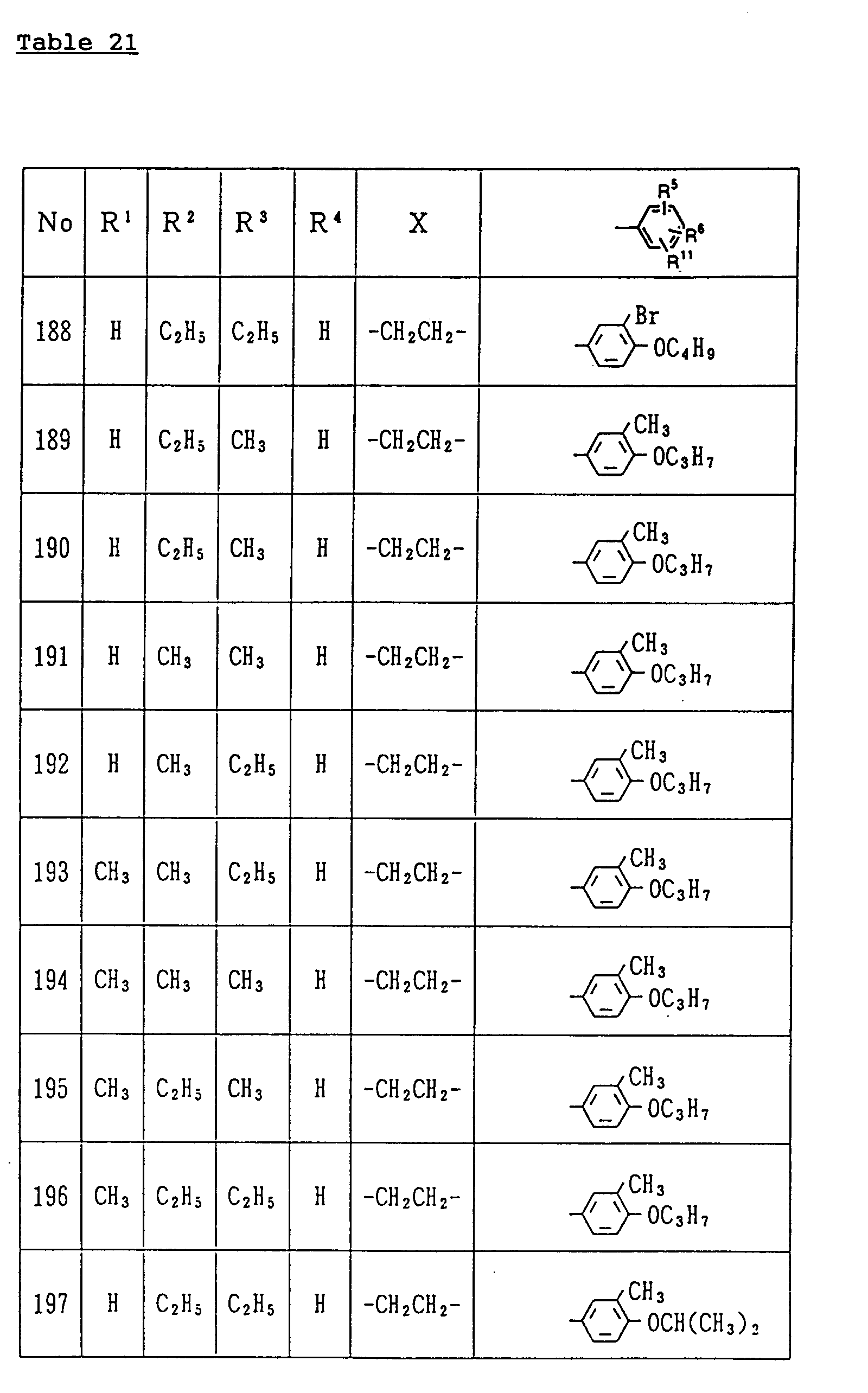


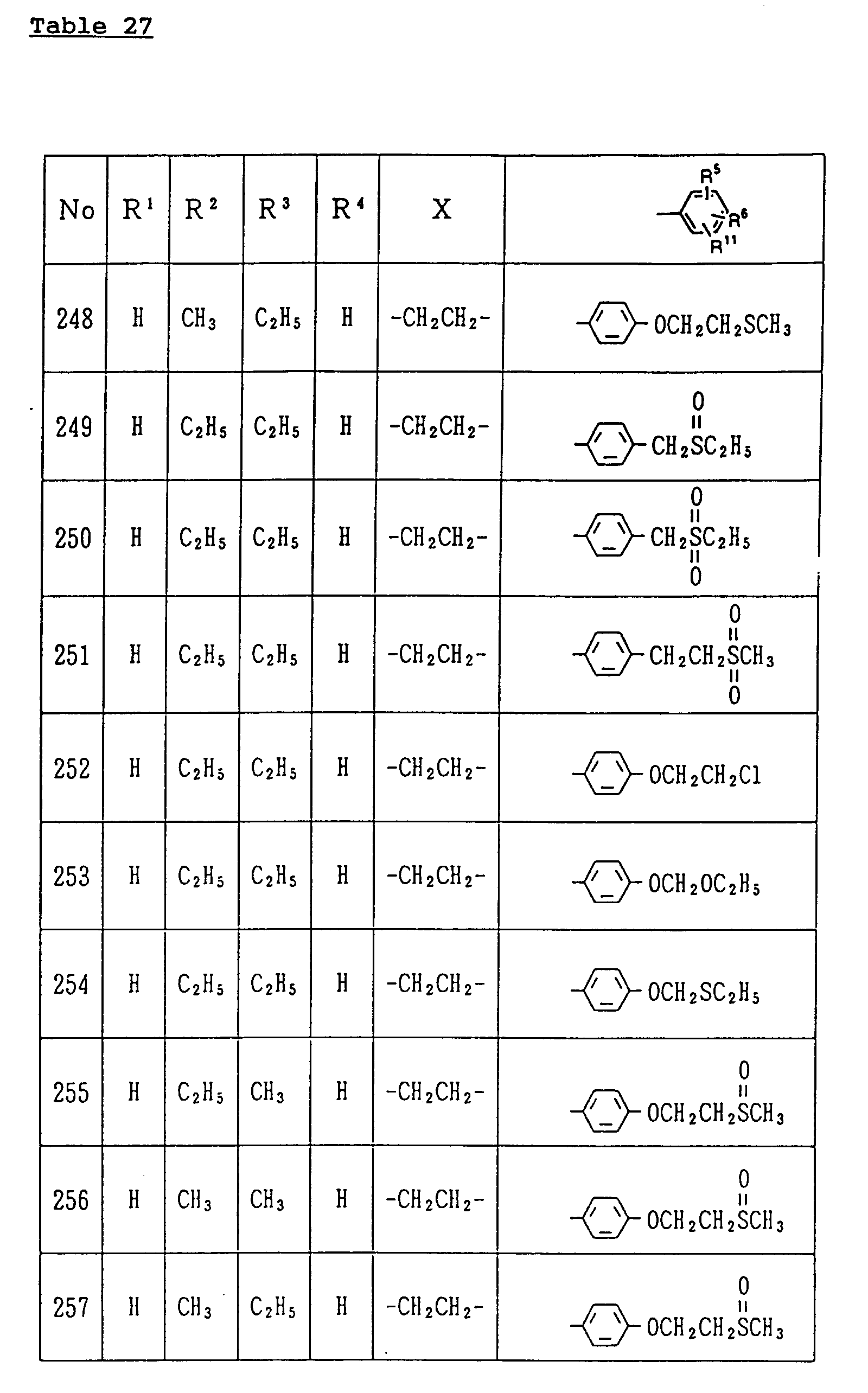


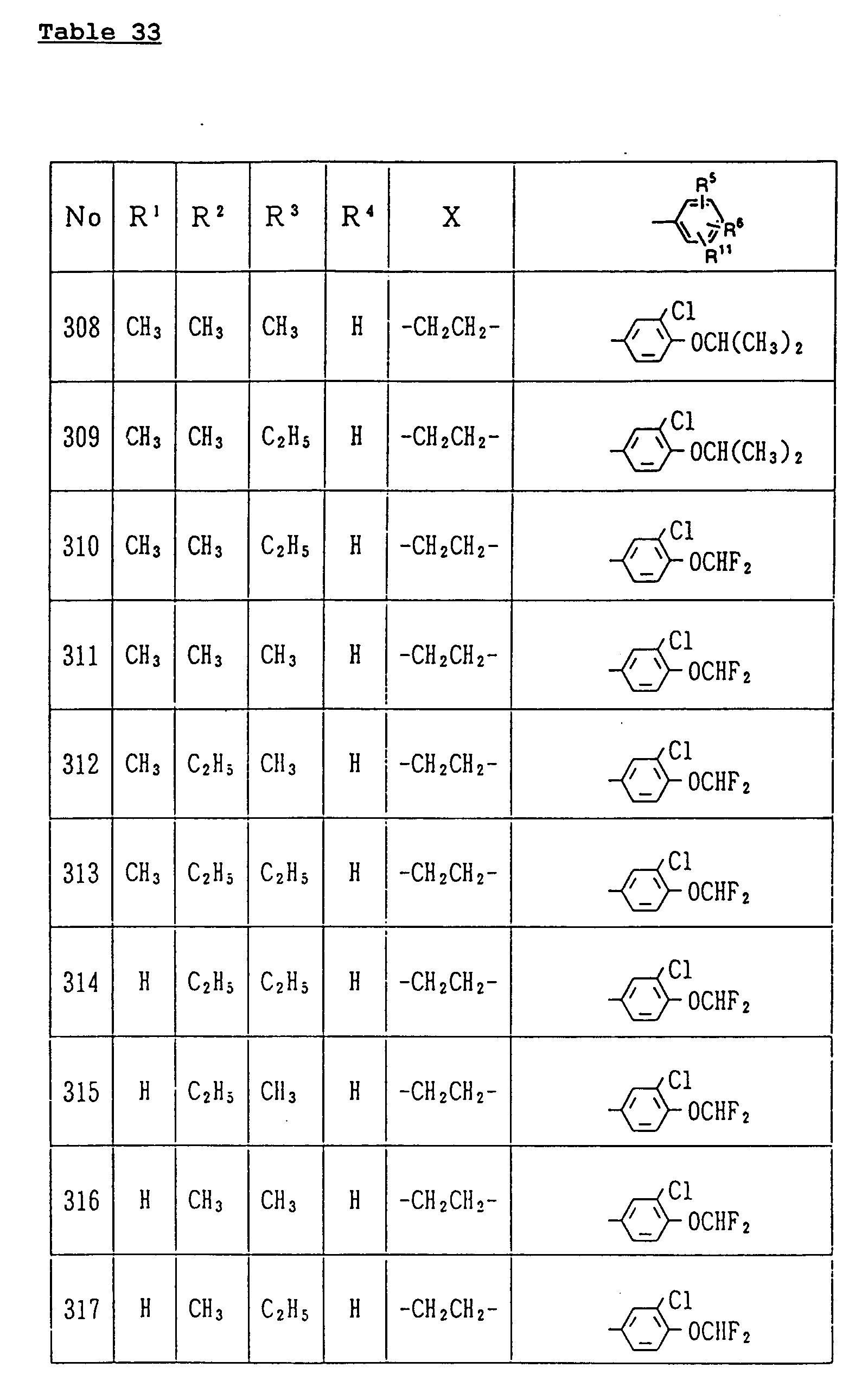

- Among these aminopyrimidine compounds of the formula (I), the following compounds are particularly preferred:
- Ethyl 4-(2-(4-difluoromethoxyphenyl)ethylamino)-6-ethylpyrimidine-5-carboxylate (Compound No. 76),
- Ethyl 4-(2-(4-butoxy-3-methylphenyl)ethylamino)-6-ethylpyrimidine-5-carboxylate (Compound No. 24),
- Ethyl 4-(2-(4-propoxyphenyl)ethylamino)-6-ethylpyrimidine-5-carboxylate (Compound No. 18),
- Ethyl 4-(2-(4-butoxyphenyl)ethylamino)-6-methylpyrimidine-5-carboxylate (Compound No. 8),
- Ethyl 4-(2-(4-butylphenyl)ethylamino)-6-ethylpyrimidine-5-carboxylate (Compound No. 47),
- Ethyl 4-(2-(4-butoxyphenyl)ethylamino)-6-ethylpyrimidine-5-carboxylate (Compound No. 3), and
- Ethyl 4-(2-(4-ethoxyethylphenyl)ethylamino)-6-ethylpyrimidine-5-carboxylate (Compound No. 20).
- The aminopyrimidine derivative (I) of the present invention can be prepared, for example, according to the following scheme by condensation of the compound (II) and the amine compound (III) in an appropriate solvent in the presence or absence of a base.

- Examples of each group represented by R3' include the same groups as those represented by R3.
- The amount of the amine compound (III) to be used is 1 to 2 mol per mol of the compound (II).
- Examples of the solvent include alcohols (e.g., methanol, ethanol, propanol, isopropanol, butanol, etc. ), ethers (e.g., diethyl ether, tetrahydrofuran, etc.), N,N-dimethylformamide, dimethyl sulfoxide, aromatic hydrocarbons (e.g., toluene, xylene, etc.), halogenated hydrocarbons (e.g., methylene chloride, etc. ), ketones (e.g., acetone, ethyl methyl ketone, etc.), water and the like. These solvents can be used alone or as mixed solvents thereof.
- Examples of the base include organic bases such as triethylamine, pyridine N,N-dimethylaniline, N,N-diethylaniline and the like; inorganic bases such as sodium hydroxide, potassium hydroxide, calcium hydroxide, sodium carbonate, potassium carbonate and the like. The amount of the base to be used is 1 to 3 mol per mol of the compound (II).
- The reaction temperature is room temperature to reflux temperature. The reaction time is 1 to 24 hours.
- The compound (I) thus obtained can be separated and purified by known methods.
- The compound (I) thus obtained can optionally be converted into the carboxylic acid derivative (I-A) by hydrolyzing the -CO2R3 group, or into the ester (I-B) by esterifying the carboxylic acid derivative (I-A).
- For example, the ester (I-B) can be converted into the carboxylic acid derivative (I-A) by hydrolysis in an appropriate solvent in the presence of a base.
- As the solvent, there can be used mixtures of an alcohol (e.g., methanol, ethanol, propanol, isopropanol, butanol, etc.) and an appropriate amount of water.
- Examples of the base include inorganic bases such as lithium hydroxide, sodium hydroxide, potassium hydroxide, calcium hydroxide, sodium carbonate, potassium carbonate and the like. The amount of the base to be used is 1 to 5 mol per mol of the ester (I-B).
- The reaction temperature is room temperature to reflux temperature. The reaction time is 1 to 24 hours.
- The carboxylic acid derivative (I-A) can be separated and purified by conventional methods.
- The carboxylic acid derivative (I-A) can be converted into the ester (I-B) by esterification according to the following three methods.
- (1) Method wherein the carboxylic acid derivative (I-A) is reacted with an alkyl halide or aralkyl halide in an appropriate solvent in the presence of a base:
Examples of the alkyl halide include methyl iodide, ethyl iodide, methyl bromide, ethyl bromide and the like. Examples of the aralkyl halide include benzyl iodide, benzyl bromide and the like.
Examples of the solvent include ethers (e.g., diethyl ether, tetrahydrofuran, etc.), ketones (e.g., acetone, ethyl methyl ketone, etc.), N,N-dimethylformamide, dimethyl sulfoxide, aromatic hydrocarbons (e.g., toluene, xylene, etc.) and the like.
Examples of the base include inorganic bases such as sodium carbonate, calcium carbonate, sodium hydroxide, potassium hydroxide and the like. The amount of the base to be used is 1 to 2 mol per mol of the carboxylic acid derivative (I-A).
The reaction temperature is room temperature to reflux temperature. The reaction time is 1 to 24 hours. - (2) Method wherein the carboxylic acid derivative (I-A) is reacted with a dialkyl sulfate in an appropriate solvent in the presence of a base:
Examples of the dialkyl sulfate include dimethyl sulfate, diethyl sulfate and the like.
Examples of the solvent include ethers (e.g., diethyl ether, tetrahydrofuran, etc.), N,N-dimethylformamide, dimethyl sulfoxide, aromatic hydrocarbons (e.g., toluene, xylene, etc.), halogenated hydrocarbons (e.g., methylene chloride, etc.), ketones (e.g., acetone, ethyl methyl ketone, etc.) and the like.
Examples of the base include inorganic bases such as sodium carbonate, potassium carbonate, sodium hydroxide, potassium hydroxide and the like. The amount of the base to be used is 1 to 3 mol per mol of the carboxylic acid derivative (I-A).
The reaction temperature is room temperature to reflux temperature. The reaction time is 1 to 24 hours. - (3) Method wherein the carboxylic acid derivative (I-A) is reacted with an alcohol in the presence of an acid:
Examples of the alcohol include methanol, ethanol, propanol, isopropanol, butanol, benzyl alcohol and the like. - Examples of the acid include inorganic acids such as hydrochloric acid, sulfuric acid, phosphoric acid and the like; organic acids such as p-toluenesulfonic acid and the like. The amount of the acid to be used is 0.05 to 1 mol per mol of the carboxylic acid derivative (I-A).
- The reaction is performed at room temperature to reflux temperature for 1 to 24 hours while removing the resulting water.
- The ester (I-B) thus obtained can be separated and purified by conventional methods.
- The amine compound (III) used in the above reaction can be prepared from the corresponding alcohol or ketone by known methods (J. Am. Chem. Soc., 76, 4180 (1954) or Angew. Chem., 80, 986 (1968)).
- On the other hand, the compound (II) used in the above reaction can preferably be prepared according to the following scheme by halogenating the compound (IV) with an appropriate halogenating agent in the absence of solvents or in toluene.

- Examples of the halogenating agent include phosphorus oxychloride, phosphorus pentachloride, phosphorus pentabromide, thionyl bromide or thionyl chloride. The amount of the halogenating agent to be used is 1 to 5 mol per mol of the compound (IV). The reaction temperature is room temperature to reflux temperature of the solvent. The reaction temperature is 1 to 24 hours.
- The compound (II) thus obtained can be used for the preparation of the compound (I), if necessary after separation and purification by conventional methods.
- The compound (II) is a novel compound. The present invention also provides this novel compound useful as an intermediate for the production of the compound (I). When the compound (II) has an asymmetric carbon atom, each optical isomer and racemic mixtures are also included in the scope of the present invention. The compound (II) is preferably that wherein Y is a chlorine atom, provided that R1 is other than a halogen atom or optionally substituted phenyl.
- The compound (IV) used in the above preparation of the compound (II) can preferably be prepared according to the following scheme by condensing the compound (V) with the amidine compound (VI) or an acid (e.g., acetic acid, hydrogen chloride, 1/2 sulfuric acid, etc.) addition salt thereof in the presence or absence of a base.

- The amount of the amidine compound (VI) to be used is 1 to 2 mol per mol of the compound (V).
- Examples of the solvent include alcohols (e.g., methanol, ethanol, propanol, isopropanol, n-butanol, tert-butanol, etc.), ethers (e.g., diethyl ether, tetrahydrofuran, etc.), N,N-dimethylformamide, dimethyl sulfoxide, aromatic hydrocarbons (e.g, toluene, xylene, etc.), halogenated hydrocarbons (e.g., methylene chloride, etc.), ketones (e.g., acetone, ethyl methyl ketone, etc.), water and the like. These solvents can be used alone or as mixed solvents thereof.
- Examples of the base include organic bases such as triethylamine, pyridine, N,N-dimethylaniline, N,N-diethylaniline, sodium methoxide, sodium ethoxide, potassium tert-butoxide and the like; inorganic bases such as sodium hydroxide, potassium hydroxide, calcium hydroxide, sodium carbonate, potassium carbonate and the like. The amount of the base to be used is 1 to 3 mol per mol of the compound (V).
- The reaction temperature is -20°C to reflux temperature. The reaction time is 1 to 24 hours.
- The compound (IV) thus obtained can be used for the preparation of the above compound (II), if necessary after separation and purification by conventional methods.
- The compound (IV) is a novel compound. The present invention also provides this novel compound useful as an intermediate for the production of the compound (I). When the compound (IV) has an asymmetric carbon atom, each optical isomer and racemic mixtures thereof are also included in the scope of the present invention.
- The above compound (V) can be prepared according the method described in J. Org. Chem., 50, 2622 (1985) or JP-A 3-109354.

- Various derivatives of the 4-aminopyrimidine compound (I) of the present invention can also be obtained by modifying the group corresponding to R6 of the formula (I) to give the compounds (I-1), (I-2), (I-3), (I-4) and (I-5).

- The compound (I-1)(i.e., the compound (I) wherein R6 is tetrahydropyran-2-yloxyalkyl, or tetrahydropyran-2-yloxyalkoxy) is reacted in an alcohol in the presence of an acid (e.g., p-toluenesulfonic acid, hydrochloric acid, etc.) to give the alcohol (I-2). The reaction temperature is room temperature to reflux temperature of the solvent. The reaction time is 30 minutes to 24 hours. If necessary, the compound (I-2) thus obtained can be separated and purified by conventional methods.
- Then, the compound (I-2) is reacted with a halogenating agent or sulfonating agent in an appropriate solvent in the presence or absence of a base to give the compound (I-3). Examples of the solvent include halogenated hydrocarbons, ethers or aromatic hydrocarbons. As the base, there can be used, for example, triethylamine, N,N-dimethylaniline, N,N-diethylaniline or pyridine in an amount of 1 to 3 mol per mol of the compound (I-2). As the halogenating agent, there can be used, for example, thionyl chloride, thionyl bromide or phosphorus tribromide in an amount of 1 to 2 mol per mol of the compound (I-2). As the sulfonating agent, there can be used, for example, methanesulfonyl chloride or p-toluenesulfonyl chloride in an amount of 1 to 2 mol per mol of the compound (I-2). The reaction temperature is 0° to reflux temperature of the solvent. The reaction time is 30 minutes to 24 hours. If necessary, the compound (I-3) thus obtained can be separated and purified by conventional methods.
- Then, the compound (I-3) is reacted with mono- or dialkylamine or alkyl mercaptan in an appropriate solvent in the presence or absence of a base to give the compound (I-4). The amount of the mono- or dialkylamine or alkyl mercaptan to be used is 1 to 5 mol per mol of the compound (I-3). Examples of the solvent include halogenated hydrocarbons, ethers, aromatic hydrocarbons, acetonitrile, N,N-dimethylformamide, dimethyl sulfoxide and the like. As the base, there can be used, for example, sodium carbonate, potassium carbonate, sodium hydroxide, potassium hydroxide, sodium hydride, potassium hydride or the like in an amount of 1 to 3 mol per mol of the mono- or dialkylamine or alkyl mercaptan. The reaction temperature is room temperature to reflux temperature of the solvent. The reaction time is 1 to 24 hours. If necessary, the compound (I-4) thus obtained can be separated and purified by conventional methods.
- Then, the compound (I-4) is reacted with m-chloroperbenzoic acid in a halogenated hydrocarbon to give the compound (I-5). The amount of the m-chloroperbenzoic acid to be used is 1 to 3 mol per mol of the compound (I-4). The reaction temperature is -20° to room temperature. The reaction time is 30 minutes to 24 hours. If necessary, the compound (I-5) thus obtained can be separated and purified by conventional methods.
- The aminopyrimidine compounds of the present invention show high fungicidal activities against a wide variety of pathogens on crop plants (e.g., rice, wheat, barley, rye, corn, common millet, millet, buckwheat, soybean, redbean, peanut, cucumber, eggplant, tomato, pumpkin, kidney bean, citrus fruits, grape, apple, pear, peach, etc.) and the like. Specific examples of the pathogen include Pyricularia oryzae, Rhizoctonia solani, Erysiphe graminis, Sphaerotheca fuliginea Erysiphe cichoracearum, Phytophthora infestans, Pseudoperonospora cubensis, Peronospora manshurica, Plasmopara viticola, Botrytis cinerea of vegetables, grape and the like, Pythium aphanidermatum, Sclerotinia sclerotiorum of buckwheat, soybean, colza and the like, Corticium rolfsii of soybean, redbean, potato, peanut and the like. Therefore, the aminopyrimidine compounds of the present invention are useful as agricultural fungicides.
- Further, the aminopyrimidine compounds of the present invention show excellent insecticidal activity against aphides (e.g., Myzus persicae, etc.), planthoppers, leafhoppers (e.g., Nephotettix cincticeps, etc.) and the like. Further, they show excellent miticidal activity against various spider mites (e.g., Tetranychus urticae, Tetranychus kanzawai, Panonychus citri, etc.). Therefore, aminopyrimidine compounds of the invention are also useful as insecticides and miticides.
- When the aminopyrimidine compounds of the present invention are used as agricultural fungicides, they can be applied to plants by any conventional manner such as atomizing, scattering, spreading or the like. Application may also be made to seeds of plants, soil around plants, soil to be seeded, paddies, water of hydroponic culture or the like. Application can be made before or after the infection of plants with pathogens.
- When the aminopyrimidine compounds of the present invention are used as insecticides or miticides, they can be applied to insects or spider mites by any conventional manner such as atomizing, scattering, spreading or the like. They may also be applied to plants by any conventional manner such as atomizing, scattering, spreading or the like to prevent damage caused by pests. Further, application may also be made to seeds of plants, soil around plants, soil to be seeded, paddies or the like.
- The aminopyrimidine compounds of the present invention can be used in the form of a conventional composition or preparation suitable for agricultural fungicides, insecticides or miticides such as solutions, wettable powders, emulsions, suspensions, concentrated liquid preparations, tablets, granules, aerosols, powders, pastes, dusts or the like. These compositions or preparations can be obtained by conventional methods, for example, by mixing at least one of the aminopyrimidine compounds with an agriculturally acceptable solid or liquid carrier and, if necessary, an appropriate adjuvant (e.g., surfactant, spreader, disperser, stabilizer, etc.) for improvement of dispersibility and other properties of the effective component.
- Examples of the solid carrier or diluent include botanical materials (e.g., flour, tobacco stalk powder, soybean powder, walnut-shell powder, vegetable powder, saw dust, bran, bark powder, cellulose powder, vegetable extract residue, etc.), fibrous materials (e.g., paper, corrugated cardboard, old rags, etc.), artificial plastic powders, clays (e.g., kaolin, bentonite, fuller's earth, etc.), talc, other inorganic materials (e.g., pyrophyllite, sericite, pumice, sulfur powder, active carbon, etc.), chemical fertilizers (e.g., ammonium sulfate, ammonium phosphate, ammonium nitrate, urea, ammonium chloride, etc.) and the like.
- Examples of the liquid carrier or diluent include water, alcohols (e.g., methanol, ethanol, etc.), ketones (e.g., acetone, ethyl methyl ketone, etc.), ethers (e.g., diethyl ether, dioxane, cellosolve, tetrahydrofuran, etc.), aromatic hydrocarbons (e.g., benzene, toluene, xylene, methylnaphthalene, etc.), aliphatic hydrocarbons (e.g., gasoline, kerosene, lamp oil, etc.), esters, nitriles, acid amides (e.g., N,N-dimethylformamide, N,N-dimethylacetamide, etc.), halogenated hydrocarbons (e.g., dichloroethane, carbon tetrachloride, etc.) and the like.
- Examples of the surfactant include alkyl sulfates, alkyl sulfonates, alkylaryl sulfonates, polyethylene glycol ethers, polyhydric alcohol esters and the like.
- Examples of the spreader or disperser include casein, gelatin, starch powder, carboxymethyl cellulose, gum arabic, alginic acid, lignin, bentonite, molasses, polyvinyl alcohol, pine oil, agar and the like.
- Examples of the stabilizer include PAP (a mixture of isopropylphosphate), tricresyl phosphate (TCP), tolu oil, epoxidized oil, surfactants, fatty acids and their esters and the like.
- The composition of the present invention may contain other fungicides, insecticides, herbicides, fertilizers and the like in addition to the above components.
- When the aminopyrimidine compounds are used as agricultural fungicides, insecticides or miticides, each of such compositions contains at least one of the aminopyrimidine compounds in a concentration of normally 0.1 to 99% by weight, preferably 1 to 60% by weight. The compositions can be used as such or in a diluted form. The concentration to be used depends upon a particular purpose, subject and plant to be treated, and it is generally in the range of about 1 to 5,000 ppm. The amount of the active component to be used is generally 1.0 g to 5 kg per hectare.
- As described hereinabove, according to the present invention, there are provided novel aminopyrimidine compounds, processes for producing them, intermediates for the production, and agricultural fungicides, insecticides and miticides containing them as active components.
- The following examples and experiments further illustrate the present invention in detail, but are not to be construed to limit the scope thereof. The spin coupling constants (J) in the NMR data are indicated in terms of Hz.
- A solution of ethyl 2-carboethoxy-3-methoxy-2-pentenoate (11.00 g, 47.77 mmol) in ethanol (40 ml) was stirred under ice-cooling. To the mixture was added a formamidine acetic acid salt (5.96 g, 57.25 mmol), followed by addition of an aqueous solution of potassium hydroxide (85% potassium hydroxide 6.94 g (105.13 mmol)/water 40 ml). Then, the mixture was stirred at room temperature for 16 hours and the pH was adjusted to 7 by adding acetic acid.
- The solvent was evaporated under reduced pressure. The residue was purified by column chromatography on silica gel eluting with ethyl acetate/methanol (= 9/1) to give the desired ethyl 6-ethyl-4-hydroxypyrimidine-5-carboxylate (6.00 g, 64%).
- mp: 84.5-86°C
- NMR (δ ppm, TMS/CDCl3): 1.27 (3H,t,J=7), 1.38 (3H,t, J=7), 2.62 (2H,q,J=7), 4.41 (2H,q,J=7), 8.18 (1H,s).
- According to the same manner as that described in Example 1, the compounds (Nos. IV-1 to IV-4 and IV-6) were synthesized. The physical properties of the compounds thus obtained are shown in Table 35.

- Ethyl 6-ethyl-4-hydroxypyrimidine-5-carboxylate (7.30 g, 37.21 mmol) was stirred under ice-cooling. Phosphorus oxychloride (11.41 g, 74.41 mmol) was added dropwise to it. After the addition, the mixture was stirred at 90°C for 3 hours. After cooling to room temperature, the mixture was poured into ice-cooled water and adjusted to pH 10 with an aqueous solution of sodium hydroxide. The resulting mixture was extracted with methylene chloride and dried over magnesium sulfate, and the solvent was evaporated. The residue was purified by column chromatography on silica gel eluting with n-hexane/ethyl acetate (= 8/2) to give the desired ethyl 4-chloro-6-ethylpyrimidine-5-carboxylate (3.50 g, 44%).
- NMR (δ ppm, TMS/CDCl3): 1.31 (3H,t,J=7), 1.42 (3H,t,J=7), 2.81 (2H,q,J=7), 4.44 (2H,q,J=7), 8.92 (1H,s).
- According to the same manner as that described in Example 3, the compounds (Nos. II'-1 to II'-4 and II'-6) were synthesized. The physical properties of the compounds thus obtained are shown in Table 36.

- Triethylamine (1.89 g, 18.68 mmol) was added to a solution of ethyl 4-chloro-6-ethylpyrimidine-5-carboxylate (2.00 g, 9.32 mmol) in toluene (50 ml). The mixture was stirred at room temperature. Then, 4-butoxyphenethylamine (2.16 g, 11.18 mmol) was added. After stirring for 18 hours, water (40 ml) was added to the reaction mixture. The mixture was extracted with ethyl acetate and dried over magnesium sulfate. After evaporation of the solvent, the residue was purified by column chromatography on silica gel eluting with n-hexane/ethyl acetate (= 8/2) to give the desired ethyl 4-(2-(4-butoxyphenyl)ethylamino)-6-ethylpyimidine-5-carboxylate (2.00 g, 58%).
- NMR (δ ppm, TMS/CDCl3): 0.94 (3H,t,J=7), 1.26 (3H,t,J=7), 1.37 (3H,t,J=7), 1.49 (2H,m), 1.74 (2H,m), 2.85 (2H,t,J=7), 2.90 (2H,q,J=7), 3.71 (2H,q,J=7), 3.91 (2H,t,J=6), 4.34 (2H,q,J=7), 6.83 (2H,d,J=9), 7.14 (2H,d,J=9), 8.01 (1H,brt), 8.51 (1H,s).
- Triethylamine (0.33 g, 3.26 mmol) was added to a solution of ethyl 4-chloro-6-ethylpyrimidine-5-carboxylate (0.40 g, 1.86 mmol) in toluene (10 ml). The mixture was stirred at room temperature. Then, 1-(4-butoxyphenyl)-1-propylamine (0.46 g, 2.22 mmol) was added. After stirring at 80°C for 3 hours, water (40 ml) was added to the reaction mixture. The mixture was extracted with methylene chloride and dried over magnesium sulfate. After evaporation of the solvent, the residue was purified by column chromatography on silica gel eluting with n-hexane/ethyl acetate (= 8/2) to give the desired ethyl 4-(1-(4-butoxyphenyl)-1-propylamino)-6-ethylpyrimidine-5-carboxylate (0.32 g, 44%).
- NMR (δ ppm, TMS/CDCl3): 0.91 (3H,t,J=7), 0.95 (3H,t, J=7), 1.25 (3H,t,J=7), 1.41 (3H,t,J=7) 1.47 (2H,m), 1.73 (2H,m), 1.87 (2H,m), 2.92 (2H,q,J=7), 3.93 (2H,t,J=7), 4.38 (2H,t,J=7), 5.16 (1H,q,J=7), 6.84 (2H,d,J=8), 7.24 (2H,d,J=8), 8.45 (1H,s), 8.50 (1H,d,J=7).
- Triethylamine (0.19 g, 1.88 mmol) was added to a solution of ethyl 4-chloro-6-ethylpyrimidine-5-carboxylate (0.20 g, 0.93 mmol) in toluene (4 ml). The mixture was stirred at room temperature. Then, 4-butylthiophenethylamine (0.20 g, 0.96 mmol) was added. After stirring for 3 hours, water (20 ml) was added to the reaction mixture. The mixture was extracted with methylene chloride and dried over magnesium sulfate. After evaporation of the solvent, the residue was purified by column chromatography on silica gel eluting with n-hexane/ethyl acetate (= 8/2) to give the desired ethyl 4-(2-(4-butylthiophenyl)ethylamino)-6-ethylpyrimidine-5-carboxylate (0.20 g, 55%).
- NMR (δ ppm, TMS/CDCl3): 0.91 (3H,t,J=7), 1.26 (3H,t, J=7), 1.34 (3H,t,J=7), 1.46 (2H,m), 1.72 (2H,m), 2.91 (6H,m), 3.74 (2H,q,J=7), 4.34 (2H,q,J=7), 7.14 (2H,d,J=8), 7.27 (2H,d,J=8), 8.04 (1H,brt), 8.51 (1H,s).
- Triethylamine (0.28 g, 2.77 mmol) was added to a solution of ethyl 4-chloro-6-ethylpyrimidine-5-carboxylate (0.30 g, 1.40 mmol) in toluene (10 ml). The mixture was stirred at room temperature. Then, 4-butylaminophenethylamine (0.40 g, 2.08 mmol) was added. After stirring for 3 hours, water (20 ml) was added to the reaction mixture. The mixture was extracted with methylene chloride and dried over magnesium sulfate. After evaporation of the solvent, the residue was purified by column chromatography on silica gel eluting with n-hexane/ethyl acetate (= 8/2) to give the desired ethyl 4-(2-(4-butylaminophenyl)ethylamino)-6-ethylpyrimidine-5-carboxylate (0.30 g, 58%).
- mp: 65-66°C.
- NMR (δ ppm, TMS/CDCl3): 0.95 (3H,t,J=7), 1.25 (3H,t, J=7), 1.36 (3H,t,J=7), 1.45 (2H,m), 1.70 (2H,m), 2.80 (2H,t,J=7), 2.89 (2H,q,J=7), 3.09 (2H,t,J=7), 3.69 (2H,q,J=7), 4.34 (2H,q,J=7), 6.55 (2H,d,J=9), 7.04 (2H,d,J=9), 7.98 (1H,brt), 8.51 (1H,s).
- Triethylamine (2.26 g, 22.33 mmol) was added to a solution of ethyl 4-chloro-6-ethylpyrimidine-5-carboxylate (2.41 g, 11.23 mmol) in toluene (10 ml). The mixture was stirred at room temperature. Then, 4-(2-tetrahydropyran-2-yloxy)ethyl)phenethylamine (2.80 g, 11.23 mmol) was added. After stirring for 16 hours, water (40 ml) was added to the reaction mixture. The mixture was extracted with methylene chloride and dried over magnesium sulfate. After evaporation of the solvent, the residue was purified by column chromatography on silica gel eluting with n-hexane/ethyl acetate (= 8/2) to give the desired ethyl 4-(2-(4-(2-(tetrahydropyran-2-yloxy)ethyl)phenyl)ethylamino)-6-ethylpyrimidine-5-carboxylate (4.20 g, 87%).
- NMR (δ ppm, TMS/CDCl3): 1.26 (3H,t,J=7), 1.37 (3H,t, J=7), 1.40-1.80 (6H,m), 2.90 (4H,m), 3.50-4.20 (8H,m), 4.34 (2H,q,J=7), 4.70 (1H,m), 6.87 (2H,d,J=9), 7.14 (2H,d,J=9), 8.02 (1H,brt), 8.51 (1H,s).
- p-Toluenesulfonic acid (0.10 g) was added to a solution of ethyl 4-(2-(4-(2-(tetrahydropyran-2-yloxy)ethyl)phenyl)ethylamino)-6-ethylpyrimidine-5-carboxylate (4.20 g, 9.82 mmol) in ethanol (40 ml). The mixture was heated under reflux for 4 hours. After cooling to room temperature, the solvent was evaporated under reduced pressure. Water (40 ml) was added to the residue. The mixture was extracted with methylene chloride and dried over magnesium sulfate. After evaporation of the solvent, the residue was purified by column chromatography on silica gel eluting with n-hexane/ethyl acetate (= 1/1) to give the desired ethyl 4-(2-(4-(2-hydroxyethyl)phenyl)ethylamino)-6-ethylpyrimidine-5-carboxylate (2.60 g, 77%).
- mp: 68-71°C.
- NMR (δ ppm, TMS/CDCl3): 1.26 (3H,t,J=7), 1.37 (3H,t, J=7), 2.90 (6H,m), 3.73 (2H,q,J=7), 3.85 (2H,t,J=7), 4.33 (2H,q,J=7), 7.18 (4H,s), 8.01 (1H,brt), 8.50 (1H,s).
- Triethylamine (0.88 g, 8.70 mmol) was added to a solution of ethyl 4-(2-(4-(2-hydroxyethyl)phenyl)ethylamino)-6-ethylpyrimidine-5-carboxylate (1.50 g, 4.37 mmol) in methylene chloride (40 ml). The mixture was stirred under ice-cooling, and methanesulfonyl chloride (0.60 g, 5.24 mmol) was added dropwise to the mixture. The resulting mixture was stirred under ice-cooling for 10 minutes after the addition. Then, water (40 ml) was added to the reaction mixture. The mixture was extracted with methylene chloride and dried over magnesium sulfate. After evaporation of the solvent, the residue was purified by column chromatography on silica gel eluting with n-hexane/ethyl acetate (= 1/1) to give the desired ethyl 4-(2-(4-(2-methylsulfonyloxyethyl)phenyl)ethylamino)-6-ethylpyrimidine-5-carboxylate (1.80 g, 98%).
- mp: 84-86°C.
- NMR (δ ppm, TMS/CDCl3): 1.26 (3H,t,J=7), 1.38 (3H,t, J=7), 2.84 (3H,s), 2.93 (4H,q,J=7), 3.03 (2H,t,J=7), 3.74 (2H,q,J=7), 4.34 (2H,q,J=7), 4.40 (2H,t,J=7), 7.19 (4H,s), 8.06 (1H,brt), 8.52 (1H,s).
- A 70% aqueous ethylamine solution (2.14 g, 33.23 mmol) was added to ethyl 4-(2-(4-(2-methylsulfonyloxyethyl)phenyl)ethylamino)-6-ethylpyrimidine-5-carboxylate (0.70 g, 1.66 mmol). The mixture was stirred at 100°C for 2 hours in a sealed tube and cooled to room temperature. Then, water (40 ml) was added to the reaction mixture. The mixture was extracted with methylene chloride and dried over magnesium sulfate. After evaporation of the solvent, the residue was purified by column chromatography on silica gel eluting with ethyl acetate/methanol (= 8/2) to give the desired ethyl 4-(2-(4-(2-ethylaminoethyl)phenyl)ethylamino)-6-ethylpyrimidine-5-carboxylate (0.40 g, 65%).
- NMR (δ ppm, TMS/CDCl3): 1.10 (3H,t,J=7), 1.26 (3H,t, J=7), 1.37 (3H,t,J=7), 2.67 (2H,q,J=7), 2.87 (8H,m), 3.74 (2H,t,J=7), 4.34 (2H,q,J=7), 7.16 (4H,s), 8.02 (1H,brt), 8.51 (1H,s).
- A solution of ethyl 4-(2-(4-(2-methylsulfonyloxyethyl)phenyl)ethylamino)-6-ethylpyrimidine-5-carboxylate (0.70 g, 1.66 mmol) in N,N-dimethylformamide (10 ml) was stirred under ice-cooling. Sodium thiomethoxide (0.13 g, 1.85 mmol) was added to the solution. The mixture was stirred under ice-cooling for 2 hours, and then water (40 ml) was added. The mixture was extracted with ethyl ether and dried over magnesium sulfate. After evaporation of the solvent, the residue was purified by column chromatography on silica gel eluting with n-hexane/ethyl acetate (= 8/2) to give the desired ethyl 4-(2-(4-(2-methylthioethyl)phenyl)ethylamino)-6-ethylpyrimidine-5-carboxylate (0.47 g, 76%).
- NMR (δ ppm, TMS/CDCl3): 1.26 (3H,t,J=7), 1.37 (3H,t, J=7), 2.18 (3H,s), 2.73 (2H,m), 2.90 (6H,m), 3.74 (2H,q,J=7), 4.34 (2H,q,J=7), 7.16 (4H,s), 8.03 (1H,brt), 8.51 (1H,s).
- A solution of ethyl 4-(2-(4-(2-methylthioethyl)phenyl)ethylamino)-6-ethylpyrimidine-5-carboxylate (0.25 g, 0.67 mmol) in methylene chloride (20 ml) was stirred under ice-cooling. 80% m-Chloroperbenzoic acid (0.16 g, 0.74 mmol) was added to the solution. The mixture was stirred under ice-cooling for 20 minutes, and then a 1N aqueous solution (20 ml) of sodium hydroxide was added. The mixture was extracted with methylene chloride and dried over magnesium sulfate. After evaporation of the solvent, the residue was purified by column chromatography on silica gel eluting with ethyl acetate/ methanol (= 8/2) to give the desired ethyl 4-(2-(4-(2-methylsulfinylethyl)phenyl)ethylamino)-6-ethylpyrimidine-5-carboxylate (0.20 g, 77%).
- NMR (δ ppm, TMS/CDCl3): 1.26 (3H,t,J=7), 1.38 (3H,t, J=7), 2.58 (3H,s), 2.97 (6H,m), 3.07 (2H,m), 3.74 (2H,q,J=7), 4.34 (2H,q,J=7), 7.16 (4H,s), 8.07 (1H,brt), 8.51 (1H,s).
- A solution of ethyl 4-(2-(4-butoxyphenyl)ethylamino)-6-ethylpyrimidine-5-carboxylate (1.00 g, 2.69 mmol) in ethanol (10 ml) was stirred at room temperature. An aqueous solution of sodium hydroxide (sodium hydroxide 0.53 g (13.24 mmol)/water 10 ml) was added to the solution. Then the mixture was stirred at room temperature for 4 hours and adjusted to pH 4 with 1N hydrochloric acid. The resulting mixture was extracted with methylene chloride and dried over magnesium sulfate, and the solvent was evaporated. The residue was recrystallized from methanol to give the desired 4-(2-(4-butoxyphenyl)ethylamino)-6-ethylpyrimidine-5-carboxylic acid (0.83 g, 90%).
- mp: 208-211°C.
- NMR (δ ppm, TMS/CDCl3): 0.95 (3H,t,J=7), 1.39 (3H,t, J=7), 1.41 (2H,m), 1.73 (2H,m), 2.91 (2H,t,J=7), 3.36 (2H,q,J=7), 3.82 (2H,q,J=7), 3.93 (2H,t,J=7), 6.48 (2H,d,J=9), 7.16 (2H,d,J=9), 8.70 (1H,s), 11.01 (1H,brs).
- Potassium carbonate (0.27 g, 1.95 mmol) was added to a solution of 4-(2-(4-butoxyphenyl)ethylamino)-6-ethylpyrimidine-5-carboxylic acid (0.34 g, 0.99 mmol) in ethyl methyl ketone (20 ml), and methyl iodide (0.42 g, 2.96 mmol) was added. After stirring at 65°C for 3 hours, the mixture was cooled to room temperature. The resulting solid was filtered off and the solvent was evaporated. The residue was purified by column chromatography on silica gel eluting with n-hexane/ethyl acetate (= 8/2) to give the desired methyl 4-(2-(4-butoxyphenyl)ethylamino)-6-ethylpyrimidine-5-carboxylate (0.26 g, 73%).
- NMR (δ ppm, TMS/CDCl3): 0.94 (3H,t,J=7), 1.25 (3H,t,J=7), 1.49 (2H,m), 1.76 (2H,m), 2.86 (2H,t,J=7), 2.92 (2H,q,J=7), 3.73 (2H,q,J=7), 3.86 (3H,s), 3.94 (2H,t,J=7), 6.84 (2H,d,J=9), 7.13 (2H,d,J=9), 7.96 (1H,brt), 8.52 (1H,s).
- Triethylamine (0.17 g, 1.68 mmol) was added to a solution of ethyl 4-chloro-6-ethyl-2-methylthiopyrimidine-5-carboxylate (0.21 g, 0.81 mmol) in toluene (4 ml), followed by addition of 3,4-dimethoxyphenethylamine (0.18 g, 0.99 mmol). The mixture was stirred at room temperature for 14 hours. The reaction mixture was poured into water, extracted with ethyl acetate and dried over magnesium sulfate. After evaporation of the solvent, the residue was purified by column chromatography on silica gel eluting with n-hexane/ethyl acetate (= 8/2) to give the desired ethyl 4-(2-(3,4-dimethoxyphenyl)ethylamino)-6-ethyl-2-methylthiopyrimidine-5-carboxylate (0.16 g, 49%).
- mp: 52-53°C.
- NMR (δ ppm, TMS/CDCl3): 1.22 (3H,t,J=7), 1.35 (3H,t,J=7), 2.54 (3H,s), 2.86 (2H,t,J=7), 2.89 (2H,q,J=7), 3.74 (2H,q,J=7), 3.87 (3H,s), 3.88 (3H,s), 4.30 (2H,q,J=7), 6.74 (1H,s), 6.77 (2H,m)), 8.37 (1H,brt).
- According to the same manner as that described in Examples 5 to 17, Compound Nos. 1, 4, 5, 7 to 35, 38 to 48, 52 to 54, 56 to 66, 68 to 71 and 75 to 327 were synthesized.
- The physical properties of the compounds thus obtained are shown in Tables 37 to 59.
Table 37 No mp 1H-NMR (CDCl3) δ ppm 1 36.5∼ 38°C 1.26 (3H, t, J = 7), 1.30 (9H, s), 1.35 (3H, t, J = 7), 2.89 (2H, t, J = 7), 2.93 (2H, q, J = 7), 3.75 (2H, q, J = 7), 4.33 (2H, q, J = 7), 7.14 (2H, d, J = 9), 7.33 (2H, d, J = 9), 7.98 (1H, brt), 8.51 (1H, s). 2 oil 0.94 (3H, t, J = 7), 1.25 (3H, t, J = 7), 1.49 (2H, m), 1.76 (2H, m), 2.86 (2H, t, J = 7), 2.92 (2H, q, J = 7), 3.73 (2H, q, J = 7), 3.86 (3H, s), 3.94 (2H, t, J = 7), 6.84 (2H, d, J = 9), 7.13 (2H, d, J = 9), 7.96 (1H, brt), 8.52 (1H, s). 3 oil 0.96 (3H, t, J = 7), 1.26 (3H, t, J = 7), 1.37 (3H, t, J = 7), 1.49 (2H, m), 1.74 (2H, m), 2.85 (2H, t, J = 7), 2.90 (2H, q, J = 7), 3.71 (2H, q, J = 7), 3.91 (2H, t, J = 6), 4.34 (2H, q, J = 7), 6.83 (2H, d, J = 9), 7.14 (2H, d, J = 9), 8.01 (1H, brt), 8.51 (1H, s). 4 32∼ 33°C 0.97 (3H, t, J = 7), 1.26 (3 H, t, J = 7), 1.36 (3H, t, J = 7), 1.49 (2H, m), 1.74 (2H, m), 2.64 (2H, q, J = 7), 2.85 (2H, t, J = 7), 2.92 (3H, s ), 3.76 (2H, t, J = 7), 3.93 (2H, t, J = 7), 4.33 (2H, q, J = 7), 6.82 (2H, d, J = 8), 7.13 (2H, d, J = 8), 8.53 (1H, s ). 5 oil 0.96 (3H, t, J = 7), 1.26 (3H, t, J = 7), 1.40 (3H, t, J = 7), 1.47 (2H, m), 1.54 (3H, d, J = 7), 1.74 (2H, m), 2.93 (2H, q, J = 7), 3.93 (2H, t, J = 7), 4.36 (2H, q, J = 7), 5.36 (1H, m), 6.85 (2H, d, J = 9), 7.27 (2H, d, J = 9), 8.41 (1H, d, J = 7), 8.48 (1H, s). Table 38 No mp 1H-NMR (CDCl3) δ ppm 6 oil 0.91 (3H, t, J), 0.95 (3H, t, J = 7), 1.25 (3H, t, J = 7), 1.41 (3H, t, J = 7), 1.47 (2H, m), 1.73 (2H, m), 1.87 (2H, m), 2.92 (2H, q, J = 7), 3.93 (2H, t, J = 7), 4.38 (2H, t, J = 7), 5.16 (1H, q, J = 7), 6.84 (2H, d, J = 8), 7.24 (2H, d, J = 8), 8.45 (1H, s), 8.50 (1H, d, J = 7). 7 oil 0.96 (3H, t, J = 7), 1.27 (3H, t, J = 7), 1.35 (3H, t, J = 7), 1.47 (2H, m), 1.75 (2H, m), 2.95 (2H, q, J = 7), 3.94 (2H, t, J = 7), 4.35 (2H, q, J = 7), 4.64 (2H, d, J = 6), 6.86 (2H, d, J = 9), 7.25 (2H, d, J = 9), 8.28 (1H, t, J = 6), 8.53 (1H, s). 8 oil 0.97 (3H, t, J = 7), 1.37 (3H, t, J = 7), 1.49 (2H, m), 1.76 (2H, m), 2.62 (3H, s), 2.86 (2H, t, J = 7), 3.73 (2H, q, J = 7), 3.93 (2H, t, J = 7), 4.34 (2H, q, J = 7), 6.84 (2H, d, J = 9), 7.14 (2H, d, J = 9), 8.23 (1H, brt), 8.47 (1H, s). 9 93.5∼ 94°C 1.31 (9H, s), 1.33 (3H, t, J = 7), 1.37 (3H, t, J = 7), 2.97 (2H, t, J = 7), 3.04 (2H, q, J = 7), 3.89 (2H, q, J = 7), 4.34 (2H, q, J = 7), 7.22 (2H, d, J = 9), 7.34 (2H, d, J = 9), 7.47 (3H, dd, J = 7,4), 8.13 (1H, brt), 8.50 (2H, dd, J = 7,4). Table 39 No mp 1H-NMR (CDCl3) δ ppm 10 oil 0.97 (3H, t, J = 7), 1.24 (3H, t, J = 7), 1.36 (3H, t, J = 7), 1.48 (2H, m), 1.76 (2H, m), 2.50 (3H, s), 2.84 (2H, t, J = 7), 2.89 (2H, q, J = 7), 3.72 (2H, q, J = 7), 3.94 (2H, q, J = 7), 4.32 (2H, q, J = 7), 6.84 (2H, d, J = 9), 7.14 (2H, d, J = 9), 8.05 (1H, brt). 11 61∼62°C 1.25 (3H, t, J = 7), 1.31 (9 H, s), 2.89 (2H, t, J = 7), 2.92 (2H, q, J = 7), 3.75 (2H, q, J = 7), 3.86 (3H, s), 7.17 (2H, d, J = 8), 7.33 (2H, d, J = 8), 7.98 (1H, brt), 8.52 (1H, s). 12 oil 0.97 (3H, t, J = 7), 1.01 (3H, t, J = 7), 1.26 (3H, t, J = 7), 1.46 (2H, m), 1.74 (4H, m), 2.87 (2H, t, J = 7), 2.93 (2H, q, J = 7), 3.72 (2H, q, J = 7), 3.93 (2H, t, J = 7), 4.23 (2H, q, J = 7), 6.84 (2H, d, J = 9), 7.14 (2H, d, J = 9), 8.01 (1H, brt), 8.52 (1H, s). 13 oil 0.97 (3H, t, J = 7), 1.26 (3H, t, J = 7), 1.35 (6H, d, J = 6), 1.46 (2H, m), 1.76 (2H, m), 2.86 (2H, t, J = 7), 2.91 (2H, q, J = 7), 3.71 (2H, q, J = 7), 3.93 (2H, t, J = 7), 5.22 (1H, m), 6.83 (2H, d, J = 9), 7.14 (2H, d, J = 9), 8.01 (1H, brt), 8.51 (1H, s). 14 oil 0.97 (3H, t, J = 7), 1.25 (3H, t, J = 7), 1.33 (3H, t, J = 7), 1.48 (4H, m), 1.74 (4H, m), 2.87 (2H, t, J = 7), 2.93 (2H, q, J = 7), 3.71 (2H, q, J = 7), 3.93 (2H, t, J = 7), 4.27 (2H, t, J = 7), 6.83 (2H, d, J = 9 ), 7.14 (2H, d, J = 9), 8.02 (1H, brt), 8.52 (1H, s). Table 40 No mp 1H-NMR (CDCl3) δ ppm 15 oil 0.97 (3H, t, J = 7), 1.15 (3H, t, J = 7), 1.47 (2H, m), 1.76 (2H, m), 2.84 (2H, t, J = 7), 2.86 (2H, q, J = 7), 3.70 (2Hq, J = 7), 3.93 (2H, t, J = 7), 5.30 (2H, s), 6.83 (2H, d, J = 9), 7.12 (2H, d, J = 9), 7.38 (5H, s), 7.98 (1H, brt), 8.51 (1H, s). 16 oil 0.97 (3H, t, J = 7), 1.26 (3H, t, J = 7), 1.31 (9H, s), 1.45 (2H, m), 1.69 (2H, m), 2.88 (2H, t, J = 7), 2.93 (2H, q, J = 7), 3.74 (2H, q, J = 7), 4.28 (2H, q, J = 7), 7.18 (2H, d, J = 8), 7.33 (2H, d, J = 8), 8.05 (1H, brt), 8.52 (1H, s). 17 38∼39°C 1.26 (3H, t, J = 7), 1.36 (3H, t, J = 7), 1.40 (3H, t, J = 7), 2.86 (2H, t, J = 7), 2.92 (2H, q, J = 7), 3.72 (2H, q, J = 7), 4.01 (2H, q, J = 7), 4.34 (2H, q, J = 7), 6.83 (2H, d, J = 9), 7.14 (2H, d, J = 9), 8.01 (1H, brt), 8.51 (1H, s). 18 60∼61°C 1.02 (3H, t, J = 7), 1.26 (3H, t, J = 7), 1.36 (3H, t, J = 7), 1.74 (2H, m), 2.86 (2H, t, J = 7), 2.92 (2H, q, J = 7), 3.72 (2H, t, J = 7), 3.90 (2H, t, J = 7), 4.34 (2H, q, J = 7), 6.84 (2H, d, J = 9), 7.14 (2H, d, J = 9), 8.02 (1H, brt), 8.52 (1H, s). Table 41 No mp 1H-NMR (CDCl3) δ ppm 19 oil 0.90 (3H, t, J = 7), 1.26 (3H, t, J = 7), 1.20∼1.40 (9H.m), 1.74 (2H, m), 2.86 (2H, t, J = 7), 2.92 (2H, q, J = 7), 3.72 (2H, q, J = 7), 3.93 (2H, t, J = 7), 4.34 (2H, q, J = 7), 6.84 (2H, d, J = 9), 7.14 (2H, d, J = 9), 8.01 (1H, brt), 8.52 (1H, s). 20 oil 1.20 (3H, t, J = 7), 1.26 (3H, t, J = 7), 1.36 (3H, t, J = 7), 2.87 (4H, t, J = 7), 2.91 (2H, q, J = 7), 3.50 (2H, q, J = 7), 3.61 (2H, t, J = 7), 3.73 (2H, q, J = 7), 4.33 (2H, q, J = 7), 7.16 (4H, s), 8.02 (1H, brt), 8.52 (1H, s). 21 oil 1.01 (3H, t, J = 7), 1.20 (3H, t, J = 7), 1.26 (3H, t, J = 7), 1.73 (2H, m), 2.87 (4H, t, J = 7), 2.93 (2H, q, J = 7), 3.50 (2H, q, J = 7), 3.61 (2H, t, J = 7), 3.73 (2H, q, J = 7), 4.24 (2H, t, J = 7), 7.16 (4H, s), 8.04 (1H, brt), 8.52 (1H, s) . 22 oil 1.20 (3H, t, J = 7), 1.26 (3H, t, J = 7), 1.34 (6H, d, J = 7), 2.86 (4H, t, J = 7), 2.91 (2H, q, J = 7), 3.50 (2H, q, J = 7), 3.61 (2H, t, J = 7), 3.73 (2H, q, J = 7), 5.22 (1H, m), 7.16 (4H, s), 8.01 (1H, brt), 8.51 (1H, s). 23 73∼74°C 1.26 (3H, t, J = 7), 1.38 (3H, t, J = 7), 2.33 (3H, s), 2.89 (2H, t, J = 7), 2.93 (2H, q, J = 7), 3.70 (2H, q, J = 7), 4.34 (2H, q, J = 7), 7.10∼7.15 (3H, m), 8.09 (1H, brt), 8.52 (1H, s). Table 42 No mp 1H-NMR (CDCl3) δ ppm 24 42∼44°C 0.97 (3H, t, J = 7), 1.26 (3H, t, J = 7), 1.36 (3H, t, J = 7), 1.47 (2H, m), 1.76 (2H, m), 2.20 (3H, s), 2.82 (2H, t, J = 7), 2.92 (2H, q, J = 7), 3.70 (2H, q, J = 7), 3.94 (2H, t, J = 7), 4.34 (2H, q, J = 7), 6.74 (1H, d, J = 9), 6.99 (1H, d, J = 9), 7.01 (1H, s), 8.00 (1H, brt), 8.52 (1H, s). 25 49∼51°C 0.98 (3H, t, J = 7), 1.26 (3H, t, J = 7), 1.37 (3H, t, J = 7), 1.45 (2H, m), 1.80 (2H, m), 2.83 (2H, t, J = 7), 2.93 (2H, q, J = 7), 3.71 (2H, q, J = 7), 4.00 (2H, t, J = 7), 4.34 (2H, q, J = 7), 6.85 (1H, d, J = 9), 7.05 (1H, dd, J = 9,2), 7.23 (1H, d, J = 2), 8.02 (1H, brt), 8.52 (1H, s). 26 40∼40.5°C 1.26 (3H, t, J = 7), 1.36 (3H, t, J = 7), 2.23 (3H, s), 2.24 (3H, s), 2.85 (2H, t, J = 7), 2.92 (2H, q, J = 7), 3.72 (2H, q, J = 7), 4.33 (2H, q, J = 7), 6.97 (1H, d, J = 8), 7.01 (1H, s), 7.07 (1H, d, J = 8), 8.01 (1H, brt), 8.51 (1H, s). 27 58∼60°C 1.26 (3H, t, J = 7), 1.38 (3H, t, J = 7), 2.29 (3H, s), 2.33 (3H, s), 2.89 (2H, t, J = 7), 2.92 (2H, q, J = 7), 3.69 (2H, q, J = 7), 4.35 (2H, q, J = 7), 7.00 (3H, m), 8.02 (1H, brt), 8.52 (1H, s). Table 43 No mp 1H-NMR (CDCl3) δ ppm 28 59.5∼ 60°C 1.26 (3H, t, J = 7), 1.38 (3H, t, J = 7), 2.88 (2H, t, J = 7), 2.92 (2H, q, J = 7), 3.70 (2H, q, J = 7), 4.36 (2H, q, J = 7), 7.07 (1H, dd, J = 9,2), 7.31 (1H, d, J = 2), 7.37 (1H, d, J = 9), 8.08 (1H, brt), 8.52 (1H, s). 29 84∼85°C 1.27 (3H, t, J = 7), 1.39 (3H, t, J = 7), 2.93 (2H, q, J = 7), 3.03 (2H, t, J = 7), 3.78 (2H, q, J = 7), 4.35 (2H, q, J = 7), 7.17 (2H, s), 7.38 (1H, s), 8.07 (1H, brt), 8.53 (1H, s). 30 70∼72°C 1.26 (3H, t, J = 7), 1.36 (3H, t, J = 7), 2.93 (2H, q, J = 7), 3.27 (2H, q, J = 7), 3.80 (2H, q, J = 7), 4.36 (2H, q, J = 7), 7.09 (1H, d, J = 8), 7.28 (2H, d, J = 8), 8.04 (1H, brt), 8.49 (1H, s). 31 oil 1.26 (3H, t, J = 7), 1.37 (3H, t, J = 7), 2.92 (2H, q, J = 7), 2.98 (2H, t, J = 7), 3.78 (2H, q, J = 7), 4.34 (2H, q, J = 7), 7.43 (4H, m), 8.10 (1H, brt), 8.52 (1H, s). 32 oil 0.97 (3H, t, J = 7), 1.25 (3H, t, J = 7), 1.36 (3H, t, J = 7), 1.49 (2H, m), 1.78 (2H, m), 2.89 (2H, t, J = 7), 2.92 (2H, q, J = 7), 3.74 (2H, q, J = 7), 3.96 (2H, t, J = 7), 4.34 (2H, q, J = 7), 6.86 (1H, d, J = 8), 6.87 (1H, t, J = 8), 7.19 (1H, d, J = 8), 7.20 (1H, t, J = 8), 7.94 (1H, brt), 8.50 (1H, s). Table 44 No mp 1H-NMR (CDCl3) δ ppm 33 oil 0.97 (3H, t, J = 7), 1.26 (3H, t, J = 7), 1.37 (3H, t, J = 7), 1.49 (2H, m), 1.78 (2H, m), 2.89 (2H, t, J = 7), 2.92 (2H, q, J = 7), 3.74 (2H, q, J = 7), 3.95 (2H, t, J = 7), 4.34 (2H, q, J = 7), 6.78 (3H, m), 7.21 (1H, t, J = 8), 8.01 (1H, brt), 8.51 (1H, s). 34 47∼48°C 1.26 (3H, t, J = 7), 1.29 (9H, s), 1.39 (3H, t, J = 7), 2.94 (2H, q, J = 7), 3.92 (2H, q, J = 6), 4.14 (2H, t, J = 6), 4.35 (2H, q, J = 7), 6.87 (2H, d, J = 9), 7.31 (2H, d, J = 9), 8.33 (1H, brt), 8.51 (1H, s). 35 42∼43°C 0.93 (3H, t, J = 7), 1.26 (3H, t, J = 7), 1.39 (3H, t, J = 7), 1.46 (2H, m), 1.76 (2H, m), 2.94 (2H, q, J = 7), 3.88 (2H, q, J = 7), 3.90 (2H, t, J=6), 4.10 (2H, t, J = 6), 4.34 (2H, q, J = 7), 6.86 (4H, m), 8.32 (1H, brt), 8.51 (1H, s). 36 65∼66°C 0.95 (3H, t, J = 7), 1.25 (3H, t, J = 7), 1.36 (3H, t, J = 7), 1.45 (2H, m), 1.70 (2H, m), 2.80 (2H, t, J = 7), 2.89 (2H, q, J = 7), 3.09 (2H, t, J = 7), 3.69 (2H, q, J = 7), 4.34 (2H, q, J = 7), 6.55 (2H, d, J = 9), 7.04 (2H, d, J = 9), 7.98 (1H, brt), 8.51 (1H, s). Table 45 No mp 1H-NMR (CDCl3) δ ppm 37 oil 0.91 (3H, t, J = 7), 1.26 (3H, t, J = 7), 1.34 (3H, t, J = 7), 1.46 (2H, m), 1.72 (2H, m), 2.91 (6H, m), 3.74 (2H, q, J = 7), 4.34 (2H, q, J = 7), 7.14 (2H, d, J = 8), 7.27 (2H, d, J = 8), 8.04 (1H, brt), 8.51 (1H, s). 38 110∼111°C 1.27 (3H, t, J = 7), 1.39 (3H, t, J = 7), 2.94 (2H, q, J = 7), 3.05 (2H, t, J = 7), 3.78 (2H, q, J = 7), 4.34 (2H, q, J = 7), 7.39 (2H, t, J = 9), 8.18 (2H, d, J = 9), 8.17 (1H, brt), 8.53 (1H, s). 39 oil 1.26 (3H, t, J = 7), 1.37 (3H, t, J = 7), 2.89 (2H, t, J = 7), 2.92 (2H, q, J = 7), 3.73 (2H, q, J = 7), 4.34 (2H, q, J = 7), 6.99 (2H, t, J = 9), 7.20 (2H, dd, J = 9,6), 8.05 (1H, brt), 8.51 (1H, s). 40 52.5∼ 53.5°C 1.26 (3H, t, J = 7), 1.37 (3H, t, J = 7), 2.21 (3H, s), 2.90 (6H, m), 3.72 (2H, q, J = 7), 4.14 (2H, q, J = 7), 4.34 (2H, q, J = 7), 6.85 (2H, d, J = 9), 7.14 (2H, d, J = 9), 8.04 (1H, brt), 8.52 (1H, s). 41 83∼84°C 1.26 (3H, t, J = 7), 1.37 (3H, t, J = 7), 2.70 (3H, s), 2.87 (2H, t, J = 7), 2.92 (2H, q, J = 7), 3.14 (2H, m), 3.74 (2H, q, J = 7), 4.34 (2H, q, J = 7), 4.41 (2H, t, J = 7), 6.86 (2H, d, J = 9), 7.16 (2H, d, J = 9), 8.05 (1H, brt), 8.52 (1H, s). Table 46 No mp 1H-NMR (CDCl3) δ ppm 42 38.5∼ 40°C 1.24 (3H, t, J = 7), 1.26 (3H, t, J = 7), 1.37 (3H, t, J = 7), 2.86 (2H, t, J = 7), 2.92 (2H, q, J = 7), 3.60 (2H, q, J = 7), 3.72 (2H, q, J = 7), 3.78 (2H, t, J = 5), 4.10 (2H, t, J = 5), 4.34 (2H, q, J = 7), 6.87 (2H, d, J = 9), 7.14 (2H, d, J = 9), 8.02 (1H, brt), 8.52 (1H, s). 43 49∼50°C 1.16 (3H, t, J = 7), 1.26 (3H, t, J = 7), 1.37 (3H, t, J = 7), 2.74 (2H, q, J = 7), 2.86 (2H, t, J = 7), 2.89 (2H, q, J = 7), 3.02 (2H, t, J = 5), 3.73 (2H, q, J = 7), 4.07 (2H, t, J = 5), 4.34 (2H, q, J = 7), 6.86 (2H, d, J = 9), 7.14 (2H, d, J = 9), 8.02 (1H, brt), 8.51 (1H, s). 44 oil 1.06 (6H, t, J = 7), 1.26 (3H, t, J = 7), 1.37 (3H, t, J = 7), 2.64 (4H, q, J = 7), 2.92 (6H, m), 3.71 (2H, q, J = 7), 4.04 (2H, t, J = 7), 4.34 (2H, q, J = 7), 6.85 (2H, d, J = 9), 7.13 (2H, d, J = 9), 8.02 (1H, brt), 8.51 (1H, s). 45 58∼59°C 1.26 (3H, t, J = 7), 1.37 (3H, t, J = 7), 2.89 (2H, t, J = 7), 2.92 (2H, q, J = 7), 3.74 (2H, q, J = 7), 4.34 (2H, q, J = 7), 7.15 (2H, d, J = 9), 7.25 (2H, d, J = 9), 8.06 (1H, brt), 8.51 (1H, s). Table 47 No mp 1H-NMR (CDCl3) δ ppm 46 34∼35°C 1.26 (3H, t, J = 7), 1.36 (3H, t, J = 7), 2.32 (3H, s), 2.88 (2H, t, J = 7), 2.92 (2H, q, J = 7), 3.74 (2H, q, J = 7), 4.30 (2H, q, J = 7), 7.12 (4H, s), 8.02 (1H, brt), 8.52 (1H, s). 47 oil 0.92 (3H, t, J = 7), 1.26 (3H, t, J = 7), 1.36 (3H, t, J = 7), 1.56 (4H, m), 2.58 (2H, t, J = 7), 2.88 (2H, t, J = 7), 2.91 (2H, q, J = 7), 3.74 (2H, q, J = 7), 4.34 (2H, q, J = 7), 7.13 (4H, s), 8.00 (1H, brt), 8.51 (1H, s). 48 40.5∼ 41.5°C 1.14 (6H, t, J = 7), 1.26 (3H, t, J = 7), 1.36 (3H, t, J = 7), 2.81 (2H, t, J = 7), 2.91 (2H, q, J = 7), 3.30 (4H, q, J = 7), 3.70 (2H, q, J = 7), 4.34 (2H, q, J = 7), 6.64 (2H, d, J = 9), 7.09 (2H, d, J = 9), 7.98 (1H, brt), 8.51 (1H, s). 49 68∼71°C 1.26 (3H, t, J = 7), 1.37 (3H, t, J = 7), 2.90 (6H, m), 3.73 (2H, q, J = 7), 3.85 (2H, t, J = 7), 4.33 (2H, q, J = 7), 7.18 (4H, s), 8.01 (1H, brt), 8.50 (1H, s). 50 84∼86°C 1.26 (3H, t, J = 7), 1.38 (3H, t, J = 7), 2.84 (3H, s), 2.93 (4H, q, J = 7), 3.03 (2H, t, J = 7), 3.74 (2H, q, J = 7), 4.34 (2H, q, J = 7), 4.40 (2H, t, J = 7), 7.19 (4H, s), 8.06 (1H, brt), 8.52 (1H, s). Table 48 No mp 1H-NMR (CDCl3) δ ppm 51 oil 1.26 (3H, t, J = 7), 1.38 (3H, t, J = 7), 1.40∼1.80 (6H, m), 2.90 (6H, m), 3.40∼4.00 (6H, m), 4.34 (2H, q, J = 7), 4.50 (1H, m), 7.17 (4H, s), 8.03 (1H, brt), 8.51 (1H, s). 52 oil 1.26 (3H, t, J = 7), 1.37 (3H, t, J = 7), 1.40∼1.80 (6H, m), 2.90 (4H, m), 3.50∼4.20 (8H, m), 4.34 (2H, q, J = 7), 4.70 (1H, m), 6.87 (2H, d J = 9), 7.14 (2H, d, J = 9), 8.02 (1H, brt), 8.51 (1H, s). 53 43.5∼44°C 0.92 (3H, t, J = 7), 1.19 (3H, t, J = 7), 1.25 (3H, t, J = 7), 1.41 (3H, t, J = 7), 1.88 (2H, m), 2.89 (2H, t, J = 7), 2.92 (2H, q, J = 7), 3.51 (2H, q, J = 7), 3.61 (2H, t, J = 7), 4.39 (2H, q, J = 7), 5.20 (1H, q, J = 7), 7.18 (2H, d, J = 8), 7.25 (2H, d, J = 8), 8.47 (1H, s), 8.51 (1H, d, J = 7). 54 oil 1.26 (3H, t, J = 7), 1.37 (3H, t, J = 7), 2.43 (3H, s), 2.80∼2.96 (8H, m), 3.74 (2H, t, J = 7), 4.34 (2H, q, J = 7), 7.16 (4H, s), 8.02 (1H, brt), 8.52 (1H, s). Table 49 No mp 1H-NMR (CDCl3) δ ppm 55 oil 1.10 (3H, t, J = 7), 1.26 (3H, t, J = 7), 1.37 (3H, t, J = 7), 2.67 (2H, q, J = 7), 2.87 (8H, m), 3.74 (2H, t, J = 7), 4.34 (2H, q, J = 7), 7.16 (4H, s), 8.02 (1H, brt), 8.51 (1H, s). 56 oil 1.26 (3H, t, J = 7), 1.36 (3H, t, J = 7), 2.31 (6H, s), 2.54 (2H, m), 2.78 (2H, m), 2.89 (2H, t, J = 7), 2.92 (2H, q, J = 7), 3.74 (2H, t, J = 7), 4.34 (2H, q, J = 7), 7.15 (4H, s), 8.02 (1H, brt), 8.52 (1H, s). 57 32∼33°C 1.09 (6H, t, J = 7), 1.26 (3H, t, J = 7), 1.36 (3H, t, J = 7), 2.65 (4H, q, J = 7), 2.74 (4H, m), 2.90 (2H, t, J = 7), 2.91 (2H, q, J = 7), 3.74 (2H, t, J = 7), 4.34 (2H, q, J = 7), 7.15 (4H, s), 8.02 (1H, brt), 8.52 (1H, s). 58 oil 0.97 (3H, t, J = 7), 1.20 (3H, t, J = 7), 1.26 (3H, t, J = 7), 1.44 (2H, m), 1.74 (2H, m), 2.88 (4H, t, J = 7), 2.93 (2H, q, J = 7), 3.51 (2H, q, J = 7), 3.61 (2H, t, J = 7), 3.74 (2H, q, J = 7), 4.28 (2H, q, J = 7), 7.16 (4H, s), 8.04 (1H, brt), 8.52 (1H, s). 59 oil 1.15 (3H, t, J = 7), 1.20 (3H, t, J = 7), 2.86 (4H, t, J = 7), 2.87 (2H, q, J = 7), 3.50 (2H, q, J = 7), 3.61 (2H, t, J = 7), 3.72 (2H, q, J = 7), 5.30 (2H, s), 7.15 (4H, s), 7.38 (5H, s), 8.00 (1H, brt), 8.52 (1H, s). Table 50 No mp 1H-NMR (CDCl3) δ ppm 60 oil 1.25 (3H, t, J = 7), 1.26 (3H, t, J = 7), 1.37 (3H, t, J = 7), 2.57 (2H, q, J = 7), 2.70∼3.00 (8H, m), 3.74 (2H, q, J = 7), 4.34 (2H, q, J = 7), 7.16 (4H, s), 8.02 (1H, brt), 8.52 (1H, s). 61 44∼ 44.5°C 1.26 (3H, t, J = 7), 1.32 (6H, d, J = 6), 1.36 (3H, t, J = 7), 2.85 (2H, t, J = 7), 2.92 (2H, q, J = 7), 3.73 (2H, q, J = 7), 4.36 (2H, q, J = 7), 4.50 (1H, m), 6.83 (2H, d, J = 9), 7.13 (2H, d, J = 9), 8.02 (1H, brt), 8.52 (1H, s). 62 oil 1.01 (6H, d, J = 7), 1.26 (3H, t, J = 7), 1.37 (3H, t, J = 7), 2.06 (1H, m), 2.86 (2H, t, J = 7), 2.92 (2H, q, J = 7), 3.69 (2H, d, J = 7), 3.73 (2H, q, J = 7), 4.34 (2H, q, J = 7), 6.84 (2H, d, J = 9), 7.14 (2H, d, J = 9), 8.02 (1H, brt), 8.52 (1H, s). 63 oil 0.97 (3H, d, J = 7), 1.26 (3H, t, J = 7), 1.28 (3H, d, J = 6), 1.36 (3H, t, J = 7), 1.70 (2H, m), 2.85 (2H, t, J = 7), 2.91 (2H, q, J = 7), 3.72 (2H, q, J = 7), 4.23 (1H, m), 4.27 (2H, q, J = 7), 6.84 (2H, d, J = 9), 7.14 (2H, d, J = 9), 8.01 (1H, brt), 8.52 (1H, s). Table 51 No mp 1H-NMR (CDCl3) δ ppm 64 oil 0.95 (6H, d, J = 7), 1.26 (3H, t, J = 7), 1.36 (3H, t, J = 7), 1.66 (2H, q, J = 7), 1.80 (1H, m), 2.86 (2H, t, J = 7), 2.92 (2H, q, J = 7), 3.72 (2H, q, J = 7), 3.96 (2H, t, J = 7), 4.34 (2H, q, J = 7), 6.84 (2H, d, J = 9), 7.14 (2H, d, J = 9), 8.01 (1H, brt), 8.52 (1H, s). 65 oil 0.94 (3H, d, J = 7), 1.26 (3H, t, J = 7), 1.28 (3H, d, J = 7), 1.36 (3H, t, J = 7), 1.47 (2H, m), 1.70 (2H, m), 2.85 (2H, t, J = 7), 2.93 (2H, q, J = 7), 3.72 (2H, q, J = 7), 4.35 (2H, q, J = 7), 4.35 (1H, m), 6.83 (2H, d, J = 9), 7.14 (2H, d, J = 9), 8.01 (1H, brt), 8.52 (1H, s). 66 oil 0.93 (3H, t, J = 7), 1.26 (3H, t, J = 7), 1.42 (3H, t, J = 7), 1.88 (2H, m), 2.94 (2H, q, J = 7), 4.39 (2H, q, J = 7), 5.20 (1H, q, J = 7), 6.80∼7.05 (6H, m), 7.29 (2H, s), 8.40 (1H, s), 8.56 (1H, d, J = 7). 67 52∼53°C 1.22 (3H, t, J = 7), 1.35 (3H, t, J = 7), 2.54 (3H, s), 2.86 (2H, t, J = 7), 2.89 (2H, q, J = 7), 3.74 (2H, q, J = 7), 3.87 (3H, s), 3.88 (3H, s), 4.30 (2H, q, J = 7), 6.74 (1H, s), 6.77 (2H, m), 8.37 (1H, brt). 68 oil 1.26 (3H, t, J = 7), 1.34 (3H, t, J = 7), 2.87 (2H, t, J = 7), 2.90 (2H, q, J = 7), 3.74 (2H, q, J = 7), 3.86 (3H, s), 3.88 (3H, s), 4.33 (2H, q, J = 7), 6.75 (3H, m), 8.06 (1H, brt), 8.52 (1H, s). Table 52 No mp 1H-NMR (CDCl3) δ ppm 69 99∼100°C 1.32 (3H, t, J = 7), 1.38 (3H, t, J = 7), 2.91 (2H, t, J = 7), 3.04 (2H, q, J = 7), 3.86 (2H, q, J = 7), 3.86 (3H, s), 3.88 (3H, s), 4.34 (2H, q, J = 7), 6.84 (3H, m), 7.46 (5H, m), 8.02 (1H, brt). 70 91∼92°C 1.26 (3H, t, J = 7), 1.37 (3H, t, J = 7), 2.87 (2H, t, J = 7), 2.92 (2H, q, J = 7), 3.74 (2H, q, J = 7), 3.95 (2H, t, J = 5), 4.04 (2H, t, J = 5), 4.37 (2H, q, J = 7), 6.86 (2H, d, J = 9), 7.15 (2H, d, J = 9), 8.04 (1H, brt), 8.52 (1H, s). 71 44∼ 45.5°C 1.26 (3H, t, J = 7), 1.37 (3H, t, J = 7), 2.87 (2H, t, J = 7), 2.92 (2H, q, J = 7), 3.09 (3H, s), 3.72 (2H, q, J = 7), 4.22 (2H, t, J = 5), 4.34 (2H, q, J = 7), 4.56 (2H, t, J = 5), 6.84 (2H, d, J = 9), 7.16 (2H, d, J = 9), 8.02 (1H, brt), 8.52 (1H, s). 72 37∼41°C 1.26 (3H, t, J = 7), 1.37 (3H, t, J = 7), 2.18 (3H, s), 2.73 (2H, m), 2.90 (6H, m), 3.74 (2H, q, J = 7), 4.34 (2H, q, J = 7), 7.16 (4H, s), 8.03 (1H, brt), 8.51 (1H, s). Table 53 No mp 1H-NMR (CDCl3) δ ppm 73 76∼78°C 1.26 (3H, t, J = 7), 1.38 (3H, t, J = 7), 2.58 (3H, s), 2.97 (6H, m), 3.07 (2H, m), 3.74 (2H, q, J = 7), 4.34 (2H, q, J = 7), 7.16 (4H, s), 8.07 (1H, brt), 8.51 (1H, s). 74 208∼211°C 0.95 (3H, t, J = 7), 1.39 (3H, t, J = 7), 1.41 (2H, m), 1.73 (2H, m), 2.91 (2H, t, J = 7), 3.36 (2H, q, J = 7), 3.82 (2H, q, J = 7), 3.93 (2H, t, J = 7), 6.48 (2H, d, J = 9), 7.16 (2H, d, J = 9), 8.70 (1H, s), 11.01 (1H, brs). 75 214∼216°C 1.29 (9H, s), 1.39 (3H, t, J = 7), 2.92 (2H, q, J = 7), 3.34 (2H, q, J = 7), 3.85 (2H, q, J = 7), 7.17 (2H, d, J = 8), 7.33 (2H, d, J = 8), 8.53 (1H, s), 10.68 (1H, brs). 76 51.5∼ 52.5°C 1.27 (3H, t, J = 7), 1.38 (3H, t, J = 7), 2.92 (2H, t, J = 7), 2.93 (2H, q, J = 7), 3.75 (2H, q, J = 7), 4.35 (2H, q, J = 7), 6.48 (1H, d, J = 74), 7.06 (2H, d, J = 8), 7.23 (2H, d, J = 8), 8.06 (1H, brt), 8.52 (1H, s). 77 66∼68°C 1.26 (3H, t, J = 7), 1.38 (3H, t, J = 7), 2.27 (3H, s), 2.28 (3H, s), 2.86 (2H, t, J = 7), 2.94 (2H, q, J = 7), 3.69 (2H, q, J = 7), 4.34 (2H, q, J = 7), 7.04 (3H, s), 8.01 (1H, brt), 8.51 (1H, s). Table 54 No mp 1H-NMR (CDCl3) δ ppm 87 49∼51°C 1.37 (3H, t, J = 7), 1.40 (3H, t, J = 7), 2.62 (3H, s), 2.86 (2H, t, J = 7), 3.73 (2H, q, J = 7), 4.01 (2H, q, J = 7), 4.34 (2H, q, J = 7), 6.84 (2H, d, J = 9), 7.14 (2H, d, J = 9), 8.23 (1H, brt), 8.47 (1H, s). 88 72∼73°C 1.25 (3H, t, J = 7), 1.41 (3H, t, J = 7), 2.86 (2H, t, J = 7), 2.91 (2H, q, J = 7), 3.72 (2H, q, J = 7), 3.87 (3H, s), 4.01 (2H, q, J = 7), 6.84 (2H, d, J = 9), 7.15 (2H, d, J = 9), 7.97 (1H, brt), 8.52 (1H, s). 91 41.5∼ 42.5°C 1.36 (3H, t, J = 7), 1.40 (3H, t, J = 7), 2.48 (3H, s), 2.58 (3H, s), 2.84 (2H, t, J = 7), 3.74 (2H, q, J = 7), 4.01 (2H, q, J = 7), 4.31 (2H, q, J = 7), 6.84 (2H, d, J = 8), 7.14 (2H, d, J = 8), 8.22 (1H, brt). 93 34∼36°C 1.03 (3H, t, J = 7), 1.37 (3H, t, J = 7), 1.80 (2H, m), 2.62 (3H, s), 2.86 (2H, t, J = 7), 3.73 (2H, q, J = 7), 3.90 (2H, t, J = 7), 4.34 (2H, q, J = 7), 6.84 (2H, d, J = 9), 7.14 (2H, d, J = 9), 8.22 (1H, brt), 8.47 (1H, s). 98 48∼49°C 1.03 (3H, t, J = 7), 1.36 (3H, t, J = 7), 1.80 (2H, m), 2.48 (3H, s), 2.59 (3H, s), 2.85 (2H, t, J = 7), 3.72 (2H, q, J = 7), 3.90 (2H, t, J = 7), 4.32 (2H, q, J = 7), 6.84 (2H, d, J = 8), 7.13 (2H, d, J = 8), 8.14 (1H, brt). 100 oil 1.32 (6H, d, J = 7), 1.37 (3H, t, J = 7), 2.62 (3H, s ), 2.86 (2H, t, J = 7), 3.73 (2H, q, J = 7), 4.34 (2H, q, J = 7), 4.51 (1H, m), 6.83 (2H, d, J = 9), 7.13 (2H, d, J = 9), 8.23 (1H, brt), 8.47 (1H, s). Table 55 No mp 1H-NMR (CDCl3) δ ppm 102 36∼38°C 1.25 (3H, t, J = 7), 1.32 (6H, d, J = 7), 2.86 (2H, t, J = 7), 2.91 (2H, q, J = 7), 3.72 (2H, q, J = 7), 3.86 (3H, s), 4.52 (1H, m), 6.84 (2H, d, J = 9), 7.14 (2H, d, J = 9), 7.96 (1H, brt), 8.52 (1H, s). 105 45.5∼ 48.5°C 1.32 (6H, d, J = 6), 1.36 (3H, t, J = 7), 2.48 (3H, s), 2.58 (3H, s), 2.84 (2H, t, J = 7), 3.72 (2H, q, J = 7), 4.31 (2H, q, J = 7), 4.51 (1H, m), 6.83 (2H, d, J = 8), 7.14 (2H, d, J = 8), 8.21 (1H, brt). 107 oil 0.97 (3H, t, J = 7), 1.49 (2H, q, J = 7), 1.76 (2H, t, J = 7), 2.60 (3H, s ), 2.86 (2H, t, J = 7), 3.73 (2H, q, J = 7), 3.86 (3H, s), 3.94 (2H, t, J = 7), 6.84 (2H, d, J = 9), 7.14 (2H, d, J = 9), 8.18 (1H, brt), 8.48 (1H, s). 109 62∼63°C 0.97 (3H, t, J = 7), 1.36 (3H, t, J = 7), 1.48 (2H, m), 1.73 (2H, m), 2.48 (3H, s), 2.58 (3H, s), 2.84 (2H, t, J = 7), 3.73 (2H, q, J = 7), 3.94 (2H, t, J = 7), 4.31 (2H, q, J = 7), 6.83 (2H, d, J = 8), 7.14 (2H, d, J = 8), 8.20 (1H, brt). 111 45.5∼ 46.5°C 1.02 (6H, d, J = 7), 1.25 (3H, t, J = 7), 2.07 (1H, m), 2.86 (2H, t, J = 7), 2.91 (2H, q, J = 7), 3.70 (2H, d, J = 7), 3.72 (2H, q, J = 7), 3.87 (3H, s), 6.85 (2H, d, J = 9), 7.14 (2H, d, J = 9), 7.97 (1H, brt), 8.53 (1H, s). Table 56 No mp 1H-NMR (CDCl3) δ ppm 113 42∼45°C 1.01 (6H, d, J = 7), 1.37 (3H, t, J = 7), 2.07 (1H, m), 2.62 (3H, s), 2.88 (2H, t, J = 7), 3.70 (2H, d, J = 7), 3.72 (2H, q, J = 7), 4.34 (2H, q, J = 7), 6.84 (2H, d, J = 9), 7.14 (2H, d, J = 9), 8.23 (1H, brt), 8.48 (1H, s). 114 58∼61°C 1.01 (6H, d, J = 6), 1.36 (3H, t, J = 7), 2.08 (1H, m), 2.48 (3H, s), 2.59 (3H, s), 2.85 (2H, t, J = 7), 3.70 (2H, d, J = 6), 3.71 (2H, q, J = 7), 4.32 (2H, q, J = 7), 6.83 (2H, d, J = 8), 7.14 (2H, d, J = 8), 8.21 (1H, brt). 118 51∼52°C 1.26 (3H, t, J = 7), 2.92 (2H, q, J = 7), 2.93 (2H, t, J = 7), 3.75 (2H, q, J = 7), 3.88 (3H, s), 6.49 (1H, t, J = 74), 7.07 (2H, d, J = 9), 7.23 (2H, d, J = 9), 8.04 (1H, brt), 8.53 (1H, s). 120 50∼52°C 1.38 (3H, t, J = 7), 2.63 (3H, s), 2.92 (2H, t, J = 7), 3.75 (2H, q, J = 7), 4.34 (2H, q, J = 7), 6.49 (1H, t, J = 75), 7.06 (2H, d, J = 9), 7.23 (2H, d, J = 9), 8.28 (1H, brt), 8.48 (1H, s). Table 57 No mp 1H-NMR (CDCl3) δ ppm 121 61∼62°C 1.36 (3H, t, J = 7), 2.48 (3H, s), 2.58 (3H, s), 2.90 (2H, t, J = 7), 3.74 (2H, q, J = 7), 4.34 (2H, q, J = 7), 6.47 (1H, t, J = 74), 7.05 (2H, d, J = 8), 7.24 (2H, d, J = 8), 8.25 (1H, brt). 125 31∼33°C 0.92 (3H, t, J = 7), 1.36 (3H, t, J = 7), 1.31-1.64 (4H, m), 2.58 (2H, t, J = 7), 2.62 (3H, s), 2.89 (2H, t, J = 7), 3.74 (2H, q, J = 7), 4.33 (2H, q, J = 7), 7.13 (4H, m), 8.21 (1H, brt), 8.48 (1H, s). 156 48∼49°C 0.98 (3H, t, J = 7), 1.37 (3H, t, J = 7), 1.51 (2H, m), 1.77 (2H, m), 2.20 (3H, s), 2.62 (3H, s), 2.83 (2H, t, J = 7), 3.71 (2H, q, J = 7), 3.94 (2H, t, J = 7), 4.33 (2H, q, J = 7), 6.75 (1H, d, J = 9), 7.00 (1H, d, J = 9), 7.01 (1H, s), 8.21 (1H, brt), 8.48 (1H, s). 163 50∼51°C 0.98 (3H, t, J = 7), 1.38 (3H, t, J = 7), 1.52 (2H, m), 1.81 (2H, m), 2.63 (3H, s), 2.84 (2H, t, J = 7), 3.72 (2H, q, J = 7), 4.01 (2H, t, J = 7), 4.35 (2H, q, J = 7), 6.85 (1H, d, J = 9), 7.05 (1H, dd, J = 9,2), 7.23 (1H, d, J = 2), 8.25 (1H, brt), 8.48 (1H, s). 164 65.5∼ 66.5°C 0.98 (3H, t, J = 7), 1.36 (3H, t, J = 7), 1.52 (2H, m), 1.79 (2H, m ), 2.49 (3H, s), 2.59 (3H, s), 2.82 (2H, t, J = 7), 3.72 (2H, q, J = 7), 4.07 (2H, t, J = 7), 4.33 (2H, q, J = 7), 6.85 (1H, d, J = 8), 7.05 (1H, dd, J = 8,2), 7.23 (1H, d, J = 2), 8.24 (1H, brt). Table 58 No mp 1H-NMR (CDCl3) δ ppm 176 oil 1.26 (3H, t, J = 7), 1.37 (3H, t, J = 7), 2.86 (2H, t, J = 7), 2.92 (2H, q, J = 7), 3.72 (2H, q, J = 7), 4.34 (2H, q, J = 7), 4.51 (2H, d, J = 5), 5.28 (1H, d, J = 10), 5.40 (1H, d, J = 17), 6.04 (1H, m), 6.86 (2H, d, J = 9), 7.15 (2H, d, J = 9), 8.02 (1H, brt), 8.52 (1H, s). 177 47∼ 48.5°C 1.26 (3H, t, J = 7), 1.37 (3H, t, J = 7), 2.51 (1H, t, J = 2), 2.88 (2H, t, J = 7), 292 (2H, q, J = 7), 3.72 (2H, q, J = 7), 4.34 (2H, q, J = 7), 4.68 (2H, d, J = 2), 6.93 (2H, d, J = 9), 7.17 (2H, d, J =9 ), 8.02 (1H, brt), 8.52 (1H, s ). 184 oil 0.97 (3H, t, J = 7), 1.25 (3H, t, J = 7), 1.49 (2H, m), 1.76 (2H, m), 2.86 (2H, t, J = 7), 2.93 (2H, q, J = 7), 3.72 (2H, q, J = 7), 3.94 (2H, t, J = 7), 4.77 (2H, d, J = 6), 5.31 (1H, d, J = 11), 5.38 (1H, d, J = 19), 5.98 (1H, m), 6.84 (2H, d, J = 9), 7.13 (2H, d, J = 9), 8.00 (1H, brt), 8.53 (1H, s ). 185 59∼ 60.5°C 0.97 (3H, t, J = 7), 1.28 (3H, t, J = 7), 1.48 (2H, m), 1.76 (2H, m), 2.54 (1H, t, J = 2), 2.86 (2H, t, J = 7), 2.97 (2H, q, J = 7), 3.73 (2H, q, J = 7), 3.94 (2H, t, J = 7), 4.88 (2H, d, J = 2), 6.84 (2H, d, J = 9), 7.13 (2H, d, J = 9), 8.01 (1H, brt), 8.54 (1H, s). Table 59 No mp 1H-NMR (CDCl3) δ ppm 324 oil 1.26 (3H, t, J = 7), 1.42 (3H, t, J = 7), 1.56 (3H, d, J = 7), 2.94 (2H, q, J = 7), 4.39 (2H, q, J = 7), 5.41 (1H, quintet, J = 7), 6.48 (1H, t, J = 75), 7.08 (2H, d, J = 8), 7.36 (2H, d, J = 8), 8.46 (1H, d, J = 7), 8.47 (1H, s). 325 oil 0.94 (3H, t, J = 7), 1.26 (3H, t, J = 7), 1.43 (3H, t, J = 7), 1.89 (2H, m), 2.94 (2H, q, J = 7), 4.41 (2H, q, J = 7), 5.20 (1H, q, J = 7), 6.48 (1H, t, J = 74Hz), 7.07 (2H, d, J = 8), 7.32 (2H, d, J = 8), 8.44 (1H, s), 8.57 (1H, d, J = 7). 326 46.5∼ 47.5°C 1.24 (3H, t, J = 7), 1.37 (3H, t, J = 7), 2.62 (3H, s), 2.86 (2H, t, J = 7), 3.60 (2H, q, J = 7), 3.72 (2H, q, J = 7), 3.78 (2H, t, J = 5), 4.10 (2H, t, J = 5), 4.33 (2H, q, J = 7), 6.87 (2H, d, J = 8), 7.14 (2H, d, J = 8), 8.23 (1H, brt), 8.47 (1H,s). 327 53.5∼ 54.5°C 1.24 (3H, t, J = 7), 1.36 (3H, t, J = 7), 2.49 (3H, s), 2.59 (3H, s), 2.85 (3H, t, J = 7), 3.60 (2H, q, J = 7), 3.72 (2H, q, J = 7), 3.79 (2H, t, J = 5), 4.11 (2H, t, J = 5), 4.31 (2H, q, J = 7), 6.87 (2H, d, J = 8), 7.14 (2H, d, J = 8), 8.23 (1H, brt). - p-Toluenesulfonic acid (0.30 g) was added to a solution of 4-bromophenethyl alcohol (9.50 g, 47.24 mmol) in methylene chloride (50 ml), and the mixture was stirred under ice-cooling. To the mixture was added 3,4-dihydropyran (5.53 g, 65.74 mmol). After stirring under ice-cooling for 20 minutes, a saturated aqueous solution of sodium bicarbonate (40 ml) was added to the reaction mixture. The resulting mixture was extracted with methylene chloride and dried over magnesium sulfate. After evaporation of the solvent, the desired 4-(2-(tetrahydropyran-2-yloxy)ethyl) bromobenzene was obtained (13.40 g, 99%).
- NMR (δ ppm, TMS/CDCl3): 1.52-1.80 (6H,m), 2.85 (2H,t,J=7), 3.43-3.96 (4H,m), 4.57 (1H,t,J=4), 7.12 (2H,d, J=8), 7.39 (2H,d,J=8).
- Magnesium (1.31 g, 53.90 mmol) was added to a solution of 4-(2-(tetrahydropyran-2-yloxy)ethyl)bromobenzene (14.00 g, 49.09 mmol) in tetrahydrofuran (20 ml). Then dibromoethane (0.1 ml) was added under an atmosphere of nitrogen gas, and the mixture was stirred under room temperature for 1 hour. After cooling to ice-cooling temperature, 2M-ethylene oxide/tetrahydrofuran solution (49.09 ml, 98.18 mmol) was added, and the mixture was stirred at room temperature for 2 hours. Then, water (40 ml) was added to the reaction mixture. The mixture was extracted with ethyl ether and dried over magnesium sulfate. After evaporation of the solvent, the residue was purified by column chromatography on silica gel eluting with n-hexane/ethyl acetate (= 8/2) to give the desired 4-(2-(tetrahydropyran-2-yloxy)ethyl)phenethyl alcohol (6.00 g, 42%).
- NMR (δ ppm, TMS/CDCl3): 1.40-1.78 (6H,m), 2.85 (2H,t,J=7), 2.89 (2H,t,J=7), 3.48-3.98 (6H,m), 4.57 (1H,t, J=4), 7.14 (2H,d,J=8), 7.20 (2H,d,J=8).
- Triethylamine (3.22 g, 31.82 mmol) was added to a solution of 4-(2-(tetrahydropyran-2-yloxy)ethyl)phenethyl alcohol (4.00 g, 15.97 mmol) in methylene chloride (40 ml). The mixture was stirred under ice-cooling, and methanesulfonyl chloride (2.19 g, 19.11 mmol) was added dropwise to the mixture. After the addition, the resulting mixture was stirred under ice-cooling for 10 minutes. Then, water (40 ml) was added. The mixture was extracted with methylene chloride and dried over magnesium sulfate. Evaporation of the solvent gave the desired 4-(2-(tetrahydropyran-2-yloxy)ethyl)phenethyl methanesulfonate (5.24 g, 99%).
- NMR (δ ppm, TMS/CDCl3): 1.40-1.78 (6H,m), 2.84 (3H,s), 2.85 (2H,t,J=7), 3.02 (2H,t,J=7), 3.47-3.97 (4H,m), 4.38 (2H,t,J=7), 4.58 (1H,t,J=4), 7.15 (2H,d,J=9), 7.20 (2H,d,J=9).
- Sodium azide (1.73 g, 26.61 mmol) was added to a solution of 4-(2-(tetrahydropyran-2-yloxy)ethyl)phenethyl methanesulfonate (5.24 g, 15.95 mmol) in N,N-dimethylformamide (50 ml). The mixture was stirred at 100°C for 1 hour. Water (40 ml) was added to the reaction mixture. The mixture was extracted with ethyl ether and dried over magnesium sulfate. After evaporation of the solvent, the residue was purified by column chromatography on silica gel eluting with n-hexane/ethyl acetate (= 20/1) to give the desired 4-(2-(tetrahydropyran-2-yloxy)ethyl)-1-(2-azidoethyl)benzene (4.30 g, 98%).
- NMR (δ ppm, TMS/CDCl3): 1.53-1.80 (6H,m), 2.86 (2H,t,J=7), 2.88(2H,t,J=7), 3.48(2H,t,J=7),3.48-3.90 (4H,m), 4.58 (1H,t,J=4), 7.13 (2H,d,J=8), 7.20 (2H,d,J=8).
- To a solution of 4-(2-(tetrahydropyran-2-yloxy)ethyl)-1-(2-azidoethyl)benzene (4.30 g, 15.61 mmol) in ethanol was added 10% palladium-carbon (0.10 g). The mixture was stirred under an atmosphere of hydrogen gas at room temperature for 16 hours. Then 10% palladium-carbon was filtered off, and the solvent was evaporated. The residue was purified by column chromatography on silica gel eluting with ethyl acetate/methanol (= 8/2) to give the desired 4-(2-(tetrahydropyran-2-yloxy)ethyl)phenethylamine (2.80 g, 72%).
- NMR (δ ppm, TMS/CDCl3): 1.53-1.80 (8H,m), 2.73 (2H,t,J=7), 2.89 (2H,t,J=7), 2.95 (2H,t,J=7), 3.47-3.90 (4H,m), 4.58 (1H,t,J=4), 7.11 (2H,d,J=8), 7.18 (2H,d,J=8).
- A mixture of 2 parts of the Compound No. 2 and 98 parts of talc is pulverized to obtain a powder.
- A suspension is prepared by mixing 40 parts of Compound No. 3, 10 parts of sodium lignin sulfonate and 50 parts of water.
- A solution is prepared by mixing 10 parts of Compound No. 8, 1 part of Tween 20 (trade mark) and 89 parts of isopropyl alcohol.
- A wettable powder is prepared by mixing 50 parts of Compound No. 10, 6 parts of sodium alkylbenzenesulfonate, 4 parts of sodium lignin sulfonate and 40 parts of clay and pulverizing the mixture.
- Granules are prepared by mixing 5 parts of Compound No. 12, 90 parts of a mixture of equal amounts of bentonite and talc and 5 parts of sodium alkylbenzene sulfonate, pulverizing the mixture and granulating the pulverized mixture.
- An emulsion is prepared by mixing and dispersing 25 parts of Compound No. 18, 8 parts of polyoxyethylene alkylphenyl ether, 2 parts of sodium alkylbenzene sulfonate and 65 parts of xylene.
- A mixture of 2 parts of the Compound No. 20 and 98 parts of talc is pulverized to obtain a powder.
- A suspension is prepared by mixing 40 parts of Compound No. 20, 10 parts of sodium lignin sulfonate and 50 parts of water.
- A solution is prepared by mixing 10 parts of Compound No. 61, 1 part of Tween 20 (trade mark) and 89 parts of isopropyl alcohol.
- A wettable powder is prepared by mixing 50 parts of Compound No. 61, 6 parts of sodium alkylbenzenesulfonate, 4 parts of sodium lignin sulfonate and 40 parts of clay and pulverizing the mixture.
- Granules are prepared by mixing 5 parts of Compound No. 62, 90 parts of a mixture of equal amounts of bentonite and talc and 5 parts of sodium alkylbenzene sulfonate, pulverizing the mixture and granulating the pulverized mixture.
- An emulsion is prepared by mixing and dispersing 25 parts of Compound No. 61, 8 parts of polyoxyethylene alkylphenyl ether, 2 parts of sodium alkylbenzene sulfonate and 65 parts of xylene.
- A mixture of 2 parts of Compound No. 63 and 98 parts of talc is pulverized to obtain a powder.
- A suspension is prepared by mixing 40 parts of Compound No. 63, 10 parts of sodium lignin sulfonate and 50 parts of water.
- A solution is prepared by mixing 10 parts of Compound No. 63, 1 part of Tween 20 (trade mark) and 89 parts of isopropyl alcohol.
- A wettable powder is prepared by mixing 50 parts of Compound No. 64, 6 parts of sodium alkylbenzenesulfonate, 4 parts of sodium lignin sulfonate and 40 parts of clay and pulverizing the mixture.
- Granules are prepared by mixing 5 parts of Compound No. 65, 90 parts of a mixture of equal amounts of bentonite and talc and 5 parts of sodium alkylbenzene sulfonate, pulverizing the mixture and granulating the pulverized mixture.
- An emulsion is prepared by mixing and dispersing 25 parts of Compound No. 65, 8 parts of polyoxyethylene alkylphenyl ether, 2 parts of sodium alkylbenzene sulfonate and 65 parts of xylene.
- The following pot experiments show controlling effect of the various compounds of the present invention on plant diseases by foliar treatment.
- In experiments for determination of preventive effect, a liquid sample to be tested was sprayed to test plants. After 24 hours, pathogens were inoculated. In experiments for determination of therapeutic effect, the test plants were inoculated with each pathogen. After 48 hours, a liquid sample to be tested was sprayed to the test plants. The liquid sample was prepared by dissolving the test compound in a small amount of N,N-dimethylformamide and diluting the solution with distilled water containing a spreader to a given concentration. As a control, 4-(2-(4-tert-butylphenyl)ethyl)amino-5-chloro-6-ethylpyrimidine (Control 1) and 5-chloro-6-ethyl-4-(α-ethyl-4-(4-fluorophenoxy)benzyl)aminopyrimidine (Control 2) were used. The percent control was calculated according to the following equation and the controlling index was calculated:

Controlling index Percent control 5 not less than 99% 4 90 to less than 99% 3 70 to less than 90% 2 50 to less than 70% 1 30 to less than 50% 0 less than 30% - Seeds of cucumber (var.: TSUKUBASHIROIBO; 1.3 to 1.8 leaf stage) were sown in plastic cups (each 9 cm in diameter), followed by cultivation for 2 to 3 weeks. A liquid test sample adjusted to 2.0 ppm was sprayed on the surface of their first leaves. The pathogen was inoculated by spraying to the leaves a conidia suspension of Sphaerotheca fuliginea which had been cultured on the cucumber leaves. The plants were kept in a greenhouse at 20°C for 10 days. The infected area on the leaf was observed, and the percent control was calculated. The results are shown in Table 60.
Table 60 Controlling effect on cucumber powdery mildew (Sphaerotheca fuliginea) Compound No. Controlling index Preventive effect Therapeutic effect 1 2 4 2 5 5 3 5 5 8 4 4 10 4 5 11 5 3 13 4 4 17 4 5 18 3 5 20 4 5 61 4 5 62 5 5 63 3 5 64 3 5 65 2 5 Control 1 3 3 Control 2 2 2 - Seeds of wheat (var.: Norin No. 61; 2.0 to 2.5 leaf stage) were sown in plastic cups (each 9 cm in diameter), followed by cultivation for about 10 days in a greenhouse. A liquid test sample (125 or 31.3 pppm) was sprayed well to the seedling. Inoculation was done by dusting conidia of Erysiphe graminis which had been cultured on the cucumber leaves, to the leaves. The plants were kept in a greenhouse at 25°C for additional 7 days. The infected area on the leaves was observed, and the percent control was calculated. The results are shown in Table 61.
Table 61 Controlling effect on wheat powdery mildew (Erysiphe graminis) Compound No. Controlling index Preventive effect 125 ppm 31.3 ppm 1 5 2 2 5 4 3 5 3 8 5 3 10 5 2 11 4 2 12 5 3 13 4 1 17 5 5 18 5 5 19 4 4 20 5 5 21 4 2 61 5 5 62 5 5 63 5 3 64 5 4 65 5 3 Control 1 3 0 Control 2 0 0 - The following test examples show experiments for evaluating insecticidal activity of the compound of the invention against three kinds of injurious insects. The test solution was prepared by dissolving the compound to be tested in a small amount of N,N-dimethylformamide and diluting the solution to a given concentration with distilled water containing a surfactant.
- A piece of a Chinese cabbage leaf with a diameter of 3 cm was put, with the back up, on a 0.3% agar gel. Apterous adults were inoculated on it, and kept at 25°C for 1 day. Then born larvae were counted. Then the adults were removed. A given concentration of the test solution was sprayed on the larvae on the piece of the Chinese cabbage leaf. After 48 hours at 25°C, the dead larvae were counted, and the ratio of the dead insects (i.e., larvae) to the above born larvae was calculated to evaluate the effect. The results are shown in Table 62.
- Six to seven paddy seedlings were bound into sheaves, and stem part of the bundle was covered with sponge. The seedlings were fixed in a polyethylene cup with a diameter of 6 cm containing a small amount of water at the bottom part by the sponge, and covered with a cylinder of stainless steel screen mesh. Then ten female adults were released in the cylinder. A given concentration of the test solution was sprayed thereto. After 48 hours at 25°C, the dead insects were counted, and the ratio of the dead insects to the above ten insects was calculated to evaluate the effect. The results are shown in Table 62.
- Ten female adults of Tetranychus urticae (sensitive population breeded successively using kidney bean leaves) were inoculated on a leaf of kidney bean seedlings in a cup. The test solution diluted to a given concentration was sprayed, and the kidney beans were kept in a glasshouse. The compounds which prevented damage by the mites after 12 days were evaluated as having the activity.
- The results are shown in Table 62 in terms of the percent control at 63 ppm.
Table 62 Compound No. Ratio of dead insects at 63 ppm Percent control at 63 ppm Myzus persicae Nephotettix cincticeps Tetranychus urticae 1 100 50 100 2 100 100 100 3 100 100 100 10 100 11 100 77 100 14 100 18 100 19 100 20 100 61 100 62 100 63 100 64 100 100 65 100 100
Claims (21)
- A compound of the formula (I):

- A compound according to claim 1, wherein R5 is a hydrogen atom, halogen atom, alkyl or alkoxy; R6 is a halogen atom, optionally substituted alkyl, alkenyl, alkynyl, optionally substituted hydroxyl, mono- or dialkylamino, alkylthio, alkylsulfinyl, alkylsulfonyl or nitro; and R11 is a hydrogen atom; or a salt thereof.
- A compound according to claim 1, wherein R5 is a hydrogen atom, halogen atom, alkyl or alkoxy; R6 is a halogen atom, alkyl, alkenyl, alkynyl, haloalkyl, alkoxyalkyl, hydroxyalkyl, alkylsulfonyloxyalkyl, tetrahydropyranyloxyalkyl, mono- or dialkylaminoalkyl, alkylthioalkyl, alkylsulfinylalkyl, alkylsulfonylalkyl, alkoxy, alkenyloxy, alkynyloxy, haloalkoxy, alkoxyalkoxy, hydroxyalkoxy, alkylsulfonyloxyalkoxy, alkylthioalkoxy, alkylsulfinylalkoxy, alkylsulfonylalkoxy, mono- or dialkylaminoalkoxy, tetrahydropyranyloxyalkoxy, optionally substituted phenoxy, mono- or dialkylamino, alkylthio, alkylsulfinyl, alkylsulfonyl or nitro; and R11 is a hydrogen atom; or a salt thereof.
- A compound according to claim 1, wherein R1 is a hydrogen atom or methyl; R2 is methyl or ethyl; R3 is C1-4 alkyl, C3-4 alkenyl or C3-4 alkynyl; R4 is a hydrogen atom; R5 is a hydrogen atom, halogen atom or alkyl; R6 is alkyl, alkoxy, haloalkoxy or alkoxyalkyl; R11 is a hydrogen atom; and X is -CH2CH2-; or a salt thereof.
- A compound according to claim 1, which is ethyl 4-(2-(4-difluoromethoxyphenyl)ethylamino)-6-ethylpyrimidine-5-carboxylate, or a salt thereof.
- A compound according to claim 1, which is ethyl 4-(2-(4-butoxy-3-methylphenyl)ethylamino)-6-ethylpyrimidine-5-carboxylate, or a salt thereof.
- A compound according to claim 1, which is ethyl 4-(2-(4-propoxyphenyl)ethylamino)-6-ethylpyrimidine-5-carboxylate, or a salt thereof.
- A compound according to claim 1, which is ethyl 4-(2-(4-butoxyphenyl)ethylamino)-6-methylpyrimidine-5-carboxylate, or a salt thereof.
- A compound according to claim 1, which is ethyl 4-(2-(4-butylphenyl)ethylamino)-6-ethylpyrimidine-5-carboxylate, or a salt thereof.
- A compound according to claim 1, which is ethyl 4-(2-(4-butoxyphenyl)ethylamino)-6-ethylpyrimidine-5-carboxylate, or a salt thereof.
- A compound according to claim 1, which is ethyl 4-(2-(4-ethoxyethylphenyl)ethylamino)-6-ethylpyrimidine-5-carboxylate, or a salt thereof.
- A process for producing a compound of the formula (I):


- A process according to claim 12, wherein the compound of the formula (II)

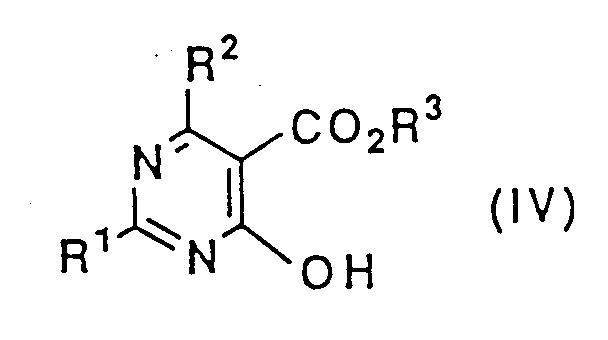
- A process according to claim 13, wherein the compound of the formula (IV):


- An agricultural fungicidal composition comprising a compound according to any one of claims 1 to 11 as an active ingredient.
- An insecticidal composition comprising a compound according to any one of claims 1 to 11 as an active ingredient.
- A miticidal composition comprising a compound according to any one of claims 1 to 11 as an active ingredient.
- A process for producing a compound of the formula (I-A):


- A process for producing a compound of the formula (I-B):


- A compound of the formula (II):

- A compound of the formula (IV):
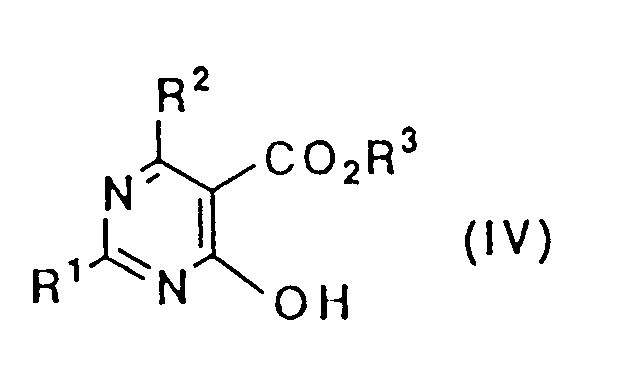
Applications Claiming Priority (4)
| Application Number | Priority Date | Filing Date | Title |
|---|---|---|---|
| JP34853592 | 1992-12-28 | ||
| JP348535/92 | 1992-12-28 | ||
| JP1498093 | 1993-02-01 | ||
| JP14980/93 | 1993-02-01 |
Publications (2)
| Publication Number | Publication Date |
|---|---|
| EP0606011A1 EP0606011A1 (en) | 1994-07-13 |
| EP0606011B1 true EP0606011B1 (en) | 1997-03-05 |
Family
ID=26351036
Family Applications (1)
| Application Number | Title | Priority Date | Filing Date |
|---|---|---|---|
| EP93310556A Expired - Lifetime EP0606011B1 (en) | 1992-12-28 | 1993-12-24 | Aminopyrimidine derivatives and their production and use |
Country Status (7)
| Country | Link |
|---|---|
| US (2) | US5439911A (en) |
| EP (1) | EP0606011B1 (en) |
| KR (1) | KR100291874B1 (en) |
| AT (1) | ATE149491T1 (en) |
| DE (1) | DE69308523T2 (en) |
| ES (1) | ES2101254T3 (en) |
| TW (1) | TW275563B (en) |
Families Citing this family (16)
| Publication number | Priority date | Publication date | Assignee | Title |
|---|---|---|---|---|
| DE4417163A1 (en) * | 1994-05-17 | 1995-11-23 | Hoechst Schering Agrevo Gmbh | Heterocyclylamino and heterocyclyloxy-cycloalkyl derivatives, their preparation and their use as pesticides and fungicides |
| DE19603576A1 (en) * | 1996-02-01 | 1997-08-07 | Bayer Ag | Acylated 4-amino and 4-hydrazinopyrimidines |
| US5888500A (en) * | 1996-09-26 | 1999-03-30 | Marshall; Lucia G. I. | Biological control agent biocarriers and method of formation |
| US5945099A (en) * | 1996-09-26 | 1999-08-31 | Marshall; Lucia G. I. | Mycoherbicidal delivery compositions, preparation and methods for controlling aquatic weeds |
| AU1459999A (en) | 1997-11-14 | 1999-06-07 | Dow Agrosciences Llc | 2-methoxyimino-2-phenyl acetamides containing a ketal- or dialkoxy substituted pyridine moiety, their preparation and their use as fungicides |
| JP4376439B2 (en) * | 2000-09-27 | 2009-12-02 | トヨタ紡織株式会社 | FIBER LAYER, ITS MANUFACTURING METHOD, AND ITS MANUFACTURING DEVICE |
| US8043056B2 (en) | 2008-02-08 | 2011-10-25 | Sunonwealth Electric Machine Industry Co., Ltd. | Self-assembly micro fan |
| WO2012112364A1 (en) * | 2011-02-14 | 2012-08-23 | Merck Sharp & Dohme Corp. | Lactam derivatives as dgat-1 inhibitors |
| WO2013113720A1 (en) | 2012-02-03 | 2013-08-08 | Basf Se | Fungicidal pyrimidine compounds |
| WO2013113719A1 (en) | 2012-02-03 | 2013-08-08 | Basf Se | Fungicidal pyrimidine compounds ii |
| WO2013113788A1 (en) | 2012-02-03 | 2013-08-08 | Basf Se | Fungicidal pyrimidine compounds |
| WO2013113776A1 (en) | 2012-02-03 | 2013-08-08 | Basf Se | Fungicidal pyrimidine compounds |
| CA2865043A1 (en) | 2012-03-13 | 2013-09-19 | Basf Se | Fungicidal pyrimidine compounds |
| CA2923101A1 (en) | 2013-09-16 | 2015-03-19 | Basf Se | Fungicidal pyrimidine compounds |
| CN114644596B (en) * | 2022-03-31 | 2024-01-30 | 青岛科技大学 | Fluoropyrimidine aromatic amine compound and application thereof |
| CN114605335A (en) * | 2022-04-11 | 2022-06-10 | 青岛科技大学 | Pyrimidine thioether amine ester pesticide |
Family Cites Families (9)
| Publication number | Priority date | Publication date | Assignee | Title |
|---|---|---|---|---|
| DE2064096C3 (en) * | 1970-12-28 | 1979-04-05 | Bayer Ag, 5090 Leverkusen | Process for the preparation of 6-position substituted 2,4-dichloropyrimidine-S-carboxylic acid esters |
| US3860596A (en) * | 1972-08-31 | 1975-01-14 | American Home Prod | 2-aryl-4-substituted-amino-5-pyrimidyl derivatives |
| PH20344A (en) * | 1981-01-29 | 1986-12-04 | Sankyo Co | Aminopyrimidine derivatives, processes for their preparation, and fungicidal, insecticidal and acaricidal compositions containing them |
| DE3205638A1 (en) * | 1982-02-17 | 1983-08-25 | Hoechst Ag, 6230 Frankfurt | Trisubstituted pyrimidine-5-carboxylic acids and their derivatives, processes for their preparation, and their use as pesticides |
| DE3338859A1 (en) * | 1983-10-26 | 1985-05-09 | Bayer Ag, 5090 Leverkusen | SUBSTITUTED PYRIMIDINE |
| US4895849A (en) * | 1986-10-08 | 1990-01-23 | Ube Industries, Ltd. | Aralkylaminopyrimidine compounds which are useful as for producing thereof and insecticides |
| CA2053148A1 (en) * | 1990-10-16 | 1992-04-17 | Karnail Atwal | Dihydropyrimidine derivatives |
| GB9125842D0 (en) * | 1991-12-04 | 1992-02-05 | Ici Plc | Heterocyclic derivatives |
| AU3933493A (en) * | 1992-04-24 | 1993-11-29 | E.I. Du Pont De Nemours And Company | Arthropodicidal and fungicidal aminopyrimidines |
-
1993
- 1993-12-17 US US08/168,217 patent/US5439911A/en not_active Expired - Fee Related
- 1993-12-24 EP EP93310556A patent/EP0606011B1/en not_active Expired - Lifetime
- 1993-12-24 ES ES93310556T patent/ES2101254T3/en not_active Expired - Lifetime
- 1993-12-24 DE DE69308523T patent/DE69308523T2/en not_active Expired - Fee Related
- 1993-12-24 AT AT93310556T patent/ATE149491T1/en not_active IP Right Cessation
- 1993-12-27 KR KR1019930029979A patent/KR100291874B1/en not_active Expired - Fee Related
- 1993-12-27 TW TW082111015A patent/TW275563B/zh active
-
1995
- 1995-05-23 US US08/448,193 patent/US5519139A/en not_active Expired - Fee Related
Non-Patent Citations (1)
| Title |
|---|
| CHEMICAL ABSTRACTS, vol. 71, 1969, Columbus, Ohio, US; abstract no. 13046k, 'Isothiazole derivatives' page 325; & ROCZ. CHEM. vol. 42, no. 12, 1968, pages 2091-2099 Z.MACHON * |
Also Published As
| Publication number | Publication date |
|---|---|
| EP0606011A1 (en) | 1994-07-13 |
| KR940014353A (en) | 1994-07-18 |
| DE69308523T2 (en) | 1997-08-14 |
| TW275563B (en) | 1996-05-11 |
| ATE149491T1 (en) | 1997-03-15 |
| KR100291874B1 (en) | 2001-09-17 |
| ES2101254T3 (en) | 1997-07-01 |
| US5519139A (en) | 1996-05-21 |
| DE69308523D1 (en) | 1997-04-10 |
| US5439911A (en) | 1995-08-08 |
Similar Documents
| Publication | Publication Date | Title |
|---|---|---|
| KR100362787B1 (en) | Alpha-substituted phenylacetic acid derivatives, preparations thereof and agricultural fungicides containing them | |
| JP2828186B2 (en) | Acrylate-based compounds, their preparation and fungicides | |
| EP0629609B1 (en) | Process for the preparation of Alkoxyiminoacetamide derivatives and an intermediate therefor | |
| US4814338A (en) | Pyrimidine derivative, process for preparing same and agricultural or horticultural fungicidal composition containing same | |
| EP0665225B1 (en) | 4-Phenethylamino pyrimidine derivative, process for preparing the same and agricultural and horticultural chemical for controlling noxious organisms containing the same | |
| US6313150B1 (en) | α-substituted phenylacetic acid derivative, its production and agricultural fungicide containing it | |
| EP0567133B1 (en) | Picolinic acid derivatives and herbicidal compositions | |
| EP0606011A1 (en) | Aminopyrimidine derivatives and their production and use | |
| EP0528681A1 (en) | Phenylmethoxyimino compounds and agricultural fungicides containing them | |
| JP2897789B2 (en) | Alkoxyiminoacetic acid amide compounds and their use as agricultural fungicides | |
| US4804762A (en) | N-cyanoalkylisonicotinamide derivatives | |
| JPH07258223A (en) | 4-Phenethylaminopyrimidine derivative, its production method and pest control agent for agriculture and horticulture | |
| JP3366715B2 (en) | Aminopyrimidine derivatives, their production method and intermediates for production, and agricultural fungicides, insecticides and acaricides containing the same | |
| JP3211518B2 (en) | Phenoxyalkylamine derivatives, their preparation and pesticides for agricultural and horticultural use | |
| JPH03173872A (en) | Aminopyrimidine derivatives, their production methods, and insecticides and fungicides | |
| JP2730019B2 (en) | Aralkylamine derivatives, their production and fungicides | |
| JPH0363266A (en) | Aralkylamine derivatives, their production methods, disinfectants, and insecticides | |
| JPH07112972A (en) | Pyrazolecarboxamide derivative, its manufacturing method and pest control agent for agricultural and horticultural use | |
| JPH03161485A (en) | Aminopyrimidine derivative, production thereof and insecticidal and fungicidal agent | |
| JPH04164072A (en) | Oxypyrimidine derivative, its production and pest control agent therefrom | |
| JP2000186089A (en) | 5-Azolylpyrimidine derivatives, their production and fungicides for agricultural and horticultural use | |
| JP2943778B2 (en) | Substituted benzene derivatives | |
| JPS63201174A (en) | Pyridazinone derivative, production thereof and insecticide, acaricide, nematicide and fungicide | |
| JPH0789937A (en) | Phenoxyalkylamine derivative, its manufacturing method and pest control agent for agriculture and horticulture | |
| JPH0426680A (en) | Pyrimidine derivatives, their production methods and pest control agents |
Legal Events
| Date | Code | Title | Description |
|---|---|---|---|
| PUAI | Public reference made under article 153(3) epc to a published international application that has entered the european phase |
Free format text: ORIGINAL CODE: 0009012 |
|
| AK | Designated contracting states |
Kind code of ref document: A1 Designated state(s): AT BE CH DE DK ES FR GB GR IE IT LI LU MC NL PT SE |
|
| 17P | Request for examination filed |
Effective date: 19940805 |
|
| 17Q | First examination report despatched |
Effective date: 19941214 |
|
| GRAG | Despatch of communication of intention to grant |
Free format text: ORIGINAL CODE: EPIDOS AGRA |
|
| GRAH | Despatch of communication of intention to grant a patent |
Free format text: ORIGINAL CODE: EPIDOS IGRA |
|
| GRAH | Despatch of communication of intention to grant a patent |
Free format text: ORIGINAL CODE: EPIDOS IGRA |
|
| GRAA | (expected) grant |
Free format text: ORIGINAL CODE: 0009210 |
|
| AK | Designated contracting states |
Kind code of ref document: B1 Designated state(s): AT BE CH DE DK ES FR GB GR IE IT LI LU MC NL PT SE |
|
| PG25 | Lapsed in a contracting state [announced via postgrant information from national office to epo] |
Ref country code: GR Free format text: LAPSE BECAUSE OF FAILURE TO SUBMIT A TRANSLATION OF THE DESCRIPTION OR TO PAY THE FEE WITHIN THE PRESCRIBED TIME-LIMIT Effective date: 19970305 Ref country code: DK Effective date: 19970305 Ref country code: AT Effective date: 19970305 |
|
| REF | Corresponds to: |
Ref document number: 149491 Country of ref document: AT Date of ref document: 19970315 Kind code of ref document: T |
|
| REG | Reference to a national code |
Ref country code: CH Ref legal event code: NV Representative=s name: BOVARD AG PATENTANWAELTE Ref country code: CH Ref legal event code: EP |
|
| REF | Corresponds to: |
Ref document number: 69308523 Country of ref document: DE Date of ref document: 19970410 |
|
| REG | Reference to a national code |
Ref country code: IE Ref legal event code: FG4D Free format text: 72353 |
|
| ITF | It: translation for a ep patent filed | ||
| PG25 | Lapsed in a contracting state [announced via postgrant information from national office to epo] |
Ref country code: PT Effective date: 19970605 |
|
| K2C1 | Correction of patent specification (title page) published |
Effective date: 19970305 |
|
| REG | Reference to a national code |
Ref country code: ES Ref legal event code: FG2A Ref document number: 2101254 Country of ref document: ES Kind code of ref document: T3 |
|
| ET | Fr: translation filed | ||
| PG25 | Lapsed in a contracting state [announced via postgrant information from national office to epo] |
Ref country code: LU Free format text: LAPSE BECAUSE OF NON-PAYMENT OF DUE FEES Effective date: 19971224 Ref country code: IE Free format text: LAPSE BECAUSE OF NON-PAYMENT OF DUE FEES Effective date: 19971224 |
|
| PLBE | No opposition filed within time limit |
Free format text: ORIGINAL CODE: 0009261 |
|
| STAA | Information on the status of an ep patent application or granted ep patent |
Free format text: STATUS: NO OPPOSITION FILED WITHIN TIME LIMIT |
|
| 26N | No opposition filed | ||
| PG25 | Lapsed in a contracting state [announced via postgrant information from national office to epo] |
Ref country code: MC Free format text: LAPSE BECAUSE OF NON-PAYMENT OF DUE FEES Effective date: 19980630 |
|
| REG | Reference to a national code |
Ref country code: GB Ref legal event code: IF02 |
|
| PGFP | Annual fee paid to national office [announced via postgrant information from national office to epo] |
Ref country code: GB Payment date: 20031107 Year of fee payment: 11 |
|
| PGFP | Annual fee paid to national office [announced via postgrant information from national office to epo] |
Ref country code: BE Payment date: 20031112 Year of fee payment: 11 |
|
| PGFP | Annual fee paid to national office [announced via postgrant information from national office to epo] |
Ref country code: SE Payment date: 20031204 Year of fee payment: 11 |
|
| PGFP | Annual fee paid to national office [announced via postgrant information from national office to epo] |
Ref country code: CH Payment date: 20031211 Year of fee payment: 11 |
|
| PGFP | Annual fee paid to national office [announced via postgrant information from national office to epo] |
Ref country code: FR Payment date: 20031223 Year of fee payment: 11 |
|
| PGFP | Annual fee paid to national office [announced via postgrant information from national office to epo] |
Ref country code: ES Payment date: 20031230 Year of fee payment: 11 |
|
| PGFP | Annual fee paid to national office [announced via postgrant information from national office to epo] |
Ref country code: NL Payment date: 20031231 Year of fee payment: 11 Ref country code: DE Payment date: 20031231 Year of fee payment: 11 |
|
| PG25 | Lapsed in a contracting state [announced via postgrant information from national office to epo] |
Ref country code: GB Free format text: LAPSE BECAUSE OF NON-PAYMENT OF DUE FEES Effective date: 20041224 |
|
| PG25 | Lapsed in a contracting state [announced via postgrant information from national office to epo] |
Ref country code: SE Free format text: LAPSE BECAUSE OF NON-PAYMENT OF DUE FEES Effective date: 20041225 |
|
| PG25 | Lapsed in a contracting state [announced via postgrant information from national office to epo] |
Ref country code: ES Free format text: LAPSE BECAUSE OF NON-PAYMENT OF DUE FEES Effective date: 20041227 |
|
| PG25 | Lapsed in a contracting state [announced via postgrant information from national office to epo] |
Ref country code: LI Free format text: LAPSE BECAUSE OF NON-PAYMENT OF DUE FEES Effective date: 20041231 Ref country code: CH Free format text: LAPSE BECAUSE OF NON-PAYMENT OF DUE FEES Effective date: 20041231 Ref country code: BE Free format text: LAPSE BECAUSE OF NON-PAYMENT OF DUE FEES Effective date: 20041231 |
|
| BERE | Be: lapsed |
Owner name: *SHIONOGI SEIYAKU K.K. TRADING UNDER THE NAME OF S Effective date: 20041231 |
|
| PG25 | Lapsed in a contracting state [announced via postgrant information from national office to epo] |
Ref country code: NL Free format text: LAPSE BECAUSE OF NON-PAYMENT OF DUE FEES Effective date: 20050701 Ref country code: DE Free format text: LAPSE BECAUSE OF NON-PAYMENT OF DUE FEES Effective date: 20050701 |
|
| EUG | Se: european patent has lapsed | ||
| REG | Reference to a national code |
Ref country code: CH Ref legal event code: PL |
|
| GBPC | Gb: european patent ceased through non-payment of renewal fee |
Effective date: 20041224 |
|
| PG25 | Lapsed in a contracting state [announced via postgrant information from national office to epo] |
Ref country code: FR Free format text: LAPSE BECAUSE OF NON-PAYMENT OF DUE FEES Effective date: 20050831 |
|
| NLV4 | Nl: lapsed or anulled due to non-payment of the annual fee |
Effective date: 20050701 |
|
| REG | Reference to a national code |
Ref country code: FR Ref legal event code: ST |
|
| PG25 | Lapsed in a contracting state [announced via postgrant information from national office to epo] |
Ref country code: IT Free format text: LAPSE BECAUSE OF NON-PAYMENT OF DUE FEES;WARNING: LAPSES OF ITALIAN PATENTS WITH EFFECTIVE DATE BEFORE 2007 MAY HAVE OCCURRED AT ANY TIME BEFORE 2007. THE CORRECT EFFECTIVE DATE MAY BE DIFFERENT FROM THE ONE RECORDED. Effective date: 20051224 |
|
| REG | Reference to a national code |
Ref country code: ES Ref legal event code: FD2A Effective date: 20041227 |
|
| BERE | Be: lapsed |
Owner name: *SHIONOGI SEIYAKU K.K. TRADING UNDER THE NAME OF S Effective date: 20041231 |