EP0605175B1 - A coated article and a method of coating said article - Google Patents
A coated article and a method of coating said article Download PDFInfo
- Publication number
- EP0605175B1 EP0605175B1 EP93310374A EP93310374A EP0605175B1 EP 0605175 B1 EP0605175 B1 EP 0605175B1 EP 93310374 A EP93310374 A EP 93310374A EP 93310374 A EP93310374 A EP 93310374A EP 0605175 B1 EP0605175 B1 EP 0605175B1
- Authority
- EP
- European Patent Office
- Prior art keywords
- coating
- boron
- composition
- metal
- fraction
- Prior art date
- Legal status (The legal status is an assumption and is not a legal conclusion. Google has not performed a legal analysis and makes no representation as to the accuracy of the status listed.)
- Expired - Lifetime
Links
- 238000000576 coating method Methods 0.000 title claims description 119
- 239000011248 coating agent Substances 0.000 title claims description 107
- 238000000034 method Methods 0.000 title claims description 33
- 229910052796 boron Inorganic materials 0.000 claims description 63
- 239000000203 mixture Substances 0.000 claims description 62
- 229910052751 metal Inorganic materials 0.000 claims description 58
- 239000002184 metal Substances 0.000 claims description 58
- PXHVJJICTQNCMI-UHFFFAOYSA-N nickel Substances [Ni] PXHVJJICTQNCMI-UHFFFAOYSA-N 0.000 claims description 56
- ZOXJGFHDIHLPTG-UHFFFAOYSA-N Boron Chemical compound [B] ZOXJGFHDIHLPTG-UHFFFAOYSA-N 0.000 claims description 50
- 239000000843 powder Substances 0.000 claims description 43
- 229910045601 alloy Inorganic materials 0.000 claims description 34
- 239000000956 alloy Substances 0.000 claims description 34
- 238000010438 heat treatment Methods 0.000 claims description 34
- 239000011230 binding agent Substances 0.000 claims description 33
- 229910052759 nickel Inorganic materials 0.000 claims description 31
- XEEYBQQBJWHFJM-UHFFFAOYSA-N iron Substances [Fe] XEEYBQQBJWHFJM-UHFFFAOYSA-N 0.000 claims description 18
- 229910000831 Steel Inorganic materials 0.000 claims description 15
- 239000010959 steel Substances 0.000 claims description 15
- 238000005474 detonation Methods 0.000 claims description 13
- 229910052742 iron Inorganic materials 0.000 claims description 13
- 229910052804 chromium Inorganic materials 0.000 claims description 11
- 239000011651 chromium Substances 0.000 claims description 11
- 238000000151 deposition Methods 0.000 claims description 11
- 239000007921 spray Substances 0.000 claims description 9
- 229910052721 tungsten Inorganic materials 0.000 claims description 9
- 238000005260 corrosion Methods 0.000 claims description 8
- 230000007797 corrosion Effects 0.000 claims description 8
- VYZAMTAEIAYCRO-UHFFFAOYSA-N Chromium Chemical compound [Cr] VYZAMTAEIAYCRO-UHFFFAOYSA-N 0.000 claims description 7
- 239000010941 cobalt Substances 0.000 claims description 7
- 229910017052 cobalt Inorganic materials 0.000 claims description 7
- 239000008199 coating composition Substances 0.000 claims description 6
- GUTLYIVDDKVIGB-UHFFFAOYSA-N cobalt atom Chemical compound [Co] GUTLYIVDDKVIGB-UHFFFAOYSA-N 0.000 claims description 6
- 150000001875 compounds Chemical class 0.000 claims description 6
- 230000008021 deposition Effects 0.000 claims description 6
- WFKWXMTUELFFGS-UHFFFAOYSA-N tungsten Chemical compound [W] WFKWXMTUELFFGS-UHFFFAOYSA-N 0.000 claims description 6
- 239000010937 tungsten Substances 0.000 claims description 6
- ZOKXTWBITQBERF-UHFFFAOYSA-N Molybdenum Chemical compound [Mo] ZOKXTWBITQBERF-UHFFFAOYSA-N 0.000 claims description 5
- RTAQQCXQSZGOHL-UHFFFAOYSA-N Titanium Chemical compound [Ti] RTAQQCXQSZGOHL-UHFFFAOYSA-N 0.000 claims description 5
- QCWXUUIWCKQGHC-UHFFFAOYSA-N Zirconium Chemical compound [Zr] QCWXUUIWCKQGHC-UHFFFAOYSA-N 0.000 claims description 5
- 229910052735 hafnium Inorganic materials 0.000 claims description 5
- VBJZVLUMGGDVMO-UHFFFAOYSA-N hafnium atom Chemical compound [Hf] VBJZVLUMGGDVMO-UHFFFAOYSA-N 0.000 claims description 5
- 229910052750 molybdenum Inorganic materials 0.000 claims description 5
- 239000011733 molybdenum Substances 0.000 claims description 5
- 229910052758 niobium Inorganic materials 0.000 claims description 5
- 239000010955 niobium Substances 0.000 claims description 5
- GUCVJGMIXFAOAE-UHFFFAOYSA-N niobium atom Chemical compound [Nb] GUCVJGMIXFAOAE-UHFFFAOYSA-N 0.000 claims description 5
- 229910052719 titanium Inorganic materials 0.000 claims description 5
- 239000010936 titanium Substances 0.000 claims description 5
- 229910052720 vanadium Inorganic materials 0.000 claims description 5
- GPPXJZIENCGNKB-UHFFFAOYSA-N vanadium Chemical compound [V]#[V] GPPXJZIENCGNKB-UHFFFAOYSA-N 0.000 claims description 5
- 229910052726 zirconium Inorganic materials 0.000 claims description 5
- 229910000990 Ni alloy Inorganic materials 0.000 claims description 4
- 229910052710 silicon Inorganic materials 0.000 claims description 4
- 229910052715 tantalum Inorganic materials 0.000 claims description 4
- -1 tantalum carbides Chemical class 0.000 claims description 4
- 150000001247 metal acetylides Chemical class 0.000 claims description 3
- UONOETXJSWQNOL-UHFFFAOYSA-N tungsten carbide Chemical compound [W+]#[C-] UONOETXJSWQNOL-UHFFFAOYSA-N 0.000 claims description 3
- 239000011159 matrix material Substances 0.000 claims description 2
- XUIMIQQOPSSXEZ-UHFFFAOYSA-N Silicon Chemical compound [Si] XUIMIQQOPSSXEZ-UHFFFAOYSA-N 0.000 claims 2
- 238000005275 alloying Methods 0.000 claims 2
- 239000010703 silicon Substances 0.000 claims 2
- 239000011148 porous material Substances 0.000 claims 1
- 229910000521 B alloy Inorganic materials 0.000 description 14
- 239000000758 substrate Substances 0.000 description 13
- 239000010410 layer Substances 0.000 description 12
- 238000010791 quenching Methods 0.000 description 10
- 238000005336 cracking Methods 0.000 description 8
- 229910001104 4140 steel Inorganic materials 0.000 description 6
- 230000000171 quenching effect Effects 0.000 description 6
- 229910001347 Stellite Inorganic materials 0.000 description 5
- 229910009043 WC-Co Inorganic materials 0.000 description 5
- AHICWQREWHDHHF-UHFFFAOYSA-N chromium;cobalt;iron;manganese;methane;molybdenum;nickel;silicon;tungsten Chemical compound C.[Si].[Cr].[Mn].[Fe].[Co].[Ni].[Mo].[W] AHICWQREWHDHHF-UHFFFAOYSA-N 0.000 description 5
- 238000009472 formulation Methods 0.000 description 5
- 229910052799 carbon Inorganic materials 0.000 description 4
- 239000002131 composite material Substances 0.000 description 4
- 230000035882 stress Effects 0.000 description 4
- 238000005299 abrasion Methods 0.000 description 3
- 229910000788 1018 steel Inorganic materials 0.000 description 2
- 229910001350 4130 steel Inorganic materials 0.000 description 2
- IJGRMHOSHXDMSA-UHFFFAOYSA-N Atomic nitrogen Chemical compound N#N IJGRMHOSHXDMSA-UHFFFAOYSA-N 0.000 description 2
- 229910001209 Low-carbon steel Inorganic materials 0.000 description 2
- 230000003628 erosive effect Effects 0.000 description 2
- 238000007689 inspection Methods 0.000 description 2
- 230000035515 penetration Effects 0.000 description 2
- 230000000717 retained effect Effects 0.000 description 2
- 238000005507 spraying Methods 0.000 description 2
- 239000000126 substance Substances 0.000 description 2
- 229910001208 Crucible steel Inorganic materials 0.000 description 1
- 229910039444 MoC Inorganic materials 0.000 description 1
- 230000032683 aging Effects 0.000 description 1
- HSFWRNGVRCDJHI-UHFFFAOYSA-N alpha-acetylene Natural products C#C HSFWRNGVRCDJHI-UHFFFAOYSA-N 0.000 description 1
- 229910052782 aluminium Inorganic materials 0.000 description 1
- XAGFODPZIPBFFR-UHFFFAOYSA-N aluminium Chemical compound [Al] XAGFODPZIPBFFR-UHFFFAOYSA-N 0.000 description 1
- QVGXLLKOCUKJST-UHFFFAOYSA-N atomic oxygen Chemical compound [O] QVGXLLKOCUKJST-UHFFFAOYSA-N 0.000 description 1
- QDWJUBJKEHXSMT-UHFFFAOYSA-N boranylidynenickel Chemical compound [Ni]#B QDWJUBJKEHXSMT-UHFFFAOYSA-N 0.000 description 1
- 239000011247 coating layer Substances 0.000 description 1
- 238000002485 combustion reaction Methods 0.000 description 1
- 239000000470 constituent Substances 0.000 description 1
- 230000002596 correlated effect Effects 0.000 description 1
- 125000002534 ethynyl group Chemical group [H]C#C* 0.000 description 1
- 238000002474 experimental method Methods 0.000 description 1
- 239000000446 fuel Substances 0.000 description 1
- 239000012535 impurity Substances 0.000 description 1
- 239000000463 material Substances 0.000 description 1
- 238000005259 measurement Methods 0.000 description 1
- 230000008018 melting Effects 0.000 description 1
- 238000002844 melting Methods 0.000 description 1
- NFFIWVVINABMKP-UHFFFAOYSA-N methylidynetantalum Chemical compound [Ta]#C NFFIWVVINABMKP-UHFFFAOYSA-N 0.000 description 1
- 229910052757 nitrogen Inorganic materials 0.000 description 1
- 229910052760 oxygen Inorganic materials 0.000 description 1
- 239000001301 oxygen Substances 0.000 description 1
- 238000012545 processing Methods 0.000 description 1
- 238000003303 reheating Methods 0.000 description 1
- 238000005096 rolling process Methods 0.000 description 1
- 239000004576 sand Substances 0.000 description 1
- 238000007493 shaping process Methods 0.000 description 1
- 239000002356 single layer Substances 0.000 description 1
- 238000010561 standard procedure Methods 0.000 description 1
- 229910003468 tantalcarbide Inorganic materials 0.000 description 1
- 238000005496 tempering Methods 0.000 description 1
- 238000012360 testing method Methods 0.000 description 1
- 238000011282 treatment Methods 0.000 description 1
Images
Classifications
-
- C—CHEMISTRY; METALLURGY
- C23—COATING METALLIC MATERIAL; COATING MATERIAL WITH METALLIC MATERIAL; CHEMICAL SURFACE TREATMENT; DIFFUSION TREATMENT OF METALLIC MATERIAL; COATING BY VACUUM EVAPORATION, BY SPUTTERING, BY ION IMPLANTATION OR BY CHEMICAL VAPOUR DEPOSITION, IN GENERAL; INHIBITING CORROSION OF METALLIC MATERIAL OR INCRUSTATION IN GENERAL
- C23C—COATING METALLIC MATERIAL; COATING MATERIAL WITH METALLIC MATERIAL; SURFACE TREATMENT OF METALLIC MATERIAL BY DIFFUSION INTO THE SURFACE, BY CHEMICAL CONVERSION OR SUBSTITUTION; COATING BY VACUUM EVAPORATION, BY SPUTTERING, BY ION IMPLANTATION OR BY CHEMICAL VAPOUR DEPOSITION, IN GENERAL
- C23C4/00—Coating by spraying the coating material in the molten state, e.g. by flame, plasma or electric discharge
- C23C4/04—Coating by spraying the coating material in the molten state, e.g. by flame, plasma or electric discharge characterised by the coating material
- C23C4/06—Metallic material
-
- C—CHEMISTRY; METALLURGY
- C22—METALLURGY; FERROUS OR NON-FERROUS ALLOYS; TREATMENT OF ALLOYS OR NON-FERROUS METALS
- C22C—ALLOYS
- C22C19/00—Alloys based on nickel or cobalt
- C22C19/03—Alloys based on nickel or cobalt based on nickel
-
- C—CHEMISTRY; METALLURGY
- C23—COATING METALLIC MATERIAL; COATING MATERIAL WITH METALLIC MATERIAL; CHEMICAL SURFACE TREATMENT; DIFFUSION TREATMENT OF METALLIC MATERIAL; COATING BY VACUUM EVAPORATION, BY SPUTTERING, BY ION IMPLANTATION OR BY CHEMICAL VAPOUR DEPOSITION, IN GENERAL; INHIBITING CORROSION OF METALLIC MATERIAL OR INCRUSTATION IN GENERAL
- C23C—COATING METALLIC MATERIAL; COATING MATERIAL WITH METALLIC MATERIAL; SURFACE TREATMENT OF METALLIC MATERIAL BY DIFFUSION INTO THE SURFACE, BY CHEMICAL CONVERSION OR SUBSTITUTION; COATING BY VACUUM EVAPORATION, BY SPUTTERING, BY ION IMPLANTATION OR BY CHEMICAL VAPOUR DEPOSITION, IN GENERAL
- C23C4/00—Coating by spraying the coating material in the molten state, e.g. by flame, plasma or electric discharge
- C23C4/12—Coating by spraying the coating material in the molten state, e.g. by flame, plasma or electric discharge characterised by the method of spraying
- C23C4/126—Detonation spraying
-
- C—CHEMISTRY; METALLURGY
- C23—COATING METALLIC MATERIAL; COATING MATERIAL WITH METALLIC MATERIAL; CHEMICAL SURFACE TREATMENT; DIFFUSION TREATMENT OF METALLIC MATERIAL; COATING BY VACUUM EVAPORATION, BY SPUTTERING, BY ION IMPLANTATION OR BY CHEMICAL VAPOUR DEPOSITION, IN GENERAL; INHIBITING CORROSION OF METALLIC MATERIAL OR INCRUSTATION IN GENERAL
- C23C—COATING METALLIC MATERIAL; COATING MATERIAL WITH METALLIC MATERIAL; SURFACE TREATMENT OF METALLIC MATERIAL BY DIFFUSION INTO THE SURFACE, BY CHEMICAL CONVERSION OR SUBSTITUTION; COATING BY VACUUM EVAPORATION, BY SPUTTERING, BY ION IMPLANTATION OR BY CHEMICAL VAPOUR DEPOSITION, IN GENERAL
- C23C4/00—Coating by spraying the coating material in the molten state, e.g. by flame, plasma or electric discharge
- C23C4/18—After-treatment
Definitions
- the present invention relates to a coated article and a method of forming a coating on a substrate.
- the present invention relates to an article having a wear and corrosion-resistant coating and a method for forming a wear and corrosion resistant coating on a substrate in which the coating will not crack when quenched in oil along with its substrate.
- a wear and corrosion resistant coating on a metallic substrate by depositing at least one coating of a metal carbide and binder, particularly tungsten carbide and cobalt and a nickel based alloy using a plasma, detonation gun or other thermal spray technique followed by a heat treatment operation.
- a metal carbide and binder particularly tungsten carbide and cobalt and a nickel based alloy
- the coating as taught in the Weatherly patent, may be formed by depositing two successive layers (the two layer method) on a metallic substrate followed by heat treatment or by depositing a single layer (the one-layer method) followed by heat treatment.
- a metal carbide layer is initially formed on the metallic surface preferably using a detonation gun followed by the deposition of a nickel based alloy or mixture of alloys containing boron.
- the range of boron in the second layer for the two layer method should be between 3 and 18 wt% when the density of the first layer is above 95% theoretical and between 6 and 18 wt% when the density of the first-layer is between 75 and 95% of theoretical.
- a metal carbide powder containing a metal binder such as cobalt and a nickel based alloy or mixture of alloys is mixed and deposited as one layer.
- the content of the metal carbide and binder is between 40 wt. % and 75 wt.
- % of the total composition and the boron content of the nickel based alloy or mixture of alloys is above 6 wt %.
- suitable wear resistant coatings may be formed in accordance with the teaching of the aforementioned Weatherly patent on a wide variety of steel substrates it is not recommended for use on steels that have to be hardened by oil quenching from elevated temperatures and then optionally tempered to achieve useful strengths and mechanical properties. If hardened before coating, such steels will be annealed by the heat treatment that is required in the aforementioned Weatherly process to develop the optimum wear and corrosion-resistant properties of the coating (hereinafter referred to as the "Weatherly Coating").
- the present invention provides for forming an article composed of a body and a superimposed coating that exhibits high wear and corrosion resistance after heat treatment.
- This coating may be used on any body but is especially intended for use on steel bodies that require heat treatment and oil-quenching after coating because it will not crack when quenched in oil from high temperature.
- a coated article which comprises a steel body and a superimposed coating with said coating having an as-deposited porosity of less than 5% and a composition consisting of a metal carbide, metal binder and fraction, said metal carbide consisting essentially of one or more carbides selected from tungsten, chromium, vanadium, hafnium, titanium, zirconium, niobium, molybdenum and tantalum carbides and compounds thereof along with a metal binder selected from Co, Ni, Fe and alloys thereof and a fraction consisting of a nickel-based boron containing alloy of such composition that boron constitutes 1.3 and 3.0 wt% of the coating, said metal carbide (s) and metal binder fraction constituting between 50 wt % and 75 wt % of the entire composition, with said metal binder being up to 25 wt % of the metal carbide plus binder fraction and with said nickel based boron-containing alloy representing the balance of the composition, with
- a method for coating a steel body to form an article with a wear and corrosion resistant surface comprising the steps of: preparing a powder composition consisting of a metal carbide, metal binder and fraction, wherein said metal carbide consists essentially of at least one metal carbide selected from tungsten, chromium, vanadium, hafnium, titanium, zirconium, niobium, molybdenum and tantalum carbides and compounds thereof, the metal binder is selected from the class consisting of cobalt, nickel, iron and alloys thereof, and the fraction consists of a nickel based boron-containing alloy in which the metal carbide and the metal binder in the powder composition comprise between 50 and 75wt% of the powder composition with the metal binder being up to 25 wt% of the composition of said fraction and with said nickel based boron containing alloy representing the balance of the composition, with a boron content in said at least one metal-based boron-containing alloy in
- the powder composition of the present invention includes a metal carbide-binder fraction comprising tungsten, chromium, vanadium, hafnium, titanium, zirconium, niobium, molybdenum or tantalum carbide or mixtures or compounds thereof and up to 25 wt % of a metal binder such as Co, Ni and Fe and a fraction comprising a nickel-based alloy containing boron.
- a metal binder such as Co, Ni and Fe
- the preferred metal carbide is tungsten carbide and the preferred metal binder is cobalt in a range of preferably between above 0 and 15 wt %.
- the powder formulation must be applied to the body by a thermal spray process, capable of producing a coating with less than 5% included porosity.
- the nickel alloy fraction of the powder mix must have a boron content such that, upon deposition by such method capable of producing a coating with less than 5% porosity, the boron content of the coating lies in the range of 1.3 to 3.0 wt% of the total coating composition.
- Commercial thermal spray processes which may be used to provide the required high density coating include the detonation gun, hypersonic combustion or high velocity oxy-fuel spray coating processes and other "high velocity" spray coating processes.
- the detonation gun process is the preferred process and is well known and fully described in U.S. Patent No. 2,714,563, 4,173,685 and 4,519,840, respectively.
- the detonation gun process oxygen, acetylene and nitrogen are fed into a gun barrel along with the charge of material being coated and ignited.
- the resultant detonation wave accelerates the powder while heating it close to or above its melting point.
- the nickel-alloy fraction of the powder mix has a boron content such that the boron content of the total powder mix is between 1.0 and 2.7 wt%.
- the as-deposited coating have a porosity of less than 5%.
- the powder composition of the present invention when deposited with this low porosity using an appropriate thermal spray process and subjected to a heat treatment at above 950°C (hereinafter referred to as the "primary heat treatment") forms a hard, ductile, impervious coating that is able to survive, without cracking, oil-quenching from above 800°C.
- the porosity will reduce to 0 to 90% of its as-coated value and the original powder components will convert to a mixture of carbides and borides dispersed in a nickel alloy matrix.
- a coating with the specified as-deposited composition and density will exhibit a hardness of greater than 900kg/mm 2 when measured by the Vickers method with 300 gram load and will exhibit a total porosity of less than 5%, preferably less than 2%, with no through porosity, i.e. any voids are closed.
- the coating resulting from the primary heat treatment has excellent wear and corrosion resistance and no further processing is needed to take advantage of these properties, though the coating may be ground or otherwise finished to favorably modify its surface characteristics.
- the primary heat treatment may be followed by a secondary heat treatment designed to modify the mechanical properties of the supporting body without detriment to the coating.
- This heat treatment may be, for example, an aging heat treatment or an oil-quenching treatment appropriate to the substrate.
- a third heat treatment, to temper the quenched steel, as is common practice in heat treating, may also be applied without detriment to the coating.
- Each heat treatment may be carried out in a vacuum or in an appropriate atmosphere.
- the secondary heat treatment may be carried out as a continuation of the primary heat treatment or separately from the primary heat treatment. In fact, the coating can be cooled and reheated and then quenched.
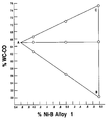
- the interdependence between the metal carbide-metal binder and the nickel based alloy is shown in Figure 1 using a composition of a WC-CO powder containing 4.4%C, 9.4%Co, 0.6%Fe, balance W and a Ni-B alloy which is composed of a combination of two nickel-based alloy components identified as Ni-B alloy 1 and Ni-B alloy 2, respectively.
- the nominal composition of Ni-B alloy 1 is: 14 wt % B, 2 wt.
- % Fe, balance Ni, and the nominal composition of the Ni-B alloy 2 is: 3% B, 3% Fe, 4% Si, 7% Cr, balance Ni.
- the ordinate represents the percentage of the WC-Co powder in the powder mix and the abscissa the percentage of Ni-B alloy 1.
- the proportions of Ni-B alloy I and Ni-B alloy 2 control the boron content of the powder formulation.
- the circled data points in Figure 1 define the boundaries of a triangular-like geometry and correspond to the data identified in the following Tables I and II respectively.
- the boron content of each of the mixtures is specified as the percentage of boron in the combined Ni-B alloy independent of the wt. % of the metal carbide.
- Table II shows the weight percent of boron in the powder and coating from which it should be noted that the boron content in the coating is not only retained but is enhanced from that in the powder.
- Table I Mix Composition-- wt. percent WC-Co Ni-B Alloy 1 Ni-B Alloy 2 % B in Ni-B Alloys 75.0 6.0 19.0 5.64 65.0 6.0 29.0 4.88 50.0 6.0 44.0 4.32 71.0 5.0 24.0 4.90 65.0 5.0 30.0 4.57 57.0 5.0 38.0 4.28 67.0 4.0 29.0 4.33 65.0 4.0 31.0 4.26 63.0 4.0 33.0 4.19 65.0 3.6 31.4 4.13 Table II --Powder Mix Comp-- wt.
- the area within the triangle formed in Figure 1 delineates the range of powder compositions which will form a coating having properties of high wear resistance, low porosity and the ability to withstand oil quenching without cracking.
- the optimum boron content range is between 4 wt. % and 5 wt. %.
- a boron content of above 6 wt % in the nickel boron alloy powder formulation results in a coating which cracks when quenched in oil.
- the range of the metal carbide-metal binder is also limited to between 50 and 75 wt % of the total mixture and preferably between 55 and 65 wt%.
- the percent of boron must be correlated to the percent of the metal carbide-metal binder to remain within the triangular region.
- the region above line A-B of Figure 1 designates a region of high wear resistance and a microhardness above 900 HV.3, whereas in the region above line A-C the porosity will be too high and the coating will exhibit interconnected porosity.
- the content of boron in the coating should be between 1.8 and 2.6 wt % in the case exemplified in figure 1 and between about 1.3 to 3.0 wt % in the most general case.
- the content of the metal carbide and binder must lie between 40 and 65 wt % and the percent of boron in the powder between 1.4 and 2.2 wt %.
- the article of the present invention is particularly suitable for high stress abrasive wear environments such as, for example, a steel guide or work roll.
- the coating formed in accordance with the present invention is particularly suitable as a bearing surface for any type of bearing and for use in providing a surface coating for a valve seat or valve gate.
- a powder mix (Powder Mix 1) was prepared of a WC-Co powder containing 86% W, 9.5% Co, 4.5% C with an alloy containing 83% Ni, 14% B, 2% Fe (Ni-B Alloy 1) and another alloy containing 83% Ni, 3% B, 7% Cr, 4% si, 3% Fe (Ni-B Alloy 2) in such proportions as to net 1.7% B in the mix.
- Powder Mix 1 was deposited by means of a detonation gun onto 1.27cms x 1.91cms (1/2"x 3/4") x 2.711 blocks of AISI 1018 steel. This detonation gun coating exhibited an as-deposited porosity of less than 5%.
- the resultant coating (Coating 11) had a microhardness greater than 900 HV.3 and a porosity of less than 1% after primary heat treatment to a temperature in excess of 1000°C.
- a coating made on a similar block of AISI 1018 steel using the same powder through a plasma torch was less than 95% dense though otherwise appearing to be of high quality in the as-deposited state, but was found to contain more than 10% porosity after primary heat treatment and its microhardness could not be measured accurately because of the high porosity.
- Coating #1 did not crack.
- the plasma torch coating could not be oil quenched without cracking.
- Coating #1 was deposited onto a 211 diameter, 611 long aluminum tube from which it was broken off by crushing the tube.
- the chemical composition of this coating was determined by standard methods of chemical analysis. Essentially identical results were obtained when the coating was deposited on a flat plate made of low carbon steel and again broken off mechanically.
- Coating #1 is made from Powder Mix 1, which contains 1.7% boron, but when removed from the substrate and analyzed it was found to contain 2.1% B. The apparent increase in B content is a result of preferential loss of other constituents during coating.
- a coating made by the spray and fuse process from Stellite SF6 powder which also contains 1.7% B, was found by analysis to contain only 1.2% B.
- a 511 0.D., 1.91cms (3/4") wall tube made of AISI 4140 steel was coated with 0.01611 of Coating #1 and primary heat-treated, then subsequently reheated to 850°C, oil quenched and tempered. The coating did not crack.
- Coating #1 was applied to the O.D. of a centrifugally cast steel mill work roll of nominal composition 1.7% C, 1.5% Ni, 1.1% Cr, 0.5% Mo, balance Fe and impurities and given the primary heat-treatment for the coating, but no secondary heat treatment. It is inherent in the operation of such rolls that each area of the surface is alternately heated and quenched as it moves into and out of contact with the hot steel. The coating was then ground and the roll installed in the finishing station of an I-beam shaping line. Three hundred tons of product was successfully rolled before the coating was penetrated. Penetration occurred in an area where the grinding had substantially reduced the coating thickness as a result of some out-of-roundness that developed during heat-treatment.
- the Stellite SF6 coating When subjected to oil quenching on 311 x 611 x 111 blocks of 4140 steel, the Stellite SF6 coating developed cracks just under the surface running parallel to the surface. The Composite 1 coating developed numerous cracks that ran completely through the coating from the surface to the substrate. While the cracking of the Stellite SF6 coating was relatively minor, it should be noted that this coating is significantly lower in hardness than the coatings of this invention, measuring only 450-500 HV.3.
- Samples of Coating #1 were prepared by coating Powder Mix 1 onto low carbon steel substrates for wear rate and mechanical property determinations and then tested in parallel with similarly prepared specimens coated using a plasma torch with a coating composition as taught in Weatherly containing tungsten carbide-cobalt and a nickel based alloy with about 8.5 wt% B and having about 3.4 wt% B in the coating.
- the results of these wear measurements are shown in Table III as indicated below where it is evident that the two coatings are essentially equivalent in the properties tested.
- the Weatherly coating however, cracked when quenched in oil on pieces of the same size, shape, and composition as those on which Coating #1 survived.
- a coating containing roughly the same B, C, Ni and W content as Coating 11, of Example 1 was prepared from another powder mix, using a plasma torch instead of the detonation gun used to deposit Coating #1.
- the porosity in this coating ranged from 3% to 6% in different samples, making it substantially inferior to coating #1.
- Coatings were prepared by detonation gun deposition of mixtures of the WC-CO powder described in Example I with varying amounts of Ni-B alloy 1 and Ni-B alloy 2 on the two large faces of 2.54cms x 7.62cms x 15.24cms(1" x 3" X 6") blocks of AISI 4140 steel, then heat treated first at over 1000°C to treat the coating and subsequently reheated to about 850°C, quenched in oil, reheated again at a lower temperature to temper the steel to about HRC 30 and examined for cracks using fluorescent penetrant. No cracks were found in any of these coatings. The specific compositions of these coatings are listed in the following Table IV.
Landscapes
- Chemical & Material Sciences (AREA)
- Engineering & Computer Science (AREA)
- Materials Engineering (AREA)
- Mechanical Engineering (AREA)
- Metallurgy (AREA)
- Organic Chemistry (AREA)
- Physics & Mathematics (AREA)
- Plasma & Fusion (AREA)
- Chemical Kinetics & Catalysis (AREA)
- Coating By Spraying Or Casting (AREA)
- Other Surface Treatments For Metallic Materials (AREA)
Applications Claiming Priority (2)
| Application Number | Priority Date | Filing Date | Title |
|---|---|---|---|
| US99871292A | 1992-12-30 | 1992-12-30 | |
| US998712 | 1992-12-30 |
Publications (3)
| Publication Number | Publication Date |
|---|---|
| EP0605175A2 EP0605175A2 (en) | 1994-07-06 |
| EP0605175A3 EP0605175A3 (en) | 1995-04-05 |
| EP0605175B1 true EP0605175B1 (en) | 1997-08-13 |
Family
ID=25545496
Family Applications (1)
| Application Number | Title | Priority Date | Filing Date |
|---|---|---|---|
| EP93310374A Expired - Lifetime EP0605175B1 (en) | 1992-12-30 | 1993-12-21 | A coated article and a method of coating said article |
Country Status (6)
| Country | Link |
|---|---|
| EP (1) | EP0605175B1 (enExample) |
| JP (1) | JPH06228728A (enExample) |
| KR (1) | KR940014880A (enExample) |
| CA (1) | CA2112545C (enExample) |
| DE (1) | DE69313093T2 (enExample) |
| SG (1) | SG47422A1 (enExample) |
Families Citing this family (7)
| Publication number | Priority date | Publication date | Assignee | Title |
|---|---|---|---|---|
| US5690716A (en) * | 1994-09-09 | 1997-11-25 | Osram Sylvania Inc. | Thermal spray powder |
| US6004372A (en) * | 1999-01-28 | 1999-12-21 | Praxair S.T. Technology, Inc. | Thermal spray coating for gates and seats |
| KR20010017861A (ko) * | 1999-08-16 | 2001-03-05 | 로버트 에이. 바쎄트 | 붕화크롬 코팅 |
| EP1077272A1 (en) * | 1999-08-16 | 2001-02-21 | Praxair Technology, Inc. | Titanium carbide/tungsten boride coatings |
| DE102007012635A1 (de) * | 2007-03-16 | 2008-09-18 | Alfred Flamang | Flammspritzwerkstoff und Verfahren zum thermischen Flammspritzen |
| KR20150127719A (ko) * | 2013-03-15 | 2015-11-17 | 메소코트, 인코포레이티드 | 3원 세라믹 용사 분말 및 코팅 방법 |
| FR3105341B1 (fr) * | 2019-12-23 | 2022-06-24 | Vallourec Oil & Gas France | Tube revêtu résistant à l’usure de cuvelage |
Family Cites Families (10)
| Publication number | Priority date | Publication date | Assignee | Title |
|---|---|---|---|---|
| DE1185034B (de) * | 1958-04-24 | 1965-01-07 | Metco Inc | Metallcarbid enthaltende Metallpulvermischung zur Herstellung von UEberzuegen auf Metallkoerpern durch Spritzschweissen |
| US4013453A (en) * | 1975-07-11 | 1977-03-22 | Eutectic Corporation | Flame spray powder for wear resistant alloy coating containing tungsten carbide |
| US4173685A (en) * | 1978-05-23 | 1979-11-06 | Union Carbide Corporation | Coating material and method of applying same for producing wear and corrosion resistant coated articles |
| CH647818A5 (de) * | 1980-12-05 | 1985-02-15 | Castolin Sa | Pulverfoermiger beschichtungswerkstoff zum thermischen beschichten von werkstuecken. |
| US4526618A (en) * | 1983-10-18 | 1985-07-02 | Union Carbide Corporation | Abrasion resistant coating composition |
| JPS63125652A (ja) * | 1986-11-14 | 1988-05-28 | Kawasaki Steel Corp | アルカリ洗浄ライン用ロ−ルの製造方法 |
| US5149597A (en) * | 1989-02-10 | 1992-09-22 | Holko Kenneth H | Wear resistant coating for metallic surfaces |
| JP2857773B2 (ja) * | 1989-08-30 | 1999-02-17 | 日鉄ハード株式会社 | 耐摩耗性に優れた製鉄機械プロセスロール |
| JP2567137B2 (ja) * | 1990-07-31 | 1996-12-25 | トーカロ株式会社 | 耐摩耗性ならびに耐溶融金属性に優れる複合皮膜被覆部材とその製造方法 |
| JPH04103750A (ja) * | 1990-08-22 | 1992-04-06 | Nippon Steel Corp | 耐摩耗被覆層の形成方法 |
-
1993
- 1993-12-21 SG SG1996001038A patent/SG47422A1/en unknown
- 1993-12-21 EP EP93310374A patent/EP0605175B1/en not_active Expired - Lifetime
- 1993-12-21 DE DE69313093T patent/DE69313093T2/de not_active Expired - Fee Related
- 1993-12-28 JP JP5349500A patent/JPH06228728A/ja active Pending
- 1993-12-29 KR KR1019930030616A patent/KR940014880A/ko not_active Ceased
- 1993-12-29 CA CA002112545A patent/CA2112545C/en not_active Expired - Fee Related
Also Published As
| Publication number | Publication date |
|---|---|
| EP0605175A3 (en) | 1995-04-05 |
| SG47422A1 (en) | 1998-04-17 |
| JPH06228728A (ja) | 1994-08-16 |
| DE69313093T2 (de) | 1998-03-26 |
| EP0605175A2 (en) | 1994-07-06 |
| DE69313093D1 (de) | 1997-09-18 |
| CA2112545A1 (en) | 1994-07-01 |
| KR940014880A (ko) | 1994-07-19 |
| CA2112545C (en) | 2000-04-18 |
Similar Documents
| Publication | Publication Date | Title |
|---|---|---|
| KR102870036B1 (ko) | 내마모성 및 내부식성을 위해 설계된 철 기반 합금 | |
| US4873150A (en) | High water-resistant member, and valve gear using the same for use in internal combustion engine | |
| Sun et al. | Plasma surface engineering of low alloy steel | |
| EP0572548B1 (en) | Tool steel with high thermal fatigue resistance | |
| EP0223202B1 (en) | Iron alloy containing molybdenum, copper and boron | |
| US4661371A (en) | Method of producing an exhaust valve for diesel engine | |
| US5966585A (en) | Titanium carbide/tungsten boride coatings | |
| US4389251A (en) | Powder mixture for thermal spraying | |
| EP3631035A1 (en) | Method and system for improving the surface fracture toughness of brittle materials, and a cutting tool produced by such method | |
| DE2208070C2 (de) | Verbundkörper und Verfahren zu dessen Herstellung | |
| KR20230113539A (ko) | 레이저 클래딩에 의한 열간 압연 밀 롤을 제조하는 방법 | |
| US4942059A (en) | Method for hardfacing metal articles | |
| US3819364A (en) | Welding hard metal composition | |
| JPH02290951A (ja) | 耐摩耗複合ロール及びその製造法 | |
| EP1077272A1 (en) | Titanium carbide/tungsten boride coatings | |
| CA2112545C (en) | Article with wear resistant coating and method | |
| EP0510598B1 (en) | Wear-resistant compound roll | |
| JPH10195547A (ja) | 耐摩耗性、耐ビルドアップ性に優れたハースロールおよびその製造方法 | |
| RU2038406C1 (ru) | Смесь для нанесения покрытий | |
| JPS60158906A (ja) | 圧延用複合ロ−ルおよびその製造方法 | |
| EP1995345A1 (de) | Verfahren zur Herstellung eines hochtemperaturbeständigen Werkstoffs | |
| JPH0288756A (ja) | 耐摩耗被膜の形成方法 | |
| EP1077271A1 (en) | Chromium boride coatings | |
| Kempster | The principles and applications of chemical vapour deposition | |
| EP0307189A2 (en) | Combination of slide members |
Legal Events
| Date | Code | Title | Description |
|---|---|---|---|
| PUAI | Public reference made under article 153(3) epc to a published international application that has entered the european phase |
Free format text: ORIGINAL CODE: 0009012 |
|
| AK | Designated contracting states |
Kind code of ref document: A2 Designated state(s): CH DE FR GB IT LI |
|
| PUAL | Search report despatched |
Free format text: ORIGINAL CODE: 0009013 |
|
| AK | Designated contracting states |
Kind code of ref document: A3 Designated state(s): CH DE FR GB IT LI |
|
| 17P | Request for examination filed |
Effective date: 19950515 |
|
| 17Q | First examination report despatched |
Effective date: 19951219 |
|
| GRAG | Despatch of communication of intention to grant |
Free format text: ORIGINAL CODE: EPIDOS AGRA |
|
| GRAH | Despatch of communication of intention to grant a patent |
Free format text: ORIGINAL CODE: EPIDOS IGRA |
|
| GRAH | Despatch of communication of intention to grant a patent |
Free format text: ORIGINAL CODE: EPIDOS IGRA |
|
| GRAA | (expected) grant |
Free format text: ORIGINAL CODE: 0009210 |
|
| AK | Designated contracting states |
Kind code of ref document: B1 Designated state(s): CH DE FR GB IT LI |
|
| REG | Reference to a national code |
Ref country code: CH Ref legal event code: EP |
|
| REG | Reference to a national code |
Ref country code: CH Ref legal event code: NV Representative=s name: KIRKER & CIE SA |
|
| REF | Corresponds to: |
Ref document number: 69313093 Country of ref document: DE Date of ref document: 19970918 |
|
| ET | Fr: translation filed | ||
| PLBE | No opposition filed within time limit |
Free format text: ORIGINAL CODE: 0009261 |
|
| STAA | Information on the status of an ep patent application or granted ep patent |
Free format text: STATUS: NO OPPOSITION FILED WITHIN TIME LIMIT |
|
| 26N | No opposition filed | ||
| REG | Reference to a national code |
Ref country code: GB Ref legal event code: IF02 |
|
| PGFP | Annual fee paid to national office [announced via postgrant information from national office to epo] |
Ref country code: GB Payment date: 20041215 Year of fee payment: 12 |
|
| PGFP | Annual fee paid to national office [announced via postgrant information from national office to epo] |
Ref country code: FR Payment date: 20041217 Year of fee payment: 12 |
|
| PGFP | Annual fee paid to national office [announced via postgrant information from national office to epo] |
Ref country code: CH Payment date: 20041222 Year of fee payment: 12 |
|
| PGFP | Annual fee paid to national office [announced via postgrant information from national office to epo] |
Ref country code: DE Payment date: 20050131 Year of fee payment: 12 |
|
| PG25 | Lapsed in a contracting state [announced via postgrant information from national office to epo] |
Ref country code: IT Free format text: LAPSE BECAUSE OF NON-PAYMENT OF DUE FEES Effective date: 20051221 Ref country code: GB Free format text: LAPSE BECAUSE OF NON-PAYMENT OF DUE FEES Effective date: 20051221 |
|
| PG25 | Lapsed in a contracting state [announced via postgrant information from national office to epo] |
Ref country code: LI Free format text: LAPSE BECAUSE OF NON-PAYMENT OF DUE FEES Effective date: 20051231 Ref country code: CH Free format text: LAPSE BECAUSE OF NON-PAYMENT OF DUE FEES Effective date: 20051231 |
|
| PG25 | Lapsed in a contracting state [announced via postgrant information from national office to epo] |
Ref country code: DE Free format text: LAPSE BECAUSE OF NON-PAYMENT OF DUE FEES Effective date: 20060701 |
|
| REG | Reference to a national code |
Ref country code: CH Ref legal event code: PL |
|
| GBPC | Gb: european patent ceased through non-payment of renewal fee |
Effective date: 20051221 |
|
| PG25 | Lapsed in a contracting state [announced via postgrant information from national office to epo] |
Ref country code: FR Free format text: LAPSE BECAUSE OF NON-PAYMENT OF DUE FEES Effective date: 20060831 |
|
| REG | Reference to a national code |
Ref country code: FR Ref legal event code: ST Effective date: 20060831 |