EP0604794B1 - Production method of foamed particles of polyolefin resin - Google Patents
Production method of foamed particles of polyolefin resin Download PDFInfo
- Publication number
- EP0604794B1 EP0604794B1 EP93119670A EP93119670A EP0604794B1 EP 0604794 B1 EP0604794 B1 EP 0604794B1 EP 93119670 A EP93119670 A EP 93119670A EP 93119670 A EP93119670 A EP 93119670A EP 0604794 B1 EP0604794 B1 EP 0604794B1
- Authority
- EP
- European Patent Office
- Prior art keywords
- carbon dioxide
- foaming agent
- weight
- particles
- resin
- Prior art date
- Legal status (The legal status is an assumption and is not a legal conclusion. Google has not performed a legal analysis and makes no representation as to the accuracy of the status listed.)
- Expired - Lifetime
Links
Classifications
-
- C—CHEMISTRY; METALLURGY
- C08—ORGANIC MACROMOLECULAR COMPOUNDS; THEIR PREPARATION OR CHEMICAL WORKING-UP; COMPOSITIONS BASED THEREON
- C08J—WORKING-UP; GENERAL PROCESSES OF COMPOUNDING; AFTER-TREATMENT NOT COVERED BY SUBCLASSES C08B, C08C, C08F, C08G or C08H
- C08J9/00—Working-up of macromolecular substances to porous or cellular articles or materials; After-treatment thereof
- C08J9/22—After-treatment of expandable particles; Forming foamed products
- C08J9/228—Forming foamed products
-
- C—CHEMISTRY; METALLURGY
- C08—ORGANIC MACROMOLECULAR COMPOUNDS; THEIR PREPARATION OR CHEMICAL WORKING-UP; COMPOSITIONS BASED THEREON
- C08J—WORKING-UP; GENERAL PROCESSES OF COMPOUNDING; AFTER-TREATMENT NOT COVERED BY SUBCLASSES C08B, C08C, C08F, C08G or C08H
- C08J9/00—Working-up of macromolecular substances to porous or cellular articles or materials; After-treatment thereof
- C08J9/0066—Use of inorganic compounding ingredients
-
- C—CHEMISTRY; METALLURGY
- C08—ORGANIC MACROMOLECULAR COMPOUNDS; THEIR PREPARATION OR CHEMICAL WORKING-UP; COMPOSITIONS BASED THEREON
- C08J—WORKING-UP; GENERAL PROCESSES OF COMPOUNDING; AFTER-TREATMENT NOT COVERED BY SUBCLASSES C08B, C08C, C08F, C08G or C08H
- C08J9/00—Working-up of macromolecular substances to porous or cellular articles or materials; After-treatment thereof
- C08J9/16—Making expandable particles
- C08J9/18—Making expandable particles by impregnating polymer particles with the blowing agent
-
- C—CHEMISTRY; METALLURGY
- C08—ORGANIC MACROMOLECULAR COMPOUNDS; THEIR PREPARATION OR CHEMICAL WORKING-UP; COMPOSITIONS BASED THEREON
- C08J—WORKING-UP; GENERAL PROCESSES OF COMPOUNDING; AFTER-TREATMENT NOT COVERED BY SUBCLASSES C08B, C08C, C08F, C08G or C08H
- C08J2203/00—Foams characterized by the expanding agent
- C08J2203/06—CO2, N2 or noble gases
-
- C—CHEMISTRY; METALLURGY
- C08—ORGANIC MACROMOLECULAR COMPOUNDS; THEIR PREPARATION OR CHEMICAL WORKING-UP; COMPOSITIONS BASED THEREON
- C08J—WORKING-UP; GENERAL PROCESSES OF COMPOUNDING; AFTER-TREATMENT NOT COVERED BY SUBCLASSES C08B, C08C, C08F, C08G or C08H
- C08J2323/00—Characterised by the use of homopolymers or copolymers of unsaturated aliphatic hydrocarbons having only one carbon-to-carbon double bond; Derivatives of such polymers
- C08J2323/02—Characterised by the use of homopolymers or copolymers of unsaturated aliphatic hydrocarbons having only one carbon-to-carbon double bond; Derivatives of such polymers not modified by chemical after treatment
Definitions
- the present invention relates to a production method of foamed particles of a polyolefin resin.
- a foamed molding of this kind is produced by filling foamed particles of a polyolefin resin, which have been produced in advance, into a mold to expand them under heat.
- the dispersing agent is generally added to the dispersion medium for the prevention of fusion bonding among the resin particles dispersed in the dispersion medium in the closed vessel.
- Calcium hydroxide, calcium carbonate, tricalcium phosphate, basic zinc carbonate and the like have been known as dispersing agents of this kind.
- the dispersing agent can not achieve a sufficient anti-fusing effect in a small amount.
- the fusion bonding property among the resulting foamed particles upon their molding will be impeded.
- the present inventors continued to investigate as to the improvement of a production method of foamed particles making use of carbon dioxide as a foaming agent on the basis of the method described in U.S. Patent No. 4,464,484 or EP-A-0113903.
- carbon dioxide and basic magnesium carbonate are used as a foaming agent and a dispersing agent, respectively, to expand resin particles, the resultant foamed particles do not undergo their mutual fusion bonding upon their production, but are well fusion-bonded to one another upon their molding (Japanese Patent Publication No. 41942/1988).
- the preferable amount of basic magnesium carbonate used as the dispersing agent is said to be 0.1-3.0 parts by weight per 100 parts by weight of the resin.
- the solution of the above problem without increasing the amount of the dispersing agent to be used requires the combined use of a surfactant with the dispersing agent.
- the amount of the surfactant to be used must be increased as the amount of the dispersing agent to be used decreases.
- finely particulate aluminum oxide has also been known as a dispersing agent. It has been proved that when finely particulate aluminum oxide is used as a dispersing agent, the above problem can be solved even if carbon dioxide is used as a foaming agent.
- finely particulate aluminum oxide is produced only in extremely few countries. Therefore, many countries are dependent upon importation. The importing countries have involved a problem that finely particulate aluminum oxide is expensive and difficult to procure stably.
- EP 0168 954 A3 disclose a production method of expandable particles of a polypropylene resin, which contain a blowing agent, like carbon dioxide and an expansion aid of an inorganic material, like talc, clay, calcium sulfite, calcium, being incorporated into the polypropylene resin particles in order to improve the expansion ratio.
- a blowing agent like carbon dioxide
- an expansion aid of an inorganic material like talc, clay, calcium sulfite, calcium
- the present inventors have carried out a further extensive investigation with a view toward solving the above-described problems. As a result, it has been found that when a finely particulate silicate mineral stably available in many countries is used as a dispersing agent, the above-described problems attendant on the production of foamed particles making use of carbon dioxide can be solved, leading to completion of the present invention.
- a method of producing foamed particles of a polyolefin resin in which the particles of the polyolefin resin, at least carbon dioxide as a foaming agent and a dispersing agent are dispersed in a dispersion medium in a closed vessel and then releasing the dispersion into an atmosphere of a pressure lower than the internal pressure of the vessel to expand the resin particles, characterized in that the dispersing agent is a finely particulate silicate mineral having an average particle size of 0.01-30 ⁇ m and the silicate mineral is used in a proportion of 0.05-1.0 part by weight per 100 parts by weight of the resin.
- the finely particulate silicate mineral is used as a dispersing agent for preventing the mutual fusion bonding of the resin particles. Therefore, even when carbon dioxide used as a foaming agent is dissolved in the dispersion medium, so that the dispersion medium turns acid, there is no potential problem that the dispersing agent may be dissolved in the dispersion medium. It is therefore possible to sufficiently prevent the fusion bonding of the resin particles using a small amount of the dispersing agent.
- the finely particulate silicate mineral is used as a dispersing agent and the amount of the dispersing agent to be added may be made small, there is no potential problem that the dispersing agent may impede the mutual fusion bonding of the resulting foamed particles upon their molding will be impeded, whereby a good molded article excellent in fusion bonding property among the foamed particle can be obtained.
- the saving of the amount of the dispersing agent to be used is also economically advantageous because the costs of not only raw materials but also waste water treatment for the dispersion medium can be reduced.
- the present invention further, there is no need to add a large amount of a surfactant even if the amount of the dispersing agent is reduced. Therefore, there is no potential problem that the production cost may increase due to the addition of a large amount of the surfactant, and the cost of the waste water treatment for the dispersion medium containing a large amount of the surfactant therein may rise.
- Illustrative examples of the polyolefin resin useful in the practice of this invention may include low-density polyethylene, high-density polyethylene, linear low-density polyethylene, ethylene-propylene copolymers, butene-propylene copolymers, ethylene-butene-propylene copolymers and the like.
- the polyolefin resins used in the present invention may or may not be crosslinked. However, uncrosslinked polyolefin resins are particular advantageous.
- the polyolefin resin is a copolymer, it may be a block copolymer or a random copolymer.
- the ethylene-propylene random copolymers, butene-propylene random copolymers or ethylene-butene-propylene random copolymers, which all contain 80-99 wt.% of a propylene component, and linear low-density polyethylene are particularly preferred as the polyolefin resin.
- carbon dioxide alone, mixtures of carbon dioxide and a volatile organic foaming agent, mixtures of carbon dioxide and another inorganic gas other than carbon dioxide, and the like may be used as a foaming agent.
- Carbon dioxide may be used in any form of solid (dry ice), liquid and gas. When it is used as a mixture with the volatile organic compound, another inorganic gas or the like, these components may be mixed in advance or separately added to a dispersion medium to mix them in the dispersion medium.
- Examples of the volatile organic compound mixed with carbon dioxide may include aliphatic hydrocarbons such as propane, butane, pentane, hexane and heptane, alicyclic hydrocarbons such as cyclobutane and cyclopentane, halogenated hydrocarbons such as trichlorofluoromethane, dichlorodifluoromethane, dichlorotetrafluoroethane, methyl chloride, ethyl chloride and methylene chloride, and the like.
- aliphatic hydrocarbons such as propane, butane, pentane, hexane and heptane
- alicyclic hydrocarbons such as cyclobutane and cyclopentane
- halogenated hydrocarbons such as trichlorofluoromethane, dichlorodifluoromethane, dichlorotetrafluoroethane, methyl chloride, ethyl chloride and methylene chlor
- the weight ratio of carbon dioxide to the volatile organic compound is preferably 1:0 to 1:10, particularly 1:0 to 1:8.
- Preferable example of said another inorganic gas usable in the mixture with carbon dioxide may include those scarcely having problems of toxicity and combustibility, such as air, oxygen, nitrogen, helium and argon. Of these, air is particularly preferred from the viewpoint of economy.
- the weight ratio of carbon dioxide to the inorganic gas is preferably 1:0 to 1:10, particularly 1:0 to 1:8.
- the expansion ratio of the resulting foamed particles can be changed by changing the mixing ratio of the carbon dioxide.
- the expansion ratio may also be changed by the amount of the foaming agent to be used. If foamed particles high in expansion ratio are intended to obtain, it is only necessary to increase the amount of the foaming agent to be used.
- the amount of the foaming agent to be used varies depending on the intended expansion ratio, and besides on the kind of base resins even when foamed particles having the same expansion ratio as each other are intended to obtain.
- the amount of the foaming agent to be used is generally 1-15 parts by weight per 100 parts by weight of the resin in the case where carbon dioxide is used alone.
- Examples of the finely particulate silicate mineral useful as a dispersing agent in the present invention may include talc, mica, kaolin and the like.
- the silicate mineral has an average particle size of 0.01-30 ⁇ m, particularly 0.01-10 ⁇ m.
- the silicate mineral is used in a range of 0.05-1.0 part by weight per 100 parts by weight of the resin.
- the use of the dispersing agent in a proportion lower than 0.05 part by weight makes it difficult to sufficiently achieve the effect of preventing the mutual fusion bonding of the resin particles in their expansion process.
- the dispersing agent is used in a proportion exceeding 1.0 part by weight, its effect can not be more enhanced.
- the amount exceeds 3.0 parts by weight the resulting foamed particles involve a potential problem that the fusion bonding property among the particles may be impeded upon their molding.
- the amount of the dispersing agent to be used may preferably be the least possible amount within limits permitting the prevention of the mutual fusion bonding of the resin particles in their foaming process. Since the finely particulate silicate mineral used in the present invention is hardly soluble in acids, its effect can be exhibited in a small amount in the foaming process making use of the carbon dioxide-based foaming agent.
- a small amount of a surfactant may be used in combination as a dispersion aid for effectively dispersing the resin particles by a small amount of the dispersing agent.
- the use of the surfactant in a large amount causes the increase in cost of the waste water treatment for the dispersion medium.
- the dispersion aid may not be necessarily added where the dispersing agent is a silicate mineral. If it is added, its amount may be extremely small, and at most about 0.02 part by weight per 100 parts by weight of the resin will be enough.
- Anionic surfactants such as sodium alkylbenzenesulfonates, sulfonates, sodium ⁇ -olefinsulfonates and sodium are preferred as the surfactants useful as dispersion aids.
- the dispersion medium dispersing the resin particles along with the foaming agent therein in the presence of the dispersing agent may be any medium not dissolving the resin particles therein.
- the dispersion medium to be used on the basis of the amount of the resin particles is preferably 150-1000 parts by weight per 100 parts by weight of the resin particles in that the resin particles are fully dispersed therein.
- the method according to the present invention preferably adopts a process in which the particles of the polyolefin resin, dispersing agent, foaming agent and the like are dispersed in the dispersion medium in a closed vessel such as an autoclave, and the contents are then heated to a temperature of at least the softening temperature of the resin particles to impregnate the resin particles with the foaming agent.
- This heating temperature varies depending on the kind of the resin used, and the like, but is generally 90-170°C.
- the resin particles in the closed vessel are held at a foamable temperature and the vessel is then opened at one end thereof at the same temperature so as to release the foamable resin particles along with the dispersion medium into an atmosphere of a pressure lower than the internal pressure of the vessel, thereby expanding the resin particles.
- the atmosphere into which the foamable resin particles are released may be any atmosphere of a pressure lower than the internal pressure of the vessel.
- the foamable resin particles are generally released into an atmosphere under atmospheric pressure. In order to smoothly conduct the release of the resin particles from the vessel and to stabilize the expansion ratio of the resulting foamed particles, it is preferable to release the resin particles while introducing inorganic gas such as air, nitrogen or carbon dioxide under high pressure.
- foaming agent carbon dioxide
- dispersing agent and dispersion aid i.e., sodium dodecylbenzenesulfonate
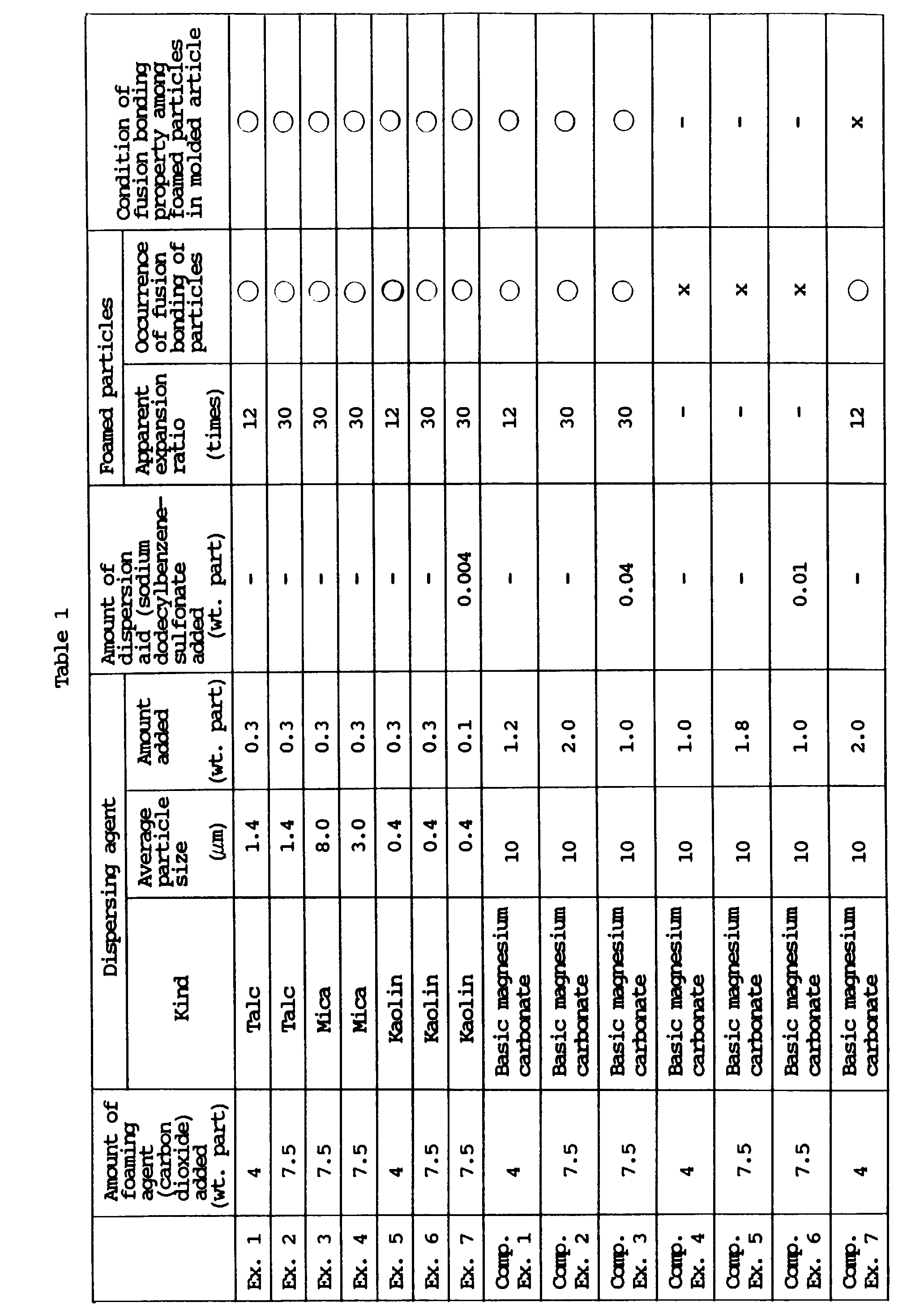
- the vessel After heating the resultant dispersion to 151°C with stirring and holding the dispersion at the same temperature for 0.25 hour, the vessel was opened at one end thereof at the same temperature to release the dispersion under atmospheric pressure while introducing high-pressure nitrogen gas into the vessel, thereby expanding the resin particles. After drying the foamed particles thus obtained, whether mutual fusion bonding of the foamed particles occurred or not was determined and the apparent expansion ratio of the foamed particles was measured. The results are shown in Table 1. Incidentally, the apparent expansion ratio of the foamed particles was determined by dividing the true density of the resin particles used by the bulk density of the resultant foamed particles.
- the resultant foamed particle samples in Comparative Examples 1-3 were free from any fusion bonding as with the foamed particle samples in Examples 1-7, and molded articles obtained by using these foamed particle samples were good in fusion bonding property among the foamed particles.
- the results of Comparative Examples 1-3 are results obtained for the first time by using a large amount of the dispersing agent or using a large amount of sodium dodecylbenzenesulfonate in combination compared with those of the Examples equal in the amount of the foaming agent to be used.
- the addition of a large amount of the dispersing agent and/or the dispersion aid is not preferred because an increase in the cost of a waste water treatment is caused.
Landscapes
- Chemical & Material Sciences (AREA)
- Engineering & Computer Science (AREA)
- Materials Engineering (AREA)
- Health & Medical Sciences (AREA)
- Chemical Kinetics & Catalysis (AREA)
- Medicinal Chemistry (AREA)
- Polymers & Plastics (AREA)
- Organic Chemistry (AREA)
- Inorganic Chemistry (AREA)
- Manufacture Of Porous Articles, And Recovery And Treatment Of Waste Products (AREA)
Description
| Foamed particles free from any fusion bonding among them and having a good spherical form | ○ |
| Fusion-bonded among particles in the autoclave | x |
| No interparticle breakage occurred, but non-interparticle breakage occurred | ○ |
| Interparticle breakage occurred | x |

Claims (8)
- A method of producing foamed particles of a polyolefin resin in which the particles of the polyolefin resin, at least carbon dioxide as a foaming agent and a dispersing agent are dispersed in a dispersion medium in a closed vessel and the contents then heated to a temperature of at least the softening temperature of the resin particles to impregnate the resin particles with foaming agent and then releasing the dispersion into an atmosphere of a pressure lower than the internal pressure of the vessel to expand the resin particles, characterized in that the dispersing agent is a finely particulate silicate mineral having an average particle size of 0.01-30 µm and the silicate mineral is used in a proportion of 0.05-1.0 part by weight per 100 parts by weight of the resin.
- The method as claimed in Claim 1, wherein the polyolefin resin is linear low-density polyethylene or a random copolymer of propylene with ethylene and/or butene, which contains 80-99 wt.% of a propylene component.
- The method as claimed in Claim 1, wherein the foaming agent is carbon dioxide.
- The method as claimed in claim 1, wherein the foaming agent is a mixed foaming agent containing carbon dioxide and a volatile organic foaming agent in a proportion of 10 parts by weight or less per part by weight of carbon dioxide.
- The method as claimed in claim 1, wherein the foaming agent is a mixed foaming agent containing carbon dioxide and another inorganic gas than carbon dioxide in a proportion of 10 parts by weight or less per part by weight of carbon dioxide.
- The method of claim 1, wherein the dispersing agent is talc, mica, kaolin.
- The method of claim 1, wherein up to about 0,02 part by weight per 100 parts by weight of the resin of a surfactant is added as a dispersion aid.
- The method of claim 1, wherein the dispersion medium is water, methanol, ethanol, glycerol, and ethylene glycol.
Applications Claiming Priority (2)
| Application Number | Priority Date | Filing Date | Title |
|---|---|---|---|
| JP36003192A JP3195676B2 (en) | 1992-12-28 | 1992-12-28 | Method for producing expanded polyolefin resin particles |
| JP360031/92 | 1992-12-28 |
Publications (2)
| Publication Number | Publication Date |
|---|---|
| EP0604794A1 EP0604794A1 (en) | 1994-07-06 |
| EP0604794B1 true EP0604794B1 (en) | 1998-04-15 |
Family
ID=18467547
Family Applications (1)
| Application Number | Title | Priority Date | Filing Date |
|---|---|---|---|
| EP93119670A Expired - Lifetime EP0604794B1 (en) | 1992-12-28 | 1993-12-07 | Production method of foamed particles of polyolefin resin |
Country Status (6)
| Country | Link |
|---|---|
| US (1) | US5340841A (en) |
| EP (1) | EP0604794B1 (en) |
| JP (1) | JP3195676B2 (en) |
| KR (1) | KR0146679B1 (en) |
| CA (1) | CA2111139C (en) |
| DE (1) | DE69317995T2 (en) |
Families Citing this family (23)
| Publication number | Priority date | Publication date | Assignee | Title |
|---|---|---|---|---|
| DE3515373A1 (en) * | 1985-04-27 | 1986-11-06 | Merck Patent Gmbh, 6100 Darmstadt | NITROGENIC HETEROCYCLES |
| DE3518734A1 (en) * | 1985-05-24 | 1986-11-27 | Merck Patent Gmbh, 6100 Darmstadt | Smectic liquid crystal phases |
| JPS62294663A (en) * | 1986-06-13 | 1987-12-22 | Alps Electric Co Ltd | Liquid crystal compound |
| DE4332724A1 (en) * | 1993-09-25 | 1995-03-30 | Huels Chemische Werke Ag | Process for the production of foam beads |
| TW294691B (en) * | 1994-08-16 | 1997-01-01 | Jsp Corp | Expansion-molded article of polyolefin resin having open voids and production thereof |
| US5628561A (en) * | 1996-04-02 | 1997-05-13 | Lambert, Sr.; Raymond E. | System and method for continuously treating particulate material in a slurry in a high temperature and high pressure chamber employing intermittent feed |
| US6451419B1 (en) | 1996-08-12 | 2002-09-17 | Jsp Corporation | Shock absorbing material |
| WO1998025996A1 (en) * | 1996-12-13 | 1998-06-18 | Jsp Corporation | Expanded particles of polyolefin resin and process for preparing the same |
| US20020182399A1 (en) | 1997-04-01 | 2002-12-05 | Hisao Tokoro | Molded body of thermoplastic resin having sound absorption characteristics |
| TW369475B (en) | 1997-06-18 | 1999-09-11 | Jsp Corp | Production apparatus of expansion-molded article, auxiliary member for transfer of foamed particles and production method of expansion-molded article |
| DE69827294T2 (en) | 1997-12-01 | 2006-03-09 | Jsp Corp. | EXPANDED POLYPROPYLENE RESIN PERSONS AND SHAPED ARTICLES |
| SG77671A1 (en) * | 1998-03-23 | 2001-01-16 | Jsp Corp | Foamed and expanded beads of polypropylene resin for molding |
| EP0963827B1 (en) * | 1998-06-11 | 2002-10-23 | Jsp Corporation | Molded article of foamed and expanded beads of propylene resin |
| US6232354B1 (en) * | 1999-01-25 | 2001-05-15 | Seng C. Tan | Microcellular polymer foams and method for their production |
| US6838488B2 (en) * | 2001-06-11 | 2005-01-04 | Jsp Corporation | Production method of foamed polypropylene resin beads |
| DE60325812D1 (en) * | 2002-08-28 | 2009-03-05 | Jsp Corp | Core of a bumper |
| JP4354209B2 (en) * | 2003-03-04 | 2009-10-28 | 株式会社ジェイエスピー | Bumper structure |
| US7259189B2 (en) * | 2003-06-12 | 2007-08-21 | Jsp Corporation | Expanded polypropylene resin beads and process for the production thereof |
| KR100830093B1 (en) * | 2007-02-23 | 2008-05-19 | 한국과학기술연구원 | Method for producing polyolefin foam particles having excellent moldability |
| KR100902331B1 (en) * | 2008-02-29 | 2009-06-12 | 하오기술 주식회사 | Method for producing polyolefin foam particles |
| JP5277798B2 (en) * | 2008-08-29 | 2013-08-28 | 株式会社カネカ | Process for producing polyolefin resin expanded particles, polyolefin resin expanded particles obtained from the process, and in-mold foam molded article |
| KR101528618B1 (en) * | 2014-11-26 | 2015-06-17 | 박희섭 | Synthetic resin and synthetic fiber containing linolenic acid, and manufacturing method thereof. |
| WO2020158749A1 (en) * | 2019-01-31 | 2020-08-06 | 株式会社カネカ | Method for producing polyolefin resin foam particles, polyolefin resin foam particles, and polyolefin resin in-mold foam molded body |
Family Cites Families (7)
| Publication number | Priority date | Publication date | Assignee | Title |
|---|---|---|---|---|
| US3681270A (en) * | 1970-05-22 | 1972-08-01 | Dynamit Nobel Ag | Process for the manufacture of foam materials containing plasticizer from polyvinylchloride and copolymers thereof |
| JPS537944B2 (en) * | 1973-09-01 | 1978-03-23 | ||
| US4525485A (en) * | 1983-09-08 | 1985-06-25 | Kanegafuchi Kagaku Kogyo Kabushiki Kaisha | Pre-expanding process and apparatus for the same |
| US4676939A (en) * | 1984-06-14 | 1987-06-30 | Japan Styrene Paper Corporation | Process for the production of expanded particles of a polypropylene resin |
| JPS6151008A (en) * | 1984-08-21 | 1986-03-13 | Japan Styrene Paper Co Ltd | Pre-expanded polyethylene resin particle |
| JPH066637B2 (en) * | 1984-09-03 | 1994-01-26 | 住友化学工業株式会社 | Propylene resin foamed particles |
| US4778829A (en) * | 1985-07-12 | 1988-10-18 | Kanegafuchi Kagaku Kogyo Kabushiki Kaisha | Process for preparing pre-expanded particles of thermoplastic resin |
-
1992
- 1992-12-28 JP JP36003192A patent/JP3195676B2/en not_active Expired - Fee Related
-
1993
- 1993-12-07 EP EP93119670A patent/EP0604794B1/en not_active Expired - Lifetime
- 1993-12-07 DE DE69317995T patent/DE69317995T2/en not_active Expired - Lifetime
- 1993-12-10 CA CA002111139A patent/CA2111139C/en not_active Expired - Lifetime
- 1993-12-15 US US08/166,827 patent/US5340841A/en not_active Expired - Lifetime
- 1993-12-27 KR KR1019930029989A patent/KR0146679B1/en not_active Expired - Lifetime
Also Published As
| Publication number | Publication date |
|---|---|
| JP3195676B2 (en) | 2001-08-06 |
| DE69317995T2 (en) | 1998-10-22 |
| US5340841A (en) | 1994-08-23 |
| CA2111139A1 (en) | 1994-06-29 |
| JPH06200071A (en) | 1994-07-19 |
| DE69317995D1 (en) | 1998-05-20 |
| EP0604794A1 (en) | 1994-07-06 |
| CA2111139C (en) | 1998-01-20 |
| KR0146679B1 (en) | 1998-08-17 |
Similar Documents
| Publication | Publication Date | Title |
|---|---|---|
| US5340841A (en) | Production method of foamed particles of polyolefin resin | |
| EP0075897A2 (en) | Process for producing pre-foamed particles of polyolefin resin | |
| EP0415744B1 (en) | Process for the production of expanded particles of a polyolefin resin | |
| EP0212204A2 (en) | Pre-expanded particles of non-crosslinked linear low density polyethylene and process for producing cellular materials therefrom | |
| US20190022904A1 (en) | Polypropylene resin foamable particles, polypropylene resin in-mold foam molded body, and production method therefor | |
| JPS61103944A (en) | polypropylene foam particles | |
| EP0429091B1 (en) | Production method of prefoamed synthetic resin particles | |
| KR19990014099A (en) | COMPOSITION OF EXPANDED GRANULES BASED ON PROPYLENE POLYMER, METHOD FOR PRODUCING THE SAME, AND USE THEREOF | |
| CA1170416A (en) | Method of producing open-cell foamed articles of cross-linked polyolefins | |
| US6166096A (en) | Pre-expanded particles of polypropylene resin, process for producing the same and process for producing in-mold foamed articles therefrom | |
| JP3311398B2 (en) | Expandable styrene resin particles and method for producing the same | |
| JPH01156338A (en) | Prefoamed polypropylene resin particle and production thereof | |
| JP3582335B2 (en) | Non-crosslinked linear low density polyethylene resin pre-expanded particles and method for producing the same | |
| US6576693B2 (en) | Pre-expanded particles of polypropylene resin and inmolded foamed article using the same | |
| JPS6369844A (en) | Expandable styrene based resin particle and production thereof | |
| WO1995033790A1 (en) | Coating composition for expandable beads | |
| JP3171272B2 (en) | Method for producing expanded polymer particles | |
| JP3525947B2 (en) | Conductive polypropylene resin expanded particles, in-mold molded article formed from the expanded particles, and method for producing in-mold molded article | |
| JP3281904B2 (en) | Expanded polypropylene resin particles and molded article thereof | |
| JPH07228721A (en) | Method for producing expanded polypropylene resin particles | |
| JPH07116314B2 (en) | Method for producing foamed polymer molded article | |
| JPH04225042A (en) | Foam based on olefin copolymer | |
| JPH04351646A (en) | Production of preexpanded particle | |
| JPH08225675A (en) | Method for producing expanded polyolefin resin particles | |
| JPS6341942B2 (en) |
Legal Events
| Date | Code | Title | Description |
|---|---|---|---|
| PUAI | Public reference made under article 153(3) epc to a published international application that has entered the european phase |
Free format text: ORIGINAL CODE: 0009012 |
|
| AK | Designated contracting states |
Kind code of ref document: A1 Designated state(s): BE DE FR GB |
|
| 17P | Request for examination filed |
Effective date: 19941229 |
|
| 17Q | First examination report despatched |
Effective date: 19960326 |
|
| GRAG | Despatch of communication of intention to grant |
Free format text: ORIGINAL CODE: EPIDOS AGRA |
|
| GRAG | Despatch of communication of intention to grant |
Free format text: ORIGINAL CODE: EPIDOS AGRA |
|
| GRAH | Despatch of communication of intention to grant a patent |
Free format text: ORIGINAL CODE: EPIDOS IGRA |
|
| GRAH | Despatch of communication of intention to grant a patent |
Free format text: ORIGINAL CODE: EPIDOS IGRA |
|
| GRAA | (expected) grant |
Free format text: ORIGINAL CODE: 0009210 |
|
| AK | Designated contracting states |
Kind code of ref document: B1 Designated state(s): BE DE FR GB |
|
| REF | Corresponds to: |
Ref document number: 69317995 Country of ref document: DE Date of ref document: 19980520 |
|
| ET | Fr: translation filed | ||
| PLBE | No opposition filed within time limit |
Free format text: ORIGINAL CODE: 0009261 |
|
| STAA | Information on the status of an ep patent application or granted ep patent |
Free format text: STATUS: NO OPPOSITION FILED WITHIN TIME LIMIT |
|
| 26N | No opposition filed | ||
| PGFP | Annual fee paid to national office [announced via postgrant information from national office to epo] |
Ref country code: BE Payment date: 20011221 Year of fee payment: 9 |
|
| REG | Reference to a national code |
Ref country code: GB Ref legal event code: IF02 |
|
| PG25 | Lapsed in a contracting state [announced via postgrant information from national office to epo] |
Ref country code: BE Free format text: LAPSE BECAUSE OF NON-PAYMENT OF DUE FEES Effective date: 20021231 |
|
| BERE | Be: lapsed |
Owner name: *JSP CORP. Effective date: 20021231 |
|
| REG | Reference to a national code |
Ref country code: FR Ref legal event code: CA |
|
| PGFP | Annual fee paid to national office [announced via postgrant information from national office to epo] |
Ref country code: GB Payment date: 20071220 Year of fee payment: 15 |
|
| GBPC | Gb: european patent ceased through non-payment of renewal fee |
Effective date: 20081207 |
|
| PG25 | Lapsed in a contracting state [announced via postgrant information from national office to epo] |
Ref country code: GB Free format text: LAPSE BECAUSE OF NON-PAYMENT OF DUE FEES Effective date: 20081207 |
|
| PGFP | Annual fee paid to national office [announced via postgrant information from national office to epo] |
Ref country code: FR Payment date: 20120103 Year of fee payment: 19 |
|
| PGFP | Annual fee paid to national office [announced via postgrant information from national office to epo] |
Ref country code: DE Payment date: 20130108 Year of fee payment: 20 |
|
| REG | Reference to a national code |
Ref country code: FR Ref legal event code: ST Effective date: 20130830 |
|
| PG25 | Lapsed in a contracting state [announced via postgrant information from national office to epo] |
Ref country code: FR Free format text: LAPSE BECAUSE OF NON-PAYMENT OF DUE FEES Effective date: 20130102 |
|
| REG | Reference to a national code |
Ref country code: DE Ref legal event code: R071 Ref document number: 69317995 Country of ref document: DE |
|
| PG25 | Lapsed in a contracting state [announced via postgrant information from national office to epo] |
Ref country code: DE Free format text: LAPSE BECAUSE OF EXPIRATION OF PROTECTION Effective date: 20131210 |