EP0602865A1 - Catalyst - Google Patents
Catalyst Download PDFInfo
- Publication number
- EP0602865A1 EP0602865A1 EP93309782A EP93309782A EP0602865A1 EP 0602865 A1 EP0602865 A1 EP 0602865A1 EP 93309782 A EP93309782 A EP 93309782A EP 93309782 A EP93309782 A EP 93309782A EP 0602865 A1 EP0602865 A1 EP 0602865A1
- Authority
- EP
- European Patent Office
- Prior art keywords
- catalyst
- metal oxide
- noble metal
- particles
- ceo2
- Prior art date
- Legal status (The legal status is an assumption and is not a legal conclusion. Google has not performed a legal analysis and makes no representation as to the accuracy of the status listed.)
- Granted
Links
Images


Classifications
-
- B—PERFORMING OPERATIONS; TRANSPORTING
- B01—PHYSICAL OR CHEMICAL PROCESSES OR APPARATUS IN GENERAL
- B01D—SEPARATION
- B01D53/00—Separation of gases or vapours; Recovering vapours of volatile solvents from gases; Chemical or biological purification of waste gases, e.g. engine exhaust gases, smoke, fumes, flue gases, aerosols
- B01D53/34—Chemical or biological purification of waste gases
- B01D53/92—Chemical or biological purification of waste gases of engine exhaust gases
- B01D53/94—Chemical or biological purification of waste gases of engine exhaust gases by catalytic processes
- B01D53/944—Simultaneously removing carbon monoxide, hydrocarbons or carbon making use of oxidation catalysts
-
- B—PERFORMING OPERATIONS; TRANSPORTING
- B01—PHYSICAL OR CHEMICAL PROCESSES OR APPARATUS IN GENERAL
- B01J—CHEMICAL OR PHYSICAL PROCESSES, e.g. CATALYSIS OR COLLOID CHEMISTRY; THEIR RELEVANT APPARATUS
- B01J23/00—Catalysts comprising metals or metal oxides or hydroxides, not provided for in group B01J21/00
- B01J23/38—Catalysts comprising metals or metal oxides or hydroxides, not provided for in group B01J21/00 of noble metals
-
- B—PERFORMING OPERATIONS; TRANSPORTING
- B01—PHYSICAL OR CHEMICAL PROCESSES OR APPARATUS IN GENERAL
- B01D—SEPARATION
- B01D53/00—Separation of gases or vapours; Recovering vapours of volatile solvents from gases; Chemical or biological purification of waste gases, e.g. engine exhaust gases, smoke, fumes, flue gases, aerosols
- B01D53/34—Chemical or biological purification of waste gases
- B01D53/46—Removing components of defined structure
- B01D53/54—Nitrogen compounds
- B01D53/56—Nitrogen oxides
-
- B—PERFORMING OPERATIONS; TRANSPORTING
- B01—PHYSICAL OR CHEMICAL PROCESSES OR APPARATUS IN GENERAL
- B01D—SEPARATION
- B01D53/00—Separation of gases or vapours; Recovering vapours of volatile solvents from gases; Chemical or biological purification of waste gases, e.g. engine exhaust gases, smoke, fumes, flue gases, aerosols
- B01D53/34—Chemical or biological purification of waste gases
- B01D53/46—Removing components of defined structure
- B01D53/62—Carbon oxides
-
- B—PERFORMING OPERATIONS; TRANSPORTING
- B01—PHYSICAL OR CHEMICAL PROCESSES OR APPARATUS IN GENERAL
- B01J—CHEMICAL OR PHYSICAL PROCESSES, e.g. CATALYSIS OR COLLOID CHEMISTRY; THEIR RELEVANT APPARATUS
- B01J23/00—Catalysts comprising metals or metal oxides or hydroxides, not provided for in group B01J21/00
- B01J23/38—Catalysts comprising metals or metal oxides or hydroxides, not provided for in group B01J21/00 of noble metals
- B01J23/54—Catalysts comprising metals or metal oxides or hydroxides, not provided for in group B01J21/00 of noble metals combined with metals, oxides or hydroxides provided for in groups B01J23/02 - B01J23/36
- B01J23/56—Platinum group metals
-
- B—PERFORMING OPERATIONS; TRANSPORTING
- B01—PHYSICAL OR CHEMICAL PROCESSES OR APPARATUS IN GENERAL
- B01J—CHEMICAL OR PHYSICAL PROCESSES, e.g. CATALYSIS OR COLLOID CHEMISTRY; THEIR RELEVANT APPARATUS
- B01J23/00—Catalysts comprising metals or metal oxides or hydroxides, not provided for in group B01J21/00
- B01J23/38—Catalysts comprising metals or metal oxides or hydroxides, not provided for in group B01J21/00 of noble metals
- B01J23/54—Catalysts comprising metals or metal oxides or hydroxides, not provided for in group B01J21/00 of noble metals combined with metals, oxides or hydroxides provided for in groups B01J23/02 - B01J23/36
- B01J23/56—Platinum group metals
- B01J23/63—Platinum group metals with rare earths or actinides
-
- B—PERFORMING OPERATIONS; TRANSPORTING
- B01—PHYSICAL OR CHEMICAL PROCESSES OR APPARATUS IN GENERAL
- B01J—CHEMICAL OR PHYSICAL PROCESSES, e.g. CATALYSIS OR COLLOID CHEMISTRY; THEIR RELEVANT APPARATUS
- B01J23/00—Catalysts comprising metals or metal oxides or hydroxides, not provided for in group B01J21/00
- B01J23/38—Catalysts comprising metals or metal oxides or hydroxides, not provided for in group B01J21/00 of noble metals
- B01J23/54—Catalysts comprising metals or metal oxides or hydroxides, not provided for in group B01J21/00 of noble metals combined with metals, oxides or hydroxides provided for in groups B01J23/02 - B01J23/36
- B01J23/66—Silver or gold
-
- B—PERFORMING OPERATIONS; TRANSPORTING
- B01—PHYSICAL OR CHEMICAL PROCESSES OR APPARATUS IN GENERAL
- B01J—CHEMICAL OR PHYSICAL PROCESSES, e.g. CATALYSIS OR COLLOID CHEMISTRY; THEIR RELEVANT APPARATUS
- B01J35/00—Catalysts, in general, characterised by their form or physical properties
- B01J35/40—Catalysts, in general, characterised by their form or physical properties characterised by dimensions, e.g. grain size
- B01J35/45—Nanoparticles
-
- B—PERFORMING OPERATIONS; TRANSPORTING
- B01—PHYSICAL OR CHEMICAL PROCESSES OR APPARATUS IN GENERAL
- B01J—CHEMICAL OR PHYSICAL PROCESSES, e.g. CATALYSIS OR COLLOID CHEMISTRY; THEIR RELEVANT APPARATUS
- B01J37/00—Processes, in general, for preparing catalysts; Processes, in general, for activation of catalysts
- B01J37/02—Impregnation, coating or precipitation
- B01J37/03—Precipitation; Co-precipitation
-
- Y—GENERAL TAGGING OF NEW TECHNOLOGICAL DEVELOPMENTS; GENERAL TAGGING OF CROSS-SECTIONAL TECHNOLOGIES SPANNING OVER SEVERAL SECTIONS OF THE IPC; TECHNICAL SUBJECTS COVERED BY FORMER USPC CROSS-REFERENCE ART COLLECTIONS [XRACs] AND DIGESTS
- Y02—TECHNOLOGIES OR APPLICATIONS FOR MITIGATION OR ADAPTATION AGAINST CLIMATE CHANGE
- Y02A—TECHNOLOGIES FOR ADAPTATION TO CLIMATE CHANGE
- Y02A50/00—TECHNOLOGIES FOR ADAPTATION TO CLIMATE CHANGE in human health protection, e.g. against extreme weather
- Y02A50/20—Air quality improvement or preservation, e.g. vehicle emission control or emission reduction by using catalytic converters
Definitions
- This invention relates to a method of conducting a chemical reaction comprising the oxidation of carbon monoxide to carbon dioxide employing a catalyst, to an engine whose exhaust apparatus contains the catalyst in order to combat air pollution, to a certain such catalyst containing ceria and its preparation and use, and to the preparation of ceria.
- Transition metal catalysts are usually prepared by dispersing the active component on high surface area carriers, such as refractory inorganic oxides, to achieve maximum specific metal surface areas and high thermal stability.
- the support material must usually have a high surface area, and various parameters are considered in selecting a support for metal catalysts.
- Metal oxides are the most commonly used carrier, and their dominance is a consequence of their generally high thermal and chemical stability, coupled with the knowledge of preparation of the materials with high surface areas.
- Support materials can be classified into either inert supports, like SiO2, supplying high surface area for dispersing the active component, or catalytically active supports, like SiO2-Al2O3 or zeolite, for bifunctional catalysts.
- the nature of the carrier oxide can affect the size and morphology of the metal particles, either during deposition or activation, an effect generally referred to as non-specific metal-metal oxide interaction.
- the support can influence the active component by a strong interaction, an example being partially reduced TiO2.
- Support for the view that the metal oxide support can significantly influence the catalytic properties of the metal in a more specific manner was provided by Tauster and co-workers (US patent specification 4149998) who described the unusual effects observed in certain metal-metal oxide systems and introduced the acronym SMSI (strong metal support interaction).
- the SMSI phenomenon caused by the high temperature reduction of Group VIII metals dispersed on certain metal oxides, is characterised by a suppression in the metal's ability to chemisorb CO or H2, increased catalytic activity in CO/H2 reactions, and decreased activity for structure sensitive reactions such as alkane hydrogenolysis, and is reversible in the sense that mild oxidation will restore the catalyst to its original state.
- the dispersion of the metal particles, thus the metal-metal oxide interfacial area, and the temperature of H2 reduction will both influence the extent of the SMSI effect.
- the various hypotheses invoked to explain the SMSI phenomenon include explanations involving a geometric effect caused by migration of oxidic moieties from the support to the surface of the metal particles, an electronic effect caused by charge transfer from cations on the oxide surface to the metal, or the creation of new active sites at the metal-metal oxide interface.
- the present invention relates to metal-metal oxide catalysts which have unique and unusual catalytic properties which are intrinsic, not requiring a separate reduction pre-treatment to manifest them, and which are stable, not being reversible in nature.
- the invention provides a method of conducting a chemical reaction comprising the oxidation of carbon monoxide to carbon dioxide employing a catalyst composed of metal oxide particles among which are uniformly incorporated noble metal particles, the catalyst having such a high interaction between the noble metal particles and the metal oxide particles that, without hydrogen reduction pre-treatment, it exhibits the formation of anionic vacancies on the metal oxide surface at a temperature lower than does the corresponding catalyst, without hydrogen reduction pre-treatment, containing the same amount of the metal oxide particles and noble metal particles and prepared by impregnating the metal oxide particles with noble metal precursor and calcining to convert the precursor to the noble metal particles.
- the invention provides also an engine whose exhaust apparatus contains the catalyst in order to combat air pollution.
- the invention also provides as a novel composition of matter the catalyst wherein the metal oxide comprises CeO2 and the noble metal is one or more of Pt, Pd, Rh and Au.
- the invention provides also a process for preparing a catalyst composed of metal oxide particles comprising CeO2 among which are uniformly incorporated noble metal particles, the noble metal being one or more of Pt, Pd, Rh and Au, which process comprises co-precipitating the noble metal particles and the metal oxide particles comprising CeO2.
- the invention also provides a method of conducting a chemical reaction employing the catalyst wherein the metal oxide comprises CeO2 and the noble metal is one or more of Pt, Pd, Rh and Au.
- the invention provides also a process for preparing ceria, which process comprises adding a solution of ceria precursor to a solution of a base to precipitate cerium hydroxide and heating the cerium hydroxide to convert it to ceria.
- noble metal is meant in this specification one or more of Ru, Rh, Pd, Os, Ir, Pt and Au.
- the noble metal is one or more of Pt, Pd, Rh and Au, especially one or more of Pt, Pd and Rh.
- the catalyst usually contains 0.1 to 30% by weight of the noble metal particles based on the total weight of the noble metal particles and the metal oxide particles. In one embodiment, the catalyst contains 0.1-10% by weight Pt and 0.1-20% by weight palladium on this basis, for instance when the metal oxide is CeO2.
- the metal oxide preferably comprises (ie consists of or includes) one or more of CeO2, ZrO2, TiO2 and SnO2, especially one or more of CeO2, ZrO2 and SnO2, particularly CeO2.
- the metal oxide preferably contains 80-100% by weight of such oxides.
- the metal oxide can include a minor amount of a secondary metal oxide to decrease the extent of sintering the main metal oxide during high temperature exposure.
- the amount of secondary metal oxide, when it is employed, is usually between 1 and 20% by weight of the metal oxide.
- the secondary metal oxide can be, for instance, one or more of ZrO2, Al2O3, La2O3 and BaO, particularly ZrO2 and/or Al2O3.
- the present catalyst has the noble metal particles uniformly incorporated among the metal oxide particles.
- the interaction between the two sets of particles is accordingly even and contrasts, for instance, with metal oxide particles whose surface has been impregnated with a noble metal precursor and which have been calcined to convert the precursor to noble metal particles.
- the interaction between the two sets of particles in the present catalyst is of unique type, as discussed above.
- the interaction between the noble metal particles and the metal oxide particles is so high that, without hydrogen reduction pre-treatment, the catalyst exhibits the formation of anionic vacancies on the metal oxide surface at a temperature lower, usually by at least 40°C, preferably by at least 80°C, especially by at least 200°C, than does the corresponding catalyst, without hydrogen reduction pre-treatment, prepared by impregnation.
- the corresponding catalyst prepared by impregnation contains the same amount of the metal oxide particles and the same amount of the noble metal particles, but has been prepared by impregnating the metal oxide particles with noble metal precursor and calcining to convert the precursor to the noble metal particles.
- This is the well known, conventional, method of preparation.
- hydrogen reduction pre-treatment has been required in the past in order to activate catalysts composed of metals and metal oxides to a strong metal-metal oxide interaction.
- the formation of anionic vacancies on the metal oxide surface enables the present catalyst to catalyse reactions such as those comprising the oxidation of carbon monoxide to carbon dioxide.
- the temperature at which the formation of anionic vacancies is exhibited is conveniently found by temperature programmed reduction.
- This analytical technique shows the temperature at which reduction of surface anion, and hence the formation of anionic vacancies, occurs.
- the temperature at which the corresponding catalyst prepared by impregnation exhibits the formation of anionic vacancies can be found by the same analytical technique, but is generally given in the literature, for instance (1) Yao H C and Yu Yao Y F, J of Catalysis, 86 , 254 (1984) and (2) Diwell A F, Rajaram R R, Shaw H A and Truex T J, "Studies in Surface Science and Catalysis", vol 71 (Capoc II), edited by Crucq A and published by Elsevier (1991), page 139.
- the metal-metal oxide interaction in the present catalyst involves a high metal-metal oxide contact area. Accordingly, the size of their particles should be small.
- the noble metal particle diameter is preferably less than 10 ⁇ .
- the metal oxide particle diameter is preferably up to 250 ⁇ , for instance 10-250 ⁇ .
- the metal oxide phase partially or completely encapsulates the metal particles, resulting in significant suppression of the carbon monoxide chemisorption ability of the metal particles.
- the carbon monoxide chemisorption value of CO:noble metal is preferably less than 0.2.
- the strong metal-metal oxide interaction in the present catalyst permits the reduction of surface anions on the oxide surface at unusually low temperature.
- the present catalyst with its high metal-metal oxide interaction, is preferably that preparable by co-precipitation of the noble metal particles and the metal oxide particles.
- Co-precipitation is a very effective method of incorporating the noble metal particles uniformly among the metal oxide particles to achieve their high interaction.
- the co-precipitation can be carried out in a manner known generally per se.
- Co-precipitating the noble metal particles and the metal oxide particles comprising CeO2 automatically gives the high interaction between the two sets of particles which is characteristic of the present catalyst and which is evident from its exhibiting, without hydrogen reduction pre-treatment, the formation of anionic vacancies on the metal oxide surface at a temperature lower than does the corresponding catalyst, without hydrogen reduction pre-treatment, prepared by impregnation.
- the present co-precipitation may produce a precipitate which does not have the metal oxide present as such but in a form, such as an hydroxide, which is then converted to the metal oxide.
- the conversion can be accomplished for instance by heating, for example at 50-500°C.
- the present co-precipitation is carried out preferably at 50-120°C, especially from boiling aqueous solution.
- the co-precipitation is preferably carried out so that it occurs in a controlled rather than a sudden manner.
- partial or complete encapsulation of the metal particles by the oxide phase occurs, resulting in significant suppression of the carbon monoxide chemisorption ability of the well dispersed metal particles.
- the co-precipitation method generates the metal-metal oxide interaction without requirement for reduction in hydrogen to manifest it, and also stabilises the interaction, as it is maintained even after air calcination at high temperature (for instance at a temperature between 500 and 900°C).
- the noble metals particles are co-precipitated from colloid of the metal.
- the colloid can be pre-formed.
- a Pt colloid sol can be made by reduction of chloroplatinic acid with ethanol in the presence of a stabilising agent.
- the co-precipitation is effected by admixing noble metal colloid, a solution of metal oxide precursor, and a base.
- the noble metal colloid can be formed in situ by a reducing agent.
- the noble metal particles are co-precipitated by reduction of hydrolysed noble metal salt.
- the catalyst usually contains 0.5-20, preferably 0.5-5, % by weight of the noble metal particles based on the total weight of the noble metal particles and the metal oxide particles.
- the noble metal salt which is hydrolysed can be any convenient soluble salt; in the case of platinum, for instance, chloroplatinic acid, tetraammine platinum hydroxide or tetraammine platinous chloride can be employed.
- the hydrolysis can be brought about by a base.
- the reduction can be brought about by a reducing agent.
- metal oxide precursor is advantageously used to reduce the hydrolysed metal salt. This is very surprising; such a possibility has never been alluded to in the prior art.
- the cerium oxide precursor must be Ce3+ salt in solution; as illustrated hereafter, corresponding use of a cerium oxide precursor in the form of Ce4+ salt in solution does not produce the present catalyst with its unique structure and advantageous properties.
- the Ce3+ salt can be any soluble Ce3+ salt.
- any soluble base can generally be used as precipitant, such as NaOH, KOH, NH4OH or an organic base.
- the preferred base is NaOH.
- Precipitation of the metal oxide can be brought about by reaction of a solution of a base and a solution of metal oxide precursor.
- the metal oxide precursor can be any soluble salt which can be converted to metal oxide in this way, except for the special case involving the cerium oxide precursor, when used as reducing agent, being in the Ce3+ form as discussed above (but the cerium oxide precursor can be a salt in which the cerium is in any oxidation state in the aspect involving a noble metal colloid).
- the metal oxide in the catalyst includes a secondary metal oxide as discussed above
- the secondary metal oxide can be incorporated during the co-precipitation by similarly precipitating it from a solution of a salt.
- Any reducing agent in the present preparation can be for instance formaldehyde or sodium formate.
- a solution of metal oxide precursor is preferably added to the solution of the base, so that the precipitation is reached from the basic side, rather than the solution of the base being added to the solution of the metal oxide precursor, so that the precipitation is reached from the acidic side. It has been found that this preferred order of addition tends to result in a catalyst of higher surface area, particularly when the metal oxide is CeO2.
- the invention provides a process for preparing ceria, which process comprises adding a solution of ceria precursor to a solution of a base to precipitate cerium hydroxide and heating the cerium hydroxide to convert it to ceria
- the process can be conducted in the same way as the co-precipitation described herein except that the noble metal moiety need not be present; a different or no catalytically active component moiety can be employed instead of the noble metal moiety.
- the base is preferably NaOH.
- the cerium hydroxide precipitated can be Ce3+ hydroxide or Ce4+ hydroxide.
- the hydroxide is usually heated in air. It is usually heated at a temperature of 50-500°C.
- the ceria usually has a Brunauer Emmett Teller surface area of at least 100m2g ⁇ 1.
- the ceria is advantageously used as a component of a catalyst.
- the component can be catalytically active or a carrier.
- the present catalyst has a high metal-metal oxide interaction, so as to promote the reduction of surface anions on the oxide surface at unusually low temperature.
- Temperature programmed reduction a technique routinely used to characterise supported metal catalysts, can be used to identify the desirable interaction. It is known that the presence of a metal can sometimes catalyse the reduction of an oxide by providing spillover atomic hydrogen, which first creates OH s ⁇ groups with the surface lattice anions. The dehydration of these OH s ⁇ groups will then lead to the formation of anionic vacancies.
- Yao and Yu Yao in their reference specified above, have suggested, for instance, that there are two kinds of lattice oxygen in CeO2, which can be removed by H2 at 500°C and 800°C respectively.
- the present catalyst wherein the metal oxide comprises CeO2 and the noble metal is one or more of Pt, Pd, Rh and Au is remarkably effective in catalysing chemical reactions. It can be employed without hydrogen reduction pre-treatment. It can be employed after a calcination pre-treatment in air at between 300 and 900°C, usually between 500 and 900°C.
- the catalyst is particularly useful when employed for conducting reactions at lower temperatures than previously were employed. It is especially useful where the reaction is a redox reaction.
- the present catalyst is remarkably effective in catalysing a chemical reaction comprising the oxidation of carbon monoxide to carbon dioxide.
- the catalyst whether or not the metal oxide comprises CeO2 and the noble metal is one or more of Pt, Pd, Rh and Au, can be employed without hydrogen reduction pre-treatment.
- the catalyst can be employed after a calcination pre-treatment in air at between 300 and 900°C, usually between 500 and 900°C. Again, it is particularly useful when employed for conducting reactions at lower temperatures than previously were employed.
- the catalyst is especially useful for the oxidation of carbon monoxide and hydrocarbon to carbon dioxide and water and the reduction of nitrogen oxides to nitrogen.
- the catalyst can be used for conducting this particular reaction in the exhaust apparatus of an engine, especially an internal combustion engine in a vehicle, in order to combat air pollution.
- the catalyst is of particular interest, because of its low temperature activity, for the treatment of vehicle exhaust emissions at low temperature during warm-up.
- the present catalyst can be employed as the sole catalyst or together with another catalyst, usually comprising one or more of Pt, Pd and Rh, for instance Rh optionally with Pt and/or Pd.
- the present catalyst can be formulated in the usual way to catalyse chemical reactions. When it is employed as sole catalyst, it generally does not need a separate high surface area carrier such as is discussed above in relation to transition metal catalysts. When it is employed together with another catalyst, a high surface area carrier is often useful to carry both catalysts.
- the present catalyst can be dispersed on the carrier and, either before or usually afterwards, the other catalyst can be dispersed on the carrier, for instance in the usual way by impregnating with a precursor and calcining to convert the precursor to the other catalyst.
- the present catalyst itself preferably has a Brunauer Emmett Teller surface area of at least 50, especially at least 100, m2g ⁇ 1.
- the catalyst can be employed in the form of pellets. It can be employed on a support, preferably a monolith, for instance a honecomb monolith.
- the monolith can be metal, in which case it can readily be heated, for instance by passing an electrical current through the metal.
- the monolith can be ceramic.
- a separate heater of gas can be utilised up-stream of the catalyst to heat gas to facilitate its reaction on the catalyst.
- Ceria was prepared using Ce(NO3)3.6H2O (126g) and solid NaOH (36g).
- the NaOH was dissolved in 6 litres of de-ionised water and brought to the boil.
- the Ce(NO3)3 was dissolved in water and made up to 500cm3.
- the resulting solution was added dropwise to the boiling NaOH solution to produce a greyish white precipitate.
- the addition of the Ce3+ solution usually lasted over an hour and the final pH was normally about 10.
- the precipitate was boiled for a further hour, filtered, and then washed free of NO3 ⁇ and Na+.
- the washed precipitate was dried at 110°C and then calcined in air at 500°C. Its BET surface was 136m2g ⁇ 1.
- Pt-CeO2 catalyst with a nominal loading of 0.9wt% Pt was prepared using Ce(NO3)3.6H2O (126g), chloroplatinic acid (1.148g - Pt assay 39.20wt%) and solid NaOH (36g).
- the NaOH was dissolved in 6 litres of de-ionised water and brought to the boil.
- the CPA and Ce(NO3)3 were dissolved in water and made up to 500cm3 as a single solution. The latter was added dropwise to the boiling NaOH solution to produce a black precipitate.
- the addition of the CPA/Ce3+ solution usually lasted over an hour and the final pH was normally about 10.
- the precipitate was boiled for a further hour, filtered, and then washed free of NO3 ⁇ , Cl ⁇ , and Na+.
- the washed precipitate was dried at 110°C and then calcined in air at 500°C.
- a Pt-CeO2 catalyst containing 0.9wt% Pt was made by incipient wetness of CeO2 (prepared as described in Example 1) with chloroplatinic acid. After drying at 110°C, the sample was calcined at 500°C.
- Ce4+ precursor cerium ammonium nitrate
- This sample is 50g of Pt-CeO2 catalyst with a nominal loading of 0.9wt% Pt and was prepared using (NH4)2Ce(NO3)6 (159.3g), chloroplatinic acid (1.148g - Pt assay 39.20wt%) and solid NaOH (48g).
- the NaOH was dissolved in 6 litres of deionised water and brought to the boil.
- the CPA and (NH4)2Ce(NO3)6 were dissolved in water and made up to 500cm3 as a single solution. The latter was added dropwise to the boiling NaOH solution to produce a beige colour precipitate.
- the slurry was boiled for a further hour, filtered, and then washed free of NO3 ⁇ , Cl ⁇ , and Na+. The washed precipitate was dried at 110°C and then calcined in air at 500°C. Analysis of these samples has confirmed a Pt loading of 0.9wt%.
- the strong Pt-CeO2 interaction is typified by the low CO chemisorption value of the catalyst prepared by the co-precipitation route using Ce3+ precursor.
- Table 1 Catalyst Calcined 500°C Preparative route BET SA m2g ⁇ 1 CO Chem CO:Pt 0.9%Pt-CeO2 Ce3+ + CPA ⁇ NaOH 130 0.08 0.9%Pt-CeO2 Ce4+ + CPA ⁇ NaOH 125 0.54 0.9%Pt/CeO2 Impregnation 136 0.71
- Transmission electron microscopy can be used to provide information on the location and the size of metal particles dispersed on an oxide support.
- HRSTEM high resolution scanning transmission electron microscopy
- micrographs of the Pt-CeO2 catalysts showed very small ceria crystallites (1-25nm) in all samples. No images of Pt could be recorded, even at a magnification of 25 x 106, indicating particles probably less than 1nm in size (NB, Pt particles greater than 10nm have been observed on the same instrument, despite the poor contrast between the support and the particles).
- EDAX energy dispersive x-ray analysis
- X-ray photoelectron emission spectroscopy can detect the electronic state of the catalyst and possibly the location of the metal particles, as the depth of analysis is only a few atomic layers from the surface.
- Table 2 X-ray photoelectron emission spectroscopy
- Ce was present as Ce4+ in all three samples.
- Catalysts prepared by impregnation or using Ce4+ precursor show well defined Pt peaks in the XPS spectra, with Pt in a +2 oxidation state, Figure la.
- catalyst prepared by co-precipitation using Ce3+ precursor produced poorly resolved Pt peaks, indicating that the Pt was not totally located on the oxide surface, Figure 1b.
- EXAFS Extended x-ray absorption fine structure
- the catalysts prepared by impregnation or using Ce4+ precursor contain Pt in a high oxidation state. However, the sample prepared by co-precipitation using Ce3+ precursor has a significant portion of Pt in a metallic state. Metallic Pt particles of a similar type were present, if the impregnated catalyst was reduced in H2 at 600°C.
- the Pt-CeO2 catalyst prepared by co-precipitation using Ce3+ precursor, possesses a geometric and electronic structure which is significantly different to the other catalysts. These unique features result in a strong metalmetal oxide interaction which can be characterised by the temperature required to form anionic vacancies on the oxide surface, during temperature programmed reduction (tpr).
- tpr temperature programmed reduction
- the tpr spectrum of CeO2 is shown in Figure 2. The presence of two peaks is attributed to two types of oxygen anion in CeO2; the low temperature peak is associated with the reduction of surface anion, whilst the high temperature peak is associated with the bulk reduction of CeO2 to Ce2O3.
- the tpr spectrum of the catalyst prepared using Ce3+ precursor is significantly different, Figure 4. H2 consumption is noted to start at much lower temperature, providing a peak at significantly lower temperature to that noted for the other Pt-CeO2 catalysts.
- the process is associated mostly with the reduction of surface anion to anionic vacancies in the CeO2 (EXAFS has indicated that Pt is present mostly in a metallic state in the catalyst and therefore cannot contribute significantly to the reduction profile).
- the tpr spectrum of the catalyst shows an intermediate peak which corresponds to that for the reduction of surface anion on non-metallised CeO2; the complete peak was shifted to lower temperature for the impregnated catalyst.
- the co-precipitated catalyst prepared via Ce3+ precursor is very different in its architecture to the catalysts prepared by impregnation or co-precipitation with Ce4+ precursor. The unique activity of these systems is illustrated by their ability to convert CO, NO and alkene at low temperature.
- Au-CeO2 catalyst 50g of Au-CeO2 catalyst, with a nominal loading of 0.9wt% Au, was prepared using HAuCl4 (0.912g - assay 49.36wt% Au), Ce(NO3)3.6H2O (126g) and solid NaOH (35.91g).
- the preparative method was similar to that used in Example 2 for the Pt-CeO2 catalyst. Initially, a very fine black precipitate was produced, but on boiling, a dark purple catalyst was obtained.
- a 0.9wt% Au-CeO2 catalyst was also made by impregnation of HAuCl4 on CeO2.
- the tpr spectrum of the catalysts after calcination at 500°C in air is shown in Figures 8 and 9 for the impregnated and co-precipitated catalyst respectively.
- the impregnated catalyst has a tpr profile similar to that of unmetallised CeO2 ( Figure 2) indicating the inability of Au to provide spillover atomic hydrogen.
- the strong metal-metal oxide interaction achieved by co-precipitation, using Ce3+ precursor, is again characterised by the uptake of hydrogen at low temperature, due to the formation of anionic vacancies.
- the co-precipitated Au-CeO2 catalyst was similarly capable of converting CO, NO and alkene at lower temperature than the impregnated catalyst, under simulated exhaust condition specified in Table 4 above.
- the activity of the impregnated catalyst was similar to that of unmetallised CeO2, which was insignificant at temperature below 300°C.
- the ability of the metal to promote vacancy formation on the oxide surface at low temperature is illustrated by the tpr spectrum of the sample calcined at 500°C, Figure 10.
- the activity of the catalyst measured in a simulated exhaust condition, rich of stoichiometric at lambda 0.98, shown in Figure 11, again indicates the capability of these catalysts to convert CO, NO and alkene at low temperature.
- a Pd-Pt-CeO2 catalyst of high thermal stability and intrinsic activity for CO, NO, and alkene was made by co-precipitating Pt, Pd with CeO2.
- the Pt loading was 0.5wt% and the Pd loading was 4wt%.
- Palladium nitrate (26.04g - assay 7.68wt% Pd), chloroplatinic acid (0.638g - assay 39.2wt% Pt) and cerous nitrate (126g) were dissolved in 500cm3 of de-ionised water.
- 40g NaOH was dissolved in 6 litres of water and brought to the boil.
- the Pd-Pt-Ce3+ solution was added dropwise to the NaOH solution to achieve a black precipitate which was then filtered, washed, dried and calcined in air at 500°C.
- Ni could be added to the catalyst either during co-precipitation or post-impregnation, to act as an H2S getter.
- the bi-metallic catalyst has features typical of those of the present catalysts as described above.
- the tpr spectrum, Figure 12 indicates the formation of anionic vacancies on the CeO2 surface by the reduction of surface anion of CeO2 at very low temperatures.
- the perturbed activity of the Pt-Pd-CeO2 catalyst is significantly higher than the standard catalyst, especially at low temperature, Figures 16-18.
- a second metal oxide was incorporated during the co-precipitation process.
- the role of the secondary metal oxide is to decrease the extent of CeO2 sintering during high temperature exposure.
- 50g of a 4%Pd-0.5%Pt-10%Al2O3-CeO2 catalyst were made by the co-precipitation technique described in Example 2, using Ce(NO3)3 (126g), Al(NO3)3.9H2O (69g), Pd(NO3)3 (25g), H2PtCl6 (0.64g) and NaOH (62.56g).
- the metal salts were dissolved as a single solution and added dropwise to the boiling NaOH.
- the stabilising effect of alumina is also shown on the tpr profiles of the samples calcined at 900°C, Figures 19-20.
- the sample without Al2O3 has sintered significantly as shown by the increase in the bulk reduction peak (high temperature) relative to the surface reduction peak (low temperature).
- significant surface reduction peak is maintained.
- the Al2O3 doped sample maintains significant low temperature activity even after calcination at 900°C, Figure 21.
- the source of small metal particles is pre-formed metal colloids.
- 166g of ceric ammonium nitrate (NH4)2Ce(NO3)6 was dissolved in 500cm3 of H2O.
- a Pt sol was prepared to contain 2.1g Pt per litre, and 215cm3 of the sol was diluted to 500cm3 with distilled water.
- 73g of crystalline NaOH was dissolved in 6 litres of water and brought to the boil.
- the Pt sol and ceric solution were added separately at a constant flow rate to the NaOH solution. After complete addition, the precipitate was boiled for an hour prior to filtration, washing, drying and calcination in air at 500°C.
- the Pt-CeO2 catalyst made by this preparative route, has a reduction profile, Figure 22, indicative of the strong metal-metal oxide interaction identified by promotion of reduction of surface anion at low temperature, which indicates the formation of anionic vacancies on the CeO2 surface.
- the Pt-SnO2 catalyst will promote low temperature conversion of CO and alkene when under lean of stoichiometric.
- the small particles of the metal are formed in situ, by the action of a reducing agent on hydrolysed salt of the metal.
- 50g of 4.0wt% Au-ZrO2 catalyst was prepared using ZrOCl2.8H2O (130.71g), HAuCl4 (4.059g - assay 49.27wt% Au), NaOH pellets (40.97g) and HCOONa (1.66g).
- the zirconyl chloride and auric acid were dissolved together in 500cm3 of water, whilst the sodium hydroxide and sodium formate were dissolved in a similar volume of water. These two solutions were added separately, but at the same rate and simultaneously, to 6 litres of boiling distilled water, whilst maintaining a constant pH of 7. After complete addition, the purple gelatinous precipitate was boiled for a further fifteen minutes, prior to filtration, washing, drying and calcining at 500°C.
- the strong Au-ZrO2 interaction achieved through this preparative route is demonstrated by the presence of low temperature reduction peak in the tpr profile, which indicates the formation of anionic vacancies on the ZrO2 surface; a corresponding catalyst made by impregnation consumes H2 at higher temperature - Figure 25 (NB, a Au-Al2O3 catalyst made by impregnation, after calcination at 500°C, does not show any H2 consumption during tpr, indicating that the reduction peak of the Au-ZrO2 system is not due to reducibility of the Au species, which should be present in a metallic state).
- a catalyst containing 0.9% Pt and 20% CeO2 was prepared by conventional impregnation of conventional Al2O3-CeO2 with a Pt precursor and then calcination at 500°C.
- the catalyst was tested for its ability to convert CO, NO and alkene in the same way as were the catalysts described in Example 2. The results for this comparative are shown in Figure 26. Comparison with Figures 5-7 shows the greater low temperature activity of the catalyst of the invention.
Landscapes
- Chemical & Material Sciences (AREA)
- Engineering & Computer Science (AREA)
- Chemical Kinetics & Catalysis (AREA)
- Materials Engineering (AREA)
- Organic Chemistry (AREA)
- Environmental & Geological Engineering (AREA)
- Health & Medical Sciences (AREA)
- Biomedical Technology (AREA)
- Analytical Chemistry (AREA)
- General Chemical & Material Sciences (AREA)
- Oil, Petroleum & Natural Gas (AREA)
- Combustion & Propulsion (AREA)
- Catalysts (AREA)
- Exhaust Gas Treatment By Means Of Catalyst (AREA)
- Organic Low-Molecular-Weight Compounds And Preparation Thereof (AREA)
- Carbon And Carbon Compounds (AREA)
- Inorganic Compounds Of Heavy Metals (AREA)
Abstract
Description
- This invention relates to a method of conducting a chemical reaction comprising the oxidation of carbon monoxide to carbon dioxide employing a catalyst, to an engine whose exhaust apparatus contains the catalyst in order to combat air pollution, to a certain such catalyst containing ceria and its preparation and use, and to the preparation of ceria.
- Transition metal catalysts, especially those involving Group VIII metals, are usually prepared by dispersing the active component on high surface area carriers, such as refractory inorganic oxides, to achieve maximum specific metal surface areas and high thermal stability. The support material must usually have a high surface area, and various parameters are considered in selecting a support for metal catalysts. Metal oxides are the most commonly used carrier, and their dominance is a consequence of their generally high thermal and chemical stability, coupled with the knowledge of preparation of the materials with high surface areas. Support materials can be classified into either inert supports, like SiO₂, supplying high surface area for dispersing the active component, or catalytically active supports, like SiO₂-Al₂O₃ or zeolite, for bifunctional catalysts. The nature of the carrier oxide can affect the size and morphology of the metal particles, either during deposition or activation, an effect generally referred to as non-specific metal-metal oxide interaction. In certain other cases, the support can influence the active component by a strong interaction, an example being partially reduced TiO₂. Support for the view that the metal oxide support can significantly influence the catalytic properties of the metal in a more specific manner was provided by Tauster and co-workers (US patent specification 4149998) who described the unusual effects observed in certain metal-metal oxide systems and introduced the acronym SMSI (strong metal support interaction). The SMSI phenomenon, caused by the high temperature reduction of Group VIII metals dispersed on certain metal oxides, is characterised by a suppression in the metal's ability to chemisorb CO or H₂, increased catalytic activity in CO/H₂ reactions, and decreased activity for structure sensitive reactions such as alkane hydrogenolysis, and is reversible in the sense that mild oxidation will restore the catalyst to its original state. The dispersion of the metal particles, thus the metal-metal oxide interfacial area, and the temperature of H₂ reduction will both influence the extent of the SMSI effect. The various hypotheses invoked to explain the SMSI phenomenon include explanations involving a geometric effect caused by migration of oxidic moieties from the support to the surface of the metal particles, an electronic effect caused by charge transfer from cations on the oxide surface to the metal, or the creation of new active sites at the metal-metal oxide interface.
- The concept that a H₂ reduction pre-treatment could influence catalytic activities of metals supported on metal oxides to enhance the low temperature CO oxidation activities of certain metal-metal oxides catalysts has been described in various patent specifications, for instance European patent specification 0337446. These do not specify whether the induced changes are due to a SMSI-type effect or the simple reduction of the metal component. The advent of automobile exhaust catalysts has led to further intensive investigations of the interaction of noble metals with metal oxides, notably CeO₂. Yu Yao (J of Catalysis, 87, 152-162 (1984)) has shown that treatment of Pd, Pt or Rh catalysts supported on CeO₂-Al₂O₃ under reducing conditions results in a dramatic, but transient, enhancement of catalytic activity for the oxidation of CO and hydrocarbons. Other research groups have studied specifically the Pt-CeO₂ interaction after reduction pre-treatment and have shown enhancement in conversion activity for CO oxidation and NOx reduction. The degree of the Pt-CeO₂ interaction was dependent on both the Pt and CeO₂ crystallite sizes. The catalysts were designed to achieve highly dispersed Pt on high surface area CeO₂ (for high Pt-CeO₂ interfacial area) by impregnation techniques, prior to the reduction pre-treatment.
- The strong metal-metal oxide interaction described in this prior literature has been observed on catalysts prepared by conventional impregnation techniques. Such procedures do not lead to a material with intrinsically unique or unusual catalytic properties. The treatment of these systems in a reducing atmosphere at high temperature induces the reported unique properties and activities of these catalysts. In addition, many of these systems are reversible in that a subsequent treatment in an oxidising atmosphere at a certain temperature, normally greater than 200°C, negates these unique catalytic properties and therefore reverses any changes in the structure or electronic character which account for the unique catalytic properties and can severely impair the usefulness of such catalyst systems.
- The present invention relates to metal-metal oxide catalysts which have unique and unusual catalytic properties which are intrinsic, not requiring a separate reduction pre-treatment to manifest them, and which are stable, not being reversible in nature.
- Accordingly, the invention provides a method of conducting a chemical reaction comprising the oxidation of carbon monoxide to carbon dioxide employing a catalyst composed of metal oxide particles among which are uniformly incorporated noble metal particles, the catalyst having such a high interaction between the noble metal particles and the metal oxide particles that, without hydrogen reduction pre-treatment, it exhibits the formation of anionic vacancies on the metal oxide surface at a temperature lower than does the corresponding catalyst, without hydrogen reduction pre-treatment, containing the same amount of the metal oxide particles and noble metal particles and prepared by impregnating the metal oxide particles with noble metal precursor and calcining to convert the precursor to the noble metal particles.
- The invention provides also an engine whose exhaust apparatus contains the catalyst in order to combat air pollution.
- The invention also provides as a novel composition of matter the catalyst wherein the metal oxide comprises CeO₂ and the noble metal is one or more of Pt, Pd, Rh and Au.
- The invention provides also a process for preparing a catalyst composed of metal oxide particles comprising CeO₂ among which are uniformly incorporated noble metal particles, the noble metal being one or more of Pt, Pd, Rh and Au, which process comprises co-precipitating the noble metal particles and the metal oxide particles comprising CeO₂.
- The invention also provides a method of conducting a chemical reaction employing the catalyst wherein the metal oxide comprises CeO₂ and the noble metal is one or more of Pt, Pd, Rh and Au.
- The invention provides also a process for preparing ceria, which process comprises adding a solution of ceria precursor to a solution of a base to precipitate cerium hydroxide and heating the cerium hydroxide to convert it to ceria.
- By noble metal is meant in this specification one or more of Ru, Rh, Pd, Os, Ir, Pt and Au. Preferably, the noble metal is one or more of Pt, Pd, Rh and Au, especially one or more of Pt, Pd and Rh. The catalyst usually contains 0.1 to 30% by weight of the noble metal particles based on the total weight of the noble metal particles and the metal oxide particles. In one embodiment, the catalyst contains 0.1-10% by weight Pt and 0.1-20% by weight palladium on this basis, for instance when the metal oxide is CeO₂.
- The metal oxide preferably comprises (ie consists of or includes) one or more of CeO₂, ZrO₂, TiO₂ and SnO₂, especially one or more of CeO₂, ZrO₂ and SnO₂, particularly CeO₂. The metal oxide preferably contains 80-100% by weight of such oxides. To increase the thermal stability of the catalyst, particularly when CeO₂ is employed as metal oxide, the metal oxide can include a minor amount of a secondary metal oxide to decrease the extent of sintering the main metal oxide during high temperature exposure. The amount of secondary metal oxide, when it is employed, is usually between 1 and 20% by weight of the metal oxide. The secondary metal oxide can be, for instance, one or more of ZrO₂, Al₂O₃, La₂O₃ and BaO, particularly ZrO₂ and/or Al₂O₃.
- The present catalyst has the noble metal particles uniformly incorporated among the metal oxide particles. The interaction between the two sets of particles is accordingly even and contrasts, for instance, with metal oxide particles whose surface has been impregnated with a noble metal precursor and which have been calcined to convert the precursor to noble metal particles. In addition, the interaction between the two sets of particles in the present catalyst is of unique type, as discussed above. The interaction between the noble metal particles and the metal oxide particles is so high that, without hydrogen reduction pre-treatment, the catalyst exhibits the formation of anionic vacancies on the metal oxide surface at a temperature lower, usually by at least 40°C, preferably by at least 80°C, especially by at least 200°C, than does the corresponding catalyst, without hydrogen reduction pre-treatment, prepared by impregnation. The corresponding catalyst prepared by impregnation contains the same amount of the metal oxide particles and the same amount of the noble metal particles, but has been prepared by impregnating the metal oxide particles with noble metal precursor and calcining to convert the precursor to the noble metal particles. This is the well known, conventional, method of preparation. As discussed above, hydrogen reduction pre-treatment has been required in the past in order to activate catalysts composed of metals and metal oxides to a strong metal-metal oxide interaction. The formation of anionic vacancies on the metal oxide surface enables the present catalyst to catalyse reactions such as those comprising the oxidation of carbon monoxide to carbon dioxide. The temperature at which the formation of anionic vacancies is exhibited is conveniently found by temperature programmed reduction. This analytical technique shows the temperature at which reduction of surface anion, and hence the formation of anionic vacancies, occurs. The temperature at which the corresponding catalyst prepared by impregnation exhibits the formation of anionic vacancies can be found by the same analytical technique, but is generally given in the literature, for instance (1) Yao H C and Yu Yao Y F, J of Catalysis, 86, 254 (1984) and (2) Diwell A F, Rajaram R R, Shaw H A and Truex T J, "Studies in Surface Science and Catalysis", vol 71 (Capoc II), edited by Crucq A and published by Elsevier (1991), page 139.
- The metal-metal oxide interaction in the present catalyst involves a high metal-metal oxide contact area. Accordingly, the size of their particles should be small. The noble metal particle diameter is preferably less than 10Å. The metal oxide particle diameter is preferably up to 250Å, for instance 10-250Å.
- In a particular embodiment, the metal oxide phase partially or completely encapsulates the metal particles, resulting in significant suppression of the carbon monoxide chemisorption ability of the metal particles. For instance, when the noble metal is Pt and the metal oxide CeO₂, the carbon monoxide chemisorption value of CO:noble metal is preferably less than 0.2.
- The strong metal-metal oxide interaction in the present catalyst permits the reduction of surface anions on the oxide surface at unusually low temperature. The catalyst is preferably such that tested on the simulated car exhaust gas mixture defined in Table 4 hereafter under conditions rich of stoichiometric at lambda=0.98 and at a mass hourly space velocity of 60 litres of gas mixture per hour per g of catalyst, it converts one or more, preferably two or three, and especially all three, of:
- (a) 50% of the CO at a temperature lower than 250°C, preferably lower than 150°C;
- (b) 50% of the NO at a temperature lower than 300°C, preferably lower than 250°C; and
- (c) 50% of the C₃H₆ at a temperature lower than 350°C, preferably lower than 300°C.
- The present catalyst, with its high metal-metal oxide interaction, is preferably that preparable by co-precipitation of the noble metal particles and the metal oxide particles. Co-precipitation is a very effective method of incorporating the noble metal particles uniformly among the metal oxide particles to achieve their high interaction. The co-precipitation can be carried out in a manner known generally per se. Although co-precipitation of noble metal particles and metal oxide particles is known in certain instances, for example from (A) European patent specification 457480 and (B) Koeppel et al, J Chem Soc, Faraday Trans, 87, 17, page 2821 (1991), it was not realised before that catalysts prepared in this way are so advantageous in chemical reactions comprising the oxidation of carbon monoxide to carbon dioxide. The present catalyst wherein the metal oxide comprises CeO₂ and the noble metal is one or more of Pt, Pd, Rh and Au, is a novel composition of matter, and the invention provides it as such. Co-precipitating the noble metal particles and the metal oxide particles comprising CeO₂ automatically gives the high interaction between the two sets of particles which is characteristic of the present catalyst and which is evident from its exhibiting, without hydrogen reduction pre-treatment, the formation of anionic vacancies on the metal oxide surface at a temperature lower than does the corresponding catalyst, without hydrogen reduction pre-treatment, prepared by impregnation.
- It will be understood that the present co-precipitation may produce a precipitate which does not have the metal oxide present as such but in a form, such as an hydroxide, which is then converted to the metal oxide. The conversion can be accomplished for instance by heating, for example at 50-500°C.
- The present co-precipitation is carried out preferably at 50-120°C, especially from boiling aqueous solution. The co-precipitation is preferably carried out so that it occurs in a controlled rather than a sudden manner. In certain cases, while forming the high metal-to-metal oxide interfacial area, partial or complete encapsulation of the metal particles by the oxide phase occurs, resulting in significant suppression of the carbon monoxide chemisorption ability of the well dispersed metal particles. The co-precipitation method generates the metal-metal oxide interaction without requirement for reduction in hydrogen to manifest it, and also stabilises the interaction, as it is maintained even after air calcination at high temperature (for instance at a temperature between 500 and 900°C).
- In one aspect of preparation, in the co-precipitation the noble metals particles, particularly of one or more of Pt, Pd, Rh and Au, are co-precipitated from colloid of the metal. The colloid can be pre-formed. For instance, a Pt colloid sol can be made by reduction of chloroplatinic acid with ethanol in the presence of a stabilising agent. In a particular technique, the co-precipitation is effected by admixing noble metal colloid, a solution of metal oxide precursor, and a base. The noble metal colloid can be formed in situ by a reducing agent.
- In another aspect of preparation, in the co-precipitation the noble metal particles, particularly of one or more of Pt, Pd and Au, are co-precipitated by reduction of hydrolysed noble metal salt. In this aspect of preparation, the catalyst usually contains 0.5-20, preferably 0.5-5, % by weight of the noble metal particles based on the total weight of the noble metal particles and the metal oxide particles. The noble metal salt which is hydrolysed can be any convenient soluble salt; in the case of platinum, for instance, chloroplatinic acid, tetraammine platinum hydroxide or tetraammine platinous chloride can be employed. The hydrolysis can be brought about by a base. The reduction can be brought about by a reducing agent. Peculiar to the case of metal oxide being CeO₂, metal oxide precursor is advantageously used to reduce the hydrolysed metal salt. This is very surprising; such a possibility has never been alluded to in the prior art. In this case, the cerium oxide precursor must be Ce³⁺ salt in solution; as illustrated hereafter, corresponding use of a cerium oxide precursor in the form of Ce⁴⁺ salt in solution does not produce the present catalyst with its unique structure and advantageous properties. The Ce³⁺ salt can be any soluble Ce³⁺ salt.
- In the present preparation, any soluble base can generally be used as precipitant, such as NaOH, KOH, NH₄OH or an organic base. The preferred base is NaOH. Precipitation of the metal oxide can be brought about by reaction of a solution of a base and a solution of metal oxide precursor. The metal oxide precursor can be any soluble salt which can be converted to metal oxide in this way, except for the special case involving the cerium oxide precursor, when used as reducing agent, being in the Ce³⁺ form as discussed above (but the cerium oxide precursor can be a salt in which the cerium is in any oxidation state in the aspect involving a noble metal colloid). When the metal oxide in the catalyst includes a secondary metal oxide as discussed above, the secondary metal oxide can be incorporated during the co-precipitation by similarly precipitating it from a solution of a salt. Any reducing agent in the present preparation can be for instance formaldehyde or sodium formate.
- In the present preparation involving a solution of a base, a solution of metal oxide precursor is preferably added to the solution of the base, so that the precipitation is reached from the basic side, rather than the solution of the base being added to the solution of the metal oxide precursor, so that the precipitation is reached from the acidic side. It has been found that this preferred order of addition tends to result in a catalyst of higher surface area, particularly when the metal oxide is CeO₂.
- It has been found that this order of addition is thus advantageous in the case of CeO₂ whether or not the present noble metal moiety is employed; CeO₂ of surprisingly higher surface area is produced. Accordingly, the invention provides a process for preparing ceria, which process comprises adding a solution of ceria precursor to a solution of a base to precipitate cerium hydroxide and heating the cerium hydroxide to convert it to ceria The process can be conducted in the same way as the co-precipitation described herein except that the noble metal moiety need not be present; a different or no catalytically active component moiety can be employed instead of the noble metal moiety. The base is preferably NaOH. The cerium hydroxide precipitated can be Ce³⁺ hydroxide or Ce⁴⁺ hydroxide. The hydroxide is usually heated in air. It is usually heated at a temperature of 50-500°C. The ceria usually has a Brunauer Emmett Teller surface area of at least 100m²g⁻¹. The ceria is advantageously used as a component of a catalyst. The component can be catalytically active or a carrier.
- The present catalyst has a high metal-metal oxide interaction, so as to promote the reduction of surface anions on the oxide surface at unusually low temperature. Temperature programmed reduction, a technique routinely used to characterise supported metal catalysts, can be used to identify the desirable interaction. It is known that the presence of a metal can sometimes catalyse the reduction of an oxide by providing spillover atomic hydrogen, which first creates OHs⁻ groups with the surface lattice anions. The dehydration of these OHs⁻ groups will then lead to the formation of anionic vacancies. Yao and Yu Yao, in their reference specified above, have suggested, for instance, that there are two kinds of lattice oxygen in CeO₂, which can be removed by H₂ at 500°C and 800°C respectively. The addition by conventional impregnation technique of a noble metal such as Pt, Rh or Pd to CeO₂ will catalyse the reduction of the first type of oxygen, associated with conversion of surface oxide anion to oxygen vacancy, and not the second type of oxygen, the bulk oxygen anion, suggesting that the metal interacts mainly with the surface of the oxide. The high metal-metal oxide interaction in the present invention enables the formation of such vacancies at lower temperature than that observed for corresponding impregnated catalysts. The mechanism by which the metal promotes the production of anionic vacancies on the oxide surface in the present invention may not necessarily be due to the spillover of atomic hydrogen from the metal to the oxide, as gold, a metal known for its inability to dissociate hydrogen, promotes the effect in the present invention.
- The present catalyst wherein the metal oxide comprises CeO₂ and the noble metal is one or more of Pt, Pd, Rh and Au is remarkably effective in catalysing chemical reactions. It can be employed without hydrogen reduction pre-treatment. It can be employed after a calcination pre-treatment in air at between 300 and 900°C, usually between 500 and 900°C. The catalyst is particularly useful when employed for conducting reactions at lower temperatures than previously were employed. It is especially useful where the reaction is a redox reaction. The present catalyst is remarkably effective in catalysing a chemical reaction comprising the oxidation of carbon monoxide to carbon dioxide. Again, the catalyst, whether or not the metal oxide comprises CeO₂ and the noble metal is one or more of Pt, Pd, Rh and Au, can be employed without hydrogen reduction pre-treatment. Again, the catalyst can be employed after a calcination pre-treatment in air at between 300 and 900°C, usually between 500 and 900°C. Again, it is particularly useful when employed for conducting reactions at lower temperatures than previously were employed. The catalyst is especially useful for the oxidation of carbon monoxide and hydrocarbon to carbon dioxide and water and the reduction of nitrogen oxides to nitrogen. The catalyst can be used for conducting this particular reaction in the exhaust apparatus of an engine, especially an internal combustion engine in a vehicle, in order to combat air pollution. The catalyst is of particular interest, because of its low temperature activity, for the treatment of vehicle exhaust emissions at low temperature during warm-up.
- The present catalyst can be employed as the sole catalyst or together with another catalyst, usually comprising one or more of Pt, Pd and Rh, for instance Rh optionally with Pt and/or Pd. The present catalyst can be formulated in the usual way to catalyse chemical reactions. When it is employed as sole catalyst, it generally does not need a separate high surface area carrier such as is discussed above in relation to transition metal catalysts. When it is employed together with another catalyst, a high surface area carrier is often useful to carry both catalysts. For instance, the present catalyst can be dispersed on the carrier and, either before or usually afterwards, the other catalyst can be dispersed on the carrier, for instance in the usual way by impregnating with a precursor and calcining to convert the precursor to the other catalyst. The present catalyst itself preferably has a Brunauer Emmett Teller surface area of at least 50, especially at least 100, m²g⁻¹. The catalyst can be employed in the form of pellets. It can be employed on a support, preferably a monolith, for instance a honecomb monolith. The monolith can be metal, in which case it can readily be heated, for instance by passing an electrical current through the metal. Alternatively, the monolith can be ceramic. A separate heater of gas can be utilised up-stream of the catalyst to heat gas to facilitate its reaction on the catalyst.
- The invention is illustrated by the accompanying drawings, whose 26 Figures are described in the Examples hereafter.
- The invention is illustrated by the following Examples.
- Ceria was prepared using Ce(NO₃)₃.6H₂O (126g) and solid NaOH (36g). The NaOH was dissolved in 6 litres of de-ionised water and brought to the boil. The Ce(NO₃)₃ was dissolved in water and made up to 500cm³. The resulting solution was added dropwise to the boiling NaOH solution to produce a greyish white precipitate. The addition of the Ce³⁺ solution usually lasted over an hour and the final pH was normally about 10. The precipitate was boiled for a further hour, filtered, and then washed free of NO₃⁻ and Na⁺. The washed precipitate was dried at 110°C and then calcined in air at 500°C. Its BET surface was 136m²g⁻¹.
- 50g of Pt-CeO₂ catalyst with a nominal loading of 0.9wt% Pt was prepared using Ce(NO₃)₃.6H₂O (126g), chloroplatinic acid (1.148g - Pt assay 39.20wt%) and solid NaOH (36g). The NaOH was dissolved in 6 litres of de-ionised water and brought to the boil. The CPA and Ce(NO₃)₃ were dissolved in water and made up to 500cm³ as a single solution. The latter was added dropwise to the boiling NaOH solution to produce a black precipitate. The addition of the CPA/Ce³⁺ solution usually lasted over an hour and the final pH was normally about 10. The precipitate was boiled for a further hour, filtered, and then washed free of NO₃⁻, Cl⁻, and Na⁺. The washed precipitate was dried at 110°C and then calcined in air at 500°C.
- To illustrate the strong Pt-CeO₂ interaction achieved by this preparative route, as opposed to a standard impregnation route, a Pt-CeO₂ catalyst containing 0.9wt% Pt was made by incipient wetness of CeO₂ (prepared as described in Example 1) with chloroplatinic acid. After drying at 110°C, the sample was calcined at 500°C. Similarly, to define the unique role of Ce³⁺ during the co-precipitation another sample of Pt-CeO₂ was made by co-precipitation using Ce⁴⁺ precursor (cerium ammonium nitrate). This sample is 50g of Pt-CeO₂ catalyst with a nominal loading of 0.9wt% Pt and was prepared using (NH₄)₂Ce(NO₃)₆ (159.3g), chloroplatinic acid (1.148g - Pt assay 39.20wt%) and solid NaOH (48g). The NaOH was dissolved in 6 litres of deionised water and brought to the boil. The CPA and (NH₄)₂Ce(NO₃)₆ were dissolved in water and made up to 500cm³ as a single solution. The latter was added dropwise to the boiling NaOH solution to produce a beige colour precipitate. The slurry was boiled for a further hour, filtered, and then washed free of NO₃⁻, Cl⁻, and Na⁺. The washed precipitate was dried at 110°C and then calcined in air at 500°C. Analysis of these samples has confirmed a Pt loading of 0.9wt%.
- The BET surface areas and CO chemisorption values (the ratio of CO chemisorbed at room temperature to Pt) of the samples calcined at 500°C are shown in Table 1.
- The strong Pt-CeO₂ interaction is typified by the low CO chemisorption value of the catalyst prepared by the co-precipitation route using Ce³⁺ precursor.
Table 1 Catalyst Calcined 500°CPreparative route BET SA m²g⁻¹ CO Chem CO:Pt 0.9%Pt-CeO₂ Ce³⁺ + CPA → NaOH 130 0.08 0.9%Pt-CeO₂ Ce⁴⁺ + CPA → NaOH 125 0.54 0.9%Pt/CeO₂ Impregnation 136 0.71 - Transmission electron microscopy can be used to provide information on the location and the size of metal particles dispersed on an oxide support. HRSTEM (high resolution scanning transmission electron microscopy) micrographs of the Pt-CeO₂ catalysts showed very small ceria crystallites (1-25nm) in all samples. No images of Pt could be recorded, even at a magnification of 25 x 10⁶, indicating particles probably less than 1nm in size (NB, Pt particles greater than 10nm have been observed on the same instrument, despite the poor contrast between the support and the particles). EDAX (energy dispersive x-ray analysis) has shown Pt dispersed in dense areas of CeO₂; the signal was very weak for the co-precipitated catalyst using Ce³⁺, indicating possibly platinum dispersed throughout the sample, whereas a much more intense signal was recorded for the other catalysts, indicating that in the latter cases the Pt was most probably dispersed on the surface.
- X-ray photoelectron emission spectroscopy (XPS) can detect the electronic state of the catalyst and possibly the location of the metal particles, as the depth of analysis is only a few atomic layers from the surface. The results are summarised in Table 2. Ce was present as Ce⁴⁺ in all three samples. Catalysts prepared by impregnation or using Ce⁴⁺ precursor show well defined Pt peaks in the XPS spectra, with Pt in a +2 oxidation state, Figure la. However, catalyst prepared by co-precipitation using Ce³⁺ precursor produced poorly resolved Pt peaks, indicating that the Pt was not totally located on the oxide surface, Figure 1b.
Table 2 Sample Preparative Route Ce Oxidation state Pt Oxidation state Pt/Ce Atomic ratio Pt-CeO₂ Ce³⁺ + CPA → NaOH Ce⁴⁺ Undefined 0.002 Pt-CeO₂ Ce⁴⁺ + CPA → NaOH Ce⁴⁺ Pt²⁺ 0.011 Pt/CeO₂ Impregnation Ce⁴⁺ Pt²⁺ 0.016 - Extended x-ray absorption fine structure (EXAFS) spectra (Pt L edge) for the different Pt-CeO₂ samples, calcined at 500°C, were recorded to provide information about the chemical environment of Pt. The Pt distances used for analysis were those of face-centred cubic Pt and PtO₂. The Pt L edge spectra obtained were fitted to those of the reference materials and a summary of the properties derived is given in Table 3.
Table 3 Sample Preparative route EXAFS data %Pt %PtO₂ Pt-CeO₂ Ce³⁺ + CPA → NaOH 70 30 Pt-CeO₂ Ce⁴⁺ + CPA → NaOH 100 Pt/ CeO₂ Impregnation 100 - The catalysts prepared by impregnation or using Ce⁴⁺ precursor contain Pt in a high oxidation state. However, the sample prepared by co-precipitation using Ce³⁺ precursor has a significant portion of Pt in a metallic state. Metallic Pt particles of a similar type were present, if the impregnated catalyst was reduced in H₂ at 600°C.
- The apparent discrepancy between the Pt oxidation state of IV, indicated by EXAFS in Table 2, and II indicated by XPS in Table 3, in some samples is thought to be due to the material being observed at or towards the surface of the catalyst by XPS and in the bulk of the catalyst by EXAFS. The important point is that both techniques are consistent in indicating well-dispersed platinum in the catalyst prepared by co-precipitation using Ce³⁺ precursor, with EXAFS further indicating that a large proportion of this is in the form of Pt(0).
- The Pt-CeO₂ catalyst, prepared by co-precipitation using Ce³⁺ precursor, possesses a geometric and electronic structure which is significantly different to the other catalysts. These unique features result in a strong metalmetal oxide interaction which can be characterised by the temperature required to form anionic vacancies on the oxide surface, during temperature programmed reduction (tpr). The tpr spectrum of CeO₂ is shown in Figure 2. The presence of two peaks is attributed to two types of oxygen anion in CeO₂; the low temperature peak is associated with the reduction of surface anion, whilst the high temperature peak is associated with the bulk reduction of CeO₂ to Ce₂O₃. The addition of Pt to CeO₂ by impregnation lowers the position of the first peak, indicating the Pt-CeO₂ interaction is mostly a surface effect, Figure 3, which agrees with the data for this impregnated catalyst in the literature, for instance the Yao and Yu Yao reference specified above. (NB, a small fraction of the hydrogen consumed in the first peak is due to reduction of the platinum oxide). A similar effect is noted from the tpr profile of the co-precipitated catalyst using Ce⁴⁺ precursor, again shown in Figure 3 as the trace is substantially identical to that of the impregnated catalyst. The mechanism by which Pt promotes the reduction of surface anion of CeO₂ is by the spillover effect described previously. The tpr spectrum of the catalyst prepared using Ce³⁺ precursor is significantly different, Figure 4. H₂ consumption is noted to start at much lower temperature, providing a peak at significantly lower temperature to that noted for the other Pt-CeO₂ catalysts. The process is associated mostly with the reduction of surface anion to anionic vacancies in the CeO₂ (EXAFS has indicated that Pt is present mostly in a metallic state in the catalyst and therefore cannot contribute significantly to the reduction profile). Furthermore, the tpr spectrum of the catalyst shows an intermediate peak which corresponds to that for the reduction of surface anion on non-metallised CeO₂; the complete peak was shifted to lower temperature for the impregnated catalyst. The strong metal-metal oxide interaction caused by preparing Pt-CeO₂ catalyst by co-precipitation, using Ce³⁺ precursor, induces anionic vacancy formation in the oxide at low temperature. The effect, however, may not be due to a simple spillover mechanism as observed for the impregnated catalyst, since the reduction of a fraction of the surface anion was not catalysed by the metal and a significant fraction of the metal particles was not localised on the surface. The co-precipitated catalyst prepared via Ce³⁺ precursor is very different in its architecture to the catalysts prepared by impregnation or co-precipitation with Ce⁴⁺ precursor. The unique activity of these systems is illustrated by their ability to convert CO, NO and alkene at low temperature. This is demonstrated in Figures 5-7, which also include the activities of the impregnated catalyst and co-precipitated Ce⁴⁺ catalyst. The activity was measured in a simulated gas mixture rich of stoichiometric (Table 4) at lambda=0.98.
Table 4 Composition of simulated exhaust gas at λ=0.98 Composition Concentration / mol% H₂ 0.43 O₂ 0.72 CO 1.30 CH₄ 0.067 C₃H₈ 0.0223 C₃H₆ 0.0223 CO₂ 15.0 H₂O 9.2 NO 0.15 SO₂ 0.002 N₂ Balance - 50g of Au-CeO₂ catalyst, with a nominal loading of 0.9wt% Au, was prepared using HAuCl₄ (0.912g - assay 49.36wt% Au), Ce(NO₃)₃.6H₂O (126g) and solid NaOH (35.91g). The preparative method was similar to that used in Example 2 for the Pt-CeO₂ catalyst. Initially, a very fine black precipitate was produced, but on boiling, a dark purple catalyst was obtained. A 0.9wt% Au-CeO₂ catalyst was also made by impregnation of HAuCl₄ on CeO₂.
- The tpr spectrum of the catalysts after calcination at 500°C in air is shown in Figures 8 and 9 for the impregnated and co-precipitated catalyst respectively. The impregnated catalyst has a tpr profile similar to that of unmetallised CeO₂ (Figure 2) indicating the inability of Au to provide spillover atomic hydrogen. The strong metal-metal oxide interaction achieved by co-precipitation, using Ce³⁺ precursor, is again characterised by the uptake of hydrogen at low temperature, due to the formation of anionic vacancies.
- The co-precipitated Au-CeO₂ catalyst was similarly capable of converting CO, NO and alkene at lower temperature than the impregnated catalyst, under simulated exhaust condition specified in Table 4 above. The activity of the impregnated catalyst was similar to that of unmetallised CeO₂, which was insignificant at temperature below 300°C. The CO and NO conversions at 200°C at lambda=0.98 are given in Table 5:
Table 5 Catalyst Preparative Route CO Oxidation NO Reduction Au-CeO₂ Co-precipitated 55% 45% Au- CeO₂ Impregnated 0% 0% - 50g of Pd-CeO₂ catalyst with a nominal loading of 0.9wt% Pd was prepared using Ce(NO₃)₃ (126g), Pd(NO₃)₃ (5.57g - assay 8.08% Pd) and solid NaOH (36g). The preparative route is as described in Example 2.
- The ability of the metal to promote vacancy formation on the oxide surface at low temperature is illustrated by the tpr spectrum of the sample calcined at 500°C, Figure 10. The activity of the catalyst measured in a simulated exhaust condition, rich of stoichiometric at lambda=0.98, shown in Figure 11, again indicates the capability of these catalysts to convert CO, NO and alkene at low temperature.
- A Pd-Pt-CeO₂ catalyst of high thermal stability and intrinsic activity for CO, NO, and alkene was made by co-precipitating Pt, Pd with CeO₂. The Pt loading was 0.5wt% and the Pd loading was 4wt%.
- Palladium nitrate (26.04g - assay 7.68wt% Pd), chloroplatinic acid (0.638g - assay 39.2wt% Pt) and cerous nitrate (126g) were dissolved in 500cm³ of de-ionised water. 40g NaOH was dissolved in 6 litres of water and brought to the boil. The Pd-Pt-Ce³⁺ solution was added dropwise to the NaOH solution to achieve a black precipitate which was then filtered, washed, dried and calcined in air at 500°C. Additionally Ni could be added to the catalyst either during co-precipitation or post-impregnation, to act as an H₂S getter.
- The bi-metallic catalyst has features typical of those of the present catalysts as described above. The tpr spectrum, Figure 12, indicates the formation of anionic vacancies on the CeO₂ surface by the reduction of surface anion of CeO₂ at very low temperatures. The activity of the catalyst measured rich of stoichiometric at lambda=0.98 in a simulated gas mixture indicates significant low temperature performance for CO, NO and alkene compared to that indicated by standard Pt-Rh/Al₂O₃-CeO₂ catalyst, Figures 13-15. A similar effect is observed when the catalysts are tested under perturbed condition whose details are shown in Table 6 below. The perturbed activity of the Pt-Pd-CeO₂ catalyst is significantly higher than the standard catalyst, especially at low temperature, Figures 16-18.

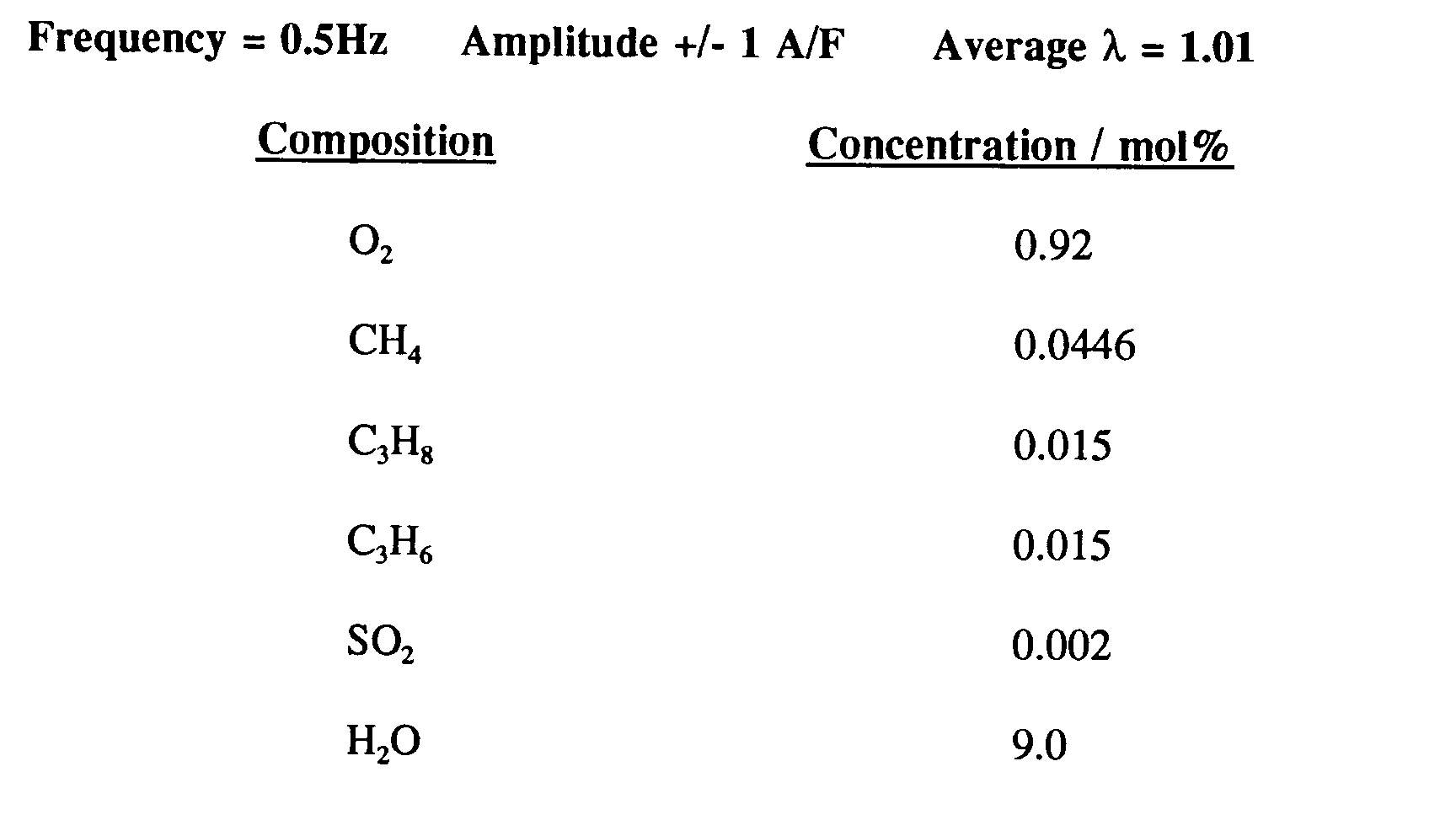
Alternate addition of CO and O₂ to the above gas mixture at a frequency of 0.5Hz.
Rich inject 3.11% CO to achieve CO = 3.96% (λ = 0.94).
Lean inject 1.41% O₂ to achieve O₂ = 2.33% (λ = 1.08).
When perturbing, CO stabilises at 2.33% and O₂ at 1.55% (λ = 1.01). - To increase the thermal stability of the co-precipitated catalyst, a second metal oxide was incorporated during the co-precipitation process. The role of the secondary metal oxide is to decrease the extent of CeO₂ sintering during high temperature exposure.
- 50g of a 4%Pd-0.5%Pt-10%Al₂O₃-CeO₂ catalyst were made by the co-precipitation technique described in Example 2, using Ce(NO₃)₃ (126g), Al(NO₃)₃.9H₂O (69g), Pd(NO₃)₃ (25g), H₂PtCl₆ (0.64g) and NaOH (62.56g). The metal salts were dissolved as a single solution and added dropwise to the boiling NaOH.
- To illustrate the stabilisation effect of Al₂O₃, BET surface areas of the catalyst were measured after calcination in air at 900°C. The values are given in Table 7.
Table 7 Catalyst Calcined 900°CBET Surface Area, m²g⁻¹ 4%Pd-0.5%Pt-CeO₂ 12.5 4%Pd-0.5%Pt-10%Al-CeO₂ 64.0 - The stabilising effect of alumina is also shown on the tpr profiles of the samples calcined at 900°C, Figures 19-20. The sample without Al₂O₃ has sintered significantly as shown by the increase in the bulk reduction peak (high temperature) relative to the surface reduction peak (low temperature). However, for the Al₂O₃ doped sample, significant surface reduction peak is maintained. Similarly the Al₂O₃ doped sample maintains significant low temperature activity even after calcination at 900°C, Figure 21.
- In this preparative route, the source of small metal particles is pre-formed metal colloids.
- To make 50g of 0.9wt% Pt-CeO₂ catalyst, 166g of ceric ammonium nitrate (NH₄)₂Ce(NO₃)₆ was dissolved in 500cm³ of H₂O. A Pt sol was prepared to contain 2.1g Pt per litre, and 215cm³ of the sol was diluted to 500cm³ with distilled water. 73g of crystalline NaOH was dissolved in 6 litres of water and brought to the boil. The Pt sol and ceric solution were added separately at a constant flow rate to the NaOH solution. After complete addition, the precipitate was boiled for an hour prior to filtration, washing, drying and calcination in air at 500°C.
- Similarly, to make 50g of 0.9wt% Pt-SnO₂ catalyst, 116.3g SnCl₄.5H₂O was dissolved in 500cm³ of H₂O. 215cm³ of a Pt sol of known concentration, 2.1g Pt per litre, was diluted to 500cm³ with de-ionised water. 54g of crystalline NaOH was dissolved in 6 litres of water and brought to the boil. The Pt sol and the Sn(IV) solution were added to the boiling NaOH separately, but simultaneously, and at a constant flow rate. The grey precipitate was boiled for an hour after complete addition of the precursor solutions. The precipitate was filtered hot, then washed, dried and calcined in air at 500°C.
- The Pt-CeO₂ catalyst, made by this preparative route, has a reduction profile, Figure 22, indicative of the strong metal-metal oxide interaction identified by promotion of reduction of surface anion at low temperature, which indicates the formation of anionic vacancies on the CeO₂ surface. Similarly, the catalyst can promote CO, NO and alkene conversion at low temperature in a simulated exhaust condition rich of stoichiometric at lambda=0.98, Figure 23. The Pt-SnO₂ catalyst will promote low temperature conversion of CO and alkene when under lean of stoichiometric.
- In this preparative route, the small particles of the metal are formed in situ, by the action of a reducing agent on hydrolysed salt of the metal.
- 50g of 4.0wt% Au-ZrO₂ catalyst was prepared using ZrOCl₂.8H₂O (130.71g), HAuCl₄ (4.059g - assay 49.27wt% Au), NaOH pellets (40.97g) and HCOONa (1.66g). The zirconyl chloride and auric acid were dissolved together in 500cm³ of water, whilst the sodium hydroxide and sodium formate were dissolved in a similar volume of water. These two solutions were added separately, but at the same rate and simultaneously, to 6 litres of boiling distilled water, whilst maintaining a constant pH of 7. After complete addition, the purple gelatinous precipitate was boiled for a further fifteen minutes, prior to filtration, washing, drying and calcining at 500°C.
- The Au-ZrO₂ catalyst prepared by the above route is capable of converting CO and NO at low temperature in a simulated exhaust gas mixture, rich of stoichiometric at lambda=0.98, Figure 24. The strong Au-ZrO₂ interaction achieved through this preparative route is demonstrated by the presence of low temperature reduction peak in the tpr profile, which indicates the formation of anionic vacancies on the ZrO₂ surface; a corresponding catalyst made by impregnation consumes H₂ at higher temperature - Figure 25 (NB, a Au-Al₂O₃ catalyst made by impregnation, after calcination at 500°C, does not show any H₂ consumption during tpr, indicating that the reduction peak of the Au-ZrO₂ system is not due to reducibility of the Au species, which should be present in a metallic state).
- A catalyst containing 0.9% Pt and 20% CeO₂ was prepared by conventional impregnation of conventional Al₂O₃-CeO₂ with a Pt precursor and then calcination at 500°C. The catalyst was tested for its ability to convert CO, NO and alkene in the same way as were the catalysts described in Example 2. The results for this comparative are shown in Figure 26. Comparison with Figures 5-7 shows the greater low temperature activity of the catalyst of the invention.
Claims (30)
Applications Claiming Priority (2)
| Application Number | Priority Date | Filing Date | Title |
|---|---|---|---|
| GB9226434 | 1992-12-18 | ||
| GB929226434A GB9226434D0 (en) | 1992-12-18 | 1992-12-18 | Catalyst |
Publications (2)
| Publication Number | Publication Date |
|---|---|
| EP0602865A1 true EP0602865A1 (en) | 1994-06-22 |
| EP0602865B1 EP0602865B1 (en) | 2000-05-10 |
Family
ID=10726837
Family Applications (1)
| Application Number | Title | Priority Date | Filing Date |
|---|---|---|---|
| EP93309782A Expired - Lifetime EP0602865B1 (en) | 1992-12-18 | 1993-12-06 | Carbon monoxide oxidation catalyst |
Country Status (14)
| Country | Link |
|---|---|
| US (2) | US5480854A (en) |
| EP (1) | EP0602865B1 (en) |
| JP (1) | JPH06219721A (en) |
| KR (1) | KR940013593A (en) |
| AT (1) | ATE192668T1 (en) |
| AU (1) | AU675463B2 (en) |
| CA (1) | CA2111529C (en) |
| DE (1) | DE69328610T2 (en) |
| DK (1) | DK0602865T3 (en) |
| ES (1) | ES2145036T3 (en) |
| GB (1) | GB9226434D0 (en) |
| GR (1) | GR3033466T3 (en) |
| PT (1) | PT602865E (en) |
| TW (1) | TW341525B (en) |
Cited By (25)
| Publication number | Priority date | Publication date | Assignee | Title |
|---|---|---|---|---|
| EP0707883A3 (en) * | 1994-10-06 | 1996-09-25 | N E Chemcat Corp | Catalyst and method for purifying exhaust gases |
| WO1996039576A1 (en) * | 1995-06-06 | 1996-12-12 | Johnson Matthey Public Limited Company | Combatting air pollution |
| NL1004175C2 (en) * | 1996-10-02 | 1998-04-06 | Energieonderzoek Ct Nederland | Catalyst system comprising an oxide core with on its surface metal particles capable of hydrogenation and / or dehydrogenation. |
| WO1999008787A1 (en) * | 1997-08-18 | 1999-02-25 | Bayer Aktiengesellschaft | Catalysts containing a platinum group metal and produced in a sol-gel method, as well as method for producing diarylcarbonates |
| WO1999016546A1 (en) * | 1997-09-29 | 1999-04-08 | Laman Consultancy Limited | Gold catalyst for fuel cells |
| WO2000013791A1 (en) * | 1998-09-07 | 2000-03-16 | Anglo American Research Laboratories (Proprietary) Limited | Gold catalyst for fuel cell |
| WO2000062923A1 (en) * | 1999-04-19 | 2000-10-26 | Engelhard Corporation | Catalyst composition comprising ceria and a platinum group metal |
| WO2005061080A1 (en) * | 2003-12-23 | 2005-07-07 | Consejo Superior De Investigaciones Científicas | Method for the selective oxidation of carbon monoxide |
| WO2005072871A1 (en) * | 2004-02-02 | 2005-08-11 | Johnson Matthey Public Limited Company | Catalyst |
| WO2005120687A1 (en) * | 2004-06-05 | 2005-12-22 | Umicore Ag & Co. Kg | Particle filter provided with a catalytic coating |
| US7344683B2 (en) | 2005-04-14 | 2008-03-18 | Mazda Motor Corporation | Exhaust gas catalytic converter |
| EP1972372A1 (en) * | 1996-04-19 | 2008-09-24 | Honda Giken Kogyo Kabushiki Kaisha | Exhaust gas emission control catalyst |
| US7485270B2 (en) | 2002-09-13 | 2009-02-03 | Johnson Matthey Public Limited Company | Process for treating compression ignition engine exhaust gas |
| WO2009136206A1 (en) | 2008-05-09 | 2009-11-12 | Johnson Matthey Public Limited Company | Exhaust system for lean-burn internal combustion engine comprising pd-au-alloy catalyst |
| EP1946834A4 (en) * | 2005-11-04 | 2010-09-15 | Toyota Motor Co Ltd | CATALYST SUPPORT PARTICLE, EXHAUST GAS PURIFYING CATALYST AND METHODS OF PRODUCING THE SAME |
| WO2011070439A1 (en) * | 2009-12-08 | 2011-06-16 | Toyota Jidosha Kabushiki Kaisha | Method of synthesizing metal composite oxide and metal composite oxide obtained by same |
| US8105559B2 (en) | 2006-10-20 | 2012-01-31 | Johnson Matthey Public Limited Company | Thermally regenerable nitric oxide adsorbent |
| WO2012085564A1 (en) | 2010-12-21 | 2012-06-28 | Johnson Matthey Public Limited Company | NOx ABSORBER CATALYST |
| WO2012114187A2 (en) | 2011-02-21 | 2012-08-30 | Johnson Matthey Public Limited Company | Exhaust system including nox reduction catalyst and egr circuit |
| EP2554255A4 (en) * | 2010-04-01 | 2013-04-24 | Toyota Motor Co Ltd | CATALYST FOR PURIFYING EXHAUST GASES |
| DE102013210557A1 (en) | 2012-06-19 | 2014-02-13 | Johnson Matthey Public Limited Company | CATALYST COMPOSITION |
| WO2014083309A1 (en) * | 2012-11-30 | 2014-06-05 | Johnson Matthey Public Limited Company | Bimetallic catalyst |
| CN104162424A (en) * | 2014-07-11 | 2014-11-26 | 华东理工大学 | Preparation method of cerium oxide-supported palladium catalyst and application of palladium catalyst in CO catalytic oxidation |
| US9266064B2 (en) | 2013-08-28 | 2016-02-23 | Johnson Matthey Plc | Co slip catalyst and method of using |
| WO2023126304A1 (en) | 2021-12-30 | 2023-07-06 | MAX-PLANCK-Gesellschaft zur Förderung der Wissenschaften e.V. | Plasma-treated single atom catalyst, production method thereof and use of the catalyst |
Families Citing this family (65)
| Publication number | Priority date | Publication date | Assignee | Title |
|---|---|---|---|---|
| FR2741869B1 (en) * | 1995-12-04 | 1998-02-06 | Rhone Poulenc Chimie | CERIUM OXIDE WITH LAMELLAR-STRUCTURAL PORES, PROCESS FOR PREPARATION AND USE IN CATALYSIS |
| FR2765492B1 (en) * | 1997-07-03 | 1999-09-17 | Rhodia Chimie Sa | GAS TREATMENT PROCESS FOR THE REDUCTION OF NITROGEN OXIDE EMISSIONS USING A CATALYTIC COMPOSITION WITH A SUPPORT BASED ON SILICA AND TITANIUM OXIDE |
| US6143192A (en) | 1998-09-03 | 2000-11-07 | Micron Technology, Inc. | Ruthenium and ruthenium dioxide removal method and material |
| US6475454B1 (en) * | 1999-01-14 | 2002-11-05 | Ge Energy & Environmental Research Corporation | Thermally limited selective oxidation methods and apparatus |
| US6492298B1 (en) | 1999-03-29 | 2002-12-10 | Kabushiki Kaisha Toyota Chuo Kenkyusho | Ordinary-temperature purifying catalyst |
| US6821923B1 (en) * | 1999-04-08 | 2004-11-23 | Dow Global Technologies Inc. | Method of preparing a catalyst containing gold and titanium |
| FR2792851B1 (en) * | 1999-04-29 | 2002-04-05 | Inst Francais Du Petrole | LOW-DISPERSE NOBLE METAL-BASED CATALYST AND USE THEREOF FOR THE CONVERSION OF HYDROCARBON CHARGES |
| US6602819B2 (en) * | 2000-01-05 | 2003-08-05 | E. I. Du Pont De Nemours And Company | Process for the reduction of carbon monoxide and carbonyl sulfide emissions |
| JP3760717B2 (en) * | 2000-02-29 | 2006-03-29 | 株式会社豊田中央研究所 | Low temperature harmful gas purification catalyst |
| JP4959047B2 (en) * | 2000-10-10 | 2012-06-20 | 三菱重工業株式会社 | Low temperature oxidation catalyst |
| JP4006976B2 (en) | 2000-11-15 | 2007-11-14 | 株式会社豊田中央研究所 | Composite oxide powder, method for producing the same and catalyst |
| EP1209121A1 (en) * | 2000-11-22 | 2002-05-29 | Haldor Topsoe A/S | Process for the catalytic oxidation of carbon monoxide and/or methanol |
| JP4032652B2 (en) * | 2001-02-23 | 2008-01-16 | 株式会社豊田中央研究所 | Composite oxide powder and method for producing the same |
| US6455182B1 (en) * | 2001-05-09 | 2002-09-24 | Utc Fuel Cells, Llc | Shift converter having an improved catalyst composition, and method for its use |
| US6818720B2 (en) | 2001-11-08 | 2004-11-16 | Degussa Ag | Supported hydrogenating catalyst in powder form |
| WO2003039743A1 (en) * | 2001-11-08 | 2003-05-15 | Degussa Ag | Supported catalyst for hydrogenation of nitroaromatics |
| US6730592B2 (en) * | 2001-12-21 | 2004-05-04 | Micron Technology, Inc. | Methods for planarization of metal-containing surfaces using halogens and halide salts |
| US7049237B2 (en) * | 2001-12-21 | 2006-05-23 | Micron Technology, Inc. | Methods for planarization of Group VIII metal-containing surfaces using oxidizing gases |
| US20030119316A1 (en) * | 2001-12-21 | 2003-06-26 | Micron Technology, Inc. | Methods for planarization of group VIII metal-containing surfaces using oxidizing agents |
| US7121926B2 (en) | 2001-12-21 | 2006-10-17 | Micron Technology, Inc. | Methods for planarization of group VIII metal-containing surfaces using a fixed abrasive article |
| US6884723B2 (en) * | 2001-12-21 | 2005-04-26 | Micron Technology, Inc. | Methods for planarization of group VIII metal-containing surfaces using complexing agents |
| US20040147394A1 (en) * | 2002-03-28 | 2004-07-29 | Wagner Jon P. | Catalyst for production of hydrogen |
| US20030186805A1 (en) * | 2002-03-28 | 2003-10-02 | Vanderspurt Thomas Henry | Ceria-based mixed-metal oxide structure, including method of making and use |
| US6774080B2 (en) * | 2002-11-25 | 2004-08-10 | Delphi Technologies, Inc. | Gas treatment device comprising SMSI material and methods for making and using the same |
| US6857431B2 (en) * | 2002-12-09 | 2005-02-22 | Philip Morris Usa Inc. | Nanocomposite copper-ceria catalysts for low temperature or near-ambient temperature catalysis and methods for making such catalysts |
| US6932848B2 (en) * | 2003-03-28 | 2005-08-23 | Utc Fuel Cells, Llc | High performance fuel processing system for fuel cell power plant |
| US7169376B2 (en) * | 2004-06-10 | 2007-01-30 | Chevron U.S.A. Inc. | Method for making hydrogen using a gold containing water-gas shift catalyst |
| CA2546234A1 (en) * | 2003-11-24 | 2005-06-09 | Dow Global Technologies Inc. | Catalyst for a diesel particulate filter |
| US20060003412A1 (en) * | 2003-12-08 | 2006-01-05 | Xencor, Inc. | Protein engineering with analogous contact environments |
| JP4199691B2 (en) * | 2004-03-25 | 2008-12-17 | 田中貴金属工業株式会社 | catalyst |
| KR101250674B1 (en) * | 2004-04-21 | 2013-04-03 | 다우 글로벌 테크놀로지스 엘엘씨 | Method for increasing the strength of porous ceramic bodies and bodies made therefrom |
| CA2574680C (en) * | 2004-07-26 | 2012-05-29 | Dow Global Technologies Inc. | Improved catalyzed soot filter |
| US20060064335A1 (en) * | 2004-08-17 | 2006-03-23 | International Business Machines Corporation | Method, system, and storage medium for performing business process modeling |
| JP5106748B2 (en) * | 2004-11-08 | 2012-12-26 | 株式会社キャタラー | Exhaust gas purification catalyst |
| WO2006051876A1 (en) * | 2004-11-10 | 2006-05-18 | Dai Nippon Printing Co., Ltd. | Method for producing metal oxide film |
| JP2006334490A (en) * | 2005-06-01 | 2006-12-14 | Mazda Motor Corp | Exhaust gas purification catalyst |
| US8115373B2 (en) | 2005-07-06 | 2012-02-14 | Rochester Institute Of Technology | Self-regenerating particulate trap systems for emissions and methods thereof |
| KR100713297B1 (en) * | 2005-09-08 | 2007-05-04 | 한화석유화학 주식회사 | Manufacturing method of metal oxide containing noble metal |
| JP4687389B2 (en) * | 2005-10-26 | 2011-05-25 | マツダ株式会社 | Exhaust gas purification catalyst |
| JP2007185588A (en) * | 2006-01-12 | 2007-07-26 | Mazda Motor Corp | Exhaust gas purification catalyst |
| US20080020922A1 (en) * | 2006-07-21 | 2008-01-24 | Li Cheng G | Zone catalyzed soot filter |
| JP4806613B2 (en) | 2006-09-25 | 2011-11-02 | バブコック日立株式会社 | Gas purification method, gas purification device, and gas purification catalyst |
| KR101046899B1 (en) * | 2006-10-05 | 2011-07-06 | 이비덴 가부시키가이샤 | Honeycomb Structure |
| US20080113439A1 (en) * | 2006-11-15 | 2008-05-15 | James Roy Butler | Method for predicting catalyst performance |
| US7947102B2 (en) * | 2006-12-21 | 2011-05-24 | Dow Global Technologies Llc | Soot filter |
| KR101569221B1 (en) * | 2007-10-12 | 2015-11-20 | 다우 글로벌 테크놀로지스 엘엘씨 | Improved thermal shock resistant soot filter |
| CA2701486A1 (en) * | 2007-12-21 | 2009-07-09 | Dow Global Technologies Inc. | Improved catalyzed soot filter and method (s) to make these |
| JP2009165904A (en) | 2008-01-10 | 2009-07-30 | Honda Motor Co Ltd | Exhaust gas purification device |
| US20100240522A1 (en) * | 2009-03-23 | 2010-09-23 | Tomoyuki Inui | Catalyst exhibiting hydrogen spillover effect |
| US8534050B2 (en) * | 2009-12-18 | 2013-09-17 | GM Global Technology Operations LLC | Exhaust gas aftertreatment system for a diesel engine and method of increasing a temperature of an SCR catalyst to reduce NOx in exhaust gases |
| US8668877B2 (en) | 2010-11-24 | 2014-03-11 | Basf Corporation | Diesel oxidation catalyst articles and methods of making and using |
| GB201021887D0 (en) | 2010-12-21 | 2011-02-02 | Johnson Matthey Plc | Oxidation catalyst for a lean burn internal combustion engine |
| GB201110850D0 (en) * | 2011-03-04 | 2011-08-10 | Johnson Matthey Plc | Catalyst and mehtod of preparation |
| WO2012175409A1 (en) | 2011-06-21 | 2012-12-27 | Umicore Ag & Co. Kg | Method for the deposition of metals on support oxides |
| JP5642107B2 (en) | 2012-03-30 | 2014-12-17 | 本田技研工業株式会社 | Saddle-type vehicle exhaust gas purification device and palladium single-layer catalyst used therefor |
| JP5992192B2 (en) | 2012-03-30 | 2016-09-14 | 三井金属鉱業株式会社 | Palladium catalyst |
| WO2013149881A1 (en) * | 2012-04-05 | 2013-10-10 | Umicore Ag & Co. Kg | Method for removing carbon monoxide and hydrocarbons from the exhaust gas of lean-burn internal combustion engines |
| JP6469942B2 (en) * | 2013-02-25 | 2019-02-13 | 日産自動車株式会社 | Catalyst particles for fuel cell and method for producing the same |
| EP2792410A1 (en) * | 2013-04-15 | 2014-10-22 | Goldemar Solutions, S.L. | Method of manufacturing a catalyst comprising gold nanoparticles, the catalyst and its use |
| JP6376532B2 (en) * | 2014-09-04 | 2018-08-22 | 株式会社アルバック | Method for producing exhaust gas purification catalyst |
| ES2808989T3 (en) * | 2017-05-18 | 2021-03-02 | General Electric Technology Gmbh | Circuit breaker comprising a ceria-based catalyst for the conversion of CO to CO2 |
| CN111215064A (en) * | 2018-11-25 | 2020-06-02 | 中国科学院大连化学物理研究所 | A precious metal water vapor shift catalyst and its preparation and application |
| KR20210125227A (en) * | 2020-04-08 | 2021-10-18 | 한화솔루션 주식회사 | Method for preparing metal catalyst deposited with inorganic film by ALD process and metal catalyst with improved activity |
| CN114308029B (en) * | 2020-09-30 | 2023-01-13 | 中国科学院大连化学物理研究所 | Method for preparing tetravalent uranium by hydrazine reduction of hexavalent uranium with bimetallic catalyst |
| WO2024009821A1 (en) * | 2022-07-07 | 2024-01-11 | ユミコア日本触媒株式会社 | Exhaust-gas-purifying oxidation catalyst, and method for oxidizing exhaust gas using same |
Citations (6)
| Publication number | Priority date | Publication date | Assignee | Title |
|---|---|---|---|---|
| GB2122912A (en) * | 1982-06-29 | 1984-01-25 | Johnson Matthey Plc | Exhaust gas purification catalyst |
| DE3832268A1 (en) * | 1987-09-24 | 1989-04-06 | Agency Ind Science Techn | ULTRAFINE GOLD PARTICLES IMMOBILIZED ON EARTH ALKALINE METAL COMPOUNDS, METHOD FOR THE PRODUCTION THEREOF, AND CATALYSTS AND SENSORS FOR FLAMMABLE GASES WHICH CONTAIN SUCH COMPOUNDS AS ESSENTIAL MAIN COMPONENTS |
| EP0428753A1 (en) * | 1989-06-09 | 1991-05-29 | N.E. Chemcat Corporation | Exhaust gas purifying catalyst excellent in thermal resistance and method of production thereof |
| EP0461950A1 (en) * | 1990-06-13 | 1991-12-18 | Rhone-Poulenc Chimie | Porous matrix material containing a second element in dispersed form and process for its manufacture |
| JPH044043A (en) * | 1990-04-20 | 1992-01-08 | Nissan Motor Co Ltd | Heat-resistant catalyst for purifying exhaust gas |
| EP0499402A1 (en) * | 1991-02-15 | 1992-08-19 | Philip Morris Products Inc. | Conversion of carbon monoxide using mixed transition metal oxide catalysts |
Family Cites Families (20)
| Publication number | Priority date | Publication date | Assignee | Title |
|---|---|---|---|---|
| US2030283A (en) * | 1931-04-13 | 1936-02-11 | Atmospheric Nitrogen Corp | Catalyst and process for the decomposition of hydrocarbons |
| US3173957A (en) * | 1961-08-21 | 1965-03-16 | Eastman Kodak Co | Process for the preparation of acrolein |
| NL131717C (en) * | 1963-06-19 | |||
| US3878131A (en) * | 1971-09-29 | 1975-04-15 | Universal Oil Prod Co | Multicomponent dehydrogenation catalyst |
| US4149998A (en) * | 1976-04-05 | 1979-04-17 | Exxon Research & Engineering Co. | Supported metal interaction catalysts |
| JPS53116290A (en) * | 1977-03-22 | 1978-10-11 | Matsushita Electric Ind Co Ltd | Production of gas purification catalyst |
| US4240933A (en) * | 1979-02-26 | 1980-12-23 | E. I. Du Pont De Nemours And Company | Pd/SiO2 Hydrogenation catalyst suitable for H2 O2 manufacture |
| CA1141359A (en) * | 1978-10-02 | 1983-02-15 | Harry B. Copelin | Pd/sio.sub.2 hydrogenation catalyst suitable for h.sub.2o.sub.2 manufacture |
| NO171409C (en) * | 1982-09-30 | 1993-03-10 | Engelhard Corp | PROCEDURE FOR THE PREPARATION OF A HYDROGENRIQUE GAS VEDA AUTOTHERMIC REFORM OF A HYDROCARBON-CONTAINED OUTPUT MATERIAL |
| ZA837689B (en) * | 1982-10-18 | 1984-06-27 | Universal Matthey Prod | Oxidation catalysts |
| GB8418975D0 (en) * | 1984-07-25 | 1984-08-30 | British Petroleum Co Plc | Synthesis gas conversion catalyst |
| US4585752A (en) * | 1984-08-15 | 1986-04-29 | W. R. Grace & Co. | Catalyst composition for ultra high temperature operation |
| US4920088A (en) * | 1987-09-08 | 1990-04-24 | Phillips Petroleum Company | Catalyst for the oxidation of carbon monoxide |
| US4818745A (en) * | 1987-09-08 | 1989-04-04 | Phillips Petroleum Company | Catalyst for oxidation of carbon monoxide and process for preparing the catalyst |
| US5202300A (en) * | 1988-02-18 | 1993-04-13 | Engelhard Corporation | Catalyst for purification of exhaust gas |
| US4911904A (en) * | 1988-02-26 | 1990-03-27 | Phillips Petroleum Company | Catalytic oxidation of carbon monoxide |
| US4921830A (en) * | 1988-04-13 | 1990-05-01 | Phillips Petroleum Company | Catalyst for the oxidation of carbon monoxide |
| JPH02252610A (en) * | 1989-03-24 | 1990-10-11 | Agency Of Ind Science & Technol | Production of gold ultrafine granule-fixed oxide |
| GB2234450A (en) * | 1989-07-25 | 1991-02-06 | Uop Ltd | Low temperature oxidation catalysts |
| GB9010709D0 (en) * | 1990-05-12 | 1990-07-04 | Johnson Matthey Plc | Catalytic reduction |
-
1992
- 1992-12-18 GB GB929226434A patent/GB9226434D0/en active Pending
-
1993
- 1993-12-06 PT PT93309782T patent/PT602865E/en unknown
- 1993-12-06 ES ES93309782T patent/ES2145036T3/en not_active Expired - Lifetime
- 1993-12-06 EP EP93309782A patent/EP0602865B1/en not_active Expired - Lifetime
- 1993-12-06 DK DK93309782T patent/DK0602865T3/en active
- 1993-12-06 DE DE69328610T patent/DE69328610T2/en not_active Expired - Lifetime
- 1993-12-06 AT AT93309782T patent/ATE192668T1/en not_active IP Right Cessation
- 1993-12-08 TW TW082110398A patent/TW341525B/en active
- 1993-12-10 AU AU52474/93A patent/AU675463B2/en not_active Ceased
- 1993-12-10 US US08/164,405 patent/US5480854A/en not_active Expired - Lifetime
- 1993-12-15 CA CA002111529A patent/CA2111529C/en not_active Expired - Fee Related
- 1993-12-18 KR KR1019930028528A patent/KR940013593A/en not_active Withdrawn
- 1993-12-20 JP JP5320305A patent/JPH06219721A/en active Pending
-
1995
- 1995-11-08 US US08/555,034 patent/US5993762A/en not_active Expired - Lifetime
-
2000
- 2000-05-19 GR GR20000401162T patent/GR3033466T3/en not_active IP Right Cessation
Patent Citations (6)
| Publication number | Priority date | Publication date | Assignee | Title |
|---|---|---|---|---|
| GB2122912A (en) * | 1982-06-29 | 1984-01-25 | Johnson Matthey Plc | Exhaust gas purification catalyst |
| DE3832268A1 (en) * | 1987-09-24 | 1989-04-06 | Agency Ind Science Techn | ULTRAFINE GOLD PARTICLES IMMOBILIZED ON EARTH ALKALINE METAL COMPOUNDS, METHOD FOR THE PRODUCTION THEREOF, AND CATALYSTS AND SENSORS FOR FLAMMABLE GASES WHICH CONTAIN SUCH COMPOUNDS AS ESSENTIAL MAIN COMPONENTS |
| EP0428753A1 (en) * | 1989-06-09 | 1991-05-29 | N.E. Chemcat Corporation | Exhaust gas purifying catalyst excellent in thermal resistance and method of production thereof |
| JPH044043A (en) * | 1990-04-20 | 1992-01-08 | Nissan Motor Co Ltd | Heat-resistant catalyst for purifying exhaust gas |
| EP0461950A1 (en) * | 1990-06-13 | 1991-12-18 | Rhone-Poulenc Chimie | Porous matrix material containing a second element in dispersed form and process for its manufacture |
| EP0499402A1 (en) * | 1991-02-15 | 1992-08-19 | Philip Morris Products Inc. | Conversion of carbon monoxide using mixed transition metal oxide catalysts |
Non-Patent Citations (1)
| Title |
|---|
| DATABASE WPI Section Ch Week 9208, Derwent World Patents Index; Class H06, AN 92-060010 * |
Cited By (43)
| Publication number | Priority date | Publication date | Assignee | Title |
|---|---|---|---|---|
| EP0707883A3 (en) * | 1994-10-06 | 1996-09-25 | N E Chemcat Corp | Catalyst and method for purifying exhaust gases |
| US5939028A (en) * | 1995-06-06 | 1999-08-17 | Johnson Matthey Plc | Combatting air pollution |
| WO1996039576A1 (en) * | 1995-06-06 | 1996-12-12 | Johnson Matthey Public Limited Company | Combatting air pollution |
| AU705112B2 (en) * | 1995-06-06 | 1999-05-13 | Johnson Matthey Public Limited Company | Combatting air pollution |
| EP1972372A1 (en) * | 1996-04-19 | 2008-09-24 | Honda Giken Kogyo Kabushiki Kaisha | Exhaust gas emission control catalyst |
| NL1004175C2 (en) * | 1996-10-02 | 1998-04-06 | Energieonderzoek Ct Nederland | Catalyst system comprising an oxide core with on its surface metal particles capable of hydrogenation and / or dehydrogenation. |
| WO1999008787A1 (en) * | 1997-08-18 | 1999-02-25 | Bayer Aktiengesellschaft | Catalysts containing a platinum group metal and produced in a sol-gel method, as well as method for producing diarylcarbonates |
| WO1999016546A1 (en) * | 1997-09-29 | 1999-04-08 | Laman Consultancy Limited | Gold catalyst for fuel cells |
| WO2000013791A1 (en) * | 1998-09-07 | 2000-03-16 | Anglo American Research Laboratories (Proprietary) Limited | Gold catalyst for fuel cell |
| GB2357628A (en) * | 1998-09-07 | 2001-06-27 | Anglo American Res Lab | Gold catalyst for fuel cell |
| WO2000062923A1 (en) * | 1999-04-19 | 2000-10-26 | Engelhard Corporation | Catalyst composition comprising ceria and a platinum group metal |
| US8006485B2 (en) | 2002-09-13 | 2011-08-30 | Johnson Matthey Public Limited Company | Compression ignition engine and exhaust system therefor |
| US7485270B2 (en) | 2002-09-13 | 2009-02-03 | Johnson Matthey Public Limited Company | Process for treating compression ignition engine exhaust gas |
| WO2005061080A1 (en) * | 2003-12-23 | 2005-07-07 | Consejo Superior De Investigaciones Científicas | Method for the selective oxidation of carbon monoxide |
| ES2238172B1 (en) * | 2003-12-23 | 2006-11-01 | Universidad Politecnica De Valencia | SELECTIVE OXIDATION METHOD OF CARBON MONOXIDE. |
| ES2238172A1 (en) * | 2003-12-23 | 2005-08-16 | Universidad Politecnica De Valencia | SELECTIVE OXIDATION METHOD OF CARBON MONOXIDE. |
| WO2005072871A1 (en) * | 2004-02-02 | 2005-08-11 | Johnson Matthey Public Limited Company | Catalyst |
| WO2005120687A1 (en) * | 2004-06-05 | 2005-12-22 | Umicore Ag & Co. Kg | Particle filter provided with a catalytic coating |
| US7344683B2 (en) | 2005-04-14 | 2008-03-18 | Mazda Motor Corporation | Exhaust gas catalytic converter |
| EP1946834A4 (en) * | 2005-11-04 | 2010-09-15 | Toyota Motor Co Ltd | CATALYST SUPPORT PARTICLE, EXHAUST GAS PURIFYING CATALYST AND METHODS OF PRODUCING THE SAME |
| US8053388B2 (en) | 2005-11-04 | 2011-11-08 | Toyota Jidosha Kabushiki Kaisha | Catalyst support particle, exhaust gas purifying catalyst, and production processes thereof |
| US8105559B2 (en) | 2006-10-20 | 2012-01-31 | Johnson Matthey Public Limited Company | Thermally regenerable nitric oxide adsorbent |
| DE112009001056T5 (en) | 2008-05-09 | 2011-03-10 | Johnson Matthey Public Limited Company | An exhaust system for a lean-burn internal combustion engine comprising a PD-AU alloy catalyst |
| WO2009136206A1 (en) | 2008-05-09 | 2009-11-12 | Johnson Matthey Public Limited Company | Exhaust system for lean-burn internal combustion engine comprising pd-au-alloy catalyst |
| US8551411B2 (en) | 2008-05-09 | 2013-10-08 | Johnson Matthey Public Limited Company | Exhaust system for lean-burn internal combustion engine comprising Pd-Au-alloy catalyst |
| WO2011070439A1 (en) * | 2009-12-08 | 2011-06-16 | Toyota Jidosha Kabushiki Kaisha | Method of synthesizing metal composite oxide and metal composite oxide obtained by same |
| RU2515430C2 (en) * | 2009-12-08 | 2014-05-10 | Тойота Дзидося Кабусики Кайся | Method for synthesis of composite metal oxide and composite metal oxide obtained using said method |
| US9126846B2 (en) | 2009-12-08 | 2015-09-08 | Toyota Jidosha Kabushiki Kaisha | Method of synthesizing metal composite oxide and metal composite oxide obtained by same |
| EP2554255A4 (en) * | 2010-04-01 | 2013-04-24 | Toyota Motor Co Ltd | CATALYST FOR PURIFYING EXHAUST GASES |
| US9138736B2 (en) | 2010-04-01 | 2015-09-22 | Toyota Jidosha Kabushiki Kaisha | Exhaust purifying catalyst |
| US9114385B2 (en) | 2010-12-21 | 2015-08-25 | Johnson Matthey Public Limited Company | NOx absorber catalyst |
| WO2012085564A1 (en) | 2010-12-21 | 2012-06-28 | Johnson Matthey Public Limited Company | NOx ABSORBER CATALYST |
| WO2012114187A2 (en) | 2011-02-21 | 2012-08-30 | Johnson Matthey Public Limited Company | Exhaust system including nox reduction catalyst and egr circuit |
| US9243539B2 (en) | 2012-06-19 | 2016-01-26 | Johnson Matthey Public Limited Company | Catalyst composition |
| DE102013210557A1 (en) | 2012-06-19 | 2014-02-13 | Johnson Matthey Public Limited Company | CATALYST COMPOSITION |
| US8986637B2 (en) | 2012-11-30 | 2015-03-24 | Johnson Matthey Public Limited Company | Bimetallic catalyst |
| DE102013222540A1 (en) | 2012-11-30 | 2014-06-05 | Johnson Matthey Public Limited Company | BIMETALLIC CATALYST |
| WO2014083309A1 (en) * | 2012-11-30 | 2014-06-05 | Johnson Matthey Public Limited Company | Bimetallic catalyst |
| US9266064B2 (en) | 2013-08-28 | 2016-02-23 | Johnson Matthey Plc | Co slip catalyst and method of using |
| GB2519846B (en) * | 2013-08-28 | 2018-01-24 | Johnson Matthey Plc | Method of oxidizing excess CO in an exhaust gas |
| GB2554029B (en) * | 2013-08-28 | 2018-08-08 | Johnson Matthey Plc | Exhaust system comprising CO slip catalyst |
| CN104162424A (en) * | 2014-07-11 | 2014-11-26 | 华东理工大学 | Preparation method of cerium oxide-supported palladium catalyst and application of palladium catalyst in CO catalytic oxidation |
| WO2023126304A1 (en) | 2021-12-30 | 2023-07-06 | MAX-PLANCK-Gesellschaft zur Förderung der Wissenschaften e.V. | Plasma-treated single atom catalyst, production method thereof and use of the catalyst |
Also Published As
| Publication number | Publication date |
|---|---|
| EP0602865B1 (en) | 2000-05-10 |
| US5993762A (en) | 1999-11-30 |
| ES2145036T3 (en) | 2000-07-01 |
| GB9226434D0 (en) | 1993-02-10 |
| DE69328610D1 (en) | 2000-06-15 |
| GR3033466T3 (en) | 2000-09-29 |
| CA2111529C (en) | 2006-05-23 |
| CA2111529A1 (en) | 1994-06-19 |
| US5480854A (en) | 1996-01-02 |
| AU675463B2 (en) | 1997-02-06 |
| AU5247493A (en) | 1994-06-30 |
| DE69328610T2 (en) | 2001-01-11 |
| KR940013593A (en) | 1994-07-15 |
| JPH06219721A (en) | 1994-08-09 |
| PT602865E (en) | 2000-08-31 |
| ATE192668T1 (en) | 2000-05-15 |
| TW341525B (en) | 1998-10-01 |
| DK0602865T3 (en) | 2000-08-07 |
Similar Documents
| Publication | Publication Date | Title |
|---|---|---|
| EP0602865B1 (en) | Carbon monoxide oxidation catalyst | |
| US6124232A (en) | Method for preparing an acidic solid oxide | |
| Getsoian et al. | Remarkable improvement in low temperature performance of model three-way catalysts through solution atomic layer deposition | |
| US5977012A (en) | Alloyed metal catalysts for the reduction of NOx in the exhaust gases from internal combustion engines containing excess oxygen | |
| Grisel et al. | Selective oxidation of CO, over supported Au catalysts | |
| Kašpar et al. | Nanostructured materials for advanced automotive de-pollution catalysts | |
| CA1083124A (en) | Polyfunctional catalysts and method of use | |
| EP0361952B1 (en) | Catalytic washcoat | |
| EP0171151A1 (en) | Three-way catalyst for lean exhaust systems | |
| EP0488514B1 (en) | A method of making a catalyst for use in automotive exhaust gas treatment | |
| EP0561904A1 (en) | High durability auto exhaust catalyst with low hydrogen sulfide emissions. | |
| EP0320243A1 (en) | Catalysts | |
| WO2019089783A1 (en) | Catalyst materials, systems, and methods of making | |
| KR20180136996A (en) | Cerium- and zirconium-based mixed oxides | |
| US20020061273A1 (en) | Cu-AI/Ce-AI complex oxide combustion catalysts, their preparation and use | |
| Konopny et al. | Preparation and characterization of γ-Al2O3-supported PdMo catalysts | |
| EP1238700B1 (en) | Hydrogenolysis catalyst | |
| EP1126914A1 (en) | Preparation of nanocrystalline and dispersible supported metal catalysts | |
| Bosch et al. | High temperature treated Pt/Sn ZnAl2O4 catalysts | |
| AU690956B2 (en) | Method of making a catalyst | |
| Masuda et al. | Effect of the type of support preparation on the thermostability and the oxidation activity of CeOx/BaO/Al2O3-supported Pd catalysts | |
| Gomez et al. | Pt-Sn/Al2O3 sol-gel catalysts: metallic phase characterization | |
| Lindström et al. | Catalytic oxidation of liquid methanol as a heat source for an automotive reformer | |
| WO2005072871A1 (en) | Catalyst | |
| Biniwale et al. | A non-noble metal based catalytic converter for two-stroke, two-wheeler applications |
Legal Events
| Date | Code | Title | Description |
|---|---|---|---|
| PUAI | Public reference made under article 153(3) epc to a published international application that has entered the european phase |
Free format text: ORIGINAL CODE: 0009012 |
|
| AK | Designated contracting states |
Kind code of ref document: A1 Designated state(s): AT BE CH DE DK ES FR GB GR IE IT LI NL PT SE |
|
| 17P | Request for examination filed |
Effective date: 19941212 |
|
| 17Q | First examination report despatched |
Effective date: 19950706 |
|
| GRAG | Despatch of communication of intention to grant |
Free format text: ORIGINAL CODE: EPIDOS AGRA |
|
| RIC1 | Information provided on ipc code assigned before grant |
Free format text: 6B 01D 53/94 A, 6B 01J 23/66 B, 6B 01J 35/02 B, 6B 01J 23/63 B |
|
| RTI1 | Title (correction) |
Free format text: CARBON MONOXIDE OXIDATION CATALYST |
|
| GRAG | Despatch of communication of intention to grant |
Free format text: ORIGINAL CODE: EPIDOS AGRA |
|
| GRAH | Despatch of communication of intention to grant a patent |
Free format text: ORIGINAL CODE: EPIDOS IGRA |
|
| GRAH | Despatch of communication of intention to grant a patent |
Free format text: ORIGINAL CODE: EPIDOS IGRA |
|
| GRAA | (expected) grant |
Free format text: ORIGINAL CODE: 0009210 |
|
| AK | Designated contracting states |
Kind code of ref document: B1 Designated state(s): AT BE CH DE DK ES FR GB GR IE IT LI NL PT SE |
|
| REF | Corresponds to: |
Ref document number: 192668 Country of ref document: AT Date of ref document: 20000515 Kind code of ref document: T |
|
| REG | Reference to a national code |
Ref country code: CH Ref legal event code: NV Representative=s name: E. BLUM & CO. PATENTANWAELTE Ref country code: CH Ref legal event code: EP |
|
| ITF | It: translation for a ep patent filed | ||
| ET | Fr: translation filed | ||
| REG | Reference to a national code |
Ref country code: IE Ref legal event code: FG4D |
|
| REF | Corresponds to: |
Ref document number: 69328610 Country of ref document: DE Date of ref document: 20000615 |
|
| REG | Reference to a national code |
Ref country code: ES Ref legal event code: FG2A Ref document number: 2145036 Country of ref document: ES Kind code of ref document: T3 |
|
| REG | Reference to a national code |
Ref country code: DK Ref legal event code: T3 |
|
| REG | Reference to a national code |
Ref country code: PT Ref legal event code: SC4A Free format text: AVAILABILITY OF NATIONAL TRANSLATION Effective date: 20000511 |
|
| PLBE | No opposition filed within time limit |
Free format text: ORIGINAL CODE: 0009261 |
|
| STAA | Information on the status of an ep patent application or granted ep patent |
Free format text: STATUS: NO OPPOSITION FILED WITHIN TIME LIMIT |
|
| 26N | No opposition filed | ||
| REG | Reference to a national code |
Ref country code: GB Ref legal event code: IF02 |
|
| REG | Reference to a national code |
Ref country code: CH Ref legal event code: PFA Owner name: JOHNSON MATTHEY PUBLIC LIMITED COMPANY Free format text: JOHNSON MATTHEY PUBLIC LIMITED COMPANY#78 HATTON GARDEN#LONDON EC1N 8JP (GB) -TRANSFER TO- JOHNSON MATTHEY PUBLIC LIMITED COMPANY#78 HATTON GARDEN#LONDON EC1N 8JP (GB) |
|
| PGFP | Annual fee paid to national office [announced via postgrant information from national office to epo] |
Ref country code: NL Payment date: 20081118 Year of fee payment: 16 Ref country code: IE Payment date: 20081118 Year of fee payment: 16 Ref country code: DK Payment date: 20081112 Year of fee payment: 16 Ref country code: CH Payment date: 20081114 Year of fee payment: 16 |
|
| PGFP | Annual fee paid to national office [announced via postgrant information from national office to epo] |
Ref country code: PT Payment date: 20081120 Year of fee payment: 16 Ref country code: ES Payment date: 20081211 Year of fee payment: 16 Ref country code: AT Payment date: 20081106 Year of fee payment: 16 |
|
| PGFP | Annual fee paid to national office [announced via postgrant information from national office to epo] |
Ref country code: SE Payment date: 20081117 Year of fee payment: 16 Ref country code: IT Payment date: 20081127 Year of fee payment: 16 |
|
| PGFP | Annual fee paid to national office [announced via postgrant information from national office to epo] |
Ref country code: FR Payment date: 20081110 Year of fee payment: 16 |
|
| PGFP | Annual fee paid to national office [announced via postgrant information from national office to epo] |
Ref country code: GR Payment date: 20081127 Year of fee payment: 16 |
|
| PGFP | Annual fee paid to national office [announced via postgrant information from national office to epo] |
Ref country code: BE Payment date: 20090126 Year of fee payment: 16 |
|
| REG | Reference to a national code |
Ref country code: PT Ref legal event code: MM4A Free format text: LAPSE DUE TO NON-PAYMENT OF FEES Effective date: 20100607 |
|
| BERE | Be: lapsed |
Owner name: *JOHNSON MATTHEY P.L.C. Effective date: 20091231 |
|
| REG | Reference to a national code |
Ref country code: NL Ref legal event code: V1 Effective date: 20100701 |
|
| EUG | Se: european patent has lapsed | ||
| PG25 | Lapsed in a contracting state [announced via postgrant information from national office to epo] |
Ref country code: PT Free format text: LAPSE BECAUSE OF NON-PAYMENT OF DUE FEES Effective date: 20100607 |
|
| REG | Reference to a national code |
Ref country code: CH Ref legal event code: PL |
|
| REG | Reference to a national code |
Ref country code: DK Ref legal event code: EBP |
|
| PG25 | Lapsed in a contracting state [announced via postgrant information from national office to epo] |
Ref country code: AT Free format text: LAPSE BECAUSE OF NON-PAYMENT OF DUE FEES Effective date: 20091206 |
|
| REG | Reference to a national code |
Ref country code: FR Ref legal event code: ST Effective date: 20100831 |
|
| REG | Reference to a national code |
Ref country code: IE Ref legal event code: MM4A |
|
| PG25 | Lapsed in a contracting state [announced via postgrant information from national office to epo] |
Ref country code: NL Free format text: LAPSE BECAUSE OF NON-PAYMENT OF DUE FEES Effective date: 20100701 Ref country code: LI Free format text: LAPSE BECAUSE OF NON-PAYMENT OF DUE FEES Effective date: 20091231 Ref country code: IE Free format text: LAPSE BECAUSE OF NON-PAYMENT OF DUE FEES Effective date: 20091207 Ref country code: FR Free format text: LAPSE BECAUSE OF NON-PAYMENT OF DUE FEES Effective date: 20091231 Ref country code: CH Free format text: LAPSE BECAUSE OF NON-PAYMENT OF DUE FEES Effective date: 20091231 Ref country code: BE Free format text: LAPSE BECAUSE OF NON-PAYMENT OF DUE FEES Effective date: 20091231 |
|
| PG25 | Lapsed in a contracting state [announced via postgrant information from national office to epo] |
Ref country code: DK Free format text: LAPSE BECAUSE OF NON-PAYMENT OF DUE FEES Effective date: 20100104 |
|
| REG | Reference to a national code |
Ref country code: ES Ref legal event code: FD2A Effective date: 20110328 |
|
| PG25 | Lapsed in a contracting state [announced via postgrant information from national office to epo] |
Ref country code: IT Free format text: LAPSE BECAUSE OF NON-PAYMENT OF DUE FEES Effective date: 20091206 |
|
| PG25 | Lapsed in a contracting state [announced via postgrant information from national office to epo] |
Ref country code: SE Free format text: LAPSE BECAUSE OF NON-PAYMENT OF DUE FEES Effective date: 20091207 |
|
| PG25 | Lapsed in a contracting state [announced via postgrant information from national office to epo] |
Ref country code: ES Free format text: LAPSE BECAUSE OF NON-PAYMENT OF DUE FEES Effective date: 20110315 |
|
| PG25 | Lapsed in a contracting state [announced via postgrant information from national office to epo] |
Ref country code: ES Free format text: LAPSE BECAUSE OF NON-PAYMENT OF DUE FEES Effective date: 20091207 |
|
| PGFP | Annual fee paid to national office [announced via postgrant information from national office to epo] |
Ref country code: GB Payment date: 20121220 Year of fee payment: 20 |
|
| PGFP | Annual fee paid to national office [announced via postgrant information from national office to epo] |
Ref country code: DE Payment date: 20121220 Year of fee payment: 20 |
|
| REG | Reference to a national code |
Ref country code: DE Ref legal event code: R071 Ref document number: 69328610 Country of ref document: DE |
|
| REG | Reference to a national code |
Ref country code: GB Ref legal event code: PE20 Expiry date: 20131205 |
|
| PG25 | Lapsed in a contracting state [announced via postgrant information from national office to epo] |
Ref country code: GB Free format text: LAPSE BECAUSE OF EXPIRATION OF PROTECTION Effective date: 20131205 Ref country code: DE Free format text: LAPSE BECAUSE OF EXPIRATION OF PROTECTION Effective date: 20131207 |