EP0601754A1 - Vinylidene fluoride copolymer, and binder composition containing the copolymer for non-aqueous solvent type secondary battery - Google Patents
Vinylidene fluoride copolymer, and binder composition containing the copolymer for non-aqueous solvent type secondary battery Download PDFInfo
- Publication number
- EP0601754A1 EP0601754A1 EP93309488A EP93309488A EP0601754A1 EP 0601754 A1 EP0601754 A1 EP 0601754A1 EP 93309488 A EP93309488 A EP 93309488A EP 93309488 A EP93309488 A EP 93309488A EP 0601754 A1 EP0601754 A1 EP 0601754A1
- Authority
- EP
- European Patent Office
- Prior art keywords
- vinylidene fluoride
- fluoride copolymer
- copolymer
- electrode
- secondary battery
- Prior art date
- Legal status (The legal status is an assumption and is not a legal conclusion. Google has not performed a legal analysis and makes no representation as to the accuracy of the status listed.)
- Granted
Links
Images
Classifications
-
- C—CHEMISTRY; METALLURGY
- C08—ORGANIC MACROMOLECULAR COMPOUNDS; THEIR PREPARATION OR CHEMICAL WORKING-UP; COMPOSITIONS BASED THEREON
- C08F—MACROMOLECULAR COMPOUNDS OBTAINED BY REACTIONS ONLY INVOLVING CARBON-TO-CARBON UNSATURATED BONDS
- C08F214/00—Copolymers of compounds having one or more unsaturated aliphatic radicals, each having only one carbon-to-carbon double bond, and at least one being terminated by a halogen
- C08F214/18—Monomers containing fluorine
- C08F214/22—Vinylidene fluoride
- C08F214/225—Vinylidene fluoride with non-fluorinated comonomers
-
- C—CHEMISTRY; METALLURGY
- C09—DYES; PAINTS; POLISHES; NATURAL RESINS; ADHESIVES; COMPOSITIONS NOT OTHERWISE PROVIDED FOR; APPLICATIONS OF MATERIALS NOT OTHERWISE PROVIDED FOR
- C09D—COATING COMPOSITIONS, e.g. PAINTS, VARNISHES OR LACQUERS; FILLING PASTES; CHEMICAL PAINT OR INK REMOVERS; INKS; CORRECTING FLUIDS; WOODSTAINS; PASTES OR SOLIDS FOR COLOURING OR PRINTING; USE OF MATERIALS THEREFOR
- C09D127/00—Coating compositions based on homopolymers or copolymers of compounds having one or more unsaturated aliphatic radicals, each having only one carbon-to-carbon double bond, and at least one being terminated by a halogen; Coating compositions based on derivatives of such polymers
- C09D127/02—Coating compositions based on homopolymers or copolymers of compounds having one or more unsaturated aliphatic radicals, each having only one carbon-to-carbon double bond, and at least one being terminated by a halogen; Coating compositions based on derivatives of such polymers not modified by chemical after-treatment
- C09D127/12—Coating compositions based on homopolymers or copolymers of compounds having one or more unsaturated aliphatic radicals, each having only one carbon-to-carbon double bond, and at least one being terminated by a halogen; Coating compositions based on derivatives of such polymers not modified by chemical after-treatment containing fluorine atoms
- C09D127/16—Homopolymers or copolymers of vinylidene fluoride
-
- H—ELECTRICITY
- H01—ELECTRIC ELEMENTS
- H01M—PROCESSES OR MEANS, e.g. BATTERIES, FOR THE DIRECT CONVERSION OF CHEMICAL ENERGY INTO ELECTRICAL ENERGY
- H01M4/00—Electrodes
- H01M4/02—Electrodes composed of, or comprising, active material
-
- H—ELECTRICITY
- H01—ELECTRIC ELEMENTS
- H01M—PROCESSES OR MEANS, e.g. BATTERIES, FOR THE DIRECT CONVERSION OF CHEMICAL ENERGY INTO ELECTRICAL ENERGY
- H01M4/00—Electrodes
- H01M4/02—Electrodes composed of, or comprising, active material
- H01M4/62—Selection of inactive substances as ingredients for active masses, e.g. binders, fillers
- H01M4/621—Binders
-
- Y—GENERAL TAGGING OF NEW TECHNOLOGICAL DEVELOPMENTS; GENERAL TAGGING OF CROSS-SECTIONAL TECHNOLOGIES SPANNING OVER SEVERAL SECTIONS OF THE IPC; TECHNICAL SUBJECTS COVERED BY FORMER USPC CROSS-REFERENCE ART COLLECTIONS [XRACs] AND DIGESTS
- Y02—TECHNOLOGIES OR APPLICATIONS FOR MITIGATION OR ADAPTATION AGAINST CLIMATE CHANGE
- Y02E—REDUCTION OF GREENHOUSE GAS [GHG] EMISSIONS, RELATED TO ENERGY GENERATION, TRANSMISSION OR DISTRIBUTION
- Y02E60/00—Enabling technologies; Technologies with a potential or indirect contribution to GHG emissions mitigation
- Y02E60/10—Energy storage using batteries
Definitions
- the present invention relates to a vinylidene fluoride copolymer showing an improved adhesion to a substrate of, e.g., a metal, and an excellent chemical resistance.
- a vinylidene fluoride copolymer is useful in the field of, e.g., binder and paint.
- the present invention also relates to a binder composition and an electrode-forming composition for a non-aqueous solvent-type secondary battery, containing such a vinylidene fluoride copolymer.
- the present invention further relates to an electrode structure obtained by using such an electrode-forming composition, and a secondary battery including the electrode structure.
- Polyvinylidene fluoride resins are excellent in chemical resistance, weatherability and anti-staining characteristic, and have been used not only as a film-forming or shaping material but also as materials for paint and binder.
- a conventional polyvinylidene fluoride resin has a rather poor adhesion to, e.g., a metal substrate and therefore an improved adhesion strength has been desired.
- JP-A 2-604 discloses a method of opening a ring in an acid anhydride portion of a copolymer of vinylidene fluoride and maleic anhydride with alcohol or water.
- the copolymer production has to be performed by solution polymerization requiring removal of the solvent, and also the step of reacting the copolymer with alcohol or water is required additionally, thus making the entire process complicated.
- JP-A 58-136605 discloses a carboxyl group-containing fluorine-containing polymer obtained by reacting a hydroxyl group-containing fluorine-containing polymer with a dibasic acid anhydride in an organic solvent to convert at least a part of the hydroxyl group into an ester group.
- a fluorine-containing polymer involves a difficulty that the ester bond thereof is liable to be hydrolyzed.
- JP-A 56-133309 discloses a method of graft-polymerizing an acrylic monomer onto radiation-exposed skeleton of polyvinylidene fluoride. This method involves a difficulty that it uses a radiation source and requires a facility for administration thereof.
- JP-B 52-24959 discloses a method of copolymerizing vinylidene fluoride with acrylic acid, methacrylic acid, etc., in the presence of dialkyl peroxydicarbonate as an initiator in a solvent of a fluorine-containing compound which comprises a C1 - C4 saturated hydrocarbon substituted with fluorine or fluorine and chlorine.
- a fluorine-containing compound which comprises a C1 - C4 saturated hydrocarbon substituted with fluorine or fluorine and chlorine.
- Vinylidene fluoride has a poor copolymerizability with a carboxyl group containing monomer, and particularly almost no example has been known regarding copolymerization of these monomers in an aqueous system.
- a mixture of vinylidene fluoride and a monobasic acid such as acrylic acid or crotonic acid, or a dibasic acid such as maleic acid or citraconic acid does not cause copolymerization but can only result in homopolymers of the constituent monomers at best, under ordinary polymerization conditions.
- An object of the present invention is to provide a vinylidene fluoride copolymer which shows good adhesion to a substrate of, e.g., a metal, is excellent in chemical-resistance and can be produced by polymerization in an aqueous system.
- Another object of the present invention is to provide a binder composition and an electrode-forming composition for a non-aqueous solvent-type secondary battery, containing such a vinylidene fluoride copolymer together with a solvent therefor.
- a further object of the present invention is to provide an electrode structure obtained by using such an electrode-forming composition, and a non-aqueous solvent-type secondary battery including the electrode structure.
- a vinylidene fluoride copolymer comprising a relatively small amount of a specific monomer having a carboxylic group or a carbonate group and a monomer principally comprising vinylidene fluoride, can be produced by copolymerization in an aqueous system. It has also been found that the vinylidene fluoride copolymer shows a remarkably improved adhesion to a substrate such as that of a metal compared with a vinylidene fluoride polymer having no carboxylic group or carbonate group introduced thereinto, and satisfactorily retains an excellent chemical resistance a vinylidene fluoride polymer inherently has.
- a vinylidene fluoride copolymer obtained by copolymerizing (a) 100 wt. parts of a monomer comprising at least 80 wt. % of vinylidene fluoride and (b) a polar monomer selected from 0.1 - 3 wt. parts of a dibasic acid monoester and 0.1 - 5 wt. parts of vinylene carbonate.
- the vinylidene fluoride copolymer is characterized by a content of the introduced polar group, i.e., carbonyl group or carbonate group.
- a vinylidene fluoride copolymer comprising: a copolymer of (a) a monomer comprising at least 80 wt.
- vinylidene fluoride % of vinylidene fluoride and (b) a polar monomer selected from the group consisting of unsaturated dibasic acid monoesters and vinylene carbonate; said vinylidene fluoride copolymer having a carbonyl group content of 1x10 ⁇ 5 - 5x10 ⁇ 4 mol/g, or a carbonate group content of 2x10 ⁇ 5 - 6x10 ⁇ 4 mol/g.
- a binder composition comprising: a vinylidene fluoride copolymer as described above, and a solvent capable of dissolving the vinylidene fluoride copolymer.
- an electrode-forming composition for a non-aqueous solvent-type secondary battery comprising: a vinylidene fluoride copolymer as described above, a solvent capable of dissolving the vinylidene fluoride copolymer, and a particulate active substance, or a particulate active substance and an electroconductive material.
- an electrode structure for a non-aqueous solvent-type secondary battery comprising: an electroconductive substrate and a composite electrode layer disposed on at least one surface of the electroconductive substrate; said composite electrode layer comprising a particulate active substance, or a particulate active substance and an electroconductive material, and a binder comprising a vinylidene fluoride copolymer as described above.
- a non-aqueous solvent-type secondary battery comprising, a positive electrode, a negative electrode, and a separator and a non-aqueous electrolytic solution disposed between the positive and negative electrodes; at least one of said positive and negative electrodes comprising an electrode structure as described above.
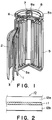
- Figure 1 is a partially exploded perspective view of a non-aqueous solvent-type secondary battery which can be constituted according to the invention.
- Figure 2 is a partial sectional view of an electrode structure adopted in the secondary battery.
- the monomer comprising at least 80 wt. % of vinylidene fluoride may include vinylidene fluoride alone, and a mixture of vinylidene fluoride and another monomer, examples of which may include: fluorine-containing monomers and hydrocarbon-type monomers, such as ethylene and propylene, respectively copolymerizable with vinylidene fluoride.
- fluorine-containing monomers copolymerizable with vinylidene fluoride may include: vinyl fluoride, trifluoroethylene, trifluorochloroethylene, tetrafluoroethylene, hexafluoropropylene, and fluoroalkyl vinyl ethers.
- Such another monomer copolymerizable with vinylidene fluoride may preferably be used in a proportion not exceeding 20 wt. % of the total of vinylidene fluoride and such another monomer in view of a balance between solubility in a solvent and solvent-resistance characteristic of the resultant copolymer.
- the above-mentioned monomer principally comprising vinylidene fluoride may be copolymerized with an unsaturated dibasic acid ester which may preferably have 5 - 8 carbon atoms, or vinylene carbonate.
- unsaturated dibasic acid monoesters may include: maleic acid monomethyl ester, maleic acid monoethyl ester, citraconic acid monomethyl ester, and citraconic acid monoethyl ester. It is particularly preferred to use maleic acid monomethyl ester or citraconic acid monomethyl ester.
- the copolymerization of a vinylidene fluoride-based monomer with an unsaturated dibasic acid monoester or vinylene carbonate may be performed by suspension polymerization, emulsion polymerization, solution polymerization, etc.
- suspension polymerization or emulsion polymerization in an aqueous medium, particularly aqueous suspension polymerization.
- a suspension aid such as methyl cellulose, methoxylated methyl cellulose, propoxidized methyl cellulose, hydroxyethyl cellulose, hydroxypropyl cellulose, polyvinyl alcohol, polyethylene oxide or gelatin in a proportion of 0.005 - 1.0 wt. %, preferably 0.01 - 0.4 wt. %, based on the water.
- a polymerization initiator such as diisopropyl peroxydicarbonate, dinormalpropyl peroxydicarbonate, dinormalheptafluoropropyl peroxydicarbonate, isobutyryl peroxide, di(chlorofluoroacyl) peroxide, or di(perfluoroacyl) peroxide.
- a polymerization initiator may be used in a proportion of 0.1 - 5 wt. %, preferably 0.5 - 2 wt. %, of the total monomer amount (i.e., total amount of the vinylidene-fluoride-based monomer and the polar monomer).
- a chain transfer agent such as ethyl acetate, methyl acetate, acetone, ethanol, n-propanol, acetaldehyde, propylaldehyde, ethyl propionate, or carbon tetrachloride, so as to control the polymerization degree of the resultant copolymer.
- the addition amount thereof may be ordinarily 0.1 - 5 wt. %, preferably 0.5 - 3 wt. %, of the total monomer amount.
- the monomers may be charged in such an amount as to provide a weight ratio of the total monomer amount to water in the range of 1:1 - 1:10, preferably 1:2 - 1:5.
- the polymerization may be performed at a temperature of 10 - 50 °C for 10 - 100 hours.
- the amount to be charged of the polar monomer (i.e., an unsaturated dibasic acid monoester or vinylene carbonate) copolymerized with the vinylidene fluoride-based monomer may be determined in consideration of factors, such as the adhesiveness, chemical resistance, molecular weight and polymerization yield of the resultant copolymer.
- the present invention it is preferred to copolymerize 0.1 - 3 wt. parts, particularly 0.3 - 2 wt. parts, as charged, of the dibasic acid monoester with 100 wt. parts of the vinylidene fluoride-based monomer.
- 0.1 wt. part it is impossible to obtain a copolymer showing a sufficient effect of polar group introduction, such as the adhesion to a metal substrate, etc.
- the addition in excess of 3 wt. parts is liable to provide a copolymer showing a lower chemical resistance.
- the resultant vinylidene fluoride copolymer may preferably have a carbonyl group content of 1x10 ⁇ 5 - 5x10 ⁇ 4 mol/g.
- the resultant vinylidene fluoride copolymer may preferably have a carbonate group content of 2x10 ⁇ 5 - 6x10 ⁇ 4 mol/g.
- the thus-obtained vinylidene fluoride copolymer according to the present invention may preferably show a solution viscosity (herein meaning a logarithmic viscosity number at 30 °C of a solution of 4 g-resin in 1 liter of N,N-dimethylformamide) in the range of 0.5 - 2.0, particularly 0.8 - 1.5.
- a solution viscosity herein meaning a logarithmic viscosity number at 30 °C of a solution of 4 g-resin in 1 liter of N,N-dimethylformamide
- the vinylidene fluoride copolymer according to the present invention may suitably be used as a material for a paint, a lining material, a binder, etc.
- a paint or a binder composition by dissolving 100 wt. parts of the vinylidene fluoride copolymer in 500 - 2000 wt. parts of a solvent capable of dissolving the copolymer.
- a solvent capable of dissolving the copolymer.
- Preferred examples of such a solvent may include polar solvents, such as N-methyl-2-pyrrolidone, N,N-dimethylformamide, N,N-dimethylacetamide, and dimethylsulfoxide.
- non-aqueous solvent-type secondary battery using an organic or non-aqueous electrolytic solution such as a lithium secondary battery
- Figure 1 is a partially exploded perspective view of a lithium secondary battery as an embodiment of a non-aqueous solvent-type secondary battery according to the present invention.
- the secondary battery basically includes a laminate structure including a positive electrode 1, a negative electrode 2 and a separator 3 disposed between the positive and negative electrodes 1 and 2 and comprising a fine porous film of a polymeric material, such as polyethylene or polypropylene, impregnated with an electrolytic solution.
- the laminate structure is wound in a vortex shape to form an electricity-generating element which is housed within a metal casing 5 having a bottom constituting a negative electrode terminal 5a.
- the negative electrode 2 is electrically connected to the negative electrode terminal 5a, and the uppermost portion of the battery is constituted by disposing a gasket 6 and a safety valve 7 covered with a top plate 8 having a projection constituting a positive electrode terminal 8a electrically connected to the positive electrode. Further, the uppermost rim 5b of the casing 5 is crimped toward the inner side to form an entirely sealed cell structure enclosing the electricity-generating element.
- the positive electrode 1 or negative electrode 2 may be constituted by an electrode structure 10 having a sectional structure as partially shown in Figure 2.
- the electrode structure 10 includes an electroconductive substrate 11 comprising a foil or wire net of a metal, such as iron, stainless steel, steel, aluminum nickel or titanium and having a thickness of, e.g., 5 - 100 ⁇ m, or 5 - 20 ⁇ m for a small-sized battery, and a composite electrode layer (12a, 12b) of, e.g., 10 - 1000 ⁇ m in thickness for a small-sized battery, on at least one surface, preferably on both surfaces as shown in Figure 2, of the electroconductive substrate.
- a metal such as iron, stainless steel, steel, aluminum nickel or titanium
- a composite electrode layer (12a, 12b) of, e.g., 10 - 1000 ⁇ m in thickness for a small-sized battery, on at least one surface, preferably on both surfaces as shown in Figure 2, of the electroconductive substrate.
- the composite electrode layers 12a and 12b are respectively a layer comprising a particulate active substance, an electroconductive material such as electroconductive carbon, optionally included, and a binder comprising the vinylidene fluoride copolymer according to the present invention.
- the active substance for constituting a positive electrode may preferably comprise a complex metal chalcogenide represented by a general formula: LiMY2 (wherein M denotes at least one species of transition metals such as Co and Ni, and Y denotes a chalcogen such as O or S), particularly a complex metal oxide inclusive of LiCoO2 as a representative.
- the active substance may preferably comprise a carbonaceous substance, such as graphite, activated carbon, or a carbonized product formed by calcination of phenolic resin or pitch.
- the electroconductive material may optionally be added for the purpose of increasing the electroconductivity of the composite electrode layer in case of using an active substance, such as LiCoO2 showing a small electron conductivity.
- an active substance such as LiCoO2 showing a small electron conductivity.
- examples thereof may include fine powders of carbonaceous substances such as carbon black and graphite, and metals such as nickel and aluminum. These electroconductive materials need not be included, e.g., when a carbonaceous substance showing a sufficient electroconductivity is used as the active substance.
- the binder does not contribute at all to the charge-discharge capacity of the battery so that the addition amount thereof should be reduced to the minimum. Accordingly, the binder is required to show a function of well holding the powder materials inclusive of the active substance and show an excellent adhesion to the electroconductive substrate even in a small amount thereof.
- the binder is generally electrically insulating so that the use thereof in an increased amount results in a larger internal resistance of the battery. Also from this viewpoint, the binder is required to exhibit its performances in as small an amount as possible.
- the binder is used in a very small amount and more specifically at most 30 wt. % of the total composite electrode layer. In such a small amount, the binder cannot completely fill the voids between particles in the composite electrode layer or voids between the electroconductive substrate and the particles.
- the binder in the case of a paint or a lining material containing fillers such as a pigment, the binder is used in an amount sufficient to fill the voids between the filler particles, so that there occurs little problem regarding the filler-holding performance of the binder.
- the binder is used in such a very small amount as described above and is required to show a performance of well holding the particulate active substance and an excellent adhesion to the electroconductive substrate.
- the non-aqueous electrolytic solution impregnating the separator 3 may generally comprise a solution of an electrolyte, such as LiClO4, LiPF6 or LiBF4 in a solvent, such as ethylene carbonate, propylene carbonate, dimethoxymethane, tetrahydrofuran or &C&-butyrolactone, which generally shows a strong dissolving power for a polymer.
- an electrolyte such as LiClO4, LiPF6 or LiBF4
- a solvent such as ethylene carbonate, propylene carbonate, dimethoxymethane, tetrahydrofuran or &C&-butyrolactone, which generally shows a strong dissolving power for a polymer.
- the binder is therefore required to be free from dissolution even dipped in such a solvent for a long period.
- the vinylidene fluoride copolymer according to the present invention may preferably be used in the following manner in case of producing a thin electrode structure 10 for a battery.
- the vinylidene fluoride copolymer having a carbonyl group content of 1x10 ⁇ 5 - 5x10 ⁇ 4 mol/g or a carbonate group content of 2x10 ⁇ 5 - 6x10 ⁇ 4 mol/g according to the present invention is dissolved in a solvent, such as N-methyl-2-pyrrolidone, N,N-dimethylformamide, N,N-dimethylacetamide or dimethylsulfoxide. Then, into the solution, particulate active substance and optional electroconductive material are added and dispersed to form an electrode-forming composition, which is then uniformly applied onto a metal foil or wire net of, e.g., ca. 5 - 20 ⁇ m in thickness, followed by drying and pressing to form a thin composite electrode layer (12a, 12b) of, e.g., around 100 ⁇ m in thickness, on the electroconductive substrate 11.
- a solvent such as N-methyl-2-pyrrolidone, N,N-dimethylformamide, N,N-d
- the weight ratio of the particulate component (active substance and optional electroconductive material) to the vinylidene fluoride copolymer may be generally ca. 80:20 - 98:2 and more specifically determined in consideration of the required performances of holding the particulate component, adhesion to the electroconductive substrate and electroconductivity of the electrode.
- the vinylidene fluoride copolymer cannot completely fill the voids between the particulate components.
- the copolymer can be uniformly dispersed and form a network structure within the composite electrode layer after drying, thus satisfactorily holding the particulate components.
- the amount of solvent in the electrode-forming composition may be determined in consideration of the applicability onto the electroconductive substrate, film-forming characteristic after drying, etc., of the composition.
- the vinylidene fluoride copolymer and the solvent may preferably be used in a weight ratio of 5:95 - 20:80.
- the vinylidene fluoride copolymer may preferably be provided for use in the form of fine particles having an average particle size of at most 1000 ⁇ m, particularly 50 - 350 ⁇ m, so as to allow quick dissolution in the above-mentioned solvent.
- the present invention provides a vinylidene fluoride copolymer showing a large adhesion onto a substrate of, e.g., a metal.
- vinylidene fluoride is copolymerized with a polar monomer selected from an unsaturated dibasic acid monoester and vinylene carbonate to introduce a functional group including a carboxyl group or a carbonate group into the resultant vinylidene fluoride-based resin to provide an improved adhesion to a substrate.
- the vinylidene fluoride copolymer according to the present invention can be extremely suitably used for various paints, lining materials and binders. It is particularly useful to use the copolymer as a binder for cell electrode production.
- coke powder used as a cell active substance used in the following Examples and Comparative Examples was prepared by calcining pitch coke in nitrogen gas at 1000 °C for 1 hour and pulverized into an average diameter of ca. 10 ⁇ m, and activated carbon powder was obtained by pulverizing activated carbon into an average diameter of ca. 10 ⁇ m.
- the carbonyl group content and carbonate group content of polymers were measured in the following manner.
- sample resins are prepared by mixing polyvinylidene fluoride resin and polymethyl methacrylate resin at various proportions and subjected to IR (infrared) spectroscopy.
- IR infrared
- the ratio of an absorption at 1726 cm ⁇ 1 to an absorption at 881 cm ⁇ 1 is measured and correlated with the carbonyl group content for each sample resin, to obtain a calibration curve of the absorption ratio versus the carbonyl group content.
- a sample polymer is washed with hot water and subjected to extraction with benzene at 80 °C for 24 hours by using a Soxhlet extractor to remove unreacted monomers and homopolymers possibly remaining in the polymer.
- the sample polymer is then subjected to the measurement of a ratio of an absorption at 1747 cm ⁇ 1 attributable to carbonyl group to an absorption at 881 cm ⁇ 1, from which a carbonyl group content of the sample polymer is obtained based on the above-mentioned calibration curve.
- a calibration curve is similarly obtained between a ratio of absorption at 1774 cm ⁇ 1 to absorption at 1402 cm ⁇ 1 and carbonate group content by using several samples obtained by mixing polyvinylidene fluoride resin and polycarbonate resin (bisphenol A-type).
- a sample polymer is washed with hot water and subjected to extraction with benzene at 80 °C for 24 hours by using a Soxhlet extractor to remove unreacted monomers and homopolymers possibly remaining in the polymer.
- the sample polymer is then subjected to the measurement of a ratio of an absorption at 1830 cm ⁇ 1 attributable to carbonate group to an absorption at 1402 cm ⁇ 1, from which a carbonyl group content of the sample polymer is obtained based on the above-mentioned calibration curve.
- the polymerization rate was 90 wt. %, and the resultant polymer showed a solution viscosity of 1.1 and a carbonyl group content of 1.2x10 ⁇ 4 mol/g.
- the polymerization rate was 81 wt. %, and the resultant polymer showed a solution viscosity of 1.0 and a carbonyl group content of 1.1x10 ⁇ 4 mol/g.
- an electrode was prepared in a similar manner as in Example 1.
- the polymerization rate was 80 wt. %, and the resultant polymer showed a solution viscosity of 1.1 and a carbonate group content of 3.5x10 ⁇ 4 mol/g.
- an electrode was prepared in a similar manner as in Example 1.
- the polymerization rate was 86 wt. %, and the resultant polymer showed a solution viscosity of 1.0 and a carbonyl group content of 2.5x10 ⁇ 4 mol/g.
- the polymerization rate was 85 wt. %, and the resultant polymer showed a solution viscosity of 1.1.
- an electrode was prepared in a similar manner as in Example 1.
- the polymerization rate was 88 wt. %, and the resultant polymer showed a solution viscosity of 1.4 and a carbonyl group content of zero, thus showing that the maleic anhydride was not copolymerized.
- an electrode was prepared in a similar manner as in Example 1.
- the polymerization rate was as very low as 12 wt. %.
- the polymerization rate was 92 wt. %, and the resultant polymer showed a solution viscosity of 1.3.
- an electrode was prepared in a similar manner as in Example 1.
- the polymerization rate was as low as 32 wt. %, and the resultant polymer showed a solution viscosity of 0.5 and a carbonyl group content of 7.2x10 ⁇ 4 mol/g.
- an electrode was prepared in a similar manner as in Example 1.
Landscapes
- Chemical & Material Sciences (AREA)
- Chemical Kinetics & Catalysis (AREA)
- Organic Chemistry (AREA)
- General Chemical & Material Sciences (AREA)
- Electrochemistry (AREA)
- Wood Science & Technology (AREA)
- Life Sciences & Earth Sciences (AREA)
- Materials Engineering (AREA)
- Engineering & Computer Science (AREA)
- Health & Medical Sciences (AREA)
- Medicinal Chemistry (AREA)
- Polymers & Plastics (AREA)
- Addition Polymer Or Copolymer, Post-Treatments, Or Chemical Modifications (AREA)
- Battery Electrode And Active Subsutance (AREA)
- Paints Or Removers (AREA)
- Adhesives Or Adhesive Processes (AREA)
Abstract
Description
- The present invention relates to a vinylidene fluoride copolymer showing an improved adhesion to a substrate of, e.g., a metal, and an excellent chemical resistance. Such a vinylidene fluoride copolymer is useful in the field of, e.g., binder and paint.
- The present invention also relates to a binder composition and an electrode-forming composition for a non-aqueous solvent-type secondary battery, containing such a vinylidene fluoride copolymer.
- The present invention further relates to an electrode structure obtained by using such an electrode-forming composition, and a secondary battery including the electrode structure.
- Polyvinylidene fluoride resins are excellent in chemical resistance, weatherability and anti-staining characteristic, and have been used not only as a film-forming or shaping material but also as materials for paint and binder. However, a conventional polyvinylidene fluoride resin has a rather poor adhesion to, e.g., a metal substrate and therefore an improved adhesion strength has been desired.
- Hitherto, various methods as described below have been proposed for introducing a functional group, such as a carboxyl group, into a fluorine-containing resin so as to provide an improved adhesion to a substrate of, e.g., a metal or an improved solubility in a solvent.
- Japanese Laid-Open Patent Application (JP-A) 2-604 discloses a method of opening a ring in an acid anhydride portion of a copolymer of vinylidene fluoride and maleic anhydride with alcohol or water. In this method, however, the copolymer production has to be performed by solution polymerization requiring removal of the solvent, and also the step of reacting the copolymer with alcohol or water is required additionally, thus making the entire process complicated.
- JP-A 58-136605 discloses a carboxyl group-containing fluorine-containing polymer obtained by reacting a hydroxyl group-containing fluorine-containing polymer with a dibasic acid anhydride in an organic solvent to convert at least a part of the hydroxyl group into an ester group. Such a fluorine-containing polymer involves a difficulty that the ester bond thereof is liable to be hydrolyzed.
- JP-A 56-133309 discloses a method of graft-polymerizing an acrylic monomer onto radiation-exposed skeleton of polyvinylidene fluoride. This method involves a difficulty that it uses a radiation source and requires a facility for administration thereof.
- Japanese Patent Publication (JP-B) 52-24959 discloses a method of copolymerizing vinylidene fluoride with acrylic acid, methacrylic acid, etc., in the presence of dialkyl peroxydicarbonate as an initiator in a solvent of a fluorine-containing compound which comprises a C₁ - C₄ saturated hydrocarbon substituted with fluorine or fluorine and chlorine. THe use of a fluorine-containing compound as the solvent requires an environmental consideration and careful removal of the solvent, thus complicating the entire process.
- Vinylidene fluoride has a poor copolymerizability with a carboxyl group containing monomer, and particularly almost no example has been known regarding copolymerization of these monomers in an aqueous system. For example, a mixture of vinylidene fluoride and a monobasic acid such as acrylic acid or crotonic acid, or a dibasic acid such as maleic acid or citraconic acid, does not cause copolymerization but can only result in homopolymers of the constituent monomers at best, under ordinary polymerization conditions.
- An object of the present invention is to provide a vinylidene fluoride copolymer which shows good adhesion to a substrate of, e.g., a metal, is excellent in chemical-resistance and can be produced by polymerization in an aqueous system.
- Another object of the present invention is to provide a binder composition and an electrode-forming composition for a non-aqueous solvent-type secondary battery, containing such a vinylidene fluoride copolymer together with a solvent therefor.
- A further object of the present invention is to provide an electrode structure obtained by using such an electrode-forming composition, and a non-aqueous solvent-type secondary battery including the electrode structure.
- According to our study, it has been found that a vinylidene fluoride copolymer comprising a relatively small amount of a specific monomer having a carboxylic group or a carbonate group and a monomer principally comprising vinylidene fluoride, can be produced by copolymerization in an aqueous system. It has also been found that the vinylidene fluoride copolymer shows a remarkably improved adhesion to a substrate such as that of a metal compared with a vinylidene fluoride polymer having no carboxylic group or carbonate group introduced thereinto, and satisfactorily retains an excellent chemical resistance a vinylidene fluoride polymer inherently has.
- More specifically, according to the present invention, there is provided a vinylidene fluoride copolymer obtained by copolymerizing (a) 100 wt. parts of a monomer comprising at least 80 wt. % of vinylidene fluoride and (b) a polar monomer selected from 0.1 - 3 wt. parts of a dibasic acid monoester and 0.1 - 5 wt. parts of vinylene carbonate.
- According to another aspect, the vinylidene fluoride copolymer is characterized by a content of the introduced polar group, i.e., carbonyl group or carbonate group. Thus, according to the present invention, there is also provided a vinylidene fluoride copolymer, comprising: a copolymer of (a) a monomer comprising at least 80 wt. % of vinylidene fluoride and (b) a polar monomer selected from the group consisting of unsaturated dibasic acid monoesters and vinylene carbonate;
said vinylidene fluoride copolymer having a carbonyl group content of 1x10⁻⁵ - 5x10⁻⁴ mol/g, or a carbonate group content of 2x10⁻⁵ - 6x10⁻⁴ mol/g. - According to another aspect of the present invention, there is provided a binder composition, comprising: a vinylidene fluoride copolymer as described above, and a solvent capable of dissolving the vinylidene fluoride copolymer.
- According to another aspect of the present invention, there is provided an electrode-forming composition for a non-aqueous solvent-type secondary battery, comprising:
a vinylidene fluoride copolymer as described above,
a solvent capable of dissolving the vinylidene fluoride copolymer, and
a particulate active substance, or a particulate active substance and an electroconductive material. - According to another aspect of the present invention, there is provided an electrode structure for a non-aqueous solvent-type secondary battery, comprising: an electroconductive substrate and a composite electrode layer disposed on at least one surface of the electroconductive substrate; said composite electrode layer comprising
a particulate active substance, or a particulate active substance and an electroconductive material, and
a binder comprising a vinylidene fluoride copolymer as described above. - According to another aspect of the present invention, there is provided a non-aqueous solvent-type secondary battery, comprising, a positive electrode, a negative electrode, and a separator and a non-aqueous electrolytic solution disposed between the positive and negative electrodes;
at least one of said positive and negative electrodes comprising an electrode structure as described above. - These and other objects, features and advantages of the present invention will become more apparent upon a consideration of the following description of the preferred embodiments of the present invention taken in conjunction with the accompanying drawing.
- Figure 1 is a partially exploded perspective view of a non-aqueous solvent-type secondary battery which can be constituted according to the invention.
- Figure 2 is a partial sectional view of an electrode structure adopted in the secondary battery.
- The monomer comprising at least 80 wt. % of vinylidene fluoride may include vinylidene fluoride alone, and a mixture of vinylidene fluoride and another monomer, examples of which may include: fluorine-containing monomers and hydrocarbon-type monomers, such as ethylene and propylene, respectively copolymerizable with vinylidene fluoride. Examples of the fluorine-containing monomers copolymerizable with vinylidene fluoride may include: vinyl fluoride, trifluoroethylene, trifluorochloroethylene, tetrafluoroethylene, hexafluoropropylene, and fluoroalkyl vinyl ethers. Such another monomer copolymerizable with vinylidene fluoride may preferably be used in a proportion not exceeding 20 wt. % of the total of vinylidene fluoride and such another monomer in view of a balance between solubility in a solvent and solvent-resistance characteristic of the resultant copolymer.
- The above-mentioned monomer principally comprising vinylidene fluoride (hereinafter referred to as "vinylidene fluoride-based monomer") may be copolymerized with an unsaturated dibasic acid ester which may preferably have 5 - 8 carbon atoms, or vinylene carbonate. Examples of such unsaturated dibasic acid monoesters may include: maleic acid monomethyl ester, maleic acid monoethyl ester, citraconic acid monomethyl ester, and citraconic acid monoethyl ester. It is particularly preferred to use maleic acid monomethyl ester or citraconic acid monomethyl ester.
- The copolymerization of a vinylidene fluoride-based monomer with an unsaturated dibasic acid monoester or vinylene carbonate (which may be hereinafter sometimes inclusively referred to as a "polar monomer") may be performed by suspension polymerization, emulsion polymerization, solution polymerization, etc. In order to allow easy post treatment, however, it is preferred to perform suspension polymerization or emulsion polymerization in an aqueous medium, particularly aqueous suspension polymerization.
- In such suspension polymerization using water as a dispersion medium, it is possible to use a suspension aid, such as methyl cellulose, methoxylated methyl cellulose, propoxidized methyl cellulose, hydroxyethyl cellulose, hydroxypropyl cellulose, polyvinyl alcohol, polyethylene oxide or gelatin in a proportion of 0.005 - 1.0 wt. %, preferably 0.01 - 0.4 wt. %, based on the water.
- It is possible to use a polymerization initiator, such as diisopropyl peroxydicarbonate, dinormalpropyl peroxydicarbonate, dinormalheptafluoropropyl peroxydicarbonate, isobutyryl peroxide, di(chlorofluoroacyl) peroxide, or di(perfluoroacyl) peroxide. Such a polymerization initiator may be used in a proportion of 0.1 - 5 wt. %, preferably 0.5 - 2 wt. %, of the total monomer amount (i.e., total amount of the vinylidene-fluoride-based monomer and the polar monomer).
- It is also possible to add a chain transfer agent, such as ethyl acetate, methyl acetate, acetone, ethanol, n-propanol, acetaldehyde, propylaldehyde, ethyl propionate, or carbon tetrachloride, so as to control the polymerization degree of the resultant copolymer. The addition amount thereof may be ordinarily 0.1 - 5 wt. %, preferably 0.5 - 3 wt. %, of the total monomer amount.
- The monomers may be charged in such an amount as to provide a weight ratio of the total monomer amount to water in the range of 1:1 - 1:10, preferably 1:2 - 1:5. The polymerization may be performed at a temperature of 10 - 50 °C for 10 - 100 hours.
- By suspension polymerization as described above, it is possible to easily copolymerize the vinylidene fluoride-based monomer and the polar monomer.
- The amount to be charged of the polar monomer (i.e., an unsaturated dibasic acid monoester or vinylene carbonate) copolymerized with the vinylidene fluoride-based monomer may be determined in consideration of factors, such as the adhesiveness, chemical resistance, molecular weight and polymerization yield of the resultant copolymer.
- According to the present invention, it is preferred to copolymerize 0.1 - 3 wt. parts, particularly 0.3 - 2 wt. parts, as charged, of the dibasic acid monoester with 100 wt. parts of the vinylidene fluoride-based monomer. Below 0.1 wt. part, it is impossible to obtain a copolymer showing a sufficient effect of polar group introduction, such as the adhesion to a metal substrate, etc. On the other hand, the addition in excess of 3 wt. parts is liable to provide a copolymer showing a lower chemical resistance. For similar reasons, the resultant vinylidene fluoride copolymer may preferably have a carbonyl group content of 1x10⁻⁵ - 5x10⁻⁴ mol/g.
- In the case of using vinylene carbonate as a co-monomer, it is preferred to copolymerize 0.1 - 5 wt. parts, particularly 0.3 - 3 wt. parts, as charged, of vinylene carbonate with 100 wt. parts of the vinylidene fluoride-based monomer. Below 0.1 wt. part, it is impossible to obtain a copolymer showing a sufficient effect of polar group introduction, such as the adhesion to a metal substrate, etc. On the other hand, the addition in excess of 5 wt. parts is liable to provide a copolymer showing a lower chemical resistance. For similar reasons, the resultant vinylidene fluoride copolymer may preferably have a carbonate group content of 2x10⁻⁵ - 6x10⁻⁴ mol/g.
- The thus-obtained vinylidene fluoride copolymer according to the present invention may preferably show a solution viscosity (herein meaning a logarithmic viscosity number at 30 °C of a solution of 4 g-resin in 1 liter of N,N-dimethylformamide) in the range of 0.5 - 2.0, particularly 0.8 - 1.5.
- Because of the excellent chemical resistance and adhesion to a substrate of a metal, etc., the vinylidene fluoride copolymer according to the present invention may suitably be used as a material for a paint, a lining material, a binder, etc. In order to provide a form suitable for application adapted to such purposes, it is preferred to form a paint or a binder composition by dissolving 100 wt. parts of the vinylidene fluoride copolymer in 500 - 2000 wt. parts of a solvent capable of dissolving the copolymer. Preferred examples of such a solvent may include polar solvents, such as N-methyl-2-pyrrolidone, N,N-dimethylformamide, N,N-dimethylacetamide, and dimethylsulfoxide.
- Hereinbelow, description will be made on the use of the vinylidene fluoride copolymer according to the invention as a binder for making an electrode for a cell.
- In a non-aqueous solvent-type secondary battery using an organic or non-aqueous electrolytic solution such as a lithium secondary battery, it has been practiced to enlarge the electrode area by providing a thin layer of active substance in order to compensate for a low performance under a heavy load due to a low electroconductivity of the non-aqueous electrolytic solution.
- Figure 1 is a partially exploded perspective view of a lithium secondary battery as an embodiment of a non-aqueous solvent-type secondary battery according to the present invention.
- More specifically, the secondary battery basically includes a laminate structure including a positive electrode 1, a
negative electrode 2 and a separator 3 disposed between the positive andnegative electrodes 1 and 2 and comprising a fine porous film of a polymeric material, such as polyethylene or polypropylene, impregnated with an electrolytic solution. The laminate structure is wound in a vortex shape to form an electricity-generating element which is housed within ametal casing 5 having a bottom constituting anegative electrode terminal 5a. In the secondary battery, thenegative electrode 2 is electrically connected to thenegative electrode terminal 5a, and the uppermost portion of the battery is constituted by disposing agasket 6 and asafety valve 7 covered with atop plate 8 having a projection constituting a positive electrode terminal 8a electrically connected to the positive electrode. Further, theuppermost rim 5b of thecasing 5 is crimped toward the inner side to form an entirely sealed cell structure enclosing the electricity-generating element. - Herein, the positive electrode 1 or
negative electrode 2 may be constituted by anelectrode structure 10 having a sectional structure as partially shown in Figure 2. More specifically, theelectrode structure 10 includes an electroconductive substrate 11 comprising a foil or wire net of a metal, such as iron, stainless steel, steel, aluminum nickel or titanium and having a thickness of, e.g., 5 - 100 µm, or 5 - 20 µm for a small-sized battery, and a composite electrode layer (12a, 12b) of, e.g., 10 - 1000 µm in thickness for a small-sized battery, on at least one surface, preferably on both surfaces as shown in Figure 2, of the electroconductive substrate. - The composite electrode layers 12a and 12b are respectively a layer comprising a particulate active substance, an electroconductive material such as electroconductive carbon, optionally included, and a binder comprising the vinylidene fluoride copolymer according to the present invention.
- The active substance for constituting a positive electrode may preferably comprise a complex metal chalcogenide represented by a general formula: LiMY₂ (wherein M denotes at least one species of transition metals such as Co and Ni, and Y denotes a chalcogen such as O or S), particularly a complex metal oxide inclusive of LiCoO₂ as a representative. For constituting a negative electrode, the active substance may preferably comprise a carbonaceous substance, such as graphite, activated carbon, or a carbonized product formed by calcination of phenolic resin or pitch.
- The electroconductive material may optionally be added for the purpose of increasing the electroconductivity of the composite electrode layer in case of using an active substance, such as LiCoO₂ showing a small electron conductivity. Examples thereof may include fine powders of carbonaceous substances such as carbon black and graphite, and metals such as nickel and aluminum. These electroconductive materials need not be included, e.g., when a carbonaceous substance showing a sufficient electroconductivity is used as the active substance.
- As the binder does not contribute at all to the charge-discharge capacity of the battery so that the addition amount thereof should be reduced to the minimum. Accordingly, the binder is required to show a function of well holding the powder materials inclusive of the active substance and show an excellent adhesion to the electroconductive substrate even in a small amount thereof. The binder is generally electrically insulating so that the use thereof in an increased amount results in a larger internal resistance of the battery. Also from this viewpoint, the binder is required to exhibit its performances in as small an amount as possible.
- Generally, the binder is used in a very small amount and more specifically at most 30 wt. % of the total composite electrode layer. In such a small amount, the binder cannot completely fill the voids between particles in the composite electrode layer or voids between the electroconductive substrate and the particles. On the other hand, in the case of a paint or a lining material containing fillers such as a pigment, the binder is used in an amount sufficient to fill the voids between the filler particles, so that there occurs little problem regarding the filler-holding performance of the binder. In the case of the electrode-forming binder, however, the binder is used in such a very small amount as described above and is required to show a performance of well holding the particulate active substance and an excellent adhesion to the electroconductive substrate.
- The non-aqueous electrolytic solution impregnating the separator 3 may generally comprise a solution of an electrolyte, such as LiClO₄, LiPF₆ or LiBF₄ in a solvent, such as ethylene carbonate, propylene carbonate, dimethoxymethane, tetrahydrofuran or &C&-butyrolactone, which generally shows a strong dissolving power for a polymer. The binder is therefore required to be free from dissolution even dipped in such a solvent for a long period.
- The vinylidene fluoride copolymer according to the present invention may preferably be used in the following manner in case of producing a
thin electrode structure 10 for a battery. - The vinylidene fluoride copolymer having a carbonyl group content of 1x10⁻⁵ - 5x10⁻⁴ mol/g or a carbonate group content of 2x10⁻⁵ - 6x10⁻⁴ mol/g according to the present invention is dissolved in a solvent, such as N-methyl-2-pyrrolidone, N,N-dimethylformamide, N,N-dimethylacetamide or dimethylsulfoxide. Then, into the solution, particulate active substance and optional electroconductive material are added and dispersed to form an electrode-forming composition, which is then uniformly applied onto a metal foil or wire net of, e.g., ca. 5 - 20 µm in thickness, followed by drying and pressing to form a thin composite electrode layer (12a, 12b) of, e.g., around 100 µm in thickness, on the electroconductive substrate 11.
- The weight ratio of the particulate component (active substance and optional electroconductive material) to the vinylidene fluoride copolymer may be generally ca. 80:20 - 98:2 and more specifically determined in consideration of the required performances of holding the particulate component, adhesion to the electroconductive substrate and electroconductivity of the electrode.
- In the composite electrode layer formed on the electroconductive substrate according to the above-mentioned weight ratio, the vinylidene fluoride copolymer cannot completely fill the voids between the particulate components. However, if a solvent well dissolving the vinylidene fluoride copolymer is used, the copolymer can be uniformly dispersed and form a network structure within the composite electrode layer after drying, thus satisfactorily holding the particulate components.
- The amount of solvent in the electrode-forming composition may be determined in consideration of the applicability onto the electroconductive substrate, film-forming characteristic after drying, etc., of the composition. Ordinarily, the vinylidene fluoride copolymer and the solvent may preferably be used in a weight ratio of 5:95 - 20:80.
- The vinylidene fluoride copolymer may preferably be provided for use in the form of fine particles having an average particle size of at most 1000 µm, particularly 50 - 350 µm, so as to allow quick dissolution in the above-mentioned solvent.
- As described above, the present invention provides a vinylidene fluoride copolymer showing a large adhesion onto a substrate of, e.g., a metal. Thus, vinylidene fluoride is copolymerized with a polar monomer selected from an unsaturated dibasic acid monoester and vinylene carbonate to introduce a functional group including a carboxyl group or a carbonate group into the resultant vinylidene fluoride-based resin to provide an improved adhesion to a substrate.
- Further, by specifying the amount of the carbonyl group or carbonate group introduced into the resultant vinylidene fluoride copolymer, it has become possible to satisfy the requirement of both chemical resistance and the adhesiveness of the vinylidene fluoride copolymer.
- Because of the excellent adhesion to a substrate of metals, plastics, glass, ceramics, wood, etc., and chemical resistance, the vinylidene fluoride copolymer according to the present invention can be extremely suitably used for various paints, lining materials and binders. It is particularly useful to use the copolymer as a binder for cell electrode production.
- Hereinbelow, the present invention will be described more specifically based on Examples and Comparative Examples.
- Incidentally, coke powder used as a cell active substance used in the following Examples and Comparative Examples was prepared by calcining pitch coke in nitrogen gas at 1000 °C for 1 hour and pulverized into an average diameter of ca. 10 µm, and activated carbon powder was obtained by pulverizing activated carbon into an average diameter of ca. 10 µm.
- The carbonyl group content and carbonate group content of polymers were measured in the following manner.
- Several sample resins are prepared by mixing polyvinylidene fluoride resin and polymethyl methacrylate resin at various proportions and subjected to IR (infrared) spectroscopy. In the resultant IR spectra, the ratio of an absorption at 1726 cm⁻¹ to an absorption at 881 cm⁻¹ is measured and correlated with the carbonyl group content for each sample resin, to obtain a calibration curve of the absorption ratio versus the carbonyl group content.
- A sample polymer is washed with hot water and subjected to extraction with benzene at 80 °C for 24 hours by using a Soxhlet extractor to remove unreacted monomers and homopolymers possibly remaining in the polymer. The sample polymer is then subjected to the measurement of a ratio of an absorption at 1747 cm⁻¹ attributable to carbonyl group to an absorption at 881 cm⁻¹, from which a carbonyl group content of the sample polymer is obtained based on the above-mentioned calibration curve.
- A calibration curve is similarly obtained between a ratio of absorption at 1774 cm⁻¹ to absorption at 1402 cm⁻¹ and carbonate group content by using several samples obtained by mixing polyvinylidene fluoride resin and polycarbonate resin (bisphenol A-type).
- A sample polymer is washed with hot water and subjected to extraction with benzene at 80 °C for 24 hours by using a Soxhlet extractor to remove unreacted monomers and homopolymers possibly remaining in the polymer. The sample polymer is then subjected to the measurement of a ratio of an absorption at 1830 cm⁻¹ attributable to carbonate group to an absorption at 1402 cm⁻¹, from which a carbonyl group content of the sample polymer is obtained based on the above-mentioned calibration curve.
- Into a 2 liter-autoclave, 1040 g of deionized water, 0.8 g of methyl cellulose, 2.5 g of ethyl acetate, 4 g of diisopropyl peroxydicarbonate, 396 g of vinylidene fluoride and 4 g of maleic acid monomethyl ester were charged (vinylidene fluoride: maleic acid monomethyl ester = 100:1.01), and subjected to suspension polymerization at 28 °C for 47 hours. After the polymerization, the polymerizate slurry was de-watered, washed with water and dried at 80 °C for 24 hours, to obtain polymer powder.
- The polymerization rate was 90 wt. %, and the resultant polymer showed a solution viscosity of 1.1 and a carbonyl group content of 1.2x10⁻⁴ mol/g.
- 10 g of the thus-obtained polymer powder was uniformly dissolved in 90 g of N-methyl-2-pyrrolidone, and 90 g of coke powder was added thereto, followed by stirring for mixing to obtain an electrode-forming composition. The composition was then uniformly applied onto a 10 µm-thick rolled copper foil (area: 100 mm x 200 mm) so as to provide a dry layer thickness of 100 µm, and dried at 130 °C for 10 min. to form an electrode.
- Into a 2 liter-autoclave, 1040 g of deionized water, 0.8 g of methyl cellulose, 4 g of diisopropyl peroxydicarbonate, 396 g of vinylidene fluoride and 4 g of citraconic acid monomethyl ester were charged (vinylidene fluoride: citraconic acid monomethyl ester = 100:1.01), and subjected to suspension polymerization at 28 °C for 55 hours. After the polymerization, the polymerizate slurry was treated in the same manner as in Example 1 to obtain polymer powder.
- The polymerization rate was 81 wt. %, and the resultant polymer showed a solution viscosity of 1.0 and a carbonyl group content of 1.1x10⁻⁴ mol/g.
- By using the polymer powder, an electrode was prepared in a similar manner as in Example 1.
- Into a 2 liter-autoclave, 1075 g of deionized water, 0.2 g of methyl cellulose, 2 g of di-n-propyl peroxydicarbonate, 307 g of vinylidene fluoride and 9 g of vinylene carbonate were charged (vinylidene fluoride: vinylene carbonate = 100:2.93), and subjected to suspension polymerization at 25 °C for 30 hours. After the polymerization, the polymerizate slurry was treated in the same manner as in Example 1, to obtain polymer powder.
- The polymerization rate was 80 wt. %, and the resultant polymer showed a solution viscosity of 1.1 and a carbonate group content of 3.5x10⁻⁴ mol/g.
- By using the polymer powder, an electrode was prepared in a similar manner as in Example 1.
- Into a 2 liter-autoclave, 1040 g of deionized water, 0.8 g of methyl cellulose, 1.2 g of ethyl acetate, 4 g of diisopropyl peroxydicarbonate, 393 g of vinylidene fluoride and 7 g of maleic acid monomethyl ester were charged (vinylidene fluoride: maleic acid monomethyl ester = 100:1.78), and subjected to suspension polymerization at 31 °C for 55 hours. After the polymerization, the polymerizate slurry was treated in the same manner as in Example 1 to obtain polymer powder.
- The polymerization rate was 86 wt. %, and the resultant polymer showed a solution viscosity of 1.0 and a carbonyl group content of 2.5x10⁻⁴ mol/g.
- 10 g of the thus-obtained polymer powder was uniformly dissolved in 90 g of N,N-dimethylformamide, and 90 g of activated carbon powder was added thereto, followed by stirring for mixing to obtain an electrode-forming composition. The composition was then uniformly applied onto a 10 µm-thick rolled copper foil (area: 100 mm x 200 mm) so as to provide a dry layer thickness of 100 µm, and dried at 110 °C for 10 min. to form an electrode.
- Into a 2 liter-autoclave, 1040 g of deionized water, 0.4 g of methyl cellulose, 8 g of ethyl acetate, 2 g of n-propyl peroxydicarbonate and 400 g of vinylidene fluoride were charged and subjected to suspension polymerization at 25 °C for 22 hours. After the polymerization, the polymerizate slurry was treated in the same manner as in Example 1 to obtain polymer powder.
- The polymerization rate was 85 wt. %, and the resultant polymer showed a solution viscosity of 1.1.
- By using the polymer powder, an electrode was prepared in a similar manner as in Example 1.
- Into a 2 liter-autoclave, 1040 g of deionized water, 0.8 g of methyl cellulose, 3 g of ethyl acetate, 4 g of diisopropyl peroxydicarbonate, 396 g of vinylidene fluoride and 4 g of maleic anhydride were charged (vinylidene fluoride: maleic anhydride = 100:1.01), and subjected to suspension polymerization at 28 °C for 22 hours. After the polymerization, the polymerizate slurry was treated in the same manner as in Example 1 to obtain polymer powder.
- The polymerization rate was 88 wt. %, and the resultant polymer showed a solution viscosity of 1.4 and a carbonyl group content of zero, thus showing that the maleic anhydride was not copolymerized.
- By using the polymer powder, an electrode was prepared in a similar manner as in Example 1.
- Into a 2 liter-autoclave, 1040 g of deionized water, 0.4 g of methyl cellulose, 4 g of ethyl acetate, 4 g of diisopropyl peroxydicarbonate, 388 g of vinylidene fluoride and 12 g of crotonic acid were charged (vinylidene fluoride: crotonic acid = 100:3.09), and subjected to suspension polymerization at 28 °C for 47 hours. After the polymerization, the polymerizate slurry was treated in the same manner as in Example 1, to obtain polymer powder.
- The polymerization rate was as very low as 12 wt. %.
- Into a 2 liter-autoclave, 1040 g of deionized water, 0.5 g of methyl cellulose, 4 g of ethyl acetate, 4 g of diisopropyl peroxydicarbonate, 380 g of vinylidene fluoride and 8 g of dimethylacrylamide were charged (vinylidene fluoride: dimethylacrylamide = 100:2.11), and subjected to suspension polymerization at 28 °C for 20 hours. After the polymerization, the polymerizate slurry was treated in the same manner as in Example 1 to obtain polymer powder.
- The polymerization rate was 92 wt. %, and the resultant polymer showed a solution viscosity of 1.3.
- By using the polymer powder, an electrode was prepared in a similar manner as in Example 1.
- Into a 2 liter-autoclave, 1040 g of deionized water, 0.8 g of methyl cellulose, 2.5 g of ethyl acetate, 4 g of diisopropyl peroxydicarbonate, 384 g of vinylidene fluoride and 16 g of maleic acid monomethyl ester were charged (vinylidene fluoride: maleic acid monomethyl ester = 100:4.17), and subjected to suspension polymerization at 31 °C for 54 hours. After the polymerization, the polymerizate slurry was treated in the same manner as in Example 1 to obtain polymer powder.
- The polymerization rate was as low as 32 wt. %, and the resultant polymer showed a solution viscosity of 0.5 and a carbonyl group content of 7.2x10⁻⁴ mol/g.
- By using the polymer powder, an electrode was prepared in a similar manner as in Example 1.
- The respective electrodes thus obtained were dipped in an electrolytic solution (propylene carbonate/dimethoxyethane = 1/1 by weight) at 50 °C for 1 week. Then, the adhesion of the composite electrode layer to the copper foil before and after the dipping was measured as a peeling strength by a 180 degree-peeling test according to JIS K6854. The results are shown in Table 1 together with the species and charged ratio of the comonomer used in combination with vinylidene fluoride for providing the binder copolymer.

Claims (11)
- A vinylidene fluoride copolymer, comprising: a copolymer of (a) a monomer comprising at least 80 wt. % of vinylidene fluoride and (b) a polar monomer selected from the group consisting of unsaturated dibasic acid monoesters and vinylene carbonate;
said vinylidene fluoride copolymer having a carbonyl group content of 1x10⁻⁵ - 5x10⁻⁴ mol/g, or a carbonate group content of 2x10⁻⁵ - 6x10⁻⁴ mol/g. - A vinylidene fluoride copolymer according to Claim 1, wherein said polar monomer comprises at least one unsaturated dibasic acid monoester selected from the group consisting of maleic acid monoesters and citraconic acid monoesters.
- A vinylidene fluoride copolymer according to Claim 2, wherein said polar monomer comprises at least one unsaturated dibasic acid monoester selected from the group consisting of maleic acid monomethyl ester and citraconic acid monomethyl ester.
- A vinylidene fluoride copolymer according to Claim 1, wherein said polar monomer comprises vinylene carbonate.
- A vinylidene fluoride copolymer obtained by copolymerizing (a) 100 wt. parts of a monomer comprising at least 80 wt. % of vinylidene fluoride and (b) a polar monomer selected from 0.1 - 3 wt. parts of a dibasic acid monoester and 0.1 - 5 wt. parts of vinylene carbonate.
- A vinylidene fluoride copolymer according to Claim 5, wherein the copolymerization is performed in an aqueous medium.
- A vinylidene fluoride copolymer according to Claim 6, wherein the copolymerization is performed by suspension polymerization.
- A binder composition, comprising: a vinylidene fluoride copolymer according to any of Claims 1 - 7, and a solvent capable of dissolving the vinylidene fluoride copolymer.
- An electrode-forming composition for a non-aqueous solvent-type secondary battery, comprising:
a vinylidene fluoride copolymer according to any of Claims 1 - 7,
a solvent capable of dissolving the vinylidene fluoride copolymer, and
a particulate active substance, or a particulate active substance and an electroconductive material. - An electrode structure for a non-aqueous solvent-type secondary battery, comprising: an electroconductive substrate and a composite electrode layer disposed on at least one surface of the electroconductive substrate; said composite electrode layer comprising
a particulate active substance, or a particulate active substance and an electroconductive material, and
a binder comprising a vinylidene fluoride copolymer according to any of Claims 1 - 7. - A non-aqueous solvent-type secondary battery, comprising, a positive electrode, a negative electrode, and a separator and a non-aqueous electrolytic solution disposed between the positive and negative electrodes;
at least one of said positive and negative electrodes comprising an electrode structure according to Claim 10.
Applications Claiming Priority (2)
| Application Number | Priority Date | Filing Date | Title |
|---|---|---|---|
| JP345141/92 | 1992-12-02 | ||
| JP04345141A JP3121943B2 (en) | 1992-12-02 | 1992-12-02 | Vinylidene fluoride copolymer |
Publications (2)
| Publication Number | Publication Date |
|---|---|
| EP0601754A1 true EP0601754A1 (en) | 1994-06-15 |
| EP0601754B1 EP0601754B1 (en) | 1998-01-21 |
Family
ID=18374561
Family Applications (1)
| Application Number | Title | Priority Date | Filing Date |
|---|---|---|---|
| EP93309488A Expired - Lifetime EP0601754B1 (en) | 1992-12-02 | 1993-11-29 | Vinylidene fluoride copolymer, and binder composition containing the copolymer for non-aqueous solvent type secondary battery |
Country Status (5)
| Country | Link |
|---|---|
| US (1) | US5415958A (en) |
| EP (1) | EP0601754B1 (en) |
| JP (2) | JP3121943B2 (en) |
| CA (1) | CA2110314C (en) |
| DE (1) | DE69316567T2 (en) |
Cited By (20)
| Publication number | Priority date | Publication date | Assignee | Title |
|---|---|---|---|---|
| EP0776056A1 (en) * | 1995-11-11 | 1997-05-28 | Dai Nippon Printing Co., Ltd. | Electrode plate for secondary battery with nonaqueous electrolyte and method of manufacturing the same |
| EP0782208A1 (en) * | 1995-12-26 | 1997-07-02 | Kureha Kagaku Kogyo Kabushiki Kaisha | Binder solution and electrode-forming composition for non-aqueous-type battery |
| WO1997027260A1 (en) * | 1996-01-22 | 1997-07-31 | Elf Atochem S.A. | Method for the adhesion of fluorinated resins to metals |
| WO1997032347A1 (en) * | 1996-02-27 | 1997-09-04 | Elf Atochem S.A. | Binders for electrodes and their production method |
| EP0791973A3 (en) * | 1996-02-22 | 1998-06-03 | Kureha Kagaku Kogyo Kabushiki Kaisha | Vinylidene fluoride plymer-based binder solution and electrode-forming composition |
| WO1998049737A1 (en) * | 1997-04-28 | 1998-11-05 | Kureha Kagaku Kogyo Kabushiki Kaisha | Vinylidene fluoride polymer-based binder solution and electrode-forming composition |
| US5952123A (en) * | 1995-07-04 | 1999-09-14 | Matsushita Electric Industrial Co., Ltd. | Electrode plates for lead-acid battery and their manufacturing method |
| EP0977291A1 (en) * | 1998-07-29 | 2000-02-02 | VARTA Aktiengesllschaft | Positive electrode of a lithium ion cell for use at high load |
| EP0999223A4 (en) * | 1997-07-24 | 2000-07-12 | Kureha Chemical Ind Co Ltd | Vinylidene fluoride copolymer for gel-form solid electrolyte formation, solid electrolyte, and battery |
| WO2000049103A1 (en) * | 1998-02-17 | 2000-08-24 | Atofina | A method for the adhesion of vinylidene fluoride resins to metal substrates, and an electrode structure and its method of production |
| WO2001018142A1 (en) * | 1999-09-08 | 2001-03-15 | Daikin Industries, Ltd. | Fluorochemical adhesive material and layered product obtained with the same |
| WO2002073720A3 (en) * | 2001-02-20 | 2003-05-01 | Atofina | Binder composition |
| CN1120210C (en) * | 2000-06-08 | 2003-09-03 | 华南理工大学 | Adhesive for lithium ion cell |
| US6680124B1 (en) | 1998-03-06 | 2004-01-20 | Daikin Industries Ltd. | Fluorochemical adhesive material and laminate made with the same |
| EP1164653A3 (en) * | 2000-06-16 | 2004-05-12 | Sony Corporation | Gel electrolyte and nonaqueous electrolyte battery |
| WO2008129041A1 (en) * | 2007-04-24 | 2008-10-30 | Solvay Solexis S.P.A. | Vinylidene fluoride copolymers |
| WO2012084578A1 (en) * | 2010-12-22 | 2012-06-28 | Solvay Specialty Polymers Italy S.P.A. | Vinylidene fluoride copolymers |
| CN103450384A (en) * | 2012-05-29 | 2013-12-18 | 中化蓝天集团有限公司 | Hydrophilic vinylidene fluoride polymer and its preparation method |
| EP2660254A4 (en) * | 2010-12-28 | 2016-02-24 | Kureha Corp | POLYMER BASED ON VINYLIDENE FLUORIDE AND APPLICATION OF SAID POLYMER |
| EP2472649A4 (en) * | 2009-08-28 | 2016-12-21 | Kureha Corp | Preparation method for binder solution for electrode formation in non-aqueous battery and binder solution for electrode formation in non-aqueous battery |
Families Citing this family (82)
| Publication number | Priority date | Publication date | Assignee | Title |
|---|---|---|---|---|
| JP2966261B2 (en) * | 1993-11-02 | 1999-10-25 | 三菱電線工業株式会社 | Positive electrode material for lithium battery and method for producing the same |
| DE19521727B4 (en) * | 1994-06-27 | 2006-04-06 | Toshiba Battery Co., Ltd. | Alkaline secondary battery |
| US5714282A (en) * | 1995-05-23 | 1998-02-03 | Tagawa; Kazuo | Coating paste and a nonaqueous electrode for a secondary battery |
| JP3467499B2 (en) * | 1995-06-29 | 2003-11-17 | 呉羽化学工業株式会社 | Epoxy group-containing vinylidene fluoride copolymer, resin composition containing the same, electrode structure, and secondary battery |
| EP0756344B1 (en) * | 1995-07-24 | 1999-12-15 | Sumitomo Chemical Company, Limited | Non-aqueous electrolyte lithium secondary battery |
| FR2738396B1 (en) * | 1995-09-05 | 1997-09-26 | Accumulateurs Fixes | LITHIUM RECHARGEABLE ELECTROCHEMICAL GENERATOR ANODE AND MANUFACTURING METHOD THEREOF |
| DE69700138T2 (en) * | 1996-01-31 | 1999-09-02 | Aea Technology Plc | Polyvinylidene fluoride as a polymeric solid electrolyte for lithium-ion batteries |
| JP3700736B2 (en) * | 1996-11-27 | 2005-09-28 | 株式会社ユアサコーポレーション | Manufacturing method of thin lithium battery |
| EP0964464B1 (en) | 1996-12-16 | 2010-08-25 | Daikin Industries, Ltd. | Binder for rechargeable battery with nonaqueous electrolyte and battery electrode depolarizing mix prepared using the same |
| KR100269204B1 (en) * | 1997-04-10 | 2000-10-16 | 윤종용 | Polymer solid electolyte and lithium secondary cell adopting the same |
| JP4163295B2 (en) * | 1997-07-24 | 2008-10-08 | 株式会社クレハ | Gel-like solid electrolyte battery |
| US6077624A (en) * | 1997-08-14 | 2000-06-20 | Valence Technology, Inc. | Lithium ion cells with improved thermal stability |
| US6235433B1 (en) * | 1997-12-19 | 2001-05-22 | Nec Corporation | High molecular gel electrolyte and secondary battery using the same |
| FR2807212A1 (en) * | 2000-03-31 | 2001-10-05 | Atofina | STRUCTURE COMPRISING A FLUORINE PRIMER AND ELECTRODE BASED ON SAID STRUCTURE |
| JP4770053B2 (en) * | 2001-02-02 | 2011-09-07 | ダイキン工業株式会社 | Electrode surface film forming agent |
| JP2002231589A (en) * | 2001-02-07 | 2002-08-16 | Osaka Gas Co Ltd | Electrode for electric double-layered capacitor and electric double-layered capacitor |
| US6746794B2 (en) | 2001-06-12 | 2004-06-08 | Tech Drive, Inc | Thermal runaway inhibitors |
| FR2832412B1 (en) * | 2001-11-19 | 2003-12-19 | Atofina | CROSSLINKABLE FUNCTIONAL POLYMER FOR THE MANUFACTURE OF LIGHT CONDUCTING MATERIALS |
| KR100424644B1 (en) * | 2002-03-06 | 2004-03-25 | 삼성에스디아이 주식회사 | Negative active material slurry composition for rechargeable lithium battery and method of preparing negative electrode for rechargeable lithium battery prepared using same |
| TW200410439A (en) * | 2002-11-22 | 2004-06-16 | Kureha Chemical Ind Co Ltd | Binder composition for electrode of nonaqueous electrolyte battery, and use thereof |
| WO2005050762A1 (en) * | 2003-11-21 | 2005-06-02 | Kureha Corporation | Electrode binder composition for nonaqueous electrolyte battery and use thereof |
| FR2876771B1 (en) | 2004-10-19 | 2007-01-05 | Arkema Sa | MULTILAYER TUBE BASED ON POLYAMIDE AND FLUORINE POLYMER FOR THE TRANSFER OF FLUIDS |
| FR2893696B1 (en) | 2005-11-24 | 2009-03-06 | Arkema Sa | MULTILAYER TUBE FOR TRANSPORTING WATER OR GAS |
| TWI424608B (en) * | 2005-12-22 | 2014-01-21 | Jsr Corp | Binder composition for secondary battery electrode, slurry for secondary battery electrode, and secondary battery electrode |
| JP5202824B2 (en) * | 2006-07-14 | 2013-06-05 | Necエナジーデバイス株式会社 | Nonaqueous electrolyte secondary battery |
| JP5023649B2 (en) * | 2006-10-13 | 2012-09-12 | ソニー株式会社 | Lithium ion secondary battery |
| US8252398B2 (en) | 2007-12-27 | 2012-08-28 | Kureha Corporation | Adhesive vinylidene fluoride resin sheet |
| US8642210B2 (en) | 2008-09-26 | 2014-02-04 | Mitsuyasu Sakuma | Negative electrode mixture for nonaqueous electrolyte secondary batteries, negative electrode for nonaqueous electrolyte secondary batteries, and nonaqueous electrolyte secondary battery |
| KR101221208B1 (en) * | 2008-11-13 | 2013-01-10 | 가부시끼가이샤 구레하 | Anode mixture for nonaqueous electrolyte secondary cell, anode for nonaqueous electrolyte secondary cell, and nonaqueous electrolyte secondary cell |
| JP5493516B2 (en) | 2009-07-06 | 2014-05-14 | ソニー株式会社 | Electrode and battery having the same |
| JP5639069B2 (en) * | 2009-10-09 | 2014-12-10 | 株式会社クレハ | Novel vinylidene fluoride copolymer and process for producing the same |
| JP2011124055A (en) * | 2009-12-10 | 2011-06-23 | Hitachi Vehicle Energy Ltd | Lithium secondary battery |
| JP2011216272A (en) * | 2010-03-31 | 2011-10-27 | Sumitomo Osaka Cement Co Ltd | Electrode material composition and lithium ion battery |
| JP5742384B2 (en) * | 2010-09-30 | 2015-07-01 | ダイキン工業株式会社 | Method for producing fluoropolymer |
| CN103155247B (en) * | 2010-10-14 | 2015-06-10 | 株式会社吴羽 | Negative electrode mixture for nonaqueous electrolyte secondary battery, negative electrode for nonaqueous electrolyte secondary battery, and nonaqueous electrolyte secondary battery |
| CN102610789B (en) | 2011-01-20 | 2016-03-02 | 三星Sdi株式会社 | For electrode and the lithium rechargeable battery comprising this electrode of lithium rechargeable battery |
| JP5701131B2 (en) * | 2011-04-05 | 2015-04-15 | 株式会社クレハ | Vinylidene fluoride copolymer and use of the copolymer |
| JP5573980B2 (en) | 2012-01-24 | 2014-08-20 | ダイキン工業株式会社 | Binder, positive electrode mixture and negative electrode mixture |
| JP6143531B2 (en) * | 2012-04-27 | 2017-06-07 | 日本合成化学工業株式会社 | Resin composition and use thereof |
| JP5949914B2 (en) | 2012-05-21 | 2016-07-13 | ダイキン工業株式会社 | Electrode mixture |
| JP5949915B2 (en) | 2012-05-21 | 2016-07-13 | ダイキン工業株式会社 | Electrode mixture |
| WO2014002935A1 (en) | 2012-06-28 | 2014-01-03 | 株式会社クレハ | Molded article |
| US9850394B2 (en) | 2012-06-28 | 2017-12-26 | Kureha Corporation | Resin composition, filler-containing resin film for non-aqueous electrolyte secondary battery, and method for producing filler-containing resin film for non-aqueous electrolyte secondary battery |
| JP6016930B2 (en) * | 2012-09-18 | 2016-10-26 | 株式会社クレハ | Non-aqueous electrolyte secondary battery binder, non-aqueous electrolyte secondary battery binder solution, non-aqueous electrolyte secondary battery negative electrode mixture and use thereof |
| WO2014149911A1 (en) | 2013-03-15 | 2014-09-25 | Arkema Inc. | Fluoropolymers |
| CN105637686B (en) | 2013-10-09 | 2018-05-08 | 电化株式会社 | Binder composition for positive electrode, slurry for positive electrode, positive electrode, and lithium ion secondary battery |
| WO2015083790A1 (en) | 2013-12-06 | 2015-06-11 | ダイキン工業株式会社 | Separator for secondary battery, and second battery |
| KR102234294B1 (en) * | 2014-01-10 | 2021-03-31 | 삼성에스디아이 주식회사 | Composite binder composition for secondary battery, cathode and lithium battery containing the binder |
| DE102014217727A1 (en) * | 2014-09-04 | 2016-03-10 | Wacker Chemie Ag | Polymer composition as binder system for lithium-ion batteries |
| JP2016062835A (en) * | 2014-09-19 | 2016-04-25 | 株式会社クレハ | Aqueous latex, separator/intermediate layer laminate, and structure for nonaqueous electrolyte secondary battery |
| JP6456741B2 (en) * | 2015-03-25 | 2019-01-23 | 株式会社クレハ | Separator / interlayer laminate, non-aqueous electrolyte secondary battery structure, and aqueous latex |
| WO2017010779A1 (en) * | 2015-07-10 | 2017-01-19 | 주식회사 엘지화학 | Separator and electrochemical device comprising same |
| CN108370026B (en) * | 2015-12-10 | 2021-07-16 | 株式会社钟化 | Non-aqueous electrolyte secondary battery |
| JP6857137B2 (en) | 2015-12-15 | 2021-04-14 | デンカ株式会社 | Binder composition for positive electrode, slurry for positive electrode, positive electrode and lithium ion secondary battery |
| WO2017154949A1 (en) | 2016-03-08 | 2017-09-14 | デンカ株式会社 | Binder composition for negative electrode, slurry for negative electrode, negative electrode, and lithium ion secondary battery |
| EP3447831B1 (en) | 2016-10-07 | 2021-02-17 | Daikin Industries, Ltd. | Binder for secondary batteries and electrode mixture for secondary batteries |
| JP6933478B2 (en) | 2017-03-21 | 2021-09-08 | 株式会社クレハ | Gel electrolyte |
| JP2018154802A (en) | 2017-03-21 | 2018-10-04 | 株式会社クレハ | Resin composition, secondary battery separator, and secondary battery |
| CN110494487A (en) | 2017-04-14 | 2019-11-22 | 大金工业株式会社 | Resin composition and molded body |
| BR112019019919B1 (en) | 2017-05-10 | 2023-10-17 | Daikin Industries, Ltd | SHEET, LAMINATE, TUBE, RISER TUBE, AND FLOW LINE |
| KR102581326B1 (en) | 2017-06-13 | 2023-09-25 | 덴카 주식회사 | Composition, binder composition for positive electrode |
| JP6909288B2 (en) | 2017-06-13 | 2021-07-28 | デンカ株式会社 | Composition for positive electrode |
| US11742491B2 (en) | 2017-10-30 | 2023-08-29 | Daikin Industries, Ltd. | Binder for secondary battery, electrode mixture for secondary battery, electrode for secondary battery and secondary battery |
| JP7083681B2 (en) * | 2018-04-05 | 2022-06-13 | 株式会社クレハ | Method for producing vinylidene fluoride copolymer |
| CN111954657A (en) | 2018-04-10 | 2020-11-17 | 阿科玛股份有限公司 | Functional Fluoropolymer |
| FR3079834B1 (en) | 2018-04-10 | 2021-09-10 | Arkema Inc | FUNCTIONAL FLUOROPOLYMERS |
| CN109721673A (en) * | 2018-12-29 | 2019-05-07 | 北京卫蓝新能源科技有限公司 | A kind of lithium battery compound binding agent and preparation method thereof |
| EP3922653A4 (en) | 2019-02-06 | 2022-07-27 | Denka Company Limited | Composition, slurry for positive electrode, and battery |
| US20220119571A1 (en) | 2019-02-06 | 2022-04-21 | Denka Company Limited | Composition, slurry for positive electrode, and battery |
| JP7554735B2 (en) | 2019-03-22 | 2024-09-20 | 株式会社クレハ | Composition for electrode mixture, electrode mixture, electrode, non-aqueous electrolyte secondary battery, and method for manufacturing electrode |
| EP3954721B1 (en) | 2019-04-09 | 2023-06-21 | Denka Company Limited | Composition |
| CN111234105A (en) * | 2020-01-20 | 2020-06-05 | 珠海冠宇电池有限公司 | Vinylene carbonate modified binder and lithium ion battery containing same |
| EP3916842A1 (en) * | 2020-05-29 | 2021-12-01 | Arkema Inc. | Electrode binder composition for lithium ion electrical storage devices |
| WO2022034901A1 (en) | 2020-08-12 | 2022-02-17 | デンカ株式会社 | Composition, resin composition, composition for positive electrode, slurry for positive electrode, positive electrode, and secondary battery |
| US20230317951A1 (en) | 2020-08-12 | 2023-10-05 | Denka Company Limited | Composition, positive electrode composition, positive electrode slurry, positive electrode, and secondary battery |
| EP4198067A4 (en) | 2020-08-12 | 2024-03-27 | Denka Company Limited | COMPOSITION, POSITIVE ELECTRODE COMPOSITION, POSITIVE ELECTRODE SLURRY, POSITIVE ELECTRODE AND SECONDARY BATTERY |
| CN114920867B (en) * | 2022-06-08 | 2024-02-02 | 万华化学(四川)有限公司 | A vinylidene fluoride copolymer with controllable particle size distribution and preparation method |
| CN116041604A (en) * | 2023-01-06 | 2023-05-02 | 浙江巨化技术中心有限公司 | Branched polyvinylidene fluoride resin and its preparation method and application |
| CN118930706A (en) * | 2023-05-12 | 2024-11-12 | 宁德时代新能源科技股份有限公司 | Fluoropolymer, conductive paste, negative electrode sheet, secondary battery and electrical device |
| CN117304385B (en) * | 2023-11-28 | 2024-04-09 | 万华化学集团股份有限公司 | A kind of polyvinylidene fluoride resin and its preparation method and use |
| WO2025173785A1 (en) * | 2024-02-16 | 2025-08-21 | Agc株式会社 | Fluorine-containing copolymer, method for producing fluorine-containing polymer, particles, and aqueous dispersion |
| WO2025204838A1 (en) * | 2024-03-28 | 2025-10-02 | 株式会社クレハ | Binder, binder liquid, electrode mixture, electrode, intermediate layer, and battery |
Citations (2)
| Publication number | Priority date | Publication date | Assignee | Title |
|---|---|---|---|---|
| DE1520614A1 (en) * | 1963-06-10 | 1970-01-02 | Du Pont | Novel vinylidene fluoride copolymers and processes for their preparation |
| JPS58136605A (en) * | 1982-02-05 | 1983-08-13 | Asahi Glass Co Ltd | Production of carboxylic group-containing fluorocarbon polymer |
Family Cites Families (5)
| Publication number | Priority date | Publication date | Assignee | Title |
|---|---|---|---|---|
| US2640862A (en) * | 1949-08-10 | 1953-06-02 | Eagle Picher Co | Battery pigment |
| US2847401A (en) * | 1955-12-05 | 1958-08-12 | Monsanto Chemicals | Interpolymers of vinylene carbonate with halo-substituted ethylenes |
| US3009980A (en) * | 1959-02-09 | 1961-11-21 | Sidney A Corren | Negative electrode |
| US3682871A (en) * | 1970-06-10 | 1972-08-08 | Goodrich Co B F | Low temperature curing vinylidene-halide-unsaturated monocarboxylic acid-n-alkylol amide polymers |
| DE3726247C1 (en) * | 1987-08-07 | 1988-11-10 | Fischer Ag Georg | Fastener |
-
1992
- 1992-12-02 JP JP04345141A patent/JP3121943B2/en not_active Expired - Fee Related
-
1993
- 1993-11-29 EP EP93309488A patent/EP0601754B1/en not_active Expired - Lifetime
- 1993-11-29 DE DE69316567T patent/DE69316567T2/en not_active Expired - Lifetime
- 1993-11-30 CA CA002110314A patent/CA2110314C/en not_active Expired - Lifetime
- 1993-12-01 US US08/159,567 patent/US5415958A/en not_active Expired - Lifetime
-
2000
- 2000-05-23 JP JP2000151028A patent/JP3999927B2/en not_active Expired - Lifetime
Patent Citations (3)
| Publication number | Priority date | Publication date | Assignee | Title |
|---|---|---|---|---|
| DE1520614A1 (en) * | 1963-06-10 | 1970-01-02 | Du Pont | Novel vinylidene fluoride copolymers and processes for their preparation |
| JPS58136605A (en) * | 1982-02-05 | 1983-08-13 | Asahi Glass Co Ltd | Production of carboxylic group-containing fluorocarbon polymer |
| GB2168358A (en) * | 1982-02-05 | 1986-06-18 | Asahi Glass Co Ltd | Process for producing carboxyl - group containing fluoropolymer |
Cited By (31)
| Publication number | Priority date | Publication date | Assignee | Title |
|---|---|---|---|---|
| US5952123A (en) * | 1995-07-04 | 1999-09-14 | Matsushita Electric Industrial Co., Ltd. | Electrode plates for lead-acid battery and their manufacturing method |
| EP0776056A1 (en) * | 1995-11-11 | 1997-05-28 | Dai Nippon Printing Co., Ltd. | Electrode plate for secondary battery with nonaqueous electrolyte and method of manufacturing the same |
| US6200703B1 (en) | 1995-12-26 | 2001-03-13 | Kureha Kagaku Kogyo Kabushiki Kaisha | Binder solution and electrode-forming composition for non-aqueous-type battery |
| EP0782208A1 (en) * | 1995-12-26 | 1997-07-02 | Kureha Kagaku Kogyo Kabushiki Kaisha | Binder solution and electrode-forming composition for non-aqueous-type battery |
| KR100263735B1 (en) * | 1995-12-26 | 2000-08-01 | 고다마 순이치로 | Binder Solution and Electrode Formation Composition for Non-Aqueous Battery |
| WO1997027260A1 (en) * | 1996-01-22 | 1997-07-31 | Elf Atochem S.A. | Method for the adhesion of fluorinated resins to metals |
| EP0791973A3 (en) * | 1996-02-22 | 1998-06-03 | Kureha Kagaku Kogyo Kabushiki Kaisha | Vinylidene fluoride plymer-based binder solution and electrode-forming composition |
| WO1997032347A1 (en) * | 1996-02-27 | 1997-09-04 | Elf Atochem S.A. | Binders for electrodes and their production method |
| WO1998049737A1 (en) * | 1997-04-28 | 1998-11-05 | Kureha Kagaku Kogyo Kabushiki Kaisha | Vinylidene fluoride polymer-based binder solution and electrode-forming composition |
| EP0999223A4 (en) * | 1997-07-24 | 2000-07-12 | Kureha Chemical Ind Co Ltd | Vinylidene fluoride copolymer for gel-form solid electrolyte formation, solid electrolyte, and battery |
| US6372388B1 (en) | 1997-07-24 | 2002-04-16 | Kureha Kaguka Kogyo Kabushiki Kaisha | Vinylidene fluoride copolymer for gel-form solid electrolyte formation, solid electrolyte, and battery |
| WO2000049103A1 (en) * | 1998-02-17 | 2000-08-24 | Atofina | A method for the adhesion of vinylidene fluoride resins to metal substrates, and an electrode structure and its method of production |
| US6680124B1 (en) | 1998-03-06 | 2004-01-20 | Daikin Industries Ltd. | Fluorochemical adhesive material and laminate made with the same |
| EP0977291A1 (en) * | 1998-07-29 | 2000-02-02 | VARTA Aktiengesllschaft | Positive electrode of a lithium ion cell for use at high load |
| WO2001018142A1 (en) * | 1999-09-08 | 2001-03-15 | Daikin Industries, Ltd. | Fluorochemical adhesive material and layered product obtained with the same |
| JP4590812B2 (en) * | 1999-09-08 | 2010-12-01 | ダイキン工業株式会社 | Fluorine-containing adhesive material and laminate using the same |
| US6740375B1 (en) | 1999-09-08 | 2004-05-25 | Daikin Industries, Ltd. | Fluorochemical adhesive material and laminate comprising the same |
| EP1245657A4 (en) * | 1999-09-08 | 2004-08-18 | Daikin Ind Ltd | FLUOROCHEMICAL ADHESIVE MATERIAL AND LAMINATE PRODUCT OBTAINED BY USING THE SAME |
| CN1120210C (en) * | 2000-06-08 | 2003-09-03 | 华南理工大学 | Adhesive for lithium ion cell |
| EP1164653A3 (en) * | 2000-06-16 | 2004-05-12 | Sony Corporation | Gel electrolyte and nonaqueous electrolyte battery |
| US6815124B2 (en) | 2000-06-16 | 2004-11-09 | Sony Corporation | Gel electrolyte and nonaqueous electrolyte battery |
| WO2002073720A3 (en) * | 2001-02-20 | 2003-05-01 | Atofina | Binder composition |
| WO2008129041A1 (en) * | 2007-04-24 | 2008-10-30 | Solvay Solexis S.P.A. | Vinylidene fluoride copolymers |
| CN101679563B (en) * | 2007-04-24 | 2012-01-18 | 索维索莱克西斯公开有限公司 | Vinylidene fluoride copolymers |
| US8337725B2 (en) | 2007-04-24 | 2012-12-25 | Solvay Solexis S.P.A. | Vinylidene fluoride copolymers |
| KR101529740B1 (en) * | 2007-04-24 | 2015-06-18 | 솔베이 스페셜티 폴리머스 이태리 에스.피.에이. | Vinylidene fluoride copolymers |
| EP2472649A4 (en) * | 2009-08-28 | 2016-12-21 | Kureha Corp | Preparation method for binder solution for electrode formation in non-aqueous battery and binder solution for electrode formation in non-aqueous battery |
| WO2012084578A1 (en) * | 2010-12-22 | 2012-06-28 | Solvay Specialty Polymers Italy S.P.A. | Vinylidene fluoride copolymers |
| US9441054B2 (en) | 2010-12-22 | 2016-09-13 | Solvay Specialty Polymers Italy S.P.A. | Vinylidene fluoride copolymers |
| EP2660254A4 (en) * | 2010-12-28 | 2016-02-24 | Kureha Corp | POLYMER BASED ON VINYLIDENE FLUORIDE AND APPLICATION OF SAID POLYMER |
| CN103450384A (en) * | 2012-05-29 | 2013-12-18 | 中化蓝天集团有限公司 | Hydrophilic vinylidene fluoride polymer and its preparation method |
Also Published As
| Publication number | Publication date |
|---|---|
| JP3999927B2 (en) | 2007-10-31 |
| CA2110314A1 (en) | 1994-06-03 |
| JP3121943B2 (en) | 2001-01-09 |
| DE69316567T2 (en) | 1998-05-07 |
| JPH06172452A (en) | 1994-06-21 |
| JP2001019896A (en) | 2001-01-23 |
| EP0601754B1 (en) | 1998-01-21 |
| US5415958A (en) | 1995-05-16 |
| CA2110314C (en) | 1997-08-26 |
| DE69316567D1 (en) | 1998-02-26 |
Similar Documents
| Publication | Publication Date | Title |
|---|---|---|
| EP0601754B1 (en) | Vinylidene fluoride copolymer, and binder composition containing the copolymer for non-aqueous solvent type secondary battery | |
| EP0751157B1 (en) | Epoxy group-containing vinylidene fluoride copolymer and its application to secondary battery | |
| US6228533B1 (en) | Electrodes with improved adhesion between activator and collector and methods of making the same | |
| JP5366823B2 (en) | Cathode structure for non-aqueous battery | |
| KR101464841B1 (en) | Mixture for non-aqueous electrolyte secondary battery, electrode for same, and non-aqueous electrolyte secondary battery | |
| JP3518712B2 (en) | Non-aqueous battery electrode forming binder, electrode mixture, electrode structure and battery | |
| KR101298300B1 (en) | Negative-electrode mix for nonaqueous-electrolyte secondary battery, negative electrode for nonaqueous-electrolyte secondary battery, and nonaqueous-electrolyte secondary battery | |
| WO2004049475A1 (en) | Binder composition for electrode of nonaqueous electrolyte battery, and electrode mixture, electrode and battery using same | |
| KR20060044522A (en) | Non-aqueous electrochemical device Binder for electrode formation, electrode mixture, electrode structure and electrochemical device | |
| KR101412382B1 (en) | Negative electrode mix for non-aqueous electrolyte secondary battery, negative electrode for non-aqueous electrolyte secondary battery, and non-aqueous electrolyte secondary battery | |
| KR101298361B1 (en) | Negative electrode mixture for nonaqueous electrolyte secondary battery, negative electrode for nonaqueous electrolyte secondary battery and nonaqueous electrolyte secondary battery | |
| JPH09199132A (en) | Electrode and secondary battery using it | |
| KR20020035876A (en) | Fluorine type adhesive resin composition | |
| JP2003155313A (en) | Epoxy group-containing vinylidene fluoride-based copolymer, resin composition containing the same, electrode structure and non-aqueous electrochemical device | |
| EP3767710A1 (en) | Waterbased pvdf slurry formulation for silicon graphite anodes | |
| JP5400058B2 (en) | Non-aqueous electrolyte secondary battery negative electrode mixture, non-aqueous electrolyte secondary battery negative electrode and non-aqueous electrolyte secondary battery |
Legal Events
| Date | Code | Title | Description |
|---|---|---|---|
| PUAI | Public reference made under article 153(3) epc to a published international application that has entered the european phase |
Free format text: ORIGINAL CODE: 0009012 |
|
| AK | Designated contracting states |
Kind code of ref document: A1 Designated state(s): DE FR GB NL |
|
| 17P | Request for examination filed |
Effective date: 19941212 |
|
| 17Q | First examination report despatched |
Effective date: 19950926 |
|
| GRAG | Despatch of communication of intention to grant |
Free format text: ORIGINAL CODE: EPIDOS AGRA |
|
| GRAH | Despatch of communication of intention to grant a patent |
Free format text: ORIGINAL CODE: EPIDOS IGRA |
|
| GRAH | Despatch of communication of intention to grant a patent |
Free format text: ORIGINAL CODE: EPIDOS IGRA |
|
| GRAA | (expected) grant |
Free format text: ORIGINAL CODE: 0009210 |
|
| AK | Designated contracting states |
Kind code of ref document: B1 Designated state(s): DE FR GB NL |
|
| REF | Corresponds to: |
Ref document number: 69316567 Country of ref document: DE Date of ref document: 19980226 |
|
| ET | Fr: translation filed | ||
| PLBE | No opposition filed within time limit |
Free format text: ORIGINAL CODE: 0009261 |
|
| 26N | No opposition filed | ||
| REG | Reference to a national code |
Ref country code: GB Ref legal event code: IF02 |
|
| NLT1 | Nl: modifications of names registered in virtue of documents presented to the patent office pursuant to art. 16 a, paragraph 1 |
Owner name: KUREHA CORPORATION |
|
| REG | Reference to a national code |
Ref country code: FR Ref legal event code: CD Ref country code: FR Ref legal event code: CA |
|
| PGFP | Annual fee paid to national office [announced via postgrant information from national office to epo] |
Ref country code: NL Payment date: 20061115 Year of fee payment: 14 |
|
| NLV4 | Nl: lapsed or anulled due to non-payment of the annual fee |
Effective date: 20080601 |
|
| PG25 | Lapsed in a contracting state [announced via postgrant information from national office to epo] |
Ref country code: NL Free format text: LAPSE BECAUSE OF NON-PAYMENT OF DUE FEES Effective date: 20080601 |
|
| PGFP | Annual fee paid to national office [announced via postgrant information from national office to epo] |
Ref country code: FR Payment date: 20121130 Year of fee payment: 20 Ref country code: DE Payment date: 20121121 Year of fee payment: 20 |
|
| PGFP | Annual fee paid to national office [announced via postgrant information from national office to epo] |
Ref country code: GB Payment date: 20121128 Year of fee payment: 20 |
|
| REG | Reference to a national code |
Ref country code: DE Ref legal event code: R071 Ref document number: 69316567 Country of ref document: DE |
|
| REG | Reference to a national code |
Ref country code: GB Ref legal event code: PE20 Expiry date: 20131128 |
|
| PG25 | Lapsed in a contracting state [announced via postgrant information from national office to epo] |
Ref country code: GB Free format text: LAPSE BECAUSE OF EXPIRATION OF PROTECTION Effective date: 20131128 Ref country code: DE Free format text: LAPSE BECAUSE OF EXPIRATION OF PROTECTION Effective date: 20131130 |