EP0598690B1 - High-flux hollow-fiber membrane with enhanced transport capability and process for making same - Google Patents
High-flux hollow-fiber membrane with enhanced transport capability and process for making same Download PDFInfo
- Publication number
- EP0598690B1 EP0598690B1 EP93850213A EP93850213A EP0598690B1 EP 0598690 B1 EP0598690 B1 EP 0598690B1 EP 93850213 A EP93850213 A EP 93850213A EP 93850213 A EP93850213 A EP 93850213A EP 0598690 B1 EP0598690 B1 EP 0598690B1
- Authority
- EP
- European Patent Office
- Prior art keywords
- membrane
- cellulose acetate
- solvent
- fibers
- water
- Prior art date
- Legal status (The legal status is an assumption and is not a legal conclusion. Google has not performed a legal analysis and makes no representation as to the accuracy of the status listed.)
- Expired - Lifetime
Links
- 239000012528 membrane Substances 0.000 title claims abstract description 64
- 239000012510 hollow fiber Substances 0.000 title claims abstract description 34
- 238000000034 method Methods 0.000 title claims abstract description 20
- 239000000835 fiber Substances 0.000 claims abstract description 43
- 229920002301 cellulose acetate Polymers 0.000 claims abstract description 39
- PEDCQBHIVMGVHV-UHFFFAOYSA-N Glycerine Chemical compound OCC(O)CO PEDCQBHIVMGVHV-UHFFFAOYSA-N 0.000 claims abstract description 28
- 239000008280 blood Substances 0.000 claims abstract description 14
- 210000004369 blood Anatomy 0.000 claims abstract description 14
- 235000011187 glycerol Nutrition 0.000 claims abstract description 14
- XSQUKJJJFZCRTK-UHFFFAOYSA-N Urea Chemical compound NC(N)=O XSQUKJJJFZCRTK-UHFFFAOYSA-N 0.000 claims abstract description 13
- 239000004202 carbamide Substances 0.000 claims abstract description 13
- 238000000108 ultra-filtration Methods 0.000 claims abstract description 6
- 239000002202 Polyethylene glycol Substances 0.000 claims abstract description 5
- 229920001223 polyethylene glycol Polymers 0.000 claims abstract description 5
- 238000012546 transfer Methods 0.000 claims abstract description 3
- 239000002904 solvent Substances 0.000 claims description 28
- 229920002774 Maltodextrin Polymers 0.000 claims description 22
- 239000005913 Maltodextrin Substances 0.000 claims description 22
- 229940035034 maltodextrin Drugs 0.000 claims description 22
- 238000007873 sieving Methods 0.000 claims description 21
- XLYOFNOQVPJJNP-UHFFFAOYSA-N water Substances O XLYOFNOQVPJJNP-UHFFFAOYSA-N 0.000 claims description 20
- 239000007788 liquid Substances 0.000 claims description 8
- 238000001035 drying Methods 0.000 claims description 2
- 238000002844 melting Methods 0.000 claims 1
- 230000008018 melting Effects 0.000 claims 1
- 238000001631 haemodialysis Methods 0.000 abstract description 5
- 230000000322 hemodialysis Effects 0.000 abstract description 5
- 239000013060 biological fluid Substances 0.000 abstract description 4
- 239000000155 melt Substances 0.000 abstract description 3
- 239000000463 material Substances 0.000 abstract description 2
- 229940081735 acetylcellulose Drugs 0.000 description 31
- 230000035699 permeability Effects 0.000 description 13
- FAPWRFPIFSIZLT-UHFFFAOYSA-M Sodium chloride Chemical compound [Na+].[Cl-] FAPWRFPIFSIZLT-UHFFFAOYSA-M 0.000 description 11
- 239000000243 solution Substances 0.000 description 10
- 239000000470 constituent Substances 0.000 description 9
- 239000000203 mixture Substances 0.000 description 8
- 239000011780 sodium chloride Substances 0.000 description 6
- 230000000694 effects Effects 0.000 description 4
- 238000013329 compounding Methods 0.000 description 3
- 238000001125 extrusion Methods 0.000 description 3
- 238000011835 investigation Methods 0.000 description 3
- 239000008188 pellet Substances 0.000 description 3
- ZAMLGGRVTAXBHI-UHFFFAOYSA-N 3-(4-bromophenyl)-3-[(2-methylpropan-2-yl)oxycarbonylamino]propanoic acid Chemical compound CC(C)(C)OC(=O)NC(CC(O)=O)C1=CC=C(Br)C=C1 ZAMLGGRVTAXBHI-UHFFFAOYSA-N 0.000 description 2
- 229920002678 cellulose Polymers 0.000 description 2
- 239000001913 cellulose Substances 0.000 description 2
- 230000000052 comparative effect Effects 0.000 description 2
- 238000007796 conventional method Methods 0.000 description 2
- 238000002474 experimental method Methods 0.000 description 2
- 238000010438 heat treatment Methods 0.000 description 2
- 238000004128 high performance liquid chromatography Methods 0.000 description 2
- 230000002706 hydrostatic effect Effects 0.000 description 2
- 238000001727 in vivo Methods 0.000 description 2
- 238000002386 leaching Methods 0.000 description 2
- 231100000252 nontoxic Toxicity 0.000 description 2
- 230000003000 nontoxic effect Effects 0.000 description 2
- 229920000642 polymer Polymers 0.000 description 2
- 239000011148 porous material Substances 0.000 description 2
- 239000007787 solid Substances 0.000 description 2
- 238000009987 spinning Methods 0.000 description 2
- 239000000126 substance Substances 0.000 description 2
- OWEGMIWEEQEYGQ-UHFFFAOYSA-N 100676-05-9 Natural products OC1C(O)C(O)C(CO)OC1OCC1C(O)C(O)C(O)C(OC2C(OC(O)C(O)C2O)CO)O1 OWEGMIWEEQEYGQ-UHFFFAOYSA-N 0.000 description 1
- ARVGPHNSEONSQH-UHFFFAOYSA-N 7,9-dihydro-3h-purine-2,6,8-trione;phosphoric acid Chemical compound OP(O)(O)=O.N1C(=O)NC(=O)C2=C1NC(=O)N2 ARVGPHNSEONSQH-UHFFFAOYSA-N 0.000 description 1
- 102000004506 Blood Proteins Human genes 0.000 description 1
- 108010017384 Blood Proteins Proteins 0.000 description 1
- GUBGYTABKSRVRQ-PICCSMPSSA-N Maltose Natural products O[C@@H]1[C@@H](O)[C@H](O)[C@@H](CO)O[C@@H]1O[C@@H]1[C@@H](CO)OC(O)[C@H](O)[C@H]1O GUBGYTABKSRVRQ-PICCSMPSSA-N 0.000 description 1
- 150000001875 compounds Chemical class 0.000 description 1
- 238000001816 cooling Methods 0.000 description 1
- 238000010790 dilution Methods 0.000 description 1
- 239000012895 dilution Substances 0.000 description 1
- 238000009826 distribution Methods 0.000 description 1
- 238000001704 evaporation Methods 0.000 description 1
- 230000008020 evaporation Effects 0.000 description 1
- 230000001747 exhibiting effect Effects 0.000 description 1
- 239000000706 filtrate Substances 0.000 description 1
- 238000002615 hemofiltration Methods 0.000 description 1
- 238000004519 manufacturing process Methods 0.000 description 1
- 238000012544 monitoring process Methods 0.000 description 1
- 210000000056 organ Anatomy 0.000 description 1
- 230000002572 peristaltic effect Effects 0.000 description 1
- 239000004014 plasticizer Substances 0.000 description 1
- 229920002492 poly(sulfone) Polymers 0.000 description 1
- 229920002647 polyamide Polymers 0.000 description 1
- 238000012545 processing Methods 0.000 description 1
- 102000004169 proteins and genes Human genes 0.000 description 1
- 108090000623 proteins and genes Proteins 0.000 description 1
- 238000000746 purification Methods 0.000 description 1
- 238000000926 separation method Methods 0.000 description 1
- 241000894007 species Species 0.000 description 1
- 238000001228 spectrum Methods 0.000 description 1
- 230000000087 stabilizing effect Effects 0.000 description 1
- 238000003756 stirring Methods 0.000 description 1
- 238000002145 thermally induced phase separation Methods 0.000 description 1
- 238000011144 upstream manufacturing Methods 0.000 description 1
Images


Classifications
-
- B—PERFORMING OPERATIONS; TRANSPORTING
- B01—PHYSICAL OR CHEMICAL PROCESSES OR APPARATUS IN GENERAL
- B01D—SEPARATION
- B01D67/00—Processes specially adapted for manufacturing semi-permeable membranes for separation processes or apparatus
- B01D67/0081—After-treatment of organic or inorganic membranes
- B01D67/0088—Physical treatment with compounds, e.g. swelling, coating or impregnation
-
- B—PERFORMING OPERATIONS; TRANSPORTING
- B01—PHYSICAL OR CHEMICAL PROCESSES OR APPARATUS IN GENERAL
- B01D—SEPARATION
- B01D71/00—Semi-permeable membranes for separation processes or apparatus characterised by the material; Manufacturing processes specially adapted therefor
- B01D71/06—Organic material
- B01D71/08—Polysaccharides
- B01D71/12—Cellulose derivatives
- B01D71/14—Esters of organic acids
- B01D71/16—Cellulose acetate
-
- A—HUMAN NECESSITIES
- A61—MEDICAL OR VETERINARY SCIENCE; HYGIENE
- A61M—DEVICES FOR INTRODUCING MEDIA INTO, OR ONTO, THE BODY; DEVICES FOR TRANSDUCING BODY MEDIA OR FOR TAKING MEDIA FROM THE BODY; DEVICES FOR PRODUCING OR ENDING SLEEP OR STUPOR
- A61M1/00—Suction or pumping devices for medical purposes; Devices for carrying-off, for treatment of, or for carrying-over, body-liquids; Drainage systems
- A61M1/14—Dialysis systems; Artificial kidneys; Blood oxygenators ; Reciprocating systems for treatment of body fluids, e.g. single needle systems for hemofiltration or pheresis
- A61M1/16—Dialysis systems; Artificial kidneys; Blood oxygenators ; Reciprocating systems for treatment of body fluids, e.g. single needle systems for hemofiltration or pheresis with membranes
- A61M1/168—Sterilisation or cleaning before or after use
-
- A—HUMAN NECESSITIES
- A61—MEDICAL OR VETERINARY SCIENCE; HYGIENE
- A61M—DEVICES FOR INTRODUCING MEDIA INTO, OR ONTO, THE BODY; DEVICES FOR TRANSDUCING BODY MEDIA OR FOR TAKING MEDIA FROM THE BODY; DEVICES FOR PRODUCING OR ENDING SLEEP OR STUPOR
- A61M1/00—Suction or pumping devices for medical purposes; Devices for carrying-off, for treatment of, or for carrying-over, body-liquids; Drainage systems
- A61M1/14—Dialysis systems; Artificial kidneys; Blood oxygenators ; Reciprocating systems for treatment of body fluids, e.g. single needle systems for hemofiltration or pheresis
- A61M1/16—Dialysis systems; Artificial kidneys; Blood oxygenators ; Reciprocating systems for treatment of body fluids, e.g. single needle systems for hemofiltration or pheresis with membranes
- A61M1/168—Sterilisation or cleaning before or after use
- A61M1/1682—Sterilisation or cleaning before or after use both machine and membrane module, i.e. also the module blood side
-
- A—HUMAN NECESSITIES
- A61—MEDICAL OR VETERINARY SCIENCE; HYGIENE
- A61M—DEVICES FOR INTRODUCING MEDIA INTO, OR ONTO, THE BODY; DEVICES FOR TRANSDUCING BODY MEDIA OR FOR TAKING MEDIA FROM THE BODY; DEVICES FOR PRODUCING OR ENDING SLEEP OR STUPOR
- A61M1/00—Suction or pumping devices for medical purposes; Devices for carrying-off, for treatment of, or for carrying-over, body-liquids; Drainage systems
- A61M1/14—Dialysis systems; Artificial kidneys; Blood oxygenators ; Reciprocating systems for treatment of body fluids, e.g. single needle systems for hemofiltration or pheresis
- A61M1/16—Dialysis systems; Artificial kidneys; Blood oxygenators ; Reciprocating systems for treatment of body fluids, e.g. single needle systems for hemofiltration or pheresis with membranes
- A61M1/168—Sterilisation or cleaning before or after use
- A61M1/169—Sterilisation or cleaning before or after use using chemical substances
-
- B—PERFORMING OPERATIONS; TRANSPORTING
- B01—PHYSICAL OR CHEMICAL PROCESSES OR APPARATUS IN GENERAL
- B01D—SEPARATION
- B01D65/00—Accessories or auxiliary operations, in general, for separation processes or apparatus using semi-permeable membranes
- B01D65/003—Membrane bonding or sealing
-
- B—PERFORMING OPERATIONS; TRANSPORTING
- B01—PHYSICAL OR CHEMICAL PROCESSES OR APPARATUS IN GENERAL
- B01D—SEPARATION
- B01D65/00—Accessories or auxiliary operations, in general, for separation processes or apparatus using semi-permeable membranes
- B01D65/02—Membrane cleaning or sterilisation ; Membrane regeneration
-
- B—PERFORMING OPERATIONS; TRANSPORTING
- B01—PHYSICAL OR CHEMICAL PROCESSES OR APPARATUS IN GENERAL
- B01D—SEPARATION
- B01D67/00—Processes specially adapted for manufacturing semi-permeable membranes for separation processes or apparatus
- B01D67/0002—Organic membrane manufacture
- B01D67/0023—Organic membrane manufacture by inducing porosity into non porous precursor membranes
- B01D67/0025—Organic membrane manufacture by inducing porosity into non porous precursor membranes by mechanical treatment, e.g. pore-stretching
- B01D67/0027—Organic membrane manufacture by inducing porosity into non porous precursor membranes by mechanical treatment, e.g. pore-stretching by stretching
-
- B—PERFORMING OPERATIONS; TRANSPORTING
- B01—PHYSICAL OR CHEMICAL PROCESSES OR APPARATUS IN GENERAL
- B01D—SEPARATION
- B01D67/00—Processes specially adapted for manufacturing semi-permeable membranes for separation processes or apparatus
- B01D67/0002—Organic membrane manufacture
- B01D67/0023—Organic membrane manufacture by inducing porosity into non porous precursor membranes
- B01D67/003—Organic membrane manufacture by inducing porosity into non porous precursor membranes by selective elimination of components, e.g. by leaching
-
- B—PERFORMING OPERATIONS; TRANSPORTING
- B01—PHYSICAL OR CHEMICAL PROCESSES OR APPARATUS IN GENERAL
- B01D—SEPARATION
- B01D67/00—Processes specially adapted for manufacturing semi-permeable membranes for separation processes or apparatus
- B01D67/0081—After-treatment of organic or inorganic membranes
- B01D67/0097—Storing or preservation
-
- B—PERFORMING OPERATIONS; TRANSPORTING
- B01—PHYSICAL OR CHEMICAL PROCESSES OR APPARATUS IN GENERAL
- B01D—SEPARATION
- B01D69/00—Semi-permeable membranes for separation processes or apparatus characterised by their form, structure or properties; Manufacturing processes specially adapted therefor
- B01D69/02—Semi-permeable membranes for separation processes or apparatus characterised by their form, structure or properties; Manufacturing processes specially adapted therefor characterised by their properties
-
- B—PERFORMING OPERATIONS; TRANSPORTING
- B01—PHYSICAL OR CHEMICAL PROCESSES OR APPARATUS IN GENERAL
- B01D—SEPARATION
- B01D69/00—Semi-permeable membranes for separation processes or apparatus characterised by their form, structure or properties; Manufacturing processes specially adapted therefor
- B01D69/08—Hollow fibre membranes
-
- B—PERFORMING OPERATIONS; TRANSPORTING
- B01—PHYSICAL OR CHEMICAL PROCESSES OR APPARATUS IN GENERAL
- B01D—SEPARATION
- B01D2321/00—Details relating to membrane cleaning, regeneration, sterilization or to the prevention of fouling
- B01D2321/02—Forward flushing
-
- B—PERFORMING OPERATIONS; TRANSPORTING
- B01—PHYSICAL OR CHEMICAL PROCESSES OR APPARATUS IN GENERAL
- B01D—SEPARATION
- B01D2321/00—Details relating to membrane cleaning, regeneration, sterilization or to the prevention of fouling
- B01D2321/04—Backflushing
-
- B—PERFORMING OPERATIONS; TRANSPORTING
- B01—PHYSICAL OR CHEMICAL PROCESSES OR APPARATUS IN GENERAL
- B01D—SEPARATION
- B01D2321/00—Details relating to membrane cleaning, regeneration, sterilization or to the prevention of fouling
- B01D2321/16—Use of chemical agents
- B01D2321/168—Use of other chemical agents
-
- B—PERFORMING OPERATIONS; TRANSPORTING
- B01—PHYSICAL OR CHEMICAL PROCESSES OR APPARATUS IN GENERAL
- B01D—SEPARATION
- B01D2321/00—Details relating to membrane cleaning, regeneration, sterilization or to the prevention of fouling
- B01D2321/20—By influencing the flow
- B01D2321/2008—By influencing the flow statically
- B01D2321/2025—Tangential inlet
-
- B—PERFORMING OPERATIONS; TRANSPORTING
- B01—PHYSICAL OR CHEMICAL PROCESSES OR APPARATUS IN GENERAL
- B01D—SEPARATION
- B01D2325/00—Details relating to properties of membranes
- B01D2325/20—Specific permeability or cut-off range
-
- B—PERFORMING OPERATIONS; TRANSPORTING
- B01—PHYSICAL OR CHEMICAL PROCESSES OR APPARATUS IN GENERAL
- B01D—SEPARATION
- B01D2325/00—Details relating to properties of membranes
- B01D2325/34—Molecular weight or degree of polymerisation
-
- B—PERFORMING OPERATIONS; TRANSPORTING
- B01—PHYSICAL OR CHEMICAL PROCESSES OR APPARATUS IN GENERAL
- B01D—SEPARATION
- B01D2325/00—Details relating to properties of membranes
- B01D2325/36—Hydrophilic membranes
Definitions
- the present invention seeks to overcome certain drawbacks of prior-art membranes and to provide new features not heretofore available.
- FIG. 1 is a profile of maltodextrin sieving and rejection behavior of a prior-art low-flux cellulose-acetate membrane, as discussed in Example 4.
- FIG. 2 shows maltodextrin sieving profiles for two prior-art hemodialysis membranes, as discussed in Example 4.
- FIG. 3 is a comparative plot of the maltodextrin sieving profile of a prior-art "Polyflux 130" membrane, compared to a membrane according to the present invention, as discussed in Example 4.
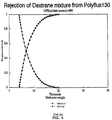
- FIG. 4 shows sieving data for a prior-art "Polyflux 130" membrane as well as a plot of values of the corresponding rejection statistic for the prior-art membrane, as discussed in Example 4.
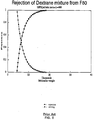
- FIG. 5 shows plots of sieving and rejection statistics (for maltodextrin) for the prior-art "F80" membrane, as discussed in Example 4.
- the present invention provides a semipermeable hollow-fiber membrane according to claim 1 having a novel combination of hydraulic (i.e., water) permeability and diffusive (i.e., solute) permeability.
- the membranes according to the present invention are permeable to solutes normally present in aqueous biological fluids (such as blood) having molecular weights up to 30,000 daltons and higher.
- aqueous biological fluids such as blood having molecular weights up to 30,000 daltons and higher.
- This invention also encompasses a process for making cellulose acetate fibers having the above-specified characteristics.
- the invention furthermore provides an extracorporeal blood-treatment device comprising membranes according to the present invention.
- the fibers according to the present invention comprise hydrophilic cellulose acetate.
- the hydrophilic cellulose acetate also is resistant to thrombogenesis, and is non-toxic. It has been found that cellulosic polymers are particularly well-adapted for such use.
- the cellulose acetate hydrophilic is liquified (i.e., melted) and combined with a water-miscible solvent for the hydrophilic cellulose acetate and a water-miscible non-solvent for the cellulose acetate hydrophilic.
- a water-miscible solvent for the hydrophilic cellulose acetate and a water-miscible non-solvent for the cellulose acetate hydrophilic.
- the solvent and the non-solvent must be liquids at the melt temperature of the hydrophilic cellulose acetate.
- the solvent and the non-solvent are preferably non-toxic and resistant to thrombogenesis.
- the resulting mixture is mixed to homogeneity and "melt-spun" (i.e., extruded in a molten condition) through an annular extrusion die.
- the mixture can be melt-spun twice, once using a die suitable for making solid fibers, then again using an annular die to produce hollow fibers. Spinning twice allows superior control over the composition and characteristics of the hollow fibers.
- the resulting hollow fibers are rapidly cooled to solidify their constituent materials and leached in heated water to remove the solvent and the non-solvent.
- thermodynamic ordering of themselves relative to the solvent and non-solvent constituents This process is termed a "thermally-induced phase separation process," abbreviated "TIPS."
- TIPS thermalally-induced phase separation process
- the molecules of the hydrophilic cellulose acetate become associated with each other during spinning to form a labyrinthine network that, after the solvent and non-solvents are removed by water leaching, is characterized by an extensive and dense network of convoluted voids having an extremely fine mean pore size.
- voids extend through the walls of the hollow fibers and provide the routes by which water and solutes pass through the walls.
- the molecules of the solvent and non-solvent, which originally occupied the voids, are removed by the water-leach step because they are miscible in water and because they do not become covalently bonded to the molecules of the hydrophilic cellulose acetate.
- a cellulose acetate hollow fiber according to the present invention is made from a composition comprising a mixture of three constituents.
- a first constituent is the cellulose acetate polymer which provides the structural aspect of the membrane.
- a second constituent is glycerine, a non-solvent for cellulose at ambient temperature.
- a third constituent is polyethylene glycol, a solvent for cellulose at ambient temperature.
- a preferred mixture for making cellulose acetate membranes consists essentially of about 32 to about 40 percent (w/w) cellulose acetate, about 5 to about 10 percent (w/w) glycerin, and the balance polyethylene glycol having a molecular weight in a range of about 150 to about 600 daltons.
- a process for making cellulose acetate membranes according to the present invention typically includes a "compounding" step in which the three compounds are mixed to homogeneity at a temperature appropriate to melt cellulose acetate (about 165 to about 180°C).
- the resulting first "melt” is then extruded through a die to form solid strands.
- the strands are cooled and pelletized using conventional methods.
- the composition of the pellets is substantially the same as the composition of the first melt.
- Fabrication of hollow-fiber membranes from the pellets is performed by first heating the pellets sufficiently to form a second "melt" which is extruded through an annular spinneret. The resulting hollow fibers are immediately cooled by air and leached in a water bath at a temperature of about 80 to about 95°C.
- the temperature of the second melt while being extruded through the annular spinneret is a key parameter affecting the hydraulic permeability of the resulting membrane.
- each one degree Celsius increase in spin temperature causes a corresponding decrease in the hydraulic permeability of the hollow fiber by about 17x10 -3 cm 3 /(s.kPa) (2 mL/min/mmHg/m 2 ).
- spin temperature it is possible to "customize" the hydraulic permeability of the hollow fibers by simply controlling the spin temperature.
- the conditions under which the hollow fibers are cooled upon exiting the annular spinneret be maintained substantially constant to ensure uniform fiber characteristics over the length of the fiber produced by the spinneret.
- These conditions include, but are not necessarily limited to, the temperature of the air used to cool the fiber, the velocity of air movement past the fiber exiting the spinneret, the longitudinal tension applied to the fiber as it exits the spinneret, the rate at which the fiber is cooled relative to the longitudinal velocity of the fiber as it exits the spinneret, and the humidity of the air used to cool the fiber.
- the longitudinal tension should be sufficient to longitudinally stretch the fiber by no greater than twenty percent.
- the glycerin and polyethylene glycol constituents of the hollow fibers are leached from the polymeric constituent. After leaching, the hollow fibers are taken up in a wet condition on reels.
- the wet fibers possess excellent hydraulic and diffusive permeability characteristics with high solute clearances for middle and high molecular weight substances while still exhibiting a manageable ultrafiltration rate for use in hemodialyzers and the like.
- wet cellulose acetate fibers are preferably replasticized using a solution of glycerin and water.
- the wet fibers are unreeled and submerged at about 25°C in an aqueous glycerin solution having a glycerin concentration of about 30 to about 40% w/w.
- the fibers are subsequently dried using air heated to about 70 to about 80°C.
- the cellulose acetate fibers can remain stable for extended periods of time because the "plasticizer" (i.e., glycerin and some water) is in equilibrium with the atmosphere at ambient temperature and humidity.
- the concentration of glycerin in the cellulose acetate membrane is about 45 to about 50% w/w and the water content is about 15 to about 18% w/w.
- Hollow cellulose acetate fibers according to the present invention can be made into hollow-fiber hemodialyzers using methods known in the art. When made into hemodialyzers, such fibers have been shown to have the following specifications: Fiber internal diameter: about 175 to about 210 ⁇ m Fiber wall thickness: about 10 to about 35 ⁇ m Ultrafiltration coefficient (K UF ) 3.13x10 -2 cm 3 /(s.kPa) to about 1.15x10 -1 cm 3 /(s.kPa) (about 15 to about 55 mL/hr/mmHg/m 2 ) Mass-transfer coefficient for urea (K oV (urea)) 6.33x10 -4 cm/s (about 38x10 -3 cm/min) or higher Ratio of [K oV (urea)]/K UF at least 2.5x10 -3
- This Example illustrates the effects of compounding temperature and hollow-fiber melt-spin temperature on the diffusive and hydraulic permeability values of hollow fibers comprising 34.5% w/w cellulose acetate after passing through an 85°C leach bath. Results are shown in Table 3.
- This Example is an investigation of sieving behavior of hollow-fiber membranes according to the present invention compared with prior-art hollow-fiber membranes.
- the sieving statistics were determined using maltodextrin solutions. See generally , Feldhoff et al., "Effect of Plasma Proteins on the Sieving Spectra of Hemofilters," Artif. Organs 8 : 186-192 (1984).
- Cellulose acetate hollow fibers made according to the present invention were bundled and made into hollow-fiber hemodialyzers using conventional procedures.
- the lumens of the hollow fibers received either a human plasma containing maltodextrin or a saline rinse.
- the maltodextrin used in this study had a continuous distribution of molecular weights from about 350 daltons (maltose) to greater than 120,000 daltons. Normal dialysate at 37°C as used in hemodialysis was used in the "dialysate" side.
- Plasma or normal saline through the lumens, and delivery of dialysate were accomplished using conventional peristaltic pumps, with tubing lengths from the respective reservoirs to the dialyzer and back being less than one meter each way.
- the "plasma” pump was adjusted to deliver plasma or saline to the arterial blood port of the dialyzer at 200 mL/min with a slight back pressure on the venous blood port.
- the "dialysate” pump was coupled to the dialysate port of the dialyzer with the downstream dialysate port plugged.
- the dialysate pump was run at 30 mL/min.
- Pressure transducers were connected by tubing and "T" connections to the arterial blood port, the venous blood port, and the upstream dialysate port. All pressure-monitoring components were positioned at the same hydrostatic elevation to avoid pressure differentials.
- the dialyzers were rinsed, by "cross-membrane" flow, with one liter of normal saline under a hydrostatic pressure of one meter to wash out glycerine and other solutes from the hollow fibers.
- the dialyzers were rinsed with 0.5 L normal saline withdrawn from the 37°C reservoir. After passing through the fibers, the 0.5 L saline was discharged to a drain. The dialyzers were then rinsed for 1,200 seconds with the 0.5 L normal saline remaining in the 37°C reservoir, with the saline being returned to the reservoir after passing through the fibers. The dialyzers were then drained of any saline on the dialysate side to present excessive dilution of the plasma/maltodextrin solution.
- FIGS. 1-5 Selected results of these experiments are shown in FIGS. 1-5.
- FIG. 1 is a profile of the maltodextrin sieving and rejection behavior of a "CDAK 4000" dialyzer incorporating a prior-art low-flux cellulose-acetate-based membrane made by Althin CD Medical, Inc., Miami Lakes, Florida.
- the square-shaped points correspond to the ability of the membrane to reject (i.e., prevent passage therethrough of) maltodextrin molecules having particular molecular weights.
- the diamond-shaped points correspond to the ability of the membrane to sieve (i.e., pass therethrough) maltodextrin molecules.
- a suitable sieving statistic is determined by measuring the concentration of a solute (here, maltodextrin) in liquid on the "blood" side and on the "dialysate” side.
- the rejection statistic plotted in FIG. 1 is defined by C b /(C b + C d ) .
- the "polyflux 130" membrane is a hydrophilic polyamide-based high-flux membrane manufactured by Gambro, Lund, Sweden; the "F80” membrane is a polysulfone membrane made by Fresenius.
- FIG. 3 is a comparative plot of the maltodextrin sieving profiles of the prior-art "Polyflux 130" membrane and an “Altrex B” membrane according to the present invention.
- FIG. 4 shows, for the prior-art "Polyflux 130" membrane, the sieving data shown in FIGS. 2 and 3.
- FIG. 4 also shows a plot of values of the corresponding rejection statistic for the "Polyflux 130" membrane.
- FIG. 5 shows, for the prior-art "F80" membrane, plots of the sieving and rejection statistics (for maltodextrin).
Landscapes
- Health & Medical Sciences (AREA)
- Chemical & Material Sciences (AREA)
- Chemical Kinetics & Catalysis (AREA)
- Engineering & Computer Science (AREA)
- Heart & Thoracic Surgery (AREA)
- Urology & Nephrology (AREA)
- Manufacturing & Machinery (AREA)
- Life Sciences & Earth Sciences (AREA)
- Veterinary Medicine (AREA)
- Anesthesiology (AREA)
- Biomedical Technology (AREA)
- Hematology (AREA)
- Emergency Medicine (AREA)
- Animal Behavior & Ethology (AREA)
- General Health & Medical Sciences (AREA)
- Public Health (AREA)
- Vascular Medicine (AREA)
- Inorganic Chemistry (AREA)
- General Chemical & Material Sciences (AREA)
- Separation Using Semi-Permeable Membranes (AREA)
- Artificial Filaments (AREA)
- External Artificial Organs (AREA)
- Spinning Methods And Devices For Manufacturing Artificial Fibers (AREA)
- Polysaccharides And Polysaccharide Derivatives (AREA)
Abstract
Description
| Fiber internal diameter: | about 175 to about 210 µm |
| Fiber wall thickness: | about 10 to about 35 µm |
| Ultrafiltration coefficient (KUF) | 3.13x10⁻² cm3/(s.kPa) to about 1.15x10⁻¹ cm3/(s.kPa) (about 15 to about 55 mL/hr/mmHg/m2) |
| Mass-transfer coefficient for urea (KoV (urea)) | 6.33x10⁻⁴ cm/s (about 38x10-3 cm/min) or higher |
| Ratio of [KoV (urea)]/KUF | at least 2.5x10⁻³ |
| [Cellulose Acetate] (% w/w) | 65°C Leach KoV (Urea) cm/s (cm/min) | Bath KUF | 75°C Leach KoV (Urea) cm/s (cm/min) | Bath KUF |
| 42.8 | 5.88x10⁻⁴ (35.3x10⁻³) | 0.51 (7.6) | 6.28x10⁴ (37.7x10⁻³) | 0.68 (10.2) |
| 40.3 | 5.65x10⁻⁴ (33.9x10⁻³) | 0.60 (9.0) | - | - |
| 38.3 | 6.22x10⁻⁴ (37.3x10⁻³) | 0.89 (13.3) | 6.93x10⁻⁴ (41.6x10⁻³) | 1.32 (19.8) |
| 38.3 | 6.13x10⁻⁴ (36.8x10⁻³) | 0.89 (13.3) | 7.23x10⁻³ (43.4x10⁻³) | 1.23 (18.4) |
| 36.7 | 6.37x10⁻⁴ (38.2x10⁻³) | 1.21 (18.2) | 7.50x10⁻⁴ (45.0x10⁻³) | 1.71 (25.6) |
| 34.6 | 6.83x10⁻⁴ (41.0x10⁻³) | 1.62 (24.4) | 7.82x10⁻⁴ (46.9x10⁻³) | 2.07 (31.1) |
| 32.9 | 7.11x10⁻⁴ (42.7x10⁻³) | 1.82 (27.4) | 7.98x10⁻⁴ (47.9x10⁻³) | 2.41 (36.1) |
| Bath Temp °C | KoV (Urea) cm/s (cm/min) | KUF cm3/s.kPa (mL/hr/mmHg/m2) |
| 75 | 8.68x10⁻⁴ (52.1x10⁻³) | 1.85 (27.8) |
| 80 | 8.33x10⁻⁴ (50.0x10⁻³) | 1.96 (29.4) |
| 85 | 8.27x10⁻⁴ (49.6x10⁻³) | 2.43 (36.4) |
Results are shown in Table 3.
| Compounding Temp (°C) | Fiber Spin Temp (°C) | KoV (Na) cm/s (cm/min) | KUF cm3/s.kPa (mL/hr/mmHg/m2) |
| 165.6 | 172.2 | 7.62x10⁻⁴ (45.7x10⁻³) | 3.74 (56.1) |
| 168.3 | 175 | 7.01x10⁻⁴ (45.7x10⁻³) | 3.48 (52.2) |
| 171.1 | 175 | 0.85x10⁻⁴ (51x10-3) | 2.16 (32.4) |
| 173.8 | 175 | 8.27x10⁻⁴ (49.6x10⁻³) | 2.43 (36.5) |
| 176.7 | 177.2 | 7.41x10⁻⁴ (44.5x10⁻³) | 1.95 (29.2) |
| KUF | In Vivo Clearance (cm/min) | KUF | |||
| Uera | Creatinie | Uric Acid | Phosphate | ||
| 3.33 (50.0) | 182 | 150 | 155 | 147 | 1.13 (16.9) |
| 233 | 182 | 195 | 184 | ||
| 289 | 220 | 223 | 195 |
Claims (17)
- A cellulose acetate hollow fiber semipermeable membrane having a lumen diameter of 175 to 210 µm and a wall thickness of 10 to 35 µm, wherein the membrane exhibits a combination of: an ultrafiltration coefficient KuF of 3.13×10⁻² cm3/(s·kPa) to 1.15×10⁻¹ cm3/(s·kPa) (15 to 55 mL/hr/mmHg/m2), a mass-transfer coefficient for urea KoV (urea) of at least 6.33×10⁻⁴ cm/s (38×10-3 cm/min), and a ratio of [KoV(urea)]/KuF of at least 2.5×10⁻³.
- The membrane of claim 1, characterized in that the membrane exhibits a sieving statistic, for maltodextrin having a molecular weight of 15,000 to 20,000 daltons, of at least 0.1.
- The membrane of claim 2, characterized in that the membrane exhibits a sieving statistic, for maltodextrin having a molecular weight of greater than 20,000 daltons, of less than 0.1.
- The membrane of claim 1, characterized in that the membrane exhibits a ratio:
- The membrane of claim 1, characterized in that the membrane is adapted for use in hemodialyzers.
- A process for making a hollow-fiber semipermeable membrane adapted for purifying aqueous biological liquids, in which process a molten liquid comprising cellulose acetate, a water-miscible non-solvent for cellulose acetate, and a water-miscible solvent for cellulose acetate is extruded through a spinneret to produce a hot hollow fiber that is cooled and contacted with 70 to 85 °C water so as to leach the non-solvent and solvent from the membrane, wherein the molten liquid comprises 32 to 40 % w/w of cellulose acetate, 5 to 10 % w/w of the non-solvent, and 50-63 % w/w of the solvent, and the membrane has an ultrafiltration coefficient (KuF) of 15 to 55 mL/hr/mmHg/m2.
- The process of claim 6, characterized in that the hot hollow fiber is stretched longitudinally so as to increase its length by no greater than 20 percent.
- the process of claim 7, characterized in that the fiber, after stretching, has a lumen diameter of 175 to 210 µm and a wall thickness of 10 to 35 µm.
- The process of claim 6, characterized in that the hollow fiber, after being contacted with the 70 to 85 °C water, is replasticized.
- The process of claim 9, characterized in that replasticization comprises contacting the hollow fiber with an aqueous glycerin solution.
- The process of claim 10, characterized in that, after the fiber is replasticized, water is removed from the fiber so as to confer on the fibers a glycerin concentration of 45 to 50 % w/w and a water concentration of 15 to 18 % w/w when the fibers are at equilibrium with the atmosphere.
- The process of claim 11, characterized in that water is removed from the fibers by drying the fibers in air at 70 to 80 °C.
- The process of claim 6, characterized in that the molten liquid has a temperature greater than the melting temperature of cellulose acetate.
- The process of claim 13, characterized in that the molten liquid has a temperature of 165 to 180 °C.
- The process of claim 6, characterized in that the non-solvent is glycerin and the solvent is polyethylene glycol having a molecular weight of 150 to 600 daltons.
- An extracorporeal blood-treatment device comprising membranes as claimed in claim 1.
- The device of claim 16, characterized in that the device is a hemodialyzer.
Applications Claiming Priority (2)
| Application Number | Priority Date | Filing Date | Title |
|---|---|---|---|
| US97694992A | 1992-11-16 | 1992-11-16 | |
| US976949 | 1992-11-16 |
Publications (3)
| Publication Number | Publication Date |
|---|---|
| EP0598690A2 EP0598690A2 (en) | 1994-05-25 |
| EP0598690A3 EP0598690A3 (en) | 1995-02-15 |
| EP0598690B1 true EP0598690B1 (en) | 1998-07-29 |
Family
ID=25524658
Family Applications (1)
| Application Number | Title | Priority Date | Filing Date |
|---|---|---|---|
| EP93850213A Expired - Lifetime EP0598690B1 (en) | 1992-11-16 | 1993-11-11 | High-flux hollow-fiber membrane with enhanced transport capability and process for making same |
Country Status (17)
| Country | Link |
|---|---|
| US (2) | US5643452A (en) |
| EP (1) | EP0598690B1 (en) |
| JP (1) | JP3392141B2 (en) |
| KR (1) | KR100224115B1 (en) |
| CN (1) | CN1041173C (en) |
| AT (1) | ATE168902T1 (en) |
| AU (1) | AU672856B2 (en) |
| BR (1) | BR9307461A (en) |
| CA (1) | CA2149418C (en) |
| DE (1) | DE69320000T2 (en) |
| DK (1) | DK0598690T3 (en) |
| ES (1) | ES2121980T3 (en) |
| PL (1) | PL173020B1 (en) |
| RU (1) | RU2108144C1 (en) |
| SG (1) | SG47875A1 (en) |
| UA (1) | UA29462C2 (en) |
| WO (1) | WO1994011095A1 (en) |
Families Citing this family (16)
| Publication number | Priority date | Publication date | Assignee | Title |
|---|---|---|---|---|
| CA2202969C (en) * | 1996-04-19 | 2001-07-24 | Shingo Emi | Selectively permeable hollow fiber membrane and process for producing same |
| BR9714445A (en) * | 1996-12-31 | 2000-03-21 | Althin Medical Inc | Semipermeable polysulfone membranes by spinning the molten material and methods for making them |
| US7144505B2 (en) | 1997-09-18 | 2006-12-05 | Baxter International Inc. | Melt-spun polysulfone semipermeable membranes and methods for making the same |
| US6218441B1 (en) | 1997-09-18 | 2001-04-17 | Timothy B. Meluch | Melt-spun polysulfone semipermeable membranes and methods for making the same |
| FR2815886B1 (en) * | 2000-10-30 | 2002-12-06 | Hospal Ind | HOLLOW FIBER BEAM FOR AN APPARATUS FOR THE EXTRACORPORAL TREATMENT OF BLOOD AND PLASMA AND ITS MANUFACTURING PROCESS |
| US6444435B1 (en) | 2000-11-30 | 2002-09-03 | Serim Research Corporation | Test strip for determining dialysate composition |
| FR2817769B1 (en) * | 2000-12-08 | 2003-09-12 | Hospal Ind | APPARATUS FOR THE EXTRACORPOREAL TREATMENT OF BLOOD OR PLASMA COMPRISING A WET SEMI-PERMEABLE MEMBRANE AND METHODS OF MANUFACTURE |
| AUPS046602A0 (en) * | 2002-02-12 | 2002-03-07 | U.S. Filter Wastewater Group, Inc. | Halar membranes |
| KR20120059755A (en) * | 2010-12-01 | 2012-06-11 | 엘지전자 주식회사 | Method for manufacturing a hollow fiber membrane for water treatment using cellulose resin |
| CN103111190B (en) * | 2013-03-05 | 2014-11-19 | 天津工业大学 | Method for preparing hollow fiber membranes by melt extrusion process |
| CN104906971A (en) * | 2015-05-20 | 2015-09-16 | 苏州市贝克生物科技有限公司 | Cellulose acetate/polyethylene glycol blood dialysis membrane and preparation method thereof |
| JP6699750B2 (en) | 2016-10-31 | 2020-05-27 | 東洋紡株式会社 | Cellulose acetate-based asymmetric hollow fiber membrane |
| CN109922876B (en) | 2016-10-31 | 2022-06-28 | 东洋纺株式会社 | Cellulose acetate hollow fiber membrane |
| CN112451774B (en) * | 2020-12-03 | 2025-10-28 | 山东威高血液净化制品股份有限公司 | Adsorption-enhanced dialyzer |
| CN114588783B (en) * | 2022-03-21 | 2023-08-01 | 山东水利建设集团有限公司 | Multistage back flush system of pump house |
| CN120714450B (en) * | 2025-08-20 | 2026-01-06 | 贵州省材料产业技术研究院 | A polymer membrane, its preparation method and its application in the concentration of traditional Chinese medicine liquid. |
Family Cites Families (3)
| Publication number | Priority date | Publication date | Assignee | Title |
|---|---|---|---|---|
| US4276173A (en) * | 1977-07-05 | 1981-06-30 | Cordis Dow Corp. | Cellulose acetate hollow fiber and method for making same |
| US4543221A (en) * | 1979-12-17 | 1985-09-24 | Cd Medical, Inc. | Method for making cellulose semipermeable hollow fibers |
| CA1272139C (en) * | 1984-11-16 | 1990-07-31 | Fluid separator, hollow fiber to be used for construction thereof and process for preparation of said hollow fibers |
-
1993
- 1993-11-10 PL PL93308999A patent/PL173020B1/en not_active IP Right Cessation
- 1993-11-10 RU RU95107703/04A patent/RU2108144C1/en not_active IP Right Cessation
- 1993-11-10 WO PCT/US1993/010826 patent/WO1994011095A1/en not_active Ceased
- 1993-11-10 KR KR1019950701946A patent/KR100224115B1/en not_active Expired - Fee Related
- 1993-11-10 JP JP51230694A patent/JP3392141B2/en not_active Expired - Fee Related
- 1993-11-10 BR BR9307461A patent/BR9307461A/en not_active IP Right Cessation
- 1993-11-10 CA CA002149418A patent/CA2149418C/en not_active Expired - Fee Related
- 1993-11-10 UA UA95062758A patent/UA29462C2/en unknown
- 1993-11-10 AU AU55978/94A patent/AU672856B2/en not_active Ceased
- 1993-11-11 DK DK93850213T patent/DK0598690T3/en active
- 1993-11-11 AT AT93850213T patent/ATE168902T1/en not_active IP Right Cessation
- 1993-11-11 ES ES93850213T patent/ES2121980T3/en not_active Expired - Lifetime
- 1993-11-11 SG SG1996004930A patent/SG47875A1/en unknown
- 1993-11-11 DE DE69320000T patent/DE69320000T2/en not_active Expired - Fee Related
- 1993-11-11 EP EP93850213A patent/EP0598690B1/en not_active Expired - Lifetime
- 1993-11-16 CN CN93121429A patent/CN1041173C/en not_active Expired - Fee Related
-
1994
- 1994-10-21 US US08/327,431 patent/US5643452A/en not_active Expired - Fee Related
-
1996
- 1996-11-20 US US08/752,871 patent/US5736046A/en not_active Expired - Fee Related
Also Published As
| Publication number | Publication date |
|---|---|
| DK0598690T3 (en) | 1999-04-26 |
| CN1093018A (en) | 1994-10-05 |
| PL173020B1 (en) | 1998-01-30 |
| ATE168902T1 (en) | 1998-08-15 |
| PL308999A1 (en) | 1995-09-18 |
| WO1994011095A1 (en) | 1994-05-26 |
| SG47875A1 (en) | 1998-04-17 |
| RU2108144C1 (en) | 1998-04-10 |
| EP0598690A2 (en) | 1994-05-25 |
| DE69320000D1 (en) | 1998-09-03 |
| UA29462C2 (en) | 2000-11-15 |
| AU5597894A (en) | 1994-06-08 |
| KR100224115B1 (en) | 1999-10-15 |
| BR9307461A (en) | 1999-06-01 |
| EP0598690A3 (en) | 1995-02-15 |
| DE69320000T2 (en) | 1999-04-15 |
| CA2149418A1 (en) | 1994-05-26 |
| ES2121980T3 (en) | 1998-12-16 |
| JPH08503413A (en) | 1996-04-16 |
| AU672856B2 (en) | 1996-10-17 |
| CA2149418C (en) | 2002-01-01 |
| CN1041173C (en) | 1998-12-16 |
| US5643452A (en) | 1997-07-01 |
| RU95107703A (en) | 1997-03-20 |
| KR950704026A (en) | 1995-11-17 |
| US5736046A (en) | 1998-04-07 |
| JP3392141B2 (en) | 2003-03-31 |
Similar Documents
| Publication | Publication Date | Title |
|---|---|---|
| US4906375A (en) | Asymmetrical microporous hollow fiber for hemodialysis | |
| EP0294737B1 (en) | Polysulfone hollow fiber membrane and process for making the same | |
| JP3097149B2 (en) | Medical dialysis module and method of manufacturing the same | |
| CA1294745C (en) | Asymmetrical microporous hollow fiber for hemodialysis and a process for manufacturing such fibers | |
| JP3117575B2 (en) | Polysulfone-based hollow fiber membrane and method for producing the same | |
| EP0568045B1 (en) | Polysulfone-based hollow fiber membrane and process for manufacturing the same | |
| KR100432463B1 (en) | Polysulfone Hollow Fiber Membrane | |
| US6042783A (en) | Hollow yarn membrane used for blood purification and blood purifier | |
| EP1547628A1 (en) | Plasma purification membrane and plasma purification system | |
| AU672856B2 (en) | High flux hollow fiber membrane | |
| WO2004056460A1 (en) | Perm selective asymmetric hollow fibre membrane for the separation of toxic mediators from blood | |
| JPH10108907A (en) | Membrane for hemocatharsis, its preparation and module for hemocatharsis | |
| JPH06238139A (en) | Polysulfone semipermeable membrane and its production | |
| JP2703266B2 (en) | Polysulfone hollow fiber membrane and method for producing the same | |
| JP3253861B2 (en) | Permselective hollow fiber membrane | |
| JPH09308685A (en) | Hollow fiber membrane for blood purification and blood purifier | |
| JP2003290638A (en) | Polysulfone-based semipermeable membrane and artificial kidney using the same | |
| JP3334705B2 (en) | Polysulfone-based selectively permeable hollow fiber membrane | |
| JP3770145B2 (en) | Method for producing semipermeable membrane and dialyzer using the semipermeable membrane | |
| JP2000210544A (en) | Manufacturing method of semipermeable membrane | |
| JPH09308684A (en) | Selective separation membrane | |
| JP4386607B2 (en) | Polysulfone blood purification membrane production method and polysulfone blood purification membrane | |
| JP2000300973A (en) | Blood purification hollow fiber membrane | |
| JPS6247367A (en) | Blood concentrator | |
| JPH09206570A (en) | Separation membrane and manufacturing method thereof |
Legal Events
| Date | Code | Title | Description |
|---|---|---|---|
| PUAI | Public reference made under article 153(3) epc to a published international application that has entered the european phase |
Free format text: ORIGINAL CODE: 0009012 |
|
| AK | Designated contracting states |
Kind code of ref document: A2 Designated state(s): AT BE CH DE DK ES FR GB GR LI NL SE |
|
| PUAL | Search report despatched |
Free format text: ORIGINAL CODE: 0009013 |
|
| AK | Designated contracting states |
Kind code of ref document: A3 Designated state(s): AT BE CH DE DK ES FR GB GR LI NL SE |
|
| 17P | Request for examination filed |
Effective date: 19950626 |
|
| 17Q | First examination report despatched |
Effective date: 19960827 |
|
| GRAG | Despatch of communication of intention to grant |
Free format text: ORIGINAL CODE: EPIDOS AGRA |
|
| GRAG | Despatch of communication of intention to grant |
Free format text: ORIGINAL CODE: EPIDOS AGRA |
|
| GRAG | Despatch of communication of intention to grant |
Free format text: ORIGINAL CODE: EPIDOS AGRA |
|
| GRAH | Despatch of communication of intention to grant a patent |
Free format text: ORIGINAL CODE: EPIDOS IGRA |
|
| GRAH | Despatch of communication of intention to grant a patent |
Free format text: ORIGINAL CODE: EPIDOS IGRA |
|
| GRAA | (expected) grant |
Free format text: ORIGINAL CODE: 0009210 |
|
| AK | Designated contracting states |
Kind code of ref document: B1 Designated state(s): AT BE CH DE DK ES FR GB GR LI NL SE |
|
| REF | Corresponds to: |
Ref document number: 168902 Country of ref document: AT Date of ref document: 19980815 Kind code of ref document: T |
|
| REG | Reference to a national code |
Ref country code: CH Ref legal event code: EP |
|
| REF | Corresponds to: |
Ref document number: 69320000 Country of ref document: DE Date of ref document: 19980903 |
|
| REG | Reference to a national code |
Ref country code: CH Ref legal event code: NV Representative=s name: RITSCHER & SEIFERT PATENTANWAELTE VSP |
|
| ET | Fr: translation filed | ||
| REG | Reference to a national code |
Ref country code: ES Ref legal event code: FG2A Ref document number: 2121980 Country of ref document: ES Kind code of ref document: T3 |
|
| REG | Reference to a national code |
Ref country code: DK Ref legal event code: T3 |
|
| PLBE | No opposition filed within time limit |
Free format text: ORIGINAL CODE: 0009261 |
|
| STAA | Information on the status of an ep patent application or granted ep patent |
Free format text: STATUS: NO OPPOSITION FILED WITHIN TIME LIMIT |
|
| 26N | No opposition filed | ||
| REG | Reference to a national code |
Ref country code: GB Ref legal event code: IF02 |
|
| PGFP | Annual fee paid to national office [announced via postgrant information from national office to epo] |
Ref country code: GR Payment date: 20021024 Year of fee payment: 10 |
|
| REG | Reference to a national code |
Ref country code: CH Ref legal event code: PUE Owner name: ALTHIN MEDICAL INC. TRANSFER- BAXTER INTERNATIONAL Ref country code: CH Ref legal event code: NV Representative=s name: KIRKER & CIE SA |
|
| REG | Reference to a national code |
Ref country code: GB Ref legal event code: 732E |
|
| NLS | Nl: assignments of ep-patents |
Owner name: BAXTER INTERNATIONAL INC. |
|
| PGFP | Annual fee paid to national office [announced via postgrant information from national office to epo] |
Ref country code: AT Payment date: 20031021 Year of fee payment: 11 |
|
| PGFP | Annual fee paid to national office [announced via postgrant information from national office to epo] |
Ref country code: NL Payment date: 20031022 Year of fee payment: 11 |
|
| PGFP | Annual fee paid to national office [announced via postgrant information from national office to epo] |
Ref country code: GB Payment date: 20031105 Year of fee payment: 11 |
|
| PGFP | Annual fee paid to national office [announced via postgrant information from national office to epo] |
Ref country code: FR Payment date: 20031119 Year of fee payment: 11 |
|
| PGFP | Annual fee paid to national office [announced via postgrant information from national office to epo] |
Ref country code: CH Payment date: 20031121 Year of fee payment: 11 Ref country code: SE Payment date: 20031121 Year of fee payment: 11 Ref country code: DK Payment date: 20031121 Year of fee payment: 11 |
|
| PGFP | Annual fee paid to national office [announced via postgrant information from national office to epo] |
Ref country code: ES Payment date: 20031209 Year of fee payment: 11 |
|
| REG | Reference to a national code |
Ref country code: FR Ref legal event code: TP |
|
| PGFP | Annual fee paid to national office [announced via postgrant information from national office to epo] |
Ref country code: DE Payment date: 20031231 Year of fee payment: 11 |
|
| PGFP | Annual fee paid to national office [announced via postgrant information from national office to epo] |
Ref country code: BE Payment date: 20040115 Year of fee payment: 11 |
|
| REG | Reference to a national code |
Ref country code: ES Ref legal event code: PC2A |
|
| PG25 | Lapsed in a contracting state [announced via postgrant information from national office to epo] |
Ref country code: GR Free format text: LAPSE BECAUSE OF NON-PAYMENT OF DUE FEES Effective date: 20040603 |
|
| PG25 | Lapsed in a contracting state [announced via postgrant information from national office to epo] |
Ref country code: GB Free format text: LAPSE BECAUSE OF NON-PAYMENT OF DUE FEES Effective date: 20041111 Ref country code: AT Free format text: LAPSE BECAUSE OF NON-PAYMENT OF DUE FEES Effective date: 20041111 |
|
| PG25 | Lapsed in a contracting state [announced via postgrant information from national office to epo] |
Ref country code: SE Free format text: LAPSE BECAUSE OF NON-PAYMENT OF DUE FEES Effective date: 20041112 Ref country code: ES Free format text: LAPSE BECAUSE OF NON-PAYMENT OF DUE FEES Effective date: 20041112 |
|
| PG25 | Lapsed in a contracting state [announced via postgrant information from national office to epo] |
Ref country code: LI Free format text: LAPSE BECAUSE OF NON-PAYMENT OF DUE FEES Effective date: 20041130 Ref country code: DK Free format text: LAPSE BECAUSE OF NON-PAYMENT OF DUE FEES Effective date: 20041130 Ref country code: CH Free format text: LAPSE BECAUSE OF NON-PAYMENT OF DUE FEES Effective date: 20041130 Ref country code: BE Free format text: LAPSE BECAUSE OF NON-PAYMENT OF DUE FEES Effective date: 20041130 |
|
| BERE | Be: lapsed |
Owner name: *BAXTER INTERNATIONAL INC. Effective date: 20041130 |
|
| PG25 | Lapsed in a contracting state [announced via postgrant information from national office to epo] |
Ref country code: NL Free format text: LAPSE BECAUSE OF NON-PAYMENT OF DUE FEES Effective date: 20050601 Ref country code: DE Free format text: LAPSE BECAUSE OF NON-PAYMENT OF DUE FEES Effective date: 20050601 |
|
| REG | Reference to a national code |
Ref country code: DK Ref legal event code: EBP |
|
| GBPC | Gb: european patent ceased through non-payment of renewal fee |
Effective date: 20041111 |
|
| EUG | Se: european patent has lapsed | ||
| REG | Reference to a national code |
Ref country code: CH Ref legal event code: PL |
|
| PG25 | Lapsed in a contracting state [announced via postgrant information from national office to epo] |
Ref country code: FR Free format text: LAPSE BECAUSE OF NON-PAYMENT OF DUE FEES Effective date: 20050729 |
|
| NLV4 | Nl: lapsed or anulled due to non-payment of the annual fee |
Effective date: 20050601 |
|
| REG | Reference to a national code |
Ref country code: FR Ref legal event code: ST |
|
| REG | Reference to a national code |
Ref country code: ES Ref legal event code: FD2A Effective date: 20041112 |
|
| BERE | Be: lapsed |
Owner name: *BAXTER INTERNATIONAL INC. Effective date: 20041130 |