EP0598552B1 - Cross-linkable polymeric composition - Google Patents
Cross-linkable polymeric composition Download PDFInfo
- Publication number
- EP0598552B1 EP0598552B1 EP93308983A EP93308983A EP0598552B1 EP 0598552 B1 EP0598552 B1 EP 0598552B1 EP 93308983 A EP93308983 A EP 93308983A EP 93308983 A EP93308983 A EP 93308983A EP 0598552 B1 EP0598552 B1 EP 0598552B1
- Authority
- EP
- European Patent Office
- Prior art keywords
- weight
- dimethacrylate
- casting composition
- composition according
- bisphenol
- Prior art date
- Legal status (The legal status is an assumption and is not a legal conclusion. Google has not performed a legal analysis and makes no representation as to the accuracy of the status listed.)
- Expired - Lifetime
Links
Classifications
-
- G—PHYSICS
- G02—OPTICS
- G02B—OPTICAL ELEMENTS, SYSTEMS OR APPARATUS
- G02B1/00—Optical elements characterised by the material of which they are made; Optical coatings for optical elements
- G02B1/04—Optical elements characterised by the material of which they are made; Optical coatings for optical elements made of organic materials, e.g. plastics
- G02B1/041—Lenses
-
- C—CHEMISTRY; METALLURGY
- C08—ORGANIC MACROMOLECULAR COMPOUNDS; THEIR PREPARATION OR CHEMICAL WORKING-UP; COMPOSITIONS BASED THEREON
- C08G—MACROMOLECULAR COMPOUNDS OBTAINED OTHERWISE THAN BY REACTIONS ONLY INVOLVING UNSATURATED CARBON-TO-CARBON BONDS
- C08G75/00—Macromolecular compounds obtained by reactions forming a linkage containing sulfur with or without nitrogen, oxygen, or carbon in the main chain of the macromolecule
- C08G75/02—Polythioethers
-
- C—CHEMISTRY; METALLURGY
- C09—DYES; PAINTS; POLISHES; NATURAL RESINS; ADHESIVES; COMPOSITIONS NOT OTHERWISE PROVIDED FOR; APPLICATIONS OF MATERIALS NOT OTHERWISE PROVIDED FOR
- C09D—COATING COMPOSITIONS, e.g. PAINTS, VARNISHES OR LACQUERS; FILLING PASTES; CHEMICAL PAINT OR INK REMOVERS; INKS; CORRECTING FLUIDS; WOODSTAINS; PASTES OR SOLIDS FOR COLOURING OR PRINTING; USE OF MATERIALS THEREFOR
- C09D4/00—Coating compositions, e.g. paints, varnishes or lacquers, based on organic non-macromolecular compounds having at least one polymerisable carbon-to-carbon unsaturated bond ; Coating compositions, based on monomers of macromolecular compounds of groups C09D183/00 - C09D183/16
Definitions
- the present invention relates to the manufacture of plastic optical articles such as video discs and ophthalmic lenses.
- the most widely used plastic ophthalmic lens material is polymerised diethylene glycol bis (allyl carbonate). This polymer has proved a satisfactory material for the manufacture of ophthalmic lenses because of a combination of features, including excellent transmission, resistance to discolouration, high strength and high impact resistance. The material has a reasonable abrasion resistance and can be coated to improve that resistance.
- Fluorene acrylates and methacrylates are specialty resins used in electronic applications.
- a polyoxy alkylene glycol diacrylate or dimethacrylate a monomer including a recurring unit derived from at least one radical-polymerisable bisphenol monomer capable of forming a homopolymer having a high refractive index of more than 1.55; and a urethane monomer having 2 to 6 terminal groups selected from a group comprising acrylic and methacrylic groups.
- Japanese Patent Application 244680 of 1989 to NEC Corporation discloses a resin composition including a fluorene epoxy acrylate prepolymer which may be used in the formation of electronic and optical parts.
- EP-A-0421086 discloses photosensitive epoxy acrylate resins for use in the manufacture of printed circuit boards.
- JP-A-4325508 discloses a plastic lens material which comprises a copolymer of radically polymerisable monomers and which has a refractive index of at least 1.60.
- JP-A-4325508 teaches the use of fluorene dimethacrylate or acrylate as the main component, for example 75 wt%, in the material.
- fluorene dimethacrylate or acrylate as the main component, for example 75 wt%, in the material.
- polyoxyalkylene glycol diacrylates and dimethacrylates are taught to be useful comonomer units to increase the impact resistance of the resultant plastic lens, these are taught to be present as a minor ingredient, if at all.
- JP-A-3106918 discloses a UV-curable resin composition for lenses containing a copolymer of (meth)acrylic acid and di(hydroxy)-phenyl fluorene, (meth)acrylate ester and a photocurable agent.
- JP-A-4345608 discloses a material for protecting LCD colour filter containing polyfunctional ethylenically unsaturated compounds, photopolymerisation initiators and bis: (meth)acrylate fluorene compounds.
- optical articles formed from such compositions exhibit improved refractive index
- certain high refractive index monomers used may exhibit unacceptable smell, toxicity, brittleness or low softening temperatures.
- the present invention provides a cross-linkable polymeric casting composition suitable for use in the formation of an optical article having a refractive index in the range of 1.51 to 1.60 including 5 to 30% by weight based on the total weight of the casting composition of a fluorene diacrylate or dimethacrylate monomer selected from monomers of the general formula wherein
- the crosslinkable polymeric casting composition according to the present invention may be utilised in the preparation of an optical article.
- the presence of the fluorene structure provides high refractive index plus good all round properties such as heat stability, abrasion resistance and impact strength. This may be achieved without the usual negative features of high index monomers such as smell, toxicity, brittleness or low softening temperatures.
- high refractive index we mean a polymer having a refractive index of at least approximately 1.55, preferably 1.57 more preferably 1.60 or higher.
- the fluorene diacrylate or dimethacrylate is of the general formula wherein
- the fluorene monomer may be selected from a bisphenol fluorene dihydroxyacrylate (BFHA) or a bisphenol fluorene dimethacrylate (BFMA) or mixtures thereof.
- BFHA bisphenol fluorene dihydroxyacrylate
- BFMA bisphenol fluorene dimethacrylate
- the fluorene diacrylate or dimethacrylate monomer may be present in an amount suitable to provide a casting composition having a viscosity of not greater than approximately 300 mPas (300 cps) at 25°C.
- the fluorene diacrylate or dimethacrylate monomer is present in amounts of from 5 to 30% by weight, based on the total weight of the casting composition.
- the polymerisable comonomer may be selected to improve the properties and/or processability of the cross-linkable polymeric casting composition.
- the thiodiacrylate or dimethacrylates may be selected from bis(4-methacryloylthioethyl)sulfide (BMTES) and bis(4-methacryloylthiophenyl)sulfide (BMTS or TS).
- BMTES bis(4-methacryloylthioethyl)sulfide
- BMTS or TS bis(4-methacryloylthiophenyl)sulfide
- the thiodiacrylate is present in amounts of from approximately 5 to 40% by weight, preferably 20 to 40% by weight.
- the polyoxy alkylene glycol diacrylate or dimethacrylate compound according to the present invention may include ethylene oxide or propylene oxide repeating units in its backbone.
- a polyethylene glycol dimethacrylate is preferred.
- One suitable material is that sold under the trade name NKESTER 9G (RTM) by Shin Nakamura.
- NKESTER 9G RTM
- NK Ester (RTM) 6G, 4G or 14G may be used.
- the polyoxy alkylene glycol diacrylate or dimethacrylate component is present in amounts of from approximately 5% by weight to 60% by weight based on the total weight of the casting composition.
- the diacrylate or dimethacrylate component is preferably present in amounts of approximately 15% by weight to 55% by weight, more preferably 20 to 45% by weight.
- the high index bisphenol monomer component in the cross-linkable casting composition is selected from: dimethacrylate and diacrylate esters of bisphenol A; dimethacrylate and diacrylate esters of 4,4'bishydroxyethoxy-bisphenol A and mixtures thereof.
- a preferred high index bisphenol compound is a bisphenol A ethoxylated dimethacrylate.
- a bisphenol A ethoxylated dimethacrylate sold under the trade designation ATM20 (RTM) by Ancomer or Bis GMA (RTM) by Freeman Chemicals have been found to be suitable.
- Halogenated high index bisphenol compounds which may be used include those sold under the trade designation and NK Ester 534M (RTM) by Shin Nakamura.
- the high index bisphenol monomer is present in amounts of from approximately 10 to 60% by weight, preferably 20 to 55% by weight, based on the total weight of the casting composition.
- the cross-linkable polymeric casting composition may include a urethane monomer having 2 to 6 terminal acrylic and/or methacrylic groups.
- Suitable materials falling within this definition include materials supplied under the trade names U-4H, U-4HA and U-6HA (RTMs) by Shin Nakamura, NF-201 and NF-202 (RTMs) by Mitsubishi Rayon. These monomers are included to improve physical toughness without causing the lens material to become too brittle. Impact resistance is improved without adversely affecting abrasion resistance.
- the urethane monomer may be present in any suitable amount to provide a desired level of hardness. When present, the urethane monomer is present in amounts of from 2.5% to 25% by weight, preferably 5% to 20% by weight, based on the total weight of the casting composition.
- the cross-linkable polymeric coating composition may include at least one poly-functional unsaturated cross-linking agent.
- the poly-functional unsaturated cross-linking agent according to the present invention is selected from the group consisting of tri-or-tetra- function vinyls, and acrylic or methacrylic monomers.
- the cross-linking agent may be a short chain monomer for example trimethylol propane trimethacrylate, pentaerythritol triacrylate or tetracrylate.
- NK Ester TMPT NK Ester A-TMPT
- NK Ester A-TMM-3 NK Ester A-TMMT (RTMs) ditrimethylol propane tetracrylate, trimethylolpropane triacrylate, pentaerythritrol tetramethacrylate, dipentaerythritol monohydroxypenta acrylate, pentaerythritol triacrylate, ethoxylated trimethylolpropane triacrylate, ethoxylated trimethylol- propane trimethacrylate.
- a material sold under the trade name SR-454 which is an ethoxylated trimethylol propane triacrylate has been found to be suitable.
- the polyfunctional unsaturated cross-linking agent is present in amounts of from 5 to 45% by weight, preferably 30 to 40% by weight based on the total weight of the casting composition.
- the cross-linkable casting composition may further include a coreactant including a polythiol.
- the polythiol may be selected from the group consisting of
- the thiol compound may be present in amounts from 0 to approximately 50% by weight.
- the cross-linkable casting composition according to the present invention may further include an initiator.
- the initiator may be a heat and/or ultraviolet (U.V.) initiator.
- compositions are preferably cured by a combination of UV radiation and heat.
- the combination of UV radiation and heat may reduce the possibility of incomplete curing for example due to the phenomenon known as "radical trapping".
- composition with the addition of approximately 0.2 to 2.0% by weight of cross-linking initiator may be exposed to UV radiation for between 0.5 and 10 seconds.
- UV curing system Any commercially viable UV curing system may be used.
- a number of fusion bulbs with different output Spectra may be considered.
- One source we have found satisfactory is a 25cm, 120 watt/cm [10 inch, 300 watt/inch] mercury lamp.
- the mould assembly is then heated to 100°C for one hour or the lens may be removed from the assembly and heated in air for about one hour at 100°C. This means that fully cured lenses can be manufactured, if desired, in about one hour. Heat curing can also be used without any use of U.V. radiation.
- Any suitable UV initiator may be used.
- An initiator available under the trade designation Irgacure 184 has been found to be satisfactory.
- More than one curing agent may be present. It has been possible to operate with a relatively low level of initiator of between approximately 0.05 and 0.25% by weight.
- a range of photoinitiators available commercially can be used, depending on sample thickness, type of UV lamp used and the absorption wavelength of the monomer mix.
- Initiator may be a single component or combination of initiator components.
- photoiniator mixtures or photoinitiator mixtures with a heat induced free radical initiator such as peroxides, peroxypercarbonates or an azo compound may also be employed.
- a heat induced free radical initiator such as peroxides, peroxypercarbonates or an azo compound
- a heat curing initiator may be used, for example 1,1 di-tert butyl peroxy -3,3,5- trimethylcyclohexane or secondary isopropyl percarbonate.
- additives may be present which are conventionally used in casting compositions such as inhibitors, dyes, UV stabilisers and materials capable of modifying refractive index. Mould release agents can be added but they are in general not required with the compositions used in the method of the present invention. Such additives (which were sold udner the given RTMs)
- UV Absorbers including
- HALS Hindered amine light stabilizers
- Anticolouring agents including
- monomeric additives can be present in amounts up to 10% by weight as diluents, and include monomers such as methacrylic acid, vinyl silanes, methyl allyl, hydroxy ethyl, methacrylate.
- monomeric additives may be included to improve processing and/or material properties, these include:
- the cross-linkable polymeric casting composition may further include at least one aliphatic glycol dimethacrylate or diacrylate.
- the aliphatic glycol dimethacrylate or diacrylate may function to reduce the viscosity of the composition and thus improve the processing characteristics of the composition.
- An ethylene, propylene, butylene or pentylene diacrylate or methacrylate may be used.
- a butylene glycol dimethacrylate is preferred.
- One suitable material is that sold under the trade designation NK ester BD (RTM) by Shin Nakamura.
- a neopentyl glycol dimethactylate may be used.
- One suitable material is that sold under the trade designation NK ester NPG (RTM) by Shin Nakamura.
- the aliphatic glycol dimethacrylate or diacrylate may be present in amounts of 1 to 10% by weight, preferably 2.5 to 5% by weight based on the total weight of the casting composition.
- a polymeric article formed from a cross linkable casting composition as described above may be an optical article.
- the optical article may provide characteristics equal to or greater than those achievable with articles made from diethylene glycol bis(allyl carbonate) but with a considerably reduced cure time and substantially increased throughput.
- the optical article may be further characterised by having an increased refractive index without degrading other important lens properties such as density, abrasion, impact, colour, and rigidity (hardness and heat resistance).
- the overall refractive index may be in the mid to high refractive index range of from approximately 1.51 to 1.59, preferably 1.53 to 1.57.
- optical articles prepared by the method of this invention include camera lenses, ophthalmic lenses and video discs.
- the casting composition may be formed into a suitable article by mixing in a convenient vessel the components making up the material, and then adding the curing catalyst and/or photo-initiator. The mixed material is then degassed or filtered. As the curing time is substantially reduced the casting process may be undertaken on a continuous or semi-continuous basis.
- a cross-linkable casting composition having the following components was prepared % by weight 9G (polyethylene glycol dimethacrylate) 45% SR-454 (ethoxylated trimethyl propanetriacrylate) 35% U4HA (urethane tetracrylate) 15% BFHA (bisphenolfluorene dihydroxyacrylate) 5%
- the monomer mix was prepared in a beaker together with 0.2% V55 as the U.V. initiator.
- the casting material was used to fill the space between a pair of glass moulds separated by a plastic gasket at their periphery.
- the mould was then passed 4 times under a U.V. lamp. This was followed by a 1 hour extended cure at 100°C.
- Example 1 was repeated under similar conditions with monomer mixes as designated in Table 1 below. The results achieved are also given in Table 1. Satisfactory lenses were achieved in Examples 1, 3, 4, 5, 8, 9, 10, 12, 13 and 14.
- 9G/TS/S454/ ATM20 20/30/10/40 (Comparative) 1.24 1.564 Good 2.1 Good 35 12.
- Apparatus used to assess the abrasion resistance of lens materials involves the use of an abrasive wheel rubbed across a lens surface. Degree of abrasion is assessed according to the level of haze induced by wear.
- Measure of the hardness of a lens material A fixed force is applied to a needle point. The depth of penetration indicates the degree of hardness.
- Example 1 Examples 1, 3, 4 and 5 should be compared with Example 2 showing how RI can be improved by using BFHA.
- Examples 8, 9 and 10 should be compared with Example 7, and Examples 12, 13 and 14 should be compared with Example 11.
Landscapes
- Chemical & Material Sciences (AREA)
- Organic Chemistry (AREA)
- Physics & Mathematics (AREA)
- Health & Medical Sciences (AREA)
- Wood Science & Technology (AREA)
- Materials Engineering (AREA)
- Life Sciences & Earth Sciences (AREA)
- Chemical Kinetics & Catalysis (AREA)
- Medicinal Chemistry (AREA)
- Polymers & Plastics (AREA)
- Engineering & Computer Science (AREA)
- General Physics & Mathematics (AREA)
- Optics & Photonics (AREA)
- Addition Polymer Or Copolymer, Post-Treatments, Or Chemical Modifications (AREA)
- Macromonomer-Based Addition Polymer (AREA)
Description
- The present invention relates to the manufacture of plastic optical articles such as video discs and ophthalmic lenses. The most widely used plastic ophthalmic lens material is polymerised diethylene glycol bis (allyl carbonate). This polymer has proved a satisfactory material for the manufacture of ophthalmic lenses because of a combination of features, including excellent transmission, resistance to discolouration, high strength and high impact resistance. The material has a reasonable abrasion resistance and can be coated to improve that resistance.
- Fluorene acrylates and methacrylates are specialty resins used in electronic applications.
- In Australian Patent 601,779, applicant describes a cross-linkable casting composition including at least polyoxyalkylene glycol diacrylate or dimethacrylate and at least one poly functional unsaturated cross-linking agent. Whilst the lenses produced from the prior art compositions provide advances in the art, difficulties may be encountered in certain applications. For example, difficulties may be encountered in some patients in fitting lenses made from such compositions. Eye discomfort, including eye fatigue problems, may be encountered. Moreover, such lenses have been found to be cosmetically unattractive.
- Further in Australian Patent Application 75160/91, applicant describes a polyoxy alkylene glycol diacrylate or dimethacrylate; a monomer including a recurring unit derived from at least one radical-polymerisable bisphenol monomer capable of forming a homopolymer having a high refractive index of more than 1.55; and a urethane monomer having 2 to 6 terminal groups selected from a group comprising acrylic and methacrylic groups.
- Japanese Patent Application 244680 of 1989 to NEC Corporation discloses a resin composition including a fluorene epoxy acrylate prepolymer which may be used in the formation of electronic and optical parts.
- EP-A-0421086 discloses photosensitive epoxy acrylate resins for use in the manufacture of printed circuit boards.
- JP-A-4325508 discloses a plastic lens material which comprises a copolymer of radically polymerisable monomers and which has a refractive index of at least 1.60. To achieve a refractive index of at least 1.60, JP-A-4325508 teaches the use of fluorene dimethacrylate or acrylate as the main component, for example 75 wt%, in the material. Whilst particular polyoxyalkylene glycol diacrylates and dimethacrylates are taught to be useful comonomer units to increase the impact resistance of the resultant plastic lens, these are taught to be present as a minor ingredient, if at all.
- JP-A-3106918 discloses a UV-curable resin composition for lenses containing a copolymer of (meth)acrylic acid and di(hydroxy)-phenyl fluorene, (meth)acrylate ester and a photocurable agent.
- JP-A-4345608 discloses a material for protecting LCD colour filter containing polyfunctional ethylenically unsaturated compounds, photopolymerisation initiators and bis: (meth)acrylate fluorene compounds.
- Whilst optical articles formed from such compositions exhibit improved refractive index, certain high refractive index monomers used may exhibit unacceptable smell, toxicity, brittleness or low softening temperatures.
- Accordingly, it is an aim of the present invention to overcome, or at least alleviate, one or more of the difficulties related to the prior art.
- Accordingly, the present invention provides a cross-linkable polymeric casting composition suitable for use in the formation of an optical article having a refractive index in the range of 1.51 to 1.60 including 5 to 30% by weight based on the total weight of the casting composition of a fluorene diacrylate or dimethacrylate monomer selected from monomers of the general formulawherein
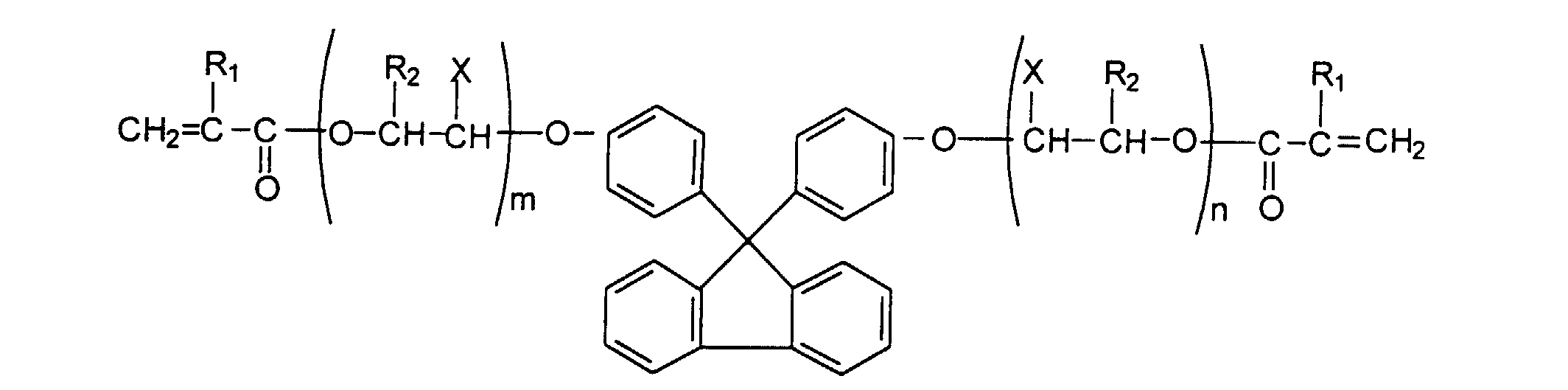
- R1 = H or alkyl,
- R2 = H or alkyl,
- X = H or OH
- m and n are integers provided that the sum of m and n is from 0 to 4; 5 to 60% by weight of a polyoxyalkylene glycol diacrylate or dimethacrylate; and
-
- The crosslinkable polymeric casting composition according to the present invention may be utilised in the preparation of an optical article. The presence of the fluorene structure provides high refractive index plus good all round properties such as heat stability, abrasion resistance and impact strength. This may be achieved without the usual negative features of high index monomers such as smell, toxicity, brittleness or low softening temperatures.
- By the term "high refractive index", as used herein, we mean a polymer having a refractive index of at least approximately 1.55, preferably 1.57 more preferably 1.60 or higher.
- The fluorene diacrylate or dimethacrylate is of the general formulawherein
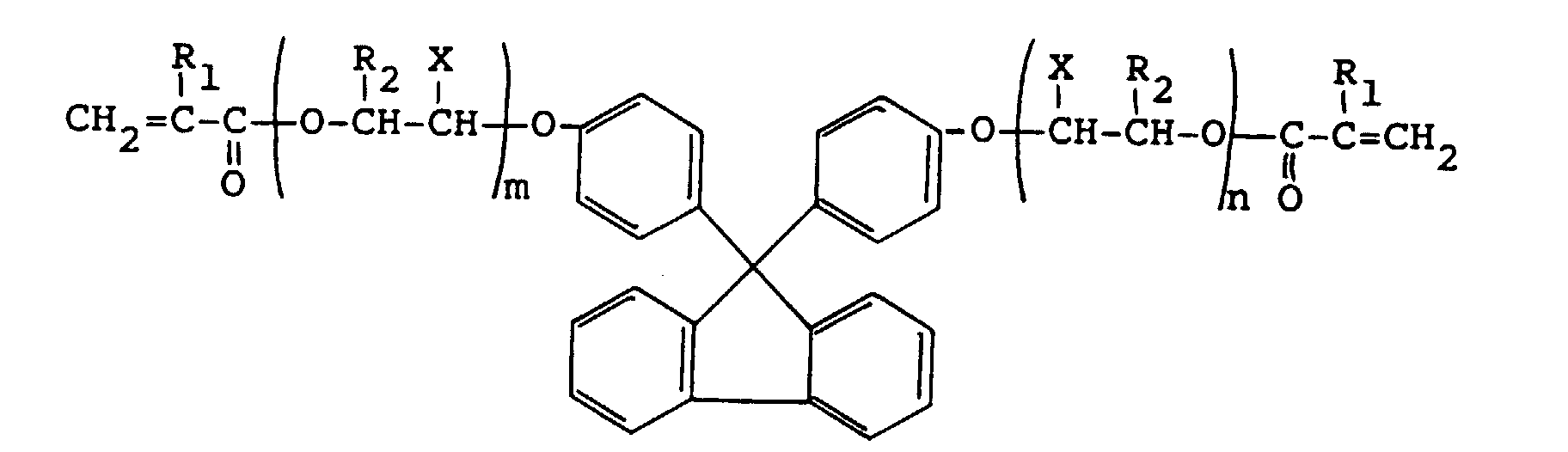
- R1 = H or alkyl, preferably CH3
- R2 = H or alkyl, preferably CH3
- X = H or OH
- m and n are integers provided that the sum of m and n is from 0 to 4
-
- The fluorene monomer may be selected from a bisphenol fluorene dihydroxyacrylate (BFHA) or a bisphenol fluorene dimethacrylate (BFMA) or mixtures thereof.
- The fluorene diacrylate or dimethacrylate monomer may be present in an amount suitable to provide a casting composition having a viscosity of not greater than approximately 300 mPas (300 cps) at 25°C. The fluorene diacrylate or dimethacrylate monomer is present in amounts of from 5 to 30% by weight, based on the total weight of the casting composition.
- The polymerisable comonomer may be selected to improve the properties and/or processability of the cross-linkable polymeric casting composition.
- The thiodiacrylate or dimethacrylates may be selected from bis(4-methacryloylthioethyl)sulfide (BMTES) and bis(4-methacryloylthiophenyl)sulfide (BMTS or TS). When present, the thiodiacrylate is present in amounts of from approximately 5 to 40% by weight, preferably 20 to 40% by weight.
- The polyoxy alkylene glycol diacrylate or dimethacrylate compound according to the present invention may include ethylene oxide or propylene oxide repeating units in its backbone. A polyethylene glycol dimethacrylate is preferred. One suitable material is that sold under the trade name NKESTER 9G (RTM) by Shin Nakamura. Alternatively, an NK Ester (RTM) 6G, 4G or 14G may be used.
- The polyoxy alkylene glycol diacrylate or dimethacrylate component is present in amounts of from approximately 5% by weight to 60% by weight based on the total weight of the casting composition. The diacrylate or dimethacrylate component is preferably present in amounts of approximately 15% by weight to 55% by weight, more preferably 20 to 45% by weight.
- When present, the high index bisphenol monomer component in the cross-linkable casting composition is selected from: dimethacrylate and diacrylate esters of bisphenol A; dimethacrylate and diacrylate esters of 4,4'bishydroxyethoxy-bisphenol A and mixtures thereof.
- A preferred high index bisphenol compound is a bisphenol A ethoxylated dimethacrylate. A bisphenol A ethoxylated dimethacrylate sold under the trade designation ATM20 (RTM) by Ancomer or Bis GMA (RTM) by Freeman Chemicals have been found to be suitable. Halogenated high index bisphenol compounds which may be used include those sold under the trade designation and NK Ester 534M (RTM) by Shin Nakamura.
- When present, the high index bisphenol monomer is present in amounts of from approximately 10 to 60% by weight, preferably 20 to 55% by weight, based on the total weight of the casting composition.
- As stated above, the cross-linkable polymeric casting composition may include a urethane monomer having 2 to 6 terminal acrylic and/or methacrylic groups. Suitable materials falling within this definition include materials supplied under the trade names U-4H, U-4HA and U-6HA (RTMs) by Shin Nakamura, NF-201 and NF-202 (RTMs) by Mitsubishi Rayon. These monomers are included to improve physical toughness without causing the lens material to become too brittle. Impact resistance is improved without adversely affecting abrasion resistance.
- The urethane monomer may be present in any suitable amount to provide a desired level of hardness. When present, the urethane monomer is present in amounts of from 2.5% to 25% by weight, preferably 5% to 20% by weight, based on the total weight of the casting composition. The cross-linkable polymeric coating composition may include at least one poly-functional unsaturated cross-linking agent.
- The poly-functional unsaturated cross-linking agent according to the present invention is selected from the group consisting of tri-or-tetra- function vinyls, and acrylic or methacrylic monomers. The cross-linking agent may be a short chain monomer for example trimethylol propane trimethacrylate, pentaerythritol triacrylate or tetracrylate. Other polyfunctional cross-linking agents which may be used include NK Ester TMPT, NK Ester A-TMPT, NK Ester A-TMM-3, NK Ester A-TMMT (RTMs) ditrimethylol propane tetracrylate, trimethylolpropane triacrylate, pentaerythritrol tetramethacrylate, dipentaerythritol monohydroxypenta acrylate, pentaerythritol triacrylate, ethoxylated trimethylolpropane triacrylate, ethoxylated trimethylol- propane trimethacrylate.
- A material sold under the trade name SR-454 which is an ethoxylated trimethylol propane triacrylate has been found to be suitable.
- When present, the polyfunctional unsaturated cross-linking agent is present in amounts of from 5 to 45% by weight, preferably 30 to 40% by weight based on the total weight of the casting composition.
- The cross-linkable casting composition may further include a coreactant including a polythiol.
- The polythiol may be selected from the group consisting of
- (a) Pentaerythritol Tetrakis (3-mercapto-propionate)
[PTMP]

- (b) Trimethylolpropane Tris (3-mercaptopropionate)
[TTMP]

- (c) 4-mercaptomethyl-3,6-dithia-1,8-octanedithiol [MDO]
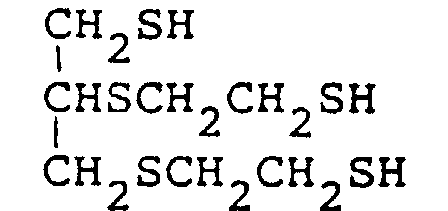
- (d) Pentaerythritol Tetrakis (3-mercaptoacetate) [PTMA]

- (e) Trimethylolpropane Tris (3-mercaptoacetate) [TTMA]

- (f) 4-t-butyl-1,2-benzenedithiol
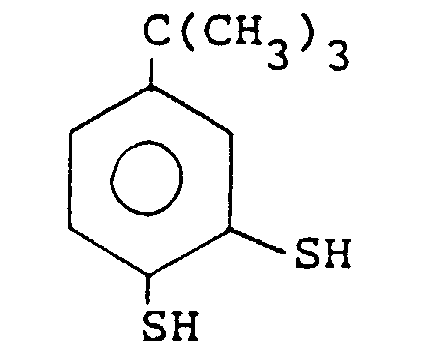
- (g) 2-mercaptoethylsulfide
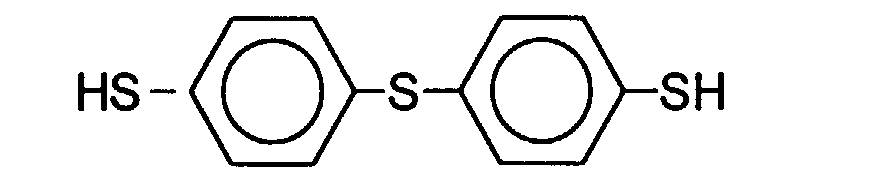
- (h) 4,4'-thiodibenzenethiol

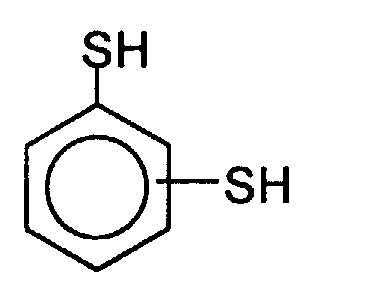
- (i) benzenedithiol

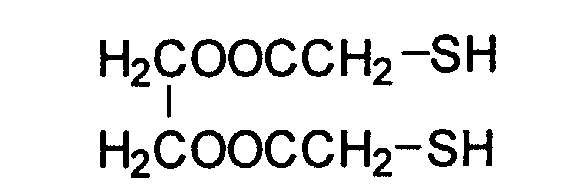
- (j) Glycol Dimercaptoacetate

- (k) Glycol Dimercaptopropionate Ethylene bis(3-Mercaptopropionate)
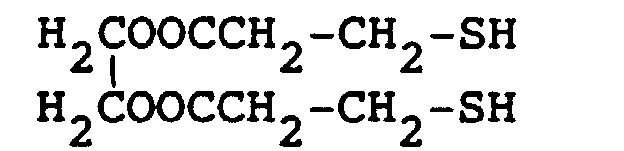
- (l) Polyethylene Glycol Dimercaptoacetates

- (m) Polyethylene Glycol Di(3-Mercaptopropionates)

-
- The thiol compound may be present in amounts from 0 to approximately 50% by weight.
- The cross-linkable casting composition according to the present invention may further include an initiator. The initiator may be a heat and/or ultraviolet (U.V.) initiator.
- The compositions are preferably cured by a combination of UV radiation and heat. The combination of UV radiation and heat may reduce the possibility of incomplete curing for example due to the phenomenon known as "radical trapping".
- The composition, with the addition of approximately 0.2 to 2.0% by weight of cross-linking initiator may be exposed to UV radiation for between 0.5 and 10 seconds.
- Any commercially viable UV curing system may be used. We have used a Fusion System with microwave driven lamps. A number of fusion bulbs with different output Spectra may be considered. Presently we prefer the "D" bulb and the "V" bulb.
- One source we have found satisfactory is a 25cm, 120 watt/cm [10 inch, 300 watt/inch] mercury lamp. The mould assembly is then heated to 100°C for one hour or the lens may be removed from the assembly and heated in air for about one hour at 100°C. This means that fully cured lenses can be manufactured, if desired, in about one hour. Heat curing can also be used without any use of U.V. radiation.
- Typically 2 - 4 passes under the UV lamps plus an hour of heat treatment at 100°C completes the cure.
- Any suitable UV initiator may be used. An initiator available under the trade designation Irgacure 184 has been found to be satisfactory. More than one curing agent may be present. It has been possible to operate with a relatively low level of initiator of between approximately 0.05 and 0.25% by weight.
- A range of photoinitiators available commercially can be used, depending on sample thickness, type of UV lamp used and the absorption wavelength of the monomer mix.
- The following photoinitiators (which are sold under the given RTMs) have been found to be suitable.
- Alcolac Vicure 10 - isobutyl benzoin ether
- Alcolac Vicure 30 - isopropyl benzoin ether
- Alcolac Vicure 55 (V55) - methyl phenyl glyoxylate
- Cyracure UV1-6974 (cationic photoinitiator) Triaryl sulfonium hexafluoroantimonate
- Lucirin TPO (radical photoinitiator) 2,4,6-Trimethylbenzoyldiphenylphosphine oxide
- Vicure 55 (radical photoinitiator) methyl phenylglyoxylate benzoic acid
- Initiator may be a single component or combination of initiator components.
- Additionally, combination of photoiniator mixtures or photoinitiator mixtures with a heat induced free radical initiator such as peroxides, peroxypercarbonates or an azo compound may also be employed.
- As an alternative to photo curing a heat curing initiator may be used, for example 1,1 di-tert butyl peroxy -3,3,5- trimethylcyclohexane or secondary isopropyl percarbonate.
- Other additives may be present which are conventionally used in casting compositions such as inhibitors, dyes, UV stabilisers and materials capable of modifying refractive index. Mould release agents can be added but they are in general not required with the compositions used in the method of the present invention. Such additives (which were sold udner the given RTMs)
-
- Ciba Geigy Tinuvin P - 2(2'-hydroxy-5'methyl phenyl) benzotriazole
- Cyanamid Cyasorb UV 531 -2-hydroxy-4-n-octoxybenzophenone
- Cyanamid Cyasorb UV5411-2(2-hydroxy-5-t-octylphenyl)-benzotriazole
- Cyanamid UV 2098 - 2-hydroxy-4-(2-acryloyloxyethoxy) benzophenone
- National Starch and Chemicals Permasorb MA - 2 hydroxy-4-(2 - hydroxy-3- methacryloxy)propoxy benzophenone
- Cyanamid UV24 - 2,2'-dihydroxy-4-methoxybenzophenone
- BASF UVINUL 400 - 2,4 dihydroxy-benzophenone
- BASF UVINUL D-49 - 2,2'-dihydroxy-4,4' dimethoxybenzophenone
- BASF UVINUL D-50 - 2,2', 4,4' tetrahydroxy benzophenone
- BASF UVINUL D-35-ethyl-2-cyano-3,3-diphenyl acrylate
- BASF UNINYL N-539-2-ethexyl-2-cyano-3,3-diphenyl acrylate
- Ciba Geigy Tinuvin 213
-
- Ciba Geigy Tinuvin 765/292 - bis (1,2,2,6,6-pentamethyl-4-piperidyl)sebacate
- Ciba Geigy 770 - bis (2,2,6,6-tetramethyl-4-piperidinyl) sebacate
-
- Ciba Geigy Irganox 245 - triethylene glycol-bis-3-(3-tertbutyl-4-hydroxy-5-methyl phenyl)propionate
- Irganox 1010 -2,2-bis[[3-[3,4-bis(1,1-dimethylethyl)-4-hydroxyphenyl]-1-oxopropoxy]methyl]-1,3-propanediyl 3,5-bis(1,1-dimethyl ethyl)-4-hydroxy benzene propanoate
- Irganox 1076 - octadecyl 3-(3',5'-di-tert-butyl(-4'-hydroxyphenyl) propionate
-
- Triphenyl phosphine
- 9, 10 dihydro-9-oxa-10-phosphaphenanthrene-1-oxide
- Cure modifiers including
- Dodecyl mercaptan
- Butyl mercaptan
- Thiophenol
- Nofmer from Nippon Oils and Fats
- Q1301 from Waco
- Other monomeric additives can be present in amounts up to 10% by weight as diluents, and include monomers such as methacrylic acid, vinyl silanes, methyl allyl, hydroxy ethyl, methacrylate. Other monomeric additives may be included to improve processing and/or material properties, these include:
- methacrylic acid, maleic anhydride, acrylic acid
- adhesion promoters/modifiers such as Sartomer 9008, Sartomer 9013, Sartomer 9015 etc.
- dye-enhancing, pH-adjusting monomers like Alcolac SIPOMER 2MIM
- a charge-reducing cationic monomer to render the material more antistatic, example Sipomer Q5-80 or Q9-75
- hydrophobic comonomers: Shin Nakamura NPG, P9-G etc. to reduce the water adsorption of the material
- viscosity modifiers
- Accordingly, in a preferred aspect of the present invention the cross-linkable polymeric casting composition may further include
at least one aliphatic glycol dimethacrylate or diacrylate. - The aliphatic glycol dimethacrylate or diacrylate may function to reduce the viscosity of the composition and thus improve the processing characteristics of the composition.
- An ethylene, propylene, butylene or pentylene diacrylate or methacrylate may be used. A butylene glycol dimethacrylate is preferred. One suitable material is that sold under the trade designation NK ester BD (RTM) by Shin Nakamura.
- A neopentyl glycol dimethactylate may be used. One suitable material is that sold under the trade designation NK ester NPG (RTM) by Shin Nakamura.
- The aliphatic glycol dimethacrylate or diacrylate may be present in amounts of 1 to 10% by weight, preferably 2.5 to 5% by weight based on the total weight of the casting composition.
- In a further aspect of the present invention there is provided a polymeric article formed from a cross linkable casting composition as described above. The polymeric article may be an optical article. The optical article may provide characteristics equal to or greater than those achievable with articles made from diethylene glycol bis(allyl carbonate) but with a considerably reduced cure time and substantially increased throughput. The optical article may be further characterised by having an increased refractive index without degrading other important lens properties such as density, abrasion, impact, colour, and rigidity (hardness and heat resistance).
- The overall refractive index may be in the mid to high refractive index range of from approximately 1.51 to 1.59, preferably 1.53 to 1.57.
- The optical articles prepared by the method of this invention include camera lenses, ophthalmic lenses and video discs.
- The casting composition may be formed into a suitable article by mixing in a convenient vessel the components making up the material, and then adding the curing catalyst and/or photo-initiator. The mixed material is then degassed or filtered. As the curing time is substantially reduced the casting process may be undertaken on a continuous or semi-continuous basis.
- The present invention will now be more fully described with reference to the accompanying examples.
- A cross-linkable casting composition having the following components was prepared
% by weight 9G (polyethylene glycol dimethacrylate) 45% SR-454 (ethoxylated trimethyl propanetriacrylate) 35% U4HA (urethane tetracrylate) 15% BFHA (bisphenolfluorene dihydroxyacrylate) 5% - The monomer mix was prepared in a beaker together with 0.2% V55 as the U.V. initiator.
- The casting material was used to fill the space between a pair of glass moulds separated by a plastic gasket at their periphery. The mould was then passed 4 times under a U.V. lamp. This was followed by a 1 hour extended cure at 100°C.
- Example 1 was repeated under similar conditions with monomer mixes as designated in Table 1 below. The results achieved are also given in Table 1. Satisfactory lenses were achieved in Examples 1, 3, 4, 5, 8, 9, 10, 12, 13 and 14.
Examples of Using BFHA as a Casting Material Ex. Casting Material S.G. R.I. Impact Y.I. Taber Abrasion Barcol Hard. 1. 9G/S454/ U4HA/BFHA 45/35/15/5 1.23 1.512 Good 1.0 Good 19 2. 9G/S454/U4HA 45/35/20 (Comparative) 1.23 1.507 Good 1.0 Good 17 3. 9G/S454/ U4HA/BFHA 45/35/10/10 1.23 1.517 Good 1.0 Good 20 4. 9G/S454/ U4HA/BFHA 45/35/5/15 1.23 1.522 Good 0.9 Good 17 5. 9G/S454/BFHA 45/35/20 1.23 1.529 Good 1.0 Good 15 6. 9G/U4HA/ATM20 45/5/50 (Comparative) 1.21 1.537 Good 1.0 Good 23 7. 9G/U4HA/ATM20 35/5/60 (Comparative) 1.11 1.543 Poor 1.4 Poor 28 8. 9G/U4HA/ ATM20/BFHA 45/5/40/10 1.22 1.542 Good 1.0 Good 24 9. 9G/U4HA/ ATM20/BFHA 45/5/30/20 1.23 1.549 Good 1.1 Good 25 10. 9G/U4H4/ ATM20/BFHA 45/5/20/30 1.23 1.554 Good 1.1 Good 27 11. 9G/TS/S454/ ATM20 20/30/10/40 (Comparative) 1.24 1.564 Good 2.1 Good 35 12. 9G/TS/S454/ ATM20/BFHA 20/30/10/30/10 1.24 1.570 Good 2.1 Good 38 13. 9G/TS/S454/ ATM20/BFHA 20/30/10/20/20 1.25 1.576 Good 2.1 Good 40 14. 9G/TS/S454/ ATM20/BFHA 20/30/10/10/30 1.25 1.582 Good 2.1 Good 42 - Apparatus used to assess the abrasion resistance of lens materials. It involves the use of an abrasive wheel rubbed across a lens surface. Degree of abrasion is assessed according to the level of haze induced by wear.
- Measure of the hardness of a lens material. A fixed force is applied to a needle point. The depth of penetration indicates the degree of hardness.
- A measure of the degree of yellowness as assessed by the Gardiner Colorimeter Model XL835.
- Examples 1, 3, 4 and 5 should be compared with Example 2 showing how RI can be improved by using BFHA.
- Similarly, Examples 8, 9 and 10 should be compared with Example 7, and Examples 12, 13 and 14 should be compared with Example 11.
- This is measured on the Abbe Refractometer.
- This is measured by weighing the material in air and water, and applying Archimede's Principle.
- This is determined by a drop-ball method according to ANSI standards.
-
9G polyethylene glycol dimethacrylate SR-454 ethoxylated trimethyl propanetriacrylate U4HA urethane tetracrylate BFHA bisphenolfluorene dihydroxyacrylate ATM20 bisphenol A ethoxylated dimethacrylate TS bis(4-methacryloylthiophenyl)sulfide
at least one comonomer selected from the group consisting of 2.5% to 25% by weight of a urethane monomer having 2 to 6 terminal acrylic and/or methacrylic groups; 5 to 45% by weight of a polyfunctional unsaturated cross-linking agent selected from the group consisting of tri- and tetrafunctional vinyls, and acrylic and methacrylic monomers; 10 to 60% by weight of a bisphenol monomer selected from the group consisting of dimethacrylate and diacrylate esters of bisphenol A, dimethacrylate and diacrylate esters of 4,4'bishydroxy-ethoxy-bisphenol A and mixtures thereof; and 5 to 40% by weight of a thiodiacrylate or thiodimethacrylate; or mixtures thereof.
Claims (14)
- A cross-linkable polymeric casting composition suitable for use in the formation of an optical article having a refractive index in the range of 1.51 to 1.60 including
5 to 30% by weight based on the total weight of the casting composition of a fluorene diacrylate or dimethacrylate monomer selected from monomers of the general formulawherein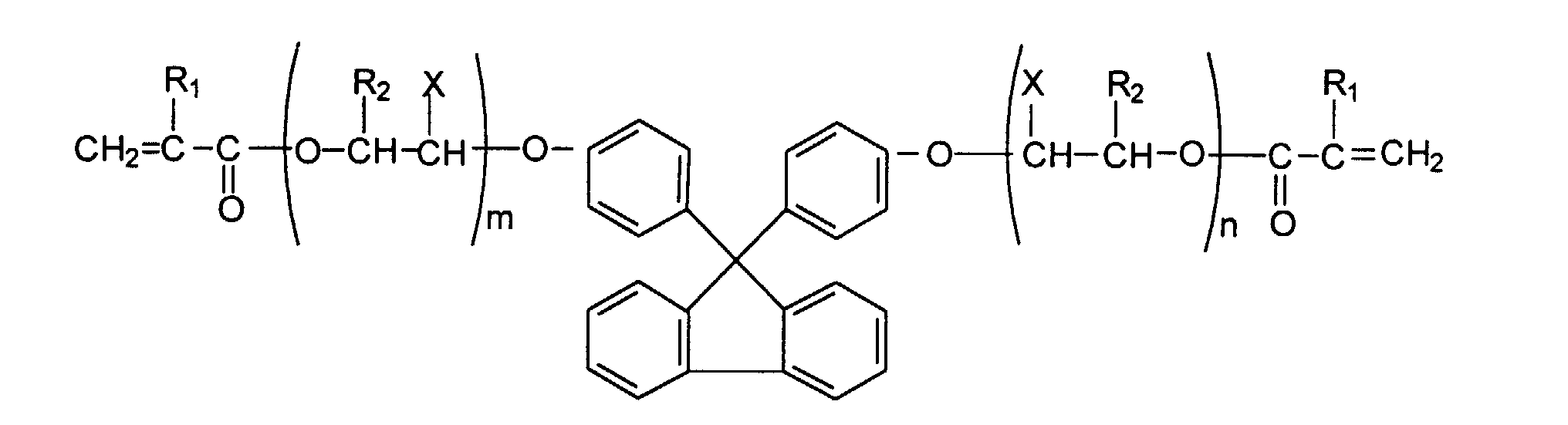 andR1 = H or alkyl,R2 = H or alkyl,X = H or OHm and n are integers provided that the sum of m and n is from 0 to 4; 5 to 60% by weight of a polyoxyalkylene glycol diacrylate or dimethacrylate;
at least one comonomer selected from the group consisting of 2.5% to 25% by weight of a urethane monomer having 2 to 6 terminal acrylic and/or methacrylic groups; 5 to 45% by weight of a polyfunctional unsaturated cross-linking agent selected from the group consisting of tri- and tetrafunctional vinyls, and acrylic and methacrylic monomers; 10 to 60% by weight of a bisphenol monomer selected from the group consisting of dimethacrylate and diacrylate esters of bisphenol A, dimethacrylate and diacrylate esters of 4,4'bishydroxy-ethoxy-bisphenol A and mixtures thereof; and 5 to 40% by weight of a thiodiacrylate or thiodimethacrylate; or mixtures thereof. - A casting composition according to claim 1, wherein the polyoxyalkylene glycol diacrylate or dimethacrylate is present in an amount of from 20 to 60% by weight of the casting composition.
- A casting composition according to claim 1 or claim 2, wherein the composition is suitable for use in the formation of an optical article having a refractive index in the range of 1.55 to 1.60.
- A casting composition according to any one of claims 1, 2 and 3, wherein the fluorene monomer is selected from a bisphenol fluorene dihydroxyacrylate (BFHA) or a bisphenol fluorene dimethacrylate (BFMA) or mixtures thereof.
- A casting composition according to any one of the preceding claims, wherein the polyoxyalkylene glycol diacrylate or dimethacrylate compound is a polyethylene glycol dimethacrylate.
- A casting composition according to any one of the preceding claims wherein the urethane monomer is a tetracrylic urethane monomer.
- A casting composition according to any one of claims 1 to 5 wherein the cross-linking agent is an ethoxylated trimethylol propane triacrylate.
- A casting composition according to any one of claims 1 to 5 wherein the bisphenol compound is a bisphenol A ethoxylated dimethacrylate.
- A casting composition according to any one of claims 1 to 5 wherein the thiodiacrylate or thiodimethacrylate is selected from bis(4-methacryloylthioethyl)sulfide (BMTES) and bis(4-methacryloylthiophenyl)sulfide (BMTS or TS).
- A casting composition according to any one of the preceding claims further including a coreactant including a polythiol selected from the group consisting of(a) Pentaerythritol Tetrakis (3-mercapto-propionate) [PTMP]
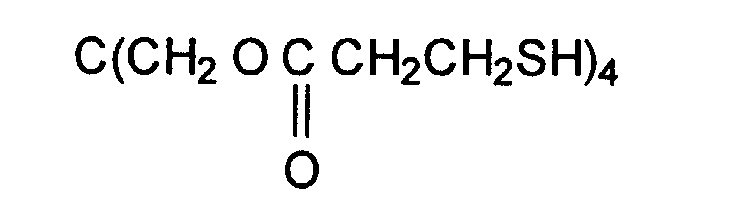 (b) Trimethylolpropane Tris (3-mercaptopropionate) [TTMP]
 (c) 4-mercaptomethyl-3,6-dithia-1,8-octanedithiol [MDO]
 (d) Pentaerythritol Tetrakis (3-mercaptoacetate) [PTMA]
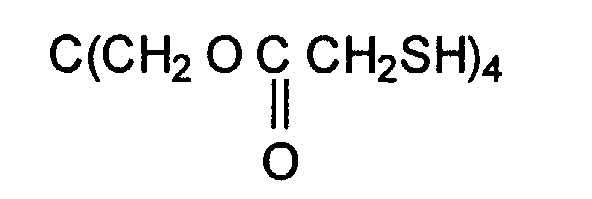 (e) Trimethylolpropane Tris (3-mercaptoacetate) [TTMA]
 (f) 4-t-butyl-1,2-benzenedithiol
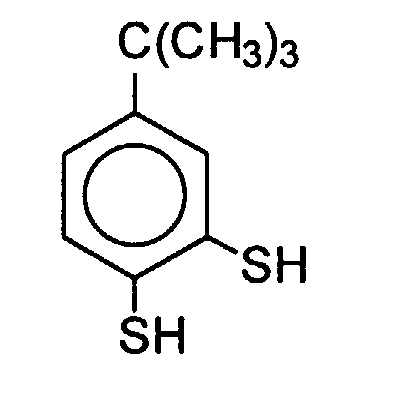 (g) 2-mercaptoethylsulfide(h) 4,4'-thiodibenzenethiol
 (i) benzenedithiol
 (j) Glycol Dimercaptoacetate
 (k) Glycol Dimercaptopropionate Ethylene bis(3-Mercaptopropionate)
 (l) Polyethylene glycol Dimercaptoacetates
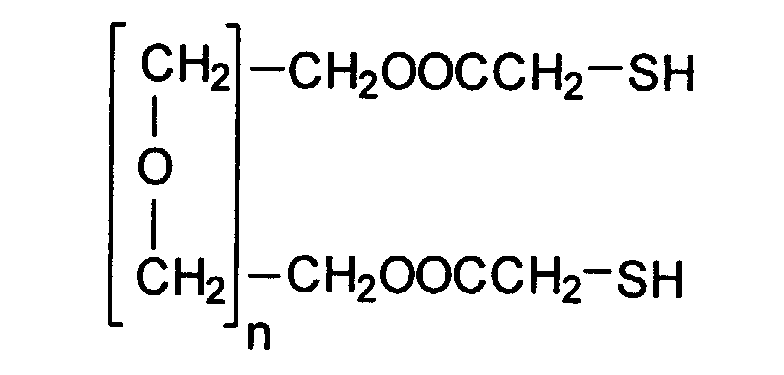 (m) Polyethylene Glycol Di(3-Mercaptopropionates)
- A casting composition according to claim 1 including5 to 30% by weight, based on the total weight of the casting composition, of the fluorene diacrylate or dimethacrylate monomer;20 to 45% by weight of a polyethylene glycol dimethacrylate;5 to 20% by weight of a tetracrylic urethane monomer; and10 to 40% by weight of an ethoxylated trimethylol propane triacrylate.
- A casting composition according to claim 1 including5 to 30% by weight, based on the total weight of the casting composition, of the fluorene diacrylate or dimethacrylate monomer;20 to 45% by weight of a polyethylene glycol dimethacrylate;5 to 20% by weight of a tetracrylic urethane monomer;20 to 55% by weight of a high index bisphenol A ethoxylated dimethacrylate.
- A casting composition according to claim 12 including5 to 40% by weight of a thiodimethacrylate selected from bis (4-methacryloyl-thioethyl) sulfide (BMTES) and bis (4-methacryloyl-thiophenyl) sulfide (BMTS or TS).
- A polymeric optical article formed from a casting composition according to any one of claims 1 to 13 and having a refractive index in the range of 1.51 to 1.60.
Applications Claiming Priority (2)
| Application Number | Priority Date | Filing Date | Title |
|---|---|---|---|
| AU5864/92 | 1992-11-16 | ||
| AUPL586492 | 1992-11-16 |
Publications (3)
| Publication Number | Publication Date |
|---|---|
| EP0598552A2 EP0598552A2 (en) | 1994-05-25 |
| EP0598552A3 EP0598552A3 (en) | 1995-02-22 |
| EP0598552B1 true EP0598552B1 (en) | 1999-06-02 |
Family
ID=3776545
Family Applications (1)
| Application Number | Title | Priority Date | Filing Date |
|---|---|---|---|
| EP93308983A Expired - Lifetime EP0598552B1 (en) | 1992-11-16 | 1993-11-10 | Cross-linkable polymeric composition |
Country Status (5)
| Country | Link |
|---|---|
| US (1) | US5502139A (en) |
| EP (1) | EP0598552B1 (en) |
| JP (1) | JP3170122B2 (en) |
| CA (1) | CA2102378A1 (en) |
| DE (1) | DE69325143T2 (en) |
Cited By (1)
| Publication number | Priority date | Publication date | Assignee | Title |
|---|---|---|---|---|
| EP4671284A1 (en) | 2024-06-27 | 2025-12-31 | Carl Zeiss Vision International GmbH | TEMPERABLE EYEGLASS GLASS MATERIAL |
Families Citing this family (43)
| Publication number | Priority date | Publication date | Assignee | Title |
|---|---|---|---|---|
| DE4410526A1 (en) * | 1994-03-26 | 1995-09-28 | Blanco Gmbh & Co Kg | Pourable, hardenable mass, for the production of plastic molded parts |
| JPH11507087A (en) * | 1995-05-30 | 1999-06-22 | ソーラー・インターナショナル・ホールディングズ・リミテッド | High refractive index / high Abbe number composition |
| US6313251B1 (en) | 1995-05-30 | 2001-11-06 | Sola International Holdings, Ltd. | High index/high abbe number composition |
| TW341022B (en) * | 1995-11-29 | 1998-09-21 | Nippon Electric Co | Interconnection structures and method of making same |
| US6468662B1 (en) | 1996-05-07 | 2002-10-22 | Reichhold, Inc. | Low monomer containing laminating resin compositions |
| EP0900244A4 (en) * | 1996-05-23 | 2000-05-10 | Sola Int Holdings | UV CURABLE VINYL ESTERS WITH HIGH REFRACTION INDEX |
| US5917006A (en) * | 1998-01-16 | 1999-06-29 | Ppg Industries Ohio, Inc. | Optical resin composition |
| AUPP155998A0 (en) * | 1998-01-29 | 1998-02-19 | Sola International Holdings Ltd | Coating composition |
| US5976422A (en) * | 1998-03-09 | 1999-11-02 | Ppg Industries Ohio, Inc. | Optical resin composition |
| JP3991472B2 (en) * | 1998-10-05 | 2007-10-17 | Jsr株式会社 | Liquid curable resin composition |
| ATE260306T1 (en) * | 1998-12-11 | 2004-03-15 | Biocompatibles Uk Ltd | CROSS-LINKED POLYMERS AND REFRACTION DEVICE MOLDED THEREOF |
| US6309585B1 (en) | 1999-04-23 | 2001-10-30 | Rodenstock North America, Inc. | Curable casting compositions having a high refractive index and high impact resistance |
| US6583196B2 (en) | 1999-04-23 | 2003-06-24 | Rodenstock North America, Inc. | Curable casting compositions having a high refractive index and high impact resistance |
| US6258218B1 (en) | 1999-10-22 | 2001-07-10 | Sola International Holdings, Ltd. | Method and apparatus for vacuum coating plastic parts |
| US6545064B1 (en) * | 1999-11-24 | 2003-04-08 | Avery Dennison Corporation | Coating composition comprising ethoxylated diacrylates |
| KR100500092B1 (en) * | 1999-11-29 | 2005-07-11 | 오므론 가부시키가이샤 | Light-resistant microlens array and resin composition for use therein |
| US6440280B1 (en) | 2000-06-28 | 2002-08-27 | Sola International, Inc. | Multi-anode device and methods for sputter deposition |
| JP3767676B2 (en) * | 2000-09-12 | 2006-04-19 | 信越化学工業株式会社 | Organosiloxane polymer compound, photocurable resin composition, pattern forming method, and film for protecting substrate |
| JP4530565B2 (en) * | 2001-03-29 | 2010-08-25 | 大阪瓦斯株式会社 | Monoacrylate fluorene compound, composition containing the compound, and cured product thereof |
| JP4750473B2 (en) * | 2004-06-10 | 2011-08-17 | 日本合成化学工業株式会社 | Active energy ray curable resin composition and coating agent using the same |
| EP1830204B1 (en) * | 2004-12-20 | 2018-10-17 | Nikon Corporation | Close-bonded diffractive optical element, optical material used therefor |
| KR100544824B1 (en) * | 2005-01-27 | 2006-01-24 | 주식회사 코오롱 | Composition for forming a prism layer and a prism film prepared therefrom |
| KR100671120B1 (en) * | 2005-07-28 | 2007-01-17 | 제일모직주식회사 | Novel fluorene polymer and hard mask composition having antireflection using same |
| JP2007291321A (en) * | 2006-03-27 | 2007-11-08 | Sanyo Electric Co Ltd | Curable organometallic composition, organometallic polymer material and optical component |
| US7446159B1 (en) * | 2007-09-20 | 2008-11-04 | Sony Corporation | Curable resin composition |
| TWI379840B (en) * | 2008-08-01 | 2012-12-21 | Eternal Chemical Co Ltd | Polymerizable composition and its uses |
| JP5618510B2 (en) * | 2008-09-22 | 2014-11-05 | キヤノン株式会社 | Optical material and optical element |
| TWI490194B (en) * | 2009-09-18 | 2015-07-01 | Eternal Chemical Co Ltd | Polymerizable composition and its uses |
| JP2011157437A (en) * | 2010-01-29 | 2011-08-18 | Dic Corp | Curable resin composition, cured product thereof, and plastic lens |
| JP5571968B2 (en) * | 2010-02-05 | 2014-08-13 | 大阪ガスケミカル株式会社 | Curable composition and cured product thereof |
| JP2011184623A (en) * | 2010-03-10 | 2011-09-22 | Dic Corp | Curable resin composition, cured product thereof and plastic lens |
| WO2011124522A1 (en) | 2010-04-06 | 2011-10-13 | Ferrania Technologies S.P.A. | Composite film material comprising a resin of fluorene crotonate, fluorene cinnamate, fluorene acrylate, fluorene methacrylate, fluorene allylether or a combination thereof |
| JP5610200B2 (en) * | 2010-06-10 | 2014-10-22 | 三菱レイヨン株式会社 | Active energy ray-curable resin composition for casting and optical component |
| JP5840611B2 (en) * | 2010-08-09 | 2016-01-06 | 株式会社ダイセル | Curable composition and cured product thereof |
| JP5760522B2 (en) * | 2011-03-07 | 2015-08-12 | 帝人株式会社 | PHOTOCURABLE RESIN COMPOSITION, ARTICLE HAVING CURED CURTAIN THEREOF, AND PRODUCTION METHOD THEREFOR |
| JP5827852B2 (en) * | 2011-08-04 | 2015-12-02 | 株式会社ダイセル | Manufacturing method of wafer level lens |
| CN103415542B (en) | 2012-03-12 | 2015-01-07 | Dic株式会社 | Radical polymerizable composition, cured product thereof, and plastic lens |
| KR101354539B1 (en) | 2012-04-13 | 2014-01-23 | 주식회사 아이에스엠 | Photosensitive polymer for thick layer and a composition comprising the same |
| WO2014157676A1 (en) * | 2013-03-29 | 2014-10-02 | 東京応化工業株式会社 | Vinyl-group-containing fluorene compound |
| EP2980058B1 (en) | 2013-03-29 | 2023-05-03 | Tokyo Ohka Kogyo Co., Ltd. | Composition containing vinyl-group-containing compound |
| CN105073699B (en) | 2013-03-29 | 2019-10-25 | 东京应化工业株式会社 | Compounds containing structural units derived from vinyl ether compounds |
| CN113637442B (en) * | 2021-08-12 | 2023-09-22 | 太仓申威新材料科技有限公司 | Ultraviolet light curing transfer printing adhesive composition for microprism reflective film and preparation method and application thereof |
| US20250136738A1 (en) * | 2022-03-28 | 2025-05-01 | Mitsui Chemicals, Inc. | Curable composition, cured product, molded body, and optical material |
Family Cites Families (15)
| Publication number | Priority date | Publication date | Assignee | Title |
|---|---|---|---|---|
| GB175162A (en) | 1920-12-29 | 1922-02-16 | Matthew Michael Waters | Apparatus for distributing inert dust in coal mines |
| GB428991A (en) | 1933-09-01 | 1935-05-22 | Harry Cohen | Improvements in tap washers |
| US4663412A (en) * | 1984-10-31 | 1987-05-05 | Ecoplastics Limited | Fluorene containing compounds and negative photoresist compositions therefrom |
| EP0269366B1 (en) * | 1986-11-21 | 1995-06-07 | Sola International Holdings, Ltd. | Cross-linkable casting compositions |
| EP0273710B2 (en) * | 1986-12-26 | 1996-10-16 | Nippon Shokubai Kagaku Kogyo Co., Ltd | Resin having high refractive index, process for producing said resin and optical materials composed of said resin |
| US5270439A (en) * | 1988-10-20 | 1993-12-14 | Sumitomo Seika Chemicals Co., Ltd. | Method of producing a curable composition containing 4,4'-bis(methacryloylthio)diphenylsulfide |
| US5191055A (en) * | 1988-12-22 | 1993-03-02 | Mitsui Toatsu Chemicals, Inc. | Mercapto compound, a high refractive index resin and lens and a process for preparing them |
| JPH03106918A (en) * | 1989-09-19 | 1991-05-07 | Nitto Denko Corp | Ultraviolet-curable resin composition |
| US5196296A (en) * | 1989-10-06 | 1993-03-23 | Nippon Steel Corporation | Epoxy acrylate resins and photosensitive resin compositions therefrom |
| US5034433A (en) * | 1990-04-10 | 1991-07-23 | Essential Dental Systems, Inc. | Composite dental cement composition containing titanium |
| US5373033A (en) * | 1990-04-20 | 1994-12-13 | Sola International Holdings Limited | Casting composition |
| JP3130555B2 (en) * | 1991-04-26 | 2001-01-31 | 三菱レイヨン株式会社 | Plastic lens materials, plastic lenses and spectacle lenses |
| JPH04345608A (en) * | 1991-05-23 | 1992-12-01 | Nippon Kayaku Co Ltd | Material for color filter and its cured product |
| JP2859761B2 (en) * | 1991-07-03 | 1999-02-24 | 日本化薬株式会社 | Radiation-curable resin composition and cured product thereof |
| JPH0570528A (en) * | 1991-09-11 | 1993-03-23 | Nippon Steel Corp | Alkali-soluble photosensitive resin and alkaline-developable photosensitive resin composition using the same |
-
1993
- 1993-11-03 CA CA002102378A patent/CA2102378A1/en not_active Abandoned
- 1993-11-10 EP EP93308983A patent/EP0598552B1/en not_active Expired - Lifetime
- 1993-11-10 DE DE69325143T patent/DE69325143T2/en not_active Expired - Fee Related
- 1993-11-15 JP JP28515693A patent/JP3170122B2/en not_active Expired - Fee Related
-
1995
- 1995-04-20 US US08/426,480 patent/US5502139A/en not_active Expired - Fee Related
Cited By (2)
| Publication number | Priority date | Publication date | Assignee | Title |
|---|---|---|---|---|
| EP4671284A1 (en) | 2024-06-27 | 2025-12-31 | Carl Zeiss Vision International GmbH | TEMPERABLE EYEGLASS GLASS MATERIAL |
| WO2026003292A1 (en) | 2024-06-27 | 2026-01-02 | Carl Zeiss Vision International Gmbh | Curable spectacle lens material |
Also Published As
| Publication number | Publication date |
|---|---|
| DE69325143T2 (en) | 1999-11-25 |
| CA2102378A1 (en) | 1994-05-17 |
| US5502139A (en) | 1996-03-26 |
| DE69325143D1 (en) | 1999-07-08 |
| EP0598552A2 (en) | 1994-05-25 |
| JP3170122B2 (en) | 2001-05-28 |
| EP0598552A3 (en) | 1995-02-22 |
| JPH072939A (en) | 1995-01-06 |
Similar Documents
| Publication | Publication Date | Title |
|---|---|---|
| US5502139A (en) | Cross-linkable polymeric composition | |
| US5373033A (en) | Casting composition | |
| EP0828766B1 (en) | High index/high abbe number composition | |
| EP0453149B1 (en) | Casting composition | |
| EP0269366B1 (en) | Cross-linkable casting compositions | |
| US6391983B1 (en) | Casting composition of aromatic polyvinyl monomer, polythiol and epoxy strain reducer | |
| US6313251B1 (en) | High index/high abbe number composition | |
| WO1999038924A1 (en) | Coating composition | |
| US6172140B1 (en) | Acrylic thio monomers | |
| AU665124B2 (en) | Cross-linkable polymeric composition | |
| EP0598551A2 (en) | Cross-linkable polymeric composition | |
| EP0900244A1 (en) | Uv curable high index vinyl esters | |
| WO1995000577A1 (en) | Telomer composition | |
| WO1997027223A1 (en) | Process for preparing optical articles | |
| AU601779B2 (en) | Cross-linkable casting composition | |
| MXPA02009496A (en) | Photochromic article and method of preparation. | |
| AU717124B2 (en) | Cross-linkable polymeric composition | |
| AU709040B2 (en) | High index/high abbe number composition | |
| JP2001011109A (en) | Photosetting resin composition having high refractive index and its cured product | |
| WO2026017551A1 (en) | Curable composition for optical lens by additive manufacturing | |
| AU688325B2 (en) | Telomer composition | |
| AU728612B2 (en) | Process for preparing optical articles | |
| EP0822948A1 (en) | Tintable cross-linkable compositions | |
| WO1998020373A1 (en) | Uv-cured optical elements |
Legal Events
| Date | Code | Title | Description |
|---|---|---|---|
| PUAI | Public reference made under article 153(3) epc to a published international application that has entered the european phase |
Free format text: ORIGINAL CODE: 0009012 |
|
| AK | Designated contracting states |
Kind code of ref document: A2 Designated state(s): AT BE CH DE DK ES FR GB GR IE IT LI LU MC NL PT SE |
|
| RBV | Designated contracting states (corrected) |
Designated state(s): DE FR GB IE IT NL |
|
| PUAL | Search report despatched |
Free format text: ORIGINAL CODE: 0009013 |
|
| AK | Designated contracting states |
Kind code of ref document: A3 Designated state(s): DE FR GB IE IT NL |
|
| 17P | Request for examination filed |
Effective date: 19950614 |
|
| 17Q | First examination report despatched |
Effective date: 19960229 |
|
| GRAG | Despatch of communication of intention to grant |
Free format text: ORIGINAL CODE: EPIDOS AGRA |
|
| GRAG | Despatch of communication of intention to grant |
Free format text: ORIGINAL CODE: EPIDOS AGRA |
|
| GRAH | Despatch of communication of intention to grant a patent |
Free format text: ORIGINAL CODE: EPIDOS IGRA |
|
| GRAH | Despatch of communication of intention to grant a patent |
Free format text: ORIGINAL CODE: EPIDOS IGRA |
|
| GRAA | (expected) grant |
Free format text: ORIGINAL CODE: 0009210 |
|
| AK | Designated contracting states |
Kind code of ref document: B1 Designated state(s): DE FR GB IE IT NL |
|
| PG25 | Lapsed in a contracting state [announced via postgrant information from national office to epo] |
Ref country code: NL Free format text: LAPSE BECAUSE OF FAILURE TO SUBMIT A TRANSLATION OF THE DESCRIPTION OR TO PAY THE FEE WITHIN THE PRESCRIBED TIME-LIMIT Effective date: 19990602 Ref country code: IT Free format text: LAPSE BECAUSE OF FAILURE TO SUBMIT A TRANSLATION OF THE DESCRIPTION OR TO PAY THE FEE WITHIN THE PRESCRIBED TIME-LIMIT;WARNING: LAPSES OF ITALIAN PATENTS WITH EFFECTIVE DATE BEFORE 2007 MAY HAVE OCCURRED AT ANY TIME BEFORE 2007. THE CORRECT EFFECTIVE DATE MAY BE DIFFERENT FROM THE ONE RECORDED. Effective date: 19990602 |
|
| REF | Corresponds to: |
Ref document number: 69325143 Country of ref document: DE Date of ref document: 19990708 |
|
| REG | Reference to a national code |
Ref country code: IE Ref legal event code: FG4D |
|
| ET | Fr: translation filed | ||
| PLBE | No opposition filed within time limit |
Free format text: ORIGINAL CODE: 0009261 |
|
| 26N | No opposition filed | ||
| REG | Reference to a national code |
Ref country code: GB Ref legal event code: IF02 |
|
| PGFP | Annual fee paid to national office [announced via postgrant information from national office to epo] |
Ref country code: GB Payment date: 20021007 Year of fee payment: 10 |
|
| PGFP | Annual fee paid to national office [announced via postgrant information from national office to epo] |
Ref country code: IE Payment date: 20021014 Year of fee payment: 10 |
|
| PGFP | Annual fee paid to national office [announced via postgrant information from national office to epo] |
Ref country code: FR Payment date: 20021024 Year of fee payment: 10 |
|
| PGFP | Annual fee paid to national office [announced via postgrant information from national office to epo] |
Ref country code: DE Payment date: 20021025 Year of fee payment: 10 |
|
| PG25 | Lapsed in a contracting state [announced via postgrant information from national office to epo] |
Ref country code: IE Free format text: LAPSE BECAUSE OF NON-PAYMENT OF DUE FEES Effective date: 20031110 Ref country code: GB Free format text: LAPSE BECAUSE OF NON-PAYMENT OF DUE FEES Effective date: 20031110 |
|
| PG25 | Lapsed in a contracting state [announced via postgrant information from national office to epo] |
Ref country code: DE Free format text: LAPSE BECAUSE OF NON-PAYMENT OF DUE FEES Effective date: 20040602 |
|
| GBPC | Gb: european patent ceased through non-payment of renewal fee |
Effective date: 20031110 |
|
| PG25 | Lapsed in a contracting state [announced via postgrant information from national office to epo] |
Ref country code: FR Free format text: LAPSE BECAUSE OF NON-PAYMENT OF DUE FEES Effective date: 20040730 |
|
| REG | Reference to a national code |
Ref country code: IE Ref legal event code: MM4A |
|
| REG | Reference to a national code |
Ref country code: FR Ref legal event code: ST |