EP0590800A2 - Vorrichtungen zur Kodierung und Dekodierung von Bildern - Google Patents
Vorrichtungen zur Kodierung und Dekodierung von Bildern Download PDFInfo
- Publication number
- EP0590800A2 EP0590800A2 EP93306913A EP93306913A EP0590800A2 EP 0590800 A2 EP0590800 A2 EP 0590800A2 EP 93306913 A EP93306913 A EP 93306913A EP 93306913 A EP93306913 A EP 93306913A EP 0590800 A2 EP0590800 A2 EP 0590800A2
- Authority
- EP
- European Patent Office
- Prior art keywords
- picture
- signal
- pictures
- affine transformation
- encoded
- Prior art date
- Legal status (The legal status is an assumption and is not a legal conclusion. Google has not performed a legal analysis and makes no representation as to the accuracy of the status listed.)
- Withdrawn
Links
Images

Classifications
-
- H—ELECTRICITY
- H04—ELECTRIC COMMUNICATION TECHNIQUE
- H04N—PICTORIAL COMMUNICATION, e.g. TELEVISION
- H04N19/00—Methods or arrangements for coding, decoding, compressing or decompressing digital video signals
- H04N19/50—Methods or arrangements for coding, decoding, compressing or decompressing digital video signals using predictive coding
- H04N19/503—Methods or arrangements for coding, decoding, compressing or decompressing digital video signals using predictive coding involving temporal prediction
- H04N19/51—Motion estimation or motion compensation
- H04N19/527—Global motion vector estimation
-
- H—ELECTRICITY
- H04—ELECTRIC COMMUNICATION TECHNIQUE
- H04N—PICTORIAL COMMUNICATION, e.g. TELEVISION
- H04N19/00—Methods or arrangements for coding, decoding, compressing or decompressing digital video signals
- H04N19/50—Methods or arrangements for coding, decoding, compressing or decompressing digital video signals using predictive coding
- H04N19/503—Methods or arrangements for coding, decoding, compressing or decompressing digital video signals using predictive coding involving temporal prediction
- H04N19/51—Motion estimation or motion compensation
-
- G—PHYSICS
- G06—COMPUTING OR CALCULATING; COUNTING
- G06T—IMAGE DATA PROCESSING OR GENERATION, IN GENERAL
- G06T3/00—Geometric image transformations in the plane of the image
- G06T3/02—Affine transformations
-
- H—ELECTRICITY
- H04—ELECTRIC COMMUNICATION TECHNIQUE
- H04N—PICTORIAL COMMUNICATION, e.g. TELEVISION
- H04N19/00—Methods or arrangements for coding, decoding, compressing or decompressing digital video signals
- H04N19/50—Methods or arrangements for coding, decoding, compressing or decompressing digital video signals using predictive coding
- H04N19/503—Methods or arrangements for coding, decoding, compressing or decompressing digital video signals using predictive coding involving temporal prediction
- H04N19/51—Motion estimation or motion compensation
- H04N19/537—Motion estimation other than block-based
Definitions
- This invention relates to a picture encoding apparatus used for reducing bit rate of a picture signal for the long-term recording, low rate transmission and other purposes, and to a picture decoding apparatus for decoding an encoded signal by the picture encoding apparatus.
- a motion compensation inter-frame/intra-frame encoding apparatus is disclosed in Japanese Laid-Open Patent Application No. 4-68989.
- This picture encoding apparatus compares through a motion vector detector a decoded picture signal of a preceding picture as a reference picture and an input picture to detect such motions as panning (parallel move) and zooming (enlargement and reduction). Then, a motion compensating circuit moves parallel, enlarges and reduces the whole of the reference picture so as to cancel the detected panning and/or zooming to generate a compensated reference picture whereby the pixel value difference between the input picture and the compensated reference picture is made small.
- a differential signal for each pixel between the input picture and the compensated reference picture is calculated by an inter-frame differential calculator.
- An inter-frame/intra-frame selector selects the differential signal or the input picture signal depending on the magnitude of the differential signal obtained by the inter-frame differential calculator and outputs to an encoder for encoding. Furthermore, the encoded signal is simultaneously decoded by a decoder and stored in a frame memory to be used as the reference picture for encoding of the next picture.
- the decoded signal of the preceding picture is used as the reference picture when the present picture is encoded.
- the present signal cannot be encoded if the preceding picture is not encoded and decoded. Therefore, it is impossible to encode plural pictures in parallel, so that it is required to use highly speedy operable components, resulting in being difficult to realize such hardware.
- an object of this invention is to provide a picture encoding apparatus which compensates such motions as panning, zooming and the like without using a decoded picture, and even when plural pictures are collectively simultaneously encoded, such motions as above can be compensated so that the encoding efficiency can be largely improved.
- a picture encoding apparatus of this invention comprises memory means for receiving a picture sequence in a unit of a predetermined number of pictures as an input signal to store a reference picture which is one picture at a specific position of the input signal, a motion estimating/compensating means for comparing non-reference pictures which are other pictures than the reference picture of the input picture and the reference signal stored in the memory means to apply the non-reference pictures with an affine transformation which cancels a motion of the whole of pictures to make a pixel value difference between pictures small thereby to generate a compensated picture, and encoding means for generating an encoded coefficient signal obtained by encoding a transformation coefficient of the affine transformation and an encoded picture signal obtained by encoding the reference picture and the compensated picture in the picture sequence.
- a picture decoding apparatus of this invention comprises decoding means for receiving an encoded coefficient signal and an encoded picture signal which are encoded through the picture encoding apparatus as described above to decode whereby an affine transformation coefficient, a reference picture and a compensated picture are decoded, and affine transformation means for applying an affine transformation which is an inverse transformation to the transformation indicated by said affine transformation coefficient for said compensated picture thereby to generate a decoded picture.
- the picture encoding apparatus of this invention calculates a motion of the whole of pictures between the reference picture and non-reference pictures in the picture sequence and applies the non-reference pictures with an affine transformation which cancels the motion thereby to make small the pixel value difference between the reference picture and non-reference pictures.
- the affine transformation is called motion transformation in that it compensates a pixel motion.
- the picture sequence may be composed of two or more continuous pictures, such as, for example, two frames or four frames.
- the reference picture may be one picture predetermined in the picture sequence, such as, for example, the first frame or the central frame of such picture sequence. As the motion of the whole of pictures, the panning and zooming each being a motion of a camera are typical.
- the compensated pictures made small in pixel difference from the reference picture through the motion compensation are collectively encoded for each picture sequence.
- One example of encoding will be explained with reference to Figs. 6 (a), (b) and (c).
- a picture shown in Fig. 6 (a) as the reference picture those shown in Figs. 6 (b) and (c) are its enlarged ones.
- the pictures shown in Figs. 6 (b) and (c) are reduced by the affine transformation respectively to those shown in Figs. 6 (d) and (e) and collectively encoded together with the reference picture shown in Fig. 6 (a) as shown in Fig. 7.
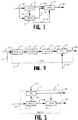
- Fig. 1 is a block diagram of a picture encoding apparatus according to a first embodiment of this invention.
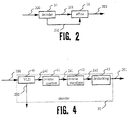
- Fig. 2 is a block diagram of a picture decoding apparatus according to a second embodiment of this invention.
- Fig. 3 is a block diagram of an encoder of the picture encoding apparatus shown in Fig. 1.
- Fig. 4 is a block diagram of a decoder of the picture decoding apparatus shown in Fig. 2.
- Fig. 5 is a block diagram of a motion compensating circuit of the picture encoding apparatus shown in Fig. 1.
- Fig. 6 is a diagram for explaining a motion compensation (affine transformation).
- Fig. 7 is a diagram for explaining an encoding using motion compensation.
- Fig. 8 is a diagram for explaining a blocking.
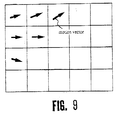
- Fig. 9 is a diagram for explaining panning and zooming calculations.
- Fig. 1 is a block diagram of a picture encoding apparatus according to a first embodiment of this invention, in which an input signal 100 is a picture sequence in a unit of a fixed number of pictures.
- a reference picture of the input signal 100 is stored in a memory 10.
- the reference picture is one picture which is predetermined in the picture sequence. For example, it may be the first occurring frame or the center frame of the input signal 100.
- a motion estimating/compensating (ME/MC) circuit 11 compares the reference picture 101b stored in the memory 10 and each of the non-reference pictures (other pictures than the reference picture) of the input signal 100 to calculate a coefficient 103 of such an affine transformation as to make the pixel value difference small.
- ME/MC motion estimating/compensating
- the affine transformation means a geometrical transformation which can be expressed in terms of movement, enlargement and reduction.
- the input signal 100 is subjected to the affine transformation by the transformation coefficient 103 thus obtained to be outputted as a compensated picture 102.
- the transformation coefficient 103 is calculated for each picture or for each unit of picture sequence.
- An encoder 12 collectively encodes a reference picture 101a and the compensated picture 102, and further simultaneously encodes the transformation coefficient 103 thereby to generate an encoded signal 104.
- the encoding is collectively carried out in the picture sequence.
- the correlation between pictures may be enhanced by performing affine transformation as compared with the case of not performing the same and as a result, the encoding efficiency when collectively encoding in the picture sequence becomes high. Additionally, a decoded signal may not be needed for encoding, and it is easy to make a fixed code length in the picture sequence by feedback control.
- the correlation between plural pictures can be enhanced thereby to improve the encoding efficiency.
- Fig. 2 is a block diagram of a picture decoding apparatus according to a second embodiment of this invention, in which an encoded signal 200 corresponds to the encoded signal 104 obtained by the picture encoding apparatus shown in Fig. 1.
- a decoder 30 decodes the encoded signal 200 to deliver a picture signal 201 and an affine transformation coefficient 202.
- An affine transformation circuit 31 transforms the picture signal 201 inversely to the affine transformation indicated by the affine transformation coefficient 202 and its result is outputted as a decoded picture 203.
- the picture corresponding to the reference picture is not subjected to affine transformation, so that the affine transformation is carried out by the affine transformation coefficient corresponding to the case of having no movement, enlargement and reduction.
- the affine transformation circuit 31 performs an inverse affine transformation to the affine transformation carried out in the picture encoding apparatus, so that the encoded signal obtained in the picture encoding apparatus can be decoded successfully.
- Fig 3 is a block diagram of the encoder 12 shown in Fig. 1.
- explanations were made such that a picture was directly encoded, however, it is more efficient on a practical basis that when encoding the input signal in the picture sequence, it is spatially divided into smaller units (blocks) to be encoded.
- a pixel signal can be frequency-converted by orthogonal transformation to protect visually important low frequency components thereby to improve the picture quality thereof, and the bit rate to be processed by the encoder at one time can be reduced thereby to be made hardware simple.
- FIG. 8 is an explanatory diagram for blocking, in which the signal string is composed of four pictures, and the pixels at the same positions in these four pictures are collected to make a block (shaded areas make one block as shown in Fig. 8). Namely, the four pictures are composed of a plurality of blocks.
- the reference picture 101a and the compensated picture 102 are divided into rectangular parallelepiped blocks in a blocking circuit 20 to output a blocked signal 120.
- the blocked signal 120 is sent to an orthogonal transformation circuit 21 to be subjected to orthogonal transformations horizontally, vertically and between pictures to output an orthogonally transformed signal 121.
- the reference picture and compensated picture become large in correlation therebetween by being subjected to affine transformation, so that the energy is concentrated into the low frequency component by orthogonal transformation. As a result, the high frequency component becomes small.
- the orthogonally transformed signal 121 is quantized by a quantizer 22 to obtain a quantization value 122.
- the quantization step of visually important low frequency component is made small and the quantization step of high frequency component is made large.
- the quantization value 122 can be made small without degrading picture quality.
- the quantization value 122 is encoded through a variable length encoder (VLC) 23 to obtain an encoded signal 104.
- VLC variable length encoder
- variable length encoder 23 a code small in bit length is allocated to a quantization value high in generation probability and a code large in bit length is allocated to that not so high in generation probability, whereby the average code length is made small.
- an affine transformation coefficient 103 is also encoded as an encoded coefficient signal, and the encoded picture signal and encoded coefficient signal are multiplexed to obtain the encoded signal 104.
- Fig. 4 is a block diagram of a decoder 30 shown in Fig. 2, which is for decoding the encoded signal 104 encoded by the encoder 20 shown in Fig. 3.
- An encoded signal 200 is decoded through a variable length decoder (VLD) 40 to deliver a quantization value 240 which is a signal corresponding to the pixel value, and an affine transformation coefficient 202.
- the quantization value 240 is the same in value as the quantization value 122 of the corresponding string of the encoder shown in Fig. 3.
- the quantization value 240 is inversely quantized by an inverse quantizer 41 to output an inverse quantization value 241.
- the inverse quantization value 241 is subjected to inverse orthogonal transformation by an inverse orthogonal transformation circuit 42 to obtain an inversely orthogonally transformed signal 242.
- the transformation carried out in the inverse orthogonal transformation circuit 42 is an inverse transformation to the transformation carried out in the orthogonal transformation circuit 21 in the encoder 20 shown in Fig. 3.
- the inversely orthogonally transformed signal 242 is deblocked in a deblocking circuit 42 to be re-arranged so as to form a picture thereby to obtain a picture signal 201.
- the re-arrangement of pixels in the deblocking circuit 43 is opposite in operation to that in the blocking circuit 12 shown in Fig. 3. As a result, by carrying out the inverse blocking as shown above, such a picture that has pixels arranged correctly can be obtained.
- the encoded signal encoded through the encoder shown in Fig. 3 can be correctly decoded.
- Fig. 5 is a block diagram of a motion compensating circuit 11 of the picture encoding apparatus shown in Fig. 1.
- the input picture 100 is temporarily stored in a memory 50.
- a motion estimating circuit (ME) 51 compares a memory output 150a and the reference signal 101b to detect the motion of a picture signal stored in the memory 50. From the motion thus detected, the motion of the whole of pictures, such as the panning, zooming and the like, is calculated and transformed into an affine transformation coefficient 103.
- An affine transformation circuit 52 applies affine transformation to a memory output 150b in terms of the affine transformation coefficient 103 thereby to obtain a compensated picture 102.
- the affine transformation coefficient of the picture encoding apparatus shown in Fig. 1 can be calculated.
- the sub-band transformation or the estimation coding may be applied instead of the orthogonal transformation.
- a pair of transformations are inverse to each other and can be applied in order to decode correctly to the original signal, they may be respectively used instead of the transformation of the orthogonal transformation circuit 21 shown in Fig. 3 and the inverse transformation of the inverse orthogonal transformation circuit 42 shown in Fig. 4.
Landscapes
- Engineering & Computer Science (AREA)
- Multimedia (AREA)
- Signal Processing (AREA)
- Physics & Mathematics (AREA)
- General Physics & Mathematics (AREA)
- Theoretical Computer Science (AREA)
- Compression Or Coding Systems Of Tv Signals (AREA)
- Compression, Expansion, Code Conversion, And Decoders (AREA)
Applications Claiming Priority (2)
| Application Number | Priority Date | Filing Date | Title |
|---|---|---|---|
| JP261153/92 | 1992-09-30 | ||
| JP26115392A JPH06113287A (ja) | 1992-09-30 | 1992-09-30 | 画像符号化装置と画像復号化装置 |
Publications (2)
| Publication Number | Publication Date |
|---|---|
| EP0590800A2 true EP0590800A2 (de) | 1994-04-06 |
| EP0590800A3 EP0590800A3 (de) | 1994-10-12 |
Family
ID=17357849
Family Applications (1)
| Application Number | Title | Priority Date | Filing Date |
|---|---|---|---|
| EP19930306913 Withdrawn EP0590800A3 (de) | 1992-09-30 | 1993-09-01 | Vorrichtungen zur Kodierung und Dekodierung von Bildern. |
Country Status (4)
| Country | Link |
|---|---|
| US (1) | US5376971A (de) |
| EP (1) | EP0590800A3 (de) |
| JP (1) | JPH06113287A (de) |
| KR (1) | KR940008498A (de) |
Cited By (3)
| Publication number | Priority date | Publication date | Assignee | Title |
|---|---|---|---|---|
| EP0740473A3 (de) * | 1995-04-29 | 1997-07-30 | Daewoo Electronics Co Ltd | Vorrichtung zur Kodierung eines Videosignals unter Verwendung einer Bewegungsschätzung mit charakteristischen Punkten |
| GB2429593A (en) * | 2005-08-26 | 2007-02-28 | Electrosonic Ltd | Data compressing using a wavelet compression scheme |
| US9992252B2 (en) | 2015-09-29 | 2018-06-05 | Rgb Systems, Inc. | Method and apparatus for adaptively compressing streaming video |
Families Citing this family (44)
| Publication number | Priority date | Publication date | Assignee | Title |
|---|---|---|---|---|
| DE4111980A1 (de) * | 1991-04-12 | 1992-10-15 | Thomson Brandt Gmbh | Verfahren zur codierung |
| GB9206396D0 (en) * | 1992-03-24 | 1992-05-06 | British Broadcasting Corp | Video image motion measurement |
| EP0625853B1 (de) * | 1993-05-21 | 1999-03-03 | Nippon Telegraph And Telephone Corporation | Bewegtbildkoder und -dekoder |
| JP3654664B2 (ja) * | 1994-08-23 | 2005-06-02 | シャープ株式会社 | 画像符号化装置及び画像復号装置 |
| JPH08275117A (ja) * | 1995-03-30 | 1996-10-18 | Toshiba Corp | 画像処理装置 |
| JPH08307698A (ja) * | 1995-04-28 | 1996-11-22 | Mitsubishi Electric Corp | ラインメモリ回路 |
| US5654771A (en) * | 1995-05-23 | 1997-08-05 | The University Of Rochester | Video compression system using a dense motion vector field and a triangular patch mesh overlay model |
| US5784175A (en) * | 1995-10-05 | 1998-07-21 | Microsoft Corporation | Pixel block correlation process |
| US5692063A (en) * | 1996-01-19 | 1997-11-25 | Microsoft Corporation | Method and system for unrestricted motion estimation for video |
| US5799113A (en) * | 1996-01-19 | 1998-08-25 | Microsoft Corporation | Method for expanding contracted video images |
| US5787203A (en) * | 1996-01-19 | 1998-07-28 | Microsoft Corporation | Method and system for filtering compressed video images |
| US6181747B1 (en) * | 1996-02-01 | 2001-01-30 | Hughes Electronics Corporation | Methods and systems for high compression rate encoding and decoding of quasi-stable objects in video and film |
| US5764814A (en) * | 1996-03-22 | 1998-06-09 | Microsoft Corporation | Representation and encoding of general arbitrary shapes |
| US5778098A (en) * | 1996-03-22 | 1998-07-07 | Microsoft Corporation | Sprite coding |
| US6137920A (en) * | 1996-05-01 | 2000-10-24 | Hughes Electronics Corporation | Method and system for generating image frame sequences using morphing transformations |
| US6075875A (en) * | 1996-09-30 | 2000-06-13 | Microsoft Corporation | Segmentation of image features using hierarchical analysis of multi-valued image data and weighted averaging of segmentation results |
| US5748789A (en) * | 1996-10-31 | 1998-05-05 | Microsoft Corporation | Transparent block skipping in object-based video coding systems |
| US5940129A (en) * | 1996-12-06 | 1999-08-17 | Hughes Electronics Corporation | Methods and systems for super compression of prior known objects in video and film |
| AU1941797A (en) * | 1997-03-17 | 1998-10-12 | Mitsubishi Denki Kabushiki Kaisha | Image encoder, image decoder, image encoding method, image decoding method and image encoding/decoding system |
| US6041078A (en) * | 1997-03-25 | 2000-03-21 | Level One Communications, Inc. | Method for simplifying bit matched motion estimation |
| US6400831B2 (en) | 1998-04-02 | 2002-06-04 | Microsoft Corporation | Semantic video object segmentation and tracking |
| US6711278B1 (en) | 1998-09-10 | 2004-03-23 | Microsoft Corporation | Tracking semantic objects in vector image sequences |
| US6983018B1 (en) | 1998-11-30 | 2006-01-03 | Microsoft Corporation | Efficient motion vector coding for video compression |
| US6563953B2 (en) | 1998-11-30 | 2003-05-13 | Microsoft Corporation | Predictive image compression using a single variable length code for both the luminance and chrominance blocks for each macroblock |
| KR100359115B1 (ko) * | 2000-05-24 | 2002-11-04 | 삼성전자 주식회사 | 영상 코딩 방법 |
| KR100875743B1 (ko) * | 2001-01-16 | 2008-12-26 | 엔엑스피 비 브이 | 모션 보상된 보간에서 헤일로 효과를 감소시키는 방법 |
| EP2262269B1 (de) | 2001-12-17 | 2018-01-24 | Microsoft Technology Licensing, LLC | Überspringen von Makroblock-Codierung |
| US20050013498A1 (en) | 2003-07-18 | 2005-01-20 | Microsoft Corporation | Coding of motion vector information |
| US7499495B2 (en) | 2003-07-18 | 2009-03-03 | Microsoft Corporation | Extended range motion vectors |
| US7616692B2 (en) | 2003-09-07 | 2009-11-10 | Microsoft Corporation | Hybrid motion vector prediction for interlaced forward-predicted fields |
| US7620106B2 (en) | 2003-09-07 | 2009-11-17 | Microsoft Corporation | Joint coding and decoding of a reference field selection and differential motion vector information |
| US7599438B2 (en) | 2003-09-07 | 2009-10-06 | Microsoft Corporation | Motion vector block pattern coding and decoding |
| US7724827B2 (en) | 2003-09-07 | 2010-05-25 | Microsoft Corporation | Multi-layer run level encoding and decoding |
| US7623574B2 (en) | 2003-09-07 | 2009-11-24 | Microsoft Corporation | Selecting between dominant and non-dominant motion vector predictor polarities |
| US8064520B2 (en) | 2003-09-07 | 2011-11-22 | Microsoft Corporation | Advanced bi-directional predictive coding of interlaced video |
| US7577200B2 (en) | 2003-09-07 | 2009-08-18 | Microsoft Corporation | Extended range variable length coding/decoding of differential motion vector information |
| US7317839B2 (en) | 2003-09-07 | 2008-01-08 | Microsoft Corporation | Chroma motion vector derivation for interlaced forward-predicted fields |
| US7567617B2 (en) | 2003-09-07 | 2009-07-28 | Microsoft Corporation | Predicting motion vectors for fields of forward-predicted interlaced video frames |
| US7606308B2 (en) | 2003-09-07 | 2009-10-20 | Microsoft Corporation | Signaling macroblock mode information for macroblocks of interlaced forward-predicted fields |
| US9077960B2 (en) | 2005-08-12 | 2015-07-07 | Microsoft Corporation | Non-zero coefficient block pattern coding |
| TWI350695B (en) * | 2006-10-18 | 2011-10-11 | Realtek Semiconductor Corp | Image encoding/decoding apparatus and method thereof |
| US9137505B2 (en) * | 2013-02-06 | 2015-09-15 | C&C Technic Taiwan Co., Ltd. | Long-range VGA image transmission system providing automatic image adjustment |
| JP6614472B2 (ja) * | 2013-09-30 | 2019-12-04 | サン パテント トラスト | 画像符号化方法、画像復号方法、画像符号化装置及び画像復号装置 |
| RU2779379C1 (ru) * | 2021-08-24 | 2022-09-06 | Вадим Никитович Козлов | Способ аутентификации электронного изображения |
Family Cites Families (11)
| Publication number | Priority date | Publication date | Assignee | Title |
|---|---|---|---|---|
| US4819169A (en) * | 1986-09-24 | 1989-04-04 | Nissan Motor Company, Limited | System and method for calculating movement direction and position of an unmanned vehicle |
| US5019910A (en) * | 1987-01-29 | 1991-05-28 | Norsat International Inc. | Apparatus for adapting computer for satellite communications |
| US4855822A (en) * | 1988-01-26 | 1989-08-08 | Honeywell, Inc. | Human engineered remote driving system |
| FR2627926A1 (fr) * | 1988-02-29 | 1989-09-01 | Labo Electronique Physique | Procede et dispositif de codage de signaux video numeriques, et dispositif de decodage correspondant |
| JPH0769958B2 (ja) * | 1988-09-20 | 1995-07-31 | 沖電気工業株式会社 | 画像変換処理方法 |
| JPH02226888A (ja) * | 1989-02-28 | 1990-09-10 | Fujitsu Ltd | 動き補償符号化装置の動ベクトル作成方式 |
| EP0405842A3 (en) * | 1989-06-26 | 1993-03-03 | Matsushita Electric Industrial Co., Ltd. | Picture coding method |
| JP2569219B2 (ja) * | 1990-01-31 | 1997-01-08 | 富士通株式会社 | 動画像予測方式 |
| JP2637836B2 (ja) * | 1990-06-25 | 1997-08-06 | シャープ株式会社 | 動画像信号圧縮・再生システム |
| GB9019538D0 (en) * | 1990-09-07 | 1990-10-24 | Philips Electronic Associated | Tracking a moving object |
| JP2611591B2 (ja) * | 1991-10-31 | 1997-05-21 | 日本ビクター株式会社 | 動き補償装置 |
-
1992
- 1992-09-30 JP JP26115392A patent/JPH06113287A/ja active Pending
-
1993
- 1993-08-30 US US08/113,175 patent/US5376971A/en not_active Expired - Lifetime
- 1993-09-01 EP EP19930306913 patent/EP0590800A3/de not_active Withdrawn
- 1993-09-23 KR KR1019930019369A patent/KR940008498A/ko not_active Ceased
Cited By (9)
| Publication number | Priority date | Publication date | Assignee | Title |
|---|---|---|---|---|
| EP0740473A3 (de) * | 1995-04-29 | 1997-07-30 | Daewoo Electronics Co Ltd | Vorrichtung zur Kodierung eines Videosignals unter Verwendung einer Bewegungsschätzung mit charakteristischen Punkten |
| US5751362A (en) * | 1995-04-29 | 1998-05-12 | Daewoo Electronics, Co., Ltd. | Apparatus for encoding a video signal using feature point based motion estimation |
| GB2429593A (en) * | 2005-08-26 | 2007-02-28 | Electrosonic Ltd | Data compressing using a wavelet compression scheme |
| US9204170B2 (en) | 2005-08-26 | 2015-12-01 | Rgb Systems, Inc. | Method for image data processing utilizing multiple transform engines |
| US9924199B2 (en) | 2005-08-26 | 2018-03-20 | Rgb Systems, Inc. | Method and apparatus for compressing image data using compression profiles |
| US9930364B2 (en) | 2005-08-26 | 2018-03-27 | Rgb Systems, Inc. | Method and apparatus for encoding image data using wavelet signatures |
| US10051288B2 (en) | 2005-08-26 | 2018-08-14 | Rgb Systems, Inc. | Method and apparatus for compressing image data using a tree structure |
| US10244263B2 (en) | 2005-08-26 | 2019-03-26 | Rgb Systems, Inc. | Method and apparatus for packaging image data for transmission over a network |
| US9992252B2 (en) | 2015-09-29 | 2018-06-05 | Rgb Systems, Inc. | Method and apparatus for adaptively compressing streaming video |
Also Published As
| Publication number | Publication date |
|---|---|
| US5376971A (en) | 1994-12-27 |
| EP0590800A3 (de) | 1994-10-12 |
| JPH06113287A (ja) | 1994-04-22 |
| KR940008498A (ko) | 1994-04-29 |
Similar Documents
| Publication | Publication Date | Title |
|---|---|---|
| US5376971A (en) | Picture encoding apparatus and picture decoding apparatus | |
| EP1098528B1 (de) | Vorrichtung zur bildvorhersage und -decodierung | |
| US7379496B2 (en) | Multi-resolution video coding and decoding | |
| KR0155784B1 (ko) | 영상데이타의 적응형 가변장 부호화/복호화방법 | |
| US5767907A (en) | Drift reduction methods and apparatus | |
| US20050135484A1 (en) | Method of encoding mode determination, method of motion estimation and encoding apparatus | |
| EP0585051B1 (de) | Bildverarbeitungsverfahren und -vorrichtung | |
| US20060209952A1 (en) | Image encoding/decoding method and apparatus therefor | |
| EP0526163A2 (de) | Verfahren und Einrichtung zur Bildkodierung | |
| EP0485230A2 (de) | Progressives Signalkodierungssystem für bewegte Bilder | |
| US20030095603A1 (en) | Reduced-complexity video decoding using larger pixel-grid motion compensation | |
| KR100504641B1 (ko) | 화상 부호화 장치 및 화상 부호화 방법 | |
| JPH06125543A (ja) | 符号化装置 | |
| WO2003067896A1 (fr) | Dispositif et procede de codage de donnees-image et dispositif et procede de decodage de donnees-image | |
| EP1158806A1 (de) | Kodierung von Bewegungsvektoren | |
| KR19980017213A (ko) | 열화영상에 대한 보상기능을 갖는 영상 복호화 시스템 | |
| US7236529B2 (en) | Methods and systems for video transcoding in DCT domain with low complexity | |
| US7139315B2 (en) | Apparatus and process for decoding motion pictures | |
| EP0680218B1 (de) | Gerät zur Dekodierung eines Bildsignales mit Kodierungsfehlerkompensation | |
| JPH0410788A (ja) | 画像信号符号量制御方法 | |
| JPH0984024A (ja) | 動画像信号の符号化装置 | |
| JPH04326690A (ja) | 動画像符号化復号化装置 | |
| KR100240620B1 (ko) | 양방향의 반화소 움직임 추정을 위한 대칭 탐색 윈도우를 형성하는 방법 및 장치 | |
| JP3166835B2 (ja) | 動画像の高能率符号化方法及び装置 | |
| JPH07107464A (ja) | 画像符号化装置および復号化装置 |
Legal Events
| Date | Code | Title | Description |
|---|---|---|---|
| PUAI | Public reference made under article 153(3) epc to a published international application that has entered the european phase |
Free format text: ORIGINAL CODE: 0009012 |
|
| AK | Designated contracting states |
Kind code of ref document: A2 Designated state(s): DE FR GB NL |
|
| PUAL | Search report despatched |
Free format text: ORIGINAL CODE: 0009013 |
|
| AK | Designated contracting states |
Kind code of ref document: A3 Designated state(s): DE FR GB NL |
|
| 17P | Request for examination filed |
Effective date: 19950124 |
|
| 17Q | First examination report despatched |
Effective date: 19990203 |
|
| STAA | Information on the status of an ep patent application or granted ep patent |
Free format text: STATUS: THE APPLICATION IS DEEMED TO BE WITHDRAWN |
|
| 18D | Application deemed to be withdrawn |
Effective date: 19990614 |
|
| R18D | Application deemed to be withdrawn (corrected) |
Effective date: 19990615 |