EP0584955B2 - Poultry washing apparatus and method - Google Patents
Poultry washing apparatus and method Download PDFInfo
- Publication number
- EP0584955B2 EP0584955B2 EP93305876A EP93305876A EP0584955B2 EP 0584955 B2 EP0584955 B2 EP 0584955B2 EP 93305876 A EP93305876 A EP 93305876A EP 93305876 A EP93305876 A EP 93305876A EP 0584955 B2 EP0584955 B2 EP 0584955B2
- Authority
- EP
- European Patent Office
- Prior art keywords
- chemical solution
- bird
- reducing chemical
- treated
- bacteria reducing
- Prior art date
- Legal status (The legal status is an assumption and is not a legal conclusion. Google has not performed a legal analysis and makes no representation as to the accuracy of the status listed.)
- Expired - Lifetime
Links
Images


Classifications
-
- A—HUMAN NECESSITIES
- A22—BUTCHERING; MEAT TREATMENT; PROCESSING POULTRY OR FISH
- A22C—PROCESSING MEAT, POULTRY, OR FISH
- A22C21/00—Processing poultry
- A22C21/0061—Cleaning or disinfecting poultry
-
- A—HUMAN NECESSITIES
- A23—FOODS OR FOODSTUFFS; TREATMENT THEREOF, NOT COVERED BY OTHER CLASSES
- A23B—PRESERVATION OF FOODS, FOODSTUFFS OR NON-ALCOHOLIC BEVERAGES; CHEMICAL RIPENING OF FRUIT OR VEGETABLES
- A23B4/00—Preservation of meat, sausages, fish or fish products
- A23B4/26—Apparatus for preserving using liquids ; Processes therefor
-
- A—HUMAN NECESSITIES
- A23—FOODS OR FOODSTUFFS; TREATMENT THEREOF, NOT COVERED BY OTHER CLASSES
- A23B—PRESERVATION OF FOODS, FOODSTUFFS OR NON-ALCOHOLIC BEVERAGES; CHEMICAL RIPENING OF FRUIT OR VEGETABLES
- A23B4/00—Preservation of meat, sausages, fish or fish products
- A23B4/26—Apparatus for preserving using liquids ; Processes therefor
- A23B4/28—Apparatus for preserving using liquids ; Processes therefor by injection of liquids
-
- A—HUMAN NECESSITIES
- A23—FOODS OR FOODSTUFFS; TREATMENT THEREOF, NOT COVERED BY OTHER CLASSES
- A23B—PRESERVATION OF FOODS, FOODSTUFFS OR NON-ALCOHOLIC BEVERAGES; CHEMICAL RIPENING OF FRUIT OR VEGETABLES
- A23B4/00—Preservation of meat, sausages, fish or fish products
- A23B4/26—Apparatus for preserving using liquids ; Processes therefor
- A23B4/30—Apparatus for preserving using liquids ; Processes therefor by spraying of liquids
Definitions
- the present invention relates to a novel apparatus and method for washing poultry to minimize the risk of contamination to humans. More specifically, the invention comprises utilizing a novel space efficient apparatus to adequately treat an eviscerated bird by applying streams of a treating chemical to all internal and external surfaces of the bird.
- the treatment chemical comprises a trialkali metal orthophosphate, and more specifically, trisodium phosphate.
- Modern poultry operations for processing chicken, turkey, duck or other poultry process birds through an automated system of slaughter, evisceration, cleaning and packaging. Due to its very nature, the process of evisceration exposes the exterior body surfaces and inner body cavities of the birds to the contents of the digestive tract. In so doing, the bird is exposed to potentially pathogenic microorganisms.
- U.S. Patent No. 4,849,237 discloses a method for sanitizing poultry carcasses in a poultry processing plant.
- the method involves, after scalding, defeathering, eviscerating and chilling the bird being treated, sanitizing the bird with ozonated water.
- the application of the ozonated water to the bird involves both immersing the external portion of the bird in a bath of ozonated water and, while immersed in the bath, subjecting the bird to jets of ozonated water directed into the body cavity of the carcass and along the outside of the carcass.
- This method is problematical in that it requires an additional area outside of the processing plant production line to synthesize the ozone gas and dissolve it in water prior to treatment. This is to prevent ozone from being released into the atmosphere of the work place and creating a health hazard to the employees. As a result, the costs of treating the birds are significantly increased.
- a long tank is fabricated to allow the plant's overhead monorails to pull the birds through a bath containing the treatment solution.
- This process is shown in Figure 1 wherein the tank is represented by reference number 10P, the treatment solution is represented by 12P, the overhead conveyor is represented by 14P, the bird shackle is represented by 16P, and the bird being treated is represented by 18P. While this method is very successful, it requires large volumes of the trialkali metal orthophosphate to be used and requires a large physical area in a poultry treating plant to accommodate the tank for practical operation.
- WO 83/03522 discloses equipment for spraying a liquid preserving composition onto meat carcasses or pieces, whereby the meat is passed through a series of frames provided with spray nozzles directed towards the interior of the frames.
- an apparatus and process for treating poultry is provided. More particularly, the inventors have discovered an apparatus which utilizes a novel spray unit to treat the internal and external portion of a bird with a bacteria reducing chemical solution.
- the unit is connected to the existing overhead conveyor which is used to transport the bird throughout the plant for different treatments, e.g., slaughtering, eviscerating, and packaging.
- the present invention provides an apparatus for use in reducing the amount of pathogenic bacteria associated with a bird comprising:
- the apparatus is used to treat poultry, and more particularly, chicken. Further, the apparatus is used to apply a solution containing an alkali metal orthophosphate, and most preferably trisodium phosphate to the chicken to reduce the risk of contamination by Salmonellae and other bacteria.
- the apparatus is used in association with a recirculation unit which supplies and recycles the treatment solution for use.
- the invention comprises a process for reducing the amount of pathogenic bacteria associated with a bird.
- the inventive process includes the steps of:
- Apparatus 10 includes exterior surface 12, having side walls 19 and bottom walls 21, and interior surface 14, having side walls 23 and bottom walls 18. Exterior surface 12 and interior surface 14 are connected by end walls 15. The area of interior surface 14 is sized to accommodate the entire body of a bird 16 being treated. Further, the bottom walls 18 of interior surface 14 are sloped downward. As best shown in Fig. 3, the walls 18 form channel 29 which terminates at exit port 20 which is in turn connected to exit line 22.
- deluge nozzles 24 and spray nozzles 26 located at or through interior surface 14 and shown in phantom are deluge nozzles 24 and spray nozzles 26.
- deluge nozzle 24 is located at or through interior surface 14 and above the body of bird 16 which is connected to overhead conveyor 38 via shackle 40.
- Overhead conveyor 38 and shackle 40 are considered existing and permanently located in the plant where apparatus 10 is to be used.
- the bird 16 is mounted such that its tail is towards conveyor 38 and its neck is toward channel 29.
- the location of deluge nozzle 24 is such that a flow of bacteria reducing chemical solution 42 can be directed downwardly and entirely through the interior body cavity of bird 16 from tail to neck.
- Spray nozzles 26 are located at or through interior surface 14 such that a flow of bacteria reducing chemical solution 42 can be directed from above, at the sides and from underneath to insure application of the chemical solution to the entire exterior surfaces of bird 16. Connected to all of these nozzles is connecting line 28. Line 28 is used to provide the bacteria reducing chemical solution to the nozzles 24 and 26. Connected to line 28 is cleaning line 30, which in turn is connected to cleaning nozzles 34. As shown in Figs. 2 and 3, cleaning nozzles are mounted above interior portion 14 and are directed downward. Both lines 28 and 30 contain valves, respectively designated by 46 and 48 to control flow of the chemical solution 42 into these lines.
- Support bracket 36 is mounted at one end onto side wall 19. Alternatively, not pictured, support bracket 36 can be mounted onto end walls 15. The other end of bracket 36 is mounted to overhead conveyor 38. Brackets 36 are designed to hold the entire weight of apparatus 10 onto conveyor 38. Referring to Fig. 3, also attached to bracket 36 and through side walls 15 and interior walls 23 is shackle guide 44. Shackle guide 44 is designed to provide an alignment and support mechanism for the incoming shackled birds 16 attached by shackle 40.
- Figure 3 only depicts the right side of apparatus 10 and that the identical arrangement is utilized for the left side of apparatus 10.
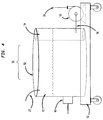
- Unit 50 for servicing apparatus 10 is shown.
- Unit 50 includes tank 52 which holds the bacteria reducing chemical solution 42.
- screen 54 which functions to exclude solid particles so that they are not circulated through apparatus 10 and do not clog nozzles 24 and 26.
- Screen 54 may alternatively be installed at the suction of pump 56.
- Screen 54 may be sized such that it extends above the liquid level in tank 52 and can be fitted with a handle, not shown. When installed in this manner, screen 54 can be slid up and out of tank 52 for periodic cleaning.
- tank 52 Connected to tank 52 through line 58 is pump 56 which pumps bacteria reducing chemical solution 42 through line 28 into nozzles 24 and 26. Also shown in Fig. 4 is a tank level controller 60 and portable cart 62 which is used to hold and transport tank 52 and pump 56. Depending on the length of lines 28 and 22, unit 50 may be located anywhere within the plant where the bird is being treated.
- a solution of a trialkali metal orthophosphate, and preferably trisodium phosphate to a chicken will be described.
- the use of the specified treating solution and treated animal is considered representative as the use of other treating solutions and other birds, e.g., ducks, geese, turkeys, other fowl, is clearly contemplated within the scope of the present invention.
- solution 42 Prior to the application of solution 42 to chicken 16, the solution is prepared in accordance with the method as set forth in U.S. Patent No. 5,069,922. More specifically, in tank 52, 4 to 12 parts of trisodium phosphate are added and mixed in with 88 to 96 parts of water to produce a solution which contains between 4% and 12% trisodium phosphate by total weight of solution.
- pH a preferred level of above 11.5, and more preferably to between 11.6 and 13.0
- other agents such as sodium carbonate, sodium and/or potassium hydroxide, alkali metal polyphosphates such as sodium tripolyphosphate or acids such as phosphoric acid may be added.
- minor amounts is meant less than 50% by weight of the combined dry weight of the trialkali metal orthophosphate and the basic agent. The temperature of the solution is maintained at between -12°C (10°F) and 10°C (50°F).
- a chicken 16 is placed onto existing shackle 40 which is permanently attached to existing overhead conveyor 38. Chicken 16 is then subjected to typical treatments such as slaughtering, scalding, defeathering, eviscerating and the like. These procedures are not considered part of the present invention.
- Unit 10 is mounted onto overhead conveyor 38 by utilizing brackets 36.
- brackets 36 In practice the mounting of brackets 36 onto surface 12 and conveyor 38 may take place by any means known in the art such as welding at both sites.
- a feature of the present invention is that the height of unit 10 with respect to conveyor 38 is adjustable.
- side wall 19 may contain a series of grooves, not pictured, so that the end of bracket 36 which is to be attached to wall 19 may be inserted and welded into any of such grooves.
- wall 19 may contain a series of horizontal shelves each having an opening in which a pin may be inserted. In this arrangement, the portion of the bracket 36 which is to communicate with wall 19 also contains an opening sized to accommodate the pin.
- Chicken 16 is advanced on shackle 40 by conveyor 38 and guided by guide 44 until it is inside unit 10 and surrounded by interior surface 14. In practice chicken 16 is advanced by conveyor 38 at a rate of 30 cm.s -1 (1 ft/sec).
- Pump 56 is then activated to supply line 28 with trisodium phosphate solution 42 from tank 52.
- solution 42 Prior to entering into pump 56, solution 42 is filtered via screen 54 to exclude large particulates.
- Valve 46 is opened and valve 48 is closed to allow solution 42 to be transported from line 28 into nozzles 24 and 26.
- the temperature of solution 42 is preferably between 7°C (45°F)and 13°C (55°F).
- Solution 42 is then applied through nozzles 24 and 26 to completely treat all internal and external surfaces of chicken 16.
- deluge nozzle 24 is designed so that a high volume of solution 42 is directed into the body cavity of chicken 16 from tail to neck.
- Nozzle 24 is a "high volume/low pressure" type nozzle which operates by delivering a volume of between 1.9 and 3.8 litres (0.5 and 1.0 gallon) of solution 42 per second at a pressure of 34.5 to 69 kPa (5 to 10 psi).
- solution 42 is applied through spray nozzles 26 to completely coat the external surfaces of chicken 16.
- These nozzles 26 are positioned to direct solution 42 from above, at the sides and to the under sides of chicken 16.
- These nozzles 26 are also "high volume/low pressure" type nozzles which operate by delivering a volume of between 1.9 and 3.8 litres (0.5 and 1.0 gallon) of solution 42 per second at a pressure of 34.5 to 69 kPa (5 to 10 psi).
- Nozzles 26 are constructed so that they provide the widest full cone or flat spray angles and are of wide bore design. Examples of such nozzles include those manufactured by Spray Systems, Inc.
- Chicken 16 is thereafter advanced through unit 10 by conveyor 38 where it may be identically treated by one or more series of nozzles.
- unit 10 has between about 3 and about 8 sets of nozzles so that chicken 16 undergoes between about 2 and about 4 treatments of solution 42. This exposes the bird to solution 42 for a time period exceeding 5 seconds, and preferably between about 7 and about 10 seconds.
- valve 46 When it is desired to clean surface 14 of unit 10, the following procedure is used. Valve 46 is closed and valve 48 is opened. Thereafter cleaning solution is pumped from tank 52, or from an alternative tank, not shown, into line 28 and then line 30.
- cleaning solution is pumped from tank 52, or from an alternative tank, not shown, into line 28 and then line 30.
- a preferred cleaning solution is any which is approved by the USDA for sanitizing purposes such as detergents, sodium hypochlorite, sanitizing agents and the like.
- the pure trisodium phosphate solution which is used to treat the chickens can be circulated as a cleaning solution for the components of unit 10. Cleaning solution is then distributed through cleaning nozzles 34 in a downward flow to remove all solid deposits from surface 14 and transport them through port 20 and into line 22,
- valve 48 is closed, valve 46 is opened, and cleaning solution is pumped into line 28 and through nozzles 24 and 26.
- nozzles 24 and 26 should not need to be cleaned as often as surface 14 because filtered solution 42 is all that should ever pass through them.
- Chicken 16 can then be transported by conveyor 38 to the remaining plant operations, e.g., packaging.
- Unit 10 may be constructed of any approved materials (particularly USDA approved materials) such as stainless steel or USDA approved thermoplastics. Particularly preferred is 10 to 20 gauge stainless steel.
- the approximate size of unit 10 is 9.1 to 12 cm (3 to 4 feet) in height, 91 to 122 cm (3 to 4 feet) in width and 152 to 244 cm (5 to 8 feet) in length.
- unit 50 may be constructed of any approved materials (particularly USDA approved materials) such as stainless steel or USDA approved thermoplastics. Particularly preferred is 10 to 20 gauge stainless steel.
- Typical pump sizing provides for up to 380 litres (100 gallons) per minute with heads of up to 9.2 to 12.2 m (30 to 40 feet).
- the size of tank 52 is dependent on the mode of plant operation and can range in size from as little as 189 litres (50 gallons) to as high as 1890 litres (500 gallons). Again, as will be recognized, larger sizes may be utilized for larger birds to be treated.
Landscapes
- Life Sciences & Earth Sciences (AREA)
- Engineering & Computer Science (AREA)
- Wood Science & Technology (AREA)
- Zoology (AREA)
- Food Science & Technology (AREA)
- Chemical & Material Sciences (AREA)
- Polymers & Plastics (AREA)
- Apparatus For Disinfection Or Sterilisation (AREA)
- Cleaning By Liquid Or Steam (AREA)
- Housing For Livestock And Birds (AREA)
- Meat, Egg Or Seafood Products (AREA)
- Processing Of Meat And Fish (AREA)
- Fodder In General (AREA)
- Control Of Washing Machine And Dryer (AREA)
- Accessory Of Washing/Drying Machine, Commercial Washing/Drying Machine, Other Washing/Drying Machine (AREA)
- Catching Or Destruction (AREA)
- Medicines Containing Material From Animals Or Micro-Organisms (AREA)
- Radar Systems Or Details Thereof (AREA)
Abstract
Description
Claims (15)
- An apparatus for use in reducing the amount of pathogenic bacteria associated with a bird comprising:(a) a unit having an interior portion having side and bottom walls, an exterior portion having side and bottom walls and end walls connecting said interior portion to said exterior portion wherein the area of said interior portion provides a space which completely surrounds one or more of the birds to be treated;(b) one or more deluge nozzles mounted within said interior portion of said unit and connected to a source of a bacteria reducing chemical solution which comprises a solution of a trialkali metal orthophosphate, to enable said bacteria reducing chemical solution to be applied to the entire interior of the body cavity of the bird to be treated;(c) one or more spray nozzles mounted within said interior portion of said unit and connected to a source of said bacteria reducing chemical solution to enable said bacteria reducing chemical solution to be applied to the entire external surfaces of the bird to be treated;(d) one or more lines for connecting said one or more deluge nozzles and said one or more spray nozzles to the source of said bacteria reducing chemical solution; and(e) one or more connectors for connecting the exterior portion or end walls of said unit to an existing overhead conveyor located within the facility where the bird is to be treated,
the apparatus further comprising a recirculation unit used to supply said bacteria reducing chemical solution to said one or more lines of element (d), said unit comprising:(f) a tank for holding a supply of said bacteria reducing chemical solution;(g) a pump which is connected to said one or more lines of element (d); and(h) a line which connects said tank to said pump. - The apparatus according to claim 1 wherein the bird to be treated is a chicken.
- The apparatus according to claim 1 wherein the bacteria reducing chemical solution comprises a trisodium phosphate solution.
- The apparatus according to claim 1 wherein said one or more connectors are connected to said side walls of said exterior portion and are capable of being mounted at different locations on said side walls of said exterior portion to enable them to have an adjustable height with respect to the existing overhead conveyor.
- The apparatus according to claim 1 wherein said bottom walls of said interior portion are sloped downward and form a channel which is connected to an exit port which is connected to said tank by a line.
- The apparatus according to claim 1 further comprising a shackle guide connected at one end to said one or more connectors and at the other end through said end walls and said interior side walls.
- The apparatus according to claim 5 further comprising:(i) a screen located in said tank or on the suction side of said pump for excluding large solid particulates; and (j) a line which connects said tank with said exit port.
- The apparatus according to claim 1 further comprising:(f) one or more cleaning nozzles mounted directly above said entire interior portion; and(g) a line which connects said one or more cleaning nozzles to said one or more lines of element (d).
- A process for reducing the amount of pathogenic bacteria associated with a bird comprising the steps of:(1) providing an apparatus comprising:(a) a unit having an interior portion having side and bottom walls, an exterior portion having side and bottom walls and end walls connecting said interior portion to said exterior portion wherein the area of said interior portion provides a space which completely surrounds one or more of the birds being treated;(b) one or more deluge nozzles mounted within said interior portion of said unit and connected to a source of a bacteria reducing chemical solution which comprises a solution of trialkali metal orthophosphate, to enable said bacteria reducing chemical solution to be applied to the entire interior of the body cavity of the bird being treated;(c) one or more spray nozzles mounted within said interior portion of said unit and connected to a source of said bacteria reducing chemical solution to enable said bacteria reducing chemical solution to be applied to the entire external surfaces of the bird being treated;(d) one or more lines for connecting said one or more deluge nozzles and said one or more spray nozzles to the source of said bacteria reducing chemical solution; and(e) one or more connectors for connecting the exterior portion or end walls of said unit to an existing overhead conveyor located within the facility where the bird is being treated;(2) connecting said apparatus to an existing overhead conveyor by utilizing said one or more connectors of element (e);(3) attaching the bird being treated to the existing overhead conveyor;(4) transporting the bird being treated along the overhead conveyor and through the interior portion of said apparatus;(5) applying said bacteria reducing chemical solution through said one or more deluge nozzles to the entire interior of the body cavity of the bird being treated;(6) applying said bacteria reducing chemical solution through said one or more spray nozzles to the entire external surfaces of the body cavity of the bird being treated; and(7) supplying said bacteria reducing chemical solution to said one or more lines of element (d) from a pump of a recirculation unit, said recirculating unit comprising:(f) a tank for holding a supply of said bacteria reducing chemical solution;(g) a pump which is connected to said one or more lines of element (d); and(h) a line which connects said tank to said pump.
- The process according to claim 12 wherein said bird being treated comprises a chicken.
- The process according to claim 9 wherein the bacteria reducing chemical solution comprises a trisodium phosphate solution.
- The process according to claim 11 wherein the flow of bacteria reducing solution from said one or more deluge nozzles in step (5) ranges from 1.9 to 3.8 litres (0.5 to 1.0 gallons) per second.
- The process according to claim 11 wherein the flow of bacteria reducing solution from said one or more spray nozzles in step (6) ranges from 1.9 to 3.8 litres (0.5 to 1.0 gallons) per second.
- The process according to claim 9 comprising the additional steps of:(8) connecting said tank to said interior surface; and(9) recirculating excess bacteria reducing chemical solution and solid particulates from said interior surface and into said tank.
- The process according to claim 14 comprising the additional steps of:(10) extracting said solid particulates from said excess bacteria reducing chemical solution; and then(11) supplying said excess bacteria chemical solution to said pump.
Applications Claiming Priority (2)
| Application Number | Priority Date | Filing Date | Title |
|---|---|---|---|
| US07/937,081 US5484332A (en) | 1992-08-28 | 1992-08-28 | Poultry washing apparatus and method |
| US937081 | 1992-08-28 |
Publications (4)
| Publication Number | Publication Date |
|---|---|
| EP0584955A2 EP0584955A2 (en) | 1994-03-02 |
| EP0584955A3 EP0584955A3 (en) | 1994-12-07 |
| EP0584955B1 EP0584955B1 (en) | 1996-05-29 |
| EP0584955B2 true EP0584955B2 (en) | 1999-12-08 |
Family
ID=25469470
Family Applications (1)
| Application Number | Title | Priority Date | Filing Date |
|---|---|---|---|
| EP93305876A Expired - Lifetime EP0584955B2 (en) | 1992-08-28 | 1993-07-26 | Poultry washing apparatus and method |
Country Status (26)
| Country | Link |
|---|---|
| US (1) | US5484332A (en) |
| EP (1) | EP0584955B2 (en) |
| JP (1) | JP2643777B2 (en) |
| KR (1) | KR100276763B1 (en) |
| CN (1) | CN1058602C (en) |
| AT (1) | ATE138530T1 (en) |
| AU (1) | AU667730B2 (en) |
| BR (1) | BR9303465A (en) |
| CA (1) | CA2095467C (en) |
| CZ (1) | CZ284882B6 (en) |
| DE (1) | DE69302871T3 (en) |
| DK (1) | DK96393A (en) |
| ES (1) | ES2090879T5 (en) |
| GR (2) | GR3020080T3 (en) |
| HU (1) | HU217559B (en) |
| IE (1) | IE75667B1 (en) |
| IL (1) | IL106800A (en) |
| MX (1) | MX9305055A (en) |
| MY (1) | MY109898A (en) |
| NZ (1) | NZ248504A (en) |
| PH (1) | PH30865A (en) |
| PT (1) | PT101347B (en) |
| RU (1) | RU2123791C1 (en) |
| SK (1) | SK279709B6 (en) |
| TW (1) | TW230746B (en) |
| ZA (1) | ZA935521B (en) |
Cited By (1)
| Publication number | Priority date | Publication date | Assignee | Title |
|---|---|---|---|---|
| US6908636B2 (en) | 2001-06-28 | 2005-06-21 | Albermarle Corporation | Microbiological control in poultry processing |
Families Citing this family (64)
| Publication number | Priority date | Publication date | Assignee | Title |
|---|---|---|---|---|
| US5632907A (en) * | 1995-12-26 | 1997-05-27 | Norbury; Fritz | Traveling backwash manifold for a centrifuge |
| US5879732A (en) * | 1996-09-10 | 1999-03-09 | Boc Group, Inc. | Food processing method |
| FR2754147B1 (en) * | 1996-10-03 | 2000-02-04 | Mbh Technologies Sa | PLANT AND PROCESS FOR THE TREATMENT OF CARCASES |
| AUPO489397A0 (en) * | 1997-01-31 | 1997-02-27 | Commonwealth Scientific And Industrial Research Organisation | Meat decontamination |
| US5882253A (en) * | 1997-12-12 | 1999-03-16 | Rhodia, Inc. | Apparatus and method for cleaning poultry |
| WO1999035916A2 (en) * | 1998-01-20 | 1999-07-22 | Novus International, Inc. | An anti-microbial treatment system for and method of disinfecting animal carcasses |
| US5938519A (en) * | 1998-03-05 | 1999-08-17 | Sec, Inc. | Post poultry washer |
| US5980375A (en) * | 1998-04-13 | 1999-11-09 | Chad Company Of Missouri, Inc. | Method and apparatus for antimicrobial treatment of animal carcasses |
| US5964656A (en) * | 1998-05-19 | 1999-10-12 | Meat Processing Service Corp. Inc. | Radio frequency identification device and method of use |
| US6196912B1 (en) * | 1998-05-19 | 2001-03-06 | Meat Processing Service Corporation | Machine readable tag |
| US6010729A (en) | 1998-08-20 | 2000-01-04 | Ecolab Inc. | Treatment of animal carcasses |
| NL1010673C2 (en) | 1998-11-27 | 2000-05-30 | Stork Pmt | Add additive to a meat product. |
| FR2800642B1 (en) * | 1999-11-05 | 2002-08-30 | Rhodia Chimie Sa | METHOD AND INSTALLATION FOR CONTINUOUS BACTERICIDAL TREATMENT OF PORTIONS OF EDIBLE FLESH |
| FR2800645B1 (en) * | 1999-11-05 | 2002-08-30 | Rhodia Chimie Sa | CONTINUOUS ITEMS PROCESSING TUNNEL WITH AN AEROSOL-PRODUCING AGENT |
| EP1280426B2 (en) * | 2000-05-09 | 2010-08-25 | Topkip B.V. | Method for cooling slaughtered poultry |
| US6835126B1 (en) * | 2001-02-27 | 2004-12-28 | Tyson Foods, Inc. | Poultry chilling and aging method and apparatus |
| US6986910B2 (en) | 2001-06-28 | 2006-01-17 | Albemarle Corporation | Microbiological control in poultry processing |
| KR20030010092A (en) * | 2001-07-25 | 2003-02-05 | 엘지니꼬동제련 주식회사 | concreat brick & block containing copper slag |
| US20030100254A1 (en) * | 2001-11-29 | 2003-05-29 | Kazuo Iwai | Method of sterilizing mammal carcasses |
| US6733379B2 (en) * | 2002-07-10 | 2004-05-11 | Rhodia Inc. | Post-evisceration process and apparatus |
| CA2497726C (en) * | 2002-09-06 | 2012-10-30 | Excel Corporation | Animal carcass microbial reduction method |
| US7086940B2 (en) * | 2002-10-22 | 2006-08-08 | Cargill Meat Solutions Corporation | System for preventing carcass scorching |
| AU2003293275A1 (en) * | 2002-12-11 | 2004-06-30 | Rudolph, Karin | Device for treating the surface of food stuffs |
| US20040147211A1 (en) * | 2003-01-24 | 2004-07-29 | Mostoller Charles R. | Poultry defeathering process and apparatus |
| US7901276B2 (en) | 2003-06-24 | 2011-03-08 | Albemarle Corporation | Microbiocidal control in the processing of meat-producing four-legged animals |
| US20040265445A1 (en) * | 2003-06-24 | 2004-12-30 | Liimatta Eric W. | Microbiocidal control in the processing of poultry |
| KR100524977B1 (en) | 2003-07-24 | 2005-10-31 | 삼성전자주식회사 | Optical disc player for compensating tracking error using real time repetitive control and driving method thereof |
| US20050079256A1 (en) * | 2003-09-29 | 2005-04-14 | Miller Vincent E. | Sanitation of carcasses using chlorine dioxide solution and gas |
| US7189157B2 (en) * | 2003-11-05 | 2007-03-13 | Linco Food Systems A/S | Method and a device for the preparation of slaughtered poultry for picking |
| US7288274B2 (en) * | 2004-01-08 | 2007-10-30 | Ecolab Inc. | Method for cleaning poultry |
| US7707931B2 (en) | 2004-04-06 | 2010-05-04 | West Liberty Foods, L.L.C. | Clean room food processing systems, methods and structures |
| US7905154B2 (en) * | 2004-11-29 | 2011-03-15 | Jones Jr Arthur T | Apparatus and method of contaminant detection for food industry |
| NL1030458C2 (en) * | 2005-11-18 | 2007-05-21 | Meyn Food Proc Technology Bv | Heating device. |
| JP2009518014A (en) | 2005-12-01 | 2009-05-07 | ソリユーシヨン・バイオサイエンシズ・インコーポレーテツド | Fungicide control in the treatment of meat quadrupeds |
| US7467994B2 (en) * | 2006-08-14 | 2008-12-23 | Terry Cemlyn Griffiths | Variable size carcass contaminant removal |
| US7575509B2 (en) * | 2007-01-26 | 2009-08-18 | Davis Poultry Equipment, Inc. | Machine for scrubbing exterior of fowl and method of use thereof |
| US7566260B1 (en) * | 2008-09-24 | 2009-07-28 | Terry Cemlyn Griffiths | Split carcass washer |
| US7740527B1 (en) * | 2009-04-24 | 2010-06-22 | Grover Harben | Poultry stunner |
| US8012002B2 (en) * | 2009-05-21 | 2011-09-06 | Cargill, Incorporated | Animal cleaning system |
| CN101855996B (en) * | 2010-07-05 | 2011-12-28 | 廖大中 | Device for cleaning pig body with bracket |
| GB201115555D0 (en) * | 2011-09-08 | 2011-10-26 | Linde Aktiengesellshcaft | A tunnel |
| US8827775B2 (en) | 2011-10-26 | 2014-09-09 | Wayne Allen Jefferson, SR. | Device for removing material from feet of poultry |
| CN102630727B (en) * | 2012-04-20 | 2013-12-11 | 常熟市屠宰成套设备厂有限公司 | Post-slaughter livestock carcass rinsing mechanism |
| CN102630729A (en) * | 2012-04-20 | 2012-08-15 | 常熟市屠宰成套设备厂有限公司 | Carcass shower machine for dead cattle |
| CN102626127A (en) * | 2012-04-20 | 2012-08-08 | 常熟市屠宰成套设备厂有限公司 | Post-slaughtered cattle carcass rinsing device |
| JP6207635B2 (en) * | 2013-02-22 | 2017-10-04 | マグナ パワートレイン ゲーエムベーハー ウント コ カーゲー | Gear box housing and manufacturing method of gear box housing |
| CN103330271B (en) * | 2013-07-12 | 2015-12-16 | 中国农业科学院农产品加工研究所 | Sugared system is sprayed in a kind of automation |
| RU2551167C1 (en) * | 2013-11-19 | 2015-05-20 | Государственное научное учреждение Всероссийский научно-исследовательский институт птицеперерабатывающей промышленности Россельхозакадемии (ГНУ ВНИИПП Россельхозакадемии) | Device for cooling (washing) poultry processing products |
| US9675085B2 (en) * | 2014-03-19 | 2017-06-13 | Birko Corporation | Fluid distribution systems, cabinet assemblies including fluid distribution systems and related assemblies and methods |
| CN103913469A (en) * | 2014-04-21 | 2014-07-09 | 南京农业大学 | System for detecting and processing contaminants on surfaces of poultry carcasses online |
| US9924727B2 (en) * | 2014-10-09 | 2018-03-27 | Safe Foods Corporation | Closed loop recycling system and dip tank for antimicrobial compounds |
| CN104522134B (en) * | 2014-12-09 | 2017-01-04 | 中国农业科学院农产品加工研究所 | Livestock meat cleaning and disinfecting device and cleaning and disinfecting method thereof |
| ES2595509B1 (en) * | 2015-06-25 | 2017-10-05 | Embutidos Goikoa, S.A. | Sausage bath machine |
| US9750265B1 (en) * | 2015-07-30 | 2017-09-05 | Zee Company, Inc. | Carcass finish cabinet with spray arbors and methods thereof |
| CN105076341A (en) * | 2015-08-21 | 2015-11-25 | 重庆大业食品有限公司 | Food-processing cleaning water recycling device |
| CN107361111A (en) * | 2016-05-11 | 2017-11-21 | 阿依古再丽·艾则孜 | A device for cleaning morel tripe process in the process of making morel food |
| CN106035600B (en) * | 2016-05-27 | 2018-08-14 | 张维秀 | A kind of whole chicken cleaning device of automation |
| NL2021431B1 (en) * | 2018-08-06 | 2020-02-17 | Meyn Food Processing Tech Bv | Conveying assembly |
| US11350653B2 (en) | 2019-04-09 | 2022-06-07 | Zee Company I, Llc | Spray cabinet for poultry processing and methods thereof |
| JPWO2022014595A1 (en) * | 2020-07-14 | 2022-01-20 | ||
| WO2023023539A1 (en) * | 2021-08-17 | 2023-02-23 | Safe Foods Corporation | Dual waterfall cabinet for food processing applications |
| US20230165284A1 (en) * | 2021-11-29 | 2023-06-01 | Morris & Associates, Inc. | Decontamination tank and method for treating food products |
| CN119365080A (en) * | 2022-04-13 | 2025-01-24 | 喷雾系统公司 | Improved poultry handling systems and methods |
| CN118872707A (en) * | 2024-09-27 | 2024-11-01 | 查维斯机械制造(北京)有限公司 | Carcass washing device |
Citations (3)
| Publication number | Priority date | Publication date | Assignee | Title |
|---|---|---|---|---|
| US3253296A (en) † | 1964-02-13 | 1966-05-31 | Gainesville Machine Company In | Apparatus for scalding fowls at multiple temperatures |
| US3674211A (en) † | 1970-08-12 | 1972-07-04 | Dyna Jet Corp The | Washing apparatus |
| US4337549A (en) † | 1979-11-15 | 1982-07-06 | The United States Of America As Represented By The Secretary Of Agriculture | Carcass cleaning unit and containment chamber |
Family Cites Families (13)
| Publication number | Priority date | Publication date | Assignee | Title |
|---|---|---|---|---|
| US3104170A (en) * | 1961-03-13 | 1963-09-17 | Calgon Corp | Methods of processing poultry |
| US3803669A (en) * | 1971-09-02 | 1974-04-16 | Food Equipment Inc | System for automatically washing the interior of fowl carcasses |
| US4196221A (en) * | 1977-06-10 | 1980-04-01 | Dew Denise R | Method and equipment for processing food products |
| US4592892A (en) * | 1981-11-12 | 1986-06-03 | Kabushiki Kaisha Ueno Seiyaku Oyo Kenkyujo | Aqueous sterilizing agent for foods or food processing machines and utensils |
| AU1220683A (en) * | 1983-02-10 | 1983-11-04 | Dover Meat Additive Co. Ltd. | Process and equipment for treating fresh slaughtered meat |
| US4683618A (en) * | 1986-07-28 | 1987-08-04 | Brien Gerard T O | Reduction of bacteria count on poultry being processed into food at a poultry processing plant |
| US4770884A (en) * | 1987-09-18 | 1988-09-13 | Monsanto Company | Control of Salmonella on poultry carcasses |
| US4849237A (en) * | 1987-10-30 | 1989-07-18 | Hurst William D | Method for sanitizing poultry carcasses in a poultry processing plant utilizing ozonated water |
| US5069922A (en) * | 1989-02-09 | 1991-12-03 | Eugene Brotsky | Process for treating poultry carcasses to control salmonellae growth |
| US5143739A (en) * | 1989-02-09 | 1992-09-01 | Rhone-Poulenc Inc. | Process for treating poultry carcasses to control salmonellae growth |
| US5069992A (en) * | 1989-11-17 | 1991-12-03 | Fuji Photo Film Co., Ltd. | Electrophotographic printing plate precursor containing alkali-soluble polyurethane resin as binder resin |
| JPH04121141A (en) * | 1990-09-07 | 1992-04-22 | Shin Nippon Giken Kogyo Kk | Sterilization of broiler |
| CA2052343C (en) * | 1991-06-07 | 1997-11-04 | Fredric G. Bender | Process for treating animal carcasses to control bacterial growth |
-
1992
- 1992-08-28 US US07/937,081 patent/US5484332A/en not_active Expired - Fee Related
-
1993
- 1993-06-24 CA CA002095467A patent/CA2095467C/en not_active Expired - Fee Related
- 1993-06-29 TW TW082105166A patent/TW230746B/zh active
- 1993-07-12 JP JP5171434A patent/JP2643777B2/en not_active Expired - Fee Related
- 1993-07-26 AT AT93305876T patent/ATE138530T1/en not_active IP Right Cessation
- 1993-07-26 DE DE69302871T patent/DE69302871T3/en not_active Expired - Fee Related
- 1993-07-26 ES ES93305876T patent/ES2090879T5/en not_active Expired - Lifetime
- 1993-07-26 EP EP93305876A patent/EP0584955B2/en not_active Expired - Lifetime
- 1993-07-30 ZA ZA935521A patent/ZA935521B/en unknown
- 1993-07-30 IE IE930582A patent/IE75667B1/en not_active IP Right Cessation
- 1993-08-02 CN CN93116292A patent/CN1058602C/en not_active Expired - Fee Related
- 1993-08-09 AU AU44538/93A patent/AU667730B2/en not_active Ceased
- 1993-08-10 CZ CZ931632A patent/CZ284882B6/en not_active IP Right Cessation
- 1993-08-19 MX MX9305055A patent/MX9305055A/en active IP Right Grant
- 1993-08-24 BR BR9303465A patent/BR9303465A/en not_active IP Right Cessation
- 1993-08-24 PT PT101347A patent/PT101347B/en active IP Right Grant
- 1993-08-25 IL IL10680093A patent/IL106800A/en not_active IP Right Cessation
- 1993-08-26 KR KR1019930016646A patent/KR100276763B1/en not_active Expired - Fee Related
- 1993-08-26 DK DK096393A patent/DK96393A/en not_active Application Discontinuation
- 1993-08-26 NZ NZ248504A patent/NZ248504A/en unknown
- 1993-08-26 PH PH46757A patent/PH30865A/en unknown
- 1993-08-27 SK SK921-93A patent/SK279709B6/en unknown
- 1993-08-27 HU HU9302445A patent/HU217559B/en not_active IP Right Cessation
- 1993-08-27 MY MYPI93001746A patent/MY109898A/en unknown
- 1993-08-27 RU RU93043843A patent/RU2123791C1/en not_active IP Right Cessation
-
1996
- 1996-05-30 GR GR960401231T patent/GR3020080T3/en unknown
-
2000
- 2000-02-29 GR GR20000400508T patent/GR3032805T3/en not_active IP Right Cessation
Patent Citations (3)
| Publication number | Priority date | Publication date | Assignee | Title |
|---|---|---|---|---|
| US3253296A (en) † | 1964-02-13 | 1966-05-31 | Gainesville Machine Company In | Apparatus for scalding fowls at multiple temperatures |
| US3674211A (en) † | 1970-08-12 | 1972-07-04 | Dyna Jet Corp The | Washing apparatus |
| US4337549A (en) † | 1979-11-15 | 1982-07-06 | The United States Of America As Represented By The Secretary Of Agriculture | Carcass cleaning unit and containment chamber |
Non-Patent Citations (5)
| Title |
|---|
| Anderson, M.E. et al (1977) "Combined and individual effects of washing and sanitizing on bacterial counts of meat - a model system". Journal of Food Protection, vol. 40, n° 10, pp. 668-670 † |
| Copie de l'ordre d'achat, Linco DK † |
| Facture du 20.3.87, Lindholst & Co, A/S † |
| Journal Officiel des Communautés européennes du 19.1.78, pp. 15/28-15/31. Directive du Conseil du 13.12.77 complétant, en ce qui concerne le procédé de réfrigération, la direction 71/118/CEE relative à des problèmes sanitaires en matière d'échanges de viandes fraiches de volaille (78/50/CEE) † |
| Plan de fabrication n° 02-717 du 20.8.82, Lindholst & Co A/S † |
Cited By (2)
| Publication number | Priority date | Publication date | Assignee | Title |
|---|---|---|---|---|
| US6908636B2 (en) | 2001-06-28 | 2005-06-21 | Albermarle Corporation | Microbiological control in poultry processing |
| US6919364B2 (en) | 2001-06-28 | 2005-07-19 | Solution Biosciences, Inc. | Microbiological control in animal processing |
Also Published As
Similar Documents
| Publication | Publication Date | Title |
|---|---|---|
| EP0584955B1 (en) | Poultry washing apparatus and method | |
| EP1037535B1 (en) | Method and apparatus for cleaning poultry | |
| US8246429B2 (en) | Apparatus and method for cleaning poultry | |
| US4849237A (en) | Method for sanitizing poultry carcasses in a poultry processing plant utilizing ozonated water | |
| US6733379B2 (en) | Post-evisceration process and apparatus | |
| EP0827695B1 (en) | Minimizing microbial growth during food processing | |
| US20040147211A1 (en) | Poultry defeathering process and apparatus | |
| MXPA00005824A (en) | Method and apparatus for cleaning poultry |
Legal Events
| Date | Code | Title | Description |
|---|---|---|---|
| PUAI | Public reference made under article 153(3) epc to a published international application that has entered the european phase |
Free format text: ORIGINAL CODE: 0009012 |
|
| AK | Designated contracting states |
Kind code of ref document: A2 Designated state(s): AT BE CH DE ES FR GB GR IT LI LU NL SE |
|
| PUAL | Search report despatched |
Free format text: ORIGINAL CODE: 0009013 |
|
| AK | Designated contracting states |
Kind code of ref document: A3 Designated state(s): AT BE CH DE ES FR GB GR IT LI LU NL SE |
|
| 17P | Request for examination filed |
Effective date: 19950109 |
|
| 17Q | First examination report despatched |
Effective date: 19950510 |
|
| GRAH | Despatch of communication of intention to grant a patent |
Free format text: ORIGINAL CODE: EPIDOS IGRA |
|
| RAP1 | Party data changed (applicant data changed or rights of an application transferred) |
Owner name: RHONE-POULENC INC. |
|
| GRAA | (expected) grant |
Free format text: ORIGINAL CODE: 0009210 |
|
| ITF | It: translation for a ep patent filed | ||
| AK | Designated contracting states |
Kind code of ref document: B1 Designated state(s): AT BE CH DE ES FR GB GR IT LI LU NL SE |
|
| REF | Corresponds to: |
Ref document number: 138530 Country of ref document: AT Date of ref document: 19960615 Kind code of ref document: T |
|
| REG | Reference to a national code |
Ref country code: CH Ref legal event code: NV Representative=s name: TROESCH SCHEIDEGGER WERNER AG |
|
| REF | Corresponds to: |
Ref document number: 69302871 Country of ref document: DE Date of ref document: 19960704 |
|
| REG | Reference to a national code |
Ref country code: GR Ref legal event code: FG4A Free format text: 3020080 |
|
| ET | Fr: translation filed | ||
| REG | Reference to a national code |
Ref country code: ES Ref legal event code: FG2A Ref document number: 2090879 Country of ref document: ES Kind code of ref document: T3 |
|
| REG | Reference to a national code |
Ref country code: ES Ref legal event code: FG2A Ref document number: 2090879 Country of ref document: ES Kind code of ref document: T3 |
|
| PLBI | Opposition filed |
Free format text: ORIGINAL CODE: 0009260 |
|
| PLBQ | Unpublished change to opponent data |
Free format text: ORIGINAL CODE: EPIDOS OPPO |
|
| PLBF | Reply of patent proprietor to notice(s) of opposition |
Free format text: ORIGINAL CODE: EPIDOS OBSO |
|
| 26 | Opposition filed |
Opponent name: HYPRED Effective date: 19970226 |
|
| NLR1 | Nl: opposition has been filed with the epo |
Opponent name: HYPRED |
|
| PLBF | Reply of patent proprietor to notice(s) of opposition |
Free format text: ORIGINAL CODE: EPIDOS OBSO |
|
| PLBF | Reply of patent proprietor to notice(s) of opposition |
Free format text: ORIGINAL CODE: EPIDOS OBSO |
|
| PLBF | Reply of patent proprietor to notice(s) of opposition |
Free format text: ORIGINAL CODE: EPIDOS OBSO |
|
| REG | Reference to a national code |
Ref country code: FR Ref legal event code: CL |
|
| REG | Reference to a national code |
Ref country code: CH Ref legal event code: PUE Owner name: RHONE-POULENC INC. TRANSFER- RHODIA INC. |
|
| NLS | Nl: assignments of ep-patents |
Owner name: RHODIA INC. A DELAWARE CORPORATION |
|
| REG | Reference to a national code |
Ref country code: FR Ref legal event code: TP |
|
| REG | Reference to a national code |
Ref country code: GB Ref legal event code: 732E |
|
| REG | Reference to a national code |
Ref country code: ES Ref legal event code: PC2A |
|
| RAP2 | Party data changed (patent owner data changed or rights of a patent transferred) |
Owner name: RHODIA INC. |
|
| PLAW | Interlocutory decision in opposition |
Free format text: ORIGINAL CODE: EPIDOS IDOP |
|
| NLT2 | Nl: modifications (of names), taken from the european patent patent bulletin |
Owner name: RHODIA INC. |
|
| PLAW | Interlocutory decision in opposition |
Free format text: ORIGINAL CODE: EPIDOS IDOP |
|
| PLAW | Interlocutory decision in opposition |
Free format text: ORIGINAL CODE: EPIDOS IDOP |
|
| PUAH | Patent maintained in amended form |
Free format text: ORIGINAL CODE: 0009272 |
|
| STAA | Information on the status of an ep patent application or granted ep patent |
Free format text: STATUS: PATENT MAINTAINED AS AMENDED |
|
| 27A | Patent maintained in amended form |
Effective date: 19991208 |
|
| AK | Designated contracting states |
Kind code of ref document: B2 Designated state(s): AT BE CH DE ES FR GB GR IT LI LU NL SE |
|
| REG | Reference to a national code |
Ref country code: CH Ref legal event code: AEN Free format text: MAINTIEN DU BREVET DONT L'ETENDUE A ETE MODIFIEE |
|
| NLR2 | Nl: decision of opposition | ||
| ITF | It: translation for a ep patent filed | ||
| PG25 | Lapsed in a contracting state [announced via postgrant information from national office to epo] |
Ref country code: GR Free format text: THE PATENT HAS BEEN ANNULLED BY A DECISION OF A NATIONAL AUTHORITY Effective date: 20000229 |
|
| NLR3 | Nl: receipt of modified translations in the netherlands language after an opposition procedure | ||
| ET3 | Fr: translation filed ** decision concerning opposition | ||
| REG | Reference to a national code |
Ref country code: ES Ref legal event code: DC2A Kind code of ref document: T5 Effective date: 20000307 |
|
| PGFP | Annual fee paid to national office [announced via postgrant information from national office to epo] |
Ref country code: SE Payment date: 20010704 Year of fee payment: 9 |
|
| PGFP | Annual fee paid to national office [announced via postgrant information from national office to epo] |
Ref country code: AT Payment date: 20010711 Year of fee payment: 9 |
|
| PGFP | Annual fee paid to national office [announced via postgrant information from national office to epo] |
Ref country code: LU Payment date: 20010719 Year of fee payment: 9 |
|
| PGFP | Annual fee paid to national office [announced via postgrant information from national office to epo] |
Ref country code: NL Payment date: 20010730 Year of fee payment: 9 Ref country code: CH Payment date: 20010730 Year of fee payment: 9 |
|
| PGFP | Annual fee paid to national office [announced via postgrant information from national office to epo] |
Ref country code: GR Payment date: 20010731 Year of fee payment: 9 |
|
| PGFP | Annual fee paid to national office [announced via postgrant information from national office to epo] |
Ref country code: BE Payment date: 20010918 Year of fee payment: 9 |
|
| REG | Reference to a national code |
Ref country code: GB Ref legal event code: IF02 |
|
| PG25 | Lapsed in a contracting state [announced via postgrant information from national office to epo] |
Ref country code: LU Free format text: LAPSE BECAUSE OF NON-PAYMENT OF DUE FEES Effective date: 20020726 Ref country code: AT Free format text: LAPSE BECAUSE OF NON-PAYMENT OF DUE FEES Effective date: 20020726 |
|
| PG25 | Lapsed in a contracting state [announced via postgrant information from national office to epo] |
Ref country code: SE Free format text: LAPSE BECAUSE OF NON-PAYMENT OF DUE FEES Effective date: 20020727 |
|
| PG25 | Lapsed in a contracting state [announced via postgrant information from national office to epo] |
Ref country code: LI Free format text: LAPSE BECAUSE OF NON-PAYMENT OF DUE FEES Effective date: 20020731 Ref country code: CH Free format text: LAPSE BECAUSE OF NON-PAYMENT OF DUE FEES Effective date: 20020731 Ref country code: BE Free format text: LAPSE BECAUSE OF NON-PAYMENT OF DUE FEES Effective date: 20020731 |
|
| BERE | Be: lapsed |
Owner name: *RHODIA INC. Effective date: 20020731 |
|
| PG25 | Lapsed in a contracting state [announced via postgrant information from national office to epo] |
Ref country code: NL Free format text: LAPSE BECAUSE OF NON-PAYMENT OF DUE FEES Effective date: 20030201 |
|
| EUG | Se: european patent has lapsed | ||
| REG | Reference to a national code |
Ref country code: CH Ref legal event code: PL |
|
| NLV4 | Nl: lapsed or anulled due to non-payment of the annual fee |
Effective date: 20030201 |
|
| PG25 | Lapsed in a contracting state [announced via postgrant information from national office to epo] |
Ref country code: IT Free format text: LAPSE BECAUSE OF NON-PAYMENT OF DUE FEES Effective date: 20050726 |
|
| PGFP | Annual fee paid to national office [announced via postgrant information from national office to epo] |
Ref country code: FR Payment date: 20060717 Year of fee payment: 14 |
|
| PGFP | Annual fee paid to national office [announced via postgrant information from national office to epo] |
Ref country code: ES Payment date: 20060726 Year of fee payment: 14 Ref country code: GB Payment date: 20060726 Year of fee payment: 14 |
|
| PGFP | Annual fee paid to national office [announced via postgrant information from national office to epo] |
Ref country code: DE Payment date: 20060831 Year of fee payment: 14 |
|
| GBPC | Gb: european patent ceased through non-payment of renewal fee |
Effective date: 20070726 |
|
| PG25 | Lapsed in a contracting state [announced via postgrant information from national office to epo] |
Ref country code: DE Free format text: LAPSE BECAUSE OF NON-PAYMENT OF DUE FEES Effective date: 20080201 |
|
| PG25 | Lapsed in a contracting state [announced via postgrant information from national office to epo] |
Ref country code: GB Free format text: LAPSE BECAUSE OF NON-PAYMENT OF DUE FEES Effective date: 20070726 |
|
| REG | Reference to a national code |
Ref country code: FR Ref legal event code: ST Effective date: 20080331 |
|
| PG25 | Lapsed in a contracting state [announced via postgrant information from national office to epo] |
Ref country code: FR Free format text: LAPSE BECAUSE OF NON-PAYMENT OF DUE FEES Effective date: 20070731 |
|
| REG | Reference to a national code |
Ref country code: ES Ref legal event code: FD2A Effective date: 20070727 |
|
| PG25 | Lapsed in a contracting state [announced via postgrant information from national office to epo] |
Ref country code: ES Free format text: LAPSE BECAUSE OF NON-PAYMENT OF DUE FEES Effective date: 20070727 |