EP0583113B1 - Discharge lamp arc tube and method of making a discharge lamp arc tube - Google Patents
Discharge lamp arc tube and method of making a discharge lamp arc tube Download PDFInfo
- Publication number
- EP0583113B1 EP0583113B1 EP19930306013 EP93306013A EP0583113B1 EP 0583113 B1 EP0583113 B1 EP 0583113B1 EP 19930306013 EP19930306013 EP 19930306013 EP 93306013 A EP93306013 A EP 93306013A EP 0583113 B1 EP0583113 B1 EP 0583113B1
- Authority
- EP
- European Patent Office
- Prior art keywords
- arc tube
- iodide
- metal
- thallium
- scandium
- Prior art date
- Legal status (The legal status is an assumption and is not a legal conclusion. Google has not performed a legal analysis and makes no representation as to the accuracy of the status listed.)
- Expired - Lifetime
Links
Images


Classifications
-
- H—ELECTRICITY
- H01—ELECTRIC ELEMENTS
- H01J—ELECTRIC DISCHARGE TUBES OR DISCHARGE LAMPS
- H01J61/00—Gas-discharge or vapour-discharge lamps
- H01J61/02—Details
- H01J61/12—Selection of substances for gas fillings; Specified operating pressure or temperature
- H01J61/125—Selection of substances for gas fillings; Specified operating pressure or temperature having an halogenide as principal component
Definitions
- This invention relates to metal halide discharge lamp arc tubes, and more particularly to arc tubes containing sodium, lithium and scandium iodides.
- metal halide lamps typically have a high efficacy of 70 to 110 Lm/W and a CRI of 60 to about 95 depending on metal halide additives and lamp configurations.
- metal halide additives and lamp configurations There are more than fifty different metal halides which may be used alone or in combination in metal halide lamps, and one lamp which has become widely used in the United States due to its very high efficacy (typically 80-110 Lm/W and CRI of about 65) is the sodium scandium lamp.
- the sodium scandium lamp typically 80-110 Lm/W and CRI of about 65
- U.S. patent 5,057,743 to Krasko et al (over which claim 1 has been characterised) describes a low wattage metal halide lamp, which contains a chemical fill comprising mercury, scandium metal, sodium iodide, scandium iodide, lithium iodide, and a starting gas.
- a chemical fill comprising mercury, scandium metal, sodium iodide, scandium iodide, lithium iodide, and a starting gas.
- additions of 2-4 mg/cm 3 of lithium iodide included in the chemical fill were stated to increase the CRI from 65 to more than 70, with little change in colour temperature and efficacy.
- a metal halide which produces white light with minimal colour separation and is suitable for projection systems is known from EP-A-0128550.
- This document discloses a lamp containing a fill of mercury, lithium iodide, zinc, scandium iodide, thallium iodide, dysprosium iodide, mercury iodide, mercury bromide and argon. Sodium is identified as a possible contaminant.
- U.S. patent 4,866,342 to Ramaiah describes a metal halide lamp having a discharge sustaining fill within an arc tube consisting essentially of a rare gas, mercury, and the halides of sodium and scandium, and additionally containing thallium halide in the mole ratio of sodium halide to thallium halide of about 280:1 to 75:1 whereby to increase the luminous efficacy of the lamp.
- lines 25 to 29 some improvement in both the luminous efficacy and the colour rendering index occurs within the narrow range of 260:1 to 240:1 mole ratio of sodium halide to thallium halide.
- no substantial improvement in CRI is provided over a wide range of molar ratios.
- lamps utilizing a chemical fill of NaIScI 3 LiI with a scandium metal getter are highly desirable.
- their colour rendering properties due to their colour rendering properties, their commercial use in certain colour-critical applications has been limited. Hence, further desirable improvements to their colour rendering index is desirable.
- the colour rendering index of a light source is a measure of the degree of colour shift objects undergo when illuminated by the light source as compared with the colour of those same objects when illuminated by a reference source of comparable colour temperature.
- the CRI rating consists of a General Index, R a , based on a set of eight test-colour samples that have been found adequate to cover the colour gamut.
- the colour appearance of a lamp is described by its chromaticity coordinates which can be calculated from spectral power distribution according to standard methods.
- Luminous efficacy of a source of light is the quotient of the total luminous flux emitted by the total lamp power input as expressed in lumens per watt (Lm/W).
- the present invention provides an arc tube for a metal halide discharge lamp, the arc tube having a chemical fill comprising an inert starting gas, mercury, sodium iodide, lithium iodide and scandium iodide, wherein said sodium iodide and said scandium iodide are present in a molar ratio of 20:1 to 28:1, characterised in that said fill further includes thallium metal as an additive in a quantity from 0.05-0.07 mg/cm 3 of arc tube volume sufficient to shift the colour coordinates (x,y) of the arc tube toward and to a position substantially on the black body curve of the standard chromaticity diagram.
- the arc tube has a chemical fill which includes sodium iodide, lithium iodide and scandium iodide. It has been found that such a chemical fill can create an undesirable purplish tint. This can be avoided with an addition of the thallium.
- the present invention provides a method of making an arc tube for a metal halide discharge lamp having a chemical fill comprising an inert starting gas, mercury, sodium iodide, lithium iodide and scandium iodide, wherein said sodium iodide and said scandium iodide are present in a molar ratio of 20:1 to 28:1, characterised in that thallium is added to said fill as thallium metal in a quantity from 0.05 to 0.07 mg/cm 3 of arc tube volume sufficient to shift the colour coordinates (x,y) of the arc tube toward and to a position substantially on the black body curve of the standard chromaticity diagram.
- FIGURE 1 there is shown the structural features of a metal halide lamp discharge lamp.
- the illustrated lamp includes a quartz discharge tube or arc tube 1 disposed within an outer sealed glass envelope 11.
- the outer envelope is most preferably evacuated.
- the outer envelope 11 is hermetically sealed to an affixed glass stem member 14 having an external base member 10.
- a pair of electrical conductors 18 and 19 are sealed into and pass through the stem member 14.
- the discharge tube 1 has a pair of electrodes 2 and 3 which project into the interior of the discharge tube 1 at respective ends and provide for energizing of the discharge lamp by an external source (not shown) during operation.
- Discharge tube 1 is generally made of quartz although other types of material may be used such as alumina, yttria or silica.
- Each electrode 2 and 3 comprises a core portion surrounded by molybdenum or tungsten wire helixes.
- Each of the electrodes 2 and 3 is connected to respective metal foils 4 and 5, preferably formed of molybdenum which are pinch sealed.
- Electrical conductors 6 and 7 which are electrically connected to respective foils, 4 and 5, extend outwardly of the respective press seals.
- Conductors 6 and 7 are respectively connected to the conductors 18 and 19 projecting from the glass stem member 14. As illustrated in the drawing, the connection between conductor 6 and conductor 18 is made by a vertically disposed wire extending exterior to a radiation shield 13.
- a pair of getters 20 and 21 are mounted to a support structure 12.
- the support member 12 which is secured to the glass stem member 14 and extends substantially parallel to the longitudinal axis of the lamp includes an envelope attachment 15 at one end.
- the envelope attachment 15 is in the form of a circular configuration which mates with a dimpled upper portion of the envelope 11 so as to maintain the support structure 12 in proper alignment and resist deformation caused by external shock.
- the radiation shield 13 is secured to the support structure 12 by spaced apart straps 16 and 17 which are respectively welded to a vertically aligned portion of the support member 12.
- the radiation shield 13 has a cylindrical shape and is typically in the form of a quartz sleeve which can have a domed shaped closure at one end.
- Each of the straps 16 and 17 is made of a spring like material so as to grippingly hold the shield 13 in position.
- the diameter and length of the radiation shield may be chosen with respect to the arc tube dimensions to achieve the optimal radiation redistribution resulting in uniform arc tube wall temperatures.
- the discharge tube 1 which is positioned interior the radiation shield 13 is electrically isolated from the radiation shield 13 and the support structure 12.
- Such a "floating frame” structure is used to control the loss of alkali metal from the arc tube fill by electrically isolating the support structure.
- the conductors 6,7,18 and 19 do not come into contact with the radiation shield 13 or the support structure 12 to which it is connected by straps 16,17, and furthermore the stem member 14 is of low electrical conductivity so as to isolate the conductors 18,19 from the support 12 secured to the stem by means of a strap.
- the drawing illustrates a mogul type base, e.g., such as an E27 screw base but it is contemplated that the lamp may have a double-ended configuration with a recessed single-contact base.
- the discharge tube for use in a 100 watt size lamp, for example, has an internal diameter of 10 mm and an arc length of 14 mm.
- the lamp may include other structural features commonly found in metal halide lamps such as an auxiliary starting probe or electrode, generally made of tantalum or tungsten which may be provided at the base end of the arc tube adjacent the main electrode 3.
- an auxiliary starting probe or electrode generally made of tantalum or tungsten which may be provided at the base end of the arc tube adjacent the main electrode 3.
- the discharge tube 1 contains a chemical fill of inert starting gas, alkali metal iodides, and scandium iodide and an amalgam containing mercury which is at least partially vaporized during lamp operation and which are dispensed into the unsealed arc tube prior to introduction of the starting gas.
- the chemical fill also comprises thallium.
- thallium is introduced into the arc tube in the form of an amalgam comprising mercury and thallium metal.
- the improved chemical fill of the present invention comprising the base NaI-ScI 3 -LiI chemistry with thallium for enhancing the lamp colour, brings the colour coordinates to the black body locus.
- Thallium metal present in the arc tube in the form of the amalgam combines with elemental iodine which is always present in the arc tube to form thallium iodide.
- Thallium iodide has three orders of magnitude higher saturated vapor pressure than thallium metal at the lamp operating temperatures.
- the amount of thallium present in the amalgam is sufficient so that the amount of thallium iodide formed is sufficient for making only the desired colour correction to the emitted light.
- the amount of thallium metal present in the initially introduced amalgam is from about 0.05 to 0.07 mg/cm 3 of the arc tube volume.
- an inert ionizable starting gas such as argon is contained within the discharge tube 1. It is contemplated that other noble gases can be substituted for argon provided an appropriate pressure is maintained that is conducive to starting the lamp.
- the fill mixture containing scandium halide and alkali metal halides is desirable for achieving a high lumen output.
- the preferred ingredients scandium iodide and the alkali metal iodides are preferably present in a ratio which provides a warm colour of lamp light output match up or comparability to the output of an incandescent lamp.
- Sodium iodide and scandium iodide are present in a molar ratio of from amount 20:1 to about 28:1. It has been found in comparison of various molar ratios of sodium and scandium iodides in sodium-scandium lamps similar to that shown in Fig. 1, that ratios within this range most closely approach the black body curve, have a desirable colour temperature and efficiency, and maintain a relatively high CRI within this range.
- the amount of lithium iodide included in the chemical fill of a lamp otherwise including mercury, scandium metal, sodium iodide and lithium iodide was varied and the luminous efficacy, operating voltage, colour temperature and CRI were monitored. It was found that desirable characteristics were achieved with certain molar ratios of alkali metal iodides (lithium iodide + sodium iodide) to scandium iodide.
- the amounts of alkali metal iodides to scandium iodide is preferably in a molar ratio of about 27:1 to about 40:1.
- a preferred ratio of sodium iodide to lithium iodide is a molar ratio of from about 1:1 to about 5:1.
- the amount of lithium iodide in the chemical fill of the lamp is about 2-4 mg/cm 3 , more preferably about 3 mg/cm 3 , wherein the molar ratio of alkali metal iodides to scandium iodide is maintained within the range of about 27:1 to 40:1.
- This amount of LiI has been found to significantly increase the lamp CRI without detrimentally affecting luminous efficacy or colour temperature (See U.S. patent 5,057,743).
- scandium metal, thorium metal, and mixtures thereof may be added to the fill.
- a weight dose of scandium elemental metal in the fill has been found desirable to adjust the metal/iodine ratio in the lamp and to getter oxygen impurities.
- FIG 2 shows that the addition of a sufficient amount of thallium brings the lamp colour coordinates to the black body locus.
- the data was obtained using a 100 watt lamp having a configuration similar to that shown in FIG. 1 with a quartz arc tube having ID-10 mm and an arc gap of 14 mm. The amount of thallium was varied from 0 to 0.15 mg.
- the fill otherwise comprised 12 mg mercury, 0.13 mg scandium metal, 6.8 mg sodium iodide, 0.8 mg scandium iodide, 2.4 mg lithium iodide and 13000 Pa (100 torr) of argon for starting.
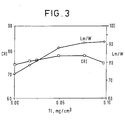
- the curves of FIG. 3 show that the lamp luminous efficacy and CRI increased with increasing amounts of metal thallium in the amalgam.
- Thallium concentrations greater than 0.1 mg/cm 3 may undesirably provide too much green colour emission resulting in an undesirable shifting of y-coordinates above the black body locus.
- the present invention advantageously utilizes thallium metal instead of thallium iodide in the lamp chemical fill.
- Thallium metal readily alloys with the mercury and does not separate within the range of 0 to 10 percent thallium.
- a thallium/mercury amalgam has the same viscosity as pure mercury and does not stick to the glass walls during lamp dosing. Since the amalgam is not hygroscopic, unlike most of the iodides, a thallium containing amalgam is more forgiving than using thallium iodide in lamp production.
- the present invention may advantageously be used for low wattage type metal halide discharge lamps, i.e., those lamps with a wattage less than 175 watts, for example 35 to 150 watts.
- Preferred lamps have a volume of 0.3 - 2.2 cm 3 , with a chemical fill consisting essentially of about 10 to 13 mg/cm 3 mercury and about 12000 Pa to about 20000 Pa (about 90 to about 150 torr) starting gas, about 0.5 to about 4.5 mg/cm 3 scandium iodide, about 5 to about 25 mg/cm 3 sodium iodide, and about 2 to 4 mg/cm 3 lithium iodide.
- the amount of thallium is from about 0.05 to about 0.07 mg/cm 3 .
- the tube has a wall loading in the range of about 14 to 17 watts/cm 2 .
- an improvement in the quality of white light emission from a high intensity discharge lamp utilizing the NaI-ScI 3 and LiI chemistry while maintaining the efficiency and long life characteristic of such a lamp and there is provided a lamp in which the lamp colour coordinates are brought back to the black body curve in order to eliminate an undesirable purplish tint of the lamp colour which would otherwise occur in the absence of thallium without sacrificing lamp performance; and there is provided a method of accurately and reproducibly introducing the chemical fill in the arc tube in order to provide good lamp to lamp colour uniformity and colour stability through lamp life.
Landscapes
- Discharge Lamp (AREA)
Description
- This invention relates to metal halide discharge lamp arc tubes, and more particularly to arc tubes containing sodium, lithium and scandium iodides.
- Known metal halide lamps typically have a high efficacy of 70 to 110 Lm/W and a CRI of 60 to about 95 depending on metal halide additives and lamp configurations. There are more than fifty different metal halides which may be used alone or in combination in metal halide lamps, and one lamp which has become widely used in the United States due to its very high efficacy (typically 80-110 Lm/W and CRI of about 65) is the sodium scandium lamp. However, despite the commercial success of some metal halide lamps, there is a need to further increase the efficacy, colour rendering and operating life of these lamps.
- U.S. patent 5,057,743 to Krasko et al (over which claim 1 has been characterised) describes a low wattage metal halide lamp, which contains a chemical fill comprising mercury, scandium metal, sodium iodide, scandium iodide, lithium iodide, and a starting gas. In the low wattage lamp illustrated, additions of 2-4 mg/cm3 of lithium iodide included in the chemical fill were stated to increase the CRI from 65 to more than 70, with little change in colour temperature and efficacy. However, it is now recognised that such a lamp with lithium iodide has an undesirable purplish tint of radiation colour which is reflected in a shift of colour coordinates from the black body curve with x=0.420, y=0.395 down to x=0.420, y=0.380.
- A metal halide which produces white light with minimal colour separation and is suitable for projection systems is known from EP-A-0128550. This document discloses a lamp containing a fill of mercury, lithium iodide, zinc, scandium iodide, thallium iodide, dysprosium iodide, mercury iodide, mercury bromide and argon. Sodium is identified as a possible contaminant.
- U.S. patent 4,866,342 to Ramaiah describes a metal halide lamp having a discharge sustaining fill within an arc tube consisting essentially of a rare gas, mercury, and the halides of sodium and scandium, and additionally containing thallium halide in the mole ratio of sodium halide to thallium halide of about 280:1 to 75:1 whereby to increase the luminous efficacy of the lamp. As set forth in column 2, lines 25 to 29, some improvement in both the luminous efficacy and the colour rendering index occurs within the narrow range of 260:1 to 240:1 mole ratio of sodium halide to thallium halide. However, no substantial improvement in CRI is provided over a wide range of molar ratios.
- Because of their superior efficacy and operating life, lamps utilizing a chemical fill of NaIScI3LiI with a scandium metal getter are highly desirable. However, due to their colour rendering properties, their commercial use in certain colour-critical applications has been limited. Hence, further desirable improvements to their colour rendering index is desirable.
- Certain terms as used in this specification have meanings which are generally accepted in the lighting industry. These terms are described in the IES LIGHTING HANDBOOK, Reference Volume, 1984, Illuminating Engineering Society of North America. The colour rendering index of a light source (CRI) is a measure of the degree of colour shift objects undergo when illuminated by the light source as compared with the colour of those same objects when illuminated by a reference source of comparable colour temperature. The CRI rating consists of a General Index, Ra, based on a set of eight test-colour samples that have been found adequate to cover the colour gamut. The colour appearance of a lamp is described by its chromaticity coordinates which can be calculated from spectral power distribution according to standard methods. See CIE, Method of measuring and specifying colour rendering properties of light sources (2nd ed.), Publ. CIE No. 13.2 (TC-3,2), Bureau Central de la CIE, Paris, 1974. The CIE standard chromaticity diagram includes the colour points of black body radiators at various temperatures. The locus of blackbody chromaticities on the x,y-diagram is known as the Planckian locus. Any emitting source represented by a point on this locus may be specified by a colour temperature. A point near but not on this Planckian locus has a correlated colour temperature (CCT) because lines can be drawn from such points to intersect the Planckian locus at this colour temperature such that all points look to the average human eye as having nearly the same colour. Luminous efficacy of a source of light is the quotient of the total luminous flux emitted by the total lamp power input as expressed in lumens per watt (Lm/W).
- Viewed from a first aspect, the present invention provides an arc tube for a metal halide discharge lamp, the arc tube having a chemical fill comprising an inert starting gas, mercury, sodium iodide, lithium iodide and scandium iodide, wherein said sodium iodide and said scandium iodide are present in a molar ratio of 20:1 to 28:1, characterised in that said fill further includes thallium metal as an additive in a quantity from 0.05-0.07 mg/cm3 of arc tube volume sufficient to shift the colour coordinates (x,y) of the arc tube toward and to a position substantially on the black body curve of the standard chromaticity diagram.
- The arc tube has a chemical fill which includes sodium iodide, lithium iodide and scandium iodide. It has been found that such a chemical fill can create an undesirable purplish tint. This can be avoided with an addition of the thallium.
- Preferably the thallium concentration is such as to result in colour coordinates x=0.42, y=0.40 located substantially on the black body locus of a CIE standard chromaticity diagram, and preferably the colour temperature is a warm colour temperature of about 3200 K.
- Viewed from a second aspect, the present invention provides a method of making an arc tube for a metal halide discharge lamp having a chemical fill comprising an inert starting gas, mercury, sodium iodide, lithium iodide and scandium iodide, wherein said sodium iodide and said scandium iodide are present in a molar ratio of 20:1 to 28:1, characterised in that thallium is added to said fill as thallium metal in a quantity from 0.05 to 0.07 mg/cm3 of arc tube volume sufficient to shift the colour coordinates (x,y) of the arc tube toward and to a position substantially on the black body curve of the standard chromaticity diagram.
- An embodiment of the invention will now be described by way of example only, with references to the accompanying drawings, wherein:-
- FIGURE 1 is a cross-sectional view of a discharge lamp arc tube disposed within a metal halide discharge lamp;
- FIGURE 2 is an x-y chromaticity diagram according to the 1931 standard showing the Planckian locus and the colour correction made in accordance with an embodiment of the present invention.
- FIGURE 3 is a graph showing CRI on one y-axis, Lm/W on another y-axis with thallium concentration in mg/cm3 on the x-axis.
-
- Referring to FIGURE 1, there is shown the structural features of a metal halide lamp discharge lamp. The illustrated lamp includes a quartz discharge tube or arc tube 1 disposed within an outer sealed
glass envelope 11. The outer envelope is most preferably evacuated. Theouter envelope 11 is hermetically sealed to an affixed glass stem member 14 having anexternal base member 10. A pair ofelectrical conductors - The discharge tube 1 has a pair of electrodes 2 and 3 which project into the interior of the discharge tube 1 at respective ends and provide for energizing of the discharge lamp by an external source (not shown) during operation. Discharge tube 1 is generally made of quartz although other types of material may be used such as alumina, yttria or silica. Each electrode 2 and 3 comprises a core portion surrounded by molybdenum or tungsten wire helixes.
- Each of the electrodes 2 and 3 is connected to
respective metal foils 4 and 5, preferably formed of molybdenum which are pinch sealed.Electrical conductors Conductors conductors conductor 6 andconductor 18 is made by a vertically disposed wire extending exterior to aradiation shield 13. A pair ofgetters support structure 12. - Within the
outer envelope 11, thesupport member 12 which is secured to the glass stem member 14 and extends substantially parallel to the longitudinal axis of the lamp includes anenvelope attachment 15 at one end. Theenvelope attachment 15 is in the form of a circular configuration which mates with a dimpled upper portion of theenvelope 11 so as to maintain thesupport structure 12 in proper alignment and resist deformation caused by external shock. - The
radiation shield 13 is secured to thesupport structure 12 by spaced apartstraps support member 12. Theradiation shield 13 has a cylindrical shape and is typically in the form of a quartz sleeve which can have a domed shaped closure at one end. Each of thestraps shield 13 in position. The diameter and length of the radiation shield may be chosen with respect to the arc tube dimensions to achieve the optimal radiation redistribution resulting in uniform arc tube wall temperatures. - It will be seen that the discharge tube 1 which is positioned interior the
radiation shield 13 is electrically isolated from theradiation shield 13 and thesupport structure 12. Such a "floating frame" structure is used to control the loss of alkali metal from the arc tube fill by electrically isolating the support structure. - Thus, the
conductors radiation shield 13 or thesupport structure 12 to which it is connected bystraps conductors support 12 secured to the stem by means of a strap. - The drawing illustrates a mogul type base, e.g., such as an E27 screw base but it is contemplated that the lamp may have a double-ended configuration with a recessed single-contact base. The discharge tube for use in a 100 watt size lamp, for example, has an internal diameter of 10 mm and an arc length of 14 mm.
- The lamp may include other structural features commonly found in metal halide lamps such as an auxiliary starting probe or electrode, generally made of tantalum or tungsten which may be provided at the base end of the arc tube adjacent the main electrode 3.
- The discharge tube 1 contains a chemical fill of inert starting gas, alkali metal iodides, and scandium iodide and an amalgam containing mercury which is at least partially vaporized during lamp operation and which are dispensed into the unsealed arc tube prior to introduction of the starting gas.
- A charge of mercury is present in a sufficient amount so when fully vaporized an arc may be sustained. Such an amount should provide an operating mercury-vapor pressure of from 0.1 to 1.0 MPa (1 to 10 atmospheres) as calculated on the basis of an average gas temperature of about 2000°K. More preferably the mercury dosage in the chemical fill of a lamp may be calculated in accordance with the formula:
- In accordance with the present invention, the chemical fill also comprises thallium. Preferably thallium is introduced into the arc tube in the form of an amalgam comprising mercury and thallium metal. The improved chemical fill of the present invention comprising the base NaI-ScI3-LiI chemistry with thallium for enhancing the lamp colour, brings the colour coordinates to the black body locus.
- Thallium metal present in the arc tube in the form of the amalgam combines with elemental iodine which is always present in the arc tube to form thallium iodide. Thallium iodide has three orders of magnitude higher saturated vapor pressure than thallium metal at the lamp operating temperatures. The amount of thallium present in the amalgam is sufficient so that the amount of thallium iodide formed is sufficient for making only the desired colour correction to the emitted light. Preferably the amount of thallium metal present in the initially introduced amalgam is from about 0.05 to 0.07 mg/cm3 of the arc tube volume.
- In addition to mercury, a small charge of an inert ionizable starting gas such as argon is contained within the discharge tube 1. It is contemplated that other noble gases can be substituted for argon provided an appropriate pressure is maintained that is conducive to starting the lamp.
- The fill mixture containing scandium halide and alkali metal halides is desirable for achieving a high lumen output. The preferred ingredients scandium iodide and the alkali metal iodides are preferably present in a ratio which provides a warm colour of lamp light output match up or comparability to the output of an incandescent lamp. Sodium iodide and scandium iodide are present in a molar ratio of from amount 20:1 to about 28:1. It has been found in comparison of various molar ratios of sodium and scandium iodides in sodium-scandium lamps similar to that shown in Fig. 1, that ratios within this range most closely approach the black body curve, have a desirable colour temperature and efficiency, and maintain a relatively high CRI within this range.
- In further tests on lamps similar to that shown in Fig. 1, the amount of lithium iodide included in the chemical fill of a lamp otherwise including mercury, scandium metal, sodium iodide and lithium iodide was varied and the luminous efficacy, operating voltage, colour temperature and CRI were monitored. It was found that desirable characteristics were achieved with certain molar ratios of alkali metal iodides (lithium iodide + sodium iodide) to scandium iodide. The amounts of alkali metal iodides to scandium iodide is preferably in a molar ratio of about 27:1 to about 40:1. A preferred ratio of sodium iodide to lithium iodide is a molar ratio of from about 1:1 to about 5:1.
- Preferably the amount of lithium iodide in the chemical fill of the lamp is about 2-4 mg/cm3, more preferably about 3 mg/cm3, wherein the molar ratio of alkali metal iodides to scandium iodide is maintained within the range of about 27:1 to 40:1. This amount of LiI has been found to significantly increase the lamp CRI without detrimentally affecting luminous efficacy or colour temperature (See U.S. patent 5,057,743). In the absence of thallium lamps of this type typically have a purplish tint since the colour coordinates are located below the black body locus with x=0.420 and y=0.380.
- In addition to the above-mentioned components, scandium metal, thorium metal, and mixtures thereof may be added to the fill. A weight dose of scandium elemental metal in the fill has been found desirable to adjust the metal/iodine ratio in the lamp and to getter oxygen impurities.
- When the base chemistry of the lamp, excludes thallium, i.e. the constituents comprises the NaI-ScI3-LiI fill ingredients, the colour of the lamp is displaced from the black body locus as shown in FIG 2. FIG 2 shows that the addition of a sufficient amount of thallium brings the lamp colour coordinates to the black body locus. The data was obtained using a 100 watt lamp having a configuration similar to that shown in FIG. 1 with a quartz arc tube having ID-10 mm and an arc gap of 14 mm. The amount of thallium was varied from 0 to 0.15 mg. The fill otherwise comprised 12 mg mercury, 0.13 mg scandium metal, 6.8 mg sodium iodide, 0.8 mg scandium iodide, 2.4 mg lithium iodide and 13000 Pa (100 torr) of argon for starting.
- The curves of FIG. 3 show that the lamp luminous efficacy and CRI increased with increasing amounts of metal thallium in the amalgam. The amount of thallium is from 0.05 to 0.07 mg/cm3 for providing high lamp efficacy of about 95 Lm/W, high CRI of about 80, a warm colour temperature of 3200K, and colour coordinates x=0.42, y=0.40 located on the black body locus. Thallium concentrations greater than 0.1 mg/cm3 may undesirably provide too much green colour emission resulting in an undesirable shifting of y-coordinates above the black body locus.
- The present invention advantageously utilizes thallium metal instead of thallium iodide in the lamp chemical fill. Thallium metal readily alloys with the mercury and does not separate within the range of 0 to 10 percent thallium. A thallium/mercury amalgam has the same viscosity as pure mercury and does not stick to the glass walls during lamp dosing. Since the amalgam is not hygroscopic, unlike most of the iodides, a thallium containing amalgam is more forgiving than using thallium iodide in lamp production.
- Preferably, the present invention may advantageously be used for low wattage type metal halide discharge lamps, i.e., those lamps with a wattage less than 175 watts, for example 35 to 150 watts. Preferred lamps have a volume of 0.3 - 2.2 cm3, with a chemical fill consisting essentially of about 10 to 13 mg/cm3 mercury and about 12000 Pa to about 20000 Pa (about 90 to about 150 torr) starting gas, about 0.5 to about 4.5 mg/cm3 scandium iodide, about 5 to about 25 mg/cm3 sodium iodide, and about 2 to 4 mg/cm3 lithium iodide. The amount of thallium is from about 0.05 to about 0.07 mg/cm3. Preferably the tube has a wall loading in the range of about 14 to 17 watts/cm2.
- Thus, in at least preferred embodiments there is provided an improvement in the quality of white light emission from a high intensity discharge lamp utilizing the NaI-ScI3 and LiI chemistry while maintaining the efficiency and long life characteristic of such a lamp; and there is provided a lamp in which the lamp colour coordinates are brought back to the black body curve in order to eliminate an undesirable purplish tint of the lamp colour which would otherwise occur in the absence of thallium without sacrificing lamp performance; and there is provided a method of accurately and reproducibly introducing the chemical fill in the arc tube in order to provide good lamp to lamp colour uniformity and colour stability through lamp life.
Claims (12)
- An arc tube for a metal halide discharge lamp, the arc tube having a chemical fill comprising an inert starting gas, mercury, sodium iodide, lithium iodide and scandium iodide, wherein said sodium iodide and said scandium iodide are present in a molar ratio of 20:1 to 28:1, characterised in that said fill further includes thallium metal as an additive in a quantity from 0.05 to 0.07 mg/cm3 of arc tube volume sufficient to shift the colour coordinates (x,y) of the arc tube toward and to a position substantially on the black body curve of the standard chromaticity diagram.
- An arc tube as claimed in claim 1, characterised in that said colour coordinates (x,y) which lie substantially on the black body curve are x=0.42, y=0.40.
- An arc tube as claimed in claim 1 or 2, characterised in that said arc tube has a colour temperature of 3200 K.
- An arc tube as claimed in claim 1, 2 or 3, characterised in that said sodium iodide and said lithium iodide are present in a molar ratio of from 1:1 to 5:1.
- An arc tube as claimed in any preceding claim, characterised in that the sodium iodide and lithium iodide are present in a molar ratio to said scandium iodide of 27:1 to 40:1.
- An arc tube as claimed in any preceding claim, characterised in that said chemical fill further includes a metal or metal alloy selected from the group consisting of scandium metal, thorium metal, and mixtures thereof.
- An arc tube as claimed in any preceding claim, characterised by a luminous efficacy of 95 Lumens/Watt.
- An arc tube as claimed in any preceding claim, characterised by a CRI of 80.
- An arc tube as claimed in any preceding claim, characterised in that said arc tube has a wattage of between 35 to 150 watts.
- A metal halide discharge lamp having an arc tube (1) as claimed in any preceding claim.
- A method of making an arc tube for a metal halide discharge lamp having a chemical fill comprising an inert starting gas, mercury, sodium iodide, lithium iodide and scandium iodide, wherein said sodium iodide and said scandium iodide are present in a molar ratio of 20:1 to 28:1, characterised in that thallium is added to said fill as thallium metal in a quantity from 0.05 to 0.07 mg/cm3 of arc tube volume sufficient to shift the colour coordinates (x,y) of the arc tube toward and to a position substantially on the black body curve of the standard chromaticity diagram.
- A method as claimed in claim 11, characterised in that said thallium metal is introduced into the arc tube with said mercury as an amalgam.
Applications Claiming Priority (2)
| Application Number | Priority Date | Filing Date | Title |
|---|---|---|---|
| US92181892A | 1992-07-29 | 1992-07-29 | |
| US921818 | 1992-07-29 |
Publications (2)
| Publication Number | Publication Date |
|---|---|
| EP0583113A1 EP0583113A1 (en) | 1994-02-16 |
| EP0583113B1 true EP0583113B1 (en) | 2003-12-10 |
Family
ID=25446018
Family Applications (1)
| Application Number | Title | Priority Date | Filing Date |
|---|---|---|---|
| EP19930306013 Expired - Lifetime EP0583113B1 (en) | 1992-07-29 | 1993-07-29 | Discharge lamp arc tube and method of making a discharge lamp arc tube |
Country Status (3)
| Country | Link |
|---|---|
| EP (1) | EP0583113B1 (en) |
| CA (1) | CA2101516A1 (en) |
| DE (1) | DE69333340T2 (en) |
Families Citing this family (1)
| Publication number | Priority date | Publication date | Assignee | Title |
|---|---|---|---|---|
| JP4832717B2 (en) | 2003-12-22 | 2011-12-07 | パナソニック株式会社 | Metal halide lamp and lighting device |
Family Cites Families (6)
| Publication number | Priority date | Publication date | Assignee | Title |
|---|---|---|---|---|
| JPS56126244A (en) * | 1980-03-06 | 1981-10-03 | Toshiba Corp | Metal halide lamp |
| JPS5963653A (en) * | 1982-10-04 | 1984-04-11 | Toshiba Corp | Short-arc metal halide lamp |
| US4557700A (en) * | 1983-06-09 | 1985-12-10 | Gte Products Corporation | Metal halide discharge lamp gas fill process to provide minimal color separation |
| JPS6132949A (en) * | 1984-07-25 | 1986-02-15 | Hitachi Ltd | Low pressure mercury vapor telegraph lamp |
| CA1324633C (en) * | 1988-09-12 | 1993-11-23 | Zeya K. Krasko | Metal halide discharge lamp with improved color rendering properties |
| US5225738A (en) * | 1990-12-14 | 1993-07-06 | North American Philips Corporation | Metal halide lamp with improved lumen output and color rendition |
-
1993
- 1993-07-28 CA CA 2101516 patent/CA2101516A1/en not_active Abandoned
- 1993-07-29 EP EP19930306013 patent/EP0583113B1/en not_active Expired - Lifetime
- 1993-07-29 DE DE1993633340 patent/DE69333340T2/en not_active Expired - Fee Related
Also Published As
| Publication number | Publication date |
|---|---|
| EP0583113A1 (en) | 1994-02-16 |
| CA2101516A1 (en) | 1994-01-30 |
| DE69333340T2 (en) | 2004-10-28 |
| DE69333340D1 (en) | 2004-01-22 |
Similar Documents
| Publication | Publication Date | Title |
|---|---|---|
| US6265827B1 (en) | Mercury-free metal halide lamp | |
| US3979624A (en) | High-efficiency discharge lamp which incorporates a small molar excess of alkali metal halide as compared to scandium halide | |
| US5057743A (en) | Metal halide discharge lamp with improved color rendering properties | |
| US4709184A (en) | Low wattage metal halide lamp | |
| US6362571B1 (en) | Metal-halide lamp with ionizable filling and oxygen dispenser to avoid blackening and extend lamp life | |
| JP4531946B2 (en) | Mercury-free metal halide lamp | |
| JP2000182564A (en) | Metal halide lamp not including mercury | |
| EP0400980B1 (en) | Metal halide lamp | |
| GB1580991A (en) | High pressure gas discharge light source with metal halide additive | |
| CA2489264C (en) | Thallium-free metal halide fill for discharge lamps and discharge lamp containing same | |
| US6946797B2 (en) | Metal halide fill, and associated lamp | |
| US20060108930A1 (en) | Metal Halide Lamp Chemistries With Magnesium and Indium | |
| EP0582709B1 (en) | Metal iodide lamp | |
| US4247798A (en) | Mercury-metal halide discharge lamp | |
| US5327042A (en) | Metal halide lamp | |
| EP0784334B1 (en) | Metal halide lamp | |
| US5021703A (en) | Metal halide lamp | |
| US5159229A (en) | Metal halide lamp having CO in gas fill | |
| US5225733A (en) | Scandium halide and alkali metal halide discharge lamp | |
| EP0359200B1 (en) | Metal halide discharge lamp with improved color rendering properties | |
| US3867664A (en) | Electric discharge devices | |
| EP0583113A1 (en) | Discharge lamp arc tubes | |
| JP3993656B2 (en) | Metal halide discharge lamp for projection | |
| EP0173235B1 (en) | Low wattage metal halide lamp | |
| US20070138964A1 (en) | Mercury-free high-pressure discharge lamp and luminaire using the same |
Legal Events
| Date | Code | Title | Description |
|---|---|---|---|
| PUAI | Public reference made under article 153(3) epc to a published international application that has entered the european phase |
Free format text: ORIGINAL CODE: 0009012 |
|
| AK | Designated contracting states |
Kind code of ref document: A1 Designated state(s): BE DE FR GB NL |
|
| 17P | Request for examination filed |
Effective date: 19940405 |
|
| 17Q | First examination report despatched |
Effective date: 19960502 |
|
| GRAH | Despatch of communication of intention to grant a patent |
Free format text: ORIGINAL CODE: EPIDOS IGRA |
|
| RIC1 | Information provided on ipc code assigned before grant |
Ipc: 7H 01J 9/395 B Ipc: 7H 01J 61/12 A |
|
| RTI1 | Title (correction) |
Free format text: DISCHARGE LAMP ARC TUBE AND METHOD OF MAKING A DISCHARGE LAMP ARC TUBE |
|
| GRAS | Grant fee paid |
Free format text: ORIGINAL CODE: EPIDOSNIGR3 |
|
| GRAA | (expected) grant |
Free format text: ORIGINAL CODE: 0009210 |
|
| AK | Designated contracting states |
Kind code of ref document: B1 Designated state(s): BE DE FR GB NL |
|
| REG | Reference to a national code |
Ref country code: GB Ref legal event code: FG4D |
|
| REF | Corresponds to: |
Ref document number: 69333340 Country of ref document: DE Date of ref document: 20040122 Kind code of ref document: P |
|
| PGFP | Annual fee paid to national office [announced via postgrant information from national office to epo] |
Ref country code: BE Payment date: 20040730 Year of fee payment: 12 |
|
| PGFP | Annual fee paid to national office [announced via postgrant information from national office to epo] |
Ref country code: NL Payment date: 20040731 Year of fee payment: 12 |
|
| PGFP | Annual fee paid to national office [announced via postgrant information from national office to epo] |
Ref country code: GB Payment date: 20040805 Year of fee payment: 12 |
|
| PGFP | Annual fee paid to national office [announced via postgrant information from national office to epo] |
Ref country code: DE Payment date: 20040928 Year of fee payment: 12 |
|
| ET | Fr: translation filed | ||
| PLBE | No opposition filed within time limit |
Free format text: ORIGINAL CODE: 0009261 |
|
| STAA | Information on the status of an ep patent application or granted ep patent |
Free format text: STATUS: NO OPPOSITION FILED WITHIN TIME LIMIT |
|
| 26N | No opposition filed |
Effective date: 20040913 |
|
| PG25 | Lapsed in a contracting state [announced via postgrant information from national office to epo] |
Ref country code: GB Free format text: LAPSE BECAUSE OF NON-PAYMENT OF DUE FEES Effective date: 20050729 |
|
| PG25 | Lapsed in a contracting state [announced via postgrant information from national office to epo] |
Ref country code: BE Free format text: LAPSE BECAUSE OF NON-PAYMENT OF DUE FEES Effective date: 20050731 |
|
| PG25 | Lapsed in a contracting state [announced via postgrant information from national office to epo] |
Ref country code: NL Free format text: LAPSE BECAUSE OF NON-PAYMENT OF DUE FEES Effective date: 20060201 Ref country code: DE Free format text: LAPSE BECAUSE OF NON-PAYMENT OF DUE FEES Effective date: 20060201 |
|
| GBPC | Gb: european patent ceased through non-payment of renewal fee |
Effective date: 20050729 |
|
| NLV4 | Nl: lapsed or anulled due to non-payment of the annual fee |
Effective date: 20060201 |
|
| BERE | Be: lapsed |
Owner name: *FLOWIL INTERNATIONAL LIGHTING (HOLDING) B.V. Effective date: 20050731 |
|
| REG | Reference to a national code |
Ref country code: FR Ref legal event code: ST Effective date: 20080229 |
|
| PG25 | Lapsed in a contracting state [announced via postgrant information from national office to epo] |
Ref country code: FR Free format text: LAPSE BECAUSE OF NON-PAYMENT OF DUE FEES Effective date: 20040731 |