EP0576233A1 - Balls and making them - Google Patents
Balls and making them Download PDFInfo
- Publication number
- EP0576233A1 EP0576233A1 EP93304823A EP93304823A EP0576233A1 EP 0576233 A1 EP0576233 A1 EP 0576233A1 EP 93304823 A EP93304823 A EP 93304823A EP 93304823 A EP93304823 A EP 93304823A EP 0576233 A1 EP0576233 A1 EP 0576233A1
- Authority
- EP
- European Patent Office
- Prior art keywords
- ball
- core
- panels
- fabric
- edges
- Prior art date
- Legal status (The legal status is an assumption and is not a legal conclusion. Google has not performed a legal analysis and makes no representation as to the accuracy of the status listed.)
- Withdrawn
Links
- 239000000853 adhesive Substances 0.000 claims abstract description 67
- 230000001070 adhesive effect Effects 0.000 claims abstract description 67
- 239000004744 fabric Substances 0.000 claims abstract description 37
- 239000013536 elastomeric material Substances 0.000 claims abstract description 11
- 238000000034 method Methods 0.000 claims description 14
- 239000000463 material Substances 0.000 claims description 11
- 229920001971 elastomer Polymers 0.000 claims description 2
- 239000012790 adhesive layer Substances 0.000 claims 1
- 239000011248 coating agent Substances 0.000 claims 1
- 238000000576 coating method Methods 0.000 claims 1
- 239000000806 elastomer Substances 0.000 claims 1
- 239000011162 core material Substances 0.000 description 47
- 230000000694 effects Effects 0.000 description 4
- 238000004519 manufacturing process Methods 0.000 description 4
- 230000008030 elimination Effects 0.000 description 3
- 238000003379 elimination reaction Methods 0.000 description 3
- 230000006835 compression Effects 0.000 description 2
- 238000000748 compression moulding Methods 0.000 description 2
- 238000001746 injection moulding Methods 0.000 description 2
- 239000000203 mixture Substances 0.000 description 2
- 239000012209 synthetic fiber Substances 0.000 description 2
- 229920002994 synthetic fiber Polymers 0.000 description 2
- 208000002240 Tennis Elbow Diseases 0.000 description 1
- 208000027418 Wounds and injury Diseases 0.000 description 1
- 238000007906 compression Methods 0.000 description 1
- 238000005520 cutting process Methods 0.000 description 1
- 230000006378 damage Effects 0.000 description 1
- 238000007598 dipping method Methods 0.000 description 1
- 238000010438 heat treatment Methods 0.000 description 1
- 238000010348 incorporation Methods 0.000 description 1
- 208000014674 injury Diseases 0.000 description 1
- 239000011344 liquid material Substances 0.000 description 1
- 238000010422 painting Methods 0.000 description 1
- 238000007639 printing Methods 0.000 description 1
- 238000003908 quality control method Methods 0.000 description 1
- 239000011343 solid material Substances 0.000 description 1
- 239000002904 solvent Substances 0.000 description 1
- 238000009987 spinning Methods 0.000 description 1
- 238000003892 spreading Methods 0.000 description 1
- 239000002699 waste material Substances 0.000 description 1
Images
Classifications
-
- A—HUMAN NECESSITIES
- A63—SPORTS; GAMES; AMUSEMENTS
- A63B—APPARATUS FOR PHYSICAL TRAINING, GYMNASTICS, SWIMMING, CLIMBING, OR FENCING; BALL GAMES; TRAINING EQUIPMENT
- A63B39/00—Hollow non-inflatable balls, i.e. having no valves
- A63B39/06—Special coverings
- A63B39/08—Special coverings made of two halves
Definitions
- the invention relates to a fabric covered ball having a core formed from an elastomeric material, and more particularly to a tennis ball wherein the fabric panels forming the cover of the ball are not adhesively bonded to one another along their edges, thus providing a ball having a uniform felt covering uninterrupted by an adhesive seam.
- Conventional tennis balls are generally fabricated from a pair of hemispherical shells which are made of an elastomeric material and which are bonded to one another along their edges to form a hollow spherical core which is covered by a pair of dogbone shaped felt-panels.
- the hemispherical shells which constitute the core of the ball are formed by compression molding or injection molding.
- a curable elastomeric adhesive having a composition similar to and capable of bonding with the material of the elastomeric core is applied to the edges of each hemispherical shell.
- each core half are abuttingly arranged, placed in a mold and cured in the presence of heat and generally in the presence of positive pressure to form a unitary hollow spherical core containing a gas at a pressure of typically about 5 to 15 psi above normal atmospheric pressure.
- the felt panels are prepared by applying a curable adhesive having a composition similar to and capable of bonding with the material of the core to the back side or the side opposite the felt pile of the felt, and cutting the felt into dogbone-shaped panels.
- a curable adhesive similar to and capable of bonding with the material of the core is also applied to the edges of the felt panels.
- the hollow spherical core is dipped or otherwise covered with a curable elastomeric adhesive which is similar to and capable of bonding with the material of the core.
- the felt cover is formed by stretching or spreading a pair of dogbone-shaped felt panels having adhesive applied to the backside and edges thereof over the surface of the adhesive covered ball.
- the resulting assembly comprising a hollow spherical core and a pair of felt panels which along with an adhesive between their edges cover the entire outer surface of the core is placed in a heated mold cavity and cured to form a unitary structure wherein the cured adhesives applied to the outer surface of the core and the back side and edges of the felt panel become an integral part of or addition to the hollow spherical core.
- heat from the mold causes the air pressure inside the core to increase and uniformly compress the felt panels between the core and the walls of the mold cavity to help uniformly bond the felt panels to the core.
- the adhesive applied to the edges of the felt panels form an elastomeric seam which bonds the panels to one another with the seam becoming an integral continuous part of the spherical core.
- the adhesive seams between the felt panels of conventional tennis balls are generally about 3.2mm (0.125'') in width and form a raised structural rib which causes the spherical hollow rubber core to become geometrically non-uniform.
- This non-uniform geometry in turn causes non-uniform flexion of the ball during impact leading to unpredictable bounces and flight trajectories during play.
- the raised ribs associated with the adhesive seams of typical tennis balls cause the ball to distort differently upon impact with a surface or with the strings of a racquet depending upon the orientation of the seams relative to the surface or the strings respectively.
- a continously connected relatively inelastic felt panel covering creates a girdling effect wherein the ball becomes stiffer and less compliant resulting in short duration impact times which reduces a player's opportunity to put spin on the ball and reduces the time over which the force of impact can be absorbed by the player.
- Short impact times are known to contribute to injuries such as tennis elbow.
- the feel to the player may be noticeably harsher than when the ball is struck between the seams.
- the elastomeric seams of a conventional tennis ball are formed of a material similar to or at least chemically compatible with the core, upon curing the seams become an addition to or an integral continuation of the core. Consequently, deformation of the ball upon direct impact on the seam causes the core to distort acutely around the seam occasionally resulting in failure of the core material near the inner face of the core wall directly underneath the seam. This type of failure may occur abruptly after repeated strikes directly on the seam resulting in a short useful life for the ball.
- the adhesive seams are also thought to constitute surface irregularities which affect the aerodynamics of the ball resulting in a flight path which is generally less predictable than that for a ball having a more uniform external surface.
- the adhesive seams which are typically white have a tendency to become dull grey after only a short period of play on a hard court surface causing the ball to become less readily visible.
- the adhesive seam represents about 8 percent of the total surface area.
- stitched-seam tennis balls Prior to the advent of the above-described adhesive seam type balls in about 1926, stitched-seam tennis balls were typically used.
- the stitched-seam tennis balls generally had much better aerodynamic and structural uniformity than the adhesive seam tennis balls because the felt panels of the stitched-seam balls were tightly sewn together at their edges with a small diameter thread leaving an almost invisible seam.
- the process for fabricating a stitched-seam ball was not readily susceptible to automation as it was very labor intensive, and, consequently, expensive.
- adhesive seam tennis balls had disadvantages, such as those related to unpredictable bounce and flight, and tendency toward failure and visibility problems, they were readily preferred over stitched-seam balls because they could be produced much less expensively.
- Other disadvantages with stitched-seam balls include the possibility of failure of the stitching and nonconformity with rules, e.g. US Tennis Association Rules which state that any seams "shall be stitchless.”
- adhesive seams have been regarded as an essential feature of stitchless tennis balls having a felt cover. It was previously believed that in order to firmly secure the cooperating felt panels to the core, the panels must be secured to one another along their edges by an adhesive seam which is itself secured to the core.
- the process may comprise the conventional steps of forming a hollow spherical core made of an elastomeric material, applying an adhesive to the core and the back side of the felt,the felt being cut into panels e.g. "dog-bone” shaped.
- the spherical core is preferably pressurized, but pressureless balls are also possible.
- the panel shapes are cut so that the felt panels can be wrapped around the core without any overlapping of the edges.
- the conventional step of applying an adhesive to the edges of the felt panels is eliminated.
- the assembled ball can then be cured in a heated mold cavity e.g. as in conventional practice.
- the resulting ball consists of a hollow spherical core made of an elastomeric material which has a felt covering firmly secured thereto.
- the invention provides a tennis ball without any adhesive seams which may therefore overcome the disadvantages identified above associated with tennis balls having adhesive seams. Elimination of all adhesive seams results in a tennis ball having a more uniform structure which provides for more uniform flexion and more uniform aerodynamic characteristics. Uniform flexion, in turn, results in more predictable bounce off of a tennis court or off of the strings of a tennis racquet. The absence of adhesive seams also reduces the potential for failure of the core on account of nonuniform deformation of the ball around the seam upon impact with the strings of a tennis racquet.
- Uniform aerodynamic characteristics result in more predictable trajectories.
- Other advantages of the invention include better visibility of the ball after extended periods of play due to the absence of adhesive seams which tend to take on a dull grey appearance, and a more pleasant feel upon striking the ball with a racket also due to the absence of adhesive seams which tend to act as stiffening ribs in a conventional tennis ball.
- Another advantage of the tennis balls of the invention is that because the edges of the felt panels are not bonded to one another, girdling effects are reduced. This results in a more compliant tennis ball which tends to stay on the racquet for a slightly longer period of time thereby increasing a player's opportunity to put spin on the ball and cause it to curve. It is often incorrectly believed that, as with a baseball, it is the seams alone that provide the aerodynamic drag needed to cause a spinning tennis ball to curve.
- the seams of a conventional tennis ball unlike the protruding stitched seams of a smooth baseball, are indented and provide a relatively insignificant amount of aerodynamic drag relative to the napped surface of the felt panels. Consequently, the absence of an adhesive seam has almost no effect on the aerodynamic drag of a tennis ball, and any such effect attributable to the seam is unimportant relative to the increased time that a player has to put spin on a seamless, more compliant ball.
- a tennis ball having a uniform felt covering uninterrupted by adhesive seams or other surface irregularities is shown.
- the ball comprises four components, a pair of hemispherical shells 12 and a pair of felt panels 14 which are bonded together by means of an adhesive material.
- the hemispherical shells 12 are formed by compression or injection molding a heat curable elastomeric material.
- a curable elastomeric adhesive having a conposition similar to and capable of bonding with the material used to form the shells 12 is applied to the edge 16 of at least one shell 12.
- edges 16 of two shells 12, at least one of which has adhesive applied to its edges, are arranged in abutting alignment within a pressurizable mold cavity and cured at an elevated temperature to form a unitary hollow spherical core preferably containing a gas at a pressure above normal atmospheric pressure, typically about 5 to 15 psig.
- Another method which is well known in the art and literature for pressurizing the hollow core of a tennis ball is to dispose within the hollow core a liquid or solid material which upon heating reacts to form a pressurized gas. While pressurized balls are preferred, pressureless balls can also be made.
- a pair of felt panels 14 cut into a dogbone-like or dumbbell-like shape are stretched or wrapped around and secured to the hollow spherical core by means of an adhesive.
- a dogbone-like or dumbbell-like shaped panel formed into the shape conforming to the surface of a spherical core is shown in Fig. 3.
- the felt panels 14 are sized and shaped so that the panels can be tightly wrapped around the core with the edges 18 of one panel continuously abutting the edges of the other panel to form a substantially continuous surface covering substantially free of gaps, adhesive seams or overlap. Tightly wrapped around the core means that the fabric is stretched or spread over the surface of the core without any bunching or creasing of the fabric.
- An almost invisible seam 20 is formed by the abutting edges of the panels 14.
- the assembled ball is then preferably placed in a mold cavity and heated to cure the adhesive and form a tennis ball having a hollow pressurized spherical core made of an elastomeric material which has a uniform continuous felt covering firmly secured thereto which is substantially free of any adhesive seams or other surface irregularities.
- the resulting ball has a uniform spherical structure, free of structural protuberances which would cause nonuniform distortion upon flexion of the ball. Also, the absence of adhesive seams or other surface irregularities imparts uniform aerodynamic properties to the ball.
- the ball has substantially uniform radial symmetry, i.e. any plane passing through the center point of the ball divides the ball into two substantially identical halves, substantially free of protuberances or irregularities, resulting in uniform aerodynamic and bounce characteristics.
- the adhesives used in the assembly of the ball are preferably heat curable and are preferably composed of a material which is similar to and capable of bonding with the material of the core so that the adhesives become a continuous and integral part of the core.
- While the preferred embodiment has a pair of felt panels having a dogbone-like or dumbbell-like shape, more than two panels and different shaped panels are possible.
- Examples of other possible panel shapes include crescents similar to those of a basketball, and a combination of pentagons and hexagons as with a soccer ball.
- the panels are preferably sized and shaped so that they completely cover the core and so that the edges of the panels tightly abut one another without any overlap.
- the ball can be fabricated with a small gap of uniform width between the edges of the panels for incorporation of an elastic band which serves as an ornamental seam.
- Such elastic bands can be brightly colored to improve visibility and attractiveness.
- the ornamental seam be bonded directly to the core and not to the edges of the felt panels.
- ornamental seams can be applied to the outer surface such as by painting, printing, or hot stamping.
- Felt as used herein means a napped fabric or cloth made of natural or synthetic fibers or a combination of both natural and synthetic fibers. Other fabric coverings are also possible,
- the preferred embodiment is a tennis ball, other types of balls or different sized balls having the structure and features disclosed herein are possible.
Landscapes
- Health & Medical Sciences (AREA)
- General Health & Medical Sciences (AREA)
- Physical Education & Sports Medicine (AREA)
- Adhesives Or Adhesive Processes (AREA)
- Details Of Garments (AREA)
- Laminated Bodies (AREA)
- Lining Or Joining Of Plastics Or The Like (AREA)
Abstract
A stitchless fabric covered ball e.g. a tennis ball, having a uniform surface free of adhesive seams or other irregularities is disclosed. The ball has a hollow spherical core made from an elastomeric material, and a plurality of fabric panels (14) secured to the core by means of an adhesive. The panels secured to the core substantially cover the entire core so that the edges of the panels are substantially in continuous abutment (20) to form a substantially continuous fabric covering uninterrupted by adhesive seams. The ball has uniform radial symmetry which provides for more predictable and uniform aerodynamic and bounce characteristics. The fabric covering preferably consists of a pair of felt fabric panels (14) having a generally dumbbell-like or dogbone-like shape.
Description
- The invention relates to a fabric covered ball having a core formed from an elastomeric material, and more particularly to a tennis ball wherein the fabric panels forming the cover of the ball are not adhesively bonded to one another along their edges, thus providing a ball having a uniform felt covering uninterrupted by an adhesive seam.
- Conventional tennis balls are generally fabricated from a pair of hemispherical shells which are made of an elastomeric material and which are bonded to one another along their edges to form a hollow spherical core which is covered by a pair of dogbone shaped felt-panels. The hemispherical shells which constitute the core of the ball are formed by compression molding or injection molding. A curable elastomeric adhesive having a composition similar to and capable of bonding with the material of the elastomeric core is applied to the edges of each hemispherical shell. The edges of each core half are abuttingly arranged, placed in a mold and cured in the presence of heat and generally in the presence of positive pressure to form a unitary hollow spherical core containing a gas at a pressure of typically about 5 to 15 psi above normal atmospheric pressure. The felt panels are prepared by applying a curable adhesive having a composition similar to and capable of bonding with the material of the core to the back side or the side opposite the felt pile of the felt, and cutting the felt into dogbone-shaped panels. A curable adhesive similar to and capable of bonding with the material of the core is also applied to the edges of the felt panels. This is typically accomplished by stacking a plurality of felt panels with their edges aligned, mechanically placing the panels under compression with their edges exposed, and repeatedly dipping them into a bath containing the adhesive until a suitable heavy build-up has been achieved. Another method of applying an adhesive to the edges of the felt panels involves the application of a rope-like entity during assembly of the ball. Either process requires complex automation or considerable labor and represents a substantial portion of the total fabrication cost. The hollow spherical core is dipped or otherwise covered with a curable elastomeric adhesive which is similar to and capable of bonding with the material of the core. The felt cover is formed by stretching or spreading a pair of dogbone-shaped felt panels having adhesive applied to the backside and edges thereof over the surface of the adhesive covered ball. The resulting assembly comprising a hollow spherical core and a pair of felt panels which along with an adhesive between their edges cover the entire outer surface of the core is placed in a heated mold cavity and cured to form a unitary structure wherein the cured adhesives applied to the outer surface of the core and the back side and edges of the felt panel become an integral part of or addition to the hollow spherical core. Generally, heat from the mold causes the air pressure inside the core to increase and uniformly compress the felt panels between the core and the walls of the mold cavity to help uniformly bond the felt panels to the core. The adhesive applied to the edges of the felt panels form an elastomeric seam which bonds the panels to one another with the seam becoming an integral continuous part of the spherical core.
- The adhesive seams between the felt panels of conventional tennis balls are generally about 3.2mm (0.125'') in width and form a raised structural rib which causes the spherical hollow rubber core to become geometrically non-uniform. This non-uniform geometry in turn causes non-uniform flexion of the ball during impact leading to unpredictable bounces and flight trajectories during play. In particular, the raised ribs associated with the adhesive seams of typical tennis balls cause the ball to distort differently upon impact with a surface or with the strings of a racquet depending upon the orientation of the seams relative to the surface or the strings respectively. Additionally, by adhering the edges of the panels to one another, a continously connected relatively inelastic felt panel covering creates a girdling effect wherein the ball becomes stiffer and less compliant resulting in short duration impact times which reduces a player's opportunity to put spin on the ball and reduces the time over which the force of impact can be absorbed by the player. Short impact times are known to contribute to injuries such as tennis elbow. Also, when a player strikes a conventional tennis ball on or near the cured adhesive seam, the feel to the player may be noticeably harsher than when the ball is struck between the seams.
- Because the elastomeric seams of a conventional tennis ball are formed of a material similar to or at least chemically compatible with the core, upon curing the seams become an addition to or an integral continuation of the core. Consequently, deformation of the ball upon direct impact on the seam causes the core to distort acutely around the seam occasionally resulting in failure of the core material near the inner face of the core wall directly underneath the seam. This type of failure may occur abruptly after repeated strikes directly on the seam resulting in a short useful life for the ball.
- The adhesive seams are also thought to constitute surface irregularities which affect the aerodynamics of the ball resulting in a flight path which is generally less predictable than that for a ball having a more uniform external surface.
- The adhesive seams which are typically white have a tendency to become dull grey after only a short period of play on a hard court surface causing the ball to become less readily visible. For a conventional tennis ball having about a 0.125 inch wide seam which is about 12.375 inches long and having a diameter between about 2.5 inches and 2.625 inches, the adhesive seam represents about 8 percent of the total surface area. Thus, a reduction in visibility of the seam significantly affects the overall visibility of a conventional tennis ball. By abutting the panel edges and completely eliminating the adhesive seam, the present invention avoids the problem entirely.
- Prior to the advent of the above-described adhesive seam type balls in about 1926, stitched-seam tennis balls were typically used. The stitched-seam tennis balls generally had much better aerodynamic and structural uniformity than the adhesive seam tennis balls because the felt panels of the stitched-seam balls were tightly sewn together at their edges with a small diameter thread leaving an almost invisible seam. However, the process for fabricating a stitched-seam ball was not readily susceptible to automation as it was very labor intensive, and, consequently, expensive. Thus, while adhesive seam tennis balls had disadvantages, such as those related to unpredictable bounce and flight, and tendency toward failure and visibility problems, they were readily preferred over stitched-seam balls because they could be produced much less expensively. Other disadvantages with stitched-seam balls include the possibility of failure of the stitching and nonconformity with rules, e.g. US Tennis Association Rules which state that any seams "shall be stitchless."
- Heretofore, adhesive seams have been regarded as an essential feature of stitchless tennis balls having a felt cover. It was previously believed that in order to firmly secure the cooperating felt panels to the core, the panels must be secured to one another along their edges by an adhesive seam which is itself secured to the core.
- Aspects of the invention are set out in the claims. In particular, in one aspect we provide a stitchless tennis ball having a uniform felt cover which is uninterrupted by any adhesive seams. In particular, it has been discovered that conventional adhesives and fabrication techniques can be incorporated in a process for making a tennis ball without an adhesive seam wherein the felt panels are firmly secured to the core but not secured to one another at the edges thereof.
- The process may comprise the conventional steps of forming a hollow spherical core made of an elastomeric material, applying an adhesive to the core and the back side of the felt,the felt being cut into panels e.g. "dog-bone" shaped. The spherical core is preferably pressurized, but pressureless balls are also possible.
- The panel shapes are cut so that the felt panels can be wrapped around the core without any overlapping of the edges. The conventional step of applying an adhesive to the edges of the felt panels is eliminated.
- The assembled ball can then be cured in a heated mold cavity e.g. as in conventional practice.
- The resulting ball consists of a hollow spherical core made of an elastomeric material which has a felt covering firmly secured thereto. Most notably, the invention provides a tennis ball without any adhesive seams which may therefore overcome the disadvantages identified above associated with tennis balls having adhesive seams. Elimination of all adhesive seams results in a tennis ball having a more uniform structure which provides for more uniform flexion and more uniform aerodynamic characteristics. Uniform flexion, in turn, results in more predictable bounce off of a tennis court or off of the strings of a tennis racquet. The absence of adhesive seams also reduces the potential for failure of the core on account of nonuniform deformation of the ball around the seam upon impact with the strings of a tennis racquet. Uniform aerodynamic characteristics result in more predictable trajectories. Other advantages of the invention include better visibility of the ball after extended periods of play due to the absence of adhesive seams which tend to take on a dull grey appearance, and a more pleasant feel upon striking the ball with a racket also due to the absence of adhesive seams which tend to act as stiffening ribs in a conventional tennis ball.
- Another advantage of the tennis balls of the invention is that because the edges of the felt panels are not bonded to one another, girdling effects are reduced. This results in a more compliant tennis ball which tends to stay on the racquet for a slightly longer period of time thereby increasing a player's opportunity to put spin on the ball and cause it to curve. It is often incorrectly believed that, as with a baseball, it is the seams alone that provide the aerodynamic drag needed to cause a spinning tennis ball to curve. The seams of a conventional tennis ball, unlike the protruding stitched seams of a smooth baseball, are indented and provide a relatively insignificant amount of aerodynamic drag relative to the napped surface of the felt panels. Consequently, the absence of an adhesive seam has almost no effect on the aerodynamic drag of a tennis ball, and any such effect attributable to the seam is unimportant relative to the increased time that a player has to put spin on a seamless, more compliant ball.
- In addition to the foregoing advantages associated with the ball itself, there are substantial advantages relating to the process for fabricating a ball in accordance with the invention. In particular, the elimination of the conventional step of applying adhesive to the edges of the felt panels results in reduced labor cost, reduced use of adhesives and solvents which results in lower material costs and is environmentally more desirable due to reduction in volatile emissions and waste handling, a reduction in floor space requirements for manufacturing, and improved quality control attributable to the elimination of a potential source of error in the fabrication process.
-
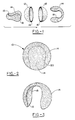
- Fig. 1 is an exploded perspective view of a tennis ball in accordance with the invention showing the components thereof prior to assembly;
- Fig. 2 is a perspective view of the tennis ball shown in Fig. 1 fully assembled; and
- Fig. 3 is a perspective view of a felt pane shaped to cooperate with a substantially identical panel to form a continuous spherical felt surface.
- Referring to the Figs. and particularly to Fig. 2, a tennis ball having a uniform felt covering uninterrupted by adhesive seams or other surface irregularities is shown.
- As shown in Fig. 1, the ball comprises four components, a pair of
hemispherical shells 12 and a pair offelt panels 14 which are bonded together by means of an adhesive material. Thehemispherical shells 12 are formed by compression or injection molding a heat curable elastomeric material. A curable elastomeric adhesive having a conposition similar to and capable of bonding with the material used to form theshells 12 is applied to theedge 16 of at least oneshell 12. Theedges 16 of twoshells 12, at least one of which has adhesive applied to its edges, are arranged in abutting alignment within a pressurizable mold cavity and cured at an elevated temperature to form a unitary hollow spherical core preferably containing a gas at a pressure above normal atmospheric pressure, typically about 5 to 15 psig. Another method which is well known in the art and literature for pressurizing the hollow core of a tennis ball is to dispose within the hollow core a liquid or solid material which upon heating reacts to form a pressurized gas. While pressurized balls are preferred, pressureless balls can also be made. - A pair of
felt panels 14 cut into a dogbone-like or dumbbell-like shape are stretched or wrapped around and secured to the hollow spherical core by means of an adhesive. A dogbone-like or dumbbell-like shaped panel formed into the shape conforming to the surface of a spherical core is shown in Fig. 3. The feltpanels 14 are sized and shaped so that the panels can be tightly wrapped around the core with theedges 18 of one panel continuously abutting the edges of the other panel to form a substantially continuous surface covering substantially free of gaps, adhesive seams or overlap. Tightly wrapped around the core means that the fabric is stretched or spread over the surface of the core without any bunching or creasing of the fabric. An almostinvisible seam 20 is formed by the abutting edges of thepanels 14. While small amounts of adhesive may become interposed between the edges of thepanels 14 during assembly, no adhesive is intentionally applied to theedges 18 of the panels and theedges 18 are therefore substantially free of adhesive. The assembled ball is then preferably placed in a mold cavity and heated to cure the adhesive and form a tennis ball having a hollow pressurized spherical core made of an elastomeric material which has a uniform continuous felt covering firmly secured thereto which is substantially free of any adhesive seams or other surface irregularities. - Because the ball is substantially free of adhesive seams which would otherwise upon curing become a part of the core, the resulting ball has a uniform spherical structure, free of structural protuberances which would cause nonuniform distortion upon flexion of the ball. Also, the absence of adhesive seams or other surface irregularities imparts uniform aerodynamic properties to the ball. The ball has substantially uniform radial symmetry, i.e. any plane passing through the center point of the ball divides the ball into two substantially identical halves, substantially free of protuberances or irregularities, resulting in uniform aerodynamic and bounce characteristics.
- The adhesives used in the assembly of the ball are preferably heat curable and are preferably composed of a material which is similar to and capable of bonding with the material of the core so that the adhesives become a continuous and integral part of the core.
- While the preferred embodiment has a pair of felt panels having a dogbone-like or dumbbell-like shape, more than two panels and different shaped panels are possible.
- Examples of other possible panel shapes include crescents similar to those of a basketball, and a combination of pentagons and hexagons as with a soccer ball. The panels are preferably sized and shaped so that they completely cover the core and so that the edges of the panels tightly abut one another without any overlap.
- While an important aspect of the invention is to provide a tennis ball free of conventional adhesive seams, various ornamental seams can be incorporated to increase the appeal and acceptability of tennis balls made in accordance with the invention. For example, the ball can be fabricated with a small gap of uniform width between the edges of the panels for incorporation of an elastic band which serves as an ornamental seam. Such elastic bands can be brightly colored to improve visibility and attractiveness. To avoid some of the disadvantages associated with conventional adhesive seams, it is preferable that the ornamental seam be bonded directly to the core and not to the edges of the felt panels. Alternatively, ornamental seams can be applied to the outer surface such as by painting, printing, or hot stamping.
- The preferred embodiment has been described with reference to its use as a tennis ball having a felt covering. "Felt" as used herein means a napped fabric or cloth made of natural or synthetic fibers or a combination of both natural and synthetic fibers. Other fabric coverings are also possible,
- Likewise, although the preferred embodiment is a tennis ball, other types of balls or different sized balls having the structure and features disclosed herein are possible.
Claims (19)
- A ball comprising a hollow spherical core having a plurality of fabric panels secured thereto, the ball being substantially free of adhesive seams so that the edges of the fabric panels are not bonded to one another.
- A ball as recited in claim 1, wherein the fabric panels are sized and shaped so that a small gap of substantially uniform width is formed between the edges of the panels, and wherein the ball further comprises an ornamental seam which is secured to the core along the gap between the edges of the panel.
- A ball as recited in claim 1, wherein the fabric panels are sized and shaped to substantially cover the entire core so that the edges of the panels are substantially in continuous abutment.
- A ball of any preceding claim wherein the core has a uniform structure substantially free of stiffening ribs, protuberances or other irregularities.
- A ball of any preceding claim wherein the core is made from an elastomeric material.
- A ball of any preceding claim wherein the fabric covering is a felt fabric.
- A ball of any preceding claim, wherein the core contains a gas at a pressure above normal atmospheric pressure.
- A ball as recited in claim 7, wherein the pressure of the gas contained in the core is in the range from about 5 psig to about 15 psig.
- A ball of any preceding claim, wherein an ornamental seam is applied to the outer surface of the ball.
- A ball comprising a hollow spherical core made from an elastomeric material, and a plurality of fabric panels secured to the core by means of an adhesive, the panels being sized and shaped to substantially cover the entire core so that the edges of the panels are substantially in continuous abutment to form a substantially continuous fabric covering uninterrupted by adhesive seams.
- A ball as recited in claim 10, wherein the edges of the fabric covering are substantially free of adhesive.
- A ball of claim 10 or 11 wherein the ball has substantially uniform radial symmetry to provide for uniform aerodynamic and bounce characteristics.
- A ball of any preceding claim wherein the fabric covering consists of a pair of felt fabric panels having a generally dumbbell-like shape.
- A process for fabricating a ball having a hollow spherical core made from an elastomeric material and a plurality of fabric panels secured to the core forming a substantially continuous fabric covering uninterrupted by adhesive seams, the process comprising the steps of:a) forming a hollow spherical core from an elastomeric material,b) procuring a plurality of fabric panels which are sized and shaped so that they can completely cover the core with the edges of the panels being in substantially continuous abutment,c) securing the fabric panels to the core with an adhesive so that the edges of the panels are substantially in continuous abutment to form a substantially continuous fabric covering uninterrupted by adhesive seams.
- A process of claim 14, wherein care is taken to ensure that the edges of the fabric covering are substantially free of any adhesives.
- A process of claim 14 or 15, wherein the fabric panels are of a felt fabric material.
- A process of claim 16, wherein the fabric panels consist of a pair of felt fabric panels having dumbbell-like shape.
- A tennis ball having a spherical elastomer core with a fabric covering adhered thereto by an adhesive layer between the spherical core and the fabric coating, with join lines formed by adjacent edges of different portions of the fabric covering, characterised in that the join lines are substantially free of any corresponding line of radially outwardly projecting cured adhesive.
- A tennis ball according to claim 18 in which the adjacent fabric covering edges substantially abut one another at the join lines.
Applications Claiming Priority (2)
| Application Number | Priority Date | Filing Date | Title |
|---|---|---|---|
| US90342592A | 1992-06-24 | 1992-06-24 | |
| US903425 | 1992-06-24 |
Publications (1)
| Publication Number | Publication Date |
|---|---|
| EP0576233A1 true EP0576233A1 (en) | 1993-12-29 |
Family
ID=25417481
Family Applications (1)
| Application Number | Title | Priority Date | Filing Date |
|---|---|---|---|
| EP93304823A Withdrawn EP0576233A1 (en) | 1992-06-24 | 1993-06-21 | Balls and making them |
Country Status (4)
| Country | Link |
|---|---|
| EP (1) | EP0576233A1 (en) |
| JP (1) | JPH06178829A (en) |
| CA (1) | CA2098558A1 (en) |
| MX (1) | MX9303780A (en) |
Cited By (8)
| Publication number | Priority date | Publication date | Assignee | Title |
|---|---|---|---|---|
| GB2483941A (en) * | 2010-09-24 | 2012-03-28 | Innovative Design & Sourcing Llc | Pet toy |
| GB2562364A (en) * | 2017-03-17 | 2018-11-14 | Cheng Ming Chuang | Multilayer composite high-elastic environmentally-friendly ball structure |
| GB2570948A (en) * | 2018-02-09 | 2019-08-14 | Cheng Ming Chuang | Hollow ball |
| US10493327B2 (en) | 2017-03-14 | 2019-12-03 | Wilson Sporting Goods Co. | Tennis ball having a core with internal material shift lines |
| US11192001B2 (en) | 2020-02-11 | 2021-12-07 | Wilson Sporting Goods Co. | Tennis ball having a thermoplastic core |
| US11247103B2 (en) | 2020-02-11 | 2022-02-15 | Wilson Sporting Goods Co. | Tennis ball having a thermoplastic core |
| US11426637B2 (en) | 2020-02-11 | 2022-08-30 | Wilson Sporting Goods Co. | Tennis ball having a thermoplastic core |
| US12599814B2 (en) | 2020-02-11 | 2026-04-14 | Wilson Sporting Goods Co. | Tennis ball having a thermoplastic core |
Families Citing this family (1)
| Publication number | Priority date | Publication date | Assignee | Title |
|---|---|---|---|---|
| JP4656898B2 (en) * | 2004-09-21 | 2011-03-23 | 善治郎 潮津 | Adhesion method between outer skin side and ball side in ball game balls |
Citations (6)
| Publication number | Priority date | Publication date | Assignee | Title |
|---|---|---|---|---|
| DE274679C (en) * | ||||
| GB203468A (en) * | 1922-07-19 | 1923-09-13 | George Spencer Moulton & Co | Improvements in or relating to tennis or like balls |
| US3508750A (en) * | 1964-09-11 | 1970-04-28 | Voit Rubber Corp | Game ball |
| EP0014040A1 (en) * | 1979-01-09 | 1980-08-06 | Albany International Corp. | Tennis balls and methods of covering tennis balls |
| GB2181959A (en) * | 1985-10-26 | 1987-05-07 | Dunlop Ltd | Improvements in or relating to tennis balls |
| GB2251555A (en) * | 1991-01-09 | 1992-07-15 | Derek Malcolm Price | Seamed tennis ball and a process for its manufacture |
Family Cites Families (4)
| Publication number | Priority date | Publication date | Assignee | Title |
|---|---|---|---|---|
| JPS5651343A (en) * | 1979-09-30 | 1981-05-08 | Katsuo Fukuda | Manufacture of hollow resilient regulation tennis ball |
| JPS6029158A (en) * | 1983-07-28 | 1985-02-14 | 株式会社モルテン | Ball for ball game |
| JPS6238029A (en) * | 1985-08-13 | 1987-02-19 | Seiko Epson Corp | Encoder |
| JPH04161175A (en) * | 1990-10-24 | 1992-06-04 | Sumitomo Rubber Ind Ltd | Tennis ball |
-
1993
- 1993-06-16 CA CA 2098558 patent/CA2098558A1/en not_active Abandoned
- 1993-06-21 EP EP93304823A patent/EP0576233A1/en not_active Withdrawn
- 1993-06-23 MX MX9303780A patent/MX9303780A/en unknown
- 1993-06-24 JP JP17741593A patent/JPH06178829A/en active Pending
Patent Citations (6)
| Publication number | Priority date | Publication date | Assignee | Title |
|---|---|---|---|---|
| DE274679C (en) * | ||||
| GB203468A (en) * | 1922-07-19 | 1923-09-13 | George Spencer Moulton & Co | Improvements in or relating to tennis or like balls |
| US3508750A (en) * | 1964-09-11 | 1970-04-28 | Voit Rubber Corp | Game ball |
| EP0014040A1 (en) * | 1979-01-09 | 1980-08-06 | Albany International Corp. | Tennis balls and methods of covering tennis balls |
| GB2181959A (en) * | 1985-10-26 | 1987-05-07 | Dunlop Ltd | Improvements in or relating to tennis balls |
| GB2251555A (en) * | 1991-01-09 | 1992-07-15 | Derek Malcolm Price | Seamed tennis ball and a process for its manufacture |
Cited By (11)
| Publication number | Priority date | Publication date | Assignee | Title |
|---|---|---|---|---|
| GB2483941A (en) * | 2010-09-24 | 2012-03-28 | Innovative Design & Sourcing Llc | Pet toy |
| US10493327B2 (en) | 2017-03-14 | 2019-12-03 | Wilson Sporting Goods Co. | Tennis ball having a core with internal material shift lines |
| EP3375499B1 (en) * | 2017-03-14 | 2020-10-21 | Wilson Sporting Goods Co. | Tennis ball having a core with internal material shift lines |
| GB2562364A (en) * | 2017-03-17 | 2018-11-14 | Cheng Ming Chuang | Multilayer composite high-elastic environmentally-friendly ball structure |
| GB2562364B (en) * | 2017-03-17 | 2020-06-10 | Cheng Ming Chuang | Multilayer composite high-elastic environmentally-friendly ball structure |
| GB2570948A (en) * | 2018-02-09 | 2019-08-14 | Cheng Ming Chuang | Hollow ball |
| GB2570948B (en) * | 2018-02-09 | 2020-05-06 | Cheng Ming Chuang | Hollow ball |
| US11192001B2 (en) | 2020-02-11 | 2021-12-07 | Wilson Sporting Goods Co. | Tennis ball having a thermoplastic core |
| US11247103B2 (en) | 2020-02-11 | 2022-02-15 | Wilson Sporting Goods Co. | Tennis ball having a thermoplastic core |
| US11426637B2 (en) | 2020-02-11 | 2022-08-30 | Wilson Sporting Goods Co. | Tennis ball having a thermoplastic core |
| US12599814B2 (en) | 2020-02-11 | 2026-04-14 | Wilson Sporting Goods Co. | Tennis ball having a thermoplastic core |
Also Published As
| Publication number | Publication date |
|---|---|
| CA2098558A1 (en) | 1993-12-25 |
| JPH06178829A (en) | 1994-06-28 |
| MX9303780A (en) | 1993-12-01 |
Similar Documents
| Publication | Publication Date | Title |
|---|---|---|
| CA2138060C (en) | Sports ball and production method thereof | |
| US20090209374A1 (en) | Sportsball with integral ball casing and bladder body | |
| EP1080745B1 (en) | Ball game ball | |
| US6062996A (en) | Formable sports implement | |
| CN1241144A (en) | Ball for ball game | |
| US6022283A (en) | Inflatable ball | |
| US3256019A (en) | Ball with cushioning means between cover and core | |
| US5888157A (en) | Football | |
| US6752732B2 (en) | Basketball having nine to twelve cover panels | |
| US5626529A (en) | Golf club shaft and method of manufacture | |
| DE69934323T2 (en) | SECONDARY SPORTS CLASTER | |
| US20020098927A1 (en) | Inflatable sportsball with cushion layer | |
| US2352872A (en) | Reinforced game ball | |
| CN1006599B (en) | ball for ball games | |
| EP3335770A1 (en) | Sportsball with sculptural ball surface | |
| KR20110056501A (en) | Badminton Shuttlecock | |
| CA2098558A1 (en) | Tennis ball without seam adhesive | |
| US5409215A (en) | Shock-absorbing metal game racket | |
| US2091455A (en) | Inflated ball and method of making same | |
| US5511787A (en) | Golf club | |
| GB2483941A (en) | Pet toy | |
| US3887416A (en) | Method of manufacturing a leather covered football | |
| TWM585645U (en) | Beach tennis racket | |
| CA2119254A1 (en) | Golf club | |
| GB2053696A (en) | Carbon fibre laminated sports equipment |
Legal Events
| Date | Code | Title | Description |
|---|---|---|---|
| PUAI | Public reference made under article 153(3) epc to a published international application that has entered the european phase |
Free format text: ORIGINAL CODE: 0009012 |
|
| AK | Designated contracting states |
Kind code of ref document: A1 Designated state(s): BE CH DE ES FR GB IT LI LU NL SE |
|
| 17P | Request for examination filed |
Effective date: 19940210 |
|
| 17Q | First examination report despatched |
Effective date: 19941212 |
|
| STAA | Information on the status of an ep patent application or granted ep patent |
Free format text: STATUS: THE APPLICATION IS DEEMED TO BE WITHDRAWN |
|
| 18D | Application deemed to be withdrawn |
Effective date: 19950425 |