EP0575438B1 - Verfahren für die erdöl-wachs-trennung bei beziehungsweise über raumtemperatur - Google Patents
Verfahren für die erdöl-wachs-trennung bei beziehungsweise über raumtemperatur Download PDFInfo
- Publication number
- EP0575438B1 EP0575438B1 EP92906842A EP92906842A EP0575438B1 EP 0575438 B1 EP0575438 B1 EP 0575438B1 EP 92906842 A EP92906842 A EP 92906842A EP 92906842 A EP92906842 A EP 92906842A EP 0575438 B1 EP0575438 B1 EP 0575438B1
- Authority
- EP
- European Patent Office
- Prior art keywords
- solvent
- wax
- mixture
- process according
- acetone
- Prior art date
- Legal status (The legal status is an assumption and is not a legal conclusion. Google has not performed a legal analysis and makes no representation as to the accuracy of the status listed.)
- Expired - Lifetime
Links
Images
Classifications
-
- C—CHEMISTRY; METALLURGY
- C10—PETROLEUM, GAS OR COKE INDUSTRIES; TECHNICAL GASES CONTAINING CARBON MONOXIDE; FUELS; LUBRICANTS; PEAT
- C10G—CRACKING HYDROCARBON OILS; PRODUCTION OF LIQUID HYDROCARBON MIXTURES, e.g. BY DESTRUCTIVE HYDROGENATION, OLIGOMERISATION, POLYMERISATION; RECOVERY OF HYDROCARBON OILS FROM OIL-SHALE, OIL-SAND, OR GASES; REFINING MIXTURES MAINLY CONSISTING OF HYDROCARBONS; REFORMING OF NAPHTHA; MINERAL WAXES
- C10G73/00—Recovery or refining of mineral waxes, e.g. montan wax
- C10G73/02—Recovery of petroleum waxes from hydrocarbon oils; Dewaxing of hydrocarbon oils
- C10G73/025—Recovery of petroleum waxes from hydrocarbon oils; Dewaxing of hydrocarbon oils by filtration
-
- C—CHEMISTRY; METALLURGY
- C10—PETROLEUM, GAS OR COKE INDUSTRIES; TECHNICAL GASES CONTAINING CARBON MONOXIDE; FUELS; LUBRICANTS; PEAT
- C10G—CRACKING HYDROCARBON OILS; PRODUCTION OF LIQUID HYDROCARBON MIXTURES, e.g. BY DESTRUCTIVE HYDROGENATION, OLIGOMERISATION, POLYMERISATION; RECOVERY OF HYDROCARBON OILS FROM OIL-SHALE, OIL-SAND, OR GASES; REFINING MIXTURES MAINLY CONSISTING OF HYDROCARBONS; REFORMING OF NAPHTHA; MINERAL WAXES
- C10G73/00—Recovery or refining of mineral waxes, e.g. montan wax
- C10G73/02—Recovery of petroleum waxes from hydrocarbon oils; Dewaxing of hydrocarbon oils
- C10G73/06—Recovery of petroleum waxes from hydrocarbon oils; Dewaxing of hydrocarbon oils with the use of solvents
Definitions
- the present invention relates to dewaxing of petroleum products (and possibly other heavy hydrocarbon mixtures). It also relates to similar processes for deoiling the waxes that are found in combination with heavy hydrocarbon mixtures. It will be understood that when the term dewaxing is used herein it will also include other similar processes such as deoiling. Wax as used in the present description will include all compounds or mixtures to which the term wax is applied, both natural and synthetic, and also will include in general saturated hydrocarbon chain link compounds.
- Crude petroleum and partially refined petroleum commonly contain waxes (usually paraffin waxes). Such waxes crystallize at low temperatures, and this is particularly notable with high molecular weight n-paraffins, certain isoparaffins, and cycloparaffins.
- dewaxing When the petroleum is being refined for use as lubricating oil, the presence of these materials which crystallize within a range of temperatures for which the lubricating oil is intended is very deleterious. Such materials are therefore commonly removed in the refining process and this subprocess is referred to as dewaxing.
- dewaxing There is great variety in the processes used for dewaxing as it cannot be carried out as a normal consequence of the fractional distillation process.
- the oldest and simplest form of dewaxing is chilling of the crude lubricating oil to about the desired pour point temperature causing crystallization of most of the wax components, after which they may be physically removed by filtration or the like. This process is largely of historical interest because of its high cost and unsuitability for processing heavy oils.
- dewaxing solvents there been found that somewhat better solvent-chilling dewaxing results were achieved with a mixture of two solvents and thus various mixtures of two different solvents have been employed as dewaxing solvents.
- MK methylethylketone
- a common dewaxing solvent may contain 25% to 50% of MEK, 40% to 60% of benzene, and 12% to 25% of toluene.
- ketones of higher molecular weight have been used in place of MEK. This permits one to obtain a higher solvent power for heavy oil.
- the high crystallization temperature (about 5°C.) of benzene has caused toluene to be substituted for the benzene so that the diluent is essentially a mixture of MEK and toluene.
- a common solvent-chilling dewax process may proceed as follows.
- the solvent may be an MEK/benzene combination, or toluene may substitute for the benzene in the solvent combination.
- the solvent is added to the oil charge it is normally heated slightly to insure complete solution of wax components.
- the mixture is then chilled to the required filtration temperature, usually of the order of -20°C. utilizing a conventional refrigeration process. Refrigeration is typically carried out by pipe-in-pipe type heat exchangers with oil in the inside pipe, the surface of which must be kept free of wax by scraper blades to maintain adequate heat transfer.
- the wax may be removed by filtration under vacuum in conventional rotary filters in a well known manner.
- propane dewaxing in which a single effective constituent is present in the solvent.
- Propane dewaxing has certain advantages in that it may be a follow-on to propane deasphalting, thereby eliminating a propane-oil separation step between the stages of the process.
- propane dewaxing temperatures are generally lower.
- a process for removing wax from a volume of hydrocarbon containing wax comprising:
- the process of the present invention is strikingly different in that it does not rely on solid surface heat exchange chilling below normal ambient temperature for crystallization of and precipitation of the wax.
- solid surface heat exchange cooling or refrigeration step using the previously known solvent-chilling dewaxing processes would not and could not result in an operable or practical process. Otherwise the expensive refrigeration step would not have been required.
- the solvent dewaxing process of the present invention involves two separate dilution steps or solvent addition steps with two distinctly different solvents.
- the first solvent will be referred to as the primary solvent, or simply the solvent
- the second solvent will be referred to as the co-solvent (or selected co-solvent).
- co-solvent as used herein will have a specially defined meaning, not to be confused with various meanings for co-solvent which may be found in other contexts.
- the second solvent or the "selected cosolvent" as it will be termed, is selected from a relatively small group of chemical compounds which are in the liquid state at or above room temperature (at a pressure of less than ten atmospheres).
- room temperature will be understood to be a rather wide range of temperatures about 20°C. (68°F.) plus or minus 10°C. (18°F.).
- the group from which the selected co-solvent is taken is the group of ketones, alcohols and organic acids having a molecular composition with a low carbon number, preferably of three or less, and having one or two oxygen atoms plus an even number (2-8) of hydrogen atoms.
- these compounds are: methanol, ethanol, propanol, isopropanol, acetic acid, formic acid, propionic acid, formaldehyde, acetone, ketene, acetaldehyde, and propionaldehyde.
- the above twelve compounds have the physical characteristic of total miscibility with light-to-intermediate (herein defined as C number of less than fourteen) hydrocarbons and, very importantly, miscibility with water.
- a process for removing wax from a volume of hydrocarbon containing wax comprising:
- the requirements for the primary solvent are not very strict and most light-to-intermediate hydrocarbons known and commonly used as solvents may be employed alone, or in admixture, for the primary solvent. There is only one requirement for the primary solvent, that it should not contain any significant quantity of the selected co-solvents described above. Admixture of the co-solvent with the solvent before addition to the petroleum feed stock substantially destroys the effectiveness of the selected co-solvent in crystallizing and precipitating the wax components from the petroleum hydrocarbon mixture at room temperature or above.
- the process according to the invention is directed to dewaxing a petroleum feed stock to obtain an end product with sufficiently low residual wax content for high quality lubricating oil
- this can be accomplished, if desired, in a single stage of steps of primary solvent dilution, selected co-solvent dilution, precipitation and filtering.
- a practical industrial process normally involves a closed loop system for recovery and reuse of solvents, as will be more fully explained hereinafter.
- the process according to the present invention can be carried out in a manner to separately recover waxes of highest value, thereby inexpensively producing a by-product capable of substantially contributing to the profitability of the overall operation.
- the process when carried out in this form is still capable of further removal of the waxes of lower molecular weight (and generally lower value) substantially in their entirety to produce a nearly wax-free lubricating oil of high quality.
- the selected co-solvent diluent is added in at least two different stages rather than in one stage. It has been found that reducing the amount or proportion of the selected co-solvent diluent has two effects. One is that the quantity of wax precipitated is reduced. The other effect is that the wax produced is of a higher average molecular weight and higher melting point, and thus has substantially higher potential value. These higher value waxes are removed in a conventional filtering process and may be further deoiled by additional washing with the same or similar solvents.
- substantially complete removal of waxes can be accomplished in the second stage or the wax removal can be divided into still more stages of selected co-solvent (possibly with water) dilution, precipitation, and filtration, each stage having wax product produced with lower molecular weight and lower melting point than the previous stage.
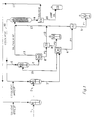
- FIGURE 1 shows a flow chart of steps in an apparatus for a process of petroleum wax separation at or above room temperature according to the invention.
- a feed stock enters the process at 1 where it is mixed in a conventional mixing tank M with a primary solvent.
- the feed stock may consist of waxy heavy vacuum gas oil and the primary solvent, for example toluene, may be in ratio of 2:1 by weight to the feed stock. Unless otherwise stated all proportions herein are proportions by weight.
- the primary solvent provided through line 17 and the feed stock provided through line 1 are mixed in mixing tank M to obtain a homogeneous solution, and this step may be facilitated by heating the solution to a temperature above ambient temperature, up to about 120°F. (or 48.9°C.).
- the output from mixing tank M is supplied through line 2 to mixing tank M1 where it is mixed with a selected co-solvent consisting essentially of acetone, the ratio of acetone to feed stock being 3:8 in this example.
- the primary solvent may include commonly used solvents other than toluene, but it should not contain any significant amount of the selected co-solvent, acetone.
- the temperature of the mixing tank M1 and contents is not critical but will normally be slightly above ambient temperature, in this example 78°F. (or 25.6°C.).
- the relatively low ratio of acetone to feed stock causes only high molecular weight, high melt temperature wax crystals to form.
- the wax crystals precipitate from the solution, and this mixture is fed through line three to a conventional vacuum filter apparatus V1.
- Exiting the vacuum filter apparatus V1 through line 4 is a product designated P1, at this point comprising a waxy slurry which is conveyed through line 4 to a solvent evaporation step at F1 which may be performed by a conventional flash evaporation apparatus.
- product P1 storage tank T1 From Fl the removed wax is conveyed through line 5 to product P1 storage tank T1.
- product P1 may be further washed or refined, such steps are conventional and not shown in FIGURE 1 for simplicity and clarity.
- Product P1 in storage tank T1 may be heated and mildly agitated to prevent solidification pending further processing thereof.
- the evaporated feed stock, primary solvent, and co-solvent from flash evaporator Fl is supplied to distillation column C through line 13.
- the process flow diagram of FIGURE 1 includes solvent and co-solvent recovery steps which are necessary for a practical system, although they are not a critical feature of the present invention.
- this separation is necessary particularly from the point of view of eliminating any significant amount of selected co-solvent in the primary solvent make up.
- the selected co-solvent acetone has a substantially lower boiling point than the primary solvent toluene, thus making virtually complete separation of the co-solvent and primary solvent easy to accomplish in a conventional distillation column.
- the filtrate from rotary vacuum filter V1 it is supplied through line 18 to a mixing tank M2; thus the filtrate from the first stage may be used essentially without further treatment in a second stage of wax separation.
- An additional quantity of selected co-solvent (acetone) is supplied through line 6 to mixing tank M2.
- the quantity of additional co-solvent for the second stage will normally be equal to or greater than the amount of co-solvent for the first stage.
- the additional selected co-solvent in the second stage is double that of the first stage. That is, the ratio of second stage co-solvent to original feed stock is 3:4.
- the process flow for the second stage proceeds substantially as for the first stage through rotary vacuum filter V2 and line 8 to solvent flash unit F2, which evaporates the residual oil solvent from product P2 into line 12 and to distillation column C; the product P2 then proceeds through line 9 to product P2 storage tank T2 in the same fashion as with product P1 and tank T1.
- Dewaxed feed stock is transferred through line 14 from the recovery distillation column to a flash evaporator F3 in which the solvent is flashed and transported through lines 15 and 17 to be recycled while the dewaxed lube oil product is fed through line 16 to a lube oil storage tank T3.
- the number of stages of wax separation is not limited to two and a third stage may be employed (not shown in FIGURE 1).
- a third stage may add an additional quantity of selected co-solvent (acetone) equal to that added in the second stage.
- the vacuum filtered wax cake may be washed with a 1:1 toluene/acetone wash in a quantity of two and two-thirds of the amount of acetone added in the third stage.
- the filtrate from the third stage and the oil/solvent from the flash evaporator would be returned to the recovery distillation column C in the same manner as for the second stage.
- solvent and co-solvent recovery is provided for in the process flow diagram of FIGURE 1.
- the co-solvent acetone has the lower boiling point than the solvent toluene and this will normally, but not necessarily, be the case.
- Distillation column C obtains virtually complete separation of the selected co-solvent which is fed into co-solvent line 18 so that line 17 has no significant amount of selected co-solvent, which co-solvent would be very detrimental or even fatal to the process if introduced in the first stage mixing tank M.
- a yield of approximately 8% of feed stock weight may be expected from stage 2 (P2). This wax will have an intermediate melting point (congealing point of about 160°F.).
- the low melting point waxes of least value will be recovered with an expected quantity of about 12% of original feed stock weight, and a low melting point (congealing point of about 135°F.).
- Light-to-intermediate hydrocarbon will mean a hydrocarbon with a C-number of thirteen or less.
- Dewaxing will mean any process for separation of wax from oil or vice-versa.
- Oil will mean any liquid or amorphous hydrocarbon, natural or synthetic.
- Wax will mean any compound or mixture to which the term wax is applied, natural or synthetic.
- Co-solvent will mean a solvent in which the feed stock is soluble but which promotes separation of wax from the feed stock at temperatures above 50°F. (10°C.). Room temperature means a range of temperatures of 20°C. (68°F.) plus or minus 10°C. (18°F.).
- Liquid will mean any material which enters a liquid state at ambient pressure of ten atmospheres or less.
- Example of multi-stage dewaxing or deoiling to sequentially and selectively remove wax fractions Two hundred parts of a waxy heavy vacuum gas oil is mixed with four hundred parts of toluene and gently heated until a homogeneous solution is obtained. The mixture is allowed to cool to 78°F. (25.6°C.). In a first stage, seventy-five parts of acetone is added to precipitate a high melt fraction of wax crystals. The mixture is filtered by vacuum and the wax cake washed with forty parts of a toluene/acetone mixture having a ratio of toluene/acetone of 5:1. After the cake is heated to remove any solvents or co-solvents and weighed, a yield of eleven parts of wax is measured with a congealing point of 172°F. (77.8°C.).
- the filtrate from the first stage is used in a second stage which removes additional wax.
- an additional one hundred fifty parts of acetone is added to the filtrate from stage 1 and additional wax precipitates.
- the mixture is vacuum filtered and washed with one hundred fifty parts of a toluene/acetone mixture having a ratio of toluene/ acetone of 2:1. After the wax cake is heated and weighed, a yield of fifteen parts of wax is measured with a congealing point of about 160°F. (71.1°C.).
- the filtrate from the second stage is used in a third stage which removes additional wax.
- an additional one hundred fifty parts of acetone is added to the filtrate from the second stage and additional wax precipitates.
- the mixture is vacuum filtered and the wax cake is washed with one hundred parts toluene/acetone having a ratio of 1:1. After the wax cake is heated and weighed, a yield of twenty four parts of wax is measured with a congealing point of about 135°F. (57.2°C.).
- Twenty parts of toluene are mixed with ten parts of heavy vacuum gas oil feed stock and gently heated. The mixture is then allowed to cool to about 78°F. (25.6°C.).
- Thirty six parts of acetone are added and within minutes a wax precipitate forms. After adding the acetone, approximately one part of water is added to the mixture and additional wax precipitated.
- the wax is recovered by vacuum filtration and wax amounting to about seven parts by weight is obtained.
- the solvents are removed from the filtrate by distillation or flashing at about 232°C. (450°F.) maximum and oil product is obtained having a pour point of approximately 45°F. (7.2°C.).
- Example of deoiling a slack wax twenty parts of a slack wax having an oil content of approximately 10 percent are mixed with forty parts of toluene and heated gently to obtain a homogeneous solution. The mixture is then allowed to cool to 78°F. (28.6°C.). Fifty five parts of acetone are added and within minutes a precipitate forms. Two parts of water are added and the mixture is filtered to collect a wax cake. The wax cake is weighed and a yield of 17.94 parts is obtained having an oil content of less than one percent.
- Vacuum gas oil having a pour point of 125°F. (51.7°C.) is contacted with a quantity of solvent equal to three times the weight of the oil sample containing toluene and methylethyl ketone (MEK) in about equal portions by weight and no significant quantity of acetone. After a homogeneous mixture is obtained, an amount of acetone equal to one-half the original oil sample is added, and a wax precipitate immediately is formed. The oil phase and wax phase are separated by filtration. This process has yielded a solid wax phase approximately equal to twenty percent of the original feed.
- MEK methylethyl ketone
- An oily liquid sample including petroleum containing approximately eight percent wax together with light or intermediate hydrocarbons is contacted with a quantity of methanol equal to four times the weight of the original sample.
- An amount of wax equal to seven percent of the original sample is precipitated and recovered.
- Vacuum gas oil having a pour point of 125°F (51.7°C.) is contacted with a quantity of solvent equal to three times the weight of the oil sample containing MEK and MiBK in equal portions by weight and no significant quantity of acetone. After a homogeneous mixture is obtained, an amount of acetone equal to one-half the original oil sample is added, and a wax precipitate immediately is formed. The oil phase and wax phase are separated by filtration.
- Example of a single stage dewaxing or deoiling to remove waxy fractions or the like Two hundred parts of a waxy heavy vacuum gas oil is mixed with four hundred parts of toluene or the like, and gently heated until a homogeneous solution is obtained. The mixture is allowed to cool to 78°F. (25.6°C.). Two hundred parts of acetone is added to precipitate the wax fraction. The mixture is filtered by vacuum and the wax cake washed with forty parts of a toluene/acetone mixture having a ratio of 5:1. After the cake is heated to remove any solvents and weighed, a yield of fifty parts of wax is measured with a congealing point of about 155°F. (68.3°C.).
- Twenty parts of toluene are mixed with ten parts of heavy oil feed stock and gently heated. The mixture is then allowed to cool to about 78°F. (25.6°C.).
- Thirty six parts of acetone are added and within minutes a wax precipitate forms. After adding the acetone, approximately one part of water is added to the mixture and additional wax precipitated.
- the wax is recovered by vacuum filtration and wax amounting to about three to ten parts by weight is obtained.
- the solvents are removed from the filtrate by distillation or flashing at about 232°C. (450°F.) maximum and oil product is obtained having a pour point of less then (0°C.).
- Twenty parts of toluene are mixed with ten parts of heavy oil feed stock and gently heated. The mixture is then allowed to cool to about 78°F. (25.6°C.).
- Thirty six parts of propanol are added and within minutes a wax precipitate forms. After adding the propanol, approximately one part of water is added to the mixture and additional wax precipitated.
- the wax is recovered by vacuum filtration and wax amounting to about three to ten parts by weight is obtained.
- the solvents are removed from the filtrate by distillation or flashing at about 232°C. (450°F.) maximum and oil product is obtained having a pour point of less than 32°F. (0°C.).
- Twenty parts of toluene are mixed with ten parts of heavy oil feed stock and gently heated. The mixture is then allowed to cool to about 78°F. (25.6°C.).
- Thirty six parts of isopropanol are added and within minutes a wax precipitate forms. After adding the isopropanol, approximately one part of water is added to the mixture and additional wax precipitated.
- the wax is recovered by vacuum filtration and wax amounting to about three to ten parts by weight is obtained.
- the solvents are removed from the filtrate by distillation or flashing at about 232°C. (450°F.) maximum and oil product is obtained having a pour point of less than 32°F. (0°C.).
- Twenty parts of toluene are mixed with ten parts of heavy oil feed stock and gently heated. The mixture is then allowed to cool to about 78°F. (25.6°C.).
- Thirty parts of formic acid are added and within minutes a wax precipitate forms. After adding the formic acid, approximately one part of water is added to the mixture and additional wax precipitated.
- the wax is recovered by vacuum filtration and wax amounting to about three to ten parts by weight is obtained.
- the solvents are removed from the filtrate by distillation or flashing at about 232°C. (450°F.) maximum and oil product is obtained having a pour point of less than 32°F. (0°C.).
- Twenty parts of toluene are mixed with ten parts of heavy oil feed stock and gently heated. The mixture is then allowed to cool to about 78°F. (25.6°C.).
- Twenty four parts of methanol are added and within minutes a wax precipitate forms. After adding the methanol, approximately one part of water is added to the mixture and additional wax precipitated.
- the wax is recovered by vacuum filtration and wax amounting to about three to ten parts by weight is obtained.
- the solvents are removed from the filtrate by distillation or flashing at about 232°C. (450°F.) maximum and oil product is obtained having a pour point of less than 32°F. (0°C.).
- Twenty parts of toluene are mixed with ten parts of heavy oil feed stock and gently heated. The mixture is then allowed to cool to about 78°F. (25.6°C.).
- Thirty parts of ketene are added and within minutes a wax precipitate forms. After adding the ketene, approximately one part of water is added to the mixture and additional wax precipitated.
- the wax is recovered by vacuum filtration and wax amounting to about three to ten parts by weight is obtained.
- the solvents are removed from the filtrate by distillation or flashing at about 232°C. (450°F.) maximum and oil product is obtained having a pour point of less than 32°F. (0°C.).
- Twenty parts of toluene are mixed with ten parts of heavy oil feed stock and gently heated. The mixture is then allowed to cool to about 78°F. (25.6°C.).
- Thirty parts of acetaldehyde are added and within minutes a wax precipitate forms. After adding the acetaldehyde, approximately one part of water is added to the mixture and additional wax precipitated.
- the wax is recovered by vacuum filtration and wax amounting to about three to ten parts by weight is obtained.
- the solvents are removed from the filtrate by distillation or flashing at about 232°C. (450°F.) maximum and oil product is obtained having a pour point of less than 32°F. (0°C.).
- Twenty parts of toluene are mixed with ten parts of heavy oil feed stock and gently heated. The mixture is then allowed to cool to about 78°F. (25.6°C.).
- Thirty six parts of acetic acid are added and within minutes a wax precipitate forms. After adding the acetic acid, approximately one part of water is added to the mixture and additional wax precipitated.
- the wax is recovered by vacuum filtration and wax amounting to about three to ten parts by weight is obtained.
- the solvents are removed from the filtrate by distillation or flashing at about 232°C. (450°F.) maximum and oil product is obtained having a pour point of less than 32°F. (0°C.).
- Twenty parts of toluene are mixed with ten parts of heavy oil feed stock and gently heated. The mixture is then allowed to cool to about 78°F. (25.6°C.).
- Thirty six parts of ethanol are added and within minutes a wax precipitate forms. After adding the ethanol, approximately one part of water is added to the mixture and additional wax precipitated.
- the wax is recovered by vacuum filtration and wax amounting to about three to ten parts by weight is obtained.
- the solvents are removed from the filtrate by distillation or flashing at about 232°C. (450°F.) maximum and oil product is obtained having a pour point of less than 32°F. (0°C.),
- Twenty parts of toluene are mixed with ten parts of heavy oil feed stock and gently heated. The mixture is then allowed to cool to about 78°F. (25.6°C.).
- Thirty six parts of propionic acid are added and within minutes a wax precipitate forms. After adding the propionic acid, approximately one part of water is added to the mixture and additional wax precipitated.
- the wax is recovered by vacuum filtration and wax amounting to about three to ten parts by weight is obtained.
- the solvents are removed from the filtrate by distillation or flashing at about 232°C. (450°F.) maximum and oil product is obtained having a pour point of less than 32°F. (0°C.).
- Twenty parts of toluene are mixed with ten parts of heavy oil feed stock and gently heated. The mixture is then allowed to cool to about 78°F. (25.6°C.).
- Thirty parts of formaldehyde are added and within minutes a wax precipitate forms. After adding the formaldehyde, approximately one part of water is added to the mixture and additional wax precipitated.
- the wax is recovered by vacuum filtration and wax amounting to about three to ten parts by weight is obtained.
- the solvents are removed from the filtrate by distillation or flashing at about 232°C. (450°F.) maximum and oil product is obtained having a pour point of less than 32°F. (0°C.).
- Twenty parts of toluene are mixed with ten parts of heavy oil feed stock and gently heated. The mixture is then allowed to cool to about 78°F. (25.6°C.).
- Thirty parts of propionaldehyde are added and within minutes a wax precipitate forms.
- approximately one part of water is added to the mixture and additional wax precipitated.
- the wax is recovered by vacuum filtration and wax amounting to about three to ten parts by weight is obtained.
- the solvents are removed from the filtrate by distillation or flashing at about 232°C. (450°F.) maximum and oil product is obtained having a pour point of less than 32°F. (0°C.).
- One part of a heavy vacuum gas oil having a pour point of 125°F. (51.67°C.) is put into solution into one and one-half parts of ISOPAR GTM, an isoparaffinic solvent (product of Exxon Corp.), by gentle heating. After everything is in solution; the mixture is allowed to cool to room temperature. The mixture is then contacted with two parts of acetone producing a wax precipitate. The wax is filtered by vacuum and washed with seven parts of a solution of ISOPAR GTM and acetone in a 3:4 ratio of ISOPAR GTM to acetone. The wax cake is recovered, and the residual solvents stripped from the cake by heating. This process produces a wax cake in the amount of about 35 percent or more of the original waxy feed having less than about 0.5 percent oil content and a melting point of about 145°F. (62.78°C.).
- Exxon's 3656 Petrolatum (similar to a slack wax only the petrolatum contains a higher melt microcrystalline wax) containing approximately 7 percent oil is used in separating the high melt fraction of the wax.
- Ten parts of 3656 is put into solution in twenty parts of ISOPAR GTM with gentle heating. After everything is in solution the mixture is cooled to about room temperature. After cooling, twenty five parts of acetone is added, producing a wax precipitate.
- the wax is recovered by vacuum filtration and washed with twenty parts of a solution containing ISOPAR GTM and acetone in a 1:1 ratio. The residual solvents are recovered by heating, producing a final wax cake containing less than about 0.2 percent oil and having a melting point above 150°F. (65.56°C.).
- the present invention provides a very practical, efficient, and cost effective procedure for separating high melting point waxy constituents of a hydrocarbon mixture to produce useful and valuable products such as commercial grade waxes with low oil content, and lubricating oils with low pour points.
- the nature of the processes can be tailored to fit a wide variety of feed stock materials and/or a variety of desired end product characteristics.
Landscapes
- Chemical & Material Sciences (AREA)
- Oil, Petroleum & Natural Gas (AREA)
- Engineering & Computer Science (AREA)
- Chemical Kinetics & Catalysis (AREA)
- General Chemical & Material Sciences (AREA)
- Organic Chemistry (AREA)
- Production Of Liquid Hydrocarbon Mixture For Refining Petroleum (AREA)
- Fats And Perfumes (AREA)
- Organic Low-Molecular-Weight Compounds And Preparation Thereof (AREA)
- Lubricants (AREA)
- Addition Polymer Or Copolymer, Post-Treatments, Or Chemical Modifications (AREA)
Claims (25)
- Verfahren zum Entfernen von Wachs aus einer Menge Wachs enthaltenden Kohlenwasserstoffen, umfassend:(a) Erzeugen einer Lösung der Menge mit einem primären Lösemittel, das weitgehend frei ist von einem ausgewählten Verschnittmittel, das ausgewählt ist aus der Gruppe chemischer Verbindungen, die sich bei einer Temperatur von 10° - 30°C und bei einem Druck weniger als 10 Atmosphären in einem flüssigen Zustand befinden, welche Gruppe einschließt: Ketone, Alkohole und organische Säuren, die eine molekulare Zusammensetzung mit einer niedrigen Kohlenstoffzahl aufweisen und ein oder zwei Sauerstoffatome haben plus eine gerade Zahl von Wasserstoffatomen;(b) danach Erzeugen einer Mischung aus dem ausgewählten Verschnittmittel und der Lösung und dadurch Ausfällen des Wachses; und(c) Abtrennen der Wachsausfällung von der Mischung.
- Verfahren nach Anspruch 1, bei welchem das Wachs ausgefällt wird, während nicht zugelassen wird, dass die Mischung eine Oberfläche berührt, die eine Herabsetzung der Temperatur der Mischung unterhalb der Umgebungstemperatur hervorrufen könnte.
- Verfahren nach Anspruch 1 oder 2, bei welchem das Verschnittmittel eine Verbindung ist, die bei etwa Raumtemperatur und bei einem Druck von weniger als 1013,25 kPa (10 Atmosphären) flüssig ist sowie flüchtiger ist als die Menge des Wachs enthaltenden Kohlenwasserstoffes.
- Verfahren nach einem der vorgenannten Ansprüche 1, 2 und 3, bei welchem das Verschnittmittel weitgehend vollständig mischbar ist mit Wasser, weitgehend vollständig mischbar ist mit dem Lösemittel und weitgehend unmischbar ist mit Wachsen.
- Verfahren nach einem der vorgenannten Ansprüche 1 bis 4, bei welchem das Verschnittmittel eine chemische Substanz mil einer Formel CaHbOc aufweist, worin a 1, 2 oder 3 ist; b ist eine gerade Zahl kleiner als 13 und c ist 1 oder 2.
- Verfahren nach einem der vorgenannten Ansprüche 1 bis 4, bei welchem das Verschnittmittel Methanol, Ethanol, Formaldehyd, Ameisensäure, Keten, Acetaldehyd, Essigsäure, Aceton, Propionaldehyd, Propansäure, Propanol oder Isopropanol oder eine Mischung von zwei oder mehreren davon ist.
- Verfahren nach einem der vorgenannten Ansprüche 1 bis 5, bei welchem das Verschnittmittel Aceton ist.
- Verfahren nach einem der vorgenannten Ansprüche 1 bis 5, bei welchem das Verschnittmittel Ameisensäure, Essigsäure oder Propansäure oder eine Mischung von mindestens zwei davon ist.
- Verfahren nach einem der vorgenannten Ansprüche 1 bis 5, bei welchem das Verschnittmittel Formaldehyd, Acetaldehyd, Aceton, Keten oder Propionaldehyd oder eine Mischung von zwei oder mehreren davon ist.
- Verfahren nach einem der vorgenannten Ansprüche 1 bis 5, ferner einschließend den Schritt des Zusetzens einer weiteren Menge des Verschnittmittels zu der Mischung, um eine zusätzliche Wachsausfällung einzuleiten.
- Verfahren nach einem der vorgenannten Ansprüche, bei welchem die Ausfällung bei einer Temperatur von mindestens 10°C ausgeführt wird.
- Verfahren nach einem der vorgenannten Ansprüche, bei welchem eine Menge Wasser zu der in Schritt (b) erzeugten Mischung zugesetzt wird, um eine zusätzliche Wachsausfällung einzuleiten.
- Verfahren nach Anspruch 11, bei welchem das primäre Lösemittel ausgewählt wird aus der Gruppe, bestehend aus Toluol, Methylethylketon, Methylisobutylketon, Benzol und einem isoparaffinischen Lösemittel oder einer Mischung von mindestens zwei davon.
- Verfahren nach Anspruch 1, bei welchem das primäre Lösemittel aus einem oder mehreren Kohlenwasserstoffen besteht und bei welchem die Mischung eine einphasige Mischung ist und bei welchem das Verschnittmittel eine chemische Substanz mit einer empirischen Formel CaHbOc aufweist, worin a 1, 2 oder 3 ist; b ist eine gerade Zahl kleiner als 9 und c ist 1 oder 2, wodurch Wachs ausgefällt wird.
- Verfahren nach Anspruch 14, bei welchem das Wachs ausgefällt wird, während nicht zugelassen wird, dass die Mischung eine Oberfläche berührt, die eine Herabsetzung der Temperatur der Mischung unterhalb der Umgebungstemperatur hervorrufen könnte.
- Verfahren nach Anspruch 13 oder 14, bei welchem das Verschnittmittel eine Verbindung ist, die bei etwa Raumtemperatur und bei einem Druck von weniger als 1013,25 kPa (10 Atmosphären) flüssig ist sowie flüchtiger ist als die Menge des Wachs enthaltenden Kohlenwasserstoffes.
- Verfahren nach einem der vorgenannten Ansprüche 14, 15 und 16, bei welchem das Verschnittmittel weitgehend vollständig mischbar ist mit Wasser, weitgehend vollständig mischbar ist mit dem Lösemittel und weitgehend unmischbar ist mit Wachsen.
- Verfahren nach einem der vorgenannten Ansprüche 14 bis 17, bei welchem das Verschnittmittel Formaldehyd, Ameisensäure, Keten, Acetaldehyd, Essigsäure, Ethanol, Aceton, Propionaldehyd, Propansäure oder Isopropanol oder eine Mischung von zwei oder mehreren davon ist.
- Verfahren nach einem der vorgenannten Ansprüche 14 bis 17, bei welchem das Verschnittmittel Aceton ist.
- Verfahren nach einem der vorgenannten Ansprüche 14 bis 18, bei welchem das Verschnittmittel Ameisensäure, Essigsäure oder Propansäure oder eine Mischung von mindestens zwei davon ist.
- Verfahren nach einem der vorgenannten Ansprüche 14 bis 18, bei welchem das Verschnittmittel Formaldehyd, Acetaldehyd, Aceton, Keten oder Propionaldehyd oder eine Mischung von zwei oder mehreren davon ist.
- Verfahren nach Anspruch 14, ferner einschließend den Schritt des Zusetzens einer weiteren Menge des Verschnittmittels zu der Mischung, um eine zusätzliche Wachsausfällung einzuleiten.
- Verfahren nach einem der vorgenannten Ansprüche 14 bis 22 bei welchem die Ausfällung bei einer Temperatur von mindestens 10°C ausgeführt wird.
- Verfahren nach einem der vorgenannten Ansprüche 14 bis 23, bei welchem eine Menge Wasser zu der in Schritt (b) erzeugten Mischung zugesetzt wird, um eine zusätzliche Wachsausfällung einzuleiten.
- Verfahren nach Anspruch 23, bei welchem das primäre Lösemittel ausgewählt wird aus der Gruppe, bestehend aus Toluol, Methylethylketon, Methylisobutylketon, Benzol und einem isoparaffinischen Lösemittel oder einer Mischung von mindestens zwei davon.
Applications Claiming Priority (3)
| Application Number | Priority Date | Filing Date | Title |
|---|---|---|---|
| US653626 | 1991-02-11 | ||
| US07/653,626 US5196116A (en) | 1991-02-11 | 1991-02-11 | Process for petroleum - wax separation at or above room temperature |
| PCT/US1992/000666 WO1992013930A1 (en) | 1991-02-11 | 1992-01-28 | Process for petroleum-wax separation at or above room temperature |
Publications (3)
| Publication Number | Publication Date |
|---|---|
| EP0575438A1 EP0575438A1 (de) | 1993-12-29 |
| EP0575438A4 EP0575438A4 (en) | 1994-06-22 |
| EP0575438B1 true EP0575438B1 (de) | 2001-05-09 |
Family
ID=24621662
Family Applications (1)
| Application Number | Title | Priority Date | Filing Date |
|---|---|---|---|
| EP92906842A Expired - Lifetime EP0575438B1 (de) | 1991-02-11 | 1992-01-28 | Verfahren für die erdöl-wachs-trennung bei beziehungsweise über raumtemperatur |
Country Status (10)
| Country | Link |
|---|---|
| US (1) | US5196116A (de) |
| EP (1) | EP0575438B1 (de) |
| AT (1) | ATE201043T1 (de) |
| AU (1) | AU664170B2 (de) |
| CA (1) | CA2060929C (de) |
| DE (1) | DE69231821T2 (de) |
| ES (1) | ES2156108T3 (de) |
| NL (1) | NL195057C (de) |
| WO (1) | WO1992013930A1 (de) |
| ZA (1) | ZA92936B (de) |
Families Citing this family (13)
| Publication number | Priority date | Publication date | Assignee | Title |
|---|---|---|---|---|
| US5474668A (en) * | 1991-02-11 | 1995-12-12 | University Of Arkansas | Petroleum-wax separation |
| US5620588A (en) * | 1991-02-11 | 1997-04-15 | Ackerson; Michael D. | Petroleum-wax separation |
| US7569136B2 (en) | 1997-06-24 | 2009-08-04 | Ackerson Michael D | Control system method and apparatus for two phase hydroprocessing |
| US7291257B2 (en) * | 1997-06-24 | 2007-11-06 | Process Dynamics, Inc. | Two phase hydroprocessing |
| EP0993498B1 (de) | 1997-06-24 | 2004-08-11 | Process Dynamics, Inc. | Wasserstoffbehandlung in zwei phasen |
| US6413480B1 (en) * | 2000-03-22 | 2002-07-02 | Yutec Technologies, Inc. | Method of separation of hydrocarbon oils from a waxy feedstock and separation system for implementation of said method |
| US6497813B2 (en) | 2001-01-19 | 2002-12-24 | Process Dynamics, Inc. | Solvent extraction refining of petroleum products |
| US20080312486A1 (en) * | 2007-06-14 | 2008-12-18 | Yutec Technologies Ltd. | Method for separation of hydrocarbon oils from a waxy feedstock and apparatus for implementation of said method |
| US12421459B2 (en) | 2011-01-19 | 2025-09-23 | Duke Technologies, Llc | Process for hydroprocessing of non-petroleum feedstocks with hydrogen production |
| US9096804B2 (en) | 2011-01-19 | 2015-08-04 | P.D. Technology Development, Llc | Process for hydroprocessing of non-petroleum feedstocks |
| CN103913397B (zh) * | 2014-03-31 | 2016-04-20 | 神华集团有限责任公司 | 合成气体中蜡含量的检测装置 |
| CN105199775B (zh) * | 2014-06-26 | 2017-05-24 | 中国石油化工股份有限公司 | 一种溶剂脱蜡的方法 |
| CN113534871A (zh) * | 2021-09-17 | 2021-10-22 | 山东西王食品有限公司 | 一种植物油脱蜡结晶曲温度监视及控制装置 |
Family Cites Families (15)
| Publication number | Priority date | Publication date | Assignee | Title |
|---|---|---|---|---|
| US1956780A (en) * | 1931-12-11 | 1934-05-01 | Standard Oil Co | Dewaxing mineral oils |
| US2044724A (en) * | 1933-03-29 | 1936-06-16 | Indian Refining Co | Manufacture of lubricating oil |
| US2164779A (en) * | 1938-03-15 | 1939-07-04 | Texas Co | Recovery of wax |
| US2410483A (en) * | 1944-11-13 | 1946-11-05 | Mid Continent Petroleum Corp | Processes of dewaxing oils |
| US2578510A (en) * | 1947-09-16 | 1951-12-11 | Atlantic Refining Co | Solvent fractionation of waxcontaining mixtures |
| US2604435A (en) * | 1947-09-16 | 1952-07-22 | Atlantic Refining Co | Solvent fractionation of waxcontaining mixtures |
| US2698279A (en) * | 1951-12-21 | 1954-12-28 | Shell Dev | Dewaxing mineral oils |
| US2880159A (en) * | 1955-07-20 | 1959-03-31 | Exxon Research Engineering Co | Solvent dewaxing of petroleum oil |
| US3041268A (en) * | 1959-12-23 | 1962-06-26 | Shell Oil Co | Solvent fractionation of wax containing mixtures |
| US3773650A (en) * | 1971-03-31 | 1973-11-20 | Exxon Co | Dewaxing process |
| US3871991A (en) * | 1973-06-22 | 1975-03-18 | Exxon Research Engineering Co | Temporarily immiscible dewaxing |
| US4514280A (en) * | 1975-06-02 | 1985-04-30 | Exxon Research And Engineering Co. | Dewaxing waxy oil by dilution chilling employing static mixing means |
| US3972802A (en) * | 1975-06-05 | 1976-08-03 | Exxon Research And Engineering Company | Immiscible coolant in propylene-acetone dewaxing |
| US4111790A (en) * | 1976-10-28 | 1978-09-05 | Exxon Research & Engineering Co. | Dilution chilling dewaxing solvent |
| US4673484A (en) * | 1986-11-19 | 1987-06-16 | Diversified Petroleum Recovery, Inc. | Amphiphilic phase behavior separation of carboxylic acids/hydrocarbon mixtures in recovery of oil from tar sands or the like |
-
1991
- 1991-02-11 US US07/653,626 patent/US5196116A/en not_active Expired - Lifetime
-
1992
- 1992-01-28 ES ES92906842T patent/ES2156108T3/es not_active Expired - Lifetime
- 1992-01-28 EP EP92906842A patent/EP0575438B1/de not_active Expired - Lifetime
- 1992-01-28 AU AU14180/92A patent/AU664170B2/en not_active Expired
- 1992-01-28 DE DE69231821T patent/DE69231821T2/de not_active Expired - Lifetime
- 1992-01-28 WO PCT/US1992/000666 patent/WO1992013930A1/en not_active Ceased
- 1992-01-28 AT AT92906842T patent/ATE201043T1/de not_active IP Right Cessation
- 1992-02-10 ZA ZA92936A patent/ZA92936B/xx unknown
- 1992-02-10 CA CA002060929A patent/CA2060929C/en not_active Expired - Lifetime
- 1992-02-11 NL NL9200249A patent/NL195057C/nl not_active IP Right Cessation
Also Published As
| Publication number | Publication date |
|---|---|
| ZA92936B (en) | 1992-10-28 |
| DE69231821D1 (de) | 2001-06-13 |
| CA2060929A1 (en) | 1992-08-12 |
| WO1992013930A1 (en) | 1992-08-20 |
| EP0575438A4 (en) | 1994-06-22 |
| NL9200249A (nl) | 1992-09-01 |
| ATE201043T1 (de) | 2001-05-15 |
| ES2156108T3 (es) | 2001-06-16 |
| DE69231821T2 (de) | 2001-11-22 |
| CA2060929C (en) | 2003-09-23 |
| AU664170B2 (en) | 1995-11-09 |
| EP0575438A1 (de) | 1993-12-29 |
| NL195057C (nl) | 2003-07-01 |
| US5196116A (en) | 1993-03-23 |
| AU1418092A (en) | 1992-09-07 |
Similar Documents
| Publication | Publication Date | Title |
|---|---|---|
| EP0575438B1 (de) | Verfahren für die erdöl-wachs-trennung bei beziehungsweise über raumtemperatur | |
| US5853564A (en) | Petroleum-wax separation | |
| US6497813B2 (en) | Solvent extraction refining of petroleum products | |
| US3720599A (en) | Continuous dewaxing of oils by in situ refrigeration | |
| US5474668A (en) | Petroleum-wax separation | |
| DE69102204T2 (de) | Entparaffinierung von Schmierölen mit Lösungsmitteln. | |
| US2625502A (en) | Wax-oil separation | |
| AU679641B2 (en) | Lubricating oil dewaxing with membrane separation of cold solvent | |
| JPH0245676B2 (de) | ||
| DE2343041C2 (de) | Verfahren zum Entwachsen von wachshaltigen Rückstandsölen | |
| TW201703833A (zh) | 用來淨化包含油和蠟的混合物的方法和裝置 | |
| US4354921A (en) | Solvent dewaxing process | |
| US4018666A (en) | Process for producing low pour point transformer oils from paraffinic crudes | |
| US2446514A (en) | Separation of hydrocarbon mixtures | |
| US1978010A (en) | Dewaxing of oil | |
| GB1298235A (en) | Two-stage dewaxing/deoiling process | |
| US1998747A (en) | Wax recovery | |
| US2907709A (en) | Method of drying a deoiling solvent by contacting with a portion of dewaxed oil | |
| US2743213A (en) | Wax deoiling process | |
| US2066166A (en) | Process of treating a cold mixture of acid sludge, oil, and wax | |
| US2144652A (en) | Method of producing lubricating oil | |
| US3108943A (en) | Wax deoiling process | |
| US4052294A (en) | Method of solvent recovery in autorefrigerant/ketone dewaxing processes | |
| US2411492A (en) | Method for treating waxy stocks | |
| US2034175A (en) | Settling aid |
Legal Events
| Date | Code | Title | Description |
|---|---|---|---|
| PUAI | Public reference made under article 153(3) epc to a published international application that has entered the european phase |
Free format text: ORIGINAL CODE: 0009012 |
|
| 17P | Request for examination filed |
Effective date: 19930906 |
|
| AK | Designated contracting states |
Kind code of ref document: A1 Designated state(s): AT BE CH DE DK ES FR GB GR IT LI LU SE |
|
| RAP1 | Party data changed (applicant data changed or rights of an application transferred) |
Owner name: THE UNIVERSITY OF ARKANSAS Owner name: ADVANCED REFINING TECHNOLOGIES, INC. |
|
| A4 | Supplementary search report drawn up and despatched | ||
| AK | Designated contracting states |
Kind code of ref document: A4 Designated state(s): AT BE CH DE DK ES FR GB GR IT LI LU SE |
|
| 17Q | First examination report despatched |
Effective date: 19970227 |
|
| GRAG | Despatch of communication of intention to grant |
Free format text: ORIGINAL CODE: EPIDOS AGRA |
|
| GRAG | Despatch of communication of intention to grant |
Free format text: ORIGINAL CODE: EPIDOS AGRA |
|
| GRAH | Despatch of communication of intention to grant a patent |
Free format text: ORIGINAL CODE: EPIDOS IGRA |
|
| GRAH | Despatch of communication of intention to grant a patent |
Free format text: ORIGINAL CODE: EPIDOS IGRA |
|
| GRAA | (expected) grant |
Free format text: ORIGINAL CODE: 0009210 |
|
| AK | Designated contracting states |
Kind code of ref document: B1 Designated state(s): AT BE CH DE DK ES FR GB GR IT LI LU SE |
|
| PG25 | Lapsed in a contracting state [announced via postgrant information from national office to epo] |
Ref country code: LI Free format text: LAPSE BECAUSE OF FAILURE TO SUBMIT A TRANSLATION OF THE DESCRIPTION OR TO PAY THE FEE WITHIN THE PRESCRIBED TIME-LIMIT Effective date: 20010509 Ref country code: CH Free format text: LAPSE BECAUSE OF FAILURE TO SUBMIT A TRANSLATION OF THE DESCRIPTION OR TO PAY THE FEE WITHIN THE PRESCRIBED TIME-LIMIT Effective date: 20010509 Ref country code: BE Free format text: LAPSE BECAUSE OF FAILURE TO SUBMIT A TRANSLATION OF THE DESCRIPTION OR TO PAY THE FEE WITHIN THE PRESCRIBED TIME-LIMIT Effective date: 20010509 Ref country code: AT Free format text: LAPSE BECAUSE OF FAILURE TO SUBMIT A TRANSLATION OF THE DESCRIPTION OR TO PAY THE FEE WITHIN THE PRESCRIBED TIME-LIMIT Effective date: 20010509 |
|
| REF | Corresponds to: |
Ref document number: 201043 Country of ref document: AT Date of ref document: 20010515 Kind code of ref document: T |
|
| REG | Reference to a national code |
Ref country code: CH Ref legal event code: EP |
|
| ITF | It: translation for a ep patent filed | ||
| REF | Corresponds to: |
Ref document number: 69231821 Country of ref document: DE Date of ref document: 20010613 |
|
| REG | Reference to a national code |
Ref country code: ES Ref legal event code: FG2A Ref document number: 2156108 Country of ref document: ES Kind code of ref document: T3 |
|
| PG25 | Lapsed in a contracting state [announced via postgrant information from national office to epo] |
Ref country code: SE Free format text: LAPSE BECAUSE OF FAILURE TO SUBMIT A TRANSLATION OF THE DESCRIPTION OR TO PAY THE FEE WITHIN THE PRESCRIBED TIME-LIMIT Effective date: 20010809 Ref country code: DK Free format text: LAPSE BECAUSE OF FAILURE TO SUBMIT A TRANSLATION OF THE DESCRIPTION OR TO PAY THE FEE WITHIN THE PRESCRIBED TIME-LIMIT Effective date: 20010809 |
|
| PG25 | Lapsed in a contracting state [announced via postgrant information from national office to epo] |
Ref country code: GR Free format text: LAPSE BECAUSE OF FAILURE TO SUBMIT A TRANSLATION OF THE DESCRIPTION OR TO PAY THE FEE WITHIN THE PRESCRIBED TIME-LIMIT Effective date: 20010810 |
|
| ET | Fr: translation filed | ||
| REG | Reference to a national code |
Ref country code: CH Ref legal event code: PL |
|
| REG | Reference to a national code |
Ref country code: GB Ref legal event code: IF02 |
|
| PG25 | Lapsed in a contracting state [announced via postgrant information from national office to epo] |
Ref country code: LU Free format text: LAPSE BECAUSE OF NON-PAYMENT OF DUE FEES Effective date: 20020128 |
|
| PLBE | No opposition filed within time limit |
Free format text: ORIGINAL CODE: 0009261 |
|
| 26N | No opposition filed | ||
| REG | Reference to a national code |
Ref country code: GB Ref legal event code: 732E |
|
| REG | Reference to a national code |
Ref country code: FR Ref legal event code: TP |
|
| REG | Reference to a national code |
Ref country code: ES Ref legal event code: PC2A |
|
| REG | Reference to a national code |
Ref country code: GB Ref legal event code: 732E |
|
| REG | Reference to a national code |
Ref country code: FR Ref legal event code: TP |
|
| REG | Reference to a national code |
Ref country code: ES Ref legal event code: PC2A |
|
| PGFP | Annual fee paid to national office [announced via postgrant information from national office to epo] |
Ref country code: IT Payment date: 20070525 Year of fee payment: 16 |
|
| PG25 | Lapsed in a contracting state [announced via postgrant information from national office to epo] |
Ref country code: IT Free format text: LAPSE BECAUSE OF NON-PAYMENT OF DUE FEES Effective date: 20080128 |
|
| PGFP | Annual fee paid to national office [announced via postgrant information from national office to epo] |
Ref country code: DE Payment date: 20110127 Year of fee payment: 20 Ref country code: FR Payment date: 20110210 Year of fee payment: 20 |
|
| PGFP | Annual fee paid to national office [announced via postgrant information from national office to epo] |
Ref country code: GB Payment date: 20110128 Year of fee payment: 20 Ref country code: ES Payment date: 20110128 Year of fee payment: 20 |
|
| REG | Reference to a national code |
Ref country code: DE Ref legal event code: R071 Ref document number: 69231821 Country of ref document: DE |
|
| REG | Reference to a national code |
Ref country code: DE Ref legal event code: R071 Ref document number: 69231821 Country of ref document: DE |
|
| REG | Reference to a national code |
Ref country code: GB Ref legal event code: PE20 Expiry date: 20120127 |
|
| PG25 | Lapsed in a contracting state [announced via postgrant information from national office to epo] |
Ref country code: DE Free format text: LAPSE BECAUSE OF EXPIRATION OF PROTECTION Effective date: 20120129 |
|
| PG25 | Lapsed in a contracting state [announced via postgrant information from national office to epo] |
Ref country code: GB Free format text: LAPSE BECAUSE OF EXPIRATION OF PROTECTION Effective date: 20120127 |
|
| REG | Reference to a national code |
Ref country code: ES Ref legal event code: FD2A Effective date: 20130725 |
|
| PG25 | Lapsed in a contracting state [announced via postgrant information from national office to epo] |
Ref country code: ES Free format text: LAPSE BECAUSE OF EXPIRATION OF PROTECTION Effective date: 20120129 |