EP0572548B1 - Tool steel with high thermal fatigue resistance - Google Patents
Tool steel with high thermal fatigue resistance Download PDFInfo
- Publication number
- EP0572548B1 EP0572548B1 EP92907450A EP92907450A EP0572548B1 EP 0572548 B1 EP0572548 B1 EP 0572548B1 EP 92907450 A EP92907450 A EP 92907450A EP 92907450 A EP92907450 A EP 92907450A EP 0572548 B1 EP0572548 B1 EP 0572548B1
- Authority
- EP
- European Patent Office
- Prior art keywords
- carbide
- tool steel
- powder
- microcomposite
- steel
- Prior art date
- Legal status (The legal status is an assumption and is not a legal conclusion. Google has not performed a legal analysis and makes no representation as to the accuracy of the status listed.)
- Expired - Lifetime
Links
Images



Classifications
-
- C—CHEMISTRY; METALLURGY
- C22—METALLURGY; FERROUS OR NON-FERROUS ALLOYS; TREATMENT OF ALLOYS OR NON-FERROUS METALS
- C22C—ALLOYS
- C22C33/00—Making ferrous alloys
- C22C33/02—Making ferrous alloys by powder metallurgy
- C22C33/0257—Making ferrous alloys by powder metallurgy characterised by the range of the alloying elements
- C22C33/0278—Making ferrous alloys by powder metallurgy characterised by the range of the alloying elements with at least one alloying element having a minimum content above 5%
- C22C33/0292—Making ferrous alloys by powder metallurgy characterised by the range of the alloying elements with at least one alloying element having a minimum content above 5% with more than 5% preformed carbides, nitrides or borides
-
- B—PERFORMING OPERATIONS; TRANSPORTING
- B22—CASTING; POWDER METALLURGY
- B22F—WORKING METALLIC POWDER; MANUFACTURE OF ARTICLES FROM METALLIC POWDER; MAKING METALLIC POWDER; APPARATUS OR DEVICES SPECIALLY ADAPTED FOR METALLIC POWDER
- B22F1/00—Metallic powder; Treatment of metallic powder, e.g. to facilitate working or to improve properties
- B22F1/09—Mixtures of metallic powders
-
- B—PERFORMING OPERATIONS; TRANSPORTING
- B22—CASTING; POWDER METALLURGY
- B22F—WORKING METALLIC POWDER; MANUFACTURE OF ARTICLES FROM METALLIC POWDER; MAKING METALLIC POWDER; APPARATUS OR DEVICES SPECIALLY ADAPTED FOR METALLIC POWDER
- B22F1/00—Metallic powder; Treatment of metallic powder, e.g. to facilitate working or to improve properties
- B22F1/12—Metallic powder containing non-metallic particles
-
- C—CHEMISTRY; METALLURGY
- C22—METALLURGY; FERROUS OR NON-FERROUS ALLOYS; TREATMENT OF ALLOYS OR NON-FERROUS METALS
- C22C—ALLOYS
- C22C29/00—Alloys based on carbides, oxides, nitrides, borides, or silicides, e.g. cermets, or other metal compounds, e.g. oxynitrides, sulfides
- C22C29/02—Alloys based on carbides, oxides, nitrides, borides, or silicides, e.g. cermets, or other metal compounds, e.g. oxynitrides, sulfides based on carbides or carbonitrides
- C22C29/06—Alloys based on carbides, oxides, nitrides, borides, or silicides, e.g. cermets, or other metal compounds, e.g. oxynitrides, sulfides based on carbides or carbonitrides based on carbides, but not containing other metal compounds
- C22C29/067—Alloys based on carbides, oxides, nitrides, borides, or silicides, e.g. cermets, or other metal compounds, e.g. oxynitrides, sulfides based on carbides or carbonitrides based on carbides, but not containing other metal compounds comprising a particular metallic binder
Definitions
- the present invention relates to process for manufacturing iron based macrocomposites, particularly for use as thermal fatigue and wear resistant parts, coatings or claddings.
- a wear resistant alloy powder e.g., a carbide powder
- a wear resistant alloy powder e.g., a carbide powder
- the powder mass is then simultaneously compacted and bonded to the substrate during the hot isostatic treatment to form a wear resistant coating on the steel substrate. While this process raises initial tool costs, it is generally considered cost effective given the increased life of the formed tool.
- Tool steels and carbides have distinct and at times contrasting qualities.
- Tool steels, particularly high speed tool steels exhibit higher thermal expansion coefficients and better toughness than carbides but lower hardness, lower thermal conductivity and lower abrasion resistance.
- the hardness of tool steels can be varied by heat treatment, the hardness of carbides does not respond to heat treatment.
- the lower limit of the isostatic pressing is 207 bar (3000 psi).
- a new class of hot isostatically treated tool steel macrocomposites is formed having, among other features, minimized degradation by thermal fatigue (e.g., heat checking) and longer life.
- These new macrocomposites are formed with a ceramic or cermet carbide microcomposite held in a matrix of hard, tough tool steel.
- the tool steel itself is also actually a microcomposite of hardenable steel and carbides.
- These macrocomposites also have improved wear resistance.
- tool steels may be employed in practice of the invention.
- this includes various ones of the tool steels of the AISI-SAG type W, S, O, A, D, H, T, M, L, F, and P, and others.
- Also available are the CPM series tool steels such as developed under various patents assigned to Crucible Steel, Inc.
- M-4 and T-15 tool steels are each commonly employed in the formation of hard tool steel tools and bits.
- M-4 tool steels are characterized by approximating the following composition (by weight percent): Carbon 1.3 Chromium 4.0 Vanadium 4.0 Tungsten 5.5 Molybdenum 4.5; (Balance iron, with incidental impurites).
- T-15 tool steels are characterized by approximating the following composition (by weight percent): Carbon 1.5 Chromium 4.0 Vanadium 5.0 Tungsten 12.0 Cobalt 5.0; (Balance iron, with incidental impurites).
- T-1 which is characterized by approximating the following composition (by weight percent): Carbon 0.70 Chromium 4.00 Vanadium 1.00 Tungsten 18.00; (Balance iron, with incidental imparities).
- thermal fatigue is minimized by forming a macrocomposite from components having a combination of low thermal expansion and high thermal conductivity.
- the hardness and toughness benefits of tool steel are married with the low thermal expansion coefficient, hardness and wear resistance benefits of carbides in a new class of macrocomposites having improved thermal fatigue resistance and lifespan.
- a tool steel matrix which is metallurgically and physically more compatible with a carbide (such as a tungsten ceramic, or cermet powder, such as tungsten carbide with cobalt) than is a common alloy steel matrix, and therefore enables higher concentrations of carbide to be employed with beneficial results.
- a carbide such as a tungsten ceramic, or cermet powder, such as tungsten carbide with cobalt
- the higher amount of carbide provides better wear resistance, and use of a tool steel matrix provides better toughness and lower cost compared to a carbide coating alone.
- the higher concentration of carbide also decreases the thermal expansion coefficient of the composite relative to tool steel.
- the macrocomposite of the present invention achieves a reduced thermal expansion coefficient which is a product of the beneficial mixture of the microcomposite components.
- a macrocomposite material having improved thermal fatigue resistance is formed by two steps of mixing and heating.
- the first step includes mixing a tool steel microcomposite alloy powder and a carbide microcomposite powder to form a powder mass in a manner that said powders are generally well distributed in said mass.
- the carbide microcomposite powder is formed of particles having a diameter of from about 25 to 100 micrometers.
- the second step includes hermetically sealing and heating the formed powder mass to a temperature of at least 1100 and below or equal to 1250°C, at at least 133 bar (2000 psi), and preferrably 205 bar (3000 psi), until the powder mass is diffusion bonded into a macrocomposite having (i) a tool steel matrix formed from the tool steel microcomposite powder, and (ii) carbide islands formed from the carbide microcomposite powder dispersed in the matrix.
- the islands may include a ceramic or a cermet.
- the carbides used in practice of the present invention preferably are formed from various refractory metals, such as tungsten, titanium, molybdenum, niobium, vanadium, silicon, hafnium, and tantalum. These carbides may be formed as a brittle but wear resistant carbide (a ceramic), or may include a metallic cementing agent, such as cobalt, cobalt-chromium, nickel, iron, and other metallic agents, to form a less brittle cemented carbide (a cermet).
- Preferred carbides include a ceramic or cermet of tungsten carbide (WC) and titanium carbide (TiC).
- the tool steel includes M-4 or T-15 steel and the carbide is tungsten carbide or tungsten carbide at about 6 to 17 percent cobalt; in an alternative example the tool steel includes H-11 steel and the carbide is tungsten carbide at about 12 percent cobalt.
- the carbide is selected from the group consisting of: tungsten carbide, tantalum carbide, titanium carbide, niobium carbide, nickel carbide, vanadium carbide, and silicon carbide, (WC, TaC, TiC, NbC, NiC, VC, and SiC) including cobalt, nickel, chromium or molybdenum binder phases, for example, or the carbide may be formed from the group consisting of: tungsten carbide or tungsten carbide with tantalum carbide at less than about 1.5 percent cobalt binder, or tungsten carbide or tungsten carbide with tantalum carbide at about 3 to 30 percent cobalt, cobalt/chromium, or nickel binder, or titanium carbide at 3 to 30 percent with nickel or nickel molybdenum binder.
- the cermet generally has the following compositional range: carbide 97 to 75 percent, binder 3 to 25 percent.
- the volumetric ratio of tool steel microcomposite powder to carbide microcomposite powder is desirably between 3:1 and 1:3 and preferably is about 1:1.
- the tool steel has a carbon content of between about 1 and 2 percent.
- a process for forming a macrocomposition having improved thermal fatigue resistance includes the steps of mixing a tool steel microcomposite alloy powder and a carbide microcomposite powder to form a powder mass in a manner that said powders are generally well distributed in the mass, hot isostatically treating a hermetically sealed portion of the mass to a temperature of at least 1100°C at at least 138 to 207 bar (2000-3000 psi) until the mass is diffusion bonded into a macrocomposite having a tool steel matrix, formed from the tool steel microcomposite powder, and carbide islands, formed from the carbide microcomposite powder dispersed in the matrix.
- This process may include placing a substrate in a treatment container and then cladding the mass onto the substrate.
- the temperature is preferably held around 1200 to 1250°C for a time period and pressure sufficient to achieve full density.
- the treatment is raised to about 1250°C for about 4 hours at about 1034 bar (15,000 psi).
- the mixing of powders may include plasma spraying, or may include mechanically mixing the powders in a magnetic field, such as with tumble or vibratory mixing in a magnetic field.
- the brittleness of the carbides is less of a factor in performance because the macrocomposite provides a tough crack-resistant matrix to bind the brittle carbides.
- the macrocomposite provides a tough crack-resistant matrix to bind the brittle carbides.
- cracks that start in the carbide are blunted or arrested by the tool steel matrix.
- the tool steel is not tougher than alloy steel, it is more compatible with the carbides.
- the invention is very useful for diffusion bonding of a wear resistant coating of adequate toughness onto a substrate.
- FIG. 1 is a prior art graph comparing high stress abrasion resistance versus toughness for several classes of materials.
- FIG. 2 is a graph comparing high stress abrasion resistance versus toughness for the several materials of FIG. 1 and the new class of macrocomposite materials of the present invention.
- FIG. 3 shows the mixing of two microcomposite powders.
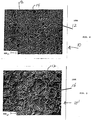
- FIG. 4 is a reproduction of a photograph at 100X magnification of an embodiment of the present invention incorporating a pure tungsten carbide ceramic combined with T-15 high speed tool steel matrix, at 1:1, HIP treated at about 1200°C for 2h, 1034 bar (15 Kpsi), heat treated at about 1200°C for 30 min, air quenched, double tempered at about 565°C for 3h.
- FIG. 5 is a reproduction of a photograph at 100 magnification of a macrocomposite of the present invention incorporating a tungsten carbide cobalt cermet microcomposite in an M-4 high speed tool steel matrix, at 1:1, HIP treated at about 1205°C for 2h at 1034 bar (15 Kpsi).
- FIG. 6 is a graph comparing Vickers hardness to toughness for several classes of materials.
- FIG. 2 it will be understood that a new class (10) of macrocomposite materials enjoys good wear resistance and good toughness, with improved thermal fatigue resistance relative to tool steel.
- the present invention is a macrocomposite formed from combining a microcomposite tool steel powder 12 with a microcomposite carbide ceramic powder 14 or a cermet powder 16.
- the pre-alloyed, gas-atomized tool steel powder and the carbide powder each maintain their integrity as they are mixed.
- the powders are combined in a mixing chamber 13. This combining is preferably done mechanically or vibratorily within a magnetic field F, such that the powders remain mixed as they are then poured into a hot isostatic treatment container (not shown).
- a portion of the resulting macrostructure 10, 10' has the tool steel microstructure 12 and the remainder has either the ceramic 14 or cermet 16 microstructure of FIG. 4 or 5.
- the resulting macrocomposite 10, 10' therefore, exhibits the characteristics of the microcomposites and therefore benefits both from the toughness of the tool steel and the wear resistance of the carbide compound and the low thermal expansion coefficient and the high thermal conductivity of the ceramic or cermet.
- the two microcomposites are mixed in nearly equal volume percentages such that after treatment, about half of the macrocomposite has the tool steel microstructure and half has the ceramic or cermet microstructure.
- the tool steel microstructure 12 is actually a combination of steel and small carbide particles (such as of a carbide of tungsten, vanadium or molybdium, for example).
- the tool steel alloy powder is preferably formed by inert-gas or water atomization.
- microcomposite ceramic tungsten carbide powder particles 14 are shown in FIG. 4 after compaction as bound in a sea of tool steel 12.
- microcomposite cermet particles 16 (preferably formed from tungsten, carbon and cobalt) are shown after compaction bound in a sea of tool steel 12.
- the tungsten carbide is cemented in a matrix of cobalt to form the microcomposite powder particles 16.
- particle size for each of the constituents is approximately equal.
- the present invention recognizes that not only does tool steel demonstrate far better wear resistance than common alloy heat treated steel, but in addition, it is more compatible with a carbide.
- alloyed steel typically includes 0.2 percent to 0.45 percent carbon and small amounts (less than 5 percent) of molybdenum and chromium, but tool steel (such as T-15) has cobalt, tungsten and carbon in good proportion.
- tool steel such as T-15
- a T-15 tool steel for example, cooperates well chemically with a tungsten carbide ceramic (because the steel already has tungsten and carbon in it) and even better with a tungsten carbide-cobalt cermet (because the steel also has cobalt in it).
- the alternative tool steels set forth above yield improved compatibility also.
- the better chemistry of the present combination reduces or avoids the formation of a reaction zone around the carbide cermet, even at 1250°C, and avoids mass migration of carbon out of the carbide compared to prior art macrocomposites using a heat treated steel matrix.
- the resulting carbides retain their advantageous mechanical properties even after processing at high temperatures.
- the cobalt content at around 5 percent of the tool steel retards mass cobalt migration from a cobalt cermeted carbide to the tool steel matrix, thereby allowing the cermeted carbide to retain good toughness. Therefore, the tool steel and carbide materials combine quite well during the hot isostatic treatment to form an inherently tough macrocomposite with a unique combination of physical properties.
- the cermet might range from tungsten carbide 97 percent to 75 percent with cobalt at 3 percent to 25 percent.
- These combinations were each respectively hot isostatically clad at 1200°C/15,000 psi (1034 bar) for 2-4 hours in 0,83 cm (0.325 inch) thickness into rolls for use in the hot rolling of steel I-beams. The rolls were used in "annealed” and heat treated conditions. In all cases the macrocomposite tool steel/cemented carbide composite substantially outperformed straight or common D-2 and T-15 tool steel rolls.
- M-4 or T-15 and tungsten carbide WC
- M-2 or T-15 and tungsten carbide at 12 percent cobalt Wc+Co 12 percent
- M-2 or T-15 and tungsten carbide at 17 percent cobalt Wc+Co 17 percent
- H-11 and tungsten carbide at 12 percent cobalt Wc+Co 12 percent
- Heat treating may include 1200°C at 30 minutes, Ar quench and double temper at 565°C, for three hours, for example.
- Cemented tungsten carbide cobalt and the ceramic tungsten carbide have very low coefficients of thermal expansion. lf one of these carbide materials, say tungsten carbide, is clad onto an alloy steel substrate, the cermet coating will form cracks during cooling of the part.
- the new coating of the present invention as previously described has a coefficient of thermal expansion located somewhat between tool steel and the ceramic or cermet carbide, which makes the material easier, to treat hot isostatically and to diffusion bond onto a tool steel substrate, with less likelihood of cracking as the coating and substrate cool. Therefore the present invention has very practical advantages in the manufacturing stage. Therefore, an assembly of the macrocomposite described above, as bonded to an alloy steel substrate, after being conventionally normalized, quenched and hardened, does not develop cracks.
Landscapes
- Chemical & Material Sciences (AREA)
- Engineering & Computer Science (AREA)
- Materials Engineering (AREA)
- Mechanical Engineering (AREA)
- Metallurgy (AREA)
- Organic Chemistry (AREA)
- Powder Metallurgy (AREA)
Description
| Carbon | 1.3 |
| Chromium | 4.0 |
| Vanadium | 4.0 |
| Tungsten | 5.5 |
| Molybdenum | 4.5; (Balance iron, with incidental impurites). |
| Carbon | 1.5 |
| Chromium | 4.0 |
| Vanadium | 5.0 |
| Tungsten | 12.0 |
| Cobalt | 5.0; (Balance iron, with incidental impurites). |
| Carbon | 0.70 |
| Chromium | 4.00 |
| Vanadium | 1.00 |
| Tungsten | 18.00; (Balance iron, with incidental imparities). |
| | Thermal Conductivity Btu ft2/ft·°F·hr | |
| 1. Tungsten carbide | 2.6 - 3.0 | 55 - 65 |
| 2. T-15 tool steel | 6.6 | 13 - 16 |
| 3. 50% WC/T-15 macrocomposite (invention) | 4.0 - 4.8 | 30 - 40 |
Claims (15)
- A process for forming a macrocomposite having improved thermal fatigue resistance comprising the steps of(a) mixing a tool steel microcomposite alloy powder and a carbide microcomposite powder to form a powder mass in a manner that said powders are generally well distributed in said mass, said carbide microcomposite powder being formed of particles having a diameter of from about 25 to 100 µm; and(b) hermetically sealing and heating said mass isostatically to a temperature of at least 1.100 °C and below or equal to 1.250 °C, at a pressure of from 138 bar (2,000 psi) to 1,034 bar (15,000 psi), until said mass is diffusion bonded into a macrocomposite having(i) a tool steel matrix formed from said tool steel microcomposite powder; and(ii) carbide islands formed from said carbide microcomposite powder dispersed in said matrix.
- The process of claim 1, wherein step (b) includes placing a substrate in a container, and further including a step (c) of cladding the mass onto the substrate by hot isostatic pressing.
- The process of claim 1 or claim 2, wherein said tool steel microcomposite is selected from the group consisting of W, S, O, A, D, H, T, M, L, F, P and CPM tool steels.
- The process of any of the claims 1 to 3, wherein said tool steel comprises M-4 or T-15 steel and said carbide includes tungsten carbide.
- The process of any of the claims 1 to 4, wherein said tool steel comprises M-4 or T-15 steel and said carbide is a tungsten carbide cobalt cermet at about 6 to 17 % cobalt.
- The process of any of the claims 1 to 5, wherein said carbide is formed from the group consisting of tungsten carbide, tantalum carbide, titanium carbide, niobium carbide, hafnium carbide, vanadium carbide, silicon carbide and mixtures thereof.
- The process of claim 6, further including a cobalt, nickel, chromium or molybdenum binder phase.
- The process of any of the claims 1 to 7, wherein said tool steel microcomposite powder and said carbide microcomposite powder are mixed in a ratio of between 3 : 1 and 1 : 3.
- The process of any of the claims 1 to 8, wherein said tool steel microcomposite powder and said carbide microcomposite powder are mixed in a ratio of about 1 : 1.
- The process of any of the claims 1 to 9, wherein said carbide microcomposite powder is at least 30 % of said powder mass.
- The process of any of the claims 1 to 10, wherein said carbide microcomposite powder comprises angularly or spherically shaped particles.
- The process of any of the claims 1 to 11, wherein said tool steel has a carbon content of from about 1 to 2 %.
- The process of any of the claims 1 to 12, further including a step of selecting the powder particle size for each of said microcomposites to be approximately equal.
- The process of any of the claims 1 to 13, wherein said mass is heated to a temperature in the range of 1,200 to 1,250 °C for a time period and at a pressure sufficient to achieve full density.
- The process of claim 14, wherein said time period is about 4 h, and said pressure is about 1,034 bar (15,000 psi).
Applications Claiming Priority (3)
| Application Number | Priority Date | Filing Date | Title |
|---|---|---|---|
| US07/657,642 US5290507A (en) | 1991-02-19 | 1991-02-19 | Method for making tool steel with high thermal fatigue resistance |
| US657642 | 1991-02-19 | ||
| PCT/US1992/001275 WO1992014853A1 (en) | 1991-02-19 | 1992-02-18 | Tool steel with high thermal fatigue resistance |
Publications (2)
| Publication Number | Publication Date |
|---|---|
| EP0572548A1 EP0572548A1 (en) | 1993-12-08 |
| EP0572548B1 true EP0572548B1 (en) | 1998-04-29 |
Family
ID=24638034
Family Applications (1)
| Application Number | Title | Priority Date | Filing Date |
|---|---|---|---|
| EP92907450A Expired - Lifetime EP0572548B1 (en) | 1991-02-19 | 1992-02-18 | Tool steel with high thermal fatigue resistance |
Country Status (6)
| Country | Link |
|---|---|
| US (1) | US5290507A (en) |
| EP (1) | EP0572548B1 (en) |
| CA (1) | CA2105178A1 (en) |
| DE (1) | DE69225312T2 (en) |
| MX (1) | MX9200659A (en) |
| WO (1) | WO1992014853A1 (en) |
Families Citing this family (72)
| Publication number | Priority date | Publication date | Assignee | Title |
|---|---|---|---|---|
| FR2692506B1 (en) * | 1992-06-22 | 1997-02-14 | Renault | FRICTION MATERIAL FOR USE IN A LUBRICATED TRIBOLOGICAL SYSTEM |
| US5385591A (en) * | 1993-09-29 | 1995-01-31 | Norton Company | Metal bond and metal bonded abrasive articles |
| US5589268A (en) * | 1995-02-01 | 1996-12-31 | Kennametal Inc. | Matrix for a hard composite |
| AU698687B2 (en) * | 1995-02-01 | 1998-11-05 | Kennametal Inc. | Matrix for a hard composite |
| DE19505628A1 (en) * | 1995-02-18 | 1996-08-22 | Hans Prof Dr Ing Berns | Process for producing a wear-resistant, tough material |
| DE69612301T2 (en) * | 1995-05-11 | 2001-07-05 | Anglo Operations Ltd., Johannesburg | SINKED CARBIDE ALLOY |
| US5880382A (en) * | 1996-08-01 | 1999-03-09 | Smith International, Inc. | Double cemented carbide composites |
| US6059533A (en) * | 1997-07-17 | 2000-05-09 | Alliedsignal Inc. | Damped blade having a single coating of vibration-damping material |
| CA2306248C (en) | 1997-10-10 | 2005-01-04 | Ultraclad Corporation | Dual alloy railroad wheel |
| US6220117B1 (en) | 1998-08-18 | 2001-04-24 | Baker Hughes Incorporated | Methods of high temperature infiltration of drill bits and infiltrating binder |
| US20080197172A1 (en) * | 1999-02-25 | 2008-08-21 | Reiber Steven F | Bonding Tool |
| US7124927B2 (en) * | 1999-02-25 | 2006-10-24 | Reiber Steven F | Flip chip bonding tool and ball placement capillary |
| US20060261132A1 (en) * | 1999-02-25 | 2006-11-23 | Reiber Steven F | Low range bonding tool |
| US6651864B2 (en) * | 1999-02-25 | 2003-11-25 | Steven Frederick Reiber | Dissipative ceramic bonding tool tip |
| US20070131661A1 (en) * | 1999-02-25 | 2007-06-14 | Reiber Steven F | Solder ball placement system |
| US6354479B1 (en) * | 1999-02-25 | 2002-03-12 | Sjm Technologies | Dissipative ceramic bonding tip |
| US7389905B2 (en) | 1999-02-25 | 2008-06-24 | Reiber Steven F | Flip chip bonding tool tip |
| US20060071050A1 (en) * | 1999-02-25 | 2006-04-06 | Reiber Steven F | Multi-head tab bonding tool |
| US7032802B2 (en) * | 1999-02-25 | 2006-04-25 | Reiber Steven F | Bonding tool with resistance |
| US8323372B1 (en) * | 2000-01-31 | 2012-12-04 | Smith International, Inc. | Low coefficient of thermal expansion cermet compositions |
| US6454027B1 (en) | 2000-03-09 | 2002-09-24 | Smith International, Inc. | Polycrystalline diamond carbide composites |
| GB2365025B (en) * | 2000-05-01 | 2004-09-15 | Smith International | Rotary cone bit with functionally-engineered composite inserts |
| GB2362388B (en) * | 2000-05-15 | 2004-09-29 | Smith International | Woven and packed composite constructions |
| DE10030296A1 (en) † | 2000-06-27 | 2002-01-10 | Hauni Maschinenbau Ag | Device for conveying a strand of the tobacco processing industry |
| US6578622B2 (en) * | 2001-02-26 | 2003-06-17 | Siemens Vdo Automotive Inc. | Core cast manifold assembly |
| US7407525B2 (en) * | 2001-12-14 | 2008-08-05 | Smith International, Inc. | Fracture and wear resistant compounds and down hole cutting tools |
| US7017677B2 (en) * | 2002-07-24 | 2006-03-28 | Smith International, Inc. | Coarse carbide substrate cutting elements and method of forming the same |
| FI115702B (en) * | 2002-08-30 | 2005-06-30 | Metso Powdermet Oy | Process for manufacturing durable abrasion and abrasion parts |
| US7250069B2 (en) * | 2002-09-27 | 2007-07-31 | Smith International, Inc. | High-strength, high-toughness matrix bit bodies |
| FI115830B (en) * | 2002-11-01 | 2005-07-29 | Metso Powdermet Oy | Process for the manufacture of multi-material components and multi-material components |
| US7243744B2 (en) | 2003-12-02 | 2007-07-17 | Smith International, Inc. | Randomly-oriented composite constructions |
| US20050227772A1 (en) * | 2004-04-13 | 2005-10-13 | Edward Kletecka | Powdered metal multi-lobular tooling and method of fabrication |
| US20050262774A1 (en) * | 2004-04-23 | 2005-12-01 | Eyre Ronald K | Low cobalt carbide polycrystalline diamond compacts, methods for forming the same, and bit bodies incorporating the same |
| US7441610B2 (en) * | 2005-02-25 | 2008-10-28 | Smith International, Inc. | Ultrahard composite constructions |
| US20070085085A1 (en) * | 2005-08-08 | 2007-04-19 | Reiber Steven F | Dissipative pick and place tools for light wire and LED displays |
| CA2603458C (en) * | 2006-09-21 | 2015-11-17 | Smith International, Inc. | Atomic layer deposition nanocoatings on cutting tool powder materials |
| US20080179104A1 (en) * | 2006-11-14 | 2008-07-31 | Smith International, Inc. | Nano-reinforced wc-co for improved properties |
| US7862634B2 (en) * | 2006-11-14 | 2011-01-04 | Smith International, Inc. | Polycrystalline composites reinforced with elongated nanostructures |
| US7682557B2 (en) * | 2006-12-15 | 2010-03-23 | Smith International, Inc. | Multiple processes of high pressures and temperatures for sintered bodies |
| US8349466B2 (en) * | 2007-02-22 | 2013-01-08 | Kennametal Inc. | Composite materials comprising a hard ceramic phase and a Cu-Ni-Sn alloy |
| US20080206585A1 (en) * | 2007-02-22 | 2008-08-28 | Kennametal Inc. | Composite materials comprising a hard ceramic phase and a Cu-Ni-Mn infiltration alloy |
| WO2010036569A2 (en) | 2008-09-24 | 2010-04-01 | Smith International, Inc. | Novel hardmetal for use in oil and gas drilling applications |
| US20100104874A1 (en) * | 2008-10-29 | 2010-04-29 | Smith International, Inc. | High pressure sintering with carbon additives |
| US20100230176A1 (en) * | 2009-03-10 | 2010-09-16 | Baker Hughes Incorporated | Earth-boring tools with stiff insert support regions and related methods |
| US20100230177A1 (en) * | 2009-03-10 | 2010-09-16 | Baker Hughes Incorporated | Earth-boring tools with thermally conductive regions and related methods |
| US8016057B2 (en) * | 2009-06-19 | 2011-09-13 | Kennametal Inc. | Erosion resistant subterranean drill bits having infiltrated metal matrix bodies |
| US9004199B2 (en) * | 2009-06-22 | 2015-04-14 | Smith International, Inc. | Drill bits and methods of manufacturing such drill bits |
| DE202009008542U1 (en) * | 2009-06-23 | 2009-08-20 | Köppern Entwicklungs-GmbH | Wear-resistant insert for a cutting or breaking tool |
| WO2011017582A2 (en) * | 2009-08-07 | 2011-02-10 | Smith International, Inc. | Functionally graded polycrystalline diamond insert |
| WO2011017625A2 (en) * | 2009-08-07 | 2011-02-10 | Smith International, Inc. | Method of forming a thermally stable diamond cutting element |
| US20110036643A1 (en) * | 2009-08-07 | 2011-02-17 | Belnap J Daniel | Thermally stable polycrystalline diamond constructions |
| WO2011017590A2 (en) | 2009-08-07 | 2011-02-10 | Smith International, Inc. | Polycrystalline diamond material with high toughness and high wear resistance |
| CN102656334B (en) | 2009-08-07 | 2015-11-25 | 史密斯国际有限公司 | Highly wear-resistant diamond inserts with improved transition structure |
| US8857541B2 (en) * | 2009-08-07 | 2014-10-14 | Smith International, Inc. | Diamond transition layer construction with improved thickness ratio |
| US8778259B2 (en) | 2011-05-25 | 2014-07-15 | Gerhard B. Beckmann | Self-renewing cutting surface, tool and method for making same using powder metallurgy and densification techniques |
| US10987735B2 (en) | 2015-12-16 | 2021-04-27 | 6K Inc. | Spheroidal titanium metallic powders with custom microstructures |
| EP4324577A1 (en) | 2015-12-16 | 2024-02-21 | 6K Inc. | Method of producing spheroidal dehydrogenated titanium alloy particles |
| CN108330430B (en) * | 2018-03-07 | 2019-12-13 | 广东省新材料研究所 | A method for improving the bonding strength of plasma sprayed Mo coating on crankshaft surface |
| WO2019246257A1 (en) | 2018-06-19 | 2019-12-26 | Amastan Technologies Inc. | Process for producing spheroidized powder from feedstock materials |
| US11311938B2 (en) | 2019-04-30 | 2022-04-26 | 6K Inc. | Mechanically alloyed powder feedstock |
| CN114007985A (en) | 2019-04-30 | 2022-02-01 | 6K有限公司 | Lithium Lanthanum Zirconium Oxide (LLZO) powder |
| ES2994209T3 (en) | 2019-11-18 | 2025-01-20 | 6K Inc | Unique feedstocks for spherical powders and methods of manufacturing |
| US11590568B2 (en) | 2019-12-19 | 2023-02-28 | 6K Inc. | Process for producing spheroidized powder from feedstock materials |
| KR20230029836A (en) | 2020-06-25 | 2023-03-03 | 6케이 인크. | Microcomposite alloy structure |
| KR102811425B1 (en) | 2020-09-24 | 2025-05-26 | 6케이 인크. | Systems, devices and methods for initiating plasma |
| EP4237174A1 (en) | 2020-10-30 | 2023-09-06 | 6K Inc. | Systems and methods for synthesis of spheroidized metal powders |
| EP4275239A4 (en) | 2021-01-11 | 2024-12-18 | 6K Inc. | METHODS AND SYSTEMS FOR RECOVERY OF LI-ION CATHODE MATERIALS USING MICROWAVE PLASMA PROCESSING |
| JP2024515034A (en) | 2021-03-31 | 2024-04-04 | シックスケー インコーポレイテッド | Systems and methods for additive manufacturing of metal nitride ceramics |
| WO2023229928A1 (en) | 2022-05-23 | 2023-11-30 | 6K Inc. | Microwave plasma apparatus and methods for processing materials using an interior liner |
| US12040162B2 (en) | 2022-06-09 | 2024-07-16 | 6K Inc. | Plasma apparatus and methods for processing feed material utilizing an upstream swirl module and composite gas flows |
| WO2024044498A1 (en) | 2022-08-25 | 2024-02-29 | 6K Inc. | Plasma apparatus and methods for processing feed material utilizing a powder ingress preventor (pip) |
| US12195338B2 (en) | 2022-12-15 | 2025-01-14 | 6K Inc. | Systems, methods, and device for pyrolysis of methane in a microwave plasma for hydrogen and structured carbon powder production |
Family Cites Families (33)
| Publication number | Priority date | Publication date | Assignee | Title |
|---|---|---|---|---|
| US4576642A (en) * | 1965-02-26 | 1986-03-18 | Crucible Materials Corporation | Alloy composition and process |
| US4469514A (en) * | 1965-02-26 | 1984-09-04 | Crucible, Inc. | Sintered high speed tool steel alloy composition |
| US3746518A (en) * | 1965-02-26 | 1973-07-17 | Crucible Inc | Alloy composition and process |
| US3556780A (en) * | 1966-01-03 | 1971-01-19 | Iit Res Inst | Process for producing carbide-containing alloy |
| US3561934A (en) * | 1967-09-11 | 1971-02-09 | Crucible Inc | Sintered steel particles containing dispersed carbides |
| US3653982A (en) * | 1969-12-18 | 1972-04-04 | Chromalloy American Corp | Temper resistant chromium-containing titanium carbide tool steel |
| SE371756B (en) * | 1972-07-07 | 1974-12-02 | Morgaardshammar Ab | |
| US3809540A (en) * | 1972-12-29 | 1974-05-07 | Chromalloy American Corp | Sintered steel bonded titanium carbide tool steel characterized by an improved combination of transverse rupture strength and resistance to thermal shock |
| US3977837A (en) * | 1973-11-06 | 1976-08-31 | Chromalloy American Corporation | Titanium carbide tool steel having improved properties |
| SE380450B (en) * | 1975-01-31 | 1975-11-10 | Seco Tools Ab | COMPOSITE ROLL |
| US4146388A (en) * | 1977-12-08 | 1979-03-27 | Gte Sylvania Incorporated | Molybdenum plasma spray powder, process for producing said powder, and coatings made therefrom |
| JPS5541949A (en) * | 1978-09-18 | 1980-03-25 | Nippon Tungsten Co Ltd | Manufacture of hard alloy |
| NL7905973A (en) * | 1979-08-03 | 1981-02-05 | Skf Ind Trading & Dev | METHOD FOR APPLYING A DENSE, HARD, TIGHT AND WEAR-RESISTANT COAT OF CERMETS OR CERAMIC MATERIAL ON A METAL ARTICLE AND OBTAINED THEREFORE. |
| US4546527A (en) * | 1981-12-01 | 1985-10-15 | Kubota Ltd. | Composite sleeve for use in rolling rolls for H-section steel and channel steel |
| GR79748B (en) * | 1982-12-23 | 1984-10-31 | Ver Edelstahlwerke Ag | |
| US4756677A (en) * | 1982-12-23 | 1988-07-12 | Vereinigte Edelstahlwerke Aktiengesellshaft | Method of manufacturing a weapon barrel |
| DE3308409A1 (en) * | 1983-03-09 | 1984-09-20 | Seilstorfer GmbH & Co Metallurgische Verfahrenstechnik KG, 8012 Ottobrunn | Process for the production of a sintered material alloy |
| DE3310038C2 (en) * | 1983-03-19 | 1985-05-09 | Fried. Krupp Gmbh, 4300 Essen | Process for the production of a composite body |
| SE451549B (en) * | 1983-05-09 | 1987-10-19 | Kloster Speedsteel Ab | POWDER METAL SURGICAL METHOD TO MAKE METAL BODIES OF MAGNETIZABLE SPHERICAL POWDER |
| SE440753B (en) * | 1983-05-13 | 1985-08-19 | Santrade Ltd | CUTTING PROCESSING TOOLS EXISTING CORE AND WRAP |
| DE3507332A1 (en) * | 1985-03-01 | 1986-09-04 | Seilstorfer GmbH & Co Metallurgische Verfahrenstechnik KG, 8092 Haag | Steel matrix/sintered material composite |
| DE3508982A1 (en) * | 1985-03-13 | 1986-09-18 | Seilstorfer GmbH & Co Metallurgische Verfahrenstechnik KG, 8092 Haag | Steel matrix/sintered material composite |
| US4769212A (en) * | 1985-03-29 | 1988-09-06 | Hitachi Metals, Ltd | Process for producing metallic sintered parts |
| JPS6287466A (en) * | 1985-09-24 | 1987-04-21 | 株式会社神戸製鋼所 | High tenacity ceramic base composite material one-body bonded with metal fiber to ceramic matrix |
| JPS63266038A (en) * | 1986-12-11 | 1988-11-02 | Kubota Ltd | High chromium cast iron and graphite composite manufacturing method |
| EP0309587B1 (en) * | 1987-03-24 | 1993-07-28 | Hitachi Metals, Ltd. | Abrasion-resistant composite roll and process for its production |
| DE3815833A1 (en) * | 1988-05-09 | 1989-11-23 | Seilstorfer Gmbh & Co Metallur | CORROSION RESISTANT COLD WORK STEEL AND STEEL MATRIX HARD PLASTIC COMPOSITE HAVING THIS COLD WORK STEEL |
| US4954058A (en) * | 1988-06-27 | 1990-09-04 | Deere & Company | Method for making composite sintered apex seal material |
| US4936912A (en) * | 1988-06-27 | 1990-06-26 | Deere & Company | Sintered apex seal material |
| GB8821044D0 (en) * | 1988-09-08 | 1988-10-05 | Metal Box Plc | Method of bonding tool material to holder & tools made by method |
| JPH0288747A (en) * | 1988-09-27 | 1990-03-28 | Nippon Steel Corp | Wear-resistant roll material |
| SE467210B (en) * | 1988-10-21 | 1992-06-15 | Sandvik Ab | MAKE MANUFACTURING TOOL MATERIALS FOR CUTTING PROCESSING |
| US4968347A (en) * | 1988-11-22 | 1990-11-06 | The United States Of America As Represented By The United States Department Of Energy | High energy product permanent magnet having improved intrinsic coercivity and method of making same |
-
1991
- 1991-02-19 US US07/657,642 patent/US5290507A/en not_active Expired - Fee Related
-
1992
- 1992-02-17 MX MX9200659A patent/MX9200659A/en unknown
- 1992-02-18 DE DE69225312T patent/DE69225312T2/en not_active Expired - Lifetime
- 1992-02-18 CA CA002105178A patent/CA2105178A1/en not_active Abandoned
- 1992-02-18 EP EP92907450A patent/EP0572548B1/en not_active Expired - Lifetime
- 1992-02-18 WO PCT/US1992/001275 patent/WO1992014853A1/en not_active Ceased
Non-Patent Citations (1)
| Title |
|---|
| Metals Handbook 1969, vol. 1, 8th ed., ASM Publ, p. 638, * |
Also Published As
| Publication number | Publication date |
|---|---|
| US5290507A (en) | 1994-03-01 |
| MX9200659A (en) | 1992-08-01 |
| DE69225312D1 (en) | 1998-06-04 |
| EP0572548A1 (en) | 1993-12-08 |
| CA2105178A1 (en) | 1992-08-20 |
| WO1992014853A1 (en) | 1992-09-03 |
| DE69225312T2 (en) | 1998-11-05 |
Similar Documents
| Publication | Publication Date | Title |
|---|---|---|
| US5290507A (en) | Method for making tool steel with high thermal fatigue resistance | |
| US7556668B2 (en) | Consolidated hard materials, methods of manufacture, and applications | |
| JP4439591B2 (en) | Stainless steel powder and products made by powder metallurgy from the powder | |
| JPS63109151A (en) | High hardness composite material and its manufacturing method | |
| US4973356A (en) | Method of making a hard material with properties between cemented carbide and high speed steel and the resulting material | |
| US8795448B2 (en) | Wear resistant materials | |
| EP1129229B1 (en) | Steel, use of the steel, product made of the steel and method of producing the steel | |
| US5470372A (en) | Sintered extremely fine-grained titanium-based carbonitride alloy with improved toughness and/or wear resistance | |
| JP2857724B2 (en) | High speed steel based sintered alloy | |
| EP0815274B1 (en) | Method of powder metallurgical manufacturing of a composite material | |
| US5034282A (en) | Process for the powder metallurgical production of working pieces or tools and PM parts | |
| JP3301441B2 (en) | Composite cylinder for high-temperature and high-pressure molding | |
| GB2298869A (en) | Stainless steel powders and articles produced therefrom by powder metallurgy | |
| EP0510598B1 (en) | Wear-resistant compound roll | |
| JPH0483807A (en) | Composite hard alloy material | |
| JPS63109139A (en) | Titanium carbide sintered alloy for cutting tool parts | |
| JPH0483805A (en) | Combined hard alloy material | |
| JPH0483808A (en) | Composite hard alloy material | |
| JPH07118775A (en) | Production of tough cermet with low coefficient of thermal expansion | |
| JPH01252704A (en) | Composite member and its manufacturing method | |
| GB2032457A (en) | Hard Alloy Powder | |
| JPH02133545A (en) | Highly alloyed high speed tool steel | |
| JPH01301835A (en) | Manufacture of high speed steel riched in wc/tic carbide | |
| JPH0483806A (en) | Composite hard alloy material |
Legal Events
| Date | Code | Title | Description |
|---|---|---|---|
| PUAI | Public reference made under article 153(3) epc to a published international application that has entered the european phase |
Free format text: ORIGINAL CODE: 0009012 |
|
| 17P | Request for examination filed |
Effective date: 19930915 |
|
| AK | Designated contracting states |
Kind code of ref document: A1 Designated state(s): DE |
|
| 17Q | First examination report despatched |
Effective date: 19951023 |
|
| RAP1 | Party data changed (applicant data changed or rights of an application transferred) |
Owner name: ULTRACLAD CORPORATION |
|
| GRAG | Despatch of communication of intention to grant |
Free format text: ORIGINAL CODE: EPIDOS AGRA |
|
| GRAG | Despatch of communication of intention to grant |
Free format text: ORIGINAL CODE: EPIDOS AGRA |
|
| GRAH | Despatch of communication of intention to grant a patent |
Free format text: ORIGINAL CODE: EPIDOS IGRA |
|
| GRAH | Despatch of communication of intention to grant a patent |
Free format text: ORIGINAL CODE: EPIDOS IGRA |
|
| GRAA | (expected) grant |
Free format text: ORIGINAL CODE: 0009210 |
|
| AK | Designated contracting states |
Kind code of ref document: B1 Designated state(s): DE |
|
| REF | Corresponds to: |
Ref document number: 69225312 Country of ref document: DE Date of ref document: 19980604 |
|
| PLBE | No opposition filed within time limit |
Free format text: ORIGINAL CODE: 0009261 |
|
| 26N | No opposition filed | ||
| PGFP | Annual fee paid to national office [announced via postgrant information from national office to epo] |
Ref country code: DE Payment date: 20110831 Year of fee payment: 20 |
|
| REG | Reference to a national code |
Ref country code: DE Ref legal event code: R071 Ref document number: 69225312 Country of ref document: DE |
|
| REG | Reference to a national code |
Ref country code: DE Ref legal event code: R071 Ref document number: 69225312 Country of ref document: DE |
|
| PG25 | Lapsed in a contracting state [announced via postgrant information from national office to epo] |
Ref country code: DE Free format text: LAPSE BECAUSE OF EXPIRATION OF PROTECTION Effective date: 20120221 |