EP0572342A1 - Automised process for the production of flexible printing plates and apparatus therefor - Google Patents
Automised process for the production of flexible printing plates and apparatus therefor Download PDFInfo
- Publication number
- EP0572342A1 EP0572342A1 EP93470010A EP93470010A EP0572342A1 EP 0572342 A1 EP0572342 A1 EP 0572342A1 EP 93470010 A EP93470010 A EP 93470010A EP 93470010 A EP93470010 A EP 93470010A EP 0572342 A1 EP0572342 A1 EP 0572342A1
- Authority
- EP
- European Patent Office
- Prior art keywords
- plate
- etching
- brushes
- engraving
- tank
- Prior art date
- Legal status (The legal status is an assumption and is not a legal conclusion. Google has not performed a legal analysis and makes no representation as to the accuracy of the status listed.)
- Granted
Links
- 238000000034 method Methods 0.000 title claims abstract description 20
- 230000008569 process Effects 0.000 title claims abstract description 11
- 238000007639 printing Methods 0.000 title claims abstract description 7
- 238000004519 manufacturing process Methods 0.000 title abstract description 4
- 238000005530 etching Methods 0.000 claims abstract description 33
- 230000005484 gravity Effects 0.000 claims abstract description 7
- 230000005855 radiation Effects 0.000 claims abstract description 6
- 238000007647 flexography Methods 0.000 claims abstract description 5
- 239000007788 liquid Substances 0.000 claims description 17
- 238000001035 drying Methods 0.000 claims description 12
- 238000004140 cleaning Methods 0.000 claims description 7
- 238000000151 deposition Methods 0.000 claims description 2
- 229920000642 polymer Polymers 0.000 description 4
- 239000002904 solvent Substances 0.000 description 3
- 230000032258 transport Effects 0.000 description 3
- 241001417494 Sciaenidae Species 0.000 description 2
- 230000008929 regeneration Effects 0.000 description 2
- 238000011069 regeneration method Methods 0.000 description 2
- 239000004743 Polypropylene Substances 0.000 description 1
- 230000006978 adaptation Effects 0.000 description 1
- 238000003287 bathing Methods 0.000 description 1
- 230000001680 brushing effect Effects 0.000 description 1
- 238000012423 maintenance Methods 0.000 description 1
- 239000000463 material Substances 0.000 description 1
- 239000002245 particle Substances 0.000 description 1
- -1 polypropylene Polymers 0.000 description 1
- 229920001155 polypropylene Polymers 0.000 description 1
- 238000002360 preparation method Methods 0.000 description 1
- 238000004801 process automation Methods 0.000 description 1
- 230000009467 reduction Effects 0.000 description 1
- 239000007921 spray Substances 0.000 description 1
- XLYOFNOQVPJJNP-UHFFFAOYSA-N water Substances O XLYOFNOQVPJJNP-UHFFFAOYSA-N 0.000 description 1
- 239000000080 wetting agent Substances 0.000 description 1
Images
Classifications
-
- G—PHYSICS
- G03—PHOTOGRAPHY; CINEMATOGRAPHY; ANALOGOUS TECHNIQUES USING WAVES OTHER THAN OPTICAL WAVES; ELECTROGRAPHY; HOLOGRAPHY
- G03F—PHOTOMECHANICAL PRODUCTION OF TEXTURED OR PATTERNED SURFACES, e.g. FOR PRINTING, FOR PROCESSING OF SEMICONDUCTOR DEVICES; MATERIALS THEREFOR; ORIGINALS THEREFOR; APPARATUS SPECIALLY ADAPTED THEREFOR
- G03F7/00—Photomechanical, e.g. photolithographic, production of textured or patterned surfaces, e.g. printing surfaces; Materials therefor, e.g. comprising photoresists; Apparatus specially adapted therefor
- G03F7/26—Processing photosensitive materials; Apparatus therefor
- G03F7/30—Imagewise removal using liquid means
- G03F7/3042—Imagewise removal using liquid means from printing plates transported horizontally through the processing stations
- G03F7/305—Imagewise removal using liquid means from printing plates transported horizontally through the processing stations characterised by the brushing or rubbing means
Definitions
- the present invention relates to a process for the preparation of flexible plates, usable for the production of printed matter in flexography, typography or dry offset, it also relates to a device for implementing the process.
- the invention relates to a process for very quickly treating photopolymer plates of any format, in order to transform them into printing plates.
- the radiation hardens these areas and the material is then removed from the protected surface by brushing it with flat or rotary brushes or by spray nozzles; solvent or water acting as a wetting agent, the operation is continued until the areas which have been exposed are sufficiently raised.
- a first object of the invention is to completely automate the entire etching process.
- Another object of the invention is therefore to make photopolymer plates of all formats and thicknesses, in a simple machine, making it possible to introduce on one side an already exposed plate and to recover it after engraving, almost dry, in minimum time.
- the method according to the invention comprises at least the following steps:
- the operator introduces the bar at the entrance of the machine on the entry table.
- the photopolymer plate is hooked at one end to a bar (1).
- This bar is driven for example at each end, by pins mounted on the supply chain mounted on the floating drum above the etching tank.
- the bar (1) drives the photopolymer plate (0) on a drum (2) via lug chains (3) ( Figure 3).
- the plate goes around the drum (2) at 180 ° to come to position ( Figure 4) on the surface of the flat brushes (5), it is then in the engraving position.
- the drum (2) descends and comes to bear on the photopolymer plate.
- the drum (2) does not move during engraving. It simply presses on the photopolymer plate (0) during gravity etching.
- the flat brushes (5) are spaced apart to allow the attachment system to pass over the feed bar (1) and also to allow the removed polymer to dissolve or dissolve. evacuate very quickly so that the etching is done in the best conditions.
- planar brushes (5) have, in addition, an alternating movement with respect to each other, which makes it possible to keep the photograph always immobile in its initial position (FIG. 8).
- the plate (0) can have any dimension relative to the format of the base of the drum (2) and any thickness.
- the etching tank (12), containing the liquid (6) and the flat brushes (5) has a lateral movement back and forth perpendicular to that flat brushes (5) as shown in figure 8.
- the brushes (5) stop: the drum is raised and the bar (1) pulled by the pin chains (3), pulls the plate around the drum.
- a rotating brush (7) bathed in a clean liquid tank, will rinse the surface of the plate (0) automatically as it passes.
- a rotating brush (8) bathed in a tank of clean liquid, will rinse the back of the plate (0) automatically as it passes ( Figure 5).
- the brushes (7 and 8) are self-cleaning with each other by friction when there is no plate (0) passing.
- a third dense brush (9), wetted by a ramp of new liquid (13) comes to wipe the surface of the plate (0) in passing (relief of the printer plate).
- the feed bar (1) continues to move ( Figure 6) and is supported by the chain (10) with pins which transports it to the pre-drying section (14).
- the plate can be checked before pre-drying and, in the event of insufficient etching, the operator can reintroduce the plate into the etching section.
- the polymer Since the plate remained for a very short time in contact with the liquid during the etching, the polymer absorbed very little liquid so there is practically no deformation of the lines of the image and the drying time of the plate will be very short. The consumption of the solvent will also be reduced accordingly.
- the invention also relates to a device for implementing the method described and comprising, without limitation, the means mentioned above in particular on the one hand mechanical means for driving the tank in a horizontal movement back and forth and mechanical means for driving the flat brushes (5) in an alternating movement in a horizontal direction perpendicular to that of the tank, and on the other hand means for depositing the plate (0) by gravity on the flat brushes (5) facing to be engraved facing said brushes.
- the flat brushes are preferably made of a PVC or polypropylene support depending on the type of etching solution used.
- the bristle diameters of these brushes and the density of the tufts are determined according to the type of photopolymer to be etched.
- the photopolymer plate drive bars are equipped, for example, with latches which allow plates of any thickness to be hung simply and quickly.
Landscapes
- Physics & Mathematics (AREA)
- General Physics & Mathematics (AREA)
- Photosensitive Polymer And Photoresist Processing (AREA)
- Printing Plates And Materials Therefor (AREA)
- Manufacture Or Reproduction Of Printing Formes (AREA)
Abstract
Description
La présente invention concerne un procédé pour la confection de clichés souples, utilisables pour la réalisation d'imprimés en flexographie, typographie ou offset sec, elle concerne également un dispositif de mise en oeuvre du procédé.The present invention relates to a process for the preparation of flexible plates, usable for the production of printed matter in flexography, typography or dry offset, it also relates to a device for implementing the process.
Plus exactement, l'invention concerne un procédé pour traiter très rapidement des plaques photopolymères de tout format, afin de les transformer en clichés d'impression.More precisely, the invention relates to a process for very quickly treating photopolymer plates of any format, in order to transform them into printing plates.
On sait déjà que l'on peut obtenir un cliché pour la flexographie ou la typographie en exposant une plaque de photopolymère sensible aux rayonnements ultraviolets, avec l'interposition d'un film négatif qui laisse exposées au rayonnement les zones qui doivent venir en relief sur le cliché terminé.We already know that we can obtain a plate for flexography or typography by exposing a photopolymer plate sensitive to ultraviolet radiation, with the interposition of a negative film which leaves exposed to radiation the areas which must come into relief on the shot finished.
Le rayonnement durcit ces zones et on élimine ensuite la matière de la surface protégée en la brossant à l'aide de brosses planes ou rotatives ou par buses de pulvérisation ; un solvant ou de l'eau faisant office d'agent mouillant, on poursuit l'opération jusqu'à ce que les zones qui ont été exposées se trouvent suffisamment en relief.The radiation hardens these areas and the material is then removed from the protected surface by brushing it with flat or rotary brushes or by spray nozzles; solvent or water acting as a wetting agent, the operation is continued until the areas which have been exposed are sufficiently raised.
Un premier objet de l'invention est d'automatiser complètement l'ensemble du procédé de gravure.A first object of the invention is to completely automate the entire etching process.
Par ailleurs, on trouve actuellement sur le marché une large gamme de plaques photopolymères de toutes épaisseurs et dans tous les formats (jusqu'à 50 x 80 pouces), et on fabrique déjà des machines semi-automatiques sur lesquelles le cliché photopolymère est fixé ou collé sur le plateau porte-cliché et une brosse plane à mouvement orbital, baignant dans un bain de gravure, permet de confectionner des clichés.In addition, there is currently on the market a wide range of photopolymer plates of all thicknesses and in all formats (up to 50 x 80 inches), and semi-automatic machines are already being manufactured on which the photopolymer plate is fixed or glued to the plate holder and a flat brush with an orbital movement, bathing in an etching bath, makes it possible to make photos.
Un autre but de l'invention est donc de confectionner des clichés photopolymères de tous formats et épaisseurs, dans une machine simple, permettant d'introduire d'un côté un cliché déjà exposé et de récupérer celui-ci après gravure, presque sec, dans un minimum de temps.Another object of the invention is therefore to make photopolymer plates of all formats and thicknesses, in a simple machine, making it possible to introduce on one side an already exposed plate and to recover it after engraving, almost dry, in minimum time.
Pour atteindre ces buts, plusieurs problèmes ont dû être résolus et notamment :
- diminution de la durée de l'opération de gravure,
- maintient automatique du cliché en position de gravure,
- mise du cliché en position de gravure automatiquement.
- reduction in the duration of the etching operation,
- automatic maintenance of the plate in the engraving position,
- putting the photo in the engraving position automatically.
Conformément à l'invention le nouveau procédé proposé se caractérise en ce qu'il comporte au moins les étapes suivantes :
- descente de la plaque (0) face à graver tournée vers le bas, dans un bac de gravure,
- gravure par la résultante d'un mouvement aternatif horizontal de brosses planes et d'un mouvement de va-et-vient du bac de gravure dans une direction horizontale perpenticulaire à celle des brosses, la plaque étant maintenue automatiquement en cours de gravure par gravité.
- lowering of the plate (0) face to engrave turned downwards, in an engraving tank,
- etching by the result of a horizontal reciprocating movement of flat brushes and a reciprocating movement of the etching tank in a horizontal direction perpendicular to that of the brushes, the plate being held automatically during etching by gravity.
En outre, il comporte de préférence les étapes préalables suivantes:
- introduction et accrochage de la plaque (0) face sensible tournée vers le haut,
- renversement de la plaque à 180° et mise en place automatique en position de gravure face à graver tounée vers le bas.
- introduction and attachment of the plate (0) with the sensitive side facing up,
- 180 ° inversion of the plate and automatic positioning in the engraving position with the engraving face turned down.
Et après gravure, les étapes suivantes:
- relèvement automatique de la plaque (0),
- rinçage et nettoyage automatique de la surface et du dos de la plaque pendant son reversement à 180°,
- transfert et contrôle de la plaque face gravée tournée sur le dessus,
- préséchage.
- automatic plate raising (0),
- automatic rinsing and cleaning of the surface and back of the plate during its 180 ° reversal,
- transfer and control of the engraved face plate turned on the top,
- pre-drying.
On comprendra mieux l'invention à l'aide de la description ci-après faite en référence aux figures annexées suivantes :
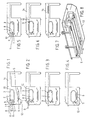
- Figure 1 : croquis d'un exemple de réalisation d'un dispositif pour la mise en oeuvre du procédé selon l'invention et montrant la première étape du procédé,
- Figures 2 à 7 : croquis montrant les étapes suivantes du procédé,
- Figure 8 : croquis montrant le bac de gravure et les brosses planes.
- FIG. 1 : sketch of an exemplary embodiment of a device for implementing the method according to the invention and showing the first step of the method,
- Figures 2 to 7 : sketch showing the following stages of the process,
- Figure 8 : sketch showing the engraving tank and the flat brushes.
Le procédé selon l'invention comporte au moins les étapes suivantes :The method according to the invention comprises at least the following steps:
Une plaque photopolymère (0), préalablement exposée aux rayons UV, est accrochée sur une barre d'amenage (1) par l'opérateur.A photopolymer plate (0), previously exposed to UV rays, is hung on a feed bar (1) by the operator.
L'opérateur introduit la barre à l'entrée de la machine sur la table d'entrée.The operator introduces the bar at the entrance of the machine on the entry table.
Il appuie sur un bouton start, en ayant au préalable réglé son temps de gravure sur la minuterie suivant l'épaisseur de la couche photopolymère ainsi que la quantité de solvant de régénération en fonction du creux nécessaire.He presses a start button, having previously set his etching time on the timer according to the thickness of the photopolymer layer as well as the amount of regeneration solvent depending on the hollow required.
La plaque photopolymère est accrochée par une extrémité à une barre (1).The photopolymer plate is hooked at one end to a bar (1).
Cette barre est entraînée par exemple à chaque extrémité, par des tétons montés sur la chaîne d'amenage montée sur le tambour flottant au-dessus de la cuve de gravure.This bar is driven for example at each end, by pins mounted on the supply chain mounted on the floating drum above the etching tank.
La barre (1) entraîne la plaque photopolymère (0) sur un tambour (2) par l'intermédiaire de chaînes à tétons (3) (figure 3).The bar (1) drives the photopolymer plate (0) on a drum (2) via lug chains (3) (Figure 3).
La plaque fait le tour du tambour (2) à 180° pour venir se positionner (figure 4) sur la surface des brosses planes (5), elle est alors en position de gravure.The plate goes around the drum (2) at 180 ° to come to position (Figure 4) on the surface of the flat brushes (5), it is then in the engraving position.
Le tambour (2) descend et vient s'appuyer sur la plaque photopolymère.The drum (2) descends and comes to bear on the photopolymer plate.
Des brosses (5) sont immergées dans le liquide (6).Brushes (5) are immersed in the liquid (6).
Le tambour (2) ne bouge pas pendant la gravure. Il appuye simplement sur la plaque photopolymère (0) pendant la gravure par gravité.The drum (2) does not move during engraving. It simply presses on the photopolymer plate (0) during gravity etching.
Les brosses planes (5), au nombre de quatre, sont espacées entre elles afin de permettre de faire passer le système d'accrochage sur la barre d'amenage (1) et aussi pour permettre au polymère enlevé de se dissoudre ou de s'évacuer très rapidement afin que la gravure se fasse dans les meilleures conditions.The flat brushes (5), four in number, are spaced apart to allow the attachment system to pass over the feed bar (1) and also to allow the removed polymer to dissolve or dissolve. evacuate very quickly so that the etching is done in the best conditions.
Les brosses (5) planes ont, de plus, un mouvement altematif l'une par rapport à l'autre, ce qui permet de maintenir le cliché toujours immobile dans sa position initiale (figure 8). A noter que le cliché (0) peut avoir n'importe quelle dimension par rapport au format de la base du tambour (2) et n'importe quelle épaisseur.The planar brushes (5) have, in addition, an alternating movement with respect to each other, which makes it possible to keep the photograph always immobile in its initial position (FIG. 8). Note that the plate (0) can have any dimension relative to the format of the base of the drum (2) and any thickness.
Afin d'avoir une gravure uniforme de la surface de la plaque photopolymère, le bac de gravure (12), contenant le liquide (6) et les brosses planes (5), a un mouvement latéral de va-et-vient perpendiculaire à celui des brosses planes (5) comme indiqué figure 8.In order to have a uniform etching of the surface of the photopolymer plate, the etching tank (12), containing the liquid (6) and the flat brushes (5), has a lateral movement back and forth perpendicular to that flat brushes (5) as shown in figure 8.
La résultante :
- du mouvement alternatif horizontal des brosses planes (5),
- du mouvement de va-et-vient du bac inférieur (12) dans une direction perpendiculaire horizontale perpendiculaire à celle des brosses,
permet de maintenir la plaque (0) en position fixe sans accrochage et d'avoir un système parfait de gravure selon deux directions orthogonales sur toute surface de n'importe quelle dimension et ceci en une seule fois. Le fait de graver ainsi en une seule fois la totalité de la surface et de placer la plaque photopolymère au-dessus des brosses pour dégager au fur et à mesure le polymère enlevé, permet de résoudre un des problèmes posés, à savoir la rapidité de la gravure.The result:
- the horizontal reciprocating movement of the flat brushes (5),
- the back and forth movement of the lower tank (12) in a horizontal perpendicular direction perpendicular to that of the brushes,
allows to keep the plate (0) in a fixed position without hooking and to have a perfect engraving system in two orthogonal directions on any surface of any dimension and this in one go. The fact of etching in one go the entire surface and placing the photopolymer plate above the brushes to gradually release the removed polymer, solves one of the problems posed, namely the speed of the engraving.
Le problème du maintient automatique des clichés en position initiale en cours de gravure étant résolu par le mouvement alternatif des brosses planes.The problem of automatically maintaining the plates in the initial position during engraving is resolved by the reciprocating movement of the flat brushes.
Une fois le temps de gravure écoulé, les brosses (5) s'arrêtent : le tambour se soulève et la barre (1) tractée par les chaînes à tétons (3), tire la plaque autour du tambour.Once the etching time has elapsed, the brushes (5) stop: the drum is raised and the bar (1) pulled by the pin chains (3), pulls the plate around the drum.
Une brosse rotative (7) baignant dans un bac de liquide propre, viendra rincer la surface de la plaque (0) automatiquement à son passage.A rotating brush (7) bathed in a clean liquid tank, will rinse the surface of the plate (0) automatically as it passes.
Une brosse rotative (8), baignant dans un bac de liquide propre, viendra rincer le dos de la plaque (0) automatiquement à son passage (figure 5).A rotating brush (8), bathed in a tank of clean liquid, will rinse the back of the plate (0) automatically as it passes (Figure 5).
Il faut noter que les brosses (7 et 8) s'autonettoyent mutuellement entre elles par frottement lorsqu'il n'y a pas de plaque (0) qui passe.It should be noted that the brushes (7 and 8) are self-cleaning with each other by friction when there is no plate (0) passing.
Une troisième brosse dense (9), mouillée par une rampe de liquide neuf (13) vient essuyer la surface de la plaque (0) au passage (relief de la plaque imprimante).A third dense brush (9), wetted by a ramp of new liquid (13) comes to wipe the surface of the plate (0) in passing (relief of the printer plate).
La barre d'amenage (1) continue son déplacement (figure 6) et elle est prise en charge par la chaîne (10) à tétons qui la transporte dans la section de pré-séchage (14). La plaque peut être contrôlée avant pré-séchange et, en cas de gravure insuffisante l'opérateur a possibilité de réintroduire la plaque dans la section gravure.The feed bar (1) continues to move (Figure 6) and is supported by the chain (10) with pins which transports it to the pre-drying section (14). The plate can be checked before pre-drying and, in the event of insufficient etching, the operator can reintroduce the plate into the etching section.
En arrivant dans cette chambre de pré-séchage (14), la surface de la plaque est humide, mais aucune goutte de produit ne subsiste sur la plaque (0). Pendant le pré-séchage la chambre est chauffée à 60° environ.Arriving in this pre-drying chamber (14), the surface of the plate is moist, but no drop of product remains on the plate (0). During the pre-drying the chamber is heated to around 60 °.
Etant donné que la plaque est restée un temps très court au contact du liquide pendant la gravure, le polymère a absorbé très peu de liquide il n'y a donc pratiquement pas de déformation des traits de l'image et le temps de séchage de la plaque sera très court. La consommation du solvant sera elle aussi réduite en conséquence.Since the plate remained for a very short time in contact with the liquid during the etching, the polymer absorbed very little liquid so there is practically no deformation of the lines of the image and the drying time of the plate will be very short. The consumption of the solvent will also be reduced accordingly.
Lorsque la plaque photopolymère arrive dans la section de pré-séchage (14) on peut réintroduire une autre plaque selon l'étape de la figure 1.When the photopolymer plate arrives in the pre-drying section (14), another plate can be reintroduced according to the step in FIG. 1.
Le procédé qui vient d'être décrit permet de graver une face d'une plaque photopolymère préalablement exposée à un rayonnement ultraviolet de n'importe quelle épaisseur et dimension et peut s'appliquer aux domaines de la flexographie, de la typographie, ou de l'offset sec.The process which has just been described makes it possible to engrave a face of a photopolymer plate previously exposed to ultraviolet radiation of any thickness and dimension and can be applied to the fields of flexography, typography, or l 'dry offset.
Ce procédé offre de nombreux avantages et/ou fonctions particlières et notamment:
- Absence de réglage en hauteur des brosses par rapport à l'épaisseur des plaques photopolymères car la pression de la plaque sur les brosses entre en cause ainsi que le temps de gravure,
- Automatisme complet des étapes,
- Qualité du nettoyage du fait que la plaque est gravée face sensible vers le bas,
- Qualité et rapidité de gravure grâce également à cette position de la plaque sensible car les particules de polymère sont évacuées automatiquement par gravité et au fur et à mesure,
- Gain de temps de gravure à 100 % grâce à la stabilité de la plaque et à la gravure de la surface totale de la plaque en une opération,
- Efficacité du nettoyage-rinçage par la brosse (7) car il s'effectue à la tangeante de deux surfaces arrondies.
- Régénération automatique du liquide (6) dans la cuve (12) par écoulement du liquide de rinçage de la brosse (7),
- Nettoyage automatique des deux brosses (7,8) entre elles par frottement lorsqu'il n'y a pas de plaque qui passe,
- Essuyage superficiel automatique de la plaque par la brosse (9) après le temps de gravure et rinçage,
- Economie de liquide car la brosse (9) est aspergée de liquide propre uniquement avant chaque passage de plaque,
- Retour de la plaque en position initiale après rotation de 360°, ainsi la face gravée est visible pendant le pré-séchage et peut être contrôlée,
- Possibilité de graver toute la surface de la plaque uniformément par la translation alternative de tout l'ensemble inférieur bac et brosses selon une direction perpendiculaire au déplacement des brosses,
- Mise en mouvement du liquide par le fonctionnement atematif des brosses,
- Passage prévu du système d'accrochage des plaques sur la barre transport (1) grâce à l'écartement des brosses,
- Nettoyage amélioré par la présence d'un râcleur (11) équipant chaque brosse (8,9).
- Possibilité d'adaptation du mouvement de va-et-vient de la cuve perpendiculairement au sens de fonctionnement des brosses,
- Automatisation complète du procédé,
- Machine très compacte et complétement hermétique.
- Lack of height adjustment of the brushes relative to the thickness of the photopolymer plates because the pressure of the plate on the brushes is involved as well as the etching time,
- Full automatic stages,
- Quality of cleaning because the plate is engraved with the sensitive side down,
- Quality and speed of etching also thanks to this position of the sensitive plate because the polymer particles are evacuated automatically by gravity and progressively,
- 100% engraving time savings thanks to the stability of the plate and the engraving of the total surface of the plate in one operation,
- Effectiveness of cleaning-rinsing with the brush (7) because it takes place at the tangent of two rounded surfaces.
- Automatic regeneration of the liquid (6) in the tank (12) by draining the rinsing liquid from the brush (7),
- Automatic cleaning of the two brushes (7,8) between them by friction when there is no plate passing,
- Automatic surface wiping of the plate by the brush (9) after the etching and rinsing time,
- Liquid saving because the brush (9) is sprayed with clean liquid only before each passage of the plate,
- Return of the plate to the initial position after 360 ° rotation, so the engraved side is visible during pre-drying and can be checked,
- Possibility of etching the entire surface of the plate uniformly by the alternative translation of the entire lower tray and brush assembly in a direction perpendicular to the movement of the brushes,
- Setting in motion of the liquid by the atemative operation of the brushes,
- Planned passage of the plate hooking system on the transport bar (1) thanks to the spacing of the brushes,
- Cleaning improved by the presence of a scraper (11) fitted to each brush (8,9).
- Possibility of adapting the back-and-forth movement of the tank perpendicular to the direction of operation of the brushes,
- Full process automation,
- Very compact and completely airtight machine.
L'invention concerne également un dispositif pour la mise en oeuvre du procédé décrit et comportant non limitativement les moyens cités ci-dessus en particulier d'une part des moyens mécaniques d'entrainement du bac dans un mouvement horizontal de va-et-vient et des moyens mécaniques d'entrainement des brosses planes (5) dans un mouvement alternatif selon une direction horizontale perpendiculaire à celle du bac, et d'autre part des moyens de déposer la plaque (0) par gravité sur les brosses planes (5) face à graver tournée vers lesdites brosses.The invention also relates to a device for implementing the method described and comprising, without limitation, the means mentioned above in particular on the one hand mechanical means for driving the tank in a horizontal movement back and forth and mechanical means for driving the flat brushes (5) in an alternating movement in a horizontal direction perpendicular to that of the tank, and on the other hand means for depositing the plate (0) by gravity on the flat brushes (5) facing to be engraved facing said brushes.
En outre, le dispositif comporte de préférence:
- une barre d'amenage (1) comportant des moyens d'accrochage de la plaque,
- des tétons d'entrainement à chaque extrémité de la barre (1) montés sur une chaîne d'amenage montée sur un tambour flottant au dessus du bac de gravure.
- des moyens d'abaissement et relevage du tambour par rapport au bac de gravure.
- une brosse rotative (7) et une brosse rotative (8) baignant dans un bac de liquide propre disposées de façon à effectuer un nettoyage-rincage de la plaque à la tangeante de deux surfaces arrondies.
- une brosse (9) dense rotative mouillée par une rampe de liquide neuf (13) pour l'essuyage de la plaque.
- une chambre de pré-séchage en fin de cycle.
- a feed bar (1) comprising means for hooking the plate,
- drive pins at each end of the bar (1) mounted on a supply chain mounted on a floating drum above the etching tank.
- means for lowering and raising the drum relative to the etching tank.
- a rotary brush (7) and a rotary brush (8) immersed in a tank of clean liquid arranged so as to perform a cleaning-rinsing of the plate at the tangent of two rounded surfaces.
- a dense rotary brush (9) wetted by a ramp of new liquid (13) for wiping the plate.
- a pre-drying chamber at the end of the cycle.
Les brosses planes sont de préférence constituées d'un support en PVC ou polypropylène suivant le type de solution de gravure utilisé. Les diamètres des poils de ces brosses et la densité des touffes sont déterminés suivant le type de photopolymère à graver.The flat brushes are preferably made of a PVC or polypropylene support depending on the type of etching solution used. The bristle diameters of these brushes and the density of the tufts are determined according to the type of photopolymer to be etched.
Les barres d'entrainement des plaques photopolymères sont équipées, par exemple, de grenouillères qui permettent d'accrocher simplement et rapidement les plaque de n'importe quelle épaisseur.The photopolymer plate drive bars are equipped, for example, with latches which allow plates of any thickness to be hung simply and quickly.
Tous les moyens mécaniques d'entrainement des brosses, du bac inférieur (12) et des autres pièces en mouvement peuvent être envisagés.All the mechanical means for driving the brushes, the lower tank (12) and other moving parts can be envisaged.
Claims (6)
Applications Claiming Priority (2)
| Application Number | Priority Date | Filing Date | Title |
|---|---|---|---|
| FR9206537 | 1992-05-25 | ||
| FR9206537A FR2691553B1 (en) | 1992-05-25 | 1992-05-25 | Automated process for making flexible plates and process implementation device. |
Publications (2)
| Publication Number | Publication Date |
|---|---|
| EP0572342A1 true EP0572342A1 (en) | 1993-12-01 |
| EP0572342B1 EP0572342B1 (en) | 1999-12-01 |
Family
ID=9430268
Family Applications (1)
| Application Number | Title | Priority Date | Filing Date |
|---|---|---|---|
| EP93470010A Expired - Lifetime EP0572342B1 (en) | 1992-05-25 | 1993-04-16 | Automised process for the production of flexible printing plates and apparatus therefor |
Country Status (4)
| Country | Link |
|---|---|
| US (1) | US5407527A (en) |
| EP (1) | EP0572342B1 (en) |
| DE (1) | DE69327131T2 (en) |
| FR (1) | FR2691553B1 (en) |
Cited By (2)
| Publication number | Priority date | Publication date | Assignee | Title |
|---|---|---|---|---|
| FR2762693A1 (en) * | 1997-04-23 | 1998-10-30 | Raymond Boucher | Prodn of photopolymer printing plates |
| FR2785997A1 (en) * | 1998-11-17 | 2000-05-19 | Photomeca Egg | IMPROVEMENT TO A PROCESS FOR THE MANUFACTURE OF FLEXIBLE SHEETS AND DEVICE FOR IMPLEMENTING THE IMPROVEMENT |
Families Citing this family (4)
| Publication number | Priority date | Publication date | Assignee | Title |
|---|---|---|---|---|
| FR2751437B1 (en) * | 1996-07-19 | 1998-09-04 | Photomeca Egg | PROCESS FOR AUTOMATICALLY MAKING PRINT SLEEVES |
| US6083419A (en) * | 1997-07-28 | 2000-07-04 | Cabot Corporation | Polishing composition including an inhibitor of tungsten etching |
| CN102405022B (en) | 2009-03-14 | 2015-02-04 | 瓦索斯蒂奇股份有限公司 | Vessel access and closure device |
| JP5869565B2 (en) | 2010-06-26 | 2016-02-24 | バソスティッチ, インコーポレイテッド | Method and apparatus for transapical access and closure |
Citations (5)
| Publication number | Priority date | Publication date | Assignee | Title |
|---|---|---|---|---|
| DE1805422A1 (en) * | 1968-10-26 | 1970-05-21 | B Bacher Kg Fa | Device for washing out plastic printing plates |
| DE1597802A1 (en) * | 1967-07-21 | 1970-08-27 | Wiladon Kunststoff Vertriebs G | Method and device for washing out photopolymer printing plates |
| DE2030539A1 (en) * | 1970-06-20 | 1971-12-30 | Wiladon Kunststoff Vertriebs G | Washing - out photopolymer - printing plates using dish-shaped washing means |
| US3812514A (en) * | 1972-03-07 | 1974-05-21 | K Watabe | Apparatus for finishing photo-sensitive resin boards into relief printing plates |
| US4023229A (en) * | 1975-04-03 | 1977-05-17 | Alison M. Blight | Printing plate washing apparatus |
Family Cites Families (6)
| Publication number | Priority date | Publication date | Assignee | Title |
|---|---|---|---|---|
| JPS5422205A (en) * | 1977-07-18 | 1979-02-20 | Asahi Chemical Ind | Method and device for washing photosensitive resin plate |
| US4259002A (en) * | 1979-02-09 | 1981-03-31 | Thawley Clive S | Plate processing apparatus |
| US4555302A (en) * | 1984-08-24 | 1985-11-26 | Urbanik John C | Method and apparatus for ultrasonic etching of printing plates |
| US4872946A (en) * | 1987-02-23 | 1989-10-10 | Fuji Photo Film Co., Ltd. | Method of manufacturing supports for lithographic printing plate |
| US5223041A (en) * | 1988-05-31 | 1993-06-29 | Cerney Donald E | Apparatus and process for processing printing plates |
| US5067193A (en) * | 1990-07-26 | 1991-11-26 | Container Graphics Corporation | Rotary printing plate washing apparatus |
-
1992
- 1992-05-25 FR FR9206537A patent/FR2691553B1/en not_active Expired - Fee Related
-
1993
- 1993-04-16 EP EP93470010A patent/EP0572342B1/en not_active Expired - Lifetime
- 1993-04-16 DE DE69327131T patent/DE69327131T2/en not_active Expired - Fee Related
- 1993-05-25 US US08/067,290 patent/US5407527A/en not_active Expired - Lifetime
Patent Citations (5)
| Publication number | Priority date | Publication date | Assignee | Title |
|---|---|---|---|---|
| DE1597802A1 (en) * | 1967-07-21 | 1970-08-27 | Wiladon Kunststoff Vertriebs G | Method and device for washing out photopolymer printing plates |
| DE1805422A1 (en) * | 1968-10-26 | 1970-05-21 | B Bacher Kg Fa | Device for washing out plastic printing plates |
| DE2030539A1 (en) * | 1970-06-20 | 1971-12-30 | Wiladon Kunststoff Vertriebs G | Washing - out photopolymer - printing plates using dish-shaped washing means |
| US3812514A (en) * | 1972-03-07 | 1974-05-21 | K Watabe | Apparatus for finishing photo-sensitive resin boards into relief printing plates |
| US4023229A (en) * | 1975-04-03 | 1977-05-17 | Alison M. Blight | Printing plate washing apparatus |
Cited By (3)
| Publication number | Priority date | Publication date | Assignee | Title |
|---|---|---|---|---|
| FR2762693A1 (en) * | 1997-04-23 | 1998-10-30 | Raymond Boucher | Prodn of photopolymer printing plates |
| FR2785997A1 (en) * | 1998-11-17 | 2000-05-19 | Photomeca Egg | IMPROVEMENT TO A PROCESS FOR THE MANUFACTURE OF FLEXIBLE SHEETS AND DEVICE FOR IMPLEMENTING THE IMPROVEMENT |
| EP1003079A1 (en) * | 1998-11-17 | 2000-05-24 | Photomeca | Process for the production of flexible printing plates and device therefor |
Also Published As
| Publication number | Publication date |
|---|---|
| US5407527A (en) | 1995-04-18 |
| EP0572342B1 (en) | 1999-12-01 |
| FR2691553B1 (en) | 1994-12-16 |
| DE69327131D1 (en) | 2000-01-05 |
| DE69327131T2 (en) | 2000-08-10 |
| FR2691553A1 (en) | 1993-11-26 |
Similar Documents
| Publication | Publication Date | Title |
|---|---|---|
| CA2642842A1 (en) | Methods and means relating to photopolymer printing plates | |
| CA2355703C (en) | Cleaning composition, method for cleaning a silk screen and cleaning device | |
| EP0572342B1 (en) | Automised process for the production of flexible printing plates and apparatus therefor | |
| EP0592343B1 (en) | Automated process for the production of flexible printing plates, the plates being placed with the sensitive surface upwards, and apparatus therefor | |
| WO2023071054A1 (en) | Photosensitive negative image type planographic printing plate precursor and lithographic printing plate platemaking method using same | |
| WO2023071053A1 (en) | Imageable composition for photosensitive negative lithographic printing plate, and platemaking method therefor | |
| FR2507542A1 (en) | METHOD FOR IMAGING IMAGES ON PRINTED OBJECTS AND APPARATUS FOR IMPLEMENTING SAID METHOD | |
| US10773540B2 (en) | Unit for washing flexographic plates | |
| FR2503887A1 (en) | APPARATUS FOR DEVELOPING PRINTING PLATES | |
| US20090211477A1 (en) | Cleaning device for rollers in lithographic plate manufacturing | |
| FR2695738A1 (en) | Process for the production of photopolymerizable flexographic printing plates. | |
| US4733260A (en) | Continuous plate making method for photosensitive resin plate and device thereof | |
| EP0819989B1 (en) | Process for an automated production of printing sleeves | |
| JP2001246725A (en) | Lithographic printing using reusable substrates | |
| JP2001253038A (en) | Method for lithographic printing using recyclable substrate | |
| FR2762693A1 (en) | Prodn of photopolymer printing plates | |
| JP2000326652A (en) | How to make a lithographic printing master | |
| JPH01242253A (en) | Foreign matter removing apparatus of plate cylinder in printing press | |
| JP3446247B2 (en) | Release agent coating device | |
| JP4042179B2 (en) | Chemical treatment equipment | |
| EP0885124B1 (en) | Processing machine, particularly for silk-screen printing on a medium | |
| JP4278883B2 (en) | Roller cleaning device | |
| WO2008054638B1 (en) | High flow rate development of photosensitive plates | |
| JP2742109B2 (en) | Clamping device for slurry casting | |
| US20100107914A1 (en) | Cleaning device for rollers in lithographic manufacturing |
Legal Events
| Date | Code | Title | Description |
|---|---|---|---|
| PUAI | Public reference made under article 153(3) epc to a published international application that has entered the european phase |
Free format text: ORIGINAL CODE: 0009012 |
|
| AK | Designated contracting states |
Kind code of ref document: A1 Designated state(s): DE GB IT NL |
|
| 17P | Request for examination filed |
Effective date: 19940315 |
|
| 17Q | First examination report despatched |
Effective date: 19970212 |
|
| RAP1 | Party data changed (applicant data changed or rights of an application transferred) |
Owner name: DU PONT DE NEMOURS (DEUTSCHLAND) GMBH |
|
| GRAG | Despatch of communication of intention to grant |
Free format text: ORIGINAL CODE: EPIDOS AGRA |
|
| GRAG | Despatch of communication of intention to grant |
Free format text: ORIGINAL CODE: EPIDOS AGRA |
|
| GRAG | Despatch of communication of intention to grant |
Free format text: ORIGINAL CODE: EPIDOS AGRA |
|
| GRAH | Despatch of communication of intention to grant a patent |
Free format text: ORIGINAL CODE: EPIDOS IGRA |
|
| GRAH | Despatch of communication of intention to grant a patent |
Free format text: ORIGINAL CODE: EPIDOS IGRA |
|
| GRAA | (expected) grant |
Free format text: ORIGINAL CODE: 0009210 |
|
| RAP1 | Party data changed (applicant data changed or rights of an application transferred) |
Owner name: E.I. DUPONT DE NEMOURS AND COMPANY Owner name: DU PONT DE NEMOURS (DEUTSCHLAND) GMBH |
|
| AK | Designated contracting states |
Kind code of ref document: B1 Designated state(s): DE GB IT NL |
|
| REF | Corresponds to: |
Ref document number: 69327131 Country of ref document: DE Date of ref document: 20000105 |
|
| ITF | It: translation for a ep patent filed | ||
| GBT | Gb: translation of ep patent filed (gb section 77(6)(a)/1977) |
Effective date: 20000110 |
|
| PLBE | No opposition filed within time limit |
Free format text: ORIGINAL CODE: 0009261 |
|
| STAA | Information on the status of an ep patent application or granted ep patent |
Free format text: STATUS: NO OPPOSITION FILED WITHIN TIME LIMIT |
|
| 26N | No opposition filed | ||
| PGFP | Annual fee paid to national office [announced via postgrant information from national office to epo] |
Ref country code: NL Payment date: 20010430 Year of fee payment: 9 |
|
| REG | Reference to a national code |
Ref country code: GB Ref legal event code: IF02 |
|
| PG25 | Lapsed in a contracting state [announced via postgrant information from national office to epo] |
Ref country code: NL Free format text: LAPSE BECAUSE OF NON-PAYMENT OF DUE FEES Effective date: 20021101 |
|
| NLV4 | Nl: lapsed or anulled due to non-payment of the annual fee |
Effective date: 20021101 |
|
| PG25 | Lapsed in a contracting state [announced via postgrant information from national office to epo] |
Ref country code: IT Free format text: LAPSE BECAUSE OF NON-PAYMENT OF DUE FEES Effective date: 20050416 |
|
| PGFP | Annual fee paid to national office [announced via postgrant information from national office to epo] |
Ref country code: DE Payment date: 20070412 Year of fee payment: 15 |
|
| PGFP | Annual fee paid to national office [announced via postgrant information from national office to epo] |
Ref country code: GB Payment date: 20070411 Year of fee payment: 15 |
|
| GBPC | Gb: european patent ceased through non-payment of renewal fee |
Effective date: 20080416 |
|
| PG25 | Lapsed in a contracting state [announced via postgrant information from national office to epo] |
Ref country code: DE Free format text: LAPSE BECAUSE OF NON-PAYMENT OF DUE FEES Effective date: 20081101 |
|
| PG25 | Lapsed in a contracting state [announced via postgrant information from national office to epo] |
Ref country code: GB Free format text: LAPSE BECAUSE OF NON-PAYMENT OF DUE FEES Effective date: 20080416 |